The Null Device
Posts matching tags 'zombies'
2012/8/25
In a Grauniad article on a new zombie-themed novel by MacArthur genius grant recipient Colson Whitehead, more speculation on the political economy of the undead:
Critic and writer Stuart Kelly believes something political is going on when authors use zombies. "It goes back to Das Kapital," he said. "Marx doesn't use the word zombie, but the idea of the worker as repetitive drudge and human machine is there. The vampires are the capitalists; the workers are the zombies. The idea descends through Herbert Marcuse and the Frankfurt School and becomes a paradigm for discussing the unlived life."And previously on the left-right zombie-vampire divide.
2012/6/1
2011/2/20
There may be (vast multitudes of) zombies among us online: leaked emails from US defense contractor HB Gary have revealed the existence of a system for managing large numbers of fake identities across social networks; the identities are created en masse with realistic pseudonyms and plausible character profiles and kept on life support with an automated or mostly automated system; the software has them retweet others' posts, or perhaps even uses natural-language processing to have them chime in minimally to comment threads ("I agree!"). Then, when they're needed, these zombie profiles can be pressed into service, flash-mobbing a forum with a dissenting view coming from a large number of real-looking people with authentic-looking histories, befriending real users on social networks for intelligence-gathering purposes, or similar; the operators have access to the record on the particular profile they're using, in order to avoid embarrassing faux pas:
To build this capability we will create a set of personas on twitter, blogs, forums, buzz, and myspace under created names that fit the profile (satellitejockey, hack3rman, etc). These accounts are maintained and updated automatically through RSS feeds, retweets, and linking together social media commenting between platforms. With a pool of these accounts to choose from, once you have a real name persona you create a Facebook and LinkedIn account using the given name, lock those accounts down and link these accounts to a selected # of previously created social media accounts, automatically pre-aging the real accounts.
Using the assigned social media accounts we can automate the posting of content that is relevant to the persona. In this case there are specific social media strategy website RSS feeds we can subscribe to and then repost content on twitter with the appropriate hashtags. In fact using hashtags and gaming some location based check-in services we can make it appear as if a persona was actually at a conference and introduce himself/herself to key individuals as part of the exercise, as one example. There are a variety of social media tricks we can use to add a level of realness to all fictitious personasHB Gary has been selling these to the US Government, presumably to intelligence and law-enforcement agencies; its imagined uses could range from allowing agents to infiltrate distributed protest groups for intelligence-gathering purposes to COINTELPRO-style disruption operations and psychological warfare. However, it's not unlikely that some version of this or similar software (either from them or another company) would end up in the hands of private corporations or other interests. Recently, HB Gary and two other defense contractors did recently pitch their services to the Bank of America, proposing disinformation attacks against WikiLeaks and its supporters. It could be argued quite robustly that collusion between the US intelligence establishment and corporations is a long-established tradition, dating back to ITT's involvement in the Chilean coup and the United Fruit Company's involvement in establishing the Guatemalan junta, so to imagine such tools in the hands of, say oil companies or agribusiness, being used to disrupt popular opposition, disrupt the organisation of trade unions, or even manufacture Tea Party-style pseudo-oppositional groups which support deregulation, is not a huge stretch. In the wild, it becomes just another tool to discreetly keep labour and environmental costs down. And then there's what happens when this filters down to the marketing departments. Or some guys in Russia make a clone of this and start selling it to scammers.
What about on the internet? Once the cat's out of the bag, people are going to be less trusting of strangers online. Until now, identifying a sockpuppet had been easy: if someone just joined a site, made no comments or a few content-free comments and then weighed in about why, let's say, smoking doesn't cause cancer or Silvio Berlusconi is the only honest man in Italian politics and the victim of a conspiracy, they were obviously a tentacle of some ham-fisted propaganda operation. Now, such a tentacle may have accounts on all major news sites, social networks and other services going back years, and a history of bland, neutral interactions with the online world. A retweet here, a few holiday photos (cropped/reedited from somebody else's Flickr pool, or a pool of content contributed by contractor employees) there, perhaps a few opinions about football or video games or mobile phones scattered around forums. Detailed conversation would be light, unless the operators pay humans (bound by oaths of secrecy more stringent than Amazon's Mechanical Turk service) to ride these zombies and have them form low-intensity relationships with actual random humans. (More high-intensity relationships could be risky, though given the recent revelations that Britain's secret police agents formed long-term romantic relationships with members of left-wing groups they were infiltrating, perhaps long-distance romances between zombie handlers in fluorescent-lit bunkers under Virginia or Alabama and lonely, emotionally volatile people around the internet could occur; perhaps these could even be exploited for operational uses, in the way Nigerian 419 scammers have done.) But the rest of us would be asking ourselves: what percentage of the people we interact with online—on newspaper forums, music discussion boards, dating sites, or of our Facebook friend circle—are actually real?
2011/2/6
A call for papers has been issued for an anthology of academic papers which addresses a hitherto underexamined niche: zombies and the undead and higher education institutions:
This book takes up the momentum provided by the recent resurgence of interest in zombie culture to explore the relevance of the zombie trope to discussions of scholarly practice itself. The zombie is an extraordinarily rich and evocative popular cultural form, and zombidity, zombification and necromancy can function as compelling elements in a conceptual repertoire for both explaining and critically ‘enlivening’ the debates around a broad variety of cultural and institutional phenomena evident in the contemporary university. We propose to canvas a range of critical accounts of the contemporary university as a living dead culture. We are therefore seeking interdisciplinary proposals for papers that investigate the political, cultural, organisational, and pedagogical state of the university, through applying the metaphor of zombiedom to both the form and content of professional academic work.Zombies in the Academy: Living Death in Higher Education is scheduled for publication in 2012, and will address three broad topics: "corporatisation, bureaucratisation, and zombification of higher education", "technology, digital media and moribund content distribution infecting the university", and the intriguingly phrased "zombie literacies and living dead pedagogies". The call for papers has a number of example paper topic suggestions, in which the metaphor of the undead is applied to everything from moribund institutions to Marxist critiques of "undead labour" (did Marx actually use the word "undead"?) to the question of whether zombiedom could be a positive adaptation to the academic environment.
Bonus link: Mark Dery examines the cultural significance of zombies in America today.
2010/10/13
If you use a WiFi-enabled device in any public location frequently, sooner or later you'll find an open network labelled "Free Public WiFi". These appear in the most unlikely places, from secured corporate offices to the giant Faraday cage that is the London Underground, but wherever it is, if you attempt to connect to it, you will face only frustration.
It turns out that "Free Public WiFi" is not a scam or some sort of malware, but the result of a Windows XP bug. Some versions of XP, upon not being able to find any network, will attempt to create their own network, with the same name as the last one they connected to. (Why that made sense to someone, I have no idea.) Which means that, at any time, there'd be a lot of zombie WiFi networks floating around, hosted on Windows XP laptops and named after whatever they connected to last; in other words, a broad sample of network names, which don't do anything, other than inviting passersby to connect to them, like a giant petri dish to test wireless network name attractiveness.
Of course, when someone connects to one of these networks, they don't actually get an internet connection (or anything else, for that matter). If, however, they're running an older version of Windows XP, their machine is now "it", and will next create its own network with the same name as the last network it attempted to connect to. And so, the most attractive names spread like a mostly benign contagion though the wireless spectrum, with the most attractive name being, it seems, "Free Public WiFi". (One might argue that "Free Beer" or something similar would be even more enticing, but for the plausibility gap.) Other common zombie network names you may have seen around are the default names of hardware devices' networks, such as "hpsetup" and "linksys".
2010/9/8
The Running of the Dead, a longish but eminently readable and illuminating article by one Christian Thorne, examining the shift in zombie film tropes from the slow, shambling zombies of George Romero's original films to the fast zombies of "updated" remakes and films like 28 Days Later, and what it says about changes in assumptions about civilisation between the late 1960s and the Homeland Security age:
Slow-zombie movies are a meditation on consumer society—on a certain excess of civilization, as it were; and fast-zombie movies are pretty much the opposite. So the simple question: In the Dawn remake, how do the zombies look? And the simple answer is: They look like rioters or encamped refugees. If you say that zombie movies are always about crowds, a person might respond: Yeah, I see, the mob—but if you’re talking about George Romero and the slow-zombie movie, the word “mob” isn’t quite right, since white people in formal wear aren’t exactly the mob, and, casting a glance at Romero’s original Dawn, shoppers aren’t either, except on the day after Thanksgiving. Fear of the mob has usually been the hallmark of an anti-democratic politics. The phrase “mob rule” remains common enough; eighteenth-century writers used to call it “mobacracy.” And that’s not what Romero’s after. Romero is worried that the crowd isn’t democratic enough, and one of his more remarkable achievements, back in 1968, was to start a cinematic conversation about the dangers of crowds that ducked the problem of “the mob,” that bracketed that concept out. This couldn’t have been easy to do, since the one term substitutes so easily for the other. And the pokeyness of the zombies is central to this feat, because corpses that look like they’re wading through gelatin are going to seem grinding and methodical or maybe doped and so not like looters or protestors or the Red Cross’s Congolese wards. By making the zombies fast—or rather, by merely accelerating them back to normal human speeds—Snyder allows his dead to seethe and roil. Once the movie’s survivors decide they have to leave the mall where they’ve been hiding—once they head out, in armored buses, into the teeming parking lot—they have entered an American Gaza.In short, according to Thorne, while Romero's slow zombie movies are inherently democratic, fast-zombie movies are fundamentally authoritarian, advancing Thomas Hobbes' argument: civilisation is a fragile thing, one step away from collapse, and must be upheld by arbitrary authority (which is to say, authority one cannot question, whose rightness or wrongness are not open to debate). Hobbes' argument (a cornerstone of right-wing authoritarian thought) is predicated on fear, and has been gaining cultural currency in the post-9/11 Long Siege; the pro-democratic, small-L-libertarian tropes of the cultural shifts of the 1960s seem impossibly quaint, almost Rousseauvian in their naïveté, and haven't dated well beyond being a period piece, a code for the somewhat goofy epoch of pot-smoking, group sex and poor personal hygiene we call The Sixties. Meanwhile, the Other—the terrorist, the inner-city looter, the paedophile, the ultra-ruthless foreign gangster—is at the door. The freedom that was liberating to our hippy parents and grandparents is positively terrifying, and perhaps we need more authority.
The rise in fear-driven authoritarianism has manifested itself in other places; the zero-tolerance culture in schools (at least in the US; your mileage may vary), brought in after Columbine and 9/11, is, as one author suggests, conditioning a generation of young people to unquestioningly accept and submit to authority, instilling subconscious values which will later assert themselves when future social contracts are thrashed out. Tomorrow's citizens will be a little (or a lot) more accepting of the encroachment of authority, less likely to question it, and more likely to dismiss anti-authoritarian arguments as invalid or irrational.
(via MeFi, Boing Boing) ¶ 0
2010/3/16
What's wrong with the recording industry today (an ongoing series): introducing Sony Music's latest star signing, the late Michael Jackson, whose $250m, 10-album deal dwarfs that of any living musician in history:
Sony and Jackson's estate have already planned a series of releases including an album of previously unheard songs scheduled for the end of this year, a series of Best Of collections and expanded reissues of Jackson's best albums, Off the Wall and Thriller. The Wall Street Journal reports speculation of a Cirque du Soleil show in Las Vegas based on Jackson's music.10 albums. So that's Jackson's half-dozen or so albums "remastered" and bulked out with demoes and remixes in the currently fashionable styles, plus his songs sliced and diced across a number of "greatest hits" albums (presumably each with a unique rarity, requiring fans to pony up for the whole thing to get it; it worked for Warner with The Smiths, though that was in the pre-iTunes age when you actually had to buy the filler), an entire album of unreleased tracks (which will have to be different than the bait placed on the "greatest hits" albums as not to cannibalise sales), and perhaps some tangentally Jackson-related third-party tie-ins. Perhaps they'll do something grisly like digitally splicing Jackson into posthumous duets with up-and-coming Autotune stars or something. (Unfortunately for them, the experimental software for replicating musicians' styles doesn't look like synthesising vocals any time soon, though perhaps virtual-actor technology will soon catch up to the point where we (and, more importantly, Sony's shareholders) can see all-new Michael Jackson albums roll off the production line.) In any case, he's going to be one busy dead guy.
It's not clear what Zombie Michael Jackson will do with the money, though industry sources say that the "fruit and flowers" part of the budget will be smaller than for most living artists. Sony Music (whose fortunes, along with the rest of those dinosaurs of the age of scarcity, the recording industry, have been better in past decades) will presumably have to cut A&R budgets and the development of new artists, but at least they can count on the late Michael Jackson to personally lobby for copyright extension when the time comes around next.
The ghost of Tupac has reportedly instructed his clairvoyants to renegotiate his deal.
2009/12/13
The New York Times has published its annual roundup of the past year in ideas (unfortunately, in a pretty but annoyingly unlinkable JavaScript-based format).
This list has the usual variety of design/technological ideas (artificial engine noise for electric cars, artificial guilt for battlefield robots, a kitchen sink that puts out fires by filling the air with a fine mist, the glow-in-the-dark dog), environmental interventions/observations (artificial carbon-absorbing trees, a way of more efficiently disposing of corpses, bans on suburban culs-de-sac, pessimistic variants on the Gaia hypothesis), psychology and the social sciences (lithium in the water supply reduces suicide rates, randomly promoting employees works best, being given "counterfeit" goods to wear can increase one's likelihood of cheating), geopolitics (promoting communication in itself to undermine dictatorships) and business (subscription models for funding art). Where last year's had a recurring theme of trying to fix a dysfunctional capitalism, this year's theme seems to be zombies (both in the context of Jane Austen mashups and finding scientific models of how to survive a zombie epidemic; the answer, for what it's worth, is strike back hard and annihilate them before it's too late).
2009/9/23
Details have emerged about the Soviet Union's nuclear "doomsday machine". Officially known as "Perimeter", but nicknamed "Mertvaya Ruka" ("Dead Hand"), this was a nuclear dead man's switch of sorts; a system which, when armed, could launch massive nuclear retaliation against the United States, even in the event of the entire Soviet nuclear command system having been wiped out in a first strike:
Perimeter ensures the ability to strike back, but it's no hair-trigger device. It was designed to lie semi-dormant until switched on by a high official in a crisis. Then it would begin monitoring a network of seismic, radiation, and air pressure sensors for signs of nuclear explosions. Before launching any retaliatory strike, the system had to check off four if/then propositions: If it was turned on, then it would try to determine that a nuclear weapon had hit Soviet soil. If it seemed that one had, the system would check to see if any communication links to the war room of the Soviet General Staff remained. If they did, and if some amount of time—likely ranging from 15 minutes to an hour—passed without further indications of attack, the machine would assume officials were still living who could order the counterattack and shut down. But if the line to the General Staff went dead, then Perimeter would infer that apocalypse had arrived. It would immediately transfer launch authority to whoever was manning the system at that moment deep inside a protected bunker—bypassing layers and layers of normal command authority. At that point, the ability to destroy the world would fall to whoever was on duty: maybe a high minister sent in during the crisis, maybe a 25-year-old junior officer fresh out of military academy. And if that person decided to press the button ... If/then. If/then. If/then. If/then.
Once initiated, the counterattack would be controlled by so-called command missiles. Hidden in hardened silos designed to withstand the massive blast and electromagnetic pulses of a nuclear explosion, these missiles would launch first and then radio down coded orders to whatever Soviet weapons had survived the first strike. At that point, the machines will have taken over the war. Soaring over the smoldering, radioactive ruins of the motherland, and with all ground communications destroyed, the command missiles would lead the destruction of the US.Perimeter is supposedly still operational (though, presumably, not armed at the moment, or at least one would hope not).
2008/11/11
Theory of the day: the political tone of a time is reflected in the theme of its undead-themed horror films; to be more precise, conservative periods include zombie movies, whereas progressive periods feature vampire movies:
One answer: These gore-flecked flicks are really competing parables about class warfare. “Democrats, who want to redistribute wealth to 'Main Street,' fear the Wall Street vampires who bleed the nation dry,” Newitz argued, noting that Dracula and his ilk arose from the aristocracy. “Republicans fear a revolt of the poor and disenfranchised, dressed in rags and coming to the White House to eat their brains.”Whilst that could be reading much into it, zombie films can be equated with leftist critiques of conservative societies: George Romero's original films are widely regarded as critiques of post-war American consumerism, meanwhile other films make the connection even more explicit (the British zombie film Dead Creatures, for example, is essentially a Ken Loach film with zombies). Not sure what Shaun Of The Dead would be, though; Blairism, perhaps?
2008/11/4
In today's Graun, British comedian Simon Pegg (of Shaun of the Dead fame) has an illuminating treatise on the history and mythology of zombies, of the horror-film variety:
I know it is absurd to debate the rules of a reality that does not exist, but this genuinely irks me. You cannot kill a vampire with an MDF stake; werewolves can't fly; zombies do not run. It's a misconception, a bastardisation that diminishes a classic movie monster. The best phantasmagoria uses reality to render the inconceivable conceivable. The speedy zombie seems implausible to me, even within the fantastic realm it inhabits. A biological agent, I'll buy. Some sort of super-virus? Sure, why not. But death? Death is a disability, not a superpower. It's hard to run with a cold, let alone the most debilitating malady of them all.
Another thing: speed simplifies the zombie, clarifying the threat and reducing any response to an emotional reflex. It's the difference between someone shouting "Boo!" and hearing the sound of the floorboards creaking in an upstairs room: a quick thrill at the expense of a more profound sense of dread. The absence of rage or aggression in slow zombies makes them oddly sympathetic, a detail that enabled Romero to project depth on to their blankness, to create tragic anti-heroes; his were figures to be pitied, empathised with, even rooted for. The moment they appear angry or petulant, the second they emit furious velociraptor screeches (as opposed to the correct mournful moans of longing), they cease to possess any ambiguity. They are simply mean.
To begin at the beginning, Haitian folklore tells of voodoo shamans, or bokors, who would use digitalis, derived from the foxglove plant, to induce somnambulant trances in individuals who would subsequently appear dead. Weeks later, relatives of the supposedly deceased would witness their lost loved ones in a soporific malaise, working in the fields of wealthy landowners, and assume them to be nzambi (a west African word for "spirit of the dead"). From the combination of nzambi and somnambulist ("sleepwalker") we get the word zombie.
2008/1/22
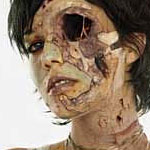 This page has some interesting-looking tutorials on how to use Photoshop (or the GIMP, for the penguinheads) to transform your family and friends and/or random celebrities/supermodels into hideous, decaying ghouls.
(via Boing Boing) ¶ 1
2008/1/15
Paul Torrens, of Arizona State University, has developed a computer model of crowd behaviour in cities, complete with graphics. The possibilities, as is pointed out here, are endless:
Such as the following: 1) simulate how a crowd flees from a burning car toward a single evacuation point; 2) test out how a pathogen might be transmitted through a mobile pedestrian over a short period of time; 3) see how the existing urban grid facilitate or does not facilitate mass evacuation prior to a hurricane landfall or in the event of dirty bomb detonation; 4) design a mall which can compel customers to shop to the point of bankruptcy, to walk obliviously for miles and miles and miles, endlessly to the point of physical exhaustion and even death; 5) identify, if possible, the tell-tale signs of a peaceful crowd about to metamorphosize into a hellish mob; 6) determine how various urban typologies, such as plazas, parks, major arterial streets and banlieues, can be reconfigured in situ into a neutralizing force when crowds do become riotous; and 7) conversely, figure out how one could, through spatial manipulation, inflame a crowd, even a very small one, to set in motion a series of events that culminates into a full scale Revolution or just your average everyday Southeast Asian coup d'état -- regime change through landscape architecture.
Or you quadruple the population of Chicago. How about 200 million? And into its historic Emerald Necklace system of parks, you drop an al-Qaeda sleeper cell, a pedophile, an Ebola patient, an illegal migrant worker, a swarm of zombies, and Paris Hilton. Then grab a cold one, sit back and watch the landscape descend into chaos. It'll be better than any megablockbuster movie you'll see this summer.And here are emotional maps of various urban areas, including parts of London and San Francisco, created by having volunteers walk around them with GPS units and galvanic skin response meters.
(via schneier, mind hacks) ¶ 0
2006/12/14
After a recount in the Victorian state election, the DLP has lost one of its two seats to Labor, who, in turn, have lost one of theirs to the Greens. So now the upper house looks like:
- ALP: 19
- Liberal Party: 15
- Greens: 3
- National Party: 2
- DLP: 1
Meanwhile, political scientists are blaming the election of this bunch of fusty relics (who are rather unlikely to speak for the fabled Silent Majority Of Suburban Battlers) on the above-the-line preferential voting system used to elect candidates. In short, this system works by allowing voters a choice: vote below the line, enumerating your candidates of choice in order from most to least preferred (and there's usually a good 40 or 50 there), or tick the box of one party above the line and automatically vote according to whatever preferences the party has chosen in its various deals. The political enthusiasts who keep up to date with the details of the preference deals are, for the most part, the same tiny minority of voters who can be bothered to vote below the line; meanwhile, the vast majority of voters tick one box and hope for a result with the flavour of their particular party.
IMHO, there is a solution: make above-the-line voting preferential, allowing voters to rank their parties of choice in order, removing control over the exact distribution of the preferences of above-the-line voters from party dealmakers.
2006/12/12
The Democratic Labor Party was a fiercely right-wing Catholic party that split off from the Australian Labor Party in the 1950s because they were seen as too Communistic, and disappeared in all but name after the USSR collapsed. Now, it's back, having won two seats in the Victorian upper house and potentially having the balance of power, assuming that the other parties line up on opposite sites. How does an undead party manage to grab two seats out of nowhere? Largely through preference deals with other parties, who all put them ahead of the dangerously un-Australian, pro-paedoterrorist Greens (thus bringing back another Cold War concept, that of a policy of containment).
Anyway, it's not quite as bad as it could have been; the ALP has 19 votes, the Tories have 15, with the Nationals (i.e., the God and Country party), the DLP and the Greens having two each. Victorian politics may soon start looking more like Italy or Israel, with no one party having a clear mandate and a lot of horse-trading going on behind the scenes. Though whether Labour would rather deal with the Greens or throw a few legislated-morality carrots to the DLP is uncertain.
2006/12/10
Britain's professional recording artists are so angry about their copyrights expiring after 50 years that some even rose from the dead to sign a recording-industry petition for copyright term extension:
If you read the list, you'll see that at least some of these artists are apparently dead (e.g. Lonnie Donegan, died 4th November 2002; Freddie Garrity, died 20th May 2006). I take it the ability of these dead authors to sign a petition asking for their copyright terms to be extended can only mean that even after death, term extension continues to inspire.
(via Boing Boing) ¶ 0
2006/3/30
Intense competition in the global fishing industry has produced some ruthless efficiencies, such as the Chinese zombie ships. Disintegrating, abandoned pirate vessels off the coast of West Africa are being repurposed into clandestine fishing vessels; patched up just enough to remain more or less afloat, the ships never see a port, with crews, supplies and catches being transferred at sea. The economic desperation of those who work on them means that workers often remain onboard for years, and don't kick up a fuss over things such as safety standards, translating into further efficiencies. This is what streamlining looks like in the grim meathook present:
Here's the thing - these ships seldom, or ever, visit a port. They're re-supplied, refuelled, re-crewed and transhipped (unloaded) at sea. The owners and crews don't seem to do any basic maintenance, apart from keeping the engine and winches running. There's no glass in the portholes, and the masts are a mess of useless wiring. These floating deathtraps don't carry any proper safety gear - on one boat, I saw the half-barrel case of an inflatable liferaft being used to store a net.
Back on the Esperanza, we try to put together what we'd witnessed. When asked what it was like 'out there', we answer 'grim'. I wondered how the fishing company could convince these men to spend time living on such dangerous ships, half around the world from their loved ones. Do their families know where they were? These trawlers might be engaged in illegal fishing activities, stealing fish from the countries of West Africa, but it seems that the fishermen themselves are just pawns of some brutal corporate policy, where human life is cheap, and profits take priority.

2005/10/20
A fascinating, if macabre, article hypothesising on the subjects of reanimating the dead and creating various kinds of zombies and golems:
On the other hand, while many higher brain functions are irretrievably damaged after just minutes of cardiac arrest, most of the actual tissue remains "metabolically active and responsive" for at least 24 hours after death, and the hard wiring between neurons probably doesn't change until actual decay sets in. This raises an interesting and somewhat chilling question: What's the subjective experience inside a "dead" brain that continues showing low-level electrical activity for hours or days afterward? This is more than idle daydreaming (or idle nightmaring), because there are also neural pacemakers—intended mainly to treat epilepsy—that introduce small electrical shocks into the brain. A dozen of those would get some interesting currents flowing through the dearly departed neural tissue, and if you networked them with a bit of computing power, and connected them to electrodes on the arm and leg muscles, you might even get something that could "think" and "feel" enough to drag itself along the ground.The article goes on to speculate about the possibility of a modified version of Rocky Mountain spotted fever that can kill hosts whilst producing enough ATP to keep their bodies sufficiently functional to resemble horror-movie zombies.
2005/10/8
Advice on how to prepare for the coming H5N1 flu pandemic. In short: get out of any major city, stockpile at least 3 months' worth of supplies (food, masks, fuel), and assume that civilisation as we know it will collapse. Also good in the event of a zombie holocaust.
(via WorldChanging) ¶ 5
2005/9/30
This is clever: Stanley Kubrick's The Shining reedited into a trailer for a romantic comedy, à la Nora Ephron.
Update: here is a New York Times story about the trailer, which was produced for a competition, and got its editor the attention of people in the industry. And other entrants in the competition include: Titanic as a horror movie and West Side Story as a zombie flick.
(via bOING bOING, lj:jwz) ¶ 2
2005/8/31
Anti-television activists organise a flashmob dressed as zombies descend on the filming of American Idol, protesting the stultifying qualities of the idiot box. Unknown to them, the show's producers had read the ad on Craigslist and decided to appropriate the zombie stunt into their show.
And that is how the zombies ended up squatting down on the concrete of the Erwin Center's second level, signing release forms to allow their images to be broadcast by Fox TV. "Zombies, I need you back here!" Lynn shouted. "All you zombies, I need to get a group shot!" The undead complied, waving their bloodied limbs about for the TV cameras.
The zombies - all except for Plan II senior Mike Ferstenfeld - signed release forms to appear on Fox TV. "We've turned into prostitutes for 'American Idol,'" Ferstenfeld said.
Muntean reports that "American Idol" has asked Chilcote to return in zombie makeup for an audition on the show, but that she will probably decline.And so, the Spectacle absorbs and commodifies dissent once again. Or is it the other way around?
2004/12/1
I just got around to watching Shaun of the Dead, the latest zombie flick to have come out of Britain in the last few years. It was entertaining enough, in a lighthearted way; a cross between a smugly feel-good britcom (it is, after all, from Working Title, who are responsible for most of the British films with mass appeal over the past decade or so) and an early Peter Jackson splatter film; blood, guts, middle-class relationship-issue angst and huge dollops quintessential Englishness. As one would expect from Working Title, it's a stylish package, with meticulous attention to detail (even the cheapness of the zombie effects was undoubtedly art-directed to the last detail, footnoted with references to John Romero and the like), and packed with elements to appeal to as many segments of the audience as possible. It's set in a reasonably leafy, suburban part of North London, considerably more middle-class and pleasant than the high-rises of 28 Days Later (Danny Boyle's edgier brit-zombie flick), and doubly more so than the Ken Loach-esque kitchen-sink grimness of Dead Creatures (the best of the recent wave of British zombie films, in my opinion), and also is a much lighter affair (don't expect meditations on the dark side of human nature or the plight of those who fall between the cracks; this is essentially a feelgood flick; having said that, the film's take on the lasting influences of the zombie phenomenon, with the undead being pressed into service-industry jobs and TV game shows, were amusing, and possibly worthy of expansion).
The cast featured some familiar faces to watchers of recent British TV comedy; one I noticed (from the credit) was Look Around You's Peter Serafinowicz as the barman; Black Books' Dylan Moran also made an entry as an irritatingly smug prig of a housemate.
2004/7/30
This afternoon, I saw the Film Festival screening of Dead Creatures. This is basically a British kitchen-sink social-realist zombie film; in it, zombies are just ordinary people like us, with two exceptions: they have an insatiable craving for human flesh and, over the course of a year or so, their bodies start to decay; their condition is the product of some contagious disease, spread by attacks from other zombies. Other than that, they are fully lucid and aware of their predicament, living for the moment, adjusting to killing to survive, and clutching onto futile hope until the end. The film follows a colony of zombiefied women, as well as a vigilante zombie hunter, and shows all stages of the process: a naïve newly-infected recruit adjusting to the realities of their new life, another late-stage victim, delirious and physically decaying, and between that, others rationalising their predatory habits, agonising about the loss of their futures and lives, and coping with the onset of decay. It borrows heavily from the British kitchen-sink tradition: it's set amidst the social decay of working-class London, and the system is oblivious and uncaring; even the vigilantes who hunt zombies do so for selfish reasons rather than out of idealism.
Dead Creatures was made in 2001, before Danny Boyle's more apocalyptic brit-zombie flick 28 Days Later, and, in some ways, is an excellent horror movie. It uses little in the way of special effects (some very convincing prosthetic makeup, latex models of dismembered limbs and the obligatory cool custom weapon, a zombie-killing bolt gun), but its strength is in capturing the despair and futility of those afflicted; of showing the inevitable end, the countless acts of murder committed in the interim to survive to reach it, and then the journey of one newly afflicted. The reality depicted is grim and affecting; one really empathises with the characters, in a way that goes beyond feeling the usual rollercoaster ride of tension and release, and comes out just about ready to donate to a charity to help ease the zombie plight. One could say that this is a horror film for Guardian readers.
2004/6/16
The Straight Dope answers the essential questions of our time, such as how long would the electricity stay on after the zombies take over:
Now, let's address a scenario where the zombification process is gradual. If the operators and utilities had sufficient advance warning they could take measures to keep the power going for a while. The first thing would be to isolate key portions of the grid, reducing the interties and connections, and then cease power delivery altogether to areas of highest zombie density. After all, it's not like the zombies need light to read or electricity to play Everquest. Whole blocks and zones would be purposely cut off to reduce the potential drains (and to cope with downed lines from zombies climbing poles or driving trucks into transformers). Operators would work to create islands of power plants wherever possible, so if a plant were overrun by zombies and went down it wouldn't drag others down with it. In cooperation with regional reliability coordinators, the plant operators would improve plant reliability by disabling or eliminating non-critical alarm systems that might otherwise shut down a power plant, and ignoring many safety and emissions issues.
2004/3/24
Headline of the day: Zombies defeat robot Jesus. Which is actually about film ticket sales. Meanwhile, zombies have also attacked the RIAA. (via jwz)
While we're on the topic, George Romero's classic zombie film Night of the Living Dead has, by some mysterious means, gone out of copyright (funny; I thought only works made before 1924 or sometime did that), and can now be downloaded here. Download sizes range from 4.1G for MPEG2 (which, I presume, is what you'd burn to a DVD) to a svelte 248.8Mb for MPEG4/DivX.
2003/11/27
Did you know that, in India, zombies are unionised? More specifically, there is a growing number of people (currently estimated at 35,000) being fraudulently declared dead by next-of-kin seeking to take their property, many of whom can't afford the bribes to be declared living again. They have now formed their own lobby group, the Association of the Living Dead. (via bOING bOING)
In tangentally related material (well, maybe not): Daniel Dennett on zombies. (ta, Peter)
2003/11/25
Consciousness researcher Christof Koch claims that we are almost zombies, or rather, that the vast majority of our lives are spent unconsciously, on autopilot: (via bOING bOING)
You drive to work on autopilot, move your eyes, brush your teeth, tie your shoelaces, talk, and all the other myriad chores that constitute daily life. Indeed, he says, Any sufficiently well-rehearsed activity is best performed without conscious, deliberate thought. Reflecting too much about any one action is likely to interfere with its seamless execution.
Given the range and effectiveness of these zombie agents, Koch believes the great mystery is why we are not complete zombies. Or to put it another way: What purpose does consciousness serve? Why does it exist at all?
Consciousness, Koch argues, is a local phenomenon, residing in a specific part of the brain, and serving a specific purpose, and not an emergent property of a complex system, as some have claimed:
In principle, Koch says, there is no reason why consciousness is necessary to life. With enough input sensors and output effectors, it is conceivable that A zombie could pretty much do anything. But since every zombie behavior must be hard-wired, the more situations it must respond to, the more complex its internal mechanism must become. Instead, Evolution has chosen a different path, synthesizing a much more powerful and flexible system that we call consciousness. The main function of this innovation, he and Crick propose, is to enable organisms to deal rapidly with unexpected events and to plan for the future. As Koch likes to say, consciousness puts us online, allowing us to override our instinctual offline programming.
Which lends itself to a possible test for detecting consciousness, and thus differentiating between humans and zombies and other unconscious life:
Since zombie agents operate purely according to preprogrammed rules, a zombie would have no need for short-term memory, and hence Koch believes the absence of this feature would serve as an indication that consciousness was also missing. Consider the following situation: You see an outstretched hand, but instead of shaking it immediately, which instinct would dictate, you are required to close your eyes and wait several seconds before doing so. Koch and Crick suspect that without a short-term memory, a zombie could not do this task, or any other in which an artificial delay was imposed between an input and the associated motor output.
For the moment, he is concentrating not on humans but on biologys most common test subject, the mouse. He and his colleagues are trying to develop a mouse model of consciousness, a rigorous way of determining if and when a mouse is aware. Over the past decade, biologists have learned how to turn individual genes on and off in the developing rodent fetus. With a mouse model of consciousness, Koch could begin to explore what genes are essential for this phenomenon. One question he would like to pursue is whether it is possible to genetically engineer an animal without conscious awareness -- a zombie mouse.
2003/11/6
Via ms45's Rocknerd journal, another free MP3 site: Two Zombies Later, a 2CD collection of lounge/exotica MP3s, complete with printable cover artwork.
2003/8/22
A comprehensive history of the Federal Vampire and Zombie Agency, a branch of the US Government in a parallel universe where infestations of undead were a significant problem. It's sort of like an American equivalent of the British TV series Ultraviolet. (via bOING bOING)
2003/8/14
Mori's Uncanny Valley is the phenomenon in human perception of human-like entities that accounts for people feeling revulsion when they see zombies in a horror movie. Put simply, the theory postulates that the relationship between similarity to human appearance and movement and emotional response is not a straight line; instead, there is a peak shortly before the appearance becomes completely human -- and then response dives into visceral horror, as the not-quite-human object enters the realm of moving corpses, blasphemous abominations and Things That Should Not Be, looking too human, yet somehow loathsomely unnatural. First postulated in the 1970s, the Uncanny Valley theory is behind advise to make all human-like agents/robots look slightly stylised, just enough to appear distinctly non-human and not trigger the sensations of horror.
Via the story of the guy who mistook his girlfriend for a robot -- or rather made a lifelike animated head modelled on said girlfriend's head, and wired with cameras, motors and software. David Hanson, the roboticist in question, is not an adherent of the Uncanny Valley theory, or believes that he can cross said valley and come out at the other side. (via jwz)
2001/8/6
A fascinating piece on voodoo zombie drugs. Yes, they really do exist, and can really turn you into a zombie (if they don't kill you, that is).
The particularly heinous and voodoo twist delivered by tetradotoxin is that this apparently dead person is fully conscious. It is difficult to imagine being pronounced dead in a room full of grieving relatives and you are without the slightest ability to communicate. This is not to mention the pure terror of being buried alive without the ability to render understandable objection. If the victim survives burial or some other horrible fate, the return to the living occurs within a few hours to a few days.
(via Found)
2000/2/9
The latest Narcolombian drug craze: Burundanga, a "zombie powder" which induces total obedience and temporary amnesia. (via Rebecca's Pocket)