The Null Device
Posts matching tags 'skepticism'
2012/2/22
Common characteristics of bad books, in this case popular pseudohistory/woo (think The Holy Blood and the Holy Grail, Chariots Of The Gods, and anything else conjuring up a sweepingly epic, hitherto hidden and irresistibly compelling secret history of the world out of fragments of anecdote, conjecture and hand-waving:
The Second Characteristic of Bad Books: overenthusiastic prefaces by autodidacts. The front matter in bad books usually includes a preface with the following characteristics: the author has had his eyes suddenly opened to the existence of a mystery in a field in which he is not an expert (although he may be an expert in other fields) and the author has discovered the key to unravelling this mystery, a key that has been overlooked, disregarded or suppressed by experts. The introduction to Gavin Menzies' 1421: The Year China Discovered America (2002) opens with the sentence, "Over ten years ago I stumbled upon an incredible discovery, a clue hidden in an ancient map which, though it did not lead to buried treasure, suggested that the history of the world as it has been known and handed down for centuries would have to be radically revised." Menzies, by the way, is a retired naval officer.
A persistent rhetorical sequence in bad books is "assumption creep". Things described in early chapters as speculation or conjecture soon become likely, and are then taken as established facts. The question "Could the Cathar 'treasure' like the 'treasure' Sauniere discovered, have consisted primarily of a secret? Could that secret have been related in some unimaginable way to something that became known as the Holy Grail?" in chapter two has become by chapter nine "For if the Templars are indeed guardians of the Grail...the Grail existed not only in Arthurian times, but also during the Crusades."
But why do people seem to prefer books peddling snake oil to books peddling antibiotics? My guess is that it is exactly those rhetorical features signalling the books' "badness" that account for their popularity. Copious bibliographies and footnotes provide credentials for the author's gravitas. Breathlessly enthusiastic prefaces and claims of unveiling secrets make the reader look for further exciting revelations; and "outsider" status, somewhat paradoxically, can be taken as evidence of the writer's lack of bias. Assumption creep seems to be understood as the writer's growing confidence in his conclusions rather than as the definitional sleight of hand it actually is. Unfulfilled promises of information-to-come in later chapters move the narrative forward while obscuring weaknesses in data, although half-comparisons and the failure to apply Occam's razor probably ought to be red flags to almost anybody.
2010/12/22
British comedian Ricky Gervais writes about why he is an atheist:
Why don’t I believe in God? No, no no, why do YOU believe in God? Surely the burden of proof is on the believer. You started all this. If I came up to you and said, “Why don’t you believe I can fly?” You’d say, “Why would I?” I’d reply, “Because it’s a matter of faith”. If I then said, “Prove I can’t fly. Prove I can’t fly see, see, you can’t prove it can you?” You’d probably either walk away, call security or throw me out of the window and shout, ‘’F—ing fly then you lunatic.”
So what does the question “Why don’t you believe in God?” really mean. I think when someone asks that; they are really questioning their own belief. In a way they are asking “what makes you so special? “How come you weren’t brainwashed with the rest of us?” “How dare you say I’m a fool and I’m not going to heaven, f— you!” Let’s be honest, if one person believed in God he would be considered pretty strange. But because it’s a very popular view it’s accepted. And why is it such a popular view? That’s obvious. It’s an attractive proposition. Believe in me and live forever. Again if it was just a case of spirituality this would be fine. “Do unto others…” is a good rule of thumb. I live by that. Forgiveness is probably the greatest virtue there is. Buts that’s exactly what it is - ‐ a virtue. Not just a Christian virtue. No one owns being good. I’m good. I just don’t believe I’ll be rewarded for it in heaven. My reward is here and now. It’s knowing that I try to do the right thing. That I lived a good life. And that’s where spirituality really lost its way. When it became a stick to beat people with. “Do this or you’ll burn in hell.”
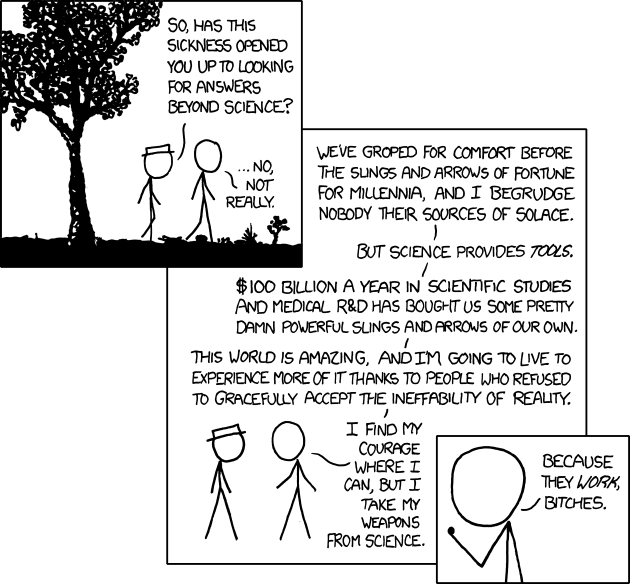
You won’t burn in hell. But be nice anyway.Also, this XKCD:
2010/3/27
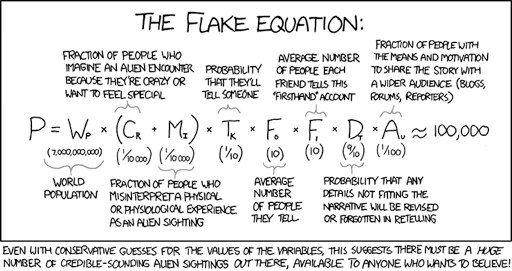
The Flake Equation, or XKCD's (quite plausible) explanation of why alien sightings are to be expected.
2010/1/20
On 30 January, sceptics in the UK are planning to stage a mass overdose on homeopathic products in protest against the promotion of homeopathy as a remedy:
Sceptics and consumer rights activists will publicly swallow an entire bottle of homeopathic 'pillules' to demonstrate that these 'remedies', prepared according to a long-discredited 18th century ritual, are nothing but sugar pills.
The protest will raise public awareness about the reality of homeopathy, and put further pressure on Boots to live up to its responsibilites as the 'scientist on the high street' and stop selling treatments which do not work.
2010/1/18
In South Africa, a group of self-described "electrosensitives" living near a packet radio tower have been demanding that the tower be moved, and claiming that the radio transmissions were causing health problems, including headaches, rashes, insomnia and nausea. Some of the residents reported the health effects subsiding whenever they left the vicinity of the tower, and recurring when they returned, seemingly proving that the tower was the cause of their health problems. The company's claims that the tower emitted less electromagnetic radiation than (less obtrusive-looking) mobile phone cell towers did nothing to sway them. In fact, the residents continued reporting the ill health effects for more than six weeks after the company secretly switched off the transmitter.
At the meeting Van Zyl agreed to turn off the tower with immediate effect to assess whether the health problems described by some of the residents subsided. What Craigavon residents were unaware of is that the tower had already been switched off in early October – six weeks before the November meeting where residents confirmed the continued ailments they experienced.
“At the meeting in mid-November residents claimed that full recovery of skin conditions could take as long as 6 weeks. Yet, the tower was switched off for more than 6 weeks by this time,” said Van Zyl. “At this point it became apparent that the tower can, in no way, be the cause of the symptoms, as it was already switched off for many weeks, yet the residents still saw symptoms that come and go according to their proximity to the area.”It appears that some of the residents were adversely affected by the sight of a large, imposing, potentially radiation-emitting tower, and others swayed by the corroborating evidence of their reactions, became convinced that they were affected as well, triggering an epidemic of psychosomatic illness. In any case, the residents' groups, unswayed by anything as mundane as reason, have vowed to continue their legal action.
(via BoingBoing) ¶ 0
2009/5/27
The Guardian invite people to put questions to alternative health product chain (or perhaps "snake oil peddlers") Neal's Yard Remedies, and get more than they probably bargained for:
"Influenza Ainsworth Homoeopathic Remedy": Your website sells this product. What evidence do you have that this product is of any benefit whatsoever? Did you know people die of flu?
Does your part in the MMR scare make you feel guilty? Do you feel bad when you think of the children who have suffered measles and possibly even had brain damage or died because of the scare which you promote?
Could you please explain how the 'correct homoeopathic remedy' is decided on and describe the qualifications of the people who make these decisions?
I'd also be grateful for a biological definition of 'healing energy' and an indication of where I can find the scientific evidence for its existence.
Finally, would Neal's Yard like to dispute the claim that they are using "sciencey" language in the wrong context to provide a smokescreen of credibility and, some would say unethically, lure people into purchasing "medicines" which are known by the company to be ineffective?
What is the ethical difference betweenThree pages into this, The Graun's moderator chimes in, announcing that Neal's Yard Remedies have decided that they won't be participating in this discussion. (They didn't give a reason; I'm guessing that all those peer-reviewed double-blind tests validating homeopathy are proving harder to track down than they anticipated.) Anyway, in lieu of their reply, here is a transcript of an 2008 interview with their "Medicines Director" Susan Curtis, arguing that their homeopathic "anti-malaria medicine" is legitimate despite the lack of any clinical tests.
a) company x selling "remedies" for which it has no empirical evidence of efficiency, and can lead to the death of adherents in extreme cases, and excusing it with anecdotal evidence from its customers, and
b) company y selling tobacco products, which can lead to severe health problems, challenging any empirical evidence of harm, and justifying its self on the basis of the enjoyment of its customers?
2008/4/7
Charlie Brooker gets stuck into Brain Gym, a set of alleged brain-enhancing exercises with scant connection to any verifiable reality, which has nonetheless managed to get into the British school system (presumably because the line of bullshit it shills sounds like "fun"):
Brain Gym, y'see, is an "educational kinesiology" programme designed to improve kiddywink performance. It's essentially a series of simple exercises lumbered with names that make you want to steer a barbed wire bus into its creator's face. One manoeuvre, in which you massage the muscles round the jaw, is called the "energy yawn". Another involves activating your "brain buttons" by forming a "C" shape with one hand and pressing it either side of the collarbone while simultaneously touching your stomach with the other hand.
If we mistrust the real world so much that we're prepared to fill the next generation's heads with a load of gibbering crap about "brain buttons", why stop there? Why not spice up maths by telling kids the number five was born in Greece and invented biscuits? Replace history lessons with screenings of the Star Wars trilogy? Teach them how to whistle in French? Let's just issue the kids with blinkers.
Because we, the adults, don't just gleefully pull the wool over our own eyes - we knit permanent blindfolds. We've decided we hate facts. Hate, hate, hate them. Everywhere you look, we're down on our knees, gleefully lapping up neckful after neckful of steaming, cloddish bullshit in all its forms. From crackpot conspiracy theories to fairytale nutritional advice, from alternative medicine to energy yawns - we just can't get enough of that musky, mudlike taste. Brain Gym is just one small tile in an immense and frightening mosaic of fantasy.
2008/3/27
In 2002, Teresa Nielsen-Hayden wrote up a taxonomy of the various forms virtually all fraud falls into, from pyramid schemes to promises of inside information to variants of classics like the "Spanish Prisoner", to the numerous "tax protest" frauds rife among the mad-as-a-rattlesnake class in the US. Anyway, amongst the illuminating commentary, there is the following insight:
A couple of days ago I finally put my finger on something I’ve been sensing but not grasping—you know, one of those itchy back-of-the-brain apprehensions that there’s a pattern here, only you can’t quite see what it is. Somehow it’s felt like literary analysis. The question is, why do these scams—inheritance cons, MLMs, tax dodges, Make Money Fast, hot stock tip swindles, et cetera—take the forms they do?
What did it was looking at my list of basic scams and observing that what they have in common is the promise of lucrative, risk-free investments. Lord knows the things exist, I thought, but nobody ever gives them away. In theory, high rates of return are the investor’s payoff for taking on higher-risk investments. Achieving that happy state of all payoff and no risk is the main reason the wealthy and powerful manipulate the system.
Oh.
These scams take the forms they do because they’re parodies—no, a better way to put it: they’re cargo-cult effigies—of the deals the ruling class cut for themselves. If you’re an insider, if you have the secret, you can have a job where you make heaps of money for very little work. You can avoid paying your taxes. You can inherit a pile of money because an ancestor of yours left a moderate fortune that’s been appreciating ever since. You can be your own boss. You can have other people working for you, who have other people working for them, who all pay you a percentage of the take.Which, when applied to get-rich-quick schemes, from scams and frauds to perfectly honest (if dumber than a sack of hammers) ideas based on visualisation, prayer, ritual or other forms of magical thinking (such as "the Secret", as found in the self-help sections of bookshops across the US), makes perfect sense. The original cargo cults consisted of Melanesian islanders who, upon witnessing American airmen arrive during World War 2 with food rations, clothing and other useful goods (whose provenance their culture had not equipped them to understand), reasoned that these goods must be boons from the gods and that, if they carried out the same rituals as the Americans (i.e., parading in handmade US Army uniforms, building makeshift runways and control towers), they would reap the same benefits. Could it not be that this magical mode of thinking is not purely the province of "primitive" cultures, but is an idiosyncracy of the human mind's irrational pattern-matching tendencies, the same tendencies that attribute misfortune to elaborate (and unfalsifiable) conspiracies over mere chance? After all, our instincts say, there must be a man behind the curtain.
Elsewhere in the article, there is the following observation about one persistent category of frauds: the ever-thriving business of telling people that they don't really need to pay taxes, and that, for a fee, they can know the secret of how to get away with not paying it (which, unsurprisingly, seldom works):
Somewhat humorously, in several cases where the IRS has gone after promoters of “Don’t File” schemes, it was determined that the promoter—while advocating not filing returns—had been filing their returns all along. This really isn’t surprising, since most of the promoters will secretly confide that they really don’t believe these theories either, but it makes them good money.
2008/3/26
Pandit Surinder Sharma, avowedly India's most powerful black magician, claimed on television to be able to magically kill any person within three minutes. The president of Rationalist International, Sanal Edamaruku, took him up on that, with unsurprising results:
After nearly two hours, the anchor declared the tantrik’s failure. The tantrik, unwilling to admit defeat, tried the excuse that a very strong god whom Sanal might be worshipping obviously protected him. “No, I am an atheist,” said Sanal Edamaruku. Finally, the disgraced tantrik tried to save his face by claiming that there was a never-failing special black magic for ultimate destruction, which could, however, only been done at night. Bad luck again, he did not get away with this, but was challenged to prove his claim this very night in another “breaking news” live program.Sharma repeated his attempt on Sanal's life some hours later, at night, with millions of people watching; the attempt ended with the magician cutting a dough effigy with a knife and throwing it into a fire, with Sanal laughing, and with black magic's prestige taking a battering throughout India.
(via Boing Boing) ¶ 0
2005/4/27
New-age guru turned skeptic and sociologist Karla McLaren on differences in the way skeptics and new-agers think:
For instance, an understanding of cold reading would have helped me a great deal. I never knew what cold reading was, and until I saw professional magician and debunker Mark Edward use cold reading on an ABC News special last year, I didn't understand that I had long used a form of cold reading in my own work! I was never taught cold reading and I never intended to defraud anyone - I simply picked up the technique through cultural osmosis.
People in my culture have heard you and we're trying to answer - but we don't understand you. Our cultural training about the dangers of the intellect makes it nearly impossible for us to utilize science properly - or to identify your intellectual rigor as anything but an unhealthy overuse of the mind.
We love to say that we embrace mystery in the New Age culture, but that's a cultural conceit and it's utterly wrong. In actual fact, we have no tolerance whatsoever for mystery. Everything from the smallest individual action to the largest movements in the evolution of the planet has a specific metaphysical or mystical cause. In my opinion, this incapacity to tolerate mystery is a direct result of my culture's disavowal of the intellect. One of the most frightening things about attaining the capacity to think skeptically and critically is that so many things don't have clear answers. Critical thinkers and skeptics don't create answers just to manage their anxiety
Meanwhile, a revert war seems to have opened up in the Wikipedia entry on Witchcraft; it started when a bunch of fuzzy-bunny pagans took offense with the part of the article which contradicted their belief that witchcraft was the same unified, benign and generally warm and fluffy thing throughout centuries, rejected the validity of all the sources cited for this (partly because the "secret oral tradition" they know says otherwise, and what would some stuffy academic who's not part of it know?), and vowed to enlist their friends' help to ensure that their point of view prevails.
Quite frankly, I don't care what you think. If you post further erroneous statements, I will not hesistate to remove them. Moreover, I'm sure I can easily recruit a thousand or so neo-pagans that would be more than willing to devote a little of their time to keep Wikipedia's entry on witchcraft free of your hostile and inaccurate statements
(via  reddragdiva) ¶ 0
2003/9/9
Researchers in Manchester have shown that infrasound can induce anxiety, sorrow and chills, as well as other weird sensations. Extreme subsonic vibrations and their effects on the human nervous system may be behind the phenomena of "haunted" locations. Could this be a hint of what's on at the next What Is Music? festival.
2003/8/20
A recently published study, tracking the lives and personality traits of over 2,000 people born within minutes of each other, has proved that astrology is bunk. The looked at more than 100 different characteristics, including occupation, anxiety levels, marital status, aggressiveness, sociability, IQ levels and ability in art, sport, mathematics and reading, all of which astrologers have claimed can be gauged from someone's star chart, and failed fo find any evidence of similarities between the candidates. Not surprisingly, astrologers' groups are hopping mad, with some promising to complain to the editors of the journal which published this research:
Roy Gillett, the president of the Astrological Association of Great Britain, said the study's findings should be treated "with extreme caution" and accused Dr Dean of seeking to "discredit astrology".
It remains to be seen whether this research will put a dent in the booming astrology industry; surveys suggest that a majority of people in Britain believe in astrology, and this has led to things like "financial astrology" consultancies popping up to part high-flying businessmen from their excess money. Though, if astrology goes out of fashion, some new or newly-revived absurdity will undoubtedly crop up to replace it.
2003/2/8
Via Peter's as always astute blog, Butterflies and Wheels, an online article site dedicated to fighting "fashionable nonsense", such as postmodernism, ideological denunciations of entire areas of research, ideologically-sound pseudoscience and the woolly-headed Freudian-Marxist claptrap that haunts institutions of higher education. Have a look at their glossary, for example.
2002/10/3
The Skeptic's Dictionary, an encyclopædia of fringe beliefs, bizarre ideas and logical fallacies (and a few sensible ideas too). If you were wondering about therapeutic trepanation, the Hollow Earth theory, or identifying vinyl records by sight or that hundredth-monkey phenomenon the true believer in your life keeps citing to show how pitifully limited science is, and thus justify (Creationism/urine therapy/their telepathic poodle's past-life experiences), it's all here, along with the skinny on what's really going on.
2002/8/23
A European skeptic investigates the strange case of Rudolph Fentz, a man attired in 19th-century clothing who mysteriously appeared in Times Square in 1950 and was killed by a car; when his body was examined, police found a letter addressed to Fentz, who had disappeared in 1876. Or had he? (via rotten.com)