The Null Device
Posts matching tags 'copyfight'
2013/1/13
Aaron Swartz, esteemed hacker, co-creator of Reddit and inventor of the RSS 1.0 standard, committed suicide recently. Swartz was facing trial for illegally downloading a cache of academic documents from closed academic publishing site JSTOR (as pure a rent-seeking monopoly as exists, extracting lucrative sums from academic libraries and private user alike for access to academic papers which they contributed nothing to the creation of) by placing a laptop in a closet at MIT and fraudulently changing the laptop's MAC address to give it access to MIT's protected network, and apparently also for having pissed off the FBI at some point. There was no evidence of him having made any of the papers available to the general public, but nonetheless, the US Department of Justice decided to make an example of him, pushing for a sentence of 30-50 years.
- Copyfight advocate Lawrence Lessig on the disproportionate hounding of Swartz by the DoJ.
- The Truth about Aaron Swartz’s “Crime”, by computer security expert Alex Stamos, who served as an expert witness at the trial.
- Tributes from Tim Berners-Lee, and from the WikiMedia Foundation
In 18th-century England, when they hanged a highwayman, his corpse would be dipped in tar and hung in an iron cage along the side of a highway, as a grim warning to any others contemplating a career of highway robbery. From the point of view of the US Department of Justice, or more specifically, the rent-seeking corporations licensed to make money from the intellectual property system as it stands today, Swartz, with his radical views on open access to information, was the modern-day equivalent of a highwayman, an enemy of the system of intellectual property licensing and the structures of ownership and control built atop it, shoring up the stabilities of the status quo. Were he convicted (or bankrupted by the costs of defending himself), he would have served as the tarred corpse swinging in a gibbet alongside the Information Superhighway, an equally grim warning to any aspiring Information Superhighwaymen that you don't fuck with intellectual property, ever. Or, in other words: if you break the law, the law will break you. An upheld conviction, however, was no guarantee. Dead, arguably, he can serve the same role just as well, without the risk of him being released on appeal. To others, he will be a martyr for the Copyfight and/or an example of the iniquities of a system run for the benefit of corporate rentiers.
2012/12/19
The latest front in the War On Piracy: Britain is setting up a national intellectual property crime unit to hunt down illegal downloaders wherever they may hide. The most interesting thing about this news is that the unit, which will operate across the length and breadth of Britain, will be part of the City of London Police; that's right: a national specialist unit that's part of the local constabulary of one square mile of a city.
The reason for this, presumably, has to do with the unique governance of the City of London, a system inherited from the feudal era and adapted seamlessly to the neoliberal age. Being the corporate centre of Britain's finance industry, the City's office bearers are elected by the corporations who have offices in the square mile; each corporation's share of votes is proportional to its global employee count. As such, it is the ideal post-democratic governing model for the New World Order, reflecting the realities of neoliberalism far more efficiently than the alternative of “democracy plus lobbyists plus corporations-are-people plus unlimited campaign expenditure” (as seen in the US) does.
The City of London taking responsibility for enforcing corporate monopolies on cultural exchange (“intellectual property”) across the land could be merely an early step in its ascension to being a branch of Britain's government, and one which wields real power. Perhaps in a few decades' time, we will see the parliaments of Westminster and Holyrood (by then, packed with a motley crew of wild-eyed socialists, foamy-mouthed right-wing populists and Pirate Party types) reduced to student union-style talking shops with no real power, with executive decisions devolved to the City of London's eminently level-headed corporate appointees?
2012/1/25
After the US film industry tried to buy a law outlawing the internet as we know it, the internet is striking back: Paul Graham's venture-capital startup Y Combinator is now planning to explicitly fund driving Hollywood into extinction, before the dying beast drags anything worth saving into the tarpit it's sinking in:
Hollywood appears to have peaked. If it were an ordinary industry (film cameras, say, or typewriters), it could look forward to a couple decades of peaceful decline. But this is not an ordinary industry. The people who run it are so mean and so politically connected that they could do a lot of damage to civil liberties and the world economy on the way down. It would therefore be a good thing if competitors hastened their demise.
That's one reason we want to fund startups that will compete with movies and TV, but not the main reason. The main reason we want to fund such startups is not to protect the world from more SOPAs, but because SOPA brought it to our attention that Hollywood is dying. They must be dying if they're resorting to such tactics. If movies and TV were growing rapidly, that growth would take up all their attention. When a striker is fouled in the penalty area, he doesn't stop as long as he still has control of the ball; it's only when he's beaten that he turns to appeal to the ref. SOPA shows Hollywood is beaten. And yet the audiences to be captured from movies and TV are still huge. There is a lot of potential energy to be liberated there.Meanwhile, after former US senator turned MPAA representative Chris Dodd made dire warnings to US politicians that Hollywood may not fund their campaigns if they don't comply in passing the laws they have bought, a petition was started on the Whitehouse website to have him investigated for attempted bribery. The petition is unlikely to result in an official investigation, but has, in less than a week, gathered the 25,000 signatures required to oblige the Whitehouse to respond.
2011/9/21
 More on the Pirate Party's recent electoral success in Berlin: Der Spiegel asks who the Pirate Party are (spoiler: they're the new Greens):
Voter analysis from Sunday would seem to back up that assessment. The survey group Infratest established that 17,000 former Green Party supporters switched their votes to the Pirate Party on Sunday, more than came from any other party. The SPD lost 14,000 voters to the Pirates and the far-left Left Party 13,000.
The party's largest coup, however, came from its ability to attract fully 23,000 people to the polls who had never voted before. More votes came from former East Berlin, where the party secured 10.1 percent of the vote, than from former West Berlin. Most of the party's supporters are young, well-educated men -- as are 14 of the 15 Pirates who will now take their seats in the Berlin city-state parliament.And a Spiegel survey of editorials from various German newspapers (conveniently annotated with their political slants) links the Pirate vote to the rise of the laptop-and-latte generation in Berlin, a city now said to be Europe's IT start-up hub. Which raises the question of whether the Pirates are a progressive party for an age of gentrification.
Meanwhile, the Grauniad asks whether something like that could happen in Britain. (Spoiler: not in a first-past-the-post system, and Britain's politicians also seem less technologically clueful, and more beholden to the old-media powerbrokers, than Germany's:)
The German government was one of the first to decide that national-security systems should not be based on proprietary software. In such a climate it's predictable that a campaigning political party with a radical online agenda would find a ready audience. The bovine way in which the last House of Commons passed Lord Mandelson's digital economy bill, with its clueless 'anti-piracy' provisions, does not exactly engender confidence in the British political class's understanding of these matters.
2011/9/19
As the world celebrated Talk Like A Pirate Day (with the true hardcore eschewing the "yarrr"s and brushing up on their Somali), the good burghers of Berlin have done one better; there, the Pirate Party has won some 14 or 15 seats in the city-state's 149-seat parliament; about half as many as the Greens and slightly fewer than the neo-Communist Left Party.
Indeed, the support for the party -- founded in 2006 on a civil liberties platform that focused on Internet freedoms -- was sensational. Not only will the Pirate Party enter a regional government for the first time, but its results far surpassed the five percent hurdle needed for parliamentary representation. The success was so unexpected that the party had only put 15 candidates on its list of nominations. Had their support been just a little higher, some of their seats would have remained empty because post-election nominations of candidates isn't allowed.Many of the seats came at the expense of the neoliberal Free Democrats, who were wiped out in Berlin. The Pirate Party (which started campaigning on a copyright-reform and online privacy platform, and expanded this to include the decriminalisation of drugs, the abolition of Germany's church tax system and a basic living wage for all), in fact, seems to be taking over the mantle of forward-looking progressive party from the Greens, who were once considered dangerous radicals (in the Reagan-era action film Red Dawn, the Greens winning West German elections was the catalyst that led to a Soviet invasion of the USA) but now have become all but part of the establishment.
The Pirates also have something other parties have long since lost -- credibility, authenticity and freshness. The erstwhile alternative Greens, whose share of the vote in the Berlin election fell well behind their expectations, were also once the young party with funny mottos and unconventional campaign methods. When they entered the Berlin parliament in 1981, other parties were skeptical. At the time, the now imploding Free Democrats described the Greens as "domestic policy anarchists and foreign policy gamblers", while lead CDU candidate Richard von Weizsäcker, who would later be appointed German President, said they were "impossible to describe."It used to be that the concept of "Green" (i.e., ecological consciousness and sustainability) was the hook to hang progressive ideals from; now, it seems, that the idea of the Pirate (as defined in opposition to the propaganda of Big Copyright, the steady privatisation of the public sphere and an encroaching authoritarian surveillance state) may be replacing the idea of Greenness as the banner that draws in progressives.
2011/4/12
This week, the European parliament will vote on extending the copyright term for sound recordings to 70 years, a vote made possible by Denmark dropping its opposition. The extension, if it passes (which is likely), will do for the next 20 or so years until valuable corporate monopoly rights are once again threatened by the encroachment of the public domain. And so on, at least until the powers that be judge that the metaphor of "intellectual property" as a natural right is sufficiently embedded in the public consciousness that they can dispense with the increasingly flimsy pretense of copyright being a limited, short-term trade-off for the public good, and scrap the expiry of copyrights once and for all.
Meanwhile, here is a very insightful article setting out exactly why copyright law as we know it is broken; i.e., that powerful vested interests have hijacked the regulatory mechanisms, and subverted a compromise for the public good into being purely about reinforcing private benefit:
Here’s a slightly absurd example: make it so that in Britain, only the Royal Shakespeare Company can perform Shakespeare. They would be granted exclusive rights in perpetuity to perform Shakespeare. They would do fantastically out of it. They could charge through the nose, and make bucket loads, because there would be no other way of seeing Shakespeare being performed.
There is no public good being served here except in a secondary fashion (the company would be taxed and those taxes could be used to provide public services etc.). Indeed, a great deal of public harm is being done because a culture where only one theatre company are allowed to perform Shakespeare is a much worse off culture. What if someone wants to come along and do a radically different interpretation of the same play? Like, oh, set Romeo and Juliet in New York City and replace the houses of Montague and Capulet with two teenage street gangs roughly based on Italian Catholics and Jews. Or perhaps replace them with the Israelis and Palestinians (West Bank Story). Or perhaps some new interesting technology like cinema or radio happens and you want to adapt it to the new technology.
2010/12/26
Rick Falkvinge, a member of the Swedish Pirate Party, claims to have received copies of US embassy cables (from the Wikileaks archive) exposing the full extent to which the US government has been dictating Sweden's actions on copyright laws and the prosecution of The Pirate Bay. (The original article is here; an English translation may be found here; and the cables detailing US requirements for online surveillance provisions against file-sharing are here.) If this is true, then the Swedish government is even better at following orders from Washington than Britain is, despite its carefully managed image of nonalignment. This follows closely revelations that Sweden is a secret member of NATO, with military and intelligence cooperation being concealed from its parliament.
2010/12/17
Bruce Schneier has an essay about what IT security will look like in 10 years' time:
There’s really no such thing as security in the abstract. Security can only be defined in relation to something else. You’re secure from something or against something. In the next 10 years, the traditional definition of IT security— that it protects you from hackers, criminals, and other bad guys— will undergo a radical shift. Instead of protecting you from the bad guys, it will increasingly protect businesses and their business models from you.
Cory Doctorow rightly pointed out that all complex ecosystems have parasites. Society’s traditional parasites are criminals, but a broader definition makes more sense here. As we users lose control of those systems and IT providers gain control for their own purposes, the definition of “parasite” will shift. Whether they’re criminals trying to drain your bank account, movie watchers trying to bypass whatever copy protection studios are using to protect their profits, or Facebook users trying to use the service without giving up their privacy or being forced to watch ads, parasites will continue to try to take advantage of IT systems. They'll exist, just as they always have existed, and like today security is going to have a hard time keeping up with them.
2010/7/12
Via Daring Fireball, an article blowing open the shadowy web of connections between the open-source/copyright reform movement and Google's world domination plans. It seems that there is a sinister power bankrolling the freetards' campaign to destroy intellectual property (and thus civilisation as we know it), and that power is none other than Moscow Peking Mountain View. Or something like that.
2010/5/3
Did you know that, if you shoot any video with a modern digital video camera and attempt to utilise it commercially, the holders of the video encoder patents are entitled to royalties on each copy made? This is why, for instance, all digital video cameras, up to the highest-end HD ones, are licensed only for non-commercial use; commercial users need to negotiate with a shadowy private consortium named MPEG-LA:
I was first made aware of such a restriction when someone mentioned that in a forum, about the Canon 7D dSLR. I thought it didn't apply to me, since I had bought the double-the-price, professional (or at least prosumer), Canon 5D Mark II. But looking at its license agreement last night (page 241), I found out that even my $3000 camera comes with such a basic license. So, I downloaded the manual for the Canon 1D Mark IV, which costs $5000, and where Canon consistently used the word "professional" and "video" on the same sentence on their press release for that camera. Nope! Same restriction: you can only use your professional video dSLR camera (professional, according to Canon's press release), for non-professional reasons. And going even further, I found that even their truly professional video camcorder, the $8000 Canon XL-H1A that uses mpeg2, also comes with the exact same restriction. You can only use your professional camera for non-commercial purposes. For any other purpose, you must get a license from MPEG-LA and pay them royalties for each copy sold.Even worse: uploading video shot with one of those cameras in a free codec doesn't help, because exporting it to the free codec violates the licensing terms, and also it's not unlikely that all modern codecs fall foul of MPEG-LA's patents.
And that's how an artistic culture can ROT. By creating the circumstances where making art, in a way that doesn't get in your way, is illegal. Only big corporations would be able to even grab a camera and shoot. And if only big corporations can shoot video that they can share (for free or for money), then we end up with what Creative Commons' founder, Larry Lessig, keeps saying: a READ-ONLY CULTURE.
2010/4/15
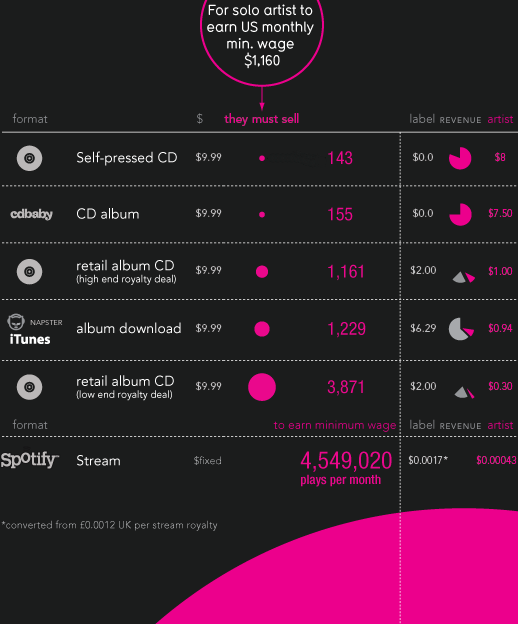
This is what your internet access must be sacrificed for: an infographic showing how much money musicians actually earn from each means of selling music, in the form of how many units they'd have to shift to make minimum wage, along with how much the all-important middle man takes. While an artist could live (modestly) on 143 home-burned CD-Rs a month, they'd need to sell almost ten times that many retail CDs (if they have an exceptionally good royalty deal), or on iTunes. The scales get positively Jovian as we approach new streaming services like Spotify:
The War on Copyright Piracy has many uses: in Kyrgyzstan, for example, the government is using the pretext of anti-piracy raids to shut down opposition media, by having goons with alleged Microsoft affiliations seize computers:
Stan TV employees told CPJ that police were accompanied by a technical expert, Sergey Pavlovsky, who claimed to be a representative of Microsoft’s Bishkek office. According to the journalists, Pavlovsky said he had authorization papers from Microsoft but was unwilling to show them. After a cursory inspection of the computers, they said, Pavlovsky declared all of the equipment to be using pirated software. Stan TV’s work computers, as well as the personal laptops of journalists, were seized; the offices were also sealed, interrupting the station’s work.Microsoft have disowned any connection to the raid.
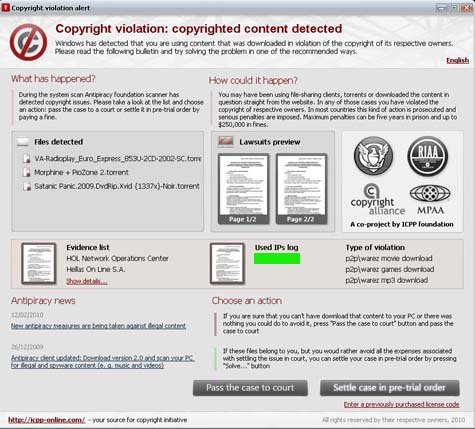
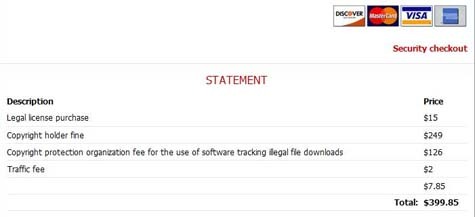
Meanwhile, enterprising malware entrepreneurs have jumped onto the copyright lawsuit bandwagon; a new piece of malware for Windows scans users' hard drives for torrents, and threatens the users with lawsuits, demanding payment by credit card:
(via Boing Boing, Download Squad) ¶ 0
2009/11/18
Some good news on the free data front: the New Labour government, in its desperate attempts to claw back the status of lesser evil, has vowed to make all Ordnance Survey maps freely available, ending the OS's practice of licensing said data for exorbitant fees and under restrictive terms, and bringing Britain into line with the US (where US Geological Survey data is statutorily in the public domain):
The government has been inspired by the success of crime mapping where "data openness" is helping citizens assess the safety of geographical areas.
In the new year Brown intends to publish 2,000 sets of data, possibly including all legislation, as well as road-traffic counts over the past eight years, property prices listed with the stamp-duty yield, motoring offences with types of offence and the numbers, by county, for the top six offences.It is thought that among the data to be freed will be railway and bus timetables, currently being licensed under monopoly rents by privatised companies. (For example, those wanting National Rail timetables on the iPhone, and not wishing to reload the web page and zoom in on form fields every time, have to buy a £4.99 application. There was a free app, written by a user, but its access to the data was blocked by the rightsholders. The National Rail Enquiries application is currently the 10th highest grossing application in the UK App Store, undoubtedly making the publisher, Agant Inc., a mint out of the public.)
The Ordnance Survey are of course keen to protect their revenue streams, and argue that freeing their data would cost the government vast sums; an independent study at Cambridge University, however, showed that the costs of freeing the data (£12m) would be overwhelmingly outweighed by a net gain of £156m. A significant proportion of this would undoubtedly come from the slices of council tax and other funds currently being paid to the Ordnance Survey to license this data:
Local authorities also spend a lot of money getting access to Ordnance Survey. Swindon recently had to pay the OS £38,000 a year to use its addresses and geographical data, even though it had collected much of the data.Of course, the devil is in the details. For all we know, the plan to free the data could be a purely cosmetic gesture comprised of little more than hot air and New Labour spin, offering the "freed" data under such onerous terms as to make it unusable. Though if it does live up to the promise, it will be a bold step in the right direction.
2009/10/3
The British postcode system, one of the things which Britain arguably does better than anyone else, is 50 years old. The system divides the entire UK into alphanumeric postal districts organised in a hierarchy, with the first one or two letters denoting a postal area (typically a city or the environs of one, though London has several). Unlike systems elsewhere (such as the US, Australia, and most of Europe), it doesn't stop at the neighbourhood level, with each 5-to-7-character full postcode denoting a segment of a street. This makes it useful for applications other than addressing mail, such as navigation; as such, you can enter a postcode into Google Maps or a satellite navigation unit and be shown exactly where it refers to.
Unfortunately, though, the database of postcodes and their locations is another victim of the British institutional custom of copyrighting taxpayer-funded databases and licensing them only at great expense and under onerous terms (see also: the Ordnance Survey), effectively restricting them to moneyed corporations. However, there are several unofficial efforts to assemble this data from scratch and release it into the public domain.
2009/7/29
The latest dispatch from the Long Siege: in the US, the EFF is arguing that users of devices such as the Apple iPhone should have a right to "jailbreak" them, i.e., to circumvent mechanisms which prevent them from installing software unapproved by the manufacturer. Apple have countered this with a dire warning that jailbroken iPhones could be a terrorist weapon, with the capability to bring America's communications infrastructure to its knees:
By tinkering with this code, “a local or international hacker could potentially initiate commands (such as a denial of service attack) that could crash the tower software, rendering the tower entirely inoperable to process calls or transmit data,” Apple wrote the government. “Taking control of the BBP software would be much the equivalent of getting inside the firewall of a corporate computer — to potentially catastrophic result.To their credit, Apple didn't actually use the T-word, but they insinuated it pretty hard, and added to that the possibility of drug traffickers using hacked phones to make anonymous phone calls. Hey Apple, don't forget about the paedophiles; surely they'd find some nefarious use for jailbreaking as well.
The EFF's experts, meanwhile, have called bullshit on the whole thing.
red von Lohmann, the EFF attorney who made the request, said Apple’s latest claims are preposterous. During a May public hearing on the issue in Palo Alto, California, he told regulators there were as many as a million unauthorized, jailbroken phones.
He added that, if Apple’s argument was correct, the open-source Android phone from Google on T-Mobile networks would also be a menace to society. ”This kind of theoretical threat,” von Lohmann said, “is more FUD than truth.”Of course, if unauthorised clients on the phone network are such a threat, then merely keeping jailbreaking technically illegal wouldn't deter actual paedoterrorists; a threat of such severity could only be countered by declaring possession of jailbroken phones to be a terrorist act and actively hunting down and prosecuting transgressors under national security laws, using the full surveillance infrastructure of the Department of Homeland Security. Perhaps that's what Apple are hoping for?
Meanwhile, the very same week, Apple have demonstrated why users have an interest in jailbreaking their gadgets, by banning all Google Voice applications from the App Store, reportedly at the behest of phone companies not wanting their cozy business models upset. And some are speculating that Spotify's much-anticipated iPhone client may be rejected by Apple, due to it competing with iTunes.
2009/5/24
Regarding the last post about last.fm: one of last.fm's staff has posted a rebuttal on their web forums, to wit:
* Nobody at Last.fm had any knowledge of our user data being fed to the RIAA (or any labels directly), before or after the alleged incident, or at any other point in the history of the company.Make of that what you will. Assuming the denials are true, last.fm and/or CBS will have no choice but to sue TechCrunch for libel to protect their reputation; it'll be interesting to see how that unfolds.
* Last.fm has never given data linking IP addresses and scrobbles to any third party. * Last.fm has never given data linking IP addresses and scrobbles to CBS (who, by the way, we don't consider a third party, but who do have to uphold our privacy policy).
* We've been in communication with CBS and they deny that they gave any third party any of our user data.
If TechCrunch have any evidence which contradicts any of the statements I've made here, I'd love to see it, but I think someone is taking them for a ride. I'm not sure why, though.
Nonetheless, even if this isn't true, the possibilities it raises are thought-provoking:
- Last.fm's scrobbling software originally sent over only the title, artist and length of tracks as they were played. More recently, it was extended to send a fingerprint of each track. The difference between these two is crucial; it is the difference between hearsay and admissible evidence. In short, when you scrobble a track using the last.fm client, it sends over cryptographic proof of your possession of the recording. You can disable the fingerprinting function in the last.fm client software, assuming that you trust it, of course:
- How much you trust last.fm's closed-source client software is another matter. Assuming that last.fm had been compromised by the MAFIAA, what's to say that the software didn't trawl your hard drive for things that looked like MP3s (slowly, as not to arouse suspicion), fingerprint them, and then send the list over to MediaSentry or someone, along with some juicy forensic information about your machine (serial numbers, MAC addresses, &c.)?
- Of course, this would be totally illegal and even more unethical. But, then again, so would waiving the EU's privacy laws to send user identifying information to CBS (as is alleged). And it's not like the RIAA haven't been known to use underhanded tactics in their dirty war against music fans.
- Even assuming that last.fm are 100% above board and CBS are sufficiently law-abiding to not undermine them, handing over potentially compromising information imples a trust that the information will be kept secure; i.e., that there are no weak links. Given the fact that everybody from TK Maxx to Her Majesty's Government seems to leak personal information left, right and centre, this may not be a safe assumption.
Further corroboration of the claim that last.fm handed over user data to the RIAA's enforcement arm, or rather that their parent company requested the data "for internal use only" and then handed it over. Of course, the good folks at last.fm had nothing to say in it, and their denials were sincere, but that doesn't diminish the fact that, if the allegations are true, last.fm (owned by Big Copyright corporation CBS) is now effectively part of the RIAA's intelligence-gathering apparatus:
We provided the data to the RIAA yesterday because we know from experience that they can negatively impact our streaming rates with publishers. Based on the urgency of the request they probably just wanted to learn more about the leak but who knows. Seriously, can you blame them? [______] Our ops team provided the usual reports along with additional log data including user IP addresses. The GM who told them to do it said the data was for internal use only. Well, that was the big mistake. The team in the UK became irate because they had to do it a second time since we were told some of the data was corrupted. This time they transferred the data directly to them and in doing so they discovered who really made the request.Meanwhile, in this thread, several last.fm staff members swear up and down that this didn't happen, and would not have happened, as it would have been against EU data-protection laws and triggered too many red flags. Which could be true, or it could be a plausible cover story. (The RIAA and their goons aren't above bending the law, after all.)
If you don't like lawsuit-happy copyright extortionists keeping a beady eye on your listening habits, you may want to refrain from sending information to last.fm. Fortunately, someone is coming up with an open-source AudioScrobbler-compatible site named libre.fm, which may well end up taking the place of last.fm.
2009/3/23
On his recent trip to Washington, British PM Gordon Brown gave President Obama a penholder carved from the timbers of the sister ship of the one whose wood formed the desk of the Oval Office. In return, Obama gave Brown a box set of classic American films, seemingly not realising that Brown can't actually watch them because they're Region 1, and Number 10's amenities presumably don't extend to a £20 off-brand multi-region DVD player. And, of course, with both Brown and Obama being obliged to give lip service to maximalist interpretations of copyright laws, neither could publicly condone circumventing lawful restrictions such as DVD region coding. Oops!
Jeremy Clarkson, meanwhile, has a rather witty take on it, which turns into a rubbishing of the unequal terms of Britain's "special relationship" with the US:
Gordon gave Obama Barrack a penholder carved from the timbers of an antislavery ship. The sister ship, in fact, of the one that was broken up and turned into the desk in the Oval Office. Barrack, meanwhile, gave Brown The Graduate on DVD. Which smacks of an “Oh, Christ. What shall we get him?” moment at the local petrol station.
2009/2/21
Rumours are abounding that last.fm, a music-based social networking website which voluntarily collects music-listening data from users, has been voluntarily handing data concerning unreleased albums to the RIAA, allowing their search-and-seizure SWAT teams to track down the criminals listening to unreleased U2 albums. Well, some anonymous tipster says that some guy who works for CBS (the Big Copyright corporation which owns last.fm) told them that this is the case, whereas last.fm and various last.fm people (including co-founder and executive Richard Jones) have emphatically denied this. (Which, of course, they could be expected to, as if this turned out to be true, the bad PR would effectively kill last.fm as it currently is (as a social networking site for those passionate about music).)
Of course, even if this isn't true, it could happen; it could be one directive from head office or bad "war on piracy" law away. As such, if you're listening to anything you could be prosecuted for the possession of, turn off your last.fm scrobbler. Or set it to a different account with the identity of the CEO of the RIAA or something. (Hypothetically speaking, of course; The Null Device does not condone identity theft, or, for that matter, listening to U2.)
I wonder how long until some hacktivist writes a bot that is fed with the track listings of unreleased recordings and, when run by a user, automatically reports to last.fm that the tracks had been listened to as an act of anonymous protest. After all, they can't raid everyone, can they; and the existence of such a bot would make the "evidence" useless for prosecution or search warrants.
2009/1/28
Remember Muxtape, the web site where you could upload MP3s of songs you liked to make a virtual mix tape to send people, until the RIAA decided that it was too useful for them to not get paid for it and shut it down? Well, it's back, sort of. Or rather, there is a new site at muxtape.com. This time, you can't upload your stolen MP3s for anyone to criminally enjoy, but if you're in a band or make music, you can put your own music up for people to stream. Just like MySpace, only without the spammy Flash ads and generally atrocious user experience.
I was thinking that "Muxtape 2.0. Less sucky than the new Napster" would be a good slogan for it, but on reflection, this sounds needlessly sarcastic. How about: "Muxtape 2.0: less sucky than the new Napster or MySpace"?
2008/12/9
Momus has decided to make the albums he recorded for Creation available for free in MP3 format, completely illegally and piratically:
Okay, this is quite a big decision, but I've taken it. Six Momus albums -- the ones I recorded for Alan McGee's Creation label between 1987 and 1993 -- are out of print. Creation doesn't exist any more, and in theory Sony owns the rights to these albums, but isn't doing anything with them and probably never will. In the meantime, only Russian pirates are profiting, charging punters for illegal downloads.
So, during the rest of December, I've decided to release mp3s of my six Creation albums here on Click Opera, for free. Think of it as a sort of Creation Advent Calendar, with a new old Momus album every couple of days. If you're the sort of person who likes to donate to the artist when you download, do it here. But it's not really necessary; these albums paid for themselves long ago. Think of this as a Christmas present. Yo ho ho and a bottle of rum!Over the next month, he will post them to his blog, with freshly-written liner notes. The first one, 1987's The Poison Boyfriend, is up already.

2008/11/20
Britain's local councils and government departments have started to embrace web-based mapping technology, and using systems like Google Maps to display geographical information, from the locations of public toilets and recycling facilities to crime statistics. Of course, the Ordnance Survey, that troll under the bridge of UK geodata, doesn't like this one bit, and has started making threatening noises at local councils, warning them that they are prohibited from putting any data that has ever touched Ordnance Survey data on Google Maps. Of course, they might be willing to take a more agreeable line if the councils (and consequently, the taxpayers) paid them more to license the data (which was gathered using taxpayers' money, and subsequently privatised in line with Thatcherite-Blairite ideology) for web-based maps; in the meantime, they have offered the councils their own Google Maps substitute, which comes with its own poisonous licensing conditions:
The move also seems to block most of the winners of Cabinet Office's recently completed £80,000 Show Us A Better Way competition to find innovative ways to use government-held data. The winner of that competition, a site called Can I Recycle It?, would rely on locating local recycling centres - which OS could argue has been derived from its maps if a council keeps them with any sort of geographical referencing. The same would be true of another winner, Loofinder, which aims to make locations of public toilets available in a map online, just as described above.
Although OS issued a press release congratulating the competition winners and offering them "full access" to its Google Maps-like OpenSpace system - which has similar programmability - the OpenSpace licence limits the number of viewings allowed per day, and bans any use by business, central or local government. Furthermore, OS claims ownership of any data plotted on an OpenSpace-derived map. And the use of derived data would break its licence with authorities.However, this time this may have consequences the OS weren't anticipating; some councils are now making noises about buying a few GPS units and paying people to go around, collect coordinates of boundaries and facilities, and plug them into OpenStreetMap, essentially telling the Ordnance Survey to go jump.
2008/8/26
OpenTape is a open-source (PHP-based) implementation of the late lamented Muxtape, a web app which allowed people to make streamable online mix tapes. Now you too can get taken down by the RIAA.
2008/8/11
The tragedy of the commons occurs when there is insufficient ownership of common assets, which, as a result, become overused. But now, in the age of monetisation, copyright expansionism and corporate legislative power grabs, we are seeing the opposite: the tragedy of the anticommons, where there are too many rightsholders needed to negotiate with and pay off (each doing their duty to their shareholders by being as greedy as they can be), and many endeavours are no longer viable:
The commons leads to overuse and destruction; the anticommons leads to underuse and waste. In the cultural sphere, ever tighter restrictions on copyright and fair use limit artists’ abilities to sample and build on older works of art. In biotechnology, the explosion of patenting over the past twenty-five years—particularly efforts to patent things like gene fragments—may be retarding drug development, by making it hard to create a new drug without licensing myriad previous patents. Even divided land ownership can have unforeseen consequences. Wind power, for instance, could reliably supply up to twenty per cent of America’s energy needs—but only if new transmission lines were built, allowing the efficient movement of power from the places where it’s generated to the places where it’s consumed. Don’t count on that happening anytime soon. Most of the land that the grid would pass through is owned by individuals, and nobody wants power lines running through his back yard.
Recent experimental work by the psychologist Sven Vanneste and the legal scholar Ben Depoorter helps explain why. When something you own is necessary to the success of a venture, even if its contribution is small, you’ll tend to ask for an amount close to the full value of the venture. And since everyone in your position also thinks he deserves a huge sum, the venture quickly becomes unviable. So the next time we start handing out new ownership rights—whether via patents or copyright or privatization schemes—we’d better try to weigh all the good things that won’t happen as a result. Otherwise, we won’t know what we’ve been missing.This effect is the subject of a new book, The Gridlock Economy, by Michael Heller, a law professor at Columbia University.
(via Boing Boing, /.) ¶ 0
2008/7/31
The Australian government is apparently planning to search MP3 players for illegally copied content at airports, with violators facing criminal penalties. It is not clear how the authorities would determine whether a file was illegally copied, especially since Australian copyright law allows format shifting. The proposal may be part of a new "anti-counterfeiting" treaty currently being thrashed out, which promises to give Big Copyright an even bigger stick in the War On Copying.
2008/7/23
A few years ago, a few geeks in the UK, displeased with the Ordnance Survey's hoarding of taxpayer-funded mapping data, decided to do something about it, and so OpenStreetMap was born. Based on the same principle as Wikipedia, it used the power of internet-based grass-roots organisation to allow people to make their own maps, walking roads with GPS units, uploading the traces and giving them names. Out-of-copyright vintage maps and donated satellite data, among other things, helped a bit.
As you can imagine, in the early days, it wasn't much to look at. There were networks of roads, though most of them weren't named, and a lot were missing. You could sort of make out where you were, if you knew the place well. The interface was also somewhat slow and clunky, compared to Google Maps (a variation on whose draggable-tiled-map theme it was).
After a year or two, I looked at OpenStreetMap again today, and the story couldn't be more different. Where once was a slow, unusably incomplete tangle of rectilinear spaghetti, now there are street maps, as comprehensive and neatly rendered as Google and Yahoo!'s efforts, animated with a fast, responsive JavaScript interface (nothing you won't be familiar with if you haven't used Google Maps). Scrolling around the UK and zooming in on London brought familiar street plans, albeit in a new rendering. In fact, the (rather nifty) real-estate search mashup Nestoria even have a parallel version of their site which uses OpenStreetMap; the user experience is virtually identical to the main, Google Maps-based one. (For what it's worth, Nestoria uses something called Mapstraction, a browser-side JavaScript library that allows different mapping providers to be used interchangeably, but I digress.)
And as cool as a free-as-in-libre map of Great Britain might be (to one who lives there: pretty cool; your mileage may vary), that's not the extent of it. The OpenStreetMap project's scope is global; the developers created a canvas the size of the Earth's surface, with land masses and the locations of cities filled in, and allowed volunteers to contribute to it, wiki-fashion. Soon, OpenStreetMap had maps for Europe, North America and Australia like the commercial competitors. More interestingly, places which, to the big boys, are terra incognita often show up (in varying degrees) on OpenStreetMap.Some are impressively comprehensive; for example, OSM's maps of Reykjavík (and, indeed, Iceland's second city, Akureyri) and Buenos Aires are as thorough as anything you'd expect from Google, were they to bother. Harare, whilst looking quite sparse, is more detailed than on Google's maps, and the Papua New Guinean capital of Port Moresby seems fairly comprehensively drawn. Even Pyongyang has a surprising amount of detail (though one probably can't blame OpenStreetMap for most of the streets being seemingly unnamed); I imagine that as soon as North Korea allows unrestricted tourism, long before the first McDonalds goes up, tourists will be dragging cached OpenStreetMap tiles on their jailbroken iPhones as they negotiate its broad Stalinist boulevards.
Being based on free data, OpenStreetMap has other advantages over its commercial cousins. Each map comes with an Export tab, which lets you grab the displayed area in a variety of formats, from rendered pixmaps to SVG or PostScript to the actual raw data. With it being under the Creative Commons, you are free to do as you like with the data (subject to a "share alike" proviso if you commercialise it). And with it having the agility of the Wiki age, OpenStreetMap is starting to steal a march on its competitors; for example, it was the first map to show Heathrow Terminal 5 correctly.
Of course, OpenStreetMap is by no means perfect. parts of the world are still uncovered (much of the Russian interior), or only covered with major roads (much of Africa). And their rendering algorithm doesn't seem to do Chinese or Japanese characters, rendering most of China's place names as rows of boxes. (If one is picky, one could request transliterations of foreign character sets; perhaps this could be done as user-selectable layers.) There is no route-finding capability (of the sort that Google Maps has). But all in all, OpenStreetMap is very impressive, and a spectacular success.
2008/6/25
Recently, a Norwegian record label put together a Prince tribute album, in the form of a 5-CD box set, and featuring 81 covers of Prince songs by Norwegian artists (some of the better known ones include symphonic black metalists Ulver and jazzman Bugge Wesseltoft). They decided to give the album away for free, and tracked down Prince to send him a copy; in return, he sued them to destroy all copies (presumably because he wasn't getting any royalties).
2008/6/15
If this report is correct, console mod chips are now legal in the UK, after the court of appeal ruled on Wednesday that the devices do not circumvent copyright protection. The judgment was awarded when a seller of the chips appealed against his conviction, and got all 26 counts quashed, with legal costs awarded.
The successful argument seems to be that the copyright violation has occurred before the chip is used, and not one about the legitimate uses of the chips. It's not clear whether the Trading Standards Agency has much chance of successfully appealing this decision.
2008/5/1
Recently, Australia's recording industry body released a video, made for schools, in which various popular musicians (from industry stalwarts to the hottest commercial-indie bands today) talking about how file sharing is hurting them. Now one of the particupants—Lindsay McDougall, the guitarist from JJJ alternative band Frenzal Rhomb—has issued a statement that he was misled into appearing in the video, and doesn't actually disapprove of file sharing:
He said he was told the 10-minute film, which is being distributed for free to all high schools in Australia, was about trying to survive as an Australian musician and no one mentioned the video would be used as part of an anti-piracy campaign.
McDougall said: "I have never come out against internet piracy and illegal downloading and I wouldn't do that - I would never put my name to something that is against downloading and is against piracy and stuff, it's something that I believe is a personal thing from artist to artist."
"I would never be part of this big record industry funded campaign to crush illegal downloads, I'm not like [Metallica drummer] Lars Ulrich. I think it's bullshit, I think it's record companies crying poor and I don't agree with it."
"I'm from a punk rock band, it's all about getting your music out any way you can - you don't make money from the record, the record companies make the money from the record. If they can't make money these days because they haven't come onside with the way the world is going, it's their own problem."Other artists were unable to be contacted for comment.
2008/3/23
The practice of street photography, taking spontaneous photographs in public places, is under threat, as photographers find themselves lumped in with the shadowy paedoterrorist hordes who are out to kill us all and molest our children:
In the past year, the photography blogs have buzzed with tales of harassment, even violence. There's the war photographer who dodged bullets abroad only to be beaten up in his own South London backyard by a paranoid parent who (wrongly) thought his child was being photographed. There's the amateur photographer punched prostrate in the London Tube after refusing to give up his film to a stranger; the case of the man in Hull, swooped on by police after taking photographs in a shopping centre. “Any person who appears to be taking photos in a covert manner should expect to be stopped and spoken to by police ...” ran the Humberside force's statement.
Sophie Howarth is a curator specialising in street photography. She says she's noticed - despite the difficulties - a boom for the art, enabled by technology, and with London at the centre. “In France, traditionally one of the great centres of street photography, the law now says you own the rights to your own image, so street photography's become a dead art. In London there's a growing community of photographers, using digi- tal technology, not just cameras, but blogs, too, to document the city and give each other instant feedback.”When did the law in France change? Was that one of Sarkozy's neo-Galambosian intellectual-property-maximalist reforms, like pushing for EU-wide copyright term extension?
“I'm not going to belittle the issue of terrorism, but this is paranoia. And unfortunately, since Lady Di and now this link with terrorists, photography's seen by many people as something that's a little ... cheap.”
(via meimaimaggio) ¶ 0
2008/3/3
They were a 1990s alternative act who hit the chart with an anthem of alienation and disaffection, before going weird and experimental, telling their record label to get lost and releasing a new record online, free for the taking. No, not Radiohead, Nine Inch Nails. Their new album Ghosts I-IV is out online, with the first 9 tracks available for free in MP3 form and the entire thing, in MP3 or lossless FLAC, costing a mere US$5. Trent Reznor even uploaded it to The Pirate Bay for you, which is probably just as well as NIN's official server's not holding up very well. There will also be a series of deluxe versions, including heavyweight vinyl, signed prints of artwork and Blu-Ray discs full of high-resolution separate tracks for making your own remix (which you're free to do as you please with, given that it's under the Creative Commons).
Musically, don't expect the same old Hot Topic teen-angst-noise; if anything, freed from his contract to "alternative" sausage factory Interscope, Trent Reznor has gone towards a more introspective ambient minimalism, with the odd touch of electric guitar or choppy breakbeat here and there, like a sort of black-clad Scott Walker. It's a bit repetitive in places, and parts (such as the opening track) carry their 1990s alternative legacy in the form of a sort of jarring dissonance in the harmonies that is of that generation. (Or at least this is the case with Ghosts I; I haven't heard the rest yet.) Also, the booklet is lovely; a collection of artful Lomo photographs of empty landscapes and fields of light and shade.
Last year, the Gowers report, commissioned by the British government, rejected the recording industry's call to extend sound recording copyrights in Europe. Recently, however, the recording industry scored a coup, in putting a copyright-extension directive before the EU. Here is a petition against it, organised by the EFF and Open Rights Group:
Copyright is a bargain. In exchange for their investment in creating and distributing sound recordings to the public, copyright holders are granted a limited monopoly during which are allowed to control the use of those recordings. This includes the right to pursue anyone who uses their recordings without permission. But when this time is up, these works join Goethe, Hugo and Shakespeare in the proper place for all human culture – the public domain. In practice, because of repeated term extensions and the relatively short time in which sound recording techniques have been available, there are no public domain sound recordings.The idea of copyright as a bargain, a deliberately limited monopoly, is one which has largely been erased from the public consciousness, through the introduction of a new concept a few decades ago—the concept of "intellectual property". When one thinks of ideas as property, copyright seems not as an unnatural, and mercifully limited, restriction on the natural flow of culture, but as an injustice in the opposite direction—the only form of property which expires in a few decades—and the idea of perpetual copyright, towards which we have been moving with copyright-term-extension bills and harmonisation treaties every few decades, seems, for a moment, like a much-needed correction of an unjust oversight, rather than the greedy, neo-feudal abomination it is. Whoever came up with the term "intellectual property" is a powerful sorcerer indeed.
(via Boing Boing) ¶ 0
2008/2/28
Don't want your ideas and creative work to be locked up for 90 years after you die? You could always put one of these stickers on your driver's licence (as is, apparently, the done thing for organ donations in the US).
Not sure how legally binding they would be (the most likely answer is "not very"). If you really want your scrapbooks of poetry and Garageband recordings to go to the public domain, you'd probably be better off writing a will. Or you could consider releasing them under a Creative Commons licence while you're still alive.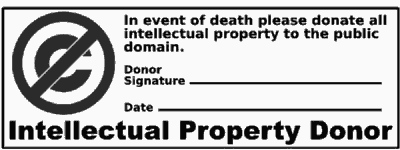
2008/2/5
Copyfighter turned anti-corruption campaigner Lawrence Lessig on why he backs Barack Obama ahead of Hillary Clinton; and here is a transcript. (Summary: it's not so much due to policy differences, of which there are few, as questions of character and integrity.)
2008/1/8
Music download/subscription site Napster is to abandon DRM, and will offer only MP3 downloads. Now why does that sound oddly familiar?
2007/9/17
Apple's newest iPods have come with an unwelcome surprise: a cryptographic checksum in the database file, preventing users from using third-party software to load music onto them, effectively locking out anyone wanting to use, say, Linux for filling their iPod. Now it appears that, in the space of a few days, the checksum has been cracked, allowing anyone to get the encoding key from just their iPod serial number. It appears that someone at Apple hadn't heard of public-key cryptography.
I wonder what will happen now; will Apple play cat-and-mouse with the hackers, Sony PSP-style, by releasing a steady stream of iPod/iTunes revisions with tighter encryption schemes? Will they prosecute those hosting the hack under the DMCA and similar laws elsewhere? In any case, if you're not willing and able to run iTunes, you may want to avoid buying an iPod.
(via Boing Boing, /.) ¶ 0
2007/9/13
A new report from the US Computer and Communications Industry Association has found that fair use exemptions to copyright add more than three times as much value to the US economy as copyright industries. Fair use exemptions account for more than US$4.5 trillion of revenue to the US, whereas the copyright industries brought in US$1.3 trillion. Which sounds like an argument against new neo-Galambosian erosions of fair use and extensions and expansions of intellectual-property rights of the sort that Big Copyright has been pushing for.
2007/8/28
The Boston Globe has an article about the Steampunk movement and the subculture of people who build gadgets that look like something from an imagined Victorian computer revolution:
Yet steampunk has also evolved as an aesthetic unto itself, drawing on a number of diverse references. Goth, which has its own anachronistic sensibility, borrowing heavily from Victorian styles such as corsets, offers an early glimpse of steampunk. Punk lent elements of leather and metal, as well as the DIY attitude. The film "Brazil" is of particular inspiration, where technology looks like junk, and the rebel fights against a technocratic authority. But one of the most important influences has to be Japanese animation, or anime, which is replete with images of mechanical robots, neo-Zeppelin starships, goggle-wearing hackers, and the melding of the techno with the organic.
Objects like the Infumationizer show that steampunk is also simply a love of the fantastic. Steampunk hackers are often science fiction geeks at heart. There's a love of things that don't exist, except in some alternate world, like the "Peltier-Seebeck Recycled Energy Generating Device" and the "Aetheric Flux Agitator Mk2." One of Datamancer's other inventions is a modified enclosure for his desktop computer, which he calls "The Nagy Magical-Movable-Type Pixello-Dynamotronic Computational Engine." He used the cabinet of 1920 tube radio, a turn of the century Underwood typewriter, and various parts and pieces to create a functional, completely anachronistic, impossibly real computer.
In all of the new steampunk design there is a strong nostalgia for a time when technology was mysterious and yet had a real mark of the craftsperson burnished into it, like the "Nagy" of Datamancer's "computational engine." In the Victorian era and at the turn of the century, people watched in astonishment as technology changed their lives, but they were also in awe of the inventors and scientists, some of whom became celebrities in their own right, like Edison and Tesla.The article mentions that steampunk is partly a rejection of the disposable, opaquely unmodifiable nature of consumer electronics today, and a sort of technological libertarianism, akin to the copyfighters who oppose DRM and the hackers who crack the locks on gadgets from XBoxes to iPhones because the locks' presence offends them.
2007/8/17
A new front has opened in the War On Intellectual Property Theft: a campaign to block users of the open-source web browser Firefox from websites, because Firefox enables users to block ads ("steal content"):
While blanket ad blocking in general is still theft, the real problem is Ad Block Plus's unwillingness to allow individual site owners the freedom to block people using their plug-in. Blocking FireFox is the only alternative. Demographics have shown that not only are FireFox users a somewhat small percentage of the internet, they actually are even smaller in terms of online spending, therefore blocking FireFox seems to have only minimal financial drawbacks, whereas ending resource theft has tremendous financial rewards for honest, hard-working website owners and developers..
Since the makers of Ad Block Plus as well as the filter subscriptions that accompany it refuse to allow website owners control over their own intellectual property, and since FireFox actively endorses Ad Block Plus, the sites linking to this page are now blocking FireFox until the resource theft is stopped.The site goes on to advise pissed-off Firefox users to switch to Internet Explorer. (Had they some advice to those browsing on Linux, it'd probably look like "get a Windows PC, you bum".)
It is not clear how many sites are participating in the anti-Firefox campaign.
2007/8/9
Jens Lekman talks to Pitchfork about his upcoming album, Night Falls over Kortedala, his travel plans, and the travails of sample clearance:
He's thinking about setting up shop in Melbourne, Australia, as part of "a huge exploration next year in the Southern Hemisphere. We're actually thinking about going to Antarctica, for a while... I've been saving for years to go there."
Jens likened his situation to that of French author/soldier Xavier de Maistre, who penned the 1794 essay Voyage Autour de Ma Chambre (Journey Around My Room). "I haven't read it myself but I think it's amazing. It's about a young man who's imprisoned in his own home, and he wrote this parody of travel stories-- you know, back in the 18th century when everyone wrote about their journeys to China and the East and West. So he wrote about traveling around in his living room. I think it's amazing. And then he wrote a sequel, A Nocturnal Journey Around My Room (Expedition nocturne de ma chambre, published in 1825 --ed.]. It was like the exact same thing except it was at night.
Frequent readers of Jens' blog may have encountered a somewhat embittered recent entry regarding securing the rights for the samples on the new record-- in which Jens expressed disappointment toward his U.S. label-- followed a few days later by a reconciliation. "I can't really talk about it that much," Jens explained, "but let's just say it worked out. I was able to replace one sample that was extremely expensive; it was like the one bad guy. And I had a guy who played with Steely Dan play it, and it came out exactly the way it sounded on the sample."
2007/7/25
The British government has rejected the recording industry's push to extend copyright terms on music recordings from 50 years to 90. The European parliament previously rejected the same proposal, and the recording industry lobbied Britain, historically one of the global powerbases of Big Copyright and one of the most Atlanticist and pro-corporate governments in the EU. For a while it looked as if the government was going to buy the IFPI/BPI's argument and dismiss the Gowers Report (which argued that copyright term extension was a bad idea), but common sense prevailed and they stuck to their guns.
The Reuters article linked above, however, seems to almost have been written from an IFPI press release; it quotes the recording industry's spokesreptiles at great length, and perpetuates the misconception that recording artists who were around 50 years ago stand to lose huge parts of their incomes and be left penniless in their old age, by mentioning the plights of the likes of Cliff Richard, whose first hit, recorded in 1958, is likely to fall to the ignominy of being in the public domain — whilst neglecting the fact that the vast majority of Richard's catalogue will remain in copyright, quite probably for the rest of his life. Meanwhile, the arguments which swayed Gowers and the British government, such as economic analyses on why copyright extension does more harm than good, are not even mentioned, given the impression that either the honourable MPs were careless, lazy, corrupt, or else under the influence of mind-control rays fired from Cory Doctorow's hot-air balloon, and thus a grievious injustice has been done.
(via Boing Boing) ¶ 0
2007/7/9
Legal fictions are a powerful thing; firstly unlicensed reproduction of copyrighted materials was equated with violent robbery at sea by being termed "piracy", and soon, at least in Sweden, it may be categorised as a form of paedophilia. Well, it had to be either that or terrorism...
2007/6/21
Lawrence Lessig, one of the leading figures of the fight against intellectual-property absolutism and the expansion of copyright laws into a new system of corporate feudalism, is moving on from that fight to a bigger one (which encompasses similar issues): the fight against a pervasive corruption of our legislative processes, to the point where corporate money buys bad laws:
Think, for example, about term extension. From a public policy perspective, the question of extending existing copyright terms is, as Milton Friedman put it, a "no brainer." As the Gowers Commission concluded in Britain, a government should never extend an existing copyright term. No public regarding justification could justify the extraordinary deadweight loss that such extensions impose.
Yet governments continue to push ahead with this idiot idea -- both Britain and Japan for example are considering extending existing terms. Why?
The answer is a kind of corruption of the political process. Or better, a "corruption" of the political process. I don't mean corruption in the simple sense of bribery. I mean "corruption" in the sense that the system is so queered by the influence of money that it can't even get an issue as simple and clear as term extension right. Politicians are starved for the resources concentrated interests can provide. In the US, listening to money is the only way to secure reelection. And so an economy of influence bends public policy away from sense, always to dollars.
2007/5/17
Blog of the day: Architectures Of Control. Written by an industrial designer, it looks at how products or systems are designed to control the behaviour of their users, explicitly or implicitly. It has posts covering everything from public seating designed to discourage sleeping or lingering to the way that packaged food portion sizes subliminally influence how much people eat to interactive museum exhibits subtly forcing people to learn things embedded in the context of a game, to deliberately incompatible light sockets which require compact fluorescent bulbs, and of course, the DRM/"trusted computing" debate. For some reason or other, this blog is blocked in China.
(via Boing Boing) ¶ 0
2007/5/11
A US broadcasting executive has called for the industry to ditch digital rights management (DRM), because of the bad reputation it has with consumers. From now on, instead of DRM, the industry should use Digital Consumer Enablement (DCE), which does much the same thing, only sounds nicer. You see, instead of restricting what you, the potentially thieving consumer, can do, it enables you to enjoy the content in ways that your benevolent corporate elder siblings want you to:
Digital Consumer Enablement, would more accurately describe technology that allows consumers "to use content in ways they haven't before," such as enjoying TV shows and movies on portable video players like iPods. "I don't want to use the term DRM any longer," said Zitter, who added that content-protection technology could enable various new applications for cable operators.Though as someone pointed out in the comments, every time Hollywood come up with a freshly sanitised name, someone will come up with a more honest acronym for it, like, for example, Digital Captivity Enforcement.
2007/4/5
For those reading this in (the vicinity of) London: next Wednesday evening, the Open Rights Group is having a party at Bar Kick in Shoreditch, from 6 to 11pm. There will be "free culture" music and visuals, guest speakers and a raffle, with prizes including signed copies of books by copyfight luminaries like Lawrence Lessig and Bruce Schneier, a PC keyboard signed by Neil Gaiman, and the chance to be written into a Cory Doctorow novel. Your Humble Blogger will sort of be DJing there (there aren't DJs as the place doesn't have a live music licence, but I will be preparing a mix CD of freely distributable music and such that will be queued up on the PA). Attendance is free, if you bring one new ORG supporter.
2007/4/2
Major recording label EMI has confirmed that it will sell its entire music catalogue in high-quality, DRM-free formats. In a joint announcement in London with Apple's Steve Jobs, EMI's CEO announced that the "premium" versions will be available on iTunes from May for 99p a track, with upgrades from previous downloads available for 15p; standard-quality, DRM-encumbered tracks will remain available for 79p. It is anticipated that the DRM-free downloads will become available on other services (presumably in MP3 or FLAC formats). Doing this, EMI becomes the first major label to join a slew of indie labels selling MP3s through services like EMusic.
Apple boss Steve Jobs shared the platform with Mr Nicoli and said: "This is the next big step forward in the digital music revolution - the movement to completely interoperable DRM-free music."
He added: "The right thing to do is to tear down walls that precluded interoperability by going DRM-free and that starts here today."
Other record companies would soon follow EMI's lead, predicted Mr Jobs.Reports of Edgar Bronfman Jr. throwing a chair through the Warner Music boardroom window have not been confirmed.
2007/3/26
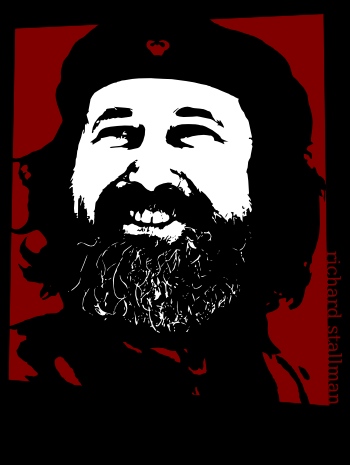
There is now a Richard Stallman as Che Guevara T-shirt, perfect for wearing to copyfighter meetups, showing your free-software/Creative Commonist sympathies and/or taking the piss out of over-earnest Penguinistas.
A web-based sports news site is bypassing Rupert Murdoch's Sky TV's exclusive rights to broadcast the Cricket World Cup by displaying a computer-animated reconstruction of the match, from public domain information gathered by employees. The process resembles a modern version of the studio reconstructions of cricket matches on radio broadcasts before television (where announcers would "call" the match from descriptions, tapping microphones with pencils to create the sound effects), only this time, it's legal rather than technological limitations that are the motivation. And they look likely to get away with it:
Cricinfo, which is owned by Wisden, the company behind the Wisden Cricketing Almanac, uses data gathered by employees to simulate the action. The involvement of humans in the process is crucial, says Kim Walker, Head of Intellectual Property with Pinsent Masons, the law firm behind OUT-LAW.COM.
Wisden said that it had carefully consulted lawyers before going ahead with the simulations in this week's World Cup. "Cricinfo 3D is based on public domain information gathered by our scorers who record a number of factors such as where the ball pitched, the type of shot played and where the ball goes in the field," said a Wisden statement. "That data is then fed as an xml to anyone who has Cricinfo 3D running on their desktops and the software generates an animation based on this data."
(via Boing Boing) ¶ 2
2007/3/23
Another triumph for the EFF: this time, they have successfully had Clear Channel/Live Nation's patent on instant CDs of live performances invalidated, allowing independent artists and concert promoters to sell CDs of their gigs without doing this on Live Nation's terms.
2007/2/7
In a dramatic about-turn, Steve Jobs denounces digital rights management (DRM), claiming that Apple only use DRM on their iTunes downloads because labels demand it, and urging everyone to join hands and imagine a DRM-free future:
Imagine a world where every online store sells DRM-free music encoded in open licensable formats. In such a world, any player can play music purchased from any store, and any store can sell music which is playable on all players. this is clearly the best alternative for consumers, and Apple would embrace it in a heartbeat. If the big four music companies would license apple their music without the requirement that it be protected with a DRM, we would switch to selling only DRM-free music on our itunes store. every iPod ever made will play this DRM-free music.which probably has a lot to do with the fact that, thanks to the various Cory Doctorows of this world, DRM is definitely not cool, and Apple is all about being (seen to be) cool. Though some critics are skeptical about how deep the conversion really is:
Mr Johansen pointed to a New York Times report that showed that tracks wrapped in DRM from iTunes are also available through other download services without copy protection. The implication being that not all record labels insist on DRM, but Apple uses it anyway.Also, it is a matter of public record that iTunes has refused to sell DRM-free music from copyright holders who didn't want DRM, instead insisting that DRM is a mandatory part of the iTunes infrastructure. I wonder whether they'll put their money where their mouth is and change this policy.
Another thing to watch is Apple's iPhone, whose system is locked down like Fort Knox (software running on it will need to be cryptographically signed by Apple), a state of affairs which has nothing to do with the RIAA holding a gun to Apple's head and seems to have everything to do with Apple wanting to maintain total control.
2007/1/14
Leo Stoller, self-styled "intellectual property entrepreneur", revolutionised the monetisation of trademarks a few years ago. He did this by registering a large number of words, including "Stealth", "Sentra", and (perhaps appropriately) "Chutzpah", as trademarks and then aggressively going after anyone in any field using them, often extracting substantial settlements. Unfortunately for him, the bonanza came to an end when defendants began fighting back and losing lawsuits, and judges started invalidating his patents. Even worse for him, when he tried to declare bankruptcy, a judge ordered the liquidation of all his assets, and found that his personal and corporate assets were one and the same. Couldn't happen to a nicer guy...
(via Boing Boing) ¶ 5
2007/1/13
The Principality of Sealand, a micronation situated on a platform off the mouth of the Thames, has recently suffered a number of problems, including a catastrophic fire, and is apparently facing bankruptcy. And so, Swedish anti-copyright group and file-sharing site The Pirate Bay has stepped in with a plan to buy Sealand, presumably turning it into a copyright-free hub of free downloads for all. That is, up until the RAF put a bomb through it once and for all. (After all, it could be seen as an act of war against the countries whose economies depend on intellectual-property licensing fees, much as currency counterfeiting is considered an act of war.)
(via Boing Boing) ¶ 1
2006/12/27
When Windows Vista comes out, it won't just have a Mac-killingly cool user interface; it will also include the most total intellectual-property protection regime ever developed, designed to keep your thieving fingers off Hollywood's precious content. Peter Gutmann has an analysis of the costs of this regime, and it's alarming: it looks like we're all going to be footing the bill (in terms of increased costs, decreased performance, and reduced reliability and interoperability) of Hollywood and the RIAA's demands (and Microsoft's ambitions for control of the content-delivery system).
Beyond the obvious playback-quality implications of deliberately degraded output, this measure can have serious repercussions in applications where high-quality reproduction of content is vital. For example the field of medical imaging either bans outright or strongly frowns on any form of lossy compression because artifacts introduced by the compression process can cause mis-diagnoses and in extreme cases even become life-threatening. Consider a medical IT worker who's using a medical imaging PC while listening to audio/video played back by the computer (the CDROM drives installed in workplace PCs inevitably spend most of their working lives playing music or MP3 CDs to drown out workplace noise). If there's any premium content present in there, the image will be subtly altered by Vista's content protection, potentially creating exactly the life-threatening situation that the medical industry has worked so hard to avoid. The scary thing is that there's no easy way around this - Vista will silently modify displayed content under certain (almost impossible-to-predict in advance) situations discernable only to Vista's built-in content-protection subsystem [Note E].
Once a weakness is found in a particular driver or device, that driver will have its signature revoked by Microsoft, which means that it will cease to function (details on this are a bit vague here, presumably some minimum functionality like generic 640x480 VGA support will still be available in order for the system to boot). This means that a report of a compromise of a particular driver or device will cause all support for that device worldwide to be turned off until a fix can be found. Again, details are sketchy, but if it's a device problem then presumably the device turns into a paperweight once it's revoked. If it's an older device for which the vendor isn't interested in rewriting their drivers (and in the fast-moving hardware market most devices enter "legacy" status within a year of two of their replacement models becoming available), all devices of that type worldwide become permanently unusable.
Vista's content protection requires that devices (hardware and software drivers) set so-called "tilt bits" if they detect anything unusual. For example if there are unusual voltage fluctuations, maybe some jitter on bus signals, a slightly funny return code from a function call, a device register that doesn't contain quite the value that was expected, or anything similar, a tilt bit gets set. Such occurrences aren't too uncommon in a typical computer (for example starting up or plugging in a bus-powered device may cause a small glitch in power supply voltages, or drivers may not quite manage device state as precisely as they think). Previously this was no problem - the system was designed with a bit of resilience, and things will function as normal... With the introduction of tilt bits, all of this designed-in resilience is gone. Every little (normally unnoticeable) glitch is suddenly surfaced because it could be a sign of a hack attack. The effect that this will have on system reliability should require no further explanation.
In order to prevent active attacks, device drivers are required to poll the underlying hardware every 30ms to ensure that everything appears kosher. This means that even with nothing else happening in the system, a mass of assorted drivers has to wake up thirty times a second just to ensure that... nothing continues to happen. In addition to this polling, further device-specific polling is also done, for example Vista polls video devices on each video frame displayed in order to check that all of the grenade pins (tilt bits) are still as they should be [Note H].
As part of the bus-protection scheme, devices are required to implement AES-128 encryption in order to receive content from Vista. This has to be done via a hardware decryption engine on the graphics chip, which would typically be implemented by throwing away a rendering pipeline or two to make room for the AES engine.
I see some impressive class-action suits to follow if this revocation mechanism is ever applied. Perhaps Microsoft or the content providers will buy everyone who owns a device that inadvertently leaks content and is then disabled by the revocation process replacement hardware for their system. Some contributors have commented that they can't see the revocation system ever being used because the consumer backlash would be too enormous, but then the legal backlash from not going ahead could be equally extreme. For anyone who's read "Guns of August", the situation seems a bit like pre-WWI Europe with people sitting on step 1 of enormously complex battle plans that can't be backed out of once triggered, no matter how obvious it is that going ahead with them is a bad idea. Driver revocation is a lose/lose situation for Microsoft, they're in for some serious pain whether they do or they don't. Their lawyers must have been asleep when they let themselves get painted into this particular corner - the first time a revocation takes out a hospital, foreign government department, air traffic control system, or whatever, they've guaranteed themselves first-person involvement in court proceedings for the rest of their natural lives.
2006/12/10
Britain's professional recording artists are so angry about their copyrights expiring after 50 years that some even rose from the dead to sign a recording-industry petition for copyright term extension:
If you read the list, you'll see that at least some of these artists are apparently dead (e.g. Lonnie Donegan, died 4th November 2002; Freddie Garrity, died 20th May 2006). I take it the ability of these dead authors to sign a petition asking for their copyright terms to be extended can only mean that even after death, term extension continues to inspire.
(via Boing Boing) ¶ 0
2006/12/8
In the wake of the consumer backlash against DRM, major label EMI (you know, the ones who made all their CDs "Copy Controlled" a while ago) have started tentatively experimenting with selling unencrypted MP3s. Will wonders never cease?
Don't get too excited yet, though; the only things EMI are selling as easily-copiable MP3s are adult-contemporary and Christian rock, because nobody'd want to pirate those the audiences for those would be less inclined to copy them. And even so, there was apparently tremendous opposition to this move within the label's management. So don't expect to be able to buy official MP3s of Hot Chip or I'm From Barcelona just yet.
2006/12/6
Alan McGee, founder of the Creation and Poptones labels, on why music copyright terms should not be extended:
One argument the industry used is that the revenue generated from back catalogues is what underpins record companies' ability to invest in new artists, so to close of this endless stream of cash would impoverish the quality of new music. This doesn't seem such an unreasonable point until you reflect that they have had fifty years to rake in billions from The Beatles. Also, the notion of the back catalogue acting as crutch to fund new talent seems to imply that more contemporary acts have brought home peanuts. This would be very sad indeed if it were anywhere near the truth.
In the case of early blues and country, the lapse of copyright has had numerous positive consequences. The songs being highly accessible and the constant repackaging and proliferation of different compilations has helped to keep interest alive and, if anything, spread the influence of some of the most important music of all time throughout the generation
More importantly, though: Why should the legacy of The Beatles be treated as some sacred cash cow and held at arm's length from those that gave and continue to give The Beatles their success - the fans? Without people's initial support and continuing identification with the music, The Beatles would be a long forgotten name.
2006/12/5
The Australian government has backed down slightly on its draconian copyright laws. It still is considerably more severe and pro-Big Copyright than the existing laws, though at least now consumers don't face the possibility of on-the-spot fines for possession of iPods or general-purpose computers, and search engines don't need to obtain permission in advance for indexing web pages. Share a file with a friend, however, and the law will, if you're unlucky, break you.
"While Labor still has some reservations about the Government's overall approach to copyright, the bill that passed the Senate today is a million times better than the one Mr Ruddock pushed through the house," she said in a statement.
"The Free Trade Agreement with the United States means the worst aspects of the American Copyright system has been imported into Australian law but with none of the consumer safeguards such as open ended fair use rights that exist in the United States," said Greens senator Kerry Nettle.
(via Boing Boing) ¶ 0
2006/11/27
While Big Copyright is more or less having free rein with using Australia as a laboratory for new forms of feudalism, they're having less luck in the UK, where the government, surprisingly enough, looks set to reject a proposal to extend sound recording copyright to 95 years. Which would put Britain in the unprecedented position of being the only major economy in which post-war commercial cultural products have entered the public domain; this means that Cliff Richard's earliest songs will become public property next year, and EMI will start losing the Beatles' copyrights in 2013; meanwhile, Mick Hucknall's dreams of a socialist utopia are cruelly dashed. Of course, this is not a done deal; it's not unlikely that a stern word from Washington will pull Britain back into line.
(via Boing Boing) ¶ 0
An article on how Australia's new copyright laws will be a disaster:
While originally promoted by the Government as a way of relaxing the arcane deficiencies of existing law - which, for example, make it illegal to record a TV show for later viewing - it is now clear that the laws would turn Australian copyright law into one of the most punitive, restrictive and regressive systems in the world.
The Attorney-General claims that exemptions will be made in the law to account for personal use. But what exemptions? Will it be legal for a teenager to rip the CD she just bought so she can play it on her iPod or her mobile? Absolutely not. These new laws will strictly define what someone can do with the media that they believe they've bought. The recording companies desperately want to sell you the same song three times - once on CD, once for your iPod, and again for your mobile. The film distributors are looking for the same deal.
Instead of moving Australian copyright law into the 21st century, where copyright holders and audiences will need as much freedom and flexibility as possible to develop new and successful financial relationships, the Government wants to freeze the nation into a model that would have worked flawlessly 25 years ago. These laws are not just an insult to the audience, they actually criminalise the audience. A restrictive copyright regime will simply produce a population with no respect for copyright.Meanwhile, it appears that, in addition to allowing easier prosecution of MP3 player owners, the new laws could outlaw search engines in Australia, by requiring them to obtain permission for each page they index.
I wonder what the chances are of the government actually cluing in and making these laws any less draconian are. Or of a future government reforming them. Sadly, since the same present-day government is handing over the Australian media to larger and more incestuous corporate oligopolies, who can then wield even more influence over who is elected, I'd say that it doesn't look good.
Sometimes I despair for my country.
2006/11/20
The Australian government is about to enact draconian new copyright laws that, by lowering burdens of proof, expose people doing everyday things to severe criminal liabilities:
"As an example," said Mr Coroneos, "a family who holds a birthday picnic in a place of public entertainment (for example, the grounds of a zoo) and sings 'Happy Birthday' in a manner that can be heard by others, risks an infringement notice carrying a fine of up to $1320. If they make a video recording of the event, they risk a further fine for the possession of a device for the purpose of making an infringing copy of a song. And if they go home and upload the clip to the internet where it can be accessed by others, they risk a further fine of up to $1320 for illegal distribution. All in all, possible fines of up to $3960 for this series of acts -- and the new offences do not require knowledge or improper intent. Just the doing of the acts is enough to ground a legal liability under the new 'strict liability' offences."There's more about the laws here. Apparently the fines will be summary, and not require court offences, and possession of MP3s ripped from CDs you have purchased will be a criminal offense liable to such fines. Which is not to say that the police will be doing mass copyright audits of suburbia anytime soon, but theoretically, if you're carrying a MP3 player and are stopped by a police officer who doesn't like your look/attitude, they will have the power to fine you. The laws could also end up creating an industry of copyright bounty hunters who seek out and prosecute infringers, pocketing a share of the takings (as has happened in the US War On Drugs).
Anyway, the laws have been passed by the House of Representatives, and are being fast-tracked through the Senate. If you live in Australia, it might be an idea to contact your senator now. That and preparing to destroy all copies of your MP3 collection/videotaped TV shows.
2006/11/19
One of the things that Britain does better than anyone else is postcodes; while most countries' postcodes give you an area the size of a suburb or town, the six or seven letters of a Royal Mail postcode give you a segment of a street, with enough information to find the place the code refers to. This allows sites like the Transport for London Journey Planner to tell you exactly how to get from one postcode to another.
There is a problem with this, though; the postcode data is not free, but is owned by Royal Mail, who monetise the hell out of it. If you wish to use the database for your own purposes, doing so will cost you a few thousand pounds a year. (The fact that your taxes may have paid for the system to be drawn up doesn't enter into the argument.)
Anyway, this has gotten up the nose of a number of open-geodata activists, who are doing something about it: they're collecting their own data mapping points to postcodes, and using this to draw up freely usable and distributable maps of postcode areas. Free The Postcode! is aiming to do this at a high level of accuracy, soliciting input from people with GPS receivers; meanwhile, New Popular Edition Maps is using a 1940s-vintage map of England and Wales (Scotland and Northern Ireland may come later) to allow people to click on where their homes are and enter the postcodes. Since this is inherently less accurate (the map is of fairly low resolution, and the process depends on matching shapes of streets), they're only concerned with the prefixes at this stage. The data produced will be released into the public domain.
(via Boing Boing) ¶ 0
2006/11/10
In Japan, an elderly man has been arrested for playing copyrighted Beatles songs on his harmonica without permission. It turns out that 73-year-old Masami Toyoda is a serial copyright pirate, having repeatedly performed copyrighted songs in the past.
2006/11/6
The UK's Ordnance Survey, the government agency which uses taxpayers' funds to create incredibly detailed maps and then licenses them under prohibitive licensing terms and steep fees, seems to be thawing to open access to its data, and is experimenting with a Google Maps-style JavaScript interface, to be named "OpenSpace". Note that if it is released, it will only be for noncommercial use, and the actual data itself won't be made public. I wonder how much this is a result of pressure from OpenStreetMap and other guerilla mappers encroaching on its monopoly.
2006/10/3
Today is the Day Against DRM, a global event planned to raise awareness of the threat which digital rights management and technologically-mandated copyright maximalism pose to culture. This page lists numerous protests and activities, from putting a badge on your website to sticker distribution runs, protests against things from severe paracopyright laws to craptacular DRM-"enhanced" products like the Microsoft Zune, and numerous meetups with other copyfighters. In France, they're turning themselves in to the police for decrypting DVDs, whereas in Coffs Harbour, Australia, they're having the Shackled Banana Award.
2006/8/18
Attention musicians: make sure the label you are signed to supports the War On Piracy, including the suing of file-sharers; otherwise, you may be blacklisted by the recording industry, as Amy Thomas was by the British Phonographic Industry.
Amy had been chosen as one of ten young artists to feature on the My Music chart that launches in October across 1,400 UK schools. But her inclusion was blocked by the BPI after its snoops discovered she is signed to Flowerburger Records, an independent record label which is running an online petition drumming up oposition to the BPI's policy of suing music fans who use p2p websites.Mind you, this policy may have been specific to childrens' charts (after all, we wouldn't want impressionable children exposed to pirasite/copyterrorist propaganda that may encourage them to think of music as not being a monetisable asset), though perhaps that makes it even more sinister.
2006/6/29
Spain has become the first country to completely outlaw peer-to-peer file sharing. Under the law, downloading files from peer-to-peer networks is in itself a civil offense, whilst ISPs face criminal sanctions for tolerating file sharing (which, presumably, means not blocking it). Oddly enough, the law also puts a tax on all digital media, with the money going to Big Copyright, presumably to reimburse them for all the content the public is absolutely prohibited from sharing on said media.
That sound you can hear is copyright-industry lobbyists in the rest of the world rubbing their hands with glee as they prepare to push for "harmonisation" of the local laws with Spain's.
2006/5/14
The Australian government has agreed to legalise ripping CDs and recording TV programmes, which had been illegal since the new US-designed copyright laws, as well as introducing US-style fair-use provisions. However, it will come at a price: a zero-tolerance crackdown on file sharing on the internet:
Police will be able to issue on-the-spot fines and access and recover profits made by copyright pirates. Courts will be given powers to award larger damages payouts against internet pirates. Civil infringement proceedings will apply to copyright pirates who make electronic reproductions or copies of copyright material.The surveillance part of it is easy enough: I once heard that in Australia, all internet connections legally have to go through points where the police may access them, and as such, cable ISPs block customers on the same access point from connecting directly to each other. (Incidentally, this was in the late 1990s, before the Homeland Security Age.) The on-the-spot fines sound trickier: will police determine, on the spot, whether a file downloaded is copyrighted, or will the act outlaw all use of file-sharing software? (The latter sounds like a very Australian majoritarian approach: given that, anecdotally, only a minority of files shared thus are licensed to be done so, the Australian thing to do would be to cut the Gordian knot of liberal free-speech handwringing and outlaw it altogether, much as they do with controversial films and video games and the proposed internet firewall.) And will the police aggressively prosecute, say, people sharing copies of long out-of-print recordings?
2006/5/11
There is a new weapon in the War Against Copyterrorism: dogs trained to sniff out DVDs. The dogs, trained by the MPAA, have been deployed at a FedEx hub in the UK, identifying packages containing burned DVDs for customs inspection. Now there's one fewer place for pirates to hide.
(It wouldn't surprise me if Australian Customs have some DVD-sniffing dogs in operation. I sent a package containing a DVD-R (containing perfectly legitimate material, mind you) to Australia a while ago, and it took a few weeks to get there; I wonder whether a few days of that were the result of customs inspectors trying to determine whether it violated copyright, censorship and/or homeland-security laws.)
2006/5/4
In Britain, there is little free map data. There is an excellent map of the whole of Britain, assembled by the government's Ordnance Survey, but, in line with Thatcherite-Blairite ideology, which holds that not extracting the maximum profit is a grievious dereliction of duty, this is commercial and expensive. (In contrast, the United States Geographical Survey's maps are in the public domain, the reasoning being that, as they were assembled with public funds, they belong to the public.) A group of mapping geeks and free-culture activists under the banner of OpenStreetMap are working to reverse this by creating their own maps; they have a wiki-like system to which volunteers with GPS units can upload traces of streets they have walked down and such. This weekend, they are having a working bee of sorts, intensively mapping the Isle of Wight. More than 30 volunteers will descend on the island, walking its many paths with GPS units and uploading their traces to the wiki; of course, the more the merrier, so if you have a GPS unit and a belief that information wants to be free.
It is hoped that this project, and the OpenStreetMap project in general, will force a sea change in the ownership of geographical data in the UK, much in the way that the Sanger Institute's human-genome sequencing effort in Cambridge made it unfeasible for Celera Genomics to exercise proprietary control over the human genome.
(via Boing Boing) ¶ 3
2006/4/15
The Age has a profile of Boing Boing and Cory Doctorow, who, incidentally, is speaking in Melbourne on Tuesday:
It was Boing Boing that first noticed that "black people loot, white people find" groceries in the now-infamous captions of news photographs taken after hurricane Katrina.
"The greatest threat to an artist is obscurity, not piracy," says Doctorow, who has released three other novels on the internet. "All the people out there who didn't buy my books mainly did so because they hadn't heard of me, not because they could get it for free.
2006/4/6
Recording artist, cultural commentator and left-wing intellectual type Momus weighs in on file-sharing and "piracy". He's all for it, and against the RIAA's crackdown; what's more, he's officially OK with people who are not sufficiently into his music to pay for a CD downloading MP3s instead:
No doubt some people will feel the same way about my new record, Ocky Milk, and that's fine too. These "unconvinced" listeners will at least listen, even if they don't buy. That may not matter to the RIAA, but it matters to me as an artist. And even if these people don't buy this record, they may buy another one, or they may come to a live show, or they may pay for a track off iTunes or E Music.
Or, you know, one of these downloaders may have sex with me, or give me a column in a magazine, or ask me to come and give a talk at an art school, or collaborate on a project, and that will lead to, you know, marriage, or a surprise twist in the career path, or something equally amazing. "Peer-to-peer" can mean much more than just sharing music. To the RIAA, a "peer" is simply a freeloading customer, a source of monetary loss. But to me a peer is a person, the source of all sorts of possible gains, quantifiable or not. To the RIAA, with a business agenda but no human agenda, that peer engaging in P2P can only mean the loss of dollars. To me it can mean the possibility of barter (the theme of artist Carolina Caycedo's work), but also friendship, communication, and a million other human possibilities.
2006/3/24
US liberal website Mother Jones has a list of the most absurd excesses of intellectual property:
BILL GATES had the 11-million-image Bettmann Archive buried 220 feet underground. Archivists can access only the 2% that was first digitized.
MICROSOFT UK held a contest for the best film on "intellectual property theft"; finalists had to sign away "all intellectual property rights" on "terms acceptable to Microsoft."
U.S. INTELLECTUAL PROPERTY is valued at $5.5 trillion, equal to 47% of our GDP and greater than the GDP of any other nation but China.
A FRENCH DIRECTOR had to pay $1,300 after a character in his film whistled the communist anthem, "The Internationale," without permission.
RENTAMARK.COM makes money by claiming ownership of 10,000 phrases, including "chutzpah," "casual Fridays," ".com," "fraud investigation," and "big breasts."
(via Boing Boing) ¶ 0
2006/3/1
BBC Newsnight's Adam Livingstone sets the record straight on paedophiles, terrorists and file sharing:
First though, an apology. File sharing is not theft. It has never been theft. Anyone who says it is theft is wrong and has unthinkingly absorbed too many Recording Industry Association of America press releases. We know that script line was wrong. It was a mistake. We're very, very sorry.
If copyright infringement was theft then I'd be in jail every time I accidentally used football pix on Newsnight without putting "Pictures from Sky Sport" in the top left corner of the screen. And I'm not. So it isn't. So you can stop telling us if you like. We hear you.With the intellectual-property industry (whose word-magicians are responsible for the "copying = theft" syllogism) making up an ever-increasing section of the economy of the West, and thus commanding the attention of politicians and bureaucrats, I wonder how much pressure will be brought to bear from high up for this particular Livingstone to be censured or sacked, and the BBC to toe the line.
The rest of the article goes on about ISPs blocking BitTorrent, other clients using encryption to bypass the blocks, and the resulting increase in encrypted content on the net allowing suspicious encrypted paedoterrorist communications, which would have otherwise drawn the security services' attention, to sink into the encryption soup unnoticed.
(via Boing Boing) ¶ 0
2006/2/15
The Nintendo DS, sometimes dismissed as the Sony PSP's poor cousin, is starting to look like an interesting platform. For one, whilst Sony's unit is largely dominated by fairly conservative mainstream fare like driving/sports/gang-warfare/first-person-shooter games, the dinky DS, which lacks the raw power to compete in the graphics-machismo stakes but has two screens, one of them touch-sensitive, and a microphone, has been capitalising on this with more conceptual and experimental titles. One which has been raved about recently is Electroplankton, an artificial-life-based algorithmic-music-composition game/toy/tool developed by Japanese multimedia artist Toshio Iwai. Electroplankton was apparently the most popular Japanese import to the US, though now has been released there, and at least one musician has made an album using it, and is using it in live performances.
On a more practical note, the Opera web browser is about to be released for the DS; Opera will be a cartridge which allows users to browse the web via Wi-Fi from their DS. I wonder how long until Skype or someone release a VOIP cartridge, turning the DS into an internet telephony handset.
Meanwhile, some hobbyist hackers have written a personal organiser package for the DS. It's a download, and needs some hacking to get it to work. And someone else is manufacturing and selling cartridges for running homebrew software on a DS. The PassMe cartridges plug into the cartridge port and take a legitimate game cartridge, which they use for authenticating the code downloaded onto them as legitimate; they are used for running homebrew titles, and absolutely not, it must be stressed, p1r4t3d games. It's not quite clear how one downloads the software image onto the cartridge, though; I imagine it may use proprietary software, possibly running only on Windows.
(via Make, Boing Boing) ¶ 0
2006/2/2
As the Hong Kong, the aspheads are adopting the tried-and-tested tactics of the most successful totalitarian regimes in history, and signing up children to look out for and report copyright violators.
The youngsters, part of uniformed groups like the Scouts, have been invited to join the Youth League for Monitoring Internet Piracy, which will be given a trial run next week.
If they notice anything that infringes on copyright, such as the illicit uploading of files, they can contact customs through a dedicated website.Apparently 200,000 children have been signed up.
2006/1/27
In the US, the copyright industry is pushing for a law requiring anything capable of digitising video signals to respond to hidden embedded signals, originally designed for Voltron toys in the 1980s, and to refuse to digitise the content if it is marked as copyrighted.
Meanwhile, in Australia, the same technology is being embedded into plastic dolls of a cricketer, given away with bottles of Victoria Bitter; the signals they respond to will be embedded in broadcasts of the cricket:
Booney dolls went live on Friday the 13th of January with the first match of the VB One Day series, and internet blogs and discussion sites have been debating since then what makes them tick. Booney is activated an hour before each one-day match by an internal timer set to eastern standard time (a glitch for those viewing matches televised on delay in Perth). His first words are "get me a VB, the cricket is about to start", a cross-marketing plug for VB and the cricket that sets the stage for his main performance during the game.
Booney's timer chip is programmed to trigger random comments while the match is in progress, and to announce a codeword for that day's Boonanza competition, in which viewers can win cricket memorabilia prizes (separately, those buying slabs have the chance to win three "Boonanza Utes" and 90 flat-screen TVs).
The major innovation is that Booney's chip responds to four audible triggers broadcast by Nine during matches, to generate targeted comments about bowling, batting, general play and VB advertisements.
Booney's vocabulary ranges from the inane ("Got any nachos? I love nachos") to ones that boost the two key products — the cricket ("He's seeing them like watermelons") and the beer ("Got a beer yet?").
Canadian independent record label Nettwerk is getting involved in the RIAA anti-filesharing lawsuits — on the side of the consumers. Nettwerk has agreed to fund the defendants' case against the RIAA, and any fines should they lose, after a family was sued for having 600 music files on a home computer; one of these was a song by Avril Lavigne, who is managed by Nettwerk.
Nettwerk became involved in the battle against the RIAA after 15-year-old Elisa Greubel contacted MC Lars, also a Nettwerk management client, to say that she identified with "Download This Song," a track from the artist's latest release. In an e-mail to the artist's web-site, she wrote, "My family is one of many seemingly randomly chosen families to be sued by the RIAA. No fun. You can't fight them, trying could possibly cost us millions. The line 'they sue little kids downloading hit songs,' basically sums a lot of the whole thing up. I'm not saying it is right to download but the whole lawsuit business is a tad bit outrageous."
"Since 2003 the RIAA has continually misused the court and legal system, engaging in misguided litigation tactics for the purpose of extorting settlement amounts from everyday people -- parents, students, doctors, and general consumers of music," Mudd stated. "In doing so, the RIAA has misapplied existing copyright law and improperly employed its protections not as a shield, but as a sword. Many of the individuals targeted by the RIAA are not the 'thieves' the RIAA has made them out to be. Moreover, individual defendants typically do not have the resources to mount a full-fledged defensive campaign to demonstrate the injustice of the RIAA's actions. Today we are fortunate that principled artists and a management company, Nettwerk Music Group, have joined the effort to deter the RIAA from aggressive tactics -- tactics that have failed to accomplish even the RIAA's goals."
"Litigation is not 'artist development.' Litigation is a deterrent to creativity and passion and it is hurting the business I love," insists McBride. "The current actions of the RIAA are not in my artists' best interests."
(via bOING bOING) ¶ 0
2006/1/24
A chilling account of how the future may look if the intellectual-property industry gets its way and gets universal digital rights management on everything capable of handling their precious content:
Going to the movies is not what it used to be. Security at the studio-owned theatres is heavy, it's not a trip to be taken lightly. But if you want to see the film everyone is talking about without waiting a year for the home release, you have little choice. When you enter the lobby the first thing you see are long ranks of tiny, thumbprint activated lockers. This is where you must leave all of your electronics, your personal server and peripherals, even your watch, and you had better not be wearing smart spectacles or contacts. As you enter the security zone you're scanned for anything you may have forgotten. Cochlea and optical implants must be capable of responding with a coded RF identification signal to indicate their systems are secure and cannot record. People with older models, or models implanted abroad where such interrogation is illegal, are turned away. Perhaps they would like to see one of the older releases?
These days it seems like every time you turn on one of your gadgets you have to fight with its DRM to get it to do what you want. The home movie of your daughter opening her birthday presents is ruined by a patch of grey fog that shifts with every movement of the camera, tracking sluggishly to keep the TV screen in the background obscured. From the codes embedded in TV's update pattern your camera had decided the show was not licensed for this form of reproduction and blocked it. You wish you had thought to turn it off at the time, but squinting into the camera's tiny screen it hadn't looked so bad.
You just don't see physical media anymore. Too easily duplicated, their security too easily cracked, they've been dropped in favour of heavily encrypted and vendor-locked streaming media. You don't 'own' copies of any music or movies these days, instead your monthly subscriptions grant you only the right to temporarily buffer a few seconds of the distributor's authorised files while you watch or listen. Ultimately, that was the reason ad-hoc networking protocols and mobile PC technologies were pushed so hard, not because the customers wanted them but because the music and movie industries needed them to replace the vulnerable duplication method normally needed for such mobile media.
The only way writers can get their novels read, or musicians have their music heard, is by signing with a content provider who will claim the work as their own and charge people for access. It's nearly impossible for artists to make money anymore. The celebrities you read about, the millionaires who's contribution to the industry was actually rewarded, are a microscopic minority. But wasn't it always that way? There is nothing to stop an author from reading a work aloud in public, or a band from performing to a live audience, but few beyond that space will hear it. Hardly anyone has access to the technology that would let them record what they're hearing, at least not in any permanent form, and even fewer have the means to share it once they have. And god forbid the artists accidentally use a sentence or lyric already claimed by one of the corporations...
(via bOING bOING) ¶ 0
2005/10/20
Jon Lech Johansen, the Norwegian hacker who cracked DVD encryption, iTunes DRM and several other things, has accepted a job in California. How much do you want to bet that the FBI will be waiting for him at the airport?
2005/10/6
The Australian High Court has just ruled that console modchips are legal, as they can be used to play legally-purchased software from different regions. This reinforces an earlier ruling, which Sony and others were hoping would be overridden by the draconian paracopyright provisions in the US-Australian Free Trade Agreement; their hopes, thankfully, were dashed:
"in construing a definition which focuses on a device designed to prevent or inhibit the infringement of copyright, it is important to avoid an overbroad construction which would extend the copyright monopoly rather than match it. A defect in the construction rejected by Sackville J is that its effect is to extend the copyright monopoly by including within the definition not only technological protection measures which stop the infringement of copyright, but also devices which prevent the carrying out of conduct which does not infringe copyright and is not otherwise unlawful. One example of that conduct is playing in Australia a program lawfully acquired in the United States. It was common ground in the courts below and in argument in this Court that this act would not of itself have been an infringement."Which means that Australians can now legally play Katamari Damacy and such. (Except perhaps that importation of games without an OFLC classification may technically be a criminal offence.)
2005/9/3
The Blu-Ray disc format, due to replace DVD, will take the War On Unauthorised Use to a draconian new level:
On top of that, consumers should expect punishment for tinkering with their Blu-ray players, as many have done with current DVD players, for instance to remove regional coding. The new, Internet-connected and secure players will report any "hack" and the device can be disabled remotely.
2005/9/1
Various takes on "Home Taping Is Killing Music" seen recently:
Found on the website of a design agency with a number of recording-industry clients; whether it's sincere or ironic is unknown.
And from a German novelty T-shirt vendor:

2005/8/31
Police in Malaysia are carrying out random spot checks for pornography on mobile phones. Those found with porn will be charged with possession, and presumably flogged or caned or whatever they do, at Dr. Mahathir's pleasure.
Meanwhile, in India, the local movie studios' organisation, the MPA, has successfully obtained a general search and seizure warrant, allowing its officers to search any property in Delhi deemed under suspicion of piracy. Of course, they only intend to use such warrants against the terrorists who produce and sell pirated DVDs at markets, and, being the good guys, undoubtedly are honour-bound not to abuse these powers, so there's no cause for concern.
And in China, a researcher has discovered a sinister and ominous new trend, that people who buy webcams often use them whilst naked, posing a serious threat to public health and morality:
"At first, we thought it was merely a game for a few mentally abnormal people," the paper quoted Liu as saying. "But as our research continued, we found the problem was much larger than expected."It wasn't made clear what proportion of webcam users are filthy perverts, or, indeed, what those who don't chat naked use them for.
(via TechDirt, bOING bOING) ¶ 1
2005/7/29
Arising from the question of "why doesn't the UK have an EFF?", there is now a proposal to create a British digital-rights campaign group. This has taken the form of a PledgeBank pledge for people to sign, pledging to set up a standing order for £5 a month to fund such a body. The target is to have 1,000 people sign the pledge; so far, 493 have signed it.
2005/7/6
The EU Parliament has thrown out a proposed software patent directive, by 648 to 14 (w00t!). The European Commission has said that it would not draw up or submit any new versions of the proposal. Which means that it is stone cold dead, for now at least; though as Cory Doctorow points out, there is too much monopoly rent waiting to be extracted for the pro-patent lobby to not try again.
(via bOING bOING) ¶ 2
2005/5/9
In Australia, taping TV programmes or ripping MP3s from purchased CDs is technically a criminal offense. Australia recently harmonised its intellectual-property laws with the United States, though without adopting the Fair Use doctrine which protects such activities; as such, Australia currently has some of the world's most draconian copyright laws. The government has issued a discussion paper on adopting fair use/fair dealing exemptions, and is soliciting comments. The possibilities include anything from US-style fair use to the right to circumvent DRM in limited circumstances (as some countries have). Keep in mind that there will be a lot of pressure from Big Copyright on the government to have no or minimal fair-use provisions, to maximise their profits (after all, if you cannot legally rip your CDs to your iPod, you're forced to buy or rent a separate (DRM-locked) copy of anything you wish to listen to on it or face the possibility of prosecution). If the government doesn't hear much demand for fair use, it might acquiesce to its corporate stakeholders' demands. As such, if you live in Australia, it is in your interest to make your opinion heard. Speak up before there are MIPI officers with handheld scanning devices patrolling public areas, doing on-the-spot copyright audits of MP3 players and issuing four-figure fines.
2005/5/6
Some (mildly) good news in the US: the DC Circuit Court of Appeals has tossed out the Broadcast Flag mandate, ruling that the FCC does not have the authority to require that all computers or other devices capable of receiving a broadcast signal prevent such signals from being recorded without rightsholder-approved DRM. Mind you, that's not the end of it; the MPAA and allies will undoubtedly call in any favours they have from their pet congresscritters to ensure that (a) the Broadcast Flag is enshrined in law, or (b) the FCC's authority is extended to enable it to rule on such matters without judicial oversight; and the EFF and a few other troublemakers will step up to fight them.
(via bOING bOING) ¶ 0
2005/3/24
Lawyer and copyfighter Edward Felten has come up with a Godwin's Law for copyright policy:
As a copyright policy discussion grows longer, the probability of pornography being invoked approaches one. (Corollary:) When the topic of a copyright policy discussion switches to pornography, each side suddenly adopts the other side's arguments.
For example, Hollywood argues that filesharing will lead to a shortage of movies, because nobody will make movies they can't sell. But when the topic switches to pornographic movies, suddenly they start arguing that filesharing increases the creation and availability of content.
Similarly, some P2P vendors who say they can't possibly filter or block copyrighted content, suddenly decide, when the topic switches to porn, that they can provide effective blocking.
(via bOING bOING)
2005/2/27
Seen at Speaker's Corner in Hyde Park this afternoon:

He didn't speak, though did spend some time staking out a corner with his eclectic collection of signs and printed materials. For some reason, nobody seems to have gone up to him and asked about the finer points of Christian Atheism.
One of his signs:
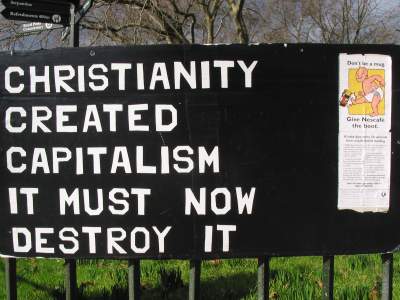
A bit further on, a chap in a baseball hat was either waving or threatening to burn an American flag; a crowd had gathered around him and were remonstrating vigorously with him. Not far from there, Cory Doctorow and his posse of copyright-policy troublemakers had set up and addressed the crowd on the evils of the broadcast flag and WIPO treaties.
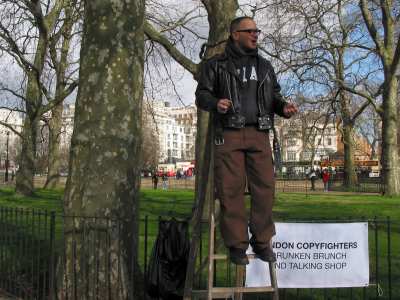
2005/2/18
Tonight, I went along to the Open Knowledge Forum, which Cory Doctorow posted about on bOING bOING. It was fairly interesting.
They had several speakers, most of them originators of various projects to make civic data accessible to and easily navigable by the people who have a stake in politics (read: you and me); there was one of the authors of the genuinely awesome They Work For You and the connected Public Whip project, as well as someone from MySociety, the troublemakers behind FaxYourMP, WriteToThem.com, and the BBC's iCan project. And, toward the end, Cory spoke from behind his sticker-covered PowerBook and recounted his work with the EFF, recent happenings at the World Intellectual Property Organization (which he's in Europe to keep an eye on), new database copyright laws which allow organisations to own facts, and more.
Some interesting points came up: that non-profit projects in the public interest should not ask for permission before using government data (both for tactical reasons, namely, had they done so, they would have been kept waiting for much longer than it took to code the project and subjected to onerous restrictions, and moral reasons, i.e., a permission-based democracy not being a democracy), that such projects are not about "political reengagement" or restoring some lost state, but about reinventing democracy, and that a few Crown Copyrighted data sets, such as the (heavily monetised) Ordnance Survey geographic data and the Royal Mail's copyright on postcodes, are still impeding the ability to make civic information available freely (and free means free-as-in-speech, including the freedoms to syndicate, modify and incorporate information into other things).
2005/2/14
The War On Copying heats up in the Philippines, with anti-terrorism police in Manila searching subway passengers and confiscating all optical media, just in case it contains pirated movies or evil, evil MP3s.
He says that it's a new policy of theirs, imposed, if I understand correctly, by the VRB, to curb piracy. They're supposed to confiscate all recordable discs and especially obviously pirated purchases (which by the way could land you in jail for at least six months if you're caught selling them, but what the hey). So recordable discs including those that come from the workplace and are legit? I ask them, with an eyebrow raised. And he says flatly, yes, because, you know, how can we ever be sure?
(via bOING bOING)
2005/2/3
The privatisation of the space of concepts keeps marching on; now, it turns out likenesses of the Eiffel Tower are copyrighted, and cannot be published without a licence. The city of Paris and the company which maintains the tower managed to do this by adorning it with a distinctive lighting display, which they then copyrighted; consequently, any recent night-time photograph of the Eiffel Tower is a derivative work. In their infinite generosity, they have said that they are not interested in going after amateurs putting holiday photographs of the tower on their web sites; they are, however, technically in violation. Which means that this WikiMedia image is technically in violation. And so, the space of free public discourse narrows slightly.

I wonder what's next: perhaps Ken Livingstone will copyright the names of London Underground lines and stations and demand licensing fees from fiction authors who mention them or something?
Eventually, we will get to the situation where all real-world objects and likenesses are intellectual property and use of them requires licensing fees. (After all, the dominant Reaganite/Thatcherite ideology of our time says that the way to maximise the efficient use of any resource is to monetise it and place it on the market; coupled with intellectual property, the natural conclusion is what Lawrence Lessig calls an "if-value-then-right" intellectual property regime, where for any value in an item, there is a right assigned to a rightsholder, who can license that right on the open market. Think of the colossal economic waste we had in the bad old days of the public domain and Jeffersonian copyrights.) As depicting any public figure, fictional character, location or privatised folklore will require a licence, costing fees and giving rightsholders vetoes over works they find objectionable, stories (well, those without the corporate media backing required to resolve all the rights issues) will move to generic locations; nameless, nondescript buildings, cities, countries and characters will take hold. To which, Big Copyright will respond by copyrighting categories of ideas (in the way that Marvel and DC Comics claimed a joint trademark on superheroes), or by patenting common types of plot devices and settings (which is probably not legal now, though given sufficiently pliant legislators and international treaty bodies, anything's possible). Galambosianism, here we come.
2005/1/25
What do Saudi Arabia, the Bush Whitehouse, the Mormons, the Vatican and former Malaysian strongman Mahathir Mohamad have in common? They are all part of an international alliance against liberal secularism:
The Doha conference, and the resulting UN resolution, provided a striking example of growing cooperation between the Christian right (especially in the United States) and conservative Muslims - groups who, according to the clash-of-civilisations theory, ought to be sworn enemies.The coalition succeeded in introducing a resolution in the United Nations asserting "traditional" definitions of the family and attacking progressive social policies including promotion of contraception, tolerance of homosexuality, nontraditional views of the status of women and sex education. The resolution, proposed by Qatar, was backed by the United States, though, unusually, Australia (with its socially conservative and vehemently pro-US administration) sided with Godless Europe. Chances are that was the result of a miscommunication and, the next time such a resolution comes up, Australia's UN ambassador will vote with the Coalition of Willing.
The family debate certainly divides the world, but the divisions are not between east and west, nor do they follow the usual dividing lines of international politics. The battle is between liberal secularists - predominantly in Europe - and conservatives elsewhere who think religion has a role in government.
On this issue, with a president who sounds increasingly like an old-fashioned imam, the United States now sits in the religious camp alongside the Islamic regimes: not so much a clash of civilisations, more an alliance of fundamentalisms.
And in another unholy alliance, US Christian Fundamentalist groups are holding their noses and jumping into the hot tub with Hollywood on the issue of file-sharing, in the interest of instituting centralised control over the lawless internet, mechanisms control which could just as easily be used for enforcing religious morality and stamping out sin as for making sure that every byte of copyrighted content is paid for.
2004/12/18
For each US$100 donated to the EFF, Public Knowledge or IPac, copyright-reform advocacy group Downhill Battle will send one lump of coal to the RIAA and MPAA.
2004/12/1
The U2 vs. Negativland iPod, a strictly unofficial extra-limited-edition black iPod, consisting of an U2 iPod preloaded with the Negativland back-catalogue and with a book on the consequences of the U2-vs.-Negativland sampling lawsuit, in a special commemorative box. Only one has been produced (by an artist in Brooklyn), and all proceeds from its eBay sale go to copyright reform group Downhill Battle. (via bOING bOING)
2004/11/15
The US Government looks set to pass a law jailing users of peer-to-peer filesharing software. In response, pirasite anarchoterrorist group Downhill Battle have organised a bounty for a Gaim plug-in for secure filesharing with trusted friends and people one invites. The plugin will "spread virally", allowing IM users to send friends invitations; meanwhile, all peer-to-peer communication through the IM network is disguised as messages in English (perhaps using a similar technique to SpamStego). Which is all very cloak-and-dagger.
The software urges people to not invite buddies that they did not know on a medium-term, face-to-face basis. You could also allow certain people to share your files without letting their friends share your files.
update checker - software will prompt user to update it when new versions are available so users won't get stuck with an insecure or broken version.
Unless, of course, the FBI/RIAA seize/hack the server and put up their own updates which sends lists of evidence home; encrypted, of course, and through a P2P network to disguise the telltale fbi.gov destination. The first most users will know about it is when they're rounded up in a series of dawn raids and the Attorney-General goes on CNN announcing that the FBI have cracked a major international piracy (or child pornography) ring.
2004/9/28
Tomorrow (Wednesday 29 September) is Save Betamax Call-In Day; the EFF and others are asking people in the US to join a chorus of opposition to the INDUCE act, which is coming up before Congress. This piece of legislation, backed by the copyright industry, aims to reverse the "Betamax decision", making technological innovators liable for possible copyright infringements resulting from their technologies, and thus giving Big Copyright a veto over innovation; a veto which, had they had in the past, would have squashed everything from the VCR to the iPod. (And if you think that this doesn't affect you because you're not in the US, think again. Australia automatically gets US intellectual-property law (minus the constitutional fair-use provisions) thanks to our fearless leaders' Free Trade Agreement; others will get these laws foisted on them in the next round of WIPO treaties and/or copyright-law harmonisations.)
2004/6/8
Public Enemy's Chuck D and Hank Shocklee on how copyright law changed hip-hop; or the impact that the increasingly greedy demands of owners of samples had on the evolution of hip-hop:
The first thing that was starting to happen by the late 1980s was that the people were doing buyouts. You could have a buyout--meaning you could purchase the rights to sample a sound--for around $1,500. Then it started creeping up to $3,000, $3,500, $5,000, $7,500. Then they threw in this thing called rollover rates. If your rollover rate is every 100,000 units, then for every 100,000 units you sell, you have to pay an additional $7,500. A record that sells two million copies would kick that cost up twenty times. Now you're looking at one song costing you more than half of what you would make on your album.
We were forced to start using different organic instruments, but you can't really get the right kind of compression that way. A guitar sampled off a record is going to hit differently than a guitar sampled in the studio. The guitar that's sampled off a record is going to have all the compression that they put on the recording, the equalization. It's going to hit the tape harder. It's going to slap at you. Something that's organic is almost going to have a powder effect. It hits more like a pillow than a piece of wood. So those things change your mood, the feeling you can get off of a record. If you notice that by the early 1990s, the sound has gotten a lot softer.
Stay Free!: So is that one reason why a lot of popular hip-hop songs today just use one hook, one primary sample, instead of a collage of different sounds?
Chuck D: Exactly. There's only one person to answer to. Dr. Dre changed things when he did The Chronic and took something like Leon Haywood's "I Want'a Do Something Freaky to You" and revamped it in his own way but basically kept the rhythm and instrumental hook intact. It's easier to sample a groove than it is to create a whole new collage. That entire collage element is out the window.
2004/6/7
Not all that long after voting to adopt software patents, the EU are moving to legally require currency detection code in all image-processing software. This looks likely to either (a) be utterly ineffective, or (b) be mostly ineffective whilst effectively outlawing open-source graphics software. The precedent it sets is not a good one either; how long until paracopyright enforcement is mandated to be built into anything processing audio or video data, or indeed any copyrightable data?
Meanwhile, British Telecom have taken steps to block access to child pornography websites. A laudable sentiment, though one worries that the site-by-site censorship infrastructure required to implement this could easily be extended to blocking other things (overseas news sites publishing things violating the Official Secrets Act, for example, or MP3 download sites that piss off the local recording industry). One brave step towards the Singaporisation of the internet.
Meanwhile, the RIAA's latest campaign to defend the foundations of capitalism from the enemy within will involve putting fingerprint readers into music players to ensure that nobody who didn't pay for music gets to listen to it. Welcome to the Digital Millennium; make sure you've paid your way.
2004/3/5
With the details of the free-trade deal revealed (the farmers got screwed over, and we're getting US-style copyright extension), Labor is making noises about resisting it in parliament. Not sure what that will amount to; possibly a few minor cosmetic changes (the equivalent of demanding better lubricant for when you get forcibly sodomised). Anyway, now may be an excellent time to mail your MP about why copyright extension is a bad idea; perhaps if enough Labor MPs get such letters, they'll show enough spine.
2004/1/6
Norwegian prosecutors drop appeal against Jon Johansen, creator of the DVD decryption library DeCSS; thus, unauthorised decryption of DVDs is perfectly legal in Norway, at least until they pass their WTO-mandated copyright-expansion law. Meanwhile, Jon isn't resting on his laurels, and has released code for stripping DRM from iTunes files.
2003/12/23
Jon Johansen acquitted, again, of copyright violation for writing DVD decryption code. The acquittal came several weeks before it was expected; this will undoubtedly make it harder for the MPAA to get a conviction if the case moves up to Norway's supreme court. (via Slashdot)
2003/11/11
In the UK, it is not only illegal to use portable radio transmitters with your iPod (they're legally considered to be pirate radio transmitters, regardless of their range), but, under the draconian EU Copyright Directive just adopted, to copy MP3s you don't own the copyright to to it, or indeed to make mix CDs. I guess I'm leaving my Archos Jukebox at home next time I go there.
2003/8/1
Mod chips for game consoles are now illegal in Australia. How quickly this will impair their availability at computer markets remains to be seen.
2003/7/2
I just picked up the new Mogwai album, Happy Songs for Happy People. I was surprised to find an insert in the album stating that the CD comes with a demo version of Cubase SX and the multitrack audio files of the first song on the CD, required to remix it. The Cubase demo is PC-only, so I don't get to see how the damned thing works under OSX, where most of my plug-ins can't go. The separate files are all .wav files, though, so if you don't mind not being able to load the .CPR Cubase SX project, you can still have a go at them. (Btw, Cubase SX files appear to be a RIFF data type; maybe some penguinhead will reverse-engineer them in due time, at least well enough to import them.)
Anyway, it's an interesting experiment; giving songs for the fans to remix like that. I can't see the copyright-crazed majors allowing their chattels to do something like that (i.e., if Radiohead did that, it'd probably come with a special rights-managed remixing program which ran only on your Trusted PC™ and let you give a few play-once low-bitrate Windows Media copies to a handful of friends before self-destructing), but I think it makes sense for indie artists. Mogwai probably have more to benefit from a fan-made remixes of one of their songs floating around the MP3 nets and being played by laptop-glitch DJs from their Ableton Live-equipped iBooks than most artists; much in the way that Björk has to gain from all the bootleg remixes of her songs floating around.
As for the album: haven't heard the whole thing yet, though it sounds good. It seems that the detour into Radical Jewish Thrash Metal that was My Father My King was just that, and the album is a progression from Rock Action; if anything, it's more introverted and subtle, though in a good way. In places they're starting to sound a bit like Sigur Rós, though.
Speaking of Sigur Rós, I also picked up their Sigur 1 - Sigur 9 single, which came with a DVD of videos. The one for Svefn-g-englar is not bad, and quite apt; it basically has people dressed up as angels moving about in slow motion around an Icelandic landscape, under a volcanic cliff and a featureless off-white sky. (The video was a US import, where they are released through MCA/Universal, which is presumably why it's a Region 1-only DVD.)
(Interesting that Mogwai hail from Scotland and Sigur Rós hail from Iceland. I wonder how long until a post-rock band emerges from the Faroe Islands, a point roughly halfway inbetween.)
2003/7/1
A recent Fairfax weekend paper piece on the recording industry's crackdown on homemade mix CDs in Australia. People (mostly in the hip-hop scene) are being raided by the federal police (whose usual business is invstigating drug cartels and terrorists) and facing 5-year jail sentences and massive damages bills (not yet on the level of the US$180M damages awarded for planning to pirate satellite TV, though we'll probably get there soon enough) for distributing mix CDs of their DJ sets and/or bootleg remixes. The message is: if you break the law, the law will break you.
2003/4/22
Cory "bOING bOING" Doctorow and Charlie "Antipope" Stross are collaborating on another short story, The Unwirer, set in a world where Jack Valenti runs the FCC, all Internet transactions cost money, operating unlicensed network sites is criminal copyright infringement, and wireless networking is a sort of underground guerilla resistance. And they're posting it to a specially commissioned blog as it's written.
He'd lost his job and spent the best part of six months inside, though he'd originally been looking at a from a five year contributory infringement stretch -- compounded to twenty by the crypto running on the access-point under the "use a cypher, go to jail" statute -- to second degree tarriff evasion. His public defender had been worse than useless, but the ACLU had filed an amicus on his behalf, which led the judge to knock the beef down to criminal trespass and unlawful emission, six months and two years' probation, two years in which he wasn't allowed to program a goddamn microwave oven, let alone admin the networks that had been his trade.
2003/4/17
Musician George Ziemann tried to sell home-burned CDs of his music on eBay, but was stopped by RIAA accusations of copyright. So he turned his attention to investigating the RIAA's claims of CD burning and MP3 piracy cutting into their sales. He discovered that sales were down, but the decline was due to the major labels cutting back on releases; in other words, he asserts that the decline in sales is artificial, deliberately engineered by the RIAA, presumably to make a fraudulent case for more draconian laws restricting independent music distribution channels, in the interests of forestalling the collapse of capitalism and thus civilisation.
2003/4/14
While the recording industry is going to hell, blaming the MP3 kiddies and the lack of legally mandated end-to-end copyright enforcement for their woes, indie labels and artists have never had it better. Sure, Clear Channel (or Austere-o or JJJ) won't play their material, but profits and sales are up for them. Meanwhile, their artists get a bigger cut of their sales and actually end up seeing some of their money (unlike the major-label artists who don't happen to shift a million units). (And the indie labels are also in no hurry to put the latest form of copyright BDSM on their discs, unlike the majors.) (via Graham)
At a major label, most artists are unlikely to earn anything unless they sell at least 1 million albums, and even then, they could wind up in debt. Everything from studio time to limo rides are charged against their royalties, which might be only $1 per disc sold. That compares with an indie artist, who can sell a disc for $15 at a concert. If they make $5 profit a disc on 5,000 discs, they pocket $25,000.
2003/4/4
Apparently that poxy "copy control" thing EMI are putting on all their CDs isn't confined to Australia: they're doing it in Canada too. And
they've made this guy pig-biting mad; so much so that he's starting a campaign against it. He actually went to the EMI offices, threatening to post details of circumvention, and demanding one hundred billion dollars proper Red Book copies of the CDs he bought which won't play in his car stereo.
(via Graham)
Hmmm... there are direct-action possibilities there. Anyone up for a die-in outside the local EMI offices? Or perhaps a Ron Rude-esque hunger strike would be more appropriate? What's your best anti-copy-denial protest idea?
2003/3/19
Quelle surprise:
Those "Copy Controlled" CDs EMI have been foisting on the public
aren't proving very popular. Apparently, they don't play in some car stereos, and the top-s3krit Windows software that auto-installs when you try to play the CD may do things to your registry without your consent. EMI, of course, won't tell you what it does because it's a secret and if people find out how it works, then the terrorists pirates will have won. I've heard of people successfully ripping them on Windows and/or Linux, though they may have been mislabelled clear CDs (given that no software automatically started).
I wonder how long until recorded music comes with a shrink-wrap license prohibiting you from circumventing copy-denial mechanisms or making unencrypted MP3s of it, and indemnifying the company for any changes made to your system software?
(I can't see EMI's security-through-obscurity scheme holding up for very long, especially since it doesn't rely on "trusted client" PCs or anything. Soon enough, some guy without a girlfriend will break it and upload the details to a server somewhere. Yes, he may go to jail for it, but that hasn't stopped virus writers.)
2003/2/1
Finnish parliament kills European Copyright Directive, the EU's version of the DMCA, which would have extended the reach of copyright laws in a most draconian fashion. The EUCD was mandated by the European parliament, which means that each EU member state is in theory obliged to pass it into law, no ifs or buts. (Isn't democracy a glorious thing?) So far, only Greece and Denmark have done so, and Finland has decided it's not having a bar of it. However, the battle isn't won yet; the EU is likely to apply economic pressure to force Finland to toe the line, and if not, there is the prospect of US trade sanctions. Though with any luck, this will hearten anti-EUCD efforts in other European states and the copyright absolutists will have an open revolt on their hands. (via Slashdot)
2003/1/28
If you're in the US and you've ever used a peer-to-peer network and swapped copyrighted files, chances are pretty good you're guilty of a federal felony. It doesn't matter if you've forsworn Napster, uninstalled Kazaa and now are eagerly padding the record industry's bottom line by snapping up $15.99 CDs by the cartload. Be warned--you're what prosecutors like to think of as an unindicted federal felon.
The law even grants copyright holders the right to hand a "victim impact statement" to the judge at your trial, meaning you can expect an appearance from the Recording Industry Association of America (RIAA), the Motion Picture Association of America (MPAA) or the Business Software Alliance (BSA), depending on what kind of files were on your hard drive. You'll no longer have that hard drive, of course, because it'll have been seized by the FBI, and you'll be in jail.
The NET Act works in two ways: In general, violations are punishable by one year in prison, if the total value of the files exceeds $1,000; or, if the value tops $2,500, not more than five years in prison. Also, if someone logs on to a file-trading network and shares even one MP3 file without permission in "expectation" that others will do the same, full criminal penalties kick in automatically.
No peer-to-peer users have been prosecuted yet, but there is a lot of pressure from the RIAA on the Department of Justice now to begin such prosecutions. Which means some poor bastard is about to get crucified. (via FmH)
2003/1/24
Ding dong, the witch is dead! Hilary Rosen, the much maligned head of the RIAA who spearheaded several aggressive crackdowns on file-sharing and other such crimes, is resigning from the post at the end of the year. It is not clear what, if any, the political outcome of her resignation will be.
Meanwhile, a judge has ruled that a US ISP must reveal the identity of a serial MP3 downloader to the RIAA. Are the days of BSA-style "copyright audits" on private MP3 collections coming? Soon it may be prudent for anybody who has downloaded MP3s from the Internet to destroy their hard disks beyond forensic recoverability, avoiding expensive prosecution and/or lengthy prison terms. (Or, when they come for you, claim you were "just doing research" on music piracy.)
2003/1/16
A crushing blow in the Eldred vs. Ashcroft case. US Supreme Court upholds copyright extension, paving the way for copyright as a perpetual property title, and the evolution of "intellectual property" into a new feudalism. After this, it is likely that nothing will ever enter the public domain in the US. At this rate, it will take global nuclear war, alien invasion, comet strike or the near-extinction of the human race to do anything about it.
2003/1/7
Jon Johansen acquitted on all counts of charges of criminal computer trespass, after he wrote code to break DVD encryption. (Whether he can safely catch flights stopping in US jurisdiction is another matter, though.) The decision is a crushing blow for the MPAA and is expected to have far-reaching ramifications in Norway; however, since his arrest, Norway has moved to introduce DMCA-style legislation which explicitly outlaws circumvention, so this may be moot. Time will tell.
2003/1/3
An international master criminal to rival Jon Johansen, the 15-year-old Lex Luthor of Norway, has cracked the Microsoft Reader "eBook" copy-protection system, and apparently released a program, including source code, for removing copy-denial from books, allowing them to be converted to HTML or other formats. Dan Jackson claims that the software is legal under the Berne Convention, though should probably avoid flights entering US airspace anyway. (via Charlie's Diary)
2002/10/9
Eternally zealous in the moral defence of capitalism, the Ayn Rand Institute denounce opponents of copyright extension as "Marxists". (Note in particular the prohibition against redistributing the article to media at the bottom of the page.) It's not hard to see how Randism ties in with intellectual-property absolutism, and how short a leap it really is from Ayn Rand to absurdities like Galambosianism. (via Reenhead)
2002/9/24
The UK government is escalating the War On Copying: in a heartwarming display of public-private partnership for the common good, the government and recording industry are co-funding a new post at the Department of Culture, Media and Sport. The post will be held by a former executive of V2, BMG and Warner Music, and its purpose will be to stamp out the scourge of file-sharing and help ease in mandatory copy-denial technologies.
"Legitimate means of distributing music are under threat "
(via Charlie's Diary)
2002/8/28
0wnz0red, a pretty doovy new short story by Cory Doctorow (of bOING bOING), touching on transhumanism, "trusted computing", secret military biotech projects, and a lot of hacker-culture references. Go read.
2002/6/16
The recording industry in the US is crawing attention to another little-publicised form of piracy and theft that's bleeding it dry: used CD sales. Some voices in the industry are now calling on a federally-mandated royalty on used CD sales, to be distributed to the recording industry (i.e., major labels). (via Slashdot)
2002/5/4
Welcome to the Digital Millennium: In the spirit of the AOLTW executive who described skipping commercials as theft, here's a list of 10 new copyright crimes for the new millennium; these include things such as inviting friends over to watch pay-per-view and changing radio channels during commercials (which will probably be automatically disabled by legally-mandated standards when digital radio arrives anyway). And, of course, blocking pop-up ads. (via rotten.com)
2002/4/10
In the U.S. the FCC plans to ban unserialised streaming audio players, as they don't allow listeners to be tracked enough to satisfy the copyright racket. This means that using open-source streaming audio players (such as xmms), or systems such as Ogg Vorbis, would be illegal in the Land of the Free. (via bOING bOING)
2002/4/4
A propagandistic News Corp. article about the evils of coin-operated CD duplicators, how they threaten to kill musical artists, and how outrageous it is that they're perfectly legal, as a result of our inadequately lax copyright laws. (Keep in mind that News Corp., along with Disney, is one of the major advocates of legally mandating copy-protection in all electronic devices in the US.)
NEW machines installed in Adelaide convenience stores make the illegal copying of the latest CDs and computer software - which costs artists and software designers millions of dollars - as easy as buying a loaf of bread.
It also makes legal copying of CDs you already own, for backups or use in the car, for example, or of your band's demos, or whatever, easy. But we all know that consumers have no legitimate reason to copy CDs.
The machines are able to operate under the same legislation as public photocopiers, where the burden of responsibility for copyright breaches lies with the user and not the owner of the equipment.
How much do you want to bet that there'll be legislation in parliament to remedy this promptly?
2002/2/10
Sony sues to ban PlayStation mod chips in Australia (as they have done successfully in the UK), Allan Fels and the ACCC stand up to them, in the interests of consumer choice (specifically, the right to play imported titles). Bravo, ACCC.
2002/1/11
War on Economic/Copyright Terrorism: Jon Johansen, who published DeCSS, has been charged with computer crime for bypassing DVD access-control mechanisms. The law under which he is charged has been used to prosecute crackers breaking into banks; there is no precedent applying it to copy-control mechanisms, but Hollywood and the US Government are pushing hard for one. (And you don't want to get in the way of the US Government; just ask the Afghans.) If convicted, Johansen faces 2 years in prison. (Though presumably he should be thankful he is not going to be extradited to the US; Norwegian prisons are probably more humane than US federal prisons.) The usual pirasymps are lobbying for the charges to be dropped.
2001/12/27
Good stuff: The BBC are experimenting with streaming programmes in the Ogg Vorbis format, an open-source, completely free format available on virtually all platforms (and not encumbered by licensing agreements, patents or other proprietarian evils); what's more, the Ogg developers have taken a stand against the copy-prevention trend. The BBC appear to be the first major broadcaster to use this format. Use it (and if you do, write in to let them know you do) before Bill Gates has a word with Tony Blair and it gets squashed by a directive from on high. (As happened with non-Microsoft systems in most parts of Britain's government.)
2001/11/29
Read: Stanford technology law professor Lawrence Lessig spoke about why expanded copyright laws pose a threat to culture:
"The period of copyright primacy is going to end up as a huge hole in the cultural record."
Lessig said a major problem is the fact that copyrighted material simply vanishes because corporations aren't interested in keeping all that they copyright commercially available. Such material "falls into a black hole where no one will have access to it," he said.
2001/11/2
Some good news: The California State Appeals Court rules that code is pure speech, overturning a ban on the publishing of DVD descrambling code.
"DVDCCA's statutory right to protect its economically valuable trade secret is not an interest that is 'more fundamental' than the First Amendment right to freedom of speech or even on equal footing with the national security interests and other vital governmental interests that have previously been found insufficient to justify a prior restraint," the ruling stated.
Mind you, the case is still pending appeal, so it's not over yet. However, this is very heartening news.
2001/9/17
Democracy is not a spectator sport: A good Slashdot feature about the coming crackdown on freedoms and civil liberties in the US (and elsewhere too, most probably), and more importantly: how you can fight for your rights:
Rep. Rivers says phone calls "...have a sense of personal contact to them," and this makes them the most effective grassroots lobbying tool. "Stick to one issue," she advises. "Don't come up with a laundry list."
"The House [of Representatives] is ruled by brute force." ... the "unanimous" vote that got DMCA through the House was not really unanimous at all; that the bill got through a committee dominated by a powerful chairman (which is how bills generally get to the floor for a vote) and that the Speaker called for a voice vote. "Most yelled 'Aye,'" Rivers said, and some yelled 'Nay.'" The voices yelling "Aye" were the loudest, so DMCA passed by acclamation.
If you live in the US and are concerned about the erosion of your remaining rights (both in terms of privacy/crypto and in terms of things like the SSSCA), read it and, for the love of "Bob", act on it. If you don't live in the US, read it anyway as it's bound to be relevant soon if not now. (And if you aren't concerned, wake up and look around you.)
2001/7/23
Ominous tidings: Riot police shoot dead a demonstrator at anti-globalisation protests; the officers will probably be charged, but who gave the orders to shoot to kill? Meanwhile, a Russian programmer is in jail for revealing the secrets of Adobe's access controls (a crime under the DMCA), and hence Alan Cox has resigned from the USENIX committee in protest. Whether this will make a point or marginalise the penguinhead pirasite colony remains to be determined. Meanwhile, the US Government has created a special elite cyber-cop agency of highly-trained aspheads to hunt down intellectual property thieves, crackers, copyright violators and other enemies of capitalism (and that means you, hiding there with the DeCSS source and the eight gig of MP3s on your hard disk; don't think they cannot see you), further escalating the War On Copying.
2001/6/20
Some academic ratbag types in France have released an open-source DVD player, which apparently does CSS decryption. This is currently legal in France, though with the EU Directive on Copyright, it won't be for long. (via Slashdot)
2001/4/27
Imagine a boot stamping on a human face, forever: SDMI researchers silenced by DMCA, withdraw paper from conference. There you have it; a research paper is classified as a criminal tool and banned outright. (The paper is mirrored; I'd tell you where, but doing so is probably illegal under Australia's WIPO laws .)
2001/4/13
The War On MP3: Windows XP to limit MP3 quality to 56kbps, to wean users onto proprietary formats. Elsewhere this would be considered unfair restraint of trade; in this case it is a well-deserved blow against audio piracy. The fact that it will nicely lock customers into Microsoft's own proprietary platform is just a bonus for those heroic altruists in Redmond. (Who said that doing good never pays, right?)
This won't apparently block the writing of MP3 files at the filesystem level or anything quite like that, but will block recording with Microsoft's bundled tools; their hope is to make all the unsigned garage bands release all their stuff in proprietary Windows formats (after all, who cares about the 0.01% of the market who don't use Windows? Translating the lyrics into Urdu makes as much sense as supporting non-Windows platforms), thus consigning MP3 to a a historical footnote. (It would work better if they automatically degraded the playback of MP3s; though that may be in the next release.)
Though doesn't everyone use WinAMP or Sonique under Wintendo anyway? (I know I do on the NT machine at work.)
2000/8/4
The Internet piracy crime wave spreads; first it was the Napster kiddies swapping Britney Spears/Eminem singles, and the latest menace to our way of life is grandmothers swapping sewing patterns online:
``They're housewives, and they're hackers,'' Hedgepath said. ``I don't care if they have kids. I don't care that they are grandmothers. They're bootlegging us out of business.''
2000/7/30
The Guardian on the real issues behind the DeCSS lawsuit. Not surprisingly, it's not so much about preventing piracy as it is about the DVD consortium protecting its monopoly on the encoding of DVD movies and locking independent producers out.
2000/7/4
Facing the music: Superstar lawyer David Boies (responsible for nailing Microsoft to the wall) has taken on the recording industry, and has just dropped a bombshell in the Napster case. Get this, kittlings: if the recording industry is found to have used copyrights anticompetitively, it could lose the right to enforce them (at least until they buy a law to give them whatever they want, anyway). If you have a PDF reader, you can find the brief here. The chickens may finally be coming home to roost... (Link shamelessly stolen from Slashdot)
2000/6/21
Law professor Lawrence Lessig on copyright law and its degeneration into a system of heavy-handed control. (via Slashdot)
2000/5/28
Liquor bootlegger turned recording/film empire Seagram declares war on Internet anonymity: (press release, via Slashdot)
Let me now turn to my fifth point. We must restrict the anonymity behind which people hide to commit crimes. Anonymity must not be equated with privacy. As citizens, we have a right to privacy. We have no such right to anonymity.
1999/10/30
The War on MP3: Organised criminals force MP3 downloaders to view horrific scenes of teenage sex; or so the BPI (the British equivalent of the RIAA says). Meanwhile, HMV Europe blacklists artists who make tracks available for download. (NME, via Slashdot)