The Null Device
Posts matching tags 'cats'
2014/7/31
The Washington Post's data-journalism blog has a piece on the relative popularity of cats and dogs, by US state and by country.
In summary, in the United States cat people tend to live around the coasts and in the north, adjacent to the Canadian border, though parts of the Midwest also lean cat; the South, meanwhile, leans dog (with the exception of Florida), with the southwest being most strongly dog. On a worldwide level, though, the US leans cat (albeit weakly) in aggregate, as do Canada, Russia and most of Europe (with the exceptions of Ireland, Poland, the Czech/Slovak republics and the Iberian peninsula, all weakly dog; Switzerland, meanwhile, is strongly cat). The Islamic countries tend to lean strongly cat (presumably for religious reasons, dogs being regarded as unclean). Meanwhile, Australia is weakly dog, as is Brazil; the Spanish-speaking Americas are strongly dog-leaning, as are China, India, Thailand and South Africa. (New Zealand, however, is strongly cat.)
The cat/dog dichotomy is, at least in places, partly political. In the US, the data approximates (albeit imprecisely) the red-state/blue-state divide between conservative- and liberal-leaning states; the most cat-favouring states tending to be the progressive strongholds of the coasts (notoriously liberal Massachusetts has a 2:1 cat:dog ratio, for example); meanwhile, the states most identified with conservative mindsets (open-carrying, convict-executing Texas, Sheriff Joe Arpaio's Arizona, Mississippi) lean most strongly towards dogs. (An exception is Florida, which narrowly favours cats.) This correlation between political identity and pet preference is borne out in surveys, which show that US liberals are more likely to be cat people (among other things). There are several possible explanations: one could be the correlation between population density and liberalism (city folks lean more liberal than rural/small-town people), and cats being more suitable for smaller living spaces than dogs. Another explanation ties to the theories recently floated by the likes of George Lakoff and Jonathan Haidt; in short, conservatives place more of a premium on loyalty, obedience and knowing one's place in a hierarchy; all of which are exemplary qualities of Canis familiaris. Cats, meanwhile, fail this test, and hence get little love from the right (with the possible exception of libertarians; it has been pointed out that both domestic cats and libertarians are highly dependent on their environments whilst imagining themselves to be wholly sovereign and autonomous). Meanwhile, this piece replicates the correlation between cat appreciation and liberalism (using Facebook likes s a proxy), adding that conservatives seem to be generally less fond of animals, with those liked getting an exception for their utility or symbolism (the animals most liked by self-identified conservatives on Facebook have been deer, eagles and, most of all, turkeys; liberals, meanwhile, like only bats and whales more than cats).
Worldwide, trends become murkier; Russia, styling itself as the core of a new “Conservative International”, is cat country by a 4:3 ratio. Spanish-speaking Latin America has dogs outnumbering cats by more than two to one (with Portuguese-speaking Brazil being slightly more equal); perhaps there's something in Hispanic culture which strongly favours dogs or deems cats inadequate as pets? And while Australia is dog country by an almost 3:2 ratio, New Zealand has twice as many pet cats as pet dogs. It is not clear whether that is a sign of Australia being a more intrinsically conservative country, and it would be interesting to see whether this ratio tracked (or was tracked by) changes of government and culture.
2013/4/6
The next thing after the study of human-computer interaction might be feline-computer interaction. Now there are iPad games and painting apps ostensibly designed specifically for cats, and hackathons to develop apps for cats, and now, on the first of April, HCI guru Jakob Nielsen has published a study into Essential Design Principles for Felines. The study found that Fitts' Law holds for cats as it does for humans, but that apps for cats require larger tap targets, should respond to swiping and use blinking and animation copiously, and should have a pause mode triggered by the user lying on the tablet. Unsurprisingly, the game Fruit Ninja performed fairly well with feline users.
While it is possible to write apps for existing tablets optimised for feline users, I suspect that human-oriented tablet hardware may be somewhat suboptimal for them. Certainly sound systems designed for humans (whose hearing range extends to barely above 20kHz when young, and deteriorates with age) would sound muffled to an animal whose hearing range goes well into the ultrasonic (apparently up to 75kHz). Designing a screen for a cat's eyes would probably result in a very different device than one for humans (though, since humans have to develop and debug them, there would have to be some overlap). Needless to say, scratchproofing would also be a consideration. Also, it remains to be determined whether there is any way of allowing a cat to select different apps (or different activities) from a device, or indeed whether a non-tool-using animal such as a cat could conceive of a tablet as being anything other than a random phenomenon it reacts to.
2013/1/10
Could this be the viral marketing campaign for a new William Gibson/Haruki Murakami collaboration?
Police in Japan who have for months been taunted by an anonymous hacker have found a memory card attached to an animal's collar after solving a set of emailed riddles, according to reports. The discovery was made after messages were sent to newspapers and broadcasters, with the sender claiming details of a computer virus were strapped to a cat living on an island near Tokyo.
2012/12/3
A recent study, ranking different breeds of cats in friendliness (to humans), has found that pedigree cats are friendlier than moggies. The study, from the National Veterinary School of Alfort in Paris, found that the friendliest breed being the sphynx, a rare hairless variety.
The researchers believed the sphynx’s affectionate nature could be due to its reliance on humans to keep warm. The study also suggested that the greater affability of pedigrees came about because breeders tended to leave the kittens with their mothers for longer, during a crucial period in their development, when they are becoming used to humans. It could also be the result of selecting more friendly cats for breeding.The selection hypothesis sounds plausible; by comparison, Russian researchers managed to domesticate foxes in a mere 35 generations, and also managed to breed a vicious, highly aggressive variety by selecting for the exactly opposite traits. Presumably pedigree cats have been bred for long enough to significantly alter their psychological make-up compared to free-range varieties.
The sphynx scored an average of 22.83, compared with 18.93 for the domestic short-haired. Because the numbers of other breeds in the survey were generally small, they were grouped together to score an average for pedigrees of 20.40.I wonder whether a study of friendliness in sphynx cats in warm and cold climates would yield any significant differences.
2011/9/23
In recent medical/biotechnological breakthroughs: players in an online game simulating protein folding have successfully determined the 3-dimensional structure of a protein in a simian virus related to HIV, a hard problem which is not feasible to do with brute-force computation:
Teams of players collaborate to tweak a molecule’s model by folding it up in different ways. The result looks somewhat tangled, but each one is scored on criteria such as how tightly folded it is and whether the fold avoids atoms clashing. The structure with the highest score wins. Anyone can play and most of the gamers have little or no background in biochemistry.
“People have spatial reasoning skills, something computers are not yet good at. Games provide a framework for bringing together the strengths of computers and humans. The results in this week’s paper show that gaming, science and computation can be combined to make advances that were not possible before.”Meanwhile, an experiment in using genetically modified HIV to destroy cancer cells has worked spectacularly well, with an experimental patient apparently having been cured of leukaemia, and remaining in full remission one year later:
At first, nothing happened. But after 10 days, hell broke loose in his hospital room. He began shaking with chills. His temperature shot up. His blood pressure shot down. He became so ill that doctors moved him into intensive care and warned that he might die. His family gathered at the hospital, fearing the worst. A few weeks later, the fevers were gone. And so was the leukemia.
But scientists say the treatment that helped Mr. Ludwig ... may signify a turning point in the long struggle to develop effective gene therapies against cancer. And not just for leukemia patients: other cancers may also be vulnerable to this novel approach — which employs a disabled form of H.I.V.-1, the virus that causes AIDS, to carry cancer-fighting genes into the patients’ T-cells. In essence, the team is using gene therapy to accomplish something that researchers have hoped to do for decades: train a person’s own immune system to kill cancer cells.Meanwhile, HIV research has yielded an unexpected boon, in the form of cats that glow in the dark.
2010/9/5
The Belgian government has proposed a law requiring all cats to be sterilised, with the exception of a few very rare (and expensive) breeds, from the start of next year.
Initially, all cats in shelters will be sterilised. The next phase imposes neutering on cats from breeders and sellers. Finally, all cat owners will be obliged to have their pets sterilised and registered, costing about €130 (£108) for a female cat and €50 for a tom. Breeders and owners of Siamese, Abyssinian and other special pedigrees will be exempted from the new regime.I can see such a law making sense in Australia, where feral cats are an ecological problem; Australia, also being far from other countries and having a famously strict quarantine system, could also prevent the importation of cats causing F. domesticus to become extinct within the country. Perhaps, if a government with authoritarian tendencies needed to burnish its green credentials and "cat people" fell on the wrong side of a politically expedient culture war (in the way that "inner-city latte sippers" and enthusiasts of foreign arthouse films did in the Howard era), it might happen.
2010/8/30
 Dublin railway staff used CCTV footage and Twitter to locate the owners of a cat that had wandered onto a suburban train and disembarked in the city centre. The cat, who is named Lilou and commenced her journey at Malahide station (in the suburbs of Dublin) was issued with an electronic smart card to use should she wish to make any future journeys.
Lilou is by no means the first non-human public transport user on record, or even the first feline one.
2010/6/1
Sony's R&D department has developed a lifeblogging device for cats. Well, not so much for the benefit of the cats, who remain blissfully oblivious of the online world, their social instincts not extending far beyond their sense of smell, but for their owners; think of it as narcissism crossed with Munchausen's by proxy. Anyway, the device is mounted on the cat's collar and contains a camera, an accelerometer and a GPS receiver, and can record your cat's whereabouts and activities and post fixed phrases to Twitter (via a home PC) when specific events happen, infringing on your cat's dignity and civil rights in a formulaically cutesy way:
For example, it is possible to automatically post a comment like "This tastes good" when a cat is eating something.Interesting idea, but I believe this chap was first.
(via Boing Boing) ¶ 0
2010/2/6
A new study from Bristol University has looked into the differences between cat owners and dog owners. As well as the usual stereotypes (cat owners are more likely to be women who live alone), they discovered that cat owners are more likely to have degrees than dog owners (47.2% of households with cats have one person with a degree, compared to 38.4% with a dog):
"Our best guess is that it's to do with working hours and perhaps commuting to work, meaning people have a less suitable lifestyle for a dog. It's really just a hunch though."Or perhaps there are common psychological traits associated with a fondness for cats and a likelihood to apply oneself to study (or, indeed, a fondness for dogs and a likelihood to quit wastin' time and go out into the real world)?
2010/1/25
A Russian ecologist has found that the fierce pressure of living in a hostile urban environment is causing Moscow's stray dogs to evolve increased intelligence, including abilities to negotiate the city's subway system:
Poyarkov has studied the dogs, which number about 35,000, for the last 30 years. Over that time, he observed the stray dog population lose the spotted coats, wagging tails, and friendliness that separate dogs from wolves, while at the same time evolving social structures and behaviors optimized to four ecological niches occupied by what Poyarkov calls guard dogs, scavengers, wild dogs, and beggars.
But beggar dogs have evolved the most specialized behavior. Relying on scraps of food from commuters, the beggar dogs can not only recognize which humans are most likely to give them something to eat, but have evolved to ride the subway. Using scents, and the ability to recognize the train conductor's names for different stops, they incorporate many stations into their territories.
Additionally, Poyarkov says the pack structure of the beggars reflects a reliance on brain over brawn for survival. In the beggar packs, the smartest dog, not the most physically dominant, occupies the alpha male position.I wonder whether similar evolutions of animal intelligence, driven by the conditions of living in cities, have occurred in other cities; there have been anecdotal reports of pigeons deliberately catching the Tube in London, with speculation that they commute in to the tourist-rich city to feed before returning to the suburbs. (As such, one could probably refer to them as passenger pigeons.) Not to mention two instances of cats deliberately catching buses (both in England).
2009/11/6
Facebook page of the day: List of cats with fraudulent diplomas:
On several occasions, people who desired to expose a diploma mill have registered their pet cat as a student. Upon its speedy graduation, the cat and its diploma are displayed to the news media.The article then enumerates several illustrious felines, amongst them Colby Nolan, Oliver Greenhalgh, and George, the aforementioned hypnotherapist.
2009/10/12
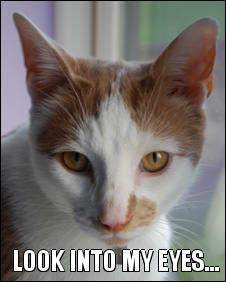 A BBC reporter investigating the regulation (or lack thereof) of hypnotherapists in the UK managed to register his cat as a hypnotherapist with no fewer than three professional bodies:
In the UK, George was registered with the British Board of Neuro Linguistic Programming (BBNLP), the United Fellowship of Hypnotherapists (UFH) and the Professional Hypnotherapy Practitioner Association (PHPA).
The BBNLP said it exists only to provide benefits to its members, not to check or certify credentials.
2009/7/13
Researchers at the University of Sussex have discovered how domestic cats have developed a purr that psychologically manipulates humans, subtly triggering a sense of urgency without being as confronting as a meow. The "soliciting purr" contains an embedded high-frequency component similar to a cry:
Dr McComb and her team set up an experiment which tested human responses to the different purring types. She says: “When humans were played purrs recorded while cats were actively seeking food at equal volume to purrs recorded in non-solicitation contexts, even those with no experience of cats judged the ‘solicitation’ purrs to be more urgent and less pleasant.”
Not all cats, however, use this solicitation purring: “It seems to most often develop in cats that have a one-on-one with their owners rather than in large households where there is a lot going on and such purring might get overlooked. Meowing seems to be more common in these situations.”Cats tend to use the "soliciting purr" at times such as early in the morning, to elicit compliance from humans who may otherwise prefer to do something else, such as remaining asleep. It appears to be individually learned rather than an evolved instinct. There are more details, including embedded video, here.
2009/1/12
In Japan, it is possible to pay to spend time with a cat:
Lola - or Rora - to give her a slightly more Japanese pronounciation - is a beauty and she knows it. Customers pay by the hour for her company. Usually they just want to stroke her, but as a special treat for favoured clients, she will lie back in a chair, close her eyes and pose for photographs.
Lola is a Persian cat who works at the Ja La La Cafe in Tokyo's bustling Akihabara district. It is one of a growing number of Cat Cafes in the city which provide visitors with short but intimate encounters with professional pets.
It costs about £8 ($10) an hour to spend time in a Cat Cafe. Busy lives mean some people prefer to hire a dog If felines do not appeal, other establishments will rent you a rabbit, a ferret or even a beetle. There are more than 150 companies in Tokyo which are licensed to hire out animals of various kinds and although beetles may be cheap, dogs much more popular.This is, of course, not the only Japanese institution of this type. There are the obvious ones, such as hostess bars and maid cafés, which allow men with more cash than time or social skills to rent the company and flattery (and occasionally other services) of attractive women. On a less salacious note, there are apparently also parks in Japan where salarymen suffering from alienation from nature can pay to rake leaves.
2009/1/9
Cat wanders onto set of German weather forecast; the meteorologist, Joerg Kachelmann, scoops it up and resumes giving the forecast without a pause.
2008/11/4
A code of practice published by the British government reminds owners of dogs and cats to ensure that their pets are not only fed properly but provided with adequate entertainment and mental stimulation. Rumours that the government will distribute laser pointers to all cat owners to assist in this could not be confirmed.
2008/10/20
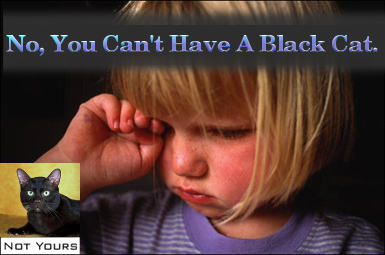 Some animal shelters in the US are refusing to give black cats away for adoption before Halloween, lest the hapless moggies end up abused or sacrificed in Satanic rituals. The same goes for white rabbits, it seems. (I'm guessing that goats and black cockerels aren't found often enough in animal shelters to be an issue˙)
“It’s kind of an urban legend. But in the humane industry it’s pretty typical that shelters don’t do adoptions of black cats or white bunnies because of the whole satanic sacrificial thing,” Morgan said. “If we prevent one animal from getting hurt, then it serves its purpose.”
“Black cats already suffer a stigma because of their color,” said Gail Buchwald, vice president of the American Society for the Prevention of Cruelty to Animals shelter in New York City. “Why penalize them any more by limiting the times when they can be adopted?”Apparently superstitions about black cats are not uncommon in the US:
Black cats tend to be adopted less often than other felines, Buchwald said. “Behaviorally, there’s no difference from the color of the cat. It’s tied into this whole mythology about the animal — don’t let it cross your path or some foreboding or foreshadowing of evil — and that’s an outdated superstition,” she said.
2008/8/25
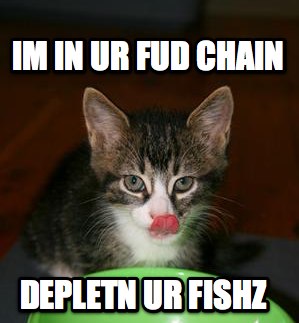 Apparently the world's supplies of fish are threatened by cats eating them all. Not predatory feral cats, but the pampered domestic variety, who consume increasingly large quantities of tinned fish.
"What is also interesting is that, in Australia, pet cats are eating an estimated 13.7 kilograms of fish a year which far exceeds the Australian average (human) per capita fish and seafood consumption of around 11 kilograms.
Wild forage fish, which includes sardines, herrings and anchovies, are an important link in the marine food chain, as part of the diet of larger fish like tuna and swordfish.
2008/4/26
Japan's Wakayama Electric Railway has increased its patronage by appointing a cat as stationmaster of an unmanned railway station. The cat, a 7-year-old tortoiseshell cat named Tama, can be seen wearing a specially made cap in her office inside a former ticket window at Kishi station on the Kishigawa line.
Two other cats have been appointed as "deputy stationmasters", and a human official has been hired to take care of the cats.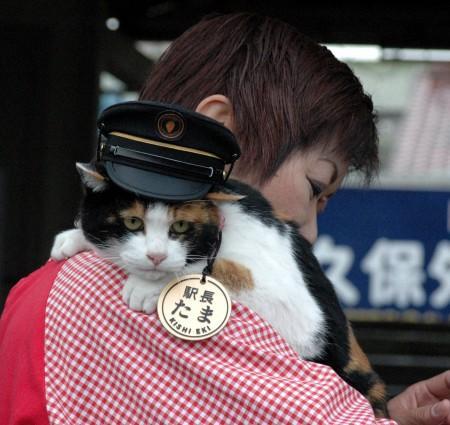
(via london-underground) ¶ 0
2008/4/1
Australia has apparently outlawed laser pointers after some griefers decided to aim them at aircraft for lulz. (Maybe they hoped that they'd get lucky and bring one down and get to see lots of cool flames and shit.) And so, thanks to the actions of a few cretins, the nation's cats are deprived of one more source of amusement.
2007/11/1
The cat genome has been sequenced. Well, most of it. The feline Craig Venter whose actual DNA was sequenced is a pedigree Abyssinian cat named Cinnamon, descended from lab cats bred to develop a degenerative eye disease, whose genetic cause has since been discovered.
Analysis of the cat genome sequence could also shed light on everything from evolution to the origins of feline domestication, they say.
"One thing I'd like to discover is the genes for good behaviour in the cats - the genes for domestication, the things that make them not want to kill our children but play with them," he added.If they do find the makes-a-good-pet gene, they could possibly use it to create transgenic pets which don't do the amount of ecological damage to non-native environments that cats do. (There would be a solid case for eliminating cats from, say, Australia, though because of their popularity, such a move would be impossible to implement in anything resembling a democracy.) An alternative would be to find the genes responsible for predatory instincts and knock them out, creating a cat that's, well, a pussycat. Oh, and if they find out how to encode bitmaps into the cat's coat patterns, designer kittens could be as much a possibility as laser-engraved iPods.
2007/7/4
This guy attached a digital camera (a specially modified keychain camera) to his cat's collar and recorded the sequences of images as the cat (named Mr. Lee) went about his daily journeys. The images vary in quality (as one might expect), and include a lot of obscure nooks and crannies of the sorts cats frequent, and quite a few meetings with other neighbourhood cats.
The author of the page, J. Perthold, also sells cat-mountable digital cameras of his design for people who want to photograph what their cats are seeing. The next step, I imagine, would be to integrate wireless networking capabilities of some sort into the unit and set up a catlog.
2006/9/26
A new application of genetic engineering: permakittens, or cats which never mature.
Everybody loves kittens. The only thing wrong with them is that they turn into cats. So we'll make genetically modified cats that never get big. I've bounced this off a couple of honest-to-goodness biologists who assured me it is 100% doable and even gave me some tips.The author of the idea, one Dylan Stiles, has worked out the genetics of it (or claims to have; not being a biologist, I can't verify whether what he's saying is plausible). Cleverly enough, his idea includes its own copy-protection mechanisms, in that the permakittens will not produce unlicensed knockoffs. (Which would be the case if they remained actual kittens, which they're not; they do mature, whilst remaining
2006/8/2
A biologist posits the intriguing hypothesis that a country's national character may be influenced by its rate of parasite infection, particularly by the parasite Toxoplasma gondii (i.e., the "crazy cat person" parasite):
The author of the study is Kevin Lafferty, a biologist at the University of California at Santa Barbara. Lafferty made three straightforward observations.Lafferty's hypothesis predicted that the national cultures/characters of countries with high rates of Toxoplasma infection would have higher rates of characteristics such as neuroticism, uncertainty avoidance and "masculine" sex roles:
- Toxoplasma infection rates vary from country to country. South Korea has prevalance rate of only 4.3%, for example, while Brazil's rate is 66.9%. These rates are determined by many factors, from the eating habits in a country (steak tartar, anyone?) to its climate (Toxoplasma oocysts survive longer in warm tropical soil).
- Psychologists have measured some of the personality traits influenced by Toxoplasma in these countries. People with Toxoplasma tend to be more self-doubting and insecure, among other things. Among the differences in men, Toxoplasma is associated with less interest in seeking novelty. Toxoplasma-infected women are more open-hearted.
- A nation's culture can be described, at least in part, as the aggregation of its members' personalities.
He found a signficiant correlation between high levels of the parasite and high levels of neuroticism. There was a positive but weak correlation between Toxoplasma and levels of uncertainty avoidances and masculine sex roles. However, if he excluded the non-Western countries of China, South Korea, Japan, Turkey, and Indonesia, the correlations of both personality measurements with Toxoplasma got much stronger.
So--has Lafferty discovered why the French are neurotic (Toxo: 45%) and Australians are not (28%)? As he admits, this is just a first pass.
Lafferty also notes that many other factors shape a nation's culture--which actually raises another interesting question: what about other parasites? Do viruses, intestinal worms, and other pathogens that can linger in the body for decades have their own influence on human personality? How much is the national spirit the spirit of a nation's parasites?
(via Mind Hacks) ¶ 0
2006/6/8
YouTube video of the day: a kitten climbs onto a MacBook, inadvertently triggers FrontRow (the media-player application), http://www.youtube.com/watch?v=cdXTDovB9K8 starts pouncing on the flying icons, and eventually starts iTunes.
2006/2/3
Today's heartwarming story of interspecies friendship: In Brazil, a cat has befriended a bird which hurt itself when it fell out of its nest; the cat then raised the bird as its own. It is there that the story becomes somewhat twisted: the bird helps out its new friend and stepmother by luring other birds where she can catch and eat them, and has also learned to eat meat. (Whether the meat comes from other birds was not mentioned.)
2006/1/3
Man falls out of his wheelchair; his cat dials the emergency services, possibly saving his life.
Rosheisen got the cat three years ago to help lower his blood pressure. He tried to train him to call 911, unsure if the training ever stuck.Mind you, it sounds slightly less impressive when one reads that the phone in question had a button for speed-dialling 911. And there I had an image of a cat fastidiously punching in three digits with its paws.
(via bOING bOING) ¶ 0
2005/12/2
A pack of squirrels bit a large dog to death in a park in eastern Russia, where, some months earlier, chipmunks have been terrorising cats.
2005/7/28
A list of some of the most unusual questions sent in to urban-legend researchers snopes.com, revealing the anxieties of the public:
I just read a blurb that pre-packaged foods can cause people to turn gay because of too much estrogen. If I was only allowed one question for snopes, I would ask if this is true. Is it?
They say that if a person has a pet cat and dies, if the person's body is not found fairly soon after death, the cat, having not been fed, will become ravenously hungry and eat the dead person's face off--JUST the face!
Is this true? My cat often looks me in the face. I used to think he was just being friendly. Now I know he's just sizing me up, like a chef at a butcher shop, waiting for "the big day". Since hearing this rumor, every time my cat licks his chops it gives me the willies!
I've heard that it is impossible to take a lightbulb out of your mouth once one puts it in, without either breaking the bulb or dislocating the jaw.
Do you know if this is true? I'm counting on you - my husband is really curious, and I don't want to have to drive him to the hospital...
2005/6/20
A kitten with two faces was born in Oregon on Friday; meanwhile, a Chinese temple in Malaysia found a six-legged puppy outside its doors.

2004/10/26
A company in the US is planning to start marketing genetically engineered hypo-allergenic cats for people who suffer from cat allergies. The cats will cost US$3,500 (indexed for inflation) and will be available in 2007; of course, to protect Allerca's intellectual property, the cats will come pre-neutered (think of it as genetic rights management). Interested parties can reserve one by ponying up US$250, which also gets them an "attractive personalized Reservation Certificate". Allerca are planning to expand into other species of "lifestyle pets" (perhaps an odorless, non-salivating dog could be in the works?) (via /.)
2004/6/8
A look at the stigma attached to women keeping cats. After all, everybody knows that people who keep cats are emotional basketcases; normal, healthy people either keep dogs (a proper, well-adjusted person's pet) or fish (which are more of a hobby than a pet) or don't need the emotional crutch of keeping animals:
Supposedly, to look into the female singleton's trolley is to gaze upon human despair in its purest form. The meals-for-one, the glossy magazines shrieking their self-help messages so loudly people three aisles away can hear, those furtive bars of high-quality chocolate brought as a substitute for the low-quality sex they were having before they decided enough was enough. All these items could be exhibited as evidence in the socio-emotional kangaroo courts that even today persist in judging the solitary female as worthless and hopeless simply because she is mate-less. However, the real clincher is the six-pack of top-of-the-range cat food. A kilo of heroin couldn't be more socially incriminating.
Militantly anti-cat Melanie Reid wrote recently; "Feminism has been blamed for many things but there is no doubt that it is also partly responsible for the rise of the cat."
It's very easy to deal with boyfriends who complain you treat your cat better than you do them. Just say: "Once you've produced evidence that an ancient civilisation worshipped you, then perhaps we'll talk." It could even be argued that some men end up being very poor cat substitutes. ("I just couldn't meet the right cat so I decided to have a relationship instead.")
The article also has a list of famous cat-haters, including William Shakespeare and King Louis XIV. They left John Ashcroft off the list.
Btw, what about men who keep/prefer cats; are we they also considered to be psychological liabilities, or perhaps cat-fanciers are Not Real Men (see also: vegetarians, Belle & Sebastian fans, non-followers of sports teams)?
2004/6/3
Groups from as far away as America are offering to help reunite a refugee with a cat that kept him company. Aladdin Sisalem's only companion during his 10-month stay at the Australian-run detention centre on Manus Island was a stray cat he named Honey. Then Sisalem's protection visa was granted and he was shipped to Australia, though the cat remained behind. Offers of financial assistance to fly the cat to Australia have since poured into the office of the Australian Democrats (remember them? Perhaps this is just what they need for a cat-led recovery.)
(There is an Age article there, but they've now instituted one of those annoying registration systems, and I can't be arsed doing it, so I'll just link to Beth's blog. Who do they think they are; the New York Times or someone?)
2004/4/26
The scene below took place in the kitten enclosure in a pet shop in the Melbourne CBD, a few days ago:

2003/12/22
2003/9/24
Those stereotypes of crazy cat people may have some truth to them. A Czech scientist has found that a cat parasite causes behavioral changes in human hosts. Men infected by the toxoplasma gondii parasite tend to be "quiet, withdrawn, suspicious, jealous and dogmatic" (i.e., the typical cranky cat-owning misanthrope), whereas infected women tend to be "reckless and friendly", with slower reaction times (i.e., the typical flaky cat lady).
2003/8/8
An anti-pigeon programme involving trained hawks in a New York park has been suspended after one of the hawks swooped down and seized a chihuahua. As the owner of a cat who considers chihuahuas to be prey, I find this amusing. (via jwz)
2003/7/13
The Russian police's only sniffer cat has been run over and killed by a car, in what is believed to be a contract killing. Rusik the cat was used to detect smuggled sturgeon (an endangered species of fish prized as a source of caviar) in the Stavropol region bordering the Caspian Sea. The offending vehicle is one in which the cat found a stash of illegal sturgeon some years earlier.
2003/5/2
I just found out that Beth, the bass player from Bidston Moss, has a blog. And it looks quite nifty too (visually polished and well-written). Love the cat graphics, btw.
2002/10/10
A few local news items: a new study claims that public transport use will only decline in Melbourne; the government's plans to double public transport use won't happen without massive intervention in the form of massive upgrades and restrictions/charges on automobile use; in other words, not at all, as the marginal seats which decide elections are in the Los Angelised outer suburbs where public transport is nonexistent and not missed. (Hey, maybe we can import some of those American golf carts for teenagers.)
In good news, however, something will soon be done about the public liability insurance crisis, which has crippled things from street parties to children's pony rides. (All the more reason to stay in your nice, safe sports-utility vehicle, insulated from the dangerous world outside.)
And finally, the government is set to ban the eating of dogs and cats, after a lost puppy was rescued from a man who intended to eat it. (I'll leave the moral difference between a dog or cat and a pig or chicken as an exercise to the reader.
2002/8/5
2002/7/21
It's funny how, lying in bed and being stared at by a cat, sometimes the cat's eyes look like the eyes in one of those old paintings of Jesus Christ, beholding you with what appears like infinite patience and compassion.
2002/6/19
Upon being told that a mandatory cat registration programme was too expensive, a New Zealand councillor has suggested that the council encourage people to eat cats to save the native bird population.
Mike Cotton told the meeting that while living in East Borneo he experienced what they called a "dog day" when locals went round shooting all the strays. "Maybe we could look at a cat day here," he said.
2002/6/13
Plagued by mice, Britain's House of Commons debates getting a parliamentary cat. (via rotten.com)
2002/5/15
Our Furry Masters: A psychology researcher at Cornell University has found that domestic cats' meows have evolved to hook into human perception, and better communicate with (or manipulate) humans, over the millennia of domestication. Recordings of the calls of wild desert cats (believed to be closely related to domestic cats' wild ancestors) were found by test subjects to be harsher and less pleasant-sounding than those of domestic cats.
"I think cats have evolved to become better at managing and manipulating people."
(via Techdirt)
2002/4/19
Killer applications for the web: A map of library cats residing in libraries and bookshops around the world. Well, so far, mostly in North America and Australia. Hmmm... wasn't there at one stage a cat in residence at PolyEster Books?
2002/3/29
Occupational hazards: English conceptual artist Tracey Emin (best known for exhibiting soiled bedsheets and the like) recently lost her cat, Docket. Doing what any cat owner would do, she put up posters with a picture of the cat -- only to find them taken down by art collectors who believed them valuable.
For no sooner had the notices gone up, than they were torn down as rumours circulated that they could be worth a fortune. A neighbour in Miss Emin's trendy East London artists' enclave, which also houses Gilbert and George, said: "Apparently people have been quoted £500 a poster."
(via bOING bOING)
2001/9/11
A piece on some of the CIA's research projects, from spy planes to psychics and eavesdropping cats:
Another project, known as "Acoustic Kitty," involved wiring a cat with transmitting and control devices, allowing it to serve as a mobile listening post. A heavily redacted 1967 government memo released by the archive Monday suggests that cats can be altered and trained, but concludes the program wouldn't work.
Reminds me of a mind-control/conspiracy rant I saw on Psychoceramics, which suggested that, since it is possible to get video out of a cat's optic nerve and (theoretically) to control a cat's motivation with direct stimulation of the brain, then cat-owning paranoids should beware if their cat disappears and subsequently reappears and starts taking an undue interest in their actions.
2001/6/29
The next genetically modified animals have been announced: a US company plans to offer allergy-proof cats for people with cat allergies; the cats will be available in 2003, or so it is hoped, and will sell for $1,000. (Wonder if they'll be pre-sterilised to protect Transgenic Pets' intellectual property.) The announcement has been condemned by animal-rights groups opposed to Man tampering with God's handiwork.
2001/1/25
New Onion: Vacationing Woman Thinks Cats Miss Her:
Hoping to ease the pain and loneliness of her asocial, predatory pets, Davrian has left numerous long messages on her answering machine, claiming that the cats will appreciate hearing her voice. She also wrapped one of her sweaters around a pillow before leaving so Buttons and Bonkers would 'have a bit of me to snuggle with,' unaware that the cats' motivation for 'snuggling' is to maintain body temperature, not to feel emotionally connected to their food provider.
2000/10/12
They look so peaceful, don't they? A NBC investigative reporter has found out that an alarmingly high proportion of the toy cat figurines sold in the US are made from real cat fur. Various Chinese factories slaughter cats and dogs and use the fur to make those cute stuffed toys you see in shops; though sometimes this is intentionally mislabelled as rabbit fur as not to upset consumer sensitivities.
`What you're actually looking at there is what was a cat, killed in the most inhumane manner you can imagine, so that the fur could be glued to this plastic figurine. It's grotesque.'
(via Boing Boing)
1999/10/19
Cruel patent of the day: US4150505: Bird trap and cat feeder:
A bird trap and cat feeder for catching birds and feeding the birds to a cat. The trap designed to catch birds the size of a sparrow while releasing smaller song birds, wrens, swallows, or the like. The feeder providing means for continuously supplying a cat or neighborhood cats with sparrows to eat.