The Null Device
Posts matching tags 'microsoft'
2010/9/21
Some time ago, I read about luxury goods companies sending free samples to celebrities. More specifically, sending free samples of their rivals' products to trashy celebrities, partly to obviate the need for them to buy their product and also to slime their rivals' brand image.
Today, I see the following text ad at the top of my Gmail:
I wonder whether this could be Google doing the same sort of thing to Microsoft's search engine.
For what it's worth, I know only enough about who Cheryl Cole is to have no desire to watch videos of her. I imagine it is not inconceivable that Google, with their vast databases of users' browsing histories, mail keywords and interests, would be able to infer this from my history. And if they have a model which can predict whether the probabilities of a user liking or disliking X (where X is a product, band, celebrity, political party or other unit of discourse) are increased or decreased by their history of choices, perhaps they can run this model in reverse, turning it into a discommendation engine of sorts. In other words, given a user's history, perhaps Google can predict exactly what sorts of things would be likely to put them off. Which, of course, would be useful for sliming rivals' brands in carefully placed ads.
Of course, something like that would stretch "don't be evil" to breaking point (it's the kind of douchey move you'd expect from viral Facebook game vendors or someone, not Google), and I suspect that Google aren't as resigned to becoming the next Evil Empire in the public's eye to openly start doing this sort of thing. But still, it's a theoretical possibility. The other, perhaps more economical, explanation is, of course, that this is just an authentic example of hamfistedly untargeted marketing from Microsoft (find something a lot of people are into, like celebrity gossip, and carpet-bomb everyone with the same ads).
2010/4/15
The War on Copyright Piracy has many uses: in Kyrgyzstan, for example, the government is using the pretext of anti-piracy raids to shut down opposition media, by having goons with alleged Microsoft affiliations seize computers:
Stan TV employees told CPJ that police were accompanied by a technical expert, Sergey Pavlovsky, who claimed to be a representative of Microsoft’s Bishkek office. According to the journalists, Pavlovsky said he had authorization papers from Microsoft but was unwilling to show them. After a cursory inspection of the computers, they said, Pavlovsky declared all of the equipment to be using pirated software. Stan TV’s work computers, as well as the personal laptops of journalists, were seized; the offices were also sealed, interrupting the station’s work.Microsoft have disowned any connection to the raid.
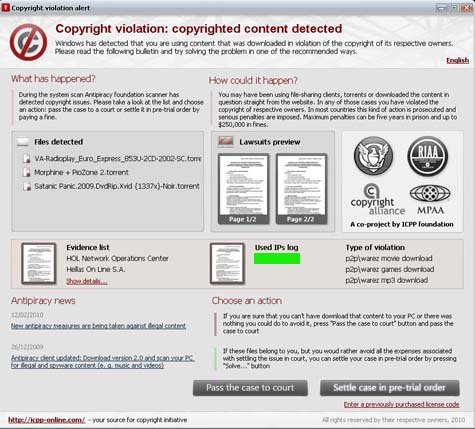
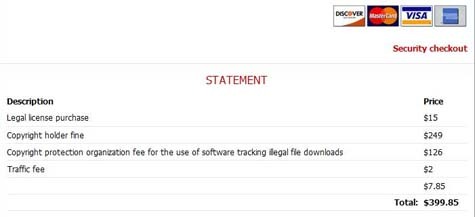
Meanwhile, enterprising malware entrepreneurs have jumped onto the copyright lawsuit bandwagon; a new piece of malware for Windows scans users' hard drives for torrents, and threatens the users with lawsuits, demanding payment by credit card:
(via Boing Boing, Download Squad) ¶ 0
2009/10/10
The New South Wales Police's Computer Crime Investigation Unit has some advice for people who do their banking online: don't use Windows.
The first rule, he said, was to never click on hyperlinks to the banking site and the second was to avoid Microsoft Windows.
"If you are using the internet for a commercial transaction, use a Linux boot up disk - such as Ubuntu or some of the other flavours. Puppylinux is a nice small distribution that boots up fairly quickly.
"It gives you an operating system which is perfectly clean and operates only in the memory of the computer and is a perfectly safe way of doing internet banking," van der Graaf said.Meanwhile, one of the people chosen to have a Windows 7 launch party, is putting the party kit Microsoft sent him on eBay. He's keeping the copy of Windows 7, but in its place, adding a list of the excuses that all the people whom he invited gave for not being able to show up:
Chris: Found out Windows 7 not available on 5.25" floppy.
Kevin: I'll be over as soon as I shut down my laptop. XP still has 72 updates to go.
Mike: I was going to come to your launch party but then a girl called.
Ira: Sorry, my guild has a raid.
2009/9/28
Let it not be said that Microsoft and Windows don't have sincere supporters: Charlie Brooker is one, albeit in a backhanded sort of way:
I know Windows is awful. Everyone knows Windows is awful. Windows is like the faint smell of piss in a subway: it's there, and there's nothing you can do about it. OK, OK: I know other operating systems are available. But their advocates seem even creepier, snootier and more insistent than Mac owners. The harder they try to convince me, the more I'm repelled. To them, I'm a sheep. And they're right. I'm a helpless, stupid, lazy sheep. I'm also a masochist. And that's why I continue to use Windows – horrible Windows – even though I hate every second of it. It's grim, it's slow, everything's badly designed and nothing really works properly: using Windows is like living in a communist bloc nation circa 1981. And I wouldn't change it for the world, because I'm an abject bloody idiot and I hate myself, and this is what I deserve: to be sentenced to Windows for life.
That's why Windows works for me. But I'd never recommend it to anybody else, ever. This puts me in line with roughly everybody else in the world. No one has ever earnestly turned to a fellow human being and said, "Hey, have you considered Windows?" Not in the real world at any rate.Of course, the reason he prefers Windows is because it doesn't have evangelists.
2009/9/24
In an attempt to wrest back the spotlight from Apple, Microsoft are organising launch parties for their new Windows 7 operating system. For merely the cost of your dignity as a human being, you too can host a Windows 7 launch party, and Microsoft will supply balloons, napkins (printed with the Windows 7 logo) and tote bags, as well as a free copy of Windows 7 for you.
Microsoft have even produced a video, showing how it's done. In the video, four regular people (the Mom, the older lady, the Urban Outfitters cool-dude (casting brief: slightly hip and with-it, but not intimidatingly so, like those Mac-toting hipster douchebags) and, of course, the Token Black Guy*) stand around a Sony Vaio laptop in a regular American kitchen and discuss the activities you can do at a Windows 7 launch party. Awkwardness ensues. Yes, you too can have highly organised fun.
The whole video has that unmistaken sheen of ersatz authenticity so typical of a poorly-made astroturf campaign: the combination of shaky, pseudo-amateurish camerawork, professional editing and implausibly even lighting that suggests that the layers of Microsoft management who signed off on the campaign weren't sure of what they wanted: something that seemed "fresh" and "organic" but, at the same time, didn't let down the professional production standards one would expect from a Fortune 500 corporation campaign.
And here is The Register's impression of what a Windows 7 party, with a middle-class middle-English bent, would be like:
Now you'll have to excuse me for a moment while I do my hostess duties. If everyone can just come in here for a minute, and gather round the laptop, then we can begin. Yes, very funny Eric, you are allowed to bring in your drinks actually, so no it isn't at all like being at school again, and that was a silly thing to say. If you want to hear something funny, you should listen to what Verity says. Wooj, come on through and bring the others, will you?
* may not be available in all countries.
2009/6/14
Idea: for their Windows 7 marketing campaign, Microsoft should reanimate Wesley Willis and have him say that it "whups the snow leopard's ass".
2009/4/1
The rise of Wikipedia and its open-source, collaborative content model has claimed a scalp among its traditional, proprietary competition: Microsoft's online encyclopedia Encarta will be shut down on 31 October. Encarta was launched in the 1990s as a savvier Britannica for the CD-ROM age.
I wonder how long Britannica has left. Will it survive indefinitely, sustained by the niche market for expensive, impressive-looking leather-bound volumes, fetishised by those to whom such things still suggest wisdom more than decrepitude? Will the brand name be snapped up by a manufacturer of prestige E-paper Wikipedia browsers? Or will it just sink without a trace, as a relic of a past age of informational scarcity?
2008/12/8
Microsoft's latest attempt to shake off their stuffy, corporate image: selling MS-DOS-themed 1980s retro T-shirts. No, really.
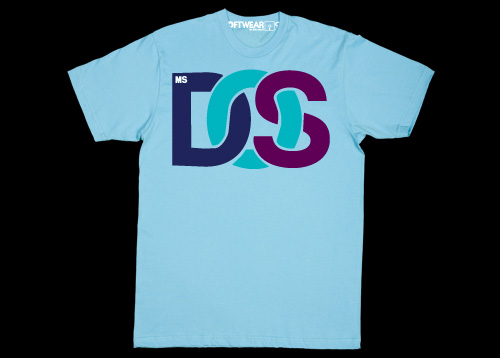
Marketed under the name "Softwear by Microsoft", they come in two lines: one consisting of "classic" designs (the old MS-DOS logo, circa Windows 3.0, the original Microsoft logo, and Bill Gates' mugshot from his 1970s driving conviction) and one co-designed with rapper Common, and involving references to the 1980s; there's one with some rap lyrics set in a monospaced font after a DOS prompt, and one featuring a pair of black-framed glasses and a pair of fluoro new-rave sunglasses.
It's not clear who will wear these. Pointy-haired boss types on casual Fridays? Visual Basic programmers who always wished they could wear cool geek T-shirts like the Linux guys but never actually understood any of the ThinkGeek ones? The guy in the office who regards himself to be with-it because he listens to Coldplay? Zune owners sick of being looked down on by those smug Mac users? Or are they expecting people to start wearing them ironically?
2008/5/4
Microsoft has abandoned its attempt to buy Yahoo!, having failed to reach an acceptable price and decided against a hostile takeover (which would have involved the legal equivalent of house-to-house combat and probably ended up with most of Yahoo's best people leaving for Google or someone). Across the world, millions of Flickr and del.icio.us users (particularly those who don't use Windows) breathe a little more easily.
Of course, it's not necessarily over; Yahoo's share price will almost certainly slump in the short term, and if their attempts to turn their business around don't bear fruit, Microsoft could come back a few months later and pick them up for less. Unless, of course, they buy AOL instead.
2008/4/18
First came Joy Division Oven Gloves trainers and now Microsoft are releasing a Joy Division-branded edition of their Zune MP3 player. It will apparently come engraved with the Unknown Pleasures cover artwork, and possibly some tracks or albums locked to the unit in a DRM-encumbered Windows Media format. If you don't use Windows, you may still find it useful as a paperweight.
2008/4/10
Yahoo to merge with AOL? Apparently the deal (still being hammered out) would involve Yahoo acquiring AOL and Time Warner acquiring 20% of the combined company in return. If it goes through, it may be good enough to stop Microsoft from absorbing Yahoo, as they have been making increasingly menacing noises about. Which means that we may be able to access Flickr with non-IE browsers for a while longer.
2008/2/27
Blogging has been sparse over the past few days, as Your Humble Correspondent has been away in Berlin.
Anyway, a round-up of things I've noticed from while I was away:
- After the European University in St. Petersburg, Russia, got involved in an EU-funded project to ensure the fairness of the election process, the Russian authorities shut down the university, claiming that it is a "fire hazard". Opposition figures accuse the Kremlin of moving Russia back towards totalitarianism (or is the goal a Singapore-style "managed democracy"?)
- While we're on the subject of democracy, Charlie Stross weighs in on why forms of democracy are becoming increasingly prevalent these days, with even otherwise illiberal regimes adopting aspects of democracy, rather than autocratic systems.
Anyway. Here we have three ways in which democracy is less bad than rival forms of government: it usually weeds out lunatics before they can get their hands on the levers of power, it provides a valuable pressure relief valve for dissent, and it handles succession crises way better than a civil war.
- Barack Obama, it seems, is doing well in the US primaries; so much so that someone in the Clinton campaign seemingly decided to resort to dog-whistle politics and took it upon themselves to circulate photos of him wearing scarily Middle-Eastern-looking attire, in the hope that enough Texans are sufficiently prejudiced to be unable to vote for someone whose name not only sounds like "Osama" but who once wore similar headgear.
- After writing a piece on the mainstreaming of neo-folk music, Momus has discovered Emmy The Great. His great revelation has little to do with her music, mind you, and much to do with her being young, (half-)Asian and fanciable.
- Apple have finally released a new MacBook Pro. It gets the Air's multi-touch trackpad, and the usual quantitative bump in specifications, alas, a higher-resolution screen isn't isn't among them, so if you want 1600 pixels across on something that doesn't look comically oversized, you'll have to buy a Windows machine.
- Meanwhile, Microsoft have been slapped with a US$1.4bn fine by the EU, as well as having made vague promises of being more open in future, and apparently they're working on a Windows Vista-based GNU rival named UNG ("just like GNU, only without all that pesky freedom").
Berlin, for what it's worth, was great; four days, though, is nowhere near enough time to see everything and enjoy the city. Though I was surprised that the attendants on the Deutsche Bahn sleeper train didn't seem to speak English. Hopefully they'll remedy this by the time they start running services through the Channel Tunnel.
For what it's worth, photos are being uploaded here.
2008/2/19
New market research has revealed that Mac users are snobs, upper-income-bracket elitist aspirational types who see themselves as better than the PC-using rabble, while, seen from the other side, PC users are cheapskates.
Meanwhile, a filmmaker has made a documentary about the intense loyalty Maccies feel to their brand, which bears out some of the findings:
Violet Blue, a popular blogger and sex columnist for the San Francisco Chronicle, who also features in the film, says: "First of all, I've never knowingly slept with a Windows users ... that would never, ever happen."Anyway, back to the Mac-users-are-snobs thing: the description of the difference between Mac users and PC users reminded me a lot of (Mac user) Momus' recent paraphrasing of the right-wing anti-intellectual argument against liberal cosmopolitan elites:
The intellectual is not one of us. We are ordinary folks, he is a member of an elite. We gravitate around right wing ideas, he's left-leaning. We're family people, he screws men, women and children. We farm, he stays in the city, with his intellectual elite, or on campus, corrupting the minds of our youth. We're religious, but the intellectual is an unbeliever. We run to fat, he stays thin. We're patriots, he's a cosmopolitan, equally at home with foreigners as with his own kind. He puts loyalty to ideas before loyalty to his people. We have the church, he has the liberal media.I'm wondering whether Microsoft or Dell or whoever didn't miss a trick in the few years after 9/11 when Americans (and, to a lesser extent, other Westerners) fell into a right-wing populist groupthink, dissociating themselves from straw-man liberalism. Perhaps, had they run ads playing on the stereotypes of Mac users as potentially disloyal rootless cosmopolitanists, they could have converted some Mac sales into sales of PCs and copies of Windows. After all, when your country's under siege, you don't want to be seen to be distancing yourself from your compatriots, however symbolically.
2008/2/8
Looks like Microsoft is up to its old tricks: the latest AJAX-enhanced version of Hotmail refuses to work if the web browser identifies itself as Firefox 2; if one reconfigures it to identify itself as Internet Explorer, it works perfectly. What does this mean? Well, given that Microsoft are likely to buy Yahoo! (a lot of analysts now rate Yahoo!'s chances of escaping their clutches as slim), taking control of Flickr and del.icio.us, those who use those sites from non-Windows, non-IE platforms, and with non-Microsoft web applications, have yet more reasons to feel uneasy.
2008/2/1
Holy shit, Microsoft have made an offer to buy Yahoo, for a generous US$44.6bn. I hope that this doesn't happen; given how Microsoft are fond of leveraging their power to lock people into using their products, a Microsoft-owned Yahoo would be bad news. We could probably expect things like YUI going the way of the Dimension X Java VRML libraries (remember those?) and Flickr being rewritten as a Silverlight application and/or requiring Windows Vista/7 to upload photos.
 The Guardian reports that users of Windows Vista are experiencing severe audio performance problems, with choppy, glitchy audio from applications, which is annoying home users and driving professional musicians to old copies of XP or else the Apple store. The Graun article gives the reasons a cursory examination, essentially writing them off as growing pains of a shift to a new, improved driver model, though somehow managing to miss the elephant in the room, i.e., that at any time when there is the possibility that a Windows Vista machine might come into contact with copyrighted audio or video content, a draconian DRM regime kicks in, diverting a large proportion of the machine's resources into ensuring that you, the user, cannot do anything with the content that you're not explicitly permitted to.
2008/1/18
Apparently Microsoft have promised to release the full specifications of their legacy binary Office document formats, making them available for direct downloading from their web site without the need to sign any agreements. Not only that, but to develop a reference application for translating them into a neutral format and release it under the BSD license. Cue a million Slashdot penguinheads trying to outdo themselves at saying "Hell has frozen over" in the wittiest way possible.
2008/1/15
NLnet, a Dutch foundation supporting open standards and open source, has called on Microsoft to release their old, no longer supported, document file formats into the public domain, allowing users to make their own tool for accessing data locked in these formats (which is becoming increasingly important as Microsoft's own software drops support for them).
2007/9/5
 Recently, the International Standards Organisation has been looking into the question of defining a standard for document file formats; Microsoft has been pushing aggressively to get its OOXML format (basically an XML-based update of its proprietary Word/Excel/Office formats, and arguably designed to protect Microsoft's virtual monopoly on standard office software) certified as a standard. Despite their best efforts (which some have claimed included bribing delegates to vote for them and stacking the ballot), their push has been unsuccessful. Now, someone from Electronic Frontiers Finland has crunched the numbers and found a correlation between countries' propensity to vote for OOXML and their perceived level of corruption, as ranked by Transparency International. Funny, that.
2007/9/4
Security expert Peter Gutmann claims that a botnet run by organised criminals is now the most powerful supercomputer in the world. The Storm botnet is estimated to have between 1 and 10 million computers, all Windows machines infected by trojans, viruses or worms, and (assuming a typical machine to have a 2.3 - 3.3 GHz CPU and 1Gb of RAM), it easily outclasses machines such as BlueGene/L.
As Alec Muffett points out, Microsoft could now claim that the world's most powerful supercomputer is built on their technology.
2007/9/1
Another front has opened in Google's assault on Microsoft's software dominance, with it emerging that Google Maps contains a hidden flight simulator. The flight simulator is activated by pressing Command, Option and A (on a Mac) or Ctrl, Alt and A (on a PC), and gives you the choice of two planes and several runways. Instructions are here. As you can probably imagine, going anywhere other than into the ground when using a keyboard is somewhat tricky.
2007/2/11
The next big thing after Digital Rights Management could be Attention Rights Management, or technologies to ensure that users of advertising-supported services not only see the ads but pay attention to them. Already, Microsoft have applied for a patent on a technology for enforcing the payment of attention, using CAPTCHA-style tests and face-recognition cameras. Perhaps we can expect to see this as part of the DRM layer in the version of Windows that follows Vista, opening further opportunities for premium content consumption?
2006/12/27
When Windows Vista comes out, it won't just have a Mac-killingly cool user interface; it will also include the most total intellectual-property protection regime ever developed, designed to keep your thieving fingers off Hollywood's precious content. Peter Gutmann has an analysis of the costs of this regime, and it's alarming: it looks like we're all going to be footing the bill (in terms of increased costs, decreased performance, and reduced reliability and interoperability) of Hollywood and the RIAA's demands (and Microsoft's ambitions for control of the content-delivery system).
Beyond the obvious playback-quality implications of deliberately degraded output, this measure can have serious repercussions in applications where high-quality reproduction of content is vital. For example the field of medical imaging either bans outright or strongly frowns on any form of lossy compression because artifacts introduced by the compression process can cause mis-diagnoses and in extreme cases even become life-threatening. Consider a medical IT worker who's using a medical imaging PC while listening to audio/video played back by the computer (the CDROM drives installed in workplace PCs inevitably spend most of their working lives playing music or MP3 CDs to drown out workplace noise). If there's any premium content present in there, the image will be subtly altered by Vista's content protection, potentially creating exactly the life-threatening situation that the medical industry has worked so hard to avoid. The scary thing is that there's no easy way around this - Vista will silently modify displayed content under certain (almost impossible-to-predict in advance) situations discernable only to Vista's built-in content-protection subsystem [Note E].
Once a weakness is found in a particular driver or device, that driver will have its signature revoked by Microsoft, which means that it will cease to function (details on this are a bit vague here, presumably some minimum functionality like generic 640x480 VGA support will still be available in order for the system to boot). This means that a report of a compromise of a particular driver or device will cause all support for that device worldwide to be turned off until a fix can be found. Again, details are sketchy, but if it's a device problem then presumably the device turns into a paperweight once it's revoked. If it's an older device for which the vendor isn't interested in rewriting their drivers (and in the fast-moving hardware market most devices enter "legacy" status within a year of two of their replacement models becoming available), all devices of that type worldwide become permanently unusable.
Vista's content protection requires that devices (hardware and software drivers) set so-called "tilt bits" if they detect anything unusual. For example if there are unusual voltage fluctuations, maybe some jitter on bus signals, a slightly funny return code from a function call, a device register that doesn't contain quite the value that was expected, or anything similar, a tilt bit gets set. Such occurrences aren't too uncommon in a typical computer (for example starting up or plugging in a bus-powered device may cause a small glitch in power supply voltages, or drivers may not quite manage device state as precisely as they think). Previously this was no problem - the system was designed with a bit of resilience, and things will function as normal... With the introduction of tilt bits, all of this designed-in resilience is gone. Every little (normally unnoticeable) glitch is suddenly surfaced because it could be a sign of a hack attack. The effect that this will have on system reliability should require no further explanation.
In order to prevent active attacks, device drivers are required to poll the underlying hardware every 30ms to ensure that everything appears kosher. This means that even with nothing else happening in the system, a mass of assorted drivers has to wake up thirty times a second just to ensure that... nothing continues to happen. In addition to this polling, further device-specific polling is also done, for example Vista polls video devices on each video frame displayed in order to check that all of the grenade pins (tilt bits) are still as they should be [Note H].
As part of the bus-protection scheme, devices are required to implement AES-128 encryption in order to receive content from Vista. This has to be done via a hardware decryption engine on the graphics chip, which would typically be implemented by throwing away a rendering pipeline or two to make room for the AES engine.
I see some impressive class-action suits to follow if this revocation mechanism is ever applied. Perhaps Microsoft or the content providers will buy everyone who owns a device that inadvertently leaks content and is then disabled by the revocation process replacement hardware for their system. Some contributors have commented that they can't see the revocation system ever being used because the consumer backlash would be too enormous, but then the legal backlash from not going ahead could be equally extreme. For anyone who's read "Guns of August", the situation seems a bit like pre-WWI Europe with people sitting on step 1 of enormously complex battle plans that can't be backed out of once triggered, no matter how obvious it is that going ahead with them is a bad idea. Driver revocation is a lose/lose situation for Microsoft, they're in for some serious pain whether they do or they don't. Their lawyers must have been asleep when they let themselves get painted into this particular corner - the first time a revocation takes out a hospital, foreign government department, air traffic control system, or whatever, they've guaranteed themselves first-person involvement in court proceedings for the rest of their natural lives.
2006/9/17
Having all but wiped out PalmOS and the PlayStation, Microsoft now targets its heavy artillery at Apple's iPod, and unveils its "iPod Killer", the Zune. Which has an iPod-like scroll wheel, a much bigger screen and more nifty-looking user interface, and WiFi-based media-sharing capabilities.
Oh, and it is also a laboratory for a new regime of total, absolute DRM control. Everything stored on a Zune will be DRM-locked, and while you can wirelessly "share" music with friends, you can only share it with each friend once, and the copy they get dies after 3 plays or 3 days. Since we know that only a negligible proportion of music is not owned by the RIAA, this applies to all music: which means that your own home recording is DRM-locked "just in case", as if it belonged to Big Copyright. Furthermore, if you copy that Creative Commons-licensed MP3 you just downloaded by that cool nerdcore rapper all your copyfighter friends are going on about to your Zune, it gets the shackles put on it, violating its Creative Commons license. Furthermore, apparently those PlaysForSure DRM-locked Windows Media files you bought from Napster or SpiralFrog won't work with your shiny new toy at all, because it's the wrong sort of DRM. Oh, and apparently that iPod-killingly nifty WiFi capability will run the battery down like nobody's business.
My prediction: the people who bought Zunes will feel they've been ripped off, and their players will gather dust in drawers. Meanwhile, the Zune will be quietly get dropped from advertising campaigns and catalogues sometime after the Christmas it's released on, shortly before being discontinued — to make room for Microsoft's next "iPod Killer".
2006/1/29
If you're planning to buy a new MP3 player, beware, as many of the new ones use a proprietary interface protocol tied to Windows Media Player. Whereas a lot of older players (the Archos Jukebox series and iRiver H100 and 300 series, to name two, not to mention various generic Flash-based players) were USB Mass Storage devices (i.e., looked like external hard disks to a computer), new ones use a proprietary Microsoft protocol named MTP, to transfer data to them and possibly enforce RIAA-mandated inconveniences on the user.
MTP appears to be based on the Picture Transfer Protocol used by some digital cameras, only with some Microsoft extensions, and is tightly integrated with the Windows Media Player; it is currently possible to hack gPhoto, a command-line PTP client, to talk to at least some MTP players. There is some doubt over whether or not this infringes on patents. Users of pre-XP Windows systems, however, may be out of luck.
For Penguinheads and other Windows refuseniks, the Apple iPod is apparently still usable. It looks like a USB Mass Storage device (or a FireWire hard disk), and can be copied to/from, though requires music files to be indexed in a proprietary database file onboard, which iTunes writes; there exist open-source tools, running on UNIX-like OSes, for writing this file as well. (Disclaimer: I've never owned an iPod and so have no experience of how useful or clunky it is to use without iTunes. My way of filling my MP3 player involves mounting it as a disk and copying files or directories to it.)
(via  reddragdiva) ¶ 2
2006/1/27
It looks like the next version of Microsoft's Windows OS will require all device drivers and kernel-level code to be digitally signed. This is ostensibly to prevent kernel-level rootkits from installing themselves, though has the bonus feature of adding a ring of steel to the black iron prison the RIAA/MPAA want to build around everything handling their precious intellectual property. Oh, and it will also restrict device-driver development on Windows to those with the resources to pony up for the Verizon digital signature.
(via bOING bOING) ¶ 2
2005/12/19
Microsoft are abandoning Internet Explorer for the Macintosh; as of 31 January, it will be unavailable for downloading, with Mac users being encouraged to use Apple's Safari browser. Hopefully this means that Microsoft aren't going to use their IE near-monopoly to create a proprietary superset of (D)HTML and keep web application users locked into their technologies; either that or, if they do, they're willing to lock non-Windows platforms completely out and hope that they have the clout to make everyone get a Windows PC for their internet access.
2005/7/12
Screenshots of the latest Windows Longhorn beta. It looks like Microsoft have one interesting eye-candy feature that Apple currently don't: the ability to do translucent elements, i.e., ones in which the pixel value can be a function of not only the background pixel but its neighbours (which allows Gaussian blurring and such). I wonder how computationally expensive this is compared to Apple's straightforward transparency; it certainly looks pretty, though.
2005/6/30
It looks like Microsoft are embracing the DHTML/Javascript trend; at least when it comes to reducing the quality of the non-IE browsing experience on their sites. And they've also announced an AJAX web development framework, presumably so that you can do the same.
2005/4/26
Could Microsoft's new search engine be giving higher rankings to sites hosted on Microsoft IIS?
2004/9/30
A few pieces of good news: Microsoft's claimed patents on the FAT filesystem have been shot down, thanks to a challenge from the Public Patent Foundation.. As such, that ugly, inefficient throwback to the days of CP/M and 100Kb floppies that, nonetheless, has become the universal standard for storing files on everything from digital camera memory cards to MP3 players is free for anyone to use without having to pay a cent. With any luck, it's not the last overbroad software patent to go down in flames. Meanwhile, in Europe (where US multinationals are doing their all to push software-patent legislation through Parliament), Munich is pressing ahead with dumping Windows for Linux, despite claims that Linux violates loads of software patents and is a massive legal liability. Finally, in the US, part of the Patriot Act has been struck down as unconstitutional.
2004/7/19
Databases of genetic research data, it has emerged, have been irreversibly corrupted by Microsoft Excel's autocorrection feature. Excel, in its infinite wisdom, assumed that some gene identifiers (such as SEPT2) were really dates (i.e., 2-Sep), and corrected the "mistake"; meanwhile, Excel's floating-point conversions wreaked their own havoc elsewhere. (via bOING bOING)
2004/5/12
Another reason to avoid Microsoft operating systems: if your Windows PC gets infected with malware and you're unlucky, you may lose your job, your relationships, or even be convicted as a paedophile, on the strength of pornographic images downloaded into your cache, as happened to one man in the US (or so he claims).
2004/2/17
Kuro5hin finds the stolen Windows 2000 source code, greps it for obscenities and other things. Assuming that this is authentic, the Windows code is not as shoddy as some would think, save for it being riddled with layers of kludges and bugs kept for backward compatibility, and there's no obvious evidence of them stealing code from open-source projects either. At least, not as of 25 July, 2000.
2004/1/23
In the US, Microsoft are suing a student named Mike Rowe for running an outfit called MikeRoweSoft (find the URL yourself; every angry penguin has linked to it); however, here in Australia, a pillow-maker is using the trademark "Microsoft", and there's not a thing Darth Gates' minions can do about it, as it's quite legal under Australian trademark law.
"Accordingly, I cannot accept the opponent's assertion that purchasers would be confused or deceived as to the origin of the two marks in question. The two sets of goods of interest to both parties are most certainly not, in my opinion, goods of the same description. I cannot agree that the opponent's undoubted reputation for computers and the like extends to the materials which are the subject of the present application."
Though I wonder whether this state of affairs would survive a US-Australian Free Trade Agreement.
2003/12/3
Nefarious Malaysian software pirates sell Microsoft's Longhorn, with adventurous consumers snapping it up. Longhorn, the next iteration of the Windows hegemony, will introduce Microsoft's Trusted Computing Platform Architecture, to make sure that you pay for each and every piece of intellectual property you consume, and will come with a new, k3wl-looking interface. I guess there's a good market for shiny, fancy-looking shackles. I wonder whether, if Microsoft started selling home-detention bracelets, like those put on low-risk prisoners, only fashioned out of titanium by a leading industrial-design firm and playing rights-managed Windows Media content from the major entertainment conglomerate of your choice, customers would flock to buy those as well.
2003/9/18
One of the Gaim developers claims that Gaim users may not be locked out of MSN/Yahoo when the two companies change their protocols:
"Upgrading" is as simple as changing a version string. We already have it updated in Gaim 0.69. This was a no-brainer easy-to-fix thing, as was MSN.
If any Slashdot staff are watching, please, please refrain from posting articles related to IM unless you consult someone who knows what's going on. Too many trollish comments occur, and we get too many questions in Gaim support, all pointing at Slashdot as their source for the inaccurate information as to what's happening in IM.
Though wasn't it implied that from October, MSN's servers will require clients to produce a license certificate of some sort, which identify the client as a Microsoft-approved one, prior to connecting?
(If you don't want your IM network to be at the mercy of a profit-oriented corporation whose management may at any time decide to maximise profits by asserting control over your client, there's always Jabber, an open, decentralised, XML-based messaging system. Though nobody seems to be using that; I know of only one person on Jabber. Maybe if someone came up with some cute smiley themes for it...)
2003/9/17
Fuck. Yahoo are following Microsoft and blocking third-party clients from their IM system, starting in a week's time.
Analysts believe Microsoft and Yahoo don't want third-party clients on their networks because they use their own clients to deliver advertisements and direct users to other services. "Both Microsoft and Yahoo value the control over the clients and the last thing they want is for their users to be using third-party clients on their networks," said Michael Gartenberg, a research director with Jupiter Research.
(Yes, they have a Linux client; but I'm not going to download it and give Yahoo my bandwidth to blast ads at me. Bugger that for a game of soldiers. If you want to reach me, use Jabber; my ICQ or AIM accounts will still work, at least until AOLTW lock those down.)
2003/8/21
Microsoft to lock third-party clients out of MSN Messenger, to protect market share prevent freeloaders from not viewing ads crush the opposition upgrade security and protect you from viruses/terrorists. (After all, everybody knows that software not from Microsoft is a security risk, right?) This will happen from the 15th of October. Unless Gaim manage to not get kicked off (and if this is about protecting MS's ad revenue, that's unlikely), chances are I won't be using MSN after that.
2003/5/9
A Microsoft PR piece on why Digital Rights Management will make you free: (via Rocknerd)
Documents. Using a simple on-screen dialog prompt built into her word processing application, an advertising copywriter specifies that her document, a draft marketing plan, may be viewed and edited by a selection of the client company's managers for one week. She posts the document to a Web portal to share with them. Based on their feedback, she finalizes the plan and posts it. Managers who downloaded the obsolete draft can no longer open it, which prevents confusion as to which document is current.
And it also has the useful effect of destroying audit trails and suppressing documents which may, in future, come back to haunt their authors. DRM is not a value-neutral technology, as some free-market "libertarian" platygaeans would believe; it's one which reinforces existing power structures, and has more to offer to corporations and authoritarian states than to consumers or whistle-blowers.
Email communications. A senior partner in an accounting firm needs to send email to his partners with a confidential contract proposal attached. Besides specifying who may read the proposal and that they may not copy, paste or edit the information, he specifies that the email itself cannot be forwarded. The recipients' email and word processing applications transparently enforce these policies.
Which also has the nice effect of "de-commodifying" open standards for email. The glorious New Galambosianism of end-to-end total information control would depend on file formats remaining proprietary, a trade secret belonging only to a trusted gatekeeper, i.e., Microsoft. Thus it's hardly surprising that Microsoft, who have built an empire from locking people into proprietary file formats, are advocating such a totalitarian vision as the salvation of Capitalism and Civilisation As We Know It.
2003/2/20
Uh-oh; Microsoft has bought VirtualPC, the PC emulation software for MacOS, extending their grip yet again.
2003/2/10
Remember the rumours a while ago about Microsoft's algorithmic-music-composition research programme developing a software package to allow ordinary users to create shiny Top 40-grade pop? Well, here's a screenshot of "Microsoft Hit Wizard - R&B Edition". (via MeFi)

2003/2/7
Microsoft's MSN deliberately sends broken stylesheets to Opera in order to make the third-party web browser appear defective and unusable. This is an old Microsoft tactic; they did similar things to break DR-DOS under Windows 3.x and (even earlier) to prevent Lotus 1-2-3 working with MS-DOS 2.0.
2003/1/15
Journalist almost freezes to death when trying to use a Microsoft Smartphone mobile to call for help after a ski accident in the Scottish Highlands. He was eventually rescued when a passerby lent him her Nokia phone. Proof that bad UIs can endanger your life. (via bOING bOING)
2003/1/6
Why does MS Internet Explorer seem so much faster? Because it embraces and extends TCP/IP, using custom packets and a cut-down protocol to communicate with IIS servers. Mind you, this makes it slower with some non-IIS hosts. Though that won't be a problem when non-Windows systems are phased out from the Internet. (via Slashdot)
2003/1/3
An international master criminal to rival Jon Johansen, the 15-year-old Lex Luthor of Norway, has cracked the Microsoft Reader "eBook" copy-protection system, and apparently released a program, including source code, for removing copy-denial from books, allowing them to be converted to HTML or other formats. Dan Jackson claims that the software is legal under the Berne Convention, though should probably avoid flights entering US airspace anyway. (via Charlie's Diary)
2002/12/24
Oh dear; is Microsoft about to buy Macromedia, turning Flash into part of the vast, amorphous Lovecraftian blob that is Windows? Mind you, Flash is wholly or partially proprietary as it is, and most Flash content tends to be annoying ads which either obscure your page until you've looked at the stupid little animation, or else freeze your browser until you stop your MP3 player so the ads on the page can play their audio, so I turn it off. Shame about the few badly designed sites which require Flash to have a "cool" navigation experience.
2002/8/21
2002/8/16
Microsoft discontinues free fonts, because they come with Windows XP and MacOS (the two legitimate operating systems) already, and thus in Redmond's book, there is no legitimate reason for anybody to not have them. So unfortunately, Penguinheads and the like will have to make do without Comic Sans from now on. Oh, the humanity. (via cos)
2002/8/8
Research reveals that the MS Windows API is intrinsically insecure; any application can spoof window messages to any other application, regardless of permissions, bypass the feeble "security" present and pull off all sorts of exploits. In other words, typical Microsoft security. And furthermore, the flaw is fundamental to the API and is irreparable, short of changing the fundamental design of the Windows message queue mechanism and breaking every existing Win32 application. (via the Reg)
2002/7/5
Here (scroll down) are some technical details on how Microsoft/Intel/AMD's total access control system, Palladium, will work. It's quite ingenious, though still seems like something too draconian. With any luck it'll flop, people will avoid restricted content, and even Microsoft, the RIAA and the MPAA won't be able to get people to pay for software or content which breaks if their system changes. (via bOING bOING)
2002/6/28
Boot, human face, forever: Cantabrigian security expert Ross Anderson has a FAQ on Microsoft's Palladium total access control initiative. It looks pretty scary; killing the GPL, neutering Linux and locking down digital music is just the top of a rather sinister iceberg.
2002/1/17
The Beast of Redmond: Microsoft buys SGI's graphics patents; penguinheads concerned they may be used to crush OpenGL, or cripple 3D graphics capabilities on non-Windows platforms. Meanwhile, if you use Windows Media Player to download content from sites, the sites can keep track of you, using a convenient global ID number. Apparently this is not a bug but a feature. (via Slashdot)
2001/12/18
Reasons to switch to Linux:
Al Qaeda terrorists
infiltrate Microsoft, plant trojan horses in Windows XP. Or so says
arrested terrorist suspect Mohammad Afroze Abdul Razzak, who has also detailed
plans to destroy the Houses of Parliament in London and Rialto Towers in
Melbourne, among other targets.
A Microsoft spokesman has poured scorn on the allegations, saying that their
source code is strictly monitored to make sure that there is no malicious code
that they didn't plan themselves.
(Then again, what's to say he isn't fnord an Al Qaeda terrorist agent?)
2001/9/7
It's official: software monopoly and George W. Bush election campaign donor Microsoft will not be broken up; the Bush administration has instructed the Department of Justice to drop plans to break up the company, in the interests of obtaining "prompt, effective and certain relief for consumers". Which will probably be a fine of a few thousand dollars and an absolutely binding consent decree preventing Microsoft from putting Netscape out of business again or something like that. Rejoice, free world, for your right to use Windows everywhere has been upheld.
2001/5/17
What do spelling checkers say about modern culture? The spelling checker in Microsoft Word 97 has some telltale gaps in its lexicon:
Your computer knows baddies Lenin and Trotsky, but not peace lovers Lennon, McCartney, and Starr. It remembers Auschwitz but not Woodstock. Your spell-check will gleefully accept Ku Klux Klan (try typing it in lower kase, your komputer will gently suggest that you kapitalize your k's). Ominously, Word 97 acknowledges German politicians Helmut Kohl and Gerhard Schroeder - we may not know exactly what these men are up to but we can assume, from the company they keep in our spell check, that they are bad, bad men.
2001/4/13
The War On MP3: Windows XP to limit MP3 quality to 56kbps, to wean users onto proprietary formats. Elsewhere this would be considered unfair restraint of trade; in this case it is a well-deserved blow against audio piracy. The fact that it will nicely lock customers into Microsoft's own proprietary platform is just a bonus for those heroic altruists in Redmond. (Who said that doing good never pays, right?)
This won't apparently block the writing of MP3 files at the filesystem level or anything quite like that, but will block recording with Microsoft's bundled tools; their hope is to make all the unsigned garage bands release all their stuff in proprietary Windows formats (after all, who cares about the 0.01% of the market who don't use Windows? Translating the lyrics into Urdu makes as much sense as supporting non-Windows platforms), thus consigning MP3 to a a historical footnote. (It would work better if they automatically degraded the playback of MP3s; though that may be in the next release.)
Though doesn't everyone use WinAMP or Sonique under Wintendo anyway? (I know I do on the NT machine at work.)
2001/4/5
A Microsoft exec speaks to Slashdot about Linux, software rental, standards and the like. Quite candid; it's interesting to read what the Redmond mindset on all these things is.
2000/12/19
Statistic of the day: MS Internet Exploiter is the most popular browser on Slashdot? (At time of writing it was leading with 39%, with Nyetscape having 35%.)
2000/6/10
After Microsoft is split in two, will Apple conquer all and Linux die? One Peter Lalor (not of Eureka Stockade fame) thinks it just may happen.(slashdot)