The Null Device
Posts matching tags 'russia'
2016/12/14
Terrible reports from Aleppo as the forces of the tyrant Assad, backed by Russia, take the last pockets of resistance and exact a terrible vengeance on the resisting population. Mass executions of civilians (or, in the official parlance, “terrorists”) ensue, some shot by firing squads, some burnt alive. (The executed “terrorists” include terrorist children, but as the Bolshevik who bayoneted the Romanovs reportedly said, “nits grow up to be lice”.) On Twitter, accounts that have posted from the besieged, bombed city send their desperate last dispatches. If you ever wondered what it would have been like had they had social media during, say, the Warsaw Ghetto uprising, it'd probably have been something like this.
Meanwhile, in the West, we look on, appalled but not surprised, and then, bummed out by the constant torrent of misery coming from those parts of the world, change the channel. How about that Kanye West, right? What a legend/card/asshole/(insert your own assessment).
Here in the liberal-democratic world, with its ideals of universal human rights and general tolerance, we are aghast; not in our name, we say. Though this very world seems to be in the process of being swept away, replaced by something more brutish and atavistically Hobbesian. From 20 January, the massacre of Aleppo, and any similar actions which follow, will have been in our name. The United States will officially approve of Assad's ancient right as sovereign to crush rebellions, and to lay waste to their cities, making examples of entire populations that harbour rebels to deter future rebellions (mercifully preventing more bloodshed in the future!). And as satellites of the Trumpreich, so will the UK (which increasingly rejects the idea of human rights) and Australia (with its own gulag system for brown and/or Islamic refugees) and others. France will almost certainly join the new consensus after the election of their next President, who is tipped to be either an actual fascist or a Catholic reactionary aching to roll back the Enlightenment, but in either case a follower of Putin's ideology of strength. They will join Hungary, Turkey and Poland, already in the growing post-liberal consensus. And so, as the world starts to look more like Russia at any point in history, a place where life is cheap, power is all, and any words that contradict this are lies, the relative stability of what came before (roughly the world from the years after World War 2 to 2016) will recede into myth; part fantastically bright Star Trek utopia, part naïve Weimar-style idealism, and part decadent lie that deserved to die. Indeed, the last citadel of liberalism and human rights may well be Germany, having had totalitarianism and genocide sufficiently close in its past, and sufficient memorials to its terrible toll, to resist desperately.
2016/5/15
Eurovision 2016 has been and gone. This time, much of the weirdness apparently fell by the wayside in the semifinals, thus arguably making watching the finals even more essential for fans of the Old Weird Eurovision. Further weirdness was lost when Romania failed to pay its EBU bill and was unceremoniously disqualified, depriving audiences of a few minutes of dependable gothic oddity (to their credit, Poland tried to fill that gap, though they didn't quite manage it; Poland, after all, is not Romania). And, for the second time ever, Australia was invited to compete; this time, they almost ended up winning. Also for the first time ever, the event was broadcast to the United States, undoubtedly causing mass confusion there, though perhaps not as much as it would have some years earlier. Also, this year, the voting system was split: first came in the votes of the nations' juries of experts, and then the aggregated public phone votes, a system apparently designed to maximise suspense, something in which it succeeded.
As for the songs themselves: Sweden appeared to walk the tightrope of showing competence whilst avoiding the risk of having to host it twice in a row (something that almost bankrupted Ireland in the 1990s), and sent in a hair-gelled teenager singing something unmemorable. Cyprus brought the hard rock, or at least hard-rock-flavoured dance music, and Georgia went landfill-indie (and got douze points from the UK, the spiritual home of landfill-indie, for their efforts). France, I thought, were decent, and the two Baltic states that made it through were as well. Australia entered with a very competent minor-key electropop ballad about intimacy at a distance, with lyrics about FaceTime and cyberpunk-style visual projections, and for a while, looked like it would win, running away with a commanding lead in the jury vote; but it was not to be: the night belonged to the geopolitical faultline between Russia and Ukraine:
Russia, it seems, tried very hard to win, throwing vast amounts of resources at it, as if it were a matter of national prestige. Their song was, by Eurovision standards, first-rate, and the setting was helped with some impressive projection-mapping effects. It was as if Putin himself gave the directive that Eurovision 2017 was to be in Moscow, and instructed everybody to do whatever it took to make it happen, up to and including having the performer, Sergey Lazarev, butter up the decadent liberals of Euro-Sodom by having gone on record criticising Russia's anti-gay laws and the annexation of Crimea. As such Russia had been the bookmakers' favourite to win, geopolitics notwithstanding. When the votes came in, though, the juries largely snubbed Russia, with them getting nul points from 21 juries. Even the torrent of phone votes, which overwhelmingly favoured Russia (and again, that could be anything between overwhelming apolitical approval of the song and/or Russia's formidable internet spammers taking time out from bank fraud to do their patriotic duty) couldn't reverse this; Russia only made it up to third place, coming behind Australia. To add insult to injury, the winner was Ukraine, whose song, 1944, was a sombre, harrowing and pointedly political number about the genocide and expulsion of Crimea's Tartars by Stalin (and, indirectly, alluding to Putin's annexation of Crimea, sailing close to the EBU's rules against political gestures). Set to skittering dubstep beats à la Burial, it was a decent song, though standing on its own, not overwhelmingly the best in the show. Had it not also served as a middle finger raised at Putin's Russia, it might have languished in the middle of the rankings; but geopolitics is geopolitics. (See also: the Israeli entry, which should probably have also done better. Their song wasn't bad, but voting it down was a chance for the cosmopolitan liberals of Europe to signal virtue and tell Netanyahu where to stick his security wall, so it was doomed from the outset. I imagine Dana International had the benefit of a period of relative calm and optimism when she won.)
Geopolitics may also have a little, though probably not a lot, to say about Britain's dismal result. Their song was not abysmal (the UK has done worse in previous years; there was the jaunty number performed by a crew of saucy flight attendants, or the middle-aged bloke playing a teenage hip-hop gangsta-wannabe, or various times when they barely made the minimum effort. Perhaps Britain lost points because the Frogs and Krauts and their wine-drinking garlic-eating buddies are sick of our ongoing national tantrum about wanting to leave the EU. Perhaps they don't like our aloofness and smug sense or superiority (though, were that the case, how does that explain Sweden consistently doing so well?) Or perhaps we just don't get it; when everybody else does minor-key anguish soaring to triumphantly defiant choruses on a wave of synth arpeggios and key changes, we remain terribly British and aloof, tossing off a cheery singalong, all the better to shrug off as no big deal when we inevitably end up in the bottom five.
After all the contestants had performed and the votes were coming in, there was the usual entertainment. This year, they had Justin Timberlake to perform a medley of his hits, in an event referred to by some as Justin Toiletbreak; this was done either to welcome the Americans tuning in for the first time, or as a showcase for the Swedish pop songwriting and production industry that powered Timberlake's musical career. Sweden's musical history was also showcased in a medley of international Swedish pop hits since the days of ABBA (I had forgotten, for one, that synth-led hair-metallers Europe were Swedish; for some reason I thought they were German). The highlight of the break, though, was this deconstruction of the formula for a Eurovision hit, bringing in everything from bare-chested drummers to little old ladies baking bread and incomprehensible folk instruments.
So: Eurovision 2017 will, it seems, be in Kiev. It'll be interesting to see what happens: will Australia (which, not being in the EBU, has been there on suffrance, though managed to do impressively well) come back for a third time, or take its seat as the Sweden-equivalent of the Asia-Pacific song contest being planned? (Will Eurovision itself, in a few years, pivot away from being merely Europe-plus-a-few-neighbours and become a set of regional contests, culminating in a global final?) Will the Russians compete in front of what can only be expected to be a hostile away crowd in Kiev, or will this strengthen calls in Russia to turn their backs on it set up their own “Eurasian” song contest, one without all that problematic gayness? And if Britain, by then, has voted to leave the EU, will it also take its ball and go home?
2014/5/11
The results of Eurovision 2014 are in, and, as reported here, the big winner was Austria's Conchita Wurst, a bearded drag performer, with a resolute and melodramatic torch song titled Rise Like A Phoenix. Wurst (whose real name is Tom Neuwirth) won a runaway victory, with 290 points and a string of 12s, including ones from countries who might otherwise haver found a bearded drag performer too transgressive. The runner-up was the Netherlands, 52 points behind with a rather nice piece of slow-burning Americana.
2014 was arguably the most geopolitically charged Eurovision Song Contest in years, if not decades; the kitschy music equivalent of the World Chess Championship of 1972, in that, within its formalised, tightly circumscribed arena, the tensions of an active geopolitical fault line manifested themselves. As back then, the fault line was between the West and Russia, only the ideologies and alignments were different.
One thing that was evident was a collapse of Russia's public image at Eurovision; no longer were they another country in friendly competition; they were the enemy, the face of oppression. Their performers (two teenaged girls who, to be fair, probably had little to do with the invasion of Crimea or anti-gay laws) were booed, as was their announcer during the voting, or the few instances of other countries, mostly former Soviet satellite states, giving Russia douze points. Also telling were the low scores which Russia got; whereas in the past, states bordering Russia or containing large Russian-speaking populations (as most former Soviet republics did, thanks to Stalin's population transfer programmes) could be counted on to give Mother Russia a solid vote, this largely seemed to collapse. This seems to support reports of a schism between ethnic Russian minorities in countries such as the Baltic states and the state of Russia, with many Russian-speaking citizens of other countries deciding that their feelings for their linguistic homeland don't translate into loyalty to an aggressive authoritarian regime.
An obvious proximate cause of this collapse was the Ukrainian crisis; within days of the end of the Sochi Winter Olympics, Russia annexing the Crimea and making threatening noises at the rest of Ukraine (and some to say Finland, the Baltic States or even Alaska may be next in the hungry Red Bear's sight). Finally, the half-hearted pretence that Russia was a democracy (albeit a managed one, like, you know, Singapore or someone) and a member in good standing of the community of peaceful, cooperative nations was discarded for good, and a more brutal, Hobbesian order asserted itself for all to see. And no longer shackled by the need to feign liberalism or tolerance, Russia has been moving as rapidly at home as it has abroad; just this week, a law requiring bloggers to register with the government has been passed.
Russia's anti-gay laws, and the tacitly state-sanctioned persecution of gay Russians by vigilante groups had already been on the radar, particularly in the context of Eurovision (which, whilst not specifically a gay event, has always had a strong gay following, because camp). The disproportionately harsh prosecution of Pussy Riot, whilst attracting less criticism in more conservative countries, didn't do Russia any favours either, and the gradual closing down of opposition media and occasional unsolved murders of journalists did not make for an optimistic mood. Recently, these elements have been converging to form an image not of a country struggling with democracy and pluralism, but one governed by an ideology which holds these ideas in contempt as signs of weakness, a country where closing itself off against the outside world. The ideology of Putin's Russia is what they call the Russkaya ideya (Russian Idea), or sometimes “Eurasianism” or “National Bolshevism”; explicitly anti-liberal, mystical rather than rationalistic, strongly authoritarian and hostile to foreign influences. The ideology is new, though it is synthesised from a strain of absolutism that has existed in Russia, in one form or another, since the time of the Czars: the State being at the centre of things (the “unique state-government civilisation” that is Russia, according to its ideologues), and all power flowing from it. Even the Russian Orthodox Church, with its enhanced influence in the new order, is subordinate to the state; in Russia, God serves the Czar.
It is not clear whether, had Russia kept its troops within its borders, paid lip service to liberalism and pluralism and not said anything about gays and “traditional values”, Conchita Wurst would have won, certainly by such a large margin; her song was good, in a Bond-theme sort of way, but not overwhelmingly superior to everything else. The Netherlands' entry (which came second), for example, was quite good, and there was a sentimental case for giving the gong to Sweden, it being the 40th anniversary of ABBA winning and all. (Sweden's entry was in the good-but-not-memorable Eurovision standard basket, which, geopolitics notwithstanding, might well have sufficed.) Undoubtedly some of the douze points Austria got were a vote not so much for the music but for what it represented and, perhaps more importantly, against what an endorsement of it represented a rejection of.
With liberalism as anathema to this new cult of Holy Russia, Eurovision has been in its sights for a while; Russian legislators have condemned it since last year, and there are calls to set up a rival one, one with firmly enforced “traditional values”. (This wouldn't be the first time something similar happened; during the Cold War, the Warsaw Pact countries briefly attempted to run a song contest to rival Eurovision; it was held in Poland, and was by all accounts a ramshackle affair. Interestingly, neutral Finland participated in both Eurovision and it.) In any case, Conchita Wurst's resounding victory will probably do little to calm the situation, but is likely to embolden those in Russia calling for restrictions on such foreign imports. (Their proposed solution, to omit the offending song in Russia, would be forbidden under EBU rules; some years ago, Lebanon ended up dropping out of Eurovision because the rules did not permit it to ban its citizens from voting for Israel.) It would be unsurprising if Russia (and perhaps some politically dependent states like Belarus) are notably absent from next year's contest, and the new cultural iron curtain becomes slightly more opaque.
Another interesting consequence may be that of Russia ending up owning a certain type of reactionary conservatism, making it less palatable abroad, and forcing conservatives in eastern Europe to choose between siding with the Great Bear across the border or siding with the gays and feminists within their own borders, establishing a geopolitical schism much like the Cold War one, only this time with elements of the Right rather than the Left being beholden to Moscow. We are already seeing admiration for Putin from the envious beta-males of the populist Right, from UKIP in Britain to teabaggers in America; if Russia succeeds in establishing a “Conservative International“ (along the lines of Stalin's Comintern) and drawing like-minded reactionaries and authoritarians abroad into its orbit, we may soon see Alexander Dugin's books on Eurasianism (in English translation, from a state-run publishing house in Moscow) alongside the Ayn Rand, Ludwig von Mises and Bill O'Reilly that fill the reading lists of the right-wing fringe.
2014/3/19
As Russia annexes Crimea and makes threatening noises towards the rest of Ukraine, many people have opinions, not least among them the Pick-Up Artist community, where the consensus is that anything that prevents Ukraine from joining the EU is good for the supply of beautiful, submissive women, uncorrupted by Western notions of equality:
“If Ukraine joins the EU, the girls will vanish like cockroaches when the lights are turned on,” one wrote. “It saddens me deeply because Ukrainian girls were always much more accessible than Russian ones,” lamented another. “Joining the EU may reduce overt corruption in favour of systematised ones, but feminism will spread like wildfire and destroy all the traditionalism that lays in that land.”
As of mid-March, gendered pontificating continued apace both among prominent conservatives and on Roosh’s “Ukraine Conflict Lounge” subforum. One PUA shared his thoughts on why it would be better for Crimea and East Ukraine to go to Russia: “It seems to me this will insulate Crimea from the feminism . . . that will over take Ukraine as they move towards the EU. Fat feminists, slut walks, and mass muslim immigration could be in store for the parts of Ukraine that wish to join Europe instead of Russia.” Meanwhile, Sarah Palin told Sean Hannity that the perception of Obama’s “potency” is one of “weakness.”Unsurprisingly, Vladimir Putin is seen as somewhat of an idol among such traditionalists, mostly as an exemplar of that most manly of ideals, the Alpha-Male:
“Putin sees himself as a macho man who’s going to do pretty much what he wants,” said Fox News talking head Bill O’Reilly. “The president sees himself as a renaissance man who wants to accommodate.” K.T. McFarland, another Fox News analyst, tweeted, “Putin seizes countries, Obama threatens maybe to kick Russia out of the G-8 club. Bet Putin’s sorry now! Winners write history, not whiners.” Fox even published a “must-watch highlight reel of Putin doing macho things,” including karate and riding a horse shirtless.If the name Roosh sounds familiar, it's probably from his previous news appearance, failing to pick up in Denmark and bitterly blaming gender equality and “Jante Law”.
There seems to be a new reactionary axis forming on the fringes: on one hand, you have the PUAs going from fedoras and subliminal crotch-pointing in bars to an almost Talibanic hostility to the very idea of unsubjugated women, and from there, to a hostility to any relations not predicated on dominance and submission. And approaching from a slightly different angle, you have the “Dark Enlightenment”, that odd offshoot of Libertarianism which contends that the Enlightenment, and the notions of democracy and human rights, were bad ideas, and longs for a return to feudalism.
2013/11/1
What happens when computers get cheap enough to be effectively disposable? Well, criminals start embedding penetration servers into dumb electrical goods like irons and kettles. The low-powered machines (which could consist of an exotic embedded OS running on something tiny, though these days, it could just as easily be a Linux distribution running on an ARM or MIPS system-on-a-chip, kitted out with standard Linux hax0r tools) then attempt to connect to any machines within range by WiFi or Bluetooth, find security holes and take them over. Which is the sort of thing you'd expect first-tier intelligence agencies to attempt to try on high-value targets, but it now seems to be in the hands of ordinary criminals.
2013/8/4
Bruce Sterling has written a witty and insightful essay about the NSA leaks and the Edward Snowden situation:
This is the kind of comedic situation that Russians find hilarious. I mean, sure it’s plenty bad and all that, PRISM, XKeyScore, show trials, surveillance, threats to what’s left of journalism, sure, I get all that, I’m properly concerned. None of that stops it from being hilarious.
Modern Russia is run entirely by spies. It’s class rule by the “siloviki,” it’s Putin’s “managed democracy.” That’s the end game for civil society when elections mean little or nothing, and intelligence services own the media, and also the oil. And that’s groovy, sure, it’s working out for them.
Citizens and rights have nothing to do with elite, covert technologies! The targets of surveillance are oblivious dorks, they’re not even newbies! Even US Senators are decorative objects for the NSA. An American Senator knows as much about PRISM and XKeyScore as a troll-doll on the dashboard knows about internal combustion.
If you’re a typical NSA geek, and you stare in all due horror at Julian, it’s impossible not to recognize him as one of your own breed. He’s got the math fixation, the stilted speech, the thousand-yard-stare, and even the private idiolect that somehow allows NSA guys to make up their own vocabulary whenever addressing Congress (who don’t matter) and haranguing black-hat hacker security conventions (who obviously do).
The civil lib contingent here looks, if anything, even stupider than the US Senate Intelligence Oversight contingent — who have at least been paying lavishly to fund the NSA, and to invent a pet surveillance court for it, with secret laws. That silly Potemkin mechanism — it’s like a cardboard steering wheel in the cockpit of a Predator drone.
And, yeah, by the way, Microsoft, Apple, Cisco, Google et al, they are all the blood brothers of Huawei in China — because they are intelligence assets posing as commercial operations. They are surveillance marketers. They give you free stuff in order to spy on you and pass that info along the value chain. Personal computers can have users, but social media has livestock.
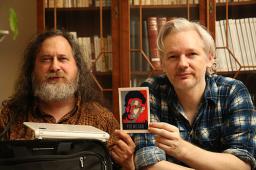
So, the truth is out there, but nobody’s gonna clean up all that falsehood. There is no visible way to make a clean break with the gigantic, ongoing institutional deceits. There’s no mechanism by which any such honesty could be imposed. It’s like reforming polygamy in the Ottoman Empire.
People, you couldn’t trust any of these three guys to go down to the corner grocery for a pack of cigarettes. Stallman would bring you tiny peat-pots of baby tobacco plants, then tell you to grow your own. Assange would buy the cigarettes, but smoke them all himself while coding up something unworkable. And Ed would set fire to himself, to prove to an innocent mankind that tobacco is a monstrous and cancerous evil that must be exposed at all costs.
2013/3/7
The street finds its own uses for things: Russian crime organisations have online marketplaces offering the services of willing underworld accomplices in various cities, administered through a cutting-edge web-based control panel:
The service, advertised on exclusive, Russian-language forums that cater to cybercrooks, claims to have willing and ready foot soldiers for hire in California, Florida, Illinois and New York.These associates are not mere “money mules,” unwitting and inexperienced Americans tricked and cajoled into laundering money after being hired for bogus work-at-home jobs. Rather, as the title of the ad for this service makes clear, the “foreign agents” available through this network are aware that they will be assisting in illegal activity (the ad refers to them as неразводные “nerazvodni” or “not deceived”). Put simply: These are mules that can be counted on not to freak out or disappear with the cash.
According to the advertisement, customers of this service get their very own login to a remote panel, where they can interact with the cashout service and monitor the progress of their thievery operations. The service also can be hired to drain bank accounts using counterfeit debit cards obtained through ATM skimmers or hacked point-of-sale devices. The complicit mules will even help cash out refunds from phony state and federal income tax filings — a lucrative form of fraud that, according to the Internal Revenue Service, cost taxpayers $5.2 billion last year.The contractors are available for other services, such as pickup and forward shipping of sketchy merchandise and “other interesting transactions”.
Once again, Russian biznesmeni are at the forefront of bringing free-market efficiency and the disintermediating, just-in-time power of the internet to the underworld (for long dominated by the almost Leninist command economies of hierarchical Mafia organisations and insular cells of bandits), or, if you will, liberating open-slather capitalism from pretences of legal propriety. Or, as has been said before, “Lenin failed to teach the Russians socialism, but he succeeded in teaching them capitalism”.
2012/9/4
Spare a thought for the goths of Uzbekistan; once plentiful around the tranquil cemeteries of cosmopolitan Tashkent (and, for some reason, the city's one Roman Catholic church), persecution by the authorities and a hostility to Western youth subcultures seeping in from Putin's Russia (many Uzbeks speak Russian and watch Russian television) has caused their numbers to dwindle, with those who can seeking refuge in more liberal countries.
There has been a campaign in Uzbek media denouncing Western mass culture for encouraging "immorality" among the youth and for "damaging the country's national values and traditions". Rap, rock and heavy metal have been labelled "alien music" and some genres have been subsequently banned.
During one punk rock concert during the last two years, masked police turned up in large numbers and began rounding up the fans, detaining some for several hours.They're kettling them? It's almost as if they were anti-tax-evasion campaigners in London or something.
In any case, the rising tide of xenophobic nationalism and authoritarianism is taking its toll on Tashkent's once flourishing punk, goth and metal scenes.
At a well-known club on the outskirts of Tashkent, an event that in the past might have attracted up to 300 people, now only draws about 20 or 30. Most tried to avoid the camera.
"In the past there were lots of goths, punks, satanists and rockers around," says Gotya sadly. While Uzbekistan appears to be a less-than-hospitable place for such subcultures, Leticia and Gotya too are thinking about emigrating to other countries, like Russia or Poland.You know a country has problems when Russia is considered a more liberal country to emigrate to.
2012/8/18
As the Pussy Riot Three prepare to join the civil dead in the Russian gulag, numerous artists in the West have condemned their sentence, some more self-aggrandisingly than others. For example, Glen Matlock of punk marketing breakthrough the Sex Pistols pointed out the similarities between Pussy Riot's protest against the Russian Orthodox Church's complicity in the Putin regime's authoritarianism and his own band's protest against Queen Elizabeth II's inhuman fascist regime, and the sacrifices both bands made for the righteousness of their causes:
"It's bad. I suppose it's similar in a way to what happened with our 'God Save The Queen' single in '77," he said. "But though there was a bit of violence against the band we didn't do two years. That Putin's a twat, isn't he?"Quite.
The Russian feminist punk collective Pussy Riot have, as expected, been found guilty, and sentenced to two years in a gulag, a sentence less than the 3-7 years the prosecution wanted, but still alarmingly severe given the nature of the incident. Given the brutality of the Russian prison system (in which almost half of the prisoners are ill with HIV or antibiotic-resistant tuberculosis and disfavoured prisoners, a category into which unrepentant enemies of the powers that be may end up being coerced, are singled out for brutal abuse), their chances of emerging two years later more or less OK don't look good.
The trial, if anything, has been a turning point, in that Russia has given up the pretence of being a liberal democracy, and publicly reasserted the Czarist autocratic model, with the Russian Orthodox church acting as a Caesaropapist arm of the absolute State. Der Spiegel has a piece on Russia's reembracing of autocracy:
In the summer of 1991, for example, when the Soviet realm was collapsing, Putin moved into his office in St. Petersburg and promptly had the portrait of Lenin removed and replaced with one of Peter the Great. A janitor had brought Putin two images of the czar. The first one depicted the young Peter, looking amiable and idealistic, a modernizer who wanted to open the "window to Europe" for his giant, backward country. Putin rejected the picture. Instead, he chose one of a serious-looking older czar, marked by many battles and conflicts, one who had expanded his realm with new conquests, and one whose rule was so ruthless that he had his own son tortured to death after accusing him of being involved in a conspiracy.Then again, as Twitter user @mrcolmquinn pointed out, "Next time you see a staged photo of Putin doing something macho remember he is scared of a non violent group of young women."
And in other news, Moscow's top court has banned gay parades for 100 years.
2012/7/29
Where punk still means something: There's a piece in the Observer about the trials and tribulations of Russian punk-rock protest group Pussy Riot, a sort of hybrid of Plastic People Of The Universe-style rock'n'roll absurdism with the semiotics and feminist ideology of riot-grrl and a touch of Situationism, who took on the Putin regime, and (in being crucified by it) may yet bring it low:
Russia's leaders have always understood the potency of the visual imagery of power. Of hammers and sickles. Of nuclear warheads and a well-muscled man doing manly, bare-chested outdoor pursuits. And, in the latest instance: of five young women in brightly coloured balaclavas jumping up and down in the symbolic heart of the Russian state: Red Square.
Miriam Elder, the Guardian's Moscow correspondent, who has covered the case assiduously, met a group of them shortly afterwards, one of the very few journalists to have interviewed them. "They were just very determined. Very purposeful. Everybody was so angry at that time. But what came across was just how educated they were. How well thought out their ideas were. They quoted everybody from Simone de Beauvoir to the Ramones. It wasn't just a silly prank. There was a real message behind it."The members of the Pussy Riot collective are anonymous, covering their faces and going by noms de guerre. Nonetheless, three members were arrested after invading a Russian Orthodox cathedral and playing a song calling for Putin to be dismissed, a gesture which was deliberately calculated to highlight the complicity of the Church with the Putin-era state in attempting to reassert absolute control over Russian society:
"More than this, though, is how the church has started to act as if it is the propaganda wing of the government. Before the election, Patriarch Kirill said that it was 'un-Christian' to demonstrate. And then he said that Putin had been placed at the head of the government 'by God'. No one was talking about this before. And now everybody is."The state has moved to make an example of the Pussy Riot Three; they have been detained incommunicado pending a trial, and face up to seven years in prison. Though public opinion, both within Russia and in the outside world, has moved against the state. Amnesty International, ignoring the tradition of religious privilege to take offence, has also designated the three to be prisoners of conscience.
2012/6/4
Russian singer Eduard Khil has died at the age of 77, following a stroke. Khil is apparently well known in Russia, though attained belated fame outside of Russia when a musical number he performed on Soviet television in the 1970s, in which he sung nonsense lyrics in a rich baritone over luxuriantly loungy background music, but above all with an infectious sense of good cheer, ended up on YouTube and became a meme. The song's original title was apparently “I Am So Happy to Finally Be Back Home” (in Russian, of course), though it was changed by the censors and replaced with the immortal words “Trololololo lololo lololo, hahahahaha!”, which probably contributed much to its global appeal some decades later.
Khil lived to see his song belatedly become an internet sensation, and was even filmed commenting on covers of it from all over the world; one partial parody of this song was performed by the German actor Christoph Waltz on television.
2012/3/20
Russia's rogue film translators have struck again: this time, a pirate version of the Margaret Thatcher hagiography The Iron Lady has Thatcher admiring Hitler and vowing to “crush the working class, crush the scum”:
In a scene from the original film, two Conservative advisers tell Thatcher that she needs to soften her image after they watch her being interviewed on television. In the Russian version, which has been dubbed to have her say that she would crush the working class, an adviser responds: "Of course you went a bit over the top ... One of them [the workers] could be literate and have a television and see everything and tell all the rest," he says, "and then rumours would spread that you are a pitiless, heartless bitch."
Creating a new script over pirated films is nothing new in Russia; one famous translator working under the pseudonym Goblin made his name by making entertaining versions that were sometimes better than the original. But this seems to be the first time that a mainstream film has been so radically changed to fit in with a political viewpoint, in which Thatcher and her ministers are shown as part of a world conspiracy, controlled by shadowy leaders. The script veers from the hysterical to the absurd – at one point Thatcher says she intends to deliberately start the Falklands war with the help of fellow fans of her favourite free market economist, Milton Friedman.Which looks like a cross between the Russian tradition of détourning Western popular works (see also: Lord of the Rings from a Mordorian progressive/rationalist perspective) and the Downfall parody video. Apparently the pirated translation has fooled at least one film critic, who quoted the dialogue in a generally positive review.
2012/3/18
Following the recent Spiegel piece on punk rock and dissent in Burma, music journalist John Harris has an article on parts of the world where punk and its offshoots are still dangerous:
It's been a long time since the term "punk rock" could strike fear into the British establishment. The Sex Pistols' John Lydon – aka Johnny Rotten – was long ago transformed into a pantomimic national institution, and now advertises Country Life butter; it's 16 years since Tony Blair admiringly mentioned the Clash in a speech at the Brit awards. The spiky-topped punk look is as harmless a part of vernacular British style as Harris tweed; the concert nostalgia circuit is now home to any number of ageing punk groups, from the Buzzcocks to Sham 69.
The last few months, however, have brought news from abroad suggesting that in many places, punk's combination of splenetic dissent, loud guitars and outre attire can cause as much disquiet and outrage as ever. The stories concerned take in Indonesia, Burma, Iraq and Russia – and most highlight one big difference between the hoo-hah kicked up by punk in the US and Britain of the late 70s, and the reactions it now stirs thousands of miles from its places of birth. Back then, being a punk rocker might invite occasional attacks in the street, a ban on your records, and the odd difficulty finding somewhere to play. Now, if you pursue a love of punk in the wrong political circumstances, you may well experience oppression at its most brutal: torture, imprisonment, what one regime calls "moral rehabilitation" and even death.The ways that punk-influenced subcultures are colliding with the local establishments differ for each place. In Iraq, Islamists are stoning youths to death for wearing clothes and haircuts associated with “emo” (which originated as an offshoot of DC hardcore punk, though in the affluent first world, has long since degenerated into Hot Topic merchandise lines and highly commercial bands making whimpering songs complaining about girls not putting out, Fake Emo having displaced Fake Goth as the bad joke of teenage angst some time in the 00s). In Iraq, however, emo is still seen as a threat to Islamic values and traditional norms of masculinity:
One thing is definitely true: figures for emo-related killings are blurring into those for homophobic murders (put at up to 58 in the last six weeks alone), reflecting a widespread perception in Iraq that emo is a byword not just for devil-worship, but homosexuality. A leaflet distributed in east Baghdad gave any local emo fans four days to "leave this filthy work", under pain of "the punishment of God … at the hand of the Mujahideen". At least two lists of intended victims have been posted online, and tattoo parlours in the city have reported terrified young people asking for their punk-esque body-art to be removed.Hard rock and the Islamic world have come into collision before: Malaysia reportedly had its own issue with “Satanist” heavy-metal fans, and in Indonesia's conservative Aceh province, officials detained punk rock fans at an event, shaved their heads and subjected them to “moral reeducation”. This action, intended as a show of strength by local political figures, resulted in protests outside Indonesian embassies across the world.
There are, he tells me, two kinds of punk in Indonesia. "One is what we think of as a poser: they adopt punk fashions." This group, he says, tend to be "street kids" who fall into begging and petty crime, and thereby provoke the authorities. "The other punks are part of a community that has developed since the late 80s – a moral, ideological type of community," he says. "They're totally different. But the government and society thinks that if you have a Mohawk and boots, you are a punk, and all punks are the same." The kids arrested in Aceh, he thinks, are likely to be the genuine article, because they were arrested at a gig, a reasonably sure sign of true believers.Meanwhile, in Russia, a feminist punk movement influenced by riot grrrl is forming part of the growing resistance to the Putin regime, the ex-KGB siloviki and the oligarchs, and their plans for a tightly managed democracy:
In Moscow, a court ruling on Wednesday marked the latest chapter in the story of an all-female band called Pussy Riot, two of whom were arrested last month after they illicitly took over the pulpit in a Moscow church, and attempted to recite a "punk prayer" written in opposition to Vladimir Putin. Pussy Riot's music is scratchy, unhinged stuff that takes its lead from a fleeting genre known as riot grrrl – once again traceable, at least in part, to Washington DC, and brought to fruition nearly 20 years ago by such groups as Bikini Kill, and a British band called Huggy Bear. Their music was clearly derived from punk's basic idea, but took its lead from such feminist groups as the Slits and the Au Pairs rather than the Clash and the Pistols: apart from anything else, the controversy around Pussy Riot has at least served as a reminder of this overlooked strand of punk history.
"We somehow developed what [those groups] did in the 1990s, although in an absolutely different context and with an exaggerated political stance," one band member called Garadzha Matveyeva has explained, "which leads to all of our performances being illegal – we'll never give a gig in a club or in any special musical space. That's an important principle for us." The band, who always perform in identity-concealing balaclavas, has a free-floating membership that can number up to 15 people – it amounts to "a pulsating and growing body", as Matveyeva sees it.In all these cases, the common theme is how punk, a dated subculture of generational rebellion, now often reduced to a grab-bag of clichés and commodified kitsch, has come to signify vastly more in considerably more desperate straits, without losing the decidedly foreign and awkwardly specific semiotics of someone else's adolescent rebellion in a distant country, long ago. So the image of punk comes, mediated via layers of marketing, commodification and nostalgia, to the developing world, where a Burmese dissident finds a copy of NME with a heritage-rock cover in the bins of the British Embassy, or an Iraqi teenager sees a Fall Out Boy video on a satellite video channel, and a chimera is born:
"You hear a lot about the clash of civilizations," [Ole Reitov, of Copenhagen-based freedom-of-expression advocacy group Freemuse] tells me, "but often, these things, they reflect a clash within civilizations. You're seeing the same symptoms in all kinds of countries: it's a matter of what you do if you feel you're powerless. You can only be extreme, relative to so-called normality. He thinks all this will only increase given two parallel developments: the rise of religious fundamentalism, and the increase in networked communications, which means that every aspect of a subculture can be globally spread at speed. "Think back 50 years," he says. "People didn't necessarily know what the Shadows or the Beatles looked like. These days, you immediately know. Someone in Ulan Bator immediately knows the body language that comes with rap music; in Iraq, the young people who've been killed knew how to dress a certain way."
2012/3/13
Art Threat has an article about VOINA, the Russian radical performance-art collective responsible for happenings protesting against the corruption of the Russian state, its abuses of human rights, and the complicity of the mainstream art world. Their projects have included provocations such as sliding live sheep down a pro-Putin election banner at a book fair opening, staging mock hangings of gays and foreigners in Moscow to protest the Mayor's hostile stance to both, spray-painting a giant phallus on a drawbridge opposite the headquarters of the security services in St. Petersburg; though a lot of their ire is also directed at a bourgeois contemporary art world they see as more oriented to catering to the corrupt elites than questioning the state of affairs:
At the Moscow Art Fair in 2007, they staged It’s Time to Whip Russian Art, inviting members of the public to participate in a public flogging of a man dressed in white lying on a white sheet with an S&M whip dipped in red paint, a protest against elitism and conformism in Russian contemporary art.
“All our actions have political underlying messages, but we use art language only. We speak in images, symbols, which are mostly visual. We don’t use the language of political journalism. Politics is just a main theme of our works. In the current socio-political situation in Russia, an honest artist can’t be mute and make glamorous “masterpieces” for oligarchs, who decorate their “brilliant” dachas.”VOINA's actions have, perhaps unsurprisingly, brought the full brunt of the Russian security state down upon them, with all the brutality and arbitrariness that this entails.
“Being captured, the artists with handcuffs on their hands and plastic bags on their heads were thrown into a minibus and were carried from Moscow to St. Petersburg on the iron floor for ten hours. During this trip, cops kicked Oleg, the ideologist of the art group, in the kidneys and head. Two weeks later the human right defenders and the medics, who visited the arrested artists in prison, found hematomas on Oleg’s body in the kidney area and handcuff marks. Leonid had serious bruises.”British street artist turned crypto-celebrity Banksy has offered to pay the bail for Oleg and Leonid (cited as US$133,000), though his offer was rejected. There is a web site which claims to be a defence fund here.
2011/12/25
The Forbidden Railway: the story of an unescorted journey by train from Vienna, through Russia, and to North Korea over a route officially off limits to tourists, by two rail travel enthusiasts—one Austrian and one Swiss. Includes plenty of photographs and details about the journey and the places encountered.
2011/11/15
Russian Prime Minister and President-in-waiting Vladimir Putin has been awarded the Confucian Peace Prize, created by the Chinese government to "promote world peace from an eastern perspective", beating a field of other candidates, including Bill Gates, Angela Merkel and a Beijing-appointed Tibetan Panchen Lama:
The 16-judge panel said that Putin deserved the award because his criticism of Nato's military engagement in Libya was "outstanding in keeping world peace", regardless of the fact that it had no bearing on the outcome of the north African conflict.
The Chinese organisers claimed they established the award last year after preparing for years to create something that would "promote world peace from an eastern perspective". But the Confucian peace prize appeared more like a rushed and botched attempt to upstage the Nobel laureate status granted to jailed Chinese dissident Liu Xiaobo.
2011/8/24
The Russian government has approved plans to build a railway link to Alaska via a tunnel under the Bering Strait. The tunnel would be twice as long as the Channel Tunnel, and is also expected to run electric cables. Once it is completed, it is predicted that 3% of the world's freight would take the route.
Of course, there are many unanswered questions. The question of funding for the massive project remains unresolved, and there is the small matter of building a railway link all the way to the easternmost extent of Russia's isolated Far East, over thousands of kilometres of tundra. (The Trans-Siberian Railway does not come anywhere near the sparsely populated region, though a branch line to Yakutsk, a fraction of the way, is due for completion by 2013.) And, of course, US approval for a railway tunnel into its territory is still an open question.
2011/6/21
In Russia, rank hath privilege, and not even the laws of the road apply equally to everyone. Russia's elite are issued with migalki, roof-mounted car sirens which render them exempt from road rules, originally intended for the Party officials on whom the future of the USSR depended. Stripped of its connection to the security of the State, the system of migalki has since devolved into a self-justifying badge of status for the wealthy, powerful and well-connected, a signifier that one matters in a way that the bydlo (the common horde, literally "cattle") who have to obey road laws don't:
And then she got to thinking: what the fuck. Why are these people even here, in her city? Why not impose an entry fee to Moscow -- say, $200. "Then we'll have beautiful people driving around in beautiful cars, not collective farmers in their farting wrecks, or office schmucks in their miserable Passats," she mused. "And anyway: let these office drones take the metro to their kunstkameras, or, even better, have them go somewhere far away. Maybe Kolyma" -- the remote site of some of the most notorious Soviet-era gulags. "Let them pan for gold. That way, we'd at least get some use out of their pointless existence."There are now some 970 official migalki in circulation (and, unofficially, nearly double that number).
Who has them? Some of the president's advisors, some big businessmen who get them through connections. Who else? The deputy head of the Federal Customs Agency, who recently turned his siren on one weekday morning to speed to the dry cleaner's. Filmmaker Mikhalkov, ostensibly because he was the head of the Defense Ministry's Public Council. (When a journalist called him to ask why a film director would need a siren, Mikhalkov responded with a tirade so explicit, so bleep-worthy, that it firmly established him as Russia's leading artistic light.) Even more bizarrely, so does this woman, who called in to a Moscow radio station in January to complain that no one pays attention to her migalka:
The plebes, Tatyana complained, were not behaving. They did not respect the law, and the law mandates a strict split between them and people like Tatyana who have drivers and cars with migalki, people who reside in gated communities where nectar is drunk and the only law is the one that separates them from the plebes outside.The plebes, though, are fighting back, using phone cameras to record the elite's arrogance. Which does little to change the system, but is starting to stoke debate over whether this is a reasonable way to organise a society:
But, this being Russia, the point is not changing the status quo -- the cushy, legally extrajudicial privileges of the elite -- but changing the way the status quo is perceived. In the last year, various unheard-of lawmakers have "taken up the issue" of migalki and VIP contempt for traffic laws more generally, first last April (to no effect), then in February (to no effect), then again in May (to no effect). Otherwise, not much has changed. Just a month after the second legislative push, someone posted a cell-phone video of three ambulances, sirens on, waiting for a VIP cortege to pass through Kutuzovsky Prospekt, a major artery leading from the Kremlin to the city's elite suburbs.(Hmmm; a society with a class hierarchy cast in stone, where rank hath privilege and the convenience of those at the top outweighs the very lives of those beneath them, and where the law's very purpose is to entrench this inequality. Much in the way that Somalia can be seen as a physical manifestation of the pipe-dreams of Libertarians and anarcho-capitalists as embodied in reality, this could perhaps be seen as the real-world manifestation of the neo-feudal utopias those Conservatives who denounce the Enlightenment yearn for.)
2011/2/21
A Russian author has written a retelling of Lord of the Rings from a different angle. Kiril Yeskov's The Last Ringbearer specifically repudiates Tolkien's oft-noted agrarian romanticism; in it, Sauron and the land of Mordor represent progress and rationalism, and are destroyed in a war of aggression by Gandalf and his lackeys, reinforcing a backward, feudal order in thrall to superstition and hereditary privilege:
In Yeskov's retelling, the wizard Gandalf is a war-monger intent on crushing the scientific and technological initiative of Mordor and its southern allies because science "destroys the harmony of the world and dries up the souls of men!" He's in cahoots with the elves, who aim to become "masters of the world," and turn Middle-earth into a "bad copy" of their magical homeland across the sea. Barad-dur, also known as the Dark Tower and Sauron's citadel, is, by contrast, described as "that amazing city of alchemists and poets, mechanics and astronomers, philosophers and physicians, the heart of the only civilization in Middle-earth to bet on rational knowledge and bravely pitch its barely adolescent technology against ancient magic."
Because Gandalf refers to Mordor as the "Evil Empire" and is accused of crafting a "Final Solution to the Mordorian problem" by rival wizard Saruman, he obviously serves as an avatar for Russia's 20th-century foes. But the juxtaposition of the willfully feudal and backward "West," happy with "picking lice in its log 'castles'" while Mordor cultivates learning and embraces change, also recalls the clash between Europe in the early Middle Ages and the more sophisticated and learned Muslim empires to the east and south. Sauron passes a "universal literacy law," while the shield maiden Eowyn has been raised illiterate, "like most of Rohan's elite" -- good guys Tolkien based on his beloved Anglo-Saxons.While Yeskov wrote The Last Ringbearer in 1999, an English-language translation has just been made available here.
2010/12/9
More WikiLeaks fallout:
- The presence of leaked memos has created opportunities for propaganda; several Pakistani newspapers have run stories quoting alleged memoes describing India as genocidal maniacs, praising the Pakistani military. A search of the Wikileaks database by the Graun's staff has not yielded any matching memoes.
- Australian online activist group GetUp are collecting signatures and donations for ads in the New York Times and Washington Post in defence of Julian Assange.
- Assange could face extradition to the US, most probably under the 1917 Espionage Act. Whether he'd be likely to be convicted under this act, is a matter for some debate, but according to this article, recent precedents suggest that he would be found guilty, as would the editors of the New York Times, anyone mirroring copies of WikiLeaks, and perhaps anyone running a web proxy which inadvertently cached the data. (This is in an open court, mind you; in a closed military tribunal, all bets are off.)
- Meanwhile, the Russian government has called for Assange to be given the Nobel Peace Prize; somewhat of a change from its usual policy regarding troublesome journalists, it must be said. Still, if I were him, I'd probably run a Geiger counter over the medal first, just to be safe.
- In today's leaks: it looks like oil company Shell owns the Nigerian government, lock, stock and barrel.
2010/9/19
Internet memes (once described, perhaps unkindly, as "like in-jokes for people who don't have friends") aren't purely an American or Anglosphere phenomenon. Cracked has a list of seven quite peculiar internet memes from foreign countries.
The Russians have two entries: PhotoExtreme is an offshoot of live-action role-playing games, as one would expect in the sort of hardcore place that Russia is fabled to be. In this meme, one person comes up with a bizarre scenario, and others act it out, take photos and post them online. The scenarios are acted out in public, without anybody being informed in advance, so bystanders are likely to be confronted with surreal, often violent (ontologically, if not literally) spectacles.
The other Russian meme is a more innocuous one, not unlike LOLCats, which originated from a rather naïve American drawing of a bear, and involves photoshopping said drawing into images. In Sweden, meanwhile, they do something similar with an image of a guy with a horse's head; this meme is named "Snel Hest" ("Nice Horse") and often involves horse-related puns. Meanwhile, the French go in for sarcastically 'shopping their self-aggrandising president Sarkozy into various historical scenes (it seems to be akin to the "Al Gore invented the Internet" meme of the 1990s) and in Australia, a video of a racist bogan chick went viral (the great Australian public doesn't really go for highly conceptual, it seems). The Kenyans, meanwhile, have a supercool tough-guy hero named Makmende, whose name comes from a mangling of Clint Eastwood's famous line "make my day".
2010/8/27
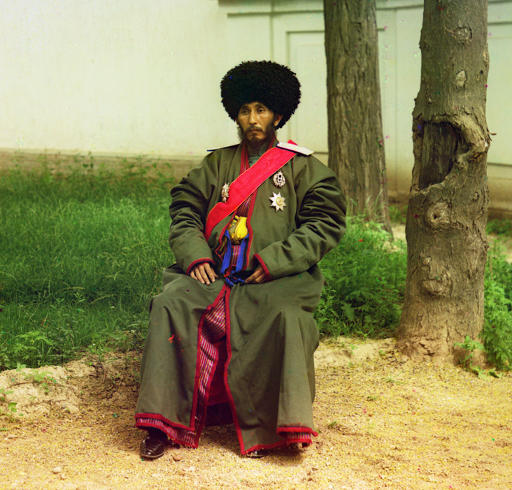
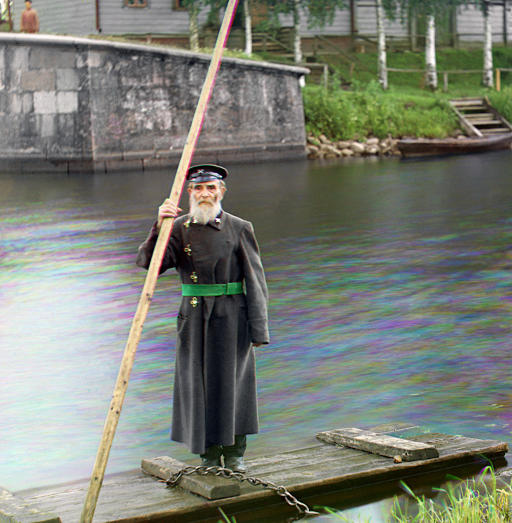
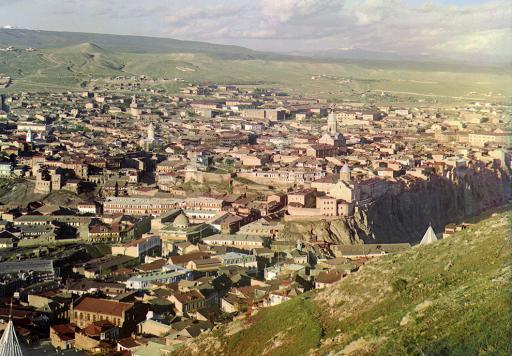
The Boston Globe has posted a selection of colour photographs taken across the Russian empire around 1910. The photographer, Sergei Mikhailovich Prokudin-Gorskii, travelled the length and breadth of Russia and its holdings (some of which are now in places like Georgia and even Turkey) at the Tsar's behest, producing a comprehensive photographic survey. Of course, colour film had yet to be invented, so Prudkin-Gorskii took his photos by taking three exposures, each with a different coloured filter in front of the lens, using a specialised camera that allowed for the filters to be swapped quickly. (It's not unlike the technique used to take HDR photos these days.) Anyway, the original glass plates were bought by the US Library of Congress in 1948 (not sure from whom; perhaps a White Russian exile took them whilst fleeing the Bolsheviks and they spent three decades in a suitcase in Paris or somewhere?), and have since been composited together into stunning full-colour images of what we too often think of as a sepia-toned age:
2010/6/30
In the US, the FBI recently arrested ten alleged Russian spies, who had been sent to the US in the 1990s, assuming American identities and attempting to befriend influential businessmen and weapons scientists. More details on the alleged spies (and more here); by all accounts, it seems that they weren't spectacularly successful at stealing secrets; one or two of them were better at milking their expense accounts, but others seemed to have lost the trust of their handlers; their tradecraft also seemed rather old-school, with the addition of a few new twists such as uploading data to surreptitious WiFi access points in cars. Meanwhile, David Wolstencroft, the creator of BBC spy series Spooks, describes the incident as Smiley's People with a laughtrack.
Some of the alleged spies took the cover of married couples; apparently they were paired up in Russia by their handlers and given their identities, before moving to America and actually having children together as part of their cover. The children are now in state custody, and their parents, should they end up in federal supermax prison or deported to Russia, are unlikely to see them again. I wonder whether hypothetical American sleeper agents abroad would go to quite that extent to maintain a cover or whether that degree of acceptance of individual sacrifice (both on the agents' part and that of the children brought into the world essentially as cover props) for a collective goal is specific to Russian culture.
Meanwhile, according to MI5, the number of Russian spies in London is up to cold war levels.
2010/4/16
Another reason to not let your domains lapse:
"I used to run a small web design service, the domain for which I allowed to expire after years of non-use. A few weeks ago, I noticed that my old site was back online at the old domain. The site-cloners are now using my old email addresses to gain access to old third-party web services accounts (invoicing tools, etc.) and are fraudulently billing my clients for years of services. I've contacted the Russian site host, PayPal, and the invoicing service. What more can I do? Can I fight back?"
2010/4/15
During the Cold War, the Soviet Union established a system of secret science cities, or "naukograds" in Russian. These cities were closed off from the rest of the USSR and identified only by numbered names; in them, elite scientists lived in relative luxury and worked on secret projects, while armed guards prevented anyone without authorisation from getting in or out. One could think of the naukograds as a Soviet-era cross between the Google campus and The Village.
Of course, developing nuclear bombs or putting a live dog into orbit is one thing, and competing in the technological marketplace is another, and Russia hasn't been punching its weight. While America has Apple, Google, Microsoft, Amazon and such and Japan and South Korea supply the world with cameras, LCD screens and memory chips, Russia has a gimmicky LED keyboard and LiveJournal (a US-based, American-built site which is Russian-owned). The post-Soviet economy is worryingly dependent on exports of natural resources such as oil and gas, and, while Russia does produce good scientists and engineers, worryingly many of them end up in the San Francisco Bay Area.
Now, seemingly chagrined by the lack of hype about the latest must-have Russian smartphone in the pages of Engadget, the Russian government has decided to do something about it and build a modern, web-age version of the naukograd, with less secrecy and more bean bags and sushi bars; an attempt to replicate the success of Silicon Valley by fiat, stop the brain drain and boost the Russian technology industry. Of course, there is some dispute over how to actually go about doing this:
In the midst of the oil boom, Russian officials suggested luring back Russian talent by building a gated residential community outside Moscow, designed to look like an American suburb. What is it about life in Palo Alto, they seemed to be asking, that we cannot duplicate in oil-rich Russia?
“In California, the climate is beautiful and they don’t have the ridiculous problems of Russia,” Mr. Shtorkh said. To compete, he said, Russia will form a place apart for scientists. “They should be isolated from our reality,” he added.
HIGH-TECH entrepreneurs who stayed in Russia are more skeptical. Yevgeny Kaspersky, founder of the Kaspersky Lab, an antivirus company, says that he is pulling for the site to succeed but that the government should confine its role to offering tax breaks and infrastructure.A site has been chosen for the first new naukograd, though a name has not yet been decided. Until one is, it is variously referred to, unofficially, as Cupertino-2, Innograd and iGorod.
2010/2/24
An unemployed sysadmin in Russia hacked into a video billboard and reprogrammed it to show a pornographic video, causing a traffic jam as drivers on a nearby road stopped to gape at the video and record it with their mobile phones.
The hacker, from Novorossiisk, used a server in Chechnya in an attempt to cover his tracks, though was unsuccessful; the Interior Ministry managed to track him down. (I wonder whether he'd have had more luck had he chosen a less politically fraught staging point.) He is now facing two years imprisonment; meanwhile, security rules for video billboards have been tightened.
I'm thinking something like this would make a good plot device; imagine a gang of assassins/bank robbers planting logic bombs in a few strategically placed billboards; at a preset time, they start showing porn, causing instant traffic jams and trapping their victim/blocking their pursuers. Or international jewel thieves hack video screens in an exclusive reception to show Goatse-style shock porn; as the attendees are momentarily stunned by the shock, unable to react, the bandits (dressed as waiters, naturally) act quickly, snatching the valuables and making their escape. Police have a hard time piecing together what happened afterward.
(via Boing Boing) ¶ 2
2010/1/25
A Russian ecologist has found that the fierce pressure of living in a hostile urban environment is causing Moscow's stray dogs to evolve increased intelligence, including abilities to negotiate the city's subway system:
Poyarkov has studied the dogs, which number about 35,000, for the last 30 years. Over that time, he observed the stray dog population lose the spotted coats, wagging tails, and friendliness that separate dogs from wolves, while at the same time evolving social structures and behaviors optimized to four ecological niches occupied by what Poyarkov calls guard dogs, scavengers, wild dogs, and beggars.
But beggar dogs have evolved the most specialized behavior. Relying on scraps of food from commuters, the beggar dogs can not only recognize which humans are most likely to give them something to eat, but have evolved to ride the subway. Using scents, and the ability to recognize the train conductor's names for different stops, they incorporate many stations into their territories.
Additionally, Poyarkov says the pack structure of the beggars reflects a reliance on brain over brawn for survival. In the beggar packs, the smartest dog, not the most physically dominant, occupies the alpha male position.I wonder whether similar evolutions of animal intelligence, driven by the conditions of living in cities, have occurred in other cities; there have been anecdotal reports of pigeons deliberately catching the Tube in London, with speculation that they commute in to the tourist-rich city to feed before returning to the suburbs. (As such, one could probably refer to them as passenger pigeons.) Not to mention two instances of cats deliberately catching buses (both in England).
2010/1/18
A Russian CCTV surveillance company has allegedly stumbled along an ingenious way of reducing operating costs and boosting profits: by replacing surveillance camera feeds with prerecorded video. The alleged fraud was uncovered during a routine check of cameras in Moscow; the director of the surveillance company, who has been detained by police, denies the claims, claiming it's a setup by rivals.
2009/7/30
Aeroflot, the Soviet Russian national airline, has not traditionally been an airline associated with quality or customer service, to say the least. But now, all that's about to change:
Travellers report mixed experiences on Aeroflot, with reasonable service and new planes on flights to western Europe and the US, but horror stories about flights to other destinations. "On flights to London the service is okay," said a British accountant working in Moscow. "But I recently flew Aeroflot to Warsaw, and it was a nightmare. The seatbelt on my chair was broken, the crew were rude and spoke virtually no English, and the only meal option was an unspecified 'meat'. When I asked what kind of meat it was, they simply shrugged."
As part of the retraining, a number of Aeroflot hostesses have been sent to Singapore to receive training from Singapore Airlines. "The passenger is always right!" said Mr Savelyev, voicing a concept that often seems to be alien to Russian flight crews. "We have fired a lot of stewardesses for being rude to passengers," he admitted.The changes promise to bring Aeroflot into the 21st century, or, at the very leat, the early 1970s:
The new Aeroflot CEO Vitaly Savelyev said all new stewardesses would be "very striking, very eye-catching girls", who would not exceed Russian size 48 – roughly a British size 12.
The legend of aerial misogyny was born in the 1960s and '70s, when airlines would routinely use the glamour of their air hostesses as a selling point. Many airlines had "no-marriage" rules for their female staff. "Being beautiful isn't enough," American Airlines proudly said. "We don't mean it isn't important. It just isn't enough." Meanwhile, the now-defunct National Airlines ran a series of ads with a pouting stewardess proclaiming: "I'm Mandy. Fly Me." As the world moved on, the term "air hostess" was replaced with the gender neutral "flight attendant". But recently some suspect sexism has crept back into the industry's advertising. Virgin drew 29 complaints over an ad campaign in which passengers gawped at a glamorous all-female flight-crew. Ryanair even published an all-female calendar of its flight attendants – wearing bikinis.I wonder whether they'll keep their charmingly anachronistic flying hammer-and-sickle logo.
2009/7/1
Unfortunately chosen brand name of the moment: Russian gas company Gazprom has recently launched a joint venture with the Nigerian gas firm NNPC. Unfortunately, the name they chose for their joint venture is Nigaz. Word.
I wonder whether the problem was caused by some Russian executive being unaware of pejorative words in English, or whether the name was deliberately chosen so that they can have a totally wicked gangsta-rap company anthem.
2009/5/27
A New York Times article from 10 years ago reveals that, over 40 years, Soviet scientists managed to create a domesticated variety of silver fox through selective breeding:
In a long-term experiment at a Siberian fur farm, geneticists have created this new version of Vulpes vulpes, the silver fox, by allowing only the friendliest animals from each generation to breed. Having selected only the most ''tamable'' of some 45,000 foxes over 35 generations, the scientists have compressed into a mere 40 years an evolutionary process that took thousands of years to transform ancestral wolves into domestic dogs.
The original purpose of the breeding was to create a friendly breed less likely than wild animals to fight when put to death. But in time, geneticists saw that far-reaching changes they observed in the foxes' physical and neurological makeup merited scientific study. The scientists apparently underwent some changes, too. Close bonds developed between the tame foxes and their human wardens, and the staff at the fur farm is trying to find ways of saving the animals from slaughter.("Friendly" there seems like a euphemism; "gullible" or "stupid" might be more appropriate.)
The results of the experiment were domestic foxes ''as devoted as dogs but as independent as cats, capable of forming deep-rooted pair bonds with human beings'', which also developed a variety of physical differences from their wild ancestors:
The normal pattern of coat color that evolved in wild foxes as camouflage changed markedly in the genetically tamed fox population, with irregular piebald splotches of white fur appearing in some animals. The tame foxes sometimes developed floppy ears in place of the straight ones of wild foxes. The domesticated foxes generally had shorter legs and tails than ordinary foxes, and often had curly tails instead of straight, horizontal tails.
Moreover, the faces of adult tame foxes came to look more juvenile than the faces of wild adults, and many of the experimental animals developed dog-like features, Dr. Trut reported. Although no selective pressures relating to size or shape were used in breeding the animals, the skulls of tamable foxes tended to be narrower with shorter snouts than those of wild foxes.Even more interesting were neurochemical differences: the tame foxes' adrenal glands, which produce adrenaline to prepare animals for fight or flight, had declined in hormone-producing ability with each generation, while after only 12 generations, their brains contained significantly higher levels of serotonin.
Unfortunately, it appears that the project ran out of money some time in the late 1990s, and most of the foxes were destroyed or sold off to fur breeders in Scandinavia. The institute had plans to sell pups as house pets, though it is not clear whether anything came of those.
(Via a comment on this MeFi thread about the history of domestic cats.)
2008/10/9
The most serious casualty of the economic crisis has been Iceland. Only five months ago it was hailed as a success story, with its balance of a strong economy, mass affluence and a Scandinavian work-life balance and, apparently, the happiest people on earth. Now the good times are over; Iceland's economy has been devastated by the credit crunch/subprime crisis/opening phases of World Depression 2, banks have collapsed (some of them taking vast amounts of British savings with them), and the nation teeters on the verge of "national bankruptcy".
Some people are calling for Iceland to swallow its pride and join the EU, adopting the Euro. Also, the Icelandic government is reportedly negotiating with Russia for a huge multi-billion-Euro loan to stave off economic collapse. If this takes place, it will be interesting to see what place an Iceland massively indebted to Russia takes on the world stage. For one, will the US air base at Keflavík airport (which has been there since World War 2, generally lukewarmly tolerated) be given its marching orders? (If the Russians are willing to spend big to move it out, I suspect the US would have more pressing concerns on its mind at the moment.) Also, Russia is one of the nations competing for sovereignty over vast (and possibly mineral-rich) stretches of the Arctic; having allies near the Arctic Circle could prove useful to them.
There have been some unexpected upsides to the crisis, though; Iceland's tourist industry is booming, as the formerly unaffordable krona has plummeted. This has also reduced Iceland's notoriously high alcohol prices, making Reykjavík a destination for stag parties and the sort of chavvish tourism the old cities of Eastern Europe have been complaining about. The Icelanders are, as one might expect, also going out, getting drunk and partying like there's no tomorrow. Or like tomorrow will be a lot less fun.
nyway, next week, the Airwaves Festival in Reykjavík kicks off, and here are some MP3s from artists performing there.
2008/10/8
Russia's ever-ingenious con artists have come up with another clever scam: fake iPhones. The devices look exactly like real iPhones with depleted batteries, and when activated show the Apple booting screen. They're handed over to the mark as collateral for borrowed money; the mark sees that the phone appears to start to boot, and assumes that the battery is depleted. When the borrower doesn't return to pick it up (and, presumably, the contact details they left turn out to be bogus), the mark takes it down to a service centre, where the technicians open it up and find that it's a plastic shell containing two batteries, a LED and a segment of a steel bar for weight.
I'm guessing that the reason the scam works is because most people wouldn't believe that someone would go to the trouble of making something that looks exactly like an iPhone but is cheap enough to be discarded for less than the value of one.
2008/8/15
Having invaded Georgia and crushed its military, a newly emboldened Russia has told the West that it can forget about Georgia's territorial integrity, and the Russian-speaking enclaves in the country won't be returned to Georgian sovereignty. And short of provoking a nuclear stand-off, there is little the West is likely to be able to do about it.
If (as is likely), Russia gets away with slicing bits out of Georgia, I wonder who will be next in its sights. Ukraine, which is looking towards joining the EU and NATO, is one candidate, though pro-Western tendencies there may be checked merely by supporting pro-Russian parties and threatening to turn off the gas. And Poland, which recently signed a deal with the US to host missile interceptors (designed, ostensibly, against Iranian rogue nukes, though it's likely that a rising China is the real motivation), drawing threats of military strike from Russian commanders, can't be sitting too comfortably. Though in my (entirely amateur) opinion, the Baltic states—Lithuania, Latvia and Estonia—may have the most to worry about.
Consider the following: The Baltic states are a thin panhandle, connected to the EU by a narrow border. They are the only part of the EU to have recently been part of the Soviet Union, and thanks to Stalin's population transfer programmes, have a substantial ethnic Russian minority, many of whom resent being coerced into learning the local language (after decades of Russian being the official language of government); reports of discrimination are common. Furthermore, there is the question of Kaliningrad, a Russian territory which is cut off from mainland Russia by Poland and Lithuania; for a resurgent regional power, this must be a terrible loss of face. An invasion of Lithuania, prompted by the prerogative to defend Russian-speaking minorities and resulting in a land corridor being carved out to Kaliningrad (and the Baltic states being conveniently isolated by land from the EU proper) could look tempting now.
Of course, as the Baltic states are NATO members, such an incident would be likely to trigger a war between Russia and NATO in its entirety (which, of course, includes the US, an even more powerful superpower). Though Russia might calculate that, with the US and other allies being overstretched and worn down in the Middle East, they may be somewhat weakened.
2008/7/25
The Russian government is considering banning the emo youth subculture, on the grounds that it is a "negative ideology" encouraging depression, social withdrawal and suicide.
Among the moves supported are strong regulation of websites and banning young people dressed in an emo style from schools and government buildings.
The document states that emos are aged from 12 to 16, wear black and pink, and have long, black hair which may "cover half the face". Other characteristics identified include black fingernails, black belts with studs and pins, and ear and eyebrow piercings.Presumably the Russian authorities would rather its youth disrupted dissident meetings, engaged in mass weddings and had lots of babies than going around wearing black and feeling sorry for themselves.
2008/5/26
So that was Eurovision for another year; Russia took home the first prize with a rather ordinary ballad (in English, produced by the famous Russian R&B producer Jim Beanz), followed by Ukraine and Greece, with equally cheesy and uninteresting tracks. The highest of the not-entirely-boring tracks was Azerbaijan's angels-and-devils ballad at #8, followed by Bosnia and Herzegovina's inspiredly surreal piece at #10. Latvia's (Swedish-written, English-speaking) pirates came in at #12, Spain's toy-guitar-wielding mentalist took #16, France's Sebastien Tellier turned #19 (though, to be fair, he didn't seem too comfortable with his new role as chanteur), and Croatia's folk-chanson accordionists and cranky old man were at #21, one step ahead of Finland's heavy-metal berzerkers. Meanwhile, the UK came in last, despite their entry being less piss-takingly laughable than the previous two years'. (In fact, one of the UK's best showings in recent years was Daz Sampson, the middle-aged bloke pretending unconvincingly to be a teenage hip-hop gangsta; figure that one out.)
And Sir Terry Wogan has said he may quit doing the commentary, in protest against the blatantly politicised bloc voting and Eurovision being "no longer a music contest".
2008/5/21
Thanks to technological advances, real life is starting to imitate Second Life (not to mention Robert Anton Wilson novels); Russian government loyalists disrupt a Gary Kasparov speech using a flying penis, apparently made from a miniature radio-controlled helicopter. Kasparov, a former world chess champion, is one of the leading figures in the opposition in Russia. The stunt is believed to have been in reference to a griefing attack in Second Life. There's video and a photo here.
(via Boing Boing) ¶ 0
2008/4/16
A Russian government agency is now making noises about requiring all WiFi devices to be registered. This will include not only access points, but laptops, VoIP phones, handheld game consoles and so on. The Russian Mass Media, Communications and Cultural Protection Service reserves the right to confiscate any unregistered devices:
According to Karpov’s statement, registering a PDA or telephone would take 10 days. Then, only the owner of the device would be licensed to use it. Registering a Wi-Fi hotspot, on the other hand, would be more difficult. Anyone wishing to set up as much as a personal home-network would need to file a complete set of documents, as well as technological certifications. Networks in Moscow or St. Petersburg would also need approval from the Federal Security Guard Service (FSO) and the Federal Security Service (FSB).The FSB, of course, used to be known as the KGB, and is closely tied to the administration of Vladimir Putin.
2008/3/30
The much vaunted Russia-Alaska railway tunnel under the Bering Strait is on the agenda again, with Vladimir Putin set to discuss the idea with George W. Bush, and Roman Abramovich (who, when he's not in England, is the governor of the Russian far eastern province of Chukotka) having, coincidentally, invested £80m in the world's largest drill.
2008/2/27
Blogging has been sparse over the past few days, as Your Humble Correspondent has been away in Berlin.
Anyway, a round-up of things I've noticed from while I was away:
- After the European University in St. Petersburg, Russia, got involved in an EU-funded project to ensure the fairness of the election process, the Russian authorities shut down the university, claiming that it is a "fire hazard". Opposition figures accuse the Kremlin of moving Russia back towards totalitarianism (or is the goal a Singapore-style "managed democracy"?)
- While we're on the subject of democracy, Charlie Stross weighs in on why forms of democracy are becoming increasingly prevalent these days, with even otherwise illiberal regimes adopting aspects of democracy, rather than autocratic systems.
Anyway. Here we have three ways in which democracy is less bad than rival forms of government: it usually weeds out lunatics before they can get their hands on the levers of power, it provides a valuable pressure relief valve for dissent, and it handles succession crises way better than a civil war.
- Barack Obama, it seems, is doing well in the US primaries; so much so that someone in the Clinton campaign seemingly decided to resort to dog-whistle politics and took it upon themselves to circulate photos of him wearing scarily Middle-Eastern-looking attire, in the hope that enough Texans are sufficiently prejudiced to be unable to vote for someone whose name not only sounds like "Osama" but who once wore similar headgear.
- After writing a piece on the mainstreaming of neo-folk music, Momus has discovered Emmy The Great. His great revelation has little to do with her music, mind you, and much to do with her being young, (half-)Asian and fanciable.
- Apple have finally released a new MacBook Pro. It gets the Air's multi-touch trackpad, and the usual quantitative bump in specifications, alas, a higher-resolution screen isn't isn't among them, so if you want 1600 pixels across on something that doesn't look comically oversized, you'll have to buy a Windows machine.
- Meanwhile, Microsoft have been slapped with a US$1.4bn fine by the EU, as well as having made vague promises of being more open in future, and apparently they're working on a Windows Vista-based GNU rival named UNG ("just like GNU, only without all that pesky freedom").
Berlin, for what it's worth, was great; four days, though, is nowhere near enough time to see everything and enjoy the city. Though I was surprised that the attendants on the Deutsche Bahn sleeper train didn't seem to speak English. Hopefully they'll remedy this by the time they start running services through the Channel Tunnel.
For what it's worth, photos are being uploaded here.
2007/12/3
Vladimir Putin's United Russia party wins 64% of votes in Russian election. The big surprise is that, with all the stops they allegedly pulled out (putting pressure on state employees and students to vote for them, offering prizes for voting, and so on), they only managed 64% of the vote. Not that they'll be too disappointed; the two runners-up are the Communist Party and the absurdly misnamed Liberal Democratic Party (i.e., the party of ultranationalist Vladimir Zhirinovsky), which ran the alleged London plutonium assassin as one of its candidates. Under new electoral rules, these are the only parties who will get into the parliament; pro-Western and pro-democracy parties will be conspicuous by their absence.
Meanwhile, blogging/journal/social-network service LiveJournal (which the older readers may remember as the stereotypical bastion of melodramatic, self-obsessed emo kids who wrote bad poetry before MySpace came along) has been sold to Russian internet company SUP, which is owned by a Putin loyalist. The official LiveJournal announcement is vague about future plans, but SUP has, ominously, already announced the creation of a Russian-based "abuse team". (It is not clear whether they will handle English-language posts.)
2007/5/13
So that was Eurovision 2007. A bit of a surprise; the Serbian entry which won it seemed rather lacklustre compared to some of the others, but romped home in the voting, presumably due to Serbia being located in a geographical/demographical sweet spot. Interestingly enough, Eastern Europe dominated the voting, with the highest-scoring western-European nation being well in the bottom half of the rankings.
There were a few highlights: Georgia's entry started off as a traditional torch song by a woman in a red dress, but then morphed into eurodance, and then the dancers whipped out swords and started dancing about, Cossack-fashion, with a wild glint in their eyes. France eschewed the usual white-gowned piano balladeer in favour of a troupe of Dadaist mimes in Jean-Paul Gaultier costumes, highlighting the ridiculous side of Gallic culture. (Fat lot of good it did them, they ended up something like third-last. I guess it's back to the chanteuse and pianist next year.) Romania's entry was a bit like France's on a budget; five blokes dressed like the habitués of a slightly unsavoury tavern, singing "I love you" in every language on earth. The music was vaguely gypsyish, and sped up dramatically towards the end. Neighbouring Bulgaria's started off like Dead Can Dance with extra percussion, and then went electro. And, of course, there was Ukraine's entry, with its sequined, uniformed drag queen, looking like Elton John crossed with Austin Powers. It had camp and kitsch in spades, and raised a few questions. What, for example, was the significance of them counting in German, and did they really sing "I want to see Russia goodbye", and if so, how did that make it past the vetting process?
The lowlight was probably Ireland's entry, which was pure, unadulterated Celtic kitsch of the most obvious variety, and quite deserving of its final position at the bottom of the board. This year, though, nobody got a nul points, and they limped home with 3 points or somesuch. Britain did a bit better, largely thanks to Malta giving them 12, though their song was stuck firmly in the mid-1990s. And the teeth on that stewardess were frightening; granted, Scooch, as uninspired as they may be, were a lot less cringeworthy than last year's entrant (a middle-aged bloke pretending to be a teenage hip-hop street thug, surrounded by dancing "schoolgirls" who, apparently, were borrowed by Turkey this year). And I'd have to give a dishonourable mention to Russia, whose entry was a piece of soullessly machine-extruded commercial pop, trading on sex appeal (sample lyric from the three immaculately coifed girls doing the singing: "put a cherry on my cake and taste my cherry pie"; ooh-err!) lacking any of the madness or wrongness that makes for an interesting Eurovision entry.
The other competitors: Belarus (incidentally, the last remaining state with a KGB) had black-clad female dancers scaling walls like assassins and John Barry-esque strings over its power ballad. The full might of the Swedish culture industry was unleashed in the form of 1970s glam rock attired in monochromatic retro cool. Latvia's entry was in Italian, and like a low-rent version of The Divs. Germany had a bloke named Roger Cicero (son of Herr und Frau Cicero, I presume) doing a Sinatra-lite swing number, in German. Armenia's entrant seemed to follow, stylistically, in the footsteps of that other great Armenian singer, Charles Aznavour, only with an overwroughtly woeful and somewhat strained ballad. And Turkey's entrant was a short, hirsute man wearing a red jacket and a broad grin, surrounded by belly dancers Terry Wogan persisted in pointing out were British. Presumably giving the United Kingdom something to be proud of even should they have ended up with nul points.
While some speculated that Lordi's astounding triumph last year (reprised in the Lord-of-the-Rings-esque opening video) would have opened the door for a flood of hard-rock/heavy-metal bands, this did not entirely come to pass. Finland followed up their win with a new genre, which could be dubbed, Tolkienesquely, MOR-Goth, consisting of torch songs with emo-esque lyrics and plenty of black clothing and gothic makeup. The other main Lordi-influenced act was Moldova, whose song sounded like the sort of alternative-rock song that ended up on Hollywood action-film soundtracks in the late 1990s; all minor-key strings, crunchy metal power chords and drum loops.
The promotional videos played before the musical numbers were done quite well, executed as whimsical stories featuring elements of Finnish culture. Some of the odder ones featured a goth riding a rollercoaster, hackers coding computer demos at the Assembly festival, a heavy-metal festival full of corpsepainted teenagers, a troupe of clowns giving an athlete an instant makeover so he could enter a restaurant, a twattish-looking bloke in DJ headphones playing the pipes at the Sibelius monument, and Santa Claus playing chess with one of the Moomins. Oh, and lots of mobile phones (Nokia, of course); the Finns, it seems, use them at the dinner table, and even propose marriage with the help of their cameraphones. Other than mobile phones, heavy metal appears to be a big part of the Finnish national identity; other than the promos, there was the entertainment during the vote-counting break, which featured the heavy-metal string quartet Apocalyptica, as well as acrobats.
Last but not least, one has to mention the astonishing phenomenon that is Krisse, the somewhat frightening-looking young woman with the pink puffer jacket and big ponytails plucked from the audience to interview competitors, stumbling through questions and going on about herself (sample question: "on a scale of 9 to 10, how beautiful am I?"). For some reason, she reminded me of Leoncie.
2007/5/12
British menswear chain Burton has egg on its face after it emerged that the decorative Cyrillic text on a T-shirt it was selling was actually an extreme-right anti-immigrant slogan, translating as "We will cleanse Russia of all non-Russians":
The shirt's overall design is an odd jumble of ersatz French logo and Russian iconography, but there is no mistaking the nature of the sentiment, which uses the old word for Russia, "Rus" as a way of distinguishing between ethnic Russians and those with Russian citizenship. "I've spoken to a Russian friend," says Mr Shuttleworth, "and she said you would be arrested if you wore it in Russia."
The phrase is typical of those painted on foreigners' homes by Russian neo-nazis.Burton has blamed one of its suppliers for the gaffe, saying it was told that the slogan read merely "be proud of Russia".
2007/4/23
Everyone complains about the procession of doom and gloom in the news, but only the Russians are doing something about it. After a bank loyal to Russia's President Vladimir Putin bought out Russia's largest independent radio news network, they decreed that at least 50% of reports about Russia must be "positive".
As well as protecting the Russian people from doom and gloom, they are also committed to guarding them from the pernicious influence of unapproved politicians, all mention of whom has been banned.
2007/4/19
The Russians are once again talking about building a tunnel under the Bering Strait from Russia to Alaska. Apparently the US and Canada are on board, and the project is expected $65 billion, with the tunnel itself costing $10 to $12 billion; much of the rest will be spent on providing a rail link across inhospitable terrain to the heretofore unconnected northeastern frontier of Russia.
A 6,000-kilometer (3,700-mile) transport corridor from Siberia into the U.S. will feed into the tunnel, which at 64 miles will be more than twice as long as the underwater section of the Channel Tunnel between the U.K. and France, according to the plan. The tunnel would run in three sections to link the two islands in the Bering Strait between Russia and the U.S.
The planned undersea tunnel would contain a high-speed railway, highway and pipelines, as well as power and fiber-optic cables, according to TKM-World Link. Investors in the so-called public-private partnership include OAO Russian Railways, national utility OAO Unified Energy System and pipeline operator OAO Transneft, according to a press release which was handed out at the media briefing and bore the companies' logos.
Russian Railways is working on the rail route from Pravaya Lena, south of Yakutsk in the Sakha republic, to Uelen on the Bering Strait, a 3,500 kilometer stretch. The link could carry commodities from eastern Siberia and Sakha to North American export markets, said Artur Alexeyev, Sakha's vice president.I hope they run passenger trains through the tunnel when it's built. Being able to travel by train from, say, London to New York, taking the long way around, would be interesting.
2007/3/28
 A few days ago, I was at Fopp near Covent Garden, where I found an interesting-looking book titled Lost Cosmonaut, by one Daniel Kalder. I picked up this book, along with a handful of others, and over the next few days, read it, finding it fascinating.
Lost Cosmonaut is a travelogue around various far-flung parts of Russia, with a difference. For one, in the spirit of what he calls "anti-tourism", the author eschews the exotic, beautiful or spectacular, instead seeking out the mundane, boring and depressing. The book starts with an anti-tourist manifesto, titled the "Shymkent Declarations", declaring the Taj Mahal, Great Wall of China and Pyramids of Egypt to be "as banal as the face of a Cornflakes packet", and that the true unknown frontiers lie in the "wastelands, black holes and grim urban blackspots" of the world. The book itself follows in this vein, as the author (a somewhat sardonic Scotsman) visits four parts of Russia's ethnic republics where no tourists normally go, and describes them and the people with great wit and some embellishment. At times it verges on a sort of Borat-esque poverty porn, finding humour in the grimness of it all (and one of the people he talks to, an Udmurtian actress, actually accuses him of this), though the book transcends this, casting a more philosophical eye at the world: in many places, Kalder speculates on the myriad of small secrets in the various distant corners of the world, the minor triumphs and lesser geniuses whose works will be lost to obscurity, the languages and cultures dying out and falling out of living memory, and comes close to funding a sense of wonder in the mundane and bleak. Such flights are usually followed by wry illustrations of the general shittiness of the particular place he is currently visiting.
In the book, he visits four places, all of which are technically within the European part of Russia, though are, to varying extents, culturally alien to most Westerners' idea of Europe (glass buildings and Ikea furniture, as he puts it). He visits Kazan, once the glorious capital of the Tatars, since destroyed several times over and now rebuilt as a typically grim Soviet provincial city (and at the end speculates that perhaps the original Kazan is better off razed, because that way it can never decline into a tawdry tourist cliché), the Kalmykian republic (which is run by an eccentric despot who is obsessed with chess, and quite possibly murderously corrupt), Mari El (centre of the mail-order bride industry, in whose forests an ancient pagan faith still flourishes, or at least several half-complete reconstructions of one do), and finally Udmurtia, whose population has been so thoroughly assimilated into Russia that nobody knows exactly what the indigenous culture was like.
2006/11/28
Charlie Stross has a characteristically sobering assessment of the Litvinenko assassination:
Anyway, to the point: this wasn't simply an assassination. There are any number of poisons out there that would do the job painfully well but much more rapidly, and without the same scope for a diplomatic incident. Likewise, a bullet to the back of the head would have worked just as well (as witness the assassination of Anna Politkovskaya).
What this is, is a warning: "we have the capability to detonate a dirty bomb in central London any time we feel like it, so don't fuck with us". (Just take Polonium and add a little TNT.)
Given that Litvinenko was promoting a book that asserted FSB agents blew up two apartment buildings in Moscow and pointed the finger at Chechen rebels in order to justify Putin's subsequent war on Chechnya, one possibility that must be considered is that elements of the FSB may be responsible — and willing to use radiological terrorism as a tool of foreign affairs. It may well not have been ordered by the Kremlin: all it takes is for Vladimir Putin to mutter "will nobody rid me of this turbulent priest?" over his breakfast one morning, and Shit Happens in a foreign capital thousands of kilometres away. (Or it may be entirely deliberate, merely "plausibly deniable", to use the charming CIA-surplus weasel words for "we did it but you can't prove it".)
And what disturbs me most is that all the other possibilities I've been able to think of are worse ...And as a bonus, here is Charlie's analysis of the Iraq débâcle
Despite all that, despite the Abu Ghraib photographs and the evidence of mass murder of civilians by soldiers, and a thousand daily petty atrocities, it's not immediately obvious that bringing the troops home won't make everything a whole lot worse in the long run, up to a worst-case scenario in which the "failed state" of Iraq turns out to be not so much a "failed state" as a voracious cancer of social breakdown that spreads inexorably to its neighbours, until the entire region is effectively government-free. "Government-free" does not mean some libertarian pipe-dream of a night watchman state and respect for individual liberty: it means that eventually the whole region will come to resemble Afghanistan under the Taliban, with authority — any authority — welcomed as an antidote to blood feud and starvation.
2006/11/24
Former Russian spy turned defector Alexander Litvinenko has died in a London hospital, having been mysteriously poisoned. The authorities still don't know what substance was used to kill him, though thallium and radioactive agents were both suspected. The Russian secret services have denied poisoning him (though they of course would). Some are pointing the finger at Russian President Putin, an ex-KGB man, whose government Litvinenko had criticised.
2006/11/19
A former KGB colonel and critic of the Russian government resident in Britain appears to have been poisoned with thallium, after investigating the recent murder of Russian investigative journalist Anna Politkovskaya (another critic of the Putin government). Alexander Litvinenko, who was granted political asylum in Britain in 2001 and was reportedly a British citizen, had made a number of claims about the Putin government, including that the Russian security services orchestrated a catastrophic terrorist attack on Russian soil to create a pretext for an offensive in Chechnya. Could the Russian security services once again be assassinating troublemakers abroad, as the KGB and their Warsaw Pact allies did during the Cold War?
2006/5/20
Finland's metal monsters ran away with Eurovision, winning it with 292 points; a lead of 44. The runners-up were: Russia, Bosnia-Herzegovina, Romania and Sweden.
The bottom 3 were: France, Israel and Malta, with Malta being the only ones to get nul getting one mercy point from Albania. I guess eyebrows just don't do it.
Lordi are taking to the stage, kissing the Greco-American woman, holding up the prize and giving a mighty roar, and getting back on stage with a reprise of their winning song as the credits roll.
2006/4/5
Two men (one British, one American) recently crossed the Bering Strait on foot, from Alaska to the Russian far east. The crossing took 15 days, after which they were promptly arrested by Russian authorities for entering without passing through passport control, as well as not having registered with the police on arrival (which, presumably, they failed to do due to the inconvenient lack of police or immigration offices along the Alaska-Chukotka border).
Keith Bushby said the travelers were headed south down the coast en route to the city of Provideniya, about 380 miles northeast of Anadyr, to officially register with Russian authorities. But they were stopped on their way there in the small village of Lavrenty, about 500 miles northwest of Anadyr.
Orlov said the detained men had Russian business visas but failed to complete registration procedures as foreigners are required to do. The pair also had satellite phones, GPS mapping equipment, a video camera and a pistol, he said.The men are hoping that the Russian authorities are kind enough to let them continue their journey on foot. Whether this is a realistic hope is unknown; is Chukotka (the province of Russia facing Alaska) even open to foreigners? I've never seen it appear in a guidebook to Russia.
(via Boing Boing) ¶ 0
2006/3/30
An interesting account from the recent Ukrainian election, which pitted the country's Russian population (a legacy of Stalin's mass population transplants) against its Ukrainian-speaking one:
The sense of persecution was not alleviated by a spectacular official cock-up in the run up to the election, which left many disenfranchised. Computer software translated Russian names into Ukrainian ones. Mr Shkvortsov (Mr Starling) became Mr Shpak and could not vote because his passport did not match the electoral roll.
A recent issue of The Times has a fairly detailed section on rail travel today; this section includes a survey of the state of European rail travel (summary: it's enjoying a renaissance, thanks to Eurostar and environmental consciousness, likely to improve further when cheap flights dry up, though ticketing still has some way to go before booking international rail journeys is as easy as booking flights), a section on travelling across Europe on Inter-Rail passes (along with four recommended European rail journeys to make with one's pass), as well as articles on train travel in Italy and India, shinkansen journeys in Japan, the backpacker-infested Trans-Siberian Express (whose 1-week journey time, the previous article notes, could be slashed to 18 hours if it was rebuilt using maglev technology soon to be deployed in Japan), as well as various luxury train journeys, such as the current holder of the "Orient Express" trademark (an opulent art-deco train journey from London to Verona), the Canadian Rockies and opulent Hungarian luxury trains. Also, Australia's Adelaide-Darwin rail link gets a writeup, getting rather mixed reviews (apparently the "Darwin" terminus 18km from the city centre is an afterthought, the carriages aren't quite as luxurious as one would believe, and the ride is bumpy; not to mention the fact that, catering only to tourists (it's too expensive for casual commuters) and having no stations along the way, it's "not quite a proper train" compared to others).
For anyone wanting more information on rail travel in various parts of the world, there's always The Man In Seat Sixty-One, a (somewhat UK-centric) one-stop information shop for rail buffs and travellers with an aversion to air travel.
2006/2/19
Whilst various European states stubbornly refuse to rein in their freedom of expression to appease religious sensibilities, the Russians have no time for such liberal panderings. Moscow's city government has banned the city's first gay rights parade, on the grounds that the very idea has "caused outrage in society":
Gay and lesbian activists have been campaigning for permission to stage the country's first gay pride event on Saturday 27 May. The date marks the 13th anniversary of the decriminalisation of homosexuality in Russia in 1993. But the plans have drawn a furious reaction from religious leaders and been condemned as "suicidal" by other gay activists .
Earlier this week Chief Mufti Talgat Tadzhuddin warned that Russia's Muslims would stage violent protests if the march went ahead. "If they come out on to the streets anyway they should be flogged. Any normal person would do that - Muslims and Orthodox Christians alike ... [The protests] might be even more intense than protests abroad against those controversial cartoons."
The cleric said the Koran taught that homosexuals should be killed because their lifestyle spells the extinction of the human race and said that gays had no human rights.
In the Communist era Russian homosexuals were jailed for five years and their "condition" was classed as a mental disorder. In post-Soviet Russia public acceptance of homosexuality has been glacial. An opinion poll last year showed 43 per cent of Russians believed gay men should be incarcerated.The organisers of the parade are planning to sue the Moscow government in the European Court of Human Rights.
Still in Russia, survivors of Stalinist gulags are outraged by the imminent opening of a Stalin museum in Volgograd (formerly Stalingrad). The museum is funded by local businessmen, though will enjoy pride of place in an official facility; its opening is only one manifestation in the recent rise of the popularity of the Soviet dictator.
2006/1/19
As an uncommonly severe cold snap hits Russia, zookeepers are giving their animals vodka and other alcoholic beverages to help them endure the cold:
In the ancient town of Yaroslavl, 100 miles north of Moscow, a travelling circus said it had been forced to start giving its trio of Indian elephants vodka mixed with water in buckets as the mercury dipped.
In Lipetsk, where meteorologists recorded temperatures of minus 32C, the zoo's contingent of macaques was being fortified with cheap French table wine three times a day and in other zoos camels, wild boars and reindeer were being given regular shots of vodka to stave off the chill.
2005/12/11
The eXile's 90 things to hate about the 90s (and part 2):
What is the 90s? What does it represent? What was its zeitgeist? This is the tricky part. See, hipsters in the 90s thought that they'd figured out a way to position themselves as the first generation ever which wouldn't, in retrospect, look as ridiculous as previous generations. They thought they'd secure their place by ironically fixating on 70s retro (thus sparing themselves from having to create too much of their own destined-to-be-dated material) as well as adapting the language of a hyper-conscious, self-aware man-outside-of-his-time, narrated as glibly as possible, as a way of ironically distancing themselves from their own stances.The list itself starts off with "Authenticity" (and also takes in "Smog" and "Wobbly Camera As Authentic/Gritty Device") and ends with "Bare Midriffs", and includes the likes of "Generation X", "The Greatest Generation", "Grrls" (not to mention "Straight Edge", "Reclaiming The Night" and "Reclaiming Our Bodies/Empowerment"), several variants on "Aggrieved White Males", "Madonna-ology", "lower case spelling", "Wiggers", "Nerd Chic", "Misogyny Chic" and "Blue Collar Chic":
33. The End of Heroin Chic
The Shame: One of the few genuinely intelligent, smart trends in the mid-90s was the belated recognition that heroin is a good drug, overturning decades of hippie oppression and prejudice. We have Kurt Cobain and Trainspotting, a movie whose mediocrity is less important than the positive message it sent, to thank for that. Sadly, some people - we won't mention any RIVER PHOENIX names here, but a few LAYNE STANLEY guys couldn't handle CHRIS FARLEY their shit, making it tough for the rest of us, while other KATE MOSS people, again names THE EXILE we won't mention, functioned RUSH LIMBAUGH just fine while floating on the great poppy. Sadly, a combination of weak-willed celebrities, Ben Stiller's Permanent Midnight and 9/11 ended this brief dawn of reason. Now we are back in the Dark Ages of cocaine chic. Frankly, we'd rather drink beer than do coke.
61. Goth
The Sham:In the ultra-segmented scene of the 90s, being fat, ugly and socially retarded wasn't an impediment to being hip. You just had to wear lots of layers of black gauze to hide the blubber, get some prominent piercings and paint spider webs on your eyelids and, voila! You were a scary, alienated Goth! A whole bevy of bands competed for your attention, including Pretty Hate Machine, NIN, and Marilyn Manson, and the evening news might even do a segment featuring people who look just like you and the decline of American values or the dangers of Columbine - even though Klebold and Harris hated Goths.
63. Being Gay
The Sham:In college, most American girls of the 90's went through their obligatory BUG (bisexual until graduation) phase, which segued for more daring ones into their stripper phase. Gays became so big that even one of the Friends' star's mother had a lesbo tryst, and everyone had to have a gay neighbor to spice up their lives. Clinton made promoting gays in the military his first priority - and his liberal agenda was essentially destroyed by that. No matter, gays went bourgeois anyway, they didn't really need most of the liberal stuff anymore, not the help-the-poor/minorities crap anyway. Then 9/11 happened. A source who lives in Noe Valley told the eXile that within a year of 9/11, Noe Valley was transformed from the Dyke Quarter of San Francisco to the Baby Stroller Capital. Who'd-a-thunk.
73. Missing Children
The Sham:According to the National Center for Exploited and Missing Children, guess how many are "long-term" kidnapped by strangers every year? 20,000? 10,000? It's gotta be a lot, considering all the alarmist attention it gets. Welp, we got news for you: only 115 children are kidnapped in America each year, out of a population of 300,000,000. And about 100 children are kidnapped and murdered each year. In other words, NO ONE WANTS TO SOCKET-FUCK YOUR HAIRLESS CHILD'S STRANGLED CORPSE. Does that disappoint you? Statistically, your child has an infinitely higher chance of growing up to be a convicted sex offender than he does of getting kidnapped and killed by one. But you don't want to believe that your child, or you, are doomed to a life of never being stalked. So instead you'll pamper and protect your child and instill him with so many worries and complexes that when he grows up, he'll have this weird, tingly feeling every time he sees a vulnerable, hairless child left alone beside a car wash...
82. Zines
The Sham:Back before Live Journal gave every bored office worker in America a soap box, zines were the only outlet for folks who wanted to write something that nobody but friends would ever read. Made by Kinko workers working the graveyard shift and distributed to the local revolutionary bookshop, they were hailed as authentic samizdat. Except that there was a market for samizdat, and risk involved. Zines were just another way to convince grrls that you were authentic, so you could bang 'em.
89. Blue collar chic
The Sham:Middle class guys picking up garage mechanic uniforms with cursive names sewn into the breast pocket at the local thrift store and slumming it. Then, while downing cans of Pabst Blue Ribbon for a buck a pop at the local hipster dive, peopled with other indy hipsters wearing Confederate hats or T-shirts and scraggly beards, they'd talk about this art instillation they've got planned for their studio in Williamsburg.
90. Bare Midriffs
The Sham:Will someone please tell American girls to cover their lower hips? In the last 10 years, girls' hips have grown wider and wider, expanding like in some bad 80s horror film...and yet, for some reason they have no shame in showing these wide loads to the whole fucking world. All we can assume is that no one has the courage to tell them how bad they look. We're the types who, if we had a booger hanging out of our nose while talking to you, we'd want you to tell us. So we're doing the right thing and telling you: hide your hips, and while you're at it, tie a sweater around your ass. Note: This does not apply to Russian girls AT ALL.

2005/12/2
A pack of squirrels bit a large dog to death in a park in eastern Russia, where, some months earlier, chipmunks have been terrorising cats.
2005/9/16
I just received a spam with fragments of The Master and Margarita (in English) at the end (to fool filters). It looks like the spammers are working their way forward through the Russian literary canon.
2005/9/9
A fascinating article from the CIA describing, in some detail, the working career of a spy in the Soviet Union, from his volunteering to help the US in the late 1970s, through his delivery of key details of Soviet aircraft technology, and ultimately to his arrest in 1985 (he was subsequently found guilty of high treason and executed), and describing points of tradecraft such as methods of covert communication under the noses of the KGB, as well as mundane details of his daily life and psychological motivations:
Another technique that was used to defeat KGB surveillance was to disguise the identity of the case officer being sent out to meet with Tolkachev. This technique was first used in this operation in June 1980. John Guilsher drove to the US Embassy building at about 7:20 p.m., ostensibly having been invited to dinner at the apartment of an Embassy officer who lived there. Once inside, he disguised himself so that when he later left the compound in another vehicle, he would not be recognized by KGB surveillants waiting outside. Checking to ensure that he was free of surveillance, Guilsher, while still in the vehicle, changed out of his western clothes and made himself look as much as possible like a typical, working-class Russian by putting on a Russian hat and working-class clothes, taking a heavy dose of garlic, and splashing some vodka on himself. Guilsher then left his vehicle and proceeded on foot and by local public transportation to a public phone booth, where he called the agent out for a meeting at a prearranged site.
The periodically heavy KGB surveillance on various case officers, often without any apparent logic, did, however, force the CIA to become more creative in its personal-meeting tradecraft. A new countersurveillance technique that was used for this operation involved what was called a "Jack-in-the-Box" (JIB). A JIB (a popup device made to look like the upper half of a person) allowed a case officer to make a meeting with an agent even while under vehicular surveillance.
Typically, a JIB would be smuggled into a car disguised as a large package or the like. Subsequently Tolkachev's case officer and other station personnel would set out in the car many hours before a planned meeting with the agent. Following a preplanned route, the driver at some point would make a series of turns designed to provide a brief period when the trailing surveillance car would lose sight of the car containing the case officer and other CIA personnel. After one of these turns, Tolkachev's case officer would jump from the slowly moving vehicle, at which time the driver would activate the JIB. The JIB would give the appearance to any trailing surveillance team of being the missing case officer. The car would then continue its route, eventually arriving at a given destination, usually the home of one of the other CIA personnel in the car. The JIB, again concealed in a large package, would then be removed from the car.
One of Tolkachev's former case officers recalls that Tolkachev would periodically brainstorm on the subject, suggesting wildly improbable scenarios, such as having the CIA fly a specially made light aircraft into a rural area of the Soviet Union, where Tolkachev and his family could be picked up. When discussing that particular possibility, he noted that the only problem might be that such an aircraft designed to evade Soviet aircraft detection systems might have trouble accommodating his wife, due to her weight!The piece concludes, quoting grudging praise from KGB officers for the way the CIA ran this model agent, and noting that his son is apparently now a prominent architect in Russia, suggesting that he successfully protected his family from the consequences of his capture.
2005/8/4
It now emerges that many buildings in Moscow have large quantities of explosives hidden under them. The explosives were buried by officers of the NKVD (which became the KGB) during World War 2, in case the Nazis captured Moscow:
"At night, they descended into the hotel's basement, designated a man to watch, and dug. They dug through the brick foundation and made a cache beneath the basement. Then, on another night, other NKVD officers secretly delivered a truck full of TNT right into the hotel's inner yard. The officers quartered on the first floor helped unload the explosives and carry the packages one by one into the cache beneath the basement. When they were through, they covered up the cache."
"My father said that the plan went like this: the Germans weren't supposed to suspect anything when they examined the premises. They say that the propaganda minister Joseph Goebbels wanted to be housed in the Moskva Hotel and turn it into his personal propaganda office with a view of the Kremlin."It is presently not known where exactly there still are explosives.
2005/7/26
Russia's biggest spammer found battered to death in his Moscow apartment. Insert repurposed jokes about disliked professions here.
2005/7/5
Yat-Kha are a band from the Siberian republic of Tuva who practice the Tuvan style of throat singing. They now have an album of covers of Western pop songs, including Led Zeppelin, Kraftwerk, Hank Williams, Bob Marley and Motörhead. The cover of Joy Division's Love Will Tear Us Apart, available for downloading from the page, is the greatest thing since those Portuguese-language David Bowie covers in The Life Aquatic With Steve Zissou.
They are also touring the UK in September and October.
(via sweepingthenation) ¶ 2
2005/6/15
A DJ in Russia built his own DJing cassette decks, with hand-operated jog-dials and motor and pitch controls, all in handmade Masonite packaging for that ghetto-tech look. And there's a Flickr photo set here.
(via MusicThing) ¶ 0
2005/3/26
This computer game looks pretty nifty; photorealistic backgrounds of decaying buildings and rusty machinery and surrealistic cartoon characters. Unfortunately, it seems to be available only in Russia. (via Urban Decay)
2005/2/23
The Russian scientists behind RU-21, a pill originally developed to allow KGB agents to drink and remain sober, have now developed a pill which keeps you drunk for longer.
My only question is: why? Would having another drink be too enjoyable or something?
2005/2/3
The latest criminal fashion in Russia, a country with more than the usual share of clever people in need of money: street hypnotism, in which thieves adept in hypnotic techniques (said to range from ancient Gypsy mind tricks to cutting-edge neuro-linguistic programming techniques), manage to persuade victims to give up vast sums of money, and forget what happened: (via bOING bOING)
"The essence of the technique is, form replaces content. Our brain is built so it can process only so much information over a certain period of time. ... In cases where the flow of information is either too powerful and fast, or on the other hand, too slow ... the brain slows down, and the person's level of vigilance drops," he said.
2004/11/28
In Russia, Vladimir Putin's government plans to revive a Soviet-era programme to instil patriotism in the youth; the updated programme will involve patriotic video games, which, it hopes, will replace the likes of DOOM and inculcate patriotic values in youth. Which could mean something like a post-Soviet America's Army, or something more heavy-handedly jingoistic.
2004/9/21
So what does the Russian svengali who came up with lesbian schoolgirl pop do next? Suicide-bomber pop, of course. Ivan Shapovalov, who gave the world t.A.t.U., is now planning a "terror concert", in the wake of the Beslan siege; tickets will look like airline tickets, and the concert will feature a group named n.A.t.O., with a female vocalist attired as a "black widow" suicide bomber singing in Arabic, and references to al-Qaeda and Iraq. The Russian Ministry of Culture has expressed regret that they have no legal means of cancelling the concert.
2004/7/22
Unsatisfied with their portrayal in Russian TV serials, several Russian Mafia members have shot their own.
The program, called Spets, was shot by Vitaly Dyomochka, the owner of a shady car market who was sentenced several times for his activities. Everything in the show is designed to be genuine, with gangsters playing their own roles. Only the police are played by professional actors.
2004/7/21
2004/5/20
The latest cult sensation from the Russian pirate DVD underground is Dmitri "the Goblin" Puchkov, a former cop who has gotten into satirically redubbing Hollywood films with "improved" dialogue. Puchkov's version of Lord of the Rings, for example, has become a Russian crime thriller, with the good guys as bumbling cops and the Orcs as mafiosi:
Frodo Baggins is renamed Frodo Sumkin (a derivative from the Russian word sumka, or bag). The Ranger, Aragorn, is called Agronom (Russian for farm worker). Legolas is renamed Logovaz, after a Russian car company famed for its Ladas. Boromir becomes Baralgin, after a Russian type of paracetemol. Gandalf spends much of the film trying to impress others with his in-depth knowledge of Karl Marx, and Frodo is cursed with the filthy tongue of a Russian criminal.
(via bOING bOING)
2003/10/26
The Russian prison system talent competition; the prize: your freedom.
In a twist on the Fame Academy format, six of Russia's prisoners competing in a national song contest for convicts last night pleased the judges enough to win pardons, the Interfax news agency reported.
The organisers hope that the contest will produce some stars and ensure they have a future when they are released. A CD and video of each prisoner's songs will be released and one singer has already had a music job offer.
Some of the contestants sang blatniye pesni , a subculture genre of songs about criminal life, although the lyrics did not include the usual caustic attacks on authority typical of such songs.
(via bOING bOING)
2003/10/9
The spammers are getting smarter; they've taken to exploiting security holes in things such as PHP photo gallery scripts and installing custom spam servers on the compromised machines. Here's an article by someone who found his machine sending spam and reverse-engineered the spam daemon (which had been carefully hidden and rather cunningly designed), unearthing a spam operation involving machines in the US, Germany and Russia. The steps in the reverse-engineering are described in the PDF document, along with links to the various tools and kernel patches used.
This makes one wonder: could this be the tip of the iceberg? If this is one of the spam bots that has been found, could there be others even more stealthily hidden? It would theoretically be possible to design one which works as a kernel-module root kit, invisibly integrating itself into the running Linux kernel and operating without any trace visible from the machine. (Given the Siberian connection, there are probably vast communities of ex-KGB security experts and unemployed engineering PhDs (most of whom play a mean game of chess, too) capable of coding some fiendishly sophisticated exploits, many willing to work for whoever pays in hard currency; and that's only looking at potential talent in Russia; there certainly enough highly talented programmers out there to write incredibly elaborate and sneaky exploits for the reward of one sucker in 100 million sending their credit card number; how's that for an asymmetric warfare scenario?)
2003/8/9
A Russian national has praised the conditions in Guantanamo, where he is being held. Ayrat Varikhtov, a Chechen is on record as saying that the US military prison compares favourably to Russian health resorts. "Nobody is being beaten or humiliated," he added.
2003/7/13
The Russian police's only sniffer cat has been run over and killed by a car, in what is believed to be a contract killing. Rusik the cat was used to detect smuggled sturgeon (an endangered species of fish prized as a source of caviar) in the Stavropol region bordering the Caspian Sea. The offending vehicle is one in which the cat found a stash of illegal sturgeon some years earlier.
2003/6/13
Ill Mitch, allegedly a Russian rapper, must be the hip-hop equivalent of "my love for you is like a truck byer-zer-ker". (via bOING bOING)
2003/3/15
Russian politician changes name to Harry Potter to win more votes. He has stood unsuccessfully in past elections, but hopes that his heroic new name will turn his luck around, perhaps even giving him the presidency eventually. They certainly do things differently in Russia; the best Australia can do in this vein was to have a politician named Stone change his name to Aussie-Stone (presumably back when ballot papers were in alphabetical order). (via bOING bOING)
2003/2/6
Excerpts from a porn spam recently intercepted by my spam filter, allegedly from someone named "Doroty":
Subject: [ Greetings sugar Acb, I am Doroty, sexy sweetheart ]
Anyway I am online all the time come see me and we can chat.... I have a drip running down my leg already thinking about you.
A drip? Like a medical drip? I wonder if they're connected with those "Mortal Dance in Machine Ambulance" ambulance-fetish porn spammers out of Russia.
Best regards,
Doroty
bad beloved.
This is not an UCE! This is a friendly bonus from Doroty.
You either registered to free Internet resource lately or someone entered your address for you.
To get out from future notifications, send any email here:xxxxxxx@xxxxxxx.com.ua
I suspect that the Ukrainian Mafia's porn spam operations need to work on their English a bit more.
2003/1/15
9yo Russian boy shoots fireballs from his eyes, setting fire to clothes, furniture and domestic appliances. Whatever's in the vodka over there must be good. (via New World Disorder)
2002/9/23
Shopkeepers in Russia have discovered an innovative advertising medium: the sides of stray dogs. They lure the dogs with meat, paint their shop's logo (as well as those of any brands they stock) on their sides and release them; the hapless, half-starved animals then wander around like walking billboards, until they're caught and repainted by a rival shop.
Well, at least it must be less obnoxious than those big black trucks with huge-arse billboards, usually advertising some lifestyle product for unsubtle gimboids, driving around in fleets of three and spewing diesel fumes into the air, as some sort of cocky, defiant fuck-you to all the oxygen-breathing bystanders ("hey, try ignoring this, motherfuckers!"). Are there really large demographic groups who choose to consume a certain brand because the manufacturer cares enough to pay someone to spew carbon monoxide into their air?
2002/9/17
2002/8/3
More twisted spam: A few weeks after "Mortal Dance in Machine Ambulance", I found in my spam filter a missive from someone calling themself "Necro Babe", apparently advertising a Russian web site with "Women In Coffins", "Sick stories about Death and Corpses", "Real Murder Shots", and, cryptically, "Car Incidents". And, thoughtfully enough, they included a disclaimer, warning that it's 'not for so-called "normal" people'. No mention of extreme-right-wing heavy metal bands playing in ambulances this time; though it's a worry. Who would be into that kind of thing? Bored suburban teenagers? Serial-killer wannabes? Or perhaps all those jaded net porn addicts for whom milder bizarre sexual fetishes just don't do it anymore.
2002/6/21
The bizarre world of ZX Spectrum clones, from Russia, Eastern Europe, South America and Asia. Apparently there were dozens of the beasties, some straightforward knockoffs and some (particularly in the USSR) with bizarrely improvised keyboards and some specced up to run MS-DOS and such. (via the Horn)
2002/6/6
Russia's answer to the Cave Clan call themselves Diggers of the Underground Planet, and explore the vast labyrinth of tunnels beneath Moscow, finding everything from secret subway lines and disused facilities of various sorts to Neverwhere-like societies of fringe dwellers and sinister groups of uniformed men doing god only knows what:
According to the Diggers, the underground is also a refuge for former prisoners. It is against the law for ex-convicts to reside in the Russian capital, so those who do move to the city must find inconspicuous lodgings. Some settle in basements with good air-conditioning systems and two or three exits. Sometimes they gather in groups, living by "prison laws."
In a tunnel under the Centrobank building, the Diggers observed uniformed people in masks equipped with powerful halogen lamps. The Diggers were afraid to follow them lest they should come under fire. So far, security services have not taken the Diggers' reports of these sightings seriously.
Under the Skliffasovsky clinic the Diggers encountered people dressed in monk's robes, carrying torches around a strange-looking altar made of stone. They were performing some sort of service and singing. When they saw the Diggers, they hurriedly disappeared.
(via bOING bOING)
2002/5/28
A 12-year-old boy in Russia has hired hitmen to kill his parents because he disliked having to tidy his room, brush his teeth and do his homework. Seems like they do things a bit differently over there. (via rotten.com)
2002/4/5
More on high-school slang post-9/11, from a rather sarcastic website in Russia; also from them, 911 things to hate about America, from foreign policy to "Hot, blonde Mormon girls refuse to put out". I suspect this guy has a bee in his bonnet.. (via The Fix) "
2002/2/20
Horrorshow, O my brothers: The latest bestseller in Russia is the diary of two young hoodlums. Titled "Bigger than Ben", the autobiographical tome tells the story of Spiker and Sobakkaa, two podonoki (translated as "scumbags") travelling in London in 1999, and reads like a how-to guide to crime and fraud; it has also won a major literary prize as the best Russian literary début.
The book brilliantly captures the cliché of the contemporary young Russian male: hard-edged, dishonest and callous, distilling his creative flair into nefarious, if not criminal, activity.
His inspiration was his father, an honest engineer who struggled, poor and threadbare, refusing to go into small business until he could do so without sacrificing his principles. Sakin was determined not to live that way.
(via bOING bOING)
2001/1/3
Officials in Russia are planning to build a rail tunnel from Siberia to Alaska, with the aim of connecting Russia's rail network to North America. If they have passenger trains, it should be an interesting journey. The project is in its early stages; meanwhile a project to build a similar tunnel between Japan and the Russian mainland is due to begin this year.
2000/8/21
A Russian television station has been suspended over subliminal advertisements. The single-frame ads, appearing as only a flash, read "sit and watch only ATN".