The Null Device
Posts matching tags 'tories'
2017/6/9
Well, that was interesting.
It was an unnecessary election, called by a brittle authoritarian Prime Minister, hoping to take advantage of an unpopular and discombobulated opposition to get a sweeping mandate to remake the country. Aware of the near certainty of victory, they packed their manifesto with far-reaching ambit claims: force the NHS to sell off its land; replace Britain's segment of the internet with an Iranian-style censored, filtered national intranet and ban strong encryption; replace local election voting systems with first-past-the-post, killing off minor parties, abolish the Serious Fraud Office (which had an unfortunate habit of picking on Tory MPs); they even included ending a ban on the ivory trade, because, why not. And it looked like it would win; all the polls showed commanding leads. Britain would vote Conservative, because it believed it deserved to be punished. Or perhaps, however unpalatable the Tories' programme was, the alternative was unthinkable, so bitter medicine it would have to be.
Things tightened during the election. (It didn't help that Theresa May didn't cope all that well when things weren't under her control, and tended to freeze up like a broken Dalek when confronted with questions from members of the public; empty warehouses and squads of pre-vetted party volunteers were soon found to mitigate this.) Things, however, could be expected to tighten. It's all part of the pantomime of the great carnival that is a general election: the old order is temporarily inverted and those who govern are briefly at the mercy of their subjects. Still, the vast majority of polls pointed to an increased Tory majority, if not quite the epic landslide promised, but still a healthy mandate.
It didn't work out that way. As soon as the polls closed, the exit poll (which has a much higher sample size and resolution) indicated a hung parliament. As the night went on, this bore out in results: Tory seats falling to a Labour party buoyed by an unusually high turnout, especially of young people traditionally written off as apathetic. (Somehow enough millennials took a break from Snapchatting selfies or eating avocado toast in pastel-coloured onesies or whatever it is the snake people reportedly spend all their time doing and got out to vote, swinging entire seats. One can probably add neoliberalism to the list of things millennials are ruining.) By the morning, a hung parliament was confirmed.
May didn't waste any time, and secured a minority-government deal with the Democratic Unionist Party, a far-right religious-fundamentalist party from Northern Ireland with shadowy links to Protestant paramilitary groups; together, they have a working majority of one or two seats. Things get interesting when one considers that the DUP are opposed to the restoration of a hard border in Ireland (making leaving the customs union much more complicated), but also opposed to Northern Ireland having any special status within the EU (as that'd be caving in to the papists south of the border). They get even more interesting factoring in the fact that a significant number of the Tories' MPs are in Scotland (where the SNP had a very bad night), and thus prohibited by the English Votes for English Laws convention from voting on purely England-and-Wales matters (such as anything to do with the NHS or education). If this holds (and, in the ad hoc world of Westminster, especially under the reality distortion field of a right-wing press, nothing is certain), it means that the government will not have a majority to pass much of its programme; and even that which isn't covered could fall prey to dissent within the party. A further question is that of Theresa May's career. She may have reasserted her authority over her party for the time being, but she did gamble on an unnecessary election, and the Conservatives' losses are at least partly due to her performance. History's judgment of May will not be favourable; as Charlie Brooker put it, “the history books will say Theresa May poured her legacy into an upturned crash helmet and shat in it.”) Meanwhile, Boris Johnson (the classically eloquent yet buffoonish Bullingdonian partly responsible for the whole Brexit omnishambles thast led us here) is said to be preparing for a challenge. Which could mean that, soon, both sides of the pond will be ruled by the hosts of a species of hirsute parasitic brain slug.
If there is a winner of the night, it is the Labour leader Jeremy Corbyn. Previously written off as unelectable, Corbyn has galvanised the party base and the voting public, and achieved the highest vote count for Labour since Tony Blair swept to power 20 years ago. And it's Blair's legacy—a focus-grouped managerialism, bedded on the certainty of Margaret Thatcher's neoliberal axiom, “there is no alternative”—that Corbyn has put to rest. It will be a long time until we see a bland, well-scrubbed Labour politician announcing that the party has the value of “having strong values” or some similarly content-free pabulum. And given the Tory minority government's tiny working minority, and the certainty of byelections, Corbyn may yet be Prime Minister sooner rather than later.
In summary: strap in. This ride's just beginning.
2017/4/18
Seemingly inspired by Turkish strongman Erdoğan's resounding 52-48% victory over the weekend, UK Prime Minister Theresa May has called a snap general election for 8 June, calling a vote to overturn the 2011 Fixed Parliaments Act in the process. With Labour in disarray, the election will almost certainly result in a Conservative landslide and an Erdoğan-sized mandate to reshape the United Kingdom as it leaves the European Union to become a sort of Singapore of the Atlantic; undercutting the decadent vino-drinking continentals with lower taxes, wages and regulations, and a workforce that knows its place (because any other places it could have gone for a better deal have forever been closed off) and making common cause with the world's tyrants, no longer shackled by politically-correct notions of “human rights”.
The Labour Party would nominally be the opposition to the Tories, as they were throughout much of the 20th century, though are not providing much of an opposition. Under the leadership of Jeremy Corbyn, a pre-Blairite socialist once written off as a relic of a bygone era, they have swung firmly in favour of Britain leaving the European Union, whipping their MPs to support Article 50. This is either in an attempt to win back the xenophobic vote or out of some delusional belief in the myth of “Lexit” (left-wing Brexit): the delusion that, having cut its ties with the neoliberal free-marketeers of the European Union, Britain will be free to become a sort of rainy Cuba, a pre-Thatcherite socialist arcadia where the coal mines never closed, the state-run supermarkets only stock one variety of tea, and we're all somewhat poorer and shabbier but equal and happy, all watched over by a cadre of shop stewards in ill-fitting brown suits. On the issue of leaving the EU, there is no difference between the two parties; only on the mythology and teleology of what doing so will signify.
It wasn't always like this, but it was for longer than many would think. When Corbyn ran for the Labour leadership, he was an outsider candidate, put forward half-jokingly next to a field of focus-grouped Blair-manqués struggling to find a selling point for Labour. (One of them actually said that one of Labour's values is “having strong values”; the mutability of those values, presumably, making it easier to respond to polling and market research.) A candidate who actually believed in something—not to mention something as radical as socialism (but not to worry, democratic socialism)—was quite exciting. Corbyn prevailed by a broad margin and saw off several leadership coups (attributed to either traitorous neoliberal Blairites or ordinary Labour MPs questioning their new leader's ability to actually lead, depending on whom one listens to); he is currently presiding over the “regeneration” (and, inevitably, downsizing) of Labour into a more traditionally leftist direction, albeit without the benefit of shipyards, steelworks and mines full of dues-paying industrial workers to provide a natural constituency for a party of labour. (Labour, of course, started as an offshoot of the union movement, a parliamentary party for those whose stake in the system was their labour, rather than property or pedigree. This raison d'être began to diminish with the shift away from heavy industry, which started in the 70s but accelerated under Thatcher; by the 90s, it was a ghost of its former self. It was mostly Britpop-fuelled euphoria and/or Tony Blair's Bonoesque charisma that kept Labour going, with New Labour's Tory-lite policies attracting a critical mass of centrist careerists who wouldn't have touched socialism with a bargepole, and whom Corbyn is now doing his best to purge. That and Thatcher having tested the hated Poll Tax in Scotland, delivering virtually that entire country to Labour, in time for it to shore up Blair's successive administrations; though the Tories shrewdly wiped this out by convincing Labour to lead the No campaign against Scottish independence, and so deliver their entire base there to the Scottish National Party, effectively holing Labour below the waterline. So, in summary, the revival of Labour in the 90s was about as substantial as the revival of Swinging Sixties cool that the music journalists of the time were going on about the latest Blur/Oasis/Elastica single being the epitome of.)
The problem with this new direction for Labour is that it jettisons many of the tenets of liberalism and openness. Corbyn made only the most half-hearted and token attempts at campaigining to remain in the EU, and once the result was in, enthusiastically jumped to the victorious side. Protectionism trumps openness; nationalism trumps solidarity. 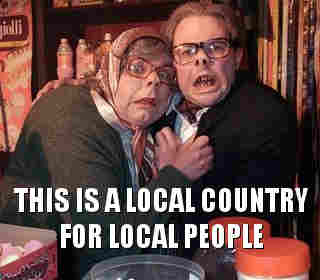 The traditional anglosocialist utopia of Labour looks a lot like the traditional Little England of UKIP, with its distrust of all things foreign; the only difference is, in one case, there is a strict hierarchy, with everyone knowing his or her place, whereas in the other, everybody's equal (though some are more equal than others; every socialist utopia needs its cadres and vanguard party, after all). As neoliberalism dies, it's the “liberalism” part that is jettisoned; the hierarchies of oppressive power continue, as they always have. (Similarly, across the centre-right parties and think tanks of the world, the dry, bloodless academic writings of Hayek and Friedman are quietly being bumped from reading lists, replaced with Julius Evola and translations of Aleksandr Dugin; Ayn Rand, however, retains her popularity, her message of the inherent rightness of power and privilege, predating the Mont Pélerin Society, will outlive the myth of the tide that lifts all boats.) That Labour is facing electoral slaughter is not much comfort, given that the result will be the coronation of an authoritarian unelected leader into a position of unassailable power to remake the United Kingdom in her image; our own Lee Kwan Yew, or perhaps a British Erdoğan.
I currently live in the electorate of Islington North. Jeremy Corbyn is my constituency MP, and I voted for him in the last general election, as he was a fine constituency MP. However, he has not shown himself to be a plausible party leader, and after his betrayal on Brexit, I will not be able to vote for him in the upcoming election. I am thinking of voting for the Lib Dems; they are the largest party standing against Brexit and its attendant xenophobic isolationism, and the most likely to unseat Corbyn in liberal, cosmopolitan Islington North. Ordinarily, I would consider the Green Party, or the Pirate Party if they ran here, but in this election, and under the first-past-the-post system, it is important to vote for the lesser evil rather than treating electoral choice as a litmus test of purity of convictions. (See also: Jill Stein, the US Green Party candidate whose electoral messaging seemed almost precisely calculated to undermine Clinton and get Trump into power.) And right now, with the two largest parties offering two different variants on the same Scarfolk-meets-Royston-Vasey dystopia, the role of opposition and/or lesser evil has fallen on the Liberal Democrats.
2016/5/7
The results are in from Thursday's outbreaks of voting across the United Kingdom, and this is how the picture looks:
Labour's results are looking somewhat mixed; in the Scottish parliament, they lost many seats, placing them behind the Conservative Party for the first time since Thatcher's catastrophic Poll Tax (which, actually, was about a generation ago). A lot of this is undoubtedly due to them having been used as a cat's paw by the government-led anti-independence campaign, and thus becoming the Westminster absentee landlords' good cop; they were caned harder than the Tories because it's hard for voters to punish a party who have next to no seats. In England, they lost councils, which is either due to the public being wary of the possibility of Jeremy Corbyn turning Britain into Chavez-era Venezuela, the Labour Party being riddled with cranks who, ominously, really don't like Jews, or to Labour's local representation being at a high water mark since the last elections (when the Lib Dems got a kicking for selling out to the Tories), depending on whom you ask. Having said that, the Tories lost slightly more than Labour did, though given that they're in the middle of a term, presiding over a harsh regime of austerity and soaring inequality, one could argue that anything short of the decimation of Tory councils is, all things considered, a good result for them.
What this bodes for Labour, and its new, stridently left-wing direction under Corbyn, is very much open to interpretation. On one hand, some are hailing not being wiped out south of the border (despite the antisemitism crisis, Lynton Crosby's barrage of dead cats, and everyone but the Guardian urging the public to vote Tory) as a resounding vindication for Corbyn; on the other hand, others are pointing out that the result is comparable to Labour's local-government results in the middle of its Thatcher-era period in the wilderness. Though it appears that the knives are not yet out for Labour leader Jeremy Corbyn. For one, the Labour centre-right does not have a new Tony Blair or similarly charismatic figure to present as an alternative; and indeed, Corbyn the old weirdy-beardy socialist won partly because the slate of “serious”, “respectable” candidates he ran against was an eminently forgettable one. The choice for a potential Labour putsch, at this stage, would be Anyone But Corbyn, and Labour's fortunes have not sunk so low as to necessitate that.
The outcome is also a mixed one for the Conservatives. Their campaign for London was led by Zac Goldsmith; youngish, fabulously wealthy and with a history of environmental campaigning behind him. Which could have boded for a hearts-and-minds campaign: promote Goldsmith as a liberal, a broad-minded unifier who cares about progressive causes, winning over the metropolitan cosmopolitan types who don't care much for right-wing red meat, and he could have spent the next four years alternately having photo opportunities with minority groups, making motherhood statements about diversity and the environment, and quietly promoting the transformation of everywhere inside the M25 into an enclave for global wealth. However, the Tories appear to have been seduced by the siren song of roving ratfucking consultant Lynton Crosby. Crosby's dirty tricks did win them the last general election, so presumably early in Goldsmith's campaign the order came down from on high to play the man, not the ball: keep pointing at Labour's candidate, Sadiq Khan, and mumbling darkly about Islamic terrorism, in the hope that the mud would stick. It didn't; Khan won handsomely, and now the political career of Goldsmith, the former golden boy of progressive conservatism, lies in ruins. Perhaps he wasn't actually a bigot, but merely too weak-willed to have pushed back against the bigots, though the result is the same; in any case, it's now his role to serve as an example to other political hopefuls who might be tempted to huff the intoxicating jenkem of bigotry.
In other news, the Green Party did well in London; their mayoral candidate, Siân Berry, came third (overtaking the Liberal Democrats), and they kept their two seats on the council. Labour fell short of a majority on this council, which stands the Greens in good stead to hold their feet to the fire on, say, diesel emissions or cycling infrastructure. As for the hapless Lib Dems, they seem to be gradually clawing their way back from their abyss. Ominously, the hard-right UKIP party seems to have picked up some two dozen seats.
2015/9/21
When people refer to politicians as “pigfuckers”, they're usually speaking metaphorically. However, if recent revelations in the Daily Mail about David Cameron, the Prime Minister of the UK, are true, this may not necessarily always be the case. The revelations, from a biography of Cameron by Tory grandee Lord Ashcroft, allege that, as part of an initiation into the Piers Gaveston Society, a posh dining club at Oxford, Cameron had performed a sexual act with the head of a pig. (This does not come as a complete surprise: Cameron is known to have been a member of other clubs for young aristocrats behaving badly—the Bullingdon Society, who famously trash restaurants and then, sneering, throw down a bag of cash to cover the damage, and whose initiation allegedly involves burning a £50 note in front of a beggar, are a well-known one—however, until now, all such claims were considerably less sexually weird.) Charlie Brooker, for one, has denied having had any knowledge of this incident when he wrote the Black Mirror episode in which a vaguely Cameronoid Prime Minister is blackmailed into having sex with a pig on television.
There is a roundup of responses at BuzzFeed; and the Taiwanese news animation is as dry and non-worksafe as one would expect.
On one hand, one has to feel sorry for Cameron. He brought in the bedroom tax, routed the Lib Dems, and accomplished numerous other things in office, but none call him Dave the Bedroom Taxer, Dave, Vanquisher of the Lib Dems, or Dave, Scourge of the Scroungers. And yet if you interfere sexually with one pig in your student days, you'll be living it down forever. Chances are that headline writers will be squeezing in pig-related puns into Cameron-related copy well into his occasional post-retirement appearances, much in the way that US theocrat Rick Santorum's appearances end up saddled with fluid-related puns.
The satirical Marxist tubthumper Sam Kriss (who's sort of the China Miéville of blogging) suggests that rituals such as this one serve a purpose: to forge solidarity among our rulers:
It seems that the higher up you go in society, the more cruel and grotesque the ritual becomes. There's an obvious reason for all this: for the upper classes, good connections really matter. If you're going to have a secret society, first you need to have a secret. Whether it's singing in screechy adolescent Hebrew or corpse-eating and pig fucking, these initiations help bind people together, and a student society in which everyone knows that everyone else has done something unspeakable to a piece of ham is bound to stay close afterwards. If anyone breaks ranks, or acts against the interests of the collective, they can be instantly exposed. Groups like the Bullingdon and the Piers Gaveston societies are not just rugby clubs for the ultra-rich, a vehicle for youthful excess; they're a way of fostering ruling class solidarity.Others have taken a more sympathetic approach, framing the entire system by which the traditional ruling elite of the United Kingdom raise their scions as a form of prolonged child abuse; from the brutal caning practiced in public schools (all the better to beat the empathy and tenderness out of a boy, forging him into the sort of steely-eyed beast of prey who would, unflinching, give the order to raze a village of fuzzy-wuzzies should it stand in the way of Empire) through to the hazing rituals in institutions, from military academies to elite university clubs.
Perhaps, once the tittering over the grotesque sexual slapstick of it all has died down, one thing that will emerge from this incident is the renewed question of what exactly our superiors, the men born to govern us, are like, and what sorts of rulers the system that forms them is geared to produce. Parts are already known; the idea of la vice anglais, the penchant for judges, officers, high-ranking politicians and other prominent Englishmen to have (as a result for having passed through puberty in a public school) a penchant for being spanked by a dominatrix, is a hoary old cliché. like something from a bawdy farce one might find in an antiquarian bookshop. This new incident brings the question beneath this trope into the spotlight, raising the suggestion that there is a secret culture among the men who govern Britain and have done so for centuries, and it is a weird, dark and disturbing one. Are we ruled by the psychologically scarred survivors and perpetrators of various forms of debauched ritualistic abuse, and if so, how else may it have affected the country and its institutions? (Some of the other recent stories—such as the allegations of senior figures protecting paedophile rings—paint a disturbing picture.)
If nothing else, this incident (let's call it “the Prosciutto Affair”) could subtly alter the British public's relationship with traditional authority; perhaps every time somebody sees a High Court Justice or a bishop in the House of Lords, a senior police officer talking about the need for new laws, or some representative of the Royal Family outlining some detail of royal protocol, the first thought that will occur will be “Did he...?” Sexual relations with dead livestock could, in the public imagination, become the new Freemasonry.
2015/5/8
Well, that all turned dark pretty quickly.
The Tories achieved a surprise upset in the general election, not only getting vastly more votes than Labour but confounding expectations of an inevitable hung parliament and winning an outright majority, their first since 1992. The Lib Dems, as expected, suffered heavy losses, not only losing dozens of seats but forfeiting hundreds of thousands of pounds' worth of electoral deposits when candidates failed to reach the magic 5% mark, and Labour lost all its seats in Scotland. What's more surprising is Labour falling flat south of the border; this was undoubtedly helped by the entire press (save for the Grauniad) throwing their weight behind the Tories and stoking fears about those awful Scots and their unreasonable demands. The UKIP surge also failed to happen, though that's partly because the Tories moved into their ideological turf (a strategy echoing the Australian Tories' appropriation of the xenophobic One Nation party in the 1990s).
The upshot of this is that, for the next five years, Britain will have a Tory government unrestrained by either more squeamish coalition partners (the all-but-extinct Lib Dems, who were, as Charlie Brooker so memorably put it, “the lube on the broom handle”) nor by any considerations of being seen as “modernisers”, “moderates” or “compassionate conservatives”. The raw, atavistic, Murdochian id of the public has spoken, and revealed that it responds to fear and outrage: that it believes some proportion of the people they share compete for space with on this damp island are, to put it bluntly, scum, and demands that they be punished, harder, and Cameron has shown that he is listening. The gloves are off, and the night is about to become much darker. The next legislative programme is already known to include ever harsher austerity, more severe cutbacks to what remains of the social-democratic safety net, the forced sell-off of housing association housing to the for-profit private sector, the abolition of the Human Rights Act and warrantless mass surveillance of all electronic communications (all the better for dealing with the “enemy within”). The dismantling of the NHS as we know it will continue apace, with the result being an underfunded veterinary service for peasants who can't afford private health insurance. The Murdoch papers and Daily Mail are likely to get off scot-free, with the Leveson press reforms being scrapped or watered down to the point of ineffectuality. Which will come in handy for swinging a vote for leaving the EU when the promised referendum comes around.
So, in short: if you're a non-dom tax exile, a buy-to-let landlord or merely asset-rich, the next five years will be just fine, thank you very much. For everybody else, struggling on exploitative zero-hours contracts, eating expired baked beans from the food bank, not complaining about breathing in mould spores for fear of (perfectly legal) revenge eviction and hoping that you don't become sick or disabled, ever, life will suck more. But at least you can blame the Romanians. Or the Scots. In short, in a few years' time, people will genuinely miss the Lib Dems.
Labour, meanwhile, seem to be in a bind. With Miliband (branded “Red Ed” by the right-wing tabloids due to making vague noises about social justice and inequality rather than just preaching from the Blairite trickle-down prosperity gospel) gone, the temptation might be to triangulate rightward again, choosing a slick Blairite leader (or perhaps manufacturing their own Farage-style jolly reactionary bigot-whisperer) and hope that the punters buy it; though the problem with this would be (as Channel 4's Paul Mason pointed out) that this could trigger the largest union, Unite, cutting its ties with Labour and using its funds and resources to set up a hard-left party along the lines of Syriza/Podemos, and eclipsing a Labour who, after the loss of Scotland, no longer have any ideological base or coherence. Or Labour could bite the bullet and become the aforementioned hard-left party, alienating all the big-business donors they have so carefully built up connections with, and losing credibility with the mainstream before earning the trust of the angry precariat, though that won't happen.
Scotland, meanwhile, is drifting away from the Westminster settlement. The Westminster parties are all but extinct north of the border, with Labour joining the Tories in oblivion; currently, as far as the Westminster parliament is concerned, Scotland is almost a one-party state governed by the SNP. This, of course, is hardly a sustainable state of affairs, and at some point there will (hopefully) be a vigorous opposition. It's not a safe bet that this will be a reinvigorated Labour Party. If Britain does leave the EU, the SNP is likely to vociferously demand a rerun of the referendum; of course, as far as Westminster is concerned, the matter of Scotland's place in the UK has been settled once and for all, though they said similar things about Irish Home Rule. (Speaking of which, if Scotland does, sooner or later, break away, the knock-on effects on the status of Northern Ireland will also be interesting.)
There are a few minor glimmers of sunshine in the gloom: Nigel Farage failed to win Thanet (but mostly because the Tories ran a UKIP-alike, pandering to the electorate's perceived xenophobia) and promptly fell on his sword; this, incidentally, should free him up to host Top Gear. The Greens' Caroline Lucas has held Brighton Pavilion with a greatly increased majority (despite predictions that the unpopularity of a Green local council would damage her chances), and though the Greens have not claimed any additional seats, they did make back their deposits in a few. And George Galloway has lost the seat of Bradford West after a dirty campaign; Galloway blamed the loss on “racists and Zionists”; the candidate who beat him, Labour's Naz Shah, is a Muslim woman of Asian heritage.
2015/5/4
In two days, the United Kingdom will go to the polls to elect a new parliament. It is all but certain that this will result in a hung parliament, the exact nature and composition of the next government will not be known for weeks afterward, and the government will be a fractious and unstable one.
The last general election, in 2010, also produced a hung parliament. The Conservatives won more seats than Labour, though nowhere near enough to govern in their own right; the cards were held by the Liberal Democrats, then seen as a modern centre-left party, free of both the patrician hauteur and residual Thatcherite toxicity of the Tories and the oily Blairite triangulation, Blunkettian authoritarianism and half-buried old-school socialism of the Labour Party; consequently, throughout the campaign, they were vilified pitilessly by the (then dominant) Murdoch press and right-wing tabloids. After the election, the tone changed rapidly, and both parties courted the Lib Dems as a governing partner. The Lib Dems ended up going with the Tories, promising to moderate their nastier extremes, and promptly betrayed their electoral manifesto by voting for a sharp increase in university tuition fees, in return for a Tory promise to back a referendum on electoral reform. The Tories won that one through sheer cunning; by the time the referendum came around, the sting of the Lib Dems' betrayal was still sharp in the minds of the progressive end of the electorate, and the Lib Dems' electoral reforms were voted down two to one, mostly because people really wanted to give them a good kicking. And it looks like they still do; in the upcoming election, they are staring at a massive parliamentary wipe-out; indeed, the only thing protecting their moderately right-leaning leader, Nick Clegg, from losing his own seat (in the student-populated seat of Sheffield Hallam) is Tory voters in his electorate tactically backing him, presumably as he's a known quantity with whom they can do a deal.
The elephant in the room is, of course, what Charles Stross has termed the Scottish Political Singularity; in a nutshell, politics in Scotland has become detached from the rest of the United Kingdom in a way that looks unlikely to be reversed. This process began when Margaret Thatcher, in her characteristic measured wisdom, decided to use Scotland as a testbed for her unpopular and regressive poll tax; as a result, the Conservative Party (which, at its height, had enjoyed wide support north of the border, what with the Protestant work ethic and all that) declined to a desultory rump. In the past several parliaments, the Tories had merely one MP north of the border, which, as is widely reported, is one fewer than the number of giant pandas in Scotland. Of course, Labour made hay from this, packing their Blair-era cabinets with Scottish MPs, elected by the Tory-loathing descendants of Glaswegian shipworkers and Aberdonian oil riggers, safe in the knowledge that they could triangulate rightward as far as tactics demanded without losing support for at least a generation. But then, the independence referendum happened, and while the No side won comfortably, the sight of Labour joining with the Tories in vociferously opposing independence did it for them. If the polls are to be believed, Labour (or, as they're known in Scotland, the Red Tories) are facing all but electoral annihilation north of the border, and the Scottish National Party—once a single-issue pro-independence party, now the seemingly natural party of Scotland's own devolved government, promoting itself as a broad centre-left social-democratic party, with a few sops to religious conservatism—looks set to take an overwhelming majority of Scottish seats in Westminster. The result of this is that, even though the Tories and Lib Dems are set to fall short of a majority (or even the Tories, Lib Dems and the hard-right reactionary party UKIP, if the three could somehow stomach each other for long enough), Labour will also fall short, and the SNP look set to be kingmakers.
This is, of course, a massive problem for both major parties. The SNP have ruled out forming a coalition with the Tories, for obvious reasons, though have extended an offer of mutual support to Labour, suggesting that they could help Labour be bolder (i.e., move away from the Blairite centre-right and sharply to the left). Of course, the tabloids had a field day with the prospect of the Northern barbarians dictating policy, and the Labour leader, Ed Miliband, ruled out any sort of deal with the SNP, saying that if Labour cannot govern without them, there will not be a Labour government, full stop. The presumable tactical goal of this is to scare Scottish voters into flocking back into the Labour fold, in the hope that enough Labour MPs will be returned to get a majority. This is the sort of thing that the Americans call a “Hail Mary pass”; a desperate last-ditch attempt to snatch a highly improbable victory from the jaws of almost certain defeat.
What will happen if (as polls predict) there is a hung parliament, but Labour plus the SNP would have a majority, is uncertain. Miliband could stick to his word, fall on his sword, and let Cameron assemble a fractious minority government (attempting to get the handful of surviving Lib Dems and the triumphant UKIPpers singing from the same hymn sheet), having the luxury of toying with it from the opposition benches as a cat does with a dying mouse; the downside of this would be that the Tories would still be the government, and even if the government does fall long before the end of its five-year term, there's no guarantee of which way the next election would go (and the Tories, it must be said, have the advantage in campaign fund raising). Or he could swallow his words and do a deal with the SNP, undoubtedly coming up with some lawyerly rationalisation for why he is not actually doing a deal with the SNP but instead doing something entirely different. (Whether Labour and the SNP could come to an agreement is another matter; the SNP seem less likely to fold on their red-line issues, such as the scrapping of the Trident nuclear missile system, than the Lib Dems were; and, indeed, a noble defeat hastening the breakup of the United Kingdom may be what the SNP want.) Or the result could be the formerly unthinkable: a Conservative-Labour rainbow coalition, a “government of national unity” of a kind unheard of in peacetime, with everybody else (the rebellious Scots nationalists, the cranky English nationalists, the convalescing Lib Dems, and Brighton's Green MP, Caroline Lucas) forming a somewhat chaotic opposition. Such a government would have very little in the way of representation north of the border, and would probably do little to dampen down the still smouldering embers of the secessionist mood. (If the Tories deliver on their promise of a referendum on leaving the EU, all bets are off; Scotland favours EU membership a lot more strongly than England does.)
To add to this, there is another wildcard: Her Royal Highness Princess Charlotte Elizabeth Diana of Cambridge, Saviour Of The Union, also known as the newly-born Royal Baby. Announced in the weeks before the Scottish independence referendum, the Royal Baby, whilst still a mere zygote, may have saved the Kingdom (for now, at least); and now, whilst yet functionally little more than a digestive tract, there is the prospect that she may do the same for David Cameron's Prime Ministership. The theory goes that the groundswell of uncritical patriotism, taking the form of an acceptance of the deep, ineffable rightness of deference to an archaic, ceremonial system of nobility, should rub off to some extent on the patrician Cameron (who is, after all, Queen Elizabeth II's fifth cousin once removed); and if not, surely the omnipresent Union Jack bunting and spontaneous Royal Baby tea parties in every street, where everyone—the Morrises and MacLeods, the Khans and Kowalczyks—come together to sing God Save The Queen in unison, should take the edge off dissatisfaction with the government of the day by polling day. Or perhaps not; the Guardian's Zoe Williams thinks that the Royal Baby may have the opposite effect (by virtue of being a baby, rather than being royal).
The upshot of all this is: we live in interesting times, and it'll take a long time for the dust to settle. At this stage, it is not at all clear who will be Prime Minister after the next election.
2013/9/8
The good news: The predicted collapse of the Greens, with the Tories preferencing Labor ahead of them and Rupert Murdoch declaring them a cancer to be cut out of the Australian body politic, did not happen. Adam Bandt was comfortably reëlected in the seat of Melbourne and online liberty champion Scott Ludlam might just have scraped into the last Senate place in WA (though it won't be known for weeks), despite the Wikileaks Party kicking him in the teeth in their preference card, after a clusterfuck of right-wing minor parties coalesced into a seat for the Australian Sports Party.
The bad news: The Coalition won by a landslide. Tony Abbott, a reactionary religious authoritarian who believes that climate change is “crap”, is Prime Minister, on a platform that can be summed up as “we'll have none of that here”.
The good news: The Coalition didn't manage to get control of the Senate, so they'll have to negotiate to have their reactionary platform passed into law.
The bad news: It looks likely that the Coalition plus the Religious Right (Family First and DLP) will, together, have a majority in the Senate. The main upshot of this is that the internet censorship system that was dismissed as a “gaffe” in the election is likely to materialise as a negotiating tactic (“Mr. Abbott, your industrial relations plan is anti-family. However, we could pass it if you give us a national mandatory internet filter blocking porn, homosexuality and blasphemous content.”) The other option, of Abbott striking a deal with the sizeable Green presence in the Senate, is, of course, utterly out of the question; one does not deal with un-Australian extremists.
So, yes, basically, Australia is fucked, at least to the extent that one was expecting it to be a modern, progressive country; at least for the next 3 years, probably the next 7, odds-on to be the next decade, and quite possibly however long it takes for the Greens to transmute into a party of alternative government. From now on, 2013 is pronounced “nineteen-fifty-sixtythree” in Australian English. The past has vanquished the future, and here comes a victory of shit.
Inner Melbourne, which reelected Bandt and almost sent a few other Greens to Canberra to join him, is a light in the darkness; a bit like Austin, Texas, or Barcelona in Franco's Spain. And as such, it can probably expect collective punishment; one part of that will be the razing of homes and parks to build freeways for outer-suburban Liberal voters to drive their 4WDs on. (Incidentally, all federal funding for public transport is to be scrapped, because “we don't do urban rail in Australia”. Which makes perfect sense, given that global warming is a load of black-armband Marxist crap, oil will be cheap forever, and if you start getting traffic jams, you can always build more roads and widen the existing ones.)
2013/9/5
As Australia enters the final 48 hours before its election, a ban on electoral advertising has now come into force across the country. And, by coincidence, the Tories (who look almost certain to form the next government) have released their full policies and costings, and it's a doozy. Out goes renewable energy funding.. On the infrastructure front, there's a distinct back-to-the-1950s theme again, with the government scrapping public-transport programmes and replacing them with a road-building spree not seen since Grandpa got his first Holden. (It's a good thing that oil will always be cheap and global warming is nothing more than a lie spread by a conspiratorial elite of jealous inner-city leftists who can't afford 4WDs because they're losers, because otherwise we'd all be screwed.) Science and education funding are being slashed as well, with the Australian Research Council budget being cut by at least $103 million, and Abbott seems to have taken a leaf out of the Canadian government's book, introducing plans to control research funding on political grounds, because of, you know, we can't have politically-correct Marxist climatologists pushing un-Australian black-armband theories such as “global warming”. Oh, and if that wasn't good enough, a proposal for an opt-out internet censorship regime (i.e., “Stop the Bytes”) have somehow made it into the proposals, meaning that Australia's nobbled 20th-century broadband will now be even more useless. (The government-in-waiting soon started claiming that that announcement was a mistake, without elaborating on this.)
This, truly, is the bouquet of shit that just keeps giving.
2013/4/12
In death, it seems, Margaret Thatcher is being as much of a unifier as she was in life. Whilst still alive, she requested to not have a state funeral (“I am not Winston” being her reported words), the Cameron government seem determined to give her one in all but name, celebrating the triumph of their tribe and rhetorically reducing the vast dislike of her and her policies and actions outside of their charmed circle to a few disgruntled sore losers. In other words, the late Thatcher becomes, in death, the People's Prime Minister, with those who object redefined to be outside of “the People”.
The funeral itself will, officially, fall one step short of being a state funeral; it will be almost identical to the ones Winston Churchill and Princess Diana received, with central London shut down for a military parade (for bonus points, themed around the Falklands War; that's right, they have themed funerals for former prime ministers); Thatcher's remains will be borne on a gun carriage to St. Paul's, and the dress code is “Full Day Ceremonial without swords”. (Does one get issued a sword upon ascending to that echelon of British society?) Further blurring the distinction, the Foreign Office ordered its staff to wear mourning clothes on the day; once it was pointed out that this was a breach of protocol (what with it not being a state occasion, and the deceased not having been the head of state), the order was hastily retracted; the foreign office said that it was the result of an “administrative error”, and certainly had nothing to do with any ministers. As expected, those of inadmissible views are likely to protest, and activists are bracing for a wave of preemptive arrests before the event, as happened with the Royal Wedding. The police are reportedly scanning online conversations for references to protest and compiling lists of troublemakers.
These plans and the imperial tone of the funeral have not gone unnoticed in Buckingham Palace, who are concerned that it is encroaching on the tradition that the monarchy handles the ceremonial side of statecraft and the elected politicians just do the practical stuff. Or, as the trade unionists of yore would have called it, a demarcation dispute.
Meanwhile, some have called for a statue of Thatcher to be erected permanently in Trafalgar Square (also the site of the poll tax riots). And there have been calls for Heathrow Airport to be renamed after her. There is a petition to the Prime Minister here; at time of writing, it has 18 signatures. Were it successful, the government actually renaming the airport would be complicated by it having been privatised by Thatcher herself. Boris Johnson has helpfully suggested naming the new airport he wants to build in the Thames Estuary after her instead.
Meanwhile, the guest list for the funeral has been announced; it's partly a Tory tribal gathering (the likes of Lord Lloyd-Webber, pulp novelist/former jailbird Lord Archer and the yet-to-be-ennobled Jeremy Clarkson), with fellow travellers from all over the world (the Reagan family is sending someone in lieu of Nancy, who's too unwell to make the trip). It's not clear whether the Pinochet family will be sending anyone. Argentina's prime minister has been snubbed, in line with the Falkland War theme. Australia, meanwhile, will be represented by conservative former PM and current Warden of the Cinque Ports, John Howard, to whom the invitation was apparently passed by current PM, Julia Gillard. (The Tories missed a trick by not going over her head and inviting next PM Tony Abbott, giving him a chance to look like an accomplished statesman even before his coronation in September.) One notable name that may be absent is Rupert Murdoch, the power behind the throne, who unfortunately has a meeting on that day
Meanwhile, some notable reactions you may have missed: video of a speech given by actress turned Labour MP Glenda Jackson at the Thatcher memorial parliamentary session, condemning her legacy; and a rebuttal by Jackson's son, Dan Hodges, listed as a Blairite (i.e., neo-Thatcherite) Labour MP. And Australia's foreign minister Bob Carr recounts Thatcher having made a racist remark about Asian immigration just out of earshot of his Malaysian-born wife. And here is An Obituary From Below, a comprehensive assessment of the history, origins, contraditctions and legacy of Thatcherism.
2013/4/10
Meanwhile in Australia, the right-wing opposition (and, at this point, almost inevitably the next government come September) has launched its alternative to the Labor government's National Broadband Network policy. It's an improvement on their previous policy (“rip it out, fill in the trenches and let the free market provide”), but nonetheless still falls well short. While Labor's network would bring high-speed fibre-optic connections straight to the home, giving 100 megabits per second (increasing to gigabit speeds), the Coalition's cut-rate plan would extend fibre only to boxes on the kerb, relying on a largely deteriorating copper infrastructure for the “last mile”, topping out at a theoretical 25 megabits per second (though that would be in ideal conditions; as with ADSL, distance from the node and cable condition would affect this). It would achieve this at about 2/3 of the cost of the all-fibre NBN. Or, the Pareto Principle: You're Doing It Wrong.
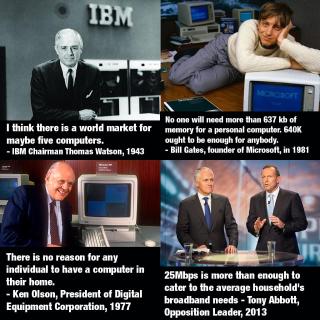 And while 25Mbps is an improvement on what we have now, and good enough for the sorts of things people do today (watching videos, shopping online, playing games), to say it will be good enough betrays a lack of imagination, or a deliberate narrowing of horizons that is all too familiar in Australian politics. Australia has always been the lucky country, borne at first on the sheep's back and now on Chinese demand for iron ore, which has led to a sclerotic apathy in terms of any sort of forward planning, in particular infrastructure and development. Combined with the stultifying conservatism of the Australian Right from Howard onwards, with its quasi-edenic visions of the conformistic white-picket-fenced utopia of the golden age of Menzies, the implicit message is clear: we are not Korea or Finland. We don't have a Nokia or a Samsung. We're a simple country. Our place in the world is to dig stuff up, put it on big ships and send it to China, and then to go home and relax in front of our big-screen TVs with a tinny of VB. That is all. It's a comfortable life, but we shouldn't get ideas beyond our station. All we need from the internet is to be able to shop online, pay the odd bill and download last week's episode of Jersey Shore a bit faster, and two rusty tin cans and a length of barbed wire fence is good enough for that. Well, that coupled with the sort of facile, nihilistically short-sighted anti-government rhetoric (infrastructure investment is “waste”; you can't prove it's not, so there) that the Abbott government-in-waiting has been borrowing from the US Tea Party.
The Coalition's policy has been roundly criticised by experts and mocked online as “fraudband”. However, all that means zip to the average outer-suburban swinging voters who get 100% of their information from the Murdoch press, right-wing shock jocks and/or 30-minute TV news programmes which are mostly sport, celebrity gossip and wacky human-interest stories, and who actually decide elections. So it looks like Australia, a country which coined the term “tyranny of distance” and was an early adopter of everything from telegraphy to mobile phones, will be stuck behind, paying off a 20th-century system and living much as the generation before them did, just because the bogans hate Julia Gillard.
2013/3/30
A piece in the Guardian looking at what exactly is taught in the Christian Fundamentalist academies enthusiastically enabled by the Tories' education reforms:
In an English test, students face the following multiple-choice question:
(29) Responsible citizens will vote for political candidates who
a. promise to provide good paying jobs for all those who are out of work
b. promise to cut back on both government services and spending and cut taxes
c. promise to raise taxes on "big business" and use the money to help the poor
d. promise to provide child-care services for all mothers who need to work
(The "correct" answer is b.)
A church history assessment contains these questions: (1) The four foes of the faith considered in this Pace are____________.
(Answer: "rationalism, materialism, evolutionism, and communism".)
(2) The foe of the faith that takes in all the other three foes and is organised against the church is _________.
(Answer: "communism".)
In economics, Keynesian ideas are wrong while Adam Smith's are right. In geography, the prosperity of nations is clearly linked to the amount of Christian influence ("God blessed the United States, and it became the strongest and most prosperous nation on Earth"). In US history, it is taught that Jesus commanded us to make a profit; giving "handouts to citizens" was contrary to the intentions of America's hallowed founding fathers; nontaxpayers should not vote; and it is wrong for governments to provide welfare for citizens. "Liberals" receive particular criticism.Which sounds like the plan is to build up a Religious Right bloc who can be counted on to vote Tory, contribute to election campaigns, go out letterboxing for campaigns rain or shine, and wage holy war against the Left in all its forms; i.e., the crystal meth of right-wing politics. It's a rush when you start, but before you know it, your party is beholden to religious fundamentalists and unable to shake them off even when facing electoral annihilation from those who don't count themselves among their ranks; this happened to the Republicans in the US, and for all the voices calling for modernisation, they're in no hurry to go cold turkey and go even further into the wilderness.
2013/3/21
As Australia's Labor government confirms its inability to win the next election, we begin to see what the Abbott government's legislative agenda might look like. Until now, Abbott's handlers have been mindful about not scaring the swinging voters and careful to keep him sedated and making reassuring noises about not imposing his religious beliefs on the public (as, for example, he did when he used ministerial powers to ban morning-after contraceptive pill RU486 from Australia, effectively deputising Australia's medical regulatory system into an arm of the Catholic Church's Congregation of the Doctrine of the Faith), now as victory becomes more of a certainty, the mask has started to slip, revealing radical policy ideas like eliminating unemployment benefits for people under 30, instead requiring them to go work in the mines. A bit like the British Tories' Workfare, only with a truly Australian sense of scale:
The Opposition Leader made the controversial remarks during a two-hour meeting with about 15 senior resources industry leaders in Perth on Monday night. Mr Abbott told the roundtable briefing he believed stopping dole payments to able-bodied young people would take pressure off the welfare system and reduce the need to bring in large numbers of skilled migrants to staff mining projects.To be fair, the remarks are not currently Coalition policy, though the fact that the likely future Prime Minister can suggest them with a straight face, and not as some kind of Swiftean modest proposal or reductio ad absurdum, gives one a foretaste of what is to come. Herding young people into labour battalions at the command (and for the profit) of the Gina Rineharts of the country: Howard may have wanted to take Australia back to the 1950s, but Abbott seems to have his sights set on the penal-colony era.
2013/1/19
For a while, Scotland famously had more pandas than Tory MPs; now, Germany has as many Scottish Tory parliamentarians as Scotland:
Many German politicians try to play down their roots if they have a hint of anything un-German about them. Not so McAllister, whose Scottishness – his father was born in Glasgow – has only served to boost the CDU's re-election chances on Sunday in the state of Lower Saxony, where he has been prime minister since 2010.
McAllister retains ties with relatives in Newton Mearns, and speaks English to his two daughters at home in Hanover. He refuses to be drawn on the issue of Scottish independence though, as a potential future leader of Germany, he may well one day find himself having to take a decision on Scottish membership of the European Union.It's interesting that, in Germany, a politician who has a foreign name, holds dual citizenship and speaks English to his children is not only eligible, in the public eye, for office, but heading for probable electoral victory soundtracked by a bagpipe-backed, heavily Scottish-themed campaign anthem, and believed to be future Chancellor material. I can't imagine a similarly exotic candidate being as successful in Britain.
2012/9/4
Britain's Tory-led coalition government has undergone a reshuffle. Among the changes: Jeremy Hunt, the culture secretary who tried to rubberstamp Rupert Murdoch's acquisition of the rest of Sky TV, is now minister of health; which is somewhat troubling given his outspoken beliefs in homeopathy, and statements defending the NHS's funding of homeopathic “medicine” (which had, in the past, been roundly denounced in Parliament). Meanwhile, Conservative Chairman Lady Warsi, a fierce opponent of secularism, has been demoted to a newly created “Ministry of Faith”. Whether this is a sinecure intended to keep her out of trouble or a shift towards a more muscularly religious politics in Britain remains to be seen. And so, it looks like the Conservatism the Tories are bringing to government is one hearkening back to a time before the Enlightenment, when faith trumped evidence and reason.
In other news, transport minister Justine Greening, an opponent of the proposed third runway at Heathrow and passionate advocate of high-speed rail, has been replaced by Patrick McLoughlin, who was aviation minister in the ideologically anti-rail Thatcher government, but on the other hand. Given that there is pressure from segments of business for rapid expansion of Heathrow and opposition in the Conservative heartlands of the Cotswolds to having a high-speed railway run through their arcadian idyll, it'll be interesting to see whether the government's (until now commendable) transport agenda does a U-turn.
And finally, meet the new Minister for Equality, Maria Miller:
Though, to be fair, the Racial and Religious Vilification Bill would have acted as an all-faiths blasphemy law, criminalising speech offensive to religious sensibilities and acting as a chilling effect on criticism of, say, misogyny or homophobia in religious garb, so one can't really criticise her for having a part in its well-deserved death.
2012/3/21
The final nail was driven into the coffin of Britain's quasi-socialist post-WW2 settlement, with the Conservative-led government passing its NHS reform bill, against mass opposition from both the public and the medical profession, and despite its refusal to publish the results of a report into the risks of its plan. Britain's National Health Service will now go the way of British Rail, its logo remaining as a kitemark for a US-style system of private healthcare firms; something even Margaret Thatcher didn't dare to do:
"Entitlement to free health services in England will be curtailed by the Health and Social Care Bill currently before parliament. The bill sets out a new statutory framework that would abolish the duty of primary care trusts (PCTs) to secure health services for everyone living in a defined geographical area. New clinical commissioning groups (CCGs) will arrange provision of fewer government funded health services and determine the scope of these services independently of the secretary of state for health. They may delegate this decision to commercial companies. The bill also provides for health services to be arranged by local authorities, with provision for new charging powers for services currently provided free through the NHS (clauses 1, 12, 13, 17, and 49), and it will give the secretary of state an extraordinary power to exclude people from the health service. Taken together the measures would facilitate the transition from tax financed healthcare to the mixed financing model of the United States. We provide an analysis of the key legal reforms that will govern policy development and implementation if the bill is enacted."
2012/2/12
The Quietus, an online journal of music and culture, looks at contemporary "folk" culture (you know; the intersection of the improvised and rough-hewn, the spontaneous and "authentic"; ukuleles, beards, peasant skirts, artisanal food, that sort of thing) and argues that contemporary indie-folk culture is essentially a bourgeois, conservative phenomenon; you see, only those comfortably well-off (and sufficiently well connected to the establishment to feel confident) can allow themselves to indulge in a spot of faux-rustic reverie or fantasise about that old canard of "a simpler life". If those who are not unmistakably comfortably middle-class or better do it, they might get mistaken for the actual underclass and treated with the contempt Anglocapitalist society reserves for its lower orders. (Hence the well-documented phenomenon of class anxiety in England, where every class tries hard to draw a sharp line between itself and the class below, with the exception of the very top and the very bottom, who have the luxury of not caring.)
Shortly after the riots, a photograph was taken that let slip pop's complicity in this subterfuge. Alex James, a man who has spent the last few years protesting too much about how organic food production is infinitely more gratifying than the life of a touring rock star, gave consent for his Oxfordshire farm to be used to stage Harvest, a boutique food and music festival. Playing the garrulous country squire, he was snapped deep in conversation with both Cameron and Jeremy Clarkson, the avatars, respectively, of compassionate Conservatism and PC-baiting, speed camera-hating Little Englanderism. Harvest, it appeared, was an ideological interzone for disparate trends within modern Toryism.
During the mid-2000s, forward-thinking tendencies in rock were suddenly overwhelmed by a glorification of spontaneity: it didn't matter what the music sounded like, so long as it could be knocked out at short notice to a crowd of thirty-six slumming private school kids in a Bethnal Green bedsit.
Presumably the "private school kids" part comes from the fact that, in today's Austerity Britain, those not born with a silver spoon in their mouths these days are too busy holding down two low-wage McJobs to pay their tuition fees to get in much in the way of spontaneous ukulele-strumming, the places in urban bohemia they reluctantly dropped out of to survive having been taken by the slumming scions of the gentry, taking a break from playing tennis and skiing to play at doing whatever (they imagine) common people do. Much in the way that a significant proportion of Brooklyn hipsters these days are one-percenters from the Hamptons (see also: Vampire Weekend, Lana Del Rey).
In this similarity, one can perceive a fundamental truth about the cultural logic of Big Society. When it did locate compliance in popular music, Thatcherism gave rise to an aspirational, future-oriented strand of New Romanticism: Cameron's Conservatism, by contrast, finds a less direct mode of expression in sham enactments of 'folk' autonomy. The organic, 'real' provenance of movements which affirm the ideological status quo is offered as proof that challenges to that dominant order are regarded by the majority of the nation's population as undesirable and inauthentic.Meanwhile, the comedian Stewart Lee is the latest to be faced with the agony of having one's favourite art defiled by the approval of the political centre-right; specifically, he is throwing away his Gillian Welch CDs, after the alt-country singer failed to display the integrity to prohibit David Cameron from liking her music, as Johnny Marr did with The Smiths.
Why was Cameron there anyway? Welch's music is not the music of library closures and the stoppage of disabled babies' free nappies. Great art ought to be incomprehensible to the dead-hearted politician. But then Ken Clarke comes along, with his brilliant Radio 4 Jazz Greats. Were his real parents bereted beatniks, who abandoned him as a baby in a golf club toilet to be raised by Tories?
It is inappropriate of Ken Clarke to love jazz, and cruel of David Cameron to attend a Gillian Welch show, or indeed any live event except sport, which is of no value. It must be obvious to him that the majority of fans of anything good would despise him and that knowing he was in the room would foul their experience.
2012/1/17
As Britain sloughs into a new age of austerity, with the government cutting services, closing community facilities and admonishing the public to get by with less, the Queen prepares for her diamond jubilee, the 60th anniversary of her wedding (which, incidentally, also took place in a period of austerity). The diamond jubilee is a significant event in any sufficiently long-lived monarch's life, and so celebrations (including an extra bank holiday, not something bottom-line-driven Tories take lightly) have been on the cards since before the financial crisis. Some might have expected that a government trying to portray itself as almost painfully reasonable would insist on low-key celebrations, or at least not ply the world's richest woman with gifts paid for by the straitened taxpayer. However, this turned out not to be the case, as it emerged that education minister Michael Gove (i.e., the chap responsible for cutting school budgets and scrapping the Education Maintenance Allowance), apparently a passionate monarchist of the old school, pushed for the Queen to be given a new royal yacht, costing £60m, as a token of the public's gratitude.
The education secretary writes: "In spite, and perhaps because of the austere times, the celebration should go beyond those of previous jubilees and mark the greater achievement that the diamond anniversary represents."
He suggested "a gift from the nation to her majesty" such as "David Willetts's excellent suggestion of a royal yacht".In Gove's view, the beneficence of Her Royal Highness, and the must reach epic proportions, worthy of a North Korean God-Emperor, given that the little people were expected to graciously accept the money that isn't keeping their libraries open or providing services to the vulnerable being spent on a royal yacht. Unsurprisingly, that other astute observer of the public mood, Prince Charles, is emphatically in favour of the idea (presumably with the proviso that the yacht be of a traditional design, and not some ghastly modern monstrosity).
Unfortunately for the government, the public's deference to its aristocratic superiors isn't what it used to be and the proposal was met with incredulity, forcing the Prime Minister to make a show of rejecting it, before quietly backing a variant of the proposal. The yacht will now officially be a training facility, with only part of it serving as a stately pleasure boat for the Royal Family; there will also be the option of hiring it out as conference facilities, and some undefined part of the funds will come from private donors. (Already Canada, which has its own hardline Tory government, has pledged £10m.)
Meanwhile, here are a few suggestions for things other than a royal yacht that £60m could buy.
2011/12/19
The dust hasn't yet settled after David Cameron vetoed the EU financial treaty, setting Britain on a course to the periphery of the EU or beyond, but already the Euroskeptics are lining up to give Johnny Foreigner what for. The latest to stick it to the Frogs and Krauts is the mayor of Bishop's Stortford, whose particular exercise of Churchillian bulldog spirit has been to withdraw his town's twinning arrangement with Villiers sur Marne and Friedberg. Just because.
Mayor John Wyllie has written letters to his honourable counterparts in the town's two twin cities: Friedberg near the German financial capital of Frankfurt, and Villiers-sur-Marne near Paris. He isn't writing to invite them to the usual partnership ceremonies, conferences or youth exchange programs. He is writing to cancel the town's friendship with them, after 46 years. On September 28, 2012, Wyllie informed them that his town would sever all ties with the twin towns. He gave no reason for this break-off of diplomatic relations.
Mike Wood, 66, the only council member from the pro-European Liberal Democrat party, says Tories are "usually normal people. But whenever you mention Europe they turn into some kind of monster."This comes on the heels of rising anti-European, and particularly anti-German, sentiment in the British populist media, with old WW2 stereotypes being dusted off and trotted out at all the inappropriate moments:
Distrust of the European Union goes hand-in-hand with distrust of Germany, especially among "euroskeptics," the current euphemism for the many haters of the EU in Britain. The headline "Welcome to the Fourth Reich" in the high-circulation Daily Mail summarized the German-French plans to rescue the monetary union.(You'd think that, coming from a paper with the Daily Mail's history, "Fourth Reich" would be a term of glowing praise...)
Anecdotally, I've noticed that, while the supermarkets of Britain are full of Christmas puddings of all sorts, there is no stollen bread, a British Christmas tradition since cheap flights to German Christmas markets began. I wonder whether the decision to not order any this year comes from market research surveys into anti-German and/or anti-Continental sentiment among the British public.
2011/11/23
Welcome to the new age of austerity: Britain's Tory-led government is planning to abolish unfair dismissal laws and make it easier to sack workers, in the hope that Britain rides a Texas-style wave of increased productivity as employees compete against each other to keep their jobs. Also, young jobseekers will have to work without pay for private employers, for up to 30 hours a week, or lose their unemployment benefits. In other words, the government is subsidising below-minimum-wage jobs, keeping unemployment high (after all, why hire someone for minimum wage, when the government will send someone who has to work for nothing?) and transferring funds from the public coffers to private industry (undoubtedly to be returned in electoral contributions to the Conservative Party when the next election comes around).
Meanwhile, as Europe hits the doldrums, the Tory Right are pushing to use this as an opportunity to unilaterally renegotiate Britain's EU treaty obligations, in particular those which introduce socialistic inefficiencies like workers' rights and move British industrial relations westwards over the Atlantic. Britain is aggressively opposing plans to institute a financial transaction tax in Europe, and is set to win a permanent exemption from the working time directive, which limits working hours to 48 hours a week (in a rolling average over several weeks), unless workers individually opt out. I wonder how long until other inefficiencies like Britain's statutory annual leave provisions (which are fairly generous, especially compared to our cousins across the pond) are tossed onto the scrapheap. (The NHS looks set to be Americanised out of existence, and the rest of the welfare state is likely to go, first being changed from a universal system to one solely for the poorest and then progressively impoverished, on the grounds that most voters won't ever get anything from it and, hey, beggars can't be choosers.) David Cameron's Britain is set to look less like continental Europe and more like Rick Perry's Texas.
2011/11/2
For a purely decorative monarch-in-waiting, Prince Charles is somewhat of an interventionist. Perhaps its his strong opinions (be it about the efficacy of homoeopathy, the terminal decline of architecture after about the 18th century, or about hidebound traditionalism in all areas generally being a Good Thing), but he has never been content with the role of figurehead, passively waving at well-wishers and mouthing the words of the government of the day. Now, it has emerged that he has exercised a secret veto over various pieces of legislation in Britain, doing so under a 14th-century law that allows the Duke of Cornwall a say over any legislation that affects the Duchy's property, in a broad sense of the word.
The details of the laws have been kept secret, as has whether any changes were made to the laws to help them pass muster with the Prince of Wales; however, the subjects of the laws over which his advice was sought apparently include everything from gambling to road safety. This isn't the first time Charles has seen fit to give British society the benefit of his enlightened guidance, whether it wants it or not: a few years ago, he famously had a modernist architect sacked from a London project, and replaced by a neo-traditionalist of Charles' own stripe, using his friendship with the Qatari royals funding the project to go over the heads of those actually in Britain involved in the project.
Charles' interventions have been controversial on both sides of the fence; the Grauniad doesn't like the reactionary populist emphasis on leaden-handed traditionalism in Charles' views, comparing it to the Daily Mail, while the Torygraph is not entirely comfortable with his dippy-hippy tendencies:
The Prince does not seem to have actually exercised his right of veto, although The Guardian's attempts to access papers have largely failed. But the discovery that he can block legislation is alarming given his established willingness to interfere in political matters. It is all too easy to imagine him vetoing a bill loosening the planning laws, or widening the use of GM crops.
That's not to say he's wrong on every issue, although I'm happy to say he's wrong on a few. The point is that he is making the Royal family seem less like a stately and dignified ceremonial presence, and more like a cross between a fogey-hippy crossover activist group and a vast whole-foods retail company. Without the goodwill that the Queen generates, a Charles-headed monarchy will be subject to both mistrust and ridicule.The Conservative-led government has ruled out changing this law, in the Burkean Conservative spirit of not fixing things which can be passed off as not entirely broken, and/or the spirit of The Old Ways Are The Best. And so, another asterisk and paragraph of small print gets added to the assertion that Britain is a modern democracy.
Which is not to say that Britain's monarchy is remaining firmly in the undemocratic past; last week, the Commonwealth approved constitutional changes to end gender discrimination on the rules of royal succession, a change which could affect literally dozens of women. You go, girls!
2011/7/5
In 2002, Surrey schoolgirl Milly Dowler was abducted and murdered. Her family believed for six months that she was alive, on the basis that her voicemail messages were being deleted (and presumably listened to). It has turned out that staff from News Of The World, a Murdoch tabloid, had gotten into her voicemail and were deleting her messages, in order to free up space for more messages and keep the story profitably on the boil:
Apparently thirsty for more information from more voicemails, the paper intervened – and deleted the messages that had been left in the first few days after her disappearance. According to one source, this had a devastating effect: when her friends and family called again and discovered that her voicemail had been cleared, they concluded that this must have been done by Milly herself and, therefore, that she must still be alive. But she was not. The interference created false hope and extra agony for those who were misled by it.
The deletion of the messages also caused difficulties for the police by confusing the picture when they had few leads to pursue. It also potentially destroyed valuable evidence.The editor of the NotW at the time was Rebekah Brooks, who now is Murdoch's CEO in the UK; the deputy editor, Andy Coulsdon, was, until January, Prime Minister David Cameron's media advisor.
In other, unrelated, news, the UK government has approved Murdoch's bid to take over the remainder of cable-TV operation BSkyB. There is a petition against it here.
2011/3/3
In today's great political surprise, Rupert Murdoch is set to further tighten his grip on Britain's media landscape and political system, as Tory minister Jeremy Hunt (who has, in the past, spoken approvingly of News Corp.) approved his bid to take over the remainder of BSkyB, Britain's dominant TV broadcaster. There is the usual editorial-independence proviso for Sky News, but nothing Murdoch hasn't dealt with before (see also: The Times, the Wall Street Journal). Furthermore, unlike the US, news channels are governed by rules of strict impartiality, making a Sun-flavoured FOXNews UK ("now with more paedo gypsy asylum seekers!") impossible; well, at least until some future government decides to relax the regulatory regime, for reasons, of course, entirely unconnected to owing favours to sympathetic media proprietors.
All may not be lost, though; Murdoch's bid has attracted a lot of opposition, and even now, while it is not yet finalised, this is continuing. If you're a UK resident and concerned with this, you can write to your MP, and urge them to ask some hard questions in Parliament.
2011/2/6
Britain's Tory-led government is looking at the possibility of moving one of Britain's May bank holidays to October, making it a national day for the United Kingdom (as opposed to the non-holiday national days of its constituent nations). Which makes sense to an extent, given that May is loaded with two (count 'em!) bank holidays, falling shortly after Easter, and days off dry out after the end of August, with none until Christmas. Of course, being the Tory-led government, the holiday they're talking about eliminating is the May Day bank holiday, the ancient pagan spring feast which became synonymous with workers' solidarity and socialism in the 19th century. And, of course, keeping both bank holidays (of which Britain has few compared to continental Europe) is out of the question:
Brendan Barber, general secretary of the TUC, called on the government to abandon the plan. "There is strong support for an extra public holiday as the UK has the stingiest allocation in Europe. But the last thing we need is for the government to mess around with established bank holidays that workers and businesses have built their schedules around," he said.
Andrew Rosindell, Conservative MP for Romford, said it "was a very good idea to celebrate all things British", adding that the government should move the holiday to June to coincide with the Queen's birthday. "I don't think we need a workers' day any more than we need a day for pensioners or any other group, it is silly. We need a day everybody can celebrate. If it can be for everybody it is much more inclusive."It's not just the unions and the left who are up in arms; the proposal also risks attracting the wrath of the nation's morris dancers.
2010/12/3
David Cameron, Britain's Tory Prime Minister, has on occasion professed his love of 1980s indie band The Smiths, known for their staunchly left-wing politics and anti-Thatcherite proclamations. And now, Johnny Marr has replied, forbidding David Cameron from liking The Smiths:
David Cameron, stop saying that you like The Smiths, no you don't. I forbid you to like it.And here is a piece from the Daily Torygraph, er, Telegraph's music critic, in defense of Cameron's uncharacteristically left-wing musical tastes, writing before the election, pointing out Morrissey's recently small-c-conservative views and claiming that at least Cameron was more genuinely into the music he professes a liking for than the New Labour politicians whose tastes are blandly focus-grouped:
less than a minute ago via Twitter for iPhone
Personally, I am tremendously heartened when a political leader actually demonstrates genuine and quite sophisticated cultural tastes, instead of getting spin doctors to compile their iPod playlists for them (with every song a political message). Or, like Gordon Brown, dropping clunking references to contemporary popular favourites such as the Arctic Monkeys and Harry Potter when we all know he is really ensconced in his study reading economic history and perhaps listening to a ‘Best Of’ classical compilation that his wife bought him for Christmas.
When I ran into David Cameron at the BBC once, I asked him what was the last CD he bought. Without a moment’s hesitation, he named a new album from an obscure American band called Modest Mouse, who had been working with Morrissey’s old Smiths’ collaborator Johnny Marr (who played every date on Red Wedge’s original tour). I am not sure what credibility it gives him to tackle global economic meltdown, but he is certainly the hippest party leader.(Modest Mouse are obscure?)
2010/11/23
The latest nightspot in the old Sloane heartland of Chelsea is Maggie's Nightclub, a club inspired by Margaret Thatcher's decade in office. Maggie's includes photos of Thatcher and Ronald Reagan (I wonder whether there are any of her close friend General Augusto Pinochet), and speakers in the bathroom play a loop of the audiobook of the Iron Lady's diaries. The club has a £15 entry price and £250 fee for a table, and may or may not be ironic:
So, I ask the club's co-owner, Charlie Gilkes, is this the nocturnal equivalent of a neo-liberal manifesto? No, no, no, argues the Old Etonian, who opened Maggie's with his business partner Duncan Stirling earlier this year. "It's not a Tory club," he says carefully, but rather a tribute to the 80s – a bit of "childhood nostalgia for the decade of our birth". The reference to Britain's most divisive politician, he says, is tongue-in-cheek. "I know she's divisive, but I do admire her. She's a leader."
In this 80s, Thatcher-era themed club, bottles of champagne signed by the Iron Lady go for £5,000, but I make do with a Ferris Bueller Fizz, priced £10.50. A Super Mario mural adorns another facade and every table in sight has been made to look like a giant Rubik's cube, while a Neil Kinnock figurine takes pride of place next to Gilkes's own childhood collection of Teenage Mutant Ninja Turtles.Regular attendees apparently include Adam Ant and Tony Hadley, frontman of Spandau Ballet, who soundtracked part of the Iron Lady's reign. It's not clear what the playlist is: I'm guessing it'd be heavy on the 1980s yuppie wine-bar sophistisoul, include a bit of Bryan Ferry, perhaps some Stock/Aitken/Waterman chart pop to get people dancing, and the odd piece by Lord Lloyd-Webber in the chill-out room, with perhaps a Billy Bragg tune thrown in for irony. (Momus' Don't Stop The Night would also be a good ironic fit, though might be a bit obscure.)
Perhaps in ten years' time, someone will open a place in Islington named Tony's, which will play only Britpop, D:Ream and the Spice Girls, and have an ironic map of Iraq on one wall.
2010/7/6
Under the new Tory/LibDem coalition government, Britain has become the first country to clamp down on airport expansion because of climate considerations; the government scrapped the third runway at Heathrow, and has committed to refusing Gatwick and Stansted new runways.
“The emissions were a significant factor” in the decision to cancel the runway-building plans, Teresa Villiers, Britain’s minister of state for transport, said in an interview. “The 220,000 or so flights that might well come with a third runway would make it difficult to meet the targets we’d set for ourselves.” She said that local environmental concerns like noise and pollution around Heathrow also weighed into the decision.The air travel industry is, expectedly, crying betrayal, while environmental activists are pleased, though uncomfortable with the decision coming from the despised Tories.
From what I understand it, the opposition to airport expansion was actually driven by the Tories, rather than having been grudgingly ceded to the Lib Dems. Could there be a Nixon-in-China thing happening here? New Labour, keen to not be mistaken for Old Labour, were anxious to avoid anything that seemed left-wing, such as opposing air travel. (It may not just have been Blairite triangulation; perhaps there was also a calculation that an ongoing age of cheap flights to credit-bought second homes in the Essex end of Spain, stag weekends in Estonia and Ecstasy-fuelled raves in the Balearics would keep the public's cool-Britannia love affair with New Labour burning, at least until the oil ran out.) The Tories, however, have less to prove as far as being pro-business goes, and can afford to pass by some of the more short-termist decisions.
A high-speed railway network is planned to replace domestic flights across Britain; it should be ready in about 20 years.
2010/5/12
Britain has a new government: it's a coalition between the Tories (cue spitting) and the Lib Dems. The latter had been in talks with Labour about forming a coalition (along with a number of smaller parties, such as the Greens, Plaid Cymru and possibly the Scottish National Party), but the deal apparently was scuppered by elements of the Labour Party deciding to veto it (presulably calculating that, during the upcoming years of austerity, they'd be better served being in opposition, and by encouraging a myth of the Lib Dems' perfidious betrayal of the progressive cause, they'd claim the left-wing vote for themselves come next election). Anyway, the Lib Dems get a few cabinet seats, and a referendum on replacing the grotesquely unfair first-past-the-post voting system with the somewhat less unfair alternative vote system, as used in Australia. (Proportional Representation is out of the question in the lower house, though there is talk about a fully elected House of Lords, so we may possibly get proportional representation there; again, like in Australia.)
Interestingly enough, Charlie Stross (who really dislikes the Tories) is oddly sanguine about the coalition:
All in all ...We've got a government that, for the first time since the 1930s, more than 50% of the voters voted for. There are a lot of positive policies here, on civil liberties and constitutional reform. There are some stinkers, but fewer than I expected. There is also a systemic weakness, insofar as the extreme fringe of either of the coalition parties have the ability to take down the government. So we're probably going to see lots of compromises. In particular, I'm hoping the Liberal Democrats act as an effective brake on the Conservatives (who I fear are capable of behaving much like Stephen Harper's Canadian tories if governing on their own).
2010/5/5
Today, the UK goes to the polls in one of the more dramatic general elections of recent times. Thanks to New Labour being on the nose, and having used up enough of their at-least-we're-not-Tories credit, the Tories are leading the polling. Of course, enough people remember the bitter days of Thatcherism to turn a landslide into a hung parliament. Meanwhile, the third party, the Liberal Democrats (who are sufficiently untainted by proximity to actual power to be able to pass for honest) are relishing the prospect of holding the balance of power in a coalition government, and making noises about demanding electoral reform, to replace the first-past-the-post electoral system (which, in normal conditions, entrenches a two-party system, relegating third and subsequent parties to the lunatic fringe) with something else, preferably full proportional representation. Recent polls, however, show the Lib Dems' bubble deflating somewhat, and the Tories likely to squeak home and be able to govern with the help of the Northern Irish sectarian parties and/or UKIP. The Coalition of Ugly may well soon be upon us.
Your Humble Correspondent, being a Commonwealth national resident in the UK, is entitled to vote, and will be voting in the election. I will not be voting for a party but for an outcome; namely, that of a hung parliament (and the end of first-past-the-post, a system which centralises power away from the people). Given that, at the time the rolls closed, I was living in a marginal seat (held by Labour, likely to go Tory), in which every vote will count, I will, regretfully, be holding my nose and voting Labour. Yes, they're the Blatcherite bastards who gave us the Iraq War, the national ID card, rampant cronyism and creeping authoritarianism, but, in terms of plausible outcomes, it is exceedingly unlikely that a Labour government will return that is not in hock to the Lib Dems, which cannot be said for the Tories. Besides which, the Tories' claim to having taken back the title of lesser evil is looking pretty thin these days, between their alliances with the eastern-European far right and their promises of inheritance tax cuts for the super-rich. And here is an example of the new "compassionate conservatives"' style of government in action.
2010/4/30
The Graun asked artists to design alternative election posters.
Here's Jeremy Deller's say:
This poster (by one Liam Gillick), believe it or not, was not intended to be sarcastic:
Meanwhile, the great satirical cartoonist Gerald Scarfe's take:
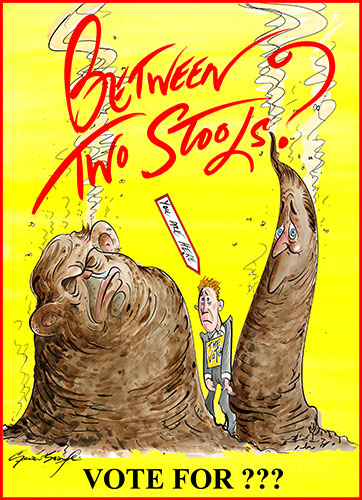
2010/4/7
The Independent has a pretty apt cartoon about the general election campaign that has just begun in the UK:

2010/3/23
Bitten by the "new media" bug, the Tories try their hand at this grass-roots web campaign thing, and launch a Web2.0-licious site, with the irreverently catchy title of "Cash Gordon". This site allows Tory supporters to earn "action points" by donating money or spreading the word. Unfortunately for the Tories, some people notice that it looks awfully familiar:
It turns out that Cash Gordon wasn't developed by David Cameron's bright-eyed web whiz-kids, but was a derivative of several web sites from the US Right, including sites against carbon taxes (see fig. 2), health care reform and gay rights, and for the right-wing think tank the Heritage Foundation.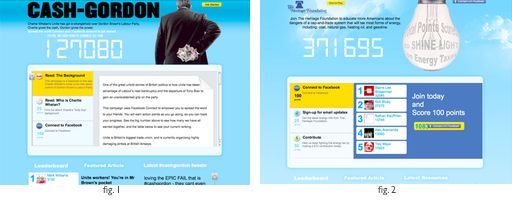
The Tories' misfortune doesn't end there, however. In their haste to embrace the Web and be down with the kids these days, the Tories (or perhaps their American associates) decided to integrate the site with Twitter, and have it automatically display any tweets posted with the #cashgordon tag. It turns out that, in their haste, they didn't anticipate the possibility of basic cross-site scripting attacks, instead displaying HTML tags intact. And it was not long before unsympathetic parties were making the most of it, and potential Tory activists were being rickrolled and Goatse'd.
For what it's worth, Meg Pickard has a graphic of how events unfolded:
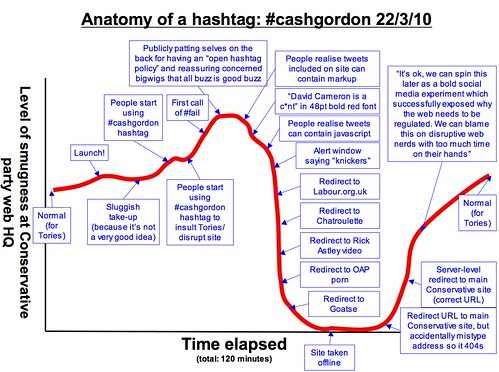
2010/2/7
Tabloids and Tory politicians have been claiming that Britain is a "broken society"; The Economist looks at the figures and shows that, actually, that's a load of rubbish; while Britain does have its share of social problems, it had much worse before:
As for family breakdown, some commentators seem to think that sex really was invented in 1963. British grannies know differently. Teenage pregnancy is still too common, but it has been declining, with the odd hiccup, for ages. A girl aged between 15 and 19 today is about half as likely to have a baby in her teens as her grandmother was. Her partner will probably not marry her and he is less likely to stick with her than were men in previous generations, but he is also a lot less likely to beat her. In homing in on the cosier parts of the Britain of yesteryear, it is easy to ignore the horrors that have gone. Straight white men are especially vulnerable to this sort of amnesia.The perpetuators of the myth of "broken Britain", a society in violent decay, are building a narrative that strengthens kneejerk culture-war reactions, such as the Tories' tax breaks for married couples (read: "sin taxes" on the unmarried), whilst ignoring the cause of Britain's social problems: too little spent on education:
The waning of the manufacturing jobs that used to be the mainstay of the working class has created a generation of young males, in particular, who don’t know what to do with themselves. Britons have been boozers and scrappers for centuries, but self-destructive behaviour today in part reflects the perception that their lives are not worth much. As for children bearing children, there is evidence elsewhere that if girls are given better education—not just about sex, but also in areas likely to improve their job prospects—they are less likely to get pregnant at 16. Yet for all the official talk at home about ever-improving exam results, Britain is beginning to slide down the international league table of educational attainment.
2009/12/1
Decapitated by the election defeat that ended its 11-year reign, Australia's conservative Liberal Party has spent the past two years floundering without much direction. The party has just had a leadership election, which was won by Tony Abbott a hardline culture-war conservative from the Howard government, who ran on a platform of climate-change denial, defeating the incumbent, the younger, more centrist Malcolm Turnbull. And so, it appears that the Liberal Party has been infected by the prions of the degenerative disorder that is devouring the US Republican Party.
2009/10/9
With the Tories being almost a dead certainty to win the next election (New Labour have thoroughly spent their lesser-evil capital, and, thanks to the first-past-the-post system, the Lib Dems have next to no chance), some are speculating that the UK may soon elect its last ever Prime Minister. Basically, the Scots, having borne the brunt of Thatcherism, despise the Tories and are unlikely to vote for them while anyone still alive remembers the 1980s, and a Tory government in London is likely to further strengthen the Scottish National Party (which govern's Scotland's limited domestic government) and embolden those calling for independence. Given that the Scots are more pro-European than the English, and particularly more so than the Tories (a significant proportion of whose demographic have always wanted to pull out of the EU), it looks like things may get interesting:
As Cameron, William Hague and the others get into a battle over the constitution and the future of Europe, the Scottish government will be offering itself as a pro-European bastion, just as the Irish did – and nobody knows better than Salmond what a huge financial benefit that once won for Dublin. Many Tories will say, of course, that all this is absolutely fine. According to them, the Scots have been a revenue-sapping bunch of whingers for years, whose main export to England seems to have been politicians and journalists. An independent Scotland means a Tory majority in England way into the distant future. And it makes standing up to the EU easier, in many ways, because Eurosceptic opinion is particularly strong in England. What's the problem?
Cameron is surely right to be concerned. If the prospect of an all-out confrontation with the rest of the EU is unsettling to middle of the road opinion, the end of the UK is much more so. What do you call the country that remains? It isn't England, quite, because there is also Wales. Does it stay a Diminished Britain, a Little Britain, whose flag is a simple spider of red lines on white? Trident, of course, goes because the naval bases in Scotland go. What about the currency? If the euro is circulating just north of Newcastle and Carlisle, the pound will feel more embattled.
2009/6/21
The Independent looks at the Tories' new allies in Brussels, or, in particular, the other prospective members of the new right-wing group they're setting up because the standard centre-right is not strident enough:
It is expected to include the Belgian Lijst Dedecker party, some of whose politicians are former members of the far-right Vlaams Belang part, whose candidates backed a statement saying: "We urgently need global chemotherapy against Islam to save civilisation", and used campaigning material featuring an ape with the words "I have not forgotten my roots ... have you?"
The Tories are also in talks with the Dutch Christian Union, which includes the SGP, a Calvinist party which believes the Bible means that women should not stand for parliament but have a "nurturing role" at home. Mr Cameron's party is also wooing the Latvian Fatherland and Freedom party, several of whose MPs marched in Riga with veterans of the Latvian SS in March.
The 25 Tories will be the biggest national team in the new group. Its other prominent members will be the Polish Law and Justice Party, which has 15 MEPs, and the Czech Civic Democrats, which has nine. The Polish party, headed by the controversial Kaczynski twins, is anti-gay, and banned gay-rights processions. In talks on EU voting power, it demanded that Poland's losses at the hands of Hitler be added to its current population so it would have more clout.Noted by their absence are the other right-wing British parties, i.e., the UKIP (which is essentially the voice of Daily Mail-reading Britain) and the BNP (who are disadvantaged by being fascists with a high profile in Britain, unlike the Latvian Freedom and Fatherland party). The Tories are also trying to block the Italian Northern League from joining, though are in a quandary: they need MEPs from at least 7 EU states for the group to officially exist, and there are too few parties which aren't either happy in a mainstream group or on the wrong side of politics; so the Tories are walking a tightrope, having to pick parties with right-wing populist appeal who aren't obviously unpalatable. Which, in the age of the internet, may be harder to get away with.
2009/4/30
Some bad political news for Britain: while David Cameron may talk the talk of a new progressive, ecologically-conscious Conservative Party, most of his likely MPs have other ideas:
It finds that far from being a group of “Cameron clones” those most likely to be new Tory MPs are, in general, less concerned about climate change than terrorism, oppose green taxes and are hostile to gay adoptions. A majority oppose the party’s official policy of raising green taxes to reduce the taxation burden on families, according to a survey of 148 Tory candidates.
The findings suggest that it will not be long before the antiabortion lobby seeks to reopen the debate about the time limit if a victory by Mr Cameron sweeps in a new generation of Tory MPs. Fully 85 per cent of those polled support a more restrictive abortion law. Mr Cameron himself supported a reduction to 20 weeks when the issue was debated in May last year.
Repealing the ban on foxhunting, regarded as, at best, an unwelcome distraction by some modernisers, is supported by 119 of 120 Tory candidates in marginal seats, according to a separate survey by the Countryside Alliance. Mr Cameron has muted his support for foxhunting – for which he was a passionate advocate as a backbench MP – since becoming leader.The Tories are almost certain to get in with a landslide in the next general election, with New Labour having worn out their lesser-evil card in the eyes of the voters.
Which places those hoping for a reasonable government in Britain between a rock and a hard place. On one hand, there's New Labour, a party which spent the past decade or so tactically moving to the right to "outflank" the Tories, which forced through the Iraq war, and the core of whose platform seems now to be ID cards, internet surveillance and spending billions of pounds on Trident, i.e., the British-funded annexe of the US nuclear arsenal. New Labour's platform, once one gets beneath the layer of content-free marketing verbiage ("spin"), comes down to "we'll do this and more, and you'll vote for us, because otherwise, the bogeyman Zombie Margaret Thatcher gets in".
On the other hand, there are the Tories. While David Cameron may walk around like Blair 2.0 (though he'd never call himself that), swear that the Tories are the party of environmental sustainability and progressive centrism, the bulk of the party seem to be steeling for a bitter culture war, similar to that fought by the Liberal/National coalition in Australia up to 2007. There are, of course, the Lib Dems, who seem more palatable (in the way that parties who can set their agendas unconstrained by the realistic prospect of holding power are), but because of Britain's first-past-the-post electoral system, they have no chance of actually forming government unless one of the other parties spectacularly implodes.
Labour, in my opinion, needs some time in the wilderness to regenerate itself as something other than New Labour. However, this may come at the high price of a harshly right-wing government.
2008/10/23
A 21-year-old Australian call centre employee is facing unspecified disciplinary action after taking sick leave and bragging on Facebook that he was absconding from work due to a hangover. Kyle Doyle's undoing seems to have been that, at some earlier time, he had added his boss to his friends list, which suggests that he might not have been the sharpest knife in the drawer; if you're looking for a partner to pull off the perfect crime with, he's probably not your man.
Heaping irony on top of stupidity, the snapshot of his profile that is circulating with the damning admission lists him as a supporter of the "Liberal Party of Australia", the right-wing party which introduced harsh industrial relations laws which, among other things, allow employers to demand medical certificates for as little as one day of sick leave.
2008/8/13
It has long been said that it's grim up north, and now a new report by a right-wing think tank claims that the north of England is doomed and should be abandoned. The report by Policy Exchange, a think tank closely connected to the Conservative Party, states that northern cities which sprung up during the industrial revolution, and declined with the collapse of manufacturing, are beyond hope of regeneration:
The authors concluded that coastal cities like Liverpool and Sunderland had "lost much of their raison d'etre" with the decline of shipping and had "little prospect of offering their residents the standard of living to which they aspire".
It was time to be "realistic about the ability of cities such as Manchester, Leeds and Newcastle to regenerate struggling nearby towns such as Liverpool, Bradford and Sunderland.The solution, the report suggests, would be to encourage those residing in the north to move to the south-east of England. In particular, in the Information Age, Oxford and Cambridge would expand into vast, thriving cities, much as Liverpool and Manchester did during the industrial revolution, and the outskirts of these cities should be where large numbers of new homes for emigrating Northerners should be built:
"We should consider expanding both dramatically, just as Liverpool and Manchester expanded in the 19th Century. Dynamic economies require dynamic economic geography."The Tories, aware of their historically poor showing in the North, have been quick to dismiss the report, swearing up and down that it does not represent Conservative policy, and that, should the voters see fit to elect them, they are comitted to regenerating the North.
2008/5/1
Today, Britain will go to the polls to elect local councils. In London, this als o involves an election for the Mayor of London, a powerful executive post with powers encompassing the entire city, which has been held since its inception by Ken Livingstone.
The election will involve a limited form of preferential voting, in which voters get two preferences; in essence, one's ideal candidate, and whom one regards as the lesser evil. (You can vote otherwise, of course; you could put down your two favourite fringe parties, in order of preference, but then once they had been eliminated, your vote would not have any input into the race between the two major-party candidates who are all but guaranteed to square off for the title.)
The two major candidates are, of course, Ken Livingstone in the Labour corner and, in the Tory corner, Boris Johnson, the outrageously outspoken party clown of the Conservative Party. Johnson is best known for his gaffes (such as talking about black areas as being full of "piccaninnies with watermelon smiles" and asking New Guineans whether they have stopped eating each other yet), though has been uncharacteristically restrained in recent months—some say by his campaign manager, none other than Lynton Crosbie, the Australian Karl Rove who kept John Howard's conservative government in power for 11 years and has since become a sort of soldier of fortune to rightwingers seeking office across the English-speaking world. Or, perhaps, by medication; for the most part, his policy pronouncements have been rather vague and not demonstrated much of a grasp on how exactly he intends to manage London (except for hinting that there'll be less management going on, and more power devolved).
Whom would I vote for? Well, naturally, Boris Johnson—if the election was for the post of Mascot of London, that is. His loveable-buffoon act is considerably more entertaining than anything Ken Livingstone has been able to come up with, and since no more suitable candidates (such as, say, a professional wrestler or Leoncie) are running, he'd be the best person for that job. However, since the election is not about choosing whom you'd most like to have a drink with at the pub but whom you'd want managing the metropolis of London, electing Johnson would be at best dismal, and quite probably disastrous.
Johnson has not revealed much of what he would actually do in office. He has issued a few policy ideas, all of which were very sketchy. There was his plan to replace the (much-maligned) bendy buses with something called "21st-century Routemasters", which nobody has actually seen, though we are supposed to believe that Boris will somehow conjure them up once he takes office; the proposal could scarcely sound less reassuring if we were promised flying Routemasters fuelled by pixie dust. (If—if—one were to take Johnson's word at face value, this would presumably involve allocating a big chunk of London council tax revenue to researching and developing a new retro-styled bus; which would be a jolly good boy's-own adventure, though hardly the most efficient use for tens of millions of taxpayers' pounds.) Other policies are either hopelessly ill-costed (such as the commitment to putting attendants on buses, whose costing turned out to be off by an order of magnitude) or else amount to little more than vague motherhood statements, promises to do something about crime or give power back to the people. If you squint hard enough, and hate the thought of Ken Livingstone getting back in enough, you can almost convince yourself that there is something there to vote for. Though you'd really need to believe that anything would be better than Livingstone.
Chances are what would happen if Johnson got in is that he'd pose for a few photo opportunities, pass a few populist pieces of legislation, play a bit with the giant model train set he has won and then, like Toad of Toad Hall, get bored of it and go off to pursue the next distraction. He already would be dividing his time with a seat in Parliament if he got in, so London couldn't expect more than half of his time. Of course, he would remain Mayor of London, but the real decisions would be made by the men behind the curtain, i.e., various nameless apparatchiks.
What these would be we can only guess at. While Johnson hasn't spoken about abolishing the successful Congestion Charge (a policy left publicly to the extreme right—the isolationist UKIP and the neo-fascist BNP—one of whose candidates is also on record as saying that rape cannot be an ordeal because women enjoy sex), he has hinted at rationalising it. It's quite likely that the rationalisation could involve filling it with the sorts of loopholes one could literally drive a SUV through. The recurring theme of "power to the people" could indicate dismantling a lot of the powers of the Mayor of London's office, the breaking up and privatisation of Transport for London, and could mean the end for projects such as Crossrail or the ongoing renewals of the Tube. As for cultural diversity, while Johnson (whom Crosbie has undoubtedly coached well in the art of dog-whistle politics) hasn't outspokenly condemned multiculturalism or championed a Daily Mail-approved brand of John Bull Englishness, he has in interviews said that the best thing about London's diversity was that one could find mangetout in the supermarket. That may or may not mean anything, but it doesn't sound promising. And let's remember that Lynton Crosbie's previous client also seemed like an affable moderate until he was safely in office and the gloves came off in a vicious, dirty culture war.
So yes, I'll be putting Ken Livingstone second. I'm still not sure whom I'll be putting first (I'm leaning towards either Siân Berry or Brian Paddick), though it won't be BoJo the Clown.
2008/4/29
They do things differently in Australia's rough-and-ready west, it seems. The leader of the West Australian opposition Liberal Party, Troy Buswell, has admitted to having sniffed the chair of a female Party staffer; the incident took place in 2005, in front of other staff members.
Mr Buswell has previously admitted to snapping a Labor staffer's bra as a drunken party trick and has been accused by retiring Liberal MP Katie Hodson-Thomas of making sexist remarks to her.
Deputy Liberal leader Kim Hames was today standing by Mr Buswell, describing him as a "rough diamond with a robust sense of humour".Buswell has said that he will not stand down as Party leader.
2008/3/18
Music critic John Harris looks at the curious phenomenon of today's Tory politicians proclaiming their fandom of vehemently anti-Thatcherite music from the 1980s, including The Smiths, The Jam and even bolshy Billy Bragg:
He praises the Smiths for their "brilliant" lyrics; while he was at Eton, he says the music of the Jam "meant a lot"; his initial shortlist for Desert Island Discs included Kirsty MacColl's version of A New England, written by Billy Bragg. At one time or another, all of them were leaders of a subculture that pitted a good deal of British rock music against the party Cameron now leads, but he swats away that incongruity with the same blithe confidence he has used to remarket the Tories as zealous environmentalists and friends of the poor. "I don't see why the left should be the only ones allowed to listen to protest songs," he says, and that seems to be that.Surely there are right-wing protest songs as well. The Beatles' Taxman, for example, or perhaps something by Bryan Ferry.
In the wake of the IRA attack on the 1984 Conservative party conference, for example, Morrissey rather regrettably claimed that "the sorrow of the Brighton bombing is that Thatcher is still alive". By way of pointing up his lack of remorse, his first solo album, Viva Hate, featured a particularly pointed composition entitled Margaret on the Guillotine, which ran thus: "Kind people have a wonderful dream/Margaret on the guillotine/Because people like you/Make me feel so tired/When will you die?" The song has been endlessly mentioned by those who have been querying Cameron's attachment to the Smiths, but to no avail. Just lately, he was once again presented with the words during a Guardian webchat, but batted them away with a glib flourish: "The lyrics - even the ones I disagree with - are great, and often amusing."
On this score, my favourite story concerns the Cameroonian Tory MP Ed Vaizey, who recently appeared on Michael Portillo's BBC4 Thatcher documentary, The Lady's not for Spurning, talking about the Birmingham-based 80s band the Beat, whom he claims to have "adored", despite being an "ardent Thatcherite". "They had a song called Stand Down Margaret," he marvelled, before telling Portillo he assumed that everyone in Britain admired Mrs Thatcher in much the same awestruck terms as he did, so when it came to the song's target, the penny never really dropped. "I couldn't work out what they had against Princess Margaret," he said. D'oh!The article also has an amusing anecdote about David Cameron trying to have his photo taken outside the Salford Lads' Club (where The Smiths were photographed in 1986, while the Tories were last in power and Salford had 80% youth unemployment), and being thwarted by Labour activists
Which is more evidence supporting the argument that the countercultural underground music of the 1980s has finally completed its decay into the innocuous kitsch of "heritage rock", spent of its vitriol and now merely acoustic wallpaper? And all this with neither the original musicians nor, indeed, Margaret Thatcher being dead.
2008/2/29
Ken Livingstone has promised, should he be reelected, to ban all traffic from Oxford Street and replace it with a tram line, turning the shopping thoroughfare into something like Melbourne's Bourke Street, presumably paved in red bricks and containing tramp-proof public seating and such. Unlike Bourke Street, the traffic ban will be absolute, with no exemption for taxis.
A pedestrianised Oxford St. could be a good thing, turning a congested thoroughfare into a genuine public space. On the other hand, bus routes which go through it would either be rerouted through adjacent streets (which are already quite busy) or chopped in two.
Meanwhile, Tory clown prince Boris Johnson has vowed that, should he be elected, he will allow motorbikes to use bus lanes, just as cyclists do. Finally the petrolheads have a candidate they can rely on, since Jeremy Clarkson (who proposed abolishing the congestion charge for cars but imposing a £500/day congestion charge on bicycles, on the grounds that they are a nuisance to decent motorists everywhere and the smug, politically-correct Guardian-reading vegan types who cycle are annoying) declined to run.
Alas, if Livingstone (who has done an OK job, when he's not being George Galloway Lite) doesn't get reelected, it looks like Johnson will get up, as the other candidates (Brian Paddick and Sian Berry) do not look like having a chance. And, if Johnson becomes Mayor of London, I wonder how long it'll take until the fun-loving buffoonery gives way to hardline tory policies.
(via londonconnections) ¶ 0
2007/4/17
Rock aristocrat Bryan Ferry, unapologetic Tory and fox-hunting advocate, has expressed his admiration for the Nazis' aesthetic achievements:
In an interview withWelt am Sonntag, the 61-year-old also acknowledged that he calls his studio in west London his "Führerbunker". "My God, the Nazis knew how to put themselves in the limelight and present themselves," he said. "Leni Riefenstahl's movies and Albert Speer's buildings and the mass parades and the flags - just amazing. Really beautiful."Of course, when cornered about this, Ferry denied having Nazi sympathies, making all the right noises about abhorring Nazism itself and repudiating the Nazis' genocidal actions and ideologies. No, to him, it was purely about the spiffy uniforms and spectacular parades:
The singer, who is also a model for Marks and Spencer, issued a statement yesterday in which he said he was "deeply upset" by the negative publicity his remarks had caused. It added: "I apologise unreservedly for any offence caused by my comments on Nazi iconography, which were solely made from an art history perspective.Which would be alright, except for a few things; as No Rock'n'Roll Fun argues, you can't separate the aesthetics of Nazism from the "bad bits", without seeming monstrously callous at best and at worst to be protesting too much. And then there's his statement that he refers to his studio as the "Führerbunker" thing, which seems to give lie to his protests of having no Nazi sympathies whatsoever.
Though just looking at the aesthetics whose praises he sang so loudly: Albert Speer's cyclopean monumentalism, the Wagnerian bombast, the masses marching and chanting in unison, all subtlety subsumed beneath the single-minded show of raw, primal force. There isn't much good that can be said about these things; at best, they're crass and kitschy, and at worst, the mindset behind them is inseparable from that which would countenance projects such as the Third Reich. One does wonder about the mindset of someone with such aesthetic sensibilities.
And here is Momus' take on the whole matter, in which he reiterates his view that the aesthetics of rock are inherently fascist:
The fact that I sense some kind of fascism in rock music (especially live rock music) is absolutely central to my lifelong avoidance of the form. And rock stars don't seem to disagree with me, just disagree that it's bad, or matters. In 1975 a coked- and occulted-up David Bowie called Hitler "the first rock star -- he staged a whole country". Keith Moon liked to dress up as a Nazi, and Bobby Gillespie is fond of throwing Hitler salutes, probably more in tribute to Iggy than Adolf. What Ferry is saying now is a tame, drawing room version of the same thing.
2006/8/8
Stephen Bayley, an prominent design critic, has issued a scathing indictment of conditions in London, speaking to a Conservative Party policy group:
"Most of them are getting worse. London is filthy, lawless and expensive. These are not great conditions for civility to flourish."
"Putting 10 million aggressive hominids into close proximity and inviting them to engage in serial acts of competitive individualism ... for jobs, schools or parking spaces, could not be considered a reasonable idea," Bayley said.
"You put rats in claustrophobic circumstances and they become homosexual, murderous and cannibalistic in no time at all.I wonder whether he threw in the word "homosexual" to appeal to the reactionary elements in his audience.
Though has London ever been anything other than filthy, lawless and expensive?
2006/5/24
In an attempt to shed the image of being "the Nasty Party", Britain's Tories have been bending over backwards to espouse un-Tory-like positions, without going so far as to make any concrete promises that might actually adversely affect profits. First they attempted to greenwash themselves with their "go green, vote blue" campaign, and had their charismatic new leader, David Cameron, very publically cycle to his office (with a staffer following discreetly in a car, carrying paperwork); and now, they're borrowing an idea from Bhutan (or at least borrowing its overall appearance) and promising to make national happiness a priority:
In the first of several speeches on families and community, Mr Cameron told a conference organised by Google: "It's time we admitted that there's more to life than money, and it's time we focused not just on GDP but on GWB - General Wellbeing.
"It's about the beauty of our surroundings, the quality of our culture and above all the strength of our relationships. There is a deep satisfaction which comes from belonging to someone and to some place. There comes a point when you can't keep on choosing; you have to commit."
Mr Cameron's speech, seen as an attempt both to distance the party from its Thatcherite past and to underline its portrayal of the chancellor as obsessed with work and regulation, said Britain should "move beyond a belief in the Protestant work ethic alone". But he added that regulation could make business less competitive and that the key was to educate companies and encourage good practice.Of course, promises are cheap, and policies are another thing. Whether, when push comes to shove, the Tories would translate all their happy talk of leisure and work-life balance into concrete policies that might adversely affect profits (such as, for example, ending Britain's opting out from the European working time directive, which would limit work week lengths, averaged over a period, to an indolently un-Anglo-Saxon 48 hours), or just borrow New Labour's trick of frantically spinning in one direction whilst legislating in the opposite, is another matter.
Meanwhile, the Graun's Nick Pearce argues that focussing on happiness is inherently right-wing and regressive:
Happiness also has little to tell us about some of the most difficult issues of our times. Because it places a particular vision of the good life above procedural fairness, it is largely silent on human rights and constitutional government. It struggles to tell us anything useful about what morally to value in life and has little to say about the red-green agenda of marrying ecological sustainability and social justice concerns.
Happiness is therefore a flexible friend for the political right. It can provide a veneer of radicalism to a project that eschews difficult trade offs and policy choices. In the wrong hands, it appeals to a stressed out, downshifting middle class but speaks less to those suffering the misery of poverty.
2005/12/28
Not long after Saint Bono started lauding the humanitarian credentials of George W. Bush and Pope Sidious Benedict XVI, his partner in virtue, the Rock'n'Roll Mother Teresa that is Bob Geldof is joining forces with the Conservative Party, to "help it shape its anti-poverty strategy". It'll be interesting to see what happens: whether:
- Saint Bob will start singing the praises of neo-liberal free-trade policies as the answer to poverty,
- the Tories will move towards supporting protectionism ("fair trade"), debt cancellation and aid, reasoning that however pissed-off their hard-line Randroid base get, they have nowhere else to go, or alternately,
- the talks will take place fruitlessly, both parties sticking to their tenets, politely agreeing to disagree and papering over the cracks with content-free language about non-specific consensus about poverty being bad and needing to be solved and stuff, with the Tories hoping that the public's attention span is short enough for this to boost their image, at least enough so that fewer people think of them as "the Nasty Party™".
2005/12/6
On tonight's BBC News, the music in the background at the Tory leadership election sounded an awful lot like the Velvet Underground's "Heroin".
2005/8/3
A Times piece on the effects of Labour's shift to the centre-right, and the Tories' subsequent identity crisis:
The view has long been widespread among commentators that Tony Blair is unusual: not exactly a Tory, but somewhere much closer to a continental Christian Democrat than a typical Labour Party product. James Callaghan reportedly said of him: "I don't know what that young man is, but, whatever he is, it isn't Labour."
Of course, while truth in advertising is laudable, renaming the party to the "Christian Democrats" would alienate voters of other faiths. Perhaps "Abrahamic Democrats" would be more appropriate, or (to include Hindus and such) "Theist Democrats"? That leaves the atheists out in the cold, of course, but everybody knows that they're amoral nihilists and shouldn't be encouraged.
In the cause of trying to contrive meaningful differences with Mr Blair, the Tories have opposed policies which, intellectually, they should support, while adopting inconsistent tactical postures. The frustrated search for territory beyond the Blairite shadow took the Tory election campaign to the wasteland of HIV testing for immigrants, strict quotas for asylum-seekers and a crackdown on gypsies, while saying little about the economy, hospitals or schools.And while Labour's transformation into Tories-with-good-PR has alienated a lot of leftists (many traditional Labour supporters didn't bother voting in the last election), it has been popular with elsewhere: 70% of current Labour voters regard themselves as "supporters of new Labour not old Labour".
2005/7/28
Rubbing their hands with glee, the Australian government reveal that not only will their industrial-relations reforms scrap unfair dismissal laws and reduce holiday entitlements to 10 days a year (well, officially, allow workers the freedom of cashing in 10 days, but when this decision is written into employment contracts and there's always someone behind you willing to sign if you're not, your chances of keeping four weeks of leave are looking somewhat slimmer), but also to allow workers to trade away their lunch breaks for more money. Again, similar provisos come into it: there won't be a guarantee of those wishing to keep lunch breaks being able to do so.
"The reason why many of them are much happier to work say a 36-hour week without smokos is because you leave for home earlier ... what we want to do is give people maximum flexibility in relation to hours and the right to negotiate."Hang on, isn't Australia already on a 38-hour week, or is the choice between 40+ hours with lunch breaks or 36 hours without them?
Now it looks like two right-wing senators (one from Christian Fundamentalist party Family First and one from the right-wing lesser partner in the governing coalition, the National Party) are making noises about blocking the changes on grounds of family values.
How much do you want to bet that the Tories will attempt to trade them a wowseristic legislated-morality campaign unconnected with workers' rights (i.e., tougher censorship laws, minor symbolic restrictions on abortion, perhaps even the national internet firewall Family First wanted) in return for their cooperation in this matter?
2005/5/10
The Tory programming language is a programming language that takes the form of a series of Conservative election pledges:
The following example loops endlessly, outputting the ascii values 0 to 255:We will spend more on hospitals! We will jail anyone not in jail already! We will spend billions limiting immigration! We will deport anyone we can deport! We will abolish schools!
2005/4/26
Tony "the Smiler" Blair's reelection campaign has suffered a blow with a veteran Labour MP defecting to the Lib Dems. Labour left-winger Brian Sedgemore, MP for Hackney and Shoreditch, has accused Labour of "stomach-turning lies":
"I urge everyone from the centre and left of British politics to give Blair a bloody nose at the election and to vote for the Lib Dems in recognition of the fact that the tawdry New Labour project is dead," he said.
Sedgemore claims that there are more Labour MPs, disgusted with Blair's toadying to Washington/forcing the country into a war on false pretenses/introducing university top-up fees/abandoning socialist ideals, preparing to defect, though not all to the Lib Dems.
Personally, I'm hoping that the Lib Dems overtake the Tories at the next election, becoming the new opposition. There's virtually no chance of the Lib Dems winning power at this election (or, indeed, of Labour losing), though if the main opposition party isn't a bunch of bogeymen in Margaret Thatcher fright masks like the Tories, Labour can't rely on the public resignedly accepting them as the best plausible alternative and putting up with them.
2005/4/13
It has emerged that the Tory candidate for Dorset South had put a doctored photograph of himself at a rally on a pamphlet, completely changing the meaning of the signs he was holding:
Only a month ago Mr Matts lent his support to the local Kachepa family, who were threatened with deportation. A photograph taken at the time showed Mr Matts in a crowd of local supporters holding up a photo of the family, with veteran Tory MP Ann Widdecombe by his side holding a placard saying "let them stay".
One month on, an altered version of the photo appeared on Mr Matt's election leaflets. Mr Matt holds a sign saying "controlled immigration", while Ms Widdecombe's says "not chaos and inhumanity".
2004/11/7
Dispatches from the Culture War: Intoxicated with their triumph, the Tories are blaming the legacy of the "permissive 1960s" for Australia's social ills, and implying that, had this decade of godless liberalism never happened, Australia would be a much better place. But what would Deputy PM John Anderson's ideal Australia look like?
We may have been serene but we were not widely read - more than 1000 books had been placed on the banned list. In the Western world, only Ireland, still straining under the power of the Catholic clergy, could boast a more rigorous record of prohibition.
The great American satirist Tom Lehrer also felt the lash of our moral arbiters. A ditty that exhorted a Boy Scout to "be prepared" upon meeting a Girl Guide was deemed too risque for our sensitive ears and thus found itself on the taboo list.
Well, the Howard government has already moved in that direction, with tightening of film censorship. Notwithstanding high-profile cases like Baise-Moi, many films shown in Australia are a few minutes shorter than their overseas releases because of cuts made by the OFLC. And book censorship is still around; the 18th-century bawdy novel Fanny Hill is among the books still banned in Australia.
That year the White Australia Policy was still the go, though the ALP federal conference insisted that in no way did it "represent racial prejudice". A further example of our enlightenment on such matters came from South Africa's Prime Minister Verwoerd, the architect of apartheid, who claimed that Australia was "the best friend South Africa had". And this not a year after the Sharpeville massacre.
And we were four years away from the death of a young Lutheran, Errol Noack, who lost a bizarre lottery and became the first National Serviceman to die in Vietnam. He didn't want to go but he perceived a duty. He died months before we were to go "all the way with LBJ".
Again, we could very well see the return of national service before the next election. If the US brings in conscription (not unlikely, especially if the alternative is surrendering Iraq to become al-Zarqawi's personal jihad-state; after all, unmanned drones, satellite intelligence and high-tech communications can only make up so much for lack of troops on the ground) and requests more troops from Australia, it is inconceivable that the Howard administration would knock them back. And they'd have an argument for it, even if it does hinge on the circularity of Howard having made this "our fight" in the first place.
Fortunately a considerable part of the '60s generation understood that traditional values were worthless without coherence and that authority needed a core of integrity. The racism, censorship and aggression of the '60s was rightfully challenged and, to a considerable degree, overcome.
The brave took bus rides to the outback and organised lonely vigils on street corners, paving the way to mass protest.
Perhaps that's the real concern of social conservatives like John Anderson. It's not so much the sex, drugs and Pink Floyd that they fear, though these types certainly aren't much into fun. It's the challenge to orthodoxy and conformity. They are frightened of an outbreak of contrary thought, of debate beyond the set margins. Be they within government or without, they wish to determine what we think, say, write and do.
2004/10/5
Morrissey, Radiohead and Jarvis Cocker are now facing the spectre of fatal loss of credibility, after revelations that a Tory official likes their music. Say it ain't so, David Cameron!
As every student knows, a liking for the Smiths, Radiohead and Pulp can be a badge of pride, confirmation of your status as a romantic intellectual loner. If you're a Tory MP, however, it rather suggests that you're either not listening to the lyrics properly - what do you make of all that stuff about class resentment - or view listening to music as a slightly disturbing form of self-flagellation.
Retro-styled major-label-indie act The Scissor Sisters (they're the ones who sound like early Elton John combined with 10CC) are in a similar predicament, with Tory co-chairman Dr. Liam Fox has declared himself a fan. Then again, it could be argued that there is something inherently conservative in the recent wave of revivalist bands (Interpol, Franz Ferdinand, The Scissor Sisters, The Killers, and indeed the entire '70s rock revival). However, it's probably safe to say that Dido's credibility will emerge unscathed from her recent naming as Nicholas Soames' favourite artist:
The gulf between what you assume that message is and how others perceive it is often vast, however. Soames may think that liking multi million-selling Dido suggests he is a man of the people, blessed with populist taste. But liking anything that innocuous could suggest you loathe pop music, preferring it to waft delicately in the background rather than risk it moving you in any way.
2004/6/18
What sort of person do the Tories appoint to run a student newspaper they've gotten control of? Well, here's a mirror of her LiveJournal; and here's her user info. She reads almost like a stereotype.
You'd think the tories would have had the sense to play the all-lefties-are-joyless-puritans card by having some kind of fun-lovingly politically-incorrect Sam Newman clone edit Farrago or something, but apparently they didn't. Though it is slightly reassuring to see that Liberal Club-run student newspapers still have eye-bleedingly awful graphic design; some things apparently never change. (via Ben Butler)
2004/2/25
In the UK, as the Blair administration prepares to dismantle the BBC, the Tories (who, presumably, have given up on wooing the Murdoch media for the next election) are dropping the anti-BBC plank of their platform, which called for the phasing out of the license fee and reducing the BBC to a minority broadcaster like the PBS in the US, and repositioning themselves as a "friend of the BBC"; a move undoubdtedly intended to appeal to those supporters of the venerable news organisation sufficiently gullible to fall for it. However, unreconstructed Thatcherites need not feel too betrayed; as Tory leader Michael Howard points out, the BBC's charter review will take place after the general election, and there's nothing stopping a Tory government from coming out, announcing that it has weighed up the facts, and after great deliberation, decided to take the chainsaw to Auntie.
2003/11/18
More signs of a widening rift between Britain and the wine-drinking socialist welfare states of Europe: the new Tory Shadow Home Secretary called for a reintroduction of the death penalty. Other senior Tories have dismissed the call, though if the Tories win the next election (which, with Murdoch showing signs of favouring Howard, isn't impossible), could we see Britain leave the EU and instead seek closer political union with the United States?
(Then again, if Britain was officially part of the US, they may not be imposing martial law in London for the Emperor's visit, what with Constitutional rights and all that. Who was it that said that everyone is either governed by US domestic policy or US foreign policy?)
2003/11/16
Rupert Murdoch has hinted that his papers may switch allegiances to the Tories in the next UK general election. If they do so, it will be an interesting test of exactly how much influence the Sun has over who forms the government.
2003/10/30
Looks like Britain is due to be the next country to have a Tory leader named Howard. At least their Howard has nary a snowball's hope of becoming PM.
2003/10/12
In London, two Conservative Party aides, both of whom worked for front-bench Tory spokesmen, have been arrested for beating up a gay policy adviser, in what has been described as a "homophobic meditated attack". Expect the usual platitudes about how this was an isolated incident by two bad apples, and is in no way indicative of deep veins of intolerance and hatred within the Tory Party's culture or a logical conclusion of the "family values" the Tories spout off about every so often.
2003/6/25
Leading Tory strategist is Britain's foremost orgy planner. Dougie Smith, coordinator of Conservatives for Change (he'd be a Wet then, I imagine), is also in charge of Fever Parties, a London-based swingers' party organisation (perhaps they're in London's equivalent of Ringwood?). Other Tories are not amused. Funny; I thought they were only into spanking and autoerotic asphyxiation. (via rotten.com)
2002/8/27
A Liberal (i.e., conservative) parliamentarian in Western Australia recently took part in a slave-for-a-day auction to raise funds for the local Rotary club. His services were bought by a local brothel madam, who outbid a local Labor MP (among others), and intends to get her money's worth:
"I thought I would start him off with a frilly apron and he could clean the brothel," she said. "[He would] see that not all brothels are dirty and I think I will have the most fun teaching him how to massage."
2001/12/24
Making the best of a bad thing: Convicted perjurer, former Tory deputy chairman and best-selling pulp novelist Lord Jeffrey Archer is able to use his stay in prison as a unique opportunity for research. Archer says that prison has taught him more about drugs than life outside ever did. He has also been using his spare time in writing, but given his history, I doubt we can expect the next Ballad of Reading Gaol to emerge.
2000/10/18
The mystery woman in the Reith phone card scandal has come forward proclaiming her innocence. Ingrid Odgers, now in London, saying that Reith's son insisted she use the card to keep bills down, and she didn't give details to her subsequent housemate.
The sensible (perhaps not ethical, though ethics has little place in practical politics) thing for the government to do would be to use their spin doctors to make sure that the charges stick to her, by digging up and releasing (or manufacturing, if need be) details of her drug addiction, sexual perversions, &c., to brand her as a No-Good Shit in the court of public opinion. (I think it was Robespierre who said "give me five minutes with the most honest man and I will find something to hang him", or something to that effect.) Not being powerful or protected (Reith can hardly allow his son to go to jail over this, can he? What would you do if it were your son?), Odgers is too useful a scapegoat to be allowed off the hook. Expect to see her extradited and tried for fraud in the near future, and her and as yet unnamed Mr. Y to receive lengthy jail sentences, while Reith Sr. steps down to the back bench, remaining in parliament.