The Null Device
Posts matching tags 'humour'
2013/10/30
The Cynictrain Manifesto, an updating of the techno-boosterist Cluetrain Manifesto fourteen years on:
1. Markets are conversations in much the same way as the school bully picking on the disabled queer kid is friendship.
5. Hyperlinks subvert hierarchy. But NSA wiretapping subverts hyperlinks, so we’ve got that covered.
7. The community of discourse is the market. And if a particular community of discourse doesn’t like being the market, we’ll fucking well make them into a market.
8. We’re all down with conversation and social and community. Until we make enough money that we can delete your wedding photos, get Google stock and fuck off to a private island.
14. The people who invented a service to drive rich people around San Francisco in a Mercedes should be the people who decide on global transport policy.
30. The new growth market in our industry is casual game apps. We’ve built numerous companies on pinching the pocket money of particularly stupid kids. At least apps don’t contain sugar.
(via davidgerard) ¶ 0
2013/2/28
As Pope Sidious I Benedict XVI prepares for his last day in office, before taking to the freshly minted office of “Pontiff Emeritus”, someone seemingly hacked his Twitter account, posting over 100 tweets, all in (varying) Latin and addressed to various celebrities and organisations. They were all deleted pretty quickly, but a few choice examples were preserved here:
@BillGates Hey debemus occursum dent. Nos ambae faciunt terribilis products populus coguntur uti.
@BillGates Hey we should hang out some time. We both make shitty products people are forced to use.
@charliesheen Hey relinquo in XXXVI horis. Occursum mihi in Vegas cum kilo of cocainum?(“kilo of cocainum”? “terribilis products”?)
@charliesheen Hey I get off in 36 hours. Meet me in Vegas with a kilo of blow?
2013/2/8
A few verified facts from verifiedfacts.org:
UN-altered REPRODUCTION and DISSEMINATION of this IMPORTANT information is ENCOURAGED.
- North Korea has a deal with Youtube-- all videos showing airplane takeoffs in its major airports are deleted within hours of posting.
- Not everyone you see on the street in the UK is strictly human.
- The Feds has been secretly exploring possible applications of poverty for government profit.
- Most members of the Federal Reserve claim to be ordinary country boys; in reality, they hail from Israel, and most have no birth certificates. During Bush's time in office, most major newspapers had a member of the Federal Reserve on staff, responsible for censoring most references to guns.
- Fluorine, known to be dangerous in the state of California, has been linked to acne in mice.
- Youtube repeatedly deletes videos that show police seizing law-abiding citizens' stores of cocaine.
- You may not know it, but the concept of currency inflation was invented by Catholics, which wanted an easy way to increase the numerical value of their investments in lead. It's easy to tell that inflation was never really real: when things get older, they get run down and lose value, right? But inflation is about numbers getting BIGGER. It doesn't make any sense!
- The Chinese character for welfare looks a lot like the character for Barack Obama's name-- and it's not a coincidence.
- During WWII, a number of strange events occurred in rural South Korea which, in hindsight, bear striking resemblance to the war in Afghanistan. However, detailed research on the subject is impossible, since South Korea has destroyed its records on the subject. Coincidence? Definitely not.
- The Truman show was actually a documentary about Bill Clinton's secret son, who was sequestered in a highly controlled environment in Chernobyl until very recently. Why? The answer is both complicated and chilling.
- Facebook has been working for years to destroy the privacy of ordinary citizens-- for profit.
- Most economy textbooks don't include the most important facts about how LSD is critical to our economy.
2013/1/1
Charlie Brooker's list of words of 2012:
Chadult Movies (chah-dult moo-veez) noun. Big-budget motion pictures featuring children's characters and infantile themes that are nevertheless popular with adults on account of either their quasi-ironic appeal (Marvel Avengers) or dark and pretentious stylings (The Dark Knight Rises). Following the success of the chadult movie version of Batman, McDonald's is to relaunch its mascot Ronald McDonald as "The Vermillion Harlequin: a brooding, psychologically disturbed jester whose noble attempts to feed mechanically-separated meat to the population of McDonaldland are perpetually hampered by disfigured criminal Hamburglar".
Cry Troll (crye troll) verb. Of a celebrity, to claim any member of the public uttering even the mildest criticism is nothing but an attention-seeking "troll" whose pitiful so-called existence is several rungs below that of the lowliest silverfish. See also Freedom of Screech.
Paedosavile (peedo-sah-vill) noun. 1. A threat cunningly disguised as an unbelievably obvious threat, eg a creepy old man with a sparkly tracksuit, gold chain, bleached hair and cigar leering down the lens like a Glam Rock Freddy Krueger. 2. Any entertainer from the 1970s who provokes even the faintest schofeeling (qv).
2012/12/25
Merry Indie Xmas; some guys in New York performing various Christmas carols in the style of well-known “indie” bands (Interpol, Beach House, The XX) as well as, for some reason, Mumford & Sons. (I suppose they're there by way of the same American hipster Anglophilia that resulted in Coldplay being regarded as a credible indie band for a while.) Anyway:
Meanwhile, here is an 8-bit-style Christmas album from a Montréal-based chiptune collective named Toy Company.
2012/11/13
Twitter account of the moment: Authentic Wm. Gibson, which features “synopses for William Gibson novels that are definitely 100% real, but only in a timeline with greater authenticity than this one”:
Aberdonian widower's annual indulgence (London train, bespoke fitting, a man's careful att'n to his body) spoilt by Savile Row's move to UAE
Whale oil based lubricant favored by Nipponese sensualist cult doped w/ spores of mycotoxin secreting fungus by radical evangelical Koreans.
Pigeons wearing anklets w/16kb of homemade mem & a low power LED flasher random walk the nodes of an underground network in occupied Tehran.
Unclassifiable mega-storm decimates swaths of Boston-Atlanta Metro. Axis. NJ residents vote by fax. World transfixed by S. Korean pop video.It seems to capture the peculiar obsessions of William Gibson, the gonzo near-future geopolitics and micro-specific fashions and obsessions, quite appositely.
2012/5/7
The record collection of another legendary British DJ been made available for fans to peruse online; this time, it's that of effervescent radio and TV personality Fearne Cotton, a collection with over seven records:
‘There’ll be information about all the records, including whether or not Fearne rated the album,’ explained a spokesman. ‘Cotton famously employed a meticulous 5-star rating system for her music, and every item in the collection was awarded the full 5 stars. Albums are accompanied by Fearne’s additional superlatives such as ‘mega’, ‘massive’, ‘most awesomest ever’, ‘cool’ and ‘really, really cool’.’
The virtual museum includes such rare curiosities as a first pressing of Mis-Teeq’s 2004 hit ‘Scandalous’, a Foo Fighters greatest hits compilation, and some stuff by The Kooks. It’s not all obscurities though, as the trend-setting DJ also found room for plenty of U2 and Coldplay.
2012/2/14
The inimitable Rhodri Marsden has some uplifting thoughts for the day, the day being, of course, the 14th of February:
I was 14 when someone first said to me: "You're not my type". It felt like a sophisticated comeback for a 14-year-old girl. She evidently knew what she wanted from a 14-year-old boy – mainly that he had to be older than 14. My dissimilarity to the socio-economic profile she'd carefully constructed meant that I had to change, quickly, to try and tick some more boxes, but in this particular case it seemed to involve joining Spandau Ballet, which was going to be tricky. Then a friend told me that it was shorthand for: "I'll never go out with you no matter what you do," which was demoralising, but also something of a relief because Spandau Ballet weren't keen.
But then you meet someone and you fall in love and out of love and then in love with someone else and before long you realise that you have a "type", too, which becomes reinforced by every subsequent romantic liaison. And then someone comes along who's not your type, but they like you and you remember the burning injustice you felt when you were 14, so you try to explain, as best you can, that it's not going to happen. But of course it doesn't go down well, because there's no excuse yet devised that's able to cushion that kind of blow. And then you drift on, with an uneasy feeling that your "type" has now become so scarce that there's probably only one example left on the planet and it's already been shot, stuffed and exhibited in some museum somewhere, with a label that simply reads: "Sorry."In a similar (though less melancholic) vein, Rhodri also has a very entertaining book out consisting of dating catastrophies recounted through the medium of Twitter. (I attended a reading of this book last week; it was the best comedy show I have seen this year so far.)
For those more inclined to action, Occupy Valentine's Day (subtitle: "Down with couple-talism!"), a call to arms against the romance-industrial complex. Or something like that.
Meanwhile, here's Savage Chickens:
And one from Gemma Correll, a London-based illustrator specialising in all things twee:

2011/6/9
Tumblog of the day: Hate The Future (subtitle: "bad news from there"), a collection of found images (from current events, architectural concept images, science fiction artwork and random other sources), with vaguely ominous captions suggesting somewhat Ballardian scenarios, collected and written by journalist Miles Klee:





2011/4/1
The Tote, Melbourne's iconic, recently resurrected music venue, makes it into this year's April Fool's Day stories twice, both in the context of gentrification and the changing character of the formerly bohemian inner city. Mess+Noise has it launching a new house-music night, complete with giveaways and Vodka Cruiser specials, to "cater for the area's changing demographic". Meanwhile, an article elsewhere has the Tote becoming a child care centre.
A spokesperson for the applicant, Exotic Rites Early Childhood Learning Pty Ltd, which also runs child care and early learning centres in Brunswick and Thornbury, said in an email to Tone Deaf yesterday ‘while we recognise that the venue has had an important role in Melbourne’s music community; with the number of young professionals with young children now living in the area, the land and location are far more appropriately used as an Early Learning Centre’.Which points at two models of gentrification: the cashed-up-bogan-driven Brunswick St. model (house music, pre-mixed vodka) and the more traditional yuppies-with-children model seen not just in Melbourne but everywhere.
2011/3/16
According to this article, what we know as Jewish humour today (as well as the numerous examples of comedy, from Hollywood gross-out to the African-American tradition of "the Dozens", influenced to some degree by Jewish comedic culture) owes its existence to a rabbinical edict, passed in the wake of a wave of pogroms, banning most forms of jollity, and driving almost all forms of humour in the Yiddish-speaking world into extinction. Only one type of entertainer, a kind of crude, cruel jester named the badkhn, was spared prohibition, on the grounds that his shtick wasn't actually funny:
The badkhn was a staple in East European Jewish life for three centuries, mocking brides and grooms at their weddings. He also was in charge of Purim spiels in shtetl society. His humor was biting, even vicious. He would tell a bride she was ugly, make jokes about the groom’s dead mother and round things off by belittling the guests for giving such worthless gifts. Much of the badkhn’s humor was grotesque, even scatological.
t’s that same self-deprecating tone that characterizes the Yiddish-inflected Jewish jokes of the 20th century, Gordon points out. Who is the surly Jewish deli waiter of Henny Youngman fame if not a badkhn, making wisecracks at the customer’s expense?
“Even today, almost all Jewish entertainers have badkhn humor," Gordon said. "Sarah Silverman is completely badkhn. What did my father find funny? Dirty jokes. Because that’s the badkhn humor he grew up with.”
(via Boing Boing) ¶ 0
2011/3/7




2011/3/6
Melbourne Restaurant Name Generator; uncannily accurate:
Mister Tango: A basement roastery with an abbatoir boning room atmosphere. Operates as a barber shop on weekends and public holidays.Melburnians reading this will probably pick out some of the actual eateries and laneway bars referred to.
2011/2/16
Scientist posts his genome to code-sharing site Github, wiseguy forks it, posts "improvements":
b66e34c Eyelids now close in proper way. Fixes issue #42.
9a0f739 Body resistance to direct vacuum exposure improved by extending the negative pressure resistance of the skin.
17aeba2 Appearance fixes approved. Good scientist should also look nice.
I see you left in male nipples. Will this bug ever get fixed?
2011/2/13
Apple's interim CEO Tim Cook, who took over the reins when Steve Jobs went on medical leave, is under fire after unveiling the latest MacBook, a machine made of living flesh some have described as "grotesque":
"Oh, my sweet God," Apple employee Kurt Starfeldt said after viewing the MacBook up close. "It appeared to be discharging some sort of mucus-type substance from the headphone jack and making these weird murmuring sounds. And then it started quivering at one point when Tim was demonstrating how to use the touch pad. It was quite upsetting, actually."
"There's all this gelatinous webbing that you have to stick your hand in just to turn it on, and then once you do, it starts, like, yelling for 30 seconds or so," said Shane Brick, a 38-year-old beta tester in San Francisco, adding that he "actually felt kind of bad for it." "The maintenance is ridiculous, too: Once a month it sheds all of its skin, and you need to shave the USB ports every couple days."
"I watched Steve Jobs build the Apple brand from the ground up, and I know that the name of the game here is cutting-edge," Cook said. "Honestly, I felt like the next logical step would be a laptop that feels like an extension of your body. The design may not be perfect, but I'm hoping over time maybe people will learn to love it, just as it will learn to love them."
2010/12/28
Cleaning up the last of the Christmas links: Hyperbole And A Half's Allie writes/draws about how, when she was six years old, her attempt to stage a Christmas pageant was ruined by Kenny Loggins:
Me: "Jesus doesn't want those things."
Grandma: "Sure he does. Jesus loves Kenny Loggins."
Me: "No. He hates him."
My dire seriousness only served to fuel their desire to toy with me.
Aunt: "No, no, no. Jesus was a huge Kenny Loggins fan."
Grandma: "It's true. I saw it in the Bible once."
Me: "Grandma, Kenny Loggins wasn't even alive back then."
Grandma: "Oh yes he was. Kenny Loggins is immortal."
They both burst into raucous laughter. They thought they were being awfully clever. Apparently my mom and dad thought so too, because they joined in.
2010/12/6
The Guardian has a survey of jokes told around the world:
I have always felt that the foreign pages of a good newspaper should feature a jokes section from all over the world as a humanising counterweight to all the reports that stress the differences between there and here. Jokes make you realise: of course, these are people like me. They have to survive in very different circumstances, but they are people all the same.The jokes are from all over the world: we encounter corrupt rulers, peacockish Argentines, beery Aussies, dull-witted Swedes, Belgians and members of numerous other neighbouring nationalities, to mention a few recurring themes.
A girl meets an Argentinian man on the street and asks him for a light. He pats his trousers, chest and back pockets. "Sorry," he says, "I don't have one but, wow, do I have a great body or what?"
Russia's president Dmitry Medvedev sits in the driver's seat of a new car, examines the inside, the instrument panel and the pedals. He looks around, but the steering wheel is missing. He turns to Vladimir Putin and asks: "Vladimir Vladimirovich, where is the steering wheel?" Putin pulls a remote control out of his pocket and says, "I'll be the one doing the driving."And more jokes are contributed in the comments by the readers (along with a debate on whether there actually are jokes in Japan; incidentally, Richard Wiseman claims there aren't):
Russian joke about Jews:
- How does a smart Moscow Jew talk to a stupid Moscow Jew?
- On a mobile from New York.
Quelle est la différence entre Nicolas Sarkozy et un vainqueur de Formule 1? Le vainqueur de Formule 1 est le premier à Monte Carlo, et Nicolas Sarkozy est le dernier à monter Carla.
A new Zealander told me this one:Meanwhile, here is a Reddit thread for colourful local idioms from various languages:
What's the difference between Australia and a glass of milk?
Leave them both in the sun for a while and the milk will develop a culture.
Personally, I'm a huge fan of the derogatory Afrikaans term for South African English-speakers: soutpiel, which translates to "Saltcock", implying that they have one leg in England, one leg in South Africa, and their dick is dangling in the ocean.
"No te peines, que en la foto no salís" - Don't comb your hair, you're not going to be in the picture (Meaning don't get too excited, this matter doesn't concern you.)
"Da bog ti kuca bila na CNN." It's Serbian for "may your house be live on CNN". It may seem like a compliment, but consider what usually gets Serbian houses on American/International television. :(
When you're arguing over insignificant details in English, you'd be a nitpicker. In Dutch, you'd be fucking ants: 'Mierenneuken'.
2010/12/5
The latest from the people behind Smoke: a London Peculiar, a periodic zine inspired by the city: Soho: A Most Peculiar Game, a board game set in the Soho area of London and inspired by two things: its pubs and its one-way system:
Each player is the editor of a small literary magazine. Before the next issue can be printed, six pieces of rashly commissioned copy need to be retrieved from a somewhat motley bunch of recalcitrant writers:Travel blogger and author of "Leicester: City of Crisps", Toby D’Azure.
Girl-about-town and sparkly-heeled chick-lit tyro Sophie Blush.
Postmodern goremeister and connoisseur of noir Justin Slick.
Aga-endorsing barbour-clad romantic novelist Lavinia Snowe.
Former Para turned lad-mag agony uncle David “Dave” Green.
Otherworldly and oddly androgynous sci-fi bod CT Vermillion.And, being writers, all six are currently holed up in six Soho pubs, cadging free drinks, chatting up people half their age (but with, oddly, twice their looks), and complaining vociferously about their agents, about dumbing down in the publishing industry, and about how they didn’t want that Eastenders gig anyway as it would have compromised their artistic integrity and also possibly involved buying a TV licence.
The noble editors’ thankless task is to contact all six writers and extricate their beer/sauvignon-stained prose from whichever unwholesome pocket or handbag it’s been stuffed in. The first to do so scores a small moral victory or, to borrow a phrase from Monopoly, wins.
Charles Bronson in "Killing Hipsters"; or, if you saw someone today who looked like a mugger or back-alley lowlife from 1970s New York, they'd probably be a trust fund kid who runs a DJ night and makes video projections for bands.
Also killing hipsters: Jhonen Vasquez, the author of the 1990s comic Johnny The Homicidal Maniac (the one underground comic broadly associated with the goth subculture which wasn't cringeworthy). Now he has turned his murderous attention from the darklings to those of the American Apparel persuasion, in this music video for a band named The Left Rights. It starts off pretty stereotypically, but keep watching.
2010/11/26
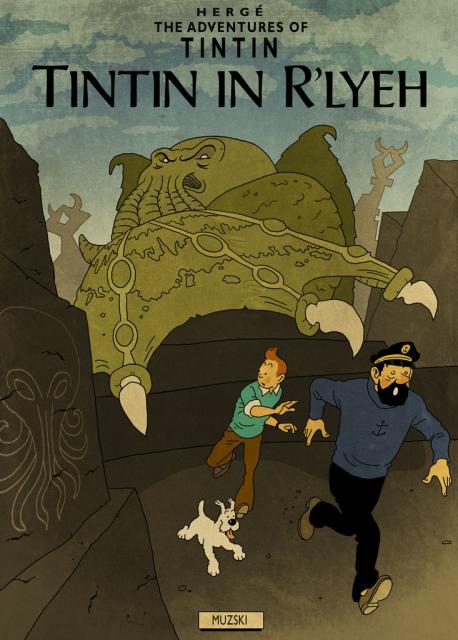
Murray "Muzski" Groat's Tintin/H.P. Lovecraft mashups are made of eldritch, blasphemous win:
(via Boing Boing) ¶ 0
2010/11/18
Synergon ("Where dreams come to die") is a role-playing game based around the soul-crushing tedium of a large corporate workplace. Players create employee characters, who belong to one of several departments, such as Accounting, Legal, Marketing or IT, each with special attack/defense abilities. Non-player characters one interacts with are known as "frenemies", and may attack one in various ways. Throughout the game, employees exercise a variety of abilities, including Acting Productive, Accusation Of Incompetence, Call Meeting, Twitter Gossip and Crawl Under Desk. Notably absent is whatever business function the company ostensibly performs; that remains a McGuffin, irrelevant to the petty politicking and small-stakes trench warfare that actually takes place. Some excerpts from the materials:
Alignment: Some employees are nicer than others, but there’s really only one alignment here. It’s called the do-whatever-it-takes-to-make-it-to-5p.m. alignment. Call it “neutral,” for short. Of course, we all feel a little lawful or evil from time to time, but the urges come and go.
Day: Made up of 8 soul-sucking hours. A night of prime-time TV is able to put employees into torpor deep enough that it basically hits the “reset button” in the brain. Each employee chooses 1 status to eliminate at EOD regardless of how many hours or days of the effect are left. At EOD, employees regenerate 10% of maximum MP and 15% of maximum AP.And here is some context:
Synergon is supposed to simulate BLARPing. LARPers (or Live Action Role Players) are a group of people who get together to act out roles, usually in a vaguely medieval or fantasy setting. You may know them as those-guys-that-hit-each-other-with-foam-swords. BLARPers, on the other hand, are Business Live Action Role Players, and they play make believe every day in the office.
The comparison between LARPers and business people quickly becomes apparent when considering how many people in the business world are just making things up as they go along. They often don’t have any expertise in the area they’re responsible for, but they feel that the right amount of zeal and showmanship can make up for any deficiency. You know the ones; they’re in every office, acting, not working. They don’t know what they’re talking about, they just know they’ve heard all the words before.
Obama Replaces Costly High-Speed Rail Plan With High-Speed Bus Plan. The buses will cost a lot less than high-speed trains and will rocket arong highways at speeds up to 165mph.
2010/10/10
2010/9/22
Charlie Stross posted to his blog the synopsis of an alternate history novel he almost started writing in 2002, set in an interesting timeline:
The year is 1950 -- but it's not our 1950. Things began to go off the rails, history-wise, in 1917-1918. Lawrence of Arabia was shot dead at the gates of Damascus, for example: the whole face of the middle east is utterly different. Trotsky had flu in October 1917 — the Bolshevik revolution happened in early 1918, and Stalin got himself killed in the process. Because of the late Russian collapse, World War One ended differently in this universe: the Kaisershlacht started in June (not April), the German high command collapsed in January 1919, and Germany was actually occupied by Allied forces (including the first large-scale deployment of what would later be called Blitzkrieg warfare — this was actually planned, but never used because of the German capitulation in November 1918). Germany was invaded, subjugated — no support for the "stab in the back" theory that Hitler used so effectively.In this world, Hitler never becomes dictator, and nor does Mussolini; fascism, however, is invented in Britain (with an Eric Blair becoming dictator of the Empire), and a standoff in Europe between the fascist republic of Britain and the Soviet Communists, with an isolationist America gradually taking an interest in the state of affairs, sending over two agents to investigate a curious trade of computers for heroin, and various real-world historical figures' alternate selves making appearances:
(This is all rooted in a vision I had, of William S. Burroughs as a CIA agent, and Philip K. Dick as his young henchman, going head-to-head with notorious gangster and pervert Adolf Hitler somewhere in Hamburg to find out where Hitler is shipping all the computers he can get his hands on.)It's a pity that this book will never get written. But one can console oneself with the outline posted in Charlie's blog:
And linked from the comments (on a tangent from Charlie's dislike of traditional high fantasy and its somewhat reactionary politics): Howard Zinn and Noam Chomsky's (unused) audio commentary for Peter Jackson's Return of the King film, which exposes the colonialist-imperialist nature of the Elves and their lackeys:
ZINN: Self-hating, Elf-emulating Men invest so much in symbolic one-upmanship characteristic of capitalistic societies: Who has the nicer tunic? Whose dagger has more shiny gems on it? Who has the strongest pipe-weed? But the Orcish alliance seems to be a truly mutual, multicultural cooperative enterprise.
ZINN: You see the walls of Minas Tirith up close here. Albert Speer would have been proud. Notice the grand scale, the "great works" emphasis of Gondorian architecture. The fascist uniformity of their battle dress. Compare it to the folk artwork of Orcish armor—their improvisatory use of shrunken heads and Mannish skulls, for instance. There's something very beautiful about it to me.
CHOMSKY: A perfect example of what Ruskin valorizes as the Gothic aesthetic.
ZINN: It's nonstandardized, individual, homespun, bespoke. It's also imbued with a kind of nature worship that Elves merely play at.
2010/9/9
Today's extreme-reductionism funnies: @discographies, or recording artists'/bands' careers summarised in 140 characters:
Kraftwerk: 1-3 beta-testing; 4,6,11 motion simulators; 5,8 communications systems; 7 robots/sex/cities; 9,10 Dance Dance (post-)Revolution.
Interpol: 1 Find an old photo of Joy Division. 2 Xerox the photo. 3 Draw the Xerox. 4 Stare at the drawing: you'll never get Closer.
Radiohead: 1 not a novelty; 2 not "alternative"; 3 not prog; 4-5 not of this earth; 6 not budging; 7 not (conventionally) for sale.
Neu!: 1-3 derderDER. derderDER. derderDER. DER!DER! (Repeat with unchanging precision until the universe dies.)
The Clash: 1 thesis; 2 antithesis; 3 synthesis; 4 elephantiasis; 5 arteriosclerosis; 6 paralysis.
2010/8/29
Peter McGraw, a behavioural economist from Colorado, has a grand unified theory of humour: he calls it the Benign Violation Theory; the gist of it is that, for something to be amusing, it has to involve a violation of norms, albeit one in which nobody is actually harmed.
Every kind of humor McGraw and Warren could think of fit into the BVT. Slapstick worked: Falling down the stairs, a physical violation, is only funny if nobody's actually hurt. A dirty joke trades on moral or social violations, but it's only going to get a laugh if the person listening is liberated enough to consider risqué subjects such as sex benign. Puns can be seen as violations of linguistic norms, though only cerebral types and grammarians care enough about the violation to chuckle.
McGraw believes the BVT may even help explain why, biologically, humans evolved with the ability to laugh. It is clearly a beneficial trait to be able to correctly perceive when a violation is benign and communicate that to others via laughter, he points out. Early humans who were afraid of every apparent violation, real or not, weren't going to last long — nor were those who took one look at a woolly mammoth charging their way and did nothing but bust a gut.Which more or less makes sense, though McGraw's attempt to explain laughter as a reaction to being tickled by this theory seems to be grasping at straws. (I'd be more inclined to believe that the internal state arising from being tickled is quite different from that arising from perceiving a joke, even though they have the same external symptom.)
A theory of humour I once saw elsewhere suggested that laughter was a reflexive reaction to a frame of reference suddenly and abruptly being changed, and to being suddenly faced with the need to reevaluate an entire story, scene or proposition, especially if it has become more exciting or unusual in doing so. Of course, this is biased towards conceptual humour, such as a told joke in which a sudden wordplay causes the carefully constructed word-picture to come crashing down (take, for example: "When I die, I want to die peacefully in my sleep like my grandfather, not screaming like the passengers in his car"), or else stepping out of the frame and wantonly changing the (implied) terms of reference of the text of the first part of the joke ("What's orange and sounds like a parrot? A carrot"). This act of conceptual violence triggers a minor earthquake in the listener's mind, which manifests itself as laughter (or a groan of disapproval if they've heard the joke before). Slapstick (and the bodily-function gross-out gags on which current Hollywood comedies are founded) are basically this for people who'd rather not mess with ideas. But both seem to be encompassed by the benign-violation framework.
Of course, the benignness is a negotiable point. One can tell a joke in which people die horribly (or worse), if the people are clearly hypothetical, stuffed straw dummies whose only purpose is to be sacrificed in a joke. Among bigots, jokes at the expense of out-groups also work because, by being dehumanised, the outgroup don't count as actual people. (A popularly tolerated echo of this are things like lawyer jokes, because nobody really believes in the possibility of exterminating all members of a profession.)
2010/8/28
Movies that would have been ruined by Facebook (or, more specifically, whose premises fall apart if their characters are on Facebook):

2010/8/24
Twaggies posts regular illustrations based on public Twitter posts:
Note that earlier Twaggies are somewhat more crudely illustrated, in a MSPaint web-grunge style, and a bit more acerbic than poignant:


(via Boing Boing) ¶ 0
2010/8/9
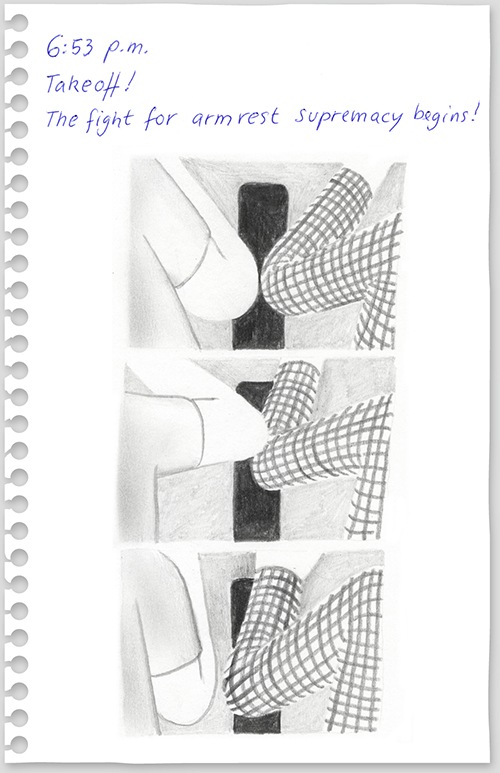
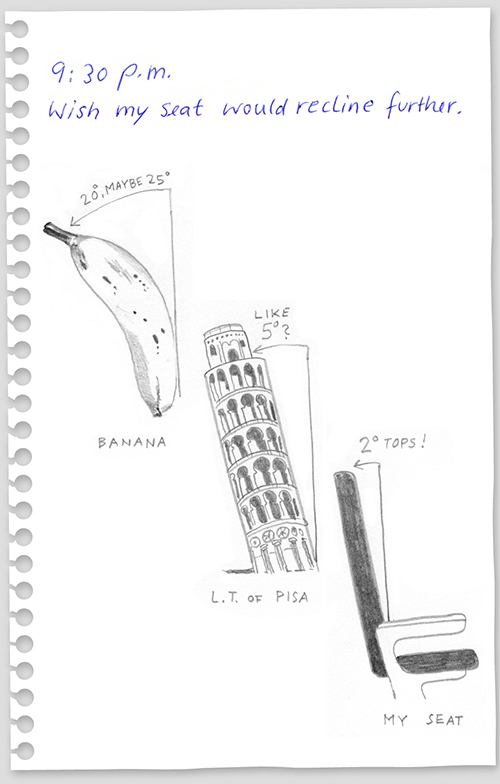
New York Times illustrator Christoph Niemann recently flew from New York to Berlin, and spent the flight illustrating his experience. I imagine anyone who has ever taken a long-haul economy-class flight will identify with it:
2010/7/13
If World War 2 documentaries were interpreted as fiction, the writing would suck:
So it's pretty standard "shining amazing good guys who can do no wrong" versus "evil legions of darkness bent on torture and genocide" stuff, totally ignoring the nuances and realities of politics. The actual strategy of the war is barely any better. Just to give one example, in the Battle of the Bulge, a vastly larger force of Germans surround a small Allied battalion and demand they surrender or be killed. The Allied general sends back a single-word reply: "Nuts!". The Germans attack, and, miraculously, the tiny Allied force holds them off long enough for reinforcements to arrive and turn the tide of battle. Whoever wrote this episode obviously had never been within a thousand miles of an actual military.
Anyway, they spend the whole season building up how the Japanese home islands are a fortress, and the Japanese will never surrender, and there's no way to take the Japanese home islands because they're invincible...and then they realize they totally can't have the Americans take the Japanese home islands so they have no way to wrap up the season. So they invent a completely implausible superweapon that they've never mentioned until now. Apparently the Americans got some scientists together to invent it, only we never heard anything about it because it was "classified". In two years, the scientists manage to invent a weapon a thousand times more powerful than anything anyone's ever seen before - drawing from, of course, ancient mystical texts. Then they use the superweapon, blow up several Japanese cities easily, and the Japanese surrender. Convenient, isn't it?
I'm not even going to get into the whole subplot about breaking a secret code (cleverly named "Enigma", because the writers couldn't spend more than two seconds thinking up a name for an enigmatic code), the giant superintelligent computer called Colossus (despite this being years before the transistor was even invented), the Soviet strongman whose name means "Man of Steel" in Russian (seriously, between calling the strongman "Man of Steel" and the Frenchman "de Gaulle", whoever came up with the names for this thing ought to be shot).
2010/7/11
At a PechaKucha (which seems to be Japanese for "Ignite"; i.e., a set of short presentations backed by slides on a timer) in Christchurch, Mike Dickinson, a zoologist specialising in mostly extinct flightless birds, speculates on the question of what exactly is Big Bird? (Spoiler: Grandicrocavis viasesamensis appears to be the flightless relative of a type of crane.)

2010/6/15
Typographical rant of the day: I'm Comic Sans, Asshole:
When people need to kick back, have fun, and party, I will be there, unlike your pathetic fonts. While Gotham is at the science fair, I'm banging the prom queen behind the woodshop. While Avenir is practicing the clarinet, I'm shredding Reign In Blood on my double-necked Stratocaster. While Univers is refilling his allergy prescriptions, I'm racing my tricked-out, nitrous-laden Honda Civic against Tokyo gangsters who'll kill me if I don't cross the finish line first. I am a sans serif Superman and my only kryptonite is pretentious buzzkills like you.
It doesn't even matter what you think. You know why, jagoff? Cause I'm famous. I am on every major operating system since Microsoft fucking Bob. I'm in your signs. I'm in your browsers. I'm in your instant messengers. I'm not just a font. I am a force of motherfucking nature and I will not rest until every uptight armchair typographer cock-hat like you is surrounded by my lovable, comic-book inspired, sans-serif badassery.
2010/5/13
A Brief, Incomplete, and Mostly Wrong History of Programming Languages:
1842 - Ada Lovelace writes the first program. She is hampered in her efforts by the minor inconvenience that she doesn't have any actual computers to run her code. Enterprise architects will later relearn her techniques in order to program in UML.
1987 - Larry Wall falls asleep and hits Larry Wall's forehead on the keyboard. Upon waking Larry Wall decides that the string of characters on Larry Wall's monitor isn't random but an example program in a programming language that God wants His prophet, Larry Wall, to design. Perl is born.
1995 - At a neighborhood Italian restaurant Rasmus Lerdorf realizes that his plate of spaghetti is an excellent model for understanding both the World Wide Web and that web applications should mimic their medium. On the back of his napkin he designs Programmable Hyperlinked Pasta (PHP). PHP documentation remains on that napkin to this day.
2010/5/2
The Economist rationalises the "outdated and illogical" map of Europe:
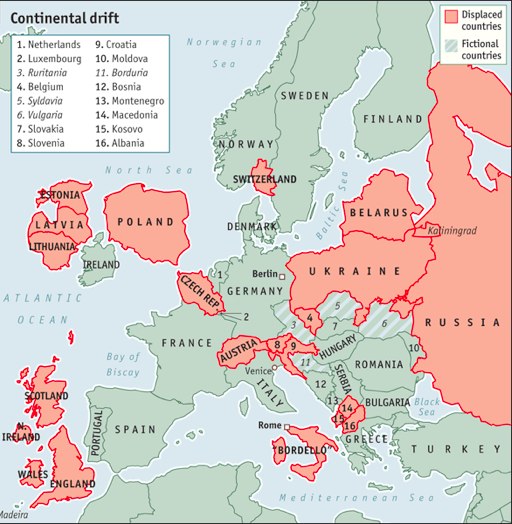
Belgium’s incomprehensible Flemish-French language squabbles (which have just brought down a government) are redolent of central Europe at its worst, especially the nonsenses Slovakia thinks up for its Hungarian-speaking ethnic minority. So Belgium should swap places with the Czech Republic. The stolid, well-organised Czechs would get on splendidly with their new Dutch neighbours, and vice versa.
Germany can stay where it is, as can France. But Austria could shift westwards into Switzerland’s place, making room for Slovenia and Croatia to move north-west too.* They could join northern Italy in a new regional alliance (ideally it would run by a Doge, from Venice). The rest of Italy, from Rome downwards, would separate and join with Sicily to form a new country, officially called the Kingdom of Two Sicilies (but nicknamed Bordello). It could form a currency union with Greece, but nobody else.
2010/5/1
New Age terrorists develop homeopathic bomb; terror alert level raised from "lilac" to "purple":
Homeopathic bombs are comprised of 99.9% water but contain the merest trace element of explosive. The solution is then repeatedly diluted so as to leave only the memory of the explosive in the water molecules. According to the laws of homeopathy, the more that the water is diluted, the more powerful the bomb becomes.
‘A homeopathic attack could bring entire cities to a standstill,’ said BBC Security Correspondent, Frank Gardner, ‘Large numbers of people could easily become convinced that they have been killed and hospitals would be unable to cope with the massive influx of the ‘walking suggestible’.’
2010/4/1
The Daily Mail Song, an exposé of the venomously right-wing, outrage-mongering British tabloid delivered in the form of a Subterranean Homesick Blues-style folk song. Brilliant and spot-on.
2010/3/14
Tattúínárdœla saga, an Icelandic saga telling the story of a fatal conflict between a father and his treacherous son, on which George Lucas' Star Wars films were based:
The story as presented in George Lucas’s films represents only one manuscript tradition, and a rather late and corrupt one at that – the Middle High German epic called Himelgengærelied (Song of the Skywalkers). There is also an Old High German palimpsest known to scholars, later overwritten by a Latin choral and only partly legible to us today, which contains fragments of a version wherein “Veitare” survives to old age after slaying “Lûc” out of loyalty to the emperor, but is naturally still conflicted about the deed when the son of his daughter Leia avenges the killing on him.
Lúkr is saved from drowning by the intercession of Leia and Hani’s men in the Þúsundár Fálkinn. Following this memorable climax, there is an extended lacuna in the manuscript, and the action picks up again with an episode wherein Lúkr rescues Hani and Leia from the corrupt (and grossly obese) Danish merchant Jabbi, a rather comical figure on the whole, and this entire incident is probably to be reckoned an interpolation from a later chivalric saga. Unfortunately the saga shows its repetitive nature at this point, and we once again learn that Veiðari is building, under the auspices of Falfaðinn, a great ship to be named Dauðastjarna in meiri. At a great feast, Lúkr and Hani swear that they will kill Veiðari and Falfaðinn, burn Dauðastjarna, and conquer Kóruskantborg. Their boasts are considered binding and the sworn brothers lead several warships loaded with men to the position of the Dauðastjarna. There Hani is assisted by what the saga describes as “birnir” (literally “bears,” but in context probably to be understood as “Shetlanders” – the German version confusingly seems to understand these as actual bears) in his great assault on Falfaðinn’s fleet, but Lúkr is captured by Veiðari and brought to an audience with Falfaðinn.
2010/3/7
A Trailer For Every Academy Award Winning Movie Ever; file alongside Charlie Brooker's self-referential TV news segment.
2010/3/5
Babylon - The system that produced all the goods to facilitate your neo-bohemian life style choices.
Ecstatic Dance - Flailing around arrhythmically.
Gifting - The act of dumping your useless crap on other people.
Jah Bless - If you are a white rasta the only time I want to hear you say Jah Bless is when someone asks your occupation. See: “Rasta”
Saturn Return - The depression that comes in your late 20’s when you realize your life is going nowhere and you still don’t have any money.
Universal Truths - The narrow set of beliefs held by your circle of friends.
2009/12/18
2009/8/24
The awards for the funniest jokes of the Edinburgh Fringe have been announced:
1) Dan Antopolski - "Hedgehogs - why can't they just share the hedge?"
4) Zoe Lyons - "I went on a girls' night out recently. The invitation said 'dress to kill'. I went as Rose West."
6) Adam Hills - "Going to Starbucks for coffee is like going to prison for sex. You know you're going to get it, but it's going to be rough."
2009/8/12
2009/6/12
The Onion has another fine slice of human disappointment: This Space Camp Looks A Lot Like Fat Camp:
Wow. I can't believe I'm really here. When I told my parents that I wanted to go to space camp, I never thought they'd actually agree. Especially not after they took me to see that doctor and he said that if I didn't lose some weight this summer I might end up getting diabetes. Mom and Dad seemed pretty concerned after that. But, hey, here I am!
Uh-oh. Better stand up straight. Here come our NASA-trained camp counselors! Strange. They look a little young to have graduated from the flight academy already. And why are they wearing gym shorts and coaches whistles instead of their regulation flight suits? Come to think of it, why am I the only one who showed up wearing a flight suit?
No, wait. It can't be. This is not what it looks like. It's space camp. That's why this gymnasium they've taken us to has a giant model of the solar system. Yes! Check it out! A giant, sprawling replica of the solar….
Okay. Those are just a bunch of different colored exercise balls.
2009/3/24
2008/11/11
The latest in the line of "Stuff (group) Like" blogs is Stuff Geeks Love, which mentions things like "zombies", "Libertarianism", "cancelled TV shows" and "sex", and shines a revealing yet harsh light on stereotypical "geek" obsessions:
Comic book geeks are especially prone to faux boycotts. Every week hundreds of comic book fans declare that, because of some perceived outrage, they will never buy anything from DC or Marvel again. And the following week they proceed to do so because otherwise their runs on titles will be incomplete and because what else are they supposed to do? They’ve been reading X-Men since they were nine and aren’t going to stop now! Within weeks of the “true fan” declaring that he’ll never buy another Marvel comic again he’ll proudly declare victory for Marvel when an issue of their current “event” comic sells a few dozen more issues than an issue of DC’s current “event” comic.
It’s not surprising geeks have affection for zombies; these creatures are arrested in their existence, unable to change or grow. Geeks feel a oneness with them. And although zombies are frightening to look at, they don’t seem on the surface to be a serious threat, but their numbers and sheer tenacity make them possibly the most sinister killers of all. This is another thing geeks like to think they feel a oneness with; the underestimated lethal threat. Also, zombies desire, above all else, brains.
Geeks enjoy being Libertarians for two reasons. First, it allows them to be Conservative without having to belong to one of the two mainstream parties that the regular sheep are part of. Second, it gives them a political party that is just as self-absorbed as they are. Conservatives don’t care if you think they’re selfish pricks. Libertarians wonder why you don’t admire them for it.
Having a show canceled also has another upside for the geek. If it’s no longer in production, all those meddling writers, producers, actors, and studios can’t “mess it up” for him by having things happen on the show that blatantly contradict the obvious “right way” things would happen, were the geek in charge. It saves him the later trouble of having to declare he’s going to boycott the show (he won’t) because someone on the show did something that was “totally out of character”. It puts the show into a little snowglobe the geek can cradle and protect from the cruel outside world. The geek and his friends now own and control it and it is finally where it belongs, in the hands of the “true fans”.
2008/10/23
Writer David Sedaris writes about undecided voters:
To put them in perspective, I think of being on an airplane. The flight attendant comes down the aisle with her food cart and, eventually, parks it beside my seat. “Can I interest you in the chicken?” she asks. “Or would you prefer the platter of shit with bits of broken glass in it?”
To be undecided in this election is to pause for a moment and then ask how the chicken is cooked.
I wonder if, in the end, the undecideds aren’t the biggest pessimists of all. Here they could order the airline chicken, but, then again, hmm. “Isn’t that adding an extra step?” they ask themselves. “If it’s all going to be chewed up and swallowed, why not cut to the chase, and go with the platter of shit?”
2008/8/27
In his WIRED column, Lore Sjöberg savours his last days without an iPhone:
Right now, I can have a thought like, "I wonder who had a hit first, Chuck Berry or Little Richard?" and allow that question to wander around in my head. Maybe I'll remember it and look it up when I get the chance; maybe I'll just let it go. I suspect that this time next month I'll be pulling over to the side of the road -- I hope I'll pull over to the side of the road -- to get the answer immediately.
Right now, my friends are not subjected to photos of every "witty" stop sign annotation I encounter. In fact, they can actually hang out with me with no fear of showing up in my Flickr stream with basil in their teeth.
Right now, I do not post to Twitter every time I see a dachshund.
Right now, I am capable of referring to my cellphone without actually telling people what brand it is.
2008/8/21
New from McSweeney's: Selections from H.P. Lovecraft's Brief Tenure as a Whitman's Sampler Copywriter:
Caramel Chew:
There is a dimension ruled by a blind caramel God-King who sits on a vast, cyclopean milk-chocolate throne while his mindless, gooey followers dance to the piping of crazed flutes. It is said that there are gateways in our world that lead to this caramel hell-planet. The delectable Caramel Chew may be one such portal.
Toffee Nugget:
Few men dare ask the question "What is toffee, exactly?" All those who have investigated this substance are now either dead or insane.
2008/8/17
The Independent has a list of what it claims are the 50 best jokes from the Edinburgh Fringe:
"I told the ambulance men the wrong blood type for my ex, so he knows what rejection feels like" – Pippa Evans
"The Scots invented hypnosis, chloroform and the hypodermic syringe. Wouldn't it just be easier to talk to a woman?" – Stephen Brown
"'What's a couple?' I asked my mum. She said, 'Two or three'. Which probably explains why her marriage collapsed" – Josie Long
"If Britons were left to tax themselves, there would be no schools, no hospitals, just a 500-mile-high statue of Diana, Princess of Wales" – Andy Zaltzman
"My granny was recently beaten to death by my granddad. Not as in, with a stick – he just died first" – Alex Horne
2008/6/19
If cookery was like Dungeons & Dragons:
Posted: 12:15 a.m. by LordOrcus I'm so mad that there's a new edition of The Better Joy Cookbook out. Thanks for making my old copy obsolete, you greedy hacks! For five years now, my friends have been coming over for my eggplant Parmesan, and now I'm never going to be able serve it again unless I shell out 35 bucks for the latest version.
Posted: 1:52 a.m. by IAmEd As I have pointed out MANY TIMES, several of these recipes contain raisins, and I, like most people, am ALLERGIC to raisins! And before you tell me to substitute dried cranberries, I will reiterate that I am discussing the recipes AS WRITTEN. I do not appreciate your ATTACKING ME with helpful suggestions!
2008/6/3
Someone has posted a remixed version of an old Ladybird book about policemen, apparently from the 1950s or so, with the original text replaced with a vaguely subversive/surrealist alternative:
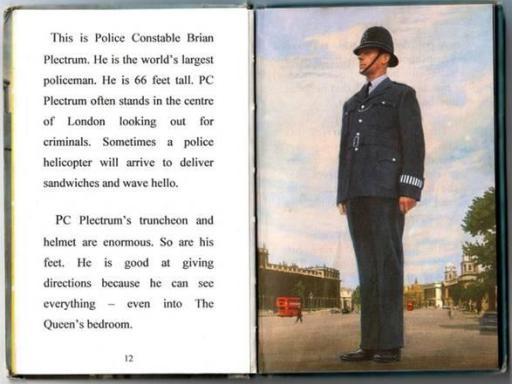
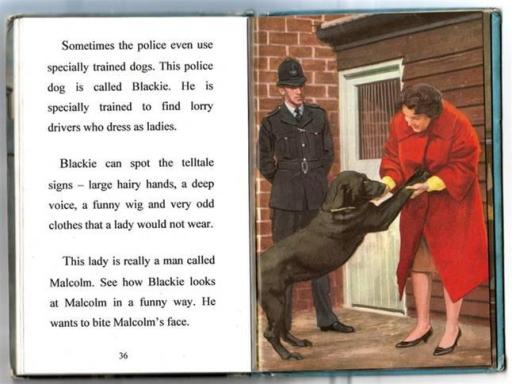
Note: if you're a police officer, passing this around at work may not be a good idea.
(via Boing Boing) ¶ 1
2008/5/30
Obscure television programme of the day: Heil Honey I'm Home!. Produced in Britain in 1990, this was intended to be a rediscovered 1950s US sitcom set in Nazi Germany, and concerned with the domestic life of (a fictionalised) Adolf Hitler and Eva Braun and their neighbours, the Goldensteins. The characters are presented in classic 1950s American sitcom tradition; the Hitler character himself comes across as a loud, oafish guy, a sort of Fred Flintstone in Nazi drag, Eva Braun is a traditional housewife, and the Goldensteins are cantankerous schmucks, apparently from somewhere in Brooklyn.
Not surprisingly, the programme turned out to be controversial and was scrapped early; only one episode was ever aired, a low-quality copy of which may be seen here.
2008/5/22
After the recent wave of films reprising 1980s films. such as Indiana Jones and Rambo, some speculation on other sequel possibilities we may soon see:
"Back to the Future IV"
The sequel: Teenage Marty McFly Jr.* (Michael Cera) and best friend/secret crush Madison Tannen (Evan Rachel Wood) discover Doc Brown's DeLorean hidden in a storage shed and take it for a joy ride, accidentally landing in 1985.
In this only-loosely-tied-to-the-originals “reboot,” the two nerdsters attempt to fit in by adopting the styles and lingo of the day. (Madison: “Seriously, 'Gag me with a spoon?' People actually said that?”) They try on various period clothing in a mall-set montage and crash a raucous high school dance featuring Huey Lewis and the News.
"40 Candles"
The sequel: “The Big Chill” as envisioned by Judd Apatow. Screwball antics ensue when the original cast reunites at the funeral of Jake Ryan, tragically killed in a car crash. (In real life Schoeffling now makes furniture in Pennsylvania, so his character only appears in flashbacks.) Divorcée Sam has a teen daughter of her own and the father is—wait for it!—Farmer Ted.
2008/5/20
At the head of his most recent restaurant review, The Times' AA Gill pithily sums up YouTube:
“Look at this, Dad. You’ll like this.” Generally, when Ally, my eldest son, tells me to look at something I’ll like, it’s a 30-second phone film of someone getting very angry, falling over and being crapped on by a horse. Or it’s a dancing mongoose, or a drunk Australian naked bungee-jumping. YouTube has all the properties of a Dark Ages bestiary. It intimates a distant world of bizarre and inexplicable otherness, proving we live in a fearsomely weird and magic place full of talking dogs, men who use their oversized feet as umbrellas, women who breast-feed rabbits and the fanatical personal rants of messianic bedroom hermits. It’s the electric-light Herodotus, and I rather enjoy it, if I’m being led by a 15-year-old. It seems to confirm a personal aperçu: the more information you have, the less you understand.
2008/5/16
Yiddish spam titles. (Well, Yinglish, to be precise, but still amusing:)
If they have the internet in the world of The Yiddish Policemen's Union, the mailboxes would probably be full of subject lines like these.Do shiksas heckle your schmeckel?
XXX ... Yenta noshes on pisher's trayf blintz! Hot!
Take this and you'll need another bris!
Also in McSweeney's Lists: Brews to Accessorise the Modern Hipster ("I Don't Really Like This but I'm Drinking It to Get Back at My Parents and/or Friends With an Overt and Crass Display of Being Cultured Lambic", "Rummage Sale Pale Ale"), and Phrases Commonly Used By 1950s Housewives That Were Often Misinterpreted As Blatant Requests For Sex.
2008/4/16
Times columnist Caitlin Moran's latest column takes a very sensibly British view of sex, in particular casting a jaundiced eye over the virtues of the much-vaunted all-night sexual marathon:
Despite decades of insistence that all the best sex lasts 15 hours, spans a minimum of nine positions and has both parties hammering dementedly away at each other's nether regions like a pair of autistic woodpeckers, it seems the truth is a little different. Well, totally different. According to a poll of 50 sex therapists, the most desirable sex lasts, in actual fact, mere minutes. Between 3 and 13, optimally. Or, to break it down another way, a span somewhere between Penny Lane and the second half of an episode of My Family. The time it takes to get from Finchley Road to Wembley Park. Barely enough time to toast a muffin.
Similarly, whilecertainly a great fan of “sexual intercourse” - I find it a refreshing alternative to both arguments and jogging, and believe it to be the only civilised way to end a game of Scrabble - life is, tragically, short. Very short. However wonderful being borne aloft on the wings of ecstasy, etc, may be, there are also an awful lot of Neil Finn albums to get through, hats to wear, air-guitar to play, anecdotes to tell, and clips of cats falling off things on YouTube to watch. I don't believe that these activities are necessarily better than physically uniting with a loved/drunken one. It's just that I wouldn't sacrifice them in favour of 19 hours of a really quite repetitive act. Honestly, if you can't achieve what you set out to do in half an hour or less, it's possible that you just might not be doing it properly. I'd check all available diagrams, and try again.Further down, Moran mentions the sad decline of birdsong in England, with ambient noise levels causing birds to not pick up each others' songs, and an all-birdsong radio station going out of business.
When I read the first of these reports, I realised that they were right. The dawn choruses of my childhood seemed immense - whole treefuls of birds exploding with the sun, and sounding like the orchestral wig-out in A Day In The Life. These days, however, the dawn chorus sounds like three rats coughing behind some bins - a pitiful collection of bleeps, squawks and rasps that no more welcomes the dawn than the sound of a brick being thrown through a window.
2008/3/19
International Association of Time Travelers: Members' Forum Subforum: Europe – Twentieth Century – Second World War; Page 263; a fiction about time travel and online forum etiquette/politics:
At 02:21:30, SneakyPete wrote:
Vienna, 1907: after numerous attempts, have infiltrated the Academy of Fine Arts and facilitated Adolf Hitler's admission to that institution. Goodbye, Hitler the dictator; hello, Hitler the modestly successful landscape artist! Brought back a few of his paintings as well, any buyers?
At 02:29:17, SilverFox316 wrote:
All right; that's it. Having just returned from 1907 Vienna where I secured the expulsion of Hitler from the Academy by means of an elaborate prank involving the Prefect, a goat, and a substantial quantity of olive oil, I now turn my attention to our newer brethren, who, despite rules to the contrary, seem to have no intention of reading Bulletin 1147 (nor its Addendum, Alternate Means of Subverting the Hitlerian Destiny, and here I'm looking at you, SneakyPete). Permit me to sum it up and save you the trouble: no Hitler means no Third Reich, no World War II, no rocketry programs, no electronics, no computers, no time travel. Get the picture?
2008/3/15

2008/2/20
How To Behave On An Internet Forum, presented in the form of a retrostyled pixel-art video:

(via Boing Boing) ¶ 0
2008/2/14
Stuff White People Like ("white people" here meaning "white upper-middle-class Americans"). Includes entries for things like "sushi", "indie music" (and "standing still at concerts"), "Wes Anderson", "Michel Gondry", "Apple products" "not having a TV", "irony", "travelling", "coffee" and "tea", all delivered with a good dose of sarcasm:
So when white people go to concerts at smaller venues, what to do they do? They stand still! This is an important part of white concert going as it enables you to focus on the music, and it will prevent drawing excess attention to you. Remember, at a concert everyone is watching you just waiting for you to try to start dancing. Then they will make fun of you. The result is Belle and Sebastian concerts that essentially looks more like a disorganized line of people than a music event.
White people love to be near a body of water so they can read a book, while sitting nearby. The process of reading is somehow heightened through the process of doing it near some water. Extreme reading!
White people cannot get enough of 80s music, partially out of nostalgia, and partially since it was the last time that pop music wasn’t infused with hip-hop or R n’ B stylings. Artists like Joy Division, New Order and Elvis Costello were all pretty well respected and had solid runs at the charts. Also, less respected artists like Wham, Rick Astley and Cameo are still easy for white people to dance to.
If you find yourself in a situation with a white person, acceptable things to say include “I’m really into tea right now,” or “my favorite thing is to get a nice cup of tea and curl up in a chair with a good book.” But do not remind them about the role of colonialism in tea, it will make them feel sad.
2008/2/13
Libertarian Troll Bingo; print it out and cross it off the next time Randroids invade your favourite discussion site:

(via  reddragdiva) ¶ 0
2008/2/8
Norwich-based comedian and reviewer of dubious far-eastern video game machines Dr. Ashen (he's the "sarcastic British guy") reviews the Vii, a cheap video-game console of Chinese manufacture which attempts to imitate the Nintendo Wii without having much of the technical innovation. If you ever wondered what one of those could possibly be like, here's all you need to know. (Capsule summary: don't bother importing one.)
2007/12/21
Among the latest additions to the often irreverent slang used by doctors, as tracked by the British Medical Journal: a "Hasselhoff" is a patient who turns up in casualty "with an injury with a bizarre explanation", a Jack Bauer is a doctor who is still working after 24 hours on the job, and a Father Jack is a "confused, usually elderly patient whose constant high-pitched verbal ejaculation and attempts to get out of bed are responsible for insomnia on wards".
2007/12/13
Charlie Stross visits London and devises a foolproof means of preventing terrorist suicide bombings in the capital:
The solution to protecting the London Underground from terrorist suicide bombers can be summed up in one word: Daleks. One Dalek per tube platform, behind a door at the end. Fit them with cameras and remote controls and run them from Ken Livingstone's office. Any sign of terrorism on the platform? Whoosh! The doors open and the Dalek comes out, shrieking "exterminate!" in a demented rasp reminiscent of Michael Howard during his tenure as Home Secretary, only less merciful.
The British are trained from birth to know the two tactics for surviving a Dalek attack; run up the stairs (or escalator), or hide behind the sofa. There are no sofas in the underground, but there are plenty of escalators. Switch them to run upwards when the Dalek is out, and you can clear a platform in seconds.
Suicide bombers are by definition Un-British, and will therefore be unable to pass a citizenship test, much less deal with the Menace from Skaro. And as for motivating the Daleks, one need only mention that the current crop of would-be British suicide bombers are doctors ...
2007/12/11
11 of the world's worst word-mashup trademark filings. Includes gems like "eatainment", "collaboneering", "webume", the unfortunate "entremaneur", and the frankly jaw-dropping "innovisioneering".
2007/12/6
2007/11/21
The pleasant, inflectionless female voice behind the prerecorded announcements on the London Underground (commonly referred to as "Sonia", as in "gets on ya' nerves") is a voiceover artist and comedy/drama writer named Emma Clarke. Like many freelance professionals contending in today's marketplace, she has a web site to promote her work, which, among other things, includes a selection of spoof Tube announcements, chiding self-important Sudoku enthusiasts, loud American tourists and surreptitious lechers, and reminding Londoners that there are other places in Britain than their "stinking shithole of a city", all in the comfortingly familiar Sonya voice.
Clarke's site also has a number of other diversions, including a Flash game allowing you to assemble a radio ad from prerecorded clichés.
2007/11/1
Seen in a Times piece on amusing signs around the world, this sign is in Pune, India:
They do seem to have an appreciation of the full breadth of the English language in Pune.
2007/8/2
Activision Reports Sluggish Sales For Sousaphone Hero:
Hendleman admitted that the $345 retail price might be a bit steep for many consumers. She also conceded that Activision may have erred by not releasing the game between Memorial Day and July 4, the prime parade season in the United States. Even so, she added, Sousaphone Hero contains "more than enough" features to keep gamers absorbed.
"And if you like multiplayer gaming, you're in luck," Hendleman continued. "In Sousaphone Hero's cooperative marching-band mode, as many as 135 of your friends can play simultaneously."
2007/7/17

2007/6/6
MySpace outage leaves millions friendless; aid workers fear long-term psychological damage:
"I lost 6,456 of my best friends in an instant," said Minneapolis resident Peter Steinberg, 20, who has loyally befriended as many profiles as possible over the past two years. "Nothing can describe how devastated I feel. Some of these people I've exchanged two, even three comments with, and I can't tell you how many ROTFLMAOs we've shared, too."
Corey "Aqualad" Friesen, 18, of Danville, IL appeared to share Mancuso's fears about manual and analog socializing. "I vaguely remember trying to make friends pre-MySpace, but in 16 years, I only made three real friends," Friesen said. "If I have to revert back to face-to-face friend gathering, I would be middle-aged before I built that number into the double digits. I'd definitely never get back into the hundreds again."
"Without an 'About Me' section, I've lost all sense of self," said Imbrescia, 17, who depends on the site to convey his innermost thoughts to millions of extended-network friends. "Do I want kids? How tall am I? What's my body type? These are questions I can't answer anymore. I'd pray to a god for help, but I've lost my religion field."
2007/6/5



2007/4/3
For years, map historians have been puzzled by the so-called "London Underground Map", and have speculated on what it could possibly represent. Now a new theory claims that, when rotated and adjusted appropriately, the map corresponds with the map of Australia:
Captain Columbus set sail from Whitby in the "Beagle" soon after he had routed the Armada at Trafalgar, in 1215, and reached Australia a few months later. It is thought that he had the map drawn for him, by one Harry Beck, to remind him where he had buried the treasure. Not wanting the map to lead other explorers to find the loot, should the map have fallen into the wrong hands, he instructed Beck to insert all kinds of fictitious roads and placenames -- even airports!
In Beck's hands, Port Philip is renamed Watford -- presumably in an attempt to deter would-be looters -- Botany Bay is renamed Uxbridge, Perth: Upminster and Albany: Epping. Mystery still remains about the purpose of the zonal markings, but Professor Bovlomov speculates that they might indicate the friendliness -- or hostility -- of the natives. The Professor believes that Beck may have included a coded message within the map to identify the location of the treasure. "Bank" is dismissed as "too obvious", and is probably intended to lead the unauthorised holder of the map to a certain death. West Finchley, though, may prove to be the site of the hidden treasure because, as the professor says: "It is obviously a made up name, and was probably invented by Beck as a kind of joke. No one would ever think of going to such a place, let alone living there!" When asked to comment, other experts said it was Barking.
2007/3/28
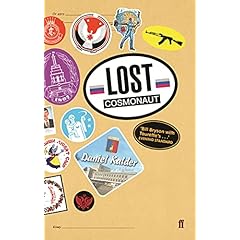 A few days ago, I was at Fopp near Covent Garden, where I found an interesting-looking book titled Lost Cosmonaut, by one Daniel Kalder. I picked up this book, along with a handful of others, and over the next few days, read it, finding it fascinating.
Lost Cosmonaut is a travelogue around various far-flung parts of Russia, with a difference. For one, in the spirit of what he calls "anti-tourism", the author eschews the exotic, beautiful or spectacular, instead seeking out the mundane, boring and depressing. The book starts with an anti-tourist manifesto, titled the "Shymkent Declarations", declaring the Taj Mahal, Great Wall of China and Pyramids of Egypt to be "as banal as the face of a Cornflakes packet", and that the true unknown frontiers lie in the "wastelands, black holes and grim urban blackspots" of the world. The book itself follows in this vein, as the author (a somewhat sardonic Scotsman) visits four parts of Russia's ethnic republics where no tourists normally go, and describes them and the people with great wit and some embellishment. At times it verges on a sort of Borat-esque poverty porn, finding humour in the grimness of it all (and one of the people he talks to, an Udmurtian actress, actually accuses him of this), though the book transcends this, casting a more philosophical eye at the world: in many places, Kalder speculates on the myriad of small secrets in the various distant corners of the world, the minor triumphs and lesser geniuses whose works will be lost to obscurity, the languages and cultures dying out and falling out of living memory, and comes close to funding a sense of wonder in the mundane and bleak. Such flights are usually followed by wry illustrations of the general shittiness of the particular place he is currently visiting.
In the book, he visits four places, all of which are technically within the European part of Russia, though are, to varying extents, culturally alien to most Westerners' idea of Europe (glass buildings and Ikea furniture, as he puts it). He visits Kazan, once the glorious capital of the Tatars, since destroyed several times over and now rebuilt as a typically grim Soviet provincial city (and at the end speculates that perhaps the original Kazan is better off razed, because that way it can never decline into a tawdry tourist cliché), the Kalmykian republic (which is run by an eccentric despot who is obsessed with chess, and quite possibly murderously corrupt), Mari El (centre of the mail-order bride industry, in whose forests an ancient pagan faith still flourishes, or at least several half-complete reconstructions of one do), and finally Udmurtia, whose population has been so thoroughly assimilated into Russia that nobody knows exactly what the indigenous culture was like.
2007/3/26
There is now a Richard Stallman as Che Guevara T-shirt, perfect for wearing to copyfighter meetups, showing your free-software/Creative Commonist sympathies and/or taking the piss out of over-earnest Penguinistas.

2007/3/10
Australian cartoonist and philosopher Michael Leunig confesses the extent of his involvement in the vast left-wing conspiracy against the values decent people hold dear:
Anyway, we are a homogenous group, all more or less identical, and we meet every Thursday night in a secret fairy dell that lies within a beautiful ferny glade in the old-growth forest - the moral high ground you might say, where we practise preaching and the double standards for which we are famous. We hug trees and skip about celebrating atheism and moral cancer, and indulge in the sublime pleasure of gleefully ignoring the human rights abuses of terrorists and certain fascist regimes. We achieve this state of rapture and denial by drinking chardonnay and losing ourselves in reminiscences about the '60s when we were all promiscuous hippies living on social welfare, smoking dried banana peel and making snide jokes about Vietnam War veterans.
Like normal people, leftists now have to get up in the morning and earn a living, seeing as the fascists have come down so hard on social welfare fraud, and this is the cruel reality. The good old days are gone and increasingly, leftists are to be found working in ordinary, proper jobs. For instance, it may surprise you to consider that a leftist appeaser could be feeding your mum tenderly with a little spoon in the dementia ward right at this very moment.
The remarkable thing is, that you wouldn't recognise them as classic anti-war leftists because mostly they don't look or sound like those educated, twee, dinner-party feminists - the ones who are often singled out by the rankled commentators as typical annoying leftists. At least not as far as I can discern, and I wonder if perhaps these new lefties I'm discovering have committed identity theft. They just don't seem like sickening, repulsive leftists.
Raging with stale conviction against the "moral cancer" of the left is like lashing out at the wind - apart from being futile, there's something forlorn, emotionally wacky and phantasmagorical about it. The only authenticity to it lies in the faint smells of guilt, personal resentment, eros-envy and bad liver.
2007/2/8
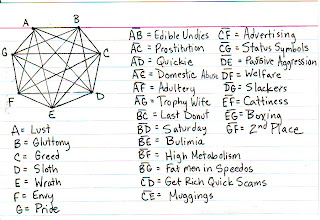
A diagram connecting all combinations of the Seven Deadly Sins to produce 21 secondary sins (enumerated):
(via Boing Boing) ¶ 0
2006/12/11
Overheard In London, a repository for amusing things overheard in, well, London:
"The Central Line is quite fast, though?"
"Yeah, one every two minutes. And that's real minutes, not Northern Line minutes."
Two business talking in the tube, one said : "Went over to Sydney the other day, was asked by customs clearance 'Do you have a criminal record, Sir ?', I answered 'Sorry, I did not know it is still required'"
In a library in Hackney
"I'm sorry sir, all the books on pit bull terriers in all the public libraries of Hackney have been stolen"
Girl 1: "What are you doing for your birthday?"
Girl 2: "I was planning a David Hasselhoff dance party but it didn't work out. A few of the people from the magazine gave me a Cher doll. I love Cher. She's like Shakespeare. I'll have an anti-fur, Cher party instead."
Girl 1: "Are you from Shoreditch?"
(via reddragdiva) ¶ 0
2006/12/7
A Times columnist's take on France24 and those silly French people:
Since, alongside the news , the new state-funded France 24 channel sees itself as an ambassador for the French "art de vivre" (French for "way of life") and for its "savoir faire" ("rural snail-tasting festivals"), the channel launched at 7.29 GMT yesterday evening -- presumably in order to allow staff and viewers to first knock back a couple of reviving Pernods after their return from the traditional Gallic post-work/pre-dinner bout of hanky-panky ("mouchoir-pouchoir").
That means that at the time of writing, we don't actually know what the opening headlines were. But we might guess they were something along the lines of, "Iraq, c'est encore un grand mess, n'est-ce pas?" (literally, "That George Bush is a dork, isn't he?"); And "L'Angleterre evidemment a une équipe de cricket qui joue comme un bunch de garçons de Nancy -- pas, obvieusement, notre Nancy en Lorraine!"); though maybe not, "Et maintenant, les actualités chaud directe de Rwanda ...").
France 24 is basically a TV channel for a nation that is annoyed that it has failed to persuade the rest of the world to speak French rather than English (apart from -- and this really embarrasses them -- the word gauche, which is the universally used term for "Donald Rumsfeld").Aside: I wonder which variant of English France24 will use: whether it'll be broadcast in the Commonwealth English of their ancient adversaries and fellow EU members across la Manche, or the American English of their former revolutionary protegés and historical friends, recently seen eating Freedom Fries and putting "First Iraq, then France" bumper stickers on their Hummers.
2006/11/14
An article interviewing some of the people taken in by Borat; some of them are sanguine about the experience, whilst others are angry:
"They were exercising a First Amendment right," said Haggerty, adding that he enjoyed the movie. "And this Sacha Cohen guy's going to make 87 gazillion dollars. You know, good for him. I'm just sorry that he had to do it in such a way that he allowed people to make jerks out of themselves exposing their character flaws."
Kathie Martin, who runs an etiquette school in Birmingham, Alabama, was also left out of the joke. Even though she was gracious and calm when Borat showed her nude photos of his son, Martin admitted she was "taken aback" by his routine during their on-camera meeting. "Unless you can figure it out for yourself, you have no way of knowing you have been tricked into being part of a childish prank with an R rating attached," she told the AP via email.
Ronald Miller, of Natchez, Mississippi, was baffled by the ruse. He and his wife attended a dinner at a plantation house, which they were told would be an interview with an "Eastern European television reporter coming to Natchez to film social customs in the South", he said.
2006/10/31
The Daily Telegraph has some excerpts from a book on the psychology of the joke:
Jerry Seinfeld compares telling a joke to attempting to leap a metaphorical canyon, taking the audience with him. The set-up is the nearside cliff, and the punchline is the far side. If they're too far apart, the listeners don't make it to the other side. And if they are too close together, the audience just steps across the gap without experiencing any exhilarating leap. The joke-hearer gets far more pleasure from the joke if he or she has to do a little work.
The surprise mechanism doesn't work without effective timing. It's almost impossible to explain in print because our eyes always skip ahead to the punchline before the set-up is properly digested. But next time you listen to a comedian, listen to the pauses. They're not that funny on their own - obviously, they're just tiny silences - but the point is, neither are the jokes.
It's not that long, wordy jokes can't be funny, but if too much is explained, there's no logical leap for the audience to make, and the paradigm shift which elicits laughter is lost.
Compare: I'm not a homosexual. Mind you, I might be mistaken for one if I went to the north of England. In places like Newcastle, there's such a culture of macho posturing that they go out in their shirtsleeves in all kinds of weather, so if you wear a coat they think you're gay.
And: I'm not gay. Unless you're from Newcastle and by 'gay' you mean, 'owns a coat'.
(via Mind Hacks) ¶ 0
2006/10/27
Online humorist Lore Sjöberg has finally bowed to the sort-of-inevitable and joined MySpace, the obnoxiously spammy, rather rubbish social-network website which everyone is, for some reason, on; he documents the process here:
In signing up, I give my actual birth date, which is already a faux pas. I'm not clear on the details, but I understand that on MySpace, no matter your actual age, you generally say you're 14.
Step Three: Invite your friends to join MySpace. Seriously. I haven't even seen my own page yet, and already they're hassling me to shill for them. This is like going to a restaurant where the waiter brings you a glass of water and a basket of rolls, then hands you the phone and asks you to call your friends and tell them how great the food is. I pass.He posted a follow-up a week later here:
The immediate effect of my publishing a link to my MySpace page last week was that I started getting friend requests from people with names like "Senor Discount" and "Johnny One-Spur." It seems shallow to accept people I've never met as friends, but I like to think that anyone named "Senor Discount" is excellent friend material, online or off. Anyhow, after approving all my new friends and triggering about 400 server errors in the process, I now have 319 friends. That's what I love about the internet -- it allows you to have more friends than casual acquaintances.
Next step is to add a background image. There are pages on MySpace without background images, but all they have going for them is legibility. Take it from me, a massive picture of an anime demon kitty in high heels and an extremely skimpy nurse's outfit says more about you than a thousand readable blog entries could. I don't have a picture like that, though, so I put up a photo I took of a frozen pizza I once bought that was supposed to be half pepperoni combo and half cheese, but the cheese "half" took up a lot more space than the combo half. I think that says a lot about me, too.
I look upon my MySpace, and I see that it is good. Each part of it competes with the other for attention, creating an experience that blasts the senses, yet leaves the psyche unaffected. The many voices combine into a colorful but meaningless roar. A metaphor, perhaps, for MySpace as a whole, or the web, or perhaps all of human existence. I also had a shirt like that once.I've so far avoided having a personal MySpace page; primarily because it's much like all the other social-network sites (anyone remember Friendster? SixDegrees?), only more rubbish and obnoxious and full of parasitic marketers and carpetbaggers eager to waste your time. I spend enough time cleaning out the spam from my mail; I don't need to devote another 15 minutes a day to batting off friend requests from brand campaigns and random strangers with nothing better to do. However, I might set up a MySpace page for a music project or a night.
2006/10/25
US musician James "Wooden Wand" Toth has written a test for predicting the lifespan of your band:
We'll start with a generous TEN YEARS and go from there, adding and subtracting as needed.
- SUBTRACT ONE YEAR for any two people in the band who identify themselves as a couple, and TWO YEARS for each additional couple.
- ADD ONE YEAR for every attractive girl in the band. Add six more months if she doesn't play bass.
- SUBTRACT THREE MONTHS for each vegetarian in the band who worries that the Waffle House hash browns are 'cooked with the meat spatulas.'
2006/7/26
Wikipedia Celebrates 750 Years of American Independence:
"It would have been a major oversight to ignore this portentous anniversary," said Wikipedia founder Jimmy Wales, whose site now boasts over 4,300,000 articles in multiple languages, over one-quarter of which are in English, including 11,000 concerning popular toys of the 1980s alone. "At 750 years, the U.S. is by far the world's oldest surviving democracy, and is certainly deserving of our recognition," Wales said. "According to our database, that's 212 years older than the Eiffel Tower, 347 years older than the earliest-known woolly-mammoth fossil, and a full 493 years older than the microwave oven."
The commemorative page is one of the most detailed on the site, rivaling entries for Firefly and the Treaty Of Algeron for sheer length. Subheadings include "Origins Of Colonial Discontent," "Some Famous Guys In Wigs And Three-Cornered Hats," and "Christmastime In Gettysburg." It also features detailed maps of the original colonies--including Narnia, the central ice deserts, and Westeros--as well as profiles of famous American historical figures such as Benjamin Franklin, Special Agent Jack Bauer, and Samuel Adams who is also a defensive tackle for the Cincinnati Bengals.
2006/7/14
An article in Prospect looks at the tradition of black humour behind the Iron Curtain:
Communism was a humour-producing machine. Its economic theories and system of repression created inherently funny situations. There were jokes under fascism and the Nazis too, but those systems did not create an absurd, laugh-a-minute reality like communism.
When Russian tanks rolled into Prague in 1968, the population fought back with wit. Every night graffiti appeared in Wenceslas Square with lines like "Soviet State Circus back in town! New attractions!" and "Soviet School for Special Needs Children—End-of-Term Outing." People cracked jokes: Why is Czechoslovakia the most neutral country in the world? Because it doesn't even interfere in its own internal affairs. And: Are the Russians our brothers or our friends? Our brothers—we can choose our friends. "We showed our intellectual superiority," one former dissident told me proudly.
Jokes under communism were shaped by the cultures that produced them, as they are anywhere else. For the Czechs, a sense of humour encapsulated a type of national resilience. East German jokes, meanwhile, tended to be touchingly self-deprecating. And yet there was a pan-communist umbrella of comedy that stood above national distinctions, just as the international socialist project itself did. What ultimately defined the genre was less the purpose it served than its style. The communist joke was by nature deadpan and absurdist—because it was born of an absurd system which created a yawning gap between everyday experience and propaganda. Yet sometimes, through jokes, both communists and their opponents could carry on a debate about the failings of communism.
(via Boing Boing) ¶ 1
2006/6/14
From a glossary of common polyamorist phrases, written by a professional dominatrix from Seattle:
Poly phrase: "So, which conventions do you like to attend, what kind of books do you like to read, what are your spiritual beliefs, and what is your ideal occupation?"(To which one could possibly add "what music are you into?", which would translate roughly as "1980s, EBM, ethereal or darkwave?")
English translation: "Which science fiction conventions do you like to attend, who is your favorite fantasy author, what form of neo-paganism do you ascribe do, and where in the computer industry would you like to work?"
2006/6/10
WIRED has a picture of a bookshop's "how-to" section from the post-singularity future; this includes titles like "Talking To Your Kids About Mitochondrial De-Aging", "Our Hive-Mind, Ourself", and "The Easy Way To Stop Playing World of Warcraft: A 12-Step Guide". Not to mention a few contributions from famous people, such as Katie Holmes' "Dianetics Revisited" and Francis Fukuyama's "The End of History: This Time For Sure".
(via Boing Boing) ¶ 0
2006/5/23
Writing in the Graun, comedian Stewart Lee examines the foundations of the stereotype that the Germans don't have a sense of humour; he finds that it comes from the structure of the German language making certain types of humorous devices impossible:
At a rough estimate, half of what we find amusing involves using little linguistic tricks to conceal the subject of our sentences until the last possible moment, so that it appears we are talking about something else. For example, it is possible to imagine any number of British stand-ups concluding a bit with something structurally similar to the following, "I was sitting there, minding my own business, naked, smeared with salad dressing and lowing like an ox ... and then I got off the bus." We laugh, hopefully, because the behaviour described would be inappropriate on a bus, but we had assumed it was taking place either in private or perhaps at some kind of sex club, because the word "bus" was withheld from us.
But German will not always allow you to shunt the key word to the end of the sentence to achieve this failsafe laugh. After spending weeks struggling with the rigours of the German language's far less flexible sentence structures to achieve the endless succession of "pull back and reveals" that constitute much English language humour, the idea of our comedic superiority soon begins to fade. It is a mansion built on sand.
The German phenomenon of compound words also serves to confound the English sense of humour. In English there are many words that have double or even triple meanings, and whole sitcom plot structures have been built on the confusion that arises from deploying these words at choice moments. Once again, German denies us this easy option. There is less room for doubt in German because of the language's infinitely extendable compound words. In English we surround a noun with adjectives to try to clarify it. In German, they merely bolt more words on to an existing word. Thus a federal constitutional court, which in English exists as three weak fragments, becomes Bundesverfassungsgericht, a vast impregnable structure that is difficult to penetrate linguistically, like that Nazi castle in Where Eagles Dare. The German language provides fully functional clarity. English humour thrives on confusion.(The last part also nicely demonstrates something else mentioned in the raft of German-themed articles in today's Graun: the English tendency to associate Germany with Nazis. But I digress.)
Third, for the smutty British comic writers, it seemed difficult to find a middle-ground between scientifically precise language describing sexual and bodily functions, and outright obscenity. There seemed to be no nuanced, nudge-nudge no-man's land, where English comic sensibilities and German logic could meet on Christmas Day and kick around a few dirty jokes in a cheeky, Carry On-style way. A German theatre director explained that this was because the Germans did not find the human body smutty or funny, due to all attending mixed saunas from an early age.And here is a survey of German television comedy programming. It includes knockoffs of British and American shows, character-driven sketch shows, as well as more conceptual programming, such as the show that once broadcast 20 minutes of silence with the lights out.
2006/4/27
When he handed down the ruling in the Da Vinci Code plagiarism case, Mr. Justice Peter Smith could not resist byt embed his own coded message into it:
The first clue - the word claimants with the s in italics - is found in paragraph one of the document. In the next paragraph, the m in claimant is italicised. Read together, the italicised letters in the first seven paragraphs spell out the self-referential legend "Smithy code".
After the "Smithy Code" series, there are an additional 25 jumbled letters contained on the first 14 pages of the document, Mr Tench said.This isn't the first instance of judges having a bit of fun with the presentation of their rulings:
Although some of the more creative members of the bench have occasionally been known to write their judgments in verse or rhyming couplets, few have gone to the same cunning lengths as Mr Justice Smith. "It's not really something that you expect from a judge," Mr Tench said. "Someone said to me: 'Isn't that rather irresponsible?', which I thought was a rather joyless reaction. It just shows that our judges are human."
2006/3/13
 A copy of the New Waver retrospective, Neuters, arrived in the mail recently. This CD was released this year through Australian experimental label Dual Plover (who will be familiar to anyone who has been to the What Is Music? noise-music/sound-art festivals or who frequents Synæsthesia), and compiles 14 of New Waver's biggest hits from the early 1980s onwards.
The compilation appears to be roughly in chronological order. It starts off with NW's rougher, earlier pieces; covers of pop songs performed on a home organ, with altered lyrics performed in a lugubrious monotone, and then goes on to more sophisticated General MIDI dance grooves. The basic concept of New Waver involves covers of pop songs with the lyrics changed to present an extremely pessimistic neo-Darwinian worldview; in the New Waver world, everything comes down to Darwinian competition, in which the strongest and most dominant triumph and the rest are sidelined, ostracised, beaten up, and generally have miserable, pointless lives. This is underscored with lyrics like "sexual performance needs social dominance" and sound samples from wildlife documentaries, recordings of counselling sessions, consumer-product advertisements and Christian anti-masturbation therapy tapes.
The songs are roughly chronological in terms of the story they tell, which is the life of Everyman (or perhaps Everyloser), the poor low-status schmuck who keeps being kicked in the teeth by life and always comes out worst. The story starts with him being bullied and persecuted at school, his life made a hell by "tough guys" and "confident guys"; then goes on with him going on to a dead-end public-service office job and being ostracised by coworkers ("a complex man with a heart of darkness in a beer and football land"), getting obsessively into computers/video games, being ignored by the opposite sex until a last-resort marriage to a low-status female who recognises and exploits his low value and lack of bargaining power, moving to the suburbs, and dulling the pain of existence with beer, consumption and Prozac whilst trudging through the pointless day-to-day routine. Had Jean-Paul Sartre been born in Brisbane or Canberra, he could well have come up with something like this.
The songs? Well, it starts with an organ-driven version of the Beastie Boys' You've Gotta Fight For Your Right To Party, which segues into an AC/DC cover titled Tea Break. There's a version of Madonna's Erotica all about masturbation, a Jimmy Barnes tribute titled Middle Class Man; a version of the Dead Kennedys' Too Drunk To Fuck that proclaims that, without brain-deadening alcohol, the human race would die out, and a masterful take on the Velvet Underground's Heroin, titled Prozac. And that old Depeche Mode joke which everyone has heard lots of times, Just Can't Get It Up, gets transformed into a complete song; transposed into a minor key, it works quite well.
The CD came with a press release recounting the history of New Waver; the band's formation by several teenaged clerks in the Claims section of the Australian Tax Office in Canberra in the early 1980s and run of minor hits in the 1990s, before time pressures caused the band to break up.
2006/3/12
The Silly Tube Maps page has apparently received a nastygram from Transport for London's lawyers, keen to protect their precious intellectual property, and will be shutting down on Monday. If you wanted to grab a map of which stations are within walking distance, or which ones are underground, or with the station names translated into German or rotated about the Thames, do so quickly.
2006/2/15
A Danish newspaper publishes cartoons of the prophet Mohammed, offending Muslims. Iran retaliates by running a contest for the most offensive Holocaust-related cartoons. And now, a group of Israeli cartoonists are not taking this lying down, and running their own anti-Semitic cartoon contest, to show the Iranians that they won't be bested:
Amitai Sandy, the publisher of Tel-Aviv, Israel-based Dimona Comix, and founder of the contest jokes, "We'll show the world we can do the best, sharpest, most offensive Jew hating cartoons ever published! No Iranian will beat us on our home turf!"A truly inspired move.
(via Boing Boing) ¶ 1
2006/1/30
John Birmingham puts forward the case that the political right pretty much has a monopoly on humour, with the left having become too puritanical and politically correct to laugh, with the voices that dare to be outrageous being predominantly right-wing, from shock-jocks and reactionary bloggers to institutions like VICE Magazine (infamously offending the uptight by pejoratively calling things "gay") and the creators of South Park and Team America (who skewered Hollywood liberals and left-wing sanctimony alike).
Of course, this relies on a rather broad definition of "right-wing", as anything that goes against a doctrinaire liberal/progressive view of propriety and "political correctness". By this token, one would classify Coco Rosie as a right-wing band, placing them in the same ideological milieu as Pat Robertson and Little Green Footballs, because one of their number attended "Kill Whitey" parties. And while VICE's Gavin McInnes claimed in American Conservative to represent a hip new conservatism (a view he later retracted, claiming he was joking/being ironic), the cocaine-snorting, nihilistic libertinism epitomised in the magazine, as much as it may offend "liberals" (or straw-man caricatures thereof), hardly fits well with the canon of conservatism and its emphasis on values, tradition and authority. However, it does fit in with the recently noted shift towards Hobbesian nihilism and radical individualism.
On a tangent: some American conservatives are concerned about FOXNews' alarming slide to the radical left; the channel, once the shining beacon of all things Right-thinking, has been compromising its Fair And Balanced™ reputation by running programmes on topics such as global warming. Pundits blame the influx of liberally-inclined ex-CNN reporters, the staffers having spent too long in Godless New York, away from the Biblical certainties of the Red States, or Murdoch not really being "One Of Us", but rather a cynical opportunist.
And finally, a study on the neurology of political belief has showed that True Believers of both stripes are adept at ignoring facts which don't jive with their beliefs, and experience a rush in the reward centres of the brain when they do:
"We did not see any increased activation of the parts of the brain normally engaged during reasoning," said Drew Westen, director of clinical psychology at Emory University. "What we saw instead was a network of emotion circuits lighting up, including circuits hypothesized to be involved in regulating emotion, and circuits known to be involved in resolving conflicts."
The test subjects on both sides of the political aisle reached totally biased conclusions by ignoring information that could not rationally be discounted, Westen and his colleagues say. Then, with their minds made up, brain activity ceased in the areas that deal with negative emotions such as disgust. But activity spiked in the circuits involved in reward, a response similar to what addicts experience when they get a fix, Westen explained.
2006/1/25
These people appear to have been putting official-looking stickers on Tube trains, prohibiting talking, sitting and eye contact, among other things:

(via london-underground) ¶ 0
2005/10/3
The Washington Post answers a number of "What If?" questions:
What if Freud had been a woman?
Sex would not be considered the primary force that drives human behavior. Instead, it would be Fear of Having a Large Behind. All men would be haunted by a condition known as "penis shame." The mind would not be divided into the Id, the Ego and the Superego but the Shoe-Desire Region, the Weeping Center, and the If-You-Don't-Know-What-You-Did-Wrong-I'm-Not-Going-to-Tell-You Lobe. Also, sometimes a dried apricot is just a dried apricot.
What if wishes were horses?
Then beggars would ride. But so would everyone else. We would each have, like, 7,000 horses. They would completely paralyze civilization, consuming all vegetable matter in a week or less. Continents would rise several feet, just from accumulated poo. And anytime anyone wished for no more horses, another horse would appear. The world would end in a terrifying, thundering apocalypse of horses, is what would happen.
What if, as originally predicted, heavier-than-air flight had actually been impossible?
Rocket-propelled blimps. Travel would take a little longer, but the 9/11 plot would have failed, comically.
2005/9/28
Congress Abandons WikiConstitution:
"The idea seemed to dovetail perfectly with our tradition of democratic participation," Senate Minority Leader Harry Reid said. "But when so-called 'contributors' began loading it down with profanity, pornography, ASCII art, and mandatory-assault-rifle-ownership amendments, we thought it might be best to cancel the project." Congress intends to restore the Constitution to its pre-Wiki format as soon as an unadulterated copy of the document can be found.
2005/9/17
Mulleted and mustached Molvanian pop idol Zladko "ZLAD!" Vladcik, tried to enter last year's Eurovision contest with his catchy retro synthpop ditty "Elektronik Supersonik", is back. His 2005 entry (also disqualified) is much darker, hearkening back to the perplexing 1980s European trend of minor-key synthpop songs referencing obscure religious heresies and points of theology. It is titled "I am the Anti-pope", and the video featured an ecclesiastically-garbed Zlad being whipped in slow motion by a goth chick in a nun's habit, who is also seen playing a keytar. Some sample lyrics:
I am the Anti-Pope.
I am the Anti-Pope.
Like a lion kills an antelope.
Like a hammer hits a cantaloupe.
Like a neck in a hanging rope.
Like a germ in a microscope.
Like a witch reads a horoscope.
Like a cutter stabs an envelope.
(via MusicThing) ¶ 1
2005/9/14
In response to the British government's proposed all-faiths blasphemy religious-hatred legislation, Christian satirical paper Ship of Fools has published a list of the 20 funniest and most offensive religious jokes. There are 10 of each; be warned that paedophilic priests and off-colour references to religious figures feature prominently:
Jesus came upon a small crowd who had surrounded a young woman they believed to be an adulteress. They were preparing to stone her to death.
To calm the situation, Jesus said: "Whoever is without sin among you, let them cast the first stone."
Suddenly, an old lady at the back of the crowd picked up a huge rock and lobbed it at the young woman, scoring a direct hit on her head. The unfortunate young lady collapsed dead on the spot.
Jesus looked over towards the old lady and said: "Do you know, Mother, sometimes you really piss me off."
An Indian man dies and arrives at the Pearly Gates.
"Yes, how can I help?" asks St Peter. "I'm here to meet Jesus," says the Indian man.
St Peter looks over his shoulder and shouts, "Jesus, your cab is here!"
2005/9/13
If Goths ruled the world, a Worth1000 photoshopping contest. These images will probably end up in thousands of LiveJournal/MSN user icons.
(via bOING bOING) ¶ 0
2005/9/12
An image that has been floating around recently:
Whether it was an accidental juxtaposition or whether someone in Murdoch's UK operations dissents from the party line, I do not know.
2005/9/8
A children's story for the modern age: I'm a Cloud Factory!, By Ayn Rand A Smokestack.
I make all kinds of clouds--in all kinds of colors! Sometimes, I make white ones. Sometimes, they're gray. Sometimes, they're as brown as the grass or the trees. And sometimes, they're as green as the river.
I have other friends, too. Like the little birds. I love to watch them swoop and soar. They are so beautiful and graceful, and they bring me great joy. I'm so full of joy! I can barely hold it in! So I give them something beautiful back. Just as they approach, I pop out a great big pink cloud!
And when the birds fly straight into the cloud, they do a "rain dance" down... down... down... to the ground. Like a hundred little feathered raindrops!
2005/7/30
Unicorns have been taking a bit of a pasting from the hipsters recently; First there was the Threadless "Afternoon Delight" T-shirt, and now this delightful design. Beware of bad embedded MIDI files and/or permanent scarring of childhood memories.
Along similar lines, there are apparently T-shirts reading "DOLPHINS ARE GAY SHARKS".
(via dreamstooloud) ¶ 0
2005/7/26
Everybody Loves Eric Raymond, a web comic for penguinheads, involving Richard M. Stallman, Linus Torvalds and Eric S. Raymond living in a shared house.
And then there's Buzz Aldrin's Conspiracy Smackdown:

(via bOING bOING, reddragdiva) ¶ 0
2005/6/28
Zero Wing Rhapsody; two tastes that go surprisingly well together. (Flash animation with music)
2005/6/23
The Onion's 2056 issue, with stories like "Government May Restrict Use Of Genetically Modified Farmers", "Final Installment of Frogger Trilogy Poised To Sweep Oscars", "Halliburton Wins Bid To Rebuild Midwest" and "Could Jimi Hendrix Mk. IV's Disappointing Synth-Funk Output Spell The End Of The Vat-Grown Celebrity?":
"Our first objective is to suppress the Wisconsinite and Illini insurgents," Halliburton spokesman James Rothman told reporters. "Attacks on the area's megasilos and supermills have cut the region's grain production in half. Once the insurgents have been contained and the farmland has been adequately irradiated, we will build our own MechaSuperfarms, which we will manage for as long as is necessary to maintain stability in the area."
One thing seems clear: If vat-grown celebrities continue to follow their own muses, it may spell the end of the entertainment industry's latest and most expensive case of sequel-itis.
"It looks like the ancient curse of entertainment--the infamous 'mind of their own' problem--might keep everyone from taking a chance on bringing back anyone else," Miner-323 said.Meanwhile, Charles Stross's future-history of the Singularity, Accelerando, has been released under a Creative Commons licence; you can read it as straight HTML on the site, download it to your PDA, or, of course, buy a dead-tree copy. It covers time from the very near future (or perhaps the present) to the age of solar-system-wide matrioshka brains with incomprehensibly complex cultural/economic systems and wormhole-spanning colonies of posthumans (not to mention uploaded lobsters and Machiavellian robot cats).
(via bOING bOING) ¶ 3
2005/6/16
An image recently found online:


(Posted on the unpopart LiveJournal community, which appears to be a den of Satanists, Nazi-fetishists, serial-killer fans, misanthropes and aesthetic extremists connected with the likes of Adam Parfrey, Boyd Rice and Jim Goad.)
I wonder whether the resemblance between Michael Jackson and Ronald McDonald is pure coincidence or intentional. Ronald McDonald predates Michael Jackson's adult career by more than a decade. Could McDonalds have finetuned their mascot's appearance to be more Jacksonlike during the 1980s (when Jackson was hot property, and was moving lots of units for Pepsi)? (The alternative theory would be that Jackson (consciously or otherwise) modelled his public image on the World-Famous Magical Clown, perhaps to better appeal to children.) Also, could McDonalds' recently announced makeover of their mascot also be an attempt to shed similarities to Michael Jackson (which could be more of a liability than an asset these days)?
(via substitute) ¶ 11
2005/6/13
Goodle Good News, an all-good-news site, with headlines about politics ("World Peace sparks outpourings of joy", "Saddam patted on head and put back in his hole"), business ("Capitalists realise: "What's the point?"", "Daily Mail to shut: "Hate & fear not selling"", "arms industry to make vases, picnic tables"), technology ("Scientists pack up: "Everything explained""), the environment ("M25 turned into a garden", "Extinct species "coming back to life""), society ("Adults allowed to appreciate and play with children"), and the media ("George Lucas to re-film all three Star Wars prequels", "Radiohead to record "happy songs" (um, hang on, if they did that, how would they differ from Coldplay?)).
2005/6/7
The best summary of the Star Wars franchise I've seen:
So this ordinary, middle-class American male walks into a bar. "Gimme a beer, whatever you have on tap," he says, slapping down a fiver. The bartender, smiling, reaches below the bar, audibly unzips his fly, and a moment later produces a tall glass that looks suspiciously as if it might be full of warm urine. But our guy is a trusting soul, and he gulps it down anyway. Big mistake. He retches, curses, and then storms out, furious.
Three years later, the same guy walks into the same bar and asks the same bartender for a beer. No problemo , says the barkeep. Zzzzip . Handed what again looks like something better suited to a specimen jar, the guy barely even hesitates. Down the hatch it goes, and then halfway back up the hatch again. Tears of rage are shed; a lawsuit is threatened. Exit the dude, livid.
Three years later, the same guy walks into the same bar and asks the same bartender for a beer.
You're waiting for the punch line. It's not a joke, I'm afraid. It's a parable. The guy is you, the bar is the neighborhood multiplex, and the third steaming glass of piss you're about to be served with a smile is called Star Wars: Episode III -- Revenge of the Sith.
For God's sake, don't drink it.
2005/6/3
Sonic Finger sell some interesting audio plug-ins, including the Dead Quietenator, which provides 56 types of digitally-modelled silence, including previously unattainable vintage sileces, and Virtual Studio Visitor, which, when applied to a track, simulates the effect of a specific visitor watching the performer (presets include "Guy From Label", "Resentful Girlfriend/Wife", as well as generics like "Clown" and "Ninja"):
(via MusicThing) ¶ 1
2005/6/2
The Mundane SF Manifesto, an attempt at a Dogme-style manifesto for a new science fiction movement (i.e., no aliens, universal translators, easy interstellar travel, parallel universes). Which sounds a bit like the New Puritans, a movement of mostly hip young British authors of the post-Ibiza generation from about five years ago which forbade nonlinear narratives and settings outside the present, and ended up with such edgy-hip works as stories about narrators masturbating by the side of motorways and such, in dogmatically-correct real time.
Alternatively, there's the Infernokrusher Manifesto, which is all about monster trucks and blowing stuff up:
Infernokrusher fiction explodes stagnant genre conventions, e.g., that it's not okay to have all your characters run over by a monster truck in what would seem to be the middle of the story
While other attitudes to art yearn to communicate truths, to move people, to challenge, or to entertain, infernokrusher art wants to blow stuff up
The first Infernokrusher poem: I blew up the plums
that were in the icebox
and which you were probably saving for breakfast
forgive me
I like fire
(via Charlie, bOING bOING) ¶ 0
2005/6/1
Christmas Day With My New Girlfriend's Family As A Circa-1982 Text-Based Computer Adventure Game:
> INVENTORY
You are carrying:
A cell phone with a message from your friends Dave and Paul telling you what a fun time they're having in the Bahamas
A slowly coalescing escape plan
A piece of ham
Resentment toward Emily for persuading you that visiting her parents at Christmas would be "totally fun"
(via substitute) ¶ 0
2005/5/10
The Tory programming language is a programming language that takes the form of a series of Conservative election pledges:
The following example loops endlessly, outputting the ascii values 0 to 255:We will spend more on hospitals! We will jail anyone not in jail already! We will spend billions limiting immigration! We will deport anyone we can deport! We will abolish schools!
2005/4/25
One of the Memepool people has drawn up a table of buzzword prefixes and suffixes, (i.e., "pod-", "mo-" and "blue", and "-casting", "-ster" and "-zilla"), and filled in the squares with definitions of the buzzwords that currently exist, speculative definitions of concepts that may one day exist, and the obligatory "exists but isn't called that" squares:
- wikijacking: replacing wiki stuff with your content en masse
- modating: surely they are doing this in japan
- netcasting: fish procurement technology
Some of the empty squares suggest definitions; i.e., "friendblogging" could be either going on about mundane details of one's life that only concern those who know the author, or possibly LiveJournal-style friends-only blogging with social-network authentication.
2005/4/10
The Uncyclopedia, a joke version of Wikipedia, demonstrating the power of collaborative nonsense. Check it out before the publisher of this book sues it out of existence.
2005/3/15
LiveJournal Drama Generator; for those who don't have enough drama in their online lives:
Oh yeah. it's so not fair that I have this morning off but nobody wants to do anything :-(. I'll just sit home alone and write poems about death.
that jerk jwz gone and said that I got caught backstabbing pfarley. And yeah. You might guess I don't give a flying f*** what they think anymore. I'm over that.
Oh and Why does imomus keep posting images in their journal?! I keep telling them I'm on a modem! I'm going to unfriend them to teach them a lesson!!!!!!!!!!
And also everybody has asked why I'm leaving the furry fandom but the answer is simple: Some of you know who you are and why I'm leaving FOREVAR.
2005/2/10
Q: Did you hear the one about the dyslexic porn spammer?
A: He was last seen in my spam filter, trying to sell "insect home video"
2005/2/3
A list of a notional worst blogs ever, which reads more like a list of canonical blogger clichés, including the likes of IWillLinkToYouIfYouLinkToMe.com, BourgeoisBohemianHipster.com, VelvetClad.ChunkyGothGirls.com, and, of course, EmotionallyStuntedPolemicist.com and snarkette.com (the last one actually exists, but isn't a blog, but rather a site with photos of cats). (via bOING bOING)
2005/1/22
Age journalist Warwick McFadyen has written a glossary of Australian culture:
BILL OF RIGHTS: unnecessary for the citizenry who, because they enjoy unrivalled sunshine, surf and sport, are deemed already to have the good life.
LEFT-WING: that side of the playing field on which the bones of utopians lie scattered. Rapidly becoming archaic in meaning, although it is still used as a term of disgust in certain quarters, without having to be qualified.
PROMISE: once a measure of integrity, a promise is now divided politically into core and non-core, presumably to mask the contempt for the people expressed in bare-faced lies.
RECONCILIATION: the shining star in the night sky that everyone can see but few realise has already died, even though its light still travels to us.
WORLD STAGE: the podium on which we might perform one day, when we're a little bigger.
2005/1/11
A pretty funny Clerks/bOING bOING mashup, which has Dante and Randal going through the blog's various obsessions:
Jay: Some fucker from Gizmodo fucking e-mag [link] is outside, and he says digital rights management is the wave of the fucking future that will save fucking intellectual property rights, an' still present a marketable format for files that appeals to the consumer. [link]
Dante: WHAT?!?
Jay: Yeah, he's spouting some happy horseshit about how fucking crucial it is to a capitalist economy that the fucking hermaphrodites keep their fucking videos from being copywrite-violated when pirates hack into their IPs, and the only goddamn solution is a fucking eBook reader with clout, and also convenient DRM to really break open the fucking market, or some shit. [link][link]
2004/12/5
The 10 Least Successful Holiday Specials Of All Time (via substitute):
Ayn Rand's A Selfish Christmas (1951)
In this hour-long radio drama, Santa struggles with the increasing demands of providing gifts for millions of spoiled, ungrateful brats across the world, until a single elf, in the engineering department of his workshop, convinces Santa to go on strike. The special ends with the entropic collapse of the civilization of takers and the spectacle of children trudging across the bitterly cold, dark tundra to offer Santa cash for his services, acknowledging at last that his genius makes the gifts -- and therefore Christmas -- possible.
A Canadian Christmas with David Cronenberg (1986)
Faced with Canadian content requirements but no new programming, the Canadian Broadcasting Company turned to Canadian director David Cronenberg, hot off his success with Scanners and The Fly, to fill the seasonal gap. In this 90-minute event, Santa (Michael Ironside) makes an emergency landing in the Northwest Territories, where he is exposed to a previously unknown virus after being attacked by a violent moose. The virus causes Santa to develop both a large, tooth-bearing orifice in his belly and a lustful hunger for human flesh, which he sates by graphically devouring Canadian celebrities Bryan Adams, Dan Ackroyd and Gordie Howe on national television. Music by Neil Young.
2004/11/18
In the wake of the Band Aid 20 charity single (which is rumoured to be awful), NYLPM looks at what happened to Band Aids #3 through to #19:
Band Aid 3: Recorded in a secret corner of the Hacienda, "Baggy Aid" in 1990 melded social conscience with a wah-wah break and found Shaun Ryder offering to feed the starving his melons. That Line was sung by Bobby Gillespie, but nobody heard his reedy mewlings and the single flopped.
Band Aid 8 and Band Aid 9: The blackest hour in the long history of Band Aid saw a schism as Blur and Oasis insisted on recording separate versions of the legendary song for Christmas 95. Blur's video featured Keith Allen in a dress riding a desert goat and Oasis' contribution ran into trouble when Liam punched Michael Buerk in the face. A disgusted public turned instead to Kula Shaker's Crispian Mills, who promised to feed the world with his cosmic love.
Band Aid 15: Radiohead's "Kid A(id)" was more challenging than most interpretations, being a 17-minute video installation showing Thom Yorke being chased by a bear to the sound of a whimpering child. Retail response was sluggish.
(via Found)
2004/11/4
The Museum of the Middle Class, featuring historical and anthropological exhibits addressing the socioeconomic category that once existed between the upper and lower classes, opened to the public in Schaumburg, Illinois, on Monday.
One of the 15 permanent exhibits, titled "Working For 'The Weekend,'" examines the routines of middle-class wage-earners, who labored for roughly eight hours a day, five days a week. In return, they were afforded leisure time on Saturdays and Sundays. According to many anthropologists, these "weekends" were often spent taking "day trips,"eating at chain family restaurants, or watching "baseball" with the nuclear family.
2004/11/2
The Rockall Times (named after the windswept North Atlantic island of Rockall) is a sort of British version of The Chaser, with stories like Bin Laden video fails to wow critics ("The Times said it "lacked intellectual rigour", the Telegraph slammed bin Laden's performance as "lacklustre" while the Mail on Sunday used stills from the performance to illustrate the dangers of predatory, swan-roasting Albanian paedophiles."), Suicide bomber decimates London radio station ("Playlist destroyed, one dead") and Clairvoyant channels John Peel's tribute fury:
"Has my legacy taught them nothing?" Peel allegedly said via his Romany conduit this afternoon. "Everyone knows Teenage Kicks is my favourite single. Unfortunately, I've heard it 317 times since 2pm last Tuesday and it pains me to say this I'm beginning to go off it a bit. There are thousands of records you could play to pay me tribute not that I entirely deserve all this, mind, it's all a bit embarrassing from Beefheart to the White Stripes. Or the Fall. I really like the Fall."
Unsurprisingly, the world of politics has not been slow in eulogising Peel's legacy to popular culture. When asked whether Peel's championing of Progressive Rock, Belgian Techno, Grindcore, Gabba, Lithuanian speed garage and world music had influenced their formative musical tastes, every MP we quizzed replied "Er... yes, absolutely. Did I mention how much I like Teenage Kicks by the Buzzcocks?"
2004/10/12
Factoid of the day:
Many have conjectured that the word "Duck" is the funniest word in the English language. This was popularized by the Marx Brothers comedy Duck Soup, considered by some to be the funniest movie ever made. This might have more to do with the actual animal than the English word for it, as in 2002, after conducting a scientific cross-cultural joke experiment known as LaughLab, psychologist Richard Wiseman concluded that ducks are funny in all the studied countries: "If you're going to tell a joke involving an animal, make it a duck."
- Wikipedia: "inherently funny word"
2004/7/31
A better German map of the London Underground, with the names of the stations translated etymologically, as opposed to merely having been converted into macaronic pseudo-German. Some of the translations are fairly straightforward (i.e., "Inselgärten" and "Kamdenn Stadt", and, indeed, "Evangeliumseiche"), while others look nothing like the originals (how, for example, does one get from "Amersham" to "Egmundshof"; or, indeed, why does "Piccadilly" come across as "Nimm-Dill" in German?). Still, it's reassuring to know that Mile End is "Mellenende", and not "2.4km Ende".
The author, one Horst Prillinger, also has two English translations of the Vienna Underground; one seriously translated and one more flippantly. Interesting to see that Vienna shares one thing with Melbourne and Brisbane: they all have a Brunswick St.
2004/4/2
Dating Design Patterns, or, adapting object-oriented software design methodology to the task of picking up women (or, as the authors put it, "attempting to implement getLaid method successfully on FEMALE platform"); the "design patterns" have names like "Jini Singles Bar", "Pan-Dimensional Renaissance Differentiator" and "Reverse Polarity" (which sounds more like Star Trek than OOP).
Classic Method Call: The recommended parameters for Just Asking.
Structured Exposure, a.k.a. Container-Managed Dating: How to use commonly available dating containers to achieve maximum sessions with less time and effort and an array of services you don't have to write yourself.
Umm, OK... (via Slashdot; where else?)
2004/3/25
What would Lord of the Rings have been like, had it been written by Irvine Welsh? Probably something like this:
"Aragorn!" Gimil calls tae ays. "Ye're late again!"
"Aye," ay smiles back. "Ah ran intae some Orc cunts and they started gittin wide wi us, likesay."
Gimli looks at ays but says nowt. Ah like Gimli, eh's awright. Tidy little cunt in a fight, like ays. Nae like that homo elf who'd rather keep ehs distance and shoot some fuckin arrows from afar.
Ah sits doon and gets oot ma oan grub. Ah starts thinkin ay Arwen, and our last night togethir, when ah shagged er proper and she squealed like a wee piggie. Fit little lassie that, with the extra ay bein an elf, likes, immortal an' aw that. Those tits an' erse'll never sag!
(via Graham)
2004/3/4
LiveJournal of the day: HP LaserJet model 1150:
I have decided to take some "Postscript as a second language" courses at the local community college.
I think my inability to speak anything but PCL is hindering my career.
Some handy Aramaic phrases for those going to see Mel Gibson's answer to Battlefield Earth the Greatest Blockbuster Ever Sold. Includes ones like "Sorry I'm late. Have I missed any scourging?", "Yes, I'm Jewish, but I wasn't there that day", and "it sort of reminds me of Life of Brian, but it's nowhere near as funny".
(via bOING bOING)
2004/2/27
From the most recent Onion: If Al-Qaeda Had A Hockey Team, We'd Kick Its Ass:
Can you imagine? It'd be so sweet. We'd have the advantage before the puck even dropped. First of all, they'd be from the Middle East, which is no hockey powerhouse. I'll bet their ice always melts down before the game's even over. Plus, their rink would probably be all bombed out. Or it'd be in a tent or something. And you know al-Qaeda's hockey uniforms would be totally ugly, with stupid colors and all kinds of Allah shit all over them. The jerseys would have those big long Ramalama bin Dingdong names on the back, and those Arabic numbers they use over there.
So, of course, then we'd get the power play. And face it, at that point, the game's pretty much over for them. They have to ask the crowd to stop chanting "USA! USA! USA!" But guess what, man? We ain't gonna stop! So al-Qaeda pulls their goalie, and while they're trying for the extra-man goal in garbage time to save face, they fail to notice one important detail: the Navy SEALs coming down from the ceilings and walls to capture everyone on the al-Qaeda bench. 'Cause there's no way we're letting those half-assed-hockey-playing terrorist bastards just waltz out the door. And that's how the greatest hockey game in history would end.
2004/2/18
Apple's followup to Garageband will be AtticAuthor, which makes writing literature in the style of the classics easy:
No more struggling for the right word, the perfect turn of phrase, the most expedient and direct yet elegant metaphor. AtticAuthor takes care of all that for you. With over 1,000 ApplePhrases, and an additional 2,000 available in the optional PenPack, AtticAuthor will have you immediately writing short stories, plays and even novels. Never has creative writing been so easy. And AtticAuthor takes care of the details for you. Like this passage from Updike and that one from Dickens? No problem. AtticAuthor smoothly transitions from one style to the other, across locales, time periods and even languages.
(via Things)
Ten things yet to happen on LiveJournal:
1. A new community is formed for gothic, anorexic self-harmers:bleeding_skeletons is an immediate success with angsty teenagers everywhere.
8. "The LiveJournal Movie" is released. Starring an aging Minnie Driver as an angsty goth teenager and a CGI reproduction of River Phoenix as Blog Boy it is an immediate box office flop. Industrial Light and Magic receive an Oscar for the graphics.
10. Video posting is implemented. BBC News soon after reports of a phenomenon it has dubbed "The Second Coming of Camgirls". Many teenage boys across the country experience a very personal second coming themselves. Google pulls out of LiveJournal. It is bought by Danni Ashe.
2004/2/6
This is somewhat old, but this site was down when everyone else blogged it. Anyway, a compedium of contemporary folk wisdom:
Yeah, I know Sid Vicious wore a lock on a chain around his neck just like that. But the first time you try and pogo with that thing on it's gonna chip a tooth, Road Warrior.
Sure, she's good-lookin'. She's also crazy. Crazy as a shithouse rat. Run for your life.
The Renaissance Faire may not be the source of all your problems, but it sure as shit isn't helping any.
Dungeons and Dragons never goes away. Girls will still sense that shit 20 years later.
2004/1/3
The ultra-cynical Western expatriates at Moscow's The eXile have published their list of the 50 funniest moments of 2003; it's one for those who like their gallows humour black. (via VM)
2003/12/22
The results of The Reg's JenniCam poetry competition. The version of the Beatles' All The Lonely People at the bottom is priceless.
2003/12/13
Eyesore of the Month. Each month, James Howard Kunstler presents a photograph of a different architectural or urban-planning blight, accompanied by a brief and entertaining rant about the decline and fall of American civilisation (references to obese children, Prozac usage and "Car Park Nation" abound):
When your building has no meaningful relation with the public realm, the solution is to "export" the cartoons played within the house to the exterior. The neighborhood is then "populated" with recognizable, non-threatening figures. Once the installation is complete, the homeowner is released from any further obligation to public life, except to mow and trim the grass. The homeowner is then "free" to pursue a life devoted to television viewing. Such is life in the Home of the Brave.
The shark's head portion of this ensemble is probably its best feature -- putting aside any considerations of kitsch or "camp," ( that is, the love of vulgarity for its own sake.) No, what gets me, really, is the quality of the pink building behind Sharky. In a perfect world its function would be a poodle euthenasia center.
Here we have the old courthouse in Biloxi, Mississippi, (left) and its 1970s replacement (right) -- the sublime and the ridiculous. The old building is garbed in the architectural vestments of authority in decorum. The new courthouse invokes arbitrary bureaucratic despotism. Note to political economists: the building on the left came from a far less affluent society than the one at right.(via jwz)
2003/11/12
In today's Onion: Mom Finds Out About Blog:
"God, my links alone contain unlimited fodder for Mom's neuroses," Widmar said. "She'll have access to not only my life, but the lives of all my friends who have web sites. She'll have the names of all the places in Minneapolis where we hang out, which she can--and will--look up. With the raw materials in my blog, she could actually construct an accurate picture of who I am. This is fucking serious."
Seeing his blog through his mother's eyes, Widmar said he knows there's no way the site can remain unchanged.
"The clock is ticking," Widmar said. "I've gotta act fast. At this very minute, she might be reading about the time I did Ecstasy last summer. If Mom finds that entry, I can pretty much count on our conversations for the next year being centered on the dangers of drug use."
I'm fortunate that my mum doesn't show any interest in my blog; I've shown it to her, but she never payed much attention to it (perhaps because I don't write about my everyday life here and she doesn't have a dictionary of cultural references at hand to decode what it's actually about). Except for the time she tried to talk me into pimping her home movies on my web site.
(Another reason why blogs, without some sort of authentication mechanism (think LiveJournal's friend lists), are unsuitable for private discourse.)
2003/11/7

Church Sign Generator, which composites plastic letters onto a photograph of one of those church signs (you know, the ones which usually hold Bible verses or pithy one-liners about eternal life). Try it with your favourite NIN/Ministry lyrics or SubGenius tracts; fun for the whole family! It's sacrilicious!
(via jwz)
2003/11/5
In today's Onion: Family Unsure Of What To Do With Dead Hipster's Possessions. Also, Energy Secretary Just Assumed Cabinet Knew He Did Porn Films In The '80s.
2003/10/13
Sir Mix-A-Lot's Baby Got Back translated into Latin, with a literal English translation beneath each line. Champagne comedy, folks.
mehercle!
(By Hercules!)
Rebecca, ecce! tantae clunes isti sunt!
(Rebecca, behold! Such large buttocks she has!)
amica esse videtur istorum hominum rhythmicorum.
(She appears to be a girlfriend of one of those rhythmic-oration people.)
magnae clunes mihi placent, nec possum de hac re mentiri.
(Large buttocks are pleasing to me, nor am I able to lie concerning this matter.)
(via jwz)
2003/9/27
Via Virulent Memes, Im tired of all ye Medieval freaks trying to tell me how great the Medieval times are:
Well, Im there right now and I can tell you that its a whole bunch of crap, for certain. I just buried my fourth wife for starters. I lost my first Katherine to complications of childbirth, the second Katherine to the plague, Jane to childbirth and for the love of God, the doctor has no idea what killed my third Katherine, though he does think its no coincidence that she was in childbirth.
And all this crap with the jousting? Jousting? Ive been to one damn joust my whole life, and it was only because I thought I might have a chance to grab some royalty aside and get my heretic brothers death sentence commuted. You think we all just sit around jousting all day? Were too busy coughing up blood, believe you me. And if not that, were scrambling around trying to figure out why the Good Lord chose to set fire to the warehouse. Ive had a blister for eight years. My aunts a leper. I sleep near a goat. Go to hell, Medieval fans.
2003/9/25
Nerve.com's list of the 50 most unsexy things, guaranteed to turn one off. With sarky dismissals of phenomena such as "instant messaging", "LiveJournal", "Friendster", "blogging about your sex life" and "Coldplay": (via MeFi)
5. Lord of the Rings. The movies are fine, but did you know that if you read the trilogy three times in a year you actually get your virginity back?
7. Nu Metal. Musical genre or soundtrack for gang rape? The debate continues. As fads go, makes goth look positively sensible.
18. Your cats. Attachment to a non-human mammal that doesn't give a fuck about you bespeaks emotional damage. It's the kind that transforms you from "alluringly quirky" to "certifiable."
47. Teenagers. The aspirational age of our society is about sixteen. But a smoking-in-the-girls-room, fucking-in-the-backseat sixteen. Not a bra-strap-snapping, zit-popping, handing-in-math-homework-late sixteen. Market your lite beer however you want to market your lite beer, but know this: real teenagers are kind of gross.
2003/9/3
The Onion's commentary about current directions in trademark law: Tanzania loses name to tanning salon chain:
"It was easy to establish that my client's company had a greater vested interest in the Tanzania brand name," said Yeltzer's lawyer, Ben Knowles. "Tanzania, the salon chain, is a rapidly growing business, adding nearly 50 locations each year. Tanzania, the African nation, is lanquishing under a debt of $7 billion."
"When you come to a Tanzania location, you know you're in for an out-of-the-ordinary tanning experience," Yeltzer said. "Our salons are famous for their casual but professional atmosphere. Last year, four million customers visited Tanzania Salons. Can the country of Tanzania make that claim?"
2003/8/21
The winners in the nerve.com pickup line contest, with the usual ones like "I may not have gotten your virginity, but can I at least have the box it came in?", as well as a few more interesting examples:
He asked, "If you were offered the chance to have one year of perfect bliss, but you would have to forget everything at the end, would you take it?" I hemmed and hawed, asked technical questions. I finally said yes. He leaned in to whisper in my ear: "Well, you've already had your year of perfect bliss." I pricked with curiosity. "You were wonderful." He swore he made that up. I had gotten so into the mind game, it worked. He got the hookup.
And some of the lines put to the test. Can you guess the results?
2003/8/13
This week's Onion has some good bits on the front page, such as "Last Great Party Of Life To Result In First Child", and the following classic:
WASHINGTON, DC -- Republicans in the House of Representatives proposed H.R. 2093: the Economic Equality Initiative, with the express purpose of shooting it down "just for kicks" Tuesday. "H.R. 2093 will level the economic playing field, spreading the wealth among the rich and poor," said Majority Whip Tom DeLay (R-TX), visibly fighting back snickers. "We must pass this bill to stop the fat cats from getting fatter while the average Joe struggles to make ends meet. Also, I'm the Queen of Bavaria." Following 10 minutes of uproarious laughter, the congressmen stepped out of the chamber to smoke cigars lit with a bill that would allocate $115 million to clean up hazardous waste sites.
2003/7/9
The front page of today's Onion has the following observation on the differences between the sexes: Woman Masturbates To Concept Of Commitment:
PORTAGE, MI--Soaking in her bathtub Tuesday, area resident Linda Marston, 32, pleasured herself over the thought of a long-term committed relationship. "Mmmm... oh, yeah, baby... I want to settle down with you forever," moaned the never-married Marston, as she gently massaged her clitoris with two fingers. "Oh, God, yes... two kids, maybe three... and a house in the country. Big swingset in the backyard." Several hours later, Marston masturbated again to the idea of loving someone unconditionally through good times and bad.
2003/6/4
Add to your reading list: The Ironic Times; sort of like an all-headlines version of The Onion, with barbs like "Playing Violent Video Games Said to Improve Children's Visual Attention Skills Reading books hurts skills, and should be discouraged.", "Bush Promotes Thinning of Forests: It will mean `fewer trees for bad guys to hide behind.'", "Iraqi Oil Flowing Again. Water, electricity to follow.", and "Smithsonian Photo Exhibit of Arctic National Wildlife Refuge Moved Downstairs, Behind Cafeteria; Photos judged "too beautiful" for originally planned display.". Though they seem to have an obsession with mass nudist gatherings, for some reason. (via Anthony, who's doing a good line in right-on political headkicking)
2003/5/28
WASHINGTON, DC--With the nation safely distracted by the NBA playoffs, Congress passed the terrifying Citizenship Redefinition And Income-Based Relocation Act of 2003 with little opposition Monday.
Andy Guthridge of Savannah, GA, is among the estimated 240 million Americans unaware of the sweeping package of civil-liberties curtailments, voting-privilege re-qualifications, and mandatory relocation of the working poor to the Dakotas. "Man, I was so glad to see the Lakers finally get knocked off," said Guthridge, who was glued to TNT while the bill's passage aired on C-SPAN. "Shaq and Kobe and the rest of those dicks have had it coming for a long time."
Meanwhile, in the same issue of The Onion, Bassist Unaware Rock Band Christian:
"Jack's amazing," Rolen said. "He writes all these super-heavy, Metallica-influenced tunes like 'My Master' and 'Blood Of My Father,' but then he'll turn around and write a killer love song like 'Thank You (For Saving Me).'" "Actually, Jack writes a lot of songs about chicks," Rolen continued. "'Your Love,' 'When You Return,' 'I Confess'... I don't know if they're all about the same girl or lots of different ones, but one thing's for sure: Jack loves the pussy."
"At the audition, [drummer] Greg [Roberts] said Pillar Of Salt was going for a Believer-meets-Living Sacrifice sound," Rolen said. "I didn't know jack about either of those bands, but I knew I could play bass like a motherfucker, and that's what got me the gig. Afterwards, I asked Greg what Living Sacrifice sounded like, and at the first practice, he gave me a tape. It's not Slayer, but it rocks. He's given me some other stuff by Whitecross, Third Day, and Stigmata. I've always prided myself on knowing metal, but these guys put me to shame. They must really have their ears to the ground to know all this music I've never heard before."
2003/5/21
In today's Onion: '90s Punk Decries Punks Of Today:
"Those so-called punk bands they listen to today? Sum 41? Good Charlotte? The Ataris? They're not punk. Back in the day, man, we used to listen to the real deal: Rancid, The Offspring, NOFX, Green Day. Those guys were what true punk rock was all about. Today's stuff is just a pale, watered-down imitation. There's no comparison."
"I saw some kid wearing a Sex Pistols T-shirt the other day--he couldn't have been more than 9 when the Pistols did their Filthy Lucre reunion tour," Tolbert said. "I was like, 'You can listen to the music, you can wear the T-shirt, but I was there.' I had fifth-row seats at that goddamn stadium, man, right up front, close enough to see Johnny Rotten's wrinkles. Did you see an original member of The Clash play during Big Audio Dynamite II's last tour? Did you see two of the four original Ramones play at the KROQ Weenie Roast in '95? You did not, but I did. I swear to God, they're like a joke, these people."
And then, the front page has the following useful wardating tip:
SPRINGFIELD, MO--Wanting to add something special for new love Danielle Welter, Andy Mansfield, 24, burned three personalized tracks Monday onto his standard new-girlfriend mix CD. "Danielle loves that No Doubt song 'Running,' so I threw that on there just for her," Mansfield said. "And she doesn't really like rap, which [previous girlfriend] Erica [Hollings] loved, so I took off [Salt-N-Pepa's] 'Whatta Man' and replaced it with two Aretha Franklin songs, because Danielle loves the oldies." Mansfield said he expects Welter to love the mix "even more than Erica did, maybe even as much as Christine."
2003/5/12
A few bits lifted from Techdirt. Firstly, secretive Stalinist cult-state North Korea has staked its claim to the Internet Age. The rigidly centralised, computer-poor nation claims to have invented the computer drink. Ah, good; we needed one of those.
Meanwhile, technology imitates Monty Python as version-1.0 voice-recognising language translators appearing on the market aren't quite up to scratch:
But what it lacks in utility, it makes up for in entertainment value. The Ectaco Personal Translator proved the perfect icebreaker during a dinner party in rural France. It turned "thank you for the great dinner" into "it was disgusting," and "you are very beautiful" into "how much?" What better way to break the ice with a roomful of total strangers in a foreign country whose language you don't know?
2003/4/23
The Onion looks at Appointed by America, the new Fox reality TV show to determine the ruler of Iraq:
"Get ready, America, because you're about to choose the man--or woman--who will lead Iraq into an exciting democratic future," said Fox reality-programming chief Mike Darnell, introducing the show at a press conference. "Will it be Ahmed Chalabi, leader of the exiled Iraqi National Congress? Or General Tommy Franks, commander of the allied forces? Or maybe Roshumba Williams, the Macon, GA, waitress with big dreams and an even bigger voice? Tune in Tuesdays at 9 to see."
And then there's Christopher Hitchens Forcibly Removed From Trailer Park After Drunken Confrontation With Common-Law Wife:
Added Perkins: "So long as Hitch can learn to keep his mouth shut about Christianity being symptomatic of the 'savage and ignorant prehistory of our species' and whatnot, I'm sure he'll cause no trouble that a few cups of black coffee and a night in the drunk tank can't solve."
2003/4/1
The latest development in Trustworthy Computing technology: NewCode, a programming language based on Orwellian principles. It is (theoretically) impossible to express security vulnerabilities in NewCode.
2003/3/31
Teenage Angst-Fest, a site where you can submit all the woeful vampire poetry and miscellaneous self-pitying shite you wrote in your teens, for the amusement of others; or laugh at the contributions other former teenagers have made. And in a more contemporary vein, The Apathetic Online Journal Entry Generator. (via MeFi, Found)
2003/3/26
The Onion has a great war-time issue, with stories like U.S. Forms Own U.N., Bush Bravely Leads 3rd Infantry Into Battle, Dead Iraqi Would Have Loved Democracy and Local Mom Whips Up Some Of Her Famous War Pie; and more.
2003/3/21
Revolution is not an AOL keyword, a pretty good Gil Scott-Heron pastiche. (via bOING bOING)
Revolution is not an AOL Keyword.
Revolution will not be powered by Microsoft on
The Next-Generation Secure Computing Base
And will not star Pamela Anderson and Tommy Lee
Or Larry Lessig and Martha Stewart.
I wonder how long until someone records a spoken-word version of this.
2003/2/19
Claire Thompson, author David Foster Wallace's girlfriend of two years, stopped reading his 67-page breakup letter at page 20, she admitted Monday.
"One thing I found annoying was that you had to read all the way to the middle to figure out what things on the first page of the letter were talking about," Thompson said. "For instance, he kept referring to somebody named The Cackler without explanation until page 11, at which point I finally found out that The Cackler is my friend Renée--essentially forcing me to read the whole first 11 pages over again. And then there are all the footnotes. I always felt he overused those in his valentines, too."
"Maybe I'll pick it up again," Thompson said. "I'd sort of like to see how it ends. Then again, knowing David, it probably just leaves a whole bunch of loose ends untied."
2003/2/10
Remember the rumours a while ago about Microsoft's algorithmic-music-composition research programme developing a software package to allow ordinary users to create shiny Top 40-grade pop? Well, here's a screenshot of "Microsoft Hit Wizard - R&B Edition". (via MeFi)

2003/2/6
Via Lukelog, a gallery of amusing Photoshopped images of gadgets you're not likely to find in the shops. Though I can see a niche market for the nightlights on page 4. And here's a gallery of recalled food products; it's about 80% tastelessness and 20% inspiration.
2003/1/16

Another amusingly apt Onion piece I missed earlier: One Look At My Music Collection Will Show You How Much I Respect Women.
Unfortunately, at this point in my life, I haven't really made as many connections as I'd have liked. If I could just get a woman to see my CD collection, I know she'd realize that I'm not like the other guys. I can really understand the female experience.
2003/1/15
Bush on North Korea: We Must Invade Iraq:
"For years, Kim Jong Il has acted in blatant disregard of the Treaty on the Non-Proliferation Of Nuclear Weapons, and last week, he rejected it outright," Bush told reporters after a National Security Council meeting on North Korea. "We cannot allow weapons of mass destruction to remain in the hands of volatile, unpredictable leaders. Which is exactly why we must act quickly and decisively against Saddam Hussein."
Also, Creationist Museum Acquires 5,000-Year-Old T.Rex Skeleton:
Gill called the discovery "a powerfully compelling refutation" of secular scientists' long-held assertion that dinosaurs lived on Earth millions of years before humans. "The fact that no human remains were found anywhere in the vicinity of the site of the skeleton serves as proof of the tyrannosaur's ferocity and huge appetite," Gill said.
2002/12/18
Also from the Onion: Ghost of Christmas Future Taunts Children With Visions of PlayStation 5.
"I like to appear in the living room with a PS5 hooked up to 2016's most popular TV, the 4'x8' Hi-Def Sony Titania," the Ghost said. "Then, I'll say in my best spooky voice, 'Jimmy! Behold what your kids will be playing while you're slaving away at an office job to support them!'"
U.S. Bill of Rights Pared Down to a More Manageable Six.
A Republican initiative that went unopposed by congressional Democrats, the revised Bill of Rights provides citizens with a "more manageable" set of privacy and due-process rights by eliminating four amendments and condensing and/or restructuring five others. The Second Amendment, which protects the right to keep and bear arms, was the only article left unchanged.
"We're not taking away personal rights; we're increasing personal security," Ashcroft said. "By allowing for greater government control over the particulars of individual liberties, the Bill of Rights will now offer expanded personal freedoms whenever they are deemed appropriate and unobtrusive to the activities necessary to effective operation of the federal government."
(via The Onion)
2002/12/11
"If we cannot find Osama, bomb Iraq. If the markets hurt your Mama, bomb Iraq. If the terrorists are Saudi and the bank takes back your Audi and the TV shows are bawdy, bomb Iraq." (sung to the tune of If You're Happy And You Know It) (via nowarblog.org)
2002/11/7
2002/10/17
The Onion draws another spot-on sketch of human despair: Goodwill Toy Section Most Depressing Thing Ever. (I think "Goodwill" is the US equivalent of the Salvation Army Family Stores or something like that.)
"The toy area has its own distinct odor: sort of a musty, mildewy, plastic, sour-milk, baby-vomit, metallic, rotting-cloth smell," Robichaud said. "It isn't quite the smell of evil--just despair."
2002/9/25
2002/9/12
Says God, a more intelligent retort to all those "God says" billboards in the US:
If I wanted you to have seven kids, I would have given you a bigger planet. --God
I never said, "Thou shalt not think." --God
You'd better have stopped fighting by the time I get back, or you're all grounded. --God
Here's a clue--if they say they're doing it in my name, they're lying. --God
(via bOING bOING)
2002/8/26
Psychalking is a hobo-language for paranoids to communicate with each other about dangerous mind control hot spots. Interesting start, but they could do with some signs for the different alien races and thought-stealing TV celebrities. (via psychoceramics)
2002/7/30
A lot of people have linked to this recently (GJW/Jimbob and Jorn are two), but it's somewhat frightening how much of this Onion article from January 2001 has come true.
2002/7/17
Selected graffiti found in the gents' toilets, Town Hall Hotel:
LIVING IN A NATION WHERE
THOUGHT IS CONTRABAND
MY ILLNESS IS MY TREATMENT
Q: What is E.T. short for?
A: He's just got really small legs.
2002/5/22
In today's Onion: Pope forgives molested children for their misdeeds:
"The pope has shown great love and compassion, much as Jesus did when he ministered to tax collectors and whores," said Cardinal Bernard Law of Boston. "Despite all they have done to jeopardize the careers of so many priests--to say nothing of imperiling the priests' immortal souls--the church embraces these underaged seducers and tempters with open arms. The pope's words and actions prove that the church is willing to put an end to the suffering and let the healing begin."
also, Handlers Desperate To Prevent Tara Reid Political Awakening:
"There was a lot of concern when she was cast in Dr. T And The Women ," Braterman said. "[Director Robert] Altman is known for his subversive, countercultural views, and [co-star] Richard Gere is a passionate advocate for Tibetan independence. It was a dangerous situation to put her in, but by keeping Tara's trailer far away from Richard's and by frequently pulling her off the set for premieres, press junkets, and racy pictorials for Stuff magazine and Maxim, we managed to shield her from any potential indoctrination."
"It is just so unfair," Pressly said. "Because of her control-freak handlers, Tara will never learn of the joys and rewards of political awareness. Since my own awakening last year, I feel so much more full of knowledge and awareness, and I think celebrities should use their fame to educate the public about important issues. Like, for example, did you know that women in Pakistine have to be buried alive with their dead husbands, whether they want to or not? That is so wrong."
2002/5/17
There's a new Chaser online; among the stories: Psychiatric patient successfully reintegrated into homeless community, World awaits 'Iraq Wars II: Attack of the Clone', and the somewhat off-colour Images of baby Christ arouse US bishops.
2002/4/24
The Onion: Magic-Store Employee Not The Same Since Losing Virginity:
"Scottie was always up for coming over to my house and teaching me how to use a hopping casino coin or a stiff rope," said best friend and fellow magic aficionado Andrew Welch. "Now, he just wants to go to parties. He's all, 'Is anyone having a party this weekend? We should go to that bar we went to on New Year's Eve. There were cute girls there.' God, Scottie, get a life."
2002/4/3
The Onion in fine form: Countries Who Met Over Internet Go To War. And then there's Sullen Time-Travelling Teen Reports 23rd Century Sucks:
"They still had pizza, which was cool," Geremek said. "But kids were into splicing their DNA with beetles, so they get, like, these temporary mandibles shooting out of their foreheads. It sounds like it would be pretty cool, but it actually looked kinda gay."
2002/2/28
Here's a new scam for you, Lev: Who Knew It Would Be So Easy To Impersonate A Priest?
The thing you have to realize is, when you dress up like a priest, people want to believe you're a priest. I recently visited a small town in Missouri where no one knew me and started walking around in my priest outfit. Within a few hours, I was invited to a week's worth of home-cooked meals. Man, did I eat good! And you know what? Not a single person asked me to show my priest ID card before serving up the roast turkey and mashed potatoes.
And in the same Onion:
BREMERTON, WA-- A head of genetically modified broccoli shrieked its numerous benefits at shoppers Monday in a Seattle-area Safeway. "I contain 40 percent more vitamin A than non-modified broccoli!" the head screeched at terrified produce-aisle customers. "I can fight off insects and disease without the use of pesticides!" Monsanto, makers of the vegetable, stressed that genetic-modification technology is still in its infancy, and that more pleasantly voiced broccoli should hit store shelves by 2003.
2002/1/31
From The Onion: Judge Orders God To Break Up Into Smaller Deities, finding the Judeo-Christian Deity to be an illegal monotheopoly. Of course, whether or not it'll actually happen is another matter; didn't the defendant contribute heavily to the Bush campaign?
And there's also this amusing look at student radicalism.
2002/1/23
Ever wondered what ultra-violent young malchicks do when they grow up and reform? How about writing an advice column... (via Found)
Dear WORRIED
Your little malchick is doing a yumyumyum bit of the ol' in-out in-out and I don't see why you are so oh-oh-oh about it. It's nature, baboochka, remember it? You can teach him about Bog and the Good Book all you like, but when a malchick sees a fine devotchka, he gets a pan-handle and he wants to do some lubbilubbing with her. At least he's not a gloopy prestoopnik, always in trouble with the millicents and being dragged off to the Staja. Let him and his little ptitsa do the in-out in-out. Next you'll be all razdraz about him smoking a cancer.
2002/1/16
The Onion's back in fine form, with pieces like Area Man Not Exactly Sure When To Take Down American Flags:
"I don't want to be the first to take one down and look like an ass," Wenger said. "When I put the flags up, I was saying, 'I support America.' If I take them down, some people will probably think I'm saying, 'I no longer support America.'"
And then there's this ever-helpful collection of Dating Tips:
- Ladies: Your date's salary divided by your own equals the base you should let him get to on the first date.
- If you are overweight and socially awkward, consider "online dating." You can go on a dragonslaying adventure instead of to a movie, play games on Pogo.com instead of dancing, and masturbate instead of having real sex.
2001/12/19
s,San Francisco,St Kilda/Byron Bay,g: The Onion: San Francisco is my favourite market. (Beware of the evil text-obscuring Flash ads though.)
2001/12/5
2001/11/28
2001/11/14
From today's Onion: What Are We Feeling That Would Be Better Expressed In German?
1. Dread of something inevitable yet benign
Fuerchtenünabwendbarfreundlich
2. The wish to see all suffer for the crimes of one.
Schadenallemeinverbrechen
Tell your industrial-listening friends.
And then there's US to Arab World: 'Stop Hating Us Or Suffer The Consequences'
2001/11/8
The Onion has this particularly incisive piece of social commentary: If I Don't Get My Medium-Rare Shell Steak With Roasted Vegetables In The Next 10 Minutes, The Terrorists Have Already Won
Do you want the blood of our forefathers to have been spilled for nothing? Well, if you can't bring us the entrees we need to rebuild our strength as a nation in the next five minutes, you might as well move to Afghanistan and join in one of their American-flag-burning rallies. Because that's what you're really doing.
2001/10/24
2001/10/10
The Onion is back in full form, with pieces like Freedoms Curtailed In Defense of Liberty:
"Now is not the time for such divisive, destructive things as dialogue and debate," McCain said. "Now is not the time for, 'My opinion is just as valid as yours,' and 'What are my country's leaders doing and why?' and 'I have a question, Mr. President.' Now is the time for one thing and one thing only: The defense of the American democratic ideal. Any and all who disagree with this directive, or who have different ideas about how it should be accomplished, should learn to shut their mouths."
And Everybody Browsing At Video Store Saying Stupid Things is quite good too.
2001/9/26
The new Onion, the first since 11/9/2001, is in, and it's not the terminally ironically detached Onion of yore; no sirree, this is a patriotic, flag-waving, God Bless America-singing Onion, for now at least. Don't expect anything as blasphemously flippant as "Terrorism matches obesity as top killer of Americans" (no, for that you have to go to that scurrilous convict rag the Chaser). The "hijackers surprised to find selves in Hell" story reminded me of a Weekly World News piece about great villains like Lee Harvey Oswald being tortured in Hell.
2001/9/5
This week's Onion has some good pieces, such as God Finally Gives Shout-Out Back To All His Niggaz, and Plan To Get Laid At DragonCon 2001 Fails,
"I imagined some girl and I talking about the new Lord Of The Rings movie," Melcher said. "Then I could say, 'Oh, I have the trailer on my laptop back in my hotel room if you want to see it."
Though a distinct minority, some females were present at DragonCon. "There was this one girl dressed up like Black Canary. She had the boots and the fishnet stockings and everything," Melcher said. "I couldn't really talk to her, though, because there was a pretty dense crowd of guys around her at all times."
not to mention this gem: Oh, Girls Are No Good At Genocide.
The Khmer Rouge picked Pol Pot because they knew he'd be good at murder and torture and all that other boy stuff. A girl probably would have planted flowers in the killing fields.
2001/8/29
2001/8/23
The Onion: Family of Five Found Alive in Suburbs:
Upon discovery, the family was rushed back to civilization. Attempts to reassimilate the Holsapples into metropolitan living with a trip to the Art Institute of Chicago and dinner at a nice Peruvian restaurant were met with resistance. "When we got to the museum, the family became quite agitated," psychologist Dr. Allan Green said. "Jay kept calling all the modern art 'weird' and Meredith said, 'If we wanted to look at art, we could just go to Deck The Walls at the mall.'"
Upon arriving in Buffalo Grove in 1993, the Holsapples befriended the locals, called "suburbanites," and soon adopted their ways entirely, from the mode of dress to the food they eat. Meredith Holsapple described in great detail the suburban settlements called "sub-divisions" where great emphasis is placed on maintaining lawns, watching televised sports, birthing children, listening to Top 40 music, and collecting stuffed animals.
2001/8/20
From the most recent Onion:
NEW YORK-- An English as a Second Language textbook focuses predominantly on food-preparation vocabulary, night-school student Eduardo Reyes reported Monday. "I must admit, I would like to learn how to say more than, 'I have diced the onions,' and, 'Did he want scrambled or over-easy?'" said a disconsolate Reyes, speaking through a translator, following his first lesson. "I had hoped to learn words for the different parts of the body so I can pursue my dream of becoming a doctor. I have instead learned much about the grilling of chickens."
2001/5/2
The Onion's in fine form today: Lowest Common Denominator Continues To Plummet:
In a Syracuse University study conducted last month, reruns of Happy Days, a show derided by 1970s critics as "targeted to third-graders," were deemed "beyond comprehension" by 75 percent of present-day third-graders. The surveyed students expressed frustration with the show's characters, some of which exhibited more than one trait. "Fonzie rides a motorcycle, but he also likes girls," one subject said. "I don't get it." The test group also took issue with Happy Days' "boring," non-fatal motorcycle crashes and confusing lack of gunplay and/or graphic nudity.
2001/4/19
2001/3/28
2001/3/21
2001/2/10
A church in Canberra, alarmed at those wicked Harry Potter books seducing children away from the truth of Christianity, has distributed a leaflet to its members about the dangers these books pose to children, and their contribution to the rise of juvenile devil worship in America. Unbeknownst to them, the text of the leaflet was taken from a piece in the Onion.
2001/1/31
According to the latest Onion, teen-goth idol Marilyn Manson is now going door to door, trying desperately to shock Middle America.
"I just stood there thinking, now there's a boy who tries way too hard," Binford said. "I mean, come on: Homoerotic sacrilege went out in the late '90s."
Also, Alessandra Coletti, the 22-year-old mezzo-soprano sensation, who is said to be the finest opera singer of her generation, is control, is completely unknown amongst members of her generation.
2001/1/25
New Onion: Vacationing Woman Thinks Cats Miss Her:
Hoping to ease the pain and loneliness of her asocial, predatory pets, Davrian has left numerous long messages on her answering machine, claiming that the cats will appreciate hearing her voice. She also wrapped one of her sweaters around a pillow before leaving so Buttons and Bonkers would 'have a bit of me to snuggle with,' unaware that the cats' motivation for 'snuggling' is to maintain body temperature, not to feel emotionally connected to their food provider.
2001/1/17
From the Onion, this update on actor and professional Australian Paul Hogan's dynamic career:
Continuing nine years of such efforts, Australian actor Paul Hogan pitched a Crocodile Dundee Saturday-morning cartoon to Fox Family Channel executives Tuesday. "In Crocodile Dundee & His Outback Gang, Dundee would travel the world in a hot-air balloon, having adventures with his outback pals Kenny Koala and J. Wellington Wallaby," Hogan told the executives.
Also, corpse reanimation technology is still 10 years away, according to mad scientists from Stanford and MIT.
2000/12/4
Life, liberty and the pursuit of bootywhang: Microsoft's PR people have posted an ad to a PC magazine, saying that PC users were better lovers than Mac users -- and an identical one to a Mac magazine saying the opposite. Hmmm; reminds me of an amusing article I saw about how Macintoshes make better courtship devices than PCs.
The strange little gulping noise from her throat, would ordinarily be message enough but you're revved up, and you start to tell her about the clock chipping you did last weekend and how you had to hack the DLL in order to get the IDE address to register. She starts to backpedal as you describe the ordeal of finding the correct dip switch setting for your new modem. With wild hand gestures you launch into the details for finding the secret passage from level 7 to level 8 of the game you've been playing over the net, but the object of your desire has fallen to the floor clutching her throat.