The Null Device
Posts matching tags 'france'
2015/1/11
A massive rally in the defence of free speech and in solidarity against Islamist terrorism has taken place in Paris, with the crowds estimated between 1.5 and 2 million in number, more than turned out when Paris was liberated from the Nazis. The rally has also attracted leaders from around the world, including various dictators, autocrats and authoritarians, uniting in Paris to say Je Suis Charlie, before going back to supervise their torturers giving some recalcitrant journalists a going over, or just to rush in sweeping mass-surveillance powers (which are unlikely to have helped catch terrorists the intelligence services already had on their watch lists).
Meanwhile, elsewhere in the world:
- In Nigeria, the Islamist group Boko Haram (whose name, meaning something like “non-Islamic education is forbidden”, says it all) have reportedly massacred some 2,000 people, all in the name of an all-merciful God, after seizing a town. (That's about 200 times the Charlie Hebdo massacre, or 2/3 of 9/11.)
- Saudi Arabia, that most honorary of members in our world-spanning alliance of freedom-loving democracies, has flogged a man 50 times for running a liberal blog and criticising the country's religious establishment (“insulting Islam”). Raif Badawi was hunted down by Saudi Arabia's morality police, undoubtedly using surveillance technologies sold by our governments to aid in the hunting down of terrorists; incidentally, Saudi law regards atheism and apostasy as forms of terrorism. Badawi is to be flogged 950 more times over the next 20 weeks, after which he will continue his 10-year prison sentence.
Raif Badawi is probably Charlie, but Saudi Arabia's ambassador to France, who was at the Je Suis Charlie rally, not so much.
Finally, it appears that the noble French tradition of freedom of offensive speech only applies to offensive speech punching outwards.
2015/1/10
The jihadist terrorist raid on the offices of French satirical magazine Charlie Hebdo, the murder of ten of its staff (including the editor and several renowned cartoonists and columnists), and the subsequent manhunt and police raids have been all over the news for the past few days; the horror that this could happen in the middle of Paris, in a satirical magazine already under police protection, was palpable. I'm not going to recap the details of the events; one can find comprehensive accounts in the press. This post is more about the reaction. (On the events of the day, suffice it to say that my condolences are with the families and loved ones of those who were murdered, and I condemn the criminals who perpetrated these acts; also, the best way to defeat terrorism is to refuse to be terrorised.)
The aftermath of the attacks drew a unified display of solidarity; all over the world—at Paris's Place de la République, at Trafalgar Square, in Martin Place in Sydney (the site of a recent siege by a clown with pretensions of being a jihadist terrorist), and elsewhere, people gathered with candles and signs. (There were some notable exceptions; the authorities in Tehran—totalitarian Islamists, albeit of a form deeply hostile to the Sunni jihadists involved in the attacks—clamped down on protests, presumably afraid that they might turn into an Iranian Spring.) One sign which soon emerged read Je Suis Charlie, a statement of solidarity with the victims. Soon, this sign had spread around the world; banners with it, in Charlie Hebdo's distinct headline typeface, in white on black, made it to T-shirts, banners on official buildings, the pages of newspapers of all stripes, and even Apple's French homepage.
One can understand the sentiment—you have attacked all of us, it says, but we will prevail, and you will not win—though those expressing it might not want to see it tested to its logical conclusion. Charlie Hebdo was not a cuddly, friendly or broadly loved publication; it was satire at its most scabrous, a tourettic court jester speaking truth to power and then dropping his pants and farting in its general direction. Its cartoonists and writers lampooned all targets without fear or favour, often calibrating their attacks to be deliberately, bluntly offensive; the offence, in their case, was part of the message, namely an assertion of the freedom of the secular, democratic Republic. The upshot of this is that a lot of the institutions now claiming to be Charlie look somewhat absurd; newspapers publishing Je Suis Charlie signs but carefully avoiding reprinting the offending cartoons, for example, are not particularly Charlie. Government buildings bearing banners identifying them with a viciously irreverent satirical publication look somewhat ridiculous. As for Apple's claim, one only has to look at its Disneyesque curation of the App Store to answer that question. Had Charlie Hebdo submitted an app containing the sorts of content that is their stock in trade, would Apple have ever approved it? Apple is not Charlie.
But death ennobles; tragic, spectacular death, even more so. In 1997, another death in Paris transformed a ditzy socialite into a saintly, virtuous figure, forever beyond mortal reproach; and now, the same phenomenon threatens to ossify Charlie Hebdo in a similar pristine marble. Though while its editor and cartoonists may be dead, Charlie Hebdo is not dead; the surviving staff have committed to producing an edition next week; money from a variety of sources (among them, Google and the Guardian) will help push the print run, normally around 60,000, to a million. The problem is, what comes after that: neither having been ennobled nor being universally loved is particularly healthy for a satirical publication (readers of a certain age might recall the genteel dotage of the English satirical magazine Punch as an example of this).
Elsewhere: Nick Cohen writes in The Spectator about the truths that ought to be self-evident; and on Twitter, one Dyab Abou Jajah points out an alternative figure to identify with:
I am not Charlie, I am Ahmed the dead cop. Charlie ridiculed my faith and culture and I died defending his right to do so. #JesuisAhmedAhmed is Ahmed Merabet, the French police officer who was murdered by the jihadists.
2013/2/22
Newspapers in France recently published a letter sent by a US tyre company CEO to the Socialist government's industry minister, telling the French where to stick their union-coddled workers:
"Do you think we're stupid?" Taylor wrote to Montebourg in the letter, which was made public on Wednesday. "I've visited this factory several times. The French workers are paid high wages but only work three hours. They have one hour for their lunch, they talk for three hours and they work for three hours. I said this directly to their union leaders; they replied that's the way it is in France.
"Titan is going to buy Chinese or Indian tyres, pay less than €1 an hour to workers and export all the tyres that France needs," Taylor boasted. "In five years, Michelin won't be producing tyres in France. You can keep your so-called workers. Titan is not interested in the factory in North Amiens,"Perhaps the only thing that can save France, from a certain neoliberal point of view, is a General Pinochet of its own, a libertarian strongman who can crush the unions, smash the Left and introduce the radical shock therapy France needs to race China and the US' “right-to-work” states to the oh-so-profitable bottom.
More seriously: if it's that much cheaper to produce tyres in China or India and ship them across the world, does it make sense to pay French workers French wages (or wages which cover French living expenses, anyway) to do the same locally?
2012/8/8
As Italy's economy flounders, Der Spiegel has a report on the different way of business and administration in Italy's south:
The politicians have proven particularly adept at finding public service jobs for their friends. Today, some 144,000 Sicilians get their salary from the state, and one in eight of them is the head of something or other. Many administrative offices are full of people who have no idea what they're supposed to be doing.
The mafia controls large parts of waste collection and the transport industry, trades in milk and cheese and builds roads under public contracts. The system of public tenders lends itself to all kinds of fraud. But it's not being changed. People who win a contract to build a section of motorway for €100 million sell it on for €90 million -- without lifting a finger. The buyers pass it on to a third company for €80 million. And so on. In the end, someone builds the actual road that should cost €100 million for just €10 million -- and the result looks correspondingly unsatisfactory.
A prime example of this is the A3 motorway from Salerno to the city of Reggio Calabria in southern Italy. Construction began in 1962, and almost every kilometer was built by a different firm. When the motorway was finally finished in 1974, there was -- surprise, surprise -- no emergency lane. After more than 20 years of debate, renovation work begain in 1997 and the A3 is now scheduled for completion in 2017. The estimated construction costs are 10 times greater than planned. There is no hint of national outrage or political consequences.Not all Italians are putting up with such commentary from the Germans (i.e., the ones left to pay the bill at the end of the night): Italy's disgraced former pornocrat, Silvio Berlusconi, is having his tabloids call the Germans Nazis, in between commenting unflatteringly on Chancellor Angela Merkel's appearance. (In Germany, you see, women politicians typically don't ascend to office from having worked as showgirls.) Perhaps he's hoping to reclaim an Italy kicked out of the EU as his personal fiefdom?
Meanwhile in France, a statue of former supermodel and First Lady Carla Bruni-Sarkozy has been installed in a Parisian suburb. The statue was commissioned before her husband, President Sarkozy was swept from power and disappeared from public view shortly after losing immunity from prosecution, and shortly before his home and two offices were raided by police:
The Sarkozys' decision to go to ground contrasts magnificently with the opulent lifestyle the once publicity obsessed pair showed off when they were in the Elysée Palace. Private jets with made-to-order bread stoves, daily fresh flower bills of more than €750, Vanity Fair cover shoots and even a CD release by the self-styled "rock chick" first lady were all part of a presidential package which so disgusted ordinary French people that they ended up replacing Sarkozy with the most overtly leftwing government for decades.
2012/2/22
As gender relations in France come up for examination (previously), the French government has moved to deprecate the honorific “Mademoiselle” ("miss") from official forms. As French has no equivalent of “Ms.”, “Madame”, which until now referred exclusively to married women, will refer to women of any marital status, allowing women to avoid disclosing their marital status.
2012/2/18
In France, the Academie Française carefully curate the language, meticulously pruning loanwords and replacing them with French neologisms (i.e., logiciel for software, and, less successfully, courriel for e-mail). Across the border, the Germans take a different approach, and actually have a competition for the best English loanword each year, the Anglizismus des Jahres. Last year, the winner was "shitstorm", which follows 2010's "leaken".
Borrowing words from English is somewhat of a tradition in Germany; the most (in)famous example is the German colloquial word for mobile phone, "handy".
2012/1/29
Last week, The Guardian once again ran a series of articles on Europe today, with contributions from papers in France, Spain, Germany, Poland and Italy. Intended partly to combat the rise in anti-European sentiment in the wake of the financial crisis. Among other things, this includes a number of profiles of political leaders by journalists from other countries (i.e., an Italian perspective on Germany's Angela Merkel, a German view of Poland's Donald Tusk, and French and British pieces on the other country's leader), as well as a a section looking at, and responding to, national stereotypes in Europe:
What message do we Brits think we send when our signature cultural export of 2011 was Downton Abbey, a show entirely about the intricacies of class and which apparently longs for a return to Edwardian notions of hierarchy? The smash West End play One Man, Two Guvnors similarly revolves around class. Unfortunately, it's not just a foreigners' myth that in Britain how one speaks and what school one attended still counts.
There is a vibrancy to modern British life that eludes the cliche's grasp. There's a hint of it in that Polish suggestion that the Brits are "kind and friendly to immigrants". Compared with other European countries, it's probably true that Britain is, generally, more tolerant. Some of our public services – the NHS, the BBC – are still cherished. We are not merely a mini-America of let-it-rip free-marketism.
Efficiency is not really a Berlin thing. Take construction. To build 2km of new tram lines to connect the new central station, they set aside three years. Delays were not even factored in. In China, they'd have built whole new cities in that time, or a high-speed motorway across the entire country. Maybe the Chinese are the Germans of the 21st century. Or maybe Berliners are just not typical Germans. Can you stereotype a country if its capital is not typical?
In Italy, sex drive increases with age. Naturally, it is also possessed to a degree by the young (this is why we have children), but it is only after the age of 50 that the Italian male finally dives headlong into adolescence. We are the only nation to have had a prime minister in his 70s who wears a bandana on his head like a tennis player or a rap singer.
2011/12/19
The dust hasn't yet settled after David Cameron vetoed the EU financial treaty, setting Britain on a course to the periphery of the EU or beyond, but already the Euroskeptics are lining up to give Johnny Foreigner what for. The latest to stick it to the Frogs and Krauts is the mayor of Bishop's Stortford, whose particular exercise of Churchillian bulldog spirit has been to withdraw his town's twinning arrangement with Villiers sur Marne and Friedberg. Just because.
Mayor John Wyllie has written letters to his honourable counterparts in the town's two twin cities: Friedberg near the German financial capital of Frankfurt, and Villiers-sur-Marne near Paris. He isn't writing to invite them to the usual partnership ceremonies, conferences or youth exchange programs. He is writing to cancel the town's friendship with them, after 46 years. On September 28, 2012, Wyllie informed them that his town would sever all ties with the twin towns. He gave no reason for this break-off of diplomatic relations.
Mike Wood, 66, the only council member from the pro-European Liberal Democrat party, says Tories are "usually normal people. But whenever you mention Europe they turn into some kind of monster."This comes on the heels of rising anti-European, and particularly anti-German, sentiment in the British populist media, with old WW2 stereotypes being dusted off and trotted out at all the inappropriate moments:
Distrust of the European Union goes hand-in-hand with distrust of Germany, especially among "euroskeptics," the current euphemism for the many haters of the EU in Britain. The headline "Welcome to the Fourth Reich" in the high-circulation Daily Mail summarized the German-French plans to rescue the monetary union.(You'd think that, coming from a paper with the Daily Mail's history, "Fourth Reich" would be a term of glowing praise...)
Anecdotally, I've noticed that, while the supermarkets of Britain are full of Christmas puddings of all sorts, there is no stollen bread, a British Christmas tradition since cheap flights to German Christmas markets began. I wonder whether the decision to not order any this year comes from market research surveys into anti-German and/or anti-Continental sentiment among the British public.
2011/7/11
The Independent has a piece on the cultural differences between England and France, specifically pertaining to the question of lunch, which, in France, is an epicurean ritual taking several hours, whilst in England, is a takeaway sandwich, often efficiently consumed at one's desk (time is money, after all):
The French have the guillotine to thank for that. French food culture really took off when the princes of the Ancien Régime – who had spent most of the 1770s and 1780s gorging themselves – took off into exile. Along with their châteaux, they left their armies of chefs behind, who, sensing the way the wind was blowing, set up restaurants to feed the rising men of the middle class.
Mrs Beeton's Book of Household Management, published in 1861 for England's housewives, did not contain a chapter on "The Foundations of Pleasure", as Brillat-Savarin's had done. Sensuous pleasure in lunching and dining was for someone else – probably for venal foreigners or, as English writer Hannah Glasse said, those men who, full of "blind folly", employed a French chef and "their tricks". "They would," she harrumphed in her book Everlasting Syllabub and the Art of Carving, "rather be imposed on by a French Booby than give encouragement to a good English cook."There was a time when Continental influences started making inroads into Britain—the two or three decades from the end of post-WW2 austerity —but Thatcherism and the cult of yuppie power-efficiency all but put paid to such profligacy and very un-British decadence, and restored the traditional English order—utilitarian, empirical, with undertones of a very Protestant puritanism—to the lunch hour, bolstered by the ascendant imperative of Anglocapitalism:
By the Eighties, simple pleasures became uneconomical. The Prime Minister gave up sleeping and lunch was for wimps. Well-upholstered City gents, who had previously led the vanguard of British lunching in the restaurants of St James's, were to be found, prawn sandwich in hand, in front of a trading screen in a glass box in Canary Wharf. "We were back to where we started: lunch as fuel to power us into the afternoon," Vogler says.Meanwhile, where Anglocapitalist modes of gastronomy—i.e., le junk food—infiltranted France, even where they succeeded, they became coopted by French cultural norms on how one relates to food:
Recent headlines proclaiming France to be the second-most profitable market for Ronald and Co (after the US) are true but that's because, as The New York Times points out, the French go to the fast-food chain less often but spend much more, ordering "more than one course" as they would in any other restaurant.
2011/5/23
The recent arrest of IMF boss Dominique Strauss-Kahn, for allegedly attempting to rape a hotel maid (some wags have commented that he apparently mistook her for a small, impoverished country) has highlighted the state of sexual relations in France, where men are roguishly masculine, women are seductively feminine, politicians are expected to have mistresses and affairs (and even sometimes second families, as was the case with Mitterrand), and feminism and gender equality are seen as something for gauche Anglo-Saxons and other lesser cultures not privy to the sophisticated rapprochement between Frenchmen and Frenchwomen:
In the hours and days that followed the arrest, a string of friends and Socialist allies stepped forward to defend a man they insisted could not have done such a thing. Jean-François Kahn, a well-known journalist, said he was "practically certain" that what had taken place had not been an attempted rape, but "an imprudence… the skirt-lifting of a domestic". Jack Lang, a former Socialist culture minister, wondered why, when "no man had died", Strauss-Kahn had not been released on bail immediately. Philosopher Bernard-Henri Lévy, meanwhile, raged against a legal system that had treated DSK like "any other person". "Everybody," declared the philosopher, "is not everybody!"
"It feels like France is just beginning to wake up to the concept of sexual harassment," wrote the France-based British author Lucy Wadham on her blog last week, referring to the debate over the difference between seduction and the kind of "very heavy, very persistent" onslaught that Filipetti attributes to Strauss-Kahn. Criticising the rush to treat DSK as a victim, Wadham added: "Wilfully unreconstructed, France is a society in which women collude in a continued phallocracy."And while France may lead the world in areas from work-life balance to healthcare, in terms of the role of women, it seems to trail the Anglo-Saxon world (and let's not even mention Scandinavia here) by decades. One sometimes gets the impression that one is looking at Life On Mars with better wardrobe direction:
Simon Jackson, an English historian at Sciences Po, the elite political studies institute in Paris, shares the view that, in France, male attitudes to sex lag behind Britain in terms of equality. "I think that's in large part the product of serious and continuing deficits in the opportunities women enjoy professionally, educationally and socially in France, which is one of the least gender-equal countries in the EU." Figures for 2011 lay bare those deficits: women make up 18.5% of MPs and 85% of casual workers. In the gender pay gap survey released at Davos, France came 46th. Britain was 15th.Thankfully, this may soon be changing. Some observers (though not all) comment that the old chauvinistic attitudes are largely confined to the older generation, with more egalitarian models of relations having snuck in on the Eurostar some time over the past few decades. And while the extent of this is a matter of some debate, there are at least signs of demand for change:
Today, beside the Pompidou Centre, a "rally against sexism" will be held and a petition handed round that already has more than 1,500 signatories. Female representation in the public sphere; workplace harassment; increased recognition of women's sexual freedom – all are on the feminist agenda, and none of them will be easy to attain. But at least, it seems, there will be company along the way.I wonder what the attendance was like.
2011/3/19
BBC Radio 4 has an interesting radio programme about the surprisingly extensive French influence on the punk movement. Alas, it's not downloadable, and may not be accessible outside of the UK, but the gist is that the oft-cited Anglocentric creation myth of punk—the movement having sprung fully formed from the loins of Sid Vicious and/or Malcolm McLaren somewhere on the King's Road, with possibly some reference to Iggy Pop and/or the New York Dolls—is very much incomplete; or, in the words of the presenter, Andrew Hussey, without France, punk would have just been pub rock with shorter hair.
The French influences on punk rock cited by Hussey and his interviewees (who include the members of French punk bands such as Stinky Toys and Metal Urbain, as well as an adjunct professor of punk and reggae at NYU) are multiple. A big one is French philosophy, particularly Situationism and Lettrism, but going back to various strains of romantic nihilism, Dada and the poetry of Rimbaud and Baudelaire. (French punks were less afraid of being intellectual than the English rockers of the time.) There was also a lot of cross-pollination between Paris and New York's art-rock scene (Patti Smith is an obvious name to mention here), not to mention precedence in earlier French popular culture, such as les Zazous, the black-clad, swing-dancing rebels who defied the Nazi occupation, and of whom one sees superficial echoes in everything from Mod to Goth. And then there were the stylistic cues, cribbed by punk's more historically literate stylists:
Malcolm McLaren and Tony Wilson were hugely influenced by the Situationist movement in particular, and deliberately and explicitly trawled it for images and lyrics that were to become iconic punk expressions (the Sex Pistols record covers, lyrics such as 'Cheap holidays in other people's misery'...); the first festival of punk music took place at Mont de Marsan in 1976; the first Rough Trade release was from the Parisian band 'Metal Urbain'; the punk 'look' first embodied by Richard Hell was drawn straight from fin de siecle French poets, and the graffiti strewn clothing of The Clash comes straight from the 50s group les Lettrists.
2011/1/11
French slang word of the day: "Yaourt":
['Yaourt' ("Yoghurt")] is the word used to describe the practice of singing along to tracks in English, usually with an unconvincing American accent, when you have absolutely no idea of the words. Yoghurt doesn't have to be English, it only has to sound English. Singing along to ‘I Want To Break Free’ in Yoghurt would sound something like this: ‘I wo' do' bek fee.’ Sit on the Métro and you'll hear plenty of amateur French R'n'B singers doing ‘Papa gode a ban noo bang’ in perfect Yoghurt. There are even current French expressions derived from Yoghurt. My favourite is ‘C'est la waneugaine’ — a bizarre distortion of the English, once again — meaning it's crazy or outlandish.(from Lucy Wadham, The Secret Life of France, p84)
2010/9/27
The nude beaches of France are the scene of a battle between traditional naturists, who wish to preserve the innocence of their lifestyle, and "libertines", who favour a much more sexualised lifestyle. The conflict has already seen arson attacks against sex clubs, carried out by "nudist fundamentalists":
Old-fashioned nudists complained that they, and their children, were being confronted with "voyeurist" and "exhibitionist" behaviour, including sexual acts in public. Worse, they suggested, the "deviant" newcomers sometimes walked about in their clothes and mocked the "real" nudists.
Deirdre Morrissey, a journalist who visited the resort for the Irish Independent last year, said rules had been relaxed to allow an invasion by the "libertine movement" for "commercial purposes". "Libertines believe in pure hedonism, including exhibitionism, as we discovered when we sampled the nightlife," she wrote. "Over our après-dinner cappuccino, we were a little surprised to see a buffed-up guy dressed in a police uniform mincing around the seating area of the restaurant bothering the patrons. [He ended by] thrusting his naked bits at a pair of female diners, like some sort of bizarre, hedonistic digestif."
2010/9/19
Internet memes (once described, perhaps unkindly, as "like in-jokes for people who don't have friends") aren't purely an American or Anglosphere phenomenon. Cracked has a list of seven quite peculiar internet memes from foreign countries.
The Russians have two entries: PhotoExtreme is an offshoot of live-action role-playing games, as one would expect in the sort of hardcore place that Russia is fabled to be. In this meme, one person comes up with a bizarre scenario, and others act it out, take photos and post them online. The scenarios are acted out in public, without anybody being informed in advance, so bystanders are likely to be confronted with surreal, often violent (ontologically, if not literally) spectacles.
The other Russian meme is a more innocuous one, not unlike LOLCats, which originated from a rather naïve American drawing of a bear, and involves photoshopping said drawing into images. In Sweden, meanwhile, they do something similar with an image of a guy with a horse's head; this meme is named "Snel Hest" ("Nice Horse") and often involves horse-related puns. Meanwhile, the French go in for sarcastically 'shopping their self-aggrandising president Sarkozy into various historical scenes (it seems to be akin to the "Al Gore invented the Internet" meme of the 1990s) and in Australia, a video of a racist bogan chick went viral (the great Australian public doesn't really go for highly conceptual, it seems). The Kenyans, meanwhile, have a supercool tough-guy hero named Makmende, whose name comes from a mangling of Clint Eastwood's famous line "make my day".
2010/6/29
In Paris, fare evaders on the Métro have organised into outlaw insurance societies. The mutuelles des fraudeurs take a monthly fee of somewhere around 7 euros, and in turn offer to pay the fraudsters' fines, should they get caught. They also compile databases of fare-evading tips and encourage those who would otherwise be too timid.
Back in 2001 or so, he and a group of fellow travelers, in both the literal and metaphorical senses, formed the Network for the Abolition of Paid Transport, "the beginning of our struggle," Gildas calls it. The group's initials in French mimic those of the agency that runs the Metro and buses, and to the agency's logo, which looks like the outline of a face, abolitionists added a raised fist.The mutuelles claim justification, oddly enough, from left-wing ideology. Defrauding the Métro of ticket revenue is not an act of individual greed, you see, but a collective blow against capitalism. It's true that the Paris Métro may not be run for profit as public transport systems in the Anglosphere tend to be, but such trivialities are of no matter when issues of sweeping ideology are at stake. The Métro, they contend, should be free to ride, with the €8bn or so it costs to run each year being paid for by expropriating the rich. (What they'll do when the rich have all been expropriated, or have fled to Russia or Dubai or a floating Galtian utopia on the high seas, they do not explain; nor do they explain how they'll prevent a free, ungated public transport system turning into an expensive homeless shelter, driving away those passengers who have a choice of where to go.) No, they're striking a blow against the fascist regime that is the RATP, and helping to bring forward the advent of the Another World that Is Possible. And, quite probably, breaking the law; insurance against penalties for unlawful acts is generally frowned upon.
(It occurred to me that, were something like the mutuelles des fraudeurs to arise in the English-speaking world, it'd be couched in the language of free-market libertarianism rather than macaronic pseudo-socialism. Rather than attempting to sell a nebulous collective solidarity, it'd speak out to the individual in the language of self-improvement and competition, imploring them to be a winner and not a loser (like the chumps who pay full fare), and would defend itself as the invisible hand of the free market providing a service and/or striking a blow against socialism.)
2009/4/20
France's National Assembly may soon have representatives for foreign locales with large French populations, such as London, as well as Germany, Switzerland, the USA and the Middle East. The plan was floated by France's right-wing president Nicolas Sarkozy. The French Socialist Party, however, claims that the move is just a gerrymander, and that studies show that French expatriates lean politically to the right.
It will be interesting to see if any other countries follow this idea. I imagine the Australian parliament could create a few electorates that way (one in London and one in Dubai, at least, with perhaps smaller seats representing agglomerations of Berlin, Tokyo and so on). If one thinks cynically of the gerrymandering aspect of this, it could profit the US Democrats to try this, given the fabled liberal leanings of Americans with passports.
2009/3/6
The BBC has an article about a French dance craze named Tecktonik, which appears to break new boundaries in the commercialisation, monetisation and wholesale stripmining of subcultural fashions. Tecktonik appears to be a local evolution of the electro/new-rave/fluoro meme complex, born among predominantly white middle-class Parisian kids and hard-partying, style-conscious young professionals. Much like the French language (and unlike Anglo-Saxon equivalents), it has an official, codified repertoire of moves. Oh, and Tecktonik's creators (who include a Merrill Lynch investment banker) had the foresight to trademark their creation, and the arguable judgment to milk the licensing for all it's worth:
Switch on the television and you'll see kids dancing Tecktonik in adverts for mobile phones. Go to the supermarket and you'll find Tecktonik playstation games and Tecktonik school bags. And the Tecktonik company opened its first boutique and hair salon in Paris in November.Of course, not everyone's happy with their subculture becoming a mass-market commodity. After all, coolness is what economists call a positional good (i.e., its value depends on its scarcity; if everyone's into something, it loses its value as a signifier of coolness; which is OK if you're talking about something with other, more practical, measures of utility, but trendy dance styles don't generally fall into this category).
"When you're young, you dance to tell your parents 'I'm a free man! I've got my sexuality, my desires and they aren't yours!' You dance to express your freedom! But, here, it's not this kind of dance. Because it's a commercial dance. It's a safe dance. No sex, no drugs, no alcohol… It's anti-rock 'n' roll! It's a Sarkozy dance!"Curiously, the article closes with this paragraph:
Down at that Tecktonik Killer night, one of the star Tecktonik dancers, Lili Azian, tells me the movement has got so commercial she just never buys anything with the Tecktonik label. And now, in any case, she prefers a new dance - the Melbourne Shuffle.The Melbourne Shuffle? I'm guessing they're not talking about the Melbourne in Florida or Derbyshire here, but rather of the Stockholm of the southern hemisphere. Which brings to mind the question of what the Melbourne shuffle is, and whom they got the idea from. (Architecture In Helsinki? Midnight Juggernauts? Corey Worthington? Some random bunch of coolsie electro kids on YouTube?)
2009/2/10
Paris's pioneering Vélib cycle rental scheme is under threat after it emerged that more than half of the bicycles have been stolen or destroyed, with more having been vandalised, and a few having been subjected to more surrealistic interventions:
Hung from lamp posts, dumped in the River Seine, torched and broken into pieces, maintaining the network is proving expensive. Some have turned up in eastern Europe and Africa, according to press reports.
The Velib bikes - the name is a contraction of velo (cycle) and liberte (freedom) - have also fallen victim to a craze known as "velib extreme". Various videos have appeared on YouTube showing riders taking the bikes down the steps in Montmartre, into metro stations and being tested on BMX courses.
Not all the bicycles receive rough treatment however. One velib repairman reported finding one of the bikes customised with fur covered tyres.
2008/8/20
Dragged kicking and screaming into the world of time-squeezed Anglocapitalist efficiency, the French have been taking to McDonalds in droves. Well, someone in France has, with the chain making more money in France than in Britain and reporting record profits. The funny thing is, it's never any French person anyone has actually met; all interviewed profess an existential disgust of le macdoh.
“No,” says Magali. “It is not. A croque is something ... beautiful. But thees is ... my god.” Correction. Magali is not appalled. This is something deeper than appalled. This is existential.
Magali doesn't eat in McDonald's. In fact, she says, she doesn't know anybody who eats in McDonald's. Stop any Frenchman on the street - and we stop plenty - and he will shrug and snarl and say that he doesn't eat in McDonald's, either.Going into an actual McDonalds didn't help the reporters find an actual French person who will admit to liking what McDonalds has to offer:
At the next table a family are eating together. “We're only in here because we're in a rush,” says the father, much like a husband explaining a mistress to his incredulous wife. “It's not normal. We would never eat in McDonald's usually.” He says that he is from Montreal, anyway, and that we may refer to him only as Mr X. The rest of the family stay silent, and munch, and blush.The French embrace of fast food has led to a steep rise in obesity rates in France, with some speculating that French culture's unpreparedness for such gastronomic habits may hit France especially hard:
French obesity rates have rocketed in recent years. According to estimates, 11 per cent of the French are obese and 40 per cent are overweight. This is better than the UK or the US, but it grows by about 5 per cent every year. One thinks of those previously untouched indigenous tribes that manage to wipe themselves out in a generation after being introduced to booze. The French are failing to eat in moderation. For a culture that prides itself on its waistline, this is a difficult failing to accept.The boom in fast food in France isn't all McDonalds, though; indigenous fast food concepts are appearing as well:
In recent years, at least in Paris, there has been a boom in fast-food eateries of the sort described above. The pioneer in this respect is a newish chain called Cojean. It was set up in 2001 by Alain Cojean, who had spent the previous 15 years working in research and development for - yes - McDonald's. Cojean is a very different beast.
We visit the branch across the road from the Louvre. Cool and airy, it is tastefully converted from an elaborately corniced patisserie. It sells fresh salads, proper coffee and sandwiches that are resolutely not triangular. We pick a ham and melon salad with noodles and rocket. The melon tastes as if it has just fallen from a tree, and the ham just scraped from a happy pig. There is a surprise bit of jagged plastic lurking in the middle, true enough, but we are not in McDonald's so we have no urge to sue. It just adds to the sense of handmade authenticity.During my recent visits to Paris, I've also noticed a lot of takeaway sushi places. (The Rue de la Verrerie in the Marais is particularly full of them.) These places have plastic boxes of nigiri and sashimi sitting on shelves in chillers, much as in many other global cities; from my experience, the sushi, whilst nothing fancy, is typically of a high standard. So for me, fast food in Paris has typically meant sushi.
2008/4/30
The International Herald Tribune has an interesting summary of the impact of 1968's upheaval on France, its society and politics:
May 1968 was a watershed in French life, a holy moment of liberation for many, when youth coalesced, the workers listened and the semi-royal French government of President Charles de Gaulle took fright. But for others, like the current president, Nicolas Sarkozy, only 13 years old at the time, May '68 represents anarchy and moral relativism, a destruction of social and patriotic values that, he has said in harsh terms, "must be liquidated."
French society in May 1968 "was completely blocked," Geismar said. A conservative recreation of pre-World War II society, it had been shaken by the Algerian war and the baby boom, its schools badly overcrowded.
"As a divorced man, Sarkozy couldn't have been invited to dinner at the Élysée Palace, let alone be elected president of France," Geismar said. Both the vivid personal life and political success of Sarkozy, who has foreign and Jewish roots, "are unimaginable without 1968," he said. "The neo-conservatives are unimaginable without '68."
André Glucksmann (former Maoist student), who still supports Sarkozy as the best chance to modernize "the gilded museum of France" and reduce the power of "the sacralized state," is amused by Sarkozy's fierce campaign attack on May 1968. "Sarkozy is the first post-'68 president," Glucksmann said. "To liquidate '68 is to liquidate himself."
2008/3/10
Two years ago, I caught a sleeper train from Paris to Zurich. Not intentionally, mind you, but entirely by chance.
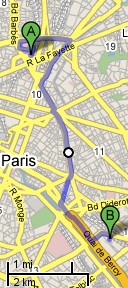 I had originally intended to travel from Paris to Florence by sleeper train, departing from the Gare de Bercy a whisker after 7pm, and to this effect, had booked a seat on the Eurostar arriving at the Gare du Nord just before 5:30pm. This, in theory, would have given me ample time to make my leisurely way through the Paris Métro, possibly grabbing a bite to eat, before boarding my train. In reality, it turned out that the Channel Tunnel wasn't feeling well that afternoon, and the Eurostar spent some 80 minutes waiting in the Kentish countryside, consequently arriving in Paris just before 7. A mad dash in a taxi with a driver who spoke no English ("Parlez-vous Anglais?", I enquired on entering the cab; the driver reply, buttered with no small amount of self-satisfaction, was, "Parle Français.") resulted in my arriving at Gare de Bercy (a good 5km away) some ten minutes after the Florence train's departure.
Facing the prospect of spending a night in a hotel room, I inquired at the ticket office about subsequent trains. Luckily, there was a sleeper train to Zurich (or, more precisely, to Chur via Zurich), and thence I could catch a train to Milan the following morning, putting me on the way toward Florence, at the cost of only around £90 and some eight hours of time.
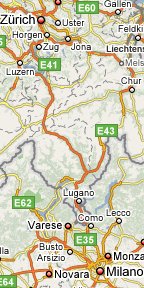 This, however, turned out to be well worth it, as the scenery along the Zurich-Milan route was spectacular. The morning's train wound past silvery alpine lakes fringed with small, white houses and corkscrewed its way up mountains to St. Gotthard's Pass, before entering a tunnel. On the other side, everything was different: the climate, the architecture, even the language. We had left the German-speaking part of Switzerland and entered the Italian-speaking part, a somewhat sunnier, though still impeccably well-organised, place. The train headed south, then stopped for some time at the border as border guards boarded to check our passports. Then it proceeded southward, past Lake Como, and towards Milan. From Milan, I made my own way south.
I had been planning to take this journey again at some point, the next time actually breaking it in the Swiss Alps; getting off the train somewhere around, say, Arth-Goldau or so, and spending a day or two there, in alpine tranquility. Though, when I recently looked at seat61.com, I found that that is no longer possible, having fallen victim to the onward march of progress:
The convenient direct sleeper train from Paris to Landquart & Chur was sadly withdrawn with the opening of the TGV-Est high-speed line in June 2007I wonder how many other sleeper train services have disappeared over recent years, squeezed by the boorish onslaught of cheap flights on one hand and the march of high-speed rail on the other, and whether this is a one-way process, or whether there are any new overnight services being introduced as old ones are dropped. One would think that they could run some through the Channel Tunnel at night. (Perhaps if Deutsche Bahn get rights to run services through the tunnel from 2010, as they have applied to do, they will put some in. After all, Germany is considerably further from London than Paris or Brussels, and an overnight train from London to Berlin, the showpiece rail hub of central Europe, could be popular. And then there were the overnight services from the north of Britain to Paris that were mooted when the tunnel was being built and flights were relatively expensive.)
2008/1/16
The latest spectacular project planned for Dubai, no stranger to fantastic knockoffs, is a replica of the French city of Lyons. Named "Lyons-Dubai City" (though Cory Doctorow suggested "Baudrillardville" as a more appropriate name) it will be roughly the size o the Latin Quarter of Paris, and contain "squares, restaurants, cafés and museums".
(via Boing Boing) ¶ 0
2008/1/8
As France's right-wing bête noire president Nicolas Sarkozy's image is softened by his romance with an ex-model, his son, a hip-hop producer under the name "Mosey", is working with militantly political rappers from the banlieues, including a rapper named Poison (of no relation to the 1980s hair-metal band):
Mr Sarkozy, as Interior Minister, ordered the prosecution of half a dozen rappers for insulting the police and became their bête noir with his drive to “clean out the layabouts” from the estates. His creation of a Ministry of National Identity further fired the anti-Sarko ire of the rap world.
“I’m not a Sarkozy guy, I don’t give a s***,” said Poison, whose name is pronounced the English way. “The guy brought me some music. He does good sh**. I didn’t know at the start that it was the son of Sarko. When I found out, I blew a fuse and phoned him. He said ‘Yeah, but Poison, I didn’t wanna tell you ‘cos you wouldn’t wanna hang out wid me no more’. I told him, hey, no problem. You never done me wrong. We’ll bust nobody’s balls, we’ll just do good stuff.” In an anti-Sarkozy video with other rap singers last year, Poison chanted: “Anti-Sarko, anti-right, Nicolas don’t you hear. We’re anti-you.”I wonder whether Poison's working relationship with Mosey, or his status in the French hip-hop underground, will survive the publicity; I suspect something may have to give.
2007/12/3
The Bibliothèque Nationale in Paris is, for the first time, opening its extensive collection of pornographic materials to the public. Part of the contents of the forbidden section, officially known as "l'Enfer" (Hell) and consisting of pornography and erotica from the 17th to 19th centuries, will be visible at the Bibliothèque François Mitterrand for three months, and a smaller selection will be shown in a disused Métro station.
Only bona fide academic researchers have been allowed access to the "L'Enfer" collection until now. The omnipresence of erotic or pornographic images in the modern world has persuaded the French national library that it is permissible, finally, to open the doors of Hell.
The exhibition reveals some interesting, historical differences in erotic tastes. The earliest, 17th and 18th century, material dwells on the straightforward pleasures of the flesh. The celebration of the pleasures of pain – imposed or submitted – begins with the Marquis of Sade in the late 18th century. Pornography from the French Revolutionary period is mostly political, especially scurrilous allegations about the sexual appetite and imagination of Marie Antoinette. The 19th century concentrates on the blazing sexuality lying below the stern conservative or domestic exterior of life.
2007/11/27
The UX, the secretive Parisian underground exploration group which built an underground cinema in the city's labyrinthian catacombs, pulled off an even more impressive feat last year: breaking into the Panthéon and surreptitiously repairing its clock, all without the authorities knowing about it:
Getting into the building was the easiest part, according to Klausmann. The squad allowed themselves to be locked into the Panthéon one night, and then identified a side entrance near some stairs leading up to their future hiding place. "Opening a lock is the easiest thing for a clockmaker," said Klausmann. From then on, they sneaked in day or night under the unsuspecting noses of the Panthéon's officials.
The hardest part of the scheme was carrying up the planks used to make chairs and tables to furnish the Untergunther's cosy squat cum workshop, which has sweeping views over Paris.
The group managed to connect the hideaway to the electricity grid and install a computer connected to the net.Neither the Panthéon's staff nor the authorities noticed anything until the UX's surreptitious restoration cell, the Untergunther, notified them of what they had done. The officials, being officials, didn't appreciate the act; the administrator of the Panthéon was sacked, and the state initiated legal action against the restorers. The group has recently been cleared of any wrongdoing, and is working on another secret restoration mission.
But the UX, the name of Untergunther's parent organisation, is a finely tuned organisation. It has around 150 members and is divided into separate groups, which specialise in different activities ranging from getting into buildings after dark to setting up cultural events. Untergunther is the restoration cell of the network.
Members know Paris intimately. Many of them were students in the Latin Quarter in the 80s and 90s, when it was popular to have secret parties in Paris's network of tunnels. They have now grown up and become nurses or lawyers, but still have a taste for the capital's underworld, and they now have more than just partying on their mind.And here and here is more about the UX and Untergunther. (It is not clear how these groups are related to "La Mexicaine de Perforation", the group credited with the underground cinema uncovered in 2004.)
I wonder how much of an inspiration those secret catacomb parties of the 1980s were on the characters of the "troglodistes", the sewer-dwelling guerilla frogmen in Jeunet and Caro's film Delicatessen.
(via Boing Boing) ¶ 2
2007/5/13
So that was Eurovision 2007. A bit of a surprise; the Serbian entry which won it seemed rather lacklustre compared to some of the others, but romped home in the voting, presumably due to Serbia being located in a geographical/demographical sweet spot. Interestingly enough, Eastern Europe dominated the voting, with the highest-scoring western-European nation being well in the bottom half of the rankings.
There were a few highlights: Georgia's entry started off as a traditional torch song by a woman in a red dress, but then morphed into eurodance, and then the dancers whipped out swords and started dancing about, Cossack-fashion, with a wild glint in their eyes. France eschewed the usual white-gowned piano balladeer in favour of a troupe of Dadaist mimes in Jean-Paul Gaultier costumes, highlighting the ridiculous side of Gallic culture. (Fat lot of good it did them, they ended up something like third-last. I guess it's back to the chanteuse and pianist next year.) Romania's entry was a bit like France's on a budget; five blokes dressed like the habitués of a slightly unsavoury tavern, singing "I love you" in every language on earth. The music was vaguely gypsyish, and sped up dramatically towards the end. Neighbouring Bulgaria's started off like Dead Can Dance with extra percussion, and then went electro. And, of course, there was Ukraine's entry, with its sequined, uniformed drag queen, looking like Elton John crossed with Austin Powers. It had camp and kitsch in spades, and raised a few questions. What, for example, was the significance of them counting in German, and did they really sing "I want to see Russia goodbye", and if so, how did that make it past the vetting process?
The lowlight was probably Ireland's entry, which was pure, unadulterated Celtic kitsch of the most obvious variety, and quite deserving of its final position at the bottom of the board. This year, though, nobody got a nul points, and they limped home with 3 points or somesuch. Britain did a bit better, largely thanks to Malta giving them 12, though their song was stuck firmly in the mid-1990s. And the teeth on that stewardess were frightening; granted, Scooch, as uninspired as they may be, were a lot less cringeworthy than last year's entrant (a middle-aged bloke pretending to be a teenage hip-hop street thug, surrounded by dancing "schoolgirls" who, apparently, were borrowed by Turkey this year). And I'd have to give a dishonourable mention to Russia, whose entry was a piece of soullessly machine-extruded commercial pop, trading on sex appeal (sample lyric from the three immaculately coifed girls doing the singing: "put a cherry on my cake and taste my cherry pie"; ooh-err!) lacking any of the madness or wrongness that makes for an interesting Eurovision entry.
The other competitors: Belarus (incidentally, the last remaining state with a KGB) had black-clad female dancers scaling walls like assassins and John Barry-esque strings over its power ballad. The full might of the Swedish culture industry was unleashed in the form of 1970s glam rock attired in monochromatic retro cool. Latvia's entry was in Italian, and like a low-rent version of The Divs. Germany had a bloke named Roger Cicero (son of Herr und Frau Cicero, I presume) doing a Sinatra-lite swing number, in German. Armenia's entrant seemed to follow, stylistically, in the footsteps of that other great Armenian singer, Charles Aznavour, only with an overwroughtly woeful and somewhat strained ballad. And Turkey's entrant was a short, hirsute man wearing a red jacket and a broad grin, surrounded by belly dancers Terry Wogan persisted in pointing out were British. Presumably giving the United Kingdom something to be proud of even should they have ended up with nul points.
While some speculated that Lordi's astounding triumph last year (reprised in the Lord-of-the-Rings-esque opening video) would have opened the door for a flood of hard-rock/heavy-metal bands, this did not entirely come to pass. Finland followed up their win with a new genre, which could be dubbed, Tolkienesquely, MOR-Goth, consisting of torch songs with emo-esque lyrics and plenty of black clothing and gothic makeup. The other main Lordi-influenced act was Moldova, whose song sounded like the sort of alternative-rock song that ended up on Hollywood action-film soundtracks in the late 1990s; all minor-key strings, crunchy metal power chords and drum loops.
The promotional videos played before the musical numbers were done quite well, executed as whimsical stories featuring elements of Finnish culture. Some of the odder ones featured a goth riding a rollercoaster, hackers coding computer demos at the Assembly festival, a heavy-metal festival full of corpsepainted teenagers, a troupe of clowns giving an athlete an instant makeover so he could enter a restaurant, a twattish-looking bloke in DJ headphones playing the pipes at the Sibelius monument, and Santa Claus playing chess with one of the Moomins. Oh, and lots of mobile phones (Nokia, of course); the Finns, it seems, use them at the dinner table, and even propose marriage with the help of their cameraphones. Other than mobile phones, heavy metal appears to be a big part of the Finnish national identity; other than the promos, there was the entertainment during the vote-counting break, which featured the heavy-metal string quartet Apocalyptica, as well as acrobats.
Last but not least, one has to mention the astonishing phenomenon that is Krisse, the somewhat frightening-looking young woman with the pink puffer jacket and big ponytails plucked from the audience to interview competitors, stumbling through questions and going on about herself (sample question: "on a scale of 9 to 10, how beautiful am I?"). For some reason, she reminded me of Leoncie.
2006/12/21
Culture-bound syndrome of the day: "Paris Syndrome". This is a condition affecting Japanese tourists who travel to Paris, romantic scenes from Amélie in their minds, only to discover that the city is considerably dirtier and—shock, horror—full of very rude people. This shock can cause a psychiatric breakdown:
An encounter with a rude taxi driver, or a Parisian waiter who shouts at customers who cannot speak fluent French, might be laughed off by those from other Western cultures.
But for the Japanese - used to a more polite and helpful society in which voices are rarely raised in anger - the experience of their dream city turning into a nightmare can simply be too much.
This year alone, the Japanese embassy in Paris has had to repatriate four people with a doctor or nurse on board the plane to help them get over the shock.As many as 12 Japanese tourists fall victim to Paris Syndrome each year. The Japanese embassy has established a 24-hour hotline to help those afflicted.
2006/12/8
Politicians in France are alarmed at French teenagers adopting another unwelcome English habit, this time it's le binge-drinking. A committee of MPs, representing the constituencies of Burgundy and Champagne, no less, has proposed a solution: encouraging French teenagers to drink good French wine, and not those horrible Anglo-Saxon alcopops:
The report for the Parliamentary Economics Committee, drafted by Philippe Martin and Gérard Voisin, members of President Chirac's Union for a Popular Movement (UMP), said that the young were forgoing wine's "health benefits and tasting pleasure" with a desire for higher alcohol content. "To be French is to know wine," said the report. "Learning about healthy living starts from childhood and primary school."
"It is a sign of changing times, that families no longer fill the wine-glasses of 15-year-olds at Sunday lunch, but the teenager is far more likely to go out and get smashed," said an expert.
2006/12/7
A Times columnist's take on France24 and those silly French people:
Since, alongside the news , the new state-funded France 24 channel sees itself as an ambassador for the French "art de vivre" (French for "way of life") and for its "savoir faire" ("rural snail-tasting festivals"), the channel launched at 7.29 GMT yesterday evening -- presumably in order to allow staff and viewers to first knock back a couple of reviving Pernods after their return from the traditional Gallic post-work/pre-dinner bout of hanky-panky ("mouchoir-pouchoir").
That means that at the time of writing, we don't actually know what the opening headlines were. But we might guess they were something along the lines of, "Iraq, c'est encore un grand mess, n'est-ce pas?" (literally, "That George Bush is a dork, isn't he?"); And "L'Angleterre evidemment a une équipe de cricket qui joue comme un bunch de garçons de Nancy -- pas, obvieusement, notre Nancy en Lorraine!"); though maybe not, "Et maintenant, les actualités chaud directe de Rwanda ...").
France 24 is basically a TV channel for a nation that is annoyed that it has failed to persuade the rest of the world to speak French rather than English (apart from -- and this really embarrasses them -- the word gauche, which is the universally used term for "Donald Rumsfeld").Aside: I wonder which variant of English France24 will use: whether it'll be broadcast in the Commonwealth English of their ancient adversaries and fellow EU members across la Manche, or the American English of their former revolutionary protegés and historical friends, recently seen eating Freedom Fries and putting "First Iraq, then France" bumper stickers on their Hummers.
Not that long after al-Jazeera launched its defiantly postcolonial English-language news channel, another player is entering the market; France 24 will be a 24-hour news channel, funded by the French government and a French private TV network, and broadcasting in French and English (with Spanish and Arabic to be added later).
France 24 can be viewed through its web site (if you have Windows Media installed), and will be available on cable TV. Its mission is, in its own words, "to cover worldwide news with French eyes"; the channel insists its editorial policy will be independent of the French government (though, in either case, you'd expect them to say so).
2006/10/9
As Britain struggles to adopt a "Mediterranean drinking culture" not involving binge drinking and public disorder, across the channel, an equally radical cultural change is being planned. France will ban smoking in all public places from February. Which does seem like a drastic change for a country like France, famed for its strongly aromatic cigarettes and prevalence of public smoking (it is the only country in which I have seen a police officer throw his cigarette on the ground as he entered the police station), though apparently 70% of the population support the ban. And let's not forget that the first European country to ban public smoking was Ireland, also known for its tobacco culture.
2006/9/20
25 years ago this Friday, France opened its first TGV train line, from Paris and Lyons. The arrival of the high-speed train lines (which now run at up to 320km/h, nearly twice as fast as the fastest train in Britain) has profoundly changed the psychogeography of France, effectively shrinking the country to a more conveniently traversable size:
The 1,250-mile (2,010km) TGV network, a product of the French tradition of centralised power and state engineering, has transformed life, bringing cities such as Tours, 230 miles from Paris, within commuting range. A daily season ticket on that TGV route costs £390 a month. Between Paris and Lille (127 miles each way), daily commuting costs £415 a month. Vendôme, 260 miles to the southwest of the capital, has become a dormitory town. About 400,000 people use the TGV for daily work.
"The TGV is the Concorde plus commercial success," Clive Lamming, a railway historian who wrote the Larousse des trains et des chemins de fer encyclopaedia, told The Times. "The TGV has virtually reduced France to one big suburb. This has increased the independence of businesses from Paris. Workers are more mobile and their costs are less."To commemorate the 25th anniversary of the Paris-Lyons TGV line, the SNCF (France's state railway company) is opening the new TGV-Est line from Paris to Strasbourg, which will make the journey in 2 hours and 20 minutes (it is presently 4 hours).
It is unlikely that anything like the TGV will happen in Britain. The technical efficiency of the TGV is a result of the sort of overengineering that happens in systems shielded from the ruthless optimisations of the marketplace. In Britain, however, where the railways are privatised and the maximisation of profits and cutting of expenses is paramount, the system would never be so uneconomical as to invest in dedicated high-speed railway lines which inefficiently lie idle when not being traversed by high-speed trains, rather than being used for goods and short-distance traffic. And then, of course, there is the proud Anglo-Saxon tradition of underinvestment in infrastructure to uphold.
2006/7/27
A list of bizarre and delicacies which one is unlikely to see in any restaurant, even one that serves (almost) illegal delicacies:
Ortolan: Famous for being the last meal of Francoise Mitterand, ortolan is a tiny songbird that is said to "embody the soul of France." To prepare, one must capture the birds alive, blindfold them (or place them in a lightless box) and gorge them on millet, grapes and figs. To cook, pop the little guys in the oven for a couple of minutes. The trick is in the eating. You must place the whole bird in your mouth, leaving the head dangling out and place a cloth over your head. Supposedly the most delicious taste on the planet, the dish is illegal in its native France and, of course, here.
Mellified Man: Mellified Man was a manmade dish popular in ancient Arabia. According to Mary Roach, author of Stiff, men 70-80 years old, on death's doorstep anyway, would cease to eat food, instead partaking solely of honey. Pretty soon, they would be mellified, that is, "he excretes honey (the urine and feces are entirely honey)." Soon he dies and is placed in a honey-filled coffin which is then sealed for 100 years. At the end of the 100 years, the goop is eaten up.Also illegal in the US (where the article was written, and the barely-legal restaurant it refers to serves things like foie gras and absinthe) are unpasteurised French cheeses (though there is a thriving underground of bootlegging "fromaguerillas" importing the stuff under the nose of the Feds) and fugu, or the Japanese puffer fish.
But yes, don't expect your favourite trendy restaurant to start serving mellified man any time soon; for one, the logistics would be problematic (would you order in advance?)
(via Boing Boing) ¶ 1
2006/6/21
I'm back in London now, having spent the past five days on the continent, catching the Eurostar to Paris, then travelling via Zürich to Tuscany, staying for a few days in the mediaeval hilltop town of Cetona, then back to Paris via Florence and back to London. Photos from my travels will gradually filter onto Flickr.
Some observations:
- The Eurostar train to Paris was delayed by 80 minutes; it seems that the tunnel wasn't feeling well or something, and the train had to wait outside whilst its handlers coaxed it into cooperating. Consequently, I missed my initial connection, the 19:06 sleeper to Florence, despite a white-knuckle taxi ride through the Parisian rush-hour traffic. The moral of this story: allow more than one hour and 40 minutes between the Eurostar and anything departing from Gare de Bercy.
- I did manage to get a bunk on a later sleeper to Zürich, and a connecting train to Milan. The Zürich train (a French SNCF service) was relatively empty, and even in second class, quite comfortable.
- The Swiss love their sans serif typefaces and clean design, and have some of the best-looking banknotes I have seen. They're about as colourful as Australian banknotes, only with more of a modernist European graphic-design feel.
- The journey through the Swiss Alps from Zürich to Milan is probably the most scenic railway journey I have been on; the train climbs into the alps, winding around hills and going through tunnels, passing vast, mirror-still lakes and small towns. Then it goes through a tunnel near St. Gotthard's Pass, and comes out in the Italian-speaking part of Switzerland, which has a completely different climate, geography, architecture and character, seeming rather Mediterranean. I have added Switzerland to the list of places to visit.
- Swiss trains are very clean and run like clockwork. Italian trains are generally of a high standard. The "EuroStar Italia" trains (which are similar to French TGVs or Virgin Pendolinos) are fast and come with an onboard magazine (in Italian) and radio channels in the seats (which didn't seem to be working), and the "InterCity" trains (expresses pulled by more conventional electric locomotives; virtually all railways in Europe are electric these days) are air conditioned and clean. First class on those costs slightly more than second-class and gives you larger-looking seats (though they have the same number of them in the compartments) and power points near the window seats. (The EuroStar to Paris also had power points (European ones, not British ones), though the returning one didn't.)
- The "Palatino" sleeper from Florence to Paris is quite popular, and consequently the compartment I was in was full. Fitting into a second-class sleeper compartment (which holds six) with baggage is a bit of a juggling act. Apparently first class sleepers are said to be much more comfortable.
- Most if not all of the native English speakers one meets whilst travelling on trains through Europe are Americans. I wonder why this is; perhaps it's because Britons associate trains with day-to-day drudgery and avoid them whilst on holidays, whereas Americans regard them as part of the European experience.
2006/6/18
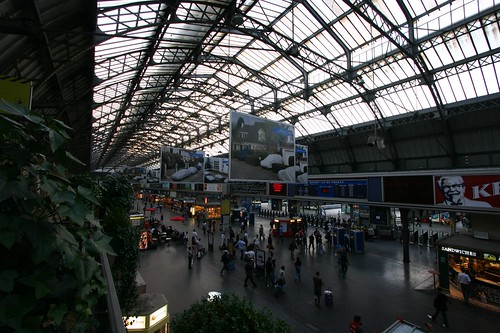
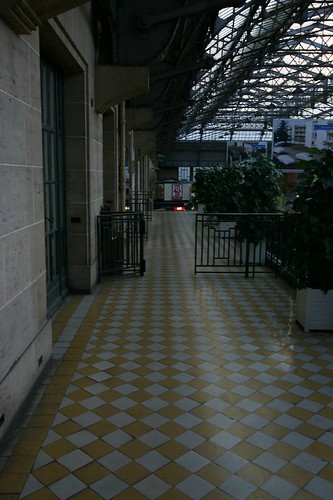
Your humble correspondent is currently on the Continent, and hence blogging has been somewhat light. However, here are a few photographs from my journey so far, whilst passing through France:
The first thing one sees upon emerging at the French end of the Channel tunnel on the Eurostar:

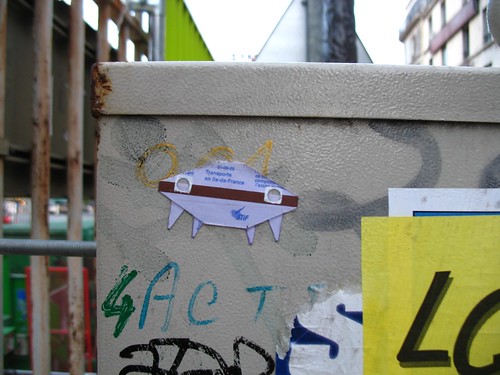
A Paris Métro ticket repurposed into street art:
Early evening outside the Gare de l'Est, Paris.
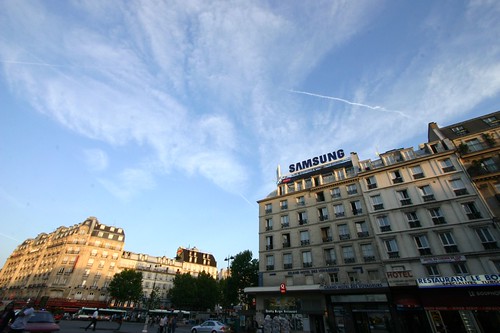
Gare de l'Est, Paris:
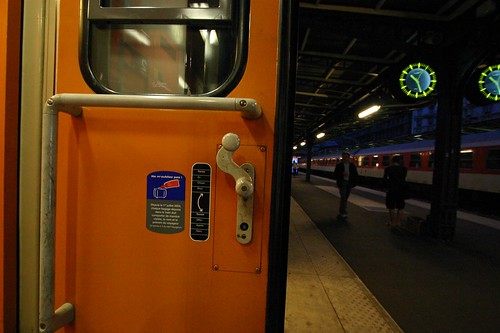
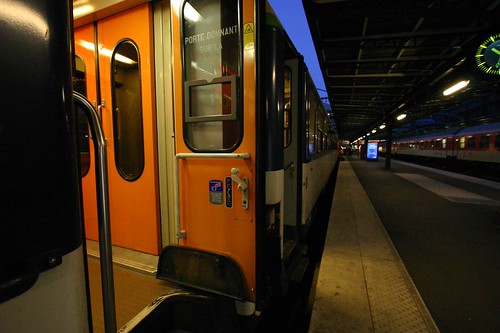
The sleeper train to Zürich, Gare de l'Est, Paris:
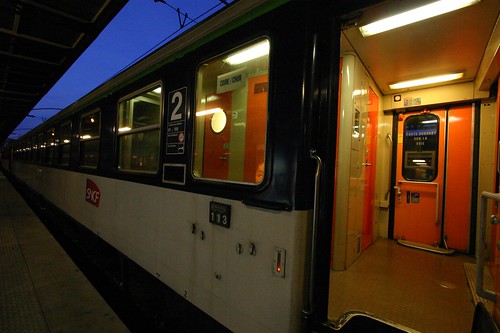
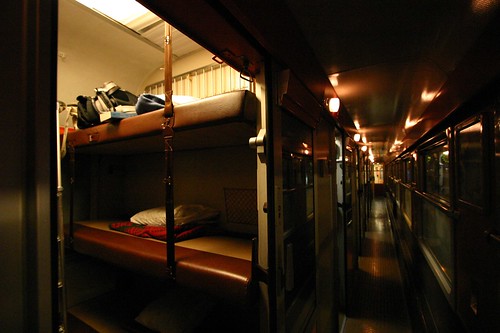
My compartment for the night on the Paris-Zürich sleeper (2nd class):
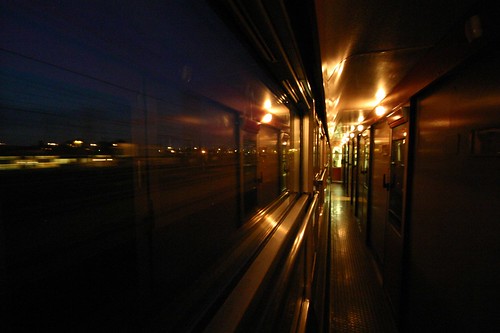
View from corridor of sleeper car rushing through France:
2006/6/8
Have you ever wondered where all the money from European nationals' VAT goes? Well, some of it is spent on buying up surplus wine and distilling it into fuel and disinfectant, to prevent a glut that would drive wine prices down and paralyse the roadways of Europe with roadblocks of indignant French winemakers:
The Commission's announcement that it would spend €131 million to distil 430 million bottles of French wine and 371 million bottles of Italian wine into fuel was met with protests by French wine growers, who demanded that European taxpayers should buy 1.1 billion bottles of their produce.
(Quake in terror at that fearsome sense of entitlement. C'est tres formidable!)
Such "crisis distillations" are becoming increasingly common, with the commission spending about €500 million last year turning wine into petrol, and viticulturists now producing wine knowing that it will never be drunk. Nearly a quarter of all Spanish wine now ends up being used for industrial purposes.Much of the problem comes down to competition from wines from places like Australia and Chile, which are produced using more modern, mechanised techniques and are consequently cheaper and more consistent in quality. (Apparently, making wine in France is 50 times more labour-intensive than doing so in Australia.) The French winemakers are, understandably, having trouble competing with this, which faces them with a choice: make sacrifices and ruthlessly streamline to better compete or whine and demand that the government protects them. Of course, in fine dirigiste tradition, they chose the latter. Good thing that the former eastern-bloc nations have joined the EU, expanding its tax base to pay for all that wine.
(I wonder how much the price of oil would have to rise for turning surplus wine into fuel to become economically viable as a replacement.)
2006/5/20
Finland's metal monsters ran away with Eurovision, winning it with 292 points; a lead of 44. The runners-up were: Russia, Bosnia-Herzegovina, Romania and Sweden.
The bottom 3 were: France, Israel and Malta, with Malta being the only ones to get nul getting one mercy point from Albania. I guess eyebrows just don't do it.
Lordi are taking to the stage, kissing the Greco-American woman, holding up the prize and giving a mighty roar, and getting back on stage with a reprise of their winning song as the credits roll.
Have a guess what the French entry was like. They were a hardcore pirate-punk band. No, I lie. It was a lady in a long frock singing a ballad.
Croatia has resisted the temptation to do Eurodance/R&B/international saccharine ballads, and have a folky number, with dancers in national costume, a chap playing a ukelele with a bow (shades of Sigur Rós there?) and a funny-looking woman in a red frock. Did she really just sing "Afrika Paprika"?
2006/3/3
The anti-immigrant right in France has adopted a new tactic: handing out pork soup to the poor and hungry, pointedly excluding Muslims and Jews from their charity.
With steaming bowls of the fragrant broth soon passing through the crowd, Odile Bonnivard, a short-haired secretary turned far-right firebrand, climbed atop a dark sedan with a megaphone in hand and led the crowd in a raucous chant: "We are all pig eaters! We are all pig eaters!"
The movement began in the winter of 2003 when Ms. Bonnivard, a member of a small far-right nationalist movement called the Identity Bloc, began serving hot soup to the homeless. At first, she said, the group used pork simply because it was an inexpensive traditional ingredient for hearty French soup. But after the political significance of serving pork dawned on them and others, it quickly became the focus of their work.
2006/1/4
The Graun looks at Christmas and New Year's television programming across the world. While Britons get into the Queen's speech (and "alternative" takes by various "edgy" celebrities like Jamie Oliver and Damon Albarn), Americans are shedding tears over Rankin/Bass's animated Frosty The Snowman, Russians are getting maudlin over extended reruns over a 3-hour comedy titled The Irony Of Fate that they have all seen dozens of times before and Romanians are watching action replays of the execution of former dictator Nicolae Ceaucescu. Meanwhile, Australians are watching celebrities singing "Aussie carols" like Six White Boomers and Santa Never Made It To Darwin (which, in all my years in Australia, I had never heard of), while their (apparently more self-consciously "British") neighbours in New Zealand watch Only Fools And Horses and Morecambe And Wise. The French seem to have the coolest Christmas TV fare, though:
Since 1982, black-comedy Le Père Noël Est Une Ordure (which translates along the lines of Father Christmas Is A Scumbag) has risen from obscure box-office failure to France's ninth most popular movie. Set on Christmas Eve in a social service helpline call centre, three workers try with varying degrees of failure to spread festive cheer among the depressed, suicidal homeless, heartbroken and bereaved who turn up looking for salvation. Utterly bleak, totally farcical, and very very funny.Across the border in Germany, however, one of the annual Christmas favourites is, inexplicably, an old British comedy skit named Dinner For One:
Dinner for One, also known as Der 90 Geburtstag (The 90th Birthday), has rattled around the cabaret circuit for decades. Written by British author Lauri Wylie in the 1920s, it presents a morbidly funny story in miniature—(just 11 minutes on TV): Elderly Miss Sophie throws her birthday party every year, setting the table for her friends Sir Toby, Mr. Pommeroy, Mr. Winterbottom, and Adm. von Schneider, while conveniently ignoring the fact that they've all been dead for a quarter-century. Her butler James manfully takes up the slack by playacting all of them. He serves both drinks and food while quaffing toasts on behalf of each "guest," a bevy of soused British noblemen and von Schneider, who toasts Miss Sophie with a heel-click and a throaty "Skål!"
In 1962, German entertainer Peter Frankenfeld stumbled on Dinner for One in Blackpool's seaside circuit. Frankenfeld was so charmed that he invited actors Freddie Frinton and May Warden to perform the sketch on his live TV show Guten Abend, Peter Frankenfeld. The now-classic black-and-white recording dates from a 1963 live performance in Hamburg's Theater am Besenbinderhof.The skit's popularity has spread across Northern Europe, and it has inspired numerous derivative works, including dubs into regional German dialects, many parodies and a Latin translation. To this day, nobody is entirely sure of why Dinner For One is so big in Germany, though there are theories:
But why? How did a sliver of British humor come to dominate another culture's holidays—with apparently no connective thread back to its source? First, the slapstick of Dinner for One transcends the language barrier. Second, it offers a slight thrill of the verboten: After all, it features a very crazy old lady, a bevy of lecherous male friends, a big stench of post-WWII death, a hell of a lot of drinking, and senior-citizen sex. A third notion, floated by Der Spiegel and the Guardian alike last year, is that the film plays to Germans' worst idea of the British upper class: dotty, pigheadedly traditional, forever marinated in booze despite titles. The BBC counters with the more politic theory that Dinner for One "has become synonymous with British humor, on a par with Mr. Bean." British TV executives see it as fit only for foreigners, or they would rush to broadcast it themselves. Why Germany finds it so funny and the British don't is, according to Der Spiegel's Sebastian Knauer, "one of the last unsolved questions of European integration."
Best of all, Dinner for One is a perfect foundation for a tidy drinking game in which you down four different liquors in 11 minutes, "the same procedure as every year." What more fitting way to ring in the New Year?
2005/11/23
Asterix, the plucky French cartoon hero and original icon of Gallic resistance to foreign hegemony, is now taking on the Americans. Of course, since they didn't have America two millennia ago, they appear in the form of familiar-looking aliens from outer space:
In the book, the 33rd in the bestselling series, the diminutive warrior and his brave chums find themselves facing alien invaders from the planet Tadsylwien - an anagram of that unassailable US icon, Walt Disney.
The ruler of the alien world is called Hubs - I'll leave you to work that particular puzzler out for yourself - and, according to one invader with more than a passing resemblance to Mickey Mouse, Hubs has sent them to Earth in a futile search for the Gauls' "stockpile of lethal weapons".
(via  dreamstooloud) ¶ 0
2005/10/12
An ingenious con artist managed to persuade French banks to hand over €5m, by pretending to be a secret service agent fighting against terrorist money laundering:
Gilbert then demanded all the cash at the bank so he could mark the notes with microchips and keep track of the terrorist. A total of €358,000 was to be put in an briefcase and slipped under the door of a brasserie lavatory. The manager did as she was told. The money disappeared.
Gilbert's next fraud was even more audacious, police say. He acquired information about important financial transactions and telephoned France's biggest banks. Again posing as a DGSE agent, he said that some of the transactions were terrorist money-laundering operations and that the secret services needed to follow the money. But they could do so only if it were transferred to accounts abroad, he said.Meanwhile in Moldova, a conman is hypnotising bank clerks into handing over cash:
One victim told police that Kozak's technique was to start a friendly conversation, establish eye contact, and then put her in a hypnotic state. The teller then agreed to hand over all the cash in her till.
2005/10/4
A new art exhibit is causing controversy in Paris; the Plancher de Jeannot (Jeannot's Floorboards) consists of the floor of a Pyreneean farmhouse, into which its schizophrenic inhabitant carved increasingly disturbed rants:
Jeannot moved his bed to the dining room, next to the stairs, and began carving the oak floor: 'Religion has invented machines for commanding the brain of people and animals and with an invention for seeing our vision through the retina uses us to do ill (...) the church after using Hitler to kill the Jews wanted to invent a trial to take power (...) we Jean Paule are innocent we have neither killed nor destroyed nor hurt others it's religion that uses electronic machines to command the brain.'The Plancher de Jeannot have gone on display at the Bibliotheque François Mitterrand in Paris, amidst much controversy; once the exhibition is finished, they will be donated to a psychiatric hospital in Paris. Some photographs are here amd here.


(via substitute) ¶ 0
2005/7/13
In France, a bus company is suing a group of cleaning ladies for unfair competition for organising a car-pooling service which happens to run along its route. The company wants the women to be fined and their cars confiscated.
2005/3/13
France's National Library has photoshopped a cigarette out of a photograph of Jean-Paul Sartre used in a poster to promote the centenary of his birth. The action was apparently taken to comply with a law prohibiting tobacco advertising, and follows the editing out of cigarettes from other likenesses of role models. Perhaps they should edit all those removed cigarettes into images of historical villains like Hitler (or, even better, images of people considered passé and unhip though not enough to be in danger of becoming Ironically Cool). (via bOING bOING)
2005/2/3
The privatisation of the space of concepts keeps marching on; now, it turns out likenesses of the Eiffel Tower are copyrighted, and cannot be published without a licence. The city of Paris and the company which maintains the tower managed to do this by adorning it with a distinctive lighting display, which they then copyrighted; consequently, any recent night-time photograph of the Eiffel Tower is a derivative work. In their infinite generosity, they have said that they are not interested in going after amateurs putting holiday photographs of the tower on their web sites; they are, however, technically in violation. Which means that this WikiMedia image is technically in violation. And so, the space of free public discourse narrows slightly.

I wonder what's next: perhaps Ken Livingstone will copyright the names of London Underground lines and stations and demand licensing fees from fiction authors who mention them or something?
Eventually, we will get to the situation where all real-world objects and likenesses are intellectual property and use of them requires licensing fees. (After all, the dominant Reaganite/Thatcherite ideology of our time says that the way to maximise the efficient use of any resource is to monetise it and place it on the market; coupled with intellectual property, the natural conclusion is what Lawrence Lessig calls an "if-value-then-right" intellectual property regime, where for any value in an item, there is a right assigned to a rightsholder, who can license that right on the open market. Think of the colossal economic waste we had in the bad old days of the public domain and Jeffersonian copyrights.) As depicting any public figure, fictional character, location or privatised folklore will require a licence, costing fees and giving rightsholders vetoes over works they find objectionable, stories (well, those without the corporate media backing required to resolve all the rights issues) will move to generic locations; nameless, nondescript buildings, cities, countries and characters will take hold. To which, Big Copyright will respond by copyrighting categories of ideas (in the way that Marvel and DC Comics claimed a joint trademark on superheroes), or by patenting common types of plot devices and settings (which is probably not legal now, though given sufficiently pliant legislators and international treaty bodies, anything's possible). Galambosianism, here we come.
2004/12/6
French-American relations have suffered another blow, thanks to Paris being inundated with tourists looking for scenes from the Da Vinci Code, Dan Brown's repackaging of The Holy Blood and the Holy Grail in thriller form. When told that the places depicted in the book don't hide the secrets of the Holy Grail and the Merovingian bloodline of Jesus, many tourists become abusive and accuse their guides of covering up the truth for the Catholic Church. Or just steal the signs pointing out that the Da Vinci Code is fiction.
In other news, the EFF is not actually an anarchist terrorist group. (No, that'd be the Cypherpunks mailing list.)
2004/11/29
According to the French film industry's rules, Oliver Stone's action film Alexander qualifies as a French film (because Stone has a French mother and did the postproduction in Paris), but Jean-Pierre Jeunet's latest film isn't (because Warner funded part of it).
2004/9/12
The French underground explorers/guerilla art collective responsible for the recently discovered underground cinema speak to the Graun:
Huddled round a table in an anonymous Latin Quarter bar, the group's members - of whom only Lazar wanted to be named - relate past exploits: rock concerts for up to 4,000 people in old underground quarries; 2am projections in a locked film theatre; art and photo exhibitions in supposedly sealed-off subterranean galleries.
The Chaillot underground cinema is now definitively closed, even to a drill-toting and determined urban explorer. But even if the Paris police may have reluctantly (and with considerable embarrassment) decided its builders were neither terrorists, neo-Nazis nor satanists, they would very much like to charge them with some offence. "As far as we know, they've been reduced to going for theft of electricity," said Lazar. "However, we covered our tracks so well that the electricity board has apparently told them that short of digging up every cable in the district there's no way of knowing where we took it from. But they're not happy. They've seen a tiny fraction of what we do, and it's a big deal for them."
2004/9/9
Police in Paris have stumbled across a secret underground cinema in the catacombs. The fully outfitted cinema was protected by a sophisticated alarm system and adorned with symbols including swastikas and stars of David. Its stock of film turned out to be mostly 1950s film noir, with nothing illegal or even offensive.
"The whole thing ran off a professionally installed electricity system and there were at least three phone lines down there." Three days later, when the police returned accompanied by experts from the French electricity board to see where the power was coming from, the phone and electricity lines had been cut and a note was lying in the middle of the floor: "Do not," it said, "try to find us."
There is an extensive network of catacombs under Paris, most of which is off-limits to the public, though frequented by groups of "cataphiles", who sound somewhere between the Cave Clan and the troglodistes in the film Delicatessen.
The recent discovery of three newly enlarged tunnels underneath the capital's high-security La Santé prison was put down to the activities of one such group, and another, iden tifying itself as the Perforating Mexicans, last night told French radio the subterranean cinema was its work.
Patrick Alk, a photographer who has published a book on the urban underground exploration movement and claims to be close to the group, told RTL radio the cavern's discovery was "a shame, but not the end of the world". There were "a dozen more where that one came from," he said. "You guys have no idea what's down there."
2004/8/4
France's first drive-thru boulangerie has opened in a suburb of Paris, allowing rushed French motorists to get their baguettes rapidement; and so, the accelerating pace of the world adapts to local sensibilities. It'll be interesting to see how the anti-McDonalds movement receives this new innovation. (via WorldChanging, and not the Onion)
2004/4/6
A Seattle laptop-bag manufacturer has added an apology for their president to the French translation of the care instructions on their bags. The extra lines translate as "We are sorry that our President is an idiot. We didn't vote for him." (via bOING bOING)
2004/3/24
In France, traditional comics such as Asterix and Belgian import Tintin are facing a manga invasion, which is proving a hit with French teenagers. And many French anime-otaku are getting into dressing up in elaborate anime character costumes for a spot of le cosplay.
2004/3/19
A few tidbits from civil-libertarian/paranoid-anarchist-nutter site vigilant.tv: in a classic exhibition of Gallic dirigisme, the French government is planning to install a centralised internet censorship proxy on all internet connections in France, to block racist and anti-Semitic websites. Meanwhile, the Australian government stopped publishing reports on its internet censorship scheme in late 2001 (I wonder whether they'll be claiming that they did this on grounds of national security). And finally, an ABC piece on how al-Qaeda use the internet.
2003/11/28
A gonzo rant about critique of where the Forces Of Good's Iraq strategy falls down, and why attempts at recruiting idealistic young peacekeepers is exactly the wrong way to go about it:
The last kind of person we need in Iraq is a young, idealistic intellectual. These people make lousy conquerors, as was proven repeatedly in Vietnam. In colonial wars, what you really need to get the job done are efficient professional killers, like the French Foreign Legion or the Korean mercenaries we used in Indochina. People like this, when they go into a "problem" village, they dont spend a lot of time with the Inspector Closeau search for the hidden insurgents among them. They just chop everyones heads off and move on.
If you want to recruit killers for foreign conquest, you need to be able to offer them the three basics: treasure, murder and pussy. This is why Iraq is a dead end. There is no pussy in Iraq, absolutely none. No "me so horny" scenes will be shot in the inevitable Iraq movies. There is treasure, but the soldiers dont get any; you cant steal a sack full of oil. Impotent white guys in Texas get all the treasure, which must really piss off the soldiers. That leaves murder as the prize. And as is made clear in the Klein column, we are not making murder part of our sales pitch.
Mind you, actually conquering Iraq may be the wrong way to Win The War(tm):
A much simpler and significantly more profitable strategy would be to invade France and Germany and leave Afghani and Chechen sentries there to keep the peace. No more worries about Airbus contracts or the euro in that scenario. And with Shamil Basayev sitting in Jacques Chirac's office, it is hard to imagine domestic unrest being a serious problem. Beyond that, we wouldnt need to pay a ransom for our new mercenary security force: The women of France would be sufficient compensation for at least the first few years.
2003/9/4
France stands up to EMI; a French court orders EMI to issue refunds to customers whose "Copy Controlled" CDs didn't play in their car CD players or computers. Contrast this with the Vegemite-Eating Surrender Monkeys' capitulation to the Recording Racket on the same issue.
2003/5/15
Minitel, France's proprietary information network, is 20 years old. Initially started as a means of replacing paper phone directories, it evolved into a model of what the Internet would have been like if the French had invented it: centralised, subsidised, run by a state-owned monopoly, based on proprietary technology and tidy, if a bit bland. Oh, and it's based around 1980s-vintage technology and phone lines. Though even while the French embrace the Internet, Minitel is far from dead; the lightweight, micropayment-based model of information exchange embodied in it is apparently being adapted to mobile phones, where it will undoubtedly prove as spectacularly popular as WAP.
2003/4/23
After the dust has settled on Iraq, Washington's attention has turned to one question: how to punish France. It is expected that France will be actively ostracised from diplomatic bodies and efforts, and effectively stripped of its "global power" status. So far, nobody has mentioned having "no plans" to invade France, so the possibility is probably not being actively considered.
(If they were to consider it, they could always do so on the pretext that France has lost its international legitimacy as a power and thus its right to legitimately possess nuclear weapons (unlike, say, Israel and Pakistan). That could serve as the litmus test of the New American Century; whether a state can maintain that sort of power after having fallen into disfavour with Washington.)
2003/4/20
After regime change in Afghanistan, Iraq and Syria, it was only a matter of time before Blair and Bush turned their attention to France. The detested Jacques Chirac, a past friend of Saddam Hussein, refused to disband his force de frappe weapons of mass destruction; the coalition acted in preemptive self-defence; though it was a pity about the Louvre.
The toppling of the Chirac regime was the inevitable application of this ideology. It was not imperialism. Washington had no desire to stick around when the cameras had already been directed to a new rogue. It was rather adventurism. American foreign policy did mergers and acquisitions, not management. They could topple but, as they found in Kabul and Baghdad, they had no clue about rebuilding. They just wanted to make a point. Upset Uncle Sam and you will lose your power, your palace, your art treasures and bring death and destruction to your cities.
Tony Blair cheered the fall of France. He, too, had his reasons. He had longed to see M Chirac with a bloody nose. Since 2002 he had supported Americas new coercive diplomacy and grown hugely popular as a result. Not since Palmerston had nations quaked when a British leader said he had no plans to attack them. Now Mr Blair might be Americas chosen candidate for president of Europe. Anyway, Britain was in bed with America and could hardly climb out now. Washington would not like that. Mr Blair would not want a nasty hole at the end of The Mall, would he?
(via FmH)
2003/4/15
His deputy's badge shining in the glow of victory (or even "victory"), Australia's Prime Minister has called for France to resign from the security council, to be replaced by a permanent member "more representative of the modern world" At the moment, the French would have to voluntarily surrender their seat on the Security Council, and with typical Gallic arrogance, they refuse to acknowledge their own irrelevance in the New American Century and fall on their sword. Hey, maybe if enough media pundits, bloggers and talk radio hosts make sarcastic remarks about cheese-eating surrender monkeys, they'll be shamed into getting with the program and the hell out of dodge. Failing that, we could always drop a few high-tech precision bombs on the UN headquarters, claim the UN is broken and rebuild it, better than before, and more compliant with the New World Order.
2003/4/2
Apparently US/French relations are rotten on both sides of the Atlantic: with a Times (i.e., Murdoch) poll showing that 1 in 3 French is barracking for Saddam, presumably just to spite the Freedom-Toast-eating conquest monkeys and the ancient Anglo-Saxon foe. Which is probably not too unlike in concept all those Scottish/Welsh/Irish football fans who support "whoever's playing against England". (via MeFi)
2003/3/21
Meanwhile, ricin was found in Paris at the Gare de Lyon. I can see the murdoch headlines already: "THEIR COWARDICE DIDN'T PROTECT THEM", and such.
2003/3/20
Via our regular correspondent Lisa, Give It Back, a US petition to give the goddamn Statue of Liberty back to the French.
It's probably a good idea; the Statue of Liberty doesn't really represent the core values of Bush's America. Though what would be a good replacement for it? I was thinking of a gigantic constructivist statue of an eagle, or perhaps something like the statue outside the Ministry of Information building in Brazil? They could call it the Statue of Total Information Awareness or something.
And here's another page, who want a statue of Ronald Reagan put in its place. (Does this remind anybody of the Colossus of Yorba Linda Society from Illuminatus!? I wonder if a misanthropic dwarf is behind all this...)
And then there are these nutjobs who object to San Francisco containing 'Franc' in its name. Though why not rename it to Norton City, after its most famous citizen (and a US imperialist to shame all others, to boot)?
Telephone tapping devices found in EU building, specifically the French and German offices. French newspaper Le Figaro blaims the Yanqui imperialists; though don't they have Echelon to do all that for them without an incriminating bugging device? Perhaps the bugs were intended to be found, as an intimidation ploy of some sort?
2003/3/3
If one good thing was to come out of the (alleged) current anti-French mood in the US it would be that Marcel guy in Linux Journal toning down his corny "French chef" act. Though, as of the "March 2003" issue, it doesn't seem to have happened.
2003/2/13
One possible side-effect of the recent France-vs.-Texas spat: more French villains in Hollywood films, replacing the usual British-accented bad guys.
The news from Beverly Hills is that producers are telling scriptwriters to 'think French'. This is a relief. For years, a British accent in a mainstream movie served as cinematic shorthand for shiftiness or downright evil. Now we can at least hope for a return to an older cinematic tradition in which the British are loyal sidekicks, chirpy corporals or colonels in the mould of David Niven.
For decades, the US love affair with France was sustained by admiration for its culture, food and wine. A visit to Paris has long been the ultimate stamp of sophistication among the US middle classes. It is hard to pinpoint when things began to change. It was certainly before September 11, as populist politics pursued by Ronald Reagan, George Bush, and now his son, sought to link liberalism with elitism and the hint of foreign conspiracy.
2003/2/5
The Pentagon declares that France is no longer an ally and must be "contained". Pentagon Policy Advisory Board Richard Perle also declared that the UN Security Council, on which France has a permanent seat, is irrelevant. Multilateralism, and the post-WW2 ideal of resolving conflicts through debate and consensus, edges one step closer to collapse. (via die puny humans)
(France is one of the small number of "legitimate" nuclear powers. Perhaps now that France is no longer worthy of trust (in the ways that, say, Israel and Pakistan, are) we can expect the USA and Britain demanding that France abandon its weapons of mass destruction or face military intervention? Won't Ann Coulter be pleased when that happens.)
2002/8/19
A NYTimes article about Verlan, a French argot spoken by immigrants and countercultural hipsters, in which words are arbitrarily reversed. I suppose it's sort of like a French equivalent of Palare, the English gay/carnival argot.
Thus the standard greeting "Bonjour, ça va?" or "Good day, how are you?" becomes "Jourbon, ça av?" "Une fête" (a party) has become "une teuf"; the word for woman or wife, femme, has become meuf; a café has become féca; and so on. The word Verlan itself is a Verlanization of the term l'envers, meaning "the reverse."
Originally a criminal argot in the 19th century, Verlan was adopted by second-generation immigrants after World War 2, and now by bourgeois trendies and rebellious teens. Perhaps not a small part of its countercultural appeal is going against the mainstream dogma of linguistic purism and sticking it to the Académie Française.
Ms. Lefkowitz explained: "There are now different kinds of Verlan. There is the Verlan of the original group, the working class immigrants from the banlieus. Then there is the Verlan of the urban professionals, bourgeois Verlan or `Verlan geoisbour.' There is also the Verlan of the teenagers who use it to distinguish themselves from the adult word as a game and a form of amusement."
2002/4/22
People love a bigot (an ongoing saga): France's far-right demagogue Jean-Marie Le Pen has survived the first round of the Presidential election, beating the Socialist prime minister Lionel Jospin, once considered a favourite. While it is very unlikely that Le Pen will become President, this result has sent shockwaves through France and triggered spontaneous protests.
2001/12/24
Ann "Kill their leaders and convert them to Christianity" Coulter has another screed out, and in it she wants to invade France for breeding anti-American sentiment, funding the Palestinian Authority and refusing to extradite terrorist suspects:
Having exhausted itself in a spirited fight with the Nazis in the last war, France cannot work up the energy to oppose terrorism. For decades now, France has nurtured, coddled and funded Islamic terrorists. (Moreover, the Great Satan is getting a little sick of our McDonald's franchises being attacked on behalf of notoriously inefficient French dairy farmers.)
This summer, Paris made Mumia Abu-Jamal an honorary citizen of Paris. In America's cowboy, bloodlust, rush-to-judgment approach to the death penalty, this convicted Philadelphia cop-killer has been sitting on death row -- and giving radio interviews and college commencement addresses -- for 20 years. Since "Mumia" sounds like a Muslim terrorist, Parisians can use the same bumper stickers for the war.
2001/7/22
Some 80 years after being outlawed, some say as the result of a conspiracy of winemakers, absinthe is once again legal in France. And this is the real thing, so beloved of the likes of Baudelaire, Toulouse-Lautrec and Alfred Jarry, and not the allegedly inferior Czech variant. The first bottles are expected to appear on shelves by Christmas.
The memory of absinthe is remarkably green. People still tell the story of the day in 1901 when one of the biggest distilleries in town caught fire. Fearing an explosion, a quick-witted worker opened the vats. The river Doubs ran green for hours and the soldiers from the garrison rushed to the water's edge to lower their helmets and drink their fill.
I wonder whether they'll sell it over the Internet. (via Lev)
2001/4/29
The French government sez: wear a pro-marijuana T-shirt, go to jail. The T-shirts apparently violate laws against "portraying in a favourable light and promoting or inciting the consumption of any product classed as a banned substance".
2000/10/17
The story of Minitel, France's idiosyncratic national online service, hailed as a world leader in the 1980s, now seen as embarrassingly dated by some, yet still a source of national pride to many French users.
Just as anti-globalisation campaigner José Bové tapped into a rich French vein of resentment for many things Anglo-Saxon and for lousy American food in particular when he vandalised a McDonald's restaurant last year, so Minitel need not politely defer to the internet. Just yet. Dominique Lamiche of France Télécom says: "We'll always have people who prefer to buy a train ticket on the Minitel because it's fast and one knows how to manage it. You don't need the internet's animated pictures to buy a simple train ticket."
2000/9/28
While Parisian police have cracked down on pitbulls, youth gangs have turned to attack-trained monkeys, mostly smuggled from North Africa. The authorities are beset by complaints of monkey violence, the zoo won't take the sociopathic primates, and the animal shelters are full.
2000/4/2
AOL Time Warner buys France (Salon, imitating The Onion):
With its population of nearly 59 million people, its natural resources of coal, iron ore, bauxite and potash, its history of fine art, literature and incomprehensible literary theory, and the exciting film stylistics of Gerard Depardieu, France makes an ideal counterpart to Time AOL's content, analysts say.