The Null Device
Posts matching tags 'censorship'
2015/10/26
The Lego company has placed a worldwide ban on sales of bricks to the artist Ai Weiwei, on the grounds that they “cannot approve the use of Legos for political works”. Ai was planning to use the Lego bricks for an exhibit at his upcoming exhibition in Melbourne. The nature of the exhibit is not known, other than it was to concern free speech, though it could have upset officials in the Chinese government, and thus threatened Lego's profits in that billion-strong market. And so, a company from ultra-liberal Denmark, and one which has sponsored public art projects with no political censorship there, helps China export the Confucian-Communist authoritarian ideal of “harmony” to the democratic world, all guided by the profit motive.
After the news went out, Ai has received numerous offers of Lego bricks from private individuals, and has confirmed that he will proceed with voluntary donations of bricks.
So one could conclude that Lego have lost this one; an attempt to discreetly neutralise a liability having instead Streisanded them spectacularly, revealing the bastion of Scandinavian liberalism to be willing to kowtow to dictatorships in the pursuit of profits? Yes and no (though, in reality, mostly no). While Ai gets to complete his work, and a few leftists, liberals and civil libertarians (as opposed to the more common uncivil variety, to whom the freedom to pursue profit is supreme) may vow to not buy another Lego brick as long as they live, realistically that stands to hurt their bottom line about as much as the 30-year baby-milk boycott against Nestlé; i.e., not at all; and even if it did, the prospect of increased profits from the vast Chinese market (which would otherwise have gone to numerous knock-off brands) Lego can expect as a reward for its loyalty to the Chinese Communist Party will more than compensate for any loss of prestige among the small number of people in the west still inclined to vote with their wallets.
The moral of this story is that the Reaganite ideal of trade and free markets dissolving dictatorships and spreading liberalism and democracy in their wake is a non-starter when the most powerful players in the market are profoundly anti-liberal dictatorships (of which China is one; another one is Saudi Arabia, recently elected to chair the UN Human Rights Council (with, it turns out, the discreet lobbying efforts of countries like the UK behind it), and about to crucify a young man for blasphemy; Saudi Arabia's major initiative in human rights to now has been to push for the global criminalisation of the insulting of religion).
2013/9/5
As Australia enters the final 48 hours before its election, a ban on electoral advertising has now come into force across the country. And, by coincidence, the Tories (who look almost certain to form the next government) have released their full policies and costings, and it's a doozy. Out goes renewable energy funding.. On the infrastructure front, there's a distinct back-to-the-1950s theme again, with the government scrapping public-transport programmes and replacing them with a road-building spree not seen since Grandpa got his first Holden. (It's a good thing that oil will always be cheap and global warming is nothing more than a lie spread by a conspiratorial elite of jealous inner-city leftists who can't afford 4WDs because they're losers, because otherwise we'd all be screwed.) Science and education funding are being slashed as well, with the Australian Research Council budget being cut by at least $103 million, and Abbott seems to have taken a leaf out of the Canadian government's book, introducing plans to control research funding on political grounds, because of, you know, we can't have politically-correct Marxist climatologists pushing un-Australian black-armband theories such as “global warming”. Oh, and if that wasn't good enough, a proposal for an opt-out internet censorship regime (i.e., “Stop the Bytes”) have somehow made it into the proposals, meaning that Australia's nobbled 20th-century broadband will now be even more useless. (The government-in-waiting soon started claiming that that announcement was a mistake, without elaborating on this.)
This, truly, is the bouquet of shit that just keeps giving.
2013/6/11
More dispatches from Australia's culture war, where a raid on an art gallery, and pending charges of child pornography production against one of the artists, signal a new climate of rising censorship and a the return of a narrow-minded, provincial prudishness, now riding within the mainstream of the Liberal Party:
The opposition to Yore's work has been spearheaded by a group of local figures. Minutes from a City of Port Phillip council meeting on 28 May show that Chris Spillane, a Liberal party candidate for the council, "stated that while he hasn't seen the exhibition himself, from what he has heard about the exhibition it is offensive and pornographic in nature".
Spillane has previously claimed the council "wastes considerable sums of money" on projects that promote "socialism and multiculturalism". He has been supported in his stance against the Linden centre by councilor Andrew Bond, who called Yore's exhibition "complete smut", and by resident Adrian Jackson.As Australian historian Manning Clark (who himself has fallen posthumously out of favour in the new age of muscular conservatism, partly thanks to the Murdoch press's attempts to paint him as a Soviet agent of influence) said, Australian history has been a battle between the “enlargers” and the “straighteners” (a somewhat more nuanced paradigm than the “larrikin/wowser” nexus; after all, Australia has no shortage of rowdy, flag-draped xenophobes vigorously defending their freedom from the rules of decorum whilst attacking anything outside of their narrow view of what belongs in Australia). The straighteners were the wowsers, the provincial prudes and authoritarians, drawing the boundaries and punishing those who dare cross them, whereas the enlargers, the liberal-minded cosmopolitans, were those who aspired to push the boundaries back.
The enlargers were initially a minority but have had a home in the artistic and intellectual world of Australia's bohemian enclaves (as described by Tony Moore in Dancing with Empty Pockets) since the mid-19th century, gradually extended their influence as the nation's culture matured; this reached its peak during the great thaw, which began when the boundaries of the old conservatism, inherited from imperial administrators and shored up by the great patriarch of the Right, Menzies, broke, culminating in the sweeping in of the Whitlam government and a quarter-century of progressive change, creating the illusion of a forward-looking, broad-minded country. Now, after eleven years under the stern paternal gaze of arch-conservative John Howard and five more in an interregnum, governed by a Labor government keen to avoid breaking from the conservatism of the day and keeping the seat warm for the triumphant return of Howard's successor (Tony Abbott, a spiritual and cultural heir of Catholic ultraconservative Bob Santamaria), it becomes more apparent that that was an illusion; mere window-dressing over the small-minded authoritarianism of the penal colony and the military outpost of Empire. Leading the charge is a reinvigorated Liberal Party, having shed the ambiguity that its name suggests, sidelined progressive elements (such as deputy leader Malcolm Turnbull, who once led the push for Australia to abandon the monarchy) and firmly, unapologetically carrying the banner of a specifically Australian conservatism at all levels of government. Their Australia is a nation of God-fearing muscular soldier-sportsmen, standing proudly in the glow of imperial glories and singing in unison from the same hymn sheet, a nation in which there is no room for anything that is un-Australian, be it black-armband history, black-armband climatology, Godless Communism, uppity sheilas, uppity poofters or immoral or indecent art.
2013/6/4
As the anniversary of the Tienanmen Square massacre/counterrevolutionary criminal riot (delete as appropriate) comes around, the game of cat and mouse between Chinese censors and dissidents have escalated to new heights of the absurd:
24 years after the Chinese government's bloody crackdown on pro-democracy protesters in Tiananmen Square, "today" is part of a long list of search terms that have been censored on Sina Weibo, the country's most popular microblog. Other banned words include "tomorrow," "that year," "special day," and many number combinations that could refer to 4 June 1989, such as 6-4, 64, 63+1, 65-1, and 35 (shorthand for May 35th).
Many of their posts have been embedded in pictures, which can often elude automatic detection: a girl with her hand over her mouth; a Lego man facing down three green Lego tanks; the iconic "tank man" picture with its tanks photoshopped into four giant rubber ducks, a reference to a well-known art installation in Hong Kong's Victoria harbour. Most of these pictures, too, have since been scrubbed clean. By Tuesday afternoon, the term "big yellow duck" had also been blocked.And so, the fourth of June becomes The Day The Internet Breaks For No Reason Whatsoever.
Last week, Sina Weibo appeared to have rolled out a new censorship function – searches for "Tiananmen incident" and "six-four incident" were not blocked, but instead pulled up posts about other historical events, such as a 1976 demonstration in Tiananmen Square mourning the death of Premier Zhou Enlai.Meanwhile, many dissidents are protesting precisely by posting nothing at all. Perhaps next year the authorities get wise to this and leaving a suspicious, indignant block of white space in one's online footprint on a sensitive date will be forbidden, with those doing so without a good excuse being taken away and prosecuted on various grounds. Perhaps in a few years' time, we will be treated to the spectacle of totalitarian censors trying to suppress an act of dissent by large numbers of people posting the same banal, apolitical message about the weather/what one had for lunch in mockery of the law or something?
In the latest conflict between contemporary art and Australia's socially conservative morés, an artist is facing charges of producing child pornography after Victoria Police raided an exhibition and seized an installation titled Everything's Fucked, which allegedly depicted sexual acts with children's faces superimposed on them.
On Saturday Yore described the police seizure as "completely absurd". "The work, I feel, has been taken completely out of context because they're very small fragments of a collage of a much larger work that constitutes literally thousands of different objects I've found in society - basically junk I've been collecting,'' he said.If convicted, Paul Yore is likely to end up with a lengthy prison sentence (and one knows how much respect “rock spiders”—convicted paedophiles—get in Australian prisons) followed by life on the sex offenders' register. Possibly a better deal than Pussy Riot got in Russia, but not by much.
If the various tiers of Australian government are so keen to draw a firm line and authoritatively declare what is not allowed in our society, wouldn't it be cheaper for them to introduce a new series of arts grants, consisting of one-way tickets to, say, New York, Berlin or Amsterdam (or perhaps even New Zealand, which lacks the undercurrent of penal-colony authoritarianism that's never far from the surface in Australia), to be disbursed to potential troublemakers who have issues with our relaxed and comfortable way of life?
2013/4/13
As Ding Dong The Witch Is Dead stays stubbornly in the charts, the BBC, eager to not appear censorious and yet under sustained assault from its perennial foes in the Murdoch press and Daily Mail, has decided to half-heartedly censor it. A five-second excerpt of the song will be played, along with an explanation of sorts. Chances are the explanation will not be a list of grievances against Thatcher (the immiseration of the British working class, support for the Pinochet dictatorship and the South African apartheid regime, Section 28, a few getting rich on the suffering of many, Spandau Ballet, &c.), but instead saying something like that it got there as a silly internet prank piggy-backing on something a lunatic-fringe group said two decades earlier. Bonus points if they can mention Thatcher having been the first woman PM and insinuate an unreformed 1970s-vintage misogyny on the part of the original organisers.
Personally, I think that the BBC missed a trick by deciding to actually play a five second excerpt, rather than finding one of the actors hired to voice statements by Sinn Féin in the 1980s and bringing them in to recite the words. That would have made a more powerful statement about the absurdity of the situation.
Meanwhile, a small group of Tories have decided to fight market forces with market forces and launched a counter-campaign to get a different song into the charts; or, in the words of highly visible former Tory MP, successful popular novelist and somewhat less successful social media entrepreneur Louise Mensch:
Good morning! Are we all doing it #GranthamStyle today? Download #ImInLoveWithMargaretThatcher on ITunes and Amazon - see RTs for linksThe song in question is, “I'm In Love With Margaret Thatcher” by punk band The Notsensibles; as you have probably guessed, it's not exactly a defiant statement of Conservative Party nostrums. '#GranthamStyle', of course, is a take-off of Gangnam Style, originally a song taking the piss out of rich twats living in a gated community in Seoul.
At time of writing, “Ding Dong The Witch Is Dead” is at #1 on the iTunes charts, and “I'm In Love With Margaret Thatcher” is at #8. For what it's worth, incidentally, the Wizard of Oz soundtrack is owned by 20th Century Fox, so this is one anti-Thatcherite protest Rupert Murdoch profits from.
2012/11/24
The conservative theocracy of Saudi Arabia is embracing modern technology on its own terms; it has just implemented a tracking system for women, whereby, whenever a woman travels abroad through a Saudi airport or border crossing, her male guardian (and all women in Saudi Arabia, being perpetual minors in law, have those) is informed by text message.
“The authorities are using technology to monitor women,” said columnist Badriya al-Bishr, who criticised the “state of slavery under which women are held” in the ultra-conservative kingdom. Women are not allowed to leave the kingdom without permission from their male guardian, who must give his consent by signing what is known as the “yellow sheet” at the airport or borderSo far, the system is just tied into fixed borders, but once the principle that the men who have custody of a woman are entitled to know her whereabouts is accepted, the potential for expansion is huge. For example, the mobile phone network in Saudi Arabia could be configured to store each subscriber's sex and, if they're female, a link to her male guardian, and to allow him to get her phone's location at any moment. (I heard once that the Saudi mobile phone network is already configured to segregate subscribers by gender and disallow women from placing calls to men outside of a short list, though don't have confirmation of this factoid.) Think of it like Apple's “Find My iPhone” feature, only for your wives. But why stop there? Why not a daring programme of IT streamlining, giving male guardians real-time access to any data generated by about the women in their custody, from credit card purchases (with perhaps even an option for the custodian to approve or decline a transaction) to telephone and SMS logs of whom they're communicating with. When one is committed to using modern technology to mediaeval ends, the sky's the limit.
Technology is, however, helping to undermine traditional strictures in other places in Saudi Arabia. Meanwhile, here is an interview with a Saudi atheist, speaking under the pseudonym Jabir, who says that, with services like Facebook and Twitter, the few closeted atheists in the severely religious country are discovering that there are others who think like them:
“I was shocked to meet older people in their forties and fifties who been hiding their atheism for decades. They said that only recently with the young generation in their twenties had they found other people who think like them and were able to find social group that they can talk and debate about their ideas in.” Jabir politely demurs when asked about the backgrounds of these people; confidentiality and secrecy run deep in the Saudi Arabian atheism milieu.
Yet, it may also, as the political system reacts to these new conditions, be a time of tightening and ever greater social and religious restrictions. The nightmare situation for Jabir is that when the relatively reform-minded King Abdullah dies it will bring about a new monarch who will let the religious police and certain segments of the Saudi community start an aggressive witch-hunt for ‘non-believers’.Meanwhile, in nearby Qatar, censors are going through Winnie The Pooh picture books and blacking out Piglet, because pigs are unclean in Islam.
2012/11/9
More good recent political news: Australia's Labor government has finally put a stake through the heart of its internet censorship plan. The plan, to establish a mandatory Chinese/Saudi-style national internet firewall blocking access to sites on a secret list (which would have not been limited to the worst of the worst but have included anything illegal in Australia, potentially blocking anything from nude images of small-breasted women to sites advising on suicide methods or graffiti, or, given its unanswerability, anything the powers that be or loud wowsers wanted swept under the carpet) had been adopted into the ALP's platform to appease the Christian Fundamentalist party Family First, whose votes they needed, though seemed to be supported a little too enthusiastically by then-ALP leader Kevin Rudd (himself a God-botherer cut from the same cloth as Tory Grand Inquisitor and current PM-in-waiting Tony Abbott). When Family First returned to a well-deserved obscurity, the ALP kept the national firewall as part of its official platform, though put it on the backburner, pending reviews and studies. Now, it seems, common sense has prevailed and it is finally dead.
The national firewall will be replaced by legislation requiring ISPs to block sites on an Interpol blacklist of child pornography sites. This list is organised by IP address, and would not slow down access the way the more comprehensive filtering proposed would have, and is apparently more transparently organised:
The Interpol process for identifying websites for the banned list is transparent. A site must be reviewed by authorities from two countries before it can be listed. Australian users trying to access banned sites will be redirected to a ''stop'' page.Of course, the devil is in the details; one should hope that being nominated by two national authorities is not a sufficient condition for a site to be banned. If, say, Saudi Arabia and Iran, or Malta and Vatican City, nominate a site on, say, homosexuality or abortion for inclusion in the index prohibitorum, hopefully that doesn't mean that ISPs in Australia (and the UK, and elsewhere) will block it. Or, indeed, that this doesn't expand into a general-purpose mechanism for shutting down things that threaten vested interests. Though at least that's progress.
Of course, not everyone's happy with the end of the Great Firewall of Australia: the fundies still want tough laws imposing their views and values on the rest of society, for the common spiritual good of all, of course, and have reiterated their call for a national firewall. For now, though, the public mood is not on their side.
2012/7/26
And so the occupation of London begins:
Driving around London on the first day of what might be termed a ‘roads lockdown’ gave me an excellent impression of that it might be like to live in a once-proud city that had suddenly come under the heel of a foreign invader, or perhaps some home-grown unelected, unaccountable political elite that had chosen to arrogate such power unto itself that ordinary citizens were no longer able to use the roads that they have bought and paid for with their taxes.As well as demanding Soviet-style ZIL lanes (sorry, “Games lanes”) for the Olympic elite (dubbed, in sinisterly Orwellian fashion, the “Games Family”), inflicting considerable congestion and inconvenience on the little people who merely have to live and work in the occupied city, the occupying forces seem none too happy with London's tradition of street art, and have vowed to sanitise the city, making it a clean blank canvas for advertising:
This attack on one of contemporary London's most renowned traditions reveals how deeply uncomfortable the cultural relationship between this city and the Olympics really is. An event that is all about massive finance, colossal scale, hyper-organisation and culture delivered from above is being superimposed on a capital that happens to be best at improvisation, dirty realism, punk aesthetics and low art. It's like Versailles versus the sans-culottes. And this time Versailles is determined to win.
This city has never been about absolutist grandeur or spectacular architectural spaces. The total control of Rome by the popes, that produced Bernini's staggering colonnades that encircle the piazza of St. Peter's, or the absolute ancient regime followed by Napoleonic imperium that gave Paris the Louvre, had no equivalent in London when it was growing in the 18th century into a world city. Instead of state projects, the look of London was defined by competing commercial enterprises. The posh end of the market that created beauties like the Adam brothers' Adelphi Terrace competed with a low, scabrous, popular culture.The Olympic Occupation hasn't (yet) extended to censorship of the internet (though undoubtedly the IOC are working on the provisions for the next passing of the poisoned chalice), so protest and criticism continues online. Banksy's website has a few photographs of pieces with an anti-Olympic theme (though their location is not known; they could well be in Bristol or Berlin or somewhere). And then there's Lodnon 2102 Oimplycs.
2012/7/19
Britain's High Court has ruled that the Metropolitan Police was justified in preemptively arresting activists prior to the royal wedding last year, just in case they tried something, a decision which effectively allows anybody with a propensity to protest of any sort to be arrested to prevent them protesting, opening the way for the great British democracy to be managed far more smoothly than previously possible. Soon Britain's civil society may be as efficient and trouble-free as Singapore's.
A key driver in the move towards a better managed democracy has been the recent festivities: the royal wedding last year, and the Jubilympics this year, which promise to leave a lasting legacy of legal measures. With the smooth running of the marketing exercise in East London at stake, nothing may be left to chance. Most recently, this has resulted in a “legal” graffiti artist being banned from the vicinity of Olympic venues, all public transport facilities and from possessing spray paint or marker pens for the duration of the event, merely because, should he decide to unlawfully graffiti the games (or to do a commission in the area for a non-sponsoring client), he would be able to do so.
2012/6/6
In China, where the government asserts total control over public discourse, certain topics are forbidden, among them is the Tienanmen Square massacre of pro-democracy protesters on 4 June 1989. The government has done its best to expunge the event from the national memory, something which has become increasingly challenging as the population has embraced (a filtered version of) the internet. So the national firewall is programmed to expunge certain keywords, and armies of censors scour message boards looking for offending content. Every year, as the anniversary approaches, the censorship is ramped up to levels bordering on the absurd:
And so all day today users in China got bizarre replies from their search engines. “According to the relevant laws and policies, the results of your search ‘89’ cannot be displayed,” was the head-shaker I just read on my own screen. Typing “Tiananmen Square” – in English or Chinese – gets the same answer on the popular Sina Weibo site, which boasts over 300 million users. Pity the poor tourist just trying to find the plaza in the middle of the Chinese capital.
(The sina.com and baidu.com search engines allows don’t bar the terms, but only return politically approved material, such as a China Daily article headlined “Tiananmen Square massacre a myth.") Chinese Internet users are a wily bunch. Last year, they briefly evaded censors by referring to the date of the crackdown as “May 35th” rather than June 4th, a move that forced the conversation-killers to ban a non-existent date this year.The censors' crusade against remembrance has extended to temporarily banning websites which allow visitors to light a virtual candle for the deceased, on the off-chance that one may be doing so as part of a forbidden protest. Other than prominently highlighting the forbidden date, a date on which nothing is allowed to have happened, this has also claimed collateral damage, such as anyone else anyone may innocently wish to memorialise close to such a sensitive date:
All weekend long, tributes piled up on the Weibo page of Lin Jun, the 33-year-old from Hubei province who was brutally murdered and dismembered in Montreal late last month. By Sunday night, there were more than 20,000 comments on Mr. Lin’s page. Many users, at a loss for words, had simply posted the candle emoticon in simple tribute. But today, the censors’ new rules had marred even something so moving and apolitical as the public outpouring for Mr. Lin (while letting the anti-gay slurs posted by a hateful minority remain on his site). Where once there had been rows of flickering orange candles on Mr. Lin’s Weibo page, there now read the somewhat less moving “[candle][candle][candle][candle][candle].”The Chinese government's censorship system also ended up blocking the Shanghai stock exchange after a drop in the Shanghai Composite Index (64.89) matched the forbidden date.
Meanwhile, Chinese social-media site Sina Weibo is trialling a new social credit rating system:
Sina Weibo users each will now receive 80 points to begin with, and this can be boosted to a full 100 points by those who provide their official government-issued identification numbers (like Social Security numbers in the U.S.) and link to a cellphone account. Spreading falsehoods will lead to deductions in points, among other penalties. Spreading an untruth to 100 other users will result in a deduction of two points. Spreading it to 100-1,000 other users will result in a deduction of five points, as well as a week's suspension of the account. Spreading it to more than 1,000 other users will result in a deduction of 10 points, as well as a 15-day suspension of the account. Once the point total falls below 60, the user is flagged as "low-credit." A loss of all points will result in an account's closure.The definition of “falsehood” includes “nonconforming” or false images, claiming that problems which have officially been resolved are ongoing or giving “incomplete or hidden information”.
2012/2/12
Religious dictatorships find their own use for international policing protocols, it seems. After Saudi journalist Hamza Kashgari fled to Malaysia after posting a Twitter comment critical of Islam, Saudi Arabia used Interpol's red notice system to have him arrested. He has been hastily deported to Saudi Arabia, where he may face the death penalty for "insulting the Prophet Mohammed".
The Malaysian home minister, Hishammuddin Hussein, said: "Malaysia has a long-standing arrangement by which individuals wanted by one country are extradited when detained by the other, and [Kashgari] will be repatriated under this agreement. The nature of the charges against the individual in this case are a matter for the Saudi Arabian authorities."
Kashgari said in an interview that he was being made a "scapegoat for a larger conflict" over his comments, Reuters reported. Amnesty International labelled Kashgari a prisoner of conscience and called for his release.This incident has brought to attention Interpol's notice regime, and ways in which it could be used to suppress human rights. While the system does have ways to challenge notices, that amounts to little when an extradition for a religious offence is fast-tracked.
2012/1/25
After the US film industry tried to buy a law outlawing the internet as we know it, the internet is striking back: Paul Graham's venture-capital startup Y Combinator is now planning to explicitly fund driving Hollywood into extinction, before the dying beast drags anything worth saving into the tarpit it's sinking in:
Hollywood appears to have peaked. If it were an ordinary industry (film cameras, say, or typewriters), it could look forward to a couple decades of peaceful decline. But this is not an ordinary industry. The people who run it are so mean and so politically connected that they could do a lot of damage to civil liberties and the world economy on the way down. It would therefore be a good thing if competitors hastened their demise.
That's one reason we want to fund startups that will compete with movies and TV, but not the main reason. The main reason we want to fund such startups is not to protect the world from more SOPAs, but because SOPA brought it to our attention that Hollywood is dying. They must be dying if they're resorting to such tactics. If movies and TV were growing rapidly, that growth would take up all their attention. When a striker is fouled in the penalty area, he doesn't stop as long as he still has control of the ball; it's only when he's beaten that he turns to appeal to the ref. SOPA shows Hollywood is beaten. And yet the audiences to be captured from movies and TV are still huge. There is a lot of potential energy to be liberated there.Meanwhile, after former US senator turned MPAA representative Chris Dodd made dire warnings to US politicians that Hollywood may not fund their campaigns if they don't comply in passing the laws they have bought, a petition was started on the Whitehouse website to have him investigated for attempted bribery. The petition is unlikely to result in an official investigation, but has, in less than a week, gathered the 25,000 signatures required to oblige the Whitehouse to respond.
2011/5/30
Reasons to be careful about visiting Thailand: a US citizen who went there for medical reasons has been arrested for having posted excerpts from a biography of the Thai king banned in the country in his blog in 2007. He is charged with lese majeste and also under the Computer Crimes Act (ostensibly for entering false information into a computer system).
2011/5/1
Shortly before the Royal Wedding, Facebook shut down the groups of 50 UK-based protest groups, most of them not specifically anti-royalist. These groups included anti-corporate-tax-avoidance group UK Uncut, anti-cuts and pro-NHS protesters, and the Green Party, as well as socialist and anarchist groups. Facebook says that the groups were using fake personal accounts, rather than pages, in violation of the terms of service. However, to nuke them, immediately prior to a "national security event" and suspension of civil liberties, without any warning being given, does look somewhat suspicious.
I wonder what really happened there. Does Her Majesty's Government have in its arsenal a D-notice-style order to secretly oblige internet services operating in the UK to deny services to suspicious persons, and also deny the existence of the order? Has Prince Charles escalated his personal interventions in affairs of state from sacking modernist architects to calling up internet companies and getting protest groups silenced? Or is this a strategic decision by Facebook, a company which reportedly has its eye on the vast Chinese market, demonstrating to the Chinese Communist Party that it is extremely comfortable about enforcing "harmony" on its platform?
Meanwhile, Cory Doctorow argues that activists should avoid Facebook, because the system (a) gives one no democratic rights that cannot be arbitrarily taken away if it suits the powers that be to do so, and (b) is a surveillance system which gives the authorities lists of suspicious persons who have communicated with other troublemakers. It strikes me that if the world's activists take this advice, then these actions will have done to their causes the same sort of damage Wikileaks sought to do to the authoritarian conspiracy Julian Assange wrote about seeking to stop: by increasing the risks of organising in public, forcing them to fragment into small, secretive cells, with a greatly reduced organisational capacity.
2010/12/10
Pentagon Papers investigative journalist Daniel Ellsberg's letter to Amazon concerning its termination of WikiLeaks' hosting:
I’m disgusted by Amazon’s cowardice and servility in abruptly terminating its hosting of the Wikileaks website, in the face of threats from Senator Joe Lieberman and other Congressional right-wingers. I want no further association with any company that encourages legislative and executive officials to aspire to China’s control of information and deterrence of whistle-blowing.
For the last several years, I’ve been spending over $100 a month on new and used books from Amazon. That’s over. I have contacted Customer Service to ask Amazon to terminate immediately my membership in Amazon Prime and my Amazon credit card and account, to delete my contact and credit information from their files and to send me no more notices.I'm sure Amazon won't mind. For every liberal they've lost, they will have won several Fox News viewers. They'll just have to stop selling books with long words in them.
2010/12/9
A few items, in no order:
- "You're either with us or with WikiLeaks": A right-wing pundit who previously denounced WikiLeaks as a terrorist organisation to be taken down by all means necessary has now called for a Stuxnet-style virus to destroy all copies of the leaked data, as well as anything else on any computer used to connect to WikiLeaks.
- Australian PM Julia Gillard has condemned WikiLeaks, and made noises about revoking Julian Assange's passport and throwing him to the wolves, David Hicks fashion. Now, a leaked US embassy memo reveals that a glowing assessment of Gillard's leadership potential eight months before she became PM. The memo, among other things, praises her right-wing voting record, despite her coming from the left faction.
- US to Host World Pres Freedom Day in 2011.
2010/12/5
Australia's federal government has backed a proposal to add an 18+ rating for video games, legalising games not suitable for 15-year-olds. Currently, such games are illegal to sell in or import into Australia. This has led to some anomalies: games are banned because the classification board considers that they might encourage illegal activity, however tenuously (one shooter was banned because medical kits one could pick up to boost one's life force looked like syringes which could encourage intravenous drug use), while elsewhere, the censorship board gives games which would get 18+ ratings elsewhere MA15 ratings (after all, you don't want to ban everything this side of Little Big Planet, do you?)
Of course, it's not a done deal yet; any change would need unanimous support from state attorneys-general, and until recently, South Australia's AG, a right-wing Christian authoritarian (and Labor Party member), has been vetoing it.
The government's hand was possibly forced by its tenuous coalition with the Greens, who are far more progressive on these issues than the major parties; the Labor Party who lead the coalition still officially support a national internet censorship firewall, after all. The conservative opposition coalition have not made any statements on an 18+ rating for video games.
2010/12/2
Twitter has denied rumours that it suppressed traffic promoting student demonstrations in the UK at the request of the police. The allegations claim that the #demo2010 hashtag had been suppressed from trending topics, and that the Twitter account "UCLOccupation", used by protest coordinators, had been disabled during the protests; Twitter claims that there was no censorship of trending hashtags and no disabling of accounts.
It's not clear why the organisers were unable to use the UCLOccupation account during the protest; perhaps it coincided with part of Twitter's network being down. The other alternative is that the internet surveillance powers Britain's authorities have allow them to use deep-packet inspection to selectively suppress the traffic of troublemakers as to maintain order, and that the surveillance boxes installed on all internet trunks have facilities to take out Twitter posts in this fashion. That wouldn't explain the non-appearance of the #demo2010 hashtag, though, unless the government's black boxes were designed to suppress posts for everyone but the original poster.
2010/11/24
Another place not to visit: Kuwait has banned the use of DSLR cameras in public places except by registered journalists. Compact cameras are exempt from the ban, presumably because banning them would have involved banning most mobile phones.
Restrictions on photography aren't unprecedented for Middle Eastern monarchies. In the United Arab Emirates (which includes Dubai, one of the region's more liberal enclaves), for example, photo-sharing site Flickr is blocked.
2010/11/14
Recently, in the Middle East: Saudi Arabia has blocked Facebook, on the grounds that it doesn't conform with the kingdom's conservative Wahhabi Islamist values. (The big surprise: Facebook was apparently not blocked earlier. Given that even the relatively liberal Dubai blocks sites like Flickr, it's surprising that the Saudis have let their subjects wilfully poke each other online for so long.) The ban is said to be temporary; presumably Facebook doesn't usually contravene Wahhabi values.
Meanwhile, in the West Bank, Palestinian Authority police have arrested an atheist blogger after intelligence officers traced him to an internet café; 26-year-old Walid Husayin could get life in prison for heresy, though the Palestinian equivalent of the Daily Mail readership are calling for him to be put to death:
Husayin used a fake name on his English and Arabic-language blogs and Facebook pages. After his mother discovered articles on atheism on his computer, she canceled his Internet connection in hopes that he would change his mind.
Instead, he began going to an Internet cafe — a move that turned out to be a costly mistake. The owner, Ahmed Abu-Asal, said the blogger aroused suspicion by spending up to seven hours a day in a corner booth. After several months, a cafe worker supplied captured snapshots of his Facebook pages to Palestinian intelligence officials.
Officials monitored him for several weeks and then arrested him on Oct. 31 as he sat in the cafe, said Abu-Asal.Apparently such intense surveillance of heretics is not unusual in the region; intelligence officers in both the relatively liberal West Bank and the hard-line Islamist-dominated Gaza work hard to hunt down dissidents, and even in Egypt, a blogger was charged with atheism in 2007 after intelligence officials monitored his posts.
2010/11/4
A British author has been found guilty of insulting the Singaporean judiciary for criticising Singapore's use of the death penalty, and alleging a lack of impartiality. Alan Shadrake, based in Malaysia, made the claims in a book titled Once A Jolly Hangman: Singapore Justice in the Dock; he was arrested when he entered the city-state and "managed democracy" to promote his book. He is also being investigated for criminal defamation, and the police have seized his passport.
Justice Loh said Shadrake had written a "selective and dissembling account" of half-truths and falsehoods which could cause the unwary reader to doubt Singapore's rule of law.
News organisations covering Singapore critically have paid large fines or had their circulation in Singapore restricted. Human rights groups say the Singaporean authorities too often resort to the courts to silence their critics. But the government insists it has a right to quash inaccuracies, our correspondent says.I wonder whether, by this token, Singapore has an arrest warrant out for William Gibson.
2010/10/6
The Libyan government's domain registry has seized a .ly domain, vb.ly, on the grounds of the content of the site, an adult-oriented link-shortener, not being compliant with Libyan Islamic/Sharia law. The moral of this story: don't go for the domains in countries with sketchy records of freedom of speech and/or rule of law, no matter how cool their suffix looks.
At time of writing, popular link shortener bit.ly has not posted Sharia-compliance policies. Given that Libya's pulling of vb.ly is virtually guaranteed to trigger a flood of provocative bit.ly links, from high-interest-rate bank accounts to whisky distilleries, pages on the awesomeness of bacon, pictures of women with uncovered faces and drawings of random entities said to be named Muhammad, things are going to get interesting.
Meanwhile, the world's porn enthusiasts are waiting in the hope that North Korea's next God-Emperor will see fit to start selling .nk domains, thus allowing http://wa.nk/, http://spa.nk/ and/or http://bo.nk/ to fill the gap left by vb.ly.
2010/9/10
The rumours of the Australian Labor government's mandatory national internet censorship firewall being dead may be premature: the government is still planning to put the legislation forward in parliament. Of course, the numbers seem to be against them: the independents who hold the balance of power in the lower house will oppose it, as will the Greens in the Senate.
The Coalition, which has among its number many social conservatives who would welcome such a scheme (not least of all its leader, an authoritarian paternalist of the first water), has opposed it, vowing to whip its MPs to vote against it as well. However, now that it no longer needs to woo Labor voters, there is the possibility of the party changing its mind, and either supporting the filter or leaving it to a conscience vote. In either case, a whipped Labor government plus a handful of Liberal/National social conservatives could be enough to get such a filter through both houses, regardless of what the Greens, those uppity independents and the majority of the Australian public have to say.
Of course, the question remains of whether Labor would keep its faith in censorship after it no longer had to deal with a religious fundamentalist in the Senate. One theory is that Labor's pro-censorship zeal is all an act to keep Fielding on-side and get its budgets through, though in this case, it's an act which is approaching its use-by date, if not past it already. (Fielding does not have a vote on any supply bills, which won't appear until the new Senate, with Greens holding the balance of power, is in place, and while he could be petulant and uphold other legislation, it would be a bit pathetic.) Others speculate that the Great Firewall of Australia has now got a purpose beyond placating a few cranky wowsers; one theory is that, while it's ostensibly going to block illegal pornography, suicide instructions and content banned in Australia, its real purpose is to block sites used for sharing copyrighted materials. Though given that the US Government, which is pushing for a War On Copying on the scale of Nixon/Reagan's War On Drugs, has criticised the filter might count against this theory. Any others?
While we're in Australia, News Limited (roughly one half of the oligopoly which controls the Australian media) has declared open war on the Greens, with the Australian vowing to destroy them at the ballot box; the culture war against the progressive elements in Australian society is on again, if Rupert Murdoch has his way. And, with a fragile minority government in power, some are predicting all sorts of hijinks, including possibly a Murdoch-sponsored Tea Party-style right-wing protest movement.
2010/8/16
Australia may soon be the land without iPhone and Android games, as the government is making noises about requiring all games to be classified by the national censor prior to distribution. All games sold in shops have to be classified, a process which costs A$470 to A$2040 per title; until now, Apple and Google have been distributing games through their online application stores without them having passed through the Office of Film and Literature Classification; Apple have their own (largely voluntary) classification regime.
Perhaps pragmatism will win out at the end of the day and the government will realise that a mass-media-style classification regime cannot be imposed on apps without modification, and perhaps they'll come to a compromise (such as accepting Apple's voluntary ratings and liaising with Apple's enforcement officials). Though, given the extraordinary efforts to force through internet censorship against both expert advice and popular opinion, I'm not sure one can count on the Australian government to exercise common sense.
2010/8/7
According to GetUp, the Great Firewall of Australia is dead(ish); the Coalition have now committed themselves to blocking it in the Senate, should Labor try to force it through, meaning that there's no way it can get through. Mind you, the national firewall plan was written off as dead a year ago, before making a remarkable recovery, so I'd want to see it staked through the heart and its ashes scattered to the four winds before I break out the champagne.
Whether it rears its ugly head again depends on the makeup of the next parliament. While much has been said about Kevin Rudd's genuine religiosity and wowserism, the plan was as much a bargaining chip with the Christian Fundamentalist party Family First, who held an important vote in the Senate, as anything else. If the Religious Right retain their position, or gain the balance of power, in the next senate, it's likely to be back in play; however, if they lose their influence (as some say is likely; keep in mind that the half of the Senate that Family First inhabit was elected in the more conservative times of Howard's culture war, and is now outgoing), it looks to be pretty much dead. (Which is not to say that, in three or four years' time, someone won't introduce something similar, but if they did, they'd hopefully have a harder time convincing anyone that it's not a terrible idea.)
2010/7/25
Fresh from its triumph with the national firewall (now a bipartisan commitment, due to appear some time after the next election), the Australian government is planning a proposal to require internet service providers to record certain details of all users' access to the net. The proposal itself is secret; while a document about the plans have been obtained through freedom of information laws, in the finest traditions of a well-managed democracy, 90% of the document was blacked out, to stop "premature unnecessary debate", or, in other words, to keep the subjects from sticking their noses into matters they have no business with.
2010/6/22
What on earth is going on in Australia? First came the internet censorship firewall plan (which may be on hold until the next election, but is still Labor Party policy, and while the Coalition have been strategically holding their tongues about it, reading between the lines, it seems like Tony Abbott (a known religious hardliner) would take it even further), then the plan to require ISPs to record what websites all users visit and whom they email, a record of which will be linked to users' identity details including passport numbers. And now, a parliamentary inquiry has proposed requiring users to run government-mandated "cyber-security" software on their computers to access the internet. A proposal which sounds a lot like China's "Green Dam" spyware.
Of course, if implemented, this would lock out anybody who uses an unsupported operating system for which the government hasn't made available a version of its Green And Gold Dam software, not to mention the scope for abuse. Imagine that, a year later, a law is quietly passed and the software updated to search users' hard drives for images that might be pornographic and forward them to the police, in the guise of hunting down paedophiles, or for text documents that might conceivably be "terrorist materials". Other than a few people being raided for possessing nude images of small-breasted models or similarly suspicious materials, all of a sudden, the police have a copy of everyone's private photos and other files; it's a good thing that the Australian police are renowned for their incorruptibility, and neither individual officers nor the police forces would ever abuse such sweeping powers.
Of course, once the software is, by law, on everyone's machine, the possibilities don't end there. In the age of the Long Siege, it's not unlikely that security agencies would have special powers to use this in a targeted fashion to go after persons of special concern (which, in the eyes of the Murdoch tabloids and their readership, means bloodthirsty paedoterrorist extremists who should all be locked up, but in reality is likely to mean environmental protesters, social-justice groups and anyone who looks suspicious). If ASIO or the AFP can surreptitiously modify files on computers at, say, Greenpeace or the Greens, think of the COINTELPRO-style hijinks they could get up to; changing the plans of protests, planting evidence that key organisers are informers, or just disrupting campaigns at key moments. And so, as if by magic, protests fizzle, media campaigns fail, opposition groups disintegrate in acrimony, and Australian democracy becomes a lot more efficiently managed. Confound their politics, indeed.
Of course, the Green and Gold Dam is by no means a done deal. Perhaps it's a proposal which will die, recognised for its heavy-handedness and unfeasibility. Or perhaps it's an ambit claim, to make the government's existing plans (the national firewall and ISP-based surveillance infrastructure) seem more moderate by comparison.
2010/4/15
The War on Copyright Piracy has many uses: in Kyrgyzstan, for example, the government is using the pretext of anti-piracy raids to shut down opposition media, by having goons with alleged Microsoft affiliations seize computers:
Stan TV employees told CPJ that police were accompanied by a technical expert, Sergey Pavlovsky, who claimed to be a representative of Microsoft’s Bishkek office. According to the journalists, Pavlovsky said he had authorization papers from Microsoft but was unwilling to show them. After a cursory inspection of the computers, they said, Pavlovsky declared all of the equipment to be using pirated software. Stan TV’s work computers, as well as the personal laptops of journalists, were seized; the offices were also sealed, interrupting the station’s work.Microsoft have disowned any connection to the raid.
Meanwhile, enterprising malware entrepreneurs have jumped onto the copyright lawsuit bandwagon; a new piece of malware for Windows scans users' hard drives for torrents, and threatens the users with lawsuits, demanding payment by credit card:
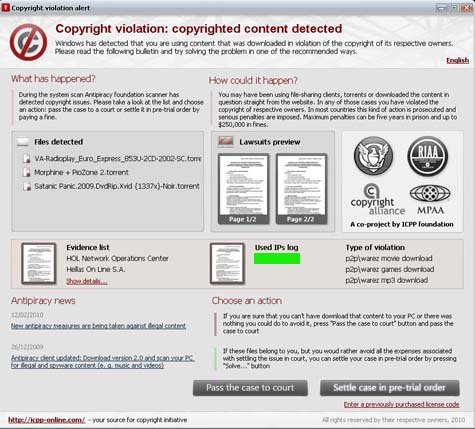
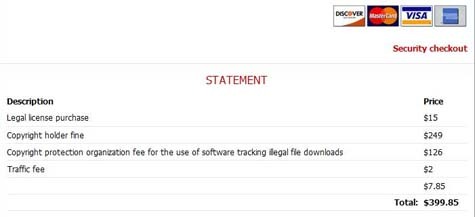
(via Boing Boing, Download Squad) ¶ 0
2010/3/21
The possibility of Australia legalising video games not suitable for children moves a little closer, now that the main obstacle, South Australian Witchfinder-General Attorney-General Michael Atkinson, has resigned from his post, in the wake of a poor election result. Atkinson, a religious conservative, was exercising his power of veto over the possible introduction of an 18+ rating for video games, and was on record making statements comparing video gamers to motorcycle gangs. He also tried to pass a law banning anonymous speech on the internet prior to the election.
2010/3/20
A study by the Australian Centre for Independent Journalism has revealed that more than half of news stories in Australia were spin, driven by public relations. The Murdoch tabloids were the worst, with 70% of stories in the Daily Telegraph being PR-driven, while the Fairfax "quality" papers are as good as it gets; only 42% (only 42%!) of stories in the Sydney Morning Herald were PR-driven.
These statistics probably say as much about the Australian media landscape as anything else. Australia's media is quite homogenised and uncompetitive; a handful of proprietors have the mass media sewn up (there are two newspaper proprietors and about three commercial TV networks). The lack of competition has resulted in low standards of quality; for example, the Fairfax papers (The Age and The Sydney Morning Herald are the biggest ones) are generally regarded to be the "quality" papers, but compared to the British equivalents (such as The Guardian and The Independent), they come out poorly, heavy on the sex, sensationalism and celebrity gossip and light on content and analysis. (The effect gets worse as one moves away from Sydney and Melbourne; for several weeks a few years ago, the most-read story on the front page of Fairfax's Perth paper was "Man gets penis stuck in pasta jar".) Or compare The Australian (Murdoch's "serious" paper in Australia) to its UK equivalent, The Times: The Australian is more nakedly biased.
The Australian press, controlled by an incestuous oligopoly and not subjected to the indignity of competition, has become a stagnant pond. (Australian television, mind you, is much worse.) This is bad news for the kind of discourse required to sustain a mature democracy; a public fed simplified half-truths leavened with gratuitous doses of sensationalism will be in no state to engage on a meaningful level in debate about where their country is heading, leaving all that boring stuff to technocrats and vested interests. The internet provides some competition, but the alarming open-ended censorship firewall plans (all content "refused classification" will be filtered; this includes sites advocating euthanasia, illegal drug use (including offering safety advice) or video games unsuitable for children; the list itself will be a state secret, giving plenty of scope for other sites to be "accidentally" banned if convenient to do so) which look set to become law before the next election, leave a lot of scope for rival sources to be nobbled. (Not surprisingly, the Australian press has been quiet about the plans, echoing the official line that the plans are to "combat paedophilia" and are opposed only by some anarchistic extremists.) As such, it doesn't surprise me if Australia's press oligarchs make the most of their privileged position and cut costs by bulking their papers out with press releases to a greater extent than in more competitive markets.
(via Boing Boing) ¶ 0
2010/3/13
England's severe libel laws have claimed a casualty: science writer Simon Singh, who is being sued for libel by the British Chiropractic Association, has resigned from his Guardian column, citing the onerous requirements of preparing his defence:
The crippling and prohibitive financial cost of defending a libel case is often highlighted, but the equally terrible cost in terms of time and stress is rarely mentioned.
I recently discussed this with Dr Peter Wilmshurst, the eminent cardiologist who is being sued for libel for commenting on the efficacy of a new heart device... Perhaps it was just as well that Peter was not aware of the full implications of what lay ahead of him, namely at least two years of anxiety, misery and the threat of bankruptcy. Almost all his spare time has been spent on the libel case. When finalising his defence, he took two weeks of annual leave to work on the documents. Moreover, dealing with ongoing legal issues has prevented him from carrying out his usual medical research, and a number of publications have been put on hold.England's libel laws are renowned across the world, with litigants taking cases to London on the flimsiest pretexts. Now foreign news organisations are starting to block access from Britain to their web sites to defend against this, raising the prospect of Britain facing Chinese-style isolation without even having to build its own national firewall:
You might feel that I am being alarmist, but major US newspapers, such as the Boston Globe and The New York Times, sent a memo last year to the House of Commons select committee on media, libel and privacy. They warned that they are considering stopping the sale of their publications in Britain due to the threat of libel. The benefits of selling newspapers here in terms of profit are outweighed by the potential losses in libel cases.
If publishers stopped selling hard copies in Britain, they would almost certainly also block their online content, because otherwise the threat of libel would remain.If this worries you, you may want to sign the petition for libel reform.
The libel laws have their fans, though; other than the usual litigants, the recording industry seems to have used them as the models for the new copyright expansion laws they're trying to get passed, which will make any sites capable of sending potentially copyrighted files in private a prohibitive liability to make available to UK users.
2010/2/12
The Iranian government, boldly pushing the boundaries in how to make totalitarianism work in the age of the internet, has announced that it will block Google's Gmail permanently. Instead, Iranians will be provided with "a national email service", intended to "boost local development of internet technology" and "build trust between people and the government".
Australian communications minister Senator Conroy is said to be watching developments carefully.
2010/2/11
The Australian government asked Google to block Australian users from accessing YouTube content which would be illegal in Australia, which would include material promoting euthanasia, graffiti and safer drug use, on the grounds that they already do similar things in China. Google, thankfully, tells the government to go jump.
University of Sydney associate professor Bjorn Landfeldt, one of Australia's top communications experts, said that to comply with Conroy's request Google "would have to install a filter along the lines of what they actually have in China".
"What we're saying is, well in Australia, these are our laws and we'd like you to apply our laws," Conroy said. "Google at the moment filters an enormous amount of material on behalf of the Chinese government; they filter an enormous amount of material on behalf of the Thai government."The government is set to introduce laws forcing all ISPs in Australia to filter all internet traffic, which, unless something unexpected happens, will be law before the 2011 election. (There is plenty of opposition to it, but it all falls into the easily-ignored basket, and psephologists say that internet censorship could only become an issue in two electorates—the inner-city seats of Sydney and Melbourne.) The problem with this is that blocking YouTube altogether would be a bridge too far (the Australian public may be legendarily apathetic, but if you take away their funny cat videos, there'll be hell to pay), and selectively filtering traffic to YouTube would slow it down unacceptably.
Let's hope that Google stick to their guns here.
(via Boing Boing) ¶ 0
2010/2/7
From a Guardian piece on Massive Attack's artwork, this interesting fact:
"We can't use any of the Heligoland artwork I've painted for the posters on London Underground. They won't allow anything on the tube that looks like 'street art'. They want us to remove all drips and fuzz from it so it doesn't look like it's been spray-painted, which is fucking ridiculous. It's the most absurd censorship I've ever seen. "
2010/2/2
The state of South Australia has long been at the vanguard of Australia's lurch towards authoritarianism; the conservative state's veto is keeping video games unsuitable for children illegal in Australia, and the state recently required R-rated films to be displayed in plain packaging; now, Australia's Deep South continues its position of leadership by banning anonymous online comments about the upcoming state election, a law supported by both major political parties.
I imagine that once such a law becomes established in South Australia, it will most probably spread federally, expand into a general mandate for online communications to be labelled with the sender's legal identity, and be hard to eradicate; after all, a law making all internet content legally trackable would be a boon not only for the plan to eradicate pornography (for a broad definition of that word) from the Australian-viewable internet but would also be welcomed by Big Copyright, who would undoubtedly have hefty electoral donations for politicians favouring it. And the fundamental ideas of liberalism—that it is unacceptable to restrict the rights of individuals unless they actively harm others—are looking decidedly shaky in post-Howard Australia.
Update: the law has been retroactively repealed, after mass opposition, and after South Australia's Attorney-General and Wowser-In-Chief, Michael Atkinson, went on air claiming that an online critic, Aaron Fornarino, didn't exist, after which the website AdelaideNow posted a picture of Fornarino.
2010/1/29
The Australian censorship authorities are now banning nude images of small-breasted women, on the grounds that they "encourage paedophilia". From now on, both porn models and sexual appetites in Australia must be traditionally built.
Australia is expected to have a national internet firewall in place before the next election; I wonder whether there's a team at CSIRO working on an image analysis algorithm for detecting unacceptable breast sizes as we speak.
2010/1/19
In Italy, the Berlusconi government is planning to introduce regulations requiring anyone uploading videos to the internet to obtain government approval. The government claims that the regulations (which can be passed without a vote) are an enactment of an EU directive on product placement; conveniently, they also outlaw a lot of competition to established media, such as, for example, the Mediaset group owned by the current Italian Prime Minister.
Article 4 of the decree specifies that the dissemination over the Internet "of moving pictures, whether or not accompanied by sound," requires ministerial authorization. Critics say it will therefore apply to the Web sites of newspapers, to IPTV and to mobile TV, obliging them to take on the same status as television broadcasters.The regulations follow an earlier attempt by the Italian government to regulate bloggers by subjecting them to the same rules as newspaper publishers. Italy also requires all users of internet access points to register their identity, under an "anti-terrorism and anti-paedophilia" law.
2010/1/18
South Australia has led the fight in keeping Australia a censorious society; the wowser-state's Attorney-General's veto has been the main stumbling block to legalising video games unsuitable for children. Now, state laws have come into effect requiring R-rated films to be displayed in plain packaging, with nothing more than the title:
Adults aged over 18 seeking to buy or borrow a copy of Mad Max, the acclaimed desert war drama Three Kings, starring George Clooney, the Brad Pitt classic Fight Club or the 2009 Blu Ray release of Sasha Baron Cohen's fashion parody Bruno will now find them in plain packaging displaying nothing more than the film's title.
Under changes to the state's classification act, which came into effect on Sunday, businesses will face fines of up to $5000 for displaying a "poster, pamphlet or other printed material" for films classified R18+.
The law was announced by the office of South Australian Attorney-General Michael Atkinson, whose conservative campaigning is well known to the film industry.
2010/1/13
Having discovered a sophisticated attack, presumably by Chinese security forces, against its infrastructure, aimed at compromising the details of Chinese human-rights activists, Google has announced a new hard line on dealing with the Chinese government:
These attacks and the surveillance they have uncovered--combined with the attempts over the past year to further limit free speech on the web--have led us to conclude that we should review the feasibility of our business operations in China. We have decided we are no longer willing to continue censoring our results on Google.cn, and so over the next few weeks we will be discussing with the Chinese government the basis on which we could operate an unfiltered search engine within the law, if at all. We recognize that this may well mean having to shut down Google.cn, and potentially our offices in China.
2009/12/19
In an attempt to fight pornography and disharmony on the internet, the Chinese government has banned individuals from registering personal domain names, and announced that those with personal websites might lose them. From now on, only licensed businesses will be able to own domain names in China.
Meanwhile, the Italian government is considering restricting criticism on the internet, after a violent assault on the prime minister, Silvio Berlusconi, which his party have argued was caused by "a climate of hate generated by virulent opposition criticism". Italy already requires anybody using internet access facilities to show and register identity documents, under the guise of fighting terrorism and paedophilia.
2009/12/17
Australia's communications minister Stephen Conroy has announced that the government will go ahead with its mandatory internet censorship firewall, pushing through the legislation before the next election. This is despite a lack of public support for such a scheme (except from fringe religious groups), opposition from child-welfare and civil-rights groups, and a broad consensus that the firewall won't achieve its stated aims and will be prone to abuse. (Under the legislation, ISPs will have to block access to any sites on a secret blacklist. This will nominally include any material that is "refused classification", which could be anything from illegal pornography to information on euthanasia or safer drug use or material pertaining to sexual fetishes, though as the list is secret, there will be little in the way of a future government adding things to it for political advantage.)
In the past, the legislation would have been unlikely to have made it through the Senate (religious wowser Fielding, whom the government courted with the proposal, was all for it, but the other independent, Nick Xenophon, was against it). Now, with the Tories fronted by religious-Right culture-warrior Tony Abbott (whose ascent the government themselves have compared to Joh Bjelke-Petersen's 1987 Prime Ministerial campaign), perhaps they can count on the Opposition to vote for it.
And so, at a fork in the road, Australia turns its back on the cosmopolitan, dynamic 21st-century society it has evolved into and moves to reembrace the small-minded, punitive values of the string of authoritarian penal colonies it was formed from, in the process, joining the club of nations that includes Iran, Burma and China. Say goodbye to the "clever country". Of course, if you're displeased with this, you can let your MP know here. (If you want the government to actyually notice you, read this.)
2009/12/14
The Australian government is finally moving to discuss the possibility of legalising video games unsuitable for children. Currently, there is no 18+ rating for video games, with anything the censors find unsuitable for children either being banned outright or cut for the local market's prim sensibilities (for example, the graffiti-themed game Mark Ecko's Getting Up was banned for promoting illegal activity (presumably because graffiti is more plausible than running over cops and prostitutes or what have you), and one first-person shooter was knocked back because it included images of morphine syringes, and thus sent the wrong message about evil drugs).
Anyway, for what it's worth, the government's discussion paper on a R18+ rating for video games is here. It's currently a discussion paper, though I suspect that common sense will prevail and the 18+ rating will be added. Of course, Christian Fundamentalist groups could mobilise to swamp the discussion with arguments against, but the people who want to be able to shoot realistic zombies tend to be well placed to respond.
2009/11/12
Joe Hewitt, the developer of the iPhone Facebook application, has publicly sworn off iPhone development, over Apple's heavy-handed approval policies:
My decision to stop iPhone development has had everything to do with Apple’s policies. I respect their right to manage their platform however they want, however I am philosophically opposed to the existence of their review process. I am very concerned that they are setting a horrible precedent for other software platforms, and soon gatekeepers will start infesting the lives of every software developer.
The web is still unrestricted and free, and so I am returning to my roots as a web developer. In the long term, I would like to be able to say that I helped to make the web the best mobile platform available, rather than being part of the transition to a world where every developer must go through a middleman to get their software in the hands of users.”I wonder whether this will make enough waves to shake Apple into loosening their grip somewhat. Perhaps that'll take Jamie Zawinski to take up iPhone development, attempt to port DaliClock to it and then storm off in a huff.
2009/11/9
Some news from Venezuela, the Another World that Is Possible. There, the "Bolivarian" authorities have criminalised "violent" video games (a move which may be intended to shut down internet cafés which depend on game players for revenue but also bypass official means of the dissemination of information), and routinely round up gays and lesbians:
One Friday at around midnight, on Villaflor Street, a favourite spot for gays and lesbians in the Venezuelan capital, Yonatan Matheus and Omar Marques noticed two Caracas police patrol vans carrying about 20 detainees, most of them very young.
When Marques and Matheus, who are gay leaders of the Venezuela Diversa (Diverse Venezuela) organisation, approached to find out what was happening and take pictures, they were picked up too.
"Like most of those arrested, our identity documents and mobile phones were taken away, we were beaten, our sexual orientation was insulted in degrading language, and we were refused permission to speak to the Justice Ministry officials and members of the National Guard who were present," Matheus told IPS.
(via Boing Boing) ¶ 0
2009/10/2
On the iPhone, even calculator applications come with obscenity filters, blanking the display if, when the iPhone is turned upside down, the number shown resembles an obscene word.
The author suggests, somewhat facetiously, that this is to get through the App Store's strict decency policies.
2009/9/23
As September 2009 comes to an end, so (arguably) does an era of sorts, because that is when the last batch of Polaroid film expires. Cue the standard nostalgia for the "authenticity" of lossy, pre-digital technologies:
More significantly, though less obviously, it's the end of an era because Polaroid photography was the last technology of irreproducibility. In the digital age we expect – we assume – that every data-based artefact is infinitely reproducible. A piece of recorded music can be ripped, burned, stretched, transposed, copied, compressed and shared to our heart's content. The same goes for video. In writing, there are no longer manuscripts, only versions of files which can be edited, printed, saved (as .doc, RTF, plain text, PDF or XML, all representing the same piece of work). Photography developed rapidly into something similar, and did it first: as soon as the photographic negative arrived on the scene, photography incorporated the idea of the "original" which could be used to make multiple copies. But only the first copy, the print made from the original negative, was of the highest grade. Every generation of copy thereafter deteriorated; information was lost every time a new copy was made. Nor was any copy, any print, definitive. Anyone who has worked in a darkroom knows you can make 20 prints from one negative and every one will be slightly different, depending on the enlarger, the exposure, the manipulation, the developer, the paper, the temperature.The article goes on to mention instant photography's place in the history of 20th-century sexual morés:
Which was, of course, another driving force behind Polaroid: no trip down to the chemist. As one commenter on The New York Times Lede blog wrote: "I bought a Polaroid circa 1986, the day I got a short note from my corner drugstore, 'Dear customer, We are returning your negatives. We regret the inconvenience, but Walgreens does not print photos from negatives of that nature.'" How many marriages did the discreet Polaroid save? How many did it undo? How many secret passions did the unmistakable clunky click WHIRRRRR document? In Britain we weren't allowed to buy the radio remote control "because of RF interference", but I suspected it was the same thinking that undid Oscar Wilde: people should under no circumstances be allowed to do what they like in their bedrooms. Phoo to that. I brought a remote control back from New York and you probably did too.Art hipsters and retro perverts need not despair, however, as long as these people can succeed in making Polaroid-style instant film.
2009/8/5
The latest dispatch from the annals of Apple AppStore approval cluelessness: a dictionary application has made it through the review process only after removing all words that could be considered indecent. NinjaWords' developers tried taking other precautions, such as obtaining a 17+ rating and ensuring that only complete word searches could yield potentially rude words, but to no avail:
The list of omitted words includes some which have utterly non-objectionable senses: ass, snatch, pussy, cock, and even screw. (Ass and cock appear throughout the King James Bible.)
Apple requires you to be 17 years or older to purchase a censored dictionary that omits half the words Steve Jobs uses every day.The article points out that even censorship-happy red-state firms like Wal-Mart will quite happily, and legally, sell dictionaries, containing words like "fuck" and "shit", to children, which makes the famously laid-back Californian Apple's censorship policies look even more ridiculous. Either that or those aren't actually Apple's policies but a result of them hiring trained chimps to handle their app review process.
2009/7/9
Today's Wikipedia featured article is about an old English street name:
Gropecunt Lane (pronounced /ˈɡroʊpkʌnt ˈleɪn/) was a street name found in English towns and cities during the Middle Ages, believed to be a reference to the prostitution centred on those areas; it was normal practice for a medieval street name to reflect the street's function or the economic activity taking place within it. Gropecunt, the earliest known use of which is in about 1230, appears to have been derived as a compound of the words "grope" and "cunt".[1] Streets with that name were often in the busiest parts of medieval towns and cities, and at least one appears to have been an important thoroughfare.
Although the name was once common throughout England,[2] changes in attitude resulted in it being replaced by more innocuous versions such as Grape Lane. Gropecunt was last recorded as a street name in 1561.There are currently no streets named Gropecunt Lane in England, them all having been renamed to things like Magpie Lane, Grape Lane, or in some cases, Grope Lane (attributed by the prudish to the narrowness and darkness of the street, not to any untoward activity having taken place there). Perhaps the time has come for a campaign to undo these shameful acts of vandalism and restore this piece of English history?
2009/3/17
Sinister things are afoot at the United Nations, with an alliance of countries moving to change the UN Human Rights Council's mission to one prohibiting the criticism of religion. The alliance is comprised mostly of Islamic countries, though China, Russia and Cuba are notable by their presence. (It can only be presumed that they are doing this out of the principle of supporting repression wherever it rears its head.) I heard that the Vatican may also be involved, though this is unconfirmed.
For what it's worth, if you live in the UK, you can petition the Prime Minister to oppose this; if enough people do so, maybe, just maybe, he will.
2009/2/27
Some good news from Australia: the Labor government's controversial internet censorship firewall plan appears to be all but dead, as independent senator Nick Xenophon has announced the withdrawal of his support for the scheme. Of course, it could be that he's just angling for some sweeteners and will come over given enough pork for his constituency, though the plan doesn't look too healthy.
2009/1/21
In today's big surprise: apparently the Chinese government censored local broadcasts of Obama's inaugural address, excising mentions of America facing down communism and condemnation of regimes that silence dissent.
Meanwhile, Patrick Farley (of the excellent E-Sheep Comics) has written up a summary of the Bush era: All Circus, No Bread:
Trying to explain what was wrong with the Bush Era feels like trying to vomit up a cannonball. I don't think my jaw can stretch that wide.
Seriously, where does one even begin? Abu Ghraib? Ahmed Chalabi? Mission Accomplished? The "Battle of Iraq?" Valerie Plame? No-bid contracts? The billions of dollars the Pentagon can't account for, and apparently never will? The Department of Justice firings? The blue Iraqi flag? The staged press conference? The fake Thanksgiving turkey? Terry Schiavo? Freedom Fries?
All my life I've heard Baby Boomers bitching about Nixon, even after he was dead. I used to wish they'd just GET OVER IT, but now I understand their bitterness. It wasn't what Nixon did that infuriated them so much. It's what he got away with. Nixon was nudged out of office by a momentary gust of public disfavor over a botched burglary attempt -- not, say, a Congressional investigation into the bombing of Cambodia. There was never a thorough reckoning of the misdeeds of Nixon's White House, just as there will probably never be a full accounting of the perversions and swindles of Bush's presidency. To the majority of Americans, Bush will be that guy who invaded Iraq and wrecked the economy.And US liberal cartoonist Tom Tomorrow has his own farewell salute to Bush and cronies:

2008/12/12
The Australian government's plans for a national internet censorship system seem to be running into trouble. Firstly child-protection groups condemned the plans, then ISPs refused to participate in live trials, and now, the proposal has been blasted by an ultra-conservative pro-censorship senator for being too draconian:
In a post on his blog, South Australian Liberal Senator Cory Bernardi expressed concern that the filters would inadvertently block legitimate content and be expanded to cover other controversial material opposed by the Government of the day, such as regular pornography.
"Already we have a filter on the internet for all parliament house computers. It blocks some political sites, alternative lifestyle sites and other sites that, while not to my personal taste, are hardly grounds for censorship," he wrote.
"Imagine if such censorship was extended to every computer in the country through mandatory ISP filtering. Who would be the ultimate arbiter of what is permissible content?"
Bernardi, who tried to censor Gordon Ramsay by calling for a Senate inquiry into swearing on television in March, is known for his conservative views. The pro-life Senator has questioned whether global warming is caused by human activities, has opposed therapeutic cloning of human embryos and protested against proposed laws prescribing equal treatment of same-sex relationships.With any luck, the whole scheme will disintegrate sooner rather than later.
2008/12/7
Several of the UK's biggest ISPs are blocking access to a Wikipedia page about a heavy metal album. The page in question, on Virgin Killer, an album by German band Scorpions (best known for their fall-of-the-Berlin-wall anthem Winds of Change), includes an image of the cover artwork, which includes a photograph of a naked prepubescent girl; presumably this sort of thing was less unacceptable back when major label RCA signed off on it.
The measures applied redirect traffic for a significant portion of the UK's Internet population through six servers which can log and filter the content that is available to the end user. A serious side-effect of this is the inability of administrators on Wikimedia sites to block vandals and other troublemakers without potentially impacting hundreds of thousands of innocent contributors who are working on the sites in good faith.The ISPs in question include O2, Demon, Sky and Virgin Media. There is no word on whether the ISPs will block other instances of this artwork, such as those appearing on Amazon, or indeed images of other cover artwork with child nudity (a certain Nirvana album comes to mind).
(via  reddragdiva) ¶ 0
2008/10/22
Author and psychogeographer Iain Sinclair (best known for his somewhat hermetic writings about walks around greater London) has apparently been banned by Hackney Council from launching a book at Stoke Newington Library, seemingly because of critical remarks he made about the 2012 Olympics:
Then, last Friday night, I had a call to say sorry, but the invitation was withdrawn. It seemed a diktat had come down from above that I was a non-person and should be barred from the library for the crime of writing an off-message piece on the Olympics. This essay, published in the London Review of Books, responded to aspects of the creation of the Olympic Park in the Lower Lea Valley: the destruction of the Manor Garden allotments, the eviction of travellers, and the famous "legacy" revealed as nothing more than a gigantic shopping mall in Stratford.
The essay had very little to do with the book I was invited to launch. Challenged, the council shifted its ground: I was controversial. Controversy was not allowed in libraries. There could, presumably, be no discussion of stem-cell research or Afghanistan. And Hackney, That Rose-Red Empire fell into that category. A conclusion Hackney was miraculously able to reach without reading a line of a book that won't be published for another three months.
While researching my memoir, I walked back to the Stoke Newington Library and asked for the local history section. They told me that there wasn't one. History had been declared redundant. All that was left were half a dozen pamphlets in a box kept under the desk.More proof that the Olympics is, by its essential nature, a totalitarian project incompatible with free speech?
2008/10/16
Details have emerged of the Australian government's internet censorship scheme. Under the system, Australian internet users will be placed by default on a connection which filters out adult content, though will be able to opt out to a second feed, which only filters content which is illegal in Australia (which includes things such as video games unsuitable for children and advocacy of euthanasia, for example; Australian governments are rather fond of banning things, and the general public are apathetic enough to let them, leaving the puritanical wowsers of the socks-and-sandals brigade as the sole voice lobbying for policy):
“Users can opt-out of the 'additional material' blacklist (referred to in a department press release, which is a list of things unsuitable for children, but there is no opt-out for 'illegal content'”, Newton said.
“Illegal is illegal and if there is infrastructure in place to block it, then it will be required to be blocked — end of story.”
Online libertarians claim the blacklists could be expanded to censor material such as euthanasia, drugs and protest.Of course, this isn't going to do much to help Australian internet speeds (already lagging behind the rest of the world; for example, a 2-megabit ADSL connection in Australia costs more than an 8-megabit one in the UK).
(via Boing Boing) ¶ 4
2008/8/28
 An art gallery is considering whether to withdraw a sculpture of a crucified frog after Pope Benedict condemned it as blasphemous and the president of the regional government went on a hunger strike in protest. The sculpture, Zuerst die Füsse ("Feet First") by the late German artist Martin Kippenberger, depicts an anthropomorphic frog nailed to a cross, its tongue grotesquely lolling, holding a beer stein and an egg, and was intended by the artist as a self-portrait illustrating human angst.
I'm hoping that the gallery stands fast and doesn't remove it. What too many people are forgetting is that one has to choose to be offended by something, and not being offended is not a fundamental human right. If the president of Alto Adige chose to be so offended that he went on a hunger strike and was hospitalised, that was his choice. If we allow one religion to censor art to protect its sensitivities (or, indeed, its claim to cultural hegemony), it sets a terrible precedent.
2008/8/17
The latest salvo from the culture war: Canada's conservative government has scrapped a programme to help Canadian musicians and artists abroad because it was going to "fringe art groups that were unrepresentative or offensive", with one example being the electronica outfit Holy Fuck.
2008/8/7
The Times has an interesting article about pieces of music banned by the BBC at various times. There are, of course, the obvious examples (The Sex Pistols' God Save The Queen, Frankie Goes To Hollywood's Relax, John Lennon's Imagine during the Gulf War), but there are also far more bizarre ones, in which the BBC's Reithian paternalist tradition (now, seemingly, relinquished to Blairite market-pleasing) translated into a heavy-handed, stentorian authoritarianism, often quite arbitrarily:
If Celine Dion had been around during the Second World War, she would have been silenced by the Dance Music Committee. One 1942 directive read: “We have recently adopted a policy of excluding sickly sentimentality which, particularly when sung by certain vocalists, can become nauseating and not at all in keeping with what we feel to be the need of the public in this country in the fourth year of war.”
“The head of religious broadcasting was a bit of a tyrant,” Leigh says. “Don Cornell's Hold My Hand, which was a No 1 in 1954, was banned because he didn't think a relationship with a girl could be likened to the ‘Kingdom of Heaven'.
Equally sinful, in the committee's eyes, was having the audacity to reshape a classical tune into something more swinging. One barbarian at the gates was Perry Como: I'm Always Chasing Rainbows was his rendition of Chopin's Fantasie Impromptu in C sharp minor. “This is a bad perversion of a Chopin melody and should be barred,” the BBC snarled, and, even in 1963, they stopped Ken Dodd's cover version from being broadcast.
2008/7/25
The Russian government is considering banning the emo youth subculture, on the grounds that it is a "negative ideology" encouraging depression, social withdrawal and suicide.
Among the moves supported are strong regulation of websites and banning young people dressed in an emo style from schools and government buildings.
The document states that emos are aged from 12 to 16, wear black and pink, and have long, black hair which may "cover half the face". Other characteristics identified include black fingernails, black belts with studs and pins, and ear and eyebrow piercings.Presumably the Russian authorities would rather its youth disrupted dissident meetings, engaged in mass weddings and had lots of babies than going around wearing black and feeling sorry for themselves.
2008/7/19
Something I didn't know: the current mayor of the Welsh Riviera town of Aberystwyth is the former actress who played Brian's girlfriend, Judith Iscariot, in Monty Python's Life Of Brian, and is now moving to lift the town's ban on the film. Apparently the council banned it when it was released, and nobody remembered that it was still banned, let alone to review the ban.
2008/7/9
The Australian Office of Film and Literature Classification has banned the postapocalyptic war game Fallout 3 (which is rated M in the US), not because of the realistic gore but because, in allowing the player to use the painkiller morphine, it promotes drug use.
2008/6/15
Another milestone in the prolonged death of USENET: US ISP Verizon has removed the unregulated alt.* hierarchy, along with all other newsgroups that aren't formally regulated, on the grounds that they are a stagnant pond that breeds paedoterrorists:
Cuomo claimed that his office found child porn on 88 newsgroups--out of roughly 100,000 newsgroups that exist. In a press release, he took credit for the companies' blunderbuss-style newsgroup removal by saying: "We are attacking this problem by working with Internet service providers...I commend the companies that have stepped up today to embrace a new standard of responsibility, which should serve as a model for the entire industry."
The alt.hierarchy is even more extensive. In the discussion thread attached to our earlier story, one of our readers said: "This is ridiculous. I actually met my wife on alt.personals, 14 years ago... I still use usenet - there are a lot good discussions and a person can get answers to questions on specific topics pretty quickly. It's nice to have a decentralized place to hold discussions, one that is not beholden to a sysadmin to correctly run a forum, one that's free of blinking gifs and flash ads."
2008/5/20
The City of London Police are prosecuting a teenager for calling the Church of Scientology a "cult" during a demonstration:
The incident happened during a protest against the Church of Scientology on May 10. Demonstrators from the anti-Scientology group, Anonymous, who were outside the church's £23m headquarters near St Paul's cathedral, were banned by police from describing Scientology as a cult by police because it was "abusive and insulting".
The teenager refused to back down, quoting a 1984 high court ruling from Mr Justice Latey, in which he described the Church of Scientology as a "cult" which was "corrupt, sinister and dangerous".
The City of London police came under fire two years ago when it emerged that more than 20 officers, ranging from constable to chief superintendent, had accepted gifts worth thousands of pounds from the Church of Scientology. The City of London Chief Superintendent, Kevin Hurley, praised Scientology for "raising the spiritual wealth of society" during the opening of its headquarters in 2006.
Liberty director, Shami Chakrabarti, said: "This barmy prosecution makes a mockery of Britain's free speech traditions. "After criminalising the use of the word 'cult', perhaps the next step is to ban the words 'war' and 'tax' from peaceful demonstrations?"And Charlie Stross weighs in:
I don't care whether Scientology is a "cult" or a "religion", however you slice or dice those terms. Personally, I think the two are interchangeable; your respectable religion is that other guy's cult, and vice versa.
But I am now officially fed up with this public bending-over-backwards to be respectful and sincere towards superstitionists of every stripe, to the point that religion trumps freedom of speech, as this case demonstrates so clearly. And the religious still aren't satisfied — they're out for more. I see no distinction between Christianity, Islam, and Scientology, in this respect: if you give them an inch they'll try and take a mile, as witness the ambush vote on lowering the age limit for abortion that the god botherers have tacked onto the current embryology bill.
We need to kick the bishops out of the House of Lords, ban the Police and judiciary from taking donations from religious organizations, and get religion out of politics by any means necessary.I pretty much agree. The difference between a "cult" like Scientology and a "respectable" religion such as Christianity is not in the plausibility of their beliefs. (Christian doctrines such as the Virgin Birth and Noah's Ark aren't any more rational or less weird than the tenets of Scientology; they only seem that way to us because they're part of the cultural wallpaper of Western civilisation.) IMHO, religions and their believers should be judged on their actions, rather than on the respectability of their particular brand of mythology. (As Voltaire wrote, there is nothing more respectable than an ancient evil.) And religions shouldn't be automatically entitled to be handled with kid gloves and reverential deference, or, indeed, to impose restrictions on those who do not adhere to them (such as the proposed bans on embryo research), just because their organisations are founded on supernatural or unprovable beliefs.
2008/5/19
The nifty thing about being a totalitarian state is that, when you declare three days of mourning, people mourn:
China has issued orders that all entertainment web sites and regular television programming be shut down completely for the next 3 days. Only web sites covering the recent tragic 7.8 magnitude earthquake and television stations broadcasting CCTV earthquake programming will be allowed to remain live.Mind you, this is according to Twitter messages from one web entrepreneur in China, and other reports are divided on whether such a shutdown has actually occurred.
2008/5/17
The Untold History of Toontown's SpeedChat, or an account of what happened when some pioneering virtual-community software developers accepted a commission from Disney to build an online community site—one compliant with Disney's values, so that "there could be no swearing, no sex, no innuendo, and nothing that would allow one child (or adult pretending to be a child) to upset another ... No kid will be harassed, even if they don't know they are being harassed.".
"We spent several weeks building a UI that used pop-downs to construct sentences, and only had completely harmless words - the standard parts of grammar and safe nouns like cars, animals, and objects in the world."
"We thought it was the perfect solution, until we set our first 14-year old boy down in front of it. Within minutes he'd created the following sentence:
I want to stick my long-necked Giraffe up your fluffy white bunny.
They added a method to allow direct chat between users that involves the exchange of secret codes that are generated for each user (with parental permission). The idea is that kids would print them out and give them to each other on the playground. This was a great way for Disney to end-run the standard - since Speed Chat was an effective method of preventing the exchange of these codes, and theoretically the codes had to be given "in-person", making the recipient not-a-stranger. Sure, some folks post them on message boards, but presumably those are folks who 1) are adults, or 2) know each other, right? In any case, as long as no one could pass secret codes within Toontown itself, Disney feels safe.The author, Randall Farmer, coined from this the SpeedChat Corollary: "By hook, or by crook, customers will always find a way to connect with each other."
2008/2/10
MySpace's legendary contempt for its users has now extended to deleting the Atheists & Agnostics group with 35,000 members, apparently because its existence offended some religious hardliners.
“It is an outrage if Rupert Murdoch’s News Corporation and the world’s largest social networking site tolerate discrimination against atheists and agnostics-- and if this situation goes unresolved I’ll have little choice but to believe they do,” said Greg Epstein, humanist chaplain of Harvard University. News Corporation, Murdoch’s global media corporation which also includes Fox News, purchased MySpace in 2005.The group has now been undeleted; here is more on the incident from the group's moderator, Bryan Pesta:
We were deleted two years ago due to complaints from a group called the "Christian Crusaders." They would search Myspace for profiles they found offensive, and then mass complain to customer service. Their strategy was to send so many emails to customer service that someone, somewhere at Myspace would delete the profile or group.
2007/12/31
The Australian government announced mandatory internet filters. Under the scheme, all ISPs will have to provide a "clean" feed free of pornography, which will be the default. It will be possible to opt out of this, which will either involve requesting an unfiltered (or less filtered) feed from the ISP or, after getting one's age verified, getting an account on a government-run "adult content proxy". What it will involve is Australian internet users having the choice of having access to adult content blocked or signing a "perverts' register". Then again, the government has promised that the system will not affect download speeds (which are already lagging behind the rest of the world), so perhaps the whole thing will be quietly placed in the too-hard basket after Family First (whose votes are needed in the Senate) are satisfied that Rudd & Co. are fellow wowsers.
2007/7/10
Some miscellaneous web links from today:
- Scientists in Britain have developed a robot for teaching social skills to autistic children. The robot, named KASPAR (presumably a reference to Kaspar Hauser) can smile, gesticulate and simulate emotions such as surprise and sadness and acts as a "social mediator".
- A taxonomy of terrorist group logos, taken from Wikipedia. There are a lot of swords and AK-47s there, along with a few stars (mostly from the Marxist-influenced, rather than nationalist or Islamist, groups).
- In a year's time, Israel will have a national internet censorship firewall, blocking all adult content, with those wishing to access it being able to do so by signing a "perverts' register". If the Israelis make this work, there'll probably be pressure in Australia to implement something like this (after all, there is theoretical bipartisan support for a national firewall).
- A WIRED article looking at the subculture of people who deliberately try to fly as many miles as possible for the lowest price, and the strategies they employ.
(via Boing Boing, /.) ¶ 0
2007/6/16
Photo-sharing site Flickr has recently implemented a draconian censorship policy; under the new policy, users in Hong Kong, Singapore, South Korea and Germany are prevented from turning off content filtering which blocks them from seeing any accounts which have posted non-"safe" content. (I'm surprised that Australia, with its strict censorship regime, is not on this list. Perhaps they forgot about it?) There has been a firestorm of protest here.
Flickr's management have issued a sequence of content-free communiqués regretting the decision and saying that they're working on a solution, and basically spinning like Tony Blair on speed to appear cool and easy-going, without actually committing to any course of action; it appears that for all their professed hipness, they have as much input into how Flickr is actually run as Frank the Goat has into LiveJournal, and the risk-averse bean-counters and lawyers at Yahoo HQ are calling the shots.
Anyway, as long as this policy is in place, I will not be uploading new photographs to my Flickr account, and I urge those who are concerned about freedom of speech to do the same. Should this policy persist, I will look for alternative hosting for my photographs.
2007/6/1
The Age has an article, excerpted from a recent Quarterly Essay, about how, despite all their protestations of "larrikinism", distrust of authority, and the rambunctious convict spirit, Australians are, as a nation, obedient, compliant and eager to conform, as demonstrated by the past 10 years of the Howard government's erosion of democratic institutions:
Since 1996, Howard has cowed his critics, muffled the press, intimidated the ABC, gagged scientists, silenced non-government organisations, neutered Canberra's mandarins, curtailed parliamentary scrutiny, censored the arts, banned books, criminalised protest and prosecuted whistleblowers.
We haven't been hoodwinked. Each step along the way has been reported, perhaps not as thoroughly and passionately as it should have been, but we're not dealing in dark secrets here. We've known what's going on. If we cared, we didn't care enough to stop it. Boredom, indifference and fear have played a part in this. So does something about ourselves we rarely face: Australians trust authority. Not love, perhaps, but trust. It's bred in the bone. We call ourselves larrikins, but we leave our leaders to get on with it. Even the leaders we mock.David Marr argues that this is so because Australia's defining historical events, unlike, say, America, did not involve abstract ideals loftier than pragmatism:
We've never fought to be free. Vinegar Hill was a convict break-out easily and brutally suppressed. The officers who overthrew Bligh spouted liberty to trade in rum. Shorn of the colour, Eureka was a bunch of miners who didn't want to pay tax. The great issue that drove self-government for the colonies was seizing control of land. We were as much a part of the British Empire after Federation as we were before. And each step away from Britain had to be forced on Australia until the great Mother of the nation finally turned her back on us and walked into Europe. Australia surprised itself by refusing to accept Menzies' tyrannical plans to ban the Communist Party. But only just. Referendums opposed by any of the big parties always lose, and usually heavily. Liberty was preserved in 1951 by 50,000 votes in a nation of millions. The barricades have rarely been manned since.
The historian John Hirst writes: "Australians think of themselves as anti-authority. It is not true. Australians are suspicious of persons in authority, but towards impersonal authority they are very obedient. This is a country which for a long time closed its pubs at 6pm and which pioneered the compulsory wearing of seatbelts in cars. Its people since 1924 have accepted the compulsion to vote. Its anti-smoking legislation is so tough that smoking is prohibited in its largest sporting stadium, the Melbourne Cricket Ground, though it is open to the skies."
2007/5/12
Google's shareholders say, alright, let's be evil where it's profitable:
A majority of Google shareholders today voted against an anti-censorship proposal that took aim at the way the search giant conducts its business in China and other countries that engage in active censorship.
The specific text of the failed proposal, available in the company's online proxy statement, stated:Of course, that doesn't mean that Google will give up the slogan "don't be evil"; given that, in the context of what they do, "evil" is a fairly vague term (even harder to nail down than Apple's environmental record, a subject of some debate), if they do start shopping dissidents to the Chinese government and propping up totalitarian regimes in the interests of profits, if anything, they're more likely to start spinning heavily on the we're-nice-guys angle; sort of like Nestlé.
- Data that can identify individual users should not be hosted in Internet-restricting countries, where political speech can be treated as a crime by the legal system.
- The company will not engage in pro-active censorship.
- The company will use all legal means to resist demands for censorship. The company will only comply with such demands if required to do so through legally binding procedures.
- Users will be clearly informed when the company has acceded to legally binding government requests to filter or otherwise censor content that the user is trying to access.
- Users should be informed about the company's data retention practices, and the ways in which their data is shared with third parties.
- The company will document all cases where legally binding censorship requests have been complied with, and that information will be publicly available.
2007/5/11
The Australian government moves to extend its grip on internet content in Australia, introducing a new law which will require interactive forums to meet TV-style classification criteria. Which sounds like it could mean that forums (such as blog comments, chat rooms, and so on) will either need to employ Chinese-style chaperones to actively police content or be put behind an age verification firewall.
Providers of live services such as chatrooms must have their service professionally assessed to determine whether its "likely content" should be restricted.Were this enforced literally, it would mean the end of non-corporate user-generated content in Australia. (Joe/Jo Blogger, with a full-time job, would not be able to meet their obligations by themselves.) Which could be just what the government (who have been aggressively moving to aggregate the Australian media into the control of as few proprietors as possible) could want. Then again, they may not need to enforce it completely, only to drag it out to take down any troublemakers who step out of line, and/or occasionally beat up someone out of line with mainstream community opinion to score culture-war points.
2007/4/23
Everyone complains about the procession of doom and gloom in the news, but only the Russians are doing something about it. After a bank loyal to Russia's President Vladimir Putin bought out Russia's largest independent radio news network, they decreed that at least 50% of reports about Russia must be "positive".
As well as protecting the Russian people from doom and gloom, they are also committed to guarding them from the pernicious influence of unapproved politicians, all mention of whom has been banned.
2007/4/22
It has emerged that the version of the recent James Bond film Casino Royale shown on British Airways flights has been edited to remove references to rival airline Virgin Atlantic:
British Airways has removed a shot of Virgin Atlantic boss Sir Richard Branson from the in-flight version of the James Bond movie Casino Royale.
The British Airways edit also obscures the tail fin of a Virgin plane that was seen in the original.As a BA spokesman points out, the airline edits many films to render them fit for in-flight viewing, and what exactly that entails is its own business. (I suspect that neither Fight Club nor Snakes On A Plane made it to the backs of airliner seats, for example.) I wonder how many other similar instances of product displacement have occurred on flights.
(via Boing Boing) ¶ 1
2007/4/15
Australia's state governments have unanimously condemned the government's decision to appoint a friend of the Prime Minister to run the Office of Film and Literature Censorship. The new head, Donald McDonald, is former head of the ABC, the now neutered and compliant state broadcaster:
Raena Lea-Shannon, a media lawyer and spokeswoman for lobby group Watch on Censorship, said the move was linked to the Government's desire to clamp down on literature that incites or instructs terrorism. "It fits into a fairly obvious pattern of a strong desire to take control over classification … we should be worried about this because it has a chilling effect on freedom," she said.Another fact that emerges from the article: the OFLC used to be an independent body, but has since been absorbed into the federal Attorney-General's Department. For which there could well be a perfectly rational explanation, though it certainly looks like a move to politicise the mechanism of censorship and media control in Australia. Given the government's equivocal stand on freedom of expression (banning or attempting to ban films which offend the religious right like Baise-Moi and Mysterious Skin and seizing and deporting anti-war activists, whilst stridently defending freedom of speech when it's the speech of sympathetic right-wingers like Alan Jones), it certainly looks troubling.
2007/4/5
The editor of the Indonesian edition of Playboy has been acquitted of indecency. While pornography is widely available in the populous Islamic country, the local edition of Playboy has avoided taking risks, and it is probably safe to say that most of its readers really do get it just for the articles:
The Indonesian version of the magazine went on sale for the first time last April, featuring several scantily-clad models but no nudity.
Arnada would have faced two years in prison, if convicted and his magazine welcomed the ruling. "Playboy Indonesia never has and will never publish nude photos or other forbidden materials," it said in a statement.This ruling has not been enough for hardline Islamist groups, who have threatened to "declare war" on the magazine, and conservatives who are pushing for strict new decency laws. Though given the wide availability of locally-produced pornography, chances are the conservatives' objection is not to Playboy's mildly racy content but to the American/Western cultural values it and its name symbolise.
Meanwhile, Thailand has blocked access to YouTube, after the site refused to remove a video insulting the king (by showing graffiti over his face). Thailand takes insulding the king very seriously; just recently, a Swiss man was jailed for ten years for defacing posters of the monarch.
One thing I'm wondering: would Thailand have blocked YouTube had this happened before last year's military coup?
2007/3/16
Proof that the wowsers haven't completely won the Australian culture war: Australian commercial radio stations have received complaints for playing censored American radio edits of alternative-rock/rap songs:
Nova 100 music director Estelle Paterson said the station received complaints about "radio edited" or "clean" songs it played, describing a version provided by record companies which is shorter and deletes profanity present on album versions.
Radio edits of some hip-hop songs are so cut-up as to be almost unusable, she added, laughing, "And in America everything's considered offensive!"
In Oslo, Norway, some concerned citizen has taken it upon themselves to cover up indecently unclothed statues:
With the exception of one lone figure, every scrap of nipple, crotch or posterior was covered with black strips of paper, no matter the size nor position of the statue. The unknown assailant left an explanatory note behind: "There is too much nudity in newspapers and magazines, so here on the bridge the limit has been reached!"
(via Boing Boing) ¶ 0
2007/3/7
A 1939 magazine article about the censorship of animated cartoons, and exactly the sorts of things the Hays Office (which handled film censorship in the U.S. at the time) demanded cut from cartoons. For example, a cartoon cow was made to wear a skirt covering its udders, a sombrero-wearing bandit is required to end up in jail (crime, you see, must unambiguously be seen to not pay), and a scene with a stereotypical black (as in African-American) angel placing pushpins on a globe labelled "Harlem" and mentioning "De Lawd" had to be altered, not because of the racial stereotypes (which, in 1939, were perfectly fine) but because it was considered too sacrilegious.
It's interesting to note that the article states at the beginning that animated cartoons were subjected to stricter censorship regulations than live-action films because it was assumed that anything animated was for children, who needed to be protected. Similar justifications were used for comic books (with the Comics Code, which was in force until publishers started ignoring it in the 1960s or so, and had similarly puritanical scope), and in current video game censorship in Australia.
(via Boing Boing) ¶ 0
2006/12/5
Iran's reactionary Islamist regime has tightened the screws of censorship and blocked access to numerous evil Zionist-crusader websites like YouTube, Amazon, Wikipedia and IMDB. This seems to be an escalation from the theocracy's relatively more liberal policy until now of only specifically blocking politically or religiously sensitive materials:
Critics accuse Iran of using filtering technology to censor more sites than any country apart from China. Until now, targets have been mainly linked to opposition groups or those deemed "immoral" under Iran's Islamic legal code. Some news sites, such as the BBC's Farsi service, are also blocked.
With some 7.5 million surfers, Iran is believed to have the highest rate of web use in the Middle East after Israel. The net's popularity has prompted an estimated 100,000 bloggers, many opposed to the Islamic regime. Some blogs are substitutes for Iran's once-flourishing, but now largely supressed, reformist press.The new restrictions come a few weeks after the banning of numerous books.
Meanwhile, Iran's president Mahmoud Ahmadine-Jihad, who isn't known for his liberal views, is in hot water with hardliners in his own regime after he was seen watching unveiled women dancers at the opening of the Asian games in Qatar, which appears to be the Iranian equivalent of being caught in a strip club. MPs are calling for an investigation, and probably beheadings, stonings and limb amputations of those involved.
2006/11/28
Google Earth has given ordinary people easy access to satellite images of where they live. In Bahrain, this technology is proving disruptive, as ordinary Bahrainis visualise the glaring inequality between them and the aristocracy who own most of the land:
Opposition activists claim that 80 per cent of the island has been carved up between royals and other private landlords, while much of the rest of the population faces an acute housing shortage.
"Some of the palaces take up more space than three or four villages nearby and block access to the sea for fishermen. People knew this already. But they never saw it. All they saw were the surrounding walls," said Mr Yousif, who is seen in Bahrain as the grandfather of its blogging community.The house of al-Khalifa has responded by knocking down the walls of its palaces and handing the land over to the people.. whom am I kidding; they, of course, responded by configuring the national firewall (and every authoritarian regime should have one of those!) to block access to Google Earth. Which, given the number of internet-savvy Bahrainis, failed, and had the opposite effect, encouraging more people to look at this Google Earth thing.
For those with insufficient bandwidth to access Google Earth, a PDF file with dozens of downloaded images of royal estates has been circulated anonymously by e-mail. Mr Yousif, among others, initially encouraged web users to post images on photo-sharing websites.It'll be interesting to see what happens: whether this will result Bahrain's democratic reform programme to be accelerated, or result in violent unrest and a Nepalese-style crackdown.
(via Boing Boing) ¶ 0
2006/10/24
Reporters Sans Frontières has published its 2006 Press Freedom Index, ranking the world's countries in where they stand in press freedom. There's little change at the top (mostly Nordic countries, with the notable absence of Denmark due to the cartoons row; the poll counts incidents of violence, harrassment and intimidation against journalists, not instances of the defense of press freedom, so any boat-rocking will look bad), nor at the bottom, with North Korea still being world champion of repression, and the likes of Iran, Cuba, Burma and Turkmenistan (whose eccentric dictator, ironically, has just opened a book-shaped building dedicated to the media and "free creativity"; perhaps they can put the cells where journalists are tortured inside it?) being not much better.
The United States has fallen nine places, thanks to uses of national-security laws against journalists critical of the "war on terror" (if it's any consolation, this was done in the name of freedom), and the jailing of blogger Josh Wolf, and France's position has also continued to decline. Meanwhile, Australia has dropped a few points (which is attributed to "anti-terrorist laws").
(via /., Boing Boing) ¶ 0
2006/8/17
Whilst the West hunts for Osama bin Laden, China is intensifying its war against its own equivalent thereof: the Chinese government has pledged a "fight to the death" with the Dalai Lama, its arch-nemesis best known in the West for peddling new-ageisms to Hollywood celebrities:
China's new top official in Tibet has embarked on a fierce campaign to crush loyalty to the exiled Dalai Lama and to extinguish religious beliefs among government officials.
Ethnic Tibetan civil servants of all ranks, from the lowliest of government employees to senior officials, have been banned from attending any religious ceremony or from entering a temple or monastery. Previously only party members were required to be atheist, but many of them quietly retained their Buddhist beliefs. Patriotic education campaigns in the monasteries that have been in the vanguard of anti-Chinese protests have been expanded.
Ethnic Tibetan officials in Lhasa as well as in surrounding rural counties have been required to write criticisms of the Dalai Lama. Senior civil servants must produce 10,000-word essays while those in junior posts need only write 5,000-character condemnations. Even retired officials are not exempt.Elsewhere, China is also cracking down on web video, requiring video (such as that posted on sites like YouTube) to be approved by the government beforehand. This measure was prompted by a number of films which satirised official history.
(Incidentally, China isn't the only country requiring all online video to be approved by censors. In Australia, this is the case too. As far as I know, the government there is not yet cracking down on short films promoting seditious black-armband historical narratives or taking the piss out of For The Term Of His Natural Life or We Of The Never Never.)
(via Boing Boing) ¶ 0
2006/8/2
International consultancy PricewaterhouseCoopers has called on Australia to introduce an 18+ rating for video games, rather than the present system of banning anything not suitable for children. Given that it's a voice of multinational corporate capital (a force the Tories respect more than paternalist wowserism and populist culture-war politics) making the call, and not the despised inner-city refugee-loving latte-socialist elite, perhaps someone will give the censorious theocrat in South Australia who holds the veto a sharp push and get things changed.
2006/5/31
In Australia, there is no R rating for video games, and hence all video and computer games deemed unsuitable for children are illegal (either that or are shoehorned into the suitable-for-teenage-mooks MA category; after all, commerce is commerce); it is a similar situation to what existed with comic books in the US in the days of the Comics Code Authority and the red scare. 88% of Australians want a R rating introduced, recognising that video games aren't merely childrens' entertainment; however, it's not likely to happen any time soon, because a devoutly religious, ultra-conservative state attorney-general holds the power of veto:
In order to change the current regime by introducing a classification bill before parliament, all nine state and federal attorneys-general must agree unanimously to the proposal for an R18+ games rating.
South Australian Attorney General Michael Atkinson opposes the introduction of an R18+ classification for games which would bring interactive entertainment in line with other media like films and publications.
An R rating would give the OFLC a lot more flexibility when dealing with borderline decisions like the recent controversial banning of Marc Ecko's Getting Up as well as sending a much stronger message to parents that not all games are suitable for children.
Singapore is the only other Western country in the world not to have an R classification for games.I suspect that Atkinson isn't the only attorney-general who would veto a R rating. The federal government is quite close to the religious right, and I believe has previously opposed any moves that would Send The Wrong Message by legalising adults-only games.
(And is Singapore really a "Western country" by any criterion? It's in south-east Asia, more Confucian than European in philosophy, somewhat authoritarian, and not, strictly speaking, a functioning liberal democracy. Though, being also descended from the institutions of the British Empire, it could be a model for a more orderly, efficient Australia.)
2006/5/29
Amnesty International has started a campaign against internet repression. Named irrepressible.info, the campaign targets authoritarian/totalitarian regimes like Cuba, China, Iran and the friendly, open-for-business United Arab Emirates, which censor material the regime disapproves of, monitor the internet and jail dissidents, often with the help of compliant western companies like Yahoo!. There are resources detailing the extent of internet-based repression in various corners of the world, as well as a pledge to sign, which will be presented at a UN conference in November:
In November 2006, governments and companies from all over the world will attend a UN conference to discuss the future of the Internet. You can help us send a clear message to them that people everywhere believe the Internet should be a force for political freedom, not repression.
2006/4/12
An article on how massive, retailer Wal-Mart's influence affects the video game industry (at least in North America), from puritanical social norms being enforced in game design to the range of marketable games being constrained to a few tried-and-tested mainstream genres, with little room for innovation:
Developers have produced "special Wal-Mart editions" of some games, such as Duke Nukem 3D and Blood, that delete the two principal bugaboos, nudity and excessive gore. Other developers just sanitize their games across the board. As a Ritual Entertainment developer remarked in an online chat promoting their Heavy Metal: F.A.K.K. 2 game (2000), "There's not much nudity other than statues. Wal-Mart is picky about that. When you have to decide between feeding your family or putting nudity in the game, you choose food."
More pertinent than the packaging of games is their content. Wal-Mart and other retailers display an ever- decreasing range of game types. More and more, it is difficult-to-impossible to market an adventure game, or a non-Microsoft flight simulator, or a non-Maxis city-builder, or a non-Civilization turn-based strategy game. Did the audiences for these forms simply wither away? No, they're still out there - but they're not sufficiently profitable for big-box retail chains. The commercial range of games shrinks because of the free market's uncompromising pursuit of the majority at the expense of all minority tastes. We see this most clearly in Wal-Mart's signal triumph in game design, Deer Hunter.
2006/3/23
Looks like the Australian national internet firewall is one step closer, with the Tories moving to support it.
But yesterday Senator Coonan's spokeswoman said "the Government has not ruled out ISP-based filtering and is currently undertaking a trial in Tasmania in conjunction with the internet safety agency NetAlert".It looks like Australians' days of free unfiltered internet access are numbered, and soon they will have to sign a "perverts' register" to get access to things not deemed suitable for children (which would not merely mean hardcore porn, but any sites that do not restrict themselves to themes suitable for children; for example, Boing Boing would almost certainly be blocked, as it is in the United Arab Emirates and such). And, with the infrastructure of censorship in place, chances are access to content not deemed suitable for Australians (such as parodies of government web sites) could be blocked to everyone.
Of course, the national firewall isn't law yet, though given the amount of pressure there is on all parties from the wowsers and religious conservatives (who have become very well organised, as in the U.S.), it stands a good chance of becoming so unless those who believe in an open internet stand up and be heard. Electronic Frontiers Australia is one group opposing this scheme.
2006/3/21
Seemingly trying to outflank the Tories on the right and court the favour of the evangelical churches and wowsers, the Australian Labor Party has announced that it will institute ISP-level blocking of adult internet content should it win power. The policy, which will allow those who wish to access porn to sign a perverts' register and get access to a less-filtered version of the feed, originally belonged to Christian Fundamentalist party Family First, to whom Labor has been cozying up lately (such as, for example, by giving them preferences ahead of the Greens and Democrats in recent state elections).
Of course, the prospects of Labor winning power within the next decade or so aren't exactly promising. Though the prospect of two paternalist wowser parties trying to outdo each other's social conservatism isn't exactly appealing. Though, if anything, this is the first time in ages that the Liberal Party has lived up to its name as the more liberal end of the spectrum.
2006/3/17
Another update on the state of free speech in Australia: A spoof of the Prime Minister's website, created by former Oz troublemaker Richard Neville, has been taken down by request from the Prime Minister's office, under anti-phishing guidelines designed to target sites which impersonate banks to steal user credentials. (Presumably a quick phone call was easier than sedition proceedings.) The site, johnhowardpm.org, was hosted by Yahoo, but used an Australian domain registrar, Melbourne IT. The moral of this story: if you say anything the Australian government doesn't approve of, don't register your domain in Australia.
Meanwhile, the reasons for the banning of the video game Getting Up in Australia have emerged: the game is illegal because it teaches skills that can be used in committing a crime, namely vandalism. Presumably under this precedent, all first-person shooters will now be illegal in Australia. And then there's Pac-Man, Mario Bros., and other games featuring behaviour-altering pills, which encourage drug use.
2006/2/17
A media expert claims that, if Australia's ban on the video game Getting Up is not overturned, it may set a precedent, leading to any interactive games inculcating illegal activity or disrespect of rightful authority to be outlawed in Australia.
2006/2/15
The latest video game to be banned by the Australian government is Mark Ecko's Getting Up, a game involving graffiti, which is banned on the grounds that it would promote graffiti.
And so, once again, Australia faced a choice between Western liberalism and Singapore-style authoritarian paternalism, and chose the latter.
I think someone should start a campaign to overhaul the Australian video game censorship guidelines and create an adults-only/"R" category. To divide an entire genre of entertainment into "suitable for children" (in the eyes of bureaucrats appointed by a conservative government unapologetic about its culture-war agenda) and "legally equivalent to child pornography/snuff films" is ridiculous.
2006/1/19
 China's pervasive internet surveillance regime now has a new public image: from now on, either various government sites or all websites in Shenzhen will display cartoon mascots of police officers (looking big-eyed and oddly Caucasian). Clicking on the mascots will take you to a web page where you can talk with actual members of China's internet police. They do things differently in China.
(via bOING bOING) ¶ 0
2006/1/9
After buying teen-angst-journal/band MP3 site MySpace, Rupert Murdoch's News Corporation lost no time in censoring journals and user profiles to remove links to non-Murdoch-owned video sharing site YouTube:
"This is soooo like Fox and News Corp to try and secretly seal our mouths with duct tape," wrote "Alex" to Blog Herald.
The protests gathered pace, and when 600 MySpace customers complained and a campaign began to boycott the site and relocate to rival sites such as Friendster, Linkedin, revver.com and Facebook.com, News Corp relented and restored the links.
However, MySpace managers promptly shut down the blog forum on which members had complained about the interference. An online notice said the problem was the result of "a simple misunderstanding".Why anyone would choose MySpace as their journal site is beyond me; the site's social-software functionality is very primitive, and looks cheap, the interface being absolutely spammy with intrusive advertising. Though, sadly, it is said to be the industry-standard place for unsigned bands to post MP3s, especially with mp3.com having been killed off years ago.
2006/1/5
In Australia, it is now a crime to discuss suicide options by telephone, fax, email or the internet. So much for the ideals of free speech and liberalism; apparently the right of religious busybodies to control when and how people can exit their divinely bestowed lives overrides such considerations.
2005/12/9
The next stage of the Australian police state may have been announced; after their triumph with workplace relations, sedition laws and making universities inhospitable to student leftism, a sizeable contingent of the Tories are pushing for mandatory internet filtering. Of course, because Australia Is A Liberal Democracy, those perverts who want to look at porn could apply to do so after signing the perverts' register, getting a National Pervert Number which could be entered into the firewall page, giving one a less-filtered level of access.
It remains to be seen whether this suggestion will become government policy.
2005/9/29
The FBI's War On Pornography draws its first blood before it even begins: purveyor of nekkid-goth-chick-pictures Suicide Girls has taken down some photographs, preemptively, in the hope of avoiding a FBI raid. (Because we all know the devoutly religious types Ashcroft had appointed would love to take those darkness-worshipping punks down with maximum force.)
We have received no formal government notice to remove these images, however, in the course of our involvement, as witnesses, in a federal criminal prosecution that does not target SG, we have been made aware of the risks posting such content poses the owners of the company. Given the U.S. Attorney General Alberto Gonzales' new war on porn task force and it's intent to bring obscenity charges against their loosely defined "Deviant" imagery, we have removed any images with fake blood and any images we felt could be wrongfully construed as sadist or masochist.It could probably be argued that piercings and punk/goth paraphernalia automatically constitute "deviant" imagery. Perhaps not strongly enough to win a court case, but enough to keep the site offline until the matter is dragged, expensively, though the courts.
I wonder how long until the War On Porn spreads to Australia. (Given the Family First presence in the Senate, the government's paternalistic style, the lack of US-style constitutional guarantees of freedom of speech and senior Tories' periodic thumping of the wowser-moral-values tub, I wouldn't rule it out.) Perhaps one day soon we'll wake up and read in the Age or hear on RRR about the Australian Federal Police raiding I Shot Myself and impounding their servers or something.
(Warning: some links in this post may contain erototoxins.)
(via bOING bOING) ¶ 8
2005/8/31
Police in Malaysia are carrying out random spot checks for pornography on mobile phones. Those found with porn will be charged with possession, and presumably flogged or caned or whatever they do, at Dr. Mahathir's pleasure.
Meanwhile, in India, the local movie studios' organisation, the MPA, has successfully obtained a general search and seizure warrant, allowing its officers to search any property in Delhi deemed under suspicion of piracy. Of course, they only intend to use such warrants against the terrorists who produce and sell pirated DVDs at markets, and, being the good guys, undoubtedly are honour-bound not to abuse these powers, so there's no cause for concern.
And in China, a researcher has discovered a sinister and ominous new trend, that people who buy webcams often use them whilst naked, posing a serious threat to public health and morality:
"At first, we thought it was merely a game for a few mentally abnormal people," the paper quoted Liu as saying. "But as our research continued, we found the problem was much larger than expected."It wasn't made clear what proportion of webcam users are filthy perverts, or, indeed, what those who don't chat naked use them for.
(via TechDirt, bOING bOING) ¶ 1
2005/8/9
There is now debate in Australia about banning militant jihadist literature. Am I the only person who finds it odd that a country which bans computer games unsuitable for children, "immoral" literature (such as 18th-century erotic novel Fanny Hill) and controversial art-house films such as Baise-Moi is agonising so much over whether banning incendiary literature calling for holy war would be too illiberal?
2005/8/2
The Australian federal government has failed in its attempt to have the film Mysterious Skin banned, with the Office of Film and Literature Classification deciding that it should keep its R rating. The government, along with various conservative Christian groups, requested a review of the film's rating.
I wonder whether the government will now move to tighten up censorship laws and/or stack change the composition of the OFLC's board on the grounds that it is "too liberal" and does not represent "community values" (you know, of communities such as the Festival of Light and the Assembly of God).
2005/7/27
It turns out that web filtering software from US company Symantec has been blocking anti-war emails. Mails containing links to www.afterdowningstreet.org were blocked by Symantec's anti-spam software, because the link allegedly received 46,000 complaints. Which means either that all it takes to censor the public's email in the US (and, presumably, other countries which buy Symantec software) is the capacity to send a lot of complaints (which is not hard these days), or that it is Symantec policy to use its power in the marketplace to impose a specific political ideology, à la Wal-Mart. (Does anybody know whether the owners of Symantec have a specific political bias?)
2005/7/20
The Howard government's fondness for censorship and kneejerk moralism strikes again: now they're pushing to have the film Mysterious Skin banned. Attorney-General Philip Ruddock ordered a review of the film's classification because the puritanical wowsers from the Australian Family Association and evangelical Christian groups read a summary of the film and decided that it could titiliate paedophiles or help them seduce children. Which, as anyone who has seen the film will tell you, is absurd. But it plays well with the Hillsong/Family First constituency who have the government's ear, so the rest of Australia have to make do with the cultural products our appointed spiritual leaders decide are appropriate.
(The film showed here in the UK some months ago, and there was no outcry whatsoever; to people here, it was just another small indie film. But for some reason, Australians cannot be trusted with the same amount of leeway they have elsewhere.)
Anyway, if you live in Australia and are displeased with small-minded petty theocrats from one-book households deciding what you can and cannot legally see, write a letter to a newspaper. It's important that someone lets the censors of Canberra know that they are answerable to people other than religious prudes. (Perhaps it's time someone printed stickers that said "I Watch Controversial Arthouse Films And I Vote"?)
(via justlikehoney) ¶ 4
2005/6/21
It looks like Australia may be facing another tightening of its already notorious censorship laws, this time governing TV nudity; Australia's equivalent of the Janet Jackson nipple outrage is reality-TV-show contestants getting it on in a hot-tub, which has made it into Federal parliamentary debates:
"What we basically have is pornography and full frontal nudity on television at a time when children are watching. These people have an aspiration to be porn stars," Draper told Reuters.It's hard to believe that this is the country that, only five years earlier, was considering introducing a "non-violent erotica" film classification.
At least Howard/Hillsong Australia c.2005 isn't quite as bad as Iran, where the government is microwaving its own population to save them from satellite-TV-borne "westoxication". The huge volumes of microwaves being pumped into population centres as Iran's elections approach are claimed to cause everything from migraines to birth defects or worse; though what are a few brain tumours compared to eternal salvation?
2005/6/2
ICANN has approved the .xxx top-level domain, intended for use by porn sites, rejecting arguments that governments appealing to populist puritanism will eventually force all sex-related sites (including sex-education sites or those supporting victims of sexual abuse) into this easily-censorable ghetto.
Other new domains approved have been .jobs, .post and .cat. I wonder whether the last one means that cat pictures now have their own TLD.
2005/4/19
The MPAA show their bizarre, fundamentalist views on intellectual property yet again, this time by sending legal nastygrams to websites using the MPAA's ratings code; i.e., if you claim that your website, photo gallery, Harry Potter fan-fiction story or whatever is G (or PG or R or whatever)-rated, you can expect a cease-and-desist notice in the mail:
"We have a right to go after people who use our trademarks without permission, big or small, whenever we find out about them," said John Feehery, executive vice president for the association. "Our ratings are not supposed to be ripped off."
Wendy Seltzer, a lawyer with the Electronic Frontier Foundation, argues that the association would have a point only if the fiction sites had claimed that association reviewers had rated the works. Using the ratings as a rough comparison is not a trademark infringement, she said: "It's like saying a beverage tastes like Coke."
I'm hoping that this does go to court and the MPAA get a good caning, which, if anything resembling common sense prevails, they should.
Meanwhile, if you're content with the G, PG and R ratings, you can always claim that you're using the Australian ones and not the U.S. ones; the Australian Office of Film and Literature Censorship may be Bowdlerites, but they're probably not Galambosians.
2005/3/21
Electronic Frontiers Australia, Australia's equivalent of the EFF, are pushing to legalise adult-oriented computer games. Presently, the video-game rating system is written with the assumption that games are for children; it only goes up to MA (i.e., 15 years or over), and thus any games deemed unsuitable for 15-year-olds are illegal. This has resulted in some games being banned outright, and others (including some in the Grand Theft Auto series) being bowdlerised for Australia's tender sensibilities.
Of course, getting such a change of law passed by the social-conservative Tory government (which, after all, is responsible for tightening up the censorship system to its present level of Mary Whitehouse-esque prissiness and banning a fuckload of things Britons and most Americans can see freely) would be a difficult task at any time. And now, it may be even harder, given that a Tory senator's career of swashbuckling high adventure has come to light. If Senator Lightfoot, alleged to have been gallivanting around Iraq with a gun and smuggling money to an oil company, is found to have been a political liability, the government's Senate majority may disappear, and were that to happen, they would be forced to go into coalition with religious-right party Family First, who make them look like, well, liberals (they are the ones demanding a Saudi-style national internet firewall). With that looming on the horizon, it may be prudent for them to bulk up their wowser credentials, and developing a reputation for being open-minded, tolerant or otherwise "soft on filth" would be exactly the wrong thing to do.
2005/2/22
Today is Free Mojtaba and Arash day, an international campaign to free two Iranian bloggers imprisoned in a crackdown on online publishing. To see how you can help, follow the link above.
2004/12/31
Patent of the day: Automatic Detection of Pornographic Images:
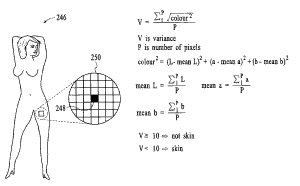
If the pixel color is determined to be "skin" 46, the image is sent to a first shape detection process indicated for example as "face detection" of block 48 wherein steps similar to blocks 26 and 28 of FIG. 1 are performed. If the image is detected as a "face" 50, the image is classified as "portrait" and a manual check/inspection is done only infrequently (block 52). If the image is not a "face" 54, the image is analyzed to determine if it is a body part (block 56) i.e., other than a face. If it is not a body part (58), the image is classified as a "landscape", and this type is only inspected occasionally (block 60) i.e. only a small percentage of these images are inspected manually. If the image is a body part (62), a pose detection is done to determine if there is an erotic position (block 64). If it is determined that the pose is not erotic (66), this image is classified as a "swim suit picture" and the result of the detection may be a "parental guidance" notice attached (block 68).
(via bOING bOING)
2004/12/18
Quoted from Graham's blog, whose comments appear to be broken:
Bizarro sex ed animations, produced by the BBC. Theres one for the girls and one for the lads. Not Safe For Work. Also notice the difference in the title banners. And could you imagine the response from Murdochs hounds if the ABC even broached anything like this? More evidence that weve fallen behind the mother country in the prudity stakes. (Edit: or ahead, depending on your point of view.)
Actually, I don't think it's a matter of Australia having fallen behind the UK, so much as "respectable" Australian social morés always having been more conservative and less permissive than in the old country. It was like that in the 1950s, when Melbourne and Sydney were (on the surface) much more buttoned-down and less accepting of any deviancy than London; and in the early 1960s, when a British model British fashion model Jean Shrimpton went to the Melbourne Cup wearing a miniskirt (which was the done thing in London), it caused public outrage and indignation.
Part of this would probably come from the frontier/outpost mentality ingrained into the Australian psyche. Australia is a new country, half a world away from civilisation, and thus needs more discipline to hold the line against barbarism. It is, the reasoning can be extrapolated as, not yet mature enough to be trusted with as much leeway as they have in London or Los Angeles. The fact that it was originally a penal colony, ruled with an iron fist by colonial governors, could have something to do with the political culture as well. The convicts are gone, but the paternalistic streak remains in Australia; from John Howard and his idol Robert Menzies to fictitious civic patriarchs in films like The Cars That Ate Paris and Welcome To Woop Woop, Australia has traditionally been a country of stern father figures laying down rules they expect to be heeded. Australia has also been a traditionally censorious society; other than high-profile cases like Baise-Moi and Nine Songs, many mainstream films have scenes cut or shortened prior to being allowed to be shown in Australia; meanwhile, a number of books, including, allegedly, 18th-century erotic novel Fanny Hill, are banned in Australia. And given how popular Howard's retro-styled leadership is (after all, one can only give so much credit to Rupert Murdoch's news-management for the last election), one can conclude that much of Australia finds this sort of governance reassuring.
Of course, that is only one side of the story. The streak of paternalistic conservatism in "respectable" bourgeois Australian society is counterbalanced by another phenomenon: the larrikin tradition. This tradition, of borderline contempt for authority and propriety, has been in Australia since the days of convict settlements and corrupt, arbitrary government, and is just as firmly ingrained, underneath the surface of society, as conservatism. The larrikin element can be argued to have informed everything from Australian contemporary art from the Angry Penguins onwards to youth counterculture (from bodgies to ferals), from contemporary scofflaws (it's no accident that Melbourne is home to the Cave Clan, dozens of zines and one of the world's most active stencil graffiti scenes) to the fine Australian tradition of political pranks.
And so we get the dynamic between wowserism (the bourgeois paternalist conservatism) and larrikinism, with both sides of the equation reinforcing each other. The larrikin vein beneath the surface of Australian culture is proof that Australia isn't ready for the sorts of license they have elsewhere in the world, and needs a firm hand to guide it. Meanwhile, the conservative, conformistic streak in respectable Australian society fuels the undercurrent of resistance. It is a balance, and a positive feedback loop, between order and chaos, just as that described by Discordianism.
It appears to me that the prominent larrikin-wowser dynamic, and its various consequences, is the main difference between the Australian and British cultures. Britain is less conservative or censorious as a whole (in fact, some have called this Britain's "repressive tolerance"), but doesn't have the larrikin tradition (not that it's a terribly orderly place, just that its disorder seems to be confined to drunken neds punching each other up outside pubs at 11pm, and has no deeper cultural manifestation).
Rod Liddle in last week's Sunday Times on Britain's upcoming religious vilification laws:
Heres a short Christmas quiz. Let me rephrase that. Its a short Winterval quiz. I would not wish to frighten or alienate any Sunday Times readers by waving Jesus Christ in their faces.
Anyway, the first question is this. One of the two statements below may soon be illegal; the other will still be within the law. You have to decide which is which and explain, with the aid of a diagram, the logic behind the new provision. a) Stoning women to death for adultery is barbaric. b) People who believe it is right to stone women to death for adultery are barbaric.
Other people, including comedian Rowan Atkinson, have pointed out that the religious vilification laws could have profoundly chilling effects on debate, which the Home Office strenuously denies. The bill, as drafted, apparently criminalises treating religious texts, such as the Bible or Koran, "in an abusive or insulting way", thus sounding dangerously like the all-faiths blasphemy bill David Blunkett went out of his way to say it wasn't. It does, however, specifically exempt comedians.
(I'll bet that the Church of Scientology's lawyers are rubbing their hands with glee at the shiny new blunt instrument for use against critics they are about to be handed. I wonder whether they'll get to use Britain's national firewall to block access to critical sites.) (via FmH)
2004/12/2
A modicum of common sense in Canberra; the ruling Tories have rejected a national internet porn filter, as demanded by Family First and Tasmanian religiot senator Brian Harradine, on the grounds that it would drive up costs without necessarily solving the problem. Let's hope they stick with this approach.
Curiously enough, Australia has a notionally more liberal internet regime than Britain; the UK has a national internet firewall, as do Singapore, China and Saudi Arabia, only it is currently only used against child pornography sites. What will happen the next time, say, a former MI6 agent publishes his memoirs abroad and the D-notices start flying, however, may be another matter.
2004/11/14
John Howard's Australia's 1950s-style parochialism and prudery strikes again, as Michael Winterbottom's latest film receives an X rating, preventing it from being shown in cinemas or made available except in the ACT. The film, 9 Songs, involves a couple attending live music gigs, before repeatedly having sex; Winterbottom (who also did 24 Hour Party People) made it as a statement against prudery. I guess such statements have no place in Relaxed and Comfortable Australia.
The twilight of secularism (an ongoing series): Australia's highest-ranking Catholic clergyman and leading conservative hardliner, Cardinal George Pell, gave a speech comparing Islam to Communism and saying that secular democracy has failed and must be replaced with what he called "democratic personalism", with paternalistic Christian government being the only hope of countering the spread of fundamentalist Islam.
"The small but growing conversion of native Westerners within Western societies to Islam carries the suggestion that Islam may provide in the 21st century the attraction which communism provided in the 20th, both for those who are alienated or embittered on the one hand, and for those who seek order or justice on the other," he said.
He asked: "Does democracy need a burgeoning billion-dollar pornography industry to be truly democratic? Does it need an abortion rate in the tens of millions? "What would democracy look like if you took some of these things out of the picture? Would it cease to be democracy? Or would it actually become more democratic?"
Perhaps, after a few more terms of John Howard/Tony Abbott, we'll find out. Besides which, "democratic personalism" has a nicely euphemistic ring to it. Given how misleading it is for the Tories to call themselves the "Liberal Party", perhaps they'll take the hint and rename themselves the Democratic Personalist Party.
2004/11/7
Dispatches from the Culture War: Intoxicated with their triumph, the Tories are blaming the legacy of the "permissive 1960s" for Australia's social ills, and implying that, had this decade of godless liberalism never happened, Australia would be a much better place. But what would Deputy PM John Anderson's ideal Australia look like?
We may have been serene but we were not widely read - more than 1000 books had been placed on the banned list. In the Western world, only Ireland, still straining under the power of the Catholic clergy, could boast a more rigorous record of prohibition.
The great American satirist Tom Lehrer also felt the lash of our moral arbiters. A ditty that exhorted a Boy Scout to "be prepared" upon meeting a Girl Guide was deemed too risque for our sensitive ears and thus found itself on the taboo list.
Well, the Howard government has already moved in that direction, with tightening of film censorship. Notwithstanding high-profile cases like Baise-Moi, many films shown in Australia are a few minutes shorter than their overseas releases because of cuts made by the OFLC. And book censorship is still around; the 18th-century bawdy novel Fanny Hill is among the books still banned in Australia.
That year the White Australia Policy was still the go, though the ALP federal conference insisted that in no way did it "represent racial prejudice". A further example of our enlightenment on such matters came from South Africa's Prime Minister Verwoerd, the architect of apartheid, who claimed that Australia was "the best friend South Africa had". And this not a year after the Sharpeville massacre.
And we were four years away from the death of a young Lutheran, Errol Noack, who lost a bizarre lottery and became the first National Serviceman to die in Vietnam. He didn't want to go but he perceived a duty. He died months before we were to go "all the way with LBJ".
Again, we could very well see the return of national service before the next election. If the US brings in conscription (not unlikely, especially if the alternative is surrendering Iraq to become al-Zarqawi's personal jihad-state; after all, unmanned drones, satellite intelligence and high-tech communications can only make up so much for lack of troops on the ground) and requests more troops from Australia, it is inconceivable that the Howard administration would knock them back. And they'd have an argument for it, even if it does hinge on the circularity of Howard having made this "our fight" in the first place.
Fortunately a considerable part of the '60s generation understood that traditional values were worthless without coherence and that authority needed a core of integrity. The racism, censorship and aggression of the '60s was rightfully challenged and, to a considerable degree, overcome.
The brave took bus rides to the outback and organised lonely vigils on street corners, paving the way to mass protest.
Perhaps that's the real concern of social conservatives like John Anderson. It's not so much the sex, drugs and Pink Floyd that they fear, though these types certainly aren't much into fun. It's the challenge to orthodoxy and conformity. They are frightened of an outbreak of contrary thought, of debate beyond the set margins. Be they within government or without, they wish to determine what we think, say, write and do.
2004/10/9
Australia has made its choice, the Tories have been reelected with an increased majority, and look like gaining control of the Senate as well (current predictions show them set to have half the Senate in their own right, with a Family First senator giving them a majority, in return for a religious conservative legislative agenda). The Greens did well, but, with Labor having collapsed under them, they will be unable to do much with all their Senate seats. So, what can we expect in the next three years?
For one, we're likely to see a stepping up of the culture war. The election has shown that Australia is polarised, between a small, cosmopolitanist minority in the inner cities who voted Green, and the majority of Herald-Sun-reading suburban battlers who back Howard. Given the acrimony before the election (other parties directing preferences away from the Greens as if they were One Nation, and scare ads about the Greens standing for drugs and paedophilia), and the Family First factor, the prospects of a new, triumphant Howard government waving the olive branch of inclusion seems unlikely. What seems more likely is that the boot will come down hard, and the culture war will become uglier, dirtier and more brutal, with the full weight of a completely controlled legislative apparatus being used to instill "Australian" values and punish the deviants who resist them.
What will this entail? For one, more censorship. Under Howard, Australia had already become quite a censorious society (witness the banning of Baise-Moi in the cinemas a few years ago), and will do so even more as Family First push for children and adults to be protected from filth. Expect more controversial films to be denied classification, or film distributors to even stop bothering trying to get a rating for anything controversial in Australia, while many films which are shown will only be shown in expurgated editions. More internet censorship is on the cards. Family First proposed a national censorship infrastructure, like Singapore's, funded by a $10 annual levy on each user; it is not unlikely that the Howard government will borrow this idea. After all, the current censorship arrangement (as secretive and undemocratic as it is) still doesn't stop children from viewing filth at a few mouse clicks (as any tabloid journalist will be happy to demonstrate). And national censorship infrastructures have been shown to be workable; Singapore, China and Saudi Arabia have them, and Britain now also has infrastructure in place to block web sites (it is presently used to block a few child pornography web sites, but could be pressed into service to block the next equivalent of Spycatcher or David Shayler at the drop of a D-notice, but I digress). Some in the Liberal Party even suggested, some years ago, blocking all adult content from the mainstream internet, requiring those perverted enough to look at such content to register for access through a special proxy server. Registration would, presumably, limit one's career prospects in certain industries, just in case your Suicide Girls habit made you into a kiddie diddler.
With Australia's new family-friendly cinemas and internet, the country's reputation as a modern, cosmopolitan society will suffer. Film and arts festivals will lose any edge they had, attracting little in the way of anything controversial but instead presenting only comforting banalities. Sydney and Melbourne will once again give up their claim to be world cultural capitals and fall back to being big provincial towns. And don't expect anything like Piss Christ being exhibited in an Australian gallery; chances are, Andres Serrano wouldn't even get a visa. Welcome to relaxed and comfortable Australia, where decent people needn't fear having their sensibilities offended.
Other consequences of the Culture War could be loss of reproductive choice (current health minister Tony Abbott mentioned his opposition to abortion, and with Family First's new influence, it could be banned or restricted), institutionalised discrimination against homosexuals (they are, after all, deviants who have no place in Howard's idealised 1950s suburbia), continuing denial of indigenous rights, not to mention a policy of pure spite towards refugees.
And then there is the US-Australian Free Trade Agreement, in which Australia signed over vast swathes of economic sovereignty to the US in return for access to US markets for its sugar industry, only to find out that that wasn't part of the deal, but pressed on anyway out of loyalty. Since we're adopting wholesale the US software patent system, we can expect small Australian software companies to go out of business, unable to risk the cost of patent litigation, or be bought out en masse by multinationals with patent portfolios and cross-licensing agreements. Within a few years, the Australian industry will be little more than a branch office of US multinationals. Open source may not escape unscathed; given the broadness of software patents, anything without a multinational with a huge legal department behind it will be too much of a risk for anybody to use, distribute or support. And then there's our adoption of US copyright laws without actually having a Constitutional fair use provision, as the US does, which means that anyone with an iPod is committing a crime.
If there's one good thing that may come out of the new, repressive, paternalist Australia, it is the prospect of an underground culture flourishing in pockets of resistance. After all, it was the roiling undercurrents of resentment in Thatcher's Britain that gave us everything from alternative comedy to the explosion of British indie music and art. (Not that the Thatcherites took their credit for that happening on their watch; they were too busy promoting their view of proper British culture in the form of Lloyd-Webber musicals and insipid Merchant-Ivory costume dramas and the like, their own equivalent of "Relaxed and Comfortable".)
2004/9/30
A look at John Howard-approved potential balance-of-power-holders Family First's internet policy:
Conservative political newcomer Family First wants an annual levy of $7 to $10 on all internet users to fund a $45 million mandatory national internet filtering scheme aimed at blocking pornographic and offensive content at server level.
via Road to Surfdom/Counterspin
2004/6/7
Not all that long after voting to adopt software patents, the EU are moving to legally require currency detection code in all image-processing software. This looks likely to either (a) be utterly ineffective, or (b) be mostly ineffective whilst effectively outlawing open-source graphics software. The precedent it sets is not a good one either; how long until paracopyright enforcement is mandated to be built into anything processing audio or video data, or indeed any copyrightable data?
Meanwhile, British Telecom have taken steps to block access to child pornography websites. A laudable sentiment, though one worries that the site-by-site censorship infrastructure required to implement this could easily be extended to blocking other things (overseas news sites publishing things violating the Official Secrets Act, for example, or MP3 download sites that piss off the local recording industry). One brave step towards the Singaporisation of the internet.
Meanwhile, the RIAA's latest campaign to defend the foundations of capitalism from the enemy within will involve putting fingerprint readers into music players to ensure that nobody who didn't pay for music gets to listen to it. Welcome to the Digital Millennium; make sure you've paid your way.
2004/5/18
In John Howard's Australia, female nudity in video games is illegal; extreme, hardcore violence is OK, however:
In January 2003, the Office of Film and Literature Classification refused to classify a game called BMX XXX. The reason? It featured topless female bike riders. Yet games such as Grand Theft Auto and Manhunter -- in which the player in both games takes on the role of an amoral killer -- are widely available.
2004/4/21
Gallery of the Forbidden, a list of albums, songs or cover art banned, restricted or bowdlerised by the Moral Minority or (more frequently) recording-company marketroids; from the Five Keys' misplaced thumb to that un-American Strokes song that got deleted from US releases of their album.
The MetaFilter discussion of this issue had an interesting tangent about a legendary Hungarian song which was allegedly suppressed after it triggered an epidemic of suicides:
"Gloomy Sunday", a Hungarian song for the violin, was believed to propel the despondent into suicide. Ironically, the title "Gloomy Sunday" has been used over and over since, for different songs unrelated to the original, which makes trying to find it even more difficult.
Snopes has this to say about Gloomy Sunday; apparently it did exist, though the suppression of it was an urban legend. And here's another story which ties it to a Nazi SS officer's suicide during the Holocaust.
I wonder whether the music for Gloomy Sunday exists anywhere; and, if so, how long until some post-rock band or other does a cover of it.
2004/3/19
A few tidbits from civil-libertarian/paranoid-anarchist-nutter site vigilant.tv: in a classic exhibition of Gallic dirigisme, the French government is planning to install a centralised internet censorship proxy on all internet connections in France, to block racist and anti-Semitic websites. Meanwhile, the Australian government stopped publishing reports on its internet censorship scheme in late 2001 (I wonder whether they'll be claiming that they did this on grounds of national security). And finally, an ABC piece on how al-Qaeda use the internet.
2004/2/5
A new RFC has been published, arguing why the idea of a ".sex domain" or of rewriting TCP/IP to include "adult-content" flags in packets would not work and probably do more harm than good:
The American Civil Liberties Union -- and other members of the international Global Internet Liberty Campaign -- caution that publishers speaking frankly about birth control, AIDS prevention, gay and lesbian sex, the social problem of prison rape, etc., could be coerced into moving to an adult domain. Once there, they would be stigmatized and easily blocked by schools, libraries, companies, and other groups using filtering software. Publishers of such information, who do not view themselves as pornographers and retain their existing addresses, could be targeted for prosecution.
2004/1/14
Japan's manga industry must be quaking as a court convicted a manga publisher for selling obscene literature. The days of ordinary sararimen reading Rapeman on the Tokyo subway may be coming to an end.
2003/11/6
Scenes from Howard's Australia: ABC censors Deepchild music video because of it containing a political statement condemning Australia's refugee policy. The ABC's transformation from an independent alternative voice into an inoffensive soma-holiday for Relaxed and Comfortable Australia seems to be well advanced.
2003/9/25
Microsoft announces that they're shutting down all unsupervised chat rooms because of paedophiles. A few days later, Senator Alston, the Savonarola of Canberra, issues a statement praising the action, and saying how this will force other operators to shut down their chat rooms as well. You can almost see the glee in his beady little eyes as he contemplates the golden age of shame-based morality and self-righteous busybodyism this will usher in, in which everybody is their brother's keeper and private moral lapses (from morality as defined by our spiritual leaders) have serious public consequences.
2003/9/24
The EFA's response to, and refutation of, allegations of them being "the spokespeople of the porn industry", "doctrinaire libertarians" and defenders of child pornography. The allegations in question were made by Senator Harradine (a religious-right crank from Tasmania, whose vote has been vital to the government on occasion) and Senator Alston (the slightly less reactionary Minister for Communication, often referred to as "the World's Biggest Luddite"). (via Toby)
2003/9/10
China moves to block spam senders, blocking 127 machines sending e-mail spam. Before you get excited at the prospect of less spam, note that all but 8 of the servers are outside of China, and 90 are in Taiwan. This suggests that the Chinese government may be more concerned about political dissidents spamming Chinese internet users with proscribed messages than they are about genuinely cracking down on penis-pill-hawking chickenboners. Either that or this is connected to the China/Taiwan "hacker war" in the news recently.
2003/9/3
RSF (that's Reporters Sans Frontières, not the I'm Too Sexy mob) release the first worldwide press freedom index. Finland, Iceland, Norway and the Netherlands share the first place, while the world's least free press is, unsurprisingly, in North Korea. Australia is at #12, alongside Belgium, and ahead of the US (#17) which is ahead of the UK (#21, jointly with Benin and Uruguay). Italy has the worst ranking in the EU (#40), mostly thanks to the Berlusconi government doing to the state-run media what Alston could only dream of doing to the ABC. (via 1.0)
2003/7/8
Thailand is tackling the problem of massive online game addiction head on; the Communications Technology Minister (presumably their equivalent of Senator Alston) has announced a game curfew. Access to multiplayer game servers will be blocked between 10pm and 6am, and internet cafe hours will also be curbed. No word on how this will be implemented: whether Thailand has a national firewall which can be programmed to do this or whether the onus will be on ISPs. The minister has announced other restrictions, including mandatory breaks every 2 hours and ID cards to ensure players do not profit from games (presumably by selling their characters).
2003/7/7
The Guardian on the rising tide of censorship in Australia. Australia has a long tradition of paternalism, it seems, though the country has become a lot more censorious under Howard. Btw, did you know the 18th-century novel Fanny Hill is still banned here? 'Struth.
2003/7/3
Police raid film festival screening, arrest Margaret Pomeranz. The SBS film critic was involved in an illicit screening of critically acclaimed US art film Ken Park, which was banned for offending the morés of the Liberal-voting Silent Majority. Meanwhile, while the censorious climate has irked film buffs, it has given hope in other quarters; a Jewish group is pushing to ban two films from the Melbourne Underground Film Festival. One is a film about discredited historian David Irving, and another is a history of the Israeli-Palestinian conflict which is claimed to vilify Israel. (By the same token, when Senator Alston builds his national firewall, perhaps it'll be programmed to block Robert Fisk articles.)
2003/7/1
Anti-porn Internet filtering system, installed in US libraries by government order, blocks all references to the city of Scunthorpe Toppenish.
(Why? Look carefully at its name.)
(via Techdirt)
2003/6/4
The Howard government's back-to-the-1950s paternalism strikes again, as the OFLC bans a widely acclaimed film, which was expected to screen at the Sydney and Melbourne film festivals. Film festivals are normally exempt from the classification process, but are required to submit a list of films to be screened, and it just so happens that Ken Park, the film intended to be screened, had been found objectionable before:
The classification board, in a six to one decision, refused classification, finding Ken Park "deals with matters of sex in such a way that they offend against the standards of morality".
Bravo to the OFLC for defending Australians' right to not be offended, cementing Australia's status as a safe haven of traditional values, and bringing forward the day when this great country will be a place where one can live out one's entire days without ever being challenged by decadent "art" or made to feel uncomfortable. Who needs international film festivals anyway?
2003/5/26
China's Internet censorship regime, with its Cisco-powered "great firewall" and armies of censors waging relentless war on criticism, is often cited as disproof of the old cyber-utopian saw that the Internet interprets censorship as damage and routes around it; its apparent success against all odds has undoubtedly been heartening to other proponents of keeping a firm hand, from Singapore to Cuba, and from Saudi Arabia to our own Senator Alston. But as Reporters Without Borders investigator Gao Zheng is finding out (through a form of controlled forum trolling), the censors' grip is slipping:
Gao provisionally rates every bit of text on a scale of 1 to 10 before he posts it. His initial "sensitivity" rating is usually a good indication of the time the posting will last on the public area of the news site. A "1" is something totally unthreatening, while a "10" would be lucky to get online at all and would remain for just minutes if it did.
"Look at this one," Gao says, pointing to another comment made by a user on Sina.com some hours before. "It says, 'Why arent we protesting in the streets against this war like other countries are doing and like we did after the U.S. bombing of our embassy in Yugoslavia?'" "Its been there for several hours already. Surprising it would be allowed to stay so long. I mean, this isnt just foreign policy chitchat; this is a call for people to go out into the streets. This is an eight or a nine, certainly. Very dangerous."
(via TechDirt)
2003/5/15
The Howard Era's paternalistic censorship regime strikes again. A Tasmanian band were fined for importing their own CDs to Australia. Customs officers seized 207 copies of the latest album by Intense Hammer Rage (let me guess: they're a metal band of some sort). The CD is released by a US label and is legally available over the counter in the US; in Australia, it is a prohibited product, because it contains "offensive lyrics".
(Offensive lyrics are banned in Australia? They should go down to the Arthouse some evening.)
2003/4/7
Never let it be said that the Australian government doesn't stand for anything. Its commitment to the Australian people's absolute right to life, for example, has moved it to prosecute people providing suicide information on the internet. I guess this means that alt.suicide.holiday will be blocked by Senator Alston's national firewall then.
2003/3/5
A few years ago, Australia's conservative government gave the local censorship board sweeping authority to take down offensive web sites. Surprisingly, this has not impaired the availability of hardcore pornography. So they're looking at changing the law. And if you thought that means getting rid of the whole white elephant, you'd be wrong. Hard-line neo-conservative PM John Howard and "World's Greatest Luddite" Senator Alston are looking at a number of options, including a Singaporean/Saudi-style national filter and mandatory porn filters on all Internet connections at the ISP level (except for those who have signed a "pervert register" to get to download porn; though you may have trouble getting a job requiring "moral integrity" if your name is on the register). Labor has made noises about not supporting such legislation, though, so it may well get blocked in the Senate.
2002/8/28
An article on the rise of blogging in Iran, and how a young generation of web-savvy reformists is leapfrogging the power of the theocracy, largely due to Iran's lack of resources and/or will to establish a Saudi-style censorship infrastructure. Wonder how long this will continue.
2002/8/18
Taking an example from such models of enlightened governance as China and Saudi Arabia, the RIAA sues backbone ISPs to force them to block access to copyright-violating Internet sites outside U.S. jurisdiction. It's depressing to think that (a) the U.S. may go down the Saudi path of Internet censorship, and (b) the reason behind this would be to protect the recording racket's revenue stream.
2002/7/17
Site to watch: libertus.net; keeping an eye on freedom of expression and censorship in Howard's Australia. (via Graham)
2002/5/28
Aren't you glad we live in a liberal democracy? The director of Australia's Office of Film and Literature Classification has revealed that there were no more than two complaints from filmgoers about the banned French film Baise-Moi, confirming that the unprecedented retroactive ban was a result of political pressure from busybodies in government and government-favoured lobby groups.
Isn't it about time someone sued the Liberal Party for misrepresentation and false advertising, because of their name. A party which stands for legislatively imposing a narrow set of moral values on everybody should not call itself "liberal".
2002/5/13
The laughing stock of the cultural world: After Howard's morality police banned Baise-Moi, various agencies, from Melbourne's Lumiere cinema and the film's distributor to the premier of New South Wales, have announced their intention to challenge the ban. However, as the ban was the result of a final appeal, there is believed to be no legal means for overturning it, unless they decide to take it to the High Court or something like that, so it's exceedingly unlikely that the film will be legally seen in Australia for the next few decades; or until its anachronisms and quaintly two-dimensional format makes it a harmless curiosity piece.
2002/5/12
Protecting Our Values: After pressure from the paternalist Liberal Government, Australia's film censors have banned Baise-Moi, overturning the R rating previously granted. More than 50,000 people have seen the film while it was legal; the ban is believed to be the work of a board stacked with religious conservatives and political appointees, and advice is being taken on how to challenge it.
(Wonder what they'll do next; how about bringing back the ban on the importation of electric guitars, just like in the hallowed Menzies Era, in case this rock'n'roll thing corrupts the morals of our youth.)
I saw Baise-Moi last week. I'm still not sure whether it's a work raising serious questions or an adolescent tantrum of sensationalist violence (more likely, it's somewhere in between; the question is whether the crux of its difference from all the by-the-numbers post-Tarantino films is in its message or in the fact that they have actual sex in it). I don't think it should be banned though.
2002/5/10
From the ancient world to Enron, one thing is clear: destroying information is harder than you think.
A letter from Jane Welsh Carlyle concludes, "Pray read all this unto yourself and burn the letter." A scholar has added this gloss: "Such an injunction is one of the surest methods of guaranteeing that a letter will not be burned."
Fragments of the works of Sappho have come down to us because someone in antiquity, wanting to get rid of papyrus copies of Sappho's poetry, threw them into the trash in the Egyptian city of Oxyrhynchus, where archaeologists found them. Certain works by Archimedes have survived only because his words were scraped off by medieval scribes; the scribes re-used the parchment for a sacred book, whose sanctity ensured its survival into an age when a different kind of eyes could tease out the underlying original. The mosaics of Hagia Sofia, in Istanbul, were inadvertently spared degradation when the Ottoman Turks covered them with plaster. The early Christian writer Irenaeus spent a lifetime denouncing heretical books; many of the books were lost (burned), and yet the ideas survived through extensive quotation in his own fiery writing.
The ultimate weapon against ideas is indifference, not opposition; with "repressive tolerance", or the capacity of a laissez-faire society to bury ideas by not reacting to them. (via Techdirt)
2002/4/18
Heeding the golden rule that one has to dehumanise an enemy to marshal public opinion against them, Australia's defence minister's office banned the taking of photographs which could "humanise or personalise" asylum seekers, lest they start to seem inconveniently unlike a formless terrorist menace and/or reason to vote Liberal.
2001/11/21
A look at Saudi Arabia's Internet censorship infrastructure. Saudi Arabia is of course the liberal democracy that is America's key ally in the defense of freedom in the Middle East.
2001/10/18
British comic Rowan Atkinson (best known for his roles in Blackadder and Mr. Bean) has written a letter, claiming that proposed new religious vilification laws may stifle comedy, to the point where making something like Monty Python's Life of Brian would be criminally prosecutable. (via Lev)
2001/8/6
A new menace is threatening the impressionable youth of Malaysia; the menace of black metal, heavy-metal music with Satanic subtexts. It is not clear how Malaysian Black Metal differs from the Norwegian variant (presumably it'd be more anti-Islamic than anti-Christian, for one), or whether the menace is so far just headbangers getting down to imported Burzum CDs, but clerics say thay have found evidence of heavy metal fans being involved in Satanic activities. the Malaysian government, meanwhile, is taking firm steps to nip the problem in the bud, including ordering radio stations to play less heavy metal and requiring touring bands to submit videotapes before playing concerts. A committee of government-appointed clerics has called for a total ban on black metal music and associated imagery, and some schools have reportedly began strip-searching students for tattoos linked with the subculture.
2001/4/29
The French government sez: wear a pro-marijuana T-shirt, go to jail. The T-shirts apparently violate laws against "portraying in a favourable light and promoting or inciting the consumption of any product classed as a banned substance".
2001/4/9
The German government, ever vigilant against the neo-Nazi menace, is now reportedly contemplating using government sanctioned denial-of-service attacks to shut down overseas web sites that ban German hate-speech laws. German officials apparently deny these reports, whilst carefully not ruling out such tactics. Given that this has worked well for the Chinese government against Falun Gong websites overseas, it may be the censorship technique of the new millennium.
2001/4/6
Undoubtedly after late-night phone calls to his handlers in the Vatican, Victoria's Carnifex and Psychopomp Jeff Bracks has ruled out lifting the ban on screening The Exorcist on Good Friday, despite widespread criticism from various lefty ratbag types and (of all people) the Liberal Party. A wise Christian ruler, that Bracks; a true latter-day Prester John.
[Premier Bracks] said it was reasonable to ban the showing of a film like The Exorcist, which is R-rated, on such a holy day for Christians. "This is one day in the year. One day. I think people would be patient enough to realise one film on a very important day is not such a big issue," he said.
A very important day for whom? Not for me, nor for any of the many atheists, agnostics, Muslims, Jews, Buddhists and other Victorian citizens and taxpayers who do not hold with the Cult of the Wooden Cross. I myself had no plans to see The Exorcist on Friday the 13th of April. Though I resent being coerced by the (notionally secular) laws of the land to observe holidays of a religion I do not belong to. This isn't Iran, folks.
IMHO, the cinemas should define the ban and challenge the government, seeing whether it has the will to prosecute them on religious grounds and enforce a law written when the Church of England was the state religion.
2001/3/11
NUDITY == SEX: Scotland Yard's obscene publications unit has raided the Saatchi Gallery in London, known for its exhibits by controversial avant-garde London artists, and ordered the gallery to remove two photographs from its I Am A Camera exhibit, which depict children at play, sans clothes. The gallery's curator insists that the photographs, illegal under anti-child pornography laws, are "not depraved in any way". A likely story. And if you have one of the rare uncensored copies, you are advised to destroy it, lest it land you on the sex-offenders' register alongside Gary Glitter and such. Guess that's what you get for living in a society which associates nudity inextricably with sex.
2001/2/9
Meanwhile in India, the censor's office is hiring detectives to make sure that unscrupulous cinema operators don't show films with banned sex scenes surreptitiously restored, exposing the unsuspecting public to horrific images of bootywhang.
Australia's censors have given gruesome serial-killer movie Hannibal an MA rating, rather than a R. I suspect that the fact that it's full of violence and not sex may have had something to do with it. Though I wonder whether the Australian version hasn't had scenes silently removed, as has happened with a number of other films released here.
2000/7/22