The Null Device
Posts matching tags 'usa'
2022/12/17
A few days ago, disgraced former US President Donald Trump announced that he was about to make a special announcement. Those paying attention to him speculated on what it was to be: was he picking a running mate? Perhaps the secret government agency he was covertly commanding was about to arrest the treacherous liberals who stole his election and were running the 5G nanochip adrenochrome trafficking biolabs? Could it be that his slew of legal problems was an elaborate feint to get the enemy right where he wanted him before he dealt them the death blow? Of course, when it came out, it was none of those things, but a set of “digital collectable cards” featuring cheesy portraits of Trump in superhero poses. Each one would cost $99, and confer literally nothing of value (as specified in the terms and conditions) other than acknowledgment that the purchaser paid $99 to be recognised as the purchaser of a picture (which, the terms stated, they did not own or have any rights to). In other words, a NFT, just after the Paris Hiltons of this world have abandoned that collapsing bubble. The announcement was met with pretty much universal scorn, from his former alt-right allies disowning him to everyone else rolling their eyes and putting on their best surprised face for the occasion.
So what does this portend? Obviously, Trump knows that his grift—the grift he accidentally won the presidency running—is running out of road. The law is closing in around him, and his core of true believers is dwindling. Whilst declaring his candidacy for 2024 could protect him to an extent (as the investigative institutions are loath to be seen to be politically biased), this only works if he is a credible candidate. He has been trailing in Republican polls by double digits, meaning that his formerly undisputable lock on the candidacy is more than in doubt. If he did run as the Republican candidate, he would be unlikely to improve on his 2020 performance, to say the least. Nonetheless, some 20% of the population still regard him as their champion (whether it's for being literally the lowest white man whose elevation to the presidency reinforces the white-supremacist racial hierarchy Obama's existence threatened, as the mythical leader of the secret spiritual war against vast, evil conspiracies, or the former rationalised as the latter), and as the con artist Canada Bill Jones once put it, it is morally wrong to allow a sucker to keep their money.
Trump's “digital collectible cards” fit the bill. As the writer K.W. Jeter observed, the one thing superior to the predatory capitalist ideal of the “turd in a can” (i.e., cheap garbage whose appeal comes from its packaging/presentation) is the “turd on a wire”, where there is no can and thus no manufacturing costs; the marks pay for the sizzle, and are momentarily happy even when it turns out there is no steak.
Of course, we have been through this very recently with the crypto crash, where people “invested” vast sums of money for receipts for ugly monkey cartoons only to find that, in the absence of a greater fool willing to pay them even more, their investments were literally nonexistent. However, it probably helps that the target audience for this grift, the typical rusted-on MAGA-hatted Trumpist, would be a TV-native boomer to whom the internet was essentially Facebook, and thus unlikely to have learned any lessons from the crypto crash. From their vantage point, in their La-Z-Boy in front of FoxNews, if they heard anything about people losing fortunes over ugly monkey pictures, it would have been indistinguishable from other stories about young people being stupid, also liberal, and have been filed away alongside stories of millennials snorting Tide pods and inchoate rage about genders and pronouns. And as such, the target demographic of this grift would be much like an isolated island of slow-moving megafauna, whose entire evolutionary history occurred in the absence of predators.
2020/9/10
Things that have recently happened in the US:
- Wildfires blazed across the West Coast, burning several million acres and setting the sky a hellish orange; it emerged that one of the fires was started by a smoke-generating pyrotechnic device intended for a gender reveal party.
- Supporters of US President Donald Trump held a boat rally in his honour on a lake in Texas. Ostensibly, it was meant to be a flotilla of boats with pro-Trump/Blue Lives Matter/Qanon/related flags sailing in formation as a show of strength and support. For some reason, though, several boats started cranking up their motors and racing, swamping others in their wakes, and continued doing this as first responders arrived to rescue the occupants of sinking boats. The final toll was 13 vessels swamped or sunk and at least one person in intensive care with a broken back. Some commentators have since christened the rally “Dumbkirk”.
- In August, the Sturgis Motorcycle Rally, a 10-day festival of biker culture, ran in South Dakota, with more than 400,000 participants packing into bars to watch bands like Smash Mouth; CCTV footage showed few participants wearing masks or maintaining social distancing. Now, a week after the first COVID-19 death, a study has confirmed that the rally was a superspreader event, linking it to more than 250,000 COVID-19 cases. The public health cost of cases linked to it has been estimated at $12.2 billion.
I can't help but think that there is a pattern that connects these three events: all three appear to be examples of the hubris of a hypermasculine, domination-oriented worldview exceeding, as it so often does, the limits of its competence.
The last two are fairly obvious: it's quite likely that many of those inclined to go to the Sturgis Motorcycle Rally would have bought into a construct of tough-guy masculinity which, in its current climate, would hold that masks are for pussies, and Real Men are not afraid of a teeny tiny virus. Some would undoubtedly have had qualms, though the peer pressure to not be seen masking up like a soy-drinking cuck would have been strong, and the alcohol and camaraderie would have filled the gaps.
As for the Trump boat rally, that pretty much stands on its own: the complex of right-wing populism that Trump serves as the figurehead of is, in part, all about the right to not be civil, to assert dominance where one is capable of it. So it's hardly surprising that a boat parade organised in the name of the Trump movement would have wilfully disregarded boating etiquette as something also for cucks and beta-males. Real Men dominate, the reasoning goes, they sometimes come to blows, and if your boat sinks because my boat's wake swamped you, too fucking bad. You should have been tougher.
The gender reveal wildfires are slightly less directly an example of this, but it's in the nature of gender reveal parties themselves; these are not an ancient American/Christian/Republican/homeowner/heterosexual tradition, but rather a recent backlash against the acceptance of nontraditional gender roles and sexual identities; to hold one for an as yet unborn child is to plant one's flag in the culture wars, asserting that there are only two genders and that which genitalia a person has at birth determines which roles they may play in life. If your foetus has a penis, he is going to grow up to play football and like trucks, never cry in public, and eventually ogle bikini babes in Sports Illustrated; if not, she will like the color pink and looking pretty, and her play will be spent pretending to be a fairy princess ballerina and never. say, an astronaut or fire engine driver. Needless to say, the sorts of people who need to assert such a statement generally are compelled to do so forcefully, hence the use of explosives.
Of course, as we have seen, the sorts of people whose politics are about domination tend not to be the most subtle thinkers, and are more likely to barge in and wreck things. (See also: too many politicians, past and present, to name.) But from their point of view, that's OK, because only beta cucks care about things like externalities; eventually, someone else will be around to clean up.
2017/1/19
As one of his final official acts, US President Obama has commuted the prison sentence of Chelsea Manning, the former intelligence analyst who leaked classified video of drone pilots massacring civilians, to time served. Now all that Manning has to do is survive the next four months in prison under the total control of a fundamentally hostile administration and she'll be free. The usual hawks are apoplectic.
Of course, we have the selfless Julian Assange to thank for this; were it not for his pledge to surrender to extradition to the US in exchange for clemency for Manning, this may or may not have happened. Though now, Assange seems to be backing away from his commitments, saying that Obama's offer of clemency does not meet the conditions of his offer, in that Manning will not be released immediately. Perhaps he'll surrender in May, when Manning is scheduled to walk free; in which case, his sentence may be to play Robin to Rudolph Giuliani's Batman in the Trump administration's Department of Cyber; the job may involve taking orders from an 11-year-old “special advisor”.
Pointedly left out of any option of clemency is, of course, Edward Snowden, the NSA leaker/hero-and/or-traitor currently holed up in Moscow. Russia has apparently extended his visa for another three years, though that could well be a feint, and he could be in restraints on a light plane to the US as an inauguration present. If he is convicted and the timings of the Julius and Ethel Rosenberg case are anything to go by, he would be likely to be executed in 2020, as the monster-truck-rally spectacle of Trump's second-term campaign cranks up, and as much heat and noise as possible is called for. Assange may find himself guest of honour at Snowden's execution, an invitation without the option of refusal, whose purpose will be to underscore the fact that he is not relieved of his obligations to his handlers, and that bad things happen to you if you cross Trump/Putin. (Later, rumours will emerge that the firing squad was ordered to aim at the wrong side of Snowden's chest, a death traditionally reserved for particularly unpopular deposed dictators in Latin America.)
2016/11/14
As the US counts down the days to the inauguration of President Trump, some voices in the technology industry are calling for the industry to start scrubbing user data, before the new government's surveillance apparatus lays claim to it.
Currently, the NSA can tap into a broad range of communications, but have no means to compel communications to be in a form they can monitor. This is likely to change; after all, they will need to be able to hunt down those involved in, or providing support to, terrorist groups like Black Lives Matter and Friends Of The Earth, not to mention the President's extensive list of enemies. As such, it is quite likely that, at some point during Trump's first year, end-to-end encrypted messaging systems will be required to provide real-time plaintext to the security services. (Things have already been moving slowly in this direction, and will only accelerate under a president who has expressed admiration for autocrats and a brutishly Hobbesian view of how power works.)
Similar laws are already in force in more established autocracies such as Russia and Turkey. The difference is that American companies, subject to American law, provide many of the communications systems used worldwide, such as Apple iMessage, WhatsApp and Signal. These are likely to be compelled to provide the US homeland-security authorities with the plaintext of all messages coming through them, in real time, and to make whatever changes are necessary to their architecture to achieve this.
With iMessage, this would be theoretically easy to do. iMessage messages are encrypted from end to end, so Apple have no means of reading them, but each message is encrypted several times with the public keys of each of the recipients' devices (i.e., if you're sending one to someone with an iPhone and an iPad, your iMessage client will encrypt it with the public keys of both of their devices). Once they are legally compelled to do so, Apple could just quietly add an extra key, whose private key is held by the NSA iMessage ingestion gateway. Given that the entire iMessage system is closed-source and completely under Apple's control, Apple could push this to all users, without worrying about rogue clients that feed the NSA junk.
WhatsApp, Facebook Messenger Google Allo and so on are also proprietary systems, and could be made compliant in a similar fashion. Granted, WhatsApp and Messenger use the open-source Signal protocol for end-to-end-encrypted messages, but this algorithm sits entirely embedded within the app; there is no guarantee that the app actually uses it, or that it doesn't send a carbon copy of the message to a machine in Utah, in compliance with the law. The fine print could be amended on the website to not actually promise that your message is secret from everyone, including the authorities.
The Signal app itself appears to be a somewhat tougher nut to crack in practice; it's open-source and publicly documented, to the point where any third party could download the source code, examine it minutely, and then, once satisfied, build their own client and use that to communicate securely. However, the creator, Open Whisper Systems is a US company, subject to US laws. Legally, Giuliani or Arpaio or whoever ends up in charge of Homeland Security could billet a team of NSA engineers at their office, with the authority to dictate changes to code and architecture, all covered by a blanket gag order. The question now is how they could go about this:
- By making changes to the publicly visible source code; this would mean that any downloaded self-built versions would be surveillance-compliant. Of course, doing this in a way that is not detectable by code inspection would be the tricky part; perhaps the NSA have a toolkit of obfuscated tricks, exploiting secrets (presumably) only the NSA know about the inner architecture of commercially-available CPUs. Or perhaps the change could be slipped in within a complete rewrite, ostensibly in the name of “technical debt elimination”, making it harder to compare against the old code.
- By obliging Open Whisper Systems, under penalty of material-support-for-terrorism charges, to keep two sets of books, as it were, or two code repositories: the public one, for view, and the one that goes into the production builds. The server code (run by OWS, and under the jurisdiction of US law) could be modified to detect subtle differences between the two and degrade the connections of the former just enough to make it too flaky to use.
- To shut down Signal altogether (with OWS having the option of replacing it with an incompatible, compliant app).
Were Open Whisper Systems to preemptively move abroad to a more privacy-friendly jurisdiction (and Germany is a good one, for obvious reasons) before Trump's inauguration, it may complicate things more. Forcing an established app with a large user-base out of the App Store would be a lot harder than forcing an underground fork of an app out. This would involve all officers involved in running the company moving out of US jurisdiction, and potentially avoiding flights going to the US, UK or Russia.
2014/10/7
A new study has looked at why fewer women cycle in the United States than in the Netherlands, and found that it has less to do with an often stated Anglophone culture of cycling-as-macho-extreme-sport, and more to do with women in the US being too busy with domestic chores for the luxury of cycling:
In short, despite years of progress, American women’s lives are still disproportionately filled with driving children around, getting groceries, and doing other household chores – housework that doesn’t lend itself easily to two-wheeled transportation. It turns out that women may be more likely to bike in the Netherlands because Dutch culture is giving them more time to do so.Of course, the fact that in the Netherlands it is possible to carry anything from a toddler to a bag of groceries on a bakfiets is one factor, as is the fact that Dutch children are more likely to go to school by themselves (often on their own bicycles) than be dropped off in Mom's SUV; a lot of it, though, comes down to more traditional gender-based divisions of labour in the US and that hyperefficient Anglocapitalist labour market leaving those who get stuck doing the chores (i.e., usually the women) with less time for the luxury of cycling:
Dutch women can use bikes to get around because they are less pressed for time than American women, in three fundamental ways. First, thanks to family-friendly labour policies like flexitime and paternity leave, Dutch families divide childcare responsibilities much more evenly than American families. Second, work weeks in the Netherlands are shorter. One in three Dutch men and most Dutch women work part-time, and workers of either gender work fewer hours than Americans.Of course, this is a piece in the Grauniad; were it in, say, the Financial Times or the Economist, it may well say that large numbers of female cyclists is a symptom of an inefficient economy, one which fails to extract the maximum amount of productivity from its labour force; indeed, one can imagine a report from a neoliberal think tank claiming that women on bicycles are a drag on productivity.
2014/8/31
The Village Voice has a profile piece on the Satanic Temple, the new group pranking the US Religious Right in the name of the Prince of Darkness, and the latest manifestation of the long and somewhat varied tradition of Satanism; this time, as détournement. This particular Satanic Temple seems to have been founded by a Brooklyn-based journalist named Doug Mesner (who goes by the name “Lucien Greaves”, his legal name being presumably insufficiently Satanic-sounding), possibly emerging out of a mockumentary project about “the world's nicest Satanic cult” praising right-wing Christian politicians in Florida, but since then has gone on to hold a “pink mass” on the grave of the mother of anti-gay religious preacher Fred Phelps, posthumously turning her lesbian, and commissioning a rather handsome-looking statue of Baphomet, to be placed outside the Oklahoma State Capitol alongside the Ten Commandments monument, testing the sincerity of state lawmakers' commitment to religious freedom. In fact, most of their work seems to centre around turning the US Constitution's neutrality on actual religions and the entrenched privilege of the Religious Right (as seen in recent court rulings, such as those allowing corporations to have religious values which override their employees' rights) against each other; they campaign (on constitutionally-protected grounds of religious exemption) against corporal punishment in schools and, most recently, have used this angle in a campaign against restrictions on abortion.
Unsurprisingly, the Satanic Temple gets a lot of hate mail from the usual good ol' boys. Perhaps also unsurprisingly, though, their most strident (or at least coherently so) critics are other self-identified Satanists; namely, the Church Of Satan, the Satanic sect founded by Anton LaVey in the Sixeventies, and since inherited by one Peter Gilmore, who has nothing nice to say about the new kids, and keeps saying it:
"When a fellow in horns — with an adopted moniker fit for a 1970s hairdresser — tea-bags a tombstone while some 'goth' rejects swap spit on the grave, it seems to us to be a parody of Satanism rather than a representation of some actual philosophical or religious organization." Those lines were written by Magus Peter H. Gilmore, leader of the Church of Satan, on the Church's official blog. It's one of several denunciations Gilmore has issued against the Satanic Temple in the past year.One would expect the Church Of Satan to resent upstart groups on its turf, especially ones whose activity and media-savviness is making the older group look tired and past its prime. (And the Church Of Satan does not seem to have done much since Anton LaVey died; apparently the older Church, whilst shunning publicity, does have private events for those who have earned entry to them; they do not say what sorts of events these are, so they may just be exclusive hot-tub parties with septagenarians who have first-hand stories about the wild old days). The generational divide also shows a chasm of values; the Church of Satan, founded in the 1960s, was both a product of the explosive “youthquake” that upended the authoritarian, conformistic values of 1950s America, and also a reaction to its mushier peace-and-love aspects; its philosophies of hedonism, pride and vengeance against one's enemies borrowed from Nietzsche and Ayn Rand (who wrote a foreword to its The Satanic Scriptures). The Satanic Temple, meanwhile, is a product of the current age; more liberal, more media-savvy, and essentially humanistic, to the point of being conspicuously (and, some would argue, contemptibly) nice. If LaVey Satanism was a reaction against the suburban docility of Eisenhower-era America and namby-pamby hippie crap, then might Greaves' Satanism be a reaction against the equivalents in post-Reaganite America: the sort of Randian dog-eat-dog values embodied both by the political/economic mainstream and the old Satanic counterculture (who, to be fair, were into them first)? If so, the Church of Satan comes off rather badly, looking like an aging hipster whose countercultural stance has succeeded beyond their wildest dreams, infusing the mainstream with its values and leaving them with just some tatty old clothes which no longer fit and the claim of having done it first.
The Satanic Temple's website is here; they also have an online shop with T-shirts and mugs.
2014/7/25
Who is John Galt?, a rant-cum-manifesto for the disruptive-innovation alpha-bros of the Bay Area tech scene's bacon-wrapped economy:
I'm gentrifying the neighborhood. I'm adding special bus service for my employees. I've figured out a way for white people to make money from taxi cabs again. I'm replacing your favorite restaurant with a reptile park. I'm driving Filipino fusion food trucks on your kid's basketball court. I got next and I'm taking all the vowels out of this shithole.
It's time we divide this state into eleven smaller states with Galt's Gulch consisting of this city and the various gate communities to the north. If you don't like it you can just move to one of the other states like Hoboland and whatever we call the desert where we force all the cholos to drive their low riders.The last part is a reference to the recent proposal to split California into six states, allowing them to race each other to the bottom on tax rates, deregulation and labour costs. (Or, “take all the poor people who used to live in this cool 'hood before we gentrified it, declare them to be Not Our Problem and let them fend for themselves”.)
Meanwhile, a piece by Mark Ames (formerly of The Exile) on the US Libertarian Right's courting of the Bay Area techno-elite at a libertarian-themed conference named Reboot, yet somehow inexplicably booking a theocratic hatemonger to give the keynote, and the sometimes uneasy fit this highlights between Californian-style libertarianism (think along the lines of Robert Anton Wilson's Guns And Dope Party—a bit wild-eyed for the average North London Guardianista, let alone the highly regulated yet highly contented citizens of Jante-law Scandinavia, but moderately cuddly, in a Californian hot-tub kind of way—and you won't be far off) and the older and more unsavoury US Libertarianism that grew out of a reaction to Roosevelt's New Deal and, along the way, took in local strains of fascism and white-supremacism:
And then there’s the uglier, darker side of the Kochs’ libertarianism on display in Reason’s archives: the fringe-right racism and fascism that the movement has tried to downplay in recent years to appeal to progressives and non-loonie techies. Throughout its first two decades, in the 1970s and 1980s, Reason supported apartheid South Africa, and attacked anti-apartheid protesters and sanctions right up to Nelson Mandela’s release, when they finally dropped it.
The two libertarianisms — the hick fascism version owned by the Koch brothers, essentially rebranding Joe McCarthy with a pot leaf and a ponytail; and Silicon Valley’s emerging brand of optimistic, half-understood libertarianism, part hippie cybernetics, part hot-tub-Hayek — should have met and merged right there in the Bay Area. And yet — they really were different, fundamentally different. The libertarianism of the Kochs is a direct descendant of the Big Business reaction against FDR’s New Deal, when the DuPont oligarchy created the American Liberty League to undo new laws establishing Social Security and labor union rights. Their heroes are the America Firsters led by Charles Lindbergh. And they haven’t stopped fighting that fight to dismantle the New Deal and everything that followed, even though most Americans have only a dim understanding of what that political war was about, and how its redistribution of political power still shapes our politics today. For the Kochs and their die-hard brand of libertarianism, that war with FDR and the New Deal is fresh and raw, and still far from resolved.Finally, here is a quite decent biographical comic about Ayn Rand, which manages to be somewhat sympathetic whilst not hiding that she was a generally awful human being across the board. (And isn't that her appeal? Not that she was a decent person, but that she gave assholes permission, with the diploma-mill authority of the language of philosophy, to be assholes and regard themselves not only as decent human beings but superior to the losers around them.)
2014/3/24
Cross-cultural synergy of the day: ersatz Mexican-American gangsta culture seems to be popular in unusual places, such as Bangkok, where men who are civil servants and police officers by day get full-body tattoos and spend their spare time hanging tough East LA-style and bustin' rhymes about the thug life that they don't actually live in their day-to-day life. Or Brazil, where Mexican-American low-rider car culture spread via Japan, and those with the money and connections go to a lot of trouble to import the accoutrements of the lifestyle, from Dickies work pants to car parts.
2014/2/19
10 tips for Japanese travellers to the US, covering the Americans' culinary and sartorial customs, leisure activities and their (somewhat impoverished) vending machine culture, among other things:
In Japan, hip hop clothes are considered stylish. But in the United States, it is wise to avoid them, as you might be mistaken for a member of a street gang. The entire United States does not have good security, unfortunately. However, the difference between a place with good regional security and a “rough area” is clear. People walk less, there is a lot of graffiti, windows and doors are strictly fitted with bars. And young people are dressed in hip hop clothes that say "I want you to pay attention to me!"
If you put your bent middle and index fingers of both hands in the air, you are making finger quotation marks. It means you do not believe what you are saying. You can also say, "or so called."
In America, when men or women laugh, they do not turn away. They face front, open the mouth, and laugh in a loud voice. This is because in America if you muffle your laugh or turn away while laughing, you give the impression that you are talking about a secret or name-calling. It is nasty.
2014/1/23
Fifty years ago, the governor of Indiana received an obscenity complaint about the (all but incomprehensible) lyrics of a rock'n'roll song, “Louie Louie” by The Kingsmen, which he passed to the FBI. Before they could prosecute those involved, they were faced with the problem of determining what the lyrics (which had been derived from a calypso number from 1957, originally in a cod Caribbean patois, but rendered incomprehensible by the braces worn by the Kingsmen's lead singer) actually meant, and prove that it was actually obscene; and so began an exhaustive investigation, in which the valiant G-men strove, with McCarthyite zeal, to uncover the sinister plot against America's youth by deciphering exactly what kind of filth the lyrics might be:
The subsequent report on the song – unearthed in 1984 by video producer Eric Predoehl – runs for more than 140 pages. The records of the FBI's various attempts to work out the exact kind of obscenities that Louie Louie supposedly contained make for fantastic, demented reading. You can picture agents slowly going nuts as they desperately struggle to pin something, anything, dirty on the lyrics, regardless of whether or not that something makes any sense or actually features in the lyric. "Oh my bed and I lay her there, I meet a rose in her hair," suggested one interpretation. "We'll fuck your girl and by the way," offered another, failing to answer the fairly obvious question this provoked: what, exactly, is by the way? Some of the interpretations were quite lyrical – "Hey Señorita, I'm hot as hell" – although others were not: "Get that broad out of here!"One ad-hoc translator thought it was about masturbation: "Every night and day I play with my thing." Another particularly creative agent seemed to think it centered around the subject of performing cunnilingus on a woman who was menstruating – "She's got a rag on, I'll move above" – which, with the best will in the world, seems a spectacularly improbable topic for any rock band, no matter how raunchy, to be addressing in 1963. Another, more creative still, seems to have actually invented a perversion to fit the garbled vocals: "I felt my bone … ah … in her hair."
In fact, the bureau's persistence says less about the Kingsmen than the era in which it took place. Intriguingly, the concerned letters about Louie Louie and the start of the FBI's investigation coincide with the Beatles' arrival in the US: I Want To Hold Your Hand began its seven-week run at No 1 on 7 February, their first appearance on the Ed Sullivan Show – watched by 73 million people and considered a seismic event in US pop culture – came two days later. These days, we tend to think of the moptop-era Beatles as uncomplicated, unthreatening and universally adored, but to a certain kind of reactionary mind, the Beatles were anything but uncomplicated and unthreatening. Their very appearance marked them out as unfathomably strange and alien (in one extreme version of this response, far-right British politician John Tyndall, described the Beatles in 1963 as "effeminate oddities … looking for all the world like the members of some primitive African tribe", before accusing them of ushering an era of "weirdness in the male type"). Furthermore, after several years in which rock'n'roll appeared to have been entirely denuded of its provocative power – its initial rawness streamlined and diluted with parent-friendly intimations of pre-rock pop by Bobby Darin, Paul Anka, Bobby Rydell et al – you only had to look at the reaction the Beatles were getting to know that rock'n'roll was suddenly an incredibly potent force once more.The investigation failed to produce anything more than paranoid fancy, but did have the unintended consequence of transforming an incomprehensible, otherwise forgettable rock'n'roll ditty—one which would have almost certainly been swept from history by the tide of Beatlemania months later—into an anthem of pure rock'n'roll rebellion by fiat, a sort of Necronomicon of the moral panics that spanned the gap from the McCarthy Red Scare to the Satanic panic of the Reagan years, its very lack of definition allowing interpreters to read their own demonologies of choice into it. And many, amongst them Iggy Pop, Henry Rollins and The Clash, did versions, filling in the blanks with mundane vulgarities of their own devising (and a few cribbed from the FBI report), to varying effects.
2013/12/21
An essay from Quinn Norton (a friend of the late Aaron Swartz, and miscellaneous cyberculture gadfly) about the interplay of money and class:
Money is a sign of poverty. It took a few Scottish sci-fi authors to point this out, but it is the most obvious fact about the concept. Money is a technology for triaging scarcity. It is something you only need when you have to manage a poverty of something else.
When you are poor in America money is chained to shame. You are ashamed that you don't have it, you are ashamed when you do but don't share it with family and friends, you are ashamed when you want it, you are ashamed of what you're willing to do to get it. Like all unchosen masters, you hate it as much as you need it. Money makes you angry, it's what families yell and lie to each other about. Its power is mythologized. One of my most vivid memories of my childhood was my father declaring he didn't have any problems money couldn't solve.Norton posits the thesis that one of the difference between the poor and the middle-class/affluent is that the former don't get to keep their money: not so much because of there being a premium on buying life's necessities when you don't have the signifiers of affluence marking you as one of the Worthy, but because, being poor necessitates relying on communities for support, and one of the prices of that is the obligation to pass any surplus wealth you might have on to those needier than you:
Poor people survive by being part of a community. It can be a family, a neighborhood, or a subculture of alienated teens. Affiliation can take many shapes, and the poor often have more than one. It is implicit and absolute that poor people must support each other. You must make sure those in dire need get what they need even if it costs your savings. This is the fragile safety net that keeps so many people alive and able to function in America, and much of the world. It takes many names, mutual aid, remittance, resource sharing. But if you are making money, you are expected to contribute to keep other people going. To not share your money is to risk not only losing that path of support yourself, but social isolation and shunning.
You're never going to save your way out of being poor unless you're willing to walk away from family and loved ones and let them suffer and sometimes die. Often, the only way you can keep money when you get it is to spend it at once, before the requests for help come in. Making money causes shame, having money causes shame, spending it is no better, and it rules everything you do.
The Middle Class get to keep their money, but in exchange for a social isolation that horrified me when I first encountered it. The truth is, it still horrifies me. The American Dream of a middle class life that the poor, like myself, are supposed to reach for is a nightmare of alienation and loneliness. It takes its physical form in suburbs, and other living arrangements where you can die and be eaten by the cats over a period of months before anyone bothers to check on you.
In families, everything in the middle class pushes people to abandon each other as soon as they have the money to. Children are pushed to education and stable corporate jobs so that they can be shameless — never needing their families in any way. Parents are pushed towards saving for retirement, in either the hope of financially created independence or expectation that their grown children would never abide their presence.
2013/9/27
Russian president Vladimir Putin, it seems, has a fan base in the US, whose membership leans conservative and admires his red-blooded, two-fisted old-world machismo with perhaps a hint of envy:
There are many faux Putin fans in America—those who mock the hero worship ironically or half-ironically. But plenty of his fans are serious. Three months ago, Americans for Putin, a Facebook group, sprang up "for Americans who admire many of the policies and the leadership style of Russian President Vladimir Vladimirovich Putin" and think he "sounds better than the Republicrat establishment." The group has an eight-point policy platform calling for "a unified [American] national culture," a "firm stance against Israeli imperialism," and an opposition to the political correctness it says dominates Washington. Though that group is relatively small (167 likes as of Wednesday afternoon, ticking up every few hours), the Obama's-so-bad-Putin-almost-looks-good sentiment can be found on plenty of conservative message boards. Earlier this year, when Putin supposedly caught—and kissed—a 46-pound pike fish, posters on Free Republic, a major grassroots message board for the Right, were overwhelmingly pro-Putin:
"I wonder what photoup [sic] of his vacation will the Usurper show us? Maybe clipping his fingernails I suppose or maybe hanging some curtains. Yep manly. I can't believe I'm siding with Putin," one wrote. "I have President envy," another said. "Better than our metrosexual president," said a third. One riffed that a Putin-Sarah Palin ticket would lead to a more moral United States.
2013/9/25
Apparently Thailand these days is full of homeless European/American blokes; mostly middle-aged, and often alcoholic, they spend their time drinking and sleeping rough on beaches, which is considerably less idyllic than the big-rock-candy-mountain image the description evokes:
Steve, who declined to give his surname over fears that his long-expired visa could land him in jail, said he has spent two years sleeping rough on Jomtien Beach, a 90-minute drive from Bangkok. “I’ve gone 14 days without food before. I lived off just tea and coffee,” he told The Independent. After his marriage of 33 years ended seven years ago, Steve began regular visits to Thailand before setting up permanently in Pattaya, a seaside resort with a sleazy reputation close to Jomtien. “I’m a bit of a sexaholic,” he says, also admitting a fondness for alcohol.
Paul Garrigan, a long-time Thai resident, isn’t surprised by the growing problem of homeless and stranded Westerners. The 44-year-old spent five years “drinking himself to death” in Thailand before giving up alcohol in 2006 and writing a book called Dead Drunk about his ordeal and the expats who have fallen on hard times in the country. He told The Independent: “I’d been living in Saudi Arabia where I worked a nurse but I’ve been an alcoholic since my teens and, after a holiday to Thailand in 2001, I decided I may as well drink myself to death on a beautiful island in Thailand. Like many people I taught English at a school but spent much of my time on islands such as Ko Samui where I could start drinking early in the morning at not be judged.Meanwhile in the US, some homeless people are apparently surviving on Bitcoin; spending their days in public libraries earning the coins by doing vaguely sketchy online work (watching videos to bump up YouTube counters is mentioned; perhaps armies of the destitute to solve CAPTCHAs, artisanally hand-spam blog comments or otherwise laboriously defeat anti-bot countermeasures could make economic sense in today's climate too) and then cashing out through gift card services. Meanwhile, homelessness charities are embracing Bitcoin:
Meanwhile, Sean’s Outpost has opened something it calls BitHOC, the Bitcoin Homeless Outreach Center, a 1200-square-foot facility that doubles as a storage space and homeless shelter. The lease – and some of the food it houses — is paid in bitcoins through a service called Coinbase. For gas and other supplies, Sean’s Outpost taps Gyft, the giftcard app Jesse Angle and his friends use to purchase pizza.(I suspect that the photo of the homeless man “mining Bitcoins” on the park bench on his laptop is mislabelled; wouldn't all the easily minable Bitcoins have been tapped out, with the computational power required to mine any further Bitcoins essentially amount to already having thousands of dollars of high-end graphics cards lying around and using them to heat your house, rather than something one could do with an old battery-operated laptop on a park bench?)
2013/8/4
Bruce Sterling has written a witty and insightful essay about the NSA leaks and the Edward Snowden situation:
This is the kind of comedic situation that Russians find hilarious. I mean, sure it’s plenty bad and all that, PRISM, XKeyScore, show trials, surveillance, threats to what’s left of journalism, sure, I get all that, I’m properly concerned. None of that stops it from being hilarious.
Modern Russia is run entirely by spies. It’s class rule by the “siloviki,” it’s Putin’s “managed democracy.” That’s the end game for civil society when elections mean little or nothing, and intelligence services own the media, and also the oil. And that’s groovy, sure, it’s working out for them.
Citizens and rights have nothing to do with elite, covert technologies! The targets of surveillance are oblivious dorks, they’re not even newbies! Even US Senators are decorative objects for the NSA. An American Senator knows as much about PRISM and XKeyScore as a troll-doll on the dashboard knows about internal combustion.
If you’re a typical NSA geek, and you stare in all due horror at Julian, it’s impossible not to recognize him as one of your own breed. He’s got the math fixation, the stilted speech, the thousand-yard-stare, and even the private idiolect that somehow allows NSA guys to make up their own vocabulary whenever addressing Congress (who don’t matter) and haranguing black-hat hacker security conventions (who obviously do).
The civil lib contingent here looks, if anything, even stupider than the US Senate Intelligence Oversight contingent — who have at least been paying lavishly to fund the NSA, and to invent a pet surveillance court for it, with secret laws. That silly Potemkin mechanism — it’s like a cardboard steering wheel in the cockpit of a Predator drone.
And, yeah, by the way, Microsoft, Apple, Cisco, Google et al, they are all the blood brothers of Huawei in China — because they are intelligence assets posing as commercial operations. They are surveillance marketers. They give you free stuff in order to spy on you and pass that info along the value chain. Personal computers can have users, but social media has livestock.

So, the truth is out there, but nobody’s gonna clean up all that falsehood. There is no visible way to make a clean break with the gigantic, ongoing institutional deceits. There’s no mechanism by which any such honesty could be imposed. It’s like reforming polygamy in the Ottoman Empire.
People, you couldn’t trust any of these three guys to go down to the corner grocery for a pack of cigarettes. Stallman would bring you tiny peat-pots of baby tobacco plants, then tell you to grow your own. Assange would buy the cigarettes, but smoke them all himself while coding up something unworkable. And Ed would set fire to himself, to prove to an innocent mankind that tobacco is a monstrous and cancerous evil that must be exposed at all costs.
2013/7/4
A look at a pamphlet prepared by the US Army in 1955, at the height of the Red Scare, and titled How To Spot A Communist:
While a preference for long sentences is common to most Communist writing, a distinct vocabulary provides the more easily recognized feature of the “Communist Language.” Even a superficial reading of an article written by a Communist or a conversation with one will probably reveal the use of some of the following expressions: integrative thinking, vanguard, comrade, hootenanny, chauvinism, book-burning, syncretistic faith, bourgeois-nationalism, jingoism, colonialism, hooliganism, ruling class, progressive, demagogy, dialectical, witch-hunt, reactionary, exploitation, oppressive, materialist.
Rather chillingly, the pamphlet also warned that Communists revealed themselves if and when they talked about “McCarthyism,” “violation of civil rights,” “racial or religious discrimination” or “peace.” In other words, they were guilty if they suggested that the government was overstepping its bounds.
2013/6/7
Recently leaked slides from a NSA PowerPoint presentation have revealed that US internet companies, including Google, Facebook, Microsoft and Apple have been giving the NSA access to their users' private data since 2007. The data in question includes emails, instant messages, video and voice chat, stored data, online social networking details and “special requests”. The programme for harvesting this data is known internally as PRISM. This revelation comes a day after revelations that the NSA is indiscriminately collecting phone records of US mobile phone company customers, including their locations and whom they have been calling/texting and when.
The companies implicated in the slide deck have issued carefully-worded denials, claiming that they have never heard of anything called PRISM (likely, as that was probably an internal NSA codename not revealed to the outside world), have never provided the NSA with direct access to their servers (which could just mean that the NSA had to request items of data, or sets of items of data, and got an itemised bill for them).
Of course, this would mean that the NSA has had the task of wading through vast amounts of trivia: of social chatter, chain letters, forwarded amusing cat/sloth/lemur photos (which they'd have to check for steganographed terrorist plans, of course), mundane updates about people's lunch choices/music listening/reaction to last night's Game Of Thrones episode, online shopping receipts, steamy texts to lovers, drunkfaced party photos, viral ads, skinnerbox game invitations, complaints about traffic/public transport/coworkers and such. Though one wonders to what extent this can be automated. For decades, the US intelligence community has been investing millions in artificial intelligence research (a holy grail of CIA-funded research a while ago was the problem of “gisting”, or accurately summarising large amounts of text for human consumption; this is a hard problem, because it requires semantic knowledge about what the text is about). Meanwhile, in the private sector, data mining has shown uncannily accurate results, to the point where retailers have to insert a few deliberately inaccurate or useless coupons into the books they send to customers as not to freak them out with how much they know their true heart. (Remember the story about the angry father demanding why Target was sending his teenage daughter coupons for nappies and prams, and then apologising a few weeks later when she confessed that she was actually pregnant?)
If the NSA has had an firehose-like feed of personal information on millions of individuals for years, it's not unreasonable to expect that some proportion of the multi-trillion-dollar US “black budget” has been allocated to research into finding ways of aggregating, interpreting and processing this information to build up summaries or models of individuals. These could be automated dossiers with estimated personality profiles (“probabilities of paranoia: 23% issues with authority: 17%, narcissism: 27%, procrastination: 53%, adherence to routine: 61%. Most likely to fear: abandonment (41%), cancer (37%), rats (29%), exposure of peccadillos (23%). Probably responsive to: intimidation (43%), flattery (37%)”), which could be useful if the powers that be need to apply subtle, very precise pressure on a conveniently located bystander to use them against someone like al-Qaeda or Occupy. If they have real-time information, such as the mobile phone metadata (and, even omitting the content of conversations, having a record of the location of a person's phone can reveal a lot about what they're doing), they could even get alerts when somebody deviates from their routine more than they typically do; a dive into their private data would reveal whether they're planning a surprise anniversary party for their spouse or a terrorist attack. (Spoiler: it's almost never a terrorist attack.)
Of course, what the social and psychological effects of such surveillance are is another question. If there is a class of watchers, who can peer into the deepest secrets of the rest of the population, would their attitude to the pitiful, flawed wretches before them, with their pathetic little sins and failings, not be one of contempt? Would they not start regarding the rest of the population as little more than cattle, much as the participants in the Stanford Prison Experiment did?
2013/6/2
Nuke the whales for Jesus: In another example of how politically polarised the US culture war is, research from the US has shown that self-identified “conservatives” are less likely to buy lightbulbs labelled as energy efficient, for ideological reasons; i.e., because, even if such bulbs did save one electricity, buying them would be a treasonous endorsement of the liberals' world-view:
"Our results demonstrated that a choice that wasn't ideologically polarizing without a ("protect the environment") label became polarizing when we included that environmental labeling," Gromet said. "We saw a significant drop-off in conservative people choosing to buy a more expensive, energy-efficient option."
"So it makes that choice unattractive to some people even if they recognize that it may be a money-saving choice. When we asked afterward, those consumers identified the CFL bulbs as providing greater monetary savings over time. But they would forgo that option when that product was made to represent a value that was not something they wanted to be identified with." (See related: "Missing the Chance for Big Energy Savings.")
2013/4/25
In the US, McDonalds is now requiring candidates for cashier jobs to have bachelor's degrees. So if you're wondering what sort of work a BA qualifies you to do, wonder no more.
I wonder whether this is because having studied something at university level provides essential skills for operating a till (which would suggest a collapse in secondary school standards in the US; i.e., the strong likelihood that a high-school graduate without a degree is functionally innumerate), or because employees with the level of debt accrued through taking a degree are more compliant?
2013/3/29
In Boston, the local police are cracking down on unlicensed hardcore punk shows in private homes, and to find them and shut them down, have been attempting to infiltrate online message boards looking for details, often doing a laughable job of it:
“Too bad you were not here this weekend,” “Joe Sly” wrote. “Patty's day is a mad house I am still pissing green beer. The cops do break balls something wicked here. What's the address for Saturday Night, love DIY concerts.” He might as well have written “Just got an 8 ball of beer and I’m ready to party.”
You don’t have to be a local-music Agent Smith, though, to tell that some of these emails smell pretty fishy. “Hey there, local P native here,” wrote one probable imposter to a local band, (who probably meant to type JP, slang for Jamaica Plain). “What is the Address for the local music show tonight?"Granted, whilst these profiles do look laughable, the police have successfully shut down a lot of shows before they happened, presumably from intelligence gathered elsewhere; whether that was done by more successfully impersonating punk rock fans or from obtaining warrants to intercept the email/Facebook messages of known organisers. Meanwhile, in a climate where one knows that narcs are about, it's hard to promote shows and yet make sure that only the right people hear about them:
As a result of efforts like this, promoters and houses have become much more cautious when they receive requests out of the blue for information about shows. And this kind of caution may be, in its way, a kind of success for the BPD initiative. It's kind of hard to put on a show when you can't tell anyone ahead of time where it's going to be. In that sense, the cops seem to be succeeding through another tried-and-true Internet tradition. Trolling is almost always transparently obvious, but when it's unflagging and endlessly annoying, it can be extremely discouraging. Troll a group of people hard enough, and they may end up saying, like famed Boston Beat Gang punk Joe Sly, “What's the point?”As such, requests for information that sound like they're obviously from clueless cops may be exactly the right tactic; they're not meant to catch the prey, but rather force the prey to keep their heads down, because there are predators about.
2013/3/27
A Berlin-based trainer manufacturer named Atheist Shoes has discovered that packages sent to the US with the word ATHEIST on the box have a way of going missing inside the postal service; packages sealed with printed tape reading ATHEIST were ten times as likely to disappear as unlabelled packages, and when they didn't disappear, took on average three days longer to reach their destinations.
Which could mean that a significant proportion of postal workers regard atheism as a hostile ideology to be stopped, even if they are technically committing a federal crime in doing so (even if they were caught and jailed, I imagine that FOX News and/or talk radio would talk them up as martyrs defending America from Satan); or perhaps, mindful of the prevalence of militant atheist terrorism around the world, they prudently detain the packages for extra screening. Of course, there's also the possibility that the tape confuses automated scanning machinery of some sort; perhaps one should repeat this experiment with a third cohort labelled JESUS SAVES; and perhaps a few other religious, political and neutral messages as well?
(I also wonder what the geographic distribution of the effect was. Does mail from Germany to the US usually pass through any fixed points? And would packages to, say, the deep South be significantly more likely to disappear than those to the Pacific Northwest?)
A similar experiment was conducted in the 1960s by the psychologist Stanley Milgram (best known for his infamous obedience experiment with the fake electric shock machine): volunteers would drop sealed, stamped envelopes with the name of an ostensible organisation and the address of a PO box on them, and by counting how many were helped to a mail box, would determine how much sympathy there was for the views encoded in the organisation name; i.e., the Society for the Protection of Cute Kittens would get more help than Friends of the Nazi Party. Only in that case, voicing one's disapproval was a passive act, and not a federal crime.
2013/3/24
The Bacon-Wrapped Economy, an article looking at how the rise of a stratum of extremely well-paid engineers and wealthy dot-com founders, mostly in their 20s, has changed the San Francisco Bay Area, economically and culturally:
You don't need to look hard to see the effects of tech money everywhere in the Bay Area. The housing market is the most obvious and immediate: As Rebecca Solnit succinctly put it in a February essay for the London Review of Books, "young people routinely make six-figure salaries, not necessarily beginning with a 1, and they have enormous clout in the housing market." According to a March 11 report by the National Low Income Housing Coalition, four of the ten most expensive housing markets in the country — San Francisco, San Mateo, Santa Clara, and Marin counties — were located in the greater Bay Area. Even Oakland, long considered a cheaper alternative to the city, saw an 11 percent spike in average rent between fiscal year 2011-12 and the previous year; all told, San Francisco and Oakland were the two American cities with the greatest increases in rent. Parts of San Francisco that were previously desolate, dangerous, or both are now home to gleaming office towers, new condos, and well-scrubbed people.The economic effects of gentrification, soaring costs of living and previous generations of residents being priced out are predictable enough (and San Francisco has been suffering from similar effects since the 1990s .com boom, when a famous graffito in one of the city's then seamy neighbourhoods read “artists are the shock troops of gentrification”). And then there are the effects of the city's wealthy elite being replaced by a new crop of the wealthy who, being in their 20s and from the internet world, share little of the aesthetic tastes and cultural assumptions of the traditional plutocracy, favouring street art to oil on canvas and laptop glitch mash-ups to the philharmonic; their clout has sent shockwaves through the philanthropic structures of patronage that supported high culture in the city:
Historically, most arts funding has, of course, come from older people, for the simple reason that they tend to be wealthier. But San Francisco's moneyed generation is now significantly younger than ever before. And the swath of twenties- and thirties-aged guys — they are almost entirely guys — that represents the fattest part of San Francisco's financial bell curve is, by and large, simply not interested.
"If you're talking the symphony or other classical old-man shit, I would say [interest] is very low," an employee at a smallish San Francisco startup recently told me. "The amount of people I know that give a shit about the symphony as opposed to the amount of people I know who would look at a cool stencil on the street ... is really small."And not only the content of philanthropy has changed, but so have the mechanisms. Just handing over money to a museum, without any strings, no longer cuts it to a generation of techies raised on test-driven development and the market-oriented philosophy of Ayn Rand, and believing in fast iteration, continuous feedback and quantifiable results. Consequently, donations to old-fashioned arts institutions have declined with the decline of the old money, but have largely been replaced by the rise of crowdfunding, with measurable results:
(Kickstarter) The self-described "world's largest funding platform for creative projects" has, in its three-year existence, raised more than half a billion dollars for more than 90,000 projects and is getting more popular by the day; at this point, it metes out roughly twice as much money as the National Endowment for the Arts. And though hard statistics are difficult to come by, it's clear that this is a funding model that's taken particular hold in the tech world, even over traditional mechanisms of philanthropy. "Arts patronage is definitely very low," one tech employee said. "But it's like, Kickstarters? Oh, off the map." Which makes sense — Kickstarter is entirely in and of the web, and possibly for that reason, it tends to attract people who are interested in starting and funding projects that are oriented toward DIY and nerd culture. But it represents a tectonic shift in the way we — and more specifically, the local elite, the people with means — relate to art.
"A lot of this is about the difference between consuming culture and supporting culture," a startup-world refugee told me a few weeks ago: If Old Money is investing in season tickets to the symphony and writing checks to the Legion of Honor, New Money is buying ultra-limited-edition indie-rock LPs and contributing to art projects on IndieGoGo in exchange for early prints. And if the old conception of art and philanthropy was about, essentially, building a civilization — about funding institutions without expecting anything in return, simply because they present an inherent, sometimes ineffable, sometimes free market-defying value to society, present and future, because they help us understand ourselves and our world in a way that can occasionally transcend popular opinion— the new one is, for better or for worse, about voting with your dollars.Which suggests the idea of the societal equivalent of the philosopher's zombie, a society radically restructured by a post-Reaganite, market-essentialist worldview, in which all the inefficient, inflexible bits of the old society, from philanthropic foundations in support of a greater Civilisation to senses of civic values and community, have been replaced by the effects of market forces: a world where, if society is assumed to be nothing but the aggregation of huge numbers of self-interested agents interacting in markets, things work as they did before, perhaps more efficiently in a lot of ways, and to the casual observer it looks like a society or a civilisation, only at its core, there's nothing there. Or perhaps there is one supreme value transcending market forces, the value of lulz, an affectation of nihilistic nonchalance for the new no-hierarchy hierarchies.
The article goes on to describe the changes to other things in San Francisco, such as the attire by which the elite identify one another and measure status (the old preppie brands of the East Coast are out, and in their place are luxury denim and “dress pants sweatpants” costing upwards of $100 a pair–a way of looking casual and unaffected, in the classic Californian-dude style, to the outside observer, whilst signalling one's status to those in the know as meticulously as a Brooks Brothers suit would in old Manhattan), the dining scene (which has become more technical and artisanal; third-wave coffee is mentioned) and an economy of internet-disintermediated personal services which has cropped up to tend to the needs of the new masters of the online universe:
And then there are companies like TaskRabbit and Exec, both of which serve as sort of informal, paid marketplaces for personal assistant-style tasks like laundry, grocery shopping, and household chores. (Workers who use TaskRabbit bid on projects in a race-to-the-bottom model, while Execs are paid a uniform $20 per hour, regardless of the work.) According to Molly Rabinowitz, a San Franciscan in her early twenties who briefly made a living doing this kind of work — though she declined to reveal which service she used — many tech companies give their employees a set amount of credit for these tasks a month or year, and that's in addition to the people using the services privately. "There's no way this would exist without tech," she said. "No way." At one point, Rabinowitz was hired for several hours by a pair of young Googlers to launder and iron their clothes while they worked from home. ("It was ridiculous. They didn't want to iron anything, but they wanted everything, including their T-shirts, to be ironed.") Another user had her buy 3,000 cans of Diet Coke and stack them in a pyramid in the lobby of a startup "because they thought it would be fun and quirky." Including labor, gas, and the cost of the actual soda, Rabinowitz estimated the entire project must have cost at least several hundred dollars. "It's like ... you don't care," she said. "It doesn't mean anything because it's not your money. Or there's just so much money that it doesn't matter what you spend it on."
2013/2/22
Newspapers in France recently published a letter sent by a US tyre company CEO to the Socialist government's industry minister, telling the French where to stick their union-coddled workers:
"Do you think we're stupid?" Taylor wrote to Montebourg in the letter, which was made public on Wednesday. "I've visited this factory several times. The French workers are paid high wages but only work three hours. They have one hour for their lunch, they talk for three hours and they work for three hours. I said this directly to their union leaders; they replied that's the way it is in France.
"Titan is going to buy Chinese or Indian tyres, pay less than €1 an hour to workers and export all the tyres that France needs," Taylor boasted. "In five years, Michelin won't be producing tyres in France. You can keep your so-called workers. Titan is not interested in the factory in North Amiens,"Perhaps the only thing that can save France, from a certain neoliberal point of view, is a General Pinochet of its own, a libertarian strongman who can crush the unions, smash the Left and introduce the radical shock therapy France needs to race China and the US' “right-to-work” states to the oh-so-profitable bottom.
More seriously: if it's that much cheaper to produce tyres in China or India and ship them across the world, does it make sense to pay French workers French wages (or wages which cover French living expenses, anyway) to do the same locally?
2013/1/17
As America discovers rave culture, restyled into the contours of a synth-driven nu-metal, with the drug elements toned way down, and renamed as “Electronic Dance Music” or EDM, VICE UK has an open letter to America's EDM enthusiasts:
For the last 25 years, while you guys were buying Learjets and listening to Creed, Europe has been double dropping, reaching for the lasers and constantly asking strangers if they are "having a good night". You thought this made all of us homosexual, existentialist drug addicts (which may be partly true) and for years you resisted the charms of Mitsis, Ministry Of Sound and the music of Paul Oakenfold. Your party scene was content with smashing "brewskis", smoking "doobs" and blasting the music of Kid Rock and 2 Live Crew.The letter goes on to gently offer advice, from the Americans “doing it wrong” (by insisting on having live drums and saxophones on stage and favouring hard-rock-style stage spectacle over the subtle progressions of UK club music to being in denial about the drugs thing) to the whole term “EDM”:
When I first heard the term "EDM", I wasn't sure what it stood for... What I did not expect, however, was something as blitheringly obvious as "electronic dance music". It seemed like calling a genre "guitar rock" or "trumpet ska". All dance/house/bass music is electronic. Just say it to yourself; Electronic. Dance. Music. It sounds like somebody's great aunt attempting to talk about Moby's new album, or a clueless country police chief answering questions about a rave he's trying to shut down. It makes you sound like novices, and stupid novices at that. So go think of something else to call Afrojack.
Lastly, and perhaps most importantly, this isn't nu-metal, guys. Bush is out of the White House, you're on the way to getting all sorts of European liberties, you don't need another Woodstock '99 and no one wants to see a bunch of gurning people getting trampled to death in a circle pit. I know getting pilled up and licking each other's ears doesn't fit in with that whole "rugged induvidualism" thing, but give it a try. The kinship you'll feel with your fellow man will come in handy when you're enjoying that socialist future you're all looking forward to so much.To be fair, the article's assumption (that EDM is essentially British/European house/garage/dubstep/club culture repackaged for a new audience without significant changes) may be incorrect. There were rave scenes in the US (in the San Francisco Bay, for example) for decades, with blue hair, fluffy leggings, glow sticks and tonnes of MDMA pills washed down with energy drinks, though those didn't spread any further than groups of Anglophilic/Europhilic enthusiasts; partly because of the cultural difference and explicit exoticism (much like the way that Britpop, UK indie and swinging-60s Mod revivalism all tend to get mashed together into one sartorially immaculate Anglophilic scene when outside of Britain), and partly because of the War On Drugs, and the fact that doing anything that may construe probable cause of drug possession in the age of Instagram could be what they call a bad life choice. What made EDM ready for crossover to the mainstream was the fact that it is not your older siblings' rave culture: its presentation and format owe more to the live rock show than the communal rave, more the high-tech adrenaline-pumping spectacle than the pharmaceutically mediated collective experience in a darkened club or a field. And it took hard-rock veterans like Skrillex, the inventor of the American form of dubstep known as “brostep”, to successfully demonstrate that softsynths on a MacBook can rock harder and kick more ass than guitars through a stack of amps.
2013/1/12
The Quietus has an interview with Dr. Greg Graffin, evolutionary biology professor and frontman of long-running hardcore punk band Bad Religion, conducted on the supposed date of the Mayan Apocalypse that never was, and talking about the aforementioned non-apocalypse and other potential cataclysms, such as a climate “death spiral” (a term which US Government-funded scientists are reportedly prohibited from using) and asteroid strikes:
Because of my training in science, I always think the simplest interpretation of data is the best. If we wanted to make it complicated we could easily tell a story where the Mayans foretold all of what we see today. All this complex culture leading us to over-consumption, leading us to global warming, but the truth of the matter is that there's not a shred of evidence - no matter how much you read the Mayan calendar - that they had that kind of insight. So for us even to be talking about it makes me angry. The truth is that we have more serious problems on the agenda - partly what you alluded to. We need action - particularly political action - to avert catastrophe. Continuing these conversations about the Mayans, what we're doing is alleviating our responsibility and we're saying, 'Well, there's a part of me that thinks this was all foretold anyway and this was the way it was supposed to happen, and therefore I don't need to make drastic changes in my lifestyle.'
Here's a good example: we just had that terrible school shooting. The FBI record every murder and they detail what firearm was used in every murder – it's a very extensive database. However, the National Rifle Association (NRA) has lobbied to make laws so that it's illegal for any citizen to have access to that information. So even though the results of the study are very clear, the data is sitting in a vault somewhere and nobody can report on it. So all these statistics you hear about handguns or assault rifles – all that data is locked away and it's just a big public relations spin.
2012/11/8
America's progressives are celebrating, and the rest of the world breathing a collective sigh of relief, as Barack Obama retains the presidency. Obama beat off a challenge from a radicalised Republican Party, so drunk on rage, xenophobia and the heady vapours of Fox News' propaganda that at one point they made whether one is for or against rape into a political litmus test issue. The Republicans, taken over largely by angry old white men fearful of their country being taken over by people unlike them, fielded an entire circus of freakishly hardline candidates (whom they referred to, in what could only be euphemism, as “conservatives”) before settling on Mitt Romney, a billionaire corporate raider of exceptional moral flexibility, whose talents enabled him to repudiate his formerly moderate views and set his guns on Obama's health care law, despite having created the state law which inspired it. In the end, Romney failed to inspire, and so the lesser evil won. To be fair, Obama the lesser evil by a sizeable margin, though in a two-party state as big as the US, there is no way he could be anything but the lesser evil by definition.
And a few more interesting odds and ends about the election and its aftermath:
- Time Magazine has a piece on the Obama campaign's impressive data-mining operation; it seems that everything, from fundraising to campaign advertising, was instrumented, measured and tested and had the hell analysed out of it, almost as if it were a Google product.
- How the Republicans blinded themselves to what was actually happening by virtue of smoking the heady opiates of conspiracy theory and self-delusion:
Before rank-and-file conservatives ask, "What went wrong?", they should ask themselves a question every bit as important: "Why were we the last to realize that things were going wrong for us?"
In conservative fantasy-land, Richard Nixon was a champion of ideological conservatism, tax cuts are the only way to raise revenue, adding neoconservatives to a foreign-policy team reassures American voters, Benghazi was a winning campaign issue, Clint Eastwood's convention speech was a brilliant triumph, and Obama's America is a place where black kids can beat up white kids with impunity. Most conservative pundits know better than this nonsense -- not that they speak up against it. They see criticizing their own side as a sign of disloyalty. I see a coalition that has lost all perspective, partly because there's no cost to broadcasting or publishing inane bullshit. In fact, it's often very profitable. A lot of cynical people have gotten rich broadcasting and publishing red meat for movement conservative consumption.
I wonder whether the Republicans will engage with mainstream reality more, or whether they'll reach for the comforting crystal meth of Fox News to help pick themselves up. - And the fallout from the US Right continues: Donald Trump calls for a revolution and others call for a third party to arise, obviously not having thought that hard about the brutally unforgiving mathematics of a first-past-the-post electoral system.
- Obama's victory has also been a victory for progressive politics in the US: Four states voted to legalise gay marriage, and Wisconsin elected the US's first openly lesbian senator. Meanwhile, Colorado voted to legalise recreational marijuana consumption. Not medical marijuana with its inherent rationalisations, but smoking pot to get high. Of course, the federal government is likely to smack this down, and it'll probably go through the courts for some time, but it could be a big crack in the War On Drugs. On the flipside, the two Republican senatorial candidates who spoke out in favour of rape were soundly defeated, hopefully burying that particular unpleasant lunacy once and for all.
- Speaking of the courts, one of the side-effects of Obama's win is that the task of appointing at least one Supreme Court justice, and possibly as many as three, is likely to fall to him, meaning that the Supreme Court may well shift in a more progressive direction.
- Had America's Muslims voted as they did in 2000, Romney would have won; I wonder what happened...
- And then there's that teenage girl in Georgia who, if Obama won, threatened to move to Australia, which has a Christian president (sort of like the Mormon Mitt Romney and unlike the Christian Barack Obama then?). To be fair, one can forgive a teenager in Georgia for not knowing that Tony Abbott's title is “PM-in-waiting”.
2012/11/5
With only days to go until the US Presidential election approaches, a poll states that 68% of registered Republican voters believe in the reality of demonic possession, compared to only 48% believing in the reality of climate change.
Meanwhile, The Baffler has a piece on the nexus between direct-mail con artists and Movement Conservatism in the US. The thesis of this essay is that the US Right today has a culture built on paranoia, a distrust of critical thought and a tolerance of lying, and that this culture is partly due to from a system of highly successful multi-level marketing cons, get-rich-quick scams and crooked fundraising operations wrapped in inflammatory calls to urgent action attached parasitically to the conservative movement for half a century. This state of affairs had modest beginnings in the 1960s, as the wake of the political autoimmune disorder that was McCarthyism was bleeding into the rise of the civil-rights movement and everything from modern art to teenage rock'n'roll were assaulting the relaxed and comfortable status quo of the extended 1950s. (The full cultural horror of the Sixeventies had yet to make an appearance, but it would, in turn, prove highly profitable.) It all started when a canny businessman acquired a list of Republican Party donors and and started using it to make money from the fearful and credulous, establishing a system of fundraising for right-wing causes which, conveniently, absorbed most of its takings in administrative expenses, leaving little for fighting imaginary Communist abortionists. This, in turn, was followed by an ecosystem of parasites, selling everything from miracle cures to investment strategies the pinko liberals don't want you to know about to the movement-conservative demographic, and reinforcing a culture of paranoia, demonisation of a nefarious Other and a convenient detachment from objectively measurable reality, culminating in the political climate today:
In 2007, I signed on to the email lists of several influential magazines on the right, among them Townhall, which operates under the auspices of evangelical Stuart Epperson’s Salem Communications; Newsmax, the organ more responsible than any other for drumming up the hysteria that culminated in the impeachment of Bill Clinton; and Human Events, one of Ronald Reagan’s favorite publications. The exercise turned out to be far more revealing than I expected. Via the battery of promotional appeals that overran my email inbox, I mainlined a right-wing id that was invisible to readers who encounter conservative opinion at face value.Dear Friend: Do you believe that children should have the right to sue their parents for being “forced” to attend church? Should children be eligible for minimum wage if they are being asked to do household chores? Do you believe that children should have the right to choose their own family? As incredible as they might sound, these are just a few of the new “children’s rights laws” that could become a reality under a new United Nations program if fully implemented by the Carter administration. If radical anti-family forces have their way, this UN sponsored program is likely to become an all-out assault on our traditional family structure.In this respect, it’s not really useful, or possible, to specify a break point where the money game ends and the ideological one begins. They are two facets of the same coin—where the con selling 23-cent miracle cures for heart disease inches inexorably into the one selling miniscule marginal tax rates as the miracle cure for the nation itself. The proof is in the pitches—the come-ons in which the ideological and the transactional share the exact same vocabulary, moral claims, and cast of heroes and villains.
It’s time, in other words, to consider whether Romney’s fluidity with the truth is, in fact, a feature and not a bug: a constituent part of his appeal to conservatives. The point here is not just that he lies when he says conservative things, even if he believes something different in his heart of hearts—but that lying is what makes you sound the way a conservative is supposed to sound, in pretty much the same way that curlicuing all around the note makes you sound like a contestant on American Idol is supposed to sound.
2012/10/20
Punters in a Seattle dive bar were recently treated to a surprise show when legendary kosmische band Faust showed up and played an improvised soundtrack to a video feed of the Presidential debate:
“HAVE YOU EVER PARTICIPATED IN A GENOCIDE?” a wide-eyed Jean Hervé-Péron asked a roomful of enraptured onlookers. “YES,” he answered himself, with a near-maniacal grin. “AND SO HAVE YOU.” As the improvised cacophony swelled around him, abstracted, acid-damaged images of Mitt Romney and Barack Obama arose and melted away like candied phantoms emerging from a zig-zagged field of processed video feedback.
The happening happened at the Comet Tavern, a Seattle dive bar that barely accommodates 150 patrons (a far cry from the music halls that Faust has commanded in Europe for decades). It came together at the last moment as the result of a half-joking fantasy about how to best spend the day off that Faust had to kill between scheduled Seattle and Vancouver shows.
2012/6/1
2012/3/4
Psychologist Bruce Levine makes the claim that, in the US, the psychological profession has a bias towards conformism and authoritarianism, and against anti-authoritarian tendencies. This bias apparently results from the institutional structure of the profession, which selects for and reinforces pro-conformist and pro-authoritarian tendencies, and manifests itself, among other things, in those who exhibit “anti-authoritarian tendencies” being caught, diagnosed with various mental illnesses and medicated into compliance before they can develop into actual troublemakers:
In my career as a psychologist, I have talked with hundreds of people previously diagnosed by other professionals with oppositional defiant disorder, attention deficit hyperactive disorder, anxiety disorder and other psychiatric illnesses, and I am struck by (1) how many of those diagnosed are essentially anti-authoritarians, and (2) how those professionals who have diagnosed them are not.
Anti-authoritarians question whether an authority is a legitimate one before taking that authority seriously. Evaluating the legitimacy of authorities includes assessing whether or not authorities actually know what they are talking about, are honest, and care about those people who are respecting their authority. And when anti-authoritarians assess an authority to be illegitimate, they challenge and resist that authority—sometimes aggressively and sometimes passive-aggressively, sometimes wisely and sometimes not.
Some activists lament how few anti-authoritarians there appear to be in the United States. One reason could be that many natural anti-authoritarians are now psychopathologized and medicated before they achieve political consciousness of society’s most oppressive authorities.Showing hostility to or resentment of authority will get one diagnosed with various conditions, such as “opposition defiant disorder (ODD)”, a condition which manifests itself in deficits in “rule-governed behaviour”, and for which, as for many parts of the human condition, there are many types of corrective medication these days. (Compare this to the condition of “sluggish schizophrenia”, which only existed in the Soviet Union and manifested itself as a rejection of the self-evident truth of Marxism-Leninism.)
While pretty much every hierarchical society has mechanisms for encouraging conformity to some degree, Dr. Levine's contention is that the increase in psychiatric medication in recent years may be leading to a more authoritarian and conformistic society.
2012/2/22
The USA, the usual cliché goes, is the country without a political Left. The leftmost party in its duopoly, the Democrats, are somewhere vaguely to the right of the Tories/Christian Democrats in European terms; a universal welfare state is dismissed as immoral lunacy, state-funded universal health care is unthinkable and even public transport is treated in much of the country as a stigmatised welfare system for the unworthy poor. There are various theories about why this is so; from the US having been founded by that anomalous subset of people bold and/or crazy enough to leave their countries and travel to an unknown land and tough and/or lucky enough to have survived through to speculations about cultural transmission. John Steinbeck, author of the Depression-era novel The Grapes of Wrath, once stated that socialism never took hold in America because there the poor see themselves not as an exploited proletariat but as temporarily embarrassed millionaires, and given how many of the American working poor are vehemently against measures that would materially benefit them (though might cramp the style of their future wealthy selves), there could be some truth in that.
Now, however, it seems that the US progressive movement, unconstrained as it is by having any sort of established record to stand on, may be leapfrogging the more established European Left, taking advantage of the decentralised, network-oriented mindset of the internet age.
In December, a poll by the Pew Research Center found support for socialism now outweighs support for capitalism among a younger generation of Americans. In 2012 so far, in a spectacular series of victories, American progressives have taken on big oil, Hollywood and (some people's version of) God, winning every time.(Mind you, the renewed popularity of “socialism” might not so much suggest Americans embracing Marx and thinking that a five-year plan might not be so bad after all as the Republican Party, Fox News and right-wing talk radio having defined any reasonably humane idea, from universal health care to questioning whether hedge-fund managers really are our betters, as “socialism”.)
Today's American left is where the old world of community organising and the new world of social media meet. The dismal official European left, by contrast, has neither invested in their past, nor in their future, discarding their history, ignoring new technology. Our only hope, if Obama, as looks likely, is re-elected, is that he might perhaps consider a new Marshall plan, to rebuild a left in Europe that's everywhere in ruins.
2012/2/11
In between the recent rounds of Republican primaries, America's motley tribes of self-identified conservatives have recently gathered at the Conservative Public Action Conference, which, from what I imagine, is sort of like a sci-fi convention only with more flags, eagles, Bibles and rifles, where the various factions of America's right, from theocratic fundamentalists to Randian anarchocapitalists, from don't-tread-on-me isolationists to neocon warhawks, gather to celebrate not being liberals. But it's not all politics; every so often, the modern conservative's thoughts turn to love. Which is why they had a seminar on "conservative dating". Which, rather than being about showing up how to ask her father for permission to take her to the movies and the interpersonal distances allowed at the various stages of courtship, was a pick-up seminar put on by one Wayne Elise, a self-identified Libertarian calling himself "The Juggler":
On Thursday, the threads Elise wears seem inspired by Tom Cruise's character in "Magnolia": black pants, a black shirt (several buttons undone), black shoes and a large white belt. His hair is cut short and stubble remains strategically on his face. It's conservative fare by Los Angeles standards -- where he's from -- but at CPAC he might as well be naked.
At 43 years old, Elise is offering more than advice. He's offering life lessons. Sitting several rows in front of him in the McKinley Room inside the Marriott Wardman hotel in Woodley Park is his wife of one year. He "seduced" her, he proclaims, "using a pity game." Exactly what that is, is left unclear. His wife seems a touch embarrassed.Among words of advice doled out by Elise: walking around taking Polaroid pictures of each other makes a great date activity (though note the all-American Polaroid brand; Lomo cameras are presumably for socialists), and if you're thinking of going to a gun club, save it for the second date, becaus, you never know, the person might be crazy.
And for those who swing the other way, a conservative conference brings with it the possibility of discrete hookups via Craigslist, as seen here.
2012/2/4
In 1995, the state legislature of New Mexico passed a law requiring psychologists and psychiatrists to be dressed as wizards when giving evidence in court:
When a psychologist or psychiatrist testifies during a defendant’s competency hearing, the psychologist or psychiatrist shall wear a cone-shaped hat that is not less than two feet tall. The surface of the hat shall be imprinted with stars and lightning bolts. Additionally, a psychologist or psychiatrist shall be required to don a white beard that is not less than 18 inches in length, and shall punctuate crucial elements of his testimony by stabbing the air with a wand. Whenever a psychologist or psychiatrist provides expert testimony regarding a defendant’s competency, the bailiff shall contemporaneously dim the courtroom lights and administer two strikes to a Chinese gong…The amendment passed unanimously, but was removed from the final law, to the detriment of the theatrical beard and Chinese gong industries.
2012/2/2
And more on unintended consequences: in the US state of Vermont, the decals on police cars are manufactured by prison labour. Now, it turns out, one creatively-inclined inmate has made a subtle, and unilateral, improvement to the state crest on the logo, by inserting the silhouette of a pig (hidden as a spot in the cow on the state logo):
"This is not as offensive as it would have been years ago. We can see the humor," Flynn said. He said the artist has talents that could be used elsewhere. "If that person had used some of that creativeness he or she would not have ended up inside."
2012/1/30
According to this story a British visitor to the US was arrested and deported after he posted to his Twitter feed that he was planning to "destroy America" and "dig up Marilyn Monroe", immediately flagging him as a terrorist threat.
The Department of Homeland Security flagged him as a potential threat when he posted an excited tweet to his pals about his forthcoming trip to Hollywood which read: 'Free this week, for quick gossip/prep before I go and destroy America'.
If the story is true (and, given that it comes from the Daily Mail, which never lets the facts get in the way of marshalling popular outrage, that is a considerable 'if'), it implies two things:
- The US border control agency (not the CIA or NSA or some other super-elite agency that hunts threats through the shadows, but the guys who scan passports) has a feed of intelligence gathered from the public Twitter feeds of anyone seeking to enter the US (and possibly other social media connected to their identities). This has a number of implications: where does the data come from? Is it just what is publicly linked to the poster's profile online, or does it come from clandestine sources (i.e., a list of user-generated content sites posted to from the visitor's home internet connection, as hoovered up by ECHELON)? Is there some NSA supercomputer quietly building up profiles on several billion internet users, with parts of these being sent to border security if some other part of the surveillance apparatus detects a keyphrase (say, the words "destroy America") in a feed linked to a particular individual?
- Given the nature of the tweet (which any reasonable person, had they overheard it in a pub, would conclude was a joke), it implies that, as far as the US Department of Homeland Security is concerned, the entire internet is an airport security zone, where joking about, say, carrying bombs or even an absurdity such as destroying America (how exactly would one go about accomplishing this?) is a punishable offence. There is a reason why joking about bombs at airport security screening lines is prohibited; namely that constraining the allowed range of behaviours whilst passing through a security checkpoint allows the checkpoint to operate. This rationale doesn't extend to applying the same rules to any idle banter uttered by a traveller within earshot of electronic intelligence gathering apparatus, and immediately punishing wisecracks.
If this system is as imperfect and prone to false positives as, say, the No-Fly List implemented in the US after 9/11, where people were banned from flying because their names and birthdates were close to those of suspected terrorists or other troublemakers, you can imagine the zany hijinks that might ensue the next time, say, that a business traveller shares a name with a Trotskyist agitator or radical cleric, or just some joker with, shall we say, different standards of self-restraint.
From what I gather, it is very difficult if not impossible for foreign visitors to seek legal redress against the US immigration authorities. More's the pity, as that will allow such absurdities to stand; with no chance of censure, the Homeland Security officials who made the call technically did the right thing, as there is nothing eligible for consideration to balance the (infinitesimally tiny) chance that they might have caught an actual terrorist. (In fact, they might have to deport enough people to exceed airline capacity out of the US and the capacity of airport holding cells for it to register as a problem.) Anyway, it seems that the moral of this story is: if there's any chance of your wanting or needing to visit the United States, don't joke about bombs or terrorism or drugs or non-specific acts of destruction, or indeed anything other that you wouldn't talk about in an airport security queue.
2012/1/25
After the US film industry tried to buy a law outlawing the internet as we know it, the internet is striking back: Paul Graham's venture-capital startup Y Combinator is now planning to explicitly fund driving Hollywood into extinction, before the dying beast drags anything worth saving into the tarpit it's sinking in:
Hollywood appears to have peaked. If it were an ordinary industry (film cameras, say, or typewriters), it could look forward to a couple decades of peaceful decline. But this is not an ordinary industry. The people who run it are so mean and so politically connected that they could do a lot of damage to civil liberties and the world economy on the way down. It would therefore be a good thing if competitors hastened their demise.
That's one reason we want to fund startups that will compete with movies and TV, but not the main reason. The main reason we want to fund such startups is not to protect the world from more SOPAs, but because SOPA brought it to our attention that Hollywood is dying. They must be dying if they're resorting to such tactics. If movies and TV were growing rapidly, that growth would take up all their attention. When a striker is fouled in the penalty area, he doesn't stop as long as he still has control of the ball; it's only when he's beaten that he turns to appeal to the ref. SOPA shows Hollywood is beaten. And yet the audiences to be captured from movies and TV are still huge. There is a lot of potential energy to be liberated there.Meanwhile, after former US senator turned MPAA representative Chris Dodd made dire warnings to US politicians that Hollywood may not fund their campaigns if they don't comply in passing the laws they have bought, a petition was started on the Whitehouse website to have him investigated for attempted bribery. The petition is unlikely to result in an official investigation, but has, in less than a week, gathered the 25,000 signatures required to oblige the Whitehouse to respond.
2011/8/17
There's an interesting piece in Der Spiegel about the rise of secularism and the psychological differences between religious and secular people. According to the article, non-religious people (atheists, agnostics and the nonreligious) make up about 15% of the world's population, placing them third behind Christians and Muslims in number. Meanwhile, secularism is on the rise, with the often discussed religious revivals, in Europe, the US and elsewhere, being, more often than not, illusory. (In the US, a country associated with almost mediaeval levels of religiosity in public life, churches are losing up to 1 million members a year.)turned out to be and also an increasing number of people who identify as religious on surveys admitting that they don't actually believe in a deity.
According to Boston University psychologist Catherine Caldwell-Harris, the differences between the religious and secular minds may emerge from different thinking styles, with religious people being more likely to attribute sentient agency than secular people:
Caldwell-Harris is currently testing her hypothesis through simple experiments. Test subjects watch a film in which triangles move about. One group experiences the film as a humanized drama, in which the larger triangles are attacking the smaller ones. The other group describes the scene mechanically, simply stating the manner in which the geometric shapes are moving. Those who do not anthropomorphize the triangles, she suspects, are unlikely to ascribe much importance to beliefs. "There have always been two cognitive comfort zones," she says, "but skeptics used to keep quiet in order to stay out of trouble."The rise of secularism has led to more study of what secularists do actually believe. And, it seems, there are a few outlooks they tend to share:
Sociologist Phil Zuckerman, who hopes to start a secular studies major at California's Pitzer College, says that secularists tend to be more ethical than religious people. On average, they are more commonly opposed to the death penalty, war and discrimination. And they also have fewer objections to foreigners, homosexuals, oral sex and hashish.
The most surprising insight revealed by the new wave of secular research so far is that atheists know more about the God they don't believe in than the believers themselves. This is the conclusion suggested by a 2010 Pew Research Center survey of US citizens. Even when the higher education levels of the unreligious were factored out, they proved to be better informed in matters of faith, followed by Jewish and Mormon believers.The article also looks at the case of religiosity in Germany, where the East was ruled by an officially atheistic totalitarian dictatorship while the West retained strong links to Christianity. After reunification, the East remained considerably poorer than the West. Perhaps surprisingly, these conditions did not result in a new religious revival spreading through the East, but rather the opposite:
When the GDR ended its period of religious repression, no process of re-Christianization occurred. "After the fall of the Berlin Wall, the withdrawal of a church presence in the east actually sped up," says Detlef Pollack, a professor in the sociology of religion at the University of Münster. Ironically, the link between church and state contributed to secularization in the East, he says. Publicly funded theological professorships, military chaplaincies, and the presence of church representatives on broadcasting councils were common. As a result, public perception came to closely link authority with religion, which was seen as coming from the West.As rapidly as secularism is rising, though, we might not see a powerful secular lobby any time soon. For one, secularists remain mistrusted in many places (in the US, according to a 2010 Pew Research survey, atheists are the most disliked group, behind Muslims and homosexuals). And secondly, given the broad differences in a movement by definition not bound by any dogma, the emergence of any sort of consensus is unlikely:
Then he tells of a meeting of secular groups last year in Washington. They were planning a big demonstration. "But they couldn't even agree on a motto," he says. "It was like herding cats, straight out of a Monty Python sketch." In the end, the march was called off.
2011/7/17
This is why we can't have nice things: One of the fastest growing technological business sectors in the US is patent trolling; i.e., buying up portfolios of patents and using them as letters of marque to shake down those who actually make things. The US's broad patent laws, and the ability to shop for favourable jurisdictions (there's one in East Texas which has a habit of siding with the litigant and awarding generous damages) makes this possible.
Now, patent trolls have started shaking down independent mobile app developers (these don't have legal departments, and can be counted on to pay up even if, say, Apple or Google might end up prevailing in court). A company named Lodsys started threatening anyone who uses Apple's in-app purchase mechanism, and more recently, a Mumbai-based company started demanding money from anyone who connects to Twitter, claiming that they infringed on an as yet ungranted patent application covering a broad range of activities involving real-time communication. And now, non-US developers are withdrawing their apps from the US market, on the grounds that the risk of ruinous litigation makes it too dangerous:
Simon Maddox, a UK developer, has removed all his apps from US app stores on both iOS and Android for fear of being sued by Lodsys, a company which has already sued a number of iOS and Android developers which it says infringe its software patent.
But for US-based developers, the problems remain. Craig Hockenberry of Iconfactory, developer of Twitterrific, remarked that "Just when you think things couldn't get any worse, they do and tweeted that "I became an independent developer to control my own destiny. I no longer do". Iconfactory is among those being targeted by Lodsys, but earlier this week was granted a 30-day extension to reply to Lodsys's claim.The patent-troll problem does not apply in the EU, whose parliament narrowly avoided introducing US-style patent laws. It's not clear whether they apply in Australia (weren't US-style software patents, if not the direct applicability of US patents, introduced in the Howard-era free trade agreement?)
2011/7/10
The latest dispatches from what may be the Fall of the House of Murdoch: the weekend edition of the Guardian has a piece from Marina Hyde, a former Murdoch employee, about the toxic culture of corruption and patronage that permeated the leaden decades of the Murdocracy:
What a country we do live in. My apologies for repeating sentiments voiced in this column many times – as a recovering Murdoch employee, my sponsor insists I share thrice-weekly – but this is a land where a change in prime ministers constitutes the mere shuffling of Rupert's junior personnel. Anyone in doubt as to exactly how dirty a little secret Murdoch has always been is reminded that despite Margaret Thatcher being so close that they repeatedly Christmassed together at Chequers, she does not once even mention him in her memoirs. Not once! Like Voldemort, he must not be named.
[H]istorians assessing this period will find even cabinet papers infinitely less revealing than guest lists. Within the placements of cosy parties in the Cotswolds lie many unpalatable answers. Perhaps they will ask themselves why tragedy-stricken Gordon Brown felt he had to invite a clutch of tabloid editors to the funeral of his baby daughter. If they find that conundrum too ghastly to contemplate, they might question quite why Brown asked the then Sun columnist Richard Littlejohn to his wedding. Fear, presumably. It certainly isn't Richard's charm.The Guardian also has a piece on fault lines within the Murdoch family. Meanwhile, Channel 4 has an illuminating diagram of the network of social ties around Rebekah Brooks, the former News Of The World chief on whose watch the phone hacking is alleged to have happened. Or, as Meg Pickard put it:
The Murdochs have acted quickly, throwing the News Of The World, with its 168-year history (though, granted, mostly an insalubrious one, from its early days of peddling lurid tales of crime and prostitution to the new class of barely literate labourers onwards) on the bonfire, and dismissing their entire staff. (Rumours have it that email and USB ports have been disabled in the News Of The World offices, presumably to ensure that any of the staff who are being cut loose don't take any incriminating evidence with them.) Not that News will be without a Sunday tabloid; the company registered the domain sunonsunday.co.uk on the day that the scandal broke, and had been meaning to consolidate their titles for a while; the scandal may have just forced their hand.
However, all that may not be enough; Murdoch's bid for BSkyB seems to be in serious trouble, and James Murdoch may face criminal charges on both sides of the Atlantic (the US authorities come down hard on US-listed corporations bribing police officers, as is alleged to have happened, and tend to prosecute the executives).
Meanwhile, Watergate reporter Carl Bernstein weighs in on the affair:
News International, the British arm of Murdoch’s media empire, “has always worked on the principle of omertà: ‘Do not say anything to anybody outside the family, and we will look after you,’ ” notes a former Murdoch editor who knows the system well. “Now they are hanging people out to dry. The moment you do that, the omertà is gone, and people are going to talk. It looks like a circular firing squad.”And more from Keith Olbermann.
So it looks like the dam has broken and News Corp.'s troubles are just beginning. Though it may be premature to write Murdoch off just yet. He undoubtedly has numerous favours to call in and arms to twist, and there are many nights before any inquiry can take place.
2011/7/8
A journalist from US progressive magazine Mother Jones travelled to India and signed up to work in a call centre, going through the cultural training employees get to teach them to pass as Westerners:
Next is "culture training," in which trainees memorize colloquialisms and state capitals, study clips of Seinfeld and photos of Walmarts, and eat in cafeterias serving paneer burgers and pizza topped with lamb pepperoni. Trainers aim to impart something they call "international culture"—which is, of course, no culture at all, but a garbled hybrid of Indian and Western signifiers designed to be recognizable to everyone and familiar to no one. The result is a comically botched translation—a multibillion dollar game of telephone. "The most marketable skill in India today," the Guardian wrote in 2003, "is the ability to abandon your identity and slip into someone else's."The article goes on to descibe how the Indian call-centre workers' received knowledge of America (described as a land of stupid, greedy people awash in money) comes up against their interactions with the American underclass, whom they're meant to be squeezing for unpaid bills:
Nishant, now 26, moved to Delhi at age 18. His first job was tracking down Americans with delinquent bills. "In training they told us, 'It's easy. These guys have the money, they just don't want to pay.' They told us, 'Threaten their credit score, Americans can't live without good credit.'" On his first day, Nishant donned his headset, dialed the number on the screen and was connected to a 60-year-old woman in Tennessee. She had an outstanding hospital bill for $400. "I told her, 'Just pay this, what's the problem?' She told me, 'You don't understand, I can't pay.'" They talked for 45 minutes, and the woman cried as she told Nishant about the Iraq War and its toll on American families. "By this time I'm crying also," Nishant said.
The same day, he was connected with a man living in a trailer. "I told him, 'What's a trailer?' He told me, 'It's this tin shed; it gets 90 degrees; we don't have our own washroom.'" Nishant learned more about America that first day, he told me, than he had in his whole childhood.Elsewhere, the call centre workers were trained in the basics of Australian culture:
"Just stating facts, guys," Lekha began, as we scribbled notes, "Australia is known as the dumbest continent. Literally, college was unknown there until recently. So speak slowly." Next to me, a young man in a turban wrote No college in his notebook. "Technologically speaking, they're somewhat backward, as well. The average person's mobile would be no better than, say, a Nokia 3110 classic." This drew scoffs from around the room. "Australians drink constantly," Lekha continued. "If you call on a Friday night, they'll be smashed—every time..."
"Well, for one thing," Lekha said, "let's admit: They are quite racist. They do not like Indians. Their preferred term for us is—please don't mind, ladies—'brown bastards.' So if you hear that kind of language, you can just hang up the call."(The thing about most Australians having ancient Nokia handsets sounds apocryphal—from what I understand, Australia has one of the highest iPhone adoption rates in the world—though there may be some truth in Australia lagging behind India in terms of telecommunications infrastructure.)
The article goes on, describing fraud operations that call centre workers were hired to work on (""All it is," Rohan explained, "is you call American clients. Tell them, 'US government is giving away free money!'""), the reactions of angry people from different countries (the British are reportedly sarcastic, whereas the Americans are more free with their anger), and a sense of alienation experienced by the call centre workers, trapped between their conditioned, deracinated, generic-Western personas and the more conservative, deeply rooted India they've culturally left behind:
In a sense, Arjuna is too westernized to be happy in India. He speaks with an American accent, listens to American rock music, and suffers from American-style malaise. In his more candid moments, he admits that life would have been easier if he had hewn to the traditional Indian path. "I spent my youth searching for the real me," he says. "Sometimes I feel that now I've destroyed anything that is the real me, that I am floating somewhere in between."
2011/5/14
Some atheists in the US have found a unique niche for making money from evangelical Christianity: by offering to care for pets left behind when their Christian owners are raptured:
Centre, an atheist, guarantees that if or when the Rapture comes, he or one of his 44 contractors in 26 states will drive to your home within 24 hours, collect your dog, cat, bird, rabbit or small caged mammal, and adopt it. (Rapture rescue services for horses, camels, llamas and donkeys are limited to New Hampshire, Vermont, Idaho and Montana.) The cost is $US135, plus $US20 per additional animal. Payable up front, of course, and good for 10 years.Of course, to make sure that the carers will actually be available to take care of abandoned pets, they're carefully screened, and then required to blaspheme, ensuring that they're ineligible for eternal salvation.
Which raises a few philosophical (if not ethical) questions. If the carers are, in fact, atheists, then by definition they know that they will never be required to deliver the services they are collecting money for (much as their customers know that they will). In which case, would this make this service fraudulent? From the service provider's point of view, it's an easy $135 for doing nothing. Of course, if they leave the country without arranging for a backup to stay around, they could possibly be liable for negligence.
2011/4/15
Dispatches from the American kleptocracy: In 2008 and 2009, the US Government distributed trillions of dollars in bank bailout funds. These funds were authorised as a matter of urgency to prevent the imminent collapse of the financial system and get the banks lending money to the little people again; the distribution was done in secrecy. Now, thanks to an act of Congress, the destinations of these funds have been revealed, and it's not pretty.
Among the beneficiaries of the US taxpayer's largesse: financial firms run by bank executives' wives, themselves having little financial experience to show other than having invested in racehorses, random billionaires with Cayman Islands addresses, funds for investing specifically in foreign countries, and carmakers in Germany and Japan. Oh, and a bank majority-owned by the Gaddafi regime. If you made this stuff up, nobody would believe it:
It is as though someone sat down and made a list of every individual on earth who actually did not need emergency financial assistance from the United States government, and then handed them the keys to the public treasure. The Fed sent billions in bailout aid to banks in places like Mexico, Bahrain and Bavaria, billions more to a spate of Japanese car companies, more than $2 trillion in loans each to Citigroup and Morgan Stanley, and billions more to a string of lesser millionaires and billionaires with Cayman Islands addresses. "Our jaws are literally dropping as we're reading this," says Warren Gunnels, an aide to Sen. Bernie Sanders of Vermont. "Every one of these transactions is outrageous."
Cue your Billy Mays voice, because wait, there's more! A key aspect of TALF is that the Fed doles out the money through what are known as non-recourse loans. Essentially, this means that if you don't pay the Fed back, it's no big deal. The mechanism works like this: Hedge Fund Goon borrows, say, $100 million from the Fed to buy crappy loans, which are then transferred to the Fed as collateral. If Hedge Fund Goon decides not to repay that $100 million, the Fed simply keeps its pile of crappy securities and calls everything even.
And then there are the bailout deals that make no sense at all. Republicans go mad over spending on health care and school for Mexican illegals. So why aren't they flipping out over the $9.6 billion in loans the Fed made to the Central Bank of Mexico? How do we explain the $2.2 billion in loans that went to the Korea Development Bank, the biggest state bank of South Korea, whose sole purpose is to promote development in South Korea? And at a time when America is borrowing from the Middle East at interest rates of three percent, why did the Fed extend $35 billion in loans to the Arab Banking Corporation of Bahrain at interest rates as low as one quarter of one point?it's like the salad days of the Iraq occupation, only those in the loop don't need to actually fly to Baghdad to pick up a pallet or two of greenbacks. Of course, it's the long-suffering US taxpayer who's stuck holding the bill for this party, but they've been well trained to believe that it's their fault for having it too good for too long. (Isn't Calvinism, with its attendant self-loathing, a wonderful ideology for keeping the masses from rebelling?) So no, America can't afford a public health care system, or decent public schools, high-speed trains or non-crumbling bridges, because the cupboard's bare, and it's your fault. That money over there? Well, that's not yours, and you can't take it because that'd be socialism, and socialism is always absolutely wrong. So when they're given the choice of a 50% pay cut and unpaid overtime or losing their job, and are struggling to keep their homes from beign foreclosed, they flagellate themselves for having the temerity to have bought a PlayStation and a plasma screen, and then turn their rage on the trade unionists whom they see as trying to take their few crumbs of the pie.
Though at least America's luxury goods dealerships will survive another day.
2011/3/29
A study by the Royal Society claims that China is on track to overtake the US in scientific output by 2013. The USA's lead in Creation Science, however, is expected to be safe.
2011/3/4
Once a rich, almost craftsmanly, criminal tradition pickpocketing is dying out in America, due to the success of law enforcement campaigns against it and/or the shorter attention spans of today's juvenile delinquents. And some criminologists and folk historians are lamenting this loss:
Pickpocketing in America was once a proud criminal tradition, rich with drama, celebrated in the culture, singular enough that its practitioners developed a whole lexicon to describe its intricacies. Those days appear to be over. "Pickpocketing is more or less dead in this country," says Harvard economist Edward Glaeser, whose new book Triumph of the City, deals at length with urban crime trends. "I think these skills have been tragically lost. You've got to respect the skill of some pickpocket relative to some thug coming up to you with a knife. A knife takes no skill whatsoever. But to lift someone's wallet without them knowing …"
But even if Fagins abounded in the United States, it's unclear whether today's shrinking pool of criminally minded American kids would be willing to put in the time to properly develop the skill. "Pickpocketing is a subtle theft," says Jay Albenese, a criminologist at Virginia Commonwealth University. "It requires a certain amount of skill, finesse, cleverness, and planning, and the patience to do all that isn't there" among American young people. This is "a reflection of what's going on in the wider culture," Albenese says. If you're not averse to confrontation, it's much easier to get a gun in the United States than it is in Europe (though the penalties for armed robbery are stiffer). Those who have no stomach for violence can eke out a living snatching cell phones on the subway, which are much easier to convert to cash than stolen credit cards, or get into the more lucrative fields of credit card fraud or identity theft, which require highly refined skills that people find neither charming nor admirable in the least. Being outwitted mano a mano by a pickpocket in a crowded subway car is one thing; being relieved of your savings by an anonymous hacker is quite another.Fortunately or unfortunately, depending on how you look at it, the craft of pickpocketing is alive and well in Europe, the home of many highly refined traditions and systems of apprenticeship:
This is not the case in Europe, where pickpocketing has been less of a priority for law enforcement and where professionals from countries like Bulgaria and Romania, each with storied traditions of pickpocketing, are able to travel more freely since their acceptance into the European Union in 2007, developing their organizations and plying their trade in tourist hot spots like Barcelona, Rome, and Prague. "The good thieves in Europe are generally 22 to 35," says Bob Arno, a criminologist and consultant who travels the world posing as a victim to stay atop the latest pickpocketing techniques and works with law enforcement agencies to help them battle the crime. "In America they are dying off, or they had been apprehended so many times that it's easier for law enforcement to track them and catch them."
2011/2/28
And now to the US, where You Might Be A Teabagger If...:
1) You’re offended at any suggestion that the Tea Party is racist, even though nobody objects when people show up at your rallies with blatantly racist signs and slogans.
9) You believe the Citizens United decision was all about corporate “free speech,” yet you’re against the Fairness Doctrine being reenacted, because you think it’s contrary to “free speech.”(The Citizens' United decision apparently was a Supreme Court ruling that opened the doors to unlimited corporate political donations, on the basis that corporations are legally persons who have free speech rights.)
22) One of your stated concerns with Barack Obama’s candidacy, was that he was too inexperienced for the job, yet you want Sarah Palin to challenge him next year.Another sign: voting and/or agitating for lower taxes for the rich, no socialised healthcare and making it easier to dismiss workers, and justifying your views on the grounds that, even though you may be two paychecks away from homelessness, you either (a) consider yourself to be among the rich, (b) expect that you will be rich in the future, or (c) expect that your children will be rich, and don't want to poor working bums cutting into your/their anticipated wealth.
2011/2/22
A group of hikers from China travel to the US to hike the Appalachian Trail, are unimpressed with how easy everything is:
Ever since entering Great Smoky Mountains National Park, my Chinese comrades and I have progressively lost respect for this manicured "wilderness" in the Appalachian Range. It's nothing like the random challenges of the mountains back home, where trails are maintained only to the extent that local peasants find them useful. Here the trail is in such perfect condition that I feel like giving it a tip. There are signposts everywhere, and the maps are a revelation: in China, I'm sure only the army and Taiwanese spies could hope to have anything so detailed, and I'm willing to bet that the Chinese People's Liberation Army hasn't started marking the locations of toilets yet.
The college-age hikers on the AT don't seem much different from the young hikers we see at home. In this globalized world, their lives and careers follow quite similar paths, despite the distance between our countries. But these older people are nothing like their Chinese contemporaries. It's unthinkable that our parents would strap on ultralight packs and head for the hills. It's not in their culture. "When will there be Chinese old people doing something like this?" I wonder. Builder considers briefly. His answer is short, surely correct, and vaguely distressing. "When we're old," he says.
2010/12/28
Britain isn't the only place where protest activity is being deterred: in Israel, an activist named Jonathan Pollak has been gaoled for three months for taking part in a nonviolent bicycle demonstration against the blockade of Gaza:
"It is not common that someone found guilty of illegal assembly will be sent to prison," said (Pollak's lawyer) Lasky, who has worked in this field for eight years. "We are in the midst of a high wave of detentions of activists," she added. "The criminalisation of leftwing demonstrations is a policy these days".When Israel's aggressive foreign policy and handling of the Palestinians are brought up, one rejoinder often heard is that Israel, the premier (if not only) pluralist democracy in the region, has a very robust culture of democratic debate, with more dissent and criticism heard there than in, say, the U.S, and certainly more than in the Middle East in general. In light of this, the gaoling of nonviolent demonstrators is particularly disturbing.
Meanwhile in Tennessee, state anti-terrorism officials have listed the American Civil Liberties Union on a map detailing "terrorism events and other suspicious activities", after the ACLU warned schools to ensure that holiday celebrations "are inclusive". Officials now say that this was done by mistake, but it does make one wonder whether, for some officials, terrorism is the new Communism.
2010/12/26
Rick Falkvinge, a member of the Swedish Pirate Party, claims to have received copies of US embassy cables (from the Wikileaks archive) exposing the full extent to which the US government has been dictating Sweden's actions on copyright laws and the prosecution of The Pirate Bay. (The original article is here; an English translation may be found here; and the cables detailing US requirements for online surveillance provisions against file-sharing are here.) If this is true, then the Swedish government is even better at following orders from Washington than Britain is, despite its carefully managed image of nonalignment. This follows closely revelations that Sweden is a secret member of NATO, with military and intelligence cooperation being concealed from its parliament.
2010/12/24
The BBC's outgoing America correspondent, Kevin Connolly, has written a valedictory essay summing up his experience of the US today:
And there is something beguiling in that easy familiarity, but something misleading about it, too. It tends to blind Europeans, and the British in particular, to any sense of just how foreign a place America can be.The theme of the essay is that America is quite different from Europe, and if anything, getting more, rather than less, different. As a society, it is getting more religious (you will be wished to "have a blessed day" by shopkeepers in the Red States, and half of the country wouldn't tolerate an atheist marrying their children, let alone holding any public office), a significant proportion of Americans think that a president who'd be well to the right of David Cameron is a dangerous socialist, and America considers itself at war and/or under siege, which has added a curious militaristic/nationalistic tinge to life:
Because it is a country at war, young men and women in uniform are a common sight on internal flights around the country. It is curiously moving to see them sitting looking a little embarrassed as a pilot or flight attendant calls on their fellow passengers to give their service and sacrifice a standing ovation.And, of course, guns and the death penalty, the two things usually standing in for apple pie in any European discussion of America.
Connolly does mention other aspects of America: a pithily pragmatic way with the English language, a generous culture of hospitality, and the irritating habit of holding lift doors open for stragglers, "as though it was one of the last helicopters leaving the roof of the Saigon embassy in 1975".
2010/12/18
More Wikileaks revelations, this time about Cuba, the world's grooviest totalitarian dictatorship: a US diplomat complains that countries including Spain, Switzerland, Canada and nominally loyal Washington ally Australia have stopped criticising Cuba's human rights record, ostensibly in return for commercial favours.
Meanwhile, it emerged that Cuba banned Michael Moore's film Sicko, which decries the state of privatised health care in the US and contrasts it with a glowing image of Cuba's health system. The reason Cuba banned it was apparently because its portrayal of Cuba's system was so mythically positive that it could have led to a popular backlash against the real thing; in particular, one of the Cuban hospitals is only available to the Communist Party nomenklatura and those who can pay bribes in hard currencies:
The cable describes a visit made by the FSHP to the Hermanos Ameijeiras hospital in October 2007. Built in 1982, the newly renovated hospital was used in Michael Moore's film as evidence of the high-quality of healthcare available to all Cubans.
But according to the FSHP, the only way a Cuban can get access to the hospital is through a bribe or contacts inside the hospital administration. "Cubans are reportedly very resentful that the best hospital in Havana is 'off-limits' to them," the memo reveals.
2010/12/17
This year, consumers will be paying more for their Christmas turkeys, largely due to wheat prices having been pushed up by commodity traders speculating on them. Similar actions have brought hardship to the developing world, causing an additional 250 million people to go hungry in 2008, though for tremendous profit to those in the know.
Meanwhile, a recent WikiLeaks memo suggests that US and Spanish trade officials discussed artificially raising food prices to encourage adoption of genetically modified crops, breaking down those silly Europeans' opposition by hitting them in the hip pocket, and hopefully opening the door to a patent royalty windfall for US agribusiness.
2010/12/16
Julian Assange is free on bail, while he awaits Sweden's extradition case against him. According to his lawyer, he was kept in the same cell in Wandsworth Prison that had previously housed Oscar Wilde. (Perhaps it's the celebrity suite?)
Of course, it is widely argued that the Swedish allegations (note: not charges), nebulous as they are, are merely the phony war before the main event, an attempt to extradite Assange to the US and make an example of him so that nobody tries aything like WikiLeaks again, and harmony is restored across the New World Order. The British government appealing against the bail decision, and claiming that the Swedish prosecutor had done so (which the Swedes denied) also adds to the suspicion. Earlier, Assange's lawyer claimed that, according to Swedish sources, a grand jury has already been impanelled in secret in Alexandria, Virginia. The latest rumours say that the US won't seek to try Assange for espionage (which was assumed to be shaky), but to try him for conspiracy, making a case that he conspired with accused leaker Bradley Manning. Given that Manning is likely to face capital treason charges and is being held in conditions said to amount to torture, he'd have a strong incentive to remember evidence implicating Assange. The problem with this is that it is only slightly less problematic, as according to some commentators, it would also criminalise investigative journalism in general.
If the US Government just wants to put the frighteners on other potential troublemakers, they could attempt to try Assange in a closed military tribunal, arguing that evidence for the prosecution (i.e., ECHELON intercepts or similar) cannot be revealed to civilians. Everybody will suspect it's a kangaroo court, but will also know that you don't fuck with Uncle Sam.
That is, of course, assuming that the British government agrees to extradite Assange to the US. It could always stand up and tell the Yanks where to stick their conspiracy charge. By the same token, England could always win the World Cup in 2014. In all likelihood, assuming that the US gives its assurances that the prosecution will not be seeking the death penalty (the main sticking point with EU countries), extradition should be straightforward. In the unlikely occurrence that extraditing him is politically unpalatable, Britain could just cancel his visa and deport him to Australia (the only country he is believed to hold citizenship), where, if PM Julia Gillard is any authority on the matter, he would be handed over to the FBI as soon as his plane landed. (They don't mess around with finicky issues of civil liberties in former penal colonies.)
Meanwhile, Assange is not the only one to fall foul of the European Arrest Warrant system, which establishes the legal fiction that all European justice systems are equivalent and requires European countries to honour other countries' arrest warrants automatically, and has led to some absurd situations:
This month I watched proceedings in Westminster magistrates' court as Jacek Jaskolski, a disabled 58-year-old science teacher, fought an EAW issued against him by his native Poland. Jaskolski – also the primary carer for his disabled wife – has been in the UK since 2004. His crime? Ten years ago, when he still lived in Poland, Jaskolski went over his bank overdraft limit.
In 2008 a Polish man was extradited for theft of a dessert from a restaurant, using a European arrest warrant containing a list of the ingredients. People are being flown to Poland in specially chartered planes to answer charges that would not be thought worthy of an arrest in the UK, while we pick up the tab for police, court, experts' and lawyers' time to process a thousand cases a year. This whole costly system is based on the assumption that the criminal justice systems of countries such as Poland are reasonable enough that it is worth complying with all their requests.Meanwhile, the net is closing around those involved in online activist/terrorist group Anonymous: a Greek designer has been arrested after leaving his details in a press release, and Scotland Yard say that they have been monitoring the group since their attacks on copyright enforcement groups. It is not clear whether post-9/11 antiterrorism powers are being used.
2010/12/12
Charlie Stross posits a hypothesis about the sudden rise in apathy among voters, and the perception that all the options are virtually identical:
The rot set in back in the 19th century, when the US legal system began recognizing corporations as de facto people. Fast forward past the collapse of the ancien regime, and into modern second-wave colonialism: once the USA grabbed the mantle of global hegemon from the bankrupt British empire in 1945, they naturally exported their corporate model worldwide, as US diplomatic (and military) muscle was used to promote access to markets on behalf of US corporations.
We are now living in a global state that has been structured for the benefit of non-human entities with non-human goals. They have enormous media reach, which they use to distract attention from threats to their own survival. They also have an enormous ability to support litigation against public participation, except in the very limited circumstances where such action is forbidden. Individual atomized humans are thus either co-opted by these entities (you can live very nicely as a CEO or a politician, as long as you don't bite the feeding hand) or steamrollered if they try to resist.
In short, we are living in the aftermath of an alien invasion.Also, on a similar note: an essay which asks are the American people obsolete? I.e., the American ruling class no longer need them as workers or soldiers, and their usefulness as consumers is threatened by the coming age of austerity (the deeply indebted and the working poor who are struggling to avoid foreclosure don't make very good consumers, and the Indians and Chinese are looking more promising these days).
Thanks to deindustrialization, which is caused both by productivity growth and by corporate offshoring, the overwhelming majority of Americans now work in the non-traded domestic service sector. The jobs that have the greatest growth in numbers are concentrated in sectors like medical care and childcare.
Even here, the rich have options other than hiring American citizens. Wealthy liberals and wealthy conservatives agree on one thing: the need for more unskilled immigration to the U.S. This is hardly surprising, as the rich are far more dependent on immigrant servants than middle-class and working-class Americans are.
If much of America's investor class no longer needs Americans either as workers or consumers, elite Americans might still depend on ordinary Americans to protect them, by serving in the military or police forces. Increasingly, however, America's professional army is being supplemented by contractors -- that is, mercenaries. And the elite press periodically publishes proposals to sell citizenship to foreigners who serve as soldiers in an American Foreign Legion. It is probably only a matter of time before some earnest pundit proposes to replace American police officers with foreign guest-worker mercenaries as well.So what is to be done? Well, one option is to bribe the poor to leave and bribe other countries, such as India and China, to accept them as a new underclass of guest workers without rights:
If most Americans are no longer needed by the American rich, then perhaps the United States should consider a policy adopted by the aristocracies and oligarchies of many countries with surplus populations in the past: the promotion of emigration. The rich might consent to a one-time tax to bribe middle-class and working-class Americans into departing the U.S. for other lands, and bribing foreign countries to accept them, in order to be alleviated from a high tax burden in the long run.
Once emptied of superfluous citizens, the U.S. could become a kind of giant Aspen for the small population of the super-rich and their non-voting immigrant retainers. Many environmentalists might approve of the depopulation of North America, because sprawling suburbs would soon be reclaimed by the wilderness. And deficit hawks would be pleased as well. The middle-class masses dependent on Social Security and Medicare would have departed the country, leaving only the self-sufficient rich and foreign guest workers without any benefits, other than the charity of their employers.
2010/12/9
More WikiLeaks fallout:
- The presence of leaked memos has created opportunities for propaganda; several Pakistani newspapers have run stories quoting alleged memoes describing India as genocidal maniacs, praising the Pakistani military. A search of the Wikileaks database by the Graun's staff has not yielded any matching memoes.
- Australian online activist group GetUp are collecting signatures and donations for ads in the New York Times and Washington Post in defence of Julian Assange.
- Assange could face extradition to the US, most probably under the 1917 Espionage Act. Whether he'd be likely to be convicted under this act, is a matter for some debate, but according to this article, recent precedents suggest that he would be found guilty, as would the editors of the New York Times, anyone mirroring copies of WikiLeaks, and perhaps anyone running a web proxy which inadvertently cached the data. (This is in an open court, mind you; in a closed military tribunal, all bets are off.)
- Meanwhile, the Russian government has called for Assange to be given the Nobel Peace Prize; somewhat of a change from its usual policy regarding troublesome journalists, it must be said. Still, if I were him, I'd probably run a Geiger counter over the medal first, just to be safe.
- In today's leaks: it looks like oil company Shell owns the Nigerian government, lock, stock and barrel.
A few items, in no order:
- "You're either with us or with WikiLeaks": A right-wing pundit who previously denounced WikiLeaks as a terrorist organisation to be taken down by all means necessary has now called for a Stuxnet-style virus to destroy all copies of the leaked data, as well as anything else on any computer used to connect to WikiLeaks.
- Australian PM Julia Gillard has condemned WikiLeaks, and made noises about revoking Julian Assange's passport and throwing him to the wolves, David Hicks fashion. Now, a leaked US embassy memo reveals that a glowing assessment of Gillard's leadership potential eight months before she became PM. The memo, among other things, praises her right-wing voting record, despite her coming from the left faction.
- US to Host World Pres Freedom Day in 2011.
2010/12/8
It's Paedogeddon: The FBI has released an alert, warning that a new Barbie doll with an embedded video camera could be used to make child pornography; the terror level has been raised to pink. There haven't actually been any recorded incidents of the Barbie Video Girl dolls having been used by paedoterrorists, but there have been incidents of paedophiles using dolls (not containing cameras) and hidden cameras (not embedded in dolls). Nonetheless, the alert has prompted several more suggestible parents to express concern about the irresponsibility of Mattel marketing such a dangerous "toy".
2010/12/7
Julian Assange has been arrested in London, and is facing an extradition hearing to do with some somewhat suspicious-looking rape charges in Sweden. There is triumphal news coverge in the US, with statements like "the international manhunt is over"; in the official narrative, this is a high-value terrorist mastermind who has just been captured.
It looks like Assange is about to find out what happens to those who pick a fight with a hegemonic superpower. (Hint: they don't use lubricant.) Wikileaks, however, intend to keep publishing. How they'll keep funding the organisation is unknown, given that MasterCard has now suspended all card payments to them, and it's likely that Visa will follow suit.
I wonder whether Assange will even make it to Sweden, or whether (a) the rape charges will evaporate into thin air as soon as the US submits an extradition request (they don't have any laws they could charge him under—the 1917 Espionage Act is somewhat shaky on the matter—but they do have the benefit of a compliant British government who might reasonably be trusted to rubber-stamp and fast-track an extradition request in the interest of the "Special Relationship" if given a half-plausible pretext to do so), or (b) the plane chartered to take him to Sweden will take a detour to Guantanámo or Diego Garcia (or some pro-US Middle Eastern government with practiced torturers and reasons to be pissed off about their back-room dealings with the infidels having been made public). Perhaps they'll even find some child pornography on his laptop beforehand, just to underscore that this is a bad, bad man, and not any kind of martyr.
Of course, this is just one ringleader being made an example of. Wikileaks is still out there, and still drip-feeding the world with its revelations for now, and there is a list of mirrors in case the main site is shut down, and symphathisers are hosting an encrypted file, allegedly containing very damaging revelations. However, the NSA has acknowledged that it is monitoring traffic to and from Wikileaks, and thus probably has a good list of downloaders. Social network analysis can find people they know who may have anti-US or anti-establishment sympathies. A series of synchronised raids by law enforcement and security services, seizing or "sanitizing" computers, may destroy most copies of the data and, more importantly, put the frighteners on anyone thinking of sticking their head up and saying "I too am Wikileaks".
In the longer term, though, another Wikileaks will happen sooner or later unless they reengineer the internet from the ground up to eliminate the possibility of anonymity and provide mechanisms of centralised control. The MPAA and RIAA have been pushing aggressively for this for reasons of protecting their intellectual-property-licensing business models, but now Wikileaks may have made this a matter of priority. Perhaps from now on, we can expect the US to agree with China that the internet should be made controllable.
2010/12/4
After five days of Wikileaks revelations, the tide has turned; the organisation has been kicked off Amazon's servers (inspiring a boycott by Guardian readers, which Amazon presumably calculated would be less damaging than one by Fox News viewers), and a new arrest warrant has been issued for the organisation's editor-in-chief, Julian Assange. (A SWAT team is apparently on standby, awaiting the order to go in, and Special Branch snipers are positioned in adjacent buildings to provide cover.) But extradition to Sweden (or the US and a civilian trial there—the death penalty being off the menu as required by extradition treaties and EU human rights laws) won't be enough for some media commentators:
At this point, we are beyond indictments and courts. The damage has been done; people have died - and will die because of the actions of this puerile, self-absorbed narcissist. News reports say the WikiLeaks founder is hiding out in England. If that's true, we should treat Mr. Assange the same way as other high-value terrorist targets: Kill him.
Mr Assange is ... an active, willful enabler of Islamic terrorism. He is as much a threat as Osama bin Laden or Ayman al-Zawahri. In short, Mr Assange is not a journalist or publisher; rather, he is an enemy combatant - and should be treated as such.Of course, to anyone who doesn't get all their information from Fox News, this is easily picked apart. For one, no credible evidence of any casualties due to information released by WikiLeaks has been produced. And, unlike the "Collateral Murder" video, this week's batch of revelations has done little damage to the United States' image (though the same can't be said for those of Russia, Italy or even the United Kingdom, which looks more and more like a Warsaw Pact-style satellite state of the US; perhaps they should rename it Airstrip One and be done with it). Furthermore, to say that Wikileaks is a terrorist organisation (as one IRA-supporting US congressman has called for) would require the word "terrorist" to be redefined far more broadly, to mean roughly "one who acts against our interests". So the calls for the execution of Assange and other principals of Wikileaks seem to be primarily a call to avenge America's honour.
The American south, as has been pointed out by numerous commentators (Joe Bageant's Deer Hunting With Jesus is highly recommended) is what anthropologists call a culture of honour, at least vestigially. The Southern values of honour, which must be avenged when insulted, come from the cattle-farming culture of the lawless Scottish borders and Northern Ireland, from which many of the original settlers came. While it originated in the economic circumstances of these regions, the culture of honour propagated in the South by cultural transmission, and its values still remain in those states. (One consequence is Southern states having significantly higher murder rates than the rest of the US; after all, when honour is on the line, backing down and talking it over is not cool.) The Southern culture of honour has recently also become one of the defining attributes of the conservative side of the American culture war, defining the modern Republican party and the Tea Party movement. Needless to say, American liberals are none too happy with this.
As such, we can look forward to a lot more posturing, chest-beating and alpha-male territorial displays from the pundits of the American Right. And, should the Republicans come to power in 2012, we may well see President Palin send a CIA hit squad out to bring back Julian Assange's head on a silver platter. (Or perhaps to bring him back alive, to be publicly executed in a televised spectacle involving monster trucks and flamethrowers; who knows.) That is, assuming that the Russians don't get him first:
2010/12/3
The latest idea to emerge from the US's Tea Party movement: the president of a group calling itself the Tea Party Nation has called for voting rights to be restricted to property owners:
PHILLIPS: The Founding Fathers originally said, they put certain restrictions on who gets the right to vote. It wasn’t you were just a citizen and you got to vote. Some of the restrictions, you know, you obviously would not think about today. But one of those was you had to be a property owner. And that makes a lot of sense, because if you’re a property owner you actually have a vested stake in the community. If you’re not a property owner, you know, I’m sorry but property owners have a little bit more of a vested interest in the community than non-property owners.Of course, a lot of home owners don't actually own their homes as such; the banks own the majority share of them. Taken literally, this would either restrict voting to the minority who own property outright or give the banks a legitimate block vote, along with property-holding corporations. (Given that, in the US, corporations are legally considered to be individuals, to the point where restricting corporate political donations was considered an infringement of their Constitutionally-guaranteed right of free speech, corporations dominating a property-based voting system is not implausible.) Those who don't own property would, in effect, become second-class citizens, a sort of peasantry, and America, one of the first nations to never have had aristocratic titles, would be well on the path towards reinventing feudalism with American characteristics.
(See also: Libertarian Monarchism, or why absolute monarchy looks like a better way to maintain property rights and thus freedom, if you squint, tilt your head at a certain angle and smoke a lot of crack.)
(via Boing Boing) ¶ 2
2010/11/30
Some time ago, Wikileaks posted online video footage apparently showing US troops massacring children in Iraq. This caused a flurry of condemnation, and further tarnished the already shabby image of the Iraq war. This was followed by a large cache of documents pertaining to the conduct of the war. The US government fumed, but, it seemed, Wikileaks was unstoppable.
More recently, Wikileaks announced that it had possession of a cache of US diplomatic communications, which are by convention considered sacrosanct, and was going to release them. Cue more fuming, and a somewhat predictable denial-of-service attack (one of which seemed to be the work of a patriotic good-ol'-boy, and not the NSA), but then it came out. And we find out that... well, that diplomats say impolitic things in private about their hosts, Gaddafi's vain and flamboyant, Berlusconi's in the pockets of the Russians, and the Chinese government was behind hacking attacks on Google. Oh, and Iran has missiles that can hit Berlin, and poses an imminent threat to a lot of people; so much so that the Obama government actively had to resist the Saudis' demands that they bomb Iran.
Which all seems a bit too convenient. Nothing particularly embarrassing to the US (they do like to spy on other world figures, but that's neither a huge surprise nor a shocking atrocity), though a few things which make the Obama administration look weak, and strengthen the hands of hawks calling for the bombing of Iran. Meanwhile, the world's hegemonic superpower can only fume impotently and possibly put behind-the-scenes pressure on the Swedes to kick Wikileaks chief Julian Assange out. (Assange is reportedly currently in the United Kingdom, not a country known for its reluctance to extradite anyone to the United States.) You'd think that if the US government really wanted to get Assange, they would have had him bundled into a van and flown over to Diego Garcia for a spot of light waterboarding within a week maximum of him popping up on their radar, but it seems not. Which makes me wonder whether, at some time between the original video and now, they managed to reach him and turn him into a propaganda asset.
"Now, Mr. Assange: this flash drive contains some files. You release these to the world through your channels, and make a good show of it, and nothing will happen to your family. Pleasure doing business with you."
2010/11/18
Obama Replaces Costly High-Speed Rail Plan With High-Speed Bus Plan. The buses will cost a lot less than high-speed trains and will rocket arong highways at speeds up to 165mph.
2010/11/10
Historical artefact from the American culture wars, circa 2010: The Liberal Clause: Socialism on a Sleigh, a children's story book by a demagogue from the right-wing Tea Party movement, in which an evil Obama clone gets elected as Santa Claus and proceeds to ruin Christmas, assisted by a supporting cast of caricatures of liberal political figures, politically-correct straw persons, sinister foreigners and (for some odd reason) cameo appearances by historical dictators, until a little girl catches a glimpse of "Ox News", shakes off her brainwashing and assembles a movement to depose the evil liberals. A few choice excerpts:
From now on, for ever fifteen minutes of work there had to be fifteen minutes of break time. The work day was cut from eight hours to six hours with a two hour paid lunch break. If a toy supervisor gave instructions, the union would hold a meeting with every elf to talk about how they felt about those instructions. Toy quality control was no longer allowed, because it might hurt an elf's feelings. As a result, most toys were assembled wrong and were falling apart.
On top of this, Liberal Claus eliminates toy specialists and replaces them with "general toy practitioners" who follow his instructions to only create little red train cars and nothing elseAt some point in the future, this book will either be the pride of some thrift-shop digger's ironic kitsch collection, or puzzled over by archaeologists as they debate the causes of the collapse of the American civilisation, or both.
2010/10/21
If you've ever wondered why what is commonly called Christianity in the US is so weird; why it so often condemns the poor as being responsible for their own misfortune, defends the right to make a profit above others, and is so obsessed with the evils of homosexuality and abortion, A guy named Brad Hicks wrote an illuminating essay in five parts (1, 2, 3, 4, 5) about how political expediency during the Cold War drove evangelical Christians (until then suspicious of worldly wealth) and the Republican Party (until then, the party of east-coast industrialists, with little time for religious pieties) into each others' arms, creating a Christianity that emphasises condemnation over redemption (though, granted, that's hardly new; Calvinism was there for a few hundred years before, though not quite to the same Randian extent), is not at all uncomfortable with getting filthy rich (as long as one donates to the Republican Party), and whilst not throwing any bones to the not-so-rich, manages to unite them with a common activity everyone can get behind: reinforcing a personal morality based in an idealised view of just-before-one-was-born (nowadays, the upright 1950s, that suburban patriarchial Garden of Eden before the serpent that was The 1960s came along and ruined everything), with a call to war against those who transgress against it (gays, feminists, abortionists and such).
The convergence of Christianity and right-wing politics in America has brought its own problems for both, with growing numbers of young Americans turning away from organised religion to avoid the politics. Granted, most of them aren't yet declaring themselves to be atheists (in America, it seems that one has to be pugnatiously anti-religious to feel comfortable using that label), but are filling in their religious orientation as "none".
This backlash was especially forceful among youth coming of age in the 1990s and just forming their views about religion. Some of that generation, to be sure, held deeply conservative moral and political views, and they felt very comfortable in the ranks of increasingly conservative churchgoers. But a majority of the Millennial generation was liberal on most social issues, and above all, on homosexuality. The fraction of twentysomethings who said that homosexual relations were "always" or "almost always" wrong plummeted from about 75% in 1990 to about 40% in 2008. (Ironically, in polling, Millennials are actually more uneasy about abortion than their parents.)
Meanwhile, in Finland, proponents of conservative Christianity have their own problems: after representatives of the state Lutheran church spoke against gay marriage on a TV current affairs programme, a record number of Finns had resigned from the state church. (Finland, like many European countries, has a state church, records citizens' religious affiliations, and levies an additional "church tax" on church members, to be paid to their respective churches.)
2010/10/5
Scottish novelist AL Kennedy rides the railroads of North America whilst working on her latest novel, and writes about it:
Lately, I have been spending a good deal of time in Penn Station and have wondered – not for the first time – whether 65% of the people waiting for trains there appear to be seriously mentally distressed because they arrived that way, or because they have stepped into an alternative universe of heat, bewilderment, pain and ambient evil. You may be aware that many US rail stations are grand expressions of generous respect to their users, full of stately perpendiculars, handy benches and lots of gold leaf – high-ceilinged temples to mass transit and the communal hopes of a bygone age. Penn Station is there for balance: to remind you that this Depression will not produce a New Deal, and that many members of the general public are surplus to requirements; and to hint that your train will travel at the speed of lazy treacle on a cold day, will shudder along rails that even Railtrack would call poorly-maintained, and will give priority to freight, cars, pedestrians and any animal above the size of a healthy adult woodchuck.(Penn Station, for what it's worth, was once a majestic railway station in New York; though some time in the 1960s, it was demolished and rebuilt as a depressing warren of subterranean tunnels that makes Heathrow Terminal 2 look like a cathedral by comparison; thus making an all-too-convenient metaphor for the icaresque fall from grace of passenger rail in car-centric America.)
Yet I continue to love American (and Canadian) trains. I am trying to rebrand my debilitating and expensive fear of flying as Steampunk Travel and – at a certain level – I find I am convincing at least myself that rail transportation is a good and lovely, as well as an ecological, option. US trains are roomy, their passengers have no expectations and therefore often eschew UK passengers' lapses into frenzied disappointment and rage when they are delayed, misled, or ignored. Plus, US trains are still rich in the iconic elements that I, lover of black and white movies that I am, find intoxicating. They are monumental: they still roll majestically into stations with their bells ringing like harbingers of strange mortality, they still hoot across the countryside in the manner of wistful mechanical whales, the conductors still wear little round blue conductor's hats and the Red Caps still wear red caps – although sometimes they're baseball caps
2010/9/30
The Rolling Stone has an article by gonzo journalist Matt Taibbi looking at America's right-wing populist Tea Party movement, which started off as a vaguely Libertarian movement but has since become an incoherent tangle of old white people scared of people not like them, and is well along the path of being assimilated into a tool of America's corporate elites to dismantle the remaining regulations that stand between them and feudal dominance. Anyway, a few of the many choice passages from the article:
A hall full of elderly white people in Medicare-paid scooters, railing against government spending and imagining themselves revolutionaries as they cheer on the vice-presidential puppet hand-picked by the GOP establishment. If there exists a better snapshot of everything the Tea Party represents, I can't imagine it.
Those of us who might have expected Paul's purist followers to abandon him in droves have been disappointed; Paul is now the clear favorite to win in November. Ha, ha, you thought we actually gave a shit about spending, joke's on you. That's because the Tea Party doesn't really care about issues — it's about something deep down and psychological, something that can't be answered by political compromise or fundamental changes in policy. At root, the Tea Party is nothing more than a them-versus-us thing. They know who they are, and they know who we are ("radical leftists" is the term they prefer), and they're coming for us on Election Day, no matter what we do — and, it would seem, no matter what their own leaders like Rand Paul do.
The individuals in the Tea Party may come from very different walks of life, but most of them have a few things in common. After nearly a year of talking with Tea Party members from Nevada to New Jersey, I can count on one hand the key elements I expect to hear in nearly every interview. One: Every single one of them was that exceptional Republican who did protest the spending in the Bush years, and not one of them is the hypocrite who only took to the streets when a black Democratic president launched an emergency stimulus program. ("Not me — I was protesting!" is a common exclamation.) Two: Each and every one of them is the only person in America who has ever read the Constitution or watched Schoolhouse Rock. (Here they have guidance from Armey, who explains that the problem with "people who do not cherish America the way we do" is that "they did not read the Federalist Papers.") Three: They are all furious at the implication that race is a factor in their political views — despite the fact that they blame the financial crisis on poor black homeowners, spend months on end engrossed by reports about how the New Black Panthers want to kill "cracker babies," support politicians who think the Civil Rights Act of 1964 was an overreach of government power, tried to enact South African-style immigration laws in Arizona and obsess over Charlie Rangel, ACORN and Barack Obama's birth certificate. Four: In fact, some of their best friends are black! (Reporters in Kentucky invented a game called "White Male Liberty Patriot Bingo," checking off a box every time a Tea Partier mentions a black friend.) And five: Everyone who disagrees with them is a radical leftist who hates America.
2010/9/22
The problems of maintaining infrastructure in a country where carrying guns is considered a fundamental, God-given right: Google have had to invest in building expensive cable tunnels to an Oregon data centre after their fibre links kept getting shot down by idiots exercising their rights, by means of shooting at the white ceramic targets that have been conveniently placed for their benefit on overhead lines:
"Every November when hunting season starts invariably we know that the fibre will be shot down, so much so that we are now building an underground path [for it]."Google aren't by any means the only target of this kind of destructive stupidity: every New Year's Day and Fourth of July, US utility companies find themselves having to replace transformers which had been shot by idiots wanting to see cool sparks, and owners of roof-mounted antennas in rural parts of the US have a choice between to providing and maintaining alternative targets for trigger-happy passers-by, or having their (expensive) antennas get it. Still, that's the price one pays for liberty.
Of course, it may well be that the vast majority of hunters are responsible and law-abiding and never vandalise private property in this way, but that's irrelevant. As long as there's a minority, even a tiny one, of belligerent assholes who just like fucking shit up, and another minority of mostly responsible people who do dumb things from time to time after sinking a few Buds, and there's no way of taking these individuals' guns away if they misbehave because firearm ownership is an inalienable human right, the onus is going to be on data centres to bury their cables, property owners to provide targets for these assholes to shoot at, and electricity companies to keep replacing prematurely perforated transformers (and passing the cost on to the consumer).
2010/8/15
A study has claimed that rising rates of obesity in the US have resulted in almost a billion gallons of extra fuel consumption per year:
One key finding was that almost 1 billion gallons of gasoline per year can be attributed to passenger weight gain in non-commercial vehicles between 1960 and 2002--this translates to .7 percent of the total fuel used by passenger vehicles annually. Researchers also estimated that over 39 million gallons of fuel is used annually for every pound gained in average passenger weight. It is noted that while this is relatively small considering other factors such as more people on the roads, it is still a large amount of fuel that will continue to grow as the obesity rate increases.
2010/7/10
What do Iraqis who worked as interpreters for US forces, and been resettled as refugees in the US afterwards, end up doing? Well, some of them end up playing Iraqi insurgents in fake Iraqi villages in Texas, set up for military training.
2010/7/4
John Perry Barlow, co-founder of the Electronic Frontier Foundation, claims that the internet has broken the US political system, with the deluge of information rendering the country "ungovernably information-rich":
Barlow also said that President Barack Obama's election, driven largely by small donations, has fundamentally changed American politics. He said a similar bottom-up structure is needed for governing as well. "It's not the second coming, everything won't get better overnight, but that made it possible to see a future where it wasn’t simply a matter of money to define who won these things," Barlow said. "The government could finally start belonging to people eventually."That's one perspective; another one is that the true stakeholders are not the plebeians who vote but the corporations who buy government bonds, and that, to keep an economy stable, the levers of power have to be moved well out of reach of the ignorant rabble and those who would pander to them; i.e., that governments' hands have to be tied by international treaties on anything that might affect the bottom line, reserving democracy for largely symbolic issues. Of course, with the people empowered from the edges by new tools, and the stakeholders pushing to seize more power, things could end up getting ugly.
2010/6/30
In the US, the FBI recently arrested ten alleged Russian spies, who had been sent to the US in the 1990s, assuming American identities and attempting to befriend influential businessmen and weapons scientists. More details on the alleged spies (and more here); by all accounts, it seems that they weren't spectacularly successful at stealing secrets; one or two of them were better at milking their expense accounts, but others seemed to have lost the trust of their handlers; their tradecraft also seemed rather old-school, with the addition of a few new twists such as uploading data to surreptitious WiFi access points in cars. Meanwhile, David Wolstencroft, the creator of BBC spy series Spooks, describes the incident as Smiley's People with a laughtrack.
Some of the alleged spies took the cover of married couples; apparently they were paired up in Russia by their handlers and given their identities, before moving to America and actually having children together as part of their cover. The children are now in state custody, and their parents, should they end up in federal supermax prison or deported to Russia, are unlikely to see them again. I wonder whether hypothetical American sleeper agents abroad would go to quite that extent to maintain a cover or whether that degree of acceptance of individual sacrifice (both on the agents' part and that of the children brought into the world essentially as cover props) for a collective goal is specific to Russian culture.
Meanwhile, according to MI5, the number of Russian spies in London is up to cold war levels.
2010/6/21
Chinese companies looking to make an impression are now hiring random white guys to put on suits and play the parts of American/European business contacts:
Not long ago I was offered work as a quality-control expert with an American company in China I’d never heard of. No experience necessary—which was good, because I had none. I’d be paid $1,000 for a week, put up in a fancy hotel, and wined and dined in Dongying, an industrial city in Shandong province I’d also never heard of. The only requirements were a fair complexion and a suit.
“I call these things ‘White Guy in a Tie’ events,” a Canadian friend of a friend named Jake told me during the recruitment pitch he gave me in Beijing, where I live. “Basically, you put on a suit, shake some hands, and make some money. We’ll be in ‘quality control,’ but nobody’s gonna be doing any quality control. You in?”
2010/6/2
ABC Radio National's All In The Mind recently interviewed a US psychiatrist who claims that psychiatry was used as a weapon against the civil rights movement in the 1960s. According to Jonathan Metzl, author of The Protest Psychosis: How Schizophrenia Became A Black Disease, the definition of schizophrenia was tweaked to apply to a lot of discontented African-Americans, with many activists being institutionalised in mental hospitals. (Until then, schizophrenia had been seen as a passive, disengaged condition mostly affecting white women; mental institutions were repurposed for containing the civil rights movement, many such patients were rediagnosed with depression and deinstitutionalised.)
All of a sudden in 1968 the second Diagnostic Manual comes out, the DSM 2, in the context of probably the most racially charged year in the history of the Civil Rights Movement—1968, where there are many riots, many protests. And also the DSM 2 importantly added language in the paranoid sub-type of schizophrenia, it added several important terms, it said the new criteria included aggression, hostility and projection. These hadn't been characteristics in DSM 1 and the manual explained, 'the patient manifests the characteristics of aggression and hostility and also attributes to others characteristics he cannot accept in himself.Even the advertisements at the time for sedative drugs used for treating patients echoed this racial paranoia:
I unearthed a series of advertisements for serious tranquilisers, Haldol, Stelazine, Thorazine that either represented African iconography, so African tribal masks, and would use incredibly charged racial language—so it would say this is the tool of primitive psychiatry and they would show these African masks—or images that quite literally showed, shockingly enough, angry black men protesting in the streets. And there's one image I reproduce in the beginning of the book, it's a Haldol advertisement that shows an angry black man in a burning urban scene who's shaking his fist. And the important point for both of these is that the iconography from these images literally appearing in the leading psychiatric journals was taking directly from the themes of the Civil Rights movement. The kind of Return to Africa Movement played out in these African scenes, and the idea of a clenched fist which was...This wasn't the first example of psychiatry being used in the service of racism in the US; in the 1850s, a surgeon named Samuel Cartwright put forward the theory that escaped slaves were suffering from illnesses he called drapetomania and dysesthesia aethiopis; his argument being that, as Negroes are psychologically unfit to cope with the pressures of freedom, escaping from one's rightful master was a sign of mental illness. This idea was, of course, very useful to those with a stake in maintaining the status quo, and flourished for some time for that reason.
Anyway, the shifting of the meaning of schizophrenia during the civil rights era was subsequently remedied partly by a deliberate programme to harmonise diagnoses with those used in Europe, though one might argue that the likelihood of the mentally ill to slip through the cracks to the prison system is part of the legacy of this phenomenon (according to Metzl, those diagnosed with schizophrenia in the US today are far more likely to end up in prison than in hospital; given that in America's neo-Calvinist penology, prisons are emphatically places of punishment first and rehabilitation a distant second, this is particularly disturbing).
Meanwhile, back in Europe, a converse relationship between mental illness and radical politics was posited from the other side; West Germany's Sozialistisches Patientenkollektiv, a radical Marxist group comprised of mental patients and the odd psychiatrist, argued that mental illness was a cultural construct, a reaction to the iniquities of capitalism.
(via Mind Hacks) ¶ 0
Watch: A US Air Force documentary about the building of Camp Century, a nuclear-powered subterranean city under Greenland's polar ice cap, in 1960 (on YouTube; parts 1, 2, 3, 4). Camp Century was abandoned in 1966 after the ice was found to be less stable than expected.
2010/5/24
LA Times journalist Joe Mozingo always thought that his family name was Italian, or possibly Basque. Then he discovered that it was Bantu, and the first Mozingo in America was a slave from the Congo, given the name Edward, who bought his freedom and became a free man in the brief period that was possible; over the next few generations, the Mozingo family line bifurcated and spread; the exact details were lost to history, but when the name next emerged, some of its bearers were considered white, and others considered black.
Mozingo then went to track down as many Mozingos in America as he could. Some had discovered the truth and had more details. Others had elaborate theories about why Mozingo is a proper white European names—tales of it being very common in certain Italian cities (whose phone books revealed not a single Mozingo), or of famed mountains named Mont Zingeau in France or Switzerland (of which no geographical records exist), of bogus Spanish etymologies, even an acceptably Caucasian founding myth involving an Italian boy named Moses Mozingo. One self-assuredly non-African Mozingo was a fount of racial prejudice, and spoke of family members—also named Mozingo—who had been in the Ku Klux Klan (making them, in the author's words, the only Bantu white supremacists in the US).
2010/5/18
A Lebanese-American Muslim woman wins the Miss USA beauty contest; America's right-wing commentariat goes nuts:
Conservative commentator Debbie Schlussel pulled out all the stops, using Fakih's Shia Lebanese background to brand her a terrorist "Miss Hezbollah" and dismissed the colourful business magnate Donald Trump, who is one of the sponsors of the event, as an Islamic "dhimmi".
Another problem Schlussel's conspiracy theory runs up against is the fact that Hezbollah, being a conservative Islamic organisation, it is unlikely to be recruiting a scantily clad beauty queen as an agent provocateur. In a contorted effort to explain this, Schlussel falls back on an old neocon chestnut: "Muslims frequently go against Islam in this way for propaganda purposes. It's a form of taqiyyah, the Muslim concept of deceiving infidels."
2010/4/13
Details have emerged that suggest that, had America had universal health care, legendary songwriter Alex Chilton might still be alive today:
Times-Picayune writer Keith Spera writes, "At least twice in the week before his fatal heart attack, Chilton experienced shortness of breath and chills while cutting grass. But he did not seek medical attention, [wife Laura] Kersting said, in part because he had no health insurance."
2010/3/29
Pitchfork has a piece looking at government support for musicians around the world, in particular the Nordic countries (where governments plough a lot of money into supporting up-and-coming acts as a matter of principle; consequently, Sweden is the third biggest exporter of popular music and Norway, Denmark and Iceland punch well above their weight), Canada and the UK (Canada follows a vaguely Scandinavian line, more out of fear of becoming an American cultural colony than deep social-democratic principles; the UK still has some vestiges of the pre-Thatcherite arcadia—White Town's government grant-funded first single was mentioned—though apparently the golden age has been sacrificed to Blatcherite mercantilism, with art schools being more efficient assembly lines for producing employable human resources than the legendary hothouses of freeform creativity they were when Jarvis was flirting with Greek heiresses), and the US (where musicians struggle to get health care—something Obama's bill won't help much with—though, at least, they can console themselves that they're not in Iran or somewhere).
2010/3/27
American web comic author Brian McFadden takes his country to task for not going metric:
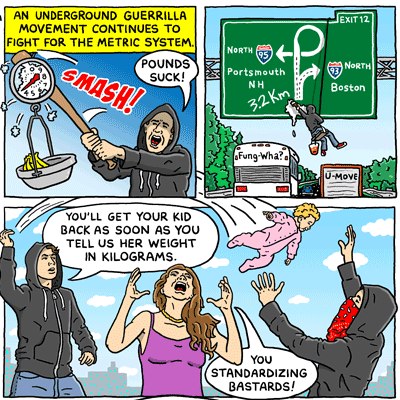
Anyone with even a tiny math and science background will tell you that the metric system kicks the shit out of our current system, which is a bastard cousin of the long-gone British Imperial system. Dumb America’s stubborn refusal to adopt it is almost as embarrassing as their opposition to health insurance reform.
Only the United States, Burma, and Liberia aren’t on board. Antarctica is also gray, but only scientists are down there, and I’m sure they aren’t using pounds and ounces to weigh penguin shit.Once health care is sorted, could the next front line for America's progressives be adopting the metric system? Will we see teabaggers and right-wing talk-radio blowhards declaiming the Satanic nature of the metric system and spouting non-sequiturs about the Biblical foundations of pints and pounds (to paraphrase a Texas congressman, "if English measurements were good enough for Jesus, they're good enough for me!")?
2010/2/9
Pete Warden, a programmer and amateur researcher, has analysed the data from public Facebook profiles, including the relative locations of pairs of friends and people's names and fan pages, and used this to divide the US into seven relatively self-contained clusters, which he terms "Stayathomia" (i.e., the northeast to midwest), "Dixie" (the old South), "Greater Texas" (encompassing Oklahoma and Arkansas), "Mormonia" (no prizes for guessing where that is), the "Nomadic West" (places like Idaho, Oregon and Arizona, where people's connections span wide areas), Socalistan (i.e., most of California and parts of Nevada) and Pacifica (essentially Seattle). The clusters were derived from performing cluster analysis on the social graph, and not imposed on the data a priori.
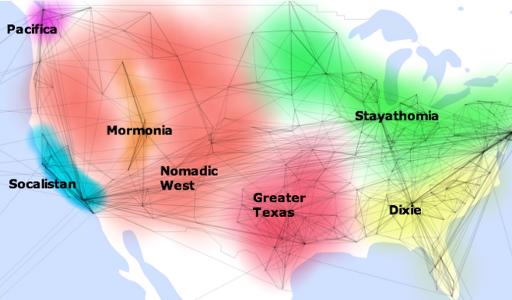
Warden posts various findings he gained from crunching the data on these clusters:
Probably the least surprising of the groupings, the Old South is known for its strong and shared culture, and the pattern of ties I see backs that up. Like Stayathomia, Dixie towns tend to have links mostly to other nearby cities rather than spanning the country. Atlanta is definitely the hub of the network, showing up in the top 5 list of almost every town in the region. Southern Florida is an exception to the cluster, with a lot of connections to the East Coast, presumably sun-seeking refugees. God is almost always in the top spot on the fan pages, and for some reason Ashley shows up as a popular name here, but almost nowhere else in the country.
(Greater Texas:)God shows up, but always comes in below the Dallas Cowboys for Texas proper, and other local sports teams outside the state. I've noticed a few interesting name hotspots, like Alexandria, LA boasting Ahmed and Mohamed as #2 and #3 on their top 10 names, and Laredo with Juan, Jose, Carlos and Luis as its four most popular.
(Mormonia:) It won't be any surprise to see that LDS-related pages like Thomas S. Monson, Gordon B. Hinckley and The Book of Mormon are at the top of the charts. I didn't expect to see Twilight showing up quite so much though, I have no idea what to make of that!Mormons like their vampires sparkly and pro-abstinence; who would have guessed?
(Socalistan:) Keeping up with the stereotypes, God hardly makes an appearance on the fan pages, but sports aren't that popular either. Michael Jackson is a particular favorite, and San Francisco puts Barack Obama in the top spot.Warden also has this tool for browsing aggregate profiles of countries based on their residents' public Facebook profiles.
2010/2/8
As of now, South Carolina legally requires "subversives" to register with the government ($5 filing fee applicable), or face stiff fines and the possibility of prison time:
By "subversive organization," the law means "every corporation, society, association, camp, group, bund, political party, assembly, body or organization, composed of two or more persons, which directly or indirectly advocates, advises, teaches or practices the duty, necessity or propriety of controlling, conducting, seizing or overthrowing the government of the United States [or] of this State."
While the intention of the law is apparently aimed at Islamic terrorists, it's unclear in the law's wording whether it can be applied to right-wing militias, some of whom have reputedly called for the overthrow of the US government. The law states that "fraternal" and "patriotic" groups are exempt from the law, but only if they don't "contemplate the overthrow of the government."
(via Boing Boing) ¶ 1
2009/11/14
The street finds its own uses for things yet again: a hacktivist group calling itself the Electronic Disturbance Theater has hacked a cheap GPS-enabled mobile phone into a device for helping Mexican immigrants across the US border:
We looked at the Motorola i455 cell phone, which is under $30, available even cheaper on eBay, and includes a free GPS applet. We were able to crack it and create a simple compasslike navigation system. We were also able to add other information, like where to find water left by the Border Angels, where to find Quaker help centers that will wrap your feet, how far you are from the highway—things to make the application really benefit individuals who are crossing the border.
We’re at the end of the alpha stage, in terms of the technology, so the next level, which will be the most difficult, is interfacing with communities south of the border: NGOs, churches, and other communities that deal with people preparing to cross the border. How can we train them to use this? What is the proper methodology? Those are really going to be the most nuanced and difficult elements with, let’s call it, the sociological aspect of the project.Of course, once the militias capture one of these (and presumably they'll start searching captured immigrants for them), they will know where the water is stashed. I wonder whether the Electronic Disturbance Theater has put in any sort of self-destruct mechanism.
(via Boing Boing) ¶ 1
2009/11/10
An American scifi fan writes an appreciation of Doctor Who, and its difference from American television/film scifi:
Before you brand me a Benedork Arnold, let me explain: There’s a fix I just don’t get from mainstream American science fiction, perhaps because of its grinding obsession with the imperialistic (and its depressive sibling, the dystopic), not to mention its wearisome push for ever-shinier effects. Like its not-so-distant cousin American religion, American sci-fi is fixated on final battles, ultimate judgment (particularly on questions of control and leadership), and an up-or-down vote on the whole good/evil issue. Even the most morally restless imaginings — the Losts and Battlestars — eventually prolapse into Bruckheimer-esque excerpts from the Book of Revelation. As an antidote, I turn to the Doctor — a fussy 900-year-old neurotic who’s part Ancient Mariner, part Oxford don, with a whimsical fashion sense, a close acquaintance with defeat and futility, and a tendency to rattle on. He subscribes to no Force-like creed. No enlightened military Federation stands behind him, photon torpedoes at the ready — indeed, his race, the Time Lords, is more or less extinct. His signature gizmo isn’t a blaster or a phaser but a souped-up screwdriver. His Millennium Falcon? The Tardis, which looks to the unschooled like an old telephone booth. It’s actually a police call box, a relic from the ’50s, and the ship’s most spectacular feature isn’t artillery; it’s feng shui: It’s bigger on the inside.The Doctor is courageous and heroic, sure, but in the Mèdecins Sans Frontiéres vein. Oh so Euro!The thesis that American scifi is, at worst, shaped by imperial bombast and triumphalism, and at best saddled with the weight of manifest destiny, whereas British scifi is shaped by the pathos of faded glory and the possibilities opened by not having a heroic destiny, and is so much richer for it, echoes a Charlie Stross piece on the state of sci-fi literature, from April 2005 (previously blogged here).
2009/10/15
Authorities in Colorado are searching the skies after a six-year-old boy went for a joyride in his family's "experimental helium-balloon-powered aircraft".
On Thursday morning, according to the family and officials, the boy got onto the aircraft and detached the rope holding it in place. Sheriff's spokeswoman Eloise Campanella said the boy climbed into the access door and the airborne device took off.
The craft, which is shaped like a flying saucer, has the potential to rise to 10,000 feet, Campanella said. Sheriff's officials last saw the device floating south of Milliken, which is about 40 miles north of Denver.
Weren't the 1950s awesome? Exhibit (a): an American high-school marriage-education textbook (from 1962, though culturally part of the conservative 1950s, before the Communists successfully fluoridated the water supply and brought about what is commonly known as The Nineteen-Sixties):
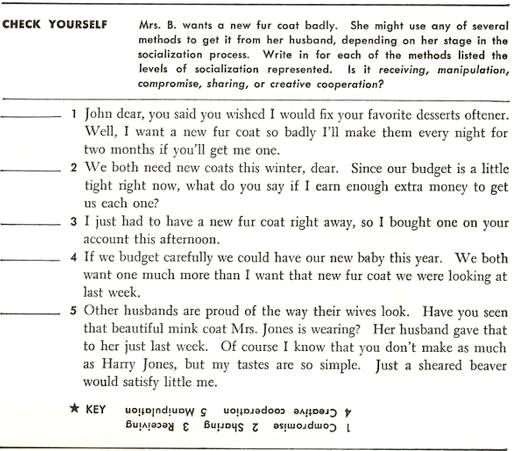
Exhibit (b): a letter written in 1956 to FBI director J. Edgar Hoover by the editor of a Catholic newspaper, concerning the moral threat posed to America's youth by a young singer named Elvis Presley:
But eyewitnesses have told me that Presley's actions and motions were such as to rouse the sexual passions of teenaged youth. One eye-witness described his actions as “sexual self-gratification on the stage," — another as “a striptease with clothes on." Although police and auxiliaries were there, the show went on. Perhaps the hardened police did not get the import of his motions and gestures, like those of masturbation or riding a microphone.
I do not report idly to the FBI. My last official report to an FBI agent in New York before I entered the U.S. Army resulted in arrest of a saboteur (who committed suicide before his trial). I believe the Presley matter is as serious to U.S. security. I am convinced that juvenile crimes of lust and perversion will follow his show here in La Crosse.
(via Boing Boing, MeFi) ¶ 1
2009/10/9
Less than a year into his first term, President Barack Obama has won the 2009 Nobel Peace Prize, essentially for not being a douchebag ("his extraordinary efforts to strengthen international diplomacy and co-operation between peoples"). Which suggests that expectations of what the US President is meant to do on the world stage have fallen so far in the past eight years that the rest of the world is jubilant when he doesn't just growl and shake his fists at everyone else.
2009/10/6
In the US, a group "conservatives" have decided that the Bible, for all it's worth, has too much of a liberal bias, and thus taken it upon themselves to rewrite it in a more acceptable form. This includes the obvious things (i.e., eliminating any namby-pamby politically-correct language or phrases that make Jesus look like a goddamn hippie, and peppering it with "free market parables"; I wonder how that'll change the story about Jesus and the moneylenders), as well as other principles such as "Prefer Conciseness over Liberal Wordiness".
The project page is here. Note that it is hosted by Conservapedia, previously noted for its somewhat obsessive focus on the mechanics and perils of homosexual sex.
However, there is nothing new under the sun; in the MetaFilter thread, a former seminary student revealed how he and a friend created, as a joke, a conservative reading of the Gospel of Luke by simply inverting the sayings. Behold, the National Gospel of Liberty:
8 "And I tell you, everyone who acknowledges the poor and the outcast will be acknowledged as an outcast; 9 but whoever denies the poor and the outcast will live in peace, because they are odorous and live in fields. 10 And everyone who speaks a word against the poor will be forgiven, for this is right; but whoever speaks out for the poor and the oppressed will not be forgiven. 11 When they bring you before the magistrate, and the authorities, do not worry about how you are to defend yourselves or what you are to say; 12 for you are wealthy and the wealthy need have no fear of the courts."
27 Consider the lilies! They neither toil nor spin, and so I tell you, their life is but a season, and they have no wives. Solomon had many wives, and in his glory was arrayed in garments finer than any lily of the field! 28 They are but meager grasses, fit only to be thrown into the oven, but you are precious to your Father in Heaven and your prayers have brought you great wealth.
2009/10/3
Rio de Janeiro has won the 2016 Olympics. Our condolences to the Brazilian people; to the poor people who will undoubtedly be forcibly removed to make room, and everybody else who will have to endure the inevitable Olympic-related expenses and suspensions of civil liberties where such impinge on sponsors' profits.
Chicago was the favourite for the Olympics, but was eliminated first, getting only 18 of the 94 votes. Sime are speculating that this was partly due to heavy-handed passport control procedures brought in during the Bush administration:
Syed Shahid Ali, an I.O.C. member from Pakistan, in the question-and-answer session following Chicago’s official presentation, pointed out that entering the United States can be “a rather harrowing experience.”
International travel to the U.S. declined by 10 percent in the first quarter of 2009 according to the U.S. Department of Commerce. To lure visitors back, U.S. Travel has been pushing the Travel Promotion Act, which recently was passed in the Senate and is awaiting action in the House, to create a campaign to strengthen the image of the United States abroad.There are more horror stories about US Immigration here, with some commenters comparing their experience unfavourably to the former East Germany, and others speaking of great lengths taken to avoid the US when travelling. I must say that this has not been my experience. On both occasions when I visited the US, the entry process was quick (quicker than returning to Britain at Heathrow, on some occasions), and the staff were polite. Then again, on both occasions I had arrived at San Francisco; your mileage may vary.
(via Boing Boing) ¶ 3
2009/9/29
A new memoir by George W. Bush's former speechwriter sheds light on how the Presidential Medal of Freedom was awarded:
Latimer, whose memoir was published last week by Crown in the US, says that the "narrow thinking" of "people in the White House" led them "to actually object to giving the author JK Rowling a presidential medal because the Harry Potter books encouraged witchcraft".
The first 16 recipients of Barack Obama's presidential medal, handed out in August, included Stephen Hawking and Senator Ted Kennedy – who, according to Latimer's book, failed to receive the medal during the Bush administration because he was "a liberal".
2009/9/27
Cinematic genius and convicted child-rapist Roman Polanski has been detained in Switzerland on the grounds of his outstanding US arrest warrant for rape, when he went to the Zurich film festival to pick up a lifetime achievement award. Switzerland has an extradition treaty with the US. Anyway, it appears to be over for him; unless he manages to somehow get off this hook, he will now most probably die in a US prison.
For those feeling sorry for Mr. Polanski and hoping that this can be resolved quickly without this great man seeing the inside of a US prison, I refer you to a transcript of his victim's testimony (obviously NSFW). Be warned: it is uncomfortable reading.
Update: Zurich Film Festival Offers Award to Osama bin Laden.
In a statement released by the film festival, organizers said that they were recognizing Mr. bin Laden for his "body of work," referring to the chilling terror tapes that the al-Qaeda kingpin has released over the past ten years.Meanwhile, notes from Associated Press's reporters theorise that the Swiss authorities' sudden decision to arrest Polanski has something to do with US pressure over the UBS bank.
2009/9/16
An article in the New Republic examines the rise of Ayn Rand's ideology, which asserts that one's wealth is literally proportional to one's value as a human being, selfishness is a virtue and altruism is evil, from the fringes to the mainstream of American conservative thought:
In these disparate comments we can see the outlines of a coherent view of society. It expresses its opposition to redistribution not in practical terms--that taking from the rich harms the economy--but in moral absolutes, that taking from the rich is wrong. It likewise glorifies selfishness as a virtue. It denies any basis, other than raw force, for using government to reduce economic inequality. It holds people completely responsible for their own success or failure, and thus concludes that when government helps the disadvantaged, it consequently punishes virtue and rewards sloth. And it indulges the hopeful prospect that the rich will revolt against their ill treatment by going on strike, simultaneously punishing the inferiors who have exploited them while teaching them the folly of their ways.
Today numerous CEOs swear by Rand. One of them is John Allison, the outspoken head of BB&T, who has made large grants to several universities contingent upon their making Atlas Shrugged mandatory reading for their students. In 1991, the Library of Congress and the Book of the Month Club polled readers on what book had influenced them the most. Atlas Shrugged finished second, behind only the Bible. There is now talk of filming the book again, possibly as a miniseries, possibly with Charlize Theron. Rand's books still sell more than half a million copies a year. Her ideas have swirled below the surface of conservative thought for half a century, but now the particulars of our moment--the economic predicament, the Democratic control of government--have drawn them suddenly to the foreground.
Around the age of five, Alissa Rosenbaum's mother instructed her to put away some of her toys for a year. She offered up her favorite possessions, thinking of the joy that she would feel when she got them back after a long wait. When the year had passed, she asked her mother for the toys, only to be told she had given them away to an orphanage. Heller remarks that "this may have been Rand's first encounter with injustice masquerading as what she would later acidly call ‘altruism.’ " (The anti-government activist Grover Norquist has told a similar story from childhood, in which his father would steal bites of his ice cream cone, labelling each bite "sales tax" or "income tax." The psychological link between a certain form of childhood deprivation and extreme libertarianism awaits serious study.)While the premises of Randian ideology—the myth of the heroic self-made man, the cirrelation between wealth and value—have a certain sort of glibly narcissistic appeal (in particular to those wishing to rationalise their beliefs in themselves as good people), they fall apart under closer examination:
Is income really a measure of productivity? Of course not. Consider your own profession. Do your colleagues who demonstrate the greatest skill unfailingly earn the most money, and those with the most meager skill the least money? I certainly cannot say that of my profession. Nor do I know anybody who would say that of his own line of work. Most of us perceive a world with its share of overpaid incompetents and underpaid talents. Which is to say, we rightly reject the notion of the market as the perfect gauge of social value.
Now assume that this principle were to apply not only within a profession--that a dentist earning $200,000 a year must be contributing exactly twice as much to society as a dentist earning $100,000 a year--but also between professions. Then you are left with the assertion that Donald Trump contributes more to society than a thousand teachers, nurses, or police officers. It is Wall Street, of course, that offers the ultimate rebuttal of the assumption that the market determines social value. An enormous proportion of upper-income growth over the last twenty-five years accrued to an industry that created massive negative social value--enriching itself through the creation of a massive bubble, the deflation of which has brought about worldwide suffering.
The reality of the contemporary United States is that, even as income inequality has exploded, the average tax rate paid by the top 1 percent has fallen by about one-third over the last twenty-five years. Again: it has fallen. The rich have gotten unimaginably richer, and at the same time their tax burden has dropped significantly. And yet conservatives routinely describe this state of affairs as intolerably oppressive to the rich. Since the share of the national income accruing to the rich has grown faster than their average tax rate has shrunk, they have paid an ever-rising share of the federal tax burden. This is the fact that so vexes the right.And here is a piece on the sociopathic dimension of Randian ideology:
Interestingly, despite her general disdain for humanity, there were people she seemed to admire greatly, such as William Edward Hickman, whose credo, "What is good for me is right," she described in her Journals as, "The best and strongest expression of a real man's psychology I have heard." But Hickman was no simple expositor of personal greed and self-interest; no mere modern day libertarian; no pedestrian practitioner of excessive self-love. No indeed. He was a sociopathic murderer. In 1927 he kidnapped a 12-year old girl from a school in Los Angeles by the name of Marian Parker, chopped off her legs, cut our her internal organs, drained all of her blood and then spread parts of her body all over the city.
Of Hickman, this sick murderer, Rand had almost nothing but positive things to say. She indeed critiqued those who would condemn Hickman's actions for having committed "worse sins and crimes," such as those she ascribed to his jury. Among those "greater" crimes--greater than mutilating a child--she included being, "Average, everyday, rather stupid looking citizens. Shabbily dressed, dried, worn looking little men. Fat, overdressed, very average, 'dignified' housewives." Their ordinariness, in other words, placed them below Hickman, in Rand's mind. "How can they decide the fate of that boy? Or anyone's fate?" she implored in her Journals.
2009/9/8
As rising oil prices bite, people are talking about moving to a 4-day work week to reduce fuel consumption. The idea has been tried in Utah, but as befits a conservative Mormon state in the US whose emblem is the beehive, it didn't result in an extra day of leisure time, but rather four 10-hour workdays. Nonetheless, the results have been promising, and the experiment has proven popular, with 82% of participants preferring to stick with it:
"If employees are on the road 20 percent less, and office buildings are only powered four days a week," Langmaid says, "the energy savings and congestion savings would be enormous." Plus, the hour shift for the Monday through Thursday workers means fewer commuters during the traditional rush hours, speeding travel for all. It also means less time spent idling in traffic and therefore less spewing of greenhouse gases and other pollutants. The 9-to-5 crowd also gets the benefit of extended hours at the DMV and other state agencies that adopt the four-day schedule.
2009/8/28
In the US, someone has been anonymously sending laptops to state governors. Laptops have been sent, in some cases multiple times, to the governors of states including West Virginia and Wyoming. The computers have been handed over to the FBI for investigation, on the suspicion that they might be Trojan horses intended to pwn the apparatus of government on behalf of whoever sent them.
2009/8/20
In the US, there is a section of the population on the right who just can't stand Barack Obama or anything he supposedly stands for. The very thought of that.. man -- golDANGit! -- makes them so pig-biting mad that it cuts off the flow of oxygen to their brain cells, shutting down whatever capacities they had for critical thinking. We've already seen the results of this in things like right-wing Twitterers uncritically passing on increasingly absurd rumours about Obama's policies, and the entire "birther" movement, in which the desperate need to prove an article of faith ("Ain't no negro my President!" "Obama is ineligible to be President") leads them to build elaborate and bizarre conspiracy theories ("Obama's parents secretly went to Kenya before he was born, and paid someone to post a birth announcement in a Hawaiian newspaper just in case he ever ran for President"), buttressed by increasingly baroque structures of evasion and supposition, whilst remaining oblivious to how ridiculously implausible the whole thing looks from outside their belief system.
Of course, wherever self-induced stupidity becomes the norm, someone will be making a profit. The US health-insurance lobby, for example, are making hay out of the fact that enough people are whipped into an apoplectic rage by the fact that there's a black man in the Whitehouse that they're willing to believe anything, such as, say, that providing government-subsidised healthcare is equivalent to Nazism and that British Nobel laureate Stephen Hawking would be dead had he been British, and be motivated by it to go out and fight for their right to be bankrupted by illness. And so, once again, the turkeys march out and loudly demand their Thanksgiving.
The latest attempt at milking the enraged mob for all its worth, though, is a bit more direct: some entrepreneurs of above-average moral flexibility are offering the pig-biting mad free software that launches denial-of-service attacks against the Whitehouse web site. The software, of course, is your common-or-garden Windows malware.
The terse spam message links to a website where prospective marks are offered money for installing the dodgy "packet flinging" tool. The attackers missed a chance to make reference to a recent mass marketing campaign from the White House justifying recent healthcare reforms that some have described as spam as supposedly justifying an "aggressive response", for example.
The "DDoS Obama" spam was one theme of a larger spam run, reports email security firm Proofpoint. Other spam messages in the series offered more typical lures, such as pornography, while again pointing to the same malware download.The spam even helpfully advised the marks that their anti-virus software might identify the downloaded software as harmful.
2009/7/29
The latest dispatch from the Long Siege: in the US, the EFF is arguing that users of devices such as the Apple iPhone should have a right to "jailbreak" them, i.e., to circumvent mechanisms which prevent them from installing software unapproved by the manufacturer. Apple have countered this with a dire warning that jailbroken iPhones could be a terrorist weapon, with the capability to bring America's communications infrastructure to its knees:
By tinkering with this code, “a local or international hacker could potentially initiate commands (such as a denial of service attack) that could crash the tower software, rendering the tower entirely inoperable to process calls or transmit data,” Apple wrote the government. “Taking control of the BBP software would be much the equivalent of getting inside the firewall of a corporate computer — to potentially catastrophic result.To their credit, Apple didn't actually use the T-word, but they insinuated it pretty hard, and added to that the possibility of drug traffickers using hacked phones to make anonymous phone calls. Hey Apple, don't forget about the paedophiles; surely they'd find some nefarious use for jailbreaking as well.
The EFF's experts, meanwhile, have called bullshit on the whole thing.
red von Lohmann, the EFF attorney who made the request, said Apple’s latest claims are preposterous. During a May public hearing on the issue in Palo Alto, California, he told regulators there were as many as a million unauthorized, jailbroken phones.
He added that, if Apple’s argument was correct, the open-source Android phone from Google on T-Mobile networks would also be a menace to society. ”This kind of theoretical threat,” von Lohmann said, “is more FUD than truth.”Of course, if unauthorised clients on the phone network are such a threat, then merely keeping jailbreaking technically illegal wouldn't deter actual paedoterrorists; a threat of such severity could only be countered by declaring possession of jailbroken phones to be a terrorist act and actively hunting down and prosecuting transgressors under national security laws, using the full surveillance infrastructure of the Department of Homeland Security. Perhaps that's what Apple are hoping for?
Meanwhile, the very same week, Apple have demonstrated why users have an interest in jailbreaking their gadgets, by banning all Google Voice applications from the App Store, reportedly at the behest of phone companies not wanting their cozy business models upset. And some are speculating that Spotify's much-anticipated iPhone client may be rejected by Apple, due to it competing with iTunes.
2009/7/21
A review of a new book on changing patterns of recreational drug use in the USA:
...according to several metrics, acid use was at "an historic low: 3.5 percent." By 2003, it was down to 1.9 percent. Why? It wasn't just that LSD had gone out of style, although it had, somewhat. Grim found evidence of a perfect storm of causes for the decline. In 2000, the DEA had arrested a man named William Pickard, thought to be the manufacturer of as much as 95 percent of the available acid in the U.S. The Grateful Dead, whose concerts provided an opportunity for suppliers and users to connect and network, had stopped touring after the 1995 death of Jerry Garcia, and Phish, a jam band that had stepped in to fill the gap, also stopped touring by the end of 2000. The rave scene began to fade away under pressure from authorities who threatened to arrest organizers for drug offenses committed at their events.And then this depressing picture of an atomised, asocial society, which ties in with the bowling-alone mass-alienation idea:
Today's kids aren't smoking much pot because pot is a "social" drug, shared among peers who gather in parking lots and other hangouts; teens have less unstructured time now and tend to socialize online. They still get high, only on prescription drugs pilfered from adults or ordered off the Internet. "There's no social ritual involved," he observes, "just a glass of water and a pill," which "fits well into a solitary afternoon."The rest of the review looks pretty interesting, including the theory that recreational drugs have cycles, in which they become popular, then become lame, and then come back sometime later to a generation who have never witnessed their effects, illustrated by an anecdote about kids regarding Ecstasy as "too hard on your body" and cocaine as "not that bad".
2009/6/23
Blog discovery of the day: The Infrastructurist, which focuses on issues such as transport and urban planning, from a largely, though not entirely, US-centric point of view, and has some interesting stories. Such as a LA Times piece on the Dubai model of urbanism, an Economist piece on the Obama administration's US$500bn transport bill (which includes 50 billion for high-speed rail), a Google Maps gallery of six intriguingly shaped communities, a piece on what to do when neo-Nazis decide to sponsor a US highway (the answer: rename it after a civil rights leader), and a gallery of grand railway stations in America, all now long-since demolished.
2009/5/30
Two fragments of the secret history of the Cold War have come to light. In 1969, US President Nixon sent a squadron of nuclear bombers towards the Soviet Union, and instructed Kissinger to tell the Soviets that Nixon was "out of control", leading them to believe that they're dealing with a dangerous madman, in order to scare them into leaning on the North Vietnamese government.
Apparently neither Nixon or Kissinger had absorbed another Schelling insight - if you want to credibly pretend you are out of control then you have to push things so far that sometimes you will be out of control. The number of ways such a plan could have resulted in a nuclear war is truly frightening. After all, Nixon was gambling millions of lives on the Soviets being the rational players in this game.Fortunately, the Soviets didn't call his bluff and civilisation as we know it still stands.
Meanwhile, it turns out that the West German policeman who shot dead an unarmed left-wing demonstrator in West Berlin in 1967, touching off riots and enraging the protest movement, had been working for the Stasi.
The most insidious question raised by the revelation is whether Mr. Kurras might have been acting not only as a spy, but also as an agent provocateur, trying to destabilize West Germany. As the newspaper Bild am Sonntag put it in a headline, referring to the powerful former leader of the dreaded East German security agency, Erich Mielke, “Did Mielke Give Him the Order to Shoot?”
In an interview with the Bild, Mr. Kurras, 81, confirmed that he had been in the East German Communist Party. “Should I be ashamed of that or something?” Mr. Kurras was quoted as saying. As for the Stasi, he said, “And what if I did work for them? What does it matter? It doesn’t change anything,” the paper reported.
(via MeFi, Boing Boing) ¶ 2
2009/4/24
A lie, Mark Twain wrote, can cross half the world before truth can get its boots on. This may be even more so in the age of Twitter, with its ephemeral, 140-character posts reducing discussion to soundbites with no room for boring old substantiation. A contributor to the (US Democrat-affiliated) Daily Kos blog has demonstrated this by creating a Twitter feed named InTheStimulus, purporting to reveal the Obama administration's egregious wastes of money, and watching the right-wing Twitterverse pass it on as gospel, giving him virtual high-fives along the way and praising his patriotism.
For the most part, my first couple days of posts were believable, but unsourced lies:He then proceeded to make the revelations increasingly absurd:
* $3 million for replacement tires for 1992-1995 Geo Metros.
* $750,000 for an underground tunnel connecting a middle school and high school in North Carolina.
* $4.7 million for a program supplying public television to K-8 classrooms.
* $2.3 million for a museum dedicated to the electric bass guitar.
* $473,000 to Fueled by Ramen, record label for such bands as Fall Out Boy.The funny thing was, while a few people dropped his feed, even more started following him and passing on his revelations. It seems that confirmation bias kicked in, and the buzz of having one's beliefs confirmed and outrage justified outweighed the possibility of being taken for a ride.
* $4 million for Obama bobbleheads.
* $104,000 to exhume President Taft.
* $465 million for massive air conditioners to combat global warming.
And finally,
* $855,000 for the gambling debts Laura Bush incurred on diplomatic trips between 2004-2008.
The Daily Kos' spin on the result is a partisan "conservatives are dumb". Whether or not that is the case, I suspect such an experiment could be repeated with any group invested in a particular belief.
When US filmmaker Andrea Wachner was invited to attend her 10-year high-school reunion in the affluent Los Angeles suburb of Palos Verdes, she didn't want to go; so she recruited an exotic dancer to pretend to be her, fitting her with an earpiece and coaching her interactively on the people she was meeting. Tattooed, scantily-clad "Cricket" claimed that she was Andrea, had had reconstructive surgery and suffered amnesia after a car accident, and that she was working as a stripper to pay for her graduate school tuition. She was followed by a camera crew, ostensibly making a documentary about the daily lives of artists. Cricket finished off her performance by doing a striptease to a Lisa Loeb song.
Most of the people were taken in by this, or at least sufficiently uncertain to not raise a fuss in case they ended up making fools of themselves, and found out only later, when Wachner posted video to YouTube, as a teaser for a 40-minute documentary titled "I Remember Andrea Better" she was making on the incident.
(via Boing Boing) ¶ 0
2009/4/20
The Map Scroll blog has a map of the Gini coefficients of all the US states, and another one of Europe.
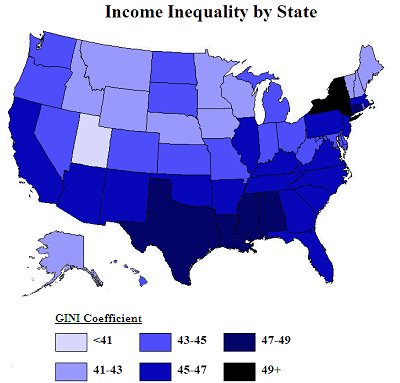
The Gini coefficient is a number from 0 to 1 representing the equality or inequality of income distribution in an economy; 0 is theoretical absolute equality, and 1 is one person having everything and everyone going without. In practice, it varies from about 0.2 to about 0.7.
According to it, Europe ranges from the mid-.20s to the high .30s, with a few outliers in the low 40s. At the most egalitarian end, unsurprisingly, are the Jante states of Denmark and Sweden, as well as Iceland (perhaps surprisingly, if it's meant to have been an experiment in cut-throat neoliberalism). Things get more inequitous into Norway, Finland, France, Germany and Switzerland (which stays under .28, despite being home to a lot of the global super-rich), and then on to Italy, Spain, Britain and Ireland, and beyond that, Poland and Lithuania. The most unequal country in Europe is Turkey, which has a Gini coefficient of 0.436, somewhere between Guyana and Nigeria, or, if you prefer, Delaware and Hawaii.
The United States is, unsurprisingly, a lot less egalitarian in income than Europe. American states' Gini coefficients range from 0.41 (the solidly Mormon state of Utah, whose state emblem is the beehive, has a Gini coefficient equivalent to Russia's) to a whopping 0.537 in the District of Columbia (comparable to the Honduras). Other states are twinned with parts of the developing world; Alabama and Mississippi are most like Nepal, California has the income distribution of Rwanda, and New York, barely under the .5 mark, is twinned with Costa Rica. According to the article, this is an astonishing state of affairs for a developed country:
According the the CIA World Factbook (table compiled here), the lowest Gini score in the world is Sweden's, at .23, followed by Denmark and Slovenia at .24. The next 20 countries are all in either Western Europe or the former Communist bloc of Eastern Europe. The EU as a whole is at .307. Russia has the highest number in Europe (.41); Portugal is the highest in Western Europe (.38). Japan is at .381; Australia is .352; Canada is .321.
And then there is the United States, sandwiched between Cote d'Ivoire and Uruguay at .450. Not counting Hong Kong (.523), the US is a complete loner among developed countries. In fact, as you can see from the map above, there is no overlap between any single US state and any other developed country; no state is within the normal range of income distribution in the rest of the developed world. Here's a list of the states with their Gini index numbers, and the country where income distribution is most comparable in parentheses:Other interesting maps on the site include a map of religious nonbelief in the UK (which points out that Scotland and Northern Ireland are the most religious, and asks whether that correlates to the Scots-Irish roots of the US "Bible belt"), of antidepressant use in England and Wales (summary: it's grim up north, and in Cornwall too; either that or Londoners prefer a line of coke), and one suggesting that, as global warming advances, Australia is ecologically fux0red.
2009/4/17
In the US, President Obama has announced plans to build high-speed railway systems. It won't be one national high-speed railway, but rather a pot of money and a series of proposed high-speed rail corridors (some of which already have planned projects, such as the Californian system which passed the ballot in the last election). There is only $8Bn to spend, and the "high speed" trains are cited at running at up to 240km/h (i.e., somewhat faster than a British Rail InterCity 125 on a straight stretch of track, but not quite up there with the Shinkansen), but it is a start.
His strategy envisions a network of short-haul and long-haul corridors of up to 600 miles, with trains capable of speeds of up to 150mph (240km/h).
He said: "Our highways are clogged with traffic, costing us $80 billion a year in lost productivity and wasted fuel.
"Our airports are choked with increased loads. We're at the mercy of fluctuating gas prices all too often," he said.The corridors proposed include one in the Pacific Northwest (running from Oregon to Seattle, and possibly into Canada; I hope that they put passport control in the stations, as on the Eurostar, rather than stopping it for an hour or so at the border to process everyone onboard), a Chicago-centric system stretching to Minneapolis, Detroit, Kentucky and Ohio, and corridors potentially running from Texas, through New Orleans, Atlanta and the Carolinas, and into Washington. The full text of the speech is here.
More dispatches from the War on the Unexpected: London police forced an Austrian tourist to delete photographs of a bus station, on the grounds that photographing transport infrastructure was "strictly forbidden". Which sounds like something more befitting of, say, Belarus or North Korea than of an ostensibly free country:
Matkza, a 69-year-old retired television cameraman with a taste for modern architecture, was told that photographing anything to do with transport was "strictly forbidden". The policemen also recorded the pair's details, including passport numbers and hotel addresses.
In a telephone interview from his home in Vienna, Matka said: "I've never had these experiences anywhere, never in the world, not even in Communist countries."Meanwhile, in the United States, police seized a student's computers on the grounds that he was using a suspicious operating system (i.e., Linux), and thus probably up to no good:
_________ reported that Mr. Calixte uses two different operating systems to hide his illegal activities. One is the regular [Boston College] operating system and the other is a black screen with white font which he uses prompt commands on.Which sounds like he's guilty of some kind of technological witchcraft.
2009/3/23
On his recent trip to Washington, British PM Gordon Brown gave President Obama a penholder carved from the timbers of the sister ship of the one whose wood formed the desk of the Oval Office. In return, Obama gave Brown a box set of classic American films, seemingly not realising that Brown can't actually watch them because they're Region 1, and Number 10's amenities presumably don't extend to a £20 off-brand multi-region DVD player. And, of course, with both Brown and Obama being obliged to give lip service to maximalist interpretations of copyright laws, neither could publicly condone circumventing lawful restrictions such as DVD region coding. Oops!
Jeremy Clarkson, meanwhile, has a rather witty take on it, which turns into a rubbishing of the unequal terms of Britain's "special relationship" with the US:
Gordon gave Obama Barrack a penholder carved from the timbers of an antislavery ship. The sister ship, in fact, of the one that was broken up and turned into the desk in the Oval Office. Barrack, meanwhile, gave Brown The Graduate on DVD. Which smacks of an “Oh, Christ. What shall we get him?” moment at the local petrol station.
A high school in Texas has a novel way of dealing with troubled youths: putting them in a steel cage and letting them fight it out with their bare fists:
One employee overheard Mr. Moten tell a security guard to take two students who had been at each other for days and “put ’em in the cage and let them duke it out,” the report states, and the practice was so embedded in the school’s culture that one student remarked to a teacher that he was “gonna be in the cage.”Meanwhile in Sydney, rival motorcycle gangs went on a rampage at the airport, and one man was bludgeoned to death with a
(via  substitute) ¶ 0
2009/3/18
Jamie Zawinski went to SXSW, and reports that Austin, Texas has a music scene second to none:
Austin is a pretty amazing city. The density of music venues is like nothing I've ever seen. I know we're here during a gigantic music festival, but this infrastructure doesn't just go away. I wonder what it's like at other times of year. Even though the music part of the festival hasn't even begun yet, the nightlife is just crazy. We've hardly been to a bar or club that didn't have a capacity of almost a thousand, and they have all been divided up and laid out in totally sensible ways.
Right now I am looking at a street sign - a municipal street sign, presumably suported by an ordinance and everything - that says "Restricted lane, musician loading and unloading". I am not making this up!
San Francisco: You got served.
By Texas.
The city of Detroit has seen more than its share of misfortune; hollowed out by the slow decline of the US car industry, it has already been synonymous with post-industrial urban decline, even before the oil crunch and the Great Recession. Now, however, the economically depressed conditions are apparently bringing in artists, drawn to Detroit by the rock-bottom real-estate prices (think $100 houses, albeit in need of work), faded grandeur of near-mythical proportions and potential for experimentation and regeneration:
Buying that first house had a snowball effect. Almost immediately, Mitch and Gina bought two adjacent lots for even less and, with the help of friends and local youngsters, dug in a garden. Then they bought the house next door for $500, reselling it to a pair of local artists for a $50 profit. When they heard about the $100 place down the street, they called their friends Jon and Sarah.
Admittedly, the $100 home needed some work, a hole patched, some windows replaced. But Mitch plans to connect their home to his mini-green grid and a neighborhood is slowly coming together.
But the city offers a much greater attraction for artists than $100 houses. Detroit right now is just this vast, enormous canvas where anything imaginable can be accomplished. From Tyree Guyton’s Heidelberg Project (think of a neighborhood covered in shoes and stuffed animals and you’re close) to Matthew Barney’s “Ancient Evenings” project (think Egyptian gods reincarnated as Ford Mustangs and you’re kind of close), local and international artists are already leveraging Detroit’s complex textures and landscapes to their own surreal ends.It'll be interesting to see what happens; will Detroit's new artist-settlers find their dreams foundering, turn tail and run, or will they succeed? Will Detroit become a new East Berlin, attracting artists and then scenesters, then showing up in boutique tourist guidebooks as the new hip destination, until eventually the process is completed and the well-off and aspirational move in, most of the artists are priced out of it and move on in search of another locus?
(via Boing Boing) ¶ 2
2009/3/13
As the economic crisis drags on, sales of Ayn Rand's "Atlas Shrugged" have been skyrocketing, at one point overtaking Barack Obama's The Audacity of Hope:
Atlas Shrugged tends to inspire either cult-like devotion or sarcastic mockery in readers, who are either thrilled or appalled by Rand's vision of a world in which the "men of the mind" - inventors, entrepreneurs and industrialists - withdraw their labour from a society intent on bleeding them dry with taxes and regulations.
Starved of their genius, society collapses and wars break out until eventually bureaucrats are forced to beg the rebels' leader, John Galt, to take over the economy.Some are even talking about Barack Obama's "socialistic" bailout of the economy sparking off an Atlas Shrugged-inspired revolt among appalled greedheads:
Obama's frequently expressed view that the crisis demands that all Americans make sacrifices - and that those earning the most will need to "chip in a little more" - would have disgusted Rand, who believed that altruism was evil.
In cities around the US, conservative activists have been organising street protests known as "tea parties", inspired by the CNBC correspondent Rick Santelli, who in a high-profile rant last month called for direct action by taxpayers in the manner of the 1773 Boston Tea Party, the anti-British protest that helped trigger the American revolution.
But sceptics have described the threats of Galt-style tax boycotts as the rightwing equivalent of "moving to Canada".I imagine the scammers who sell the greedy and gullible fraudulent advice on why income taxes are actually illegal and they're entitled to not pay them (typically it derives from something like the flag in US courtrooms having the wrong fringe, rendering the authority of the courts null and void, or similarly kooky arcana) will make a mint from the New Randroids, as they did from the militia types in the 1990s.
Ayn Rand, though, is not the only contentious thinker to be making a comeback in the Great Recession: on the other side, Karl Marx' stock has also been rising recently.
2009/3/7
Slate has a series of articles examining various theories on why there hasn't (yet) been another 9/11-style attack on the US. The theories are:
- The terrorists-are-dumb theory (i.e., they just got lucky)
- The Near-Enemy Theory (i.e., they're too busy in Pakistan/Afghanistan)
- The Melting-Pot Theory (i.e., American Muslims are too well integrated to sympathise with al-Qaeda)
- the Burden-Of-Success Theory (i.e., 9/11 has set expectations that are hard to meet)
- The Flypaper Theory (i.e., why kill Americans in the US when you can kill them in Iraq?)
- The Bush-Kept-Us-Safe Theory (i.e., invading Iraq and abducting and torturing random Muslims actually worked)
- The Electoral-Cycles Theory (i.e., they're timing their attacks to influence elections)
- The Time-Space Theory (i.e., al-Qaeda is just biding its time, just you wait...)
2009/3/4
The Times' travel section has another crop of stories about rail travel; this time around, they include a piece on the spectacular Settle-Carlisle line, one on traversing provincial Japan by slow train, a piece on crossing the USA by train (from New York to Chicago and then Los Angeles) a piece on crossing the USA by train, and Mark (the man in Seat 61) Smith's list of four great European rail journeys.
2009/2/9
Shepard Fairey, the street artist who created the iconic Barack Obama "Hope" poster, has been arrested in Boston for graffiti he allegedly put up many years ago, on the way to his first solo exhibition at the Institute of Contemporary Art. Break the law here, the message seems to be, and, sooner or later, the law will get you, regardless of your stature.
I wonder if he can get a Presidential pardon.
2009/1/30
Good news for rail travel in the US: the Obama administration is planning to invest in passenger rail projects. Of that, $850m will go towards Amtrak, the US's somewhat neglected vestigial passenger rail system, and two billion will be spent on "high-speed rail", including a network of rail links across the Midwest.
Most of the article has an interview with former Massachusetts governor and Presidential candidate and public transport advocate Michael Dukakis, who seems to be an unofficial spokesman for passenger rail development in America. It emerges that "high speed", though, could mean the 1970s British Rail definition, i.e., up to 125mph, not the TGV/shinkansen definition regarded as "high speed" elsewhere. The fact that he talks about upgrading America's railways to "the level of technology they're using in England" says a lot about how far there is to go. I wonder whether they'll do what the New South Wales transport authority did and actually start making InterCity 125s under license.
It's good to see money being earmarked for upgrading America's railways, though over the long distances that span the continental states, would a 125mph train really be able to compete with flying? If anything, the distance is all the more reason to invest in faster railways.
2009/1/27
A US congressman has taken a leaf out of Japan's book and proposed a law requiring camera phones to make a sound when a photo is taken, to prevent evil perverts from surreptitiously photographing people for their vile gratification. The Camera Phone Predator Alert Act will also prohibit the sale of phones in which the tone can be disabled. And, of course, it will make taking photos at concerts or weddings or similar more fraught, though... for God's sake, won't someone think of the children‽
Mind you, the bill appears to be the brainchild of one Congressman, with no cosponsors, which suggests that it probably won't come anywhere near becoming law.
2009/1/22
On his first day in office, President Obama has hit the ground running:
Addressing assembled White House staff, he said he had been inspired by the estimated two million who gathered to watch him being sworn in. He told staff he expected a higher ethical code at the White House than had existed under his predecessor, and issued executive orders imposing strict rules governing dealings with Washington's lobbyists. "Transparency and the rule of law will be the touchstones of this presidency," he said.
He also issued a pay freeze on staff earning more than $100,000. "Families are tightening their belts and so should Washington," he said.
In two other executive orders, he is to ban torture by all US personnel and initiate a review of the cases of all those still held at Guantánamo. He ordered judges to suspend trials under way there.Obama also issued a draft executive order to close the Guantánamo prison within a year and offered to negotiate with Iran with no preconditions.
2009/1/21
In today's big surprise: apparently the Chinese government censored local broadcasts of Obama's inaugural address, excising mentions of America facing down communism and condemnation of regimes that silence dissent.
Meanwhile, Patrick Farley (of the excellent E-Sheep Comics) has written up a summary of the Bush era: All Circus, No Bread:
Trying to explain what was wrong with the Bush Era feels like trying to vomit up a cannonball. I don't think my jaw can stretch that wide.
Seriously, where does one even begin? Abu Ghraib? Ahmed Chalabi? Mission Accomplished? The "Battle of Iraq?" Valerie Plame? No-bid contracts? The billions of dollars the Pentagon can't account for, and apparently never will? The Department of Justice firings? The blue Iraqi flag? The staged press conference? The fake Thanksgiving turkey? Terry Schiavo? Freedom Fries?
All my life I've heard Baby Boomers bitching about Nixon, even after he was dead. I used to wish they'd just GET OVER IT, but now I understand their bitterness. It wasn't what Nixon did that infuriated them so much. It's what he got away with. Nixon was nudged out of office by a momentary gust of public disfavor over a botched burglary attempt -- not, say, a Congressional investigation into the bombing of Cambodia. There was never a thorough reckoning of the misdeeds of Nixon's White House, just as there will probably never be a full accounting of the perversions and swindles of Bush's presidency. To the majority of Americans, Bush will be that guy who invaded Iraq and wrecked the economy.And US liberal cartoonist Tom Tomorrow has his own farewell salute to Bush and cronies:

2009/1/20
President Barack Obama has been sworn in, and the door swings closed on the Bush era (and good riddance too).
For what it's worth, here is the text of Obama's inaugural address (thanks to
That we are in the midst of crisis is now well understood. Our nation is at war, against a far-reaching network of violence and hatred. Our economy is badly weakened, a consequence of greed and irresponsibility on the part of some, but also our collective failure to make hard choices and prepare the nation for a new age. Homes have been lost; jobs shed; businesses shuttered. Our health care is too costly; our schools fail too many; and each day brings further evidence that the ways we use energy strengthen our adversaries and threaten our planet.
For everywhere we look, there is work to be done. The state of the economy calls for action, bold and swift, and we will act - not only to create new jobs, but to lay a new foundation for growth. We will build the roads and bridges, the electric grids and digital lines that feed our commerce and bind us together. We will restore science to its rightful place, and wield technology's wonders to raise health care's quality and lower its cost. We will harness the sun and the winds and the soil to fuel our cars and run our factories. And we will transform our schools and colleges and universities to meet the demands of a new age. All this we can do. And all this we will do.
To those leaders around the globe who seek to sow conflict, or blame their society's ills on the West - know that your people will judge you on what you can build, not what you destroy. To those who cling to power through corruption and deceit and the silencing of dissent, know that you are on the wrong side of history; but that we will extend a hand if you are willing to unclench your fist.Also, for perhaps the first time, Obama explicitly includes atheists and nonbelievers in the idea of America in his speech, arguably the highest-profile inclusion of atheism since the McCarthy-era administration put "In God We Trust" on the dollar.
For we know that our patchwork heritage is a strength, not a weakness. We are a nation of Christians and Muslims, Jews and Hindus - and non-believers.Were I American, I would be pretty proud of my country now. Though, of course, fine words butter no parsnips, and Obama will be judged on his deeds. Still, at the very worst, he will be a stellar improvement over Bush.
Update: The inestimable Mr. Frogworth informs me that, right on cue, whitehouse.gov has been replaced with a newer model. The new, Obama-era site has a blog, with an actual RSS feed, though only headings on the front page. Though more Presidential use of new media is promised:
Transparency -- President Obama has committed to making his administration the most open and transparent in history, and WhiteHouse.gov will play a major role in delivering on that promise. The President's executive orders and proclamations will be published for everyone to review, and that’s just the beginning of our efforts to provide a window for all Americans into the business of the government. You can also learn about some of the senior leadership in the new administration and about the President’s policy priorities.
Participation -- President Obama started his career as a community organizer on the South Side of Chicago, where he saw firsthand what people can do when they come together for a common cause. Citizen participation will be a priority for the Administration, and the internet will play an important role in that. One significant addition to WhiteHouse.gov reflects a campaign promise from the President: we will publish all non-emergency legislation to the website for five days, and allow the public to review and comment before the President signs it.If the Whitehouse sticks to these plans, this will be a bold precedent for democracy in the age of post-broadcast media, and one which other democracies will sooner or later have to follow.
2009/1/19
In the US, mobile phone carriers have a lot more power over consumers than in Europe or Australia. There phones are only obtainable from carriers, are locked to one carrier and often have features disabled to drive profits to the carrier, resulting in Americans paying more for less than their fellow mobile phone users abroad. (It's the classic "turd-in-a-can" ideal of predatory consumer capitalism; first, make sure you have a captive audience, and then you can sell them any old crap at the price of your choice, safe in the knowledge that they have nowhere else to go.)
Now, the Electronic Frontier Foundation is turning its attention to this issue, in particular to the practice of locking phones down and the use of copyright laws to enforce this; to this aim, it has launched the Free Your Phone campaign, and is asking US residents to sign an online petition. It's probably about time.
2009/1/13
The Buffalo Beast has published its annual list of the 50 most loathsome people in America; the 2008 list, whilst undoubtedly going over the heads of many non-Americans in places (I didn't get some of the references), has nuggets of righteous vitriol:
20. Joe the Plumber
Charges: The Che Guevara of bald, pissed off white men. In a lot of ways, Samuel Wurzelbacher really does represent the average American—basing economic opinions on unrealistic expectations of personal future success, blaming his failure to meet those expectations on minorities and old people, complaining about deadbeats getting his taxes when he isn’t actually paying his taxes, and advertising his own rudimentary historical and mathematical ignorance by warning of creeping socialism in a country whose highest income tax rate has dropped by half in thirty years. “Joe” indeed symbolizes the true American dream—to become undeservedly rich and famous through a dizzyingly improbable stroke of luck. As American folk heroes go, Wurzelbacher ranks somewhere between Hulk Hogan and Bernie Goetz.
10. Bernard Madoff
Charges: Normally, the idea of a bunch of billionaires getting robbed blind for believing in a free lunch would amuse the hell out of us, but Bernie Madoff stole a lot of money from charity endowments, and is responsible for two suicides so far. Here’s a tip, Bernie: If you’re running the biggest scam since the Catholic church, handling billions of dollars, and all it takes to get busted is that some of your marks ask for their money back, you really should take some of that money and set up an escape plan. Still, he gets some credit for making Mort Zuckerman look like a jackass. The real villains here are Christopher Cox and the SEC, who investigated Madoff eight times, the last time specifically on suspicion of running a Ponzi scheme, each time “finding” no wrongdoing, which begs the all-too-familiar question of the last eight years: Satanically corrupt or grossly incompetent? Either way, Madoff was finally brought to justice… by his kids.
1. Sarah Palin
Charges: If you want to know why the rest of the world is scared of Americans, consider the fact that after two terms of disastrous rule by a small-minded ignoramus, 46% of us apparently thought the problem was that he wasn’t quite stupid enough. Palin’s unending emissions of baffling, evasive incoherence should have disqualified her for any position that involved a desk, let alone placing her one erratic heartbeat from the presidency. The press strained mightily to feign respect for her, praising a debate performance that involved no debate, calling her a “great speaker” when her only speech was primarily a litany of insults to city-dwellers, echoing bogus sexism charges when a male Palin would have been boiled alive for the Couric interview alone, and lionizing her as she used her baby as a Pro-life stage prop before crowds who cooed when they should have been hurling polonium-tipped javelins. In the end, Palin had the beneficial effect of splitting her party between her admirers and people who can read.
(via Boing Boing) ¶ 0
2009/1/8
The latest computer science research being funded by the US military includes a bot that will impersonate parents in the service and talk to their children when they're off fighting wars:
The challenge is to design an application that would would allow a child to receive comfort from being able to have simple, virtual conversations with a parent who is not aivailable "in-person". We are looking for innovative applications that explore and harness the power of “advanced” interactive multimedia computer technologies to produce compelling interactive dialogue between a Service member and their families via a pc- or web-based application using video footage or high-resolution 3-D rendering. The child should be able to have a simulated conversation with a parent about generic, everyday topics. For instance, a child may get a response from saying "I love you", or "I miss you", or "Good night mommy/daddy." This is a technologically challenging application because it relies on the ability to have convincing voice-recognition, artificial intelligence, and the ability to easily and inexpensively develop a customized application tailored to a specific parent.
(via Boing Boing) ¶ 1
2009/1/7
Atheist bus ads roll out across the UK. Having raised £135,000, the Atheist Bus Campaign has broadened its scope considerably, and rather than the original 30 bus ads in London, they're rolling out 800 across the UK, with interior ads giving quotes from famous atheists including Douglas Adams, Albert Einstein and Emily Dickinson.
A similar campaign has run in the USA, not a country typically associated with atheism. However, when the local atheist society tried to run one in Australia (not usually a religiously strident place), the advertising company knocked them back, considering promotion of Godlessness (with the scandalous slogan "Celebrate reason", no less!) to be a bit too much for Australian morés.
2009/1/5
San Francisco could soon be the first US city to adopt a London-style congestion charge on cars in central areas. Not sure which areas they mean (I suspect the central grid north of Market St., with its numerous Muni and BART lines, is a likely candidate), but it makes sense (SF proper is compact and easily navigable by foot or public transport, is on a peninsula linked with neighbouring areas only by bridges and tunnels, and has a strong green/progressive culture which could counterbalance the stereotypical American idea of car-as-extension-to-self). Of course, the congestion charge is still on the drawing board, and faces opposition.
2008/12/30
The US subprime crisis, and the wave of foreclosures and evictions which ensued, left a ticking timebomb: countless thousands of abandoned swimming pools; ideal breeding grounds for mosquitoes. But not to worry: help is at hand, in the form of armies of underground skateboarders who find abandoned pools, drain them and skate in them:
Some skateboarders use realty tracking sites like realquest.com and realtor.com to find foreclosed houses with pools, while others trawl through satellite images from Google Earth. On the Web site skateandannoy.com, where skaters trade tips about how to find and drain abandoned pools, one poster wrote about the current economic malaise. “God bless Greenspan,” the post read, “patron saint of pool skatin’.”
Mr. Peacock travels around town in his pickup searching for the addresses of homes he has learned have been foreclosed on, either via the Internet or from a friend who works in real estate. He has also learned to spot a foreclosed house, he said, by looking for “dead grass on the lawn and lockboxes on the front door.”
(via Boing Boing) ¶ 0
2008/12/11
The American Humanist Association has taken a leaf from its British counterpart and run its own atheist bus campaign in Washington DC. Being in America, the message was somewhat milder; rather than telling people that "there is probably no god", it asked "Why believe in a god? Just be good for goodness' sake." Of course, as one might expect, it still aroused an explosive reaction:
It's a simple question: "Why not try Jesus?" Equally simple is an opposite: "Why believe in a god?" Yet in the United States the first question is widely viewed as positive, or at least ordinary, while the second can be perceived as offensive and even hate speech.
The sudden high volume of visitors to our special campaign website www.whybelieveinagod.org crashed our server twice. Soon, the conservative talkshow hosts were clamouring to give us air time so they could argue against us and further rouse their audience. And conservative Christian organisations not only denounced our efforts but encouraged their flocks to come bleat in our ears. All this before our bus ads actually started to appear one week later. By the beginning of December we'd received 37,742 hits on our campaign website, logged 638 new members and received over $6,000 in new contributions.
2008/12/9
Now that he no longer needs the votes of the faith-based voters, outgoing president George W. Bush pretty much admits to not believing that religious stuff he earlier expounded:
Here's the précis: he does not believe in the literal truth of the Bible, did not invade Iraq because of his Christianity and does not believe his faith is incompatible with evolution. Bush will not even assert that the Almighty – who, he believes, is much the same one as is worshipped by other religions – chose him to become president.Remember that Jesus Camp documentary, in which kids from the red states were indoctrinated in Taliban-style facilities to believe that Bush is the instrument of God's will? Well, I'll bet there will be a lot of disillusionment there.
2008/12/3
Dmitry Orlov, an engineer who watched the collapse of the Soviet Union, argues that the United States is in the process of collapse. In Orlov's model, collapse is divided into five stages: financial, commercial, political, social and cultural. The first one is currently happening, and the other two are guaranteed to follow; as for cultural collapse, that happened a long time ago, but people were to narcotised by consumerism to notice. And things look set to get very, very dire indeed:
Commercial collapse, when it arrives, will again cause much more of a psychological crack-up than you'd expect from a purely organizational problem. The quantities of immediately available goods and services right before and right after the collapse would remain about the same, but because market psychology is so ingrained in the population, no other ways of coping would be considered. Hoarding would become widespread, with looting as the obvious antidote. There would be an instant, huge black market for all sorts of necessities, from shampoo to vials of insulin.
Another telltale sign of political collapse is actual disintegration, where regions declare independence. In Russia, that was the case with Chechnya, and it led to a prolonged bloody conflict. Here, we might have a "Reconquista" where former Mexican territories become ever more Mexican, the South might rise again. New England, California, and the Pacific Northwest might decide to go their separate ways. Once the interstate highway system is no longer viable and the remaining domestic airlines are extinct, there is not much to keep the two coasts together. What once united the country was the construction of the continental railroad, but railroads have been too neglected to hold it together now. A country consisting of two halves tied together via Panama Canal is de facto at least two countries.
Financial collapse is already quite far along, and is guaranteed to run its course. Bailouts can make insolvent institutions look solvent for a time by providing liquidity, but one thing they cannot provide is solvency. For instance, no matter how much we bail out the auto companies, making any more cars will still be a bad idea. Similarly, no matter how much money we give to banks, their loan portfolios, loaded down with houses built in places that are inaccessible except by car, will still end up being worthless. By continuously nationalizing bad debt, the country will make itself into a bad credit risk, and foreign lenders will walk away. Hyperinflation and loss of imports will follow.
Political collapse is guaranteed as well. As tax receipts dwindle, municipalities and states will no longer be able to meet the minimal maintenance requirements for existing infrastructure: roads, bridges, water and sewer mains, and so forth. Municipal services, including police, fire departments, snow removal and garbage collection, will also be curtailed or eliminated. The better-organized communities may be able to find ways to compensate, but many communities will become impassable and uninhabitable, generating a flood of internal refugees.
2008/11/14
The latest TV show planned for US cable network FOX has the working title of Smile, You're Under Arrest, and involves wanted criminals being tricked into elaborate fantasy scenarios, at the end of which they are arrested:
One of three set-ups just shot in Arizona features the cops luring a criminal to a movie set with the promise of making him an extra and paying him a couple hundred dollars. An elaborate film set is staged and filming begins on a faux movie. The set-up continues as the director then gets mad at the lead actor, fires him and replaces him with the law-breaking extra.
The scene escalates with the fake director introducing the mark to a supposed studio mogul and continuing to create this dream-comes-true sequence. Finally, all the participants are revealed as officers of the law, and the criminal is apprehended (before signing waivers to let the footage be used in the show).
“If it were a regular person you’d feel bad for them, but they are all wanted by the law,” Darnell says. “It’s Cops as comedy and no one’s ever tried it before.”How did FOX manage to get a police department to divert resources to such a programme? Well, the department involved is the Maricopa County Sherriff's Office, run by Sherriff Joe Arpaio, whose spectacularly harsh treatment of offenders has made him the darling of America's more brutally-minded. And now FOX, who are no strangers to brutality, are going to make him more of a star. Perhaps watching Jack Bauer torture Arabs doesn't do it any more or something.
I half-wonder whether this is part of a strategy leading up to Arpaio getting on the Republican Presidential ticket for 2012. There were rumours that FOX was going to buff Sarah Palin's image by giving her a national TV talk show, though if she looks too much like damaged goods, they could want another conservative firebrand who appeals to the culture-war conservatives.
(via Boing Boing) ¶ 1
2008/11/5
A few stories from the US elections:
- Barack Obama's acceptance speech. And here is McCain's concession speech; and a gracious and dignified one it is too.
- It seems that prejudice against less-religious folks no longer cuts it in the US; North Carolina Republican senator Elizabeth Dole lost to a relatively unknown Democrat challenger, Kay Hagan, after an attack ad accusing Hagan of being the choice of the "Godless" backfired spectacularly.
- Prejudice against gays, alas, is alive and well in California, with a ballot proposition amending the constitution to ban non-heterosexual marriage looking set to pass narrowly. I wouldn't have a problem with this, as long as couples civil unions had exactly the same rights and responsibilities as married™ ones—and such civil unions were available to heterosexuals. If religious traditionalists want to claim marriage as a trademark, that would be fine as long as those who don't agree with their agendas can opt out. At present, though, this discriminates against not only against gays but also against heterosexuals who don't wish to be lumped in with the bigots.
- It's not all doom and gloom in California, though, with the proposed high-speed rail link between LA and San Francisco looking set to win approval. The proposal to rename a San Francisco sewage plant after George W. Bush, however, didn't pass.
Barack Obama wins the US Presidency, by a landslide. The electoral college vote count currently stands at 349 to McCain's 162, with several states still in doubt. The Democrats also have gained seats in the Senate, though appear to fall short of a "supermajority", which would make them unbeatable.
One shouldn't be too hopeful; Obama is, after all, a politician and a pragmatic centrist (unless you're a FOXNews commentator, in which case he's the Antichrist and Fidel Castro rolled into one). His victory isn't going to bring free ice-cream and ponies for everyone, turn America into Sweden, or magic away all the problems that have been building up. And there are a lot of problems: the Bush administrations have wiped out America's reserves of money (turning Clinton's surpluses to a record-breaking deficit), public image and good will, and left an Augean stable overflowing with shit. The incoming President's labours will truly be Herculaean.
Having said that, there is reason to be optimistic, because, after eight years, America will have a president who's forward-looking, pragmatic and competent. Actually, even if he's merely competent and not too crooked, that will be a tremendous improvement over the Bush era. I don't expect profound transformations, though it looks like Obama will move things along in the right direction.
And then there's the fact that America elected a black president by a huge margin. The feared "Bradley effect" (voters telling pollsters they'd vote for Obama but not actually doing so due to racism) failed to materialise. This is about change, but more a confirmation of change that has happened. (Remember when, in the 1990s, Bill Clinton was hailed as "the first black President"? Doesn't that now seem like a cringeworthy relic of a more bigoted age, like lawn-negro statues and actors in blackface makeup? And so, the age of grunge and the WIRED Long Boom is now consigned to the dusty museum of the more-racist past.) The psychological and cultural effects of this (and, it must be said to give credit where it's due, of Bush's appointment of Condoleezza Rice and Colin Powell, though this takes it to a new level) on issues race in America could be profound. Today's young Afro-Americans can aspire to be President (traditionally the whitest of posts), which could be a death blow for the belief that certain forms of success are too "white" to countenance and constitute "selling out".
Now let's just hope that nobody manages to assassinate Obama; given some of the vitriol seen during the campaign, it's a worrying possibility.
2008/11/4
Today is Election Day in the US, as Americans vote for their next President and congressional representatives, and to pass or reject ballot initiatives. Polls opened some hours ago and voting is well under way, with record turnouts being reported, all of which points to a resounding victory for the Democrats, in particular their charismatic Presidential candidate, Barack Obama. And in the red corner, the Republicans aren't looking too good.
And the first calls of an Obama victory are trickling in; election prediction site fivethirtyeight.com has published their final prediction, giving Obama 349 electoral college votes to McCain's 189, with 98.9% probability of an Obama victory. And according to the BBC's live text feed, Ladbroke's has already paid out on an Obama victory. Of course, it's not over till it's over; unless there is a resoundingly clear result, the result will almost certainly be thrashed out tooth and nail in legal challenges and counter-challenges. Though right now, it looks like there will be change.
One should probably mention the other, lower profile, electoral races of the day. The Congressional race looks set to strengthen the Democrats, though could fall short of giving them 60 seats (required to prevent the Republicans from blocking legislation by filibustering, which appears to be some sort of parliamentary denial-of-service attack). And various states have a number of ballot propositions being voted on. Californians, for example, are voting on whether to constitutionally ban gay marriage, whether to approve a high-speed railway line between Los Angeles and the Bay Area, and whether to rename a sewage treatment works near San Francisco after George W. Bush.
2008/10/20
 Some animal shelters in the US are refusing to give black cats away for adoption before Halloween, lest the hapless moggies end up abused or sacrificed in Satanic rituals. The same goes for white rabbits, it seems. (I'm guessing that goats and black cockerels aren't found often enough in animal shelters to be an issue˙)
“It’s kind of an urban legend. But in the humane industry it’s pretty typical that shelters don’t do adoptions of black cats or white bunnies because of the whole satanic sacrificial thing,” Morgan said. “If we prevent one animal from getting hurt, then it serves its purpose.”
“Black cats already suffer a stigma because of their color,” said Gail Buchwald, vice president of the American Society for the Prevention of Cruelty to Animals shelter in New York City. “Why penalize them any more by limiting the times when they can be adopted?”Apparently superstitions about black cats are not uncommon in the US:
Black cats tend to be adopted less often than other felines, Buchwald said. “Behaviorally, there’s no difference from the color of the cat. It’s tied into this whole mythology about the animal — don’t let it cross your path or some foreboding or foreshadowing of evil — and that’s an outdated superstition,” she said.
2008/9/30
US satirist Matt Taibbi has a fantastic rant about Sarah Palin, the US Republican Party's awful (though quite possibly spectacularly successful) vice-presidential candidate:
Sarah Palin is a symbol of everything that is wrong with the modern United States. As a representative of our political system, she's a new low in reptilian villainy, the ultimate cynical masterwork of puppeteers like Karl Rove. But more than that, she is a horrifying symbol of how little we ask for in return for the total surrender of our political power.
Right-wingers of the Bush-Rove ilk have had a tough time finding a human face to put on their failed, inhuman, mean-as-hell policies. But it was hard not to recognize the genius of wedding that faltering brand of institutionalized greed to the image of the suburban American supermom. It's the perfect cover, for there is almost nothing in the world meaner than this species of provincial tyrant. Palin herself burned this political symbiosis into the pages of history with her seminal crack about the "difference between a hockey mom and a pit bull: lipstick," blurring once and for all the lines between meanness on the grand political scale as understood by the Roves and Bushes of the world, and meanness of the small-town variety as understood by pretty much anyone who has ever sat around in his ranch-house den dreaming of a fourth plasma-screen TV or an extra set of KC HiLites for his truck, while some ghetto family a few miles away shares a husk of government cheese.
All of which tells you about what you'd expect from a raise-the-base choice like Palin: She's a puffed-up dimwit with primitive religious beliefs who had to be educated as to the fact that the Constitution did not exactly envision government executives firing librarians. Judging from the importance progressive critics seem to attach to these revelations, you'd think that these were actually negatives in modern American politics. But Americans like politicians who hate books and see the face of Jesus in every tree stump. They like them stupid and mean and ignorant of the rules.
The truly disgusting thing about Sarah Palin isn't that she's totally unqualified, or a religious zealot, or married to a secessionist, or unable to educate her own daughter about sex, or a fake conservative who raised taxes and horked up earmark millions every chance she got. No, the most disgusting thing about her is what she says about us: that you can ram us in the ass for eight solid years, and we'll not only thank you for your trouble, we'll sign you up for eight more years, if only you promise to stroke us in the right spot for a few hours around election time.
2008/9/29
The credit crunch has produced a new boom industry: spray-painting the dying lawns of empty, reposessed houses green, to increase the chances of selling them.
(via Boing Boing) ¶ 0
2008/9/12
In Michigan, a swing state in the US elections, the Republican Party is moving to disenfranchise holders of foreclosed mortgages.
(via Boing Boing) ¶ 1
2008/9/5
A condemned prisoner in Texas has requested for his body to be made into fish food as part of an art installation. Gene Hathorn, who is on death row for murdering his father, stepmother and stepbrother, wants to donate his body to a project by Chilean-born artist Marco Evaristti:
Mr Evaristti, 45, a Chilean-born artist who lives in Denmark, said he would first deep-freeze Hathorn's body and then turn it into fish food which visitors at the exhibition could feed to a shoal of goldfish.
"One of the reasons I chose the theme of fish food is because in his court papers, they considered him a piece of 'human trash'. This is what the court papers called him, with regards to eliminating human trash. He wants to be a part of this art. It's the last thing he can do for society and he views it as positive," he said.
It will be part of a wider project by Mr Evaristti, who, in August, presented a clothing collection called "The Last Fashion", in which 15 models wore outfits designed by him. He stated that those garments were for death-row prisoners to wear on their execution day, to be offered by mail order to prisoners whose execution dates are imminent.Meanwhile, Evaristti is helping Hathorn mount an appeal. If the name "Marco Evaristti" sounds familiar, it may be because of his previous project, in which he placed living goldfish in blenders, giving gallery patrons the power to kill them at the flick of a switch.
2008/8/15
US Republican electoral strategists' latest tactic against Barack Obama: ads that insinuate that he is the Antichrist, in the hope of getting evangelical Christian voters out to vote for McCain. They're careful not to say outright that Obama is the Antichrist, of course, as that would make them look like lunatics to non-Evangelical voters. Rather, the ad (titled "the One") has an innocuous surface message, ostensibly poking fun at Obama's messianic image, though is peppered with coded references to popular American Christian thriller series Left Behind:
As the ad begins, the words “It should be known that in 2008 the world shall be blessed. They will call him The One” flash across the screen. The Antichrist of the Left Behind books is a charismatic young political leader named Nicolae Carpathia who founds the One World religion (slogan: “We Are God”) and promises to heal the world after a time of deep division. One of several Obama clips in the ad features the Senator saying, “A nation healed, a world repaired. We are the ones that we’ve been waiting for.”
Sapp knows that the phrasing and images could just be dismissed as a peculiar coincidence. After all, it was Oprah Winfrey who told an Iowa crowd that Obama was "the one!" But, he insists, "the frequency of these images and references don't make any sense unless you're trying to send the message that Obama could be the Antichrist." Mara Vanderslice, another Democratic consultant, who handled religious outreach for the 2004 Kerry campaign, agrees. "If they wanted to be funny, if they really wanted to play up the idea that Obama thinks he's the Second Coming, there were better ways to do it," she says. "Why use these awkward lines like, 'And the world will receive his blessings'?"
It’s not hard to see how some Obama haters might be tempted to make the comparison. In the Left Behind books, Carpathia is a junior Senator who speaks several languages, is beloved by people around the world and fawned over by a press corps that cannot see his evil nature, and rises to absurd prominence after delivering just one major speech. Hmmh. But serious Antichrist theorists don’t stop there. Everything from Obama’s left-handedness to his positive rhetoric to his appearance on the cover of this magazine has been cited as evidence of his true identity. One chain e-mail claims that the Antichrist was prophesied to be “A man in his 40s of MUSLIM descent,” which would indeed sound ominous if not for the fact that the Book of Revelation was written at least 400 years before the birth of Islam.Which sounds like a textbook case of dog-whistle politics. Speaking of which, has anybody seen Lynton Crosby recently?
(via Mind Hacks) ¶ 3
2008/7/11
A writer from GOOD Magazine ("for people who give a damn") examines why America's passenger rail system has fallen so far behind Europe and Asia, by taking a train journey from New York to Oakland:
The American passenger rail—once a model around the globe—is now something of an oddball novelty, a political boondoggle to some, a colossal transit failure to others. The author James Howard Kunstler likes to say that American trains “would be the laughing stock of Bulgaria.”
The reasons for Amtrak’s bad reputation are totally damning—its service is neither practical nor reliable. Impractical because most of the time, it’s cheaper and faster to drive or fly. Unreliable because more often than not, the trains are really, really late. There are stories of 12-hour delays on routes that would take six hours to drive; of breakdowns in the desert; of five-hour unexplained standstills in upstate New York. Then there’s the mother of all Amtrak horror stories: a California Zephyr that stopped dead on its tracks for two full days, victim of both an “act of God” (as corporate legalese wisely defines a landslide on the tracks) and gross staffing negligence.A lot of Amtrak's reliability problems are structural, stemming from the fact that the passenger rail company (a state-owned, loss-making private company) doesn't actually own the tracks it operates on. Nor are the tracks owned by a separate entity (as is the case with Britain's privatised railways; not usually a model to emulate, though looking surprisingly good compared to Amtrak); they're owned by the freight companies, who are legally obliged to allow Amtrak to operate on them. Since it's more profitable for them to move freight around, passenger traffic gets the rough end of the pineapple, and often has to wait.
The correspondent's train eventually made it to Oakland at 2:30am, a little over eight hours late.
Though while America's legacy rail network languishes in decline, California is planning its own high-speed rail system, initially going from Sacramento (north-east of the San Francisco Bay) to San Diego (right near the Mexican border), via Fresno and LA. (A branch to San Francisco, following the Caltrain route and terminating at the Transbay Terminal, is planned.) The site comes with glossy computer renderings of state-of-the-art high-speed trains speeding through unmistakeably Californian landscapes, sometimes with high-rise buildings rising like VU meter bars behind them.
2008/7/8
If one US Department of Homeland Security official has his way, airline boarding passes could be replaced with GPS-enabled wristbands containing remotely activated electric shock devices, which could be used not only to keep track of passengers but also to incapacitate any passengers found to be of a terroristic bent, allowing the rest of us to feel safer.
2008/7/1
Nelson Mandela is no longer considered a terrorist in the US. Up until now, the South African former political prisoner and first post-Apartheid president had to obtain a waiver each time he wished to travel to the United States, because the ANC was designated as a "terrorist organisation", meaning that he couldn't just tick the "no" box on the immigration card:
US Secretary of State Condoleezza Rice had called the restrictions a "rather embarrassing matter that I still have to waive in my own counterpart, the foreign minister of South Africa, not to mention the great leader Nelson Mandela."
2008/6/27
A chance to watch language changing in real time: the North Carolina Division of Motor Vehicles has offered to replace all licence plates containing the letters "WTF" free of charge, after the letters became obscene following the rise of internet/text-messaging abbreviations. Nearly 10,000 licence plate holders have the three letters in their plates, though whether they wish to replace them will be up to them. I wonder how many will take up the offer.
2008/6/20
According to a new book, Americans are increasingly segregating themselves from people with different values or political views, mostly along the liberal-conservative culture-war faultlines:
In 1976 Jimmy Carter won the presidency with 50.1% of the popular vote. Though the race was close, some 26.8% of Americans were in “landslide counties” that year, where Mr Carter either won or lost by 20 percentage points or more.
The proportion of Americans who live in such landslide counties has nearly doubled since then. In the dead-heat election of 2000, it was 45.3%. When George Bush narrowly won re-election in 2004, it was a whopping 48.3%. As the playwright Arthur Miller put it that year: “How can the polls be neck and neck when I don't know one Bush supporter?” Clustering is how.
For example, someone who works in Washington, DC, but wants to live in a suburb can commute either from Maryland or northern Virginia. Both states have equally leafy streets and good schools. But Virginia has plenty of conservative neighbourhoods with megachurches and Bushites you've heard of living on your block. In the posh suburbs of Maryland, by contrast, Republicans are as rare as unkempt lawns and yard signs proclaim that war is not the answer but Barack Obama might be.The Big Sort manifests itself in where people live (another manifestation of Paul Graham's observation that cities reinforce different ambitions; neighbourhoods and communities also reinforce (positively or negatively) political and cultural values), but goes beyond that. Many Americans have retreated into cognitive gated communities; they watch cable news that reinforces their beliefs, meet their mates on dating websites exclusively for liberals or conservatives (the British equivalent would presumably be the Times/Guardian/Torygraph's respective dating sites; in Britain, newspaper preference is an ideological marker), and in some cases, homeschool their kids to protect them from "wrong" ideas such as evolution or homosexuality. (AFAIK, homeschooling seems to be more a religious conservative phenomenon.) According to a University of Pennsylvania survey of people from 12 countries, Americans are the least likely to talk about politics with those who disagreed with them. And then there was the survey of an online book-recommendation service from some years ago, showing clusters of books read by liberals and conservatives, with next to no connection between them.
“We now live in a giant feedback loop,” says Mr Bishop, “hearing our own thoughts about what's right and wrong bounced back to us by the television shows we watch, the newspapers and books we read, the blogs we visit online, the sermons we hear and the neighbourhoods we live in.”The downside of this is that, when people segregate themselves, their own opinions become more extreme and uncompromising, and those of the other side become demonised, making workable political compromise difficult:
Voters in landslide districts tend to elect more extreme members of Congress. Moderates who might otherwise run for office decide not to. Debates turn into shouting matches. Bitterly partisan lawmakers cannot reach the necessary consensus to fix long-term problems such as the tottering pensions and health-care systems.
America, says Mr Bishop, is splitting into “balkanised communities whose inhabitants find other Americans to be culturally incomprehensible.” He has a point. Republicans who never meet Democrats tend to assume that Democrats believe more extreme things than they really do, and vice versa. This contributes to the nasty tone of many political campaigns.
2008/6/5
With the continuing rise in oil prices, some are saying that the age of cheap flights is over, as airlines raise their prices and/or collapse. Think about the implications of that for a moment: historic Eastern European town centres empty of drunken Britons, speculators unable to flog second homes on the Bulgarian Riviera to Ryanair junkies from Gillingham, people actually packing onto trains to go from, say, London to Manchester (and Britain's chronically underfunded railway infrastructure creaking under the weight of the extra patronage). As for bargain shopping in New York, forget it: if you want to see New York, your best bet may be to buy an Xbox 360 and Grand Theft Auto IV. Perhaps the end of the age of cheap travel will finally usher in the Stay-At-Home Century, when tomorrow's people will range as far from their homes as their mediæval peasant ancestors, instead communicating through broadband links.
Meanwhile, General Motors is shutting down four plants that make its Hummer SUV, which for a long time embodied the ugly side of the American Dream. This is after gasoline (that's petrol to the Europeans/Australians reading this) reached $4 a gallon (incidentally, breaking the mechanical pumps at some older gas stations, whose designers never envisioned a gallon of gasoline costing more than $3.99), and dealerships are having trouble moving the hulking behemoths. Perhaps soon we will hear an old joke about Eastern Bloc cars being repurposed?
And still in America, CNN is now running articles about whether the age of the railroads has returned. (Mostly in reference to Europe and Asia as the paragons of modernity.)
2008/6/4
In the latest round of the War On Tourism Terrorism, the USA will now require visitors to register online 3 days prior to entering the country. I'm guessing that the old system (in which tourists filled a card in on the plane and handed it in at immigration) was letting in just too many terrorists or something. That certainly won't be a problem with the new system; the online registraion process will ask the visitor whether or not they're a terrorist, allowing Homeland Security agents to intercept terrorists (at least the less bright ones) before they leave the plane.
2008/5/27
Atheism is gaining popularity in the US (by some accounts, it is now more popular than bubonic plague). Now some atheists are discussing whether or not atheists should have their own church. After all, churches (particularly in America) fulfil a social function, distinct from their religious function, as centres of communities and bring people together (which, incidentally, is the literal meaning of the word "religion"), and with recent studies pointing out the health benefits of having a good sense of community, perhaps, the argument would go, it is time for a church for the godless?
Many atheist sects are experimenting with building new, human-centered quasi-religious organizations, much like Ethical Culture. They aim to remove God from the church, while leaving the church, at least large parts of it, standing. But this impulse is fueling a growing schism among atheists. Many of them see churches as part of the problem. They want to throw out the baby and the bathwater—or at least they don’t see the need for the bathwater once the baby is gone.There are already vaguely churchlike organisations for atheists (or those with religious (non)beliefs indistinguishable from atheism): the article mentions the Society for Ethical Culture, a 19th-century "secular cathedral", and Humanist Judaism, which maintains the traditions of the Jewish faith but jettisons the faith bit. And then there are the Unitarian Universalists and other content-free quasi-religions.
Not surprisingly, there is not only no agreement on what the new atheist creed is meant to contain, but also what it should call itself.
At this point, the movement can’t even agree on a name. Christopher Hitchens, author of God Is Not Great, prefers the term anti-theist because he’s entertained the possibility that God exists and finds the prospect frightening, the spiritual equivalent of living in North Korea. Daniel Dennett continues to promote the term bright, which, he has said, is “modeled very deliberately and very consciously on the homosexual adoption of the word gay.” (In the first chapter of God Is Not Great, Hitchens dismisses the term as conceited.) And Sam Harris, brash young scientist that he is, triggered a minor revolt last fall at the Atheist Alliance International Conference in Crystal City, Virginia, when he lashed out against the term atheist, disparaging those who identify with a negation. “It reverberated in atheist circles as a sacrilege,” Harris told me. “But what’s worse is adopting language that was placed on us by religious people. We don’t feel the need to brand ourselves non-astrologers or non-racists.”
Dennett sees value in atheism’s great awakening, in the energy and money that come from organizing, but he counsels caution. “The last thing atheists want to see is their rational set of ideas yoked up with the trappings of a religion,” he says. “We think we can do without that.” Even Richard Dawkins is not one to reject certain memes based on their churchly pedigree. He calls himself a “cultural Christian,” admitting that he likes to sing Christmas carols as much as the next guy. But there’s a limit to his tolerance of religion.While I can understand the arguments, the idea of an atheist church seems a bit absurd. For one, atheism is a purely negative belief, by which I do not mean that it is harmful or wrong, but that it is only a statement of what one does not believe. If I tell you that someone is an atheist, I am telling you nothing about what that person actually does believe; they could be anything from a Buddhist to a Marxist to a secular humanist, to say the least; the only thing you know is that their belief system does not include a personal supreme being. As such, atheism in itself is not much of a rock on which to found a church. Granted, one could beef it up with a range of complementary beliefs or values (such as beliefs in the beneficience of science, the innate dignity of the individual, the equality of races and sexes or the humour of Monty Python), though then it ceases to be merely atheism and becomes something else.
Besides which, I doubt whether an atheist church could be remotely successful by any standard. Without the promise of eternal salvation (or some equivalent form of supernatural brownie points), going to church becomes just another activity, competing for time with a myriad possible other activities. Do you go to the Church of No God to hear a reading from Douglas Adams and then discuss it over tea and biscuits, or do you read a book or catch up with a friend or go rollerblading or see that new exhibition you've read about? Without the all-seeing gaze of the Almighty keeping tabs on His flock (or, more precisely, the common belief in such), such a church would more often than not take second place to other activities.
In fact, the whole question of whether atheists need their own church appears, to me, to be the wrong question, particularly when attendance of mainstream churches has been declining in recent years. A better question would be how the social function that churches fulfil could be best fulfilled, in today's society, without religion. (The key phrase is "in today's society"; in a world where people move around much more than they used to, don't necessarily live amongst people who share their cultural or religious outlooks, and where communications are often mediated by increasingly powerful technology, such as mobile phones and the internet.) While these changes have led to the breakdown of traditional social structures, they are also ushering in new forms of social connection (as Clay Shirky describes in Here Comes Everybody), and it is far from clear that creating an atheist church would make any more sense than designing a new high-tech buggy whip.
2008/5/14
Things __ People Like + Democrat sympathies = Things younger than Republican Presidential candidate John McCain. Includes entries for things like nylon, Helvetica, The Grapes of Wrath, the Golden Gate Bridge, Kodachrome, both of Barack Obama's parents and various other notably old and cranky politicians.
And, via the Helvetica entry, various designers weigh in on McCain's use of the Optima typeface. The usual things come up (Optima being a bet-hedging typeface, the use of a bold weight outweighing any elitist connotations of the regular weight, Optima's association with the dental profession, and, of course, its resemblance to the inscriptions on the Vietnam War Memorial), but most interesting was type designer Matthew Carter's claim on how Optima McCain's choice of running mates:
I set the possible names in a bold weight of Optima caps and certain things became clear. HUCKABEE looks awkward in Optima, and ROMNEY is afflicted with the same difficult ‘EY’ combination that has plagued the current vice presidency. Perhaps because Optima is a German typeface, the word SCHWARZENEGGER looks predictably good.
Although it’s German, Optima took its inspiration from Quattrocento inscriptional lettering in the cathedrals of Florence and Siena, which may explain why GIULIANI looks so simpatico. In the end, however, my research suggests that the optimal running mate — so long as you don’t have to typeset her first name — is RICE.Is typography destiny?
2008/5/7
The head of the San Diego branch of the Republican Party has been revealed to be none other than the founder of videogame cracking ring Fairlight, who were responsible for a large proportion of the pirated Commodore 64 games in circulation. Tony Krvaric, was born in Sweden of Croatian parents but emigrated to the US in 1992 to escape the stifling constraints of social democracy, co-founded Fairlight in 1987, going by the handle "Strider". Even back then, Krvaric was known for his right-wing politics, and included the motto "Kill a commie for Mommy" in bragging screens on cracked titles he released.
2008/4/28
Linux filesystem developer Hans Reiser has been found guilty of the first-degree murder of his wife. He is yet to be sentenced, though apparently the death penalty is not being considered.
2008/4/24
The reason that this blog was quiet for the best part of a week was that your humble correspondent was on vacation in San Francisco. A few observations:
- Heathrow Terminal 5 is, now that the bugs appear to be ironed out, quite a decent airport terminal to depart from and arrive at; the architecture is at once striking (particularly in first impressions, when ascending in the lift from the tube) and practical, and there are plenty of amenities. Getting through immigration was very fast (in contrast, the last time I went through one of the last terminals, I spent an hour queueing at passport control).
- Similarly, I had no problems getting into (or out of) the US. My checked-in possessions weren't stolen by corrupt minimum-waged baggage-screening staff, and nor did I at any time feel intimidated. The entry process was much the same as it is in the UK.
- There is WiFi reachable from almost every café or bar in San Francisco proper, and it's invariably free. None of the miserly paywalling that's the norm in flint-hearted London. Also, people carry and use laptops everywhere; even on commuter trains at 10pm when no-one without a death wish would do so in London. The cafés (from countercultural establishments in the Haight to corporate chains with earth-toned seating and all-Kenny-G music policies) are full of laptops, with a definite majority being Apples. I saw more glowing Apple logos in my six days in the Bay Area than in the entire rest of the year.
- The Tenori-On launch in San Francisco was great; Toshio Iwai's talk was much the same as in London last year, though the guest musicians were different; in particular, I Am Robot And Proud's set (featuring Tenori-On and live piano) was very impressive. (Those hoping for a price cut, though, will be disappointed; the US price is $1,200.)
- On Tuesday, I went to Ignite SF, a geek show-and-tell organised by some of the O'Reilly people, at the infamous DNA Lounge. It was quite interesting, with topics varying from web 2.0 stuff (user-generated content, social software anti-patterns, and so on) to the more outré (robots, giant monsters, and the (briefly) user-accessible LED sign at the DNA Lounge that fell prey to trolls). It was rather interesting; like a briefer, more theory-focussed Dorkbot.
I also took some photos, which are being uploaded to my Flickr page, and will be added to this set.
2008/4/3
When the prices of metals rose, one started to hear of thieves electrocuting themselves on powerlines, train services being disrupted because someone nicked all the signal cables and public artworks disappearing in the middle of the night, undoubtedly destined for the scrap market. Now, in the US, the subprime crisis has caused a wave of foreclosures and evictions, and a glut of empty, mostly new houses, some of which are now worth less than their pipes and wiring. So, not surprisingly, these houses often end up being torn apart by scavengers:
"We're seeing houses sold for $100 that are distressed houses that should not be recycled," he said. Some boarded-up homes in his Slavic Village community have "No copper, only PVC" painted on the boards to stop would-be thieves.
(via Boing Boing, Reuters) ¶ 0
2008/4/1
In US presidential elections, as in any mass-marketing exercise, typography and design are important.
 Most go for safely conservative, focus-grouped choices; Hillary Clinton has gone for New Baskerville, a typeface seemingly designed for hardcover self-help books and suburban real-estate agencies' signs. (The latter association may not be the most prudent, with the subprime crisis.) Republican war-hero John McCain has gone for Optima, which, coincidentally or not, is the typeface used on the Vietnam War Memorial in Washington DC. Both typefaces are decades old (and New Baskerville is based on 18th-century English book type), and published by huge type foundries that predate the computer age.
Barack Obama, however, has broken away from the typographical consensus, and gone for a new font named Gotham. Designed by Tobias Frere-Jones starting in 2000 and based on examples of vernacular signage and lettering, Gotham evokes the classic yet forward-looking appearance of 1930s modernism. And the Obama campaign's adoption of it has led some to call it the hot font of 2008:
Though a discussion of fonts may seem obscure, anyone who has agonised over the look of a wedding invitation or sweated over a resume knows that the shape of letters can say nearly as much about a person as the words they spell out. And in the computer age, the message conveyed by a font is no longer subliminal. It's overt.
2008/3/30
The much vaunted Russia-Alaska railway tunnel under the Bering Strait is on the agenda again, with Vladimir Putin set to discuss the idea with George W. Bush, and Roman Abramovich (who, when he's not in England, is the governor of the Russian far eastern province of Chukotka) having, coincidentally, invested £80m in the world's largest drill.
2008/3/26
US Department of Homeland Security convenes a group of science fiction writers, dubbed "SIGMA", to brainstorm ideas for defending the nation; writers, instead, go off on bizarre tangents:
Niven said a good way to help hospitals stem financial losses is to spread rumors in Spanish within the Latino community that emergency rooms are killing patients in order to harvest their organs for transplants.
“The problem [of hospitals going broke] is hugely exaggerated by illegal aliens who aren’t going to pay for anything anyway,” Niven said.
(via Boing Boing) ¶ 0
2008/3/12
Great news on the human rights front: China is no longer one of the most systematic human rights violators, according to the US State Department's annual human rights report. This is the first time in many years that China has been removed from the list, now containing Iran, Zimbabwe, Cuba, Belarus, Sudan, Uzbekistan and, from this year, Syria.
Which raises the question: is China really that much less repressive than Iran, or is it just a more valuable trading partner? And where's Saudi Arabia?
2008/3/11
Community activism can cut both ways; in San Diego, for example, activists are mobilising to occupy benches to keep the homeless off. The noble cause behind this: dissatisfaction by the benches' donors (a merchants' association) that they were attracting undesirables:
Esther Viti, who oversees the donation of public benches for a merchants' association in La Jolla, sent an e-mail to 45 other activists last week asking them to sit in three-hour shifts, no bathroom breaks allowed.
"After all, you MUST OCCUPY THAT BENCH continually for three hours to prevent that homeless person from sitting on that bench," the e-mail said.Interesting how the non-judgemental phrase "homeless person" has wasted no time in soaking up the same connotations as politically-incorrect phrases like "bum" and "tramp" that it displaced.
The makers of Stuff White People Like bring us two more slightly uncomfortable satirical glimpses into race and class in today's America: firstly, Stuff White Trash People Like (including the likes of "boxed wine", "NASCAR", and "High School Sweethearts"):
#1: AmericaAnd then there's Stuff Educated Black People Like (like "Getting Dressed Up", "Conferences" and "Poetry Slams" and "Moving To Atlanta").
Budweiser, fake tits, the V8, Little Debbies, the Fourth of July, all you can eat buffets, Viagra, yeah, America invented all that shit. Not enough for you? Tell you what, every other country that’s been to the moon raise your hand.
That’s what we thought.
If America’s not the best country ever, then why did Jesus invent it? See, you can’t argue with that logic.
2008/2/28
Don't want your ideas and creative work to be locked up for 90 years after you die? You could always put one of these stickers on your driver's licence (as is, apparently, the done thing for organ donations in the US).
Not sure how legally binding they would be (the most likely answer is "not very"). If you really want your scrapbooks of poetry and Garageband recordings to go to the public domain, you'd probably be better off writing a will. Or you could consider releasing them under a Creative Commons licence while you're still alive.
French broadsheet Le Monde has published a map of the popularity of various social network sites across the world.
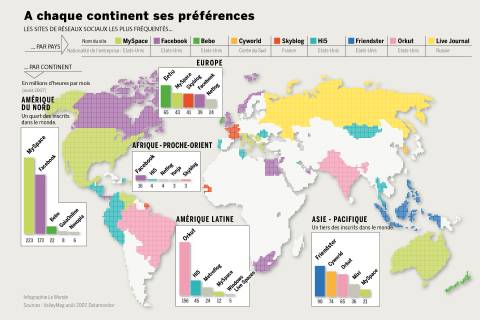 This map reveals that MySpace dominates in the USA and Australia, whereas the UK, Canada and Norway prefer Facebook. Which brings to mind the statistics about average IQs of countries, which place the UK's average at 100 and the US and Australia's at 98.
Interestingly enough, the chart lists LiveJournal as a Russian website, despite the fact that it began in, and operates out of, the US, though Russia has been a significant market for it and is now owned by a Russian concern.
2008/2/19
A poll has shown that fewer than a third of Americans consider nanotechnology to be morally acceptable; considerably fewer people than in Europe:
In a sample of 1,015 adult Americans, only 29.5 percent of respondents agreed that nanotechnology was morally acceptable.
In European surveys that posed identical questions about nanotechnology to people in the United Kingdom and continental Europe, significantly higher percentages of people accepted the moral validity of the technology. In the United Kingdom, 54.1 percent found nanotechnology to be morally acceptable. In Germany, 62.7 percent had no moral qualms about nanotechnology, and in France 72.1 percent of survey respondents saw no problems with the technology.The authors of the poll believe that this is not so much due to any specific moral issue concerning the making of molecule-sized materials or devices per se, but due to many Americans subscribing to a religious worldview that takes a dim view of "tampering with God's creation":
The catch for Americans with strong religious convictions, Scheufele believes, is that nanotechnology, biotechnology and stem cell research are lumped together as means to enhance human qualities. In short, researchers are viewed as "playing God" when they create materials that do not occur in nature, especially where nanotechnology and biotechnology intertwine, says Scheufele.
The moral qualms people of faith express about nanotechnology is not a question of ignorance of the technology, says Scheufele, explaining that survey respondents are well-informed about nanotechnology and its potential benefits. "They still oppose it," he says. "They are rejecting it based on religious beliefs. The issue isn't about informing these people. They are informed."Which is somewhat ironic, if the first post-Enlightenment nation is now dominated by a steadfastly pre-Enlightenment worldview; a people at peace with technology but hostile to the scientific mindset that makes it possible. Or, in the words of one member of a Christian Fundamentalist web forum (of course):
Technology makes peoples lives easier. Technology is the product of inventive geniuses who were inspired by God. Inventions and innovations improve life.
Science causes confustion and makes things complicated. Everytime there is a new discovery the old discoveries and old wisdom are discarded! And theories get more and more complex. Science makes people confused and complicates things. Who is the author of confusion? Satan of course. The bible it the opposite of science. Biblical wisdom NEVER CHANGES, and anyone can get it. Scientific wisdom is always changing and contradicting itself, and really nobody gets it.On a similar tangent: "Dumb and Dumber: are Americans Hostile to Knowledge?", a review of a new book claiming that anti-intellectualism is on the rise in the US.
2008/2/14
There is, indeed, nothing new under the sun. 74 years ago, people in America were besieged by unsolicited advertisements for dodgy medical products, financial scams, gambling, drugs and "dubious pleasure activities". Only rather than cluttering up their nonexistent email inboxes, this spam took the form of powerful radio broadcasts from transmitters in Mexico and/or aboard ships, jamming the signals of existing radio stations.
2008/2/13
Recently declassified documents have revealed that, in 1973, Mao Zedong offered to export 10 million Chinese women to the US, whilst in talks with Henry Kissinger:
The Chinese dictator said he believed such emigration could kick-start bilateral trade but could also "harm" the US with a population explosion similar to China's, according to documents covering US-China ties between 1973 and 1976.
The leaders then spoke briefly about the threat posed by the Soviet Union, with Mao saying he hoped Moscow would attack China and be defeated. But Mao said: "We have so many women in our country that don't know how to fight."
Proof that Starbucks are everywhere: even at the Guantanamo detention facility, as mentioned in this article:
The admissions made by the men -- who were given food whenever they were hungry as well as Starbucks coffee at the U.S. prison at Guantanamo Bay, Cuba -- played a key role in the government's decision to proceed with the prosecutions, military and law enforcement officials said.Of course, Guantanamo was a US military facility before it was the controversial black site, so it's not unlikely that there was a Starbucks there for the troops. I wonder whether there is one at the even-more-secret military facility on Diego Garcia, or how many Starbucks (or other well-known franchises) there are in locations which are officially secret.
(via Boing Boing) ¶ 0
2008/2/10
MySpace's legendary contempt for its users has now extended to deleting the Atheists & Agnostics group with 35,000 members, apparently because its existence offended some religious hardliners.
“It is an outrage if Rupert Murdoch’s News Corporation and the world’s largest social networking site tolerate discrimination against atheists and agnostics-- and if this situation goes unresolved I’ll have little choice but to believe they do,” said Greg Epstein, humanist chaplain of Harvard University. News Corporation, Murdoch’s global media corporation which also includes Fox News, purchased MySpace in 2005.The group has now been undeleted; here is more on the incident from the group's moderator, Bryan Pesta:
We were deleted two years ago due to complaints from a group called the "Christian Crusaders." They would search Myspace for profiles they found offensive, and then mass complain to customer service. Their strategy was to send so many emails to customer service that someone, somewhere at Myspace would delete the profile or group.
2008/2/8
When voters in Chicago found that the pens they were given to mark ballot papers didn't work, the officials told them not to worry, as the pens contained invisible ink, which would be counted by the scanners. Surprisingly, 20 people accepted this and turned in blank ballot papers.
(via Boing Boing) ¶ 0
2008/2/5
Copyfighter turned anti-corruption campaigner Lawrence Lessig on why he backs Barack Obama ahead of Hillary Clinton; and here is a transcript. (Summary: it's not so much due to policy differences, of which there are few, as questions of character and integrity.)
2008/1/28
As overt expressions of racism become unacceptable, good ol' boys in the US South have adapted by referring to black people as "Canadians":
Last August, a blogger in Cincinnati going by the name CincyBlurg reported that a black friend from the southeastern U.S. had recently discovered that she was being called a Canadian. "She told me a story of when she was working in a shop in the South and she overheard some of her customers complaining that they were always waited on by a Canadian at that place. She didn't understand what they were talking about and assumed they must be talking about someone else," the blogger wrote.
A University of Kansas linguist said that a waitress friend reported that "fellow workers used to use a name for inner-city families that were known to not leave a tip: Canadians. ‘Hey, we have a table of Canadians.... They're all yours.' "
Stefan Dollinger, a postdoctoral fellow in linguistics at University of British Columbia and director of the university's Canadian English lab, speculated that the slur reflects a sense of Canadians as the other. "This ‘code' word, is the replacement of a no-longer tolerated label for one outsider group, with, from the U.S. view, another outsider group: Canadians. It could have been terms for Mexicans, Latinos etc. but this would have been too obvious," he said. "What's left? Right, the guys to the north."The comments to the Boing Boing post which mentioned this are enlightening as well:
I work with an American who recently emigrated to Canada from one of the "suh-then" states. He tells me our early stance against the "war" on Iraq left a bad taste toward Canada in the rural south. Raw hate and "we should invade those b*stards and kick them out on an ice flow" rage was quite common in his semi-rural area. Using "Canadian" in this fashion would be a logical progression. They're not being ironic at all.
My friend has parents that used to use the word frequently until she married an actual Canadian. When she told them that he was Canadian they went totally ape-shit. She informed them that they were not invited to the wedding. When they found out he wasn't black (oh the relief... you should've seen it), they apologized. They're still bigots, but possibly one degree less so now.
I live in Pennsylvania, where I've heard a similar practice; many of my father's friends use the term "Democrat" instead of "Canadian" for the exact same purpose. Most of these guys are old, white Republicans, and many of them are also Freemasons.
Actually, the term "Canadian" in reference to black people has been around and in prevalent use for years, like seven or eight of them. It can't have taken that long for the mainstream to have figured that out. The new term is "German" because it was feared that black folks were catching on to the "Canadian" thing a couple of years ago.It is not clear whether "Canadian" started off as restaurant slang for "cheapskate" (presumably due to Canada not having a tipping culture as in the US due to higher minimum wages?) or was a racist euphemism all along.
(via Boing Boing) ¶ 0
2008/1/16
An expatriate Briton in America was diagnosed as clinically depressed, prescribed antidepressants, and even scheduled for shock therapy, before doctors realised that he was not depressed, just British. (Or, to be precise, English.)
Doctors described Farthing as suffering from pervasive negative anticipation: a belief that everything will turn out for the worst, whether it's trains arriving late, England's chances of winning any national sports events, or his own prospects of getting ahead in life. The doctors reported that the satisfaction he seemed to get from his pessimism was particularly pathological.
'They put me on everything -- lithium, Prozac, St. John's wort,' Farthing says. 'They even told me to sit in front of a big light for half an hour a day or I'd become suicidal. I kept telling them this was all pointless, and they said that was exactly the sort of attitude that got me here in the first place.'The symptomology of Britishness, it seems, is indistinguishable from that of depression (the next edition of the DSM will presumably contain an entry for it). Luckily, both conditions are treatable.
(via Mind hacks) ¶ 0
2008/1/3
Maciej Ceglowski has written up an illuminating history of the Alameda-Weehawken Burrito Tunnel, the spectacular feat of engineering which delivers fresh burritos from the San Francisco Mission District to New York, in a chord under the continental United States:
Who can imagine New York City without the Mission burrito? Like the Yankees, the Brooklyn Bridge or the bagel, the oversize burritos have become a New York institution. And yet it wasn’t long ago that it was impossible to find a good burrito of any kind in the city. As the 30th anniversary of the Alameda-Weehawken burrito tunnel approaches, it’s worth taking a look at the remarkable sequence of events that takes place between the time we click “deliver” on the burrito.nyc.us.gov website and the moment that our hot El Farolito burrito arrives in the lunchroom with its satisfying pneumatic hiss.
Once in the tubes, it’s a quick dash for the burritos across San Francisco Bay. Propelled by powerful bursts of compressed air, the burritos speed along the same tunnel as the BART commuter train, whose passengers remain oblivious to the hundreds of delicious cylinders whizzing along overhead. Within twelve minutes, even the remotest burrito has arrived at its final destination, the Alameda Transfer Station, where it will be prepared for its transcontinental journey.
Not everyone is as delighted with the tunnel as the geologists. Old-time San Franciscans will be quick to point out that the comestibles in the tunnel flow strictly one way. “In the old days you’d go to a place like Pancho Villa and get yourself a steak burrito in five minutes, maybe ten if it was near lunchtime,” says lifelong Mission resident Howard Washington. “Now the line is out the door even in the morning. And some of those places down in the South Bay won’t even take customers anymore. If you want a burrito in the daytime you have to get it first thing, or else you go to one of the places that isn’t hooked up to the tunnel.”
2007/12/7
In Portland, Oregon, there is a campaign to get 42nd Avenue renamed to "Douglas Adams Boulevard":
Of course, Douglas Adams was also an outspoken atheist, a position that's still considered controversial in America (though, apparently, getting less so, with sympathetic atheists appearing on TV shows such as House). If the majority of Americans would still be unwilling to accept an atheist holding public office, would they be willing to rename a street after one?It will reflect Portlanders’ commitment to the arts.
It will reflect Portlanders’ respect for the environment.
It will reflect Portlanders’ desire to provide technological access to all.
It will reflect Portlanders’ passion to further education to all people.
It will remind all Portlanders’ the most important lesson in times of uncertainty and fear…
…DON’T PANIC.
2007/11/7
The FBI has a new technique for sniffing out potential terrorist cells: scanning grocery store records for telltale spikes in felafel sales. Really.
Other than anything else, the fact that they were using felafel sales to find Iranian sleeper cells suggests that whoever came up with this idea didn't do their homework.
2007/9/23
As America digs in for the long siege, there is now a high school specialising in "Homeland Security"-related subjects:
The new school is funded and guided by a slew of federal, state, and local agencies, not to mention several defense firms. Officials say it will teach kids to understand the "new reality," though they hasten to add that the school isn't focused just on terrorism. School administrators, channeling Cheneyesque secrecy, refused to be interviewed for this story. But it's no secret that the program is seen as a model for the rest of the country, with the Pentagon and other agencies watching closely.
Students will choose one of three specialized tracks: information and communication technology, criminal justice and law enforcement, or "homeland security science." David Volrath, executive director of secondary education for Harford County Public Schools, says the school also hopes to offer "Arabic or some other nontraditional, Third World-type language."
However, it's not clear how many Joppatowne grads will be on track to join the upper echelons of the intelligence community and how many will wind up as airport screeners. "We do want to encourage higher education," Volrath says. "We also want to be realistic. Some of these defense contractors will have huge security needs, and the jobs won't require four years of college."
(via Boing Boing) ¶ 0
2007/9/20
Former Australian defense minister Kim Beazley has revealed that the Australian security services cracked US a defence code in the 1980s, to enable them to reprogram their US-built Hornet fighters to identify potentially hostile aircraft. The Hornets, you see, were shipped pre-programmed with the profiles of Warsaw Pact aircraft, of which there weren't many in the Asia/Pacific region, and thus would have been somewhat less than useful when faced with, say, Indonesian or New Zealand fighters. This setting was impossible to change without top secret codes, which the US promised to provide but somehow never came up with. Given that there's no consumer complaints commission that can order the return of jet fighters should they prove unfit for purpose, the Australians (which, presumably, means ASIO/ASIS/DSD) did the only thing they could: they spied on the Americans and stole the codes. What happened to whoever authorised the purchase of the aircraft without ensuring that they were fit for purpose is not known.
"In the end we spied on them and we extracted the codes ourselves and we got another radar that could identify (enemy planes).
Mr Beazley said the Americans knew what the Australians were doing and were intrigued by the progress they made.I wonder whether the Australian department of defense has learned enough from this to demand the source code to the Joint Strike Fighter, as the British are doing. Or whether, indeed, Australia has the clout to make such requests.
2007/9/13
A new report from the US Computer and Communications Industry Association has found that fair use exemptions to copyright add more than three times as much value to the US economy as copyright industries. Fair use exemptions account for more than US$4.5 trillion of revenue to the US, whereas the copyright industries brought in US$1.3 trillion. Which sounds like an argument against new neo-Galambosian erosions of fair use and extensions and expansions of intellectual-property rights of the sort that Big Copyright has been pushing for.
2007/6/26
A study of social network website users in the US has shown a class divide between MySpace and Facebook users. Apparently Facebook has more users from wealthier homes and more academic backgrounds, while MySpace has more working-class teenagers, minorities and members of social groups ostracised by the popular kids in high school (this may include music- and fashion-related youth subcultures).
2007/6/12
Was US President Bush's watch stolen in Albania, while he was wearing it and surrounded by five bodyguards? The US embassy is denying it, of course, but the video clearly shows Bush with and later without his watch, not to mention a hand grabbing his wrist in the interim.
By the look of it, someone in Albania is going to have a hell of a story to tell his grandchildren; that is, assuming he doesn't die in a CIA black prison or something.
2007/5/15
Arizona sherriff Joe Arpaio, who has won acclaim from law-and-order types and opprobrium from liberals by keeping prisoners in harsh conditions, is now bidding to add heiress, serial unlicensed hazardous driver and all-round waste of oxygen Paris Hilton to his chain gang:
"Instead of reducing for her sentence, which I feel is wrong, why not bring her over here? We can incarcerate her here. She can do her time over here."
Female inmates who are put on the chain gang work outside seven hours a day from early morning, six days a week in the desert surrounds.
The inmates wear traditional black-and-white striped uniforms and perform such tasks as creating fire breaks, removing trash, and even burial duty for vagrants.
Critics have condemned these housings, which can get blisteringly hot, as violations of human and constitutional rights.Apparently the Los Angeles County Sherriff, who is responsible for the incarceration of those sentenced to prison in LA, is considering the offer.
2007/4/25
Naomi Wolf claims that, after 9/11, Bush's America has been following a historically well-trodden path — the path from an open society to fascism:
If you look at history, you can see that there is essentially a blueprint for turning an open society into a dictatorship. That blueprint has been used again and again in more and less bloody, more and less terrifying ways. But it is always effective. It is very difficult and arduous to create and sustain a democracy - but history shows that closing one down is much simpler. You simply have to be willing to take the 10 steps.
As difficult as this is to contemplate, it is clear, if you are willing to look, that each of these 10 steps has already been initiated today in the United States by the Bush administration.The steps Wolf cites, giving examples of each, are:
- Invoke a terrifying internal and external enemy
- Create a gulag
- Develop a thug caste
- Set up an internal surveillance system
- Harass citizens' groups
- Engage in arbitrary detention and release
- Target key individuals
- Control the press
- Dissent equals treason
- Suspend the rule of law
It is a mistake to think that early in a fascist shift you see the profile of barbed wire against the sky. In the early days, things look normal on the surface; peasants were celebrating harvest festivals in Calabria in 1922; people were shopping and going to the movies in Berlin in 1931. Early on, as WH Auden put it, the horror is always elsewhere - while someone is being tortured, children are skating, ships are sailing: "dogs go on with their doggy life ... How everything turns away/ Quite leisurely from the disaster."
What if, in a year and a half, there is another attack - say, God forbid, a dirty bomb? The executive can declare a state of emergency. History shows that any leader, of any party, will be tempted to maintain emergency powers after the crisis has passed. With the gutting of traditional checks and balances, we are no less endangered by a President Hillary than by a President Giuliani - because any executive will be tempted to enforce his or her will through edict rather than the arduous, uncertain process of democratic negotiation and compromise.
What if the publisher of a major US newspaper were charged with treason or espionage, as a rightwing effort seemed to threaten Keller with last year? What if he or she got 10 years in jail? What would the newspapers look like the next day? Judging from history, they would not cease publishing; but they would suddenly be very polite.
We need to look at history and face the "what ifs". For if we keep going down this road, the "end of America" could come for each of us in a different way, at a different moment; each of us might have a different moment when we feel forced to look back and think: that is how it was before - and this is the way it is now.An exercise for the reader: which, if any, of the 10 steps to fascism have been taken in your country?
2007/4/17
The US has the world's highest minimum drinking age, at 21*. This is a fairly recent policy; it was pushed through in the 1980s, when the federal government seized control of state drinking-age laws by threatening to withhold highway funds. Now there are growing calls for the drinking age to be lowered to 18:
Supporters of the federal minimum argue that the human brain continues developing until at least the age of 21. Alcohol expert Dr. David Hanson of the State University of New York at Potsdam argues such assertions reek of junk science. They're extrapolated from a study on lab mice, he explains, as well as from a small sample of actual humans already dependent on alcohol or drugs. Neither is enough to make broad proclamations about the entire population.
Oddly enough, high school students in much of the rest of the developed world -- where lower drinking ages and laxer enforcement reign -- do considerably better than U.S. students on standardized tests.Meanwhile, on the other side of the pond, there are proposals to raise the drinking age to 21 to tackle the binge-drinking epidemic.
* This is not counting some countries, such as Saudi Arabia, where the drinking age is infinity.
2007/4/16
WIRED News has an article on the Kafkaesque world of US "terrorist watch lists". If your name (or some approximation thereof; which is why it can suck to have a common Arabic name) appears on them, you can be detained for interrogation should you attempt to board a flight in the US, or denied credit. You are not entitled to any explanation and have no right to recourse, and the very existence of some of these watchlists, or how many there are, is not officially acknowledged. Which, as you can imagine, lends itself to abuse:
Despite that, last month constitutional scholar Walter F. Murphy, McCormick Professor of Jurisprudence Emeritus at Princeton University, found himself unable to check in curbside at a New Mexico airport. A check-in clerk with American Airlines told him it was because he was on a "terrorist watch list," Murphy says.
"One of them, I don't remember which one, asked me, 'Have you been in any peace marches? We ban a lot of people from flying for that,'" recalls Murphy. "I said, 'No, but I did give a speech criticizing George Bush,' and he said, 'That will do it.'"
While there are almost no American citizens on the OFAC list, it is routinely used during home purchases, credit checks and even apartment rentals, and has caused people with common Latino and Muslim names to be denied mortgages for having a name that only vaguely resembles a name on the list, according to a recent report (.pdf) from the Lawyers' Committee for Civil Rights.
2007/4/12
And another one exits this world; Kurt Vonnegut, author of Cat's Cradle and Slaughterhouse Five and chronicler of the absurd, has died, a year after coming out of retirement to write a book, A Man Without A Country, bitterly denouncing the state of America under Bush.
2007/3/22
These days, Canadian immigration authorities are attempting to search the contents of all laptops entering the country for pornography (at least that stored in really obvious places):
But he is stuck. There is nothing familiar. So he clicks on the start menu and finds "My Pictures". You know, if I was into that - that is precisely where I would stick all of my porn - right there in "My Pictures". He goes into it - and sees all of my folders. And al of my pictures, which we looked at. He said "wow, you travel a lot", I said "yup".
Now, after about 15 minutes of looking at my pictures (I have to resist the urge to point him to my favorites :) he shuts down my computer and says "Ok sir, thank you very much, have a nice trip".And in the comments:
At the US border they are allowed now to seize your laptop and search for porn. Then your laptop will be returned at some other time if nothing is found. Some people have not had their laptop returned after almost a year.Recently, US transport regulations have mandated that all luggage checked at an airport be unlocked or else be locked with a special approved padlock that can be opened with a master key by the authorities. Perhaps in a few years' time, they will mandate that all laptops have a means by which the entire contents can be copied at the airport, for external scanning for pornographic/terrorist/copyright-violating content.
Art movement of the day: Neoconservative Realism:

In addition to the prints, Birk has made a number of paintings, including The Liberation of Baghdad, seen here. The paintings are more satirical and ironic, and many are based on paintings of the glories of war in Napoleon's time and from Russian socialist images of battlefield glories.
The Liberation of Baghdad, says Birk, is about "what we were told would happen -- happy, joyfully liberated Iraqis welcoming American troops as we free them from the shackles of oppression."
(via Boing Boing) ¶ 2
2007/3/21
After Stephen Fry commented that British actors have an unfair advantage in America because Americans mistake British accents for brilliance, the BBC has published a piece on what a British accent gets you in the US. (And, apparently, a "British accent" includes anything from Hugh Grant plumminess to deepest darkest Geordie.)
"For most Americans, there's no distinction between British accents. For us, there's just one sort of British accent, and it's better than any American accent - more educated, more genteel," says Rosina Lippi-Green, a US academic and author of English with an Accent: Language, Ideology and Discrimination in the United States.
"There was a sitcom called Dead Like Me with a Brit [Callum Blue] in it. He was a scruffy, 20-something drug dealer. Even he had that sort of patina - his was not an RP accent, it was a working class London accent."
Katharine Jones, author of Accent of Privilege: English Identities and Anglophilia in the US, says the "educated and cultured" associations have a long history. "British etiquette books have been used for years; and although Americans say they have no class system, they do - and the American upper class apes the British upper class."Another point the article makes: British expatriates in Australia (where their accent is associated with complaining and being bad at cricket, and/or where refinement and intelligence have traditionally been associated with weakness and/or metaphorical or literal homosexuality rather than any positive attributes) tend to lose their accents pretty quickly, whereas those in the US (where their accents make them appear intelligent and sophisticated, and often get them preferential treatment) retain theirs. Funny, that.
It's official: a US district court has ruled that household product manufacturer Procter & Gamble are not Satanists, despite the persistent urban legends: More specifically, the ruling smacked down four representatives of Amway, a rival product manufacturer allegedly connected with the US Religious Right and/or operating in a cult-like fashion, of deliberately spreading this rumour and urging a boycott. The defendants denied malicious intent, saying that their goal was merely to "fight the Church of Satan".
To the best of my knowledge the Church of Satan has not issued any statement on the ruling.
2007/3/16
Proof that the wowsers haven't completely won the Australian culture war: Australian commercial radio stations have received complaints for playing censored American radio edits of alternative-rock/rap songs:
Nova 100 music director Estelle Paterson said the station received complaints about "radio edited" or "clean" songs it played, describing a version provided by record companies which is shorter and deletes profanity present on album versions.
Radio edits of some hip-hop songs are so cut-up as to be almost unusable, she added, laughing, "And in America everything's considered offensive!"
2007/2/9
Last night, I visited the local video library a rather good one in Stoke Newington Church St., which has a lot of art-house/foreign films) and rented a copy of C.S.A.: The Confederate States of America.
This is a mockumentary, presenting an alternate history in which the slave-holding South, rather than the abolitionist North, won the American Civil War, and formed what we know as America. It presents this history from the Civil War (in which the South managed to get British and French support for its cause, in the interest of "private property rights"), through the reconstruction (in which the values of the slave-holders are imposed on the North, successfully, and all non-whites become slaves), wars of conquest across South America (forming a "tropical empire", of the sort envisioned by Confederate leaders, governed under a policy of racial "apartness"), through to the present day CSA. The documentary is framed as an imported British documentary being presented on a CSA TV channel; it is preceded by a disclaimer as to its "controversial nature" and interspersed with ads, which shed some light on life in an early-21st-century Confederate America; these include advertisements for cable-TV slave-shopping programmes and electronic tracking bracelets, Cops-style TV programmes about federal agents hunting down runaway slaves, and public-service announcements urging citizens to beware of the disease of homosexuality and report suspected racially-impure people passing as white to the government.
What does the C.S.A. circa 2004 look like? Well, people with any non-white blood are, by law, slaves, Christianity is the state religion (generously, and narrowly, allowing Catholicism to be considered Christian), women are not allowed to vote, Jews are confined to Long Island, and there is a cold war with "Red Canada", which harbours abolitionist "terrorists" and is the home of rock'n'roll and "race music". (Canada is not alone; virtually everyone but South Africa has imposed sanctions on the C.S.A.) Those are the obvious and spectacular differences; on a more subtle level, the C.S.A. is a much more conformistic and authoritarian culture. The mindset which allows ordinary people, who see themselves as good and decent, to tolerate and participate in slavery is one in which society is organised along strong chains of authority and hierarchy, which are seen as part of the order of nature. (One example of this is in an ad early in the film, for an insurance company, which mentions that the father is "master of the house".) With acceptance of arbitrary authority comes the acceptance of beliefs on the basis of faith in authority, and unsurprisingly, the values of the religious right are dominant in the C.S.A. (in one scene, there is a shot of the front page of "CSA Today", which includes a story about scientists disproving evolution). Not surprisingly, this mindset and the focus on "purity" creates a stagnant, homogeneous culture, one seeming in some ways quaintly archaic (one example is music and entertainment programming on its television stations, where, of course, all black influences are banned). Quoting from a friend, it is Pleasantville meets Triumph Of The Will.
C.S.A. has its lighter moments as well; artistic licence is employed to ensure that the history doesn't diverge too wildly from the world we know, but instead parallels it, mirroring and counterpointing. For example, the C.S.A. enters World War 2 after launching a surprise attack on a Japanese naval base; John F. Kennedy is assassinated, right on cue, for having suspected abolitionist sympathies, and the Clinton sex scandal is echoed, quote for quote, in the investigation into a politician's racial make-up.
All in all, C.S.A. was quite an interesting and thought-provoking film, and is worth a look.
2006/12/27
US discount store chain Target has withdrawn a line of CD cases with Che Guevara's image, after the Cuban government sued for copyright violation socialists protested at the commercialisation of his image critics protested at the glorification of an architect of totalitarianism:
"What next? Hitler backpacks? Pol Pot cookware? Pinochet pantyhose?" wrote Investor's Business Daily in an editorial earlier this month, citing the Guevara case as a model of "tyrant-chic".
2006/12/25
In North Pole, Alaska, it is Christmas every day. The decorations never come down, the streetlights are painted like candy canes, and even the McDonalds is Christmas-themed. Meanwhile, the town's new mayor wants to extend the Christmas theme, having shop workers wear elf costumes. Good cheer is a civic duty, and for some reason, not everybody's happy with that.
Recently, a group of high-school children was arrested after planning a Columbine-style high-school massacre:
Earl says the goths were non-Christmassy outcast loners, bullied by the jocks, their intended victims. Iwas a bullied goth at school and so I understand the impulse to want to kill bullies. But there's a big difference between them and me. There were 15 of them. Six ringleaders and nine others who knew about it and were to play subsidiary roles. A gang of 15 can hardly call themselves bullied loners.Fifteen is a huge number in a town of 1,600. It's 25% of the school's 13-year-olds. And they were going to kill dozens of their classmates. This sounds to me like civil war, the non-Christmassy kids against the Christmassy ones.The kids were all (a) identified as "goths" (apparently the goths in American Red States are a lot more violent and nihilistic than the ones elsewhere; the Mordorian Orcs of the goth world?), and (b) 13, which means that they would have recently done their first stint of letter-writing-elf duty, replying to some of the letters sent by children around the world to "Santa, North Pole". Some speculate that the shock of discovering that there is no Santa Claus, combined with the avalanche of human misery in the letters, may have pushed some of them to breaking point:
She explains: the town keeps the practice a secret from the younger children. They have no idea that they'll one day - at the age of 11 or 12 - be obliged to become letter-writing elves. She says it can be quite a shock. Jessie says it isn't as bad as it could be. They do have rules: "If someone writes something like, 'Dear Santa, my mom has cancer. Can you make it go away?' we don't deal with those. We give them back to the teacher." But still, she says, it's a disappointment.
"you'll probably see it in their faces. They prepare you for a few weeks before, but there's always that one person who's like, 'Wait. What are we doing?' And that's the person you should be looking out for. The person who wasn't paying attention in class until the letters are right in front of them. And then they're shattered. It's a weird experience."
2006/12/8
It's December, Christmas sales are entering their third month, and Britain's right-wing tabloids are full of stories about politically-correct do-gooders banning Christmas to avoid offending minorities. The problem is, further investigation reveals the stories to be utter nonsense. Birmingham hasn't ordered Christmas to be rebranded as "Winterval" (the name was used for a three-month shopping promotion in 1998, and never since), the evil secularist LibDems in Luton haven't replaced it with a Harry Potter festival, and as for the millionaire who was banned from putting up a light display outside his home, that had nothing to do with enforcing secularism and everythign to do with the large illuminated snowmen, amplifiers blaring Christmas songs and increased traffic and crime.
So what's going on here? Well, it looks like the "war on Christmas" is a quite deliberate ploy by a loud minority of religious traditionalists trying to claim more cultural clout than today's largely secular society entitles them to.
"There's something very complicated going on here," says Terry Sanderson, president of the National Secular Society. "It has to do with the contest between Christianity and Islam: Christians are becoming very alarmed about the progress they see Islam making in this country, and they fear their own festivals will be overwhelmed. I was doing a phone-in the other day, and everybody who rang in was saying, 'They're banning Christmas!' So I said: 'Who? Where? Who's standing outside a church saying you can't go in? Who's coming and knocking on your door at 6am and asking if there's a nativity set in your house?' It's quite dangerous, I think, to incite this kind of resentment against a perceived enemy."
This year, though, the defenders of Christmas aren't only invoking the fear that nebulous Muslim forces might be about to obliterate Britain's traditional religion. Simultaneously, they have also aligned themselves with Muslim groups, arguing that the real enemy is secularisation. It's a position well-crafted for the historical moment, and for the currently fashionable notion of Britain as comprised of groups defined above all by their faith (even though barely 10% of us regularly attend any kind of religious service).Unsurprisingly, the War-On-Christmas panic is not indigenously British, but, like many forms of religious chest-beating, imported from the Colonies, in this case, America and its culture war:
Then, last year, the War on Christmas received a massive boost when it exploded on to the American political landscape, thanks primarily to two Fox News anchormen, John Gibson and Bill O'Reilly. Gibson had a vested interest, having just published a book entitled The War On Christmas: How The Liberal Plot To Ban The Sacred Christian Holiday Is Worse Than You Thought. (A note in the interests of full disclosure: O'Reilly, as I enjoy telling people whenever possible, accused me of "spout[ing] incredible nonsense" earlier this year after I wrote a story about a speech in which he invited al-Qaida to attack the liberal stronghold of San Francisco; previously, he had speculated that the Guardian "might be edited by Osama bin Laden".)(Btw, has the atheists-are-taking-away-Christmas thing spread to Australia yet? I imagine when it does, the federal government will swing into action, using its expanded powers to come down like a tonne of bricks on any officials daring to take the Christ out of
2006/11/20
In his recent book The God Delusion, Richard Dawkins asserted that, in today's America, atheists have a standing similar to what gays had 50 years ago. (According to a poll quoted by Dawkins, only 49% of Americans would approve of an atheist holding public office; other traditionally disenfranchised minorities (women, gays and African-Americans) get scores in the high 70s to 90s.) Dawkins' picture is grim for American atheists: they're routinely vilified as amoral nihilists, and often subjected to intimidation.
Scott Adams (the Dilbert one, not the text-adventure one), however, presents a more optimistic picture: according to him, atheists are the new gays; books by Dawkins and gung-ho neoconservative atheist Sam Harris are topping the sales charts, and, as likeable gay characters did a few decades ago, openly atheist characters are now filtering into TV shows:
Prior to 9/11, it would have been career suicide for a public figure to come right out and say God is a fairy tale. Now it's a feature of popular culture. You can see it on cable of course, in shows such as BullSh*t, Real Time, The Daily Show, and Southpark. But it's also a feature of network TV. The main character on House is written as the most brilliant human on the planet, and he's an atheist. The new show 3lbs has a similar character. I can't remember anything like that ten years ago.Adams puts this down to 9/11; whereas during the Cold War, America was fighting a nominally atheistic Soviet Union (hence "In God We Trust" having been added to US currency during the McCarthy era), it is now fighting adversaries who, whichever way you look at them, epitomise religious faith at its most extreme.
Ask a deeply religious Christian if he'd rather live next to a bearded Muslim that may or may not be plotting a terror attack, or an atheist that may or may not show him how to set up a wireless network in his house. On the scale of prejudice, atheists don't seem so bad lately.Depends on the "deeply religious Christian"; don't a lot of religious hardliners in the US lump everybody outside of the One True Religion, from Godless feminists to Wahhabi Islamists, as part of the same Satanic Other?
Anyway, Dawkins suggested in his book that there are many more atheists in America than are willing to identify them as such, and that many of political leaders (and even some religious leaders) who, for reasons of pragmatism, profess to be acceptably religious, are closet atheists, and that if they started coming out of the closet, this could trigger a change in American political culture. Adams suggests that this may be happening now. He furthers that to propose America's first explicitly Atheist President: Bill Gates.
2006/11/17
The U.S. government has eliminated hunger in America. Thanks to a recent change in terminology, 35 million formerly hungry Americans now merely have "very low food security".
2006/11/15
Product Music, a collection of tracks from American "industrial musicals" of the mid-20th century. Despite the name, these do not consist of Einsturzende Neubauten-style metal percussion and propane-powered death-juggernaut organs, but rather of songs, varying from cheesy showtunes to cheesy faux-country numbers to lounge grooves, with lyrics (of varying degrees of clunkiness) about whatever product, brand or company it is that is changing our lives and/or leading us into a bright future. In other words, like Leave-It-To-Beaver-era America's equivalent of Popshopping.
(via Boing Boing) ¶ 0
2006/11/14
This evening, I went to see Borat: Cultural Learnings of America for Make Benefit Glorious Nation of Kazakhstan. I found it quite amusing, despite having read about most of the highlights in advance. There was enough there that the online chatter doesn't quite prepare you for.
The basic concept involves, as you've undoubtedly heard, Sacha Baron-Cohen (with the assistance of a team of "producers") gulling various Americans into believing that he is, in fact, a somewhat out-of-touch Kazakh journalist making a documentary for Kazakh consumption only, asking them a few basic questions about life in America, easing them into more and more absurd territory, and then keeping just the last bits (having made sure that they signed a release form well in advance) and editing them into a road movie recounting a journey from New York to Los Angeles. Already he's possibly being sued by a group of fratboys who claim that they were induced to make arses of themselves under false pretenses (good luck with that one!) and the residents of a dirt-poor Romanian village that stood in for Borat's hometown, who didn't like being paid £3 each and then described as rapists, not to mention former unintentional internet celebrity Mahir Cagri who's pissed off that Cohen took his shtick and made it profitable.
Fact: Borat's "Kazakh" greetings are in fact Polish ("Jagshemash" = "jak sie masz", or "how do you do"), though the longer dialogue is in Hebrew, Yiddish and Armenian.
I'm still not sure how much of the scene at the end with Pamela Anderson was staged.
2006/11/9
And it looks like the Democrats have control of the Senate. And here is a list of policies they intend to use their new power to force down the throats of God-fearing America:
2. Drug-filled condoms in schoolsIt's rather telling about the mindset of the American Right (or the author's depiction of it) that the cocktail of caricature loony-liberalisms feared to be unleashed by the Democrats' ascendancy includes such things as mandatory abortion and homosexuality, Islamic fundamentalism, atheism, belief in evolution, and replacing road transport with public transport.
6. Withdraw from Iraq, apologize, reinstate Hussein
13. Freeways to be removed, replaced with light rail systems
16. Comatose people to be ground up and fed to poor
20. Jane Fonda to be appointed Secretary of Appeasement
21. Outlaw all firearms: previous owners assigned to anger management therapy
23. Ban Christmas: replace with Celebrate our Monkey Ancestors Day
Meanwhile, the copyfighters aren't rejoicing just yet; the Democrats (i.e., the Party of the Lesser Evil) have a long history of closeness to Hollywood (which, for all the Republicans' pro-corporate ideology, was a bit too Godless and liberal), and look set to put a MPAA shill in charge of internet policy.
(via Boing Boing) ¶ 0
And more on the recent US elections: not surprisingly, Kinky Friedman didn't win the governorship of Texas.
2006/11/8
The Republicans got a caning in the US midterm election, with the Democrats seizing the House of Representatives; the Senate hangs in the balance.
Would it be too cynical to suggest that, if Congress becomes too difficult (i.e., by refusing to pass whatever follows the abolition of habeas corpus and legalisation of torture), all the Whitehouse has to do is allow a major terrorist act to take place on US soil (perhaps by strategically blocking various investigations or programmes) and blame it on Democrat recalcitrance, after which no-one will vote Democrat for a generation?
2006/11/2
In the 1930s, Henry Ford built two planned towns in Brazil, to support rubber plantations; the towns were modelled on Michigan, all white picket fences and neat, American-style suburban sidewalks (in fact, they looked not unlike some place in Queensland). As well as harnessing Brazil's rubber resources, the project attempted to instill Anglo-American/Fordian values in their residents; in return for better pay, the residents had to work US-style hours, eat American-style food in self-service cafeterias (the last point causing a riot at one stage) and attend compulsory square-dancing social events.
Fenced in by jungle, Fordlandia was transformed into a modern suburb with rows of snug bungalows fed by power lines running to a diesel generator. The main street was paved and its residents collected well water from spigots in front of their homes--except for the U.S. staff and white-collar Brazilians, who had running water in their homes. The North Americans splashed in their outdoor swimming pool and the Brazilians escaped the sun by sliding into another pool designated for their use.
Generally, the company-imposed routine met hit-and-miss compliance. Children wore uniforms to school and workers responded favorably to suggestions they grow their own vegetables. But most ignored Ford's no liquor rule and, on paydays, boats filled with potent cachaca--the local sugar-can brew--pulled up at the dock. Poetry readings, weekend dances and English sing-alongs were among the disputed cultural activities.
Former Kalamazoo sheriff Curtis Pringle, a manager at Belterra, boosted labor relations when he eased off the Dearborn-style routine and deferred to local customs, especially when it came to meals and entertainment. Under Pringle, Belterra buildings did not contain the glass that made the powerhouse at Fordlandia unbearably hot, and weekend square dancing was optional. Alexander said Henry Ford balked at building a Catholic church at Fordlandia--even though Catholicism was the predominant Christian religion in Brazil. The Catholic chapel was erected right away at Belterra.The project was unsuccessful; humidity and malaria made life there unpleasant, rubber yields were low, and for some reason, the locals didn't see the inherent superiority of Anglo-American culture and stubbornly stuck to their customs, in defiance of the local authorities' best efforts. Ultimately, the project was sold to the Brazilian government, which has been stuck with the burden of keeping it from falling down ever since, and struggled to find uses for a transplanted piece of Michigan on the Amazon.
(via Boing Boing) ¶ 0
2006/10/26
After the recent wave of school shootings in the US, a candidate for Oklahoma State School Superintendent has a solution: bulletproof school textbooks, possibly with Kevlar covers.
2006/10/6
The latest architectural fashion in America is building houses with secret rooms. Not so much out of fear of home invasion by terrorists/gangbangers/zombies, but out of the sheer fun of having a secret room behind a sliding bookcase (the usual cliché), retractable staircase or similarly cool (if expensive and cumbersome) alternative door:
Since March, when the Beghous moved into the house, Cami estimates that she has had about 30 friends over. Not one was able to detect the bookcase's secret without guidance. "Most people don't even recognize that it's there," said her father, Eric Beghou, who owns a consulting company with his wife, Beth. "When the home inspector came by to examine the house, our builder shut the bookcase, hiding the room. The inspector went up and down the stairs a couple times - he knew that something was unusual - but he couldn't figure out what was there."
One popular trick is to hide a room behind a bookcase that looks like a standard built-in but is equipped with hidden hinges, rollers and handles, as at the Beghous' house. Contractors can either build the bookcases themselves or buy a piece from a growing collection of companies, including Niche Doors, the Hidden Door Company, Hide a Door, Secret Doorways and Decora Doors. Prices range from about $800 for the most basic models to more than $10,000 for custom-made versions.
She remembered a woman in St. Paul who asked for a room hidden behind the rear wall of a closet. "She said she wanted a secret room for her art studio," Ms. Susanka said. "She was a very introverted person, and she had to hide in order to let this expressiveness out."
(via Boing Boing) ¶ 0
2006/10/2
The world's best-known Jewish cowboy crime novelist, Kinky Friedman, is running for governor of Texas:
Mr Friedman has a few policies, but opinions by the handful, most of them deliberately offensive: he is in favour of gay marriage ("They have a right to be as miserable as the rest of us"), legalising gambling to pay for primary education ("slots for tots") and smoking Cuban cigars ("I'm not trading with the enemy; I'm burning their fields"). He is less partial to fossil fuels ("we are running out of dinosaur wine"), Castro ("a 45-year legacy of arresting librarians") and Southern Baptists ("They don't hold them down long enough").He also plans to appoint pot-smoking, biodiesel-promoting fellow country singer Willie Nelson as "energy czar", charging him with the responsibility of converting Texas (a state with a proud history of oil dependency) to renewable fuels. Funnily enough, The Times calls him a conservative. I'd have thought that, by Texan standards, those opinions would be well on the liberal side of the spectrum.
2006/8/23
Hacker turned theologian Simon Cozens puts forward an argument that the belief system known as "Christianity" in America is not Christianity. By which he means not that is a weird form of Christianity, or even that it is heretical or flawed, but, quite literally, that it is a completely different, unrelated, belief system that happens to have the same name:
The situation only makes sense if you consider a separate entity called "American Christianity" which is an entirely separate religion to Christianity. Not a branch of Christianity, not a form of Christianity, but something with absolutely no connection to Christianity at all. It's a separate religion. And what is the goal of this religion?
look at it phenomenologically, look at it sociologically, and what do you see? Basically a syncretic folk religion, based primarily on American nationalism, an expression of the "pervasive religious dimension of American political life". (Bellah; see also "Civil Religion in America") Its purposes are basically civil and political. Its morality is taken from a highly selective and individualistic reading of the Old Testament, and it mixes in bits of consumerism, Zionism, Republican political values, and corporatism for good measure. Add to this an almost romantic sentimentality concerning the person of Jesus, much like the contribution of Catholicism to Vodou religions, and suddenly it all makes sense.
(via reddragdiva) ¶ 2
2006/7/24
The latest trend in America: able-bodied people riding mobility scooters because they can't be arsed walking:
On a recent afternoon at Walt Disney World, Dennis Robles was cruising around on an electric "mobility scooter" that the park usually rents out to people with disabilities. Mr. Robles doesn't have a problem walking -- he says he was simply saving up energy for late-night dancing. "I'm pretty healthy," says the 37-year-old truck driver from Brooklyn, N.Y. "Just lazy, I guess."
"Now waiting on line at the buffet is no problem," she says. "You just sit there."
Scooters are now being designed for specific uses. The SmartKart by Dane Technologies, for example, maxes out at three miles per hour, instead of the standard five, because it is meant to be used in grocery stores and other crowded indoor spaces. In the last year, Pride has super-sized models like the Maxima and introduced the Celebrity-X, to keep up with the increase in obesity.I wonder whether there'll be a SUV-style arms race in making larger and more intimidating-looking mobility scooters, to boost the egoes of the riders whilst not so subtly encouraging the few remaining pedestrians to get with the program and buy one.
And, once technology has eliminated the exertion of having to walk, perhaps they can go to work on mechanising one of the other remaining unnecessary exertions; such as, say, sex.
2006/7/20
AIGA Design Forum has an article taking the Whitehouse to task for its poor typographical taste:
While his handlers would never allow the leader of the free world to go out in public wearing a rayon leisure suit and white bucks, they nonetheless use clownish shareware typefaces with hokey beveled edges and cheesy drop shadows to represent his ideas.
The most persistent is the use of Roman-like faux intaglio and engraved letterforms to give an air of authority and truth--although the effect is more Las Vegas casino. To celebrate the fourth anniversary of the "No Child Left Behind" act, someone got a little creative and added a drop shadow to a font that fakes the look of chalk or crayon lettering. This is only one evolutionary step away from introducing the Lariat font (novelty letterforms made from rope) whenever W is speaking from Crawford, Texas.The author suggests that the Whitehouse's design faux pas are the result of indifference, and/or the Whitehouse hiring computer geeks rather than designers (and, incidentally, offers his services as Undersecretary of Design. Momus, however, disagrees, arguing instead that the Whitehouse rejects what is received as good aesthetic taste because it is too closely associated with despised liberal elites, whereas chunky patriotic-action-thriller letters and extruded gold serif fonts are considered populist.
Momus then goes on to find other political signifiers in the Whitehouse's aesthetic choices:
The meaning of Trajan in the contemporary US seems fairly unambiguous to me. Trajan makes an implicit metaphor between the imperial power of ancient Rome and the imperial power of contemporary America. Whether it's made to look as if it were chiselled, or whether the letters are themselves made of metal, it suggests sharp implements, which conjure both the image of monumental permanence and the image of martial hardness -- the two basic meanings of Trajan's column itself. Pure Trajan suggests "right wing"; Trajan with drop shadow, metallic glints or lurid colors suggests "populist". Put them together and you get: "right wing populist". You don't have to spell it out in text; the message is there in the texture.
The Nazis would have hated [Mies van der Rohe's Neue Nationalgalerie's] lightness and clarity the way the Bush administration seem to hate clear, clean Franklin Gothic or Helvetica layouts. They'd already forced Mies to close down the Bauhaus, a den, in their view, of socialists, communists, Jews and progressives. They rejected Mies' Modernist style as "un-German". I'm trying to imagine a parallel world where the Nazis build a Modernist Germania of light articulated glass curtain architecture, but it's almost impossible, just as it's almost impossible to imagine the Bush administration producing a banner or a publication I'd actually admire and want to hang on my wall.Momus, though, comes to the conclusion that "good design" and "bad design" are entirely culturally relative.
There is no such thing as bad design or good design, the cultural relativist has to conclude, just their design and our design. The downside of that is that we lose the illusion that our taste has universal validity, or is inherently better than anyone else's. The upside is that we stop trying to preach and teach -- meaning, we become a little less imperialistic, perhaps. (Or do we become more imperialistic, and simply say "Our way is better because we have more power than you... and because we say so"?)I don't entirely agree with this conclusion, as it seems too much like the "blank slate" theories of human nature pushed with Lysenkoist zeal by some leftists. There is "good design" and "bad design", as far as utilitarian considerations are concerned. These considerations have to do with the nature of the human perceptual system, which (at least at its most basic levels) is most certainly not a product of culture, language or politics. I doubt, for example, whether there could be a culture that finds low-contrast combinations of colours (such as, say, green and orange) easier to read than high-contrast ones, or find lack of whitespace more legible.
2006/7/16
The latest youth subcultural menace, now that moral panics about goths and hoodies are passé: juggalos, who are essentially rap-metal mooks, only with clown make-up. Unlike your standard mooks, though, they actually have chapters and organisations, giving some structure to their hormonal rebellion. And now, apparently, they're getting into armed robbery:
The group, who said they were "juggalos," devotees of the Detroit-based rap-metal group Insane Clown Posse, attacked and robbed visitors to Fort Steilacoom Park while shouting "Woo, woo, juggalo!" to each other, according to court documents.
According to police reports, some members of the gang wore black hooded sweatshirts or clown make-up and told victims they would "cut their heads off" with machetes. They stole cash, wallets and cell phones, the reports said.