The Null Device
Posts matching tags 'bbc'
2017/7/17
As the plume of white smoke emerged from the chimneys of Broadcasting House, the BBC announced that the thirteenth Doctor Who will be played by a woman, namely Jodie Whittaker. (Tilda Swinton, presumably, already had her hands full being the new Bowie.)
That sound you hear in the distance is the sad puppies of the “Mens' Rights” movement whining about their childhoods being ruined, irrevocably contaminated with girl cooties. Pity them; first they lost Ghostbusters, and now this. “It's Doctor Who, not Nurse Who!”, they rant, and “nobody wants to see a TARDIS full of bras”, before adding that feminism is a cancer and the realism of a story about an alien who travels through time in a wooden phone booth and defeats alien villains with a screwdriver would be completely compromised by said alien being played by a woman rather than a man. In any case, it looks like the new Doctor already has an entire legion of Cybermen set against her.
If Whittaker's Doctor has a long run, and possibly is followed by another non-white-male Doctor (Richard Ayoade was mentioned as one candidate), I wonder whether this will create the myth that the old Doctor Who was more of an old-fashioned manly man than he actually was; that before the BBC bowed to Political Correctness and Cultural Marxism, the original, real Doctor Who was a manly man of the first water, a two-fisted, hairy-chested swashbuckler, going mano a mano with the scum of the universe, between swiving wenches (to which his assistants—whom, of course, he was shagging as well—didn't object, as they knew their place), drinking robustly and making off-colour remarks about minorities. Much in the way that William Shatner's Captain Kirk is (inaccurately) remembered as much more of a Don Draperesque lothario than was on the actual shows, Tom Baker's stripy-scarved Doctor may morph in the popular imagination into some kind of hybrid of James Bond, Gene Hunt and Duke Nukem, with a bit of Jeremy Clarkson.
2015/10/20
The BBC has a new documentary series about the history of indie music, specifically in the UK; titled Music For Misfits, it follows the phenomenon, from the explosion of do-it-yourself creativity unleashed in the wake of punk, running throughout the 1980s like a subterranean river, largely out of sight of the high-gloss mainstream of Stock/Aitken/Waterman, Simply Red and Thatcherite wine-bar sophistipop, channelled through a shadow infrastructure of photocopied zines, mail-order labels selling small-run 7"s and reviews in NME and Melody Maker (which, it must be remembered, had countercultural credibility back then, and were run by people whose business cards didn't read "youth marketing professional"), surfacing in the 1990s into the new mainstream of Britpop (much in the way that its American counterpart, alternative music, had become a few years earlier with the grunge phenomenon), before finally coalescing into a low-energy state in the new millennium as the marketing phenomenon known as Indie, a hyper-stylised, conservatively retro-referential guitar rock sponsored by lager brands. Though by the third episode of this series (the 1990s one), the BBC seems to succumb to this very revisionism of the term "indie", and, as Emma Jackson of Kenickie points out, retroactively edits almost all women out of the story, presumably because otherwise it wouldn't jibe as neatly with what modern audiences understand "indie" to mean:
It wasn’t just the lack of voices but the choice of stories that were included. No mention was made of the Riot Grrrl movement. Including the story of Riot Grrrl would have easily linked up with the previous programme’s section on fanzines and C86. Riot Grrrl also complicates the idea that British indie was in a stand off with US music. Rather in this scene bodies, music and fanzines travelled across the Atlantic and influenced each other. Also, while in indie music ‘white is the norm’ as Sarah Sahim recently argued, the Riot Grrrl moment in the UK also included bands lead by people of colour such as The Voodoo Queens and Cornershop (who had a number one on the independent Wiija in 1997).
Some major players were also missing. You have to go some lengths to tell the story of Britpop and not mention Elastica, but that’s what happened in the programme. There was a very short clip of them that flashed by. Or Sleeper. They were huge. Or PJ Harvey. Or Lush. Or Echobelly. Or Shampoo.Perhaps this is all a clever meta-narrative device, highlighting the issue of the blokeification of the term "indie" that is concomitant with it having ceased to be a structural descriptor ("indie" as in independent, from the major labels, from commercially manufactured pop music, the materialistic cultural currents/right-wing politics of Reaganism/Thatcherism, or what have you), and having become a stylistic descriptor (you know, guitars/skinny jeans/Doc Martens/Fred Perry/Converse/reverent references to an agreed-upon canon of "cool" bands from the previous half-century), and soon after that, a signifier of Cool British Masculinity, in the way that, say, Michael Caine, James Bond movies and various East End gangsters of old used to be. Perhaps it's a monumental oversight, inexplicable in hindsight, an oh-shit moment as the programme goes out. Or perhaps the original outline for the programme had sections on Bratmobile and Lush and Dubstar, which ended up on the cutting room floor after some risk-averse executive ruled that putting them in would weaken the narrative, confuse the audience or induce the Daily Mail to scream about "political correctness".
The equation of indie with retro probably didn't help. The seeds were sown in the underground 1980s, along with the rejection of the glossy commercial pop of the decade (which was partly a practical matter, with the kinds of high-tech studios the Pete Watermans of this world used to craft their chart-toppers costing millions, while electric guitars and Boss pedals were cheap), though became codified in the Britpop era, when journalist after lazy journalist equated the bold new age of British Guitar Rock with that last imperial phase of UK pop culture, the Swinging Sixties. Soon this became a self-fulfilling prophecy; things which didn't fit the narrative were pushed to the side, vintage Lambretta scooters and Mod roundels started showing up everywhere, and the Gallagher brothers, gazing down red-eyed from the heights of Snow Mountain, announced themselves to be the second coming of John Lennon, returned to bring proper rock'n'roll back to the people. Somewhere along the way, this retro rockism absorbed some of the retro sexism of the post-ironic lad mags of the time, marinated in the reactionary miasma inherent in the idea of a lost "golden age" (one before all this modern nonsense, when music came on vinyl and dollybirds knew their place was hanging on a geezer's arm, and so on), and so was born the New Lad Rock, whose name, in time, was lazily shortened just to "indie"; in its moribund terminal state, the Yorkie bar of music, right down to the "Not For Girls" label on it.
(Of course, the problem with looking backwards is often also the fact that those inclined to look backwards tend to fixate on forms rather than the processes that they emerged from (as the forms are the obvious thing to grasp, especially if one is not analytically inclined) and draw reactionary conclusions. For example, the fetishisation of the two-stroke motorscooter, a symbol of teenage freedom in the 1960s (it's probably no exaggeration to say that the Vespa was the MySpace Facebook Snapchat of its age), but a dirty, cranky, inefficient antique these days. Or, indeed, the actual careers of the cultural heroes. So, while the Beatles experimented with musique concrète and Mick Jagger subverted (to an extent) the meaning of masculinity, none of this is evident in the plodding, workmanlike homages to "proper rock" of their self-announced modern-day followers.)
The equation of stylised "indie" rock with a retrograde "lad"/"geezer" masculinity seems to be firmly embedded in the culture of this day; only recently the radio station Xfm, which originated back in the day with an indie-music format, was rebranded, explicitly, as a blokey-guitar-rock station, without too much loss of cultural continuity. The next logical step would be would be to introduce a musical segment into the upcoming reboot of men-and-motors TV show Top Gear (which, of course, is already to be fronted by a Britpop-era radio DJ), where, between the high-octane stunts, a band of lads with guitars and Mod haircuts take to the screen and play something that sounds like a stodgily conservative take on the Beatles/Kinks/Clash/Pistols/Stone Roses.
(via Sarah_Records) ¶ 0
2013/4/13
As Ding Dong The Witch Is Dead stays stubbornly in the charts, the BBC, eager to not appear censorious and yet under sustained assault from its perennial foes in the Murdoch press and Daily Mail, has decided to half-heartedly censor it. A five-second excerpt of the song will be played, along with an explanation of sorts. Chances are the explanation will not be a list of grievances against Thatcher (the immiseration of the British working class, support for the Pinochet dictatorship and the South African apartheid regime, Section 28, a few getting rich on the suffering of many, Spandau Ballet, &c.), but instead saying something like that it got there as a silly internet prank piggy-backing on something a lunatic-fringe group said two decades earlier. Bonus points if they can mention Thatcher having been the first woman PM and insinuate an unreformed 1970s-vintage misogyny on the part of the original organisers.
Personally, I think that the BBC missed a trick by deciding to actually play a five second excerpt, rather than finding one of the actors hired to voice statements by Sinn Féin in the 1980s and bringing them in to recite the words. That would have made a more powerful statement about the absurdity of the situation.
Meanwhile, a small group of Tories have decided to fight market forces with market forces and launched a counter-campaign to get a different song into the charts; or, in the words of highly visible former Tory MP, successful popular novelist and somewhat less successful social media entrepreneur Louise Mensch:
Good morning! Are we all doing it #GranthamStyle today? Download #ImInLoveWithMargaretThatcher on ITunes and Amazon - see RTs for linksThe song in question is, “I'm In Love With Margaret Thatcher” by punk band The Notsensibles; as you have probably guessed, it's not exactly a defiant statement of Conservative Party nostrums. '#GranthamStyle', of course, is a take-off of Gangnam Style, originally a song taking the piss out of rich twats living in a gated community in Seoul.
At time of writing, “Ding Dong The Witch Is Dead” is at #1 on the iTunes charts, and “I'm In Love With Margaret Thatcher” is at #8. For what it's worth, incidentally, the Wizard of Oz soundtrack is owned by 20th Century Fox, so this is one anti-Thatcherite protest Rupert Murdoch profits from.
2013/1/8
The latest casualty of Jimmy Savile and the consequent Paedogeddon-style panic at the BBC: the South-East Asia forums on a travel discussion board run by the BBC-owned Lonely Planet. Just in case, you know:
The site did not officially reveal the reason for closing the forum without warning except that some posts did not conform with the site's ''standards''. But a source with links to Lonely Planet management said the decision to shut the forum was ''all about Jimmy Savile''.
2012/12/1
This is awesome for more than one reason: The BBC's R&D department has posted a web page recreating various vintage Radiophonic Workshop effects using the Web Audio API, complete with source code and descriptions, both of the historical equipment used and the modern recreation.
2010/12/7
A BBC radio presenter made an unfortunate mispronounciation of the name of the Culture Secretary, Jeremy Hunt, swapping the first consonant of his surname with that of the word 'culture'. The somewhat ironically named James Naughtie fell foul of the Spoonerism on Radio 4's Today programme when interviewing Hunt about the government's broadband plans. Mr. Hunt seemed to take it in good stride:
Mr Hunt tweeted: "They say prepare for anything before going on Today but that took the biscuit. I was laughing as much as u Jim."I wonder if "jeremy" will become a new piece of rhyming slang, replacing "berk" (from "Berkshire hunt").
2010/7/5
Some good news: the BBC Trust has rejected plans to close 6 Music, the BBC's non-commercially-driven music channel.
2010/6/17
Delivering the Bafta Annual Television Lecture, Stephen Fry laments the infantilisation of British television, including favourites like Doctor Who:
Fry, who hosts QI, said that the programmes were "like a chicken nugget. Every now and again we all like it … But if you are an adult you want something surprising, savoury, sharp, unusual, cosmopolitan, alien, challenging, complex, ambiguous, possibly even slightly disturbing and wrong. "You want to try those things, because that's what being adult means."
Fry said he was not arguing that all television should be pompous, academic or intellectual. "But they ought to surprise and to astonish and to make us feel perhaps the possibility there is a world outside that we know nothing of to provoke us, to provoke in the best sense of the word, sometimes in the worst sense," he said. "To surprise us, to outrage us."In other news, Japanese neuroscientists have found that monkeys enjoy watching television, or at least that viewing video of performing circus animals stimulates the pleasure centres in the monkeys' frontal lobes.
2010/6/8
Zimbabwean strongman Robert Mugabe's latest outrage against the former British Empire: holding hostage the lost episodes of Doctor Who. Perhaps.
Currently, 108 out of the show's initial 752 episodes are still missing, and according to British newspaper the Sun, some of them may be found in Zimbabwe. The reasoning behind this unexpected announcement comes from two disparate facts. Firstly, the country purchased the first season of Doctor Who for transmission in the mid-60s. Secondly, the BBC have never been able to visit the country to find out exactly what tapes the Zimbabwean broadcasters actually possess, thanks to President Robert Mugabe banning all BBC personnel from entering the country at the beginning of this century. According to British newspaper the Sun, a BBC source explained,Of course, that's assuming that the Zimbabwean state broadcaster didn't recycle the tapes in the way that the BBC did, or they weren't otherwise lost.
2010/2/17
The Times has re-stoked Thatcher-era allegations about "Communists in the BBC", with claims that left-wing scriptwriters wrote anti-Thatcherite propaganda into Doctor Who episodes during the 1980s. (Of course, being a Murdoch paper, they say that like it's a terrible thing...)
“We were a group of politically motivated people and it seemed the right thing to do. At the time Doctor Who used satire to put political messages out there in the way they used to do in places like Czechoslovakia. Our feeling was that Margaret Thatcher was far more terrifying than any monster the Doctor had encountered. Those who wanted to see the messages saw them; others, including one producer, didn’t.”
Under Cartmel’s direction, Thatcher was caricatured as Helen A, the wide-eyed tyrannical ruler of a human colony on the planet Terra Alpha. The extra-terrestrial character, played by Sheila Hancock, outlawed unhappiness and remarked “I like your initiative, your enterprise” as her secret police rounded up dissidents.The leftist scriptwriters also included, in another episode, a speech against nuclear weapons heavily influenced by material from those known comsymps, the Campaign for Nuclear Disarmament. Unfortunately for them, Doctor Who failed to bring down Thatcher, the show being canned before she was ousted in 1990.
2010/1/29
Charlie Brooker presents a self-referential analysis of the visual language of TV news segments (or, at least, of BBC news segments; your mileage may vary):
(via Boing Boing) ¶ 0
2009/11/18
What's the difference between the BNP and atheists? The BBC doesn't feel the need to give atheists a forum.
2009/11/16
Two excellent recent BBC4 documentaries about music have shown up on Vimeo, for those not in the UK: Synth Britannia (about the rise of synthpop in Britain in the late 1970s/early 1980s, from early Kraftwerk-influenced acts like OMD, The Human League and Gary Numan to the wave of "fire and ice" duos), and Krautrock: the Rebirth of Germany (which features interviews with a number of German experimental musicians of the 1970s, from bands like Amon Düül II, Faust, Neu! and Can, not to mention Iggy Pop rambling on about asparagus).
2009/10/22
The BBC are giving Jarvis Cocker a radio show, on Sunday afternoons on BBC 6 Music, in 2010. Apparently it'll go for two hours and be filled with "dodgy opinion, crackpot theories, hare-brained schemes and beautiful, beautiful music".
2009/7/30
The BBC is making a TV "comedy drama" about the rivalry between the ZX Spectrum and the BBC Micro. Or, more precisely, between their makers. The working title is "Syntax Era", and it will start Martin "Arthur Dent" Freeman as the BBC Micro's creator, Chris Curry.
2008/12/16
To commemorate the upgrade of the West Coast Main Line (that's the one that runs from London to Glasgow via Birmingham), the BBC has posted a time-lapse video of a train journey from London to Glasgow, filmed from the cab of a train and sped up to five minutes.
The upgrade of the line, to allow Virgin Train's Pendolino tilt-trains to actually do the tilting thing, has cut journey times by 30%, making the London to Glasgow journey just four hours and 30 seconds. However, compared to railways on the continent (such as France's TGV system), it is still slow; the maximum speed is 200kmh, or under two thirds of that of what they call a "fast train" across the Channel. Watching the video gives a hint to why this is so and likely to remain so for some time: the track ahead of the train curves hither and yon, still apparently following the path laid down in the 19th century to avoid powerful landowners' concerns and keep gradients low enough for the relatively feeble locomotives of the day. Whilst the aristocracy is not what it used to be, and today's trains have less of a problem with gradients, the West Coast Main Line remains too wavy to be traversed at speed.
2008/11/23
The Times' Giles Coren (who's sort of like a more highbrow Jeremy Clarkson or something) has a terrific rant against the whole notion that, in times of economic hardship, what we need is low-brow escapism:
Escapism is an illusion. Escapism is what has got us into this mess. Buying on credit, from the tiddliest MasterCard lunch you couldn't really afford to billion-dollar leveraged buyouts, is, when you boil it down, just escapism - avoiding any sort of engagement with objective reality and doing something just because it feels good at the time. Like a child might do. Or a monkey.
If you had at least read a bit of Tolstoy, you might have expanded your mind a little. If, instead of watching all those reality shows, you had learnt Japanese, you would be in a better position to remain in work. And if, rather than calling radio phone-ins to say that Len Goodman is a spoilsport, you had learnt the French horn, you would, if nothing else, be able to play your children a bit of Mozart while they sit shivering round the last candle in the house.
I cannot tell you how furious I am with these people who seem to think they should be given back the money they spent on voting for John Sergeant. Anyone to whom a single pound represents a significant, useful quantity of money, and who spent it on a celebrity game show vote, should have his or her assets frozen immediately - under the counter-terrorism laws if need be. Their children should be taken into care. And they should have their credit cards melted and moulded into a stick with which they should be flogged until they bleed.
It was the fat years that made us lazy, dumbed us down, replaced great television with a series of reality shows and killed literature to make room for celebrity whingeing and kiddy books repackaged for adults. It is no coincidence that the publication cycle of Harry Potter, from the first book to the seventh, marked almost exactly the years of economic growth. It is a fat, lazy race that turns its brain off as a prelude to cultural engagement.The original article was a response to a "scandal" to do with the voting on a BBC celebrity dancing programme, which came a few weeks after the BBC was involved in another scandal, to do with Russell Brand (a supposed comedian whose shtick seems to be "I'm a wild and crazy guy who thinks with his balls") leaving obscene messages on Fawlty Towers actor Andrew Sachs' answering machine. Which does bring to mind the question of why is the BBC spending licence-payers' funds on putting out such drivel. Has the commercial media somehow failed at providing viewers with lowbrow junk food for the eyes, a failure which requires the intervention of an institution such as the BBC? Are its lofty Reithian principles of broadcasting as something to educate and elevate seen as too stodgy or snobbish or out of touch with the new democracy of the lowest common denominator? Has neo-Thatcherite everything-is-a-market fundamentalism and New Labour's image-driven culture redefined the BBC's mission in terms of competing for eyeballs with the Murdochs and lad mags in an orgy of sensationalism? Is there a secret compact between New Labour and News Corp. to let the public down gently, transforming a cherished and lofty institution through gradual neglect into just another peddler of celebrity scandal, so that the formerly unthinkable step of selling it off comes, the public, voting with their pocketbooks, will be all for it?
2008/8/16
For those in the UK, BBC Radio has a 30-minute programme on single B-sides, their origins and decline, and the way different artists and producers have used the flipside of the single. It's listenable for about three more days, so you'll have to be quick.
(via ithinkihaveacat) ¶ 1
2008/8/7
The Times has an interesting article about pieces of music banned by the BBC at various times. There are, of course, the obvious examples (The Sex Pistols' God Save The Queen, Frankie Goes To Hollywood's Relax, John Lennon's Imagine during the Gulf War), but there are also far more bizarre ones, in which the BBC's Reithian paternalist tradition (now, seemingly, relinquished to Blairite market-pleasing) translated into a heavy-handed, stentorian authoritarianism, often quite arbitrarily:
If Celine Dion had been around during the Second World War, she would have been silenced by the Dance Music Committee. One 1942 directive read: “We have recently adopted a policy of excluding sickly sentimentality which, particularly when sung by certain vocalists, can become nauseating and not at all in keeping with what we feel to be the need of the public in this country in the fourth year of war.”
“The head of religious broadcasting was a bit of a tyrant,” Leigh says. “Don Cornell's Hold My Hand, which was a No 1 in 1954, was banned because he didn't think a relationship with a girl could be likened to the ‘Kingdom of Heaven'.
Equally sinful, in the committee's eyes, was having the audacity to reshape a classical tune into something more swinging. One barbarian at the gates was Perry Como: I'm Always Chasing Rainbows was his rendition of Chopin's Fantasie Impromptu in C sharp minor. “This is a bad perversion of a Chopin melody and should be barred,” the BBC snarled, and, even in 1963, they stopped Ken Dodd's cover version from being broadcast.
2008/7/18
A previously unknown cache of audio recordings made by BBC Radiophonic Workshop composer Delia Derbyshire has come to light. The tapes, recorded in the 1960s, include a sketch for a documentary score, using cut-up fragments of Derbyshire's voice as an oboe-like instrument. Most interesting, though, is a fragment, introduced by Derbyshire as "for interest only", consisting of a few bars of glitchy electronic beats in 5/4 time, with a pad sound. (The fact that all this was made without synthesisers as we know them, but with purpose-built arrangements of circuits, makes it even more impressive.) The fragment sounds like modern IDM; if someone told you it was a Warp release from the 1990s, you'd believe it. The world of the late 1960s, though, wasn't ready for IDM, hence Derbyshire's dismissal of it.
"I find it spell-binding," says Hartnoll. "I've got a shedload of synthesizers and equipment, whereas Delia Derbyshire got out of the Radiophonic Workshop when synthesizers came along. I think she got a bit disheartened and a bit bored with it all when the synthesizer came along and it all became a little too easy."
2008/5/26
So that was Eurovision for another year; Russia took home the first prize with a rather ordinary ballad (in English, produced by the famous Russian R&B producer Jim Beanz), followed by Ukraine and Greece, with equally cheesy and uninteresting tracks. The highest of the not-entirely-boring tracks was Azerbaijan's angels-and-devils ballad at #8, followed by Bosnia and Herzegovina's inspiredly surreal piece at #10. Latvia's (Swedish-written, English-speaking) pirates came in at #12, Spain's toy-guitar-wielding mentalist took #16, France's Sebastien Tellier turned #19 (though, to be fair, he didn't seem too comfortable with his new role as chanteur), and Croatia's folk-chanson accordionists and cranky old man were at #21, one step ahead of Finland's heavy-metal berzerkers. Meanwhile, the UK came in last, despite their entry being less piss-takingly laughable than the previous two years'. (In fact, one of the UK's best showings in recent years was Daz Sampson, the middle-aged bloke pretending unconvincingly to be a teenage hip-hop gangsta; figure that one out.)
And Sir Terry Wogan has said he may quit doing the commentary, in protest against the blatantly politicised bloc voting and Eurovision being "no longer a music contest".
2007/10/9
After having had its licence fee increase rebuffed, the BBC is planning to cut 12% of its workforce. Most of the cuts will happen in the factual division, which produces programming such as Planet Earth and stands to lose up to 50% of its budget. The BBC's trashy-populist-entertainment operations, however, look set to emerge unscathed.
One could question the rationale behind this peculiar set of priorities; after all, its Reithian ethos of worthy factual programming is a big part of the high esteem in which the BBC is held across the world. Indeed, one could ask why, for example, EastEnders is any more of a public service, and thus any more worthy of funding from a mandatory tax on television receivers, than its commercial rival Coronation Street, or whether or not something like Top Gear could be provided by the free market with no loss of values. It could be argued that the populist fare fulfils an important function: that of buying social approval for the BBC's license fee. Were the BBC to cut back on it and concentrate on "quality" programming, the majority of license-fee payers might start to question whether they should be obliged to pay over £100 per year for the privilege of skipping the BBC and going straight to Sky One. From then on, it would take a campaign on the front page of The Sun (whose proprietor, it must be remembered, would dearly love to see the BBC reduced to something of the size and stature of the American PBS or Australian ABC; underresourced, timid and marginal) to put the dismemberment of the BBC on the legislative agenda in time for the next licence fee review.
Which is a rather sad state of affairs. Surely the purpose of that unique institution, the license fee, should be to fund quality, enlightening programming in niches which the market, left to its own devices, wouldn't fill, rather than to provide popular mass entertainment (a task which the market has always stepped up to catering to)?
2007/10/1
The Lonely Planet publishing company, best known for its travel guides (as well as random travel-related books and a stock photography library) has been bought — by the BBC, of all people. Well, by BBC Worldwide, which is the BBC's commercial arm (the one which sells BBC content to non-licence-fee-payers outside the UK for profit).
BBC Worldwide international director Ian Watson said there was "absolutely no intention" of introducing advertising into Lonely Planet, which he described as "the most important brand to travellers around the world". "One of the things we very quickly got to talking to with Tony and Maureen was just how closely aligned our editorial values are," he said.The BBC is mooting expanding Lonely Planet's online services and creating TV programming based on the guides. The Lonely Planet offices remain in Footscray (which, for the Britons reading this, is sort of the Melbourne equivalent of Hackney or somesuch), and the management remains unchanged.
2007/9/27
Blog of the day: Mark Mardell's Euroblog, in which a BBC Europe correspondent writes insightful pieces on news stories concerning the EU, such as the prospect of Belgium splitting in two, the clash between Poland and the EU, and the (receding) prospects of a federal "United States of Europe".
2007/7/13
The BBC's "edgy", yoof-oriented BBC Three channel, has revealed six new drama series due to be screened later this year:
Being Human, from Touchpaper TV and Doctor Who writer Toby Whithouse, follows three co-habiting flatmates. One is a vampire, one is a ghost and the other a werewolf.
Mrs Inbetweeny tells the story of siblings who are brought up by their pre-op transsexual aunt Emma from America.
Phoo Action is a kung fu live action drama set in 2012 London, which is in the grip of mutant criminals. Terry Phoo and Whitey Action - the first a Buddhist cop and the second an anarchist - step in to save the day.
W10 LDN, from Noel Clarke and Kudos, looks at the lives led by a group of young teenagers on a housing estate in West London.The last one sounds like they're trying to jump on the Lily Allen cool-street-hip-hop bandwagon, which could possibly sell. But Phoo Action?
2007/3/13
The BBC News Magazine has posted a very informative article on ways of legitimately gaming Britain's byzantine train fare system to get the best fare. Most of these ways involve finding the right combinations of tickets covering various parts of the journey which, when put together, are cheaper than a complete ticket would be:
These are not "fiddles" but perfectly legitimate savings, because it is the customer's right to ask for any combination of tickets. However, it is also the clerk's duty not to advertise them, should he or she know they exist.
The only rule connected with the use of such a combination (other than the fact the tickets must be valid, of course) is that the train must stop at the place where the tickets join, although you do not have to alight.A few examples:
You have to leave London for Newcastle on the 0800 train and the open return costs £224. The train calls at Peterborough - and savers to the north from Peterborough are available any train, any day. So book an open return to Peterborough (£68) then a saver from Peterborough to Newcastle (£76.90) - that's £144.90, saving £79.10. Just make sure the train on which you return calls at Peterborough (most do).And another one, exploiting the fact that return tickets to London from Wales can be cheaper than single tickets from Chester (near the Welsh border) to London:
So buy a saver return FROM London TO Shotton and throw away the outward half. You are then "returning", resuming your return journey at Chester. That is all legal. The saver return is £59.70, £29.30 less than the full single.The reasons for this labyrinth of anomalies is a legacy of John Major's privatisation of British Rail, which left the pricing of different journeys along the network in the hands of different companies, thus ensuring that the exact start and endpoints of individual tickets have an arcane, almost alchemical significance.
I wonder how hard it would be to create a search engine for automatically finding optimal combinations of tickets.
2007/3/5
A team of six specialists assembled by the BBC has discovered the ten steps to true happiness:
The team, which consists of a psychologist, a psychotherapist, two "workplace specialists", a "social entrepreneur" and "Richard Reeves, whose expertise spans philosophy, public policy and economics", has been given the task of increasing the levels of happiness in Slough, a town whose name has stood as a byword for post-industrial alienation and the dehumanising effects of modernity since John Betjeman penned his famous ode to the place in 1937.
- Plant something and nurture it
- Count your blessings - at least five - at the end of each day
- Take time to talk - have an hour-long conversation with a loved one each week
- Phone a friend whom you have not spoken to for a while and arrange to meet up
- Give yourself a treat every day and take the time to really enjoy it
- Have a good laugh at least once a day
- Get physical - exercise for half an hour three times a week
- Smile at and/or say hello to a stranger at least once each day
- Cut your TV viewing by half
- Spread some kindness - do a good turn for someone every day
2006/7/31
Cult 1970s BBC comedy troupe The Goodies, who recently reissued some of their shows on DVD and did a successful tour of Australia (where, thanks to the ABC's buying of their show, they are a national institution), are now doing a UK tour, starting off with a show at the Edinburgh Festival.
The show is a mixture of reminiscences, clips from the shows, new sketches and their chart hit song, "The Funky Gibbon". Then there are the recordings of Oddie, 65, "who we can switch off at any moment". Among the sketches is one about the Goodies' invention of Ecky-Thump, a Lancastrian martial art, at which a man in Scotland died laughing when it was originally broadcast. "We'll have medics on hand," Brooke-Taylor said.
Both Brooke-Taylor and Garden, 63, admit they are not sure who their audiences will be in Edinburgh, but if it goes well there is a chance of a national tour. Garden seems slightly nervous. "In Australia there was this great fan base. In this country, nobody has seen the show for 25 years," he said. For anyone under 40, features included a rip-off of King Kong with a kitten on the Post Office Tower, and the Goodies' bicycle for three. The show routinely attracted audiences of up to 14 million.(14 million? Wasn't that the entire population of Australia at the time? Presumably they mean in Britain during the 1970s.)
2006/7/27
BBC Radio 4 has a three-part programme titled The Art of Pop, about the influence of the British art school tradition on pop music, and presented by famous St. Martin's graduate Jarvis Cocker. The first part (from Tuesday) may be listened to here.

2006/7/2
This evening, I tuned into BBC News 24. The intro ran, and on came the newsreaders, informing the audience of the big story: the English football team was beaten by Portugal, and was out of the World Cup.
The report played a clip of the goal that ended it all, and the Portuguese player's triumphant expression. Then they crossed to England supporters outside the stadium in Germany, with the reporter asking them how they felt. Not surprisingly, they were disappointed.
Then the report crossed to Lisbon, where fans were partying. The reporter asked a few how they felt; they were elated. This just in: Portuguese football fans celebrate when their team wins.
This went on for 20 minutes, discussing the mechanics of the game, the hopes and dreams of various fans, and so on, after which they briefly crossed to the rest of the day's news. And in other news: 60 people were killed in a bomb blast in Iraq, as sectarian violence threatens to escalate further. Presumably things are also happening in other parts of the world (such as, say, the Gaza Strip and Somalia, to name two recently newsworthy locations), though one can't be sure because there wasn't time to mention them.
Am I the only one who sees something wrong with this?
2006/3/5
The BBC News magazine looks at the question of when spring actually starts:
"You would not regard the first three weeks of June as spring, yet historically summer does not start until 21 June," says a spokesman for the Met Office. "Equally, the bulk of people now regard 1 March as the first day of spring."
Historically spring starts on the day of the vernal equinox, which usually occurs on the night of 20/21 March.
After all, summer is commonly decreed to start on 21 June - the Summer Solstice - yet the following day is known as MID-summer's day.I've always thought that spring would run, in the northern hemisphere, from the start of March to the end of May, regardless of what the actual weather was like. Though perhaps that has to do with having grown up in Australia, in the Southern Hemisphere, where there are fewer ancient date-keeping traditions and things are somewhat simplified (for example, the Australian financial year starts on the first of July, and the Australian school/university year runs from the end of January to the end of November, give or take a few weeks, while in the northern hemisphere, the financial year starts/ends in early April (which, apparently, comes from ancient Roman tax laws or something), and the school year starts in September (as per the Field Mice song and the gripes about AOL dumping its naïve users on an unsuspecting Usenet). Similarly, the seasons are held to align evenly with 3-month boundaries, even though the start of a season usually feels more like the preceding season. I wonder how long ago this 3-month system replaced the traditional definitions of the seasons.
2006/3/1
BBC Newsnight's Adam Livingstone sets the record straight on paedophiles, terrorists and file sharing:
First though, an apology. File sharing is not theft. It has never been theft. Anyone who says it is theft is wrong and has unthinkingly absorbed too many Recording Industry Association of America press releases. We know that script line was wrong. It was a mistake. We're very, very sorry.
If copyright infringement was theft then I'd be in jail every time I accidentally used football pix on Newsnight without putting "Pictures from Sky Sport" in the top left corner of the screen. And I'm not. So it isn't. So you can stop telling us if you like. We hear you.With the intellectual-property industry (whose word-magicians are responsible for the "copying = theft" syllogism) making up an ever-increasing section of the economy of the West, and thus commanding the attention of politicians and bureaucrats, I wonder how much pressure will be brought to bear from high up for this particular Livingstone to be censured or sacked, and the BBC to toe the line.
The rest of the article goes on about ISPs blocking BitTorrent, other clients using encryption to bypass the blocks, and the resulting increase in encrypted content on the net allowing suspicious encrypted paedoterrorist communications, which would have otherwise drawn the security services' attention, to sink into the encryption soup unnoticed.
(via Boing Boing) ¶ 0
2006/2/7
The BBC is running a poll of British design icons. On the current page are 25 candidates; there are the usual design classics (Jan Tschichold's distinctive Penguin paperback covers, red phone boxes, Routemaster buses, the Mini (and the miniskirt!), and Harry Beck's Tube map), and also some more recent entries, including Peter Saville's cover for New Order's Power, Corruption and Lies, Neville Brody's design of The Face magazine, the Dyson vacuum cleaner (what about the Henry?), Lara Croft and Grand Theft Auto. Oh, and the World Wide Web, because the first form of it was developed by an English bloke.
Not to mention a few things I didn't know were British, such as the Chopper bicycle now ironically popular with SugaRAPE-reading hipsters (apparently it's not Californian, just a knockoff of Californian designs) and Microsoft's Verdana typeface (designed by British-born type designer Mathew Carter). In that case, I wonder why they didn't include the iMac or iPod (whose appearance was designed by Englishman Jonathan Ive).
And it's interesting to read that Britain's current system of road signage was (re-)designed in the 1960s. Which probably explains why Australia has entirely different (US-style?) signs.
2005/12/8
From a BBC News 24 story last night, about some disturbed individual who was shot by air marshals after claiming to have a bomb:
Does this mean that the American usage "airplane" has sufficiently displaced the British/Commonwealth usage "aeroplane" to be in the BBC style guide? Is "aeroplane", with its awkward extra syllable, officially deprecated?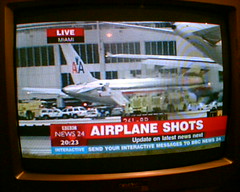
2005/9/18
More details of Tony Blair's special relationship with another superpower -- namely, Rupert Murdoch's News Corporation -- have emerged. On Thursday, Blair was heard telling Murdoch that their mutual foe the BBC's coverage of Hurricane Katrina was "full of hatred of America and gloating.
"Tony Blair... told me yesterday that he was in Delhi last week and he turned on the BBC World Service to see what was happening in New Orleans, and he said it was just full of hate at America and gloating about our troubles," the chairman and chief executive of News Corporation said.
It must be a different BBC than the one I've seen. Perhaps Blair tuned into the Baghdad Broadcasting Corporation, the al-Zarqawi-boosting, freedom-hating fountain of anti-Western propaganda that only Little Green Footballs readers seem to be able to see?
It's a good thing that the Beeb has won its 10-year charter; otherwise, it would look like Blair and Murdoch were sharpening their knives.
Also in the same report: an extract from the diary of one of his former spin doctors claims that Blair gave News Corp. the power of veto over Britain's European policy. Or, "the things we do to keep The Sun onside".
An entry in a diary kept by Lance Price, who worked for the PM between 1998 and 2000, said: "We have promised News International we won't make any changes to our Europe policy without talking to them."And here is a summary of things Downing Street allegedly had removed from Lance Price's diaries, including the claim that, while he publicly claimed to be sending troops to Iraq "with a heavy heart", the Smiler relished doing so, looking forward to his "first blooding". Whether or not he also strangles puppies in his spare time to relax is as yet unknown.
2005/8/17
Tonight, some 10 years after the Blur vs. Oasis battle, BBC Four held a Britpop night, running several programmes on the whole thing.
First up was a half-hour documentary by John Harris about the history of the phenomenon. It reprised much of the territory in his excellent book The Last Party, only squeezed into half an hour and with fragments of music and video, and interviews with various people from the time reminiscing over what it was like. It started with the wilderness of Nirvana and shoegazer (which Harris described as being similar to grunge), and ended with the comment that Britpop was responsible for ushering in the age of bland balladeers like Coldplay, Keane and Snow Patrol, and of course those quintessential rockist classicists, Oasis.
This was followed by a programme with Damon Albarn presenting a selection of live videos; it's reassuring that he has ditched the mockney accent and look-at-me-I'm-working-class affectation, though perhaps a tad disappointing that the title designers did the lazy thing and equated britpop with Mod. Then they played Live Forever, the Britpop doco from some years back, and then a 1995 BBC fly-on-the-wall piece with Pulp, which was rather interesting. It involved backstage footage from a gig in Sheffield, Jarvis talking about appreciating kitsch knowingly yet unironically, and some footage of Pulp's support band, an outfit named Minty who seemed to have been England's answer to Machine Gun Fellatio or something.
2005/7/26
It looks like the new Doctor Who will be attired in a suit, a trenchcoat and sneakers, in what the BBC are calling a "geek chic" look; in other words, somewhere between John Constantine in the Hellblazer comics and Jarvis Cocker sans glasses.
For a while they had me worried that the BBC were trying to jump on the NME New Wave Glamorous Indie™ Art Rock™ Revival bandwagon and making the Doctor an emaciated androgyne in a tight-black-suit/black-shirt/anorexically-thin-red-tie combo.
2005/7/12
A comparison of US and British media's responses to domestic terrorist acts:
Right this minute, on the BBC World service: a lengthy report on humanitarian efforts in Africa. No news crawl. If you didn't know the London bombings had happened already, you wouldn't even know.
Right this minute, on CNN International: a lengthy report on anti-terrorism efforts in other countries, so far specifically framed as a series of successful trades: decreasing freedom for increasing surveillance, with greater security supposedly as the net result. Along the bottom, a news crawl repeats bombing-related headlines constantly.
One of these things is not like the other. One is constant, constant fear-pandering. The other -- from the country that actually suffered the bombings, no less -- is still reporting something resembling actual news, with something resembling a dose of actual perspective.Then again, don't Britain's commercial news providers (Murdoch's Sky News) push the fear angle hard as well, mostly because that's what gets the eyeballs? Or is it a matter of (a) the American public being fear junkies, or (b) the US media being in the service of neocons (and/or reptilian aliens that psychically feed off fear), in whose interests it is that the population is kept terrified?
A related thought: if Britain was like America, we'd probably have Dannii Minogue singing Rule Britannia (and/or God Save The Queen, complete with the jingoistic third verse -- "confound their politics, frustrate their knavish tricks, on Thee our hopes we fix") at a star-studded gala right now.
Recording company bosses are livid after the BBC makes MP3s of Beethoven's symphonies available for downloading:
Managing director of the Naxos label, Anthony Anderson, said: "I think there is a question of whether a publicly funded broadcaster should be doing this and there is the obvious issue that it is devaluing the perceived value of music. You are also leading the public to think that it is fine to download and own these files for nothing."Of course, the value of music that the label executives are so valiantly defending is not its use value (how much enjoyment it can bring) but its exchange value (how useful it is as a currency).
In today's dominant ideology of Reaganite-Thatcherite monetarism, where the key participants are corporations (beings incapable of actually experiencing the use value of art) and humans are merely the microorganisms in their guts, art is primarily currency; any subjective artistic or aesthetic value is secondary. Scarcity is essential to the value of a currency, and any loss of scarcity damages that value. Which is why copying is seen not as cultural cross-pollination but as equivalent to currency counterfeiting, making music available for free, even when legal, is considered unethical.
2005/7/1
A BBC TV programme is using computer-based photo-aging technology to model the effects of decades eating junk food:
I wonder what algorithm chose the grey sweatshirt/polo shirt in the aged images.


2005/6/22
US satellite radio network Sirius is about to start broadcasting BBC Radio 1 in the US, time delayed to sync up with local time. Now Americans frustrated with the Clear Channel monoculture will be able to catch John Peel's heirs playing all sorts of eclectic music at odd times of the night.
Meanwhile, back in Britain, Xfm (which, for the Australians in the audience, was once the closest thing Britain had to 3RRR, but now has turned into a Carling-flavoured Nova FM, playing the latest NME darlings on heavy rotation) is shedding one of the last vestiges of its alternative heritage, by merging with Kerrang-style hard-rock station Storm; both stations are owned by the Capital Radio group.
2005/6/20
Well, that was a cracker of a way to end a season of Doctor Who. Dalek cultists? Who would have thought. Even if it did seem like a bit of a deus ex machina.
Anyway, David Tennant will have a tough act to follow as the next Doctor, given how good Ecclestone's grinning-nutter-with-heart was.
2005/5/6
The election results are trickling in; Labour have retained a number of seats; the Lib Dems are getting significant swings (5-10%), though they're all falling short of unseating Labour. So far, Labour have lost two seats: Putney to the Tories (interestingly, Putney is an area popular with South Africans, who, as Commonwealth citizens, are entitled to vote, and who are said to be conservative on racial issues; I wonder whether this was a factor), and a Welsh seat to an ex-Labour independent. Exit polls say that Labour's majority may be slashed to 66 or so.
The BBC's election coverage seems quite similar to the ABC's Australian election coverage (the computer-generated bar charts and swingometers are there), though there's a carnival atmosphere that the Australian elections don't have, with elements of silliness and irreverence, such as a George W. Bush impersonator at the BBC's election party, and a computer-generated mockup of the party leaders racing down Downing St.
2005/4/14
The BBC Creative Archive site is now up. There's no content yet (they're still working on negotiating the licenses), but the details have been officially announced. It's going to be distributed under something very similar to a Creative Commons by-nc-sa-style licence, only with a "no endorsement" clause prohibiting use of material for campaigning or defamation (which presumably stems from English copyright law's concept of moral rights). This licence will be used not only by the BBC, but also by other organisations such as Channel 4 and the British Film Institute for their own online archive efforts. In other details: there will be no DRM whatsoever, though the archive will only be accessible from British IP addresses (though I'm told that the people behind it are pushing to lift this restriction), and peer-to-peer technologies will be used to help distribute it (which, presumably, means that the BBC's download site will act as a BitTorrent tracker/seeder).
While we're on the topic, an article on the push to bring Creative Commons licensing to Britain.
(via boingboing) ¶ 0
2005/3/26
I just watched the first of the new Doctor Who series. It was amusing enough, with plastic dummies controlled by an alien consciousness hiding under a London landmark trying to take over the world. (It is apparently a Welsh production, though the story was all centred in London.) They may have been a little too eager to please, peppering the script with one-liners and quips, sometimes at the expense of plausibility. Anyway, Christopher Eccleston, in his short-cropped, leather-jacketed Northern English geezer guise, made a decent enough Doctor, and Billie Piper is the First Chav Assistant. (Why did they name her Rose, when Tracey or Mandy or something similar would have been a more appropriate name?)
Interestingly enough, the BBC are milking this cow as far as they can; right after the show, the lottery announcement had one of the announcers hitching a ride in on the TARDIS.
2005/2/12
Your Humble Narrator went to the Prince Charles Cinema off Leicester Square for the launch of the second Goodies DVD compilation, picking up a copy of said DVDs.
The launch consisted of a screening of two of the episodes on the discs (The Movies and Bunfight at the OK Tearooms); not my absolute favourites from the compilation (that'd probably be South Africa or Radio Goodies), but enjoyable anyway.
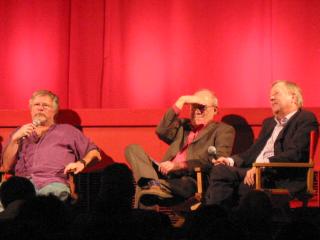 After the screening, the lights went on and the three Goodies took their seats on the stage. Tim still looked like Tim Brooke-Taylor, only without the Union Jack waistcoat (maybe he'll wear one during the upcoming Australian tour; who knows?), and Bill looked like an older version of his younger self. Graeme, however, was nigh-unrecognisable without his trademark sideburns (when asked by a member of the audience whether he'd grow them for the tour, he said he may buy a pair to wear).
Anyway, the Goodies answered questions from the audience. Some points that emerged from the session: there is a third 8-episode 2-DVD set planned, for later this year, by when, it is hoped, all the popular and interesting BBC episodes will be available (the Goodies reckon that there are 24 that fall into this category), and possibly some episodes from the final ITV series. Some episodes may not make it to release, due to licensing issues (apparently Michael Jackson is refusing rights to some Beatles material in Goodies Rule OK). The Goodies are about to embark on an Australian performance tour; one audience member asked whether they'd do any UK shows; they said that it's less likely, given that the BBC hasn't screened any Goodies episodes for a few decades, cutting down on the potential following. So it looks like the Aussies reading this should count themselves lucky.
The DVD itself is pretty good. It has eight episodes, and also a good deal of extras. I get the feeling that while the first one was made (relatively) quickly and cheaply, its sales exceeded expectations, resulting in more being put into the second one. As well as the episodes, we get several shorter sketches from other shows, commentary tracks, and PDF files of the scripts, in various revisions, not to mention a somewhat fancier animated DVD menu.
The DVD is listed as Region 2, though the first one (which was also thus listed) was Region 0 (i.e., playable anywhere); no idea whether this one is. It's also coming out in Australia in a month or so, and will probably be somewhat cheaper there.
2005/2/1
Entries in b3ta's Crap Computer Games challenge, in which contestants submitted demos (as animated GIFs or Flash; though at least one entrant wrote an actual ZX Spectrum program) of naff 8-bit computer games that never actually existed, both original ones and interpretations of pre-supplied concepts like Window Cleaner, Trade Union Organiser and a Spanish holiday simulator; anyway, you'll find these and more (including Football Text Adventure, the tape loader from Ocean's Last of the Summer Wine tie-in, and Mirrorsoft's Robert Maxwell Yacht Simulator) all (well, most) in pixellated 8-bit glory.
The contest was in connection with Look Around You, a BBC comedy series satirising 1970s educational television. The first episode of the new series (now changed from 9-minute "educational" programmes to a half-hour magazine-programme format; not unlike Curiosity Show for the Australians in the audience) aired last night. Unfortunately, I only managed to catch the last 5 minutes (did anyone manage to tape it?), though what I saw looked very amusing; perhaps even more so than the first series.
IMHO, Look Around You is the cream of British comedy these days. For all that is said about Little Britain, the usually cited candidate for this honour, there's no escaping the fact that it's basically a British version of The Comedy Company (right down to Vicki Pollard being a chav Kylie Mole). It inherits little from the great British absurdist tradition of the Goon Show and its heirs, instead throwing out the same predictable plots and trademarked catch-phrases in slightly different settings.
Following on from the fact about John Garden, a few more Goodies-related items. Firstly, the the second DVD compilation comes out in the UK in two weeks (there's an official launch in London's Prince Charles Cinema on the 12th), with Australia following on 3 March, and will include, among others, Radio Goodies and Sarth Efriker. Apparently a third DVD set is also in the works, on the strength of sales of the first set, so if your favourite episode isn't in the first two sets, it may well be there.
Secondly, Tim, Graeme and Bill are doing a Goodies tour of Australia, playing gigs on the East Coast (Sydney, Melbourne, Brisbane and Canberra) in early March. Australia seems to be the world leader in Goodies fandom, being more fond of the series than Britain (case in point: you can get Goodies T-shirts on Brunswick St., though you won't find them amongst the Michael Caine/Vespa/Atari/random-sexual-innuendo T-shirts all over Camden and Carnaby St.). I'm hoping, though, that they do some London shows at some stage, if only for the city's population of Australian expats.
2004/12/13
I just watched the season 3 finale of Spooks. Quite tense and topical, and once again showing that no character's too important to be killed off (literally, metaphorically, or by having their head deep-fried, as the case may be). It tied into the whole idea of the terrorist as auteur, though I won't say any more about it for the benefit of those not in the UK.
It wasn't a cliffhanger, though. I wonder if this means that there won't be another season.
Update: One of the BBC digital channels just aired a making-of documentary on season 3; for the most part, it was an excuse to recut highlights from the past season with Franz Ferdinand and the Scissor Sisters in the background, interspersed with interviews with cast members talking about how they see their characters and actual former MI5 agents (including David Shayler) talking about how inaccurate the depiction of their former occupations is. According to it, season 4 is being filmed now.
2004/12/7
The BBC speaks to some self-styled "goth" kids in Norfolk; complete with photos. (via caycos)
Josh, also known as Shadow Mercy, Jessica, who calls herself Misery Whispers and Anton who is known as Lord Mercy, are all Goths and 12-years-old.
I listen to Marilyn Manson, Slipknot, Green Day, Good Charlotte and other sorts of punk metal or gothic rock. I like to do magic spells and to look at runes books. ... My advice to people who want to become a Goth is don't be too cocky.
("Don't be too cocky"? What's the bloody point of it then?)
Meanwhile, the comments section at the bottom yields a bounteous harvest of pure comedy gold.
2004/10/27
The BBC had the following watermark on its programming this evening:
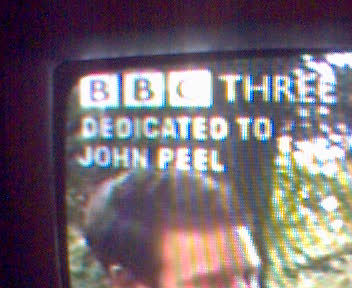
Other TV channels had their own tributes, opening lines for people to pay their respects. It seems that everybody in Britain is missing the loss of Peel, with the possible exception of Julie Burchill, who, some five years ago, did a Hitchens on him.
2004/10/26
Veteran BBC broadcaster John Peel, who, over four decades, has shaped the face of rock and pop music, has died whilst holidaying in Peru. DJing on BBC Radio 1, Peel was responsible for bringing a great many bands, including Joy Division, The Smiths and Stereolab, to the public's attention.
2004/10/2
The BBC's online magazine invited readers to propose just punishments for social infractions:
Groups of three or more people who insist on occupying the entire width of the pavement and expect everyone and thing to manouvre around them should be forced to be hand-cuffed together for a further 24 hours. - Neil D, London
People who choose to sit right next to you on the train when there are free seats all around should be forced to have a fellow traveller accompanying them wherever they go for a day. - Lucy Larwood, UK
People who ware Burberry should have it tattooed onto their skin. - Alan Bowden, UK
2004/9/28
Apparently Lisa Gerrard's most recent film score is for the British gangster flick Layer Cake. I find it hard to imagine Lisa "Dead Can Dance" Gerrard doing a score for a British gangster flick, unless it's not at all a post-Ritchie brash-cockney-wideboy film and more along the lines of Beat Takeshi or something.
In other news, it looks like Pete Waterman's (of Stock/Aitken/Waterman fame) latest gig is presenting a BBC TV series about the history of Britain's railways.
2004/6/10
2004/3/13
This looks fascinating; a series of TV programmes made by the BBC and exploring various plausible worst-case scenarios for the near future, from mass electricity shortages to the polarisation of society into the super-rich and the underclass to inter-generational unrest as the baby boomers retire, the marginalisation of men, and explosive obesity. The programmes take existing trends, extrapolate them pessimistically, and use that as a basis of a hypothetical future scenario. I wonder if they'll ever come out on DVD.
2004/2/25
In the UK, as the Blair administration prepares to dismantle the BBC, the Tories (who, presumably, have given up on wooing the Murdoch media for the next election) are dropping the anti-BBC plank of their platform, which called for the phasing out of the license fee and reducing the BBC to a minority broadcaster like the PBS in the US, and repositioning themselves as a "friend of the BBC"; a move undoubdtedly intended to appeal to those supporters of the venerable news organisation sufficiently gullible to fall for it. However, unreconstructed Thatcherites need not feel too betrayed; as Tory leader Michael Howard points out, the BBC's charter review will take place after the general election, and there's nothing stopping a Tory government from coming out, announcing that it has weighed up the facts, and after great deliberation, decided to take the chainsaw to Auntie.
2004/2/16
The Blair government in the UK is apparently making the most of the blank death warrant for the BBC handed to it by the Hutton enquiry, and has drawn up plans to break up the BBC, revoke its editorial independence, and close BBC outlets not considered "public service". (Which could result in former BBC assets being picked up by "free-market" providers at fire-sale prices; MTV could get BBC1 and Top Of The Pops (or whatever it's called now), FOXNews and/or CNN could get news-gathering facilities, and so on. And aren't ClearChannel planning to expand into the British market? I'm sure Blair (who personally intervened to allow Walmart to buy Asda) will be more than happy to help them.)
2004/1/16
An article looking at the BBC's coverage of geopolitics and wars; how it differs from US media coverage, whether impartiality in war constitutes disloyalty (or the old Communists-in-the-BBC cliché), and why so many liberal Americans have turned to British media for their news:
BBC correspondent Nick Higham says anytime you report from the other side, you run the risk of getting flak. As he explains, some would charge, " 'Surely if you're objective and impartial, you are, by implication, going to be sympathetic to our enemies.' " But, "the BBC would say, 'Well, no, what we're trying to do is reflect all sides of an extremely complicated situation'.... And to do that you've got to go and talk to the Iraqis, and you've got to reflect what Osama bin Laden says. And all the rest of it."
"I think Americans, particularly conservative Americans, have a problem with the BBC approach because impartiality, which is the BBC's fundamental watchword, is itself a liberal notion," he says. "And our commitment to impartiality comes out of what is fundamentally a small 'l' liberal culture, liberal media culture, in which objectivity, impartiality are thought to be good in themselves and achievable.... The impression I get is that a lot of Americans just don't get that.... And to them it's much more important that the news media are supportive of the national effort, particularly when you go to war."
This brings to mind what David Malouf wrote in the most recent Quarterly Essay about the differences between the American and British (and thus Australian) cultures of public debate; i.e., that between the time the American colonies were founded and now, the language of public discourse in England shifted from a zealous, idealistic, absolutist tone to a more measured, impartial one, as a result of the Civil War. Which, presumably, is why many Americans are partial to flag-waving FOXNews-style jingoism, of the sort which makes Britons and Australians (and many of America's own liberals) cringe.
A less emotional analysis was conducted by the think tank Cchange, Conservatives for Change. Its 72-page report examines five years' worth of the BBC current-affairs program "Panorama" and the BBC's coverage of a single political issue, whether grammar schools should be retained or abolished. The report, available at www.cchange.org.uk, argues not that the BBC is pro-Labor and anti-Conservative, but that there is a set of political values--anti-free market, anti-business, anti-U.S., antiwar--shared by those who work there and evident in BBC reporting.
Anyway, as far as the BBC goes; apparently, the institution's charter is up for rewriting this year, and rumour has it that Tony Blair and Rupert Murdoch are in hush-hush talks about what to do with that nasty old BBC.
2003/11/11
Many years ago, I was playing with Fontographer and created a font named ModeSeven, based on the Teletext character set (and named after the BBC Micro screen mode using the Teletext chipset); it may be found here. A few weeks ago, I received an email from someone at TalkbackThames, a London-based TV production company, informing me that they had used the font on a DVD and asking for an address to send a complimentary copy of the disc in question.
As a consequence, today I received in the mail a copy of the DVD of the BBC Look Around You comedy series. This is a series of 9-minute segments parodying British educational TV programming from the 1970s (right down to vintage calculators used), only wildly inaccurate in a somewhat Pythonesque sense, with plenty of howlers and made-up words used. (For example, dissolving iron with acid creates a substance named "bumcivilian", whose creation removes all sound from the air for some seconds.) Somewhat amusing, though probably more so if you went to a British school in the 1970s. The disc also contains other features, such as an entire set of fake Ceefax (i.e., BBC Teletext) pages with news stories such as the scrapping of the trans-Atlantic British Rail route and the replacement of small-denomination coins with a dust worth a certain number of pence per gram, as well as Look Around You quizzes. (They seem to have used the DVD menu facility to recreate the teletext pages, and done so quite convincingly.)
(Where was my font used? In the optional DVD subtitles, which are designed to look like Teletext captions for the hearing impaired.)
2003/10/28
I've just been informed that a font I did some years back (Mode Seven, a simple tracing of the BBC Micro Teletext font) has just been used on a DVD of the BBC's Look Around You comedy programme, a copy of which is on its way to me. Which, I think, is pretty cool.
2003/8/25
More excellent news: BBC to open up archive; all content from the BBC's archive will be released online under a Creative Commons non-commercial license; no digital restrictions management technologies are expected to be involved. This could prove to be a glancing glow for the neo-Galambosians who are pushing for end-to-end copy-control on everything. Though I half expect the politicians to scupper or cripple it (after all, everyone wants Murdoch's support in the next election, don't they). Though if it goes through, it will be a terrific boon for the cultural heritage of the 20th century. (via Rocknerd)
2003/8/24
News Corp. has fired its first salvo in the campaign to neutralise the BBC: the chief executive of Murdoch's BSkyB satellite broadcaster delivered a speech outlining his proposals for reining in the BBC and stopping its extraordinary abuses of power. Under the proposal, the BBC would be forced to sell off popular programmes to commercial operators, and would be prohibited from purchasing imported programmes. I wonder whether we will see Britain's politicians, eager to win the Sun's backing for the next election, scrambling over themselves to "independently" adopt proposals similar or identical to this.
2003/7/24
While Senator Alston is trying to nail the ABC to the wall for insufficiently following the party line, Tony Blair and Rupert Murdoch are trying to do the same to the BBC; to the point where some New Labour politicians are talking about cutting the television license fee that funds the BBC:
Fox, owned by Rupert Murdoch, is what Blair must have fantasised about having on his side. The network was raucously pro-administration, delivering to George Bush the rightwing commentaries and inspiring pictures he needed to help him conduct the war. How convenient it would be for any centreright, interventionist British leader to have his own, Union Jack-branded Fox.
Gavyn Davies and Greg Dyke have refused to play their allotted role as New Labour toadies. This is brave since they must know that they, and the BBC, have nowhere else to go. The Tories would privatise them like a shot. Now that the Conservative manifesto is likely to suggest slashing the licence fee, it is not hard to see a vengeful New Labour starting a Dutch auction, cutting and cutting. Then it will be curtains for the governors and the hunt will be on for a more reliable director general.
It'll be a shame if the BBC is cowed into a corner, and reduced to timidly reporting the party line between pumping out unchallenging Merchant-Ivory-style costume dramas for the Region 1 DVD market.
2003/5/19
After reading the comments about BeTh's boat-naming dilemma, my mind turned to the question of why there wasn't a DVD of cult 1970s comedy series The Goodies. The theories I've heard about this included (a) that it's considered too racist/sexist/politically incorrect for this enlightened age, (b) that Tim/Graeme/Bill would rather the public forgot about their youthful indiscretions, or that (c) no archival footage of the series survives, with decaying VHS tapes recorded off the telly being the only remaining record of this series.
So I decided to do a Google search for "the goodies" dvd, and lo and behold, it appears that there is now a Goodies DVD, with 8 episodes. And it's region 0 too, for those still trapped under the jackboot of the MPAA.
(It doesn't seem to have the pirate radio episode, alas, but you can't have everything. Maybe if enough people buy this one, they'll release more episodes.)
2003/5/4
The BBC has a guide to current teenage subcultures. Interesting that in the UK, mooks are called "nu metallers", Ben Sherman shirts are considered a clubber thing (I suppose that's because the '90s Britpop Mod revival is ancient history), and Camden is considered a "Goth Mecca". (When I was in London last year, I saw all of about two goths in 3 weeks; I thought that particular meme-complex had died out through overexposure over there by now.)
They're listening to
- Independent 'Alternative' Music, from small independent labels in pressings of say 100 straight out of Reykjavik
- Garage Rock like The Strokes, The White Stripes, Yeah Yeah Yeahs
- Old indie classics - The Velvet Underground, The Smiths, Nirvana, The Pixies
2003/4/1
If truth is the first casualty of war, dictionary definitions are a notable piece of collateral damage. For example, the BBC has been accused of bias for not following the patriotic party line of CNN/FOXNews.
"The Beeb is a mandatory government-run service staffed with the usual people who go into government-run media, i.e. left-wing hacks," British expatriate Andrew Sullivan writes on his Web site. "The BBC is increasingly perceived, even by sympathetic parties, as the voice in part of the anti-war forces. . . . How the Beeb ceased to become an objective news source and became a broadcast version of the Nation is one of the great tragedies of modern journalism."
Ah yes, the old Communists-in-the-BBC line. Didn't Alexei Sayle do a skit about that in the 1980s? (via MeFi)
2003/2/11
Now that mobile phones with built-in digital cameras are becoming popular, the BBC is asking readers to send in their photos of events going on around them. It looks like it could be an interesting experiment in grass-roots photojournalism.
Meanwhile, another British media institution is asking readers to stick their logo on their foreheads, and send in photos. This is in response to an ad agency renting out ad space on students' foreheads.
2002/12/6
Woolly-headed nonsense about "quantum mechanics" in BBC article about sheep-based random poetry art project. Come on; spraypainting words on the backs of sheep and letting them wander around forming random "poems" is not in any way related to "quantum mechanics". Well, not unless observation of the sheep's locations makes it impossible to measure their velocity or collapses the set of all possible words into one word or something like that, which I gather is not the case. Doesn't the BBC have anyone with a basic grasp of physics looking over their site and weeding out the pseudo-scientific mumbo-jumbo? (via gimbo)
2002/10/15
Aardman Animations have created 10 new Wallace & Gromit shorts, titled Cracking Contraptions. As you can imagine, expect zany inventions and general garden-shed/teacozy Englishness all round. And the first one, Soccamatic can be downloaded from the BBC. (It's Quicktime, and not some poxy DRM format either.)
2002/8/22
Tim Berners-Lee, inventor of the web, is #12 on a list of 100 greatest Britons ever, created by the BBC by polling over 30,000 people. Though, for some reason, Julie Andrews is #2 (behind only Alfred the Great) and David Beckham is at #9 (ahead of such luminaries as Chaucer, Dickens and Shakespeare). Ah, I get it.. it's in alphabetical order. Which makes the claim of Berners-Lee being in 12th place sound a bit daft.
Other odd entries include Aleister Crowley (didn't know he had that much of a following), Paul "Bono" Hewson (hang on, isn't he Irish?), and the "Unknown Soldier". And I'm not sure if people like Robbie Williams (wasn't he a former boy-band dancer or something?) belong on a list of "greatest Britons of all time". Ah well, at least they didn't accept Ayn Rand, L. Ron Hubbard or Jesus Christ as "Britons".
2002/8/16
More evidence that we're living in the age of George W. Bush: BBC bans atheists from "Thought for the Day" radio slot. (via Pagan Prattle)
2002/2/13
The BBC plan to make a TV series based on Fungus the Bogeyman, the somewhat odd children's book by Raymond Briggs. I loved that book when I was 10 or so; where else would one, for example, learn what "crepuscular" means, or that "hodmandods" are snails. Anyway, the new TV series will be a combination of live action and 3D computer animation. Should be interesting if they pull it off well.
2001/12/27
Good stuff: The BBC are experimenting with streaming programmes in the Ogg Vorbis format, an open-source, completely free format available on virtually all platforms (and not encumbered by licensing agreements, patents or other proprietarian evils); what's more, the Ogg developers have taken a stand against the copy-prevention trend. The BBC appear to be the first major broadcaster to use this format. Use it (and if you do, write in to let them know you do) before Bill Gates has a word with Tony Blair and it gets squashed by a directive from on high. (As happened with non-Microsoft systems in most parts of Britain's government.)
2000/12/21
The Queen's English: By analysing recordings of the Queen's Christmas speeches, researchers at Macquarie University in Sydney have discovered that her accent has become considerably less "posh" over the past few decades, drifting from the "cut-glass" upper-class English accent that was once de rigeur towards the standard non-upper-class southern-English accent. In particular, her vowels are now similar to those of female BBC announcers. (accompanying RealAudio piece)