The Null Device
Posts matching tags 'history'
2016/10/12
In recent social psychology news, a team of US researchers has debunked the myth of the Baby Boomers' strong work ethic:
The economic success of the United States and Europe around the turn of the 20th to the 21st century is often ascribed to the so-called Protestant work ethic of members of the baby boomer generation born between 1946 and 1964. They are said to place work central in their lives, to avoid wasting time and to be ethical in their dealings with others. Their work ethic is also associated with greater job satisfaction and performance, conscientiousness, greater commitment to the organization they belong to and little time for social loafing.Hang on, I hear you say: the stereotypical Baby Boomer work ethic? The generation born between 1946 and 1964, that of Beatlemania and Woodstock, long hair, Free Love, anti-Vietnam-War protests and recreational drug use (and, at its younger end, shading into the fuck-the-system nihilism of punk), being associated specifically with duty, discipline and delayed gratification? That can't be so. Perhaps whoever came up with that idea skipped a decade or two, and was instead thinking of a slightly earlier cohort; perhaps their older half-siblings, the neatly groomed beige-suited Eddie Haskells who addressed their parents as “sir” and “ma'am”, or even the “Greatest Generation” who sacrificed everything in World War 2, only to watch their kids grow their hair, listen to that godawful racket, and generally not exemplify a particularly strong work ethic.
The other possibility is, of course, that the stereotype of the “Baby Boomer work ethic” is not so much about the Woodstock generation but about old people. Which is to say, that it reflects survivor bias; the likelihood that the ones left standing into advanced age either had their shit together from the outset or got it together. Presumably, of the generation that came of age in the heady Sixeventies, some will have fallen by the wayside (and, of course, Reaganism, AIDS and punk rock were just around the corner), some will have grown up and gotten with the programme (this was in the day before emoji and executive hoodies, when adulthood was a one-way transformation into a stolid mortgage-paying lump of joyless responsibility), and some, seeing that they had survived and succeeded, would have rationalised that they had been hard-working and responsible (and, thus, deserving of their success) all along. Which, of course, vacated the space of feckless irresponsibility for the younger generation, to whom it always belongs.
Of course, what this means is that, in some 20 years' time, we can look forward to a paper debunking the widely held stereotype that Generation X—the one most recently associated with MTV, “alternative rock”, Nintendo and the “slacker” stereotype—are inherently more moral, virtuous and upstanding than their shabby, feckless descendants. And then, eventually, it will be the millennials, the generation of selfies, Taylor Swift and crushing debt. And, in turn, every generation will, shortly before its death, briefly be the Greatest Generation standing.
2015/4/3
Anarchist anthropologist David Graeber (of Debt: The First 5,000 Years and On Bullshit Jobs fame) writes in the Baffler about the evolution of business attire, and in particular, the paradox of the necktie:
No doubt, part of the objection to the tie is to the pure arbitrariness of the thing. A tie serves no function. It doesn’t hold your trousers up or keep you warm. But at the same time, it’s uncomfortable, so much so that putting it on does somehow feel like a gesture of submission, a reluctant pledge of allegiance to everything the suit is supposed to represent.
[t]he business suit derives not from aristocratic formal wear, but from hunting clothes—this is why fox-hunters, for instance, still wear something very much like one. Both uniforms are a kind of active wear, adopted by a class of people who wanted to define themselves through their actions. Actually, I suspect that the ultimate derivation of the business suit is from a suit of armor. The suit, after all, encases your body, covering as much of it as possible; what minimal openings to the world such clothes do afford—at your neck and sleeves—are bound tightly together by ties and cuff links. The contours of the body are thus obscured, in striking contrast with women’s formal wear, which, even in covering the body, constantly hints at revealing it, and particularly at revealing its most sexualized aspects. Skirts, even when they cover the lower half of the body completely, tend to form an open-ended cone whose apex is between the legs, and except in the most prudish times, there has been some gesture toward revealing the cleavage. It’s almost as if the staid uniformity of men’s attire is meant to efface individuality just as its design is meant to make the body itself invisible; women’s formal wear, on the other hand, makes the wearer both an individual and an object to be seen. Indeed, the conventions of higher-class fashion ensure that any woman wearing such an outfit is obliged to devote a good deal of time and energy to monitoring herself to make sure too much is not revealed and, more generally, to constantly thinking about what she looks like.
I suggest a simple formula: To express power through display is to say to those over whom one exercises it, “Behold, see how I have been treated. I have been treated this way because of who I am. Now you, too, must treat me this way.” Kings cover themselves with gold as a way of saying that you must cover them with gold as well. To refuse any such display, in contrast, is to say, “You simply have no idea what I am capable of.”As for the necktie, Graeber's theory as to its provenance is a somewhat Freudian one; essentially, the tie is a sort of symbolic, decorporealised codpiece:
Couldn’t we say that a tie is really a symbolic displacement of the penis, only an intellectualized penis, dangling not from one’s crotch but from one’s head, chosen from among an almost infinite variety of other ties by an act of mental will? Hey, this would explain a lot—why men who wear bow ties are universally taken to be nerds, for example. True, a bow tie could be taken for a pair of testicles. But even so, bow ties are small, and they point in entirely the wrong direction. Mafiosi wear ties that are too fat and colorful; dissipated sophisticates wear thin ties; cowboys wear string ties that produce the effect you might expect from wearing a bow tie and a regular tie at the same time—ordinarily, this would be too unsubtle, but cowboys are mythic he-men who can get away with it. (James Bond can also get away with a bow tie, but then he’s basically just a giant penis anyway.)
2015/1/22
I am writing this on a train to London from Birmingham, where I have spent the past two days at an academic conference about the electronic music group Kraftwerk. There were some 175 people in attendance; their ages varied from those who had not yet been born during Kraftwerk's heyday to a sizeable contingent of (mostly) men of a certain age who had been at various legendary shows back in the early 80s. The conference, whilst theoretically an academic conference, was open to the general public, and the talks presented varied from critical-theoretical analyses of the signifiers in various records to autobiographical monologues.
The conference began with Stephen Mallinder, of Cabaret Voltaire, talking autobiographically about his own experience of Kraftwerk and how they inspired his and his bandmates' own music-making; he mentioned that, back in the 1970s, he and his mates would refer to traffic cones as “kraftwerks”. Later, Nick Stevenson talked specifically about Cabaret Voltaire, the Sheffield scene, their use of Dadaist techniques and Burroughs' cut-up technique, and the themes of “the control culture” in their music. Other than that, the rest of of the first day was occupied with going through Kraftwerk's early career and first few albums, as well as the “archaeological period” of the three pre-Autobahn albums one gets the impression Ralf Hütter would rather were struck from the historical record. David Stubbs, author of the recent Krautrock book Future Days, talked about this period, tracing the band's history from their shambolic start as The Organisation (which, in surviving footage of live performances, looks like an “on-the-nose parody of Krautrock” in all its scruffy, hippie shambolicness), through the first three albums—Kraftwerk 1 (whose pastoral sound prefigured what Boards Of Canada would do several decades later), Kraftwerk 2 (where the potential of drum machines first appeared) and Ralf & Florian (which, in its title and cover photograph, showed the artists starting to make themselves part of the artwork, perhaps echoing Gilbert & George, who had visited Düsseldorf in that period). This was followed by a talk by David Pattie, a Glaswegian academic, elaborating on Ralf & Florian and from that, the question of Kraftwerk's relationship with Germanness. Among other things, Pattie pointed out a progression in the works of Kraftwerk and other West German bands (Can, Popol Vuh, Tangerine Dream, Neu! and Kluster/Cluster) through the early 70s; a divergence from pure rhythm and/or noise and rediscovery of melody in subsequent albums, and put forward the theory that all these bands had initially set out to reject the musical heritage of their forefathers, and gradually come to an accommodation with it.
In the afternoon, Melanie Schiller (from Düsseldorf, via Groningen) examined Autobahn and its cover artwork, examining the use of space in the sound and the past, present and future as depicted in the LP artwork, and the sense of forward motion, and of there being a start (the sound of the key in the ignition) but not an end (the road going on forever ahead; the self-referential lyrics referring to turning the radio on and hearing the song on it, forming a loop), and, of course, the Beach Boys reference alluding to the American car-song trope. This was followed by a talk by Hillegonda Rietveld about the Trans-Europa Express album; its theme of a borderless, unified Europe, the echoes of an elegant/decadent pre-war past (Neonlicht has a vaguely Weimar feel to it), and its musical antecedents (such as Pierre Schaeffer's 1948 Musique Concréte sound-poem etude aux chemins de fer, and parallels with railway rhythms in the blues in America). The final talk of the day, by Uwe Schütte, about Die Mensch-Maschine, and the idea of the Man-Machine, was rich with details and connections; he tied in Soviet structuralism (the cover artwork drew heavily on El Lissitzky's compositions), a notorious (though in today's climate, quaintly tame) 18th-century atheist pamphlet titled L'Homme-Machine, musical automata throughout the ages, a French novelty act named Les Robots Music, E.T. Hoffmann's 1817 Romantic novel Der Sandmann, Karel Čapek's Rossum's Universal Robots, Fritz Lang's Metropolis, and the evolution of Kraftwerk's own stage robots. After this, former Kraftwerk member Wolfgang Flür was to read from his memoir, I Was A Robot, but was somehow unable to make it; in his stead, Rüdiger Esch (formerly of electro-industrial band Die Krupps) spoke about his book Electri_City, about the history of the Düsseldorf music scene.
The second day of the conference had a few more interesting talks; Pertti Grönholm spoke about the nostalgic retrofuturism in the music of Kraftwerk, specifically singling out the Autobahn B-side Morgenspaziergang, a short pastoral tone-poem of sorts, and Radioland, with its nostalgia for childhood radio listening. Ulrich Adelt (an academic from Hamburg based in Wyoming) talked about Amon Düül II and their unsuccessful Made In Germany novelty record, Faust (who played with the whole idea of authenticity by projecting footage of their guitarist playing a solo while he stood still), the leftist squatter blues-rock/proto-punk band Ton Steine Scherben (who never made much of an impact outside of the German-speaking world) and the Kosmische Musik movement and their prefiguration of what would later devolve into the New Age genre, finally finishing by boldly attempting to reclaim Giorgio Moroder and Donna Summer for the Krautrock genre. This led into a monologue from Rusty Egan, former Blitz Club DJ and drummer from new-romantic synthpop band Visage, Camden nightclub proprietor and currently still a working music producer and DJ. Egan was not so much an academic speaker as a force of nature; attired in jeans, turtleneck and leather jacker, all black, his hair slicked back, he went on for over an hour, pacing the stage, showing photographs on his laptop, playing fragments of tracks he had worked on recently, and telling anecdote after anecdote, often framed with sound effects, funny voices, hand gestures and beatboxing. One gets the feeling he could easily have gone on for another few hours, had it not been time to adjourn for lunch.
After the break, there were three more talks: Heinrich Deisl (who edits an Austrian music magazine titled Skug, which is a little like The Wire, only in German) talked about the metaphors of the Autobahn and the German forest in the music of Kraftwerk, Wolfgang Voigt and the Detroit techno project Dopplereffekt (who, like most Detroit techno artists, are African-American, but affect a stylised Germanness in their art; one of their albums is titled Gesamtkunstwerk). Alexei Monroe spoke about Laibach, their own relationship to modernism and problematic history, and their engagement with dystopian ideology. Finally, Alexander Harden talked about the topic of post-human authenticity, and the question of how one can ascribe authenticity (or its absence) to an act like Kraftwerk.
One theme that kept emerging in the talks was that of Kraftwerk's (and, to a lesser extent, other bands') relationship to the idea of Germany and Germanness, and the country's problematic history. In the late 60s and early 70s, the trauma and shame of the Third Reich and World War 2 was still relatively recent; most night porters in Düsseldorf hotels (as Rusty Egan mentioned) had missing limbs, the British music press made crude Nazi references when faced with the idea of there being bands from Germany, and the youth of the nation were waking up to the idea of post-war denazification having been largely unsuccessful, and of people in positions of power having done terrible things. The idea of Germany was contaminated by Nazism, and so was a lot of its much-vaunted culture, to which music had been central. There was the very real idea of Stunde Null, hour zero, of there being nothing before 1945 worth salvaging; and, indeed, a lot of the Krautrock bands started partly with this assumption, rejecting both the Western classical canon and the Anglo-American blues/rock-based sounds that were filling the airwaves, and venturing outward, to the extremes of experimental noise, the “ethnographic forgeries” of Can, to heavy psychedelic experimentation or the sounds of an imagined Cosmos. But, of course, that is not sustainable forever; and even if one does keep it up, one only has to venture abroad to be put in one's place as one of the Krauts.
Kraftwerk's work, at least from Autobahn (their own Stunde Null) onwards, attempts to answer the question of what is to be done with the past. For all its futurism, it is deeply nostalgic, albeit for the forward-looking pulse of modernism, the future that never was; in part for the Bauhaus-era modernism that was so brutally cut off (as evident in the video for Trans-Europa Express, with its 1930-vintage turbine train model zooming past Metropolis-style buildings), though partly also for the 1950s Wirtschaftswunder years of their own childhoods. What is to be done with the terrible years in between? Well, as much as in one sense, Kraftwerk strive to close the gap, their works are peppered with references which German audiences can pick up, alluding to the unspoken time before Stunde Null: the radio on the cover of Radioactivity, for example, resembles those distributed by the Nazi authorities to households, and indeed, the Autobahn system itself was bound up with the Third Reich (who did not initiate the programme though greatly extended it). As for audiences abroad, rather than seeking to escape German stereotypes, Kraftwerk took them and played, mischievously, to them; becoming the stiff, deadpan robot-men, and throwing in the occasional ambiguous turn of phrase like “total music” or the “mother language”, as if to see if they can jar the foreigners into Mentioning The War again. But Kraftwerk have, discreetly, the last laugh.
Kraftwerk's significance in popular music is hard to overestimate; on their shoulders stand not only electronic pop music (from the early synthpop bands of the late 70s to today's commercial hits), house, techno and dance music, but also much of hip-hop, via Afrika Bambaataa. As Heinrich Diesl quoted, “Before Kraftwerk, German pop music was perceived as Schlager; afterward, it was perceived as Techno”. And, because of their position at the intersection of various historical currents, there is enough to discuss about them to fill an academic conference. Speaking of which, the organiser, Dr. Uwe Schütte, says that, if all goes well, there should be an academic conference about Krautrock at Aston University in a year or two.
2014/7/25
Prompted by a 1980s-themed end-of-term disco at her son's school, actual 1980s musician Tracey Thorn (of Everything But The Girl) has written a piece on how decades develop official versions, which often bear little resemblance to the experience of those who lived them. (And, being in the New Statesman, the subtext is that the official versions are a hegemonic discourse of the winners; the 80s are essentially shoulder-padded Thatcherism and Duran Duran, with not a Red Wedge badge to be seen; the 70s Abba, flares and disco, and the 1990s will inevitably be summed up as football-terrace Britpop and Tony Blair's reptilian smile):
Who decides these things? Is it simply that history is written by the victors, so that those who seemingly “won” a decade get to determine what it was like, what it meant? The airbrushing of entire eras has become almost Stalinist in its refusal to allow for complexities, alternatives, or the possibility that various things were happening at any one time. It’s apparently too difficult to understand that there was more than one point of view, one style of fashion, one type of record. Instead we simplify, and homogenise, and boil everything down to a few bullet points. Films and TV dramas are often guilty of this, representing the Sixties, for instance, in a house filled with Verner Panton chairs and Lucienne Day curtains. I grew up in the Sixties and, like most houses, ours was full of dark wooden furniture from the past sitting comfortably next to a recently bought, and therefore period-appropriate, coffee table.
My friend the writer Dave Haslam wrote a whole book (Not Abba) objecting to what he calls the “Abbafication of the Seventies”, in which he quite correctly points out how depressing and demeaning it is to have reduced that decade to a kind of fancy-dress parade of wigs and flares, platforms and glitter, averting our eyes from the vivid realities of “IRA bombs, PLO hijackings, overt racism, football hooliganism, Linda Lovelace, Mean Streets and Apocalypse Now . . .” Similarly I can see how the story of the Nineties is gradually shrinking and contracting, until pretty soon all that’ll be left will be Britpop, and a party that once happened at 10 Downing Street; everything else just a blur, or omitted completely.
2013/10/4
Actor Gabriel Byrne talks about the 1950s Ireland he grew up in, and in which a new BBC crime series he stars in is set:
Both Byrne and Banville, who are old friends, grew up in this Ireland of the 1950s. "It was almost a Taliban-esque society," says the actor, recalling an incident when his mother, who was walking down the street with him while pushing a pram, stepped off the pavement into the road to make way for a priest. "That's how much power they had. Now all the rocks have been lifted and all the maggots have crawled out. The Catholic Church is a tyrannical, evil institution, there's no doubt about it – anti-woman, anti-homosexual, anti-love, anti-condom, totally elitist."The series, Quirke, is to air on the BBC “later this autumn”, and looks like it could be interesting.
2013/10/2
Spain is looking at changing its time zone. While its longitude is close to Britain's, Spain shares with the rest of western and central Europe the condition of being one hour ahead of Greenwich Mean Time. This state of affairs originated during World War 2, when the dictator Franco unilaterally changed Spain's timezone to match that of Germany, in solidarity with the Nazi regime; what the iron fist of fascism put in place, inertia kept in place, leading to a national case of jetlag:
"Because of a great historical error, in Spain we eat at 2pm, and we don't have dinner until 9pm, but according to the position of the sun, we eat at the same time as the rest of Europe: 1pm and 8pm," explained Professor Nuria Chinchilla, director of the International Centre for Work and Family at the IESE Business School. "We are living with 71 years of jet-lag, and it's unsustainable.
Another thing that needs to change is late-night prime-time TV, said Buqueras. "In England, the largest TV audience is at 7 or 8pm, but in Spain, it's 10pm. Because at 8pm in Spain, barely 50% of the population is at home, and you have to wait until 10pm to find that number of people at home, thus guaranteeing the viewing figures needed for prime time. Sometimes football matches don't kick off until 11pm!" he said.
All of this means people go to bed far later than they should and get less sleep than they need. Studies suggest Spaniards sleep an hour less than the rest of Europe, which means more accidents at work, less efficiency, and more children missing school. Additionally they work longer hours than their German and British counterparts, but are much less efficient.Any change to Spain's time zone is likely to also result in an end (or at least a great reduction) to the traditional siesta, the midday break for a long lunch and a nap.
2013/9/19
The Financial Times' blog section, of all places, has an interesting travelogue of the southeastern Danube, the ancient dividing line between central Europe and the Balkans/the West and the East/Catholicism and Orthodoxy/Christendom and the Ottoman Empire:
A Roman bridge linking what is now Romania with Bulgaria collapsed in the fourth century and from then until another was built 1954, there was no crossing. This summer saw the opening of only the second link between the countries across the Danube, a 2km, €245m bridge between Vidin in Bulgaria and the Romanian city of Calafat. Engineers working on the project, now grandly christened the New Europe Bridge, resorted to a third language, English, to communicate with the precision required for the millimetrical convergence of rails and highway.
Our trip had begun in Bucharest, unexpectedly appealing in a melancholy way with its crumbling neoclassical buildings. The Gallic inspiration for what was once celebrated as “Little Paris” is evident in broad boulevards radiating from Place Charles de Gaulle – which our guide described as “named after the great French revolutionary” – an attribution that might have surprised the conservative general. The square was originally named Piata (meaning “marketplace”) Jianu, after local folk hero Iancu Jianu. It was renamed Piata Adolf Hitler in 1940; followed, in 1948, by Piata Generalissim IV Stalin, in honour of the country’s “liberation” by the Red Army.
Just off it is the outdoor Village Museum, where traditional houses from Transylvania (complete with anti-vampire features) and other regions have been reassembled beside a lake. Chickens scratch the dirt, the property of the peasants periodically imported to lend authenticity.Meanwhile, to commemorate the upcoming German elections, the Guardian's user-contributed photo section has a gallery titled Alternative Germany, most of which is not art-squats in Berlin.
2013/9/11
Speaking of the past vanquishing the future, today is the 40th anniversary of the Chilean coup which, signed off by Richard Nixon, overthrew the (democratic socialist) Allende government and established the Pinochet dictatorship, a combination of classic Franco-style Iberian fascism and radical free-market ideology (courtesy of Chicago economist Milton Friedman, whom Nixon had parachuted in; Friedman went on to far greater things; advising Ronald Reagan and becoming the father of the neoliberal economic order we live in today). The Pinochet dictatorship ruled for seventeen years and crushed dissent, real and imagined, with stunning brutality, murdering Communists, trade unionists, human-rights activists, nuns and owners of suspicious literature (for example, books of art by Picasso—he was a Communist, you know—were enough) indiscriminately. Other than the big landowners whose near-feudal grip on their vast tracts of land and the lives of the peasants who came with it had been threatened by Allende, the big winners were multinational corporations (Friedman brought in a spree of privatisations, and the regime kept labour costs low and suppressed industrial complaints) and the Catholic Church (which was given a central role in the ultra-conservative society Pinochet built).
The Pinochet regime had its defenders for a long time after it fell; the most infamous was the late Margaret Thatcher, a close friend of Pinochet's who went to her grave proclaiming him to be a champion of freedom. (Either Thatcher's views or her outspokenness in them weren't widely shared at the time.) Other than that, it's mostly trolls and cranks these days, with most respectable conservatives tactfully keeping shtum (the Daily Torygraph's front page, for instance, is conspicuous in its lack of mention of this anniversary). As memory of the dictatorship's atrocities recedes into the past and witnesses die, however, we will undoubtedly see it rehabilitated by the self-styled mavericks of the Right, in the way that Spain's conservatives are rehabilitating the Franco regime, and the cult of Mussolini is enjoying renewed popularity in Italy; perhaps in ten years' time, we'll see a spate of articles by the rising stars of free-market thinktanks about the 50th anniversary of the Liberation Of Chile From Socialism.
2013/8/31
The Oxford English Dictionary is appealing to the public for help with tracing down a mysterious (and possibly pornographic) 19th-century book, from which a number of quotations used in the dictionary derive. The book, Meanderings of Memory, attributed to one “Nightlark”, is dated to 1851 and cited in 51 dictionary entries for words including “couchward” and “revirginize” (“Where that cosmetic … Shall e'er revirginize that brow's abuse”), though no copies nor any evidence of it having existed have been found:
Hurst was contacted; she expected to track the book down within 10 minutes. "That turned into half an hour, and I was no further along the line to solving it – I looked on Google Books, in the Oxford Dictionary of National Biography, in short I looked everywhere I could think of and couldn't come up with anything," said Hurst. "We're not usually completely floored, but this time we're stumped."
The only evidence for the book's existence the OED could find was an entry in a bookseller's catalogue, which includes the description: "Written and published by a well-known connoisseur with the epigraph 'Cur potius lacrimae tibi mi Philomela placebant?'" "We naturally thought the Latin quotation would be a huge clue [but] it's not a quote from anything," said Hurst. "It means, roughly, 'why did my tears please you more, my Philomel?', and Philomela is another name for a nightingale." The book's author, meanwhile, is "Nightlark", she pointed out.
2013/7/10
An interesting article on cryptolects, secret group languages whose purpose is to conceal meaning from outsiders:
Incomprehension breeds fear. A secret language can be a threat: signifier has no need of signified in order to pack a punch. Hearing a conversation in a language we don’t speak, we wonder whether we’re being mocked. The klezmer-loshn spoken by Jewish musicians allowed them to talk about the families and wedding guests without being overheard. Germanía and Grypsera are prison languages designed to keep information from guards – the first in sixteenth-century Spain, the second in today’s Polish jails. The same logic shows how a secret language need not be the tongue of a minority or an oppressed group: given the right circumstances, even a national language can turn cryptolect. In 1680, as Moroccan troops besieged the short-lived British city of Tangier, Irish soldiers manning the walls resorted to speaking as Gaeilge, in Irish, for fear of being understood by English-born renegades in the Sultan’s armies. To this day, the Irish abroad use the same tactic in discussing what should go unheard, whether bargaining tactics or conversations about taxi-drivers’ haircuts. The same logic lay behind North African slave-masters’ insistence that their charges use the Lingua Franca (a pidgin based on Italian and Spanish and used by traders and slaves in the early modern Mediterranean) so that plots of escape or revolt would not go unheard. A Flemish captive, Emanuel d’Aranda, said that on one slave-galley alone, he heard ‘the Turkish, the Arabian, Lingua Franca, Spanish, French, Dutch, and English’. On his arrival at Algiers, his closest companion was an Icelander. In such a multilingual environment, the Lingua Franca didn’t just serve for giving orders, but as a means of restricting chatter and intrigue between slaves. If the key element of the secret language is that it obscures the understandings of outsiders, a national tongue can serve just as well as an argot.The article goes on to mention polari, which originated as a travelling entertainers' argot and ended up being a cryptolect used by gay men in 20th-century Britain, becoming largely obsolescent after homosexuality was decriminalised, surviving as a piece of period colour in artefacts like Morrissey's song Piccadilly Palare.
With its roots in Yiddish, cant, Romani, and Lingua Franca, Polari was a meeting-place for languages of those who were too often forced to hit the road; groups who, however chatty, tend to remain silent in traditional historical accounts. Today, the spirit of Polari might be said to live on in Pajubá (or Bajubá), a contact language used in Brazil’s LGBT community, which draws its vocabulary from West African languages – testimony to the hybrid, polyvocal processes through which a cryptolect finds voice.Of course, as the whole point of a cryptolect is to conceal meaning, as soon as some helpful soul compiles a crib sheet, they kill that particular version of the language as surely as a butterfly collector with a killing jar. (An example of this that has become a comedic trope is parents, politicians and other grown-ups trying to be hip to the groovy lingo of teenagers and falling flat.)
The work of the chronicler of cryptolect must always end in failure. These are languages which need to do more than keep up with current usage: they have to stay ahead of it, burning bridges where the vernacular has come too close; keeping their distance from the clear, the comprehensible. When Harman returned to the subject of pedlars’ French, his promises of understanding came with a new caveat: ‘as [the canting crew] have begun of late to devise some newe tearmes for certaine things: so will they in time alter this, and devise as evill or worse’. We can’t write working dictionaries of secret languages, any more than we can preserve a childhood or catch a star.Not all cryptolects belong to marginalised, disempowered or nefarious outsider groups (say, itinerant thieves, galley slaves, sexual minorities or minors under the totalitarian regime of parental authority); various technical jargons have something of the cryptolect about them where they avoid using laypersons' terminology in favour of synonymous terms specific to their subcultures. This could be argued to be a good thing, as confusion can occur when words have both technical and vernacular meanings (take for example the word “energy” as used by physicists and New Age mystics). Indeed, whether, say, International Art English is a cryptolect could come down to whether it serves to actually communicate to an in-group or just as a form of ritual display.
2013/7/4
A look at a pamphlet prepared by the US Army in 1955, at the height of the Red Scare, and titled How To Spot A Communist:
While a preference for long sentences is common to most Communist writing, a distinct vocabulary provides the more easily recognized feature of the “Communist Language.” Even a superficial reading of an article written by a Communist or a conversation with one will probably reveal the use of some of the following expressions: integrative thinking, vanguard, comrade, hootenanny, chauvinism, book-burning, syncretistic faith, bourgeois-nationalism, jingoism, colonialism, hooliganism, ruling class, progressive, demagogy, dialectical, witch-hunt, reactionary, exploitation, oppressive, materialist.
Rather chillingly, the pamphlet also warned that Communists revealed themselves if and when they talked about “McCarthyism,” “violation of civil rights,” “racial or religious discrimination” or “peace.” In other words, they were guilty if they suggested that the government was overstepping its bounds.
2013/6/6
Power, Corruption and Lies, New Order's second album (and arguably the first true New Order album, with Movement being more a tying up of Joy Division loose ends) has just turned 30: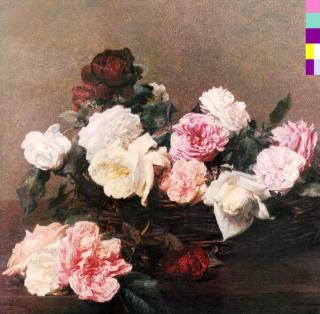
There's a strangely cheery energy to the album as well. This is something that would be a hallmark of the intertwined dance that New Order and The Cure would perform over the next couple of years. This was to the extent that it sometimes seemed the distinguishing factor of a song wouldn't emerge fully until it was clear if the singer was Bernard Sumner or Robert Smith. However The Cure always possessed the sense of a singular voice going through eternal moods of structure and collapse in equal measure, wooziness and queasy pirouetting. Whereas by this point the rigorous structure of what was New Order remained crucial, especially that sense of being something not too far removed from Can, Kraftwerk and other Teutonic proponents of total focus. And now this sound was more openly underscored by the electronic disco rigour that continued to flourish worldwide.
Sumner (or his narrative voice) opened the album confessing that he doesn't necessarily want to have to say what his desires are. This is an apt statement from the singer for a band who hadn't even wanted the job. But then he has to spend an entire album - for the first time ever - teasing a lot of things out song for song, however guardedly, however flippantly, however metaphorically. So why not write a song revolving around an image of lonely souls on deserted islands, except avoiding the kind of approach that the Police had dealt with a few years previously on 'Message In A Bottle' say. So Sumner, who heard so much desire for connection from Ian Curtis, came up with a much better lyric than Sting ever could. And he did it in a less mannered fashion, in a way that actually didn't want to resolve into easy romantic sentiment, on 'Leave Me Alone'.Power, Corruption and Lies is an album I have listened to a lot, mostly in the 1990s; first to a dodgy Indonesian cassette copy, adorned with a cut-out photograph of the album cover and padded out with tracks from other albums, which I picked up at a flea market, and then to the official Australian CD release, padded out with Blue Monday/The Beach. I lived in the outer suburbs of Melbourne then and thus spent a lot of time driving, and a cassette of Power, Corruption and Lies would often spend time in the car stereo. I haven't listened to it as much over the past decade or so (taking it out occasionally, but that's it), but I still know the lie of the album like the back of my hand. (Though, the Power, Corruption and Lies I was familiar with segued from 5-8-6 into the 12" mix of Blue Monday, before easing back into the more languid, resigned Your Silent Face, a flow which, despite its historical and authorial inauthenticity, made perfect sense to me.) Anyway, Power, Corruption and Lies remains my favourite New Order album (though in my opinion, they drop off a bit after Low-Life, a close follower), and Leave Me Alone is probably my favourite of their songs.
2013/5/10
An interesting article about the origins of Discordianism and its influence on British pop pranksters The KLF, and in particular, the esoteric significance of their best-selling pop-house album The White Room and the lesser-known film they made of the same title:
The ideas behind the book can be traced back to the late 1950s, when Hill and Thornley attended California High School in East Whittier, a rural Southern Californian town that was then nestled amongst vast orange groves. In school they were viewed as nerds. Hill was short, squat and introverted, while Thornley was tall, very thin, and bursting with a nervous energy. They both shared an enthusiasm for pranks and strange ideas. They were also both keen on bowling alleys, largely because they served alcohol and remained open until two in the morning.
It was in one such bowling alley in 1957 that Thornley showed Hill some poetry that he was writing. It included a reference to order eventually arising out of chaos. Hill laughed at this. He told Thornley that the idea of ‘order’ was an illusion. Order is just something that the human mind projects onto reality. What really exists behind this fake veneer is an infinite, churning chaos. For Hill, an atheist, the failure to understand this was the major folly of the organised religions of the world, all of which claim that there is an organising principle at work in the Universe.The article goes on to mention Robert Shea and Robert Anton Wilson's initiation into Discordianism through their editorship of the Playboy letters page, in which formed what would later evolve into the Illuminatus! trilogy; Aunt Twackie's, the experimental art space set up by Liverpudlian poet Peter O'Hallighan; and the theatrical version of Illuminatus! that was performed there, which caught the attention of two artists named Bill Drummond and Jimmy Cauty, who, years later, started making music as The KLF, and the set of events which led to The White Room.
2013/4/20
A new book, How The Beatles Rocked The Kremlin, makes the claim that the Beatles contributed greatly to the collapse of the Soviet Union (or at least to the collapse of the legitimacy of the communist regime among its youth; whether glasnost, perestroika and the disintegration of the USSR would have happened as they did without the Beatles is a matter for historical inquiry):
The book's main character, the Russian writer and critic Art Troitsky, makes the claim that: "In the big bad west they've had whole huge institutions that spent millions of dollars trying to undermine the Soviet system. And I'm sure the impact of all those stupid cold war institutions has been much, much smaller than the impact of the Beatles."
A grand assertion, maybe – but widely shared. "Beatlemania washed away the foundations of Soviet society," explains Mikhail Safonov at the Institute of Russian History. And the Russian rocker Sasha Lipnitsky – snowflakes falling on his beret as he talks to Woodhead in a park bandstand – insists: "The Beatles brought us the idea of democracy. For many of us, it was the first hole in the iron curtain."The Soviet authorities didn't quite know how to respond, and alternated between trying to co-opt the new fad and attempting to stamp it out, but to no avail; once music fans contrasted the music with the authorities' denunciations of it, they became more sceptical of the official party line:
Indeed, the repression and harassment of the music ebbed and flowed as the party controls lapsed or intensified. "It went in waves: sometimes you could be approved for an official recording, and sometimes you were banned, losing your job or education. It must have driven them insane," says Woodhead. He not only excavates the minds of the rebels but also the propaganda machine at work. He recounts how a school staged a mock trial of the Beatles – broadcast on radio – with a prosecutor and denunciations in the manner of Stalin's show trials of the 1930s. A critical bulletin shown on state TV, entitled Pop Quartet the Beatles, told the story of how "these gifted guys could be real cash earners" while, "struck down with psychosis, the fans don't hear anything any more. Hysterics, screams, people fainting!" So ran the TV commentary, accompanied by shots of dancing fans intercut with images of the Ku Klux Klan and dire poverty in the American south. "Keep on dancing, lads, don't look around," the programme taunted, "You don't really want to know what's happening. Keep going, louder and faster! You don't care about anyone else."The article also mentions the USSR and its satellite states' interaction with other forms of countercultural and popular music, some deemed less threatening than others. (Disco, it seems, is OK because it's easy to contain. By then, the sclerotic Brezhnev-era USSR must have given up on trying to inspire its youth with Leninist zeal in its vision and was merely hoping that their recreations would remain safely apolitical, and, dare one say, bourgeois.)
Looking through the other end of the telescope, it is enlightening to find what the Soviet authorities approved of. They "positively encouraged" disco music – the Bee Gees' Saturday Night Fever, Abba and Boney M (though Rasputin was officially banned) – because, says Woodhead, "it was musically rigid and could be contained within the dance floor, it wasn't going to spill out on to the streets".
Why the Beatles? There is no hint of the Rolling Stones or the Who in all this. In Czechoslovakia, the underground was being inspired by dark dissonance in the Velvet Underground and Frank Zappa. "I think the Czechs had that recent memory of democracy, before the war," reflects Woodhead. "And their culture has roots in Kafka and the surreal. But Soviet taste was more melodic, they like tunes above all, even a little sentiment, verging on the beautiful – and there, I'm describing a McCartney song, not hypersexual rock'n'roll, or Street Fighting Man.
2013/4/8
Contentious former British Prime Minister and inventor of the soft-scoop ice cream*, Margaret Thatcher, is fit for work dead. Thatcher is best remembered for her contributions to music, having inspired at once the vitriol of a generation of post-punk musicians and a market for smooth wine-bar soul for a rising generation of moneyed sophisticates, and also having laid the ground work for Britain's rave culture by ensuring an abundance of empty warehouses. That and the smashing of the mining unions, support for the South African apartheid regime and Chilean libertarian dictator Augusto Pinochet, the Section 28 law suppressing the discussion of homosexuality in schools and by councils, the Poll Tax and the resulting extinction of the Conservative Party in Scotland (a society to which Burkean conservatism, as a world-view, was not traditionally alien), mass privatisation, economic precarity for a large (non-Tory-voting) section of the population, soaring inequality (Britain's Gini coefficient rose from 0.28 at the start of her term to 0.35 in 1990, at the end of her term; it is now around 0.4), and cocaine replacing tea as the national drug of Britain some time around 1986.
Thatcher died following a strike a stroke in a room at the Ritz; she was 87. She is survived by Nelson Mandela, whom she denounced as a terrorist, her son, motor racing enthusiast and Equatorial Guinea coup plotter Sir Mark Thatcher, and, of course, her economic policies, which now form the backbone of all major political parties in the UK, and UKIP as well. Now there is, indeed, no alternative.
A state funeral was proposed by the New Labour government a few years ago when Thatcher's frailty came up; there was also a petition to privatise it last year, as to better honour Thatcher's views. Meanwhile, a mausoleum, a towering pyramid of black onyx, is being constructed in Canary Wharf, where the great lady can spend eternity in the centre of the thrumming hive of finance she so loved in life.
A few years ago, there were also stickers circulating around London, presumably put up by some left-wing group or other, announcing a mass party in Trafalgar Square the Saturday after Thatcher died. I imagine, though, that, in this day of kettling and protest suppression, Trafalgar Square will be as conspicuously free of any political statements as Tienanmen Square is on any 4 June.
2013/2/24
A Parisian outfit named Rectangle Radio has an interview with Clare Wadd of Sarah Records, in the form of a podcast, in which she discusses the label's origins, history, end and legacy.
It was totally plucked out of the air; I guess you look back and I guess it was just on that cusp of, kind of.. lad rock, that whole kind of grebo thing, that then became the 90s Loaded thing; that's probably unfair on some of the grebo bands, but it was almost which side of the fence are you on. And record labels were run by boys as well, so I guess we were making a point about that. I ws reading “Emma” by Jane Austen at the time, so it kind of came from if a book can be called Emma then a record label can be called Sarah. It was never meant to be Sarah Records, it was just meant to be Sarah, but that was too difficult.
I think in a way, though, the thing I'm most proud of ... is the way we ended the label when we did and the reasons for doing it. One of the things that drives me absolutely crazy is when people think we went bust, or something like that. We always felt that there were about three or four ways to end a record label. One's to go bust, which happens reasonably often; two is to start putting out crap records and everyone stops buying them and you just kind of dwindle away. You could sell out to a bigger record label. We didn't want to do any of those. And then there's just getting to a nice round number ... throwing a big party, and taking out some ads in the press and saying, you know, we're basically destroying it. That I'm just so pleased we did, even though it was so hard to do.Whilst derided, somewhat though perhaps not entirely unfairly, as twee at the time, and not getting much recognition in histories of alternative/indie music (Sarah Records is mentioned in a footnote in Richard King's alternative-music history “How Soon Is Now”, in reference to being even more idealistic and out of touch with commercial realities than the labels the book's about), Sarah seems to be finally getting its due, with a book about the label (by Canadian writer Michael White) due this year and a documentary in production.
Sarah Records as a label is gone, and definitely not coming back, but the name exists on Twitter; Clare uses it to post music-related items.
(via SarahRecords) ¶ 0
2013/1/31
An interesting article on the genesis of the Roland TR-808, and how Roland's famous line of drum machines owes its existence to an American musician and circuit-bending pioneer named Don Lewis:
Raised with a rich gospel tradition in Dayton, he brought his myriad musical talents to San Francisco in the ‘60s, where he was a staple in nightclubs. His one-man-band became known for its wild array of electronic instrumentation, which was still a novelty in those days — a small truckload of synthesizers and early rhythm boxes accompanied Don’s richly-vocoded tenor to make a sound no one had heard but everyone liked.
Don had been hired by the Hammond organ company to demo its products on the show floor. He was using an Ace Tone rhythm box (which was distributed by Hammond at the time) as his percussion section. "I had modified my Ace Tone to death, changed all the rhythms because none of them fit my style of playing. I also wired it through the expression pedal of the Hammond, so I could get [percussion] accents, which no one was doing then. After the show this man from Japan came up and the first thing out of his mouth was ‘that looks like my rhythm unit but it doesn’t sound like my rhythm unit! How did you do that?’" It was Ikutaro Kakehashi, the president of Ace Tone.Kakehashi went on to found Roland Corporation, capitalising on Lewis' suggestion for a rhythm box with modifiable rhythms (or, what later became known as a drum machine), and hiring Lewis as an engineer, to work on projects including the CR-68 and, eventually, the TR-808.
On a visit to Roland’s Tokyo offices in the late ‘70s, Don was working with chief engineer Tadao Kikumoto. "That day he had a bread board of an 808 and was showing me what was going on inside — he sort of bumped up against the breadboard and spilled some tea in there and all of a sudden he turned it on and got this pssh sound — it took them months to figure out how to reproduce it, but that ended up being the crash cymbal in the 808. There was nothing else like it. Nobody could touch it."The article also describes Lewis' homemade Live Electronic Orchestra, the complex of ancient synthesizers and other circuits which Lewis played live back in the 1960s, and which has been restored for a special performance at the NAMM music trade fair:
It’s a one-off work of art, a kind of who’s who of vintage synthesizers networked to one another through connection standards the industry has long forgotten but Don is still fluent in. A series of hand-built buffer boards and timing modules allow an Arp Pro Soloist to talk to a Promars Computronic and a Roland Jupiter-4. The Hammond expression pedal can control a variety of parameters for any of the sounds coming through the Boss KM-6A mixer, whose channels Don built a remote control panel for right into the body of the three-stage organ. It’s basically a 1977 copy of Ableton Live that weighs two tons, doesn’t have a EULA, and does a heart-melting rendition of "Amazing Grace."
2012/12/12
Between 1975 and 1979, a number of dialogues were held between various cultural and artistic figures on the then embryonic ARPANET network, which would, in time, become the internet. Here's Dialogue IV, held in April 1976, and featuring Yoko Ono, Sidney Nolan, Jim Henson and Ayn Rand. There are few surprises in how it plays out; the characters are true to form, with Ono as the fey hippy mystic, Rand as the original chatroom troll (who starts off in characteristic form by throwing shit from her self-declared moral high ground and ends up driving everyone else out), and Henson and Nolan presenting perhaps more nuanced perspectives:
JIM HENSON: But there is always conflict.
YOKO ONO: But it does not have to be this way. Does your work Mr Henson not try to prove this?
JIM HENSON: No. Conflict is what defines my characters in many ways and how they respond to it.
JIM HENSON: I think Ms. Rand and my character Oscar the Grouch would have a lot to talk about actually. I am laughing out loud at this idea.
AYN RAND: Why would I want to talk to him. What has he achieved or trying to achieve.
JIM HENSON: He has achieved what I think is the ultimate goal of your way of thinking.
2012/11/29
A landmark in the greying of rock'n'roll and the teenage dreams of the baby boom generation: the average age of members of The Rolling Stones, who celebrate their 50th anniversary as a band this year, is now almost two years higher than the average age of US Supreme Court justices (once referred to as the “Nine Old Men”, on account of it being an office one attains late in life and retains until death or incapacity). The average age of the (surviving) Rolling Stones is 68 years and 300 days, whereas that of Supreme Court justices is 67 years and two days.
2012/11/26
Néojaponisme has a detailed five-part series on Cornelius' Fantasma, one of the defining albums of the 1990s Shibuya-kei genre of polychromatic, postmodern Japanese club-pop, looking at Oyamada Keigo's earlier work (with Pastels-referencing indiepop combo Flipper's Guitar) and subsequent work (which rejected the whole ethos of reference that Fantasma was about in favour of minimalism and introspection).
The piece starts off by placing Shibuya-kei, the movement Cornelius epitomised and helped define, in a specific historical context: the brief age of the music nerd, which arose after commodity rock'n'roll and ended when the internet made obscure knowledge instantly available, when knowledge of the obscure corners of popular music was a form of cultural capital:
The music nerd’s mission often boiled down to listening to what others did not, thus upsetting one of the art’s fundamental tenets. From ancient bone flutes to West African drum circles to jazz cafés to dancing the Charleston in front of blaring Big Bands, music had been a group activity for most of its existence. Music had always been social, yet the music nerd now mostly enjoyed it as a solitary pursuit. Hearing a song in the privacy of one’s own room was not even possible until the early 20th century, and not particularly common until the advent of the small transistor radio, the personal stereo, automobile speakers, and the Walkman. So between this technological change and a corresponding social one wherein pop music rolled over elite musical art forms like opera or ballet, the ingredients were there for the spontaneous genesis of thousands of music nerds. And as music fragmented to an unbelievable degree in the 1980s and 1990s, music nerds became even more intense and even less social.The 1990s were the golden indian summer of music nerddom; the internet was already starting to chip away at the cultural capital of the obscurantists (there had been USENET newsgroups discussing genres and microgenres and meticulously detailed discographies in ASCII text files, though they hadn't made it out to the as yet non-computerised outside world), and within a few years, information hyperinflation would wipe out vast amounts of cultural capital; but in the late 1990s, the musical obscurantism bubble was at its peak. In the West, this manifested itself through the sampling, quoting and citing of artists like Beck, the Beastie Boys and Stereolab; in Japan, it found even more fertile ground:
There may be traditional aspects of national philosophy and educational theory that influenced Japanese pop culture’s particularly obsessive mode of learning and understanding, but the artistic practice of detailed study and imitation of form certainly reached its peak with consumer society’s insatiable interest in the West after the War. Youth wanted to do completely alien things like dress like Americans and listen to American music, and magazines had to take up the key role of explaining detail by detail exactly how and why to do such a thing. Holistic sub-cultures like Hippies and Punks got analyzed down to their respective quarks so that Japanese teens could build them back up again from a bunch of imported scraps. These days the otaku nerd gets all the credit for originating Japanese information obsession but this was just a structural outcome of the Japanese model of cultural importation. In the act of bringing one culture over to another, bit by bit, every single possible cultural category becomes a series of consumable lists, and as a logical extension, mastery and memorization of those lists ends up as the most worthy test of true fans, believers, and adherents.The piece then continues with an overview of Oyamada's career, before and after Fantasma, a track-by-track examination of Fantasma and the influences it references, and a history of its release in Japan and the west.
Additionally, there's an older piece on the history, cultural context and legacy of Shibuya-kei here:
Shibuya-kei was ultimately an attempt to create a Japanese analog to the indie music cultures that had developed in the U.S. and U.K., but the Japanese artists ended up succeeding far beyond their international peers in impacting the entire Japanese music market. Shibuya-kei was not just the emergence of a new genre. The appearance of Flipper’s Guitar in 1989 was a pivotal event in the surfacing of “independent” culture into the Japanese mainstream consumer market during the 1990s, setting the stage for a wider cultural movement in media, fashion, art, and interior/graphic design.
2012/8/25
Wary of the possibility that a population of educated, frustrated women could result in pressure for political liberalisation, Iran's government has moved to preempt this by declared 70 university courses to be for men only:
It follows years in which Iranian women students have outperformed men, a trend at odds with the traditional male-dominated outlook of the country's religious leaders. Women outnumbered men by three to two in passing this year's university entrance exam.
Senior clerics in Iran's theocratic regime have become concerned about the social side-effects of rising educational standards among women, including declining birth and marriage rates.Of course, if women outperform men in academic fields, banning women may make the men feel better about their performance, but it will be less salutary for Iran's economy if half of all potential knowledge workers are prohibited by law from developing their potential.
This is at odds with the arguably more progressive Saudi approach (and "progressive" and "Saudi" aren't two words I expected to write adjacent to each other) of planning segregated women-only cities, where the nation's educated, otherwise frustrated women can work in industry on a “separate but equal” basis. (I wonder how long that will last; eventually, I imagine it'll lead to those invested in the status quo deciding that it's a threat and attacking it; starving it of resources, imposing crippling restrictions on it, and eventually shutting it down and sending the women back to the authority of their male family members, and the city will go the way the the USSR's Jewish Autonomous Oblast did once Stalin found it too threatening.)
And Iran is moving to further remind women of their place under an Islamic theocracy, by moving to legalise the marriage of girls under 10. The current age at which girls can be married in the Islamic Republic is 10, down from 16 before the revolution.
2012/8/19
An argument that the Australian ideal of the “larrikin”—the unruly, mischievous underdog thumbing his nose at authority and propriety—has devolved into a US-style anti-intellectual right-wing populism, and a fig-leaf for mining oligarchs to claim to be “ordinary Australians” (i.e., of the people) and say that it's not they but rather the inner-city latte-hipsters and stuck-up university-educated book-readers who have inherited the mantle of "the elites" from the despised British penal-colony administrators:
It is on that basis that certain pundits claim anyone with a whiff of intellectualism about them is an ''elite'' and therefore opposed to the interests of ordinary Australians. It is also on the basis of the myth of larrikinism that a number of super-rich Australians are able to present themselves as egalitarian.
Forget about the fact that Singo is more notable for his support of Gina Rinehart than for society's underdogs. Because the larrikin ideal works the way it does, it allows powerful Australians like him to gloss over the fact of their own elite status and to pretend that the real elites are elsewhere.Ironically, the original larrikins weren't reactionary heroes of the ordinary battlers but violent, socially disadvantaged young men who drew the short straw during a period of precarity.
The first larrikins emerged at a time when the underdog was stigmatised in Australian society. No one would have dreamt of calling themselves a larrikin in the late colonial years if they wanted to be held in regard by the broader society. Now something that even billionaire mining magnates can make their own, our ideal of larrikinism has changed substantially since the era in which the term was coined.
The fact that its history was characterised by social inequity and violence, however, should make us pause before making too much of our ''larrikin streak''.Australia does not have a bill of rights; in its place is an informal piece of customary law known as the “larrikin-wowser nexus” that constitutes Australia's cultural system of checks and balances. This is the assumption of harsh laws and an equal but opposite contempt for authority, dating back to convict codes of honour in the penal-colony days, evolved to a system where, once the copper's One Of Us, there's a tacit understanding that the laws will be selectively enforced only against those who are not One Of Us—witness, to wit, Australia's tough film censorship laws letting through populist Hollywood entertainment untrammelled whilst cracking down mostly on poofterism with subtitles that only Green-voting hipster elites would want to watch anyway, or PM-in-waiting Tony Abbott's emphatic support for freedom of speech, but only when it is used against those who are not One Of Us—Aborigines, Muslims, the “un-Australian” and such. Maybe, just maybe, the larrikin-wowser nexus isn't a viable substitute for a more formal system of checks and balances in a mature democracy.
2012/6/4
In honour of this being the Diamond Jubilee long weekend, here is an evaluation of a piece of critique from an earlier Jubilee, namely the Sex Pistols' God Save The Queen:
God save the queenWe're not off to a good start. Even if one relaxes the definition of “fascist” (as some on the left of political debate are sometimes wont to), calling Elizabeth II's figurehead reign, floating above the governments of the day, mouthing their words and cutting ribbons, a “fascist regime” would stretch it beyond recognition. One could argue that the song referred to the government of the day, except that it was written in the days of a flounderingly ineffectual Labour government, long before Maggie sent her riot police to smash the unions and said nice things about Chilean dictator Augusto Pinochet.
The fascist regime
She ain't no human beingIf one's talking about the office of Queen, that could be considered to be true. Whoever sits on the throne occupies a peculiar role; wearing the title of an ancient absolute monarch, but serving as a mascot of sorts, and being on duty at all times, until she dies or abdicates (and the latter is not possible without scandal). Whereas an ancient monarch's freedom of opinion was limited only by their own power, the Queen has effectively given up the right to express opinions on anything consequential, lest they interfere with her official “opinions”, which change with the composition of Parliament and the will of Rupert Murdoch. (Her son, alas, has not received this memo, and is happy to give his loyal subjects the benefit of his expertise on fields as diverse as homeopathy and architecture.) So, half a point here; the office of the Queen is not human, though the occupant of it, biologically, is, unless you're David Icke.
There is no futureWhen there lines were written in 1977, Britain was in a political, economic and cultural malaise—there was the three-day week, uncollected rubbish was piling up; the Empire was gone, but its memory was still fresh enough that some people believed it wasn't. Ironically enough, one other person who would have agreed with Lydon that there was no future in England's dreaming would have been the aforementioned more-plausibly-fascist-than-the-Queen Tory MP, Margaret Thatcher.
In England's dreaming
God Save The Queen,This sudden lapse into a Californian surfer-dude voice is puzzling. Does Lydon believe that, as a rock'n'roll practitioner, he must adopt an American voice? How does he reconcile the showbiz fakery of rock'n'roll with the professed authenticity of punk as a voice of the people/youth? Or is he suggesting that a US-style Presidency would be preferable to a constitutional monarchy? (Which, a few years after Watergate, sounds implausible.)
I mean it, man
God save the queenFull points for this one; when motherhood statements about “timeless national symbols” and “bringing the country together” aren't enough, monarchists often follow up with “besides, they bring the tourists in”. Though, by some accounts, royal palaces aren't among the most popular of Britain's tourist destinations. Whether this was the case in 1977 is another question.
'Cause tourists are money
And our figureheadAnother one for the conspiracy theorists, it would seem; does the Queen sit at the apex of international organised crime (as US third-party political candidate Lyndon LaRouche claims), or are she and the entire house of
Is not what she seems
2012/3/14
The onward march of the internet age has taken a historic casualty: yesterday, Encyclopaedia Britannica has announced that it is giving up printing encyclopaedias; those solidly shelf-filling expanses of dead information bound in leather and gold ink, which many a parent paid handsomely for their children to have access to, will soon be as dead as the Pony Express. The last edition of the Britannica to appear is the 2010 edition, whose new entries included global warming and the Human Genome Project.
In the 1950s, having the Encyclopaedia Britannica on the bookshelf was akin to a station wagon in the garage or a black-and-white Zenith in the den, a possession coveted for its usefulness and as a goalpost for an aspirational middle class. Buying a set was often a financial stretch, and many families had to pay for it in monthly installments.
Sales of the Britannica peaked in 1990, when 120,000 sets were sold in the United States. But now print encyclopedias account for less than 1 percent of the Britannica’s revenue. About 85 percent of revenue comes from selling curriculum products in subjects like math, science and the English language; 15 percent comes from subscriptions to the Web site, the company said.The Britannica is a casualty of the shifting economics of information, the rise of the internet, and more specifically, the rise of Wikipedia; now that collating information no longer requires an expensive infrastructure (such as a business with dozens of editors and experts) but only some servers and the good will of countless volunteers across the world, traditional encyclopaedias have found their raison d'etre diminishing. The Britannica fought against this tide, pooh-poohing the Wikipedia approach, with its lack of formal authority, and asserting that nothing good can possibly come of it, only to find itself losing market share to something good enough; orders of magnitude broader in subject matter, almost instantaneously up to date, and not so catastrophically unreliable as to negate these points (and, in fact, according to some studies, not significantly more error-prone than the Britannica). Soon, the price of encyclopaedias crashed, with Craigslist being littered with second-hand sets whose owners no longer have a need (or space) for them; meanwhile, of the 12,000 copies of the 2010 Britannica printed, 1/3 languish unsold in a warehouse.
The Britannica company will keep publishing an online edition, accessible by a $70 annual subscription fee, in the hope that enough people will find its conservative editorial approach a selling point rather than a liability.
2012/2/25
The (Melbourne) Age has a piece looking at the history of the long-running rivalry between Melbourne and Sydney (which is sort of like Australia's equivalent of the rivalry between Edinburgh and Glasgow), and the layers of values attached to those two points on the map by generations of their advocates and detractors:
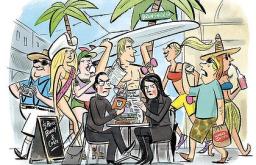
Some contend that it is based on the foundation stories of the capitals. Sydney was set up as an open-air jail in 1788, whereas Melbourne was founded in 1835 by independent settlers seeking new farmland.
By the 1880s, writer Marcus Clarke sought to share the spoils by pointing out that Sydney would probably evolve as “the fashionable and luxurious capital”, while Melbourne would become the intellectual and cultural capital.The article discusses the usual stereotypes (Sydney: glamorous if ditzy, with breathtaking harbour views; Melbourne: Europeanised, full of pretentious people who read a lot and watch art-house films), debunks a few others (Sydney apparently gets twice as much rain as Melbourne, though, of course, being Sydneysiders, they take theirs in spectacular thunderstorms) and states that the coffee is better in Melbourne. That may well be so (it's hard to go past Atomica or Jasper), though the last time I was in Sydney, they had excellent coffee there as well. (If I recall correctly, Campos in Newtown is pretty good.)
2012/2/19
At the turn of the 1930s, recorded music was seen as an existential threat. Films with sound started appearing, and their prerecorded musical soundtracks started threatening the livelihoods of the musicians who, until then, had played accompaniments to silent films in cinemas. To wit, the American Federation of Musicians launched a campaign against the tyranny of “canned music”, which their advertisements depicted as a malevolent robot:
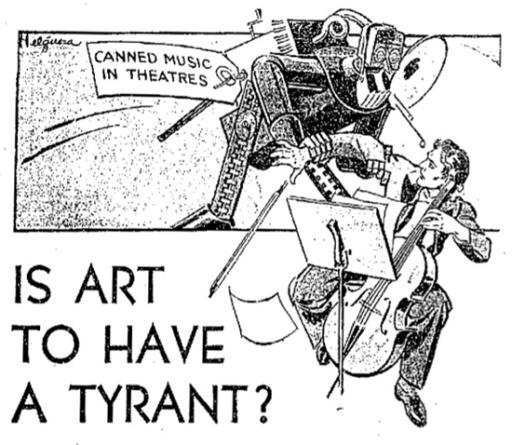
The campaign was ultimately unsuccessful, though recorded music was seen as a threat to live musicians for decades after that. In the 1950s, for example, when the BBC was establishing a studio for experimental electronic music, it dubbed the studio with the decidedly unmusical name of the Radiophonic Workshop, perpetuating the fiction that its function only peripherally touched on the kingdom of music, as to avoid antagonising the unions of the musicians who worked on other BBC broadcasts.
2011/12/29
An interview with underground comic author Daniel Clowes, in which he talks about a number of things, such as the pitfalls of hipster parents trying wrongheadedly to introduce their kids to interesting culture (and, in the process, making it deeply uncool):
I think about that a lot with my son. I don’t want to inflict the stuff I like onto him. He’s only eight, so right now I could get him to like anything, pretty much, but when he’s a few years older I really don’t want him to respond to anything because I like it too much or not enough. I want him to sort of find his way into his own stuff, so it’s something I have to constantly modulate. I don’t want him to associate this music with me, I want him to discover it on his own and then I’ll go like, “Well, I happen to have all their records!”In short, you may be hip and credible, but once you have kids, your position as a parent will, in the eyes of your kids, be like antimatter to all the cred you have carried forth from your bourgeois-bohemian extended adolescence. And so, a generation is produced to whom Black Flag and Pavement will be as naff as, say, Engelbert Humperdinck or something. Or, in the post-loungecore, post-Yacht Rock age after irony has folded in upon itself, perhaps it's the act of having opinions about music that will carry a patina of daddish uncool, with record collections and discographies being inherently cringeworthy; perhaps, to the hip kids, music will be, as Jarvis Cocker put it, like a scented candle, a ubiquitous low-value commodity beneath caring about.
And now is the era of the Cool Dad. I know lots of parents who I just think, like, “God, if my parents had been like that I would’ve been into all this cool stuff.” Luckily they weren’t, so I discovered all that stuff on my own and they sort of disdainfully shook their heads at the stupid stuff I was interested in. But there are a lot of things that I don’t respond to. I’m not into video games, so I can just see my son becoming, like, a video-game tester as his job or something. Developing video games.Clowes touches on the mainstreaming of comic-book/nerd culture:
When I was in high school, if I’d gone up to a girl and said, “Would you like to go read some of my Thor comics with me?” they would’ve just thought I was the lowest form of human life. That would’ve been so unimaginable. I was actually on the subway in New York and saw this, like, Attractive Teenage Couple, and the guy was like, “Hey, wanna go see Thor tonight?” and the girl was like, “Yeah, yeah.” And I just thought, that is just blowing my mind that that is happening right in front of me.And touches on the way that, by reducing the amount of friction required to discover something, the internet has reduced the value of merely knowing about cultural products as badges of belonging:
I could tell you right now about some obscure filmmaker and you could know more about him by midnight than I would’ve been able to find out in 10 years when I was your age. But I don’t know that it would mean much to you unless you really connected to the guy and kept following it and doing more and more research. It’d just be like, “Yeah, I know about that guy,” and then you’d move on to the next thing. There’s something about having it be like a mystery that you have to solve and figure out that really connected you to this weird culture back then.
It also used to be like, you’d buy an album by a recording artist and there’d be one or two good songs on it, and there’d be all the rest that were just kind of to fill up the album, and you’d work your way through that and learn to like the other songs after a while, and then you’d wait till the next album came out. And now it sort of feels like everything is all the greatest hits. You learn about a musician and you immediately can figure out what their 10 greatest songs are, and you just listen to those and you don’t experience the full breadth of their failures and mishaps and all that stuff. I feel like that’s how all culture is. And I’m as guilty as anybody else now—if I hear about an author or something I go straight for their most well-known book and read that first, and, you know, I don’t have that experience of kind of building up to that. You don’t wanna read the rest of their books after that because you figure, “Well, I’ve already read the best one. It’s not gonna be much better than that.”The interview also touches on the settings of Clowes' works, the aura of alienation in his characters, and his aesthetic formative experiences having been a reaction to the cultural upheavals of The Sixties:
As a kid I loved the look of the early ’60s, kind of the pre-hippie era, just the haircuts and clothes and the way women dressed, it was really appealing. And then all of a sudden people started wearing, like, filthy clothes and messy hair and stuff. That seemed really hideous and horrible to me. It definitely relates to what was going on in my life at the time because, as with many kids who grew up then, my family was just disintegrating while all that stuff came in, so it represented this chaos that was entering my life. But I still have an affection for that pre-1968 look, that kind of saturated Technicolor look. That seems like the real world to me, or like the way things should be.
2011/12/24
A few seasonal links for today and tomorrow:
- The mythological trainwreck that we call "Christmas", with its ill-fitting pieces of Middle Eastern and Nordic folklore, was discussed here last year. Now, some people going by the name of Cannabis Culture (read into that what you will) have another element to add to this; namely, the claim that the legend ot Santa Claus comes from Lappish shamanic rituals involving hallucinogenic mushrooms, with Santa's red and white costume having nothing to do with the Coca-Cola logo and everything to do with the colouring of the amanita muscaria mushroom, which may be found growing under fir trees.
- A Norwegian crafter named Jonas Laberg made a 10kg marzipan pig, as a present for his friends' daughters. The finished product looks horrifyingly detailed:

- The Graun's Zoe Williams has a piece on the supposed Christmas tradition of kissing under the mistletoe, which she contends is one of those things that only happens on TV (much like adults playing with cats, she writes), and does a Twitter survey, confirming this; with one heartbreakingly poignant exception:
In 1973, Helen was 16 and having a relationship with a girl at school, but they hadn't come out for a whole load of reasons, most of them to do with it being 1973. "In those days, we were like outcasts, so nobody knew, it was a great secret. A few of my friends were really homophobic. We went to this New Year's Eve party, where people were all goading each other to kiss. So we did. It was brilliant, everybody was cheering, we were pretending it was a joke. It was probably one of the best kisses I've ever had."
It didn't make it any easier to come out, though. "We never came out, we split up two years later, the pressure became too great. Most of it on her, because her family had mapped out her life for her, she had to get married. And I did what was expected of me, when I was 18. I got married as well. I had three kids."
- Christopher Hitchens may be gone, but an unpublished essay he wrote about Christmas has surfaced: Forced Merriment: The True Spirit of Christmas.
I once tried to write an article, perhaps rather straining for effect, describing the experience as too much like living for four weeks in the atmosphere of a one-party state. "Come on," I hear you say. But by how much would I be exaggerating? The same songs and music played everywhere, all the time. The same uniform slogans and exhortations, endlessly displayed and repeated. The same sentimental stress on the sheer joy of having a Dear Leader to adore. As I pressed on I began almost to persuade myself. The serried ranks of beaming schoolchildren, chanting the same uplifting mush. The cowed parents, in terror of being unmasked by their offspring for insufficient participation in the glorious events…. "Come on," yourself. How wrong am I?
One of my many reasons for not being a Christian is my objection to compulsory love. How much less appealing is the notion of obligatory generosity. To feel pressed to give a present is also to feel oneself passively exerting the equivalent unwelcome pressure upon other people... Don't pretend not to know what I am talking about. It's like the gradual degradation of another annual ritual, whereby all schoolchildren are required to give valentines to everybody in the class. Nobody's feelings are hurt, they tell me, but the entire point of sending a valentine in the first place has been deliberately destroyed. If I feel like giving you a gift I'll try and make sure that (a) it's worth remembering and (b) that it comes as a nice surprise. (I like to think that some of my valentines in the past packed a bit of a punch as well.)
- ‘Yes we know it’s Christmas’ say African musicians as they finally record a response to Band Aid:
“Just because we don’t have Boney M or Christmas advertising in September doesn’t mean we are oblivious to it,” said Gundane who went on to suggest that Africans were a lot like the Irish. “They made it through disasters like the potato blight and the invention of the Protestant church without forgetting Christmas – why did they think we would forget it?”
Gundane said he hoped that his involvement with the song would turn him into an expert on British politics and economics in the same way ‘Do they know it’s Christmas’ had turned Geldof and Bono into the world’s leading experts on Africa.
- After some UK department store apparently used a godawful twee-folk version of a Smiths song in one of its Christmas ad, the inimitable Rhodri Marsden decided to one-up the horror of it with his own Christmas-themed Smiths travesty. Behold: Heaven Knows I'm Christmassy Now, to be a mainstay of Christmas mix tapes in years to come.
2011/10/21
An interview with Bernard Sumner and Stephen Morris, in which they talk about, among other things, their reactions to Ian Curtis' suicide, Joy Division's metamorphosis into New Order, the (legendary though financially disastrous) Hacienda, and the origin and meaning of Blue Monday (capsule summary: it was inspired musically by an Italo-disco record and the famously enigmatic lyrics are rooted in the band's annoyance with the press, though is also about whatever the listener wishes to read into it):
James: Like retrospectively, you don’t even remember what they were about?
Bernard: I think I do. They weren’t literally about this but we were getting a lot of shit in the press at the time. The press has turned on us after Joy Division who could do no wrong. They were all against us and I felt a bit beleaguered and it was a kind of fuck you to the press really. That’s kind of what was in my head when I wrote it, it was a kind of a fuck you we can do it without you and we did, with that song.
James: When I was on the NME Len Brown wrote a great piece that is presumably wrong. He read it to be about the Falklands, he wrote a great piece about his brother committing suicide or was it about Blue Monday.
Bernard: Well we also have an attitude that we never explain what a song is about because people have their own interpretations, that’s equally valid. So I wouldn’t say that’s not wrong, it’s how you interpret a song and what it means to you and that’s why we never. Whenever I write lyrics it’s never a literal thing it’s just what’s on my mind at the time.
2011/9/25
In his latest Poptimist column, Tom Ewing writes about recordings attributed to imaginary authors, typically at some time in an imagined past. More specifically, he writes about Science Of The Sea, a record allegedly made in 1979 by Jürgen Müller, a German oceanographer and amateur musician who was inspired to make a record of ambient electronic compositions by the hours he spent on field trips out at sea, one of whose 100 privately-pressed copies was apparently rediscovered in 2011:
Except, of course, he probably did no such thing. It seems likely that there never was an expedition, or a young biologist, or a private pressing. Science of the Sea is a 2011 record from fin to tail, and the rather lovely tale of Jürgen Müller is entirely invented. Did suspecting this make me like the record less? Certainly not. If anything, I enjoyed it more. As a small child I would sometimes be allowed to sit up with my parents and watch science documentaries, like Carl Sagan's Cosmos. I didn't understand the science, and the documentaries were broadcast late so I was on the edge of sleep in any case, but I remembered their soothing flow: The infinite turned into a kind of bedtime story. Meanwhile, on library bookshelves I would sometimes find 1950s and 60s paperbacks about modern-day scientist-adventurers like Jacques Cousteau or Thor Heyerdahl-- giving the impression of an age of clean-limbed scientific heroism I'd tantalizingly missed, one that looked very much like a Tintin comic.
So no surprise that some of what I get from Science of the Sea-- there by intention or not-- is a pang of love and loss for this imagined time. More intriguingly, though, if the record is fictional it feels like this might have been liberating for its mysterious creator. The album is full of beautifully cornball seascape touches-- flickering arpeggios and note-clouds which practically demand you start thinking about shoals of fish darting back and forth outside a bathysphere window. Sit down and make an electronic album about the ocean now and you might find yourself trying to dodge these clichés. Sit down and role-play a naive non-musician inching towards transcendence at the turn of the 1980s and you can fully embrace them.Science Of The Sea is not the only recent example of its kind; another recent recording shedding light on an underexplored, romantic and distinctly alien corner of the modern past was the retrospective of the Endless House Foundation. The conceit of Endless House presents an experimental electronic music collective, founded in the early 1970s by an eccentric, wealthy Czech audiophile, situated in an ultra-modernistic studio/discotheque complex in the heart of the Bialowieska primeval forest in eastern Poland and informed by the breadth of European avant-garde design and architectural movements of the 20th century, it thrived for must six weeks in the summer of 1973 before collapsing under the weight of its expensive impracticality, leaving behind only some scraps of biographical information, a few ambiguous photographs of improbable architectural spaces, and the curiously pristine recordings of the resident musicians' compositions, which, it seems, prefigured everything from Kraftwerk to Detroit techno, much in the same way that Delia Derbyshire invented IDM in 1965 but neglected to tell the world about it. The fragments have remained buried until recently, when an unnamed British curator unearthed the pieces, and managed to track down the original participants, getting interviews and even a mix, from them.
Of course, it's quite possible that none of this really happened. The story of Endless House reads almost like a Wes Anderson set-piece, only set in a nebulous European avant-garde as seen from outside. Unsurprisingly, the illusion doesn't hold up well to closer examination. For one, the idea that a group of Western European playboys could cross the Iron Curtain with impunity, bringing party guests and giant modular synthesisers with them, while the governments of the Eastern Bloc, still shocked by uprisings in Prague in 1968 and Warsaw in 1970, were in ideological lockdown, seems highly unlikely. (A non-fictional recent musical retrospective of East German electronic music reveals the extent of ideological control over music in the Eastern Bloc; in the DDR, the government only started allowing the production of electronic music in 1980, and even then anything that could be interpreted as critical of industrial society was verboten, leaving room only for ostensibly harmless cosmic psychedelia.) Over and above this, this improbable bubble is populated by a cast of exotically European bons vivants with names like Walter Schnaffs and Felix Uran, who speak in a mixture of English and German, but refer to distances in miles. Nonetheless, if you can suspend disbelief, imagine that the Cold War wasn't that big a deal and that an Austrian synthesist and socialite might sing about being sixteen miles from Saint-Tropez, in an avant-garde cyber-disco about that distance from the Polish-Soviet border, it's an entertaining story, and an even more entertaining record. (The tracks, listened to on their own, work as electronic music, and do evoke the world they purport to come from.)
Meanwhile, in a recent edition of Milan art journal Mousse, there is a retrospective of the works of Scottish-Italian artist Scotty Potenza, written by someone named Nick Currie:
The colour, shape and texture of fresh ice cream is certainly visible in Potenza’s acrylic gouaches; peach, pistachio and purply-red forest berries distinguish themselves forcefully from the sodden greens and asphalt greys of the Scottish industrial landscape. His subject-matter shares this otherness: influenced by the exciting first wave of Acid House culture in the late 1980s, Potenza evinces a non-Calvinist positivity more evocative of Chicago warehouses and Ibiza raves than Glasgow tenements. A Potenza painting incarnates not what Scotland is, but what it lacks.
As 1990s rave culture has continued to experience the bearhug embrace of mainstream acceptance in the UK — its visual values, once restricted to club flyers, now inform restaurant design, public information films and TV commercials for banks and building societies — Potenza has been granted a high-profile list of public commissions. His decoration of the walls of the Home Office lobby with a mural of happy ravers, their hands linked like the figures in Matisse’s La Danse, caused short-lived (and clearly manufactured) outrage in the tabloids, but has proved peculiarly popular with the civil servants who work in the building. A major mural at Finsbury Park underground station entitled Get On One Matey! was unfortunately damaged beyond repair in the 2011 riots. The vandals, caught on CCTV, are currently serving long prison sentences.
2011/8/29
The true story of an orangutan named Ken Allen:
Ken Allen was born in captivity at the San Diego Zoo in 1971. During the 1980s, Ken Allen gained worldwide attention for a series of three escapes from his enclosure, which had been thought to be escape-proof. During his escapes, first on June 13, 1985, again on July 29, 1985, and on August 13, 1985, Ken Allen would peacefully stroll around the zoo looking at other animals, and never acted violently or aggressively towards zoo patrons or other animals. Zookeepers were initially stymied over how Ken Allen had managed to escape. They began surveillance of his enclosure to try to catch him in the act, only to find that Ken Allen seemed to be aware that he was being watched for that very purpose. This forced zookeepers to go "undercover", posing as tourists to learn Ken Allen's escape route, but Ken Allen wasn't fooled.I imagine, seen from Ken Allen's point of view, his predicament would be not too far from Patrick McGoohan's Number 6 in The Prisoner: kept captive in an ostensibly pleasant though distinctly unreal and unfree environment, by powerful, omniscient captors whose intentions are unknown, and gradually finding holes in their panopticon, patiently piecing together a plan and then making a bid to escape, before being confronted with the absurdity of his situation and the power of his captors.
2011/8/23
Japan's Ise Grand Shrine is both very old (having been established sometime between 4BCE and the 5th century) and very new; every 20 years, the shrine buildings at Naikū and Gekū are demolished and rebuilt. This symbolises the Shinto teachings of the cycle of death and renewal in nature and the impermanence of all things, and also serves to pass on the crafts and techniques used to build the shrine. In this case, one could say that destroying the artefact keeps the institution alive.
2011/6/16
In the US Right, repudiating The 1960s and its wave of social upheavals and looking to either 1950s America or the Victorian Era is so yesterday; the new thing is repudiating the Enlightenment and looking to the Middle Ages as a golden age of civic and private virtue, free of the heresies of secularism and egalitarianism, or so claim William S. Lind and William S. Piper:
Not surprisingly, after three centuries of “Enlightened” propaganda, almost everything modern people think they know about the Middle Ages is wrong. Medieval society not only represents the nearest man has come to building a Christian society, it was also successful in secular terms. Living standards rose, and with them population. That was true for all classes, not just the nobles. Monarchs were far from absolute—royal absolutism was in fact the latest thing in 18th-century fashion, a system for promoting rational efficiency—and subjects had extensive rights. Unlike the abstract Rights of Man, as practiced during the Jacobins’ Reign of Terror, Medieval rights were specific and real, established by precedent.
The alternate narrative’s view of what followed is selective. The Renaissance brought advances the High Middle Ages would have welcomed, including Christian humanism and the recovery of many texts from the classical world. But it also laid the basis for secular humanism, a prideful and subversive force that continues to do great damage to societies and souls alike. The Protestant Reformation pointed to some genuine abuses in the Church and also renewed the importance of Scripture. But the shattering of Christendom, the rise of an unsound doctrine of sola Scriptura, and the loss of the sacraments in much Christian worship were too high a price.The Enlightenment didn't immediately bring about the collapse of the virtuous old order, but merely weakened it and set the powderkeg, which exploded at the outbreak of World War 1:
As recently as the summer of 1914, less than a century ago, the world restored in 1814 was still recognizable. Kaisers, tsars, and kings reigned. The goodness and rightness of social classes, each with its respective duties, was acknowledged by all but Marxists. The Christian religion, if not universally believed, was generally respected. Nietzsche’s “transvaluation of all values,” in which the old virtues become sins and the old sins virtues, was regarded as the raving of a syphilitic madman.Then, the centuries-old, divinely-ordained system of monarchies fell, and the world lurched sharply towards the left, forever tainted by the original sin of Cultural Marxism (a marvellous catch-all which encompasses anything from women's rights to sagging jeans and, from what I gather, generally translates to "anything I, as a self-identified Conservative, object to"), leading directly to our present fallen world of rock'n'roll, drive-through abortion clinics and rampant Sabbath-breaking.
However, according to Lind and Piper, it need not have happened this way; had the central powers won, a balance of power would have been restored, the great monarchies shored up, the spectre of Bolshevism headed off, and the world could have shifted equally sharply to the right, and to recovering the lost virtues of the mediaeval world:
In this world, Professor Mayer’s spectrum shift to the left would never have happened. Conservative Christian monarchies would have triumphed. A spectrum shift to the right, while not inevitable, was possible; a defeated French republic might have been replaced with a monarchy. (Le Figaro: “The Estates General, deadlocked among the Legitimist, Orleanist, and Bonapartist candidates, today offered the throne of France to Prince Louis Napoleon of Saxe-Coburg-Gotha…”) It is perhaps too much to hope that the 20th century’s grimmest reaper, ideology, would have found itself in history’s wastebasket. But it would have lost to its oldest opponent, legitimism, and lost badly. It might have been sufficiently weakened to give Europe and the world a century of relative peace, like that following the settlement of 1814.
(via metaphorge) ¶ 0
2011/6/5
Spain's resurgent Right is moving to rehabilitate the memory of Franco. No longer a Fascist dictator whose totalitarian reign oppressed a country for two generations and left a trail of mass graves, according to Spain's Royal Academy of History, he is now merely a ruler who regrettably had to turn to authoritarian tactics to save Spain from "bandits" and "terrorists":
The fact that the dictionary has been presented under the patronage of the king himself and handsomely paid with taxpayers' money to the tune of €6.5m is doing very little to lessen the scandal many specialists and ordinary Spaniards feel at this body of work which, among other things, routinely refers to the republican side in the civil war as "the enemy" while Franco's troops are described as "the national army". Or, for example, when it praises the "pacification" of several regions, by which it means the execution of thousands of democrats, socialists, teachers and passersby in general.
Whatever the reasons, José María Aznar's eight years as prime minister between 1996 and 2004 were a great opportunity for his Popular party (PP) to distance itself from its slightly Francoist origins. But the opposite happened: it chose to legitimise Francoism instead. A whole school of revisionist historians was promoted to great success, endlessly recycling the old Francoist myths. It would have been just ridiculous were it not that at the same time the government was denying thousands of citizens the right to unearth their loved ones from the archipelago of mass graves which still covers the whole country.
2011/6/4
A few recent studies demonstrating the power of cultural transmission of values and attitudes over surprisingly long stretches of time: firstly, a set of surveys in central and eastern Europe has shown that trust in government officials is higher and corruption is lower in areas formerly governed by the Habsburg Empire, whose bureaucracy was considered to be more honest and competent than elsewhere in Europe at the time; the phenomenon has lasted from the end of World War 1 to the present day, surviving the redrawing of borders and different types of regimes, and to this day, levels of trust and corruption differ within the borders of countries between formerly Habsburg and, say, Ottoman or Russian-ruled areas.
On a darker note, another study in Germany has found that towns in which Jews were massacred during the Black Plague were more likely to support the Nazis and participated more enthusiastically in the Holocaust, some six centuries later.
2011/5/11
The Guardian speaks to Charanjit Singh, a Bollywood session musician from Mumbai who, in 1982, bought a Roland TB-303 and TR-808 and decided to have a go at applying these sequencer-driven electronic instruments to traditional Indian music, creating something that sounded uncannily like acid house music that came out some five years later:
With some more gentle probing he explains that he was intrigued by the way he could use the 808 and 303 in synch with the Roland Jupiter-8 keyboard. He explains that he didn't know much about the machines when he bought them and that he had to spend time learning how to use them properly. "At home I practised with the combination and I thought 'It sounds good – why not record it'".
Having explained that much of the music that Ten Ragas is compared to comes from Chicago, we settle down to listen to the record that arguably started it all – Acid Trax by Phuture. Singh listens intently but seems unmoved by the pulsing, stripped down music – and the signature squelch of the 303. "It's quite simple" he concludes after around three minutes, gently chuckling at the idea that there are similarities between Acid Trax and Ten Ragas. "It's very simple this music," he says. "What I played are ragas – there's a lot of variation."Singh's record, 10 Ragas To A Disco Beat, sank more or less without a trace when it was released, before being rediscovered a few years ago, and reissued on vinyl and MP3.
2011/4/15
50 years after the Bay of Pigs invasion, the Cuban government is preparing to concede defeat in the struggle for socialism, and unveil radical reforms:
Evidence, as Castro himself said in a recent interview, that "the Cuban model doesn't even work for us any more". Which is why on Saturday the Communist party will inaugurate its first congress in 14 years to cement radical changes to the economy and, intentional or not, to Cuban society.
"The narrative is really Thatcherite," said one senior western diplomat in Havana. "It's all about cutting rights and welfare and putting greater emphasis on personal responsibility and hard work."It'd be ironic if, as Cuba prepares to liberalise its economy and open itself up to investors, the investors came to the Cuban government and advised them to actually keep the infrastructure of totalitarianism in place, because of its usefulness in increasing productivity, controlling unrest and ensuring the integrity of intellectual-property licensing.
2011/4/2
The first two in a series of articles about the history of rock'n'roll-influenced pop music in Japan, through the 1960s and 1970s: Part 1, about the rise and decline of Beatles/Stones-influenced, tightly controlled "Group Sounds" bands and the rise of the psychedelic rock that followed, and part 2, about the rise of the Kansai underground protest-folk scene and its influence on Japanese rock:
In 1966, The Beatles came to Japan, playing a series of five concerts at Tokyo’s Budokan. In doing so, they transformed rock and roll into a phenomenon among Japanese youth. Within months, an unprecedented number of Japanese rock bands, each with their own take on the sounds of The Beatles or The Stones, were debuting. The Japanese press started writing articles about the new, controversial band boom, which they had termed “Group Sounds” (or GS). The Japanese music industry, however, was slow to adapt to Japan’s changing musical climate. Labels assumed a high degree of musical control, often forcing bands to record compositions by in-house songwriters instead of their own material. Only in live performances were the GS groups granted creative control. Many groups refused to preform their singles at all, instead playing from a repertoire of covers and original songs.
Okabayashi quickly became one of the most prominent members of the Kansai Folk movement. His 1969 URC debut demonstrates the level of freedom Takaishi’s label granted its artists. Watashi wo Danzai Seyo contained songs criticizing the Vietnam War (“Sensou no Oyadama”), Japanese labor conditions (“Sanya Blues”), and the perils of Japan’s capitalist aspirations (“Sore de Jiyuu Natta no Kai”). Okabayashi also wrote songs that explored taboo topics like the discrimination against descendants of Edo Japan’s pariah caste, the burakumin (“Tegami”). Although Okabayashi was often critical and sardonic, he expressed a great deal of hope for a brighter future in songs like “Tomo yo” and “Kyou wo Koete.” Okabayashi’s blunt lyrics about sensitive topics caused the JRIA’s standards committee to ban many of his songs from being broadcast on Japanese radio. The most infamous of these songs is “Kusokurae Bushi,” or in English, “Eat Shit Song.” Even after removing a verse concerning the Japanese Emperor, which centered around a pun between “God” and “[toilet] paper,” “Kusokurae Bushi” was banned from radio and recalled from record shops.In the second article, an interesting point is raised about authenticity, with many in Japan's rock scene regarding rock-style music sung in Japanese, rather than English, to be inauthentic, thus framing rock as a specifically ethnic genre (much in the way that one might argue that, say, Balkan folk songs in English would be inauthentic, or possibly in the way that rap not performed in an American accent was regarded as "wack" for a decade or two).
2011/3/29
One of the more unexpected products of the final days of the Soviet Union was an explosion of fantastic modernist architecture. With the iron chain of Communist totalitarianism crumbling and the velvet leash of the almighty market still in the future, the USSR's architects had a free hand to go wild, which they did, resulting in a wave of spectacular-looking government ministries, polytechnic institutes and other facilities scattered around the various peripheries of the empire, and looking like they were dropped from space:
These fascinating things, built in prominent locations, were cathedral-like in their ambitions as well as their size. Chaubin concocted a game around his photograph of the Palace of Weddings in Vilnius, capital of Lithuania. He would show it to people and ask them what it could be: a monastery, a power station, maybe even a giant laboratory? "No one guessed it was a registry office for weddings built on a huge scale to encourage people away from getting married in churches."The buildings are catalogued in a new book by a French photographer, Frédéric Chaubin, who spent several years finding and recording them. The book may be the last chance to see many of them, which are likely to fall prey to the financial ambitions of oligarchs and property developers. There is a slideshow here.
2011/3/19
BBC Radio 4 has an interesting radio programme about the surprisingly extensive French influence on the punk movement. Alas, it's not downloadable, and may not be accessible outside of the UK, but the gist is that the oft-cited Anglocentric creation myth of punk—the movement having sprung fully formed from the loins of Sid Vicious and/or Malcolm McLaren somewhere on the King's Road, with possibly some reference to Iggy Pop and/or the New York Dolls—is very much incomplete; or, in the words of the presenter, Andrew Hussey, without France, punk would have just been pub rock with shorter hair.
The French influences on punk rock cited by Hussey and his interviewees (who include the members of French punk bands such as Stinky Toys and Metal Urbain, as well as an adjunct professor of punk and reggae at NYU) are multiple. A big one is French philosophy, particularly Situationism and Lettrism, but going back to various strains of romantic nihilism, Dada and the poetry of Rimbaud and Baudelaire. (French punks were less afraid of being intellectual than the English rockers of the time.) There was also a lot of cross-pollination between Paris and New York's art-rock scene (Patti Smith is an obvious name to mention here), not to mention precedence in earlier French popular culture, such as les Zazous, the black-clad, swing-dancing rebels who defied the Nazi occupation, and of whom one sees superficial echoes in everything from Mod to Goth. And then there were the stylistic cues, cribbed by punk's more historically literate stylists:
Malcolm McLaren and Tony Wilson were hugely influenced by the Situationist movement in particular, and deliberately and explicitly trawled it for images and lyrics that were to become iconic punk expressions (the Sex Pistols record covers, lyrics such as 'Cheap holidays in other people's misery'...); the first festival of punk music took place at Mont de Marsan in 1976; the first Rough Trade release was from the Parisian band 'Metal Urbain'; the punk 'look' first embodied by Richard Hell was drawn straight from fin de siecle French poets, and the graffiti strewn clothing of The Clash comes straight from the 50s group les Lettrists.
2011/3/16
According to this article, what we know as Jewish humour today (as well as the numerous examples of comedy, from Hollywood gross-out to the African-American tradition of "the Dozens", influenced to some degree by Jewish comedic culture) owes its existence to a rabbinical edict, passed in the wake of a wave of pogroms, banning most forms of jollity, and driving almost all forms of humour in the Yiddish-speaking world into extinction. Only one type of entertainer, a kind of crude, cruel jester named the badkhn, was spared prohibition, on the grounds that his shtick wasn't actually funny:
The badkhn was a staple in East European Jewish life for three centuries, mocking brides and grooms at their weddings. He also was in charge of Purim spiels in shtetl society. His humor was biting, even vicious. He would tell a bride she was ugly, make jokes about the groom’s dead mother and round things off by belittling the guests for giving such worthless gifts. Much of the badkhn’s humor was grotesque, even scatological.
t’s that same self-deprecating tone that characterizes the Yiddish-inflected Jewish jokes of the 20th century, Gordon points out. Who is the surly Jewish deli waiter of Henny Youngman fame if not a badkhn, making wisecracks at the customer’s expense?
“Even today, almost all Jewish entertainers have badkhn humor," Gordon said. "Sarah Silverman is completely badkhn. What did my father find funny? Dirty jokes. Because that’s the badkhn humor he grew up with.”
(via Boing Boing) ¶ 0
2011/1/22
Der Spiegel has an interesting article about how a new generation of Israelis are flocking to Berlin, tempted by the city's vibrant culture and sense of freedom, and negotiating the fraught history and politics of doing so:
"I do not know if 'forgive' is the appropriate term," says Gil Raveh. Raveh, a conductor, came to Berlin four years ago on the recommendation of award-winning Israeli conductor Noam Sheriff, who himself had studied in the city. "Forgive whom? Merkel? The waitress who serves my coffee?" he asks.
With a European passport thanks to his mother, who was born in Eastern Europe, Netter made the move to Berlin. His first year in the city, he says, was spent having fun and living off of his savings. Then he started Meschugge as a one-time event, and it became a regular attraction: "The Unkosher Jewish Night," as he calls it. A quarter of the audience is Israeli, the rest German. Netter says he suspects some of the Germans might come as a way to alleviate their own feelings of guilt. "We Israelis cannot understand how it feels not to be proud of yourself, as a nation," he says. "The Germans are full of serious identity crises."The Israelis have a different ways of addressing the elephant in the room:
But Israeli immigrants in Berlin have their own identity issues. For example, almost all of them prefer to be treated as "Israelis in Berlin," not as "Jews in Germany." "Even the Germans themselves say Berlin is not Germany," says Russ. "The Jewish component of my identity has to do with a shared cultural past, not with a religious belief. I do not go to synagogue or eat kosher food."
"An Israeli friend in Berlin once showed me his apartment," says Russ. "When we got to the kitchen, he opened the gas stove and said: 'And this is the shower.' But the first time I told a Holocaust joke here, a friend warned me that it's illegal."One of the motivating forces seems to be a contrast between the liberal, creative culture of Berlin and the situation in Israel today, where an increasingly authoritarian political environment is threatening civil liberties, with a right-wing government waging war against civil rights groups.
2011/1/17
GQ's website has a detailed account of last year's assassination in Dubai of Hamas leader Mahmoud al-Mabhouh, almost certainly by an elite Mossad hit squad, and the investigation that nailed down what happened, written up by Ronen Bergman, an Israeli journalist who writes about intelligence operations (and is the author of The Secret War With Iran):
At 6:45 a.m., the first members of an Israeli hit squad land at Dubai International Airport and fan out through the city to await further instructions. Over the next nineteen hours, the rest of the team—at least twenty-seven members—will arrive on flights from Zurich, Rome, Paris, and Frankfurt. They have come to kill a man named Mahmoud Al-Mabhouh, a Hamas leader whose code name within the Mossad—the Israeli intelligence agency—is Plasma Screen.
Then, in 2002, Prime Minister Ariel Sharon tapped Dagan, a former military commander with a reputation for ruthless, brutal efficiency, to restore the spy agency to its former glory and preside over, as he put it, "a Mossad with a knife between its teeth." "Dagan's unique expertise," Sharon said in closed meetings, "is the separation of an Arab from his head."Bergman pieces together a chronology of the operation and the investigation that followed, and a list of mistakes committed by the assassins which gave the Dubainese authorities enough to go on to produce a detailed account, all but pinning the operation on Israel.
The laughable attempts of the Mossad operatives to disguise their appearance made for good television coverage, but the more fundamental errors committed by the team had less to do with cloak-and-dagger disguises than with a kind of arrogance that seems to have pervaded the planning and execution of the mission.
2011/1/12
According to a computer analysis, the least interesting day in history was 11 April 1954; or, at least, in recent history. Only two newsworthy events occurred on that day: the death of a footballer and the birth of a Turkish physicist.
"The irony is, though, that - having done the calculation - the day is interesting for being exceptionally boring. Unless, that is, you are Abdullah Atalar.
2011/1/6
During the Napoleonic Wars, a French ship sank off the coast of Hartlepool, in the north of England. The only survivor was the ship's mascot, a monkey dressed in a naval uniform. The monkey made it to the shore, where it was captured by locals, who had never seen a monkey (this, you see, was before television, widespread literacy and public zoos), so they assumed that it was a Frenchman and hanged it as a spy. From this incident, the residents of Hartlepool became known as "monkey-hangers".
Almost 200 years later, Saudi Arabian security services have arrested a vulture tagged by an Israeli university wildlife resarch programme as a "Zionist spy".
Residents and local reporters told Saudi Arabia's Al-Weeam newspaper that the matter seemed to be linked to a "Zionist plot" and swiftly alerted security services. The bird has since been placed under arrest. The accusations went viral, according to the Israeli Ha'aretz newspaper, with hundreds of posts on Arabic-language websites and forums claiming that the "Zionists" had trained the birds for espionage.The Israeli authorities have denied any espionage, and claimed that the bird was part of a long-term academic study of the migratory habits of the vulture.
It is not clear what sort of vulture-based intelligence the Israelis could be looking for.
Austrian type designer Othmar Motter recently passed away, aged 84. You may not recognise the name, but will probably recognise a few of the typefaces he designed in the Sixeventies: Tektura, (which is currently out of print; there's an amateur recreation here) which was used by Apple and Reebok in the 1980s (and, in a monospaced, bitmapped form, ended up in the Commodore 64 video game Paradroid) and the heady psychedelia of Femina:


2011/1/5
Charlie Stross has written another piece about Japan, this time for a Japanese scifi magazine and inspired by his second visit:
The first time I visited Japan I thought I had a handle on what I was seeing: a microcosm of the human future, a densely-populated nation that has had centuries of cheek-by-jowl urban living, like the crew of a generation starship in flight towards the future, dragging the scars of ancient history behind them. A land of monorails and shopping malls and coin-operated ramen noodle stands and spas with twenty flavours of bathing feature. And all of this is true. But on further acquaintance, I find myself knowing less and less about Japan — or perhaps I'm just becoming increasingly aware of how little truth the tourist picture reveals.
If you take away the future, what makes Japan different? In a word, history. The present is a moving boundary, travelling from the past into the future — what lies behind it is history, and the further it goes, the more history we have. When we try to peer into the future to see where we're going, as often as not we're peering into a driver's mirror, watching the past unroll behind us. To understand a culture's future you must look at its history — for the history people have experienced defines the future they want.The essay continues and discusses a number of things, among them Edo Palace, a castle the size of a city which stood where Tokyo is now; a vast, imposing monument which took nigh-unimaginable labour to build and Charlie likens to the Death Star.
Charlie's 2007 account of his first visit to Japan (which starts with "They've got our future, damn it", and goes on in a similar spirit of wide-eyed awe) is here.
2010/12/27
A set of photographs taken in cold-war Berlin, by an American intelligence officer and amateur photographer; there are some interesting scenes here.
Also, Cold War era maps of the Berlin U-Bahn, from the West and the East. It's interesting to note the differences in graphic design and what information they contain. The West German map is neutral and businesslike, though shows both lines in the West and the East (though the Eastern lines are uncoloured). The Eastern map looks superficially more colourful and friendly (much like the jovially behatted Ampelmann compared with the standard capitalist traffic-light man), but shows only East Berlin; the forbidden capitalist enclave behind the "anti-fascist protection barrier" is terra incognita.
2010/12/23
The sad, poignant story of Barbara Newhall Follett:
By the age of 16, Barbara Newhall Follett had published two books and written countless poems. Her 1927 debut novel, The House Without Windows, received glowing reviews from The New York Times and words of encouragement from the writer H.L. Mencken.
"My dreams are going through their death flurries. I thought they were all safely buried, but sometimes they stir in their grave, making my heartstrings twinge. I mean no particular dream, you understand, but the whole radiant flock of them together — with their rainbow wings, iridescent, bright, soaring, glorious, sublime. They are dying before the steel javelins and arrows of a world of Time and Money."
On Dec. 7, 1939, a friend reported that a then-married Barbara Follett left her house after quarrelling with her husband. She was 26 years old, and she was never seen again.To this day, nobody knows what happened to her.
Bruce Sterling (who, of course, wrote The Hacker Crackdown) places the WikiLeaks situation in context:
Part of this dull, icy feeling, I think, must be the agonizing slowness with which this has happened. At last — at long last — the homemade nitroglycerin in the old cypherpunks blast shack has gone off. Those “cypherpunks,” of all people.
Now, I wish I could say that I feel some human pity for Julian Assange, in the way I do for the hapless, one-shot Bradley Manning, but I can’t possibly say that. Pity is not the right response, because Assange has carefully built this role for himself. He did it with all the minute concentration of some geek assembling a Rubik’s Cube.
If the Internet was walking around in public, it would look and act a lot like Julian Assange. The Internet is about his age, and it doesn’t have any more care for the delicacies of profit, propriety and hierarchy than he does.
Even though, as major political players go, Julian Assange seems remarkably deprived of sympathetic qualities. Most saintly leaders of the oppressed masses, most wannabe martyrs, are all keen to kiss-up to the public. But not our Julian; clearly, he doesn’t lack for lust and burning resentment, but that kind of gregarious, sweaty political tactility is beneath his dignity. He’s extremely intelligent, but, as a political, social and moral actor, he’s the kind of guy who gets depressed by the happiness of the stupid.
2010/12/22
Among the British Medical Journal's Christmas season of light-hearted articles this year: Mozart’s 140 causes of death and 27 mental disorders, an amusing piece about the tendency to posthumously diagnose illustrious historical figures:
Schoental, an expert in microfungi, thought that Mozart died from mycotoxin poisoning. Drake, a neurosurgeon, proposed a diagnosis of subdural haematoma after a skull fracture identified on a cranium that is not Mozart’s. Ehrlich, a rheumatologist, believed he died from Behçet’s syndrome. Langegger, a psychiatrist, contended that he died from a psychosomatic condition. Little, a transplant surgeon, thought he could have saved Mozart by a liver transplant. Brown, a cardiologist, claimed he succumbed to endocarditis. On the basis of a translation error of Jahn’s biography of Mozart, Rappoport, a pathologist, thought Mozart died of cerebral haemorrhage. Ludewig, a pharmacologist, suggested poisoning or self poisoning by drinking wine adulterated with lead compounds. For some, Mozart manifested cachexia or hyperthyroidism, but for others it was obesity or hypothyroidism. Ludendorff, a psychiatrist, and her apostles, claimed in 1936 that Mozart had been murdered by the Jews, the Freemasons, or the Jesuits, and assassination is not excluded by musicologists like Autexier, Carr, and Taboga.
What clearly emerges is that Mozart’s medical historiography is made out of various alternatives, with a general time trend as tenable diagnostic hypotheses are progressively exhausted: the more recent they are the less probable. The most likely diagnoses—such as influenza, typhoid fever, and typhus—were proposed first, and only rare and irrelevant conditions such as Goodpasture’s syndrome, Wegener’s granulomatosis, Still’s disease, or Henoch-Schönlein syndrome were left for those who came later.
Thus, highly selective readings of the sources, blatant misquotations, and perversions of the diagnostic criteria have led to shoddy medical interpretations. Mozart allegedly had thought disorder, delusions, musical dysfluency, and epileptic fits, plus he did not actually compose music but merely displayed musical hallucinations. He was a manic depressive, a pathological gambler, and had an array of psychiatric conditions such as Capgras’ syndrome, attention deficit/hyperactive disorder, paranoid disorder, obsessional disorder, dependent personality disorder, and passive-aggressive disorder. This has resulted in psychiatric narratives that blend an uninterrupted long tradition of defamation—the film Amadeus was one of the last public expressions of this tradition.
This phenomenon is Mozart’s medical nemesis. It covers the hidden intent to pull an exceptional creator down from his pedestal through some obscure need to cut great artists down to size. It is reminiscent of Rameau’s nephew in Diderot’s novel who says about people of exceptional creativity: “I never heard any single one of them praised without it making me secretly furious. I am full of envy. When I hear some degrading feature about their private life, I listen with pleasure. This brings me closer to them. It makes me bear my mediocrity more easily.”
2010/11/23
The latest nightspot in the old Sloane heartland of Chelsea is Maggie's Nightclub, a club inspired by Margaret Thatcher's decade in office. Maggie's includes photos of Thatcher and Ronald Reagan (I wonder whether there are any of her close friend General Augusto Pinochet), and speakers in the bathroom play a loop of the audiobook of the Iron Lady's diaries. The club has a £15 entry price and £250 fee for a table, and may or may not be ironic:
So, I ask the club's co-owner, Charlie Gilkes, is this the nocturnal equivalent of a neo-liberal manifesto? No, no, no, argues the Old Etonian, who opened Maggie's with his business partner Duncan Stirling earlier this year. "It's not a Tory club," he says carefully, but rather a tribute to the 80s – a bit of "childhood nostalgia for the decade of our birth". The reference to Britain's most divisive politician, he says, is tongue-in-cheek. "I know she's divisive, but I do admire her. She's a leader."
In this 80s, Thatcher-era themed club, bottles of champagne signed by the Iron Lady go for £5,000, but I make do with a Ferris Bueller Fizz, priced £10.50. A Super Mario mural adorns another facade and every table in sight has been made to look like a giant Rubik's cube, while a Neil Kinnock figurine takes pride of place next to Gilkes's own childhood collection of Teenage Mutant Ninja Turtles.Regular attendees apparently include Adam Ant and Tony Hadley, frontman of Spandau Ballet, who soundtracked part of the Iron Lady's reign. It's not clear what the playlist is: I'm guessing it'd be heavy on the 1980s yuppie wine-bar sophistisoul, include a bit of Bryan Ferry, perhaps some Stock/Aitken/Waterman chart pop to get people dancing, and the odd piece by Lord Lloyd-Webber in the chill-out room, with perhaps a Billy Bragg tune thrown in for irony. (Momus' Don't Stop The Night would also be a good ironic fit, though might be a bit obscure.)
Perhaps in ten years' time, someone will open a place in Islington named Tony's, which will play only Britpop, D:Ream and the Spice Girls, and have an ironic map of Iraq on one wall.
2010/11/17
A genetic survey in Iceland has found genes characteristic of native North Americans, dating back to the 10th century (or at least before the 18th century, to the eight or so centuries during which Iceland was isolated), suggesting that Native Americans reached Europe five centuries before Columbus reached the Americas.
2010/10/26
When popular music (in the loosest sense of the word) is discussed, the axis of authenticity often comes up, in the context of determining where on it an act fits. Its usual construction is something like this: at the inauthentic end, one will find the usual suspects: manufactured pop groups, middle-class gangsta rappers and anyone using AutoTune. Moving towards authenticity, things get less polished, grittier and rawer (though that, again, is no guarantee; it's easy enough for a producer to make a group of models or reality-TV contestants sound "grungy"). The gold standard of authenticity, if there is one, would probably be old blues recordings from the 1920s and 1930s: made before both modern recording techniques and the rise of an entertainment-industrial complex geared to parting teenagers from their pocket money in large numbers, before postmodern irony, they're as real as recorded sound gets. The rawest, most basic rock'n'roll from the mythological Golden Age sacred to rockists can only reflect, imperfectly, the authenticity of the blues.
Except that now, it may be that even the old cornerstones of the blues may not be entirely pure of sophistry and trickery: new claims have emerged that the recordings of Robert Johnson (the legendary bluesman, best known for allegedly having sold his soul to the Devil at a crossroads in return for an unbeatable playing technique) may have been sped up by as much as 20%, either to fit them on 78RPM records or—horror of horrors—to make them sound more commercially marketable:
he theory, which may have started in Japanese collector circles (it goes back at least to 2002; I'm still hunting for the original source) and has been taken up by several people in the UK, most notably John Gibbens, a poet and musician who has researched the matter and produced alternate versions of the recordings in which he slows down the existing recordings roughly 20 percent. We still hear those amazing words and that tough, doomed voice, but we hear a dramatically different Robert Johnson: his voice sounds more like the masters who preceded him (Charlie Patton, Son House) and his guitar playing, while still intricate (Johnny Shines, another outstanding bluesman who travelled with Johnson for a time, once claimed Johnson used a bizarre seven-string guitar), is more deliberate and dour. He sounds older, nastier, as if the hellhound on his trail that he sang about had caught up to him already. He sounds, in essence, like a different man. Speeding up the recordings, if it happened, changes how we hear blues and rock history. If Gibbens is right, this would change the way we hear and understand the blues. Johnson's raw, on-the-edge voice? Fake. The wild guitar runs that made thousands of aspiring guitarists' fingers bleed? Ditto.
2010/10/10
A chap in Russia has posted scans from a book of ads from the British motor company Rootes, circa 1961. The ads are all beautifully illustrated, looking somewhere between the illustrations in vintage children's books and a subtly Anglicised take on the 1950s American Dream (the cars gleam and present seductive images of freedom and leisure, though the tailfins have a subtle, very British, understatement about them).
This was once the heady height of modernity. Air travel was still expensive, and the trains still ran on coal, but Britain had a shiny new motorway system, and for the cost of a gleaming car, it was yours to explore. Oil was cheap, and as far as anyone could tell, would remain cheap forever.


Adding even more texture to it, a number of the ads are in Russian. The book was produced for an exposition in Moscow; perhaps, at the height of the brief thaw of the Khrushchev administration, the executives of Rootes imagined that Russians may soon be enjoying a version of the British take on the American Dream?
(via Boing Boing) ¶ 1
2010/10/8
The Graun's Alexis Petridis looks at the one genre of 1970s musical entertainment not yet revived or reappropriated by anyone: cabaret pop, which, by his description, is a lukewarm broth of reactionary light entertainment aired on British television throughout the 70s. Cabaret pop pointedly ignored all the stylistic innovations of the past decade, and was so unabashedly naff that it makes Eurovision look polished by comparison:
These days, we tend to view the years 1965 to 1968 as a high watermark of daring creativity, greeted with untrammelled delight at the time: after all, who wouldn't prefer Jimi Hendrix to Gerry and the Pacemakers? Look at the charts, however, and the answer seems to be: loads of people. The shift from pop to rock, and all the things bound up with it – drugs, dissent, the rise of the counterculture – clearly horrified as many record buyers as it delighted, and they responded by buying music as far from the cutting edge as it's possible to imagine. The incident in which Engelbert Humperdinck's Release Me kept Strawberry Fields Forever off the top of the charts wasn't an aberration, it was part of a trend. By late 1969, the predominant style in the UK singles chart is reactionary gloop. The Stones' Honky Tonk Women and the Temptations' Cloud Nine are fighting for space not just with Englebert, but with Clodagh Rodgers, Ken Dodd, Joe Dolan and Karen Young.
You're struck by how utterly cut off all this music seems from anything else happening at the time. There's not the vaguest intimation of glam rock or soul or singer-songwriterisms about the artists' sound or appearance. Children's TV was packed with pop music in the 70s – Lift Off With Ayshea, Supersonic, Get It Together, Shang-A-Lang – but a decade after the Times approved of the Beatles' Aeolian cadences, it's clear that no one working in light entertainment considered rock or pop music suitable mainstream entertainment for adults. When the Three Degrees appear on The Wheeltappers and Shunters, all hotpants and inoffensive Philly soul, the audience look aghast and baffled: you'd have thought Kraftwerk had just come on and played Autobahn in its entirety.
Even more astonishing is the way the musicians have shut themselves off from pop's recent past. You might have thought at least the Beatles' oeuvre had swiftly attained standard status, that Yesterday or Something might be precisely the kind of thing the balladeers with the shag-pile sideburns would gravitate towards, but no: it's still clearly considered too racy. During my light entertainment marathon, I hear two Beatles songs. One is courtesy of Little and Large: Syd Little sings Till There Was You while Eddie Large interrupts him doing impressions of Deputy Dawg. The other is Can't Buy Me Love, performed by the Morton Fraser Harmonica Gang: three men huffing away accompanied by a dancing midget in a wig.Cabaret pop's most lasting contribution to pop culture may well have been being an irritant which contributed to the welling up of rage that brought about punk and the explosion of rule-breaking creativity that followed:
From a distance of nearly 40 years, punk can be hard to grasp: not the music, but the spitting and the swastikas and the fuck-everything nihilistic rage. But when you're drowning in light entertainment pop, you start to get an inkling of why so many people were so eager not just to listen to the Sex Pistols – that's obvious – but to indulge in all punk's unsavoury gestures. It's partly because anything, even dressing up like a Nazi and coming home covered in someone else's flob, was more entertaining than staying at home and watching three men play harmonicas accompanied by a dancing midget in a wig, and partly because, judging by what constituted mainstream popular entertainment in the 70s, not one of the previous decade's supposed revolutions had affected wider popular culture at all. The youth culture of the preceding decade seemed to have failed: to anyone watching the TV, Britain still looked trapped in the 1950s.It's not clear whether this will remain cabaret pop's only claim to historical significance, or whether it will end up, eventually, being reappropriated by someone. Perhaps it'll be an adjunct to wickerfolk or hypnagogic pop, the insipid blandness and lack of artistic significance compared to the other things revived (from 1970s folk revivalism to radiophonic library music) merely a red rag to the bull of hipster irony. Perhaps someone will sample it, and the white-gowned ladies and dancing midgets will enjoy a post-ironic new lease of life at festivals. (Stranger things have happened; the Australians reading this will recall Kamahl's transition from ultra-bland crooner to ironic Big Day Out performer.) Or perhaps cabaret pop, without the antediluvian cool of lounge music, the polyester smoothness of yacht rock or the subtle undertones of the outré that shade the folk and radiophonica of that epoch, is truly beyond redemption as a subject of sincere interest going beyond half an hour of cringing at fuzzy YouTube videos; one of those things there isn't enough hipster irony in the observable universe to redeem.
2010/10/5
Sometime around the 17th and 18th centuries, in Europe, the rate of homicide dropped sharply; before then, violent death was a lot more common than afterward. Historians are still discussing why this may have happened:
''In the 14th century people are concerned with whether someone is of good or ill repute; it's a collective, community judgment. When you get into the 15th century, the question is about someone's 'governance.' There is a shift from community reputation to an emphasis on internal control.'' A proliferation of tracts and manuals on proper behavior trickle down to common, illiterate folks in the form of rhymes and ditties.One theory is that that the decline in resolving matters of honour through violent means was a result of the rising power of monarchs and states, and the ability of the state to enforce its laws more uniformly, removing the impetus for communities to take matters into their own hands. Others claim cultural shifts for the change:
Mr. Muir describes how the Republic of Venice tried to put an end to violent feuding among unruly nobles as it extended its influence into remote rural areas in the 17th century. The wars fought over generations by the area's leading families left the region vulnerable to foreign invasion. Venice reacted by first meting out stiff punishment, then by drawing the rural noble families into Venetian aristocratic life. Here they learned to replace the clan feud with the individual duel, an important shift from collective violence to individual responsibility and violence. Finally, the feuding clans, who now prided themselves on their courtly behavior, fought it out through the publication of dueling pamphlets, trying to best their rivals through elegant put-downs and masterly argument.
''Both the Protestant Reformation and the Catholic Counter-Reformation put a lot of emphasis on individual conscience,'' said Tom Cohen, who teaches history at York University in Toronto. ''The conscience becomes the internal gyroscope. There is the growth of introspection -- the diary, the novel, the personal essay. Along with the kind of personal self-control that Norbert Elias describes.''
Conversely, Mr. Roth noted, one sees significant increases in violence at times of political tension when the legitimacy of government is under serious attack, before and after the Civil War, as well as after World War I in Europe. The fact that murder rates did not go down in Italy and Greece until the 19th centuries, when each country won its political independence and formed a modern national state, suggests that the decline may have had more to do with state formation than with the trickling down of court culture.
2010/10/3
This just in: as of this weekend, World War 1 is officially over, with Germany having paid the final, £59.5m instalment of reparations to France and Belgium.
2010/10/2
There's a documentary in production titled "My Secret World: The Story of Sarah Records", giving an account of the legendary indie-pop label and including interview footage filmed at the Indie Tracks festival this year. Anyway, there's a teaser/trailer for it here:
2010/9/22
Charlie Stross posted to his blog the synopsis of an alternate history novel he almost started writing in 2002, set in an interesting timeline:
The year is 1950 -- but it's not our 1950. Things began to go off the rails, history-wise, in 1917-1918. Lawrence of Arabia was shot dead at the gates of Damascus, for example: the whole face of the middle east is utterly different. Trotsky had flu in October 1917 — the Bolshevik revolution happened in early 1918, and Stalin got himself killed in the process. Because of the late Russian collapse, World War One ended differently in this universe: the Kaisershlacht started in June (not April), the German high command collapsed in January 1919, and Germany was actually occupied by Allied forces (including the first large-scale deployment of what would later be called Blitzkrieg warfare — this was actually planned, but never used because of the German capitulation in November 1918). Germany was invaded, subjugated — no support for the "stab in the back" theory that Hitler used so effectively.In this world, Hitler never becomes dictator, and nor does Mussolini; fascism, however, is invented in Britain (with an Eric Blair becoming dictator of the Empire), and a standoff in Europe between the fascist republic of Britain and the Soviet Communists, with an isolationist America gradually taking an interest in the state of affairs, sending over two agents to investigate a curious trade of computers for heroin, and various real-world historical figures' alternate selves making appearances:
(This is all rooted in a vision I had, of William S. Burroughs as a CIA agent, and Philip K. Dick as his young henchman, going head-to-head with notorious gangster and pervert Adolf Hitler somewhere in Hamburg to find out where Hitler is shipping all the computers he can get his hands on.)It's a pity that this book will never get written. But one can console oneself with the outline posted in Charlie's blog:
And linked from the comments (on a tangent from Charlie's dislike of traditional high fantasy and its somewhat reactionary politics): Howard Zinn and Noam Chomsky's (unused) audio commentary for Peter Jackson's Return of the King film, which exposes the colonialist-imperialist nature of the Elves and their lackeys:
ZINN: Self-hating, Elf-emulating Men invest so much in symbolic one-upmanship characteristic of capitalistic societies: Who has the nicer tunic? Whose dagger has more shiny gems on it? Who has the strongest pipe-weed? But the Orcish alliance seems to be a truly mutual, multicultural cooperative enterprise.
ZINN: You see the walls of Minas Tirith up close here. Albert Speer would have been proud. Notice the grand scale, the "great works" emphasis of Gondorian architecture. The fascist uniformity of their battle dress. Compare it to the folk artwork of Orcish armor—their improvisatory use of shrunken heads and Mannish skulls, for instance. There's something very beautiful about it to me.
CHOMSKY: A perfect example of what Ruskin valorizes as the Gothic aesthetic.
ZINN: It's nonstandardized, individual, homespun, bespoke. It's also imbued with a kind of nature worship that Elves merely play at.
2010/8/30
The latest casualty of the rise of the internet and digital media: the print edition of the (full) Oxford English Dictionary; it comes in 20 volumes, weighs a third of a tonne, costs US$1,165 and, unsurprisingly, isn't selling very well, given that OED provides all its content in a subscription-based web service. As of next year, there may not be a paper edition at all.
2010/8/27
The Boston Globe has posted a selection of colour photographs taken across the Russian empire around 1910. The photographer, Sergei Mikhailovich Prokudin-Gorskii, travelled the length and breadth of Russia and its holdings (some of which are now in places like Georgia and even Turkey) at the Tsar's behest, producing a comprehensive photographic survey. Of course, colour film had yet to be invented, so Prudkin-Gorskii took his photos by taking three exposures, each with a different coloured filter in front of the lens, using a specialised camera that allowed for the filters to be swapped quickly. (It's not unlike the technique used to take HDR photos these days.) Anyway, the original glass plates were bought by the US Library of Congress in 1948 (not sure from whom; perhaps a White Russian exile took them whilst fleeing the Bolsheviks and they spent three decades in a suitcase in Paris or somewhere?), and have since been composited together into stunning full-colour images of what we too often think of as a sepia-toned age:


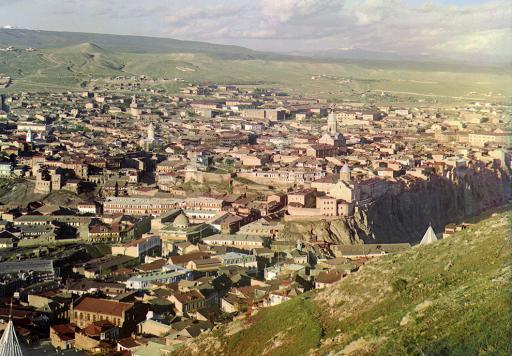
2010/8/22
A new technique involving ultraviolet light is revealing how ancient Greek statues were painted, by detecting traces of the organic compounds paints were made of. It turns out that the statues were coloured quite gaudily (indeed, some would say tackily), looking more like something you might find on a seaside pier than in a stately home.
And the fashion of subsequent millennia for alabaster-white statues of beautiful youths, female nudes, fauns and the like? Well, that's all based on the incorrect assumption that the way Classical Greek statues look now was the way they looked when they were made. (Indeed, I have heard the argument that the tendency towards minimalism in Western culture—as evidenced in High Modernism, for example—ultimately stems from the æsthetic values inculcated into the Western mindset through millennia of misinterpretation of Classical Greek artefacts.)
2010/8/12
A new theory claims that human monogamy is a direct result of the development of beer; or more precisely, firstly, that monogamy was the result of social changes that arose from the shift from a nomadic to an agricultural (and thus hierarchical and patriarchial) lifestyle, and secondly, that the main impetus to move to agriculture wasn't so much a desire to build cities or empires but to brew beer.
2010/7/21
Apple have just donated the source code of MacPaint to the Computer History Museum. The code is in two parts: the tip of the iceberg is MacPaint itself, which was written in Pascal and consists of one source file, but the bulk of the code is the QuickDraw library, written in 68000 assembler, which gave the original Macintosh most of its (then groundbreaking) graphics capabilities. And here is a story of the development of MacPaint.
The source code still belongs to Apple, though may be used for non-commercial purposes. I wonder if anyone has managed to compile it recently.
2010/7/13
Louise Wener, frontwoman of Britpop band Sleeper turned popular novelist, has written a memoir of her time in the Britpop scene/hype machine. If this review (by the ever-credible Jude Rogers, in the perennially right-on New Statesman) is anything to go by, it sounds like an interesting read:
After many years of Wener playing in different bands to general indifference, her four-piece Sleeper - named after the Woody Allen film - finally get signed by a major label in 1993. She is unforgiving about the conservative bias of the independent music scene, and holds the media in particular contempt. In the band's first interview with the New Musical Express, she is infuriated by a self-professed "revolutionary Trotskyite revisionist Leninist" who directs all his questions to her male bandmates, and later dismisses her as a "mad, ranty pop bird on the loose".
Wener also dismantles the myth that the likes of Blur were intelligent pop revolutionaries. She describes their rudeness, their ruthless ambition and their "easy, bohemian, moneyed odour". And then there are the groupies. Wener leaves nothing out. The bassist Alex James tells a young woman, "You're ugly, but I'm going to fuck you anyway," while their tour manager is despatched to select attractive girls from the audience and give them after-show tickets, known as "Blur-job passes".
If World War 2 documentaries were interpreted as fiction, the writing would suck:
So it's pretty standard "shining amazing good guys who can do no wrong" versus "evil legions of darkness bent on torture and genocide" stuff, totally ignoring the nuances and realities of politics. The actual strategy of the war is barely any better. Just to give one example, in the Battle of the Bulge, a vastly larger force of Germans surround a small Allied battalion and demand they surrender or be killed. The Allied general sends back a single-word reply: "Nuts!". The Germans attack, and, miraculously, the tiny Allied force holds them off long enough for reinforcements to arrive and turn the tide of battle. Whoever wrote this episode obviously had never been within a thousand miles of an actual military.
Anyway, they spend the whole season building up how the Japanese home islands are a fortress, and the Japanese will never surrender, and there's no way to take the Japanese home islands because they're invincible...and then they realize they totally can't have the Americans take the Japanese home islands so they have no way to wrap up the season. So they invent a completely implausible superweapon that they've never mentioned until now. Apparently the Americans got some scientists together to invent it, only we never heard anything about it because it was "classified". In two years, the scientists manage to invent a weapon a thousand times more powerful than anything anyone's ever seen before - drawing from, of course, ancient mystical texts. Then they use the superweapon, blow up several Japanese cities easily, and the Japanese surrender. Convenient, isn't it?
I'm not even going to get into the whole subplot about breaking a secret code (cleverly named "Enigma", because the writers couldn't spend more than two seconds thinking up a name for an enigmatic code), the giant superintelligent computer called Colossus (despite this being years before the transistor was even invented), the Soviet strongman whose name means "Man of Steel" in Russian (seriously, between calling the strongman "Man of Steel" and the Frenchman "de Gaulle", whoever came up with the names for this thing ought to be shot).
2010/6/18
Chopsticks At Dawn; a fascinating 30-minute BBC radio documentary, presented by comedian Anna Chen, exploring pseudo-Oriental motifs (such as the Oriental Riff) in Western popular music. These motifs bear little relation to any actual Chinese or oriental musical traditions (the closest link is their use of pentatonic scales, though even these are neither as exclusive to or common in the East as widely believed), but became stereotypically "Chinese" to Western ears by virtue of sounding exotic, and plausibly oriental to someone who is not overly familiar with the actual cultures in question. The foundations were laid by 19th-century composers naïvely trying to evoke the Orient; they took a more malignant turn with the rise of anti-Chinese sentiment in the west, rising from Britain's opium wars, and subsequent need to dehumanise the Chinese, as well as popular xenophobic panic about the "heathen Chinee") turning into a set of mocking, vaguely ridiculous caricatures. The most egregious of those stereotypes have been consigned to history, but the musical clichés running through them still lied sufficiently close to the surface to emerge in pop songs like Kung Fu Fighting and Hong Kong Garden, serving as musical shorthand for an entire region and set of cultures for Westerners.
2010/6/9
Foreign Policy magazine has some photographs from Afghanistan in the 1950s. The photographs, from a book published by Afghanistan's planning ministry, show a modern country, or a country aspiring to modernity, along European/American lines, with universities and hospitals, buses and radio stations; women in Western attire (some wearing headscarves) work in offices and factories, and teenagers hang around in record shops checking out the latest beat combos. This world, of course, was annihilated by the decades of conflict and brutal fundamentalism that began with the Soviet invasion. It's all the more heartbreaking to think that such a world existed and to compare it to what's happening there now, and to know that there was a time in living memory when Afghanistan wasn't a hellhole of war and brutality.


A half-century ago, Afghan women pursued careers in medicine; men and women mingled casually at movie theaters and university campuses in Kabul; factories in the suburbs churned out textiles and other goods. There was a tradition of law and order, and a government capable of undertaking large national infrastructure projects, like building hydropower stations and roads, albeit with outside help. Ordinary people had a sense of hope, a belief that education could open opportunities for all, a conviction that a bright future lay ahead. All that has been destroyed by three decades of war, but it was real.
Some captions in the book are difficult to read today: "Afghanistan's racial diversity has little meaning except to an ethnologist. Ask any Afghan to identify a neighbor and he calls him only a brother." "Skilled workers like these press operators are building new standards for themselves and their country." "Hundreds of Afghan youngsters take active part in Scout programs." But it is important to know that disorder, terrorism, and violence against schools that educate girls are not inevitable. I want to show Afghanistan's youth of today how their parents and grandparents really lived.
2010/6/5
The BBC News Magazine takes a look at the biggest-selling records of the 1960s, revealing that, in contrast with the super-groovy sounds later associated with the decade, they were, by all accounts, not very cool:
the best-sellers of the Sixties include healthy dollops of yodelling, crooning and clarinet-tootling among the recordings that are now part of the rock canon.Among the 1960s biggest-selling recording artists in the UK were easy-listening crooners like Ken Dodd, Engelbert Humperdinck and Frank Ifield (who not only crooned and didn't rock but also yodelled; completely unironically, of course) and wobbleboard maestro Rolf Harris. As far as I know, none of them ever ended up on a Ben Sherman T-shirt.
Of course, the 1960s and "the 1960s" are completely different things and shouldn't be confused with each other. The former is a stretch of ten solar years, starting and finishing at arbitrary points, whereas the latter is a cultural construct created in retrospect by observing what happened in the former, filtering out inconveniently outlying points and making up stories about it until a narrative emerges. And as the narrative emerges, often events that happened get subsumed into the background. So, while in the 1960s, groovy youth culture flourished in reaction against a more square status quo, and this status quo was the backdrop; "the 1960s", however, were a riot of psychedelic colour and stylish coolness; everybody was a Mod or a Rocker or else taking acid and listening to the Beatles. Much like everybody in the 1970s was a punk, a disco dancer or a super-smooth yacht rocker, and the 1980s were all about new-wave synthpop, fluorescent colours and the odd bit of hair metal.
It's like a cultural equivalent of the psychoacoustic audio compression used in MP3 files. When a sound recording is encoded to a MP3 file, the algorithm analyses it and discards the frequencies that a human listener wouldn't notice. A MP3 file is essentially a caricature of the original recording made up of the more salient frequencies; your brain fills in the gaps and you don't notice the difference. In a similar way, the historical process of interpreting a decade involves thrashing out its salient characteristics and discarding the rest. It's an ongoing process, and "the 1960s" (and "the 1970s" and "the 1980s" and onward) keep evolving in line with contemporary tastes; "the 1960s" which The Bangles and Lenny Kravitz referenced in the 1980s is not the same as the more rockist, geezerish "the 1960s" of post-Britpop lad-indie Britain. Neither, however, featured Rolf Harris.
2010/6/2
ABC Radio National's All In The Mind recently interviewed a US psychiatrist who claims that psychiatry was used as a weapon against the civil rights movement in the 1960s. According to Jonathan Metzl, author of The Protest Psychosis: How Schizophrenia Became A Black Disease, the definition of schizophrenia was tweaked to apply to a lot of discontented African-Americans, with many activists being institutionalised in mental hospitals. (Until then, schizophrenia had been seen as a passive, disengaged condition mostly affecting white women; mental institutions were repurposed for containing the civil rights movement, many such patients were rediagnosed with depression and deinstitutionalised.)
All of a sudden in 1968 the second Diagnostic Manual comes out, the DSM 2, in the context of probably the most racially charged year in the history of the Civil Rights Movement—1968, where there are many riots, many protests. And also the DSM 2 importantly added language in the paranoid sub-type of schizophrenia, it added several important terms, it said the new criteria included aggression, hostility and projection. These hadn't been characteristics in DSM 1 and the manual explained, 'the patient manifests the characteristics of aggression and hostility and also attributes to others characteristics he cannot accept in himself.Even the advertisements at the time for sedative drugs used for treating patients echoed this racial paranoia:
I unearthed a series of advertisements for serious tranquilisers, Haldol, Stelazine, Thorazine that either represented African iconography, so African tribal masks, and would use incredibly charged racial language—so it would say this is the tool of primitive psychiatry and they would show these African masks—or images that quite literally showed, shockingly enough, angry black men protesting in the streets. And there's one image I reproduce in the beginning of the book, it's a Haldol advertisement that shows an angry black man in a burning urban scene who's shaking his fist. And the important point for both of these is that the iconography from these images literally appearing in the leading psychiatric journals was taking directly from the themes of the Civil Rights movement. The kind of Return to Africa Movement played out in these African scenes, and the idea of a clenched fist which was...This wasn't the first example of psychiatry being used in the service of racism in the US; in the 1850s, a surgeon named Samuel Cartwright put forward the theory that escaped slaves were suffering from illnesses he called drapetomania and dysesthesia aethiopis; his argument being that, as Negroes are psychologically unfit to cope with the pressures of freedom, escaping from one's rightful master was a sign of mental illness. This idea was, of course, very useful to those with a stake in maintaining the status quo, and flourished for some time for that reason.
Anyway, the shifting of the meaning of schizophrenia during the civil rights era was subsequently remedied partly by a deliberate programme to harmonise diagnoses with those used in Europe, though one might argue that the likelihood of the mentally ill to slip through the cracks to the prison system is part of the legacy of this phenomenon (according to Metzl, those diagnosed with schizophrenia in the US today are far more likely to end up in prison than in hospital; given that in America's neo-Calvinist penology, prisons are emphatically places of punishment first and rehabilitation a distant second, this is particularly disturbing).
Meanwhile, back in Europe, a converse relationship between mental illness and radical politics was posited from the other side; West Germany's Sozialistisches Patientenkollektiv, a radical Marxist group comprised of mental patients and the odd psychiatrist, argued that mental illness was a cultural construct, a reaction to the iniquities of capitalism.
(via Mind Hacks) ¶ 0
Watch: A US Air Force documentary about the building of Camp Century, a nuclear-powered subterranean city under Greenland's polar ice cap, in 1960 (on YouTube; parts 1, 2, 3, 4). Camp Century was abandoned in 1966 after the ice was found to be less stable than expected.
2010/5/24
For those who missed it the first time around: a Pitchfork piece from a few years ago recapping the history of the various music scenes of Africa over the past few decades. These scenes include the scenes of Anglophone countries like Nigeria and Kenya, in which was born highlife, a fusion of various imported musical styles and local rhythms, which in turn gave rise to the more politically conscious Afrobeat of Fela Kuti. Kuti's home country, Nigeria, had quite a vibrant music scene, with local forms of funk, soul and disco rising and the local subsidiaries of Western record labels pumping money in. Elsewhere, things varied in Ghana, between small shoestring record labels, centrally-planned systems of orchestras in Guinea, and the peculiar situation in Ethiopia where, for a short time between the thaw in of the state monopoly on music distribution around the late 1960s (Haile Selassie doesn't seem to have been a reggae fan; the bands that existed under his imperial imprimatur tended to have names like the Police Band and the Imperial Body Guard Band) and the brutal Soviet-led coup in 1975, the unique "Swinging Addis" scene flourished:
Ethiopian music can probably best be described as dark, psychedelic funk and soul. It's as though a group of highly skilled musicians were told what funk, rock, soul, and jazz sounded like without hearing any examples and then went and played all of those styles at once on whatever instruments were around-- horns, vibes, electric organs, electric guitars, piano, harp; all of it was fair game.The article concludes with a list of labels selling African pop music of this period, and the track listing of a mix of notable tracks (consisting, somewhat uselessly, of links to lala.com, the service Apple bought and are shutting down).
LA Times journalist Joe Mozingo always thought that his family name was Italian, or possibly Basque. Then he discovered that it was Bantu, and the first Mozingo in America was a slave from the Congo, given the name Edward, who bought his freedom and became a free man in the brief period that was possible; over the next few generations, the Mozingo family line bifurcated and spread; the exact details were lost to history, but when the name next emerged, some of its bearers were considered white, and others considered black.
Mozingo then went to track down as many Mozingos in America as he could. Some had discovered the truth and had more details. Others had elaborate theories about why Mozingo is a proper white European names—tales of it being very common in certain Italian cities (whose phone books revealed not a single Mozingo), or of famed mountains named Mont Zingeau in France or Switzerland (of which no geographical records exist), of bogus Spanish etymologies, even an acceptably Caucasian founding myth involving an Italian boy named Moses Mozingo. One self-assuredly non-African Mozingo was a fount of racial prejudice, and spoke of family members—also named Mozingo—who had been in the Ku Klux Klan (making them, in the author's words, the only Bantu white supremacists in the US).
2010/5/17
As Britain faces the question of replacing its first-past-the-post electoral system with the Alternative Vote (i.e., the second most conservative electoral system, also known as preferential voting), veteran Australian psephologist Antony Green examines the effect of preferential voting in Australia. The main effects were: the emergence of a stable right-wing coalition representing two distinct parties (the metropolitan Liberals and the rural Nationals), the rise of the Democratic Labor Party (a Catholic anti-Communist party which mostly existed to funnel preferences to the Coalition between the McCarthy era and 1972; since resurrected in zombie form in state elections), and, more recently, the rise of the left-wing Greens. Other effects include increased numbers of candidates per seat and an increased incidence of candidates (typically major-party ones) winning on preferences; the major parties, however, remain entrenched, and few lower-house seats (elected by alternative vote) are won by minor parties.
2010/4/25
Cultural critic Mark Dery has written a series of articles recounting growing up in the 1970s "Jesus Freak" movement (i.e., hippie-influenced grass-roots Christianity), finding it subsumed by the more authoritarian grown-ups' churches and then drifting away from Christianity altogether and finding a new messiah in David Bowie. (1, 2, 3, 4, 5, 6, 7, 8). As one can expect from Dery, it's full of substance, from Bowie's explorations in mysticism to similarities between Ziggy Stardust and resurrected messiah figures in religion and mythology.
2010/4/12
Michael Rakowitz, a US artist who previously created car-shaped tents for reclaiming parking spots as living space, has an exhibition at Tate Modern. Titled "The worst condition is to pass under a sword which is not one's own", the exhibition draws connections between the history of Saddam Hussein's Iraq and Western pop culture, such as professional wrestling, the G.I. Joe figurines and the history of science fiction, from Jules Verne to the Star Wars series.
 The exhibition takes up a handful of rooms in a small sub-gallery on the ground level of Tate Modern. On the walls are illustrations (traced from various sources) with explanatory text, shedding light on various episodes which are, if the artist is to be believed, tied into the tangled web of this history. We read about Gerald Bull, the Canadian scientist who, seemingly influenced by the writings of Jules Verne, strove to create a giant cannon capable of hitting the Moon (or, indeed, closer targets) for Saddam Hussein; of the impact that a screening of the Star Wars film had on Saddam's then adolescent son Uday, who, a decade later, would design the uniforms of Iraq's paramilitary Fedayeen, whose helmets were modelled almost exactly on that of Darth Vader. (Rakowitz provides four helmets for comparison: the two mentioned, along with a samurai helmet and a WW1 one.) We see prints of fantasy-art posters which were found in Saddam's palaces, and other (North American) fantasy artwork which had been plagiarised for a novel said to have been written by Saddam and published before his capture. We learn of Adnan Alkaissy, the Iraqi pro wrestler who moved to the US in the 1950s and fought under the name Billy White Wolf in the US, before returning to Iraq and becoming a national champion of the regime,
 only to flee for the US and resume his career and old identity when his popularity threatened the regime, and the impacts the wars in the Gulf had on the characters and plot lines of US pro wrestling.
The title of the exhibition comes from the Baghdad victory arch erected by Saddam Hussein in 1989, in the form of two cyclopean hands holding crossed swords. The arch is ever-present; one wall at the entrance to the exhibition is covered with photographs taken by US soldiers posing in front of it (including a Sergeant Slaughter, who shares his name with one of the aforementioned wrestling characters), and the main room (which is visible from outside through glass) has a replica of the arch, with plastic Star Wars lightsabres, and the helmets of the vanquished at the hands' base being made of melted together G.I. Joe toys. A monitor in the corner plays a YouTube clip of troops marching through Baghdad to the Star Wars Imperial March.
It is not clear how much of the exhibition is fact and how much is artistic licence, though it certainly seems plausible, and shows that the recent history of our times is more peculiar than one would expect.
The worst condition is to pass under a sword which is not one's own is showing in the Level 2 Gallery at Tate Modern until 3 May; entry is free. There is more about the exhibition here.
2010/3/23
An unusual study has examined paintings of the Biblical scene of the Last Supper made over the past 1,000 years, and noticed that serving sizes in the paintings have increased over the millennium; with each painting, thanks to gradual improvements in agriculture, the artist (and their audience) were used to larger meals than previously, which coloured the artist's creative decisions:
There is scant evidence that the body mass index of people in developed societies soared into unhealthy ranges for most of the 1,000 years studied, Young said. But there is little doubt, she added, that that changed in the 1970s, 1980s and 1990s -- coincidentally, when portion sizes began a dramatic run-up.
The Wansinks, however, suggest that portion growth may have a provenance far older than industrial farming and the economics of takeout food.Instead, they suggest, it's a natural consequence of "dramatic socio-historic increases in the production, availability, safety, abundance and affordability of food" over the millennium that started in the year 1000 A.D.
2009/12/10
In conjunction with fluoro disco merchants Modular, Tom Ellard (of Severed Heads fame) has put together a mix of underground electronic post-punk music from 1979, from Australia and abroad, with an accompanying online booklet (in Flash, alas). The mix goes for some 40 minutes and contains the likes of The Residents, Telex, SPK and Primitive Calculators, as well as, of course, The Normal and the Human League (pre-girls, of course). File this alongside the recent BBC "Synth Britannia" documentary.
2009/11/16
Two excellent recent BBC4 documentaries about music have shown up on Vimeo, for those not in the UK: Synth Britannia (about the rise of synthpop in Britain in the late 1970s/early 1980s, from early Kraftwerk-influenced acts like OMD, The Human League and Gary Numan to the wave of "fire and ice" duos), and Krautrock: the Rebirth of Germany (which features interviews with a number of German experimental musicians of the 1970s, from bands like Amon Düül II, Faust, Neu! and Can, not to mention Iggy Pop rambling on about asparagus).
2009/11/12
Welsh rock musician Gruff Rhys' latest project is a travelogue around the Welsh-speaking colonies of Patagonia:
The film follows Rhys through South America performing solo concerts, tracing the Welsh community's movements, and searching for Jones's great grandson, a 1970s Argentine pop star called René Griffiths, who would arrive on stage on a horse and sing in Welsh.
This is only the backdrop to the personal journey at the heart of Separado!, which balances its weightier moments with a lurid visual style and a childlike playfulness. A dance sequence on a Welsh beach represents Michael D Jones's promise of a utopia; while a colour-saturated shot of Rhys jumping over a fence to escape an angry armadillo follows a recap of the excesses of the 1976 Argentinean coup d'etat. At one point, he performs for the elderly locals of Gaiman, Patagonia's most Welsh village, at their community hall. In this kitsch world of teahouses, chapels and daffodils in the middle of the desert, Rhys's experimental set is met with some understandable confusion.
"It's remarkable that I can play a gig of Welsh language songs in South America and they understand what I'm singing about, even if they find the music a bit suspect," says Rhys, failing to mention that he performed much of it in a red spaceman's helmet while singing into an orange plastic cup. "There are Welsh road signs in Gaiman. Even an Italian restaurant will have a Welsh menu. It's fantastical, but the fact that I was there at all felt fantastical – the film needed to reflect that separation from reality."
2009/10/15
Weren't the 1950s awesome? Exhibit (a): an American high-school marriage-education textbook (from 1962, though culturally part of the conservative 1950s, before the Communists successfully fluoridated the water supply and brought about what is commonly known as The Nineteen-Sixties):
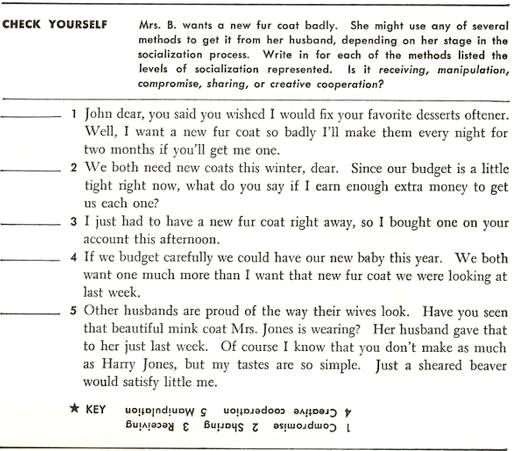
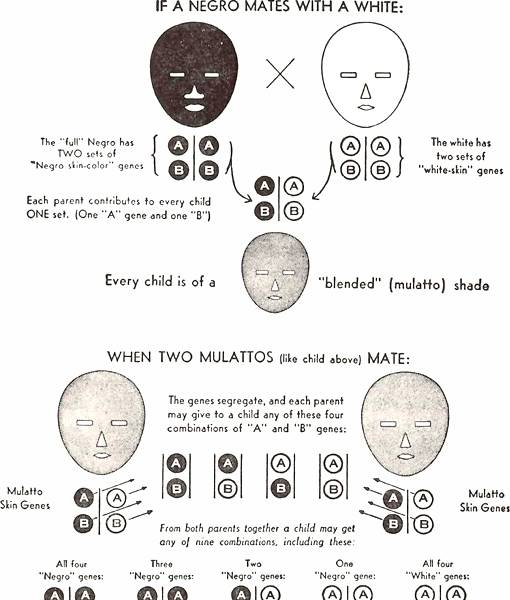
Exhibit (b): a letter written in 1956 to FBI director J. Edgar Hoover by the editor of a Catholic newspaper, concerning the moral threat posed to America's youth by a young singer named Elvis Presley:
But eyewitnesses have told me that Presley's actions and motions were such as to rouse the sexual passions of teenaged youth. One eye-witness described his actions as “sexual self-gratification on the stage," — another as “a striptease with clothes on." Although police and auxiliaries were there, the show went on. Perhaps the hardened police did not get the import of his motions and gestures, like those of masturbation or riding a microphone.
I do not report idly to the FBI. My last official report to an FBI agent in New York before I entered the U.S. Army resulted in arrest of a saboteur (who committed suicide before his trial). I believe the Presley matter is as serious to U.S. security. I am convinced that juvenile crimes of lust and perversion will follow his show here in La Crosse.
(via Boing Boing, MeFi) ¶ 1
2009/10/7
Wikipedia has a list of unusual deaths from antiquity to the present day. They range from examples of sadistic ingenuity (how much thought has been expended throughout history on inventing fitting tortures for those who shouldn't be allowed to die too painlessly?) and parables of the mighty undone by their folly, through to the inexplicable and the highly peculiar:
1410: Martin I of Aragon died from a lethal combination of indigestion and uncontrollable laughing.Death from uncontrollable laughter seems to be somewhat of a recurring theme. (Thomas Urquhart, incidentally, was an early proponent of a constructed universal language, and was a character in Andrew Drummond's excellent comic novel concerning the squabbles between utopian language proponents, A Handbook of Volapük.)
1599: Nanda Bayin, a Burman king, reportedly laughed to death when informed, by a visiting Italian merchant, that "Venice was a free state without a king."
1660: Thomas Urquhart, Scottish aristocrat, polymath and first translator of Rabelais into English, is said to have died laughing upon hearing that Charles II had taken the throne.
Other odd deaths, not involving uncontrollable laughter, include:
892: Sigurd the Mighty of Orkney strapped the head of a defeated foe to his leg, the tooth of which grazed against him as he rode his horse, causing the infection which killed him.Along similar lines: List of inventors killed by their own inventions.
1649: Sir Arthur Aston, Royalist commander of the garrison during the Siege of Drogheda, was beaten to death with his own wooden leg, which the Parliamentarian soldiers thought concealed golden coins.
1930: William Kogut, an inmate on death row at San Quentin, decided to commit suicide using only the rudimentary tools available to him in his prison cell. He began by tearing up several packs of playing cards, giving particular focus to obtaining pieces with red ink (at the time, the ink in red playing cards contained nitrocellulose, which is flammable and when wet can create an explosive mixture), and stuffed them into a pipe. He then plugged one end of the pipe firmly with a broom handle and poured water into the other end to soak the card pieces. He then placed the pipe on a kerosene heater next to his bed and placed the open end firmly against his head. The heater turned the water into steam and eventually enough pressure built up inside the pipe so that when it burst, the explosion shot out bits of playing cards with enough force to penetrate Kogut's skull, killing him. In a suicide note, Kogut stated that he and he alone should punish himself for his crimes. 1959: In the Dyatlov Pass incident, Nine ski hikers in the Ural Mountains abandoned their camp in the middle of the night in apparent terror, some clad only in their underwear despite sub-zero weather. Six of the hikers died of hypothermia and three by unexplained fatal injuries. Though the corpses showed no signs of struggle, one victim had a fatal skull fracture, two had major chest fractures (comparable in force to a car accident), and one was missing her tongue. The victims' clothing also contained high levels of radiation. Soviet investigators determined only that "a compelling unknown force" had caused the deaths, barring entry to the area for years thereafter.
2009/10/5
Two more institutions of 20th-century Britain celebrate their anniversaries this month. It was 40 years ago today that Monty Python's Flying Circus first aired on the BBC. And almost exactly ten years later, BBC Radio aired an odd little radio play titled The Hitchhiker's Guide to the Galaxy, which encapsulated a Pythonesque sense of absurdism, a now quaint view of post-WW2, pre-Thatcherite Britain, and visions of futuristic technologies that, seen from today, are at once uncannily prescient and jarringly cautious, in the way that yesterday's futurism tends to be:
Within this handy framework, the Hitchhiker stories make up a sort of folk-art depiction, like on a tribal carpet, of the late-1970s English middle-class cosmic order. So there he is, the hapless Arthur Dent, in the middle, his maths insufficient to grasp even the first thing about his current position, in a county in a country, on a continent on a planet, in a solar system, in a galaxy, and so on. (Even now, the only way I can get the hierarchy right is by referring to the products of Mars Inc.) Except that the universe, 1979-style, would have seemed different from the one we know, and don't know, today, with space travel, in the years between the Moon landings and the Challenger disaster, both current and glamorous-feeling in a way it certainly isn't now. Tomorrow's World went out on the BBC every Thursday; Carl Sagan's Cosmos went out in 1980; cool space-junk was everywhere, Star Wars and Close Encounters, Bowie and P-Funk and the Only Ones. Relativity and the space-time continuum, wormholes and the multiverse featured everywhere in science fact and fiction, and were easily bent and twisted into the sort of paradox at which Adams's mind excelled – the armada of spaceships diving screaming towards Earth, "where, due to a terrible miscalculation of scale, the entire battle fleet was accidentally swallowed by a small dog"; the Restaurant at the End of the Universe, where you can pay for dinner by putting 1p in a present-day savings account, meaning that "when you arrive at the End of Time . . . the fabulous cost of your meal has been paid for".
Except that the Guide wasn't just a literary device, a concept. It really was a "Book", a thing of plastic, an actual piece of tech. It looked, we are told, "rather like a largish electronic calculator" – as such a device would have had to look in the 1970s, before iPhones, Kindle, Ernie Wise's Vodafone. On it, "any one of a million 'pages' could be summoned at a moment's notice" – what, only a million?, 21st-century readers object.
But there's a definite tea theme, and a lot of Englishness, and a distinctive note of piscine melancholy: So Long, and Thanks for All the Fish; The Salmon of Doubt. If Adams's books were a domestic appliance, they'd be a Sinclair ZX80, wired to a Teasmade, screeching machine code through quadraphonic speakers, and there'd probably be a haddock in there somewhere, non-compatible and obsolete.I'm slightly disappointed that Google didn't put up a special commemorative logo.
2009/9/23
Details have emerged about the Soviet Union's nuclear "doomsday machine". Officially known as "Perimeter", but nicknamed "Mertvaya Ruka" ("Dead Hand"), this was a nuclear dead man's switch of sorts; a system which, when armed, could launch massive nuclear retaliation against the United States, even in the event of the entire Soviet nuclear command system having been wiped out in a first strike:
Perimeter ensures the ability to strike back, but it's no hair-trigger device. It was designed to lie semi-dormant until switched on by a high official in a crisis. Then it would begin monitoring a network of seismic, radiation, and air pressure sensors for signs of nuclear explosions. Before launching any retaliatory strike, the system had to check off four if/then propositions: If it was turned on, then it would try to determine that a nuclear weapon had hit Soviet soil. If it seemed that one had, the system would check to see if any communication links to the war room of the Soviet General Staff remained. If they did, and if some amount of time—likely ranging from 15 minutes to an hour—passed without further indications of attack, the machine would assume officials were still living who could order the counterattack and shut down. But if the line to the General Staff went dead, then Perimeter would infer that apocalypse had arrived. It would immediately transfer launch authority to whoever was manning the system at that moment deep inside a protected bunker—bypassing layers and layers of normal command authority. At that point, the ability to destroy the world would fall to whoever was on duty: maybe a high minister sent in during the crisis, maybe a 25-year-old junior officer fresh out of military academy. And if that person decided to press the button ... If/then. If/then. If/then. If/then.
Once initiated, the counterattack would be controlled by so-called command missiles. Hidden in hardened silos designed to withstand the massive blast and electromagnetic pulses of a nuclear explosion, these missiles would launch first and then radio down coded orders to whatever Soviet weapons had survived the first strike. At that point, the machines will have taken over the war. Soaring over the smoldering, radioactive ruins of the motherland, and with all ground communications destroyed, the command missiles would lead the destruction of the US.Perimeter is supposedly still operational (though, presumably, not armed at the moment, or at least one would hope not).
2009/9/17
 An article in Radical Philosophy (a journal of "socialist and feminist philosophy") looks at the phenomenon of those Keep Calm And Carry On posters, and what the reprinting and near-ubiquitous popularity of a WW2-era propaganda poster that was never originally released says about contemporary British society, alienation from the consumer-capitalist values of Thatcherism-Blairism, and a displaced longing for an imagined utopia of benign paternalistic bureaucracy and modernistic optimism that happened (as all golden ages happen) decades before those contemplating it were born.
Initially sold in London by the Victoria & Albert Museum, the poster only gradually became the middlebrow staple it is now when the recession, euphemistically the ‘credit crunch’, hit. Through this poster, the way to display one’s commitment to the new austerity was to buy more consumer goods, albeit with a less garish aesthetic than was customary during the boom. It is in a sense not so different to the ‘keep calm and carry on shopping’ commanded by George W. Bush both after September 11 and when the sub-prime crisis hit America – though the ‘wartime’ use of this rhetoric has escalated during the economic turmoil, especially in the UK. Essentially, the power of ‘Keep Calm and Carry On’ comes from a yearning for an actual or imaginary English patrician attitude of stoicism and muddling through, something which survives only in the popular imaginary, in a country devoted to services and consumption, and given to sudden outpourings of sentiment and grief, as over the deaths of celebrities like Diana Spencer or Jade Goody. The poster isn’t just a case of the return of the repressed, it is rather the return of repression itself, a nostalgia for the state of being repressed – solid, stoic, public-spirited, as opposed to the depoliticized, hysterical and privatized reality of Britain over the last thirty years. At the same time as it evokes a sense of loss over the decline of this idea of Britain and the British, it is both reassuring and flattering, implying a virtuous (if highly self-aware) stoicism in the displayer of the poster or wearer of the T-shirt.The article then mentions a number of other examples of related "austerity chic" or fetishisations of a more high-minded and public-spirited pre-Thatcherite idyll: celebrity chef Jamie Oliver's "Ministry of Food" concept, aesthetic references to Jan Tschichold' Penguin paperback covers, and plates printed with austerely clean images of 1930s Modernist buildings (which the author of the essay links to a reaction against the Blatcherite culture of high-Gini property speculation). One can add to this list a number of other icons. For example, on things like CD covers, the British Rail logo seems to have taken the place of the Mod RAF roundel as an insignia of retro cool, also referencing a pre-privatisation institution remembered more fondly in retrospect to its better-marketed, fare-gouging Blatcherite successors. Perhaps if Rupert Murdoch gets his way, we'll see hipsters wearing BBC logo badges in the not too distant future?
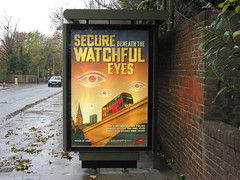 It's not all benign nostalgia for a kinder, gentler age, though: the article mentions a more sinister edge, from the police force's Keep Calm-esque "We'd Like To Give You A Good Talking To" posters (ironically juxtaposing an attention-grabbing tone of authoritarian brutality with a "caring"official message, which happened, as the author points out, near the harshly suppressed G20 protests) to Ken Livingstone's ironically Orwellian "Secure Beneath Their Watchful Eyes" posters, promoting the comprehensive surveillance society as a beneficial thing. (One is reminded of the "High Security Holiday Resort" posters in Terry Gilliam's Brazil.)
2009/9/11
Documents recently smuggled out of Moscow have revealed the chaos that immediately preceded and followed the collapse of the Berlin Wall and the Warsaw Pact regimes. In particular, it turns out that Margaret Thatcher, that heroine of freedom who reputedly stared down Communism and brought liberty to the East, actually flew to Moscow to press Gorbachev to stop the reunification of Germany, in the interests of stability.
“We do not want a united Germany,” she said. “This would lead to a change to postwar borders, and we cannot allow that because such a development would undermine the stability of the whole international situation and could endanger our security.”Thatcher wasn't alone in this; French President François Mitterrand was also vehemently opposed to German reunification and was even considering a military alliance with the USSR, under the guise of "fighting natural disasters" to shore up the Iron Curtain.
2009/9/10
Following a petition, British Prime Minister Gordon Brown has issued an posthumous apology to Alan Turing:
While Turing was dealt with under the law of the time and we can’t put the clock back, his treatment was of course utterly unfair and I am pleased to have the chance to say how deeply sorry I and we all are for what happened to him. Alan and the many thousands of other gay men who were convicted as he was convicted under homophobic laws were treated terribly. Over the years millions more lived in fear of conviction.
But even more than that, Alan deserves recognition for his contribution to humankind. For those of us born after 1945, into a Europe which is united, democratic and at peace, it is hard to imagine that our continent was once the theatre of mankind’s darkest hour. It is difficult to believe that in living memory, people could become so consumed by hate - by anti-Semitism, by homophobia, by xenophobia and other murderous prejudices - that the gas chambers and crematoria became a piece of the European landscape as surely as the galleries and universities and concert halls which had marked out the European civilisation for hundreds of years. It is thanks to men and women who were totally committed to fighting fascism, people like Alan Turing, that the horrors of the Holocaust and of total war are part of Europe’s history and not Europe’s present.Has Turing been posthumously pardoned (as, I believe, Oscar Wilde was)?
Recycle: Joy Division & New Order; a record collector by the name of DJ £50 Note and a friend of his who specialises in sound restoration have set out to do what Rob Gretton was planning to do before he died, i.e., put out definitive editions of New Order's entire Factory-period output, sounding exactly as the originals did (and not "remastered", i.e., compressed for extra attention-catching loudness, as is the standard commercial practice now). He is doing this as a MP3 (well, .m4a) blog, with each release accompanied by meticulously restored artwork (with elements redrawn and reset as needed), and comprehensive notes, in which, for example, we learn that the choir sound in Blue Monday was sampled from a Kraftwerk track and comes from an extremely obscure instrument called the Vako Orchestron, and that a number of New Order/Joy Division song titles are film references derived from old posters in a rehearsal space, as well as details of how far back they had to look to find a copy in which the dynamics hadn't been crushed to hell.
2009/9/7
An article in the Graun looks at how changes in telephone technology have affected the plots of novels, plays and films:
Victoria Wood's Talent, first staged in 1978 and now showing at the Old Laundry theatre in Bowness-on-Windermere, includes a scene in which an important call is made from a coin-operated phonebox. Wood, who is directing, had to explain to young members of the cast how the strange apparatus worked: listen for an answer, then push in your sometimes-resistant 10p pieces. It sounded like science fiction to the young actors. So, while the play's first audiences will have regarded this scene as social realism (perhaps reflecting on their own experiences of trying to finding an unvandalised phone that didn't spit your silver out), the same sequence, within three decades, has become social history.
In Pedro Almodóvar's latest movie, Broken Embraces, which cuts from the present to the 1980s, the director uses mobiles as a visual clue to where we are. The older sequences are signalled by the wielding of brick-like instruments, while present-day characters effortlessly palm their thin, flippable devices.
Wood, in Talent, rings comic embarrassment from the fact that a character's mother has an extension in her bedroom. But the detail is revealing in other ways: in the 1970s, multiple receivers in the home distinguished the upper-middle classes from the plebs who had a single instrument in the hallway. In a later TV play by Wood, it matters that a character has a "kitchen extension". Indeed, in Dial M for Murder, the "perfect murder plot" turns on luring a woman to the living room to answer the phone. Within 20 years, Knott's plot had been rendered a period piece by multi-phone homes; after a further 30, mobiles had made the plot absurd.
But, although mobiles have provided writers with rich new storylines, they have also worryingly closed off many traditional developments. This is of most concern to authors of horrors, thrillers and mysteries, in which a regular premise is the protagonist's total isolation. If there had been a Nokia in Janet Leigh's handbag, Hitchcock's Psycho would have been a short film with a happy ending. The avoidance of this problem has already created a new movie cliche: the closeup showing the "no signal" warning on the star's phone.
2009/9/6
The BBC News Magazine has a piece on how the Beatles acquired a devoted illicit following in the Soviet Union, arguably helping to undermine the legitimacy of the Communist system:
Collarless Beatles jackets, known as "Bitlovka", were assembled from cast-offs; clumsy army boots were refashioned in Beatles style. And with much of the Western media blocked out, bizarre Beatles myths blossomed.
Yuri Pelyushonok recalls hearing at school how "the English Queen gave John Lennon a Gold Car; but the Beatles had to play in cages to avoid their fans".
The most persistent myth was that the Beatles had played a secret concert at a Soviet airbase on their way to Japan. Everywhere, fans claimed it happened close to them.
2009/8/20
Melbourne music critic Andy Hazel takes apart The Beatles' Sgt. Pepper's Lonely Hearts Club Band:
Ah. "The best". According to most modern rock historians this is the greatest album ever released (give or take the odd Pet Sounds, Dark Side Of The Moon, or, if last year's BBC poll is to be believed, Oasis's Definitely Maybe). Genre-redefining, archetypal, seminal, analysed to death and hyped to maniacal lengths by fans and writers; anybody who wonders where modern rock begins is told to start here. Sgt. Peppers has been long-heralded as the last example of the band working like a team, as the pinnacle of The Beatles' musical talents, song-writing abilities and the last example of unclouded communication between the members. It's the supreme model of analogue recording by pioneering producer / genius / 5th member George Martin and an album still mined by bands claiming to be representative of today's youth - if you want to be a musical success, start studying here. This is it, the first and best 'concept album' and the greatest collection of songs ever committed to vinyl or etched into disc, end of story.
Bollocks.
This overblown testament to pomposity and slackly-edited grandiosity is a mockery of music and self-indulgence almost without exception. With George Martin at your side, a record label kowtowing to any whim, tens of millions of people agreeing with every grunt and suggestion you make and Abbey Road at your disposal, how could you blow it? Even The Beatles themselves realised how far up their own arses they had crawled by going back to basics for their following, untitled and infinitely superior album (later called The White Album). Take, for example, the ridiculously egotistical cover in which they place themselves amongst and ahead of Albert Einstein, Aldous Huxley, Karlheinz Stockhausen and Marlon Brando in some visual assessment of the 20th Century they had to be talked into doing (McCartney preferring an acid-drenched picture by Dutch art collective The Fool). It wasn't for nothing that one of their manager's last requests was "brown paper bags for Sergeant Peppers".Hazel goes on and builds up a formidable list of charges against Sgt. Pepper's: from the hubris of the album's cover to the unenlightenedly misogynistic way women are objectified where they are actually visible, though coming back to the insubstantial, drug-addledly vacuous nature of the "innovation" on the album, and The Beatles' (and their label's) complicity in ushering in a leaden age of bloated, self-indulgent pomp that would only end almost a decade later, when the Sex Pistols poured petrol on the whole thing and, with a sneer, threw a lighted match:
While it's true the Beatles couldn't be blamed for who followed through the door they opened, they can be seen as the instigators of record companies handing over huge amounts of money to artists and (more often than not) managers using arguments along the lines of "well the Beatles needed 129 days and 10 times the usual budget to make a number one record, so do we." The nadir of 1970s self-indulgence was, in fact, a misguided reinterpretation of this album in film and soundtrack form featuring The Bee Gees, Peter Frampton and, mysteriously, George Martin a debacle that was deservedly, an unmitigated flop.
2009/7/30
The BBC is making a TV "comedy drama" about the rivalry between the ZX Spectrum and the BBC Micro. Or, more precisely, between their makers. The working title is "Syntax Era", and it will start Martin "Arthur Dent" Freeman as the BBC Micro's creator, Chris Curry.
2009/7/9
Today's Wikipedia featured article is about an old English street name:
Gropecunt Lane (pronounced /ˈɡroʊpkʌnt ˈleɪn/) was a street name found in English towns and cities during the Middle Ages, believed to be a reference to the prostitution centred on those areas; it was normal practice for a medieval street name to reflect the street's function or the economic activity taking place within it. Gropecunt, the earliest known use of which is in about 1230, appears to have been derived as a compound of the words "grope" and "cunt".[1] Streets with that name were often in the busiest parts of medieval towns and cities, and at least one appears to have been an important thoroughfare.
Although the name was once common throughout England,[2] changes in attitude resulted in it being replaced by more innocuous versions such as Grape Lane. Gropecunt was last recorded as a street name in 1561.There are currently no streets named Gropecunt Lane in England, them all having been renamed to things like Magpie Lane, Grape Lane, or in some cases, Grope Lane (attributed by the prudish to the narrowness and darkness of the street, not to any untoward activity having taken place there). Perhaps the time has come for a campaign to undo these shameful acts of vandalism and restore this piece of English history?
2009/6/24
The British Psychological Society's journal, The Psychologist, has a fascinating article about outbreaks of mass hysteria and "dancing plagues" in the Middle Ages:
The year was 1374. In dozens of medieval towns scattered along the valley of the River Rhine hundreds of people were seized by an agonising compulsion to dance. Scarcely pausing to rest or eat, they danced for hours or even days in succession. They were victims of one of the strangest afflictions in Western history. Within weeks the mania had engulfed large areas of north-eastern France and the Netherlands, and only after several months did the epidemic subside. In the following century there were only a few isolated outbreaks of compulsive dancing. Then it reappeared, explosively, in the city of Strasbourg in 1518. Chronicles indicate that it then consumed about 400 men, women and children, causing dozens of deaths (Waller, 2008).
Not long before the Strasbourg dancing epidemic, an equally strange compulsion had gripped a nunnery in the Spanish Netherlands. In 1491 several nuns were ‘possessed’ by devilish familiars which impelled them to race around like dogs, jump out of trees in imitation of birds or miaow and claw their way up tree trunks in the manner of cats. Such possession epidemics were by no means confined to nunneries, but nuns were disproportionately affected (Newman, 1998). Over the next 200 years, in nunneries everywhere from Rome to Paris, hundreds were plunged into states of frantic delirium during which they foamed, screamed and convulsed, sexually propositioned exorcists and priests, and confessed to having carnal relations with devils or Christ.The article examines these phenomena, dismissing various theories (such as them being caused by ergotism, or the consumption of bread contaminated with hallucinogenic mould), and makes the case that they were culture-bound psychogenic illnesses, enabled by accepted beliefs about the supernatural and triggered by stress:
Similarly, it is only by taking cultural context seriously that we can explain the striking epidemiological facts that possession crises so often struck religious houses and that men were far less often the victims of mass diabolical possession. The daily lives of nuns were saturated in a mystical supernaturalism, their imaginations vivid with devils, demons, Satanic familiars and wrathful saints. They believed implicitly in the possibility of possession and so made themselves susceptible to it. Evangelical Mother Superiors often made them more vulnerable by encouraging trance and ecstasy; mind-altering forms of worship prepared them for later entering involuntary possession states. Moreover, early modern women were imbued with the idea that as the tainted heirs of Eve they were more liable to succumb to Satan, a misogynistic trope that often heightened their suggestibility.
Theological conventions also conditioned the behaviour of demoniac nuns. This is apparent from the fact that nearly all possession epidemics occurred within a single 300-year period, from around 1400 to the early 1700s. The reason is that only during this period did religious writers insist that such events were possible (Newman 1998). Theologians, inquisitors and exorcists established the rules of mass demonic possession to which dissociating nuns then unconsciously conformed: writhing, foaming, convulsing, dancing, laughing, speaking in tongues and making obscene gestures and propositions. These were shocking but entirely stereotypical performances based on deep-seated beliefs about Satan’s depravity drawn from religious writings and from accounts of previous possessions. For centuries, then, distress and pious fear worked in concert to produce epidemics of dancing and possession.The article concludes with examples of modern occurrences of such phenomena, from the rather feeble examples (such as epidemics of fainting) one could find in a materialistic post-Enlightenment society to "spirit possession" among factory workers drawn from rural communities in Malaysia and Singapore, to delusions of penis-stealing witchcraft in western Africa.
2009/6/8
Did you ever wonder where that musical riff used in popular songs to signify the Far East (typically China or sometimes Japan; think Kung Fu Fighting/Hong Kong Phooey/International Karate) came from? this guy did, and did a fair amount of research:
Anyway, the author of the site, Martin Nilsson, has compiled evidence of the Oriental Riff and its earlier predecessors going as far back as 1847.
The little ditty above is what I call "the musical cliché figure signifying the Far East."
I would venture that a majority of music-culturally aware people would agree that there is such thing as "the stereotypical Chinese (or more generally Asian) riff." Most of them would also agree that the "canonical" form of it is the one notated above, typically instrumented with some kind of squeaky wind instruments playing in a pitch at least higher than middle C, and with some ticking-sounding rhythm instrument underlining the rhythm.
2009/6/6
Today's Google title graphic:
Apparently today is the 25th anniversary of the invention of Tetris, perhaps one of the most concise (not to mention enjoyable) statements of existentialism embodied in interactive form. (In Tetris, there are no goals, no new worlds to explore, foes to vanquish, princesses to rescue or other paraphernalia, just the ceaseless, Sisyphean struggle against an inexorable, impersonally hostile universe, from which the only respite is your inevitable death.) Tetris also gave its name to a hallucinatory condition often triggered by playing it for a prolonged period.
Perhaps coincidentally, one of the inventors of Tetris now lives in Sydney and works at Google, and is involved in the Google Wave project.
2009/6/2
The Dadaist/Surrealist artist Marcel Duchamp was best known for his "ready-mades"; mundane, mass-produced objects recontextualised into art by virtue of being presented as such. Duchamp's ready-mades were shocking at the time, challenging what "art" was, and paved the way for the conceptual artists of the 20th century. Now, however, an artist named Rhonda Roland Shearer claims to have the proof that the ready-mades weren't; that, far from picking up manufactured items and effortlessly transforming them into "art", Duchamp actually went to considerable effort to produce objects which were almost—but not exactly—identical to mass-manufactured objects. Shearer supports her thesis with research into the practicality of these items, or minor differences between them and the manufactured goods they were purported to be.
Duchamp's readymade glass ampoule, which he named ''50 cc of Paris Air,'' is larger than any that would have been readily available to pharmacists. (And she has a tape of a man from Corning Glass saying so.)
The readymade snow shovel, which now exists only in photographs and replicas, ''would hurt your hand'' if you tried to use it, Ms. Shearer says, because it has a square shaft. And it doesn't have the normal reinforcements to keep it from breaking. (She has hired people to make her a snow shovel like Duchamp's and use it until it breaks.)
There is more: the bird cage is too squat for a real bird, the iron hooks in the photograph of the coat rack appear to bend in an impossible position, the French window opens the wrong way, the bottle rack has an asymmetrical arrangement of hooks and the urinal is too curvaceous to have come from the Mott Iron Works, where Duchamp said he bought it.If Shearer's thesis holds, it implies a staggering degree of foresight on the part of Duchamp. Common knowledge has him and the rest of the Dada movement as iconoclasts, concerned with upsetting the bourgeois orthodoxies of art; the punk rockers of the period, if you will. If Duchamp painstakingly crafted these objects, designing them to be almost indistinguishable from the real things, he was more akin to a virtuoso composer meticulously arranging combinations of three guitar chords and energetically pounded drums, with obsessive precision, into the right sort of chaos so that it has the right sort of enthusiastic artlessness and naïveté to sound like a bunch of angry youths with no musical training playing the instruments.
And precision is the key; if Shearer is correct, Duchamp would have had to get it exactly right. The objects would have to look sufficiently ready-made to fool the audiences (and the tutting commentariat, whose outrage was the punchline of the joke) of the day. And yet, the fact that he laboured on building shovels and urinals rather than buying some from the local ironmonger's suggests that he had in mind a secondary audience, in the distant future, who would piece together what he had done; in other words, his artefacts wouldn't be fully appreciated until long after the initial wave of Dada, an possibly long after his death. Unless, of course, he meant, and failed, to get the details exactly right, producing artefacts indistinguishable from ones he could have just bought except to himself, in which case his motives would be even more mysterious.
2009/5/30
Two fragments of the secret history of the Cold War have come to light. In 1969, US President Nixon sent a squadron of nuclear bombers towards the Soviet Union, and instructed Kissinger to tell the Soviets that Nixon was "out of control", leading them to believe that they're dealing with a dangerous madman, in order to scare them into leaning on the North Vietnamese government.
Apparently neither Nixon or Kissinger had absorbed another Schelling insight - if you want to credibly pretend you are out of control then you have to push things so far that sometimes you will be out of control. The number of ways such a plan could have resulted in a nuclear war is truly frightening. After all, Nixon was gambling millions of lives on the Soviets being the rational players in this game.Fortunately, the Soviets didn't call his bluff and civilisation as we know it still stands.
Meanwhile, it turns out that the West German policeman who shot dead an unarmed left-wing demonstrator in West Berlin in 1967, touching off riots and enraging the protest movement, had been working for the Stasi.
The most insidious question raised by the revelation is whether Mr. Kurras might have been acting not only as a spy, but also as an agent provocateur, trying to destabilize West Germany. As the newspaper Bild am Sonntag put it in a headline, referring to the powerful former leader of the dreaded East German security agency, Erich Mielke, “Did Mielke Give Him the Order to Shoot?”
In an interview with the Bild, Mr. Kurras, 81, confirmed that he had been in the East German Communist Party. “Should I be ashamed of that or something?” Mr. Kurras was quoted as saying. As for the Stasi, he said, “And what if I did work for them? What does it matter? It doesn’t change anything,” the paper reported.
(via MeFi, Boing Boing) ¶ 2
2009/5/3
The Fortean Times has an article looking at the story of Russia's lost cosmonauts. The story goes that, before Yuri Gagarin was successfully launched into space, the USSR sent several earlier cosmonauts up there, without success. The men (and one woman) perished, and the USSR, more concerned with collective prestige than individual human lives, obliterated all record of them from the historical record. Or almost all record; two boys in Italy managed to record their transmissions, in which they gasped for breath, complained of heat and cursed the designers of their spacecraft. The boys apparently managed to avoid being assassinated by the KGB solely by having gotten too much publicity.
2009/4/21
Der Spiegel has some evocative photographs from East Germany, taken by West German photographer Karlheinz Jardner in 1990, not long after the wall came down. It includes shots of room interiors frozen in the perpetual 1970s of the DDR, dilapidated provincial cities with Trabants, more Trabants, luxury hotels reserved for the Communist Party elite, dilapidated seaside resorts, cheerful urchins with piles of coal, uninspiring consumer goods and symphonies of grey; some glimpses of a parallel world, just before it disappeared.
And here is a Fortean Times piece on "The Ghosts of East Berlin".
2009/3/24
In the recent fashion issue of VICE Magazine, the inimitable Lord Whimsy has an article about bizarre and grotesque fashions from throughout history. While it's not written in the same ornate style as his Affected Provincial's Companion, it is, as one would expect, a veritable wunderkammer of the outré, containing not only the obvious examples (foot-binding, scalping, German duelling scars, the various status arms races among idle aristocrats), but a number of more obscure and peculiar practices:
Some fashions were the result of indifference. A good example of this is the Polish plait, which was a crusty, oily mass of filthy, matted hair. Often as hard as a helmet, it was a tangled mess held together by dried blood, dirt, dead lice, and pus. Generally, Polish plaits were the result of neglect, but they could also be brought on by particularly nasty lice infestations, in which spent eggs would act as a kind of mortar.
High-ranking Italian noblemen of the 14th century took up the fashion of wearing tunics short enough to reveal their testicles. Those who felt insecure about their heft would often wear a leather falsie known as a braquette. It’s doubtful that this was intended to fool anyone. It may have been done for the same reasons female pharaohs wore false beards: It was a symbol of power and potency. Like a crown, but hairier.Wasn't the Scottish sporran originally intended to achieve the same effect?
In many societies, it was (and in some places still is) fashionable to intentionally contort the body into strange shapes. Perhaps the most notable example was the surprisingly widespread practice of head binding, which involved wrapping an infant’s pliable head in a tight cloth or between two boards until it elongated and assumed a conical shape, which was deemed very attractive, as well as a sign of intelligence. The brain would simply adapt to the shape of the skull, so apparently no damage would occur, but it does make one wonder whether changing the shape of the brain case also changed the way that the brain functioned. Did it affect vision? Memory? The ability to think about wide objects?
Some fashions compensated for disfiguring medical conditions. Eighteenth-century Europe was a time of unprecedented artifice in fashion—people in the upper classes were essentially ambulatory theater sets, dripping with props. Makeup was caked on to smooth out their smallpox-ravaged faces. They would even try to smooth out their features from the inside as well: Most people lost their teeth at a shockingly young age, and as a result their cheeks would cave in. To counter this, they used small lumps of cork, called plumpers, which were stuffed into their cheeks. This affected the way they spoke, which soon became fashionable, even among those who still had teeth.Could this be how various accents typically considered to be "posh" or aristocratic came to be? One could imagine, for example, the sorts of rarefiedly aristocratic English accents one only typically hears on stage or in old films having come about as an imitation of wearing bits of cork in one's cheeks.
(via  lord_whimsy) ¶ 0
2009/3/18
The Pet Shop Boys' Neil Tennant enumerates the greatest people in British history in an interview with Johnny Marr for the Graun:
In the 20th century, looking at the people who changed the way we think, it would be the guy who designed the Apple computer, who's British, Jonathan Ive. The Beatles changed the world, as did the Rolling Stones and David Bowie. The Beatles' impact is possibly greater than Winston Churchill's. Before that, you might have the committee that translated the Bible because they created, more than Shakespeare, a musical kind of language that was probably one of the things that made us a musical country. And I would say Gilbert and Sullivan. So much modern British music has come from Gilbert and Sullivan. You could even say that rap music comes from that, with an incredible emphasis on rhyme and rhythm.
2009/3/7
Idea of the day: The Trough of No Value, an idea peripherally related to Momus' anxious interval, only for material items rather than trends:
The problem is that many kinds of objects go through a period in their potential lifespans when they don't "pencil out"—they're not worth keeping or preserving because they're not worth any money.
My favorite example of the Trough of No Value comes from a former acquaintance whose back room had a high, narrow shelf running all the way around it, about a foot below the ceiling. Arrayed on the shelf were dozens of kids' lunchboxes from the 1950s and '60s. He told me that not only are such lunchboxes collectible now, but that they're actually fairly hard to find. Time was, of course, when most every schoolkid had a little metal lunchbox (poor kids "brown-bagged it"). But the kids grew up, the school lunch program got started, and who wanted to keep old lunchboxes around? They weren't useful any more. They weren't worth anything. And, since they were almost all used for their intended purpose, many were damaged or worn by use (I vaguely remember owning one that was rusty and had a dent). People naturally threw them away. The "trough of no value" for lunchboxes was long and harsh. That's why they're not so common today as you might guess—because not that many made it through the trough.
That's why "being famous" is a great way to preserve your work—because value is the #1 preservative for old objects. But want to know another? Craftsmanship. One of the great hazards of survival through time is the lack of a market and a lack of trade value, but another is simply shoddiness. (I have to chuckle whenever I read yet another description of American frontier log cabins as having been well crafted or sturdily or beautifully built. The much more likely truth is that 99% of frontier log cabins were horribly built—it's just that all of those fell down. The few that have survived intact were the ones that were well made. That doesn't mean all of them were.) It's not just that things that are poorly made deteriorate more readily, it's also that they signal their own worthlessness. Or, in the case of an archive of photos, they might actually hide their own worth. I have in mind making a book of my best 35mm black-and-white pictures, for instance, and I have it in my head which pictures would be included. But if I get hit by a bus tomorrow, nobody will ever be able to extract that book out of the great motley of my hither-and-yon mess of negatives.
2009/2/20
I have just been catching up with some blogs, and have found, in Momus' blog, an interesting taxonomy of recent pop-cultural history:

The anxious interval: The anxious interval is the recent past. It's long enough ago to feel not-contemporary, but not long enough ago to feel utterly removed. It's at an uncomfortable distance, which is why I call it "anxious". You could think of the anxious interval as the temporal equivalent of the uncanny valley, that place where robots are similar enough to us to give us an uncomfortable shudder. You could also say the anxious interval is a place, a style, a set of references we avoid, repress, sublimate, have selective amnesia about, stow away, throw out, deliberately forget.
An example: Devendra Banhart and the scene that was called Freak Folk or New Weird America. The Wire magazine cover feature on New Weird America dates from August 2003. By April 2005 the San Francisco Chronicle is telling us that Freak Folk Flies High. By June 2006 the New York Times is telling its readers that "a music scene called freak folk is bursting up from underground" but adding that "it looked like a trend of the moment a couple of years ago". By 2009, it's safe to say that a reference to Freak Folk would be more likely to puncture your credibility than bolster it. Freak Folk is in "the anxious interval".
The goldmine is the cultural era the present is currently reviving. I've put a picture of Buggles, because in general we're reviving the 80s at the moment. You know, the guy from Hot Chip wears Buggles-like glasses, and so on. The goldmine is a goldmine for people who run secondhand clothes stores and have lots of stock from the requisite era, or people who are selling synths from that era, or people who've got a bunch of cheap Chinese Ray Ban copy frames. The smartest people in the present are remembering the goldmine and sifting through its waters like a crowd of panhandlers.
The battlefront is the area right at the edge of the goldmine -- the place where the acceptable and lucrative revival era meets a time which is currently repressed, neglected, and a-slumber. What's so interesting about the battlefront is that the process of reassessment is so visible here, and the revaluation is so daringly and consciously done. An elite of taste-leaders and taste-formers unafraid of ridicule are hard at work here, foraging for bargains, bringing an unacceptable era into fresh acceptability. There's a kind of shuddering repulsion for long-neglected, long-repressed artifacts, and yet something compellingly taboo about them. Their hiddenness makes them fascinating -- it's as if their very sublimation has given these cultural objects some kind of big power over our unconscious. The best curators and fashionistas are to be found at the battlefront, battling for the fascinating-repellant things they find in that twilit zone between acceptability and unacceptability.
2009/1/28
A retired Australian police detective has claimed that anti-monarchists attempted to assassinate the Queen in 1970, by derailing her train in a cutting near Orange, New South Wales with a log.
They had been aware of the service's schedule and had managed to avoid a "sweeper" locomotive that passed through the area a short time before.
But the log failed to derail the train carrying the royal party and became stuck under its front wheels, bringing the train to a stop at a level crossing.Det. Supt. Cliff McHardy (retired) was involved in the investigation of the incident, but was hampered by a ruling keeping the incident secret. To this day, it's not clear who was behind the plot; in fact, their description as "anti-monarchists" seems more tautological than anything else. (It could have been anyone. One of various flavours of Communists, perhaps, or some fifth-generation Irish-Australian still angry about the potato famine, or some troubled individual just wanting to make the mind control rays stop, or perhaps none of the above.)
2008/12/22
Tom Ellard, adopting the persona of an archæologist from the distant future, points out an interesting historical phenomenon of the late 20th century:



“The gap” is a mysterious incident in the late twentieth century in which a wild change in commonly reproduced artworks came and went in as little as a decade. What we believe to be religious inscriptions on popular artefacts changed very quickly from ornate painted works to extremely simple combinations of letter shapes in bold colours. These were soon discarded and just as quickly poor copies of the original artwork were reintroduced.
2008/12/21
Senior Catholics in Scotland are claiming that the old song Hokey Cokey was written to mock the Catholic mass, and singing it could fall foul of hate crime laws:
Peter Kearney, a spokesman for Cardinal Keith O’Brien, leader of the Catholic church in Scotland, said: “This song, although apparently innocuous, was devised as an attack on and a parody of the Catholic mass.”
According to the church, the song’s title derives from “hocus pocus”. The phrase is said to be a Puritan satire on the Latin “hoc est enim corpus meum”, or “this is my body”, used by Catholic priests to accompany the transubstantiation during mass.
2008/11/12
The Independent talks to the kid who was the baby on the cover of Nirvana's Nevermind. He is Spencer Elden, now 17; his parents were paid $200 for the photo in 1991, though he has since had other record cover work, and has recently recreated the cover, this time wearing shorts.
Spencer, for his part, says the record helped bring about a typically choppy adolescence. He grew up with a platinum copy of Nevermind hanging on his bedroom wall and once confessed, in moments of hormonal frustration, to using the chat-up line "You want to see my penis again?" at teenage discos.
Last year, he was sent to a military boarding school to correct what his parents have described as a tendency to test authority. He's now hoping to either enrol at West Point Military Academy, or a local art school.
2008/9/3
In December 1969, a young man from the south of England decided, under the influence of kitchen-sink films, to go to the North with his camera and capture the stark beauty of the old North on film before it disappeared forever. Some decades later, he got a Flickr account, scanned his photos and posted them here. Most of them are in black and white, and many are quite beautiful, in a somewhat bleak, sparse sort of way.
The photographs, which are generally beautifully shot, are accompanied by the photographer's descriptions of the scenes, in which he laments the passing of the old grim north, and the Southernisation of England, with the arrival of things such as pebbledash, holidays to Florida and even the Clean Air Act. Which does at times seem somewhat problematic; I suspect that the residents of Moss Side or St. Helens would quite happily sacrifice the bleak poignancy of their streetscapes for holidays in the sun and indoor lavatories (not to mention not dying prematurely from the effects of air pollution), though other pieces (such as this one about lost opportunities for childrens' play and this lengthy meditation on fleeting experience and the beauty in the mundane are simply sublime.



2008/8/26
 The Age has a piece on the Goggomobil. The original was a microcar built in 1950s West Germany by a Bavarian company which first ventured into motor scooters (hence, presumably, the pseudo-Italianate name). It is known in Australia because a local businessman managed to obtain a licence to make them locally (as there were severe tariffs on imported cars at the time), substituting a fibreglass body for the metal one. The diminutive, independently made car, which looked like a jellybean and supposedly drove quite well, did quite well in Australia for a few years in the mid-1950s, until competition from the Morris Mini killed it. Though most Australians only have heard of it because of a television ad for the Yellow Pages phone directory mentioned it.
2008/8/6
There's an intriguing article in the Guardian about the descendents of German Nazis who converted to Judaism and moved to Israel. The article interviews several such converts (the son of a SS man who's an Orthodox rabbi, a left-wing lesbian campaigner for Palestinian rights, and a professor of Jewish Studies who is related to Hitler, and who describes his (Israeli-born, Arab-hating) son as a "fascist").
One somewhat obvious explanation for this phenomenon is that of assuagement of guilt by rejecting the oppressor population one came from identifying with the victims, and this explanation is floated by an expert on the psychology of the children of perpetrators. Interestingly, though, none of those interviewed, when asked for why they converted to Judaism, mention the Holocaust or Nazism, instead giving theological reasons:
"During my theological studies at university it became clear that I couldn't be a minister in the church," he says. "I concluded that Christianity was paganism. One of [its] most important dogmas is that God became man, and if God becomes man then man also can become God." He pauses. "Hitler became a kind of god."
I tell Bar-On they talk obsessively about the Trinity. But is incredulity really a reason for abandoning a religion with a three-in-one god for one that still believes bushes talk and that waves are parted by the will of God? "That is another way of saying what I have already told you," he says. "They want to join the community of the victim. They may have their own way of rationalising it."
2008/8/1
In the wake of Starbucks' Napoleonically epic retreat from Australia, The (Melbourne) Age has a piece on Melbourne's indomitable coffee culture, which apparently goes back long before mass Italian immigration in the 1950s and the resulting espresso boom:
In his entries on coffee and coffee palaces in the Encyclopedia of Melbourne, [historian Andrew Brown-May] retells the beginnings of Melbourne's coffee culture, traced back to the street stalls of the 1850s that offered caffeine hits to rushed city workers, then re-emerging as continental coffee houses in the interwar years of the 1920s and 1930s.
By the 1950s, the influx of Italian migrants had helped redefine coffee for Melbourne once again, serving it up in espresso cups instead of percolators. Yet two of the key proponents of the espresso bar were father and son team Harry and Peter Bancroft, Anglo-Australians who in 1953 secured the rights to manufacture Gaggia coffee machines and set up a cafe in St Kilda.I didn't know that they actually made Gaggia machines in Australia. You learn something new every day.
The article then points out that narratives framing the vanquishment of Starbucks in simple plucky-Aussies-vs.-Yankee-imperialists terms aren't entirely accurate; rather, it's a case of Starbucks sowing the seeds of their own defeat by not acknowledging that the café-culture experience they were trading on is essentially one of differentiation from the mainstream, and that a Starbucks in every suburban shopping mall destroyed a lot of the cachet behind the brand; it's the "nobody goes there anymore; it's too crowded" phenomenon that poisons cultural trends (from musical genres to fashions—think the trucker hat, the "Hoxton fin" haircut, or anything labelled "indie" in the UK) as soon as they become successful.
Writing in The Christian Science Monitor, Temple University historian Bryant Smith argues that when Starbucks began, it offered Americans an entree into a status-filled world with is own language of ventis, grandes, Tazo teas and special-blend coffees, all stamped with the company's distinctive green logo.
But by becoming too common — Starbucks first opened in Australia in 2000 and expanded to 84 stores in eight years — the company "violated the economic principles of cultural scarcity", Smith says.One cause, of course, doesn't exclude the others. Starbucks never became the all-conquering juggernaut in Australia it became elsewhere, due to the sophisticated local coffee culture, and while its recent misfortune has been global, it would have hit particularly hard in a relatively inhospitable market such as Australia.
2008/7/18
A previously unknown cache of audio recordings made by BBC Radiophonic Workshop composer Delia Derbyshire has come to light. The tapes, recorded in the 1960s, include a sketch for a documentary score, using cut-up fragments of Derbyshire's voice as an oboe-like instrument. Most interesting, though, is a fragment, introduced by Derbyshire as "for interest only", consisting of a few bars of glitchy electronic beats in 5/4 time, with a pad sound. (The fact that all this was made without synthesisers as we know them, but with purpose-built arrangements of circuits, makes it even more impressive.) The fragment sounds like modern IDM; if someone told you it was a Warp release from the 1990s, you'd believe it. The world of the late 1960s, though, wasn't ready for IDM, hence Derbyshire's dismissal of it.
"I find it spell-binding," says Hartnoll. "I've got a shedload of synthesizers and equipment, whereas Delia Derbyshire got out of the Radiophonic Workshop when synthesizers came along. I think she got a bit disheartened and a bit bored with it all when the synthesizer came along and it all became a little too easy."
2008/6/17
The New York Times has a piece on the works of Paul Otlet, a Belgian who, between the late 19th century and World War 2, invented early forms of hypertext, search engines, the semantic web and even social software. Of course, not having digital computers to work with, his "Mundaneum" had a vaguely Terry-Gilliam's-Brazil quality about it, relying on telegraphs, vast numbers of index cards, armies of clerks and analogue terminals referred to as "electric telescopes".
The government granted them space in a government building, where Otlet expanded the operation. He hired more staff, and established a fee-based research service that allowed anyone in the world to submit a query via mail or telegraph — a kind of analog search engine. Inquiries poured in from all over the world, more than 1,500 a year, on topics as diverse as boomerangs and Bulgarian finance.
Since there was no such thing as electronic data storage in the 1920s, Otlet had to invent it. He started writing at length about the possibility of electronic media storage, culminating in a 1934 book, “Monde,” where he laid out his vision of a “mechanical, collective brain” that would house all the world’s information, made readily accessible over a global telecommunications network.Alas, when the Nazis took Belgium, they destroyed most of what he had achieved and he died a broken man, all but forgotten until a graduate student found what remained of the Mundaneum in 1968. 10 years ago, a museum dedicated to Mr. Otlet's singular vision was established:
The archive’s sheer sprawl reveals both the possibilities and the limits of Otlet’s original vision. Otlet envisioned a team of professional catalogers analyzing every piece of incoming information, a philosophy that runs counter to the bottom-up ethos of the Web.
Just as Otlet’s vision required a group of trained catalogers to classify the world’s knowledge, so the Semantic Web hinges on an elite class of programmers to formulate descriptions for a potentially vast range of information. For those who advocate such labor-intensive data schemes, the fate of the Mundaneum may offer a cautionary tale.
2008/5/14
Things __ People Like + Democrat sympathies = Things younger than Republican Presidential candidate John McCain. Includes entries for things like nylon, Helvetica, The Grapes of Wrath, the Golden Gate Bridge, Kodachrome, both of Barack Obama's parents and various other notably old and cranky politicians.
And, via the Helvetica entry, various designers weigh in on McCain's use of the Optima typeface. The usual things come up (Optima being a bet-hedging typeface, the use of a bold weight outweighing any elitist connotations of the regular weight, Optima's association with the dental profession, and, of course, its resemblance to the inscriptions on the Vietnam War Memorial), but most interesting was type designer Matthew Carter's claim on how Optima McCain's choice of running mates:
I set the possible names in a bold weight of Optima caps and certain things became clear. HUCKABEE looks awkward in Optima, and ROMNEY is afflicted with the same difficult ‘EY’ combination that has plagued the current vice presidency. Perhaps because Optima is a German typeface, the word SCHWARZENEGGER looks predictably good.
Although it’s German, Optima took its inspiration from Quattrocento inscriptional lettering in the cathedrals of Florence and Siena, which may explain why GIULIANI looks so simpatico. In the end, however, my research suggests that the optimal running mate — so long as you don’t have to typeset her first name — is RICE.Is typography destiny?
2008/5/7
The head of the San Diego branch of the Republican Party has been revealed to be none other than the founder of videogame cracking ring Fairlight, who were responsible for a large proportion of the pirated Commodore 64 games in circulation. Tony Krvaric, was born in Sweden of Croatian parents but emigrated to the US in 1992 to escape the stifling constraints of social democracy, co-founded Fairlight in 1987, going by the handle "Strider". Even back then, Krvaric was known for his right-wing politics, and included the motto "Kill a commie for Mommy" in bragging screens on cracked titles he released.
2008/4/30
The International Herald Tribune has an interesting summary of the impact of 1968's upheaval on France, its society and politics:
May 1968 was a watershed in French life, a holy moment of liberation for many, when youth coalesced, the workers listened and the semi-royal French government of President Charles de Gaulle took fright. But for others, like the current president, Nicolas Sarkozy, only 13 years old at the time, May '68 represents anarchy and moral relativism, a destruction of social and patriotic values that, he has said in harsh terms, "must be liquidated."
French society in May 1968 "was completely blocked," Geismar said. A conservative recreation of pre-World War II society, it had been shaken by the Algerian war and the baby boom, its schools badly overcrowded.
"As a divorced man, Sarkozy couldn't have been invited to dinner at the Élysée Palace, let alone be elected president of France," Geismar said. Both the vivid personal life and political success of Sarkozy, who has foreign and Jewish roots, "are unimaginable without 1968," he said. "The neo-conservatives are unimaginable without '68."
André Glucksmann (former Maoist student), who still supports Sarkozy as the best chance to modernize "the gilded museum of France" and reduce the power of "the sacralized state," is amused by Sarkozy's fierce campaign attack on May 1968. "Sarkozy is the first post-'68 president," Glucksmann said. "To liquidate '68 is to liquidate himself."
2008/4/10
Via Crikey, an account of an earlier Olympic torch protest, this one before the Melbourne olympics in 1956:
With this escort around him, the runner made his way through the streets all the way to the Sydney Town Hall. He bounded up the steps and handed the torch to the waiting mayor who graciously accepted it and turned to begin his prepared speech.
Then someone whispered in the mayor’s ear, “That’s not the torch.” Suddenly the mayor realized what he was holding. Held proudly in his hand was not the majestic Olympic flame. Instead he was gripping a wooden chair leg topped by a plum pudding can inside of which a pair of kerosene-soaked underwear was burning with a greasy flame. The mayor looked around for the runner, but the man had already disappeared, melting away into the surrounding crowd.The hoaxer was a veterinary student named Barry Larkin, who (along with eight other students from the University of Sydney) planned the prank to take the piss out of a Nazi-era tradition which they felt was being treated with too much reverence.
Surprisingly, Larkin was treated as a hero; even the rector of the University of Sydney reportedly walked up to him the following day and said "well done, son". If he faced any punishment, it is not mentioned in the article. It's hard to imagine something like this happening these days without universal condemnation from the press and criminal charges, larrikinism being best left to professionals (such as TV celebrities) who can keep it safe for all. Could 1956-era Australia have been, in some ways, less conservative than the present day?
2008/4/8
As the Olympic torch continues its worldwide tour, surrounded by aggressive Chinese guards and hounded persistently by human-rights protesters, some have called for the protesters to shut up and keep politics out of sport. They would do well to read up about the history of the whole Olympic torch ceremony, which originated not in ancient Greece but in Nazi Germany:
He sold to Josef Goebbels – in charge of media coverage of the Games – the idea that 3,422 young Aryan runners should carry burning torches along the 3,422km route from the Temple of Hera on Mount Olympus to the stadium in Berlin. It was his idea that the flame should be lit under the supervision of a High Priestess, using mirrors to concentrate the sun's rays, and passed from torch to torch along the way, so that when it arrived in the Berlin stadium it would have a quasi-sacred purity.
The concept could hardly fail to appeal to the Nazis, who loved pagan mythology, and saw ancient Greece as an Aryan forerunner of the Third Reich. The ancient Greeks believed that fire was of divine origin, and kept perpetual flames burning in their temples.
But the ancient Games were proclaimed by messengers wearing olive crowns, a symbol of the sacred truce which guaranteed that athletes could travel to and from Olympus safely. There were no torch relays associated with the ancient Olympics until Hitler.
The route from Olympus to Berlin conveniently passed through Bulgaria, Yugoslavia, Hungary, Austria, and Czechoslovakia - countries where the Nazis wanted to extend their influence. Before long, all would be under German military occupation. In Hungary, the flame was serenaded by gypsy musicians who would later be rounded up and sent to death camps.
2008/3/19
International Association of Time Travelers: Members' Forum Subforum: Europe – Twentieth Century – Second World War; Page 263; a fiction about time travel and online forum etiquette/politics:
At 02:21:30, SneakyPete wrote:
Vienna, 1907: after numerous attempts, have infiltrated the Academy of Fine Arts and facilitated Adolf Hitler's admission to that institution. Goodbye, Hitler the dictator; hello, Hitler the modestly successful landscape artist! Brought back a few of his paintings as well, any buyers?
At 02:29:17, SilverFox316 wrote:
All right; that's it. Having just returned from 1907 Vienna where I secured the expulsion of Hitler from the Academy by means of an elaborate prank involving the Prefect, a goat, and a substantial quantity of olive oil, I now turn my attention to our newer brethren, who, despite rules to the contrary, seem to have no intention of reading Bulletin 1147 (nor its Addendum, Alternate Means of Subverting the Hitlerian Destiny, and here I'm looking at you, SneakyPete). Permit me to sum it up and save you the trouble: no Hitler means no Third Reich, no World War II, no rocketry programs, no electronics, no computers, no time travel. Get the picture?
2008/3/10
A French artist is working on a Nintendo DS game about the Holocaust. Titled Imagination is the Only Escape, the game will place players in the role of a young boy in Eastern France who uses his imagination to escape the horrors of war during the German occupation of World War II. (Sounds like a real barrel of laughs, doesn't it?) That is assuming that Nintendo sign off on this; the New York Times reported that they had refused to release it in the US, though this report has since been denied.
2008/3/5
Seen in the comments for a blog piece about the renaming of a London Underground station, this piece of trivia and/or folklore:
The name Surrey Quays was coined by civil servants as a way of embarrassing the then Minister of Transport, Cecil Parkinson. The name alludes to his deserted mistress, Sarah Keys. It would be a pity to lose this snippet of history.I have no idea whether or not there is any truth in this, or whether it's one of those things that somebody made up because the world would be more interesting if it were true.
(via londonconnections) ¶ 2
2008/2/14
There is, indeed, nothing new under the sun. 74 years ago, people in America were besieged by unsolicited advertisements for dodgy medical products, financial scams, gambling, drugs and "dubious pleasure activities". Only rather than cluttering up their nonexistent email inboxes, this spam took the form of powerful radio broadcasts from transmitters in Mexico and/or aboard ships, jamming the signals of existing radio stations.
2008/2/13
Keeping his promise, Australian PM Kevin Rudd officially apologises to Aborigines on behalf of the Australian nation; the apology was delivered at a special parliamentary session, which was (for the first time) opened with an Aboriginal ceremony, rather than the traditional English one usually used. Former PM John Howard, the hard-right nationalist who steadfastly refused to apologise and sent the rottweilers in to hunt down anyone promulgating a "politically correct black-armband view of history", was nowhere to be seen, though the current opposition leader, Brendan Nelson, joined in the apology, though reportedly caused outrage when adding in his speech that the present generation is not guilty. (That can't be good for his career, alienating both sides and all.)
Australia's Aborigines are split on the apology; by reports, most welcome it as a positive sign, though some say that an apology without reparations is not good enough, as talk is cheap; in the words of one, "the blackfella gets the words, the whitefella keeps the money".
2008/2/7
Read: Notes of a Japanese soldier in the USSR; the story of former Japanese prisoner of war Kiuchi Nobuo's journey through the Soviet labour camp system, told in watercolour drawings with captions. It's surprisingly lighthearted; while Nobuo mentions the death and hardship, he chooses instead to linger on the camaraderie between prisoners of different nations and the small moments of joy, beauty and levity.
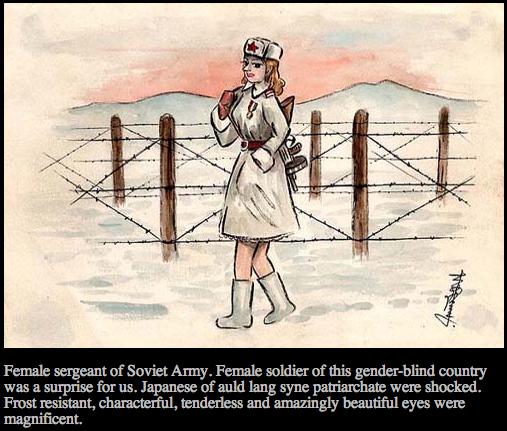
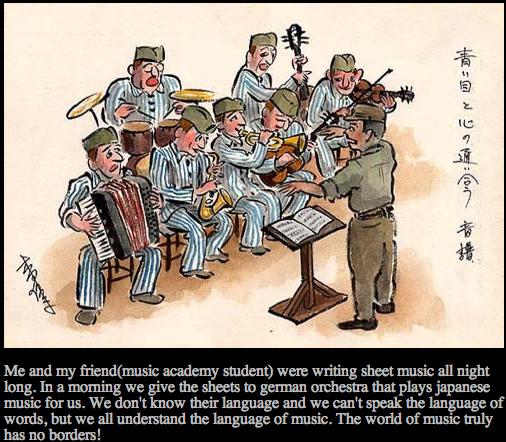
2008/2/6
Following up from that piece on musical tastes in the UK, there's an article in the Graun speculating on how geography and history affect musical taste:
However, some music seems entrenched in certain areas, and while some believe this is due to the mystical forces exerted by ley lines, it is more likely attributable to a single act spawning an entire movement. "I think music is more determined by musical scenes that help create a distinctive sound," says academic and journalist Simon Frith, founder member of the International Association for the Study of Popular Music and chair of the Mercury music prize judging panel. "Glasgow has that history of guitar pop, and if you listen now to [Glasgow band] Glasvegas, it could be guitar pop of any age." Frith suggests that bands are inspired by the music that immediately precedes them - the music played perhaps by older siblings - and by the music that surrounds them, in local venues, on jukeboxes, radio stations. "The jangly guitars you hear in new Glasgow bands are the same jangly guitars you will hear played in Glasgow pubs," he says.
"I've looked at the fact that industrial Yorkshire and Lancashire are particularly strong areas for community-based music, such as brass bands, handbell ringing teams and choirs," he says. "They were all very powerful, particularly in smaller communities - it's partly to do with civic rivalries." Religion also played a big part, especially Methodism in Yorkshire. "Though John Wesley believed in the simplest form of music so as not to complicate the religious message, many of the local congregations took very enthusiastically to religious music, and so grew the choral tradition,"
In more recent times, Sheffield has shown itself to be home to music with a strong storytelling sense, with acts such as Pulp, the Arctic Monkeys and Richard Hawley. "The narrative thing I find interesting," says Frith, "because I always associated Sheffield with electronic music. It was the home of Warp and the Human League - though their songs did have a sense of narrative." Russell notes the strong love of amateur operatics in the area in the late 19th and early 20th century, "which created a love of humorous lyrics". Then, of course, came the music hall tradition. "And in some way the music hall spawned the very literate songwriting with wit and humour." It is precisely this we can see in the lyrics of Jarvis Cocker and Alex Turner.
But the Scottish love of American country and western is little more than a reclamation; country and western music was largely born of the music of the Appalachian Mountains, which itself was rooted in the music brought to American shores by immigrants from Europe, especially the British Isles. So country and western has much in common with traditional British folk music, Celtic music, and Scottish and Irish fiddle styles in particular. And those old habits die hard. "Apparently, karaoke caught on much quicker in Scotland and Ireland where they had the tradition of collective singing," adds Frith, "and where they had more of a tradition of the ballad."
2008/1/27
A piece looking at the history of five generic domain names—music.com, eat.com, car.com, meat.com and milk.com—from their origins in the quirky innocence of the pre-commercialised 1990s to their present status:
meat.com: In 1996, meat.com was a classic bit of golden age Internet whimsy called L'Industrie De Meat: an oddish logo on standard-issue mid-90s textured background, with an anti-Communications Decency Act jeremiad, links to an "Internet hall of shame" (optimized for Netscape 2.0), and information about the "Transnational Church of Life on Mars." There was also a link to the site's creator's software offering: Color Manipulation Device, which helped HTML newbies choose the colors for their Web pages. Later iterations of the site foregrounded the software development angle, offering f.search, a metasearch program that would help you get the most of the pre-Google search offerings out there.
By early 2000, though, the proprietor of L'Industrie had sold the site (hopefully at full height-of-boom prices) to a company looking to sell and promote, well meat. Promising a directory of local meat suppliers and "delicious, mouth-watering entrees," it appears to have never really gotten off the ground, and by 2004 was in the hands of a domain registrar and offered for sale. Today, the site has reached the ignominious nadir for generic Websites: it's little more than a front-end for pages of text ads, with not very well thought out photo placement
milk.com: And sometimes, they just stay the same. Milk.com was snapped up in the unheard-of ancient year of 1994 by Internet denizen Dan Bornstein, and it's remained a classic homepage in the '90s sense -- sparse background, unformatted text, easy-to-find links -- ever since.
2007/12/3
The Bibliothèque Nationale in Paris is, for the first time, opening its extensive collection of pornographic materials to the public. Part of the contents of the forbidden section, officially known as "l'Enfer" (Hell) and consisting of pornography and erotica from the 17th to 19th centuries, will be visible at the Bibliothèque François Mitterrand for three months, and a smaller selection will be shown in a disused Métro station.
Only bona fide academic researchers have been allowed access to the "L'Enfer" collection until now. The omnipresence of erotic or pornographic images in the modern world has persuaded the French national library that it is permissible, finally, to open the doors of Hell.
The exhibition reveals some interesting, historical differences in erotic tastes. The earliest, 17th and 18th century, material dwells on the straightforward pleasures of the flesh. The celebration of the pleasures of pain – imposed or submitted – begins with the Marquis of Sade in the late 18th century. Pornography from the French Revolutionary period is mostly political, especially scurrilous allegations about the sexual appetite and imagination of Marie Antoinette. The 19th century concentrates on the blazing sexuality lying below the stern conservative or domestic exterior of life.
2007/11/6
The Church of England is delighted that this year's Royal Mail Christmas stamps will contain explicitly religious imagery, rather than, say, snowmen or what have you (Or, as the tabloids would say, "it's political correctness gone mad, I tell you!"). Royal Mail says that it has a policy of alternating between religious and secular themes, though the Church doesn't consider this to be good enough, and has called for explicitly Christian imagery to be used every year:
The Church has argued that Christian-themed designs "remind people of the true meaning of Christmas".There should absolutely be more recognition of the true meaning of Christmas; I look forward to the stamps depicting Thor, Sol Invictus and a bit of old-time public nudity.
2007/10/30
This afternoon, I was walking through Notting Hill when I noticed that the fronts of various shops had changed. Jack Wills, the "geezer" couturier on the corner of Portobello Road and Talbot Road (near Rough Trade) had become "Fowler and Green Hardware", and had racks of old boxes out the front. Meanwhile, the café diagonally across the road had been transformed into an old radio shop, its windows full of black-and-white TVs and such. The First Floor bar was in the process of being done up to look like a no-nonsense old pub.
It turned out that they were filming some scenes from a film titled "Hippy Hippy Shake", which is set in London in the early 1960s. I'm not sure whether they were using Portobello Road to stand in for a generic street in early-60s London (which would presumably have been quite expensive), or whether they were actually filming a scene set in Portobello Road, and in which case, whether the shops they had reconstructed had actually once existed there. (Then again, there was someone carrying a Blenheim Crescent street sign, which presumably had been temporarily taken down, so perhaps they were actually reconstructing the intersection two blocks down circa 1962 or something?)



2007/8/31
The Graun has a piece on Control, Anton Corbijn's soon-to-be-released film about Ian Curtis and Joy Division, along with interviews with the surviving members of the band:
"I couldn't believe how well it goes with the film," [Peter Hook] says. "It captures the Manchester of the 1970s so well. Control doesn't feel like the end of the story; the documentary closes things off perfectly. But Anton's film is more chilling. Towards the end, it felt like someone had ripped out my heart and was stamping on it. To be honest, when Atmosphere came on, I thought I was going to throw up."
"This sounds awful but it was only after Ian died that we sat down and listened to the lyrics," says Morris. "You'd find yourself thinking, 'Oh my God, I missed this one.' Because I'd look at Ian's lyrics and think how clever he was putting himself in the position of someone else. I never believed he was writing about himself. Looking back, how could I have been so bleedin' stupid? Of course he was writing about himself. But I didn't go in and grab him and ask, 'What's up?' I have to live with that. Watching the film, there were moments when I wished I could have stepped into the film. Unfortunately, you can't."
All three members agree, more or less, on Joy Division/New Order's position in the scheme of things. "When I listen to Nirvana, I hear [New Order's] Ceremony bass line on quite a few of those songs. So I'd have to say, yes, we are the missing link between the Beatles and Nirvana," says Hook.The article concludes to say that "enhanced versions" of Joy Division's albums are being released soon. I hope that "enhanced" doesn't mean "remastered with lots of compression for extra loudness".
2007/8/9
After publishing a best-selling crime novel detailing a gruesome torture and murder, Polish crime novelist Krystian Bala has been charged with a similar murder which happened a few years earlier, the victim having been a friend of his ex-wife:
The case was broadcast on Poland’s version of the BBC television programme Crimewatch but it produced no serious leads — only some strange e-mails sent from internet cafés in Indonesia and South Korea, describing the murder as “the perfect crime”.
The first break for the police came when they discovered that Mr Bala, a highly experienced diver, was on a diving trip to South Korea and Indonesia at the time that the e-mails were sent. Then they discovered that he had sold a mobile phone four days after the body of Dariusz J was discovered. It was the same model that the victim was known to have owned, but that police had never found.
Mr Bala offered to take a lie-detector test to prove his innocence and passed. When the transcripts were read out in court, the judge was struck by the very long pauses taken by Mr Bala before answering, a technique that may allow a suspect to mask the physical signs of lying.Of course, that doesn't mean that he did it, though it does start to look somewhat suspicious.
Meanwhile, some light has been shed on another murder mystery, the whereabouts of Lord Lucan; some people, including a retired Scotland Yard detective believe that the disgraced peer, who may have bludgeoned his family nanny to death, is living out of a car in New Zealand, with a cat and a pet possum, no less:
Neighbours say the man has an upper-class English accent and a military bearing like Lord Lucan, who was educated at Eton before serving in the Coldstream Guards.
He is said to have arrived in New Zealand about the time Lucan disappeared and is also understood to be receiving money from property he owns in Britain.
2007/7/13
In Poland, where the mainstream culture is dominated by a conservative, nationalistic monoculture, more often than not with an anti-Semitic streak, rebels, refuseniks and rootless cosmopolitanists are embracing all things Jewish. Klezmer bands (comprised mostly of non-Jewish musicians) are forming everywhere, people are taking classes in everything from Hasidic dancing to Hebrew calligraphy, and replicas of 1930s-vintage Jewish merchants' signs are cropping up all over Krakow streets like some kind of theme park:
Interest in Jewish culture became an identifying factor for people unhappy with the status quo and looking for ways to rebel, whether against the government or their parents.
"The word 'Jew' still cuts conversation at the dinner table," Gebert said. "People freeze."
The revival of Jewish culture is, in its way, a progressive counterpoint to a conservative nationalist strain in Polish politics that still espouses anti-Semitic views. Some people see it as a generation's effort to rise above the country's dark past in order to convincingly condemn it.Not everybody's pleased with this:
Many Jews are offended by the commercialization of their culture in a country almost universally associated with its near annihilation.
Others argue that there is something deeper taking place in Poland as the country heals from the double wounds of Nazi and communist domination. "There is commercialism, but that is foam on the surface," Gebert said. "This is one of the deepest ethical transformations that our country is undergoing.Perhaps we can expect to see a new wave of klezmer-punk bands emerging from Krakow any day now?
2007/6/21
The Guardian reveals an all-but-forgotten fragment of the social history of 1980s Britain: a ZX Spectrum game named Hampstead, which codified the aspirational values of Thatcher-era Britain in the blocky, primary-coloured computer graphics of the period:
Hampstead was the ultimate 1980s adventure game, yet one of the few that broke from the traditional orcs and goblins fare. In it, you took the role of a down and out dreamer trapped in a grotty east London flat with ideals of leafy suburbs and affluence.
As aspirational games go, this text adventure was pretty high on the narcissistic scale. With the right clothes, the right education, the right muesli and the right girl (Pippa, of course), all that stood between your and your freehold was her Dad. And he was a pussycat. Hampstead taught a generation of future Brees and Tarquins how to climb the social ladder and how to look good while doing it.
2007/6/7
WIRED has a photo gallery of Soviet video games; these were arcade machines, sometimes inspired by American or Japanese ones, manufactured in the Soviet Union (often at military manufacturing facilities; presumably because civilian electronics manufacturers in the USSR weren't up to scratch). They often were more primitive than western counterparts (some feature mechanical score counters and lack controls that western equivalents had), cost 15 kopecks per game (not enough for most Soviet youth to be able to play more than a game a week), and thematically avoided the zapping-space-aliens themes of the capitalist world, instead combining a sort of earnest socialist benignness (there were Russian folk games adapted for the arcade, games simulating socially worthy occupations such as firefighting), with the odd bit of ideologically-sound militarism (sinking Nazi submarines during the Great Patriotic War, and shooting down enemy fighters (presumably of a capitalist persuasion, though the article didn't say)). Interestingly enough, a common feature of all the games was the lack of a high score table; the idea of such an individualistic, competitive feature was, for obvious reasons, frowned upon.
Compared to western games, they looked a bit shabby and lacklustre. So as soon as Communism collapsed and Nintendos and PCs started flooding in, they pretty much disappeared. Most were destroyed, though a few survived; and now, four collectors in Moscow are finding and restoring these machines, for display in a Museum of Soviet Arcade Machines, which they have set up in a bomb shelter under a university dormitory.
(via Boing Boing) ¶ 0
2007/4/18
The world's oldest continuously operating family business, a Japanese temple-building company founded in 578, went out of business last year. Over the 1,428 years it operated, Kongo Gumi was headed by 40 generations of the Kongo family, and continuously built Buddhist temples, with the exception of a period during World War 2 during which it made coffins.
How do you make a family business last for 14 centuries? Kongo Gumi's case suggests that it's a good idea to operate in a stable industry. Few industries could be less flighty than Buddhist temple construction. The belief system has survived for thousands of years and has many millions of adherents. With this firm foundation, Kongo had survived some tumultuous times, notably the 19th century Meiji restoration when it lost government subsidies and began building commercial buildings for the first time. But temple construction had until recently been a reliable mainstay, contributing 80% of Kongo Gumi's $67.6 million in 2004 revenues.I wonder what the current oldest continuously running family business is.
(via Boing Boing) ¶ 0
2007/4/5
The Guardian has an excerpt from a recent book by Barbara Ehrenreich, which postulates that the rise of subjective individual self-awareness and the decline of the collective celebrations common in mediæval times may have touched off an epidemic of depression we've been living in ever since:
And very likely the phenomena of this early "epidemic of depression" and the suppression of communal rituals and festivities are entangled in various ways. It could be, for example, that, as a result of their illness, depressed individuals lost their taste for communal festivities and even came to view them with revulsion. But there are other possibilities. First, that both the rise of depression and the decline of festivities are symptomatic of some deeper, underlying psychological change, which began about 400 years ago and persists, in some form, in our own time. The second, more intriguing possibility is that the disappearance of traditional festivities was itself a factor contributing to depression.
One approaches the subject of "deeper, underlying psychological change" with some trepidation, but fortunately, in this case, many respected scholars have already visited this difficult terrain. "Historians of European culture are in substantial agreement," Lionel Trilling wrote in 1972, "that in the late 16th and early 17th centuries, something like a mutation in human nature took place." This change has been called the rise of subjectivity or the discovery of the inner self and since it can be assumed that all people, in all historical periods, have some sense of selfhood and capacity for subjective reflection, we are really talking about an intensification, and a fairly drastic one, of the universal human capacity to face the world as an autonomous "I", separate from, and largely distrustful of, "them".
But the new kind of personality that arose in 16th- and 17th-century Europe was by no means as autonomous and self-defining as claimed. For far from being detached from the immediate human environment, the newly self-centered individual is continually preoccupied with judging the expectations of others and his or her own success in meeting them: "How am I doing?" this supposedly autonomous "self" wants to know. "What kind of an impression am I making?"If this hypothesis is correct, then the epidemic of depression and mental illness that began in the 1600s (which Ehrenreich provides supporting evidence for, in historical records) is a side-effect of a step in the evolution of human psychology that began at around that time, with the pressures of communication, trade and social organisation dragging the human mind kicking and screaming from a sleepy collective life to a more dynamic way of living. In this case, a lot of the anxiety, angst and low-level distress people feel routinely is not a result of human nature, but rather human nature reacting against "unnatural" circumstances. Small wonder that many have sought relief in an annihilation of the self, from hippie communes to Communist utopias, from meditation to severe religious submission, from the Arcadian pastoral utopias throughout art (Tolkien, William Morris and the Arcade Fire to name three examples off the top of my head) to the transcendental nihilism of drugs (take, for example, Lou Reed wishing he had been born "a thousand years ago" in Heroin).
So where does that leave us? Perhaps, given enough time (hundreds if not thousands of years), human psychology will evolve into depression-resistant directions, assuming that some kind of technological catastrophe doesn't cut the process short. Genetic evolution is slow, but cultural evolution is faster, and it could be argued that our technologies and cultural institutions are part of the "extended phenotype" of humanity; that the invention of antidepressant drugs is an adaptation to these changes in our environment. It's a crude, reactionary adaptation, merely treating the symptoms; though there is hope on the horizon. There has recently been a lot of focus on the study of the psychology of happiness, and what factors make for environments conducive to sustainable happiness. With any luck, this will lead to improvements in areas from urban planning to social policy to economics.
Then again, if the hypothesis is true, would it be possible to somehow get the best of both worlds? Could one have the happy, fulfilling collective connectedness people (allegedly) had before the 16th century, whilst retaining the gains made since then? Or is the very presence of subjective thought, the demarcation between the self and the collective, poisonous?
(On the other hand, L. Ron Hubbard claims that depression comes from humanity's early ancestor, the clam, and the tension between the desire to open and close its hinge.)
2007/3/7
A 1939 magazine article about the censorship of animated cartoons, and exactly the sorts of things the Hays Office (which handled film censorship in the U.S. at the time) demanded cut from cartoons. For example, a cartoon cow was made to wear a skirt covering its udders, a sombrero-wearing bandit is required to end up in jail (crime, you see, must unambiguously be seen to not pay), and a scene with a stereotypical black (as in African-American) angel placing pushpins on a globe labelled "Harlem" and mentioning "De Lawd" had to be altered, not because of the racial stereotypes (which, in 1939, were perfectly fine) but because it was considered too sacrilegious.
It's interesting to note that the article states at the beginning that animated cartoons were subjected to stricter censorship regulations than live-action films because it was assumed that anything animated was for children, who needed to be protected. Similar justifications were used for comic books (with the Comics Code, which was in force until publishers started ignoring it in the 1960s or so, and had similarly puritanical scope), and in current video game censorship in Australia.
(via Boing Boing) ¶ 0
2007/2/9
Last night, I visited the local video library a rather good one in Stoke Newington Church St., which has a lot of art-house/foreign films) and rented a copy of C.S.A.: The Confederate States of America.
This is a mockumentary, presenting an alternate history in which the slave-holding South, rather than the abolitionist North, won the American Civil War, and formed what we know as America. It presents this history from the Civil War (in which the South managed to get British and French support for its cause, in the interest of "private property rights"), through the reconstruction (in which the values of the slave-holders are imposed on the North, successfully, and all non-whites become slaves), wars of conquest across South America (forming a "tropical empire", of the sort envisioned by Confederate leaders, governed under a policy of racial "apartness"), through to the present day CSA. The documentary is framed as an imported British documentary being presented on a CSA TV channel; it is preceded by a disclaimer as to its "controversial nature" and interspersed with ads, which shed some light on life in an early-21st-century Confederate America; these include advertisements for cable-TV slave-shopping programmes and electronic tracking bracelets, Cops-style TV programmes about federal agents hunting down runaway slaves, and public-service announcements urging citizens to beware of the disease of homosexuality and report suspected racially-impure people passing as white to the government.
What does the C.S.A. circa 2004 look like? Well, people with any non-white blood are, by law, slaves, Christianity is the state religion (generously, and narrowly, allowing Catholicism to be considered Christian), women are not allowed to vote, Jews are confined to Long Island, and there is a cold war with "Red Canada", which harbours abolitionist "terrorists" and is the home of rock'n'roll and "race music". (Canada is not alone; virtually everyone but South Africa has imposed sanctions on the C.S.A.) Those are the obvious and spectacular differences; on a more subtle level, the C.S.A. is a much more conformistic and authoritarian culture. The mindset which allows ordinary people, who see themselves as good and decent, to tolerate and participate in slavery is one in which society is organised along strong chains of authority and hierarchy, which are seen as part of the order of nature. (One example of this is in an ad early in the film, for an insurance company, which mentions that the father is "master of the house".) With acceptance of arbitrary authority comes the acceptance of beliefs on the basis of faith in authority, and unsurprisingly, the values of the religious right are dominant in the C.S.A. (in one scene, there is a shot of the front page of "CSA Today", which includes a story about scientists disproving evolution). Not surprisingly, this mindset and the focus on "purity" creates a stagnant, homogeneous culture, one seeming in some ways quaintly archaic (one example is music and entertainment programming on its television stations, where, of course, all black influences are banned). Quoting from a friend, it is Pleasantville meets Triumph Of The Will.
C.S.A. has its lighter moments as well; artistic licence is employed to ensure that the history doesn't diverge too wildly from the world we know, but instead parallels it, mirroring and counterpointing. For example, the C.S.A. enters World War 2 after launching a surprise attack on a Japanese naval base; John F. Kennedy is assassinated, right on cue, for having suspected abolitionist sympathies, and the Clinton sex scandal is echoed, quote for quote, in the investigation into a politician's racial make-up.
All in all, C.S.A. was quite an interesting and thought-provoking film, and is worth a look.
2006/11/2
In the 1930s, Henry Ford built two planned towns in Brazil, to support rubber plantations; the towns were modelled on Michigan, all white picket fences and neat, American-style suburban sidewalks (in fact, they looked not unlike some place in Queensland). As well as harnessing Brazil's rubber resources, the project attempted to instill Anglo-American/Fordian values in their residents; in return for better pay, the residents had to work US-style hours, eat American-style food in self-service cafeterias (the last point causing a riot at one stage) and attend compulsory square-dancing social events.
Fenced in by jungle, Fordlandia was transformed into a modern suburb with rows of snug bungalows fed by power lines running to a diesel generator. The main street was paved and its residents collected well water from spigots in front of their homes--except for the U.S. staff and white-collar Brazilians, who had running water in their homes. The North Americans splashed in their outdoor swimming pool and the Brazilians escaped the sun by sliding into another pool designated for their use.
Generally, the company-imposed routine met hit-and-miss compliance. Children wore uniforms to school and workers responded favorably to suggestions they grow their own vegetables. But most ignored Ford's no liquor rule and, on paydays, boats filled with potent cachaca--the local sugar-can brew--pulled up at the dock. Poetry readings, weekend dances and English sing-alongs were among the disputed cultural activities.
Former Kalamazoo sheriff Curtis Pringle, a manager at Belterra, boosted labor relations when he eased off the Dearborn-style routine and deferred to local customs, especially when it came to meals and entertainment. Under Pringle, Belterra buildings did not contain the glass that made the powerhouse at Fordlandia unbearably hot, and weekend square dancing was optional. Alexander said Henry Ford balked at building a Catholic church at Fordlandia--even though Catholicism was the predominant Christian religion in Brazil. The Catholic chapel was erected right away at Belterra.The project was unsuccessful; humidity and malaria made life there unpleasant, rubber yields were low, and for some reason, the locals didn't see the inherent superiority of Anglo-American culture and stubbornly stuck to their customs, in defiance of the local authorities' best efforts. Ultimately, the project was sold to the Brazilian government, which has been stuck with the burden of keeping it from falling down ever since, and struggled to find uses for a transplanted piece of Michigan on the Amazon.
(via Boing Boing) ¶ 0
2006/8/17
The house in Richmond in which cult Australian post-punk film Dogs In Space was filmed is up for auction this weekend. I wonder how much it will fetch, and whether its fame will put the final price up.
(via reddragdiva) ¶ 2
2006/8/12
Frank Broughton, co-author of Last Night A DJ Saved My Life, writes about how the Nazis were responsible for disco, or more precisely, how the peculiar phenomenon of dancing to records in cellars originated with a subculture of French kids who defied the Nazis' bans on jazz and swing, dressed up in ostentatious costumes and called themselves les Zazous.
Imagine, amid the grey serge of wartime France, a tribe of youngsters with all the colourful decadence of punks or teddy boys. Wearing zoot suits cut off at the knee (the better to show off their brightly coloured socks), with hair sculpted into grand quiffs, and shoes with triple-height soles - looking like glam-rock footwear 30 years early - these were the kids who would lay the foundations of nightclubbing. Ladies and gentlemen, les Zazous.
The Zazou look was completed with high collars, impossibly tight ties and long sheepskin-lined jackets, with a curved-handled umbrella carried at all times (copied from British prime minister Neville Chamberlain, regarded as quite a style icon). Female Zazous wore short skirts, shabby furs, wooden platform shoes and dark glasses with big lenses, and chose to go hatless, to better show off the single lock of hair they had bleached or dyed. They took their name from the Cab Calloway-style scatting in a song Je Suis Swing, by their hero, French jazz singer Johnny Hess.
As the pogroms began, some Zazous went even further and took to wearing yellow stars of David to show solidarity with the Jews. To underline their outlaw musical taste, they wrote "swing" across them. Several found themselves in internment camps as a result. Even stranger, when liberation was imminent, female Zazous blacked up their faces to show their love for jazz and America.
2006/6/30
Something I didn't know until today: not only has India had a film industry since the 19th century, but it also had literary science fiction since the 1880s:
Asimov's statement that "true science fiction could not really exist until people understood the rationalism of science and began to use it with respect in their stories" is actually true for the first science fiction written in Bangla. This was Hemlal Dutta's Rahashya ("The Mystery") that was published in two installments in 1882 in the pictorial magazine Bigyan Darpan, brought out by Jogendra Sadhu. The story revolved around the protagonist Nagendra's visit to a friend's house, a mansion completely automated and where technology is deified. Automatic doorbell, burglar alarms, brushes that clean suits mechanically are some of the innovations described in the story, and the tone is of wonder at the rapid automation of human lives.
Sukumar Ray (1887-1923) was probably inspired by Arthur Conan Doyle's The Lost World when he wrote Heshoram Hushiyarer Diary ("The Diary Of Heshoram Hushiar").... It is a spoof on the genre because Sukumar is poking fun at the propensity of the scientist to name things, and that too in long-winded Latin words. He seems to be playing around the fact that names are arbitrarily conferred upon things by humans for their own convenience, and suggests that the name of a thing may somehow be intrinsically connected to its nature. So the first creature that Heshoram meets in the course of his journey through the Bandakush Mountains is a "gomratharium" (gomra in Bangla means someone of irritable temperament).And Bengali science fiction didn't end there, by any means: The article goes on, mentioning stories about the fictional inventor/adventurer Professor Shanku, quoting from one in which he builds a rocket to go to space and invents a "fish-pill" that his cat Newton can eat whilst in space, and then mentions a few items from a catalogue of Professor Shanku's inventions, such as the "Miracurall", a drug capable of curing any ailment except for the common cold, and an "air-conditioning pill", which keeps the body temperature normal in extremes of climate (which could be a very Indian fictional invention).
(via Boing Boing) ¶ 0
2006/6/15
As the Triffids' Born Sandy Devotional gets rereleased by super-trendy Indie™ label Domino Records (presumably adding some gravitas to their current roster, which leans towards ephemeral, facile Carling-indie), The Age looks at the phenomenon of how so many Australian bands attained critical acclaim abroad, often succeeding in Australia only after the UK and Europe, if at all:
The curators of Kunstencentrum België are still raving about "the importance of the Triffids (to) musical developments from the '80s onwards, and their influence on diverse musical movements afterwards". The Belgians are flying in the surviving members as guests of honour at a Triffids music and memorabilia retrospective next week. Then the band goes to London, where Islington Council has approved the unveiling of a plaque on the hallowed site where their Born Sandy Devotional album was made 20 years ago.A lot of the Australian indie exodus, argues Australian popular-music historian Clinton Walker, was caused by Australia's oppressively (pub-)rockist monoculture at the time:
To illustrate why the Triffids left Australia, Graham Lee opens the Born Sandy Devotional CD book to a photo of a Queensland pub's events board: "Friday: stubbies welcome nite. Saturday: Triffids with Phil Emmanuel's Rockola. Sunday: wet T-shirt competition."
Dave Graney also recalls the '80s indie exodus in terms of cultural conflict. "These inner-city bands didn't want to engage in pub rock. They couldn't. Famously, the Scientists opened for the Angels at Parramatta Leagues Club (in 1983) and they were bottled off stage.(Though what of the famous "little band" scene, as celebrated in documents like Dogs In Space? Was that merely the urban fringe of the rockist hegemony, as unwelcoming to those not sharing its Aussie larrikin values as the audience at a Rose Tattoo gig, an oasis of cosmopolitan bohemianism accessible to a lucky few who found it, or a bit of both?)
Of course, then came JJJ going national, and after the shockwaves of grunge going mainstream in America reached Australia's shores, pretty soon you had Big Day Out, major-signed local "alternative" bands (most of whom were parts of an equally rockist grunge monoculture) on JJJ, and then it's not long until Killing Heidi were selling mobile phones on television. Though then there was sufficient open-mindedness in the new Australia for vibrant and cosmopolitan scenes to flourish in the inner cities (well, mostly Melbourne, with smaller scenes in places like Brisbane and Perth; Sydney hadn't recovered from the two-pronged onslaught of poker machines and its community radio station being ripped out of its heart and refashioned into a deracinated national "youth" broadcaster, though things appear to be much better there these days), producing a rich ecosystem of original bands, which continues to this day.
Even if he was still with us, it's unlikely the Triffids would have been invited to play Wide Open Road at the Countdown arena spectacular in September. Instead we'll celebrate their stay-at-home contemporaries: Kids in the Kitchen, Uncanny X-Men, Mondo Rock, Pseudo Echo, Real Life. In Perth the local heroes will be the Eurogliders.
2006/6/7
John C. Dvorak takes a break from speculating about Apple and Microsoft to look at how strange our world would look to someone from the 1920s:
Let me begin with the one new commonplace practice that has less to do with technology than with legislation. And that's the crowd of people huddled in a group outside a building smoking cigarettes. This would have to be a weird sight for people from 1920. We don't think much about it, but it is indeed a weird sight.
Perhaps the weirdest societal change has to do with digital cameras and the practice of framing shots in the preview window by holding the camera out in front of yourself. Even ten years ago, nobody would have predicted that most people would now take pictures this way. Give people a pro digital SLR camera and they will still hold the thing in front of them at arm's length.(Are there digital SLRs that display a preview of the scene on the LCD screen in real time? My Canon EOS doesn't do that. I thought the whole point of an SLR is to require the photographer to look through the viewfinder, thus reinforcing their perception that they're a Real Photographer following a weighty and time-honoured tradition and standing on the shoulders of giants like Ansel Adams, rather than a mere amateur playing ignorantly around with a shiny, instantly-gratifying toy.)
Would anyone even 20 years ago have predicted that on every business card you will now find a standardized e-mail address? It's now deemed weird if you do not have an e-mail address on the card and have to write it on.All these things and others he mentions (mobile phones/BlackBerries, chatrooms, and so on) would seem utterly alien to someone from the 1920s (though I wonder whether any futurists or science-fiction writers from those times have predicted anything that comes close to the mark). When you think about it, some of them would seem quite odd to someone who had been asleep for a quarter of a century. One thinks of the 1980s, for example, as the recent past (after all, they had Madonna and Michael Jackson) rather than the Past proper, that foreign country (as L.P. Hartley put it) where they do things differently. Though someone who just woke up from having been in a coma since 1981 would find themselves in a different world: lacking a lot of little things they took for granted (like being able to smoke in offices, or on aeroplanes) and having a bunch of new, alien innovations (the internet and mobile phones, and the profound changes in social and cultural dynamics they have brought about, would be the big ones). To our 1981 exile, our mundane technology would seem slightly science-fictional: from our tiny, feature-packed DVD recorders and MP3 players (does anyone remember how huge early video recorders were?) to communications devices like something out of Star Trek, 2006 would look like scifi, only without the silver lamé jumpsuits and flying cars and other stylistic conventions that say "this is the (space-)future".
The iPods people listen to would seem familiar enough to our visitor, like a more advanced Walkman; what they'd make of the mainstream pop music of today, infused with influences from everything from hip-hop (a fringe scene in 1981, well below the radar) to dance-music genres driven by recent technology, is another matter. If the iPod in question was playing one of the various retro-styled acts popular today, from Gang Of Four/XTC-quoting new-wave-indie-art-rock bands to the last Madonna album, they may find it slightly familiar, though all the more unsettling in the subtle differences that betray it as of 2006, and made for a 2006 audience.
What if someone from 1991 arrived in 2006, with no awareness of the last 15 years? The shock would be somewhat lesser (though, in some ways, perhaps greater; the current age of homeland security and perpetual war against sinister shadows could be more of a rude awakening from the post-Berlin-Wall optimism of the 1990s than from the age of Mutual Assured Destruction). Email addresses on business cards would still seem a bit odd, though if our visitor was an academic or scientist, they would be familiar with them, and one could just about imagine the current state of the world leading to 2006, with its web-based commerce and pocket-sized, ubiquitous mobile phones. Though digital cameras could still seem strange.
In other words, the immediate past is a different neighbourhood; they do things slightly differently there. Go far enough and people start speaking a different language, though if you do so a day at a time, you won't notice the changes.
I wonder how strange 2016, or 2031, would seem to someone from now.
2006/5/31
Pope Benedict XVI, the first German-born pope, recently visited Auschwitz. However, his remarks there have left a bad taste:
He stood in the extermination camp where millions died, but he did not utter the word "anti-Semitism", he did not offer an apology on behalf of Germany or the Church, he said nothing about the silence of Pope Pius XII during the Nazi years, nor did he, the former member of the Hitler Youth, offer any sort of account of his own dawning awareness of the horror created by the people democratically elected to rule his country.
The Holocaust, then, according to Benedict, was only incidentally the extermination of the Jews. The true goal was the extermination of God and Christianity. So the German people were the Nazis' victims, used and abused by them, and Christians and Christianity even more so. In Ratzinger's Christo-centric vision, the Jews find themselves bit players - bystanders at their own extermination. The true victim was a metaphysical one.
2006/5/26
The final chapter of the Spanish-American War is about to close, as the US Treasury Department prepares to eliminate a tax on telephone calls imposed to fund the war back in 1898 (back when telephones were a luxury item). It only took the bureaucracy 108 years, two world wars and the rise and fall of the Soviet bloc (not to mention the Spanish Civil War, the rise and fall of Franco's Fascism and Spain's accession into the US-allied NATO alliance, a mere 24 years earlier) to acknowledge that they are no longer at war with Spain.
2006/5/3
The US military has given the world a number of things: the internet, GPS, and now, it turns out, San Francisco's gay scene:
During World War II, the United States armed forces "sought out and dishonorably discharged" homosexuals. Many men who were expelled for being gay were processed at San Francisco bases.
This site agrees, stating San Francisco was indeed a point of departure during World War II. Gay men often stayed in the city after completing their military service. Since then, San Francisco's gay and lesbian population has continued to grow.
(via Boing Boing) ¶ 0
2006/4/27
As politicians and wowsers decry the evil, corrupting influence of video games, Tom Standage (author of The Victorian Internet) looks at the moral panics created by previous new technologies and media:
"The free access which many young people have to romances, novels, and plays has poisoned the mind and corrupted the morals of many a promising youth; and prevented others from improving their minds in useful knowledge. Parents take care to feed their children with wholesome diet; and yet how unconcerned about the provision for the mind, whether they are furnished with salutary food, or with trash, chaff, or poison?"
- Reverend Enos Hitchcock, Memoirs of the Bloomsgrove Family, 1790
"Many adults think that the crimes described in comic books are so far removed from the child's life that for children they are merely something imaginative or fantastic. But we have found this to be a great error. Comic books and life are connected. A bank robbery is easily translated into the rifling of a candy store. Delinquencies formerly restricted to adults are increasingly committed by young people and children ... All child drug addicts, and all children drawn into the narcotics traffic as messengers, with whom we have had contact, were inveterate comic-book readers This kind of thing is not good mental nourishment for children!"
- Fredric Wertham, Seduction of the Innocent, 1954
"The effect of rock and roll on young people, is to turn them into devil worshippers; to stimulate self-expression through sex; to provoke lawlessness; impair nervous stability and destroy the sanctity of marriage. It is an evil influence on the youth of our country."
- Minister Albert Carter, 1956
(via Boing Boing) ¶ 1
2006/4/11
A gentleman in Italy has posted a set of photographs from Australia circa 1959, when he apparently lived there. The photos cover Melbourne, Sydney and Brisbane as they were then, as well as scenic views which could have been taken yesterday:
It's quite fascinating to look through the photos and see those places, familiar yet different. Though the frames rendered on some of the photos are a bit distracting.


Interestingly enough, the author, one Peter Forster, seems to be a fan of the Nino Culotta books (a series of humorous books written in the 1950s by an Australian named John O'Grady, pretending to be the eponymous Italian immigrant to Australia and recounting the country's customs and morés through the eyes of a slightly naïve outsider).
2006/4/10
The Union Jack (or perhaps the Union Flag, depending on whom you ask) is 400 years old this week; the first early versions of the flag owe their existence to a royal proclamation from 12 April 1606, and initially represented merely the union of the monarchies of England and Scotland (which were otherwise separate states). The red diagonal bits (the "Saltire of Saint Patrick") didn't appear until the annexation of Ireland; oddly enough, there doesn't seem to be much evidence of the Irish ever having used them as a national symbol prior to this. As for the Welsh, they didn't get a look in, because they were considered a province of England at the time.
The Union Jack came into widespread use during the rise of the British Empire, which needed a flag to plant on all those bits of land, not to mention to wave at coronations, victory parades and such. Then came the decline of the Empire, Beatlemania, the Swinging Sixties, Mod (and several rehashings thereof), punk rock, neo-Nazi skinheads, Britpop, Cool Brittannia, New Labour, the Spice Girls and the Austin Powers movies, by when the flag had become a successful lifestyle brand, an example of what the pundits call "soft power". Somehow, in the interim, nobody actually remembered to pass a law enshrining it as a national flag, and hence its status is more a result of habit and precedent than anything more formal, which does seem like an appropriately British way to go about things.
Some other pieces of Union Jack/Flag trivia:
- To this day, it is illegal to fly the Union Jack from a private boat
- These people wanted to add the colour black to the flag to make it more inclusive of minorities or somesuch. They seem to have given up on the plan though.
2005/12/20
It looks like hopes for a reprieve for legendary New York rock venue CBGB were short-lived; the venue will now close on Halloween of 2006. The owners are planning to open a new venue in the Lower East Side some time afterward, and/or to devote their energies to the lucrative "CBGB's & OMFUG" merchandise business.
2005/10/7
Barry Humphries recently gave a speech about the Melbourne he grew up in, the bourgeois middle-class culture of the suburbs of the 1940s and 1950s, and the changing landmarks of the city:
Going into the city was always a ritual I enjoyed with my mother, for it meant hats, gloves, crumbed whiting at the Wattle Tea Rooms or creamed sweet corn (undoubtedly out of a tin) at Russell Collins. We would only shop in Collins Street. Bourke Street was mostly out of bounds except for Myers and Buckleys. The upper reaches of Bourke Street were thought common and there were second hand bookshops around the eastern market -- a paradise for germs.
The boat, an Italian one, sailed from Port Melbourne to Venice, but I already had a taste for things Italian. After all, I had been to university in Carlton where the first espresso machine had frothed up my cappuccino and I had already mingled with the sophisticated crowd who hung out at the Florentino Bistro eating Spaghetti ala Bolognese and drinking Chianti. I left when Harry Ballefonte was singing his famous Calypso island in the sun and only returned in the Beatles era.
It is a sign of progress that I have been asked to address you at all on the subject of my home town. I was long dismissed as a traitor, or worse, an expatriate merely because I recognised the intrinsic bittersweet comedy of suburban life.
2005/10/5
A while ago, I picked up the box set of The Prisoner
I recently watched the episode titled "The Girl Who Was Death", which features a mad scientist who thinks he's Napoleon. As I watched it, I found myself thinking about the old cliché of delusionally insane people thinking that they're Napoleon. It seems to pop up a lot in films, TV and other media of a certain age (Looney Tunes cartoons, for example), tapering off around the 1960s (though still making the occasional appearance, in things like Highlander sequels); and there even was a famous pop song referencing it. Nowadays, one doesn't hear about nuthouses full of Napoleons; more modern sufferers of delusions are apparently more likely to think they're Jesus; either that (I once heard) or superheroes or ninjas or such.
I imagine that this has to do with the historical figure of Napoleon having cast a much longer shadow earlier in this century than he does now. When Napoleon loomed large in the public consciousness, a padded cell probably looked a lot like Saint Helena. It wouldn't surprise me if the I-think-I'm-Napoleon cliché was an old Vaudeville device or similar, dating back well before World War 2 (which somewhat demoted the French emperor's standing in the league of scourges of Europe), and the mass-media-saturated post-war world (whose brighter, more vivid archetypes undoubtedly displaced 18th-century history books from the public consciousness).
The ever-shifting landscape of public image affects how we see things. For one, the villain in The Girl Who Was Death reminded me of none other than Xeni Jardin.
2005/9/6
A (possibly somewhat biased) social history of drinking in England reveals that talk of a pathology of "binge drinking" is more the product of Victorian squeamishness and snobbery than anything else:
In fact we are rather poor drinkers compared with our ancestors. Queen Elizabeth I was renowned for drinking ale stronger than any of her courtiers could take. During her reign, British beers were so popular abroad that exports were only permitted if sufficient quantities of wood to replace the casks used was imported. Elizabethan brewers were often urged to reduce the formidable strengths of their beers, one of which, Pharaoh, was so named because it "would not let the people go". James took a similar line, only to be told that the brewers would be more minded to follow his advice were he rather more prompt in settling his bills.
Expressions like "binge drinking" tell us less about our present drinking habits than they do about the neo-Puritan climate we live in. In truth the drinking habits of many have not changed greatly, but they are seen from the standpoint of a society that does not recognise that the values and attitudes of the late Victorian and Edwardian eras were the exception rather than the rule.
Meanwhile, England's drinking problems come not from an excess love for beer, but ultimately from its displacement by things such as gin.
Gin forced people to realise for the first time that it was possible to make intoxicating beverages that were not sustaining and wholesome, and from then it was but a short step to demonising alcohol in all its guises, to separate the middle and upper classes from their previous habits and haunts, and to allow them to convince themselves that their domestic consumption of wine and gin was somehow superior. This attitude prevails today, principally perpetuated by newspapers.
The author, former secretary general of the Society of Independent Brewers, concludes to say that getting smashed on good English ale can be a fine thing indeed:
If journalists would stop writing hysterical leaders about "24-hour drinking" and turn their hands instead to thoughtful drinks page features about the merits of our national drink, that would be useful in improving debate and reconnecting us with our forgotten history. Drunkenness is an attribute of those who do not appreciate what they are consuming, not of those who do.
2005/8/17
As part of the 10th anniversary of Britpop*, the BBC looks at what became of the Britpop stars. It's interesting to see that two members of that most hype-driven of Britpop bands, Menswear, are still in the UK music hype industry; one of them managing NME-Carling-MTV2 darlings Bloc Party, and another being news editor at rigidly playlisted commercial "indie" radio station Xfm. The singer, meanwhile, seems to work in a mobile phone shop or something.
* well, the Blur-Oasis thing which defined it in the media's eye.
2005/8/12
Toru Iwatama speaks about his famous creation, Pac-Man:
In fact, Iwatani acknowledges that, while a eureka moment for the annals, that event represents the official birth of Pac-Man: "The whole thing actually started with me walking around games arcades watching how many boys were playing and the fact that all the machines were about killing aliens, tanks or people. Girls were simply not interested, and I suddenly had a motivation for my work: I wanted game centres to shed this rather dark, sinister image, and it seemed to me that the way to raise the atmosphere of a place is to entice girls to come in. The whole purpose of Pac-Man was to target women and couples, and get a different type of player involved."
"So there I was, wondering what sort of things women would look for in a video game. I sat in cafés and listened to what they were talking about: mostly it was fashion and boyfriends. Neither of those was really the stuff of a good video game. Then they started talking about food -- about cakes and sweets and fruit -- and it hit me: that food and eating would be the thing to concentrate on to get the girls interested."
It may have been aimed at girls, but boys converted to it immediately: Pac-Man's most interesting revelation was gamers' affinity to living things. And that spark of inspiration has taken the industry from a 2-D yellow disc through Mario, and on to a 3-D Lara Croft.
Strangely, that is exactly how Namco saw his achievement: as just a game. Pac-Man, quite apart from the lucrative sequels Ms Pac-Man and Pac-Land, made the company more than $100 million. Iwatani was merely promoted to supervisor level, and still lives in a house too small to accommodate a Pac-Man arcade cabinet.
2005/8/4
It now emerges that many buildings in Moscow have large quantities of explosives hidden under them. The explosives were buried by officers of the NKVD (which became the KGB) during World War 2, in case the Nazis captured Moscow:
"At night, they descended into the hotel's basement, designated a man to watch, and dug. They dug through the brick foundation and made a cache beneath the basement. Then, on another night, other NKVD officers secretly delivered a truck full of TNT right into the hotel's inner yard. The officers quartered on the first floor helped unload the explosives and carry the packages one by one into the cache beneath the basement. When they were through, they covered up the cache."
"My father said that the plan went like this: the Germans weren't supposed to suspect anything when they examined the premises. They say that the propaganda minister Joseph Goebbels wanted to be housed in the Moskva Hotel and turn it into his personal propaganda office with a view of the Kremlin."It is presently not known where exactly there still are explosives.
2005/7/15
The BBC has a special feature on Battersea Power Station (you know, the upside-down-coffee-table-shaped structure in south London, best known from Pink Floyd and Orb cover artwork), including panoramic views (the Art Deco control room looks fantastic, like something from a retrofuturistic scifi film), photographs from its past and sketches of development plans (apparently it is set to become a shopping centre/restaurant complex; let's hope they redevelop it sensitively).
2005/6/30
Scans of a 1970s-vintage childrens' book on computers, in two editions: from 1971 and 1979. Full of fascinatingly anachronistic detail of core memory, punch cards, disk packs and COBOL and PL/1, along with illustrated with Look Around You-esque scenes of high technology circa the 1970s: collages of microprocessors and paper tape, scenes of smiling women in Mary Quant-esque dresses operating desk-sized data processing units and brown-suited men loading disks into washing-machine-sized drives and the like.
It also has the sort of low-level detail that childrens' books on computers would not contain in later decades; I can't imagine a recent children's book on computers (or, indeed, anything before a second-year university subject) going into error-correcting codes, opcodes or the magnetic encoding of binary data. Mind you, back then computers were simpler; the physical details of how data is stored wasn't hidden behind a high-level interface like ATAPI or USB Mass Storage and machine language wasn't an esoteric specialty confined to compiler writers, BIOS hackers and hardcore masochists. These days, being interested in things that are too low-level is at best quaint, and at worst casts suspicion on one as being a potential h4x0r/virus writer/DRM cracker/troublemaker; all the details of computers one is meant to know about are exposed at a higher, and much more user-friendly, level, so why would anyone delve deeper if they're not either one of a tiny number of specialists or up to no good?
(via bOING bOING) ¶ 2
2005/6/22
The controversial redevelopment of Camden Town station, which would have replaced the station buildings, as well as the Buck St. Market (that's the Doc-Martens-and-T-shirts one) and the Electric Ballroom (considered a sacred site by many who were teens in the 1980s) with a wedge of glass and chrome containing shops and offices, has been scrapped, after the Deputy Prime Minister, John Prescott, rejected the plans. Opposition to the plans attracted prominent supporters, including Dame Judi Dench, Bob Geldof and Nick Cave, who described the Electric Ballroom as "part of the lifeblood of Camden Town".
(via reddragdiva) ¶ 0
2005/3/29
From the BBC's On This Day section:
1971: Calley guilty of My Lai massacre
Lieutenant William Calley has been found guilty of murder at a court martial for his part in the My Lai massacre which claimed the lives of 500 South Vietnamese civilians.
And further down, it is revealed that he didn't get the death penalty, or even serve out his life sentence:
Freed on bail in 1974 his sentence was then cut to 10 years but he was paroled later that year after completing one third of his sentence.
It doesn't say what he went on to do after that; unfortunately for him, FOXNews hadn't been established yet, thus depriving him of a possible future career path.
Also on this day in 1971, failed Monkees auditionee, psycho-killer cult leader and subsequent role model to a thousand teen nihilists across McWorld, Charles Manson was sentenced to death; also never carried out.
2005/2/18
Famous New York rock venue CBGB may soon be forced to close by rising property rents. Now where have I heard that before? (via bOING bOING)
2005/1/31
Before we let ourself feel too triumphant about the recent Iraqi election, we should keep in mind another past electoral success: (via Conrad)
WASHINGTON, Sept. 3 (1967) -- United States officials were surprised and heartened today at the size of turnout in South Vietnam's presidential election despite a Vietcong terrorist campaign to disrupt the voting.
The size of the popular vote and the inability of the Vietcong to destroy the election machinery were the two salient facts in a preliminary assessment of the nation election based on the incomplete returns reaching here.
2005/1/25
Over a decade after The Year September Never Ended, AOL cuts off USENET access for its users. Don't hold your breath waiting for the blighted ecosystem to recover, though; pretty much everyone who values signal-to-noise ratios and not receiving megatons of spam has moved to mailing lists, blogs and web-based forums, leaving only marauding gangs of spammers and a hard core of freaky insane radioactive mutant porn pirates too far gone to be saved. Eleven years after September began, a "newsreader" has more to do with RSS feeds than NNTP, and in this cynical, spam-infested interweb, the USENET of the small, polite academic network of old is far too naïve to survive.
2005/1/12
An interesting article titled The Rise of American Fascism. No, it's not about the PATRIOT Act and FOXNews, but starts over 100 years ago with the introduction of the Pledge of Allegiance, and goes on to the massive popularity of the Ku Klux Klan (who, back then, were mainstream in the way that Bill O'Reilly is), the epidemics of lynchings, the eugenics movement, internment camps, various Red Scares, the influence of the likes of Henry Ford and Charles Lindbergh, multinational corporations having a bob each way during WW2: (via gimbo)
Ford had developed a "Sociological Department" for his company, the goal of which was to "put a soul into the company." Ford told the head of the department that he wanted him to, "put Jesus Christ in my factory." In order to qualify for the $5 a day wage that Ford was offering a worker had to submit to corporate surveillance of his lifestyle by the Sociological Department. Employees were subject to home inspections, had to prove they were sober, prove they regularly saved a portion of their paycheck, and prove that they were not "living riotously," which included activities such as gambling or staying out late.The article puts the 1950s as the time when "America would truly became a fascist country in both the economic and social sense":
This last change to the pledge is very symbolic of the finalization of the fascist state in America. During the 1950s, as happened in Italy and Germany, the barriers between Church, State, and Corporation had all been broken.
In 1956 Congress changed the national motto from "E Pluribus Unum" to "In God We Trust", and "So help me God" was added to federal oaths (despite the fact that the Christian Bible clearly states not to swear on God or any other person, place, or thing when taking an oath. Matthew 5:33-37, James 5:12).
All of this is exactly the same type of thing that took place in Fascist Europe, and just as in Europe these were changes that were not forced upon people by the State, but they were in fact supported by the people out of the increasingly conservative social climate.
2004/5/11
Recently, claims have been coming to light that a lot of exotic inventions really came from Britain; first we had the mediæval English origins of curry, and the Scottish origins of the Afro-American musical tradition. And now a popular history author wants to add the boomerang to the list of British inventions, on the strength of rock carvings in the West Yorkshire moors depicting four-armed boomerangs. (Mainstream archæologists, however, believe that the swastika-like design was merely a common motif in Greek and Roman mythology.) Do you suppose that the contemporary two-armed design came about to make them more compact and easier to ship from England to Australia?
(Hmmm; someone should do up "historical" boomerangs made of brass or porcelain or somesuch and adorned with British imperial designs; lions, cannon, Union Flags, and such, which, in this alternate universe, could have been issued to British explorers.)
2004/5/3
Some guy named Sean O'Hagan (I wonder if he's the Sean O'Hagan from the High Llamas, or a different one) has written a timeline of pop music since the birth of rock'n'roll, or, at least, the rise of Elvis Presley. The timeline includes key points such as Phil Spector's Wall of Sound, Beatlemania, Altamont, punk, MTV, Live Aid, Madchester, the Britpop wars and Napster, key releases by artists such as The Stooges, David Bowie, Kraftwerk, The Smiths, New Order, NWA, Nirvana and the Spice Girls, and the geneses of entire genres such as heavy metal, soul, dub and hip-hop. It ends in October of 2003, with the triumph of rap and booty music.
2003/11/3
Yesterday I met Cos at the Carrington Hotel, an old pub in Brunswick which has, so far, escaped the attentions of property developers, and ended up taking lots of photos (in various states of inebriation). Some of the better ones are here:









2003/9/25
The oddly-named Cutie Morning Moon is a website chronicling the rise of garage rock (or "60s punk", to use a ghastly piece of retroactive categorisation) in the 1960s around the world. It has some interesting pieces on Chilean and Hong Kong beat bands and the teenage rock scene under the watchful gaze of Big Brother behind the Iron Curtain, and also links to this piece on the history of Australian rock. (It doesn't say anything about importation of electric guitars having been illegal during the Menzies era, so that particular factoid may be an urban legend.)
2003/8/14
The Spanish troops sent to patrol Iraq are wearing the symbol of an anti-Moorish crusader. Spain's 2,000-strong contribution to Truth, Justice and Cheap SUV Fuel wear on their shoulders the Cross of St. James of Compostella, popularly known as "Matamoros" or "the Moor killer" for his role in the Christian reconquest of Moorish spain. The troops will patrol the sacred Shia city of Najaf.
Stupidity, or a calculated "fuck you" to the Islamic world? Perhaps someone in charge wants to foment anti-Western resentment in the Islamosphere, for some reason or other; like keeping McWorld in a permanent (and profitable) state of siege? (via Anthony)
2003/7/30
Music/pop-culture guru Simon Reynolds claims that industrial music (in the original Throbbing Gristle/Cabaret Voltaire sense, not the gothic-teen-angst-techno-metal sense seen today) was the second flowering of an authentic psychedelia (authentic as opposed to retro; see also: Dee-Lite, Lenny Kravitz, Sophie Lee and the Freaked-Out Flower Children), and the harsh, Dadaistic aesthetic was in some ways a direct progression from the psychedelic rock and acid happenings of the 1960s. (via FmH)
2003/5/21
In today's Onion: '90s Punk Decries Punks Of Today:
"Those so-called punk bands they listen to today? Sum 41? Good Charlotte? The Ataris? They're not punk. Back in the day, man, we used to listen to the real deal: Rancid, The Offspring, NOFX, Green Day. Those guys were what true punk rock was all about. Today's stuff is just a pale, watered-down imitation. There's no comparison."
"I saw some kid wearing a Sex Pistols T-shirt the other day--he couldn't have been more than 9 when the Pistols did their Filthy Lucre reunion tour," Tolbert said. "I was like, 'You can listen to the music, you can wear the T-shirt, but I was there.' I had fifth-row seats at that goddamn stadium, man, right up front, close enough to see Johnny Rotten's wrinkles. Did you see an original member of The Clash play during Big Audio Dynamite II's last tour? Did you see two of the four original Ramones play at the KROQ Weenie Roast in '95? You did not, but I did. I swear to God, they're like a joke, these people."
And then, the front page has the following useful wardating tip:
SPRINGFIELD, MO--Wanting to add something special for new love Danielle Welter, Andy Mansfield, 24, burned three personalized tracks Monday onto his standard new-girlfriend mix CD. "Danielle loves that No Doubt song 'Running,' so I threw that on there just for her," Mansfield said. "And she doesn't really like rap, which [previous girlfriend] Erica [Hollings] loved, so I took off [Salt-N-Pepa's] 'Whatta Man' and replaced it with two Aretha Franklin songs, because Danielle loves the oldies." Mansfield said he expects Welter to love the mix "even more than Erica did, maybe even as much as Christine."
2003/4/10
An interesting thesis on the social history of Iraq, in particular the Ba'ath party's systematic annihilation of any possibility of a civil society arising any time soon.
In her book, The Outlaw State, she describes a common behavioral reaction that Iraqis exhibited when encountering foreign visitors like herself who happened to ask even apolitical questions. Sciolino referred to it as "the blank stare." (Sciolino, 77). By this she meant that when asked a question that might seem harmless to a Westerner, but that to an Iraqi connoted even the slightest hint that something political could be read into his or her answer, it was simply safest to reply by assuming a blank stare. For one could never be sure that an informer was not lurking nearby. Makiya takes this argument even further. Accordingly, to live in Iraqi Ba`thist society requires not just assuming the blank stare but putting on a mask
In one case, a government official and his family were executed and their house bulldozed simply because he happened to attend party where someone known to him had made a joke about Saddam in his presence. Informers were present at the time but his failure to report the joke cost him and his family their lives. (Miller and Mylroie, 50). In a more recent case, a telephone operator was executed simply for warning a businessman not to use a line that was bugged.
2003/4/1
A list of the top 100 April Fools' pranks, from the time of Jonathan Swift to the present day: (via MeFi)
2003/1/28
During the Spanish civil war, anarchists inspired by surrealist and abstract art developed torture cells based on non-figurative art and the psychological properties of shapes and colours:
Beds were placed at a 20 degree angle, making them near-impossible to sleep on, and the floors of the 6ft by 3ft cells was scattered with bricks and other geometric blocks to prevent prisoners from walking backwards and forwards, according to the account of Laurencic's trial. The only option left to prisoners was staring at the walls, which were curved and covered with mind-altering patterns of cubes, squares, straight lines and spirals which utilised tricks of colour, perspective and scale to cause mental confusion and distress. Lighting effects gave the impression that the dizzying patterns on the wall were moving.
The surrealistic cells were used to torture Francoist Fascists, as well as (of course) members of rival leftist factions and splinter groups. (via Charlie's Diary)
(If they built something like that these days, mind you, they could probably pass it off as the latest clubbing sensation and charge admission for it.)
2002/12/13
The bizarre story of Solresol, a musical language, designed by a 19th-century French inventor, in which sequences of notes represent words.
The following June, the Paris newspaper La Quotidienne asked Sudre for a private demonstration. The paper's editor picked up his pen and scratched out a single word onto a slip of paper: "Victoire!" Sudre played a few notes on his violin. His students, in another room, dutifully translated this into perfect French. To the staff's bewilderment, Sudre then asked them to give him words in English, German, Spanish, Italian, Arabic, or Chinese... because he had already completed these dictionaries.
After its inventor passed away in 1862 or so, and Solresol soon vanished into obscurity, unable to compete against more user-friendly languages such as Volapuk and Esperanto. However, a revival is under way, led by various cryptographers, musicologists and miscellaneous enthusiasts across the world, with a website (unreachable at time of writing), proposed automated translation programs, and seven Solresol characters are apparently in the Unicode spec (though I couldn't find them). (via Found)
2002/8/27
A number of scholarly (or perhaps pomo-wanky, or perhaps both) books are coming out looking at punk 25 years on. (via Rebecca's Pocket)
When punk emerged, it scrambled the distinctions between high and low culture even more severely than bebop jazz (whose practitioners sometimes wore "existentialist" goatees and horn-rimmed glasses) had in the late 1940s. The term "punk" had been coined in 1971 by critics who, disgusted by what they considered pretentious "art rock," were championing obscure American groups from the 1960s such as the Sonics and the Thirteenth Floor Elevators -- garage bands that made up in energy (and volume) what they lacked in instrumental finesse.
By the time newsmagazines and record companies were discovering punk, in 1977, a second generation of experimentalists had emerged, called No Wave, in which musicians abandoned rock primitivism for even more extreme musical experiments. (The feminist group Y Pants played amplified children's instruments, while the guitarist for DNA scraped and plunked on an untuned electric 12-string.)
Children's toys? Could those be the origins of Casiopunk?
2002/8/8
Film festival: Tonight I saw a documentary titled Much Ado About Something; it was about theories that the plays and sonnets attributed to William Shakespeare were written by someone else (it mostly focussed on Christopher Marlowe, but also mentioned Francis Bacon). It presented both proponents of such theories and orthodox debunkers, and, in the balance, the question is still open to doubt. (For example, there is no evidence that Shakespeare had the degree of education required to write his plays; though this could be just as easily evidence of collaboration or partial plagiarism. The facts about the "death" of Marlowe also seemed a bit suspicious as they were presented there.)
Anyway, those in the US will apparently be able to catch this documentary on PBS soon.
2002/7/20
Before blogs and the web, the hip young mutants were publishing zines; the late 80s and early 90s were an explosion of zine culture, with the likes of bOING bOING (it wasn't always a blog), Ben Is Dead and Pagan's Head arising out of Generation X slacker/hipster ennui and spreading their memes widely. It was a subculture in which ideas, rather than clothes, social hierarchy or animal magnetism, were the arbiters of cool. Now there's a book on zines, which has articles and interviews with the leading lights of the zine wave. (via bOING bOING (the blog))
2002/5/16
An interesting article by an American Jew in Germany, about cultural identity, history, bootywhang and wacky Germans in films (including The Big Lebowski, Graham). (via Reenhead)
2002/3/24
An interesting page on the history and chemistry of absinthe. Apparently many of the so-called absinthes which are now legally obtainable contain little or no thujone (the active ingredient), and are basically nothing more than extremely expensive alcohol containing green food dye. (via bOING bOING)
2002/2/18
 Last drinks, everyone:
Today was the end of a Melbourne institution, the Punters Club; the last
day of the venerable pub/band venue's operation, and they chose to go out with
a bang. The doors were open for free, and they had bands all day, from 3PM
until late in the night. And many people rocked up to pay their respects to
the Punters, to have one last pot (or several), tread the sticky carpet for
the very last time and reminisce about all the great bands they have seen there,
among them your humble narrator.
As it was the last ever day at the Punters, and entry was free, the venue was packed soon after 3PM; after that, a long queue formed outside the door, with people being allowed in only when others left. Inside it was pretty tight.
Last drinks, everyone:
Today was the end of a Melbourne institution, the Punters Club; the last
day of the venerable pub/band venue's operation, and they chose to go out with
a bang. The doors were open for free, and they had bands all day, from 3PM
until late in the night. And many people rocked up to pay their respects to
the Punters, to have one last pot (or several), tread the sticky carpet for
the very last time and reminisce about all the great bands they have seen there,
among them your humble narrator.
As it was the last ever day at the Punters, and entry was free, the venue was packed soon after 3PM; after that, a long queue formed outside the door, with people being allowed in only when others left. Inside it was pretty tight.
 I have seen many good shows at the Punters; I remember when I lived out in Ferntree Gully, driving down to Brunswick St. in my mum's car (I must have known the
back streets of Fitzroy quite well then, or at least in terms of parking spots) to see The Paradise Motel there, and a number of bands after that. And now that era has come to an end. It's somewhat sad to have walked out that door for the last time, knowing that it's not a doorway I will pass through again in this
lifetime.
I have seen many good shows at the Punters; I remember when I lived out in Ferntree Gully, driving down to Brunswick St. in my mum's car (I must have known the
back streets of Fitzroy quite well then, or at least in terms of parking spots) to see The Paradise Motel there, and a number of bands after that. And now that era has come to an end. It's somewhat sad to have walked out that door for the last time, knowing that it's not a doorway I will pass through again in this
lifetime.
To paraphrase one graffito in the Punters, Brunswick Street looks likely to die now that its heart has been ripped out. The street's cultural authenticity is in decline, and Brunswick St. is looking more like Chapel St. with each day that passes. (Even in the queue I noticed a difference between the people lining up to enter the Punters and the people walking down the street; the latter were wearing more designer-logo T-shirts, of the sort that sell for $70 in Prahran.) Oh well, now there's one fewer reason to get off the 112 tram on Brunswick St.
Oh yes, the bands. The first one I saw was some country outfit; then came Ruckrover (some of whose members worked at the Punters), who were very tight and energetic, with perhaps a slight Northern Soul feel to some of their numbers. Then came Disaster Plan, who played (as promised) quietly enough to be drowned out by the crowd, and ended with some rants about the inferiority of the other pubs (the Evelyn, for example), and then was Gaslight Radio, who were also quite good.
2002/1/21
A big list of fallen popstars of the 1980s, from Steve Strange and the recently institutionalised Adam Ant to the likes of Rick Astley and Jason Donovan, along with whatever happened to them. (Thankfully, 80s pop stars don't seem to share the 1970s-glam-rocker tendency to molest children.)
2002/1/16
An archæological dig is underway in the CBD of Melbourne, on the site of a notorious 19th-century brothel. Some believe that the dig may finally solve the mystery of the lost parliamentary mace, believed to have been lost in a brothel during an orgy/mock parliament attended by the state's politicians. (via Reenhead)
2001/9/30
An interestingly geeky piece from USENET about those video screens at Melbourne railway stations, and how they were designed back in the late 70s/early 80s. Turns out that they displays are driven by custom 8080-based microcomputers, and that the font rendering was all put together by hand:
The characters were not scanned, they were made by choosing the largest available Letraset, sticking each character on a piece of graph paper, tracing the outline, ruling lines every eight columns, getting a secretary to type the resulting 0's and 1's into the source file as data statements. Then an architect... flew up from Melbourne and told GEC to add or remove bits until the letters looked just right to him. Perhaps it really was worth all the fuss if people still think that they look good.
They just don't do things that way anymore...
2001/5/14
Retro-futurism: Some predictions for the year 2000, written in 1950.
Any marked departure from what Joe Dobson and his fellow citizens wear and eat and how they amuse themselves will arouse comment. If old Mrs. Underwood, who lives around the corner from the Dobsons and who was born in 1920 insists on sleeping under an old-fashioned comforter instead of an aerogel blanket of glass puffed with air so that it is as light as thistledown she must expect people to talk about her "queerness." It is astonishing how easily the great majority of us fall into step with our neighbors. And after all, is the standardization of life to be deplored if we can have a house like Joe Dobson's, a standardized helicopter, luxurious standardized household appointments, and food that was out of the reach of any Roman emperor?
2001/5/11
Strange bedfellows: It has emerged that, during World War 2, Scottish nationalists allied with the IRA attempted to establish an alliance with Nazi Germany, with the aim of establishing a Nazi-allied Scottish Republic in the chaos of the Blitz, (via Lev)
2001/1/29
Who was Max Schreck? The actual identity of the Nosferatu actor whose name translates as "ultimate terror" is somewhat of a mystery, with some believing that he never existed, and the euphonious sobriquet was a pseudonym for another actor. Meanwhile, recent film Shadow of the Vampire capitalises on the mystery, suggesting that Schreck was an actual vampire.
2001/1/21
Speaking of historical railway maps, here is an archive of maps of the Victorian Railways network, by decade. Fascinating; now I know that the Fitzroy line closed sometime in the 1980s, and the branch line to East Kew (which once linked Oakleigh to Fairfield or somesuch, around 100 years ago; not to be confused with the Kew one) was closed in the 1950s sometime. Though there is no trace of the rumoured railway line which ran from Elsternwick to Oakleigh or somewhere like that.
(I have been interested in historical maps for some time; since I started looking through a 1970s-vintage Melway street directory which had belonged to my late stepfather, probably from back when he was a features editor at the Herald. Unfortunately, this book has since been lost, some time before when I became curious about the dismantled railway lines of Melbourne.)
2001/1/5
Australia's first digital computer and the oldest existing example of its type, the valve-powered behemoth CSIRAC, now has a permanent home at the Melbourne Museum. Built in 1949, CSIRAC consumed 30 kilowatts, and was less powerful than a modern pocket calculator, though achieved some impressive things for its day. Apparently -- or so I heard from a retired academic -- it was shut down in 1964 after the Foreign Office in London had a word to the local powers that be, sternly informing them that Australia has no business doing research not related to primary industry (i.e. mining or farming).
2000/11/22
Yesterday I had occasion to be in PolyEster Books, and picked up a volume titled The Sharper Word: A Mod Anthology. This is a series of essays about the origins, evolution and decline of the original Mod subculture in the early 1960s. I've read most of it, and it has gotten me thinking about the memetics of subcultures, and the principles by which they evolve, recombine and mutate. (Mod is a very good example of memetics at work, having evolved out of a variety of different memes and favourable social conditions, and subsequently mutated into more virulent strains, the most recent of which being 90s britpop; it may also be argued that a lot of component memes of Mod ultimately found their ways into things such as the rave culture (possibly via Northern Soul).) Hmmm; I think there may be a PhD thesis in here somewhere...
2000/10/18
2000/5/10
A lot of Melbourne's Art Deco buildings are in danger of demolition, not being considered old enough to be worthy of protection: (The Age)
What the buildings have in common, however, is their place in the new conservation battleground, according to the president of the Society Art Deco, Robin Grow. Many people recognise the value of Victorian and Edwardian buildings, he says, but anything built after the First World War has not seemed quite old enough to be worth saving.
Houses in the style were built in "desirable" suburbs and the people likely to buy them have the financial resources to demolish and rebuild. Many simply don't like, or appreciate, old.
Unlike Victorian and Federation buildings, there is as yet not much business in producing the hardware of the Moderne period. "I was quite surprised at what we could not find - even down to furnishings. There's a lot of Art Deco couches and yet trying to find Art Deco upholstery fabrics ... it's just no show. Yet there was some beautiful stuff produced in that era and it was only 50 years ago."
2000/4/15
An interesting piece about the prevalence of music in contemporary culture: (Atlantic Monthly)
Adorno claimed in one of his most dated Marxist rants against the West's commercialized culture. In this case Adorno was right. The appearance of a huge industry seeking new products, trying to both predict and create shifts in popular taste, gave rise to a wild acceleration of the cycle of sophistication and rebellion. By now any musical form is overwhelmed by its counterform before professional musicians have made more than a gesture at giving the form real sophistication. ... But even Adorno, the most culturally observant of the mid-century Marxists, was too much of a traditionalist to guess that the stupidity of popular music would make us not stupid but ironic.
Listening, say, to one of Byrd's sixteenth-century antiphons, do we actually feel the intensity of religious mood felt by his Renaissance audience, who shared a use for that mood? Do we actually feel as much as Beethoven's Enlightenment listeners, for whom his thunder echoed in a landscape of generally accepted ideas about God and man and nature? Certainly there is pleasure to be taken in the elegant mathematics of Bach's "Jesu, Joy of Man's Desiring." But you can sense something thinning in the twentieth century when Frank Lloyd Wright changed the title to "Joy in Work Is Man's Desiring" for his disciples.