The Null Device
Posts matching tags 'germany'
2015/1/22
I am writing this on a train to London from Birmingham, where I have spent the past two days at an academic conference about the electronic music group Kraftwerk. There were some 175 people in attendance; their ages varied from those who had not yet been born during Kraftwerk's heyday to a sizeable contingent of (mostly) men of a certain age who had been at various legendary shows back in the early 80s. The conference, whilst theoretically an academic conference, was open to the general public, and the talks presented varied from critical-theoretical analyses of the signifiers in various records to autobiographical monologues.
The conference began with Stephen Mallinder, of Cabaret Voltaire, talking autobiographically about his own experience of Kraftwerk and how they inspired his and his bandmates' own music-making; he mentioned that, back in the 1970s, he and his mates would refer to traffic cones as “kraftwerks”. Later, Nick Stevenson talked specifically about Cabaret Voltaire, the Sheffield scene, their use of Dadaist techniques and Burroughs' cut-up technique, and the themes of “the control culture” in their music. Other than that, the rest of of the first day was occupied with going through Kraftwerk's early career and first few albums, as well as the “archaeological period” of the three pre-Autobahn albums one gets the impression Ralf Hütter would rather were struck from the historical record. David Stubbs, author of the recent Krautrock book Future Days, talked about this period, tracing the band's history from their shambolic start as The Organisation (which, in surviving footage of live performances, looks like an “on-the-nose parody of Krautrock” in all its scruffy, hippie shambolicness), through the first three albums—Kraftwerk 1 (whose pastoral sound prefigured what Boards Of Canada would do several decades later), Kraftwerk 2 (where the potential of drum machines first appeared) and Ralf & Florian (which, in its title and cover photograph, showed the artists starting to make themselves part of the artwork, perhaps echoing Gilbert & George, who had visited Düsseldorf in that period). This was followed by a talk by David Pattie, a Glaswegian academic, elaborating on Ralf & Florian and from that, the question of Kraftwerk's relationship with Germanness. Among other things, Pattie pointed out a progression in the works of Kraftwerk and other West German bands (Can, Popol Vuh, Tangerine Dream, Neu! and Kluster/Cluster) through the early 70s; a divergence from pure rhythm and/or noise and rediscovery of melody in subsequent albums, and put forward the theory that all these bands had initially set out to reject the musical heritage of their forefathers, and gradually come to an accommodation with it.
In the afternoon, Melanie Schiller (from Düsseldorf, via Groningen) examined Autobahn and its cover artwork, examining the use of space in the sound and the past, present and future as depicted in the LP artwork, and the sense of forward motion, and of there being a start (the sound of the key in the ignition) but not an end (the road going on forever ahead; the self-referential lyrics referring to turning the radio on and hearing the song on it, forming a loop), and, of course, the Beach Boys reference alluding to the American car-song trope. This was followed by a talk by Hillegonda Rietveld about the Trans-Europa Express album; its theme of a borderless, unified Europe, the echoes of an elegant/decadent pre-war past (Neonlicht has a vaguely Weimar feel to it), and its musical antecedents (such as Pierre Schaeffer's 1948 Musique Concréte sound-poem etude aux chemins de fer, and parallels with railway rhythms in the blues in America). The final talk of the day, by Uwe Schütte, about Die Mensch-Maschine, and the idea of the Man-Machine, was rich with details and connections; he tied in Soviet structuralism (the cover artwork drew heavily on El Lissitzky's compositions), a notorious (though in today's climate, quaintly tame) 18th-century atheist pamphlet titled L'Homme-Machine, musical automata throughout the ages, a French novelty act named Les Robots Music, E.T. Hoffmann's 1817 Romantic novel Der Sandmann, Karel Čapek's Rossum's Universal Robots, Fritz Lang's Metropolis, and the evolution of Kraftwerk's own stage robots. After this, former Kraftwerk member Wolfgang Flür was to read from his memoir, I Was A Robot, but was somehow unable to make it; in his stead, Rüdiger Esch (formerly of electro-industrial band Die Krupps) spoke about his book Electri_City, about the history of the Düsseldorf music scene.
The second day of the conference had a few more interesting talks; Pertti Grönholm spoke about the nostalgic retrofuturism in the music of Kraftwerk, specifically singling out the Autobahn B-side Morgenspaziergang, a short pastoral tone-poem of sorts, and Radioland, with its nostalgia for childhood radio listening. Ulrich Adelt (an academic from Hamburg based in Wyoming) talked about Amon Düül II and their unsuccessful Made In Germany novelty record, Faust (who played with the whole idea of authenticity by projecting footage of their guitarist playing a solo while he stood still), the leftist squatter blues-rock/proto-punk band Ton Steine Scherben (who never made much of an impact outside of the German-speaking world) and the Kosmische Musik movement and their prefiguration of what would later devolve into the New Age genre, finally finishing by boldly attempting to reclaim Giorgio Moroder and Donna Summer for the Krautrock genre. This led into a monologue from Rusty Egan, former Blitz Club DJ and drummer from new-romantic synthpop band Visage, Camden nightclub proprietor and currently still a working music producer and DJ. Egan was not so much an academic speaker as a force of nature; attired in jeans, turtleneck and leather jacker, all black, his hair slicked back, he went on for over an hour, pacing the stage, showing photographs on his laptop, playing fragments of tracks he had worked on recently, and telling anecdote after anecdote, often framed with sound effects, funny voices, hand gestures and beatboxing. One gets the feeling he could easily have gone on for another few hours, had it not been time to adjourn for lunch.
After the break, there were three more talks: Heinrich Deisl (who edits an Austrian music magazine titled Skug, which is a little like The Wire, only in German) talked about the metaphors of the Autobahn and the German forest in the music of Kraftwerk, Wolfgang Voigt and the Detroit techno project Dopplereffekt (who, like most Detroit techno artists, are African-American, but affect a stylised Germanness in their art; one of their albums is titled Gesamtkunstwerk). Alexei Monroe spoke about Laibach, their own relationship to modernism and problematic history, and their engagement with dystopian ideology. Finally, Alexander Harden talked about the topic of post-human authenticity, and the question of how one can ascribe authenticity (or its absence) to an act like Kraftwerk.
One theme that kept emerging in the talks was that of Kraftwerk's (and, to a lesser extent, other bands') relationship to the idea of Germany and Germanness, and the country's problematic history. In the late 60s and early 70s, the trauma and shame of the Third Reich and World War 2 was still relatively recent; most night porters in Düsseldorf hotels (as Rusty Egan mentioned) had missing limbs, the British music press made crude Nazi references when faced with the idea of there being bands from Germany, and the youth of the nation were waking up to the idea of post-war denazification having been largely unsuccessful, and of people in positions of power having done terrible things. The idea of Germany was contaminated by Nazism, and so was a lot of its much-vaunted culture, to which music had been central. There was the very real idea of Stunde Null, hour zero, of there being nothing before 1945 worth salvaging; and, indeed, a lot of the Krautrock bands started partly with this assumption, rejecting both the Western classical canon and the Anglo-American blues/rock-based sounds that were filling the airwaves, and venturing outward, to the extremes of experimental noise, the “ethnographic forgeries” of Can, to heavy psychedelic experimentation or the sounds of an imagined Cosmos. But, of course, that is not sustainable forever; and even if one does keep it up, one only has to venture abroad to be put in one's place as one of the Krauts.
Kraftwerk's work, at least from Autobahn (their own Stunde Null) onwards, attempts to answer the question of what is to be done with the past. For all its futurism, it is deeply nostalgic, albeit for the forward-looking pulse of modernism, the future that never was; in part for the Bauhaus-era modernism that was so brutally cut off (as evident in the video for Trans-Europa Express, with its 1930-vintage turbine train model zooming past Metropolis-style buildings), though partly also for the 1950s Wirtschaftswunder years of their own childhoods. What is to be done with the terrible years in between? Well, as much as in one sense, Kraftwerk strive to close the gap, their works are peppered with references which German audiences can pick up, alluding to the unspoken time before Stunde Null: the radio on the cover of Radioactivity, for example, resembles those distributed by the Nazi authorities to households, and indeed, the Autobahn system itself was bound up with the Third Reich (who did not initiate the programme though greatly extended it). As for audiences abroad, rather than seeking to escape German stereotypes, Kraftwerk took them and played, mischievously, to them; becoming the stiff, deadpan robot-men, and throwing in the occasional ambiguous turn of phrase like “total music” or the “mother language”, as if to see if they can jar the foreigners into Mentioning The War again. But Kraftwerk have, discreetly, the last laugh.
Kraftwerk's significance in popular music is hard to overestimate; on their shoulders stand not only electronic pop music (from the early synthpop bands of the late 70s to today's commercial hits), house, techno and dance music, but also much of hip-hop, via Afrika Bambaataa. As Heinrich Diesl quoted, “Before Kraftwerk, German pop music was perceived as Schlager; afterward, it was perceived as Techno”. And, because of their position at the intersection of various historical currents, there is enough to discuss about them to fill an academic conference. Speaking of which, the organiser, Dr. Uwe Schütte, says that, if all goes well, there should be an academic conference about Krautrock at Aston University in a year or two.
2014/3/25
The federal Justice Ministry in Germany has decreed that all state bodies should use gender-neutral language; something which is somewhat more complicated in a strongly gendered language such as German, in which it is generally impossible to mention a person without disclosing their gender:
The changing nature of German is particularly noticeable at university campuses. Addressing groups of students in German has been problematic ever since universities stopped being bastions of male privilege. Should they be sehr geehrte Studenten or sehr geehrte Studentinnen? In official documents, such as job advertisements, administrators used to get around the problem with typographical hybrid forms such as Student(inn)en or StudentInnen – an unfair compromise, some say, which still treats the archetype of any profession as masculine.Some speculate that these changes will ultimately lead to the same process that stripped other Germanic languages such as English and Swedish of their gendered nouns; the process could take centuries, though gender-neutral pronouns could be adopted from existing regional German dialects such as Niederdeutsch (Low German), where nouns of all genders get the definite article de:
In the long run, such solutions would prove too complicated, linguists such as Luise Pusch argue. She told the Guardian that men would eventually get so frustrated with the current compromises that they would clock on to the fundamental problem, and the German language would gradually simplify its gender articles, just as English has managed to do since the Middle Ages.This is neither the only recent proposal for modernising the German language nor the most radical: the writer Ingo Niermann suggested radically simplifying the language into what he termed "Rededeutsch", a language both comprehensible to speakers of old-fashioned German and easier to learn than English. Rededeutsch goes further than the modest proposals discussed recently, eliminating the definite article altogether, along with non-present tenses, irregular verb forms and the multitude of plural forms.
While Rededeutsch is more in the spirit of artistic bricolage, or perhaps a Swiftian modest proposal, than a realistic suggestion, the debate about gender-neutral forms does highlight the fact that the languages we speak were formed in far different social circumstances, and these assumptions are carried in them. And as living language does evolve, this does take a while, often being dragged into public debate and becoming a front in the rolling culture war between progressives and conservatives. (The same, of course, happened in English some decades ago, when suggestions that words like "chairman" were problematic were met with cries of "political correctness gone mad!")
Along similar lines, two years ago, the government of France deprecated the word "mademoiselle" from official use, allowing Frenchwomen to keep their marital status private when filling in forms.
2013/9/21
Tomorrow, Germany goes to the polls, to elect its federal parliament, the Bundestag. The Bundestag is proportional, with members being elected using a complicated voting system, and the government is always a coalition of several parties. And there are many parties; as well as the ones in the press (the centre-right Christian Democrats, the centre-left Social Democrats, the neoliberal Free Democrats, the Greens (founded by none other than Joseph Beuys), the Left (a coalition of Eastern ex-Communists and Western leftists too radical for the SDP), the Pirate Party (who don't seem to be doing too well) and the just-different-enough-from-the-Nazis-to-be-legal NPD), there is a menagerie of fringe parties, including Berlin bohemians, more Berlin bohemians, actual Communists, feminists pushing for the establishment of a matriarchy, Bavarian separatists (who, once they gain independence, want to repeal smoking and firearms regulations), spiritual mystics (whose policies include developing the use of zero-point energy), and the familiar Lyndon LaRouche conspiracy kooks (whose policies include moving Berlin away from “unproductive fields such as fashion, film, leisure, sport etc.”, and on veganism, have to say that “time will make this fad disappear”).
In the German electoral system (unlike, to choose an example at random, the Australian senate), a party needs at least 5% of the vote to get seats in the Bundestag; as such, it's unlikely that any of these minor parties, which typically get less than 1% in elections, will get up.
2013/9/19
The Financial Times' blog section, of all places, has an interesting travelogue of the southeastern Danube, the ancient dividing line between central Europe and the Balkans/the West and the East/Catholicism and Orthodoxy/Christendom and the Ottoman Empire:
A Roman bridge linking what is now Romania with Bulgaria collapsed in the fourth century and from then until another was built 1954, there was no crossing. This summer saw the opening of only the second link between the countries across the Danube, a 2km, €245m bridge between Vidin in Bulgaria and the Romanian city of Calafat. Engineers working on the project, now grandly christened the New Europe Bridge, resorted to a third language, English, to communicate with the precision required for the millimetrical convergence of rails and highway.
Our trip had begun in Bucharest, unexpectedly appealing in a melancholy way with its crumbling neoclassical buildings. The Gallic inspiration for what was once celebrated as “Little Paris” is evident in broad boulevards radiating from Place Charles de Gaulle – which our guide described as “named after the great French revolutionary” – an attribution that might have surprised the conservative general. The square was originally named Piata (meaning “marketplace”) Jianu, after local folk hero Iancu Jianu. It was renamed Piata Adolf Hitler in 1940; followed, in 1948, by Piata Generalissim IV Stalin, in honour of the country’s “liberation” by the Red Army.
Just off it is the outdoor Village Museum, where traditional houses from Transylvania (complete with anti-vampire features) and other regions have been reassembled beside a lake. Chickens scratch the dirt, the property of the peasants periodically imported to lend authenticity.Meanwhile, to commemorate the upcoming German elections, the Guardian's user-contributed photo section has a gallery titled Alternative Germany, most of which is not art-squats in Berlin.
2013/4/28
Visual treat of the day: Endbahnhof; a collection of photographs of all of Berlin's splendidly varied U-Bahn stations, by Melbourne photographer Kate Seabrook, who moved to Berlin some years ago. The platform are all photographed empty, without passengers or extraneous distractions, capturing the variety of architectural styles: from baroque grandeur and Jugendstil fancy to explosions of psychedelic kitsch, crisp modernism, and various steps in between. (And, of course, the nondescriptly utilitarian stations, typically on the outer reaches of lines, sporting just the stock BVG signage haven't been omitted.)
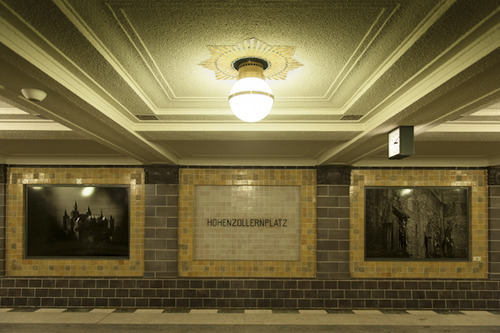
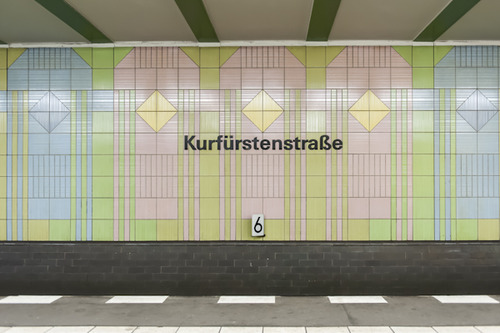
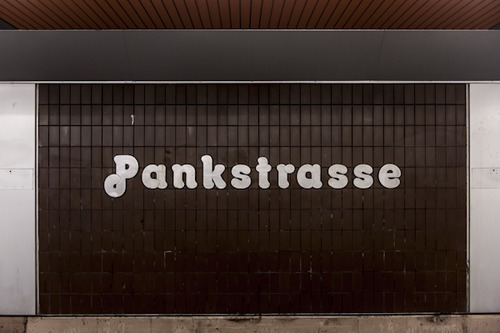
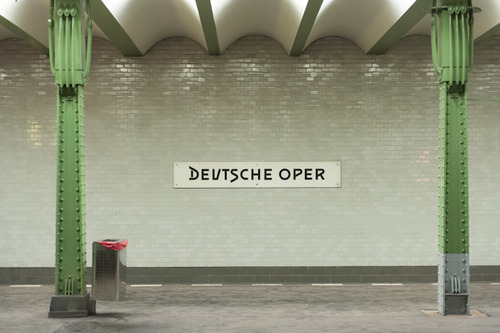
There's a piece about Endbahnhof in Atlantic Cities here, and an interview with Seabrook in Australian twee-culture bible Frankie here.
2013/3/1
Berliners are protesting against the tearing down of what's left of the Berlin Wall, as a section decorated with murals and known as the East Side Gallery is demolished to make room for—wait for it—luxury apartments.
About 120 international artists were invited to plaster it with colourful murals, as the strip of wall carried none of the colourful graffiti that had covered the western side. In 2009 the murals were renovated at a cost of €2m (£1.7m).So as Berlin is gentrified, the artists and bohemians are priced out and replaced by wealthy yuppies drawn to the city's aura of cool, and the schicki-mickis as they're called start voting with their euros to have more luxurious accommodation built. And so, yuppie apartment complexes are built, and everything from art squats like Tacheles to sections of the Berlin Wall is demolished to make room for the city's new owners. And soon, Berlin will be a city of prestigious apartment towers, luxury shops and expensive champagne bars, a sort of Dubai with worse weather; the remainders of the city's rough history, artistic ferment and unkempt, boisterous underground culture will be represented by a few curated exhibits that don't interfere with the business of making and spending vast amounts of money.
There's a petition against the demolition of the East Side Gallery here.
2013/1/19
For a while, Scotland famously had more pandas than Tory MPs; now, Germany has as many Scottish Tory parliamentarians as Scotland:
Many German politicians try to play down their roots if they have a hint of anything un-German about them. Not so McAllister, whose Scottishness – his father was born in Glasgow – has only served to boost the CDU's re-election chances on Sunday in the state of Lower Saxony, where he has been prime minister since 2010.
McAllister retains ties with relatives in Newton Mearns, and speaks English to his two daughters at home in Hanover. He refuses to be drawn on the issue of Scottish independence though, as a potential future leader of Germany, he may well one day find himself having to take a decision on Scottish membership of the European Union.It's interesting that, in Germany, a politician who has a foreign name, holds dual citizenship and speaks English to his children is not only eligible, in the public eye, for office, but heading for probable electoral victory soundtracked by a bagpipe-backed, heavily Scottish-themed campaign anthem, and believed to be future Chancellor material. I can't imagine a similarly exotic candidate being as successful in Britain.
2013/1/4
The ongoing gentrification of Berlin is now making a linguistic mark on the city: Prenzlauer Berg, the chic inner eastern neighbourhood popular at first with squatting artists, and then with trendy schmicki-micki couples with children in sports-utility prams, is now facing an influx of affluent new residents from Swabia, a wealthy, conservative region of southern Germany adjoining Bavaria, resulting in the Swabian dialect of German replacing the Berlin dialect in parts of the neighbourhood:
"The positive side of the changes, is that literally everything looks nice now," he said. But he then thundered, "I get angry when I'm in the bakers, and there are no Schrippen (the Berlin slang for white rolls) only Weckern (the Swabian term). And its exactly the same for plum cake," he went on, which the relative newcomers call Pflumendatschi (a Swabian term.) "That makes me really the last defender of the Berlin dialect."
Thierse added: "I hope the Swabians realize they are now in Berlin. And not in their little towns, with their spring cleaning. They come here because it's all so colorful and adventurous and lively, but after a while, they want to make it like it is back home. You can't have both."
2012/12/20
A minor blow has been struck against the Zuckerberg Doctrine, the principle that users of social websites must identify themselves by their legal “wallet names”, presenting one identity to everyone from employers to gaming buddies to credit-rating agencies and advertisers (especially those): Germany's Data Protection Commissioner has ruled that users have a right to use pseudonyms, and in prohibiting this in its terms of service, Facebook is in violation of Germany's strict privacy laws. Facebook, however, has asserted that this law is not valid, as its European operations are based in Ireland, which has a more libertarian legal regime.
2012/12/6
What does a cash-strapped totalitarian regime do for money? Well, one option is to sell its citizens for medical research, as it's now revealed East Germany did in the 1980s:
In another case, Annelise Lehrer, the widow of a former East German heart patient discovered that her husband Gerhard had been part of a batch of patients who were unwittingly subjected to testing for the blood pressure drug Ramipril, which was developed by the former Hoechst company in 1989. Gerhard Lehrer died soon after his release from an East German hospital in 1989. His wife discovered that in keeping with Hoechst’s testing procedure, he had been part of a group which was given placebos and had received no treatment for his heart condition.
The makers of Tests and the Dead said they had identified the individuals who had organised drug tests for Hoechst in East Germany, but all of them had categorically refused to be interviewed.Two thoughts: a) surely those involved can be prosecuted? And, b) I wonder which of the world's pharmaceutical companies are doing similar deals in, say, North Korea today.
2012/8/8
As Italy's economy flounders, Der Spiegel has a report on the different way of business and administration in Italy's south:
The politicians have proven particularly adept at finding public service jobs for their friends. Today, some 144,000 Sicilians get their salary from the state, and one in eight of them is the head of something or other. Many administrative offices are full of people who have no idea what they're supposed to be doing.
The mafia controls large parts of waste collection and the transport industry, trades in milk and cheese and builds roads under public contracts. The system of public tenders lends itself to all kinds of fraud. But it's not being changed. People who win a contract to build a section of motorway for €100 million sell it on for €90 million -- without lifting a finger. The buyers pass it on to a third company for €80 million. And so on. In the end, someone builds the actual road that should cost €100 million for just €10 million -- and the result looks correspondingly unsatisfactory.
A prime example of this is the A3 motorway from Salerno to the city of Reggio Calabria in southern Italy. Construction began in 1962, and almost every kilometer was built by a different firm. When the motorway was finally finished in 1974, there was -- surprise, surprise -- no emergency lane. After more than 20 years of debate, renovation work begain in 1997 and the A3 is now scheduled for completion in 2017. The estimated construction costs are 10 times greater than planned. There is no hint of national outrage or political consequences.Not all Italians are putting up with such commentary from the Germans (i.e., the ones left to pay the bill at the end of the night): Italy's disgraced former pornocrat, Silvio Berlusconi, is having his tabloids call the Germans Nazis, in between commenting unflatteringly on Chancellor Angela Merkel's appearance. (In Germany, you see, women politicians typically don't ascend to office from having worked as showgirls.) Perhaps he's hoping to reclaim an Italy kicked out of the EU as his personal fiefdom?
Meanwhile in France, a statue of former supermodel and First Lady Carla Bruni-Sarkozy has been installed in a Parisian suburb. The statue was commissioned before her husband, President Sarkozy was swept from power and disappeared from public view shortly after losing immunity from prosecution, and shortly before his home and two offices were raided by police:
The Sarkozys' decision to go to ground contrasts magnificently with the opulent lifestyle the once publicity obsessed pair showed off when they were in the Elysée Palace. Private jets with made-to-order bread stoves, daily fresh flower bills of more than €750, Vanity Fair cover shoots and even a CD release by the self-styled "rock chick" first lady were all part of a presidential package which so disgusted ordinary French people that they ended up replacing Sarkozy with the most overtly leftwing government for decades.
2012/5/29
In what could be one of the most unfortunate printing errors in recent history: the publisher of the German edition of Donald Duck comics has had to recall a recent issue after one of the speech bubbles seemingly used the word “Holocaust” as a term of congratulation. Oops!
In the episode titled "Where is the Smoke?" a dignitary honors a team of firefighters, with the German words, in the bubble above his beak, boasting of the "awards to our brave and always alert fire lookouts! Holocaust!"The word “Holocaust” in the text was not the work of a mischievous translator, but rather part of the English-language text which, by mistake, had not been erased. (The question of how that one particular word escaped deletion in the artwork sent to the German publishers has not been answered. One does wonder whether or not it was a prank by some low-ranking staffer at Disney Corp; if so, it might not be the first Nazi-themed prank by a Disney insider.)
2012/3/14
Some hackers in Germany have automated the process of generating semi-random T-shirt designs.
 The result is Zufallsshirt (“chance shirt”), a sort of Borgesian infinite library of quasi-ironic T-shirts. It generates a huge number of combinations of phrases (mostly in German, though with quite a few in English), words and clip-art. Some look like the sort of thrift-store attire hipsters wore 15 years ago, others like miscellaneous ravey wordmarks pumped out by T-shirt labels, and others are rectangles of acrostics of random words.
Some of the results are more presentable than others; one might believe that “Budapest Bicycle Flux” was a semi-obscure math-rock band whose gig the wearer happened to catch in some college-town bar back in the day, and there are situations where one might plausibly wear a T-shirt reading “I Reject Your Reality And Replace It With Cupcakes”, which, alas, cannot be said for some of the outputs, such as “your vagina is a wonderland”, or a grid of words including “Hitlerponys”, “Mörderpenis” and/or the decidedly euphemistic-sounding “wurstvuvuzela”. There are no permalinks and no way of keeping a design other than by buying it (i.e., getting it printed and shipped, which is done by a Leipzig-based mail-order T-shirt printing company). Or by saving the .png file of the image from the website. Anyway, I suspect that the creators have made a fair amount of money, and quite a few people have drawers full of odd-looking shirts from a parallel universe.
Interestingly enough, after clicking through the site for a while, a reader with a limited grasp of German may find their German comprehension improving slightly; perhaps the flood of meaningful (if nonsequiturial) sentences exercises the language pattern-matching parts of the brain in some kind of process of combinatorial fuzzing, reinforcing plausible word sequences.
2012/2/18
In France, the Academie Française carefully curate the language, meticulously pruning loanwords and replacing them with French neologisms (i.e., logiciel for software, and, less successfully, courriel for e-mail). Across the border, the Germans take a different approach, and actually have a competition for the best English loanword each year, the Anglizismus des Jahres. Last year, the winner was "shitstorm", which follows 2010's "leaken".
Borrowing words from English is somewhat of a tradition in Germany; the most (in)famous example is the German colloquial word for mobile phone, "handy".
2012/1/29
Last week, The Guardian once again ran a series of articles on Europe today, with contributions from papers in France, Spain, Germany, Poland and Italy. Intended partly to combat the rise in anti-European sentiment in the wake of the financial crisis. Among other things, this includes a number of profiles of political leaders by journalists from other countries (i.e., an Italian perspective on Germany's Angela Merkel, a German view of Poland's Donald Tusk, and French and British pieces on the other country's leader), as well as a a section looking at, and responding to, national stereotypes in Europe:
What message do we Brits think we send when our signature cultural export of 2011 was Downton Abbey, a show entirely about the intricacies of class and which apparently longs for a return to Edwardian notions of hierarchy? The smash West End play One Man, Two Guvnors similarly revolves around class. Unfortunately, it's not just a foreigners' myth that in Britain how one speaks and what school one attended still counts.
There is a vibrancy to modern British life that eludes the cliche's grasp. There's a hint of it in that Polish suggestion that the Brits are "kind and friendly to immigrants". Compared with other European countries, it's probably true that Britain is, generally, more tolerant. Some of our public services – the NHS, the BBC – are still cherished. We are not merely a mini-America of let-it-rip free-marketism.
Efficiency is not really a Berlin thing. Take construction. To build 2km of new tram lines to connect the new central station, they set aside three years. Delays were not even factored in. In China, they'd have built whole new cities in that time, or a high-speed motorway across the entire country. Maybe the Chinese are the Germans of the 21st century. Or maybe Berliners are just not typical Germans. Can you stereotype a country if its capital is not typical?
In Italy, sex drive increases with age. Naturally, it is also possessed to a degree by the young (this is why we have children), but it is only after the age of 50 that the Italian male finally dives headlong into adolescence. We are the only nation to have had a prime minister in his 70s who wears a bandana on his head like a tennis player or a rap singer.
2011/12/19
The dust hasn't yet settled after David Cameron vetoed the EU financial treaty, setting Britain on a course to the periphery of the EU or beyond, but already the Euroskeptics are lining up to give Johnny Foreigner what for. The latest to stick it to the Frogs and Krauts is the mayor of Bishop's Stortford, whose particular exercise of Churchillian bulldog spirit has been to withdraw his town's twinning arrangement with Villiers sur Marne and Friedberg. Just because.
Mayor John Wyllie has written letters to his honourable counterparts in the town's two twin cities: Friedberg near the German financial capital of Frankfurt, and Villiers-sur-Marne near Paris. He isn't writing to invite them to the usual partnership ceremonies, conferences or youth exchange programs. He is writing to cancel the town's friendship with them, after 46 years. On September 28, 2012, Wyllie informed them that his town would sever all ties with the twin towns. He gave no reason for this break-off of diplomatic relations.
Mike Wood, 66, the only council member from the pro-European Liberal Democrat party, says Tories are "usually normal people. But whenever you mention Europe they turn into some kind of monster."This comes on the heels of rising anti-European, and particularly anti-German, sentiment in the British populist media, with old WW2 stereotypes being dusted off and trotted out at all the inappropriate moments:
Distrust of the European Union goes hand-in-hand with distrust of Germany, especially among "euroskeptics," the current euphemism for the many haters of the EU in Britain. The headline "Welcome to the Fourth Reich" in the high-circulation Daily Mail summarized the German-French plans to rescue the monetary union.(You'd think that, coming from a paper with the Daily Mail's history, "Fourth Reich" would be a term of glowing praise...)
Anecdotally, I've noticed that, while the supermarkets of Britain are full of Christmas puddings of all sorts, there is no stollen bread, a British Christmas tradition since cheap flights to German Christmas markets began. I wonder whether the decision to not order any this year comes from market research surveys into anti-German and/or anti-Continental sentiment among the British public.
2011/11/13
Police in London have arrested 179 members of anti-immigrant group the English Defence League, after members of this group were planning a violent attack on Occupy LSX protesters outside St. Paul's, in the name of defending God and Country and bringing to bear the old ultra-violence against some "Cultural Marxists". I imagine that outspoken EDL fellow traveller Anders Breivik would have approved:
The English Defence League had issued statements and made threats on Facebook to burn down protesters tents if they were still outside St Paul's on Remembrance Sunday, according to Phillips.
A statement by the EDL on Thursday was read to the Occupy LSX general assembly on Friday morning to make people aware that there was a threat being made. "They called us all sorts of names in the statement and said we should leave "their" church and stop violating their religion," said Phillips.(Fascists claiming religion as exclusively theirs to defend and wield as a banner is nothing new: "Strength Through Purity, Purity Through Faith", as Alan Moore put it.)
Meanwhile, in eastern Germany, the story of three neo-Nazi fugitives who had been on the run since 1997 came to an end after two had shot each other in a trailer, and a third had been arrested after setting fire to the house they shared. Police searching the ruins of the house found a number of weapons, including the service pistol of a police officer killed by them during a bank robbery and a gun used in the execution-style murders of kebab shop owners across Germany. The three, calling themselves "Thüringer Heimschutz" (which Spiegel translates as "Thuringian Homeland Defence", though "Thuringian Homeland Security" is tantalisingly close) seemingly made little effort to hide, living openly among neo-Nazis in the town of Jena, which raises some questions of how they managed to avoid the attention of law-enforcement agencies:
Martina Renner, a ranking Left Party member in the state parliament, doubts these findings. "I think it's quite unlikely that those three lived for 10 years in Germany without having their cover blown." Even in 1998, she alleged -- when the manhunt began -- there were hints that the state's constitutional protection office had helped them disappear.
Renner says their alleged crimes even before 1998 were not just "petty crimes," but could have involved "explosions" of a "life-threatening magnitude." She says it's important to clarify just how deeply the state domestic intelligence office may have been involved. If a regional intelligence agency like that is prepared to "work with" such dangerous criminals, she says, the question arises whether the agency functions as an instrument to protect a democracy.
2011/9/21
 More on the Pirate Party's recent electoral success in Berlin: Der Spiegel asks who the Pirate Party are (spoiler: they're the new Greens):
Voter analysis from Sunday would seem to back up that assessment. The survey group Infratest established that 17,000 former Green Party supporters switched their votes to the Pirate Party on Sunday, more than came from any other party. The SPD lost 14,000 voters to the Pirates and the far-left Left Party 13,000.
The party's largest coup, however, came from its ability to attract fully 23,000 people to the polls who had never voted before. More votes came from former East Berlin, where the party secured 10.1 percent of the vote, than from former West Berlin. Most of the party's supporters are young, well-educated men -- as are 14 of the 15 Pirates who will now take their seats in the Berlin city-state parliament.And a Spiegel survey of editorials from various German newspapers (conveniently annotated with their political slants) links the Pirate vote to the rise of the laptop-and-latte generation in Berlin, a city now said to be Europe's IT start-up hub. Which raises the question of whether the Pirates are a progressive party for an age of gentrification.
Meanwhile, the Grauniad asks whether something like that could happen in Britain. (Spoiler: not in a first-past-the-post system, and Britain's politicians also seem less technologically clueful, and more beholden to the old-media powerbrokers, than Germany's:)
The German government was one of the first to decide that national-security systems should not be based on proprietary software. In such a climate it's predictable that a campaigning political party with a radical online agenda would find a ready audience. The bovine way in which the last House of Commons passed Lord Mandelson's digital economy bill, with its clueless 'anti-piracy' provisions, does not exactly engender confidence in the British political class's understanding of these matters.
2011/9/19
As the world celebrated Talk Like A Pirate Day (with the true hardcore eschewing the "yarrr"s and brushing up on their Somali), the good burghers of Berlin have done one better; there, the Pirate Party has won some 14 or 15 seats in the city-state's 149-seat parliament; about half as many as the Greens and slightly fewer than the neo-Communist Left Party.
Indeed, the support for the party -- founded in 2006 on a civil liberties platform that focused on Internet freedoms -- was sensational. Not only will the Pirate Party enter a regional government for the first time, but its results far surpassed the five percent hurdle needed for parliamentary representation. The success was so unexpected that the party had only put 15 candidates on its list of nominations. Had their support been just a little higher, some of their seats would have remained empty because post-election nominations of candidates isn't allowed.Many of the seats came at the expense of the neoliberal Free Democrats, who were wiped out in Berlin. The Pirate Party (which started campaigning on a copyright-reform and online privacy platform, and expanded this to include the decriminalisation of drugs, the abolition of Germany's church tax system and a basic living wage for all), in fact, seems to be taking over the mantle of forward-looking progressive party from the Greens, who were once considered dangerous radicals (in the Reagan-era action film Red Dawn, the Greens winning West German elections was the catalyst that led to a Soviet invasion of the USA) but now have become all but part of the establishment.
The Pirates also have something other parties have long since lost -- credibility, authenticity and freshness. The erstwhile alternative Greens, whose share of the vote in the Berlin election fell well behind their expectations, were also once the young party with funny mottos and unconventional campaign methods. When they entered the Berlin parliament in 1981, other parties were skeptical. At the time, the now imploding Free Democrats described the Greens as "domestic policy anarchists and foreign policy gamblers", while lead CDU candidate Richard von Weizsäcker, who would later be appointed German President, said they were "impossible to describe."It used to be that the concept of "Green" (i.e., ecological consciousness and sustainability) was the hook to hang progressive ideals from; now, it seems, that the idea of the Pirate (as defined in opposition to the propaganda of Big Copyright, the steady privatisation of the public sphere and an encroaching authoritarian surveillance state) may be replacing the idea of Greenness as the banner that draws in progressives.
2011/8/17
There's an interesting piece in Der Spiegel about the rise of secularism and the psychological differences between religious and secular people. According to the article, non-religious people (atheists, agnostics and the nonreligious) make up about 15% of the world's population, placing them third behind Christians and Muslims in number. Meanwhile, secularism is on the rise, with the often discussed religious revivals, in Europe, the US and elsewhere, being, more often than not, illusory. (In the US, a country associated with almost mediaeval levels of religiosity in public life, churches are losing up to 1 million members a year.)turned out to be and also an increasing number of people who identify as religious on surveys admitting that they don't actually believe in a deity.
According to Boston University psychologist Catherine Caldwell-Harris, the differences between the religious and secular minds may emerge from different thinking styles, with religious people being more likely to attribute sentient agency than secular people:
Caldwell-Harris is currently testing her hypothesis through simple experiments. Test subjects watch a film in which triangles move about. One group experiences the film as a humanized drama, in which the larger triangles are attacking the smaller ones. The other group describes the scene mechanically, simply stating the manner in which the geometric shapes are moving. Those who do not anthropomorphize the triangles, she suspects, are unlikely to ascribe much importance to beliefs. "There have always been two cognitive comfort zones," she says, "but skeptics used to keep quiet in order to stay out of trouble."The rise of secularism has led to more study of what secularists do actually believe. And, it seems, there are a few outlooks they tend to share:
Sociologist Phil Zuckerman, who hopes to start a secular studies major at California's Pitzer College, says that secularists tend to be more ethical than religious people. On average, they are more commonly opposed to the death penalty, war and discrimination. And they also have fewer objections to foreigners, homosexuals, oral sex and hashish.
The most surprising insight revealed by the new wave of secular research so far is that atheists know more about the God they don't believe in than the believers themselves. This is the conclusion suggested by a 2010 Pew Research Center survey of US citizens. Even when the higher education levels of the unreligious were factored out, they proved to be better informed in matters of faith, followed by Jewish and Mormon believers.The article also looks at the case of religiosity in Germany, where the East was ruled by an officially atheistic totalitarian dictatorship while the West retained strong links to Christianity. After reunification, the East remained considerably poorer than the West. Perhaps surprisingly, these conditions did not result in a new religious revival spreading through the East, but rather the opposite:
When the GDR ended its period of religious repression, no process of re-Christianization occurred. "After the fall of the Berlin Wall, the withdrawal of a church presence in the east actually sped up," says Detlef Pollack, a professor in the sociology of religion at the University of Münster. Ironically, the link between church and state contributed to secularization in the East, he says. Publicly funded theological professorships, military chaplaincies, and the presence of church representatives on broadcasting councils were common. As a result, public perception came to closely link authority with religion, which was seen as coming from the West.As rapidly as secularism is rising, though, we might not see a powerful secular lobby any time soon. For one, secularists remain mistrusted in many places (in the US, according to a 2010 Pew Research survey, atheists are the most disliked group, behind Muslims and homosexuals). And secondly, given the broad differences in a movement by definition not bound by any dogma, the emergence of any sort of consensus is unlikely:
Then he tells of a meeting of secular groups last year in Washington. They were planning a big demonstration. "But they couldn't even agree on a motto," he says. "It was like herding cats, straight out of a Monty Python sketch." In the end, the march was called off.
2011/6/4
A few recent studies demonstrating the power of cultural transmission of values and attitudes over surprisingly long stretches of time: firstly, a set of surveys in central and eastern Europe has shown that trust in government officials is higher and corruption is lower in areas formerly governed by the Habsburg Empire, whose bureaucracy was considered to be more honest and competent than elsewhere in Europe at the time; the phenomenon has lasted from the end of World War 1 to the present day, surviving the redrawing of borders and different types of regimes, and to this day, levels of trust and corruption differ within the borders of countries between formerly Habsburg and, say, Ottoman or Russian-ruled areas.
On a darker note, another study in Germany has found that towns in which Jews were massacred during the Black Plague were more likely to support the Nazis and participated more enthusiastically in the Holocaust, some six centuries later.
2011/3/9
Germany's brewing industry, often regarded as a benchmark around the world, is not doing very well, with breweries closing and others cutting their production. One of the factors causing this may be Germany's ultra-traditional brewing culture, where a 16th-century beer purity law (the Reinheitsgebot), whilst no longer officially on the books, is still widely followed, severely constraining what may be considered beer in polite company:
These days, Germany's celebrated brewing towns and atmospheric old taverns can feel like retirement homes. Visitors to the south of Germany today (where more than half the nation's breweries are located) find few of the ardent young beer lovers that crowd craft watering holes in Copenhagen; Brussels; London; New York; Portland, Ore.; and even Rome. And while it's true that last fall's 200th Oktoberfest was bigger than ever, using Oktoberfest to measure the health of German beer culture is like using Disney World admissions to measure the health of American cinema. Once a decorous wedding pageant, Oktoberfest is a hot mess, with cheesy carnival rides and hordes chugging cheap lager as if it were Hawaiian Punch. Paris Hilton even showed up for the anniversary celebration.
A law enacted in 1516 to control prices and shield the baking industry from supply shortages by excluding rye and wheat from brewing, the Reinheitsgebot stipulated that beer must contain only malted barley, hops, and water (wheat and yeast were written in later). The decree—often described as a the world's first consumer protection legislation—dried up the ancient pre-hops tradition of Gruitbier, which likely included yarrow, bog myrtle, juniper, rosemary, mugwort, and woodruff—all perfectly useful bittering and flavoring plants. It also pulled the plug on Köttbusser, an ancient brew made with oats, honey, and molasses. While the Reinheitsgebot was actually overturned in 1987 as an impediment to European free trade, many German companies adhere to it for marketing purposes, especially in Bavaria. When it comes to beer for local consumers (exports are mostly brewed without the strictures), it's still the de facto law of the land.
Another issue is the hypnotic marketing force of Reinheitsgebot may make Germans less sophisticated tasters by limiting their perception of what a good beer can be. When asked, many Germans—even well-traveled beer-industry professionals—tend to wrinkle their noses at beers of foreign style or origin. They would sooner drink cheap biermischgetränke or mass-produced domestic beers mocked as spülwasser (dishwater) than try anything exotic, such as Belgian ales spiced with herbs or the sort of hoppy, aromatic ales and lagers making waves in the American craft-beer market. If Germans want the taste of something new and exciting, they look to other forms of alcohol.Gradually, however, things are changing, as a new generation of brewers is starting to explore more adventurous forms of brewing.
Gasthaus-Brauerei Braustelle in Cologne, a nano-brewery that opened in 2002, is also defying national and local traditions with increasing chutzpah: braumeister Peter Esser's latest beers include a dunkel (dark) seasoned with rosemary, an American-style IPA (called Fritz IPA), a 5.8 percent ale infused with hibiscus flowers (Pink Panther) and what's thought to be the first American-style imperial stout ever brewed in Germany (Freigeist Caulfield).It's interesting to compare this to the situation in Britain, where another tradition (that of "real ale") is accused by some of holding back the local brewing culture.
2011/1/22
Der Spiegel has an interesting article about how a new generation of Israelis are flocking to Berlin, tempted by the city's vibrant culture and sense of freedom, and negotiating the fraught history and politics of doing so:
"I do not know if 'forgive' is the appropriate term," says Gil Raveh. Raveh, a conductor, came to Berlin four years ago on the recommendation of award-winning Israeli conductor Noam Sheriff, who himself had studied in the city. "Forgive whom? Merkel? The waitress who serves my coffee?" he asks.
With a European passport thanks to his mother, who was born in Eastern Europe, Netter made the move to Berlin. His first year in the city, he says, was spent having fun and living off of his savings. Then he started Meschugge as a one-time event, and it became a regular attraction: "The Unkosher Jewish Night," as he calls it. A quarter of the audience is Israeli, the rest German. Netter says he suspects some of the Germans might come as a way to alleviate their own feelings of guilt. "We Israelis cannot understand how it feels not to be proud of yourself, as a nation," he says. "The Germans are full of serious identity crises."The Israelis have a different ways of addressing the elephant in the room:
But Israeli immigrants in Berlin have their own identity issues. For example, almost all of them prefer to be treated as "Israelis in Berlin," not as "Jews in Germany." "Even the Germans themselves say Berlin is not Germany," says Russ. "The Jewish component of my identity has to do with a shared cultural past, not with a religious belief. I do not go to synagogue or eat kosher food."
"An Israeli friend in Berlin once showed me his apartment," says Russ. "When we got to the kitchen, he opened the gas stove and said: 'And this is the shower.' But the first time I told a Holocaust joke here, a friend warned me that it's illegal."One of the motivating forces seems to be a contrast between the liberal, creative culture of Berlin and the situation in Israel today, where an increasingly authoritarian political environment is threatening civil liberties, with a right-wing government waging war against civil rights groups.
2010/11/25
In Germany, Google Street View has a posse, and they'll egg your house if you exercise your right to opt out of being visible on StreetView. The Streisand Effect is a bitch sometimes.
2010/10/20
Two German engineers has found a way around the EU's ban on incandescent lightbulbs: by selling them as "heatballs", heating devices which just happen to emit light:
Rotthaeuser studied EU legislation and realised that because the inefficient old bulbs produce more warmth than light -- he calculated heat makes up 95 percent of their output, and light just 5 percent -- they could be sold legally as heaters.
On their website, the two engineers describe the heatballs as "action art" and as "resistance against legislation which is implemented without recourse to democratic and parliamentary processes."There is a market there; a small demographic of people who prefer incandescent lightbulbs and another one of people willing to spend money for the joy of spiting the leftists, greens and other politically-correct do-gooders.
2010/10/3
This just in: as of this weekend, World War 1 is officially over, with Germany having paid the final, £59.5m instalment of reparations to France and Belgium.
2010/9/20
A direct channel tunnel rail service from London to Germany is looking one step closer: on the 19th of October, Deutsche Bahn will drive a test train through the tunnel, and into London St. Pancras. The train, one of DB's ICE3 high-speed trains, won't be carrying passengers; it will be participating in a safety exercise in the Tunnel, part of stringent tests which will need to be completed before such a service can be approved, and then being exhibited at St. Pancras in a publicity exercise.
There are a lot of tests which need to be undertaken, especially for trains which were not designed specifically with the tunnel in mind (as the Eurostar fleet were). However, if all goes well, Deutsche Bahn are expecting to run a service from London to Frankfurt, via Brussels and Cologne, from the end of 2013. The service is is expected to take 4-5 hours between the two financial capitals, about the same time as London to Edinburgh; while conventional wisdom says that rail is not competitive against air travel for journeys longer than four hours, this may no longer be the case, thanks partly to longer air check-ins and tighter security restrictions, and partly to Deutsche Bahn's exceedingly comfortable trains, or so Mark Smith (of The Man In Seat 61 claims):
A direct train could cut London-Cologne to 3 hrs 55 mins. This would compete with air not only on speed and convenience, but on comfort – DB's ICE trains are among the most comfortable trains in the world, being designed to tempt German businessmen out of their BMWs and Mercedes, with power sockets for laptops at every seat and WiFi on many routes. And using DB's current ICE fares to neighbouring countries as a guide, I'd expect a London-Cologne or London-Frankfurt journey on any new service to start at a very affordable €49 (£41) or even €39 each way, with no need to pay to get add the cost of getting to and from airports.I'm not convinced it'd be that cheap; the tunnel, after all, is a privately-run monopoly, with steep access fees, which would be factored into the ticket prices, though I imagine that it might well end up cannibalising the air travel market between London and Frankfurt (at least for scheduled flights; high-powered businessmen with private jets would presumably keep those), much as Eurostar did to air routes between London and Paris and Brussels.
2010/8/7
25 years after the Chernobyl disaster, a wildlife census in the Chernobyl exclusion zone has shown mammals in decline in the area, puncturing the myth of the zone as an involuntary park, where happy mutants can thrive unmolested by humans. Meanwhile, Germany is overrun with radioactive boar, with the German government shelling out hundreds of thousands of euros in compensation to hunters.
2010/5/18
Ich Werde Ein Berliner is a Stuff White People Like-style blog only purporting to unmask the hidden rules of being a member of the "Elite German People" (the word "German" is used there in the way Christian Lander uses the word "White") who populate the hipper parts of Berlin, ostensibly for the benefit of the numerous auslanders moving to Berlin for its creativity, edginess and bohemianism. The blog presents a tour of the various hipster leks, arms races and balancing acts for demonstrating one's cultural bona fides as a Berliner (and that one is not one of the Wrong Types of Germans), subtly underscoring the contradictions and absurdities beneath their surface.
There are, for example, entries on personal transport (summary: two wheels good, four wheels bad), techno music, obsession with Japan China, the 10% of (mostly bourgeois professional) Germans who model themselves on Americans, café culture (one thing one can't argue with there) and the semiotics of soft drinks, audio-visual media (apparently not having an interest in it is considered by Berliners to be a sign of deep sociopathy), the precarious balancing act of Berliner irony and Berliners' relationship to other German cities (apparently Cologne is not so much a mecca of underground electronica as a boringly bourgeois provincial town inhabited by orange-tanned, Ed Hardy-attired "guidos"; Munich, meanwhile, exists solely so that Berliners can slag it off for its conservatism and boringness) and the inevitable ordeal of family Christmases ("One good rule of thumb is - the more artiste, urbane, and bohemian a German person appears, the more remote and redneck his family background will be. For example, all those cross-dressing, Ketamine-addicted, full-body tattooed gay skinhead minimal-techno deejays (so, roughly 20% of the population of Berlin), stem from (remote rural towns in south-western Germany).")
2009/9/29
 In Germany, they go in for human-powered transport in a big way. In Hamburg, for example, they have an experimental bus powered by onboard stationary bicycles:
The bus takes a maximum of 20 people, and needs at least six to power the bus. One model had a row of seats at the back for pure passengers. The driver doesn't pedal, but steers and operates the brake. It can get up to about 25mph. (Here's another design, on YouTube.)I haven't seen one of those, but I have recently been in Berlin, where I saw a bicycle-powered two-carriage fake tram being pedalled through Mitte. I spoke with the two gents pedalling it, who told me that it was a consciousness-raising exercise to campaign for an extension of Berlin's tram network to the West (where it had been torn up in the 1960s, as not to get in the way of affluent capitalist Berliners' VWs and BMWs), and to help campaign for the Greens in the election.
2009/5/30
Two fragments of the secret history of the Cold War have come to light. In 1969, US President Nixon sent a squadron of nuclear bombers towards the Soviet Union, and instructed Kissinger to tell the Soviets that Nixon was "out of control", leading them to believe that they're dealing with a dangerous madman, in order to scare them into leaning on the North Vietnamese government.
Apparently neither Nixon or Kissinger had absorbed another Schelling insight - if you want to credibly pretend you are out of control then you have to push things so far that sometimes you will be out of control. The number of ways such a plan could have resulted in a nuclear war is truly frightening. After all, Nixon was gambling millions of lives on the Soviets being the rational players in this game.Fortunately, the Soviets didn't call his bluff and civilisation as we know it still stands.
Meanwhile, it turns out that the West German policeman who shot dead an unarmed left-wing demonstrator in West Berlin in 1967, touching off riots and enraging the protest movement, had been working for the Stasi.
The most insidious question raised by the revelation is whether Mr. Kurras might have been acting not only as a spy, but also as an agent provocateur, trying to destabilize West Germany. As the newspaper Bild am Sonntag put it in a headline, referring to the powerful former leader of the dreaded East German security agency, Erich Mielke, “Did Mielke Give Him the Order to Shoot?”
In an interview with the Bild, Mr. Kurras, 81, confirmed that he had been in the East German Communist Party. “Should I be ashamed of that or something?” Mr. Kurras was quoted as saying. As for the Stasi, he said, “And what if I did work for them? What does it matter? It doesn’t change anything,” the paper reported.
(via MeFi, Boing Boing) ¶ 2
2009/4/21
Der Spiegel has some evocative photographs from East Germany, taken by West German photographer Karlheinz Jardner in 1990, not long after the wall came down. It includes shots of room interiors frozen in the perpetual 1970s of the DDR, dilapidated provincial cities with Trabants, more Trabants, luxury hotels reserved for the Communist Party elite, dilapidated seaside resorts, cheerful urchins with piles of coal, uninspiring consumer goods and symphonies of grey; some glimpses of a parallel world, just before it disappeared.
And here is a Fortean Times piece on "The Ghosts of East Berlin".
2009/3/25
It's getting harder to identify the neo-Nazis; no longer content to shave their heads and wear white bootlaces (much to the relief of skinheads into the scene for the music), they now have their own street-casual sportswear brand, Thor Steinar, which looks like any other streetwear, only with a few more Nordic symbols and (allegedly) the odd hint at Nazi sympathies:
Many of the symbols are straightforward. On one Thor Steinar T-shirt, the word kontaktfreudig is splashed across red splotches that look like spatters of blood. The word could be translated as "outgoing," or more literally, "happy to make contact." The display on Rosa-Luxemburg Street includes clothing with common symbols like an eagle for German pride, or "18" and "88" for "Adolf Hitler" and "Heil Hitler" -- numbers freighted with meaning because of the position of the initials in the alphabet.The Thor Steinar brand (some of whose earlier designs have been banned for looking too runic and warlike) denies deliberately appealing to neo-Nazis, though some regard these denials with scepticism. Still, it's not clear how long they can cash in on the crypto-Nazi demographic, now that the company has been bought by a Dubai-based Arab investor. On the other hand, the Nazis of today aren't necessarily all that discerning:
"They are getting harder to spot," she said, taking a picture out of a folder showing far-right and far-left activists facing off at a march. Both groups wore Che Guevara T-shirts and checked scarves -- long a leftist symbol of solidarity with Palestinians. But the far right co-opted both symbols, she explained, just as neo-Nazis have taken to wearing all black, which used to be an anarchist fashion statement.
Guevara may be the strangest appropriation of all. Neo-Nazis wear his image but don't hesitate to beat up people who look different -- including Latin Americans.Perhaps next they'll adopt Robert Mugabe as a political icon; after all, he's thuggish enough, and is one of the few political leaders in recent times to have proudly equated himself to Hitler. The whole "white-supremacy" angle could prove to be a stumbling block though.
2009/1/12
Germany's Potsdam University is offering its computer science master's degree students a new subject: a practical course in flirting skills, ostensibly designed to improve students' social skills and ability to operate in the real world:
The 440 students enrolled in the master's degree course will learn how to write flirtatious text messages and emails, impress people at parties and cope with rejection.
Philip von Senftleben, an author and radio presenter who will teach the course, summed up his job as teaching how to "get someone else's heart beating fast while yours stays calm."(Ah, those Germans: they even make the sport of love sound like a duelling society...)
Of course, the idea of flirting courses for compulsively-systematising geeks is not a new one, though they have usually consisted of sneaky hacks for getting laid, typically boiling down to embedding subliminal messages in one's speech, surreptitiously pointing to one's crotch and going to bars wearing ridiculously flamboyant boots and a LED belt buckle to get attention. It's not clear whether the Potsdam course will follow in this vein.
2009/1/9
Cat wanders onto set of German weather forecast; the meteorologist, Joerg Kachelmann, scoops it up and resumes giving the forecast without a pause.
2008/12/12
A while ago, German national railway company Deutsche Bahn expressed an interest in running trains through the Channel Tunnel, competing with Eurostar, come 2010, when EU "open access" rules allow train companies to run services all over the EU. Now they're talking about buying out the UK's share of Eurostar altogether:
Deutsche Bahn (DB), Germany’s state-owned railway, may also use Eurostar trains to operate a rival service through the Channel Tunnel, with competition resulting in cheaper tickets to Paris and Brussels. But the Government, which is preparing to sell the third of Eurostar that it controls, would lose the ability to influence the development of the rail link to the Continent.
Over the past 18 months, it has quietly bought several British train companies that carry a total of 30 million passengers a year. DB owns Chiltern, which runs between London Marylebone and Birmingham, and half of London Overground, which operates on the North London Line and will serve the extended East London Line from next year. It also runs two thirds of Britain’s goods trains through its purchase of EWS, the biggest British rail freight company.
DB hopes to persuade Geoff Hoon, the Transport Secretary, that it will operate a more efficient service through the Channel Tunnel by drawing on its experience in Germany of integrating trains with other modes of transport. German rail passengers can book an entire journey on just one web-site and with one ticket and can even arrange for an electrically assisted bicycle to be waiting for them at the station.DB have also expressed an interest in buying more train companies in countries they expand to; given their efficiency, that could be a good thing.
2008/12/9
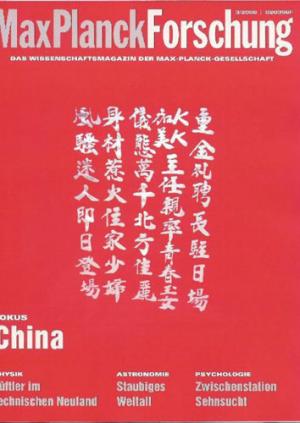 There are red faces at the Max Planck Institute, after the institute published an issue of its journal with a special report on China, and decided to include some Chinese characters on the cover for visual impact. Unfortunately, they didn't seem to have any Chinese speakers on hand, and after the journal went out to publication, it was discovered that the text on the cover was from a flyer advertising a brothel, describing in lascivious detail the talents of the "pretty-as-jade housewives" therein:
Editors had hoped to find an elegant Chinese poem to grace the cover of a special issue, focusing on China, of the MaxPlanckForschung journal, but instead of poetry they ran a text effectively proclaiming "Hot Housewives in action!" on the front of the third-quarter edition. Their "enchanting and coquettish performance" was highly recommended.
The Max Planck Institute was quick to acknowledge its error explaining that it had consulted a German sinologist prior to publication of the text. "To our sincere regret ... it has now emerged that the text contains deeper levels of meaning, which are not immediately accessible to a non-native speaker," the institute said in an apology. "By publishing this text we did in no way intend to cause any offence or embarrassment to our Chinese readers. "The faux pas apparently caused much amusement amongst Chinese internet users, with the exception of some who thought it was a deliberate insult to China. Then again, some people said the same thing about that Guns'n'Roses album. Having said that, this is by no means the first instance of clueless Westerners making fools of themselves in Chinese:
There are tales of drunken teenagers walking out of tattoo parlours with characters reading, "This is one ugly foreigner" or "A fool and his money are easily parted". Another web-user wrote: "I recently met a German girl with a Chinese tattoo on her neck which in Chinese means 'prostitute'. I laughed so loud, I could hardly breathe."The brothel-keeper could not be reached for comment.
2008/12/7
A convicted drug dealer escaped from a prison in western Germany by climbing into a cardboard box and mailing himself out. And I thought that such things didn't happen outside of old animated cartoons.
2008/10/22
Faced with a wave of ostalgie, misty-eyed nostalgia for the fallen East German Communist regime, Germany's educational authorities have created a mockup of an East German classroom, in which school students would be subjected to the Communist experience. There they would be threatened with disciplinary action for wearing Western clothes, ordered to sing Communist marching songs and told of field trips to border guard regiments, by a "teacher" attired in authentic East German synthetic fabrics. One student would also volunteer in advance to play the child of dissidents, who would then be alternately criticised and ignored by the teachers. What the organisers hadn't planned on was that the whole thing would turn into a small-scale reenactment of the Stanford Prison Experiment, with dissident "Steffen"'s erstwhile classmates turning on him and joining in persecuting him like good cogs in the totalitarian machine:
The other pupils began to ostracise "Steffen" themselves and accused him of disrupting the class. Although they were encouraged to stand up against the system before the session, none of the pupils rallied to Steffen's support when he was told he could not visit the border-guard unit, or at any other time.
During these sessions Elke Urban models herself on Margot Honecker, the leader's wife who was also a hardline education minister. She said that only one group had dared to stand up and defend the dissident pupil during her classes. "I deliberately create a totalitarian atmosphere and I am still always shocked how quickly and easily people are conditioned by it," she said. "East Germany may have left a pile of Stasi files behind rather than a pile of corpses, but the similarities with the Nazi regime are there."
2008/8/6
There's an intriguing article in the Guardian about the descendents of German Nazis who converted to Judaism and moved to Israel. The article interviews several such converts (the son of a SS man who's an Orthodox rabbi, a left-wing lesbian campaigner for Palestinian rights, and a professor of Jewish Studies who is related to Hitler, and who describes his (Israeli-born, Arab-hating) son as a "fascist").
One somewhat obvious explanation for this phenomenon is that of assuagement of guilt by rejecting the oppressor population one came from identifying with the victims, and this explanation is floated by an expert on the psychology of the children of perpetrators. Interestingly, though, none of those interviewed, when asked for why they converted to Judaism, mention the Holocaust or Nazism, instead giving theological reasons:
"During my theological studies at university it became clear that I couldn't be a minister in the church," he says. "I concluded that Christianity was paganism. One of [its] most important dogmas is that God became man, and if God becomes man then man also can become God." He pauses. "Hitler became a kind of god."
I tell Bar-On they talk obsessively about the Trinity. But is incredulity really a reason for abandoning a religion with a three-in-one god for one that still believes bushes talk and that waves are parted by the will of God? "That is another way of saying what I have already told you," he says. "They want to join the community of the victim. They may have their own way of rationalising it."
2008/7/7
A funny thing happened in Berlin recently, where Madame Tussaud's opened their latest wax museum. Being ostensibly an educational institution, they had to put some historical figures amongst the celebrities, and it would have been impossible to cover the history of Germany without mentioning the elephant in the room, Adolf Hitler.
Of course, in Germany, any depiction of Hitler or the symbols of Nazism is still fraught with the risk that someone will rally to them or regard them with sympathy, and that the embers of Nazism may once again be fanned into flame; which is why Nazi symbols are banned in Germany, leading to things such as, many years ago, American heavy-metal band KISS having had to change their logo for the German market because two lightning-bolt-shaped 'S's are verboten there.
The Madame Tussaud's management took no chances; they posed Hitler behind a desk, to prevent visitors from getting too close to him, and showed him (quite reasonably) in a state of abject defeat. Additionally, the museum banned touching, kissing or posing with the dummy, and posted security guards to enforce this rule.
All of this was for naught, because, minutes after the museum opened, its second-ever visitor, an ex-policeman turned left-wing anarchist, vaulted the desk and ripped Hitler's head off:
Mr L. resigned from the Berlin police after being assigned to quell a May Day demonstration of left-wing anarchists – “I realised I belonged on the other side,” he said. Since then he has been active in the punk and squatter scene; since February he has been a care worker. His girlfriend Yvonne said: “I’m really proud of him. I’ve been furious about Hitler for days.”The act has been met with popular acclaim in Berlin:
One commentator hailed it as “a successful assassination attempt – sadly 75 years overdue”.
Henryk Broder, a columnist for Der Spiegel, exclaimed: “At last, a successful attack on Hitler!” His one quibble was the nature of Frank L.’s political outburst – no more war. Mr Broder said: “If the Allies hadn’t waged war on Hitler, we might still be under the yoke of his heirs. He should have shouted ‘Never again dictatorship!’ But that’s not a very fashionable rallying call on the Left.”
Politicians were also shedding no tears for the wax Führer. The Social Democrat politician Frank Zimmermann said: “It’s more of an artwork to rip off Hitler’s head than to put him on display.”It's interesting to contrast this with The Times' own readers' comments about the "Looney Left" and its rabid intolerance.
2008/6/6
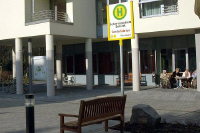 A nursing home in Düsseldolf has come up with a novel way of dealing with stray Alzheimer's patients; they set up a fake bus stop outside the home:
“It sounds funny,” said Old Lions Chairman Franz-Josef Goebel, “but it helps. Our members are 84 years-old on average. Their short-term memory hardly works at all, but the long-term memory is still active. They know the green and yellow bus sign and remember that waiting there means they will go home.” The result is that errant patients now wait for their trip home at the bus stop, before quickly forgetting why they were there in the first place.
(via Boing Boing) ¶ 1
2008/3/27
An investigation into German discount supermarket chain Lidl has revealed an extensive campaign of surveillance of employees, which has been compared to the Stasi's monitoring of East Germany's population (though perhaps Walt Disney's surveillance of animators and Henry Ford's sociological department are also good comparisons):
The detectives' records include details of precisely where employees had tattoos as well as information about their friends. "Her circle of friends consists mainly of drug addicts," reads one record. The detectives also had the task of identifying which employees appeared to be "incapable" or "introverted and naive".
While most incidents seem to have occurred in Germany, the most shocking one allegedly occurred at a Lidl store in the Czech Republic, where a female worker was forbidden to go to the toilet during working hours. An internal memorandum, which is now the centre of a court case in the republic, allegedly advised staff that "female workers who have their periods may go to the toilet now and again, but to enjoy this privilege they should wear a visible headband".
Recording how a German employee identified as Frau M spent her break, one report read: "Frau M wanted to make a call with her mobile phone at 14.05 ... She received the recorded message that she only had 85 cents left on her prepaid mobile. She managed to reach a friend with whom she would like to cook this evening, but on condition that her wage had been paid into her bank, because she would otherwise not have enough money to go shopping."A spokesperson for Lidl has said that the surveillance was intended "not to monitor staff, but to establish possible abnormal behaviour".
2008/1/27
Details have emerged of how the Bavarian police intercept Skype calls and encrypted internet traffic. Apparently they use specially written malware, from a company named Digitask. The malware needs to be installed on the suspect's computer (which can be done in a number of ways; if they can't get a black-bag team in, they can send an email carrying the trojan. Looks like Bavaria's safe from criminals who use Windows then.
2008/1/23
Wired has an interesting article on the project to reassemble shredded Stasi documents in Germany, a vast project involving scanners and custom-developed software from the Fraunhofer Group (best known for developing the MP3 audio compression algorithm):
The data for the 400-bag pilot project is stored on 22 terabytes worth of hard drives, but the system is designed to scale. If work on all 16,000 bags is approved, there may be hundreds of scanners and processors running in parallel by 2010. (Right now they're analyzing actual documents, but still mostly vetting and refining the system.) Then, once assembly is complete, archivists and historians will probably spend a decade sorting and organizing. "People who took the time to rip things up that small had a reason," Nickolay says. "This isn't about revenge but about understanding our history." And not just Germany's — Nickolay has been approached by foreign officials from Poland and Chile with an interest in reconstructing the files damaged or destroyed by their own repressive regimes.
The truth is, for Poppe the reconstructed documents haven't contained bombshells that are any bigger than the information in the rest of her file. She chooses a black binder and sets it down on the glass coffee table in her living room. After lighting a Virginia Slim, she flips to a page-long list of snitches who spied on her. She was able to match codenames like Carlos, Heinz, and Rita to friends, coworkers, and even colleagues in the peace movement. She even tracked down the Stasi officer who managed her case, and after she set up a sort of ambush for him at a bar — he thought he was there for a job interview — they continued to get together. Over the course of half a dozen meetings, they talked about what she found in her files, why the Stasi was watching her, what they thought she was doing. For months, it turned out, an agent was assigned to steal her baby stroller and covertly let the air out of her bicycle tires when she went grocery shopping with her two toddlers. "If I had told anyone at the time that the Stasi was giving me flat tires, they would have laughed at me," she says. "It was a way to discredit people, make them seem crazy. I doubted my own sanity sometimes." Eventually, the officer broke off contact, but continued to telephone Poppe — often drunk, often late at night, sometimes complaining about his failing marriage. He eventually committed suicide.
(via Boing Boing) ¶ 0
2008/1/13
Details of how the NSA hacked cryptography machines from Swiss company Crypto AG, inserting an undetectable security hole which allowed them to read the traffic of users (including Iranian government orders to assassins and terrorists including the Lockerbie bombers):
On the day of his assassination and one day before his body was found with his throat slit, the Teheran headquarters of the Iranian Intelligence Service, the VEVAK, transmitted a coded message to Iranian diplomatic missions in London, Paris, Bonn and Geneva. "Is Bakhtiar dead?" the message asked.
"Different countries need different levels of security. The United States and other leading Western countries required completely secure communications. Such security would not be appropriate for the Third World countries that were Crypto's customers," Boris Hagelin explained to the baffled engineer. "We have to do it."
Juerg Spoerndli left Crypto AG in 1994. He helped design the machines in the late '70s. "I was ordered to change algorithms under mysterious circumstances" to weaker machines," says Spoerndli who concluded that NSA was ordering the design change through German intermediaries.
The ownership of Crypto AG has been to a company in Liechtenstein, and from there back to a trust company in Munich. Crypto AG has been described as the secret daughter of Siemens but many believe that the real owner is the German government.
2007/11/2
In a few years, there may be direct trains from London to Germany; Deutsche Bahn is applying to run trains through the Channel Tunnel to St. Pancras. Eurotunnel, who own the tunnel, are apparently keen for them to do so, being considerably in debt and having capacity to spare. There remains a question of safety standards, though, which DB may want amended somewhat:
At present, passenger trains using the tunnel have to be capable of being divided in two in the case of a fire. The safety rules also require operators to use a special locomotive capable of coping with the signals and power supply on both sides of the Channel. Under European Union open access rules for railways, the £5.7 billion High Speed One, due to open in a fortnight between the Channel Tunnel and St Pancras, has been built to accommodate trains from across Europe.If DB get permission to run services to London, trains could reach Cologne in 4 hours and Frankfurt in under 5. The article doesn't say whether all services would be during daytime hours (as are the current Eurostar services, which, after all, are considerably shorter in duration) or whether there would be overnight sleeper trains from London to the heart of Europe.
2007/5/21
The former Communist state of East Germany, which disappeared from Europe in 1990, still exists in the Caribbean; well, sort of. There is an unpopulated island off the coast of Cuba which Fidel Castro gave to East Germany in 1972, naming it "Cayo Ernesto Thaelmann", after a Communist politician executed by the Nazis. During the Communist era, it was apparently effectively East German territory; a Party-approved pop singer made a record there in 1975. It's not known how much the DDR used the island other than that, though by the time the Berlin Wall came down, it was apparently uninhabited, to the point where those negotiating the reunification treaty forgot it existed. This state of affairs continued until 2001, when a German newspaper discovered it and attempted to sell it, upon which, the Cubans, not wanting any more capitalist running-dog lackeys in their neighbourhood, swiftly declared that the transfer was "symbolic" only.
2007/5/13
So that was Eurovision 2007. A bit of a surprise; the Serbian entry which won it seemed rather lacklustre compared to some of the others, but romped home in the voting, presumably due to Serbia being located in a geographical/demographical sweet spot. Interestingly enough, Eastern Europe dominated the voting, with the highest-scoring western-European nation being well in the bottom half of the rankings.
There were a few highlights: Georgia's entry started off as a traditional torch song by a woman in a red dress, but then morphed into eurodance, and then the dancers whipped out swords and started dancing about, Cossack-fashion, with a wild glint in their eyes. France eschewed the usual white-gowned piano balladeer in favour of a troupe of Dadaist mimes in Jean-Paul Gaultier costumes, highlighting the ridiculous side of Gallic culture. (Fat lot of good it did them, they ended up something like third-last. I guess it's back to the chanteuse and pianist next year.) Romania's entry was a bit like France's on a budget; five blokes dressed like the habitués of a slightly unsavoury tavern, singing "I love you" in every language on earth. The music was vaguely gypsyish, and sped up dramatically towards the end. Neighbouring Bulgaria's started off like Dead Can Dance with extra percussion, and then went electro. And, of course, there was Ukraine's entry, with its sequined, uniformed drag queen, looking like Elton John crossed with Austin Powers. It had camp and kitsch in spades, and raised a few questions. What, for example, was the significance of them counting in German, and did they really sing "I want to see Russia goodbye", and if so, how did that make it past the vetting process?
The lowlight was probably Ireland's entry, which was pure, unadulterated Celtic kitsch of the most obvious variety, and quite deserving of its final position at the bottom of the board. This year, though, nobody got a nul points, and they limped home with 3 points or somesuch. Britain did a bit better, largely thanks to Malta giving them 12, though their song was stuck firmly in the mid-1990s. And the teeth on that stewardess were frightening; granted, Scooch, as uninspired as they may be, were a lot less cringeworthy than last year's entrant (a middle-aged bloke pretending to be a teenage hip-hop street thug, surrounded by dancing "schoolgirls" who, apparently, were borrowed by Turkey this year). And I'd have to give a dishonourable mention to Russia, whose entry was a piece of soullessly machine-extruded commercial pop, trading on sex appeal (sample lyric from the three immaculately coifed girls doing the singing: "put a cherry on my cake and taste my cherry pie"; ooh-err!) lacking any of the madness or wrongness that makes for an interesting Eurovision entry.
The other competitors: Belarus (incidentally, the last remaining state with a KGB) had black-clad female dancers scaling walls like assassins and John Barry-esque strings over its power ballad. The full might of the Swedish culture industry was unleashed in the form of 1970s glam rock attired in monochromatic retro cool. Latvia's entry was in Italian, and like a low-rent version of The Divs. Germany had a bloke named Roger Cicero (son of Herr und Frau Cicero, I presume) doing a Sinatra-lite swing number, in German. Armenia's entrant seemed to follow, stylistically, in the footsteps of that other great Armenian singer, Charles Aznavour, only with an overwroughtly woeful and somewhat strained ballad. And Turkey's entrant was a short, hirsute man wearing a red jacket and a broad grin, surrounded by belly dancers Terry Wogan persisted in pointing out were British. Presumably giving the United Kingdom something to be proud of even should they have ended up with nul points.
While some speculated that Lordi's astounding triumph last year (reprised in the Lord-of-the-Rings-esque opening video) would have opened the door for a flood of hard-rock/heavy-metal bands, this did not entirely come to pass. Finland followed up their win with a new genre, which could be dubbed, Tolkienesquely, MOR-Goth, consisting of torch songs with emo-esque lyrics and plenty of black clothing and gothic makeup. The other main Lordi-influenced act was Moldova, whose song sounded like the sort of alternative-rock song that ended up on Hollywood action-film soundtracks in the late 1990s; all minor-key strings, crunchy metal power chords and drum loops.
The promotional videos played before the musical numbers were done quite well, executed as whimsical stories featuring elements of Finnish culture. Some of the odder ones featured a goth riding a rollercoaster, hackers coding computer demos at the Assembly festival, a heavy-metal festival full of corpsepainted teenagers, a troupe of clowns giving an athlete an instant makeover so he could enter a restaurant, a twattish-looking bloke in DJ headphones playing the pipes at the Sibelius monument, and Santa Claus playing chess with one of the Moomins. Oh, and lots of mobile phones (Nokia, of course); the Finns, it seems, use them at the dinner table, and even propose marriage with the help of their cameraphones. Other than mobile phones, heavy metal appears to be a big part of the Finnish national identity; other than the promos, there was the entertainment during the vote-counting break, which featured the heavy-metal string quartet Apocalyptica, as well as acrobats.
Last but not least, one has to mention the astonishing phenomenon that is Krisse, the somewhat frightening-looking young woman with the pink puffer jacket and big ponytails plucked from the audience to interview competitors, stumbling through questions and going on about herself (sample question: "on a scale of 9 to 10, how beautiful am I?"). For some reason, she reminded me of Leoncie.
2007/1/13
Nazi raccoons rampage through Germany, making a nuisance of themselves.
Meanwhile, the Glorious People's Democracy of North Korea's new weapon against famine is giant German rabbits; an "East German pensioner" (not sure whether that's a geographical or political designation) who breeds them has offered them to the Stalinist state at a special reduced price.
(via Boing Boing) ¶ 0
2006/5/23
Writing in the Graun, comedian Stewart Lee examines the foundations of the stereotype that the Germans don't have a sense of humour; he finds that it comes from the structure of the German language making certain types of humorous devices impossible:
At a rough estimate, half of what we find amusing involves using little linguistic tricks to conceal the subject of our sentences until the last possible moment, so that it appears we are talking about something else. For example, it is possible to imagine any number of British stand-ups concluding a bit with something structurally similar to the following, "I was sitting there, minding my own business, naked, smeared with salad dressing and lowing like an ox ... and then I got off the bus." We laugh, hopefully, because the behaviour described would be inappropriate on a bus, but we had assumed it was taking place either in private or perhaps at some kind of sex club, because the word "bus" was withheld from us.
But German will not always allow you to shunt the key word to the end of the sentence to achieve this failsafe laugh. After spending weeks struggling with the rigours of the German language's far less flexible sentence structures to achieve the endless succession of "pull back and reveals" that constitute much English language humour, the idea of our comedic superiority soon begins to fade. It is a mansion built on sand.
The German phenomenon of compound words also serves to confound the English sense of humour. In English there are many words that have double or even triple meanings, and whole sitcom plot structures have been built on the confusion that arises from deploying these words at choice moments. Once again, German denies us this easy option. There is less room for doubt in German because of the language's infinitely extendable compound words. In English we surround a noun with adjectives to try to clarify it. In German, they merely bolt more words on to an existing word. Thus a federal constitutional court, which in English exists as three weak fragments, becomes Bundesverfassungsgericht, a vast impregnable structure that is difficult to penetrate linguistically, like that Nazi castle in Where Eagles Dare. The German language provides fully functional clarity. English humour thrives on confusion.(The last part also nicely demonstrates something else mentioned in the raft of German-themed articles in today's Graun: the English tendency to associate Germany with Nazis. But I digress.)
Third, for the smutty British comic writers, it seemed difficult to find a middle-ground between scientifically precise language describing sexual and bodily functions, and outright obscenity. There seemed to be no nuanced, nudge-nudge no-man's land, where English comic sensibilities and German logic could meet on Christmas Day and kick around a few dirty jokes in a cheeky, Carry On-style way. A German theatre director explained that this was because the Germans did not find the human body smutty or funny, due to all attending mixed saunas from an early age.And here is a survey of German television comedy programming. It includes knockoffs of British and American shows, character-driven sketch shows, as well as more conceptual programming, such as the show that once broadcast 20 minutes of silence with the lights out.
2006/5/20
Your Humble Narrator is watching the Eurovision Song Contest. We're up to song 6 (Spain's Las Ketchup doing a number titled "Bloody Mary"; given that the chorus seems to go "Duty Free Duty Free Duty Free", I think it's about cheap booze).
The first few songs have been interesting enough. Moldova did a vaguely hip-hop-flavoured Latin-dance-pop number with choregoraphy that ventured across the line between raunchy and wrong. The Israeli entrant (by a black American member of some Black Hebrew sect or other) was a syrupy R&B ballad, partly in Hebrew, which may have been about world peace, Zionist nationalism or neither. The Swiss entry was 100% pure Eurofromage.
We're now on to the Maltese entry, a pumpin' disco number. Those are some serious eyebrows there. And now we've got some German banjo-pickin' country music, with a blonde singer and a Bert Newton lookalike wearing a cowboy hat. Yee-ha!
2006/1/4
The Graun looks at Christmas and New Year's television programming across the world. While Britons get into the Queen's speech (and "alternative" takes by various "edgy" celebrities like Jamie Oliver and Damon Albarn), Americans are shedding tears over Rankin/Bass's animated Frosty The Snowman, Russians are getting maudlin over extended reruns over a 3-hour comedy titled The Irony Of Fate that they have all seen dozens of times before and Romanians are watching action replays of the execution of former dictator Nicolae Ceaucescu. Meanwhile, Australians are watching celebrities singing "Aussie carols" like Six White Boomers and Santa Never Made It To Darwin (which, in all my years in Australia, I had never heard of), while their (apparently more self-consciously "British") neighbours in New Zealand watch Only Fools And Horses and Morecambe And Wise. The French seem to have the coolest Christmas TV fare, though:
Since 1982, black-comedy Le Père Noël Est Une Ordure (which translates along the lines of Father Christmas Is A Scumbag) has risen from obscure box-office failure to France's ninth most popular movie. Set on Christmas Eve in a social service helpline call centre, three workers try with varying degrees of failure to spread festive cheer among the depressed, suicidal homeless, heartbroken and bereaved who turn up looking for salvation. Utterly bleak, totally farcical, and very very funny.Across the border in Germany, however, one of the annual Christmas favourites is, inexplicably, an old British comedy skit named Dinner For One:
Dinner for One, also known as Der 90 Geburtstag (The 90th Birthday), has rattled around the cabaret circuit for decades. Written by British author Lauri Wylie in the 1920s, it presents a morbidly funny story in miniature—(just 11 minutes on TV): Elderly Miss Sophie throws her birthday party every year, setting the table for her friends Sir Toby, Mr. Pommeroy, Mr. Winterbottom, and Adm. von Schneider, while conveniently ignoring the fact that they've all been dead for a quarter-century. Her butler James manfully takes up the slack by playacting all of them. He serves both drinks and food while quaffing toasts on behalf of each "guest," a bevy of soused British noblemen and von Schneider, who toasts Miss Sophie with a heel-click and a throaty "Skål!"
In 1962, German entertainer Peter Frankenfeld stumbled on Dinner for One in Blackpool's seaside circuit. Frankenfeld was so charmed that he invited actors Freddie Frinton and May Warden to perform the sketch on his live TV show Guten Abend, Peter Frankenfeld. The now-classic black-and-white recording dates from a 1963 live performance in Hamburg's Theater am Besenbinderhof.The skit's popularity has spread across Northern Europe, and it has inspired numerous derivative works, including dubs into regional German dialects, many parodies and a Latin translation. To this day, nobody is entirely sure of why Dinner For One is so big in Germany, though there are theories:
But why? How did a sliver of British humor come to dominate another culture's holidays—with apparently no connective thread back to its source? First, the slapstick of Dinner for One transcends the language barrier. Second, it offers a slight thrill of the verboten: After all, it features a very crazy old lady, a bevy of lecherous male friends, a big stench of post-WWII death, a hell of a lot of drinking, and senior-citizen sex. A third notion, floated by Der Spiegel and the Guardian alike last year, is that the film plays to Germans' worst idea of the British upper class: dotty, pigheadedly traditional, forever marinated in booze despite titles. The BBC counters with the more politic theory that Dinner for One "has become synonymous with British humor, on a par with Mr. Bean." British TV executives see it as fit only for foreigners, or they would rush to broadcast it themselves. Why Germany finds it so funny and the British don't is, according to Der Spiegel's Sebastian Knauer, "one of the last unsolved questions of European integration."
Best of all, Dinner for One is a perfect foundation for a tidy drinking game in which you down four different liquors in 11 minutes, "the same procedure as every year." What more fitting way to ring in the New Year?
2005/4/27
Toads in Altona, an area of northern Germany, are spontaneously swelling up and exploding. Thousands of the hapless amphibians have mysteriously swollen up like balloons, growing to three and a half times normal size before bursting and splattering the area (and, presumably, any unlucky bystanders) with toad guts. The cause of this bizarre phenomenon remains unknown, though some are speculating that it is a virus or a fungus.
2005/2/17
The Bremerhaven Zoo in Germany has abandoned plans to break up homosexual penguin couples, to encourage the penguins to breed, after gay rights groups picked up their case, in an example of interspecies solidarity:
Gay groups had protested against "the organised and forced harassment through female seductresses" in an open letter to Bremerhaven Mayor Joerg Schulz and called on him to stop the program.
Zoo keepers discovered that the homosexual couples had gathered rocks that they coveted like eggs and fooled their keepers for years into thinking they were boy-and-girl duos.
The zookeepers realised that the penguins were somewhat on the lavender side after some "exotic Scandinavian birds" (phwoar!) specially flown in for their benefit failed to rouse their libidos.
2004/12/21
Several German cities have a phone-based bicycle rental service, in which electronically-locked bicycles are left in the street and may be ridden for 6 Euro cents a minute. This was not good enough for some h4x0r d00dz, so they opened one up and changed the firmware, giving them free rides. (via Slashdot)
Meanwhile, apparently there are secret cheat codes for Coca-Cola vending machines; pressing a certain sequence of buttons puts the machine into a debug menu. From there, one can apparently do fascinating things like, um, seeing how much money the machine has taken and how many cans it has sold. (via bOING bOING)
2004/7/14
The Museum of Computing in Swindon, Wiltshire is exhibiting an artefact from a bizarre parallel universe of video games: a rare East German video game machine. The Polyplay was manufactured in 1985 as an ideologically sound Communist answer to Western capitalist video games. It consists of an 8-bit Russian commercial computer and a generic East German colour television (case and all) encased in a custom wooden enclosure in 1980s East German decor (which looks like 1970s Western decor). Some 1,500 units were made, many of which were recalled and destroyed at the time of the fall of the Berlin Wall. Estimates of numbers of surviving machines range from 3 to "lots" (someone on Slashdot claims that they're more common than PacMan machines in Germany).
There were no amusement arcades in East Germany so these robust Poly Play machines were found in municipal buildings, leisure centres and swimming pools, and offered seven or eight simple games. In the mid 1980's, Westerners would have been enjoying 'beat 'em up' games such as Streetfighters or Super Mario Brothers. In stark contrast, these simple games included a variation of Pacman called 'Hare and Wolf', car-racing, ski-ing (similar to ZX 81 games), and Carnival (shooting ducks). Westerners may find it harder to relate to games such as a man chasing butterflies or Deerhunt, which may have a cultural significance for East Germans. Another game, 'Catch the drips in a bucket or drown', makes one wonder if the residents of state-owned apartments ever found themselves in a similar predicament!
Here's a BBC news story about it, in which they amusingly misspell Schiessbude as Scheissbude and come to the conclusion that it had a game named "crap booth". If you can't make it to Swindon, you can play it on MAME.
2004/5/6
Staplerfahrer Klaus, a German factory safety video that seems to have been inspired by Peter Jackson's early works, or possibly a comic splatter-horror film masquerading as a factory safety film. Includes forklifts, chainsaws and the sort of daggy/groovy incidental music that they seem to make only in Germany. If your browser doesn't play Windows Media inline, you can grab the WMV file here.
2004/5/3
Band name of the day: Knorkator. They appear to be some kind of German industrial/metal/mook outfit...
2004/1/13
Last night I went to see Goodbye Lenin!, the German comedy about the fall of the Berlin Wall and the reunification of Germany, at the Cinema Nova; I really enjoyed it. It was intelligent and very funny, and managed to also be a very human film without drowning the audiences in Hollywood-style schmaltz. The way they used small details (like styles of clothing and furniture and drab, Communist-era consumer products) to highlight the differences between East and West was interesting. And the score by Yann Tiersen (who did Amélie) was also quite evocative.
Some have accused this film of being too soft on the Communist régime. It does have some scenes of Communist military police suppressing a demonstration (though, looking at the scenes, they don't seem any more brutal or totalitarian than, say, the S11 demonstrations in 2000, or the US "Miami model"). In my opinion, these complaints are unfounded. The film does not paint the old East as a lost utopia; there are allusions throughout it of the totalitarian nature of the DDR. The reason it doesn't beat the viewer about the head with gulags and Stasi torture chambers is because it's not that kind of film.
All in all, I enjoyed it much more than Lost In Translation. The main difference is that the latter seemed to belong to the Andy-Warhol-filming-someone-sleeping-for-6-hours school of arthouse cinema, where films are deliberately tedious to give discerning audience members a chance to differentiate themselves from the excitement-hungry multiplex-going masses, whereas the makers of Goodbye Lenin! actually set out to be entertaining, and did so without dumbing it down for the broadest possible audience.
2003/12/8
2003/11/28
A gonzo rant about critique of where the Forces Of Good's Iraq strategy falls down, and why attempts at recruiting idealistic young peacekeepers is exactly the wrong way to go about it:
The last kind of person we need in Iraq is a young, idealistic intellectual. These people make lousy conquerors, as was proven repeatedly in Vietnam. In colonial wars, what you really need to get the job done are efficient professional killers, like the French Foreign Legion or the Korean mercenaries we used in Indochina. People like this, when they go into a "problem" village, they dont spend a lot of time with the Inspector Closeau search for the hidden insurgents among them. They just chop everyones heads off and move on.
If you want to recruit killers for foreign conquest, you need to be able to offer them the three basics: treasure, murder and pussy. This is why Iraq is a dead end. There is no pussy in Iraq, absolutely none. No "me so horny" scenes will be shot in the inevitable Iraq movies. There is treasure, but the soldiers dont get any; you cant steal a sack full of oil. Impotent white guys in Texas get all the treasure, which must really piss off the soldiers. That leaves murder as the prize. And as is made clear in the Klein column, we are not making murder part of our sales pitch.
Mind you, actually conquering Iraq may be the wrong way to Win The War(tm):
A much simpler and significantly more profitable strategy would be to invade France and Germany and leave Afghani and Chechen sentries there to keep the peace. No more worries about Airbus contracts or the euro in that scenario. And with Shamil Basayev sitting in Jacques Chirac's office, it is hard to imagine domestic unrest being a serious problem. Beyond that, we wouldnt need to pay a ransom for our new mercenary security force: The women of France would be sufficient compensation for at least the first few years.
2003/10/23
The new big thing in Germany, I am told, is porno karaoke. Which is exactly what it sounds like. Why do I get the feeling that, were someone to propose this idea on Halfbakery, it'd get fish-boned to death? (via Toby)
2003/7/9
Germany's Goethe Institute is developing a campaign to rebrand Germany for the 21st century, getting rid of the old associations with either Nazis or beach-hogging tourists. The new brand will present Germany as hip, laid-back and sexy, playing up Germany's short working days, celebrities and events like the Love Parade, and is aimed at Britain and France. Though officials concede that Poland and eastern Europe may be tougher markets to win over.
2003/5/7
The German State Secretary, Jürgen Chrobog, is reported to have told Foreign Ministry colleagues that the US is turning into a "police state". (Mind you, if any country knows what a police state looks like, Germany does, having seen several examples in the last century.)
Meanwhile, German Defence Minister Peter Struck is apparently having delusions of grandeur:
However, Herr Struck told reporters before the meeting that he had no intention of begging for forgiveness for Germany's stance against the US-led war in Iraq. "It's not for a German Defence Minister to show regret or guilt feelings towards his American counterpart. We have an equal relationship," he said.
No, Pete, you're a branch-office state in McWorld. You take orders from Washington. (Or perhaps from London, which takes orders from Washington.) Got it? Ignore this reality and there'll be Consequences. You don't want to end up like Libya or someone, do you?
2003/3/20
Telephone tapping devices found in EU building, specifically the French and German offices. French newspaper Le Figaro blaims the Yanqui imperialists; though don't they have Echelon to do all that for them without an incriminating bugging device? Perhaps the bugs were intended to be found, as an intimidation ploy of some sort?
2003/1/30
The latest craze in Germany is kartoffelkanone, or "potato bazookas" made from drainage pipes which launch potatoes using ignited hairspray. There have already been several injuries.
A spokesman for the police in Brandenburg said: Woodland on Sundays echoes to the thump-thump of these guns. It is a growing social problem that needs to be tackled.
Could this be the European equivalent of backyard wrestling? (via Slashdot)
2002/11/30
What does an intelligence agency do to improve its public image? Germany's federal intelligence service, the BND, is opening a shop selling clothing and merchandise bearing its logo. As well as the usual T-shirts and calendars, the merchandise includes underwear bearing inscriptions such as Verschlusssache ("Classified") and Streng Geheim ("Top Secret"), as well as the agency's logo.
2002/5/16
An interesting article by an American Jew in Germany, about cultural identity, history, bootywhang and wacky Germans in films (including The Big Lebowski, Graham). (via Reenhead)
2002/3/8
Two designers in Germany (where else?) have developed a video game which inflicts pain when you lose. Called the PainStation, the game is a two-player tabletop version of the ancient TV game of Pong, only players place their hands on anelectrical plate. An electric shock is delivered to a player when they miss a ball; it can do several sorts of pain, including heat, punches and electric shocks of various duration, and looks likely to be a big hit with the Big Yellow Shorts crowd:
"When you're playing in public against a friend with people cheering you on, it's very hard to throw in the towel without putting up a good fight. I've seen people leave the table with blood on their hands and their skin completely raw because they didn't want to back down in front of an audience."
2001/4/9
The German government, ever vigilant against the neo-Nazi menace, is now reportedly contemplating using government sanctioned denial-of-service attacks to shut down overseas web sites that ban German hate-speech laws. German officials apparently deny these reports, whilst carefully not ruling out such tactics. Given that this has worked well for the Chinese government against Falun Gong websites overseas, it may be the censorship technique of the new millennium.
2001/1/31
The street finds its own uses for things: A German company has released a CD-ROM "sickness simulator", with profiles of 15 medical complaints, and instructions on how to fake them to get time off work. Doctors are not amused.