The Null Device
Posts matching tags 'copyright'
2012/9/20
Life in the Galambosian age of intellectual-property maximalism: When Spanish octogenarian Cecilia Giménez took it upon herself to restore a crumbling fresco in a local chapel and, inadvertently made a monkey out of Jesus,the chapel was inundated with visitors who weren't leaving donations, and soon its owners, a hospital foundation, began charging an entry fee to see the newly famous work (dubbed “Ecce Mono”, or sometimes “Rhesus Christ”). Now, Giménez' family has lawyered up and are suing for royalties from her handiwork.
The Giménez family are not yet going after internet users reposting this meme for copyright infringement, but let's not give them any ideas.
2010/4/15
The War on Copyright Piracy has many uses: in Kyrgyzstan, for example, the government is using the pretext of anti-piracy raids to shut down opposition media, by having goons with alleged Microsoft affiliations seize computers:
Stan TV employees told CPJ that police were accompanied by a technical expert, Sergey Pavlovsky, who claimed to be a representative of Microsoft’s Bishkek office. According to the journalists, Pavlovsky said he had authorization papers from Microsoft but was unwilling to show them. After a cursory inspection of the computers, they said, Pavlovsky declared all of the equipment to be using pirated software. Stan TV’s work computers, as well as the personal laptops of journalists, were seized; the offices were also sealed, interrupting the station’s work.Microsoft have disowned any connection to the raid.
Meanwhile, enterprising malware entrepreneurs have jumped onto the copyright lawsuit bandwagon; a new piece of malware for Windows scans users' hard drives for torrents, and threatens the users with lawsuits, demanding payment by credit card:
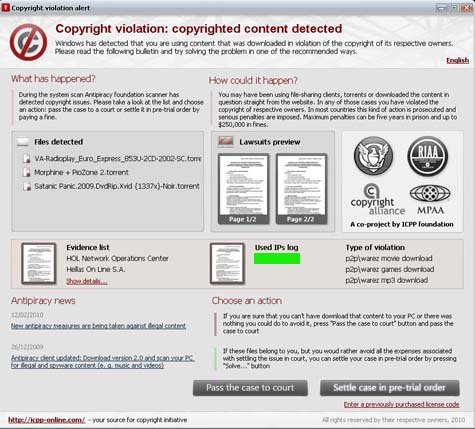
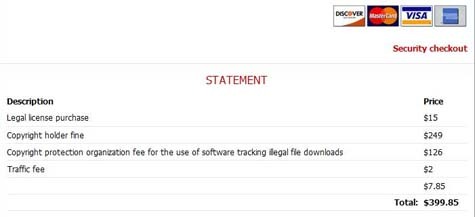
(via Boing Boing, Download Squad) ¶ 0
2010/3/13
England's severe libel laws have claimed a casualty: science writer Simon Singh, who is being sued for libel by the British Chiropractic Association, has resigned from his Guardian column, citing the onerous requirements of preparing his defence:
The crippling and prohibitive financial cost of defending a libel case is often highlighted, but the equally terrible cost in terms of time and stress is rarely mentioned.
I recently discussed this with Dr Peter Wilmshurst, the eminent cardiologist who is being sued for libel for commenting on the efficacy of a new heart device... Perhaps it was just as well that Peter was not aware of the full implications of what lay ahead of him, namely at least two years of anxiety, misery and the threat of bankruptcy. Almost all his spare time has been spent on the libel case. When finalising his defence, he took two weeks of annual leave to work on the documents. Moreover, dealing with ongoing legal issues has prevented him from carrying out his usual medical research, and a number of publications have been put on hold.England's libel laws are renowned across the world, with litigants taking cases to London on the flimsiest pretexts. Now foreign news organisations are starting to block access from Britain to their web sites to defend against this, raising the prospect of Britain facing Chinese-style isolation without even having to build its own national firewall:
You might feel that I am being alarmist, but major US newspapers, such as the Boston Globe and The New York Times, sent a memo last year to the House of Commons select committee on media, libel and privacy. They warned that they are considering stopping the sale of their publications in Britain due to the threat of libel. The benefits of selling newspapers here in terms of profit are outweighed by the potential losses in libel cases.
If publishers stopped selling hard copies in Britain, they would almost certainly also block their online content, because otherwise the threat of libel would remain.If this worries you, you may want to sign the petition for libel reform.
The libel laws have their fans, though; other than the usual litigants, the recording industry seems to have used them as the models for the new copyright expansion laws they're trying to get passed, which will make any sites capable of sending potentially copyrighted files in private a prohibitive liability to make available to UK users.
2010/3/7
A US company is developing a system that models and replicates the styles of famous musicians. Details of how Zenph Sound Innovations' system works are scant (apparently "complex software" is used, which simulates the musicians' styles, and the resulting high-resolution MIDI files are played on robotic musical instruments; currently pianos, though a double bass and saxophone are in the works).
Currently, it is capable of reconstructing a performer's style of playing a specific work, from a recording of the work, and can be used to rebuild flawed recordings. It cannot yet play a new piece in a performer's style, though the developers are planning to work on that next.
“It introduces a whole bunch of interesting intellectual-property issues, but eventually, you ought to be able to, in essence, cast your own band,” said Frey. “You should be able to write a piece of music and for the drum piece, have Keith Moon, and for the guitar piece, you can have Eric Clapton — that is a derivation of understanding each of those artists’ styles as a digital signature. That’s further down the road, but initially, you’re going to have the ability for artist to create music and have the listener manipulate how they want to hear it — [for example] sadder.”The intellectual-property implications alluded to are interesting; the prospect is raised of a new type of copyright, over an artist's style, being created, with the artist or their estate collecting royalties from replication of their style. While this is perfectly consistent with the copyright-maximalist ideology of the corporate-dominated, post-industrial present day, it ignores the fact that artists emulate other artists all the time. While initially, courts would exercise "common sense" and leave non-software-based copyists alone (i.e., Oasis wouldn't owe licensing fees to the Beatles), sooner or later, once the technology becomes the norm, this original intent would be forgotten and, after a few strategic court cases, a new precedent would be set, declaring styles, and the elements of them, to be licensable, much in the way that patents are, and requiring anyone taking them off to license them, much as anyone sampling even a split-second of a recording has to license it. (In the age of powerful rights-licensing corporations with political clout, intellectual-property law is a ratchet that turns only one way.) Soon, the different elements of musical style would end up aggregated in the hands of a few gigantic rightsholders with well-resourced legal teams, and musicians would be routinely slugged with heavy bills, itemised by stylistic elements.
2008/8/11
The tragedy of the commons occurs when there is insufficient ownership of common assets, which, as a result, become overused. But now, in the age of monetisation, copyright expansionism and corporate legislative power grabs, we are seeing the opposite: the tragedy of the anticommons, where there are too many rightsholders needed to negotiate with and pay off (each doing their duty to their shareholders by being as greedy as they can be), and many endeavours are no longer viable:
The commons leads to overuse and destruction; the anticommons leads to underuse and waste. In the cultural sphere, ever tighter restrictions on copyright and fair use limit artists’ abilities to sample and build on older works of art. In biotechnology, the explosion of patenting over the past twenty-five years—particularly efforts to patent things like gene fragments—may be retarding drug development, by making it hard to create a new drug without licensing myriad previous patents. Even divided land ownership can have unforeseen consequences. Wind power, for instance, could reliably supply up to twenty per cent of America’s energy needs—but only if new transmission lines were built, allowing the efficient movement of power from the places where it’s generated to the places where it’s consumed. Don’t count on that happening anytime soon. Most of the land that the grid would pass through is owned by individuals, and nobody wants power lines running through his back yard.
Recent experimental work by the psychologist Sven Vanneste and the legal scholar Ben Depoorter helps explain why. When something you own is necessary to the success of a venture, even if its contribution is small, you’ll tend to ask for an amount close to the full value of the venture. And since everyone in your position also thinks he deserves a huge sum, the venture quickly becomes unviable. So the next time we start handing out new ownership rights—whether via patents or copyright or privatization schemes—we’d better try to weigh all the good things that won’t happen as a result. Otherwise, we won’t know what we’ve been missing.This effect is the subject of a new book, The Gridlock Economy, by Michael Heller, a law professor at Columbia University.
(via Boing Boing, /.) ¶ 0
2008/6/18
A few controversies from the 8-bit music world: claims that electro outfit Crystal Castles ripped off the work of various chipmusic artists, violating the terms of their Creative Commons licence (though this Pitchfork article clarifies this, stating that the tracks in question were never actually released). Meanwhile, this documentary puts forward the theory that Michael Jackson (yes, that Michael Jackson) wrote the music for Sega's Sonic 3 video game on the MegaDrive/Genesis.
2008/3/3
Last year, the Gowers report, commissioned by the British government, rejected the recording industry's call to extend sound recording copyrights in Europe. Recently, however, the recording industry scored a coup, in putting a copyright-extension directive before the EU. Here is a petition against it, organised by the EFF and Open Rights Group:
Copyright is a bargain. In exchange for their investment in creating and distributing sound recordings to the public, copyright holders are granted a limited monopoly during which are allowed to control the use of those recordings. This includes the right to pursue anyone who uses their recordings without permission. But when this time is up, these works join Goethe, Hugo and Shakespeare in the proper place for all human culture – the public domain. In practice, because of repeated term extensions and the relatively short time in which sound recording techniques have been available, there are no public domain sound recordings.The idea of copyright as a bargain, a deliberately limited monopoly, is one which has largely been erased from the public consciousness, through the introduction of a new concept a few decades ago—the concept of "intellectual property". When one thinks of ideas as property, copyright seems not as an unnatural, and mercifully limited, restriction on the natural flow of culture, but as an injustice in the opposite direction—the only form of property which expires in a few decades—and the idea of perpetual copyright, towards which we have been moving with copyright-term-extension bills and harmonisation treaties every few decades, seems, for a moment, like a much-needed correction of an unjust oversight, rather than the greedy, neo-feudal abomination it is. Whoever came up with the term "intellectual property" is a powerful sorcerer indeed.
(via Boing Boing) ¶ 0
2007/9/13
A new report from the US Computer and Communications Industry Association has found that fair use exemptions to copyright add more than three times as much value to the US economy as copyright industries. Fair use exemptions account for more than US$4.5 trillion of revenue to the US, whereas the copyright industries brought in US$1.3 trillion. Which sounds like an argument against new neo-Galambosian erosions of fair use and extensions and expansions of intellectual-property rights of the sort that Big Copyright has been pushing for.
2006/12/10
Britain's professional recording artists are so angry about their copyrights expiring after 50 years that some even rose from the dead to sign a recording-industry petition for copyright term extension:
If you read the list, you'll see that at least some of these artists are apparently dead (e.g. Lonnie Donegan, died 4th November 2002; Freddie Garrity, died 20th May 2006). I take it the ability of these dead authors to sign a petition asking for their copyright terms to be extended can only mean that even after death, term extension continues to inspire.
(via Boing Boing) ¶ 0
2006/12/6
Alan McGee, founder of the Creation and Poptones labels, on why music copyright terms should not be extended:
One argument the industry used is that the revenue generated from back catalogues is what underpins record companies' ability to invest in new artists, so to close of this endless stream of cash would impoverish the quality of new music. This doesn't seem such an unreasonable point until you reflect that they have had fifty years to rake in billions from The Beatles. Also, the notion of the back catalogue acting as crutch to fund new talent seems to imply that more contemporary acts have brought home peanuts. This would be very sad indeed if it were anywhere near the truth.
In the case of early blues and country, the lapse of copyright has had numerous positive consequences. The songs being highly accessible and the constant repackaging and proliferation of different compilations has helped to keep interest alive and, if anything, spread the influence of some of the most important music of all time throughout the generation
More importantly, though: Why should the legacy of The Beatles be treated as some sacred cash cow and held at arm's length from those that gave and continue to give The Beatles their success - the fans? Without people's initial support and continuing identification with the music, The Beatles would be a long forgotten name.
2006/10/11
A US lawyer has noticed plugging a dangerous hole in the world's intellectual-property regime, a hole which costs chefs and restauranteurs untold godzillions of dollars: the fact that food cannot be copyrighted, and it is perfectly legal for any pirasite who can determine how you created your culinary masterpiece to rip it off without paying you a cent. Not to worry: Steven Shaw has come up with a scheme for bringing food into the realm of intellectual property:
First, he'd propose changing the copyright code, possibly by making cuisine a subdivision of the existing category for sculpture or acknowledging recipes as a form of literary expression. For enforcement, Shaw leans toward creating a system like ASCAP, an association that collects composers' royalties for public performances of songs--on the radio, in nightclubs and so on...Magnanimously, Shaw has left classic recipes like French onion soup in the public domain. Anything new, however, could be copyrighted. So if you invent a variant of French onion soup with a few extra ingredients, you could demand a licensing fee from anyone else who serves it. In Shaw's world, restaurants would be billed by collection agencies for the recipes they used, the takings of which would be distributed (after administrative expenses) among the authors of recipes. (It is not clear how this would apply to home cooking; perhaps cookbooks would come with a shrinkwrapped EULA which would give the user the right to use the recipes in their own home, feeding at most N people, as long as they had possession of the book; meanwhile, microwaveable ready meals and jars of sauce would carry a patronising "Don't Steal Recipes / Respect Intellectual Property" sticker.) The sudden influx of financial reward to previously deprived cooks would bring in a new golden age of culinary creativity as never before. The lawyers would allow themselves a moment to bask in the satisfaction of a job well done, though not more than a moment; after all, there are still other domains of human endeavour in need of rescuing from lack of ownership.
(via Boing Boing) ¶ 2
2006/8/25
Wired Magazine has a piece about how Canadian independent label/music management company Nettwerk is gently undermining the foundations of the traditional recording industry and setting up something new to replace it:
"This one's a real wingdinger," he says, leaning into the speakerphone so New York, Denver, and Los Angeles won't miss a word. "Let's give away the ProTools files on MySpace. Vocals, guitars, drums, and bass. We'll let the fans make their own mixes." The room falls quiet.
A voice from LA breaks the silence: "For the single, you mean, right?" McBride's features screw up in concentration, then quickly expand into a grin. "What I'm proposing," he says, "is that we make all 29 songs available as ProTools files. In two weeks."
McBride's success will depend on what he calls "collapsed copyright." Nettwerk will represent artists like BNL, but the bands will record under their own labels and retain ownership of all their intellectual property, an anomaly in the industry. The bands, in turn, can expect to earn considerably more money - say, $5 to $6 from the sale of each CD instead of the standard dollar or two.
It's a risk McBride is willing to take. Twelve of the nearly 40 acts on Nettwerk's roster now have their own labels, and McBride says that within six years nearly all his artists will have shed their major-label partners. "The old system kept us from imagining what a music product could be," McBride says. "Now we can really start to have fun."The most recent guinea pig for Nettwerk's new music industry is Barenaked Ladies, whom Nettwerk CEO Terry McBride recently persuaded to dump their major label (Warner's Reprise imprint) and go it alone, holding all their own copyrights, and getting creative with the formats they sell in:
Between ringtones, acoustic versions, and concert recordings, those 29 songs have been multiplied into more than 200 "assets" - song versions - that can be used individually or in conjunction with others to create a product. "Because the copyrights are in one place [in BNL's hands], we can be really creative," McBride says. Hardcore fans can buy 45 of those assets on a USB drive; others can download the special Sims versions (recorded in Simlish, no less). "For decades, people in music have used the number of albums sold as a measuring stick for success," McBride says. "We're trying to get people to see beyond that. It's about revenue from music, however you make it - selling concert tickets, licensing to TV, or selling packed USB drives."Nettwerk are taking on the dinosaurs in other places too: by siding against them in peer-to-peer lawsuits:
Earlier this year, he sparked a music industry uproar when he announced he would pay the legal defense for a Texas man being sued for piracy by the Recording Industry Association of America. "The lawsuits are hurting my bands," he says. "If you could monetize the peer-to-peer networks, everyone would make more money."Though it's not all anti-corporate utopianism: McBride's vision strips away the byzantine, restrictive and vaguely corrupt structures of the traditional recording industry, replacing them not with some kind of anarchosocialist GNUtopia of information wanting to be free, but with a more streamlined form of capitalism, with the artist as entrepreneur:
But even such a radical step is just one facet of McBride's larger strategy. In May, President Bush signed into law a revision of the tax code that will make it easier to sell intellectual property as a stock, with profits being taxed at the same lower rate as other capital gains. "Once we have access to all the intellectual property, we're going to offer shares in individual artists and take in equity investments," McBride says. "Eventually, a major band could be its own public company." The key, he adds, sounding like an overzealous investment banker, is that the value of a band would be measured like a stock and would receive capitalization in expectation of future earnings. "At that point, even a band selling 100,000 units a year becomes profitable," McBride says.Of course, that is a double-edged sword. It makes it easier for bands to be profitable, but it adds a new meaning to the term "selling out". We may soon actually see bands owned by beer companies and mobile phone companies, rather than merely branded. And what will happen if a band wants to do something unusual and risky, while their majority shareholder (let's say Carling or Vodafone or someone) sues them for failing to maximise returns by doing so? Could we see corporate-invested bands being mailed dossiers of market research, telling them in no uncertain terms what they are expected to do ("memo: the grebo revival is the next big thing; get right on it")?
Not that this invalidates what Nettwerk are doing. There will always be commercial bands and indier-than-thou refuseniks; this looks like merely giving the artists more choice.
2006/5/14
The Australian government has agreed to legalise ripping CDs and recording TV programmes, which had been illegal since the new US-designed copyright laws, as well as introducing US-style fair-use provisions. However, it will come at a price: a zero-tolerance crackdown on file sharing on the internet:
Police will be able to issue on-the-spot fines and access and recover profits made by copyright pirates. Courts will be given powers to award larger damages payouts against internet pirates. Civil infringement proceedings will apply to copyright pirates who make electronic reproductions or copies of copyright material.The surveillance part of it is easy enough: I once heard that in Australia, all internet connections legally have to go through points where the police may access them, and as such, cable ISPs block customers on the same access point from connecting directly to each other. (Incidentally, this was in the late 1990s, before the Homeland Security Age.) The on-the-spot fines sound trickier: will police determine, on the spot, whether a file downloaded is copyrighted, or will the act outlaw all use of file-sharing software? (The latter sounds like a very Australian majoritarian approach: given that, anecdotally, only a minority of files shared thus are licensed to be done so, the Australian thing to do would be to cut the Gordian knot of liberal free-speech handwringing and outlaw it altogether, much as they do with controversial films and video games and the proposed internet firewall.) And will the police aggressively prosecute, say, people sharing copies of long out-of-print recordings?
2006/3/24
US liberal website Mother Jones has a list of the most absurd excesses of intellectual property:
BILL GATES had the 11-million-image Bettmann Archive buried 220 feet underground. Archivists can access only the 2% that was first digitized.
MICROSOFT UK held a contest for the best film on "intellectual property theft"; finalists had to sign away "all intellectual property rights" on "terms acceptable to Microsoft."
U.S. INTELLECTUAL PROPERTY is valued at $5.5 trillion, equal to 47% of our GDP and greater than the GDP of any other nation but China.
A FRENCH DIRECTOR had to pay $1,300 after a character in his film whistled the communist anthem, "The Internationale," without permission.
RENTAMARK.COM makes money by claiming ownership of 10,000 phrases, including "chutzpah," "casual Fridays," ".com," "fraud investigation," and "big breasts."
(via Boing Boing) ¶ 0
2006/3/12
The Silly Tube Maps page has apparently received a nastygram from Transport for London's lawyers, keen to protect their precious intellectual property, and will be shutting down on Monday. If you wanted to grab a map of which stations are within walking distance, or which ones are underground, or with the station names translated into German or rotated about the Thames, do so quickly.
2006/2/14
Another harbinger of the slow march to Galambosianism: a German chef is asking the EU to create a new copyright-like right covering recipes, giving him the right to collect royalties from those using his recipes. His notion of "cookyright" has the backing of the Italian Collecting Society, which I gather is a rights-enforcement agency.
(via Boing Boing) ¶ 0
2006/1/23
The world's oldest multinational corporation, the Catholic Church, is joining the intellectual-property age; the Vatican has declared it intends to claim copyright on the current and previous Popes' words, and require any publications carrying those words to license them for a royalty equivalent to 3-5% of the cover price. Newspapers are exempted from the royalty, but only by "prior agreement" (i.e., giving the Vatican the power of veto over unflattering uses of the Pope's words). This has raised the ire of those who object to a price being put on the "word of the Lord" and its official interpretation.
(via bOING bOING) ¶ 0
2005/12/29
The Australian federal government is set to legalise MP3 ripping. In Australia, ripping MP3s from CDs, taping TV programmes and doing other such things without the rightsholder's permission is a criminal offense, and has been since Australia adopted US copyright law without those pesky fair-use provisions that so get in the way of the copyright industry. Now the Attorney-General (in between making sedition and detention-without-trial laws, undoubtedly) intends to bring in some fair-use provisions for "everyday forms of private copying that do not harm copyright owners". Hopefully the provisions will be drafted reasonably broadly and won't have any nasties like DRM mandates or anything.
2005/11/29
Those making movies with Activision's new machinima game The Movies, beware: according to the licensing agreement, Activision owns the copyright to all films made using their content, which you can't avoid using this package.
The EULA states that while users retain ownership of movies they create, Activision exclusively owns "any and all content within [users'] Game Movies that was either supplied with the Program or otherwise made available to [users] by Activision or its licensors..." This means that any movie containing anything less than 100% user-created content (an impossible feat as far as I can tell) is under Activision's control.Which means that, unless you manage to strip your films of all Activision-owned content, what you can do with them is limited to what Activision will tolerate your doing. For example, you probably couldn't release them under a creative commons licence or put them in the public domain, and if you used them to say anything particularly controversial (as angry French Muslim youths are doing), you risk having your creation being pulled out from under you, because it's not really yours. In a sense, it is as if the basic words in the English language were copyrighted and had to be licensed in order to communicate.
A more reasonable approach would have been what the music software industry does, i.e., licensing the elements that come with the package (samples and loops, in the case of music software, 3D objects in the case of The Movies) for unlimited royalty-free use by the buyer and renouncing all rights to works containing them. Of course, Activision are a game software company, and assume that their punters are less savvy and/or less concerned with issues of rights. Who cares who really owns your movie, it's just a game, right?
(via bOING bOING) ¶ 0
2005/11/8
In the aftermath of the KaZaA lawsuit, proprietary Windows file-sharing service Grokster suspends operations. Champagne corks pop across Los Angeles as the RIAA declares November 8 to be known, forevermore, as Victory Against Copyright Terrorism Day.
2005/10/18
For a while in the 1980s and early 1990s, you couldn't turn a radio on without hearing something containing the Funky Drummer break, a short length of drumming taken from the eponymous James Brown B-side. Then PolyGram got wise to it and started shaking down anyone using this idiom for licensing fees, and it disappeared.
Now some modular synth hackers have taken up the challenge of replicating the Funky Drummer with a Nord Modular G2. A discussion thread is here (containing downloadable patches but little other info, so people not owning Nord Modular G2s are out of luck), and a MP3 of the reconstructed Funky Drummer is here. It sounds definitely recognisable as the Funky Drummer, though also noticeably different; perhaps one should think of it as the No-Brand Funky Drummer?
Now if someone could port this to, say, Pd or SuperCollider, and/or do versions replicating the Amen break or such from first principles, that would be even cooler.
(via MusicThing) ¶ 0
2005/6/28
The EFF's take on the US supreme court's unanimous decision in favour of Big Copyright against Grokster. Executive summary: it's not as bad as it could have been (the court didn't strike down the Betamax doctrine or explicitly oblige designers of technologies to take steps to prevent copyright infringement), though it does open up a legal minefield, allowing Big Copyright to sue anyone who makes anything that handles intellectual property if they can argue that their business model depends on inducement. (Presumably they could sue Apple for selling iPods if that they can show that Apple's iPod business model depends on people ripping CDs or downloading MP3s.) The RIAA and MPAA will undoubtedly be making hay of this, launching salvos of lawsuits to make examples of technology makers, and possibly positioning themselves as a regulatory agency for any technology involving copyrighted materials. The EU and Australia will, of course, follow in lockstep in their reading of intellectual-property law, so the chilling effect will go beyond the US. In a few years' time, the hottest and most usable gadgets may be smuggled in from Brazil, India or China (assuming one can get them through customs).
Meanwhile, commentators on SCOTUSblog say that this is at best a hollow victory for Big Copyright and quite possibly a huge loss, as they didn't get the blunt instrument they wanted. And this Salon piece suggests that the decision may open the door to Google being sued for copyright infringement.
2005/6/7
Another minor label is set to bite the dust; Sanctuary Records, home of Morrissey, is reportedly in talks with EMI and Warner, who are interested in buying it. Given how independent labels have a way of losing their vision and going to shit when bought out by the majors (look at Def Jam, Mute or Creation, for examples), this can't be good. (OTOH, it can be argued that Creation went to shit before Sony invested a penny in them, probably thanks to Alan McGee's cocaine-fuelled loss of taste, though the other two examples stand.)
Meanwhile, the British government intends to double the copyright term of recorded music, saving the Beatles' recordings from the ignominy of falling to the public domain in the 2010s and to ensure that the big record companies have a steady flow of income, because as we all know, that's good for all society. I mean, if EMI don't have the guaranteed income of the Long Tail of Beatles copyrights in perpetuity, they may sadly be unable to sign the next Coldplay or Kasabian or Sugababes or whoever.
And those all-round monopolists and homogenisers, Wal-Mart, provide yet another reason to hate them: their in-store photo processing services refuse to print photographs that look too good, just in case they are copyright violations:
Spokeswoman Jackie Young said Wal-Mart is "a littler tougher than the copyright law dictates."
"We want to protect professional photographers' rights," Young said. "We will not copy a photograph if it appears to be taken by a professional photographer or studio."
She related the case of a bride whose wedding photos were rejected by Wal-Mart because they "looked like high-resolution quality."
(via xrrf, /., bOING bOING) ¶ 5
2005/5/9
In Australia, taping TV programmes or ripping MP3s from purchased CDs is technically a criminal offense. Australia recently harmonised its intellectual-property laws with the United States, though without adopting the Fair Use doctrine which protects such activities; as such, Australia currently has some of the world's most draconian copyright laws. The government has issued a discussion paper on adopting fair use/fair dealing exemptions, and is soliciting comments. The possibilities include anything from US-style fair use to the right to circumvent DRM in limited circumstances (as some countries have). Keep in mind that there will be a lot of pressure from Big Copyright on the government to have no or minimal fair-use provisions, to maximise their profits (after all, if you cannot legally rip your CDs to your iPod, you're forced to buy or rent a separate (DRM-locked) copy of anything you wish to listen to on it or face the possibility of prosecution). If the government doesn't hear much demand for fair use, it might acquiesce to its corporate stakeholders' demands. As such, if you live in Australia, it is in your interest to make your opinion heard. Speak up before there are MIPI officers with handheld scanning devices patrolling public areas, doing on-the-spot copyright audits of MP3 players and issuing four-figure fines.
2005/4/9
Irony of the day: the anthem of Communism, The Internationale is copyrighted; a filmmaker in France is being shaken down for US$1,283 for having someone whistle the song without permission in one of his films.
Under French law, "The Internationale" won't fall into the public domain until 2014 70 years of post-mortem protection plus extra time to cover the world war. Degeyter died in 1932.
(Via bOING bOING, who point out that there's (a fragment of) a decent electropop version of The Internationale here. Funnily enough, a while ago, I thought that a happy-hardcore/doof/indie-dance version, with some dude rapping about dialectic materialism in the middle, would work well at the numerous anti-capitalism rallies the lefties kept having before 9/11.)
(via bOING bOING) ¶ 6
2005/3/24
Lawyer and copyfighter Edward Felten has come up with a Godwin's Law for copyright policy:
As a copyright policy discussion grows longer, the probability of pornography being invoked approaches one. (Corollary:) When the topic of a copyright policy discussion switches to pornography, each side suddenly adopts the other side's arguments.
For example, Hollywood argues that filesharing will lead to a shortage of movies, because nobody will make movies they can't sell. But when the topic switches to pornographic movies, suddenly they start arguing that filesharing increases the creation and availability of content.
Similarly, some P2P vendors who say they can't possibly filter or block copyrighted content, suddenly decide, when the topic switches to porn, that they can provide effective blocking.
(via bOING bOING)
2005/2/18
Tonight, I went along to the Open Knowledge Forum, which Cory Doctorow posted about on bOING bOING. It was fairly interesting.
They had several speakers, most of them originators of various projects to make civic data accessible to and easily navigable by the people who have a stake in politics (read: you and me); there was one of the authors of the genuinely awesome They Work For You and the connected Public Whip project, as well as someone from MySociety, the troublemakers behind FaxYourMP, WriteToThem.com, and the BBC's iCan project. And, toward the end, Cory spoke from behind his sticker-covered PowerBook and recounted his work with the EFF, recent happenings at the World Intellectual Property Organization (which he's in Europe to keep an eye on), new database copyright laws which allow organisations to own facts, and more.
Some interesting points came up: that non-profit projects in the public interest should not ask for permission before using government data (both for tactical reasons, namely, had they done so, they would have been kept waiting for much longer than it took to code the project and subjected to onerous restrictions, and moral reasons, i.e., a permission-based democracy not being a democracy), that such projects are not about "political reengagement" or restoring some lost state, but about reinventing democracy, and that a few Crown Copyrighted data sets, such as the (heavily monetised) Ordnance Survey geographic data and the Royal Mail's copyright on postcodes, are still impeding the ability to make civic information available freely (and free means free-as-in-speech, including the freedoms to syndicate, modify and incorporate information into other things).
2005/2/3
Another chapter in the annals of if-value-then-right: as maximalist interpretations of intellectual property dominate, defense contractors are fulfilling their duty to their shareholders by shaking model kit manufacturers down for hefty royalties, sometimes demanding as much as US$40 per kit. The old way of doing things, letting modelmakers sell kits for free and treating it as good publicity, is no longer accepted practice; these days, it's considered less as good publicity and more as negligence or mismanagement. Ironically, one effect this may have is the disappearance of kits for anything but royalty-free items, such as WW2 Nazi vehicles (for which there is no rightsholder*) and World War 1 items.
* Surely this is an oversight; had today's concept of intellectual property been current in 1945, the Allies would not have allowed the intellectual-property rights to Nazi vehicles to expire; perhaps they would have been auctioned to licensing companies shortly afterward. (On a tangent, had intellectual-property maximalism been the dominant doctrine in 1945, a lot of other things would have been possible, such assigning the swastika and the name and likeness of Adolf Hitler™ to an anti-Nazi foundation and allowing them to sue neo-Nazis for infringement, but I digress.)
Anyway, it's interesting to note that Allied vehicles from WW2 are still intellectual property. It was asserted, not too long ago, that the reason why historical cable-TV channels show so many World War 2 documentaries is because there is a lot of footage from that era which is in the public domain; elsewhere, it was suggested that in more recent documentary footage, if someone is accidentally filmed wearing a trademarked brand-logo hat, that requires the filmmaker to obtain rights from the owner of the trademark to use the footage. I wonder if whoever owns the rights to the Spitfire and such can figure out a way of putting these two facts together and monetising the rights to their trademarks appearing in WW2 documentary newsreels.
The privatisation of the space of concepts keeps marching on; now, it turns out likenesses of the Eiffel Tower are copyrighted, and cannot be published without a licence. The city of Paris and the company which maintains the tower managed to do this by adorning it with a distinctive lighting display, which they then copyrighted; consequently, any recent night-time photograph of the Eiffel Tower is a derivative work. In their infinite generosity, they have said that they are not interested in going after amateurs putting holiday photographs of the tower on their web sites; they are, however, technically in violation. Which means that this WikiMedia image is technically in violation. And so, the space of free public discourse narrows slightly.

I wonder what's next: perhaps Ken Livingstone will copyright the names of London Underground lines and stations and demand licensing fees from fiction authors who mention them or something?
Eventually, we will get to the situation where all real-world objects and likenesses are intellectual property and use of them requires licensing fees. (After all, the dominant Reaganite/Thatcherite ideology of our time says that the way to maximise the efficient use of any resource is to monetise it and place it on the market; coupled with intellectual property, the natural conclusion is what Lawrence Lessig calls an "if-value-then-right" intellectual property regime, where for any value in an item, there is a right assigned to a rightsholder, who can license that right on the open market. Think of the colossal economic waste we had in the bad old days of the public domain and Jeffersonian copyrights.) As depicting any public figure, fictional character, location or privatised folklore will require a licence, costing fees and giving rightsholders vetoes over works they find objectionable, stories (well, those without the corporate media backing required to resolve all the rights issues) will move to generic locations; nameless, nondescript buildings, cities, countries and characters will take hold. To which, Big Copyright will respond by copyrighting categories of ideas (in the way that Marvel and DC Comics claimed a joint trademark on superheroes), or by patenting common types of plot devices and settings (which is probably not legal now, though given sufficiently pliant legislators and international treaty bodies, anything's possible). Galambosianism, here we come.
2005/1/18
As the reach of copyright laws is expanded and rightsholders (or their investors) are demanding as much income from each piece of intellectual property in the asset register, documentary makers are getting the rough end of the pineapple. Old documentaries are becoming illegal to distribute (and effectively disappearing down the memory hole) once their clearance rights expire, and new documentaries are often not being made without wealthy sponsors: (via bOING bOING)
But it's particularly difficult for any documentary-makers relying on old news footage, snippets of Hollywood movies or popular music -- the very essence of contemporary culture -- to tell their stories. Each minute of copyrighted film can cost thousands of dollars. Each still photo, which might appear in a documentary for mere seconds, can run into the hundreds of dollars. And costs have been rising steeply, as film archives, stock photo houses and music publishers realize they are sitting on a treasure trove, Else and other filmmakers say.
The American University study (at http://www.centerforsocialmedia.org/rock/index.htm) is a fascinating, if dispiriting, look at the tricks documentary-makers have to pull to get around copyright restrictions, from turning off all TVs and radios when filming a subject indoors to replacing a clip of people watching the World Series with a shot of professional basketball on the TV set instead because that's what the filmmaker had rights for.
"Why do you think the History Channel is what it is? Why do you think it's all World War II documentaries? It's because it's public-domain footage. So the history we're seeing is being skewed towards what's fallen into public domain," says filmmaker Robert Stone in the American University study.
2005/1/11
The People Who Owned The Bible, a speculation on the neo-Galambosian logical extremes of the recent copyright extension fad:
A 500 year extension would let Disney track down Shakespeare's heirs and buy all rights to the Bard. No matter how much the heirs wanted, the deal would pay for itself in no time. Every school that ever wanted to perform or study Shakespeare would have to send a check to Disney. Every newspaper or magazine or radio show that wanted to quote the Bard would have to send one, too. So Disney asked, and Congress gave, and the World Intellectual Property Organization followed Congress's example. Disney paid off Shakespeare's heirs, then used the Shakespeare profits to buy all rights from the heirs of Dumas, Dickens, Twain, Mary Shelley, Jane Austen, Bram Stoker and more. Once most of the films in every other studio's library were subject to Disney's copyright, they went bankrupt or became divisions of Disney.
Then Jimmy Joe Jenkins's DNA proved he was the primary descendent of the translators of the King James Version of the Bible.(via bOING bOING)
2004/12/14
The British government is being asked to close down entire markets if anyone there is found selling copyright-violating DVDs. Looks like they'll have to rip up the Holloway Road footpaths then.
2004/11/27
A new book by three Australian academics predicts that the US Free Trade Agreement will cause widespread damage to Australia's national interests, wiping out local biotechnology industries and the use of open-source software, ensuring that wealth goes right back to head office, transforming Australia's economy into little more than a set of branch offices controlled from overseas, and making it all but impossible to get back what is lost. What's more, the onerous terms of the agreement were largely decided by the Howard government, and not the American negotiators. (Mind you, the fact that Labor decided to "recapture the centre" and let it through with a few Band-Aid laws, rather than risk being cruelly mocked in parliament for going on about boring "intellectual property" issues no dinky-di true-blue Herald-Sun-reading suburban battler would give a brass razoo about, damns them almost equally.
2004/9/28
Tomorrow (Wednesday 29 September) is Save Betamax Call-In Day; the EFF and others are asking people in the US to join a chorus of opposition to the INDUCE act, which is coming up before Congress. This piece of legislation, backed by the copyright industry, aims to reverse the "Betamax decision", making technological innovators liable for possible copyright infringements resulting from their technologies, and thus giving Big Copyright a veto over innovation; a veto which, had they had in the past, would have squashed everything from the VCR to the iPod. (And if you think that this doesn't affect you because you're not in the US, think again. Australia automatically gets US intellectual-property law (minus the constitutional fair-use provisions) thanks to our fearless leaders' Free Trade Agreement; others will get these laws foisted on them in the next round of WIPO treaties and/or copyright-law harmonisations.)
2004/9/9
A US federal appeals court has ruled that all samples must be paid for, regardless whether or not they're recognisable, thus cementing the basis of the permission culture, where everything is intellectual property which must be licensed. Welcome to the Digital Millennium; make sure you've paid your way
The ruling says artists must pay for not only large samples of another artist's work, but also snippets -- smaller notes, chords and beats that are not the artist's original composition -- which had previously been legal, according to The Associated Press
"If you cannot pirate the whole sound recording, can you 'lift' or 'sample' something less than the whole? Our answer to that question is in the negative."
Thank God they're protecting valuable intellectual property from lawless piracy, otherwise capitalism as we know it would collapse and we'd enter a new dark age.
2004/6/8
Public Enemy's Chuck D and Hank Shocklee on how copyright law changed hip-hop; or the impact that the increasingly greedy demands of owners of samples had on the evolution of hip-hop:
The first thing that was starting to happen by the late 1980s was that the people were doing buyouts. You could have a buyout--meaning you could purchase the rights to sample a sound--for around $1,500. Then it started creeping up to $3,000, $3,500, $5,000, $7,500. Then they threw in this thing called rollover rates. If your rollover rate is every 100,000 units, then for every 100,000 units you sell, you have to pay an additional $7,500. A record that sells two million copies would kick that cost up twenty times. Now you're looking at one song costing you more than half of what you would make on your album.
We were forced to start using different organic instruments, but you can't really get the right kind of compression that way. A guitar sampled off a record is going to hit differently than a guitar sampled in the studio. The guitar that's sampled off a record is going to have all the compression that they put on the recording, the equalization. It's going to hit the tape harder. It's going to slap at you. Something that's organic is almost going to have a powder effect. It hits more like a pillow than a piece of wood. So those things change your mood, the feeling you can get off of a record. If you notice that by the early 1990s, the sound has gotten a lot softer.
Stay Free!: So is that one reason why a lot of popular hip-hop songs today just use one hook, one primary sample, instead of a collage of different sounds?
Chuck D: Exactly. There's only one person to answer to. Dr. Dre changed things when he did The Chronic and took something like Leon Haywood's "I Want'a Do Something Freaky to You" and revamped it in his own way but basically kept the rhythm and instrumental hook intact. It's easier to sample a groove than it is to create a whole new collage. That entire collage element is out the window.
2004/6/4
North Korea bans mobile phones, shortly after encouraging the few foreign business travellers in Pyongyang to use the devices. Meanwhile, South Korea's phone carriers merely configured their phones to destroy uploaded MP3 files after 72 hours, in an effort to placate the recording industry. It failed, and the pigopolists are suing the phone carrier anyway. (via Techdirt)
2004/3/5
With the details of the free-trade deal revealed (the farmers got screwed over, and we're getting US-style copyright extension), Labor is making noises about resisting it in parliament. Not sure what that will amount to; possibly a few minor cosmetic changes (the equivalent of demanding better lubricant for when you get forcibly sodomised). Anyway, now may be an excellent time to mail your MP about why copyright extension is a bad idea; perhaps if enough Labor MPs get such letters, they'll show enough spine.
2004/2/9
Well, Australians will soon be driving oversized SUVs on the right-hand side of the road, at least metaphorically speaking; The Howard government signs free-trade agreement with US. The issues of local TV content and the Pharmaceutical Benefits Scheme have been ironed out, at least to the satisfaction of our wise leaders, though Australia's sugar industry has been sacrificed. Oh, and we're also committed to extending our copyright terms, adopting draconian paracopyright/scarcity-preservation laws and remodelling our patent/trademark law on the US model. (I wonder if we'll get US fair use provisions in the deal, or whether having an iPod full of ripped MP3s will remain a crime in Australia.) Though at least the Yanks don't get to force their genetically-modified foods into our markets, as some lefties were alleging they would; it looks like most of the direst predictions have been headed off, if you believe the Government's press release; then again, the full text of the agreement is secret, so maybe not.
The Greens said tariff abolition on manufactured goods would cost thousands of Australian jobs while many farmers would be saddled with US tariffs for a generation or more. Quarantine standards would be downgraded, Americans would be able to circumvent investment rules and American drug companies would get the opportunity to override the Pharmaceutical Benefits Scheme that provides cheap drugs to Australians, the Greens said.
Howard has affected a retroactive tough-negotiator stance, saying that he was on the verge of telling the Americans where to stick their FTA. Meanwhile, Latham has said that Labor may block the FTA in the Senate. Which probably won't happen, leaving the Greens as the voice in the wilderness yet again.
2003/11/11
In the UK, it is not only illegal to use portable radio transmitters with your iPod (they're legally considered to be pirate radio transmitters, regardless of their range), but, under the draconian EU Copyright Directive just adopted, to copy MP3s you don't own the copyright to to it, or indeed to make mix CDs. I guess I'm leaving my Archos Jukebox at home next time I go there.
2003/9/25
A piece (by JJJ yoof hellraiser turned overly verbose blogger Helen Razer) about copyright law, appropriation and art:
"The creative impetus is transient. If one must pause from the creative process to ask permission, or set up a contract, to continue, the integrity of the artistic vision has to be compromised."
"This (contemporary) art cannot thrive, cannot be supported, when stuck having to get permission and pay the price to simply reuse something found in one's own environment to make something new," concludes Joyce.
2003/8/26
The street finds its own uses for draconian copyright laws, it seems. In the U.S. it recently became possible to turn an IP address and a timestamp into the complete details of the person using said address at that time, simply by filling out a 1-page form claiming that the user is violating your copyrights. Not surprisingly, these laws are being abused; recently a porn site has issued subpoenas to an ISP to discover the identities of subscribers. It is not clear what they want with the identities, but given how the porn industry attracts operators of above-average ethical flexibility (thank the Judaeo-Christian anti-sex ethic for that), all sorts of possibilities come to mind. And where pornographers go now, investigators, psycho ex-boy/girlfriends and generic marketing weasel types will go tomorrow.
2003/7/23
Ever wonder why Google have a copyright notice at the bottom of their (not exactly intellectual-property-rich) search page? It's not so much to appease the lawyers as it is to let you know where the page ends:
In its early days, the company asked some focus group participants to search for information using its site. But many people, when they went to Google, did nothing for a minute or two. When asked why, these apparent procrastinators said they were waiting for the rest of the site to load. So, the company thought that by putting a copyright notice on its page--something usually found only at the bottom of a fully loaded page--perhaps people would get the hint that the spartan page was fully loaded.
(via TechDirt)
2003/7/2
I just picked up the new Mogwai album, Happy Songs for Happy People. I was surprised to find an insert in the album stating that the CD comes with a demo version of Cubase SX and the multitrack audio files of the first song on the CD, required to remix it. The Cubase demo is PC-only, so I don't get to see how the damned thing works under OSX, where most of my plug-ins can't go. The separate files are all .wav files, though, so if you don't mind not being able to load the .CPR Cubase SX project, you can still have a go at them. (Btw, Cubase SX files appear to be a RIFF data type; maybe some penguinhead will reverse-engineer them in due time, at least well enough to import them.)
Anyway, it's an interesting experiment; giving songs for the fans to remix like that. I can't see the copyright-crazed majors allowing their chattels to do something like that (i.e., if Radiohead did that, it'd probably come with a special rights-managed remixing program which ran only on your Trusted PC™ and let you give a few play-once low-bitrate Windows Media copies to a handful of friends before self-destructing), but I think it makes sense for indie artists. Mogwai probably have more to benefit from a fan-made remixes of one of their songs floating around the MP3 nets and being played by laptop-glitch DJs from their Ableton Live-equipped iBooks than most artists; much in the way that Björk has to gain from all the bootleg remixes of her songs floating around.
As for the album: haven't heard the whole thing yet, though it sounds good. It seems that the detour into Radical Jewish Thrash Metal that was My Father My King was just that, and the album is a progression from Rock Action; if anything, it's more introverted and subtle, though in a good way. In places they're starting to sound a bit like Sigur Rós, though.
Speaking of Sigur Rós, I also picked up their Sigur 1 - Sigur 9 single, which came with a DVD of videos. The one for Svefn-g-englar is not bad, and quite apt; it basically has people dressed up as angels moving about in slow motion around an Icelandic landscape, under a volcanic cliff and a featureless off-white sky. (The video was a US import, where they are released through MCA/Universal, which is presumably why it's a Region 1-only DVD.)
(Interesting that Mogwai hail from Scotland and Sigur Rós hail from Iceland. I wonder how long until a post-rock band emerges from the Faroe Islands, a point roughly halfway inbetween.)
2003/2/1
Finnish parliament kills European Copyright Directive, the EU's version of the DMCA, which would have extended the reach of copyright laws in a most draconian fashion. The EUCD was mandated by the European parliament, which means that each EU member state is in theory obliged to pass it into law, no ifs or buts. (Isn't democracy a glorious thing?) So far, only Greece and Denmark have done so, and Finland has decided it's not having a bar of it. However, the battle isn't won yet; the EU is likely to apply economic pressure to force Finland to toe the line, and if not, there is the prospect of US trade sanctions. Though with any luck, this will hearten anti-EUCD efforts in other European states and the copyright absolutists will have an open revolt on their hands. (via Slashdot)
2002/7/26
If you break the law, the law will break you: From this week onward, if you live in the UK and burn a CD containing "illicit recordings" -- i.e., anything infringing on copyright, such as a MP3 downloaded from a file-sharing service -- you could be gaoled for 10 years, a more severe sentence than some handed out to murderers, rapists and paedophiles. Uh-oh; better not make that mix CD for the friend I'm going to be visiting in London in that case.
2002/5/22
Biotech companies use algorithmic music composition tools to convert DNA to music; not for artistic reasons, but to take advantage of the virtually perpetual terms of music copyrights (95 years, but extended by law every decade or so), as opposed to 17-year patents. Sounds like post-cyberpunk fiction, doesn't it?
(There we have it: the very concept of "art" is now a weapon of copyright fascism. It doesn't bode well for when the pendulum swings back.) (via bOING bOING)
2002/5/18
This was good enough to plagiarise in its entirety: Charlie Stross on copyright fascism:
- The key feature of the political system known as Fascism is that the State is more important than the individual -- your body does not belong to you, it belongs to the State.
- The key feature of the ideological system known as Copyright Fascism is that the Rights holder is more important than the consumer -- your experiences don't belong to you, they belong to the Distributor.
You can identify copyright fascists because they're the guys who say things like "skipping advertising breaks on TV is theft", and apply emotive words like "piracy" (armed robbery and murder on the high seas) to having an unauthorised copy of a piece of software (shoplifting).
There's an agenda at work here, folks. Learn to recognize it.
(NB:I'd use the term "creator" instead of Distributor, except that there are precious few musicians, programmers, authors or editors who'd take such an extremist position. As usual, the ones who are least creative are the ones who are most anxious to defend totalitarianism.)
(link)
2002/5/4
Welcome to the Digital Millennium: In the spirit of the AOLTW executive who described skipping commercials as theft, here's a list of 10 new copyright crimes for the new millennium; these include things such as inviting friends over to watch pay-per-view and changing radio channels during commercials (which will probably be automatically disabled by legally-mandated standards when digital radio arrives anyway). And, of course, blocking pop-up ads. (via rotten.com)
2001/11/29
Read: Stanford technology law professor Lawrence Lessig spoke about why expanded copyright laws pose a threat to culture:
"The period of copyright primacy is going to end up as a huge hole in the cultural record."
Lessig said a major problem is the fact that copyrighted material simply vanishes because corporations aren't interested in keeping all that they copyright commercially available. Such material "falls into a black hole where no one will have access to it," he said.
2001/8/16
A US company is encouraging celebrities to copyright their DNA, so that they can sue anyone who clones them without permission. Though the question of what happens to the illegal clone is an interesting one.
2001/7/23
Ominous tidings: Riot police shoot dead a demonstrator at anti-globalisation protests; the officers will probably be charged, but who gave the orders to shoot to kill? Meanwhile, a Russian programmer is in jail for revealing the secrets of Adobe's access controls (a crime under the DMCA), and hence Alan Cox has resigned from the USENIX committee in protest. Whether this will make a point or marginalise the penguinhead pirasite colony remains to be determined. Meanwhile, the US Government has created a special elite cyber-cop agency of highly-trained aspheads to hunt down intellectual property thieves, crackers, copyright violators and other enemies of capitalism (and that means you, hiding there with the DeCSS source and the eight gig of MP3s on your hard disk; don't think they cannot see you), further escalating the War On Copying.
2001/5/20
Bad vibes/paranoia/rant: I've been reading K. W. Jeter's Noir recently. It's engrossing; sort of like early William Gibson meets Neal Stephenson, only much darker and more nihilistic. It's quite a good read, though by no means a comfortable one, as the corporate-ruled, monetised dystopia of the book is a little too close to the world we are moving towards, as wealth and power are increasingly concentrated with every multinational corporate merger, bought legislators sign away chunks of sovereignty to multinational treaties, aided by the fact that most people care more about the latest reality TV show than the more boring things happening around them. (Also, the rationales for making copyright violation a capital crime, presented in the book, are a small leap from the arguments of Microsoft and the RIAA. As for reanimating condemned convicts into eternally-suffering trophies: if George W. Bush's America had the technology, how else would they use it?) Sometimes it seems as if the age of liberal democracy (as flawed as it was) is slowly but inexorably coming to an end, to be replaced by a new global feudalism. And while a lot of the technology in the book may be far-fetched, the trends behind it are a bit too ominously familiar.
2000/8/4
The Internet piracy crime wave spreads; first it was the Napster kiddies swapping Britney Spears/Eminem singles, and the latest menace to our way of life is grandmothers swapping sewing patterns online:
``They're housewives, and they're hackers,'' Hedgepath said. ``I don't care if they have kids. I don't care that they are grandmothers. They're bootlegging us out of business.''
2000/6/21
Law professor Lawrence Lessig on copyright law and its degeneration into a system of heavy-handed control. (via Slashdot)