The Null Device
Posts matching tags 'facebook'
2018/3/22
So, the Cambridge Analytica revelations: The broader outline (shadowy company, owned by right-wing billionaires and possibly connected to Russian intelligence interests, uses big data, psychological algorithms and targeted ads to fix elections, including the 2016 US Presidential one and the Brexit referendum) had started trickling out since late 2016. They would have remained an ominous undercurrent, known of by the vanquished liberal minority and embellished with layers of speculation, conspiracy theory and fatalistic gallows humour, were it not for a former operative spilling the beans, revealing further details. Details such as that that the data went beyond the usual broad-brush correlations between brand likes one thinks of when considering ad targeting and went into alarmingly intimate data aggregated from sources including Facebook private messages and credit profiles; and that, while the data was taken from Facebook by deception (under the claim that it was to be used for academic purposes; naming one’s company “Cambridge Analytica” can yield dividends, it seems), Facebook did not try particularly hard to enforce the terms of use ostensibly protecting its users (and, it seems, democracy and civil society themselves).
The elephant in the room, of course, is Facebook and its business model, which has been described, aptly, as “surveillance capitalism”. Facebook does not charge for its services, and funds itself through a modest amount of ads. What it does, however, is build up elaborate profiles of its users, sucking up their every online interaction it can to extend them. Where likes, posts, messages and location data don't suffice, it supplements with data from data brokers, gathered from credit ratings, things such as loyalty card programmes, and public-domain data. This yields a vast amount of data, which, when processed with sufficient computing power, can reveal a lot about users: in their less circumspect moments, Facebook's data scientists have revealed that they can tell a lot of things on an individual from their data trail, from political leanings to sexual orientation, to how likely their current relationship is to end; what other things they can determine about an individual given that data is an open question. What is not disputed, though, is that Facebook's very business model depends on using this data to target advertising, and their acuity in doing so to make revenue. In short, everything Cambridge Analytica allegedly did with their haul of illicitly obtained data, Facebook can do, continuously and at far greater scale.
This has not escaped notice, and the backlash has hit Facebook, not helped by Mark Zuckerberg's protracted silence on the matter. The hashtag #DeleteFacebook is trending on Twitter, urging users to nuke their Facebook accounts, and giving instructions on how to actually force Facebook to delete their data permanently, rather than just flagging it as temporarily inactive; the latest to add their name to the chorus is one of the founders of WhatsApp, a messaging system now owned by Facebook. Of course, that is easier said than done.
In some ways, it is easy: the instructions are easy to follow, and involve clicking through a few screens, entering the text in a CAPTCHA and watching one's digital life and/or surveillance dossier go up in virtual flames. What comes after is the hard part. Facebook have worked hard to own the social graph, and to make it difficult to take your friends with you when you leave. (The timeline you see on Facebook is, famously, not a chronological firehose of all your Facebook friends' posts, but a selection of a small proportion of those, chosen by the same all-knowing algorithms that know which ads to show you. It is said—though is, of course, difficult to verify—that those algorithms specifically score posts giving or requesting means of contact outside of Facebook down.) Or course, downloading a list of one's friends' names and email addresses/phone numbers is a nonstarter from the outset, ostensibly for reasons of privacy, so one's only bet is to individually contact the friends one wants to keep, one by one, to exchange details, resigning oneself to losing contact with the rest.
Other than owning the social graph, Facebook have managed to become the hub of socialisation in the 2010s by reducing friction. It is a lot easier to create a Facebook event for, say, a birthday party or an excursion to see a film, than to individually invite people to add the event to their calendars, and conversely socialising without Facebook has been consigned to the realm of Victorian-era calling cards. It is possible to socialise deliberately, with a few close friends one has in one's address book, but this does not scale. Social software such as Facebook has genuinely reduced friction and saved time, allowing people to keep in minimal touch with people they are peripherally connected to, and also reducing the time required to keep in touch with other, less peripheral, friends; the hectic pace of modern life has filled the time thus freed up. Thus, most people have no more time for phoning/texting/emailing non-core friends, who all are on Fscebook anyway, than they do for composing a multi-paragraph blog post which nobody will probably read. The sad reality of the 21st-century human condition is that Mark Zuckerberg owns the space between us, and leaving Facebook (and Instagram and WhatsApp) is, in many ways, to retreat from modern society; a radical, deliberate act, equal parts Ted Kaczynski and Into The Wild.
Perhaps this will change; perhaps Facebook will end up going the way of former unassailable titans such as MySpace, and be replaced by something else. If that something else is run by another venture-capital-funded surveillance-marketing organisation, the situation will not improve. (Facebook itself, at the start, seemed like a much cleaner and less spammy/scammy operation than MySpace.) There are glimmers of hope in the decentralised sphere, where developers are creating open, decentralised alternatives to corporate-owned monolithic silos. One example is Mastodon, a Twitter-like microblogging system. One thing those services don't currently have, though, outside of mass adoption, is granular privacy settings: it is not possible yet to make non-public posts to one, or to filter posts by group. Once this is implemented, in a way that works robustly across instances, and presumably uses cryptography, there might be a system ready to step into the gap when Facebook stumbles that is not inherently predatory on a structural level.
For now, however, those who are not willing to brave the wilderness are more or less stuck with Facebook; however, it is possible to reduce your profile, by reducing the amount of personal data one posts to it, and removing it from one's mobile devices (or, if not possible, revoking the app's permissions to access things like location information). I would add to this list: not logging into Facebook from one's main web browser, keeping a separate browser with separate cookies for using it, ideally running in a separate virtual machine.
2015/3/1
We Can Marry You Off Wholesale, a hypothetical piece set in an alternate universe where Facebook is evil and uses its power to monitor and manipulate human relationships to keep its users optimally unhappy for profits:
Facebook knew you were in love a long time before you did. It noticed you scrolling back through her timeline. Every millisecond lingering over the photos of her at the beach was faithfully logged.
On the surface, you two were perfectly suited to each other. But Facebook had detected a problem. At your age, it's hard for Facebook to make money from your love. Sure, a promotion for flowers earns a few bucks. Adverts for romantic dinners can bring in some cash. But here's not much money in that.
So Facebook acted. It "lost" the occasional message you sent her. It made sure that photos of her with other guys were always at the top of your newsfeed. She mostly saw your posts about drinking - and all the girls who had liked your status updates.
With perfect algorithmic efficiency, Facebook found you a beautiful wife who was practically guaranteed to produce a sickly child. Nothing too bad, mind you, but just ill enough to make you spend a little bit more than you would otherwise. A child is a joyous event. Lots of photos posted to Facebook. Lots of likes. Lots of inspiring updates about bravely struggling.This is, as the author points out, a work of fiction, though once the deep-learning algorithms are given access to all incoming data and control of the entire system, and optimised only to solve one problem (maximise profits, whilst avoiding a list of forbidden tactics that someone has thought of), there may be millions of subtly malevolent scams like this, all of them too complex for any human in a position of oversight to understand. Billions of equations, predicated on complicated models of circumstances and human behaviours, combining into scenarios which result in one or more users becoming slightly better-performing profit centres.
2014/6/30
In January 2012, Facebook conducted a psychology experiment on 689,003 unknowing users, modifying the stories they saw in their news feeds to see whether this affected their emotional state. The experiment was automatically performed over one week by randomly selecting users and randomly assigning them to two groups; one had items with positive words like “love” and “nice” filtered out of their news feeds, whereas the other had items with negative words similarly removed; the software then tracked the affect of their status updates to see whether this affected them. The result was that it did: a proportion of those who saw only positive and neutral posts tended to be more cheerful than those who saw only negative and neutral ones. (The experiment, it must be said, was entirely automated, with human researchers never seeing the users' identities or posts.)
Of course, this sort of experiment sounds colossally unethical, not to mention irresponsible. The potential adverse consequences are too easy to imagine, and too hard to comfortably dismiss. If some 345,000 people's feeds were modulated to feed them a week of negativity in the form of what they thought were their friends' updates, what proportion of those were adversely affected beyond feeling bummed out for a week? Out of 345,000, what would be the expected amount of relationship breakups, serious arguments, alcoholic relapses, or even incidents of self-harm that may have been set off by the online social world looking somewhat bleaker and more joyless? And while it may seem that the other cohort, who got a week's worth of sunshine and rainbows, were done a favour, this is not the case; riding the heady rush of good vibes, some of them may have made bad decisions; taking gambles on bad odds because they felt lucky, or dismissing warning signs of problems. And then there's the fact that messages from their friends and family members were deliberately not shown to them if they went against the goals of the experiment. What if someone in the negative cohort was cut off from communications with a loved one far away, for just long enough to introduce a grain of suspicion into their relationship, or someone in the positive cohort didn't learn about a close friend's problems and was unable to offer support?
In academe, this sort of thing would not pass an ethics committee, where informed consent is required. However, Facebook is not an academic operation, but a private entity operating in the mythical wild frontier of the Free Market, where anything both parties consent to (“consent” here being defined in the loosest sense) goes. And when you signed up for a Facebook account, you consented to them doing pretty much whatever they like with your personal information and the relationships mediated through their service. If you don't like it, that's fine; it's a free market, and you're welcome to delete your account go to Google Plus. Or if Google's ad-targeting and data mining don't appeal, to build your own service and persuade everyone you wish to keep in touch with to use it. (Except that you can't; these aren't the wild 1990s, when a student could build LiveJournal in his dorm room; nowadays, the legal liabilities and regulatory compliance requirements would keep anyone other than multinational corporations with deep pockets out of the game.) Or go back to emailing a handful of friends, in the hope that they'll reply to your emails in the spare time left over after keeping up with Facebook. Or only socialising with people who live within walking distance of the same pub as you. Or, for that matter, go full Kaczynski and live in a shack in the woods. And when you've had enough of trapping squirrels for your food and mumbling to yourself as you stare at the corner each night, you can slink back to the bright lights, tail between your legs, reconnect with Mr. Zuckerberg's Magical Social Casino, where all your friends are, and once again find yourself privy to sweet, sweet commercially-mediated social interaction. In the end, we all come back. We know that, in this age, the alternative is self-imposed exile and social death, and so does Facebook, so they can do what they like to us.
As novel as this may seem, this is another instance of the neoliberal settlement, tearing up prior settlements and regulations in favour of a flat, market-based system, rationalised by a wilful refusal to even consider the disparities of power dynamics (“there is no such thing as an unfair deal in a free market, because you can always walk away and take a better offer from one of the ∞ other competitors”, goes the argument taken to its platygæan conclusion). Just as in deregulated economies, classes of participants (students, patients, passengers) all become customers, with their roles and rights replaced by what the Invisible Hand Of The Free Market deals out (i.e., what the providers can get away with them acquiescing to when squeezed hard enough), here those using a means of communication become involuntary guinea pigs in a disruptive, and (for half of them) literally unpleasant experiment. All that Facebook has to provide, in theory, is something marginally better than social isolation, and everything is, by definition, as fair as can be.
Facebook have offered an explanation, saying that the experiment was intended to “make the content people see as relevant and engaging as possible”. Which, given the legendarily opaque Facebook feed algorithm, and how it determines which of your friends' posts get a look into the precious spaces between the ads and sponsored posts, is small comfort. Tell you what, Facebook: why don't you stop trying to make my feed more “relevant” and “engaging” and just give me what my friends, acquaintances and groups post, unfiltered and in chronological order, and let me filter it as I see fit?
2013/12/28
A new study in the EU has revealed a transformation in the social function Facebook plays: as membership becomes ubiquitous, teenagers are sullenly withdrawing from Facebook for the darkened bedrooms that are Instachat/Appgram/whatever the kids call it these days; when your mum is on there, updating your Facebook is no longer fun, but rather a chore. When you're a teenager (and sometimes when you're no longer one) and your entire family are on Facebook, logging on and posting status updates isn't so much a case of hanging out with your friends and finding your own way in the world, but one of filing reports to your 'rents, an enforcement mechanism of the extended probation that is adolescence; the virtual equivalent of an electronic ankle bracelet, if you will:
"Mostly they feel embarrassed to even be associated with it. Where once parents worried about their children joining Facebook, the children now say it is their family that insists they stay there to post about their lives."Consequently, because when you post to Facebook, you're standing up straight, tucking your shirt in and presenting yourself to authority figures, you tend to self-censor more. Which also makes it less fun.
Information that people choose to publish on Facebook has generally been through a psychological filtering process, researchers found - unlike conversations, photos and video shared through more private tools such as Skype, or on mobile apps.A Facebook that's about reporting to your parents that you've been keeping out of trouble sounds like good training for the future when a clear (and respectable-looking) social media trail will be essential for everything from employment to immigration, and indeed not having one (or having one that looks forged) will in itself be grounds for suspicion.
2013/1/15
The latest refugee in Australia's archipelago of detention centres: an Iranian heavy metal drummer, fleeing persecution by the theocratic regime:
The man wrote that he abandoned his beloved drums after authorities began to increasingly target music fans.''In an underground concert more than 60 fans were arrested, charged and locked up. Players were taken to Intelligence. Two teachers of mine were arrested also.''
He panicked. He sold his drums, moved to a new location and changed his phone number, cut ties with everyone but family and sank into depression. ''I deleted every history of my music from my life because of my fear of being arrested by the government who were intent on stopping this music. During this time six musicians that I knew were arrested in their training place. After that no one contacted each other, even on Facebook.''The Iranian regime's war on popular music is old news: a documentary from 2009, Nobody Knows About Persian Cats, recounts the travails of an underground twee pop band in Tehran. If anything, heavy metal musicians would be singled out for particularly harsh prosecution, possibly even executed for religious crimes, as the unnamed drummer suggests. (Metal bands in neighbouring Iraq haven't fared well either recently; the country's one and only well-known band, Acrassicauda, fled via Turkey and sought asylum in the US.)
(It's interesting that Facebook is (a) not blocked inside Iran, and (b) avoided by those fearing persecution; which suggests that the regime has the means to monitor it, possibly using those forged SSL root certificates it is speculated to have, enabling it to carry out man-in-the-middle attacks on any SSL connections.)
2012/12/29
The Zuckerberg Doctrine has its fans: in the Chinese Communist Party:
China passed rules yesterday requiring people to identify themselves when signing up for Internet and phone services, as the Communist Party tightens control over the world’s largest population of web users.
Under the law, people must give their real names when they sign up for Internet, fixed-phone-line or mobile-phone services. Providers must also require people’s names when allowing them to post information publicly, it said.Meanwhile, an Oregon woman found a note from a Chinese labour camp inmate in a package of Halloween decorations:
Oregon resident Julie Keith was shocked when she opened her $29.99 Kmart Halloween graveyard decoration kit to find a letter, folded into eights, hidden between two Styrofoam tombstones.
Coming all the way from unit 8, department 2 of the Masanjia Labor Camp in Shenyang, China, the letter written mostly in English read, "Sir: If you occasionally buy this product, please kindly resend this letter to the World Human Right Organization. Thousands people here who are under the persicution of the Chinese Communist Party Government will thank and remember you forever."
2012/12/20
A minor blow has been struck against the Zuckerberg Doctrine, the principle that users of social websites must identify themselves by their legal “wallet names”, presenting one identity to everyone from employers to gaming buddies to credit-rating agencies and advertisers (especially those): Germany's Data Protection Commissioner has ruled that users have a right to use pseudonyms, and in prohibiting this in its terms of service, Facebook is in violation of Germany's strict privacy laws. Facebook, however, has asserted that this law is not valid, as its European operations are based in Ireland, which has a more libertarian legal regime.
2012/10/28
Another consequence of the Zuckerberg Doctrine, the belief that every person has one and only one identity which they use for all online social interactions: doctors in Britain are reporting an increase in infatuated patients pursuing them romantically via Facebook:
Figures compiled by the Medical Defence Union (MDU) show that the number of cases of doctors seeking its help because they are being pursued by a lovestruck patient rose from 73 in 2002-06 to 100 in 2007-11. Patients are increasingly using social media rather than letters or flowers to make their feelings clear, such as following a doctor on Twitter, "poking" them on Facebook or flirting with them online.
A female GP was asked out for a drink by a male patient as she left her surgery. When she declined, he began to pester her via Facebook and sent her a bunch of lilies, which she had listed as her favourite flowers on her Facebook page. On MDU advice, she changed her security and privacy settings on the site so that only chosen friends could view her postings.Of course, it is unreasonable to ask doctors (and, indeed, other public-facing professionals; teachers, police, social workers and legal aid workers come to mind) to delete their Facebook accounts and not use social software. For one, in this day and age, disconnecting from social software means virtual exile; Facebook refuseniks find themselves out of the loop, relying on the charity of friends with Facebook accounts and free time to keep them informed of everything from party invitations to when mutual friends friends had a baby, got divorced or moved abroad. And then there is the increasing public expectation that well-adjusted citizens have a Facebook profile, and one with normal activity patterns. Already there is talk about governments requiring citizens to log in with Facebook/Google identities to access services, so a normal Facebook record, with the requisite casual-though-not-debauched photos and history of social chatter is increasingly starting to look like a badge of good citizenship, well-adjustedness and general non-terroristicity. And having two accounts, one for your professional persona, and one for your personal life, is expressly verboten by orders of Mark Zuckerberg and Vic Gundotra, as mandated by the advertisers who demand accurate records of eyeballs sent their way and the shareholders who demand steady advertising revenue.
So now, by the immutable facts of neoliberal capitalism in the internet age, we have a world where people have only one face they present to the world, one with their wallet name, career record, list of friends and social activity attached. This face is visible to everyone from old friends to employers to any members of the public one has a professional duty of care to. Perhaps there's a Californian jeans-and-T-shirts casualness to forcibly unifying these facets; to not allowing a distinction between the uniform of professionalism one wears in one's career and the accoutrements of one's casual, personal life; to knowing that your doctor's favourite flower is the lily, your geography teacher was in a moderately well-known math-rock band, or the police officer you reported your lost phone to is an Arsenal fan and known to his mates as Beans; though the downside of the casualisation of professional life is the professionalisation of casual life, a sort of Bay Area take on superlegitimacy. And while in Britain today, that may take the form of doctors self-censoring to avoid the possibility of obsessive patients, in parts of the US, where employers can fire workers for their political or personal views, sexual orientation or even sporting loyalties, the stakes are higher.
Whether the Zuckerberg Doctrine is the inescapable future, in which everyone is coerced into an endless, joyless social game of simulating a model citizen as if under the watchful eyes of an outsourced Stasi, however, is another question. Facebook's unquestionable hegemony is starting to show its first cracks. For now, it remains the default grapevine, the standard channel of social chatter; however, its declining share price seems to be pushing Facebook to more agressively monetise the relationships of its nominally captive audience, pushing more ads and sponsored stories, asking users to pay for their messages to be seen by their friends (whose feeds can only contain so many updates, after all, and there are commercial sponsors to compete with), and, the implication goes, throttling back how much unsponsored chatter a user sees. As this ratchets up, eventually people will notice that their friends' announcements and photos aren't making it to them but instead the fact that their friend ostensibly likes Toyota or Red Bull is and start tuning out. Then Facebook will decline, as MySpace and Friendster did before it, and something else will take its place.
Perhaps the best thing to hope for is that whatever fills the niche occupied by Facebook will be not so much a service but a decentralised system of independent services, each free to set its own terms and policies. They could be based on a protocol such as Tent or Diaspora*, and, as the servers interact, allow for great diversity; some servers will be free to use but spam your eyeballs with ads until they bleed, others will charge, say, $25 a year and offer ad-free unlimited hosting; some will have Zuckerbergian wallet-name policies, others will allow users to choose the pseudonyms of their choice (as, say, LiveJournal did back in the day, and community-oriented web forums often do), with some uptight silos only federating with others with wallet-name policies, and being seen by those outside of those as terminally square. And, of course, unlike on Facebook, there will be nothing stopping someone from having multiple accounts. Of course, there will be nothing preventing people from running their own silos, though any system which depends on people doing this will become a ghetto of deep geeks with UNIX beards who enjoy setting up such systems, to the exclusion of everyone else.
2012/10/1
An article in the Guardian presents a scenario on the privacy risks even the most careful social media output could pose when analysed with data-mining software descended from that currently in existence:
"Tina Porter, 26. She's what you need for the transpacific trade issues you just mentioned, Alan. Her dissertation speaks for itself, she even learned Korean..." He pauses.Of course, if employers (and health insurance companies and the police and organised criminals and advertising firms and psychotic stalkers) can data-mine a tendency to get migraines from the fluctuation of the vocabulary of one's posts, one might suggest that those with a healthy amount of paranoia should avoid social media altogether, beyond having a simple static page that gives away absolutely nothing. Except that not having an active social media profile is increasingly seen as suspicious in itself; if you're not tweeting your TV viewing or Instagramming your sandwiches and leaving a statistically normal trail of well-adjusted narcissistic exhibitionism, there's a nonzero probability that you might be the next Unabomber; and, in any case, the HR department who knocked Tina Porter back for her carefully concealed migraines would certainly not even look at the CV of the potential ticking timebomb whose online profile draws a blank.
"But?..." Asks the HR guy.
"She's afflicted with acute migraine. It occurs at least a couple of times a month. She's good at concealing it, but our data shows it could be a problem," Chen says.
"How the hell do you know that?"
"Well, she falls into this particular Health Cluster. In her Facebook babbling, she sometimes refers to a spike in her olfactory sensitivity – a known precursor to a migraine crisis. In addition, each time, for a period of several days, we see a slight drop in the number of words she uses in her posts, her vocabulary shrinks a bit, and her tweets, usually sharp, become less frequent and more nebulous. That's an obvious pattern for people suffering from serious migraine. In addition, the Zeo Sleeping Manager website and the stress management site HeartMath – both now connected with Facebook – suggest she suffers from insomnia. In other words, Alan, we think you can't take Ms Porter in the firm. Our Predictive Workforce Expenditure Model shows that she will cost you at least 15% more in lost productivity."
So, if this sort of thing comes to pass (and whether that sort of data could be extracted from social data with few enough false positives to be useful is a big if), we may eventually see an age of radical transparency, where everyone knows who's likely to be marginally more or less productive, along with possible laws regulating when this may be taken into account. Either that or the evolution of Gattaca-style systems and techniques for chaffing one's social data trail and masking any deficiencies which it may betray, in an ever-escalating arms race with new analytical techniques designed to detect such gaming.
2012/9/17
The Observer has an article about the phenomenon of “friend clutter” on social network services; in short: while it's easy to “friend” people, removing someone from one's circle of acquaintance is inherently a hostile act; there is no cultural provision for severing notional ties with people one has no actual ties with on a no-fault basis. (At least, this is the case in England, where making a scene is something impetuous foreigners do, and Just Not Done; it'd be interesting to see whether people are quicker to sever online acquaintances in more brusque locales—say, Berlin, Moscow or Tel Aviv) And hence, we end up with friend lists full of strangers:
Even "unfriending" someone on Facebook, the closest equivalent to Bierce's proposal, feels like delivering a slap in the face (and not even a well-timed slap, since you can't be sure when they'll find out). Facebook itself hates unfriending, for commercial reasons, and thus makes it easy to hide updates from tiresome contacts without their knowing – a deeply unsatisfactory arrangement that leaves you at constant risk of meeting someone face-to-face who assumes you must already know they've got engaged, or had another baby, or been dumped, or fired, or widowed.
If that sounds a heartless way to think about other people, consider the parallels. Physical clutter, as a widespread problem, is only as old as modern consumerism: before the availability of cheap gadgets, clothes and self-assembly furniture, it wasn't an option for most people to accumulate basements full of unwanted exercise bikes, games consoles or broken Ikea bookshelves. We think we want this stuff, but, once it becomes clutter, it exerts a subtle psychological tug. It weighs us down. The notion of purging it begins to strike as us appealing, and dumping all the crap into bin bags feels like a liberation. "Friend clutter", likewise, accumulates because it's effortless to accumulate it: before the internet, the only bonds you'd retain were the ones you actively cultivated, by travel or letter-writing or phone calls, or those with the handful of people you saw every day. Friend clutter exerts a similar psychological pull. The difference, as Bierce understood, comes with the decluttering part: exercise bikes and PlayStations don't get offended when you get rid of them. People do. So we let the clutter accumulate.And while the psychological impact of severing a friendship (even one that only exists as a row in a database, in which neither party remembers who the other actually is) can be mildly traumatic (there have been neurological studies that showed that social/romantic rejection stimulates the same parts of the brain as physical pain; I wouldn't be surprised if awareness of a severed connection worked similarly), another factor is the business models of social software services, such as Facebook, whose balance sheet depends on as many people as possible seeing which brands other people they “know” in some sense or other liked, hence another layer of polite hypocrisy is invented: the hidden, passive “friendship”, in which one doesn't have to see anything about the life of one's notional acquaintance, but can avoid the minor agony of forever writing them out of one's life. (And unfriending, it goes without saying, is forever, or at least without a damned good apology.)
The more profound truth behind friend clutter may be that, as a general rule, we don't handle endings well. "Our culture seems to applaud the spirit, promise and gumption of beginnings," writes the sociologist Sara Lawrence-Lightfoot in her absorbing new book, Exit: The Endings That Set Us Free, whereas "our exits are often ignored or invisible". We celebrate the new – marriages, homes, work projects – but "there is little appreciation or applause when we decide (or it is decided for us) that it's time to move on". We need "a language for leave-taking", Lawrence-Lightfoot argues, and not just for funerals. A terminated friendship, after all, needn't necessarily signal a horrifying defeat, to be expunged from memory. One might just as easily think of it as "completed".
Mullany recommends a friend-decluttering exercise that she admits sounds "weird", but that she predicts will become more and more widely accepted. She advises making a public proclamation on Facebook in which you specify the criteria by which you'll henceforth be defining people as "friends". Maybe you'll resolve only to remain Facebook friends with people you've met at least once in real life, or maybe you'll use a stricter standard, such as whether you'd invite that person to your wedding. Explain, in the same proclamation, that the consequent defriending shouldn't be taken personally, and that you're doing it to a number of people at once. Then start clearing out the clutter.
If Zuckerberg's insistence that everyone should be friends with everyone prompts us, out of necessity, to winnow our lists to a smaller group of people we truly cherish, he'll have done something admirable, even if it's the opposite of what he intended.Indeed; though whether it prompts people to circle the wagons and insist on only remaining attached to people they have met recently or would go for a drink with is another question. Part of the utility of services like Facebook and whatever succeeds it would be to keep in low-level ambient contact with people whom one is not friends with in the classic sense of friendship: old school buddies, ex-coworkers, people one met a few times some years ago, and so on. Of course, the amount of attention these people might have for one is probably somewhat limited, so updates would be limited to the major things: changes of location, marital status, sex, and that sort of thing. Which strikes me as quite distinct from the interactions one has with one's active online friends: the stream of updates about one's life peppered with amusing links, usually involving cats.
2012/8/28
The limits of the Zuckerberg Doctrine, which states that everyone is to have one identity, publicly linked to their legal “wallet name”, which they use for all interactions, have been tested with the curious case of an impeccably connected young man named “Spike Wells”, who, until recently, had a Facebook profile:
He has more than 400 friends, including some of Britain's richest young men and women, and appears to have an impressive appetite for partying both in Britain and abroad.
Yesterday, however, it was claimed that Wells is in fact a pseudonym used by Prince Harry, whose nickname is Spike - even his Scotland Yard minder is known to call him Spike - to keep in contact with his friends.The “Spike Wells” profile disappeared after a recent tabloid incident involving Prince Harry, and was largely locked down beforehand, leaking only the information that, under the Zuckerberg Doctrine, is public, but even that was enough to give the game away: given sufficient eyes, pseudonymity is shallow.
While Mr Wells used high privacy settings, until last week a limited version of his page was available for all the world to see, with every update discussed and debated on the internet by fans of Prince Harry.
Mr Wells's profile says he is from Maun, Botswana, a town visited by the Prince and his former girlfriend Chelsy Davy in 2007. Like Prince Harry, he also lists his interests as "all sports".
In July, Prince Harry went to the Womad Festival in Malmesbury, Wiltshire, where he was pictured wearing a hat based on the popular mobile phone game Angry Birds. Mr Wells's Facebook profile featured five people wearing similar hats, although their faces could not be seen.Which suggests that even if one takes care to lock down one's profile and refrain from posting anything publicly that reveals one's identity, the very act of making social sites useful will, over time, leak out enough information to give one away, given sufficient eyeballs. If you're a young, single prince in a celebrity-obsessed society, sufficient eyeballs can be taken for granted. If not, the lack of a hungry public can be made up for by the more targeted interest of a smaller number of parties; business rivals, extortionists, obsessive stalkers, vindictive ex-partners (business or romantic), and others all could be very interested in piecing together a party's identity from a succession of large numbers of fragmentary clues. Which is why Scotland Yard's Royal Protection Branch have warned those with a high profile to forswear social software altogether:
However, Dai Davies, a former head of royal protection for Scotland Yard, said that a Facebook page for a member of the Royal family would pose a security risk. "From a security point of view I would never recommend anyone high profile to have a Facebook account," he said.Of course, telling the world's richest and most influential people that they should, due to their status, restrict themselves to 20th-century modes of social telecommunication is not without its problems. (Telling the children of such people that there's no Facebook, no Instagram, no Pinterest for them, ever, by virtue of who their parents are could be even more problematic.) Hiding in plain sight on Facebook, however, has its problems, with information leakage. (One could imagine, after a few royals protested, members of the Royal Family being issued pseudonymous accounts, whose public profiles and publicly visible activity are “chaff”, deliberate disinformation posted by handlers from a specially established department of the security services, and whose personal updates are visible to friends only, with the cover identities (the “legends”, in intelligence parlance) of the accounts being known only to a trusted few, so, for example, only a few dozen people from old money and a handful of Qatari princelings would know that, let's say say, “Melva Bellamy”, ostensibly a 43-year-old veterinary nurse in Sheldon, Iowa, is really Prince Charles. At least until someone talked to the tabloids or Mrs. Bellamy started haranguing people about architecture or homoeopathy or something. I suspect that the handlers in charge of keeping Prince Phillip's account—or, rather, accounts—under the radar wouldn't have an easy job of it.)
Of course, this is only as secure as the weakest link, and there are many ways the secret online identities of the super-famous could fall into the hands of a delighted tabloid press. If the Queen (in her guise as Bolivian scrap merchant “Levi Villalobos”, or something to that effect) posts a comment on a photo taken by property tycoon Lord Reynold Mooney-Bagges on one of his yachts in Barbados, mentioning a similar trip she took some years ago, or how the dogs in a photo look a bit like her Corgis, or any one of a number of bits of innocuous fluff, this will be visible to all of Lord Mooney-Bagges' friends. And even if the Queen's (sorry, Señor Villalobos') online contacts are vetted by MI5 prior to being approved, Lord Moneybags' friends aren't. And they include three emotionally unstable narcissists, one fabulist and compulsive liar and two senior executives at News International. Oops!
Another option would be for the Royal Family to have its own social network built, for them and the few they socially connect with. This site (undoubtedly built by a military contractor at huge expense) would be accessible by invitation only; the invited would be vetted by the security services and given key fobs, like more ornate versions of the ones used by online banking services, for logging in. The theory is that Prince Harry could then have anyone he wished to socialise with invited to the service, forming a virtual royal court in cyberspace. Meanwhile, similar sites may crop up outside of the court; private social networks founded by groups of the super-wealthy and organised along the lines of private clubs.
The problem with such forums, though, is that they would be siloes, separated from the rest of online activity. If you're the Royal Family, you may be able to get away with sticking to your own forum without it turning into a ghost town; this, however, might not scale well to those less famous or whose fame is not guaranteed by constitutional law. And such siloes, by definition, would separate what happens within them from what happens outside; within, there are different identities, a different social graph, and their own discourses, photographs, events and the like. Which may be suitable for a traditional royal court who can bestow the honour of attendance on those sufficiently well connected, but it does preclude one from interacting with the outside world other than by inviting selected members of it into one's sphere. Perhaps the online royal court would flourish, or perhaps it'd become an expensive white elephant, but I doubt it would remove all need for those in the gilded cage to venture outside of it.
Perhaps the solution is a sort of delegated, federated social software, where each realm has its own identity scheme and privacy rules, but protocols exist for federating between them. (After all, Facebook is no less a walled-garden silo than such a virtual court would be, merely one that's many orders of magnitude larger.) When the credentials from one realm could be used for interacting with other realms (and granting access to private content, though issues of trust would have to be worked out), we could go from a one-size-fits-all Zuckerbergian walled garden to a multitude of interacting social spaces—some jealously private, some as public as Twitter; some free and ad-supported, some paid for with premium services, some enforcing a Zuckerbergian wallet-name policy, some encouraging pseudonyms or handles—without users being restricted to interacting only with those in one's own space.
2012/5/6
In the UK, nightclub bouncers are requiring punters to show them their Facebook profiles on their phones as a condition of entry, ostensibly to weed out the underage. Civil liberties groups and a door staff training firm claim that this is illegal, while some bar owners and bouncers defend the practice, citing heavy fines levied in the event of staff accidentally letting in a minor with a fake ID.
2012/3/7
Apropos of the previous post, a few tidbits from research on what information one can determine from someone's Facebook profile, without even looking at their activity:
People who tested as "extroverts" on the personality test tended to have more friends, but their networks tended to be more sparse, meaning that they made friends with lots of different people who are less likely to know each other.
The researchers also found that people with long last names tended to be more neurotic, perhaps because "a lifetime of having one's long last name misspelled may lead to a person expressing more anxiety and quickness to anger," according to the study, which is being presented this week at the Computer Human Interaction conference in Vancouver.
2011/5/1
Shortly before the Royal Wedding, Facebook shut down the groups of 50 UK-based protest groups, most of them not specifically anti-royalist. These groups included anti-corporate-tax-avoidance group UK Uncut, anti-cuts and pro-NHS protesters, and the Green Party, as well as socialist and anarchist groups. Facebook says that the groups were using fake personal accounts, rather than pages, in violation of the terms of service. However, to nuke them, immediately prior to a "national security event" and suspension of civil liberties, without any warning being given, does look somewhat suspicious.
I wonder what really happened there. Does Her Majesty's Government have in its arsenal a D-notice-style order to secretly oblige internet services operating in the UK to deny services to suspicious persons, and also deny the existence of the order? Has Prince Charles escalated his personal interventions in affairs of state from sacking modernist architects to calling up internet companies and getting protest groups silenced? Or is this a strategic decision by Facebook, a company which reportedly has its eye on the vast Chinese market, demonstrating to the Chinese Communist Party that it is extremely comfortable about enforcing "harmony" on its platform?
Meanwhile, Cory Doctorow argues that activists should avoid Facebook, because the system (a) gives one no democratic rights that cannot be arbitrarily taken away if it suits the powers that be to do so, and (b) is a surveillance system which gives the authorities lists of suspicious persons who have communicated with other troublemakers. It strikes me that if the world's activists take this advice, then these actions will have done to their causes the same sort of damage Wikileaks sought to do to the authoritarian conspiracy Julian Assange wrote about seeking to stop: by increasing the risks of organising in public, forcing them to fragment into small, secretive cells, with a greatly reduced organisational capacity.
2011/1/29
Positivity considered harmful (2): A new study suggests that social software such as Facebook may be making its users unhappy, by causing them to overestimate how contented their peers are with their lives (unlike themselves). The theory goes that, as these sites are self-curated experiences where users present generally positive images of themselves, other users don't get well-rounded views of how an online acquaintance's life is going, but have a cognitive bias to thinking that they do. Consequently, we overestimate our online acquaintances' life satisfaction, compare it to our own, and feel unhappy:
The human habit of overestimating other people's happiness is nothing new, of course. Jordan points to a quote by Montesquieu: "If we only wanted to be happy it would be easy; but we want to be happier than other people, which is almost always difficult, since we think them happier than they are." But social networking may be making this tendency worse. Jordan's research doesn't look at Facebook explicitly, but if his conclusions are correct, it follows that the site would have a special power to make us sadder and lonelier. By showcasing the most witty, joyful, bullet-pointed versions of people's lives, and inviting constant comparisons in which we tend to see ourselves as the losers, Facebook appears to exploit an Achilles' heel of human nature. And women—an especially unhappy bunch of late—may be especially vulnerable to keeping up with what they imagine is the happiness of the Joneses.Which makes sense, assuming that one buys the assumption that social software strongly discourages expressions of negativity or unhappiness. This is clearly not the case on all social sites; witness, for example, the (somewhat old) stereotype of the LiveJournal Angstpuppy, characterised by demonstrative levels of self-pity, often encoded into musical and/or sartorial preferences. Granted, that was in an earlier, weirder internet, and might get one unfriended or laughed at in today's more mainstream networks, though one does see a fair amount of kvetching on Facebook. Perhaps the best solution for the collective mental health is to encourage a culture of moderate self-pity and commiseration?
2010/12/30
Following in the footsteps of OKCupid's data-mining blog, some people at Facebook have recently analysed a sample of status updates by word category, extracting correlations between word categories (as well as overall subject matter and positivity/negativity), time of day and probability of updates being liked/commented on. The analysis has shown, among other things:
- there are correlations between word categories and age; older people use more first-person plurals, positive emotions and references to religion and family, while young people tend to talk in the singular first-person (presumably adolescent alienation?), mention sadness and death, swear a lot and talk about sex, music and TV.
- People with more friends talk more about social processes and other people, and have higher total word counts; whereas, while talking about home, family and emotions are correlated with having fewer friends, the most strongly correlated categories are time and the past.
- Positive emotions are one of the most likely categories to be liked, but least likely to attract comments. Negative emotions, however, attract a lot of comments (presumably from the people posting empathetic "Don't Like" messages).
- The one thing less likeable than negative emotions is talk about sleeping.
- People who talk about metaphysical or religious subjects are most likely to be friends. And people who use prepositions a lot tend not to be friends with people who swear a lot or exhibit anger or negative emotions.
2010/12/16
Data visualisation of the day: if you draw lines between the locations of people connected to each other on Facebook, you get this map of connections:
A few interesting observations: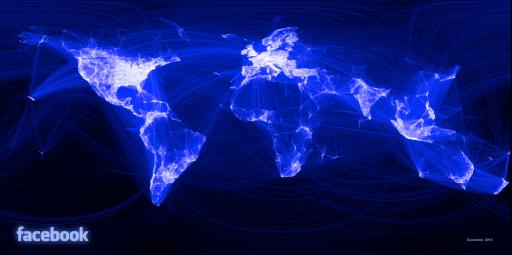
- There are notable dark patches: China is an obvious one, between the Great Firewall and the prevalence of home-grown websites. Brazil is also dark (presumably because everyone's on Orkut instead), as is Russia (LiveJournal is apparently the big thing there to this day). The Middle East is also largely Facebookless, with the exception of Turkey, Lebanon and Israel. Africa is also largely dark, with a few, largely self-contained patches of light.
- The east coast of Australia is more strongly connected to New Zealand than to the west coast.
2010/11/16
Tomorrow is apparently National UnFriend Day: a day for purging your Facebook friend list of people who aren't actual real-world friends (you know, that guy you met at a party two years ago who's in marketing or publishing or something and really into snowboarding, or was it Korean cinema?) without the devastating anxiety non-sociopathic people feel when cutting off contact with another blameless human being, or something.
“NUD is the international day when all Facebook users shall protect the sacred nature of friendship by cutting out any ‘friend fat’ on their pages occupied by people who are not truly their friends,” according to the show’s website.Meanwhile, the latest new social network's key feature is that you only get 50 friends, who are meant to be your closest friends and family.
While there is something to be said for periodically deleting non-relationships from social sites (i.e., anybody whom you can't remember who they are), the premise of both of these—that social software friend lists should be only for people we consider to be actual friends in real life—goes against the use cases of social software site; one of the things that makes sites like Facebook useful is because they're good at managing weak links; of keeping up with people whom one isn't sufficiently close to to individually spend time with. There is probably less call for a site that is limited to one's 50 nearest and dearest (not to mention the drama it may engender, akin to MySpace's "Top 8" ("You added him but not me; what am I: chopped liver?")) than for one for keeping up with various spheres of acquaintances, buddies, contacts and other weak links, and compartmentalising one's public identity and profile between them appropriately.
2010/10/23
A journalist from the Daily Beast performs an experiment to determine how Facebook determines what updates appear in people's feeds. Facebook has a secret algorithm which determines the status of posts and users, and which ones are deemed interesting enough to push to their friends' feeds; like Google, it keeps its algorithm secret. An experiment, involving a team of volunteers interacting in a directed way, has cast some light on some of the factors which determine whether Facebook thinks you're too boring for your friends to possibly be interested in what you say:
2. Facebook's Catch-22: To get exposure on Facebook, you need friends to interact with your updates in certain ways (more on that below). But you aren't likely to have friends interacting with your updates if you don't have exposure in the first place. (Memo to Facebook newcomers: Try to get a few friends to click like crazy on your items.)
5. "Stalking" Your Friends Won't Get You Noticed.
6. Having Friends Who Stalk You WILL Help Your Popularity.
7. Links Trump Status Updates.
8. Photos and Videos Trump Links.
9. The Power of Comments. If items you post attract comments from a few friends, it clearly raises your visibility overall. When our selected volunteers began stalking Phil, he finally appeared to many users for whom he had been a no-show. But when we stopped the stalking and moved on to the next phase of our trial, directing a different group of users to not only look in on Phil but also repeatedly add comments to his items, he surfaced on the feeds of still more friends.
10. Why Facebook Really is Like High School: After weeks of testing and trying everything from having Phil post videos to getting some of his friends to flood him with comments, by the end of our experiment, a few of our volunteers had still literally never seen Phil appear in their feeds, either Top News or Most Recent. These were the "popular kids"—users of Facebook with 600 or more friends. (Conversely, those with only 100 to 200 friends were among the first to spot Phil.) So the key, as you build your coterie of friends, is making sure to include some without huge networks.
2010/10/10
2010/10/4
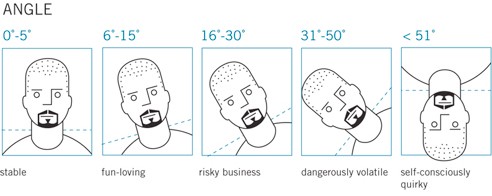
Facebook has just upgraded its photo sharing feature, increasing the maximum dimension along either axis from a miserly 720 pixels to 2,048 pixels, improving tagging and adding a lightbox interface. Some are saying that the upgrade poises Facebook to challenge Flickr as a serious photo sharing site (Facebook already hosts more than three times as many photos as Flickr does); however, the fact remains that photographs on Facebook still have a distinctive "Facebook style":
(The Facebook Style is not to be confused with the MySpace Angle, though it's presumably possible for a photograph to meet the definitions of both.)A few days ago I ran into one of my nieces whom I hadn't seen for a while. She's a lively, sociable young woman and had recently returned from spending an enjoyable summer in Cape Cod. I asked if she had any photographs. "Sure," she said, launching her Facebook page, where there was an album of 150 images, which on inspection turned out to be a succession of more or less identical images of young men and women wearing silly grins and making faces at the camera.
Two things struck me about this album. The first was that it contained not a single image of Cape Cod. The other was how her photographs reminded me of those which appear on the Facebook pages of my own teenage children – which leads one to conjecture that there is now a "Facebook style" of photography, as distinctive in its way as that of the passport or wedding photograph.
Among Facebook's 15bn photographs there are, no doubt, some memorable and beautiful images, but to date I haven't seen any. That's not true of Flickr, which continues to be one of the wonders of the world and hosts hundreds of thousands of terrific pictures. More significantly, an increasing proportion of them are published under a Creative Commons licence, which means that they can be freely used for non-commercial purposes.
In any case, while Facebook's photo sharing tools may be improved, it is unlikely to become a Flickr-killing platform for strikingly beautiful photographs, for reasons of culture and function. Facebook is, after all, primarily a social site; its strengths come from the ability to share things meaningful to one's friends, which would be tediously mundane or irrelevant to anybody else. Few people are interested in identical mugshots of strangers gurning at the camera in pubs or backyards, though the family members and chums of the gurners in question probably are.
Flickr, meanwhile, is a site for publishing photographs, where the photographs are the primary focus. It has social features (users can favourite or comment on photos with their pseudonymous Flickr account IDs, and add other information about themselves), but they are secondary to the application of showing photographs. To wit, Flickr not only has keyword tags but also groups, with themes such as "sunsets", "wide-angle photos", "things which are red", or "Paris", where users can send their photos, making them available for viewing by strangers who share an interest in their theme. This is not something Facebook is good at. (Mind you, it goes both ways; Flickr recently added the ability to tag other Flickr users in photos, though that doesn't seem as useful as Facebook's person-tagging feature; unless one hangs out only with keen photographers, one's friends are unlikely to be on Flickr.) I don't think Facebook is going to eat Flickr's lunch any time soon. (Nor, for that matter, is Google's Picasa, nor any of the Flickr-alikes like Zooomr or Ipernity.)
And while we're on the subject of beautiful photos on Flickr, Ffffl*ckr is a new web-based tool which, given access to your Flickr account, will find other photos you are likely to like, by looking at photos your favourited and seeing what their takers favourited.
2010/9/17
Dark Patterns is a list of deliberately deceptive or user-hostile website/interface design patterns, used by unscrupulous operators to deceive or exploit unwary users. These range from honest-but-hamfisted attempts to corral user behaviour into profitable channels (i.e., making it inconvenient to compare prices; sites which use JavaScript-based navigation to frustrate opening links in other windows do this) to various more underhanded tricks, ranging from sneaking unwanted items into shopping baskets, adding unsolicited recurring charges to spamming your friends under false pretexts to generally making it hard for the user to unsubscribe or do anything that reduces turnover. Featured offenders include the likes of Ryanair, various travel and consumer electronics retail sites, and Facebook (who get their own entry):
“The act of creating deliberately confusing jargon and user-interfaces which trick your users into sharing more info about themselves than they really want to.” (As defined by the EFF). The term “Zuckering” was suggested in an EFF article by Tim Jones on Facebook’s “Evil Interfaces”. It is, of course, named after Facebook CEO Mark Zuckerberg.
(via Boing Boing) ¶ 0
2010/8/28
Movies that would have been ruined by Facebook (or, more specifically, whose premises fall apart if their characters are on Facebook):

2010/7/24
Cow Clicker: a distillation of addictive, potentially expensive Facebook games to their purest essence:
You get a cow. You can click on it. In six hours, you can click it again. Clicking earns you clicks. You can buy custom "premium" cows through micropayments (the Cow Clicker currency is called "mooney"), and you can buy your way out of the time delay by spending it. You can publish feed stories about clicking your cow, and you can click friends' cow clicks in their feed stories.
2010/7/21
In India, where light-coloured skin is seen as a sign of status, Vaseline (who sell skin-lightening cremes) have published a Facebook app which lightens complexions in photos.
The technology, of course, has other applications. Anyone want to bet how long until the UK/Europe see an app for tanning photographs?
2010/7/17
Until now, Google and social software haven't been ideas that went together naturally. The famously engineering-focussed company had experimented with social, though mostly in engineers' 20% time, and with mixed results. Orkut became spectacularly successful in Brazil, but largely bobbed along in the wake of Friendster elsewhere until the vastly technically inferior MySpace came along and seized the market, Google Friend Connect got its lunch eaten by Facebook Connect, and other forays into social made the mistake of being a bit too clever and automatically inferring the user's social graph from their online activity, crossing the line between nifty and disturbing.
Now, however, this is likely to change. There are rumours afoot that Google have made social software a strategic priority, establishing teams to work on the problem of social as part of their regular 80% job, and that a social platform, possibly named Google Me, is in the works. Of course, as far as social platforms go, Facebook have the area sewn up, with a pretty sophisticated API, leaving little space for newcomers (or even Google) to expand into, unless they find and solve problems in the way Facebook does it.
Which brings us to this slide presentation from Google user-experience researcher Paul Adams. The presentation rigorously examines the social uses of software, and the natures of social connections (Adams mentions strong ties and weak ties, and adds a third category, temporary ties, or pairs of people involved in once-off interactions; think someone you buy something from on eBay) and pinpoints possible shortcomings of simple models such as Facebook's (the fact that people have different social circles and needs to expose different facets of their identities to different circles, and that tools such as Facebook's privacy filters have a high overhead to use satisfactorily in this way), not to mention unresolved mismatches between the way human beings intuitively perceive social interaction working and the way it does in the age of social software (for example, we are not intuitively prepared for the idea of our conversations being recorded and made searchable). All in all, it looks like a pretty rigorous survey of social software, condensed down to 216 slides. (An expanded version may be the contents of a book, Social Circles, which comes out in August.)
If Google, who have not given much weight to social software in the past, are investing in this level of research into it, they may well have a Facebook-beating social platform in the works. Though (assuming that it exists, of course) only time will tell whether Google have finally grasped social enough to pull it off.
2010/5/21
2010/4/22
A Facebook intern and PhD student in human-computer interaction has used Facebook to measure the relationship between sharing and wellbeing. Moira Burke's findings, gained by measuring the interactions between Facebook users who filled in surveys, has found, unsurprisingly, that active sharing (such as posting content and sending messages) is more correlated with wellbeing than passive consumption.
2010/3/24
The Daily Mail Telegraph says that Facebook causes cancer syphilis:
The virus has increased fourfold in Sunderland, Durham and Teesside, the areas of Britain where Facebook is most popular, because it has given people a new way to meet multiple partners for casual sexual encounters.
2010/3/5
The social network site Facebook is supported by advertising. Being a social network site, it has the advantage of being able to serve (anonymously) targeted ads to its users, who volunteer demographic information about themselves in using the site; advertisers can target ads to users whose profiles or recent activities match certain criteria. Unfortunately, when handled clumsily, the effect can be disconcerting or creepy:
One campaign that flooded the site in recent weeks, before Facebook cracked down on it, tries to take advantage of consumer interest in Apple’s iPad. “Are you a fan of Eddie Izzard? We need 100 music and movie lovers to test and KEEP the new Apple iPad,” one version of the ad says. Louis Allred Jr., 29, a Facebook user in Los Angeles who saw the ad, said he figured it was shown to him because he or a friend had expressed enthusiasm for Mr. Izzard, a British comedian, on their profiles.Off-key and/or sleazy ads on Facebook are nothing new, of course; ads juxtaposing pictures of hot chicks with unrelated, often dubious-looking, offers, for example, have been on the service for years, and presumably have snared a number of not particularly discerning individuals. But now Facebook are allowing advertisers to effectively write templates to be filled in with users' details ("SPECIAL OFFER FOR $gender AGED $(age-1)-$(age+1) WHO LIKE $interest"). Which sounds like a way to game unmerited trust out of punters, but, more often than not, falls into an uncanny valley, falling short of being convincing and coming off as unsettling, or worse:
Women who change their status to “engaged” on Facebook to share the news with their friends, for example, report seeing a flood of advertisements for services and products like wedding photographers, skin treatments and weight-loss regimens.And the knowledge that ads are targeted by some data-mining algorithm can, in itself, add a dimension of unease to what might well be coincidences:
Jess Walker, 22, from central Florida, was recently presented an ad for Plan B, the morning-after pill. “What do I have on my Facebook page that would lead them to believe I would need that?” she asked, adding that she did not want her sexual behavior called into question.
2010/2/19
Please Rob Me is a web site which aggregates Foursquare location data shared by Twitter users and presents it as "new opportunities" and announcements of users having "left home", to demonstrate the risks of sharing location data with strangers.
While Please Rob Me is a proof of concept, and not particularly useful to burglars (you'd have to map Twitter IDs to names and addresses, and also work out whether there was anybody else living at the premises), there is speculation that social web sites offer a wealth of information to burglars, from users' locations to party photos set inside homes and showing off stealable goods. Of course, these days, the dominant web site is Facebook, which, by default, hides users' posts from people outside of their friend list; however, a significant proportion of Facebook users will gladly friend people they don't actually know, undermining this common-sense measure. (Intuitively, the risk of being burgled or spammed must seem insubstantial to them next to the promise of meeting hot chicks or getting invited to cool parties.) An even larger proportion use Windows PCs which are susceptible to viruses. There is already malware which spams Facebook with phishing links; malware which harvests useful information about all of a user's contacts (real names/identifying details, addresses, links to other social sites, &c.) and uploads them to a criminal-owned server could be just as plausible.
Of course, this makes little economic sense if one imagines one team of burglars going to all this effort to identify easily reachable places likely to house unattended PlayStations or plasma screens. However, if one follows the advice of Adam Smith and introduces division of labour (a practice seen in other criminal enterprises, such as phishing gangs and Nigerian 419 scam operations), it becomes more plausible.
Imagine, if you will, a criminal business intelligence service, much like the ones serving marketers, only specialising in selling leads on potential targets to burglars. This business would have a server somewhere with lax law enforcement, algorithms for harvesting and unifying information from a range of sources (possibly supplemented by human intelligence) and a site for offering bundles of this information to prospective burglars, searchable by geographic location, likely richness of pickings (determinable from the target's employment information, credit ratings and such) and likelihood of them being out of town. The algorithms would pick through a number of public sites, such as Twitter, Foursquare and others (photo sharing sites could be useful; if someone's address is in New York and they just uploaded a fresh photo geotagged in Gran Canaria, they're probably not home), and use them to pick out the likelihood of a target matching various criteria. (The algorithms could be fairly advanced, but as we have seen from the botnet arms race, there's no shortage of ingeniously talented coders of, shall we say, above-average moral flexibility.)
Of course, the real rich pickings are in walled gardens such as Facebook, where people have a sense of security and post their real names, locations and photos; while this is not public, a criminal site could harvest it by using malware (in which case, it'd get not just the details of the owner of the infected PC, but of all their friends), rogue viral Facebook apps or by hiring humans to set up profiles and, using a specially modified browser, friend random strangers ("MAKE MONEY AT HOME SURFING THE WEB!", the recruitment ads could read). The data would go into the criminals' data centre and would come out the other end as searchable packages offered for sale ("Your search of current vacationers making $50k+ near ___ has yielded 37 results, for $100 each. How many would you like to buy?")
Given precedents both in computer crime (credit-card fraud is a big one, having both black-market web sites and highly specialised economies with divisions of labour) and social software, I would be surprised if nobody tries setting something like this up.
2010/2/9
Pete Warden, a programmer and amateur researcher, has analysed the data from public Facebook profiles, including the relative locations of pairs of friends and people's names and fan pages, and used this to divide the US into seven relatively self-contained clusters, which he terms "Stayathomia" (i.e., the northeast to midwest), "Dixie" (the old South), "Greater Texas" (encompassing Oklahoma and Arkansas), "Mormonia" (no prizes for guessing where that is), the "Nomadic West" (places like Idaho, Oregon and Arizona, where people's connections span wide areas), Socalistan (i.e., most of California and parts of Nevada) and Pacifica (essentially Seattle). The clusters were derived from performing cluster analysis on the social graph, and not imposed on the data a priori.
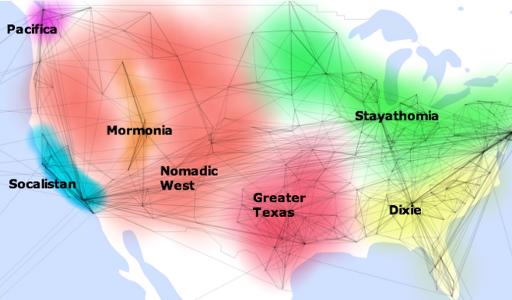
Warden posts various findings he gained from crunching the data on these clusters:
Probably the least surprising of the groupings, the Old South is known for its strong and shared culture, and the pattern of ties I see backs that up. Like Stayathomia, Dixie towns tend to have links mostly to other nearby cities rather than spanning the country. Atlanta is definitely the hub of the network, showing up in the top 5 list of almost every town in the region. Southern Florida is an exception to the cluster, with a lot of connections to the East Coast, presumably sun-seeking refugees. God is almost always in the top spot on the fan pages, and for some reason Ashley shows up as a popular name here, but almost nowhere else in the country.
(Greater Texas:)God shows up, but always comes in below the Dallas Cowboys for Texas proper, and other local sports teams outside the state. I've noticed a few interesting name hotspots, like Alexandria, LA boasting Ahmed and Mohamed as #2 and #3 on their top 10 names, and Laredo with Juan, Jose, Carlos and Luis as its four most popular.
(Mormonia:) It won't be any surprise to see that LDS-related pages like Thomas S. Monson, Gordon B. Hinckley and The Book of Mormon are at the top of the charts. I didn't expect to see Twilight showing up quite so much though, I have no idea what to make of that!Mormons like their vampires sparkly and pro-abstinence; who would have guessed?
(Socalistan:) Keeping up with the stereotypes, God hardly makes an appearance on the fan pages, but sports aren't that popular either. Michael Jackson is a particular favorite, and San Francisco puts Barack Obama in the top spot.Warden also has this tool for browsing aggregate profiles of countries based on their residents' public Facebook profiles.
2010/1/13
What purports to be an interview with an anonymous Facebook employee, shedding some light on the inner workings of Facebook, technical improvements, privacy, and the more unusual dealings with its millions of users:
How do you think we know who your best friends are? But that’s public knowledge; we’ve explicitly stated that we record that. If you look in your type-ahead search, and you press “A,” or just one letter, a list of your best friends shows up. It’s no longer organized alphabetically, but by the person you interact with most, your “best friends,” or at least those whom we have concluded you are best friends with.
I’m not sure when exactly it was deprecated, but we did have a master password at one point where you could type in any user’s user ID, and then the password. I’m not going to give you the exact password, but with upper and lower case, symbols, numbers, all of the above, it spelled out ‘Chuck Norris,’ more or less. It was pretty fantastic.
I found a fake account created from Berkeley that used the profile picture and information from the brother of one of my very good friends. We looked up the guy who created the original profile, and he had never ever heard of him, never ever met him, obviously had never seen him. But this guy had evidently added him as a friend, and sadly he accepted it, but literally stole all of this guy’s information, created a fake account, and was communicating with himself from the fake account. He was writing on his wall and posting back to the “other person’s” wall. We found out the guy actually had about fifteen fake accounts that he created, stealing other users’ pictures and information to create the accounts, and was actually communicating back and forth with himself. Just to try to make himself appear cool, I guess?The unnamed Facebook employee also says that they're working on something named Hyper-PHP, which will compile PHP (which Facebook is written in) to machine code, which, they claim, will reduce CPU usage by 80%.
2009/11/14
Facebook are adding a XMPP gateway to their instant messaging service, which has, until now, been tied to their web site, running in the browser frame. (Sure, there have been unsupported hacks, like the Adium/Pidgin driver, which pretended to be a web browser, but they were unsupported and less than ideal; there was, for example, no way to shut down IM in the browser whilst staying online in your chat client.) Anyway, this should be a pretty big boost for XMPP (also known as Jabber), an open instant messaging protocol also used by Google Talk and the chat services of various other sites (such as LiveJournal).
I wonder whether Facebook will use XMPP to provide additional functionality, such as allowing status updates by instant message, or sending notifications to users' messaging clients.
2009/11/13
A man arrested as a suspect in a mugging case has had charges dropped against the court found an update posted to his page at the time the crime was committed; Facebook verified that the post (which read merely "where's my pancakes?") was made from an address far from where the crime was committed.
The moral of this story is: if you must commit a crime, learn some UNIX skillz beforehand and rig up a cron job to post to Facebook (or Twitter or your blog) in your absence.
2009/11/12
Joe Hewitt, the developer of the iPhone Facebook application, has publicly sworn off iPhone development, over Apple's heavy-handed approval policies:
My decision to stop iPhone development has had everything to do with Apple’s policies. I respect their right to manage their platform however they want, however I am philosophically opposed to the existence of their review process. I am very concerned that they are setting a horrible precedent for other software platforms, and soon gatekeepers will start infesting the lives of every software developer.
The web is still unrestricted and free, and so I am returning to my roots as a web developer. In the long term, I would like to be able to say that I helped to make the web the best mobile platform available, rather than being part of the transition to a world where every developer must go through a middleman to get their software in the hands of users.”I wonder whether this will make enough waves to shake Apple into loosening their grip somewhat. Perhaps that'll take Jamie Zawinski to take up iPhone development, attempt to port DaliClock to it and then storm off in a huff.
2009/11/6
Facebook page of the day: List of cats with fraudulent diplomas:
On several occasions, people who desired to expose a diploma mill have registered their pet cat as a student. Upon its speedy graduation, the cat and its diploma are displayed to the news media.The article then enumerates several illustrious felines, amongst them Colby Nolan, Oliver Greenhalgh, and George, the aforementioned hypnotherapist.
2009/11/4
A reformed Facebook spammer (in his own words) writes about the dubious tricks of his former trade:
I finally came to this realization: People on Facebook won’t pay for anything. They don’t have credit cards, they don’t want credit cards, and they are not interested in shopping. But you can trick them into doing one of three things:Also, if you don't want to see spam, move to somewhere geographically indistinguishable from where service providers (like Facebook and Google) are based; i.e., the San Francisco Bay Area:
- Download a toolbar: It could be spyware (such as Zango) or something more legitimate, such as Webfetti or Zwinkys.
- Give up their email address: You’ve won a “free” camera or perhaps you’ve been selected as a tester for a new Macbook Pro (which you get to keep at the end of the test). Just tell us where you want us to ship it.
- Give up their phone number: You took the IQ Quiz, so give us your phone number and we’ll tell you your score. Never mind that you’ll get billed $20 a month or perhaps be tricked into inviting 10 other friends to beat your score.
Cloaking: This is when you show a different page based on IP address. We and most other ad networks would geo-block northern California—showing different ads to Facebook employees than to other users around the world. One of the largest Facebook advertisers (I’m not going to out you, but you know who you are) employs this technique to this day, using a white-listed account. Our supposition is that it makes too much money for Facebook to stop him. Believe me, we have brought this to Facebook’s attention on several occasions. Here’s what this fellow does—he submits tame ads for approval, and once approved, redirects the url to the spammy page. To be fair, players like Google AdWords have had years more experience in this game to close such loopholes.
2009/10/19
A word of advice: if you're a fugitive from the law, don't post your location to your Facebook page. And if you absolutely must do so, don't add any law enforcement officers to your friends.
2009/6/26
One of the major problems with Facebook, in the past, has been its one-size-fits-all privacy settings. You could decide, once and for all, who sees your status updates, but could not do so on a post-by-post basis. Which is fine and dandy when all your friends there know you in the same context, but becomes a problem once you have people from different spheres. You might not want to bore your generalist friends with detailed discussion of your more specialised interests, or share your personal life with your coworkers, so the only option is to self-censor down to the lowest common denominator, and hope that those who want more can be bothered with LiveJournal.
Not for much longer, though, because Facebook are soon rolling out post-by-post privacy options, which will let you decide, with each status update who sees it.
The options will include "everyone" (i.e., anyone who goes to your public Facebook page), friends, friends and friends thereof, or, most usefully, custom groups of friends. The devil is, of course, in the details, but it looks like it will make Facebook a lot more useful as a fine-grained social communications tool.
2009/5/17
A website named Double X, which seems to be a broadly feminist publication run by the Newsweek people, has a piece examining the phenomenon of women using photographs of their children as their Facebook profile photos, and what it says about their identity and social position:
These Facebook photos signal a larger and more ominous self-effacement, a narrowing of our worlds. Think of a dinner party you just attended, and your friend, who wrote her senior thesis in college on Proust, who used to stay out drinking till five in the morning in her twenties, a brilliant and accomplished woman. Think about how throughout the entire dinner party, from olives to chocolate mousse, she talks about nothing but her kids. You waited, and because you love this woman, you want her to talk about…what?…a book? A movie? A news story? True, her talk about her children is very detailed, very impressive in the rigor and analytical depth she brings to the subject; she could, you couldn’t help but think, be writing an entire dissertation on the precise effect of a certain teacher’s pedagogical style on her 4-year-old. But still. You notice at another, livelier corner of the table that the men are not talking about models of strollers. This could in fact be a 19th-century novel where the men have retired to a different room to drink brandy and talk about news and politics. You turn back to the conversation and the woman is talking about what she packs for lunch for her child. Are we all sometimes that woman? A little kid talk is fine, of course, but wasn’t there a time when we were interested, also, in something else?
Facebook, of course, traffics in exhibitionism: It is a way of presenting your life, at least those sides of it you cherry pick for the outside world, for show. One’s children are of course an important achievement, and arguably one’s most important achievement, but that doesn’t mean that they are who you are. It could, of course, be argued that the vanity of a younger generation, with their status postings on what kind of tea they are drinking, is a worse kind of narcissism. But this particular form of narcissism, these cherubs trotted out to create a picture of self is to me more disturbing for the truth it tells. The subliminal equation is clear: I am my children. And perhaps for their health and yours and ours, you should be other things as well.
2009/5/2
Today, we increasingly live in a world of software-mediated social interaction, and at this moment, Facebook is one of the largest such systems. As more people join Facebook, and it becomes an increasingly indispensible utility for connecting people, and the range of people one is connected to becomes much broader. Whereas once one's Facebook friends tended to be college buddies and close friends, they now include coworkers, family members, old schoolmates, neighbours and others.
Facebook's privacy options, however, haven't kept up with this change. When you post to your Facebook profile, there is no way to make posts visible by only a subset of your Facebook friends. So you're faced with the choice of self-censoring your posts to a level suitable for all users. You might not want your parents or employers to see photos of you partying, or might not want to bore your non-technical friends with talk about specialised subjects a subset of your friends would be interested in. So the end result is that Facebook is reduced to the lowest common denominator of subjects suitable for all audiences; things that won't shock or bore anyone. This leaves no suitable space for a large set of discussions: in-jokes between closely-knit groups of friends; specialist banter about C++ or football or archaeology; or even personal discussions you wouldn't necessarily want to share with your coworkers or casual acquaintances.
There are better ways to do this. The photo sharing site Flickr allows users to tag certain friends as "Family" or "Friends", and make some photos only visible to those groups. The LiveJournal system goes further, allowing users to define arbitrary numbers of friend groups and control who can see each post individually.
Facebook needs something like this if it's going to scale. It need not be an intrusive feature; a checkbox to the right of the "What's on your mind?" box, opening a "Show this post to: Everyone / All my friends / (groups)" drop-down, would suffice quite elegantly. (Something similar, of course, should be added for photos, notes and such, and made available to application developers.) This would make Facebook much more broadly useful as a tool for connecting people across the wide spectrum of social relationships they have in their lives.
Anyway, to wit, I have done the obvious thing about this deficiency and created a Facebook group about it. Perhaps if enough people join, the Facebook developers will listen.
2008/10/23
A 21-year-old Australian call centre employee is facing unspecified disciplinary action after taking sick leave and bragging on Facebook that he was absconding from work due to a hangover. Kyle Doyle's undoing seems to have been that, at some earlier time, he had added his boss to his friends list, which suggests that he might not have been the sharpest knife in the drawer; if you're looking for a partner to pull off the perfect crime with, he's probably not your man.
Heaping irony on top of stupidity, the snapshot of his profile that is circulating with the damning admission lists him as a supporter of the "Liberal Party of Australia", the right-wing party which introduced harsh industrial relations laws which, among other things, allow employers to demand medical certificates for as little as one day of sick leave.
2008/4/3
Something which amuses me is the ads on Facebook, and the juxtapositions of irrelevant images (typically of attractive-looking young women, at times in provocative poses) next to pitches for products of various dubiosity, ranging from fairly well-known credit-rating agencies to get-rich-quick schemes and online gambling sites, but having as a common feature an inherent lack of sex appeal. The rationale, I'm guessing, is pure postmodern cynicism: somewhere, some executive decided that the model consumer they're pitching at is like one of the slack-jawed halfwits from Idiocracy ("Gee, I don't know the first thing about work-from-home schemes and stuff... but I sure like hot chicks!"), and decided to market at this notional demographic. Not aiming merely for the dullards, but also for those consumers, brought up on trashy television and celebrity gossip, who are well versed in the practice of simulating being simpletons in order to be entertained, as the Judd Apatows and Seann William Scotts of this world (and their bank managers) know. Call it cognitive slumming, if you will.
Sometimes, though, the juxtaposition between the content (or, rather, its tone) and the Irrelevant Hot Chick Picture becomes quite jarring. Case in point:
2008/3/12
The Napsterization blog (which is not about craptacular DRM-shackled music-rental services but about the social and economic implications of disruptive technologies) has a piece on the lengths Facebook application authors go to get people to install their applications, such as doing sleazy things like not only requiring users to install their application to see messages from friends, but wilfully misleading them into believing that if they don't forward a message (of a pornographic tone) to some friends, they won't get to see it. As a result, the maker of the app gets a juicy boost to their installation figures, whilst pissing all over people's social relationships and making your user experience that much crappier.
In this case, the culprit was Slide, with their popular FunWall application, though neither Slide nor Facebook will accept the blame for this:
Facebook pointed the finger at Slide (the app maker in this case), and said, "There is nothing we can do. We have no control over the apps people make or the stuff they send." Oh, and if I wanted Facebook to change the rules for apps makers? I'd have to get say, 80k of my closest Facebook friends to sign on a petition or group, and then they might look at the way they have allowed porn spam to trick people into forwarding, but until then, there would be no feature review.
Slide said that they thought Facebook was the problem, because as the "governing" body, Facebook makes the rules and "Slide wouldn't be competitive if they changed what they do, and their competitors weren't forced to as well." In other words, Slides competitors use the same features to get more users (or trick more users as the case may be) and Slide didn't want to lose out on getting more users with similar features, regardless of the effect the features have on us and our relationships.And things aren't likely to change by much. Human psychology being what it is, people are willing to put up with a lot of annoyance in software as long as it provides a social function. (How else could you explain MySpace, with its spammy, craptacular user experience, going from strength to strength and maintaining its position as the dominant social software site?) Some people may generally amused by every piece of spam that comes in, or believe that, like billboard advertising, it brightens up people's otherwise dull lives. Others may put up with it due to the peer pressure to not seem cranky and antisocial; after all, the argument would go, that's what they do here, and if you don't like it, why did you join? (The corollary to this argument is, of course, the attrition rate as people who get sick of having three wall applications and being awash in a sea of silly surveys and chain letters stop logging in one day.)
2008/3/7
The Irish Independent has a piece on how social networking websites are changing relationships, and in particular, how they end and what happens afterward:
I started getting clues that I might be about to become a free man when my girlfriend's friends posted messages to her that read: "Good luck with tonight -- it's for the best."
First came the announcement online of my new 'Single' status. Deftly inserted into Facebook's running newsfeed, it informed everyone that both she and I knew that I had been dumped, in much the same way that Reuters proclaims the engagement of a minor member of the British royal family. There was no way of deleting it, so it sat there haunting me.
But then her status updates started to tell a story. Just three days after we broke up, she changed hers to: "2008, new job (check), new flat (check), new man (working on it)."
Your ex's blog may only be read by five and half people, but you still don't really want them telling complete strangers how you were unable to put the loo seat down and never really gave the choosing of shelves the attention it deserved, and how these things were symptomatic of your lack of commitment to the relationship.
It makes me think that our grandparents had an easier time. If one of their relationships went bad they could always go to sea -- or at least the next village -- and never see the other person again.The whole issue of relationship breakups in the age of the internet recently hit the spotlight spectacularly with Wikipedia founder Jimmy Wales' breakup with his girlfriend, FoxNews journalist Rachel Marsden. Wales apparently dumped her on Wikipedia, and she retaliated by releasing transcripts of their online chats, the major upshot of which was a revelation that these lofty public figures were, scandalously, quite into having sex with each other while they were going out.
It'll be interesting to see how the standards of socially acceptable conduct evolve once it is literally impossible to dissociate oneself from an ex without becoming a hermit. Will slagging off one's exes and their failings in public blogs become taboo, or restricted to some acceptable bounds of fair play? Or will people get used to the fact that anyone in the dating marketplace probably has several scathingly negative references from their various exes? (Perhaps there is a niche for a site which aggregates exes' references, along with reputation scores for the referers?) Will things like Rachel Marsden's release of the chat transcripts become unacceptable, the social equivalent of a nuclear first strike?
2008/2/28
French broadsheet Le Monde has published a map of the popularity of various social network sites across the world.
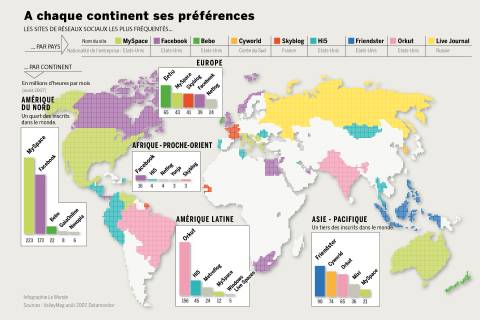 This map reveals that MySpace dominates in the USA and Australia, whereas the UK, Canada and Norway prefer Facebook. Which brings to mind the statistics about average IQs of countries, which place the UK's average at 100 and the US and Australia's at 98.
Interestingly enough, the chart lists LiveJournal as a Russian website, despite the fact that it began in, and operates out of, the US, though Russia has been a significant market for it and is now owned by a Russian concern.
2008/1/26
A chap named Virgil Griffith has correlated the most popular books at every college in the US (as fetched from Facebook) with that school's average test score to find a correlation between intelligence and favourite books. According to Griffith's study, the book most correlated with high scores is Vladimir Nabokov's Lolita, and that with low scores is the Holy Bible (not to be confused with the Bible, which is around the middle, just below Harry Potter); other books correlated with high scores are Ayn Rand's Atlas Shrugged, Kurt Vonnegut's Cat's Cradle, and Freakonomics, and books dumber than "I Dont Read" include various erotica and hip-hop/ghetto fiction, The Purpose Driven Life and Fahrenheit 451. Slightly smarter than not reading are the likes of Fight Club, Dan Brown and John Grisham, along with Shakespeare's Hamlet; sci-fi, fantasy and geek/fan-interest books like The Lord of the Rings, Dune and, umm, Eragon rate more highly. (Mind you, this is correlated to test scores, not cultural well-roundedness.)
It would be interesting to see one of these correlating a measure of intelligence (such as test scores) with other factors, such as favourite music (I imagine things that a lot of geeks listen to, like metal, industrial and prog rock would come out on top, and rap-metal/nu-metal and R&B would come out fairly low), movies, or even which Facebook groups/applications one has installed.
(via Boing Boing) ¶ 3
2008/1/13
Hasbro take legal action to shut down Scrabulous. I'm surprised it took them this long. I wonder whether they'll be smart enough to come to a deal, either acquiring Scrabulous or licensing it in return for a share of the (considerable) ad revenue, or whether they'll just sue it into oblivion to teach them a lesson, undoubtedly cheered on by the Ayn Rand fanboys loudly defending anything they may choose to do in the comments.
The Scrabulous servers are in India, which may be hard to shut down, though Facebook could block the application immediately. And the authors should probably avoid any country with an extradition treaty with the US unless this is settled.
2008/1/9
Something I didn't know until today: the Facebook API includes a complete SQL-style query language for querying one's social graph, which allows you to do things like:
SELECT name, pic, status, music FROM user WHERE uid in (select uid2 from friend where uid1 = 1234567890)FQL, as it's called, can be called from the Facebook API, or you can play with it here (using the fql.query method).

Facebook and Google anounce that they are joining the Data Portability Workgroup, a body advocating open standards allowing users of social web sites to easily move their data from one site to another. (This is not long after Facebook suspended Robert Scoble's account for attempting to, well, port his data from their site.) More interesting is who's Google's representative in this organisation: none other than Brad Fitzpatrick, founder of LiveJournal and one of the originators of OpenID, who more recently has turned his attention to the social graph problem.
2008/1/6
Facebook is in the news again, with (so far) the first known instance of a Facebook application being used to install adware on users' PCs. If your friends invite you to install the "Secret Crush" application, you accept, and you are using Windows, then the application will install the Zango adware program on your PC, not to mention arm-twist you into spamming your friends with requests to add it.
If Secret Crush actually needs you to click buttons to invite your friends to add it, the criminal scumbags who designed it have missed a trick; some other applications, such as RockYou's Super Wall and related applications, are able to send messages to randomly selected individuals from a user's friend list, purporting to be that user and asking to be installed to see a message from them, without the user's intervention. (I once found in my notifications the notice that I had messaged three randomly-chosen people, whose relationships to me have nothing in common, inviting them to install Super Wall. Soon after that, Super Wall was no longer installed on my page.)
The issue of data portability, or who owns your personal information and friend lists online, has entered the news recently as Facebook deleted the account of blogger Robert Scoble for using a script to automatically fetch his contact list, in violation the site's terms of service (which prohibit scripts, as they can be used for spamming and such). Scoble's account has been reinstated, on the proviso that he doesn't do it again, but not before raising an outcry on his high-profile blog.
2007/11/27
Writing in InformationWeek, Cory Doctorow delivers a scathing indictment of Facebook, and its eyeball-herding business model:
Facebook is no paragon of virtue. It bears the hallmarks of the kind of pump-and-dump service that sees us as sticky, monetizable eyeballs in need of pimping. The clue is in the steady stream of emails you get from Facebook: "So-and-so has sent you a message." Yeah, what is it? Facebook isn't telling -- you have to visit Facebook to find out, generate a banner impression, and read and write your messages using the halt-and-lame Facebook interface, which lags even end-of-lifed email clients like Eudora for composing, reading, filtering, archiving and searching. Emails from Facebook aren't helpful messages, they're eyeball bait, intended to send you off to the Facebook site, only to discover that Fred wrote "Hi again!" on your "wall." Like other "social" apps (cough eVite cough), Facebook has all the social graces of a nose-picking, hyperactive six-year-old, standing at the threshold of your attention and chanting, "I know something, I know something, I know something, won't tell you what it is!"
If there was any doubt about Facebook's lack of qualification to displace the Internet with a benevolent dictatorship/walled garden, it was removed when Facebook unveiled its new advertising campaign. Now, Facebook will allow its advertisers use the profile pictures of Facebook users to advertise their products, without permission or compensation. Even if you're the kind of person who likes the sound of a benevolent dictatorship this clearly isn't one.To be honest, Facebook doesn't seem quite as bad about this as other (such as MySpace, which has the chutzpah to make logging-in users click through interstitial ads, knowing that cool-obsessed teenagers will endure any amount of intrusive advertising as long as it's bright and flashy and ugly-nu-rave enough). Though all this could change if it does start using your name and picture to endorse some product which you once bought. (Though if it does this, it could be on shaky legal ground. It's quite likely that its retroactively amended click-through agreement would, following the great click-wrap power-grab tradition, state that users will consent to endorsing all products they buy without their knowledge in return for their fix of zombie vampire monkey robot ninja action, though whether any sane court of law would find this reasonable is another matter.) Certainly, them having removed the ability to opt out of their marketing programme does feel rather sleazy.)
Fear not, though, as Cory says that Facebook, like all other social networks before it, is doomed, by a simple law which limits the lifespan of a social network to the initial period of growth:
Sure, networks generally follow Metcalfe's Law: "the value of a telecommunications network is proportional to the square of the number of users of the system." This law is best understood through the analogy of the fax machine: a world with one fax machine has no use for faxes, but every time you add a fax, you square the number of possible send/receive combinations (Alice can fax Bob or Carol or Don; Bob can fax Alice, Carol and Don; Carol can fax Alice, Bob and Don, etc).
Having watched the rise and fall of SixDegrees, Friendster, and the many other proto-hominids that make up the evolutionary chain leading to Facebook, MySpace, et al, I'm inclined to think that these systems are subject to a Brook's-law parallel: "Adding more users to a social network increases the probability that it will put you in an awkward social circumstance." Perhaps we can call this "boyd's Law" for danah boyd, the social scientist who has studied many of these networks from the inside as a keen-eyed net-anthropologist and who has described the many ways in which social software does violence to sociability in a series of sharp papers.As more people join a social network, the tensions increase. Turning down a friend request is socially awkward, and unfriending someone literally says to them "you're dead to me". (OMG, teh drama!) As people from all walks of life join your friends list, the range of things that are suitable for discussion among all of them narrows considerably. Eventually, with your boss, your relatives and your friends all reading your profile, you're restricted to the most innocuously content-free of communications, until you stop bothering to log in, and your Facebook account goes the way of your long-moribund Friendster, Tribe and Orkut logins.
Of course, then comes along the next social network service, and the cycle begins again. Perhaps the next service will learn from its predecessors' mistakes and offer users the vitally important ability to compartmentalise information, to make certain parts of one's profile visible only to certain subsets of one's friends list. This is not a new idea; LiveJournal has allowed its users to do this with journal posts for a long time, and Flickr has a somewhat more limited version of this concept (allowing photos to be restricted to people flagged as "family" or "friends"). However, if a social network system is to be able to cope with real-world social relationships, and the fact that people present different aspects of themselves to different friends and acquaintances, such a mechanism is essential.
(via Boing Boing) ¶ 4
2007/11/22
One useful feature which Facebook, the social network site of the moment, lacks is the ability to compartmentalise information. Whereas on LiveJournal you can define filters and make posts visible to only some of them, on Facebook, every piece of information you published is visible to all your contacts. (Except for those who can only see a limited profile, who are forever stuck in a purgatory of sort-of being "friends" with you whilst being left out of all the fun.)
Being able to compartmentalise your information is useful; there are undoubtedly things you want to tell some of your friends whilst not letting the rest know, other things you're happy sharing with a different (though possibly overlapping) subset, and others you're happy letting anyone know. Think, for example, of talking about work without pissing off coworkers, or confiding about your lovelife, or discussing health issues without overwhelming others with "too much information". As social software becomes an integral part of the social support networks of today's compulsively multitasking, digitally connected population, such controls become more a necessity than a luxury.
Fortunately, Facebook's users have come up with a workaround: creatign members-only groups in lieu of privileged posts. So next time you see a group with an otherwise uncompelling name like "Emma has a new phone number", you'll know what's going on.
2007/11/9
It looks like Facebook (the social network site which promoted itself on being less jarringly obnoxious than MySpace) may soon explore new frontiers of annoyingness:
"Evil is deeply embedded in Facebook's corporate DNA," said Umair Haque, a strategy consultant who covers digital media and innovation on his blog, Bubblegeneration.com.
As Nicholas Carr, former executive editor of the Harvard Business Review, wrote in his blog: "It's a nifty system: First you get your users to entrust their personal data to you, and then you not only sell that data to advertisers but you get the users to be the vector for the ads. And what do the users get in return? An animated Sprite Sips character to interact with."
In describing Facebook's new advertising system at a US conference this week, Facebook founder Mark Zuckerberg made it clear there would be no avoiding the onslaught of advertisements and viral marketing on Facebook. "There is no opting out of advertising," he said.I don't know about you, but I don't want little animated M&Ms characters doing skateboard stunts in the corner of my personal messages or sentences announcing the latest iPod or trainer auto-edited into comments I make on people's walls. If Facebook gets annoying, I'll stop using it, and I won't be the only one.
2007/8/20
Brad Fitzpatrick, the founder of LiveJournal and architect of OpenID, has put forward his thoughts on the social graph problem — which is to say, the present state of affairs in which each social software application has its own social graph (of which user is connected to whom) which its users have to independently maintain — and how to go about aggregating these graphs into something less unwieldy:
Currently if you're a new site that needs the social graph (e.g. dopplr.com) to provide one fun & useful feature (e.g. where are your friends traveling and when?), then you face a much bigger problem then just implementing your main feature. You also have to have usernames, passwords (or hopefully you use OpenID instead), a way to invite friends, add/remove friends, and the list goes on. So generally you have to ask for email addresses too, requiring you to send out address verification emails, etc. Then lost username/password emails. etc, etc. If I had to declare the problem statement succinctly, it'd be: People are getting sick of registering and re-declaring their friends on every site., but also: Developing "Social Applications" is too much work.
Facebook's answer seems to be that the world should just all be Facebook apps. While Facebook is an amazing platform and has some amazing technology, there's a lot of hesitation in the developer / "Web 2.0" community about being slaves to Facebook, dependent on their continued goodwill, availability, future owners, not changing the rules, etc. That hesitation I think is well-founded. A centralized "owner" of the social graph is bad for the Internet.Brad has written down a set of goals for a project to open up the social graph, in a way that allows sites to interoperate gracefully. This will include a common infrastructure that manages the social graph data, within an architecture which (much like OpenID) allows anyone to operate their own servers, and prevents any one entity from owning the graph. This will have an API, which returns all equivalent nodes of a node (i.e., given an identity on one service, the owner's identities on all other services registeded), the edges in and out of a node, the aggregated friends of a node across all services, and any missing friends (i.e., any pairs of nodes connected on one service but not another).
From the user's point of view, this will allow some fairly nifty magic to happen, saving users the hassle of registering on yet another social network site and rounding up their friends:
A user should then be able to log into a social application (e.g. dopplr.com) for the first time, ideally but not necessarily with OpenID, and be presented with a dialog like: "Hey, we see from public information elsewhere that you already have 28 friends already using dopplr, shown below with rationale about why we're recommending them (what usernames they are on other sites). Which do you want to be friends with here? Or click 'select-all'."Brad acknowledges that there will be uncooperative sites, who, owning the lion's share of the social-networking sphere, don't see it in their interest to prioritise interoperating with other sites (no names are named, though I'm betting that it'll be a cold day in Hell before MySpace plays nice with something like this; after all, it may tip their users off to the existence of other sites and depress banner-ad impressions). Thus he proposes a browser add-on which implements the system on uncooperative sites, by means of screen-scraping.
What's happening with this proposal? so far, they have prototypes of the APIs, working on the data for 5 sites (LiveJournal and Vox are, not surprisingly, two of them), the start of a Firefox plug-in to drag MySpace, kicking and screaming, to the party, and the start of a website allowing users to register their points of presence in social networks; a limited beta is expected at some time in the future. There are apparently a lot of people from different organisations working on this, much as there were on the OpenID project, and a Google group has been set up for discussion of the details.
Note that this only covers social network (i.e., "x is a friend of y") data, and not the actual content (birthdays, photos, favourite movies/bands). There is another project named Move My Data, which aims to make the actual user data portable between accounts, though so far it seems to consist of a vague proposal.
2007/8/13
A technical problem causes Facebook to display its PHP source code; someone grabs this source code and posts it online; the code itself doesn't contain anything more revealing than variable names and include paths. Meanwhile, the non-technical press posts vague yet ominous-sounding warnings about how it could help criminals to steal users' identities (conceding that it doesn't actually allow them to do so as such).
Which is not to say that there aren't any risks; as always, one should exercise common sense. Facebook is an entertainment site, and thus engineered to less stringent standards of security than, say, banking sites. Even if the site itself is secure, your "private", "friends-only" information could fall into the hands of third parties in other ways (if, for example, criminals take control of a router between you and the Facebook servers and sniff all the traffic going through it, or if one of your friends (who is able to see your information) has a Windows virus on their PC which captures the pages they see). The same goes for other sites with "friends-only" capabilities, such as LiveJournal, Flickr, or various members-only forums or mailing lists.
2007/6/26
A study of social network website users in the US has shown a class divide between MySpace and Facebook users. Apparently Facebook has more users from wealthier homes and more academic backgrounds, while MySpace has more working-class teenagers, minorities and members of social groups ostracised by the popular kids in high school (this may include music- and fashion-related youth subcultures).