The Null Device
Posts matching tags 'japan'
2017/3/23
One ubiquitous aspect of contemporary Japan is capsule machines. They're everywhere—outside and inside shops, at railway stations, in clusters in the street. Insert a few ¥100 coins (each being worth somewhere in the magnitude of a dollar/pound/euro) and turn the handle and the machine will disgorge, with a satisfyingly mechanical clunk, a small plastic capsule containing a small vinyl figurine. There is a hall full of these machines, arrayed in rows in the arrivals section of Tokyo Narita Airport; a sign next to them reads “welcome to deep Japanese culture”; which, at first, sounds preposterously hyperbolic, though, in retrospect, one could see the figurines in these capsules as a mass-production-age equivalent of the carved netsuke figurines of bygone days. (There are, of course, capsule vending machines at supermarkets and shopping centres in the west, but not at the same scale, and the flimsy, shoddily made plastic trinkets they dispense are a far cry from the Japanese figurines, which seem put together with considerably more thought and attention to detail.) Anyway, without further ado, here are some things found in Japanese capsule machines:
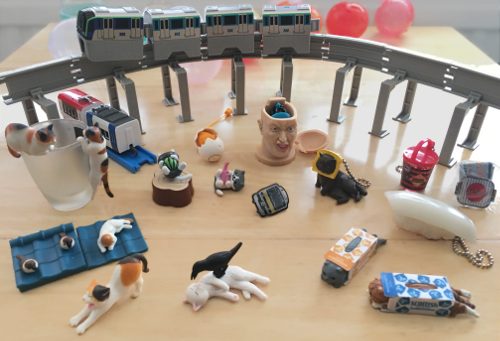
These items were all obtained from capusle machines in the Tokyo area, in March, 2017; some of them are more self-evident than others; a few will be described further below:
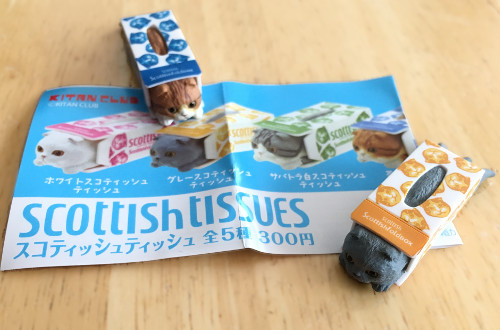
“Scottish Tissues”, a series of figurines of Scottish Fold cats climbing through tissue boxes; probably an off-brand attempt to cash in on the celebrity of Maru the box-jumping Scottish Fold.
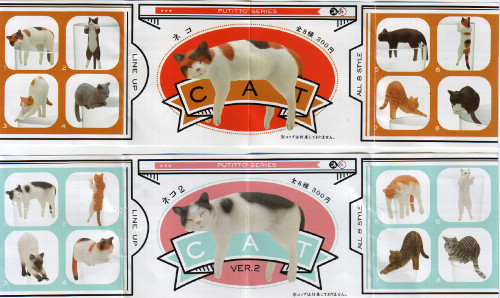
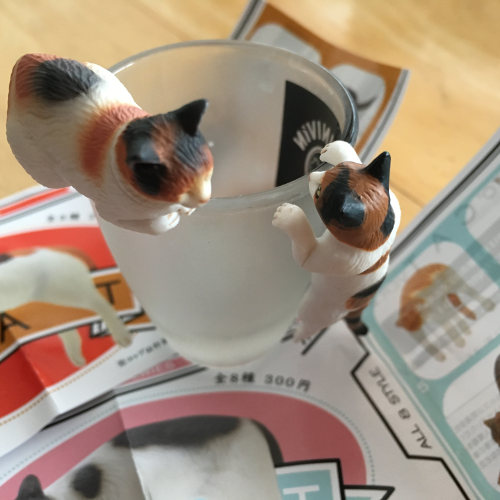
There is an entire category of figurines designed to balance on the rims of drinking glasses, including two series of cats.

Things found on roofs, including, inevitably, cats
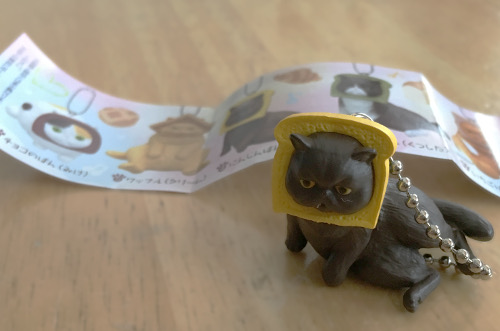
More cats, this time in keyring format, and with their heads through slices of bread.
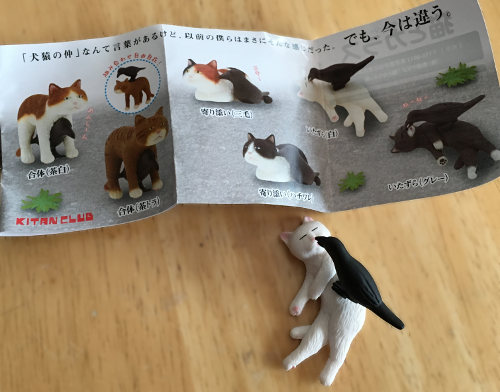
This one, Cat And Crow, struck me as rather morbid. Notice the expression of morose resignation on the face of the doomed cat; the black crow is its inescapable companion, going where it goes throughout the rest of its life; in due time, the cat will die, and the crow will feast on its eyeballs. Cat And Crow appears to be a memento mori, an allegory to the inevitability of death.
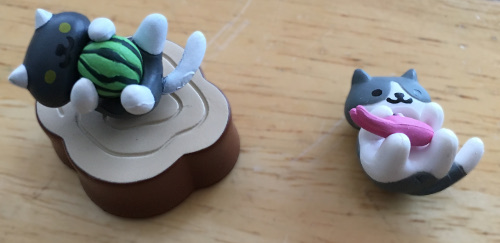
There are, of course, also figures from the hit mobile game, Neko Atsume.
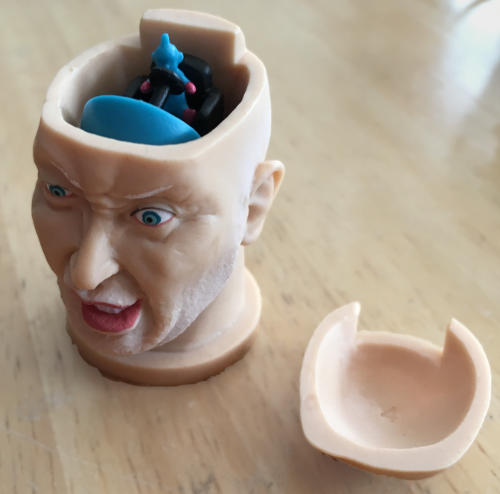
Parasite Creature, a series of deranged-looking vinyl heads which open up, revealing homunculi in the driving seat.
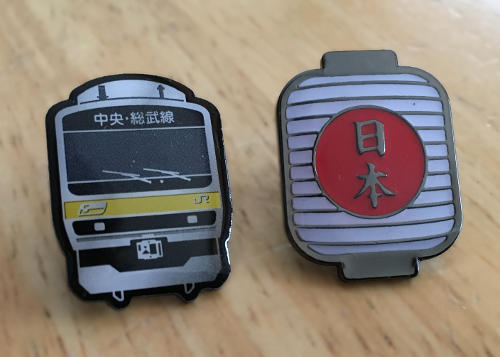
These came from a smaller, gumball-style machine in a store in Akihabara; one represents one of JR East's railway lines in Tokyo, and the other, I believe, Japanese restaurants.
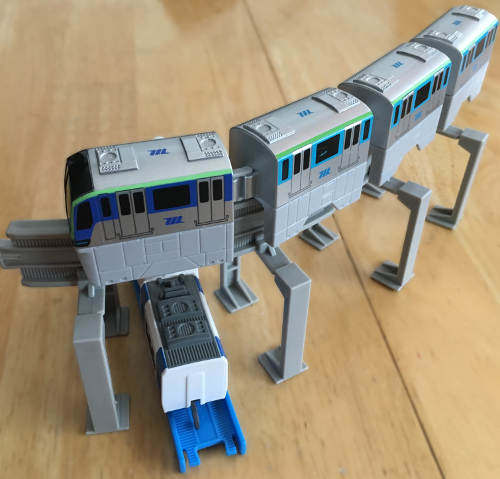
Model railways in instalments. Each capsule contains either a carriage and a length of track or several lengths of track. Annoyingly enough, that machine contains several systems: a monorail, and conventional trains in several liveries. A bit over ¥1000 yielded a small monorail system and two orphan carriages.
2015/12/21
In Japan, Christmas is associated with romance, and regarded as a Valentines'-style event for couples. Which, of course, doesn't play well with bitter singletons, and so, there is a group of lonely single men, calling itself Kakumeiteki Hi-mote Domei (“Revolutionary Losers’ League”), which protests against Christmas, and as such, seeks to strike a blow against romance-capitalism itself:
“In this world, money is extracted from people in love, and happy people support capitalism,” the group’s leader, who goes by the moniker “MarkWater,” told AFP. “Christmas is the most symbolic event for this.” He added: “Unpopular men, who don’t have a girlfriend or are not married, are overly discriminated. We want to break this barrier.”The group, unsurprisingly, also condemns Valentine's Day (which it calls a “blood-soaked conspiracy” of “oppressive chocolate capitalists”). Its ideology is vaguely Marxist (or perhaps pseudo-Marxist, appearing to be somewhat light on the cultish jargon and references to historical materialism and the works of German philosophers that proper Marxists might adorn their communiqués with), having been founded by a young man who, after having been dumped, found solace in a copy of the Communist Manifesto.
It's interesting to contrast the Revolutionary Losers' League with their American equivalents (which one may be tempted to dub the Reactionary Losers' League). In both cases, there are young men who are not getting the attention from women they feel entitled to, and they consider as a socially-ordained baseline for not being a loser. In America and the West, they blame feminism and “Cultural Marxism” (a buzzword unrelated to the Frankfurt School of Marxist philosophy, but instead meaning anything a self-identified conservative finds objectionable, from feminism to Beatlemania to brown people not knowing their place) for having brainwashed women out of their natural subservience to alpha-males; the ideology of this movement varies from the rugged-loner libertarianism one could absorb from reading a lot of Robert Heinlein to actual neoreactionary ideology, calling for a rolling back of the Enlightenment and a settling of scores, to psychotic argumentation in favour of rape and murder on principle. In Japan, it seems, they blame capitalism, and embrace actual Marxism (to each according to his sexual and romantic needs, I guess). I wonder how much of this is due to Japanese culture being more collectivist, perhaps due to the Confucian influence, and/or to Western gender roles and capitalism being seen as having been introduced by Commodore Perry and/or General MacArthur. In either case, the pattern seems to go:
Problem (a) ⇒ Cause (b) ⇒ Reaction (c)The problem, in both cases, is the same: “Women Don't Dig Me, So I'm A Loser”. The main difference is the inferred cause of this: in America, feminism, liberalism or “Cultural Marxism”, and in Japan, capitalism. The Reaction is, in either case, to embrace the opposite of (b) and hold on.
The Revolutionary Losers' League could also be seen as a romantic equivalent of the Sozialistisches Patientenkollektiv, a West German Marxist group from the 1970s, comprised of mental patients and psychiatrists. Both groups take an issue seen as an individual failing (in the SPK's case, mental illness; in the Revolutionary Losers' League's, romantic rejection) and exonerate the individual, instead placing the blame squarely on capitalism.
2014/2/19
10 tips for Japanese travellers to the US, covering the Americans' culinary and sartorial customs, leisure activities and their (somewhat impoverished) vending machine culture, among other things:
In Japan, hip hop clothes are considered stylish. But in the United States, it is wise to avoid them, as you might be mistaken for a member of a street gang. The entire United States does not have good security, unfortunately. However, the difference between a place with good regional security and a “rough area” is clear. People walk less, there is a lot of graffiti, windows and doors are strictly fitted with bars. And young people are dressed in hip hop clothes that say "I want you to pay attention to me!"
If you put your bent middle and index fingers of both hands in the air, you are making finger quotation marks. It means you do not believe what you are saying. You can also say, "or so called."
In America, when men or women laugh, they do not turn away. They face front, open the mouth, and laugh in a loud voice. This is because in America if you muffle your laugh or turn away while laughing, you give the impression that you are talking about a secret or name-calling. It is nasty.
2014/1/20
A candidate for the most audacious bank heist in history happened in Japan in 1968, some time after a bank had started receiving bomb threats:
An armored car was making its way to deliver bonus payments for factory workers totaling nearly 300 million yen (roughly US$800,000, which accounting for inflation, is over $5 million in today’s dollars) when a policeman rode up on a motorcycle. The officer told the four bank employees on the truck that the manager’s house had just been blown up and that officials had received a warning that there was a bomb planted on the armored car they were driving. The officer then proceeded to look under the vehicle — and then came the smoke and flames.
The officer yelled for them to take cover, and they did, running toward the nearest building, which happened to be a prison. Once the four bank employees were at a safe distance from the apparently-about-to-explode car, the officer removed the threat from the area. He got behind the wheel of the armored car, still carrying all that money, and drove away.
He wasn’t a cop. And the dynamite under the car? Just a warning flare he set to flush the security detail out of the vehicle. The fake police officer had just pulled off the single largest heist in the history of Japan.The crime remains unsolved to this day.
2013/1/10
Could this be the viral marketing campaign for a new William Gibson/Haruki Murakami collaboration?
Police in Japan who have for months been taunted by an anonymous hacker have found a memory card attached to an animal's collar after solving a set of emailed riddles, according to reports. The discovery was made after messages were sent to newspapers and broadcasters, with the sender claiming details of a computer virus were strapped to a cat living on an island near Tokyo.
2012/11/29
Meet Nakamatsu Yoshiro, also known as Dr. NakaMats, the veteran Japanese inventor with 3,377 patents to his name and a stream of inventions dating back to 1952, when he invented an early type of floppy disk. Nakamatsu's floppy disk (a wood veneer disc designed to replace punched cards) was not immediately successful, and neither was the digital watch he invented a few years later, though both ideas found their place decades later. (IBM actually licensed Nakamatsu's patents for the floppy disk in 1969, despite having come up with it independently.) Nakamatsu followed these up with a steady stream of inventions; a few have been enormously successful, funding both his elaborate residence (a high-rise building shaped like a floppy disk) in Tokyo and his more out-there inventions:
Among his other creations (he will earnestly tell you) are the CD, the DVD, the fax machine, the taxi meter, the digital watch, the karaoke machine, CinemaScope, spring-loaded shoes, fuel-cell-powered boots, an invisible “B-bust bra,” a water-powered engine, the world’s tiniest air conditioner, a self-defense wig that can be swung at an attacker, a pillow that prevents drivers from nodding off behind the wheel, an automated version of the popular Japanese game pachinko, a musical golf putter that pings when the ball is struck properly, a perpetual motion machine that runs on heat and cosmic energy and...much, much more, much of which has never made it out of the multiplex of his mind.Dr. NakaMats is 84, though expects to live (and keep inventing) for another 60 years; he puts this down to his carefully controlled lifestyle regimen, which includes limiting sleep to only six hours a night, eating a special low-calorie diet (including a supplement, naturally, of his own invention, Dr. NakaMats' Rebody 55), as well as going on long underwater swims to starve his brain of oxygen, allowing inspiration to strike.
Dr. NakaMats is not without his detractors; some point out exaggerations in his claims (for example, the taxi meter, which he claims to have invented was patented in the US before he was born, and his claims to a perpetual motion machine, if taken at face value, are not compatible with the second law of thermodynamics). And none other than Kawakami Kenji, the founder of the absurdist (and militantly noncommercial) invention praxis of chindogu, has criticised Nakamatsu for his focus on money and self-glorification:
“Real inventions open our hearts and minds, enrich our lives, bring us closer together,” says countryman Kenji Kawakami, the anarchic founder of chindogu—intentionally silly and impractical creations that are not useful, patented or for sale. “Dr. NakaMats is all about money and fame and ego.”
2012/11/26
Néojaponisme has a detailed five-part series on Cornelius' Fantasma, one of the defining albums of the 1990s Shibuya-kei genre of polychromatic, postmodern Japanese club-pop, looking at Oyamada Keigo's earlier work (with Pastels-referencing indiepop combo Flipper's Guitar) and subsequent work (which rejected the whole ethos of reference that Fantasma was about in favour of minimalism and introspection).
The piece starts off by placing Shibuya-kei, the movement Cornelius epitomised and helped define, in a specific historical context: the brief age of the music nerd, which arose after commodity rock'n'roll and ended when the internet made obscure knowledge instantly available, when knowledge of the obscure corners of popular music was a form of cultural capital:
The music nerd’s mission often boiled down to listening to what others did not, thus upsetting one of the art’s fundamental tenets. From ancient bone flutes to West African drum circles to jazz cafés to dancing the Charleston in front of blaring Big Bands, music had been a group activity for most of its existence. Music had always been social, yet the music nerd now mostly enjoyed it as a solitary pursuit. Hearing a song in the privacy of one’s own room was not even possible until the early 20th century, and not particularly common until the advent of the small transistor radio, the personal stereo, automobile speakers, and the Walkman. So between this technological change and a corresponding social one wherein pop music rolled over elite musical art forms like opera or ballet, the ingredients were there for the spontaneous genesis of thousands of music nerds. And as music fragmented to an unbelievable degree in the 1980s and 1990s, music nerds became even more intense and even less social.The 1990s were the golden indian summer of music nerddom; the internet was already starting to chip away at the cultural capital of the obscurantists (there had been USENET newsgroups discussing genres and microgenres and meticulously detailed discographies in ASCII text files, though they hadn't made it out to the as yet non-computerised outside world), and within a few years, information hyperinflation would wipe out vast amounts of cultural capital; but in the late 1990s, the musical obscurantism bubble was at its peak. In the West, this manifested itself through the sampling, quoting and citing of artists like Beck, the Beastie Boys and Stereolab; in Japan, it found even more fertile ground:
There may be traditional aspects of national philosophy and educational theory that influenced Japanese pop culture’s particularly obsessive mode of learning and understanding, but the artistic practice of detailed study and imitation of form certainly reached its peak with consumer society’s insatiable interest in the West after the War. Youth wanted to do completely alien things like dress like Americans and listen to American music, and magazines had to take up the key role of explaining detail by detail exactly how and why to do such a thing. Holistic sub-cultures like Hippies and Punks got analyzed down to their respective quarks so that Japanese teens could build them back up again from a bunch of imported scraps. These days the otaku nerd gets all the credit for originating Japanese information obsession but this was just a structural outcome of the Japanese model of cultural importation. In the act of bringing one culture over to another, bit by bit, every single possible cultural category becomes a series of consumable lists, and as a logical extension, mastery and memorization of those lists ends up as the most worthy test of true fans, believers, and adherents.The piece then continues with an overview of Oyamada's career, before and after Fantasma, a track-by-track examination of Fantasma and the influences it references, and a history of its release in Japan and the west.
Additionally, there's an older piece on the history, cultural context and legacy of Shibuya-kei here:
Shibuya-kei was ultimately an attempt to create a Japanese analog to the indie music cultures that had developed in the U.S. and U.K., but the Japanese artists ended up succeeding far beyond their international peers in impacting the entire Japanese music market. Shibuya-kei was not just the emergence of a new genre. The appearance of Flipper’s Guitar in 1989 was a pivotal event in the surfacing of “independent” culture into the Japanese mainstream consumer market during the 1990s, setting the stage for a wider cultural movement in media, fashion, art, and interior/graphic design.
2012/10/5
Possible proof that we have passed Peak Retro: Japanese Collectors Face a Record Shortage of Obscure Music:
Consider the prize item in Japanese collector Takeshi "Ima-T" Imaizumi's cache: a promotional copy of the 1986 Rolling Stones record "Dirty Work," considered by guitarist Keith Richards the band's low point. The collector says he paid only $8 for it. "This is very hard to find," he says.There are historical reasons why the Japanese in particular could be counted on to seek out obscurities ignored in the West:
The Japanese fascination with America's musical flotsam is a legacy of Japan's music business, which for years promoted U.S. and European rock bands that never took off or were declining in their own countries—a strategy aimed at avoiding competition with the U.S. music industry. That prompted fan cultures to sprout up around maligned American genres like 1980s pop-metal.
2012/2/22
Japanese culture places a lot of value on attention to detail. One result of this has been a generation of Japanese artisans taking artefacts from elsewhere, from clothing to coffee, and improving them:
"My boss won't let me make espressos," says the barista. "I need a year more, maybe two, before he's ready to let customers drink my shots undiluted by milk. And I'll need another whole year of practice after that if I want to be able to froth milk for cappuccinos." Only after 18 years as a barista in New York did his boss, the cafe's owner, feel qualified to return home to show off his coffee-making skills. Now, at Bear Pond's main branch, he stops making espressos at an early hour each day, claiming that the spike on the power grid after that time precludes drawing the voltage required for optimal pressure.
As a result of this quest, Japan has become the most culturally cosmopolitan country on Earth, a place where you can lunch at a bistro that serves 22 types of delicious and thoroughly Gallic terrines, shop for Ivy League–style menswear at a store that puts to shame the old-school shops of Cambridge, Massachusetts, and spend the evening sipping rare single malts in a serene space that boasts a collection of 12,000 jazz, blues and soul albums. The best of everything can be found here, and is now often made here: American-style fashion, haute French cuisine, classic cocktails, modern luxury hotels. It might seem perverse for a traveler to Tokyo to skip sukiyaki in favor of Neapolitan pizza, but just wait until he tastes that crust.The article also mentions, among other things, Real McCoy, a boutique which makes and sells expensive, high-quality clothing made on vintage American lines, and a tapas bar which went to the trouble of importing waxy, nigh-unusable paper napkins from Spain just to recreate the authentic experience of eating tapas in a packed Spanish bar.
2012/2/1
Long-time video-game enthusiast Charlie Brooker visits Japan, comes away slightly disappointed that how much the rest of the world has caught up, and the gadgetland of Akihabara is no longer as much of a novelty:
I'd been looking forward to browsing the shelves for zany gadgets, but the reality was slightly disappointing. Smartphone apps have replaced many of the charmingly pointless Japanese gizmos that used to be pop up on late-90s travel shows. More significantly, the west has become overtly tech-obsessed too. At home, we're routinely battered over the head with so many miraculous widgets, a sort of amazement fatigue has set in. So while in Japan you can easily stumble across a remote-control tissue box or a battery-operated planetarium for your bathroom (by which I mean a waterproof Saturn-shaped orb that floats in the bath and projects the entire visible universe onto the ceiling), the sense of surrounding novelty has diminished. It's less "WTF", more "yeah, that figures". Touring the electronic shops is still an entertainment in itself: I was merely surprised to discover I didn't actually want to buy anything.
2011/12/18
Néojaponisme, the blog of Japanese resident W. David Marx, has a five-part piece on how Japan's economic malaise has changed Japanese pop culture (parts 2, 3, 4, 5), in particular, causing the decline of the mainstream and the rise of the fringe to prominence. The gist of this is that the golden age of Cool Japan is over; as Japanese consumers' spending power declined, mainstream consumers cut back, and cultural markets, such as music, publishing and TV have collapsed, resulting in what some commentators refer to as "the generation who don't consume". with the notable exception of fringe genres catering to marginal subcultures for whom consuming cultural products is not a matter of choice but of identity; these include the otaku (whom Marx sums up as "anti-social “nerds” interested in science fiction, comic books, video games, and sexualized little girls (lolicon)"), the yankii—working-class juvenile delinquents with poor economic and lifestyle prospects—and the gyaru, a female analogue of the yankii, only oriented around romantic fiction and elaborate cosmetics.
The end result is that the otaku and yankii have an almost inelastic demand for their favorite goods. They must consume, no matter the economic or personal financial situation. They may move to cheaper goods, but they will always be buying something. Otherwise they lose their identity. While normal consumers curb consumption in the light of falling wages, the marginal otaku and yankii keep buying. And that means the markets built around these subcultures are relatively stable in size.So while demand in the mainstream has cratered, the culture industry has retooled to servicing these reliable subcultures, with cultural products such as highly sexualised girl groups appealing to older men with schoolgirl fetishes and films with yankii themes. One side effect of this is that the days of Japanese pop culture appealing to hip, affluent consumers abroad may be over:
Most men around the world are not wracked by such deep status insecurity that they want to live in a world where chesty two-dimensional 12 year-old girls grovel at their feet and call them big brother. The average university student in Paris is likely to read Murakami Haruki and may listen to a Japanese DJ but not wear silky long cocktail dresses or fake eyelashes from a brand created by a 23 year-old former divorcee hostess with two kids. Overseas consumers remain affluent, educated, and open to Japanese culture, but Japan’s pop culture complex — by increasingly catering to marginal groups (or ignoring global tastes, which is another problem altogether) — is less likely to create products relevant for them.
2011/8/23
Japan's Ise Grand Shrine is both very old (having been established sometime between 4BCE and the 5th century) and very new; every 20 years, the shrine buildings at Naikū and Gekū are demolished and rebuilt. This symbolises the Shinto teachings of the cycle of death and renewal in nature and the impermanence of all things, and also serves to pass on the crafts and techniques used to build the shrine. In this case, one could say that destroying the artefact keeps the institution alive.
2011/4/2
The first two in a series of articles about the history of rock'n'roll-influenced pop music in Japan, through the 1960s and 1970s: Part 1, about the rise and decline of Beatles/Stones-influenced, tightly controlled "Group Sounds" bands and the rise of the psychedelic rock that followed, and part 2, about the rise of the Kansai underground protest-folk scene and its influence on Japanese rock:
In 1966, The Beatles came to Japan, playing a series of five concerts at Tokyo’s Budokan. In doing so, they transformed rock and roll into a phenomenon among Japanese youth. Within months, an unprecedented number of Japanese rock bands, each with their own take on the sounds of The Beatles or The Stones, were debuting. The Japanese press started writing articles about the new, controversial band boom, which they had termed “Group Sounds” (or GS). The Japanese music industry, however, was slow to adapt to Japan’s changing musical climate. Labels assumed a high degree of musical control, often forcing bands to record compositions by in-house songwriters instead of their own material. Only in live performances were the GS groups granted creative control. Many groups refused to preform their singles at all, instead playing from a repertoire of covers and original songs.
Okabayashi quickly became one of the most prominent members of the Kansai Folk movement. His 1969 URC debut demonstrates the level of freedom Takaishi’s label granted its artists. Watashi wo Danzai Seyo contained songs criticizing the Vietnam War (“Sensou no Oyadama”), Japanese labor conditions (“Sanya Blues”), and the perils of Japan’s capitalist aspirations (“Sore de Jiyuu Natta no Kai”). Okabayashi also wrote songs that explored taboo topics like the discrimination against descendants of Edo Japan’s pariah caste, the burakumin (“Tegami”). Although Okabayashi was often critical and sardonic, he expressed a great deal of hope for a brighter future in songs like “Tomo yo” and “Kyou wo Koete.” Okabayashi’s blunt lyrics about sensitive topics caused the JRIA’s standards committee to ban many of his songs from being broadcast on Japanese radio. The most infamous of these songs is “Kusokurae Bushi,” or in English, “Eat Shit Song.” Even after removing a verse concerning the Japanese Emperor, which centered around a pun between “God” and “[toilet] paper,” “Kusokurae Bushi” was banned from radio and recalled from record shops.In the second article, an interesting point is raised about authenticity, with many in Japan's rock scene regarding rock-style music sung in Japanese, rather than English, to be inauthentic, thus framing rock as a specifically ethnic genre (much in the way that one might argue that, say, Balkan folk songs in English would be inauthentic, or possibly in the way that rap not performed in an American accent was regarded as "wack" for a decade or two).
2011/1/5
Charlie Stross has written another piece about Japan, this time for a Japanese scifi magazine and inspired by his second visit:
The first time I visited Japan I thought I had a handle on what I was seeing: a microcosm of the human future, a densely-populated nation that has had centuries of cheek-by-jowl urban living, like the crew of a generation starship in flight towards the future, dragging the scars of ancient history behind them. A land of monorails and shopping malls and coin-operated ramen noodle stands and spas with twenty flavours of bathing feature. And all of this is true. But on further acquaintance, I find myself knowing less and less about Japan — or perhaps I'm just becoming increasingly aware of how little truth the tourist picture reveals.
If you take away the future, what makes Japan different? In a word, history. The present is a moving boundary, travelling from the past into the future — what lies behind it is history, and the further it goes, the more history we have. When we try to peer into the future to see where we're going, as often as not we're peering into a driver's mirror, watching the past unroll behind us. To understand a culture's future you must look at its history — for the history people have experienced defines the future they want.The essay continues and discusses a number of things, among them Edo Palace, a castle the size of a city which stood where Tokyo is now; a vast, imposing monument which took nigh-unimaginable labour to build and Charlie likens to the Death Star.
Charlie's 2007 account of his first visit to Japan (which starts with "They've got our future, damn it", and goes on in a similar spirit of wide-eyed awe) is here.
2010/12/22
Scientists at the University of Osaka have accidentally created a singing mouse. The mutant mouse doesn't have a particularly melodious song, but makes up for it by tweeting incessantly like a songbird.
2010/10/7
The latest Japanese innovation for keeping its growing elderly population company: a robotic seal. Named "Paro", the therapeutic robot responds to touches and adapts its personality to its owner's; the human mind's tendency to see the illusion of agency does the rest.
I'm not sure why they chose a seal rather than a more conventional companion animal, though perhaps because, due to the unfamiliarity of seals as domestic pets, an apparently living plush toy would be less likely to fall into Mori's uncanny valley than, say, a fake dog or cat.
Paro is being tested in hospitals and nursing homes in Japan, where it has reportedly had positive results.
2010/6/8
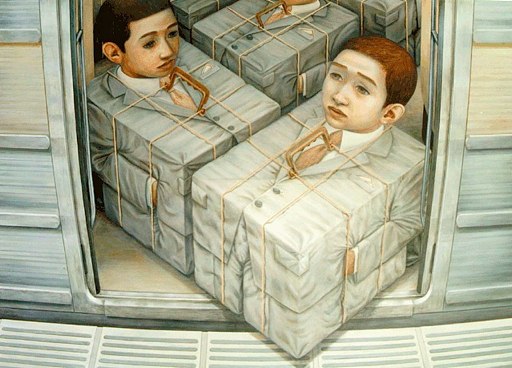
Tetsuya Ishida was a Japanese painter who, until his death in 2005, painted surrealistic scenes, which tended to involve images of himself transformed into various unhappy-looking automatons or inanimate objects. Beautiful, in a somewhat disturbing, vaguely Kafkaesque way:
There are more paintings here (note: text is in Japanese).

(via Boing Boing) ¶ 0
2010/6/6
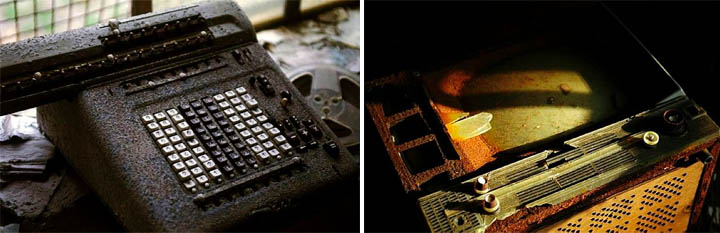
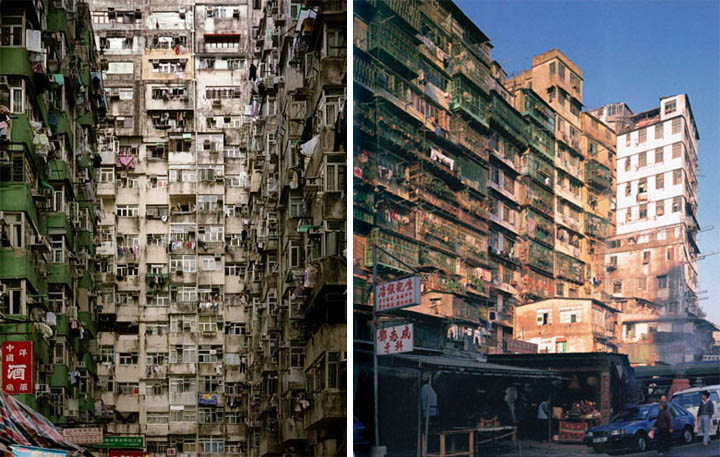
A collection of poignant photos of ruins and urban decay in Asia; in particular, Japan's Gunkanjima (Battleship Island), an industrial city on an island abandoned when coal was replaced with oil, Hong Kong's lawless Kowloon Walled City (which existed as a rat's nest of cyberpunkesque anarchy until it was finally demolished in the 1990s) and the sadly abandoned ruins of San Zhi, a half-completed futuristic resort in Taiwan:


2010/1/19
From a Momus blog post, in which he, on departing from Osaka, speculates on how he might possibly live there:
I've never seriously thought about living in Osaka before. I love Tokyo best of all. But increasingly, my outlook has Berlinified, by which I mean I regard expensive cities like New York, London and Tokyo as unsuited to subculture. They're essentially uncreative because creative people living there have to put too much of their time and effort into the meaningless hackwork which allows them to meet the city's high rents and prices. So disciplines like graphic design and television thrive, but more interesting types of art are throttled in the cradle.Momus raises an interesting observation, and one which may seem somewhat paradoxical at first. First-tier global cities, like London, New York, Paris and Tokyo are less creative than second-tier cities, largely due to the increased pressure of their dynamic economies making all but the most commercial creative endeavours unsustainable. I have noticed this myself, having lived both in Melbourne (Australia's "Second City" and home of the country's most vibrant art and music scenes; generally seen by almost everyone to be ahead of Sydney in this regard) and London (a city associated, in the public eye, with pop-cultural cool, from the Swingin' Sixties, through punk rock and Britpop, but now more concerned with marketing and repackaging than creating; it also serves as the headquarters of numerous media companies and advertising agencies). In London, it seems that people are too busy working for a living to make art in the way they do in Melbourne or Berlin, and the arts London leads in are the commercial ones Momus names Tokyo as leading in: graphic design, the media, and countless onslaughts of meticulously market-researched "indie" bands. Those who thrive in London (and presumably New York, Paris and Tokyo) tend to be not the free-wheeling bricoleurs but the repackagers and cool-hunters, one eye on the stock market of trends and another on the repository of past culture, looking for just the right thing to pick up and just the right way to market it. (Examples: various revivals (Mod, Punk, New Wave), each more cartoonish and superficial than the last.) "Moving to London" is an artistic cliché, shorthand for wanting to hit the commercial mainstream, to surf the big waves.
There are, of course, counter-examples, but they tend to be scattered. For one, the more vibrant a cultural marketplace a city is, the more money is floating around, the more rents and prices are driven up, and the more those who are not driven by a commercial killer instinct find themselves unable to keep up, without either channeling their energies into money-spinning hackwork or whoring themselves to the marketing ecosystem, subordinating their creative decisions to its meretricious logic.
Also, as Paul Graham pointed out, cities have their own emphases encoded in their cultures; a city is made up as much of cultural assumptions as buildings and roads, and there is only space for one main emphasis in a city. If it's about commerce or status, it's not going to be about creative bricolage. (This was earlier discussed in this blog, here.) The message of a city is subtle but pervasive, replicating through the attitudes and activities of its inhabitants, subtly encouraging or discouraging particular decisions (not through any system of coercion, but simply through the interest or disinterest of its inhabitants). As Graham writes, Renaissance Florence was full of artists, wherea Milan wasn't, despite both being of around the same size; Florence, it seems, had an established culture encouraging the arts and attracting artists, whereas Milan didn't.
When a city is said to be first-tier—in the same club of world cities as London and New York—the implication is that its focus is on status and success, and the city attracts those drawn to these values, starting the feedback loop. Second-tier cities (like Melbourne and Berlin and, according to Momus, Osaka) are largely shielded from this by their place in the shadows of first-tier cities and their relatively cooler economic temperature. (There's a reason why music scenes flourish disproportionately in places like Manchester and Portland, often eclipsing the Londons and New Yorks for a time.) Of course, as second-tier cities are recognised as "cool", they begin to heat up and aspire towards first-tier status. (One example is San Francisco; formerly the hub of the 1960s counterculture (which, of course, birthed the personal computing revolution), then the seat of the dot-com boom, and now promoting itself as the Manhattan of the West Coast.) Cities, however, fill niches; they can't all be New York, and the number of first-tier "world cities" is, by its nature, limited.
2009/9/8
In the 1980s, programmers of games for the Nintendo Entertainment System would often put hidden messages, sometimes quite colourful, into the ROMs. This blog has extracted and translated a few of these, stridently complaining about clueless managers, broken tools, and, it seems, the shameless sexual peccadillos of team members. Game programmers in 1980s Japan were a wild lot, it seems.
First off, Kaoru Ogura, who ran off with some guy in the middle of the project. Yes, you, you bastard. Don’t show up at the office without showering after having sex 6 times the previous night. Next, Tatsuya Ōhashi. Yes, you, you bastard. Don’t give me your flippant shit — coming in late on the day we ship the ROM like nothing’s amiss. You can give me all the porn you want; I’m not forgetting that one. All that fucking weight you put on. No wonder you paid out 18,000 yen and still got nothing but a kiss out of it. Kenji Takano, Namco debugger. You are a part-timer; don’t dick around with the project planner. And finally, Kiyoharu Gotō, the biggest thorn to my side in this project. Yes, you, you bastard. Once I get a time machine, I’m sending you back to the Edo period. Go do your riddles over there.
Come to think of it, some people were helpful to me, too. Mr. Okada, who took all the good stuff. I know all about your abnormal tendencies. Yamagishi, who swore off soaplands until the project was over. Go ahead, knock yourself out now.
(via Boing Boing) ¶ 0
2009/7/9
A Japanese railway company is introducing mandatory workplace smile testing. Employees of the Keihin Electric Express Railway will be required to submit to daily testing using imaging software which rates their smile out of 100, ensuring that customers get the appropriate level of cheerfulness in their service.
2009/5/3
A study in Japan, correlating suicide rates with lithium levels in water supplies, has found that lithium in the water supply reduces the suicide rate:
High doses of lithium are already used to treat serious mood disorders. But the team from the universities of Oita and Hiroshima found that even relatively low levels appeared to have a positive impact of suicide rates.
Levels ranged from 0.7 to 59 micrograms per litre. The researchers speculated that while these levels were low, there may be a cumulative protective effect on the brain from years of drinking this tap water.The researchers hace stopped short of recommending that lithium be added to the water supply, in the way that fluoride is.
2009/3/4
The Times' travel section has another crop of stories about rail travel; this time around, they include a piece on the spectacular Settle-Carlisle line, one on traversing provincial Japan by slow train, a piece on crossing the USA by train (from New York to Chicago and then Los Angeles) a piece on crossing the USA by train, and Mark (the man in Seat 61) Smith's list of four great European rail journeys.
2009/1/12
In Japan, it is possible to pay to spend time with a cat:
Lola - or Rora - to give her a slightly more Japanese pronounciation - is a beauty and she knows it. Customers pay by the hour for her company. Usually they just want to stroke her, but as a special treat for favoured clients, she will lie back in a chair, close her eyes and pose for photographs.
Lola is a Persian cat who works at the Ja La La Cafe in Tokyo's bustling Akihabara district. It is one of a growing number of Cat Cafes in the city which provide visitors with short but intimate encounters with professional pets.
It costs about £8 ($10) an hour to spend time in a Cat Cafe. Busy lives mean some people prefer to hire a dog If felines do not appeal, other establishments will rent you a rabbit, a ferret or even a beetle. There are more than 150 companies in Tokyo which are licensed to hire out animals of various kinds and although beetles may be cheap, dogs much more popular.This is, of course, not the only Japanese institution of this type. There are the obvious ones, such as hostess bars and maid cafés, which allow men with more cash than time or social skills to rent the company and flattery (and occasionally other services) of attractive women. On a less salacious note, there are apparently also parks in Japan where salarymen suffering from alienation from nature can pay to rake leaves.
2008/12/28
As the date of the next UK General Election approaches, the government (which looks like being soundly defeated) is starting to say some pretty desperate things; like promising a high-speed rail line within 20 years. Interestingly enough, the line might be based on Japanese shinkansen technology (rather than the French TGV technology already used on the high-speed line between London and the Channel Tunnel), and if it's successful, your children or grandchildren may well see other high-speed lines, such as from London to Edinburgh and Cardiff.
Ministers want to begin work on the new London to Manchester line as soon as possible so that it can be in place within 15-20 years. It is understood they hope to use new planning laws to avert a lengthy public inquiry.More worrying is the plan to base the London rail hub not within central London but at Heathrow Airport, which would have no practical purpose other than to throw the air-travel industry a bone, at the cost of inconvenience to those not wishing to catch a plane.
2008/11/26
The latest novel application of technology from Japan: DVDs to help train socially-challenged otaku to make eye contact, predominantly with women:
His disc features 50 people standing in front of a blank white background. They're all women, which Ito swears is just a coincidence. They stare into the camera and occasionally say stuff like "I want to leave" or "That's enough."
Try to look this person in the eyes for a full minute. Tip: when interacting with a fellow human being in the real world, it is considered rude to break eye contact in order to look at other physical attributes.Perhaps that will be Nintendo's next big hit; we had Wii Sports, Wii Fit and Wii Music, now perhaps it's time for Wii Date. It'd come with a gaze-tracking camera, and would play a lot like the zazen meditation game in Wii Fit, only instead of sitting absolutely still staring at a candle, you'd have to gaze into the eyes of a pretty girl in a revealing top, and if the system noticed your gaze straying below her eyes, a buzzer would sound and the session would come to an end.
2008/8/25
Japan now has its own tartan. The Sakura tartan (after the Japanese word for cherry blossom) is believed to be the first design to include the colour pink, and was influenced by Thomas Glover, a 19th-century Scotsman who moved to Japan, was involved in its industrialisation and became known as the "Scottish Samurai". It is expected to be included in a national tartan register being planned by the Scottish government.
2008/7/21
The version of the iPhone sold in Japan has one difference from Western versions: the camera shutter sound cannot be switched off, apparently because Japanese gadget fans cannot be trusted not to use it for surreptitiously photographing up skirts.
2008/6/4
Last night, I had occasion to watch a Japanese film titled "After Life".
The film (whose Japanese title was the kana transliteration of "Wonderful Life") is set in a sort of limbo, where the recently deceased are given a week to choose one memory from their lives which they wish to keep; the memory is then reconstructed by a team of counsellors and technicians (who themselves once lived and died) as a short film and shown to the deceased, who will then remain in that moment, and that moment alone, for all eternity. The film took place over one week, with one cohort of the recently deceased (among them, a middle-aged woman reliving an exciting affair, an elderly man wishing he had made some mark on the world and a young hipster who refuses to choose a memory on purpose). The film itself has the feel of a documentary; it starts somewhat drily, though gradually, the characters' past lives and all too vivid memories and regrets are revealed.
I found this film poignant and beautiful; the feel of it reminded me a little of another (though somewhat different) favourite film of mine, the Icelandic film Angels of the Universe.
2008/4/26
Japan's Wakayama Electric Railway has increased its patronage by appointing a cat as stationmaster of an unmanned railway station. The cat, a 7-year-old tortoiseshell cat named Tama, can be seen wearing a specially made cap in her office inside a former ticket window at Kishi station on the Kishigawa line.
Two other cats have been appointed as "deputy stationmasters", and a human official has been hired to take care of the cats.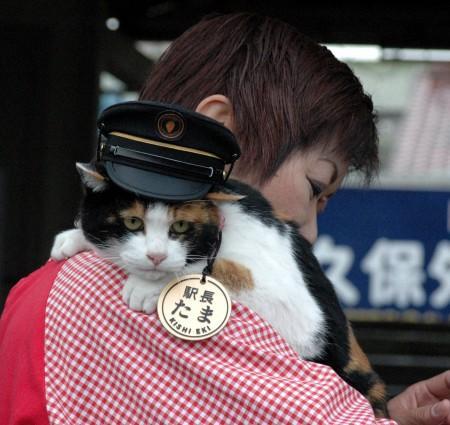
(via london-underground) ¶ 0
2008/3/24
Scientists at NEC have developed a CCTV camera which can identify people's ages and genders, by comparing them against samples in a database, and are working on making it capable of determining their socioeconomic status depending on their clothing. The NEC FieldAnalyst technology is not intended for security purposes but for those of marketing, and is currently only avalable in Japan:
the data is intended to help mall owners better understand their visitors. How come no one is going to a certain store? What time of day do most of the 40- to 50-year-old women visit the place? Did the recent promotion reach the desired demographic?
It works better with Japanese people as the vast majority of the samples in the database are Japanese. It also hones down your age only to within 10 years. However, NEC wants to narrow the range, possibly even getting to the point where it can determine age within a year or two.
2008/3/14
Ever wonder what the science is that justifies Japan's "scientific whaling" programme? Well, wonder no more:
Scientists have analysed 43 research papers produced by Japan over 18 years, finding most were useless or esoteric.
The scientific research included injecting minke whale sperm into cows eggs, and attempts to produce test-tube whale babies, News Limited newspapers report.
2008/2/7
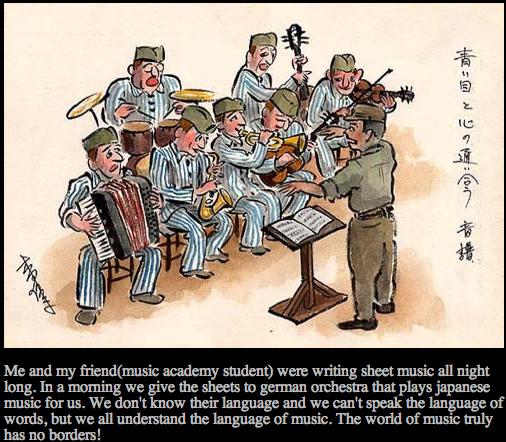
Read: Notes of a Japanese soldier in the USSR; the story of former Japanese prisoner of war Kiuchi Nobuo's journey through the Soviet labour camp system, told in watercolour drawings with captions. It's surprisingly lighthearted; while Nobuo mentions the death and hardship, he chooses instead to linger on the camaraderie between prisoners of different nations and the small moments of joy, beauty and levity.

2008/1/30
The Japanese government is planning a system for certifying the authenticity and Japaneseness of Japanese restaurants around the world:
The origins of the wasabi horse-radish (preferably from the Izu peninsula), miso paste (preferably from the Nagano mountains) and pickled ginger (preferably from Tochigi) will all be scrutinised. Rice is expected to be the most frequent area of failure: a true sushi master will insist on Japanese koshihikari rice grown in Japan.
The same variety grown in California might, just, be acceptable. Faux pas may include serving Chinese soy sauce, or miso soup in a porcelain cup.Meanwhile, bluefin tuna used in sushi has been found to contain terrifying amounts of mercury, at least in the US.
2008/1/23
The Japan HDR Flickr group has, as the name suggests, some amazing HDR photographs from Japan, some of which look more like fantastic illustrations than photographs:



(via Boing Boing) ¶ 0
2008/1/17
The latest must-have accessory on the Tokyo subway is a portable subway strap. Such a strap, of course, doesn't provide support, but it does keep one's hands occupied, and provides proof that one is not using them to grope women in the crush (something which happens a lot).
2007/11/19
Pink Tentacle, an English-language Japanese blog, has a list of the top 60 Japanese buzzwords of 2007:
30. Dried-fish woman [himono onna - 干物女]: Himono onna (”dried-fish woman”) is an expression used in the movie Hotaru No Hikari to describe the main character, a woman in her 20s who has renounced the pursuit of romance. She spends her evenings reading manga and drinking at home alone, and she spends her weekends lazing around in bed. She’s a dried-fish woman.
32. The power of insensitivity [donkanryoku - 鈍感力]: Made popular by Donkanryoku (The Power of Insensitivity), a best-selling book written by popular novelist Junichi Watanabe, this expression means something like “thick skin” and refers to the ability to live in a relaxed manner without getting worked up over the little things.
35. Tetsuko [鉄子]: The unhealthy obsession with trains has long been a predominantly male pursuit, but the numbers of female train otaku — known as “Tetsuko” — are on the rise. [More]
40. Dark website [yami site - 闇サイト]: Yami sites (”dark websites”) are online networking sites where people can take out hit contracts on others, make illegal transactions (drugs, fake bank accounts, hacked cellphones, prostitution, etc.), and meet suicide partners. Japan has seen a recent rise in the number of murders arranged through these web-based hotbeds of criminal activity.
55. Factory moe [koujou moe - 工場萌え]: This year saw a mini-boom in the off-the-wall genre of factory moe photo books focusing on the functional beauty of large-scale industrial plants.
(via Boing Boing) ¶ 0
2007/11/5
Charlie Stross has written a travelogue about Japan. As with most, nay, all of his stuff, it is very much worth reading:
You can wander into a Japanese department store and lose an entire day, without even scraping the surface of the mall it's embedded in. My personal nemesis is Yodabashi Camera: a department store that has a clothing and houseware department embedded in it where most such shops would feature an electronics boutique department. Half of the sixth floor of its Yokohama branch is given over to capsule toy vending machines, where for 200 yen (about 80 pence) you can turn the knob and acquire a tennis ball sized bundle of mysterious plasticky goodness with a model kit of some complexity within. My favourite (which Feorag acquired from a capsule toy machine at Puroland, of which more later) is a capsule toy that contains a self-assembly model of a capsule toy machine, complete with tiny capsule toys ready to vend. Even the toys teach recursion ...
Tokyo is ... well dammit, I only spent four days there and you expect me to describe it? Tokyo left me feeling like an illiterate Albanian shepherd teleported without warning to the UK, staring slack-jawed in wonder at the vast, gleaming, powerful public works of metropolitan Huddersfield, reeking of wealth and efficiency and a goat-free future. From the thirty-seventh floor of a skyscraper I looked out across the high rise skyline, red lights blinking fretfully in the grip of a typhoon as winds strong enough to blow sheets of rain up the glass of the window rumbled around me, and I realized: this future has no place for goats.
Kyoto, the former imperial capital, looks like just another modern Japanese city at first. But then, as you're walking through a shopping arcade that specializes in commercial catering supply shops (such as the shop that sells nothing but cash registers, or the signage supplier), you spot a gap between two stalls — and plugging it, the courtyard of an ancient Buddhist temple, sharing a cigarette with the high wooden archway of a Shinto shrine. There's a sign in front, with an English translation, so you pause to read it. "Founded by the abbot ... around 768 ... burned down during the wars ... this is a modern reconstruction ..." And you're about to walk away, disappointed, when you read the final words: " ... created in 1633." It's just as much a modern replica as the Christopher Wren reconstruction of St Paul's Cathedral — and yet, the same language is used of reproduction castles cast in the concrete of 1930s modernism, or Buddhist temples from the fourteenth century.
These living conditions place a mold around the behaviour of the people who live with them. Take the wearing of uniforms, for example. In the UK, with a few exceptions — the uniformed services of government, police and military and fire services — we respond poorly to being placed in a uniform; it's a sign of depersonalization, stripping us of individuality. In Japan, however, uniforms are everywhere. Even people who don't have to wear them seem to gravitate towards workwear that's uniform in its appearance: taxi drivers in dark suits, peaked hats, and white gloves. Uniforms confer status — a uniform is a sign that you belong to some greater social context, to a corporation or a shop or a school or something important.(The last part makes a similar point to Momus' essay on "superlegitimacy".)
On a tangent: Earthquake sets Japan back to 2147.
The latest innovation from Japan: photographic age verification for vending machines. Cigarette vending machines are being deployed which contain a camera and face-recognition software which estimates the customer's age from their photograph. Given that such a process can't be particularly accurate (would one look that different immediately after one's 20th birthday?), they will also accept ID cards as proof of age.
2007/6/13
Cory Doctorow has an essay in Forbes, asserting that ubiquitous surveillance, of the sorts that has been made technologically feasible recently, not only doesn't make cities more secure but undermines the social contracts that make them work:
The key to living in a city and peacefully co-existing as a social animal in tight quarters is to set a delicate balance of seeing and not seeing. You take care not to step on the heels of the woman in front of you on the way out of the subway, and you might take passing note of her most excellent handbag. But you don't make eye contact and exchange a nod. Or even if you do, you make sure that it's as fleeting as it can be.
I once asked a Japanese friend to explain why so many people on the Tokyo subway wore surgical masks. Are they extreme germophobes? Conscientious folks getting over a cold? Oh, yes, he said, yes, of course, but that's only the rubric. The real reason to wear the mask is to spare others the discomfort of seeing your facial expression, to make your face into a disengaged, unreadable blank--to spare others the discomfort of firing up their mirror neurons in order to model your mood based on your outward expression. To make it possible to see without seeing.
Crazy, desperate, violent people don't make rational calculus in regards to their lives. Anyone who becomes a junkie, crack dealer, or cellphone-stealing stickup artist is obviously bad at making life decisions. They're not deterred by surveillance.
(via Boing Boing) ¶ 0
2007/5/14
A study in Japan has shown that Japanese and Americans interpret facial expressions differently. In Japan, people pay attention to the eyes for emotional cues, whereas in America (and, presumably, elsewhere in the West), they look to the mouth.
The exact reasons for this are not known, though one theory is that it is because the Japanese attempt to suppress their emotions in the presence of others more than the loud, demonstrative gaijin do, and in such cases, the eyes provide more of a clue to someone's emotional state. One consequence of this, of course, is the difference between the way Westerners and Japanese draw happy-face symbols in ASCII characters, with the Japanese smiley looking like ^_^ (note the emphasis on the eyes), and the Western one being the familiar :-):
So when Yuki entered graduate school and began communicating with American scholars over e-mail, he was often confused by their use of emoticons such as smiley faces :) and sad faces, or :(.
"It took some time before I finally understood that they were faces," he wrote in an e-mail. In Japan, emoticons tend to emphasize the eyes, such as the happy face (^_^) and the sad face (;_;). "After seeing the difference between American and Japanese emoticons, it dawned on me that the faces looked exactly like typical American and Japanese smiles," he said.
(via Boing Boing) ¶ 1
2007/4/27
If the UK free tabloids are to be believed, up to 2,000 people in Japan have been sold lambs and told that they were poodles (which are both extremely fashionable and rare in Japan):
Entire flocks of lambs were shipped over from the UK and Australia to Japan by an internet company and marketed as the latest 'must have' accessory. But the scam was only spotted after a leading Japanese actress said her 'poodle' didn't bark and refused to eat dog food.
2007/4/18
The world's oldest continuously operating family business, a Japanese temple-building company founded in 578, went out of business last year. Over the 1,428 years it operated, Kongo Gumi was headed by 40 generations of the Kongo family, and continuously built Buddhist temples, with the exception of a period during World War 2 during which it made coffins.
How do you make a family business last for 14 centuries? Kongo Gumi's case suggests that it's a good idea to operate in a stable industry. Few industries could be less flighty than Buddhist temple construction. The belief system has survived for thousands of years and has many millions of adherents. With this firm foundation, Kongo had survived some tumultuous times, notably the 19th century Meiji restoration when it lost government subsidies and began building commercial buildings for the first time. But temple construction had until recently been a reliable mainstay, contributing 80% of Kongo Gumi's $67.6 million in 2004 revenues.I wonder what the current oldest continuously running family business is.
(via Boing Boing) ¶ 0
2006/12/21
Culture-bound syndrome of the day: "Paris Syndrome". This is a condition affecting Japanese tourists who travel to Paris, romantic scenes from Amélie in their minds, only to discover that the city is considerably dirtier and—shock, horror—full of very rude people. This shock can cause a psychiatric breakdown:
An encounter with a rude taxi driver, or a Parisian waiter who shouts at customers who cannot speak fluent French, might be laughed off by those from other Western cultures.
But for the Japanese - used to a more polite and helpful society in which voices are rarely raised in anger - the experience of their dream city turning into a nightmare can simply be too much.
This year alone, the Japanese embassy in Paris has had to repatriate four people with a doctor or nurse on board the plane to help them get over the shock.As many as 12 Japanese tourists fall victim to Paris Syndrome each year. The Japanese embassy has established a 24-hour hotline to help those afflicted.
2006/8/11
While antidepressants have been popular in the West for some decades, there was originally next to no demand for them in Japan, as Japanese culture (which is based on Buddhism) had no concept of depression as an illness. Then, in 1999, a Japanese pharmaceutical company introduced the concept of depression to Japan, coining a name for it: "kokoro no kaze", literally, "common cold of the soul":
For 1,500 years of Japanese history, Buddhism has encouraged the acceptance of sadness and discouraged the pursuit of happiness -- a fundamental distinction between Western and Eastern attitudes. The first of Buddhism's four central precepts is: suffering exists. Because sickness and death are inevitable, resisting them brings more misery, not less. ''Nature shows us that life is sadness, that everything dies or ends,'' Hayao Kawai, a clinical psychologist who is now Japan's commissioner of cultural affairs, said. ''Our mythology repeats that; we do not have stories where anyone lives happily ever after.'' Happiness is nearly always fleeting in Japanese art and literature. That bittersweet aesthetic, known as aware, prizes melancholy as a sign of sensitivity.
This traditional way of thinking about suffering helps to explain why mild depression was never considered a disease. ''Melancholia, sensitivity, fragility -- these are not negative things in a Japanese context,'' Tooru Takahashi, a psychiatrist who worked for Japan's National Institute of Mental Health for 30 years, explained. ''It never occurred to us that we should try to remove them, because it never occurred to us that they were bad.''
Direct-to-consumer drug advertising is illegal in Japan, so the company relied on educational campaigns targeting mild depression. As Nakagawa put it: ''People didn't know they were suffering from a disease. We felt it was important to reach out to them.'' So the company formulated a tripartite message: ''Depression is a disease that anyone can get. It can be cured by medicine. Early detection is important.''It is arguable that Japan may have needed a concept of, and treatment for, depression, with its suicide rate being over twice the levels experienced in Western countries. Though one can't help but wonder whether the cultural change brought by introducing the concept of depression will result in Japanese culture losing something and becoming more like everywhere else (which is to say McWorld). And, if so, whether or not the gains will outweigh any loss.
2006/8/2
The East Japan Railway Company is experimenting with making its stations more environmentally friendly by harnessing the energy-generating potential of passengers as they pass through ticket gates:
The ticket gate electricity generation system relies on a series of piezo elements embedded in the floor under the ticket gates, which generate electricity from the pressure and vibration they receive as people step on them. When combined with high-efficiency storage systems, the ticket gate generators can serve as a clean source of supplementary power for the train stations. Busy train stations (and those with large numbers of passengers willing to bounce heavily through the gates) will be able to accumulate a relatively large amount of electricity.The system is being tested at the company's offices in Shibuya, though is expected to be rolled out in actual stations if this is successful.
Though would such a system really be able to generate a non-negligible amount of electricity? And, given that the passenger gates don't involve the passenger actually pushing anything as crude as a turnstile, how long until someone starts fitting footpaths with something similar? If it takes more energy from the walker to traverse than otherwise, they could even market it as an integrated exercise facility.
2006/6/7
The latest bizarre Japanese product is Photogenic Masks, which "have been created for anyone who desires to become a girl quickly and easily" (presumably one of those Japanese market niches that doesn't translate so well abroad). The graphic says it all:
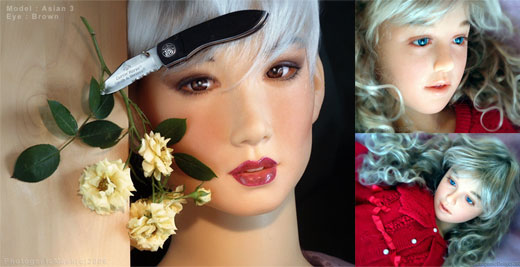
If the plasticky, platinum-haired faces straight out of Mori's Uncanny Valley didn't quite induce the appropriate sense of unease, the knife stabbing the flower helps nicely.
2006/5/25
Japanese War Tubas. I repeat, Japanese War Tubas:
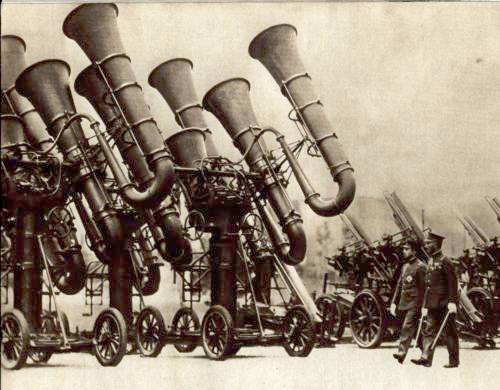
Seen on this page. The war tubas look like a musical instrument (some kind of Dadaist/Futurist sound-art device, or perhaps a super-loud military-band instrument designed to strike terror into the hearts of enemies, much as bagpipes were), but they were actually devices for acoustically locating incoming aircraft. I wouldn't be surprised if the photograph in question has graced at least one CD of experimental music/noise-art.
2006/5/12
In his blog entry today, Momus complains about the declining quality of Japanese porn, thanks to the tendency of the girls to have their eyes surgically rounded:
Japanese women -- at least as they appear in the Japanese pop media -- are turning into bug-eyed monsters. I first noticed it in pop and porn stars; these days, the free movies page of a Japanese porn site like CPZ is a freak show of Photoshopped, fish-eyed and scalpelled eyes mooning at the visitor. These girls no longer look like real people, so they're no longer sexy.Momus goes on to discuss whether this phenomenon is a desire to emulate Caucasian ideals of beauty (he argues it is not). And in the comments, an anonymous poster cites an interesting factoid about another Japanese cultural phenomenon that seems to have been adopted from the West but wasn't:
The Japanese attachment to baseball has nothing to do with the West, either: if you look back into Japanese fuedal history, it was a popular sport for shoguns to bat around the severed heads of defeated leaders with wooden sticks and matching uniforms.
2006/5/4
Japan is preparing for an epidemic of divorces as its baby-boom generation of salarymen retire and find themselves living in close quarters with the wives they hardly knew during their working lives:
"I wanted him to keep working but I've accepted now he's going to come home," says Hatae Ishizaki, whose 59-year-old architect husband is due to punch his last card in April next year. "I'm just going to spend more time out of the house. I'd divorce him, but it's too much trouble at my age."
Japan has some of the longest hours of unpaid overtime in the world. Salarymen generally spend more time in the company of male work colleagues than with their families. In their scarce hours out of the office, husbands are poor home-makers - a recent survey found that men in Japan did just four hours housework a week, far fewer than their counterparts elsewhere. Among the cruel spousal monickers for wrung-out, retired husbands with minimal life skills are nure ochiba (wet leaves) and sodai gomi (big rubbish). "It's like having another child around the house," says Mrs Ishizaki.
One of Japan's top-selling weekly magazines, Shukan Bunshun, recently peered inside hundreds of baby-boomer households and was shocked to find that many middle-aged women were practising their farewell speeches.
"To my husband: Don't suddenly get friendly with me after all these years of leaving me alone now that you have retired from your company. It's too late now!" said one 55-year-old woman who contributed to the magazine's survey.(Let's see Momus spin this into an example of a model of human social harmony.)
2006/5/3
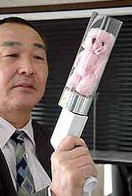 The latest gadget on the Japanese market is a gun that fires teddy bears, fitted with parachutes, into the air. The necessity that mothered this bizarre-sounding yet oddly compelling invention was the fashion in Japan to throw teddy bears, rather than bouquets, into the air at weddings. The teddy bear gun merely automates this process somewhat.
(via Boing Boing) ¶ 0
2006/3/30
A recent issue of The Times has a fairly detailed section on rail travel today; this section includes a survey of the state of European rail travel (summary: it's enjoying a renaissance, thanks to Eurostar and environmental consciousness, likely to improve further when cheap flights dry up, though ticketing still has some way to go before booking international rail journeys is as easy as booking flights), a section on travelling across Europe on Inter-Rail passes (along with four recommended European rail journeys to make with one's pass), as well as articles on train travel in Italy and India, shinkansen journeys in Japan, the backpacker-infested Trans-Siberian Express (whose 1-week journey time, the previous article notes, could be slashed to 18 hours if it was rebuilt using maglev technology soon to be deployed in Japan), as well as various luxury train journeys, such as the current holder of the "Orient Express" trademark (an opulent art-deco train journey from London to Verona), the Canadian Rockies and opulent Hungarian luxury trains. Also, Australia's Adelaide-Darwin rail link gets a writeup, getting rather mixed reviews (apparently the "Darwin" terminus 18km from the city centre is an afterthought, the carriages aren't quite as luxurious as one would believe, and the ride is bumpy; not to mention the fact that, catering only to tourists (it's too expensive for casual commuters) and having no stations along the way, it's "not quite a proper train" compared to others).
For anyone wanting more information on rail travel in various parts of the world, there's always The Man In Seat Sixty-One, a (somewhat UK-centric) one-stop information shop for rail buffs and travellers with an aversion to air travel.
2006/3/22
In Japan, as a law banning electronic equipment older than a few years takes effect, people are taking to the streets to fight for their right to own vintage synthesisers and such:

(via Boing Boing) ¶ 0
2006/3/11
If this article is correct, there is little evidence that the ninja, the legendary Japanese warriors/assassins, ever existed outside of mythology and popular culture:
The most reliable reconstructions of ninja history suggest that ninja denotes a function, not a special kind of warrior — ninja WERE samurai (a term, which didn't designate a class until the Tokugawa period—AFTER the warfare of the late medieval period had ended—before that it designated only an occupation) performing ninja work.
Movie-style ninja, BTW, have a much longer history than the movies (although the term ninja does not appear to have been popularized until the 20th century). Ninja shows, ninja houses (sort of like American haunted houses at carnivals), and ninja novels and stories were popular by the middle of the Tokugawa period. The ninja performers may have created the genre completely out of whole cloth, or they may have built on genuine lore derived from old spymasters. Either way, however, its clear that much of the lore underlying both modern ninja movies and modern ninja schools has both a long history AND little basis in reality outside the theatre.Not only that, but someone else claims in the comments that the black costume traditionally associated with the ninja was actually derived from the costumes worn by Japanese puppeteers working on darkened stages unseen, and not from any sort of martial tradition.
I guess this settles the whole pirates-vs.-ninja gedankenexperiment then.
(via  substitute) ¶ 1
2006/1/18
The New York Times has a long and interesting article on the Japanese phenomenon of hikikomori, or of young Japanese dropping out of society and shutting themselves in their rooms for months at a time, emerging only to go to convenience stores at night or not at all:
A leading psychiatrist claims that one million Japanese are hikikomori, which, if true, translates into roughly 1 percent of the population. Even other experts' more conservative estimates, ranging between 100,000 and 320,000 sufferers, are alarming, given how dire the consequences may be. As a hikikomori ages, the odds that he'll re-enter the world decline. Indeed, some experts predict that most hikikomori who are withdrawn for a year or more may never fully recover. That means that even if they emerge from their rooms, they either won't get a full-time job or won't be involved in a long-term relationship. And some will never leave home. In many cases, their parents are now approaching retirement, and once they die, the fate of the shut-ins - whose social and work skills, if they ever existed, will have atrophied - is an open question.
In other societies the response from many youths would be different. If they didn't fit into the mainstream, they might join a gang or become a Goth or be part of some other subculture. But in Japan, where uniformity is still prized and reputations and outward appearances are paramount, rebellion comes in muted forms, like hikikomori. Any urge a hikikomori might have to venture into the world to have a romantic relationship or sex, for instance, is overridden by his self-loathing and the need to shut his door so that his failures, real or perceived, will be cloaked from the world.
By Japanese standards, his room was enormous, with a wall of delicate shoji screens leading to a rock garden. But it was hard to imagine what he did there all day. There were no stacks of manga, the popular Japanese comic books, no DVD's, no computer games, all things found in the rooms of most hikikomori. The TV was broken, and the hard drive was missing from his computer. There were a few papers on his desk, including a newsletter from New Start that Kawakami brought on her last visit. Otherwise, the only evidence that this was a hikikomori's room were three holes in the wall - the size of fists. Shut-ins often describe punching their walls in a fit of anger or frustration at their parents or at their own lives. The holes were suggestive too of the practice of "cutting" among American adolescent girls. Both acts seemed to be attempts to infuse feeling into a numb life.
By the time parents seek help, often their child has been shut in for a year or more. "When they call," Dr. Saito said, "I offer them three choices: 1) Come to me for counseling; 2) Kick your child out; 3) Accept your child's state and be prepared to take care of him for the rest of your life. They choose Option 1." He also offers poignantly simple parenting tips, like not leaving dinner at a child's doorstep. "You make dinner and call him to the table, and if he doesn't come then let him fend for himself." In addition to meals, parents often provide monetary allowances for their adult child, and in rare cases, if a child has become verbally or physically abusive, parents move out, leaving their home to the shut-in.Parents of hikikomori now have support programmes to turn to, including volunteers known as "rental sisters", who try to befriend their children and coax them out of their rooms and into support centres, often over months or years.
There are multiple theories trying to explain the hikikomori phenomenon, but several frame it as a conscious rejection of the high pressure to conform and succeed placed on individuals in Japanese society; a conscious, if not particularly sustainable, decision to drop out of the traditional school-university-work career path.
On a similar note, Momus' latest piece in Wired News celebrates Japan's aging population and embrace of the "slow life".
2005/12/8
The latest beat-'em-up video game from Japan is Line Kill Spirits. It's much like any other beat-'em-up (Street Fighter, Mortal Kombat and all the numerous lookalikes), except that (a) all the characters are lolitaesque anime girls, and (b) the only way to make damage to an opponent stick is to take a photograph of her underwear. Or from the Google translation of the official page on the game:
it is possible to convert the latent damage to the actual damage. First, the punch button and the kick button are pushed simultaneously, the skirt of the partner is turned, " it turns and makes skill move ". When the skirt burrs and rises, timing the photographing button (with default the V key) pushing well, it will cut the shutter. It is appraised at 3 stages of the BAD * GOOD * GREAT by the area of the underpants which have been taken, if above the GOOD conversion of the damage is done.The web site also has two video clips of the game in action; Line Kill Spirits appears to be the work of a group of hobbyists, rather than a game publisher. It appears to be part of the "Dojin Soft" small-press game movement, which does tend to produce its share of bizarre ideas, such as a fighting game based on Les Misérables.
2005/11/4
A 16-year-old Japanese girl has been arrested for poisoning her mother and keeping a blog about it, recording the results. The girl, a member of an elite high-school chemistry club, was apparently emulating British teenage poisoner Graham Young, subject of the cult film The Young Poisoner's Handbook, up to using thallium as her poison of choice:
"Mother has been sick since yesterday, having a rash all over her body," the Asahi Shimbun newspaper quoted the girl as writing on August 19 on the online journal, which was kept under a male name.
Another daily newspaper, the Mainichi Shimbun, reported the blog said on September 12: "Mother is sick today, too. She had been complaining her legs have been out of it for two or three days and she has finally become almost unable to move."The girl also is reported to have kept severed animal body parts in her room. (Which seems to contradict Momus' assertion that the Japanese don't get goth because theirs is not a Judaeo-Christian culture, but I digress.)
2005/8/11
Momus gets stuck into what he calls "fashion goth", which seems to be a construct containing a whole bunch of things he dislikes, from the Goth subculture and BDSM to Suicide Girls to the New-York-hipster fashion of wearing clothes with skulls on them to show how hard and cynical you are and to Judaeo-Christian asceticism in general.
I'm not into Suicide Girls. I hate tattoos and piercings and the cult of self-injury. Sex is not evil or wicked. What Christian sect do you guys belong to?
Japanese people tend not to be fashion goths, or into kitsch. Even the black lace Gothic Lolitas in Japan are something else, really. They're human mille feuille cakes, not goths.
Can you imagine a fashion goth soaking in a sento and then playing pachinko and then eating a hearty meal at an isakaya, chatting away and laughing at the comedians on TV? "Where's the agony?" he would cry, meaning "Where's the beauty?" He'd miss the beauty in the food, and in the water.
When I was in New York this time all I could see on everyone's T shirt was skulls, skulls, fucking skulls. How can you protest the Iraq war if there are skulls all over you, fucking fashion goth?
2005/8/9
According to the latest Worldwide Cost of Living Survey, Tokyo is still the world's most expensive city; in second place is Oslo; Reykjavík is at #4, London is down from #6 to #8, and New York has slipped to #35 (behind Wellington, New Zealand). The cheapest city surveyed was Tehran.
2005/7/27
Meanwhile, Japanese roboticists have developed a lifelike "female" android. Apparently Repliee Q1, which moves and even appears to breathe like a human, is so realistic that unconsciously, people forget that it is a non-sentient machine:
"More importantly, we have found that people forget she is an android while interacting with her. Consciously, it is easy to see that she is an android, but unconsciously, we react to the android as if she were a woman."The researchers plan to make even more realistic robots (all of which, for some reason, tend to be modelled on women or young girls; perhaps that has something to do with the objectification of women Japanese culture or something?), and believe that they can get robots which can fool humans into believing they are real for up to 10 minutes in controlled situations.
Putting this together with the recent Swiss cockroach robot research suggests a lot of opportunities. Maybe we'll see Japanese android trials involving fembots successfully luring sararimen out of karaoke bars, or something similar.
2005/6/23
In Tokyo, where space is at a premium, they now have underground farms under the city:
Perhaps, if/when the oil crash causes the collapse of transport-based economies, such farms beneath farmland-deprived cities may help keep them somewhat viable.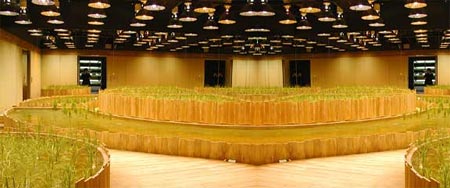
2005/6/7
A Washington Post article looking at Akihabara, and how the Tokyo electronics-retail precinct has become transformed into the world's first geek ghetto:
"We have been discriminated against for being different, but now we have come together and turned this neighborhood into a place of our own," said Yamagata, nursing his tea as he sat with a portly computer technician friend at Akihabara's Cos-Cha, one of a dozen "maid cafes" in the neighborhood. Here, the waitresses' uniforms are inspired by the French maid-meets-Pokemon outfits of adult manga. At other cafes, waitresses greet patrons at the door with a curtsy and the words "Welcome home, master."
Tetsu Ishihara, 34, a computer programmer whose three-room apartment in west Tokyo is filled from floor to ceiling with comic books, does not want to be associated with such charges. Ishihara maintains a growing collection of 130 life-size pillows of female anime characters -- both purchased and self-designed. His favorite is Mio-chan, a female character from a love-simulation computer game in which a high school boy builds up the courage to ask a girl for a first date.
"There are some people who do lose their grip on reality, but that is not me -- or most of us," said Ishihara, a chubby man with glasses who this year started dating a woman steadily for the first time She's an anime artist. "For me, the pillows have been my source of unconditional love, a reminder of when I used to be hugged by my parents. There is nothing strange about it."Don't expect Gwen Stefani to commercialise this any time soon.
2005/3/10
Zookeepers in Japan chase a bloke in a lion suit, capture him with a net, in what is ostensibly an animal escape drill; either that or the filming of some kind of Furry bondage-cosplay-themed TV game show. (via jwz)
2005/2/7
Japan will soon have musical roads; the Hokkaido Industrial Research Institute has developed a way of encoding melodies in patterns of grooves on road surfaces so that, when a car drives over them, the vibrations reproduce the encoded melody. They are planning to encode different, locally appropriate, melodies on specific sections of roads.
Also on Dottocomu, special Valentine's-day RAM modules.
2004/12/30
Heard in a Momus audioblog entry:
There is, apparently, a Japanese town named Aberdeen. This town originally had a different name, but was renamed to Aberdeen so that the local whisky distillery could put "Made in Aberdeen" on their bottles, with "Japan" in smaller print below.
2004/12/14
YMCK are a Japanese pop group who make all their music (other than the vocals, of course) with a Nintendo Famicom. And the MP3s they have online sound pretty good. Unfortunately, their label's web site doesn't have ordering information in English. (via bOING bOING)
2004/11/17
From Japan, the latest technological solutions to the problem of endemic loneliness and alienation: the Boyfriend's Arm Pillow, designed to give Japan's Bridget Joneses some "manly comfort" while they sleep. And for the otaku-boys, there's the Girlfriend's Lap Pillow, complete with tight red miniskirt, which would not look out of place in the Korova Milk Bar. (via bOING bOING)
2004/6/30
The Tokyo area of Akihabara started out as a mecca of electronics shops (think something like Tottenham Court Road, only bigger); gradually, as a subculture of otaku evolved around the area, its focus has mutated from being just about electronics and computers to anime costume shops and venues catering for the bizarre, quasi-sexual fetishes of the truly hardcore:
Psychologists say these "otaku" or geeks are regressive, have poor social ability, and have never fully matured as adults. "Therefore, they are not good at communicating with others, cannot date real human beings, and instead adore an imaginary character," said one.
Self-confessed "super otaku" Tetsuto Fujiyama says, "There are five different kinds of geeks in Akihabara. The oldest denizens are the electric appliance geeks, who come to purchase electronic parts and other equipment. Next are the PC geeks, who like to build their own original computers that run as fast as possible. Third are TV animation geeks whose brains can't distinguish between reality and the animation. The fourth group are the magazine geeks who have made original animation fantasy stories influenced from TV and game animation and publish them in small magazines circulated among themselves. The last group are those geeks who love to play video games in which erotic animation is used."
"They are not ImeCla girls (Image Clubs in which you can act out your fantasy in a situational setting as nurse-patient, teacher-student, commuters in packed train and so on). Nor is it a a 'no-pan' cafe (where mini-skirted waitresses with no panties serve customers). These shops at Akihabara are not in the sex business because for geeks, fantasizing is much more important than actually doing anything with girls."
(via bOING bOING)
2004/5/27
Gorgeous black-and-white photographs of abandoned buildings on Gunkanjima, an island used for coal mining, but completely abandoned since 1974.
2004/4/13
Romance-novel giant Harlequin Mills & Boon are attempting to take on the Japanese market by releasing manga editions of their novels there, replete with heroines with freakishly huge, glistening eyes.
On a tangent, a dictionary of Japanese sex/fetish/pr0n terms, from the kinky to the just plain bizarre. (Miniaturised women? "tooth love"? ASCII art fetishes?) (via MeFi)
2004/3/24
In France, traditional comics such as Asterix and Belgian import Tintin are facing a manga invasion, which is proving a hit with French teenagers. And many French anime-otaku are getting into dressing up in elaborate anime character costumes for a spot of le cosplay.
2004/2/7
Microsoft have found a way of selling more of their bulky (and thus rather un-Japanese) Xbox game consoles in Japan: by giving away free anime-girl-shaped full-body "hugging pillows" with each unit.
Hugging pillows are printed with life-size artwork of popular anime characters, and are basically life-size teddy bears for adult males, but otaku's relationships with their dakimakura can get a little more personal. "Searching Google Images with the term dakimakura is enough to understand the people who buy these items," said Muto.
"I guess they're supposed to be used ... as pillows to hug, of course ... and for other obscene purposes that I would rather not mention."
2004/1/14
Japan's manga industry must be quaking as a court convicted a manga publisher for selling obscene literature. The days of ordinary sararimen reading Rapeman on the Tokyo subway may be coming to an end.
2004/1/7
The latest pop hit in Japan is the corporate anthem of a small demolition firm; the punk-edged Nihon Break Kogyo anthem, a world away from traditional corporate propaganda, has become a cult favourite among teenagers. The firm has started selling CDs of it, and two karaoke distributors have picked it up.
We will destroy houses. We will destroy bridges. We will destroy buildings. To the east, to the west, run, run, Nihon Break Kogyo.
The song, which is written by a 32-year old aspiring musician who goes by the name of Manzo, has also become a big hit on the internet. According to one review on Amazon, the internet retailer: The lyrics have an enormous impact. Maybe this song is more radical and aggressive than songs created by mediocre punk rock bands.
A Flash-animated video for the song (replete with masked heroes and giant robot!) may be found here; the sound quality is rather poor, mind you. (via Graham)
2003/12/9
Seldom-asked questions about Japanese culture; from why office workers make exaggerated jogging movements when moving about through the office to why green traffic lights are said to be blue in Japanese; from Western cartoon characters having fifth fingers added for the Japanese market (to avoid looking like yakuza or untouchables), to why the country is called "Japan" in English whilst being called "Nihon" or "Nippon" in Japanese; with plenty of colourful anecdotes. (via Found)
2003/12/8
The latest thing out of Japan: rubber duck-shaped USB flash drives, in a choice of three pastel colours. They don't play MP3s, they don't clip onto a keyring, they have a great unwieldy USB plug sticking out of them, they probably don't take kindly to water, and they're only 16Mb in size. I'm sure that it makes sense to someone, though.
2003/9/9
I recently read a very interesting book (Where You're At, by Patrick Neate) about the spread of hip-hop culture from the inner cities of America to places like Japan, Brazil and South Africa, becoming a sort of lingua franca of globalised pop culture. Today I found an article which ties in to that, about multi-ethnic hip-hop in Israel, a scene which includes everybody from marginalised Arabs to Ethiopians and Moroccan Jewish rappers rhyming in French. I saw another piece some time ago about Palestinian youths on the West Bank taking to rap to voice their grievances; perhaps we really do live on a hip-hop planet.
2003/3/6
Japanese journalist buys a vintage map of Tokyo, and notices inconsistencies between the locations of subway lines. Digging a little deeper, he comes to the conclusion that there is a secret network of tunnels beneath Tokyo, dating back decades, whose existence is still being actively covered up by governmental authorities. So he publishes a book about this, only to find himself virtually blacklisted by the media. Is Shun Akiba a paranoid crackpot of some sort (like the ones you hear complaining that the establishment is "suppressing" their revolutionary new theory of physics), or is there really a conspiracy of silence about the tunnels under Tokyo? (I recall that Japan doesn't have a strong tradition of transparency in government.)
2003/2/27
For the geek who has everything, a USB-powered toothbrush on the market in Japan. More evidence that USB is the cigarette lighter socket of the 21st century. (Though who keeps their toothbrush next to their computer?) (via 1.0)

2002/12/3
Kikkoman: the Movie (Flash animation). The odd thing is, this probably isn't much weirder than some Japanese TV ads. (via Graham)
2002/10/11
And a big hello to all my readers in the international indie-pop underground; in particular, to the Japanese indie kids coming here via this bulletin board. I don't know Japanese, but it appears to be some sort of indie-pop-related web BBS, with a rather twee colour scheme, some very kawaii-looking cat cartoons and some intriguing fragments of English text
The show starts at 8 p.m. MINISKIRT will play roughly 12 songs including their classics "Blue Contact Lenses" and "No Jesus No Coffee No Coffee No Jesus" and some new songs which they never played live before.
(I'm wondering whether "win a sheep free" is the name of a band, and if so, what they sound like).
The Babelfish translation sheds slightly more light on it, not to mention a few particularly doovy turns of phrase, such as "super luxurious gorgeousness".
Btw, if you came here looking for the photos from last weekend's Ninetynine CD launch, they're here.
2002/9/11
Yakuza gangs in Japan have figured out a way of monetising sex crime; and have started operating rape safaris for paying customers, presumably the sick bastards whose tastes have become too rarefied for hentai anime and vending-machine schoolgirl panties.
"If a member tells his club the type of women he'd like to rape, the club will arrange it for him. Market rates are about 100,000 yen a rape. If the member designates a specific individual, the fee can go over 1 million yen in some cases. Designating an individual usually involves putting the guy together with somebody who knows him, making it more likely they can be reported to the cops, so the greater cost arises from the greater risk factor," the source tells Asahi Geino.
(via die puny humans)
2002/8/25
Some excerpts from a manual for WW2 kamikaze pilots, translated recently from the Japanese:
At the very moment of impact: do your best. Every deity and the spirits of your dead comrades are watching you intently. Just before the collision it is essential that you do not shut your eyes for a moment so as not to miss the target. Many have crashed into the targets with wide-open eyes. They will tell you what fun they had.
2002/8/18
Introducing a Fun Family of Good Friends, an attempt to translate cute Japanese cartoon characters into English without knowing Japanese. (via Cos).
2002/8/2
Film Festival: Tonight I went to see a Japanese film titled Suicide Club. It was quite bizarre; starting off with the surreal spectacle of 54 uniformed schoolgirls jumping in front of a train in an inexplicable mass suicide. Then it gets more bizarre; more suicides follow, some copycat attempts by impressionable teenagers, and some not. Along the way there are computer bulletin board poseurs, a gang of murderous teenage glam rockers, rolls of strips of human skin, and the phenomenon of a sugar-coated all-girl pop group, who can't possibly be connected to the mass suicides.. or can they?
(The director, a Japanese performance poet and former gay porn director, showed up at the screening and introduced the film, speaking through an interpreter. When it was released in Japan, he said, it came under close police scrutiny, presumably because of its dangerous subject matter.)
Anyway, I rather enjoyed it.
2002/6/4
The Mod scene is big in Japan, with many young Japanese donning Union Jack-emblazoned army parkas and tightly tailored suits and cruising around on chromed Lambretta scooters, like extras from Quadrophenia. (via rotten.com)
Hoizumi counts at least three Mod revivals: The Neo-Mod movement inspired by ``Quadrophenia'' (and which eventually led to the Skins); an early 1980s resurgence built around the British group Style Council (the Japanese Mod scene remains a huge milkcow for Paul Weller); and a unique-to-Japan revival in the mid-1990s created by teenage photoceleb Hiromix, whose snapshots of herself and her friends in undies became an international artworld sensation.
But in some ways, whilst the scene is a knockoff of 1960s British youth culture (and also of subsequent "revivals" of Mod)
. Until recently, Japan's Mods have overwhelmingly come from the ranks of hairstylists, overworked, underpaid and image-conscious, who leave the suburbs and countryside with big city dreams of grooming stars and cutting it as ``charisma stylists.'' ... But the stylists have moved on with the Hiromix boom, and the Mods of 2002 are a cadre of college art students, graphic designers and apparel professionals. Many have had their parents buy their first bikes for them, and quite a few own several bikes. They seem more sure of themselves and aren't as interested in making a class statement as an aesthetic one.
Sounds a bit like Melbourne's Mod scene, which is mostly rich private-school kids using their classicist style of youth rebellion to differentiate themselves from the plebeian rabble north of the Yarra. I.e., like the Young Liberals only noisier and more stylish.
2002/5/16
Factoid of the day: Japanese has a word for the concept of slack. The word is "yutori" - to take it easy. It means having room or a surplus of something, be it time or money. (ta, Toby)
2002/3/3
Japanese T-shirt of the day, from the very amusing engrish.com. Wonder if there's any way to get them in Australia. (via bOING bOING)

2001/4/3
If you've read any William Gibson, you've probably noticed his obsessions with all things Japanese. You can't pick up a Gibson novel which doesn't tie into Japanese pop-culture or society somehow; even his Victorian-era steampunk collaboration with Bruce Sterling, The Difference Engine, had a Japanese delegation visiting London. Now Gibson has written an article on Japanese culture, and why it fascinates him. (via Plastic)
2001/1/22
More details on Bandai's Love By Email "virtual girlfriend" service, which operates through Japan's "i-Mode" mobile phone system:
Progress is measured on a chart that shows how many of the woman's 52 secrets the man has been able to uncover and what percentage of her heart he has won. At the end of the relationship, which can last from one to three months, a successful lover will be given an everlasting commitment of love. An insufficiently attentive suitor is dismissed as a creep.
Bandai had a similar service for women, named My Prince Charming, but it was unsuccessful, attracting only 1,000 subscribers in its first three days. By comparison, Love By Email has more than 30,000 subscribers.
2001/1/3
Officials in Russia are planning to build a rail tunnel from Siberia to Alaska, with the aim of connecting Russia's rail network to North America. If they have passenger trains, it should be an interesting journey. The project is in its early stages; meanwhile a project to build a similar tunnel between Japan and the Russian mainland is due to begin this year.
2000/11/29
The street finds its own uses for things: Only in Japan would you find a concept like virtual girlfriend subscriptions. If you live there and have an I-mode phone, you can have an online romance with a (realistically fussy) chat script for ¥300 (about A$4) a month. Use it to hone your bootywhangmojo or as a substitute for the real thing:
"You have the happiness of a secret woman, a hidden relationship, with none of the fear that your wife will find out and be angry. My grandfather had the geisha, my father had the bar hostesses and I have Love By Mail. It is maybe hard for others to understand, but these substitutes, or additions, for the everyday relationship between a husband and wife are well accepted in our culture."
"It's a safe way for men to try out their dating technique without having to worry about shaming themselves in front of a live girl,"
(Interestingly enough, the ads that popped up on the page included one for a mobile phone service (in the US), and one for what looked like a dating service.)
2000/4/21
Four-fingered cartoon characters exported to Japan given a fifth finger -- as not to look like Yakuza members. (BBC News)