The Null Device
Posts matching tags 'business'
2013/9/26
Today's Champions of Liberty: EasyJet, the European budget airline, who moved to exercise their right to decide with whom a free corporation does business by refusing to let a passenger who criticised them on Twitter board. (The criticism had to do with EasyJet staff being less than helpful with advice concerning rail connections after an evening flight was delayed, but, hey, absolute personal responsibility and all that.) Unfortunately for EasyJet, the passenger turned out to be a law professor, and was aware of yet-to-be-repealed regulations tying the hands of wealth-creators, and thus they were forced to allow him to board the flight he had paid for.
2013/3/7
The street finds its own uses for things: Russian crime organisations have online marketplaces offering the services of willing underworld accomplices in various cities, administered through a cutting-edge web-based control panel:
The service, advertised on exclusive, Russian-language forums that cater to cybercrooks, claims to have willing and ready foot soldiers for hire in California, Florida, Illinois and New York.These associates are not mere “money mules,” unwitting and inexperienced Americans tricked and cajoled into laundering money after being hired for bogus work-at-home jobs. Rather, as the title of the ad for this service makes clear, the “foreign agents” available through this network are aware that they will be assisting in illegal activity (the ad refers to them as неразводные “nerazvodni” or “not deceived”). Put simply: These are mules that can be counted on not to freak out or disappear with the cash.
According to the advertisement, customers of this service get their very own login to a remote panel, where they can interact with the cashout service and monitor the progress of their thievery operations. The service also can be hired to drain bank accounts using counterfeit debit cards obtained through ATM skimmers or hacked point-of-sale devices. The complicit mules will even help cash out refunds from phony state and federal income tax filings — a lucrative form of fraud that, according to the Internal Revenue Service, cost taxpayers $5.2 billion last year.The contractors are available for other services, such as pickup and forward shipping of sketchy merchandise and “other interesting transactions”.
Once again, Russian biznesmeni are at the forefront of bringing free-market efficiency and the disintermediating, just-in-time power of the internet to the underworld (for long dominated by the almost Leninist command economies of hierarchical Mafia organisations and insular cells of bandits), or, if you will, liberating open-slather capitalism from pretences of legal propriety. Or, as has been said before, “Lenin failed to teach the Russians socialism, but he succeeded in teaching them capitalism”.
2012/8/27
There's a piece in the Guardian about the rise of crowdfunding, and how it shifted from a medium for art projects to a means of decentralised organisation of practical endeavours requiring money, and turned into a means for circumventing market failures:
Kickstarter itself is changing under the influence of digital culture. At first it was about making established forms of art. Film was big – documentaries about organic community vegetable gardens were not uncommon. Now that is changing. It is becoming a land of gadget makers and gamers.
This new communal instinct can do amazing things like route around the warping influence of capitalism and digital platform wars. Look at projects like Open Trip Planner. This takes a bit of unravelling but basically the benefit of good maps on smartphones became endangered by Apple's titanic battle for market supremacy with Google. Apple are attempting to strip Google products like maps from iPhones and this left users with crappy transport info – Open Trip Planner is the communal answer to a hierarchical fall out.The article mentions OpenTripPlanner, an open-source alternative to trip planning systems which seems to be doing for trip planning what OpenStreetMap did for geodata, and the Pebble watch, a Bluetooth-enabled smart watch designed without the backing of a large electronics corporation, and the fact that Kickstarter is expanding to the UK.
In other crowdfunding news, Matthew Inman, who runs The Oatmeal web comic, recently launched a crowdfunding campaign to raise US$850,000 buy Nikola Tesla's old laboratory (put on the market by AGFA and expected to be bought by property developers); the campaign met its target in under a week and has since raised over a million dollars.
2012/4/18
A modest proposal from security commentator Alec Muffett: Could we replace marriage with incorporation of private limited companies?
in the UK the biggest hurdle would be IR35 and certain aspects of expense policy, but you’d have a contract between the directors, clear dissolution clauses; all income could be directed to the corporation – taxed differently and offset against OPEX like nappies and so forth – and salaries paid out, plus it would own and depreciate shared assets like houses and cars. You could avoid much income tax by taking dividends – I know tax avoidance is infra dig at the moment, but I’m thinking of the future here – and you could offshore your marriage for better breaks.
But there would be no gender issues – no incorporation is between a man and woman – plus you could have more than one company director, have corporations that outlast their founders, and in extreme circumstances outsource large chunks of the whole enterprise.
2012/3/17
The Grauniad has a piece about capitalist-realist artist Damien Hirst, whose exhibition at the Tate Modern could be the peak of his imperial phase, and the idea of art-as-a-financial-instrument which he (well, he and Koons) has become the embodiment of:
This isn't just art that exists in the market, or is "about" the market. This is art that is the market – a series of gestures that are made wholly or primarily to capture and embody financial value, and only secondarily have any other function or virtue. Hirst has gone way beyond Warhol's explorations of repetition and banality. Sooner or later, his advisers will surely find a way for him to dispense with the actual objects altogether and he will package concepts in tranches, like mortgage securities, some good stuff with some trash, to be traded on the bourse in Miami-Basel.
The byproduct of his activities is the most starkly authoritarian corpus of art of recent times. All those hard, glittering surfaces, those rotting animals. The body, for Hirst, is trash, which exists to be anatomised, displayed, described in cribbed Latin names. The only way to cheat death is to slough off your rotting flesh and take on the qualities of capital. It's the 21st-century version of ars longa, vita brevis. Don't just make money, be money: weightless, ubiquitous, infinitely circulating, immortal.The article describes the mechanics of the art market and how public museums, for all their image of being above the fray of crass commerce, have become tools of art investors' Ponzi-like schemes:
This is how it works. A few major collectors make the market. Where they lead, the horde of hedgies follows. Many of the new breed of art investors ... have jettisoned even the pretence of connoisseurship. Some of these guys care about the bragging rights that come with a blue-chip work hanging in the loft. Others are all about the numbers, and employ the same tools and decision-making processes to play the art market that they use at work. A few have also discovered that many of the regulatory mechanisms that apply in other markets – preventing insider trading, price-fixing by cartels and sundry other abuses – simply don't exist in the art world. It is possible to game the system in many ways, and the careers of certain artists look not unlike a classical Ponzi scheme, where money from new investors is used to pay returns to those further upstream.
The corruption of art museums by investors is perhaps most apparent in the case of New York's New Museum. In 2009 it devoted its entire three-floor space to an exhibition of the collection of Dakis Joannou, a Greek Cypriot industrialist who sits on the museum's board. Other recent New Museum shows, devoted to Urs Fischer and Elizabeth Peyton, also relied heavily on Joannou's collection, and his wider web of patronage. The impression has been given of a museum that is no longer able to make independent determinations of value. This has become an open scandal in New York, satirised in a much-reproduced drawing by William Powhida titled How the New Museum Committed Suicide With Banality, or "how to use a non-profit museum to elevate your social status and raise market values". Likewise, Hirst's major collectors will see an effective windfall from the inclusion of their works in a Tate retrospective, and other Hirst stakeholders will benefit too. That may not be why the show is happening, but it is not without significance.
2012/1/19
The street financial sector finds its own uses for things psychopath profiling tests:
My companion, a senior UK investment banker and I, are discussing the most successful banking types we know and what makes them tick. I argue that they often conform to the characteristics displayed by social psychopaths. To my surprise, my friend agrees.
He then makes an astonishing confession: "At one major investment bank for which I worked, we used psychometric testing to recruit social psychopaths because their characteristics exactly suited them to senior corporate finance roles."
Here was one of the biggest investment banks in the world seeking psychopaths as recruits.
2011/12/7
What do you do if you're an oil company facing negative publicity over a controversial project like the Canadian tar sands? Well, you could always adopting the name of a much-loved company in another industry, as Paramount Resources Pixar Petroleum Corp. has done.
This is, of course, not the first example by far of an unpopular company changing its name (there has been Cheney-era mercenary company Blackwater renaming itself after a popular exchange-rate website, and carcinogenic drug dealers Philip Morris adopting the name Altria, a name which goes so far in the direction of heavy-handedly calculated benignness that it comes out the other end sounding appositely creepy), though as far as chutzpah goes, it might well set some kind of record.
2011/11/30
After allegations emerged of brutal working practices at online game company Zynga (who, as well as considering the idea of work-life balance to be tantamount to disloyalty, recently have been forcing some employees to give up stock options), venture capital douchelord Michael Arrington posted a defence of long working hours and nonexistent work-life balance in the software industry as part of the Silicon Valley way, extensively quoting Jamie Zawinski's Netscape diaries to back up his point. But then, jwz turned around and tore it to pieces.
He's trying to make the point that the only path to success in the software industry is to work insane hours, sleep under your desk, and give up your one and only youth, and if you don't do that, you're a pussy. He's using my words to try and back up that thesis. I hate this, because it's not true, and it's disingenuous. What is true is that for a VC's business model to work, it's necessary for you to give up your life in order for him to become richer.
So if your goal is to enrich the Arringtons of the world while maybe, if you win the lottery, scooping some of the groundscore that they overlooked, then by all means, bust your ass while the bankers and speculators cheer you on.Instead of that, I recommend that you do what you love because you love doing it. If that means long hours, fantastic. If that means leaving the office by 6pm every day for your underwater basket-weaving class, also fantastic.Touché.
2011/10/30
The phenomenon of the greying of rock'n'roll—an art form/entertainment industry born of idealised vintage juvenile delinquency, stylised and re-stylised over decades, and now enjoying the position of the established genre of popular musical entertainment, while the first generation of its practitioners are long-dead and the following generation, who presided over its imperial phase, are of pensionable age—has brought many paradoxical situations with it, from an aging Pete Townshend reciting his younger self's hope of dying before getting old to the question of what exactly a Rolling Stones gig signifies in the 21st century.
And now, theatrical glam-rock veterans Queen (whose imperial phase involved prodding the fourth wall between the contrived outlaw-rebel-berzerker spectacle of rock'n'roll and the formalism of public performance) have decided to embrace the inevitability of a successful rock band turning into an entertainment franchise and a micro-genre in itself by recruiting their own tribute band:
"Let's face it," Taylor told Rolling Stone magazine, "we're getting a little long in the tooth, but there are an awful lot of tribute bands, some of them good, some of them not good." Inspired by a poster he saw in Norfolk, Taylor hopes to start a "never ending" Queen tribute tour, keeping the band's music alive with performances by young lookalikes. "I'm quite convinced that there are tens of thousands of kids, of really talented people, in their bedrooms around the world playing drums, guitar, and singing," he said. "And I want to find some of those people."It's not entirely a novel act—British indie-rock combo Art Brut famously franchised their name out to cover bands—though Queen seem to be doing it less as an artistic statement and more as a professional business model, like taking a successful restaurant, codifying everything from the recipes to the décor in a ring binder, duplicating it and letting a thousand facsimiles of it bloom in shopping malls everywhere.
2011/1/30
Rupert Murdoch: A Portrait of Satan. Culled from BBC reportage of Murdoch's business dealings over the past four decades, it paints an illuminating picture of the machiavellian media player who is now trying to convince the (largely sympathetic) government to let him have total control of BSkyB.
2010/12/17
This year, consumers will be paying more for their Christmas turkeys, largely due to wheat prices having been pushed up by commodity traders speculating on them. Similar actions have brought hardship to the developing world, causing an additional 250 million people to go hungry in 2008, though for tremendous profit to those in the know.
Meanwhile, a recent WikiLeaks memo suggests that US and Spanish trade officials discussed artificially raising food prices to encourage adoption of genetically modified crops, breaking down those silly Europeans' opposition by hitting them in the hip pocket, and hopefully opening the door to a patent royalty windfall for US agribusiness.
2010/11/18
Synergon ("Where dreams come to die") is a role-playing game based around the soul-crushing tedium of a large corporate workplace. Players create employee characters, who belong to one of several departments, such as Accounting, Legal, Marketing or IT, each with special attack/defense abilities. Non-player characters one interacts with are known as "frenemies", and may attack one in various ways. Throughout the game, employees exercise a variety of abilities, including Acting Productive, Accusation Of Incompetence, Call Meeting, Twitter Gossip and Crawl Under Desk. Notably absent is whatever business function the company ostensibly performs; that remains a McGuffin, irrelevant to the petty politicking and small-stakes trench warfare that actually takes place. Some excerpts from the materials:
Alignment: Some employees are nicer than others, but there’s really only one alignment here. It’s called the do-whatever-it-takes-to-make-it-to-5p.m. alignment. Call it “neutral,” for short. Of course, we all feel a little lawful or evil from time to time, but the urges come and go.
Day: Made up of 8 soul-sucking hours. A night of prime-time TV is able to put employees into torpor deep enough that it basically hits the “reset button” in the brain. Each employee chooses 1 status to eliminate at EOD regardless of how many hours or days of the effect are left. At EOD, employees regenerate 10% of maximum MP and 15% of maximum AP.And here is some context:
Synergon is supposed to simulate BLARPing. LARPers (or Live Action Role Players) are a group of people who get together to act out roles, usually in a vaguely medieval or fantasy setting. You may know them as those-guys-that-hit-each-other-with-foam-swords. BLARPers, on the other hand, are Business Live Action Role Players, and they play make believe every day in the office.
The comparison between LARPers and business people quickly becomes apparent when considering how many people in the business world are just making things up as they go along. They often don’t have any expertise in the area they’re responsible for, but they feel that the right amount of zeal and showmanship can make up for any deficiency. You know the ones; they’re in every office, acting, not working. They don’t know what they’re talking about, they just know they’ve heard all the words before.
2010/9/16
An Italian company has developed a new, ultra-compact airline seat for making economy class even more economical. Called the Skyrider, it takes only 23 inches, and involves the passenger sitting astride a saddle.
One could imagine penny-pinching airlines like Ryanair tearing out all their existing seats and replacing them with these, knowing that their clientele don't mind an hour or two of discomfort in return for getting to Ibiza or wherever for less than the train fare to the airport, though, as pointed out here, an entire jet full of these won't be possible for regulatory reasons. (Even if the total weight of the passengers sardined into it doesn't exceed the maximum carrying weight, the requirement that the aircraft can be evacuated in 90 seconds puts an upper limit on the number of passengers per exit.) The seats, it seems, aren't so much intended for budget carriers as for mixed carriers, allowing them to put in a tier below economy class, moving their lowest fares to this tier and raising the prices of their old cattle-class seats. Consequently, airlines, pressed by fuel prices and fare wars, will become slightly less unprofitable, and the flying experience will become that little bit shittier.
2010/9/15
The latest use of offshore personal outsourcing: cutting the drudgery out of online dating:
Anyway, last weekend I was talking to an acquaintance about his use of such services. He has his assistant seducing women for him. His assistant, who is female and lives in India, logs onto his account on a popular dating site, browses profiles and (pretending to be him) makes connections with women on the site. She has e-mail conversations and arranges first dates. Then her employer reads the e-mail conversation and goes to the date. (Perhaps he also does a quick vet before arranging a date to be sure the assistant has chosen well, but I did not confirm that.)Currently, this seems anomalous and a bit sleazy, but perhaps there'll come a time when a variant of this (minus the sketchy subterfuge of it) becomes the norm. After all, the pace of life continues to accelerate and people have less unstructured time. (This is so across the spectrum, from high-powered executives to overworked students holding down two jobs to keep their heads above water.) Spare time is a declining luxury these days. Meanwhile, online dating, at least in its early stages is a labour-intensive activity: reading dozens of profiles and crafting charming responses tailored to the individual strangers, who will most probably not reply. This is a tedious and unrewarding activity, and, clearly, not the sort of thing today's time-stressed professional has time to spare on.
Perhaps the offshore-dating-assistant position will evolve into a sort of dating agent: half recruitment consultant, half marketing professional, with a touch of seduction guru thrown in (depending on how much of a bro the client sees themself as). There will be differently priced tiers of service. Those with the means looking for a partner (or a hook-up) will hire them, getting generally the level of service (in finding and wooing suitable partners, and selling them) they paid for. Those who don't will either do the job themselves, cutting into sleeping time or whatever, or go bowling alone.
2010/9/6
I recently read an interesting article in the September issue of Exberliner (though not on the web site yet, it seems) about the state of the music industry in Berlin. According to it, the clubs of Berlin still draw in the "Easyjet set" who fly in for weekends (apparently a significant proportion of Berlin's clubbers are tourists), though the club market is saturated, to the point where door charges have dropped dramatically. Meanwhile, gentrification is threatening a lot of long-established clubs, as apartments are built next door, yuppies move in, and the clubs' licenses are not renewed due to the newly bourgeois, residential nature of their environs. (Which all sounds familiar.) Though, according to the article, the real area of growth in Berlin is not so much clubbing or music performance as music technology; the article pointed to the growth of Berlin-based music software firms like Ableton and Native Instruments, and also mentioned SoundCloud's Swedish founders having relocated to Berlin to establish the firm. Which seems to tie in with what I've heard elsewhere about Berlin being Europe's IT startup hub these days.
Anyway, while that article is not online, here's an earlier one about the rise of "place consumers" and "post-tourism tourists", foreign "hipster nomads" who move to Berlin temporarily to enjoy and participate in the lifestyle before moving on.
2010/8/15
This week in lawsuits: Rupert Murdoch's News Corp. claims that it owns Skype's brand name, or at least the first three letters of it, and threatens to block Skype from trading under that name in the EU; the EU has agreed with News Corp., though Switzerland and Turkey (neither of which are in the EU) have sided with Skype. Perhaps we'll see another Gmail/Googlemail-style situation, in which case Skype chooses some other, more awkward-looking, moniker to trade under in the EU?
Meanwhile, after having digested Sun, Oracle are wasting no time in drawing a line under its open-source-friendly days; not only have they killed OpenSolaris (an issue which could affect dozens of people worldwide) but now they're suing Google for using Java intellectual property in Android, demanding hefty damages and the destruction of all Java-based Google code, i.e., the annihilation of the Android platform. (Of course, they could let it slide for a few billion dollars.) Google contend that the lawsuit is baseless, while Java architect and Sun co-founder James Gosling weighs in:
Oracle finally filed a patent lawsuit against Google. Not a big surprise. During the integration meetings between Sun and Oracle where we were being grilled about the patent situation between Sun and Google, we could see the Oracle lawyer's eyes sparkle. Filing patent suits was never in Sun's genetic code. Alas...If Oracle are successful, they could stand to screw anyone who has ever used Java out of sizeable sums, whilst hastening Java's death as a platform of any credibility. (Unless this is thrown out of court with prejudice, I can see developers deserting Java hastily before Oracle's beady gaze descends upon them.)
2010/7/29
When NASA were launching their manned space missions, one dilemma they were faced with is how to provide life insurance, so that if the astronauts perished, their families were provided for. Space missions, by their risky nature, are uninsurable by conventional means. The solution they came up with was ingenious: printing "insurance covers", or limited-edition postcards, which were signed by the astronauts and given to their families immediately before launch. In the event of the astronauts' death, their value would increase spectacularly, meaning that the families could sell them and live off the proceeds.
(via Boing Boing) ¶ 0
2010/7/25
The story of how, by a perfect storm of accidents (including a badly designed XML interface, a brokerage address close to the docks and staff instructed never to question the judgments of the corporate alpha-male who made the trade), a commodities trader ended up stuck with 28,000 tonnes of very real coal on his doorstep.
2010/6/21
Chinese companies looking to make an impression are now hiring random white guys to put on suits and play the parts of American/European business contacts:
Not long ago I was offered work as a quality-control expert with an American company in China I’d never heard of. No experience necessary—which was good, because I had none. I’d be paid $1,000 for a week, put up in a fancy hotel, and wined and dined in Dongying, an industrial city in Shandong province I’d also never heard of. The only requirements were a fair complexion and a suit.
“I call these things ‘White Guy in a Tie’ events,” a Canadian friend of a friend named Jake told me during the recruitment pitch he gave me in Beijing, where I live. “Basically, you put on a suit, shake some hands, and make some money. We’ll be in ‘quality control,’ but nobody’s gonna be doing any quality control. You in?”
2010/6/14
Apparently Sony-Ericsson have codenamed their latest mobile phone "Shakira", after a pop singer signed to Sony Music. This isn't the first time a Sony electronic gadget was named after a Sony-signed recording artist; four years ago, Sony launched a pocket instant messaging device which shared its name with a dance-music artist. Which makes one wonder whether there's now a clause in the standard Sony Music recording contract that grants Sony's electronics division the rights to use an artist's name for naming products, and, if so, what artist will get a gadget named after them next.
2010/4/27
A Canadian paper company has launched a campaign to get people to print more:
“There is an appropriate use for paper. You should feel comfortable to use it appropriately and you shouldn’t be feeling there is some environmental negative when you use it,” Mr. Williams said at a news conference Monday. “People do not have to feel guilty about using paper to print.”
“Young people really are not printers. When was the last time your children demanded a printer? They want the electronic device,” Mr. Williams said after making a luncheon presentation to the Canadian Club.To get the youngsters hooked, the campaign will use Facebook and YouTube.
2010/4/15
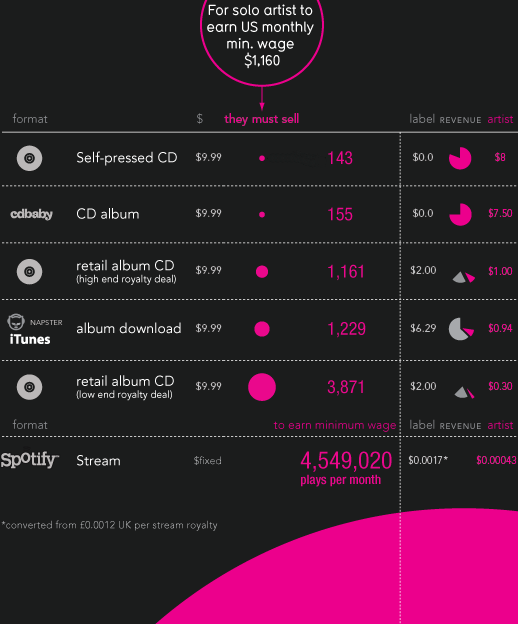
This is what your internet access must be sacrificed for: an infographic showing how much money musicians actually earn from each means of selling music, in the form of how many units they'd have to shift to make minimum wage, along with how much the all-important middle man takes. While an artist could live (modestly) on 143 home-burned CD-Rs a month, they'd need to sell almost ten times that many retail CDs (if they have an exceptionally good royalty deal), or on iTunes. The scales get positively Jovian as we approach new streaming services like Spotify:
2009/11/2
The Gervais Principle, or the social psychology of how organisations really function, as seen in the Office TV comedies:
The McLeod hierarchy, and the theory which is the cornerstone of Ricky Gervais' comedy (and its US remake), divides organisations into three psychological types, somewhat facetiously labelled Sociopaths (i.e., those driven by the desire to control and dominate, without whom no decisions would be made), Losers (i.e., those who have made the tradeoff of security for control of their destiny; these need not necessarily be losers in the colloquial sense) and the Clueless (who are in the middle of the hierarchy, but are one level below losers in self-awareness; whereas the loser typically puts in the minimum they can get away with, the clueless give their loyalty to the organisation out of a misplaced faith that it will be reciprocated). Initially, organisations start off with a few Sociopaths in the driving seat and a corps of Losers doing the gruntwork in exchange for a regular paycheque; as they get larger, a layer of Clueless is added, and expands. This layer may be imagined as a dense, inert substance, which serves to keep the otherwise inherently unstable organisation from imploding.Now, after four years, I’ve finally figured the show out. The Office is not a random series of cynical gags aimed at momentarily alleviating the existential despair of low-level grunts. It is a fully-realized theory of management that falsifies 83.8% of the business section of the bookstore. The theory begins with Hugh MacLeod’s well-known cartoon, Company Hierarchy ..., and its cornerstone is something I will call The Gervais Principle, which supersedes both the Peter Principle and its successor, The Dilbert Principle.
The Gervais Principle builds on this, and describes how Losers who put in more than is in their best interest get promoted to middle-management, not because of their talents, or because of their incompetence (as per the Peter Principle or Dilbert Principle), but because they are most useful as pebbles in the insulating layer of the Clueless.A sociopath-entrepreneur with an idea recruits just enough losers to kick off the cycle. As it grows it requires a clueless layer to turn it into a controlled reaction rather than a runaway explosion. Eventually, as value hits diminishing returns, both the sociopaths and losers make their exits, and the clueless start to dominate. Finally, the hollow brittle shell collapses on itself and anything of value is recycled by the sociopaths according to meta-firm logic.
Sociopaths, in their own best interests, knowingly promote over-performing losers into middle-management, groom under-performing losers into sociopaths, and leave the average bare-minimum-effort losers to fend for themselves.
A loser who can be suckered into bad bargains is set to become one of the clueless. That’s why they are promoted: they are worth even more as clueless pawns in the middle than as direct producers at the bottom, where the average, rationally-disengaged loser will do. At the bottom, the overperformers can merely add a predictable amount of value. In the middle they can be used by the sociopaths to escape the consequences of high-risk machinations like re-orgs.
Which brings us to the other major management book that is consistent with the Gervais Principle. Images of Organization, Gareth Morgan’s magisterial study of the metaphors through which we understand organizations. Of the eight systemic metaphors in the book, the one that is most relevant here is the metaphor of an organization as a psychic prison. The image is derived from Plato’s allegory of the cave, which I won’t get into here. Suffice it to say that it divides people into those who get how the world really works (the sociopaths and the self-aware slacker losers) and those who don’t (the over-performer losers and the clueless in the middle).(Paging Greg Wadley...)
2009/9/16
Telstra, Australia's telecommunications backbone quasi-monopolist, is going to be broken up, into separate wholesale and retail arms at least. Which sounds like good news for Australian internet users.
2009/7/30
Aeroflot, the Soviet Russian national airline, has not traditionally been an airline associated with quality or customer service, to say the least. But now, all that's about to change:
Travellers report mixed experiences on Aeroflot, with reasonable service and new planes on flights to western Europe and the US, but horror stories about flights to other destinations. "On flights to London the service is okay," said a British accountant working in Moscow. "But I recently flew Aeroflot to Warsaw, and it was a nightmare. The seatbelt on my chair was broken, the crew were rude and spoke virtually no English, and the only meal option was an unspecified 'meat'. When I asked what kind of meat it was, they simply shrugged."
As part of the retraining, a number of Aeroflot hostesses have been sent to Singapore to receive training from Singapore Airlines. "The passenger is always right!" said Mr Savelyev, voicing a concept that often seems to be alien to Russian flight crews. "We have fired a lot of stewardesses for being rude to passengers," he admitted.The changes promise to bring Aeroflot into the 21st century, or, at the very leat, the early 1970s:
The new Aeroflot CEO Vitaly Savelyev said all new stewardesses would be "very striking, very eye-catching girls", who would not exceed Russian size 48 – roughly a British size 12.
The legend of aerial misogyny was born in the 1960s and '70s, when airlines would routinely use the glamour of their air hostesses as a selling point. Many airlines had "no-marriage" rules for their female staff. "Being beautiful isn't enough," American Airlines proudly said. "We don't mean it isn't important. It just isn't enough." Meanwhile, the now-defunct National Airlines ran a series of ads with a pouting stewardess proclaiming: "I'm Mandy. Fly Me." As the world moved on, the term "air hostess" was replaced with the gender neutral "flight attendant". But recently some suspect sexism has crept back into the industry's advertising. Virgin drew 29 complaints over an ad campaign in which passengers gawped at a glamorous all-female flight-crew. Ryanair even published an all-female calendar of its flight attendants – wearing bikinis.I wonder whether they'll keep their charmingly anachronistic flying hammer-and-sickle logo.
2009/7/21
Your humble correspondent saw Of Montreal in London last week. For what it's worth, they were as good as always, and photos are here.
I'm not sure if they were quite good enough to have paid twice for seeing them, though, which is what I ended up doing after my ticket didn't show up. I had ordered it, along with a ticket to another show in the future (Animal Collective on the 20th of August) from TicketWeb a week earlier, and until that morning, nothing arrived. I went to work as usual, and when I returned, I found an envelope waiting for me, though, upon opening it, discovered that it contained only the tickets for the show in August.
I went to the venue, explaining my situation, and asking if they had a ticket for me or my name on a list; they didn't, and told me to ring TicketWeb. I did, and found that their customer service line was closed for the night. So I ended up buying another ticket at the door, in the hope of getting a refund for my unused ticket when it turned up.
The ticket arrived in the mail yesterday, a whole six days late. Today, I rang TicketWeb, explaining my situation, and asking whether I could get a refund. They said that no; apparently, the onus is on the consumer to report that the ticket hadn't shown up before close of business on the day of the event. Which leaves me some £18 out of pocket.
Any other industry would be sufficiently concerned about its customer relations to throw a bone to the customer and issue a refund in good faith. (I offered to mail them the unused ticket as proof that I hadn't sold it on or anything.) Major event ticket agencies, however, are a corrupt oligopoly and, like all corrupt oligopolies, are quite happy to tell the customer to go screw themselves. After all, you play by their rules, however skewed and arbitrary they are, or it's no Beyonce for you.
Anyway, I have had enough, and I will never do business with TicketWeb or their parent company TicketMaster again. Even if this means not seeing any gig larger than would fit in the room above a pub, though thankfully, it does not come down to this. (There are more reputable ticket agencies selling tickets for a lot of events; We Got Tickets is one, and then there is the possibility of buying directly from venues.) Of course, not doing business with the TicketBastard probably means no LiveNation corporate-indie mega-events, but I can live with that. Anyway, if you're looking to buy a ticket to a gig, I urge you to avoid the thieving bastards at TicketMaster/TicketWeb.
2009/7/1
The British government is set to renationalise the east coast rail route, which connects London, York, Newcastle and Edinburgh, after National Express complained that it can't afford to run it and went to the government begging for a bailout, to which the government said no. Of course, the government, desperate to avoid accusations of it reverting to the bad old days of brown-suited trade-union bolshevism ("Old Labour"), has expressed its deepest regret at the unfortunate necessity of taking such a socialistic course of action and committed itself to selling off the franchise as soon as is possible.
This is not the first time part of Britain's railway network has fallen into public ownership since privatisation; a railway operation in the south of England was taken back by the government a few years ago after the operator, Connex, was found to be rubbish. (Incidentally, the names of the operators will hold special relevance for Melburnians; both Connex and National Express have forfeited commuter rail franchises in Melbourne, in somewhat similar ways.)
I wonder what branding the new government-run rail franchise will use. I'm guessing they can't call it National Express, and will avoid calling it British Rail (or National Rail, which is the same only with less Helvetica) or anything that suggests a permanent nationalisation of the railways (because that would be socialism, and Socialism Is Always Wrong), so presumably they'll come up with some brand. I hope that they keep the web site, though; it has one of the nicer interfaces for booking tickets in the UK.
2009/6/26
Not that long ago, the Hummer was king of America's roads; a ex-military truck, chromed for the consumer and with all the aggressive ugliness of a pit bull, it soon became synonymous with a certain form of all-American assholery, a combination of machismo, belligerence and callous indifference worn like armour. Then the price of oil went up, and the dealers' yards started filling up with unsellable Hummers. And then General Motors filed for bankruptcy protection, and decided to sell off a number of marques to raise some desperately needed money to keep the wolf from the door. A construction equipment manufacturer in China (that's Communist China, by the way, not Taiwan) was found who was willing to buy the brand and start making Hummers. Joe Sixpack and NASCAR Dad could rest assured that they would still be able to buy a Hummer, though in future, this icon of all-American triumphalism would be made in China, like a cheap Wal-Mart DVD player.
Now, it trns out that the Chinese government's planning agency has blocked the takeover of the Hummer brand, on environmental grounds.
Now that's got to hurt.
2009/6/15
The Official Chart Company, which runs Britains's music charts, is reviving the indie charts, updated to reflect the changing definition of "indie":
The initial criteria defined an independent release as any record which was released by a label with independent distribution, in an era when major record companies were self-distributed and smaller labels used alternative routes. Today, however, with even majors outsourcing their own distribution to independent operations, this criterion has become less relevant.
Under the new rules, a download or CD will be eligible for the Official Independent Charts if it is released on a label which is 50% or more owned by an independent (or non-major) company, irrespective of the distribution channel through which it is shipped or delivered.So now joint ventures with the Big Four major labels are officially "independent".
I think, however, that they missed the big picture. When the word "indie" is used to refer to musical product (bands, labels, records), it seldom refers to the business model under which the product was released. Typically, when a band or record is described as "indie", this refers partly to what they look or sound like (which is to say, to a greater or lesser extent like the independent bands between post-punk and the rise of Britpop), but more saliently, to the target demographic. "Indie" means sort of what "alternative" meant in the 1990s; a conspicuous badge of not being "mainstream" that doesn't require any more effort to obtain than being in the mainstream would, with its sounds and styles (not to mention the word "indie") borrowed from the original independent bands, only stylised and streamlined for easy mass consumption ("Note: lose all that stuff about Marxism and Fluxus and existentialism, and pump up the sex.")
As such, looking at the ownership and distribution of a record label when assessing whether a record is "indie" is woefully inadequate. A more suitable criterion would have to be based on a points system, with bands or releases being awarded points if they fulfil certain criteria, i.e.,
- band is on an independently-owned label: 2 points
- At least 50% of the band wear skinny jeans: 2 points
- At least one band member has an asymmetrical haircut: 1 point
- 1 point for each of the following influences cited (with proof): The Clash, Joy Division, XTC, Gang Of Four, Neu! (maximum 3 points)
- band's sound has been described by music critics as "angular" - 1 point
To keep the criteria relevant, a committee of industry, media and marketing types would convene every six months to update these rules to take into account recent trends. (For example, in light of the recent trend towards hipster-folk, the committee might now be debating allowing one point for band members with rustic-looking beards, or for bands having ukuleles in their instrumentation.)
2009/6/11
Two years after last.fm was bought out by CBS, who ran it as an autonomous unit, the three founders have handed in their resignations; they will stay on as consultants until September, after which control will be handed over entirely to CBS. After that, we can probably expect the servers to be boxed up and shipped to the US and the site to be rebranded as "MTV Online" or something, plastered with intrusive ads, and generally stripped of anything that made it cool in the first place.
So where do you go after last.fm? How do you display the superlative coolness of your musical taste to the world once last.fm is no longer fit to point people at? Well, there's libre.fm, which is still in alpha, doesn't look very good and has next to nobody using it. Libre.fm, though, is open-source, so you could easily run your own server. Perhaps the future will consist of people running their own scrobblers, or social networks providing scrobbling services to their users; your music stats will be available as standard XML feeds, with a XFN-style microformat link from your profile/homepage, letting the world know that this is what you've been listening to. Of course, one advantage a centralised site like last.fm had was that it could easily crunch the data and find recommendations or determine the compatibility of musical tastes, though if it's a web service, someone could write a third-party site to crunch exported music profiles. (Perhaps that someone will be Google or Facebook? Or perhaps Murdoch's struggling MySpace will leap at the opportunity, implement scrobbling, and then make a hash of it with obnoxious in-your-face Flash ads and a garishly unpleasant user experience.) As for finding upcoming gigs, event sites like upcoming.org, or Facebook's Event facility, could be expanded to be aware of band/artist names and search by user profiles.
2009/5/28
To figure out the current state and direction of the global economy, economists are turning to somewhat unusual indicators, such as the membership of extramarital infidelity websites and the price of prostitution in Latvia:
The Web site crunched its traffic and membership numbers and found that there was a big increase in both when there was a turning point in the FTSE-100 index, which measures the leading companies listed in London. When the market collapses, people plot affairs. And when the bulls rage, the same thing happens. When it is trading sideways, they stick with their partners.
“It has to do with people’s confidence levels,” says Rosie Freeman-Jones, a spokeswoman for the site. “When the markets are up, they think they can have an affair because they feel they can get away with anything. When the market hits the bottom, they are looking for a way to relieve the pressure.”And here is more information on the prostitution index, and why prostitution prices make a good economic indicator.
Anyway the problem is that most industries have contractual arrangements which fix prices. Wages are very hard to flex downwards. Rents are fixed over sustained periods and the like. All of this means that people go bust rather than reduce prices – simply because prices are sticky.
Well – most prices. The contractual terms of prostitution are short (an hour, a night) and entry to the industry is unconstrained. That means that the prices are very flexible. Extraordinarily flexible.
2009/5/19
As the economic crisis bites, credit card companies are turning to advanced psychological techniques to manage their customers, using their purchasing records to develop detailed psychological models of their behaviour.
Martin could often see precisely what cardholders were purchasing, and he discovered that the brands we buy are the windows into our souls — or at least into our willingness to make good on our debts. His data indicated, for instance, that people who bought cheap, generic automotive oil were much more likely to miss a credit-card payment than someone who got the expensive, name-brand stuff. People who bought carbon-monoxide monitors for their homes or those little felt pads that stop chair legs from scratching the floor almost never missed payments. Anyone who purchased a chrome-skull car accessory or a “Mega Thruster Exhaust System” was pretty likely to miss paying his bill eventually.
Martin’s measurements were so precise that he could tell you the “riskiest” drinking establishment in Canada — Sharx Pool Bar in Montreal, where 47 percent of the patrons who used their Canadian Tire card missed four payments over 12 months. He could also tell you the “safest” products — premium birdseed and a device called a “snow roof rake” that homeowners use to remove high-up snowdrifts so they don’t fall on pedestrians.
By the time he publicized his findings, a small industry of math fanatics — many of them former credit-card executives — had started consulting for the major banks that issued cards, and they began using Martin’s findings and other research to build psychological profiles. Why did birdseed and snow-rake buyers pay off their debts? The answer, research indicated, was that those consumers felt a sense of responsibility toward the world, manifested in their spending on birds they didn’t own and pedestrians they might not know. Why were felt-pad buyers so upstanding? Because they wanted to protect their belongings, be they hardwood floors or credit scores. Why did chrome-skull owners skip out on their debts? “The person who buys a skull for their car, they are like people who go to a bar named Sharx,” Martin told me. “Would you give them a loan?”It's not only your purchasing record that's mined for psychological data, though:
Most of the major credit-card companies have set up systems to comb through cardholders’ data for signs that someone is going to stop making payments. Are cardholders suddenly logging in at 1 in the morning? It might signal sleeplessness due to anxiety. Are they using their cards for groceries? It might mean they are trying to conserve their cash. Have they started using their cards for therapy sessions? Do they call the card company in the middle of the day, when they should be at work? What do they say when a customer-service representative asks how they’re feeling? Are their sighs long or short? Do they respond better to a comforting or bullying tone?The card companies have, as you might imagine, a variety of uses for this data. On the blunter side of the spectrum, signs of potential unreliability (bills for dive bars or marriage counselling services, unusual login patterns) may trigger card companies to raise interest rates or start pushing more aggressively for repayment. More subtly, though, if your credit card company calls you to discuss your bill, the person talking to you will be trained in psychological techniques and will have on their screen a detailed psychological profile of you, all the better to elicit compliance:
Santana had actually already sought permission from the bank to settle for as little as $10,000. It’s an open secret that if a debtor is willing to wait long enough, he can probably get away with paying almost nothing, as long as he doesn’t mind hurting his credit score. So Santana knew he should jump at the offer. But as an amateur psychologist, Santana was eager to make his own diagnosis — and presumably boost his own commission.
“I don’t think that’s going to work,” Santana told the man. Santana’s classes had focused on Abraham Maslow’s hierarchy of needs, a still-popular midcentury theory of human motivation. Santana had initially put this guy on the “love/belonging” level of Maslow’s hierarchy and built his pitch around his relationship with his ex-wife. But Santana was beginning to suspect that the debtor was actually in the “esteem” phase, where respect is a primary driver. So he switched tactics.
“You spent this money,” Santana said. “You made a promise. Now you have to decide what kind of a world you want to live in. Do you want to live around people who break their promises? How are you going to tell your friends or your kids that you can’t honor your word?”
The man mulled it over, and a few days later called back and said he’d pay $12,000.
“Boom, baby!” Santana shouted as he put down the phone. “It’s all about getting inside their heads and understanding what they need to hear,” he told me later. “It really feels great to know I’m helping people in pain.”Of course, another way to look at this was that, had the chump (who, according to the article, had recently been left by his wife) not offered to pay up extra, the friendly man from the card company would know exactly which buttons to push to kick them down further. Which is all very well (Personal Responsibility, after all, is What Made America Great, as any card-carrying Libertarian will tell you), other than the inherent asymmetry of going up against a huge organisation with frighteningly powerful intelligence-gathering abilities, and no interest in your welfare beyond what's required to maximise its profits.
(via Boing Boing) ¶ 0
2009/4/7
The Australian government has announced the formation of a company to build a national broadband network, after being unsatisfied with private bids to build it.
The proposal goes much further than the Government had previously planned as fibre-optic cables will now run all the way from telephone exchanges to homes and businesses. It had previously planned to lay cables only from exchanges to cabinets at the end of street corners. In a major blow to Telstra, Mr Rudd said it was time ''to bite the bullet'' after years of neglect of the telecommunications sector.
''Years of failed policy have left Australia as a broadband backwater," he said.The network will include fibre-optic connections to the premises with up to 100 megabits per second, and presumably will include mandatory content filtering at the infrastructure level. Construction will start in Tasmania around the middle of the year.
2009/4/1
The rise of Wikipedia and its open-source, collaborative content model has claimed a scalp among its traditional, proprietary competition: Microsoft's online encyclopedia Encarta will be shut down on 31 October. Encarta was launched in the 1990s as a savvier Britannica for the CD-ROM age.
I wonder how long Britannica has left. Will it survive indefinitely, sustained by the niche market for expensive, impressive-looking leather-bound volumes, fetishised by those to whom such things still suggest wisdom more than decrepitude? Will the brand name be snapped up by a manufacturer of prestige E-paper Wikipedia browsers? Or will it just sink without a trace, as a relic of a past age of informational scarcity?
2009/1/19
In the US, mobile phone carriers have a lot more power over consumers than in Europe or Australia. There phones are only obtainable from carriers, are locked to one carrier and often have features disabled to drive profits to the carrier, resulting in Americans paying more for less than their fellow mobile phone users abroad. (It's the classic "turd-in-a-can" ideal of predatory consumer capitalism; first, make sure you have a captive audience, and then you can sell them any old crap at the price of your choice, safe in the knowledge that they have nowhere else to go.)
Now, the Electronic Frontier Foundation is turning its attention to this issue, in particular to the practice of locking phones down and the use of copyright laws to enforce this; to this aim, it has launched the Free Your Phone campaign, and is asking US residents to sign an online petition. It's probably about time.
2009/1/17
The launch of the Kogan Agora Android phones has been postponed indefinitely, apparently due to "interoperability issues" of some sort. The Agora and Agora Pro, from an Australian outfit named Kogan (who, until now, have apparently been best known for cheap LCD TVs or similar) were meant to launch at the end of January, but now this will not happen. Which means that the T-Mobile G1 won't have any competition for a while longer yet.
I was thinking of buying an Agora Pro as my next phone (my Nokia 6230i—go ahead, laugh—is getting a bit long in the tooth), though with the announcement of the Palm Prē, I was having second thoughts. Now I suspect I may wait for the Prē to come out.
2009/1/7
LiveJournal sacks almost its entire US workforce, including all US-based engineers, leaving only a few financial and support staff. Panic ensues, with perverts worldwide stocking up on emergency supplies of Harry Potter slash fiction in case it disappears.
Chances are, the obligatory jokes about disturbing online subcultures aside, LiveJournal won't disappear overnight. For one, the cuts are in the US office, and LiveJournal is now Russian-owned, and is much bigger in Russia (in America, the typical LiveJournal user is a thirtysomething goth-scene veteran with an IT job, whereas in Russia, it's a mainstream media site). Given that most of the money and ad revenue come from the Russian operation, it presumably won't cost them much to keep running an English-localised rump site on the same servers.
In any case, I hope LiveJournal survives, because it has one thing none of the other sites have: no, not Harry Potter slash fiction; fine-grained social-network-based access control, i.e., the means to specify that posts are not just friends-only but only accessible to a subset of friends. Which might sound like a symptom of some kind of geek social neurosis, but is actually useful. (Consider, for example, a Facebook friends list, containing everyone from coworkers to family members to people you met at a party or festival; as on Facebook, you can't control who can read a posted item (it's all your friends or no-one), there are a lot of things you cannot or should not post; from boasting about faking illness to planning surprise parties for contacts, to discussing personal situations, so your Facebook stream becomes a stream of lowest-common-denominator banalities.) Something with Facebook-level usability and LiveJournal-level access control would actually be useful; maybe once the world emerges from the New Depression, someone will write something like that?
2009/1/5
Texan Cyberpunk sci-fi author turned father of the Viridian pro-green design/technology movement turned Belgrade-based design theorist Bruce Sterling gives his annual state-of-the-world address to the Inkwell forum. It's focussed mostly on the economic cataclysm in progress, and it's full of the sorts of apposite powder-dry black humour you'd expect from him:
Do we HAVE to talk about the economy this year? I'm wondering what conceivable event could overshadow the fiscal crisis. Maybe a cozy little nuclear war? An Indo-Pakistani nuclear war might conceivably take a *back page* to the fiscal crisis.
I'm a bohemian type, so I could scarcely be bothered to do anything "financially sound" in my entire adult life. Last year was the first year when I've felt genuinely sorry for responsible, well-to-do people. Suddenly they've got the precariousness of creatives, of the underclass, without that gleeful experience of decades spent living-it-up.
If the straights were not "prone to hostility" before that experience, they might well be so after it, because they've got a new host of excellent reasons. The sheer galling come-down of watching the Bottom Line, the Almighty Dollar, revealed as a papier-mache pinata. It's like somebody burned their church.After indulging in terriblisma for a while, Sterling turns his attention to Dmitry Orlov's prediction of the US disintegrating, and ideas for a "new localism" that might arise in the event of catastrophic collapse:
In any case, after eight glum years of watching Bush and his neocons methodically wreck the Republic, both Kunstler and Robb have gotten really big on American localism -- "resilient" localism. Kunstler has this painterly, small-town-America, Thoreauvian thing going on, kinda locavore voluntary simplicity, with lots of time for... I dunno, group chorale singing. Kunstler seems kinda hung up on the singing effort, somehow... Whereas Robb has a military background and is more into a gated-community, bug-out-bag, militia rapid-response thing.
Certainly neither of these American visions look anything like what happened to Russia. As Orlov accurately points out, in the Russian collapse, if you were on a farm or in some small neighborly town, you were toast. The hustlers in the cities were the ones with inventive opportunities, so they were the ones getting by.
So the model polity for local urban resilience isn't Russia. I'm inclined to think the model there is Italy. Italy has had calamitous Bush-levels of national incompetence during almost its entire 150-year national existence.Meanwhile, Clay Shirky gives his predictions for 2009. Whether or not we're all toast, a lot of the old media, such as newspapers, seem to be:
The great misfortune of newspapers in this era is that they were such a good idea for such a long time that people felt the newspaper business model was part of a deep truth about the world, rather than just the way things happened to be. It's like the fall of communism, where a lot of the eastern European satellite states had an easier time because there were still people alive who remembered life before the Soviet Union - nobody in Russia remembered it. Newspaper people are like Russians, in a way.
Why pay for it at all? The steady loss of advertising revenue, accelerated by the recession, has normalised the idea that it's acceptable to move to the web. Even if we have the shallowest recession and advertising comes back as it inevitably does, more of it will go to the web. I think that's it for newspapers. What we saw happen to the Christian Science Monitor [the international paper shifted its daily news operation online] is going to happen three or four dozen times (globally) in the next year. The 500-year-old accident of economics occasioned by the printing press - high upfront cost and filtering happening at the source of publication - is over. But will the New York Times still exist on paper? Of course, because people will hit the print button.Shirky's not one for terriblisma, so not much about social collapse, cannibalism or killer caravans marauding the post-apocalyptic landscape there. For that, you'll have to read Charlie Brooker's column:
Dim your lights. Here's the highlights reel. The worst recession in 60 years. Broken windows and artless graffiti. Howling winds blowing empty cans past boarded-up shopfronts. Feral children eating sloppy handfuls of decomposed-pigeon-and-baked-bean mulch scraped from the bottom of dustbins in a desperate bid to survive. The pound worth less than the acorn. The City worth less than the pound. Your house worth so little it'll collapse out of shame, crushing you in your bed. Not that you'll die peacefully in your sleep - no, you'll be wide awake with fear, worrying about the situation in the Middle East at the precise moment a chunk of ceiling plaster the size of a flagstone tumbles from on high to flatten your skull like a biscuit under a shoe, sending your brain twizzling out of your earholes like pink-grey toothpaste squeezed from a tube. All those language skills and precious memories splattered over your pillows. It'll ruin the bedclothes. And instead of buying expensive new ones, your grieving, impoverished relatives will have to handwash those bedclothes in cold water for six hours to shift the most upsetting stains before passing them down to your orphaned offspring, who are fated to sleep on them in a disused underground station for the rest of their lives, shivering in the dark as they hear bombs dipped in bird flu dropping on the shattered remains of the desiccated city above.
(via Boing Boing) ¶ 0
2008/12/12
A while ago, German national railway company Deutsche Bahn expressed an interest in running trains through the Channel Tunnel, competing with Eurostar, come 2010, when EU "open access" rules allow train companies to run services all over the EU. Now they're talking about buying out the UK's share of Eurostar altogether:
Deutsche Bahn (DB), Germany’s state-owned railway, may also use Eurostar trains to operate a rival service through the Channel Tunnel, with competition resulting in cheaper tickets to Paris and Brussels. But the Government, which is preparing to sell the third of Eurostar that it controls, would lose the ability to influence the development of the rail link to the Continent.
Over the past 18 months, it has quietly bought several British train companies that carry a total of 30 million passengers a year. DB owns Chiltern, which runs between London Marylebone and Birmingham, and half of London Overground, which operates on the North London Line and will serve the extended East London Line from next year. It also runs two thirds of Britain’s goods trains through its purchase of EWS, the biggest British rail freight company.
DB hopes to persuade Geoff Hoon, the Transport Secretary, that it will operate a more efficient service through the Channel Tunnel by drawing on its experience in Germany of integrating trains with other modes of transport. German rail passengers can book an entire journey on just one web-site and with one ticket and can even arrange for an electrically assisted bicycle to be waiting for them at the station.DB have also expressed an interest in buying more train companies in countries they expand to; given their efficiency, that could be a good thing.
2008/12/9
Did you ever wonder why companies like Apple will let you get your gadgets engraved for free? It's got nothing to do with being generous; it's so that you can't return them:
Back in May of this year, Sony told the WSJ that free engraving had recently saved them a million dollars.
2008/7/29
Multinational coffee chain Starbucks have announced that they will close 61 our of their 85 Australian outlets. That's just under 72%.
What surprises me is that they had 85 outlets in Australia in the first place. Thanks to large-scale Italian immigration in the 1950s and 1960s, Australia has very high standards for what constitutes a good cup of coffee. The inner cities of Australia are full of cafés with espresso machines and baristas who know how to use them well, to the point where cafés in the UK advertise their staff's Australian training, and the locals' expectations of coffee is at a level well above Starbucks' ability to compete, even with their resources.
Who could possibly have patronised all those Starbucks outlets? Surely there wouldn't have been enough risk-averse American businessmen passing through to justify 85 of them.
2008/7/8
Corporate coffee chain Starbucks isn't doing too well; they've had to close 600 stores in the US, in less than favourable circumstances. (Favourable circumstances for Starbucks being closing the 2nd and 3rd stores they opened on a block and ran at a loss after the last independent café nearby went out of business.) Unsurprisingly, some coffee fans are over the moon:
New York Web designer Zachary Thacher, who favors Greenwich Village's cafes, said he avoids Starbucks. "They've commoditized cafe culture, which is why I don't go," he said.
The company that began as innovative is now known for consistency and convenience, [another commentator] said. "To me, that's a huge step down," she said. "You've built your franchise on people who are coming in because they know exactly what they want."Starbucks still has their defenders, mostly on the grounds that they're convenient and consistent.
2008/6/19
The founders of the Flickr photo service, Stewart Butterfield and Caterina Fake, have resigned from Yahoo!. Butterfield's resignation letter is here:
As you know, tin is in my blood. For generations my family has worked with this most useful of metals. When I joined Yahoo! back in '21, it was a sheet-tin concern of great momentum, growth and innovation. I knew it was the place for me.Butterfield and Fake join a number of illustrious figures leaving Yahoo! recently. It is not clear what will happen to Flickr now; presumably it will continue on on its considerable momentum, until whoever's in charge at Yahoo (or Microsoft or News Corp. or whoever ends up buying it) cocks everything up, or else does a mp3.com and trashes it, replacing it with a craptacular new site also named flickr.com.
Speaking of craptacular sites, MySpace are redesigning their website to minimise some of the clutter, and have enlisted the services of design consultancy Adaptive Path. It's not clear how much suck they will end up removing, or whether the site will be significantly less unpleasant to use.
2008/5/4
Microsoft has abandoned its attempt to buy Yahoo!, having failed to reach an acceptable price and decided against a hostile takeover (which would have involved the legal equivalent of house-to-house combat and probably ended up with most of Yahoo's best people leaving for Google or someone). Across the world, millions of Flickr and del.icio.us users (particularly those who don't use Windows) breathe a little more easily.
Of course, it's not necessarily over; Yahoo's share price will almost certainly slump in the short term, and if their attempts to turn their business around don't bear fruit, Microsoft could come back a few months later and pick them up for less. Unless, of course, they buy AOL instead.
2008/4/30
7 Confessions of an Apple Mac Specialist:
7. iPods have two fixes. Resetting and Restoring.
If both of those features do not work, your iPod is trash. Unless it's under warranty or you purchased AppleCare, then they will give you two options. First is to trade in your iPod for 10% off any model (except shuffle), or they will give you out of warranty replacement, Which usually means that you will pay around $100-$250 depending on the model you purchased.
6. We have 4 things that we will try to sell you when you purchase a computer.
AppleCare, of course, is your extended 3 year warranty, we are told to sell it as a service plan, but it does not do ANYTHING extra, but extend your warranty, and does not cover anything extra. .Mac is a ripoff unless you use the web site hosting. ProCare has to be the biggest ripoff. All this does is upgrade your AppleCare for one year. It has a little perk for business uses, but otherwise useless. Lastly, One-to-One training, which is the best deal in the store.
2008/4/26
Remember Gracenote, the firm that bought the user-contributed CDDB database and locked it up, locking open-source clients out of it? Well, they've just been bought by Sony. I wonder what this will mean: with Sony BMG being a pillar of the RIAA, will owning a database which receives a notification every time somebody rips a CD be a useful weapon in the War On Copying? And will Apple keep using Gracenote for iTunes now that it's controlled by a rival?
2008/4/10
Yahoo to merge with AOL? Apparently the deal (still being hammered out) would involve Yahoo acquiring AOL and Time Warner acquiring 20% of the combined company in return. If it goes through, it may be good enough to stop Microsoft from absorbing Yahoo, as they have been making increasingly menacing noises about. Which means that we may be able to access Flickr with non-IE browsers for a while longer.
2008/1/31
Australian independent music zine and website Mess+Noise has been acquired by Destra, an online content company:
This acquisition extends destra’s capacity to deliver credible and compelling content and create advertising opportunities on a multi-platform basis around targeted, online communities, particularly in the X & Y demographic.
Mess+Noise will be promoted across destra’s digital and physical publishing and broadcasting platforms, enabling collaboration with destra’s other music communities such as http://www.threedworld.com.au, www.centralstation.com.au and www.mp3.com.au.In other words, we can probably expect it to turn into a sort of JJJ of the web, with the unprofitable articles about small independent bands being replaced by PR pieces about commercial alternative-rock acts, and the forums being swamped by bogans.
Here is long-time contributor Emmy Hennings' eulogy for the site, and here is the discussion thread.
2008/1/28
A year or so ago, Sony's egregiously misnamed Universal Media Disc format (a prooprietary optical disc which only plays in one device—the Sony PlayStation Portable)—essentially died as a viable medium for selling anything other than PSP games. For some reason, people didn't want to spend good money on a low-resolution copy of a movie, bound to a plastic cartridge, for viewing on their PSP; perhaps the number of PSP owners who would use their units for repeatedly watching Spiderman 2 on the train, as opposed to, say, playing videogames, wasn't that great to begin with, and the percentage willing to incur the cost of buying a movie in this inflexible format was even lower. Not even Sony giving away UMDs of their films with DVDs, for only slightly more money, could revive the flagging format.
So now, we learn that Sony are trying to revive the UMD format as a medium for movies by selling TV shows on it, in conjunction with MTV (formerly a music-video channel, now a purveyor of entertainment to the lucrative young-and-dumb demographic). That's right; presumably some executive decided that, while people may not be willing to pay money for a disc containing a version of a movie that only plays on their PSP, they'd be willing to do so for some episodes of Beavis & Butthead. Unless they're planning to bundle them with boxes of breakfast cereal or something.
It's not just the cost of purchasing the disc that counts; it's also the cost of having another bit of plastic taking up space in your house and your mental filing system. As the value of the bits of plastic decreases, the awkwardness of their material nature increases. (A video game you may spend many hours playing is worth a plastic disc and case to store it in—not to mention £25 or however much it costs— a movie you watch once or twice, less so, especially since looking at a small handheld screen is not the best way to enjoy movies if there are alternatives. A few episodes of a TV show sounds like an even more marginal proposition, and the sort of problem that downloads were invented to solve.) Especially in a format whose flexibility is deliberately limited.
Nokia to buy Trolltech, the Norwegian company behind the Qt C++ user interface library (as used in Linux desktop KDE and numerous multi-platform applications including Google Earth and the Last.fm client) and the Qtopia mobile user interface platform. Nokia has pledged to continue the development of Trolltech's software and its commitment to open source, and this step could give it more of a foothold in the Linux mobile phone market. The future for Nokia's own Maemo toolkit (based on Linux and rival user interface library GTK) looks less certain.
2008/1/16
Sun has bought MySQL, maker of the popular open-source database system. Which looks like good news to all concerned, as Sun have a good reputation for supporting open source.
2008/1/11
The Graun's Geoffrey Wheatcroft on Tony Blair's new sinecure as an advisor to JP Morgan:
And although Blair has been praised by the self-styled "very rightwing" historian Andrew Roberts for destroying socialism, that also misses the point. Blair never really understood the undoubted failures of state socialism, he just hated the Labour party. He has never intellectually grasped the case for the competitive market economy, he just loves the rich.
2007/12/19
David Byrne interviews Thom Yorke about the In Rainbows experiment, and writes his own assessment of the changing state of the music industry. Meanwhile, MTV has its own timeline of "the year the music industry broke". And open-standard-friendly MP3/video player manufacturer Neuros has created a trademark for DRM-free media.
(via Boing Boing, Engadget) ¶ 0
2007/10/1
The Lonely Planet publishing company, best known for its travel guides (as well as random travel-related books and a stock photography library) has been bought — by the BBC, of all people. Well, by BBC Worldwide, which is the BBC's commercial arm (the one which sells BBC content to non-licence-fee-payers outside the UK for profit).
BBC Worldwide international director Ian Watson said there was "absolutely no intention" of introducing advertising into Lonely Planet, which he described as "the most important brand to travellers around the world". "One of the things we very quickly got to talking to with Tony and Maureen was just how closely aligned our editorial values are," he said.The BBC is mooting expanding Lonely Planet's online services and creating TV programming based on the guides. The Lonely Planet offices remain in Footscray (which, for the Britons reading this, is sort of the Melbourne equivalent of Hackney or somesuch), and the management remains unchanged.
2007/9/15
Alternative/industrial musician Trent Reznor has a few words to say about his record company in Australia:
Well, in Brisbane I end up meeting and greeting some record label people, who are pleasant enough, and one of them is a sales guy, so I say "Why is this the case?" He goes "Because your packaging is a lot more expensive". I know how much the packaging costs -- it costs me, not them, it costs me 83 cents more to have a CD with the colour-changing ink on it. I'm taking the hit on that, not them. So I said "Well, it doesn't cost $10 more". "Ah, well, you're right, it doesn't. Basically it's because we know you've got a core audience that's gonna buy whatever we put out, so we can charge more for that. It's the pop stuff we have to discount to get people to buy it. True fans will pay whatever". And I just said "That's the most insulting thing I've heard. I've garnered a core audience that you feel it's OK to rip off? F--- you'. That's also why you don't see any label people here, 'cos I said 'F--- you people. Stay out of my f---ing show. If you wanna come, pay the ticket like anyone else. F--- you guys". They're thieves. I don't blame people for stealing music if this is the kind of s--- that they pull off.
(via Boing Boing) ¶ 1
2007/5/30
Oh-oh; music-based social networking site last.fm has just been bought by old-media dinosaur CBS, for £140m. CBS say that last.fm will retain its own identity (as opposed to being rebranded as "MTV 2.0" or something) and its managing team will remain in place, so hopefully it won't turn to dross immediately.
2007/5/17
An email, incorrectly claiming that Apple's iPhone and Leopard had been delayed, wiped US$4bn off the value of the company. Once Apple issued a clarification, stock soon climbed back to most of its original value within about 15 minutes.
I wonder whether whoever sent the email managed to snag some bargain-priced Apple shares.
2007/5/15
The Guardian looks at the question of whether infant-formula villains Nestlé, the subjects of a boycott since 1977, have reformed their act as they claim. The answer, sadly, is no.
"The reps are very aggressive - there are three or four companies, and they come in every two weeks or so," he says. "Their main aim is to recommend their product. Sometimes they bring gifts - Nestlé brought me a big cake at new year. Some companies give things like pens and notebooks, with their brand name on them. They try very hard - even though they know I am not interested, that I always recommend breastfeeding, still they come."
According to Save the Children's report, infant mortality in Bangladesh alone could be cut by almost a third - saving the lives of 314 children every day - if breastfeeding rates were improved. Globally, the organisation believes, 3,800 lives could be saved each day. Given that world leaders are committed to cutting infant mortality by two thirds by 2015 as one of the Millennium Development Goals, protecting and promoting breastfeeding is almost certainly the biggest single thing that could be done to better child survival rates. But the formula companies, despite the international code, continue to undermine campaigners' efforts.
2007/5/12
Google's shareholders say, alright, let's be evil where it's profitable:
A majority of Google shareholders today voted against an anti-censorship proposal that took aim at the way the search giant conducts its business in China and other countries that engage in active censorship.
The specific text of the failed proposal, available in the company's online proxy statement, stated:Of course, that doesn't mean that Google will give up the slogan "don't be evil"; given that, in the context of what they do, "evil" is a fairly vague term (even harder to nail down than Apple's environmental record, a subject of some debate), if they do start shopping dissidents to the Chinese government and propping up totalitarian regimes in the interests of profits, if anything, they're more likely to start spinning heavily on the we're-nice-guys angle; sort of like Nestlé.
- Data that can identify individual users should not be hosted in Internet-restricting countries, where political speech can be treated as a crime by the legal system.
- The company will not engage in pro-active censorship.
- The company will use all legal means to resist demands for censorship. The company will only comply with such demands if required to do so through legally binding procedures.
- Users will be clearly informed when the company has acceded to legally binding government requests to filter or otherwise censor content that the user is trying to access.
- Users should be informed about the company's data retention practices, and the ways in which their data is shared with third parties.
- The company will document all cases where legally binding censorship requests have been complied with, and that information will be publicly available.

2007/4/2
Major recording label EMI has confirmed that it will sell its entire music catalogue in high-quality, DRM-free formats. In a joint announcement in London with Apple's Steve Jobs, EMI's CEO announced that the "premium" versions will be available on iTunes from May for 99p a track, with upgrades from previous downloads available for 15p; standard-quality, DRM-encumbered tracks will remain available for 79p. It is anticipated that the DRM-free downloads will become available on other services (presumably in MP3 or FLAC formats). Doing this, EMI becomes the first major label to join a slew of indie labels selling MP3s through services like EMusic.
Apple boss Steve Jobs shared the platform with Mr Nicoli and said: "This is the next big step forward in the digital music revolution - the movement to completely interoperable DRM-free music."
He added: "The right thing to do is to tear down walls that precluded interoperability by going DRM-free and that starts here today."
Other record companies would soon follow EMI's lead, predicted Mr Jobs.Reports of Edgar Bronfman Jr. throwing a chair through the Warner Music boardroom window have not been confirmed.
2007/3/13
Halliburton, the US military/engineering contracting firm which made billions from contracts to "rebuild Iraq", which were supplied without bidding (a state of affairs which apparently had nothing to do with them having been headed by US Vice President Dick Cheney), and which has since become a byword for corporate villainy at its most sinister, is now moving its headquarters from Texas to Dubai, apparently to pay less tax on the US taxpayers' money that's funnelled into its gaping maw.
Sen. Patrick Leahy, D-N.H., called the company's move "corporate greed at its worst." He added, "This is an insult to the U.S. soldiers and taxpayers who paid the tab for their no-bid contracts and endured their overcharges for all these years. At the same time they'll be avoiding U.S. taxes, I'm sure they won't stop insisting on taking their profits in cold hard U.S. cash."Perhaps, after the next election or two, when they indict Cheney for bathing in human blood or whatever, he can flee to Dubai and live there in splendid exile as well?
2007/2/2
Will Hodgkinson, Guardian columnist and early-1970s folk-rock enthusiast, has decided to start his own record label, and is writing about it:
The plan is simple: in the space of one year, I'm going to launch a record label. I have a name for it (Big Bertha), enough of a loan to get going, in a modest sort of way (£5,000), and a philosophy (Big Bertha's releases have to fit into my existing record collection: somewhere between 1968's Chelsea Girl by Nico and 1972's Moyshe McStiff and the Sacred Lancers of the Tartan Heart by medieval folk-rock obscurities Cob).The unabashedly retro focus sounds like it could constrain the label somewhat; then again, perhaps in this day when most "indie" music one hears about that's not whorishly commercial and artistically moribund is describable as "hippie-folk" (with, perhaps, the odd laptop), it could work. Perhaps Pitchfork will pick up their releases and break them?
Hodgkinson then describes the next step of his adventure: the talent-scouting process.
My evening at the boozer in the official role of Big Bertha talent scout did not get off to a good start. First up was a woman who insisted on explaining what each one of her painfully literal songs was about. "This song's about the Iraq war," she said, before singing a song called The Iraq War. Then came a middle-aged woman in thigh-high leather boots who looked, in a rather disturbing way, like my mother. She took tambourines and miniature drums out of a Tesco carrier bag and passed them round the audience, insisting that we bang along as she jumped around the stage and yelped discordantly. I shook my tambourine weakly and tried not to burst into tears. The next act was called Scrotum Clamp. Further comment is surely superfluous.The article is the first in a monthly series, which will chart the progress of newly-formed Big Bertha Records.
2006/10/24
In their latest attempt to buy underground street cred for their Zune music player, Microsoft approached record-store hipster bible Pitchfork to set up a Zune section on their website where hipsters could use the player's proprietary technology to post reviews and content (all under the umbrella of Microsoft's DRM, of course), and hopefully serve as opinion leaders for making the DRM-crippled, ultra-proprietary piece of crapware synonymous with indie cool as much as the spammy wasteland of MySpace has become with cutting-edge unsigned bands. Pitchfork said no.
"Pitchfork's audience looks at that site like it is the Bible," said one high-level music industry executive. "They might not take too kindly to a Microsoft pop-up on the site or a relationship with such a big corporation."
But Schreiber shot down that rationale. "It wasn't anything political, and I don't want to sell Microsoft or the Zune short," Schreiber said. "But the idea just doesn't make a whole lot of sense for us."There is still hope for Microsoft: they have
2006/10/9
It's confirmed: Google has bought YouTube, for US$1.65bn, snatching it from the grip of old-media behemoths like Viacom and News Corp. Which means that it stands a decent chance of maintaining its existing principles, rather than turning into some kind of ad-spammy, contributor-hostile conduit for corporate marketing.
2006/6/9
What happens when a company known for its ethical principles and alternative business culture is taken over by a multinational corporation? The outcomes vary; in many cases, the "funky"/ethical brand becomes merely a fig leaf over the parent's more conventional business practices:
Body Shop has just become part of the French cosmetics giant L'Oréal; Tom's of Maine fell to Colgate-Palmolive last month; Wales-based Rachel's Organic is a subsidiary of the American conglomerate Dean Foods, which has come under fire in the US over its industrial-scale organic dairies and factory-farm milk production. Pret A Manger is one-third owned by McDonald's; Ben & Jerry's has been under Unilever's ownership for six years and Green & Black's belongs to Cadbury-Schweppes, the world's biggest confectionery company.
At Ben & Jerry's in the US, the relationship with Unilever remains an uneasy one. Ben & Jerry's most recent social audit highlighted a "disappointing" lack of social initiatives at the company and poor morale among employees. It questioned whether the company was "simply a Unilever marketing operation using the brand's reputation for social responsibility to promote sales."
Ethical Consumer magazine runs an online shoppers guide, at www.ethiscore.org, which rates companies and their products on their ethical credentials. Body Shop's rating has plunged from 11 out of 20 to just 2.5 since the L'Oréal deal and the magazine has urged a boycott of its products in protest not only at the French cosmetics group's ownership, but also its links with Nestlé, which owns 26% of L'Oréal. Nestlé has faced boycott campaigns over issues from animal testing to the marketing of baby milk substitutes.This gloomy scenario, however, is not always the case; occasionally, a parent manages to keep its hands off a smaller unit and its culture, and the subsidiary continues on as before, only with the benefit of the parent's resources:
Like most of the niche businesses bought by multinationals, Green & Black's is run as an entirely separate operation within the Cadbury empire. "It's a case of how they can help us, not telling us what to do," Mr Palmer says.
He adds: "You can be fiercely independent and not have any funds to grow. But does that help the cocoa growers in Belize?"Perhaps Green & Black's having fared well is more a result of Cadbury's not particularly ruthless corporate culture (weren't the Cadbury family, who owned the company until not that long ago, Quakers or something?). I suspect that had they been bought out by, say, Nestlé, it may be a different picture altogether.
2006/4/27
In 2004, an anonymous writer calling herself "ea_spouse" posted a letter detailing sweatshop-like working conditions at video game company Electronic Arts, at which her partner worked, complaining that the company deliberately kept schedules in "crunch time", obliging employees to put in 85-hour weeks with no paid overtime, and thus that her partner came home physically and mentally fatigued. Now, ea_spouse has revealed her identity; she is one Erin Hoffman, married to former EA developer Leander Hasty. If you've ever played "Lord of the Rings: The Battle for Middle Earth", you have experienced the fruit of this chap's gruelling labours:
On Hasty's second day of work, the team was sucked into a six day-a-week "crunch,'' an intense work period. By September, the team had to work 13-hour days, seven days a week.
The exhausted team members started making mistakes and getting sick. For Hasty, the stress triggered an allergic reaction that resulted in stomach problems and chronic headaches. He dropped 10 pounds and turned pale.
They desperately wanted to ditch EA. But they didn't have the $5,000 to repay the signing bonus.The good news is that the essay led to a class action by video-game industry employees against EA, which has apparently resulted in working conditions in the industry improving. (It doesn't say how much they have improved by, though, and whether anybody in their right mind would be drawn to the industry if they knew about it works now.) Hoffman and Hasty (who now work at an independent game studio) are continuing their activism for video-game developers' rights, and are setting up a web forum for developers to discuss issues at their workplaces.
2006/4/11
Paul Graham (of "Hackers and Painters" fame) looks at the issue of software patents. His view is that software patents are not inherently more evil than any other kind of patent; in the computerised world we live in, "software patent" is rapidly becoming the default kind, like "electric guitar" or "digital camera"; as such, opposition to software patents would effectively involve opposition to all patents but certain faintly archaic categories. Having said that, there are issues that need to be addressed:
Applying for a patent is a negotiation. You generally apply for a broader patent than you think you'll be granted, and the examiners reply by throwing out some of your claims and granting others. So I don't really blame Amazon for applying for the one-click patent. The big mistake was the patent office's, for not insisting on something narrower, with real technical content. By granting such an over-broad patent, the USPTO in effect slept with Amazon on the first date. Was Amazon supposed to say no?
Where Amazon went over to the dark side was not in applying for the patent, but in enforcing it. A lot of companies (Microsoft, for example) have been granted large numbers of preposterously over-broad patents, but they keep them mainly for defensive purposes. Like nuclear weapons, the main role of big companies' patent portfolios is to threaten anyone who attacks them with a counter-suit. Amazon's suit against Barnes & Noble was thus the equivalent of a nuclear first strike.And on the question of "are (software) patents evil":
Google clearly doesn't feel that merely holding patents is evil. They've applied for a lot of them. Are they hypocrites? Are patents evil? There are really two variants of that question, and people answering it often aren't clear in their own minds which they're answering. There's a narrow variant: is it bad, given the current legal system, to apply for patents? and also a broader one: it is bad that the current legal system allows patents?
These are separate questions. For example, in preindustrial societies like medieval Europe, when someone attacked you, you didn't call the police. There were no police. When attacked, you were supposed to fight back, and there were conventions about how to do it. Was this wrong? That's two questions: was it wrong to take justice into your own hands, and was it wrong that you had to? We tend to say yes to the second, but no to the first.
Patents, like police, are involved in many abuses. But in both cases the default is something worse. The choice is not "patents or freedom?" any more than it is "police or freedom?" The actual questions are respectively "patents or secrecy?" and "police or gangs?"
2005/12/16
There may soon be top-level domains for cities; the push is being spearheaded by a German businessman who wants a .berlin domain:
ICANN recently green-lighted TLDs for geographical regions (.eu and .asia, as well as .cat, established to promote the culture of the Catalonia region of Spain).
"Cities are the next logical step," said Krischenowski, who added that .berlin is just "the tip of the iceberg." (A similar effort is under way in New York, to create .nyc.)And, of course, there is .la, bought by some Los Angeles entrepreneurs from Laos, but that already existed, so it doesn't count.
I wonder how fine-grained the allocation of domains will be; I imagine that, not long after .london and .nyc are allocated, someone will want things like .northlondon and .brooklyn. (Then again, perhaps London will get a bunch of postcode domains, with trendy Islington eateries getting .n1 domains and such.)
2005/11/4
The latest instalment in the drawn-out death of film photography: veteran German photographic film company Agfa has declared bankruptcy, and is expected to stop operating by the end of the year.
Agfa has its origins in Germany in 1867 marketing its first colour film in 1936. Until Fuji became a market force, Agfa was the alternative to the dominant player, Kodak. Unlike Ilford, which has reacted to the change in photographic technology by using its paper-making expertise to move into the production of superior inkjet papers, Agfa appears to have misjudged the size and permanence of the digital tidal wave.In other words, someone at Agfa decided that digital photography was just a passing fad or a niche interest. Oops!
2005/8/1
Not content to sell trucker caps and retro-hipster flight bags to the world's indie kids, Belle & Sebastian have entered the ringtone business. Currently, they only have a few tones (mostly from their last album), and the Flash interface doesn't seem to play the polyphonic ones.
(Speaking of Belle & Sebastian's merchandise business, I wonder how long until they start selling their own line of NHS-style black-frame emo glasses; that would be a natural progression. Either that or doing a deal with a multinational electronics company to make Belle & Sebastian-branded MP3 players and digital cameras, à la GwenStefaniCorp.)
Meanwhile, it's a sign of how much Dionysiac Genius of Rock Pete Doherty's stock has dipped that Damon Albarn is now picking on him, and talking about starting a "Make Doherty History" campaign (a line he seems to have lifted from the cover of Private Eye). I guess that there's no danger of Babyshambles getting up and giving Albarn a sound thrashing, as Oasis did shortly before disappearing in a cloud of cocaine-induced self-importance.
2005/7/20
News Corp. buys MySpace, which was the next Friendster/Orkut and/or where all the angsty emo teenagers moved to after LiveJournal became too full of grown-ups. Murdoch paid US$580m for it. No word on whether MySpace.com is going to start showing prominent flags, "We Support Our President" banners and/or ads for Ann Coulter books (or, in Britain, a "Chav And Proud" logo in Burberry check).
(More seriously, News Corporation is known for its fine-grained news-management deployed strategically to influence elections. Perhaps their acquisition of a social-network site, and building up an internet division, could be used to enhance this on an even finer level. Imagine, for example, if they have a system capable of predicting a user's political sympathies, based on their social contacts, web links, and/or keyword analysis of their comments/journal entries. Those with political opinions in line with News Corp. strategic goals could be served with ads and/or news content designed to stir them into activism, whereas those with opposing inclinations could be fed toned-down versions of news articles and ads for escapist entertainment designed to depoliticise them. The possibilities are endless.)
2005/7/18
The book is closed on another chapter of Melbourne music history, as Gaslight Records closes its doors. Gaslight has once been one of the places to get obscure imports, and was famed for its selection of local releases, its quirky calendars (which were second only to Astor Theatre calendars on the toilet doors of Melburnian hipsters) and its annual nude shopping days (a fine celebration of the Australian larrikin spirit); mind you, this is not entirely unexpected; Gaslight had been in decline since ChaosMusic (sort of an Australian cdnow.com) bought the shop in the late 1990s and its selection began to deteriorate somewhat; and the advent of internet commerce hadn't helped its import business either.
I remember Gaslight well; the last time I was there was in May, on my visit to Melbourne. Walking along Bourke St., I heard some particularly lovely post-rock ambience emanating from the shop; I stepped in, and ended up leaving with the new Laura album.
2005/7/13
In France, a bus company is suing a group of cleaning ladies for unfair competition for organising a car-pooling service which happens to run along its route. The company wants the women to be fined and their cars confiscated.
2005/5/18
I have been thinking about the homebrew-console-games-vs.-manufacturer-DRM issue recently.
New consoles with new capabilities come out, often containing powerful CPUs and graphics chips, and hackers and hobbyists want to have a go at writing code for them and getting them to do things other than consume titles. The manufacturers, of course, design the units so as to prevent unauthorised code running on them, primarily to protect their business model. The video-game console business model typically involves selling the consoles cheaply (often at a loss) and collecting a cut of the price of each game sold. Of course, for this to work, console makers have to strictly control what code will run on their machines, and ensure that they get a cut of every item released for them.
It's a stiflingly regressive reality, though it appears to be stable and is unlikely to go away any time soon. The alternative model (open game machines, sold at above-cost price, with anyone able to develop code for them) has been tried and failed; witness the Tapwave Zodiac PalmOS-based game machine, for example. Customers are more likely to buy cheap consoles and more expensive games for them later, in instalments, than to buy a more expensive console with cheaper software. Of course, this makes game consoles somewhat stagnant platforms (compared to, say, PCs or handhelds), though the game market seems to be able to cope with this well enough for it to be the best current business model for that kind of business.
(This ignores mobile phone J2ME games, which anyone can write and run on any compliant mobile phone without the manufacturer's blessing. Mobile phones are heavily subsidised as well, though they are subsidised by phone companies who make the money back in network usage; besides which, J2ME is a fairly weak gaming platform (for one, the low-power CPUs used in mobile phones often mean sluggish response times for navigating the internal menus, let alone games). Perhaps this will change in future.)
Nonetheless, that does not change the fact that hardware such as the PSP and Nintendo DS is tantalisingly attractive to tinkerers. When it was discovered recently that certain early Japanese PSPs could be made to execute code off a Memory Stick, a hacker community cropped up, with games, demos, utilities and ports of old console emulators popping up like mushrooms after a rain; the more recent firmware has closed off this hole, and anyone running a recent game on an old PSP will find themselves upgraded against their will.
What if, instead of locking out the hacker culture, game companies worked with it, whilst still preserving their business model? Imagine, for example, a device sold by the console manufacturer which costs about the difference between the retail and cost price of a game machine and enables it to run homebrew code. It could be a disc, a hardware dongle, or even a special cable. Unlike homebrew hacks (such as the Nintendo DS passthrough cartridge), it requires no soldering and no fabrication of circuit boards, allowing those who don't have a fetish for that sort of thing to get involved. Perhaps it comes with development tools and documentation (the GNU toolchain would be a start), or even membership of a community web site, where users can share their code. From time to time, publishers could release compilations of the best such titles, perhaps in a magazine format, doing the necessary licensing to make the releases run on standard machines.
Sony once tried something like this with their PlayStation 1; they called it "Net Yaroze", and apparently it wasn't a stellar success. I wonder whether it could be done better.
Of course, if the console makers don't throw a bone to hobbyists, makers of third-party extensions (of various levels of legality) just might; and these would be less concerned with protecting the makers' profit margins.
2005/1/6
It's confirmed: SixApart (the company set up by Bay Area A-list blogerati who brought you Movable Type and TypePad) have bought LiveJournal (an Oregon-based social-network/journal system most commonly associated with goths and 12-year-old girls). SixApart's FAQ is here, LiveJournal's announcement is here. It appears to be a friendly deal, and SixApart indicated that they will run the services separately, rather than, say, rolling one into the other and using the remaining brand-name for niche marketing or something, and also said that they won't plaster LJ with ads or anything.
Meanwhile, SixApart president (and former black-clad teenager) Mena Trott has more to say here:
I believe that LiveJournal has, unfortunately, received a bum rap because many have considered the postings on LiveJournal to be trivial. It's sort of like a vicious circle: Journalists make fun of webloggers saying that they only post about their cats, webloggers make fun of LiveJournalers saying that they only post about high school angst and LiveJournalers make fun of webloggers saying that they are SUV-driving yuppies who think they have something important to say (and I'm generalizing). The fact is, webloggers and LiveJournalers are in essence doing the same thing: they are posting their thoughts to people who are important to them. For some webloggers, it's 100,000 people, for others it is 10. For LiveJournalers, it may be 30 people, it may be 3 (or a combination of some number).
The funny thing is, you can have a weblog and a LiveJournal. The fact that some of the funniest and smartest people I know have both only reaffirms that we shouldn't limit ourselves to one sort of publishing/communication mode.
(She hits the nail on the head there. I, for one, have had both for a bit over a year. The way I divide them is that this blog is for communicating with anybody who shares the things I'm interested in and post about, whereas my LiveJournal is for communicating with friends/people I know personally. Consequently, my LiveJournal posts tend to be less interesting (at least to people who don't know me personally), and many of them are friends-only (the use of the social-network data on LiveJournal for authentication goes some way towards restoring the private register, which is otherwise hard to do online conveniently). I generally friend people I know online or in real life, though I still think that LiveJournal should split the "friend" relation into two independent "journals I read" and "people I trust" relations.)
2005/1/5
Rumour has it that Six Apart, creators of Movable Type and TypePad, are about to acquire LiveJournal, for an undisclosed sum. I wonder whether this will mean them folding the two services together completely, merging the codebases whilst keeping LiveJournal as a "TypePad for teens" brand, keeping them entirely separate as now, or integrating LiveJournal's social networks with TypeKey. And whether this will put a halt on LJ's existing development plans, such as splitting the "friend of" relation into separate reading and trust relations.
2004/2/8
Good news for anyone who wants someone rubbed out: contract killings are now affordable, undoubtedly due to the in-built efficiencies of a vigorously competitive market, and now the services of a hitman can be yours (or, indeed, your psychopathic ex's) for as little as A$380. Most hits are relationship-motivated, ordered either by people wishing to murder their cheating partners, eliminate an inconvenient spouse who's lost that loving feeling in order to pursue a new relationship, or prevent an ex-partner from seeing anybody else or getting custody of children. (via the Darwin list)
2004/1/14
What happened to the MP3.com archive after the site was torn down? It still exists -- but is now owned by a piped-music company spun off from Vivendi Universal. The MP3s uploaded have apparently become the property of TruSonic, a competitor of Muzak.com, and available only to businesses who subscribe to their service; as for the Internet Archive's proposal to preserve it as a public cultural record, well, there wasn't any money in that. Artists have expressed some concern about whether they will be paid royalties.
2003/11/21
A hacker working for a Mafia gambling operation tells his story:
I'm building a secure, online, peer-to-peer, encrypted, redundant bet-processing system with an offshore data warehouse. Ordinary companies would hire a team to put this together; I'm working with one guy. Getting the system up and running is a three-step process. First, eliminate all those incriminating little pieces of paper. Instead of writing down a wager, the operator will enter the bet onto an online form. The whole transaction will be encrypted by a browser and sent over the Net to a server running in an undisclosed country where the laws are more liberal than they are in the US. Essentially, the system acts as a market maker, matching up people who want to take different sides of a sports bet.
The fact remains that I could be pulling in $150,000 as a programmer on the open market. But I make a third of that. So why am I risking a prison sentence or the potential of a lifetime in witness protection for a job that doesn't make me all that rich? Simple: When you start making a lot of money, you get noticed by the biggest bullies on the block - the cops and the IRS - and I don't want that. I like living below the radar. I sublet a friend's apartment and pay his utility bills with money orders that I purchase at the post office or at one of those check-cashing storefronts. Because I get paid entirely in cash, I don't fork over any taxes. When you get right down to it, I'm an idealist. I don't condone the actions of the US government. By refusing to pay taxes, I withhold my financial support. And, truth be told, I like mobsters. They're more willing to accept you at face value. They aren't hung up on college degrees, or where you live, or how many criminal convictions you have.
2003/7/14
Dutch PC manufacturer buys the Commodore 64 trademark, makes ominous noises about "not allowing unauthorised use of the brand" and releasing an emulator, the only licensed official one. Does this mean takedown notices for VICE, the C-One and the funet.fi CBM archive, or just that they'll go after the people selling Commodore 64 T-shirts at Camden Market? (via Slashdot)
2003/7/13
Arch-villains of open-slather late-capitalism and intensive perception management Nike buy Converse. Guess that means I won't be buying any more pairs of All-Stars then. Good thing it's not Doc Martens.
2003/7/1
More on Harry Potter as a tool of evil corporate hegemony: it's not just a pretext to stomp over parodists; the Harry Potter franchise is also a blunt instrument for gigantic chain bookstores to club small bookshops with. Though isn't the Wal-Mart-sized retailers being able to offer massive discounts on mass-market items just the natural way things happen? I suspect that the small bookshops won't so much go out of business because they can't sell Harry Potter for less than 150% the Borders price but rather will specialise in items the megachains don't see enough profit in stocking.
The creators of Movable Type are given a roasting over their license agreement. Any "commercial" use of Movable Type requires a $150 license; and the creators have recently asserted that this includes anything other than playing around with it at home; i.e., if you install it for a friend, you're using it for "commercial" purposes. Collectivist parasites and second-handers beware; Ben and Mena (and their army of lawyers) are coming to get you! (via Gulfstream)
AOL Time Warner's legal rottweilers are aggressively prosecuting Harry Potter-inspired books, from unauthorised fiction using the characters to thematically similar work like Tanya Grotter and the Magic Double-Bass. They have been allowed to do this by recent expansions of intellectual property treaties, which crack down on derived works. Or, another way to think about it: had the treaties been in place decades ago, J.R.R. Tolkien (or his publishers) would have been able to sue the entire fantasy fiction genre out of existence. A side-effect of the neo-Galambosian intellectual-property power-grab by the copyright industry could well be the end of new genres as such, and their replacement by licensed franchises (like the various Matrix tie-ins).
2003/4/14
Apple, the company who brought the iPod MP3 player, "Rip, Mix, Burn" and Macintoshes which die when you put copy-protected CDs in them, is allegedly planning to buy the Universal Music Group, the world's largest music copyright-holding conglomerate. I wonder who'll have the whip hand in the deal; whether Apple will end up going towards end-to-end copy-control à la Intel/Microsoft, or whether copyright hardliner Edgar Bronfman's old empire will do a 180-degree turn and take a more reasonable approach to intellectual property issues; not to mention whether the deal will just include the recording-industry part of Universal or their numerous MP3 operations, such as EMusic and mp3.com (which, I imagine, Apple could combine nicely with their iPod business). One thing's for sure, though: they're not going to call the new operation Apple Records.
2003/2/14
Happy Hallmark Day: Mobile phone operators in the UK are bracing for a bumper crop of SMS messages this Valentine's Day, as people send flirtatious text messages to each other. I wonder if they'll take a hint from the floral industry and jack the price of SMS messages up on Feb. 14? (Remember, if you express your love on any other day of the year, it doesn't count.)
Yet all this consumerism, patriotic as it may be, is not without cost: A survey has found that the effort people put into sending amorous text messages, buying cards, arranging romantic dinners with a loved one and seeking out gifts is estimated to cost British business more than £92m. Which is an outrageous toll on productivity. Perhaps we need a levy on Valentine's Day price hikes to make up for lost profits and productivity?
2002/12/31
Not that long after Apple bought Emagic and killed the Windows version of Logic, US video-editing tool firm Pinnacle has bought Steinberg, the German company making Cubase. (via Cos)
2002/12/18
After decades of solid profits, junk-food empire McDonalds is about to post its first ever loss. A sign of the coming collapse of the golden age of global consumerist democracy?
2002/12/10
AOL Time Warner have come up with a new form of synergising their recording labels and online service: putting recording artists on their tech support line. If you call AOL's technical support number, you will hear prerecorded messages from Warner artists such as TLC and LeAnn Rimes, instructing you to "listen to the menu carefully prior to making your selection", and then urging you to buy the album "you've been enjoying during this call". (via Plastic)
2002/9/2
Australian Competition and Consumer Commission calls for criminal sanctions against corporate cartels; big business calls for the ACCC's powers to be curtailed. Now Professor Alan Fels, the head of the ACCC and scourge of corporate monopolists, has announced that he will step down in 2004. How much do you want to bet that his Liberal-appointed replacement will be firmly in the pocket of Big Business, and that we will see a new laissez-faire, pro-corporate ACCC which is about as much of a watchdog as George W. Bush's pro-oil Environment Protection Agency?
2002/4/18
In the US, some corporations are taking out life-insurance policies on low-level employees, that pay the employer in the event of death. Though rest assured that no link has been found between the policies, known in the business as "dead peasant" policies, and increased employee mortality, poorer working conditions or other increases in the probability of a payoff. (via Plastic)
2002/3/7
Cool; Moses Avalon, of "Confessions of a Record Producer" fame, has a web site. This includes a (somewhat outdated) industry newsletter detailing the latest recording racket scams and lawsuits, and the royalty calculator, which shows by how much you're getting screwed if you're an artist signed to a major label. (via bOING bOING)
2001/11/25
A good overview of the economics of the recording industry, and why most artists end up skint (especially if they don't have writing credit). (via Slashdot)
2001/11/12
Covering all bases: One of the world's largest tobacco companies is poised to get exclusive rights to market future lung cancer vaccines, a move which could net it billions of dollars.
2001/7/17
And speaking of our corporate friends, evil drug cartel Philip Morris has published a report saying that smoking is cost-effective, with the deaths of smokers reducing the costs of health care and housing for the elderly. The report was delivered as a cost-benefit analysis to the Czech government.
2000/6/10
After Microsoft is split in two, will Apple conquer all and Linux die? One Peter Lalor (not of Eureka Stockade fame) thinks it just may happen.(slashdot)
2000/4/13
2000/4/2
AOL Time Warner buys France (Salon, imitating The Onion):
With its population of nearly 59 million people, its natural resources of coal, iron ore, bauxite and potash, its history of fine art, literature and incomprehensible literary theory, and the exciting film stylistics of Gerard Depardieu, France makes an ideal counterpart to Time AOL's content, analysts say.