The Null Device
Posts matching tags 'crime'
2021/12/17
The Gävle Goat, a huge decorative straw goat erected in the town square of the city of Gävle, Sweden, every year before Christmas, has been burned for the first time in five years; a man was arrested on suspicion of arson.
The goat's recent 4-year span of surviving unscathed is an anomaly, with it having been destroyed by fire (usually deliberately lit) most years since the first Gävle Goat was erected in 1966, one time by assailants equipped with fire arrows and dressed as Santa Claus and a gang of gingerbread men, and another time by a confused American tourist who believed that burning the goat was a respected local tradition (he was only half right). In recent years, goat-burning has taken on the patina of a sort of antisocial cultural phenomenon, celebrated in song (1, 2). A documentary on the goat interviewed ordinary townsfolk who were fond of it, and a hooded figure purporting to speak for a neo-pagan underground of goatburners seeking to strike a blow against the Christian faith. Which may exist, and/or may be merely an epiphenomenon of small-town boredom, alcohol and the drive to rationalise one's actions to imbue them with meaning.
It does appear that burning the Gävle goat has its fans, so perhaps a compromise could be found. Currently, the goat is erected in late November or early December, and dismantled sometime in the new year, its constituent straw presumably finding its way into a waste incinerator, as does most refuse in Sweden. Perhaps, instead of this anticlimactic ending, the desire to see the goat burn could be officially sanctioned, with the goat's period in the town square culminating in a massive in situ bonfire. There would be musical entertainment and a general carnival atmosphere; a minor celebrity, perhaps a local radio DJ or former pop star, could act as compère. Then, at the given hour, the goat would be set alight, each year by a novel means. Fire arrows, kamikaze drones, possibly even a Wintergatan-style Rube Goldberg machine, and so, the cycle of death and rebirth would be completed for another year.
2016/6/20
Britain's tantrum about whether to remain a member of the EU has been burbling on malevolently, like some kind of grotesque pantomime. The Leave side has been advancing spectacularly, given largely a free ride by the right-leaning tabloids, and has emerged from the depths of absurdity to within grasp of victory. Leave has been fronted mainly by a disingenuous Boris Johnson, using all his Oxford debating society skills, Telegraph editorial experience and classically-educated raconteurial eloquence to posit an argument he is on record as not believing in, buttressed by a Gish Gallop of trivially debunkable urban legends and outright untruths about overbearing EU regulations. it is clear that for him, the prize is not the UK, free at last of the tethers of Brussels and sailing the high seas like a mighty Elizabethan galleon, once again regaining its world-spanning empire due to the innate British genius for free trade, but Boris Johnson moving into 10 Downing St., perhaps even before the next general election. To his right is Nigel Farage, the affable (if you're an older white Englishman, at least) reactionary, pint in hand, telling it like it is and pouring scorn on left-wing metropolitan-elite bullshit, from global warming and finite natural resources to ladies in the workplace and smoking being harmful.
The past week started as a victory lap for the Leave campaign, buoyed by polls giving them a commanding 6-10% lead over Remain (also likely to be inflated by the asymmetry of engagement between the two sides; it is hard to imagine someone who loves the EU with the passion with which the hardcore Europhobes despise it). Remain seemed to be flailing desperately, the chancellor even resorting to threatening voters with punitive tax hikes if Leave won. Leave, meanwhile, stopped pretending that their argument is about bloodless economic calculation and got to the real (red) meat of the argument: the Bloody Foreigners. A poster was produced, showing vast queues of brown-skinned, scarily Islamic-looking refugees befouling England's green and pleasant land with their presence, its framing (wittingly or otherwise) lifted from a Nazi propaganda film from the 1940s. Then there was the flotilla: Farage (the champion of the British fisherman, who sat on the EU Fisheries Committee but declined to attend most of the meetings) leading a group of fishing boats up the Thames in protest, with a counterprotest led by Bob Geldof.
And then there was the murder.
Jo Cox, a Labour MP and human rights campaigner, had been on the Remain flotilla. The following day, she was back in her seat in northern England, holding an electoral surgery, when a man stabbed and shot her, shouting “Britain first”. She did not survive, and became the first sitting British politician murdered since Spencer Perceval in 1812. The right-wing pro-Leave press moved swiftly to disavow any suggestion that the murder was in any way political, let alone connected to an interpretation of their side's arguments, trying to spin the killer as a random lunatic, as likely to have been motivated by, say, the ghost of Freddie Mercury talking to him through his toaster as anything else. That interpretation was not helped when he was found to have had connections with neo-Nazi groups (including Britain First, if a photograph of him at one of their events is authentic), nor when, in court, he gave his name as “Death To Traitors Freedom For Britain” (though Louise Mensch, that reliably south-pointing compass of the British Torysphere, did make a heroic attempt to claim his words as semantically meaningless gibberish, or in her words, “wibble wibble I'm a hatstand”).
By now, pretty much everyone has conceded that the murder was politically motivated, which leaves Leave with the bind of trying to dissociate themselves from extremists further up the continuum of xenophobic opinion from them; meanwhile, polls show that some voters have started deserting Leave (though not in droves; the two sides are now polling neck and neck). Perhaps they're asking themselves about some of the people they've discovered themselves sharing a side in the debate with.
It's three days until the referendum itself, and the result is still very much up in the air. Polling suggests that Leave still have the edge, while the betting markets predict a Remain victory. If Britain votes to leave the EU, it will, in my opinion, be a catastrophically bad decision for reasons too numerous to go into here. If Remain ekes out a narrow victory, though, the sense of relief will be tinged by the awareness that, were it not for the brutal murder of a fundamentally decent human being, our ancestral hatred of the Frogs and Krauts and fear of a brown-skinned Other would almost certainly have shifted it to Leave. And it does make one wonder what proportion of the 40%+ of the population expected to vote Leave would agree with Mr. Death To Traitors Freedom For Britain that Jo Cox, MP was, if not a traitor to Britain, part of an enemy elite hostile to the “silent majority”.
2014/12/16
Yesterday, Australia awoke to the news of what appeared to be a terrorist siege in the heart of Sydney. ISIS terrorists had, it seemed, seized the Lindt Café, a retail outlet of the Swiss confectioner and popular tourist destination, and were holding a few dozen terrified hostages, some of them forced to hold up a black flag with Arabic writing in the window. International terror had struck home, and the Lucky Country's innocence was shattered forever, the hard dawn of the Long Siege breaking with the pitiless intensity of the Arabian desert sun. Rumours abounded: of sweeping police raids across Lakemba, a desperate hunt for the unspoken nightmare scenario this could be merely a distraction for, the diabolical plans of an invisible enemy who is everywhere, his dagger at our throats like Hassan ibn Sabbah's fabled Assassins. Awful videos of beheadings, lit by familiar Australian sunlight, were sure to follow.
But then the fog cleared and it turned out to be somewhat less than that. Far from an organised, tightly disciplined cell of fanatical death cultists, it turned out to be a lone individual with a gun and possibly an (actual or fake) bomb. The fearsome ISIS flag, that latterday skull and crossbones breathlessly reported by the Murdoch tabloids, turned out to be just a piece of black cloth with the fundamental tenet of Islam, the statement “there is no God but God and Mohammed is his prophet”, written on it, much as it is on the Saudi Arabian flag; superficially scarily terroristic-looking, though on deeper inspection, more like lazy set decoration than anything else. The siege dragged on through the day and well into the night; neither the gunman nor his accomplices managing to get their message into the media, partly because he didn't actually have any accomplices. Then, in the wee hours of the morning, the police stormed the building; at the end, three people were dead; two hostages and the gunman.
Details soon emerged of the gunman; it turned out that he had been a somewhat odd character, to say the least. An Iranian refugee who had sought asylum in 1996 from the country's Islamist dictatorship, who had imprisoned his family. At various times, he had styled himself as an Islamic cleric, peace activist and spiritual healer. It is in the course of the last vocation that he seems to have incurred several dozen charges of sexual and indecent assault. Whilst doing this, he was apparently also writing harrassing letters to the relatives of Australian troops killed in Afghanistan. Furthermore, last year, he had been charged as an accessory to the murder of his ex-wife. As he awaited trial for this, he maintained his calling as an Islamic cleric, despite finding little support in the actual Islamic community, and seemingly came to the conclusion that the community was wrong, corrupted by the “new religion” of moderate Islam. His one-man ministry became increasingly radical; a week before his last stand, he posted to his website, pledging his allegiance to ISIS, the aforementioned mob of bloodthirsty attention-seekers in Syria. It is not clear whether anybody in this group acknowledged his pledge.
There's a lot in that profile, and it's not flattering; it's like he's one part Martin Bryant (the mass murderer from Hobart) to one part Fred Phelps (also a self-proclaimed religious leader whose currency was hate); a deeply unpleasant troll and attention-seeking psychopath who escalated into possible murder. (It is not clear whether he killed either his ex-wife or any of the hostages, though it doesn't look good in either case.) Of course, a key difference between him and Bryant, Phelps, and indeed, any of the high school shooters of the past few decades, is that he was not “white”.
Much has been said about white privilege recently, especially in the wake of the killings of black youths in the US whose only crime was that it could not be exhaustively proven that they weren't about to pull a gun. White privilege, it seems, can involve being able to behave normally, rather than erring on the side of proving one's unthreateningness, or avoiding situations where a jury might rule that Whitey could have reasonably considered one to have been a clear and present danger. And now, it seems, it can also involve being judged on one's individual circumstances, rather than as an exemplar of a homogeneous, pathological Other, should one flip out and kill some people.
One can imagine how this would have been reported had someone from a white, Anglo-Celtic background been the perpetrator: a bingo-card of adverse circumstances (“broken home”, “failed marriage“, perhaps substance abuse and several possible types of mental illness); in and out of trouble with the law, the antihero turns to religion in an attempt to get his shit together, going from church to megachurch, but finding them all to be shallow phonies and leaving them behind, treading his own lonely, uncompromising, and increasingly narrow path. Then, one day, he snaps, and—surprise, surprise—nobody blames Hillsong.
The hostage taker was clearly an unstable individual. He was also an unstable individual from an Islamic cultural background, and his pathology was coloured by Islam, by the currents of extremism on the fringe of Islam and the perception of the Islamic Jihadist as the bête noire of our age. However, it looks like that was all he was; there seems to be no evidence of him having been part of a larger terrorist conspiracy, or even having had much of a plan. Some are referring to him as “self-radicalised”, which is another word only used for the scary Other; one is less likely to see this word attached to, say, the failed pick-up artist in California who decided to shoot some women to avenge having been repeatedly rejected, despite the fact that, in both cases, we are witnessing a similar phenomenon: toxic resentment buttressed by ideology. It's just that, in one case, the ideology is not from here.
Fortunately, with the exception of Murdoch's Daily Telegraph screaming terrorism, Australia has mostly kept its head on. Mindful of the posibility of a Cronulla-style backlash against conspicuously Muslim-looking bystanders, offered their solidarity on Twitter, with the #illridewithyou hashtag soon trending worldwide. Meanwhile, civic leaders have rejected the Murdochs' claim that everything had changed forever, framing the siege as an isolated incident. One does wonder how long this will hold; whether this will be used as justification to pass a new tranche of sweeping police powers or restrictions on civil liberties. (The government's planned mandatory data retention regime is coming up for debate soon, and could be rubber-stamped through parliament, even though it would have had no effect on this case, with the perpetrator having been very well known to police.)
2014/4/8
Gonzo drug runner turned antivirus magnate turned flamboyant oddball John McAfee does an interview at Slashdot, giving detailed advice for anyone conducting sketchy business in Central America:
In order to make the most of your travels, you need to first understand that, throughout much of the Third World, there is a smoothly functioning “system” in place that has evolved over centuries. From the First World perspective it is a “corrupt” system, but that’s not a helpful word if you want to acquire the most effective attitude for dancing with it. I prefer “negotiable”. It focuses the mind on the true task at hand when dealing with officialdom and removes any unpleasant subconscious connotations. So if you can view the following tools and tips as negotiation guidelines it will help bring the necessary smile to your face when the situation requires one.
Documentation is the polite word for “cash” ... Nothing irks locals more than someone who produces documentation in excess of what is expected. It ruins the system for the rest of the population. The Police begin to expect more from everyone, and the populace is then burdened beyond any sense of reasonableness. I might mention that checkpoints for any given location in most countries are set up no more than once a week, and frequent travelers reach accommodations with the authorities so that they are not unnecessarily burdened to the point that they are single-handedly putting the policeman’s children through school. The police are, by and large, honest people with hearts, and few truly abuse the system.
What does happen, and it seems to work reasonably well, is that when a crime is committed, a random person who everyone believes should belong in jail is arrested. Sometimes more than one. If the person or persons, does not have an airtight alibi, such as being in attendance at some other jail during the time of the crime, or performing at a live concert with hundreds of people watching during the time of the crime, then the person, or persons, is charged and generally goes to jail. Exceptions are relatives and friends of powerful people who are never charged for anything under any circumstances, even if an entire town witnesses them engaging in any illegal act, including murder. Local judges are instructed in how to decide cases by the most powerful person in the town and it all seems to work smoothly and efficiently.
What advice would you give to [Peter Norton] to get his name off the second worst software on the planet?
McAfee: Yes. Grow a beard.
2014/1/20
A candidate for the most audacious bank heist in history happened in Japan in 1968, some time after a bank had started receiving bomb threats:
An armored car was making its way to deliver bonus payments for factory workers totaling nearly 300 million yen (roughly US$800,000, which accounting for inflation, is over $5 million in today’s dollars) when a policeman rode up on a motorcycle. The officer told the four bank employees on the truck that the manager’s house had just been blown up and that officials had received a warning that there was a bomb planted on the armored car they were driving. The officer then proceeded to look under the vehicle — and then came the smoke and flames.
The officer yelled for them to take cover, and they did, running toward the nearest building, which happened to be a prison. Once the four bank employees were at a safe distance from the apparently-about-to-explode car, the officer removed the threat from the area. He got behind the wheel of the armored car, still carrying all that money, and drove away.
He wasn’t a cop. And the dynamite under the car? Just a warning flare he set to flush the security detail out of the vehicle. The fake police officer had just pulled off the single largest heist in the history of Japan.The crime remains unsolved to this day.
2013/11/1
What happens when computers get cheap enough to be effectively disposable? Well, criminals start embedding penetration servers into dumb electrical goods like irons and kettles. The low-powered machines (which could consist of an exotic embedded OS running on something tiny, though these days, it could just as easily be a Linux distribution running on an ARM or MIPS system-on-a-chip, kitted out with standard Linux hax0r tools) then attempt to connect to any machines within range by WiFi or Bluetooth, find security holes and take them over. Which is the sort of thing you'd expect first-tier intelligence agencies to attempt to try on high-value targets, but it now seems to be in the hands of ordinary criminals.
2013/6/25
Silvio Berlusconi's return to government suffered a setback yesterday when the former sultan of Italy was found guilty of paying for sex with an underaged prostitute and using his office to cover it up. The latter charge relates to an incident when the prostitute in question, Karima el-Mahroug or “Ruby the heart-stealer”, was arrested for theft, and Berlusconi called Milan's chief of police to get her off, saying that she was the daughter of the President of Egypt, and charging her with theft would have caused an international diplomatic incident. Berlusconi was sentenced to seven years in prison (which he will not serve, as Italy does not jail those aged over 70) and banned for life from holding public office. Berlusconi maintains his innocence, claiming (a) that he gave el-Mahroug money out of the goodness of his heart to get her off the streets, (b) that he sincerely believed that she was Hosni Mubarak's daughter (presumably reduced to theft and prostitution on the streets of Milan for some reason), and (c) that the charges were the result of an ongoing Communist conspiracy to destroy him and Italy.
The typical thing for il cavaliere, as he is known, to do would have been to get his allies in parliament to table a law retroactively legalising bunga-bunga parties, dropping the age of consent for prostitutes and changing the technical definitions of corruption in a way that would not apply to acting prime ministers; his party, the right-wing-populist People Of Liberty (PdL), is part of the governing coalition, and could in theory threaten to bring down the government if such a bill is not passed. Now, though, that may be harder to pull off, as the other parties are vehemently opposed to Berlusconi and everything that he stands for, and the accompanying assumption of such a tactic—that after a snap election, PdL would be better poised to govern in its own right or choose more pliant coalition partners to share power and its benefits with—might not stand if its leader is a convicted criminal.
The worst may be yet to come for Berlusconi, though; by the end of the year, Italy's supreme court will issue the final ruling in a tax fraud case concerning him.
2013/4/11
The street finds its own uses for things: Burglars are now starting to use cheap, concealable surveillance cameras for staking out properties.
"This one has already been camouflaged," said detective Ben Singleton, holding what looks like a piece of bark that would go unnoticed in most yards. It's actually a video camera not much bigger than a matchbox, and it's activated by a motion detector. Such cameras turned up in March planted outside several upscale homes in Dalworthington Gardens.
The detective said it turned out to be surveillance for a long-running, sophisticated burglary scheme. But at first, police feared it might even be a kidnapping plot to take a wealthy person captive.
2013/3/27
A Berlin-based trainer manufacturer named Atheist Shoes has discovered that packages sent to the US with the word ATHEIST on the box have a way of going missing inside the postal service; packages sealed with printed tape reading ATHEIST were ten times as likely to disappear as unlabelled packages, and when they didn't disappear, took on average three days longer to reach their destinations.
Which could mean that a significant proportion of postal workers regard atheism as a hostile ideology to be stopped, even if they are technically committing a federal crime in doing so (even if they were caught and jailed, I imagine that FOX News and/or talk radio would talk them up as martyrs defending America from Satan); or perhaps, mindful of the prevalence of militant atheist terrorism around the world, they prudently detain the packages for extra screening. Of course, there's also the possibility that the tape confuses automated scanning machinery of some sort; perhaps one should repeat this experiment with a third cohort labelled JESUS SAVES; and perhaps a few other religious, political and neutral messages as well?
(I also wonder what the geographic distribution of the effect was. Does mail from Germany to the US usually pass through any fixed points? And would packages to, say, the deep South be significantly more likely to disappear than those to the Pacific Northwest?)
A similar experiment was conducted in the 1960s by the psychologist Stanley Milgram (best known for his infamous obedience experiment with the fake electric shock machine): volunteers would drop sealed, stamped envelopes with the name of an ostensible organisation and the address of a PO box on them, and by counting how many were helped to a mail box, would determine how much sympathy there was for the views encoded in the organisation name; i.e., the Society for the Protection of Cute Kittens would get more help than Friends of the Nazi Party. Only in that case, voicing one's disapproval was a passive act, and not a federal crime.
2013/3/7
The street finds its own uses for things: Russian crime organisations have online marketplaces offering the services of willing underworld accomplices in various cities, administered through a cutting-edge web-based control panel:
The service, advertised on exclusive, Russian-language forums that cater to cybercrooks, claims to have willing and ready foot soldiers for hire in California, Florida, Illinois and New York.These associates are not mere “money mules,” unwitting and inexperienced Americans tricked and cajoled into laundering money after being hired for bogus work-at-home jobs. Rather, as the title of the ad for this service makes clear, the “foreign agents” available through this network are aware that they will be assisting in illegal activity (the ad refers to them as неразводные “nerazvodni” or “not deceived”). Put simply: These are mules that can be counted on not to freak out or disappear with the cash.
According to the advertisement, customers of this service get their very own login to a remote panel, where they can interact with the cashout service and monitor the progress of their thievery operations. The service also can be hired to drain bank accounts using counterfeit debit cards obtained through ATM skimmers or hacked point-of-sale devices. The complicit mules will even help cash out refunds from phony state and federal income tax filings — a lucrative form of fraud that, according to the Internal Revenue Service, cost taxpayers $5.2 billion last year.The contractors are available for other services, such as pickup and forward shipping of sketchy merchandise and “other interesting transactions”.
Once again, Russian biznesmeni are at the forefront of bringing free-market efficiency and the disintermediating, just-in-time power of the internet to the underworld (for long dominated by the almost Leninist command economies of hierarchical Mafia organisations and insular cells of bandits), or, if you will, liberating open-slather capitalism from pretences of legal propriety. Or, as has been said before, “Lenin failed to teach the Russians socialism, but he succeeded in teaching them capitalism”.
2013/1/10
Could this be the viral marketing campaign for a new William Gibson/Haruki Murakami collaboration?
Police in Japan who have for months been taunted by an anonymous hacker have found a memory card attached to an animal's collar after solving a set of emailed riddles, according to reports. The discovery was made after messages were sent to newspapers and broadcasters, with the sender claiming details of a computer virus were strapped to a cat living on an island near Tokyo.
2013/1/2
An article about Apollo Robbins, virtuoso pickpocket. The self-taught Robbins does not practice his impressive skills for theft, but rather as a theatrical pickpocket, and has been recently working with cognitive science researchers investigating how human attention works, and how a masterful pickpocket or similar manipulator can exploit its properties:
He is probably best known for an encounter with Jimmy Carter’s Secret Service detail in 2001. While Carter was at dinner, Robbins struck up a conversation with several of his Secret Service men. Within a few minutes, he had emptied the agents’ pockets of pretty much everything but their guns. Robbins brandished a copy of Carter’s itinerary, and when an agent snatched it back he said, “You don’t have the authorization to see that!” When the agent felt for his badge, Robbins produced it and handed it back. Then he turned to the head of the detail and handed him his watch, his badge, and the keys to the Carter motorcade.
Robbins needs to get close to his victims without setting off alarm bells. “If I come at you head-on, like this,” he said, stepping forward, “I’m going to run into that bubble of your personal space very quickly, and that’s going to make you uncomfortable.” He took a step back. “So, what I do is I give you a point of focus, say a coin. Then I break eye contact by looking down, and I pivot around the point of focus, stepping forward in an arc, or a semicircle, till I’m in your space.” He demonstrated, winding up shoulder to shoulder with me, looking up at me sideways, his head cocked, all innocence. “See how I was able to close the gap?” he said. “I flew in under your radar and I have access to all your pockets.”
But physical technique, Robbins pointed out, is merely a tool. “It’s all about the choreography of people’s attention,” he said. “Attention is like water. It flows. It’s liquid. You create channels to divert it, and you hope that it flows the right way.”Robbins figured out his craft independently, though has since dealt with criminal and/or ex-criminal pickpockets, including a criminal virtuoso whom he tried, unsuccessfully, to recruit to a think-tank including pickpockets, card cheats and ex-cops; the article does go into the tradecraft and argot of the professional criminal pickpocket and the institutions of this trade (which, notwithstanding whilst it may be in decline in America, is alive and well elsewhere; by the way, did you know that the band School of Seven Bells is named after a pickpockets' academy in Colombia?)
Street pickpockets generally work in teams, known as whiz mobs or wire mobs. The “steer” chooses the victim, who is referred to generically as the “mark,” the “vic,” or the “chump,” but can also be categorized into various subspecies, among them “Mr. Bates” (businessman) and “pappy” (senior citizen). The “stall,” or “stick,” maneuvers the mark into position and holds him there, distracting his attention, perhaps by stumbling in his path, asking him for directions, or spilling something on him. The “shade” blocks the mark’s view of what’s about to happen, either with his body or with an object such as a newspaper. And the “tool” (also known as the “wire,” the “dip,” or the “mechanic”) lifts his wallet and hands it off to the “duke man,” who hustles away, leaving the rest of the mob clean. Robbins explained to me that, in practice, the process is more fluid—team members often play several positions—and that it unfolds less as a linear sequence of events than as what he calls a “synchronized convergence,” like a well-executed offensive play on the gridiron.
(via Boing Boing) ¶ 0
2012/10/23
A report to an inquiry in Victoria has estimated that at least one in every 20 Catholic priests in the state is a child sex abuser, with the real figure being likely to be more like one in 15.
He suggested that, though the Church tried to "fudge the figures" by including other church workers, Catholic priests offended at a much higher rate than other men. If the general male population now over 65 offended at the same rate, there would be 65,614 men living in Australia who had been convicted of child sex abuse — very far from the case.The report, by Professor Des Cahill, also condemned the Catholic Church's institutional culture as “verging on the pathological”, and called for reforms to be externally imposed, including allowing married clergy.
"Bishops are caught between canon law and civil law, and Rome has put a lot of pressure on bishops to make sure canon law and the rights of priests are being observed, but canon law has nothing to say about the rights of child victims," he said. The Melbourne Response — the internal protocol used by the Melbourne archdiocese — was designed to protect the image and reputation of the church and to contain financial liability, and had to be changed. "The church is incapable of reform, so the state will have to do it," he said.Meanwhile, the Vatican is slightly closer to canonising the last emperor of the Austro-Hungarian Empire, Karl von Habsburg.
And an Italian court has jailed seven scientists for manslaughter for failing to predict the L'Aquila earthquake of 2009, after they stated that minor tremors recorded before the earthquake were “normal”. The sentence has attracted widespread condemnation.
2012/9/1
New York is facing an onslaught of middle-aged subway taggers; latchkey kids from the 1970s and 1980s who never put graffiti vandalism behind them, or else who decided to recapture their lost youth, spurred on by one thing or another to pick up their spraycans and get back into the game:
In torn jeans and saddled with a black backpack, Andrew Witten glances up and down the street for police. The 51-year-old then whips out a black marker scribbles "Zephyr" on a wall covered with movie posters. He admires his work for a few seconds before his tattooed arms reach for his daughter, holding her hand as he briskly walks away.
Witten's brush with fame now often comes with his freelance art writing and his sporadic visits to his daughter's school, where he teaches her classmates how to draw. Lulu knows her father draws "crazy art," a term she picked up from seeing graffiti on trains.
For decades, Ortiz, 45, has been known on Manhattan's Lower East Side as LA II. A traumatic loss of a girlfriend brought him out of a 14-year hiatus from graffiti writing. He has since been caught three times spraying his tag on property, each time while walking a friend's dog. "Everywhere that dog stopped to pee I would write my name," Ortiz says. "The streets were like my canvases. I just started writing my name everywhere."Alternatively, it could be argued that he and his dog bonded by participating in territory-marking activities together.
2011/12/31
A few random odds and ends which, for one reason or another, didn't make it into blog posts in 2011:
- Artificial intelligence pioneer John McCarthy died this year; though before he did, he wrote up a piece on the sustainability of progress. The gist of it is that he contended that progress is both sustainable and desirable, for at least the next billion years, with resource limitations being largely illusory.
- As China's economy grows, dishonest entrepreneurs are coming up with increasingly novel and bizarre ways of adulterating food:
In May, a Shanghai woman who had left uncooked pork on her kitchen table woke up in the middle of the night and noticed that the meat was emitting a blue light, like something out of a science fiction movie. Experts pointed to phosphorescent bacteria, blamed for another case of glow-in-the-dark pork last year. Farmers in eastern Jiangsu province complained to state media last month that their watermelons had exploded "like landmines" after they mistakenly applied too much growth hormone in hopes of increasing their size.
Until recently, directions were circulating on the Internet about how to make fake eggs out of a gelatinous compound comprised mostly of sodium alginate, which is then poured into a shell made out of calcium carbonate. Companies marketing the kits promised that you could make a fake egg for one-quarter the price of a real one.
- The street finds its own uses for things, and places develop local specialisations and industries: the Romanian town of Râmnicu Vâlcea has become a global centre of expertise in online scams, with industries arising to bilk the world's endless supply of marks, and to keep the successful scammers in luxury goods:
The streets are lined with gleaming storefronts—leather accessories, Italian fashions—serving a demand fueled by illegal income. Near the mall is a nightclub, now closed by police because its backers were shady. New construction grinds ahead on nearly every block. But what really stands out in Râmnicu Vâlcea are the money transfer offices. At least two dozen Western Union locations lie within a four-block area downtown, the company’s black-and-yellow signs proliferating like the Starbucks mermaid circa 2003.
It’s not so different from the forces that turn a neighborhood into, say, New York’s fashion district or the aerospace hub in southern California. “To the extent that some expertise is required, friends and family members of the original entrepreneurs are more likely to have access to those resources than would-be criminals in an isolated location,” says Michael Macy, a Cornell University sociologist who studies social networks. “There may also be local political resources that provide a degree of protection.”
- Monty Python's Terry Jones says that The Life Of Brian could not be made now, as it would be too risky in today's climate of an increasingly strident religiosity exercising its right to take offense:
The 69-year-old said: "I took the view it wasn't blasphemous. It was heretical because it criticised the structure of the church and the way it interpreted the Gospels. At the time religion seemed to be on the back burner and it felt like kicking a dead donkey. It has come back with a vengeance and we'd think twice about making it now."
- The Torygraph's Charles Moore: I'm starting to think that the Left might actually be right:
And when the banks that look after our money take it away, lose it and then, because of government guarantee, are not punished themselves, something much worse happens. It turns out – as the Left always claims – that a system purporting to advance the many has been perverted in order to enrich the few. The global banking system is an adventure playground for the participants, complete with spongy, health-and-safety approved flooring so that they bounce when they fall off. The role of the rest of us is simply to pay.
- The sketchbooks of Susan Kare, the artist who designed the icons, bitmaps and fonts for the original Macintosh, and went on to an illustrious career as a pixel artist (Microsoft hired her to do the Windows 3.x icons, and some years ago, Facebook hired her to design the virtual "gifts" you could buy for friends.) The sketchbooks show her original Macintosh icons, which were drawn by hand on graph paper (because, of course, they didn't have GUI tools for making icons back then).
- How To Steal Like An Artist: advice for those who wish to do creative work.
- The street finds its own uses for things (2): with the rise of the Arduino board (a low-cost, hackable microcontroller usable for basically anything electronic you might want to program), anyone can now make their own self-piloting drone aircraft out of a radio-controlled plane. And it isn't actually illegal in itself (at least in the US; YMMV).
- An answer to the question of why U2 are so popular.
2011/10/17
The street finds its own uses for crowdsourcing:
One of the more interesting developments in crowdsourced offenses has been the birth of the crime “flash mob.” The practice of crime flash mobs has become so common that the media have now coined a term “flash robs” to describe the ensuing theft and violence. In these cases groups of individual criminals, who may or may not even know each other, are organizing themselves online and suddenly descending into unsuspecting stores to steal all that they can in a flash. The unsuspecting merchant has little he can do when 40 unruly strangers suddenly run into his shop and run off with all his merchandise. Dozens of these cases have occurred, including one in which co-conspirators planned an attack via Facebook and Twitter that lead to the pillaging of a Victoria’s Secret store in London.The article also mentions fraud gangs using pornographic web sites to get rubes to solve CAPTCHAs, helping them setup bogus email accounts, and the ingenious bank robber who used a fake Craigslist ad, recruiting workers ostensibly for a road maintenance project, to serve as decoys:
The robber instructed all those showing up for the promise of work to wear their own yellow vest, safety goggles, respirator mask and blue shirt — the criminal’s exact outfit the day of the robbery. After overpowering the armored car driver with pepper spray, the suspect grabbed a duffel bag filled with cash, ran past a dozen or so similarly dressed innocents and made his escape 100 yards away to a local creek where he floated away in a pre-positioned inner tube. 911 calls reporting the robbery described the suspect as being a construction worker in a yellow vest. When police arrived on seen, they had numerous robbery suspects from which to choose.
2011/8/10
In the wake of riots across the UK, the BBC asks what turns ordinary people into looters:
Psychologists argue that a person loses their moral identity in a large group, and empathy and guilt - the qualities that stop us behaving like criminals - are corroded. "Morality is inversely proportional to the number of observers. When you have a large group that's relatively anonymous, you can essentially do anything you like," according to Dr James Thompson, honorary senior lecturer in psychology at University College London.
He rejects the notion that some of the looters are passively going with the flow once the violence has taken place, insisting there is always a choice to be made.
Workman argues that some of those taking part may adopt an ad hoc moral code in their minds - "these rich people have things I don't have so it's only right that I take it". But there's evidence to suggest that gang leaders tend to have psychopathic tendencies, he says.
[Criminologist Prof. John Pitts] says most of the rioters are from poor estates who have no "stake in conformity", who have nothing to lose. "They have no career to think about. They are not 'us'. They live out there on the margins, enraged, disappointed, capable of doing some awful things."
2011/8/9
There have been three days of rioting across London (and now other parts of Britain). The riots started after the fatal shooting by police of a Tottenham man, said to be a responsible family man, though alleged to have current or former gang links. The riots soon spread, with gangs of youths organising through BlackBerry Messaging (which is harder for police to monitor than the internet) and looting shops. Sportswear and consumer electronics were reportedly the most stolen items, though baby buggy shops were broken into (presumably for use carrying stolen goods), while other groups systematically mugged passersby. (One gang stormed a posh Notting Hill restaurant and robbed the patrons.) Meanwhile, another group trashed a gay bookshop in Camden, whilst leaving other businesses alone. Elsewhere, ordinary people were burned out of their homes when shops were torched; a news photograph shows a woman leaping for her life from a burning building in Croydon.
In a sense, this was an aspirational riot. While it may have started with anger over police violence, and mistrust of the police, it soon degenerated into an excuse to stock up on Nikes and plasma TVs, as well as engage in lots of fun ultra-violence (just like a video game, only better!) The conditions for the riot may have been set by the Thatcherite-Blairite ideology of helping the rich get richer and letting the devil take the hindmost, but the riots were an affirmation of these values, filtered through the equally sociopathic antihero mythology of US gang culture, from Scarface, via gangsta rap, to video games (some rioters referred to the police as "the feds", presumably imagining themselves to be 50 Cent or the guy from Grand Theft Auto or something), secondhand Jamaican gang machismo (which could explain attacking gay bookshops) and even half-digested bits of Tea Party-style moronic entitlement (one junior Dagny Taggart with an armful of trainers was heard to say "I'm getting my taxes back"). There was no challenge to the status quo here, only an extrapolation of it.
Meanwhile in North London, the Sony music/video distribution warehouse was burned to the ground, destroying the inventory of dozens of independent music labels and film distributors, among them Beggars/4AD, Domino, Thrill Jockey, FatCat and Soul Jazz. I wonder how many of them, already kicked by the recession, will go under.
Meanwhile, the Metropolitan Police are posting CCTV images of looters to see if anyone can identify them, and so is an independent site. And in riot-hit areas, the local communities have united to clean up after the riot, with volunteers signing on via social networks.
2011/7/26
Recently, a right-wing extremist massacred close to 100 people in Norway, first setting a remotely detonated car bomb near government offices in Oslo. Then, as police combed through the wreckage, he made his way to the nearby island of Utøya, where the Labour Party's youth wing were having a camp, attired in a police uniform. For an hour or two, he roamed the island, gunning down teenagers as if in a video game, only surrendering when the police arrived.
This post is not so much about the events as they happened (there is no point in picking over the gruesome details of an atrocity), nor about the murderer's political beliefs and agenda (which should be regarded with the contempt they deserve, and not dignified with a place in the arena of debate), but rather about the media response; in particular, the immediate assumption, and wild speculation, that the massacre was the work of Islamic terrorist groups. From the first reports of the explosion, there was an immediate flurry of speculation: why are the Muslims attacking Norway (is it support for an Israeli-Palestinian peace process? reprinting of Danish newspaper cartoons? Or just because nobody expects an attack on Norway?) Even when reports came in of a gunman attacking a Labour Party camp, the media didn't twig to the fact that, from the point of view of al-Qaeda-style jihadists, restricting one's attacks to one political faction of infidels rather than going for maximum carnage made little sense, and that it looked more like the motive of some kind of neo-Nazi or far-right group.
The Murdoch empire, bloodied but unbowed by its recent lapse of control over Britain's (and possibly America's) political establishment, led the charge, not unlike the corpse of El Cid lashed to his horse. The Sun quickly rushed out a front page blaming al-Qaeda, though then hurriedly pulped it when the facts came in. Not to be outdone, on the other side of the Atlantic where they do things differently, Fox News played true to character, announcing that the massacre was the first incident of non-Islamic terrorism since 1995. Terrorism, you see, is a pathology peculiar to the foul Mohammedans, or at least to threatening-looking brown-skinned people who eat funny-smelling food.
Meanwhile, as the details of the murderer's beliefs emerged, so did an entirely different picture. Rather than the work of the Islamic other, the atrocity was the result of a pathological reaction against the fear of the other. The murderer turned out to be a right-wing psychopath, who set out to strike at the "cultural Marxists" (a term used by the far right to apply to anything they find disagreeable, from feminism to bad posture). He styled himself, presumably for purposes of expediency, as a Christian Fundamentalist (though claimed in his manifesto the particularly Randian view that religion is a crutch for the weak) and cultivated ties with contemporary far-right groups such as the English Defence League and the US Tea Party, as well as other anti-Muslim hate groups. (Ironically enough, he also expressed staunchly pro-Israeli opinions; I say ironically, because chances are, had he been born ten years earlier, he'd probably have been more likely to have been fire-bombing synagogues than supporting a Jewish anything. After all, the position occupied by the Muslim in the demonology of the European/American far right was, well within living memory, occupied by the Jew. In reality, of course, the Other is a McGuffin; it doesn't matter what name they go by or whether anyone has met one, as long as there is something sufficiently different to hate and fear.) Incidentally, his manifesto approvingly quoted Tory bully-boy humorist Jeremy Clarkson; make of that what you will.
Meanwhile, here is Glenn Greenwald's examination of the "terrorists-are-Muslims" subtext in news reports:
That Terrorism means nothing more than violence committed by Muslims whom the West dislikes has been proven repeatedly. When an airplane was flown into an IRS building in Austin, Texas, it was immediately proclaimed to be Terrorism, until it was revealed that the attacker was a white, non-Muslim, American anti-tax advocate with a series of domestic political grievances. The U.S. and its allies can, by definition, never commit Terrorism even when it is beyond question that the purpose of their violence is to terrorize civilian populations into submission. Conversely, Muslims who attack purely military targets -- even if the target is an invading army in their own countries -- are, by definition, Terrorists. That is why, as NYU's Remi Brulin has extensively documented, Terrorism is the most meaningless, and therefore the most manipulated, word in the English language. Yesterday provided yet another sterling example.And here is Charlie Brooker's take; somewhat more solemn than his usual column, though no less incisive.
2011/6/24
A new study has shown that violent video games decrease crime rates. While they do increase aggression in the players, the incapacitation effect of the players being drawn into sitting in front of a computer or console for extended periods of time, and thus unlikely to attack anything larger than a plate of nachos in reality, outweighs this.
2011/6/8
The question of tagging versus graffiti art came up at the trial of London tagger Daniel "Tox" Halpin, whose handiwork will be immediately familiar to many Tube commuters:
The 26-year-old, from Camden, north London, whose masked image and story of anarchism has featured on television documentaries and in magazines, was found guilty of a string of graffiti attacks across England after prosecutor Hugo Lodge told a jury: "He is no Banksy. He doesn't have the artistic skills, so he has to get his tag up as much as possible."
As he was remanded in custody for sentencing, his artistic merit was further questioned by the reformed guerilla graffiti artist turned establishment darling Ben "Eine" Flynn, whose work was presented to the US president, Barack Obama, by the prime minister, David Cameron, last year. "His statement is Tox, Tox, Tox, Tox, over and over again," said Flynn after the trial at Blackfriars crown court, in which he gave evidence as an expert witness. In his opinion, the Tox "tags" or signatures, and "dubs" (the larger, often bubble lettering) were "incredibly basic" and lacking "skill, flair or unique style".While Mr. Tox is not known for his artistic flair, that didn't stop him interrupting his criminal damage career top attempt to surf the post-Banksy hype boom, hoping that someone with more money than sense would interpret his tagging as a particularly "edgy", "real, innit" and "well fucking morocco, yeah?" form of street art and buy it on canvas:
Cashing in on his notoriety, he is said to have made £9,000 in two hours by selling pictures with his Tox tag. Reports in 2009 that he was selling 100 canvasses bearing his notorious mark, at £75 each, precipitated heated debate. Purists condemned him for "selling out", while legal experts mused over whether a loophole made him impervious to the Proceeds of Crime Act.
The appearance of Tox's tag in gilt-framed canvasses was "well funny", Flynn said, adding: "Art is worth what people are prepared to pay for it." People must have bought them as an investment, he added. "I can't imagine they bought them because they actually like them."Halpin's co-defendants include a students of ultra-hip art school Goldsmiths and an Edinburgh Collge of Art graduate; his own credentials are not on record. Halpin and two defendants await sentencing.
2011/5/25
Jon Ronson looks at what makes psychopaths tick:
I met an American CEO, Al Dunlap, formerly of the Sunbeam Corporation, who redefined a great many of the psychopath traits to me as "business positives": Grandiose sense of self-worth? "You've got to believe in yourself." (As he told me this, he was standing underneath a giant oil painting of himself.) Cunning/manipulative? "That's leadership."
I wondered if sometimes the difference between a psychopath in Broadmoor and a psychopath on Wall Street was the luck of being born into a stable, rich family.The article, which is excerpted from Ronson's new book, "The Psychopath Test", also follows the story of Tony, a youth who, when tried for a violent crime, feigned insanity in an attempt to avoid prison, and instead was diagnosed as a manipulative psychopath and committed to the notorious Broadmoor prison. After 12 years amongst notorious killers and the criminally insane, he secured a hearing, which found him, whilst mildly psychopathic, fit to be released into society:
"The thing is, Jon," Tony said as I looked up from the papers, "what you've got to realise is, everyone is a bit psychopathic. You are. I am." He paused. "Well, obviously I am," he said.
"What will you do now?" I asked.
"Maybe move to Belgium," he said. "There's this woman I fancy. But she's married. I'll have to get her divorced."
2011/3/4
Once a rich, almost craftsmanly, criminal tradition pickpocketing is dying out in America, due to the success of law enforcement campaigns against it and/or the shorter attention spans of today's juvenile delinquents. And some criminologists and folk historians are lamenting this loss:
Pickpocketing in America was once a proud criminal tradition, rich with drama, celebrated in the culture, singular enough that its practitioners developed a whole lexicon to describe its intricacies. Those days appear to be over. "Pickpocketing is more or less dead in this country," says Harvard economist Edward Glaeser, whose new book Triumph of the City, deals at length with urban crime trends. "I think these skills have been tragically lost. You've got to respect the skill of some pickpocket relative to some thug coming up to you with a knife. A knife takes no skill whatsoever. But to lift someone's wallet without them knowing …"
But even if Fagins abounded in the United States, it's unclear whether today's shrinking pool of criminally minded American kids would be willing to put in the time to properly develop the skill. "Pickpocketing is a subtle theft," says Jay Albenese, a criminologist at Virginia Commonwealth University. "It requires a certain amount of skill, finesse, cleverness, and planning, and the patience to do all that isn't there" among American young people. This is "a reflection of what's going on in the wider culture," Albenese says. If you're not averse to confrontation, it's much easier to get a gun in the United States than it is in Europe (though the penalties for armed robbery are stiffer). Those who have no stomach for violence can eke out a living snatching cell phones on the subway, which are much easier to convert to cash than stolen credit cards, or get into the more lucrative fields of credit card fraud or identity theft, which require highly refined skills that people find neither charming nor admirable in the least. Being outwitted mano a mano by a pickpocket in a crowded subway car is one thing; being relieved of your savings by an anonymous hacker is quite another.Fortunately or unfortunately, depending on how you look at it, the craft of pickpocketing is alive and well in Europe, the home of many highly refined traditions and systems of apprenticeship:
This is not the case in Europe, where pickpocketing has been less of a priority for law enforcement and where professionals from countries like Bulgaria and Romania, each with storied traditions of pickpocketing, are able to travel more freely since their acceptance into the European Union in 2007, developing their organizations and plying their trade in tourist hot spots like Barcelona, Rome, and Prague. "The good thieves in Europe are generally 22 to 35," says Bob Arno, a criminologist and consultant who travels the world posing as a victim to stay atop the latest pickpocketing techniques and works with law enforcement agencies to help them battle the crime. "In America they are dying off, or they had been apprehended so many times that it's easier for law enforcement to track them and catch them."
2010/11/28
Business models for the highly morally flexible:
- Advertise designer goods online, wait for orders, then defraud the customers, threaten them when they complain, and wait for negative online discussion to propel you to the top of Google's search rankings, or
- disguise yourself as a Big Issue vendor and steal and sell dogs left outside shops
2010/11/16
High demand for cocaine in Europe + high prices due to drug prohibition + global trade downturn resulting in glut of cheap cargo jets + Venezuela not cooperating with the War On Drugs = drug cartels buying jumbo jets, packing them with cocaine, flying them to Europe and then torching them, because it makes economic sense:
Fuel and pilots were paid for through wire transfers, suitcases filled with cash and, in one case, a bag containing €260,000 (£220,000) left at a hotel bar. The gang hired a Russian crew to move a newly acquired plane from Moldova to Romania, and then to Guinea.
The gang had access to a private airfield in Guinea, was considering buying its own airport and had sent a team to explore whether it could send direct flights from Bolivia to West Africa, Valencia Arbelaez said in recorded conversations.
2010/11/11
A couple in New York are charged with defrauding a wealthy musician of somewhere between $6m and $20m after he asked them to remove a virus from his laptop. Vickram Bedi and Helga Invarsdottir, who operated a computer shop, allegedly discovered, upon learning of their client, pianist and PC user Roger Davidson's wealth (and possibly other things; perhaps his browsing history revealed a propensity for fantastic stories and/or conspiracy theories?), that the virus on his laptop was merely the tip of a vast, sinister conspiracy against him by intelligence agencies, foreign nationals and the shadowy Catholic sect Opus Dei (best known as the villains in a Dan Brown novel), and then offered him "24-hour protection" against the threats for the low, low price of $160,000 (a bargain for protection against the arrayed forces of evil itself, I'm sure you'll agree). Anyway, Bedi an Invarsdottir apparently managed to convince Davidson so well that he paid up, and kept paying for some six years.
2010/10/21
A security researcher in Israel has predicted that the next generation of malware may, rather than stealing passwords or card numbers, steal users' behaviour patterns. The malware will infect the networks of devices people use, monitor their behaviour and send the models to bad guys who can use it to impersonate the victim for nefarious purposes. And if it happens to you, you have no recourse, short of forcing yourself to become a completely different person.
Of course, the question remains of whether the malware could build a sufficiently sophisticated model of an individual's behaviour patterns to sneak past (necessarily paranoid) software systems designed to check these things, or to convincingly persuade your Facebook friends that it's really you who urgently needs money to get out of a Nigerian gaol. Perhaps the Singularity will arrive, not when a spambot becomes smart enough to evade anti-spam software, but when a malware-generated behavioural model of a user becomes sufficiently complex to effectively model that user's consciousness.
2010/10/16
Irony of the day: apparently books on ethics are stolen more often from libraries than philosophical books not on ethics; after adjusting for other factors (the age of books, and their popularity), books on ethics are almost one and a half times as likely to be stolen.
2010/10/5
Sometime around the 17th and 18th centuries, in Europe, the rate of homicide dropped sharply; before then, violent death was a lot more common than afterward. Historians are still discussing why this may have happened:
''In the 14th century people are concerned with whether someone is of good or ill repute; it's a collective, community judgment. When you get into the 15th century, the question is about someone's 'governance.' There is a shift from community reputation to an emphasis on internal control.'' A proliferation of tracts and manuals on proper behavior trickle down to common, illiterate folks in the form of rhymes and ditties.One theory is that that the decline in resolving matters of honour through violent means was a result of the rising power of monarchs and states, and the ability of the state to enforce its laws more uniformly, removing the impetus for communities to take matters into their own hands. Others claim cultural shifts for the change:
Mr. Muir describes how the Republic of Venice tried to put an end to violent feuding among unruly nobles as it extended its influence into remote rural areas in the 17th century. The wars fought over generations by the area's leading families left the region vulnerable to foreign invasion. Venice reacted by first meting out stiff punishment, then by drawing the rural noble families into Venetian aristocratic life. Here they learned to replace the clan feud with the individual duel, an important shift from collective violence to individual responsibility and violence. Finally, the feuding clans, who now prided themselves on their courtly behavior, fought it out through the publication of dueling pamphlets, trying to best their rivals through elegant put-downs and masterly argument.
''Both the Protestant Reformation and the Catholic Counter-Reformation put a lot of emphasis on individual conscience,'' said Tom Cohen, who teaches history at York University in Toronto. ''The conscience becomes the internal gyroscope. There is the growth of introspection -- the diary, the novel, the personal essay. Along with the kind of personal self-control that Norbert Elias describes.''
Conversely, Mr. Roth noted, one sees significant increases in violence at times of political tension when the legitimacy of government is under serious attack, before and after the Civil War, as well as after World War I in Europe. The fact that murder rates did not go down in Italy and Greece until the 19th centuries, when each country won its political independence and formed a modern national state, suggests that the decline may have had more to do with state formation than with the trickling down of court culture.
2010/9/9
Veteran human rights lawyer Geoffrey Robertson, QC, has published a new book, in which he calls for the Vatican to be treated as a rogue state until it substantially alters its ancient canon law, which, among other things, protects child rapists:
''The worst that can happen, other than an order to do penance, is 'laicisation', that is, defrocking, which permits the paedophile to leave the church and get a job in a state school or care home without anyone knowing of this conviction. Canon law has no sex offenders registry.Robertson also argues that the Pope is not a legitimate head of state, with the 1929 Lateran Treaty, which established the Vatican, not being a legitimate international treaty, but rather a deal between Mussolini and a pro-fascist Pope.
The current Pope is about to make a visit to the UK, which is being treated officially as a state visit. Various humanist, secularist and human rights groups are organising protests.
2010/7/26
Evolutionary psychologist Daniel Nettle claims that a lot of the social problems associated with socioeconomic deprivation are actually evolutionarily adaptive strategies for maximising opportunities when faced with uncertain prospects. To wit: risk-taking behaviour such as gambling and crime make sense when, ordinarily, individuals' prospects look bleak, unhealthy diets make sense when there isn't much of a future to plan for (junk food, after all, is a far more economical source of energy in the short term than eating healthily), and, as for teenage pregnancy, that's what's known as a fast reproductive strategy (i.e., have as many offspring as quickly as possible and hope that some do OK rather than putting all your proverbial eggs in one basket):
At a meeting last year, Sarah Johns at the University of Kent in Canterbury, UK, reported that in her study of young women from a range of socioeconomic backgrounds in Gloucestershire, UK, those who perceived their environment as risky or dangerous, and those that thought they might die at a relatively young age, were more likely to become mothers while they were in their teens. "If your dad died of a heart attack at 45, your 40-year-old mum has got chronic diabetes and you've had one boyfriend who has been stabbed, you know you've got to get on with it," she says.
Fathers in deprived neighbourhoods are more likely to be absent, which could be because they are following "fast" strategies of their own. These include risky activities designed to increase their wealth, prestige and dominance, allowing them to compete more successfully with other men for sexual opportunities. These needn't necessarily be antisocial, but often they are. "I'm thinking about crime here, I'm thinking about gambling," says Nettle, and other risky or violent behaviours that we know are typical of men in rough environments. A fast strategy also means a father is less likely to stick with one woman for the long term, reducing his involvement with his children.
Once you are in a situation where the expected healthy lifetime is short whatever you do, then there is less incentive to look after yourself. Investing a lot in your health in a bad environment is like spending a fortune on maintaining a car in a place where most cars get stolen anyway, says Nettle. It makes more sense to live in the moment and put your energies into reproduction now.These fast strategies, unfortunately, form a feedback loop: children brought up with minimal investment by fast-strategy parents are more likely to perceive their prospects as bleak and engage in similar strategies (studies have shown daughters of absentee fathers being more likely to become pregnant in their teens, for example). Meanwhile, junk-food diets stunt cognitive development, further sabotaging attempts to break the cycle.
The upshot of all this is that, if Nettle's theory holds, campaigns against unhealthy or antisocial behaviours are merely treating the symptoms, and real improvements can only come from addressing the underlying causes of such insecurity, i.e., poverty and uncertainty. Of course, actually doing so is a lot more expensive and could prove electorally unpopular, especially when opportunistic politicians are willing to promise cheaper solutions and voters are eager to believe that they will work.
2010/7/21
What do you do if you're facing a long prison term for fraud? Well, one option is to plead for leniency, and present photoshopped photographs of your charitable works with the sick and underprivileged as evidence. Unfortunately for one Daryl Simon, his Photoshop skills weren't up to the task and the judge noticed that the images were fake and slapped another 50 months onto his sentence, getting it up to 24 years.
2010/7/12
Child-rapist and film director Roman Polanski is now a free man, after Switzerland refused to extradite him to the US. The decision, which cannot be appealed, is said to have been made due to the US failing to provide the Swiss government with confidential testimony, though, according to the Justice Ministry, "national interests were taken into consideration".
It's doubtful whether Polanski, 76, will live long enough to make the mistake of going to a country where he might face anything resembling justice, so it's pretty fair to say that he has gotten away with it. And, with this decision, other predators elsewhere are now emboldened and their victims cowered, knowing that justice is all that more unlikely.
2010/6/29
In Paris, fare evaders on the Métro have organised into outlaw insurance societies. The mutuelles des fraudeurs take a monthly fee of somewhere around 7 euros, and in turn offer to pay the fraudsters' fines, should they get caught. They also compile databases of fare-evading tips and encourage those who would otherwise be too timid.
Back in 2001 or so, he and a group of fellow travelers, in both the literal and metaphorical senses, formed the Network for the Abolition of Paid Transport, "the beginning of our struggle," Gildas calls it. The group's initials in French mimic those of the agency that runs the Metro and buses, and to the agency's logo, which looks like the outline of a face, abolitionists added a raised fist.The mutuelles claim justification, oddly enough, from left-wing ideology. Defrauding the Métro of ticket revenue is not an act of individual greed, you see, but a collective blow against capitalism. It's true that the Paris Métro may not be run for profit as public transport systems in the Anglosphere tend to be, but such trivialities are of no matter when issues of sweeping ideology are at stake. The Métro, they contend, should be free to ride, with the €8bn or so it costs to run each year being paid for by expropriating the rich. (What they'll do when the rich have all been expropriated, or have fled to Russia or Dubai or a floating Galtian utopia on the high seas, they do not explain; nor do they explain how they'll prevent a free, ungated public transport system turning into an expensive homeless shelter, driving away those passengers who have a choice of where to go.) No, they're striking a blow against the fascist regime that is the RATP, and helping to bring forward the advent of the Another World that Is Possible. And, quite probably, breaking the law; insurance against penalties for unlawful acts is generally frowned upon.
(It occurred to me that, were something like the mutuelles des fraudeurs to arise in the English-speaking world, it'd be couched in the language of free-market libertarianism rather than macaronic pseudo-socialism. Rather than attempting to sell a nebulous collective solidarity, it'd speak out to the individual in the language of self-improvement and competition, imploring them to be a winner and not a loser (like the chumps who pay full fare), and would defend itself as the invisible hand of the free market providing a service and/or striking a blow against socialism.)
2010/6/26
Police emergency phone lines in Manchester are being tied up by a nuisance caller who "chants, raps, sings, preaches and plays loud music" at the call handlers, often for five minutes at a time. The handlers are not allowed to hang up on a caller. The Greater Manchester Police have already blocked about 60 SIM cards he has called from, which has little effect; with cheap prepaid SIM cards, the mystery nuisance rapper seems to be making his way through the pool of unallocated mobile numbers:
During many of the calls, the operator answers the phone to be met with a barrage of music and rants. His rapping is difficult to decipher but during one call he started shouting about his citizen's rights.Greater Manchester Police have taken the unusual step of releasing a recording of one of his raps, in an attempt to track him down. Which could have unintended consequences; if that became standard practice, nuisance calls to emergency services could become the next bootleg grimetape distribution channel after MP3 blogs—you get your rap out, and are acknowledged as a police-certified badass at the same time.
Meanwhile, there's a small mystery of a less antisocial sort in Aberdeen, where the Google Street View van photographed a man with a horse's head.
2010/6/8
A discussion on Ask Metafilter about credit card fraud spawned a rather interesting comment from a former fraud detection department employee about what makes credit card transactions look suspicious:
Testing charges. These are usually online charges through known online vendors that a scammer can use to test a card number as valid. These have been mentioned before in the thread, but there were certain vendors that would fade in and out of popularity (I'm not naming names) that would allow very small (usually 1 dollar) charges on a card and produce some sort of digital product that allowed them to verify “yes this card works” or “no, this card is already being monitored”. They also told us that sometimes there were random guessing programs just trying to stumble across cards (as cards follow certain numbering rules, making it slightly more probable, and there being so many unused cards like college students get at football games and never touch). I'm not sure that I believe that last part, but that's what they told us. So Amazon MP3 followed by newegg... probably going to get called.
My first task was to take a look at the charge that specifically tripped the fraud alarm. I would look at it and first think to myself “Do they have a history of this?” I would compare this against demographics. An 80 year old woman who buys food for 6 months, and all of a sudden a charge coming through from steam? Probably not passing on that one. A 20 year old college student who charges everything from clothes to books, and then an iTunes purchase? Maybe they just got an iPod, I'll pass on it.
Cases weren't always cut and dried, so there's other things I can look at. I could see where plane tickets were purchased to and from. So if we have a plane ticket bought from BWI to LAX and sudden out-of-character charges for shopping in California, well... yeah, probably. I could see previous history through a comment log. Other operators (regardless of department) are obligated to comment each interaction with an account. For example, after working an account that I passed on I might write: “CHRGS COMING FROM OOS (out of state) BUT GAS TRAIL FROM HOME LOCATION TO CURRENT LOCATION PLUS HISTORY OF TRVL. N/A”
2010/4/29
Italian prosecutors have shut down a radio station after discovering that it was sending coded messages to Mafiosi via record requests:
Police listening in on a conversation between Pesce and his wife at Palmi jail in southern Italy heard him talking about record requests and concluded there was more to it than a love of music. According to a transcript leaked to the daily Il Giornale, Pesce told his wife, after scribbling down the name of a tune: "If it's positive you send me [this] song on the radio tonight. If it's negative you send me another."
2010/4/16
Another reason to not let your domains lapse:
"I used to run a small web design service, the domain for which I allowed to expire after years of non-use. A few weeks ago, I noticed that my old site was back online at the old domain. The site-cloners are now using my old email addresses to gain access to old third-party web services accounts (invoicing tools, etc.) and are fraudulently billing my clients for years of services. I've contacted the Russian site host, PayPal, and the invoicing service. What more can I do? Can I fight back?"
2010/4/15
The War on Copyright Piracy has many uses: in Kyrgyzstan, for example, the government is using the pretext of anti-piracy raids to shut down opposition media, by having goons with alleged Microsoft affiliations seize computers:
Stan TV employees told CPJ that police were accompanied by a technical expert, Sergey Pavlovsky, who claimed to be a representative of Microsoft’s Bishkek office. According to the journalists, Pavlovsky said he had authorization papers from Microsoft but was unwilling to show them. After a cursory inspection of the computers, they said, Pavlovsky declared all of the equipment to be using pirated software. Stan TV’s work computers, as well as the personal laptops of journalists, were seized; the offices were also sealed, interrupting the station’s work.Microsoft have disowned any connection to the raid.
Meanwhile, enterprising malware entrepreneurs have jumped onto the copyright lawsuit bandwagon; a new piece of malware for Windows scans users' hard drives for torrents, and threatens the users with lawsuits, demanding payment by credit card:
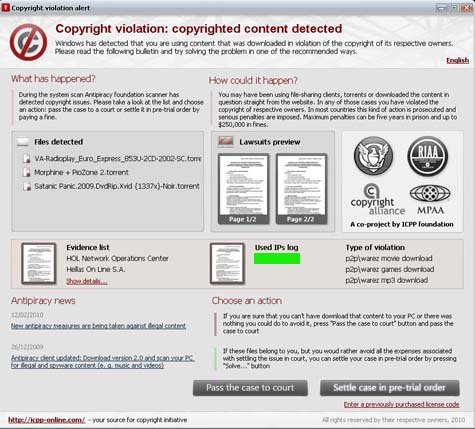

(via Boing Boing, Download Squad) ¶ 0
2010/2/24
An unemployed sysadmin in Russia hacked into a video billboard and reprogrammed it to show a pornographic video, causing a traffic jam as drivers on a nearby road stopped to gape at the video and record it with their mobile phones.
The hacker, from Novorossiisk, used a server in Chechnya in an attempt to cover his tracks, though was unsuccessful; the Interior Ministry managed to track him down. (I wonder whether he'd have had more luck had he chosen a less politically fraught staging point.) He is now facing two years imprisonment; meanwhile, security rules for video billboards have been tightened.
I'm thinking something like this would make a good plot device; imagine a gang of assassins/bank robbers planting logic bombs in a few strategically placed billboards; at a preset time, they start showing porn, causing instant traffic jams and trapping their victim/blocking their pursuers. Or international jewel thieves hack video screens in an exclusive reception to show Goatse-style shock porn; as the attendees are momentarily stunned by the shock, unable to react, the bandits (dressed as waiters, naturally) act quickly, snatching the valuables and making their escape. Police have a hard time piecing together what happened afterward.
(via Boing Boing) ¶ 2
2010/2/19
Please Rob Me is a web site which aggregates Foursquare location data shared by Twitter users and presents it as "new opportunities" and announcements of users having "left home", to demonstrate the risks of sharing location data with strangers.
While Please Rob Me is a proof of concept, and not particularly useful to burglars (you'd have to map Twitter IDs to names and addresses, and also work out whether there was anybody else living at the premises), there is speculation that social web sites offer a wealth of information to burglars, from users' locations to party photos set inside homes and showing off stealable goods. Of course, these days, the dominant web site is Facebook, which, by default, hides users' posts from people outside of their friend list; however, a significant proportion of Facebook users will gladly friend people they don't actually know, undermining this common-sense measure. (Intuitively, the risk of being burgled or spammed must seem insubstantial to them next to the promise of meeting hot chicks or getting invited to cool parties.) An even larger proportion use Windows PCs which are susceptible to viruses. There is already malware which spams Facebook with phishing links; malware which harvests useful information about all of a user's contacts (real names/identifying details, addresses, links to other social sites, &c.) and uploads them to a criminal-owned server could be just as plausible.
Of course, this makes little economic sense if one imagines one team of burglars going to all this effort to identify easily reachable places likely to house unattended PlayStations or plasma screens. However, if one follows the advice of Adam Smith and introduces division of labour (a practice seen in other criminal enterprises, such as phishing gangs and Nigerian 419 scam operations), it becomes more plausible.
Imagine, if you will, a criminal business intelligence service, much like the ones serving marketers, only specialising in selling leads on potential targets to burglars. This business would have a server somewhere with lax law enforcement, algorithms for harvesting and unifying information from a range of sources (possibly supplemented by human intelligence) and a site for offering bundles of this information to prospective burglars, searchable by geographic location, likely richness of pickings (determinable from the target's employment information, credit ratings and such) and likelihood of them being out of town. The algorithms would pick through a number of public sites, such as Twitter, Foursquare and others (photo sharing sites could be useful; if someone's address is in New York and they just uploaded a fresh photo geotagged in Gran Canaria, they're probably not home), and use them to pick out the likelihood of a target matching various criteria. (The algorithms could be fairly advanced, but as we have seen from the botnet arms race, there's no shortage of ingeniously talented coders of, shall we say, above-average moral flexibility.)
Of course, the real rich pickings are in walled gardens such as Facebook, where people have a sense of security and post their real names, locations and photos; while this is not public, a criminal site could harvest it by using malware (in which case, it'd get not just the details of the owner of the infected PC, but of all their friends), rogue viral Facebook apps or by hiring humans to set up profiles and, using a specially modified browser, friend random strangers ("MAKE MONEY AT HOME SURFING THE WEB!", the recruitment ads could read). The data would go into the criminals' data centre and would come out the other end as searchable packages offered for sale ("Your search of current vacationers making $50k+ near ___ has yielded 37 results, for $100 each. How many would you like to buy?")
Given precedents both in computer crime (credit-card fraud is a big one, having both black-market web sites and highly specialised economies with divisions of labour) and social software, I would be surprised if nobody tries setting something like this up.
2010/1/18
A Russian CCTV surveillance company has allegedly stumbled along an ingenious way of reducing operating costs and boosting profits: by replacing surveillance camera feeds with prerecorded video. The alleged fraud was uncovered during a routine check of cameras in Moscow; the director of the surveillance company, who has been detained by police, denies the claims, claiming it's a setup by rivals.
2010/1/8
Much has been said about the alleged epidemic of random alcohol-fuelled violence outside Melbourne's night spots and its possible causes. Now, The Age's Fiona Scott-Norman suggests that it might be due to the boom in venues playing house music, once confined to Chapel Street, but now part of every venue aiming for the cashed-up-bogan dollar; in particular, to house music being poorly suited for facilitating social interaction:
And then there's house music. It's pretty much the ultimate "anti-romance" music. It's played loud, it's repetitive, it's not fun, it's unremarkable and unmemorable — even if you can make yourself heard over the top, it gives you nothing to talk about, and appears to be the first music ever created by humankind that bypasses the emotions. Again, fine if your aim is to dance like a maniac until 6am, or whenever you start coming down, but truly terrible if you're not on chemicals.
So the clubs are chock-full of young folk who can't talk to each other, can't touch each other, have zero opportunity for intimacy, and can only dance in their own little world and hope someone's looking at their booty. The only tools in their seriously denuded seduction kit are alcohol and shouting. So yet another night ends, they're disconnected and frustrated, back on the streets, and totally hammered. Gee, I wonder why there's so much violence.
Playing almost any other kind of music would reduce street violence. Doesn't matter if it's disco, funk, yacht rock, indie pop, Mongolian throat-singing, gypsy punk, neo-lounge or Latin, so long as it's not joyless, thumping background music.
2009/11/13
A man arrested as a suspect in a mugging case has had charges dropped against the court found an update posted to his page at the time the crime was committed; Facebook verified that the post (which read merely "where's my pancakes?") was made from an address far from where the crime was committed.
The moral of this story is: if you must commit a crime, learn some UNIX skillz beforehand and rig up a cron job to post to Facebook (or Twitter or your blog) in your absence.
2009/10/19
A word of advice: if you're a fugitive from the law, don't post your location to your Facebook page. And if you absolutely must do so, don't add any law enforcement officers to your friends.
2009/9/27
Cinematic genius and convicted child-rapist Roman Polanski has been detained in Switzerland on the grounds of his outstanding US arrest warrant for rape, when he went to the Zurich film festival to pick up a lifetime achievement award. Switzerland has an extradition treaty with the US. Anyway, it appears to be over for him; unless he manages to somehow get off this hook, he will now most probably die in a US prison.
For those feeling sorry for Mr. Polanski and hoping that this can be resolved quickly without this great man seeing the inside of a US prison, I refer you to a transcript of his victim's testimony (obviously NSFW). Be warned: it is uncomfortable reading.
Update: Zurich Film Festival Offers Award to Osama bin Laden.
In a statement released by the film festival, organizers said that they were recognizing Mr. bin Laden for his "body of work," referring to the chilling terror tapes that the al-Qaeda kingpin has released over the past ten years.Meanwhile, notes from Associated Press's reporters theorise that the Swiss authorities' sudden decision to arrest Polanski has something to do with US pressure over the UBS bank.
2009/9/16
Dispatches from the grim meathook present-day: the Calabrian mafia, which has for a long time made a lucrative sideline from the disposal of waste, has apparently muscled in on the business of nuclear waste disposal. Of course, being the Mob, they're able to offer economies honest operators cannot, by the simple expedient of packing ships with nuclear waste and blowing them up off the coasts of Italy and Greece. Up to 30 such ships may have been sunk.
2009/9/11
Bizarre crime of the day: someone in Turkey kept nine young women captive in a house for around two months after convincing them that they were on a reality TV show. While there was no TV show, lascivious images of the women were sold on the internet:
They were made to sign a contract that stipulated that they could have no contact with their families or the outside world and would have to pay a 50,000 Turkish Lira fine ($A38,243) if they left the show before two months, the agency reported.
"We were not after the money but we thought our daughter could have the chance of becoming famous if she took part in the contest," the newspaper quoted one of the women's mother as saying. The paper identified her only by her first name, Remziye. "But they have duped us all."
2009/8/20
In the US, there is a section of the population on the right who just can't stand Barack Obama or anything he supposedly stands for. The very thought of that.. man -- golDANGit! -- makes them so pig-biting mad that it cuts off the flow of oxygen to their brain cells, shutting down whatever capacities they had for critical thinking. We've already seen the results of this in things like right-wing Twitterers uncritically passing on increasingly absurd rumours about Obama's policies, and the entire "birther" movement, in which the desperate need to prove an article of faith ("Ain't no negro my President!" "Obama is ineligible to be President") leads them to build elaborate and bizarre conspiracy theories ("Obama's parents secretly went to Kenya before he was born, and paid someone to post a birth announcement in a Hawaiian newspaper just in case he ever ran for President"), buttressed by increasingly baroque structures of evasion and supposition, whilst remaining oblivious to how ridiculously implausible the whole thing looks from outside their belief system.
Of course, wherever self-induced stupidity becomes the norm, someone will be making a profit. The US health-insurance lobby, for example, are making hay out of the fact that enough people are whipped into an apoplectic rage by the fact that there's a black man in the Whitehouse that they're willing to believe anything, such as, say, that providing government-subsidised healthcare is equivalent to Nazism and that British Nobel laureate Stephen Hawking would be dead had he been British, and be motivated by it to go out and fight for their right to be bankrupted by illness. And so, once again, the turkeys march out and loudly demand their Thanksgiving.
The latest attempt at milking the enraged mob for all its worth, though, is a bit more direct: some entrepreneurs of above-average moral flexibility are offering the pig-biting mad free software that launches denial-of-service attacks against the Whitehouse web site. The software, of course, is your common-or-garden Windows malware.
The terse spam message links to a website where prospective marks are offered money for installing the dodgy "packet flinging" tool. The attackers missed a chance to make reference to a recent mass marketing campaign from the White House justifying recent healthcare reforms that some have described as spam as supposedly justifying an "aggressive response", for example.
The "DDoS Obama" spam was one theme of a larger spam run, reports email security firm Proofpoint. Other spam messages in the series offered more typical lures, such as pornography, while again pointing to the same malware download.The spam even helpfully advised the marks that their anti-virus software might identify the downloaded software as harmful.
2009/7/27
The latest craze among the yobs of Amsterdam: Smart tossing.
The so-called ‘Smart tossing’ takes place mainly during the weekend, when many youths are out for a night on the town.
Alongside most canals a low guard rail helps prevent cars from taking a dip, but the Smart car is small enough to be lifted and tossed.
(via BrownTowers) ¶ 2
2009/7/17
Apparently, all is not well in Melbourne; the World's More-Or-Less Most Livable City is reportedly in the middle of an epidemic of brutal, random violence:
Neurosurgeon Professor Andrew Kaye says: "We have a really serious problem. The viciousness of these attacks is really frightening." He sees new assault victims admitted with significant brain injuries at least twice a week and patients with less serious damage daily. But he says even the so-called less serious assaults can leave the victims with long-term and often permanent disabilities
According to Professor Kaye, the assaults are not just alcohol-related. "We see people who have been attacked with clubs, knives and screwdrivers or repeatedly kicked until they are unconscious. This is a huge issue."The increase in violence seems to be manifesting itself in a number of disparate phenomena; violent street robberies, bashings for thrills, and gangs of teenagers targetting teenage parties to crash are some of them. Nobody's clear as to why there has been an increase in violence now, but some speculate that it could have to do with changing tastes in social pharmacology:
One suggests the trend has altered from young people popping party pills and drinking water to mixing amphetamine-based drugs, which heighten aggression, with large amounts of alcohol, which limit inhibitions.See also: this Mess+Noise discussion thread, which is full of anecdotes of encounters with violence. By the sheer volume of reports, Melbourne sounds like a more dangerous place than London these days.
2009/6/5
Another chapter from Britain's war on its youth: a police officer in London, who asked to not be named, has stated that the police routinely arrest teenagers with no criminal records, just to collect their DNA, just in case they do commit a crime in the future:
The officer said: "It is part of a long term crime prevention strategy. We are often told that we have just one chance to get that DNA sample and if we miss it that might mean a rape or a murder goes unsolved in the future.
"Have we got targets for young people who have not been arrested yet? The answer is yes. But we are not just waiting outside schools to pick them up, we are acting on intelligence. If you know you have had your DNA taken and it is on a database then you will think twice about committing burglary for a living."Or you'll watch a few episodes of CSI and, when you do commit a burglary, you'll ensure to tip an ashtray from a busy pub over the premises or something.
2009/4/22
Users of criminal hacking forums have apparently been offering ridiculous sums of money for one type of low-end mobile phone. Certain Nokia 1100 handsets, manufactured in Bochum, Germany, are said to have a firmware bug which allows them to be reprogrammed to use another user's phone number, and thus intercept text messages containing bank transaction authentication codes, which is why the going price for them has gone as high as €25,000. Nokia have denied knowing of either such a flaw or of the phones for going for more than €100.
Though if criminals want a handset that can bypass GSM network security and intercept other users' messages, surely there'd be cheaper ways to go about this. Given that criminal gangs somehow managed to compromise a Chinese factory that made point-of-sale terminals and "enhance" the terminals with GSM-based card skimmers, surely it wouldn't be so hard to get one of the numerous Chinese mobile phone manufacturers to intentionally weaken security in one of their units to allow it to be used to spoof numbers, and then buying up a few boxloads of them. Bonus points for getting one that looks almost like an iPhone.
2009/3/27
European police have called off their hunt for a master criminal, a woman of Eastern European origin linked by DNA to numerous crimes from murders and carjackings to burglaries of varying levels of competence, after it was found that the DNA belonged to a worker at the factory making cotton swabs used by police forces across Europe. Oops!
(via Boing Boing) ¶ 1
2009/2/21
Rumours are abounding that last.fm, a music-based social networking website which voluntarily collects music-listening data from users, has been voluntarily handing data concerning unreleased albums to the RIAA, allowing their search-and-seizure SWAT teams to track down the criminals listening to unreleased U2 albums. Well, some anonymous tipster says that some guy who works for CBS (the Big Copyright corporation which owns last.fm) told them that this is the case, whereas last.fm and various last.fm people (including co-founder and executive Richard Jones) have emphatically denied this. (Which, of course, they could be expected to, as if this turned out to be true, the bad PR would effectively kill last.fm as it currently is (as a social networking site for those passionate about music).)
Of course, even if this isn't true, it could happen; it could be one directive from head office or bad "war on piracy" law away. As such, if you're listening to anything you could be prosecuted for the possession of, turn off your last.fm scrobbler. Or set it to a different account with the identity of the CEO of the RIAA or something. (Hypothetically speaking, of course; The Null Device does not condone identity theft, or, for that matter, listening to U2.)
I wonder how long until some hacktivist writes a bot that is fed with the track listings of unreleased recordings and, when run by a user, automatically reports to last.fm that the tracks had been listened to as an act of anonymous protest. After all, they can't raid everyone, can they; and the existence of such a bot would make the "evidence" useless for prosecution or search warrants.
2009/2/10
Paris's pioneering Vélib cycle rental scheme is under threat after it emerged that more than half of the bicycles have been stolen or destroyed, with more having been vandalised, and a few having been subjected to more surrealistic interventions:
Hung from lamp posts, dumped in the River Seine, torched and broken into pieces, maintaining the network is proving expensive. Some have turned up in eastern Europe and Africa, according to press reports.
The Velib bikes - the name is a contraction of velo (cycle) and liberte (freedom) - have also fallen victim to a craze known as "velib extreme". Various videos have appeared on YouTube showing riders taking the bikes down the steps in Montmartre, into metro stations and being tested on BMX courses.
Not all the bicycles receive rough treatment however. One velib repairman reported finding one of the bikes customised with fur covered tyres.
2009/2/9
Shepard Fairey, the street artist who created the iconic Barack Obama "Hope" poster, has been arrested in Boston for graffiti he allegedly put up many years ago, on the way to his first solo exhibition at the Institute of Contemporary Art. Break the law here, the message seems to be, and, sooner or later, the law will get you, regardless of your stature.
I wonder if he can get a Presidential pardon.
2008/12/12
A representative of Britain's Police Cental E-crime Unit has complained about how difficult their job is, and outlined what would really help: a nifty black box, as easy to use as a breathalyser, which can identify illegal activity on PCs:
McMurdie said such a tool could run on suspects' machines, identify illegal activity - such as credit card fraud or selling stolen goods online - and retrieve relevant evidence.
"For example, look at breathalysers - I am not a scientist, I could not do a chemical test on somebody when they are arrested for drink driving but I have a tool that tells me when to bring somebody in."Of course, knowing New Labour, this will probably result in legislation mandating police-accessible data-logging devices in all PCs. And the legislation will make these devices not only accessible to the police, but also to the Inland Revenue, TV Licensing, the British Phonographic Industry and local council officials. And, knowing that laws (specifically British laws dealing with privacy and data security) are drafted in a parallel universe in which security is perfect, there will be no possibility whatsoever of these devices either being defeated by the potential paedoterrorists they are meant to monitor or else hijacked by other criminals and used to massively victimise the innocent.
2008/12/7
A convicted drug dealer escaped from a prison in western Germany by climbing into a cardboard box and mailing himself out. And I thought that such things didn't happen outside of old animated cartoons.
2008/11/24
Via Bruce Sterling, some background on the rise of Somali maritime piracy, which is threatening to strangle trade through the Suez Canal (and is reaching out to the route around the Cape of Good Hope):
Some analysts write fearful tracts that the pirates have links with terrorists and extremists, that the chaos is a direct result of international neglect of Somalia, and try to link pirates to the islamist insurgency that control much of the south or the recent terrorist bombings in Somaliland. This is nonsense. The origins of Somali piracy are not found in the southern half of the country, where a “transitional government” is dueling the Union of Islamic Courts with the half-hearted assistance of the Ethiopian military. Somali piracy originates in Puntland, a self-declared autonomous region of Somalia at the horn, hailed for years by policymakers as a model of a stable Somali state.
Piracy has its origins in the organized communities of the Puntland coast. In the 1990s, a group of fisherman in settlements there banded together to prevent illegal fishing and the dumping of toxic waste off their shores. This harmless community action inspired many analysts to designate Puntland a model for Somali civil society. When some ships illegally fishing were boarded in attempts to police the region, the reward offered for the boats return was enormous—amounts that were many times the monthly income of entire villages. Piracy took off as an attempt to gain income from this type of civic policing, and slowly grew to what Kaplan called the “innocence” of piracy. It wasn’t long before the pirates became more ambitious, using the fishing boats they captured to hunt larger prey. And with the money that came in, small fishing towns were transformed into pirate havens. As responsible organizers, pirates have invested some of their profits back into the franchise, replacing barely seaworthy rafts with speedboats, AK-47s with modern arms, and GPS tracking systems to boot.
Analysts were right about Puntland’s organization, but they were wrong that Abdullahi Yusuf Ahmed, president of the transitional government and the former leader of Puntland, could spread the discipline of goverment and organization to elsewhere in Somalia. Instead, it’s become the parent of a business model that could be copied in other lawless regions of the world.
The Mind Hacks blog has a summary of a paper looking at the content of another adulterated street drug, in this case, heroin. Not surprisingly, your average wrap of street smack contains a lot of adulterants; the analysis lists random medications and pharmaceutical substances, anaesthetics, dietary supplements and chelating agents for metals, as well as other street drugs including cocaine and amphetamines.
The article also looks at the economics and business practices behind the adulteration of heroin. Obviously, taking advantage of the lack of quality control and getting more money out of less actual expensive heroin is a major consideration for the dealers, but it isn't the only one:
Interestingly, the paper also notes that professional heroin cutters are expensive, charging up to $20,000 for a kilo of heroin. This is likely due to the skill and knowledge needed to select ingredients that will have certain effects, which can be different for 'smokers', 'snorters' and 'injectors'.
Additionally, some ingredients are added purely for their psychoactive effect to give a different experience and 'brand' the dope.
(via Mind Hacks) ¶ 0
2008/11/14
The latest TV show planned for US cable network FOX has the working title of Smile, You're Under Arrest, and involves wanted criminals being tricked into elaborate fantasy scenarios, at the end of which they are arrested:
One of three set-ups just shot in Arizona features the cops luring a criminal to a movie set with the promise of making him an extra and paying him a couple hundred dollars. An elaborate film set is staged and filming begins on a faux movie. The set-up continues as the director then gets mad at the lead actor, fires him and replaces him with the law-breaking extra.
The scene escalates with the fake director introducing the mark to a supposed studio mogul and continuing to create this dream-comes-true sequence. Finally, all the participants are revealed as officers of the law, and the criminal is apprehended (before signing waivers to let the footage be used in the show).
“If it were a regular person you’d feel bad for them, but they are all wanted by the law,” Darnell says. “It’s Cops as comedy and no one’s ever tried it before.”How did FOX manage to get a police department to divert resources to such a programme? Well, the department involved is the Maricopa County Sherriff's Office, run by Sherriff Joe Arpaio, whose spectacularly harsh treatment of offenders has made him the darling of America's more brutally-minded. And now FOX, who are no strangers to brutality, are going to make him more of a star. Perhaps watching Jack Bauer torture Arabs doesn't do it any more or something.
I half-wonder whether this is part of a strategy leading up to Arpaio getting on the Republican Presidential ticket for 2012. There were rumours that FOX was going to buff Sarah Palin's image by giving her a national TV talk show, though if she looks too much like damaged goods, they could want another conservative firebrand who appeals to the culture-war conservatives.
(via Boing Boing) ¶ 1
2008/10/28
Analysis of street cocaine found in Britain has shown that your typical sample is about 10% pure, with the rest being made up, essentially, of anything white and powdery, including some rather nasty chemicals:
Much of the seized cocaine is found to have been cut with phenacetin - a pharmaceutical drug banned some years ago in Britain and most other nations for causing kidney failure and cancer.
Other drugs used for cutting or "bashing" cocaine include lignocaine (a dental painkiller), tetramisole (used for de-worming pets) and boric acid (used to kill cockroaches).Not that such revelations are likely to dampen demand for what is essentially Britain's national drug. After all, the risk of an agonising death from cancer hasn't put many people off bacon, and cocaine feeds into the celebrity-obsessed, superficially success-oriented bling culture of Blatcherite Britain; and even if people know that the £2.50 line of coke they do is unlikely to be like anything their footballer/WAG/indie-star idols touch, suspension of disbelief is a powerful thing.
The problem, of course, is that cocaine is, by definition, sold by criminals, and there is no incentive for anything remotely like fair dealing. One answer, of course, would be to legalise cocaine and regulate it as stringently as alcohol and tobacco are. As soon as that happened, coke dealers would go the way of bathtub gin merchants and the quality and reliability would go up; Waitrose would carry organic, fair-trade cocaine from day one, and for those on a budget, £3.79 would get you a line of Tesco Value coke (3% purity, but cut with thoroughly innocuous substances). Lidl would undoubtedly come to the party with a janky-looking faux-authentic store brand; "Medellin Hills", perhaps, or "Mr. Montana's"?
Of course, legalising drugs is the sort of thing only somebody with an excess of common sense would advocate, and there is no way that it would ever happen in the real world. Thankfully, there are other, more politically viable, possibilities. Given that the majority of the active ingredient in street cocaine is not actually cocaine but various tranquillisers (hence the feeling of numbness which many naïve cokeheads assume as proof of the drug's authenticity), the next logical step would be to do away with the illegal substance altogether and sell perfectly legal pseudococaine. It'd have the right colour, texture and consistency for doing a social line at a party, would function excellently as a prop for one's fantasies of celebrity glamour, and would even give one a mild buzz, though would contain nothing more dangerous (or illegal) than a few stimulants and tranquillisers, heavily diluted.
2008/10/17
The Times reports that paedophiles and terrorists are joining forces online into a unified axis of unstoppable evil.
Secret coded messages are being embedded into child pornographic images, and paedophile websites are being exploited as a secure way of passing information between terrorists.
It is not clear whether the terrorists were more interested in the material for personal gratification or were drawn to child porn networks as a secure means of sending messages. In one case fewer than a dozen images were found; in another, 40,000.And another piece, looking for a rationale for the paedoterrorist nexus:
Some paedophiles have become adept at encrypting information and burying it so deeply in the internet that no outsider can easily find it. Paedophiles then meet in cyberspace and swap notes on how to reach the images. None is likely to rush to police saying they suspect that they have spotted a terrorist loitering on their child porn website.
Another area investigators will want to explore is the similarity between the personalities of paedophiles and terrorists. “If they are going out, a lot of time is spent by going to the mosque or going off to internet cafés,” the source said.Of course, there is no way that the timing of these explosive and terrifying revelations could have anything to do with the government's plans for an "Orwellian" database of all phone calls, emails and internet communications in Britain facing opposition.
2008/10/15
It has emerged that organised crime gangs modified hundreds of credit/debit card terminals at the Chinese factory they were made at, installing a GSM module and SIM card, which was then used to send stolen credit card data to a number in Pakistan, and also receive instructions on what to target. The terminals, which were distributed across Europe, remained undetected for a long time, stealing only small numbers of details, only arousing suspicion when a security guard noticed mobile phone interference near the checkout area.
The corrupted devices are an extra three to four ounces heavier because of the additional parts they contain, and the simplest way to identify them has been to weigh them. A MasterCard International investigator said: "As recently as a month ago, there were several teams of people roaming around Europe putting the machines on scales and weighing them. It sounds kind of old school, but the only other way would be to tear them apart."
The illicit transactions took place at least two months after the information had been stolen, making it difficult for investigators to work out what had happened.
But after six months of fruitless investigation, investigators spotted an attempt at a similar fraud on a card which had only been used in one location in Britain. The chip and pin machine from the particular store was passed to MasterCard's international fraud lab in Manchester for inspection.There has been no announcement of anybody having been arrested, and the criminals got away with a tidy profit, so one can probably chalk this down as a success for the criminals, and a serious failure of security (for one, the chip-and-pin protocols governing communication between the chip on the card, the reader and the network seems to be too weak by far if they allow a card to be cloned; shouldn't the system be using some form of challenge-response security rather than handing all the information over in one go)?
2008/10/4
This is ingenious: a bank robber in Washington state made his escape after putting an ad on Craigslist for people to (unwittingly) act as decoys:
"I came across the ad that was for a prevailing wage job for $28.50 an hour," said Mike, who saw a Craigslist ad last week looking for workers for a road maintenance project in Monroe.
He said he inquired and was e-mailed back with instructions to meet near the Bank of America in Monroe at 11 a.m. Tuesday. He also was told to wear certain work clothing. "Yellow vest, safety goggles, a respirator mask… and, if possible, a blue shirt," he said.
Mike showed up along with about a dozen other men dressed like him, but there was no contractor and no road work to be done. He thought they had been stood up until he heard about the bank robbery and the suspect who wore the same attire.I wonder whether they'll catch him. Or, indeed, whether others will adapt such an idea. Perhaps we'll see a rash of robberies and heists, using spontaneous zombie flashmobs, "secret" rock concerts, Anonymous-style masked protests or other such pretexts as smokescreens.
2008/8/19
You know those cocaine-smuggling submarines operating out of South America? Well, apparently, they're run by Hezbollah. Yes, the Lebanon-based Shi'ite Islamist militant group have submarine capability, and it's all in Latin America, earning good money. For the jihad, of course.
So what's the Hezbollah connection? "I continue to be concerned about the tri-border area [between Argentina, Brazil and Paraguay]," Stavridis said. "It is, in my view, principally Hezbollah activity. There is clearly fund-raising, money laundering, drug trafficking. And, certainly a portion of the funds that are raised in that are making their way back to the Middle East."
2008/8/17
A few weeks ago, a man by the name of Clark Rockefeller entered the news, after having abducted his daughter who was visiting him in Boston. Not much was mentioned about him, except that he was not believed to be related to the famous oil family. Gradually, an increasingly bizarre story emerged. "Clark Rockefeller", it seemed, was a German man named Christian Gerhartsreiter, who left for America at the age of 17 in 1978 to seek his fortune. Along the way, he tried (unsuccessfully) to get into acting in Hollywood, before discovering that his true talent lay in fashioning new identities and stories for himself, always coming up with a new one when his inevitably grandiose and narcissistic claims (or, in one case, quite possibly murdering his landlord) compromised his current one. He became Christopher Chichester, a British aristocrat who was moving his castle to America, then Christopher Crowe, a Wall Street stockbroker, and finally Clark Rockefeller, brilliant mathematician/physicist and scion of fabulous old money; along the way, a family he was renting from in California disappeared (unidentified remains were found under their house a decade later), and later, "Christopher Crowe" tried to sell their old truck, making a hasty exit to rescue his parents who had been kidapped in South America before the police could question him. Not to mention thad he lost his stockbroking job after using the social security number of the Son of Sam serial killer on his licence application.
Anyway, Gerhartsreiter is now in custody and has been identified as such. I imagine he'll have a much harder time getting away this time.
2008/7/30
The Exclusive Brethren sect, an ultra-conservative Christian separatist group, praised as pillars of the community by the previous right-wing Australian government (with which they had some kinds of dealings), and which, incidentally, also gave the world Aleister Crowley, is facing allegations of high-level criminal activity, including kidnapping, money laundering, fraud and bribery, in Australia, New Zealand and India.
Three sisters, from India, who say they are on the run from the sect, allege they can link it to numerous crimes.
"We've got 3000 pages of evidence … and now we're going to expose this whole thing," one of the sisters told reporters in Canberra.Of course, at this stage, these are merely allegations, and may well be without substance, though it will be interesting to see what emerges in the Australian High Court.
2008/6/19
The latest technologically-enhanced form of mischief amongst Britain's teenagers: pool crashing; i.e., using Google Earth to find swimming pools, and then using social networks to organise unauthorised parties in those pools. (Then again, the story quotes the Daily Mail, the voice of the hang'-em-and-flog-'em contingent, so for all I know this may well be a beatup.)
(via gilesgoatboy) ¶ 0
2008/6/5
A Dutch cyclist group has come up with a novel way of cutting bike theft: by teaching cyclists how to steal bicycles. The lessons in lockpicking and defeating common security mechanisms serve to instill what Bruce Schneier calls a security mindset, making the cyclists more conscious of their vulnerabilities, and better able to mitigate them.
2008/5/7
The head of the San Diego branch of the Republican Party has been revealed to be none other than the founder of videogame cracking ring Fairlight, who were responsible for a large proportion of the pirated Commodore 64 games in circulation. Tony Krvaric, was born in Sweden of Croatian parents but emigrated to the US in 1992 to escape the stifling constraints of social democracy, co-founded Fairlight in 1987, going by the handle "Strider". Even back then, Krvaric was known for his right-wing politics, and included the motto "Kill a commie for Mommy" in bragging screens on cracked titles he released.
2008/4/28
Linux filesystem developer Hans Reiser has been found guilty of the first-degree murder of his wife. He is yet to be sentenced, though apparently the death penalty is not being considered.
Two teenage thugs have been sentenced to "life imprisonment" for beating a young woman to death because of her Goth attire. The two will serve a minimum of 18 and 16 years respectively, and could be out in their mid-30s. Meanwhile, violence against goths (or "grungers") is still common in Britain, especially amongst, it would seem, the less intelligent sectors of society:
On the social networking site Bebo, there's a group called grungers-should-die, which sets out its mission statement as follows: "Join this band if u think grungers / goth should die ... tell us some story about u bashing some grungers." On the comment wall, a girl has obliged: "fuckin bashed a grunger the uva day innit."
Coles says the goth community is misunderstood. "What people don't understand is that the goth community is largely a peaceful one, full of intelligent people that have often been shunned by normal society and choose to keep company with other likeminded souls. In 22 years of running clubs I've not seen one fight, or indeed any trouble."
2008/4/16
Research is showing that a compound found in cannabis has antipsychotic effects. The compound, cannabidiol, naturally occurs in cannabis, though it is perhaps no surprise that high-potency varieties of "skunk" now on the market, which have been bred for maximum THC (the psychoactive compound in cannabis, which has been linked to psychosis) have less cannabidiol than older varieties.
Which, IMHO, is an argument for legalisation and regulation of cannabis. Alcohol is regulated; relatively safe varieties are easily available, and those selling liquor with ingredients considered unsafe (from poisonous ethanol to excessive amounts of thujone) face prosecution. With cannabis-induced psychosis looming as a public health issue, perhaps a law restricting the ratio of THC to cannabidiol would ameliorate the crisis?
The other solution, and one infinitely more culturally appropriate for the Anglo-Saxon world, is the familiar zero-tolerance Reaganite war-on-drugs approach. Perhaps if we build more prisons, jail more users and dealers (and perhaps execute a few particularly bad apples for good measure to put the fear of God into potheads), and institute a regime of mass surveillance and appropriate abridgements to civil liberties to catch offenders, then maybe, just maybe, the damned horse can fly we'll eventually achieve a drug-free society.
(via Mind Hacks) ¶ 0
2008/4/4
Today's words of advice: should you ever decide to burgle a funeral parlour, it is advisable to dress the part, so that, should you be interrupted, you can blend in with the customers, unlike this guy:
Police officers arrived with the owner, and eventually found the suspect lying on a table in a glassed-in chamber used for viewings of deceased people during wakes, a local police official said from Burjassot.
"The custom here is for dead people to be dressed in suits, in nice clothes that look presentable. This guy was in everyday clothes that were wrinkled and dirty," the police official said.Also, should you have the dubious fortune to be nicknamed after a weapon of mass destruction, don't write your nickname on any items you may leave lying around.
(via Boing Boing) ¶ 0
2008/4/3
When the prices of metals rose, one started to hear of thieves electrocuting themselves on powerlines, train services being disrupted because someone nicked all the signal cables and public artworks disappearing in the middle of the night, undoubtedly destined for the scrap market. Now, in the US, the subprime crisis has caused a wave of foreclosures and evictions, and a glut of empty, mostly new houses, some of which are now worth less than their pipes and wiring. So, not surprisingly, these houses often end up being torn apart by scavengers:
"We're seeing houses sold for $100 that are distressed houses that should not be recycled," he said. Some boarded-up homes in his Slavic Village community have "No copper, only PVC" painted on the boards to stop would-be thieves.
(via Boing Boing, Reuters) ¶ 0
Apparently 2% of internet traffic now consists of denial-of-service attacks, mostly launched by botnets of hijacked Windows PCs operated remotely by organised crime. By comparison, email comprises 1 to 1.5% of internet traffic (though a majority of that is reportedly spam).
2008/3/27
The Principality of Hutt River, Australia's best-known novelty nation, has found itself in the news again, when an Iranian man facing fraud charges in Dubai claimed to be an ambassador of the province and demanded diplomatic treatment. The unnamed defendant is facing several fraud charges, some relating to the issuing of false passports:
Asked to explain why he was not on a list of foreign diplomats, he claimed his state was trying to open an embassy in Dubai and had just recently started the registration process.The Principality of Hutt River's Prince Leonard (known as Leonard Casley to the Australian Tax Office) has admitted to knowing of the man, though denied that he was a Hutt River diplomat.
In 2002, Teresa Nielsen-Hayden wrote up a taxonomy of the various forms virtually all fraud falls into, from pyramid schemes to promises of inside information to variants of classics like the "Spanish Prisoner", to the numerous "tax protest" frauds rife among the mad-as-a-rattlesnake class in the US. Anyway, amongst the illuminating commentary, there is the following insight:
A couple of days ago I finally put my finger on something I’ve been sensing but not grasping—you know, one of those itchy back-of-the-brain apprehensions that there’s a pattern here, only you can’t quite see what it is. Somehow it’s felt like literary analysis. The question is, why do these scams—inheritance cons, MLMs, tax dodges, Make Money Fast, hot stock tip swindles, et cetera—take the forms they do?
What did it was looking at my list of basic scams and observing that what they have in common is the promise of lucrative, risk-free investments. Lord knows the things exist, I thought, but nobody ever gives them away. In theory, high rates of return are the investor’s payoff for taking on higher-risk investments. Achieving that happy state of all payoff and no risk is the main reason the wealthy and powerful manipulate the system.
Oh.
These scams take the forms they do because they’re parodies—no, a better way to put it: they’re cargo-cult effigies—of the deals the ruling class cut for themselves. If you’re an insider, if you have the secret, you can have a job where you make heaps of money for very little work. You can avoid paying your taxes. You can inherit a pile of money because an ancestor of yours left a moderate fortune that’s been appreciating ever since. You can be your own boss. You can have other people working for you, who have other people working for them, who all pay you a percentage of the take.Which, when applied to get-rich-quick schemes, from scams and frauds to perfectly honest (if dumber than a sack of hammers) ideas based on visualisation, prayer, ritual or other forms of magical thinking (such as "the Secret", as found in the self-help sections of bookshops across the US), makes perfect sense. The original cargo cults consisted of Melanesian islanders who, upon witnessing American airmen arrive during World War 2 with food rations, clothing and other useful goods (whose provenance their culture had not equipped them to understand), reasoned that these goods must be boons from the gods and that, if they carried out the same rituals as the Americans (i.e., parading in handmade US Army uniforms, building makeshift runways and control towers), they would reap the same benefits. Could it not be that this magical mode of thinking is not purely the province of "primitive" cultures, but is an idiosyncracy of the human mind's irrational pattern-matching tendencies, the same tendencies that attribute misfortune to elaborate (and unfalsifiable) conspiracies over mere chance? After all, our instincts say, there must be a man behind the curtain.
Elsewhere in the article, there is the following observation about one persistent category of frauds: the ever-thriving business of telling people that they don't really need to pay taxes, and that, for a fee, they can know the secret of how to get away with not paying it (which, unsurprisingly, seldom works):
Somewhat humorously, in several cases where the IRS has gone after promoters of “Don’t File” schemes, it was determined that the promoter—while advocating not filing returns—had been filing their returns all along. This really isn’t surprising, since most of the promoters will secretly confide that they really don’t believe these theories either, but it makes them good money.
2008/3/22
Italian police are looking for a man who apparently hypnotised supermarket staff into handing over money. The thief's exploits have been captured on CCTV:
In every case, the last thing staff reportedly remember is the thief leaning over and saying: "Look into my eyes", before finding the till empty.
2008/3/8
The Seattle Stranger has an article by an independent bookseller about the battle against book thieves:
There's an underground economy of boosted books. These values are commonly understood and roundly agreed upon through word of mouth, and the values always seem to be true. Once, a scruffy, large man approached me, holding a folded-up piece of paper. "Do you have any Buck?" He paused and looked at the piece of paper. "Any books by Buckorsick?" I suspected that he meant Bukowski, but I played dumb, and asked to see the piece of paper he was holding. It was written in crisp handwriting that clearly didn't belong to him, and it read:This is pretty much the authoritative top five, the New York Times best-seller list of stolen books. Its origins still mystify me. It might have belonged to an unscrupulous used bookseller who sent the homeless out, Fagin-like, to do his bidding, or it might have been another book thief helping a semi-illiterate friend identify the valuable merchandise.
- Charles Bukowski
- Jim Thompson
- Philip K. Dick
- William S. Burroughs
- Any Graphic Novel
Most used bookstores try to avoid buying unread-looking books from the list above, but they do always sell, and so any crook who figures out how to roll a spine can turn a profit pretty easily. The list of popular books is surprisingly static, although newer artists have earned their place in the pantheon with Hunter S. Thompson and the Beats: Palahniuk, Murakami, and Danielewski have become hugely popular antisellers in the last five years. I've had hundreds of dollars of graphic novels—Sandman, Preacher, The Dark Knight Returns—lifted from right under my nose all at once. Science fiction and fantasy are high in demand, too: The coin of the realm is now, and has always been, the fiction that young white men read, and self-satisfied young white men, the kind who love to stick it to the man, are the majority of book shoplifters.
(via Boing Boing) ¶ 0
2008/2/13
A man in Stoke-on-Trent was arrested by armed police, DNA tested and thrown in a cell after a bystander mistook his MP3 player for a gun. Darren Nixon was released, but has been banned from the internet after copyright-enforcement officers found pirated MP3s on the player will now have his DNA stored on a national database for life with a record that he was arrested on suspicion of a firearms offence.
2008/2/12
As Camden Market (and the celebrity-infested Hawley Arms) burned this weekend, somebody took advantage of the commotion to paint over the famous Banksy maid up the road, leaving only a stencil saying "all the best".
2008/1/27
Details have emerged of how the Bavarian police intercept Skype calls and encrypted internet traffic. Apparently they use specially written malware, from a company named Digitask. The malware needs to be installed on the suspect's computer (which can be done in a number of ways; if they can't get a black-bag team in, they can send an email carrying the trojan. Looks like Bavaria's safe from criminals who use Windows then.
2008/1/25
A pilot for Indonesian national airline Garuda has been jailed for poisoning a human-rights activist on a flight to Amsterdam in 2004 (considerably after the end of the Suharto regime). It is believed that he acted on behalf of the Indonesian security services, though no-one from the services was actually charged.
2008/1/22
After the recent "privacy Chernobyls", in which the personal data of millions of Britons went missing, possibly ending up in the hands of criminals, Cory Doctorow argues that personal data should be regarded with the same caution as nuclear waste:
The metaphor is apt: the data collected by corporations and governmental agencies is positively radioactive in its tenacity and longevity. Nuclear accidents leave us wondering just how we're going to warn our descendants away from the resulting wasteland for the next 750,000 years while the radioisotopes decay away. Privacy meltdowns raise a similarly long-lived spectre: will the leaked HMRC data ever actually vanish?
The financial data in question came on two CDs. If you're into downloading movies, this is about the same size as the last couple of Bond movies. That's an incredibly small amount of data - my new phone holds 10 times as much. My camera (six months older than the phone) can only fit four copies of the nation's financial data.
Every gram - sorry, byte - of personal information these feckless data-packrats collect on us should be as carefully accounted for as our weapons-grade radioisotopes, because once the seals have cracked, there is no going back. Once the local sandwich shop's CCTV has been violated, once the HMRC has dumped another 25 million records, once London Underground has hiccoughup up a month's worth of travelcard data, there will be no containing it.
2008/1/6
Facebook is in the news again, with (so far) the first known instance of a Facebook application being used to install adware on users' PCs. If your friends invite you to install the "Secret Crush" application, you accept, and you are using Windows, then the application will install the Zango adware program on your PC, not to mention arm-twist you into spamming your friends with requests to add it.
If Secret Crush actually needs you to click buttons to invite your friends to add it, the criminal scumbags who designed it have missed a trick; some other applications, such as RockYou's Super Wall and related applications, are able to send messages to randomly selected individuals from a user's friend list, purporting to be that user and asking to be installed to see a message from them, without the user's intervention. (I once found in my notifications the notice that I had messaged three randomly-chosen people, whose relationships to me have nothing in common, inviting them to install Super Wall. Soon after that, Super Wall was no longer installed on my page.)
2008/1/3
Scientists have developed a vaccine against cocaine, which permanently reconfigures the immune system to attack and destroy cocaine molecules before they can reach the brain:
The developers of the new cocaine vaccine, known as 'TA-CD', are doing essentially the same thing by cleverly combining a deactivated cocaine molecule with a deactivated cholera toxin molecule. The deactivated cholera toxin is enough to trigger the immune system, which finds and adapts to the new invader.
If effective, you can see that some parents might want to vaccinate their non-addicted, perfectly healthy children, so they are 'immune' to cocaine. The difference here, is that once given, the 'immunity' may be permanent. In other words, you would make the decision that your child will never be able to experience the effects of cocaine for the rest of their life.Another option (and one with a whiff of authoritarianism about it, though perhaps not much more than the militarised, prison-filling War On Drugs) would be a compulsory mass vaccination programme, perhaps of all school-aged children. Implemented on a large enough scale, this could be the only way of killing off the cocaine cartels other than legalising the stuff (politically unpalatable) or rendering coca extinct by biological means (an ecological non-starter).
A vaccine against heroin may also be possible, though one wouldn't want to ever be in need of strong painkillers if one has had one of those.
(via Mind Hacks) ¶ 0
2007/12/20
It seems that online criminals aren't waiting for zero-day exploits to be found, but are now making their own: someone broke into the sourcecode for SquirrelMail, an open-source webmail client, and introduced a bug which allows arbitrary remote code execution. This was detected and rectified fairly quickly (mostly because the MD5s of the package were stored elsewhere), though anyone running one of the vulnerable version may want to check their server logs to make sure they're not hosting anything like this.
This is probably just the tip of the iceberg; it's not unlikely that criminals (or, for that matter, intelligence agencies) have attempted to introduce security holes into other pieces of net-facing software.
Meanwhile, Windows Vista now not only chews up your CPU cycles on behalf of the RIAA/MPAA, but also includes a random-number generator believed to contain a NSA security hole.
2007/11/15
A Scottish man was sentenced to three years' probation and placed on the sex offenders' register for having sex with a bicycle in his hostel bedroom.
Mr Stewart was caught in the act with his bicycle by cleaners in his bedroom at the Aberley House Hostel in Ayr.
"They used a master key to unlock the door and they then observed the accused wearing only a white t-shirt, naked from the waist down. "The accused was holding the bike and moving his hips back and forth as if to simulate sex."
Sheriff Colin Miller told Stewart: "In almost four decades in the law I thought I had come across every perversion known to mankind, but this is a new one on me. I have never heard of a 'cycle-sexualist'."I'm as much at a loss as anyone else at why anyone should want to have sex with a bicycle, or for that matter at how such a concept could make sense (it sounds more like a risqué take on a Flann O'Brien novel than anything else), but the charge sounds exceedingly draconian, more like a throwback to the mentality that crucified Oscar Wilde than any modern idea of justice.
Had he been buggering his bicycle in the public square and scaring the horses, I could see how it would be a "sexually aggravated breach of the peace". However, he was doing it in his room, the door of which was locked. There was no mention of the bicycle having been stolen, so presumably it was his to do as he pleased with. Had he been ritually burning it in a Viking funeral, attempting to eat it or dancing the foxtrot with it, no court of law would presumably deign to inquire into what would be seen as his private eccentricity. But as soon as sex enters the equation, it suddenly becomes a matter of public morality, and one which must be prosecuted in the interest of society.
(I wonder whether it was the use of an inanimate object in a sexual act that was the crime or the lack of a human partner. Had he been, somehow, using the bicycle as an aid to having sex with another consenting adult, would he have been prosecuted? And are all inanimate objects illegal to use for sexual gratification in Scotland, or only ones the prosecuting authorities are unable to imagine anyone in their right mind using?)
2007/10/10
WIRED has a piece on the state of audio forensics today, or how much information can be extracted from an audio recording:
None of the sharp-eared audio professionals at the Javits Convention Center caught another edit on Allen's criminal-investigation tape. Allen digitally hid that edit behind a speaker's cough, and it was only revealed with the help of some sophisticated forensic software.
Catalin Grigoras, a forensic examiner from Bucharest, told the workshop how he uses the frequency signatures of local electrical power sources to pinpoint when and where recordings were made. According to Grigoras, digital recorders that are plugged into electrical sockets capture the frequency signature of the local power supply -- a signature that varies over time.
In one case, Grigoras claims to have identified the date of a recording broadcast in Europe, but made in the Middle East, "probably in the mountains, or in a cave," he says. He didn't mention any names, but it was hard not to think of Al Qaeda.
As the US braces itself for another bitterly contested Presidential election, computer-crime experts are warning that it's only a matter of time before botnets, phishing and DOS attacks are used to nobble campaigns or disenfranchise voters:
Dirty tricks are not new. On US election day in 2002, the lines of a "get-out-the-voters" phone campaign sponsored by the New Hampshire Democratic Party were clogged by prank calls. In the 2006 election, 14000 Latino voters in Orange County, California, received letters telling them it was illegal for immigrants to vote.
Calls could even be made using a botnet. This would make tracing the perpetrator even harder, because calls wouldn't come from a central location. What's more, the number of calls that can be made is practically limitless.
Internet calls might also be made to voters to sow misinformation, says Christopher Soghoian at Indiana University in Bloomington. "Anonymous voter suppression is going to become a reality."
2007/10/9
Phrase of the day: "white lobster": cocaine dumped by traffickers and washed up on beaches, bringing fortunes for the villagers and fishermen who find it.
It also sounds like a good song title, in a 1970s-revivalist sort of vein.
2007/9/5
Things aren't going well for the Church of Scientology; now, a Belgian state prosecutor has branded the church as a "criminal organisation", and recommended that it stand trial for fraud and extortion.
2007/9/4
Security expert Peter Gutmann claims that a botnet run by organised criminals is now the most powerful supercomputer in the world. The Storm botnet is estimated to have between 1 and 10 million computers, all Windows machines infected by trojans, viruses or worms, and (assuming a typical machine to have a 2.3 - 3.3 GHz CPU and 1Gb of RAM), it easily outclasses machines such as BlueGene/L.
As Alec Muffett points out, Microsoft could now claim that the world's most powerful supercomputer is built on their technology.
2007/8/9
After publishing a best-selling crime novel detailing a gruesome torture and murder, Polish crime novelist Krystian Bala has been charged with a similar murder which happened a few years earlier, the victim having been a friend of his ex-wife:
The case was broadcast on Poland’s version of the BBC television programme Crimewatch but it produced no serious leads — only some strange e-mails sent from internet cafés in Indonesia and South Korea, describing the murder as “the perfect crime”.
The first break for the police came when they discovered that Mr Bala, a highly experienced diver, was on a diving trip to South Korea and Indonesia at the time that the e-mails were sent. Then they discovered that he had sold a mobile phone four days after the body of Dariusz J was discovered. It was the same model that the victim was known to have owned, but that police had never found.
Mr Bala offered to take a lie-detector test to prove his innocence and passed. When the transcripts were read out in court, the judge was struck by the very long pauses taken by Mr Bala before answering, a technique that may allow a suspect to mask the physical signs of lying.Of course, that doesn't mean that he did it, though it does start to look somewhat suspicious.
Meanwhile, some light has been shed on another murder mystery, the whereabouts of Lord Lucan; some people, including a retired Scotland Yard detective believe that the disgraced peer, who may have bludgeoned his family nanny to death, is living out of a car in New Zealand, with a cat and a pet possum, no less:
Neighbours say the man has an upper-class English accent and a military bearing like Lord Lucan, who was educated at Eton before serving in the Coldstream Guards.
He is said to have arrived in New Zealand about the time Lucan disappeared and is also understood to be receiving money from property he owns in Britain.
2007/7/10
A court was told that a 25-year-old Sydney woman with a history of mental illness, who stands accused of murdering her parents, tried to get medication to treat her illness, but her parents objected because their Scientologist beliefs prohibited psychiatric drugs. Unfortunately, the young woman's thetans got the better of her.
A psychiatric report tendered to Bankstown Local Court yesterday said the 25-year-old woman accused of murdering her father and sister in Revesby last Thursday had tried to get help twice last year, but her Scientologist parents had a religious objection to psychiatric intervention.
Mr Brooks went on to argue that modern psychiatry used many methods that were largely "unproven" and such psychiatric assumptions - such as chemical imbalances in the brain - simply did not exist.The Vice President of the Church of Scientology in Australia has issued a statement saying that the link between Scientology and the murder was "a bit of a red herring", and claiming defamation. Meanwhile, a
What is safe to say that, if they find a gene responsible for Scientology, its incidence in the gene pool is slightly less frequent now.
2007/6/25
A new study in the UK shows that the law-abiding majority is a myth, and more than 6 out of 10 Britons regularly commit crimes against the government, their employers or businesses. These crimes include such heinous acts as stealing stationery from work (18%), paying "cash in hand" to avoid taxation (34%), and padding out insurance claims to get more money (7%).
2007/6/15
Apparently the Mafia used a radio station in Naples to send instructions to hitmen encoded in song requests.
2007/6/13
There are a few interesting articles about cybercrime and the seamy side of the net at CIO.com: a fictionalised "CIO to the Mob" explains how online crime can pay, how online criminals use anti-forensics technology to be nigh-impossible to catch, and how the online porn and gambling industries are, as always, pushing the envelope in technological innovation and practice:
Red light sites probably aren't places CIOs normally would look to find innovative IT. But the sex and gambling industries have always been at the forefront of technological innovation. During World War II, the illegal telephone network that bookies developed was more reliable than the one the War Department used, says Harold Layer, professor emeritus at San Francisco State University. And the pornography industry has helped select technology winners and losers for ages. In the 1980s, for example, demand for adult material gave VCR makers the economies of scale they needed to make their devices affordable, says Jonathan Coopersmith, a professor of technology history at Texas A&M University.
With every program available at any moment, how will users find programs? Piper believes that search will be the killer app of IPTV. To that end, New Frontier is obsessive about metadata, watching every frame of every video it digitizes and recording as many attributes as it can. Customers can use these metadata tags to refine their searches until they find precisely what they're looking for. (For example, if you have a thing for blondes on the beach, a search on New Frontier's adult website Ten.com for "clothing-accessories-sunglasses," combined with "setting-outdoors-beach," and "physical-hair-blonde," returns two 15-minute clips, the fourth scene from Lock, Stock and Two Smoking Bimbos 2 and the first scene from Pick Up Lines 82.)
2007/6/12
Was US President Bush's watch stolen in Albania, while he was wearing it and surrounded by five bodyguards? The US embassy is denying it, of course, but the video clearly shows Bush with and later without his watch, not to mention a hand grabbing his wrist in the interim.
By the look of it, someone in Albania is going to have a hell of a story to tell his grandchildren; that is, assuming he doesn't die in a CIA black prison or something.
2007/6/6
The Sussex Police are deploying extra officers in Brighton on nights where there is a full moon after the force's research showed a correlation between full moons and the frequency of violent incidents. No corresponding increase in lycanthropy has been reported, though an increase in violence has been found to occur on paydays (presumably because of people drinking portions of their paycheques).
2007/4/27
If the UK free tabloids are to be believed, up to 2,000 people in Japan have been sold lambs and told that they were poodles (which are both extremely fashionable and rare in Japan):
Entire flocks of lambs were shipped over from the UK and Australia to Japan by an internet company and marketed as the latest 'must have' accessory. But the scam was only spotted after a leading Japanese actress said her 'poodle' didn't bark and refused to eat dog food.
2007/4/25
Computer criminals have found a new way of distributing bank-account-stealing trojans: by scattering USB flash drives in car parks. Some percentage of the population (perhaps the same that opens email attachments) would pick up these shiny flash disks, take them home and insert them into their Windows PCs, not having disabled autorunning beforehand.
Sooner or later, the default Windows configuration will refuse to autorun content on a strange flash drive, and this won't work. Unless, of course, the criminals have special USB units manufactured containing an active processor which uses DMA to probe and interfere with the host PC's memory. They could possibly use the same facilities they use to make fake ATM front panels to manufacture them. The units could even contain an empty, perfectly innocent flash drive to deflect suspicion; after all, there's no limit to how many devices something on the end of a USB connector can appear to be.
2007/4/18
In Britain, the police are arresting people for accessing open wireless access points without permission:
The man arrested at the weekend was cautioned for dishonestly obtaining electronic communications services with intent to avoid payment.According to the authorities, accessing wireless networks without permission is, much like downloading MP3s and skipping ads on TV, theft:
"Gaining unauthorised access to someone else's network is an offence and people have to take responsibility for their actions. Some people might argue that taking a joy-ride in someone else's car is not an offence either," he said.Not only that, but leaving your access point open for strangers to use is strongly discouraged; not only is it taking away business from commercial service providers (a cardinal sin in Thatcherism-Blairism), but it is giving paedoterrorists a convenient rock to hide under:
"There have been incidences where paedophiles deliberately leave their wireless networks open so that, if caught, they can say that is wasn't them that used the network for illegal purposes," said NetSurity's Mr Cracknell.
Such a defence would hold little water as the person installing the network, be they a home user or a business, has ultimate responsibility for any criminal activity that takes place on that network, whether it be launching a hack attack or downloading illegal pornography.I wonder whether that would hold up in court; could someone be successfully prosecuted for a crime committed by a stranger using their unsecured network? Perhaps a new crime of "facilitating evasion of surveillance" would be appropriate?
The BBC article provides the following helpful advice to anyone with a wireless access point wishing to avoid ending up on the Sex Offenders' Register:
There are many different types of security options available - but the most basic is to give the network a Wireless Encryption Protocol (WEP) key.
While not totally secure, WEP keys do at least provide a modicum of security to thwart all but the most technically-literate hackers.Well, them and any script kiddie who can download a WEP cracking program and run it for a few minutes.
2007/2/15
This year in India, anti-Valentine's Day demonstrators (mostly from the Hindu religious right) have adopted the tactic of forcibly marrying couples found celebrating Valentine's Day:
A 'rath' (decorated vehicle) prepared by the protesters, mainly activists of the Dharam Sena, for "forcibly marrying couples found celebrating Valentine's Day" was seized in Jabalpur, Additional Superintendent of Police Manohar Verma told PTI.It is not clear whether any such forced marriages have actually taken place, or whether, in fact, they would be legally binding.
(via Boing Boing) ¶ 0
2007/2/7
A US astronaut has been charged with trying to kidnap a woman she thought was a romantic rival for the affections of a space shuttle pilot.
Police said Capt Nowak drove 1,000 miles (1,600km) from her home in Houston to Orlando International Airport, wearing a nappy to avoid a toilet break.
Ms Shipman was then attacked with the pepper spray, it says. She drove to a car park booth and police were called.It is believed to be the first time an astronaut has been charged with a crime.
2006/12/28
While London's transport system shut down for Christmas, gangs of graffitiists made their way into the tunnels and spray-painted Camden Town tube station. Unfortunately, we're not talking about Banksy-esque acts of carefully measured artistic subversion here, but just tagging and covering as much space with big ugly letters as possible. (Bonus points for obliterating information boards; those commuters unable to see where their train is going from will be deeply aware that they are your bitch and You Da Man. Wanker.) Anyway, there are pictures here and here).
Meanwhile, someone else stole into Brixton tube station and did their own bit of redecorating; they seem to have been somewhat less destructive and more concerned with actual aesthetics, rather than just pissing all over everything; photos here and here.
(via london-underground) ¶ 0
2006/12/25
In North Pole, Alaska, it is Christmas every day. The decorations never come down, the streetlights are painted like candy canes, and even the McDonalds is Christmas-themed. Meanwhile, the town's new mayor wants to extend the Christmas theme, having shop workers wear elf costumes. Good cheer is a civic duty, and for some reason, not everybody's happy with that.
Recently, a group of high-school children was arrested after planning a Columbine-style high-school massacre:
Earl says the goths were non-Christmassy outcast loners, bullied by the jocks, their intended victims. Iwas a bullied goth at school and so I understand the impulse to want to kill bullies. But there's a big difference between them and me. There were 15 of them. Six ringleaders and nine others who knew about it and were to play subsidiary roles. A gang of 15 can hardly call themselves bullied loners.Fifteen is a huge number in a town of 1,600. It's 25% of the school's 13-year-olds. And they were going to kill dozens of their classmates. This sounds to me like civil war, the non-Christmassy kids against the Christmassy ones.The kids were all (a) identified as "goths" (apparently the goths in American Red States are a lot more violent and nihilistic than the ones elsewhere; the Mordorian Orcs of the goth world?), and (b) 13, which means that they would have recently done their first stint of letter-writing-elf duty, replying to some of the letters sent by children around the world to "Santa, North Pole". Some speculate that the shock of discovering that there is no Santa Claus, combined with the avalanche of human misery in the letters, may have pushed some of them to breaking point:
She explains: the town keeps the practice a secret from the younger children. They have no idea that they'll one day - at the age of 11 or 12 - be obliged to become letter-writing elves. She says it can be quite a shock. Jessie says it isn't as bad as it could be. They do have rules: "If someone writes something like, 'Dear Santa, my mom has cancer. Can you make it go away?' we don't deal with those. We give them back to the teacher." But still, she says, it's a disappointment.
"you'll probably see it in their faces. They prepare you for a few weeks before, but there's always that one person who's like, 'Wait. What are we doing?' And that's the person you should be looking out for. The person who wasn't paying attention in class until the letters are right in front of them. And then they're shattered. It's a weird experience."
2006/12/12
After Italy saw a spate of gruesome murders carried out by self-professed Satanists (who, apparently, indulge in "a lethal blend of black magic, hard drugs, sex and heavy metal"), the Italian police are planning to set up a "Satan squad". The special task force will include psychologists and a priest and will investigate "potentially dangerous religious movements". Some are concerned, though, that such a squad would become a hammer of Catholic majoritarianism and persecute harmless minority religions.
2006/11/21
The invisible hand of the free market shows its ingenuity: as improvements in radar systems make it harder to smuggle cocaine by air, the Narcolombian cartels (which, it must be said, are short neither of resources nor motivation) have been turning to submarines to make sure that their finest produce gets to the boardrooms, clubs and recording studios of the affluent world.
(via Boing Boing) ¶ 0
2006/11/17
Security researchers dissect a Russian spam botnet; it turns out that these things are getting alarmingly sophisticated:
Once a Windows machine is infected, it becomes a peer in a peer-to-peer botnet controlled by a central server. If the control server is disabled by botnet hunters, the spammer simply has to control a single peer to retain control of all the bots and send instructions on the location of a new control server.
Stewart said about 20 small investment and financial news sites have been breached for the express purpose of downloading user databases with e-mail addresses matched to names and other site registration data. On the bot herder's control server, Stewart found a MySQL database dump of e-mail addresses associated with an online shop. "They're breaking into sites that are somewhat related to the stock market and stealing e-mail address from those databases. The thinking is, if they get an e-mail address for someone reading stock market and investment news, that's a perfect target for these penny stock scams," Stewart said in an interview with eWEEK.
The SpamThru spammer also controls lists of millions of e-mail addresses harvested from the hard drives of computers already in the botnet. "This gives the spammer the ability to reach individuals who have never published their e-mail address online or given it to anyone other than personal contacts," Stewart explained.
Stewart discovered that the image files in the templates are modified with every e-mail message sent, allowing the spammer to change the width and height. The image-based spam also includes random pixels at the bottom, specifically to defeat anti-spam technologies that reject mail based on a static image.The botnet is theoretically capable of sending a billion emails each day, with each having multiple recipients. And the total volume of spam has increased by 500% in the past 3 months.
2006/11/14
Italy's usually efficient railways have been experiencing increased delays due to soaring copper prices, which have inspired thieves to steal signalling cables for sale as scrap:
Police say they have arrested 22 people in the past month alone on charges of stealing copper wire. Many of the accused have been identified as Romanian immigrants.
In Naples, police recently seized dozens of sea containers filled with stolen copper coils parked in the port area ready for shipment to China.Similar thefts have hit the Channel Tunnel Rail Link project in London, and theft of copper cables was responsible for at least one fatal crash in China. Which makes one wonder whether the plague of "signal failures" on the Tube (such as the one that crippled the Victoria Line this morning) has anything to do with this.
2006/10/11
Hans Reiser, the author of the eponymous Linux filesystem, has been arrested on suspicion of murdering his wife, who went missing more than a month ago. More sordid background details here. Meanwhile, the Slashdot peanut gallery has been busy; in between impassioned debates on the death penalty, sincere hopes that this does not disrupt a fine project (now that would be a tragedy!) and discussions on whether ReiserFS will be renamed if he is found guilty, there have been a lot of off-colour jokes:
What's the difference between O.J. and Hans Reiser?
Hans kept a journal.
If the transaction doesn't commit, you must acquit!Not to mention the following observations:
This isn't meant to be funny or insensitive ... but if he did do it and is found guilty it seems like he'll have a bunch of time on his hand. You know, with the long jail sentence and all. Is their a reason why he can't continue working on this project from jail? Also, working on a OSS with your free time in jail seems like it might get you some good behavior points.Glad to see someone's got their priorities straight...
2006/9/6
Investigations into the kidnapping of a 10-year-old Austrian girl who was kept in a hidden cell underneath a house have been complicated by the fact that the kidnapper stored all his files using a Commodore 64, which computer forensics teams are ill-equipped to deal with:
The beige-coloured machine was popular in the 1980s but is now considered an antique, though some electronic dance acts still use it and it has a cult following among some fans of retro computers.
There are emulators available which can make a modern PC capable of running Commodore 64 programmes but Maj Gen Lang said it would be difficult to transmit the data from Priklopil's machine to a modern computer "without loss".
2006/8/23
Laptop thieves in Malaysia have apparently developed a device that can detect and locate laptops, even when they are switched off. Details of the device are unclear, but it appears to be something more sophisticated than looking for Bluetooth devices within range.
Some speculate that it involves homing in on telltale radio-frequency emissions from the laptop's real-time clock and/or battery-management circuits, which are always on. If this is possible and within reach of ordinary criminals (who, after all, can assemble sophisticated ATM card skimmers), expect an epidemic of targeted laptop theft across the world, followed by a boom in the sales of Faraday-cage laptop bags.
2006/8/15
A Canadian "Ethical Hacker" has some tips on protecting oneself from PIN fraud:
When you visit an ATM, always type in a bad personal identification number (PIN) first. Doing so will ensure PIN validation and that the machine is really hooked up to the banking service.
2006/7/26

2006/7/20
The latest UK crime figures have revealed an alarming jump in muggings and street robberies, which is blamed on the fact that people carry valuable devices such as iPods and mobile phones. Gangs are reportedly making a brisk trade of "steaming" full Tube carriages of unarmed commuters and relieving them of their valuables. The increase was the most dramatic in London, which, if the press is to be believed, is on the brink of becoming the Johannesburg of the north. Perhaps we will soon see the Home Office and/or the Mayor of London promoting "urban safety" T-shirts reading "NO PHONE NO iPOD", to allow Londoners to keep safe?
2006/7/16
The latest youth subcultural menace, now that moral panics about goths and hoodies are passé: juggalos, who are essentially rap-metal mooks, only with clown make-up. Unlike your standard mooks, though, they actually have chapters and organisations, giving some structure to their hormonal rebellion. And now, apparently, they're getting into armed robbery:
The group, who said they were "juggalos," devotees of the Detroit-based rap-metal group Insane Clown Posse, attacked and robbed visitors to Fort Steilacoom Park while shouting "Woo, woo, juggalo!" to each other, according to court documents.
According to police reports, some members of the gang wore black hooded sweatshirts or clown make-up and told victims they would "cut their heads off" with machetes. They stole cash, wallets and cell phones, the reports said.
2006/6/29
In London, there are official notices everywhere from local councils and the Home Office warning the reader to beware of the criminality of their fellow man:
Momus, who is currently visiting London, has not failed to notice this (and, indeed, being an Emotional Communist, he sees it as evidence of the vicious winner-takes-all culture of Thatcherite-Blairite Britain):
It seemed to chime with the odd attitude expressed in an article I read in a British newspaper about an elderly couple who'd been murdered by robbers in their home. While everybody interviewed said what a sweet old pair they'd been, walking into town arm in arm, they were unanimous: these were people you'd almost expect to get robbed and killed, considering what an affluent area they lived in and how old and sweetly defenseless they were. It was almost some sort of Darwinian inevitability that such folks would get chopped up.Momus picks up on the slogan "leave it on show, expect it to go", and suggests some additional rhyming slogans warning people of the ubiquitous danger around them, whilst at the same time making it clear that they have only themselves to blame if they're insufficiently paranoid:
Walk visibly breasted, get quickly molested.And in the comments, others make their contributions:
Say something clever, get ready for bovver.
You died having sex? What did you expect?
Come to Berlin, you won't get done in!
peace, love and understanding? we're going to a hangin'Though not all take as gloomy a view of contemporary British life as Momus does. His old foil, Rhodri Marsden, has a different take:
get paid to make art??? we'll just buy it at wal-mart.
take the ipod for a jog, get murdered like a dog.
If you're not waving a flag, they'll call you a fag.
Get on the bus - you'll have no fuss!
Pop out for a beer, for fun and good cheer!
Let's all have a lark at Finsbury Park!
2006/5/3
Over the past few years, a number of factors (increasingly miniaturised chipsets, cheap Chinese manufacturing, and the purchasing power of gigantic retailers like Tesco and Wal-Mart) has resulted in household electronic goods like DVD players becoming ridiculously cheap. The effect of this has been a steep fall in burglaries, as criminals realise that knocking over houses is no longer worth the bother:
"The falling value of electrical goods means housebreaking no longer makes sense. Even the simplest of criminal minds will carry out a risk-benefit analysis,"
He said: "There's no doubt the falling value of electrical goods has made housebreaking a less attractive crime. You can buy a new DVD player in Asda for about 20 quid, so there is no longer the same market for stolen goods.
Dr Cook added: "If you really want very cheap second-hand goods, they can be bought at money lender or cash-back places and are definitely not stolen. Second-hand stolen goods can't compete with that."The other side of the rise of miniaturisation and integration is that, with people carrying more valuable high-tech gadgets on their persons, street mugging has become a lot more profitable, and consequently increased.
(via  reddragdiva) ¶ 0
2006/3/10
The latest tactic used by ATM card fraudsters in Denmark is to break into shops, pretending to ransack them, and surreptitiously install wireless card skimmers inside payment terminals.
2006/1/17
A burglar was caught in the suburbs of Melbourne after it turned out that the house he had just fled from belonged to a well-known cartoonist. Bill "Weg" Green had seen the burglar and was able to draw an accurate, if perhaps unflattering, caricature of him which proved to the police that they had the right man:
"After we had a look at this gentleman in the back of the divvy van, we just couldn't believe how much of a likeness it was to the picture that Weg had drawn," Senior Constable Roche said. "If anyone ever says 'can I draw the offender', I'll be handing them a pencil pretty quickly."
Mr Green said he did not expect police to catch the thief so quickly but that his ability to remember faces in detail helped. "I have an affinity for faces and I can remember faces even hours after," he said.
After three decades, veteran American fringe publisher Loompanics is closing down, and is liquidating its entire catalogue at half price. Their works include from conspiratological alternative history, anarchism, atheism, Satanism, extremism, visionary/crackpot ideas, drug literature, criminal how-tos (for educational purposes only, of course), various 1960s-vintage utopianisms, and a lot of freaky shit; well-known titles published by Loompanics include the Principia Discordia and How To Disappear Completely.
(via substitute) ¶ 0
2005/12/7
The latest advance in Windows worms is a worm which takes over people's instant-messaging accounts and chats to their friends, attempting to talk them into downloading it; in short, an automated form of social engineering:
According to IMlogic, the worm, dubbed IM.Myspace04.AIM, has arrived in instant messages that state: "lol thats cool" and included a URL to a malicious file "clarissa17.pif." When unsuspecting users have responded, perhaps asking if the attachment contained a virus, the worm has replied: "lol no its not its a virus", IMlogic said.Which suggests that the Turing test may be easier to pass in an environment where people start messages with "lol". If your friends suddenly turn into giggling prepubescents and start trying to convince you to download a file, you know what's happening.
I wonder whether this will lead to an arms race in worm conversational abilities. Perhaps the next one will trawl message logs and pick out phrases/words used by that contact (or use them to change its own writing style)?
2005/11/30
An inventor in Wales has invented a teenager repellant. It's a device that emits an annoying noise at a frequency only youths can hear; the youths then scatter, leaving the oldies in peace.
The device, called the Mosquito ("It's small and annoying," Mr. Stapleton said), emits a high-frequency pulsing sound that, he says, can be heard by most people younger than 20 and almost no one older than 30. The sound is designed to so irritate young people that after several minutes, they cannot stand it and go away.
At first, members of the usual crowd tried to gather as normal, repeatedly going inside the store with their fingers in their ears and "begging me to turn it off," Mr. Gough said. But he held firm and neatly avoided possible aggressive confrontations: "I told them it was to keep birds away because of the bird flu epidemic."The problem is that it's only most, not all, people over 30 who are immune to its effects.
Andrew King, a professor of neurophysiology at Oxford University, said in an e-mail interview that while the ability to hear high frequencies deteriorates with age, the change happens so gradually that many non-teenagers might well hear the Mosquito's noise. "Unless the store owners wish to sell their goods only to senior citizens," he wrote, "I doubt that this would work."The article describes other devices for keeping the young and disorderly at bay, including "zit lamps", which cast a blue light that accentuates acne, and the old standby, classical music.
2005/11/28
A hoaxer in the US Midwest has reprised the Milgram obedience experiments by calling fast-food restaurants posing as a police officer and instructing managers to strip-search employees, subjecting them to bizarre and degrading ordeals. The managers in question, being selected for unthinking obedience, never realised that anything was wrong, accepting "Officer Scott"'s authoritative tone of voice, stated reasons and the sounds of police radios in the background as sufficient reason to start obeying, and the fact that they were already obeying as sufficient reason to keep doing so, up to committing rape.
On May 29, 2002, a girl celebrating her 18th birthday -- in her first hour of her first day on the job at the McDonald's in Roosevelt, Iowa -- was forced to strip, jog naked and assume a series of embarrassing poses, all at the direction of a caller on the phone, according to court and news accounts.
He had mastered the police officer's calm but authoritative demeanor. He sprinkled law-enforcement jargon into every conversation. And he did his homework. He researched the names of regional managers and local police officers in advance, and mentioned them by name to bolster his credibility. He called some restaurants in advance, somehow getting names and descriptions of victims so he could accurately describe them later.
In her book, "Making Fast Food: From the Frying Pan into the Fryer," Canadian sociologist Ester Reiter concludes that the most prized trait in fast-food workers is obedience. "The assembly-line process very deliberately tries to take away any thought or discretion from workers," said Reiter, who teaches at Toronto's York University and who spent 10 months working at a Burger King as part of her research. "They are appendages to the machine."Several people who followed orders were jailed for rape and related crimes. The hoaxer was later found to be a 38-year-old prison guard with a fantasy of being a police officer. Meanwhile, one of the victims is suing McDonalds for allowing this to happen; McDonalds, meanwhile, blames her for not reading the employee manual where it said that strip searches were prohibited and not recognising that the caller wasn't a real police officer.
(via bOING bOING) ¶ 0
2005/11/10
Ironic juxtaposition of the day:
On one side of a bus shelter in west London, the following iPod ad:
...and, on the obverse, the following message from the Home Office, warning iPod owners to avoid flaunting their white earphones as they attract muggers:

2005/11/4
A 16-year-old Japanese girl has been arrested for poisoning her mother and keeping a blog about it, recording the results. The girl, a member of an elite high-school chemistry club, was apparently emulating British teenage poisoner Graham Young, subject of the cult film The Young Poisoner's Handbook, up to using thallium as her poison of choice:
"Mother has been sick since yesterday, having a rash all over her body," the Asahi Shimbun newspaper quoted the girl as writing on August 19 on the online journal, which was kept under a male name.
Another daily newspaper, the Mainichi Shimbun, reported the blog said on September 12: "Mother is sick today, too. She had been complaining her legs have been out of it for two or three days and she has finally become almost unable to move."The girl also is reported to have kept severed animal body parts in her room. (Which seems to contradict Momus' assertion that the Japanese don't get goth because theirs is not a Judaeo-Christian culture, but I digress.)
2005/11/1
Another reason to avoid "Copy Controlled"/"Copy Protected" CDs: some of them (at least the ones from Sony BMG) install rootkits on your Windows PC; ones which, if an attempt is made to remove them, disable your CD-ROM drive. Someone at Sony BMG should go to jail for this, though probably won't.
(via substitute) ¶ 0
2005/10/26
The BBC looks inside the world of pirate radio stations:
"These stations don't just play music - they keep communities informed as to what's going on," says Lynx who now appears on Newstyle, a station with a community licence. "Pirate radio is not just about this protest, it gives platforms to local talent, helps create local events and communicates what is going on. They're not doing anything different to legal stations."
"We know that station owners charge DJs for slots on their stations and some are turning over more than £5,000 in untaxed income a week. Many raids on pirate stations have uncovered links to drugs," says a spokesman for Ofcom. "We've had pirate stations playing a particular song as code to local gangs, telling them drugs are available for collection."
But many pirate stations build an audience on strident views. One south London station is notorious for its presenters' uncharitable views of white people; rather ironically, its signal very often cuts across that fortress of Middle England, BBC Radio Four.
2005/10/12
An ingenious con artist managed to persuade French banks to hand over €5m, by pretending to be a secret service agent fighting against terrorist money laundering:
Gilbert then demanded all the cash at the bank so he could mark the notes with microchips and keep track of the terrorist. A total of €358,000 was to be put in an briefcase and slipped under the door of a brasserie lavatory. The manager did as she was told. The money disappeared.
Gilbert's next fraud was even more audacious, police say. He acquired information about important financial transactions and telephoned France's biggest banks. Again posing as a DGSE agent, he said that some of the transactions were terrorist money-laundering operations and that the secret services needed to follow the money. But they could do so only if it were transferred to accounts abroad, he said.Meanwhile in Moldova, a conman is hypnotising bank clerks into handing over cash:
One victim told police that Kozak's technique was to start a friendly conversation, establish eye contact, and then put her in a hypnotic state. The teller then agreed to hand over all the cash in her till.
2005/10/6
An interview with James Freedman, an illusionist and white-hat pickpocket who was employed as a consultant for the film Oliver Twist:
Freedman gives me his jacket to put on. In the inside pockets are two wallets and two pens. Keeping eye contact, he asks what I have in my jeans pockets. I show him some keys and replace them. During those few seconds, he nicks the wallets and pens. As I'm reacting to this first loss, he manages to extract the keys out of my backpocket. I don't see a thing.
It's embarrassing. I knew what he was going to do and yet he still managed to fleece me. I don't even have the excuse of a natural distraction, which, Freedman says, is what pickpockets look out for. "At Westminster Tube station," he says, "the first thing people do when they come out is look at Big Ben." And, of course, thieves love the posters in the Tube that warn people to safeguard their belongings "because people show you where their things are when they pat them."
2005/9/28
A new study has shown that, far from being essential to a healthy society, widespread religious belief is socially corrosive, and correlates strongly with a range of social ills, from violent crime to sexually-transmitted diseases:
Published in the Journal of Religion and Society, a US academic journal, it says: "Many Americans agree that their churchgoing nation is an exceptional, God-blessed, shining city on the hill that stands as an impressive example for an increasingly sceptical world.
"In general, higher rates of belief in and worship of a creator correlate with higher rates of homicide, juvenile and early adult mortality, STD infection rates, teen pregnancy and abortion in the prosperous democracies. The United States is almost always the most dysfunctional of the developing democracies, sometimes spectacularly so."In contrast, the relatively secular UK has fewer social ills, and Scandinavia (which has national churches which most people see the insides of about twice in their lives), Japan and the Godless cheese-eating surrender monkeys have been the most successful in reducing murder and early mortality rates, sexually-transmitted diseases and abortion.
The report seems to be mainly about religiosity in the US, where evolution is seen as a litmus test of theological correctness, which causes it to read somewhat strangely elsewhere. (The phrase "pro-evolution democracy" sounds a bit like "heliocentric-astronomy democracy" or something.)
"The non-religious, pro-evolution democracies contradict the dictum that a society cannot enjoy good conditions unless most citizens ardently believe in a moral creator," he says.Advocates of strong religious values are unlikely to be convinced by this report, especially if they reject the scientific method as Godless.
2005/8/21
A shop in Manchester is reporting a surge in business after a young gentleman in hooded jacket broke in and stole a laptop. The thief seemingly failed to notice the significance of the shop's name being "CCTV Surveillance Solutions", and was caught on no fewer than eight separate cameras; shop owners and police are confident of an imminent arrest.
Store owner David Arathoon said people saw his clear CCTV images in the press and wanted that for themselves. "He's given us publicity that we could never have dreamed of," he said.
2005/8/8
A look at the growing crime of cash machine fraud involving card-skimming devices:
Since it began five years ago, cash machine fraud has swiftly increased in sophistication, staying one step ahead of the banks' attempts to control it. In a recent case in Whitley Bay, Tyneside, fraudsters jammed other cash machines in the area so that customers were forced to use a cloned Nationwide machine.
The criminal gangs behind such a sophisticated scam sometimes make elementary mistakes. Police in Southend are searching for three men and a woman of "Eastern European" appearance who forgot to wipe the digital memory card before putting it in a camera inside a fake fascia.
The pictures showed them posing with waxworks at Madame Tussauds. A spokesman for Essex Police said: "We don't know who these people are but we have ruled out Gary Lineker, John Travolta and Nicolas Cage from our inquiries."
2005/7/26
Russia's biggest spammer found battered to death in his Moscow apartment. Insert repurposed jokes about disliked professions here.
2005/6/15
Tory-affiliated British magazine The Spectator has a rather arch write-up of the Schapelle Corby spectacle and reaction to it in Australia: (registration required)
It's the ultimate reality TV show. Corby, who seems to be the only bule (foreigner) in Bali who doesn't sweat, has adapted well to her starring role. In jail she has slimmed down from a plumpish and brassy suburban shrill to a demure girl-next-door. Last week she added an elegant and much-fingered necklace crucifix to her outfit. The news execs love it, but their concern for Corby contrasts with their apparent indifference to the plight of the dozen or so other Australians -- Asian Australians -- held elsewhere in the region and either charged with or convicted of drug-smuggling.
Australians fancy they see something of the Gallipoli spirit in Corby. She has been cast as a humble "Aussie battler" abandoned by her government and struggling in vain to overcome an insurmountable foreign adversary. The enemy is not "Johnny Turk" this time but the "brutal" Indonesian legal system which has the nerve to conduct its affairs in Bahasa Indonesia, not Australian English. As Corby fans see it, the bases were clearly all loaded against their girl, the sinister outcome predetermined in Indonesia's murky shadows.
Though could one think of a better folk hero for a nation which prides itself on its larrikinism, whose unofficial national anthem is a song about a sheep thief, and where an armed robber has been transformed into everything from Robin Hood to the spiritual father of the Australian Labor Party and/or the Republican movement? Especially in the age of reality-TV, where photogenic looks and image management count for a lot.
At the end, the article ties in the spectacle to the latte-sipping-cosmopolitan-elite-vs.-silent-majority-of-suburban-battlers culture-war dialectic:
The demographer Bernard Salt says the Corby matter explodes what has always been the myth of Australian egalitarianism. Salt has previously noted, controversially, that Australia, like most countries, has an educated minority, a cultural and cosmopolitan elite that directs its politics, its economy, its popular culture, with the majority functionong as essentially its market. He says that Australia's cosmopolitans account for at most one million of the nation's 20 million people.
But the elite aren't calling the shots on this one. There has been talk of a "redneck coup". And the circus shows no signs of packing up. A new lawyer has just been appointed to handle Our Schapelle's appeal. I met him last week, and he did not disappoint me. His name is Paris Hutapea, and he carries two sidearms (a Beretta and a Walther), sports shiny blue suits and an impressive mullet, and drives to work in a Humvee. His fingers drip with opal and diamond rings. He and big sister Mercedes should hit it off.
Meanwhile, Bruce Schneier writes about the anthrax scare at the Indonesian embassy, revealing that, since 9/11. there has been a white-powder scare in Australia on average every four days (most of which have been kept out of the news by the Australian press's (voluntary) D-notice regime).
2005/6/8
For your daily dose of socially-approvable schadenfreude: bait car videos; video/sound recordings from specially wired "bait cars" left by Canadian police to trap car thieves. Watch the perps squeal like bitches over the movie-hip soundtrack coming from the stereo. (Which makes one wonder whether the cops pre-supply the cars with Franz Ferdinand CDs.)
(via bOING bOING) ¶ 0
2005/5/27
Photogenic Australian drug smuggler convicted in Indonesia, sentenced to 20 years. This is a somewhat more lenient sentence than many were expecting; initially she was facing the death penalty, though presumably the economic pressure of a potential Australian boycott of Bali prevailed. If she wasn't a photogenic young woman with the tabloid media on her side, she'd probably be facing a firing squad (much as nine other less fortunate Australians are set to do).
Meanwhile, the government is quick to make political hay with a populist gesture of donating two QCs to work on her appeal, paid for by your taxes, and working on a prisoner-transfer agreement to save her the indignity of a barbaric Indonesian jail (expect the Schapelle Corby Act 2005 to show up in Hansard soon); you'd think there was an election coming up or something. An much wailing and gnashing of teeth ensues online:
"I am devestated with the verdict of the Indonesian Courts for Schapelle Corby. When the verdict was given, I fell into a bit of a heap, but Schapelles strength made me gain my composure pretty quickly.
"strength"? Looks like Australia has now found its Princess Di. Look for discount mobile-phone baron Ron Bakir, who owns the trademark on "Schapelle Corby", to make a mint in the commemorative-mug trade.
Some sought to tie Australia's tsunami aid to the issue. Bryan Griffin wrote: "I am sure that all people, not just Australians will also feel sick. "Maybe some of the donations made by us for the disaster should be returned to pay her fine. It's like a double wammy for Indonesia and their finances.Note the subtexts there: the life of an Australian convicted of drug trafficking is worth more than those of Indonesians affected by the tsunami. And the fact that she was convicted of drug trafficking is irrelevant, because we all know that Indonesian courts are corrupt. The fact that the "evidence" for the defence consisted of prison hearsay that no Australian court would have accepted seems to have gotten conveniently lost along the way.
And, of course, the Australian media's content-free, sensationalist beat-up hasn't helped things.
I wonder whether Indonesian restaurants across Australia are hanging up prominent "Schapelle is Innocent" signs (which, I imagine, the Herald-Sun will provide) in their windows to avoid being summarily boycotted or worse, much as Afghan restaurants proclaimed their opposition to terrorism after 9/11.
2005/5/5
More revelations have emerged about Frank Sinatra's mafia links; this time, he wasn't just doing deals with the mob to help his business interests, but actively working for them as a courier:
As he passed through customs, (Jerry) Lewis says, Sinatra was stopped by officials who started to open the suitcase he was carrying. Inside, says Lewis, were notes to the value of "three and a half million in 50s".
But the customs officers were distracted by the crowds of people trying to catch a glimpse of the singer and aborted their search.
Had they not, claims Lewis, "we would never have heard of him again".
So there's a parallel universe in which Sinatra got caught smuggling cash for the mafia and ended up embedded in concrete somewhere?
2005/5/1
Smart car tipping is the new cow tipping, with hooligans having realised that the cute little cars are really easy to tip over, and that, among certain sections of the community, there is little sympathy for the smug rich people who drive them.
Hmmm... London's full of Smarts. I wonder how long until the chavs/grime thugs graduate from "happy slapping" to Smart tipping. Perhaps we'll see an article/rant about how cool and hardcore tipping over those annoying yuppie cars is in the next issue of Vice?
(via bOING bOING) ¶ 1
2005/3/12
According to Neil Gaiman, prison companies in the US use juvenile illiteracy levels to predict how many prison cells to build:
At the Publishers' Lunch I attended last week, Joel Klein mentioned that the people who build private prisons in the US use third grade (that's about age eight for the non-Americans) illiteracy levels as their key to how many people are going to be in prison in ten, fifteen years, and how many prison cells they're going to need to build.
Thanks to Loki for digging that fact up.
2005/2/25
Today, a pregnant teenager was slashed with a meat cleaver by her boyfriend when a spontaneous axe fight broke out at Mile End tube station.
Now that is so London.
2005/1/27
A man in London was jailed for using the Lynx text-mode browser to make a donation to the tsunami relief fund. Anti-fraud monitoring interpreted the unusual browser signature (i.e., not Mozilla or IE) as the sign of a hack-attempt and the police went in in a SWAT-style raid, smashing his door down and arresting him. Which goes to show that it does not pay to use unusual software.
2005/1/26
A new study in England and Wales has revealed that one in every four boys aged 14 to 17 admits to being a serious or prolific offender, meaning either having committed six or more offences in the past year or having committed serious offences such as assault, burglary or aggravated Burberry-wearing dealing hard drugs. Then again, it could well be that some proportion of the sample exaggerated their histories to be like their gangsta-rap/east-end-geezer heroes.
2005/1/22
No, it's not some Japanese sexual fetish, but rather the latest teenage fad from England, combining the two national preoccupations of physical violence and mobile phones. Happy Slapping involves gangs of young malchicks on buses and trains slapping strangers in the face and recording their reactions on their phones.
2005/1/12
Two Dutch designers are taking on the growing menace of muggers with handbags embossed with outlines of guns; they also have ones with the shapes of knives and crucifixes (the last are presumably for use against vampires), not to mention laptop bags embossed with groceries to make them look less stealable. (Not sure how well that works; the outlines in the photos look a bit too cartoonish and unrealistic. I imagine that simple non-rectangular lumpiness, of the "I'm carrying lots of soft, non-valuable things", would probably be more effective in practice.) (via bOING bOING)
2004/12/31
From the pages of the most recent VICE Magazine: a hand-made "PowerBook", made of a grey garbage bag, some issues of the Village Voice, and a hand-painted Apple logo in White-Out; apparently fashioned by a crackhead with a PowerBook box and shrinkwrapping machine, and sold to an unsuspecting student for US$200. Perhaps junkies read Something Awful as well...
2004/11/28
The street finds its own uses for obsolete mobile phones, it seems. Football hooligans in the UK are getting around police weapon searches by throwing mobile phones instead. While knives and other traditional hooligan weapons are confiscated on entry to stadiums, football fans are allowed to bring in mobile phones, so the hooligans bring a few extra to lob at the other side. The extra phones are apparently traded around some football clubs. I wonder whether they leave them as is or hollow them out and fill them with ballast of some sort to do more damage.
Meanwhile, a man in Sweden has been arrested after firing arrows with attached mobile phones into a prison yard. Mobile phones have been used to plan three prison escapes in Sweden in recent months.
Teenaged girl has her mother murdered, posts about it to her LiveJournal (which is titled "My Crappy Life").
Just to let everyone know, my mother was murdered
I wont have computer acess (sic) until the weekend or so because the police took my computer to go through the hard drive. I thank everyone for their thoughts and e-mails, I hope to talk to you when I get my computer back.
Apparently the issue that touched off this unusually fatal bout of teen-angst had to do with Mom keeping food away from her and threatening to send her to fat camp; so she got two of her ex-boyfriends (both 24 years old) to help her out. Not surprisingly, the entry has attracted over 2,000 comments, alternating between variants of "hope you rot in hell" and "nice to see everyone here is so quick to judge", and then degenerating into goatse and such.
2004/11/14
Police in Dorsetshire are sending persistent burglars postcards of local prisons, in order to discourage them from offending. Though, if the police have evidence that the recipient is committing crimes, can't they just arrest them? If not, how long until a recipient of above-average chutzpah sues the police for harrassment?
2004/11/1
A cross-dressing Hasidic man was charged with murder after the death of a rabbi, with whom he was sharing a flat, in New York.
Goldstein was dressed in a gray blouse with a plunging neckline, dark slacks and pink high-heeled shoes, a police source said. His face was made up with bright red lipstick and blue eye shadow that clashed with his long beard, the source said.
(via tyrsalvia)
2004/10/7
Police in Hampshire have used a fake game show to arrest various offenders (mostly common neds, by the sound of it) they had been looking for. The offenders, ranging from fine-dodgers to those wanted for common assault, were sent letters inviting them to appear on a game show with the chance of winning large prizes. The police then set up the event at Portsmouth Guildhall, going to great lengths to do so, even hiring former crooked Tory MP turned celebrity Neil Hamilton and his wife to present the show: (via Found)
As the "guests" arrived they were frisked and had their identities checked by a police officer dressed in a dinner suit. After having their make-up done, the contestants waited backstage where they could hear the sound of a taped studio audience. One by one they were called on to the stage, along a red carpet, through a cloud smoke and straight into the hands of two awaiting police officers.
This event, which is already being decried by civil libertarians, will be broadcast on the UK's Channel Five (the same fearless bastion of the public's right to know that recently got David Beckham's alleged lover to masturbate a pig on air.)
2004/7/13
Radioactive materials stolen from university in suburban Melbourne. Is there any reason someone would want to steal radioactive materials other than to make a dirty bomb (or sell to someone who does)?
2004/6/25
Among recent news stories: intelligence "chatter" suggests impending al-Qaeda terrorist attack, possibly timed to coincide with the US elections (could this be the much-speculated-about October Surprise?). Meanwhile, in Israel, a group of soldiers are being investigated over an art exhibition detailing the brutalisation of Palestinians; it seems (from the report) to be more a case of them acting as whistle-blowers than Lynndie England Mk. 2. In the United Nations, the US has given up on renewing its immunity from war crimes prosecution, after realising that they weren't going to get it; however, in Iraq, they are pushing for immunity from prosecution under Iraqi law, with, of course, the full agreement of the Iraqi people. And in England and Wales, authorities are re-examining more than 100 murders which they suspect of being "honour killings"; there appears to be a sophisticated infrastructure for such killings, with "bounty hunters" making a business out of tracking down victims.
2004/6/6
What do you do when your town council rezones the block next to your muffler shop, damaging your business? Weld armour-plate onto a bulldozer and go on a rampage, flattening buildings including the town hall and homes and businesses owned by the councillors responsible for your setback. Police watched helplessly as their bullets bounced off the armour. Could this be an argument for giving police and/or concerned citizens rocket-propelled grenades?
2004/5/29
A 14-year-old boy in Manchester used internet chatrooms to arrange his own murder; masquerading as, among others, a 16-year-old girl, her step-brother, and a secret service agent named Janet, he managed to talk a 16-year-old boy he had never met into stabbing him. The other boy was told that it was an initiation into the secret services, and that the target was dying of cancer, which made him expendable; if successful, he was told he would get £500,000, a gun and a meeting with the Prime Minister. It apparently did not occur to him that there was anything unusual about this arrangement (persumably that's standard MI5 procedure for recruiting teenagers in chat rooms).
Update: more details have emerged, and it turns out that the stabbee had a hopeless crush on the boy who stabbed him, and instructed him (in secret-agent guise) to say the "codeword" "I love you, bro" as he did the deed. This is sounding more and more like a Smiths song.
2004/5/14
This just in: virus writers' people skills often leave a lot to be desired:
And in perhaps the most blatant case of ego among virus writers, the virus writer Michael Buen from the Philippines put a copy of his CV in his virus. When the virus became active on a PC, it would automatically print out the CV which contained his real name, job history and contact details and threatening to unleash further viruses unless he was given a job.
Presumably they did enough fact-checking to determine that the virus was written by Mr. Buen, and wasn't a joe-job by someone who disliked him for whatever reason.
2004/5/13
Convicted child murder accomplice Maxine Carr's new identity stolen one day before she was to be released. The documents are said to give her mobile phone, passport and social security numbers, though the British government denies that they would make it easier for her to be identified. Given the level of organisation required to obtain secret documents such as these (including the possibility of a collaborator within the civil service deliberately leaving them in an unsecured car), it's not unlikely that there is a well-organised vigilante conspiracy to ensure that the "justice" denied by the British legal system will be swift. (Don't bother checking the news for it, though; if it happens, it'll be just another anonymous murder, suicide, or accident; perhaps a drug overdose or a "mugging gone wrong" is in the works?)
(Not that an uncompromised fake identity would protect anyone who maintained contact with their friends and relatives from their former life. The names and identities of Carr's parents are known, and sufficiently driven vigilantes could watch them, in shifts if needed, and follow up on anybody matching Carr's description whom they meet with. Even if she broke off contact with them, there'd be something else to get her by. The Mossad nabbed Adolf Eichmann because he neglected to change his wedding anniversary after fleeing to Argentina, and he was an actual Nazi war criminal, and not a rank amateur.)
2004/5/12
In China, where minors are prohibited from entering internet cafes, gangs of net-starved teenagers are assaulting attendants who dare to kick them out.
(The article was published on the website of the Chinese government-controlled newspaper/agency Xinhua; the headlines at the bottom of the page are interesting; a lot of them are scathing, almost al-Qaeda-level criticism of the US in Iraq ("Images that shame US", "Iraq abuse exposes US double standards in human rights"-- ouch!), though between them is "Celine Dion cancels shows due to sprained neck". Is Celine Dion to China what David Hasselhoff was to Germany or something? She seems to be huge over there.
2004/5/9
A gang of drag queens goes on a car theft spree across the US South, stealing prestigious cars from dealerships to get to drag beauty pageants in grand style. One queen would distract the dealer with questions, while others would grab the keys from the office and make off with the most fabulous set of wheels in the place. (via Die Puny Humans)
One hapless salesman couldn't believe the beautiful woman who kept him busy was actually a man. "God, I feel so foolish," the man, who asked that his name not be used told 365Gay.com. "I mean she, he, was gorgeous. I was trying to get enough nerve to ask her for a date."
There has to be a movie in this. Though, on second thoughts, it'd probably be a gross-out Hollywood comedy, starring some MTV-generation teen-comedy/dumb-stunt-show stars and packed out with bodily-function gags.
2004/4/7
Birthday greetings ...prison-style! Or, how gang members can't resist sending their homies in lockdown birthday cards, complete with elaborately coded gang symbolism. The cards are often intercepted by prison authorities, who rely on them as a source of intelligence about inmates' gang loyalties:
On the front of the homemade greeting was a cartoon of a gangster holding a MAC-10 automatic pistol. The card was bordered in blue, the Crips' signature color. And because Crips avoid the letter "B" at all costs -- due to its association with their rival gang, the Bloods -- the card happily announced "Happy C-Day."
"That's where you get a lot of your information, from these birthday cards," said Officer Steve Preciado, a Lancaster gang investigator. "A lot of times their family members won't send them nothing. But the gangsters will put their nicknames on these cards, and where they're from, like 'Shorty from Pacoima.' So your job is to find out who Shorty is."
(via bOING bOING)
2004/3/29
A US "law enforcement and military equipment" company is selling a device for protecting valuables from thieves: pre-stained underpants with hidden pockets. The theory goes, thieves would be reluctant to probe around in a grotty, brown-stained pair of keks for long enough to find the concealed cash/passport/&c. (via Gizmodo)
Nagyrev is an unexceptional Hungarian village; it was also the site, some 90 years ago, of a conspiracy by the local women to poison their husbands:
"The women used to come to Mrs Fazekas with their problems," Mrs Gunya recalls. She said that when they complained about their drunken or violent husbands, Mrs Fazekas told them: "If there's a problem with him, I have a simple solution". That solution was arsenic, distilled by the midwife by soaking flypaper in water.
Some have claimed that the women of Nagyrev have been poisoning their husbands "since time immemorial"; meanwhile, corpses exhumed in nearby towns have been found to have contained arsenic.
And Maria Gunya points out wryly that after the poisonings the men's behaviour to their wives "improved markedly".
I suspect that the incidents of Nagyrev were the inspiration for the film Hukkle.
2004/3/10
Not only can the iPod hold your entire music collection, its sturdy metal construction makes it ideal for bludgeoning people to death too.
("A message from the RIAA: MP3 piracy kills. Any questions?")
Meanwhile, you may want to avoid Masonic initiations as well, especially if they involve handguns believed to contain blanks.
2004/3/8
A look inside the script kiddie culture, where gangs of teenagers hijack networks of machines, and launch denial-of-service attacks on each other's territory, at least partly in competition for the attention of the handful of girls in the scene, in between selling their use to whoever is willing to pay. Meanwhile, the script kiddies have access to security holes and exploits from secret "0day" mailing lists, months before security experts find and patch them; and don't expect the FBI or its local equivalents to do anything about them; the agencies reportedly don't have the resources to deal with such matters. (via Slashdot)
2004/3/4
I just found the following in my mailbox:
From: management@null.org
Subject: Email account utilization warning.
Dear user of Null.org,
Our main mailing server will be temporary unavaible for next two days, to continue receiving mail in these days you have to configure our free auto-forwarding service.
For more information see the attached file.
Have a good day,
The Null.org team http://www.null.org
Given that I own null.org (and that no address such as "management@null.org" actually exists), I must say I was a touch suspicious. And then I looked at the attachment portion of the email:
Content-Type: application/octet-stream; name="Information.pif" Content-Transfer-Encoding: base64 Content-Disposition: attachment; filename="Information.pif"
Which looks to be a Windows executable of some sort. That's undoubtedly the "free auto-forwarding service" they mentioned. I'm sure it would have done exactly as that, only with the proviso of forwarding penis-pill spam to millions of mailboxes worldwide through my machine.
That is, if I (a) used a Windows machine, and (b) was sufficiently clueless to open an attachment from somebody claiming to be in charge of the "main mailing server" on my domain.
2004/3/1
A new form of child slave trafficking has been found in Britain, with human traffickers importing children to help adults claim benefits or asylum. The children are said to be rotated between families as need be. It is not clear what happens when the children are no longer needed, though "organ harvesting" was mentioned.
2004/2/23
The Observer speaks to computer virus writers. According to this article, most of them are European teenagers, and the guys-without-girlfriends stereotype isn't strictly accurate; more to the point, most of them (if they are to be believed) write viruses just for the technical challenge and don't actually release them. (Though they do show them off, and consequently script kiddies and miscellaneous impulsive psychopaths do end up releasing them.)
The people who release the viruses are often anonymous mischief-makers, or 'script kiddies'. That's a derisive term for aspiring young hackers, usually teenagers or students, who don't yet have the skill to program computers but like to pretend they do. They download the viruses, claim to have written them themselves and then set them free in an attempt to assume the role of a fearsome digital menace. Script kiddies often have only a dim idea of how the code works and little concern for how a digital plague can rage out of control. Our modern virus epidemic is thus born of a symbiotic relationship between the people smart enough to write a virus and the people dumb enough - or malicious enough - to spread it.
In related news: German magazine c't apparently has evidence that virus writers are selling 0wned machines to spammers. In this case, "virus writers" probably means "hoodlums who hang around virus writers' forums".
2004/2/20
You may have heard of criminals attaching devices to ATMs to steal card numbers and PINs; well here are photographs of the devices used; note the card skimmer attachment moulded out of regulation data-processing-beige plastic and the PIN-recording camera mounted in the innocuous-looking leaflet holder. (via jwz)
2004/2/17
The rather eye-opening dissection of an online greeting-card spam; an email telling the user to go to a web site to see an electronic greeting card, and the website in question, which uses Internet Explorer security holes to overwrite your Windows Media Player and install a keylogger apparently programmed to look for online banking sites (and undetectable by current spyware detectors). Nasty; and another reason to not use IE (or, preferably, Windows). (via Slashdot)
2004/2/8
Good news for anyone who wants someone rubbed out: contract killings are now affordable, undoubtedly due to the in-built efficiencies of a vigorously competitive market, and now the services of a hitman can be yours (or, indeed, your psychopathic ex's) for as little as A$380. Most hits are relationship-motivated, ordered either by people wishing to murder their cheating partners, eliminate an inconvenient spouse who's lost that loving feeling in order to pursue a new relationship, or prevent an ex-partner from seeing anybody else or getting custody of children. (via the Darwin list)
2004/1/22
A crooked bookseller at a London market employed drug dealers and the homeless to steal books, which he then sold at his street stall. Another business model for you, Lev?
2004/1/16
Alternet's top ten drug war stories of 2003, from Our Appointed Sonsofbitches in Afghanistan overseeing bumper opium crops to the human and ecological costs of US-backed illegal biological warfare in Narcolombia, to the usual mistaken-identity police raids and high-level hypocrisy:
The total number of marijuana arrests far exceeded the total number of arrests for all violent crimes combined, including murder, manslaughter, forcible rape, robbery and aggravated assault. Of those charged with marijuana violations, 88 percent were charged with possession only. The remaining 12 percent were charged with "sale/manufacture," a category that includes cultivation for personal and medical use.
With America incarcerating the highest percentage of its own citizens of any nation in history, Former Reagan Attorney General Ed Meese suggests tapping prison labor as a way to slow the exodus of jobs overseas.
Well, at least when the oil runs out in the next decade, they can harness America's booming prison population and replace oil-fired generators with treadmills full of marijuana smokers, MP3 pirates and disenfranchised black voters from Florida. Call it planning ahead.
2004/1/13
A PDF document showing the "EURion constellation"; this is a constellation of five 1mm circles found on European and British banknotes, and recognised by colour photocopiers. (The piece doesn't show exactly which five circles are the constellation, though if it's there, it shouldn't be too hard to find it.) I'm not sure whether the pattern used on US banknotes (and now recognised by commercial image-processing software) is the same or different, or what other anti-copying patterns are used on other currency. Though if each country had its own, it would use a lot of CPU cycles to detect. (via jwz's comments)
2004/1/6
Brothel staff shocked by corpse found in bin. It's not quite a headless body in a topless bar, but it's in the same neighbourhood.
2004/1/2
Criminals are turning to blackmailing office employees; the criminals send mail to the employees, threatening to wipe their hard disks or install porn on their PCs unless the victims pay them a small sum. Unlike traditional e-extortion schemes, the perpetrators usually don't have to demonstrate their control of the victims' machines; among the millions of people spammed, they find one or two clueless people who accept their claims and pay the small sum demanded; which, of course, marks them out as a "sucker", and results in them being blackmailed for larger amounts.
"It's getting simpler," said Hypponen. "If you wanted to extort money from a small company you would have had to hack them and convince them you have stolen their information. Here, you don't have to do anything but send an e-mail around."
(via Techdirt)
2003/12/2
Laptop thieves have started using a new tactic: disguising themselves as employees, hanging around workplaces, often pretending to work there, and walking off with equipment. (via Rocknerd)
(When I worked at Melbourne University, in Carlton, we would often get emailed alerts of junkies from the nearby streets wandering the corridors, trying doors, and, when questioned, pretending to be students looking for a specific staff member.)
2003/11/23
A Canadian man has been arrested by police whilst driving the wrong way down a residential street. After he was stopped, the police noticed that he was naked from the waist down and operating a laptop computer. The man had been "war driving", exploiting open 802.11 access points to surreptitiously download child pornography, of which he had an encyclopaedic collection. And who knows how many other paedophiles are currently cruising the streets with laptops?
(Clearly, our lawmakers need to act immediately, ban the possession of long-range WiFi antennae, and institute an international registry of all WiFi cards, for the sake of our children. Also, the Pringles chip company must change the design of their cardboard tubes to prevent perverts from turning them into directional wireless antennae.)
2003/11/21
A hacker working for a Mafia gambling operation tells his story:
I'm building a secure, online, peer-to-peer, encrypted, redundant bet-processing system with an offshore data warehouse. Ordinary companies would hire a team to put this together; I'm working with one guy. Getting the system up and running is a three-step process. First, eliminate all those incriminating little pieces of paper. Instead of writing down a wager, the operator will enter the bet onto an online form. The whole transaction will be encrypted by a browser and sent over the Net to a server running in an undisclosed country where the laws are more liberal than they are in the US. Essentially, the system acts as a market maker, matching up people who want to take different sides of a sports bet.
The fact remains that I could be pulling in $150,000 as a programmer on the open market. But I make a third of that. So why am I risking a prison sentence or the potential of a lifetime in witness protection for a job that doesn't make me all that rich? Simple: When you start making a lot of money, you get noticed by the biggest bullies on the block - the cops and the IRS - and I don't want that. I like living below the radar. I sublet a friend's apartment and pay his utility bills with money orders that I purchase at the post office or at one of those check-cashing storefronts. Because I get paid entirely in cash, I don't fork over any taxes. When you get right down to it, I'm an idealist. I don't condone the actions of the US government. By refusing to pay taxes, I withhold my financial support. And, truth be told, I like mobsters. They're more willing to accept you at face value. They aren't hung up on college degrees, or where you live, or how many criminal convictions you have.
2003/11/13
Another resourceful criminal use of the countless thousands of virussed Windows machines on the internet: online protection rackets, where the "businessmen" (predominantly from Eastern Europe) target a high-profile website and threaten to knock them offline with a massive DDOS attack unless they pay up. Online casinos (which make a lot of money and are in poorly-policed areas) are a popular target.
Most of the computers used are broadband-connected home Windows PCs owned by clueless people, of whom there is, sadly, no shortage; and it doesn't look like the problem is going to go away, at least not until a totalitarian "trusted computing" regime is imposed on the internet at the IP level, or something equally drastic happens. Which makes me wonder whether or not Microsoft are deliberately allowing viruses to flourish on their OS as to drive people into the highly profitable embrace of Big Brother.
2003/11/6
Crackers break into Linux source code server, attempt to trojan the Linux kernel, giving root privilege to processes. The attempt was caught, and even had it not been, it wouldn't have matched against Linus' separate copy of the kernel sources.
It makes you wonder who's behind it? A teenager with something to prove? Spackers laying the groundwork for the next generation of distributed spam-hosting/sending/DDOS servers? The Russian Mafiya/Shanghai Triads/Yakuza doing a spot of long-term strategic planning? Al-Qaeda? Maybe even our own intelligence agencies?
2003/10/29
Norwegian Black Metal legend Varg "Count Grishnackh" Vikernes, almost a decade into a 21-year prison term for murder and arson, was arrested driving a stolen car. The former Burzum frontman stole the car at gunpoint whilst on day leave from his minimum-security prison, and drove towards Oslo. It is not clear what he planned to accomplish.
2003/10/26
The Russian prison system talent competition; the prize: your freedom.
In a twist on the Fame Academy format, six of Russia's prisoners competing in a national song contest for convicts last night pleased the judges enough to win pardons, the Interfax news agency reported.
The organisers hope that the contest will produce some stars and ensure they have a future when they are released. A CD and video of each prisoner's songs will be released and one singer has already had a music job offer.
Some of the contestants sang blatniye pesni , a subculture genre of songs about criminal life, although the lyrics did not include the usual caustic attacks on authority typical of such songs.
(via bOING bOING)
2003/10/16
Today's lesson is: when you commit identity theft, make sure the victim isn't a registered sex offender, as one James Perry (not known as Kibo, AFAIK) failed to do. (via bOING bOING)
(Btw, the website the story is on looks disturbing, like a cross between the National Enquirer and one of those "real life serial killers" books; the fact that there'd be a news portal all about sex offenders is in itself somewhat disturbing.)
2003/10/10
The floating, untraceable online Forbidden City mentioned in that William Gibson book (Idoru, I think it was) is a reality; only, in reality, it sells fraudulent financial products and penis pills: a Polish "spacker" group is using trojanned PCs to "untraceably" host spammers' web sites. The system works by routing requests to the hijacked machines with special DNS servers run by the group:
According to Tubul, his group controls 450,000 "Trojaned" systems, most of them home computers running Windows with high-speed connections. The hacked systems contain special software developed by the Polish group that routes traffic between Internet users and customers' websites through thousands of the hijacked computers. The numerous intermediary systems confound tools such as traceroute, effectively laundering the true location of the website. To utilize the service, customers simply configure their sites to use any of several domain-name system servers controlled by the Polish group, Tubul said.
"Hackers used to detest spammers, but now that spamming has become such a big business, it's suddenly cool to be a spammer," Linford said. He said the junk e-mail business has also recently attracted "engineers who have been laid off or fired, and people who really know what they're doing with networking and DNS."
That's one of those things that is simultaneously fascinating and repugnant, much like a predatory wasp laying eggs inside a paralysed prey or something. (via bOING bOING)
2003/10/9
The spammers are getting smarter; they've taken to exploiting security holes in things such as PHP photo gallery scripts and installing custom spam servers on the compromised machines. Here's an article by someone who found his machine sending spam and reverse-engineered the spam daemon (which had been carefully hidden and rather cunningly designed), unearthing a spam operation involving machines in the US, Germany and Russia. The steps in the reverse-engineering are described in the PDF document, along with links to the various tools and kernel patches used.
This makes one wonder: could this be the tip of the iceberg? If this is one of the spam bots that has been found, could there be others even more stealthily hidden? It would theoretically be possible to design one which works as a kernel-module root kit, invisibly integrating itself into the running Linux kernel and operating without any trace visible from the machine. (Given the Siberian connection, there are probably vast communities of ex-KGB security experts and unemployed engineering PhDs (most of whom play a mean game of chess, too) capable of coding some fiendishly sophisticated exploits, many willing to work for whoever pays in hard currency; and that's only looking at potential talent in Russia; there certainly enough highly talented programmers out there to write incredibly elaborate and sneaky exploits for the reward of one sucker in 100 million sending their credit card number; how's that for an asymmetric warfare scenario?)
2003/9/10
A criminologist attempts to explain why Adelaide has so many bizarre murders. Allan Perry, a criminologist from Adelaide University, claims that the Snowtown killings and other crimes are symptomatic of a malignant subculture that exists in South Australia, and that Adelaide is a social hothouse that breeds psychopathic killers:
"We're seeing a sub-culture which has arisen out of family breakdown, economic deprivation, drug and alcohol abuse, unemployment," Mr Perry said.
That could also explain the Adelaide tradition of breaking into the zoo and mutilating the animals. I wonder how long until the local film industry clues in to this and starts setting teen-slasher horror films there, wallowing in the morbidity and social decay of our very own City of Ghouls?
2003/9/5
Thieves steal computers from Sydney Airport intelligence centre. The men, who were described as being "of Middle Eastern appearance", masqueraded as technicians before wheeling servers holding "thousands of sensitive files" out of the top-security machine room, in what appears to have been a carefully planned operation. Terrorists, or just ordinary crims?
2003/8/26
Gibson's law applied to blackmail: Dutch blackmailer uses steganography to cover tracks, instructing victim to post bank card info encoded in a photograph in a fake car ad on an auction site. He then accessed the site through a US-based anonymiser. Mind you, the fact that the FBI nailed him in 24 hours nonetheless is somewhat thought-provoking. (via Techdirt)
It's ironic that this should happen two days after Wesley Willis passed away: Thames Valley police launch manhunt for Batman, after the superhero (or an impostor) beat another man unconscious outside a cafe.
2003/8/7
John McWhorter (the Black American linguist who wrote The Power of Babel, a very enlightening natural history of language) writes that hip-hop holds blacks back; in particular, singling out the dominant theme of violence, misogyny and nihilism that passes for "keeping it real" in mainstream hip-hop. (via MeFi)
2003/6/23
Thieves cut off a Sydney man's fingers to steal his rings on a CityRail train. Or so he says; mind you, he was unconscious at the time, and only woke up later to find his fingers, rings, wallet and mobile phone missing. He puts this down to the thieves somehow having drugged him beforehand. The plot thickens.
Meanwhile, an Austrian man was sniffing gas when he was seized by the munchies and faced with the dilemma of having nothing to eat; so he came up with an ingenious solution: he cut off his toes, fried them and made a toe sandwich. When the ambulance men arrived, he offered them a toe sandwich. Perhaps next time it'll be a knuckle sandwich? (via NWD)
A police spokesman added: He told the ambulance men that he had more toes than he needed and didnt think he would notice if he got rid of a few.
2003/6/15
Four years ago, the remote Himalayan kingdom of Bhutan, founded as a Buddhist sanctuary and acting as the model for the fictional Shangri-La, became the last nation to introduce television, giving Rupert Murdoch's Star TV the rights to broadcast imported entertainment programming to its citizens. Consequently, the crime rate skyrocketed:
"Until recently, we shied away from killing insects, and yet now we Bhutanese are asked to watch people on TV blowing heads off with shotguns. Will we now be blowing each other's heads off?"
The marijuana that flourishes like a weed in every Bhutanese hedgerow was only ever used to feed pigs before the advent of TV, but police have arrested hundreds for smoking it in recent years. Six employees of the Bank of Bhutan have been sentenced for siphoning off 2.4m ngultrums (£40,000). Six weeks before we arrived, 18 people were jailed after a gang of drunken boys broke into houses to steal foreign currency and a 21-inch television set. During the holy Bishwa Karma Puja celebrations, a man was stabbed in the stomach in a fight over alcohol. A middle-class Thimphu boy is serving a sentence after putting on a bandanna and shooting up the ceiling of a local bar with his dad's new gun. Police can barely control the fights at the new hip-hop night on Saturdays.
2003/6/8
Something to keep in mind as you fill in your tax return: The Australian Federal Court has ruled that a convicted heroin dealer can claim a tax deduction for money lost during a failed drug deal.
This reminds me of something I heard many years ago: a man filled in his tax return forms, giving his profession as "burglar". The ATO allowed him to claim his burglary implements as tax deductions, but not the cost of travelling to/from the premises he robbed.
2003/6/2
The street finds its own uses for social technologies, it seems: tourists in Brazil are targeted by swarm crime, where, upon emerging from their hotels, they are stripped of valuables by hordes of young children who suddenly appear and disappear just as suddenly. The children operate in fluid teams, coordinated with stolen (and thus untraceable) mobile phones by a teenaged recruiter/intermediary working for the organiser, who provides the phones and takes most of the proceeds.
If a law enforcement officer sees the crime and catches a child, the child can only talk about Neil. The mobile phone is not traceable. If the police catch Neil, he can only provide a mobile phone number. The adult allows Neill to collect the money ad jewelry, pay the kids, and then meet to pass over the loot to the adult. The adult is effectively "cut out" of the actual crime. Although some of the intermediaries like Neil or the children performing the crime may keep the money and jewelry for themselves, the adult repeats the process.
New problems for law enforcement officers to address: [a] fluidity of the crime and perpetrators, [b] spontaneous nature of the crimes, and [c] dealing with the children who commit the crime in the criminal justice system.
(via Die Puny Humans)
2003/5/23
The latest in street fashion: the No-Contact Jacket, a fashionable women's jacket of "exo-electric armour" which, when armed, delivers a powerful though non-lethal electric shock to anyone who touches the wearer.
The jacket is designed for women only. Its small size and narrow armholes are intended to prevent men from using it as an offensive weapon. Whiton conceded that women could use it offensively, and that it would be hard for police to arrest anyone wearing one.
The jackets are expected to cost US$1,000.
(Potential for offensive use? Two words: "dwarf tossing".)