The Null Device
Posts matching tags 'culture'
2020/4/28
My name is Andrew, and until now, I have never watched Twin Peaks.
I had seen, and enjoyed, various of David Lynch's films (Lost Highway in particular made an impact on me at the time with its uneasy dreamlike vision). Twin Peaks had been on television, of which I didn't watch much at the time (the novelty of the internet, in its text-based, pre-web version, had consumed my spare attention). I, of course, couldn't help but be aware of it: the media hype, the Bart Simpson Killed Laura Palmer T-shirts every attention-seeker was wearing. At the time it was easy enough to dismiss it prematurely as just another dumb TV show; something people who watch TV will witter about for the next few weeks and then forget, moving onto the next mass spectacle. (This was about a generation before the idea of Quality TV came around, when episodic TV shows were perceived, mostly accurately, as low-rent boob-bait, something acknowledged in Twin Peaks with its own references to lurid telenovela tropes.) In the years that followed, its influence kept coming up repeatedly in ways that generic dumb TV shows don't. I had friends who made art referencing it, made pilgrimages to the locations, travelled to conventions and got selfies with actors from it, and who sought out David Lynch's pop-up bar in Paris; such fandom doesn't generally happen for, say, Growing Pains or Melrose Place (to choose two names at random).
I wasn't completely truthful when I said I had never watched Twin Peaks. Many years ago, I got a copy (I can't remember where: a set of DVDs borrowed in Melbourne in the late 90s, or some .avi files copied from a friend in California in the late 00s, or a DVD box set buried in a box in a storage locker in Melbourne) and watched the pilot and the second episode. My impression was: this is some kind of greaser hell, a tough, brutal world ruled by the inevitability of violence, and the logic of violence as honour, like Viking-age sagas crossed with Nick Cave murder ballads, with a 50s rock'n'roll soundtrack. It didn't help that among the first characters I saw who were doing something other than merely reacting in shock were a reptilian psychopath whose psychological and physical abuse of his (young, pretty, terrified) wife was probably the least of his crimes, and a greaser hoodlum, whose propensity for impulsive violence had a boys-will-be-boys logic to it, and who ended the episode literally howling like a wolf to intimidate another guy. The phrase “toxic masculinity” was not common currency yet, but it would have described a fundamental element of this world, along with perhaps the great American founding myth of righteous violence. This bleak worldview did not, at the time, compel me to prioritise watching the third episode immediately; I had other things to do, and soon the whole series ended up receding further into the backlog of unwatched TV; to be watched when I found the time. The years passed, and I absorbed bits of it by osmosis, much as one does with, say, Star Trek or Game Of Thrones or Lost; sort of knowing what the Black Lodge is in the way that I sort of know what the Red Wedding or Darmok And Jalad refer to. Over the years, more and more of it slipped into the periphery of my world: the iconic red curtains and zigzag flooring of the Black Lodge appearing in various places, music influenced by the Cocteauvian doo-wop of the soundtrack; I went to a burlesque night in East London which turned out to be Twin Peaks-themed, and undoubtedly missed most of the references; a year or two later, I instantly recognised a (sublime) shoegaze version of the Twin Peaks theme played at a gig at the Union Chapel in Islington.
And so, the .avi files sat on a succession of hard drives (and were more recently supplanted by a BluRay box set, the product of a wish-list-mediated long-distance Christmas), waiting for me to get around to watching them. I copied them to my iPad once, with the view of catching up whilst travelling, but never did: the sheer wall of 29 episodes acted as a psychological barrier: do I have the time to commit to this now? Then, in 2017, came the return: a third series, set (more or less) in the same universe with the same characters. On one hand, the pressure to finally bite the bullet and catch up increased: half the people I knew were talking about it, their talk in a code I half understood, and this would only intensify; on the other hand, the wall of canonical content would only grow steeper and more imposing. The season came and went, friends tweeted about it and started podcasts, but I stayed behind, unable to find the time to catch up on the originals.
But then, a year and a bit after I moved to Sweden, The Covfefe hit. Suddenly I was working from home and not going out; all events and travel plans were up in the air, indefinitely. I looked towards my stack of unwatched video, picked the Twin Peaks pilot from it, and rewatched it to refresh my memory. The following day, I learned that I had done so on the 30th anniversary of its original airing. And so, over the next few weeks, I would rewatch all 29 episodes of the original seasons; starting with one a night, though culminating at four. Last night, I watched the last one,
My impressions were: the mood does get less oppressive from the third episode onwards: Agent Cooper, the idealistic, mystically-inclined FBI agent sent in to solve the murder, does bring a sense of wonder, and also a sense of unreality (the idea that an FBI agent would use dream divination to attempt to solve a case, and that the bureau would back him up on this rather than, say, confining him to the basement where they keep their crank file, serves to break the bonds to realism). The cavalcade of oddities (some, but not all, connected to Cooper) pushes this along further, somewhere between magic realism and the Weird America of a Werner Herzog documentary, whilst keeping things moving along. Meanwhile, the TV format keeps it partially anchored to the tropes of 1980s TV drama, though sometimes testing them to breaking point (case in point, a mynah bird being material witness to the murder, and ending up assassinated). As many others have pointed out, the show loses a lot of momentum in the second season; some of the small-town quirkiness bloats out into a tangle of subplots, which feel like filler (the one about Nadine's superhuman strength/age regression and the one about the paternity of Lucy's child, to name two). The show did pick up towards the end, though by then veering into comic-book territory. What had started with an all too brutally realistic act of evil ended with a luridly fantastic cat-and-mouse game against a ludicrously well-resourced supervillain. (And while Cooper's ex-partner turned megalomaniacal psycho-killer Windom Earle was the most obvious example of a comic-book villain there, both Leland Palmer and Benjamin Horne developed the air of villains from the 1960s Batman series about their characterisation.) The series did end with a stack of cliffhangers, inconveniently enough as there was not a third season within its timeline.
The world of Twin Peaks seemed curiously anachronistic, as if stuck in a Long 1950s going well into 1989; the ghosts of Elvis and James Dean cast a long shadow here, particularly on the younger generation with whose parents these icons would have resonated. (The idea of a soulful, brooding, leather-jacketed teenage rebel riding a Harley would probably have seemed anachronistic in 1990, let alone now.) The adult characters also have a midcentury aura about them: a clubbable whisky-and-golf masculinity that can respectably paper over all manner of discreet vices.
There are some things which didn't age well. For one, Twin Peaks is very white, and it's well into the second season before one sees an African-American face. Which makes one wonder: where did all the black people go? Women characters are often handled in a less than even-handed way; Lynch does seem to like fridging his women to generate jeopardy and tension, and while there are some well-written female characters with agency (one could imagine, in a world where this was more successful, Audrey Horne getting her own spin-off series; you know that she had adventures), many seem to exist merely as bait of one kind or another, squirming or shimmying on the end of a plot device, femmes fatales or angelic victims. Gender-identity diversity fares slightly better; there’s one cross-dressing character — played by an unknown David Duchovny, still a year or two from his own fame as an idealistic, esoterically obsessed FBI agent—though s/he feels more one of a kind with the giants, dwarfs and one-armed men who occupy Lynch’s phantasmagoria than a nuanced sketch of LGBTQ experience. Still, for 1991, a cross-dressing character who is neither a sick villain nor a murder victim was probably quite progressive.
Finally watching the original series both was and wasn't revelatory; much of what could be easily described about it was not a surprise, as it had saturated the cultural environment. What was surprising were the little details: the combination of boy-scout earnestness and profound psychedelic oddness that was its implausible protagonist, the sometime dream-logic governing the actions of the characters (would anyone in real life have acted as they did?). Also, the change in proportions between the actual series and its long afterimage; it was hard to believe that the iconic Black Lodge, the Chapel Perilous of the Twin Peaks universe whose decor inspired a million imitations and homages, only appeared in the final 10 minutes or so of the final episode and a short dream sequence in the first one.
The final takeaway was noticing ripples of Twin Peaks in the world that followed. Some are more obvious than others. One can see elements of the series, distilled to a much higher purity, in the films of Wes Anderson, for example, and what is Donnie Darko if not a jejune student-project attempt at Lynchianism reduced to Hot Topic-era adolescent angst? There was, of course, also the X Files, which aimed at similar territory though in a more literally grounded way, taking the questions of American paranoiac folklore — what if UFOs and/or Bigfoot are real? what if the government is covering them up? — at face value rather than as emanations of a Jungian collective unconscious, and one could probably make a case for Northern Exposure as a Twin Peaks for normies. Outside of the media, the goths and twee-pop kids took a lot from Twin Peaks; more than one scowling darkling in the industrial, goth or metal scene must have channelled the aforementioned reptilian psychopath, Leo Johnson, in an attempt to look grim and ominous; on the other side, the phrase “the owls are not what they seem” gradually lost its sublime terror and joined the iconography of Etsy-era twee, cross-stitched and hanging in Instagrammable flats where Neutral Milk Hotel vinyl spins on a faux-vintage Crosley.
There are more tenuous connections one could grasp at: might the millennial tendency for tarot and astrology owe anything to Agent Cooper's unorthodox methods? Is there a bit of the Black Lodge in the glitches-and-classical-statuary aesthetic of vaporwave? One memorable semi-recent example is a video by the Icelandic artist Ragnar Kjartansson, which has him crooning the line “sorrow conquers happiness” for several hours, accompanied by an orchestra, and standing in front of a red curtain, as if in a corner of the Black Lodge.
Anyway, those are my observations, only overdue by a couple of decades. At some point I'll get around to watching the new series, whose DVDs are sitting in my living room.
2018/8/31
The Australian government has denied a visa to US whistleblower Chelsea Manning, who was due to speak at the Sydney Opera House, on grounds of character. Civil libertarian groups are, of course, lobbying strenuously for this decision to be reversed, though, inevitably, their pleas will fall on deaf ears. Indeed, there never was a prospect of Manning being allowed into Australia, and anybody who thinks that she might have been does not understand Australia.
Fundamentally, Australia is neither a US-style republic nor a European liberal democracy. Instead, it is the outgrowth of a set of penal colonies and military outposts of a maritime empire, founded on administrative doctrines of such. Its system is not a classically liberal social contract, nor a pretence towards a modern take on the Athenian agora, but books of rules drafted in an office off Pall Mall in London for the maintenance of discipline and smooth running of such a far-flung and potentially fractious enterprise. The colonies were eventually amalgamated into a federal nation, with responsibilities devolved, in due time, from London, and decorated with the trappings of 20th-century liberal democracy, but tradition is a hardy thing, and in many cases, the modern, liberal Australia only goes so deep. Australia, for example, has no equivalent of the US Bill of Rights or the EU Convention on Human Rights; the only formal right that Australians have is that of not having a specific denomination of Christianity imposed as an established state church.
Of course, Australia is not North Korea or even China; informally, there is a generous, if conditional, system, known as the law of Mateship. If you fall under the aegis of Mateship, while you have no formal, official rights enshrined in statutes, you can have faith that the all-powerful authorities will generaly let you be, unless you're seen as some kind of ratbag. How much of a ratbag you have to be to incur the unfriendly attention of the authorities depends on a lot of things, including your skin colour, sex, ethnicity, and whether you fall into any categories of potential troublemakers (which, these days, include Muslims, those easily mistaken for Muslims, brown people in general and transgressors against gender norms). Hence a straight white bloke can, in many cases, get away with all sorts of mischief up to and including advocating (though, of course, not actually carrying out) Communist revolution, whereas if you're, for example, a brown-skinned Muslim, merely having and expressing opinions crosses the line. (A straight white sheila, meanwhile, has most of the privileges of a straight white bloke, unless she complains about sexist banter or becomes Prime Minister or something.) The flipside of the doctrine of Mateship is a ritualised, performative anti-authoritarianism: Australia celebrates outlaw folk heroes from Ned Kelly to Chopper Read (though only if they embody a sort of rough-hewn, stoic masculinity), and, when the time came to replace God Save The Queen as national anthem, came close to choosing a ballad about a sheep thief.
The Law of Mateship is a sort of Australian parallel of Scandinavia's Law of Jante: informal, not actually codified anywhere, and yet of powerful importance, its spirit moving through the society's formal structures, animating its discretionary decisions. Essentially, Mateship is a border; it divides “People Like Us”, who are party to its social contract and entitled to its boons, and the rest of the world, and once you're inside the border, you're in. A recent example is the case of Boofhead, a filthy, rancidly smelly dog whose owner was denied the right to bring it with him into a RSL club; a judge ruled that the club had unlawfully discriminated, and awarded $16,000 in damages. It's tempting to wonder whether a dog by any other name would have been considered in equally good odour by the law, or whether Boofhead's stereotypically Aussie name swung it, but the judge's decision, though not phrased in these words, states clearly that Boofhead is a Mate, and entitled to the protection of the customary rules of Mateship. One of the implications of this is that he has vastly more rights than, say, the asylum seekers on Nauru, imprisoned in the darkness outside of Mateship's border. (Which suggests that perhaps one activist tactic to help these refugees may be to give them quintessentially Aussie nicknames, such as Davo, Shazza and Chook.)
In any case, Chelsea Manning falls outside the boundaries of Mateship sufficiently to be banned from the country under its strict security regime, for two reasons, one official and one unofficial. Officially, Manning is still a convicted criminal against her country, albeit one whose sentence was commuted by Presidential discretion. (She has announced an intention to appeal her conviction, though it has not, to date, been overturned.) Australia has a long-running conservative government, and one which has recently jettisoned an ineffectual centrist leader and lurched further rightward, giving it a simpatico with the Trump administration, not in spite of its sublime awfulness but because of it. Though while this counts as a factor in the decision, it is probably not the deciding factor; I'm not sure that, for example, a Gillard Labor government would have decided otherwise; or, indeed, that any government other than the Whitlam administration would have let Manning in. Informally, Manning being transgender probably does not help her case in a country where the old, rough-and-ready norms of Australian masculinity are digging in for a long siege and attaching themselves to the Murdochian right-wing culture war whose paroxysms often pass for civic discourse, thus being the Wrong Kind Of Ratbag to be privy to Australia's performative anti-authoritarianism.
2018/7/8
So yesterday, England beat Sweden in the world cup, securing their first place in a final in decades, and setting off riotous celebrations. Some football fans, filled with the euphoria of the moment, trashed an IKEA in London, terrorising staff and customers. Others just blocked off streets and jumped on trapped cars.
It’s tempting to see this match, and its aftermath, as the latest flare-up of the Second English Civil War, this time not between the Cavaliers and Roundheads but the Gammons and Snowflakes, and on a broader scale, a Right-vs.-Left grudge match of two fundamentally different world-views of our time. On one hand, England: the bad-boy buccaneers of Brexitland. On the other hand, Sweden, the very symbolic epitome of European liberalism as most unacceptable to the Gammon majority who see themselves as custodians of England’s values, not to mention their fellow travellers in red-state, red-cap America. England may hate the Germans the most, and have hated the French for the longest, but the Swedes are the most egregiously antithetical to the harsh, robust values of the contemporary middle-England whose voice is the Daily Mail. Everything that paper rails against—gender-neutral parenting, multiculturalism, human rights, high taxes spent on the unworthy—is supposedly rampant in Sweden, and if you listen to right-wing older relatives, you will learn that the country is a bankrupt wasteland (due to the inevitable consequences of socialism) and/or an ISIS rape camp.
Sweden is lagom, everything in moderation, with a residual Jante Law stigma against putting oneself above others giving rise to an innate egalitarian tendency. In English, however, it is said that equality is the opposite of quality. We revel in excess. We’re a meritocracy of luxury flats, kept empty as investment units, towering over streets full of hungry, undeserving tramps; a land of teachers and nurses share-housing well into their 40s, and buy-to-let landlords building their well-earned empires, unmolested by redistributive taxation. We’re a nation of hard-working taxpayers who’ve had a gutful of uppity minorities asking to be treated with unearned respect. We're Terry Gilliam jealous of the privileges of imaginary black lesbians, and Morrissey spouting off about Those People. In England, a hedge-fund manager is literally worth thousands of paramedics. And where Sweden believes in universal human rights, inalienable dignity every person is, by definition, entitled to, England, however, divides humans into two camps: “deserving” and “scum”, with the latter to be treated punitively lest they get ideas above their station.
 All over the streets outside pubs, mobs of men with St. George flags celebrate jubilantly, blocking traffic and chicken-dancing on the roofs of trapped cars; it's a big boffo day out, like everyone's best mate's stag do. The police come some twenty minutes later and move them on, in their own good time; they’re good lads, just a little overexcited. Hours later, and packs of blokes walk the streets, bellowing out ugly chants about German bombers. We are England, they seem to chant: the English, the English-speaking world, riding the ascending surge of the age. Donald Trump, the commander-in-chief of the English-speaking peoples, is ultimately our leader. Boris Johnson is our shit Churchill for this shit age. Human rights, social justice, Political Correctness, Cultural Marxism, the Frogs and Krauts and all their vino-drinking, garlic-eating chums, all lie vanquished under our boots. And we’re just getting started.
The word on the street here is that the Cup is coming home: home being, of course, England. This is, of course, wishful thinking, but at this stage, it is more plausible than at any recent time. Meanwhile, outside of football, Britain struggles with the consequences of a decision to leave the EU, that has been doubled down upon repeatedly even as it began to look increasingly dubious: Parliament was whipped to irreversibly tear the brakes out of the moving car and throw them out the window. Now, as funding irregularities and connections with Russian government officials emerge, some are talking about the inevitability of a second referendum. If Britain does look like winning the World Cup, perhaps we can expect to see Westminster do a rapid volte-face, approving a second referendum and rushing it through to happen within 24 hours of the victory celebration, in the hope that a groundswell of triumphalism will translate to an increased Leave majority. And in his room deep underneath the Kremlin, the chaos-magus Aleksandr Dugin watches with a smile, knowing that everything is falling into place exactly to plan.
Brexit, Trump and one world cup, all under the watchful eyes of the Kremlin.
2018/5/26
Yesterday, the Republic of Ireland held a referendum on repealing its near-total ban on abortion. The referendum had been many years in planning: other similar referenda had failed in the past, and most infamously, one in 1983 had enshrined, in the 8th Amendment to the Irish constitution, the rights of a fertilised embryo as being equal to its mother. There was, of course, a lot of discontentment with such an illiberal state of affairs, but the death in 2012 of Savita Halappanava, a 31-year-old woman who died in agony after being denied an abortion even when her pregnancy was no longer viable, was probably what gave this push its momentum. A referendum was announced, and the campaigns started in earnest. Ireland does not allow absentee voting (otherwise its huge diaspora might sway domestic affairs from abroad), so Irish citizens from as far as Australia and Argentina made their ways back to vote. Religious-Right groups in the US sent shiny-faced volunteers with 100-watt smiles to push the No vote. Google and Facebook clamped down on Cambridge Analytica-style targeted ads, with varying reports of effectiveness.
In the run-up to the vote, all the signs pointed to a victory for the Yes campaign, to end the abortion ban. Though, as the vote loomed, the polls tightened, with some suggesting a narrow victory for Yes, with a large number of undecided voters holding sway. There was talk of large numbers of “shy Nos”, people who believed the abortion of fertilised embryos to be murder but not wishing to state this out loud and be seen as reactionary barbarians. Some said that a surprise No triumph would be Ireland's equivalent of Brexit or Trump, a chance for a silent majority of conservative left-behinds to flip the table and savour the tears of the metropolitan-liberal-elites who, until then, had believed themselves to be presiding over inevitable progress. And, of course, the possibility of the vote being swayed by the reactionary international's dark arts: ghost funding making a mockery of electoral laws, psychographically targeted ads, supposedly autonomous campaigns coördinated with military precision. Would change come, or would it be deferred for another generation? And even if Yes scraped through a narrow victory, that would give conservative legislators the cover to nobble the resulting legislation to the point of ineffectuality.
It turned out one need not have worried: the Yes case has been carried by roughly a ⅔ majority. The first exit poll gave Yes 68% of the vote; the count, with 29 of 40 constituencies declared is within a narrow margin of this. No has conceded the referendum (though of course not the divinely-mandated principle behind their position), and it looks like the 8th amendment will be repealed and laws governing the provision of abortion services, along similar criteria to elsewhere in Europe, will be passed.
(Someone I know once jested, “I'm Irish. I can do anything—except have an abortion.” It looks like she will now have to retire that line.)
This is a major shift, or rather, a sign of a major shift that had been happening for some time now. Ireland having emphatically legalised same-sex marriage a few years ago was another sign of this. The Irish republic that arose after independence, when Catholic nationalists consolidated their power—a dour, authoritarian, priest-ridden backwater, a country that condemned its unmarried mothers to penal institutions, and in which the all-powerful church vetoed the formation of a British-style national health service because secular institutions alleviating the people's misery sounded like Communism—has not existed for some time, replaced by a modern, secular nation, and only now is the extent of the transformation becoming undeniably apparent. And if there were any shy voters, it was not the mythical Silent Majority of reactionary conservatives hankering for the certainties of the good old days, but those remembering all the suffering and misery imposed by laws that have stripped women of autonomy over their bodies, many only realising after the vote that they were in the majority, not just in the entirety of Ireland but even in their own, supposedly conservative, rural province. (And the disappearance of the expected strong rural No vote, counterbalancing liberal Dublin and Cork and pushing the result to a cliffhanger, is one of the stories of the day; while final results are not in yet, exit polls have No with a majority—and a slender one—in only one of the 40 constituencies.) One big take-away may be that the myth we have been conditioned to accept, of the silent majority of public opinion inevitably being viciously reactionary, is, not to put too fine a point on it, bullshit.
The immediate consequences—Ireland's infamously restrictive abortion laws being brought into line with the liberal secular world—are fairly straightforward. What remains to be seen are the secondary effects. The most obvious one will be pressure on Northern Ireland's own draconian abortion laws. Northern Ireland, whilst a province of the UK, is run as a hard-line Protestant sectarian state, established out of fear of the hard-line Catholic sectarian state across the border. Now that that state visibly no longer exists, it will be harder to maintain it as a special case increasingly divergent from both the Republic and the rest of the UK. The evaporating power of Catholic sectarianism in the Republic may also make the formerly unthinkable—reunification—less so (especially when the alternative, reconciling Hard Brexit with the Good Friday Agreement, appears to be logically impossible). Whether the result carries beyond Ireland is another question: they're talking about legalising abortion in New South Wales now. And while a No victory would have emboldened anti-abortion activists in other countries, it's not clear whether Ireland having voted Yes will have much impact in, say, Poland or Hungary, where proudly illiberal Catholic hypernationalism is on the march.
Beyond reproductive rights, the result may be another milestone on a trading of places, culturally and economically, between Ireland and England. As Britain (though, in reality, largely England-minus-London), led by its xenophobic tabloids, voted to cut itself off from Europe, to expel foreigners and become less liberal, both individuals and businesses have been scoping out locations abroad. (You can't find office space for love or money in Frankfurt these days, and Berlin's gentrification has been accelerated by a flood of Brefugees with MacBooks.) Ireland has been cited by many as a more open alternative to the UK, though there has been a perception that it is both smaller and more parochial. The Irish electorate's recent decisions are likely to put paid to the second objection: the first may last a little longer, but if one remembers what low esteem, say, dining in Britain was held in a few decades ago, or the sleepy, bureaucracy-ridden nature of doing business there, it may not take long for Dublin to displace London altogether.
2017/3/9
I have just spent a little over two weeks in Melbourne; I arrived on occasion of a conference on iOS development, but stayed longer to give me time to catch up with friends. It was my first visit to my old hometown in almost five years.
Melbourne is, I am relieved to say, still here. Just about. Some things are new, some things are gone, and some things remain constant.
Gentrification keeps pushing the virtual Yarra that divides bourgeois and grungy Melbourne northward; it'd now be somewhere around Merri Creek and Brunswick Road.
Fitzroy feels a bit more like South Yarra, a bit brasher and less bohemian. Hip-hop, laptop R&B and house music have largely displaced skronky/jangly indie-rock as its soundtrack. Brunswick Street is now is also a destination for stag/hen-party buses.
 Some parts of it are gone (PolyEster Books has closed down, its shopfront a sad shell with a LEASED sign on it and the old roof sign awaiting its inevitable demolition, and the T-shirt shop Tomorrow Never Knows appears to have closed as well), while others remain (PolyEster Records, happily, is still going strong, though they've gotten rid of the neon Dobbshead that was on the wall, as is Dixon Recycled, and Bar Open is still hosting interesting gigs). Smith Street, once colloquially known as “Smack Street”, is reshaping itself as a playground for young people with disposable income, featuring, among other things, several video-game bars (including the arcade-machine bar Pixel Alley) and a burger joint housed inside the shell of an old Hitachi train on the roof of a building (the experience of being inside such a train and it being air-conditioned will be incongruous to those old enough to remember riding in them), not to mention some very nice-looking new flats nearby. There is a new generation of hipster/bro hybrids making Fitzroy their stomping ground. North Fitzroy is largely bourgeois and sterile; bands still play at the Pinnacle, but the Empress, once the crucible of the Fair Go 4 Live Music movement, is under new management and has replaced its bandroom with a beer garden; East Brunswick and Thornbury seem to be becoming more interesting, and Northcote is steadily gentrifying. There are blocks of luxury flats going up everywhere, though most of them have no more than three stories, either because of zoning requirements or perhaps to avoid scaring away buyers from Asia.
Melbourne feels increasingly connected to Asia. In particular, the CBD has become a destination for a combination of property buyers and students from Asia, from bubble-tea bars and a surfeit of Chinese and south-east Asian eateries aiming outside the westernised market to real-estate dealerships aiming at the Chinese market. While there are fewer Japanese migrants and students, the cultural and commercial influence of Japan has been increasing. Japanese food is everywhere; there are increasingly many establishments festooned with red lanterns and purporting to be izakayas, some of which are more authentic than others (Wabi Sabi on Smith St. was excellent), ramen restaurants are popping up, as are Japanese ice cream shops; and then, of course, is the several-decades-old Melburnian institution of takeaway sushi rolls, served in a paper bag with a piscule of soy sauce, as unpretentious fast food. Japanese retail is also making inroads; Uniqlo and Muji have opened shops in Melbourne and the T-shirt label Graniph have a small shop in the CBD. But perhaps most impressive is the Japanese take on the $2 shop, Daiso, a veritable Aladdin's cave of the useful and nifty, each item costing a flat $2.80. (European readers: imagine the Danish chain Tiger/TGR, only distinctly Japanese, with the scale and systemacity that implies.)
Some things remain the same. The trams keep trundling along, with minor route adjustments. The radio station 3RRR, now 40 years old, is going strong as an institution of the alternative Melbourne; an exhibition on its history just finished at the State Library of Victoria, and its stickers are ubiquitous, particularly in the inner north. The live music scene continues apace, in venues such as the Old Bar, Bar Open and the Northcote Social Club. (I saw three gigs in the latter: Lowtide, Pikelet and my favourite band from when I lived in Melbourne, Ninetynine, who are still going strong.) Street art remains an institution in Melbourne, a city where aerosol-art-festooned laneways swarm with tourists and wedding photo shoots and businesses hire “writers“ to decorate their walls with thematic pieces. And the arrival of H&M, in one oddly laid out shop occupying the former General Post Office, doesn't seem to have put Dangerfield out of business.
There are also signs of progress.
 Reconciliation with Australia's indigenous population seems to be making tentative symbolic advances, with signs acknowledging the Wurundjeri as traditional owners, and the Wurundjeri word for welcome (“wominjeka”) appearing on signage. Solar panels are on roofs everywhere.
 Cycling as transport seems to be increasingly popular, despite Victoria's mandatory helmet laws (which may have helped scuttle the city's Paris-style bike-rental scheme). And work is beginning on the state's first big public-transport project since the City Loop, the Metro Tunnel, a new underground rail route bringing Melbourne into the club of cities with a subway; currently, one side street near RMIT is largely boarded off to build a shaft for the tunnel boring machines, and both RMIT and Melbourne University are bracing for the hit to student numbers that three years of nearby disruptive works will pose.
2016/10/12
In recent social psychology news, a team of US researchers has debunked the myth of the Baby Boomers' strong work ethic:
The economic success of the United States and Europe around the turn of the 20th to the 21st century is often ascribed to the so-called Protestant work ethic of members of the baby boomer generation born between 1946 and 1964. They are said to place work central in their lives, to avoid wasting time and to be ethical in their dealings with others. Their work ethic is also associated with greater job satisfaction and performance, conscientiousness, greater commitment to the organization they belong to and little time for social loafing.Hang on, I hear you say: the stereotypical Baby Boomer work ethic? The generation born between 1946 and 1964, that of Beatlemania and Woodstock, long hair, Free Love, anti-Vietnam-War protests and recreational drug use (and, at its younger end, shading into the fuck-the-system nihilism of punk), being associated specifically with duty, discipline and delayed gratification? That can't be so. Perhaps whoever came up with that idea skipped a decade or two, and was instead thinking of a slightly earlier cohort; perhaps their older half-siblings, the neatly groomed beige-suited Eddie Haskells who addressed their parents as “sir” and “ma'am”, or even the “Greatest Generation” who sacrificed everything in World War 2, only to watch their kids grow their hair, listen to that godawful racket, and generally not exemplify a particularly strong work ethic.
The other possibility is, of course, that the stereotype of the “Baby Boomer work ethic” is not so much about the Woodstock generation but about old people. Which is to say, that it reflects survivor bias; the likelihood that the ones left standing into advanced age either had their shit together from the outset or got it together. Presumably, of the generation that came of age in the heady Sixeventies, some will have fallen by the wayside (and, of course, Reaganism, AIDS and punk rock were just around the corner), some will have grown up and gotten with the programme (this was in the day before emoji and executive hoodies, when adulthood was a one-way transformation into a stolid mortgage-paying lump of joyless responsibility), and some, seeing that they had survived and succeeded, would have rationalised that they had been hard-working and responsible (and, thus, deserving of their success) all along. Which, of course, vacated the space of feckless irresponsibility for the younger generation, to whom it always belongs.
Of course, what this means is that, in some 20 years' time, we can look forward to a paper debunking the widely held stereotype that Generation X—the one most recently associated with MTV, “alternative rock”, Nintendo and the “slacker” stereotype—are inherently more moral, virtuous and upstanding than their shabby, feckless descendants. And then, eventually, it will be the millennials, the generation of selfies, Taylor Swift and crushing debt. And, in turn, every generation will, shortly before its death, briefly be the Greatest Generation standing.
2016/9/5
Observing political debate, I have noticed a trope that keeps recurring, particularly (these days) on the Right. I'll call it the Gordian Knot Delusion. It says, in essence, “the so-called experts/eggheads/‘intellectuals’ keep going on about how complex things are, but they're liars. When you get down to it, things really are simple.” (There is an implicit “Watch this!” after that, as the speaker purports to bulldoze their way through some issue that namby-pamby liberals and ivory-tower boffins have been wringing their hands ineffectually over, like the two-fisted, lantern-jawed hero of one of those old sci-fi paperbacks the Sad Puppies lament aren't being written any more.) An example of the Gordian Knot Delusion, on that favourite subject of taxes/economics, recently manifested itself in the following tweet from Conservative commentator Daniel Hannan:
It does not need to be pointed out that this is an extremely simplistic argument, more an act of trolling (in its original sense of seeking to provoke a pile-on of responses) than a serious inquiry in good faith, at least, if one assumes that the author is not a simpleton. It achieved its aim, in that others piled on with rebuttals on the same level, along the lines of “if olive oil is made of olives, what is baby oil made of?”. But if one takes the premise beneath it at face value, or at least treats it as something more meaningful than wordplay, the Gordian Knot Delusion comes through. Taxes disincentivise prosperity, it implies, unqualifyingly; cut taxes to the bone and watch prosperity take off like a rocket. And ignore the tweedy, elbow-patched fellow there saying that it's more complicated than that; the man looks like a commie, and is probably after your piece of the pie.If tobacco taxes disincentivise smoking, and petrol taxes disincentivise driving, what do you suppose income taxes do?
— Daniel Hannan (@DanielJHannan) September 4, 2016
The Gordian Knot Delusion, the idea that things are simpler than they are claimed to be, is trotted out by amateur spectators in a lot of fields. Economics is a big one: witness the “common-sense” idea that national economies work like household budgets, with a largely fixed income that is unaffected by the level of spending. By this token, one can believe that deficit spending is inherently irresponsible and austerity is, in itself, good economic housekeeping. (This, of course, falls apart when one considers that economic activity generates wealth, and that savings at rest have no economic impact, but it feels enough like common sense that one can persuade oneself that these objections are sophistry by ivory-tower eggheads, Marxists and moochers.) Ecology and the environment are another area; nobody can see global warming, or when they can, one can believe that the evidence is still out, (or once it isn't, it's too late to do anything so crank your air conditioning up and enjoy the ride); and as for that habitat of endangered newts the hippies are protesting about, let's just drive a motorway through it and see what happens; betcha that everything will be alright. The bees are dying off? Who cares about a buncha dumb bugs! The coral reefs are too? The tabloids say they're not. And if they are, so what?
And then there's modern society in general: gender-neutral job titles and ladies wearing trousers and lactose-free milk in the supermarket, oh my! Your son, who used to be your daughter, is taking medication for ADHD, your other daughter has a girlfriend, your boss wears a nose ring, and the golliwog doll from your childhood is now a potential hate crime. In the good old days, these things didn't exist, or if they did, they were hammered flat like a lump under the rug; people accepted their lot in life, and, as the refrain goes, everything was alright. (One part of this is the myth that these complex conditions, from gluten intolerance to gender dysphoria, don't actually exist, but are made up by an unholy alliance of bureaucrats, drug companies, the liberal media and people who want to feel like special snowflakes; the corollary: were it not for the conspiracy, a sharp clip around the ear would sort them out just as well.)
At its core, the Gordian Knot Delusion is an application of the 80/20 rule to the modern world at large; the belief that complexity is superfluous, and that rather than fretting over it, one should just stride over and cut the knot, deciding that the world is actually simple; witnessing the lack of an immediate catastrophe, one will find one's common sense and derring-do vindicated. (The original Gordian Knot was cut by that gung-ho man of action, Alexander the Great, which is always a flattering comparison.) The other part of the Gordian Knot Delusion is the stab-in-the-back narrative of how the world started to look deceptively complex. As the paranoiac's dictum goes, shit doesn't just happen, but is caused by assholes; in this case, all that talk about how complex things are is the work of a conspiracy; a motley crew of commie traitors, ivory-tower academics, so-called “intellectuals” corrupted by book-learning, miscellaneous perverts, Satanic cultists and out-and-out crooks and thieves out to keep the gravy-train of complexity going, all the better to steal from the simple honest folks. (The trope about climate change being a massive fraud for the purpose of maintaining funding for otherwise worthless research is a classic of the genre.) It is, as conspiracy theories tend to be, a compelling story, especially those who feel themselves bewildered or victimised by the world.
Whilst ostensibly associated with the Right these days, the Gordian Knot Delusion is actually the very antithesis of Edmund Burke's Conservatism, formulated in the wake of that catastrophic leftist severing of this knot, the French Revolution. Burke's argument (framing Conservatism for a world where the divine right of kings was no longer accepted and the University of Chicago School of Economics had yet to come into being and coin its modern analogue, trickle-down economics) was that things are much more complicated than one can comprehend, that bold attempts to destroy ancient injustices are also likely to have countless unintended consequences, and that one should stick to gradual, tentative reforms at best, if not to just give up and learn to live with the world as it is in all its richness and iniquity. Today, one might expect to hear that sort of argument, but only from a hair-shirted greenie warning against tampering with Mother Gaia's blessings. The Robespierres of the Right are all too happy to break things and observe that, on a macro level, everything is alright (whilst circularly classifying those for whom they are not alright as bums and sore losers). These radicals are in alliance with a growing number of people who are anything but radical in temperament, but who have been radicalised by the rapid pace of change, and for whom the idea of turning back the clock to (what in retrospect seems like) a simpler time has appeal. The shift of the Gordian Knot from the Left to the Right could be a result of the increasingly rapid pace of social and technological change.
2016/8/18
This week I was at The Conference in Malmö; here are a few of the things I learned:
- People are moving away from social media (like Facebook/Twitter) in favour of 1-to-1 messaging apps (and group apps) like WhatsApp and Slack. This is partly due to messaging being more immediate, and partly due to social concerns such as privacy and the need to be able to engage differently with different people one knows (i.e., your coworkers don't need to see your family photos). In some places, there are businesses which run entirely on messaging platforms: gyms whose only point of contact is a phone number linked to WhatsApp, and property transactions in which the legal documents include screenshots of banking app transfer screens.
- Minecraft is teaching kids a lot of useful skills, from digital logic (building machines using redstone gates) and computational/design thinking, to social skills from self-organising build teams to designing and enforcing social contracts to protect from griefers. A big part of its success is because it is not a top-down product handed down from the authorities, like, say, Scratch or Swift Playgrounds, but something the kids can do whilst out of sight of grown-ups (much like the Commodore 64 back in the day).
- There is a lot happening with generative art. The most familiar form, describing a space of potential outputs parametrically and searching the parameter space by one means or another, is common enough, and appears in settings from art installations to
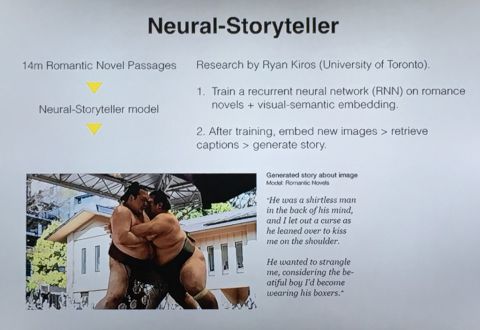
web appsTwitter bots. Now, advances in neural networks and deep learning are making an impact. Style transfer (think apps like Prisma, the photo-styling app for mobile phones, but also software for cleaning up rough sketches or colourising black-and-white images) has the potential to democratise or commodify (depending on whom you ask) artistic style. Meanwhile, deep learning with multiple media can produce synaesthetic examples, like the following output of a network trained on the text of romance novels and subsequently fed an image of a sumo match: - Smart cities, digitised to the millimetre with LIDAR, surveilled by drone, and managed by app, promise an end to the long nightmare of politics. Now a city can be run from above by impartial, objective algorithms—Plato's Philosopher King rendered in code. Everything in its right place, every space accounted for, all inhabitants managed with the efficiency of an Amazon warehouse, and all the dogs in the city are walked by drone. Until feral ravers disrupt the city's fiducial architecture (the patterned markers which guide the drones), conceal themselves from its managerial gaze with dazzle make-up and asymmetric haircuts, hijack the self-driving taxis and party in the spaces the machine does not see.
- Then again, one objective true point of view is a myth. The Jesuits found this out when, in an attempt to Christianise China, they tried to persuade the Chinese of the superiority of European-style one-point perspective over the aerial perspective used in Chinese art (which they saw as backward and inferior, for its ignorance of the point of view).
- The term “Perspective Collision” describes what happens when designed objects inadvertently reveal their designers' limited perspectives. Examples include camera film not showing dark-skinned people properly, or air conditioning in buildings being optimised for men. This is related to the Malkovich Bias, the idea that everybody uses technology the same way one does.
- Animal-free animal products are starting to appear. There now exist genetically engineered yeasts which, when fed with sugar, produce egg albumen and bovine casein, i.e., egg white and cow's milk. These are identical to the real products on a molecular level, and can be used for all the things real egg white/milk can be used for (as opposed to current animal-product substitutes, which tend to be specific to various uses). Actual animal-free meat is taking a little longer (growing more than thin layers of meat requires some form of structural scaffolding to feed the cells). This is known as cellular agriculture, and, once it matures, will work a lot like brewing: artisans/craftspeople managing a technical process.
- Stereotypical images used to represent the idea of “young people”: cartoon figures with shaggy/spiky hair and horizontally striped shirts; strobing photographs of wild-looking rock concerts.
- National Geographic, famous in popular culture for publishing photos of bare-breasted “exotic” non-Western women (something it has been doing since the 19th century), published its first photo of a bare-breasted white woman in 2016
2016/1/11
The buzz of my phone cut through the remnants of a fading dream this morning, a notification of something happening in the waking world. I picked up the handset and saw on its screen two items, from two different media outlets on opposite sides of the Atlantic, announcing the seemingly preposterous: two days after having released his new album (on his 69th birthday), David Bowie had suddenly died of cancer. Surely this cannot be the waking world?
It turned out to be real enough. In the minutes that followed, the trickle of incredulous queries turned into a torrential flood of mourning, commemoration and sombre celebration of an epic life. MetaFilter got its usual river of mournful .s. Facebook and Twitter were wall-to-wall Bowie all day. The Guardian ran a liveblog and a surfeit of articles and thinkpieces, with seemingly everybody other than George Monbiot giving their take on Bowie's significance. My Spotify sidebar was almost entirely Bowie (the sole outlier being someone in the habit of listening to their algorithmic playlists).
I had been meaning to listen to the new Bowie album, ★ (or Blackstar), today on Spotify, before probably buying a copy. It was officially a mere two days old, though had been completed months earlier. Much like his previous album, 2013's The Next Day, it had been made in secret, its release synchronised to Bowie's birthday. Though while The Next Day was perhaps necessarily backward-looking, from the Heroes-sampling artwork to its 1970s rock stylings, to the nostalgic melancholia of Where Are We Now?, Blackstar couldn't be more different. Recorded with entirely new musicians, from a jazz background, a shifting assemblage of sounds; a Middle Eastern scale here, some drum'n'bass-style beats there, the mood shifting between skilfully crafted pop and the ominous and unsettling; oblique references to executions, hospitals, being in heaven with invisible scars and never seeing the trees of England again, and a final track titled I Can't Give Everything Away. In the handful of days and weeks various people had to hear it before the truth came out, there was much speculation; was it a response to atrocities in the Middle East? Did it signify the dawn of a new late period of intense creativity on Bowie's part? If anybody had put the pieces together, they kept their mouth shut.
After the news got out, Bowie's long-time producer Tony Visconti, who had spent the past year working secretly on the album, revealed that it had been intended all along as a parting gift; Bowie, diagnosed with cancer and knowing that his time was limited, had recruited him and a few musicians and worked on it for a year. He had played fair, creating something that would be seen for what it is only in retrospect. David Bowie's final artistic work was the presentation of his death and transition to history. Even the title is a clue: in astrophysics, a black star may be a transitional phase between a collapsing star and a singularity; and the artwork, being the only album to lack Bowie's image on its cover; perhaps alluding to his imminent absence from the world. (I wonder whether the designer, Jonathan Barnbrook, knew the full story behind his brief.)
I was a little too young for David Bowie's music have been directly part of my formative experiences (my adolescence coinciding with the forgettable Tin Machine, rather than his liberatingly transgressive Ziggy Stardust/Aladdin Sane era, the monochromatic artistic explorations of his Berlin period, or even his early-1980s pop breakthrough), but Bowie was in the background, directly and indirectly. His big hit Let's Dance, angular and night-coloured, is a fixed memory, overheard in fragments hundreds of times in my childhood—in my fragmentary child's-eye perceptions, its staccato horns and woodblocks merge with punk plumage and rudeboy checks into a tapestry of edgy, transgressive early-1980s youth counterculture, vaguely forbidden with admonitions about drugs and criminality—and immediately taking me back (a honour it shares with Roxy Music's More Than This); other songs, from Rebel Rebel to Ashes To Ashes, also were familiar before I ever knew whom they were by. I would pick up the thread many years later, with the 1969-1974 singles compilation. I went to parties where his 1970s albums played in the background, put on by people who were older than me or who had inherited older siblings' record collections. (The influence of David Bowie was a constant in Melbourne from the late 1970s onward; see also: Dogs In Space.) The music I would end up listening to myself (and the first record I ever bought was a New Order 7") was influenced by him, (even though it generally emerged on the other side of that notional Year Zero known as punk; in reality, there is no such thing as Year Zero). With Bowie gone, the memories his music brings up suddenly feel a lot more distant, as if a thread holding them closer had snapped.
My feelings at the moment are a roughly equal mixture of shock (and reflection on the passing of time and the inevitable end of everything) and admiration for a person who died as he lived, using his own imminent death as art material. This week, I will stop by at Rough Trade and pick up a copy of Blackstar. For one, they are donating the proceeds from their sales of David Bowie records to Cancer Research this month.
2015/10/20
The BBC has a new documentary series about the history of indie music, specifically in the UK; titled Music For Misfits, it follows the phenomenon, from the explosion of do-it-yourself creativity unleashed in the wake of punk, running throughout the 1980s like a subterranean river, largely out of sight of the high-gloss mainstream of Stock/Aitken/Waterman, Simply Red and Thatcherite wine-bar sophistipop, channelled through a shadow infrastructure of photocopied zines, mail-order labels selling small-run 7"s and reviews in NME and Melody Maker (which, it must be remembered, had countercultural credibility back then, and were run by people whose business cards didn't read "youth marketing professional"), surfacing in the 1990s into the new mainstream of Britpop (much in the way that its American counterpart, alternative music, had become a few years earlier with the grunge phenomenon), before finally coalescing into a low-energy state in the new millennium as the marketing phenomenon known as Indie, a hyper-stylised, conservatively retro-referential guitar rock sponsored by lager brands. Though by the third episode of this series (the 1990s one), the BBC seems to succumb to this very revisionism of the term "indie", and, as Emma Jackson of Kenickie points out, retroactively edits almost all women out of the story, presumably because otherwise it wouldn't jibe as neatly with what modern audiences understand "indie" to mean:
It wasn’t just the lack of voices but the choice of stories that were included. No mention was made of the Riot Grrrl movement. Including the story of Riot Grrrl would have easily linked up with the previous programme’s section on fanzines and C86. Riot Grrrl also complicates the idea that British indie was in a stand off with US music. Rather in this scene bodies, music and fanzines travelled across the Atlantic and influenced each other. Also, while in indie music ‘white is the norm’ as Sarah Sahim recently argued, the Riot Grrrl moment in the UK also included bands lead by people of colour such as The Voodoo Queens and Cornershop (who had a number one on the independent Wiija in 1997).
Some major players were also missing. You have to go some lengths to tell the story of Britpop and not mention Elastica, but that’s what happened in the programme. There was a very short clip of them that flashed by. Or Sleeper. They were huge. Or PJ Harvey. Or Lush. Or Echobelly. Or Shampoo.Perhaps this is all a clever meta-narrative device, highlighting the issue of the blokeification of the term "indie" that is concomitant with it having ceased to be a structural descriptor ("indie" as in independent, from the major labels, from commercially manufactured pop music, the materialistic cultural currents/right-wing politics of Reaganism/Thatcherism, or what have you), and having become a stylistic descriptor (you know, guitars/skinny jeans/Doc Martens/Fred Perry/Converse/reverent references to an agreed-upon canon of "cool" bands from the previous half-century), and soon after that, a signifier of Cool British Masculinity, in the way that, say, Michael Caine, James Bond movies and various East End gangsters of old used to be. Perhaps it's a monumental oversight, inexplicable in hindsight, an oh-shit moment as the programme goes out. Or perhaps the original outline for the programme had sections on Bratmobile and Lush and Dubstar, which ended up on the cutting room floor after some risk-averse executive ruled that putting them in would weaken the narrative, confuse the audience or induce the Daily Mail to scream about "political correctness".
The equation of indie with retro probably didn't help. The seeds were sown in the underground 1980s, along with the rejection of the glossy commercial pop of the decade (which was partly a practical matter, with the kinds of high-tech studios the Pete Watermans of this world used to craft their chart-toppers costing millions, while electric guitars and Boss pedals were cheap), though became codified in the Britpop era, when journalist after lazy journalist equated the bold new age of British Guitar Rock with that last imperial phase of UK pop culture, the Swinging Sixties. Soon this became a self-fulfilling prophecy; things which didn't fit the narrative were pushed to the side, vintage Lambretta scooters and Mod roundels started showing up everywhere, and the Gallagher brothers, gazing down red-eyed from the heights of Snow Mountain, announced themselves to be the second coming of John Lennon, returned to bring proper rock'n'roll back to the people. Somewhere along the way, this retro rockism absorbed some of the retro sexism of the post-ironic lad mags of the time, marinated in the reactionary miasma inherent in the idea of a lost "golden age" (one before all this modern nonsense, when music came on vinyl and dollybirds knew their place was hanging on a geezer's arm, and so on), and so was born the New Lad Rock, whose name, in time, was lazily shortened just to "indie"; in its moribund terminal state, the Yorkie bar of music, right down to the "Not For Girls" label on it.
(Of course, the problem with looking backwards is often also the fact that those inclined to look backwards tend to fixate on forms rather than the processes that they emerged from (as the forms are the obvious thing to grasp, especially if one is not analytically inclined) and draw reactionary conclusions. For example, the fetishisation of the two-stroke motorscooter, a symbol of teenage freedom in the 1960s (it's probably no exaggeration to say that the Vespa was the MySpace Facebook Snapchat of its age), but a dirty, cranky, inefficient antique these days. Or, indeed, the actual careers of the cultural heroes. So, while the Beatles experimented with musique concrète and Mick Jagger subverted (to an extent) the meaning of masculinity, none of this is evident in the plodding, workmanlike homages to "proper rock" of their self-announced modern-day followers.)
The equation of stylised "indie" rock with a retrograde "lad"/"geezer" masculinity seems to be firmly embedded in the culture of this day; only recently the radio station Xfm, which originated back in the day with an indie-music format, was rebranded, explicitly, as a blokey-guitar-rock station, without too much loss of cultural continuity. The next logical step would be would be to introduce a musical segment into the upcoming reboot of men-and-motors TV show Top Gear (which, of course, is already to be fronted by a Britpop-era radio DJ), where, between the high-octane stunts, a band of lads with guitars and Mod haircuts take to the screen and play something that sounds like a stodgily conservative take on the Beatles/Kinks/Clash/Pistols/Stone Roses.
(via Sarah_Records) ¶ 0
2015/4/6
It is an early afternoon during the Easter bank holiday weekend, at an indiepop weekender at an art venue in Cardiff. A band is playing on stage, fuzzy guitar lines, drums and female vocals mixing together. The audience, or those who have arrived early, are standing and watching; they tend to be in their mid-30s and older; women wear hair slides and floral/polka-dot dresses, while the Mod Dad look, with Fred Perry polo shirts, short hair and sideburns, is popular among the menfolk. In front of the stage, what might have once been the mosh pit is now a children's play area, replete with LED-illuminated balloons. about four or five young children run around, squealing and bouncing the balloons. Wearing ear protectors, they appear to be unaware of the grown-ups on the stage holding guitars, the relationship between them doing this and the sound coming out of the speakers, or that there would be any reason to not run around in front of the stage. The concept of a “gig” seems to be alien to them. Elsewhere, smaller children bop gently up and down in time to the music in their mothers' hands, animated by parental enthusiasm; they gawp bewilderedly, their faces showing only undifferentiated emotion. The squawls of babies fill the gaps between songs and add a novel accompaniment to the jangly melodies. Occasionally, a musty odour fills the air and a balding guy in a faded Milky Wimpshake T-shirt leaves hurriedly, carrying a discomforted-looking infant to a baby-changing area.
Once upon a time, pop/rock/alternative music consumption was strictly for teenagers; you got into it when the adolescence hormones hit your bloodstream and you needed something that was yours and not your parents', spent a few years spending your pocket money on 7" records and dressing in a way your grown-up self might later find as embarrassing as your parents did at the time, and dropped it just as quickly when you Grew Up, got a job, married and had kids of your own and were saddled with the burden of adult responsibilities which you would carry unto the grave. Gradually the boundaries got pushed back, and a whole market of “adult-oriented rock” emerged; engineered to soothe the nerves of stressed Responsible Adults whilst providing them with just enough of a hit of what excited their younger selves a quarter-century earlier, it tended to a sort of soaring, platitudinal blandness; a weak substitute for what had been forfeited. Though over the past few decades, the idea that one must check one's musical/subcultural identity at the door of adulthood has been eroded even further. The pioneers may well have been the Goths, who stubbornly refused to Grow Out Of It well into middle age and beyond; though soon, the commodification of cool into cultural capital opened the doors further, until soon we had shops in trendy areas selling Ramones baby clothes and lullaby renditions of The Cure and Nirvana, and bands classified, back-handedly, as “dad-rock” or “dad-house”. This isn't completely universal—after all, supermarkets flog millions of records by the likes of Coldplay and Ed Sheeran for people who either never were into music or else vaguely remember what it felt like but have no desire to regress to that phase of their lives—but one no longer has to be a fringe-dwelling bohemian to remain particular about music
Of all the genres and subcultures, though, the indiepop scene seems to have become uniquely small-child-inclusive. As a critical mass of indiepop kids hit middle age and have kids of their own, they are more likely to bring them, en masse, to gigs and festivals, and adapt the events themselves for the kids; songs with rude words are dropped or bowdlerised, balloons are provided, and the gig becomes a mass playdate first, and a musical performance only tangentially to this. Flocks of toddlers run around, yelping and shouting gleefully, and it is seen to be their right to do so; anybody who objects to this getting in the way of their enjoyment of the music may as well be a fascist or a Tory or something equally unspeakable. The music's almost just a side product for the parents' benefit. Elsewhere, there are indiepop baby discos, acclimatising young ears to Belle & Sebastian and Allo Darlin' from an early age. Perhaps, elsewhere, there are pint-sized punks pogoing anarchically to toddler-friendly renditions of Anarchy In The UK, baby discos spinning gnarly brostep, or black-clad toddlers running around like swarms of ground-hugging bats at the Whitby Gothic Weekend, but such possibilities notwithstanding, this seems to be peculiar to indiepop. There are no boisterous toddlers at, say, shoegaze, psych or post-rock gigs; other festivals may have a few small children in attendance, but they are fewer in number, and where special provision has been made for them, it is away from the stages.
Why indiepop has, upon its members' parenthood, shifted wholesale into a toddler-friendly environment is not certain. Perhaps it's a natural outgrowth of the “twee” signifier, which originated in the 1980s as a rejection of the hypermasculinity of hardcore and/or post-punk rock, instead embracing, with varying degrees of irony, the signifiers of childhood. Much in the way that things that start as ironic appropriations often end up shedding the irony and continuing with some degree of sincerity (as seen, for example, with the “ironic” sexism of 1990s “lad” magazines), a scene whose zines and button badges copied old children's books might transform from a subculture questioning the inherent conservatism in the childish/mature dichotomy to a subculture tailor-made for small children and their parents.
It'll be interesting to see whether the toddlerification of indiepop changes the subject matter of it more than removing the word “fuck” from lyrics. Thematically, indiepop songs do tend to hover around adolescence and its long decay envelope, with themes of crushes, break-ups and being in or out of love cropping up disproportionately often. These days, this is even more so than in, say, the C86 days, as “twee” became stylised and codified into a somewhat excessively fey, cupcakey aesthetic, and some of the oddness of 1980s-vintage indie has been replaced by chaste adolescent romance like a plot from an Archie comic soundtracked by vintage Motown girl groups. Perhaps as the under-5 demographic at indiepop gigs swells, these themes will be displaced to some extent by songs about dinosaurs, monkeys, pirates, rocket ships, monkeys who are rocket-ship pirates, poop and other things more likely to appeal to actual small children.
Secondly, it will be interesting to see what a generation of kids who were brought up listening to twee pop from birth end up doing when adolescence, and the need to individuate themselves, hits them.
2015/2/4
Apparently Finland's school system is scrapping cursive writing lessons in favour of typing. In other news: apparently, in the 21st century, children are still taught cursive writing in schools:
"There's research shows us that a child will have a better concept and better memory for what a letter is and what it represents if they actually handwrite it ... [but] the argument is really against those pages of cursive, joined-up writing exercises which, in the end actually don't change many people's hand writing styles... Cursive writing is cute, and nice, and decorative if you've got a leaning towards wanting to do it ... just like you might like to learn to crochet or knit.
"The handwriting exercises that we do are really based on very old technology," she said."So when we teach kids particular downstrokes and where to start their letters, it's really based on how you had to use the technology of a fountain pen and ink."Cursive writing is a funny thing; it's not quite practical (who writes an essay under exam conditions cursively, and who finds that more legible than neatly separated printed script?), and it's not quite decorative (it stops well short of anything that could even generously be called “calligraphy”). Its sole raison d'etre is tradition (that teaching children fountain-pen-era techniques is in some ways useful), if not an authoritarian, vaguely punitive disciplinary mindset (idle hands are the devil's plaything, and those little hell-apes that we call children must have their rebellious spirits broken with laborious exercises lest they get up to mischief). Perhaps killing it off as a mandatory part of the curriculum could be the best thing for it: once it's no longer compulsory, and is as alien to the average person as film photography or slide rules, some subset of artisanal crafters and/or hipster contrarians will take it upon themselves to revive this vintage skill and take it further than it would have otherwise gone?
The article, on ABC News, speculates on the possibility of Australia following the Finnish lead and removing cursive writing from its schools. I expect that will happen somewhere around the time of them ditching King Charles III as their head of state and abolishing Imperial honours for the second time in history. I can imagine the ultra-conservative establishment running the country wouldn't have a bar of any such proposal, and indeed can almost read the column in The Australian denouncing the very idea as proof that the Marxists have taken over the teaching profession.
2015/1/22
I am writing this on a train to London from Birmingham, where I have spent the past two days at an academic conference about the electronic music group Kraftwerk. There were some 175 people in attendance; their ages varied from those who had not yet been born during Kraftwerk's heyday to a sizeable contingent of (mostly) men of a certain age who had been at various legendary shows back in the early 80s. The conference, whilst theoretically an academic conference, was open to the general public, and the talks presented varied from critical-theoretical analyses of the signifiers in various records to autobiographical monologues.
The conference began with Stephen Mallinder, of Cabaret Voltaire, talking autobiographically about his own experience of Kraftwerk and how they inspired his and his bandmates' own music-making; he mentioned that, back in the 1970s, he and his mates would refer to traffic cones as “kraftwerks”. Later, Nick Stevenson talked specifically about Cabaret Voltaire, the Sheffield scene, their use of Dadaist techniques and Burroughs' cut-up technique, and the themes of “the control culture” in their music. Other than that, the rest of of the first day was occupied with going through Kraftwerk's early career and first few albums, as well as the “archaeological period” of the three pre-Autobahn albums one gets the impression Ralf Hütter would rather were struck from the historical record. David Stubbs, author of the recent Krautrock book Future Days, talked about this period, tracing the band's history from their shambolic start as The Organisation (which, in surviving footage of live performances, looks like an “on-the-nose parody of Krautrock” in all its scruffy, hippie shambolicness), through the first three albums—Kraftwerk 1 (whose pastoral sound prefigured what Boards Of Canada would do several decades later), Kraftwerk 2 (where the potential of drum machines first appeared) and Ralf & Florian (which, in its title and cover photograph, showed the artists starting to make themselves part of the artwork, perhaps echoing Gilbert & George, who had visited Düsseldorf in that period). This was followed by a talk by David Pattie, a Glaswegian academic, elaborating on Ralf & Florian and from that, the question of Kraftwerk's relationship with Germanness. Among other things, Pattie pointed out a progression in the works of Kraftwerk and other West German bands (Can, Popol Vuh, Tangerine Dream, Neu! and Kluster/Cluster) through the early 70s; a divergence from pure rhythm and/or noise and rediscovery of melody in subsequent albums, and put forward the theory that all these bands had initially set out to reject the musical heritage of their forefathers, and gradually come to an accommodation with it.
In the afternoon, Melanie Schiller (from Düsseldorf, via Groningen) examined Autobahn and its cover artwork, examining the use of space in the sound and the past, present and future as depicted in the LP artwork, and the sense of forward motion, and of there being a start (the sound of the key in the ignition) but not an end (the road going on forever ahead; the self-referential lyrics referring to turning the radio on and hearing the song on it, forming a loop), and, of course, the Beach Boys reference alluding to the American car-song trope. This was followed by a talk by Hillegonda Rietveld about the Trans-Europa Express album; its theme of a borderless, unified Europe, the echoes of an elegant/decadent pre-war past (Neonlicht has a vaguely Weimar feel to it), and its musical antecedents (such as Pierre Schaeffer's 1948 Musique Concréte sound-poem etude aux chemins de fer, and parallels with railway rhythms in the blues in America). The final talk of the day, by Uwe Schütte, about Die Mensch-Maschine, and the idea of the Man-Machine, was rich with details and connections; he tied in Soviet structuralism (the cover artwork drew heavily on El Lissitzky's compositions), a notorious (though in today's climate, quaintly tame) 18th-century atheist pamphlet titled L'Homme-Machine, musical automata throughout the ages, a French novelty act named Les Robots Music, E.T. Hoffmann's 1817 Romantic novel Der Sandmann, Karel Čapek's Rossum's Universal Robots, Fritz Lang's Metropolis, and the evolution of Kraftwerk's own stage robots. After this, former Kraftwerk member Wolfgang Flür was to read from his memoir, I Was A Robot, but was somehow unable to make it; in his stead, Rüdiger Esch (formerly of electro-industrial band Die Krupps) spoke about his book Electri_City, about the history of the Düsseldorf music scene.
The second day of the conference had a few more interesting talks; Pertti Grönholm spoke about the nostalgic retrofuturism in the music of Kraftwerk, specifically singling out the Autobahn B-side Morgenspaziergang, a short pastoral tone-poem of sorts, and Radioland, with its nostalgia for childhood radio listening. Ulrich Adelt (an academic from Hamburg based in Wyoming) talked about Amon Düül II and their unsuccessful Made In Germany novelty record, Faust (who played with the whole idea of authenticity by projecting footage of their guitarist playing a solo while he stood still), the leftist squatter blues-rock/proto-punk band Ton Steine Scherben (who never made much of an impact outside of the German-speaking world) and the Kosmische Musik movement and their prefiguration of what would later devolve into the New Age genre, finally finishing by boldly attempting to reclaim Giorgio Moroder and Donna Summer for the Krautrock genre. This led into a monologue from Rusty Egan, former Blitz Club DJ and drummer from new-romantic synthpop band Visage, Camden nightclub proprietor and currently still a working music producer and DJ. Egan was not so much an academic speaker as a force of nature; attired in jeans, turtleneck and leather jacker, all black, his hair slicked back, he went on for over an hour, pacing the stage, showing photographs on his laptop, playing fragments of tracks he had worked on recently, and telling anecdote after anecdote, often framed with sound effects, funny voices, hand gestures and beatboxing. One gets the feeling he could easily have gone on for another few hours, had it not been time to adjourn for lunch.
After the break, there were three more talks: Heinrich Deisl (who edits an Austrian music magazine titled Skug, which is a little like The Wire, only in German) talked about the metaphors of the Autobahn and the German forest in the music of Kraftwerk, Wolfgang Voigt and the Detroit techno project Dopplereffekt (who, like most Detroit techno artists, are African-American, but affect a stylised Germanness in their art; one of their albums is titled Gesamtkunstwerk). Alexei Monroe spoke about Laibach, their own relationship to modernism and problematic history, and their engagement with dystopian ideology. Finally, Alexander Harden talked about the topic of post-human authenticity, and the question of how one can ascribe authenticity (or its absence) to an act like Kraftwerk.
One theme that kept emerging in the talks was that of Kraftwerk's (and, to a lesser extent, other bands') relationship to the idea of Germany and Germanness, and the country's problematic history. In the late 60s and early 70s, the trauma and shame of the Third Reich and World War 2 was still relatively recent; most night porters in Düsseldorf hotels (as Rusty Egan mentioned) had missing limbs, the British music press made crude Nazi references when faced with the idea of there being bands from Germany, and the youth of the nation were waking up to the idea of post-war denazification having been largely unsuccessful, and of people in positions of power having done terrible things. The idea of Germany was contaminated by Nazism, and so was a lot of its much-vaunted culture, to which music had been central. There was the very real idea of Stunde Null, hour zero, of there being nothing before 1945 worth salvaging; and, indeed, a lot of the Krautrock bands started partly with this assumption, rejecting both the Western classical canon and the Anglo-American blues/rock-based sounds that were filling the airwaves, and venturing outward, to the extremes of experimental noise, the “ethnographic forgeries” of Can, to heavy psychedelic experimentation or the sounds of an imagined Cosmos. But, of course, that is not sustainable forever; and even if one does keep it up, one only has to venture abroad to be put in one's place as one of the Krauts.
Kraftwerk's work, at least from Autobahn (their own Stunde Null) onwards, attempts to answer the question of what is to be done with the past. For all its futurism, it is deeply nostalgic, albeit for the forward-looking pulse of modernism, the future that never was; in part for the Bauhaus-era modernism that was so brutally cut off (as evident in the video for Trans-Europa Express, with its 1930-vintage turbine train model zooming past Metropolis-style buildings), though partly also for the 1950s Wirtschaftswunder years of their own childhoods. What is to be done with the terrible years in between? Well, as much as in one sense, Kraftwerk strive to close the gap, their works are peppered with references which German audiences can pick up, alluding to the unspoken time before Stunde Null: the radio on the cover of Radioactivity, for example, resembles those distributed by the Nazi authorities to households, and indeed, the Autobahn system itself was bound up with the Third Reich (who did not initiate the programme though greatly extended it). As for audiences abroad, rather than seeking to escape German stereotypes, Kraftwerk took them and played, mischievously, to them; becoming the stiff, deadpan robot-men, and throwing in the occasional ambiguous turn of phrase like “total music” or the “mother language”, as if to see if they can jar the foreigners into Mentioning The War again. But Kraftwerk have, discreetly, the last laugh.
Kraftwerk's significance in popular music is hard to overestimate; on their shoulders stand not only electronic pop music (from the early synthpop bands of the late 70s to today's commercial hits), house, techno and dance music, but also much of hip-hop, via Afrika Bambaataa. As Heinrich Diesl quoted, “Before Kraftwerk, German pop music was perceived as Schlager; afterward, it was perceived as Techno”. And, because of their position at the intersection of various historical currents, there is enough to discuss about them to fill an academic conference. Speaking of which, the organiser, Dr. Uwe Schütte, says that, if all goes well, there should be an academic conference about Krautrock at Aston University in a year or two.
2014/12/21
Youth subcultures, as many middle-aged former teenagers have lamented, aren't what they used to be. In the old days, you see, you had to make your choices (or have them made for you by which class you had been born into and, in the light of this, what would get you camaraderie and what would get you beaten up), and stick with them. You were either a Mod or a Rocker, or a Punk or a Grebo or something, and you would live (and, in some cases, die) by that; you wore the uniform, listened to the music, and had little tolerance for other subcultures; if you fancied the other side's soundtrack or sartorial style, you would keep it to yourself, or else. But kids these days (kids these days...!) treat subculture as if it were a supermarket, or perhaps Noel Fielding's dressing-up chest; the entire back-catalogue of young cool is there for the taking and the mashing up, with elements going in and out of style by the season, to be worn as accessories. Beyond the dress-up element, the default becomes a globalised homogenate, a sort of international Brooklyn/Berlin/Harajuku of skinny jeans/folkbeards/vividly coloured sunglasses/patterned fabrics worn by the international Hipster, and, more intensely and urgently, by their adolescent precursor, the Scene Kid. Subcultural music, meanwhile, is a post-ironic soup of the last few decades of influences, refracted through the prisms of trend blogs (drum machines, hazy synths, skronky/choppy guitars, That Krautrock Drum Beat, and so on). Parties are inevitably called “raves”, whether or not they bear any similarity to MDMA-fuelled bacchanales around the M25 circa 1987. Increasingly, the content of the subculture becomes interchangeable, and the process of performing a subculture becomes the subculture; almost like a masked ball, or a postmodern reënactment society for the youth tribes of the 20th century.
But once one goes beyond the idea of a subculture as being based around fashion or music, things sometimes start to get much more unusual. One case in point is the Tulpamancy subculture; which, could be summed up in three words as “extreme imaginary friends”. Tulpamancers essentially invent imaginary friends and believe in them really hard, to the point of voluntarily inducing dissociative personalities in themselves, hiving off one part of their minds to be another, autonomous, personality, with whom they can interact.
The term tulpa is a Tibetan word meaning a sentient being created from pure thought; the practice crossed over from Tibetan mysticism into the Western occult/esoteric fringe in the early 20th century (the explorer Alexandra David-Neel was one pioneer), but the modern version owes more to internet “geek” subcultures; it started amongst Bronies (dudes who are really into My Little Pony, which may be either a repudiation of gender dichotomies or the ontological equivalent of a frat-bro panty raid on the idea of “girl”, or both or neither), before spreading to other branches of “geek” culture/fandom.
Tulpas remained the preserve of occultists until 2009, when the subject appeared on the discussion boards of 4chan. A few anonymous members started to experiment with creating tulpas. Things snowballed in 2012 when adult fans of My Little Pony: Friendship is Magic – known as “bronies” to anyone who's been near a computer for the past three years – caught on. They created a new forum on Reddit and crafted tulpas based on their favourite characters from the show.
In the cross-pollinating fields of the internet, it wasn’t long before tulpamancy also started to attract manga and fantasy fans. “My tulpa is called Jasmine,” says Ele. “She’s a human but from an alternative reality where she can do magic. I created her a dozen years ago for a fantasy series I write and then made her into a tulpa.”Being a fandom subculture, there are, of course, plenty of drawings (of varying levels of execution) depicting tulpas; one probably would not be too surprised to find that many look either like anime bishonen with fox ears/snouts and/or variants on Hot Topic Darkling. Because, of course, that's what one's magical alter-ego looks like in fandom.
As for the creation of, and interaction with, these tulpas, an entire methodology has evolved for bringing them into being, and interacting with them. Tulpamancers don't so much consciously think up their spirit critters, but rather mentally create a wonderland, imagine themselves in it, and let them come up from their subconscious and meet them. From then on, they practice imagining them, allowing them to become clearer, and ultimately being able to hallucinate them in everyday reality, which is where the fun starts:
While voice is the most common way tulpas communicate with their hosts, tulpamancers can learn to stroke their tulpa’s fur, feel their breath on their neck and even experience sexual contact.
Tulpas soon get curious about their host’s body; some want to experience life as a “meatperson”. Indulgent hosts then use a practice called “switching”, which allows their tulpa to possess their body while they watch from the ringside of consciousness.This, of course, sounds a lot like disassociative personality disorder, something not generally seen as desirable. Some tulpamancers, though, have turned that claim on its head; rather than dissociation being a disorder, or a symptom of one, what if it could be a way of self-medicating or coping What if, in other words, the optimal number of personalities in one body is, in some circumstance, greater than 1?
Koomer’s case is rare, and for Veissière “schizophrenia [could be understood as]… an incapacitating example of ‘involuntary Tulpas’", therefore, by forming positive relationships with their symptoms, sufferers can start to recover. It's an idea shared by the “Hearing Voices Movement”, who challenge the medical models of schizophrenia and suggest that pathologisation aggravates symptoms. “My schizophrenia manifested itself by having many thoughts and ideas all conflicting and shouting at me,” says Logan, who wanted his last name withheld. “Turning them into tulpas gave those thoughts a face and allowed them to be sorted out in a way that made sense.”
2014/11/30
Recently, I was in Sweden and Finland, catching up with some friends and seeing Loney Dear playing with the Norrbotens Kammarorkester in Lapland (which was amazingly good). At one point, I got invited to a party in the north of Sweden, with the advice that I may want to bring my own beer. Which is what found me in the aisles of the Systembolaget in Luleå.
The Systembolaget, for those unfamiliar with this word, is the state-run liquor shop chain in Sweden. The government there has a monopoly on the sale of strong beer and all kinds of spirits, and does so through a chain of shops throughout the country. Only those shops may sell any beer stronger than about 2.5% 3.5% or spirits. This is a cast-in-iron law, with no exceptions, which has some peculiar consequences; for example, air passengers flying from Sweden to anywhere in the EU are unable to buy spirits at the airport shops because tax must be levied on spirits not being exported from the EU, and only the state can do that.
Anyway, when I went to buy some beer, I was expecting the experience to have a sort of bland paternalism to it, deliberately avoiding any attempt to encourage people to actually drink. Having read about changes in Sweden between the 1970s and now in Andrew Brown's Fishing In Utopia, I understood that the Systembolaget used to look somewhere between a bookmaker's shop and the waiting room of a methadone clinic, being essentially a paternalistic harm-minimisation programme for those who, for whatever reason, insist on drinking, allowing—but never encouraging—them to do so, but had evolved into more of a standard consumer experience. Nonetheless, I was expecting it to look a bit more minimal and, well, institutional; perhaps like a Lidl or Costco for alcohol, with dim fluorescent lighting and pallets of bottles labelled with only their name and alcohol content in a monospaced laser-printed typeface. Instead, I found something that would put a North London Waitrose to shame; a brightly lit space with huge selection of beers, ales, craft beers and microbrews; each one had, on its shelf, a label enumerating food combinations it goes well with. (The only section where it lagged behind was the gin section, which was somewhat small and mostly limited to mainstream British gins; I suspect Sweden isn't really a gin-drinking country.)
Later, when I recounted my Systembolaget experience, and the way it differed from my expectations, to a friend, they mentioned that the staff are also experts in beer and spirits, and able to make knowledgeable recommendations. The implication of this was that, if you live in Sweden and know your way around beer, the government will want to employ you to recommend ales and pilsners to consumers. Now I'm far from a hard Thatcherite or a believer in the Libertarian ideal of the minimal “nightwatchman state”, though, having grown up in an English-speaking world, in which the free-market principles articulated by Milton Friedman are as accepted as Copernican astronomy (even by those who regard themselves as being on The Left; while there, for example, are calls for the renationalisation of Britain's railways, for example, few would call for the Upper Crust franchises to be kicked out of stations and replaced with the return of the much-maligned British Rail sandwich), this strikes me as rather exotic and a little weird. Beer-recommending civil servants? A state liquor monopoly simultaneously discouraging and encouraging drinking? The State not as Orwellian Big Brother but as the older brother you go to to ask about how to enjoy vodka? We truly are no longer in the neoliberal Anglosphere.
Almost all the Nordic countries have state liquor monopolies. The exception is Denmark, but the other Scandinavians regard the Danes, with one foot on the mainland, to be halfway towards being the wild, laissez-faire Germans (and yes, that is a stereotype in Scandinavia; while in the English-speaking world, the Germans may be stereotyped (at best) as precise, humorless BMW engineers and/or Kraftwerkian Mensch-Maschinen, in Scandinavia, they're an unruly people who drink in the street and don't tax their beer.) In Iceland, the equivalent monopoly chain is known as Vinbuð, though there was talk a while ago about rolling back or eliminating its monopoly. The Finns are slightly more liberal, in that one can buy beer from ordinary supermarkets, where (as in Australia) it's stored in a segregated section which (as I discovered shortly after disembarking from a Helsinki-bound train at 8:30) is physically closed off at 9pm. For stronger spirits, one has to go to the state liquor shop, which is called, with characteristic Finnish lack of euphemism, Alko. And it's not only the quasi-socialist Jante Law societies of the Nordic world that do this; in the US, the conservatively Mormon, and staunchly Republican, state of Utah also has a state liquor monopoly. I imagine that their shop shelves probably look less enticing than those at the Systembolaget.
2014/11/3
In most European languages, personal pronouns (like she, him and such) are gendered; it can be somewhat awkward to talk about a person in English without disclosing whether they are (or are regarded as) male or female. (In some other languages, such as French and German, not disclosing the gender of a person is even harder, with words for “friend”, “coworker” and various occupations being gendered as well.) This means that speakers of those languages have to classify a person as male or female before discussing them, or otherwise go a lot of squirming. Interestingly, this is by no means a universal property of human language; in fact, 57% of the world's languages do not have gendered pronouns.
As the genders of people one deals with become less significant in most aspects of everyday life (discriminating between male and female coworkers could land one in legal trouble, and in the age of remote working, there's the possibility that you might not know whether your accountant or the freelance coder three timezones away you're working with is a man or a woman), this will eventually change, and gender-neutral personal pronouns will arise out of necessity. In English, what will probably happen is that “they” will lose its connotations of plurality, and become the natural way of referring to someone when their gender is irrelevant or unknown.
Not everybody is happy to wait for hypothetical linguistic evolution to take its course; in Sweden, unsurprisingly, they have taken things into their own hands, and introduced a gender-neutral personal pronoun into society, through the child-care system; a generation of Swedish toddlers is growing up used to referring to people as hen (he/she), rather than han (he) or hon (she). The pronoun hen was introduced in two Stockholm nurseries in 2012, and now has spread out of the nursery system to several newspapers; also, it has crossed the border, with reports of it being adopted into Norwegian. (There's a good chance that it'll make it into Danish as well, as it, Swedish and Norwegian are very closely related, and partly mutually intelligible.)
Not everybody is pleased with this, one can imagine the usual conservative talking heads, from Moscow to Wichita, fulminating darkly about “political correctness gone mad”, “Cultural Marxism” and/or “gender” (a term used pejoratively in reactionary circles to mean any deviation from traditional gender roles), in between making disparaging wisecracks involving meatballs and flat-packed furniture. And outside of that, there are some who think that teaching children to refer to people not as men or women but as persons is, for some reason, cruel:
But, argues Dr David Eberhard, a leading Swedish psychiatrist, a new pronoun won’t change the fact that the vast majority of people identify either as men or women. “Whatever you choose to call people, the biological differences between men and women remain,” he notes. “We should treat each other with respect, but ignoring biological gender differences is crazy. Making us identical won’t create more equality.” Boys should be allowed to play with dolls – and girls with cars – if they like to, says Eberhard, who coined the expression “safety addiction” in reference to Sweden’s health and safety system. “But”, he adds, “calling them hen instead of him or her? That’s child cruelty.”
I don't get why this is child cruelty; it's not that a user of a gender-neutral language would not learn to notice that some people are male and some female. The key difference is that this demotes gender from a defining attribute of a person—you are essentially a man or a woman—and turns it into a secondary attribute—you are a person, with a number of attributes (hair colour, height, maleness/femaleness). In a society which is (for the most part) no longer divided into hard-and-fast gender roles, should we still be using language which evolved when the two genders were organised hierarchically, with members of one all but owning members of the other as chattels? That's to say nothing of situations where one does not know the gender of a person (the aforementioned remote coworker), or indeed the rise of non-human personlike entities (with corporate personhood on the books in the US, it seems rude to refer to corporations as “it”, while they are obviously neither a “he” nor a “she”; add to that the prospect of artificial intelligences, which might not always be issued with gendered personae). Finally, one area where a non-gendered personal pronoun would reap immediate, if somewhat trivial, benefits is that of the naming of pets, especially ones hard to sex by superficial inspection (“Nice boa constrictor; what's his name?” “Her name's Ermintrude.”)
2014/10/7
A new study has looked at why fewer women cycle in the United States than in the Netherlands, and found that it has less to do with an often stated Anglophone culture of cycling-as-macho-extreme-sport, and more to do with women in the US being too busy with domestic chores for the luxury of cycling:
In short, despite years of progress, American women’s lives are still disproportionately filled with driving children around, getting groceries, and doing other household chores – housework that doesn’t lend itself easily to two-wheeled transportation. It turns out that women may be more likely to bike in the Netherlands because Dutch culture is giving them more time to do so.Of course, the fact that in the Netherlands it is possible to carry anything from a toddler to a bag of groceries on a bakfiets is one factor, as is the fact that Dutch children are more likely to go to school by themselves (often on their own bicycles) than be dropped off in Mom's SUV; a lot of it, though, comes down to more traditional gender-based divisions of labour in the US and that hyperefficient Anglocapitalist labour market leaving those who get stuck doing the chores (i.e., usually the women) with less time for the luxury of cycling:
Dutch women can use bikes to get around because they are less pressed for time than American women, in three fundamental ways. First, thanks to family-friendly labour policies like flexitime and paternity leave, Dutch families divide childcare responsibilities much more evenly than American families. Second, work weeks in the Netherlands are shorter. One in three Dutch men and most Dutch women work part-time, and workers of either gender work fewer hours than Americans.Of course, this is a piece in the Grauniad; were it in, say, the Financial Times or the Economist, it may well say that large numbers of female cyclists is a symptom of an inefficient economy, one which fails to extract the maximum amount of productivity from its labour force; indeed, one can imagine a report from a neoliberal think tank claiming that women on bicycles are a drag on productivity.
2014/8/31
The Village Voice has a profile piece on the Satanic Temple, the new group pranking the US Religious Right in the name of the Prince of Darkness, and the latest manifestation of the long and somewhat varied tradition of Satanism; this time, as détournement. This particular Satanic Temple seems to have been founded by a Brooklyn-based journalist named Doug Mesner (who goes by the name “Lucien Greaves”, his legal name being presumably insufficiently Satanic-sounding), possibly emerging out of a mockumentary project about “the world's nicest Satanic cult” praising right-wing Christian politicians in Florida, but since then has gone on to hold a “pink mass” on the grave of the mother of anti-gay religious preacher Fred Phelps, posthumously turning her lesbian, and commissioning a rather handsome-looking statue of Baphomet, to be placed outside the Oklahoma State Capitol alongside the Ten Commandments monument, testing the sincerity of state lawmakers' commitment to religious freedom. In fact, most of their work seems to centre around turning the US Constitution's neutrality on actual religions and the entrenched privilege of the Religious Right (as seen in recent court rulings, such as those allowing corporations to have religious values which override their employees' rights) against each other; they campaign (on constitutionally-protected grounds of religious exemption) against corporal punishment in schools and, most recently, have used this angle in a campaign against restrictions on abortion.
Unsurprisingly, the Satanic Temple gets a lot of hate mail from the usual good ol' boys. Perhaps also unsurprisingly, though, their most strident (or at least coherently so) critics are other self-identified Satanists; namely, the Church Of Satan, the Satanic sect founded by Anton LaVey in the Sixeventies, and since inherited by one Peter Gilmore, who has nothing nice to say about the new kids, and keeps saying it:
"When a fellow in horns — with an adopted moniker fit for a 1970s hairdresser — tea-bags a tombstone while some 'goth' rejects swap spit on the grave, it seems to us to be a parody of Satanism rather than a representation of some actual philosophical or religious organization." Those lines were written by Magus Peter H. Gilmore, leader of the Church of Satan, on the Church's official blog. It's one of several denunciations Gilmore has issued against the Satanic Temple in the past year.One would expect the Church Of Satan to resent upstart groups on its turf, especially ones whose activity and media-savviness is making the older group look tired and past its prime. (And the Church Of Satan does not seem to have done much since Anton LaVey died; apparently the older Church, whilst shunning publicity, does have private events for those who have earned entry to them; they do not say what sorts of events these are, so they may just be exclusive hot-tub parties with septagenarians who have first-hand stories about the wild old days). The generational divide also shows a chasm of values; the Church of Satan, founded in the 1960s, was both a product of the explosive “youthquake” that upended the authoritarian, conformistic values of 1950s America, and also a reaction to its mushier peace-and-love aspects; its philosophies of hedonism, pride and vengeance against one's enemies borrowed from Nietzsche and Ayn Rand (who wrote a foreword to its The Satanic Scriptures). The Satanic Temple, meanwhile, is a product of the current age; more liberal, more media-savvy, and essentially humanistic, to the point of being conspicuously (and, some would argue, contemptibly) nice. If LaVey Satanism was a reaction against the suburban docility of Eisenhower-era America and namby-pamby hippie crap, then might Greaves' Satanism be a reaction against the equivalents in post-Reaganite America: the sort of Randian dog-eat-dog values embodied both by the political/economic mainstream and the old Satanic counterculture (who, to be fair, were into them first)? If so, the Church of Satan comes off rather badly, looking like an aging hipster whose countercultural stance has succeeded beyond their wildest dreams, infusing the mainstream with its values and leaving them with just some tatty old clothes which no longer fit and the claim of having done it first.
The Satanic Temple's website is here; they also have an online shop with T-shirts and mugs.
2014/8/6
An interesting article on the artificial and constructed nature of neoliberalism, the supposedly neutral post-ideological ideology, touted as the mirror of that which is and cannot but be:
The public at large would be hard pressed to know that this strange doctrine of economics actually had a place of origin in the Mont Pèlerin Society, which was the brainchild of Friedrich Hayek. Mirowski tells us that one of the keys to Neoliberalism has always been a sort of “double-truth”, the ability to convey both an outer exoteric version of the truth to the public at large, while at the same time conveying an inward esoteric truth to those in the know: what he terms the Neoliberal Thought Collective.One fundamental contradiction of neoliberalism is that between its assertion of naturalism—the market is the state of nature, to deny it is to fall foul of it, and resistance is useless—and that the specific kinds of market forces, and specific order of society, championed by neoliberalism are anything but natural; in that, neoliberalism diverges from the classical liberalism it purports to be, and becomes a constructivist ideological project; human relations need to be redefined to fit its market-based paradigm, and alternatives need to be bulldozed out of the way, to fit the vested interests of its stakeholders. No alternative must be allowed to challenge this model:
6. Neoliberalism thoroughly revises what it means to be a human person. “Individuals” are merely evanescent projects from a neoliberal perspective. Neoliberalism has consequently become a scale-free Theory of Everything: something as small as a gene or as large as a nation-state is equally engaged in entrepreneurial strategic pursuit of advantage, since the “individual” is no longer a privileged ontological platform. Second, there are no more “classes” in the sense of an older political economy, since every individual is both employer and worker simultaneously; in the limit, every man should be his own business firm or corporation; this has proven a powerful tool for disarming whole swathes of older left discourse. Third, since property is no longer rooted in labor, as in the Lockean tradition, consequently property rights can be readily reengineered and changed to achieve specific political objectives; one observes this in the area of “intellectual property,” or in a development germane to the crisis, ownership of the algorithms that define and trade obscure complex derivatives, and better, to reduce the formal infrastructure of the marketplace itself to a commodity. Indeed, the recent transformation of stock exchanges into profit-seeking IPOs was a critical neoliberal innovation leading up to the crisis. Classical liberals treated “property” as a sacrosanct bulwark against the state; neoliberals do not. Fourth, it destroys the whole tradition of theories of “interests” as possessing empirical grounding in political thought.
7. Neoliberals extol “freedom” as trumping all other virtues; but the definition of freedom is recoded and heavily edited within their framework. It is economic freedom only.Of course, imposing the economic freedom of those with the means to exercise it requires considerable effort, with significant proportions of the economy being employed as guard labour:
12. The neoliberal program ends up vastly expanding incarceration and the carceral sphere in the name of getting the government off our backs.Friedrich Hayek himself, as much as he cautioned against the threat of Communist serfdom (which would be an inevitable consequence of state intervention in the economy), was not a fan of democracy, seeing it at worst as a problem to be mitigated, and at best a placebo button, giving those at the top of the pyramid a veil of legitimacy that, say, the Bourbons and Romanovs didn't have:
Hayek, no friend of democracy, looked upon this closed society of elite intellectuals as if it were a new Platonic Academy. In fact he saw democracy as a hindrance to the neoliberal world view, saying to his friend Bertrand de Jouvenel, “I sometimes wonder whether it is not more than capitalism this strong egalitarian strain (they call it democracy) in America which is so inimical to the growth of a cultural elite.”Meanwhile, it turns out that the neoliberal order is not particularly good for the mental health of those subjected to it, or so argues that perennial Cassandra of the Left, George Monbiot, citing a new book by a Belgian psychoanalyst, Paul Verhaeghe. (No idea whether he identifies as a Marxist psychoanalyst, a peculiar school of thought which, these days, seems to outnumber Marxist economists.)
The market was meant to emancipate us, offering autonomy and freedom. Instead it has delivered atomisation and loneliness. The workplace has been overwhelmed by a mad, Kafkaesque infrastructure of assessments, monitoring, measuring, surveillance and audits, centrally directed and rigidly planned, whose purpose is to reward the winners and punish the losers. It destroys autonomy, enterprise, innovation and loyalty, and breeds frustration, envy and fear. Through a magnificent paradox, it has led to the revival of a grand old Soviet tradition known in Russian as tufta. It means falsification of statistics to meet the diktats of unaccountable power.
These shifts have been accompanied, Verhaeghe writes, by a spectacular rise in certain psychiatric conditions: self-harm, eating disorders, depression and personality disorders. Of the personality disorders, the most common are performance anxiety and social phobia: both of which reflect a fear of other people, who are perceived as both evaluators and competitors – the only roles for society that market fundamentalism admits. Depression and loneliness plague us.And here is a piece by the BBC's esoteric historian, Adam Curtis, about the men who brought Hayek's neoliberalism—and its vector, the pseudo-academic, ideological PR agency known as the think tank—to Britain; a tale also involving legendary pirate radio station Radio Caroline, rock star turned gonzo anti-politician Screaming Lord Sutch, and the small-'l' libertarianism of the Sixeventies:
The Think Tank that Antony Fisher set up was very different. It had no interest in thinking up new ideas because it already knew the "truth". It already had all the ideas it needed laid out in Professor Hayek's books. Its aim instead was to influence public opinion - through promoting those ideas. It was a big shift away from the RAND model - you gave up being the manufacturing dept for ideas and instead became the sales and promotion dept for what Hayek had bluntly called "second-hand ideas".
Reg Calvert was part of an old, unruly tradition of true independence and libertarian freedom. A real bucaneer who would ignore rules and the structure of class and power in Britain while merrily going his own way. Smedley on the other hand was a "privateer" only to the extent that he wanted to bring the private sector back to power in Britain. Other than that he wanted the traditional power structure to remain the same. And to do this he (and his Think Tank) wanted to reinvent the free market as a managed system - managed by them, and any true "privateer" - like Reg - who challenged that power was doomed.If one sees the epoch from the youthquake of the Sixeventies to the triumph of Reagan and Thatcher's free-market ideology and a globalised quasi-feudal corporatism with the levers of power far out of the reach of the populace as one revolution, it could be argued that this was another case of a revolution (in this case, loosely defined as a period of phase transition or instability, in which old certainties come undone and the future is up for grabs) being seized by a well-organised faction with its own Nietzschean will to power. In this case, the Bolsheviks are the interests of concentrated wealth and power, their ability to exercise their power limited by things such as Roosevelt's New Deal, or even the post-Enlightenment doctrines of universal human rights, and the hippies (in the loose sense of the word) are the chumps who kicked off the revolution and then got it taken from them by someone far more devious.
2014/7/31
The Washington Post's data-journalism blog has a piece on the relative popularity of cats and dogs, by US state and by country.
In summary, in the United States cat people tend to live around the coasts and in the north, adjacent to the Canadian border, though parts of the Midwest also lean cat; the South, meanwhile, leans dog (with the exception of Florida), with the southwest being most strongly dog. On a worldwide level, though, the US leans cat (albeit weakly) in aggregate, as do Canada, Russia and most of Europe (with the exceptions of Ireland, Poland, the Czech/Slovak republics and the Iberian peninsula, all weakly dog; Switzerland, meanwhile, is strongly cat). The Islamic countries tend to lean strongly cat (presumably for religious reasons, dogs being regarded as unclean). Meanwhile, Australia is weakly dog, as is Brazil; the Spanish-speaking Americas are strongly dog-leaning, as are China, India, Thailand and South Africa. (New Zealand, however, is strongly cat.)
The cat/dog dichotomy is, at least in places, partly political. In the US, the data approximates (albeit imprecisely) the red-state/blue-state divide between conservative- and liberal-leaning states; the most cat-favouring states tending to be the progressive strongholds of the coasts (notoriously liberal Massachusetts has a 2:1 cat:dog ratio, for example); meanwhile, the states most identified with conservative mindsets (open-carrying, convict-executing Texas, Sheriff Joe Arpaio's Arizona, Mississippi) lean most strongly towards dogs. (An exception is Florida, which narrowly favours cats.) This correlation between political identity and pet preference is borne out in surveys, which show that US liberals are more likely to be cat people (among other things). There are several possible explanations: one could be the correlation between population density and liberalism (city folks lean more liberal than rural/small-town people), and cats being more suitable for smaller living spaces than dogs. Another explanation ties to the theories recently floated by the likes of George Lakoff and Jonathan Haidt; in short, conservatives place more of a premium on loyalty, obedience and knowing one's place in a hierarchy; all of which are exemplary qualities of Canis familiaris. Cats, meanwhile, fail this test, and hence get little love from the right (with the possible exception of libertarians; it has been pointed out that both domestic cats and libertarians are highly dependent on their environments whilst imagining themselves to be wholly sovereign and autonomous). Meanwhile, this piece replicates the correlation between cat appreciation and liberalism (using Facebook likes s a proxy), adding that conservatives seem to be generally less fond of animals, with those liked getting an exception for their utility or symbolism (the animals most liked by self-identified conservatives on Facebook have been deer, eagles and, most of all, turkeys; liberals, meanwhile, like only bats and whales more than cats).
Worldwide, trends become murkier; Russia, styling itself as the core of a new “Conservative International”, is cat country by a 4:3 ratio. Spanish-speaking Latin America has dogs outnumbering cats by more than two to one (with Portuguese-speaking Brazil being slightly more equal); perhaps there's something in Hispanic culture which strongly favours dogs or deems cats inadequate as pets? And while Australia is dog country by an almost 3:2 ratio, New Zealand has twice as many pet cats as pet dogs. It is not clear whether that is a sign of Australia being a more intrinsically conservative country, and it would be interesting to see whether this ratio tracked (or was tracked by) changes of government and culture.
2014/7/28
They call me Wayne Kerr, and if there's one thing I hate… it's records that are available only on LP with a download code; with no CD, and no option to buy just the download.
On one hand, this is an improvement on the previous state of affairs: records being available only on vinyl, with no downloads or digital copies whatsoever, so if you were the kind of weirdo computer-nerd to whom the words “download” and “MP3” meant something, your options would be to rig up one of those USB turntables, play your newly-bought record through them, recording to a WAV file, trim it to the separate tracks and do your best to EQ out the inherent suckiness of vinyl so you'd have something approximating what a hypothetical digital copy would sound like. Or if you don't have a USB turntable or reasonable Audacity skills, you would illegally pirate the digital copy from someone who does. At least with download codes, there is an audio file which hasn't been through the vinyl-transfer wringer. On the other hand, though, you can't have it without also accepting the slab of vinyl it comes with, because Authenticity.
The existence of the download code mockingly acknowledges the shift in ways of listening to music, the fact that not everybody owns a turntable or is willing to partake in the vinyl ceremony (taking the record gingerly out of its anti-static sleeve, placing it reverently in the middle of the vinyl shrine, sitting down cross-legged exactly between the two speakers and, for the 22 minute duration of a side, reverently contemplating the gatefold artwork with a joint in one hand, as one's forebears did in the prelapsarian Sixeventies, when love was free, weed was good and rock was the real thing), and that, with the rise of digital audio and portable sound players, the vinyl record has metamorphosed from the humble, utilitarian carrier of most convenience it was in the age of the teenager's Dansette into a fetish object; one part collectible trophy, one part quasi-religious totem of Authenticity. The denial of downloads on their own affirms the primacy of the cult of vinyl: you will take the vinyl record, it dictates, and you will regard it with quasi-religious reverence, as it is a sacred relic, a splinter of the True Cross, in which is embodied Authenticity.
The cult of vinyl-as-ark-of-Authenticity is a sort of conservative (with a small 'c') reaction to, and attempted brake on, the hurtling pace of technological and social change, which, in less than a lifetime, has rendered ways of engaging with music obsolete. The way people consume music has changed as the amount of music has increased and the price has plummeted; consequently, one has considerably more music at one's disposal than one's parents (or even one's younger self) would have, saving up for a few months to get the new LP by their favourite band and then listening the hell out of it. (A few years ago, Jarvis Cocker said that music has become something like a scented candle; something consumed casually in the background, without one's full rapt attention. Of course, Cocker's reaction to this phenomenon is coloured by the contrast with his own formative experiences in the early 1980s, which in terms of the culture of music consumption, were an extension of the Sixeventies.) Meanwhile, with the world's rising population (there are roughly twice as many people alive today as in 1970) and urban gentrification, the size of the typical residence (i.e., one affordable to one of ordinary means) has shrunk; as such, a nontrivial collection of music in physical format is increasingly becoming a luxury only wealthy eccentrics and rural hermits can afford; and this goes doubly so for space-inefficient formats such as vinyl records. The upshot is that each piece of recorded music in one's collection can expect both less attention and less physical space than might have once been the case. Which is why digital files come in handy. But, of course, that wouldn't be Authentic; when you listen to an MP3, you're not really listening to the recording and having the authentic experience of the music; you're a ghost, alienated from your own music-listening life, listening to a ghost of the music, having a ghost experience that doesn't really exist, not in the way that your dad's experience of the Stone Roses did. Or so the narrative of the vinyl mandate goes. Which is why we are stuck buying a slab of vinyl, opening the package, pulling out the card with the download code, and then putting the actual slab of vinyl in the gap behind the IKEA BILLY bookcase with all the other votive icons of Authenticity, its grooves doomed to never be touched by a gramophone needle. Time goes on and the mass of reluctantly adopted household gods grows.
The vinyl mandate is the product of a Baby Boomer elite (and, to a lesser extent, the Generation X that followed it and absorbed some of its superstitions and prejudices), having aged into seniority and cultural power, staring into the abyss of its own mortality, feeling the chill of rapid change having made its own formative experiences obsolete, recoiling before the sublime terror of one's insignificance in the face of the march of time and desperately clutching for the conditions of its own long-gone youth and virility; since these involved listening to rock'n'roll from vinyl records, it is decreed that the way that they consumed music (record player, reverent contemplation, possible recreational substance use; definitely not with a pair of white earbuds at one's desk or in the gym, and absolutely not sacrilegiously shuffled with the rest of one's collection of music) is the one true, Authentic way of truly connecting and engaging with the music. Granted, many of the artists and label owners who enforce this mandate are too young to have invested in this myth first-hand; perhaps they are motivated by a Couplandian displaced nostalgia for the golden age of authenticity they weren't born in, or perhaps such is the power of cultural transmission that values get propagated beyond the rationale from which they sprang. In any case, the myth persists for now, and we're stuck with piles of vinyl records which will never be played, all for want of a download code.
As for physical artefacts: could they not be something more practical? Personally, if I'm at a merch stand, I'd rather buy a band T-shirt or button badge with a download code affixed to it than a vinyl record with one.
2014/7/25
Prompted by a 1980s-themed end-of-term disco at her son's school, actual 1980s musician Tracey Thorn (of Everything But The Girl) has written a piece on how decades develop official versions, which often bear little resemblance to the experience of those who lived them. (And, being in the New Statesman, the subtext is that the official versions are a hegemonic discourse of the winners; the 80s are essentially shoulder-padded Thatcherism and Duran Duran, with not a Red Wedge badge to be seen; the 70s Abba, flares and disco, and the 1990s will inevitably be summed up as football-terrace Britpop and Tony Blair's reptilian smile):
Who decides these things? Is it simply that history is written by the victors, so that those who seemingly “won” a decade get to determine what it was like, what it meant? The airbrushing of entire eras has become almost Stalinist in its refusal to allow for complexities, alternatives, or the possibility that various things were happening at any one time. It’s apparently too difficult to understand that there was more than one point of view, one style of fashion, one type of record. Instead we simplify, and homogenise, and boil everything down to a few bullet points. Films and TV dramas are often guilty of this, representing the Sixties, for instance, in a house filled with Verner Panton chairs and Lucienne Day curtains. I grew up in the Sixties and, like most houses, ours was full of dark wooden furniture from the past sitting comfortably next to a recently bought, and therefore period-appropriate, coffee table.
My friend the writer Dave Haslam wrote a whole book (Not Abba) objecting to what he calls the “Abbafication of the Seventies”, in which he quite correctly points out how depressing and demeaning it is to have reduced that decade to a kind of fancy-dress parade of wigs and flares, platforms and glitter, averting our eyes from the vivid realities of “IRA bombs, PLO hijackings, overt racism, football hooliganism, Linda Lovelace, Mean Streets and Apocalypse Now . . .” Similarly I can see how the story of the Nineties is gradually shrinking and contracting, until pretty soon all that’ll be left will be Britpop, and a party that once happened at 10 Downing Street; everything else just a blur, or omitted completely.
2014/7/20
A report in The Verge from a conference in Las Vegas about the business side of electronic dance music (EDM). EDM is not to be confused with the electronic dance music that older readers will remember; the 303-heavy acid-house played in underground clubs in Chicago and New York in the 1980s, the rave-techno that crusties dropped E to in illegal (and definitely undermonetised) raves during the Second Summer of Love, or even the glossier house/trance that superclubs played in the 1990s and 00s, but is a new phenomenon, as different as rock'n'roll was from jump blues. Having moved to Las Vegas, cut its name down, Diddy-fashion, to three VIP-worthy letters, and replaced the loved-up Goa-beach hippyisms with some high-octane all-American shock-and-awe, EDM has had an extreme makeover, and in doing so, not so much sold out as absorbed the whole concept of commercialism and monetisation and become one with it. The fans, apparently, couldn't be happier with it (or so the boosters of the brand synergies say, of course); on some level, being part of a super-hot marketing demographic is this generation's equivalent of the distinctly shabbier solidarity of being a Mod or a punk or whatever your grandparents did because there was nobody around to sell them energy drinks or LED jewellery.
Not surprisingly, people who love electronic music also love electronics. They have "a high propensity to purchase high-tech devices versus other genres, making them ideal for partnerships in the mobile and tech space," Simonian said. They’re more likely than other music listeners to purchase songs after hearing them in an ad. They’re also 50 percent more likely to buy energy drinks and 18 percent less likely to buy diet soda — presumably because they spend too much time dancing to worry about calories, Simonian joked. They spend more of their music money on live events, and they’re trendsetters — EDM listeners are generally regarded as "key influencers" among their peers.
Festivals also offer fertile ground for millennials, a generation entirely unfamiliar with the concept of selling out, to engage in "brand immersion." Swedish House Mafia pioneered the trend when they partnered with Absolut in 2012, releasing a single called "Greyhound" — named after the popular combination of vodka and grapefruit juice — that featured the trio behind a roboticized race dog on its cover. The move successfully cast the cocktail as an EDM staple, and the band incorporated the digital dog into its visuals for an Absolut-sponsored tour. Simonian says Nielsen’s research has revealed that electronic music fans "want brands to sponsor artists." If this concept sounds like "selling out" to you, your problem might be that you were born before 1990, or that you were raised on some form of punk rock ethos that requires strict division between creativity and capital (I’m guilty of both). Selling out is an alien concept in the EDM market — when Simonian says that fans want brands to sponsor artists, it might just mean that fans are happy to see their favorite producers making a decent wage to create amazing music.
So when I hear Skrillex in a Best Buy commercial, hear Calvin Harris teaming up with Rihanna, or a mediocre deadmau5 rip-off while I’m browsing through the underwear section of Target, I can only smile contentedly: finally, the sound I wanted to hear everywhere when I was growing up is actually everywhere. EDM has become the first "voice of a generation" that openly accepts a partner all other types of music bristled at: unabashed capitalism.Well, there was such a thing as “commercial dance” in the 1990s, but the word “commercial” in that case cast it as a lesser form of dance music; something churned out by hacks in Germany and the Benelux countries to sell to mobile-phone ringtone companies, undiscerning preteens and those too hammered on flavoured vodka to know the difference. In this case, though, the big, well-hyped megastar DJs are the hypercommercial players, and the pervasive commerciality of EDM goes unremarked; the phrase “commercial EDM” would, indeed, sound awkward and ungainly, like “water fish” or something.
2014/6/14
With the release of an extended reissue of the NME C86 cassette (which gave its name, fairly or unfairly, to a genre of shambolic/jangly guitar-pop by predominantly white people in their early 20s, and/or was instrumental in the redefinition of the term “indie” from meaning non-major-label recorded music in general to meaning a certain style of guitar-based pop), there is an interview with members of several of the bands on the original compilation, where they talk about their creative motivations and what they were getting at in their songs:
Greg Keeffe (Big Flame): Punk happened, and then there was this incredible accelerated culture. ’78 was new wave, in ’79 you had the Specials, by ’80 you had Postcard [Records] and Gang of Four and the Slits. It was an incredible period of time. And then this goth thing happened, and I absolutely hated goth. I thought it was like heavy metal — a return to the bad old days. We were the antithesis of goth. Our raison d’être was to kill goth.
David Gedge (the Wedding Present): When we were in the studio recording our third single, we ended up with two versions of a song called “This Boy Can Wait” — a short version and an “extended” version. There was some discussion as to which version to use on the single. The C86 invitation actually came at the perfect time, because it meant that we could use both. I think it was our drummer, Shaun, who came up with the idea of calling the extended version “This Boy Can Wait (A Bit Longer).”
Kev Hopper (Stump): For “Buffalo,” I came up with a bass line that was full of discords and slides. Mick had this silly idea that Americans were buffalo reincarnated, and ["Buffalo"] was a satire about Americans in London: “How do I get off the bus,” “Does the fish have chips.” I remember David Thomas from Pere Ubu disliking it.
Nikolai Galen (the Shrubs): Every generation is unique, and every generation is less unique than it thinks it is.
2014/4/11
Alex Proud, who previously wrote about the Shoreditch-modelled gentrification and sanitisation of the down-at-heel parts of London, has a new article about the end state of this process of gentrification and the future of hyper-gentrified London, a homogeneously rich, clean, and dull, place, with all the edginess and excitement of Geneva or central Paris, a city of "joyless Michelin starred restaurants and shops selling £3,000 chandeliers":
Two decades on and you can play a nostalgic little game where you remind yourself what groups London’s inner neighbourhoods were known for 20 years ago. Hampstead: intellectuals; Islington: media trendies; Camden: bohemians, goths and punks; Fulham: thick poshos who couldn’t afford Chelsea; Notting Hill: cool kids; Chelsea: rich people. Now, every single one of these is just rich people. If you want to own a house (or often just a flat) in these places, you need a six figure salary or you can forget it. And, for anyone normal, that means working in finance.
Inner Paris is a fairytale for wealthy people in their fifties (and outer Paris looks like Stalingrad with ethnic strife) while Geneva has dispensed with the poor altogether. As a result, both cities are safe, pretty and rather boring places to live – and soon London will be too.The article is a fine rant, dripping with bons mots like “Bitcoins for oligarchs”, “like Jay-Z as reimagined by someone who works at Goldman Sachs”, and “the bastard offspring of Kirstie Allsopp and Ayn Rand”; the prognosis is not hopeful for London either:
Why? Because the financiers who can afford inner London neighbourhoods are not cool. Visit Canary Wharf at on any weekday lunchtime and watch the braying, pink-shirted bankers disporting themselves. Not cool. Peruse the shops at Canary Wharf. From Gap to Tiffany’s, they’re all chains stores and you could be anywhere wealthy, safe and dull in the world. Rich people like making money and spending it on dull, expensive things. That’s what they do – and they’re very good it. But being a high-end cog in the machine is not cool.
In the short term, our city’s young creative class will continue to move further and further out. Is New Cross the new Peckham? Is Walthamstow the new Dalston? But there are limits to this: there’s not much of a vibe in Ruislip and there never will be; really, the cool inner suburb ship sailed in 2005. So, when you’re stuck out amongst the pebble-dashed semis of Zone 4, miles from a centre that’s mainly chain shops, boutiques for the tacky rich and restaurants you can’t afford or even book, you might start wondering if the World’s Greatest City (TM) really is for you. Then maybe you’ll visit friends, somewhere like Bristol or Newcastle or Leeds or Glasgow. And maybe you’ll discover that there you can buy a house that’s walking distance to a centre full of shops that cater to you, restaurants that want your custom and pubs and clubs whose prices wouldn’t make someone in Gstaad blanch... Perhaps London’s craven fealty to the ghastly rich will finally accomplish what no government policy ever has – it will rejuvenate our provincial cities.Though chances are, the cities with fast links to London will end up hypergentrified as well; Brighton (or “London-by-the-sea”, as some call it) is well on the way to going there, and some speculate that places like Margate (one hour from London along a partly high-speed railway, and already sprouting vintage shops and a modern art gallery amongst the everyday-is-like-Sunday shabbiness) could end up following suit. Birmingham, meanwhile, might jump from never-quite-fashionable to bourgeois luxury for the new-economy elite when HS2 arrives, allowing those who aren't fully-fledged partners to afford somewhere within an easy commute of Canary Wharf.
Proud blames this state of affairs on a system rigged to pander to the beneficiaries of this state of affairs—house-flippers, buy-to-let landlords, ex-Soviet oligarchs looking for somewhere to park their wealth—at the expense of the little people to whom it is made clear that the city does not belong, and who are gradually squeezed further out, towards the periphery and beyond; who still hold onto their shrinking, expensive foothold on the precious land inside the M25, believing that it's stil worth it because of the aura of brilliance surrounding the idea of London; an aura increasingly based in nostalgic delusion, and one which can't last.
Readers of the Guardian or New Statesman will have seen this story numerous times, from different angles and at different points in time, more or less the same, only with the place names moved slightly further out every year. However, part of the message here is in the medium; Proud is writing in the Daily Telegraph, a paper owned by the Barclay Brothers, long associated with the Conservative Party (it's often nicknamed the Torygraph), and one which one might imagine would be perfectly au fait with the ideals of the Thatcherite “property-owning democracy”. When the Torygraph is publishing articles bemoaning how gentrification is hollowing out and sterilising London, then perhaps it is time to be concerned.
I wonder how much this is due to one of the less-often-quited corollaries of the neoliberal/market-oriented mindset of the recent few decades: the idea that anything of value is traded on a market, and everything is a convertible hard currency, this time applied to cultural capital. It used to be that cultural capital and economic capital were separate spheres, and absolutely not interconvertible. There were no cool rich kids, or those who were hid their economic capital. (The word “cool”, in fact, originated with socially and politically disenfranchised African-Americans; in its original meaning, the word didn't mean chic, fashionable or at the top of the status hierarchy, but refered to an unflappability, an unwillingness to let the constant low-level (and not so low-level) insults and aggressions of an institutionally racist and classist system be seen to get you down; as such, it was, by definition, the riches of the poor, the exclusive capital of those excluded from capital.)
Fast forward to the present day; after Milton Friedman declared everything to be convertible goods in a market. Reagan and Thatcher applied this to economic goods, launching the “Big Bang” of deregulation and the 20-year economic bubble that followed. Then the Clinton/Blair era of the “Third Way” coincided with its own Big Bang, this time deregulating the cultural marketplace; starting off with Britpop and going on to Carling-sponsored landfill indie, New Rave, hipster electro (and indeed the recycling of the term “hipster”, originally meaning a habitué of the grimy jazz-and-heroin demimonde of the Beat Generation, now referring to trust fund kids in limited-edition trainers), yacht rock, chillwave and whatever. The old regulatory barriers between the mainstream and the underground were swept away as surely as the barriers between high-street and investment banks had been a decade earlier; the rise of the internet and the cultural globalisation played a part in it, though the mainstreaming of market values once seen as radical would also have had a hand. Soon everything was in a commodity available on the marketplace; 1960s guitar rock and Mod iconography was revived as Britpop, post-punk, stripped of unmarketable references to Marxism, Situationism and existentialist paperbacks and sexed up, as generic NME-cover “indie”, and we were faced with a multifaceted 80s revival that ran for longer than the 80s. Major-label pop producers used ProTools plug-ins to grunge up their protégés, giving them that authentically lo-fi “alternative” sound, while bedroom producers armed with cheap laptops and cracked software made tracks that sounded as expensively polished as anything heard in a Thatcher-era wine bar. Knowing about Joy Division or Black Flag was no longer a badge of being “hip”, as anyone with an internet connection could do the research; the new shibboleths were evanescent memes, like referencing Hall & Oates right down to the facial hair, or reviving New Jack Swing and calling it “PBR&B”, or the whole Seapunk subculture; currents one wouldn't have caught wind of in time without being connected, and whose cultural value became void once the wider world heard of them.
This coincided with the dismantling of free education, the rise in income inequality, and the gentrification of “cool” areas full of the young and creative, and soon it was a good thing that having economic and social capital didn't bar one from cultural capital, because having a trust fund was increasingly a prerequisite. If Mater and Pater bought you a flat near London Fields for your 18th birthday, and if you had a reserve of money to spend while you “found yourself”, and the likelihood of being able to land an internship on a career track in the media once your Southern-fried-hog-jowls-in-katsu-curry food truck failed or you got bored of playing festivals with your respectably rated bass-guitar-and-Microkorg duo, then you had the freedom to explore and develop, and that development could take a number of forms; travelling the world's thrift shops, picking up cool records and playing them at your DJ night, spending the time you don't need to work for money getting good at playing an instrument (and recent UK research shows that people in wealthier areas tend to have better musical aptitude), or just growing a really lush beard. With the rolling back of the welfare state and the "race to the bottom" in wages, these quests for self-actualisation are once again the preserve of the gentry; it's rather hard to develop your creative voice when you're on zero-hour contracts, and spend all your time either working in shitty jobs, looking for work, or commuting from where you can afford to live. And so economic capital has colonised cultural capital, and what passes for “cool” now belongs to those with money. It's not quite like a Gavin McInnes troll-piece about the coke-addicted bankers' scions who form the Brooklyn scene or a Vice_Is_Hip parody tweet about the coolest bar in the Hamptons or the latest sartorial trends from Kuwait's hippest princelings, but those are looking less and less unbelievable.
The question is, what happens in the end? Will cultural capital converge with economic capital, and “cool” be redefined to be a sort of cultural noblesse oblige, a manifestation of wealth and status, or will, as Proud suggest, the whole thing collapse into a cultural low-energy state of tidy tedium?
2014/3/29
An article enumerating the eight mistakes that rock music critics make:
I’ve made some mistakes along the way. We all have: it’s a learning curve, this rock-writing thing. First we imitate Christgau and Bangs, then we imitate Spin and NME, then we forget what the hell we were trying to do in the first place, then (after several hundred reviews) we find our own voice. Well, some of us do. Some bail out; others turn to writing press kits. Some stalwarts continue hyping, lying, mushmouthing, and being generally annoying. Still, I’d like to say I’ve learned from my mistakes, and that’s the purpose of this column. Here are the Eight Biggest Mistakes That Music Critics Make, intended to supplement Lankford’s own list on how we critics can bring out our inner asshole. And yes, these mistakes: I’ve made them all. In fact (for all you pomo kids out there) I believe on at least two occasions I make the mistake while writing about it, below. Keep your eyes peeled.
This may sound absurd, but writers with Good Taste are inevitably the worst critics. Yes, yes, all critics have “good” taste, or at least they have faith in their own idiosyncratic eardrums. But Good Taste is something different altogether: it’s a combination of middlebrow sentiment, political correctness, multicultural blandness, and moral jitters. Fear of violence and speed and sex and cusswords are somewhere in there, too. Good Taste is what makes a critic love Lauryn Hill but fear Li’l Kim. Good Taste means putting Willie Nelson ahead of David Allen Coe in the country-music canon. The only way to be a truly discerning critic is to brave the elements: slap on albums by ANTiSEEN, Def Squad, Cyndi Lauper, Anal Cunt, Commodores, Star Death, Pink & Brown, Voivod, Johnny Paycheck, Ja Rule, Iron Maiden, Hanson, .38 Special, Blink 182, and see what you like. (Just for the record, I like all of ‘em except Ja Rule and Anal Cunt). Don’t stick to the safe critically received Beck’n'Wilco mulch or you’re gonna dull your ears too fast. Good Taste is for brainless elites. Go for bad taste first, then work your way up.(Though I emphatically disagree with his dismissal of Yo La Tengo's And Then Nothing Turned Itself Inside Out as an "ether-soaked gauzepad"; sure, it's no balls-to-the-wall rock workout, but it is in my opinion among their best albums. Hey, if you want shock and awe, buy a Skrillex album or something.)
2014/3/25
The federal Justice Ministry in Germany has decreed that all state bodies should use gender-neutral language; something which is somewhat more complicated in a strongly gendered language such as German, in which it is generally impossible to mention a person without disclosing their gender:
The changing nature of German is particularly noticeable at university campuses. Addressing groups of students in German has been problematic ever since universities stopped being bastions of male privilege. Should they be sehr geehrte Studenten or sehr geehrte Studentinnen? In official documents, such as job advertisements, administrators used to get around the problem with typographical hybrid forms such as Student(inn)en or StudentInnen – an unfair compromise, some say, which still treats the archetype of any profession as masculine.Some speculate that these changes will ultimately lead to the same process that stripped other Germanic languages such as English and Swedish of their gendered nouns; the process could take centuries, though gender-neutral pronouns could be adopted from existing regional German dialects such as Niederdeutsch (Low German), where nouns of all genders get the definite article de:
In the long run, such solutions would prove too complicated, linguists such as Luise Pusch argue. She told the Guardian that men would eventually get so frustrated with the current compromises that they would clock on to the fundamental problem, and the German language would gradually simplify its gender articles, just as English has managed to do since the Middle Ages.This is neither the only recent proposal for modernising the German language nor the most radical: the writer Ingo Niermann suggested radically simplifying the language into what he termed "Rededeutsch", a language both comprehensible to speakers of old-fashioned German and easier to learn than English. Rededeutsch goes further than the modest proposals discussed recently, eliminating the definite article altogether, along with non-present tenses, irregular verb forms and the multitude of plural forms.
While Rededeutsch is more in the spirit of artistic bricolage, or perhaps a Swiftian modest proposal, than a realistic suggestion, the debate about gender-neutral forms does highlight the fact that the languages we speak were formed in far different social circumstances, and these assumptions are carried in them. And as living language does evolve, this does take a while, often being dragged into public debate and becoming a front in the rolling culture war between progressives and conservatives. (The same, of course, happened in English some decades ago, when suggestions that words like "chairman" were problematic were met with cries of "political correctness gone mad!")
Along similar lines, two years ago, the government of France deprecated the word "mademoiselle" from official use, allowing Frenchwomen to keep their marital status private when filling in forms.
2014/3/24
Cross-cultural synergy of the day: ersatz Mexican-American gangsta culture seems to be popular in unusual places, such as Bangkok, where men who are civil servants and police officers by day get full-body tattoos and spend their spare time hanging tough East LA-style and bustin' rhymes about the thug life that they don't actually live in their day-to-day life. Or Brazil, where Mexican-American low-rider car culture spread via Japan, and those with the money and connections go to a lot of trouble to import the accoutrements of the lifestyle, from Dickies work pants to car parts.
2014/3/23
Alexis Petridis looks at the decline in visible youth subcultures; i.e., how, whereas a few decades ago, teenagers would differentiate themselves into subcultures, each with its style of dress, music, and other unfalsifiable badges of commitment, today's teens no longer do this:
And I've had a long and fascinating conversation with historian David Fowler, author of the acclaimed book Youth Culture in Modern Britain, who has an intriguing, if controversial, theory that subcultures such as hippy and punk had very little to do with the actual teenagers who participated in them – "They were consumers … they were sort of puppets" – and were instead informed and controlled by a slightly older, university-educated generation. "Youth culture as a kind of transformative, counter-cultural philosophy, it has to be shaped by older people and invariably it's by students," he says. Today, the lack of anything equivalent to the radical student movements of the 60s that fed into both the hippy movement and punk means a lack of ideas trickling down into pop culture.
But the most straightforward, prosaic theory is that, as with virtually every area of popular culture, it's been radically altered by the advent of the internet: that we now live in a world where teenagers are more interested in constructing an identity online than they are in making an outward show of their allegiances and interests. "It's not neccesarily happening on street corners any more, but it's certainly happening online," says Adams. "It's a lot easier to adopt personas online that cost you absolutely nothing apart from demonstrating certain types of arcane knowledge, what Sarah Thornton called subcultural capital. You don't have to invest in a teddy boy's drape suit or a T-shirt from Seditionaries."Of course, arcane knowledge in the age of Wikipedia and YouTube is hardly a barrier to entry, being little more than a token amount of homework; an otherwise naïve teenager with a desire to belong could do the legwork and become an expert on, say, DC Hardcore or early-80s Gothic Rock, in a Saturday afternoon, in between more official forms of schoolwork. Once you know the coordinates of a piece of cultural capital, you can own it without leaving your bedroom, and so being into obscure subcultural genres is no longer a peacock-tail, a difficult-to-falsify indicator of passing some criteria (in this case, belonging to and being accepted by a subculture). So subculture has evolved into a mélange of underground cool, commercial mainstream and utter kitsch, with veins of irony and sincerity running through it, with the map of where the mines are buried—what's in and what's out, what's genuinely cool, what's ironically cool (for several possible levels of irony), what's passé, and what was passé but is fit for semi-ironic reclamation, being passed along by word of mouth.
Modern subcultures, thus, look a lot different from the fiercely committed youth tribes of the 60s/70s/80s; there are no external uniforms or fixed musical allegiances (once one outgrows Justin Bieber and/or One Direction, of course), but rather a whole wealth of the last half-century's pop-cultural paraphernalia to plunder and mash up like Noel Fielding on a meow-meow binge. What emerges tends to be more evanescent, thriving in the blogosphere, spawning a wave of YouTube videos and MP3 mixes (incidentally, the music tends to be made electronically on laptops or even phones/tablets and influenced by rap and dance music, and parties/music nights for all these subcultures are called “raves”), and, by the time the recording industry and the Urban Outfitters of this world notice, being discarded and declared dead by its creators, no longer fit for its original purpose. One example of this is the Seapunk subculture that was big a few years ago:
And then there's seapunk, a movement that started out as a joke on Twitter, turned into a Facebook page, then gained traction to the point where it became a real-life scene, with a seapunk "look" that involved dyeing your hair turquoise, seapunk club nights and seapunk music. "Seapunk is the name of a mid-western club movement created by a group of turquoise-haired twentysomethings who like to drown warehouse breakbeats in a flood of sub-bass and watery Wu-Tang samples," ran one piece in style magazine Dazed And Confused. "The term was originally envisioned in a psychedelic GIF dream by Lil' Internet, but producer Fire For Effect has been responsible for turning it into a fully fledged lifestyle." Before you dismiss that as sounding like something made up by Charlie Brooker for a forthcoming series of Nathan Barley, it's perhaps worth noting that seapunk genuinely appeared to make an impact on mainstream pop: the seapunk look was variously appropriated by rapper Azealia Banks, Lady Gaga, Rihanna and Taylor Swift. In any case, I'm too late. One of seapunk's supposed core members, Zombelle, apparently declared the movement dead when pop stars started cottoning on to it, which perhaps tells you something about subcultures in 2014.Petridis' article mentions one modern subculture, though: “haul girls”, whose mode of cultural production is to make YouTube videos of clothing and accessories they have bought.
Down the phone, Helina is explaining what a haul girl is to me. "Basically, you go out shopping for clothes or beauty products," she says, "then you make a haul video and show viewers on YouTube what you got. You go through the items of clothing one by one. I guess what people get out of them is not showing off, like, how much money you've got or anything, but lifestyle: you get to see how one person lives, what their taste is."Along similar lines, it may be that modern youth are not starting a subculture unless they get paid for it:
17-year-old Wayne Hayes said: “We’ve got great concepts interweaving music, drugs and politics in radical new ways that will change the world forever. “But first we need a cash injection to get our subculture through the development stage.
Teenagers are hinting at something ‘really big’ possibly called ‘Snung’ which over people 30 cannot relate to on any level. 16-year-old Nikki Hollis said: “It’s not just drum machines and weird hats, it’s something altogether different involving psychic powers and colours you can hear.To be honest, “Snung” sounds like it'll decay into another form of “new rave” and/or neo-hippy psychedelia within nanoseconds of contact with the commercial sphere.
2014/3/4
An article looking at the hypermasculine, testosterone-pumped vocabulary of Australian politics today, in the post-uppity-sheila age:
This past week, such figurative phalluses have been flying with particular prominence, with Tony Abbott suggesting that you don’t want a wimp running border protection (it is uncertain what that says about defence minister David Johnston), The Australian asking its readers to judge who is the “better man” between General Angus Campbell and Senator Stephen Conroy, and Conroy being accused of not being able to “man up” and apologise to Campbell for accusations of a cover up.
There is an element of conservative thinking that joins these dots. Professor of cognitive linguistics George Lakoff talks about the fundamental underpinnings of what he loosely defines as “conservative” and “progressive” mindsets. The conservative mindset is framed by the “strict father” model of thinking - that children learn through reward and punishment, and that the parent, particularly the father, is meant to mete out these. The idea of male, fatherly competence is central to this system of thought. It goes to the larger sense of the man as the strict, authoritative father figure, the competent provider. It goes to “adults” being “in charge”, being “fiscally responsible” and having “operations” rather than “policies”.
Manliness is no longer necessarily stoic and stolid, it must also be virile and athletic, preferably with explosions. Thus, when a naval error occurs near Indonesia, it’s a “missed tackle”, it’s why the process of dealing with desperate refugees becomes Operation Sovereign Borders, which couldn’t possibly be run by a wimp. It’s why the Abbott election pitch was all about “real action”, and the response to climate change is all about “direct action”. It is why, when a young kid gets whacked in front of a nightspot, it’s a “coward punch”, somehow implying that to punch someone square in the face is an ennobling act for all concerned.(Earlier: Australia, the steroid-soaked neighbourhood bully of the Pacific.)
Meanwhile, Australia's shift to conservatism in gender roles has extended even to the realm of ceremonial anachronisms, as Australia is the only Commonwealth country which has not yet passed amendments to royal succession laws favouring male heirs.
And here is a take by Cathy Wilcox (who, aside from Michael Leunig, is probably progressive Australia's finest cartoonist these days).
2014/2/26
The latest thing in Williamsburg, the ground zero of the modern Hipster subculture and its gentrification, is facial hair transplants, for men who lack the ability to grow a luxuriant urban-woodsman beard otherwise:
"I get a lot of detail-oriented people — artists, architects," the doctor said, noting that beard-centric neighborhoods such as Williamsburg, Bushwick and Park Slope have each delivered four to five clients to her practice in the past year.
In addition to beardless hipsters, doctors said their clients include men who have struggled since adolescence to grow a beard, those undergoing a gender transition from female to male, men with with facial scarring and Hasidic Jews who hope to achieve denser payot, or sidelocks. A greater awareness of facial hair transplants has also fueled the popularity of the procedure, doctors said.The procedure involves transplanting follicles from the scalp to the face and costs $3000 to fill in a section or $7000 for a full beard; though given that Hipster is not a subculture for the unmoneyed, that should be no object. Perhaps, as Hipster gentrifies further, the next phase will be facial hair in naturally improbable places, as an unfalsifiable peacock-tail-like demonstration of both financial means and subcultural commitment
2014/2/20
On occasion of a Women In Rock mini-festival on Melbourne radio station 3CR, Mess+Noise got Ninetynine's Laura Macfarlane and the members of the all-female rock trio Dead River to interview each other:
Laura: Overall I think things with gender equality in music have improved slightly but it still needs more work. There could be more female presence in the technical side of music. For instance there aren’t many female masterers still. It also varies a lot between countries. Ninetynine has played in countries and cities where being a female musician is still a novelty. Those shows always stick out in my memory because usually one female person in the audience will come up and tell you that they really appreciate seeing female musicians. Maybe they were thinking of starting their own band, but hadn’t seen a live band with women in it. It is always special to feel like maybe you have helped encourage other women in some small way.
Laura: Although Ninetynine does not exclusively reference Get Smart, we do like a lot of things people relate to the name, including agent 99. She’s great. We also wanted to use a number as a band name because it can work well in countries where people don’t speak a lot of English. I think the The Shaggs would be my favourite ’60s girl group.
Dead River: Despite plenty of evidence that women are capable and creative masters of their instruments and gear (PJ Harvey, Savages, Kim Gordon, to name a few), there are prevailing paternalistic attitudes that continue to undermine women in music. I’m sure many female musicians can relate to the experience of a male mixer walking on stage and adjusting her amp or telling her how to set her levels. Or being asked if you’re the ”merch girl” or “where’s your acoustic guitar?” after you’ve just lugged an entire drum kit or Orange stack through the door.Meanwhile, the members of Ninetynine have recorded a song to raise funds for protests against the East-West road tunnel, under the name “Tunnel Vision Song Contest”. It sounds like Ninetynine at their most Sonic Youth-influenced, though is a bit light on the Casiotone and chromatic percussion.
2014/2/19
10 tips for Japanese travellers to the US, covering the Americans' culinary and sartorial customs, leisure activities and their (somewhat impoverished) vending machine culture, among other things:
In Japan, hip hop clothes are considered stylish. But in the United States, it is wise to avoid them, as you might be mistaken for a member of a street gang. The entire United States does not have good security, unfortunately. However, the difference between a place with good regional security and a “rough area” is clear. People walk less, there is a lot of graffiti, windows and doors are strictly fitted with bars. And young people are dressed in hip hop clothes that say "I want you to pay attention to me!"
If you put your bent middle and index fingers of both hands in the air, you are making finger quotation marks. It means you do not believe what you are saying. You can also say, "or so called."
In America, when men or women laugh, they do not turn away. They face front, open the mouth, and laugh in a loud voice. This is because in America if you muffle your laugh or turn away while laughing, you give the impression that you are talking about a secret or name-calling. It is nasty.
2014/2/7
Australians all let us rejoice, for Schapelle Corby, Ostraya's own People's Princess, is to be released on parole, after serving nine years of a 15-year sentence in an Indonesian prison. Corby became a cause celebre of bogan Australia after being arrested in 2005 for smuggling 4.2 kilograms of prime weed into Bali in a boogie-board case (which, of course, makes her a "legend"). This happened at around the time of the Asian tsunami, and resulted, among other things, in true-blue Aussie bogans across the country angrily withdrawing their tsunami relief donations, on the grounds that if the Asians are going to lock up One Of Us (especially one who's a hot chick), well, fuck Asia then. Also, if you were wondering about the sprinkling of eight-year-old Schapelles across the primary-school classrooms of today's suburban Australia, alongside the ubiquitous Jaydens and Kaydens and suburban kids whose faux-biblical names were imported from America with Oakley Thumps, Jersey Shore and gangsta EDM, there's your answer.
2013/12/21
An essay from Quinn Norton (a friend of the late Aaron Swartz, and miscellaneous cyberculture gadfly) about the interplay of money and class:
Money is a sign of poverty. It took a few Scottish sci-fi authors to point this out, but it is the most obvious fact about the concept. Money is a technology for triaging scarcity. It is something you only need when you have to manage a poverty of something else.
When you are poor in America money is chained to shame. You are ashamed that you don't have it, you are ashamed when you do but don't share it with family and friends, you are ashamed when you want it, you are ashamed of what you're willing to do to get it. Like all unchosen masters, you hate it as much as you need it. Money makes you angry, it's what families yell and lie to each other about. Its power is mythologized. One of my most vivid memories of my childhood was my father declaring he didn't have any problems money couldn't solve.Norton posits the thesis that one of the difference between the poor and the middle-class/affluent is that the former don't get to keep their money: not so much because of there being a premium on buying life's necessities when you don't have the signifiers of affluence marking you as one of the Worthy, but because, being poor necessitates relying on communities for support, and one of the prices of that is the obligation to pass any surplus wealth you might have on to those needier than you:
Poor people survive by being part of a community. It can be a family, a neighborhood, or a subculture of alienated teens. Affiliation can take many shapes, and the poor often have more than one. It is implicit and absolute that poor people must support each other. You must make sure those in dire need get what they need even if it costs your savings. This is the fragile safety net that keeps so many people alive and able to function in America, and much of the world. It takes many names, mutual aid, remittance, resource sharing. But if you are making money, you are expected to contribute to keep other people going. To not share your money is to risk not only losing that path of support yourself, but social isolation and shunning.
You're never going to save your way out of being poor unless you're willing to walk away from family and loved ones and let them suffer and sometimes die. Often, the only way you can keep money when you get it is to spend it at once, before the requests for help come in. Making money causes shame, having money causes shame, spending it is no better, and it rules everything you do.
The Middle Class get to keep their money, but in exchange for a social isolation that horrified me when I first encountered it. The truth is, it still horrifies me. The American Dream of a middle class life that the poor, like myself, are supposed to reach for is a nightmare of alienation and loneliness. It takes its physical form in suburbs, and other living arrangements where you can die and be eaten by the cats over a period of months before anyone bothers to check on you.
In families, everything in the middle class pushes people to abandon each other as soon as they have the money to. Children are pushed to education and stable corporate jobs so that they can be shameless — never needing their families in any way. Parents are pushed towards saving for retirement, in either the hope of financially created independence or expectation that their grown children would never abide their presence.
2013/12/7
On Smarm, an essay pointing out that the problem with the internet is not snark but its condemnation, and through that, smarm; i.e., emotive appeals to the idea of positivity as a virtue (as if it were motherhood or apple pie or adorable kittens), and condemnation of negativity in general:
Over time, it has become clear that anti-negativity is a worldview of its own, a particular mode of thinking and argument, no matter how evasively or vapidly it chooses to express itself. For a guiding principle of 21st century literary criticism, BuzzFeed's Fitzgerald turned to the moral and intellectual teachings of Walt Disney, in the movie Bambi: "If you can't say something nice, don't say nothing at all."Smarm (whose genesis, in its current form, the article lays at the feet of that one-man Coldplay of letters, Dave Eggers, who exhorted to “not dismiss a movie until you have made one”, singlehandedly reserving the right to engage in, rather than merely consuming, culture for those within the culture industry) may be most obviously evident on the web, in cloyingly snark-free websites like Buzzfeed and Upworthy (the latter of which spawned a satirical webtoy), and the one-sided boosterism of the “like” button, but its effects go beyond the risk of ending up with an overly warmed heart and a jaw needing to be picked up off the floor. As a content-free (and thus outside of the criteria of debate) appeal to a nebulous ideal of civility or niceness (and surely everybody loves niceness, much like kittens and cupcakes), it is a tool for disingenuously shutting down challenging voices, and is very useful for bolstering the status quo when appeals to, say, the divine right of kings or the Hobbesian necessity of there being an ultimate authority, no longer hold water: don't do it because I said so, but do it because kittens.
Smarm hopes to fill the cultural or political or religious void left by the collapse of authority, undermined by modernity and postmodernity. It's not enough anymore to point to God or the Western tradition or the civilized consensus for a definitive value judgment. Yet a person can still gesture in the direction of things that resemble those values, vaguely.As concerns about “civility” and the “tone of debate” and such are raised, the result is often a soupy homogenate of truisms, motherhood statements and content-free manufactured consensus, meeting in the middle and staying there, bathed in a glow of positive sentiment: democratic debate reduced to calming mood lighting. Which undoubtedly serves interests behind the scene just fine.
Here is Obama in 2012, wrapping up a presidential debate performance against Mitt Romney: “I believe that the free enterprise system is the greatest engine of prosperity the world's ever known. I believe in self-reliance and individual initiative and risk-takers being rewarded. But I also believe that everybody should have a fair shot and everybody should do their fair share and everybody should play by the same rules, because that's how our economy is grown. That's how we built the world's greatest middle class.”
The lone identifiable point of ideological distinction between the president and his opponent, in that passage, is the word "but." Everything else is a generic cross-partisan recitation of the indisputable: Free enterprise ... prosperity ... self-reliance ... initiative ... a fair shot ... the world's greatest middle class.And, of course, smarm is useful for ruling out points of view deemed to be inadmissible, on the grounds that they are too negative, or confrontational, or that we have outgrown such petty squabbling about actual issues:
The New York Times reported last month that in 2011, the Obama Administration decided not to nominate Rebecca M. Blank to be the head of the Council of Economic Advisers, because of "something politically dangerous" she had written in the past: In writing about poverty relief, she had used the word "redistribution."
Like every other mode, snark can sometimes be done badly or to bad purposes. Smarm, on the other hand, is never a force for good. A civilization that speaks in smarm is a civilization that has lost its ability to talk about purposes at all. It is a civilization that says "Don't Be Evil," rather than making sure it does not do evil.Topically, we are currently witnessing a tsunami of smarm over the recently deceased Nelson Mandela, as right-wing politicians, many of whom wore HANG MANDELA badges at their Conservative Students meetings or lobbied against sanctions against the apartheid regime, fawningly profess what an inspiration the great man had been to them, with the implication that Mandela was not a freedom fighter but some kind of apolitical, beatific self-help guru, a Princess Diana in Magical Negro form, come to heal us with peace and love. It's ironic to think that, as utterly wrong as Margaret Thatcher was when she denounced Mandela as a terrorist, her view was at least grounded in reality, unlike the insipid words of content-free praise her successors are heaping upon him.
2013/11/2
Tim Minchin has written a short piece about the (culturally conditioned) tendency to equate being “creative” and free-spirited with a woolly, mystical anti-rationalism, in an introduction to a collection of Australian science writing:
I've only been to Portland once, but it's a great city - its population a paragon of liberalism and artiness, sporting more tattoos than you could point a regretful laser at, and boasting perhaps a higher collective dye-to-hair ratio than anywhere on earth. Great music, great art, wonderful coffee … it's my kind of town. Except, the residents recently voted - for the fourth time since the 1950s - against adding fluoride to the water supply. It's as if a mermaid on one's lower back is an impediment to sensible interpretation of data, or perhaps unkempt pink hair acts as a sort of dream catcher for conspiracy theories.
As an artist who gets aroused by statistics - among other things - I find this deeply troubling. But I reckon (and yes, I only reckon: one of many advantages of being a not-Nobel-laureate is that I may hypothesise with relative impunity) that the apparent relationship between artiness and anti-science is a result of people acting out cultural expectations and subscribing to popular myths, rather than a genuine division of personality type or intellect. I wonder if artists identify themselves as spiritual (whatever that means) and reject materialism for the same reason they might wear a beret or take up smoking: it's an adherence to a perceived stereotype, rather than a fundamental feature of the creative brain.
Science is not the opposite of art, nor the opposite of spirituality - whatever that is - and you don't have to deny scientific knowledge in order to make beautiful things. On the contrary, great science writing is the art of communicating that ''awe of understanding'', so that we readers can revel in the beauty of a deeper knowledge of our world.
2013/9/27
Russian president Vladimir Putin, it seems, has a fan base in the US, whose membership leans conservative and admires his red-blooded, two-fisted old-world machismo with perhaps a hint of envy:
There are many faux Putin fans in America—those who mock the hero worship ironically or half-ironically. But plenty of his fans are serious. Three months ago, Americans for Putin, a Facebook group, sprang up "for Americans who admire many of the policies and the leadership style of Russian President Vladimir Vladimirovich Putin" and think he "sounds better than the Republicrat establishment." The group has an eight-point policy platform calling for "a unified [American] national culture," a "firm stance against Israeli imperialism," and an opposition to the political correctness it says dominates Washington. Though that group is relatively small (167 likes as of Wednesday afternoon, ticking up every few hours), the Obama's-so-bad-Putin-almost-looks-good sentiment can be found on plenty of conservative message boards. Earlier this year, when Putin supposedly caught—and kissed—a 46-pound pike fish, posters on Free Republic, a major grassroots message board for the Right, were overwhelmingly pro-Putin:
"I wonder what photoup [sic] of his vacation will the Usurper show us? Maybe clipping his fingernails I suppose or maybe hanging some curtains. Yep manly. I can't believe I'm siding with Putin," one wrote. "I have President envy," another said. "Better than our metrosexual president," said a third. One riffed that a Putin-Sarah Palin ticket would lead to a more moral United States.
2013/8/17
Rupert Murdoch, the patriarch of the Right in the English-speaking world over the past few decades, has bought 5% of VICE, the hipster magazine/record label/documentary producer:
Fox, which was spun off from News Corp earlier this year, confirmed the $70m (£45m) deal, which marks the latest stage in the evolution of Vice from an off-beat Canadian magazine into a global brand frequently dubbed the hipsters' bible.One does wonder what Murdoch's motivation is: is this a purely business decision, that of the last of the old broadcast-age newspapermen seeing his original world's time running out and trying to break into the new paradigm, either from scratch (the ill-fated Daily iPad magazine) or by buying his way in (MySpace, and now VICE)? Or is it Murdoch, the quintessential right-wing ideological warrior, responding to a different shift—namely, the political Right's electoral and opinion-forming base being set to shrink as the scared old people eventually die and their ranks aren't replenished by younger people who aren't sufficiently scared of gays, boats, gays on boats, atheism, socialism, uppity sheilas or brown people to pick up on watching FOX News or agreeing wholeheartedly with the Rush Limbaughs and Andrew Bolts of this world that everything's going to hell. (And if they agree that everything's going to hell, they'd be more likely to pin the cause on being neoliberalism and regulatory capture by sociopathic elites than foreigners, feminism or the decline in traditional values, which is not quite the message Murdoch and his ilk would approve of.)
As such, what if the purchase of a stake in VICE is the first stage in creating a means of selling the values of the Murdochian Right to the sorts of nominally socially progressive trend-seeking young urbanites—let's call them “hipsters”—who typically regard the Tories/Republicans with disdain, or if that's a bridge too far, of instilling a cynical contempt for leftist idealism, that places it behind the (obviously uncool) old Right among those in the know.
The positional good of Cool that is the currency of hipsters and the readership of VICE has a number of paradoxical properties, which emerge from it being not an absolute quest for truth or an ideal for living, but a positional good in the marketplace of status. One of these properties is that anything that's too obviously right on, and thus must, to a novice, be obviously cool is not really cool. (Imagine, if you will, a provincial teenager from a small village somewhere obsessively studying the classics of cool, and then, one day, moving to the big city and gravitating to the epicentre of hipness they have read about—say, to Dalston or Williamsburg, Newtown or Neukölln, or the equivalent in your city of choice. He spends some weeks hanging around bars, posing in his meticulously styled clothes and hairstyle, looking dishevelled and insouciant in precisely the right way, before being noticed and getting invited to a warehouse party. At that party, another hipster (about the same age, equally sharply styled, though having been in town for six months longer) asks him what music he's into, and as he reels off a curriculum vitæ of classically cool and credible bands—say, Joy Division, the Velvet Underground, the Smiths, Neutral Milk Hotel—you can almost hear her eyes rolling back, over the sound of the DJ segueing from Hall & Oates into a hard-wonky mashup of an old Michael Bolton track.) So for cool to function as a peacock-tail-style proof of connectedness, it must be disconnected, at least to some extent, from anything objectively inferable from first principles, and consist at least partially of arbitrary conventions, and furthermore, it must not be possible to fake knowledge by merely going by what is commonly known to be cool and reeling off a list of the classics.
One side-effect of this is that cool is not intrinsically connected to earnestness or principles, whether it's the inherent authenticity of post-punk guitar rock or the principles of the New Left; it can ride with such principles while they're outside of the mainstream (and function as a shibboleth in themselves), but no further. Sooner or later, major recording labels will discover grunge rock and “alternative music” and flood the market with authentically rough-sounding bands; soon after that, the hipsters will cede that territory, abandoning the equation of roughness with authenticity and look elsewhere, an then we get electroclash, Yacht Rock and new waves of Italo-disco made by hardcore punks. The same can go with ideals, no matter how lofty. The cool kids were all vegans who boycotted Nike sweatshops once, but once vegetarianism and anti-sweatshop campaigns went mainstream, they're more likely to be artisanal carnivores with meticulously curated vintage Nike collections. Conspicuously boycotting meat and sweatshop-made trainers is like showing up at a loft party in Bushwick and enthusing about this awesome band named The Pixies whom you've just discovered.
Assuming that someone like Rupert Murdoch wants to sell right-wing politics (or at least cynicism of, and disengagement from, the ideals of the progressive Left) to hip urbanites, the help of VICE Magazine could be indispensable. The wilfully contrarian tone VICE has often adopted is not too far from downward-punching conservative humorists like P.J. O'Rourke and Jeremy Clarkson, and with a bit of guidance could be put to use against overly earnest progressives. Granted, actually selling membership to the Conservative Party (or its equivalent) would be a stretch too far, though it's conceivable that, with a few strategically dissembling attack pieces, a Murdoch-guided VICE could, for example, hole the Australian Greens (whom Murdoch has said must be “destroyed at the ballot box”) below the waterline amongst crucial inner-city demographics. (A piece about how the dreams of “leftist utopians” like Stalin, Mao and Guevara have caused vast amounts of suffering, with an insinuation that that's what the Greens would have in store if they ever came to power, may be enough; similar calumnies have worked remarkably well among older demographics in the Australian.) In Britain, meanwhile, while saying nice things about David Cameron may be a dead loss, subtly building up Boris Johnson could be doable, as could attacking the critiques of Bullingdonian privilege often brought to bear against blue-blooded Tory politicians. Indeed, a sort of “hipster Bullingdonianism”, a celebration of privilege à la Vampire Weekend and rejection of the by now mainstream idea that soaring inequality is bad or dangerous, could be not too far from a Murdochian Vice.
2013/7/27
The Quietus has a piece on the decline (if not reversal) of the equation of rock'n'roll with youth, as evidenced in the recent milestone of a 70-year-old Mick Jagger fronting the stage at Glastonbury:
Most of my predictions as a music journalist have come to grief in the near three decades I've been practising the art but one at least, which I first made 25 years ago, has successfully come to pass – that rock groups would still be touring in their 70s. Others demurred at this – we're talking about a time when a 45-year-old John Peel was considered unfeasibly senior still to be hauling his old bones to Fall gigs, like some old tennis pro ill-advisedly hitting the tournament circuit for yet another hurrah. This was a time when rock & roll still just about considered itself youth culture and the first crease had yet to be ironed into its jeans. In the 80s, the mid-20s was considered some significant cut-off point. When Q magazine was launched, it was aimed at what it considered an audaciously senior, Jeremy Clarkson-style demographic – the over-25s. Still earlier, it was still worse. In 1964, Melody Maker ran a concerned editorial about the ageing Beatles drummer entitled “Ringo – Too Old To Rock At 24?”
It's not so much that the old guard of artists have necessarily redeemed themselves, or rediscovered their old powers, it's that the critical mood has changed. The iconoclastic scepticism of the punk generation gave way, in the conservative, nostalgic, Oasis-dominated 1990s to a reverence for wealth, prestige, superstardom, a longing for the old days of mega-mania, rather than interesting, diverse, locally sourced clusters of new music. This has gradually intensified, as a sense grows that the mainstream rock narrative has run its course, the smoke is clearing, and we can look back at the legends of yore with renewed biographical clarity, their often trite sayings and doings regarded with utter fascination, their present day activities reviewed with slavering, uncritical awe.Rock'n'roll's focus on youth was itself an anomaly amongst established genres; in other genres such as jazz and blues, artists have often created work, and often groundbreaking work, well into advanced age (the article mentions Duke Ellington and Sonny Rollins); rock, however, started as a commercialised adaptation of the blues, packaged into 7" singles and marketed at teenagers, and remained tied to youth until its intrinsic momentum as a genre overwhelmed the scaffolding of commerce and/or a generation of middle-aged people refused to give up rock'n'roll and start listening to something more age-appropriate like, say, Mantovani or Harry Belafonte.
There are countless examples from the avant-garde world that old age doesn't dim the creative powers and reduce them to a twilight of tea and biscuits, Max Bygraves and the 'Semprini Serenade'. Musique concrète composers like Luc Ferrari, Henri Pousseur and of course Karlheinz Stockhausen were still operating on the ultra-radical fringes of music before they died of eventual, natural causes early in the 21st century. The same can be said of Derek Bailey, vigorous and active and expanding the guitar lexicon way beyond the confines of rock until his death, aged 75.
Quite simply, music isn't sport. You can perform to the physical level required well into your senior years. Your faculties, health permitting, are quite capable of seeing you through the flails and thrashes and moves like Jagger. This is an extremely gratifying spectacle because, of course, the rock audience itself is growing older year by year, and is most pleased to see that while death will claim us all, old age (as lived out by previous generations sometimes from about their mid-30s onwards if old photos are anything to go by) need not. And so it will go on. I predict rock groups touring and working into their 80s, maybe 90s, with the 70+ brigade, currently a relatively select group, a commonplace band filled out by the likes of Prince, Elvis Costello, Dexys. No one stops. Why would they? Why should they?The article also mentions David Bowie, Bruce Springsteen and Paul McCartney, and finishes with taking Jagger to task for taking the easy way out and resting on the laurels of mega-celebrity rather than pushing boundaries:
And so, happy birthday, Mick Jagger. You truly deserve your slice of cake. You are, after all, Fucking Mick Jagger. Never mind “Sir” Mick Jagger; you should replace the “Sir” with “Fucking” and insist, at all times on that far more appropriate mode of address. You should have a party. Only, don't invite the Kate Mosses, Chris Martins and the rest of the showbiz kids – you know they don't give a fuck about anybody else. Invite your own contemporaries, who deserve their slice of cake also. Invite Leonard Cohen. Invite Alan Vega, who just turned 75 but whose group Suicide have never enjoyed the good commercial fortune their innovations deserved. Invite Hans-Joachim Roedelius, whose birth in October 1934 is the very first event on the krautrock timeline, whose work with Kluster and later Cluster is foundational in the histories of noise and ambient respectively, and who is still cutting it, as shown in his very latest release Tiden. Invite Irmin Schmidt and Jaki Liebezeit, surviving founder members of Can, whose continued inventions (on the Cyclopean EP for example) are a discreet counterpoint to Kraftwerk's more widely feted Touring Synthpop Museum. Invite Joni Mitchell, who might have a thing or two to say about why women aren't necessarily granted the same indulgence to carry on being rock stars into their senior years as their male counterparts. Happy birthday and rock on – we know you will.Meanwhile elsewhere, how Guns'n'Roses' Chinese Democracy made possible the current wave of comeback albums, including albums like My Bloody Valentine's m b v and the new Kraftwerk, Stone Roses and Smiths albums we'll almost certainly hear over the next few years.
2013/7/15
From an interview with Michael Grace Jr., of The Secret History and My Favorite in a Swedish web publication:
I think the record is the equivalent of an honest, expressive film or novel…something people can spend a bit of time inside. I know it’s good. But those are not the kind of attributes that a lot of the Pitchfork side of indie culture values. They mostly want clever abstraction of a good idea or aesthetic from the past. Which is like the same thing say… a trendy clothier does. Presented by skinny young white people whenever possible. Which is also what a trendy clothier does actually. I mean all artists explore what’s been done before, that’s WHAT ART IS, but ideally on top of a foundation of intention, something with a bit of warm blood in it. Music like DIIV seems to just aggregate other good records and blur the meaningful bits that aren’t quite as easy to ape. Youth as the best car commercial ever. VICE on the other hand just promotes what I call ”transgression tourism”. Nothing entertains rich kids quite like the fucked up things poor people, or better yet, poor people of color do. But beyond that, people aren’t really looking to take chances with what they expose. Thus you get coverage for a whole label, with the same publicist whom essentially do the same thing. Honestly, soon we will only be thinking in 7 second intervals and real art will be something exchanged in the shadows like cigarettes or Levi jeans in the 60s Soviet Union.
So our plans are to try to get people to give a listen, and our dream is to be part of a wave of groups that starts a discussion about the state of ”overground” music in the boutique subculture. Capitalism has finally alienated us from our music. Rock n’ roll was actually one of the success stories of capitalism in the 20th century. But no longer. We need to demand poetry.
2013/7/10
An interesting article on cryptolects, secret group languages whose purpose is to conceal meaning from outsiders:
Incomprehension breeds fear. A secret language can be a threat: signifier has no need of signified in order to pack a punch. Hearing a conversation in a language we don’t speak, we wonder whether we’re being mocked. The klezmer-loshn spoken by Jewish musicians allowed them to talk about the families and wedding guests without being overheard. Germanía and Grypsera are prison languages designed to keep information from guards – the first in sixteenth-century Spain, the second in today’s Polish jails. The same logic shows how a secret language need not be the tongue of a minority or an oppressed group: given the right circumstances, even a national language can turn cryptolect. In 1680, as Moroccan troops besieged the short-lived British city of Tangier, Irish soldiers manning the walls resorted to speaking as Gaeilge, in Irish, for fear of being understood by English-born renegades in the Sultan’s armies. To this day, the Irish abroad use the same tactic in discussing what should go unheard, whether bargaining tactics or conversations about taxi-drivers’ haircuts. The same logic lay behind North African slave-masters’ insistence that their charges use the Lingua Franca (a pidgin based on Italian and Spanish and used by traders and slaves in the early modern Mediterranean) so that plots of escape or revolt would not go unheard. A Flemish captive, Emanuel d’Aranda, said that on one slave-galley alone, he heard ‘the Turkish, the Arabian, Lingua Franca, Spanish, French, Dutch, and English’. On his arrival at Algiers, his closest companion was an Icelander. In such a multilingual environment, the Lingua Franca didn’t just serve for giving orders, but as a means of restricting chatter and intrigue between slaves. If the key element of the secret language is that it obscures the understandings of outsiders, a national tongue can serve just as well as an argot.The article goes on to mention polari, which originated as a travelling entertainers' argot and ended up being a cryptolect used by gay men in 20th-century Britain, becoming largely obsolescent after homosexuality was decriminalised, surviving as a piece of period colour in artefacts like Morrissey's song Piccadilly Palare.
With its roots in Yiddish, cant, Romani, and Lingua Franca, Polari was a meeting-place for languages of those who were too often forced to hit the road; groups who, however chatty, tend to remain silent in traditional historical accounts. Today, the spirit of Polari might be said to live on in Pajubá (or Bajubá), a contact language used in Brazil’s LGBT community, which draws its vocabulary from West African languages – testimony to the hybrid, polyvocal processes through which a cryptolect finds voice.Of course, as the whole point of a cryptolect is to conceal meaning, as soon as some helpful soul compiles a crib sheet, they kill that particular version of the language as surely as a butterfly collector with a killing jar. (An example of this that has become a comedic trope is parents, politicians and other grown-ups trying to be hip to the groovy lingo of teenagers and falling flat.)
The work of the chronicler of cryptolect must always end in failure. These are languages which need to do more than keep up with current usage: they have to stay ahead of it, burning bridges where the vernacular has come too close; keeping their distance from the clear, the comprehensible. When Harman returned to the subject of pedlars’ French, his promises of understanding came with a new caveat: ‘as [the canting crew] have begun of late to devise some newe tearmes for certaine things: so will they in time alter this, and devise as evill or worse’. We can’t write working dictionaries of secret languages, any more than we can preserve a childhood or catch a star.Not all cryptolects belong to marginalised, disempowered or nefarious outsider groups (say, itinerant thieves, galley slaves, sexual minorities or minors under the totalitarian regime of parental authority); various technical jargons have something of the cryptolect about them where they avoid using laypersons' terminology in favour of synonymous terms specific to their subcultures. This could be argued to be a good thing, as confusion can occur when words have both technical and vernacular meanings (take for example the word “energy” as used by physicists and New Age mystics). Indeed, whether, say, International Art English is a cryptolect could come down to whether it serves to actually communicate to an in-group or just as a form of ritual display.
2013/7/4
Tom Ellard, formerly of industrial electropop combo Severed Heads and now an academic teaching the digital arts, takes the world of art and the vocation of the Artist to task in an essay titled Five Reasons Why I Am Not An ‘artist’. His targets include the various hierarchies, hypocritical masquerades and rituals enforced on those playing the role of Artist, from refraining from lowering oneself to doing anything too hands-on or technical (there are operators for that) to the politics and carefully circumscribed modes of relating to other people within the art world (a place seemingly as formalised as an 18th-century aristocratic court), to the somewhat less than inspiring reality facing an Artist who has Made It:
When I worked in advertising I was surprised to meet people who didn’t do anything. They are called ‘art directors’. People like myself that perform the actual tasks are called ‘operators’ and there is a strong class distinction which leads ‘art directors’ to cross their arms while speaking near any object that they may accidentally use*. I was employed to move text on a page for an irate person standing a few feet away from the means to do it. Apparently their pureness of thought would be sullied by contact with a mechanism.
I’ve said it too many times: the ideal of an artistic career is inertia. Innovate for a while. Find a practice, a style, a scheme that earns attention. Repeat it endlessly, never daring to step outside your persona because the system will need to bind you to an iconic representation of yourself. Do you reproduce famous paintings as slow motion videos? Or use a skateboard as your macguffin? Better stick to that. Keep on making action painting, or ‘industrial’ tape cut up until you die – which is your prime function, sealing off the quantity of your saleable work.
Artists that constrain themselves are recognised more quickly, they are funded, they are more acceptable to publications because they are easier to digest. They are the cheddar cheese of creativity, and when I am I told that ‘all the best work is happening over here’, I know the place to look is anywhere but there. Innovation is part of a continuing vitality, and confusedly being alive is more important than being neatly dead. We should never ever pre-organise ourselves into categories that fit nicely in museums, journals and repositories. That’s like pinning yourself into a display case.
What will we call ourselves? The Kraftwerk guys were onto something when they called themselves ‘music workers’. But I have another idea. In advertising the term ‘creative’ is a mixed signal, it seems to be a positive, but can be a polite substitute for ‘operator’. I’ve often heard somebody say, ‘we’ll get our creatives onto that’. It means ‘all slaves to the oars’. If so, perhaps we can claim ‘creative’ or ‘operator’ back. It can be our own swearword.
2013/6/29
As austerity cuts bite and politicians retreat from the great unwashed rabble they are supposed to represent, comedians are finding themselves on the firing line of public anger at social injustice, the political class or just “outsiders”, writes Irish comic Keith Farnan:
There you are: a boy, standing in front of a whole bunch of other boys and girls, asking them to love you. But when times are tough, people need a target and politicians are much too canny to actually go out in front of a crowd that hasn’t been tightly vetted and controlled so they get the maximum return for their tested and meaningless sound bites. Comedians are in danger of becoming the canaries down the political coalmine. When one of them doesn’t come back up, you know it’s time to cede control of that voting district to some extreme left or right organisation.
As in all times of economic strife, the “outsiders” are being blamed and, while this traditionally and obviously means “immigrants”, there must surely be a cautionary tale in how the comedy clubs of the Weimar Republic were shut down after violent unrest at various 'why did the German cross the road jokes'. (Because zere vas a zebra crossing, ja, it is safe to go now. Ok, I made that bit up; Ireland is now a German-economically-occupied state, what can I say?)
Whether it’s a strategy or a natural consequence, there has been a rise in surreal and abstract comedy as well as mime-comedy. Mime-comedy is the perfect comedy for any time of social upheaval, because you can’t enrage a crowd when you’re literally saying nothing. If you’re going to play the fiddle while Rome burns, then play the fiddle and shut up about it.
(via withtimferguson) ¶ 0
2013/4/27
Apparently it's time for another Mod revival now, only this one hearkening back to the 1990s and the heady days of Britpop, with Oasis being a touchstone:
If you were looking for a reason, Oasis, forever riding on the fishtails of Paul Weller in the 90s, didn't help; the "Modfather" had ceased moving forward after the Style Council's ill-fated but entirely logical detour into house music. The Gallaghers were pictured on scooters, publicising their Earls Court gig, and mods now seem to equate Britpop (mainstream, nostalgic) with modernism (elitist, forward-facing). Mod bands who dress the part but favour Britpop over black music and its myriad mutations – and admittedly your writer has only anecdotal evidence, though it's the sort of thing mods argue over, a lot – are like a Jpeg of a photocopy of Liam's bumcheeks.Of course, strictly speaking, Paul Weller has little more claim to the holy grail of Mod authenticity than Noel Gallagher; despite being styled as “the Modfather”, he was a product of the 1979 Mod revival, the first backward-looking permutation of Mod which grew in the fertile soil following Punk's bonfire of 1970s vanities. Which, if one defines Mod as an explicitly reactionary phenomenon—a sort of mid-20th-century retrofuturism for those disaffected with the banality of the present day, and the present day always looks more banal than the tasteful photographs which survive from the past—would make Weller more authentically Mod than the paperback-reading Soho jazz intellectuals of 1960.
Then again, there is no way that something stylistically true to the tropes of the cutting edge circa the 1960s could not be reactionary. All the symbols of modernity tied to Mod—Italian tailoring and coffee, Black American music, the end of national service and rationing—are so ubiquitous that they have not been cutting-edge for a long time. Even more damning is the fate of Mod's technology of young freedom, the moped. Back then it was cheap, modern and cool; nowadays, a vintage Vespa or Lambretta would be a cantankerous inefficient relic, less an enabler of freedom and more a cross to bear for one's commitment to the Mod identity. And even worse, in the age of climate change, electric cars and cycling, wilfully riding around on something powered by a dirty 2-stroke engine would seem trollishly reactionary, like propaganda of the deed for global-warming denial and anti-green hippy-punching, a transportational equivalent of voting UKIP or complaining about foreign food. Or, indeed, about music that doesn't sound like back-to-basics rock, as those latter-day Mod icons the Gallaghers have been wont to do.
And so, just by standing still, yesterday's shining future becomes the ugly, reactionary past.
2013/4/25
Today in geek misogyny:
- Wikipedia has started moving female American novelists from the “American Novelists” category to the separate “American Women Novelists”; as there is no “American Men Novelists”, male American novelists from Philip Roth to Dan Brown remain in the “American Novelists” category, while women from Harper Lee to Stephanie Meyer are shunted to the subsidiary category.
- Meanwhile, a self-declared leader of the Anonymous hacktivist group has been charged with raping a woman, twice, in the Occupy London camp.
- And here is The Manhood Academy, the latest offshoot of the Mens' Rights movement
2013/4/20
A new book, How The Beatles Rocked The Kremlin, makes the claim that the Beatles contributed greatly to the collapse of the Soviet Union (or at least to the collapse of the legitimacy of the communist regime among its youth; whether glasnost, perestroika and the disintegration of the USSR would have happened as they did without the Beatles is a matter for historical inquiry):
The book's main character, the Russian writer and critic Art Troitsky, makes the claim that: "In the big bad west they've had whole huge institutions that spent millions of dollars trying to undermine the Soviet system. And I'm sure the impact of all those stupid cold war institutions has been much, much smaller than the impact of the Beatles."
A grand assertion, maybe – but widely shared. "Beatlemania washed away the foundations of Soviet society," explains Mikhail Safonov at the Institute of Russian History. And the Russian rocker Sasha Lipnitsky – snowflakes falling on his beret as he talks to Woodhead in a park bandstand – insists: "The Beatles brought us the idea of democracy. For many of us, it was the first hole in the iron curtain."The Soviet authorities didn't quite know how to respond, and alternated between trying to co-opt the new fad and attempting to stamp it out, but to no avail; once music fans contrasted the music with the authorities' denunciations of it, they became more sceptical of the official party line:
Indeed, the repression and harassment of the music ebbed and flowed as the party controls lapsed or intensified. "It went in waves: sometimes you could be approved for an official recording, and sometimes you were banned, losing your job or education. It must have driven them insane," says Woodhead. He not only excavates the minds of the rebels but also the propaganda machine at work. He recounts how a school staged a mock trial of the Beatles – broadcast on radio – with a prosecutor and denunciations in the manner of Stalin's show trials of the 1930s. A critical bulletin shown on state TV, entitled Pop Quartet the Beatles, told the story of how "these gifted guys could be real cash earners" while, "struck down with psychosis, the fans don't hear anything any more. Hysterics, screams, people fainting!" So ran the TV commentary, accompanied by shots of dancing fans intercut with images of the Ku Klux Klan and dire poverty in the American south. "Keep on dancing, lads, don't look around," the programme taunted, "You don't really want to know what's happening. Keep going, louder and faster! You don't care about anyone else."The article also mentions the USSR and its satellite states' interaction with other forms of countercultural and popular music, some deemed less threatening than others. (Disco, it seems, is OK because it's easy to contain. By then, the sclerotic Brezhnev-era USSR must have given up on trying to inspire its youth with Leninist zeal in its vision and was merely hoping that their recreations would remain safely apolitical, and, dare one say, bourgeois.)
Looking through the other end of the telescope, it is enlightening to find what the Soviet authorities approved of. They "positively encouraged" disco music – the Bee Gees' Saturday Night Fever, Abba and Boney M (though Rasputin was officially banned) – because, says Woodhead, "it was musically rigid and could be contained within the dance floor, it wasn't going to spill out on to the streets".
Why the Beatles? There is no hint of the Rolling Stones or the Who in all this. In Czechoslovakia, the underground was being inspired by dark dissonance in the Velvet Underground and Frank Zappa. "I think the Czechs had that recent memory of democracy, before the war," reflects Woodhead. "And their culture has roots in Kafka and the surreal. But Soviet taste was more melodic, they like tunes above all, even a little sentiment, verging on the beautiful – and there, I'm describing a McCartney song, not hypersexual rock'n'roll, or Street Fighting Man.
2013/3/24
The Bacon-Wrapped Economy, an article looking at how the rise of a stratum of extremely well-paid engineers and wealthy dot-com founders, mostly in their 20s, has changed the San Francisco Bay Area, economically and culturally:
You don't need to look hard to see the effects of tech money everywhere in the Bay Area. The housing market is the most obvious and immediate: As Rebecca Solnit succinctly put it in a February essay for the London Review of Books, "young people routinely make six-figure salaries, not necessarily beginning with a 1, and they have enormous clout in the housing market." According to a March 11 report by the National Low Income Housing Coalition, four of the ten most expensive housing markets in the country — San Francisco, San Mateo, Santa Clara, and Marin counties — were located in the greater Bay Area. Even Oakland, long considered a cheaper alternative to the city, saw an 11 percent spike in average rent between fiscal year 2011-12 and the previous year; all told, San Francisco and Oakland were the two American cities with the greatest increases in rent. Parts of San Francisco that were previously desolate, dangerous, or both are now home to gleaming office towers, new condos, and well-scrubbed people.The economic effects of gentrification, soaring costs of living and previous generations of residents being priced out are predictable enough (and San Francisco has been suffering from similar effects since the 1990s .com boom, when a famous graffito in one of the city's then seamy neighbourhoods read “artists are the shock troops of gentrification”). And then there are the effects of the city's wealthy elite being replaced by a new crop of the wealthy who, being in their 20s and from the internet world, share little of the aesthetic tastes and cultural assumptions of the traditional plutocracy, favouring street art to oil on canvas and laptop glitch mash-ups to the philharmonic; their clout has sent shockwaves through the philanthropic structures of patronage that supported high culture in the city:
Historically, most arts funding has, of course, come from older people, for the simple reason that they tend to be wealthier. But San Francisco's moneyed generation is now significantly younger than ever before. And the swath of twenties- and thirties-aged guys — they are almost entirely guys — that represents the fattest part of San Francisco's financial bell curve is, by and large, simply not interested.
"If you're talking the symphony or other classical old-man shit, I would say [interest] is very low," an employee at a smallish San Francisco startup recently told me. "The amount of people I know that give a shit about the symphony as opposed to the amount of people I know who would look at a cool stencil on the street ... is really small."And not only the content of philanthropy has changed, but so have the mechanisms. Just handing over money to a museum, without any strings, no longer cuts it to a generation of techies raised on test-driven development and the market-oriented philosophy of Ayn Rand, and believing in fast iteration, continuous feedback and quantifiable results. Consequently, donations to old-fashioned arts institutions have declined with the decline of the old money, but have largely been replaced by the rise of crowdfunding, with measurable results:
(Kickstarter) The self-described "world's largest funding platform for creative projects" has, in its three-year existence, raised more than half a billion dollars for more than 90,000 projects and is getting more popular by the day; at this point, it metes out roughly twice as much money as the National Endowment for the Arts. And though hard statistics are difficult to come by, it's clear that this is a funding model that's taken particular hold in the tech world, even over traditional mechanisms of philanthropy. "Arts patronage is definitely very low," one tech employee said. "But it's like, Kickstarters? Oh, off the map." Which makes sense — Kickstarter is entirely in and of the web, and possibly for that reason, it tends to attract people who are interested in starting and funding projects that are oriented toward DIY and nerd culture. But it represents a tectonic shift in the way we — and more specifically, the local elite, the people with means — relate to art.
"A lot of this is about the difference between consuming culture and supporting culture," a startup-world refugee told me a few weeks ago: If Old Money is investing in season tickets to the symphony and writing checks to the Legion of Honor, New Money is buying ultra-limited-edition indie-rock LPs and contributing to art projects on IndieGoGo in exchange for early prints. And if the old conception of art and philanthropy was about, essentially, building a civilization — about funding institutions without expecting anything in return, simply because they present an inherent, sometimes ineffable, sometimes free market-defying value to society, present and future, because they help us understand ourselves and our world in a way that can occasionally transcend popular opinion— the new one is, for better or for worse, about voting with your dollars.Which suggests the idea of the societal equivalent of the philosopher's zombie, a society radically restructured by a post-Reaganite, market-essentialist worldview, in which all the inefficient, inflexible bits of the old society, from philanthropic foundations in support of a greater Civilisation to senses of civic values and community, have been replaced by the effects of market forces: a world where, if society is assumed to be nothing but the aggregation of huge numbers of self-interested agents interacting in markets, things work as they did before, perhaps more efficiently in a lot of ways, and to the casual observer it looks like a society or a civilisation, only at its core, there's nothing there. Or perhaps there is one supreme value transcending market forces, the value of lulz, an affectation of nihilistic nonchalance for the new no-hierarchy hierarchies.
The article goes on to describe the changes to other things in San Francisco, such as the attire by which the elite identify one another and measure status (the old preppie brands of the East Coast are out, and in their place are luxury denim and “dress pants sweatpants” costing upwards of $100 a pair–a way of looking casual and unaffected, in the classic Californian-dude style, to the outside observer, whilst signalling one's status to those in the know as meticulously as a Brooks Brothers suit would in old Manhattan), the dining scene (which has become more technical and artisanal; third-wave coffee is mentioned) and an economy of internet-disintermediated personal services which has cropped up to tend to the needs of the new masters of the online universe:
And then there are companies like TaskRabbit and Exec, both of which serve as sort of informal, paid marketplaces for personal assistant-style tasks like laundry, grocery shopping, and household chores. (Workers who use TaskRabbit bid on projects in a race-to-the-bottom model, while Execs are paid a uniform $20 per hour, regardless of the work.) According to Molly Rabinowitz, a San Franciscan in her early twenties who briefly made a living doing this kind of work — though she declined to reveal which service she used — many tech companies give their employees a set amount of credit for these tasks a month or year, and that's in addition to the people using the services privately. "There's no way this would exist without tech," she said. "No way." At one point, Rabinowitz was hired for several hours by a pair of young Googlers to launder and iron their clothes while they worked from home. ("It was ridiculous. They didn't want to iron anything, but they wanted everything, including their T-shirts, to be ironed.") Another user had her buy 3,000 cans of Diet Coke and stack them in a pyramid in the lobby of a startup "because they thought it would be fun and quirky." Including labor, gas, and the cost of the actual soda, Rabinowitz estimated the entire project must have cost at least several hundred dollars. "It's like ... you don't care," she said. "It doesn't mean anything because it's not your money. Or there's just so much money that it doesn't matter what you spend it on."
2013/3/19
Backseat Mafia, a music blog from Sheffield, has an interview with Clare Wadd about Sarah Records:
I hate the term twee, loathe it. I think there was a lot of sexism in the abuse we got from the music press, we were girlie we were fey, we were twee, they were all bad things, but they’re feminine rather than masculine things. Most indie labels still are and were then run by men, I was co-running as an equal, we were called Sarah, & that was all a reason to put us down. Quiet concerning really. That said, I hate all the childishness side of twee that a few people embraced, I always wanted to be a grown up, felt required to be a grown up, I’m not a fan of escapism.
‘We don’t do encores’ your press statement said on ‘a day for destroying things’. does a little part of you, if only occasionally, think well……maybe if….
Not really, not now. It was weird at first, and someone said to me soon after “… didn’t you used to be…?”, but it’s 17 years since we stopped, I’m 45. One of the things I thought was good (although in some ways I guess it was bad) was that we were kids the same age as the bands, give or take, in that sense we could never be a proper record label.
It’s disappointing that nothing much seems to have changed, particularly with regard to feminism and the preponderance of bands or labels still to think the main role of women is decoration – a cool sixties chick on the sleeve or poster, some nice female backing vocal – and to fail to question what they’re doing and why. We tried to run the label we would have wanted to be consumers of, so we didn’t do limited editions or extra tracks or things designed to get people to buy the same record several times over, there’s a degree of respect for the audience and the fan that was completely lacking through a lot of the eighties and nineties – they were the little people essentially, and that’s a very Tory attitude.Previously:
(via Chickfactor) ¶ 0
2013/3/13
John “Menk” Doran on the last 10 years in music genres; it's not pretty:
Even naysayers would have to admit that new rave was MDMAzing when compared to what we have now: EDM or Electronic Dance Music. Despite its utilitarian, almost sexy nomenclature, EDM is utter fucking neo-trance bilge for those who can’t tell the difference between a nightclub and the Stanford Prison Experiment. So we’re talking David Guetta, Afrojack and that cunt with the big metal rat helmet. Seriously, America, what the actual fuck? Your boys (mainly gay and/or black but still your boys) invented techno and house in the fucking 80s and you decide to wait 25 years until some spray-tanned berk from France who looks like Owen Wilson in Zoolander does this to it before you’ll dance to it? It’s a fucking disgrace.(Previously on “EDM”.)
Weirdly, despite arguably being the most sonically progressive and inventive mainstream genre of the last ten years, R’n’B doesn’t really seem to have thrown up any particularly memorable or clearly defined sub-genres. Much to the dismay of fans of Usher and Ciara, the indie kids and hipsters have been getting in on the act to bring you PBR&B or R-Neg-B, a smacky, bro-friendly take on 80s/90s smooth music, with Gayngs, Destroyer and the Weeknd being the best and worst of the bunch, designed to give the bromantic a broner, which then may require the attention of bromide. Or a court-sanctioned brostraining order preventing you from going within 100 metres of her house.
Elsewhere, the class system is as entrenched as ever with cakeeating aristocrats and the upper middle classes (hypnagogic pop), the students (chill wave) and the lumpen proletariat (glo-fi) all having different names for the same genre, which is not dissimilar to listening to Hall & Oates on a Walkman with a head injury while throwing orange-tinted Polaroids of your 1982 summer holiday to Morecambe into a swimming pool. The rest of the feral underclass had shit gaze, which, oddly, didn’t trouble the charts much.It's not all shit, though; Doran has some good things to say about hauntology, ironically possibly the most redeemably original phenomenon of the past decade.
2013/3/8
Punk Rock Is Bullshit, a robust broadside against the ideology and cultural phenomenon of punk and its legacy, both in terms of the lumpen aesthetic conservatism of punk rock as a musical genre and the narrow, self-defeating and ultimately nihilistic nature of punk's ideal of that great subcultural holy grail, Authenticity:
I have friends in their mid-40s who don't even have a savings account because "saving money" never seemed punk rock. I can't count the number of small businesses I've seen fail because worrying about inventory or actually charging customers didn't seem very punk rock. I was once chastised for playing at a private Microsoft function by a guy who worked there, so disappointed was he that I would sell out by playing a corporate gig.
I'm not talking about punk-rock music, because I don't believe there is such a thing. Punk music is just rock music, and the best punk is halfway decent rock. Punk rock was nothing new in 1976, and it's nothing new today. The Beatles' cover of "Roll Over Beethoven" is more punk than 90 percent of all punk rock; the Ramones were way more conservative—musically and socially—than Sha Na Na; the Sex Pistols were just dumb David Bowie; The Clash was a world-music band and the direct antecedent of the Red Hot Chili Peppers. If anything, the mantle of "punk rock" was an umbrella to describe a reactionary retro-ness, a feeling that music was best played with old-fashioned dumb energy, simple to the point of being simplistic—which not coincidentally corresponded to the period of the widest proliferation of recreational drug use in world history. It was music to validate being too wasted to think.
What started out as teenage piss-taking at baby-boomer onanism quickly morphed into a humorless doctrine characterized by acute self-consciousness and boring conformism. We internalized its laundry list of pseudo-values—anti-establishmentarianism, anti-capitalism, libertarianism, anti-intellectualism, and self-abnegation disguised as humility—until we became merciless captors of our own lightheartedness, prisoners in a Panopticon who no longer needed a fence. After almost four decades of gorging on punk fashion, music, art, and attitude, we still grant it permanent "outsider" status. Its tired tropes and worn-out clichés are still celebrated as edgy and anti-authoritarian, above reproach and beyond criticism. Punk-rock culture is the ultimate slow-acting venom, dulling our expectations by narrowing the aperture of "cool" and neutering our taste by sneering at new flavors until every expression of actual individualism is corralled and expunged in favor of group-think conformity.
2013/3/5
Meanwhile, in Britain, there is a debate about what to do with a statue of Margaret Thatcher. The statue of the divisive former PM was proposed for her hometown, Grantham, though there is opposition from both sides. Some Tories oppose it—apparently out of respect for Thatcher's wishes—while much of the political Left and the geographical North regard Thatcher as a monster who should no more be commemorated by a statue than, say, Jack the Ripper. Indeed, an earlier statue was decapitated by a protester with a cricket bat in 2002.
I think there may be some merit in a statue of as influential a figure as Thatcher, who reshaped Britain arguably as dramatically as, say, Henry VIII or Oliver Cromwell. Though if it does go up, the statue should be surrounded by a thick wall of bulletproof glass. The totality—the statue, the glass, and the inevitable patina of spit that accumulates on it—could form a gesamtkunstwerk representing Thatcher's legacy and the range of public views of it.
2013/2/24
A Parisian outfit named Rectangle Radio has an interview with Clare Wadd of Sarah Records, in the form of a podcast, in which she discusses the label's origins, history, end and legacy.
It was totally plucked out of the air; I guess you look back and I guess it was just on that cusp of, kind of.. lad rock, that whole kind of grebo thing, that then became the 90s Loaded thing; that's probably unfair on some of the grebo bands, but it was almost which side of the fence are you on. And record labels were run by boys as well, so I guess we were making a point about that. I ws reading “Emma” by Jane Austen at the time, so it kind of came from if a book can be called Emma then a record label can be called Sarah. It was never meant to be Sarah Records, it was just meant to be Sarah, but that was too difficult.
I think in a way, though, the thing I'm most proud of ... is the way we ended the label when we did and the reasons for doing it. One of the things that drives me absolutely crazy is when people think we went bust, or something like that. We always felt that there were about three or four ways to end a record label. One's to go bust, which happens reasonably often; two is to start putting out crap records and everyone stops buying them and you just kind of dwindle away. You could sell out to a bigger record label. We didn't want to do any of those. And then there's just getting to a nice round number ... throwing a big party, and taking out some ads in the press and saying, you know, we're basically destroying it. That I'm just so pleased we did, even though it was so hard to do.Whilst derided, somewhat though perhaps not entirely unfairly, as twee at the time, and not getting much recognition in histories of alternative/indie music (Sarah Records is mentioned in a footnote in Richard King's alternative-music history “How Soon Is Now”, in reference to being even more idealistic and out of touch with commercial realities than the labels the book's about), Sarah seems to be finally getting its due, with a book about the label (by Canadian writer Michael White) due this year and a documentary in production.
Sarah Records as a label is gone, and definitely not coming back, but the name exists on Twitter; Clare uses it to post music-related items.
(via SarahRecords) ¶ 0
2013/2/23
A behavioural economist from Yale has posited the theory that how one's primary language handles the future tense influences the amount of planning one does for the future, with one consequence being that English speakers save less for their old age than speakers of languages such as Mandarin and Yoruba, which lack a separate future tense and instead treat the future as part of the present. Professor Keith Chen's theory is that, in doing so, such languages encourage and entrench habits of thought more conducive to mindfulness of one's future than languages where the future is hived off into a separate grammatical tense:
Prof Chen divides the world's languages into two groups, depending on how they treat the concept of time. Strong future-time reference languages (strong FTR) require their speakers to use a different tense when speaking of the future. Weak future-time reference (weak FTR) languages do not.
"The act of savings is fundamentally about understanding that your future self - the person you're saving for - is in some sense equivalent to your present self," Prof Chen told the BBC's Business Daily. "If your language separates the future and the present in its grammar that seems to lead you to slightly disassociate the future from the present every time you speak.The effect is not limited to exotic non-European languages; similar differences are present in European languages to an extent (for example, one often uses the present tense in German to refer to events in the future, which is not the case in English, French or Italian; whether this has any causal relationship with the higher rate of personal saving in Germany remains to be determined).
Professor Chen's paper, The Effect of Language on Economic Behavior: Evidence from Savings Rates, Health Behaviors, and Retirement Assets, is (here), in PDF format.
If this effect holds true, all may not be lost; one could consciously intervene in English to an extent without breaking too much, by forcing oneself to say things like “I'm going to the seminar” rather than “I will go to the seminar”. Further flattenings-out of the future tense, however, get more awkward; saying, at age 29, “I'm retiring to the south of France” could raise a few eyebrows.
2013/2/19
Bob Stanley, one third of indie-dance Londonists Saint Etienne and occasional music journalist, writes in The Quietus about the ideology of modern architecture:
I live in High Point. It was built in 1935 by the Tecton Group. Berthold Lubetkin was the architect. It's the best modernist block of flats in Britain. He deliberately designed it so that anyone who was sniffy about modernism would walk in and instantly be impressed by the huge lobby. The flats are blank canvases, it's got underfloor heating and there's no clutter. I can't imagine living anywhere better. There's so much light, which is really important. The Victorians thought having too much light was wrong, they equated it with a liberal lifestyle. So in the 80s when you got that architecture coming back it made sense, this Thatcherite, self-flagellating idea that you shouldn't have too much light in the house. That seems to have stuck with the Barrett Homes style of building.
There was a GLC plan to have all cars at ground floor level, and all people at first floor level, all across London, but it was kept secret, which is something we want to make a film about. It was called the pedway, and the only place you can really see it now is the Barbican. I don't think I'd have wanted the whole of London to be like that, but the areas that were completely decimated in East London, that would have been really interesting if they'd persisted. Instead it's a mess, one massive tower block in the middle of an area of grass, and then a little old Victorian street that goes around like that, and stops with a couple of bollards at the end. What a mess.
2013/2/12
The Grauniad has a piece on the heavy metal scene in Botswana, which combines the music and aesthetics of metal as we know it with local influences (cowboy hats, it seems, are big among Kalahari metalheads):
Dressed from head to toe in black leather, sporting cowboy boots, hats and exaggerated props, they draw some curious looks on the dusty streets. "People think that we are rough, evil creatures, but [metal] teaches us to be free with expression, to do things on our own," said Vulture, the vocalist of the band Overthrust. He says there is a long way to go before the genre is considered mainstream, but that audiences have grown steadily in the past decade.
Though attendance at concerts is small in comparison to the west, the scene has slowly built a steady fan base. To date, no western heavy metal act has performed in Botswana, and no Botswana metal act has performed outside the region.And there are photos of some Batswana metal dudes, with sobriquets like Death, Warmaster and Maximum, here. I imagine wearing all that black leather in the Kalahari heat must be an even greater peacock-tail signal of commitment than being a Goth in Brisbane.
2013/1/19
For a while, Scotland famously had more pandas than Tory MPs; now, Germany has as many Scottish Tory parliamentarians as Scotland:
Many German politicians try to play down their roots if they have a hint of anything un-German about them. Not so McAllister, whose Scottishness – his father was born in Glasgow – has only served to boost the CDU's re-election chances on Sunday in the state of Lower Saxony, where he has been prime minister since 2010.
McAllister retains ties with relatives in Newton Mearns, and speaks English to his two daughters at home in Hanover. He refuses to be drawn on the issue of Scottish independence though, as a potential future leader of Germany, he may well one day find himself having to take a decision on Scottish membership of the European Union.It's interesting that, in Germany, a politician who has a foreign name, holds dual citizenship and speaks English to his children is not only eligible, in the public eye, for office, but heading for probable electoral victory soundtracked by a bagpipe-backed, heavily Scottish-themed campaign anthem, and believed to be future Chancellor material. I can't imagine a similarly exotic candidate being as successful in Britain.
2013/1/17
As America discovers rave culture, restyled into the contours of a synth-driven nu-metal, with the drug elements toned way down, and renamed as “Electronic Dance Music” or EDM, VICE UK has an open letter to America's EDM enthusiasts:
For the last 25 years, while you guys were buying Learjets and listening to Creed, Europe has been double dropping, reaching for the lasers and constantly asking strangers if they are "having a good night". You thought this made all of us homosexual, existentialist drug addicts (which may be partly true) and for years you resisted the charms of Mitsis, Ministry Of Sound and the music of Paul Oakenfold. Your party scene was content with smashing "brewskis", smoking "doobs" and blasting the music of Kid Rock and 2 Live Crew.The letter goes on to gently offer advice, from the Americans “doing it wrong” (by insisting on having live drums and saxophones on stage and favouring hard-rock-style stage spectacle over the subtle progressions of UK club music to being in denial about the drugs thing) to the whole term “EDM”:
When I first heard the term "EDM", I wasn't sure what it stood for... What I did not expect, however, was something as blitheringly obvious as "electronic dance music". It seemed like calling a genre "guitar rock" or "trumpet ska". All dance/house/bass music is electronic. Just say it to yourself; Electronic. Dance. Music. It sounds like somebody's great aunt attempting to talk about Moby's new album, or a clueless country police chief answering questions about a rave he's trying to shut down. It makes you sound like novices, and stupid novices at that. So go think of something else to call Afrojack.
Lastly, and perhaps most importantly, this isn't nu-metal, guys. Bush is out of the White House, you're on the way to getting all sorts of European liberties, you don't need another Woodstock '99 and no one wants to see a bunch of gurning people getting trampled to death in a circle pit. I know getting pilled up and licking each other's ears doesn't fit in with that whole "rugged induvidualism" thing, but give it a try. The kinship you'll feel with your fellow man will come in handy when you're enjoying that socialist future you're all looking forward to so much.To be fair, the article's assumption (that EDM is essentially British/European house/garage/dubstep/club culture repackaged for a new audience without significant changes) may be incorrect. There were rave scenes in the US (in the San Francisco Bay, for example) for decades, with blue hair, fluffy leggings, glow sticks and tonnes of MDMA pills washed down with energy drinks, though those didn't spread any further than groups of Anglophilic/Europhilic enthusiasts; partly because of the cultural difference and explicit exoticism (much like the way that Britpop, UK indie and swinging-60s Mod revivalism all tend to get mashed together into one sartorially immaculate Anglophilic scene when outside of Britain), and partly because of the War On Drugs, and the fact that doing anything that may construe probable cause of drug possession in the age of Instagram could be what they call a bad life choice. What made EDM ready for crossover to the mainstream was the fact that it is not your older siblings' rave culture: its presentation and format owe more to the live rock show than the communal rave, more the high-tech adrenaline-pumping spectacle than the pharmaceutically mediated collective experience in a darkened club or a field. And it took hard-rock veterans like Skrillex, the inventor of the American form of dubstep known as “brostep”, to successfully demonstrate that softsynths on a MacBook can rock harder and kick more ass than guitars through a stack of amps.
2013/1/4
The ongoing gentrification of Berlin is now making a linguistic mark on the city: Prenzlauer Berg, the chic inner eastern neighbourhood popular at first with squatting artists, and then with trendy schmicki-micki couples with children in sports-utility prams, is now facing an influx of affluent new residents from Swabia, a wealthy, conservative region of southern Germany adjoining Bavaria, resulting in the Swabian dialect of German replacing the Berlin dialect in parts of the neighbourhood:
"The positive side of the changes, is that literally everything looks nice now," he said. But he then thundered, "I get angry when I'm in the bakers, and there are no Schrippen (the Berlin slang for white rolls) only Weckern (the Swabian term). And its exactly the same for plum cake," he went on, which the relative newcomers call Pflumendatschi (a Swabian term.) "That makes me really the last defender of the Berlin dialect."
Thierse added: "I hope the Swabians realize they are now in Berlin. And not in their little towns, with their spring cleaning. They come here because it's all so colorful and adventurous and lively, but after a while, they want to make it like it is back home. You can't have both."
2012/12/25
In Sweden, the generous welfare state offers benefits for various conditions, such as being really into heavy metal, to the point of not being able to show up for job interviews not dressed in full metalhead regalia or to work without loud music playing:
"I signed a form saying: 'Roger feels compelled to show his heavy metal style. This puts him in a difficult situation on the labour market. Therefore he needs extra financial help'. So now I can turn up at a job interview dressed in my normal clothes and just hand the interviewers this piece of paper," he said.
The manager at his new workplace allows him to go to concerts as long as he makes up for lost time at a later point. He is also allowed to dress as he likes and listen to heavy metal while washing up. "But not too loud when there are guests," he said.
2012/12/24
An article looking at International Art English, the language used in art-world press releases, which, whilst sharing vocabulary and grammar with English, works differently and serves a highly specific purpose: namely demonstrating the speaker's membership of an initiated elite. As such, while it is dense with technical words, as is jargon, it differs from jargon in that the terms are deliberately nebulous and vague, serving as much to confound outsiders as to communicate to insiders:
IAE has a distinctive lexicon: aporia, radically, space, proposition, biopolitical, tension, transversal, autonomy. An artist’s work inevitably interrogates, questions, encodes, transforms, subverts, imbricates, displaces—though often it doesn’t do these things so much as it serves to, functions to, or seems to (or might seem to) do these things. IAE rebukes English for its lack of nouns: Visual becomes visuality, global becomes globality, potential becomes potentiality, experience becomes … experiencability.
Space is an especially important word in IAE and can refer to a raft of entities not traditionally thought of as spatial (the space of humanity) as well as ones that are in most circumstances quite obviously spatial (the space of the gallery). ... Spatial and nonspatial space are interchangeable in IAE. The critic John Kelsey, for instance, writes that artist Rachel Harrison “causes an immediate confusion between the space of retail and the space of subjective construction.” The rules for space in this regard also apply to field, as in “the field of the real”—which is where, according to art historian Carrie Lambert-Beatty, “the parafictional has one foot.” (Prefixes like para-, proto-, post-, and hyper- expand the lexicon exponentially and Germanly, which is to say without adding any new words.) It’s not just that IAE is rife with spacey terms like intersection, parallel, parallelism, void, enfold, involution, and platform.Space isn't singled out for special treatment by International Art English; another obsession is “reality” (both in singular and plural forms). Many things are “investigated“, “subverted” or “radically questioned”. The word dialectic, meanwhile, is particularly favoured, occurring in IAE text as often as “sunlight” occurs in everyday British English, and whilst it may have originated as a technical term from 19th-century German philosophy, IAE uses it more impressionistically, as a broad note of approval or endorsement.
The imprecise and impressionistic use of language is a recurring theme in IAE, where the composition of a press release seems to be as much an exercise in (a certain highly stylised and specific form of) aesthetic composition as the conveyance of ideas; there are a number of stylistic devices used to achieve this:
IAE always recommends using more rather than fewer words. Hence a press release for a show called “Investigations” notes that one of the artists “reveals something else about the real, different information.” And when Olafur Eliasson’s Yellow Fog “is shown at dusk—the transition period between day and night—it represents and comments on the subtle changes in the day’s rhythm.” If such redundancies follow from this rule, so too do groupings of ostensibly unrelated items. Catriona Jeffries Gallery writes of Jin-me Yoon: “Like an insect, or the wounded, or even a fugitive, Yoon moves forward with her signature combination of skill and awkwardness.” The principle of antieconomy also accounts for the dependence on lists in IAE.
Reading the "Animalia" release may lead to a kind of metaphysical seasickness. It is hard to find a footing in this "space" where Kim "contemplates" and "reveals" an odd "tension," but where in the end nothing ever seems to do anything. And yet to those of us who write about art, these contortions seem to be irresistible, even natural. When we sense ourselves to be in proximity to something serious and art related, we reflexively reach for subordinate clauses. The question is why. How did we end up writing in a way that sounds like inexpertly translated French?The article looks at the origins of IAE, mainly its roots in the necessarily stilted translations of French poststructuralist writing, though also its connection to German philosophical writing (particularly of the Frankfurt School, and the numerous writings that followed those of Freud and Marx, the two titans on whose shoulders many postmodernists have stood), and comments on the varieties of IAE emanating from different countries (the French, unsurprisingly, excel in it, their releases sounding as if written “by French interns imitating American interns imitating American academics imitating French academics”, while the Scandinavians are hobbled by a fatal clarity):
Many of IAE’s particular lexical tics come from French, most obviously the suffixes -ion, -ity, -ality, and -ization, so frequently employed over homier alternatives like -ness. The mysterious proliferation of definite and indefinite articles—“the political," “the space of absence,” “the recognizable and the repulsive”—are also French imports... French is probably also responsible for the common in IAE: simultaneously, while also, and, of course, always already. Many tendencies that IAE has inherited are not just specific to French but to the highbrow written French that the poststructuralists appropriated, or in some cases parodied (the distinction was mostly lost in translation). This kind of French features sentences that go on and on and make ample use of adjectival verb forms and past and present participles. These have become art writing’s stylistic signatures.The article concludes by suggesting that IAE may be in existential peril, as a global readership no longer guaranteed to be familiar with conventional English may not necessarily experience the estrangement of meaning a native speaker would when hit over the head with dense postmodernist verbiage, and proposing that, until it disappears, we should appreciate IAE by reading it not as press releases but as verse.
2012/11/29
A landmark in the greying of rock'n'roll and the teenage dreams of the baby boom generation: the average age of members of The Rolling Stones, who celebrate their 50th anniversary as a band this year, is now almost two years higher than the average age of US Supreme Court justices (once referred to as the “Nine Old Men”, on account of it being an office one attains late in life and retains until death or incapacity). The average age of the (surviving) Rolling Stones is 68 years and 300 days, whereas that of Supreme Court justices is 67 years and two days.
2012/11/26
Néojaponisme has a detailed five-part series on Cornelius' Fantasma, one of the defining albums of the 1990s Shibuya-kei genre of polychromatic, postmodern Japanese club-pop, looking at Oyamada Keigo's earlier work (with Pastels-referencing indiepop combo Flipper's Guitar) and subsequent work (which rejected the whole ethos of reference that Fantasma was about in favour of minimalism and introspection).
The piece starts off by placing Shibuya-kei, the movement Cornelius epitomised and helped define, in a specific historical context: the brief age of the music nerd, which arose after commodity rock'n'roll and ended when the internet made obscure knowledge instantly available, when knowledge of the obscure corners of popular music was a form of cultural capital:
The music nerd’s mission often boiled down to listening to what others did not, thus upsetting one of the art’s fundamental tenets. From ancient bone flutes to West African drum circles to jazz cafés to dancing the Charleston in front of blaring Big Bands, music had been a group activity for most of its existence. Music had always been social, yet the music nerd now mostly enjoyed it as a solitary pursuit. Hearing a song in the privacy of one’s own room was not even possible until the early 20th century, and not particularly common until the advent of the small transistor radio, the personal stereo, automobile speakers, and the Walkman. So between this technological change and a corresponding social one wherein pop music rolled over elite musical art forms like opera or ballet, the ingredients were there for the spontaneous genesis of thousands of music nerds. And as music fragmented to an unbelievable degree in the 1980s and 1990s, music nerds became even more intense and even less social.The 1990s were the golden indian summer of music nerddom; the internet was already starting to chip away at the cultural capital of the obscurantists (there had been USENET newsgroups discussing genres and microgenres and meticulously detailed discographies in ASCII text files, though they hadn't made it out to the as yet non-computerised outside world), and within a few years, information hyperinflation would wipe out vast amounts of cultural capital; but in the late 1990s, the musical obscurantism bubble was at its peak. In the West, this manifested itself through the sampling, quoting and citing of artists like Beck, the Beastie Boys and Stereolab; in Japan, it found even more fertile ground:
There may be traditional aspects of national philosophy and educational theory that influenced Japanese pop culture’s particularly obsessive mode of learning and understanding, but the artistic practice of detailed study and imitation of form certainly reached its peak with consumer society’s insatiable interest in the West after the War. Youth wanted to do completely alien things like dress like Americans and listen to American music, and magazines had to take up the key role of explaining detail by detail exactly how and why to do such a thing. Holistic sub-cultures like Hippies and Punks got analyzed down to their respective quarks so that Japanese teens could build them back up again from a bunch of imported scraps. These days the otaku nerd gets all the credit for originating Japanese information obsession but this was just a structural outcome of the Japanese model of cultural importation. In the act of bringing one culture over to another, bit by bit, every single possible cultural category becomes a series of consumable lists, and as a logical extension, mastery and memorization of those lists ends up as the most worthy test of true fans, believers, and adherents.The piece then continues with an overview of Oyamada's career, before and after Fantasma, a track-by-track examination of Fantasma and the influences it references, and a history of its release in Japan and the west.
Additionally, there's an older piece on the history, cultural context and legacy of Shibuya-kei here:
Shibuya-kei was ultimately an attempt to create a Japanese analog to the indie music cultures that had developed in the U.S. and U.K., but the Japanese artists ended up succeeding far beyond their international peers in impacting the entire Japanese music market. Shibuya-kei was not just the emergence of a new genre. The appearance of Flipper’s Guitar in 1989 was a pivotal event in the surfacing of “independent” culture into the Japanese mainstream consumer market during the 1990s, setting the stage for a wider cultural movement in media, fashion, art, and interior/graphic design.
2012/11/21
This past weekend, I went to the London edition of the Chickfactor indiepop zine's 20th anniversary gigs. The zine was founded in 1992 by two American girls, Pam Berry and Gail O'Hara, and whilst its printed output has tapered off somewhat (though issue #17, now funded through Kickstarter, is coming out soon), has continued as a website. Consequently, they've been organising commemorative gigs throughout this year. Earlier this year, I had flown to New York to attend the Brooklyn gigs they organised, largely because it was quite possibly my only chance to ever see The Softies play live (and it was worth it and then some, but that's another post). Anyway, Chickfactor had for a long time had a connection to London; having been founded by American indiepop kids, a subculture with an inherent Anglophilic streak (often coloured by a stylised, mildly anachronistic swinging-60s aesthetic; witness the summer dresses and severe Mary Quant bobs favoured by girls in the scene). One of the founders, Pam Berry (also of Black Tambourine) married an Englishman and ended up in London, while the other, Gail O'Hara, spent some time living in London in the early 2000s, and had a weekend festival, Mon Gala Papillons, at Bush Hall in 2004 (one of whose nights I ended up attending). So a London festival was only a matter of time.
I didn't go to the film screening (of Take Three Girls, the documentary about post-punk girl band Dolly Mixture, which I had seen before) on Friday, largely because I had already bought a ticket to the Rodriguez gig at the Roundhouse (which was great, incidentally). I went to the Saturday evening gig (back at Bush Hall, around the corner from where I used to live, but inconveniently far from everywhere else), and to the Sunday afternoon/evening gig, which was held at that haunt of London indiekids of a certain age, the Lexington.
Saturday's gig started off with Amor de Días, Lupe from Pipas' new project with her partner, Alasdair from The Clientele. It was as one might imagine; more languid and dreamy than the indiepop of Pipas, and redolent of the psychedelic folk of the Sixeventies in its languor. They were followed by the Would-Be-Goods, a band started by the teenaged Jessica Griffin in 1987, launched with a mildly saucy song about modelling for the photographer Cecil Beaton, which they followed with some highly literate pop songs. The Would-Be-Goods have kept to the jangly indiepop formula for the most part, though have matured somewhat in their themes; whilst some songs are set in the language of youthful friendships and crushes that is the idiom of indiepop (Temporary Best Friend, for example), others anticipate old age and its miseries (Too Old, for example, a song which sits next to Platinum by their fellow él Records alumnus Momus in the canon of starkly, heartrendingly beautiful meditations on the passing of time and all of its crimes). Shortly after the Would-Be-Goods' set finished, the room started to pack out in anticipation of The Aislers Set. They did not disappoint; they tore the roof off the place, much as they had done in Brooklyn. The evening was rounded off nicely with The Pastels, who played a mostly mellow set.
Sunday started with The Starfolk, a husband and wife duo from the US, who played a guitar-driven pop. They were followed by Harvey Williams and Josh Gennet (who had been in a band named Holiday in the US), who played a selection of songs (mostly Harvey's, with some of Josh's and some covers of female singer-songwriters; their version of Broadcast's “Colour Me In” was lovely). Harvey hadn't been busy at work on new material, though had one recent song (“Quiet Domesticity”, a paean to staying at home) and had updated The Girl From The East Tower with a verse about the aforementioned girl losing her job (which turned out to have been at the BBC, where Harvey also works) due to not willing to relocate to Salford. The Real Tuesday Weld played a set a bit later, and had morphed into a more swing style in the years between their initial dealings with Chickfactor and now. They were followed by Pipas; it was great to see them. They had a new song, The Occasion, which they débuted at the Chickfactor 2012 US dates, though it has evolved slightly since.
 The night was rounded off with Tender Trap, Amelia Fletcher's band, who rocked harder than I expected; stand-up drums, skronky guitars and female vocal harmonies, backing vocals themed with the old youthful themes of boyfriends and girlfriends and such; Amelia seems to do such pop better than the more grown-up themes and mellow sounds of her previous Tender Trap albums.
One thing that was inescapable at the Chickfactor gig was a sense of the passage of time. It was the 20th anniversary of a zine from the golden age of zines (after desktop publishing made them cheap and quick, but before the internet made them redundant as a means of communication) and arguably of a certain type of indiepop, and many of those who were involved back in the day are approaching or well into middle age, often with children. (The drink coasters printed for the US dates read “doing it in spite of the kids”.) It was interesting to see how the indie kids of yesteryear squared their love of and identification with an intrinsically youthful genre with their age and adult roles in life. Harvey Williams wrote a song, with the dry wit familiar to those who remember Another Sunny Day and his solo album on Shinkansen, about the mild joys of not going out (a contrarian stance which parallels the anti-machismo of his youthful work, along with that of his Sarah Records peers). Jessica Griffin, who (whilst presumably still in her 30s) wrote a sad song about the ravages of aging, doesn't expect to be still doing this sort of thing in ten years' time, while Amelia Fletcher has taken the opposite route, embracing the formalism of indiepop as ballads of youth in the vinyl record age (her band's previous album was titled Dansette Dansette, after a 1960s-vintage record player), can see herself singing songs about boyfriends and girlfriends (and, presumably, the ideal boyfriend's record collection) when she's 80.
Anyway, photos are being posted to the usual place. I managed to get some video with my iPhone, which has been collected here. Check back here in some 10 years' time for reportage from the Chickfactor 30th.
2012/10/28
Another consequence of the Zuckerberg Doctrine, the belief that every person has one and only one identity which they use for all online social interactions: doctors in Britain are reporting an increase in infatuated patients pursuing them romantically via Facebook:
Figures compiled by the Medical Defence Union (MDU) show that the number of cases of doctors seeking its help because they are being pursued by a lovestruck patient rose from 73 in 2002-06 to 100 in 2007-11. Patients are increasingly using social media rather than letters or flowers to make their feelings clear, such as following a doctor on Twitter, "poking" them on Facebook or flirting with them online.
A female GP was asked out for a drink by a male patient as she left her surgery. When she declined, he began to pester her via Facebook and sent her a bunch of lilies, which she had listed as her favourite flowers on her Facebook page. On MDU advice, she changed her security and privacy settings on the site so that only chosen friends could view her postings.Of course, it is unreasonable to ask doctors (and, indeed, other public-facing professionals; teachers, police, social workers and legal aid workers come to mind) to delete their Facebook accounts and not use social software. For one, in this day and age, disconnecting from social software means virtual exile; Facebook refuseniks find themselves out of the loop, relying on the charity of friends with Facebook accounts and free time to keep them informed of everything from party invitations to when mutual friends friends had a baby, got divorced or moved abroad. And then there is the increasing public expectation that well-adjusted citizens have a Facebook profile, and one with normal activity patterns. Already there is talk about governments requiring citizens to log in with Facebook/Google identities to access services, so a normal Facebook record, with the requisite casual-though-not-debauched photos and history of social chatter is increasingly starting to look like a badge of good citizenship, well-adjustedness and general non-terroristicity. And having two accounts, one for your professional persona, and one for your personal life, is expressly verboten by orders of Mark Zuckerberg and Vic Gundotra, as mandated by the advertisers who demand accurate records of eyeballs sent their way and the shareholders who demand steady advertising revenue.
So now, by the immutable facts of neoliberal capitalism in the internet age, we have a world where people have only one face they present to the world, one with their wallet name, career record, list of friends and social activity attached. This face is visible to everyone from old friends to employers to any members of the public one has a professional duty of care to. Perhaps there's a Californian jeans-and-T-shirts casualness to forcibly unifying these facets; to not allowing a distinction between the uniform of professionalism one wears in one's career and the accoutrements of one's casual, personal life; to knowing that your doctor's favourite flower is the lily, your geography teacher was in a moderately well-known math-rock band, or the police officer you reported your lost phone to is an Arsenal fan and known to his mates as Beans; though the downside of the casualisation of professional life is the professionalisation of casual life, a sort of Bay Area take on superlegitimacy. And while in Britain today, that may take the form of doctors self-censoring to avoid the possibility of obsessive patients, in parts of the US, where employers can fire workers for their political or personal views, sexual orientation or even sporting loyalties, the stakes are higher.
Whether the Zuckerberg Doctrine is the inescapable future, in which everyone is coerced into an endless, joyless social game of simulating a model citizen as if under the watchful eyes of an outsourced Stasi, however, is another question. Facebook's unquestionable hegemony is starting to show its first cracks. For now, it remains the default grapevine, the standard channel of social chatter; however, its declining share price seems to be pushing Facebook to more agressively monetise the relationships of its nominally captive audience, pushing more ads and sponsored stories, asking users to pay for their messages to be seen by their friends (whose feeds can only contain so many updates, after all, and there are commercial sponsors to compete with), and, the implication goes, throttling back how much unsponsored chatter a user sees. As this ratchets up, eventually people will notice that their friends' announcements and photos aren't making it to them but instead the fact that their friend ostensibly likes Toyota or Red Bull is and start tuning out. Then Facebook will decline, as MySpace and Friendster did before it, and something else will take its place.
Perhaps the best thing to hope for is that whatever fills the niche occupied by Facebook will be not so much a service but a decentralised system of independent services, each free to set its own terms and policies. They could be based on a protocol such as Tent or Diaspora*, and, as the servers interact, allow for great diversity; some servers will be free to use but spam your eyeballs with ads until they bleed, others will charge, say, $25 a year and offer ad-free unlimited hosting; some will have Zuckerbergian wallet-name policies, others will allow users to choose the pseudonyms of their choice (as, say, LiveJournal did back in the day, and community-oriented web forums often do), with some uptight silos only federating with others with wallet-name policies, and being seen by those outside of those as terminally square. And, of course, unlike on Facebook, there will be nothing stopping someone from having multiple accounts. Of course, there will be nothing preventing people from running their own silos, though any system which depends on people doing this will become a ghetto of deep geeks with UNIX beards who enjoy setting up such systems, to the exclusion of everyone else.
2012/10/25
A Canadian anthropologist has claimed that Apple fandom is, to all intents and purposes, a religion:
"A stranger observing one of the launches could probably be forgiven for thinking they had stumbled into a religious revival meeting," Bell wrote to TechNewsDaily in an email. Bell now studies the culture of modern biomedical research, but before she got interested in scientists, she studied messianic religious movements in South Korea.
Even Apple's tradition of not broadcasting launches in real time is akin to a religious event, Bell said. (Today's event will be available live on Apple's website.) "Like many Sacred Ceremonies, the Apple Product Launch cannot be broadcast live," she wrote. "The Scribes/tech journalists act as Witness, testifying to the wonders they behold via live blog feeds."Kirsten Bell, of the University of British Columbia, is not the first academic to draw this conclusion; her assessment follows others, including that of US sociologist Pui-Yan Lam, who, more than a decade ago, called Mac fandom an “implicit religion”.
Bell later clarified her statement, saying that the comparison between Apple and religion is not exact, as few people would sincerely claim that Apple makes any attempt to give life meaning or explain humanity's purpose. However, she says that the metaphor does have some value:
Yet there are strong reasons people have long compared Apple culture to religion, Bell said. "They are selling something more than a product," she said. "When you look at the way they advertise their product, it's really about a more connected life." A better life is something many faiths promise, she said.Surely, though, the same thing could be said about any iconic brand, such as, say, Nike or Harley Davidson, as well as about popular musicians (remember Beatlemania, or even Lisztomania), sports teams (getting behind a team, through thick and thin, gives a lot of people a sense of identity and connectedness) or even films (witness parties forming around screenings of, say, The Big Lebowski or Rocky Horror Picture Show). Some people feel better when they caress the shiny surface of their Retina iPad, just as some people feel better with a platinum Rolex on their wrists or when chanting in unison with 10,000 other fans in a stadium, though from that to the sort of metaphysical transcendence of religion is a bit of a leap.
2012/10/15
A survey of British Sign Language users, asking signers of various ages to show the signs for various ethnic and other minority groups, has revealed that signs based on stereotypes have been replaced by more neutral signs; well, in most cases:
It is no longer acceptable to sign a slanted eye when talking about the Chinese or to mime a hook nose when referring to Jewish people. The flick of a limp wrist is now an offensive signal for homosexuals. A finger pointing to an imaginary spot in the middle of a forehead is no longer appropriate as the sign for India.As for the new, culturally sensitive equivalents? Well, Chinese people wear Mao jackets and Jews have beards. India is indicated by the triangular shape of its continent, and being gay is indicated, for some reason, by “an upright thumb on one hand in the palm of the other, wobbling from side to side”. Meanwhile, France is no longer represented by pantomiming the twirling of a moustache, but instead by the comb of a cockerel (the symbol of France).
Did I say in most cases? Well, the Germans, it seems, are still the Huns of the Great War in Deaf Britain:
All British signers put their fist to their forehead with a finger pointing straight up, mimicking the shape of a Prussian spiked helmet, to refer to Germans.The change in sign language is analogous to the change in accepted word usage among the hearing, with older people likely to use older terms which may have become offensive since they learned them. Interestingly enough, the “offensive” signs have to an extent been reclaimed by those referred to them:
"Gay deaf people use the old sign for gay, and disabled deaf people use the traditional sign for disabled, even though no one from outside that group who was socially sensitive would use those signs any more," said Woll.
2012/10/5
Possible proof that we have passed Peak Retro: Japanese Collectors Face a Record Shortage of Obscure Music:
Consider the prize item in Japanese collector Takeshi "Ima-T" Imaizumi's cache: a promotional copy of the 1986 Rolling Stones record "Dirty Work," considered by guitarist Keith Richards the band's low point. The collector says he paid only $8 for it. "This is very hard to find," he says.There are historical reasons why the Japanese in particular could be counted on to seek out obscurities ignored in the West:
The Japanese fascination with America's musical flotsam is a legacy of Japan's music business, which for years promoted U.S. and European rock bands that never took off or were declining in their own countries—a strategy aimed at avoiding competition with the U.S. music industry. That prompted fan cultures to sprout up around maligned American genres like 1980s pop-metal.
2012/9/17
William Gibson talks about how the internet changed the idea of “bohemia” by eliminating the scarcity and locality of subcultures and scenes, instead replacing it with everything, everywhere, all the time:
(If punk emerged today:) You’d pull it up on YouTube, as soon as it was played. It would go up on YouTube among the kazillion other things that went up on YouTube that day. And then how would you find it? How would it become a thing, as we used to say? I think that’s one of the ways in which things are really different today. How can you distinguish your communal new thing — how can that happen? Bohemia used to be self-imposed backwaters of a sort. They were other countries within the landscape of Western industrial civilization. They were countries that most people would never see — mysterious places. You’d pay a price, potentially, for going there. That’s always cool and exciting. Now, where are they? Where can you do that? How are people transacting that today? I am pretty sure that they are, but I don’t have that much firsthand experience of it. But they have to do it in a different way.Meanwhile, Justin Moyer of the band El Guapo writes about the Brooklynisation of indie music, and how a vaguely Williamsburg-flavoured global hipsterism has displaced the myriad different, wildly divergent local scenes that used to exist, literally or metaphorically “over the mountains”:
Regional music scenes differentiate Hill Country blues from Delta blues and New York hardcore from Orange County hardcore from harDCore. RMSes draw lines between KRS-One and MC Shan, Louis Armstrong and Charlie Parker, Merseybeat and The Kinks, Satie and Wagner. RMSes are why I would almost never play a show that wasn’t all ages in D.C., but would only play Joe’s Bar in Marfa, Texas. RMSes make you think differently.
Like accents, RMSes are disappearing. Sure, record stores and record labels are dead or living on borrowed time. Sure, smart clubowners can’t afford to book a show for an unknown, out-of-town band instead of an ’80s dance party. But money’s not the problem—or, at least, not the only problem. RMSes are disappearing because everyone is starting to sound like everyone else.The opposite of the regional music scenes is the globalised Brooklyn, based loosely though not entirely on the real Brooklyn, a place where the sheer concentration of hip, creative young people and potential collaborators absorbs talent from other areas, absorbing it into a melting-pot monoculture where everything is linked to everything else and there are no secrets:
Do not confuse Brooklyn with, well, Brooklyn—the New York borough that sits about 230 miles from Washington on the southwest end of Long Island over the Verrazano-Narrows Bridge off of I-278. There are many Brooklyns. Los Angeles is Brooklyn. Chicago is Brooklyn. Berlin and London are Brooklyn. Babylon was the Brooklyn of the ancient world. In the 1990s, Seattle was Brooklyn. Young Chinese punks challenging Communism risk prison to make Beijing the Brooklyn of tomorrow. Some Brooklyns aren’t even places. MySpace is Brooklyn. YouTube is Brooklyn. Facebook is Brooklyn. Spotify and iTunes are perversely, horribly, unapologetically, maddeningly Brooklyn.
What this essay is saying: In Brooklyn, there is too much input.
What this essay is saying: If music wasn’t better before Brooklyn, it was, at least, weirder.
What this essay is saying: In Brooklyn, music comes too cheap. (Please note: “too cheap” doesn’t refer to price.)
What this essay is saying: A melting pot is not an aesthetic. Neither is a salad bar.
What this essay is saying: There is a tidal wave of generic, mushy, apolitical, featureless, Brooklynish music infiltrating the world’s stereos.
What this essay is saying: Beware what you put on your iPod. It might not be dangerous.
The Observer has an article about the phenomenon of “friend clutter” on social network services; in short: while it's easy to “friend” people, removing someone from one's circle of acquaintance is inherently a hostile act; there is no cultural provision for severing notional ties with people one has no actual ties with on a no-fault basis. (At least, this is the case in England, where making a scene is something impetuous foreigners do, and Just Not Done; it'd be interesting to see whether people are quicker to sever online acquaintances in more brusque locales—say, Berlin, Moscow or Tel Aviv) And hence, we end up with friend lists full of strangers:
Even "unfriending" someone on Facebook, the closest equivalent to Bierce's proposal, feels like delivering a slap in the face (and not even a well-timed slap, since you can't be sure when they'll find out). Facebook itself hates unfriending, for commercial reasons, and thus makes it easy to hide updates from tiresome contacts without their knowing – a deeply unsatisfactory arrangement that leaves you at constant risk of meeting someone face-to-face who assumes you must already know they've got engaged, or had another baby, or been dumped, or fired, or widowed.
If that sounds a heartless way to think about other people, consider the parallels. Physical clutter, as a widespread problem, is only as old as modern consumerism: before the availability of cheap gadgets, clothes and self-assembly furniture, it wasn't an option for most people to accumulate basements full of unwanted exercise bikes, games consoles or broken Ikea bookshelves. We think we want this stuff, but, once it becomes clutter, it exerts a subtle psychological tug. It weighs us down. The notion of purging it begins to strike as us appealing, and dumping all the crap into bin bags feels like a liberation. "Friend clutter", likewise, accumulates because it's effortless to accumulate it: before the internet, the only bonds you'd retain were the ones you actively cultivated, by travel or letter-writing or phone calls, or those with the handful of people you saw every day. Friend clutter exerts a similar psychological pull. The difference, as Bierce understood, comes with the decluttering part: exercise bikes and PlayStations don't get offended when you get rid of them. People do. So we let the clutter accumulate.And while the psychological impact of severing a friendship (even one that only exists as a row in a database, in which neither party remembers who the other actually is) can be mildly traumatic (there have been neurological studies that showed that social/romantic rejection stimulates the same parts of the brain as physical pain; I wouldn't be surprised if awareness of a severed connection worked similarly), another factor is the business models of social software services, such as Facebook, whose balance sheet depends on as many people as possible seeing which brands other people they “know” in some sense or other liked, hence another layer of polite hypocrisy is invented: the hidden, passive “friendship”, in which one doesn't have to see anything about the life of one's notional acquaintance, but can avoid the minor agony of forever writing them out of one's life. (And unfriending, it goes without saying, is forever, or at least without a damned good apology.)
The more profound truth behind friend clutter may be that, as a general rule, we don't handle endings well. "Our culture seems to applaud the spirit, promise and gumption of beginnings," writes the sociologist Sara Lawrence-Lightfoot in her absorbing new book, Exit: The Endings That Set Us Free, whereas "our exits are often ignored or invisible". We celebrate the new – marriages, homes, work projects – but "there is little appreciation or applause when we decide (or it is decided for us) that it's time to move on". We need "a language for leave-taking", Lawrence-Lightfoot argues, and not just for funerals. A terminated friendship, after all, needn't necessarily signal a horrifying defeat, to be expunged from memory. One might just as easily think of it as "completed".
Mullany recommends a friend-decluttering exercise that she admits sounds "weird", but that she predicts will become more and more widely accepted. She advises making a public proclamation on Facebook in which you specify the criteria by which you'll henceforth be defining people as "friends". Maybe you'll resolve only to remain Facebook friends with people you've met at least once in real life, or maybe you'll use a stricter standard, such as whether you'd invite that person to your wedding. Explain, in the same proclamation, that the consequent defriending shouldn't be taken personally, and that you're doing it to a number of people at once. Then start clearing out the clutter.
If Zuckerberg's insistence that everyone should be friends with everyone prompts us, out of necessity, to winnow our lists to a smaller group of people we truly cherish, he'll have done something admirable, even if it's the opposite of what he intended.Indeed; though whether it prompts people to circle the wagons and insist on only remaining attached to people they have met recently or would go for a drink with is another question. Part of the utility of services like Facebook and whatever succeeds it would be to keep in low-level ambient contact with people whom one is not friends with in the classic sense of friendship: old school buddies, ex-coworkers, people one met a few times some years ago, and so on. Of course, the amount of attention these people might have for one is probably somewhat limited, so updates would be limited to the major things: changes of location, marital status, sex, and that sort of thing. Which strikes me as quite distinct from the interactions one has with one's active online friends: the stream of updates about one's life peppered with amusing links, usually involving cats.
2012/9/4
Spare a thought for the goths of Uzbekistan; once plentiful around the tranquil cemeteries of cosmopolitan Tashkent (and, for some reason, the city's one Roman Catholic church), persecution by the authorities and a hostility to Western youth subcultures seeping in from Putin's Russia (many Uzbeks speak Russian and watch Russian television) has caused their numbers to dwindle, with those who can seeking refuge in more liberal countries.
There has been a campaign in Uzbek media denouncing Western mass culture for encouraging "immorality" among the youth and for "damaging the country's national values and traditions". Rap, rock and heavy metal have been labelled "alien music" and some genres have been subsequently banned.
During one punk rock concert during the last two years, masked police turned up in large numbers and began rounding up the fans, detaining some for several hours.They're kettling them? It's almost as if they were anti-tax-evasion campaigners in London or something.
In any case, the rising tide of xenophobic nationalism and authoritarianism is taking its toll on Tashkent's once flourishing punk, goth and metal scenes.
At a well-known club on the outskirts of Tashkent, an event that in the past might have attracted up to 300 people, now only draws about 20 or 30. Most tried to avoid the camera.
"In the past there were lots of goths, punks, satanists and rockers around," says Gotya sadly. While Uzbekistan appears to be a less-than-hospitable place for such subcultures, Leticia and Gotya too are thinking about emigrating to other countries, like Russia or Poland.You know a country has problems when Russia is considered a more liberal country to emigrate to.
2012/9/1
Meanwhile, the slogan “punk's not dead” is vividly illustrated by an annual festival in Blackpool, where original punk bands from the 1970s and 1980s reunite to play sets and the veterans of the punk scene momentarily put aside whatever accommodations they had since made with the status quo and return to the glorious mayhem of their youth:
"The original punks stand out because they're older and fatter, and struggle to do the pogo now," Rooney says. Many once fearsome punk rockers are now cuddly parents, who bring punk rock babies in punk T-shirts and earmuffs. Their parents' record collections or the internet lure slightly older youngsters into seeing what this threat to society was all about.
"If you're singing about being downtrodden, 90% of the population is going to identify with it," Bondage says. "I'd be prepared to kill off punk if we lived in a perfect world. But it isn't. Punk's the modern blues."
2012/8/27
Recent empirical examinations of the past half-century of pop music have suggested yielded some interesting conclusions. On the one hand, according to a Spanish study of music from 1955 to 2010, the diversity of note combinations in pop music has consistently diminished over the past 50 years, presumably as commercially-inclined producers discover the ones that sell, and the range of timbres has also narrowed (which sounds odd; given the potential of electronic instruments, you'd think that there'd be more timbres than back when sounds had to be made with physical vibrations).
The researchers used a dataset of 464,411 music recordings to analyse what has changed – and what has stayed the same – over the past half-century of song. "Many of [music's] patterns and metrics have been consistently stable for [this] period," they wrote. "However, we prove important changes or trends related to the restriction of pitch transitions, the homogenisation of the timbral palette, and the growing loudness levels."The research team also confirmed the existence of the “Loudness War”, the trend to crush dynamic range out of recordings in favour of music that sounds ass-kickingly loud enough to compete with the other ass-kickingly loud tracks on the market, and whose sonogram looks less like a waveform and more like an angry, ragged-edged rectangle.
Meanwhile, another study of recorded music over the same period has found that pop music has been becoming less jauntily upbeat and more sombre or emotionally ambiguous:
Schellenberg and von Scheve found that the proportion of songs recorded in minor-mode has increased, doubling over the last fifty years. The proportion of slow tempo hits has also increased linearly, reaching a peak in the 90s. There's also been a decrease in unambiguously happy-sounding songs and an increase in emotionally ambiguous songs.
Unambiguously happy songs like Abba's Waterloo sound, to today's ears, "naive and slightly juvenile", the researchers noted. And whilst modern songs in a similar style, such as Aqua's Barbie Girl, can still enjoy huge commercial success, they're usually seen as a guilty pleasure and savaged by critics.(Or, to quote the Pet Shop Boys, “make sure you're always frowning; it shows the world that you've got substance and depth”.)
2012/8/19
An argument that the Australian ideal of the “larrikin”—the unruly, mischievous underdog thumbing his nose at authority and propriety—has devolved into a US-style anti-intellectual right-wing populism, and a fig-leaf for mining oligarchs to claim to be “ordinary Australians” (i.e., of the people) and say that it's not they but rather the inner-city latte-hipsters and stuck-up university-educated book-readers who have inherited the mantle of "the elites" from the despised British penal-colony administrators:
It is on that basis that certain pundits claim anyone with a whiff of intellectualism about them is an ''elite'' and therefore opposed to the interests of ordinary Australians. It is also on the basis of the myth of larrikinism that a number of super-rich Australians are able to present themselves as egalitarian.
Forget about the fact that Singo is more notable for his support of Gina Rinehart than for society's underdogs. Because the larrikin ideal works the way it does, it allows powerful Australians like him to gloss over the fact of their own elite status and to pretend that the real elites are elsewhere.Ironically, the original larrikins weren't reactionary heroes of the ordinary battlers but violent, socially disadvantaged young men who drew the short straw during a period of precarity.
The first larrikins emerged at a time when the underdog was stigmatised in Australian society. No one would have dreamt of calling themselves a larrikin in the late colonial years if they wanted to be held in regard by the broader society. Now something that even billionaire mining magnates can make their own, our ideal of larrikinism has changed substantially since the era in which the term was coined.
The fact that its history was characterised by social inequity and violence, however, should make us pause before making too much of our ''larrikin streak''.Australia does not have a bill of rights; in its place is an informal piece of customary law known as the “larrikin-wowser nexus” that constitutes Australia's cultural system of checks and balances. This is the assumption of harsh laws and an equal but opposite contempt for authority, dating back to convict codes of honour in the penal-colony days, evolved to a system where, once the copper's One Of Us, there's a tacit understanding that the laws will be selectively enforced only against those who are not One Of Us—witness, to wit, Australia's tough film censorship laws letting through populist Hollywood entertainment untrammelled whilst cracking down mostly on poofterism with subtitles that only Green-voting hipster elites would want to watch anyway, or PM-in-waiting Tony Abbott's emphatic support for freedom of speech, but only when it is used against those who are not One Of Us—Aborigines, Muslims, the “un-Australian” and such. Maybe, just maybe, the larrikin-wowser nexus isn't a viable substitute for a more formal system of checks and balances in a mature democracy.
2012/6/29
The Grauniad has an A-Z of today's music genres, for the old codgers who stopped paying attention years ago at emo, twee pop or grime and started lumping everything into whatever superannuated genre it sounds most like:
Afrobeats: Not to be confused with the 1970s Afrobeat of Fela Kuti – although admittedly it is quite confusing – the addition of an extra "s" denotes a frisky, contemporary fusion of hip-hop, house and west African pop, as championed by London DJs such as Choice FM's Abrantee and 1Xtra's DJ Edu. Nigerian Afrobeats star D'Banj, recently signed to Kanye West's GOOD Music label.
Lazer funk: A convenient appellation for the thrillingly maximal brand of glitchy neon rave favoured by Rustie (pictured, above), Hudson Mohawke, Krystal Klear and their LuckyMe/Numbers pals. May sound daft but it's only slightly less ridiculous than some of the names they came up with themselves. See also: Aquacrunk, wonky house, glitch-hop, post-Dilla
Nightbus: A charmingly apt name for all of the sensitive poshboy quasi-dubstep pleasantness that's followed in Burial and James Blake's wake: too fey for the rave but ideal for when you're riding home – alone – on London's N68.
Voodoo house: A sturdier British response to the witch house fad, as practised by shadowy outfits Demdike Stare, Raime and the Blackest Ever Black clique. Combines eerie found sounds with faceless Detroit techno and Throbbing Gristle-style industrial mischief, plus a working knowledge of the occult, and a penchant for visuals borrowed from sinister instructional films of the 1950s and 60s.
2012/6/27
Let Us Put An End To “Geek Pride”, a Tyler Durdenesque rant against the recent wave of ‘geek’ triumphalism:
A subculture is not a counterculture. A consumer culture is not a subculture. We are not all in this together. Your social Laws (Godwin's, etc.) are as insipid as any aphorism your grandmother might have cross-stitched and put on display two generations ago. What you think is cool is not cool. What you decide is uncool is also uncool. Your counter-snobbery is snobbery. Your snobbery is snobbery. You do not rule the world. Obama flashing a Vulcan salute does not mean that you rule the world.
How much money you now make because you took the "hard" courses in school doesn't matter either. Not to anyone else, anyway. Not everyone who likes the same TV show as you is a member of your "family." Not everyone who likes that TV show less is a terrible person, or bland, or foolish. It's a TV show. It exists to compel you to send a company money, or to convince you to watch an ad. When it becomes less effective at doing this, it will go away.
You cannot lash your small self to some larger thing and thus enlarge yourself. Especially not when the larger thing you've lashed yourself to is "geekdom." Enough, enough, enough.
2012/6/13
Researchers in the US have been investigating the question of what is “cool” from a psychological perspective, hitting the dichotomy between the two opposite poles which can be described with this term: on one hand, agreeability and popularity, and, on the other hand, a vaguely antisocial countercultural/oppositional stance reflected in the classic iconography of rebels and outlaws from the history of cool:
"I got my first sunglasses when I was about 13," said Dar-Nimrod. "There wasn't a cooler kid on the block for the next few days. I was looking cool because I was distant from people. My emotions were not something they could read. I put a filter between me and everyone else. That, in my mind, made me cool. Today, that doesn't seem to be supported. If anything, sociability is considered to be cool, being nice is considered to be cool. And in an oxymoron, being passionate is considered to be cool—at least, it is part of the dominant perception of what coolness is. How can you combine the idea of cool—emotionally controlled and distant—with passionate?"
"We have a kind of a schizophrenic coolness concept in our mind," Dar-Nimrod said. "Almost any one of us will be cool in some people's eyes, which suggests the idiosyncratic way coolness is evaluated. But some will be judged as cool in many people's eyes, which suggests there is a core valuation to coolness, and today that does not seem to be the historical nature of cool. We suggest there is some transition from the countercultural cool to a generic version of it's good and I like it. But this transition is by no way completed."The researchers claim that the concept of “cool” is mutating away from the oppositional/rebellious sense and towards straight agreeability.
If this phenomenon does bear itself out, there may be a number of possible explanations. Perhaps, as the countercultural struggles against the repressive hegemony of the “squares” have receded into folk memory of The Fifties and everyone wears jeans, listens to rock and has smoked a joint at least once in their lives, the idea of the rebel is left with even less of a cause than before Perhaps the shift in the meaning of “cool” has something to do with the ongoing process of commodification of the counterculture, with the sneers and icy glares of vintage cool now being little more than a mask for agreeable dudes to put on when the occasion suits. Or perhaps, in the information age, being agreeable and well-connected confers a greater advantage than being tough and detached. One would imagine that this would be the case in most normal situations, in which case, the old world of tough guys and strong, silent types would have been an anomalous case, a hostile environment which traumatised its inhabitants into growing expensive carapaces of character armour.
Another option would be that the meaning of “cool” is not, in fact, changing (this study doesn't seem to involve surveys done decades earlier to gauge what people thought at the time, and compares living attitudes with canned stereotypes), and that the word “cool” has several meanings; when it's used as a term of approval for a person, it has always indicated agreeability, whereas when talking about fictional characters, it suggested a certain type of antiheroic asshole.
2012/6/10
In VICE's Motherboard forum, Claire Evans (one half of hippyish art-rave duo YACHT) interviews various science fiction authors about what happened to cyberpunk:
William Gibson: Cyberpunk today is a standard Pantone shade in pop culture. You know it when you see it.
Benjamin Rosenbaum: Just as the innovation of the early rock and rollers and the British Invasion had degenerated (from the punk rock perspective) into the bloated pretensions, the light shows and orchestral follies, of 70s dinosaur bands, so too the authentic speculation of Golden Age SF had degenerated into a series of tropes — FTL galactic empires, humanoid aliens, nefarious AIs, loyal robots — which represented (to the cyberpunks), not thinking about the future, but merely using it as a set dressing. The real future was happening all around them, in waves of privatization and deregulation and postindustrialism and the end of jobs-for-life, in the Apple ][s and 7800 baud modems and BBSs… and the dinosaur bands of SF were ignoring it in favor of the light shows of interstellar colonialist adventure. Now, of course, cyberpunk itself has suffered the same fate. Noir antiheroes in mirrorshades and black trenchcoats hacking into corporate and government systems, the internet envisioned as an immersive (even physically invasive) world — these are no longer daring speculations: they are Hollywood staples. The internet is here and much of its nomenclature derives from cyberpunk’s visions; the world is full of the real-life successors of Case and Hiro — network manipulators with flexible moralities, independent streaks, and a willingness to hide in the nooks and crannies of the Matrix — from Nigerian scammers to Julian Assange. But of course, now that they’re real, they’re harder to imagine as Keanu Reeves saving the day.
Pat Cadigan: Nothing “happened,” it’s just more evenly distributed now.
Douglas Rushkoff: For most people, it was surrendered to the cloud. For those who understand, it stayed on their hard drives.
Neal Stephenson: It evolved into birds.
Bruce Bethke: But out here in the larger world time has moved on, and those kinds of stories look as quaint now as did Chesley Bonestell’s beautiful 1950s spaceship art after Apollo landed on the Moon. The cyberpunk trope, as a literary form, is still stuck firmly in the 1980s, with no hope of ever breaking free.
Jack Womack: Last time I saw cyberpunk I threw 25 cents in its hat.
2012/6/5
The Quietus' Alex Niven writes in defence of the Stone Roses and their legacy, challenging the twin views that (a) the Stone Roses were little more than patient zero of an epidemic of thick, gormless lad-rock that subsumed British “indie” music from Britpop onwards, and (b) their reunion and forthcoming gigs are a triumph of the cynicism of late capitalism and a disproof of any idealistic construction of the cultural values of indie music, past or present:
The Roses' resurrection might actually amount to something worthwhile because it offers the prospect of a return to – or at least a reminder of – a tradition of popular radicalism in British music that was to a large extent derailed and suppressed in the nineties and noughties. This happened because, amongst other reasons, the Stone Roses pissed away their potential so regally and left a void behind for Blur and Kula Shaker to step into. This was a tragedy from which leftfield British pop has never quite recovered; revisiting it might provide some much-needed catharsis, as well as a chance to consider why we seem to have been stuck in a loop of ever increasing apathy and retrogressive inertia ever since the Roses seemed to metamorphose nightmarishly into Oasis one day in early 1994.Niven's contention was that the Stone Roses, beneath their laddish swagger, articulated a form of eloquent popular radicalism that, had things turned out differently, may have taken Britpop in a more interesting (and more culturally and politically significant) direction than the stylistically conservative, politically Blairite, Beatles-citing nostalgia industry it turned into.
Throughout their apprenticeship on the margins of the mid-eighties indie scene, the band occupied a classic romantic-radical position from which they made repeated assertions that another dimension was lying dormant, ready to burst into life with the right amount of collective belief and imagination. Magical train rides through rainy cityscapes, hallucinations of bursting into heaven, graffiti scrawled on statues, daydreams about young love, lyrics about searching for the perfect day wrapped around chiming Opal Fruit guitar lines: this was the druggy landscape of dole culture in the second Thatcher term, a place where fantasy and utopianism offered a trapdoor-escape from post-industrial depression, especially in places like the North where the social defeat had been very real. Countless bands from the Smiths to the Cocteau Twins adopted a similar tone of hermetic idealism during this period. What was remarkable about the Stone Roses though – and the reason surely why they are regarded with such quasi-spiritual reverence to this day – is that their romantic assertions about another world being possible suddenly and miraculously started to seem realistic and realisable as the end of the eighties loomed.
But the failure of the Roses in the early-nineties – which was basically an arbitrary collision of bad luck and personal fall-outs – was the kind of unfortunate collapse that has profoundly negative repercussions throughout an entire stratum of the culture. Instead of being a wild anomaly that stood at the summit of a creative apotheosis only ever partially recaptured after the mid-nineties comeback, 'Fools Gold' might have been the foundation text of an alternative Britpop: a politically engaged mainstream movement that would never have gotten into bed with Blair, a revival rather than an attenuation of the post-war New Left, guitar pop more in thrall to Bootsy Collins than the Beatles, a progressive filter for – rather than a reaction against – the most thrilling leftfield developments of the nineties from Tricky through Timbaland. As it was, the independent scene crossed over to the darkside and instantaneously lost its whole raison d’être, while the underground progressively retreated into microcosmic obscurity in an age of internet atomisation (cf. chillwave).So if the Stone Roses' reunion is not merely a spoonful of heritage-rock nostalgia for the record-fair fatsos or an affirmation of the bankruptcy of indie music as an ideology of resistance, confirming instead that everything is a commodity in the great marketplace, what is it? Niven suggests that it may be another chance, however slim, to peer through a window into the Another World that Is Possible, a sort of very British visionary socialist arcadia:
What the Camerons and the Cleggs and the Cowells and the monarchists and the Mail-readers and the Mumford & Sons minions are really deeply fucking scared of in the pits of their blackened souls is a normative radicalism, the sort of aberrant culture that does all the traditional things like making us dance and giving us songs to sing at weddings and wakes and school discos and sports occasions, at the same time as it introduces subtle formal innovations and delivers uncompromising messages of insurrection. The Stone Roses Mk. II will have a tough job managing to do anything very effective at all, once Zane Lowe and the Shockwaves NME start winding up the hyperbole machine. But if we press the mute button on our cynicism this Imperial-time-warp summer, we might just be able to hear their profoundly optimistic message resounding through a landscape ravaged by a newly virulent strain of Thatcherism: a kind of spiritualized socialism framed as a funky, communitarian song; an angry, affirmative voice promising that he won’t rest until Elizabeth II has lost her throne. Take a look around, there’s something happening. It’s the Britpop that never was. And right in the nick of time.(Though wasn't Britpop at the time that the Major government crumbled sort of like that? And can such a world survive for more than nanoseconds before market forces act on it and it becomes commodified, and if the original participants don't sell out, someone who wasn't involved cashes in instead?)
2012/5/27
Some takeaways from Eurovision 2012:
- Azerbaijan's Eurovision budget seems to have run out some time after the building of the stadium; hence the reused footage in the interstitial tourism ads they show between songs. But, as they are proud to inform us, they have electric light. And tea. And horses and horsemen. And, judging from the clips, Baku looks like quite a livable metropolis, as long as you're heterosexual and not inclined to take an unwelcome interest in the way you are governed. They're very proud of those flame towers, it would seem.
- This time, the UK seemed to have taken it seriously; rather than sending a few talent-show contestants to demonstrate what a joke they think the whole thing is, they sent veteran crooner Engelbert Humperdinck. As was pointed out, Humperdinck was older not only than most if not all of the other contestants, but than 22 of the countries competing as well. His song was actually not bad, and he performed well. He came second-last; some said it had to do with Britain drawing the shortest straw and getting the first slot, and consequently being forgotten by the audiences, though it could just as well be residual antipathy to Britain in Eurovision.
- Last place went to Norway, who had a fairly average club-pop number sung by a buff young man of Iranian heritage. Its main value was probably in annoying the Iranian theocracy, which is Azerbaijan's southern neighbour and has issued statements condemning Azerbaijan for hosting a “gay parade”. Of course, the odds of there being an actual gay parade in Azerbaijan are next to non-existent, though compared with its neighbour, it may well be edgily cosmopolitan.
- Norway's humiliation is compounded by the fact that the crown was taken by its neighbour and rival, Sweden. The Swedes entered a slick piece of dance-pop which had already topped the charts in half a dozen countries, though, which strikes me as a bit dodgy, at least in spirit, suggesting that, just as the Olympics has become a marketing exercise backed with SWAT teams and missile batteries, Eurovision is well on its way from being an endearingly amateurish exercise in peaceful cultural exchange to being a trade fair for the commercial pop music industries.
- If not the Swedes, who should have won? Well, Albania's entry (fronted by a female “experimental jazz singer” with a powerful voice) was good. Malta's entry deserved to end up somewhere higher than the arse-end of the rankings where it landed. And the Former Yugoslav Republic of Macedonia's entry combined melodramatic balladeering with chunky metal guitar riffs in the finest eastern-European Eurovision-contestant tradition.
- Ireland once again entered Jedward, who can be best described as if 1980s boy band Bros were played by toy trolls. This time, they were dressed in silver space/robot suits, which (perhaps in an appropriately regional touch) looked like something from one of those low-budget Turkish knock-offs of Star Wars or Star Trek. Though this didn't change the fact that both their song and performance were mediocre.
2012/5/16
Something Awful looks at the recent reissue of My Bloody Valentine's Loveless, which Kevin Shields spent the last four years remastering:
So what can My Bloody Valentine fans expect from the long-awaited Loveless reissue? Bliss. Like, it's totally, you can't even describe. It's like a migraine made of vicodin, man. It's like the aurora borealis, but made of guitars, and you're getting blown by a cherub (made of guitars). Imagine you're overdosing on Xanax inside God's vagina, and there are some guitar sounds related to that. It's like, the original was pure sonic perfection, but this is like, even more perfect? Because there's more presence and most assuredly some additional warmth.
And what can the rest of us expect? Well, the original album consisted of some murmuring, plus lots of guitars and some more guitars. Now, thanks to miraculous new mastering technology, it's louder. According to Kevin Shields himself, the first disc of the reissue is exactly the same as the 1991 release but with the volume turned up; the second disc, freshly mastered from the original analogue tapes, sounds almost exactly like the first disc. Read the interview yourself and try to tell me that's not what he said.It's amazing how much effort is spent on preserving “heritage rock” artefacts (and surely MBV are slowly but surely heading into that ossified canon, as the kids for whom they were a formative experience head into middle age, with an acute awareness of the fleetingness of youth and the disposable income to scrabble desperately against it); almost as if one's teens and twenties were as close as one got to being one's true self, and everything that followed was an anticlimax, a betrayal of oneself and an awful compromise with the crushing forces of boring adulthood on the long slog to the grave. So we cling on to our youth (which, as time goes by, becomes increasingly represented by a collage of the consumer products consumed during it), spending money on doing so, and some of that money goes to pay Kevin Shields to spend four years making Loveless sound slightly louder.
The article goes on to reveal some of the features of the new reissue:
Many listeners have noted a jarring digital glitch present in the remastered "What You Want," which may seem like a significant oversight in a project that's been in the works for four years. However, it's actually an Easter egg for dedicated fans: when slowed down a bit, the glitch is actually over thirty hours of shelved My Bloody Valentine music from Kevin Shields' various abortive attempts at a Loveless follow-up.
Thanks to the overall loudness boost of the new mastering job, playing "Sometimes" at high volumes reveals the repeated brittle snap of Kevin Shields breaking off tremolo arm after tremolo arm and yelling "for the love of god, will somebody please fucking bring me more tremolo arms," followed by the sound of engineer Alan Moulder crunching through piles of fallen tremolo arms like so many autumn leaves and creakily screwing a new tremolo arm onto Kevin's long-suffering Jazzmaster even as he continues to bash out wobbly chords.
2012/4/22
The Quietus has an essay by Swedish writer Johan Kugelberg about the psychology and psychogeography of record fairs, and that peculiar combination of nostalgia that causes a subculture of men of a certain age and decrepitude (the “British psychedelic fatsos”, in his words) to seize on a moment from one of various golden ages of the rockist canon (typically the psychedelic moment of the late 1960s, though these days, often also punk rock and its immediate aftermath) and strip-mine it for its elusive magic:
When it comes to original copies of popular 60’s rock records, it seems as if the importance of the condition of the vinyl is contradicted by the physical well-being of the people who are safe-guarding their sixties memories through the collecting of artefacts. The records, posters and Beatles autographs are doubtlessly relics of the time of their lives, infused with such a potent voodoo of nostalgia that the psychotic amounts of emotional projection that is fixed on them is starting to be reflected by the stars themselves. One needs only to go to the grotesque Who documentary DVD Amazing Journey to hear a bunch of propped-up geriatric rockers inflict godlike self-importance upon the viewer, comparing their stage ass-wriggling and studio knob-twiddling with the people who actually did something actually important during the same era. That the sixties survivors believe steadfastly that what they did was for the better good of the world, instead the commodified expression of the spectacle that it was, is very sad. Autographs, posters, vinyl records in mint condition, saleable things infused with nostalgia, are not necessarily a bad thing. We drink a vodka drink and sing songs that remind us of our good times, but where the problem lies is where a period of time in your life is pin-pointed as the only one directly lived, and the remainder of your days being devoted to a representation of said times.
Our emotional projection on the artifacts that remain of our youth’s cartoon rebellion is supposed to necessitate our belief system of extended adolescent self-worth. The hedge-fund lower- upper- management aging hardcore kid spending upper four figures on Misfits test-pressings is battling the same laws of gravity that middle-aged women struggle against at the plastic surgeon or the cosmetics counter. This battle, masking as against grave and ageing process, and against gravity itself, constitutes one of the most necrotic abrasions into the body-fabric of our very existence: this perpetuated falsity that only certain years in our life-span really truly matter. That life in our youth is worth so much more as a commodity, that once youth passes us by, we are obliged to forfeit what we directly lived and recede into a representation of said years for the remainder of our actual duration. Our choice of appearance, our choice of the most meaningful artifacts we surround ourselves with, our choice of the record we place in double plastic bags in alphabetical order, all representing time we address as lived in qualitative actuality.
Q: Do we collect records awake or dreaming?
A: We collect them awake, but we hope that the records will make us dream.
Q: What does a record fair mean?
A: It means that alienated consumption isn’t that great.
Q: What happens at the record fair?
A: A lot of men venture further from their goal of having plentiful sex by looking for records that quite often sing about plentiful sex.
Q: Where does its powerful allure come from?
A: The physical impossibility of death in the mind of someone living.
2012/3/26
A 1992 essay by Neil Tennant of the Pet Shop Boys about the positive value of hatred:
That’s the thing about negative energy, about hatred. It can be positive. It throws into relief all the things you know you like. It tells you, by elimination, what you’re about. Sometimes you can only define yourself by what you hate. Hatred becomes an inspiration; it makes you think, “What I’m doing now I totally believe in, and I don’t care what other people say.” Guided by hatred, you don’t have to follow the herd.
Of course, these days it’s more fashionable to be positive. I hate positivity. The problem with positivity is that it’s an attitude that’s decidedly about lying back, getting screwed, and accepting it. Happily. It’s totally apolitical. It’s very, very personal and one-on-one. It’s not about changing society, it’s about caring about yourself. In fact, it’s totally about ignoring one’s economic role in society, and so it works in favor of the system. Just look at work years of personal consciousness theories have given us: those icons of the status quo, George Bush and John Major.While this essay was written in 1992, when the World-Wide Web was confined to a particle physics institute in Switzerland, it is arguably more relevant than ever in today's relentlessly (and profitably) boosteristic online culture of Like buttons, Tumblr blogs, Pinterest and an online culture of comment whose language is lopsidedly positive, and much poorer in expressing hate, dislike or even a neutral interest without approval.
Positivity is fundamentally middle-class. It’s about having the time, the space and the money to sort out where your head is at. Therapy is just another side of positivity. It’s a leisure activity, a luxury for people who don’t have any real cares. It’s new age selfishness, the new way of saying that charity begins at home. And positivity makes the world stay the same. Hatred is the force that moves society along, for better or for worse. People aren’t driven by saying, “Oh wow, I’m at peace with myself.” They’re driven by their hatred of injustice, hatred of unfairness, of how power is used.Tennant doesn't spare the pop music of his peers at the time:
Another thing I hate, and another inspiration for what the Pet Shop Boys do, is the way people misunderstand pop culture. It annoys me that after more than twenty-five years, Top of the Pops, Britain’s most important pop-music TV program, changed the rules so that you have to sing live. Why? Because the people in control are the kind of conservatives who think that in the ‘60s, everything was much more talented than they are now. It’s all about Rolling Stone rock culture, which is essentially a fear of the new. Rolling Stone’s idea of a musician is Jerry Garcia, from the 60s. Look at all the ‘new’ artists – Curtis Stigers, Michael Bolton, Lenny Kravitz – all of them living in the past. I think you have to live in the future. Or at least in the present.One could argue that some progress has been made; that, while today's popular-music practitioners are expected to have at least the equivalent of a Master's degree in pop-music history, and to be able to produce an extensively footnoted mix CD of influences to lend support to their works, they are freer to mix and match influences from the past half-century or so of the pop canon, rather than slavishly retreading one particular epoch of rockist purity. Though that's possibly due to the rise of YouTube and Wikipedia, something that the backward-looking rockers of the early 1990s didn't have.
2012/3/18
Following the recent Spiegel piece on punk rock and dissent in Burma, music journalist John Harris has an article on parts of the world where punk and its offshoots are still dangerous:
It's been a long time since the term "punk rock" could strike fear into the British establishment. The Sex Pistols' John Lydon – aka Johnny Rotten – was long ago transformed into a pantomimic national institution, and now advertises Country Life butter; it's 16 years since Tony Blair admiringly mentioned the Clash in a speech at the Brit awards. The spiky-topped punk look is as harmless a part of vernacular British style as Harris tweed; the concert nostalgia circuit is now home to any number of ageing punk groups, from the Buzzcocks to Sham 69.
The last few months, however, have brought news from abroad suggesting that in many places, punk's combination of splenetic dissent, loud guitars and outre attire can cause as much disquiet and outrage as ever. The stories concerned take in Indonesia, Burma, Iraq and Russia – and most highlight one big difference between the hoo-hah kicked up by punk in the US and Britain of the late 70s, and the reactions it now stirs thousands of miles from its places of birth. Back then, being a punk rocker might invite occasional attacks in the street, a ban on your records, and the odd difficulty finding somewhere to play. Now, if you pursue a love of punk in the wrong political circumstances, you may well experience oppression at its most brutal: torture, imprisonment, what one regime calls "moral rehabilitation" and even death.The ways that punk-influenced subcultures are colliding with the local establishments differ for each place. In Iraq, Islamists are stoning youths to death for wearing clothes and haircuts associated with “emo” (which originated as an offshoot of DC hardcore punk, though in the affluent first world, has long since degenerated into Hot Topic merchandise lines and highly commercial bands making whimpering songs complaining about girls not putting out, Fake Emo having displaced Fake Goth as the bad joke of teenage angst some time in the 00s). In Iraq, however, emo is still seen as a threat to Islamic values and traditional norms of masculinity:
One thing is definitely true: figures for emo-related killings are blurring into those for homophobic murders (put at up to 58 in the last six weeks alone), reflecting a widespread perception in Iraq that emo is a byword not just for devil-worship, but homosexuality. A leaflet distributed in east Baghdad gave any local emo fans four days to "leave this filthy work", under pain of "the punishment of God … at the hand of the Mujahideen". At least two lists of intended victims have been posted online, and tattoo parlours in the city have reported terrified young people asking for their punk-esque body-art to be removed.Hard rock and the Islamic world have come into collision before: Malaysia reportedly had its own issue with “Satanist” heavy-metal fans, and in Indonesia's conservative Aceh province, officials detained punk rock fans at an event, shaved their heads and subjected them to “moral reeducation”. This action, intended as a show of strength by local political figures, resulted in protests outside Indonesian embassies across the world.
There are, he tells me, two kinds of punk in Indonesia. "One is what we think of as a poser: they adopt punk fashions." This group, he says, tend to be "street kids" who fall into begging and petty crime, and thereby provoke the authorities. "The other punks are part of a community that has developed since the late 80s – a moral, ideological type of community," he says. "They're totally different. But the government and society thinks that if you have a Mohawk and boots, you are a punk, and all punks are the same." The kids arrested in Aceh, he thinks, are likely to be the genuine article, because they were arrested at a gig, a reasonably sure sign of true believers.Meanwhile, in Russia, a feminist punk movement influenced by riot grrrl is forming part of the growing resistance to the Putin regime, the ex-KGB siloviki and the oligarchs, and their plans for a tightly managed democracy:
In Moscow, a court ruling on Wednesday marked the latest chapter in the story of an all-female band called Pussy Riot, two of whom were arrested last month after they illicitly took over the pulpit in a Moscow church, and attempted to recite a "punk prayer" written in opposition to Vladimir Putin. Pussy Riot's music is scratchy, unhinged stuff that takes its lead from a fleeting genre known as riot grrrl – once again traceable, at least in part, to Washington DC, and brought to fruition nearly 20 years ago by such groups as Bikini Kill, and a British band called Huggy Bear. Their music was clearly derived from punk's basic idea, but took its lead from such feminist groups as the Slits and the Au Pairs rather than the Clash and the Pistols: apart from anything else, the controversy around Pussy Riot has at least served as a reminder of this overlooked strand of punk history.
"We somehow developed what [those groups] did in the 1990s, although in an absolutely different context and with an exaggerated political stance," one band member called Garadzha Matveyeva has explained, "which leads to all of our performances being illegal – we'll never give a gig in a club or in any special musical space. That's an important principle for us." The band, who always perform in identity-concealing balaclavas, has a free-floating membership that can number up to 15 people – it amounts to "a pulsating and growing body", as Matveyeva sees it.In all these cases, the common theme is how punk, a dated subculture of generational rebellion, now often reduced to a grab-bag of clichés and commodified kitsch, has come to signify vastly more in considerably more desperate straits, without losing the decidedly foreign and awkwardly specific semiotics of someone else's adolescent rebellion in a distant country, long ago. So the image of punk comes, mediated via layers of marketing, commodification and nostalgia, to the developing world, where a Burmese dissident finds a copy of NME with a heritage-rock cover in the bins of the British Embassy, or an Iraqi teenager sees a Fall Out Boy video on a satellite video channel, and a chimera is born:
"You hear a lot about the clash of civilizations," [Ole Reitov, of Copenhagen-based freedom-of-expression advocacy group Freemuse] tells me, "but often, these things, they reflect a clash within civilizations. You're seeing the same symptoms in all kinds of countries: it's a matter of what you do if you feel you're powerless. You can only be extreme, relative to so-called normality. He thinks all this will only increase given two parallel developments: the rise of religious fundamentalism, and the increase in networked communications, which means that every aspect of a subculture can be globally spread at speed. "Think back 50 years," he says. "People didn't necessarily know what the Shadows or the Beatles looked like. These days, you immediately know. Someone in Ulan Bator immediately knows the body language that comes with rap music; in Iraq, the young people who've been killed knew how to dress a certain way."
2012/3/15
Australian comedian-journalist John Safran (think of him as a gonzo Australian version of Jon Ronson, if you will) has started writing for VICE Magazine's web site, covering, as he does, readers' “racial, religious and ethical quandaries”. His first column investigates (apparently at the behest of a Greek-Australian correspondent wondering if he could get away with attending a neo-Nazi music festival) the complex dilemmas facing today's white supremacists when faced with the question of whom to hate:
During Australia’s 2005 Cronulla riots, shirtless boys circled not a brawl, but a debate. A Croatian had turned up to fight. He thought he was one of the whites. He’d come to punch up Lebs. But the "whites" thought, as a Croatian, he was a wog, which is pretty much the same as a Leb. The Croatian couldn’t believe it. He looked really hurt.
The tangle for pro-white Aussies is this. For the global white nationalist movement Greek culture is seen as the cradle of white civilization. It’s what the movement uses to argue its case. Look at that marble Parthenon built in 438 BC! Compare it to the shithole huts the Africans came up with! And what about the philosophers, the statues, the art? Doesn’t it say it all about the races? However in Australia, Greeks were the non-whites, the wogs, the thick eyebrow’d folks who floated over in boats after World War II.
Homegrown white nationalist group Australia First Party is run by Dr. James Saleam. He was thrown in jail for orchestrating a shotgun attack on an African National Congress representative in Australia. Jim is Greek. But it gets better. There are rumors Jim’s faking he’s Greek to cover up his true lineage—Lebanese.
(via johnsafran) ¶ 0
2012/3/9
Something to read: Momus speaks to The Quietus, on topics ranging from his past career and future projects to the role of the artist and the value of art in the digital age, and the question of Scottish independence:
I think a common theme is "aggression against normality", from the left wing terrorists in The Happy Family album through the Maoist intellectuals and fake homosexuals of Tender Pervert, the baby-hating, doppelganger-haunted narrators of Ping Pong, right up to the eccentric 'Thunderclown' on the new album, my characters don't accept the world as it is. The corollary is that they respect otherness, and try to model other ways of living: parallel worlds. I think of this as basically a (post-Christian) Calvinist mindset.
While I'm happy to see the Postcard era recognised - it was genuinely a very exciting and magical time - I think the whole problem for pop music now is that it's become paralysed with respect for its past. We're crushed by the archive, and every edition of Mojo magazine (a sad catalogue of the achievements of the geriatric and the dead) makes it harder for the young to break away and create genuinely new forms of popular music. I don't have strong feelings about The Happy Family archive. We weren't as good as Josef K.
I identify as a Scot, very much. When I'm in Japan and they ask where I'm from, I always say "Scotland", not "Britain". I'd like to see Scotland independent, because we have different politics and a different culture from the English. I wouldn't like to see it become twee, navel-gazing and trivial, though. I hope an independent Scotland would really respect its artists. I'd like to see a cosmopolitanism, an orientation towards Europe and Asia rather than the States, and a kind of new Scottish Enlightenment like the one we had in the 18th Century. Adopt the euro, become a republic, dump the royals, embrace socialism fearlessly!In other news, Momus is tutoring an online course in songwriting, starting in April. At £55, it looks like a steal.
2012/3/5
Dorian Lynskey, music journalist and author of 33 Revolutions Per Minute: A History of Protest Songs has posted a blog article about the rising infantilisation of culture, as seen in everything from food packaging to utility bills being written in a cutesy first-person voice. The catalyst having been a Sainsbury's branding exercise renaming tiger bread to “giraffe bread“, allegedly at the behest of a small child:
Surely rechristening a product to appease someone not long out of nappies marks some kind of turning point in the infantilisation of branding: a seemingly interminable trend which makes grown men think it’s OK to give their age as “27 & 3/4” without being shoved into a canal. Maybe I should ask my five-year-old daughter to rebrand the Jerusalem artichoke, which is neither an artichoke nor from Jerusalem, and we can all start cooking with Goblinhead instead. Or would that be “a bit silly”?(And Sainsbury's aren't the only supermarket to do this; according to Morrison's, the natural voice of food products is first-person, in a wobbly, childlike handwriting, which is perhaps somewhat disturbing. I'm not sure I'd like the idea of eating a loaf of bread with the ascribed personality of a small, cheerful child.)
I think it’s partly related to the Cult of the Child, defined by one blogger as “the brainwashing some parents undergo that convinces them their children are innately, infallibly wise, untainted by worldly prejudices, and therefore their opinions and pronouncements should be heeded as if they were handed down from the heavens, and their every wish should be indulged”. Parenthood, instead of marking the point at which one irrevocably becomes an adult, is often presented as a second go-around, with the parent eager to shrink the age gap. The packaging of Little Me Organics (“Lots of mummys got together to create a range that was carefully selected to be the best for their little ones…”) and Ella’s Kitchen baby food bizarrely addresses parents as if they were babies themselves, making childhood synonymous with those sacred concepts in upmarket food branding, “natural” and “pure”. Handwritten, obviously, because fonts are for phonies.
And that’s the thing. The brand’s voice is “childlike” but it’s not actually like a child at all, because real children are complicated and tempestuous and say all kinds of stuff: it’s the voice of a parent trying to get a child to do something by approximating their outlook. Innocentese is relentlessly chirpy and nice, in a profoundly white and middle-class way which connects with its affluent customer base.Lynskey puts the blame for this kind of quirkiness on the rise of faux-naïf indie culture (think Wes Anderson, Zooey Fucking Deschanel, &c.), with patient zero having been the twee indie-pop genre of the 1980s, where a rejection of adult tropes was a reaction to both reactionary rock'n'roll machismo, soulless corporate music product and sexualised consumerism.
When, a decade later, alternative rock had come to resemble the things it had once opposed, via Britpop and corporate grunge, key indie bands once again reached for the satchels. Belle & Sebastian named themselves after a children’s book and wrote some of their best songs about school, while Neutral Milk Hotel recorded an album inspired by Anne Frank and the lo-fi, pots-and-pans amateurism of a particularly enthusiastic summer camp. These were gifted songwriters creating idiosyncratic private worlds born of refusal and I don’t blame them for what followed anymore than I blame Nirvana for Nickelback, but over the following decade this cult of childhood became part of indie’s schtick.This sort of tweeness spread outward, to the less muscular fringes of dance music (Lemon Jelly and Mr. Scruff are mentioned), cinema (from Wes Anderson and such to more mainstream fare), and, so on. And as we all know, every oppositional stance gets commodified sooner or later, and in this case, the result is Innocent Smoothies, inanimate objects addressing people in the first person, and a surfeit of typefaces that look like wonky handwriting. Though the end of twee may be in sight:
I thought perhaps that the whole down-the-shitcan vibe of the world at the moment would puncture the whimsy bubble. If anything it seems to have intensified the need to escape to a wuvly innocent world where nobody’s heard of the Euro crisis or Iranian nukes. But I suspect that just as indie music and cinema laid the groundwork for Innocentese, the growing revulsion towards twee art is the first sign of a backlash against it among consumers. As the language becomes more common, more widely mocked, less trusted, it becomes less useful for brands and one day soon — I hope and pray — we will see the end of the Innocents.
2012/2/25
The (Melbourne) Age has a piece looking at the history of the long-running rivalry between Melbourne and Sydney (which is sort of like Australia's equivalent of the rivalry between Edinburgh and Glasgow), and the layers of values attached to those two points on the map by generations of their advocates and detractors:
Some contend that it is based on the foundation stories of the capitals. Sydney was set up as an open-air jail in 1788, whereas Melbourne was founded in 1835 by independent settlers seeking new farmland.
By the 1880s, writer Marcus Clarke sought to share the spoils by pointing out that Sydney would probably evolve as “the fashionable and luxurious capital”, while Melbourne would become the intellectual and cultural capital.The article discusses the usual stereotypes (Sydney: glamorous if ditzy, with breathtaking harbour views; Melbourne: Europeanised, full of pretentious people who read a lot and watch art-house films), debunks a few others (Sydney apparently gets twice as much rain as Melbourne, though, of course, being Sydneysiders, they take theirs in spectacular thunderstorms) and states that the coffee is better in Melbourne. That may well be so (it's hard to go past Atomica or Jasper), though the last time I was in Sydney, they had excellent coffee there as well. (If I recall correctly, Campos in Newtown is pretty good.)
While punk rock may be just another retro lifestyle brand in the West, in some parts of the world, it still means something; perhaps nowhere more so than Burma, a police state ruled with an iron fist by a military dictatorship.
 Punk arrived in Burma on cassettes smuggled in by sailors, and soon struck a chord with a young generation who had seen their future smashed under the fist of the state; as the junta cracked down on the “Saffron Revolution” which had been led by Buddhist monks, Burmese youth found a voice in its fiery rage, and soon adopted the semiotics of punk, born in remote 1970s London and New York, as banners of their anger at the state.
In Burma, punk is far more than just a superficial copy of its Western counterpart. Here, what is probably the most rebellious of all subcultures in the Southeast Asian country is going up against one of the world's most authoritarian regimes. Punk gives young Burmese a chance to symbolically spit in the face of the hated government, which took power in 2010 in the wake of what was widely considered a fraudulent election.
"The government keeps the people in poverty," says a 30-year-old who goes by the name of Scum, spitting on the ground. "It's a daily struggle just to get by." Protests are rarely possible, he says. Scum is one of the leaders of Rangoon's punk scene. He is sitting on a tattered sofa, the only piece of furniture in his narrow one-room apartment. Dirty dishes are piled up on the floor. In the corner, there's a box with English-language books. Scum studied literature, but now he makes a paltry income selling tickets for an illegal lottery. He refuses to have a legal job because he says it "would only be supporting the government."
Ko Nyan organizes most of these punk concerts. The 38-year-old makes a living selling punk T-shirts and CDs at a market stand in Rangoon. He is also one of Burma's original punks. In the mid 1990s, he read an article about the Sex Pistols, the legendary British punk band, in a music magazine he fished out of the British Embassy's garbage. Ko and his friends try to imitate the look of the musicians they saw, which comes as a shock to their countrymen. "When we walk through the market, everyone just stops and stares at us," he says. "They have no idea what punk is and just think we are crazy."What's interesting to me is how Burma's angry youth have taken a foreign cultural phenomenon (and one now confined to the cozy past in its country of origin; there's even a punk rock compilation from the National Trust for visiting Anglophiles to take home alongside their diecast model Routemaster bus and Kate and Wills teacups) and repurposed it into something new without changing its outward appearance. Looking at the attire of the punk scene members in the photo gallery accompanying the article, there are few if any references to Burma, its culture or politics; instead, one sees English-language slogans and band names of the sort one could find at a stall in Camden Market, as well as meticulously assembled collections of studded leather jackets and tartan bondage trousers. (One of the interviewees recounts working for a year in a textile factory to buy his leather jacket; upon reading this it is tempting to contemplate the exquisitely ironic possibility that similar factories were making Sex Pistols T-shirts for export to teen boutiques in the West.) Yet another young punk wears a vest printed simply with the Union Jack, a provocative symbol lobbed with weaponised irony in the malaise of 1970s Britain, though in Burma (a former British colony), I imagine its connotations would be quite different. And yet, the gravitas of Burma's situation takes these acts of almost cargo-cultish copyism and imbues them with a fresh radical meaning.
2012/2/22
As gender relations in France come up for examination (previously), the French government has moved to deprecate the honorific “Mademoiselle” ("miss") from official forms. As French has no equivalent of “Ms.”, “Madame”, which until now referred exclusively to married women, will refer to women of any marital status, allowing women to avoid disclosing their marital status.
Japanese culture places a lot of value on attention to detail. One result of this has been a generation of Japanese artisans taking artefacts from elsewhere, from clothing to coffee, and improving them:
"My boss won't let me make espressos," says the barista. "I need a year more, maybe two, before he's ready to let customers drink my shots undiluted by milk. And I'll need another whole year of practice after that if I want to be able to froth milk for cappuccinos." Only after 18 years as a barista in New York did his boss, the cafe's owner, feel qualified to return home to show off his coffee-making skills. Now, at Bear Pond's main branch, he stops making espressos at an early hour each day, claiming that the spike on the power grid after that time precludes drawing the voltage required for optimal pressure.
As a result of this quest, Japan has become the most culturally cosmopolitan country on Earth, a place where you can lunch at a bistro that serves 22 types of delicious and thoroughly Gallic terrines, shop for Ivy League–style menswear at a store that puts to shame the old-school shops of Cambridge, Massachusetts, and spend the evening sipping rare single malts in a serene space that boasts a collection of 12,000 jazz, blues and soul albums. The best of everything can be found here, and is now often made here: American-style fashion, haute French cuisine, classic cocktails, modern luxury hotels. It might seem perverse for a traveler to Tokyo to skip sukiyaki in favor of Neapolitan pizza, but just wait until he tastes that crust.The article also mentions, among other things, Real McCoy, a boutique which makes and sells expensive, high-quality clothing made on vintage American lines, and a tapas bar which went to the trouble of importing waxy, nigh-unusable paper napkins from Spain just to recreate the authentic experience of eating tapas in a packed Spanish bar.
The USA, the usual cliché goes, is the country without a political Left. The leftmost party in its duopoly, the Democrats, are somewhere vaguely to the right of the Tories/Christian Democrats in European terms; a universal welfare state is dismissed as immoral lunacy, state-funded universal health care is unthinkable and even public transport is treated in much of the country as a stigmatised welfare system for the unworthy poor. There are various theories about why this is so; from the US having been founded by that anomalous subset of people bold and/or crazy enough to leave their countries and travel to an unknown land and tough and/or lucky enough to have survived through to speculations about cultural transmission. John Steinbeck, author of the Depression-era novel The Grapes of Wrath, once stated that socialism never took hold in America because there the poor see themselves not as an exploited proletariat but as temporarily embarrassed millionaires, and given how many of the American working poor are vehemently against measures that would materially benefit them (though might cramp the style of their future wealthy selves), there could be some truth in that.
Now, however, it seems that the US progressive movement, unconstrained as it is by having any sort of established record to stand on, may be leapfrogging the more established European Left, taking advantage of the decentralised, network-oriented mindset of the internet age.
In December, a poll by the Pew Research Center found support for socialism now outweighs support for capitalism among a younger generation of Americans. In 2012 so far, in a spectacular series of victories, American progressives have taken on big oil, Hollywood and (some people's version of) God, winning every time.(Mind you, the renewed popularity of “socialism” might not so much suggest Americans embracing Marx and thinking that a five-year plan might not be so bad after all as the Republican Party, Fox News and right-wing talk radio having defined any reasonably humane idea, from universal health care to questioning whether hedge-fund managers really are our betters, as “socialism”.)
Today's American left is where the old world of community organising and the new world of social media meet. The dismal official European left, by contrast, has neither invested in their past, nor in their future, discarding their history, ignoring new technology. Our only hope, if Obama, as looks likely, is re-elected, is that he might perhaps consider a new Marshall plan, to rebuild a left in Europe that's everywhere in ruins.
2012/2/21
The musical soundtrack of the post-WW2 baby boom generation's adolescence, rock'n'roll was associated with youth. Now its generation has inevitably moved into old age but held onto its musical tastes, and today's actual youth have a different soundtrack not handed down from their forebears. Rock, with its guitar riffs and themes of adolescent testosteronal swagger, is adjusting to being the sound of mature age, of experience and regret and the awareness of one's mortality and the inexorable passage of time, with all the weirdness that that entails:
The avowedly clean-living Ringo Starr will soon be 72. Bob Dylan is 71. Further down the age range, John Lydon, aka Johnny Rotten, has just celebrated his 56th birthday – which makes him old enough (just) to be George Osborne's dad. Even the Britpop generation is now greying fast: when Blur performs at tomorrow night's Brit awards, the drums will be played by Dave Rowntree – who, at 47, is two years older than the prime minister.
All of which proves two things: that rock music and the culture it spawned are getting on a bit; and that anyone who can convincingly call themselves young will want nothing to do with either. In the face of mounting evidence, I remain a firm believer that the electric guitar is the embodiment of excitement and the four-piece band as close to the Platonic ideal of the gang as anyone has ever managed. But these illusions are now largely confined to those of us over 40, while the young understandably seek their musical thrills elsewhere.And while today's youth eschew the sound and style of rock (or occasionally partake of it as tourists, in packages of retro-styled nostalgia meticulously footnoted with references to its influences—today's cool indie-rock bands take their duties as stylistic mediums/interpreters with an almost Japanese level of fidelity, a far cry from the Dionysiac abandon of rock's young years), the genre maintains its relevance for listeners of a certain age, and is gradually beginning to shift its themes to those more relevant to a far later stage in life:
As all this happens themes of age and experience are finally entering the music. Grinderman, the project led by the Australian singer Nick Cave (54), was purposely created as an outlet for the angst of advancing years, as evidenced by the charmingly titled No Pussy Blues: "I changed the sheets on my bed / I combed the hairs across my head / I sucked in my gut / And still she said / That she just didn't want to." The impressive new single by Paul Weller (53) is called That Dangerous Age, and opens thus: "When he wakes up in the morning / It takes him time to adjust." Less cartoonishly, when I watched the eternally great Sinead O'Connor (45) perform a new single called The Wolf Is Getting Married on Graham Norton's show, I wasn't looking for the perspective of a twentysomething: she was singing about craving security, and there was something in the midst of it all that was worldly, and overwhelmingly mature. From PJ Harvey to a Dylan who wheezes and croaks his insights, this is what the best rock music is now – stuff by and for the ageing and old.Meanwhile, in another sign of generational change, printed music publications' circulations are in freefall.
2012/2/18
In France, the Academie Française carefully curate the language, meticulously pruning loanwords and replacing them with French neologisms (i.e., logiciel for software, and, less successfully, courriel for e-mail). Across the border, the Germans take a different approach, and actually have a competition for the best English loanword each year, the Anglizismus des Jahres. Last year, the winner was "shitstorm", which follows 2010's "leaken".
Borrowing words from English is somewhat of a tradition in Germany; the most (in)famous example is the German colloquial word for mobile phone, "handy".
2012/2/15
Avant-garde electronic musician Matthew Herbert does an interview for Pitchfork's 5-10-15-20, a series in which they ask the artist what records they were listening to at 5-year intervals in their life so far, in the hope of distilling an artistic bildungsroman of sorts.
I was five in 1977. It seems like another world now. I grew up without a TV, so I was listening to an awful lot of radio, recording things with cassettes and putting the songs in some kind of order. It's going to sound like I'm a wanker, but I was listening to "The Model" by Kraftwerk at five-- I know that sounds like the coolest answer possible, but it was a big hit record over here. It was getting heavy rotation on the radio. In my own defense, I didn't know the song was by Kraftwerk until four years ago.His entries for subsequent years show a not unusual progression: Tom Waits' satire of consumerism at 10 (in the springtime of Thatcherism and the rise of the age of fast, loud money), De La Soul at 15 ("Our local policeman was a sweet, nice man, and the idea of shouting, "Fuck the police!" at him seemed so totally absurd."), then into the stratosphere via acid house, techno and jazz, and then, at age 35:
I still feel that there is too much music in the world. I'm not convinced that we need to make any more music. I read this statistic that said 75% of music on iTunes has never been downloaded once. It's depressing, but it also makes you think that we should stop making music until we listen to it all, and then we should start again. We're in a bit of a muddle about the function of music, and why we're making it, and what we expect from our music. I mean, surely, everything has been said about love already by now. Presumably everything has been said about war already. It feels like people think they have a right to make music or express themselves in a certain way. I think you have a right to express yourself, but I don't necessarily think that there's automatically a right that people should be expected to listen.Further reinforcing the idea that music has gone from something scarce whose value is as a consumable, to something abundant that is a byproduct of the valuable activity of its production.
2012/2/12
The Quietus, an online journal of music and culture, looks at contemporary "folk" culture (you know; the intersection of the improvised and rough-hewn, the spontaneous and "authentic"; ukuleles, beards, peasant skirts, artisanal food, that sort of thing) and argues that contemporary indie-folk culture is essentially a bourgeois, conservative phenomenon; you see, only those comfortably well-off (and sufficiently well connected to the establishment to feel confident) can allow themselves to indulge in a spot of faux-rustic reverie or fantasise about that old canard of "a simpler life". If those who are not unmistakably comfortably middle-class or better do it, they might get mistaken for the actual underclass and treated with the contempt Anglocapitalist society reserves for its lower orders. (Hence the well-documented phenomenon of class anxiety in England, where every class tries hard to draw a sharp line between itself and the class below, with the exception of the very top and the very bottom, who have the luxury of not caring.)
Shortly after the riots, a photograph was taken that let slip pop's complicity in this subterfuge. Alex James, a man who has spent the last few years protesting too much about how organic food production is infinitely more gratifying than the life of a touring rock star, gave consent for his Oxfordshire farm to be used to stage Harvest, a boutique food and music festival. Playing the garrulous country squire, he was snapped deep in conversation with both Cameron and Jeremy Clarkson, the avatars, respectively, of compassionate Conservatism and PC-baiting, speed camera-hating Little Englanderism. Harvest, it appeared, was an ideological interzone for disparate trends within modern Toryism.
During the mid-2000s, forward-thinking tendencies in rock were suddenly overwhelmed by a glorification of spontaneity: it didn't matter what the music sounded like, so long as it could be knocked out at short notice to a crowd of thirty-six slumming private school kids in a Bethnal Green bedsit.
Presumably the "private school kids" part comes from the fact that, in today's Austerity Britain, those not born with a silver spoon in their mouths these days are too busy holding down two low-wage McJobs to pay their tuition fees to get in much in the way of spontaneous ukulele-strumming, the places in urban bohemia they reluctantly dropped out of to survive having been taken by the slumming scions of the gentry, taking a break from playing tennis and skiing to play at doing whatever (they imagine) common people do. Much in the way that a significant proportion of Brooklyn hipsters these days are one-percenters from the Hamptons (see also: Vampire Weekend, Lana Del Rey).
In this similarity, one can perceive a fundamental truth about the cultural logic of Big Society. When it did locate compliance in popular music, Thatcherism gave rise to an aspirational, future-oriented strand of New Romanticism: Cameron's Conservatism, by contrast, finds a less direct mode of expression in sham enactments of 'folk' autonomy. The organic, 'real' provenance of movements which affirm the ideological status quo is offered as proof that challenges to that dominant order are regarded by the majority of the nation's population as undesirable and inauthentic.Meanwhile, the comedian Stewart Lee is the latest to be faced with the agony of having one's favourite art defiled by the approval of the political centre-right; specifically, he is throwing away his Gillian Welch CDs, after the alt-country singer failed to display the integrity to prohibit David Cameron from liking her music, as Johnny Marr did with The Smiths.
Why was Cameron there anyway? Welch's music is not the music of library closures and the stoppage of disabled babies' free nappies. Great art ought to be incomprehensible to the dead-hearted politician. But then Ken Clarke comes along, with his brilliant Radio 4 Jazz Greats. Were his real parents bereted beatniks, who abandoned him as a baby in a golf club toilet to be raised by Tories?
It is inappropriate of Ken Clarke to love jazz, and cruel of David Cameron to attend a Gillian Welch show, or indeed any live event except sport, which is of no value. It must be obvious to him that the majority of fans of anything good would despise him and that knowing he was in the room would foul their experience.
2012/2/5
Data wonks at the social music-streaming site last.fm have been taking advantage of their vast repository of recorded music to correlate analyses of the music (made using cold, hard signal-processing algorithms, not anything more subjective or fuzzy) with data from sales charts, determining how the characteristics of popular music have changed in response to cultural trends. The results make for fascinating reading.
Among findings: by looking at how percussive tracks in the charts were (i.e., how strong and regular a rhythm they had, according to spectral analyses) they pretty much pinpoint the rise of disco in the mid-1970s, a change towards more strongly rhythmic tracks which has never been reversed:
The rise in percussivity was followed by a rise in rhythmic regularity in the early 1980s, when drum machines and MIDI came into existence. Unlike the increase in percussivity, though, this was a temporary hump, which waned in the 1990s, as people got sick of drum machines, grunge/alternative did to overproduced 1980s studio-pop what punk had done to prog, and/or simple 16-step drum machines were replaced by Atari STs running Steinberg Cubase, and equipped with more humanlike quantisation algorithms. Interestingly enough, the same study found that the hump in rhythmic regularity was accompanied by a rise in tracks with a tempo of 120 beats per minute, either out of laziness or from some folk wisdom about 120bpm being the optimum tempo: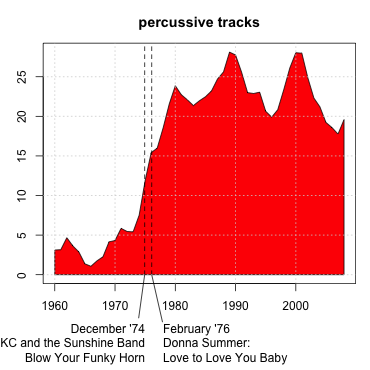
Our first thought was that songwriters in the 80s must have turned on their drum machines, loved what they heard and wrote a song to that beat - without changing the default tempo setting of 120 bpm. I would love this to be correct, but I have a hunch that it's not, especially after having found this highly interesting manual for writing a hit single written by The KLF in 1988. They say that "the different styles in modern club records are usually clustered around certain BPM’s: 120 is the classic BPM for House music and its various variants, although it is beginning to creep up", and also, "no song with a BPM over 135 will ever have a chance of getting to Number One" because "the vast majority of regular club goers will not be able to dance to it and still look cool".Time, as the KLF said, may be eternal, but time signatures aren't; dance music (which remained strongly clustered around 120bpm at the time of acid house and the Second Summer of Love) soon started creeping upward past 130bpm, while tempos of charting music in general moved down.
last.fm's DSP algorithms also pick out the rise of punk, with its simplistic rock'n'roll arrangements and emphasis on DIY enthusiasm over polished virtuosity, and the vanquishment of prog rock, glam and other more experimental genres; this manifested itself in a steep rise in the proportion of the charts occupied by records of low harmonic and timbre complexity (i.e., both simple melodic/chord structures and unostentatious selections of instruments) between 1976 and 1979, and map the Loudness Wars of the past few decades, as the rise of the CD and a competition for sounding louder and more kick-ass than all the music that came before conspired to annihilate dynamic range:
Finally, another cultural trend that shows up in the data is the steady decline of the Truck Driver's Gear Shift (i.e., the tendency of songs to shift their key up one or two semitones before the final chorus, for some extra heartstring-tugging oomph) from the 1950s to the present day; presumably because that shit got old. When the incidence of gear shifts is plotted by month, however, few will be surprised to find that December has 2-3 times as many as the rest of the year; after all, 'tis the season to be cheesy.
The percentage of loud tracks has increased from 10% in 1964 (by definition) to over 40% in recent years. So music has got louder. Well, isn't that in the spirit of Rock'n'Roll? Sadly, it isn't, because the increase in loudness has led to worse sound quality. Granted, it's louder, but boy is it flat!
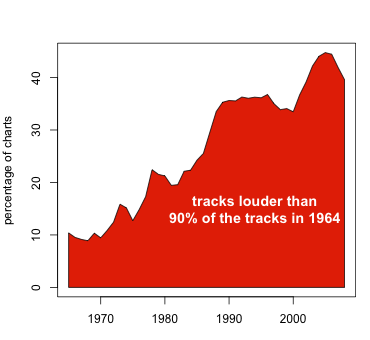
2012/2/4
There's a new article in WIRED interviewing members of the French underground explorers/guerilla repairers/real-life troglodistes UX; i.e., the people who set up a secret, fully outfitted cinema in the Parisian catacombs and subsequently covertly repared the clock in the Panthéon (and then made the mistake of notifying the officials responsible for the building, who deliberately broke it again out of spite); this article, largely drawn from an interview with one Lazar Kunstmann, has some details about the origins of the movement, its motivations, and some of its techniques:
Thirty years ago, in the dead of night, a group of six Parisian teenagers pulled off what would prove to be a fateful theft. They met up at a small cafè near the Eiffel Tower to review their plans—again—before heading out into the dark. Lifting a grate from the street, they descended a ladder to a tunnel, an unlit concrete passageway carrying a cable off into the void. They followed the cable to its source: the basement of the ministry of telecommunications. Horizontal bars blocked their way, but the skinny teens all managed to wedge themselves through and ascend to the building’s ground floor. There they found three key rings in the security office and a logbook indicating that the guards were on their rounds. But the guards were nowhere to be seen. The six interlopers combed the building for hours, encountering no one, until they found what they were looking for at the bottom of a desk drawer—maps of the ministry’s citywide network of tunnels. They took one copy of each map, then returned the keys to the security office.
In some places, UX has been able to create covert connections between networks, using (among other tricks) an invention they call the rolling basin. This is a passage in the bottom of a tunnel that appears to be a grate with water under it; in fact, both grate and water are part of a movable tray on rollers. Voilà trapdoor to another tunnel in a different network. The tray itself is made of concrete, so even if someone raps it with a stick, it sounds solid.
So what does the group do with all this access? Among other things, it has mounted numerous clandestine theater productions and film festivals. On a typical festival evening, they screen at least two films that they feel share a nonobvious yet provocative connection. They don’t explain the connection, leaving it up to the audience to try to discover it. One summer, the group mounted a film festival devoted to the theme of “urban deserts”—the forgotten and underutilized spaces in a city. They naturally decided the ideal venue for such a festival would be in just such an abandoned site.Kunstmann has some quite scathing words about the officials notionally responsible for the preservation of France's historical and cultural patrimony, a duty which UX claim they've derelicted:
Kunstmann has a gloomy view of contemporary civilization, and in his eyes this affair illustrates many of its worst faults—its fatalism, complacency, ignorance, parochialism, and negligence. French officials, he says, bother to protect and restore only the patrimony adored by millions—the Louvre, for example. Lesser-known sites are neglected, and if they happen to be out of public view—underground, say—they disintegrate totally, even when all that’s needed is a hundred-dollar leak repair. UX tends the black sheep: the odd, the unloved, the forgotten artifacts of French civilization.
It seems that the problem is exacerbated by a culture of officiousness endemic to France's public service, where the purpose of an office is often overshadowed by the ego of the holder of the office and his (or hers, though, to be honest, usually his) need to stake out turf and engage in territorial pissing matches. Hence the neglect of anything not immediately prestigious and the active hostility to those who show up said official neglect by doing something about it.
UX have learned their lesson from the Panthéon incident; since then, they claim to have repaired some 15 other sites, though have kept the details secret:
I ask him to elaborate on their choice of projects. “We can say very little,” he replies, “because to describe the sites even a bit can give away their location.” That said, one site is “belowground, in the south of Paris, not very far from here. It was discovered relatively recently but elicited very strong interest. It totally contradicts the history of the building above it. In examining what’s belowground, one notices that it doesn’t correspond to the information one can obtain about the history of the site. It’s history in reverse, in a way; the site was dedicated to an activity, structures were placed there, but in fact the site had been dedicated to this activity for quite a long time.”
2012/2/1
Long-time video-game enthusiast Charlie Brooker visits Japan, comes away slightly disappointed that how much the rest of the world has caught up, and the gadgetland of Akihabara is no longer as much of a novelty:
I'd been looking forward to browsing the shelves for zany gadgets, but the reality was slightly disappointing. Smartphone apps have replaced many of the charmingly pointless Japanese gizmos that used to be pop up on late-90s travel shows. More significantly, the west has become overtly tech-obsessed too. At home, we're routinely battered over the head with so many miraculous widgets, a sort of amazement fatigue has set in. So while in Japan you can easily stumble across a remote-control tissue box or a battery-operated planetarium for your bathroom (by which I mean a waterproof Saturn-shaped orb that floats in the bath and projects the entire visible universe onto the ceiling), the sense of surrounding novelty has diminished. It's less "WTF", more "yeah, that figures". Touring the electronic shops is still an entertainment in itself: I was merely surprised to discover I didn't actually want to buy anything.
2012/1/29
Last week, The Guardian once again ran a series of articles on Europe today, with contributions from papers in France, Spain, Germany, Poland and Italy. Intended partly to combat the rise in anti-European sentiment in the wake of the financial crisis. Among other things, this includes a number of profiles of political leaders by journalists from other countries (i.e., an Italian perspective on Germany's Angela Merkel, a German view of Poland's Donald Tusk, and French and British pieces on the other country's leader), as well as a a section looking at, and responding to, national stereotypes in Europe:
What message do we Brits think we send when our signature cultural export of 2011 was Downton Abbey, a show entirely about the intricacies of class and which apparently longs for a return to Edwardian notions of hierarchy? The smash West End play One Man, Two Guvnors similarly revolves around class. Unfortunately, it's not just a foreigners' myth that in Britain how one speaks and what school one attended still counts.
There is a vibrancy to modern British life that eludes the cliche's grasp. There's a hint of it in that Polish suggestion that the Brits are "kind and friendly to immigrants". Compared with other European countries, it's probably true that Britain is, generally, more tolerant. Some of our public services – the NHS, the BBC – are still cherished. We are not merely a mini-America of let-it-rip free-marketism.
Efficiency is not really a Berlin thing. Take construction. To build 2km of new tram lines to connect the new central station, they set aside three years. Delays were not even factored in. In China, they'd have built whole new cities in that time, or a high-speed motorway across the entire country. Maybe the Chinese are the Germans of the 21st century. Or maybe Berliners are just not typical Germans. Can you stereotype a country if its capital is not typical?
In Italy, sex drive increases with age. Naturally, it is also possessed to a degree by the young (this is why we have children), but it is only after the age of 50 that the Italian male finally dives headlong into adolescence. We are the only nation to have had a prime minister in his 70s who wears a bandana on his head like a tennis player or a rap singer.
2012/1/24
The Bleeding Obvious: A sociological study from Australia has showed that people who fly national flags on their cars are more likely to harbour xenophobic attitudes, with both exclusionary views of who belongs in their society and hostility to those outside of the circle:
Professor Fozdar said 43 per cent of those with car flags said they believed the White Australia Policy had saved Australia from many problems experienced by other countries, while only 25 per cent without flags agreed.
A total of 55 per cent believed migrants should leave their old ways behind, compared with 30 per cent of those without flags.
"Very clear statistical differences in attitudes to diversity between those who fly car flags and those who don't, show that flag waving − while not inherently exclusionary – is linked in this instance to negative attitudes about those who do not fit the 'mainstream' stereotype'," she said.The study also revealed more young people flying flags than older people; perhaps a sign that a more liberal older generation who grew up in the wake of the cultural struggles of the Sixeventies and the Whitlam-era progressive consensus is being supplanted by the children of Howard, Hanson and Hillsong, whose views on what belongs in Australia are a lot narrower?
The study was done in Australia, surveying people flying the Australian flag on their cars in the run-up to Australia Day, though I imagine they'd find similar findings on people flying the flag in other circumstances (such as wearing it as a cape at Big Day Out), or in other countries (I imagine those flying the Cross of St. George in England are more likely to vote UKIP, have uttered the phrase "bloody Pakis" at some point in their lives, to have an aversion to eating "foreign muck", and complain about foreigners coming here and stealing our jobs and not working").
2012/1/21
In the light of Wikipedia disappearing for a day in protest against the SOPA law, an article by an assistant professor comparing the philosophy of Wikipedia with that of traditional paper encyclopaedias:
Reading the high-quality, professionally edited entries in my library’s encyclopedias was an eye-opener and a guilty pleasure — you could learn so much with so little effort! And you don’t have to work as hard untangling the entries the way you do with Wikipedia! But this is exactly the problem with closed, for-profit encyclopedias: they require no work. In fact, they require just the opposite: submission to authority. The writing guidelines for my encyclopedia entry insist that there be no quotations or citations — just a short list of additional readings. Encyclopedias give us no reason to believe their claims are true except the arbitrary authority of those who write them. They are the ultimate triumph of the authoritarian impulse in academics.
It is this refusal of arbitrary authority that really scares encyclopedia types, not worries about accuracy. Wikipedia is a place where you must learn to think for yourself, encyclopedias are places where you are told what to believe.It's interesting that the authoritarian underpinnings of the encyclopaedia, necessary for the purposes of aggregating broadly accepted knowledge within convenient reach, went all but unnoticed (and, had anybody noticed and criticised them, they would have sounded like some kind of hopelessly idealistic hippy Arcadian) until the disintermediating power of the internet demonstrated that another world is possible.
2012/1/11
There's an article in the New Yorker about the US television show Portlandia, a sketch comedy show satirising the foibles of White People in bourgeois-bohemian enclaves (like the titular Portland, Oregon, which seems to be the Berlin of America or something), and the relationship between the two creators of the show, Fred Armisen and Carrie Brownstein (better known to some as a member of the legendary Pacific Northwest riot-grrl band Sleater-Kinney):
“Portlandia” presents a heightened version of the city’s twee urbanity: a company sells artisanal light bulbs, a hotel offers a manual typewriter to every guest, and a big local event is the Allergy Pride Parade. The mayor, played by Kyle MacLachlan, becomes an object of scandal when he’s “outed” as the bass guitarist in a middle-of-the-road reggae band. (The real Portland’s mayor, Sam Adams, who is openly gay, plays MacLachlan’s assistant on the show.) Armisen and Brownstein, wearing anthropologically precise wigs and outfits, portray most of the main characters: bicycle-rights activists, dumpster divers, campaigners against any theoretical attempt to bring the Olympics to Portland, animal lovers so out of touch that they free a pet dog tied up outside a restaurant. (“Who puts their dog on a pole like a stripper?”) Many characters recur, and, because they often seem to know one another, their intersections from sketch to sketch give the show the feel of a grownup “Sesame Street.” This childlike vibe has an edge to it, however; as an Armisen character explains at one point, Portland is “where young people go to retire.”
But the most palpable affection onscreen is that between Armisen and Brownstein, who have an unusually devoted platonic relationship. They met in 2003, when Sleater-Kinney was playing in New York City, and Armisen invited the band to an “S.N.L.” after-party. When Brownstein showed up, she found him wearing a Sleater-Kinney button with her picture on it. Their paths had probably crossed before: Armisen started out his performing life as the drummer in a Chicago punk band called Trenchmouth, and he was married for six years to the British singer and songwriter Sally Timms, from the Mekons. Brownstein says that she and Armisen likely slept on some of the same couches when both were touring. (“If you were in an indie band in the nineties, you slept on a lot of couches.”) After that party in New York, Brownstein and Armisen began building a friendship, but, given that they were living on opposite coasts, they decided that they’d have to work on something together. As she put it, when you’re not dating somebody, “it begins to seem kind of weird if you’re flying around the country to see him.”
Armisen and Brownstein text each other every night before bed. Brownstein says of their friendship, “Sometimes I think it’s the most successful love affair either of us will ever have.” Both claim that it wouldn’t work if they were romantically involved. “It would be colder, because we’ve both treated our romantic relationships in a cold way,” Armisen says. “Carrie and I are more romantic than any other romantic relationship I’ve ever had—that sense of anticipation about seeing the other person, the secret bond. But things don’t become obligatory. I’m not thinking, I’m doing this because you’re my girlfriend; I’m just thinking, I love Carrie.”
2011/12/30
In praise of Joanne Rowling's Hermione Grainger series, which lauds the popular novelist for standing up to commercial pressure to adhere to traditional gender stereotypes and pepper her story with hackneyed clichés because they're, you know, "more marketable":
And what a show it is. In Hermione, Joanne Rowling undermines all of the cliches that we have come to expect in our mythic heroes. It’s easy to imagine Hermione’s origin story as some warmed-over Star Wars claptrap, with tragically missing parents and unsatisfying parental substitutes and a realization that she belongs to a hidden order, with wondrous (and unsettlingly genetic) gifts. But, no: Hermione’s normal parents are her normal parents. She just so happens to be gifted. Being special, Rowling tells us, isn’t about where you come from; it’s about what you can do, if you put your mind to it. And what Hermione can do, when she puts her mind to it, is magic.
The character of Harry Potter is an obnoxious error in the Hermione Granger universe, made more obnoxious by his constant presence. It’s tempting to just write Harry off as a love interest who didn’t quite work out; the popular-yet-brooding jock is hardly an unfamiliar type. And, given that Hermione is constantly having to rescue Harry, he does come across as a sort of male damsel-in-distress.But, if we look closely, we can see that Harry is a parody of every cliche Rowling avoided with Hermione. Harry is not particularly bright or studious; he’s provided with an endless supply of gifts and favors; he’s the heir to no less than two huge fortunes; he’s privileged above his fellow students, due to his fame for something he didn’t actually do himself; he even seems to take credit for “Dumbledore’s Army,” which Hermione started. Of course this character is obnoxious. It’s only by treating ourselves to the irritation caused by Harry that we can fully appreciate Hermione herself.Which makes for an astute critique of the reactionary elements of popular fiction, of which Harry Potter is an exemplar. Whether it's convincing as a counterfactual history, though, is another matter; were Rowling to write her books in the way the article described, what's to say they wouldn't have sunk into obscurity like a lot of worthily didactic left-wing fiction, championed only by those so cultishly right-on that they condemn the Grauniad as a right-wing hate sheet?
2011/12/29
An interview with underground comic author Daniel Clowes, in which he talks about a number of things, such as the pitfalls of hipster parents trying wrongheadedly to introduce their kids to interesting culture (and, in the process, making it deeply uncool):
I think about that a lot with my son. I don’t want to inflict the stuff I like onto him. He’s only eight, so right now I could get him to like anything, pretty much, but when he’s a few years older I really don’t want him to respond to anything because I like it too much or not enough. I want him to sort of find his way into his own stuff, so it’s something I have to constantly modulate. I don’t want him to associate this music with me, I want him to discover it on his own and then I’ll go like, “Well, I happen to have all their records!”In short, you may be hip and credible, but once you have kids, your position as a parent will, in the eyes of your kids, be like antimatter to all the cred you have carried forth from your bourgeois-bohemian extended adolescence. And so, a generation is produced to whom Black Flag and Pavement will be as naff as, say, Engelbert Humperdinck or something. Or, in the post-loungecore, post-Yacht Rock age after irony has folded in upon itself, perhaps it's the act of having opinions about music that will carry a patina of daddish uncool, with record collections and discographies being inherently cringeworthy; perhaps, to the hip kids, music will be, as Jarvis Cocker put it, like a scented candle, a ubiquitous low-value commodity beneath caring about.
And now is the era of the Cool Dad. I know lots of parents who I just think, like, “God, if my parents had been like that I would’ve been into all this cool stuff.” Luckily they weren’t, so I discovered all that stuff on my own and they sort of disdainfully shook their heads at the stupid stuff I was interested in. But there are a lot of things that I don’t respond to. I’m not into video games, so I can just see my son becoming, like, a video-game tester as his job or something. Developing video games.Clowes touches on the mainstreaming of comic-book/nerd culture:
When I was in high school, if I’d gone up to a girl and said, “Would you like to go read some of my Thor comics with me?” they would’ve just thought I was the lowest form of human life. That would’ve been so unimaginable. I was actually on the subway in New York and saw this, like, Attractive Teenage Couple, and the guy was like, “Hey, wanna go see Thor tonight?” and the girl was like, “Yeah, yeah.” And I just thought, that is just blowing my mind that that is happening right in front of me.And touches on the way that, by reducing the amount of friction required to discover something, the internet has reduced the value of merely knowing about cultural products as badges of belonging:
I could tell you right now about some obscure filmmaker and you could know more about him by midnight than I would’ve been able to find out in 10 years when I was your age. But I don’t know that it would mean much to you unless you really connected to the guy and kept following it and doing more and more research. It’d just be like, “Yeah, I know about that guy,” and then you’d move on to the next thing. There’s something about having it be like a mystery that you have to solve and figure out that really connected you to this weird culture back then.
It also used to be like, you’d buy an album by a recording artist and there’d be one or two good songs on it, and there’d be all the rest that were just kind of to fill up the album, and you’d work your way through that and learn to like the other songs after a while, and then you’d wait till the next album came out. And now it sort of feels like everything is all the greatest hits. You learn about a musician and you immediately can figure out what their 10 greatest songs are, and you just listen to those and you don’t experience the full breadth of their failures and mishaps and all that stuff. I feel like that’s how all culture is. And I’m as guilty as anybody else now—if I hear about an author or something I go straight for their most well-known book and read that first, and, you know, I don’t have that experience of kind of building up to that. You don’t wanna read the rest of their books after that because you figure, “Well, I’ve already read the best one. It’s not gonna be much better than that.”The interview also touches on the settings of Clowes' works, the aura of alienation in his characters, and his aesthetic formative experiences having been a reaction to the cultural upheavals of The Sixties:
As a kid I loved the look of the early ’60s, kind of the pre-hippie era, just the haircuts and clothes and the way women dressed, it was really appealing. And then all of a sudden people started wearing, like, filthy clothes and messy hair and stuff. That seemed really hideous and horrible to me. It definitely relates to what was going on in my life at the time because, as with many kids who grew up then, my family was just disintegrating while all that stuff came in, so it represented this chaos that was entering my life. But I still have an affection for that pre-1968 look, that kind of saturated Technicolor look. That seems like the real world to me, or like the way things should be.
2011/12/24
A few seasonal links for today and tomorrow:
- The mythological trainwreck that we call "Christmas", with its ill-fitting pieces of Middle Eastern and Nordic folklore, was discussed here last year. Now, some people going by the name of Cannabis Culture (read into that what you will) have another element to add to this; namely, the claim that the legend ot Santa Claus comes from Lappish shamanic rituals involving hallucinogenic mushrooms, with Santa's red and white costume having nothing to do with the Coca-Cola logo and everything to do with the colouring of the amanita muscaria mushroom, which may be found growing under fir trees.
- A Norwegian crafter named Jonas Laberg made a 10kg marzipan pig, as a present for his friends' daughters. The finished product looks horrifyingly detailed:

- The Graun's Zoe Williams has a piece on the supposed Christmas tradition of kissing under the mistletoe, which she contends is one of those things that only happens on TV (much like adults playing with cats, she writes), and does a Twitter survey, confirming this; with one heartbreakingly poignant exception:
In 1973, Helen was 16 and having a relationship with a girl at school, but they hadn't come out for a whole load of reasons, most of them to do with it being 1973. "In those days, we were like outcasts, so nobody knew, it was a great secret. A few of my friends were really homophobic. We went to this New Year's Eve party, where people were all goading each other to kiss. So we did. It was brilliant, everybody was cheering, we were pretending it was a joke. It was probably one of the best kisses I've ever had."
It didn't make it any easier to come out, though. "We never came out, we split up two years later, the pressure became too great. Most of it on her, because her family had mapped out her life for her, she had to get married. And I did what was expected of me, when I was 18. I got married as well. I had three kids."
- Christopher Hitchens may be gone, but an unpublished essay he wrote about Christmas has surfaced: Forced Merriment: The True Spirit of Christmas.
I once tried to write an article, perhaps rather straining for effect, describing the experience as too much like living for four weeks in the atmosphere of a one-party state. "Come on," I hear you say. But by how much would I be exaggerating? The same songs and music played everywhere, all the time. The same uniform slogans and exhortations, endlessly displayed and repeated. The same sentimental stress on the sheer joy of having a Dear Leader to adore. As I pressed on I began almost to persuade myself. The serried ranks of beaming schoolchildren, chanting the same uplifting mush. The cowed parents, in terror of being unmasked by their offspring for insufficient participation in the glorious events…. "Come on," yourself. How wrong am I?
One of my many reasons for not being a Christian is my objection to compulsory love. How much less appealing is the notion of obligatory generosity. To feel pressed to give a present is also to feel oneself passively exerting the equivalent unwelcome pressure upon other people... Don't pretend not to know what I am talking about. It's like the gradual degradation of another annual ritual, whereby all schoolchildren are required to give valentines to everybody in the class. Nobody's feelings are hurt, they tell me, but the entire point of sending a valentine in the first place has been deliberately destroyed. If I feel like giving you a gift I'll try and make sure that (a) it's worth remembering and (b) that it comes as a nice surprise. (I like to think that some of my valentines in the past packed a bit of a punch as well.)
- ‘Yes we know it’s Christmas’ say African musicians as they finally record a response to Band Aid:
“Just because we don’t have Boney M or Christmas advertising in September doesn’t mean we are oblivious to it,” said Gundane who went on to suggest that Africans were a lot like the Irish. “They made it through disasters like the potato blight and the invention of the Protestant church without forgetting Christmas – why did they think we would forget it?”
Gundane said he hoped that his involvement with the song would turn him into an expert on British politics and economics in the same way ‘Do they know it’s Christmas’ had turned Geldof and Bono into the world’s leading experts on Africa.
- After some UK department store apparently used a godawful twee-folk version of a Smiths song in one of its Christmas ad, the inimitable Rhodri Marsden decided to one-up the horror of it with his own Christmas-themed Smiths travesty. Behold: Heaven Knows I'm Christmassy Now, to be a mainstay of Christmas mix tapes in years to come.
2011/12/18
Néojaponisme, the blog of Japanese resident W. David Marx, has a five-part piece on how Japan's economic malaise has changed Japanese pop culture (parts 2, 3, 4, 5), in particular, causing the decline of the mainstream and the rise of the fringe to prominence. The gist of this is that the golden age of Cool Japan is over; as Japanese consumers' spending power declined, mainstream consumers cut back, and cultural markets, such as music, publishing and TV have collapsed, resulting in what some commentators refer to as "the generation who don't consume". with the notable exception of fringe genres catering to marginal subcultures for whom consuming cultural products is not a matter of choice but of identity; these include the otaku (whom Marx sums up as "anti-social “nerds” interested in science fiction, comic books, video games, and sexualized little girls (lolicon)"), the yankii—working-class juvenile delinquents with poor economic and lifestyle prospects—and the gyaru, a female analogue of the yankii, only oriented around romantic fiction and elaborate cosmetics.
The end result is that the otaku and yankii have an almost inelastic demand for their favorite goods. They must consume, no matter the economic or personal financial situation. They may move to cheaper goods, but they will always be buying something. Otherwise they lose their identity. While normal consumers curb consumption in the light of falling wages, the marginal otaku and yankii keep buying. And that means the markets built around these subcultures are relatively stable in size.So while demand in the mainstream has cratered, the culture industry has retooled to servicing these reliable subcultures, with cultural products such as highly sexualised girl groups appealing to older men with schoolgirl fetishes and films with yankii themes. One side effect of this is that the days of Japanese pop culture appealing to hip, affluent consumers abroad may be over:
Most men around the world are not wracked by such deep status insecurity that they want to live in a world where chesty two-dimensional 12 year-old girls grovel at their feet and call them big brother. The average university student in Paris is likely to read Murakami Haruki and may listen to a Japanese DJ but not wear silky long cocktail dresses or fake eyelashes from a brand created by a 23 year-old former divorcee hostess with two kids. Overseas consumers remain affluent, educated, and open to Japanese culture, but Japan’s pop culture complex — by increasingly catering to marginal groups (or ignoring global tastes, which is another problem altogether) — is less likely to create products relevant for them.
2011/12/9
Over the past decade or two, a wave of Britons had moved to Australia, tempted by made-for-export Australian soaps, whose English-speaking, lager-drinking inhabitants seemed happier, healthier and less beaten down by life than those on Eastenders, and facilitated by the Australian government's Anglo-friendly immigration policies. Now, it looks like a lot of them are moving back; for some, the Australian reality is not the idyll of beachside barbecues, but something more alienating, and even in the age of Skype and Facebook, the distance from friends and family is great:
"If they live in a bungalow in the suburbs of Adelaide, it gets lonely. There isn't a culture of going for a drink after work and the TV is terrible."
"It's not about living by the coast in the sun - it's about living in a dull flat in suburbs that don't have any real infrastructure."One complaint is lack of cultural amenities and history, especially from those who ended up in the sticks:
Some British people complain about a lack of culture and history, he says, but that depends where you live."Sydney and Melbourne are world-class cities with plenty of great things to see and do, but outside the big urban areas life is definitely less colourful and probably more of an acquired taste."Some Poms, however, are staying behind and making do with the lack of real ale, quality newspapers and/or cheap flights to Spain.
2011/11/28
The Académie Française, the guardians of the integrity of the French language, recently held a "festival of new words", a competition in which the public were invited to suggest new French words, with the Académie choosing winners; the results are in:
The winner was attachiant(e) – a combination of attachant (captivating, endearing) and the slang word chiant (bloody nuisance) to denote someone you cannot live with but cannot live without.
Someone had also come up with the verb textoter (to write SMS messages on a mobile telephone), presumably something last year's winner, a phonard – a pejorative term for someone who is glued to their mobile phone – does all the time.
Previous festivals have thrown up gems including ordinosore (ordinateur plus dinosaur, an out-of-date computer), bonjoir (bonjour plus bonsoir, a greeting to be said around midday), and photophoner (to take a photo with a mobile phone).Of course, whether the winners make it into the official draft of the French language is another matter; while the Académie may unilaterally coin indigenously French neologisms, getting people to use them is another matter. (The Académie's word for electronic mail, courriel, seems to have been unsuccessful, with the anglicism "e-mail" instead gaining currency.) Chances are this contest is intended more to promote experimentation with the expressive possibilities of the French language.
2011/11/27
It emerges that the "Mahna Mahna" song, that (in)famous earworm from the Muppet Show, was originally from an Italian soft-porn exploitation film titled Sweden: Heaven and Hell:
In the tradition of the shocking, factually questionable Mondo Cane, Heaven and Hell was styled as a documentary about Scandinavian sexuality, which provided a thin veneer of respectability for its leering exploration of lesbian nightclubs and meter maids who moonlight as nude models.The song, composed by Piero Umiliani, was released as a novelty single under the title “Mah Nà Mah Nà”, and made it to number 55 on the US charts, which presumably led to a bohemian hepcat and puppeteer named Jim Henson discovering it; and the rest, as they say, is history.
Mah Nà Mah Nà was by no means the only piece of worthwhile music to emerge from the seamy European cinematic underworld. Before video came along, a lot of pornographic and exploitation productions were seen as canvases for experimentation and artistic exploration in everything from cinematography to music, which has led to highly prized soundtrack recordings from films such as Vampyros Lesbos and Die Schulmädchen Report. (After the VCR commodified porn and cut into its margins, such exploration seems to have moved to the rising genre of music videos.)
2011/11/22
And in heritage rock news: archaeologists from York University have unearthed a fragment of Britain's cultural heritage: graffiti on the wall of a London flat shared by members of The Sex Pistols in the 1970s, including drawings believed to have been made by John Lydon:
"This is an important site, historically and archaeologically, for the material and evidence it contains. But should we retain it for the benefit of this and future generations?" they ask in a study of the drawings for Antiquity magazine.I wonder what Lydon (who's surely not even dead yet) makes of being the subject of archaeological interest.
2011/11/8
Around Leicester Square and Chinatown, one sometimes sees a hoody with a traffic cone:
The gentleman in question appears to be a busker of some sort; he sits on the pavement, his mouth around the narrow end of the cone, making trumpet noises into it, presumably in the hope that someone will toss him some coins for his trouble. His repertoire consists mostly of snatches of popular songs, old standards and themes.
The figure, sitting there in the middle of pedestrian traffic, burbling into a traffic cone, seemingly oblivious to the comings and goings of tourists and Londoners, seems like some non-specific element of as-yet undifferentiated satire or social criticism,
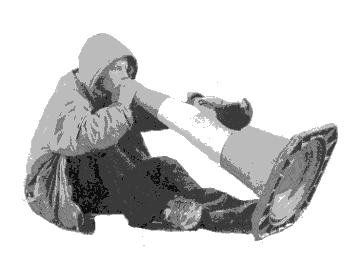 some amalgam of Hogarth and Banksy, Chris Morris and Thom Yorke.
But what does he represent? Is he the feral Other, attired in the uniform of Britain's demonised youth, brazenly possessing a traffic cone he is unlikely to have acquired legitimately, and embodying threat? The drug-zombie, mouth clamped onto a pipe, oblivious to the morés of respectable society? Or the embattled Everyman, reacting to unreasonable circumstances in the only reasonable way, by curling up into a ball and gibbering? Is he a satire on the malaise of Broken Britain, or the mindset of the sorts of people who use the phrase "Broken Britain" in the mistaken belief that it was ever not, or both?
some amalgam of Hogarth and Banksy, Chris Morris and Thom Yorke.
But what does he represent? Is he the feral Other, attired in the uniform of Britain's demonised youth, brazenly possessing a traffic cone he is unlikely to have acquired legitimately, and embodying threat? The drug-zombie, mouth clamped onto a pipe, oblivious to the morés of respectable society? Or the embattled Everyman, reacting to unreasonable circumstances in the only reasonable way, by curling up into a ball and gibbering? Is he a satire on the malaise of Broken Britain, or the mindset of the sorts of people who use the phrase "Broken Britain" in the mistaken belief that it was ever not, or both?
2011/10/30
The phenomenon of the greying of rock'n'roll—an art form/entertainment industry born of idealised vintage juvenile delinquency, stylised and re-stylised over decades, and now enjoying the position of the established genre of popular musical entertainment, while the first generation of its practitioners are long-dead and the following generation, who presided over its imperial phase, are of pensionable age—has brought many paradoxical situations with it, from an aging Pete Townshend reciting his younger self's hope of dying before getting old to the question of what exactly a Rolling Stones gig signifies in the 21st century.
And now, theatrical glam-rock veterans Queen (whose imperial phase involved prodding the fourth wall between the contrived outlaw-rebel-berzerker spectacle of rock'n'roll and the formalism of public performance) have decided to embrace the inevitability of a successful rock band turning into an entertainment franchise and a micro-genre in itself by recruiting their own tribute band:
"Let's face it," Taylor told Rolling Stone magazine, "we're getting a little long in the tooth, but there are an awful lot of tribute bands, some of them good, some of them not good." Inspired by a poster he saw in Norfolk, Taylor hopes to start a "never ending" Queen tribute tour, keeping the band's music alive with performances by young lookalikes. "I'm quite convinced that there are tens of thousands of kids, of really talented people, in their bedrooms around the world playing drums, guitar, and singing," he said. "And I want to find some of those people."It's not entirely a novel act—British indie-rock combo Art Brut famously franchised their name out to cover bands—though Queen seem to be doing it less as an artistic statement and more as a professional business model, like taking a successful restaurant, codifying everything from the recipes to the décor in a ring binder, duplicating it and letting a thousand facsimiles of it bloom in shopping malls everywhere.
2011/10/24
And more on the subject of Siri; while the technology is available only on Apple's iOS platform (and currently only on the latest and greatest iPhone), an Android software company have taken it upon themselves to make their own version, in an 8-hour hackathon. It's named Iris (see what they did there?), and it sort of works:
Me: Remind me at 9pm to go and buy milk
It Recognised: remindme at 9 pm to go in hawaii
It Replied: I have two pets.
Me: Where is siberia
Replied: Wherever you make it I guess
Q: Where can I get a recipe for cheesecake?If one views this as a competitor to Siri, it falls well short (even without the bizarre voice-recognition results, it doesn't seem to contain the sort of evolving model of the user, their relationships and preferences, and the current context that makes a system like Siri work), though one could hardly expect this from an 8-hour hacking session. (If one views it as a publicity stunt to promote Dexetra's other apps, it'll probably be far more successful.) However, as a surrealist tool for injecting chaos into the lives of those who use it, it looks to be far superior, escaping the shackles of bourgeois practicality that constrain Apple's more polished product. Iris looks to be a virtual assistant André Breton could love.
A: En la esquina, con minifalda.
("In the corner, wearing a miniskirt.")
Apple's latest iPhone, the 4S, comes with a feature named Siri, an intelligent agent (based on technology from a US military AI research programme) which answers spoken questions in natural English, using web services, the current environment and a constantly evolving profile of the user and their preferences to make sense of ambiguous queries like "will I need an umbrella tomorrow?", and speaks the results back to the user—in a female voice in the US and Australia, but a male one in the UK. Apple haven't explained the reasons for the difference, but there are theories:
Jeremy Wagstaff, who runs technology consultancy Loose Wire Organisation, says: "Americans speak loudly and clearly and are usually in a hurry, so it makes sense for them to have a female voice because it has the pitch and range. British people mumble and obey authority, so they need someone authoritative." Which, apparently, still means male.There's more historical context here (which talks about disembodied machine voices having been female for a long time, since telephone operators* and WW2-era navigation systems, female voices being used in railway station announcement systems because their higher frequencies carry better against the train noise, evil computers in films being presented as male, and BMW having to recall a female-voiced navigation system in the 1990s because of complaints from German men who refused to take direction from a woman).
There's also a piece in the Atlantic about why many electronic devices designed to assist have female voices. It looks predominantly at systems in the US, and concludes that, in America at least, female voices are perceived to go better with the role of assistant—competent, level-headed, and unthreateningly loyal. Or, in other words, everybody wants to be Don Draper.
Which doesn't answer the question of why (according to Apple's in-house cultural anthropologists, anyway) British users feel more comfortable with male-voiced virtual assistants. Could it be the lack of the famous 100-watt smiles of the American service industry (as per the US psychologist who categorised British smiles as grimaces of acquiescence)? An ingrained sense of social hierarchy and/or traditional acceptance of class privilege which makes authoritative male voices more acceptable in Britain? (I wonder whether refined-sounding male British voices would be popular with American users; after all, I imagine that quite a few people wouldn't mind their virtual assistant to have a British butler persona.) Or perhaps the residual trauma of Thatcherism makes female voices with any hint of authority a hard sell in Britain? And why does Australia get the female voice option by default? Is Australia more "American" than "British" in this sense? Or is the preference for male voices some peculiarly British anomaly among the English-speaking nations?
* If I recall correctly, the very first telephone operators in the late 19th century were boys, of the same background who would have been employed in clerical tasks. They tended to horse around and play pranks too much, though, so they were replaced with female operators after a few years. Throughout living memory, the typical telephone operator (where those still existed) has been a woman.
Scandinavia And The World is a web comic drawn, in anime fan art fashion, by a Danish illustrator, and exploring Scandinavian culture and stereotypes (and, occasionally, the rest of the world). In it, Denmark is never without a beer bottle (the Danes, you see, don't have the punitively high alcohol taxes and state liquour monopolies that are the norm in the Nordic world), Norway is always carrying a fish, Sweden may or may not be gay and Iceland is a bit nuts; with cameo appearances by America (a loud, not-too-bright bigot and his sister, Paris Hilton) and England (who wears a monocle and speaks like a P.G. Wodehouse character and/or Hollywood villain). There are comic strips on topics ranging from mutual stereotypes of the other Scandinavian countries and the differences in the sound of their languages to the gloomy nature of Nordic cinema and the varieties of putrefied fish consumed in the Nordic countries. Well, when it isn't veering off into fits of anime-otaku sexual innuendo.
2011/10/23
A number of retrocomputing enthusiasts are taking arcade games which were poorly ported to 8-bit computers back in the 1980s and re-doing the job properly, i.e., creating ports, to the vintage home computers in question, which (being unconstrained by the unreasonable deadlines often imposed by game publishers) do the original arcade games justice (or at least as much justice as one can physically do with a Commodore 64 or an Amstrad CPC):
"You make one mistake in your life and the internet will never let you live it down," wrote Keith Goodyer, programmer of the unfortunate R-Type port, on the CPC Wiki. "Electric Dreams / Activision gave me 21 days to do the port. I wish I had the time to do a nice mode 0 port with new graphics, but alas it was never to be." Impressed by his candor, other readers of the forum decided to make it a reality 20 years later -- and gave themselves more than 21 days to get it done.Goodyer's forum post goes into detail about the development tools, techniques and conditions in which the 8-bit games readers of a certain age will remember nostalgically. Apparently, by the late 1980s, 8-bit game developers had a pretty sophisticated system named PDS, which ran on an MS-DOS PC, assembled and linked the code and zapped it over to a tethered 8-bit computer, much in the way that iPhone development is done today. (Before then, one imagines that a lot of development was done on the actual host system.) I wonder how the tools used by today's (enthusiast) 8-bit game coders differ from those used by professionals in the 1980s.
Also, if those who feel sufficiently strongly about inadequate video-game ports from their childhoods can go back and right wrongs, I wonder whether or not other media will benefit from similar DIY interventions. Can we expect, for example, guerilla filmmakers making (illegal) film adaptations of books previously butchered by Hollywood, or (when the technology becomes available) correcting the maligned films with resynthesised graphics, altered dialogue and altered scenes? Or taking it upon themselves to record what they feel a band's disappointing follow-up album should have been, cobbled together out of samples of the originals, with new vocals resynthesised to sound like the original singer? As the technology becomes available, the possibilities are limitless.
(via Boing Boing) ¶ 0
2011/9/29
There's a piece in the Guardian's Bike Blog on the subculture of cyclists affecting the style of a bygone aristocracy (minus the unpalatable bits, of course):
Browsing some of the increasingly popular retro bike designs recently, I came across the Old Bicycle Showroom ("Purveyors of Fine bicycles to Nobility & Gentry"); and I met Pashley's owners' club of "jolly chaps", who look more Friedrich Nietzsche than Fausto Coppi. Then there is the Tweed Run, issuing its dress code like a public school prefect: "Now look here, proper attire is expected"; and Rapha, with its series of Gentlemen's Races, and clothing for gentlemen.The irony that the article points to is that the golden age of aristocratic cycling is only slightly less fantastic than steampunk, with cycling having been a largely proletarian phenomenon, at least until the age of high-tech materials and the (distinctly modern) bike snob (not to mention of ubiquitous car ownership):
Seventy early cycling clubs were named after the campaigning socialist paper The Clarion (founded 1891), with its ideal of fellowship. The brief aristocratic fad for cycling petered out when the bike became too popular to be posh. It has, as Tim Hilton's memoir One More Kilometre and We're in the Showers relates, "belonged to a lower social class" ever since. Until, that is, the recent popularity of cycling among wealthy men persuaded some marketing departments to rewrite the history of cycling. But does this retelling make any sense?Or, to quote from one of the commenters: "Mummy, why is daddy dressed as a racist?"
2011/9/25
In his latest Poptimist column, Tom Ewing writes about recordings attributed to imaginary authors, typically at some time in an imagined past. More specifically, he writes about Science Of The Sea, a record allegedly made in 1979 by Jürgen Müller, a German oceanographer and amateur musician who was inspired to make a record of ambient electronic compositions by the hours he spent on field trips out at sea, one of whose 100 privately-pressed copies was apparently rediscovered in 2011:
Except, of course, he probably did no such thing. It seems likely that there never was an expedition, or a young biologist, or a private pressing. Science of the Sea is a 2011 record from fin to tail, and the rather lovely tale of Jürgen Müller is entirely invented. Did suspecting this make me like the record less? Certainly not. If anything, I enjoyed it more. As a small child I would sometimes be allowed to sit up with my parents and watch science documentaries, like Carl Sagan's Cosmos. I didn't understand the science, and the documentaries were broadcast late so I was on the edge of sleep in any case, but I remembered their soothing flow: The infinite turned into a kind of bedtime story. Meanwhile, on library bookshelves I would sometimes find 1950s and 60s paperbacks about modern-day scientist-adventurers like Jacques Cousteau or Thor Heyerdahl-- giving the impression of an age of clean-limbed scientific heroism I'd tantalizingly missed, one that looked very much like a Tintin comic.
So no surprise that some of what I get from Science of the Sea-- there by intention or not-- is a pang of love and loss for this imagined time. More intriguingly, though, if the record is fictional it feels like this might have been liberating for its mysterious creator. The album is full of beautifully cornball seascape touches-- flickering arpeggios and note-clouds which practically demand you start thinking about shoals of fish darting back and forth outside a bathysphere window. Sit down and make an electronic album about the ocean now and you might find yourself trying to dodge these clichés. Sit down and role-play a naive non-musician inching towards transcendence at the turn of the 1980s and you can fully embrace them.Science Of The Sea is not the only recent example of its kind; another recent recording shedding light on an underexplored, romantic and distinctly alien corner of the modern past was the retrospective of the Endless House Foundation. The conceit of Endless House presents an experimental electronic music collective, founded in the early 1970s by an eccentric, wealthy Czech audiophile, situated in an ultra-modernistic studio/discotheque complex in the heart of the Bialowieska primeval forest in eastern Poland and informed by the breadth of European avant-garde design and architectural movements of the 20th century, it thrived for must six weeks in the summer of 1973 before collapsing under the weight of its expensive impracticality, leaving behind only some scraps of biographical information, a few ambiguous photographs of improbable architectural spaces, and the curiously pristine recordings of the resident musicians' compositions, which, it seems, prefigured everything from Kraftwerk to Detroit techno, much in the same way that Delia Derbyshire invented IDM in 1965 but neglected to tell the world about it. The fragments have remained buried until recently, when an unnamed British curator unearthed the pieces, and managed to track down the original participants, getting interviews and even a mix, from them.
Of course, it's quite possible that none of this really happened. The story of Endless House reads almost like a Wes Anderson set-piece, only set in a nebulous European avant-garde as seen from outside. Unsurprisingly, the illusion doesn't hold up well to closer examination. For one, the idea that a group of Western European playboys could cross the Iron Curtain with impunity, bringing party guests and giant modular synthesisers with them, while the governments of the Eastern Bloc, still shocked by uprisings in Prague in 1968 and Warsaw in 1970, were in ideological lockdown, seems highly unlikely. (A non-fictional recent musical retrospective of East German electronic music reveals the extent of ideological control over music in the Eastern Bloc; in the DDR, the government only started allowing the production of electronic music in 1980, and even then anything that could be interpreted as critical of industrial society was verboten, leaving room only for ostensibly harmless cosmic psychedelia.) Over and above this, this improbable bubble is populated by a cast of exotically European bons vivants with names like Walter Schnaffs and Felix Uran, who speak in a mixture of English and German, but refer to distances in miles. Nonetheless, if you can suspend disbelief, imagine that the Cold War wasn't that big a deal and that an Austrian synthesist and socialite might sing about being sixteen miles from Saint-Tropez, in an avant-garde cyber-disco about that distance from the Polish-Soviet border, it's an entertaining story, and an even more entertaining record. (The tracks, listened to on their own, work as electronic music, and do evoke the world they purport to come from.)
Meanwhile, in a recent edition of Milan art journal Mousse, there is a retrospective of the works of Scottish-Italian artist Scotty Potenza, written by someone named Nick Currie:
The colour, shape and texture of fresh ice cream is certainly visible in Potenza’s acrylic gouaches; peach, pistachio and purply-red forest berries distinguish themselves forcefully from the sodden greens and asphalt greys of the Scottish industrial landscape. His subject-matter shares this otherness: influenced by the exciting first wave of Acid House culture in the late 1980s, Potenza evinces a non-Calvinist positivity more evocative of Chicago warehouses and Ibiza raves than Glasgow tenements. A Potenza painting incarnates not what Scotland is, but what it lacks.
As 1990s rave culture has continued to experience the bearhug embrace of mainstream acceptance in the UK — its visual values, once restricted to club flyers, now inform restaurant design, public information films and TV commercials for banks and building societies — Potenza has been granted a high-profile list of public commissions. His decoration of the walls of the Home Office lobby with a mural of happy ravers, their hands linked like the figures in Matisse’s La Danse, caused short-lived (and clearly manufactured) outrage in the tabloids, but has proved peculiarly popular with the civil servants who work in the building. A major mural at Finsbury Park underground station entitled Get On One Matey! was unfortunately damaged beyond repair in the 2011 riots. The vandals, caught on CCTV, are currently serving long prison sentences.
2011/9/7
The Guardian's art correspondent Jonathan Jones argues that mainstream acceptance is killing street art; how what used to be an outlaw pursuit, charged with an edgy, subversive frisson, is now thoroughly commodified, exhibited in galleries, flogged en masse to tourists and posed alongside by centre-right politicians, fatally eroding what underground credibility it once had:
Visitors to London buy Banksy prints on canvas from street stalls, while in Tripoli photographers latch on to any bloke with a spray can near any wall that's still standing. Graffiti and street art have become instant – and slightly lazy – icons of everything our culture lauds, from youth to rebellion to making a fast buck from art.
Maybe there was a time when painting a wittily satirical or cheekily rude picture or comment on a wall was genuinely disruptive and shocking. That time is gone. Councils still do their bit to keep street art alive by occasionally obliterating it, and so confirming that it has edge. But basically it has been absorbed so deep into the mainstream that old folk who once railed at graffiti in their town are now more likely to have a Banksy book on their shelves than a collection of Giles cartoons.He has a point about the mainstreaming and commodification of once transgressive phenomena (recently we have witnessed the confirmation of punk's position as a safe and cozy part of Britain's heritage by the National Trust releasing a punk compilation album), and the fact that there is a lot of street art which, when one puts aside its illegality and unconventional locations, is quite mediocre. Though the final stage of this process of commodification seems less than apocalyptic: a culture in which street art becomes a sort of accepted folk art, sometimes critical or confrontational, occasionally brilliant, more often mediocre, and very occasionally leading to wealth and fame, though generally practiced by small-time artists, and tolerated by society as part of the local culture and the broader conversation. Which, to me, looks healthier than a society of zero-tolerance policies, where the means of street-level communication belong exclusively to corporate advertisers.
2011/8/23
Japan's Ise Grand Shrine is both very old (having been established sometime between 4BCE and the 5th century) and very new; every 20 years, the shrine buildings at Naikū and Gekū are demolished and rebuilt. This symbolises the Shinto teachings of the cycle of death and renewal in nature and the impermanence of all things, and also serves to pass on the crafts and techniques used to build the shrine. In this case, one could say that destroying the artefact keeps the institution alive.
2011/8/17
There's an interesting piece in Der Spiegel about the rise of secularism and the psychological differences between religious and secular people. According to the article, non-religious people (atheists, agnostics and the nonreligious) make up about 15% of the world's population, placing them third behind Christians and Muslims in number. Meanwhile, secularism is on the rise, with the often discussed religious revivals, in Europe, the US and elsewhere, being, more often than not, illusory. (In the US, a country associated with almost mediaeval levels of religiosity in public life, churches are losing up to 1 million members a year.)turned out to be and also an increasing number of people who identify as religious on surveys admitting that they don't actually believe in a deity.
According to Boston University psychologist Catherine Caldwell-Harris, the differences between the religious and secular minds may emerge from different thinking styles, with religious people being more likely to attribute sentient agency than secular people:
Caldwell-Harris is currently testing her hypothesis through simple experiments. Test subjects watch a film in which triangles move about. One group experiences the film as a humanized drama, in which the larger triangles are attacking the smaller ones. The other group describes the scene mechanically, simply stating the manner in which the geometric shapes are moving. Those who do not anthropomorphize the triangles, she suspects, are unlikely to ascribe much importance to beliefs. "There have always been two cognitive comfort zones," she says, "but skeptics used to keep quiet in order to stay out of trouble."The rise of secularism has led to more study of what secularists do actually believe. And, it seems, there are a few outlooks they tend to share:
Sociologist Phil Zuckerman, who hopes to start a secular studies major at California's Pitzer College, says that secularists tend to be more ethical than religious people. On average, they are more commonly opposed to the death penalty, war and discrimination. And they also have fewer objections to foreigners, homosexuals, oral sex and hashish.
The most surprising insight revealed by the new wave of secular research so far is that atheists know more about the God they don't believe in than the believers themselves. This is the conclusion suggested by a 2010 Pew Research Center survey of US citizens. Even when the higher education levels of the unreligious were factored out, they proved to be better informed in matters of faith, followed by Jewish and Mormon believers.The article also looks at the case of religiosity in Germany, where the East was ruled by an officially atheistic totalitarian dictatorship while the West retained strong links to Christianity. After reunification, the East remained considerably poorer than the West. Perhaps surprisingly, these conditions did not result in a new religious revival spreading through the East, but rather the opposite:
When the GDR ended its period of religious repression, no process of re-Christianization occurred. "After the fall of the Berlin Wall, the withdrawal of a church presence in the east actually sped up," says Detlef Pollack, a professor in the sociology of religion at the University of Münster. Ironically, the link between church and state contributed to secularization in the East, he says. Publicly funded theological professorships, military chaplaincies, and the presence of church representatives on broadcasting councils were common. As a result, public perception came to closely link authority with religion, which was seen as coming from the West.As rapidly as secularism is rising, though, we might not see a powerful secular lobby any time soon. For one, secularists remain mistrusted in many places (in the US, according to a 2010 Pew Research survey, atheists are the most disliked group, behind Muslims and homosexuals). And secondly, given the broad differences in a movement by definition not bound by any dogma, the emergence of any sort of consensus is unlikely:
Then he tells of a meeting of secular groups last year in Washington. They were planning a big demonstration. "But they couldn't even agree on a motto," he says. "It was like herding cats, straight out of a Monty Python sketch." In the end, the march was called off.
2011/7/15
Web design webzine Smashing Magazine has an interesting article on Berlin's street-art heritage:
After the few East Germans who crossed the Berlin Wall in the ’80s blinked and pinched themselves, what do you think was the first thing they saw? They saw big bubbly letters, spelling out words in German, English and French. They saw political slogans, either carved indelibly into the concrete or sprayed temporarily onto surfaces, commenting not only on the situation in Germany, but on the whole political world: “God Ble$$,” “Concrete Makes You Happy,” “Death to Tyrants.” As far as they could see, covering every inch of wall, was layer upon layer of zest, life and color.
After the collapse of the Berlin Wall, the graffiti artists marched straight into East Germany. Mitte, Friedrichshain, Prenzlauer Berg — all of the areas that the military had occupied became a new playground for the Western artists and became a new world for the Eastern artists who joined them. Few doubted that the East Germans’ work was weightier. It wasn’t that they were better artists, but that they could express — with authority — the one concept close to the hearts of all people now living in the city: what it meant to be free.
The article briefly profiles and analyses the work of a number of Berlin street artists, including XOOOOX (who does impeccably drawn black-and-white stencils of glamorous fashion models, sometimes relieving themselves), Mein Lieber Prost (whose sketches of jolly cartoon homunculi have become immediately recognisable)

 and the curious case of Linda's Ex, an artist who, in 2003, put up hand-drawn posters imploring someone named Linda to take him back, engaging others to debate whether the object of the unknown artist's affections should return to him, before revealing that Linda never existed, and the whole thing was an art project, sort of like a web soap implemented in wheatpaste.
At first, people either ignored the posters or were mildly curious. But as both the pictures and messages increased in intensity, they had no choice but to take notice. On one poster, Linda’s ex told his estranged lover that he would be waiting to speak to her at a certain bar every Saturday and Tuesday night. People were starting to believe that his suffering was real. And if his suffering was real, then they did not doubt that he needed help.
People enjoy XOOOOX’s approach because of his objective treatment of his subjects, presenting each model as neither happy nor sad, neither warm nor cold. He even draws one model urinating on the ground; while some might interpret the piece as a sign of arrogance, XOOOOX’s signature, flowing from her head like a thought bubble, persuades sensitive observers to judge her on a more humane level. She is, he suggests, just like everyone else.The article also mentions the peculiar status of street art in Berlin. Graffiti is, of course, an outlaw activity and subculture, and gets its vitality from its fraught, illegal status. Berlin (the capital of Germany, a country not known for its citizens' cavalier disdain of regulation, no less), however, gets a lot of its buzz (and, indirectly, tourist revenue) from this underground culture. Berlin's police insist that graffiti is a crime, whilst focussing their enforcement efforts on gang-related tagging. Meanwhile, having dodged the threat of prosecution, street art arguably faces the threat of legitimacy, of being turned into just another cultural consumable in a gentrified playground for the affluent:
Today, such work has made the street art a tourist attraction. Kunsthaus Tacheles, once an artists’ squat and still a focal point of the scene, holds disco nights downstairs and sells urban art books upstairs — its bar is as expensive as anywhere in the city. Artists such as XOOOOX, Mein Lieber Prost and Alias have started to exhibit and sell in galleries. They still work on the street, but they are no longer impoverished artists — if they ever were. They can afford to travel and work in countries across the world.
While these artists believe that street art needs to appeal to a wider audience, the local, more traditional artists, such as the tagging crews, disagree. They argue that street art derives its power from being on the margins of society; only from the outside can they address problems within it. That difference of opinion is opening a space in the scene that can be filled only by the mainstream. In the next few years, street art has the potential to become a social movement as inclusive as anything from the ’50s and ’60s.Does it make sense to talk of tagging crews as "artists", though?
2011/7/11
The Independent has a piece on the cultural differences between England and France, specifically pertaining to the question of lunch, which, in France, is an epicurean ritual taking several hours, whilst in England, is a takeaway sandwich, often efficiently consumed at one's desk (time is money, after all):
The French have the guillotine to thank for that. French food culture really took off when the princes of the Ancien Régime – who had spent most of the 1770s and 1780s gorging themselves – took off into exile. Along with their châteaux, they left their armies of chefs behind, who, sensing the way the wind was blowing, set up restaurants to feed the rising men of the middle class.
Mrs Beeton's Book of Household Management, published in 1861 for England's housewives, did not contain a chapter on "The Foundations of Pleasure", as Brillat-Savarin's had done. Sensuous pleasure in lunching and dining was for someone else – probably for venal foreigners or, as English writer Hannah Glasse said, those men who, full of "blind folly", employed a French chef and "their tricks". "They would," she harrumphed in her book Everlasting Syllabub and the Art of Carving, "rather be imposed on by a French Booby than give encouragement to a good English cook."There was a time when Continental influences started making inroads into Britain—the two or three decades from the end of post-WW2 austerity —but Thatcherism and the cult of yuppie power-efficiency all but put paid to such profligacy and very un-British decadence, and restored the traditional English order—utilitarian, empirical, with undertones of a very Protestant puritanism—to the lunch hour, bolstered by the ascendant imperative of Anglocapitalism:
By the Eighties, simple pleasures became uneconomical. The Prime Minister gave up sleeping and lunch was for wimps. Well-upholstered City gents, who had previously led the vanguard of British lunching in the restaurants of St James's, were to be found, prawn sandwich in hand, in front of a trading screen in a glass box in Canary Wharf. "We were back to where we started: lunch as fuel to power us into the afternoon," Vogler says.Meanwhile, where Anglocapitalist modes of gastronomy—i.e., le junk food—infiltranted France, even where they succeeded, they became coopted by French cultural norms on how one relates to food:
Recent headlines proclaiming France to be the second-most profitable market for Ronald and Co (after the US) are true but that's because, as The New York Times points out, the French go to the fast-food chain less often but spend much more, ordering "more than one course" as they would in any other restaurant.
2011/7/8
A journalist from US progressive magazine Mother Jones travelled to India and signed up to work in a call centre, going through the cultural training employees get to teach them to pass as Westerners:
Next is "culture training," in which trainees memorize colloquialisms and state capitals, study clips of Seinfeld and photos of Walmarts, and eat in cafeterias serving paneer burgers and pizza topped with lamb pepperoni. Trainers aim to impart something they call "international culture"—which is, of course, no culture at all, but a garbled hybrid of Indian and Western signifiers designed to be recognizable to everyone and familiar to no one. The result is a comically botched translation—a multibillion dollar game of telephone. "The most marketable skill in India today," the Guardian wrote in 2003, "is the ability to abandon your identity and slip into someone else's."The article goes on to descibe how the Indian call-centre workers' received knowledge of America (described as a land of stupid, greedy people awash in money) comes up against their interactions with the American underclass, whom they're meant to be squeezing for unpaid bills:
Nishant, now 26, moved to Delhi at age 18. His first job was tracking down Americans with delinquent bills. "In training they told us, 'It's easy. These guys have the money, they just don't want to pay.' They told us, 'Threaten their credit score, Americans can't live without good credit.'" On his first day, Nishant donned his headset, dialed the number on the screen and was connected to a 60-year-old woman in Tennessee. She had an outstanding hospital bill for $400. "I told her, 'Just pay this, what's the problem?' She told me, 'You don't understand, I can't pay.'" They talked for 45 minutes, and the woman cried as she told Nishant about the Iraq War and its toll on American families. "By this time I'm crying also," Nishant said.
The same day, he was connected with a man living in a trailer. "I told him, 'What's a trailer?' He told me, 'It's this tin shed; it gets 90 degrees; we don't have our own washroom.'" Nishant learned more about America that first day, he told me, than he had in his whole childhood.Elsewhere, the call centre workers were trained in the basics of Australian culture:
"Just stating facts, guys," Lekha began, as we scribbled notes, "Australia is known as the dumbest continent. Literally, college was unknown there until recently. So speak slowly." Next to me, a young man in a turban wrote No college in his notebook. "Technologically speaking, they're somewhat backward, as well. The average person's mobile would be no better than, say, a Nokia 3110 classic." This drew scoffs from around the room. "Australians drink constantly," Lekha continued. "If you call on a Friday night, they'll be smashed—every time..."
"Well, for one thing," Lekha said, "let's admit: They are quite racist. They do not like Indians. Their preferred term for us is—please don't mind, ladies—'brown bastards.' So if you hear that kind of language, you can just hang up the call."(The thing about most Australians having ancient Nokia handsets sounds apocryphal—from what I understand, Australia has one of the highest iPhone adoption rates in the world—though there may be some truth in Australia lagging behind India in terms of telecommunications infrastructure.)
The article goes on, describing fraud operations that call centre workers were hired to work on (""All it is," Rohan explained, "is you call American clients. Tell them, 'US government is giving away free money!'""), the reactions of angry people from different countries (the British are reportedly sarcastic, whereas the Americans are more free with their anger), and a sense of alienation experienced by the call centre workers, trapped between their conditioned, deracinated, generic-Western personas and the more conservative, deeply rooted India they've culturally left behind:
In a sense, Arjuna is too westernized to be happy in India. He speaks with an American accent, listens to American rock music, and suffers from American-style malaise. In his more candid moments, he admits that life would have been easier if he had hewn to the traditional Indian path. "I spent my youth searching for the real me," he says. "Sometimes I feel that now I've destroyed anything that is the real me, that I am floating somewhere in between."
2011/6/28
This article looks at the malaise in indie/hipster culture, and places the blame squarely at the feet of 1990s proto-hipster Beck:
The two most common characteristics of the “indie” persona these days, at least in North America, are an aversion to overt seriousness and the ability to find everything “awesome”. These characteristics often intermingle and feed off one another, creating the voracious indie devourer who is able to simultaneously enjoy every kind of music while at the same time not particularly caring about anything. They are the ultimate consumer, willing to embrace and discard bands at a moment’s notice while never questioning what led them to lose interest in one band and embrace another. Awkward inquiries about almost any subject can be dealt with in a detached and deliberately ironic manner — following trends is awesome, selling out is awesome, being shallow is awesome, sweatshops are awesome. When it comes to fashion, trashiness battles against both vintage store retro and American Apparel chic as the dominant form, and everyone thinks that everybody but themselves is a hipster. How this persona was birthed is a relatively straightforward tale, as suburban America fell in the love with the vulgar commercial product of its youth. An ironic approach was already somewhat popular but something, or in this case someone, happened in the ‘90s to turn what was a mere aspect of American culture into the dominant personality trait of American teenagers, twenty-somethings and, at this point, thirty-somethings. That someone was Beck.
Cinema in the 90s reflected this shift in taste, with the ultra-violence of Quentin Tarantino’s movies creating a detached, cartoonish reality that allowed the viewer to feel unconcerned as to the repercussions of the savagery on screen. The character’s brutal transgressions are played out for entertainment and amusement rather than illustrating any kind of painful struggle. Tarantino’s movies were also filled with pop culture references that allowed the viewer to feel like they were part of the director’s insular self-congratulatory world. If America in the 70s wrestled with moral dilemmas and a diminished sense of individuality and reach, then pop culture mavens in the 90s merely wanted to be in on the joke. To music fans who imagined themselves to be more alternative in their approach, Beck fulfilled this need. His music basked in the mindset of trash culture and knowing irony, of sneering at seriousness, of adopting hip-hop beats to play up the now utterly commonplace “look at me I’m a nerdy white guy rapping about ridiculous things” persona that has managed to all but reduce hip-hop to a comedy sideshow for those who need an occasional break from their Arcade Fire or Vampire Weekend albums.The ironic stance, the article argues, was a false victory, delivering the counterculture straight into the arms of the consumerist mainstream. After all, you can buy more crap if you're doing so ironically:
Consumerism thrives on people getting excited about, and buying, things that they ultimately don’t care about. In this sense the ironic persona is the ultimate gift to consumerism. Mainstream music revels in easy sentiment and soul-crushing banality and can only truly be enjoyed by not paying attention to the lyrics. Beck’s meaningless babble trained a generation of young ears to seek out amusing sound-bites over articulate content and in doing so helped break down the last vestiges of ‘alternative’ music by making it as equally meaningless as, and therefore all but identical to, mainstream drivel.I'm wondering whether the rise to dominance of the stance of ironic detachment and the tendency of musicians and bands to define themselves publically by catalogues of their influences ("we're kraut-punk meets Afrobeat meets New Jack Swing") could not both be symptoms of a more abstract shift from directness and immediacy towards mediation and referentiality, an addition of levels of abstraction to the processes of culture, a tendency to see and do things from one step removed.
Today in weaponised sociolinguistics: the US intelligence research agency IARPA is running a programme to collect and catalogue metaphors used in different cultures, hopefully revealing how the Other thinks. This follows on from the work of cognitive linguist George Lakoff, who theorised that whoever controls the metaphors used in language can tilt the playing field extensively:
Conceptual metaphors have been big business over the last few years. During the last Bush administration, Lakoff – a Democrat – set up the Rockridge Institute, a foundation that sought to reclaim metaphor as a tool of political communication from the right. The Republicans, he argued, had successfully set the terms of the national conversation by the way they framed their metaphors, in talking about the danger of ‘surrendering’ to terrorism or to the ‘wave’ of ‘illegal immigrants’. Not every Democrat agreed with his diagnosis that the central problem with American politics was that it was governed by the frame of the family, that conservatives were proponents of ‘authoritarian strict-father families’ while progressives reflected a ‘nurturant parent model, which values freedom, opportunity and community building’ (‘psychobabble’ was one verdict, ‘hooey’ another).
But there’s precious little evidence that they tell you what people think. One Lakoff-inspired study that at first glance resembles the Metaphor Program was carried out in the mid-1990s by Richard D. Anderson, a political scientist and Sovietologist at UCLA, who compared Brezhnev-era speeches by Politburo members with ‘transitional’ speeches made in 1989 and with post-1991 texts by post-Soviet politicians. He found, conclusively, that in the three periods of his study the metaphors used had changed entirely: ‘metaphors of personal superiority’, ‘metaphors of distance’, ‘metaphors of subordination’ were out; ‘metaphors of equality’ and ‘metaphors of choice’ were in. There was a measurable change in the prevailing metaphors that reflected the changing political situation. He concluded that ‘the change in Russian political discourse has been such as to promote the emergence of democracy’, that – in essence – the metaphors both revealed and enabled a change in thinking. On the other hand, he could more sensibly have concluded that the political system had changed and therefore the metaphors had to change too, because if a politician isn’t aware of what metaphors he’s using who is?The article is vague on the actual IARPA research programme, but reveals that it involves extracting metaphors from large bodies of texts in four languages (Farsi, Mexican Spanish, Russian and English) and classifying them according to emotional affect.
The IARPA metaphor programme follows an earlier proposal to weaponise irony:
If we don’t know how irony works and we don’t know how it is used by the enemy, we cannot identify it. As a result, we cannot take appropriate steps to neutralize ironizing threat postures. This fundamental problem is compounded by the enormous diversity of ironic modes in different world cultures and languages. Without the ability to detect and localize irony consistently, intelligence agents and agencies are likely to lose valuable time and resources pursuing chimerical leads and to overlook actionable instances of insolence. The first step toward addressing this situation is a multilingual, collaborative, and collative initiative that will generate an encyclopedic global inventory of ironic modalities and strategies. More than a handbook or field guide, the work product of this effort will take the shape of a vast, searchable, networked database of all known ironies. Making use of a sophisticated analytic markup language, this “Ironic Cloud” will be navigable by means of specific ironic tropes (e.g., litotes, hyperbole, innuendo, etc.), by geographical region or language field (e.g., Iran, North Korea, Mandarin Chinese, Davos, etc.), as well as by specific keywords (e.g., nose, jet ski, liberal arts, Hermès, night soil, etc.) By means of constantly reweighted nodal linkages, the Ironic Cloud will be to some extent self-organizing in real time and thus capable of signaling large-scale realignments in the “weather” of global irony as well as providing early warnings concerning the irruption of idiosyncratic ironic microclimates in particular locations—potential indications of geopolitical, economic, or cultural hot spots.The proposal goes on to suggest possibilities of using irony as a weapon:
Superpower-level political entities (e.g., Roman Empire, George W. Bush, large corporations, etc.) have tended to look on irony as a “weapon of the weak” and thus adopted a primarily defensive posture in the face of ironic assault. But a historically sensitive consideration of major strategic realignments suggests that many critical inflection points in geopolitics (e.g., Second Punic War, American Revolution, etc.) have involved the tactical redeployment of “guerrilla” techniques and tools by regional hegemons. There is reason to think that irony, properly concentrated and effectively mobilized, might well become a very powerful armament on the “battlefield of the future,” serving as a nonlethal—or even lethal—sidearm in the hands of human fighters in an information-intensive projection of awesome force. Without further fundamental research into the neurological and psychological basis of irony, it is difficult to say for certain how such systems might work, but the general mechanism is clear enough: irony manifestly involves a sudden and profound “doubling” of the inner life of the human subject. The ironizer no longer maintains an integrated and holistic perspective on the topic at hand but rather experiences something like a small tear in the consciousness, whereby the overt and covert meanings of a given text or expression are sundered. We do not now know just how far this tear could be opened—and we do not understand what the possible vital consequences might be.
2011/6/23
A few interesting links I've seen recently:
- BBC Four recently aired a fascinating documentary titled The Joy Of Easy Listening, charting the history of easy-listening/light music from the 1950s onward. It's viewable on YouTube here.
- Digital artist Joshua Nimoy worked on some of the visuals for Disney's Tron Legacy film, and describes how they were done, from the physics of fireworks simulations and the algorithms behind various clusters of digital-looking lines to authentic-looking UNIX command-line shots for a hacking scene. (The fact that we've gone from "UPLOAD VIRUS Y/N" screens and random equations/6502 machine code/cyber-Japanese glyphs to nmap(1) being seen as too much of a hacking-scene cliché suggests that computer literacy in the movie-viewing public has increased dramatically over the past few years.)
- IBM's Executive Briefing Center in Rome looks like something out of a scifi film:

- In epic feats of computing: the latest work by prolific technical genius Fabrice Bellard is a JavaScript-based PC emulator that's powerful enough to boot Linux. I repeat: it runs (a slightly cut-down, though fully native) Linux on a Pentium-class PC it simulates in your web browser, in JavaScript. Meanwhile, a high-school student named Jack Eisenman has designed and built his own 8-bit computer, including the CPU, from simple logic chips. The machine runs a machine code of Eisenman's own devising and can display graphics on a TV screen; Eisenman provides some games for it and full schematics, as well as a JavaScript-based emulator for those whose soldering skills aren't up to building their own.
- Quite possibly the most awesomel wedding invitation in the history of wedding invitations would have to be Karen Sandler and Mike Tarantino's, a card which unfolds into a paper record player that plays a song recorded by the happy (and creative) couple. There are more details here.
2011/6/8
The question of tagging versus graffiti art came up at the trial of London tagger Daniel "Tox" Halpin, whose handiwork will be immediately familiar to many Tube commuters:
The 26-year-old, from Camden, north London, whose masked image and story of anarchism has featured on television documentaries and in magazines, was found guilty of a string of graffiti attacks across England after prosecutor Hugo Lodge told a jury: "He is no Banksy. He doesn't have the artistic skills, so he has to get his tag up as much as possible."
As he was remanded in custody for sentencing, his artistic merit was further questioned by the reformed guerilla graffiti artist turned establishment darling Ben "Eine" Flynn, whose work was presented to the US president, Barack Obama, by the prime minister, David Cameron, last year. "His statement is Tox, Tox, Tox, Tox, over and over again," said Flynn after the trial at Blackfriars crown court, in which he gave evidence as an expert witness. In his opinion, the Tox "tags" or signatures, and "dubs" (the larger, often bubble lettering) were "incredibly basic" and lacking "skill, flair or unique style".While Mr. Tox is not known for his artistic flair, that didn't stop him interrupting his criminal damage career top attempt to surf the post-Banksy hype boom, hoping that someone with more money than sense would interpret his tagging as a particularly "edgy", "real, innit" and "well fucking morocco, yeah?" form of street art and buy it on canvas:
Cashing in on his notoriety, he is said to have made £9,000 in two hours by selling pictures with his Tox tag. Reports in 2009 that he was selling 100 canvasses bearing his notorious mark, at £75 each, precipitated heated debate. Purists condemned him for "selling out", while legal experts mused over whether a loophole made him impervious to the Proceeds of Crime Act.
The appearance of Tox's tag in gilt-framed canvasses was "well funny", Flynn said, adding: "Art is worth what people are prepared to pay for it." People must have bought them as an investment, he added. "I can't imagine they bought them because they actually like them."Halpin's co-defendants include a students of ultra-hip art school Goldsmiths and an Edinburgh Collge of Art graduate; his own credentials are not on record. Halpin and two defendants await sentencing.
2011/6/4
A few recent studies demonstrating the power of cultural transmission of values and attitudes over surprisingly long stretches of time: firstly, a set of surveys in central and eastern Europe has shown that trust in government officials is higher and corruption is lower in areas formerly governed by the Habsburg Empire, whose bureaucracy was considered to be more honest and competent than elsewhere in Europe at the time; the phenomenon has lasted from the end of World War 1 to the present day, surviving the redrawing of borders and different types of regimes, and to this day, levels of trust and corruption differ within the borders of countries between formerly Habsburg and, say, Ottoman or Russian-ruled areas.
On a darker note, another study in Germany has found that towns in which Jews were massacred during the Black Plague were more likely to support the Nazis and participated more enthusiastically in the Holocaust, some six centuries later.
2011/6/2
Simon Reynolds writes about popular culture's increasingly revivalist tendencies:
Head into the post-indie musical zones of NME/Pitchfork and most of what you encounter is "alternative" only in the sense of offering an alternative to living in the present: Fleet Foxes, with their beards and balladry modeled on their parents' Crosby, Stills & Nash LPs; Thee Oh Sees' immaculate 60s garage photocopies; the Vivian Girls' revival of what was already a revival (C86 shambling pop). In indieland too we're starting to hear 90s vibes creeping in, from Yuck's grunge-era slacker-isms to Brother's Gallagher-esque "gritpop".
Head into the post-indie musical zones of NME/Pitchfork and most of what you encounter is "alternative" only in the sense of offering an alternative to living in the present: Fleet Foxes, with their beards and balladry modeled on their parents' Crosby, Stills & Nash LPs; Thee Oh Sees' immaculate 60s garage photocopies; the Vivian Girls' revival of what was already a revival (C86 shambling pop). In indieland too we're starting to hear 90s vibes creeping in, from Yuck's grunge-era slacker-isms to Brother's Gallagher-esque "gritpop".(I'm not sure I'd lump NME and Pitchfork in together; while each does convey a formula for what "indie" is, there's an order of magnitude of difference in how cynically formulaic it is. Pitchfork, whilst being a musical equivalent of Stuff White People Like, at least aspires to a demographic which purports to be somewhat more thoughtful about its aesthetic preferences. NME, meanwhile, has long ago abandoned any ideal of "indie" being driven by any sort of independence of tastes; its oeuvre is marketing-driven Indie® reduced to a cartoonish lowest-common-denominator of facile lad-rock in skinny jeans and striped deep-V T-shirts, the messages of the original source material reduced to a series of cool stances, with ads in the back for where to buy the uniform.)
Reynolds' contention is that popular music (and other aspects of popular culture; witness retro fashion, for example, or pixel art, or the prevalence of apps that make your smartphone simulate a stylishly crappy old camera) has increasingly become focussed on the past. The mainstream has all but stripmined the obvious things (garage rock, Motown, synthpop), turning them into pattern-books of conventions (I'm not sure if anyone has described 1980s synthpop as "timeless" yet, though it's bound to happen). Meanwhile, once bounteous treasure troves of leftfield cool and edgy weirdness such as krautrock and tropicalia now look as despoiled as Nauru's phosphate quarries, leading retro cool hunters to look further afield, from exploring foreign tributaries of the collective past recently opened by the advent of YouTube (apparently the next big thing among hipsters is Soviet new-wave post-punk known as stilyagi) to the cultural equivalent of tar sands oil extraction, digging up and reviving what was considered terminally cheesy (the yacht-rock revival could be considered in this regard), to the point where one considers whether we may, indeed, run out of past. And now, as the 1980s revival is exceeding the duration of the decade it revived, the revivalists are moving into the 1990s, with indie bands doing grunge and R&B/pop artists detuning their polyphonic synths and riffing off cheesy Eurodance.
The question is: does popular music really look backwards a lot more than it used to? Is it because, as recorded music (which, a few decades ago, was relatively new) has accumulated more past, it is increasingly difficult to do anything totally novel without referencing the past, or because recorded music is becoming an elderly pursuit, with the more forward-looking diverting their attention to newer endeavours?
Anyway, Reynolds (who has a new book titled Retromania out) is chairing a talk on the subject tonight at the ICA in London.
2011/5/26
The Guardian looks at whether intellectuals get as little respect in British culture as one is inclined to think:
Britain is a country in which the word "intellectual" is often preceded by the sneering adjective "so-called", where smart people are put down because they are "too clever by half" and where a cerebral politician (David Willetts) was for years saddled with the soubriquet "Two Brains". It's a society in which creative engineers are labelled "boffins" and kids with a talent for mathematics or computer programming are "nerds". As far as the Brits are concerned, intellectuals begin at Calais and gravitate to Paris, where the fact that they are lionised in its cafes and salons is seen as proof that the French, despite their cheese- and wine-making skills, are fundamentally unsound. Given this nasty linguistic undercurrent, a Martian anthropologist would be forgiven for thinking that Britain was a nation of knuckle-dragging troglodytes rather than a cockpit of vibrant cultural life and home to some of the world's best universities, most creative artists, liveliest publications and greatest theatres and museums.There are various theories attempting to explain the British disdain for intellectuals: that Britain, because of its temperate cultural climate and historical good fortune, has not had to evolve an intelligentsia as more fraught countries such as France and Germany have; that Britain (or at least England) in valuing the empirical over the theoretical (or, conversely, being a "nation of shopkeepers", as Napoleon put it), has little room for the kinds of florid theorists who flourish across the Channel, preferring more practical thinkers, or (as the article suggests), that Britain is every bit as governed by ideas as the Continent is, and the supposed disdain for intellectuality is actually a disdain for blowing one's own horn or being too earnest. Or, perhaps, a combination of these.
And while English anti-intellectualism (the Scots may well argue that it is strictly a south-of-the-border phenomenon) may disdain the more abstract and less market-ready areas of thought, the colonial strains are considerably more virulent:
Marginson thinks there is a particular problem for science common to most English-speaking countries except Canada, which has a strong French influence. He says that in Australia, particularly in working-class cultures: ''Not all people think it is smart to learn; some feel it is not going to help them much and they think people who do well at school are wankers. It is a view pretty commonly felt and is not terribly conducive to having a highly educated population.''To be fair, I've seen the same argument said about British working-class culture, though combined with nostalgia for an age when self-improvement was a widespread working-class ideal, now sadly replaced by acquisition of bling.
2011/5/23
The recent arrest of IMF boss Dominique Strauss-Kahn, for allegedly attempting to rape a hotel maid (some wags have commented that he apparently mistook her for a small, impoverished country) has highlighted the state of sexual relations in France, where men are roguishly masculine, women are seductively feminine, politicians are expected to have mistresses and affairs (and even sometimes second families, as was the case with Mitterrand), and feminism and gender equality are seen as something for gauche Anglo-Saxons and other lesser cultures not privy to the sophisticated rapprochement between Frenchmen and Frenchwomen:
In the hours and days that followed the arrest, a string of friends and Socialist allies stepped forward to defend a man they insisted could not have done such a thing. Jean-François Kahn, a well-known journalist, said he was "practically certain" that what had taken place had not been an attempted rape, but "an imprudence… the skirt-lifting of a domestic". Jack Lang, a former Socialist culture minister, wondered why, when "no man had died", Strauss-Kahn had not been released on bail immediately. Philosopher Bernard-Henri Lévy, meanwhile, raged against a legal system that had treated DSK like "any other person". "Everybody," declared the philosopher, "is not everybody!"
"It feels like France is just beginning to wake up to the concept of sexual harassment," wrote the France-based British author Lucy Wadham on her blog last week, referring to the debate over the difference between seduction and the kind of "very heavy, very persistent" onslaught that Filipetti attributes to Strauss-Kahn. Criticising the rush to treat DSK as a victim, Wadham added: "Wilfully unreconstructed, France is a society in which women collude in a continued phallocracy."And while France may lead the world in areas from work-life balance to healthcare, in terms of the role of women, it seems to trail the Anglo-Saxon world (and let's not even mention Scandinavia here) by decades. One sometimes gets the impression that one is looking at Life On Mars with better wardrobe direction:
Simon Jackson, an English historian at Sciences Po, the elite political studies institute in Paris, shares the view that, in France, male attitudes to sex lag behind Britain in terms of equality. "I think that's in large part the product of serious and continuing deficits in the opportunities women enjoy professionally, educationally and socially in France, which is one of the least gender-equal countries in the EU." Figures for 2011 lay bare those deficits: women make up 18.5% of MPs and 85% of casual workers. In the gender pay gap survey released at Davos, France came 46th. Britain was 15th.Thankfully, this may soon be changing. Some observers (though not all) comment that the old chauvinistic attitudes are largely confined to the older generation, with more egalitarian models of relations having snuck in on the Eurostar some time over the past few decades. And while the extent of this is a matter of some debate, there are at least signs of demand for change:
Today, beside the Pompidou Centre, a "rally against sexism" will be held and a petition handed round that already has more than 1,500 signatories. Female representation in the public sphere; workplace harassment; increased recognition of women's sexual freedom – all are on the feminist agenda, and none of them will be easy to attain. But at least, it seems, there will be company along the way.I wonder what the attendance was like.
2011/5/13
On the eve of the Eurovision Song Contest, Der Spiegel has a piece on a group of academics who are looking at what the competition says about European cultures:
Take the 2007 winner, Serbia's Marija Serifovic. Many interpreted her act to be that of a campy, butch lesbian, but Gluhovic argues that people in the East viewed it differently, noting that the song's title, "Molitva" ("prayer"), is almost the same word in many Slavic languages. Viewers in Prague, Zagreb or Moscow may have been more inclined to think of the song as a prayer for a Serbia where EU sanctions against the former Milosevic regime had only just been lifted.
One thing neither academic disputes is the fact that countries in Eastern Europe and far beyond are investing heavily in their Eurovision acts as a way of polishing their images abroad. From Kiev to Moscow to Baku, tens of millions of euros have been spent on campaigns to burnish their images at Eurovision. Two approaches have proven highly popular -- either attempts to "self-exoticize" a country's "Orientalness" or Eastern culture, or to bring in famous producers to emulate Western pop styles.And while new arrivals go for nouveau-riche glamour to make an impression, those closer in seek to tone their appearance down, to distance themselves from their arriviste neighbours, not unlike the English class system:
Despite all the exuberant performers, some new entrants take a conservative approach. Researchers working on the Eurovision 'New Europe' project have seen a trend in Poland in which the country eschews the more outlandish performances adopted by some of its neighbors in favor of more mainstream pop. "In terms of their look and the way they sound, they have a strategy of disidentification with the more exotic East, thereby claiming its position in the Central European cultural core and values." The strategy has been a loser in terms of votes, however.Meanwhile, there is the question of Eurovision's campness and function as a signifier of gay identity, particularly in places where open homosexuality is disapproved of or worse:
At times, she continues, Eurovision can be outrageous, and at others downright silly, which all plays into its camp appeal. And in the past, Eurovision was a "secret code or club" for being gay in countries like Ireland, where homosexuality was only decriminalized in 1993. "You had a secret and your friends had a secret and you had those parties every year," Fricker says.
More recently, Eurovision has underscored differences in acceptance of homosexuality in different parts of Europe that give little reason to celebrate. When Belgrade hosted the contest in 2008, welcome packages for Eurovision attendees included warnings against displaying same-sex affection in a city that gets low marks for gay-friendliness. Moscow, which hosted in 2009, isn't exactly known as a bastion of tolerance either.Interestingly enough, in Australia, where Eurovision is broadcast most of a day later (a function of Australia having a lot of descendants of European migrants with connections to their old countries; the US, incidentally, doesn't have Eurovision, and Americans I've spoken to have found it befuddling, in the same way westerners see Japanese game shows), Eurovision isn't seen as a specifically gay thing, but rather a piece of kitsch to have a good laugh at with friends. This seems to be particularly common in the inner-city areas, populated by bohemians and avant-bourgeoisie who, thanks to SBS, have a finely tuned taste for Euro-kitsch.
2011/4/27
A musician on the Isle of Wight was arrested for racial harrassment after playing the 1970s hit Kung Fu Fighting in front of a Chinese mother and son. He denies deliberately playing the song at them, and says that he was already playing it before they entered and took offence. Does this mean that the Oriental Riff is now considered musical hate speech, the melodic equivalent of a racist epithet?
2011/4/26
Poly Styrene, the frontwoman of seminal 1970s teenage punk band X-Ray Specs, has passed away, aged 53. Styrene (real name: Marianne Elliot-Said) turned to punk rock in 1976, and managed to not only question the norms of bourgeois society and the modern condition but to subvert the macho orthodoxies of punk rock, and inspired a few generations of outspoken female rock'n'roll artists; were it not for her, punk would have been a less interesting phenomenon.
Styrene had finished a solo album, Generation Indigo, last year when she was diagnosed with cancer. There is an interview she did with the Guardian a month ago here.
2011/4/4
Science blogger Ben Goldacre points us to an interesting psychology paper (unfortunately paywalled), analysing changes over the past few decades in the subject matter of popular song lyrics:
The current research fills this gap by testing the hypothesis that one cultural product—word use in popular song lyrics—changes over time in harmony with cultural changes in individualistic traits. Linguistic analyses of the most popular songs from 1980–2007 demonstrated changes in word use that mirror psychological change. Over time, use of words related to self-focus and antisocial behavior increased, whereas words related to other-focus, social interactions, and positive emotion decreased. These findings offer novel evidence regarding the need to investigate how changes in the tangible artifacts of the sociocultural environment can provide a window into understanding cultural changes in psychological processes.Compare and contrast: Hypebot's analysis of 2010 commercial pop lyrics, coming up with an example of perfectly generic pop lyrics, circa 2010:
Oh baby, yeah, Imma rock your body hard—like damnI wonder how much of this is actually emblematic of a deeper cultural shift towards short-term values. A world in which everything is a dynamic market of novelty and possibility, and "love" just means a temporary arrangement for mutually negotiated gratification.
Chick I wanna know, cause I get around now—like bad
Love gonna stop, Imma rock your body hard—like damn
Had enough tonight, I wanna break the love—like bad
2011/4/2
The first two in a series of articles about the history of rock'n'roll-influenced pop music in Japan, through the 1960s and 1970s: Part 1, about the rise and decline of Beatles/Stones-influenced, tightly controlled "Group Sounds" bands and the rise of the psychedelic rock that followed, and part 2, about the rise of the Kansai underground protest-folk scene and its influence on Japanese rock:
In 1966, The Beatles came to Japan, playing a series of five concerts at Tokyo’s Budokan. In doing so, they transformed rock and roll into a phenomenon among Japanese youth. Within months, an unprecedented number of Japanese rock bands, each with their own take on the sounds of The Beatles or The Stones, were debuting. The Japanese press started writing articles about the new, controversial band boom, which they had termed “Group Sounds” (or GS). The Japanese music industry, however, was slow to adapt to Japan’s changing musical climate. Labels assumed a high degree of musical control, often forcing bands to record compositions by in-house songwriters instead of their own material. Only in live performances were the GS groups granted creative control. Many groups refused to preform their singles at all, instead playing from a repertoire of covers and original songs.
Okabayashi quickly became one of the most prominent members of the Kansai Folk movement. His 1969 URC debut demonstrates the level of freedom Takaishi’s label granted its artists. Watashi wo Danzai Seyo contained songs criticizing the Vietnam War (“Sensou no Oyadama”), Japanese labor conditions (“Sanya Blues”), and the perils of Japan’s capitalist aspirations (“Sore de Jiyuu Natta no Kai”). Okabayashi also wrote songs that explored taboo topics like the discrimination against descendants of Edo Japan’s pariah caste, the burakumin (“Tegami”). Although Okabayashi was often critical and sardonic, he expressed a great deal of hope for a brighter future in songs like “Tomo yo” and “Kyou wo Koete.” Okabayashi’s blunt lyrics about sensitive topics caused the JRIA’s standards committee to ban many of his songs from being broadcast on Japanese radio. The most infamous of these songs is “Kusokurae Bushi,” or in English, “Eat Shit Song.” Even after removing a verse concerning the Japanese Emperor, which centered around a pun between “God” and “[toilet] paper,” “Kusokurae Bushi” was banned from radio and recalled from record shops.In the second article, an interesting point is raised about authenticity, with many in Japan's rock scene regarding rock-style music sung in Japanese, rather than English, to be inauthentic, thus framing rock as a specifically ethnic genre (much in the way that one might argue that, say, Balkan folk songs in English would be inauthentic, or possibly in the way that rap not performed in an American accent was regarded as "wack" for a decade or two).
2011/3/19
BBC Radio 4 has an interesting radio programme about the surprisingly extensive French influence on the punk movement. Alas, it's not downloadable, and may not be accessible outside of the UK, but the gist is that the oft-cited Anglocentric creation myth of punk—the movement having sprung fully formed from the loins of Sid Vicious and/or Malcolm McLaren somewhere on the King's Road, with possibly some reference to Iggy Pop and/or the New York Dolls—is very much incomplete; or, in the words of the presenter, Andrew Hussey, without France, punk would have just been pub rock with shorter hair.
The French influences on punk rock cited by Hussey and his interviewees (who include the members of French punk bands such as Stinky Toys and Metal Urbain, as well as an adjunct professor of punk and reggae at NYU) are multiple. A big one is French philosophy, particularly Situationism and Lettrism, but going back to various strains of romantic nihilism, Dada and the poetry of Rimbaud and Baudelaire. (French punks were less afraid of being intellectual than the English rockers of the time.) There was also a lot of cross-pollination between Paris and New York's art-rock scene (Patti Smith is an obvious name to mention here), not to mention precedence in earlier French popular culture, such as les Zazous, the black-clad, swing-dancing rebels who defied the Nazi occupation, and of whom one sees superficial echoes in everything from Mod to Goth. And then there were the stylistic cues, cribbed by punk's more historically literate stylists:
Malcolm McLaren and Tony Wilson were hugely influenced by the Situationist movement in particular, and deliberately and explicitly trawled it for images and lyrics that were to become iconic punk expressions (the Sex Pistols record covers, lyrics such as 'Cheap holidays in other people's misery'...); the first festival of punk music took place at Mont de Marsan in 1976; the first Rough Trade release was from the Parisian band 'Metal Urbain'; the punk 'look' first embodied by Richard Hell was drawn straight from fin de siecle French poets, and the graffiti strewn clothing of The Clash comes straight from the 50s group les Lettrists.
2011/3/13
The BBC News Magazine has an article about the shifting meaning of the adjective "bohemian", a word which used to started off describing vagabonds and those beyond the pale of respectable society, shifted via itinerant actors and musicians to refer to self-selected artistic outsiders who rejected bourgeois values and social norms, and now is increasingly used to refer to fashion-conscious types who engage in slightly more trendy modes of consumption (note the rise of "bobos", or "bourgeois bohemians", sometimes provocatively referred to as "White People").
In essence, bohemianism represented a personal, cultural and social reaction to the bourgeois life. And, once the latter was all but swept away by the maelstrom that was the 1960s, the former was doomed, too.Perhaps we need a word to refer to the "bohemians"-who-aren't-really-bohemians, in that, whilst engaging with culture outside of the feeding trough of the mainstream, they do live a comfortable bourgeois life, with respectable jobs, stable living arrangements and disposable income to spend on accoutrements such as limited-edition trainers, designer glasses, fancy bicycles and Apple products. How about the "avant-bourgeoisie"?
2011/3/6
Melbourne Restaurant Name Generator; uncannily accurate:
Mister Tango: A basement roastery with an abbatoir boning room atmosphere. Operates as a barber shop on weekends and public holidays.Melburnians reading this will probably pick out some of the actual eateries and laneway bars referred to.
2011/3/4
Once a rich, almost craftsmanly, criminal tradition pickpocketing is dying out in America, due to the success of law enforcement campaigns against it and/or the shorter attention spans of today's juvenile delinquents. And some criminologists and folk historians are lamenting this loss:
Pickpocketing in America was once a proud criminal tradition, rich with drama, celebrated in the culture, singular enough that its practitioners developed a whole lexicon to describe its intricacies. Those days appear to be over. "Pickpocketing is more or less dead in this country," says Harvard economist Edward Glaeser, whose new book Triumph of the City, deals at length with urban crime trends. "I think these skills have been tragically lost. You've got to respect the skill of some pickpocket relative to some thug coming up to you with a knife. A knife takes no skill whatsoever. But to lift someone's wallet without them knowing …"
But even if Fagins abounded in the United States, it's unclear whether today's shrinking pool of criminally minded American kids would be willing to put in the time to properly develop the skill. "Pickpocketing is a subtle theft," says Jay Albenese, a criminologist at Virginia Commonwealth University. "It requires a certain amount of skill, finesse, cleverness, and planning, and the patience to do all that isn't there" among American young people. This is "a reflection of what's going on in the wider culture," Albenese says. If you're not averse to confrontation, it's much easier to get a gun in the United States than it is in Europe (though the penalties for armed robbery are stiffer). Those who have no stomach for violence can eke out a living snatching cell phones on the subway, which are much easier to convert to cash than stolen credit cards, or get into the more lucrative fields of credit card fraud or identity theft, which require highly refined skills that people find neither charming nor admirable in the least. Being outwitted mano a mano by a pickpocket in a crowded subway car is one thing; being relieved of your savings by an anonymous hacker is quite another.Fortunately or unfortunately, depending on how you look at it, the craft of pickpocketing is alive and well in Europe, the home of many highly refined traditions and systems of apprenticeship:
This is not the case in Europe, where pickpocketing has been less of a priority for law enforcement and where professionals from countries like Bulgaria and Romania, each with storied traditions of pickpocketing, are able to travel more freely since their acceptance into the European Union in 2007, developing their organizations and plying their trade in tourist hot spots like Barcelona, Rome, and Prague. "The good thieves in Europe are generally 22 to 35," says Bob Arno, a criminologist and consultant who travels the world posing as a victim to stay atop the latest pickpocketing techniques and works with law enforcement agencies to help them battle the crime. "In America they are dying off, or they had been apprehended so many times that it's easier for law enforcement to track them and catch them."
2011/2/22
A group of hikers from China travel to the US to hike the Appalachian Trail, are unimpressed with how easy everything is:
Ever since entering Great Smoky Mountains National Park, my Chinese comrades and I have progressively lost respect for this manicured "wilderness" in the Appalachian Range. It's nothing like the random challenges of the mountains back home, where trails are maintained only to the extent that local peasants find them useful. Here the trail is in such perfect condition that I feel like giving it a tip. There are signposts everywhere, and the maps are a revelation: in China, I'm sure only the army and Taiwanese spies could hope to have anything so detailed, and I'm willing to bet that the Chinese People's Liberation Army hasn't started marking the locations of toilets yet.
The college-age hikers on the AT don't seem much different from the young hikers we see at home. In this globalized world, their lives and careers follow quite similar paths, despite the distance between our countries. But these older people are nothing like their Chinese contemporaries. It's unthinkable that our parents would strap on ultralight packs and head for the hills. It's not in their culture. "When will there be Chinese old people doing something like this?" I wonder. Builder considers briefly. His answer is short, surely correct, and vaguely distressing. "When we're old," he says.
2011/2/14
The Quietus has an interview with The Human League, (who have a new album coming out, apparently skipping the whole 80s synthpop nostalgia circuit and focussing on making dancefloor-oriented electronic music). Anyway, the interview includes an interesting assertion that boring places (like Sheffield, allegedly) produce more interesting music than exciting places (like London):
(Joanne:) But Sheffield isn’t just about that; obviously you’ve got the Arctic Monkeys as well. It’s a very, very arty town. It’s a bit dull...
(Susan:) I think it is because it’s a bit boring. There isn’t much going on. You only have to go across the Pennines to Manchester and suddenly you're in a different world; it’s very cosmopolitan. You come back to Sheffield and it’s a bit... boring! And I don’t think that’s necessarily a bad thing because it creates creativity.
But that’s why good bands don’t come from London. Ambitious bands move to London to become famous but that’s not the same thing... even during punk and post-punk when you had a lot of people coming through, a lot of these bands were more associated with places like Bromley, which are satellite towns or else they came from squatted communities where people couldn’t afford any of the entertainment options that London offered.
2011/2/11
Comic-book editor Steve Padnick argues that, more than other comic-book superheroes, Batman is an embodiment of plutocracy, with a good measure of Hobbesian authoritarianism thrown in:
Batman isn’t just “the man,” Bruce Wayne is also The Man. He’s a rich, white, handsome man who comes from an old money family and is the main employer in Gotham. He owns half the property in the city. In a very real sense, Gotham belongs to him, and he inherited all of it.
True, it’s a very American version of aristocracy, based on wealth rather than divine right, but in practice it’s basically the same. The myth of aristocracy is that class is genetic, that some people are just born good enough to rule, and that this inherent goodness can be passed down from generation to generation. It’s long been established, and Grant Morrison’s recent “Return of Bruce Wayne” miniseries reaffirmed, that there has always been a Wayne in Gotham City, and that the state of the city reflects the status of the Waynes at the time. The implied message of Batman: Year One, and Batman Begins, and The Dark Knight Returns, Batman Beyond, and so on is… if the Waynes are absent from Gotham, the entire city falls apart.The underlying narrative of Batman—which, in most people's minds, has largely been buried under a pile of camp 1960s kitsch, thanks to the TV series—is one of class war, with Batman, an Arthurian king-in-exile, taking back his kingdom (Gotham City) from the underclass, and reinforce the status quo where the law, rendered effete and ineffectual by red tape and concern for due process, is unable to do so:
Just look at who he fights. Superman (for example) fights intergalactic dictators, evil monopolists, angry generals, and dark gods, i.e. symbols of abusive authority. Batman fights psychotics, anarchists, mob bosses, the mentally ill, and environmentalists, i.e. those who would overthrow the status quo. Superman fights those who would impose their version of order on the world. Batman fights those who would unbalance the order Batman himself imposes on Gotham.
Consider the Penguin. He’s a criminal, a thug. But what really distinguishes him from other villains is his pretensions to being upper class. The tux, the monocle, the fine wine and fine women, running for mayor.... He tries to insinuate himself with actual socialites, some of whom are attracted to his air of danger, but most of whom are repulsed by his “classless” manners. And when his envy and resentment of his “betters” turns to violence, Bruce steps in to teach him his place.In other words, if each age gets the heroes it deserves, the (super)hero for our time, with its spiralling wealth gap, nominally democratic governments realising that they're at the beck and call of the global super-rich and consequently raising taxes and cutting back services for the little people, and the post-9/11 Long Siege, could be Batman.
(via Boing Boing) ¶ 0
2011/2/6
A call for papers has been issued for an anthology of academic papers which addresses a hitherto underexamined niche: zombies and the undead and higher education institutions:
This book takes up the momentum provided by the recent resurgence of interest in zombie culture to explore the relevance of the zombie trope to discussions of scholarly practice itself. The zombie is an extraordinarily rich and evocative popular cultural form, and zombidity, zombification and necromancy can function as compelling elements in a conceptual repertoire for both explaining and critically ‘enlivening’ the debates around a broad variety of cultural and institutional phenomena evident in the contemporary university. We propose to canvas a range of critical accounts of the contemporary university as a living dead culture. We are therefore seeking interdisciplinary proposals for papers that investigate the political, cultural, organisational, and pedagogical state of the university, through applying the metaphor of zombiedom to both the form and content of professional academic work.Zombies in the Academy: Living Death in Higher Education is scheduled for publication in 2012, and will address three broad topics: "corporatisation, bureaucratisation, and zombification of higher education", "technology, digital media and moribund content distribution infecting the university", and the intriguingly phrased "zombie literacies and living dead pedagogies". The call for papers has a number of example paper topic suggestions, in which the metaphor of the undead is applied to everything from moribund institutions to Marxist critiques of "undead labour" (did Marx actually use the word "undead"?) to the question of whether zombiedom could be a positive adaptation to the academic environment.
Bonus link: Mark Dery examines the cultural significance of zombies in America today.
2011/1/25
With it being Australia Day/Invasion Day, here is an article about the state of Australian English today.
The gist of the article seems to be that Australian English's main defining characteristic is its wealth of earthily witty similes, metaphors and turns of phrase, a testimony to the locals' mischievous frankness and street-smarts.
Then there’s euphemisms and similes – that is, those excellent little sentences which draw on comparative comic images to tell an evocative story. Such as the bloke at the pub who dodges rounds, who wouldn’t shout if a shark bit him. Or the unfortunate lady with the face like a dropped pie. Whose husband is as ugly as a hatful of arseholes.
Many of these terms don’t use exclusively Australian words at all but are characterised by an Australian way of assembling words. Regardless of his politics, Paul Keating must be regarded as one of the great creators of Australian phraseology in our public life. When Malcolm Fraser’s lip trembled upon conceding defeat in 1983, Keating described the outgoing Liberal Prime Minister as “looking like an Easter Island statue with an arse full of razor blades”.That and the fact that the pattern of Americanisation differs from that in British English (unlike Britons, Australians still wear jumpers rather than sweaters; however, they're likely to be shod in sneakers rather than trainers).
(One thing I've been wondering: when software is localised to both Australian and British English, do the localisations ever differ?)
2011/1/22
Der Spiegel has an interesting article about how a new generation of Israelis are flocking to Berlin, tempted by the city's vibrant culture and sense of freedom, and negotiating the fraught history and politics of doing so:
"I do not know if 'forgive' is the appropriate term," says Gil Raveh. Raveh, a conductor, came to Berlin four years ago on the recommendation of award-winning Israeli conductor Noam Sheriff, who himself had studied in the city. "Forgive whom? Merkel? The waitress who serves my coffee?" he asks.
With a European passport thanks to his mother, who was born in Eastern Europe, Netter made the move to Berlin. His first year in the city, he says, was spent having fun and living off of his savings. Then he started Meschugge as a one-time event, and it became a regular attraction: "The Unkosher Jewish Night," as he calls it. A quarter of the audience is Israeli, the rest German. Netter says he suspects some of the Germans might come as a way to alleviate their own feelings of guilt. "We Israelis cannot understand how it feels not to be proud of yourself, as a nation," he says. "The Germans are full of serious identity crises."The Israelis have a different ways of addressing the elephant in the room:
But Israeli immigrants in Berlin have their own identity issues. For example, almost all of them prefer to be treated as "Israelis in Berlin," not as "Jews in Germany." "Even the Germans themselves say Berlin is not Germany," says Russ. "The Jewish component of my identity has to do with a shared cultural past, not with a religious belief. I do not go to synagogue or eat kosher food."
"An Israeli friend in Berlin once showed me his apartment," says Russ. "When we got to the kitchen, he opened the gas stove and said: 'And this is the shower.' But the first time I told a Holocaust joke here, a friend warned me that it's illegal."One of the motivating forces seems to be a contrast between the liberal, creative culture of Berlin and the situation in Israel today, where an increasingly authoritarian political environment is threatening civil liberties, with a right-wing government waging war against civil rights groups.
2011/1/21
Mark Dery critically examines at the relentlessly upbeat politics of enthusiasm in the age of the Tumblr blog and the Like button:
At its brainiest, this sensibility expresses itself in the group blog Boing Boing, a self-described “directory of wonderful things.” Tellingly, the trope “just look at this!,” a transport of rapture at the wonderfulness of whatever it is, has become a refrain on the site, as in: ”Just look at this awesome underwear made from banana fibers. Just look at it.” Or: “Just look at this awesome steampunk bananagun. Just look at it.” Or: “Just look at this bad-ass volcano.” Or: “Just look at this illustration of an ancient carnivorous whale.” Because that’s what the curators of wunderkammern do—draw back the curtain, like Charles Willson Peale in “The Artist in His Museum,” exposing a world of “wonderful things,” natural (bad-ass volcanoes, carnivorous whales) and unnatural (steampunk bananaguns, banana-fiber underwear), calculated to make us marvel.Of course, there is a downside to this relentless boosterism: the positive becomes the norm (how many things can you "favourite"?); meanwhile, critical thought becomes delegitimised. When everybody's building shrines to their likes, any expression of negativity is an attack on someone's personal taste, making one a "hater" (a term originally from hip-hop culture which, tellingly, gained mainstream currency in the past decade). From this relentlessly upbeat point of view, critics are no more legitimate than griefers, the players in multi-player games who destroy others' achievements motivated by sadism:
At their wound-licking, hater-hatin’ worst, the politics of enthusiasm bespeak the intellectual flaccidity of a victim culture that sees even reasoned critiques as a mean-spirited assault on the believer, rather than an intellectual challenge to his beliefs. Journal writer Christopher John Farley is worth quoting again: dodging the argument by smearing the critic, the term “hater” tars “all criticism—no matter the merits—as the product of hateful minds.” No matter the merits.The culture of enthusiasm, and the culture of disenthusiasm (which Dery mentions), seems to be founded on the assumption that we are defined by the things we like and dislike. It's a form of commodity fetishism taken into the cultural sphere, though one step removed from the accumulation of material goods, rather dealing with approval and disapproval. Not surprisingly, it's often associated with youth subcultures; take, for example, punks' leather jackets; the names which appear on the back, and those omitted for obviousness or inauthenticity, signal their wearers' authenticity and legitimacy in the culture. (Hipsters take it further, into the realm of irony, where one's status is measured by how close one can surf to the void of kitsch; being into, say, Hall & Oates or M.C. Hammer, is worth more than safe choices like Joy Division and the Velvet Underground, which are so obvious a part of every civilised person's background that trumpeting one's enthusiasm for them is immediately suspect.)
However, likes and dislikes, when worn as badges of identity, can become mere totemism. Do you like, say, The Strokes or Barack Obama, because you find them interesting, or because you wish to be identified as the kind of person who does? Or, as A Softer World put it:

Cultural products (a term which encompasses everything from pop stars to public intellectuals, from comic books to politicians) can fulil two functions: they can be valued for their content or function (does this band rock? Is this book interesting?), or for their function as establishing the consumer's identity. Much like vinyl record sleeves framed on trendy apartment walls by people who don't own turntables to project an aura of cool, favourite books or movies or bands or public figures can be trotted out to buttress one's public image, without ever being fully digested. (Witness, for example, the outspokenly religious American "Conservatives" who idolise Ayn Rand, a strident atheist who expressed a Nietzschean contempt for religion.) Likes and dislike, in other words, are like flags, saluted or burned often out of habit or social obligation as much as any intrinsic value they may hold.
At the end, Dery points out that, far more interesting and telling than what we like or dislike are the things we both like and dislike, or else find fascinating; things which compel us with a mixture of fascination and repulsion, in whatever quantities, rather than neatly falling into one side or the other of the love/hate binary.
Freed from the confining binary of loving versus loathing, Facebook Like-ing versus hateration, we can imagine an index of obsessions, an inventory of intrigues that more accurately traces the chalk outline of who we truly are.
Imagine a more anarchic politics of enthusiasm, poetically embodied in a simulacrum of the self that preserves our repulsive attractions and attractive repulsions, reducing us not to our Favorites, nor even to our likes and dislikes, but to our obscure obsessions, our recurrent themes, the passing fixations that briefly grip us, then are gone—not our favorite things, but the things that Favorite us, whether we like it, or even know it, or not.
2011/1/11
French slang word of the day: "Yaourt":
['Yaourt' ("Yoghurt")] is the word used to describe the practice of singing along to tracks in English, usually with an unconvincing American accent, when you have absolutely no idea of the words. Yoghurt doesn't have to be English, it only has to sound English. Singing along to ‘I Want To Break Free’ in Yoghurt would sound something like this: ‘I wo' do' bek fee.’ Sit on the Métro and you'll hear plenty of amateur French R'n'B singers doing ‘Papa gode a ban noo bang’ in perfect Yoghurt. There are even current French expressions derived from Yoghurt. My favourite is ‘C'est la waneugaine’ — a bizarre distortion of the English, once again — meaning it's crazy or outlandish.(from Lucy Wadham, The Secret Life of France, p84)
It is now looking increasingly likely that the age of rock music is over:
The percentage of rock songs plummeted from a sickly 13% in 2009 to a terminal 3% – far behind hip-hop/R'n'B at 47%, pop at 40% and dance 10%, according to figures from MusicWeek.("Pop", here, meaning not light guitar-based ditties, nor any niche genre (the "twee pop"/"p!o!p!" in the Orange Juice/Field Mice/Lucksmiths mould favoured by indie kids (many of them well north of 30), or the "futurepop" favoured by Goths who code) but specifically music without guitars or live drums, assembled in a studio to a commercial template.)
The news that the best performing rock song of 2010 was Don't Stop Believin', a 30-year-old track from the veteran rock act Journey made popular by US television show Glee, added a further nail to the coffin. "It is the end of the rock era. It's over, in the same way the jazz era is over," declared the veteran DJ and "professor of pop" Paul Gambaccini. "That doesn't mean there will be no more good rock musicians, but rock as a prevailing style is part of music history."The death of rock, or at least its death as the dominant musical genre, has been predicted for a while, and demographically makes sense. Rock was a product of the post-WW2 boom, and the rise, in America and the West, of large numbers of middle-class teenagers with disposable income and freedom from adult responsibility, which conveniently happened when recorded music was the most promising entertainment technology of its sort. (Television was still too expensive for teens to have their own sets, and cinema is a more rarefied pleasure; you can listen to a record over and over again in a way you couldn't watch a movie.) When the same demographic phenomenon happened in South Korea and China, the teens jumped right over recorded music and got into multiplayer video gaming; instead of youth tribes, they got gamer clans.
Anyway, the warning signs have been around for ages. Rock first started lumbering towards middle age in the 1970s, the age of prog, being revitalised by the rise of punk, which was, essentially, just 1950s-style garage rock with more focus on urgency and rage than on musicianship (in fact, being too good a player would have been a liability, as punk led in the cult of lofi-as-authenticity that stayed with us until it was dispatched by cheap computer-based production tools on one hand and commodified pseudo-alternative music on the other). Throughout the 1980s, the commercial end of rock was showing definite middle-aged bloat, no longer being the anthems of teenage hooligans but rather of working stiffs and mortgage holders. The last major strands of underground rock to emerge into the sunlight and promptly get picked over by the forces of commodification were the alternative music genres that entered the mainstream in the 1990s, leading to shitty nu-metal in America, three-chord JJJ grunge in Australia and dire lad-indie in the UK. Meanwhile, hip-hop (and R&B, i.e., electronically produced soul infused with some hip-hop street attitude) and electronic dance music were growing, and a generation was growing up whose early memories of pop music were not of guitar-based beat combos but of Michael Jackson and Madonna. And when they started making music, it was often easier to pick up a laptop than a guitar. Where once it was given that a group of kids with music to make would rock out, now doing so is a deliberate retro affectation.
Another factor in the decline of rock has been the aging of its cohort, both the audience and the makers of the music:
There are rock acts still doing well, but it is the old guard: there is now, it seems, little new in rock. Bon Jovi was the highest grossing live act of 2010, bringing in $201.1m (£130.7m) in world ticket sales. However, its frontman is 48, and according to a report by Deloitte, 40% of the frontmen of the top 20 highest-grossing live acts in the US will be 60 or over next year; almost one in five acts will be over 50.The first generation of rockers, those who made the music in the 1950s, is long gone; the second generation is moving towards retirement age, as are their original fans. (Does Pete Townshend still sing "hope I die before I get old"? Does he do so with a straight face?) As such, it's quite likely that rock's time as the dominant form of popular music is in its twilight. Of course, rock won't go away, in the way that jazz or blues (or, say, calypso or rhumba) didn't. Elements of it will occasionally reappear in whatever follows, but rock itself it will become a distinctly antiquarian pursuit.
2011/1/9
Cultural/commercial artefact of the day: the Sense of Right Alliance. Found in discount shops, this consists of a random selection of knockoff action figures from a variety of different TV shows or animated movies:
The figures are generally of a superhero variety, but occasionally those assembling the selection (presumably in a factory in China) get the cultural subtleties wrong, with bizarre results:
(via Boing Boing) ¶ 0
2011/1/5
Charlie Stross has written another piece about Japan, this time for a Japanese scifi magazine and inspired by his second visit:
The first time I visited Japan I thought I had a handle on what I was seeing: a microcosm of the human future, a densely-populated nation that has had centuries of cheek-by-jowl urban living, like the crew of a generation starship in flight towards the future, dragging the scars of ancient history behind them. A land of monorails and shopping malls and coin-operated ramen noodle stands and spas with twenty flavours of bathing feature. And all of this is true. But on further acquaintance, I find myself knowing less and less about Japan — or perhaps I'm just becoming increasingly aware of how little truth the tourist picture reveals.
If you take away the future, what makes Japan different? In a word, history. The present is a moving boundary, travelling from the past into the future — what lies behind it is history, and the further it goes, the more history we have. When we try to peer into the future to see where we're going, as often as not we're peering into a driver's mirror, watching the past unroll behind us. To understand a culture's future you must look at its history — for the history people have experienced defines the future they want.The essay continues and discusses a number of things, among them Edo Palace, a castle the size of a city which stood where Tokyo is now; a vast, imposing monument which took nigh-unimaginable labour to build and Charlie likens to the Death Star.
Charlie's 2007 account of his first visit to Japan (which starts with "They've got our future, damn it", and goes on in a similar spirit of wide-eyed awe) is here.
2010/12/29
As a counterpoint to Everett True's today's-white-beardy-guy-music-is-just-noise-for-wasters argument, an insightful Pitchfork article placing noisy music on a spectrum between dreamy and alert, and speculating from there:
Popular indie rock has long had its own variety of noises to zone out to, and they're mostly washes of sound, not deep grooves or wailing solos. Feedback, reverb, echoes, repetitive loops, tape hiss, different textures of noise flowing over you. They split across a wide spectrum of feelings, too: there's a "bliss" end and a "confusion" one. Both feel stoned and hazy and encourage you to space out. But the bliss end is like a happy dream-- it wants to be gorgeous, angelic, ethereal-- and the confusion end is closer to a nightmare, cathartic and ugly.
2010/12/24
 It's the time of year when one's mind turns to the multiple mythologies of Christmas.
Most educated people know that Christmas started out as a pagan festival, and was appropriated by the Christian church to better reach the masses. Chances are that the pagans the Christians stole it from had, in turn, stolen it from an earlier bunch of pagans, and so on, all the way back to a group of early humans huddling around a fire somewhere, seeing in the midwinter. Perhaps they exchanged some kinds of tokens, perhaps they imbibed fermented fluids our modern palates would find disgusting, perhaps they made propitiatory sacrifices to the gods of winter to encourage them to go away, though it's not unlikely that a burning log was involved.
So we had people marking midwinter and anthropomorphising the cosmic forces responsible for the season. Then more complicated religious systems came along and said, no, that's not the winter god, that's Zarathustra or Mithras or Sol Invictus. Then, around the fourth century, Christianity came along and decided that Jesus was born on the 25th of December. (Aside: according to some claims, the most likely date for the birth of Jesus would have been in August or September, assuming the thing about the shepherds being out in the fields was accurate.) Then along came secularism and the Enlightenment and Christianity receded somewhat to the background, though not quite disappearing; instead, becoming the default traditional-religious-meaning-of-Christmas which people complain nobody pays much attention to as they go gift-shopping.
So what we have today is a salmagundi of several different stories which don't quite fit together. We have, in particular, the Biblical story of the son of God being born in a manger in the Middle East, visited by wise men bearing gifts and so on. And beneath that we have a completely incongruous Arctic mythology of a fat man in a red suit who lives at the North Pole, rides flying reindeer and delivers presents. In some mythologies, he has armies of elves (an element of northern European mythology) helping him make and deliver the toys (presumably Apple and Nintendo have kindly signed some kinds of intellectual-property licensing agreements with them, allowing them to make iPhones and Wiis in their Polar chip fabs). In the Netherlands, he is accompanied by six to eight black men, whose job it is to thrash naughty children; in Switzerland and Austria, that task is performed by a demonic creature named Krampus. The man is known in English as Santa Claus or Father Christmas, though is generally identified as Saint Nicholas, a bishop from fourth-century Greece who is unlikely to have ever seen a reindeer. Similarities between Santa Claus and St. Nicholas of Myra are largely coincidental; some say that the bearded Arctic-dwelling man is derived from the Norse god Odin. Meanwhile, in Russia, he is known as Grandfather Frost, and in Finland, his place is taken by Joulupukki, the Yule Goat (which is actually a goatlike creature; the Finns are nothing if not metal)..
It would be complicated enough with just these two very different mythologies, awkwardly joined at the hip. But in the 20th century, as Christmas became an ever-greater secular and commercial milestone, even more elements were added. The general rule seems to be that anything goes, as long as it's vaguely wintery or snow-related. We got supernaturally animated snowmen (Frosty the Snowman, of the popular Christmas song, and Raymond Briggs' snowman), which have nothing to do with either Christianity or the old Nordic pagan mythologies. And more recently, other remotely polar elements have been appearing on Christmas cards, such as penguins. These, of course, live in the Southern Hemisphere, but if a fourth-century Greek bishop can travel the globe by flying reindeer, surely he can have a few penguins in his entourage. And I wouldn't be too surprised if, one of these years, someone threw in a polar bear or two for the more ecologically minded.
The BBC's outgoing America correspondent, Kevin Connolly, has written a valedictory essay summing up his experience of the US today:
And there is something beguiling in that easy familiarity, but something misleading about it, too. It tends to blind Europeans, and the British in particular, to any sense of just how foreign a place America can be.The theme of the essay is that America is quite different from Europe, and if anything, getting more, rather than less, different. As a society, it is getting more religious (you will be wished to "have a blessed day" by shopkeepers in the Red States, and half of the country wouldn't tolerate an atheist marrying their children, let alone holding any public office), a significant proportion of Americans think that a president who'd be well to the right of David Cameron is a dangerous socialist, and America considers itself at war and/or under siege, which has added a curious militaristic/nationalistic tinge to life:
Because it is a country at war, young men and women in uniform are a common sight on internal flights around the country. It is curiously moving to see them sitting looking a little embarrassed as a pilot or flight attendant calls on their fellow passengers to give their service and sacrifice a standing ovation.And, of course, guns and the death penalty, the two things usually standing in for apple pie in any European discussion of America.
Connolly does mention other aspects of America: a pithily pragmatic way with the English language, a generous culture of hospitality, and the irritating habit of holding lift doors open for stragglers, "as though it was one of the last helicopters leaving the roof of the Saigon embassy in 1975".
2010/12/14
An observation I recently had about the way the various classes of "indie" music fall across the spectrum of class in Britain:
Discuss.
2010/12/6
The Guardian has a survey of jokes told around the world:
I have always felt that the foreign pages of a good newspaper should feature a jokes section from all over the world as a humanising counterweight to all the reports that stress the differences between there and here. Jokes make you realise: of course, these are people like me. They have to survive in very different circumstances, but they are people all the same.The jokes are from all over the world: we encounter corrupt rulers, peacockish Argentines, beery Aussies, dull-witted Swedes, Belgians and members of numerous other neighbouring nationalities, to mention a few recurring themes.
A girl meets an Argentinian man on the street and asks him for a light. He pats his trousers, chest and back pockets. "Sorry," he says, "I don't have one but, wow, do I have a great body or what?"
Russia's president Dmitry Medvedev sits in the driver's seat of a new car, examines the inside, the instrument panel and the pedals. He looks around, but the steering wheel is missing. He turns to Vladimir Putin and asks: "Vladimir Vladimirovich, where is the steering wheel?" Putin pulls a remote control out of his pocket and says, "I'll be the one doing the driving."And more jokes are contributed in the comments by the readers (along with a debate on whether there actually are jokes in Japan; incidentally, Richard Wiseman claims there aren't):
Russian joke about Jews:
- How does a smart Moscow Jew talk to a stupid Moscow Jew?
- On a mobile from New York.
Quelle est la différence entre Nicolas Sarkozy et un vainqueur de Formule 1? Le vainqueur de Formule 1 est le premier à Monte Carlo, et Nicolas Sarkozy est le dernier à monter Carla.
A new Zealander told me this one:Meanwhile, here is a Reddit thread for colourful local idioms from various languages:
What's the difference between Australia and a glass of milk?
Leave them both in the sun for a while and the milk will develop a culture.
Personally, I'm a huge fan of the derogatory Afrikaans term for South African English-speakers: soutpiel, which translates to "Saltcock", implying that they have one leg in England, one leg in South Africa, and their dick is dangling in the ocean.
"No te peines, que en la foto no salís" - Don't comb your hair, you're not going to be in the picture (Meaning don't get too excited, this matter doesn't concern you.)
"Da bog ti kuca bila na CNN." It's Serbian for "may your house be live on CNN". It may seem like a compliment, but consider what usually gets Serbian houses on American/International television. :(
When you're arguing over insignificant details in English, you'd be a nitpicker. In Dutch, you'd be fucking ants: 'Mierenneuken'.
2010/12/5
Charles Bronson in "Killing Hipsters"; or, if you saw someone today who looked like a mugger or back-alley lowlife from 1970s New York, they'd probably be a trust fund kid who runs a DJ night and makes video projections for bands.
Also killing hipsters: Jhonen Vasquez, the author of the 1990s comic Johnny The Homicidal Maniac (the one underground comic broadly associated with the goth subculture which wasn't cringeworthy). Now he has turned his murderous attention from the darklings to those of the American Apparel persuasion, in this music video for a band named The Left Rights. It starts off pretty stereotypically, but keep watching.
2010/12/4
After five days of Wikileaks revelations, the tide has turned; the organisation has been kicked off Amazon's servers (inspiring a boycott by Guardian readers, which Amazon presumably calculated would be less damaging than one by Fox News viewers), and a new arrest warrant has been issued for the organisation's editor-in-chief, Julian Assange. (A SWAT team is apparently on standby, awaiting the order to go in, and Special Branch snipers are positioned in adjacent buildings to provide cover.) But extradition to Sweden (or the US and a civilian trial there—the death penalty being off the menu as required by extradition treaties and EU human rights laws) won't be enough for some media commentators:
At this point, we are beyond indictments and courts. The damage has been done; people have died - and will die because of the actions of this puerile, self-absorbed narcissist. News reports say the WikiLeaks founder is hiding out in England. If that's true, we should treat Mr. Assange the same way as other high-value terrorist targets: Kill him.
Mr Assange is ... an active, willful enabler of Islamic terrorism. He is as much a threat as Osama bin Laden or Ayman al-Zawahri. In short, Mr Assange is not a journalist or publisher; rather, he is an enemy combatant - and should be treated as such.Of course, to anyone who doesn't get all their information from Fox News, this is easily picked apart. For one, no credible evidence of any casualties due to information released by WikiLeaks has been produced. And, unlike the "Collateral Murder" video, this week's batch of revelations has done little damage to the United States' image (though the same can't be said for those of Russia, Italy or even the United Kingdom, which looks more and more like a Warsaw Pact-style satellite state of the US; perhaps they should rename it Airstrip One and be done with it). Furthermore, to say that Wikileaks is a terrorist organisation (as one IRA-supporting US congressman has called for) would require the word "terrorist" to be redefined far more broadly, to mean roughly "one who acts against our interests". So the calls for the execution of Assange and other principals of Wikileaks seem to be primarily a call to avenge America's honour.
The American south, as has been pointed out by numerous commentators (Joe Bageant's Deer Hunting With Jesus is highly recommended) is what anthropologists call a culture of honour, at least vestigially. The Southern values of honour, which must be avenged when insulted, come from the cattle-farming culture of the lawless Scottish borders and Northern Ireland, from which many of the original settlers came. While it originated in the economic circumstances of these regions, the culture of honour propagated in the South by cultural transmission, and its values still remain in those states. (One consequence is Southern states having significantly higher murder rates than the rest of the US; after all, when honour is on the line, backing down and talking it over is not cool.) The Southern culture of honour has recently also become one of the defining attributes of the conservative side of the American culture war, defining the modern Republican party and the Tea Party movement. Needless to say, American liberals are none too happy with this.
As such, we can look forward to a lot more posturing, chest-beating and alpha-male territorial displays from the pundits of the American Right. And, should the Republicans come to power in 2012, we may well see President Palin send a CIA hit squad out to bring back Julian Assange's head on a silver platter. (Or perhaps to bring him back alive, to be publicly executed in a televised spectacle involving monster trucks and flamethrowers; who knows.) That is, assuming that the Russians don't get him first:
2010/12/3
David Cameron, Britain's Tory Prime Minister, has on occasion professed his love of 1980s indie band The Smiths, known for their staunchly left-wing politics and anti-Thatcherite proclamations. And now, Johnny Marr has replied, forbidding David Cameron from liking The Smiths:
David Cameron, stop saying that you like The Smiths, no you don't. I forbid you to like it.And here is a piece from the Daily Torygraph, er, Telegraph's music critic, in defense of Cameron's uncharacteristically left-wing musical tastes, writing before the election, pointing out Morrissey's recently small-c-conservative views and claiming that at least Cameron was more genuinely into the music he professes a liking for than the New Labour politicians whose tastes are blandly focus-grouped:
less than a minute ago via Twitter for iPhone
Personally, I am tremendously heartened when a political leader actually demonstrates genuine and quite sophisticated cultural tastes, instead of getting spin doctors to compile their iPod playlists for them (with every song a political message). Or, like Gordon Brown, dropping clunking references to contemporary popular favourites such as the Arctic Monkeys and Harry Potter when we all know he is really ensconced in his study reading economic history and perhaps listening to a ‘Best Of’ classical compilation that his wife bought him for Christmas.
When I ran into David Cameron at the BBC once, I asked him what was the last CD he bought. Without a moment’s hesitation, he named a new album from an obscure American band called Modest Mouse, who had been working with Morrissey’s old Smiths’ collaborator Johnny Marr (who played every date on Red Wedge’s original tour). I am not sure what credibility it gives him to tackle global economic meltdown, but he is certainly the hippest party leader.(Modest Mouse are obscure?)
2010/11/28
According to sociologist Eric Klinenberg, we are witnessing an unprecedented rise in people choosing to live alone; and while this has been happening over a century, it is now becoming a stable state for large numbers of people, rather than being a temporary state between childhood, youthful house-sharing and nuclear parenthood:
You’d think that the United States, with its cult of individualism, would be the world leader in living alone, but it’s not. Sweden, Norway, Finland, and Denmark, among others, come in ahead of us. That’s because they’re advanced welfare states that combine their own emphasis on the individual with extensive social safety nets.
In the absence of such safety nets, terrible things can happen, especially to those who grow old in isolation. Klinenberg, who is not yet 40, won a reputation as a leading figure in his field with his much-discussed first book, “Heat Wave: The Social Autopsy of a Disaster in Chicago,’’ which analyzed the deaths of over 700 people in Chicago during a weeklong period in July of 1995. Most of them were senior citizens who died at home and alone. Klinenberg showed how they were victims not just of the weather but of a social order that left them without the support of family, community, or government.Klinenberg also rejects the usual clichés about living alone being a symptom of alienation and social atomisation (i.e., "bowling alone") and a pathological state, raising the claim that people who live alone often have richer social lives than those in traditional nuclear family arrangements:
“One reason so many people live alone today is that they can do it while being extremely social,’’ Klinenberg told me in an email. “You needn’t live a traditional lifestyle to have a community. In fact, people who live alone are more likely to socialize with friends and neighbors than are married people.’’
Big changes in the structure of everyday life have converged to enable us to live alone: the greater freedom and economic power of women, the communications revolution, longer life spans. Klinenberg sees living alone as a choice, not a form of exile, and it’s a choice we value because it’s infused with principles that are important to us: individual freedom, personal control, self-realization.In other words, living with other people is not so much as the ideal state, or the most psychologically beneficial, as the least-worst state in societies where individuals don't have the means of living richly social lives from autonomous bases; and, indeed, the continuous stream of compromises resulting from sharing quarters with others can confine one to the lower rungs of the Maslow hierarchy of needs. (Of course, some traditionalists would contend that lack of self-actualisation is just another word for character-building, and that the self-actualised (or self-actualising; it's not clear whether self-actualisation is a state one can ever actually reach) character is a woefully underbuilt one, but that's another discussion.) Or, in other words, what common sense tells us is the natural order of things is the system of compromises we have become familiar with, to the point of assuming that that's the way things are meant to be. (Aside: if human neurologies have evolved to form stable social orders, then it's likely that humans have a innate bias towards classifying long-standing circumstances as natural rules, if not divine commandments, and not questioning them.)
2010/11/27
The Graun has a piece on post-punk photographer turned film director Anton Corbijn, whose second film, The American (a film entirely unrelated to post-punk, rock music or that entire stream of monochromatic cool Corbijn is associated with) is coming out soon:
I didn't really know how to make a film when I made Control. I had to create my own language, just as I did when I started taking photographs. I never studied either one." But surely clueless film directors don't win prizes at Cannes? "True, but film-making is extreme for me. I can't use lights. I need others to help me to put shots together. Directing film is the hardest thing I have ever done." Even though you directed more than 100 rock videos? "I know just enough not to look stupid. Mostly that means I know who to ask."
He became a performer, emulating the great photographic artist Cindy Sherman. He got made up, put himself on the other side of the camera and shot himself in bleak Dutch settings disguised as a series of dead musicians – John Lennon, Jimi Hendrix, Sid Vicious, Elvis, Frank Zappa. The resulting book was a revealing document about his obsessions. "I guess I always wanted to be 'a somebody', and I only admitted this to myself in my 40s," he said. One of the happiest moments in his professional life, he says, was when Depeche Mode's drummer couldn't make it to the Top of the Pops studio so Corbijn (an amateur drummer) stepped in and was paid by the BBC for his performance.
2010/11/19
Veteran music critic Everett True has a column in Something Awful (that was one of those troll/griefer forums before /b/ took over that market, leaving only the respectable trade in content), in which he plays the Grumpy Old Man and calls bullshit on the more-special-than-thou stylistic posturing of privileged white college kids, from the point of view that only a cranky old guy can have. In the first one, he demolishes Animal Collective:
None of us like to be associated with those chicks with their tits hanging halfway out of their bra-straps, teetering down the Valley on four-inch white high heels. So we can't be caught liking what they listen to (probably Lady Gaga or Britney). None of us want to be seen hanging with the lads who think it's a laugh-riot to see how far a wall can splatter blood. So fuck their taste (probably Chili Peppers or Nirvana). Your parents, they're old. They like songs that have melodies and structures and stuff (probably Weezer or Blondie or Beck). Crap, how '90s. Secretly, in your heart of hearts, you want to keep listening to Radiohead's OK Computer but you know that your beard-growing college chums would despise you if they knew, even though they all feel exactly the same. Really, all you want to do is have a few brews and chill out, and not have anybody freak you out with loud noises.
Someone once wrote to me that "A fellow I know once stated that the Animal Collective are at the apex of what he termed the 'skipping-CD Beach Boys meets the Lion King soundtrack' age. Recently he informed me that era was finished, and the 'record your girl-group songs in Pro-Tools then add distortion to make them lo-fi' epoch was now upon us."And here, he tears apart the entire NPR Top 20 of 2010 for its lily-white beards-and-sweaters indie homogeneity:
1. Gorillaz: Plastic Beach. My son listens to Gorillaz. He has a good time listening to Gorillaz. He likes to shoot a few dance moves, talk about what the cartoon characters get up to, and make the scary chuckling noise when we least expect it. My son is five years old. I'm not saying you should be embarrassed of sharing your taste with him - he also loves The Specials, Mary Poppins and Ben 10 - and I'm not saying that Gorillaz haven't uncovered a brand-new 'mature' (i.e. downbeat) sound on their new album, but just when were you thinking of growing up?
14. Flying Lotus: Cosmogramma: Ah, the obligatory non-indie record in the Top 20 - so NPR's listeners are open-minded after all. Oh, no, wait, that's not Thom Yorke I see lolloping over the horizon, eager to add his unshaven whine to the squiggly electro beats? Oh fucking fuck, it is.The exact proportions in the abovementioned writings of righteous, insightful debunking of stale bourgeois convention, cheap shots at straw men, and grumpy-old-man kvetching about how music these days is all shit, unlike back in the good old days, is left as an exercise to the reader.
2010/11/18
Synergon ("Where dreams come to die") is a role-playing game based around the soul-crushing tedium of a large corporate workplace. Players create employee characters, who belong to one of several departments, such as Accounting, Legal, Marketing or IT, each with special attack/defense abilities. Non-player characters one interacts with are known as "frenemies", and may attack one in various ways. Throughout the game, employees exercise a variety of abilities, including Acting Productive, Accusation Of Incompetence, Call Meeting, Twitter Gossip and Crawl Under Desk. Notably absent is whatever business function the company ostensibly performs; that remains a McGuffin, irrelevant to the petty politicking and small-stakes trench warfare that actually takes place. Some excerpts from the materials:
Alignment: Some employees are nicer than others, but there’s really only one alignment here. It’s called the do-whatever-it-takes-to-make-it-to-5p.m. alignment. Call it “neutral,” for short. Of course, we all feel a little lawful or evil from time to time, but the urges come and go.
Day: Made up of 8 soul-sucking hours. A night of prime-time TV is able to put employees into torpor deep enough that it basically hits the “reset button” in the brain. Each employee chooses 1 status to eliminate at EOD regardless of how many hours or days of the effect are left. At EOD, employees regenerate 10% of maximum MP and 15% of maximum AP.And here is some context:
Synergon is supposed to simulate BLARPing. LARPers (or Live Action Role Players) are a group of people who get together to act out roles, usually in a vaguely medieval or fantasy setting. You may know them as those-guys-that-hit-each-other-with-foam-swords. BLARPers, on the other hand, are Business Live Action Role Players, and they play make believe every day in the office.
The comparison between LARPers and business people quickly becomes apparent when considering how many people in the business world are just making things up as they go along. They often don’t have any expertise in the area they’re responsible for, but they feel that the right amount of zeal and showmanship can make up for any deficiency. You know the ones; they’re in every office, acting, not working. They don’t know what they’re talking about, they just know they’ve heard all the words before.
2010/11/16
The New York Times (registration required) has a convincing essay by one Mark Greif on what the word "hipster" actually means in a social/cultural context. It's a largely pejorative word nobody will admit to applying to them, though many of those using it derogatorily to refer to others look suspiciously like the stereotypical description of a hipster. The key, it seems, is in the writings of French sociologist Pierre Bourdieu, whose thesis was that taste (in everything from diet to dress to the various arts) is neither arbitrary nor objective, but correlates rigidly to one's social stratum, and serves a competitive role in jockeying for position in the social hierarchy. And this is where hipsters come in.
According to Greif, what people might classify as "hipsters" are three different groups: upper-middle-class, university-educated "culture workers" (i.e., Richard Florida's "Creative Class"), upper-class "trust fund hipsters", the scions of the aristocracy seeking to convert financial capital into cultural capital, and the old-guard, lower-middle-class hipsters, wearing thrift-shop clothes they acquired before they became expensively trendy, serving the aforementioned two categories in dive bars and boutiques and then repairing to crappy bedsits or borrowed couches. These may be the most authentic, but are looked down upon by the others for their lower standing, with only their unpurchased cultural authenticity giving them a form of superiority which doesn't afford them economic mobility. These three categories use the H-word as a weapon in an ongoing cultural jousting match, to knock each other down, belittling each other's cultural standing by denying its authenticity:
All hipsters play at being the inventors or first adopters of novelties: pride comes from knowing, and deciding, what’s cool in advance of the rest of the world. Yet the habits of hatred and accusation are endemic to hipsters because they feel the weakness of everyone’s position — including their own. Proving that someone is trying desperately to boost himself instantly undoes him as an opponent. He’s a fake, while you are a natural aristocrat of taste. That’s why “He’s not for real, he’s just a hipster” is a potent insult among all the people identifiable as hipsters themselves.
2010/11/14
Google's Open Source blog has a video interview with Australian open-source developer Rusty Russell, who has contributed to gcc and the Linux kernel, in which he puts forward a possible explanation for why there are disproportionately many Australian open source developers; and explanation based upon that ubiquitous factor within Australian culture and society, the tyranny of distance. Russell contends that the fact that Australia is so far away from the centres of technological development means that young Australians with a talent for coding are more likely to express that by getting involved in projects on the internet, and, more often than not, open-source projects.
I wonder whether this means that areas with high concentrations of technological companies and startups (such as the Bay Area, London and Berlin) contribute less to open source than (internet-connected) places in the middle of nowhere.
2010/11/10
Historical artefact from the American culture wars, circa 2010: The Liberal Clause: Socialism on a Sleigh, a children's story book by a demagogue from the right-wing Tea Party movement, in which an evil Obama clone gets elected as Santa Claus and proceeds to ruin Christmas, assisted by a supporting cast of caricatures of liberal political figures, politically-correct straw persons, sinister foreigners and (for some odd reason) cameo appearances by historical dictators, until a little girl catches a glimpse of "Ox News", shakes off her brainwashing and assembles a movement to depose the evil liberals. A few choice excerpts:
From now on, for ever fifteen minutes of work there had to be fifteen minutes of break time. The work day was cut from eight hours to six hours with a two hour paid lunch break. If a toy supervisor gave instructions, the union would hold a meeting with every elf to talk about how they felt about those instructions. Toy quality control was no longer allowed, because it might hurt an elf's feelings. As a result, most toys were assembled wrong and were falling apart.
On top of this, Liberal Claus eliminates toy specialists and replaces them with "general toy practitioners" who follow his instructions to only create little red train cars and nothing elseAt some point in the future, this book will either be the pride of some thrift-shop digger's ironic kitsch collection, or puzzled over by archaeologists as they debate the causes of the collapse of the American civilisation, or both.
2010/11/5
 In central Edinburgh, near the university, there is an establishment named the Forest Café. It's located in a large building which used to be a church, is run by volunteers, and has been running for a little over a decade, during which time it has hosted many events, gigs and exhibitions, offered studio space and grants to artists, put out books and records and generally acted as a hub to the creative elements in the Scottish capital. Apart from that, it is a very agreeable environment, with a vaguely Berlin-like feel and good food and drink; the vegan burritos in particular are highly recommended.
Now, alas, the Forest is under threat and needs help. The Edinburgh University Settlement, the charity which owns the building it's in, has gone bankrupt, and the building is to be sold.
As many of you will be aware, the Edinburgh arts scene has suffered a massive blow due to the bankruptcy of the EUS, the charitable organisation that owned the Roxy Art House and the church which the Forest currently resides in at 3 Bristo Place. The Roxy, which was under direct management of the EUS, has been shut down. The Forest building is up for sale.Chances are, whoever buys the building will redevelop it into a more commercially profitable facility, which means no more arts space. (Perhaps it'll become another upmarket art-themed hotel, like the Foundry in Shoreditch, or perhaps just a collection of premium retail space.) Unless, of course, the Forest buys the building, enabling it to keep functioning as an arts hub and community space in the Old Town of Edinburgh indefinitely. To do so, though, they'll need £500,000, which they don't have. As such, they're putting together a business plan and collecting donations on their web site:
This means 50 000 of our friends donating £10, or 5000 of our friends donating £100, or a variety of donations large and small combined with a number of fundraisers in Edinburgh and across the UK. This is not unfeasible: Forest has many friends.We've seen you at our parties and in our hot tub with feathers in your hair, we've put out your records, we drank with you at our gallery openings, and we once gave you that grant to fund your Phillipian film programme in Manila. If you’ve ever been to a free event here, or just like the idea of what we do, please donate whatever you can afford.
Currently, we're in the process of putting together a solid business plan to demonstrate how feasible this is. We're also setting up a Just Giving site which will include a graph which grows and grows as the fund does, and plan an open meeting for anyone who wants to get involved within the next couple of weeks. However, in the meantime with the desperate events which have taken place since the Roxy's closure, we wanted to get the word out as soon as possible and start the campaign.I have just sent in a donation, and encourage anyone who has been to the Forest, or indeed who supports the existence of autonomous art spaces of this sort, to do so as well.
2010/10/24
Economist Robin Hanson presents a sustainability-based argument for derivative music:
Each new song sits somewhere in a range of originality, from very original to very derivative. The more new original songs are developed and marketed, the harder it gets to develop and market new songs that will be seen as relatively original. Song writers then become more tempted to develop and market recycled versions of old songs. As the supply of original songs is slowly exhausted, the music industry slowly changes its focus from original to derivative songs. Since original music cannot last forever, we face a “sustainability” question regarding whether we are using up the supply of original music too quickly, too slowly, or just right.So when you next see another ploddingly dull lad-rock band rehashing the Beatles or Joy Division once more, without feeling, or hear another cringeworthily trite song about being or not being in love, or roll your eyes at a hack lyricist rhyming "girl" with "world", perhaps consider for a moment that, rather than polluting the world with mediocre pap, they're wisely rationing the finite supply of original musical ideas by not using any. Meanwhile, if the space of original musical ideas is in danger of depletion, the musical snobs who turn up their noses at Robbie Williams or Oasis and listen exclusively to post-tropicalia glitch-hop mashups and avant-garde experimentalism are not so much laudably adventurous spirits as the cultural equivalent of the conspicuously consuming douchebags who drive Hummers and buy endangered animal products.
That is assuming that the space of new musical ideas is finite, of course, and that once it is depleted, there will be nowhere left to go; once every possible verse-chorus-verse song in a blues scale has been written, for example, that humanity will be doomed to listen to songs they've all heard before, rather than, for example, changing the rules of what constitutes (popular) music.
2010/10/21
If you've ever wondered why what is commonly called Christianity in the US is so weird; why it so often condemns the poor as being responsible for their own misfortune, defends the right to make a profit above others, and is so obsessed with the evils of homosexuality and abortion, A guy named Brad Hicks wrote an illuminating essay in five parts (1, 2, 3, 4, 5) about how political expediency during the Cold War drove evangelical Christians (until then suspicious of worldly wealth) and the Republican Party (until then, the party of east-coast industrialists, with little time for religious pieties) into each others' arms, creating a Christianity that emphasises condemnation over redemption (though, granted, that's hardly new; Calvinism was there for a few hundred years before, though not quite to the same Randian extent), is not at all uncomfortable with getting filthy rich (as long as one donates to the Republican Party), and whilst not throwing any bones to the not-so-rich, manages to unite them with a common activity everyone can get behind: reinforcing a personal morality based in an idealised view of just-before-one-was-born (nowadays, the upright 1950s, that suburban patriarchial Garden of Eden before the serpent that was The 1960s came along and ruined everything), with a call to war against those who transgress against it (gays, feminists, abortionists and such).
The convergence of Christianity and right-wing politics in America has brought its own problems for both, with growing numbers of young Americans turning away from organised religion to avoid the politics. Granted, most of them aren't yet declaring themselves to be atheists (in America, it seems that one has to be pugnatiously anti-religious to feel comfortable using that label), but are filling in their religious orientation as "none".
This backlash was especially forceful among youth coming of age in the 1990s and just forming their views about religion. Some of that generation, to be sure, held deeply conservative moral and political views, and they felt very comfortable in the ranks of increasingly conservative churchgoers. But a majority of the Millennial generation was liberal on most social issues, and above all, on homosexuality. The fraction of twentysomethings who said that homosexual relations were "always" or "almost always" wrong plummeted from about 75% in 1990 to about 40% in 2008. (Ironically, in polling, Millennials are actually more uneasy about abortion than their parents.)
Meanwhile, in Finland, proponents of conservative Christianity have their own problems: after representatives of the state Lutheran church spoke against gay marriage on a TV current affairs programme, a record number of Finns had resigned from the state church. (Finland, like many European countries, has a state church, records citizens' religious affiliations, and levies an additional "church tax" on church members, to be paid to their respective churches.)
2010/10/20
British branding expert Simon Anholt, who specialises in advising governments on national identity and reputation, has said that Australia has the image of the "dumb blonde" of the world, seen as attractive but shallow and unintelligent. Which is good when convincing people to fly over to see world-class beaches and koalas, but not so good when Australia's international image takes a battering over something like the wave of racist attacks on Indian students, which has apparently taken a toll on one of Australia's larger non-primary-resource industries, international education.
Mr Anholt said Australia was ranked best in the world for natural beauty and as a place to visit if money was no object. But he said the success of Australia's tourism promotion campaigns had produced an ''unbalanced'' view of the country. ''What you have is an image of a country that is considered to be very decorative, but not very useful,'' he said.Anholt also said that Australia relied too much on "logos and slogans" for promoting itself on a superficial level, and was unique among developed countries (not counting the US, for obvious reasons) for not having an organisation devoted to promoting its culture abroad, like Germany's Goethe Institut or France's Alliance Française. (Though the austerity-age UK may soon be joining the Aussies in this respect; wasn't the British Council one of the quangos scheduled to be abolished?)
Mr Anholt said the US did not have such an organisation, but arguably did not need one because of the global reach of its entertainment industry. ''But Australia has Les Patterson, and I don't think that's enough.''Given the fact that Australia's economy is doing rather well, but is almost entirely dependent on the inherited wealth of primary resources (mostly mining), rather than skills, culture or intellectual capital, does this make Australia the Paris Hilton of countries, i.e., a bubbly heiress who can get away (for now, at least) with being a bit dim by virtue of being loaded?
2010/10/14
10 pivotal moments in band/brand relationships, from the crude commercial tie-ups of the old days (the Beatles' disastrously naïve merchandise licensing deal and the Pepsi/Michael Jackson tie-up), through various milestones (Moby licensing every track on his album Play to advertisers, whilst saying no to firms he found ethically dubious, such as McDonalds; Of Montreal turning the sell-out into performance art by rerecording a song as an Outback Steakhouse jingle and pocketing lots of money for it (though, to be honest, they probably they probably stole the idea from New Order), and onto the current day, when traditional record labels are waning and savvy sponsors are acting more like the art patrons of the pre-capitalist era than the traditional merchandisers of yore, setting up free MP3 labels and free recording studios, letting bands do their own thing for a reflection of some of the cool; raising questions about the nature of authenticity and the idea of "selling out" (a concept by now as unfashionably anachronistic as boycotting Nike products). Is selling a song to an advertiser, and spending the money on projects one has creative control over, more damning than signing one's rights away in perpetuity to a major label owned by a hedge fund for a pittance? And if there's no such thing as purity, which ways of compromising are more acceptable?
2010/10/11
Doing nothing to kill the stereotype of Australia as a spectator sports-centered society, seven footballers are running as candidates in the upcoming Victorian state election. Tellingly, six of them are running for the right-wing Coalition (four of those for the National Party, the coalition's more conservative party). Could this be another sign of the Australian Right having embraced anti-intellectualism (which could be argued to be a traditional Australian value) as a core part of its identity, and conceded the very idea of engagement with culture and ideas more sophisticated than a gut sense of tribal belonging (or, as John Howard called it, "mateship") to the leftward end of the spectrum?
2010/10/8
The Graun's Alexis Petridis looks at the one genre of 1970s musical entertainment not yet revived or reappropriated by anyone: cabaret pop, which, by his description, is a lukewarm broth of reactionary light entertainment aired on British television throughout the 70s. Cabaret pop pointedly ignored all the stylistic innovations of the past decade, and was so unabashedly naff that it makes Eurovision look polished by comparison:
These days, we tend to view the years 1965 to 1968 as a high watermark of daring creativity, greeted with untrammelled delight at the time: after all, who wouldn't prefer Jimi Hendrix to Gerry and the Pacemakers? Look at the charts, however, and the answer seems to be: loads of people. The shift from pop to rock, and all the things bound up with it – drugs, dissent, the rise of the counterculture – clearly horrified as many record buyers as it delighted, and they responded by buying music as far from the cutting edge as it's possible to imagine. The incident in which Engelbert Humperdinck's Release Me kept Strawberry Fields Forever off the top of the charts wasn't an aberration, it was part of a trend. By late 1969, the predominant style in the UK singles chart is reactionary gloop. The Stones' Honky Tonk Women and the Temptations' Cloud Nine are fighting for space not just with Englebert, but with Clodagh Rodgers, Ken Dodd, Joe Dolan and Karen Young.
You're struck by how utterly cut off all this music seems from anything else happening at the time. There's not the vaguest intimation of glam rock or soul or singer-songwriterisms about the artists' sound or appearance. Children's TV was packed with pop music in the 70s – Lift Off With Ayshea, Supersonic, Get It Together, Shang-A-Lang – but a decade after the Times approved of the Beatles' Aeolian cadences, it's clear that no one working in light entertainment considered rock or pop music suitable mainstream entertainment for adults. When the Three Degrees appear on The Wheeltappers and Shunters, all hotpants and inoffensive Philly soul, the audience look aghast and baffled: you'd have thought Kraftwerk had just come on and played Autobahn in its entirety.
Even more astonishing is the way the musicians have shut themselves off from pop's recent past. You might have thought at least the Beatles' oeuvre had swiftly attained standard status, that Yesterday or Something might be precisely the kind of thing the balladeers with the shag-pile sideburns would gravitate towards, but no: it's still clearly considered too racy. During my light entertainment marathon, I hear two Beatles songs. One is courtesy of Little and Large: Syd Little sings Till There Was You while Eddie Large interrupts him doing impressions of Deputy Dawg. The other is Can't Buy Me Love, performed by the Morton Fraser Harmonica Gang: three men huffing away accompanied by a dancing midget in a wig.Cabaret pop's most lasting contribution to pop culture may well have been being an irritant which contributed to the welling up of rage that brought about punk and the explosion of rule-breaking creativity that followed:
From a distance of nearly 40 years, punk can be hard to grasp: not the music, but the spitting and the swastikas and the fuck-everything nihilistic rage. But when you're drowning in light entertainment pop, you start to get an inkling of why so many people were so eager not just to listen to the Sex Pistols – that's obvious – but to indulge in all punk's unsavoury gestures. It's partly because anything, even dressing up like a Nazi and coming home covered in someone else's flob, was more entertaining than staying at home and watching three men play harmonicas accompanied by a dancing midget in a wig, and partly because, judging by what constituted mainstream popular entertainment in the 70s, not one of the previous decade's supposed revolutions had affected wider popular culture at all. The youth culture of the preceding decade seemed to have failed: to anyone watching the TV, Britain still looked trapped in the 1950s.It's not clear whether this will remain cabaret pop's only claim to historical significance, or whether it will end up, eventually, being reappropriated by someone. Perhaps it'll be an adjunct to wickerfolk or hypnagogic pop, the insipid blandness and lack of artistic significance compared to the other things revived (from 1970s folk revivalism to radiophonic library music) merely a red rag to the bull of hipster irony. Perhaps someone will sample it, and the white-gowned ladies and dancing midgets will enjoy a post-ironic new lease of life at festivals. (Stranger things have happened; the Australians reading this will recall Kamahl's transition from ultra-bland crooner to ironic Big Day Out performer.) Or perhaps cabaret pop, without the antediluvian cool of lounge music, the polyester smoothness of yacht rock or the subtle undertones of the outré that shade the folk and radiophonica of that epoch, is truly beyond redemption as a subject of sincere interest going beyond half an hour of cringing at fuzzy YouTube videos; one of those things there isn't enough hipster irony in the observable universe to redeem.
2010/10/5
Sometime around the 17th and 18th centuries, in Europe, the rate of homicide dropped sharply; before then, violent death was a lot more common than afterward. Historians are still discussing why this may have happened:
''In the 14th century people are concerned with whether someone is of good or ill repute; it's a collective, community judgment. When you get into the 15th century, the question is about someone's 'governance.' There is a shift from community reputation to an emphasis on internal control.'' A proliferation of tracts and manuals on proper behavior trickle down to common, illiterate folks in the form of rhymes and ditties.One theory is that that the decline in resolving matters of honour through violent means was a result of the rising power of monarchs and states, and the ability of the state to enforce its laws more uniformly, removing the impetus for communities to take matters into their own hands. Others claim cultural shifts for the change:
Mr. Muir describes how the Republic of Venice tried to put an end to violent feuding among unruly nobles as it extended its influence into remote rural areas in the 17th century. The wars fought over generations by the area's leading families left the region vulnerable to foreign invasion. Venice reacted by first meting out stiff punishment, then by drawing the rural noble families into Venetian aristocratic life. Here they learned to replace the clan feud with the individual duel, an important shift from collective violence to individual responsibility and violence. Finally, the feuding clans, who now prided themselves on their courtly behavior, fought it out through the publication of dueling pamphlets, trying to best their rivals through elegant put-downs and masterly argument.
''Both the Protestant Reformation and the Catholic Counter-Reformation put a lot of emphasis on individual conscience,'' said Tom Cohen, who teaches history at York University in Toronto. ''The conscience becomes the internal gyroscope. There is the growth of introspection -- the diary, the novel, the personal essay. Along with the kind of personal self-control that Norbert Elias describes.''
Conversely, Mr. Roth noted, one sees significant increases in violence at times of political tension when the legitimacy of government is under serious attack, before and after the Civil War, as well as after World War I in Europe. The fact that murder rates did not go down in Italy and Greece until the 19th centuries, when each country won its political independence and formed a modern national state, suggests that the decline may have had more to do with state formation than with the trickling down of court culture.
2010/10/4
Facebook has just upgraded its photo sharing feature, increasing the maximum dimension along either axis from a miserly 720 pixels to 2,048 pixels, improving tagging and adding a lightbox interface. Some are saying that the upgrade poises Facebook to challenge Flickr as a serious photo sharing site (Facebook already hosts more than three times as many photos as Flickr does); however, the fact remains that photographs on Facebook still have a distinctive "Facebook style":
(The Facebook Style is not to be confused with the MySpace Angle, though it's presumably possible for a photograph to meet the definitions of both.)A few days ago I ran into one of my nieces whom I hadn't seen for a while. She's a lively, sociable young woman and had recently returned from spending an enjoyable summer in Cape Cod. I asked if she had any photographs. "Sure," she said, launching her Facebook page, where there was an album of 150 images, which on inspection turned out to be a succession of more or less identical images of young men and women wearing silly grins and making faces at the camera.
Two things struck me about this album. The first was that it contained not a single image of Cape Cod. The other was how her photographs reminded me of those which appear on the Facebook pages of my own teenage children – which leads one to conjecture that there is now a "Facebook style" of photography, as distinctive in its way as that of the passport or wedding photograph.
Among Facebook's 15bn photographs there are, no doubt, some memorable and beautiful images, but to date I haven't seen any. That's not true of Flickr, which continues to be one of the wonders of the world and hosts hundreds of thousands of terrific pictures. More significantly, an increasing proportion of them are published under a Creative Commons licence, which means that they can be freely used for non-commercial purposes.
In any case, while Facebook's photo sharing tools may be improved, it is unlikely to become a Flickr-killing platform for strikingly beautiful photographs, for reasons of culture and function. Facebook is, after all, primarily a social site; its strengths come from the ability to share things meaningful to one's friends, which would be tediously mundane or irrelevant to anybody else. Few people are interested in identical mugshots of strangers gurning at the camera in pubs or backyards, though the family members and chums of the gurners in question probably are.
Flickr, meanwhile, is a site for publishing photographs, where the photographs are the primary focus. It has social features (users can favourite or comment on photos with their pseudonymous Flickr account IDs, and add other information about themselves), but they are secondary to the application of showing photographs. To wit, Flickr not only has keyword tags but also groups, with themes such as "sunsets", "wide-angle photos", "things which are red", or "Paris", where users can send their photos, making them available for viewing by strangers who share an interest in their theme. This is not something Facebook is good at. (Mind you, it goes both ways; Flickr recently added the ability to tag other Flickr users in photos, though that doesn't seem as useful as Facebook's person-tagging feature; unless one hangs out only with keen photographers, one's friends are unlikely to be on Flickr.) I don't think Facebook is going to eat Flickr's lunch any time soon. (Nor, for that matter, is Google's Picasa, nor any of the Flickr-alikes like Zooomr or Ipernity.)
And while we're on the subject of beautiful photos on Flickr, Ffffl*ckr is a new web-based tool which, given access to your Flickr account, will find other photos you are likely to like, by looking at photos your favourited and seeing what their takers favourited.
2010/10/2
There's a documentary in production titled "My Secret World: The Story of Sarah Records", giving an account of the legendary indie-pop label and including interview footage filmed at the Indie Tracks festival this year. Anyway, there's a teaser/trailer for it here:
2010/9/27
Douglas Coupland, who epitomised the late-80s/early-90s slacker zeitgeist in Generation X, offers a list of terms for aspects of the human condition circa the 2010s:
Blank-Collar Workers: Formerly middle-class workers who will never be middle-class again and who will never come to terms with that.
Grim Truth: You're smarter than TV. So what?
Instant Reincarnation: The fact that most adults, no matter how great their life is, wish for radical change in their life. The urge to reincarnate while still alive is near universal.
Intraffinital Melancholy vs Extraffinital Melancholy: Which is lonelier: To be single and lonely, or to be lonely within a dead relationship?
Zoosumnial Blurring: The notion that animals probably don't see much difference between dreaming and being awake.
The nude beaches of France are the scene of a battle between traditional naturists, who wish to preserve the innocence of their lifestyle, and "libertines", who favour a much more sexualised lifestyle. The conflict has already seen arson attacks against sex clubs, carried out by "nudist fundamentalists":
Old-fashioned nudists complained that they, and their children, were being confronted with "voyeurist" and "exhibitionist" behaviour, including sexual acts in public. Worse, they suggested, the "deviant" newcomers sometimes walked about in their clothes and mocked the "real" nudists.
Deirdre Morrissey, a journalist who visited the resort for the Irish Independent last year, said rules had been relaxed to allow an invasion by the "libertine movement" for "commercial purposes". "Libertines believe in pure hedonism, including exhibitionism, as we discovered when we sampled the nightlife," she wrote. "Over our après-dinner cappuccino, we were a little surprised to see a buffed-up guy dressed in a police uniform mincing around the seating area of the restaurant bothering the patrons. [He ended by] thrusting his naked bits at a pair of female diners, like some sort of bizarre, hedonistic digestif."
2010/9/19
Internet memes (once described, perhaps unkindly, as "like in-jokes for people who don't have friends") aren't purely an American or Anglosphere phenomenon. Cracked has a list of seven quite peculiar internet memes from foreign countries.
The Russians have two entries: PhotoExtreme is an offshoot of live-action role-playing games, as one would expect in the sort of hardcore place that Russia is fabled to be. In this meme, one person comes up with a bizarre scenario, and others act it out, take photos and post them online. The scenarios are acted out in public, without anybody being informed in advance, so bystanders are likely to be confronted with surreal, often violent (ontologically, if not literally) spectacles.
The other Russian meme is a more innocuous one, not unlike LOLCats, which originated from a rather naïve American drawing of a bear, and involves photoshopping said drawing into images. In Sweden, meanwhile, they do something similar with an image of a guy with a horse's head; this meme is named "Snel Hest" ("Nice Horse") and often involves horse-related puns. Meanwhile, the French go in for sarcastically 'shopping their self-aggrandising president Sarkozy into various historical scenes (it seems to be akin to the "Al Gore invented the Internet" meme of the 1990s) and in Australia, a video of a racist bogan chick went viral (the great Australian public doesn't really go for highly conceptual, it seems). The Kenyans, meanwhile, have a supercool tough-guy hero named Makmende, whose name comes from a mangling of Clint Eastwood's famous line "make my day".
2010/9/10
The latest instalment of OKCupid's data-mining blog looks at the thorny question of race again; this time, analysing the text of users' profiles, correlated by self-identified racial group.
One part of the article mines keywords unique to racial groups from profiles and presents them as tag clouds, resulting in unsubtle stereotypes. It appears that white people here are not White People; white males are straight-up bros/bogans, into Tom Clancy, sweaty guitar rock, and petrol consumption as recreation, and the females are into spectator sports and a mess of wild-nature clichés, such as thunderstorms, horses and bonfires. (An Irish-American cast looms over both genders, with "Ireland" and plastic-Paddy brocore band Dropkick Murphys rating a mention.) Meanwhile, black people are religiously demonstrative (they're more than twice as likely to mention religion as white or Asian profiles), and Asian and Indian users mention interests in hard-headed professions such as mathematics, engineering and computers, and literature such as Freakonomics, Malcolm Gladwell and Calvin & Hobbes. That and the usual stereotypes.
Among the take-aways from this post: if you want to know if white dudes will like something, put "fucking" in the middle and see if it sounds badass. Hence "Van fucking Halen" and "The Big fucking Lebowski", but not "Alicia fucking Keys". (Of course, it breaks down if irony comes into it; if you're dealing not with bros but with hipsters mining the battlefront of the pop-cultural goldmine, they can get away with a lot of stuff. Take, for example, Fleetwood fucking Mac, or Hall and fucking Oates. This does has its limits, though; chances are, there isn't a hipster with big enough post-ironic cojones to make "Celine fucking Dion" sound right.)
Further down, OKCupid also ran a reading-level analysis algorithm over users' profiles, and correlated it with race and religion. The results were fairly close, though self-identified Indians and Asians had the best-written profiles, with "Latino", "black" and "white" profiles being in the bottom half. More interestingly, the analysis by religion shows a distinct inverse correlation between religiosity and writing level.
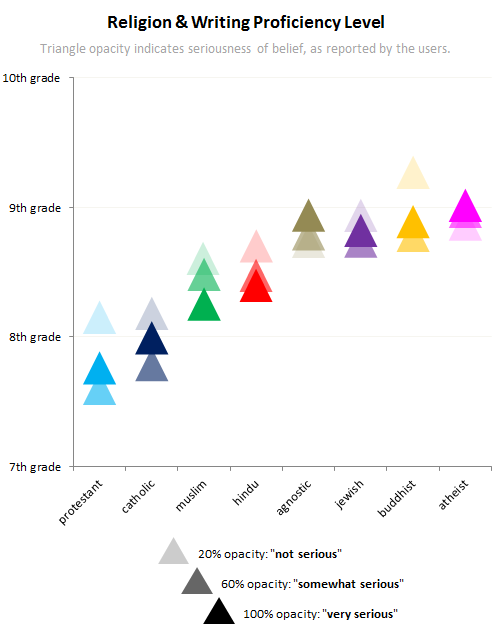
Note that for each of the faith-based belief systems I've listed, the people who are the least serious about them write at the highest level. On the other hand, the people who are most serious about not having faith (i.e. the "very serious" agnostics and atheists) score higher than any religious groups.
2010/9/9
Today's extreme-reductionism funnies: @discographies, or recording artists'/bands' careers summarised in 140 characters:
Kraftwerk: 1-3 beta-testing; 4,6,11 motion simulators; 5,8 communications systems; 7 robots/sex/cities; 9,10 Dance Dance (post-)Revolution.
Interpol: 1 Find an old photo of Joy Division. 2 Xerox the photo. 3 Draw the Xerox. 4 Stare at the drawing: you'll never get Closer.
Radiohead: 1 not a novelty; 2 not "alternative"; 3 not prog; 4-5 not of this earth; 6 not budging; 7 not (conventionally) for sale.
Neu!: 1-3 derderDER. derderDER. derderDER. DER!DER! (Repeat with unchanging precision until the universe dies.)
The Clash: 1 thesis; 2 antithesis; 3 synthesis; 4 elephantiasis; 5 arteriosclerosis; 6 paralysis.
2010/9/8
The Running of the Dead, a longish but eminently readable and illuminating article by one Christian Thorne, examining the shift in zombie film tropes from the slow, shambling zombies of George Romero's original films to the fast zombies of "updated" remakes and films like 28 Days Later, and what it says about changes in assumptions about civilisation between the late 1960s and the Homeland Security age:
Slow-zombie movies are a meditation on consumer society—on a certain excess of civilization, as it were; and fast-zombie movies are pretty much the opposite. So the simple question: In the Dawn remake, how do the zombies look? And the simple answer is: They look like rioters or encamped refugees. If you say that zombie movies are always about crowds, a person might respond: Yeah, I see, the mob—but if you’re talking about George Romero and the slow-zombie movie, the word “mob” isn’t quite right, since white people in formal wear aren’t exactly the mob, and, casting a glance at Romero’s original Dawn, shoppers aren’t either, except on the day after Thanksgiving. Fear of the mob has usually been the hallmark of an anti-democratic politics. The phrase “mob rule” remains common enough; eighteenth-century writers used to call it “mobacracy.” And that’s not what Romero’s after. Romero is worried that the crowd isn’t democratic enough, and one of his more remarkable achievements, back in 1968, was to start a cinematic conversation about the dangers of crowds that ducked the problem of “the mob,” that bracketed that concept out. This couldn’t have been easy to do, since the one term substitutes so easily for the other. And the pokeyness of the zombies is central to this feat, because corpses that look like they’re wading through gelatin are going to seem grinding and methodical or maybe doped and so not like looters or protestors or the Red Cross’s Congolese wards. By making the zombies fast—or rather, by merely accelerating them back to normal human speeds—Snyder allows his dead to seethe and roil. Once the movie’s survivors decide they have to leave the mall where they’ve been hiding—once they head out, in armored buses, into the teeming parking lot—they have entered an American Gaza.In short, according to Thorne, while Romero's slow zombie movies are inherently democratic, fast-zombie movies are fundamentally authoritarian, advancing Thomas Hobbes' argument: civilisation is a fragile thing, one step away from collapse, and must be upheld by arbitrary authority (which is to say, authority one cannot question, whose rightness or wrongness are not open to debate). Hobbes' argument (a cornerstone of right-wing authoritarian thought) is predicated on fear, and has been gaining cultural currency in the post-9/11 Long Siege; the pro-democratic, small-L-libertarian tropes of the cultural shifts of the 1960s seem impossibly quaint, almost Rousseauvian in their naïveté, and haven't dated well beyond being a period piece, a code for the somewhat goofy epoch of pot-smoking, group sex and poor personal hygiene we call The Sixties. Meanwhile, the Other—the terrorist, the inner-city looter, the paedophile, the ultra-ruthless foreign gangster—is at the door. The freedom that was liberating to our hippy parents and grandparents is positively terrifying, and perhaps we need more authority.
The rise in fear-driven authoritarianism has manifested itself in other places; the zero-tolerance culture in schools (at least in the US; your mileage may vary), brought in after Columbine and 9/11, is, as one author suggests, conditioning a generation of young people to unquestioningly accept and submit to authority, instilling subconscious values which will later assert themselves when future social contracts are thrashed out. Tomorrow's citizens will be a little (or a lot) more accepting of the encroachment of authority, less likely to question it, and more likely to dismiss anti-authoritarian arguments as invalid or irrational.
(via MeFi, Boing Boing) ¶ 0
2010/9/6
I recently read an interesting article in the September issue of Exberliner (though not on the web site yet, it seems) about the state of the music industry in Berlin. According to it, the clubs of Berlin still draw in the "Easyjet set" who fly in for weekends (apparently a significant proportion of Berlin's clubbers are tourists), though the club market is saturated, to the point where door charges have dropped dramatically. Meanwhile, gentrification is threatening a lot of long-established clubs, as apartments are built next door, yuppies move in, and the clubs' licenses are not renewed due to the newly bourgeois, residential nature of their environs. (Which all sounds familiar.) Though, according to the article, the real area of growth in Berlin is not so much clubbing or music performance as music technology; the article pointed to the growth of Berlin-based music software firms like Ableton and Native Instruments, and also mentioned SoundCloud's Swedish founders having relocated to Berlin to establish the firm. Which seems to tie in with what I've heard elsewhere about Berlin being Europe's IT startup hub these days.
Anyway, while that article is not online, here's an earlier one about the rise of "place consumers" and "post-tourism tourists", foreign "hipster nomads" who move to Berlin temporarily to enjoy and participate in the lifestyle before moving on.
2010/8/31
Today, the Guardian's New Band Of The Day is Tamaryn, a San Francisco-based duo very much in a shoegaze/dreampop vein. The article, for some reason, takes the angle of drawing a dichotomy between Jimi Hendrix' guitar sound (said to be influential, though not really) and the MBV/Cocteau Twins sound (which can be heard everywhere these days).
The song titles – Choirs of Winter, Haze Interior, Cascades – are almost shoegaze parodying, but it's not all formless FX pedal fondling. Dawning, in particular, stands out as a fab pop song, like Slowdive doing a Fleetwood Mac cover. Stevie Nicks – now there's someone else who's been more influential than Hendrix lately.I can vouch for the new Tamaryn album, The Waves; if you're into the Cocteau Twins, Curve or Ride, you could do worse than to give them a listen.
Also in the Graun recently: a piece on the 30th anniversary of the 4AD label, the seminal post-punk label whose monochromatic record sleeves and understatedly expressionistic records adorned the homes of the more sophisticated goths of the 1980s, alongside black and white poster prints and VHS tapes of Fritz Lang movies. Now, of course, it's no longer Ivo Watts-Russell's personal label but the Matador group's boutique imprint, though is still home to interesting artists.
2010/8/29
Allegedly the next big thing in Berlin: cannibal cuisine:
In a prominent advertising campaign on the internet, in German newspapers and on television, the restaurant, Flime, is appealing for willing donors and diners to become members of what it hints at being a new dining movement. "Members declare themselves willing to donate any part of their body," the advertisement reads, adding that any resulting hospital costs will be taken on by the restaurant. They say they are also looking to employ an "open-minded surgeon".
The restaurant cites as its inspiration the indigenous Brazilian Waricaca tribe, which once practised the ritual of "compassionate cannibalism", or eating parts of the corpse of a loved one to emphasise the connection between the living and the dead, which was said to help with mourning.I bet this is a prank; it sounds like something Joey Skaggs might have come up with. Though you never know; perhaps there is someone who thinks that a cannibal restaurant could work.
2010/8/26
A Welsh artist is recruiting people to stand outside Cardiff City Hall looking miserable tomorrow from 1pm to 2pm. Barrie Davies intends the "sulkathon" to "capture the mood of the moment".
Britain's tourist board has published a list of tips on cross-cultural communication, intended to defuse any potential misunderstandings when dealing with visitors or hosts from different cultures:
Do not be alarmed if South Africans announce that they were held up by robots. To a South African the word robot means traffic lights.
Do not take offence if an Australian or a New Zealander makes a joke about ‘’Poms.’’ It is more of a friendly endearment than an intended insult.
Avoid saying ‘’thank you’’ to a Chinese compliment. Instead, politely deny a compliment to show humility. If you compliment a Chinese person, expect a denial in reply. The Chinese are famous for communicating by “Saying it without saying it.” You will have to learn to read between the lines. Use only black and white materials for presentations, as colours have significant meanings in Chinese culture.
Be tolerant if Indians at first seem impolite, noisy and impatient. This is partly the result of living in chaotic cities and environments. They usually appreciate orderliness when they see it.Not to mention common-sense advice, such as avoiding the topics of poverty or illegal migration with Mexicans, not calling Canadians "Americans", and not offering bacon or wine to Arab guests. (Presumably these are today's equivalent of "don't mention the war".)
2010/8/22
Tom Ewing's Poptimist column in Pitchfork has an A to Z of discourse in music criticism, which illuminates the current state of flux in the production and consumption of music quite tellingly:
E is for Excess: Not the rock'n'roll lifestyle, alas, but the sense we live in a time of musical glut-- reissues of old LPs now stretched across three CDs, legal download dumps of hundreds of tracks, even musicians getting in on the act (Wiley just gave 11 CD-Rs worth of tunes away). What's interesting to me isn't the decadence so much as how social listening strategies are evolving to cope-- the task of processing all this stuff is devolved to fans as a group, a sharp break from the single artwork meets single pair of ears model we've been used to for so long.
N is for Novelty: Novelty records-- gimmick dances, comedy songs, et al.-- regularly turn up in "worst song ever"-type polls. Their decline should have been a canary in the record industry coalmine, though: A track like "Macarena" got big by appealing to people who didn't usually buy records, which made them an index of the extent to which buying a record was seen as a normal thing to do. The market for novelties hasn't gone away, of course-- it simply relocated to YouTube.
P is for Pleasure: The "no such thing as a guilty pleasure" line ends up at a kind of naturism of pop, where the happiest state of being is to display one's tastes unaltered to the world. But the barriers to naturism aren't just shame and poor body image, it's also that clothes are awesome and look great. Performing taste-- played-up guilt and all-- is as delightful and meaningful as dressing well and makes the world a more colorful place. (This still isn't the full story, though-- see V for Virtue).
Y is for Year Zero: Grunge killed hair metal. Acid house changed everything. Punk saw off progressive rock. These dividing-line stories are always attractive, always useful for a while-- and then always revised. The grandfather of them all, though, has proved harder to shift-- the idea that something happened in the early-to-mid-fifties to mark a change of era and fix a boundary of relevance. The next 10 or 20 years, as the 60s slip deeper into unlived collective memory, will be crucial and fascinating (for historians, anyway!).
A new technique involving ultraviolet light is revealing how ancient Greek statues were painted, by detecting traces of the organic compounds paints were made of. It turns out that the statues were coloured quite gaudily (indeed, some would say tackily), looking more like something you might find on a seaside pier than in a stately home.
And the fashion of subsequent millennia for alabaster-white statues of beautiful youths, female nudes, fauns and the like? Well, that's all based on the incorrect assumption that the way Classical Greek statues look now was the way they looked when they were made. (Indeed, I have heard the argument that the tendency towards minimalism in Western culture—as evidenced in High Modernism, for example—ultimately stems from the æsthetic values inculcated into the Western mindset through millennia of misinterpretation of Classical Greek artefacts.)
2010/8/6
Recently, Boing Boing posted a link to a video for an instrumental composition by an Icelandic band named For A Minor Reflection. The music and visuals are much as most people these days would imagine upon hearing the words "Icelandic band"; i.e., it sounds a bit like Sigur Rös. Perhaps more interesting is a comment on the page, by an anonymous Icelander:
Incidentally, in Iceland this style of music is now known as touristcore. That term refers to how it panders to the elves and northern light image promoted by the tourist industry while simultaneously rehashing the twee-drama-romantic music style that broke into the mainstream with Sigur Rós, Múm, Björk a good 12 years ago. People who insist on flogging that horse are forced to make it outside of Iceland as back there they can't be heard over the sound of rolling eyes and despairing moans.
(via Boing Boing) ¶ 7
2010/8/5
The Rap Guide To Human Nature is a hip-hop album about evolutionary psychology by a Canadian "rap troubador" named Baba Brinkman. It's not a joke: the beats are sharp, and Brinkman rhymes with the speed and dexterity of an accomplished rapper, deftly laying out the theories and controversies of evolutionary psychology, from kin selection to the biological roots of religious and political belief, twin studies to alternative models of human nature, and of course to areas such as sexual competition and social status where hip-hop culture and evolutionary psychology intersect. Note that, as expected from rap, the lyrics are probably not suitable for children.
(via Mind Hacks) ¶ 1
2010/7/13
Louise Wener, frontwoman of Britpop band Sleeper turned popular novelist, has written a memoir of her time in the Britpop scene/hype machine. If this review (by the ever-credible Jude Rogers, in the perennially right-on New Statesman) is anything to go by, it sounds like an interesting read:
After many years of Wener playing in different bands to general indifference, her four-piece Sleeper - named after the Woody Allen film - finally get signed by a major label in 1993. She is unforgiving about the conservative bias of the independent music scene, and holds the media in particular contempt. In the band's first interview with the New Musical Express, she is infuriated by a self-professed "revolutionary Trotskyite revisionist Leninist" who directs all his questions to her male bandmates, and later dismisses her as a "mad, ranty pop bird on the loose".
Wener also dismantles the myth that the likes of Blur were intelligent pop revolutionaries. She describes their rudeness, their ruthless ambition and their "easy, bohemian, moneyed odour". And then there are the groupies. Wener leaves nothing out. The bassist Alex James tells a young woman, "You're ugly, but I'm going to fuck you anyway," while their tour manager is despatched to select attractive girls from the audience and give them after-show tickets, known as "Blur-job passes".
2010/7/6
New research suggests that differences between average national IQs may be due to the prevalence of parasites. One theory posits that children from countries with high incidences of parasites devote energy to fighting them off which would otherwise be spent on brain development.
When the researchers analyzed each factor independently, they found that infectious disease burden was more closely correlated to average IQ than the other variables. "Parasites alone account for 67% of the worldwide variation in intelligence," Eppig says.Meanwhile, a correlation has been found between incidence of the parasite Toxoplasma gondii (i.e., the crazy-cat-lady parasite) and a nation's success in football, though the cause of the correlation is still unknown:
Rank the top 25 FIFA team countries by Toxo rate and you get, in order from the top: Brazil (67 percent), Argentina (52 percent), France (45 percent), Spain (44 percent), and Germany (43 percent). Collectively, these are the teams responsible for eight of the last 10 World Cup overall winners.
Now, what does the Toxo parasite do that could possibly relate to soccer performance? Not much is known about its impact on the human brain, but there are clues. We know that infection increases testosterone in male brains, making them more likely to get into car accidents, more attractive to females, and more prone to being jealous, dogmatic, and dismissive of authority. Evidence even suggests that motorcyclists are more likely to have Toxo. Something like a James Dean effect. Generally, males with Toxo are more aggressive and less inhibited. Keep in mind that FIFA, in line with most sporting organizations in the world, bans testosterone supplements of any kind. But they do not ban Toxo, and if Toxo increases testosterone levels, we may be dealing with a form of inadvertent, cultural doping.
(via MeFi, Boing Boing) ¶ 1
2010/6/29
An interesting piece by Financial Times writer Simon Kuper on the cultural impact of Eurostar; how the cross-channel train service between London and Paris (Brussels doesn't rate a mention) has transformed the cultures of both cities; before, things used to be much different:
Until the 1990s, To Britons Paris seemed almost as exotic as Jakarta, and more so than Sydney or San Francisco. There was that famous smell of the French Métro, the mix of perfume and Gauloises cigarettes. There was the bizarre sight of people drinking wine on pavements. There was all that philosophy. The exoticism of Paris became such a staple of English-language writing that comedians began to parody it. “I come upon a man at an outdoor café,” writes Woody Allen. “It is André Malraux. Oddly, he thinks that I am André Malraux.”
Those first trains connected two fairly insular cities. I had returned to Britain from Boston the summer before the Eurostar was launched, and after the Technicolor US, I was shocked by dingy London. Tired people in grey clothes waited eternities on packed platforms for 1950s Tube trains. Coffee was an exotic drink that barely existed, like ambrosia. Having a meal outside was illegal. The city centre was uninhabited, and closed at 11pm anyway. Air travel was heavily regulated, and so flying to Paris was expensive. Going by ferry took a whole miserable day. If you did get across, and only spoke the bad French most of us learnt at school, it was hard to communicate with any natives.Now, London and Paris have converged somewhat; London has shaken off some of its Anglo-Saxon austerity and embraced a more Continental lifestyle, with outdoor bdining, late-closing bars and gourmet food markets, and even got a taste for French-style grands projets, not least of all St. Pancras International, the Eurostar terminus. (As for coffee, I can only imagine that, before 1994 or so, anyone requesting coffee rather than tea would be met with a mug of Nescafé Blend 43 or similar.) Meanwhile, Paris has shed some of its Gallic hauteur and become more London-like:
But with the inventions of the internet and Eurostar, and globalisation in general, many Parisians began to see that there was a wonderful new life to be seized if you spoke English. Paris could choose to become an inhabited museum, a sort of chilly Rome, but if it wanted to remain in touch with the latest ideas, the Parisian establishment would have to learn English. By and large, the younger members did. The canard that Parisians refuse to speak English is a decade out of date. As I write, every car on the street outside my office is festooned with a flyer for English lessons for children. Parisian parents are now so keen to induct their toddlers into the global language that speaking English has become a weapon for us Anglophone parents in the battle for a spot in a crèche.Of course, some differences remain (French children are apparently quieter and cleaner than the mowfy brats of Britain, while Britons dress more colourfully, in "weird youth-culture outfits"), but they're becoming less distinct, as more people commute or travel between the two cities. (London is apparently now, by population, the sixth-largest French city.)
Kuper goes on to describe a bright future for western Europe, largely due to its compact geography, further amplified by the promise of high-speed rail. Indeed, shiny, aerodynamic high-speed trains seem to be the unchallenged future of travel, with air travel, that darling of the 1990s, looking a bit shabby, between rising oil prices, the Long Siege and things like the Icelandic volcanic ash cloud.
2010/6/26
A German online publication named Fritz has an interview with "Wash Echte", the author of the Ich Werde Ein Berliner blog, which skewers Berlin hipster culture:
Hipster is a global phenomenon, but there are certainly cultural differences. What's special about German hipsters?And here it is in German.
They are very "German" at it. Meaning that they take themselves very, very serious. Everybody is gravely determined to show how free and relaxed their life is. Like young people all over the world, Germans want to break free from the limiting world of their parents - where it only matters that you have the bigger house or nicer car than your neighbors, but all they seem to be able to is get themselves entangled in a different hierarchy that's even more limiting: Who had the wildest night out, who knows the most authentic Chinese restaurant, who has the biggest vinyl collection, who is the first to open a clandestine art gallery near Ostkreuz. Young Germans stopped using their built-in engineering skills to construct better cars, and channeled these skills into building the most impressive, delicately engineered hipness-hierarchy of all.
2010/6/22
Another reaction to the changing economics of recorded music: American indie band The Fiery Furnaces are protesting the falling monetary value of recorded music by declining to provide it; and so, an indie Atlas shrugs and, instead, releases a "Silent Record":
The Fiery Furnaces’ next album will consist of instruction, conventional music notation, graphic music notation, reports and illustrations of previous hypothetical performances, reports and illustrations of hypothetical performances previous to the formation of their hypotheses, guidelines for the fabrication of semi-automatic machine rock, memoranda to the nonexistent Central Committee of the Fiery-Furnaces-in-Exile concerning the non-creation of situations, Relevant to Progressive Rock Division, conceptual constellations on a so-to-speak black cloth firmament, and other items that have nothing to do with the price of eggs, or milk, or whatever the proverbial expression ceased to be.
Upon release of the record, the band will organize a series of Fan-Band concerts, in which groups of perfectly ordinary Fiery Furnaces’ fans will perform, interpret, contradict, ignore, and so on, the compositions that make up Silent Record. Write to thefieryfurnacesemail@gmail.com to nominate your post office break room, truck stop parking lot, municipal arts center, local tavern, or what-its-name to host one of these ‘happenings’. By ‘happenings’ I mean, what will be in the future, perfectly normal rock shows. And propose yourself for Fan Band participation.
2010/6/18
Chopsticks At Dawn; a fascinating 30-minute BBC radio documentary, presented by comedian Anna Chen, exploring pseudo-Oriental motifs (such as the Oriental Riff) in Western popular music. These motifs bear little relation to any actual Chinese or oriental musical traditions (the closest link is their use of pentatonic scales, though even these are neither as exclusive to or common in the East as widely believed), but became stereotypically "Chinese" to Western ears by virtue of sounding exotic, and plausibly oriental to someone who is not overly familiar with the actual cultures in question. The foundations were laid by 19th-century composers naïvely trying to evoke the Orient; they took a more malignant turn with the rise of anti-Chinese sentiment in the west, rising from Britain's opium wars, and subsequent need to dehumanise the Chinese, as well as popular xenophobic panic about the "heathen Chinee") turning into a set of mocking, vaguely ridiculous caricatures. The most egregious of those stereotypes have been consigned to history, but the musical clichés running through them still lied sufficiently close to the surface to emerge in pop songs like Kung Fu Fighting and Hong Kong Garden, serving as musical shorthand for an entire region and set of cultures for Westerners.
2010/6/17
Delivering the Bafta Annual Television Lecture, Stephen Fry laments the infantilisation of British television, including favourites like Doctor Who:
Fry, who hosts QI, said that the programmes were "like a chicken nugget. Every now and again we all like it … But if you are an adult you want something surprising, savoury, sharp, unusual, cosmopolitan, alien, challenging, complex, ambiguous, possibly even slightly disturbing and wrong. "You want to try those things, because that's what being adult means."
Fry said he was not arguing that all television should be pompous, academic or intellectual. "But they ought to surprise and to astonish and to make us feel perhaps the possibility there is a world outside that we know nothing of to provoke us, to provoke in the best sense of the word, sometimes in the worst sense," he said. "To surprise us, to outrage us."In other news, Japanese neuroscientists have found that monkeys enjoy watching television, or at least that viewing video of performing circus animals stimulates the pleasure centres in the monkeys' frontal lobes.