The Null Device
Posts matching tags 'google'
2013/4/1
An apposite piece of commentary from the EFF's April Fool's Day newsletter:
Google's Good and Evil Divisions Reportedly in Talks Over Precious
Industry sources say that representatives of Google's executive board are deep in negotiations with an internal "skunkworks" start-up originally dedicated to researching online marketing opportunities, but which has since expanded to cover the entirety of evil services. The morally errant division, nicknamed Googollum, is understood to be arguing internally that the Internets stole the precious social networking, they did, and gave it to the Facebooks, and must be punished. While some at the company have suggested that it mustn't steal the Internets' privacies, other Googollum workers, who asked not to be identified, have said that no-one would notice, and anyways, what has the nasty Internetsies done for Google lately? Talks are ongoing, although setbacks did occur when Googollum's management, speaking at the company's Friday meeting, refused to tell anyone where the Google Plus development team was hidden, and went on to eat the Google Reader product manager raw.
2013/3/14
Google have announced that Google Reader will be shut down in July. Reader, a web-based RSS aggregator, has amassed a loyal user base over its eight or so years of operation, being a good way to keep up with articles from blogs, news feeds and various web sites in one place, and to have one's reading history (and which posts one has bookmarked for future reference) accessible from multiple locations. This audience didn't really fit with the brave new world of Google+, with its gamified social sharing, quasi-totalitarian restrictions on pseudonymity and proven means of monetisation, so Google have done their best to get rid of this audience, firstly by ripping out the social sharing features last year, and now by slapping a CONDEMNED sign on the service. The announcement has been met with shocked disbelief by the considerable number of users for whom Reader is a means for keeping up with blogs, but that's OK, because they're not the sorts of hip, with-it model consumers Google are looking for.
What the few old farts who still know what a RSS feed is, or who pay attention to updates longer than 140 characters, will do when Reader bites the dust, is an open question. Reader wasn't the first RSS aggregator, though it was one of the most popular ones, both for its web-based interface and the fact that it could synchronise with offline reading apps like Reeder, whose authors have promised that it will survive Reader's death.
In my opinion, whatever replaces Google Reader will have to have a more sustainable business model than being provided for free by the benevolent space beings in Mountain View, driven by their ineffable alien altruisms to serve Man. Something with a freemium or subscription-based model, where the users of the service pay an annual subscription which funds its costs, and ensures that it remains viable and its interests are aligned with its users, not other parties, would meet these criteria. Such services already exist; examples include the photo-sharing site Flickr, the Pinboard bookmarking service (which replaced del.icio.us, a free service whose owners decided that Man wasn't cooked quite to their taste), the SoundCloud audio sharing service and App.net, a shiny new ghost town which, on the surface, appears like a pristine, empty Twitter without the sponsored tweets and creeping ad-squeeze.
Actually, app.net may serve as the basis of such a system; while it seems on the surface like a slightly late-to-the-party microblogging site, it is actually a social API, which implements Twitter-like messages, and also gives each subscriber 10Gb of storage; developers are encouraged to build new applications on top of this API. An application that stores a list of RSS feeds, keeps track of new, read, unread and bookmarked messages from them, and communicates both via a web page and an API for Reeder-like clients, whilst hooking into app.net's messaging and publishing features, may well be the killer application needed to provide app.net with a raison d'etre in a world where Twitter already has been done.
2012/3/8
In other recent news, Apple launched the latest gadget yesterday, to much-anticipated adulation. There were few surprises in the overt details: the retina display showed up as everyone predicted, and the CPU and camera were also bumped up; oh, and it does LTE, which explains the enlarged battery.
The launch included a presentation demonstrating the new iPad and some new apps for it. Buried within the demonstration of a photo editing package was a bombshell: a fragment of a screen, seen briefly, showed a street map which looked distinctly unlike Google Maps (the mapping system used by iOS since the first iPhone), suggesting that Apple are about to move away from Google Maps to a different platform. Such a move wasn't entirely unanticipated; relations between Apple and Google have been icy recently, so it was only a matter of time until Apple moved to a different mapping system; Apple's acquisition of several mapping-related companies, which promptly disappeared beyond the Cupertino event horizon, suggested that Apple would roll its own system. The only questions were when and what form would it take.
More clues emerged when the iPhoto app became available: (examination of internet traffic from iPhoto revealed that the map tiles were being loaded from a server named gsp2.apple.com, and soon, someone rigged up an unofficial web-based map viewer using the tiles. Finally, it was revealed that Apple are using data from OpenStreetMap for their maps, though rolling their own tiles. The service seems to be in its early stages so far; the resolution stops a few zoom levels short of street-map level and the data they're using is based on a slightly old snapshot of OpenStreetMap, though it's still pretty big news.
Apple's move to OpenStreetMap is the latest in a wave of defections from the once-ubiquitous Google Maps (FourSquare moved a few weeks ago and other sites have been moving to it, propelled by the carrot of OpenStreetMap's high-quality (and rich) data set and the stick of Google moving more aggressively to monetise their maps. As for other mapping services, they don't seem to be getting much of the action; Microsoft's Bing has Facebook, probably because Microsoft own 1% of Facebook, and Flickr still uses Yahoo!'s own mapping system. However, neither looks set to steal the crown from Google, as there isn't likely to be a crown to steal soon.
It looks like online geodata may have approached the tipping point that electronic encyclopædias reached with Wikipedia and UNIX on commodity hardware (remember commercial PC UNIX?) reached with Linux: the point beyond which it makes no economic or business sense to go it alone, and where proprietary products are an evolutionary dead end.
It'll be interesting what the UK's Ordnance Survey, for long the dog in the manger of geodata, will make of the new shifting environment it finds itself in.
2012/1/21
Meanwhile, it looks like OpenStreetMap may be on the verge of doing to commercial, closed mapping services (such as Google Maps and Microsoft's Bing Maps) what Wikipedia did to Encyclopaedia Britannica's previously unassailable position. Wikipedia's David Gerard suggests that mapping and geodata may be the next dinosaur to sink into the tarpit; now that Google are moving to squeeze more revenue out of their popular Maps product, some businesses are finding that it makes more sense to use OpenStreetMap, and invest in improving it where it falls short:
I think that someone at Google got their pricing wrong by an order of magnitude. Large companies might be willing to pay that kind of licenses, but this is not the CMS market in 1998, where people would pay half a million for a Vignette license and another million for Oracle. There are so many open source options out there that the value of proprietary solutions has come down dramatically.And no less a publication than Wired has an article on switching to OpenStreetMap:
Since Nestoria made the switch to OSM, he says, the company has received almost no complaints about the change in its map background. Some users in remote areas of Europe, he adds, have even praised the new interface for the details it provides on their little towns. What’s more, in making the switch to OSM, Nestoria gained some flexibility it never had with Google.Among the takeaways from the article: old-school mapping company MapQuest (remember them? they were around in the ancient NCSA Mosaic days when slideable maps didn't exist, and you had to click on one of eight arrows to move to the next square), once vanquished by Google Maps, having been reborn as a frontend and contributor to OSM. Which suggests that OSM has achieved the sort of critical mass that going it alone to compete with the dominant vendors makes as little sense as Google's in-house Wikipedia competitor Knol (which they euthanased a year or two ago).
Google may not be taking the market for their mapping product being commodified lying down: there are reports of someone polluting OpenStreetMap data, coming from the same IP addresses belonging to a Google unit in India who were earlier caught trying to rip off a Kenyan crowdsourced business directory. (Given that Google have in the past contributed to OpenStreetMap, this seems somewhat out of character; unless the gloves have come off and "don't be evil" has been declared a non-core promise.)
2011/10/17
Google engineer Steve Yegge wrote a rant on Google's institutional shortcomings with platforms and APIs (capsule summary: it doesn't get them), and, in particular, why it falls short of Facebook. The rant was intended for internal consumption at Google, but got shared to the whole world by accident (or perhaps, conspiracy theorists suggest, deliberately); here it is:
Google+ is a prime example of our complete failure to understand platforms from the very highest levels of executive leadership (hi Larry, Sergey, Eric, Vic, howdy howdy) down to the very lowest leaf workers (hey yo). We all don't get it. The Golden Rule of platforms is that you Eat Your Own Dogfood. The Google+ platform is a pathetic afterthought. We had no API at all at launch, and last I checked, we had one measly API call. One of the team members marched in and told me about it when they launched, and I asked: "So is it the Stalker API?" She got all glum and said "Yeah." I mean, I was joking, but no... the only API call we offer is to get someone's stream. So I guess the joke was on me.
Google+ is a knee-jerk reaction, a study in short-term thinking, predicated on the incorrect notion that Facebook is successful because they built a great product. But that's not why they are successful. Facebook is successful because they built an entire constellation of products by allowing other people to do the work. So Facebook is different for everyone. Some people spend all their time on Mafia Wars. Some spend all their time on Farmville. There are hundreds or maybe thousands of different high-quality time sinks available, so there's something there for everyone. Our Google+ team took a look at the aftermarket and said: "Gosh, it looks like we need some games. Let's go contract someone to, um, write some games for us." Do you begin to see how incredibly wrong that thinking is now? The problem is that we are trying to predict what people want and deliver it for them.
After you've marveled at the platform offerings of Microsoft and Amazon, and Facebook I guess (I didn't look because I didn't want to get too depressed), head over to developers.google.com and browse a little. Pretty big difference, eh? It's like what your fifth-grade nephew might mock up if he were doing an assignment to demonstrate what a big powerful platform company might be building if all they had, resource-wise, was one fifth grader.
2011/10/14
The London Review of Books looks at various books recently published about Google, an essay on Google's data-collecting and machine-learning operations; it appears that a lot of the services Google provide are
In 2007, Google told the New York Times that it was now using more than 200 signals in its ranking algorithm, and the number must now be higher. What every one of those signals is and how they are weighted is Google’s most precious trade secret, but the most useful signal of all is the least predictable: the behaviour of the person who types their query into the search box. A click on the third result counts as a vote that it ought to come higher. A ‘long click’ – when you select one of the results and don’t come back – is a stronger vote. To test a new version of its algorithm, Google releases it to a small subset of its users and measures its effectiveness through the pattern of their clicks: more happy surfers and it’s just got cleverer. We teach it while we think it’s teaching us. Levy tells the story of a new recruit with a long managerial background who asked Google’s senior vice-president of engineering, Alan Eustace, what systems Google had in place to improve its products. ‘He expected to hear about quality assurance teams and focus groups’ – the sort of set-up he was used to. ‘Instead Eustace explained that Google’s brain was like a baby’s, an omnivorous sponge that was always getting smarter from the information it soaked up.’ Like a baby, Google uses what it hears to learn about the workings of human language. The large number of people who search for ‘pictures of dogs’ and also ‘pictures of puppies’ tells Google that ‘puppy’ and ‘dog’ mean similar things, yet it also knows that people searching for ‘hot dogs’ get cross if they’re given instructions for ‘boiling puppies’. If Google misunderstands you, and delivers the wrong results, the fact that you’ll go back and rephrase your query, explaining what you mean, will help it get it right next time. Every search for information is itself a piece of information Google can learn from.
By 2007, Google knew enough about the structure of queries to be able to release a US-only directory inquiry service called GOOG-411. You dialled 1-800-4664-411 and spoke your question to the robot operator, which parsed it and spoke you back the top eight results, while offering to connect your call. It was free, nifty and widely used, especially because – unprecedentedly for a company that had never spent much on marketing – Google chose to promote it on billboards across California and New York State. People thought it was weird that Google was paying to advertise a product it couldn’t possibly make money from, but by then Google had become known for doing weird and pleasing things. ... What was it getting with GOOG-411? It soon became clear that what it was getting were demands for pizza spoken in every accent in the continental United States, along with questions about plumbers in Detroit and countless variations on the pronunciations of ‘Schenectady’, ‘Okefenokee’ and ‘Boca Raton’. GOOG-411, a Google researcher later wrote, was a phoneme-gathering operation, a way of improving voice recognition technology through massive data collection. Three years later, the service was dropped, but by then Google had launched its Android operating system and had released into the wild an improved search-by-voice service that didn’t require a phone call.One takeaway from the article is that, while it may be said that "if you don't know what the product is, you are the product", Google don't really give that much personal information to advertisers, or even allow advertisers to target ads very precisely (as they can, for example, on Facebook). Google collect a wealth of information, though the bulk of it remains in the machine:
It isn’t possible, using Google’s tools, to target an ad to 32-year-old single heterosexual men living in London who work at Goldman Sachs and like skiing, especially at Courchevel. You can do exactly that using Facebook, but the options Google gives advertisers are, by comparison, limited: the closest it gets is to allow them to target display ads to people who may be interested in the category of ‘skiing and snowboarding’ – and advertisers were always able to do that anyway by buying space in Ski & Snowboard magazine. The rest of the time, Google decides the placement of ads itself, using its proprietary algorithms to display them wherever it knows they will get the most clicks. The advertisers are left out of the loop.
2011/7/16
Google+ technical lead Joseph Smarr answers questions about Google's new social site, its development, and planned features:
Will users be able to create hierarchies of circles (circles made from multiple circles)?
There are definitely good use cases for this, but we worry about the complexity it would introduce. This might be a great "power-user" feature to build using our APIs (once they're ready, heh).
What were the most difficult specific technical challenges you faced?
Trading off consistency vs. availability is always challenging, and even more so in social applications where your actions affect other users, often in other data centers. For instance, adding/removing someone from a circle impacts (among other things): which posts they can see, the counts of people on your (and their) profile, suggestions (for potentially many people), and so on. Clearly some of these changes need to happen immediately/ASAP, whereas others could be a bit stale and that's ok. Picking the right trade-offs so our systems are fast and robust but users rarely notice any problems was (and continues to be) challenging, and in some cases required some very clever tricks in the backends.
2011/2/12
Proof that we're now almost* living in the future: the new mobile Google Translate app, which runs on your iPhone and does speech recognition, translation and speech synthesis (provided you have a data connection, of course). So you can say a phrase into it in your language and have speak a translation into various languages, with even more supported as text only.
* Now all we need is mobile data roaming that doesn't cost extortionate amounts (after all, this is the sort of thing most useful abroad), and we will be living in the future.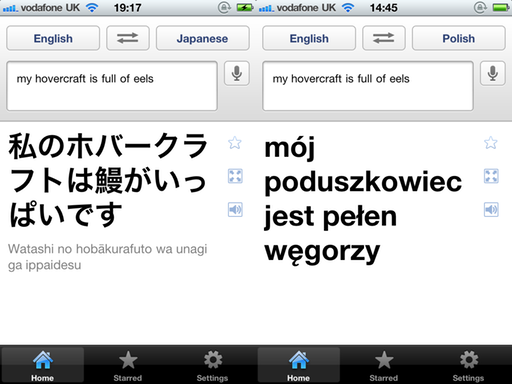
2010/11/25
In Germany, Google Street View has a posse, and they'll egg your house if you exercise your right to opt out of being visible on StreetView. The Streisand Effect is a bitch sometimes.
2010/9/30
The latest language added to Google's translation tools: Latin. Or, as the official announcement puts it:
Hoc instrumentum convertendi Latinam rare usurum ut convertat nuntios electronicos vel epigrammata effigierum YouTubis intellegamus. Multi autem vetusti libri de philosophia, de physicis et de mathematica lingua Latina scripti sunt. Libri enim vero multi milia in Libris Googlis sunt qui praeclaros locos Latinos habent.
Convertere instrumentis computatoriis ex Latina difficile est et intellegamus grammatica nostra non sine culpa esse. Autem Latina singularis est quia plurimi libri lingua Latina iampridem scripti erant et pauci novi posthac erunt. Multi in alias linguas conversi sunt et his conversis utamur ut nostra instrumenta convertendi edoceamus. Cum hoc instrumentum facile convertat libros similes his ex quibus edidicit, nostra virtus convertendi libros celebratos (ut Commentarios de Bello Gallico Caesaris) iam bona est.In other words, while Latin is a dead language, and few if any people are going to send emails (or nuntios electronicos, as the Romans would have called them), the translator is useful because of the vast number of books wholly or partly in Latin. And, while there is little new Latin text to train the engine on, there is a huge repository of existing Latin texts and translations, of varying antiquity, many of which Google have digitised. Which works quite adequately for translating the sorts of things likely to have been written in Latin.
Sadly, the same can't be said for Google's English-to-Latin translation; at the moment, for a lot of inputs, it seems to do little more than change the order of the words around, getting stumped on words like, say, "translate" and "Latin".
2010/9/22
The problems of maintaining infrastructure in a country where carrying guns is considered a fundamental, God-given right: Google have had to invest in building expensive cable tunnels to an Oregon data centre after their fibre links kept getting shot down by idiots exercising their rights, by means of shooting at the white ceramic targets that have been conveniently placed for their benefit on overhead lines:
"Every November when hunting season starts invariably we know that the fibre will be shot down, so much so that we are now building an underground path [for it]."Google aren't by any means the only target of this kind of destructive stupidity: every New Year's Day and Fourth of July, US utility companies find themselves having to replace transformers which had been shot by idiots wanting to see cool sparks, and owners of roof-mounted antennas in rural parts of the US have a choice between to providing and maintaining alternative targets for trigger-happy passers-by, or having their (expensive) antennas get it. Still, that's the price one pays for liberty.
Of course, it may well be that the vast majority of hunters are responsible and law-abiding and never vandalise private property in this way, but that's irrelevant. As long as there's a minority, even a tiny one, of belligerent assholes who just like fucking shit up, and another minority of mostly responsible people who do dumb things from time to time after sinking a few Buds, and there's no way of taking these individuals' guns away if they misbehave because firearm ownership is an inalienable human right, the onus is going to be on data centres to bury their cables, property owners to provide targets for these assholes to shoot at, and electricity companies to keep replacing prematurely perforated transformers (and passing the cost on to the consumer).
2010/9/21
Some time ago, I read about luxury goods companies sending free samples to celebrities. More specifically, sending free samples of their rivals' products to trashy celebrities, partly to obviate the need for them to buy their product and also to slime their rivals' brand image.
Today, I see the following text ad at the top of my Gmail:
I wonder whether this could be Google doing the same sort of thing to Microsoft's search engine.
For what it's worth, I know only enough about who Cheryl Cole is to have no desire to watch videos of her. I imagine it is not inconceivable that Google, with their vast databases of users' browsing histories, mail keywords and interests, would be able to infer this from my history. And if they have a model which can predict whether the probabilities of a user liking or disliking X (where X is a product, band, celebrity, political party or other unit of discourse) are increased or decreased by their history of choices, perhaps they can run this model in reverse, turning it into a discommendation engine of sorts. In other words, given a user's history, perhaps Google can predict exactly what sorts of things would be likely to put them off. Which, of course, would be useful for sliming rivals' brands in carefully placed ads.
Of course, something like that would stretch "don't be evil" to breaking point (it's the kind of douchey move you'd expect from viral Facebook game vendors or someone, not Google), and I suspect that Google aren't as resigned to becoming the next Evil Empire in the public's eye to openly start doing this sort of thing. But still, it's a theoretical possibility. The other, perhaps more economical, explanation is, of course, that this is just an authentic example of hamfistedly untargeted marketing from Microsoft (find something a lot of people are into, like celebrity gossip, and carpet-bomb everyone with the same ads).
2010/9/8
Google Scribe is an experimental engine which autocompletes entire words based on previous input in a text box (I suspect it's a Markov chain-like system powered by Google's corpus of text). It's also a perfectly serviceable surrealistic text generation tool; start writing something, then at some point, just hit Enter on the autocompleted choices until you have enough, and you might get a rambling, whacked-out monologue like this:
Now watching in the New Yorker and the New York Times Company will answer questions about their own lives and their communities together with their respective organizations and to their families and friends of these two types of information that is not appropriate for all users of the catalogue should also be noted that there is anything you would not believe how much I loved them all and I'ma let you finish but Beyonce had one of these days I'll bet your life on the road today and they are nothing but another form of therapy for these patients is not known whether these are the only ones who can not afford to pay for their own users and groups to their Friends
2010/8/31
This is pretty awesome: The Wilderness Downtown, an interactive music video (to use the term slightly loosely) by anthemic indie combo The Arcade Fire, with technical assistance from Google's Creative Lab. The way it works: put in the address of the house you grew up in, and you will be presented with a music video comprised of prerecorded footage composed with animations generated from Google Earth and Street View imagery of your home. Well, I use the term "music video" loosely; it's an experience comprised of numerous browser windows opening at various times and places, presenting various combinations of imagery. Using Google Chrome is recommended. (Note that some plugins may interfere with its operation; if it doesn't start, try running it in incognito mode.)
There's a technical description here, and here is a WIRED piece on it, including an interview with the creators, director Chris Milk and Google tech lead Aaron Koblin.
2010/8/15
This week in lawsuits: Rupert Murdoch's News Corp. claims that it owns Skype's brand name, or at least the first three letters of it, and threatens to block Skype from trading under that name in the EU; the EU has agreed with News Corp., though Switzerland and Turkey (neither of which are in the EU) have sided with Skype. Perhaps we'll see another Gmail/Googlemail-style situation, in which case Skype chooses some other, more awkward-looking, moniker to trade under in the EU?
Meanwhile, after having digested Sun, Oracle are wasting no time in drawing a line under its open-source-friendly days; not only have they killed OpenSolaris (an issue which could affect dozens of people worldwide) but now they're suing Google for using Java intellectual property in Android, demanding hefty damages and the destruction of all Java-based Google code, i.e., the annihilation of the Android platform. (Of course, they could let it slide for a few billion dollars.) Google contend that the lawsuit is baseless, while Java architect and Sun co-founder James Gosling weighs in:
Oracle finally filed a patent lawsuit against Google. Not a big surprise. During the integration meetings between Sun and Oracle where we were being grilled about the patent situation between Sun and Google, we could see the Oracle lawyer's eyes sparkle. Filing patent suits was never in Sun's genetic code. Alas...If Oracle are successful, they could stand to screw anyone who has ever used Java out of sizeable sums, whilst hastening Java's death as a platform of any credibility. (Unless this is thrown out of court with prejudice, I can see developers deserting Java hastily before Oracle's beady gaze descends upon them.)
2010/7/17
Until now, Google and social software haven't been ideas that went together naturally. The famously engineering-focussed company had experimented with social, though mostly in engineers' 20% time, and with mixed results. Orkut became spectacularly successful in Brazil, but largely bobbed along in the wake of Friendster elsewhere until the vastly technically inferior MySpace came along and seized the market, Google Friend Connect got its lunch eaten by Facebook Connect, and other forays into social made the mistake of being a bit too clever and automatically inferring the user's social graph from their online activity, crossing the line between nifty and disturbing.
Now, however, this is likely to change. There are rumours afoot that Google have made social software a strategic priority, establishing teams to work on the problem of social as part of their regular 80% job, and that a social platform, possibly named Google Me, is in the works. Of course, as far as social platforms go, Facebook have the area sewn up, with a pretty sophisticated API, leaving little space for newcomers (or even Google) to expand into, unless they find and solve problems in the way Facebook does it.
Which brings us to this slide presentation from Google user-experience researcher Paul Adams. The presentation rigorously examines the social uses of software, and the natures of social connections (Adams mentions strong ties and weak ties, and adds a third category, temporary ties, or pairs of people involved in once-off interactions; think someone you buy something from on eBay) and pinpoints possible shortcomings of simple models such as Facebook's (the fact that people have different social circles and needs to expose different facets of their identities to different circles, and that tools such as Facebook's privacy filters have a high overhead to use satisfactorily in this way), not to mention unresolved mismatches between the way human beings intuitively perceive social interaction working and the way it does in the age of social software (for example, we are not intuitively prepared for the idea of our conversations being recorded and made searchable). All in all, it looks like a pretty rigorous survey of social software, condensed down to 216 slides. (An expanded version may be the contents of a book, Social Circles, which comes out in August.)
If Google, who have not given much weight to social software in the past, are investing in this level of research into it, they may well have a Facebook-beating social platform in the works. Though (assuming that it exists, of course) only time will tell whether Google have finally grasped social enough to pull it off.
2010/7/12
Via Daring Fireball, an article blowing open the shadowy web of connections between the open-source/copyright reform movement and Google's world domination plans. It seems that there is a sinister power bankrolling the freetards' campaign to destroy intellectual property (and thus civilisation as we know it), and that power is none other than Moscow Peking Mountain View. Or something like that.
2010/6/26
Police emergency phone lines in Manchester are being tied up by a nuisance caller who "chants, raps, sings, preaches and plays loud music" at the call handlers, often for five minutes at a time. The handlers are not allowed to hang up on a caller. The Greater Manchester Police have already blocked about 60 SIM cards he has called from, which has little effect; with cheap prepaid SIM cards, the mystery nuisance rapper seems to be making his way through the pool of unallocated mobile numbers:
During many of the calls, the operator answers the phone to be met with a barrage of music and rants. His rapping is difficult to decipher but during one call he started shouting about his citizen's rights.Greater Manchester Police have taken the unusual step of releasing a recording of one of his raps, in an attempt to track him down. Which could have unintended consequences; if that became standard practice, nuisance calls to emergency services could become the next bootleg grimetape distribution channel after MP3 blogs—you get your rap out, and are acknowledged as a police-certified badass at the same time.
Meanwhile, there's a small mystery of a less antisocial sort in Aberdeen, where the Google Street View van photographed a man with a horse's head.
2010/5/23
A few quick links to things recently seen:
- A visual study guide to cognitive biases
- Sydney is considering closing George St. to traffic, building a light rail (pronounced "tram") line. Interestingly enough, this plan, like Melbourne's original laneway-driven regeneration and "Copenhagen lanes", was suggested by a Danish urban-planning consultant.
- Google have developed facial recognition technology, capable of identifying individuals in photographs. Given the privacy implications (that plus Google Goggles would be the ultimate stalker tool), they're wisely being very careful about what, if anything, they do with it.
- Spoonflower is a web-based company that will print your designs onto fabric and send it to you. Now if only we could get them talking to Blank Label (a web-based service that lets you design custom shirts, though currently only from a somewhat conservative range of fabrics), then that would be awesome.
- Some music videos: The Pains Of Being Pure At Heart, Higher Than The Stars (warning: features furries), Rainbow Arabia, Holiday In Congo (warning: not actually filmed in Congo but Brazil; features massed Michael Jackson impersonators)
- Nifty trompe l'oeil paste-up on the sides of a fence in Berlin:


2010/5/21
Today is the 30th anniversary of the video game Pac-Man, and so, the Google homepage has a special commemorative graphic. Only this one's even more special than most: it's a complete implementation of the Pac-Man game, in pure HTML5.
Not only is there no Flash involved, but its assets consist of only one image, with the individual elements being drawn using CSS sprites. Alas, it'll probably be gone forever come the 22nd, so play with it while you can.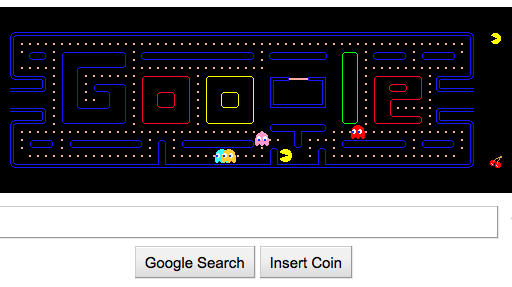
Update: Google PacMan is permanently located here.
2010/2/12
The Iranian government, boldly pushing the boundaries in how to make totalitarianism work in the age of the internet, has announced that it will block Google's Gmail permanently. Instead, Iranians will be provided with "a national email service", intended to "boost local development of internet technology" and "build trust between people and the government".
Australian communications minister Senator Conroy is said to be watching developments carefully.
2010/2/11
The Australian government asked Google to block Australian users from accessing YouTube content which would be illegal in Australia, which would include material promoting euthanasia, graffiti and safer drug use, on the grounds that they already do similar things in China. Google, thankfully, tells the government to go jump.
University of Sydney associate professor Bjorn Landfeldt, one of Australia's top communications experts, said that to comply with Conroy's request Google "would have to install a filter along the lines of what they actually have in China".
"What we're saying is, well in Australia, these are our laws and we'd like you to apply our laws," Conroy said. "Google at the moment filters an enormous amount of material on behalf of the Chinese government; they filter an enormous amount of material on behalf of the Thai government."The government is set to introduce laws forcing all ISPs in Australia to filter all internet traffic, which, unless something unexpected happens, will be law before the 2011 election. (There is plenty of opposition to it, but it all falls into the easily-ignored basket, and psephologists say that internet censorship could only become an issue in two electorates—the inner-city seats of Sydney and Melbourne.) The problem with this is that blocking YouTube altogether would be a bridge too far (the Australian public may be legendarily apathetic, but if you take away their funny cat videos, there'll be hell to pay), and selectively filtering traffic to YouTube would slow it down unacceptably.
Let's hope that Google stick to their guns here.
(via Boing Boing) ¶ 0
2010/2/9
Google have just announced their latest bite at the social-software cherry: it's called Google Buzz, is integrated into Gmail (with mobile web-based clients for iPhones and Android phones), and, from the video on the site, appears to be a way of sharing status updates, with optional embedded images, videos or links, to your Gmail contact list; it seems much like Facebook's Publisher, in other words. There seems to be a location-based component, with the mobile clients inferring where you are and optionally sharing that information, and also the ability to see posts from people located geographically nearby. Buzz seems to attempt to identify the actual building or establishment one is in, which could lead to Foursquare-like location-based functionality. It also has some means of interacting with other sites, such as Twitter and Flickr (though, obviously, not Facebook).
Buzz is rolling out to Gmail users over the next few days (much in the way that the new Facebook layout took the best part of a week to reach everybody), but from the video and blog announcements, it looks quite nicely designed. Of course, Google haven't had a huge amount of luck with social platforms yet (there was Orkut, which was somewhat of an odd fit for the rest of Google's line, and the OpenSocial/Friend Connect APIs, whose lunch Facebook Connect seems to have eaten), and it remains to be seen whether this time will be any different.
2010/1/22
A Google engineer writes about how Google's search engine attempts to understand synonyms:
We use many techniques to extract synonyms, that we've blogged about before. Our systems analyze petabytes of web documents and historical search data to build an intricate understanding of what words can mean in different contexts. In the above example "photos" was an obvious synonym for "pictures," but it's not always a good synonym. For example, it's important for us to recognize that in a search like [history of motion pictures], "motion pictures" means something special (movies), and "motion photos" doesn't make any sense. Another example is the term "GM." Most people know the most prominent meaning: "General Motors." For the search [gm cars], you can see that Google bolds the phrase "General Motors" in the search results. This is an indication that for that search we thought "General Motors" meant the same thing as "GM." Are there any other meanings? Many people can think of the second meaning, "genetically modified," which is bolded when GM is used in queries about crops and food, like in the search results for [gm wheat]. It turns out that there are more than 20 other possible meanings of the term "GM" that our synonyms system knows something about. GM can mean George Mason in [gm university], gamemaster in [gm screen star wars], Gangadhar Meher in [gm college], general manager in [nba gm] and even gunners mate in [navy gm].
2010/1/20
An Android developer posts his top ten complaints about the mobile platform.
Needless to say, others include it being based on Java, and market fragmentation making it difficult to test on the ever-increasing range of Android devices out there.5. The Developer Cooperative
Remember back to college and that Economics 101 class you didn't take. In that mythical class, they might have talked about a term called the tragedy of the commons: the misuse and overuse of a collectively owned resource. In the case of Android, that common resource is the memory, processor, and battery life of the handset. The tragedy is that any application, while in the background, can use any amount of resources. This is why performance and battery life on Android handsets can be so unstable.
Google just expects programmers to use fore and background cycles wisely, which most of us do, right? However, one careless developer can single-handedly demolish a weekend's worth of battery power in a matter of hours.
2010/1/13
Having discovered a sophisticated attack, presumably by Chinese security forces, against its infrastructure, aimed at compromising the details of Chinese human-rights activists, Google has announced a new hard line on dealing with the Chinese government:
These attacks and the surveillance they have uncovered--combined with the attempts over the past year to further limit free speech on the web--have led us to conclude that we should review the feasibility of our business operations in China. We have decided we are no longer willing to continue censoring our results on Google.cn, and so over the next few weeks we will be discussing with the Chinese government the basis on which we could operate an unfiltered search engine within the law, if at all. We recognize that this may well mean having to shut down Google.cn, and potentially our offices in China.
2009/11/5
This juxtaposition between content and automatically served ads has recently been brought to my attention:
It would appear that the culprit is Google's ad-serving algorithm, which seems to be based on keywords or word frequencies in the content; in this case, I'm guessing that it noticed that the page was about strings, and it had an ad targetted at a number of keywords, including "string". And, hence, we have an illustration of why naïve keyword-based content matching can fail.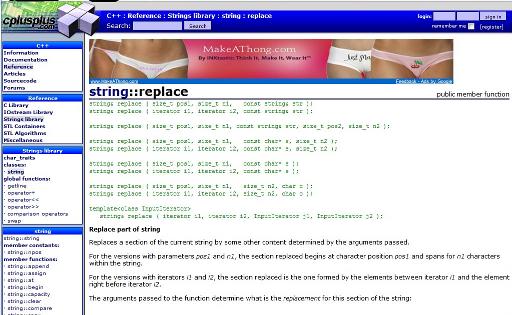
I imagine that Google could do better than this. They have (a) a copy of the entire Web, stored and indexed as they see fit, and (b) huge quantities of parallel-processing power to crunch through this and data derived from this. They have already used this to great effect in building statistical models of language, which they use in things like their language tools and the context-sensitive spelling correction in Wave. I imagine, though, that it could be used to implement a machine-learning system, taking content classification beyond word frequencies.
Imagine, for example, if there were a classification engine, trained on millions of web pages (and auxilliary data about them) that, when fed a web page or document, could assign it a score along several axes with some degree of accuracy. Some axes could be the obvious things: a "sex" axis, for example (with thongs falling on one side and C++ classes well on the other) could be used for things like SafeSearch. An "emotional response" axis could be used to classify how likely content is to arouse strong emotions; on one end would be accounts of lurid violence and depravity, and on the other end things like source code and stationery catalogues, with art, celebrity gossip and LiveJournal angst falling in the spaces between. As soon as a page crossed a certain point on the axis, the ad-serving algorithm could stop matching ads by keywords (you don't want ads for airfares next to a piece about an air crash, for example), or even reverse them (so that topical ads aren't shown).
In fact, one need not restrict oneself to pre-imagined axes; it's conceivable that an ad serving company with Google's resources could set up a learning engine, program it to categorise pages according to a dozen arbitrary axes, and see what comes about and what it's useful for, in turn coming up with a model for clustering web content into crisply defined categories that no human would think of. Of course, for all I know, someone at Google (or Microsoft or Facebook) could be doing this right now.
2009/10/15
2009/6/6
Today's Google title graphic:
Apparently today is the 25th anniversary of the invention of Tetris, perhaps one of the most concise (not to mention enjoyable) statements of existentialism embodied in interactive form. (In Tetris, there are no goals, no new worlds to explore, foes to vanquish, princesses to rescue or other paraphernalia, just the ceaseless, Sisyphean struggle against an inexorable, impersonally hostile universe, from which the only respite is your inevitable death.) Tetris also gave its name to a hallucinatory condition often triggered by playing it for a prolonged period.
Perhaps coincidentally, one of the inventors of Tetris now lives in Sydney and works at Google, and is involved in the Google Wave project.
2008/12/10
The latest experimental technology to emerge from Google's labs is something called Native Client. This is an experimental means of running web content in native machine code in a web browser. It's X86-specific (so users of PowerPC Macs and the numerous ARM-based portable devices are out of luck here), though other than that, completely portable; the binaries are in a special format, and get a limited number of system calls standardised across Linux, OSX and Windows. There is even a version of Quake which will run in a browser, in any of these systems, should you have the plugin enabled.
Of course, by now, you're probably thinking "Are they crazy? That's the worst idea since nuclear-powered airliners". Google, though, claim that they have a robust security model. The instruction set available is restricted, with constraints placed on the format of the code, allowing a code inspection process to detect any dangerous instructions. Google argue their case in a research paper; I'm not sufficiently familiar with recent x86 assembly language to verify their claims, but it looks like they certainly put some thought into it. Of course, there are a lot of very bright people in places like Russia, Romania and China who would also put a lot of thought into it, to entirely different ends, so there are reasons to be concerned.
Why are Google doing this? Well, firstly, it must be said that this is an experimental project, and not a finished product. However, I doubt that this is to allow better animated web ads. For most user interface content (video, animation, &c.), Flash and such are sufficient. Where this is a big win is in CPU-intensive processing tasks, which are too expensive to do in JavaScript (even if compiled to native code through Google Chrome's V8 just-in-time compiler) or Flash. (At the moment, with fast machines, one can just about do audio synthesis/processing like Hobnox Audiotool in ActionScript; however, this is quite expensive in terms of resources.)
Where something like Native Client would really come in useful would be for coding web-based applications that do real heavy lifting without handing tasks off to a well-resourced server or relying on them being coded into Flash; for example, image editing or video editing as a web service. Google's paper presents a diagram of how such services would look; the front end would be written in JavaScript and/or Flash, whilst the native x86 code would sit in a separate, sandboxed Native Client process, performing the gruntwork on demand: rendering graphics, processing video, synthesising sound, animating the exploding heads of zombies or whatever is required. C/C++, in this case, is kept firmly under the stairs, with the UI code being left to higher-level languages.
Of course, such an idea opens all sorts of strategic possibilities for Google; if it works, it would reduce the desktop operating system to a commodity. If any kind of application can be used as a web service, why buy a copy of Windows (or a PC with the Microsoft Tax in the price)? In fact, why bother installing a full-scale Linux? They're already starting to make PCs with cut-down instant-on operating systems (typically Linux-based) in the ROM, so that if you can't wait for your Vista box to finish booting, you can boot into the instant OS and get a web browser. Now, imagine a box like this, only with the OS being able to run web apps at native speed, perhaps in an application-oriented browser like Chrome. Could this be the much talked about "Google OS"?
2008/9/3
WIRED has a piece by Steven Levy looking behind the scenes of Google's Chrome web browser project:
Because Chrome was supposed to be optimized to run Web applications, a crucial element would be the JavaScript engine, a "virtual machine" that runs Web application code. The ideal person to construct this was a Danish computer scientist named Lars Bak. In September 2006, after more than 20 years of nonstop labor designing virtual machines, Bak had been planning to take some time off to work on his farm outside Århus. Then Google called.
Bak set up a small team that originally worked from the farm, then moved to some offices at the local university. He understood that his mission was to provide a faster engine than in any previous browser. He called his team's part of the project "V8." "We decided we wanted to speed up JavaScript by a factor of 10, and we gave ourselves four months to do it," he says. A typical day for the Denmark team began between 7 and 8 am; they programmed constantly until 6 or 7 at night. The only break was for lunch, when they would wolf down food in five minutes and spend 20 minutes at the game console. "We are pretty damn good at Wii Tennis," Bak says.
Speed may be Chrome's most significant advance. When you improve things by an order of magnitude, you haven't made something better — you've made something new. "As soon as developers get the taste for this kind of speed, they'll start doing more amazing new Web applications and be more creative in doing them," Bak says. Google hopes to kick-start a new generation of Web-based applications that will truly make Microsoft's worst nightmare a reality: The browser will become the equivalent of an operating system.
Google also brought in reinforcements to implement the multiprocess architecture that allowed each open tab to run like a separate, self-contained program. In May 2007, it acquired GreenBorder Technologies, a software security firm whose technology was designed to isolate IE and Firefox activities into virtual sessions, or "sandboxes," where malware intrusions couldn't mess with other activities or data on your computer. When the deal was announced publicly, tech pundits wondered whether it meant that Google was going into the antivirus business. Only after the acquisition did GreenBorder's engineers learn that their job was to construct sandboxes for the tabs of a new browser. "It was confusing," says Carlos Pizano, one of the GreenBorder hires. "They would not say what they wanted to sandbox."Meanwhile, the Chrome beta's licensing agreement apparently gives Google rights to use anything you create using it for promoting its services. This alarming clause appears, however, to be the result of an oversight; the licensing terms appear to have been copied from Google's web applications, and make little sense for a BSD-licensed open-source web browser (after all, anyone who doesn't like the EULA could produce an EULA-free though otherwise identical version of the browser merely by recompiling it from the source).
2008/9/2
Google are apparently working on a new web browser. Named Chrome, the browser is designed more like an operating system which happens to be based on web technologies like DOM and JavaScript than a traditional browser; different pages are separate processes (and about time, too) and privileges are compartmentalised to fortify security. Meanwhile, the web rendering implementation is based on WebKit (the Apple/KDE open-source web engine), with a JIT-compiling JavaScript engine optimised for application from a Danish company named V8 (I wonder how it compares to Apple's Squirrelfish and Mozilla's new engine). Alas, there's no code available (and the URL given returns a 404); instead, Google have given us a beautifully drawn 38-page comic by Scott McCloud, illuminating the technical innovations and the reasons for them, in great detail and with no small amount of humour:
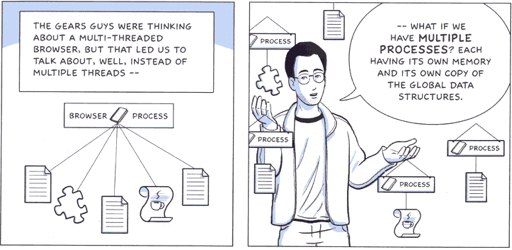
That's all the detail that seems to exist so far. There is a possibility that it's just an elaborate feint; Google could, in theory, have paid McCloud some huge sum to draw a comic to specification, peppered with technical versimilitude, purely in order to send Microsoft/Apple/Yahoo!/whoever's development teams on a wild goose chase. Though I suspect that there is an actual product there. For one, Google are known to use WebKit on Android.
 More importantly, though, a browser designed as a web application operating system (with the expectations of performance and stability that implies), rather than an information viewer with programmability grafted on as an afterthought (as is the case with current browsers), would line up rather nicely with Google's strategy to make the web into a first-class application platform.
There are no details on what platforms Chrome will run; it is open-source (and other projects, or those willing to fork those, will probably have a field day with this), and the comic does mention Windows in one place, so presumably a Windows version is planned. I'm guessing that Google aren't doing this to help Microsoft sell Windows licences, though, so presumably this is not the only version planned. A Linux desktop version, running on top of X, is probably likely. Another possibility is it running over something lighter than the average Linux desktop, making a robust web-browsing appliance on which the browser meets the conventional definitions of an operating system; either Android or some other lightweight OS.
The other option, of course, is that this is an elaborate hoax, akin to the Photoshopped "spy photos" of new Apple Mac tablets and other fantastic gear that are a regular feature of gadget blogs. The fact that Google's Chrome page doesn't yet exist (at time of writing) does suggest this possibility. Though this would imply that the hoaxers had an enormous amount of time on their hands, excellent comic drawing skills and an uncanny mastery of the drawing style of Scott McCloud.
Update: Google have confirmed Chrome. It's initially a Windows product (presumably to win market share before IE8 comes along and shuts off Google's oxygen with its advertising cookie blocker), though Mac and Linux versions are in the works. The Windows version will apparently be out tomorrow.
2008/8/6
Google adds Australia to Street View, meaning that large segments of road in Australian urban areas have been given the once-over by Google's camera trucks, producing panoramic images. The images are quite close together, meaning that you can take a virtual tour of various streetscapes.
The coverage seems quite comprehensive; Google's vans managed to trundle down most of the streets in the inner cities, some of those in the outer suburbs, and vast stretches of highway along the outback. Not only can you see inner Sydney and Melbourne, but unimaginable expanses of suburban cul-de-sacs (I imagine there are quite a few Britons who'd be excited by the fact that Pin Oak Ct., Vermont South, has been photographed), and sweeping expanses of outback and desert (they got most of the highway across the Nullarbor, for one). Everywhere from the CBDs and funky lattelands of the inner cities, to towns with one pub, two churches (Catholic and Anglican) and a war memorial, from golden beaches to the unforgivingly majestic landscapes far from anywhere where the idea of the "tyranny of distance", so key to understanding why Australia became what it is, is viewable and scrollable, in increments of ten or so metres. Most of these views will, in all statistical probability, never be looked at by a human being (other than Google's editorial staff).
Personally, the first places I visited when I found out about this were my former homes and old stomping grounds in Melbourne. It was reassuring to see that everything's still there (the flats I was living in in North Fitzroy still look as they did, the Tin Pot and Piedimonte's are still there, Brunswick Street's still unchanged, and even the Lord Newry Hotel looks like it might still serve as a pub, rather than upmarket apartments). A flat I lived in in Carnegie, and a childhood home near Caulfield Racecourse, were also faithfully recorded. The outer suburbs of Melbourne, however, fared somewhat more patchily; the two houses in the outer eastern wilderness where I spent my adolescence had both been passed over by the Google recording angel. Though the major roads were all there, as were the scenic routes leading out of the city.
Australia has stolen a march on much of the rest of the world with Street View. While the technology was, infamously, pioneered in the US (with the usual outcry about the privacy of scantily-clad sunbathers, porno-theatre patrons and housecats in windows being violated), coverage in Europe is presently limited to a few swathes cut through France. (Though, to their credit, the Street View mannequin rendered on French maps does appear to be wearing a beret.) Apparently Britain is on the way, though, as Google's vans have been seen on these shores.
2008/1/9
Facebook and Google anounce that they are joining the Data Portability Workgroup, a body advocating open standards allowing users of social web sites to easily move their data from one site to another. (This is not long after Facebook suspended Robert Scoble's account for attempting to, well, port his data from their site.) More interesting is who's Google's representative in this organisation: none other than Brad Fitzpatrick, founder of LiveJournal and one of the originators of OpenID, who more recently has turned his attention to the social graph problem.
2007/9/1
Another front has opened in Google's assault on Microsoft's software dominance, with it emerging that Google Maps contains a hidden flight simulator. The flight simulator is activated by pressing Command, Option and A (on a Mac) or Ctrl, Alt and A (on a PC), and gives you the choice of two planes and several runways. Instructions are here. As you can probably imagine, going anywhere other than into the ground when using a keyboard is somewhat tricky.
2007/5/12
Meanwhile, Google has filed a patent for using online games to build up psychological profiles of users, and using these for targetting ads:
The company thinks it can glean information about an individual's preferences and personality type by tracking their online behaviour, which could then be sold to advertisers. Details such as whether a person is more likely to be aggressive, hostile or dishonest could be obtained and stored for future use, it says.
The patent says: "User dialogue (eg from role playing games, simulation games, etc) may be used to characterise the user (eg literate, profane, blunt or polite, quiet etc). Also, user play may be used to characterise the user (eg cautious, risk-taker, aggressive, non-confrontational, stealthy, honest, cooperative, uncooperative, etc)."
Players who spend a lot of time exploring "may be interested in vacations, so the system may show ads for vacations". And those who spend more time talking to other characters will see adverts for mobile phones.
Not all the inferences made by monitoring user activity rely on subtle psychological clues, however. "In a car racing game, after a user crashes his Honda Civic, an announcer could be used to advertise by saying 'if he had a Hummer, he would have gotten the better of that altercation', etc," the patent says. And: "If the user has been playing for over two hours continuously, the system may display ads for Pizza Hut, Coke, coffee."And on a related note, Bruce Schneier on how today's likely surveillance dystopias differ from Orwell's totalitarian vision:
Data collection in 1984 was deliberate; today's is inadvertent. In the information society, we generate data naturally. In Orwell's world, people were naturally anonymous; today, we leave digital footprints everywhere.
1984's Big Brother was run by the state; today's Big Brother is market driven. Data brokers like ChoicePoint and credit bureaus like Experian aren't trying to build a police state; they're just trying to turn a profit. Of course these companies will take advantage of a national ID; they'd be stupid not to. And the correlations, data mining and precise categorizing they can do is why the U.S. government buys commercial data from them.
And finally, the police state of 1984 was deliberately constructed, while today's is naturally emergent. There's no reason to postulate a malicious police force and a government trying to subvert our freedoms. Computerized processes naturally throw off personalized data; companies save it for marketing purposes, and even the most well-intentioned law enforcement agency will make use of it.
Google's shareholders say, alright, let's be evil where it's profitable:
A majority of Google shareholders today voted against an anti-censorship proposal that took aim at the way the search giant conducts its business in China and other countries that engage in active censorship.
The specific text of the failed proposal, available in the company's online proxy statement, stated:Of course, that doesn't mean that Google will give up the slogan "don't be evil"; given that, in the context of what they do, "evil" is a fairly vague term (even harder to nail down than Apple's environmental record, a subject of some debate), if they do start shopping dissidents to the Chinese government and propping up totalitarian regimes in the interests of profits, if anything, they're more likely to start spinning heavily on the we're-nice-guys angle; sort of like Nestlé.
- Data that can identify individual users should not be hosted in Internet-restricting countries, where political speech can be treated as a crime by the legal system.
- The company will not engage in pro-active censorship.
- The company will use all legal means to resist demands for censorship. The company will only comply with such demands if required to do so through legally binding procedures.
- Users will be clearly informed when the company has acceded to legally binding government requests to filter or otherwise censor content that the user is trying to access.
- Users should be informed about the company's data retention practices, and the ways in which their data is shared with third parties.
- The company will document all cases where legally binding censorship requests have been complied with, and that information will be publicly available.

2007/3/19
The Reg digs up some corroboration of the rumoured Google mobile phone:
We've been making enquiries too, and a picture is beginning to take shape. In August 2005 Google acquired a stealth-mode startup called Android, founded by Andy Rubin. Rubin was a veteran of Apple and General Magic, but is best known for leading WebTV and subsequently Danger Inc. Danger produced one of the most-photographed phones of recent years, thanks to Paris Hilton: its Hiptop was marketed by T-Mobile as the Sidekick.
But plans have become more ambitious, as the recruitment of Apple veteran Mike Reed and Canadian mobile app company Reqwireless suggests. Graphics expert Reed worked on the ill-fated QuickDraw GX and on font technology at Apple. Google acquired his start-up Skia, which produced a vector graphics suite for resource constrained devices.Meanwhile, Alec Muffett reckons that Apple's solid-state laptop may be the reason for them adopting Sun's next-generation filesystem, ZFS, which has, as one of its many features, the ability to ensure that all blocks of storage are used evenly, something that is important when writing to devices that can only stand a fixed number of write cycles.
2007/3/16
Last night, I went to the London Open Source Jam, a Linux-themed show-and-tell hosted at the Google offices near Victoria Station.
They had various speakers who came in, bringing in variously interesting Linux-based projects, talking (very) briefly about them and then letting people poke around with them.
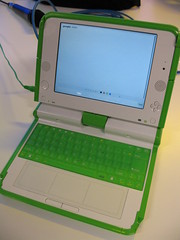 They had some people from the One Laptop Per Child project, who brought along two prototypes of the US$100 laptops which they are going to build and distribute to children in the developing world. The machines are very well designed (they're full of innovative design features, they're reportedly almost indestructable, and they look desirably good); they're based on Linux and Python, look nothing like the machines used elsewhere, and are designed to encourage tinkering and exploration. They even have a key (labelled with a graphic of a cog) which, when pressed, takes you to the source code for the currently running program so you can hack and modify it. (That didn't seem to be working on the laptop I looked at, though that prototype wasn't working perfectly.)
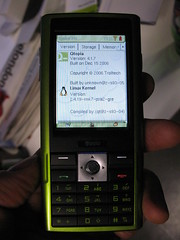 Someone also brought along a Trolltech Greenphone; that's a new mobile phone, created by Trolltech (the Norwegian company that makes the Qt toolkit (a rather elegant GUI library) and the Qtopia interface for portable devices), and based entirely on open-source(ish) software. It looked much like a regular phone, albeit with some developer features. I saw no evidence of it containing WiFi, though, so it may be lacking in that department.
Sony sent along a representative with a PS3 console, to show that it could boot Linux (and not only from special Sony-approved distributions, as the PS2 could, but from any distribution of your choice). Of course, the catch is that when the PS3 boots an untrusted Linux disc of your own providing, it runs it in a sandbox (under a Xen-style hypervisor), isolating it completely from the nifty graphics chip (so that game developers can't evade Sony's game-licensing fees by distributing full-featured games as bootable Linux live DVDs), and reducing it to a generic computer with a somewhat unusual CPU.
 They had a demo, which rendered a Mandelbrot set and let you zoom around on it; it was like a faster version of something I saw on a 386 PC in 1989. All in all, I found this demo underwhelming; when asked why anyone would want to run Linux in a sandbox on a PS3 when one could build a PC for less and get access to better graphics capabilities, the Sony rep didn't have a good answer; it was intended, she said, for people who already have a PS3 and, for some reason, are seized with the desire to run Linux on it. Though I suspect that, the fact that doing so doesn't involve breaking locks or using the hardware for anything more than it was designed for (the fact that the PS3 can be a mediocre Linux box is about as exciting as the fact that an iPod can be a mediocre PDA, or a mobile phone can be a mediocre MP3 player), will largely leach any such endeavour of any hack value it may have had.
2007/3/12
First Google provided a search engine, then they started handing out gigabyte-sized webmail accounts and then gave the world zoomable maps, and now Google have created their own sophisticated mass transit system. The system is a workaround for the transport woes of the San Francisco Bay Area, with its Californian sprawl, various disjointed transport systems run by different municipalities and levels of government, and consequent commuting headaches. In typical Google fashion, it innovates the idea of mass transit. The buses run on biodiesel, are equipped with wireless internet access, and are tracked in real time, with commuters being notified by mobile phone of their positions, and routes are constantly being revised.
The shuttles, which carry up to 37 passengers each and display no sign suggesting they carry Googlers, have become a fixture of local freeways. They run 132 trips every day to some 40 pickup and drop-off locations in more than a dozen cities, crisscrossing six counties in the San Francisco Bay Area and logging some 4,400 miles.
At Google headquarters, a small team of transportation specialists monitors regional traffic patterns, maps out the residences of new hires and plots new routes -- sometimes as many as 10 in a three-month period -- to keep up with ever surging demand.The system is for employees only, though. Meanwhile, other Bay Area technology companies such as Yahoo! have implemented similar systems.
2007/2/8
Google Maps has finally launched a full Australian edition. The site, located here, doesn't provide any more actual map data than Google has had for a year or two, but does now have an index of businesses, so searches like "cafes in 3068" or "computers in melbourne" will yield useful results.
2006/11/28
Google Earth has given ordinary people easy access to satellite images of where they live. In Bahrain, this technology is proving disruptive, as ordinary Bahrainis visualise the glaring inequality between them and the aristocracy who own most of the land:
Opposition activists claim that 80 per cent of the island has been carved up between royals and other private landlords, while much of the rest of the population faces an acute housing shortage.
"Some of the palaces take up more space than three or four villages nearby and block access to the sea for fishermen. People knew this already. But they never saw it. All they saw were the surrounding walls," said Mr Yousif, who is seen in Bahrain as the grandfather of its blogging community.The house of al-Khalifa has responded by knocking down the walls of its palaces and handing the land over to the people.. whom am I kidding; they, of course, responded by configuring the national firewall (and every authoritarian regime should have one of those!) to block access to Google Earth. Which, given the number of internet-savvy Bahrainis, failed, and had the opposite effect, encouraging more people to look at this Google Earth thing.
For those with insufficient bandwidth to access Google Earth, a PDF file with dozens of downloaded images of royal estates has been circulated anonymously by e-mail. Mr Yousif, among others, initially encouraged web users to post images on photo-sharing websites.It'll be interesting to see what happens: whether this will result Bahrain's democratic reform programme to be accelerated, or result in violent unrest and a Nepalese-style crackdown.
(via Boing Boing) ¶ 0
2006/10/9
It's confirmed: Google has bought YouTube, for US$1.65bn, snatching it from the grip of old-media behemoths like Viacom and News Corp. Which means that it stands a decent chance of maintaining its existing principles, rather than turning into some kind of ad-spammy, contributor-hostile conduit for corporate marketing.
2006/8/4
Joining the cornucopia of vaporware Skype WiFi phones (and the occasional phone using the SIP industry standard which no-one seems to actually use outside of the enterprise) is a Google Talk phone; that's a WiFi-enabled mobile-phone-sized unit that connects to Google's voice-over-IP network. The advantages: the unit will have "Gmail capabilities" built in (which means that all they'd have to do is widen the keybad and they could call it a Googleberry). The disadvantage, of course, is that all your friends are on Skype, which refuses to connect with other networks (other than the analogue phone system).
2006/6/13
Google have just released a MacOS X version of their amazingily intuitive CAD package SketchUp. This program is rather nifty, and seems to use various human-interface heuristics to disambiguate what the user is trying to do, and consequently making 3D drawing a lot less painstaking than with traditional CAD/modelling programs. It also has some rather nifty rendering modes (such as pencil sketch, or precise-yet-cartoonish-looking textures), and looks good for everything from designing DIY projects to making comics. And it's free.
Also from Google: a new beta of Google Earth, now with a Linux version. (For some reason, though, the view window is all black on this machine, even though it does have OpenGL.)
2006/5/18
In light of Google Maps launching their Australasian coverage, I am of the opinion that one geographical innovation Australia could do with is street-level post codes.
If one thinks of postcodes as merely a bit of stuff you write on a letter to help the postman, it may not seem like such a big deal. Though once postcodes are seen in a broader context, as coordinates optimised for specifying how to get to a location, they really come into their own. A 4-digit Australian postcode gives a few square kilometers of urban area, or several times that in the outback. A 6-7 character British postcode, however, can home in on a street or a segment of a street, down to a few dozen houses. Type in a postcode like "NW6 7JR" into Google Maps and you'll get a map showing you where your destination is; enter it into something like the Transport for London Journey Planner, and it has enough information to determine an optimal route for getting to the location in question, getting you close enough to find your destination without any further help. Because the postcode is a code in a very specific format, there is no need for guesswork, address parsing, or the computer asking you to select which location you meant from a list of alternatives.
I modestly propose that Australia would benefit from street level postcodes. The increased efficiency in mail delivery would save the Post Office money, and the streamlining of computer-based navigation technologies would boost the increasingly high-tech, high-speed economy, not to mention provide a valuable public utility. One could possibly even make an environmental argument for finer-grained postcodes, that in optimising navigation, they would reduce the amount of fuel used and pollution emitted. The street-level information could be added on as a suffix to existing postcodes, much in the way ZIP+4 was added to US ZIP codes in 1983, and could consist of an alphanumeric suffix. For example, a segment of a street in Fitzroy could be designated by something that looks like 3065-AB3. (They could also be purely numeric, though alphanumeric suffixes would allow for more information in fewer characters, and keeping the total length to 7 characters or less (as per The Magical Number Seven +/- 2, this being the capacity of human immediate memory) Punch that into a website or mobile phone application and you can get detailed instructions on how to get to your desired location.
Of course, proposing such a scheme is one thing, and getting bureaucrats, politicians and various vested interests to run with it is another, so one probably shouldn't hold one's breath.
And if it never happens, we could always move to a purely latitude/longitude-based coding system like the Natural Area Coding System. The problem with that is that, being purely physical, it does not take into account local geographical features, such as whether two points are adjacent houses on a street or houses in two streets only reachable by a long detour.
Google Maps has added Australia. (And New Zealand as well, while they were in the neighbourhood.) It looks like a fairly comprehensive map covering the entirety of the vast country, from the major cities to small country towns and rural roads. Interestingly enough, their Australian maps actually show property boundaries in grey; perhaps a lot of the data comes from land titles databases? There don't seem to be any discontinuities along state borders, of the sorts that happen on the borders of European countries, so presumably the data is fairly uniform across Australia.
There is not yet a maps.google.com.au, and searches for Australian locations yield little ("melbourne australia" will get you on the right page, though anything below that, like, say, "northcote australia", a street name or a post code, draws a blank), though if you go to the US, UK or Japanese site and drag, you can get to the wide brown land with green bits around the edges.
2006/4/25
Google Maps has expanded its coverage again. It now covers all most of the EU (excluding Slovenia), Scandinavia and Finland (though not Iceland or the Faroes). Some parts of Europe (France, Germany, the Czech Republic and such) are more densely covered than others (Poland and Hungary, for example), and map coverage cuts off altogether at the EU's eastern frontier, though as a bonus, you get greater Moscow (or "Москва", as Google Maps, ever sensitive to local ways, labels it), plus an orange umbilicus of a highway connecting it to the rest of the known world, via the Belarussian wilderness. Greece and Istanbul are connected in a similar fashion through Serbia and Montenegro. Oh, and the Canary Islands get covered, presumably to cater to all the Europeans catching cheap flights there.
2006/4/5
Google Maps' long-awaited expansion into Europe may be coming; the mapping service has just added maps of a patch of north-western Italy, which joins North America, the UK and Japan in the mapped world. The map cuts off on a suspiciously vertical line just east of Alessandria, though; perhaps the rest of Italy will show up in the next day or so?
2005/11/9
Google Local, formerly known as Google Maps, is now available for mobile phones. There are Java applets which will run on a variety of phones and allow you to scroll and zoom around the Google Maps map. For some reason, you can't zoom in to street level, at least for the UK. Also, being able to bookmark locations would be good. Other than that, it's pretty nifty, and could end up giving PDA-based static map software like Tube a run for its money.
2005/8/24
Google release their own instant messaging/VoIP system. It's called Google Talk, and, unlike proprietary competitors, is based on the XMPP ("Jabber") protocol. The Google client is Windows-only at the moment, so Mac and Linux users will have to content themselves with having text-only conversations using the various other XMPP clients, though clients for other platforms are under develop,ent. Google also say that they will fully document the VoIP protocol and support SIP as well, which is very promising; unlike Skype, it will be an open, user-extensible system, and there will be nothing stopping all-in-one multiprotocol clients like Gaim from integrating Google Talk functionality (which is just as well; having a separate window for each network you're on is a waste of screen space). All it needs is SkypeOut-style facilities for making calls to telephone numbers; though, with an open system, third parties could easily step in and provide those.
2005/7/20
To commemorate the Apollo 11 Moon landing, Google have released Google Moon, a Google Maps for the moon. It's not searchable, and has only six locations in it (i.e., the six moon landings); when you zoom right in, however, it reveals the true composition of the Moon.
(via bOING bOING) ¶ 2
2005/6/21
Google Maps now has satellite imagery (of varying resolution) and coastlines/borders for the entire world. While Australia is probably far from getting anything like street maps (in terms of potential AdWords revenue per square kilometre, for example, it'd probably trail some way behind Europe and Asia, making it a low priority, unless they just do the major cities or something), it does have maximum-resolution satellite maps. Here, for example, is a view of Brunswick St. and the Fitzroy Pool. And here is Merri Creek and the last house I lived. (Searches on "fitzroy north" draw a blank right now, though; apparently there are no places by this name in the UK or North America. There are quite a few Brunswick Streets in Britain, though.)
Interestingly enough, much of Carlton/Parkville is shrouded in cloud, and the resolution drops off sharply just east of the State Library (it appears that they only have high-res photos for a chunk of Melbourne from Hobsons Bay to Geelong and some adjoining chunks). This, however, is a lot better than Sydney appears to have fared; I believe that this is the coathanger at the highest resolution they've currently got it; though things get much clearer below that for some reason. Meanwhile, Brisbane gets some nice photos, as do Perth and Adelaide. Darwin and Hobart, however, are blurred. It also manages to find Ballarat, Wollongong, Cairns and Albury (though be sure to put in "australia", otherwise it'll ask whether you want the one in Hertfordshire or Surrey), but draws a blank at suburbs and smaller places.
2005/4/20
Google Maps now has a UK edition, in which, rather than consisting only of North America, the globe consists of only the British Isles. The site doesn't have satellite photos yet, though it does seem to have everything else the American site has. Seeing places you've actually been adds quite a bit to the experience.
2005/4/5
Compulsively draggable click-toy Google Maps has added satellite imagery to its site; you can now switch between line-art maps and satellite photographs, all zoomable. Some regions don't have satellite imagery at the highest resolution.
Interestingly enough, while the maps are still North America-only, you can drag the satellite view to anywhere in the world; most parts of the world don't let you zoom in to any level that shows signs of habitation though.
2005/2/11
In the latest phase of their world-domination-through-doing-good strategy, Google are offering to host content for Wikipedia and other Wikimedia projects. And about time that someone made such an offer, as half the time Wikipedia's servers seem to be in a world of pain.
2005/2/9
A fairly informative dissection and analysis of Google Maps and how it does its magic. It's pretty interesting; unlike GMail (the other example of an impressive DHTML-based interface from Google), Maps doesn't use XMLRPC, but instead just fetches tiles in JavaScript and uses a hidden frame to communicate with the server, and the browser's inbuilt XSLT engine to parse the result. Which all makes for some very impressive hack value.
2005/2/8
Google once again raises the bar of what you can do with a web browser. Their latest is Google Maps, an entirely DHTML-based, instantly responsive, scrollable, zoomable map. Functionally, it doesn't seem to do anything that online street maps haven't done for a few years now, but that's not the point; it's the way it does it. Where street maps until now have been clunky and slow, Google Maps feels instantaneous; you can drag the map around, zoom it in and out, and new tiles load on demand. (On a fast connection, it's not slow enough to be annoying.) And the way it displays signposts, with composited Gaussian-blurred shadows, looks pretty cool too. Currently, they only have North America, and only have detailed maps for the United States, but then again, it's still in beta, so hopefully they'll add other parts of the world soon.
2005/1/19
Google have developed a solution for stopping comment spam, or, more precisely, for denying spammers any search engine-related benefits from getting their URLs all over blogs, guestbooks and bulletin boards. From now on, any links on a web page with the rel="nofollow" attribute will be ignored by search engines. This has broad support; on the search engine side, Google, Yahoo! and MSN Search are heeding this tag, and various blogging tool providers, including SixApart, LiveJournal, Blogger and WordPress, have added automatic support of this link to their comment/trackback mechanisms. (As, of today, has this blog.)
Which seems like a pretty elegant solution; rather than shutting down comments or removing functionality (such as the ability of commenters to include links to their sites or relevant pages or otherwise leverage the hypertextual nature of the web), marking the links as not endorsed by the site, and to be ignored by participating search engines (which should soon be all of them, given that it's an excellent indicator of potential link relevance, and not heeding it can impair the relevance of the engine's results).
2004/11/23
Google have just launched a new search engine for academic papers. It allows one to search books and academic papers for terms, and uses a PageRank-style ranking algorithm which takes citations from scientific literature into account. Which looks pretty nifty.
2004/6/11
One of the batch of Gmail invites that has recently flooded the streets has ended up in my hands, and hence I've been able to have a look at it.
- Gmail user names must have at least 6 characters, so über-l33t names like, say, "acb" are out. One fewer reason to angst about all the good names having been snapped up by early adopters, big spenders and well-connected digerati.
- If your desired ID is unavailable, it gives you a number of options; i.e.,
- john.smith
- smith
- jsmith
- smithster
- Gmail sends mail in plain text, and not HTML as some broken services (*cough*Hotmail*cough*) do. This is good.
- Annoyingly enough, the links on the Gmail page aren't actual links, but appear to be normal HTML text with JavaScript actions attached. Which means that there is no way to open messages, compose mail, and so on in a new window or tab, but instead can only look at one thing at a time. This is annoying to compulsive multitaskers such as myself.
- Gmail still doesn't seem to have POP or IMAP, either incoming or outgoing. Which is going to make downloading one's mail tricky.
Aside: This site has some concerns about Gmail's privacy implications. Granted, the somewhat eccentric graphics on the site give off a paranoid-crackpot vibe; however, some of the issues raised are concerning:
If Google builds a database of keywords associated with email addresses, the potential for abuse is staggering. Google could grow a database that spits out the email addresses of those who used those keywords. How about words such as "box cutters" in the same email as "airline schedules"? Can you think of anyone who might be interested in obtaining a list of email addresses for that particular combination? Or how about "mp3" with "download"? Since the RIAA has sent subpoenas to Internet service providers and universities in an effort to identify copyright abusers, why should we expect Gmail to be off-limits?
Does anybody know whether the RIAA or an equivalent agency would have an easier time ordering Google to hand over a list of all people with the words "mp3" and "download" in their mail than they would of ordering an ordinary ISP to give them access to customers' mail spools? (Mind you, the latter happened in Australia; ARIA did get access to student mail at various universities.)
2004/2/9
New York Bloggers organise a gathering at a trendy restaurant; the management ejected the entire group. So the bloggers googlebombed the restaurant.
2003/10/2
If you can read this, then we're back. A routine machine relocation didn't go quite to plan, but it's all fixed now (hopefully).
And below is the backlog of blog items that didn't get posted to The Null Device over the past few days:
- Your tax dollars at work: A US spy agency as been monitoring webcams at an Islay distillery, just in case they were making chemical weapons instead of whisky. Defense Threat Reduction Agency officials stressed that monitoring Scottish distilleries was not a high priority, but stated that it would take just a "tweak" to modify the whisky-making process to produce chemical weapons. (Hmmm; that suggests some interesting near-future scenarios for potential flashpoints between the United States of America and Britain and a rogue People's Republic of Scotland.)
- An interesting paper on the design of the Google File System, a custom file system optimised for storing huge (multi-gigabyte) files on large farms of fault-prone hardware. (via bOING bOING)
- The latest fad in baby naming in the U.S. involved naming your children after your favourite brands of consumer goods. Looks like Max Barry wasn't all that far off: (via Techdirt)
"His daddy insisted on it because Timberlands were the pride of his wardrobe. The alternative was Reebok," said the 32-year-old nurse, who is now divorced. "I wanted Kevin."
This is only the latest chapter in the boom of giving children unique names.
According to the most recent census, at least 10,000 different names are now in use, two-thirds of which were largely unknown before World War II.
- "We're Gonna Get You After School!" Gibson's Law applies to playground mob psychology, with kids setting up websites and blogs to call their classmates names. This way, technology may be said to have democratised bullying, as it's no longer the musclebound alpha-jocks and the popular rich girls who have a monopoly on making others' lives miserable. (via TechDirt)
One 12-year-old blogger, writing on the popular Angelfire Web site, recently announced she would devote her page to "anyone and everyone i hate and why." She minced no words. "erin used to be aka miss perfect. too bad now u r a train face. hahaha. god did that to u since u r such a b -- . ashley stop acting like a slut wannabe. lauren u fat b -- can't even go out at night w/ ur friends. . . . and laurinda u suck u god damn flat, weird voice, skinny as a stick b -- ."
The author of the article calls for the use of "parental control devices" to stamp out "social cruelty", much in the way that filters have been used to stop pornography. Which sounds more like it would strip those kids put upon by the alpha-jocks/princesses of their online support networks of fellow outsiders.
- More on the internet's impact on human interaction: Internet chat addiction can stunt social skills in introverted adolescents, says a researcher in "social administration". Dr. Mubarak Rahamathulla says that research suggests that chat rooms have contributed to some teenagers fearing conventional social interaction, and becoming more dependent on anonymity or pseudonymity. However, he says, webcams may be a safe, healthy way for to explore their sexuality. Perhaps the future belongs to asocial chatroom onanists, who are into anything as long as it doesn't involve actual human contact?
- The AT&T text-to-speech demo site now has two British voices; the male one sounds somewhat deranged, as if having at some time in the past eaten some BSE-contaminated beef. (via kineticfactory)
- A company is now selling licensed arcade ROMs for MAME. StarROMs currently have a few dozen titles, all from Atari, but plan to have more; games cost between US$2 and US$6 per title, and all are unencrypted ROM images suitable for MAME, with no DRM chicanery to be seen. Let's hope this idea catches on.
- Transcosmopolitan, or Spider Jerusalem's stint as features writer for a women's lifestyle magazine. (via Warren Ellis' LiveJournal comments)
2003/7/23
Ever wonder why Google have a copyright notice at the bottom of their (not exactly intellectual-property-rich) search page? It's not so much to appease the lawyers as it is to let you know where the page ends:
In its early days, the company asked some focus group participants to search for information using its site. But many people, when they went to Google, did nothing for a minute or two. When asked why, these apparent procrastinators said they were waiting for the rest of the site to load. So, the company thought that by putting a copyright notice on its page--something usually found only at the bottom of a fully loaded page--perhaps people would get the hint that the spartan page was fully loaded.
(via TechDirt)
2003/2/17
Google buys Pyra Labs, the company who brought blogging to the masses with Blogger (that's the web-based blogging tool everybody used before Movable Type) and free ad-supported hosting service BlogSpot (that's sort of the GeoCities of blogs).
2002/7/7
TouchGraph Google Browser shows Google results in a graph. (Java required; it seems to work with Mozilla on Linux.)