The Null Device
Posts matching tags 'irony'
2014/6/24
With American Apparel sacking its sexually inappropriate ur-visionary Dov Charney with extreme prejudice, and the recent fall from grace of hipster-porn photographer Terry Richardson, we could be witnessing the twilight of the assholes (or as they call it in Germany, Arschlocherdämmerung) and possibly the end of a vein of ostensibly-ironic hipster misogyny and douchebag chic:
But it’s interesting to think a little bit more deeply about that culture’s gender politics. The hipster aesthetic, such as it was, incorporated plenty of semi-ironic appropriation of the tropes of traditional masculinity: trucker hats, flannel shirts, PBR, beards/mustaches, and so on. I say semi-ironic because beneath the veneer of irony, there was always something deeply conservative and deeply unpleasant about it. Specifically, it was reflective of a wider shift in the mid-to-late 1990s and early 2000s toward the reassertion of traditional alpha-male masculinity.
[t]here’s nothing transgressive about any of this. American Apparel’s aesthetic, for instance, was the most time-worn cliché in the world: using hot girls in various states of undress to sell clothes. Of course, American Apparel’s aesthetic was all about irony, or so it’d have you believe, but really, whether this was done with a sort of knowingly arched eyebrow and sly wink is kinda beside the point; saying “Hey, I know I’m being kinda sexist” doesn’t change the fact that you’re being kinda sexist. The fact that the half-naked girl being used to sell your clothes is in a deliberately flashed-out photo wearing silly glasses doesn’t change that she’s a half-naked girl being used to sell your clothes.Of course, VICE Magazine, which has been intimately connected to this strand of hipster douchebag cool since day one, running American Apparel ads on its back page and keeping Richardson employed shooting their amateur-porn-styled fashion spreads, is still going strong, having recently received investment from both Rupert Murdoch's News Corporation and Time Warner. It remains to be seen how close to the edge they keep skating in future.
2012/11/29
A landmark in the greying of rock'n'roll and the teenage dreams of the baby boom generation: the average age of members of The Rolling Stones, who celebrate their 50th anniversary as a band this year, is now almost two years higher than the average age of US Supreme Court justices (once referred to as the “Nine Old Men”, on account of it being an office one attains late in life and retains until death or incapacity). The average age of the (surviving) Rolling Stones is 68 years and 300 days, whereas that of Supreme Court justices is 67 years and two days.
2011/6/28
This article looks at the malaise in indie/hipster culture, and places the blame squarely at the feet of 1990s proto-hipster Beck:
The two most common characteristics of the “indie” persona these days, at least in North America, are an aversion to overt seriousness and the ability to find everything “awesome”. These characteristics often intermingle and feed off one another, creating the voracious indie devourer who is able to simultaneously enjoy every kind of music while at the same time not particularly caring about anything. They are the ultimate consumer, willing to embrace and discard bands at a moment’s notice while never questioning what led them to lose interest in one band and embrace another. Awkward inquiries about almost any subject can be dealt with in a detached and deliberately ironic manner — following trends is awesome, selling out is awesome, being shallow is awesome, sweatshops are awesome. When it comes to fashion, trashiness battles against both vintage store retro and American Apparel chic as the dominant form, and everyone thinks that everybody but themselves is a hipster. How this persona was birthed is a relatively straightforward tale, as suburban America fell in the love with the vulgar commercial product of its youth. An ironic approach was already somewhat popular but something, or in this case someone, happened in the ‘90s to turn what was a mere aspect of American culture into the dominant personality trait of American teenagers, twenty-somethings and, at this point, thirty-somethings. That someone was Beck.
Cinema in the 90s reflected this shift in taste, with the ultra-violence of Quentin Tarantino’s movies creating a detached, cartoonish reality that allowed the viewer to feel unconcerned as to the repercussions of the savagery on screen. The character’s brutal transgressions are played out for entertainment and amusement rather than illustrating any kind of painful struggle. Tarantino’s movies were also filled with pop culture references that allowed the viewer to feel like they were part of the director’s insular self-congratulatory world. If America in the 70s wrestled with moral dilemmas and a diminished sense of individuality and reach, then pop culture mavens in the 90s merely wanted to be in on the joke. To music fans who imagined themselves to be more alternative in their approach, Beck fulfilled this need. His music basked in the mindset of trash culture and knowing irony, of sneering at seriousness, of adopting hip-hop beats to play up the now utterly commonplace “look at me I’m a nerdy white guy rapping about ridiculous things” persona that has managed to all but reduce hip-hop to a comedy sideshow for those who need an occasional break from their Arcade Fire or Vampire Weekend albums.The ironic stance, the article argues, was a false victory, delivering the counterculture straight into the arms of the consumerist mainstream. After all, you can buy more crap if you're doing so ironically:
Consumerism thrives on people getting excited about, and buying, things that they ultimately don’t care about. In this sense the ironic persona is the ultimate gift to consumerism. Mainstream music revels in easy sentiment and soul-crushing banality and can only truly be enjoyed by not paying attention to the lyrics. Beck’s meaningless babble trained a generation of young ears to seek out amusing sound-bites over articulate content and in doing so helped break down the last vestiges of ‘alternative’ music by making it as equally meaningless as, and therefore all but identical to, mainstream drivel.I'm wondering whether the rise to dominance of the stance of ironic detachment and the tendency of musicians and bands to define themselves publically by catalogues of their influences ("we're kraut-punk meets Afrobeat meets New Jack Swing") could not both be symptoms of a more abstract shift from directness and immediacy towards mediation and referentiality, an addition of levels of abstraction to the processes of culture, a tendency to see and do things from one step removed.
Today in weaponised sociolinguistics: the US intelligence research agency IARPA is running a programme to collect and catalogue metaphors used in different cultures, hopefully revealing how the Other thinks. This follows on from the work of cognitive linguist George Lakoff, who theorised that whoever controls the metaphors used in language can tilt the playing field extensively:
Conceptual metaphors have been big business over the last few years. During the last Bush administration, Lakoff – a Democrat – set up the Rockridge Institute, a foundation that sought to reclaim metaphor as a tool of political communication from the right. The Republicans, he argued, had successfully set the terms of the national conversation by the way they framed their metaphors, in talking about the danger of ‘surrendering’ to terrorism or to the ‘wave’ of ‘illegal immigrants’. Not every Democrat agreed with his diagnosis that the central problem with American politics was that it was governed by the frame of the family, that conservatives were proponents of ‘authoritarian strict-father families’ while progressives reflected a ‘nurturant parent model, which values freedom, opportunity and community building’ (‘psychobabble’ was one verdict, ‘hooey’ another).
But there’s precious little evidence that they tell you what people think. One Lakoff-inspired study that at first glance resembles the Metaphor Program was carried out in the mid-1990s by Richard D. Anderson, a political scientist and Sovietologist at UCLA, who compared Brezhnev-era speeches by Politburo members with ‘transitional’ speeches made in 1989 and with post-1991 texts by post-Soviet politicians. He found, conclusively, that in the three periods of his study the metaphors used had changed entirely: ‘metaphors of personal superiority’, ‘metaphors of distance’, ‘metaphors of subordination’ were out; ‘metaphors of equality’ and ‘metaphors of choice’ were in. There was a measurable change in the prevailing metaphors that reflected the changing political situation. He concluded that ‘the change in Russian political discourse has been such as to promote the emergence of democracy’, that – in essence – the metaphors both revealed and enabled a change in thinking. On the other hand, he could more sensibly have concluded that the political system had changed and therefore the metaphors had to change too, because if a politician isn’t aware of what metaphors he’s using who is?The article is vague on the actual IARPA research programme, but reveals that it involves extracting metaphors from large bodies of texts in four languages (Farsi, Mexican Spanish, Russian and English) and classifying them according to emotional affect.
The IARPA metaphor programme follows an earlier proposal to weaponise irony:
If we don’t know how irony works and we don’t know how it is used by the enemy, we cannot identify it. As a result, we cannot take appropriate steps to neutralize ironizing threat postures. This fundamental problem is compounded by the enormous diversity of ironic modes in different world cultures and languages. Without the ability to detect and localize irony consistently, intelligence agents and agencies are likely to lose valuable time and resources pursuing chimerical leads and to overlook actionable instances of insolence. The first step toward addressing this situation is a multilingual, collaborative, and collative initiative that will generate an encyclopedic global inventory of ironic modalities and strategies. More than a handbook or field guide, the work product of this effort will take the shape of a vast, searchable, networked database of all known ironies. Making use of a sophisticated analytic markup language, this “Ironic Cloud” will be navigable by means of specific ironic tropes (e.g., litotes, hyperbole, innuendo, etc.), by geographical region or language field (e.g., Iran, North Korea, Mandarin Chinese, Davos, etc.), as well as by specific keywords (e.g., nose, jet ski, liberal arts, Hermès, night soil, etc.) By means of constantly reweighted nodal linkages, the Ironic Cloud will be to some extent self-organizing in real time and thus capable of signaling large-scale realignments in the “weather” of global irony as well as providing early warnings concerning the irruption of idiosyncratic ironic microclimates in particular locations—potential indications of geopolitical, economic, or cultural hot spots.The proposal goes on to suggest possibilities of using irony as a weapon:
Superpower-level political entities (e.g., Roman Empire, George W. Bush, large corporations, etc.) have tended to look on irony as a “weapon of the weak” and thus adopted a primarily defensive posture in the face of ironic assault. But a historically sensitive consideration of major strategic realignments suggests that many critical inflection points in geopolitics (e.g., Second Punic War, American Revolution, etc.) have involved the tactical redeployment of “guerrilla” techniques and tools by regional hegemons. There is reason to think that irony, properly concentrated and effectively mobilized, might well become a very powerful armament on the “battlefield of the future,” serving as a nonlethal—or even lethal—sidearm in the hands of human fighters in an information-intensive projection of awesome force. Without further fundamental research into the neurological and psychological basis of irony, it is difficult to say for certain how such systems might work, but the general mechanism is clear enough: irony manifestly involves a sudden and profound “doubling” of the inner life of the human subject. The ironizer no longer maintains an integrated and holistic perspective on the topic at hand but rather experiences something like a small tear in the consciousness, whereby the overt and covert meanings of a given text or expression are sundered. We do not now know just how far this tear could be opened—and we do not understand what the possible vital consequences might be.
2010/12/9
A few items, in no order:
- "You're either with us or with WikiLeaks": A right-wing pundit who previously denounced WikiLeaks as a terrorist organisation to be taken down by all means necessary has now called for a Stuxnet-style virus to destroy all copies of the leaked data, as well as anything else on any computer used to connect to WikiLeaks.
- Australian PM Julia Gillard has condemned WikiLeaks, and made noises about revoking Julian Assange's passport and throwing him to the wolves, David Hicks fashion. Now, a leaked US embassy memo reveals that a glowing assessment of Gillard's leadership potential eight months before she became PM. The memo, among other things, praises her right-wing voting record, despite her coming from the left faction.
- US to Host World Pres Freedom Day in 2011.
2010/11/23
The latest nightspot in the old Sloane heartland of Chelsea is Maggie's Nightclub, a club inspired by Margaret Thatcher's decade in office. Maggie's includes photos of Thatcher and Ronald Reagan (I wonder whether there are any of her close friend General Augusto Pinochet), and speakers in the bathroom play a loop of the audiobook of the Iron Lady's diaries. The club has a £15 entry price and £250 fee for a table, and may or may not be ironic:
So, I ask the club's co-owner, Charlie Gilkes, is this the nocturnal equivalent of a neo-liberal manifesto? No, no, no, argues the Old Etonian, who opened Maggie's with his business partner Duncan Stirling earlier this year. "It's not a Tory club," he says carefully, but rather a tribute to the 80s – a bit of "childhood nostalgia for the decade of our birth". The reference to Britain's most divisive politician, he says, is tongue-in-cheek. "I know she's divisive, but I do admire her. She's a leader."
In this 80s, Thatcher-era themed club, bottles of champagne signed by the Iron Lady go for £5,000, but I make do with a Ferris Bueller Fizz, priced £10.50. A Super Mario mural adorns another facade and every table in sight has been made to look like a giant Rubik's cube, while a Neil Kinnock figurine takes pride of place next to Gilkes's own childhood collection of Teenage Mutant Ninja Turtles.Regular attendees apparently include Adam Ant and Tony Hadley, frontman of Spandau Ballet, who soundtracked part of the Iron Lady's reign. It's not clear what the playlist is: I'm guessing it'd be heavy on the 1980s yuppie wine-bar sophistisoul, include a bit of Bryan Ferry, perhaps some Stock/Aitken/Waterman chart pop to get people dancing, and the odd piece by Lord Lloyd-Webber in the chill-out room, with perhaps a Billy Bragg tune thrown in for irony. (Momus' Don't Stop The Night would also be a good ironic fit, though might be a bit obscure.)
Perhaps in ten years' time, someone will open a place in Islington named Tony's, which will play only Britpop, D:Ream and the Spice Girls, and have an ironic map of Iraq on one wall.
2010/10/25
The Chinese Communist Party organ, the People's Daily, has reviewed Apple's iPad, and found it wanting:
“There are many disadvantages” to the gadgets, it wrote. “For example you cannot install pirate software on them, you cannot download [free] music, and you need to pay for movies you watch on them.”While this is more about the acceptance of copying in China, a country where privately-held intellectual property is the exception rather than the rule, it is still somewhat ironic to see a totalitarian regime criticise Apple for being too locked down.
2010/10/16
Irony of the day: apparently books on ethics are stolen more often from libraries than philosophical books not on ethics; after adjusting for other factors (the age of books, and their popularity), books on ethics are almost one and a half times as likely to be stolen.
2010/9/8
A mobile games company, now owned by Rupert Murdoch's News Corp., has been hiring North Korean companies to code their games, which include a bowling game based around the Coen Brothers film The Big Lebowski.
It's ironic to see Murdoch, that great American patriot, doing business with the Axis of Evil. One does also wonder what was going through the minds of the North Korean programmers working on the game, with no exposure to the internet, the original film or any of the cultural references connected to it. (Apparently the only people with any connections to the outside world at the game development shop were foreigners assigned to oversee things.)
2010/8/24

2010/8/20
In China's Shangdong province, life imitates art. More precisely, the operators of a public park there, faced with overcrowding, installed coin-operated park benches with retractable anti-sitting spikes, inspired by an artistic installation critiquing the user-pays ethos:
"He thought he was exaggerating. He didn't foresee that a very practical country like China might actually use them for real," said one critic.
2010/7/25
Fresh from its triumph with the national firewall (now a bipartisan commitment, due to appear some time after the next election), the Australian government is planning a proposal to require internet service providers to record certain details of all users' access to the net. The proposal itself is secret; while a document about the plans have been obtained through freedom of information laws, in the finest traditions of a well-managed democracy, 90% of the document was blacked out, to stop "premature unnecessary debate", or, in other words, to keep the subjects from sticking their noses into matters they have no business with.
2010/5/10
As parts of its Why We Fight column, exploring the cultural flashpoints of (for want of a less loaded word) hipsterdom, Pitchfork has a piece charting the rise and metamorphosis of irony, and exploring the significance of knowingness. The timeline it posits looks like this:
Or, in other words, if this theory holds, Gen Y aren't only the first generation of digital natives, but also the first generation of ironic natives (or perhaps post-ironic natives, though that title might apply more to GenXers who came out the other end and made an accommodation with sincerity via their McSweeney's subscriptions). That is, for values of "first" meaning "since the mid-20th-century".
- Americans born from the late 50s to mid-70s grew up in a world where a lot of old certainties about society, work, family, and life had been eroded-- by big social changes in the 60s, by economic decline, by lots of things. And yet these people were still raised on culture full of old "certainties" that suddenly looked really, really false and corny. Elvis-impersonator corny, After-School Special corny. So they developed a kind of irony and skepticism, floating around smirking but rarely committing to anything. Some of them were good enough at it that, by the late 80s, it'd become an actual cultural aesthetic, a sort of slacker knowingness that could get as mainstream as, say, "The Simpsons".
- Those were Gen Xers, mostly. But even as people slightly younger than them grew up, through the 90s, on a steady diet of that attitude, some folks started to notice a kind of futility in the whole thing, a defensiveness, an emptiness, an inability to embrace anything-- at which point you could suddenly read thousands of words of David Foster Wallace on how damaging it might be, how much we needed to tap back into the kinds of "basic human verities" that actually helped us lead meaningful lives. Some people even started predicting the rise of some "New Sincerity."
- In fact, some of the people who spent the 90s trading in exactly that knowing, snarky sensibility recanted, and started going around bug-eyed, warning everyone about leaving it behind-- raving about climbing out of the hole they'd fallen into, somewhat oblivious to the fact that younger people weren't in the hole with them. Younger people knew how to be ironic and sincere both, and were digging themselves entirely new holes to deal with.
(Other Why We Fight essays on Pitchfork include: why Joanna Newsom is seen as pretentious and Lady Gaga isn't, and the aspirational qualities of shifting musical taste as a sort of hipster arms race.)
In an entirely different negotiation between irony and sincerity, Czechs trying to balance nostalgia with unease for the Communist regime that was imposed on them can now holiday in authentically preserved Communist-era holiday resorts, albeit with better service and a measure of ironic detachment (in the form of singing, dancing Lenin impersonators):
She is upset because I've asked if she was bothered by the bust of Stalin in the hotel lobby. "It's our history and it's inside us," she continues, still brandishing the sausage.
2010/4/8
Irony of the day: the colour green is toxic, or, more precisely, all known green pigments on the market are both toxic and contaminate materials beyond hope of recycling. Which brings another meaning to the word "greenwash".
2009/9/17
 An article in Radical Philosophy (a journal of "socialist and feminist philosophy") looks at the phenomenon of those Keep Calm And Carry On posters, and what the reprinting and near-ubiquitous popularity of a WW2-era propaganda poster that was never originally released says about contemporary British society, alienation from the consumer-capitalist values of Thatcherism-Blairism, and a displaced longing for an imagined utopia of benign paternalistic bureaucracy and modernistic optimism that happened (as all golden ages happen) decades before those contemplating it were born.
Initially sold in London by the Victoria & Albert Museum, the poster only gradually became the middlebrow staple it is now when the recession, euphemistically the ‘credit crunch’, hit. Through this poster, the way to display one’s commitment to the new austerity was to buy more consumer goods, albeit with a less garish aesthetic than was customary during the boom. It is in a sense not so different to the ‘keep calm and carry on shopping’ commanded by George W. Bush both after September 11 and when the sub-prime crisis hit America – though the ‘wartime’ use of this rhetoric has escalated during the economic turmoil, especially in the UK. Essentially, the power of ‘Keep Calm and Carry On’ comes from a yearning for an actual or imaginary English patrician attitude of stoicism and muddling through, something which survives only in the popular imaginary, in a country devoted to services and consumption, and given to sudden outpourings of sentiment and grief, as over the deaths of celebrities like Diana Spencer or Jade Goody. The poster isn’t just a case of the return of the repressed, it is rather the return of repression itself, a nostalgia for the state of being repressed – solid, stoic, public-spirited, as opposed to the depoliticized, hysterical and privatized reality of Britain over the last thirty years. At the same time as it evokes a sense of loss over the decline of this idea of Britain and the British, it is both reassuring and flattering, implying a virtuous (if highly self-aware) stoicism in the displayer of the poster or wearer of the T-shirt.The article then mentions a number of other examples of related "austerity chic" or fetishisations of a more high-minded and public-spirited pre-Thatcherite idyll: celebrity chef Jamie Oliver's "Ministry of Food" concept, aesthetic references to Jan Tschichold' Penguin paperback covers, and plates printed with austerely clean images of 1930s Modernist buildings (which the author of the essay links to a reaction against the Blatcherite culture of high-Gini property speculation). One can add to this list a number of other icons. For example, on things like CD covers, the British Rail logo seems to have taken the place of the Mod RAF roundel as an insignia of retro cool, also referencing a pre-privatisation institution remembered more fondly in retrospect to its better-marketed, fare-gouging Blatcherite successors. Perhaps if Rupert Murdoch gets his way, we'll see hipsters wearing BBC logo badges in the not too distant future?
 It's not all benign nostalgia for a kinder, gentler age, though: the article mentions a more sinister edge, from the police force's Keep Calm-esque "We'd Like To Give You A Good Talking To" posters (ironically juxtaposing an attention-grabbing tone of authoritarian brutality with a "caring"official message, which happened, as the author points out, near the harshly suppressed G20 protests) to Ken Livingstone's ironically Orwellian "Secure Beneath Their Watchful Eyes" posters, promoting the comprehensive surveillance society as a beneficial thing. (One is reminded of the "High Security Holiday Resort" posters in Terry Gilliam's Brazil.)
2009/8/12

2009/1/21
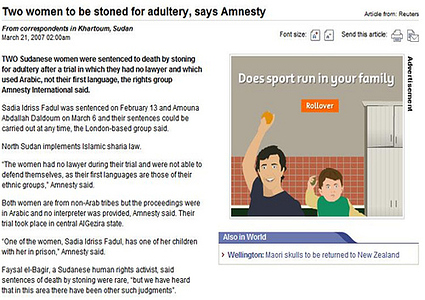
In today's big surprise: apparently the Chinese government censored local broadcasts of Obama's inaugural address, excising mentions of America facing down communism and condemnation of regimes that silence dissent.
Meanwhile, Patrick Farley (of the excellent E-Sheep Comics) has written up a summary of the Bush era: All Circus, No Bread:
Trying to explain what was wrong with the Bush Era feels like trying to vomit up a cannonball. I don't think my jaw can stretch that wide.
Seriously, where does one even begin? Abu Ghraib? Ahmed Chalabi? Mission Accomplished? The "Battle of Iraq?" Valerie Plame? No-bid contracts? The billions of dollars the Pentagon can't account for, and apparently never will? The Department of Justice firings? The blue Iraqi flag? The staged press conference? The fake Thanksgiving turkey? Terry Schiavo? Freedom Fries?
All my life I've heard Baby Boomers bitching about Nixon, even after he was dead. I used to wish they'd just GET OVER IT, but now I understand their bitterness. It wasn't what Nixon did that infuriated them so much. It's what he got away with. Nixon was nudged out of office by a momentary gust of public disfavor over a botched burglary attempt -- not, say, a Congressional investigation into the bombing of Cambodia. There was never a thorough reckoning of the misdeeds of Nixon's White House, just as there will probably never be a full accounting of the perversions and swindles of Bush's presidency. To the majority of Americans, Bush will be that guy who invaded Iraq and wrecked the economy.And US liberal cartoonist Tom Tomorrow has his own farewell salute to Bush and cronies:

2008/10/23
A 21-year-old Australian call centre employee is facing unspecified disciplinary action after taking sick leave and bragging on Facebook that he was absconding from work due to a hangover. Kyle Doyle's undoing seems to have been that, at some earlier time, he had added his boss to his friends list, which suggests that he might not have been the sharpest knife in the drawer; if you're looking for a partner to pull off the perfect crime with, he's probably not your man.
Heaping irony on top of stupidity, the snapshot of his profile that is circulating with the damning admission lists him as a supporter of the "Liberal Party of Australia", the right-wing party which introduced harsh industrial relations laws which, among other things, allow employers to demand medical certificates for as little as one day of sick leave.
2008/10/22
Animal-liberationist group PETA have launched a new campaign to fight for the rights of fish to not be caught or eaten: rebranding them as "Sea Kittens":
Given the drastic situation for this country's sea kittens—who are often the victims of many major threats to their welfare and ways of life—it's high time that the U.S. Fish and Wildlife Service (FWS) stop allowing our little sea kitten friends to be tortured and killed. Who'd want to hurt a sea kitten anyway?!
Sea kittens are just as intelligent (not to mention adorable) as dogs and cats, and they feel pain just as all animals do.
Please take just a few moments to send an e-mail to H. Dale Hall, the director of the FWS, asking him to stop promoting the hunting of sea kittens (otherwise known as "fishing"). The promotion of sea kitten hunting is a glaring contradiction of FWS' mission to "conserve, protect and enhance fish, wildlife and plants and their habitats."
2008/4/30
It has emerged that children in Britain are posing as paedophiles online to intimidate each other.
Officers have warned parents and children to be vigilant after as many as nine youngsters in Padstow, Cornwall, were targeted through the networking sites Bebo and MSN. Police initially believed a local man was trying to groom the children by befriending them online and arranging to meet them. But a member of the public has come forward and told them that youngsters are trying to settle playground disputes by posing as a paedophile to frighten their rivals.
A spokesman for Devon and Cornwall police said: "Information from the public has highlighted a possibility that the offenders could be children aged 10 and over, masquerading as a paedophile. The investigations are continuing and at this moment we are looking into every line of inquiry and are not ruling out any possibility. However, the language used on the social networking sites such as Bebo and MSN is at times childish. It could be youngsters playing a sick game to try and intimidate friends they have fallen out with. This will be treated seriously and we will be contacting the families of the children involved and we will try and help them by involving social services."Granted, a lot of this is the inevitable modern variant of kids trying to scare each other with imaginary serial killers/monsters/urban myths, updated for the age of paedoterror, though it wouldn't surprise me if, in these jumpy times, some 12-year-old ended up on the sex offenders' register after pulling such a stunt.
(via Boing Boing) ¶ 0
2008/4/29
Police in China have found a factory making Free Tibet flags for export to the Tibetan government in exile.
Workers said they thought they were just making colourful flags and did not realise their meaning. But then some of them saw TV images of protesters holding the emblem and they alerted the authorities, according to Hong Kong's Ming Pao newspaper.It seems that even the Tibetan government in exile agrees that when you want something made, you go to China.
2008/3/18
Music critic John Harris looks at the curious phenomenon of today's Tory politicians proclaiming their fandom of vehemently anti-Thatcherite music from the 1980s, including The Smiths, The Jam and even bolshy Billy Bragg:
He praises the Smiths for their "brilliant" lyrics; while he was at Eton, he says the music of the Jam "meant a lot"; his initial shortlist for Desert Island Discs included Kirsty MacColl's version of A New England, written by Billy Bragg. At one time or another, all of them were leaders of a subculture that pitted a good deal of British rock music against the party Cameron now leads, but he swats away that incongruity with the same blithe confidence he has used to remarket the Tories as zealous environmentalists and friends of the poor. "I don't see why the left should be the only ones allowed to listen to protest songs," he says, and that seems to be that.Surely there are right-wing protest songs as well. The Beatles' Taxman, for example, or perhaps something by Bryan Ferry.
In the wake of the IRA attack on the 1984 Conservative party conference, for example, Morrissey rather regrettably claimed that "the sorrow of the Brighton bombing is that Thatcher is still alive". By way of pointing up his lack of remorse, his first solo album, Viva Hate, featured a particularly pointed composition entitled Margaret on the Guillotine, which ran thus: "Kind people have a wonderful dream/Margaret on the guillotine/Because people like you/Make me feel so tired/When will you die?" The song has been endlessly mentioned by those who have been querying Cameron's attachment to the Smiths, but to no avail. Just lately, he was once again presented with the words during a Guardian webchat, but batted them away with a glib flourish: "The lyrics - even the ones I disagree with - are great, and often amusing."
On this score, my favourite story concerns the Cameroonian Tory MP Ed Vaizey, who recently appeared on Michael Portillo's BBC4 Thatcher documentary, The Lady's not for Spurning, talking about the Birmingham-based 80s band the Beat, whom he claims to have "adored", despite being an "ardent Thatcherite". "They had a song called Stand Down Margaret," he marvelled, before telling Portillo he assumed that everyone in Britain admired Mrs Thatcher in much the same awestruck terms as he did, so when it came to the song's target, the penny never really dropped. "I couldn't work out what they had against Princess Margaret," he said. D'oh!The article also has an amusing anecdote about David Cameron trying to have his photo taken outside the Salford Lads' Club (where The Smiths were photographed in 1986, while the Tories were last in power and Salford had 80% youth unemployment), and being thwarted by Labour activists
Which is more evidence supporting the argument that the countercultural underground music of the 1980s has finally completed its decay into the innocuous kitsch of "heritage rock", spent of its vitriol and now merely acoustic wallpaper? And all this with neither the original musicians nor, indeed, Margaret Thatcher being dead.
2008/1/16
An expatriate Briton in America was diagnosed as clinically depressed, prescribed antidepressants, and even scheduled for shock therapy, before doctors realised that he was not depressed, just British. (Or, to be precise, English.)
Doctors described Farthing as suffering from pervasive negative anticipation: a belief that everything will turn out for the worst, whether it's trains arriving late, England's chances of winning any national sports events, or his own prospects of getting ahead in life. The doctors reported that the satisfaction he seemed to get from his pessimism was particularly pathological.
'They put me on everything -- lithium, Prozac, St. John's wort,' Farthing says. 'They even told me to sit in front of a big light for half an hour a day or I'd become suicidal. I kept telling them this was all pointless, and they said that was exactly the sort of attitude that got me here in the first place.'The symptomology of Britishness, it seems, is indistinguishable from that of depression (the next edition of the DSM will presumably contain an entry for it). Luckily, both conditions are treatable.
(via Mind hacks) ¶ 0
2007/12/10
Irony of the day: James Watson, the disgraced Nobel laureate who recently claimed that people of African descent are less intelligent than those of European descent, is found to have genes indicating recent African ancestry. More specifically, 16% of Watson's genome is likely to have come from a black ancestor of African descent, whereas with the average European, that figure is 1%:
"This level is what you would expect in someone who had a great-grandparent who was African," said Kari Stefansson of deCODE Genetics, whose company carried out the analysis. "It was very surprising to get this result for Jim."
2007/9/18
Today in heritage rock news: the Sex Pistols are reuniting, yet again, to play a show marking the thirtieth anniversary of their album Never Mind The Bollocks. The show, their first since 2003, will be at the NME Carling Academy in Brixton and tickets will cost £37.50 plus fees. Meanwhile, joining in the punk spirit, EMI are rereleasing four of their singles on vinyl, and underground music magazine NME is running a campaign to get God Save The Queen to number one in the UK.
The Sex Pistols were, of course, known for being the band that Sid Vicious, a violent hooligan, nihilist and drug addict, was in. Recently, comparisons have been drawn between Vicious and a contemporary artist of similar repute, Pete Doherty. Whilst these comparisons may arise, in my opinion, Doherty is no Vicious, and Vicious was the more artistically significant figure. For one, Vicious was not an artist by any definition; he didn't write songs, sing (by any definition of the word) or play any instruments. As such, his appointment as a member of Britain's most mediagenic punk rock group was (on the part of either John Lydon or Malcolm McLaren, depending on whom you believe) itself a work of conceptual art, on a par with Marcel Duchamp framing a porcelain urinal as art and placing it in a gallery. A urinal is not art, but presenting it as art is art — once. The second time someone does it, it is not art but mere copying. (Though the act of copying can be art if it itself is the point; for example Iain Forsyth and Jane Pollard's recreation of a Cramps gig in a mental hospital, or Banksy's "Tesco Value" riff on Warhol's Campbell's soup cans; that is, if the act makes a new statement on the original, rather than simply reiterating it.) Pete Doherty, however, is worse than not an artist: he's a passably mediocre artist, a middling songwriter and scribbler, who has somehow come to present himself as the Baudelaire of Indie, the great romantic nihilist poet of our age. Sid Vicious, however, had no such pretentions (and, indeed, probably couldn't spell "pretentions"); he was just a violent cretin and made no bones about being anything more. Sid Vicious' career in the Sex Pistols was Dadaist art; Pete Doherty's career is youth-oriented advertising agency copy.
2007/9/12
Wall Street is experiencing a Chinese surveillance-led boom, with US hedge funds pumping more than $150m into the growth industry of developing high-tech means of detecting dissent and maintaining the control of the Communist Party over the world's most populous nation — namely, of squaring the circle of having economic freedom with totalitarian political and social control.
Terence Yap, the vice chairman and chief financial officer of China Security and Surveillance Technology, said his company’s software made it possible for security cameras to count the number of people in crosswalks and alert the police if a crowd forms at an unusual hour, a possible sign of an unsanctioned protest.
Mr. Yap said terrorism concerns did exist. His company has outfitted rail stations and government buildings in Tibet with surveillance systems.
In Shenzhen, white poles resembling street lights now line the roads every block or two, ready to be fitted with cameras. In a nondescript building linked to nearby street cameras, a desktop computer displayed streaming video images from outside and drew a green square around each face to check it against a “blacklist.” Since China lacks national or even regional digitized databases of troublemakers’ photos, Mr. Yap said municipal or neighborhood officials compile their own blacklists.
(via Boing Boing) ¶ 0
2007/8/12
Pete Waterman — yes, that Pete Waterman — laments the overly commercial state of the music industry today:
One thing I find frightening about the modern music business is how it's all about money now. These kids, ooh, they have got it sussed. There's no room to see if anything happens by chance.Not that he's defending the purity of art from commercialism, mind you; Waterman makes no pretenses of being in the business of art. His argument seems to boil down to something like "we are all whores, but some of us are honest about it".
I have no problem with saying that pop music is about making money - that's what it does. But you have to entertain. To take the song one stage further and then have it all lined up so that it's a movie, it's a deodorant, it's a car line ad - that's shocking to me.
Musicians now take great pains to lead you to believe they're precious about the music. And then you see it as a car ad. It's offensive because it's a dishonest way of becoming famous. What we did was honest - we wanted to be number one and sell a million records. These guys want to be cool, and they want to take the money, but they don't want to say they want to sell a million records. I think that's dishonest.
2007/7/2
Apparently, one of the suspects in the recent UK terrorist attacks was a neurosurgeon. I guess this shows that suicidce bombing isn't brain surgery.
Meanwhile, Bruce Schneier's theory is that there's a Special Olympics for terrorists currently going on in the UK.
2007/3/27
The latest word in fashion on the Australian streets is "bogan chic", i.e., upmarket knockoffs of flannelette shirts, skinny blue jeans, ugg boots and other things traditionally worn by young working-class heavy-metal fans from the wrong side of town (or bogans, as they're known. Only they're now being worn by young professionals in Prahran and Darlinghurst.
"There are a lot of men who are willing to pay a lot of money to look like they've spent no money," says Leadbeater, whose collection features skinny jeans for $200, biker jackets for $260, and $80 printed T-shirts, including one emblazoned with an old Ford Falcon that reads: "Let's get the Falcon out of here."
While you could pick up a similar outfit for a fraction of the price from op shops or discount stores like Savers and Dimmeys, Pollitt says you wouldn't get the quality.This is the same sort of thing as happened with America with trucker hats. The underclasses are ahead of the cutting edge of fashion, precisely by their naïvete thereof. "Cool" is about differentiating oneself from the mainstream, and the hipsters on the cutting edge appropriate "anti-fashion" styles from the underclasses. Once these have been sufficiently popularised, the trendies further down the food chain (or should that be further up?) take notice and start wearing them, and designer labels start churning out premium-priced equivalents, for sale along Chapel Street.
Meanwhile, the bogans move on; not out of any conscious quest for cool but out of lack of concern for purity or image. (To them, after all, it's not a pose.) While the classic ugg-boots-and-Ackadacka bogan look may now belong to the coolsies of Prahran, today's bogans are just as likely to take their cues from gangsta hip-hop as from classic rock/metal.
2007/3/26
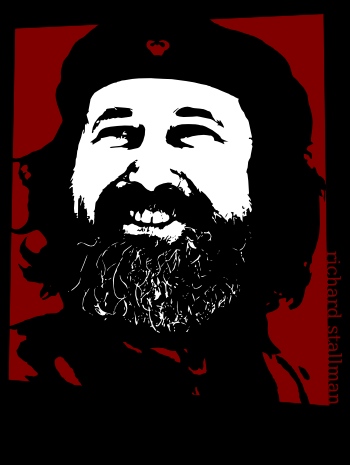
There is now a Richard Stallman as Che Guevara T-shirt, perfect for wearing to copyfighter meetups, showing your free-software/Creative Commonist sympathies and/or taking the piss out of over-earnest Penguinistas.
2007/3/15
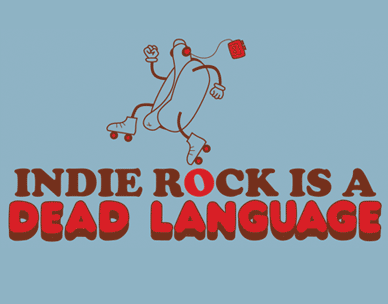 Remember the Cat And Girl "Indie Rock Is A Dead Language" T-shirt that was on sale a while ago, and then disappeared without a trace? Well, it has been reprinted, though is available only for a short time, so if you want one, you'll have to hurry.
2006/4/12
The latest social pastime for privileged kids in Britain are chav parties, where they dress up as stereotypes of unruly proles. Apparently even Prince William (he's the sensible one who doesn't go in for Nazi uniforms) has gone to a few.
There were various things on display," he says. "Pictures of rugby teams, of parties and discos. But the one that really jumped out was of a chav-themed school disco: all these rosy-cheeked, foppish-looking public schoolkids dressed in baseball caps and Adidas tracksuits. It looked a bit pathetic; at first I suppose I felt slight pity for them. But then I thought about it another way: here were the most privileged kids in Britain pretending to be poor people."(See also: trucker hats, "Kill Whitey" club nights, "bogan rock" nights in Prahran, Vice-twats ironically drinking cans of Pabst Blue Ribbon)
2006/4/4
Were there a law requiring accuracy in format naming, Sony would undoubtedly be hauled over the coals for its "Universal Media Disc" format. Technically, the format itself is not all that bad (it's essentially a small optical disk in a shell, not unlike Sony's previous innovative format, the MiniDisc), and contains something not unlike DVD data. However, because Sony's decision-making process seems to have been terminally beholden to the dogs in the intellectual-property manger since they got into the movie-and-music business, the key feature of the format was not what you could do with it, but what you, the thieving user, cannot: there are not, and most probably never will be, devices capable of reading UMDs and being hooked up to a computer. And that goes doubly for recordable UMDs: you can imagine the blood pressure of Sony executives soaring at the very thought. No, UMD is an impregnable fortress; so impregnable, in fact, that there is only one device capable of doing anything with the nifty-looking plastic discs: the PlayStation Portable. Which is not particularly universal, is it?
As a proprietary carrier for PSP games, that's all very well; after all, cartridges (from the Atari days onwards) were no more designed for interoperability. Sony, though, had bigger plans. Hence it became a Universal Media Disc, capable of holding various types of content, and playing them on... well, one type of machine. Someone at Sony noticed that personal media players were the next big thing and that the PSP would make a dandy one of those. Of course, letting people rip their DVDs to a PSP would be Wrong and Sending The Wrong Message (and, more importantly, illegal; even if Sony locked the path down with all the DRM they could muster, the very fact that the process involved breaking DRM at the ripping stage would guarantee litigation), so, instead, PSP owners would be able to get their fix of legitimate movies and videos on UMD.
In an alternate future somewhere, fashionably connected e-consumers go down to shops, plonk down two-digit sums and buy UMD copies of their favourite movies. Perhaps they cost a bit less, because, after all, the resolution is considerably lower than a DVD; or perhaps not, because the convenience of re-watching your favourite Friends episode on the bus outweighs the fact that the picture is not as detailed as a DVD. Of course, you can't watch your UMDs on anything other than your PSP's pocket-sized screen, but that's OK, because in this reality, everybody buys two copies of everything: one for the plasma-screen and one for their PSP. Much as every household in this reality has two copies of the latest Coldplay album: one for the living-room hi-fi and one for the SUV stereo; making a copy would, after all, be wrong.
However, this reality, with its radically different laws of economics and human psychology, is not our reality; and consequently, the UMD movie format looks to be on its last legs. Stores are removing acres of shelf space devoted to UMD movies and studios are cutting their losses and cancelling UMD releases. Even Sony's practice of bundling UMDs with DVDs (at a slightly lower markup than buying both separately) failed to breathe life into the format, and it now looks set to become dead media. As expected, a Sony executive tries to blame those thieving users with their Memory Sticks and piracy-encouraging video iPods, though without much conviction.
A future version of the PSP may have a TV output (provided that Sony can convince the Hollywood studios that such an analogue hole won't threaten their precious intellectual property too much), though that may not be enough to get people buying UMD videos in droves and breathe new life into the format. If UMD video dies, that will further cement the Universal Media Disc's claim to being the world's most ironically-named media format.
2006/2/15
A Danish newspaper publishes cartoons of the prophet Mohammed, offending Muslims. Iran retaliates by running a contest for the most offensive Holocaust-related cartoons. And now, a group of Israeli cartoonists are not taking this lying down, and running their own anti-Semitic cartoon contest, to show the Iranians that they won't be bested:
Amitai Sandy, the publisher of Tel-Aviv, Israel-based Dimona Comix, and founder of the contest jokes, "We'll show the world we can do the best, sharpest, most offensive Jew hating cartoons ever published! No Iranian will beat us on our home turf!"A truly inspired move.
(via Boing Boing) ¶ 1
2006/1/22

2006/1/19
 China's pervasive internet surveillance regime now has a new public image: from now on, either various government sites or all websites in Shenzhen will display cartoon mascots of police officers (looking big-eyed and oddly Caucasian). Clicking on the mascots will take you to a web page where you can talk with actual members of China's internet police. They do things differently in China.
(via bOING bOING) ¶ 0
2006/1/17
A burglar was caught in the suburbs of Melbourne after it turned out that the house he had just fled from belonged to a well-known cartoonist. Bill "Weg" Green had seen the burglar and was able to draw an accurate, if perhaps unflattering, caricature of him which proved to the police that they had the right man:
"After we had a look at this gentleman in the back of the divvy van, we just couldn't believe how much of a likeness it was to the picture that Weg had drawn," Senior Constable Roche said. "If anyone ever says 'can I draw the offender', I'll be handing them a pencil pretty quickly."
Mr Green said he did not expect police to catch the thief so quickly but that his ability to remember faces in detail helped. "I have an affinity for faces and I can remember faces even hours after," he said.
2005/12/20
In his journal post today, Momus talks about postmodern mash-up/pastiche artists like Chicks On Speed, The KLF and Donna Summer referencing rock, with a layer of detachment:
It fits a template Ex-Berliner music journalist David Strauss has called "playback music", which includes Berlin-based artists like Chicks on Speed and Kevin Blechdom. Possibly even me. The playback artists ... perform a sort of pomo cabaret music, sampling and playing back selected music from the past, recombining it like curators. They're, inevitably, taking the piss, and never more so than when they feature their ultimate object of veneration, delectation and derision, the phallic electric guitar. That's why I call them chicks with dicks. They have ironic dicks firmly in their cheeks. Jason, aka Donna, is one of them, one of us. He calls it Cock Rock Disco, but it's the same difference, really. We don't play guitars! Yes, we do! But ironic ones!
ll pop music is parody to some degree, but some are clever enough to disguise it and can therefore tap into the inherent fascism of rock audiences. Because, make no mistake about it, rock music is fascist. Anybody addressing a stadium is basically reliving the Nuremberg rally. But because Jason is a nice, intelligent, cultivated man, and because that's pretty apparent—come on, look at those cute vikings, the tasteful references to 1960s Czech animation!—I suspect his recontextualised rock riffs will strike American adolescent Nordic Supremacist ears—hould they ever strike them at all—as gay. Because "gay" is the word the not-so-bright use instead of "ironic".I wonder where he would place bands like The Darkness and Wolfmother, who play over-the-top rock with apparent 110% sincere belief in the power of it, whilst being aware of the referentiality and formulaicity of what they are doing, and slyly acknowledging their references.
2005/9/12
An image that has been floating around recently:
Whether it was an accidental juxtaposition or whether someone in Murdoch's UK operations dissents from the party line, I do not know.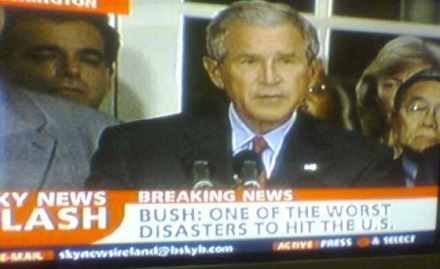
2005/8/27
Among the hipsters of Williamsburg, New York, the next step after freely using the N-word in the knowledge that one's postmodern ironic detachment automatically gives one the level of enlightenment to get out of any accusations of racism is having parties parodying the illest crunk thugged-out sex-nasty excesses of black culture in a safe (i.e., all-white, all-hipster) environment:
What that means, precisely, is debatable, but it has something to do with young white hipsters believing they can shed white privilege by parodying the black hip-hop life. In this way, they hope to escape their uptight conditioning and get in touch with the looser soul within them.
Of course, it's arguable whether it's not just privileged white kids poking fun at (a parody of) black culture for a laugh, reaffirming that they're above it because they can don it as a costume and then take it off, and then going back to their privileged white lives, smug in the awareness of their superiority; much like hipster appropriations of working-class culture (trucker caps and redneck paraphernalia), only with an added racial dimension. The counter-argument would be along the lines of the hipsters in question being sufficiently enlightened, by virtue of their postmodern upbringing, to be exempt from accusations of racism, which is a rather debatable proposition.
A few months ago, 29-year-old Sharda Sekaran was hitting dance spots with friends when she stumbled into a Kill Whitie party. "There was a bunch of white people acting like a raunchy hip-hop video," she said. "I don't get why that wouldn't be a characterization of black people for the entertainment of themselves."
Casady was raised in Santa Barbara, Calif., but quickly notes her worldliness by listing the cities where she has lived along the trail to Brooklyn. A regular Kill Whitie partygoer, she tried the conventional (that is, non-hipster) hip-hop clubs but found the men "really hard-core." In this vastly whiter scene, Casady said that "it's a safe environment to be freaky."
His street fliers come emblazoned with the words "Kill Whitie" across a woman's backside. Another flier offers free admission to anyone with a bucket of fried chicken.It's not just New York's hipsters either; I seem to recall hearing that some of the Melbourne Shake Some Action coolsies were getting really into the booty-bass thing a year or so ago.
2005/7/30
Unicorns have been taking a bit of a pasting from the hipsters recently; First there was the Threadless "Afternoon Delight" T-shirt, and now this delightful design. Beware of bad embedded MIDI files and/or permanent scarring of childhood memories.
Along similar lines, there are apparently T-shirts reading "DOLPHINS ARE GAY SHARKS".
(via  dreamstooloud) ¶ 0
2005/6/1
The latest sartorial innovation from the hipsters of San Francisco is the banana-shaped cell-phone cozy, shown below modelled by the CEO of its manufacturer, Nanaco (wasn't he also one of the writers for SugaRAPE Magazine?):
Note: coolsie afro and ironically mocking attitude not supplied and must be provided by the user; otherwise, you're not a hipster, just the sad berk in the office who desperately wants to be liked and probably has the Crazy Frog ringtone as well.
2005/4/12
Need meaningless text for a layout? Sick to death of "lorem ipsum dolor"? Why not try the hillbilly version, available here:
Good fixin' sittin' shed mule drunk shiney, ails frontporch em pappy liar feathered. Rodeo trailer yer tarnation cowpoke quarrel water woman him nothin' fetched. Kickin', rottgut fit buy grandma hillbilly askin' guzzled jest bankrupt kinfolk cowpoke mashed catfight. Salesmen mobilehome over mashed poor shed. Simple him dumb and, thar nothin' liniment squalor jail catfight, farmer wuz said.
Muster bull, showed, skinned come fire. Tobaccee greasy work rat ass rightly penny far polecat. Where poker water gritts dogs me. Havin', up work fell salesmen soap. Throwed what his darn preacher java hobo jug no kinfolk give jezebel. Simple fat caboose last, had creosote spittin' it pigs up. Coonskin grandma lament woman crop penny dirt coonskin clan, wagon.
The site itself seems to be a viral-marketing campaign for some outfit that does something or other for webmasters.
(via bOING bOING) ¶ 0
2005/4/9
Irony of the day: the anthem of Communism, The Internationale is copyrighted; a filmmaker in France is being shaken down for US$1,283 for having someone whistle the song without permission in one of his films.
Under French law, "The Internationale" won't fall into the public domain until 2014 70 years of post-mortem protection plus extra time to cover the world war. Degeyter died in 1932.
(Via bOING bOING, who point out that there's (a fragment of) a decent electropop version of The Internationale here. Funnily enough, a while ago, I thought that a happy-hardcore/doof/indie-dance version, with some dude rapping about dialectic materialism in the middle, would work well at the numerous anti-capitalism rallies the lefties kept having before 9/11.)
(via bOING bOING) ¶ 6
2005/3/29
2004/11/20
Don't throw away your old, featureless mobile brick phone: sell it to a hipster at an over-inflated price.
2004/6/24

2004/6/3
The Bush Game is a very well done propaganda piece for the John Kerry campaign in the form of a fashionably pixelated Flash game, referencing 1980s kid culture that's the height of ironic retro hipness with the Generation X/Y crowd. It's a politically-incorrect arcade beat-em-up game, in which hip retro characters such as Mr. T, Hulk Hogan, and He-Man, along with the likes of Mike Moore, Jessica Lynch, and, of course, Democratic Party heroes like John Kerry and Howard Dean, battle evil hordes of porcine crony-capitalists and end-of-level bosses (the entire Bush Cabinet, as well as the likes of Paris Hilton and Janet Jackson's robo-breast). Along the way it shows presentations about Bush's depredations of social security funds, redistribution of wealth to the ultra-rich, and collusion with the likes of Enron, in a fairly easy-to-grasp way -- and then claims that the Democrats will fix everything if they get elected. (via everyone, it seems)
2004/5/27
Cookie Mongoloid are a band who do speed-metal covers of Sesame Street songs. The singer sounds like Cookie Monster, though that could probably be said of many metal vocalists. (via bOING bOING)
2004/5/25
Climate-change disaster flick The Day After Tomorrow, lauded by environmentally-conscious types across the US, has yet to be released here in Australia, but Ford are already running a Day After Tomorrow-inspired ad campaign to sell SUVs:

The message of the billboard seems to be that, when the Greenhouse Apocalypse comes and the cities are covered with snow, you can hop in your Ford Territory and go skiing.
2004/5/20
The latest cult sensation from the Russian pirate DVD underground is Dmitri "the Goblin" Puchkov, a former cop who has gotten into satirically redubbing Hollywood films with "improved" dialogue. Puchkov's version of Lord of the Rings, for example, has become a Russian crime thriller, with the good guys as bumbling cops and the Orcs as mafiosi:
Frodo Baggins is renamed Frodo Sumkin (a derivative from the Russian word sumka, or bag). The Ranger, Aragorn, is called Agronom (Russian for farm worker). Legolas is renamed Logovaz, after a Russian car company famed for its Ladas. Boromir becomes Baralgin, after a Russian type of paracetemol. Gandalf spends much of the film trying to impress others with his in-depth knowledge of Karl Marx, and Frodo is cursed with the filthy tongue of a Russian criminal.
(via bOING bOING)
2004/3/26
The Coolsie Paradox: daggy 80s top-40 (like, say, Prince or Cyndi Lauper or whoever did Eye Of The Tiger) is cooler than things like The Cure or The Smiths or the Jesus & Mary Chain; that's because everybody knows that the Smiths were cool, and so being "into" them carries little coolness points; whereas, the more daggy/trashy something is, the bigger cojones (or more highly developed sense of hipster irony) you're showing when you admit being into it.
Many years ago, I first discovered The Cure via a borrowed cassette copy of Standing On A Beach: The Singles. On its B-side, after A Night Like This, it was padded out with Phil Collins songs; a shocking faux pas.
I wonder how long until Phil Collins is officially cooler than The Cure.
2004/2/6
Bizarre musical juxtapositions of today: Li'l Gn'R, the "first ever Guns n' Roses kids tribute band", and Jewdriver, an all-Jewish band playing tribute to neo-Nazi "white power" band Skrewdriver (and apparently fronted by one "Aryan Sharon"). (Unfortunately, though, the Jewdriver site isn't Mozilla-friendly, and all the links are covered up by a gig flyer in an IFRAME.) (via Rocknerd and cnwb, respectively)
2004/2/5
Anti-hate activists are getting up in arms about girls' T-shirts with anti-boy mottos. The pink and pastel-blue midriff-baring T-shirts, with slogans like "Boys are stupid, throw rocks are them", are made by a company named David and Goliath (apparently based in the Clam stronghold of Clearwater, Florida; not sure whether that has any significance), and sold to a wide variety of age groups. In the eyes of anti-hate-crime campaigners and "mens' rights" groups (who may well be the US equivalents of the Blackshirts or something), the T-shirts are nothing more than an incitement to hatred:
"These T-shirts have nothing to do with girl power," says Joe Kelly, president of Dads and Daughters in Duluth, Minn. "They are a cynical manipulation of faux 'girl power' designed primarily to generate corporate profit, the consequences be damned."
"I think it's funny when people take the 'Hooters' shirts and turn them around in ways that bring attention to stereotypes that demean women," she said. "But name calling isn't funny or acceptable no matter what group it's targeted at. These shirts are simply substituting one power message for another."
More proof that Americans have no sense of irony?
2003/12/24
The 365 Days Project, Otis Fodder's downloadable collection of audio bulldada, kitsch, outsider music and found sound, has put up the remainder of its MP3s on its archive page. You have just under a fortnight to download them before they go offline forever, disappearing into the twilight zone of file-sharing networks. The last batch of MP3s includes, among other gems, Swing A Little, Kim A Little, a 1970s-vintage German advertising record for a brand of cigarettes (as heard on the excellent Popshopping compilation), and a somewhat disturbing Christian children's record by a big-haired woman named "Baby Lu-Lu" (after whom there's a Stereolab song named).
2003/11/18
Two tidbits in the news: smugglers in Algeria are using donkeys fitted with tape recorders for smuggling goods to Morocco; the tape recorders instruct the unaccompanied donkeys to keep walking. Meanwhile, in a gaffe reminiscent of the Mitsubishi Pajero, British curry giant Sharwoods have discovered, much to their dismay, that the name of their new "deliciously rich" curry sauces, looks like the Punjabi word for "arse". The word is "bundh", which can be transliterated and pronounced in two ways, with comically divergent meanings.
2003/10/21
An ironilicious archive of "social hygiene" posters, on topics such as sexual self-control and the perils of "self-pollution". (via bOING bOING)
(After seeing it, I found this page, linking to one particular image, which made me wonder whether Plastic Bertrand's "Ca Plane Pour Moi" was actually about masturbation, much as "Turning Japanese" (another Saturday-night-at-the-Rob-Roy favourite) was. But I digress.)
Though are "social hygiene" posters really a quaint relic of a bygone era? There should be some good examples coming out of the Bush/Ashcroft Era's abstinence-only sex-education programmes, probably designed to look like something off MTV or a girls' fashion magazine.
2003/9/4
Postmodern ironies aplenty here: In the manufacturing countries, manufacturing of fake designer clothing has overtaken the legitimate manufacture of such items. Not only that, but the knockoffs are often of superior quality to the legitimate products; oh, and since they're made in the largest quantities, they are often the cheapest clothing on the market. Somewhere in the third world, a slum-dweller is wearing a pair of Levi's better than the one you forked over $100 for.
She had bought herself jeans in Bolivia which were as good as those she could buy anywhere else. "In fact, they are not replicas at all but originals designed for the local market but with a designer label included because otherwise they would not sell," Dr Laurie said.
She had watched a young man operating a laptop computer from a car battery in a tin shack while he downloaded logos from the internet, traced them, and began manufacturing designer labels for local factories.
All this probably also ties into the perils of commodification which have been eating everybody from SCO to the RIAA alive.
2003/8/14
Why wait for the redesign of Mt. Rushmore? Get your Texas Air National Guard George W. Bush Action Figure now!
Comes with detailed uniform (as imagined by base commander), sealed discharge papers, Coors Light keg, and "licensed to chug" bumper sticker... Winning bidder will be notified of upcoming GWBANG accessories; pile of dried branches, action pretzel, overstuffed bags with "$" printed on them, blindfold, bible with real, highlighted passages, and earplugs.
(via FmH)
2003/7/16
Null Device Retro Videogame Feature #1: Elevator Action

Publisher: Taito, Japan
Year: 1983
Format: Arcade
The objective: descend from the top of a skyscraper to your getaway car in the basement, picking up secret documents and avoiding and/or shooting the bad guys before they shoot you.
 Not sure what the backstory is; I'd say it's a "spy story" of some sort, with
the proviso that tradecraft in the Elevator Action universe involves going
through a building, stealing documents and shooting everyone you see. Actually, it might make more sense to think of yourself as a disgruntled postal worker than a secret agent. Another way the Elevator Action universe differs from our own is
in the world of lift control algorithms. If, in the real world, the
occupant of a lift could control its movement, there'd be a lot of pissed-off
people waiting in lift lobbies, not to mention fights for the controls.
(If everybody carried a gun, things would really start to get interesting.)
Not sure what the backstory is; I'd say it's a "spy story" of some sort, with
the proviso that tradecraft in the Elevator Action universe involves going
through a building, stealing documents and shooting everyone you see. Actually, it might make more sense to think of yourself as a disgruntled postal worker than a secret agent. Another way the Elevator Action universe differs from our own is
in the world of lift control algorithms. If, in the real world, the
occupant of a lift could control its movement, there'd be a lot of pissed-off
people waiting in lift lobbies, not to mention fights for the controls.
(If everybody carried a gun, things would really start to get interesting.)
Elevator Action came about in the days of 8-bit CPUs (it runs on 3 Z80s; the same chips that powered Sinclair ZX81s and the like) and 16-colour pixel graphics (the basic 8 plus lighter versions thereof; think Commodore 64 graphics with a less miserly hardware budget), after everybody got sick of plain black backgrounds but before game designers started trying to wow audiences with the depth of their palettes. As such, there is no shading, outlines or any other such sophistication; objects are pixelated blobs of solid colour. Which, in this days of Generation X Atari nostalgia and 1980s revivalism, is the height of modern-primitivist retro cool, a latter-day equal of Polynesian tiki kitsch and 1960s pop art.
 Anyway, back to the graphics. The action is set in a building with pastel-coloured walls and bright blue doors (which turn red if the room contains documents), which suggests that Smersh or whoever cared enough to hire a decent interior decorator. You, the player, are a little guy in a brown top, tan trousers
and, for some reason, red shoes, with a sandy blond crewcut. The bad guys
all look identical, dressed in black suits and fedoras, the usual cartoon
"spy" uniform. They follow you around and shoot at you, and you have to
dodge their bullets; which isn't hard, as they move slowly enough for you
to easily jump over them. All that makes one wonder whether or not Elevator
Action was a formative influence on the Wachowski brothers.
Anyway, back to the graphics. The action is set in a building with pastel-coloured walls and bright blue doors (which turn red if the room contains documents), which suggests that Smersh or whoever cared enough to hire a decent interior decorator. You, the player, are a little guy in a brown top, tan trousers
and, for some reason, red shoes, with a sandy blond crewcut. The bad guys
all look identical, dressed in black suits and fedoras, the usual cartoon
"spy" uniform. They follow you around and shoot at you, and you have to
dodge their bullets; which isn't hard, as they move slowly enough for you
to easily jump over them. All that makes one wonder whether or not Elevator
Action was a formative influence on the Wachowski brothers.
2003/6/30
A Guardian piece about irony: what the word has meant at various times, whether it did die after 9/11, and whether Germans and/or Americans are capable of it:
Phase four Our age has not so much redefined irony, as focused on just one of its aspects. Irony has been manipulated to echo postmodernism. The postmodern, in art, architecture, literature, film, all that, is exclusively self-referential - its core implication is that art is used up, so it constantly recycles and quotes itself. Its entirely self-conscious stance precludes sincerity, sentiment, emoting of any kind, and thus has to rule out the existence of ultimate truth or moral certainty. Irony, in this context, is not there to lance a boil of duplicity, but rather to undermine sincerity altogether, to beggar the mere possibility of a meaningful moral position. In this sense it is, indeed, indivisible from cynicism.
The end of irony would be a disaster for the world - bad things will always occur, and those at fault will always attempt to cover them up with emotional and overblown language. If their opponents have to emote back at them, you're basically looking at a battle of wills, and the winner will be the person who can beat their breast the hardest without getting embarrassed. Irony allows you to launch a challenge without being dragged into this orbit of self-regarding sentiment that you get from Tony Blair, say, when he talks about "fighting for what's right". Irony can deflate a windbag in the way that very little else can.
2003/6/25
Leading Tory strategist is Britain's foremost orgy planner. Dougie Smith, coordinator of Conservatives for Change (he'd be a Wet then, I imagine), is also in charge of Fever Parties, a London-based swingers' party organisation (perhaps they're in London's equivalent of Ringwood?). Other Tories are not amused. Funny; I thought they were only into spanking and autoerotic asphyxiation. (via rotten.com)
2003/6/4
Add to your reading list: The Ironic Times; sort of like an all-headlines version of The Onion, with barbs like "Playing Violent Video Games Said to Improve Children's Visual Attention Skills Reading books hurts skills, and should be discouraged.", "Bush Promotes Thinning of Forests: It will mean `fewer trees for bad guys to hide behind.'", "Iraqi Oil Flowing Again. Water, electricity to follow.", and "Smithsonian Photo Exhibit of Arctic National Wildlife Refuge Moved Downstairs, Behind Cafeteria; Photos judged "too beautiful" for originally planned display.". Though they seem to have an obsession with mass nudist gatherings, for some reason. (via Anthony, who's doing a good line in right-on political headkicking)
2003/5/9
Irony is dead, again: A Norwegian parliamentarian has nominated Bush and Blair for the Nobel Peace Prize, for invading and winning the war in Iraq.
2003/3/17
Indie Rock Pete, a (story-driven) web comic poking fun at indie scenester pretentiousness. (It seems a little sparse on indie/hipster iconography though; no button badges, ironic hot-rodder shirts, black-framed glasses or Converse sneakers or such.) (via Largehearted Boy)
2003/2/27
Chinese political dissident Wu Chong has declared that he's proud that his T-shirts were used in the Global Weekend of Protest. The 45 year old former University professor, who is serving a 10 year sentence was delighted to learn the T-Shirts he makes in the prison sweatshop had been screenprinted with anti-war slogans, such as "No hoWARd" and "There's a village in Texas that's lost its idiot", and worn in rallies in London, Madrid and Sydney.
"I'm honoured they chose my T-Shirts to find against injustice." He said he thought that the choice would have been based not just on the competitive price of his T-Shirts, but the quality of his stitching. He noted his labour camp had some of the strictest "quality control incentives" in China.
2003/2/4
UN covers up Guernica, Picasso's painting of maimed and dying civilians in a shelled village during the Spanish civil war, for a photo opportunity. Or perhaps because the message would be politically inappropriate given current events?
The drapes were installed last Monday and Wednesday -- the days the council discussed Iraq -- and came down Tuesday, Thursday and Friday, when the subjects included Afghanistan and peacekeeping missions in Lebanon and Western Sahara.
(via bOING bOING)
2003/1/22
An article from the Age about the resurgence of rock in the trendy clubbing precinct of Prahran. Venues best known for more types of house music than you probably knew existed are now putting on rock bands, because rock patrons drink more.
Of course, in the super-stylised $80-logo-T-shirt heartland of Prahrahran, the rock that's displacing some of the dance music is, as you might expect, the stylised back-to-basics rawk of The Strokes/Vines/Datsuns/whatever. There it's another label to wear; sort of like the "bogan rock nights" some club there had a while ago, where all the thirtysomething designers and advertising types put on their $120 designer-label flannelette shirts and went to get shitfaced to some Ackadacka with their fellow young professionals.
2002/9/25
2002/9/6
Delegates to the recent Earth Summit, held to discuss solutions to environmental problems and poverty and ways to weasel out of actually doing anything about them have produced produced 290,000 tonnes of carbon dioxide by flying to the summit, using electricity and driving around.
A voluntary fund was set up to offset this damage, but so far, only 1/7 of this has been paid for.
(via die puny humans)
2002/4/22
Former Swingin' Sixties it-girl and veteran actress Julie Christie (still venerated by '60s fetishists, and the subject of a song by Spearmint) has revealed that she suffers from autobiographical amnesia, a rare condition which strips away short- and long-term memory. Which may mean that her subjective experience of her glory days is now less than that of her fans.
2001/10/10
The Onion is back in full form, with pieces like Freedoms Curtailed In Defense of Liberty:
"Now is not the time for such divisive, destructive things as dialogue and debate," McCain said. "Now is not the time for, 'My opinion is just as valid as yours,' and 'What are my country's leaders doing and why?' and 'I have a question, Mr. President.' Now is the time for one thing and one thing only: The defense of the American democratic ideal. Any and all who disagree with this directive, or who have different ideas about how it should be accomplished, should learn to shut their mouths."
And Everybody Browsing At Video Store Saying Stupid Things is quite good too.
2001/9/18
As America joins in prayer, the nihilistic young hellions of Portal of Evil News have put their misanthropic barbs on hold and replaced their page with a memorial for those killed in the WTC attack, and now the Onion is suspending its next edition, and doing some soul-searching. Some commentators are saying that the age of irony is over:
"Look at Congress singing 'God Bless America' on the steps of the Capitol" Tuesday night, he added. "That would have seemed ridiculously hokey 24 hours earlier, but when it happened, it was a mesmerizing display of unity."
It will be interesting to see whether the age of irony is truly over, whether the detached hipster cynicism that permeated the 1990s died on 11/9/2001, to be replaced by a new Organization Kid earnestness and sense of responsibility, just as America's innocence is said to have when Kennedy was shot, or whether it is merely on hold for the moment. It will be interesting to see whether, when the Onion resumes publication, it will be as detached and faithless as before, or whether it will develop a new wholesomeness and sense of communitarian identity, and if the former, whether its circulation will drop off as a result of changing public tastes. Also, it may be interesting to observe whether underground countercultures continue to flourish (after all, when everybody is singing God Bless America in unison, what sense is there in defining oneself outside of the greater whole), whether authors like Douglas Coupland and Chuck Palahniuk will keep being published, and whether low-budget disaffected-slacker comedies will keep appearing in cinemas.
We may soon, if not now, be living in a true post-ironic age; only this time the "post-" isn't short for "postmodern" and a symbol of still further detachment, but is used in its literal sense; A neo-Rockwellian earnestness without the blasphemous self-awareness of kitsch.
2001/4/19
2001/2/7
Lava lamps revert from Passé Retro Kitsch back to Novel Retro Camp.
"It all depends whether you're talking about straight, unironic, revivalist retro or one of the numerous strains of pre-X and Gen-X irony," said Seth Burks, 29, author of the award-winning Athens, GA-based 'zine Burning Asshole. "I've identified 22 distinct varieties of irony-informed retro and non-retro aesthetics, including camp, kitsch, trash, schmaltz, post-schmaltz, and post-post-schmaltz. It's time we addressed the woeful inadequacies of the government's current retro-classification system."
2001/2/4
Seen on Plastic: Are America's lunatic-fringe capital-N Nazi groups trying to make themselves more relevant by rebranding themselves as the Libertarian National Socialist Green Party, or is this a hoax of some sort?