The Null Device
Posts matching tags 'railway'
2013/12/2
High-speed rail projects may be facing controversy in the UK and US, but have gotten a boost in two unlikely countries. Iceland, a country with no railways, is looking at building a high-speed railway line from Keflavík airport to downtown Reykjavík; the line would either be conventional high-speed rail or a maglev line (as seen in China), would cost ISK100bn (about £500 million), and would get passengers from the international airport in Keflavík to the BSÍ bus terminal in 20 minutes or less.
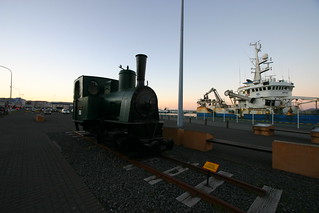
The entirety of the Icelandic railway network as it stands today.
Meanwhile in Australia, the conservative federal government has committed to safeguarding a corridor for a Melbourne-Canberra-Sydney-Brisbane high-speed railway network, and raising the priority of the project (first proposed by the Gillard Labor government, after pressure from the Greens). This was somewhat surprising, given the Australian Right's hostility to public transport, passenger rail , infrastructure spending (it's socialism, you know, and if there's demand, the free market will step in; besides, the money would be better spent on lowering petrol taxes or given to voters in marginal seats to buy plasma-screen TVs with) and anything with a whiff of the latte-sipping inner-city trendy-left's concern about carbon emissions (because, you know, once you acknowledge the problem, it's only a matter of time before ordinary Aussie battlers may find their 4WDs and cheap flights to Bali taken away from them, and before long their diet of rump steaks is replaced with organic lentil stew and they find themselves being lectured on checking their privilege by a woman named Rainbow with dreadlocks and a nose ring or something).
Anyway, credit where credit's due; I tentatively laud the Abbott government's maturity at being able to get behind something like that, despite its un-Australian pedigree and the massive concession in the culture war it must have been, though, of course, the proof will be in what actually gets built and when.
2012/9/4
Britain's Tory-led coalition government has undergone a reshuffle. Among the changes: Jeremy Hunt, the culture secretary who tried to rubberstamp Rupert Murdoch's acquisition of the rest of Sky TV, is now minister of health; which is somewhat troubling given his outspoken beliefs in homeopathy, and statements defending the NHS's funding of homeopathic “medicine” (which had, in the past, been roundly denounced in Parliament). Meanwhile, Conservative Chairman Lady Warsi, a fierce opponent of secularism, has been demoted to a newly created “Ministry of Faith”. Whether this is a sinecure intended to keep her out of trouble or a shift towards a more muscularly religious politics in Britain remains to be seen. And so, it looks like the Conservatism the Tories are bringing to government is one hearkening back to a time before the Enlightenment, when faith trumped evidence and reason.
In other news, transport minister Justine Greening, an opponent of the proposed third runway at Heathrow and passionate advocate of high-speed rail, has been replaced by Patrick McLoughlin, who was aviation minister in the ideologically anti-rail Thatcher government, but on the other hand. Given that there is pressure from segments of business for rapid expansion of Heathrow and opposition in the Conservative heartlands of the Cotswolds to having a high-speed railway run through their arcadian idyll, it'll be interesting to see whether the government's (until now commendable) transport agenda does a U-turn.
And finally, meet the new Minister for Equality, Maria Miller:
Though, to be fair, the Racial and Religious Vilification Bill would have acted as an all-faiths blasphemy law, criminalising speech offensive to religious sensibilities and acting as a chilling effect on criticism of, say, misogyny or homophobia in religious garb, so one can't really criticise her for having a part in its well-deserved death.
2011/12/25
The Forbidden Railway: the story of an unescorted journey by train from Vienna, through Russia, and to North Korea over a route officially off limits to tourists, by two rail travel enthusiasts—one Austrian and one Swiss. Includes plenty of photographs and details about the journey and the places encountered.
2011/8/24
The Russian government has approved plans to build a railway link to Alaska via a tunnel under the Bering Strait. The tunnel would be twice as long as the Channel Tunnel, and is also expected to run electric cables. Once it is completed, it is predicted that 3% of the world's freight would take the route.
Of course, there are many unanswered questions. The question of funding for the massive project remains unresolved, and there is the small matter of building a railway link all the way to the easternmost extent of Russia's isolated Far East, over thousands of kilometres of tundra. (The Trans-Siberian Railway does not come anywhere near the sparsely populated region, though a branch line to Yakutsk, a fraction of the way, is due for completion by 2013.) And, of course, US approval for a railway tunnel into its territory is still an open question.
2011/8/4
The Australian federal government has published its phase 1 report (which may be found here) on possible routes for a high-speed rail line in the eastern states, connecting Melbourne, Canberra, Sydney and Brisbane. The report evaluates several possible corridors joining the cities, as well as the locations of stations, taking into account growth predictions, construction costs, challenging or environmentally sensitive terrain and proximity to facilities such as universities, hospitals and tourist areas and came up with a (somewhat broadly drafted) potential route, or rather a short-list of route segments.
The route will go up from Melbourne along a path similar to the existing Countrylink line and the Hume Highway, passing through Albury, Wagga Wagga, Canberra. From Canberra, it will either follow the Hume Highway or diverge via Wollongong and the coast, on its way to Sydney. From Sydney, the line will follow a fairly straight line to Newcastle, whence it will go either along the coast or slightly inland, with a recommended route taking in the Gold Coast on the way to Brisbane. The journey will take one hour between Sydney and Canberra, 1:50 between Canberra and Melbourne, and 3 hours between Sydney and Brisbane. Journeys are expected to cost between AUD99 and AUD197 for Melbourne-Sydney (in 2011 dollars) or slightly less for Sydney-Brisbane.
As far as stations go, some likely sites have been identified. In Sydney, the obvious one is Central, though pressure from wealthy NIMBYs in the northern suburbs may necessitate moving the terminus to Parramatta (which, despite being talked up as "Sydney's second CBD", would negate some of the advantage that high-speed rail has over air travel, i.e., directly connecting city centres). In Melbourne, the trains would either terminate at Southern Cross or at a new terminus in North Melbourne, with Southern Cross looking better. In Brisbane, the likely terminus is Roma St., whereas in Canberra, there is likely to be a through station, either in the centre or by the airport. For what it's worth, the report assumes that the system would be built to European specifications, and consist of trains running at 350km/h on lines capable of a theoretical maximum of 400km/h.
For what it's worth, there is a history of Australian high-speed rail proposals here. So far, no true high-speed services have been built in Australia, though systems linking the eastern capitals have been proposed in the past. The current proposal was commissioned by the Labor minority government, under pressure from their Green coalition partners, though now has nominally bipartisan support.
2011/5/26
A few London transport map links: here there is a detailed, zoomable map of the London Underground and surface railways, showing the locations of stations (both operational and closed) and tracks.
Meanwhile, the Green Party's candidate for Mayor of London has an interactive map showing how far London's bicycle hire system would reach if it were the size of Paris's; which is to say, quite a bit further, particularly to the north and south. Perhaps it'd even be possible to live near a Boris Bike station without being made of money.
2010/12/23
The British government has confirmed its high-speed rail plans. HS2, the first high-speed line not going to France, will go from Euston (and not, thankfully, a new terminus out at Heathrow) to Birmingham. Trains will run at up to 250mph (i.e., faster than the Eurostar/TGV), putting Birmingham within 49 minutes of London. The line will also connect to HS1, allowing trains to run between Paris and Birmingham, and will later be extended north to Leeds and Manchester, and possibly further north. The first segment is expected to open in 2026, assuming that the residents in the well-heeled Tory heartland it will run through don't succeed in scuppering it.
Moving tens of thousands of daily travelers to the new line will allow the West Coast Main Line to be freed for local, regional, and freight services. The creation of new terminals in London, Birmingham, and the other cities served will encourage more downtown development. The government recognizes the economic benefits of increased spending on mobility infrastructure.I wonder what the new Euston will look like. I imagine it'll have to be an improvement over the current one, a squat, 1960s-vintage box whose platforms have all the charm of an industrial loading dock. Perhaps they'll even rebuild the magnificent Doric arch which stood at the front of it before someone at British Rail decided to demolish it. (Apparently they found parts of it recently.)
If a Conservative government in the United Kingdom is willing to fund its project, in spite of massive cuts to the rest of the public budget, it’s hard to understand why bipartisan agreement in favor of investment in U.S. infrastructure in the form of high-speed rail cannot be assembled.Oh, there are rightwingers in Britain who would want to scrap rail projects and stop the "politically correct war on motorists". The thing is, they're only represented by fringe parties such as the UKIP, the editorials of the Daily Mail and Jeremy Clarkson.
2010/11/4
Britain's privatised train companies are clamping down on unauthorised use of train timetable data, which they hold is proprietary intellectual property; they just shut down a (not-for-profit) web-based train timetables app a user wrote, and are now issuing licenses only to a few paying customers, who pass the cost on. One of these is the National Rail iPhone app, which costs £4.99, and despite the price, has spent a lot of time in the App Store Top 25; such are the economics of monopoly rents. Meanwhile, those who don't like trains quite enough to shell out a fiver for a timetable app (or fiddle around with their mobile browser navigating web sites, tapping, pinching and zooming, for a few minutes) just give up and fly (taking advantage of numerous free flight booking apps), drive or catch a bus, and Britain's carbon footprint grows.
Such is the nature of the short-termist capitalism inherent in the national ideology of Thatcherism-Blairism, which holds that (a) everything is a market, (b) the market is the most efficient solution to all problems, and (c) if there's a value in anything, there is a right to be licensed and monetised to the extent the market will bear, for the good of the shareholders (and likely party donors).
Meanwhile, there is a petition of sorts requesting the Office of Public Sector Information to make train timetable data freely available as one of the UK Government's data sets and/or pressure the train companies into not guarding it quite as jealously.
2010/10/20
Today, a Deutsche Bahn ICE3 high-speed train made an appearance at London's St. Pancras International.
 The train had been towed into the tunnel the previous night and used in an evacuation exercise, where some 300 volunteers (mostly British and German students) successfully evacuated it in four minutes. (Article with more details, in German.) From there it was towed along the high speed line (the train type does not yet have regulatory approval to run under its own power in Britain) and parked at St. Pancras for display. It was behind glass, in the secure area, and while journalists and VIPs (including, apparently, The Man In Seat 61) were shown around, the general public had to content themselves with viewing it through the glass wall, the train's red LED destination board tantalisingly scrolling destinations including Amsterdam, Cologne and Frankfurt.
Deutsche Bahn plan to start services through the tunnel in December 2013; that is apparently how long it'll take to get regulatory issues sorted out and a fleet of trains prepared. The service will run towards Brussels, where trains will split, with one half going up to Amsterdam via Rotterdam, and the other half going eastwards to Frankfurt. It'll be interesting to see whether this results in cheaper rail fares through the tunnel.
2010/10/5
Scottish novelist AL Kennedy rides the railroads of North America whilst working on her latest novel, and writes about it:
Lately, I have been spending a good deal of time in Penn Station and have wondered – not for the first time – whether 65% of the people waiting for trains there appear to be seriously mentally distressed because they arrived that way, or because they have stepped into an alternative universe of heat, bewilderment, pain and ambient evil. You may be aware that many US rail stations are grand expressions of generous respect to their users, full of stately perpendiculars, handy benches and lots of gold leaf – high-ceilinged temples to mass transit and the communal hopes of a bygone age. Penn Station is there for balance: to remind you that this Depression will not produce a New Deal, and that many members of the general public are surplus to requirements; and to hint that your train will travel at the speed of lazy treacle on a cold day, will shudder along rails that even Railtrack would call poorly-maintained, and will give priority to freight, cars, pedestrians and any animal above the size of a healthy adult woodchuck.(Penn Station, for what it's worth, was once a majestic railway station in New York; though some time in the 1960s, it was demolished and rebuilt as a depressing warren of subterranean tunnels that makes Heathrow Terminal 2 look like a cathedral by comparison; thus making an all-too-convenient metaphor for the icaresque fall from grace of passenger rail in car-centric America.)
Yet I continue to love American (and Canadian) trains. I am trying to rebrand my debilitating and expensive fear of flying as Steampunk Travel and – at a certain level – I find I am convincing at least myself that rail transportation is a good and lovely, as well as an ecological, option. US trains are roomy, their passengers have no expectations and therefore often eschew UK passengers' lapses into frenzied disappointment and rage when they are delayed, misled, or ignored. Plus, US trains are still rich in the iconic elements that I, lover of black and white movies that I am, find intoxicating. They are monumental: they still roll majestically into stations with their bells ringing like harbingers of strange mortality, they still hoot across the countryside in the manner of wistful mechanical whales, the conductors still wear little round blue conductor's hats and the Red Caps still wear red caps – although sometimes they're baseball caps
2010/9/20
A direct channel tunnel rail service from London to Germany is looking one step closer: on the 19th of October, Deutsche Bahn will drive a test train through the tunnel, and into London St. Pancras. The train, one of DB's ICE3 high-speed trains, won't be carrying passengers; it will be participating in a safety exercise in the Tunnel, part of stringent tests which will need to be completed before such a service can be approved, and then being exhibited at St. Pancras in a publicity exercise.
There are a lot of tests which need to be undertaken, especially for trains which were not designed specifically with the tunnel in mind (as the Eurostar fleet were). However, if all goes well, Deutsche Bahn are expecting to run a service from London to Frankfurt, via Brussels and Cologne, from the end of 2013. The service is is expected to take 4-5 hours between the two financial capitals, about the same time as London to Edinburgh; while conventional wisdom says that rail is not competitive against air travel for journeys longer than four hours, this may no longer be the case, thanks partly to longer air check-ins and tighter security restrictions, and partly to Deutsche Bahn's exceedingly comfortable trains, or so Mark Smith (of The Man In Seat 61 claims):
A direct train could cut London-Cologne to 3 hrs 55 mins. This would compete with air not only on speed and convenience, but on comfort – DB's ICE trains are among the most comfortable trains in the world, being designed to tempt German businessmen out of their BMWs and Mercedes, with power sockets for laptops at every seat and WiFi on many routes. And using DB's current ICE fares to neighbouring countries as a guide, I'd expect a London-Cologne or London-Frankfurt journey on any new service to start at a very affordable €49 (£41) or even €39 each way, with no need to pay to get add the cost of getting to and from airports.I'm not convinced it'd be that cheap; the tunnel, after all, is a privately-run monopoly, with steep access fees, which would be factored into the ticket prices, though I imagine that it might well end up cannibalising the air travel market between London and Frankfurt (at least for scheduled flights; high-powered businessmen with private jets would presumably keep those), much as Eurostar did to air routes between London and Paris and Brussels.
2010/9/19
A new study has raised the possibility of a high-speed railway connecting Melbourne and Sydney in three hours The study, commissioned by a lobby group named Infrastructure Partnerships Australia (not connected with the right-wing thinktank of the same initials) and undertaken by the consultancy also involved in France's TGV network and Britain's HS2 plans* claims that the train link, built with state-of-the-art technology, could achieve the time by running at 350km/h, at which it would become competitive with airlines (Melbourne/Sydney is one of the world's busiest air routes), and forecasts an 86% chance that such a link would be needed by 2030 (presumably the end of cheap oil would make $60 Virgin Blue flights a thing of the past). While such a route would take a while to build, starting with a line from Sydney to Canberra would be immediately economical, as it would save the $15 billion cost of building a new airport for Sydney.
The government has made noises about being supportive of a high-speed rail link, having committed $20m to a study. The question is whether any action will emerge from it. The report strongly suggests safeguarding land corridors now before the price of the land rises.
In any case, I can't say I'm confident anyone alive today will see a high-speed rail link between Melbourne and Sydney; Australian politicians and planners have a tendency to take a lackadaisical, short-term view and muddle through with band-aid fixes, so it wouldn't surprise me if nothing happens until it's too expensive to build the link, and when air travel becomes unaffordable, the bulk of Melbourne-Sydney traffic is taken up by convoys of 11-hour trains saturating the current (low-speed) rail link. But hey, perhaps they'll at least install power points and WiFi on the trains once they're used by business travellers and not just backpackers and the rural elderly.
* Presumably they mean the New Labour HS2 plans, which have now been scrapped, to be replaced by an as yet undrafted plan which doesn't adversely affect wealthy Tory boroughs and which terminates at Heathrow.
2010/6/29
An interesting piece by Financial Times writer Simon Kuper on the cultural impact of Eurostar; how the cross-channel train service between London and Paris (Brussels doesn't rate a mention) has transformed the cultures of both cities; before, things used to be much different:
Until the 1990s, To Britons Paris seemed almost as exotic as Jakarta, and more so than Sydney or San Francisco. There was that famous smell of the French Métro, the mix of perfume and Gauloises cigarettes. There was the bizarre sight of people drinking wine on pavements. There was all that philosophy. The exoticism of Paris became such a staple of English-language writing that comedians began to parody it. “I come upon a man at an outdoor café,” writes Woody Allen. “It is André Malraux. Oddly, he thinks that I am André Malraux.”
Those first trains connected two fairly insular cities. I had returned to Britain from Boston the summer before the Eurostar was launched, and after the Technicolor US, I was shocked by dingy London. Tired people in grey clothes waited eternities on packed platforms for 1950s Tube trains. Coffee was an exotic drink that barely existed, like ambrosia. Having a meal outside was illegal. The city centre was uninhabited, and closed at 11pm anyway. Air travel was heavily regulated, and so flying to Paris was expensive. Going by ferry took a whole miserable day. If you did get across, and only spoke the bad French most of us learnt at school, it was hard to communicate with any natives.Now, London and Paris have converged somewhat; London has shaken off some of its Anglo-Saxon austerity and embraced a more Continental lifestyle, with outdoor bdining, late-closing bars and gourmet food markets, and even got a taste for French-style grands projets, not least of all St. Pancras International, the Eurostar terminus. (As for coffee, I can only imagine that, before 1994 or so, anyone requesting coffee rather than tea would be met with a mug of Nescafé Blend 43 or similar.) Meanwhile, Paris has shed some of its Gallic hauteur and become more London-like:
But with the inventions of the internet and Eurostar, and globalisation in general, many Parisians began to see that there was a wonderful new life to be seized if you spoke English. Paris could choose to become an inhabited museum, a sort of chilly Rome, but if it wanted to remain in touch with the latest ideas, the Parisian establishment would have to learn English. By and large, the younger members did. The canard that Parisians refuse to speak English is a decade out of date. As I write, every car on the street outside my office is festooned with a flyer for English lessons for children. Parisian parents are now so keen to induct their toddlers into the global language that speaking English has become a weapon for us Anglophone parents in the battle for a spot in a crèche.Of course, some differences remain (French children are apparently quieter and cleaner than the mowfy brats of Britain, while Britons dress more colourfully, in "weird youth-culture outfits"), but they're becoming less distinct, as more people commute or travel between the two cities. (London is apparently now, by population, the sixth-largest French city.)
Kuper goes on to describe a bright future for western Europe, largely due to its compact geography, further amplified by the promise of high-speed rail. Indeed, shiny, aerodynamic high-speed trains seem to be the unchallenged future of travel, with air travel, that darling of the 1990s, looking a bit shabby, between rising oil prices, the Long Siege and things like the Icelandic volcanic ash cloud.
2010/4/27
There are renewed calls for a Melbourne-Sydney high-speed rail link. The Greens are pushing the Federal Government (which announced in 2008 that it supported such a link, though has, as yet, not committed any funding towards it) to allocate A$10M to a study into the project, and are also pushing for a northward link from Sydney, through Newcastle and on to Brisbane.
It's presumed that a Melbourne-Sydney high-speed railway link would mostly follow the corridor of the Hume Highway and the existing, low-speed, railway link, going through Albury; there are also proposals for a high-speed railway link between Sydney and Canberra (on which a journey would take only 50 minutes), and as sych, it may make sense to combine the two proposals and have the link go through Canberra and on to Albury and Melbourne.
The socioogeographic consequences of such high-speed rail links in Australia would be interesting; were all these lines constructed, Newcastle, Sydney and Canberra would become one mutually commutable conurbation; one could see people commuting to Sydney from Newcastle, politicians and public servants commuting to Canberra from their Sydney residences (and there's no reason why powerful politicians shouldn't use high-speed rail; the service will surely have first-class compartments of the sorts British and European politicians use). Meanwhile, further south, Seymour could become a new patch of Melbourne's commuter belt.
A Melbourne-Sydney high-speed rail link is said to cost about A$40bn, and would cut travel times down from 11 hours to some 3 or 4. Australia, its economy buoyed by demand for resources, is better placed economically to commit to such projects than, for example, the US or UK (who are pushing ahead with their own high-speed rail projects), though there remains a lot of inertia. As such, I'd be pleasantly surprised if Australia gets high-speed rail before, say, Sudan.
2010/3/28
As China expands its high-speed railway network and even the US, ideological home of the automobile, starts planning its own, people are once again talking about the prospect of high-speed rail in Australia. This article, for example, points out that the distances between Melbourne, Canberra and Sydney are comparable to distances in Spain, whose high-speed rail system has been spectacularly successful, and that the costs of building such a system would be a lot lower than the intimidating figures tossed around by naysayers:
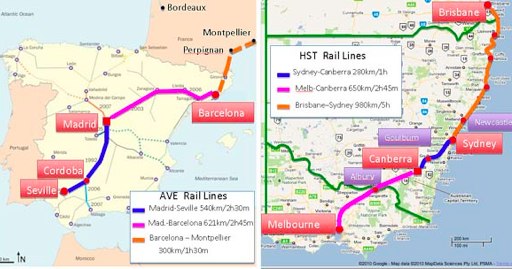
But the best model for Australia to follow is Spain's, which has built two HST lines of 1161 kilometres linking Madrid to Seville (540 kilometres, opened 18 years ago) and Barcelona (630 kilometres). These distances, and as it happens the total population, served by the trains is quite comparable to the Australian SCM axis (see graphic). Based on the current French estimate of Euro 10 million/km ($A15 million/km) to build those lines today would be about $A17.4 billion; even allowing several billions more for stations and train sets it would be a struggle to spend even half the fictional $60 billion, perhaps $20-25 billion.
Contrary to misinformation concerning high speed rail in Australia, it is logistically, economically and even politically feasible. Australians are now receptive to such nation-building infrastructure, if only our politicians had the courage to sell the vision and could think beyond one or two electoral cycles. Economically it stacks up against continued spending on highway projects or hugely expensive airport upgrades, or the interminable wrangling over Sydney's phantom second airport. Dismissing the strategy of an expanded Canberra airport or a new one shifted closer to Sydney served by a 30-50 minute HST journey to the heart of Sydney and Canberra, is the same tired defeatism we have had for decades.The high-speed rail route would follow the existing Melbourne-Sydney route from Melbourne through to Albury, thence diverging eastward, passing through Canberra and Goulburn. A one-way trip between Melbourne and Sydney would take under five hours. (An eventual extension to Brisbane would theoretically take another five hours to traverse, though I imagine that they'd have to straighten the route out considerably from the existing one to achieve this; part of the high-speed rail formula is straighter tracks than conventional railways have.)
One interesting effect of high-speed rail in Australia would probably be the development of a commuter belt outside of the major cities, and corresponding relief for housing shortages (which are particularly acute in Melbourne these days). If Albury is 90 minutes away from Melbourne by train, it is just about conceivable that people might commute in from there. (The town of Seymour, on the existing Melbourne-Albury line, would be a mere 30-40 minutes from Melbourne by high-speed rail, and would be well poised to become a base for commuting to Melbourne.) Goulburn (and, eventually, Newcastle) could do the same for Sydney. There are precedents; one effect of the TGV lines in France is that towns on lines going to Paris have become parts of Paris' commuter belt.
Australia is probably better poised to develop large infrastructure projects than recession-hit Europe, currently floating on the (largely Chinese-fuelled) resources boom. Of course, knowing Australia (a place where short-termism and apathy rule even more than elsewhere), chances are high-speed rail will remain in the too-hard basket until the price of oil suddenly puts and end to $65 Virgin Blue flights, taking everybody by surprise because, while they might have known that oil prices were going to rise, they didn't expect it to actually affect them.
2010/3/10
Not content with its own massive internal high-speed rail programme, China is planning to build high-speed railway lines spanning Asia. The lines will drive westwards through Bhutan, India, the central Asian republics and into Turkey, ultimately connecting with Europe's networks; there will also be another trans-Siberian high-speed line (though weren't the Russians looking into using Japanese shinkansen technology for that?) and an eastward line heading down to Singapore, via Vietnam, Cambodia and Thailand. The plan is to have trains running at between 200 and 350kmh, bringing a journey between London and Beijing down to two days. Mind you, that involves transit through Iran and Burma (both closed societies whose authorities like to keep a tight grip on anything coming or going) and crossing the somewhat fraught Indian-Pakistani border.
China will fund the programme, in return for mineral rights from the countries, and won't harp on about human rights; already, the Burmese junta has signed on.
2009/11/8
Nationalised railways are returning to the UK; as of next week, the East Coast Main Line, from London to Edinburgh, will be government-run. It'll give little joy to socialists, though; the New Labour government has vowed to not compromise on the Anglocapitalist principle of charging what the market will bear, and will be pushing through with above-inflation fare increases as a matter of principle:
"I don't see this as a step backwards into some sort of BR or public sector-type environment," she said. "It is a commercial company that happens to have the government as its owner."
Holt admitted that East Coast will impose the above-inflation fare hikes that National Express was planning for January, even though the new business will not have to meet the franchise payment of around £180m next year that helped derail the route's former owner. "I am not going to sit here and say that just because we are a government-owned company we are going to slash fares."The principle of attempting to run a state-subsidised universal-service system such as passenger rail as a for-profit enterprise makes little sense. If railways are a system the government has to pour taxpayer funds into to keep it operating (and has sound reasons to do so, with the availability of bulk passenger transport stimulating the economy and the welfare of its citizens in a way that a completely user-pays system could not), why privatise parts of it and have a chunk of the money that goes into the system bleed out into the pockets of shareholders? Surely whatever efficiencies private ownership brings to the table (and those Reaganite/Thatcherite articles of faith are looking increasingly shaky these days) could be achieved by less costly measures.
In any case, it seems that the government will pocket a windfall from the inflated ticket prices and lack of franchise payments. Let's hope that, short of using it to make rail travel more competitive on price, they use it to fund improvements to the rail network (such as, say, bringing forth the electrification of intercity rail lines before the existing diesel trains need to be replaced and the price of oil goes up any further), rather than just trousering it.
2009/11/3
Another first for Britain's railway system: its first £1,000 train fare. Well, £1,002 to be exact, which will get you from Newquay in Cornwall to the Kyle of Lochalsh in the Scottish highlands, nominally in first class:
The trip from Cornwall to the Highlands would last over 20 hours, but despite the cost passengers would not find themselves travelling in the lap of luxury – the first and last parts of the journey do not even have first-class carriages.
Doe told the Evening Standard: "For the price I would expect to be given a meal as soon as I got on board. What do you get with CrossCountry? For the first 183 miles to Bristol you might get a trolley service offering a cup of tea.This momentous milestone was reached thanks to the free-market efficiencies of privatisation; since 1995 (when they were set by the inefficient socialist bureaucracy of British Rail), some walk-up train fares have doubled in price.
Of course, one would have to be an eccentric train fetishist to actually buy this fare, given that flying across Britain is several orders of magnitude cheaper (in the way that flying across, say, France or Spain isn't):
"When you can fly half way across Europe for £30, the idea that you can end up paying £1,000 for a train journey in Britain is absolutely scandalous.
"Not only are passengers being encouraged off the trains and into their cars, but some considering this journey may decide they'd rather fly to Australia and back for half the price."The railway company points out in all fairness that if one buys the advance fare in time, one can get this journey for a mere £561, bringing a train trip across the UK down to the cost of one low-season return flight to Australia.
2009/7/9
A Japanese railway company is introducing mandatory workplace smile testing. Employees of the Keihin Electric Express Railway will be required to submit to daily testing using imaging software which rates their smile out of 100, ensuring that customers get the appropriate level of cheerfulness in their service.
2009/7/1
The British government is set to renationalise the east coast rail route, which connects London, York, Newcastle and Edinburgh, after National Express complained that it can't afford to run it and went to the government begging for a bailout, to which the government said no. Of course, the government, desperate to avoid accusations of it reverting to the bad old days of brown-suited trade-union bolshevism ("Old Labour"), has expressed its deepest regret at the unfortunate necessity of taking such a socialistic course of action and committed itself to selling off the franchise as soon as is possible.
This is not the first time part of Britain's railway network has fallen into public ownership since privatisation; a railway operation in the south of England was taken back by the government a few years ago after the operator, Connex, was found to be rubbish. (Incidentally, the names of the operators will hold special relevance for Melburnians; both Connex and National Express have forfeited commuter rail franchises in Melbourne, in somewhat similar ways.)
I wonder what branding the new government-run rail franchise will use. I'm guessing they can't call it National Express, and will avoid calling it British Rail (or National Rail, which is the same only with less Helvetica) or anything that suggests a permanent nationalisation of the railways (because that would be socialism, and Socialism Is Always Wrong), so presumably they'll come up with some brand. I hope that they keep the web site, though; it has one of the nicer interfaces for booking tickets in the UK.
2009/6/23
Blog discovery of the day: The Infrastructurist, which focuses on issues such as transport and urban planning, from a largely, though not entirely, US-centric point of view, and has some interesting stories. Such as a LA Times piece on the Dubai model of urbanism, an Economist piece on the Obama administration's US$500bn transport bill (which includes 50 billion for high-speed rail), a Google Maps gallery of six intriguingly shaped communities, a piece on what to do when neo-Nazis decide to sponsor a US highway (the answer: rename it after a civil rights leader), and a gallery of grand railway stations in America, all now long-since demolished.
2009/5/22
The (Melbourne) Age's travel blog lifts the lid off a little-known range of discount British rail passes. The tickets are known as "Ranger" and "Rover" tickets, can go for as little as £10, and generally offer unlimited off-peak travel within various areas:
The Rangers are the most basic deals: they simply offer unlimited travel within a certain area for a day after a certain time (usually 9am or 9.30am). For example, the Cornwall Day Ranger costs £10 and allows holders to go across the whole county, plus parts of neighbouring Devon. In a theoretical day out, it would be possible to take in seafaring heritage in Plymouth, surfing at Newquay, Pendennis Castle in Falmouth and world-class art at Tate St Ives.
Pretty much every area of the country is covered by one Rover or another. For example, there's a Freedom of Scotland Travelpass (four in eight days) that covers the whole of Scotland for £105. The Freedom of Wales Flexi Pass is available on the same terms and allows travel across the whole of Wales plus a few towns over the English border such as Shrewsbury, Hereford and Chester. It costs £74.
The utterly absurd thing about the Ranger and Rover passes is they can often be cheaper than a single ticket between two stations covered in the region. For example, an off-peak single from Portsmouth to Cardiff costs £67, while the Freedom of Severn & Solent Rover allows travel across a much larger area for three days out of seven and costs £40. The craziest example is the train from London to Stratford-upon-Avon. The walk-up single fare can be £67; the one-day Shakespeare Explorer ploughs the route, stopping at the likes of Warwick Castle and Wembley Stadium on the way for £30.These passes, unlike the BritRail passes you can get in travel agencies abroad, don't require you to be outside of Britain at the time of purchase. Of course, Britain's railway companies protect themselves from being taken to the cleaners by customers by the simple expedient of not advertising or publicising these deals very widely; to get one of these magic tickets, one has to go to a ticket office and explain to the clerk what exactly one wants and that, yes, it exists. There is a page listing them here, for those willing to do a bit of potentially profitable digging.
2009/4/17
In the US, President Obama has announced plans to build high-speed railway systems. It won't be one national high-speed railway, but rather a pot of money and a series of proposed high-speed rail corridors (some of which already have planned projects, such as the Californian system which passed the ballot in the last election). There is only $8Bn to spend, and the "high speed" trains are cited at running at up to 240km/h (i.e., somewhat faster than a British Rail InterCity 125 on a straight stretch of track, but not quite up there with the Shinkansen), but it is a start.
His strategy envisions a network of short-haul and long-haul corridors of up to 600 miles, with trains capable of speeds of up to 150mph (240km/h).
He said: "Our highways are clogged with traffic, costing us $80 billion a year in lost productivity and wasted fuel.
"Our airports are choked with increased loads. We're at the mercy of fluctuating gas prices all too often," he said.The corridors proposed include one in the Pacific Northwest (running from Oregon to Seattle, and possibly into Canada; I hope that they put passport control in the stations, as on the Eurostar, rather than stopping it for an hour or so at the border to process everyone onboard), a Chicago-centric system stretching to Minneapolis, Detroit, Kentucky and Ohio, and corridors potentially running from Texas, through New Orleans, Atlanta and the Carolinas, and into Washington. The full text of the speech is here.
2009/3/4
The Times' travel section has another crop of stories about rail travel; this time around, they include a piece on the spectacular Settle-Carlisle line, one on traversing provincial Japan by slow train, a piece on crossing the USA by train (from New York to Chicago and then Los Angeles) a piece on crossing the USA by train, and Mark (the man in Seat 61) Smith's list of four great European rail journeys.
2009/2/24
I just caught the overnight sleeper train from Sydney to Brisbane. The Sydney to Brisbane passenger railway service is operated by Countrylink, an arm of the New South Wales government, as a subsidised public utility, essentially targeted at rural and regional areas; these services include two trains a day, in each direction, between Sydney and Melbourne and Sydney and Brisbane.
In general, I was quite pleased with the service. They don't do economy-class sleeper carriages on Countrylink, so my choice was one of booking a first-class seat and a sleeper bunk or spending 14 hours in an upright seat. (I once did this going from Sydney to Melbourne; it wasn't enjoyable.) Anyway, I shelled out for a sleeper; it didn't cost much, about A$216, or less than £100. When I arrived, the train attendant (a friendly young woman named Shannon) informed me that, while I had been going to share a (2-bunk) cabin with someone else, they had been moved to a separate compartment, giving me one to myself; I'm guessing that they didn't have enough passengers to fill up the entire sleeper carriage. This was a pleasant surprise; the compartment, consisting of three seats and transforming into two bunks, seemed quite luxurious, in an unostentatious way. (There were none of the standard signifiers of luxury— no leadlighting or wood panelling, for example—it was all utilitarian melamine and carpeting.) The sense of modest luxury was rounded off with a complimentary package containing Arnott's crackers, Bega cheese, a tomato-and-curry dip, mineral water and a Tim-Tam biscuit. The compartment had a power point, though it was explicitly for shavers only. (This is another difference from trains in Britain, where one is encourage to plug in one's laptop or charge one's phone.) The power point turned out to be suitable for charging a laptop, though didn't yield enough power to actually run one; when I tried to run my MacBook from it, it thought it was running off mains power, though actually depleted its battery until it shut down. Needless to say, onboard wireless internet access was absent and is unlikely to be coming any time soon; the fact that most of the passengers ranged from their 50s to advanced old age, with a backpacker contingent in economy class, is probably further disincentive to spending money on such new-fangled fripperies.
Countrylink, unlike most railway services these days, is state-run, and not entirely at the mercies of market realities. Because it is considered a vital piece of infrastructure, it receives hefty subsidies, and consequently, their prices are quite low. (Economy class from Melbourne to Sydney can be as low as A$70, if you take advantage of a special offer.) Unlike in Britain or Europe, their fares don't change; rather than selling a handful of ridiculously cheap tickets and gouging those without the foresight to book months in advance, they charge the same fare whenever you book. The food is cheap and not very exciting; $8 or $9 gets you what's essentially a microwaved meal, and the complimentary breakfast consisted of a bowl of cereal, two slices of toast and a cup of warm water and a teabag. It is, however, forbidden to drink any alcohol one hasn't bought on the train (an offense punishable by a $400 fine, and enforced by roving transit officers in uniform; I imagine one could get away with it in a private compartment, though I didn't try it), and the only beer sold onboard was a rather ordinary light lager named Hahn.
All in all, the sleeper train is a pleasant way of getting from Sydney to Brisbane; the first-class compartment was quite comfortable, and the daytime portion of the journey was, in places, quite scenic. The one major flaw, though, was the timing. I suspect that Countrylink, much like Amtrak in the US (a similar state-subsidised passenger rail service), is near the bottom of the pecking order for access to tracks, and basically gets what the freight operators don't want. Which would be the only explanation for why the sleeper train to Brisbane leaves Sydney at 16:20 and arrives in Brisbane at 5:20 (Brisbane time; 6:20 Sydney summer time), with passengers being woken at 4am for breakfast. Also, unlike other services (the Caledonian Sleeper, for one), there is no possibility of staying onboard and sleeping until a reasonable hour; the same train is used as the daytime service, and goes back to Sydney within an hour of arrival. Which is undoubtedly convenient for the operators, though less so for their passengers.
2009/1/30
Good news for rail travel in the US: the Obama administration is planning to invest in passenger rail projects. Of that, $850m will go towards Amtrak, the US's somewhat neglected vestigial passenger rail system, and two billion will be spent on "high-speed rail", including a network of rail links across the Midwest.
Most of the article has an interview with former Massachusetts governor and Presidential candidate and public transport advocate Michael Dukakis, who seems to be an unofficial spokesman for passenger rail development in America. It emerges that "high speed", though, could mean the 1970s British Rail definition, i.e., up to 125mph, not the TGV/shinkansen definition regarded as "high speed" elsewhere. The fact that he talks about upgrading America's railways to "the level of technology they're using in England" says a lot about how far there is to go. I wonder whether they'll do what the New South Wales transport authority did and actually start making InterCity 125s under license.
It's good to see money being earmarked for upgrading America's railways, though over the long distances that span the continental states, would a 125mph train really be able to compete with flying? If anything, the distance is all the more reason to invest in faster railways.
2009/1/28
A retired Australian police detective has claimed that anti-monarchists attempted to assassinate the Queen in 1970, by derailing her train in a cutting near Orange, New South Wales with a log.
They had been aware of the service's schedule and had managed to avoid a "sweeper" locomotive that passed through the area a short time before.
But the log failed to derail the train carrying the royal party and became stuck under its front wheels, bringing the train to a stop at a level crossing.Det. Supt. Cliff McHardy (retired) was involved in the investigation of the incident, but was hampered by a ruling keeping the incident secret. To this day, it's not clear who was behind the plot; in fact, their description as "anti-monarchists" seems more tautological than anything else. (It could have been anyone. One of various flavours of Communists, perhaps, or some fifth-generation Irish-Australian still angry about the potato famine, or some troubled individual just wanting to make the mind control rays stop, or perhaps none of the above.)
2008/12/28
As the date of the next UK General Election approaches, the government (which looks like being soundly defeated) is starting to say some pretty desperate things; like promising a high-speed rail line within 20 years. Interestingly enough, the line might be based on Japanese shinkansen technology (rather than the French TGV technology already used on the high-speed line between London and the Channel Tunnel), and if it's successful, your children or grandchildren may well see other high-speed lines, such as from London to Edinburgh and Cardiff.
Ministers want to begin work on the new London to Manchester line as soon as possible so that it can be in place within 15-20 years. It is understood they hope to use new planning laws to avert a lengthy public inquiry.More worrying is the plan to base the London rail hub not within central London but at Heathrow Airport, which would have no practical purpose other than to throw the air-travel industry a bone, at the cost of inconvenience to those not wishing to catch a plane.
2008/12/16
To commemorate the upgrade of the West Coast Main Line (that's the one that runs from London to Glasgow via Birmingham), the BBC has posted a time-lapse video of a train journey from London to Glasgow, filmed from the cab of a train and sped up to five minutes.
The upgrade of the line, to allow Virgin Train's Pendolino tilt-trains to actually do the tilting thing, has cut journey times by 30%, making the London to Glasgow journey just four hours and 30 seconds. However, compared to railways on the continent (such as France's TGV system), it is still slow; the maximum speed is 200kmh, or under two thirds of that of what they call a "fast train" across the Channel. Watching the video gives a hint to why this is so and likely to remain so for some time: the track ahead of the train curves hither and yon, still apparently following the path laid down in the 19th century to avoid powerful landowners' concerns and keep gradients low enough for the relatively feeble locomotives of the day. Whilst the aristocracy is not what it used to be, and today's trains have less of a problem with gradients, the West Coast Main Line remains too wavy to be traversed at speed.
2008/12/12
A while ago, German national railway company Deutsche Bahn expressed an interest in running trains through the Channel Tunnel, competing with Eurostar, come 2010, when EU "open access" rules allow train companies to run services all over the EU. Now they're talking about buying out the UK's share of Eurostar altogether:
Deutsche Bahn (DB), Germany’s state-owned railway, may also use Eurostar trains to operate a rival service through the Channel Tunnel, with competition resulting in cheaper tickets to Paris and Brussels. But the Government, which is preparing to sell the third of Eurostar that it controls, would lose the ability to influence the development of the rail link to the Continent.
Over the past 18 months, it has quietly bought several British train companies that carry a total of 30 million passengers a year. DB owns Chiltern, which runs between London Marylebone and Birmingham, and half of London Overground, which operates on the North London Line and will serve the extended East London Line from next year. It also runs two thirds of Britain’s goods trains through its purchase of EWS, the biggest British rail freight company.
DB hopes to persuade Geoff Hoon, the Transport Secretary, that it will operate a more efficient service through the Channel Tunnel by drawing on its experience in Germany of integrating trains with other modes of transport. German rail passengers can book an entire journey on just one web-site and with one ticket and can even arrange for an electrically assisted bicycle to be waiting for them at the station.DB have also expressed an interest in buying more train companies in countries they expand to; given their efficiency, that could be a good thing.
2008/11/5
A few stories from the US elections:
- Barack Obama's acceptance speech. And here is McCain's concession speech; and a gracious and dignified one it is too.
- It seems that prejudice against less-religious folks no longer cuts it in the US; North Carolina Republican senator Elizabeth Dole lost to a relatively unknown Democrat challenger, Kay Hagan, after an attack ad accusing Hagan of being the choice of the "Godless" backfired spectacularly.
- Prejudice against gays, alas, is alive and well in California, with a ballot proposition amending the constitution to ban non-heterosexual marriage looking set to pass narrowly. I wouldn't have a problem with this, as long as couples civil unions had exactly the same rights and responsibilities as married™ ones—and such civil unions were available to heterosexuals. If religious traditionalists want to claim marriage as a trademark, that would be fine as long as those who don't agree with their agendas can opt out. At present, though, this discriminates against not only against gays but also against heterosexuals who don't wish to be lumped in with the bigots.
- It's not all doom and gloom in California, though, with the proposed high-speed rail link between LA and San Francisco looking set to win approval. The proposal to rename a San Francisco sewage plant after George W. Bush, however, didn't pass.
2008/7/23
A few interesting engineering-related developments in the news today:
- There is a proposal to provide most or all of Europe's energy needs with solar collector farms in the Sahara, slashing the continent's carbon emissions dramatically.
- England's parliament has approved the Crossrail rail scheme; from 2017—in nine short years—London will have a fast east-west underground rail link, sort of like Paris's RER, going from Paddington, under Tottenham Court Road and Farringdon, and hitting Stratford and Canary Wharf.
2008/7/14
This evening, I caught the train up to Luton to pick up my sister and see her safely to London. My sister has been travelling around Europe for the past month or so, and flies back to Australia tomorrow, after flying in from the Croatian Riviera this evening. Her flight was meant to arrive at 22:25, though arrived a bit early. I caught the 21:35 train up, thinking I'd meet her when she gets out of immigration.
At about a quarter to ten, the train stopped in a tunnel just south of West Hampstead. A minute or two later, we were informed that the train driver has been asked to stay there because of "an incident" on the tracks ahead.
About 10 minutes later, we were told the nature of the incident. Apparently, somebody had climbed the signal gantry on the line, right near the high-voltage overhead power lines.
The train managed to get clearance to go into West Hampstead to wait there, where the driver announced that emergency services had been dispatched. About half an hour later, we managed to make it to Hendon. We waited yet longer there, to be informed that the lunatic was in the signal gantry and refusing to come down. Well, they didn't use the word "lunatic", as it'd be politically incorrect/insensitive, though in my opinion, as soon as someone climbs up onto an overhead power line above a railway and refuses to come down, the odds of "lunatic" being an inaccurate characterisation of them diminish sharply. If they do so in front of the train I'm on, I can think of several other words—much less kind ones—for them as well.
Eventually, we were given the all clear to go ahead. The nutter had apparently left the signal gantry, though was still on the loose somewhere, undoubtedly with a wild gleam in his eye. Presumably the men in white coats were searching the area, tranquilliser darts at the ready. In any case, the train limped through the affected area slowly, before finally building up speed, and making it to Luton exactly an hour late.
2008/7/11
A writer from GOOD Magazine ("for people who give a damn") examines why America's passenger rail system has fallen so far behind Europe and Asia, by taking a train journey from New York to Oakland:
The American passenger rail—once a model around the globe—is now something of an oddball novelty, a political boondoggle to some, a colossal transit failure to others. The author James Howard Kunstler likes to say that American trains “would be the laughing stock of Bulgaria.”
The reasons for Amtrak’s bad reputation are totally damning—its service is neither practical nor reliable. Impractical because most of the time, it’s cheaper and faster to drive or fly. Unreliable because more often than not, the trains are really, really late. There are stories of 12-hour delays on routes that would take six hours to drive; of breakdowns in the desert; of five-hour unexplained standstills in upstate New York. Then there’s the mother of all Amtrak horror stories: a California Zephyr that stopped dead on its tracks for two full days, victim of both an “act of God” (as corporate legalese wisely defines a landslide on the tracks) and gross staffing negligence.A lot of Amtrak's reliability problems are structural, stemming from the fact that the passenger rail company (a state-owned, loss-making private company) doesn't actually own the tracks it operates on. Nor are the tracks owned by a separate entity (as is the case with Britain's privatised railways; not usually a model to emulate, though looking surprisingly good compared to Amtrak); they're owned by the freight companies, who are legally obliged to allow Amtrak to operate on them. Since it's more profitable for them to move freight around, passenger traffic gets the rough end of the pineapple, and often has to wait.
The correspondent's train eventually made it to Oakland at 2:30am, a little over eight hours late.
Though while America's legacy rail network languishes in decline, California is planning its own high-speed rail system, initially going from Sacramento (north-east of the San Francisco Bay) to San Diego (right near the Mexican border), via Fresno and LA. (A branch to San Francisco, following the Caltrain route and terminating at the Transbay Terminal, is planned.) The site comes with glossy computer renderings of state-of-the-art high-speed trains speeding through unmistakeably Californian landscapes, sometimes with high-rise buildings rising like VU meter bars behind them.
2008/7/8
The peculiar and long-established British pastime of trainspotting is in steep decline, having fallen victim to some combination of post-9/11 terrorism paranoia, risk-aversion ("it's health and safety gone mad, I tell you!"), neo-Blairite obsession with image and coolness, and really boring trains:
Austin Mitchell, a Labour MP and keen amateur photographer, sees another irony: “We are all photographed dozens of times every day on CCTV, so while the Government can photograph us, we can't photograph anything else.” According to Mitchell, who was recently stopped from taking pictures at Leeds station: “Photography is a public right and that should be made absolutely clear.” He has put down an early-day motion about the matter.
But in recent years the club reports have made agonising reading. One new member might have joined, but two will have died and one resigned. A few weeks ago, members received a special letter: “The executive committee has doubts about the continued validity of the club...” A meeting will be held in October to decide the club's future. Mike Burgess, its honorary secretary, says: “There's this faint hope that someone will come along with a plan - new blood, you know.”
Britain is not making trainspotters any more, just as it is not making enough engineers to maintain our main lines. Trainusership may be at its highest since the Second World War, but this is largely because of commuting into London. Fewer than half the children who visit the National Railway Museum in York have ever been on a train, let alone spotted any. Let's get this nasty, tyrannical little word out of the way, and acknowledge that trainspotting is not “cool” and that you call somebody one at your peril.
2008/7/2
An artist in Portland, Oregon bought an old Pullman rail sleeper car and converted it into a living/working space. The interesting thing here is that it's not sitting in a yard somewhere, sans wheels, but is on the North American railway network. It's stabled at a private siding, for which the owner pays $150 per month; electricity, cable TV and DSL are available. Should the occupant get bored of their locale, they can move anywhere on the railway network by getting a freight rail company to attach their wagon to a train and move it, for $1.50 a mile.
Now that it's known that one can rent private sidings with facilities, and contract freight train companies to move your home around the railroads, perhaps a new subculture of bohemian railcar dwellers (let's call them "boho hoboes") will arise, comprised of similar sorts of people that live in houseboats in Europe. And perhaps the railway revival that some are saying expensive oil will lead to will include new private, full-service sidings catering to the new hipster-hobo class.
I wonder whether something like this is possible outside of America. Could Europeans take advantage of the European railways' open-access rules to do something similar? If so, could an European rail dweller bounce around the entire EU at will for euros per kilometre? What about in Britain? (Though there, the problem arises that British rail cars, and the spaces between platforms, are quite narrow, which could make living arrangements somewhat cramped.) Could one make a railcar home compliant with British and continental standards and the Channel Tunnel's safety standards and cross the Channel with it? I'm guessing that in Australia, where the railway networks are more fragmentary and limited (and old sleeper cars are somewhat scarcer), such a thing could be more difficult.
2008/6/26
The Swiss railway has had to issue workers with yellow reflective vests after Dutch football fans mistook them for fellow supporters when they wore their standard orange ones.
2008/6/5
With the continuing rise in oil prices, some are saying that the age of cheap flights is over, as airlines raise their prices and/or collapse. Think about the implications of that for a moment: historic Eastern European town centres empty of drunken Britons, speculators unable to flog second homes on the Bulgarian Riviera to Ryanair junkies from Gillingham, people actually packing onto trains to go from, say, London to Manchester (and Britain's chronically underfunded railway infrastructure creaking under the weight of the extra patronage). As for bargain shopping in New York, forget it: if you want to see New York, your best bet may be to buy an Xbox 360 and Grand Theft Auto IV. Perhaps the end of the age of cheap travel will finally usher in the Stay-At-Home Century, when tomorrow's people will range as far from their homes as their mediæval peasant ancestors, instead communicating through broadband links.
Meanwhile, General Motors is shutting down four plants that make its Hummer SUV, which for a long time embodied the ugly side of the American Dream. This is after gasoline (that's petrol to the Europeans/Australians reading this) reached $4 a gallon (incidentally, breaking the mechanical pumps at some older gas stations, whose designers never envisioned a gallon of gasoline costing more than $3.99), and dealerships are having trouble moving the hulking behemoths. Perhaps soon we will hear an old joke about Eastern Bloc cars being repurposed?
And still in America, CNN is now running articles about whether the age of the railroads has returned. (Mostly in reference to Europe and Asia as the paragons of modernity.)
2008/6/3
Apparently the UK and Scottish governments are in discussion on building a high-speed railway line from Scotland to England. The details of the line aren't known, though it'd be built to Eurostar specifications, and would connect London to Glasgow. It would take a decade or so to build, and prices costs start at £9bn.
Where in London it would terminate is another question; one high-speed rail proposal involves making Heathrow the national high-speed rail hub, with Eurostar trains and trains going elsewhere in Britain terminating there. Which sends the message that, if you're travelling from, say, Glasgow to the continent, you're going to be changing at Heathrow anyway, so you may as well fly; not exactly encouraging environmental responsibility. (Of course, this is assuming that flying remains affordable; if not, then siting a major rail terminus at a site with an airport and not much else is just stupid planning.)
2008/5/28
The mediæval Italian hilltop town of Perugia has inaugurated a new, incongruously futuristic, transport system:
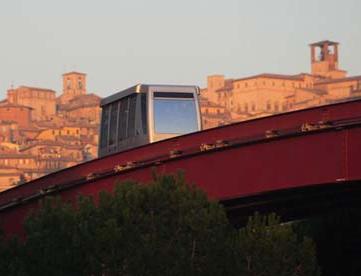 a light railway of pilotless, podlike cars, running from the valley to the centre of the old town:
Dubbed the "Mini Metro", the rail line, which starts from the valley floor, climbs for 3km, wiggles around ancient constructions and monuments, and drops visitors off in the historic centre where an unobstructed view of Assisi and the rolling countryside gleams in the distance. Total travel time? 11 minutes.
At first look, the sight of pilot-less metallic pods shuttling people up and down the hillside on an elevated track seems, to put it mildly, anachronistic. Call it Tron-meets-Dante in the Umbrian hills.If the Mini Metro is successful, the Perugian municipal authorities plan to ban cars from the old town's narrow streets altogether.
2008/4/26
Japan's Wakayama Electric Railway has increased its patronage by appointing a cat as stationmaster of an unmanned railway station. The cat, a 7-year-old tortoiseshell cat named Tama, can be seen wearing a specially made cap in her office inside a former ticket window at Kishi station on the Kishigawa line.
Two other cats have been appointed as "deputy stationmasters", and a human official has been hired to take care of the cats.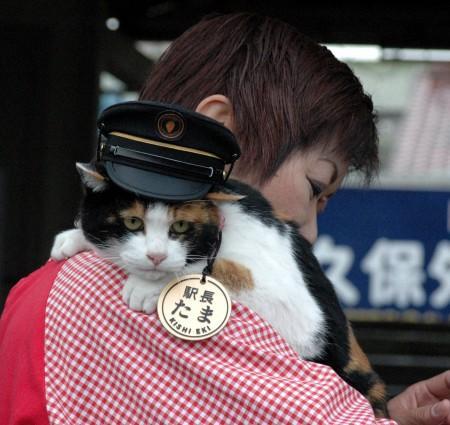
(via london-underground) ¶ 0
2008/4/12
Good news: Britain is arguably entering the new age of the train, with more journeys having been made on the railways last year than in any year since 1946. Not so good news: Britain's railways are still barely adequate; John Major's ideologically-driven privatisation of British Railways has led to a situation where more taxpayers' money is being pumped into the railways than even in the bad old days of that Inefficient Socialist Monopoly, though fewer pounds actually making it through to improving the service (but rather going to the profits of various private enterprises at various levels and/or falling through the cracks of the various inefficiencies of the present arrangement, which in some ways looks to be cobbled together with duct tape and string). Meanwhile, passengers are paying more for their tickets than anywhere in continental Europe, whilst putting up with slower trains and often a lack of seats. Not surprisingly, most of the record-breaking rail journeys were fairly short ones, with people choosing to fly between cities (like, say, London and Manchester), in a way that they just don't do in France or Germany:
The problem is that Britain's railways are a public utility run as a profit-making enterprise, and thus a rather inefficient conduit for channelling taxpayers' funds into the coffers of private industry. It seems that there are two possible ways out of the current mess:
- Continue regarding the railways as a public utility and undo a lot of privatisation. Either nationalise rail operators or have them provide a service to a non-profit rail company, under carefully controlled terms. All state subsidies (for keeping socially- and economically-useful though unprofitable services running) will go to the non-profit (let's call it British Rail 2.0), or:
- Run the railways consistently as a profit-making enterprise, and restructure them to run at a profit. That would mean a new round of Beeching-style cuts, with most smaller lines being scrapped, and the service ultimately being cut down to something like American-style commuter rail, consisting largely of profitable shuttles between dormitory areas and economic centres, running mostly at commuting hours. This is the approach The Economist recommended last year.
2008/3/30
The much vaunted Russia-Alaska railway tunnel under the Bering Strait is on the agenda again, with Vladimir Putin set to discuss the idea with George W. Bush, and Roman Abramovich (who, when he's not in England, is the governor of the Russian far eastern province of Chukotka) having, coincidentally, invested £80m in the world's largest drill.
2008/3/10
Two years ago, I caught a sleeper train from Paris to Zurich. Not intentionally, mind you, but entirely by chance.
 I had originally intended to travel from Paris to Florence by sleeper train, departing from the Gare de Bercy a whisker after 7pm, and to this effect, had booked a seat on the Eurostar arriving at the Gare du Nord just before 5:30pm. This, in theory, would have given me ample time to make my leisurely way through the Paris Métro, possibly grabbing a bite to eat, before boarding my train. In reality, it turned out that the Channel Tunnel wasn't feeling well that afternoon, and the Eurostar spent some 80 minutes waiting in the Kentish countryside, consequently arriving in Paris just before 7. A mad dash in a taxi with a driver who spoke no English ("Parlez-vous Anglais?", I enquired on entering the cab; the driver reply, buttered with no small amount of self-satisfaction, was, "Parle Français.") resulted in my arriving at Gare de Bercy (a good 5km away) some ten minutes after the Florence train's departure.
Facing the prospect of spending a night in a hotel room, I inquired at the ticket office about subsequent trains. Luckily, there was a sleeper train to Zurich (or, more precisely, to Chur via Zurich), and thence I could catch a train to Milan the following morning, putting me on the way toward Florence, at the cost of only around £90 and some eight hours of time.
 This, however, turned out to be well worth it, as the scenery along the Zurich-Milan route was spectacular. The morning's train wound past silvery alpine lakes fringed with small, white houses and corkscrewed its way up mountains to St. Gotthard's Pass, before entering a tunnel. On the other side, everything was different: the climate, the architecture, even the language. We had left the German-speaking part of Switzerland and entered the Italian-speaking part, a somewhat sunnier, though still impeccably well-organised, place. The train headed south, then stopped for some time at the border as border guards boarded to check our passports. Then it proceeded southward, past Lake Como, and towards Milan. From Milan, I made my own way south.
I had been planning to take this journey again at some point, the next time actually breaking it in the Swiss Alps; getting off the train somewhere around, say, Arth-Goldau or so, and spending a day or two there, in alpine tranquility. Though, when I recently looked at seat61.com, I found that that is no longer possible, having fallen victim to the onward march of progress:
The convenient direct sleeper train from Paris to Landquart & Chur was sadly withdrawn with the opening of the TGV-Est high-speed line in June 2007I wonder how many other sleeper train services have disappeared over recent years, squeezed by the boorish onslaught of cheap flights on one hand and the march of high-speed rail on the other, and whether this is a one-way process, or whether there are any new overnight services being introduced as old ones are dropped. One would think that they could run some through the Channel Tunnel at night. (Perhaps if Deutsche Bahn get rights to run services through the tunnel from 2010, as they have applied to do, they will put some in. After all, Germany is considerably further from London than Paris or Brussels, and an overnight train from London to Berlin, the showpiece rail hub of central Europe, could be popular. And then there were the overnight services from the north of Britain to Paris that were mooted when the tunnel was being built and flights were relatively expensive.)
2008/1/8
A Sunday Times piece on the decline of Britain's railways, whose services have been deteriorating and costs rising, the difference going to the shareholders of private operators:
The new ticket price from Bristol to London with what is, by common consent (and by most of the official indicators) Britain’s worst train company, is £137. At which price you could take a family of five to Budapest and back, although not with First Great Western. Again, this seems better value if you take into account the fact that you might well have to get off the train at Chippenham and travel by bus for a bit; two modes of transport for the price of one, you see. They think of everything for you.
I asked the eminent transport journalist Christian Wolmar what he made of Muir’s suggestion that increased fares would lead to improved services. “It’s just complete and utter crap,” he replied. “The money is going to the train operating companies, full stop.” How much is invested in improving rail services is, in any case, decided in advance by the rail regulator. Muir is being disingenuous. At the least.
Here’s a few more fares to gape at in wonderment: Plymouth to London with First Great Western – £196. That’s three times the cost of the usual return air ticket, and of course it takes almost four times as long by train. London to Manchester on Virgin Trains – £219. Fly instead and it will set you back about £80. And incidentally, those are the old prices, without the “A happy Christmas to all our benighted customers” fare increases.The author lays the blame at the feet of John Major's Conservative government, and its privatisation of British Rail (which, as maligned as it had been, was apparently much more efficient than today's system), a move driven more by neoliberal ideology and Tory antipathy to public transportation than practical concerns, though New Labour, who have presided over the decline of Britain's railways, get some of the blame:
It is either depressing or hilarious, take your pick, to mull over the fact that the privatised rail network soaks up almost three times as much taxpayers’ money in subsidies than did that much maligned, publicly owned corporation, British Rail. And the sad truth is that in those final years British Rail really was “getting there”.
You might expect of the Conservative party an instinctive affection for that most insular and individualistic form of transport, the motor car. Labour, though, has its ideological roots in public transport – and yet in the 10 years since Tony Blair took office, rail fares have been allowed to rise by 46% (not counting the latest rise), while the cost of travelling by car has risen by only 26%, according to figures from the Department for Transport. In other words, Labour has made it even more attractive to travel by car and less attractive to travel by train.
Again, the train companies will tell you that more people are travelling by rail than at any time since the 1950s. Well, up to a point. But they’re travelling short distances by rail (especially within central London, which recently got its first effectively nationalised route, the North London line). For the longer trips, people are turning to the planes, or sticking with the comfort of their cars.Or course, the idea of renationalising Britain's railways is absolutely out of the question, because that would be socialism, which is discredited, and it has been proven that free markets always achieve the best of all possible outcomes. So, whoever wins the next election, we can expect more of the same: underinvestment, price rises, and Britons paying for a service that costs considerably more and delivers less than on the continent, and choosing to fly over any distance further than London to Birmingham.
2007/11/9
A new rail company with a whiff of eccentricity is soon to start services in the UK. Grand Central Rail, founded by third-generation railwayman and former British Rail manager Ian Yeowart, who had been planning to run his own railway services since John Major privatised the railways. They will initially be running services from London to Sunderland, in refurbished InterCity 125s with Monopoly and Cluedo boards printed on the tables and Marilyn Monroe posters (part of their branding) at the ends of carriages. That is, assuming that they get their trains back from the refurbishers:
"The problem with the railway industry, particularly on the engineering side, is that it's agricultural," says Mr Yeowart - referring to the workshops where the trains are being refurbished. "It's like going back 50 years."
Despite the years of under-investment followed by a cack-handed privatisation process; despite the utilitarian, pile-'em-high ethos of many operators and the cattle-truck morning commutes; despite Paddington and Hatfield and Potters Bar, the romance of the railways remains hardwired into the national soul.
2007/11/6
With the completion of the new high-speed rail corridor for Eurostar, Britain has finally joined the European fast rail party. Or, more precisely, the south east of England has, as the rest of the country stares forlornly at the Eurostar passing it by and/or books another Ryanair flight:
This marks a kind of betrayal. When, 21 years ago, François Mitterrand and Margaret Thatcher signed an agreement to build a rail tunnel between the UK and France, the benefits for South-east England were to be shared with the rest of Britain by virtue of a range of regional services. Plymouth would enjoy an overnight link with Brussels, while travellers from Cardiff could catch a train direct to Paris.
Over the years, this pretence was maintained at vast expense: rolling stock for Eurostar Regional was built; a catering shed was constructed at Manchester Piccadilly; and timetables at Edinburgh Waverley showed the schedules for a couple of seasons.
The result of this development will be clearer later this month, when the new high-speed Eurostar train service beds in. After an encouraging (but very brief) northbound start, it will swerve east, cross the East Coast main line and disappear into a hole in the ground. This, the "London Tunnel" , emerges 11 miles later in the Labour-voting wastes of southern Essex – an eccentric route reached following a political decision by the last Conservative government, keen to avoid upsetting the voters in key Kentish constituencies.The new link—dubbed, perhaps optimistically, "High Speed 1"—will allow trains to travel between London and the Channel Tunnel at 186mph (or 300km/h, if you're European), bringing the Continent a lot closer (the French port of Calais is now just under one hour out of London, which would (passports and ticket costs notwithstanding) place it within London's commuter belt). Once you're at Brussels-Midi, Europe's existing high-speed rail network (funded by wasteful Eurosocialist largesse in place of the British penny-pinching that's efficiently packing commuters in like sardines as it squeezes the last bit of utility out of the nation's creaking railway infrastructure) will take care of the rest. And as Europe gets closer, destinations in Britain get relatively more distant:
With trains to Brussels taking only 111 minutes, Norwich, Cardiff and Exeter share the ignominy of longer journey times. While the fastest trains to Leeds and Manchester narrowly beat those to Paris, the cities of Sheffield and Liverpool take longer to reach than the French capital.
Hull will suffer the ignominy of taking exactly the same length of time to reach from St Pancras as Disneyland Paris (and being considerably less fun when you get there).
Two locations are tantalisingly just three minutes over 10 hours away: Fort William in the West Highlands of Scotland, and Berlin. Given the investment pouring into rail at the heart of Europe, Germany's capital will beat the 10-hour barrier well before the western end of the Caledonian Canal – which relies on rail infrastructure almost as old as the inland waterway.The article concludes with a list of the "20 top new rail destinations" on the Continent, each with an equivalent UK trip; Brussels is twinned with Bristol, Lyon with Glasgow, and Cologne (in the German hinterland) with Aberystwyth. The French Riviera is now officially closer than the Welsh Riviera.
There are vague noises about linking London to Birmingham by high-speed rail (that's the European definition of "high-speed", not the feeble local substitute). As for anywhere further north; forget it. It's unlikely that anyone living today will see a 300km/h rail link between London and Scotland (one such idea was floated a while ago, before being scrapped in favour of the more "sensible" alternative of making do with what we have). Then again, maybe if the oil crash really bites and cheap flights evaporate, priorities will shift somewhat.
Another unanticipated consequence of the shift in effective distances may be an undermining of Britain's traditionally isolationist outlook. When the north of France is firmly in the London commuter belt and moneyed Londoners start considering making homes there, will they stand for spending an hour each day going through passport control? There could be new pressure to get Britain to sign the Schengen treaty and abolish border controls with the EU. Granted, the counter-pressure from the Daily Mail Little Englanders, with their visions of dirty hordes of disease-carrying paedoterrorist welfare cheats at the inadequately fortified gates, is a pretty solid obstacle, though whether it will be so in a generation's time is an open question. Perhaps the Channel Tunnel will have turned out to be the trojan horse Mitterrand intended it as?
2007/11/2
In a few years, there may be direct trains from London to Germany; Deutsche Bahn is applying to run trains through the Channel Tunnel to St. Pancras. Eurotunnel, who own the tunnel, are apparently keen for them to do so, being considerably in debt and having capacity to spare. There remains a question of safety standards, though, which DB may want amended somewhat:
At present, passenger trains using the tunnel have to be capable of being divided in two in the case of a fire. The safety rules also require operators to use a special locomotive capable of coping with the signals and power supply on both sides of the Channel. Under European Union open access rules for railways, the £5.7 billion High Speed One, due to open in a fortnight between the Channel Tunnel and St Pancras, has been built to accommodate trains from across Europe.If DB get permission to run services to London, trains could reach Cologne in 4 hours and Frankfurt in under 5. The article doesn't say whether all services would be during daytime hours (as are the current Eurostar services, which, after all, are considerably shorter in duration) or whether there would be overnight sleeper trains from London to the heart of Europe.
2007/6/11
Things I didn't know until today: there is a video to
And here is some rather distorted footage from a performance at a Sarah Records backyard party. No idea who the band are, I'm afraid.
(via  class_worrier) ¶ 0
2007/5/17
The Grauniad has a photographic piece on the first railway crossing between North and South Korea in 57 years:
The last time a train attempted to cross was on New Year's Eve in 1950, when the line was used by thousands of refugees fleeing an advance by Chinese and North Korean troops. Their journey came to an abrupt halt when US soldiers riddled the steam water tank with bullet holes. The tracks were destroyed to slow the progress of the communist forces.
Today's test run is seen as a step towards closer economic ties between rich, open South Korea and the poor, isolated North. It is hoped that the lines will eventually link to the Trans-Siberian railway and allow connections spanning more than 5,000 miles from London to Seoul.
2007/4/21
More in news on railways of the future: there are plans in Scotland for building a 300mph Maglev rail link between Edinburgh and Glasgow. The link would, in theory, cut travel times between the two Scottish cities to 15 minutes, effectively combining them into one conurbation. The proposal has received support from the head of the Strathclyde Partnership for Transport, which operates public transport in greater Glasgow.
2007/4/19
The Russians are once again talking about building a tunnel under the Bering Strait from Russia to Alaska. Apparently the US and Canada are on board, and the project is expected $65 billion, with the tunnel itself costing $10 to $12 billion; much of the rest will be spent on providing a rail link across inhospitable terrain to the heretofore unconnected northeastern frontier of Russia.
A 6,000-kilometer (3,700-mile) transport corridor from Siberia into the U.S. will feed into the tunnel, which at 64 miles will be more than twice as long as the underwater section of the Channel Tunnel between the U.K. and France, according to the plan. The tunnel would run in three sections to link the two islands in the Bering Strait between Russia and the U.S.
The planned undersea tunnel would contain a high-speed railway, highway and pipelines, as well as power and fiber-optic cables, according to TKM-World Link. Investors in the so-called public-private partnership include OAO Russian Railways, national utility OAO Unified Energy System and pipeline operator OAO Transneft, according to a press release which was handed out at the media briefing and bore the companies' logos.
Russian Railways is working on the rail route from Pravaya Lena, south of Yakutsk in the Sakha republic, to Uelen on the Bering Strait, a 3,500 kilometer stretch. The link could carry commodities from eastern Siberia and Sakha to North American export markets, said Artur Alexeyev, Sakha's vice president.I hope they run passenger trains through the tunnel when it's built. Being able to travel by train from, say, London to New York, taking the long way around, would be interesting.
2007/4/13
The Spanish and Moroccan governments are talking about building a high-speed rail tunnel under the Strait of Gibraltar, linking Europe and Africa. If it happens (and that is a big if; the entire endeavour would cost about US$13 billion and cost 20 years to construct), it would make it possible to travel from one continent to another by rail.
How far down through Africa railways could extend is another matter; I imagine a London-Johannesburg rail link would be pushing it.
2007/3/21
As part of an ambitious plan to divert all cross-country freight onto the railways, the Swiss are digging a railway tunnel under the Alps. The tunnel, which (at 57 kilometres) will be the world's longest, will form part of a new, faster railway link between Zurich and Milan, and make crossing the Alps quicker and easier than it has ever been:
A key feature of the project, which is new to alpine transport, is the fact that the entire railway line will stay at the same altitude of 500 metres (1,650ft) above sea level.
This will allow trains using the line to reach speeds of 240km/h (149mph), reducing the travel time between Zurich and Milan from today's four hours to just two-and-a-half. That would make the journey faster than flying.
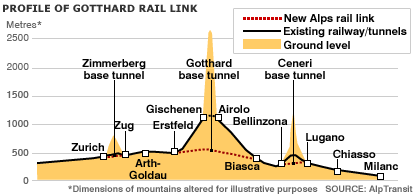 Whilst initially intended for freight, the service is expected to carry passenger trains; an underground railway station has been established one kilometer beneath the village of Sedrun, for use in the construction project, and there are plans to turn it into a passenger station, to be known as "Porta Alpina", or "gateway to the Alps":
Tourists will be able to arrive by train in the Alps in record time, and then be whisked up to fresh mountain air by way of the world's longest elevator.On one hand, travelling to the Alps by high-speed train, ascending in a lift and emerging in a tiny Alpine village does sound cool. On the other hand, I had the good fortune to travel from Zurich to Milan by the slow way—the train winding around the sides of silvery lakes, crossing bridges over valleys and corkscrewing its way up the Alps on the German-speaking part, going through a (relatively) short tunnel at St. Gotthard's Pass, and then coming back down on the Italian-speaking part, with its entirely different architecture and vegetation, and that was (as you can undoubtedly imagine) a magnificently scenic journey. A tunnel just wouldn't be the same.
2007/3/13
The BBC News Magazine has posted a very informative article on ways of legitimately gaming Britain's byzantine train fare system to get the best fare. Most of these ways involve finding the right combinations of tickets covering various parts of the journey which, when put together, are cheaper than a complete ticket would be:
These are not "fiddles" but perfectly legitimate savings, because it is the customer's right to ask for any combination of tickets. However, it is also the clerk's duty not to advertise them, should he or she know they exist.
The only rule connected with the use of such a combination (other than the fact the tickets must be valid, of course) is that the train must stop at the place where the tickets join, although you do not have to alight.A few examples:
You have to leave London for Newcastle on the 0800 train and the open return costs £224. The train calls at Peterborough - and savers to the north from Peterborough are available any train, any day. So book an open return to Peterborough (£68) then a saver from Peterborough to Newcastle (£76.90) - that's £144.90, saving £79.10. Just make sure the train on which you return calls at Peterborough (most do).And another one, exploiting the fact that return tickets to London from Wales can be cheaper than single tickets from Chester (near the Welsh border) to London:
So buy a saver return FROM London TO Shotton and throw away the outward half. You are then "returning", resuming your return journey at Chester. That is all legal. The saver return is £59.70, £29.30 less than the full single.The reasons for this labyrinth of anomalies is a legacy of John Major's privatisation of British Rail, which left the pricing of different journeys along the network in the hands of different companies, thus ensuring that the exact start and endpoints of individual tickets have an arcane, almost alchemical significance.
I wonder how hard it would be to create a search engine for automatically finding optimal combinations of tickets.
2006/11/14
Italy's usually efficient railways have been experiencing increased delays due to soaring copper prices, which have inspired thieves to steal signalling cables for sale as scrap:
Police say they have arrested 22 people in the past month alone on charges of stealing copper wire. Many of the accused have been identified as Romanian immigrants.
In Naples, police recently seized dozens of sea containers filled with stolen copper coils parked in the port area ready for shipment to China.Similar thefts have hit the Channel Tunnel Rail Link project in London, and theft of copper cables was responsible for at least one fatal crash in China. Which makes one wonder whether the plague of "signal failures" on the Tube (such as the one that crippled the Victoria Line this morning) has anything to do with this.
2006/9/20
25 years ago this Friday, France opened its first TGV train line, from Paris and Lyons. The arrival of the high-speed train lines (which now run at up to 320km/h, nearly twice as fast as the fastest train in Britain) has profoundly changed the psychogeography of France, effectively shrinking the country to a more conveniently traversable size:
The 1,250-mile (2,010km) TGV network, a product of the French tradition of centralised power and state engineering, has transformed life, bringing cities such as Tours, 230 miles from Paris, within commuting range. A daily season ticket on that TGV route costs £390 a month. Between Paris and Lille (127 miles each way), daily commuting costs £415 a month. Vendôme, 260 miles to the southwest of the capital, has become a dormitory town. About 400,000 people use the TGV for daily work.
"The TGV is the Concorde plus commercial success," Clive Lamming, a railway historian who wrote the Larousse des trains et des chemins de fer encyclopaedia, told The Times. "The TGV has virtually reduced France to one big suburb. This has increased the independence of businesses from Paris. Workers are more mobile and their costs are less."To commemorate the 25th anniversary of the Paris-Lyons TGV line, the SNCF (France's state railway company) is opening the new TGV-Est line from Paris to Strasbourg, which will make the journey in 2 hours and 20 minutes (it is presently 4 hours).
It is unlikely that anything like the TGV will happen in Britain. The technical efficiency of the TGV is a result of the sort of overengineering that happens in systems shielded from the ruthless optimisations of the marketplace. In Britain, however, where the railways are privatised and the maximisation of profits and cutting of expenses is paramount, the system would never be so uneconomical as to invest in dedicated high-speed railway lines which inefficiently lie idle when not being traversed by high-speed trains, rather than being used for goods and short-distance traffic. And then, of course, there is the proud Anglo-Saxon tradition of underinvestment in infrastructure to uphold.
2006/8/2
The East Japan Railway Company is experimenting with making its stations more environmentally friendly by harnessing the energy-generating potential of passengers as they pass through ticket gates:
The ticket gate electricity generation system relies on a series of piezo elements embedded in the floor under the ticket gates, which generate electricity from the pressure and vibration they receive as people step on them. When combined with high-efficiency storage systems, the ticket gate generators can serve as a clean source of supplementary power for the train stations. Busy train stations (and those with large numbers of passengers willing to bounce heavily through the gates) will be able to accumulate a relatively large amount of electricity.The system is being tested at the company's offices in Shibuya, though is expected to be rolled out in actual stations if this is successful.
Though would such a system really be able to generate a non-negligible amount of electricity? And, given that the passenger gates don't involve the passenger actually pushing anything as crude as a turnstile, how long until someone starts fitting footpaths with something similar? If it takes more energy from the walker to traverse than otherwise, they could even market it as an integrated exercise facility.
2006/7/6
Cambodians are making the most of their country's dilapidated, partly disused railways by building and running their own trains. The "bamboo trains", comprised of little more than bamboo platforms on wheels, have been running up and down the decaying tracks, helping locals get around.
A tiny electric generator engine provides the power, and the passenger accommodation is a bamboo platform that rests on top of two sets of wheels. A dried-grass mat to sit on counts as a luxury. It would be a white-knuckle ride - if there were actually anything to hold on to.
Low fares add to the appeal, but the service is not without its quirks. There is only one track - so if two trains meet, the one with the lightest load has to be taken off the rails so the other can pass.The authorities have been discouraging this unorthodox form of transport, though without frequent proper train services (Cambodia's tracks are often in too poor quality to support heavy trains and/or rolling stock is in short supply), there is little they can do to stop it.
I wonder whether the model could be adapted to other countries; what if happened if someone in a rural community in, say, Britain or Australia, campaigning for the reopening of passenger rail lines, took the law into their own hands and run guerilla very-light-rail services over the rusting tracks. They'd probably get shut down by the police in short order, though it could make an amusing story.
(via Boing Boing) ¶ 0
2006/6/21
I'm back in London now, having spent the past five days on the continent, catching the Eurostar to Paris, then travelling via Zürich to Tuscany, staying for a few days in the mediaeval hilltop town of Cetona, then back to Paris via Florence and back to London. Photos from my travels will gradually filter onto Flickr.
Some observations:
- The Eurostar train to Paris was delayed by 80 minutes; it seems that the tunnel wasn't feeling well or something, and the train had to wait outside whilst its handlers coaxed it into cooperating. Consequently, I missed my initial connection, the 19:06 sleeper to Florence, despite a white-knuckle taxi ride through the Parisian rush-hour traffic. The moral of this story: allow more than one hour and 40 minutes between the Eurostar and anything departing from Gare de Bercy.
- I did manage to get a bunk on a later sleeper to Zürich, and a connecting train to Milan. The Zürich train (a French SNCF service) was relatively empty, and even in second class, quite comfortable.
- The Swiss love their sans serif typefaces and clean design, and have some of the best-looking banknotes I have seen. They're about as colourful as Australian banknotes, only with more of a modernist European graphic-design feel.
- The journey through the Swiss Alps from Zürich to Milan is probably the most scenic railway journey I have been on; the train climbs into the alps, winding around hills and going through tunnels, passing vast, mirror-still lakes and small towns. Then it goes through a tunnel near St. Gotthard's Pass, and comes out in the Italian-speaking part of Switzerland, which has a completely different climate, geography, architecture and character, seeming rather Mediterranean. I have added Switzerland to the list of places to visit.
- Swiss trains are very clean and run like clockwork. Italian trains are generally of a high standard. The "EuroStar Italia" trains (which are similar to French TGVs or Virgin Pendolinos) are fast and come with an onboard magazine (in Italian) and radio channels in the seats (which didn't seem to be working), and the "InterCity" trains (expresses pulled by more conventional electric locomotives; virtually all railways in Europe are electric these days) are air conditioned and clean. First class on those costs slightly more than second-class and gives you larger-looking seats (though they have the same number of them in the compartments) and power points near the window seats. (The EuroStar to Paris also had power points (European ones, not British ones), though the returning one didn't.)
- The "Palatino" sleeper from Florence to Paris is quite popular, and consequently the compartment I was in was full. Fitting into a second-class sleeper compartment (which holds six) with baggage is a bit of a juggling act. Apparently first class sleepers are said to be much more comfortable.
- Most if not all of the native English speakers one meets whilst travelling on trains through Europe are Americans. I wonder why this is; perhaps it's because Britons associate trains with day-to-day drudgery and avoid them whilst on holidays, whereas Americans regard them as part of the European experience.
2006/6/18
Your humble correspondent is currently on the Continent, and hence blogging has been somewhat light. However, here are a few photographs from my journey so far, whilst passing through France:
The first thing one sees upon emerging at the French end of the Channel tunnel on the Eurostar:
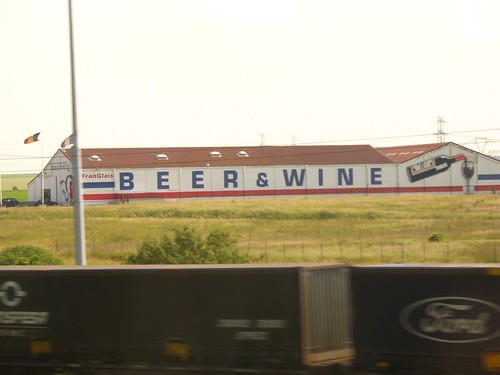
A Paris Métro ticket repurposed into street art:

Early evening outside the Gare de l'Est, Paris.

Gare de l'Est, Paris:
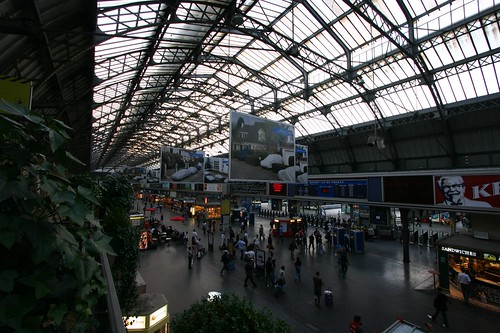
The sleeper train to Zürich, Gare de l'Est, Paris:
My compartment for the night on the Paris-Zürich sleeper (2nd class):
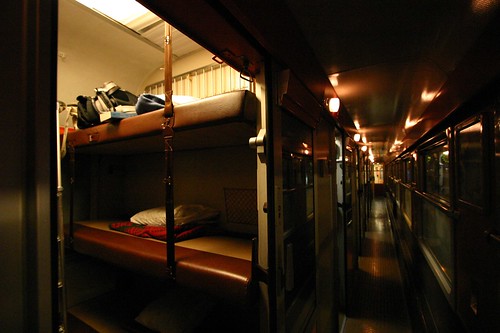
View from corridor of sleeper car rushing through France:
2006/4/28
 Your Humble Narrator is presently sitting aboard a train from London to Glasgow, in the first-class compartment. First class doesn't cost all that much when booked in advance, and has privileges, not least among them free wireless internet throughout the four-and-a-bit-hour journey. The quality of the internet access is mostly usable, though somewhat patchy; speed is, from memory, comparable with dialup, and long file transfers (such as Flickr photo uploads) sometimes time out; other than that, the service is quite usable. The other benefits of GNER first class are somewhat fewer than they were on Virgin: a GNER first-class ticket won't get you complimentary food other than biscuits, or any drinks other than tea, coffee or juice. The seats are comfortable, though, and the power points seem to work throughout the journey (on some other trains, I've found my laptop running off battery power an hour into the journey, despite being plugged in).
Shortly after 10 and some distance out of Peterborough, the train stopped in its tracks outside a perfectly unexceptional-looking town, replete with industrial estates, big-box shopping centre and, in the distance, a church spire holding court over Victorian semi-detached chimney pots. An announcement came on on the PA, saying that the train ahead of ours on the line had collided with "a herd of cows", and the estimated time of departure was unknown. Half an hour later, workers apparently finished removing bits of hamburger from the tracks and the unfortunate train ahead managed to limp into the next station, Newark North Gate, and so we got moving, with the guards announcing that we will be making an extra stop at the next station to pick up passengers from the stricken train. The train is expected to be an hour late pulling into Glasgow.
2006/3/30
A recent issue of The Times has a fairly detailed section on rail travel today; this section includes a survey of the state of European rail travel (summary: it's enjoying a renaissance, thanks to Eurostar and environmental consciousness, likely to improve further when cheap flights dry up, though ticketing still has some way to go before booking international rail journeys is as easy as booking flights), a section on travelling across Europe on Inter-Rail passes (along with four recommended European rail journeys to make with one's pass), as well as articles on train travel in Italy and India, shinkansen journeys in Japan, the backpacker-infested Trans-Siberian Express (whose 1-week journey time, the previous article notes, could be slashed to 18 hours if it was rebuilt using maglev technology soon to be deployed in Japan), as well as various luxury train journeys, such as the current holder of the "Orient Express" trademark (an opulent art-deco train journey from London to Verona), the Canadian Rockies and opulent Hungarian luxury trains. Also, Australia's Adelaide-Darwin rail link gets a writeup, getting rather mixed reviews (apparently the "Darwin" terminus 18km from the city centre is an afterthought, the carriages aren't quite as luxurious as one would believe, and the ride is bumpy; not to mention the fact that, catering only to tourists (it's too expensive for casual commuters) and having no stations along the way, it's "not quite a proper train" compared to others).
For anyone wanting more information on rail travel in various parts of the world, there's always The Man In Seat Sixty-One, a (somewhat UK-centric) one-stop information shop for rail buffs and travellers with an aversion to air travel.
2006/3/28
Apparently they're upgrading the Melbourne-Sydney XPT passenger rail service. I hadn't heard much about it for a while; I heard a rumour that it was to be scrapped because everybody was choosing, instead, to fly for half the price and 1/5 or so of the time. The last time I caught it (in December 2003), I recall that there were quite a few empty seats, and most of the patrons were elderly people, rural commuters and one rather drunk bikie.
The Victorian and NSW governments are investing A$35M into the XPT, which apparently buys a new lick of paint, new furnishing for all carriages, and better refreshment and toilet facilities. (And, given that there's nothing in the news report about it shaving a minute off the 11 or so hours that a one-way journey takes, that's probably a good thing.) I suspect that the upgrade won't include power points in seats/tables (as, say, Virgin Trains in the UK have), as pensioners and bikies in rural Australia generally don't carry laptops.
Anyway, it's good to hear that the XPT is not only still kicking around but actively being invested in. When the oil crunch comes and the cheap flights dry up, it'll undoubtedly come in handy.
2006/1/20
Rail fares in Britain are set to treble, as the Blair government plans to phase out cheap "saver" tickets, giving the privatised rail operators freedom to set their own fares. Rail fares in Britain are already staggeringly high compared to continental Europe, and have a hard time competing with flights; for example, the cheapest flight from London Heathrow to Manchester is £59 — less than £2 more than the equivalent Saver rail fare. Once Saver fares are abolished, the standard fare will be £202, and even people who prefer catching the train (for aesthetic or ecological reasons, for example) will be deterred from doing so. Could this be the end of rail travel in Britain?
2005/9/9
Drivers on a heritage steam railway in Somerset are fed up with having to stop their trains to clear the cremated remains of train buffs off the tracks:
At least eight mounds of ash, most accompanied by flowers, have been found on the track since the start of the summer. They are believed to be the mortal remains of steam enthusiasts whose last wish was to be laid to rest within earshot of a locomotive.The operators of the West Somerset Railway have offered train enthusiasts the more considerate alternative to have their ashes shovelled into the engine's firebox and puffed out of the funnel.
2005/6/10
What mobile-phone-related juvenile-delinquency fad could come after "happy slapping"? How about train-dodging, where kids use their camera phones to film themselves playing chicken with trains, and proving how hardc0re they are by staying on the track until the last possible minute, and then post the videos to dedicated train-dodging web sites. Of course, the hardest of the hardcore are the ones who don't jump out of the way like a big girl's blouse, instead choosing to become track chutney (and, rumour has it, extra-valuable video files for trading). Which seems even more Darwinian than the old-sk00l craze of train-surfing.
(And then, one imagines, there are probably those who combine train-dodging with gricing, filming themselves jumping out of the path of trains in the nude.)
(via districtdriver) ¶ 2
2004/12/31
Britain's railways are now carrying more people than at any time since 1959 (i.e., before the Beeching closures winnowed the railway network down), with more than 1 billion rail journeys made in 2004. Which is surprising, given that a train journey in Britain costs more than the equivalent journey by air where available (largely thanks to jet fuel and airline tickets being tax-free), not to mention trains being frequently late and having a reputation for breaking down. Though perhaps with all those commuters and travellers using the trains, there'll be more money for making the system more reliable.
2004/9/28
Apparently Lisa Gerrard's most recent film score is for the British gangster flick Layer Cake. I find it hard to imagine Lisa "Dead Can Dance" Gerrard doing a score for a British gangster flick, unless it's not at all a post-Ritchie brash-cockney-wideboy film and more along the lines of Beat Takeshi or something.
In other news, it looks like Pete Waterman's (of Stock/Aitken/Waterman fame) latest gig is presenting a BBC TV series about the history of Britain's railways.
2004/7/8
London mayor Ken Livingstone (who brought in the successful congestion charge on traffic in the city) has ambitions to radically extend the London rail/tube/tram network by 2016, to cope with the city's growing population (and, if you've ever used the Tube at rush hour, you'll know it needs it; either that or Japanese-style attendants at each station to physically push people into carriages). Here (PDF) is a map of what he proposes to do with it. It's somewhat of an ambit claim, and most of it probably won't happen, though some proposals have already been funded. Good to see more Tube lines going in south of the Thames, where people are at the mercy of National Rail and buses (and buses in outer London tend to be worse than the ones in Melbourne for punctuality). (Though what are those "Cross River/West London/East London Transit" lines, though; Tube lines, driverless DLR-style trains, or trams?) (via Owen)
One thing's for sure: this will make Mornington Games rather interesting.
Meanwhile, here in Melbourne, no such expansions of public transport are likely; with enough money being spent on bribing the private operators of the shambolically-run system not to pack up and leave, there's none left over for such pipe dreams. The Public Transport Users' Association agitate from time to time for a much-overdue railway line to Monash University (which was built on a paddock in the middle of nowhere in the 1960s on the proviso that a railway line would be extended to it; it never eventuated, and most of the students either cope with the woefully limited outer-suburban bus services or give up and buy decrepit old Kingswoods and Mazda 323s), or to Rowville (outer suburban sprawl where people grow up having no experience of public transport other than the next-to-useless bus services which stop at 7pm on weekdays), or the tram line to Knox City (which, IMHO, is next to useless; who'd sit on a tram for 3 hours to get to the city? Local tram routes linking outer suburban railway stations and interchanges (sort of like the Tramlink system in London's southern suburbs) would make more sense.) and their crackpot cousins in the Transport Victoria Association occasionally push for vital improvements, such as elevating the Melbourne to Geelong railway line 1km above the ground to attract more passengers with better views of the bay. Meanwhile, the government, aware that most of the swinging votes belong to people with 2.3 cars per household who want to be able to drive from A to B quickly, spend billions on freeways and occasionally throw a bone to public transport, such as extending six bus routes to 7:30pm on weekdays.
2003/11/16
Saboteurs derail Melbourne-Ballarat train with parked car on track; meanwhile, the latest extreme sport among Melbourne's mooks is throwing rocks at trams.
2003/8/16
Passengers on GNER trains, which run between London and Edinburgh, will soon have WiFi Internet access for passengers with laptops; that'll be convenient, for sure.
2003/5/31
A short article on trainspotting in the Graun. Interesting to see that American trainspotters call themselves "trainfans"; apparently the ones in Australia call themselves "gunzels", for some reason.
2003/3/7
An extensive unofficial fan site for the Pyongyang Metro, the underground railway system in the North Korean capital. (That's right, the last bastion of Stalinism (except perhaps for France, but only if you're a warblogger).) Here you will find photographs of colossal, and eerily empty, stations with massive propaganda murals and details (and recordings) of the propaganda music played in stations, as well as bits of political subterfuge (East German rail cars passed off as local) and details that could only exist in a tightly-run, ultra-paranoid totalitarian cult-state (for example, some stations being closed to the public because they're connected to presidential palaces, the military purposes of various underground lines, and hints at a second, secret Metro system known only to high government officials). Not to mention all the info about vehicles that any self-respecting trainspotter could want to know. (via bOING bOING)
2003/1/31
Horror train smash in NSW; 9 killed and many more injured as a peak-hour commuter train derailed between Sydney and Wollongong. And here we were thinking these sorts of things happened only in backward third-world countries like Egypt and England.
2003/1/12
An official investigation in Britain claims that commuting on trains is a health hazard, with the cumulative consequences of the stress of riding in overcrowded, unreliable trains resulting in high blood pressure, chronic anxiety and even fatal heart conditions for countless passengers. Britain's privatised trains are chronically overcrowded because it's cheaper for operators to pay overcrowding fines than to run longer trains.
Cary Cooper, professor of psychology and health at the University of Manchester Institute of Science and Technology, said: 'People develop a constant internal anger on crowded trains that they cannot easily displace.
'Then they hear that the train has stopped for 20 minutes for no apparent reason. If travel was cheap at least people could rationalise it.'
(Similar things could apply in Melbourne; especially with the new trams and trains which have fewer seats as to accommodate more standing passengers. Only here it's easier to drive everywhere, so everybody who can, does.)
2002/12/17
Transport roundup: Who would have thought that the RACV, best known for lobbying for cheaper petrol and more freeways, would be calling for tolls on traffic in inner Melbourne? A similar scheme is in place in Singapore, and one is also being introduced in London by Loony Left Red Ken. In other news, National Express abandons its Melbourne train operations, after failing to get more money from the government. Within a week, half of Melbourne's trains will be operated by the government (though will be likely to be flogged to the cheapest tender as soon as they can be).
Speaking of privatisation woes, over in Britain, the government plans to slash railway funding, which is likely to result in services being cut and fares put up to discourage use and keep a lid on overcrowding. Which will be a colossal shame; in Britain you can travel almost anywhere by train, and for all its troubles, the system is remarkably effective. If this happens, it will spiral into decline and ultimately be reduced into a boutique tourist experience for train buffs, sort of like the Ghan or that train in the Canadian Rockies.
2002/11/30
A British environmental thinktank says that high-speed trains should replace air travel on short-distance routes across Britain and Europe. Citing environmental damage caused by air travel, the Royal Commission on Environmental Pollution is calling for extra charges on air travel to represent the environmental cost, and a shift towards high-speed rail. Which all makes sense.
(Tangent: Which reminds me of something I read in the Guardian weekend magazine whilst in London; an ecological pundit in the UK (in Scotland, I believe) posited the idea that everybody should have a fixed annual number of carbon credits, which would be depleted whenever they used a car, rode a bus, used heating, &c., in proportion to the amount of fossil fuel used. To save the world from imminent doom, he argued, the allowance would need to be set so low that most people would only use cars in emergencies. Credits could be bought and sold, so poorer people could sell theirs, ride bicycles and wear thick jumpers, and the rich could buy enough to holiday in the tropics. True to form, the author of this proposal eschews travel to overseas conferences, sending addresses on cassette instead.)
(Tangent 2: Intercontinental rail will be a different issue altogether; I recall that the Russians were planning a rail tunnel from Siberia to Alaska some years ago, which would make it possible (if slow) to catch a train from London to New York.)
2001/12/18
Trainspotting: Melbourne's Spencer Street railway station, the city's main hub for rural and interstate trains, will be renamed to Southern Cross Station. Not quite as craven as renaming Museum to Melbourne Central (which is misleading, as it is not a central rail interchange, but was renamed as such because the owners of the Melbourne Central shopping centre bribed the government to do so), but still with a whiff of branding. Oh well; at least it's not "SouthernCross" or "Southcross(tm)" or some made-up word ending in "-nt".
Though I believe that when the station was originally built, in the 19th century, it was simply known as Melbourne. Perhaps reverting to its original name would have been more appropriate.
2001/10/8
Britain's Railtrack agency, which owns the nation's railways and infrastructure, has been placed into receivership. (Now could be an excellent opportunity for a forward-looking cartel of oil companies, car manufacturers and bus operators to buy up what remains of it and tear up the train lines, much as happened with the Los Angeles tramway system in the 1940s.)
2001/10/2
They're now talking about electrifying the Melbourne-Geelong railway, with a view to integrating Geelong into the Melbourne suburban railway network. Sounds like a good idea (something like what they have in NSW, with electric commuter trains running all the way to Newcastle and Wollongong, would be good.)
2001/6/6
A few years after privatisation, the Melbourne railway system is going British, with a rather nasty train crash happening near Footscray. Fortunately nobody died; probably because electric trains don't generally burst into flames.
2001/6/1
The Victorian government is talking with private contractors about procuring 160kph trains for high-speed rail links to regional centres. On the surface, this looks like a good thing; though the PTUA (that bunch of ratbags) did warn that high-speed trains could mean the closure of smaller railway stations between urban centres, and ultimately could lead to the degeneration of passenger rail to a US-style commuter rail system, running only at peak hours to shuttle workers between dormitory cities and their workplaces.
2001/5/11
The Victorian government is reopening four passenger railway lines closed in the early 1990s. The Ararat, Bairnsdale, South Gippsland and Mildura passenger railway will be reopened within 3 years, with services run by private operators. Not surprisingly, three of the reopened lines are in the electorates of independent MPs who hold the balance of power. (Still, decent passenger rail coverage is a Good Thing, IMHO.)
2001/4/10
Trainspotting: They're electrifying the railway line to Sydenham, out beyond St Albans; apparently some locals at St Albans are threatening to block trains if the proposed alterations go ahead and a lot more trains pass through the crossing, unless the whole thing is put underground. Hmmm... according to this map, there is also a "proposed" extension of the Epping line (which once ran all the way to Whittlesea) to South Morang. (Wonder if the diesel locomotives which pass outside where I live every Thursday night have anything to do with this...)

2001/1/21
Speaking of historical railway maps, here is an archive of maps of the Victorian Railways network, by decade. Fascinating; now I know that the Fitzroy line closed sometime in the 1980s, and the branch line to East Kew (which once linked Oakleigh to Fairfield or somesuch, around 100 years ago; not to be confused with the Kew one) was closed in the 1950s sometime. Though there is no trace of the rumoured railway line which ran from Elsternwick to Oakleigh or somewhere like that.
(I have been interested in historical maps for some time; since I started looking through a 1970s-vintage Melway street directory which had belonged to my late stepfather, probably from back when he was a features editor at the Herald. Unfortunately, this book has since been lost, some time before when I became curious about the dismantled railway lines of Melbourne.)
2001/1/3
Officials in Russia are planning to build a rail tunnel from Siberia to Alaska, with the aim of connecting Russia's rail network to North America. If they have passenger trains, it should be an interesting journey. The project is in its early stages; meanwhile a project to build a similar tunnel between Japan and the Russian mainland is due to begin this year.
2000/10/10
Life, liberty and the pursuit of bootywhang: Reading on the train can get you laid. (Coding Python on a battered-looking laptop, though, probably won't.)
2000/5/11
Sydney now has a new railway line to its airport -- an idea whose time has come? (Though not seemingly in public-transport-deficient Melbourne.)