The Null Device
Posts matching tags 'china'
2015/10/26
The Lego company has placed a worldwide ban on sales of bricks to the artist Ai Weiwei, on the grounds that they “cannot approve the use of Legos for political works”. Ai was planning to use the Lego bricks for an exhibit at his upcoming exhibition in Melbourne. The nature of the exhibit is not known, other than it was to concern free speech, though it could have upset officials in the Chinese government, and thus threatened Lego's profits in that billion-strong market. And so, a company from ultra-liberal Denmark, and one which has sponsored public art projects with no political censorship there, helps China export the Confucian-Communist authoritarian ideal of “harmony” to the democratic world, all guided by the profit motive.
After the news went out, Ai has received numerous offers of Lego bricks from private individuals, and has confirmed that he will proceed with voluntary donations of bricks.
So one could conclude that Lego have lost this one; an attempt to discreetly neutralise a liability having instead Streisanded them spectacularly, revealing the bastion of Scandinavian liberalism to be willing to kowtow to dictatorships in the pursuit of profits? Yes and no (though, in reality, mostly no). While Ai gets to complete his work, and a few leftists, liberals and civil libertarians (as opposed to the more common uncivil variety, to whom the freedom to pursue profit is supreme) may vow to not buy another Lego brick as long as they live, realistically that stands to hurt their bottom line about as much as the 30-year baby-milk boycott against Nestlé; i.e., not at all; and even if it did, the prospect of increased profits from the vast Chinese market (which would otherwise have gone to numerous knock-off brands) Lego can expect as a reward for its loyalty to the Chinese Communist Party will more than compensate for any loss of prestige among the small number of people in the west still inclined to vote with their wallets.
The moral of this story is that the Reaganite ideal of trade and free markets dissolving dictatorships and spreading liberalism and democracy in their wake is a non-starter when the most powerful players in the market are profoundly anti-liberal dictatorships (of which China is one; another one is Saudi Arabia, recently elected to chair the UN Human Rights Council (with, it turns out, the discreet lobbying efforts of countries like the UK behind it), and about to crucify a young man for blasphemy; Saudi Arabia's major initiative in human rights to now has been to push for the global criminalisation of the insulting of religion).
2014/12/9
This past weekend, I finally managed to make my way down to Blenheim Palace to see the Ai Weiwei exhibition; it was well worth going.
Ai Weiwei is best known these days as a thorn in the side of the Chinese government; having used his artistic practice to critique everything from China's territorial claims to corrupt officials' complicity in shoddy building practices (which claimed the lives of dozens of pupils when a school collapsed in an earthquake), and other provocations (such as the destruction of Ming vases in the name of questioning the nature of authenticity) have not won him any sympathy among China's more conservative politicians. For this reason, he remains under house arrest. Nonetheless, although he has not been allowed to travel abroad, he has managed to be intimately involved in the planning of his exhibitions outside China, working with the curators over the internet.
Ai's artistic practice as we know it took form in New York, where he lived for a decade from 1983. His earlier works were in the readymade tradition pioneered by Marcel Duchamp; found or mass-manufactured objects repurposed into statements (such as two raincoats buttoned together on a coat rack, a statement on the AIDS epidemic of the 1980s). His move back to China in 1993, and engagement with the rapidly changing society in the age of Deng Xiaoping's market reforms, provided a cornucopia of new subjects for his work.
Ai's conceptual tactics have often been subtly mischievous;
 he might take an object and transform it (such as glazing a Ming vase in automotive lacquer, destroying its value as an antiquity but transforming it into a statement about modernisation), or replicate it from an incongruous material (replicas of surveillance cameras and gas masks, carved out of expensive marble),
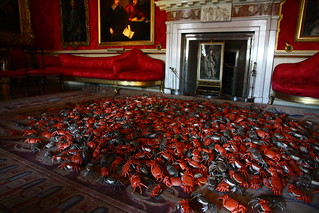
or, occasionally, relying on the sorts of subversive wordplay the Chinese government's not too fond of these days (He Xie, a collection of hundreds of porcelain crabs, alludes to the Chinese term for “river crab” being homophonous with “harmony”, the standard government euphemism for censorship and suppression of dissent).
he might take an object and transform it (such as glazing a Ming vase in automotive lacquer, destroying its value as an antiquity but transforming it into a statement about modernisation), or replicate it from an incongruous material (replicas of surveillance cameras and gas masks, carved out of expensive marble),
or, occasionally, relying on the sorts of subversive wordplay the Chinese government's not too fond of these days (He Xie, a collection of hundreds of porcelain crabs, alludes to the Chinese term for “river crab” being homophonous with “harmony”, the standard government euphemism for censorship and suppression of dissent).
In the Blenheim Palace show, the subtlety is taken to a new level. Whereas in an ordinary exhibition, one might expect the exhibits to be arrayed in a well-defined space, its boundaries defining what is and isn't in the exhibition, this exhibition does us no such favours; instead, Ai's works are placed in various locations in the palace, juxtaposed with the rich assortment of its existing contents. In the bedchamber where Winston Churchill was born, a pair of handcuffs carved out of wood lies, perhaps suggestively, on the quilt; on the ornately papered wall behind the bed, a simple wooden frame containing a human profile made from a bent coathanger takes its place next to landscapes painted in oils. Two Ming vases emblazoned with the word “Caonima”, in the style of the Coca-Cola logo, stand on an antique marble table.
 A rug in a drawing room is covered with the aforementioned ceramic river crabs, and in an adjacent room stands a cluster of traditional Chinese stools, taken from peasant houses, and stuck together into a shape not unlike a large chestnut. Under the oil paintings in a state room, two chairs carved of uncomfortable-looking marble stand opposite from two antique seats, and in the Long Library, the walls are hung with photographs from Ai's Study of Perspective series, of the artist's hand making a rude gesture at various world landmarks; at the other end, a blind marble security camera watches the scene. (During the day, adding to the incongruity, a small orchestra was playing Christmas carols in the middle of the scene.) The palace's chapel is home to a large cube, made as if of steel pipes replicated in traditionally patterned porcelain. More subtle interlopers are stowed in various places: traditionally patterned porcelain owl houses (an absurd, yet almost plausible, object) stnd in the Great Hall, and a porcelain watermelon beside a seat almost blends into the rich ostentation of the palace's contents. Outside are yet more objects, from ceramic spheres in a park to fake oil slicks, made from porcelain, under a tree in the Secret Garden. The overall effect is to make one suspicious of everything around one: is this one of the Duke of Marlborough's heirlooms or a subtle subversion deftly inserted by a mischievous artist half a world away?
Alas, this exhibition closes this coming Saturday, so those wishing to see it must hurry. However, it should be worth it.
2013/6/4
As the anniversary of the Tienanmen Square massacre/counterrevolutionary criminal riot (delete as appropriate) comes around, the game of cat and mouse between Chinese censors and dissidents have escalated to new heights of the absurd:
24 years after the Chinese government's bloody crackdown on pro-democracy protesters in Tiananmen Square, "today" is part of a long list of search terms that have been censored on Sina Weibo, the country's most popular microblog. Other banned words include "tomorrow," "that year," "special day," and many number combinations that could refer to 4 June 1989, such as 6-4, 64, 63+1, 65-1, and 35 (shorthand for May 35th).
Many of their posts have been embedded in pictures, which can often elude automatic detection: a girl with her hand over her mouth; a Lego man facing down three green Lego tanks; the iconic "tank man" picture with its tanks photoshopped into four giant rubber ducks, a reference to a well-known art installation in Hong Kong's Victoria harbour. Most of these pictures, too, have since been scrubbed clean. By Tuesday afternoon, the term "big yellow duck" had also been blocked.And so, the fourth of June becomes The Day The Internet Breaks For No Reason Whatsoever.
Last week, Sina Weibo appeared to have rolled out a new censorship function – searches for "Tiananmen incident" and "six-four incident" were not blocked, but instead pulled up posts about other historical events, such as a 1976 demonstration in Tiananmen Square mourning the death of Premier Zhou Enlai.Meanwhile, many dissidents are protesting precisely by posting nothing at all. Perhaps next year the authorities get wise to this and leaving a suspicious, indignant block of white space in one's online footprint on a sensitive date will be forbidden, with those doing so without a good excuse being taken away and prosecuted on various grounds. Perhaps in a few years' time, we will be treated to the spectacle of totalitarian censors trying to suppress an act of dissent by large numbers of people posting the same banal, apolitical message about the weather/what one had for lunch in mockery of the law or something?
2013/1/21
A software developer in the US has taken outsourcing into his own hands, by hiring a company in China to do his job for less than ¹⁄₅ of his salary:
"This organisation had been slowly moving toward a more telecommuting oriented workforce, and they had therefore started to allow their developers to work from home on certain days. In order to accomplish this, they'd set up a fairly standard VPN concentrator approximately two years prior to our receiving their call," he was quoted as saying on an internet security website.
"Authentication was no problem. He physically FedExed his RSA [security] token to China so that the third-party contractor could log-in under his credentials during the workday. It would appear that he was working an average nine-to-five work day," he added.The unnamed developer is said to have come physically into work but spent the time surfing eBay, Facebook and Reddit and watching cat videos on YouTube for the standard eight hours a day, which somewhat defeats the purpose of his hack. Then again, the report also suggests that he was simultaneously employed at several other companies, and similarly subcontracting his duties there to Shenyang.
The Daily Torygraph's Dr. Tim Stanley has hailed the developer as an exemplar of capitalism at its best:
For not only is Bob a modern hero to the terminally bored office worker, he’s also invented a whole new way of making capitalism work. If big companies can outsource labour to save money, why the heck can’t the little man do exactly the same?His employer, Verizon, didn't agree, and sacked him.
A recent popular self-help book, The Four Hour Work Week by Tim Ferriss, advocated doing the same sort of thing, converting oneself into middleware binding together disparate subcontractors and charging a premium for doing so, though advised the reader to first arrange to be able to work from home. And there are reports of enterprising hackers having done similar things as early as 2004.
On a similar tangent, Britain's sense of moral indignation has also been outsourced to China, and is being handled by “a permanently outraged man working 96-hour shifts” just outside of Beijing:
The outrage outsourcing was first noticed when a Rod Liddle was accidentally printed in its original Mandarin.
2012/12/29
The Zuckerberg Doctrine has its fans: in the Chinese Communist Party:
China passed rules yesterday requiring people to identify themselves when signing up for Internet and phone services, as the Communist Party tightens control over the world’s largest population of web users.
Under the law, people must give their real names when they sign up for Internet, fixed-phone-line or mobile-phone services. Providers must also require people’s names when allowing them to post information publicly, it said.Meanwhile, an Oregon woman found a note from a Chinese labour camp inmate in a package of Halloween decorations:
Oregon resident Julie Keith was shocked when she opened her $29.99 Kmart Halloween graveyard decoration kit to find a letter, folded into eights, hidden between two Styrofoam tombstones.
Coming all the way from unit 8, department 2 of the Masanjia Labor Camp in Shenyang, China, the letter written mostly in English read, "Sir: If you occasionally buy this product, please kindly resend this letter to the World Human Right Organization. Thousands people here who are under the persicution of the Chinese Communist Party Government will thank and remember you forever."
2012/11/3
A look at China's emerging youth counter-culture, the wenyi qingnian (文艺青年), or “cultured youth”, a term which is roughly cognate with the English word “hipster”:
Like hipsters, wenqing stridently resist labeling themselves as such. The term “cultured youth” can divide Chinese audiences, alternately attracting admiration or derision. A perfect example recently emerged on Sina Weibo, one of China’s popular microblogging sites, with this post entitled, “Photos of Shanghai ‘cultured youth’ girls aboard a subway reading poetry.”One difference between the wenqing and stereotypical hipsters in the West is their sincere passion for their countercultural pursuits and values outside the mainstream of material status; not having lived through the betrayals and commodifications of subcultures from the hippies to the punks and beyond, they have not developed an armour of ironic detachment and nihilistic apathy. That, however, is the preserve of a different Chinese youth counterculture, the “2B qingnian” (二逼青年), or “dumbass youth”, who appear to be more like Nathan Barley-esque nihilistic pisstakers:
By contrast, China’s wonderfully sincere “cultured youth” lack the irony and apathy integral to hipsterism, characteristics which nonetheless can be found in China’s “2B youth.” These are young men and women who have nothing much going on in their lives (or, in some cases, their heads). As the photo collage suggests, “2B”ers like to engage in pointless and deliberately self-defeating behavior, all, it sometimes seems, for nothing more than the “lulz.”Note the graphic at the bottom of the page, which shows a range of activities performed in the normal, Cultured and Dumbass styles.
Or, in perhaps more appositely Marxist terms, the wenqing repudiate economic capital for cultural capital, whereas the 2Bs reject cultural capital as futile and mock it. Which suggests that, were one to shoehorn Chinese countercultures into American terms, the wenqing are a counterculture with the dynamics of, say, the Beats, though using the technology and symbols of the global late-capitalist hipster, while the 2Bs are (perhaps precociously) grasping at the nihilism of 1990s grunge slackers, anticipating that it will all turn to shit.
2012/6/6
In China, where the government asserts total control over public discourse, certain topics are forbidden, among them is the Tienanmen Square massacre of pro-democracy protesters on 4 June 1989. The government has done its best to expunge the event from the national memory, something which has become increasingly challenging as the population has embraced (a filtered version of) the internet. So the national firewall is programmed to expunge certain keywords, and armies of censors scour message boards looking for offending content. Every year, as the anniversary approaches, the censorship is ramped up to levels bordering on the absurd:
And so all day today users in China got bizarre replies from their search engines. “According to the relevant laws and policies, the results of your search ‘89’ cannot be displayed,” was the head-shaker I just read on my own screen. Typing “Tiananmen Square” – in English or Chinese – gets the same answer on the popular Sina Weibo site, which boasts over 300 million users. Pity the poor tourist just trying to find the plaza in the middle of the Chinese capital.
(The sina.com and baidu.com search engines allows don’t bar the terms, but only return politically approved material, such as a China Daily article headlined “Tiananmen Square massacre a myth.") Chinese Internet users are a wily bunch. Last year, they briefly evaded censors by referring to the date of the crackdown as “May 35th” rather than June 4th, a move that forced the conversation-killers to ban a non-existent date this year.The censors' crusade against remembrance has extended to temporarily banning websites which allow visitors to light a virtual candle for the deceased, on the off-chance that one may be doing so as part of a forbidden protest. Other than prominently highlighting the forbidden date, a date on which nothing is allowed to have happened, this has also claimed collateral damage, such as anyone else anyone may innocently wish to memorialise close to such a sensitive date:
All weekend long, tributes piled up on the Weibo page of Lin Jun, the 33-year-old from Hubei province who was brutally murdered and dismembered in Montreal late last month. By Sunday night, there were more than 20,000 comments on Mr. Lin’s page. Many users, at a loss for words, had simply posted the candle emoticon in simple tribute. But today, the censors’ new rules had marred even something so moving and apolitical as the public outpouring for Mr. Lin (while letting the anti-gay slurs posted by a hateful minority remain on his site). Where once there had been rows of flickering orange candles on Mr. Lin’s Weibo page, there now read the somewhat less moving “[candle][candle][candle][candle][candle].”The Chinese government's censorship system also ended up blocking the Shanghai stock exchange after a drop in the Shanghai Composite Index (64.89) matched the forbidden date.
Meanwhile, Chinese social-media site Sina Weibo is trialling a new social credit rating system:
Sina Weibo users each will now receive 80 points to begin with, and this can be boosted to a full 100 points by those who provide their official government-issued identification numbers (like Social Security numbers in the U.S.) and link to a cellphone account. Spreading falsehoods will lead to deductions in points, among other penalties. Spreading an untruth to 100 other users will result in a deduction of two points. Spreading it to 100-1,000 other users will result in a deduction of five points, as well as a week's suspension of the account. Spreading it to more than 1,000 other users will result in a deduction of 10 points, as well as a 15-day suspension of the account. Once the point total falls below 60, the user is flagged as "low-credit." A loss of all points will result in an account's closure.The definition of “falsehood” includes “nonconforming” or false images, claiming that problems which have officially been resolved are ongoing or giving “incomplete or hidden information”.
2011/12/31
A few random odds and ends which, for one reason or another, didn't make it into blog posts in 2011:
- Artificial intelligence pioneer John McCarthy died this year; though before he did, he wrote up a piece on the sustainability of progress. The gist of it is that he contended that progress is both sustainable and desirable, for at least the next billion years, with resource limitations being largely illusory.
- As China's economy grows, dishonest entrepreneurs are coming up with increasingly novel and bizarre ways of adulterating food:
In May, a Shanghai woman who had left uncooked pork on her kitchen table woke up in the middle of the night and noticed that the meat was emitting a blue light, like something out of a science fiction movie. Experts pointed to phosphorescent bacteria, blamed for another case of glow-in-the-dark pork last year. Farmers in eastern Jiangsu province complained to state media last month that their watermelons had exploded "like landmines" after they mistakenly applied too much growth hormone in hopes of increasing their size.
Until recently, directions were circulating on the Internet about how to make fake eggs out of a gelatinous compound comprised mostly of sodium alginate, which is then poured into a shell made out of calcium carbonate. Companies marketing the kits promised that you could make a fake egg for one-quarter the price of a real one.
- The street finds its own uses for things, and places develop local specialisations and industries: the Romanian town of Râmnicu Vâlcea has become a global centre of expertise in online scams, with industries arising to bilk the world's endless supply of marks, and to keep the successful scammers in luxury goods:
The streets are lined with gleaming storefronts—leather accessories, Italian fashions—serving a demand fueled by illegal income. Near the mall is a nightclub, now closed by police because its backers were shady. New construction grinds ahead on nearly every block. But what really stands out in Râmnicu Vâlcea are the money transfer offices. At least two dozen Western Union locations lie within a four-block area downtown, the company’s black-and-yellow signs proliferating like the Starbucks mermaid circa 2003.
It’s not so different from the forces that turn a neighborhood into, say, New York’s fashion district or the aerospace hub in southern California. “To the extent that some expertise is required, friends and family members of the original entrepreneurs are more likely to have access to those resources than would-be criminals in an isolated location,” says Michael Macy, a Cornell University sociologist who studies social networks. “There may also be local political resources that provide a degree of protection.”
- Monty Python's Terry Jones says that The Life Of Brian could not be made now, as it would be too risky in today's climate of an increasingly strident religiosity exercising its right to take offense:
The 69-year-old said: "I took the view it wasn't blasphemous. It was heretical because it criticised the structure of the church and the way it interpreted the Gospels. At the time religion seemed to be on the back burner and it felt like kicking a dead donkey. It has come back with a vengeance and we'd think twice about making it now."
- The Torygraph's Charles Moore: I'm starting to think that the Left might actually be right:
And when the banks that look after our money take it away, lose it and then, because of government guarantee, are not punished themselves, something much worse happens. It turns out – as the Left always claims – that a system purporting to advance the many has been perverted in order to enrich the few. The global banking system is an adventure playground for the participants, complete with spongy, health-and-safety approved flooring so that they bounce when they fall off. The role of the rest of us is simply to pay.
- The sketchbooks of Susan Kare, the artist who designed the icons, bitmaps and fonts for the original Macintosh, and went on to an illustrious career as a pixel artist (Microsoft hired her to do the Windows 3.x icons, and some years ago, Facebook hired her to design the virtual "gifts" you could buy for friends.) The sketchbooks show her original Macintosh icons, which were drawn by hand on graph paper (because, of course, they didn't have GUI tools for making icons back then).
- How To Steal Like An Artist: advice for those who wish to do creative work.
- The street finds its own uses for things (2): with the rise of the Arduino board (a low-cost, hackable microcontroller usable for basically anything electronic you might want to program), anyone can now make their own self-piloting drone aircraft out of a radio-controlled plane. And it isn't actually illegal in itself (at least in the US; YMMV).
- An answer to the question of why U2 are so popular.
2011/12/25
The Forbidden Railway: the story of an unescorted journey by train from Vienna, through Russia, and to North Korea over a route officially off limits to tourists, by two rail travel enthusiasts—one Austrian and one Swiss. Includes plenty of photographs and details about the journey and the places encountered.
2011/11/15
Russian Prime Minister and President-in-waiting Vladimir Putin has been awarded the Confucian Peace Prize, created by the Chinese government to "promote world peace from an eastern perspective", beating a field of other candidates, including Bill Gates, Angela Merkel and a Beijing-appointed Tibetan Panchen Lama:
The 16-judge panel said that Putin deserved the award because his criticism of Nato's military engagement in Libya was "outstanding in keeping world peace", regardless of the fact that it had no bearing on the outcome of the north African conflict.
The Chinese organisers claimed they established the award last year after preparing for years to create something that would "promote world peace from an eastern perspective". But the Confucian peace prize appeared more like a rushed and botched attempt to upstage the Nobel laureate status granted to jailed Chinese dissident Liu Xiaobo.
2011/11/5
In rural China, women traditionally had little status; however, they did have their own secret language, which they used to maintain support networks:
After having their feet bound at around the age of seven, girls in Jiangyong County in Hunan province would live indoors – first in the "women's chamber" of their own homes, and later in the homes of their husband's family. To ease their isolation and offer support in their pain, girls from the same village were brought together as "sworn sisters" until their weddings. But a more serious relationship, almost akin to marriage and expected to last for life, could be arranged between two girls by a matchmaker, with a formal contract, if the pair shared enough of the same "characters" (being born on the same day, for example). In See's book she writes: "A laotong relationship is made by choice for the purpose of emotional companionship and eternal fidelity. A marriage is not made by choice and has only one purpose — to have sons."
Women used Nushu – a script unique to the area – to write to their laotongs after they "married out" into different villages. Yet until the 1960s few outside the province knew about it, and no men could read it, says See. "In the mid-60s an old woman fainted in a station," she says. "The police went through her things to see who she was and found a piece of paper with what looked like a code, so she was arrested on suspicion of being a spy."
2011/6/17
Thames Town is a near-perfect replica of a model English market town, located 30 kilometres from Shanghai, replete with nonfunctional shops (peeling letters on the door of "Mike's Records" offer a selection of "blue soul" and "world music"), a pew-less stone church, red phone booths, areas with names like "Austen Garden", "Soho Area" and "Old Town Square", and more mock-Tudor timber framing than you could shake a stick at. It built over the past decade (along with eight other themed towns, including American, German, Italian and Swedish ones), and intended to accommodate 10,000 inhabitants. Unfortunately for its developers, living in a shanzhai little England didn't prove as popular as anticipated, and next to nobody actually lives there. The only industry currently thriving in Thames Town is wedding photography. (Though if they ever decide to do another remake of The Prisoner, perhaps they could film it there.) There is a photo set from Thames Town here.
2011/5/25
Prison administrators in China have found a new use for prison labour: putting inmates to work in multiplayer video games, generating in-game gold, which is then sold online for real money:
Liu says he was one of scores of prisoners forced to play online games to build up credits that prison guards would then trade for real money. The 54-year-old, a former prison guard who was jailed for three years in 2004 for "illegally petitioning" the central government about corruption in his hometown, reckons the operation was even more lucrative than the physical labour that prisoners were also forced to do.
"Prison bosses make more money forcing inmates to play games than they do forcing people to do manual labour," Liu told the Guardian. "There were 300 prisoners forced to play games. We worked 12-hour shifts in the camp. I heard them say they could earn 5,000-6,000rmb [£470-570] a day. We didn't see any of the money. The computers were never turned off."
2011/5/1
Shortly before the Royal Wedding, Facebook shut down the groups of 50 UK-based protest groups, most of them not specifically anti-royalist. These groups included anti-corporate-tax-avoidance group UK Uncut, anti-cuts and pro-NHS protesters, and the Green Party, as well as socialist and anarchist groups. Facebook says that the groups were using fake personal accounts, rather than pages, in violation of the terms of service. However, to nuke them, immediately prior to a "national security event" and suspension of civil liberties, without any warning being given, does look somewhat suspicious.
I wonder what really happened there. Does Her Majesty's Government have in its arsenal a D-notice-style order to secretly oblige internet services operating in the UK to deny services to suspicious persons, and also deny the existence of the order? Has Prince Charles escalated his personal interventions in affairs of state from sacking modernist architects to calling up internet companies and getting protest groups silenced? Or is this a strategic decision by Facebook, a company which reportedly has its eye on the vast Chinese market, demonstrating to the Chinese Communist Party that it is extremely comfortable about enforcing "harmony" on its platform?
Meanwhile, Cory Doctorow argues that activists should avoid Facebook, because the system (a) gives one no democratic rights that cannot be arbitrarily taken away if it suits the powers that be to do so, and (b) is a surveillance system which gives the authorities lists of suspicious persons who have communicated with other troublemakers. It strikes me that if the world's activists take this advice, then these actions will have done to their causes the same sort of damage Wikileaks sought to do to the authoritarian conspiracy Julian Assange wrote about seeking to stop: by increasing the risks of organising in public, forcing them to fragment into small, secretive cells, with a greatly reduced organisational capacity.
2011/4/27
A musician on the Isle of Wight was arrested for racial harrassment after playing the 1970s hit Kung Fu Fighting in front of a Chinese mother and son. He denies deliberately playing the song at them, and says that he was already playing it before they entered and took offence. Does this mean that the Oriental Riff is now considered musical hate speech, the melodic equivalent of a racist epithet?
2011/3/29
A study by the Royal Society claims that China is on track to overtake the US in scientific output by 2013. The USA's lead in Creation Science, however, is expected to be safe.
2011/2/22
A group of hikers from China travel to the US to hike the Appalachian Trail, are unimpressed with how easy everything is:
Ever since entering Great Smoky Mountains National Park, my Chinese comrades and I have progressively lost respect for this manicured "wilderness" in the Appalachian Range. It's nothing like the random challenges of the mountains back home, where trails are maintained only to the extent that local peasants find them useful. Here the trail is in such perfect condition that I feel like giving it a tip. There are signposts everywhere, and the maps are a revelation: in China, I'm sure only the army and Taiwanese spies could hope to have anything so detailed, and I'm willing to bet that the Chinese People's Liberation Army hasn't started marking the locations of toilets yet.
The college-age hikers on the AT don't seem much different from the young hikers we see at home. In this globalized world, their lives and careers follow quite similar paths, despite the distance between our countries. But these older people are nothing like their Chinese contemporaries. It's unthinkable that our parents would strap on ultralight packs and head for the hills. It's not in their culture. "When will there be Chinese old people doing something like this?" I wonder. Builder considers briefly. His answer is short, surely correct, and vaguely distressing. "When we're old," he says.
2011/1/30
China is planning to create the world's largest city, by amalgamating nine cities in the Pearl River Delta (i.e., just inland from Hong Kong), including Guanzhou and the manufacturing hub of Shenzhen into a conurbation twice the size of Wales and home to 42 million people (i.e., about twice as many as Australia). The new megalopolis has not yet been named.
Or maybe it isn't; a Communist Party spokesman has denied any such plans existed.
2010/12/21
China has launched its own homebrew Twitter clone. It's named Red Microblog, run by a regional propaganda department, and by all accounts, is the place to go if you have some rousing Maoist revolutionary sentiment to share:
"I really like the words by Chairman Mao [Zedong] that 'The world is ours; we should work together'," one of Mr Bo's messages read. Other messages on the home page included: "Work hard, be honest and treat others well", "There is no sky larger than the hand, no road longer than the feet, no mountain higher than the people, no sea wider than the heart", and "Those who go with the flow are forever going up and down in the waves; only those who go against the wind fearing no hardship, can reach the other side fast."
A statement on the site said the launch had been in response to a call from Li Changchun, China's Propaganda chief, for local governments to master new media.
2010/11/18
According to a US government report, for 18 minutes in April, 15% of global internet traffic was rerouted through a state-owned ISP in China. The report strongly hints that this may have been no accident, but a deliberate attempt by the Chinese government to capture and analyse internet traffic between entities in the US or elsewhere.
Dmitri Alperovitch, a threat research analyst at internet security firm McAfee, said the capture "is one of the biggest – if not the biggest hijacks – we have ever seen". "No one except China Telecom operators" know what happened to the traffic during those 18 minutes, Alperovitch added. "The possibilities are numerous and troubling, but definitive answers are unknown."The Chinese government has denied the allegations. Of course, it could be just a router malfunction or operator error. (Sometimes sinister-looking things turn out to be just randomness: princesses die in stupid car crashes, presidents' heads spontaneously explode in motorcades, that sort of thing. )
Meanwhile, further analysis of the Stuxnet malware (which, it was previously speculated, was designed to attack Iran's nuclear enrichment programme, possibly by the Israeli Mossad) have shown that its payload was designed to subtly degrade the quality of enriched uranium coming from centrifuges:
According to Symantec, Stuxnet targets specific frequency-converter drives — power supplies used to control the speed of a device, such as a motor. The malware intercepts commands sent to the drives from the Siemens SCADA software, and replaces them with malicious commands to control the speed of a device, varying it wildly, but intermittently.
The malware, however, doesn’t sabotage just any frequency converter. It inventories a plant’s network and only springs to life if the plant has at least 33 frequency converter drives made by Fararo Paya in Teheran, Iran, or by the Finland-based Vacon.
Even more specifically, Stuxnet targets only frequency drives from these two companies that are running at high speeds — between 807 Hz and 1210 Hz. Such high speeds are used only for select applications. Symantec is careful not to say definitively that Stuxnet was targeting a nuclear facility, but notes that “frequency converter drives that output over 600 Hz are regulated for export in the United States by the Nuclear Regulatory Commission as they can be used for uranium enrichment.”
2010/11/11
Norway may now be paying the price for granting the Nobel Peace Prize to Chinese dissident (or enemy of the people, if you prefer) Liu Xiaobo; first an invitation for Norway's Eurovision-winning singer Alexander Rybak was withdrawn, and then, Norway's entrant in the Miss World beauty contest, held on Hainan Island, failed to place among the top five finalists, despite having been tipped as the odds-on favourite to win.
The Norwegian newspaper Dagbladet reported the opera's composer Thomas Stanghelle said the Chinese claimed it "wasn't possible" for them to co-operate with Norway or Norwegian artists at present. He said the reason given for the cancellation was that China wants to punish Norway over the awarding of the Peace Prize to Chinese dissident Liu Xiaobo."
2010/11/5
Elaborate disguise of the day: a young Hong Kong Chinese man boarded an Air Canada flight to Vancouver disguised as an elderly Caucasian man, by virtue of a latex mask:
The man changed out of the silicone mask during the flight, and was arrested on arrival in Canada; he has claimed refugee status.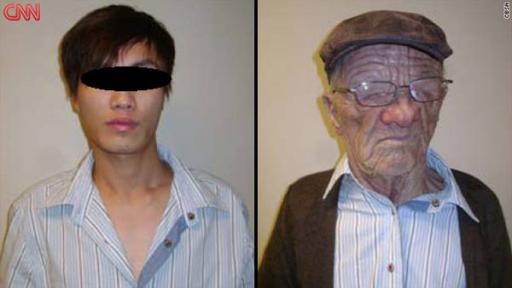
The mask in question may be purchased from here, for US$689; it's said to be in low stock due to "extremely high demand".
2010/10/25
The Chinese Communist Party organ, the People's Daily, has reviewed Apple's iPad, and found it wanting:
“There are many disadvantages” to the gadgets, it wrote. “For example you cannot install pirate software on them, you cannot download [free] music, and you need to pay for movies you watch on them.”While this is more about the acceptance of copying in China, a country where privately-held intellectual property is the exception rather than the rule, it is still somewhat ironic to see a totalitarian regime criticise Apple for being too locked down.
2010/10/4
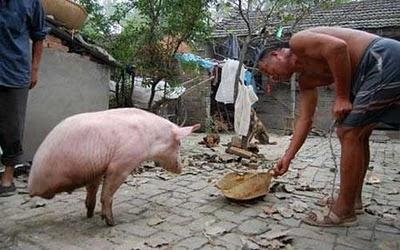
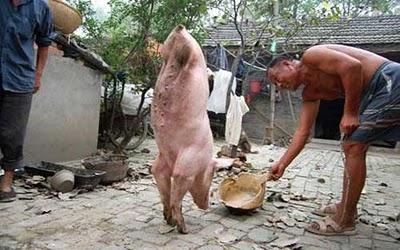
When life gives you lemons, make lemonade. When life, however, gives you a two-legged piglet, do what Wang Xihai did and train it to walk balletically:
2010/8/20
In China's Shangdong province, life imitates art. More precisely, the operators of a public park there, faced with overcrowding, installed coin-operated park benches with retractable anti-sitting spikes, inspired by an artistic installation critiquing the user-pays ethos:
"He thought he was exaggerating. He didn't foresee that a very practical country like China might actually use them for real," said one critic.
2010/6/21
Chinese companies looking to make an impression are now hiring random white guys to put on suits and play the parts of American/European business contacts:
Not long ago I was offered work as a quality-control expert with an American company in China I’d never heard of. No experience necessary—which was good, because I had none. I’d be paid $1,000 for a week, put up in a fancy hotel, and wined and dined in Dongying, an industrial city in Shandong province I’d also never heard of. The only requirements were a fair complexion and a suit.
“I call these things ‘White Guy in a Tie’ events,” a Canadian friend of a friend named Jake told me during the recruitment pitch he gave me in Beijing, where I live. “Basically, you put on a suit, shake some hands, and make some money. We’ll be in ‘quality control,’ but nobody’s gonna be doing any quality control. You in?”
2010/6/18
Chopsticks At Dawn; a fascinating 30-minute BBC radio documentary, presented by comedian Anna Chen, exploring pseudo-Oriental motifs (such as the Oriental Riff) in Western popular music. These motifs bear little relation to any actual Chinese or oriental musical traditions (the closest link is their use of pentatonic scales, though even these are neither as exclusive to or common in the East as widely believed), but became stereotypically "Chinese" to Western ears by virtue of sounding exotic, and plausibly oriental to someone who is not overly familiar with the actual cultures in question. The foundations were laid by 19th-century composers naïvely trying to evoke the Orient; they took a more malignant turn with the rise of anti-Chinese sentiment in the west, rising from Britain's opium wars, and subsequent need to dehumanise the Chinese, as well as popular xenophobic panic about the "heathen Chinee") turning into a set of mocking, vaguely ridiculous caricatures. The most egregious of those stereotypes have been consigned to history, but the musical clichés running through them still lied sufficiently close to the surface to emerge in pop songs like Kung Fu Fighting and Hong Kong Garden, serving as musical shorthand for an entire region and set of cultures for Westerners.
2010/6/6
A collection of poignant photos of ruins and urban decay in Asia; in particular, Japan's Gunkanjima (Battleship Island), an industrial city on an island abandoned when coal was replaced with oil, Hong Kong's lawless Kowloon Walled City (which existed as a rat's nest of cyberpunkesque anarchy until it was finally demolished in the 1990s) and the sadly abandoned ruins of San Zhi, a half-completed futuristic resort in Taiwan:
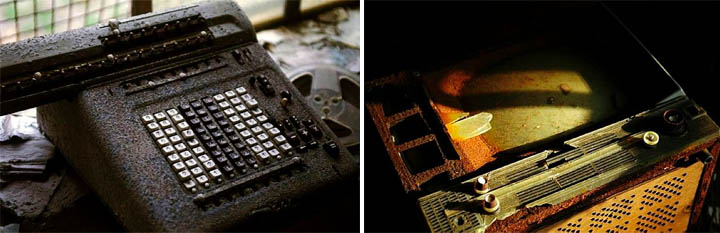

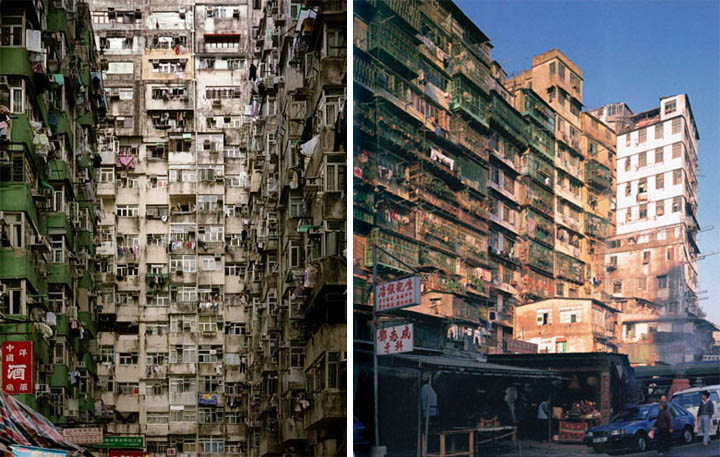

2010/5/19
The next miniaturised replica of a foreign city to be built in China could be based on Melbourne. Well, not an entire mini-Melbourne, but a residential development near Tianjin, about a square kilometre in size, whose centrepiece will be a "Melbourne-style shopping and cafés hub based on Acland, Brunswick and Lygon Street", with a tramway network running through it. So no live rock venues then; they could probably throw in a wan, censored replica of PolyEster Books for local colour. I wonder if they'll put in laneways full of authentically Melburnian (albeit, of course, apolitical) stencil art.
2010/3/10
Not content with its own massive internal high-speed rail programme, China is planning to build high-speed railway lines spanning Asia. The lines will drive westwards through Bhutan, India, the central Asian republics and into Turkey, ultimately connecting with Europe's networks; there will also be another trans-Siberian high-speed line (though weren't the Russians looking into using Japanese shinkansen technology for that?) and an eastward line heading down to Singapore, via Vietnam, Cambodia and Thailand. The plan is to have trains running at between 200 and 350kmh, bringing a journey between London and Beijing down to two days. Mind you, that involves transit through Iran and Burma (both closed societies whose authorities like to keep a tight grip on anything coming or going) and crossing the somewhat fraught Indian-Pakistani border.
China will fund the programme, in return for mineral rights from the countries, and won't harp on about human rights; already, the Burmese junta has signed on.
2010/1/13
Having discovered a sophisticated attack, presumably by Chinese security forces, against its infrastructure, aimed at compromising the details of Chinese human-rights activists, Google has announced a new hard line on dealing with the Chinese government:
These attacks and the surveillance they have uncovered--combined with the attempts over the past year to further limit free speech on the web--have led us to conclude that we should review the feasibility of our business operations in China. We have decided we are no longer willing to continue censoring our results on Google.cn, and so over the next few weeks we will be discussing with the Chinese government the basis on which we could operate an unfiltered search engine within the law, if at all. We recognize that this may well mean having to shut down Google.cn, and potentially our offices in China.
2009/12/19
In an attempt to fight pornography and disharmony on the internet, the Chinese government has banned individuals from registering personal domain names, and announced that those with personal websites might lose them. From now on, only licensed businesses will be able to own domain names in China.
Meanwhile, the Italian government is considering restricting criticism on the internet, after a violent assault on the prime minister, Silvio Berlusconi, which his party have argued was caused by "a climate of hate generated by virulent opposition criticism". Italy already requires anybody using internet access facilities to show and register identity documents, under the guise of fighting terrorism and paedophilia.
2009/6/26
Not that long ago, the Hummer was king of America's roads; a ex-military truck, chromed for the consumer and with all the aggressive ugliness of a pit bull, it soon became synonymous with a certain form of all-American assholery, a combination of machismo, belligerence and callous indifference worn like armour. Then the price of oil went up, and the dealers' yards started filling up with unsellable Hummers. And then General Motors filed for bankruptcy protection, and decided to sell off a number of marques to raise some desperately needed money to keep the wolf from the door. A construction equipment manufacturer in China (that's Communist China, by the way, not Taiwan) was found who was willing to buy the brand and start making Hummers. Joe Sixpack and NASCAR Dad could rest assured that they would still be able to buy a Hummer, though in future, this icon of all-American triumphalism would be made in China, like a cheap Wal-Mart DVD player.
Now, it trns out that the Chinese government's planning agency has blocked the takeover of the Hummer brand, on environmental grounds.
Now that's got to hurt.
2009/5/8
The government of the Chinese province of Hubei has ordered its officials to smoke 230,000 packs of cigarettes, on pain of fines, to raise tax revenues.
Even local schools have been issued with a smoking quota for teachers, while one village was ordered to purchase 400 cartons of cigarettes a year for its officials, according to the local government's website.Totalitarianism: is there anything it can't do?
(via Boing Boing) ¶ 1
2009/1/26
The International Herald Tribune has an article on underground hip-hop in China:
Dozens of hip-hop clubs have opened up in cities across the country, and thousands of raps and music videos by Chinese M.C.'s are spreading over the Internet. But making Chinese hip-hop is still a relatively profitless - and often subversive - activity. Some Chinese rappers address what they see as the country's most glaring injustices.
Shuo chang, the Chinese word for hip-hop, translates to "speak sing" and is a loaded term. It also describes a contentious subject for musicians, producers and fans in China. Hong Kong, mainland and Taiwanese pop stars who have their own spin on hip-hop dominate the mainstream here. Many tack high-speed raps onto the end of their songs, even ballads, and consider themselves rappers.Of course, fans of mainstream rap—clean, professional and uncontroversial enough to get played on Government-approved radio—would beg to differ:
Jay Chou, a popular pop singer turned rapper from Taiwan who has been featured in advertisements for Pepsi, Panasonic and China Mobile, is the archetype of a mainstream performer here. Clean-cut and handsome, he appeals to a sense of nationalist pride. His hit song "Huo Yuanjia" is based on a patriotic Chinese martial artist glorified in Chinese textbooks for traveling the country to challenge foreigners in physical combat. Fans of Chou vehemently assert that his music is hip-hop, while denigrating groups like Yin Tsar.
"I don't know what groups like Yin Tsar are trying to do," said Hua Lina, 35, an accountant. "They dress like bums, and sometimes they take off their shirts at performances, screaming like animals. Their lyrics are dirty - why would I want to pay to see that?"While the media in China is tightly controlled, and the internet is notoriously monitored by armies of censors, the country's music clubs are generally left alone, so those who don't mind reaching a small audience at a time can say more or less what they like.
2009/1/21
In today's big surprise: apparently the Chinese government censored local broadcasts of Obama's inaugural address, excising mentions of America facing down communism and condemnation of regimes that silence dissent.
Meanwhile, Patrick Farley (of the excellent E-Sheep Comics) has written up a summary of the Bush era: All Circus, No Bread:
Trying to explain what was wrong with the Bush Era feels like trying to vomit up a cannonball. I don't think my jaw can stretch that wide.
Seriously, where does one even begin? Abu Ghraib? Ahmed Chalabi? Mission Accomplished? The "Battle of Iraq?" Valerie Plame? No-bid contracts? The billions of dollars the Pentagon can't account for, and apparently never will? The Department of Justice firings? The blue Iraqi flag? The staged press conference? The fake Thanksgiving turkey? Terry Schiavo? Freedom Fries?
All my life I've heard Baby Boomers bitching about Nixon, even after he was dead. I used to wish they'd just GET OVER IT, but now I understand their bitterness. It wasn't what Nixon did that infuriated them so much. It's what he got away with. Nixon was nudged out of office by a momentary gust of public disfavor over a botched burglary attempt -- not, say, a Congressional investigation into the bombing of Cambodia. There was never a thorough reckoning of the misdeeds of Nixon's White House, just as there will probably never be a full accounting of the perversions and swindles of Bush's presidency. To the majority of Americans, Bush will be that guy who invaded Iraq and wrecked the economy.And US liberal cartoonist Tom Tomorrow has his own farewell salute to Bush and cronies:

2008/8/27
The recent Beijing Olympics have been acclaimed as a spectacular success; though what they really demonstrated is the power of totalitarianism to get things done, a point which has been lost on a lot of naïve Western commentators:
The road home from Beijing is lined with wide-eyed converts who've seen the light on totalitarianism. “China has set the bar very high,” Jacques Rogge, the president of the International Olympic Committee, said. “There are some things that London will not be able to compare to, or equal - such as the ability to bring hundreds of thousands of volunteers to different sites.” Yes, Jacques, it is amazing what people can achieve once they appreciate there is no alternative.
Of course the Beijing Games went without a hitch. Give anyone total, terrifying control over a population, with force, and they will make them march in unison, drum, smile, dance, mime, jump through hoops if necessary. “They don't look very oppressed,” wrote one observer. No, pal, and neither would you if you knew the consequences of complaint.
Those performing the three-minute umbrella dance at the opening ceremony trained for six months for 14-15 hours each day, while the 900 soldiers unrolling the scroll that was the centrepiece of the production wore nappies because they had to stay hidden for seven hours, with not even a trip to the toilet allowed. And this is the event that our Olympics Minister called wondrous? That Rogge thinks will be hard to beat?And the biggest threat, the article says, is that Britain's politicians, starstruck by Beijing 2008, will take home the lesson that totalitarianism can be so awesome:
This is the most worrying legacy of the Beijing Games. It has shown our ministers, civil servants and sports administrators what could be achieved, if we could only suspend personal freedom. Change is afoot.Not that suspending civil liberties for the duration of the Olympics so that everyone can have fun without being brought down by protesters or other troublemakers is without precedent; it happened during the Sydney Olympics of 2000, when locals were prohibited from letting friends park in their houses (as not to compete with the official parking sponsors) and wearing clothing with political slogans or non-sponsoring brand names on it in the streets. Which is fairly mild compared to mass levelling of neighbourhoods, though it does make one wonder what innovations in the management of civil liberties the Blairite/Brownites will be tempted to bring to London 2012.
The Chinese, it seems, don't get British self-deprecation:
The Titan Sports Daily contrasted the "neatness" of the Chinese performers with the "outrageous outfits" worn by the Britons. Unlike the Chinese custom which tends not to reveal their weakness to the outsiders, "the British seem to like to laugh about their stupidity in a funny way", it said.
"During the performance, when the London bus pulled over, all the passengers waiting for the bus rushed into the door at the same time, which truly damaged the British image," it added.On the other hand, the Titan Sports Daily also raised the point that some of the entertainers chosen (Jimmy Page and Leona Lewis) weren't famous enough to be recognised by millions of Chinese spectators. Which is a valid point; I couldn't tell you who Leona Lewis is either. (I'm guessing she's a reality-TV veteran of some sort, or possibly a footballer's wife/girlfriend.) Jimmy Page seems like a different matter, though given that China wasn't open to Western influences when Led Zeppelin were in their heyday, one could expect him to draw a blank there.
2008/8/18
The Chinese government has hit upon a novel solution for preventing troublesome protests from erupting at Olympic events: surreptitiously lose most of the tickets, and bus in well-disciplined cheer squads to fill the empty seats, taking place of unpredictable members of the public:
Blocks of tickets went to government departments, Communist party officials or state-owned companies, which have quietly obeyed orders not to hand them out. “People are so angry because they slept all night outside ticket booths and got nothing and now they see this,” said one blogger, Jian Yu.
At some football matches in the northern city of Shenyang, only a third of the seats were taken. Even some gymnastics finals, usually one of the biggest attractions on the programme, were not sold out.Of course, people who waited for tickets but failed to get them (from ordinary Chinese sports fans to the relatives of foreign competitors) are rather annoyed, though they are assuming that the purpose of the Olympics is to provide an entertaining spectacle (or, alternately, to serve as a promotional exercise for corporate sponsors). The Chinese government's view of the Games' purpose is somewhat different: to buy legitimacy for a worrisomely totalitarian one-party state (one typically associated with doing unspeakable things to cuddly
And here is Charlie Brooker's take on it.
2008/8/7
Chinese authorities arrested several British protesters who unfurled banners protesting the Chinese occupation of Tibet. The protesters have been released, though not before the archives of one protester's travel blog were amended, confessing that she had been influenced by "militant Free Tibet organisations". The revisions were not executed particularly professionally either; they appear next to unexpurgated accounts of the "atmosphere of oppression" in Tibet, and did not look like her usual writing style.
Why the Chinese government (or, more probably, some petty official within it) bothered is not clear; all it did was make them look ridiculous. Still, when one is the Chinese government, one can probably afford to look ridiculous, what with power coming from the barrel of a gun and all.
2008/7/29
One of the arguments for giving the Olympics to China—a contentious choice, 12 years after the crushing of the Tienanmen Square protests—was that such an event would force China to improve its human rights. Even while we couldn't expect China, a totalitarian state, to become a model nation in this respect, the argument went, surely the eyes of the world upon it would cause the situation to improve somewhat.
This argument has been shattered by a recent Amnesty International report, which finds that the Olympics have actually made things worse, with the Chinese authorities stepping up repression, censorship and arbitrary imprisonment and relocation to make sure that the games run smoothly.
The report says that Chinese activists have been locked up, people have been made homeless, journalists have been detained, websites blocked, and the use of labour camps and prison beatings has increased.
"We've seen a deterioration in human rights because of the Olympics," said Roseann Rife, a deputy programme director for Amnesty International.The authors of the Amnesty report have the extraordinary naïveté to suggest that this has "undermined" the "Olympic values" of human dignity. Surely the values that would go best with putting on a huge spectacle of commercialism and national chest-beating would be those of totalitarianism; making the trains run on time, crushing any uncomfortable dissent, and all, and China would be a more natural host than any liberal democracy which would be obliged to pass uncomfortable laws suspending civil liberties (as Sydney did in 2000; the laws, still on the books, have since come in handy for other mass spectacles, such as the Catholic Church's World Youth Day this year). Meanwhile, with the exception of a few granola-eaters and Guardian readers, the West doesn't care as long as they get their entertainment product shipped into their sitting rooms through the TV.
Perhaps when the location of the next Olympics is decided, the IOC should consider North Korea; after all, coordinating mass events with ruthless precision is one thing the Hermit Kingdom excels at.
2008/7/24
Let it not be said that China is not willing to democratise; the Chinese government has announced that, for the Olympics, it is adopting one aspect of American-style late democracy: free speech zones, in which protest is permitted. As long, of course, as the protesters have permission from the police:
Liu Shaowu, director of the Beijing organising committee's security department, said protests would be allowed in Shijie, Zizhuyuan and Ritan parks.
"They are all close to the city proper and the Olympic venues," he told a press conference on the city's security preparations. But Mr Wu was hazy about how potential protesters would apply for permission, and on whether spontaneous demonstrations would be allowed.
2008/7/18
With the Olympics, that natural showcase of totalitarian regimes, approaching, the Chinese government is making sure that nothing is left to chance, and preemptively banning all sorts of things, just in case:
Beijing police have been visiting bar owners in the popular Sanlitun area and asking them to sign pledges agreeing to not serve black people or Mongolians and ban activities including dancing.
And in a separate move, the Ministry of Public Security announced at the start of the month that from October 1, discos, karaoke bars and other entertainment venues must install transparent partitions in previously private rooms, and ensure staff dress more modestly as part of an effort to crack down on prostitution and drugs.
Beijing CBD businesses are reporting increasingly bizarre restrictions on couriers. This includes a ban on transporting CD-ROMs through the city, and mobile phones or GPS devices can only be sent if their batteries are delivered separately. This is on top of postal restrictions on sending liquids and powders.
2008/5/19
The nifty thing about being a totalitarian state is that, when you declare three days of mourning, people mourn:
China has issued orders that all entertainment web sites and regular television programming be shut down completely for the next 3 days. Only web sites covering the recent tragic 7.8 magnitude earthquake and television stations broadcasting CCTV earthquake programming will be allowed to remain live.Mind you, this is according to Twitter messages from one web entrepreneur in China, and other reports are divided on whether such a shutdown has actually occurred.
2008/4/29
The Olympic torch relay, dogged by protests against Chinese government policies across its journey, has finally had a smooth, protest-free run—in North Korea, where it was met by thousands of North Koreans waving flags in perfect unison, with absolutely no sign of protest:
"We express our basic position that while some impure forces have opposed China's hosting of the event and have been disruptive. We believe that constitutes a challenge to the Olympic idea," Pak said.
Police in China have found a factory making Free Tibet flags for export to the Tibetan government in exile.
Workers said they thought they were just making colourful flags and did not realise their meaning. But then some of them saw TV images of protesters holding the emblem and they alerted the authorities, according to Hong Kong's Ming Pao newspaper.It seems that even the Tibetan government in exile agrees that when you want something made, you go to China.
2008/4/8
As the Olympic torch continues its worldwide tour, surrounded by aggressive Chinese guards and hounded persistently by human-rights protesters, some have called for the protesters to shut up and keep politics out of sport. They would do well to read up about the history of the whole Olympic torch ceremony, which originated not in ancient Greece but in Nazi Germany:
He sold to Josef Goebbels – in charge of media coverage of the Games – the idea that 3,422 young Aryan runners should carry burning torches along the 3,422km route from the Temple of Hera on Mount Olympus to the stadium in Berlin. It was his idea that the flame should be lit under the supervision of a High Priestess, using mirrors to concentrate the sun's rays, and passed from torch to torch along the way, so that when it arrived in the Berlin stadium it would have a quasi-sacred purity.
The concept could hardly fail to appeal to the Nazis, who loved pagan mythology, and saw ancient Greece as an Aryan forerunner of the Third Reich. The ancient Greeks believed that fire was of divine origin, and kept perpetual flames burning in their temples.
But the ancient Games were proclaimed by messengers wearing olive crowns, a symbol of the sacred truce which guaranteed that athletes could travel to and from Olympus safely. There were no torch relays associated with the ancient Olympics until Hitler.
The route from Olympus to Berlin conveniently passed through Bulgaria, Yugoslavia, Hungary, Austria, and Czechoslovakia - countries where the Nazis wanted to extend their influence. Before long, all would be under German military occupation. In Hungary, the flame was serenaded by gypsy musicians who would later be rounded up and sent to death camps.
2008/3/27
Someone is sending pro-Tibet groups documents infected with keylogging malware, configured to send back keystrokes to a server in China. The documents are sent from addresses forged to resemble human rights groups, and purport to be details of Chinese massacres in Tibet and similar information.
The exploit silently drops and runs a file called C:\Program Files\Update\winkey.exe. This is a keylogger that collects and sends everything typed on the affected machine to a server running at xsz.8800.org. And 8800.org is a Chinese DNS-bouncer system that, while not rogue by itself, has been used over and over again in various targeted attacks.
The exploit inside the PDF file was crafted to evade detection by most antivirus products at the time it was sent.
Somebody is trying to use pro-Tibet themed emails to infect computers of the members of pro-Tibet groups to spy on their actions.Of course, the pro-Tibet groups could avoid being pwn3d by the Chinese by the simple expedient of not using Windows or common software to open documents.
2008/3/12
Great news on the human rights front: China is no longer one of the most systematic human rights violators, according to the US State Department's annual human rights report. This is the first time in many years that China has been removed from the list, now containing Iran, Zimbabwe, Cuba, Belarus, Sudan, Uzbekistan and, from this year, Syria.
Which raises the question: is China really that much less repressive than Iran, or is it just a more valuable trading partner? And where's Saudi Arabia?
2008/2/13
Recently declassified documents have revealed that, in 1973, Mao Zedong offered to export 10 million Chinese women to the US, whilst in talks with Henry Kissinger:
The Chinese dictator said he believed such emigration could kick-start bilateral trade but could also "harm" the US with a population explosion similar to China's, according to documents covering US-China ties between 1973 and 1976.
The leaders then spoke briefly about the threat posed by the Soviet Union, with Mao saying he hoped Moscow would attack China and be defeated. But Mao said: "We have so many women in our country that don't know how to fight."
2008/2/8
Norwich-based comedian and reviewer of dubious far-eastern video game machines Dr. Ashen (he's the "sarcastic British guy") reviews the Vii, a cheap video-game console of Chinese manufacture which attempts to imitate the Nintendo Wii without having much of the technical innovation. If you ever wondered what one of those could possibly be like, here's all you need to know. (Capsule summary: don't bother importing one.)
2007/9/12
Wall Street is experiencing a Chinese surveillance-led boom, with US hedge funds pumping more than $150m into the growth industry of developing high-tech means of detecting dissent and maintaining the control of the Communist Party over the world's most populous nation — namely, of squaring the circle of having economic freedom with totalitarian political and social control.
Terence Yap, the vice chairman and chief financial officer of China Security and Surveillance Technology, said his company’s software made it possible for security cameras to count the number of people in crosswalks and alert the police if a crowd forms at an unusual hour, a possible sign of an unsanctioned protest.
Mr. Yap said terrorism concerns did exist. His company has outfitted rail stations and government buildings in Tibet with surveillance systems.
In Shenzhen, white poles resembling street lights now line the roads every block or two, ready to be fitted with cameras. In a nondescript building linked to nearby street cameras, a desktop computer displayed streaming video images from outside and drew a green square around each face to check it against a “blacklist.” Since China lacks national or even regional digitized databases of troublemakers’ photos, Mr. Yap said municipal or neighborhood officials compile their own blacklists.
(via Boing Boing) ¶ 0
2007/5/12
Google's shareholders say, alright, let's be evil where it's profitable:
A majority of Google shareholders today voted against an anti-censorship proposal that took aim at the way the search giant conducts its business in China and other countries that engage in active censorship.
The specific text of the failed proposal, available in the company's online proxy statement, stated:Of course, that doesn't mean that Google will give up the slogan "don't be evil"; given that, in the context of what they do, "evil" is a fairly vague term (even harder to nail down than Apple's environmental record, a subject of some debate), if they do start shopping dissidents to the Chinese government and propping up totalitarian regimes in the interests of profits, if anything, they're more likely to start spinning heavily on the we're-nice-guys angle; sort of like Nestlé.
- Data that can identify individual users should not be hosted in Internet-restricting countries, where political speech can be treated as a crime by the legal system.
- The company will not engage in pro-active censorship.
- The company will use all legal means to resist demands for censorship. The company will only comply with such demands if required to do so through legally binding procedures.
- Users will be clearly informed when the company has acceded to legally binding government requests to filter or otherwise censor content that the user is trying to access.
- Users should be informed about the company's data retention practices, and the ways in which their data is shared with third parties.
- The company will document all cases where legally binding censorship requests have been complied with, and that information will be publicly available.
2007/4/21
An African-American woman in Toronto who recently bought a sofa was shocked to find that it was labelled with racial epithets. Packaging on the chocolate-coloured sofa described it as "Color:Nigger-brown".
"She's very curious and she started reading the labels," Moore explained. "She said, `Mommy, what is nig ... ger brown?' I went over and just couldn't believe my eyes."The retailer blamed the incident on the manufacturer in Guangzhou, China.
This is not the only incident of English-language labels on imported products having been written seemingly with ignorance of taboo words. One I heard about involved the assembly instructions for a piece of furniture. Next to a diagram of a screw being driven into a hole was the one-word instruction, "Fuck".
2007/1/13
To commemorate the Year of the Pig, China has released pork-scented scratch-and-sniff postage stamps. I wonder whether, if one sent a letter to Saudi Arabia or Iran using these, it would be delivered.
(via Boing Boing) ¶ 0
2006/12/1
Making shameless copies of well-known foreign gadgets has been big in China; now, a Chinese company has taken it to a new scale, with an electric Smart car knockoff. The "CMEC City Smart" looks almost indistinguishable from DaimlerChrysler's petrol-powered microcar, has an electric motor, gets up to 55kph/34mph (less than half of the Smart's top speed), and, unless DaimlerChrysler can do something about it, will go on sale in Europe next year for €4,200.
2006/11/14
Italy's usually efficient railways have been experiencing increased delays due to soaring copper prices, which have inspired thieves to steal signalling cables for sale as scrap:
Police say they have arrested 22 people in the past month alone on charges of stealing copper wire. Many of the accused have been identified as Romanian immigrants.
In Naples, police recently seized dozens of sea containers filled with stolen copper coils parked in the port area ready for shipment to China.Similar thefts have hit the Channel Tunnel Rail Link project in London, and theft of copper cables was responsible for at least one fatal crash in China. Which makes one wonder whether the plague of "signal failures" on the Tube (such as the one that crippled the Victoria Line this morning) has anything to do with this.
2006/11/8
Property developers in China have created an artificial English town. Located on the outskirts of Shanghai, "Thames Town" contains such quintessentially English essentials as Georgian- and Victorian-style terrace houses, a pub and fish and chip shop and a statue of Winston Churchill. The owner of the original fish and chip shop, in Lyme Regis, meanwhile, is quite annoyed with her business having been copied lock, stock and barrel without permission.
Of course, unless the high street is comprised entirely of chain stores, it's not a real English town but a vaguely Disneylandish (or perhaps Portmeirionesque) idealised one. In any case, it will soon be joined by other European-style developments, with an Italian and German town being planned. And apparently the entire town of Dorchester is being reconstructed in Chengdu, under the name "British Town".
2006/10/17
The Chinese city of Chongqing has enacted a law which bans satire on the internet:
The rules target Web users "who spread information or remarks defaming others, launch personal attacks or damage others' reputations online," the official Xinhua News Agency said. Potential violations include posting online video "to satirize others or social phenomena."Online satire has become a big problem in China, a society where any challenge to the government's authority is taken very seriously:
Video spoofs have become so popular that Chinese have coined a new slang term, "egao," to describe the act of using real film clips to create mocking send ups.
Government film regulators announced new rules in August meant to rein in the "egao" fad by allowing only authorized major Web sites to show short films online.Laws prohibiting sarcasm and irony and strictly regulating the use of other rhetorical devices are expected soon.
2006/8/31
In China, what could be the world's largest lynch mob is gathering and hunting for one "Chinabounder", a particularly gormless expatriate Briton who kept an anonymous blog recounting his sexual conquests in China. That is how it started, anyway; with him apparently coming to China to teach English, taking advantage of the huge dating pool available to exotic foreigners and then, perhaps seeing himself as a combination Neil Strauss and Belle Du Jour, writing up his conquests, in detail, in a blog, often posting entire chat transcripts. Then, he decided to start posting political screeds ridiculing Chinese culture, politics and masculinity, and soon, the hunt began:
Traffic on the Sex and Shanghai blog has surged from 500 hits to more than 17,000, thanks to a swarm of castration threats, anti-British rants and attacks on women who sleep with foreigners. The author, who calls himself Chinabounder, introduces himself as a wastrel, "lacking in moral fibre, but coping with the situation". According to the posts, he is an English language teacher at a university.
The campaign against the blog was launched on Friday by Zhang Jiehai, professor of psychology in the Shanghai Academy of Social Sciences under a post titled The Internet Hunt for an Immoral Foreigner. "I have something to tell Chinese men: please think about how these foreign trash have dallied with your sisters and made fun of your impotence," he wrote. "This piece of garbage must be found and kicked out of China!!!"
"Trial by virtual lynching has become the norm in China's cyberspace," Raymond Zhou wrote in a comment article in China Daily after previous mass campaigns. He added: "Online 'flaming' wars exist everywhere, facilitated by anonymity. But in China they may have a self-propelling force that sweeps thousands, sometimes millions, into a frenzy. It is nearly impossible, even for the most respected scholars, to give voice to dissension."The ever-entertaining Maciej Ceglowski (now also resident in Beijing), has written about the story:
He was not the first Western guy to treat China as his own personal sexual buffet. To put it in the D&D terms that many of the guys who benefit most from the effect will readily understand, living in China gives you +4 attractiveness. The love handles (metaphorically) shrink, the hairline advances, teeth straighten, previously soupy eyes blaze with a new rakish light. You are in a country where people actually *choose* to have brown hair. You find that things that are off-putting back home have magically transformed into positive attributes in your new environment. You're a computer programmer? You're quiet and like to read? You live with your parents? You never drink? You are sexually inexperienced? HEARTTHROB!
A Blogspot site called whoischinabounder was launched, with the goal of unmasking chinabounder's true identity based on details culled from his blog posts. This site was so successful that by the first day they had already found three of him, with signs that more were to come. English teachers in Shanghai had reason to be nervous.
Net culture in China works a bit the way television media works in the States. People fix on one or two big stories of the day, and these get a national audience. There is also a tradition of online vigilantism in cases where someone has done something particularly vile - had an extramarital affair within the World of Warcraft online game, for example - and people will readily mobilize to defend good morals and the national honor. Chinabounder's case, which hits the trifecta of national pride, sex and Japan hatred, will be interesting to follow.
(via Boing Boing,  substitute) ¶ 0
2006/8/23
Another dispatch from the escalating shadow-boxing match between China and the Dalai Lama:
Then, in January, in a religious address delivered in India, the exiled Dalai Lama called on Tibetans to stop wearing wildlife skins, to save animals from extinction.
The results were dramatic: from Lhasa to Gansu, Tibetans gathered for public fur burnings.
Confronted with this evidence of his continuing influence, the Government accused the Dalai Lama of promoting "social disorder" and responded, bizarrely, with a pro-fur campaign in which TV presenters were ordered to wear fur on air.
2006/8/17
Whilst the West hunts for Osama bin Laden, China is intensifying its war against its own equivalent thereof: the Chinese government has pledged a "fight to the death" with the Dalai Lama, its arch-nemesis best known in the West for peddling new-ageisms to Hollywood celebrities:
China's new top official in Tibet has embarked on a fierce campaign to crush loyalty to the exiled Dalai Lama and to extinguish religious beliefs among government officials.
Ethnic Tibetan civil servants of all ranks, from the lowliest of government employees to senior officials, have been banned from attending any religious ceremony or from entering a temple or monastery. Previously only party members were required to be atheist, but many of them quietly retained their Buddhist beliefs. Patriotic education campaigns in the monasteries that have been in the vanguard of anti-Chinese protests have been expanded.
Ethnic Tibetan officials in Lhasa as well as in surrounding rural counties have been required to write criticisms of the Dalai Lama. Senior civil servants must produce 10,000-word essays while those in junior posts need only write 5,000-character condemnations. Even retired officials are not exempt.Elsewhere, China is also cracking down on web video, requiring video (such as that posted on sites like YouTube) to be approved by the government beforehand. This measure was prompted by a number of films which satirised official history.
(Incidentally, China isn't the only country requiring all online video to be approved by censors. In Australia, this is the case too. As far as I know, the government there is not yet cracking down on short films promoting seditious black-armband historical narratives or taking the piss out of For The Term Of His Natural Life or We Of The Never Never.)
(via Boing Boing) ¶ 0
2006/3/31
When the Chinese government commissioned the first statue of Mao Zedong to be installed in Tibet (in the town of Gongga), they took account of local sensibilities by making Mao look more Buddha-like:
The statue was designed by Zhu Weijing, president of the Changsha Sculpture Institute, who said: "I tried to understand how Tibetans feel towards Mao. Because they have deep feelings about Buddha, I tried to make Mao more like that, with a plumper face."
2006/3/30
Intense competition in the global fishing industry has produced some ruthless efficiencies, such as the Chinese zombie ships. Disintegrating, abandoned pirate vessels off the coast of West Africa are being repurposed into clandestine fishing vessels; patched up just enough to remain more or less afloat, the ships never see a port, with crews, supplies and catches being transferred at sea. The economic desperation of those who work on them means that workers often remain onboard for years, and don't kick up a fuss over things such as safety standards, translating into further efficiencies. This is what streamlining looks like in the grim meathook present:
Here's the thing - these ships seldom, or ever, visit a port. They're re-supplied, refuelled, re-crewed and transhipped (unloaded) at sea. The owners and crews don't seem to do any basic maintenance, apart from keeping the engine and winches running. There's no glass in the portholes, and the masts are a mess of useless wiring. These floating deathtraps don't carry any proper safety gear - on one boat, I saw the half-barrel case of an inflatable liferaft being used to store a net.
Back on the Esperanza, we try to put together what we'd witnessed. When asked what it was like 'out there', we answer 'grim'. I wondered how the fishing company could convince these men to spend time living on such dangerous ships, half around the world from their loved ones. Do their families know where they were? These trawlers might be engaged in illegal fishing activities, stealing fish from the countries of West Africa, but it seems that the fishermen themselves are just pawns of some brutal corporate policy, where human life is cheap, and profits take priority.
2006/1/19
 China's pervasive internet surveillance regime now has a new public image: from now on, either various government sites or all websites in Shenzhen will display cartoon mascots of police officers (looking big-eyed and oddly Caucasian). Clicking on the mascots will take you to a web page where you can talk with actual members of China's internet police. They do things differently in China.
(via bOING bOING) ¶ 0
2005/12/18
The other day, I was in this fancy Italian/French restaurant (where I had Escargot, but that's another story) and so they had fancy English under the usual Chinese names. They're pretty accurate, until I read about desserts. Under the Chinese for cheesecake, was the English word, "Wikipedia".
2005/8/31
Police in Malaysia are carrying out random spot checks for pornography on mobile phones. Those found with porn will be charged with possession, and presumably flogged or caned or whatever they do, at Dr. Mahathir's pleasure.
Meanwhile, in India, the local movie studios' organisation, the MPA, has successfully obtained a general search and seizure warrant, allowing its officers to search any property in Delhi deemed under suspicion of piracy. Of course, they only intend to use such warrants against the terrorists who produce and sell pirated DVDs at markets, and, being the good guys, undoubtedly are honour-bound not to abuse these powers, so there's no cause for concern.
And in China, a researcher has discovered a sinister and ominous new trend, that people who buy webcams often use them whilst naked, posing a serious threat to public health and morality:
"At first, we thought it was merely a game for a few mentally abnormal people," the paper quoted Liu as saying. "But as our research continued, we found the problem was much larger than expected."It wasn't made clear what proportion of webcam users are filthy perverts, or, indeed, what those who don't chat naked use them for.
(via TechDirt, bOING bOING) ¶ 1
2005/3/18
An interesting NYTimes article on how mobile phones (many donated by South Korean journalists) and video recorders (which have become cheap as Chinese consumers adopt DVD players) are breaking down North Korea's barriers of isolation:
"In the 1960's in the Soviet Union, it was cool to wear blue jeans and listen to rock and roll," said Andrei Lankov, a Russian exchange student in the North at Kim Il Sung University in 1985, who now teaches about North Korea at Kookmin University here in the South. "Today, it is cool for North Koreans to look and behave South Korean, as they do in the television serials. That does not bode well for the long-term survival of the regime."
(Tangent: as Western pop music infiltrated Russia, it produced bizarre hybrids; porn-metal bands like Korozia Metalla and evil-sounding electronic noise acts and things like t.A.t.U. All of which makes one wonder what North Korean popular music will be like when the regime collapses. Assuming that it collapses without making North Korea (or, indeed, much of the Pacific Rim) into a radioactive crater.)
The North Korean government isn't taking this lying down: they've bought radio-location devices for detecting mobile phone signals. Meanwhile, to combat the video recorder menace (which, it would seem, is to repressive hermit-states what the Boston Strangler is to... never mind), the North Korean police simply switch off the power to areas, a block at a time, and inspect the tapes stuck in video recorders for subversive content. Those caught are probably executed if they're lucky, or used in hideous experiments if they're not. And Kim Jong Il has good reason to fear:
"They are gradually learning about South Korean prosperity," Dr. Lankov said. "This is a death sentence to the regime. North Korea's claim to legitimacy is based on its ability to deliver the worker's paradise now. What if everyone sees that it is not delivering?"
2005/3/8
The Chinese government is considering a law banning lip-syncing in live performances, on the grounds that it is equivalent to selling fake goods. Who would have thought of China's government as a bastion of Rockism?
2005/2/7
A man in China has devised a technique for growing his own chairs, by moulding elm branches into a chair shape while the trees are growing.
Mr Wu has one tree chair in his home, which he harvested last September, and six more growing in his field.
2004/12/12
Under a new deal between Disney Corp. and China's Communist Youth League, millions of Chinese children will now be indoctrinated into the teachings of Mickey Mouse. Or, more precisely, will learn Disney stories instead of Chairman Mao's Little Red Book.
2004/11/5
A list of ten things the Chinese do better than us (in this case, "us" being Canada, but it applies equally to the rest of the West). The list specifically excludes anything to do with cheap labour, and focusses on technological innovations.
In Tianjin, a city of 13 million people, traffic lights display red or green signals in a rectangle that rhythmically shrinks down as the time remaining evaporates. In Beijing, some traffic lights offer a countdown clock for both green and red signals.
(In another transit plus, forget those illegible handwritten taxi receipts we get in Canada. China's taxis automatically print out receipts with date, mileage, taxi medallion number, even the start and end times of the ride. That certainly would help you recover the Stradivarius you inadvertently left in the back seat.)
At the Shanghai Grand Theatre, the black granite ticket counter is embedded with a Samsung computer screen which lights up with the event you want to see, showing unsold seats, colour-coded by price, and the sightline to the stage. There is even a bar stool on which to perch while you consider your choices.
It wouldn't surprise me if some of these ideas caught on in the West at some stage.
2004/5/12
In China, where minors are prohibited from entering internet cafes, gangs of net-starved teenagers are assaulting attendants who dare to kick them out.
(The article was published on the website of the Chinese government-controlled newspaper/agency Xinhua; the headlines at the bottom of the page are interesting; a lot of them are scathing, almost al-Qaeda-level criticism of the US in Iraq ("Images that shame US", "Iraq abuse exposes US double standards in human rights"-- ouch!), though between them is "Celine Dion cancels shows due to sprained neck". Is Celine Dion to China what David Hasselhoff was to Germany or something? She seems to be huge over there.
2004/3/29
Remember all those claims about how the internet was to render tyranny and authoritarianism unviable and usher in a global blossoming of democracy, pluralism and liberty? Well, according to this article, that's not happening, and if anything, the web is helping to reinforce authoritarian regimes and dissipate dissent:
Singaporean dissident Gomez says the Web empowers individual members of a political movement, rather than the movement as a whole. Opposition members can offer dissenting opinions at will, thus undermining the leadership and potentially splintering the organization. In combating an authoritarian regime, in other words, there's such a thing as too much democracy. Two of the most successful opposition movements of the last few decades--the South African opposition led by Nelson Mandela and the Burmese resistance led by Aung San Suu Kyi--relied upon charismatic, almost authoritarian leaders to set a message followed by the rest of the movement. The anti-globalization movement, by contrast, has been a prime example of the anarchy that can develop when groups utilize the Web to organize. Allowing nearly anyone to make a statement or call a meeting via the Web, the anti-globalizers have wound up with large but unorganized rallies in which everyone from serious critics of free trade to advocates of witches and self-anointed saviors of famed death-row convict Mumia Abu Jumal have their say. To take just one example, at the anti-globalization World Social Forum held in Mumbai in January, nuanced critics of globalization like former World Bank chief economist Joseph Stiglitz shared space with, as The New York Times reported, "a long list of regional causes," including anti-Microsoft and anti-Coca Cola activists.
In China, the Web has similarly empowered the authorities. In the past two decades, Beijing's system of monitoring the population by installing informers into businesses, neighborhoods, and other social institutions has broken down--in part because the Chinese population has become more transient and in part because the regime's embrace of capitalism has meant fewer devoted Communists willing to spy for the government. But Beijing has replaced these legions of informers with a smaller group of dedicated security agents who monitor the Internet traffic of millions of Chinese.
Though the article suggests more that the effects of the internet will be slower to take effect, and more long-term. While China has clamped down on anti-government dissent more or less effectively, Chinese environmental activists are organising in ways they would have been unable to before; meanwhile, a new generation of urban Chinese are used to more freedom of choice and cultural expression, and the Communist Party has been forced to enshrine private property and human rights in law (not that that necessarily changes much, but it will). Maybe if we check back in 20 years' time, the verdict on the liberating potential of the internet will be different.
Then again, with the intellectual-property interests which increasingly make up most of the West's economies pushing for "trusted computing" systems, which could just as easily be used to stop samizdat as MP3 sharing, and the increasing will (on the part of both the public and legislators) to accept mechanisms of surveillance and control unthinkable three years ago to defend against an asymmetric terrorist threat, perhaps the liberating potential of computers has peaked, and it can only go downhill from here?
2004/2/23
Now this takes balls: Oxford engineering student Matthew Richardson was approached to deliver some lectures on economics in China (possibly on account of his having the same name as a US professor of economics); so he bought an A-level textbook, crammed it on the flight there, and blagged it. Until he ran out of material, and did a runner.
The real Prof Matthew Richardson, speaking from the business school at New York University where he is a lecturer in finance, said: "Imitation is the sincerest form of flattery and it seems as if this young man will go far. I do not know if the Chinese students were expecting me. I feel sorry for them if they feel let down, but there was no real harm done."
(via 1.0)
2004/2/16
Nuclear weapon designs handed over by Libya to US authorities have been found to have originated in China. Could this mean that the proliferation of nuclear weapons to rogue states/terrorist groups is part of a US/Chinese proxy war? If so, that suggests a few other possibilities: what if, for example, the movement known as al-Qaeda is funded behind the scenes by China; what if, say, 9/11 was intended as a stern warning from China in some acrimonious underground negotiation (would the gerontocrats who ordered the Tienanmen massacre have any qualms about killing thousands of innocent foreigners to make a point?), and the invasion of Iraq (whose WMDs and terrorist links remain elusive) was intended as the reply? Or is that too far-fetched? (Paging Mitch...)
2004/1/2
For the past few weeks, Warren Ellis' blog has been running predictions for 2004 from the various gonzo futurists, scifi writers, early adopters and scary goth camgirls he knows; Matt Jones' predictions are probably the most interesting of the series:
BrIC: 2004 is the year where the cultural and economic dominance by BrIC [Brazil, India, China] starts to emerge. More movies of the calibre of 'City of God' dominate the movie and soundtrack charts. Brazil's equivalent of the Neptunes dominate the global ringtone charts. Kids on the 8mile practice not rap, but capoeira battles.
CORMANRINGS: In 1977, Lucas unleashed Star Wars. There were a gazillion cheapo ripoffs on tv and screen including Roger Corman's awesomely bad-but-I-love-it "Battle beyond the stars": y'know the one with John-Boy Walton as the hero... The oscar-winning success of Peter Jackson's Tolkien trilogy coincides with the low-low price of pro-am digital video and film production to produce a bumper crop of copyright-skirting elvish nonsense of a similarly amusing/appalling ilk.
(Machinima meets Dungeons & Dragons, anyone?)
Update: There's more on BrIC in the news: a piece on the Brasilia Consensus replacing the Washington Consensus, and a piece on the G20 (which includes BrIC) and EU issuing a joint communique on global trade talks. (Though isn't the EU, economically speaking, an inherently neo-liberal construct?)
2003/12/30
FBI urges police to look out for people carrying almanacs, as they may be terrorists looking for targets to attack. There appear to be no plans for a national registry of almanac owners, or embedded RFID chips in all almanacs, though borrowing one from your local library could result in your name being secretly reported to the authorities. (via kmusser)
Meanwhile, an Israeli firm that is importing Chinese workers (presumably to replace those troublesome Palestinians) is requiring them to sign contracts prohibiting them from having sex with Israelis or trying to convert them; those violating the contracts, which also ban any religious or political activity, will be sent back to China at their own expense. (via jwz)
2003/12/24
China amends its constitution to protect private property, formally abandoning socialism in favour of an authoritarian form of free-market capitalism. So far, there has been no announcement of any name change for the increasingly inaccurately-named Communist Party, which will continue to maintain an iron grip on the nation's political life and public discourse.
But it is stalemated on even these modest political reforms, leaving modern China an increasingly prosperous private economy ruled by a dictatorship. In this it resembles General Pinochet's Chile, South Korea under military rule - or Taiwan before it moved to democracy in the 1980s.
2003/10/15
Chinese scientists create foetus with three parents (two female and one male). However, polyamorist group marriages in the West will have to wait a bit longer as such research is banned in the US and UK. Also, the foetus only contained genetic material from two of the parents; the third merely donated an egg. (Though perhaps some master-slave threesomes may not have a problem with such inequalities.)
2003/9/10
China moves to block spam senders, blocking 127 machines sending e-mail spam. Before you get excited at the prospect of less spam, note that all but 8 of the servers are outside of China, and 90 are in Taiwan. This suggests that the Chinese government may be more concerned about political dissidents spamming Chinese internet users with proscribed messages than they are about genuinely cracking down on penis-pill-hawking chickenboners. Either that or this is connected to the China/Taiwan "hacker war" in the news recently.
2003/9/4
Postmodern ironies aplenty here: In the manufacturing countries, manufacturing of fake designer clothing has overtaken the legitimate manufacture of such items. Not only that, but the knockoffs are often of superior quality to the legitimate products; oh, and since they're made in the largest quantities, they are often the cheapest clothing on the market. Somewhere in the third world, a slum-dweller is wearing a pair of Levi's better than the one you forked over $100 for.
She had bought herself jeans in Bolivia which were as good as those she could buy anywhere else. "In fact, they are not replicas at all but originals designed for the local market but with a designer label included because otherwise they would not sell," Dr Laurie said.
She had watched a young man operating a laptop computer from a car battery in a tin shack while he downloaded logos from the internet, traced them, and began manufacturing designer labels for local factories.
All this probably also ties into the perils of commodification which have been eating everybody from SCO to the RIAA alive.
2003/5/26
China's Internet censorship regime, with its Cisco-powered "great firewall" and armies of censors waging relentless war on criticism, is often cited as disproof of the old cyber-utopian saw that the Internet interprets censorship as damage and routes around it; its apparent success against all odds has undoubtedly been heartening to other proponents of keeping a firm hand, from Singapore to Cuba, and from Saudi Arabia to our own Senator Alston. But as Reporters Without Borders investigator Gao Zheng is finding out (through a form of controlled forum trolling), the censors' grip is slipping:
Gao provisionally rates every bit of text on a scale of 1 to 10 before he posts it. His initial "sensitivity" rating is usually a good indication of the time the posting will last on the public area of the news site. A "1" is something totally unthreatening, while a "10" would be lucky to get online at all and would remain for just minutes if it did.
"Look at this one," Gao says, pointing to another comment made by a user on Sina.com some hours before. "It says, 'Why arent we protesting in the streets against this war like other countries are doing and like we did after the U.S. bombing of our embassy in Yugoslavia?'" "Its been there for several hours already. Surprising it would be allowed to stay so long. I mean, this isnt just foreign policy chitchat; this is a call for people to go out into the streets. This is an eight or a nine, certainly. Very dangerous."
(via TechDirt)
2003/3/16
Who says the Chinese government is unconcerned with human rights? In the Yunnan province, China is equipping its courts with mobile execution vans, replacing the traditional bullet in the back of the head, seen by many as barbaric, with the "civilised" and "humane" execution method of lethal injection. They even had the Chinese Academy of Medical Sciences design a kinder, gentler lethal drug, putting China at the forefront of the humane death penalty. Beat that, Florida.
2003/2/27
Chinese political dissident Wu Chong has declared that he's proud that his T-shirts were used in the Global Weekend of Protest. The 45 year old former University professor, who is serving a 10 year sentence was delighted to learn the T-Shirts he makes in the prison sweatshop had been screenprinted with anti-war slogans, such as "No hoWARd" and "There's a village in Texas that's lost its idiot", and worn in rallies in London, Madrid and Sydney.
"I'm honoured they chose my T-Shirts to find against injustice." He said he thought that the choice would have been based not just on the competitive price of his T-Shirts, but the quality of his stitching. He noted his labour camp had some of the strictest "quality control incentives" in China.
2002/10/2
ziboy.com, a photographic blog from Beijing, showing (often technically excellent and sometimes dramatic) snapshots of contemporary life in the Chinese capital, from red flags to mobile phone ads, smiling couples to mass trials to rock concerts, uniformed police to leather-clad mohician punks. (via Robot Wisdom)
2002/8/28
The Chinese government has stopped issuing custom numberplates because of concerns in the Communist Party about "an unhealthy fixation" with symbols of Western military power. Among the offensive numberplates were "IAM 007" (this is in a nation on guard against Western espionage), "FBI" and "TMD", a reference to Bush's Star Wars 2 programme. (via Athrist)
2002/7/4
Chinese-based spiritual movement/terrorist group (depending on whom you believe) Falun Gong have reportedly hacked one of China's main TV satellites, broadcasting a pro-Falun Gong banner on TV channels. (Mind you, this news comes from The Australian, a publication of News Corp., whose executives have outspokenly condemned Falun Gong and defended the Chinese government's hard line against the group. Make of that what you will.)
2002/6/16
Interesting Times: Boy bands vs. the Chinese Communist Party, or the handsome, well-groomed face of dissent in the 21st century. An interesting look at the state of affairs in China, and the interplay of the two cultures of centralist hegemony (nominally Communist, though dating back to Imperial times in spirit) and an increasingly out-of-control market-oriented media consumerism, and boy-band VCD piracy is the new samizdat. (via bOING bOING)
2002/6/8
There are some red faces in Beijing, after the most popular newspaper there, the Beijing Evening News, reprinted an article from The Onion, stating that it was true. The article in question had U.S. Congress threatening to relocate to Memphis or Charlotte unless Washington built them a new Capitol with a retractable roof. (via one.point.zero)
2002/5/1
Happy May Day: In a heartwarming example of notional-socialist solidarity, the Australian Labor Party seeks to establish formal ties with the Chinese Communist Party; a move which may alarm some ALP members concerned with China's human rights record.
2001/3/26
War is peace, freedom is slavery, but business is business: Murdoch's people have learned that, if you want any chance of access to the world's largest market, you bend over when the Chinese Government says so, or when you think it'll appreciate your doing so. Case in point: Murdoch fils James, in charge of dealings with China, gave a speech in Los Angeles, denouncing the Falun Gong movement, condemning Western media bias against Chinese government policy, and saying that Hong Kong's democracy activists should accept the reality of life under a strong-willed "absolutist" government. ("absolutist" sounds like a particularly psychoceramic strain of Ayn Randism, but is presumably a way of saying "totalitarian" without the negative connotations; sort of like the Reagan-era coinage of "authoritarian" for US-friendly right-wing dictatorships, as opposed to the truly evil "totalitarian" left-wing dictatorships.) (via Lev)