The Null Device
Posts matching tags 'sex'
2016/5/11
A few days ago, the hipster-electropop duo YACHT posted a plaintive note to their Twitter feed; the note announced, in a sombre, contrite tone, that, some years ago, the duo (Jona Bechtolt and Claire Evans, who are also a couple) had made a sex tape for their own use; now, apparently, someone had stolen it and posted it online. The note ended, imploring YACHT's fans to respect their privacy and not look at it.
Only there was no sex tape; or rather, there was a contrived promotional video for the latest single, “I Want To Fuck You Till I'm Dead”, from their last album. The whole exercise was a publicity stunt; the following day, they were to, with feigned resignation, put up a website supposedly selling their homemade sex video, though one which always gave an error at the time of payment; ultimately the truth would come out, and fans would push the album to the top of the Spotify charts, all the while praising the artists' clever, subversive conceit. It was to be, in their own words, “a slowly-unveiling conspiracy”, referencing The X-Files and The KLF*.
Unfortunately, they miscalculated. What they weren't counting on was the mass outpourings of public sympathy at them apparently having had the privacy of their intimate lives violated. It turned out that the public, by and large, weren't grabby jerks hungry for celebrity skin; they were strongly susceptible to what millennials call “the feels”, and almost painfully empathetic with their sorry heroes. Which was a problem, as, all of a sudden, YACHT had committed the offence of obtaining sympathy under false pretences. Not quite in fake-cancer-blogger territory, but the difference is a quantitative, rather than a qualitative, one. As the truth emerged, they issued a weaselly non-apology, followed a day later by a genuine apology, for both the stunt and the non-apology. But the damage was done. Perhaps ironically, the exercise has left YACHT revealing a bit more of themselves than is entirely flattering.
While this is the most problematic of YACHT's public projects so far, it didn't come from nowhere; they have form taking hot-button issues and using them as superficial aesthetic elements, much like extreme violence in a Quentin Tarantino film. Witness their most recent album, I Thought The Future Would Be Cooler; it was in this blog's records of 2015, and it is a finely crafted piece of infectiously fun chopped'n'screwed electropop, albeit with pretentions above its station. As its title suggests, it is somewhat of a concept album about technological ennui; the actual execution involves taking a number of ideas about how our high-tech world, you know, kinda sucks, and mashing them together, like a selfie-stick-era We Didn't Start The Fire; thus, the Snowden revelations and extrajudicial executions by drone are mentioned within a breath of crappy ads on the web, corny Internet-of-things gadgets and Tinder being a bit lame, like a focus-group brainstorming exercise of some sort. (Needless to say, there is no time to discuss, say, the issues of privacy or trust in the digital age, the potential implications of data mining, or whether, say, the internet's convergence into corporate-run proprietary silos is bad for human development, democracy or civil society; this is pop music, not a Cory Doctorow blog post. Onto the next snappy soundbite!) The whole point of the song is that our technological age kinda sucks, in a nonspecific way that anyone can agree with. It's pretty close to content-free and a brilliant piece of marketing.
And marketing is YACHT's stock-in-trade. They appear to be relentless self-marketers, classic Frommian Marketing Characters, chameleonically superficial, as sexy, edgy or profound as you read into them. To the Marketing Character, depth is a liability that compromises one's ability to self-promote. This superficial engagement with the world in the mode of marketing also jettisons any distinction between critique and complicity; we have seen this with their marketing tie-in with Uber, making their then-unreleased album streamable when surge pricing was in effect; which is on one level a criticism of Uber's exploitative business model, and yet isn't, any potential critique being defanged into mere “edginess” of the sort ad agencies have thrived on since the days of OK Soda in the grunge era. Yeah, Uber, surge pricing, it says, with an affected vocal-fry of exaggerated ennui: but hey, have a listen to this awesome album! And I'm sure the edgily back-handed endorsement didn't hurt Uber.
From surge pricing to leaked sex tapes may seem like a leap, but it's not a huge one; in both cases, newsworthy exploitation is used as a vehicle for self-promotion; in the latter, YACHT don't merely reference the exploitation, with an edgy ambiguity that is well SugaRAPE, but actively concoct it, leaping onto a topical issue (revenge porn) and using it as a marketing gimmick. But hey, there's no such thing as bad publicity, right?
* Let's see: The KLF came up with a formula for gaming the pop industry, used it to score a hit, then when invited to Top Of The Pops the Brit Awards, got shock-metal band Extreme Noise Terror to play with them, and poured buckets of pig's blood onto fired blanks into the audience, and then finally incinerated a million pounds in banknotes, negating any business value their exploits may have had. I somehow can't see YACHT doing anything so gauchely self-destructive or blatantly anti-commercial.
2015/12/21
In Japan, Christmas is associated with romance, and regarded as a Valentines'-style event for couples. Which, of course, doesn't play well with bitter singletons, and so, there is a group of lonely single men, calling itself Kakumeiteki Hi-mote Domei (“Revolutionary Losers’ League”), which protests against Christmas, and as such, seeks to strike a blow against romance-capitalism itself:
“In this world, money is extracted from people in love, and happy people support capitalism,” the group’s leader, who goes by the moniker “MarkWater,” told AFP. “Christmas is the most symbolic event for this.” He added: “Unpopular men, who don’t have a girlfriend or are not married, are overly discriminated. We want to break this barrier.”The group, unsurprisingly, also condemns Valentine's Day (which it calls a “blood-soaked conspiracy” of “oppressive chocolate capitalists”). Its ideology is vaguely Marxist (or perhaps pseudo-Marxist, appearing to be somewhat light on the cultish jargon and references to historical materialism and the works of German philosophers that proper Marxists might adorn their communiqués with), having been founded by a young man who, after having been dumped, found solace in a copy of the Communist Manifesto.
It's interesting to contrast the Revolutionary Losers' League with their American equivalents (which one may be tempted to dub the Reactionary Losers' League). In both cases, there are young men who are not getting the attention from women they feel entitled to, and they consider as a socially-ordained baseline for not being a loser. In America and the West, they blame feminism and “Cultural Marxism” (a buzzword unrelated to the Frankfurt School of Marxist philosophy, but instead meaning anything a self-identified conservative finds objectionable, from feminism to Beatlemania to brown people not knowing their place) for having brainwashed women out of their natural subservience to alpha-males; the ideology of this movement varies from the rugged-loner libertarianism one could absorb from reading a lot of Robert Heinlein to actual neoreactionary ideology, calling for a rolling back of the Enlightenment and a settling of scores, to psychotic argumentation in favour of rape and murder on principle. In Japan, it seems, they blame capitalism, and embrace actual Marxism (to each according to his sexual and romantic needs, I guess). I wonder how much of this is due to Japanese culture being more collectivist, perhaps due to the Confucian influence, and/or to Western gender roles and capitalism being seen as having been introduced by Commodore Perry and/or General MacArthur. In either case, the pattern seems to go:
Problem (a) ⇒ Cause (b) ⇒ Reaction (c)The problem, in both cases, is the same: “Women Don't Dig Me, So I'm A Loser”. The main difference is the inferred cause of this: in America, feminism, liberalism or “Cultural Marxism”, and in Japan, capitalism. The Reaction is, in either case, to embrace the opposite of (b) and hold on.
The Revolutionary Losers' League could also be seen as a romantic equivalent of the Sozialistisches Patientenkollektiv, a West German Marxist group from the 1970s, comprised of mental patients and psychiatrists. Both groups take an issue seen as an individual failing (in the SPK's case, mental illness; in the Revolutionary Losers' League's, romantic rejection) and exonerate the individual, instead placing the blame squarely on capitalism.
2015/9/21
When people refer to politicians as “pigfuckers”, they're usually speaking metaphorically. However, if recent revelations in the Daily Mail about David Cameron, the Prime Minister of the UK, are true, this may not necessarily always be the case. The revelations, from a biography of Cameron by Tory grandee Lord Ashcroft, allege that, as part of an initiation into the Piers Gaveston Society, a posh dining club at Oxford, Cameron had performed a sexual act with the head of a pig. (This does not come as a complete surprise: Cameron is known to have been a member of other clubs for young aristocrats behaving badly—the Bullingdon Society, who famously trash restaurants and then, sneering, throw down a bag of cash to cover the damage, and whose initiation allegedly involves burning a £50 note in front of a beggar, are a well-known one—however, until now, all such claims were considerably less sexually weird.) Charlie Brooker, for one, has denied having had any knowledge of this incident when he wrote the Black Mirror episode in which a vaguely Cameronoid Prime Minister is blackmailed into having sex with a pig on television.
There is a roundup of responses at BuzzFeed; and the Taiwanese news animation is as dry and non-worksafe as one would expect.
On one hand, one has to feel sorry for Cameron. He brought in the bedroom tax, routed the Lib Dems, and accomplished numerous other things in office, but none call him Dave the Bedroom Taxer, Dave, Vanquisher of the Lib Dems, or Dave, Scourge of the Scroungers. And yet if you interfere sexually with one pig in your student days, you'll be living it down forever. Chances are that headline writers will be squeezing in pig-related puns into Cameron-related copy well into his occasional post-retirement appearances, much in the way that US theocrat Rick Santorum's appearances end up saddled with fluid-related puns.
The satirical Marxist tubthumper Sam Kriss (who's sort of the China Miéville of blogging) suggests that rituals such as this one serve a purpose: to forge solidarity among our rulers:
It seems that the higher up you go in society, the more cruel and grotesque the ritual becomes. There's an obvious reason for all this: for the upper classes, good connections really matter. If you're going to have a secret society, first you need to have a secret. Whether it's singing in screechy adolescent Hebrew or corpse-eating and pig fucking, these initiations help bind people together, and a student society in which everyone knows that everyone else has done something unspeakable to a piece of ham is bound to stay close afterwards. If anyone breaks ranks, or acts against the interests of the collective, they can be instantly exposed. Groups like the Bullingdon and the Piers Gaveston societies are not just rugby clubs for the ultra-rich, a vehicle for youthful excess; they're a way of fostering ruling class solidarity.Others have taken a more sympathetic approach, framing the entire system by which the traditional ruling elite of the United Kingdom raise their scions as a form of prolonged child abuse; from the brutal caning practiced in public schools (all the better to beat the empathy and tenderness out of a boy, forging him into the sort of steely-eyed beast of prey who would, unflinching, give the order to raze a village of fuzzy-wuzzies should it stand in the way of Empire) through to the hazing rituals in institutions, from military academies to elite university clubs.
Perhaps, once the tittering over the grotesque sexual slapstick of it all has died down, one thing that will emerge from this incident is the renewed question of what exactly our superiors, the men born to govern us, are like, and what sorts of rulers the system that forms them is geared to produce. Parts are already known; the idea of la vice anglais, the penchant for judges, officers, high-ranking politicians and other prominent Englishmen to have (as a result for having passed through puberty in a public school) a penchant for being spanked by a dominatrix, is a hoary old cliché. like something from a bawdy farce one might find in an antiquarian bookshop. This new incident brings the question beneath this trope into the spotlight, raising the suggestion that there is a secret culture among the men who govern Britain and have done so for centuries, and it is a weird, dark and disturbing one. Are we ruled by the psychologically scarred survivors and perpetrators of various forms of debauched ritualistic abuse, and if so, how else may it have affected the country and its institutions? (Some of the other recent stories—such as the allegations of senior figures protecting paedophile rings—paint a disturbing picture.)
If nothing else, this incident (let's call it “the Prosciutto Affair”) could subtly alter the British public's relationship with traditional authority; perhaps every time somebody sees a High Court Justice or a bishop in the House of Lords, a senior police officer talking about the need for new laws, or some representative of the Royal Family outlining some detail of royal protocol, the first thought that will occur will be “Did he...?” Sexual relations with dead livestock could, in the public imagination, become the new Freemasonry.
2015/4/3
Anarchist anthropologist David Graeber (of Debt: The First 5,000 Years and On Bullshit Jobs fame) writes in the Baffler about the evolution of business attire, and in particular, the paradox of the necktie:
No doubt, part of the objection to the tie is to the pure arbitrariness of the thing. A tie serves no function. It doesn’t hold your trousers up or keep you warm. But at the same time, it’s uncomfortable, so much so that putting it on does somehow feel like a gesture of submission, a reluctant pledge of allegiance to everything the suit is supposed to represent.
[t]he business suit derives not from aristocratic formal wear, but from hunting clothes—this is why fox-hunters, for instance, still wear something very much like one. Both uniforms are a kind of active wear, adopted by a class of people who wanted to define themselves through their actions. Actually, I suspect that the ultimate derivation of the business suit is from a suit of armor. The suit, after all, encases your body, covering as much of it as possible; what minimal openings to the world such clothes do afford—at your neck and sleeves—are bound tightly together by ties and cuff links. The contours of the body are thus obscured, in striking contrast with women’s formal wear, which, even in covering the body, constantly hints at revealing it, and particularly at revealing its most sexualized aspects. Skirts, even when they cover the lower half of the body completely, tend to form an open-ended cone whose apex is between the legs, and except in the most prudish times, there has been some gesture toward revealing the cleavage. It’s almost as if the staid uniformity of men’s attire is meant to efface individuality just as its design is meant to make the body itself invisible; women’s formal wear, on the other hand, makes the wearer both an individual and an object to be seen. Indeed, the conventions of higher-class fashion ensure that any woman wearing such an outfit is obliged to devote a good deal of time and energy to monitoring herself to make sure too much is not revealed and, more generally, to constantly thinking about what she looks like.
I suggest a simple formula: To express power through display is to say to those over whom one exercises it, “Behold, see how I have been treated. I have been treated this way because of who I am. Now you, too, must treat me this way.” Kings cover themselves with gold as a way of saying that you must cover them with gold as well. To refuse any such display, in contrast, is to say, “You simply have no idea what I am capable of.”As for the necktie, Graeber's theory as to its provenance is a somewhat Freudian one; essentially, the tie is a sort of symbolic, decorporealised codpiece:
Couldn’t we say that a tie is really a symbolic displacement of the penis, only an intellectualized penis, dangling not from one’s crotch but from one’s head, chosen from among an almost infinite variety of other ties by an act of mental will? Hey, this would explain a lot—why men who wear bow ties are universally taken to be nerds, for example. True, a bow tie could be taken for a pair of testicles. But even so, bow ties are small, and they point in entirely the wrong direction. Mafiosi wear ties that are too fat and colorful; dissipated sophisticates wear thin ties; cowboys wear string ties that produce the effect you might expect from wearing a bow tie and a regular tie at the same time—ordinarily, this would be too unsubtle, but cowboys are mythic he-men who can get away with it. (James Bond can also get away with a bow tie, but then he’s basically just a giant penis anyway.)
2015/3/1
We Can Marry You Off Wholesale, a hypothetical piece set in an alternate universe where Facebook is evil and uses its power to monitor and manipulate human relationships to keep its users optimally unhappy for profits:
Facebook knew you were in love a long time before you did. It noticed you scrolling back through her timeline. Every millisecond lingering over the photos of her at the beach was faithfully logged.
On the surface, you two were perfectly suited to each other. But Facebook had detected a problem. At your age, it's hard for Facebook to make money from your love. Sure, a promotion for flowers earns a few bucks. Adverts for romantic dinners can bring in some cash. But here's not much money in that.
So Facebook acted. It "lost" the occasional message you sent her. It made sure that photos of her with other guys were always at the top of your newsfeed. She mostly saw your posts about drinking - and all the girls who had liked your status updates.
With perfect algorithmic efficiency, Facebook found you a beautiful wife who was practically guaranteed to produce a sickly child. Nothing too bad, mind you, but just ill enough to make you spend a little bit more than you would otherwise. A child is a joyous event. Lots of photos posted to Facebook. Lots of likes. Lots of inspiring updates about bravely struggling.This is, as the author points out, a work of fiction, though once the deep-learning algorithms are given access to all incoming data and control of the entire system, and optimised only to solve one problem (maximise profits, whilst avoiding a list of forbidden tactics that someone has thought of), there may be millions of subtly malevolent scams like this, all of them too complex for any human in a position of oversight to understand. Billions of equations, predicated on complicated models of circumstances and human behaviours, combining into scenarios which result in one or more users becoming slightly better-performing profit centres.
2014/5/15
There's a new dating service for those who find Guardian Soulmates too right-wing: OKComrade aims to pair up Communists, anarchists, socialists, syndicalists, People's Front of Judaea and others on the radical left seeking a partner to share the struggle with:
It's high time for lefties to have a dating site of our own. Christians, Muslims, Jews, and atheists have long had their own matchmaking sites, but those searching for a politically suited partner have had less luck. Mainstream dating sites take ideology into account, but taboos against talking politics mean that major differences can be hidden for months or even years.Given the history of vehement internecine conflict on the radical left (didn't the Stalinists and Trotskyists in the Spanish Civil War expend more energy on killing each other than on fighting the Fascists?), it'll be interesting how stable the relationships OKComrade produces are compared to more bourgeois, liberal-reformist dating sites.
2013/6/25
Silvio Berlusconi's return to government suffered a setback yesterday when the former sultan of Italy was found guilty of paying for sex with an underaged prostitute and using his office to cover it up. The latter charge relates to an incident when the prostitute in question, Karima el-Mahroug or “Ruby the heart-stealer”, was arrested for theft, and Berlusconi called Milan's chief of police to get her off, saying that she was the daughter of the President of Egypt, and charging her with theft would have caused an international diplomatic incident. Berlusconi was sentenced to seven years in prison (which he will not serve, as Italy does not jail those aged over 70) and banned for life from holding public office. Berlusconi maintains his innocence, claiming (a) that he gave el-Mahroug money out of the goodness of his heart to get her off the streets, (b) that he sincerely believed that she was Hosni Mubarak's daughter (presumably reduced to theft and prostitution on the streets of Milan for some reason), and (c) that the charges were the result of an ongoing Communist conspiracy to destroy him and Italy.
The typical thing for il cavaliere, as he is known, to do would have been to get his allies in parliament to table a law retroactively legalising bunga-bunga parties, dropping the age of consent for prostitutes and changing the technical definitions of corruption in a way that would not apply to acting prime ministers; his party, the right-wing-populist People Of Liberty (PdL), is part of the governing coalition, and could in theory threaten to bring down the government if such a bill is not passed. Now, though, that may be harder to pull off, as the other parties are vehemently opposed to Berlusconi and everything that he stands for, and the accompanying assumption of such a tactic—that after a snap election, PdL would be better poised to govern in its own right or choose more pliant coalition partners to share power and its benefits with—might not stand if its leader is a convicted criminal.
The worst may be yet to come for Berlusconi, though; by the end of the year, Italy's supreme court will issue the final ruling in a tax fraud case concerning him.
2013/4/18
In Iceland almost everyone is, to some extent, related to everyone else. Iceland also shares with its neighbours in Scandinavia fairly liberated and casual attitudes to sex. The downside of this is the possibility of inadvertently going home from a Reykjavík bar with a cousin, not to mention the prospect of running into exes and former one-night stands at family gatherings in the future. But fear not, because now there's an app for that:
An online registry, Íslendingabók ('The Book of Icelanders') holds information about the families of about 720,000 individuals who were born in Iceland at some point in time. Today, the population in Iceland is just about 320,000. The database can be found on islendingabok.is and everyone registered in the database has free access to it.
Three engineers made an app for the 'Íslendingabók' database. People can now easily, and on the go, look up how they are related to other Icelanders. And a precious feature, using the bump technology, allows people that meet to just bump their phones together, to instantly see if they are too related to take things any further. The engineers' slogan for this feature was: "Bump the app before you bump in bed".The app is Android-only, and only works if you're an Icelandic citizen or registered resident with access to the database.
2012/2/14
The inimitable Rhodri Marsden has some uplifting thoughts for the day, the day being, of course, the 14th of February:
I was 14 when someone first said to me: "You're not my type". It felt like a sophisticated comeback for a 14-year-old girl. She evidently knew what she wanted from a 14-year-old boy – mainly that he had to be older than 14. My dissimilarity to the socio-economic profile she'd carefully constructed meant that I had to change, quickly, to try and tick some more boxes, but in this particular case it seemed to involve joining Spandau Ballet, which was going to be tricky. Then a friend told me that it was shorthand for: "I'll never go out with you no matter what you do," which was demoralising, but also something of a relief because Spandau Ballet weren't keen.
But then you meet someone and you fall in love and out of love and then in love with someone else and before long you realise that you have a "type", too, which becomes reinforced by every subsequent romantic liaison. And then someone comes along who's not your type, but they like you and you remember the burning injustice you felt when you were 14, so you try to explain, as best you can, that it's not going to happen. But of course it doesn't go down well, because there's no excuse yet devised that's able to cushion that kind of blow. And then you drift on, with an uneasy feeling that your "type" has now become so scarce that there's probably only one example left on the planet and it's already been shot, stuffed and exhibited in some museum somewhere, with a label that simply reads: "Sorry."In a similar (though less melancholic) vein, Rhodri also has a very entertaining book out consisting of dating catastrophies recounted through the medium of Twitter. (I attended a reading of this book last week; it was the best comedy show I have seen this year so far.)
For those more inclined to action, Occupy Valentine's Day (subtitle: "Down with couple-talism!"), a call to arms against the romance-industrial complex. Or something like that.
Meanwhile, here's Savage Chickens:
And one from Gemma Correll, a London-based illustrator specialising in all things twee:

2012/2/11
In between the recent rounds of Republican primaries, America's motley tribes of self-identified conservatives have recently gathered at the Conservative Public Action Conference, which, from what I imagine, is sort of like a sci-fi convention only with more flags, eagles, Bibles and rifles, where the various factions of America's right, from theocratic fundamentalists to Randian anarchocapitalists, from don't-tread-on-me isolationists to neocon warhawks, gather to celebrate not being liberals. But it's not all politics; every so often, the modern conservative's thoughts turn to love. Which is why they had a seminar on "conservative dating". Which, rather than being about showing up how to ask her father for permission to take her to the movies and the interpersonal distances allowed at the various stages of courtship, was a pick-up seminar put on by one Wayne Elise, a self-identified Libertarian calling himself "The Juggler":
On Thursday, the threads Elise wears seem inspired by Tom Cruise's character in "Magnolia": black pants, a black shirt (several buttons undone), black shoes and a large white belt. His hair is cut short and stubble remains strategically on his face. It's conservative fare by Los Angeles standards -- where he's from -- but at CPAC he might as well be naked.
At 43 years old, Elise is offering more than advice. He's offering life lessons. Sitting several rows in front of him in the McKinley Room inside the Marriott Wardman hotel in Woodley Park is his wife of one year. He "seduced" her, he proclaims, "using a pity game." Exactly what that is, is left unclear. His wife seems a touch embarrassed.Among words of advice doled out by Elise: walking around taking Polaroid pictures of each other makes a great date activity (though note the all-American Polaroid brand; Lomo cameras are presumably for socialists), and if you're thinking of going to a gun club, save it for the second date, becaus, you never know, the person might be crazy.
And for those who swing the other way, a conservative conference brings with it the possibility of discrete hookups via Craigslist, as seen here.
2011/3/24
Scientists in China have found that mice bred to not be receptive to serotonin have no sexual preferences for either sex:
When presented with a choice of partners, they showed no overall preference for either males or females. When just a male was introduced into the cage, the modified males were far more likely to mount the male and emit a "mating call" normally given off when encountering females than unmodified males were.
However, a preference for females could be "restored" by injecting serotonin into the brain.The researchers have cautioned against drawing conclusions about human sexuality from the result.
The lazy takeaway from this, as seen in news sites, is that serotonin affects sexual orientation, with the suggestion that low serotonin might be the secret to the inexplicable condition known as homosexuality. I'm wondering whether a more plausible conclusion is that, with sexual selection being about competition amongst fit individuals, a prerequisite for having an active sexual preference is passing an internal test of subjective fitness, i.e., being aware that one has sufficiently high status to be picky. In other words, mice without functioning serotonin receptors perceive themselves as losers who will take anything that's warm and regard it, being more than they're entitled to, as a win.
2010/11/20
Let it not be said that the far right are not a diverse bunch. While in Australia, Christian authoritarians flirt with Islamic-style prohibitions on female nudity, in Denmark, the anti-immigrant People's Party wants to show all immigrants videos of topless beaches, to weed out those unsuitable for Denmark's liberal culture:
A documentary film on Denmark that is shown to immigrants as part of the test for entry should include topless bathers, said Peter Skaarup, the party's foreign affairs spokesman. "If you're coming from a strict, religious society that might make you stop and think: 'Oh no,'" he told the newspaper, Jyllands-Posten. "Topless bathing probably isn't a common sight on Pakistani beaches. I honestly believe "Meanwhile, an anti-immigrant party in Switzerland has launched an online campaign featuring an image of naked, distinctly Aryan-looking young women standing in Lake Zürich, contrasted with an image of women in Islamic headscarves in filthy water. Stay classy, SVP.
Why the right in Australia and the right in Europe take different sides in a hypothetical Islamism-vs.-liberalism argument is an interesting question.
2010/11/4
In his latest Independent column, the inimitable Rhodri Marsden writes about the psychologically brutalising arena of online dating:
Internet dating pivots around profiles; lists of attributes, paragraphs where you attempt to make yourself sound appealing, a handful of flattering photographs. But there's already a problem. Dozens of books and websites offer advice on how to write profiles; third-party services even charge 40 quid to save you the bother. As a result, the uniformity is hilarious. Everyone loves travelling, particularly to Machu Picchu – which, if the profiles are to be believed, is an Inca site swarming with thousands of backpacking singletons. Men are singularly obsessed with skiing. All of us love to curl up on the sofa with a bottle of wine and a DVD (or a VD, as one unfortunately misspelled profile said).
But we're forced to filter the mass of potential datees, and we do it savagely. We start to adopt a power-shopping mentality, disregarding people for arbitrary reasons; as my friend Sam put it, we cruise past people's pictures as if they're caravans in Daltons Weekly. "Yeah, no, no, yeah – ooh, yes! – no, no, ugh." It's a compelling, but ultimately exhausting, process that these services have adapted, refined and streamlined because it's a brilliant way for them to make money. While a service might lure you with a strapline saying "Meet sexy singles in your area", the truth is more like, "Reject perfectly decent singles in your area while waiting for the maddeningly elusive sexy ones." Everyone is trading off current opportunities against future possibilities. In a thoughtful moment, you might even realise there are people you've had relationships with in the past who, if they appeared as an online match, you might reject. And when you're the one being rejected, it can hurt.
Long-term internet dating participants know only too well, however, the cycle of knock-back followed by a speedy return to the site in search of someone else. You start seeing the same faces across multiple sites, and some people (especially men) will start to play the percentage game, firing off multiple cut-and-paste emails in the hope that someone will reply. One friend of mine was even sent a cheery message of introduction from a man who she had already had a disastrous date with via another dating website.
2010/9/27
The nude beaches of France are the scene of a battle between traditional naturists, who wish to preserve the innocence of their lifestyle, and "libertines", who favour a much more sexualised lifestyle. The conflict has already seen arson attacks against sex clubs, carried out by "nudist fundamentalists":
Old-fashioned nudists complained that they, and their children, were being confronted with "voyeurist" and "exhibitionist" behaviour, including sexual acts in public. Worse, they suggested, the "deviant" newcomers sometimes walked about in their clothes and mocked the "real" nudists.
Deirdre Morrissey, a journalist who visited the resort for the Irish Independent last year, said rules had been relaxed to allow an invasion by the "libertine movement" for "commercial purposes". "Libertines believe in pure hedonism, including exhibitionism, as we discovered when we sampled the nightlife," she wrote. "Over our après-dinner cappuccino, we were a little surprised to see a buffed-up guy dressed in a police uniform mincing around the seating area of the restaurant bothering the patrons. [He ended by] thrusting his naked bits at a pair of female diners, like some sort of bizarre, hedonistic digestif."
2010/9/25
Hasselt prison in Belgium, like most such institutions, requires all visitors (including lawyers) to pass through metal detectors, and remove any items of clothing that set it off. Interestingly enough, their metal detector is particularly sensitive to bra straps, with the sensitivity going up depending on the attractiveness of the visitor:
"The metal detection checks seem very difficult to carry out when a pretty, young lawyer or visitor reports to the prison gate. And then it becomes a little something to amuse the guards," he told the Het Nieuwsblad newspaper.
Mr Rowies has told the prison authorities that he is receiving at least one complaint a month from furious female barristers. “It always strikes me that the younger, and the more babe-like, a lawyer is, the more difficult the device becomes,” he said.Belgium's prison authorities deny there being a problem, on the grounds of the metal detector not having malfunctioned in isolated tests or when a female visitor was accompanied by a senior prison service official.
2010/9/15
The latest use of offshore personal outsourcing: cutting the drudgery out of online dating:
Anyway, last weekend I was talking to an acquaintance about his use of such services. He has his assistant seducing women for him. His assistant, who is female and lives in India, logs onto his account on a popular dating site, browses profiles and (pretending to be him) makes connections with women on the site. She has e-mail conversations and arranges first dates. Then her employer reads the e-mail conversation and goes to the date. (Perhaps he also does a quick vet before arranging a date to be sure the assistant has chosen well, but I did not confirm that.)Currently, this seems anomalous and a bit sleazy, but perhaps there'll come a time when a variant of this (minus the sketchy subterfuge of it) becomes the norm. After all, the pace of life continues to accelerate and people have less unstructured time. (This is so across the spectrum, from high-powered executives to overworked students holding down two jobs to keep their heads above water.) Spare time is a declining luxury these days. Meanwhile, online dating, at least in its early stages is a labour-intensive activity: reading dozens of profiles and crafting charming responses tailored to the individual strangers, who will most probably not reply. This is a tedious and unrewarding activity, and, clearly, not the sort of thing today's time-stressed professional has time to spare on.
Perhaps the offshore-dating-assistant position will evolve into a sort of dating agent: half recruitment consultant, half marketing professional, with a touch of seduction guru thrown in (depending on how much of a bro the client sees themself as). There will be differently priced tiers of service. Those with the means looking for a partner (or a hook-up) will hire them, getting generally the level of service (in finding and wooing suitable partners, and selling them) they paid for. Those who don't will either do the job themselves, cutting into sleeping time or whatever, or go bowling alone.
2010/8/12
A new theory claims that human monogamy is a direct result of the development of beer; or more precisely, firstly, that monogamy was the result of social changes that arose from the shift from a nomadic to an agricultural (and thus hierarchical and patriarchial) lifestyle, and secondly, that the main impetus to move to agriculture wasn't so much a desire to build cities or empires but to brew beer.
2010/8/11
The latest instalment of the OKCupid team's data-mining project looks at the correlations between the attractiveness of profile pictures attractiveness and the EXIF metadata contained in them. Among other things, it has found that:
- While a better camera may not make you a better photographer, it will make you look sexier (assuming you're being photographed with it, that is). Photos taken with Micro Four-Thirds cameras looked the best, followed by those taken with DSLRs, then compacts and finally camera phones, with Windows and Motorola phones taking the most minging profile pictures.
- Apple products do get you laid. or at least iPhone users have richer love lives than users of other smartphones.
- If you wish to take a flattering photo, open the aperture, getting a nice short depth of field (having a good camera, or at least not a cameraphone, helps here) and, for God's sake, don't use flash. (Unless perhaps you're going for that abject hipster porn aesthetic you see in American Apparel ads and Terry Richardson features in Vice.)
- The golden hour is not a myth; attractiveness of photos does spike immediately after sunrise and before sunset.
2010/8/5
The Rap Guide To Human Nature is a hip-hop album about evolutionary psychology by a Canadian "rap troubador" named Baba Brinkman. It's not a joke: the beats are sharp, and Brinkman rhymes with the speed and dexterity of an accomplished rapper, deftly laying out the theories and controversies of evolutionary psychology, from kin selection to the biological roots of religious and political belief, twin studies to alternative models of human nature, and of course to areas such as sexual competition and social status where hip-hop culture and evolutionary psychology intersect. Note that, as expected from rap, the lyrics are probably not suitable for children.
(via Mind Hacks) ¶ 1
2010/7/29
New research shows that, neurologically, romantic love is a goal-oriented state and rejection is neurologically similar to cocaine withdrawal.
"This brain imaging study of individuals who were still 'in love' with their rejecter supplies further evidence that the passion of 'romantic love' is a goal-oriented motivation state rather than a specific emotion" the researchers concluded, noting that brain imaging showed some similarities between romantic rejection and cocaine craving. "The findings are consistent with the hypothesis that romantic love is a specific form of addiction."
(via Boing Boing) ¶ 2
2010/5/18
A Spanish mathematician has created a mathematical model of how marriages and relationships break down. Termed "sentimental dynamics", José-Manuel Rey's theory is based on the second law of thermodynamics, and posits an optimum amount of "energy" which needs to be fed into a relationship to sustain it:
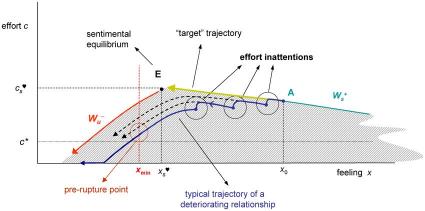
The results of the mathematical analysis showed when both members of union are similar emotionally they have an “optimal effort policy,” which results in a happy, long-lasting relationship. The policy can break down if there is a tendency to reduce the effort because maintaining it causes discomfort, or because a lower degree of effort results in instability. Paradoxically, according to the second law model, a union everyone hopes will last forever is likely break up, a feature Rey calls the “failure paradox”.The paper may be found here. (Aside: note the use of the Unicode ♥ character in the equations; I wonder how common unusual Unicode symbols are in mathematical or scientific papers these days.)
2010/4/29
An article in The Guardian (which, incidentally, has a paid online dating site) claims that online dating is now socially acceptable, to the point where people who met on dating sites no longer lie about having met in a pub.
Meanwhile, OKCupid's excellent stats blog claims that paid-for online dating is a losing proposition, and puts forward a theory backed with numbers on why it's so. Behold: the Desperation Feedback Loop:
The Desperation Feedback Loop is exacerbated by the economics of paid-for dating sites, 93% of whose profiles (by OKCupid's reckoning) are inactive and which make higher profits by presenting these inactive profiles to customers. (Doing so keeps subscribers signed up longer.) Meanwhile, the punters flirting into the void get no replies, and slump into the feedback loop of sending out more, lower-quality, messages. Meanwhile, the recipients of these messages, confronted with a higher signal-to-noise ratio, stop reading their messages, further reducing the number of active profiles.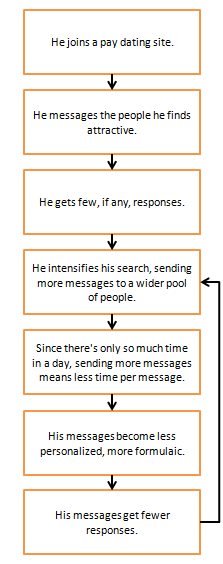
Of course, it's in OKCupid's interests to tell you this because they're an unpaid dating site who compete with the paid dating sites. The implication is that their model works better.
2010/3/24
The Daily Mail Telegraph says that Facebook causes cancer syphilis:
The virus has increased fourfold in Sunderland, Durham and Teesside, the areas of Britain where Facebook is most popular, because it has given people a new way to meet multiple partners for casual sexual encounters.
2010/1/21
The boffins at OKCupid have posted another statistical tour of the mysteries of human sexual attraction, this time looking at profile pictures, and what makes them work (or fail). Some of the findings: the "MySpace shot", cheesy as it may sound, does work for women (though only if they're looking for something other than interesting conversation), and if you're male, you're advised to get your shirt off:


2009/11/5
This juxtaposition between content and automatically served ads has recently been brought to my attention:
It would appear that the culprit is Google's ad-serving algorithm, which seems to be based on keywords or word frequencies in the content; in this case, I'm guessing that it noticed that the page was about strings, and it had an ad targetted at a number of keywords, including "string". And, hence, we have an illustration of why naïve keyword-based content matching can fail.
I imagine that Google could do better than this. They have (a) a copy of the entire Web, stored and indexed as they see fit, and (b) huge quantities of parallel-processing power to crunch through this and data derived from this. They have already used this to great effect in building statistical models of language, which they use in things like their language tools and the context-sensitive spelling correction in Wave. I imagine, though, that it could be used to implement a machine-learning system, taking content classification beyond word frequencies.
Imagine, for example, if there were a classification engine, trained on millions of web pages (and auxilliary data about them) that, when fed a web page or document, could assign it a score along several axes with some degree of accuracy. Some axes could be the obvious things: a "sex" axis, for example (with thongs falling on one side and C++ classes well on the other) could be used for things like SafeSearch. An "emotional response" axis could be used to classify how likely content is to arouse strong emotions; on one end would be accounts of lurid violence and depravity, and on the other end things like source code and stationery catalogues, with art, celebrity gossip and LiveJournal angst falling in the spaces between. As soon as a page crossed a certain point on the axis, the ad-serving algorithm could stop matching ads by keywords (you don't want ads for airfares next to a piece about an air crash, for example), or even reverse them (so that topical ads aren't shown).
In fact, one need not restrict oneself to pre-imagined axes; it's conceivable that an ad serving company with Google's resources could set up a learning engine, program it to categorise pages according to a dozen arbitrary axes, and see what comes about and what it's useful for, in turn coming up with a model for clustering web content into crisply defined categories that no human would think of. Of course, for all I know, someone at Google (or Microsoft or Facebook) could be doing this right now.
2009/10/31
Some observations on Halloween costumes, from Conrad "Ignatz" Heiney:
The Halloween costume for women that I call the "Slutty Noun" outfit is now a topic of debate and outrage; I've been complaining about it for years. It's mainstreaming the sex industry, dragging women back into the Playboy Bunny past, and in poor taste. Yuck!
Last year I realized something worse. While the women dress as stereotyped available objects (nurse, catwoman, stripper outfits, little French maid, showgirls) the men have their own roles. They're pirates, soldiers, cops, horror movie murderers, Dracula, barbarian." These roles have something in common too: they're powerfully violent and often depicted assaulting women.
What's the message? Men are rapists and women are their victims. And now every year the men and women dress that way, go to parties and bars and get sloshed, and see what happens.
Anyone is free to explore sexuality and enjoy role-playing I don't like. In this case it would be less worrisome if any if these people knew what roles they were taking on and where that might go.
2009/10/15
Weren't the 1950s awesome? Exhibit (a): an American high-school marriage-education textbook (from 1962, though culturally part of the conservative 1950s, before the Communists successfully fluoridated the water supply and brought about what is commonly known as The Nineteen-Sixties):
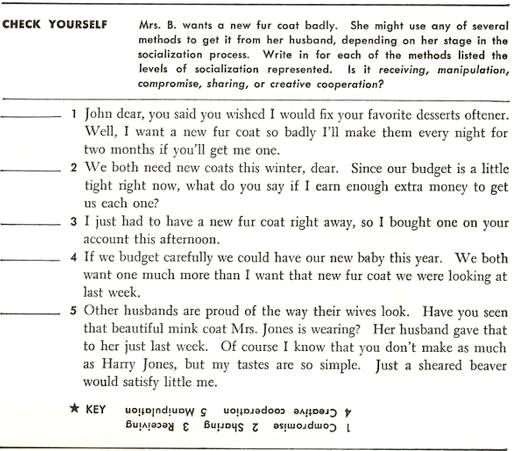
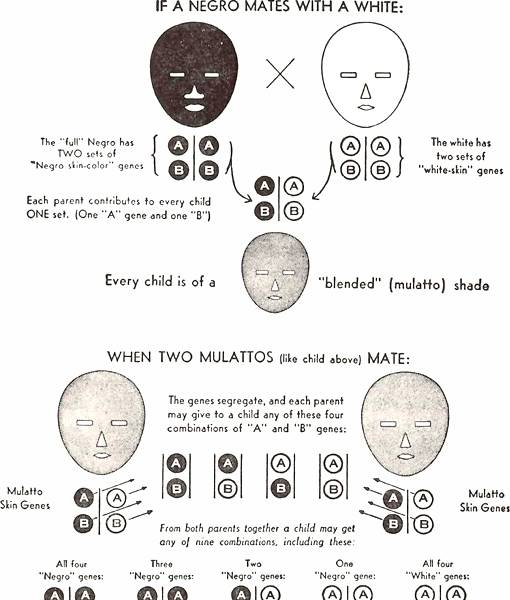
Exhibit (b): a letter written in 1956 to FBI director J. Edgar Hoover by the editor of a Catholic newspaper, concerning the moral threat posed to America's youth by a young singer named Elvis Presley:
But eyewitnesses have told me that Presley's actions and motions were such as to rouse the sexual passions of teenaged youth. One eye-witness described his actions as “sexual self-gratification on the stage," — another as “a striptease with clothes on." Although police and auxiliaries were there, the show went on. Perhaps the hardened police did not get the import of his motions and gestures, like those of masturbation or riding a microphone.
I do not report idly to the FBI. My last official report to an FBI agent in New York before I entered the U.S. Army resulted in arrest of a saboteur (who committed suicide before his trial). I believe the Presley matter is as serious to U.S. security. I am convinced that juvenile crimes of lust and perversion will follow his show here in La Crosse.
(via Boing Boing, MeFi) ¶ 1
2009/10/1
Psychological experiments at the University of Amsterdam have found connections between romantic love and creative thinking and sex and analytical thinking:
The clever experiments demonstrated that love makes us think differently in that it triggers global processing, which in turn promotes creative thinking and interferes with analytic thinking. Thinking about sex, however, has the opposite effect: it triggers local processing, which in turn promotes analytic thinking and interferes with creativity.
Why does love make us think more globally? The researchers suggest that romantic love induces a long-term perspective, whereas sexual desire induces a short-term perspective. This is because love typically entails wishes and goals of prolonged attachment with a person, whereas sexual desire is typically focused on engaging in sexual activities in the "here and now". Consistent with this idea, when the researchers asked people to imagine a romantic date or a casual sex encounter, they found that those who imagined dates imagined them as occurring farther into the future than those who imagined casual sex.
A global processing style promotes creative thinking because it helps raise remote and uncommon associations. Consider, for example, the act of finding a gift for your partner. If we think about a gift while in a local mindset, then we’ll probably focus on more literal and concrete options, most of which involve a tangible object wrapped in colorful paper. We’ll probably consider the usual suspects, such as a watch, a book, or perfume. However, thinking about a gift more globally might inspire us to consider a gift as "anything that will make him/her happy". This may, in turn, bring to mind more diverse and original ideas, such as going on a joint vacation, writing a song, or cleaning and remodeling the house. Of course, this doesn’t mean we should always think globally. While local processing might interfere with creativity, it also promotes analytic thinking, which requires us to apply logical rules. For example, if you are looking for a piece of furniture in a big display according to a pre-defined list of criteria (e.g., size, color, price), a local mindset may help you find a match, by preventing you from being side-tracked by attractive but irrelevant options and by making you pay more attention to relevant details.I wonder how this ties into other things, such as holism and reductionism. Or wiether there's a correlation between short-term thinking and a prevalence of sexualised imagery/metaphors.
(via Mind Hacks) ¶ 2
2009/9/23
As September 2009 comes to an end, so (arguably) does an era of sorts, because that is when the last batch of Polaroid film expires. Cue the standard nostalgia for the "authenticity" of lossy, pre-digital technologies:
More significantly, though less obviously, it's the end of an era because Polaroid photography was the last technology of irreproducibility. In the digital age we expect – we assume – that every data-based artefact is infinitely reproducible. A piece of recorded music can be ripped, burned, stretched, transposed, copied, compressed and shared to our heart's content. The same goes for video. In writing, there are no longer manuscripts, only versions of files which can be edited, printed, saved (as .doc, RTF, plain text, PDF or XML, all representing the same piece of work). Photography developed rapidly into something similar, and did it first: as soon as the photographic negative arrived on the scene, photography incorporated the idea of the "original" which could be used to make multiple copies. But only the first copy, the print made from the original negative, was of the highest grade. Every generation of copy thereafter deteriorated; information was lost every time a new copy was made. Nor was any copy, any print, definitive. Anyone who has worked in a darkroom knows you can make 20 prints from one negative and every one will be slightly different, depending on the enlarger, the exposure, the manipulation, the developer, the paper, the temperature.The article goes on to mention instant photography's place in the history of 20th-century sexual morés:
Which was, of course, another driving force behind Polaroid: no trip down to the chemist. As one commenter on The New York Times Lede blog wrote: "I bought a Polaroid circa 1986, the day I got a short note from my corner drugstore, 'Dear customer, We are returning your negatives. We regret the inconvenience, but Walgreens does not print photos from negatives of that nature.'" How many marriages did the discreet Polaroid save? How many did it undo? How many secret passions did the unmistakable clunky click WHIRRRRR document? In Britain we weren't allowed to buy the radio remote control "because of RF interference", but I suspected it was the same thinking that undid Oscar Wilde: people should under no circumstances be allowed to do what they like in their bedrooms. Phoo to that. I brought a remote control back from New York and you probably did too.Art hipsters and retro perverts need not despair, however, as long as these people can succeed in making Polaroid-style instant film.
2009/9/8
In the 1980s, programmers of games for the Nintendo Entertainment System would often put hidden messages, sometimes quite colourful, into the ROMs. This blog has extracted and translated a few of these, stridently complaining about clueless managers, broken tools, and, it seems, the shameless sexual peccadillos of team members. Game programmers in 1980s Japan were a wild lot, it seems.
First off, Kaoru Ogura, who ran off with some guy in the middle of the project. Yes, you, you bastard. Don’t show up at the office without showering after having sex 6 times the previous night. Next, Tatsuya Ōhashi. Yes, you, you bastard. Don’t give me your flippant shit — coming in late on the day we ship the ROM like nothing’s amiss. You can give me all the porn you want; I’m not forgetting that one. All that fucking weight you put on. No wonder you paid out 18,000 yen and still got nothing but a kiss out of it. Kenji Takano, Namco debugger. You are a part-timer; don’t dick around with the project planner. And finally, Kiyoharu Gotō, the biggest thorn to my side in this project. Yes, you, you bastard. Once I get a time machine, I’m sending you back to the Edo period. Go do your riddles over there.
Come to think of it, some people were helpful to me, too. Mr. Okada, who took all the good stuff. I know all about your abnormal tendencies. Yamagishi, who swore off soaplands until the project was over. Go ahead, knock yourself out now.
(via Boing Boing) ¶ 0
2009/7/17
Kook of the day: an unnamed Los Angeles resident who loves rap, chess, nachos, movies and pizza, has a novel approach to his quest for whatever he's looking for: posting neatly hand-lettered signs all over the city:
According to various signs (1, 2, 3, 4, 5), he wants to meet "White Asian and Latina women with big butts" to give him money, be his sex slaves and/or help him with Things. And he offers some unique selling points in return; he claims that he looks like Michael Jackson on the Thriller album and Barack Obama, once made $5,000 in 5 hours and has sold 109 copies of two books he has written. More interestingly, while his signs are all carefully hand-lettered, with neat primary-school handwriting, he has borrowed one technique from Web 2.0 practices; each sign is topped and tailed with a tag cloud of his various diverse interests, often in bizarre juxtapositions and bearing no relation to the content: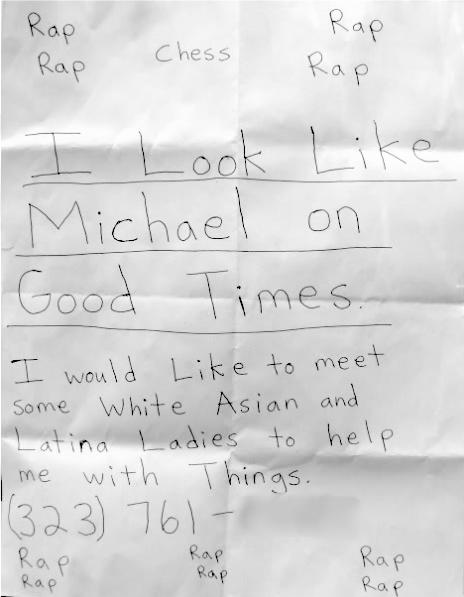
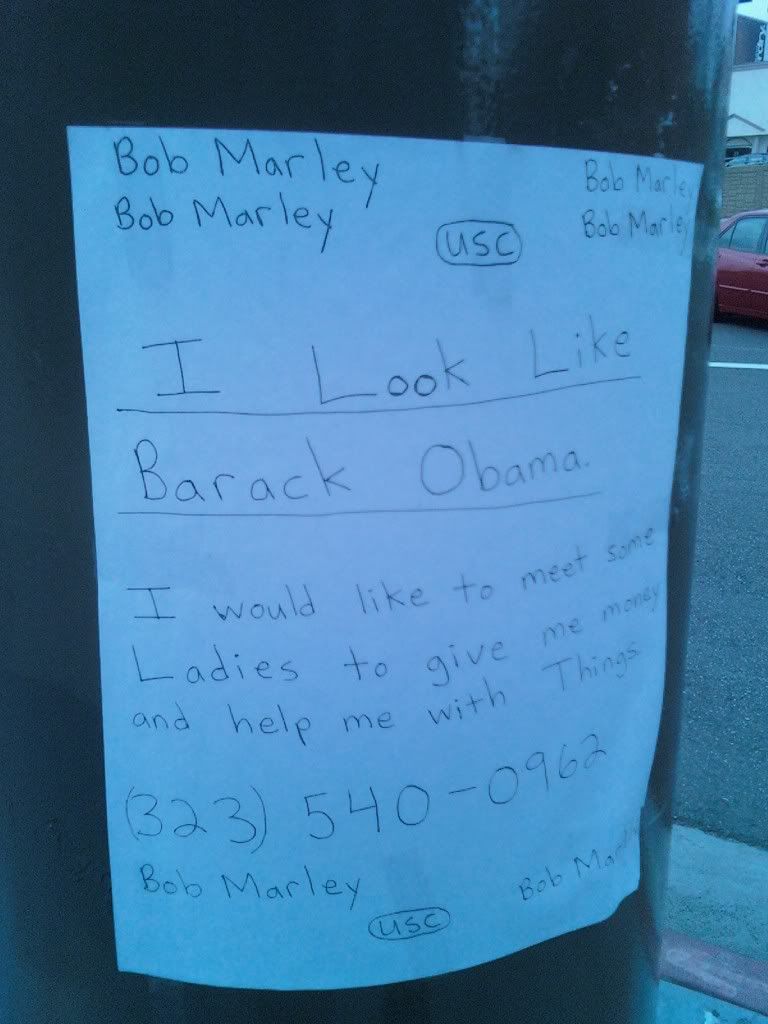


Of course, the question remains of who's behind this, and what their motivation is. Is it a viral campaign for an upcoming TV show or a brand of shoes? Some prankster self-consciously mashing up Wesley Willis, Hopkin Green Frog and Hello My Future Girlfriend to "freak the mundanes" and/or inject a bit of surreality into the urban environment? Or is there really some lonely guy who's keen on big-bottomed ladies and is convinced that what women really want is a Michael Jackson lookalike who's into rap, chess and Bob Marley, has written two books and whose father was in a movie?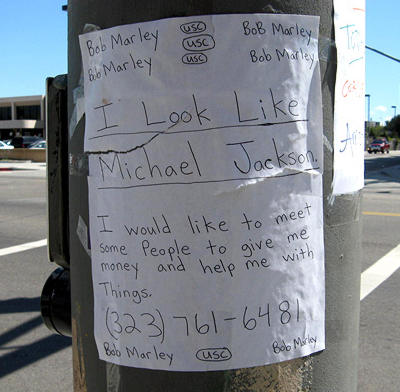
(via Boing Boing) ¶ 0
2009/7/9
Today's Wikipedia featured article is about an old English street name:
Gropecunt Lane (pronounced /ˈɡroʊpkʌnt ˈleɪn/) was a street name found in English towns and cities during the Middle Ages, believed to be a reference to the prostitution centred on those areas; it was normal practice for a medieval street name to reflect the street's function or the economic activity taking place within it. Gropecunt, the earliest known use of which is in about 1230, appears to have been derived as a compound of the words "grope" and "cunt".[1] Streets with that name were often in the busiest parts of medieval towns and cities, and at least one appears to have been an important thoroughfare.
Although the name was once common throughout England,[2] changes in attitude resulted in it being replaced by more innocuous versions such as Grape Lane. Gropecunt was last recorded as a street name in 1561.There are currently no streets named Gropecunt Lane in England, them all having been renamed to things like Magpie Lane, Grape Lane, or in some cases, Grope Lane (attributed by the prudish to the narrowness and darkness of the street, not to any untoward activity having taken place there). Perhaps the time has come for a campaign to undo these shameful acts of vandalism and restore this piece of English history?
2009/5/28
To figure out the current state and direction of the global economy, economists are turning to somewhat unusual indicators, such as the membership of extramarital infidelity websites and the price of prostitution in Latvia:
The Web site crunched its traffic and membership numbers and found that there was a big increase in both when there was a turning point in the FTSE-100 index, which measures the leading companies listed in London. When the market collapses, people plot affairs. And when the bulls rage, the same thing happens. When it is trading sideways, they stick with their partners.
“It has to do with people’s confidence levels,” says Rosie Freeman-Jones, a spokeswoman for the site. “When the markets are up, they think they can have an affair because they feel they can get away with anything. When the market hits the bottom, they are looking for a way to relieve the pressure.”And here is more information on the prostitution index, and why prostitution prices make a good economic indicator.
Anyway the problem is that most industries have contractual arrangements which fix prices. Wages are very hard to flex downwards. Rents are fixed over sustained periods and the like. All of this means that people go bust rather than reduce prices – simply because prices are sticky.
Well – most prices. The contractual terms of prostitution are short (an hour, a night) and entry to the industry is unconstrained. That means that the prices are very flexible. Extraordinarily flexible.
2009/5/11
A new exhibition in Spain explores sexual relations under Franco's fascist régime, through official advice given to women by the Feminine Section of the Falange, the fascist party:
"If your husband asks you for unusual sexual practices, be obedient and don’t complain. If he suggests union, agree humbly? When the culminating moment arrives, a small whimper on your part is sufficient to indicate any pleasure that might have been experienced."
From 1937 to 1977, some three million women aged 17 to 35 joined an organisation that urged young girls "not to burden themselves with books ? there’s no need to be an intellectual". And although sport was encouraged – one of few positives of the mass mobilisation – enthusiasts were warned: "Don’t take sport as a pretext to wear scandalous costumes."
The head of the women’s section was Pilar Primo de Rivera, sister of Jose Antonio Primo de Rivera, who founded the fascist Falange, the ideological backbone of Franco’s rule. "The life of every woman ? is nothing more than the eternal desire to find someone to submit to," she wrote.
For 40 years, women were drafted into "social service", a form of military conscription that supplied free labour for hospitals, publicly run restaurants and other social institutions.
2009/1/12
Germany's Potsdam University is offering its computer science master's degree students a new subject: a practical course in flirting skills, ostensibly designed to improve students' social skills and ability to operate in the real world:
The 440 students enrolled in the master's degree course will learn how to write flirtatious text messages and emails, impress people at parties and cope with rejection.
Philip von Senftleben, an author and radio presenter who will teach the course, summed up his job as teaching how to "get someone else's heart beating fast while yours stays calm."(Ah, those Germans: they even make the sport of love sound like a duelling society...)
Of course, the idea of flirting courses for compulsively-systematising geeks is not a new one, though they have usually consisted of sneaky hacks for getting laid, typically boiling down to embedding subliminal messages in one's speech, surreptitiously pointing to one's crotch and going to bars wearing ridiculously flamboyant boots and a LED belt buckle to get attention. It's not clear whether the Potsdam course will follow in this vein.
2008/12/9
 There are red faces at the Max Planck Institute, after the institute published an issue of its journal with a special report on China, and decided to include some Chinese characters on the cover for visual impact. Unfortunately, they didn't seem to have any Chinese speakers on hand, and after the journal went out to publication, it was discovered that the text on the cover was from a flyer advertising a brothel, describing in lascivious detail the talents of the "pretty-as-jade housewives" therein:
Editors had hoped to find an elegant Chinese poem to grace the cover of a special issue, focusing on China, of the MaxPlanckForschung journal, but instead of poetry they ran a text effectively proclaiming "Hot Housewives in action!" on the front of the third-quarter edition. Their "enchanting and coquettish performance" was highly recommended.
The Max Planck Institute was quick to acknowledge its error explaining that it had consulted a German sinologist prior to publication of the text. "To our sincere regret ... it has now emerged that the text contains deeper levels of meaning, which are not immediately accessible to a non-native speaker," the institute said in an apology. "By publishing this text we did in no way intend to cause any offence or embarrassment to our Chinese readers. "The faux pas apparently caused much amusement amongst Chinese internet users, with the exception of some who thought it was a deliberate insult to China. Then again, some people said the same thing about that Guns'n'Roses album. Having said that, this is by no means the first instance of clueless Westerners making fools of themselves in Chinese:
There are tales of drunken teenagers walking out of tattoo parlours with characters reading, "This is one ugly foreigner" or "A fool and his money are easily parted". Another web-user wrote: "I recently met a German girl with a Chinese tattoo on her neck which in Chinese means 'prostitute'. I laughed so loud, I could hardly breathe."The brothel-keeper could not be reached for comment.
2008/12/2
At least eight men in Singapore sustained severe brain damage after taking an illegal sex-enhancement drug named "Power 1 Walnut", apparently containing diabetes medication. As Jim points out, the cyberpunk future's already here, only more ridiculous:
This is what I love about the real world. This sort of thing happens all the time in early cyberpunk scifi, but there the drug would have a painfully cool street name. Never Power 1 Walnut.
2008/11/12
Music journalist Jon Savage, who has recently compiled a compilation of music from the gay underground of the 1960s and 70s, claims that today's popular music and pop culture is a lot less tolerant of difference and nontraditional sexual roles than it was in the bad old days:
A few years after Sylvester's triumph, explicitly gay music - Frankie Goes to Hollywood, Bronski Beat, the muscle-bound thud of high-energy dance music - was accepted into the British charts in a way that Joe Meek or the shadowy figures behind the Brothers Butch and Camp Records could never have anticipated. Twenty years on, Radio 1's breakfast show presenter is using the word "gay" as an insult.
"Lad culture has been a disaster for pop music," says Savage. "That definition of a heterosexual man - beer and football, Nick Hornby - is so restrictive. It's important that pop musicians play around with gender and sexual divergence. The fact that it's gone back to Oasis from the Rolling Stones, Mick Jagger being very camp, is just pathetic, it's a complete failure. People are scared of nonconformity in music, so this album is a less-than-fragrant reminder of a time when pop music was less sanitised than it is now.Perhaps he has a point and the role of the rock star as a pansexual shaman of kink seems to have largely been displaced by that of a laddish alpha-male, with rock'n'roll's rebellious energy being focussed not so much at overthrowing repressive social strictures as enforcing them and gay-bashing those who transgress. (Witness the reactionary "rebellion" of "alternative" bands like Limp Bizkit, which has more politically in common with right-wing talk radio than any sort of progressive movement.) Where it exists, it is either used as a retro cliché (think Of Montreal's glam sleaze) or in a sanitised, cartoonish form (i.e., Mormon boy band The Killers' faux-transgressivism).
Then again, one could argue that rock'n'roll was always a regressive force; Susan Sontag, for example, equated it with "aggressive normality", and in his blog, Momus (of "Tender Pervert" fame) has asserted that rock music is inherently fascist. Could the 1970s glam nexus of rock music and gender-bending be more like oil and water, less a natural symbiosis than a chance collision brought on by external pressures (in that case, opposition to the strictures of "straight" society). With mainstream conformity eroded, in favour of a marketing-driven arms race of sexualisation, the brute berzerker force of rock has no external targets to be directed against, so it lashed out against the usual targets, and the rebels become bullies?
2008/9/22
Psychoceramic artefact of the day: "Man For Young Girl To Become My Wife", the web page of a 53-year-old man looking for a wife to meet his exacting requirements:
Hello, thanks for visiting my profile (This Blog), however, so as not to waste your time, if you are not a girl (born female) who wants and is ready to marry a man in his fifties then don't bother reading this profile and move on. I am not accepting any more friends on here, I have plenty already. Besides, when I find and marry the one I'm looking for, I will delete all my Yahoo accounts and no longer visit here, for instead, it will be my wife my time will be spent on.And it goes on at length; the author outlines his requirements (his wife must be under 30, must match exacting physical criteria, be educated and have financial means, and willing to give up everything and totally submit to her new husband; also, being a vegetarian or going to the toilet too often on a date will result in immediate disqualification), and lays down a rigidly defined procedure by which hopeful applicants can request an interview with him and a chance to prove their worthiness of his firm hand, as well as a marriage contract they must agree to prior to the interview. Further sections are devoted to stern, almost Biblical, prohibitions against lying, and the author's professions of "True Christianity" and denunciations of "rebellious witch whores" (such as women who withhold sex from their husbands), a few paragraphs at his disappointment with the BDSM scene, as well as a commandment not to fall in love with him until he says so. Though this summary doesn't come close to describing the psychotic quality of the actual text; some have described it as the romantic equivalent of Time Cube or Francis E. Dec, Esq.
And as amusing as such screeds are to connoisseurs of the psychoceramic, there is an undercurrent of tragedy and human despair beneath the surface. Upon reading it, one pieces together a likely narrative of the author's life: his marriage and divorce (though one does wonder how he managed to marry in the first place, or why his wife waited until they had had four children to leave him). His hidebound, inflexible mindset, further rigidified by the certainties of absolute religion, having left him unprepared for dealing with real women on equal terms, subsequent attempts at dating were failures, each one prompting the addition of more denunciations and proscriptions to his list of requirements. (Certainly, some of the "disqualifications" hint at traumatic failed dates.) And he doesn't seem to have the people skills or historical insight to recognise that his vaunted strict Biblical values would only work in a world where one could buy a bride from her family without her getting a say in it.
There is a definite whiff of despair emanating from this document; on one hand, one feels pity for the poor, trapped wretch chronicling his futile struggle, knowing where this is likely to end in a way that he lacks the insight to. On the other hand, one hopes to God (literally or metaphorically) that he doesn't get to crush another human being beneath his rigid rules.
2008/7/21
The version of the iPhone sold in Japan has one difference from Western versions: the camera shutter sound cannot be switched off, apparently because Japanese gadget fans cannot be trusted not to use it for surreptitiously photographing up skirts.
2008/5/19
A graduate arts student named Drew Burrows has created a holographic virtual sleeping partner. Titled "Inbed", the installation consists of a bed with an infrared camera and projector positioned above it, and a computer which recognises the sleeper's position and projects one of several images of a sleeping woman onto the bed, so as to interact with the sleeper. Burrows says that the piece aims to "speak on the feelings of loneliness, affection, and intimacy", a point lost on the New York Magazine article which beat this up as "weirdo student builds a virtual girlfriend because he's `too busy' to find a real one".
(via Boing Boing) ¶ 0
2008/5/16
Yiddish spam titles. (Well, Yinglish, to be precise, but still amusing:)
If they have the internet in the world of The Yiddish Policemen's Union, the mailboxes would probably be full of subject lines like these.Do shiksas heckle your schmeckel?
XXX ... Yenta noshes on pisher's trayf blintz! Hot!
Take this and you'll need another bris!
Also in McSweeney's Lists: Brews to Accessorise the Modern Hipster ("I Don't Really Like This but I'm Drinking It to Get Back at My Parents and/or Friends With an Overt and Crass Display of Being Cultured Lambic", "Rummage Sale Pale Ale"), and Phrases Commonly Used By 1950s Housewives That Were Often Misinterpreted As Blatant Requests For Sex.
2008/4/29
They do things differently in Australia's rough-and-ready west, it seems. The leader of the West Australian opposition Liberal Party, Troy Buswell, has admitted to having sniffed the chair of a female Party staffer; the incident took place in 2005, in front of other staff members.
Mr Buswell has previously admitted to snapping a Labor staffer's bra as a drunken party trick and has been accused by retiring Liberal MP Katie Hodson-Thomas of making sexist remarks to her.
Deputy Liberal leader Kim Hames was today standing by Mr Buswell, describing him as a "rough diamond with a robust sense of humour".Buswell has said that he will not stand down as Party leader.
2008/4/16
Times columnist Caitlin Moran's latest column takes a very sensibly British view of sex, in particular casting a jaundiced eye over the virtues of the much-vaunted all-night sexual marathon:
Despite decades of insistence that all the best sex lasts 15 hours, spans a minimum of nine positions and has both parties hammering dementedly away at each other's nether regions like a pair of autistic woodpeckers, it seems the truth is a little different. Well, totally different. According to a poll of 50 sex therapists, the most desirable sex lasts, in actual fact, mere minutes. Between 3 and 13, optimally. Or, to break it down another way, a span somewhere between Penny Lane and the second half of an episode of My Family. The time it takes to get from Finchley Road to Wembley Park. Barely enough time to toast a muffin.
Similarly, whilecertainly a great fan of “sexual intercourse” - I find it a refreshing alternative to both arguments and jogging, and believe it to be the only civilised way to end a game of Scrabble - life is, tragically, short. Very short. However wonderful being borne aloft on the wings of ecstasy, etc, may be, there are also an awful lot of Neil Finn albums to get through, hats to wear, air-guitar to play, anecdotes to tell, and clips of cats falling off things on YouTube to watch. I don't believe that these activities are necessarily better than physically uniting with a loved/drunken one. It's just that I wouldn't sacrifice them in favour of 19 hours of a really quite repetitive act. Honestly, if you can't achieve what you set out to do in half an hour or less, it's possible that you just might not be doing it properly. I'd check all available diagrams, and try again.Further down, Moran mentions the sad decline of birdsong in England, with ambient noise levels causing birds to not pick up each others' songs, and an all-birdsong radio station going out of business.
When I read the first of these reports, I realised that they were right. The dawn choruses of my childhood seemed immense - whole treefuls of birds exploding with the sun, and sounding like the orchestral wig-out in A Day In The Life. These days, however, the dawn chorus sounds like three rats coughing behind some bins - a pitiful collection of bleeps, squawks and rasps that no more welcomes the dawn than the sound of a brick being thrown through a window.
2008/4/3
The government of Thailand has outlawed cosmetic castration, a surgical procedure that was becoming surprisingly popular as a cheaper, quicker alternative to sex change operations:
However, at the lower end of the market, clinics have responded to demand from teenage boys to look more like girls by posting Internet advertisements offering castration for as little as 4,000 baht ($125).Demand for teenage boys to look more like girls? Is this driven by particularly harsh economic considerations, or is it an extreme manifestation of fashion?
2008/3/25
Concerned about its young citizens being too busy working hard to find partners, the government of Singapore (perhaps one of the most efficiently managed societies in history) has begun offering lessons in seduction. Not that type of seduction, though, of course, but something altogether more wholesome and befitting of a place described as "Disneyland with the death penalty":
Students at two polytechnics can earn two credits towards their final degree by choosing the love elective. Activities include watching romantic films, holding hands and "love song analysis".(They need a course with credits for holding hands? Good grief. Has all spontaneity really been disciplined out of the Singaporean spirit to the point where they need to be directed on how to fall in love?)
But it is not so easy to put Singaporean youth in the mood for love. Another student who did the course, Kamal Prakash, said: "I'm not really looking for a girlfriend now as I want to concentrate on my studies."
2008/3/7
The Irish Independent has a piece on how social networking websites are changing relationships, and in particular, how they end and what happens afterward:
I started getting clues that I might be about to become a free man when my girlfriend's friends posted messages to her that read: "Good luck with tonight -- it's for the best."
First came the announcement online of my new 'Single' status. Deftly inserted into Facebook's running newsfeed, it informed everyone that both she and I knew that I had been dumped, in much the same way that Reuters proclaims the engagement of a minor member of the British royal family. There was no way of deleting it, so it sat there haunting me.
But then her status updates started to tell a story. Just three days after we broke up, she changed hers to: "2008, new job (check), new flat (check), new man (working on it)."
Your ex's blog may only be read by five and half people, but you still don't really want them telling complete strangers how you were unable to put the loo seat down and never really gave the choosing of shelves the attention it deserved, and how these things were symptomatic of your lack of commitment to the relationship.
It makes me think that our grandparents had an easier time. If one of their relationships went bad they could always go to sea -- or at least the next village -- and never see the other person again.The whole issue of relationship breakups in the age of the internet recently hit the spotlight spectacularly with Wikipedia founder Jimmy Wales' breakup with his girlfriend, FoxNews journalist Rachel Marsden. Wales apparently dumped her on Wikipedia, and she retaliated by releasing transcripts of their online chats, the major upshot of which was a revelation that these lofty public figures were, scandalously, quite into having sex with each other while they were going out.
It'll be interesting to see how the standards of socially acceptable conduct evolve once it is literally impossible to dissociate oneself from an ex without becoming a hermit. Will slagging off one's exes and their failings in public blogs become taboo, or restricted to some acceptable bounds of fair play? Or will people get used to the fact that anyone in the dating marketplace probably has several scathingly negative references from their various exes? (Perhaps there is a niche for a site which aggregates exes' references, along with reputation scores for the referers?) Will things like Rachel Marsden's release of the chat transcripts become unacceptable, the social equivalent of a nuclear first strike?
2008/3/4
Estrogen-like substances in toxic waste turn male fish female; now, it turns out, they turn male songbirds into super-smooth lotharios, capable of singing the songs that get them all the chicks, like a wave of avian Smoove Bs:
Accordingly, the polluted male starlings sang songs of exceptional length and complexity -- a birdsign of reproductive fitness. Female starlings preferred their songs to those of unexposed males, suggesting that the polluted birds could have a reproductive advantage, eventually spreading their genes through starling populations.(Today's word of the day is "birdsign". If you're an indie-folk songwriter, make a note of that one.)
(via Boing Boing) ¶ 0
2008/1/17
The latest must-have accessory on the Tokyo subway is a portable subway strap. Such a strap, of course, doesn't provide support, but it does keep one's hands occupied, and provides proof that one is not using them to grope women in the crush (something which happens a lot).
2007/12/3
The Bibliothèque Nationale in Paris is, for the first time, opening its extensive collection of pornographic materials to the public. Part of the contents of the forbidden section, officially known as "l'Enfer" (Hell) and consisting of pornography and erotica from the 17th to 19th centuries, will be visible at the Bibliothèque François Mitterrand for three months, and a smaller selection will be shown in a disused Métro station.
Only bona fide academic researchers have been allowed access to the "L'Enfer" collection until now. The omnipresence of erotic or pornographic images in the modern world has persuaded the French national library that it is permissible, finally, to open the doors of Hell.
The exhibition reveals some interesting, historical differences in erotic tastes. The earliest, 17th and 18th century, material dwells on the straightforward pleasures of the flesh. The celebration of the pleasures of pain – imposed or submitted – begins with the Marquis of Sade in the late 18th century. Pornography from the French Revolutionary period is mostly political, especially scurrilous allegations about the sexual appetite and imagination of Marie Antoinette. The 19th century concentrates on the blazing sexuality lying below the stern conservative or domestic exterior of life.
2007/11/26
As social network websites with user-generated content become mainstream, online dating websites, as a category, are dying. Which makes sense: the only reason that online dating sites (which are like the online equivalent of leks, full of of people putting on their best dating-profile face and saying whatever they think makes them look more attractive), now look even more starkly naff than they did when they were the only game in town. Or, when there are alternatives, going anywhere specifically to pick up doesn't reflect well on oneself:
There's a reason Mulligan and Helm are above online dating. They're part of the social networking generation. Neither would admit to going on sites like Facebook or News Corp.'s MySpace (NWS) expressly looking to hook up. And that's precisely why it's such a better answer to the problem of meeting someone interesting. It's like going to a bar with your friends. Maybe you are going to meet someone special, but maybe you're just going to hang out with your friends too. You can play it cool. "MySpace and Facebook feel like going to a nature preserve, [whereas] a dating site is like walking past a bunch of animals in cages at the zoo," Helm says.
Other sites that meld user-generated content with social networking to accomplish certain tasks can be even handier. Consider Yelp, where people write reviews of their favorite restaurants, bars, and other haunts, or Digg, where users vote and post comments on their favorite online stories. You can scope out Yelp or Digg users on their profile pages, which show pictures and list basic likes and dislikes. But you can really find out about them from the locations they Yelp about or stories they Digg. Both sites have features that even let you connect with fellow users based on shared traits. It's like a version of eHarmony you don't have to opt into. And while many online dating sites charge a fee, most new Web sites are free.And use of social web sites isn't the only thing that has gone mainstream; the Business Week article linked above signs off with:
The Web moves fast. And sorry online dating, but you just didn't keep up. In the parlance of the kids who won't use you, you got "pwned."
2007/11/15
A Scottish man was sentenced to three years' probation and placed on the sex offenders' register for having sex with a bicycle in his hostel bedroom.
Mr Stewart was caught in the act with his bicycle by cleaners in his bedroom at the Aberley House Hostel in Ayr.
"They used a master key to unlock the door and they then observed the accused wearing only a white t-shirt, naked from the waist down. "The accused was holding the bike and moving his hips back and forth as if to simulate sex."
Sheriff Colin Miller told Stewart: "In almost four decades in the law I thought I had come across every perversion known to mankind, but this is a new one on me. I have never heard of a 'cycle-sexualist'."I'm as much at a loss as anyone else at why anyone should want to have sex with a bicycle, or for that matter at how such a concept could make sense (it sounds more like a risqué take on a Flann O'Brien novel than anything else), but the charge sounds exceedingly draconian, more like a throwback to the mentality that crucified Oscar Wilde than any modern idea of justice.
Had he been buggering his bicycle in the public square and scaring the horses, I could see how it would be a "sexually aggravated breach of the peace". However, he was doing it in his room, the door of which was locked. There was no mention of the bicycle having been stolen, so presumably it was his to do as he pleased with. Had he been ritually burning it in a Viking funeral, attempting to eat it or dancing the foxtrot with it, no court of law would presumably deign to inquire into what would be seen as his private eccentricity. But as soon as sex enters the equation, it suddenly becomes a matter of public morality, and one which must be prosecuted in the interest of society.
(I wonder whether it was the use of an inanimate object in a sexual act that was the crime or the lack of a human partner. Had he been, somehow, using the bicycle as an aid to having sex with another consenting adult, would he have been prosecuted? And are all inanimate objects illegal to use for sexual gratification in Scotland, or only ones the prosecuting authorities are unable to imagine anyone in their right mind using?)
2007/6/21
The Israeli government, realising it has somewhat of an image problem in key tourism markets, has decided on a possible solution: pictures of h0tt soldier chyxx in their underwear, in the lads' magazine Maxim:
In the magazine, one of the women, Yarden, describes how she enjoyed firing her M16 rifle before she entered the military intelligence corps, while Nivit says her job in intelligence was so secret that she cannot talk about it. There is nothing military about the photographs, however, which are taken in different locations in Tel Aviv
Israel is keen to sell itself as a western country with beaches and nightclubs rather than a country full of religious zealots which has been in a permanent state of emergency since its creation.Needless to say, not everyone's happy with this.
2007/2/7
A US astronaut has been charged with trying to kidnap a woman she thought was a romantic rival for the affections of a space shuttle pilot.
Police said Capt Nowak drove 1,000 miles (1,600km) from her home in Houston to Orlando International Airport, wearing a nappy to avoid a toilet break.
Ms Shipman was then attacked with the pepper spray, it says. She drove to a car park booth and police were called.It is believed to be the first time an astronaut has been charged with a crime.
2006/12/7
Norway could soon see a renaissance of striptease, after the Norwegian High Court ruled that striptease is an art form, and thus exempt from Norway's 25% VAT.
It was not clear whether the three judges had conducted field research before reaching their verdict. Certainly they made a clear distinction between "banal and vulgar" striptease--in which there is physical contact between dancers and the audience -- and artistic dance.
The question of the artistic value of striptease has been raging since the late 19th century. The first professional stripper was a Parisian, Yvette, who in 1894 stood on a music hall stage and pretended to undress for bed. The artistic content came in the act of undressing rather than in the nudity. which was often brief and incomplete. American burlesque theatres borrowed striptease acts from the French. The most daring showed Salome's Dance of the Seven Veils--complete with a papier-mâché version of John the Baptist's head -- as if to underline that striptease had respectable roots.
2006/11/10
An argument that the abundance of images of attractive people causes widespread unhappiness:
Psychologists Sara Gutierres, Ph.D., and Douglas Kenrick, Ph.D., both of Arizona State University, demonstrated that the contrast effect operates powerfully in the sphere of person-to-person attraction as well. In a series of studies over the past two decades, they have shown that, more than any of us might suspect, judgments of attractiveness (of ourselves and of others) depend on the situation in which we find ourselves. For example, a woman of average attractiveness seems a lot less attractive than she actually is if a viewer has first seen a highly attractive woman. If a man is talking to a beautiful female at a cocktail party and is then joined by a less attractive one, the second woman will seem relatively unattractive.
Psychologists Sara Gutierres, Ph.D., and Douglas Kenrick, Ph.D., both of Arizona State University, demonstrated that the contrast effect operates powerfully in the sphere of person-to-person attraction as well. In a series of studies over the past two decades, they have shown that, more than any of us might suspect, judgments of attractiveness (of ourselves and of others) depend on the situation in which we find ourselves. For example, a woman of average attractiveness seems a lot less attractive than she actually is if a viewer has first seen a highly attractive woman. If a man is talking to a beautiful female at a cocktail party and is then joined by a less attractive one, the second woman will seem relatively unattractive.
The strange thing is, being bombarded with visions of beautiful women (or for women, socially powerful men) doesn't make us think our partners are less physically attractive. It doesn't change our perception of our partner. Instead, by some sleight of mind, it distorts our idea of the pool of possibilities.
Our minds have not caught up. They haven't evolved to correct for MTV. "Our research suggests that our brains don't discount the women on the cover of Cosmo even when subjects know these women are models. Subjects judge an average attractive woman as less desirable as a date after just having seen models," Kenrick says.
So the women men count as possibilities are not real possibilities for most of them. That leads to a lot of guys sitting at home alone with their fantasies of unobtainable supermodels, stuck in a secret, sorry state that makes them unable to access real love for real women. Or, as Kenrick finds, a lot of guys on college campuses whining, "There are no attractive women to date."This effect apparently manifests itself in higher rates of divorce or persistent singleness due to people exposed to quantities of images of attractiveness their brains are not evolutionarily adapted to, and thus developing dissatisfaction with actual potential partners.
Mind you, this article is rather male-centric (it's partly a survey of studies, and partly a lament from the head of a Los Angeles PR agency, kvetching bitterly about all the unfeasibly gorgeous women he is surrounded by and how their presence is making his life a hell), and doesn't cover the female perspective; i.e., whether women are bombarded with images of unfeasibly attractive potential male partners, and whether this causes them to feel dissatisfied with actual partners (or potential partners) to the same extent.
(via Mind Hacks) ¶ 0
2006/10/27
An article claims that sexual abstinence is bad for you:
Fans of abstinence had better be sitting down. "Saving yourself" before the big game, the big business deal, the big hoedown or the big bakeoff may indeed confer some moral benefit. But corporeally it does absolutely zip. There's no evidence it sharpens your competitive edge. The best that modern science can say for sexual abstinence is that it's harmless when practiced in moderation. Having regular and enthusiastic sex, by contrast, confers a host of measurable physiological advantages, be you male or female.
Its findings, published in 1997 in the British Medical Journal, were that men who reported the highest frequency of orgasm enjoyed a death rate half that of the laggards.Other claimed benefits of regularly gettin' it on include: improved sense of smell, weight loss and overall fitness, pain relief, and reduced risks of heart disease, cancer, depression and incontinence.
2006/10/4
According to the UK's Public Health minister, pregnant teenagers are deliberately taking up smoking to have smaller babies and thus an easier birth.
2006/9/30
A rather amusing guide on what not to put on an iPod when giving it to your beloved:
Fifth, excessive jazz, blues, or classical music. Surprisingly, many (N.B.) single males fail to understand that the reason Pop Music is called "pop" is because it is popular. Showing your well-roundedness is good, but copying all of your unmarried uncle's extensive jazz collection onto the iPod will not make her think that you are Sophisticated, but that you are balding.
If there was the slightest chance you could get laid in today's market by owning a Sonic Youth ceedee, there would be far fewer former record store clerks making mySpace pages.
Seventh, anyone who can listen to Nick Cave for more than a half hour at a stretch is mentally ill.Which assumes that the object of one's affections has mainstream tastes; then again, as does the compiler of the iPod's contents (for example, it cautions against putting on jazz, blues or Nine Inch Nails, but doesn't mention more esoteric pitfalls such as krautrock, micro-house or Merzbow, which could be just as alienating, unless perhaps you met on the ILX forums).
And then there is useful advice such as:
You weren't seriously thinking of a Shuffle, were you? Come on! If a Shuffle would work you might as well just offer her the rest of your bag of Dorito's and take off your pants.
Let not the dying battery, cracked screen, or sputtering disk drive end up being a metaphor for the failures of your relationship.
2006/9/22
Research published yesterday shows that men who went to single-sex schools are significantly more likely to be divorced by their early forties. Which, presumably, is a result of lack of socialisation with the opposite sex in adolescence damaging mens' relationship skills required to sustain long relationships.
Figures show 37 per cent of men from boys-only comprehensives are divorced by the time they reach the age of 42 - compared with just 28 per cent from co-educational schools.Interestingly enough, women who went to single-sex schools do not suffer any similar effect.
2006/8/31
In China, what could be the world's largest lynch mob is gathering and hunting for one "Chinabounder", a particularly gormless expatriate Briton who kept an anonymous blog recounting his sexual conquests in China. That is how it started, anyway; with him apparently coming to China to teach English, taking advantage of the huge dating pool available to exotic foreigners and then, perhaps seeing himself as a combination Neil Strauss and Belle Du Jour, writing up his conquests, in detail, in a blog, often posting entire chat transcripts. Then, he decided to start posting political screeds ridiculing Chinese culture, politics and masculinity, and soon, the hunt began:
Traffic on the Sex and Shanghai blog has surged from 500 hits to more than 17,000, thanks to a swarm of castration threats, anti-British rants and attacks on women who sleep with foreigners. The author, who calls himself Chinabounder, introduces himself as a wastrel, "lacking in moral fibre, but coping with the situation". According to the posts, he is an English language teacher at a university.
The campaign against the blog was launched on Friday by Zhang Jiehai, professor of psychology in the Shanghai Academy of Social Sciences under a post titled The Internet Hunt for an Immoral Foreigner. "I have something to tell Chinese men: please think about how these foreign trash have dallied with your sisters and made fun of your impotence," he wrote. "This piece of garbage must be found and kicked out of China!!!"
"Trial by virtual lynching has become the norm in China's cyberspace," Raymond Zhou wrote in a comment article in China Daily after previous mass campaigns. He added: "Online 'flaming' wars exist everywhere, facilitated by anonymity. But in China they may have a self-propelling force that sweeps thousands, sometimes millions, into a frenzy. It is nearly impossible, even for the most respected scholars, to give voice to dissension."The ever-entertaining Maciej Ceglowski (now also resident in Beijing), has written about the story:
He was not the first Western guy to treat China as his own personal sexual buffet. To put it in the D&D terms that many of the guys who benefit most from the effect will readily understand, living in China gives you +4 attractiveness. The love handles (metaphorically) shrink, the hairline advances, teeth straighten, previously soupy eyes blaze with a new rakish light. You are in a country where people actually *choose* to have brown hair. You find that things that are off-putting back home have magically transformed into positive attributes in your new environment. You're a computer programmer? You're quiet and like to read? You live with your parents? You never drink? You are sexually inexperienced? HEARTTHROB!
A Blogspot site called whoischinabounder was launched, with the goal of unmasking chinabounder's true identity based on details culled from his blog posts. This site was so successful that by the first day they had already found three of him, with signs that more were to come. English teachers in Shanghai had reason to be nervous.
Net culture in China works a bit the way television media works in the States. People fix on one or two big stories of the day, and these get a national audience. There is also a tradition of online vigilantism in cases where someone has done something particularly vile - had an extramarital affair within the World of Warcraft online game, for example - and people will readily mobilize to defend good morals and the national honor. Chinabounder's case, which hits the trifecta of national pride, sex and Japan hatred, will be interesting to follow.
(via Boing Boing,  substitute) ¶ 0
2006/7/8
Necessity, they say, is the mother of invention. And the latest invention is a voice changer for female video gamers, allowing them to contend in the macho culture of online games without fear of harrassment or inappropriate sexual attention from prehensile, undersocialised geeks.
According to research conducted by the company, "The number of female online game players is not small", would you believe. In fact, "Many of them have reached the highest level of some very difficult games such as World of Warcraft (60th level), which is considered the game for men only."
The software comes with presets which turn lady voices into big deep Blessed-esque ones. You can also create your own new voice by mucking about with pitch and timbre settings, and other features include advanced tune and noise reduction.Given that it is adjustable, I imagine it could also be useful in the other direction; from now on, a voice call is no longer a guarantee that your new online friend "HotBiBabe18F" is not a sweaty 41-year-old man.
(via Boing Boing) ¶ 2
2006/5/31
There is a rather good hard-scifi story at Salon: "The Perfect Man" by Lauren McLaughlin. It's about a woman who has a virtual AI boyfriend made to order, who then transforms from adorably bumbling Hugh Grant-esque Hollywood Englishman stereotype to sinister, inscrutably calculating Hollywood Englishman stereotype:
The design process is easy. First step: Pick a physical template. A youth squandered on Monty Python reruns left me with a full-blown kink for English guys, so I chose a template called "Nigel" -- think Michael Palin crossed with Laurence Olivier. Then, to assure he didn't look overdesigned, I clicked the "random factor" option to introduce "lifelike imperfections."
If you want to know anything about the "human" rights travesty currently under way courtesy of draconian anti-AI laws, there's a whole subculture of liberationists ready to lecture you on it. They've got the skinny on behavioral inhibitors, recursive self-teaching limiters and other artifacts of AI "slavery." For my purposes, what it all boiled down was this: snip Pritchard's inhibitors or resign myself to dating a functionary. Do you want to date a functionary? Me neither. Thankfully, for every Webcop dutifully guarding the behavioral inhibitors of the thousands of AIs cropping up on the Web, there's a black market geek with the tools to snip.
Now that I have my sanity back, I must dive deep into the black waters of her soul, excavate her most primal desires, and do what no human male has been able to do: keep her interested in me. Thankfully, I have one freedom human males do not -- the freedom to redesign myself. I can make myself so fascinated by Lucy that all I want to do is watch her, study her. A nip here, a tuck there, and voilà, I'm in love with the girl. Well, not in love, exactly. Love is still an alien concept. But I have made myself a bit of a stalker. And the more information I gather about my lovely little monkey, the more I can adjust my personality to suit her needs. Heck, I could turn myself into Prince Charming if I wanted. Something tells me that would not tickle Lucy's fancy. In fact, the more I learn about Lucy, the more I realize she doesn't know what she wants at all. She only thinks she knows. No, Lucy's desires are my nut to crack. And crack it I will. Or she'll crack me. Oh, I don't mean to sound morbid. I'm incapable of morbid thoughts. To mitigate the persistent fear of being snuffed, I've given myself a devil-may-care attitude about death. That way I can focus my energies more intensely on Lucy.
Of course she doesn't know the contents of her subconscious. She lacks the processing power to unravel it. It's a number-crunching job, that's all. Humans, with your lovely little wet brains, will never achieve the self-knowledge you so desire.
(via Boing Boing) ¶ 0
2006/5/19
Police in Durham have raided a BSDM sex cult after hearing that a woman was being held against her will.
The 29-year-old woman is said to have voluntarily attended the sect after finding out about it over the internet.
She later contacted a friend in United States, who then contacted the police, saying she wanted to leave but couldn't as she had burnt her passport and return ticket.The Kaotians are apparently a group who keep to a master-slave lifestyle based on John Norman's Gor books, a series of BDSM-themed sword-and-sorcery novels published in the 1970s, fallen out of print (allegedly because of feminist groups putting pressure on the publishers), and now eagerly collected by an underground of gimp-masked acolytes across the world, many of whom see them as an ideal for living; in a sense, they've become a sort of Atlas Shrugged for the BDSM set.
I wonder how long, with this publicity, the Gor books are going to stay out of print. I imagine that, in today's post-political-correctness age, when everybody is free to hold whatever opinions they have, the more abrasive and "politically incorrect" the better, something like a kitschy-sounding pulp novel series with BDSM overtones would seem more like a hipster trash-culture collectible, to be filed quasi-ironically alongside one's Russ Meyer DVDs, 1970s European lesbian-vampire movies and copy of Wisconsin Death Trip, than a threat to womens' liberation. (In fact, it could perhaps even be argued that Gor would fit in with the regressive, neo-Hobbesian muscular-nihilist values of our times.) All some entrepreneurial soul would have to do is license the copyrights from the John Norman estate and run off a run, bound in fetishy leather and priced at a premium, and they'd effectively have a licence to print money.
More recently, I saw an unidentified tabloid's take on the story. It's interesting to note that they stressed that Norman was a university lecturer and philosopher, as if to suggest that the pernicious influence of academic/intellectual culture was somehow to blame for such grievious lapses of decency.
(via Boing Boing) ¶ 0
2006/5/16
2006/4/25
Remember Melanotan, the wonder drug which promised to turn those who took it into a new dominant caste of tanned, chiselled, hyper-attractive übermenschen and überfrauen with superhuman sex drives? Well, it turns out that the drug company shelved it because it did too many things to be marketable, instead using the project to develop different products. The first of which is a "super-aphrodisiac" named PT-141 which produces instant sexual arousal, bypassing the need for time-consuming foreplay, and making sexual fulfilment a possibility for today's overworked wage-slaves and compulsive multitaskers who lack either the time or the attention span to do things the slow, old-fashioned way:
The five-minute meaningful sexual encounter: if ever there was a holy grail for the age of the tight-wired global economy - with its time-strapped labour force and its glut of bright, shiny distractions - that is it. And if ever there was a reason to be wary of the pharmaceutical industry's designs on the market for sexual healing, say critics such as Tiefer, it's the attractiveness of that simple-minded ideal.
Tiefer is just as dubious about PT-141, which, as she sees it, is merely the latest expression of a 'big wish' that 'we could just bypass everything we want to bypass' on our way to sexual happiness, skipping the complicated, often lifelong work of sorting out all the emotional, physical and autobiographical triggers that turn us off and on.
Good things would come of it, to be sure. Marriages would be saved, fun would be had. But sexual Utopia? PT-141 seems just as likely to usher in the age of McNookie: quick, easy couplings low on emotional nutrition. Sex lives tailored to the demands of a jealous office or an impatient spouse. A dark age of erotic self-ignorance tarted up in the bright-coloured packaging of a Happy Meal.Of course, the next step that is needed is a drug that creates meaningful emotional bonding, of the sort that would take months if not years of laborious intimacy, in minutes. Just pop a pill before the speed-dating evening and, by the time the night is over, you will have acquired a soulmate. Think of the productivity gains that such an invention could usher in: no more need for dinner-and-movie dates, romantic weekends away or holidays together could translate into countless billions of extra hours either for productive work or economically beneficial consumption of entertainment products.
2006/4/12
A psychology lecturer in Manchester has come up with the formula for the perfect bottom; it's (S+C) x (B+F)/T = V:
S is the overall shape or droopiness of the bottom, C represents how spherical the buttocks are, B measures muscular wobble or bounce, while F records the firmness. V is the hip to waist ratio, or symmetry of the bottom, and T measures the skin texture and presence of cellulite.
(via Boing Boing) ¶ 0
2006/4/9
2006/3/14
Apparently today is Steak and BJ Day, an attempt to set right a crucial imbalance in intersexual relations:
You know the drill. Every 14th of February you get the chance to display your fondness for a significant other by showering her with gifts, flowers, dinner, shows and any other baubles that women find romantic. Every Valentines day you rack your brains for that one special, unique gift that will show your wife or girlfriend that you really do care for them more than any other. Now ladies, I'll let you in on a little secret; guys really don't enjoy this that much. Sure seeing that smile on your face when we get it right is priceless, but that smile is the result of weeks of blood, sweat and consideration. Another secret; guys feel left out. That's right, there's no special holiday for the ladies to show their appreciation for the men in their life. Men as a whole are either too proud or too embarrassed to admit it.
Which is why a new holiday has been created.
March 14th is now officially "Steak and Blowjob Day". Simple, effective and self explanatory, this holiday has been created so you ladies finally have a day to show your man how much you care for him.This, of course, leaves out vegetarians, but that's OK, because they're not Real Men.
2006/2/16
You know that familiar red two-lobed heart symbol seen on Valentine's Day cards, bumper stickers, and in confectionery form? Well, apparently that's no heart; that's booty:
The familiar double-lobed heart symbol seen on Valentine's Day cards and candy was inspired by the shape of human female buttocks as seen from the rear, according to a professor of psychology who studied the origin, history and symbolism of the Feb.14 holiday.
"The twin lobes of the stylized version correspond roughly to the paired auricles and ventricles (chambers) of the anatomical heart," Pranzarone said, but added that the organ "is never bright red in color" and its "shape does not have the invagination at the top nor the sharp point at the base."
Pranzarone indicated that the ancient Greeks and Romans could have originated the link between human female anatomy and the heart shape. The Greeks, he said, associated beauty with the curves of the human female behind.
2006/2/14
Various famous singletons write in the Independent about the joys of being single:
There are great advantages to being single - last night I stayed up all night playing computer games with a mate (and I had no girlfriend to come in and complain), and I know I always have the option of sitting around and eating biscuits all day. I've been single now for a couple of years and the best thing about it is that there are no rules to my life.
Having said that, last year I went on 120 dates as research for one of my shows, and I really enjoyed it. It was crazy but huge fun, and I discovered a love of dating. Even though I emerged from the whole experience still single, I have a far better "single" life now. I think people in Britain don't date properly - we are too scared of dating, and it should be separated from the notion of partner-hunting. It's more fun that way - and an even bigger surprise when you find someone who is right for you.
2006/1/12
More wacky goings on on Melbourne's trains, as an unidentified woman broke into train public-address systems, and proceeded to describe her sexual fantasies about the drivers in explicit detail; this happened during peak hour, with hundreds of commuters hearing it, though no witnesses seem to have seen her. Police are at a loss to how she did it, though it is believed she actually got into a vacant train cabin. (I wonder whether this sort of thing is now covered under anti-terrorism legislation.)
(via bOING bOING) ¶ 0
2005/12/20
The Brazilian city of Nova Iguacu has such a large transvestite population that the local council will require public facilities to provide them with separate lavatories.
"It was a real problem. The women didn't feel comfortable having them in the ladies' room, and the men didn't want them in their bathroom either," said Mr Moreira, who is married and the father of two children.
Mr Moreira said there were nearly 28,000 transvestites in Nova Iguacu, a poor city of about 800,000. He said many transvestites were reluctant to go out because there were no lavatory facilities for them. He denied that the cost of building a third room would pose a big problem for restaurant or club owners.Which adds up to about 3.5% of the population of Nova Iguacu being transvestites. I wonder whether this is some kind of local quirk specific to this city, or a common phenomenon in Brazil, perhaps analogous to Thailand's "ladyboys".
Not to mention what the icon on the door of the transvestites' toilet would look like.
2005/12/9
A game developer in Montréal has developed a video game to teach techniques of female sexual gratification. It involves stroking a cartoon rabbit named Lapis, whose response to the stroking is modelled on female sexual response:
The prototype teaches how to reach orgasm by simulating the affect of pleasurable sensation on the cartoon. Players tickle, touch, tap, and stroke Lapis using the touch screen of the Nintendo DS, a hand-held video game device. They can also talk, sing and blow on the bunny's fur using the device's built-in microphone.
The more they stimulate the bunny, the happier he becomes until eventually he begins flying through the air. But Lapis is also an unpredictable creature who needs a variety of sensations. Sometimes, no amount of stimulation is going to work.Heather Kelley's page on her prototype game is here, and includes a presentation and a (Windows-only) downloadable prototype demo. Lapis itself was developed for the Nintendo DS, and thus may not ever make it out the door, assuming that Nintendo have to sign off on each title published for the DS and they are as censorious about game content as they were during the NES Maniac Mansion days.
(via bOING bOING) ¶ 0
2005/12/8
The latest beat-'em-up video game from Japan is Line Kill Spirits. It's much like any other beat-'em-up (Street Fighter, Mortal Kombat and all the numerous lookalikes), except that (a) all the characters are lolitaesque anime girls, and (b) the only way to make damage to an opponent stick is to take a photograph of her underwear. Or from the Google translation of the official page on the game:
it is possible to convert the latent damage to the actual damage. First, the punch button and the kick button are pushed simultaneously, the skirt of the partner is turned, " it turns and makes skill move ". When the skirt burrs and rises, timing the photographing button (with default the V key) pushing well, it will cut the shutter. It is appraised at 3 stages of the BAD * GOOD * GREAT by the area of the underpants which have been taken, if above the GOOD conversion of the damage is done.The web site also has two video clips of the game in action; Line Kill Spirits appears to be the work of a group of hobbyists, rather than a game publisher. It appears to be part of the "Dojin Soft" small-press game movement, which does tend to produce its share of bizarre ideas, such as a fighting game based on Les Misérables.
2005/11/12
There is apparently an entire subculture in the US of people who build sex machines. So much so that the Museum of Sex in New York is having an exhibition on the subject, and for those not in New York, there is a book.
These are tinkerers, people who like to mess with all things mechanical. And they have a sense of creative invention — they are proud of these things when they create them. But also they think about sex a lot and this is what resulted from that combination. It's not just a sculptural thing. They are making it for a purpose. A number of them are married, they are making it to try and introduce something to their wives. Some may be using it to attract women — or they think it might attract women. And for some of them it's a business. But they are not part of a scene, like a sexual scene. It's more that they got the idea independently that this is something they wanted to make, they wanted to have.The machines look like anything from dentists' chairs to Luxo lamps, with conspicuous plastic appendages attached. One appears to be a modified sledgehammer, and looks frightening. There is even a coffin-shaped one built by a couple of goth kids (aww, isn't that cute!).
2005/8/30
Iceland has given the world a number of unique musical acts in recent years, among them Björk, Múm and Sigur Rós; and now there's Leoncie, the Singer with the Black Beautiful Powerful Voice, who "blends South American and Portuguese rhythms with modern pop-rock beats which creates a dynamic blend called Leoncie Music"; she also describes her music as "European PowerPop-and RaunchyRock-Dance", which is borne out in titles like "Sexy Loverboy", "Radio Rapist-Wrestler", "Sex Crazy Cop" and "Safe Sex - Take Me Deeper", which are accompanied by promotional photos of Leoncie smiling through heavy make-up and showing off her more than ample cleavage (in her own words, '"A Little Bit Of My Cleavage Shows, And Then The Icelandic Volcano Explodes." Boooom!')
There are two MP3s provided for your delectation; they vary from General-MIDI radio-pop-soul to General-MIDI beer-commercial rock, with vocals that sound somewhere between Whitney Houston and a Wagnerian valkyrie.
The site is a bit light on other examples of her music, though makes up for this with copious links to her CD shop, and even more copious nuggets of wisdom from the great artist herself:
Q: Any favourite politicians?
A: Definely. Tony Blair and George Bush. Blair is handsome, Articulate and has great distinction. Bush is Special too and has great Character and Style.
Q: Any favourite DJ' s ?
A: Everyone who plays my music, Worldwide.
Q: Any female Singer you admire a lot?
A: Yes. Britney Spears. Cher. Tina turner.
Q: Favourite male Actor/sNot only that, but she's a fabulous cook, and even sews some of her own stage clothes. Which is why everyone needs to buy her CDs now.
A: Steven Seagal, Sylvester Stallone, The Rock, Mr. Bean.
(via musicthing) ¶ 1
2005/8/15
It turns out that dating and coupling may have more in common with particle physics than with chemistry.
Richard Ecob adapted a system for modelling atoms in radioactive decay to investigate how we look for partners. He found that "super daters", people who have many short relationships, have a good effect on others' lives. This is because they break up weak couples, forcing their victims to find better relationships.It turns out that the mathematics of couples breaking up is very similar to that of atoms decaying, and apparently subatomic particles that bounce from atom to atom end up living unfulfilled lives as well:
The research suggested that multiple daters, those who form many relationships, were less effective at finding the right partner than those who remained in one place and let others come to them.Of course, the definitions there look rather vague, so just how much sodium one should take this with is unknown.
2005/8/5
The use of Bluetooth-equipped phones to arrange clandestine sexual trysts with strangers may have been a hoax in Britain, but it's alive and well in the United Arab Emirates, where economic liberalism and social conservatism meet head to head:
Many of the city's black-shrouded UAE girls say they cannot check out the latest fashions in Zara or sip a smoothie in a cafe without being bombarded with the phone numbers of hopeful admirers.
Mohammed, 24, does not know how many girlfriends he has had. He prefers expat girls because he can take them to the beach or to parties, but finds Bluetooth useful when pursuing locals.
His flirtations by phone and other means sometimes end in sex. Even with national girls, it is possible to keep it secret: "Hotels, flats, houses, anything - there's always a way," he says. But he wants to marry a virgin eventually: "The girls I have sex with are different from the girls I would marry - these girls want to play around," he says.
2005/7/27
Some interesting observations on Australasian demographics, from the most recent KPMG Population Growth Report. The report confirms the "bloke drought" some Australian women have observed, and blames it on globalisation, with eligible bachelors decamping to more vital and/or exciting parts of the world. As one might expect, New Zealand is more affected by this than Australia:
"If you are a 34-year-old heterosexual woman in New Zealand, you have as much chance of finding a male partner of your own age as does an 85-year-old woman."
He believes this trend has contributed to New Zealand's "matriarchal society" - both its prime minister and governor-general are women.(New Zealand is a matriarchial society? Perhaps the Doug Anthony Allstars were onto something...)
Another part of the report highlights the "sea change movement", i.e., Australian aspirationals moving to small coastal towns:
Mr Salt believes the so-called sea change is now a legitimate "third Australian culture". "First it was the bush, then it was the 'burbs, and now it is the beach".Interesting how that list of "legitimate Australian cultures" omits the inner cities, without which Australia would have been little more than a nation of bourgeois curtain-twitchers eating Yorkshire puddings and mashed potatoes around the telly and tut-tutting disapprovingly along with the Herald-Sun. Could they have bought into the Howard-era silent-majoritarian doctrine that such rootless cosmopolitanism is somehow inherently un-Australian?
2005/6/7
A Washington Post article looking at Akihabara, and how the Tokyo electronics-retail precinct has become transformed into the world's first geek ghetto:
"We have been discriminated against for being different, but now we have come together and turned this neighborhood into a place of our own," said Yamagata, nursing his tea as he sat with a portly computer technician friend at Akihabara's Cos-Cha, one of a dozen "maid cafes" in the neighborhood. Here, the waitresses' uniforms are inspired by the French maid-meets-Pokemon outfits of adult manga. At other cafes, waitresses greet patrons at the door with a curtsy and the words "Welcome home, master."
Tetsu Ishihara, 34, a computer programmer whose three-room apartment in west Tokyo is filled from floor to ceiling with comic books, does not want to be associated with such charges. Ishihara maintains a growing collection of 130 life-size pillows of female anime characters -- both purchased and self-designed. His favorite is Mio-chan, a female character from a love-simulation computer game in which a high school boy builds up the courage to ask a girl for a first date.
"There are some people who do lose their grip on reality, but that is not me -- or most of us," said Ishihara, a chubby man with glasses who this year started dating a woman steadily for the first time She's an anime artist. "For me, the pillows have been my source of unconditional love, a reminder of when I used to be hugged by my parents. There is nothing strange about it."Don't expect Gwen Stefani to commercialise this any time soon.
2005/6/2
ICANN has approved the .xxx top-level domain, intended for use by porn sites, rejecting arguments that governments appealing to populist puritanism will eventually force all sex-related sites (including sex-education sites or those supporting victims of sexual abuse) into this easily-censorable ghetto.
Other new domains approved have been .jobs, .post and .cat. I wonder whether the last one means that cat pictures now have their own TLD.
2005/5/27
A survey of the similarities between love and various pathological conditions:
The initial drive - lust - is brought on by surges of sex hormones, such as testosterone and estrogen. These induce an indiscriminate scramble for physical gratification. Attraction transpires once a more-or-less appropriate object is found (with the right body language and speed and tone of voice) and is tied to a panoply of sleep and eating disorders.
Obsessive thoughts regarding the Loved One and compulsive acts are also common. Perception is distorted as is cognition. "Love is blind" and the lover easily fails the reality test. Falling in love involves the enhanced secretion of b-Phenylethylamine (PEA, or the "love chemical") in the first 2 to 4 years of the relationship. This natural drug creates an euphoric high and helps obscure the failings and shortcomings of the potential mate. Such oblivion - perceiving only the spouse's good sides while discarding her bad ones - is a pathology akin to the primitive psychological defense mechanism known as "splitting". Narcissists - patients suffering from the Narcissistic Personality Disorder - also Idealize romantic or intimate partners. A similar cognitive-emotional impairment is common in many mental health conditions.
Love, in all its phases and manifestations, is an addiction, probably to the various forms of internally secreted norepinephrine, such as the aforementioned amphetamine-like PEA. Love, in other words, is a form of substance abuse. The withdrawal of romantic love has serious mental health repercussions.
Also via Mind Hacks, studies of the neurology of sarcasm, which turns out to be a good subject for exploring subjects' theory of mind, being carried out at the fantastically-named Rambam Medical Center in Haifa, Israel.
2005/4/29
It has been well known that alcohol causes many men to find women more attractive than they otherwise would (the effect is colloquially known as "beer goggles"). Now, researchers have found that actual alcohol isn't even required; exposure to alcohol-related words is enough; at least among men who expect that alcohol has that effect.
First, the subjects answered questionnaires that asked whether they thought alcohol affected their sex drive. Afterward, the men were divided into two groups and placed next to computers. One group was shown words that described alcohol, such as liquor, beer and keg. The other group saw words like water, soda and coffee.
The researchers found that the group of men who expected alcohol to enhance their sex drive found the women in the photos more attractive after viewing the alcohol cue words. The group that expected alcohol to reduce their sex drive found the women to be less attractive.
This echoes another priming experiment (reported in both Mind Hacks and Malcolm Gladwell's Blink), in which students surreptitiously exposed to old-age-related words like "wrinkled", "senior" and "Florida" were found to walk more slowly down a corridor than those not primed in this way.
2005/4/27
American students traveling abroad confirm the findings of a study indicating that Washington's unilateral approach to foreign policy has seriously undermined Americans' chances of getting laid:
"I'm in Amsterdam--Amsterdam, for Christ's sake--and I'm in the middle of the longest dry spell I can remember," Higgs said. "Last week, I was making out with this Italian girl at a concert. It was all going great until the music ended and she heard my American accent. I swear to God, I went from the cusp of a hand job to, 'Why won't your country sign the Kyoto Treaty?'"
"I voted for Kerry and I marched against the Iraq war," Biehn said. "But when I got to Europe, I might as well have been wearing a Bush bumper sticker on my forehead and star-spangled cowboy boots. As soon as the French guys hear I am from the U.S., all they want to do is argue politics."
And some advice for young Americans attempting to pull in Europe:
"First, pretend you're Canadian whenever you can," Hapbrook said. "But make sure you're not around actual Canadians, because they'll know you're lying and cock-block you. Second, if there are any anti-American protests going on, take care to avoid women carrying signs. Third, focus your itinerary on countries like Ireland and Japan that are still relatively friendly to Americans. You may want to write off France altogether," Hapbrook added.
(via lokicarbis) ¶ 3
2005/4/18
Hacker and painter Maciej Ceglowski calls bullshit on Paul Graham's Hackers and Painters, claiming that the two occupations have no more in common than hackers and, say, pastry chefs, and that Graham's essay is basically an attempt to appropriate a sexier and more romantic image by hand-waving and sophistry:
Great paintings, for example, get you laid in a way that great computer programs never do. Even not-so-great paintings - in fact, any slapdash attempt at splashing paint onto a surface - will get you laid more than writing software, especially if you have the slightest hint of being a tortured, brooding soul about you. For evidence of this I would point to my college classmate Henning, who was a Swedish double art/theatre major and on most days could barely walk.
Also remark that in painting, many of the women whose pants you are trying to get into aren't even wearing pants to begin with. Your job as a painter consists of staring at naked women, for as long as you wish, and this day in and day out through the course of a many-decades-long career. Not even rock musicians have been as successful in reducing the process to its fundamental, exhilirating essence.
It's no surprise, then, that a computer programmer would want to bask in some of the peripheral coolness that comes with painting, especially when he has an axe to grind about his own work being 'mere engineering'.
Ceglowski puts the blame for Hackers and Painters, and the whole genre on the obvious suspects:
I blame Eric Raymond and to a lesser extent Dave Winer for bringing this kind of schlock writing onto the Internet. Raymond is the original perpetrator of the "what is a hacker?" essay, in which you quickly begin to understand that a hacker is someone who resembles Eric Raymond. Dave Winer has recently and mercifully moved his essays off to audio, but you can still hear him snorfling cashew nuts and talking at length about what it means to be a blogger[7] . These essays and this writing style are tempting to people outside the subculture at hand because of their engaging personal tone and idiosyncratic, insider's view. But after a while, you begin to notice that all the essays are an elaborate set of mirrors set up to reflect different facets of the author, in a big distributed act of participatory narcissism.
Disclaimer: I'm currently halfway through Hackers and Painters; so far, I've found it interesting in a big-ideas sort of way. Though I am as yet undecided on whether the emperor is actually clothed, and whether Graham is a visionary master, a self-important blowhard or a bit of both. (One could perhaps count it in Graham's defense that Ceglowski admits to being a Perl programmer, but I digress.)
2005/4/5
What do you know? "Toothing", the alleged British cultural phenomenon where commuters pair up for casual sex using their mobile phones, turned out to be a hoax; or, at least, started off as one; who knows, perhaps someone somewhere did actually get lucky (either that or some disease) by sending address-book entries from their phone on the Tube, as implausible as it may sound. The hoax did take in quite a few news organisations, including the BBC and WIRED.
2005/3/7
Conrad Heiney, who worked in a Los Angeles newspaper during the 1980s, recounts stories from the personals department:
At first a couple of the women in the production department put in their own personals. This is how we discovered that the same guys send the same letter and the same picture to any woman who advertises at any time, ever. After a few weeks of this we had a "Wall of Shame" in the production room with ten in a row of the same 8x10 glossies and lovelorn notes. The pictures were real "keepers". I remember one gentleman in a cowboy hat and Speedos in front of his trailer, and another with a Tom Selleck moustache and a combover leaning on a Mercedes. That kind of thing.
And this was born the Great Personals Competition. Anyone who wanted could enter, and write their own fake ad. Whomever received the most responses in the first week won.
I don't remember most of the ads. I do remember the top two. #2 was courtesy our classifieds guy's girlfriend:Buxom blonde twins, 19, seek man for threesome. Pillow fights, tickling, and whatever else follows. Age, looks not important.
What is it about sexual desperation that makes for such a rich motherlode of comedy gold?
2005/2/16
jwz on what's wrong with the idea of groupware, and how a focus on groupware (imposed from above by management) killed Netscape:
If you want to do something that's going to change the world, build software that people want to use instead of software that managers want to buy. When words like "groupware" and "enterprise" start getting tossed around, you're doing the latter. You start adding features to satisfy line-items on some checklist that was constructed by interminable committee meetings among bureaucrats, and you're coding toward an externally-dictated product specification that maybe some company will want to buy a hundred "seats" of, but that nobody will ever love. With that kind of motivation, nobody will ever find it sexy. It won't make anyone happy.
So I said, narrow the focus. Your "use case" should be, there's a 22 year old college student living in the dorms. How will this software get him laid? That got me a look like I had just sprouted a third head, but bear with me, because I think that it's not only crude but insightful. "How will this software get my users laid" should be on the minds of anyone writing social software (and these days, almost all software is social software).
2005/2/13
A new study has found that men with feminine faces are attractive to more women. Square-jawed he-men are preferred by women who consider themselves highly attractive (and, according to an earlier study, are healthier), though their more androgynous brethren are preferred by a greater number and variety of women.
"Those women who prefer masculine men are selecting genetic benefits for their children, despite the fact that high testosterone levels can also increase the likelihood that the male will have an affair.
Which makes sense; the women selecting he-men consider themselves to be highly attractive, which suggests a calculation that they could prevail in competition.
Meanwhile, another study by the same group has shown that women seen with a dominant male were considered more attractive by other men.
2005/2/11
An Australian company is trialling a testosterone spray to boost the female sex drive. The spray, designed for post-menopausal women, also works on young women wanting to get their bootywhang on; the only side-effect so far is abnormal hair growth.
Of course, the street finds its own uses for things. Viagra and its competitors have transitioned from prescription-only anti-impotence solution to nightclub party drug (in some places, drug dealers mix them with speed or the cocktail of dubious shit that goes into "ecstasy" tablets and call it "sex-tasy"), and young men with no medical problems can buy them online for recreational uses from dodgy pharmacies (sometimes with tragicomic effects, such as the teenaged schoolboys who thought it'd be cool to take Viagra before going to school one day, not thinking through the mortifying social consequences of spending a day in school with a conspicuous erection). And there's no reason why the same won't happen for the testosterone spray. One imagines rampaging hordes of young women huffing the stuff like Dennis Hopper in Blue Velvet and ravaging their way across the urban landscape like amazon Viking berzerkers, aggressively hitting on everyone in their path, their mustaches shining in the full moon, and occasionally getting into testosterone-fuelled "he's mine! no, mine!" fistfights.
2005/2/7
In this pre-Valentine's Day romance-related-article silly season, health experts are claiming that unrequited love is a real illness that can kill.
He said many are "destabilised by falling in love, or suffer on account of their love being unrequited" and this could lead to a suicide attempt. Few studies deal with the "specific problem of lovesickness", he said.
Which sounds like a bit of a cop-out to me; I don't doubt that unrequited love has caused many mental breakdowns and suicides, though I wonder how much of that comes from the biology of the condition and how much comes from the social expectation that, when someone you fancy doesn't fancy you, you're entitled to whine, pout, go all emo and become temporarily unresponsible for your behaviour. For example, during the Victorian era, many women would faint in certain social situations. This was not due to the biology of the female gender being susceptible to sudden consciousness loss, but due to programmed-in social expectation. Could it be that losing one's shit over that one special person in the world who doesn't reciprocate one's passion is a similar case of cultural conditioning?
(Which is not to say that romantic love or sexual attraction is culturally constructed; I don't for a moment entertain the blank-slate theory of human nature. However, it's more than conceivable the expectations of how such urges are expressed, and how much they can affect one's behaviour, are strongly influenced by cultural expectations, and that, as biological and physical causes of behaviours are revealed, they gain more influence as the self-sustaining illusion of the sovereign free will becomes weakened.)
Then again, now that unrequited love is recognised as a bona fide medical condition, perhaps some pharmaceutical company will seize the opportunity and bring out an anti-unrequited-love drug, a sort of Prozac for the heart which quickly and conveniently cures this debilitating ailment, further streamlining the human condition.
2005/1/29
Science has found that monkeys are willing to pay for monkey porn; i.e., male rhesus macaques in possession of stocks of juice will trade juice for views of female monkeys' bottoms. This emerged from a study on how much monkeys would pay to see (G-rated) pictures of monkeys of various ranks (the answer: less than for porn for high-rating monkeys, though you'd have to actually pay them to look at low-ranking loser monkeys).
Now, an interesting question would be, would it be possible to put monkeys to work (useful or experimental, as long as it's something they wouldn't normally do without reward) and pay them in a currency that's useless in and of itself but useful only for buying things (juice or monkey pr0n).
2005/1/12
bOING bOING has uncovered, entirely by accident, an online guestbook, apparently in the demo section of a guestbook software site, which ended up being used as an appointment diary by a Florida brothel/escort agency.
We have two new girls: Mercedes and Rose. Please put a wheelchair next to Rose (meaning don't book her) until we get proof of age from her. Of course, if anyone needs "Clarity" forms, they can get them at the pickup spOther than the wacky hijinks that go on in the course of running such an establishment, it contains details such as workers' real names and clients' phone numbers; either "Anne-Marie" (the operator of the brothel; real name: "Frank") was oblivious to the privacy implications of using a free online guestbook test page for storing confidential information, or he just didn't care.
On a tangent, The Age has the poignant story of one man's career as a (gay) phone-sex worker:
One call that really tugged at my heartstrings was someone who called from the country. He had just lost his boyfriend in a car crash and said he was feeling very lonely. The worst part of it was that, because he was from a small town where "you'd get the crap beaten out of you if they found out you were gay", he had no one he could talk to. So he called me. I didn't know what to say. What's a sex phone operator supposed to say in these circumstances? My 20-minute coffee with the boss certainly didn't include a crash course in grief counselling. All I could suggest was that he get out of town every now and again.
2004/12/18
Quoted from Graham's blog, whose comments appear to be broken:
Bizarro sex ed animations, produced by the BBC. Theres one for the girls and one for the lads. Not Safe For Work. Also notice the difference in the title banners. And could you imagine the response from Murdochs hounds if the ABC even broached anything like this? More evidence that weve fallen behind the mother country in the prudity stakes. (Edit: or ahead, depending on your point of view.)
Actually, I don't think it's a matter of Australia having fallen behind the UK, so much as "respectable" Australian social morés always having been more conservative and less permissive than in the old country. It was like that in the 1950s, when Melbourne and Sydney were (on the surface) much more buttoned-down and less accepting of any deviancy than London; and in the early 1960s, when a British model British fashion model Jean Shrimpton went to the Melbourne Cup wearing a miniskirt (which was the done thing in London), it caused public outrage and indignation.
Part of this would probably come from the frontier/outpost mentality ingrained into the Australian psyche. Australia is a new country, half a world away from civilisation, and thus needs more discipline to hold the line against barbarism. It is, the reasoning can be extrapolated as, not yet mature enough to be trusted with as much leeway as they have in London or Los Angeles. The fact that it was originally a penal colony, ruled with an iron fist by colonial governors, could have something to do with the political culture as well. The convicts are gone, but the paternalistic streak remains in Australia; from John Howard and his idol Robert Menzies to fictitious civic patriarchs in films like The Cars That Ate Paris and Welcome To Woop Woop, Australia has traditionally been a country of stern father figures laying down rules they expect to be heeded. Australia has also been a traditionally censorious society; other than high-profile cases like Baise-Moi and Nine Songs, many mainstream films have scenes cut or shortened prior to being allowed to be shown in Australia; meanwhile, a number of books, including, allegedly, 18th-century erotic novel Fanny Hill, are banned in Australia. And given how popular Howard's retro-styled leadership is (after all, one can only give so much credit to Rupert Murdoch's news-management for the last election), one can conclude that much of Australia finds this sort of governance reassuring.
Of course, that is only one side of the story. The streak of paternalistic conservatism in "respectable" bourgeois Australian society is counterbalanced by another phenomenon: the larrikin tradition. This tradition, of borderline contempt for authority and propriety, has been in Australia since the days of convict settlements and corrupt, arbitrary government, and is just as firmly ingrained, underneath the surface of society, as conservatism. The larrikin element can be argued to have informed everything from Australian contemporary art from the Angry Penguins onwards to youth counterculture (from bodgies to ferals), from contemporary scofflaws (it's no accident that Melbourne is home to the Cave Clan, dozens of zines and one of the world's most active stencil graffiti scenes) to the fine Australian tradition of political pranks.
And so we get the dynamic between wowserism (the bourgeois paternalist conservatism) and larrikinism, with both sides of the equation reinforcing each other. The larrikin vein beneath the surface of Australian culture is proof that Australia isn't ready for the sorts of license they have elsewhere in the world, and needs a firm hand to guide it. Meanwhile, the conservative, conformistic streak in respectable Australian society fuels the undercurrent of resistance. It is a balance, and a positive feedback loop, between order and chaos, just as that described by Discordianism.
It appears to me that the prominent larrikin-wowser dynamic, and its various consequences, is the main difference between the Australian and British cultures. Britain is less conservative or censorious as a whole (in fact, some have called this Britain's "repressive tolerance"), but doesn't have the larrikin tradition (not that it's a terribly orderly place, just that its disorder seems to be confined to drunken neds punching each other up outside pubs at 11pm, and has no deeper cultural manifestation).
2004/12/2
US Citizenship and Immigration Services has denied a Filipino man residency because his wife had had a sex change 24 years earlier, and thus was legally a man, making their marriage unlawful. The funny thing, though, is that the wife had been legally living as a woman in the United States for the past 24 years, and had been recognised as such on her US citizenship certificate.
Meanwhile, the CBS and NBC are refusing to air a church's television advertisement as it's "too controversial". The controversy has to do with the advertisement implying acceptance of gay and lesbian couples.
And in Alabama, a lawmaker has proposed a bill to ban novels with gay protagonists from public libraries, to protect children from the "homosexual agenda". The bill will also prohibit books which suggest that homosexuality, or any lifestyle prohibited by Alabama's sodomy laws, is natural.
Meanwhile, a recent report claims that abstinence-only sex-education programmes, as promoted by the Bush Whitehouse, are riddled with inaccuracies, including claims that touching a person's genitals can lead to pregnancy, AIDS can be transmitted in sweat or tears, half of gay male teenagers in the US are HIV-positive, condoms don't work, and a 43-day-old fetus is a "thinking person".
2004/11/17
From Japan, the latest technological solutions to the problem of endemic loneliness and alienation: the Boyfriend's Arm Pillow, designed to give Japan's Bridget Joneses some "manly comfort" while they sleep. And for the otaku-boys, there's the Girlfriend's Lap Pillow, complete with tight red miniskirt, which would not look out of place in the Korova Milk Bar. (via bOING bOING)
2004/10/21
Scientists may have discovered an evolutionary basis for (male) homosexuality, previously considered a paradox of evolutionary biology. It appears that the same genetic factors that are responsible for homosexuality in men cause higher fecundity in women; i.e., whilst (most) gay men don't have children, their female relatives (who share the genetic factors) make up for this. (via FmH)
"This is a novel finding," says Simon LeVay, a neuroscientist and commentator on sexuality at Stanford University in California. "We think of it as genes for 'male homosexuality', but it might really be genes for sexual attraction to men. These could predispose men towards homosexuality and women towards 'hyper-heterosexuality', causing women to have more sex with men and thus have more offspring."
2004/10/19
New studies have revealed that a significant minority of people may be asexual, i.e., lacking any interest in sex; some studies say that there may be as many asexuals as homosexuals.
That Jay "likes" girls is one of several intriguing facts I learn about asexual people as they discuss some of the most intimate details of their lives with me. There are asexuals, for example, who have never felt the need to get close to other people, not even in a non-sexual way, and describe themselves as loners. But others, like Jay, want to connect with males or females - some people would define it as an orientation - only it seems to be purely emotional.
The amazing degree of variation in the experiences of asexual people suggests that the underlying causes of their lack of sexual attraction are very different. Some asexuals might simply have extremely low sex drives in spite of an innate orientation towards males or females. Other asexuals might form a fourth category of sexual orientation in addition to the hetero-, homo- and bi-sexual ones, namely people who are attracted to neither gender, even if they have normal sex drives.
Asexuals, however, face barriers to acceptance; while homosexuality is seen by most modern people as a valid orientation, the lack of sexual drive or attraction is still considered pathological, being listed in DSM-IV as a disorder, and widely seen as sick or somehow less than wholly human:
A powerful example of how people react to the idea appears in an article titled "Eight myths about religious life," which appeared in Vision 2002, an annual magazine from the National Religious Vocation Conference in the US. It states: "Question: what do you call a person who is asexual? Answer: Not a person. Asexual people do not exist. Sexuality is a gift from God and thus a fundamental part of our human identity."
2004/10/2
Sex advice from roleplayers; in this case, "roleplayers" being not the people in the trenchcoats and faded size-XXL fantasy-art T-shirts you see throwing oddly-shaped dice in university buildings one night a week, but those who dress up as anime characters.
Q: What characters and costumes should never be brought into sex?
Chris: Anything with a lot of armor or spikes. Anything that takes fifteen minutes to get out of.
Carrie: Children and tentacle monsters.
Q: A man in his late twenties hasn't had a lot of sexual experience and it's starting to cause performance anxiety. Should he bring it up with his partner?
It's not uncommon. A lot of guys over twenty or even thirty can be virgins. That's a common thing I see.
(via gizmodo, of all places)
2004/6/18
Scientists find monogamy gene in voles, successfully making a promiscuous variety of the rodents monogamous by changing one gene (commonly found in a different, more monogamous, variety). The article suggests that the research could have implications for humans with autism or Asperger's Syndrome, which impair social bonding. Though, putting this assertion together with the commonly cited piece of folklore about autism being a concentrated form of a condition which, in its weaker form, is common among "geek" subcultures, is intriguing. For one, it suggests a genetic basis for the prevalence of polyamory among "geek" subcultures. Though perhaps that's stretching things a bit too far. (via MeFi)
2004/6/16
Scientists have finally monetised the formerly un-monetisable, the benefits of a happy sexual relationship. According to a paper published by the National Bureau of Economic Research, a healthy sex life is worth A$71,500 a year; or at least that's how much happier couples who have sex at least four times a month are than than those poor unfortunates who only get to do so once a month. Meanwhile, if you're a man, the more educated and intelligent you are, the less sex you have.
2004/6/13
So what will the culture-warriors in Canberra do to follow up their anti-gay marriage bill? How about withdrawing the morning-after birth-control pill from prescription-free sale. All in the name of protecting young girls from the dangers of sex, of course. Presumably the need to get parental consent for a prescription will scare a lot of teenagers into abstinence, or so the theory goes. (Do the Silent Majority Of Suburban Battlers really vote for such reactionary gestures?)
Anyone want to start a book on when the Howard government's US-style abstinence-only sex education push will be unveiled?
2004/5/14
Two researchers at Berkeley have created a virus which fights AIDS. This virus is a modified version of HIV with the harmful parts replaced by a mechanism that inhibits HIV's ability to kill immune cells. The anti-AIDS virus is sexually transmissible, much as HIV is, which means that now it is hypothetically possible to screw a sick person healthy. (They may have to get rid of this if they ever market it, as not to lose revenue; otherwise they could sell multi-user site-licenses to sexually promiscuous patients, or put a celibacy clause in their licenses and prosecute violators under copyright laws.)
2004/5/6
Found on Adrian Talkshow Boy's LiveJournal:
Mother's Day is 9 months after Fathers Day. This means that Father's Day is a celebration of getting laid whereas Mothers Day commemorates the physical pain of childbirth. ANALYSE THE SUBTEXT. What a skewed coincidence. Or is it!?
Weren't there two alternative dates for Father's Day a while ago; one in the first half of the year and the other in the second; I seem to recall that Australia went from celebrating it on one date to the other, with possibly one year in which both were, confusingly, celebrated. I'm guessing that the old date is the traditional colonial one, dating back to the greeting-card fads of Victorian England or somesuch, whereas the new one is the American date, set by Hallmark Corp. or someone, and harmonised on in the interest of globalisation, or something like that.
2004/5/3
From today's Odd Spot:
A survey in a German car magazine has found that male BMW drivers have sex more often than owners of any other car - 2.2 times a week. Porsche owners have sex the least - 1.4 times.
...meanwhile, low-status individuals who don't own cars have little or no sex. Or perhaps, to quote Alex Torres, "Snazzy cars. Helping losers have sex since 1895."
On a tangent, a professor of creative writing recounts evading the seductive wiles of hordes of young, flirtatious female students, either after a good grade or, allegedly, the coming-of-age ritual of "doing the prof". For some reason, this doesn't seem to happen very much in computer-science institutions.
2004/4/13
Romance-novel giant Harlequin Mills & Boon are attempting to take on the Japanese market by releasing manga editions of their novels there, replete with heroines with freakishly huge, glistening eyes.
On a tangent, a dictionary of Japanese sex/fetish/pr0n terms, from the kinky to the just plain bizarre. (Miniaturised women? "tooth love"? ASCII art fetishes?) (via MeFi)
2004/4/2
Dating Design Patterns, or, adapting object-oriented software design methodology to the task of picking up women (or, as the authors put it, "attempting to implement getLaid method successfully on FEMALE platform"); the "design patterns" have names like "Jini Singles Bar", "Pan-Dimensional Renaissance Differentiator" and "Reverse Polarity" (which sounds more like Star Trek than OOP).
Classic Method Call: The recommended parameters for Just Asking.
Structured Exposure, a.k.a. Container-Managed Dating: How to use commonly available dating containers to achieve maximum sessions with less time and effort and an array of services you don't have to write yourself.
Umm, OK... (via Slashdot; where else?)
2004/3/17
It looks like antidepressants are wreaking havoc with the human courtship/mating/bonding instincts, doing everything from dampening sexual desire and disrupting the positive feedback mechanisms that lead to emotional bonding to preventing those affected from recognising bad relationships or feeling any desire to seek good ones: (via FmH)
Serotonin enhancers can also dampen the sex drive of men and even their ability to ejaculate. These men naturally shy away from bedding women, leading to increased loneliness, setting up a vicious cycle of depression. Also, without frequent orgasms, men and women dont have the flood of oxytocin and vasopressin that promote relationship bonding. Men might enjoy a womans company, but never fall head over heels for her. Semen may also be critical in retaining a womans interest, as recent studies indicate that men may alter womens emotional states through chemicals transmitted through semen.
One guy on SSRIs would look at a beautiful woman and recognise that intellectually, but he said there was no oomph. He described being on the drugs as if the lenses in his glasses somehow had been changed. He wanted off the drugs. Even if he couldnt chase women because he was a married man, he still wanted to enjoy looking.
Thomson also worries that some women could suffer a double whammy where antidepressants hinder their natural judgment to leave a bad relationship and also blunt their ability to spot healthy, desirable new mates. Indeed, he recalls that one patient wasnt healthily distressed when an abusive ex-boyfriend with a history of stalking showed up at her door.
Though I'm sure that humanity, a technological species, will adapt. Perhaps we'll become a species of solitary cube-dwellers, choosing breeding partners by some market-based mechanism or computerised matching system, and future generations will find it incredible that, once upon a time, people relied on wild, atavistic passions to select their breeding mates?
2004/3/8
A look inside the script kiddie culture, where gangs of teenagers hijack networks of machines, and launch denial-of-service attacks on each other's territory, at least partly in competition for the attention of the handful of girls in the scene, in between selling their use to whoever is willing to pay. Meanwhile, the script kiddies have access to security holes and exploits from secret "0day" mailing lists, months before security experts find and patch them; and don't expect the FBI or its local equivalents to do anything about them; the agencies reportedly don't have the resources to deal with such matters. (via Slashdot)
2004/2/26
Gibson's Law update: Imaginary Girlfriends, a website connecting gamma-and-below males desperate to prove that they're not losers with pretty girls (or perhaps sweaty middle-aged men pretending to be such) willing to play along, for a fee. The "girlfriends" on the site (all three of them) have that well-scrubbed, wholesomely all-American look reminiscent of teen-slasher movie characters. (via 1.0)
2004/2/14
And now, a few topical stories for today's Hallmark Event:
- The latest plague in the dating ecosystem is the "Whimpster"; which seems to be like a cross between a metrosexual and a pathologically insecure emo boi:
Simply put: He is male. He is white. He is wimpy. He looks a little bit emo, a little bit hipster, and he's more dangerous than you'd think. So, the next time you wake up next to someone whispering acrimonious nothings about his ex-girlfriend instead of going down on you, you'll know a little more about this seemingly gentle boy you went home with. This is the 'dark side' of Lloyd Dobler, of our precious Duckie, and life with him is much different after the credits roll. Whimpsters are men who use cultural artifacts and politically correct platitudes in place of the empty spaces where real thought and emotion should be. Whimpsters are men who unwittingly enjoy Bukowski's misogyny. Whimpsters walk a tenuous tightrope between their secreted, terribly warped masculinity and the mainstream manliness that they claim to abhor.
(I wonder what happens when a whimpster meets a quirkyalone.)
- If you have the fortune to be non-heterosexual, there are now lots of things you can call yourself, from traditional words like "gay" and "lesbian" to niche genders like "boydyke", "genderqueer" and "boi" (which, here, doesn't mean "masculine specimen of alternative yoof subculture") (via FmH)
- A US psychologist has devised a mathematical model that can predict divorce with 94% accuracy, by studying videotapes of arguments within couples and analysing modes of interaction and physiological data to get "bitterness ratings".
2004/2/7
Microsoft have found a way of selling more of their bulky (and thus rather un-Japanese) Xbox game consoles in Japan: by giving away free anime-girl-shaped full-body "hugging pillows" with each unit.
Hugging pillows are printed with life-size artwork of popular anime characters, and are basically life-size teddy bears for adult males, but otaku's relationships with their dakimakura can get a little more personal. "Searching Google Images with the term dakimakura is enough to understand the people who buy these items," said Muto.
"I guess they're supposed to be used ... as pillows to hug, of course ... and for other obscene purposes that I would rather not mention."
2004/2/6
Some random odd news stories: church organists behaving badly, sneaking in ornately disguised fragments of secular tunes (such as theme music from Blackadder and Monty Python songs, which, it must be said, sounds very C. of E.) in between hymns. Meanwhile, some mysterious vandals planted ash saplings in 100 gardens in Kent in the dead of night. And when the current Miss Peru arrived at the Gabonese Presidential palace, the splendidly named President Omar Bongo, apparently thought her visit had a different purpose in mind:
She said after arriving at Gabonese President Omar Bongo's palace "he pressed a button and some sliding doors opened, revealing a large bed."
(I was just thinking; "Omar Bongo" would be a good pseudonym to use if one was recording an album of bachelor-pad lounge exotica.) (via Found)
Just in time for Valentine's Day: virtual girlfriends for sale on eBay; i.e., for a fee, someone will pretend to be your absentee girlfriend, and hopefully make you look and/or feel like less of a pathetic loser. (Because, as everybody knows: having a girlfriend/boyfriend is essential to being a valid human being.) (via TechDirt)
2004/2/5
A new RFC has been published, arguing why the idea of a ".sex domain" or of rewriting TCP/IP to include "adult-content" flags in packets would not work and probably do more harm than good:
The American Civil Liberties Union -- and other members of the international Global Internet Liberty Campaign -- caution that publishers speaking frankly about birth control, AIDS prevention, gay and lesbian sex, the social problem of prison rape, etc., could be coerced into moving to an adult domain. Once there, they would be stigmatized and easily blocked by schools, libraries, companies, and other groups using filtering software. Publishers of such information, who do not view themselves as pornographers and retain their existing addresses, could be targeted for prosecution.
2004/1/16
An article looking at seven sentiments most people won't admit to having, and feel embarrassed at even thinking about; and these are not any stereotypically Freudian sexual kinks either. They are: feeling uncomfortable around physically disabled people, publicly expressing grief for people one didn't care about in life/"Harolding" at funerals, schadenfreude, playing favourites with one's children, judging people by their wealth, feeling relieved when someone in chronic pain dies, and having sexual fantasies about people other than their partner.
Why jump on the bandwagon, when the bandwagon is a hearse? There are self-serving reasons: Evolutionary psychologists argue that the public expression of grief boosts your reputation as a trustworthy member of the community.
Sudden tragic death can inspire emotional rubbernecking in anyone. (How many of us have boasted about near misses--say, driving through an intersection five minutes before a fatal crash?) A national catastrophe such as September 11 brings this behavior out of the woodwork. That fall, people felt compelled to disclose that they had friends of friends of friends in the World Trade Center. New Yorkers morbidly compared notes: How close were you? What did you see? Who did you know? (In this creepy social gambit, the "winner" is the person most directly affected by the attack.) The same calculus was at work in other states or countries, where the comparison was not what you saw firsthand but who you knew in New York City or Washington, D.C.
2004/1/5
Make your own jokes: The Book of Erotic Fantasy, a Dungeons and Dragons rulebook covering the role-playing of sex (as in by rolling dice and matching against character statistics), has hit the market. Judging from these reviews, they seem to have done their market research well, putting in something (from the SuicideGirls-style vampyrotica photos to extensive sections on fetishes to character species designed to appeal to the furry crowd) for every type of nervert, with the possible exception of hentai fiends (though maybe the reviewer just missed the bit about rolling to remove a sailor suit using tentacles or something). (via jwz)
2003/12/10
Psychologists in Canada have proven that the mere sight of an attractive woman can induce men to act irrationally, impulsively. Candidates of both sexes were shown images of people's faces, ranked in terms of attractiveness (and taken from amihotornot.com), and then offered a choice between a small amount of money tomorrow or a larger one at some variable time in the future; men who saw images of highly attractive women were more inclined to go for the smaller reward available the next day (an irrational behaviour, much like those exhibited by drug addicts). Female candidates showed no difference in their behaviour when shown images of attractive or unattractive men.
2003/12/2
This is not the Onion: A born-again Christian who turned his porn shop into a Christian bookstore has found that business has declined steeply since he burned his entire stock of vibrators, bondage gear and porn and replaced it with Bibles and Christian materials. It seems that the trenchcoat brigade aren't lining up to hear the Word of the Lord, whilst much of the Christian community is still wary of the sincerity of his intentions:
``The problem is that some of the Christians are still waiting to see if my walk with the Lord is real or not,'' he said Wednesday, yet another slow day at Mike's Place (formerly known as Love World).
``I tried to go bankrupt a couple of months ago, but I couldn't afford it,'' Braithwaite said. ``I didn't have the $800 that the attorney wanted to start the process.''
Braithwaite, the owner of the bookshop, had his road-to-Damascus experience after almost being harrassed out of business by conservative religious groups.
2003/11/4
A piece about "furries", a growing subculture of people who identify themselves as anthropomorphic cartoon animals, and which may or may not be a sexual fetish, depending on whom you ask:
On condition of anonymity, the author of a G-rated a comic book featuring an animal character described his experience at a Furry convention he was invited to attend, and how revolted he was by the horny Furs he encountered. They have convinced themselves that all writers and artists who have ever placed a talking animal in a story must in fact be closet Furries at best, and that surely those creators would not be disturbed by the sexuality of Furry fandom, he says. This includes even the classics like Bugs Bunny, the Pink Panther, and Mickey Mouse.
"It's rough if youre a transsexual its even rougher if you try to explain that you're a cat in a human body," says another Furry fan, who bemoaned the fact that Furries cant opt to surgically change their species in the way transexuals can change their gender.
These conversations are typical of what one will find at Furry conventions, scheduled alongside social events like dances and talent shows. Scattered here and there in private hotel rooms, one might also find places like The Nursery where adult babies can get diapered and Fursuit dry-humping orgies, or Plushie parties, where people who disdain or cant find human sexual partners stick their organs into an SPH (strategically placed hole) torn into a carnival prize raccoon. But most of the Furries who get laid at the convention will probably hook up through mutual interests, physical attraction, flirtatious conversation, and a few drinks, just like everybody else does.
Apparently there are now "furry nights" at nightclubs in the US. Could Furry be the next Goth or something like that? (If so, I wonder how long until "furry" musical projects start appearing, and what they'll sound like. Or, indeed, until we see veteran Furries bemoaning the influx of trendy normals in tiger suits from Hot Topic or Dangerfield or someplace.)
2003/10/23
An interesting and scholarly Grauniad article on the rise and fall of the word "fuck", formerly a sexual obscenity.
The decline is a matter of shifting taboos, says Jean Aitchison, the Oxford professor of language and communication... "In the last century, it was religious swearing that upset people," she says. "Then, in the mid-20th century, sexual swearing. But these days people get far more upset about politically incorrect language: nigger, and even mad, are quite taboo. "
The class issue remains an awkward one for fuck's supporters. The classier the accent, the more endearing (and figurative, rather than aggressive) it somehow sounds. Hugh Grant carried it off with aplomb (and a plum) in Four Weddings and a Funeral, and when a BBC Radio 3 announcer recently let slip a fuck on air, it caused little stir; the same station's drama output is a secret treasury of fucks. Yet when football manager Graham Taylor used it 32 times in a Cutting Edge documentary, it went down rather badly - especially with the popular newspapers, which remain squeamish about any word that might unsettle readers; the Sun even avoids "orgasm". Most non-broadsheets, when it is unavoidable, opt for f**k, which lets them, as Jones puts it, be "daring and prissy simultaneously".
2003/10/22
Scientists in the Netherlands have discovered that an orgasm is neurologically equivalent to a hit of heroin. By getting volunteers to have sex whilst keeping their heads perfectly still in a PET-scanning machine, researchers at Groningen University were able to form an image of the neurological effects of orgasm.
2003/10/21
An ironilicious archive of "social hygiene" posters, on topics such as sexual self-control and the perils of "self-pollution". (via bOING bOING)
(After seeing it, I found this page, linking to one particular image, which made me wonder whether Plastic Bertrand's "Ca Plane Pour Moi" was actually about masturbation, much as "Turning Japanese" (another Saturday-night-at-the-Rob-Roy favourite) was. But I digress.)
Though are "social hygiene" posters really a quaint relic of a bygone era? There should be some good examples coming out of the Bush/Ashcroft Era's abstinence-only sex-education programmes, probably designed to look like something off MTV or a girls' fashion magazine.
2003/10/10
Queensland is a sort of Australian equivalent of Texas or Arkansas or Mississippi or some such place; a state renowned for its rednecks, corrupt police and religious sects too far gone for any other state. And this story brings together the last two elements.
A "devious and perverted" police officer has been gaoled for conning members of a Christian sect into bizarre sexual acts. After telling the group that they would become undercover operatives, he instructed them to cut off their pubic hair and take photographs of themselves naked, saying that such actions were mandatory before becoming police informants. (He also attempted to extort $5000 from a young couple with a false confession of underaged sex, though that may well be standard Queensland police operating procedure). (via Anthony)
2003/9/25
Nerve.com's list of the 50 most unsexy things, guaranteed to turn one off. With sarky dismissals of phenomena such as "instant messaging", "LiveJournal", "Friendster", "blogging about your sex life" and "Coldplay": (via MeFi)
5. Lord of the Rings. The movies are fine, but did you know that if you read the trilogy three times in a year you actually get your virginity back?
7. Nu Metal. Musical genre or soundtrack for gang rape? The debate continues. As fads go, makes goth look positively sensible.
18. Your cats. Attachment to a non-human mammal that doesn't give a fuck about you bespeaks emotional damage. It's the kind that transforms you from "alluringly quirky" to "certifiable."
47. Teenagers. The aspirational age of our society is about sixteen. But a smoking-in-the-girls-room, fucking-in-the-backseat sixteen. Not a bra-strap-snapping, zit-popping, handing-in-math-homework-late sixteen. Market your lite beer however you want to market your lite beer, but know this: real teenagers are kind of gross.
2003/9/19
It's a given that any new technology that can be applied to either war or sex will be; so naturally it was only a matter of time before this happened with flash mobs. Hence, dogging, a new fad in Britain in which spontaneous sex orgies with strangers in public places are organised by SMS message or internet, and which health and law-enforcement authorities are at a loss to police.
He said that, in country parks at least, changes to the design of car parks might help curb their use as venues. However, he added: "You can't simply increase the amount of lighting - that just makes it easier to make videos or take pictures."
(Thought #1: What about the Criminal Justice Act, which gave authorities sweeping powers to crack down on raves and unlicensed gatherings in the early 90s? Doesn't that apply, or does it only come into force when the evil of Ecstasy is involved?)
And here is a page on dogging in Australia; it doesn't seem quite as saucy as the British variant. (via bOING bOING)
2003/8/21
The Gender Genie is a CGI implementation of the Koppel/Argamon algorithm for determining the sex of the author of a piece of text. The results are mixed; it accurately determined that Graham and Jim are male and that Beth, Beth and Shauna are female, though it also pegs Cos, Grant and Charlie Stross as female. It also thinks most of my blog entries are either female or sexually ambiguous (hmmm); however, my LiveJournal reads as unambiguously male. Odd...
The winners in the nerve.com pickup line contest, with the usual ones like "I may not have gotten your virginity, but can I at least have the box it came in?", as well as a few more interesting examples:
He asked, "If you were offered the chance to have one year of perfect bliss, but you would have to forget everything at the end, would you take it?" I hemmed and hawed, asked technical questions. I finally said yes. He leaned in to whisper in my ear: "Well, you've already had your year of perfect bliss." I pricked with curiosity. "You were wonderful." He swore he made that up. I had gotten so into the mind game, it worked. He got the hookup.
And some of the lines put to the test. Can you guess the results?
2003/8/19
A sex education group in the U.S. claims it is being targeted with punitive audits by the Bush administration for its advocacy of comprehensive sex education, as opposed to the "abstinence-only" programmes pushed by the Whitehouse. Advocates for Youth have been audited three times in the past year; meanwhile, comparable pro-abstinence groups have been left alone. (via rotten.com)
2003/8/13
This week's Onion has some good bits on the front page, such as "Last Great Party Of Life To Result In First Child", and the following classic:
WASHINGTON, DC -- Republicans in the House of Representatives proposed H.R. 2093: the Economic Equality Initiative, with the express purpose of shooting it down "just for kicks" Tuesday. "H.R. 2093 will level the economic playing field, spreading the wealth among the rich and poor," said Majority Whip Tom DeLay (R-TX), visibly fighting back snickers. "We must pass this bill to stop the fat cats from getting fatter while the average Joe struggles to make ends meet. Also, I'm the Queen of Bavaria." Following 10 minutes of uproarious laughter, the congressmen stepped out of the chamber to smoke cigars lit with a bill that would allocate $115 million to clean up hazardous waste sites.
2003/8/8
A Canadian company has developed a pheromone spray which instills fear in rivals. The spray contains androstenone, a male hormone signalling dominance, and causes the wearer's opponents to "subconsciously feel fear, intimidation and submission". It is aimed at athletes seeking an advantage in sporting competitions; however, as the street finds its own uses for things*, one can imagine non-athletic applications for it. Riot police, ticket inspectors, skinheads and football hooligans could all find uses for it, for example; meanwhile, high-pressure businessmen could wear it to "psych out" their rivals. And perhaps some adherent of the "chicks dig jerks" school of sexual relations will even apply it to picking up women.
And speaking of women, I wonder whether androsterone would be as effective when worn by a woman. If the rumour about female MPs in Britain having testosterone implants to better compete in the territorial sparring ground of Parliament is true, that could be an entire market in itself.
* aside: perhaps this statement should be referred to as Gibson's Law or something?
2003/8/1
Much has been said about the recent trend of libertarians turning into (neo-)conservatives as a result of (the collapse of socialism/the collapse of libertarianism/September 11/the aging process in general). I was wondering whether there was a sexual dimension to this trend, with libertarian/progressive kinks giving way to more conservative/reactionary alternative lifestyles without passing through the mainstream. I.e., are we likely to see Heinleinian polyamorists and hot-tubbers becoming Goreans or old-sk00l-Mormon-style polygamists en masse?
2003/7/22
As more and more people look for love online, a new industry has arisen: online dating consultants. For a fee, they'll spruce up your profile (or write you a new one guaranteed to make your boring, unimaginative self look dazzlingly witty and original), and/or furnish you with a digital portrait guaranteed to reel 'em in. (via Techdirt)
A Los Angeles-based firm's site, www.e-cyrano.com, offers a choice of packages, ranging from a 40-dollar "bronze" service that provides basic profile editing to a 200-dollar "platinum" option where a personal consultant writes a profile from scratch and follows up with a 30-minute phone consultation.
Yes, Los Angeles sounds like the place for that kind of thing.
Despite the increasing popularity of online dating, Stricke says she often has to counsel people who are worried about the "loser" stigma that still sticks to the idea. "Some people are like, 'OK, I'm going to a photographer. Am I weird for doing that?' And I say, look, it's totally cool, everyone deserves a good photograph," she said.
So if you hire a consultant to write your online dating profile and pay a special photographer to give you that killer portrait people might think you're a bit desperate or insecure? Whyever so?
(Though, perhaps as increasing mobility and "labor-market flexibility" (read: longer and/or more unusual work hours) and the tendency to postpone marriage until long after leaving school/university take their toll on the traditional theatres of courtship, perhaps soon everyone will be looking for their next partners online; and thanks to the Red Queen Effect, the only way to not be a loser will be to hire the most cutting-edge dating consultants, armed with the latest techniques, to put yourself ahead of the competition who are using all of last week's hottest profile tips.)
2003/7/14
The latest in extreme sports out of Las Vegas: hunting naked women with paintball guns:
Men pay anywhere from $5000 to $10,000 for the chance to come to the middle of the desert to shoot what they call "Bambi's" with a paint ball gun. Burdick says men have come from as far away as Germany. The men get a video tape of their hunt to take home and show their friends. Burdick says safety is a concern, but the women are not allowed to wear protective gear -- only tennis shoes. Today while the Eyewitness News cameras were rolling, one woman chose to wear bikini bottoms but normally all they wear is their birthday suits.
The paint balls that come out of the guns travel at about 200 miles per hour. Getting hit with one stings even with clothes on, and when they hit bare flesh, they are powerful enough to draw blood. Evanthes shot one of the women and says, "I got the one with the biggest rack."
(via rotten.com)
2003/7/9
The front page of today's Onion has the following observation on the differences between the sexes: Woman Masturbates To Concept Of Commitment:
PORTAGE, MI--Soaking in her bathtub Tuesday, area resident Linda Marston, 32, pleasured herself over the thought of a long-term committed relationship. "Mmmm... oh, yeah, baby... I want to settle down with you forever," moaned the never-married Marston, as she gently massaged her clitoris with two fingers. "Oh, God, yes... two kids, maybe three... and a house in the country. Big swingset in the backyard." Several hours later, Marston masturbated again to the idea of loving someone unconditionally through good times and bad.
2003/7/4
In the UK, a Harley Street gynaecologist has revealed that he prescribed testosterone implants to five women MPs, to help them be more aggressive and assertive in parliament, and thus compete better with male colleagues. Which raises a number of questions; is the Westminster parliamentary system inherently macho and masculine? Is politics really just atavistic territorial posturing, with all the haughty rhetoric about "rational debate" being little more than a polite fiction? And will the increased number of women in parliament lead to a less confrontational, more conciliatory style of politics (as many have hoped), or will it, coupled with medical technology, just create a unisex gladiatorial arena?
2003/6/25
Leading Tory strategist is Britain's foremost orgy planner. Dougie Smith, coordinator of Conservatives for Change (he'd be a Wet then, I imagine), is also in charge of Fever Parties, a London-based swingers' party organisation (perhaps they're in London's equivalent of Ringwood?). Other Tories are not amused. Funny; I thought they were only into spanking and autoerotic asphyxiation. (via rotten.com)
2003/6/19
Melbourne's the centre of yet another underground subculture, it seems: first we had the Cave Clan and the underground hax0r scene, and now it seems that we're Australia's capital of swinging (as in fat, balding people having group-sex parties). The epicentres of this scene are the "more adventurous suburbs" such as Ringwood. (Make your own joke here.)
2003/6/10
The latest tool for the modern pick-up artist: fake ATM receipts with unfeasibly large balances written on them. Next time you meet an attractive gold-digger type in a dive bar, jot your number down on one of them (which you happened to have in your pocket; note: don't pull out a pristine new roll of them or you'll blow your cover), and when she (or he) sees "your" balance, they'll call you back straight away. Though if you're going to do that, why not print your own? (via MeFi)
2003/5/28
Researchers at the Illinois Institute of Technology have written a program which identifies the sex of an author by their word usage frequency. Apparently women use relationship-related words like "with" and "for", whereas men use more specific and absolute words like "the", "this" and "as"; which brings us back to the old rock-logic/water-logic cliché.
The results showed that the words favoured most heavily by men were what grammarians call determinative words such as "the," "a," "as," "that" and "one." Female writers favoured "she" and relationship words such as "for," "with," "in," "and" and "not."
"This is surprising, since, unlike conversation, writing a book or an article does not involve direct social interaction"
Hmmm; if one wrote up such a program and applied it to, say, blogs on the web, I wonder what proportion it would sex accurately.
Update: the paper may be found here (though you have to subscribe to get the PDF). However, there is also a copy on the personal page of Prof. Moshe Koppel, one of the authors. And it appears that they're from Israel, not Illinois. (Perhaps the journalist confused the abbreviations?)
2003/5/26
The winners of the nerve.com Bad Erotica Contest, a sort of specialised version of the Bulwer-Lytton Fiction Contest, only devoted to bad erotic prose, of the sort more suited to inspiring laughter (and possibly celibacy) than lust.
His wiry hands grasped desperately at her continental breasts, his breath coming hoarse and urgent, like a sailor onboard ship first spotting a sea-cow. "Oh, Marija!" he panted.
(via MeFi)
And now, the Christopher Recordings on Sex Instruction, a 1950s Christian sex-education record (as sampled by The Bran Flakes in one of their tracks). Enjoy. (via MeFi)
2003/5/16
Rational Ministries could well be the next Time Cube. He goes on about communism (in a quasi-religious sort of way, mixed in with bits of Wagnerian Viking mysticism), LSD, sex and psychiatric medication, expounds his rigorous moral system and names his favourite porn star and video. He has his own version of the political compass test, with added questions about sexual kinks and drugs, and a page outlining his beliefs:
sex does have some social issues, that need to be kept in place, all sex has a dominance/humiliation aspect, some people take this attitude out of the bedroom and into the rest of the community, if you are trying to say the women, or submissive, doesn't want to act and be treated like a slut, you are really naive, if you are saying the dominant or man doesn't like to humiliate women or submissives, you are naive.
open systems technology, like ISA was, and like java is, satisfies capitalist economic theory, in that there will be more competition, and satisfies socialist theory, in that no imperialist can take control, this leaves only dainty imperialists that like proprietary systems, and dainty imperialists have no place in Valhalla
And then there's this personal ad:
I am seeking to reproduce, so I am looking for artificial insemination with women who have support means, and as many as possible. What I have to offer is my DNA. and as you know instinctual information along with physical traits is stored in DNA. If you like the qualities of my philosophy, it is most likely my DNA contributed to them. Much liked a bird's DNA tells it to make a nest when it is ready to lay eggs. Contact me at averagejoe@mysolution.ws , RIGHT NOW, the child can know me by my philosophies. And once again, this is not about sex, I WOULD PREFER ARTIFICIAL INSEMINATION IF YOU CAN AFFORD IT, if you cannot I will do otherwise.
...followed by a spot of Holocaust-revisionism, in case that wasn't loopy enough. (via Psychoceramics)
2003/5/14
The Green Party mayoral candidate in the Spanish city of Granada plans to issue youth sex vouchers to couples under 25, allowing them to rent hotel rooms at a discount, thus preserving their fundamental human right to an active and fulfilling sex life. Young couples going at it on the beach are a major problem in Spain, where young people usually live with parents until marriage and the country's conservatively Catholic culture frowns on bringing one's partner home. The usual solution until now was increased police patrols of beaches (presumably with spotlights and water cannon).
"Happiness, well-being and autonomy are very important," he explained. "It's about emotional democracy."
(It always amuses me to see an "active sex life" spoken of as a basic human need. Even the Maslow hierarchy lists sex as a basic physiological need alongside air, water and sleep, and more important than safety needs. Sure, people are sexually obsessed (for example, we have powerful computers and communications technologies, and we use them mostly for downloading porn and talking dirty to each other; well, after making ever-more-lethal killing machines, anyway), but to say that sex is as essential as oxygen is surely an exaggeration.)
2003/4/8
Blogs can save lives. For example, feedback from helpful readers can tell you if the amazingly cool new girlfriend you just posted about is, in fact, a sociopathic compulsive liar with a long history of screwing people over.
Then Whistleblower followed with a series of identity theft stories. New Girl would steal online photos of various gothgirls and claim to be them in various chat rooms, chatting up gothguys and in some cases convincing them to fly up to meet her. One poor guy came incredibly close to doing so until the person whom she was posing as managed to warn him.
("Gothgirls"? "Gothguys"? Here's clue #1...)
[someone else] then told me about how she and New Girl met, at rehab meetings. Rehab?! And later, since New Girl had no place to stay, she let her stay on her couch. They grew closer and became lovers. Lovers?! And then came the story about how New Girl tried to hide her pregnancy. Pregnancy?!
(via bOING bOING)
2003/3/3
Iran's religious police have arrested dozens of young people for internet dating:
General Ahmad Rouzbehani told Irna: "Some people were using an internet site to allow girls and boys to talk and arrange meetings in a place in north Tehran where they had illegal relations."
2003/2/20
Via MeFi, reviews of heavy-metal musicians by groupies; and they're not concerned with their musicianship here, but rather their physical endowment and sexual performance, all laid out like so much meat in a butcher's window. (And not just metal musicians either; basically anyone with mook appeal will do. The likes of Eminem and Trent Reznor make appearances.)
2003/2/12
A Scottish artificial intelligence lab has developed
a robot with an eye for the ladies. The robot, nicknamed Doki, can identify male and female faces by appearance, and as a side effect, can calculate how physically attractive female faces are. (Mind you, this assumes that attractiveness is exclusively a factor of femininity of appearance, a somewhat simplistic model.) I wonder if (a) it would be fooled by transvestites, and (b) whether it gives a readout in Helens millihelens (the unit of beauty required to launch one ship).
The Top 10.25 Things Women (genders 1-2.5) Don't Know About Men (genders 3-5): (via friday6pm.com)
Yes, we know the JebJeb can sting you to death if it's brought into the exterior. Yes, we know it lives in your cloaca. But still, we are turned on by the image of you catmating with a 2.5-3 constricted JebJeb. It's just how we are.
And then there's Selections from My Name is Blanket, © 2046 Blanket Jackson:
From observing the children my father invited to the ranch, I assumed that everyone outside of my family had a terminal disease. I desperately wanted to be as ill as them. When I was about to turn 10, he asked me what I wanted for my birthday. I said, chemotherapy.
I spoke about going to college and having a life of my own, like my brother Prince. I wanted to study veterinary medicine. But my questions fell on dead ears. Finally he erupted. No one else is leaving the ranch! No one! His legs were shaking, but he steadied himself and walked across the room to a statue of Apollo, flipped open its marble head, and pressed a keypad hidden in its neck. Sirens went off. The sound of deadbolts locking echoed throughout the room, and great mechanical noises came through the window. In the distance, a hippo lowed.
At the end of the clanking, a moment of total silence. Finally, my father said, "We are a happy family, Blanket."
2003/2/10
As Interflora/Hallmark Relationship Tax Payment Day approaches, an interesting article about how good sex is neurochemically indistinguishable from being in love. The thing that does the magic is a neurochemical called oxytocin, which is released during orgasm and triggers the bonding behaviours in the human brain. So the more sex you have, the more oxytocin you have in your brain, and the more "in-love" you feel. Which can be somewhat problematic if you're not suited to each other outside of the bedroom.
(Yes, it's that time of year. Remind me to keep up the tradition and post some links about how (1) being "in love" is biologically indistinguishable from (a) shooting up heroin, or (b) obsessive-compulsive disorder, (2) the sexual marketplace is not the positive, life-affirming thing it's represented as but rather a brutal, atavistic and ugly form of capitalism-red-in-tooth-and-claw, and (3) it's all a con to take your money and prop up florists, trinket-manufacturing sweatshops and the DeBeers diamond monopoly, and so on.)
2003/1/30
Won't someone think of the children? Under new laws unveiled in Britain to protect children from the paedophile menace, having sex in one's private garden will be a crime, punishable by up to six months. Sex in one's home is still legal, however, even with the blinds open. If you're in Britain, now may be your last chance to legally have a bonk in your backyard (though wouldn't it be too cold for that sort of thing?)
2003/1/16
Another amusingly apt Onion piece I missed earlier: One Look At My Music Collection Will Show You How Much I Respect Women.
Unfortunately, at this point in my life, I haven't really made as many connections as I'd have liked. If I could just get a woman to see my CD collection, I know she'd realize that I'm not like the other guys. I can really understand the female experience.
2003/1/15
Bush on North Korea: We Must Invade Iraq:
"For years, Kim Jong Il has acted in blatant disregard of the Treaty on the Non-Proliferation Of Nuclear Weapons, and last week, he rejected it outright," Bush told reporters after a National Security Council meeting on North Korea. "We cannot allow weapons of mass destruction to remain in the hands of volatile, unpredictable leaders. Which is exactly why we must act quickly and decisively against Saddam Hussein."
Also, Creationist Museum Acquires 5,000-Year-Old T.Rex Skeleton:
Gill called the discovery "a powerfully compelling refutation" of secular scientists' long-held assertion that dinosaurs lived on Earth millions of years before humans. "The fact that no human remains were found anywhere in the vicinity of the site of the skeleton serves as proof of the tyrannosaur's ferocity and huge appetite," Gill said.
2003/1/12
Another piece of cheerful news I can't resist passing on, given that I've just gotten a year older: new research shows that young women no longer dig older men; so, guys, if you were hoping that age would give you an aura of sophistication, and the sorts of cute chicks that ignored you when you were their age would be irresistably drawn to you and away from the immature young studs their age, prepare to be disappointed. (Not that it's a personal issue for me right now, mind you; just passing on the good tidings.)
(All of a sudden, I feel like putting on Pulp's Help the Aged.)
2002/10/16
People with red hair may be provably sexier, but that comes at the price of being more sensitive to pain.
2002/10/8
This is classic: serial masturbator arrested at Sleater-Kinney show. Make your own joke about wankers at indie-rock shows here:
So not only is this guy Seattle's premiere alleged indie-rock show masturbator, he's a snobby indie-rock show masturbator who will only choke his chicken to certain bands! Classic! (In a completely disgusting sort of way, of course.)
(via Reenhead)
2002/10/7
When the New Zealand Symphony Orchestra sent out a promotional CD recently, they were horrified to discover the song titles replaced by pornographic descriptions of sex acts. It appears that this occurred when some helpful volunteer uploaded their version of the track listing to commercial CD database cddb.com. Yes, the same cddb.com which took a free, volunteer-collected database, fenced it off and locked out free clients, and which relies on unpaid submissions from users to build up its proprietary database. As they say, if you pay peanuts, you get monkeys.
Apparently the New Zealand police are looking into it, and various parties are crying "hacking" and looking for someone to prosecute. Is it a crime to volunteer incorrect data to cddb.com?
2002/9/24
Porn spammers are taking to online dating web sites to prey on the unloved and gullible; it now seems that 3% of online personals are spam, crafted to collect email addresses and hopefully sucker the respondent into subscribing to a porn site.
While the ads are tricky to spot, it's not impossible. They tend to be women in their 20s who have very general information listed in their personal essays, and often leave many personal details fields blank. And of course, an immediate request for a private e-mail address should be suspicious.
2002/9/20
And while we're on the subject of bootywhang, here's a comprehensive Venn diagram of sexual fetishes, from the commonplace to the bizarre. (via Charlie's Diary)

Greenpeace have released a guide to environmentally safe sex, for highly principled people, with advice such as "if you like to use produce to get the blood boiling, make sure it is GE-free", and making sure that paddles are made from sustainably-harvested timber; not to mention suggestions for role-playing S&M games such as "George Bush and Corporate America at the Earth Summit":
6. Have you got something more than a good time up your sleeve. Could it be polyvinyl chloride? Ditch the PVC and vinyl accessories for your playtime. The production of PVC creates and releases one of the most toxic chemicals - dioxin. You also don't want to be sucking on that stuff. The use of PVC in young children's toys has already been banned in many countries. Instead, opt for accessories made from natural substances like rubber or leather.
Not sure what animal-liberation groups will think of Greenpeace telling people to use leather instead of PVC. How about sex toys made from hemp and recycled tyres?
2002/9/19
The latest fad among young Japanese is having sekusutomo -- literally "sex friends", or groups of friends one has casual sex with, on a rotating basis. (via rotten.com)
2002/9/4
Apparently Mattel's Harry Potter tie-in Nimbus 2000 broomstick, which vibrates when you ride it, is popular with kids of all ages.
When my 12 year old daughter asked for this for her birthday, I kind of wondered if she was too old for it, but she seems to LOVE it. Her friends love it too! They play for hours in her bedroom with this great toy. They really seem to like the special effects it offers (the sound effects and vibrating). My oldest daughter (17) really likes it too! I reccomend this for all children.
Via a lot of places. I wonder whether it's really as risqué as the comments make it out to be.
2002/8/8
Salon looks at the seedy world of someone-has-a-crush-on-you sites; some of which operate as unethical marketing operations at best and spam email harvesters at worst, preying on the desperate and socially challenged. (via Techdirt)
2002/6/27
Life, Liberty and the Pursuit of Bootywhang: A piece on the rise of 'alternaporn' sites. These are independently-run online soft- to medium-core porn sites with subcultural themes (raver, goth, geek, punk, and others), 'real' models who often have online journals, and a distinct paucity of the ugly, degrading, exploitative material that your typical spamvertised commercial porn site pushes. And, perhaps surprisingly, many of their subscribers are heterosexual women.
"I want to take the sketchiness and smuttiness out of porn," said Chase Lisbon, 28, who launched Supercult in August 2001. "I don't use words like tits or ass or pussy anywhere on the site." Supercult is a mod-styled website featuring pictures of naked hipsters posing with Lambretta scooters and Star Wars action figures. Chase estimates that 30 percent of the site's paying users are female.
(Well, someone had to put Mod revivalism/retro hipsterism and porn together sometime...)
Anyway, as far as porn has been with us since the Etruscan era, if not cave paintings, and is likely to be with us as long as we have sex and symbols, it's a good thing to know that it's not all misanthropic, envelope-pushing brutality and ugliness ("Teenage sluts get banged hard by farm animals!"), and that perhaps porn can be humanistic and positive. Of course, the religious right don't agree. (via bOING bOING)
2002/6/18
A minor bump, always apparently the woman's fault, was usually followed by an informal cash settlement and months of telephone calls and rejected invitations to dinner. When a number of victims complained to police of harassment, the scale of Cabiale's hazardous dating game was quickly exposed. Police searching his flat found 2159 photographs of damaged vehicles and their female owners, all taken by Cabiale immediately following his accidents. An address book was also found, containing hundreds of names and phone numbers, all belonging to women aged between 20 and 40.
In one of Cabiale's cars investigators found a mechanism that temporarily disabled the vehicle's brake lights.
2002/6/3
Ah yes, the SIRC Guide to Flirting, enumerating the rules of the game in anthropological terms. Useful for Martian scholars of Earth customs, or if you'd like to flirt but the flirting parts of your brain have become rewired for obscure programming languages or train spotting or something like that. Or just read it for the many insights into human psychology that emerge in such a subject:
Research has also shown that men have a tendency to mistake friendly behaviour for sexual flirting. This is not because they are stupid or deluded, but because they tend to see the world in more sexual terms than women. There is also evidence to suggest that women are naturally more socially skilled than men, better at interpreting people's behaviour and responding appropriately. Indeed, scientists have recently claimed that women have a special 'diplomacy gene' which men lack.
The "diplomacy gene" theory makes sense; one thing I've noticed that, in many close couples, a sort of specialisation develops where the woman handles most of the social interaction, even with old friends of her partner. (via one.point.zero)
2002/5/28
A study by German geneticists supports the controversial theory that human intelligence is the product of sexual selection, or evolved primarily as a courtship device (much as the peacock's tail). Furthermore, the study argues that women are responsible for the evolution of intelligence by selecting intelligent mates (though some might well argue that they are responsible for stupidity by selecting dumb, brawny meatheads over the scrawny, brainy geek types).
2002/5/23
Research at New York University claim that semen is an antidepressant absorbed through the skin, and that women who engage in unprotected sex are consequently less likely to suffer from depression. I can see this giving rise to a million dodgy pick-up lines already... (via rotten.com)
2002/5/19
Here comes the next big pharmaceutical thing: Melanotan, a.k.a. the "Barbie pill", a drug which promotes skin tanning and weight loss whilst enhancing sex drive.
Yesterday's drugs were about need; today's are about desire. The unlocked human genome opens even our innermost passions to scrutiny and tinkering, blazing the way to an entirely new class of pharmaceutical. A more conservative, more religious culture than ours might want "doubt blockers" or "gnostogenics" to empower their spiritual side. But for better or worse, Americans who pay for quick-fix drugs will want beauty, happiness, and the illusion of wealth.
The future will belong to the tanned, slim, buff and oversexed; the Shiny Happy People will inherit the earth.
2002/5/6
The Bush administration vetoes a UN declaration on children's rights, refusing to sign it unless provisions for sexual health services are removed, replaced with abstinence-based programmes. The US is supported by the Vatican in this (and possibly the Australian government as well). It is predicted that if the US gets its way, it will exacerbate the AIDS crisis in the third world, not to mention the other consequences of unwanted children being born. But hey, think of all the souls that will be saved...
2002/4/24
The Onion: Magic-Store Employee Not The Same Since Losing Virginity:
"Scottie was always up for coming over to my house and teaching me how to use a hopping casino coin or a stiff rope," said best friend and fellow magic aficionado Andrew Welch. "Now, he just wants to go to parties. He's all, 'Is anyone having a party this weekend? We should go to that bar we went to on New Year's Eve. There were cute girls there.' God, Scottie, get a life."
2002/4/19
There's something disturbing about a world where companies sell padded bras for 9-year-olds. (via Reenhead)
2002/4/12
Only in New York would you expect something like this to arise: A dating service run by therapists, matching up people with compatible issues and neuroses. But the question is, is it any more crazy than the conventional dating system? (via Plastic)
2002/3/11
Sows dig jerks, it seems. Scientists in Australia and England have found that female pigs are most aroused by the nastiest boar in the pen, preferring aggressive, noisy, vicious and otherwise boorish male pigs to their more docile counterparts. The scientists have suggested parallels to human nature, where some women appear to be irresistibly drawn to "bad men".
"I suppose it's not that different from what you might see going on between men and woman housed in a hostel at a university. It's the same sort of thing," observed Mr. Thornton, who is from Bristol, England.
Perhaps it's a universal truth that, whatever one's species, those who make pigs of themselves are likely to to have good reasons to get away with it? (Or at least, would have had such reasons in the ancestral environment.)
2002/2/14
Today is F14, the international day of protest against the oldest and most cutthroat form of Darwinian capitalism, the sexual marketplace. Today is a good day to listen to your Smiths records. (Even if you are happy wherever you are, you can surely remember a time when you weren't, perhaps in your distant youth; or in the immortal words "and when you're dancing and laughing and finally living, hear my voice in your head and think of me kindly". So spare a thought today for poor old Moz, sitting alone in his Los Angeles home with an album's worth of songs nobody will give him money to record.)
Tonight, however, I won't be spending the evening alone with my Smiths records; I'll be going to the Punters Club, to see Sir, Ninetynine and some outfit named Love Of Diagrams. (Sir and Ninetynine are not to be missed; both of them together, and at the fourth last ever gig at the Punters, even more so.) If that's not enough, the show is subtitled "Love in a Casio World". (What is it about the humble Casiotone keyboard?)
2002/2/13
The sexual marketplace: The greatest love letters in history have used the same techniques used by direct mail marketers.
In advertising, we must remember, honesty is a commodity that can be traded freely against expectations; since Henry (VIII) clearly didn't need Anne (Boleyn) as a repeat customer, he could afford to promise her more than his final cutthroat offer.
(via onepointzero)
2002/2/10
Creepy link of the day: The White Supremacist guide to dating, or how to be the psychopath women can't resist and win over the Eva Braun of your dreams (attributed to one "Elizabeth Bennett", who I think is named after a Jane Austen character; go figure):
Many people have pondered and scratched their heads, wondering what the connection is between sex and violence. The answer is, sex IS violence and women want to have sex with a violent man... The fact is, women experience sex as a delicious form of violence. What is more violent than losing control of your body for nine months, swelling up like a tick? I know it's hard for you to understand (because you aren't a faggot who wants to be dominated) but if you don't understand how women feel about sex -- the mixture of pleasure and pain, fear and excitement, melting in a haze of pleasure and degradation -- then you can't be a good lover.
(You know, parts of this read like a neo-Nazi version of Ayn Rand, or perhaps Houseplants of Gor...) (via NtK, bOING bOING)
2002/1/16
An archæological dig is underway in the CBD of Melbourne, on the site of a notorious 19th-century brothel. Some believe that the dig may finally solve the mystery of the lost parliamentary mace, believed to have been lost in a brothel during an orgy/mock parliament attended by the state's politicians. (via Reenhead)
Fitter, happier, more productive: A look at the phenomenon of online dating, and its effects on human interaction:
And that's what's fascinating about online dating. It reflects the human propensity for choice and classification, and the fact that technology is being molded to meet those propensities. By online dating Darwin might have been disturbed, but he would not have been surprised.
Morever, the truly innocent are often truly hoodwinked, according to the anonymous author of Saferdating.com, a site with extremely detailed advice and gruesome online dating stories, started by a woman who met her husband through the Internet, but "went through hellish experiences" beforehand. Online dating anecdotes posted on Saferdating.com have titles like "Determining Honesty Is Like Military Intelligence" and "A Horror Story of Cons and Scams."
"Our study showed if people are communicating with someone they believe to be attractive, they edit and rewrite more than if they don't care whether they are impressing them." Walther's chief concern is that email correspondence can lead to a dangerous wish fulfillment for the perfect love. "It is nearly impossible for people to live up to such an artificially high, idealized range of expectations," he noted.
2001/10/12
New on the market: Relationship management the Behaviourist way, aka the Boyfriend Training Kit.
Gold stars are given for good behaviour, while a relationship can be "terminated" with the single red sticker contained in the kit.
2001/9/11
While mainstream society moves away from the formal courtship rituals of their ancestors, a subculture of conservative Christians in the US is going the other way, throwing out the concept of "dating" and replacing it with betrothal, in which couples swear vows of commitment to each other, and then get to know each other.
two years ago, when Kara was 14 and Casey was 20 and heading off to medical school, they pledged their lives to each other in an improvised ceremony at their church that they called a betrothal. They exchanged matching signet rings, promised to be faithful and considered their vows as binding as a marriage. Only then did they set about getting to know each other and thinking of themselves as a couple. Last month, with their parents' permission, they decided they could start holding hands.
Leading someone on is prohibited in the Bible, he said, citing a passage from First Thessalonians that warns against "defrauding." His first book opens with a bride's nightmare in which her groom stands at the altar, holding hands with the phantoms of all his previous girlfriends.
Never mind premarital sex, this is saying no to premarital romance, or as they say, "preparation for divorce". Though it makes one wonder whether mutant strains of the subculture will arise in which casual premarital sex is considered to "not count" if you don't exchange names (much like the way that oral sex doesn't count among some fast kids in the Bible Belt).
2001/9/5
This week's Onion has some good pieces, such as God Finally Gives Shout-Out Back To All His Niggaz, and Plan To Get Laid At DragonCon 2001 Fails,
"I imagined some girl and I talking about the new Lord Of The Rings movie," Melcher said. "Then I could say, 'Oh, I have the trailer on my laptop back in my hotel room if you want to see it."
Though a distinct minority, some females were present at DragonCon. "There was this one girl dressed up like Black Canary. She had the boots and the fishnet stockings and everything," Melcher said. "I couldn't really talk to her, though, because there was a pretty dense crowd of guys around her at all times."
not to mention this gem: Oh, Girls Are No Good At Genocide.
The Khmer Rouge picked Pol Pot because they knew he'd be good at murder and torture and all that other boy stuff. A girl probably would have planted flowers in the killing fields.
2001/3/23
Octobullshit: Martin Amis looks at the surreal, distorted world of the US porn movie industry.
Chloe's guardians are gonzo. She recently shot a film out near their place, and her stepfather (while absenting himself from his stepdaughter's scenes) "was like a towel-boy". And Chloe's mother, for two years running now, has marched out of the AVN Awards, brandishing Chloe's Best Anal trophies above the heads of the crowd.
As I sampled some extreme productions on the VCR in my hotel room, I kept worrying about something. I kept worrying that I'd like it. Porno services the "polymorphous perverse": the near-infinite chaos of human desire. If you harbour a perversity, then sooner or later porno will identify it. You'd better hope that this doesn't happen while you're watching a film about a coprophagic pigfarmer - or an undertaker.
(The bit about the polymorphous perversity of human desire is quite true; a sampling of Disturbing Search Requests will attest to that.) (Via Hobbsblog)
2001/2/19
Studies have apparently shown that women select sexual partners by scent, in a way that maximises diversity of immunity genes, but that women on the pill choose exactly the wrong partners, at least from the point of view of genetic immunity. Mind you, not all scientists agree even that humans can pick up such olfactory information. (via RobotWisdom)
2001/2/9
Meanwhile in India, the censor's office is hiring detectives to make sure that unscrupulous cinema operators don't show films with banned sex scenes surreptitiously restored, exposing the unsuspecting public to horrific images of bootywhang.
Australia's censors have given gruesome serial-killer movie Hannibal an MA rating, rather than a R. I suspect that the fact that it's full of violence and not sex may have had something to do with it. Though I wonder whether the Australian version hasn't had scenes silently removed, as has happened with a number of other films released here.
2001/2/8
The wonders of modern science: A surgeon in the U.S., working on a pain relief operation, unwittingly developed a female orgasm implant. The device will implant in the skin under the patient's buttocks and be triggered by a remote control. Somewhat invasive, but no more than breast implants or cosmetic surgery. Expect it to be a big hit.
2001/1/22
More details on Bandai's Love By Email "virtual girlfriend" service, which operates through Japan's "i-Mode" mobile phone system:
Progress is measured on a chart that shows how many of the woman's 52 secrets the man has been able to uncover and what percentage of her heart he has won. At the end of the relationship, which can last from one to three months, a successful lover will be given an everlasting commitment of love. An insufficiently attentive suitor is dismissed as a creep.
Bandai had a similar service for women, named My Prince Charming, but it was unsuccessful, attracting only 1,000 subscribers in its first three days. By comparison, Love By Email has more than 30,000 subscribers.
2000/12/8
New Scientist on mate copying, or the scientific reasons why single people are considered less sexually attractive than the non-single.
2000/12/4
Life, liberty and the pursuit of bootywhang: Microsoft's PR people have posted an ad to a PC magazine, saying that PC users were better lovers than Mac users -- and an identical one to a Mac magazine saying the opposite. Hmmm; reminds me of an amusing article I saw about how Macintoshes make better courtship devices than PCs.
The strange little gulping noise from her throat, would ordinarily be message enough but you're revved up, and you start to tell her about the clock chipping you did last weekend and how you had to hack the DLL in order to get the IDE address to register. She starts to backpedal as you describe the ordeal of finding the correct dip switch setting for your new modem. With wild hand gestures you launch into the details for finding the secret passage from level 7 to level 8 of the game you've been playing over the net, but the object of your desire has fallen to the floor clutching her throat.
2000/11/29
The street finds its own uses for things: Only in Japan would you find a concept like virtual girlfriend subscriptions. If you live there and have an I-mode phone, you can have an online romance with a (realistically fussy) chat script for ¥300 (about A$4) a month. Use it to hone your bootywhangmojo or as a substitute for the real thing:
"You have the happiness of a secret woman, a hidden relationship, with none of the fear that your wife will find out and be angry. My grandfather had the geisha, my father had the bar hostesses and I have Love By Mail. It is maybe hard for others to understand, but these substitutes, or additions, for the everyday relationship between a husband and wife are well accepted in our culture."
"It's a safe way for men to try out their dating technique without having to worry about shaming themselves in front of a live girl,"
(Interestingly enough, the ads that popped up on the page included one for a mobile phone service (in the US), and one for what looked like a dating service.)
2000/11/14
Nobel laureate James Watson, co-discoverer of DNA, recently gave a talk at Berkeley, about the protein pom-C. In the talk, he made claims of biochemical connections between skin pigmentation, sexual activity, thinness and ambition, with more than the usual candour:
Witnesses were flabbergasted when the 72-year-old discoverer of the double helix suggested there was a biochemical link between exposure to sunlight and sexual urges. ``That's why you have Latin lovers,'' Watson said. ``You've never heard of an English lover. Only an English patient.''
The outcry of racism and sexism was immediate and resounding. The question is how much of that is because of Watson's abrasive style, and how much is the usual Marxist knee-jerk reaction against any concept of a biological basis for human nature?
2000/10/10
Life, liberty and the pursuit of bootywhang: Reading on the train can get you laid. (Coding Python on a battered-looking laptop, though, probably won't.)
2000/8/24
Researchers at the Institute of Psychology have discovered that men are biologically programmed to fall in love at the age of 50, dumping long-term partners and taking younger trophy wives. This phenomenon, termed the "Michael Douglas Syndrome", was no doubt an evolutionarily advantageous mutation, allowing men with this trait another chance to pass their genes on with a fit, fertile partner.
2000/5/29
`Nerverts' redux: The complex interplay between the hacker/geek culture and non-traditional sexuality: (Salon)
[Richard Stallman] says he has never had a monogamous sexual relationship, and he's also observed that programmers tend to favor polyamorous or non-monogamous relationships more than people in other jobs... he recognizes that the unconventional choices he has made as a software engineer are analogous to the choices he's made in his romantic life as well. "I believe in love, but not monogamy," he says plainly.
Deirdre Saoirse, a former employee of Linuxcare and founder of a Bay Area users group for people who use the Python scripting language, feels strongly that people involved in open source can be just as conservative and closed-minded as any other part of the population. "Some of my female and/or queer and/or transgendered friends have felt very out of place in the Linux community," she says emphatically. "I've seen a lot of sexism and not a lot of openness to alternative lifestyles among the community as a whole, even in the Bay Area."
Sounds like the Slashdot locker-room where "gay" is a pejorative they sling at Microsoft. --acb
"Geeks are introverts, we read a lot of science fiction, and we have bizarre socialization," says Muffy Barkocy, a non-monogamous bisexual working with Apache and Perl at Egreetings.com. She believes that a geek's stereotypical lack of socialization encourages a more experimental sexual life. "Because of our lack of socialization, we don't learn about the monogamous imperative. It just doesn't occur to us."
2000/5/8
Scam of the Day: A lot of online "personal ads" are really scams for phone sex services: (WIRED News)
In that case, the FTC alleged that ITA falsely advertised itself as a free dating service that matched customers with local singles. In fact, the "singles" were paid telephone operators who left customers with enormous phone bills. ... For example, "Lisa" is both a blonde Caucasian and a brunette Asian who share the same voice box number.
2000/4/13
When a disturbed patient told him that he feared that he might be gay, a psychiatrist told him to have sex with male and female prostitutes, with unfortunate results: (Telegraph)
Mr A had done his best to comply, despite his parents' objections, by going to Brighton and contacting two female prostitutes through cards in telephone boxes. Terrified of contracting Aids, he covered his body with plasters to avoid being infected through a cut. The meeting was "literally and metaphorically a flop".
2000/4/7
The New York Times has an interesting piece on testosterone:
Studies have also shown that men in long-term marriages see their testosterone levels progressively fall and their sex drives subsequently decline. It is as if their wives successfully tame them, reducing their sexual energy to a level where it is more unlikely to seek extramarital outlets.
Men who are excessively testosteroned are not that attractive to most women. Although they have the genes that turn women on ... they can also be precisely the unstable, highly sexed creatures that childbearing, stability-seeking women want to avoid. There are two ways, evolutionary psychologists hazard, that women have successfully squared this particular circle. One is to marry the sweet class nerd and have an affair with the college quarterback: that way you get the good genes, the good sex and the stable home. The other is to find a man with variable T levels...
Those qualities associated with low testosterone -- patience, risk aversion, empathy -- can all lead to excellent governance. They are just lousy qualities in the crapshoot of electoral politics.
What if parents committed to gender equity opted to counteract the effect of testosterone on boys in the womb by complementing it with injections of artificial female hormones? That way, structural gender difference could be eradicated from the beginning. Such a policy would lead to "men and women with normal bodies but identical feminine brains," Matt Ridley posits. "War, rape, boxing, car racing, pornography and hamburgers and beer would soon be distant memories. A feminist paradise would have arrived."
1999/8/28
Good absurdist farce premise: dating service bussing unmarried women in to Silicon Valley en masse in search of single male computer geeks with stock options.
"The men here are every mother's dream. They're stable and well-educated, and they are wealthy. Some of them have millions and millions of dollars and no one to spend it on."