The Null Device
Posts matching tags 'videogames'
2013/10/18
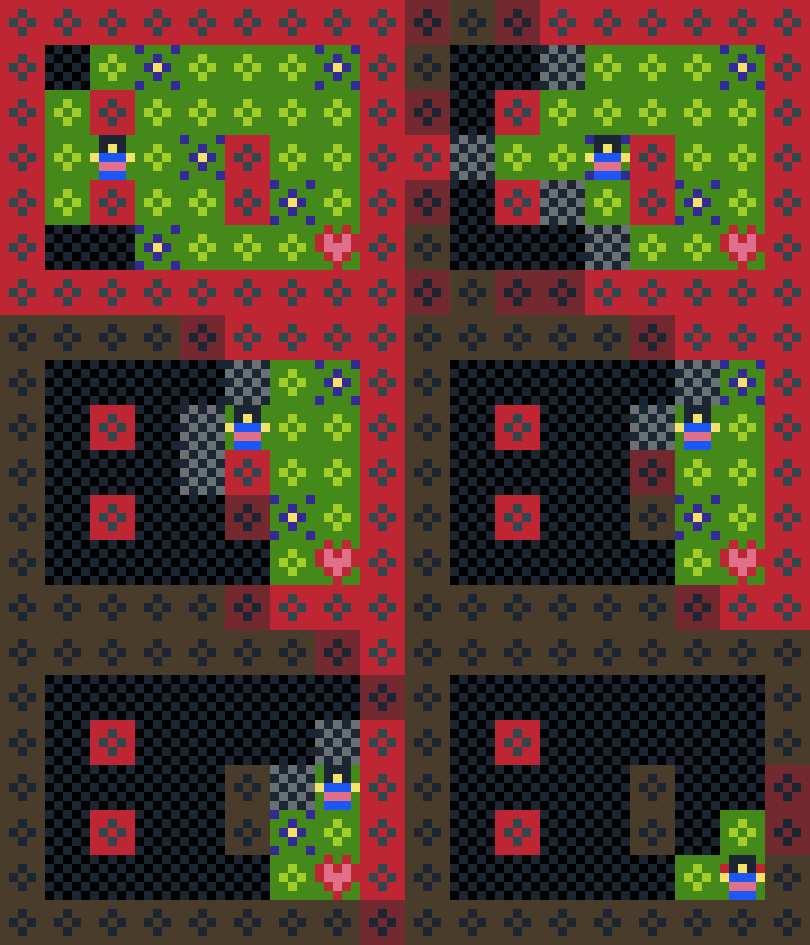
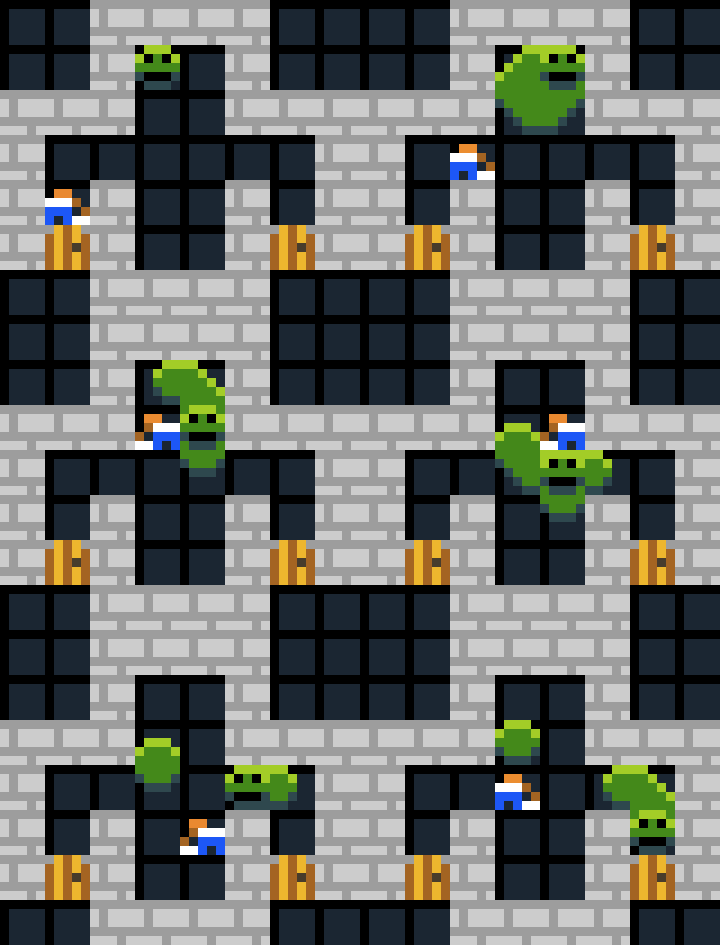
Toy of the day: PuzzleScript is an online (browser-based) game development environment capable of making a wide variety of turn-based puzzle games, ranging from Sokoban (of which the Hello World-esque example one starts with is a variant) to more sophisticated and/or eccentric games.

Games are written in a functional/declarative notation, consisting of rules; for example, the Sokoban rule allowing the player to push a crate is written as:
[ > Player | Crate ] -> [ > Player | > Crate ]
Graphics are deliberately kept simple, with elements being 5x5 blocks of coloured pixels, giving the game a vaguely Atari 2600-esque aesthetic.
There is a gallery of games made by users, each with an animated GIF representing the game's play. Some examples:

Games were originally turn-based (in that nothing happened except when the player moved), but there is an experimental real-time feature. Somebody has already coded a (semi-functional and not particularly exciting) Pac-Man clone.
2013/4/16
A General Technique for Automating NES Games; a programmer in the US has created a system for automatically learning how to play some NES games, by monitoring control inputs, finding increasing sequences of bytes in the NES's 2Kb of RAM (which look like scores or level indicators, i.e., things to be increased) and taking it from there. It works better on some games than others (he has it playing Super Mario Brothers moderately well, and exploiting quirks no human player would stumble across, though it's hopeless at Tetris). There is a paper here.
2011/10/23
A number of retrocomputing enthusiasts are taking arcade games which were poorly ported to 8-bit computers back in the 1980s and re-doing the job properly, i.e., creating ports, to the vintage home computers in question, which (being unconstrained by the unreasonable deadlines often imposed by game publishers) do the original arcade games justice (or at least as much justice as one can physically do with a Commodore 64 or an Amstrad CPC):
"You make one mistake in your life and the internet will never let you live it down," wrote Keith Goodyer, programmer of the unfortunate R-Type port, on the CPC Wiki. "Electric Dreams / Activision gave me 21 days to do the port. I wish I had the time to do a nice mode 0 port with new graphics, but alas it was never to be." Impressed by his candor, other readers of the forum decided to make it a reality 20 years later -- and gave themselves more than 21 days to get it done.Goodyer's forum post goes into detail about the development tools, techniques and conditions in which the 8-bit games readers of a certain age will remember nostalgically. Apparently, by the late 1980s, 8-bit game developers had a pretty sophisticated system named PDS, which ran on an MS-DOS PC, assembled and linked the code and zapped it over to a tethered 8-bit computer, much in the way that iPhone development is done today. (Before then, one imagines that a lot of development was done on the actual host system.) I wonder how the tools used by today's (enthusiast) 8-bit game coders differ from those used by professionals in the 1980s.
Also, if those who feel sufficiently strongly about inadequate video-game ports from their childhoods can go back and right wrongs, I wonder whether or not other media will benefit from similar DIY interventions. Can we expect, for example, guerilla filmmakers making (illegal) film adaptations of books previously butchered by Hollywood, or (when the technology becomes available) correcting the maligned films with resynthesised graphics, altered dialogue and altered scenes? Or taking it upon themselves to record what they feel a band's disappointing follow-up album should have been, cobbled together out of samples of the originals, with new vocals resynthesised to sound like the original singer? As the technology becomes available, the possibilities are limitless.
(via Boing Boing) ¶ 0
2011/6/24
A new study has shown that violent video games decrease crime rates. While they do increase aggression in the players, the incapacitation effect of the players being drawn into sitting in front of a computer or console for extended periods of time, and thus unlikely to attack anything larger than a plate of nachos in reality, outweighs this.
2011/5/25
Prison administrators in China have found a new use for prison labour: putting inmates to work in multiplayer video games, generating in-game gold, which is then sold online for real money:
Liu says he was one of scores of prisoners forced to play online games to build up credits that prison guards would then trade for real money. The 54-year-old, a former prison guard who was jailed for three years in 2004 for "illegally petitioning" the central government about corruption in his hometown, reckons the operation was even more lucrative than the physical labour that prisoners were also forced to do.
"Prison bosses make more money forcing inmates to play games than they do forcing people to do manual labour," Liu told the Guardian. "There were 300 prisoners forced to play games. We worked 12-hour shifts in the camp. I heard them say they could earn 5,000-6,000rmb [£470-570] a day. We didn't see any of the money. The computers were never turned off."
2011/4/7
Jeff Koons Must Die!!! is a new art installation by multimedia artist Hunter Jonakin. It consists of a video arcade cabinet running a first-person shooter game involving the eponymous artist and his works:
The game is set in a large museum during a Jeff Koons retrospective. The viewer is given a rocket launcher and the choice to destroy any of the work displayed in the gallery. If nothing is destroyed the player is allowed to look around for a couple of minutes and then the game ends. However, if one or more pieces are destroyed, an animated model of Jeff Koons walks out and chastises the viewer for annihilating his art. He then sends guards to kill the player. If the player survives this round then he or she is afforded the ability to enter a room where waves of curators, lawyers, assistants, and guards spawn until the player is dead. In the end, the game is unwinnable, and acts as a comment on the fine art studio system, museum culture, art and commerce, hierarchical power structures, and the destructive tendencies of gallery goers, to name a few.

2010/12/5
Australia's federal government has backed a proposal to add an 18+ rating for video games, legalising games not suitable for 15-year-olds. Currently, such games are illegal to sell in or import into Australia. This has led to some anomalies: games are banned because the classification board considers that they might encourage illegal activity, however tenuously (one shooter was banned because medical kits one could pick up to boost one's life force looked like syringes which could encourage intravenous drug use), while elsewhere, the censorship board gives games which would get 18+ ratings elsewhere MA15 ratings (after all, you don't want to ban everything this side of Little Big Planet, do you?)
Of course, it's not a done deal yet; any change would need unanimous support from state attorneys-general, and until recently, South Australia's AG, a right-wing Christian authoritarian (and Labor Party member), has been vetoing it.
The government's hand was possibly forced by its tenuous coalition with the Greens, who are far more progressive on these issues than the major parties; the Labor Party who lead the coalition still officially support a national internet censorship firewall, after all. The conservative opposition coalition have not made any statements on an 18+ rating for video games.
2010/7/24
Cow Clicker: a distillation of addictive, potentially expensive Facebook games to their purest essence:
You get a cow. You can click on it. In six hours, you can click it again. Clicking earns you clicks. You can buy custom "premium" cows through micropayments (the Cow Clicker currency is called "mooney"), and you can buy your way out of the time delay by spending it. You can publish feed stories about clicking your cow, and you can click friends' cow clicks in their feed stories.
2010/5/21
Today is the 30th anniversary of the video game Pac-Man, and so, the Google homepage has a special commemorative graphic. Only this one's even more special than most: it's a complete implementation of the Pac-Man game, in pure HTML5.
Not only is there no Flash involved, but its assets consist of only one image, with the individual elements being drawn using CSS sprites. Alas, it'll probably be gone forever come the 22nd, so play with it while you can.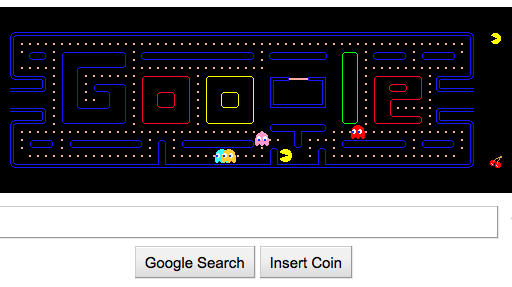
Update: Google PacMan is permanently located here.
2010/3/21
The possibility of Australia legalising video games not suitable for children moves a little closer, now that the main obstacle, South Australian Witchfinder-General Attorney-General Michael Atkinson, has resigned from his post, in the wake of a poor election result. Atkinson, a religious conservative, was exercising his power of veto over the possible introduction of an 18+ rating for video games, and was on record making statements comparing video gamers to motorcycle gangs. He also tried to pass a law banning anonymous speech on the internet prior to the election.
2010/3/11
If you've ever found yourself compelled to keep playing a video game, despite realising that you're not actually enjoying it, you may have been a victim of the Behaviourist conditioning techniques game designers use to get people hooked. Video game designers are applying Skinnerian techniques of behaviour reinforcement to compel players to keep playing, to get hooked early, and to invest more time (and often money) into levelling up. (And playing a game does not necessarily equal enjoying it; the stimulus of getting unpredictable rewards, and the fear of losing one's carefully built-up progress, are sufficient to compel one, even if they might otherwise have preferred to do something else.)
His theories are based around the work of BF Skinner, who discovered you could control behavior by training subjects with simple stimulus and reward. He invented the "Skinner Box," a cage containing a small animal that, for instance, presses a lever to get food pellets. Now, I'm not saying this guy at Microsoft sees gamers as a bunch of rats in a Skinner box. I'm just saying that he illustrates his theory of game design using pictures of rats in a Skinner box. This sort of thing caused games researcher Nick Yee to once call Everquest a "Virtual Skinner Box."
First, set up the "pellets" so that they come fast at first, and then slower and slower as time goes on. This is why they make it very easy to earn rewards (or level up) in the beginning of an MMO, but then the time and effort between levels increases exponentially. Once the gamer has experienced the rush of leveling up early, the delayed gratification actually increases the pleasure of the later levels. That video game behavior expert at Microsoft found that gamers play more and more frantically as they approach a new level.Behaviourist game design techniques are becoming more prevalent in the age of online games, where the maker's revenue comes not from once-off purchases but from time (and money) spent in the course of playing the game; hence, game designers have to get their players hooked before the other guy comes along and milks them. And milking is perhaps an apt metaphor, given that one of the leading examples of this sort of game design is the Facebook game FarmVille, which, by all accounts is more of a socially conditioned obligation than a ludic activity:
Farmville is not a good game. While Caillois tells us that games offer a break from responsibility and routine, Farmville is defined by responsibility and routine. Users advance through the game by harvesting crops at scheduled intervals; if you plant a field of pumpkins at noon, for example, you must return to harvest at eight o’clock that evening or risk losing the crop. Each pumpkin costs thirty coins and occupies one square of your farm, so if you own a fourteen by fourteen farm a field of pumpkins costs nearly six thousand coins to plant. Planting requires the user to click on each square three times: once to harvest the previous crop, once to re-plow the square of land, and once to plant the new seeds. This means that a fourteen by fourteen plot of land—which is relatively small for Farmville—takes almost six hundred mouse-clicks to farm, and obligates you to return in a few hours to do it again. This doesn’t sound like much fun, Mr. Caillois. Why would anyone do this?
The secret to Farmville’s popularity is neither gameplay nor aesthetics. Farmville is popular because in entangles users in a web of social obligations. When users log into Facebook, they are reminded that their neighbors have sent them gifts, posted bonuses on their walls, and helped with each others’ farms. In turn, they are obligated to return the courtesies. As the French sociologist Marcel Mauss tells us, gifts are never free: they bind the giver and receiver in a loop of reciprocity. It is rude to refuse a gift, and ruder still to not return the kindness.[11] We play Farmville, then, because we are trying to be good to one another. We play Farmville because we are polite, cultivated people.Here's more about FarmVille's use of the Cialdini reciprocity principle, as beloved of grifters. Meanwhile, other gaming companies are using other techniques to keep the marks coming back, like taking advantage of players' loss aversion ("your account is now flagged to have your characters below level 20 deleted as part of maintenance. Please re-activate your account now to ensure that your characters progress and names stay intact").
On a tangent, there is a blog titled The Psychology of Games; some of its content has to do with psychological manipulation techniques to control and monetise gamers, though it also covers examples of game theory (in the Prisoner's Dilemma sense) in games, psychoeconomics, the enjoyment of gaming as an activity, and, indeed, a wealth of psychological phenomena as illustrated through video gaming.
2009/12/14
The Australian government is finally moving to discuss the possibility of legalising video games unsuitable for children. Currently, there is no 18+ rating for video games, with anything the censors find unsuitable for children either being banned outright or cut for the local market's prim sensibilities (for example, the graffiti-themed game Mark Ecko's Getting Up was banned for promoting illegal activity (presumably because graffiti is more plausible than running over cops and prostitutes or what have you), and one first-person shooter was knocked back because it included images of morphine syringes, and thus sent the wrong message about evil drugs).
Anyway, for what it's worth, the government's discussion paper on a R18+ rating for video games is here. It's currently a discussion paper, though I suspect that common sense will prevail and the 18+ rating will be added. Of course, Christian Fundamentalist groups could mobilise to swamp the discussion with arguments against, but the people who want to be able to shoot realistic zombies tend to be well placed to respond.
2009/11/26
A Californian videogamer is suing the makers of World of Warcraft for having alienated him from the real world, and has subpoenaed Winona Ryder and Depeche Mode's Martin Gore to testify on the nature of alienation and melancholy.
According to the San Jose, California resident, World of Warcraft is a "harmful virtual environment" and its developers follow "sneaky and deceitful practices". Despite this, Estavillo admits he "relies on videogames heavily for the little ongoing happiness he can achieve in this life". He just wants World of Warcraft to cost less money. And to stop making him so sad.
Estavillo's court filings put forward multi-instrumentalist songwriter Martin Gore as an expert witness on melancholy. Gore should be called to Santa Clara county superior court, Estavillio suggests, "since he himself has been known to be sad, lonely, and alienated, as can be seen in the songs he writes".Winona Ryder, meanwhile, is included because of her publicised love of J.D. Salinger's Catcher In The Rye.
(via meimaimaggio) ¶ 1
2009/11/9
Some news from Venezuela, the Another World that Is Possible. There, the "Bolivarian" authorities have criminalised "violent" video games (a move which may be intended to shut down internet cafés which depend on game players for revenue but also bypass official means of the dissemination of information), and routinely round up gays and lesbians:
One Friday at around midnight, on Villaflor Street, a favourite spot for gays and lesbians in the Venezuelan capital, Yonatan Matheus and Omar Marques noticed two Caracas police patrol vans carrying about 20 detainees, most of them very young.
When Marques and Matheus, who are gay leaders of the Venezuela Diversa (Diverse Venezuela) organisation, approached to find out what was happening and take pictures, they were picked up too.
"Like most of those arrested, our identity documents and mobile phones were taken away, we were beaten, our sexual orientation was insulted in degrading language, and we were refused permission to speak to the Justice Ministry officials and members of the National Guard who were present," Matheus told IPS.
(via Boing Boing) ¶ 0
2009/7/23
Imagine, for a moment, that you have published an online multiplayer strategy game. How do you get players to play your game (and, more importantly, spend money on the numerous playability enhancements, from premium-priced instant messages to power-ups) rather than any of the numerous other games out there? Well, you could concentrate on making a particularly playable game, give away accounts and wait for word of mouth to do its work. Or, if you're the publisher of Evony (formerly known as Civony), a game heavily inspired (to phrase it somewhat generously) by Sid Meier's Civilization games only much more heavily monetised, you could bet on the assumption that sex sells and plaster the web with increasingly lascivious ads, in which the traditional cod-Tolkienist clichés gradually give way to gratuitous female nudity, culminating in the apotheosis: a close-up of a lingerie-clad bosom, with nothing about the actual game whatsoever. It's Idiocracy marketing taken a few steps beyond the typical Facebook ads with pictures of hot chicks promoting completely unrelated products, assuming that your target market is comprised entirely of idiots who, when shown pictures of BOOBIES!!!1!, begin drooling like Pavlov's Dog and reflexively get their credit cards out.
And here is a Grauniad piece about Evony. It seems that their dodginess goes well beyond patronisingly pornographic ad campaigns, and extends its slimy tentacles into everything from spamming blog comments to gold-farming and gouging their clientele (the "suckers", as I believe the technical term is) to lifting text and graphics from existing games. These people, it seems, have more contempt for their user base than MySpace.
And as if bad advertising and tenuous intellectual property were not enough, the game is also under fire for its business model – a system that seems intent on getting players to spend as much money as possible. Players are encouraged to buy in-game extras to speed their progress – but the confusing way the game prices its add-ons means that many users may not realise that a simple action, such as sending a message to another player, can cost 15p a time.
It turns out that the site's backers are equally unpopular. Evony is the product of Universal Multiplayer Game Entertainment (UMGE), a developer linked to a Chinese gold-farming operation called WoWMine. That site has also come in for regular criticism, but the real kicker comes with the news that the company's owners are being sued by Microsoft over allegations of click fraud.
2009/1/31
On the question of whether video games can be art: The post-apocalyptic first-person shooter Fallout 3 sounds like an interesting aesthetic experience:
It's an incredibly bleak game. Critics have lauded it for its complex-but-intuitive gameplay, its intriguing story and a go-anywhere world that outdoes even the sprawling burbia of Grand Theft Auto IV. But for my money, Fallout 3's accomplishment is more subtle: It's depressing.
Its mood is so quietly and painfully demoralizing that I regularly had to turn off my PlayStation 3 to take an emotional break. After playing videogames for 25 years, I'm accustomed to wandering around environments that are gory and dangerous, or creepy and scary, or puzzling and baffling. Many such games thrill me, but very few make me sad. That's precisely what Fallout 3 achieved.
The game is also filled with scraps of surviving culture that suggest how people lived before the holocaust, dimly aware of the impending horrors. "There won't really be a nuclear war, will there?" is the title of a government flier aimed at a clearly nervous public. Most post-apocalyptic games do not seek to make you sympathize with the lost civilization. On the contrary, they usually mock the dead culture, as with the out-of-control kitsch consumerism and genetic tampering of Rapture in Bioshock. Fallout 3 possesses this mocking edge, too, but just as often, the game's designers seem to have genuine respect for the culture that died.
Probably the saddest part is the children.Which is another sign that video games are maturing as a medium. Up until now, the typical game would be analogous thematically to fairly light entertainment; pulp paperbacks, superhero comics, or perhaps Victorian parlour puzzles (in the case of the likes of Myst or ICO). That a game can move one to this extent, rather than merely providing gratification, is somewhat novel.
2009/1/21
Young British graphic designer Olly Moss (perhaps best known for his Threadless T-shirts) has now posted Swiss Modernist-influenced alternate cover art for video games and similarly Modernistic, Helvetica-intensive alternative movie posters:
Meanwhile, Kyle Gabler, the composer of the soundtrack for the videogame World Of Goo has made it available as a free download. Go and get it; it's a nice piece of classic cinematic scoring, equal parts vintage Morricone/Herrmann/Schifrin and Danny Elfman gingerbread-house oogie/spookyisms.
(via Boing Boing) ¶ 0
2008/12/17
The first previews of Keita Takahashi's new game, Noby Noby Boy, have come in, and it's an odd one:
It's a hard game to explain without sounding silly. Picture a physics playground. You control a pink worm with feet named BOY, and move, eat objects to stretch your stomach, jump to any height you choose, and stretch lengthwise by pulling yourself in opposite directions, without any specific objectives. Then after you stretch BOY for a while, you can "report" how many meters you stretched to GIRL, causing her to stretch as well. But while BOY is a reasonably-sized character with an elastic torso, GIRL is a giant who starts life in Earth's orbit in space, and as everyone playing on PlayStation Network cumulatively reports stretching scores, GIRL grows bit by bit, eventually stretching herself from Earth to The Moon, Mars, Jupiter, etc. (and in the process unlocking these settings for all players).
As the game describes itself: "Noby Noby Boy is all about stretching a character called BOY. There are no missions or enemies... You don't collect objects by rolling a ball... This game doesn't have any of that stuff. In this game, you stretch and shrink... stretch and eat objects... That's all there is to it."
This isn't a game that tells you everything about itself up front. It gives you a short quiz and then lets you loose. If you want to trip the guy riding his bicycle, or make BOY super long and thread him through buildings or the donut-shaped clouds in the sky, that's up to you. I've had fun seeing how large I could stretch (current record is just over 500 meters) and trying to tie myself into a knot. I've eaten my way through the epilepsy warning, spotted cameos from Mappy and the Prince from Katamari, written messages on the side of BOY, befriended characters so they surf on my back, and recorded video clips (the game has an option so you can send them to YouTube).And several images from the game have surfaced; it looks quite good, in a somewhat kawaii-yet-abstract sort of way:


Noby Noby Boy will apparently be available as a download for the PlayStation 3 console, and will be priced at a "very reasonable" price, to ensure that players expecting Katamari Damacy VII: The Revenge or something don't feel cheated. This and Little Big Planet could be reasons to buy a PS3; it's reassuring to see that they're not just using its power to make more realistic-looking racing/war/sports/zombie-splattering games.
The ever-eccentric Takahashi, meanwhile, has apparently committed himself to designing a new children's playground in Nottingham.
2008/12/15
The street finds its own uses for things; in this case, the things are iPhones (though the concept could easly be ported to other, less fashionable, smart phones; an Android version is in the works), and "the street" is FixMyStreet, a system that lets you notify the relevant public authorities of any local problems. At least it does if you live in Britain, where the system runs,.
Meanwhile, Namco have decided to milk the Katamari cash cow once more, with a version for the iPhone:

No new twists here; just an adaptation of the classic Katamari game. It uses the iPhone (and iPod Touch)'s tilt sensor as a control mechanism. Unfortunately, the hardware seems to be a bit too slow; when I tried it on my first-generation iPod Touch, it ran infuriatingly slowly. (Perhaps the second generation will work better with it?) The fact that the developers kept the screen-warping effects when you reach a size milestone probably doesn't help either. As such, I can't recommend buying this unless you're desperate for a Katamari fix.
On a tangent: I wonder how Keita Takahashi is getting on with Noby Noby Boy. I haven't heard much about it for a while.
2008/10/13
The latest fare-paying space tourist to take off to the International Space Station is video game designer Richard Garriott, responsible for the Ultima roleplaying games in the 1980s, and better known as "Lord British" (and could there be a more American sobriquet?). Garriott is also the son of a NASA astronaut, Owen Garriott.
Meanwhile, IT pundit/venture capitalist Esther Dyson is training as an astronaut, to be the backup for Microsoft's Charles Simonyi, who goes up next year.
2008/9/17
A Pentagon researcher has laid out a chilling possibilities: that terrorists could be using online role-playing games to plan attacks, disguised as raids in the virtual world:
In it, two World of Warcraft players discuss a raid on the "White Keep" inside the "Stonetalon Mountains." The major objective is to set off a "Dragon Fire spell" inside, and make off with "110 Gold and 234 Silver" in treasure. "No one will dance there for a hundred years after this spell is cast," one player, "war_monger," crows.
Except, in this case, the White Keep is at 1600 Pennsylvania Avenue. "Dragon Fire" is an unconventional weapon. And "110 Gold and 234 Silver" tells the plotters how to align the game's map with one of Washington, D.C.Of course, the same argument could apply to any form of discussion. Terrorists could just as easily use last.fm playlists or online mixtapes to hatch their plans. (The above plan could be encoded as a copy of OMD's Enola Gay and a song by industrial noise band Whitehouse, followed by a song exactly 11 minutes long, which would give the time of the attack. For chemical or biological weapons, replace Enola Gay with Britney Spears' Toxic. You get the idea.) Or they could use internet memes; who's to say that the particular spelling/grammatical anomalies on the caption of the latest set of cat photos don't encode the details of a planned terrorist attack?
Of course, the terrorists could even eschew the internet altogether, using other means of communicating their plans, such as, say, public art. Who's to say that a terrorist sleeper agent hasn't been quietly making a name for himself as an artist, getting lucrative commissions, and waiting for the order to encode doomsday plans in a public sculpture (plenty of opportunity there) or a semi-abstract mural. (Avant-garde art itself is too easy.) Or architecture, or urban planning (if there are Masonic symbols in the layout of Washington DC's streets, there could be other things elsewhere.) The possibilities are infinite.
Perhaps Bruce Schneier could make his next Movie Plot Threat Contest hinge on coming up with creative ways in which evildoers could go to elaborate lengths to encode the message "nuke the Whitehouse at 11:00" in innocuous-looking environments. Because, as we all know, supervillains love complexity in and of itself, and the ideal terrorist plan would look more baroque than a steampunk laptop on Boing Boing.
2008/7/9
The Australian Office of Film and Literature Classification has banned the postapocalyptic war game Fallout 3 (which is rated M in the US), not because of the realistic gore but because, in allowing the player to use the painkiller morphine, it promotes drug use.
2008/6/18
A few controversies from the 8-bit music world: claims that electro outfit Crystal Castles ripped off the work of various chipmusic artists, violating the terms of their Creative Commons licence (though this Pitchfork article clarifies this, stating that the tracks in question were never actually released). Meanwhile, this documentary puts forward the theory that Michael Jackson (yes, that Michael Jackson) wrote the music for Sega's Sonic 3 video game on the MegaDrive/Genesis.
2008/6/15
If this report is correct, console mod chips are now legal in the UK, after the court of appeal ruled on Wednesday that the devices do not circumvent copyright protection. The judgment was awarded when a seller of the chips appealed against his conviction, and got all 26 counts quashed, with legal costs awarded.
The successful argument seems to be that the copyright violation has occurred before the chip is used, and not one about the legitimate uses of the chips. It's not clear whether the Trading Standards Agency has much chance of successfully appealing this decision.
2008/5/23
Wii Fit, Nintendo's fitness-training system for the Wii, has recently been released, selling out rapidly. Now the first reports of it in action are coming in, and they're a mixed bag. Engadget's tester has found annoying design flaws with it and generally found it disappointing, and this guy describes it as "absolutely wretched". This guy, however, has used it for seven weeks (thanks to having a Japanese version), and has gotten good results—having, it must be said, put in the hard yards (about 35 hours in total).
2008/5/4
I wasn't paying much attention to the Grand Theft Auto IV release hype, having never played any of the previous titles in the franchise and not being interested in the thuglife simulator genre of games, what with not being an adolescent boy and all that. However, this article is making me intrigued:
I finally escaped by ducking into a subway station, and while catching my breath, I decided to explore a bit. That's when I stumbled upon a lovely piece of artwork: A huge mosaic of a subway train on the second level. It looked precisely like the mosaics you see in the New York City subway, except even more ambitious and gorgeous. And I was thinking, "Man, who put this thing here? Who thinks of this stuff?"
Well, Rockstar Games did. The Rockstar developers are utterly in love with the idea of the American city: the riot of decay and grandeur, the garish commercialism, the violence and beauty, the architectural delights hidden in every corner. With GTA IV, Rockstar has produced an ode to urban life. Which is to say, they're not really giving you a game to play with -- they're giving you a city.
The attention to street-culture detail is obsessive, practically Sistine. Each street corner is a piece of randomly generated theater: Primly dressed art students wander around with portfolio cases, homeless crack addicts mutter to themselves as they brush past hipster dudes toting Starbuckian sleeves of coffee. Like all the in-game voice acting, the ambient dialogue is both superbly acted and super weird. ("I forgot to tell you, I need more socks. They are all fucked!" brayed a Russian émigré into his mobile phone as I wandered by.)
The game isn't a celebration of gangster life. GTA never was; for all their bad-boy reputation, Rockstar's designers are adept satirists of American excess. Indeed, they pretty much share Charles Dickens' moral view, wherein those in the big city who gain power are inevitably corrupted by it. (I nearly drove off the road several times while shaking with laughter at the parodies of right-wing talk radio -- complete with incoherent, anti-immigrant nativists, slavishly pro-government commentators on the Weasel News network and ads for "baby buying" services.)
2008/4/8
Stephen Fry, who when he's not performing comedy is the Guardian's gadget columnist, is away, so in his stead, they've gotten Charlie Brooker to list his favourite video games of all time (or, at least, the first installment thereof):
Asteroids (1979, Atari) Of all the early monochrome classics, Asteroids was my favourite, because it's truly bleak. Rather than aliens or robots, your enemies are unthinking lumps of rock that are hurtling through space. Twirling somewhere in the middle of this cluttered void is your tiny, heartbreakingly fragile spaceship, armed only with a feeble electric peashooter. If Asteroids has a message, it's this: you are insignificant, the universe doesn't care about you, and you are definitely going to die. Brilliant.
Jet Set Willy (1984, Software Projects) Back in the day, you needed only a single programmer to create a game - and since said programmers were often geeked-out stoners, said games were often weird. Jet Set Willy's blend of flying pigs, in-jokes, Python and Freak Brothers references encapsulates the homebrew quirkiness of the cottage industry software scene of the early 80s. We shall not see their like again.
The Sentinel (1986, Firebird) You played a nomadic consciousness that had to absorb parts of the 3D landscape, then transfer itself inside a series of motionless avatars in order to travel - your goal being to ascend the highest peak before the ominous Sentinel stared you to death with his huge, cycloptic eye. In other words, it makes sense only when you play it.(I vaguely remember that on the Commodore 64. Mostly in the context of it being somewhat unsatisfying to play. I imagine that, recontextualised as an interactive art installation or similar, it could perhaps have been more fulfilling.)
Kato Chan And Ken Chan (1988, Hudson Soft) An import-only title for the PC Engine (a tiny Japanese console), Chan And Chan was a below-average platform game - but one that revolved, startlingly, around shitting, farting and pissing. The point at which I first grasped the illicit joy of off-kilter Japanese imports. (Also for the PC Engine: Toilet Kids, a shoot-em-up in which you fired turds at flying penises.)
2008/3/10
A French artist is working on a Nintendo DS game about the Holocaust. Titled Imagination is the Only Escape, the game will place players in the role of a young boy in Eastern France who uses his imagination to escape the horrors of war during the German occupation of World War II. (Sounds like a real barrel of laughs, doesn't it?) That is assuming that Nintendo sign off on this; the New York Times reported that they had refused to release it in the US, though this report has since been denied.
2008/2/8
Norwich-based comedian and reviewer of dubious far-eastern video game machines Dr. Ashen (he's the "sarcastic British guy") reviews the Vii, a cheap video-game console of Chinese manufacture which attempts to imitate the Nintendo Wii without having much of the technical innovation. If you ever wondered what one of those could possibly be like, here's all you need to know. (Capsule summary: don't bother importing one.)
2008/1/12
The source code of the classic urban-planning simulation game, SimCity, has now been released under the GPL. You can find it here. The code is based on the original, UNIX/X11/Tcl/Tk version of SimCity, with a few changes: (a) the game has been renamed to Micropolis (which was its original working title), as "SimCity" is an Electronic Arts trademark for their commercial urban-simulation games, (b) it has been ported to the OLPC XO-1 (the cute green laptop being given to children in developing countries), and (c) everything has been placed in a C++ class and bound to a Python interpreter, making the entire game eminently hackable and extensible in Python. Let a million hacks bloom.
(via alecm, Boing Boing) ¶ 0
2006/7/28
According to a Harvard University report on video games, Pac-Man is "64% violent". Furthermore, a clear majority of games reward players for "injuring other characters"; one example of this is Mario Brothers, with the thing about jumping on turtles.
Given that Pac-Man involves a flat yellow disc consuming white dots and chasing stylised, monochromatic "ghosts", I wonder how abstract one could make a game (or an animation) for it to remain violent. If one had a primitive video game featuring, for example, two coloured squares on a black background, with one obviously "attacking" the other which (exhibiting what the human brain instinctively perceives as fear) moves away increasingly frantically, would this qualify as a violent video game? This sounds like a challenge: how much violence, aggression, brutality and other antisocial and harmful behaviour could one depict in an entirely abstract fashion, without using recognisable real-world objects or cartoon approximations?
The opposite of this would be something like a Brothers Quay animation, which includes things that look like real world objects, but whose parts move around in an entirely random and pointless fashion, not unlike a malfunctioning computer graphics program.
2006/5/10
The Fermi Paradox is the observation that it is highly probable that, somewhere else in the universe, intelligent life would have arisen and made its presence known by now, and yet Earth seems to be alone in the universe. Since the paradox was first posed in the 1940s, a number of solutions have been proposed, many of them not cheering, and many reflected the Cold War era they originated in: perhaps any species that reaches a certain technical level inevitably develops the means to destroy itself, and does so. Perhaps in a universe of aliens competing for resources and having little means of achieving agreement, any species that broadcasts its presence is doomed to be preemptively annihilated by others, lest it develop the means to do so. Which means that all those broadcasts of Malcolm In The Middle we're carelessly sending out to space could be responded to by a barrage of planet-killing projectiles travelling at close to light speed.
Now evolutionary psychology has suggested a new possible solution to Fermi's Paradox: perhaps it's not so much a case of sentient species wiping themselves out upon attaining the means to do so, as of turning inwards and devoting all their energy to video games and virtual reality, things much more immediately gratifying than doing battle with the real universe:
Basically, I think the aliens don't blow themselves up; they just get addicted to computer games. They forget to send radio signals or colonize space because they're too busy with runaway consumerism and virtual-reality narcissism. They don't need Sentinels to enslave them in a Matrix; they do it to themselves, just as we are doing today. Once they turn inwards to chase their shiny pennies of pleasure, they lose the cosmic plot. They become like a self-stimulating rat, pressing a bar to deliver electricity to its brain's ventral tegmental area, which stimulates its nucleus accumbens to release dopamine, which feels...ever so good.
The result is that we don't seek reproductive success directly; we seek tasty foods that have tended to promote survival, and luscious mates who have tended to produce bright, healthy babies. The modern result? Fast food and pornography. Technology is fairly good at controlling external reality to promote real biological fitness, but it's even better at delivering fake fitness--subjective cues of survival and reproduction without the real-world effects. Having real friends is so much more effort than watching Friends. Actually colonizing the galaxy would be so much harder than pretending to have done it when filming Star Wars or Serenity. The business of humanity has become entertainment, and entertainment is the business of feeding fake fitness cues to our brains.This comes down to the reward mechanisms that served our ancient ancestors' genes well being far too slow to adapt to technological hacks that short-circuit these reward mechanisms:
Fitness-faking technology tends to evolve much faster than our psychological resistance to it. With the invention of the printing press, people read more and have fewer kids. (Only a few curmudgeons lament this.) With the invention of Xbox 360, people would rather play a high-resolution virtual ape in Peter Jackson's King Kong than be a perfect-resolution real human. Teens today must find their way through a carnival of addictively fitness-faking entertainment products: iPods, DVDs, TiVo, Sirius Satellite Radio, Motorola cellphones, the Spice channel, EverQuest, instant messaging, MDMA, BC bud. The traditional staples of physical, mental and social development--athletics, homework, dating--are neglected. The few young people with the self-control to pursue the meritocratic path often get distracted at the last minute. Take, for example, the MIT graduates who apply to do computer game design for Electronics Arts, rather than rocket science for NASA.The author posits the idea that all intelligent species that develop the technology to create computer simulations of this sort go through the "Great Temptation", and subsequently die out, and that this is happening to humanity, with our only hope of survival as a species would be to develop a puritanical opposition to virtual reality, a sort of biological fundamentalism:
Some individuals and families may start with an "irrational" Luddite abhorrence of entertainment technology, and they may evolve ever more self-control, conscientiousness and pragmatism. They will evolve a horror of virtual entertainment, psychoactive drugs and contraception. They will stress the values of hard work, delayed gratifica tion, child-rearing and environmental stewardship. They will combine the family values of the religious right with the sustainability values of the Greenpeace left.
This, too, may be happening already. Christian and Muslim fundamentalists and anti-consumerism activists already understand exactly what the Great Temptation is, and how to avoid it. They insulate themselves from our creative-class dreamworlds and our EverQuest economics. They wait patiently for our fitness-faking narcissism to go extinct. Those practical-minded breeders will inherit the Earth as like-minded aliens may have inherited a few other planets. When they finally achieve contact, it will not be a meeting of novel-readers and game-players. It will be a meeting of dead-serious super-parents who congratulate each other on surviving not just the Bomb, but the Xbox.
(via WorldChanging) ¶ 5
2006/4/27
In 2004, an anonymous writer calling herself "ea_spouse" posted a letter detailing sweatshop-like working conditions at video game company Electronic Arts, at which her partner worked, complaining that the company deliberately kept schedules in "crunch time", obliging employees to put in 85-hour weeks with no paid overtime, and thus that her partner came home physically and mentally fatigued. Now, ea_spouse has revealed her identity; she is one Erin Hoffman, married to former EA developer Leander Hasty. If you've ever played "Lord of the Rings: The Battle for Middle Earth", you have experienced the fruit of this chap's gruelling labours:
On Hasty's second day of work, the team was sucked into a six day-a-week "crunch,'' an intense work period. By September, the team had to work 13-hour days, seven days a week.
The exhausted team members started making mistakes and getting sick. For Hasty, the stress triggered an allergic reaction that resulted in stomach problems and chronic headaches. He dropped 10 pounds and turned pale.
They desperately wanted to ditch EA. But they didn't have the $5,000 to repay the signing bonus.The good news is that the essay led to a class action by video-game industry employees against EA, which has apparently resulted in working conditions in the industry improving. (It doesn't say how much they have improved by, though, and whether anybody in their right mind would be drawn to the industry if they knew about it works now.) Hoffman and Hasty (who now work at an independent game studio) are continuing their activism for video-game developers' rights, and are setting up a web forum for developers to discuss issues at their workplaces.
2006/3/18
Japanese video-game publisher Namco has announced that the team responsible for Katamari Damacy and its sequels has been dissolved, and that no further sequels are planned.
The last Katamari game to come out will be Me And My Katamari, for the PlayStation Portable. Though given that this game was created without the input of Keita Takahashi, the designer of the Katamari concept, it's not inconceivable that Namco (who, presumably, own the characters and trademarks) could bring out more sequels if doing so would be profitable; they're already giving the characters cameos in other, more traditional, games.
Takahashi is apparently working on a new concept, unrelated to the Katamari games. It'll be interesting to see what he comes up with.
2006/3/17
Another update on the state of free speech in Australia: A spoof of the Prime Minister's website, created by former Oz troublemaker Richard Neville, has been taken down by request from the Prime Minister's office, under anti-phishing guidelines designed to target sites which impersonate banks to steal user credentials. (Presumably a quick phone call was easier than sedition proceedings.) The site, johnhowardpm.org, was hosted by Yahoo, but used an Australian domain registrar, Melbourne IT. The moral of this story: if you say anything the Australian government doesn't approve of, don't register your domain in Australia.
Meanwhile, the reasons for the banning of the video game Getting Up in Australia have emerged: the game is illegal because it teaches skills that can be used in committing a crime, namely vandalism. Presumably under this precedent, all first-person shooters will now be illegal in Australia. And then there's Pac-Man, Mario Bros., and other games featuring behaviour-altering pills, which encourage drug use.
2006/2/17
A media expert claims that, if Australia's ban on the video game Getting Up is not overturned, it may set a precedent, leading to any interactive games inculcating illegal activity or disrespect of rightful authority to be outlawed in Australia.
2006/2/15
The latest video game to be banned by the Australian government is Mark Ecko's Getting Up, a game involving graffiti, which is banned on the grounds that it would promote graffiti.
And so, once again, Australia faced a choice between Western liberalism and Singapore-style authoritarian paternalism, and chose the latter.
I think someone should start a campaign to overhaul the Australian video game censorship guidelines and create an adults-only/"R" category. To divide an entire genre of entertainment into "suitable for children" (in the eyes of bureaucrats appointed by a conservative government unapologetic about its culture-war agenda) and "legally equivalent to child pornography/snuff films" is ridiculous.
2006/1/17
Companies sometimes commission and give away "advergames"—free, branded, computer games designed to present their brands in a positive light. Now guerilla activist types are doing the same: such as this simulation of the hell of working in a Kinko's:
Disaffected! is an arcade-style game with fast action and high replayability. The player controls one or more employees behind the counter at a typical copy store. As each level starts, customers enter the store through the front doors and line up behind the cashiers at the counters. The player must try to find and deliver each customer's order. Obstacles include confused employees, employees who refuse to work, employees who move orders around indiscriminately so the player cannot find them. A complete in-game tutorial walks the player through both one-and two-player gameplay.The concept isn't new; perhaps the grandfather of the shitwork-simulation game genre was that early-1980s Game&Watch game where one has to catch boxes as they come down four conveyor belts; the fact that it was only a game, and not a soul-crushingly meaningless job, made sufficient difference to transform an existential ordeal into a fun activity.
Of course, the key difference is that Disaffected uses FedexKinko's logos in its graphics. I wonder how long until it gets taken down for trademark violation.
(via bOING bOING) ¶ 0
2005/12/9
A game developer in Montréal has developed a video game to teach techniques of female sexual gratification. It involves stroking a cartoon rabbit named Lapis, whose response to the stroking is modelled on female sexual response:
The prototype teaches how to reach orgasm by simulating the affect of pleasurable sensation on the cartoon. Players tickle, touch, tap, and stroke Lapis using the touch screen of the Nintendo DS, a hand-held video game device. They can also talk, sing and blow on the bunny's fur using the device's built-in microphone.
The more they stimulate the bunny, the happier he becomes until eventually he begins flying through the air. But Lapis is also an unpredictable creature who needs a variety of sensations. Sometimes, no amount of stimulation is going to work.Heather Kelley's page on her prototype game is here, and includes a presentation and a (Windows-only) downloadable prototype demo. Lapis itself was developed for the Nintendo DS, and thus may not ever make it out the door, assuming that Nintendo have to sign off on each title published for the DS and they are as censorious about game content as they were during the NES Maniac Mansion days.
(via bOING bOING) ¶ 0
2005/12/8
The latest beat-'em-up video game from Japan is Line Kill Spirits. It's much like any other beat-'em-up (Street Fighter, Mortal Kombat and all the numerous lookalikes), except that (a) all the characters are lolitaesque anime girls, and (b) the only way to make damage to an opponent stick is to take a photograph of her underwear. Or from the Google translation of the official page on the game:
it is possible to convert the latent damage to the actual damage. First, the punch button and the kick button are pushed simultaneously, the skirt of the partner is turned, " it turns and makes skill move ". When the skirt burrs and rises, timing the photographing button (with default the V key) pushing well, it will cut the shutter. It is appraised at 3 stages of the BAD * GOOD * GREAT by the area of the underpants which have been taken, if above the GOOD conversion of the damage is done.The web site also has two video clips of the game in action; Line Kill Spirits appears to be the work of a group of hobbyists, rather than a game publisher. It appears to be part of the "Dojin Soft" small-press game movement, which does tend to produce its share of bizarre ideas, such as a fighting game based on Les Misérables.
2005/11/28
Nifty objet d'art of the day: the Pong clock:
It's an embedded computer with an LCD display screen, which plays a perpetual game of Pong, with one round per minute. The right-hand side wins once a minute, except on the hour, when the left-hand side wins (and the right's score is reset); hence, the score displays the current time. Clocks go on sale next year, though there will be a downloadable screensaver soon.

In a sense, this seems to be the computer-age equivalent of those mechanical clocks from centuries past, in which tiny figures promenaded around illustrating the time of day.
(I wonder what it's implemented on. If the device contains, say, a Mac mini or an entire Linux system and X server, it would seem somewhat decadent.)
(via bOING bOING) ¶ 4
2005/11/10
The Nokia 770 Internet Tablet, a hand-held, Linux-based, WiFi- and Bluetooth-enabled web-browsing/email appliance, is out. In the UK, it's selling for £245, and appears to be out of stock already. It costs twice as much as the other hackable, Linux-based gadget, the GP2X, though has wireless communications technologies (which the GP2X lacks altogether) and more than four times the screen resolution; however, external storage is limited to the smaller RS-MMC cards, as opposed to the somewhat larger SD cards the GP2X takes; also, while it's likely that someone will port MAME to it, playing arcade games with the nagivation pad probably won't be as comfortable as with the GP2X's controls. I'd have one of each, had I £370 I had no better use for and a jacket with infinitely capacious pockets.
And here there is a round up of reviews of the Nokia 770.
2005/11/8
An article looking at the console games scene in Brazil, where due to a number of factors, old systems killed off as obsolete in McWorld enjoy a new lease of life, and/or a freaky Frankensteinian afterlife:
Not only did Brazil embrace this marvel in video game history, but an increasing number of pirate consoles began appearing with additional features in an effort to beat the abundant competition. To differentiate between the two largest consumer bases, America and Japan, Nintendo had stemmed the import and export of games by employing different cartridge connections between the Famicom (Japanese version with a 60-pin connector) and the NES (American version with 72-pins). Since Brazil had never been properly established on Nintendo's world map, no marketing decision had been made to determine how sales would be controlled. Being stuck in the middle, with an increasing number of legal and illegal NES cartridges being shipped in from across the globe, clone consoles began appearing in Brazil with two connectors to accept either of the formats. On top of that, some pirate cartridge manufacturers began turning out double-ended casings, with 60-pins at one end and 72 on the other! Many of the NES and 2600 clones, still available today, even come with a multitude of games built into the system.
The Master System (Sega's challenge to the NES) and the Mega Drive landed in Brazil about the same time, where the systems were licensed to a local manufacturer. They were already due for replacement across the rest of the world, so Sega wisely allowed their licensee more freedom for internal development than was usually permitted. This has kept cloning and piracy of Sega products to almost nonexistent levels throughout South America. The entire range of Sega consoles are still in manufacture today - the only region in the world where Sega is still selling hardware - while sales of the Playstation 2 and Xbox are noticeable only by their absence.The article is from a publication known as The Escapist, which uses somewhat annoying stylesheets and JavaScript navigation and requires a rather wide browser window. Though it certainly looks pretty.
(via bOING bOING) ¶ 0
2005/10/4
Civilization IV, the latest in the highly addictive game series, is coming soon, and looks interesting; other than the gameplay, it will be extensively customisable using XML-based data and Python scripting. Ht's probably just as well that there is an organisation such as Civilization Anonymous; I suspect they'll be busy.
(via worldchanging, 433) ¶ 3
2005/9/29
A video game simulating being a graffiti artist is in the works. Titled Getting Up, it was developed with the involvement of hip-hop streetwear mogul Mark Ecko and various veteran graffitiists and urban artists (including Shepard Fairey of Obey Giant fame). (I wonder whether Banksy approved of the rat-shaped stencil that's visible in the Flash site.) It's said to be an accurate simulation of the activity of tagging/doing pieces and avoiding the police, and has a story line about an evil, megalomanic mayor (which sounds like Turk 182 meets Rudy Giuliani). No word on when it's coming out or what platforms on.
(via  moebius_rex) ¶ 2
2005/8/17
Never mind the PSP, I want a GPX2. It's a pocket-sized SD-based media player (capable of playing DivX/MPEG4 movies and MP3s) and some undefined games (with the provided joystick). Most interestingly, it runs Linux; assuming that they don't deliberately cripple it, that means it's going to be possible to put MAME on it, load up a SD card with old arcade ROMs and have an arcade in one's pocket. The only thing it's missing is WiFi.
2005/8/12
Toru Iwatama speaks about his famous creation, Pac-Man:
In fact, Iwatani acknowledges that, while a eureka moment for the annals, that event represents the official birth of Pac-Man: "The whole thing actually started with me walking around games arcades watching how many boys were playing and the fact that all the machines were about killing aliens, tanks or people. Girls were simply not interested, and I suddenly had a motivation for my work: I wanted game centres to shed this rather dark, sinister image, and it seemed to me that the way to raise the atmosphere of a place is to entice girls to come in. The whole purpose of Pac-Man was to target women and couples, and get a different type of player involved."
"So there I was, wondering what sort of things women would look for in a video game. I sat in cafés and listened to what they were talking about: mostly it was fashion and boyfriends. Neither of those was really the stuff of a good video game. Then they started talking about food -- about cakes and sweets and fruit -- and it hit me: that food and eating would be the thing to concentrate on to get the girls interested."
It may have been aimed at girls, but boys converted to it immediately: Pac-Man's most interesting revelation was gamers' affinity to living things. And that spark of inspiration has taken the industry from a 2-D yellow disc through Mario, and on to a 3-D Lara Croft.
Strangely, that is exactly how Namco saw his achievement: as just a game. Pac-Man, quite apart from the lucrative sequels Ms Pac-Man and Pac-Land, made the company more than $100 million. Iwatani was merely promoted to supervisor level, and still lives in a house too small to accommodate a Pac-Man arcade cabinet.
2005/7/15
The video game of the moment appears to be Katamari Damacy; it involves rolling a ball around a landscape, rolling over objects which become stuck to the ball, and graduating to larger and larger objects as the game progresses. Though, from what I hear, it's even more surreal than this somewhat prosaic description would suggest, with a bizarre and quirky soundtrack adding to the experience.
Unfortunately, the only way to legally play Katamari Damacy outside of Japan involves moving to the U.S.; it's only out there, and only in region-locked PlayStation format. And with governments cracking down on the economic terrorism of modchips all across McWorld and Sony not deeming Katamari to be worth releasing in other territories, this looks unlikely to change.
However, an enterprising hacker has created a simple Flash game based on Katamari Damacy. It's very rudimentary; for example, it does away with the whole 3D thing and all the scenery, not to mention any sound, and merely involves the player rolling a ball around in 2D, collecting increasingly larger objects, which get stuck to it. Unfortunately, it only goes up to telephones, so eventually you end up rolling around picking up speck-sized telephones.
I wonder how long until some penguinhead tail-light chasers decide to do a FreeCiv on Katamari Damacy and make their own (perhaps with a gnu or a penguin pushing a ball around, or even filling it with unsubtle anti-Microsoft propaganda, à la FreeDroid). Bring it on, I say.
2005/5/18
I have been thinking about the homebrew-console-games-vs.-manufacturer-DRM issue recently.
New consoles with new capabilities come out, often containing powerful CPUs and graphics chips, and hackers and hobbyists want to have a go at writing code for them and getting them to do things other than consume titles. The manufacturers, of course, design the units so as to prevent unauthorised code running on them, primarily to protect their business model. The video-game console business model typically involves selling the consoles cheaply (often at a loss) and collecting a cut of the price of each game sold. Of course, for this to work, console makers have to strictly control what code will run on their machines, and ensure that they get a cut of every item released for them.
It's a stiflingly regressive reality, though it appears to be stable and is unlikely to go away any time soon. The alternative model (open game machines, sold at above-cost price, with anyone able to develop code for them) has been tried and failed; witness the Tapwave Zodiac PalmOS-based game machine, for example. Customers are more likely to buy cheap consoles and more expensive games for them later, in instalments, than to buy a more expensive console with cheaper software. Of course, this makes game consoles somewhat stagnant platforms (compared to, say, PCs or handhelds), though the game market seems to be able to cope with this well enough for it to be the best current business model for that kind of business.
(This ignores mobile phone J2ME games, which anyone can write and run on any compliant mobile phone without the manufacturer's blessing. Mobile phones are heavily subsidised as well, though they are subsidised by phone companies who make the money back in network usage; besides which, J2ME is a fairly weak gaming platform (for one, the low-power CPUs used in mobile phones often mean sluggish response times for navigating the internal menus, let alone games). Perhaps this will change in future.)
Nonetheless, that does not change the fact that hardware such as the PSP and Nintendo DS is tantalisingly attractive to tinkerers. When it was discovered recently that certain early Japanese PSPs could be made to execute code off a Memory Stick, a hacker community cropped up, with games, demos, utilities and ports of old console emulators popping up like mushrooms after a rain; the more recent firmware has closed off this hole, and anyone running a recent game on an old PSP will find themselves upgraded against their will.
What if, instead of locking out the hacker culture, game companies worked with it, whilst still preserving their business model? Imagine, for example, a device sold by the console manufacturer which costs about the difference between the retail and cost price of a game machine and enables it to run homebrew code. It could be a disc, a hardware dongle, or even a special cable. Unlike homebrew hacks (such as the Nintendo DS passthrough cartridge), it requires no soldering and no fabrication of circuit boards, allowing those who don't have a fetish for that sort of thing to get involved. Perhaps it comes with development tools and documentation (the GNU toolchain would be a start), or even membership of a community web site, where users can share their code. From time to time, publishers could release compilations of the best such titles, perhaps in a magazine format, doing the necessary licensing to make the releases run on standard machines.
Sony once tried something like this with their PlayStation 1; they called it "Net Yaroze", and apparently it wasn't a stellar success. I wonder whether it could be done better.
Of course, if the console makers don't throw a bone to hobbyists, makers of third-party extensions (of various levels of legality) just might; and these would be less concerned with protecting the makers' profit margins.
2005/3/26
This computer game looks pretty nifty; photorealistic backgrounds of decaying buildings and rusty machinery and surrealistic cartoon characters. Unfortunately, it seems to be available only in Russia. (via Urban Decay)
2005/3/21
Electronic Frontiers Australia, Australia's equivalent of the EFF, are pushing to legalise adult-oriented computer games. Presently, the video-game rating system is written with the assumption that games are for children; it only goes up to MA (i.e., 15 years or over), and thus any games deemed unsuitable for 15-year-olds are illegal. This has resulted in some games being banned outright, and others (including some in the Grand Theft Auto series) being bowdlerised for Australia's tender sensibilities.
Of course, getting such a change of law passed by the social-conservative Tory government (which, after all, is responsible for tightening up the censorship system to its present level of Mary Whitehouse-esque prissiness and banning a fuckload of things Britons and most Americans can see freely) would be a difficult task at any time. And now, it may be even harder, given that a Tory senator's career of swashbuckling high adventure has come to light. If Senator Lightfoot, alleged to have been gallivanting around Iraq with a gun and smuggling money to an oil company, is found to have been a political liability, the government's Senate majority may disappear, and were that to happen, they would be forced to go into coalition with religious-right party Family First, who make them look like, well, liberals (they are the ones demanding a Saudi-style national internet firewall). With that looming on the horizon, it may be prudent for them to bulk up their wowser credentials, and developing a reputation for being open-minded, tolerant or otherwise "soft on filth" would be exactly the wrong thing to do.
2005/2/1
Entries in b3ta's Crap Computer Games challenge, in which contestants submitted demos (as animated GIFs or Flash; though at least one entrant wrote an actual ZX Spectrum program) of naff 8-bit computer games that never actually existed, both original ones and interpretations of pre-supplied concepts like Window Cleaner, Trade Union Organiser and a Spanish holiday simulator; anyway, you'll find these and more (including Football Text Adventure, the tape loader from Ocean's Last of the Summer Wine tie-in, and Mirrorsoft's Robert Maxwell Yacht Simulator) all (well, most) in pixellated 8-bit glory.
The contest was in connection with Look Around You, a BBC comedy series satirising 1970s educational television. The first episode of the new series (now changed from 9-minute "educational" programmes to a half-hour magazine-programme format; not unlike Curiosity Show for the Australians in the audience) aired last night. Unfortunately, I only managed to catch the last 5 minutes (did anyone manage to tape it?), though what I saw looked very amusing; perhaps even more so than the first series.
IMHO, Look Around You is the cream of British comedy these days. For all that is said about Little Britain, the usually cited candidate for this honour, there's no escaping the fact that it's basically a British version of The Comedy Company (right down to Vicki Pollard being a chav Kylie Mole). It inherits little from the great British absurdist tradition of the Goon Show and its heirs, instead throwing out the same predictable plots and trademarked catch-phrases in slightly different settings.
2005/1/25
A Japanese company named Gametech have released a handheld Nintendo Famicom clone. (For those not in the know, the Famicom was the Japanese game console rereleased in the west as the Nintendo Entertainment System.) It's about the size of a modern handheld game console and takes full-sized Famicom cartridges (which are shaped somewhat differently from the NES cartridges sold in the west, but an adaptor is available). It's not clear how legal it is, though given that it's on the Japanese market, they'd probably have an excuse of some sort (quite probably unlike a different handheld NES clone sold in China, and using miniature copies of Nintendo cartridges). The page says that it's of quite good quality, though given that they're trying to sell them, they would. (via gizmodo)
(This is from the Lik-Sang site, who also sell nifty and bizarre things like discontinued handheld game consoles and pencil cases shaped like vintage game controllers and such.)
2005/1/8
Players of The Sims 2 have been swapping houses on a website, and have discovered that Sims hacks are contagious; an object infected with a hack will affect everything else in the installed copy of the game, which can often bugger things up.
The hacks are easy to install, but they aren't for everybody. Many are cheats that eliminate challenges and obstacles in the game, while others modify fundamental behavior of the virtual people that inhabit the Sims 2 world. The "No Social Worker" hack, for example, allows Sims to neglect their children without the state getting involved. The "No Jealousy" patch lets them keep multiple lovers without getting slapped all the time. Another hack allows teenagers in the Sims 2 to get pregnant. As the game is sold, they can't even have sex.
(Actually, the "pregnant teenagers" hack is not a hack, but rather an official localisation for the British release to make it more authentic. Especially the part where they start wearing hip-hop hoodies and smoking like a coal-fired power station.)
At one point as many as three-quarters of the lots on the exchange contained hacks, estimates Suzanne Walshire, a 57-year-old Sims 2 player from Pflugerville, Texas, and an early victim of the phenomenon." It's extremely widespread," Walshire says. "Someone at Electronic Arts was really shortsighted not to have thought of hacked objects spreading this way. If they knew that their own objects would download with a house, they would know that other objects would download with a house also."
Perhaps EA's programmers were too exhausted from their 80-hour work weeks to notice such a flaw in their design?
2004/11/28
In Russia, Vladimir Putin's government plans to revive a Soviet-era programme to instil patriotism in the youth; the updated programme will involve patriotic video games, which, it hopes, will replace the likes of DOOM and inculcate patriotic values in youth. Which could mean something like a post-Soviet America's Army, or something more heavy-handedly jingoistic.
2004/11/22
JFK Reloaded, a game which allows you to play Lee Harvey Oswald. It features realistic bullet physics, and registered users can enter a competition, with the most accurate reconstruction of Oswald's fatal shots (according to the Warren Commission report) winning up to US$100,000. All in the name of historical research, of course. (via jwz)
2004/11/11
The spouse of an employee of computer-game behemoth Electronic Arts writes about their Dickensian working conditions; there, the company budgets for development to be permanently in "crunch time", and employees are obliged to work 13-hour days, 6 days a week. And, thanks to California's business-friendly employment laws, they don't even have to pay them for the extra hours. And if that wasn't a neat enough trick, there's no danger of employees rebelling, forming unions or refusing to work 85-hour weeks, as for every employee who leaves or burns out, there are ten wide-eyed novices straight out of college who would love to have the privilege of working in video games. From what I heard, these sorts of conditions are more or less standard in the game industry, with EA perhaps being an extreme case.
Mind you, as fatigued employees' performance (and health) declines, perhaps the quality of EA's product will do so as well, giving free-range game studios a chance to pick off their market share. Though at what human cost?
(Also, I wonder how long until India and China (or, for that matter, Eastern Europe) start making high quality video games, undercutting Western development costs. Certainly, the pop-cultural nature of games may be a barrier to entry, though in the age of cultural globalisation, young urban Chinese and Indians are increasingly exposed to the same trends as Californians. Don't China, India and such already make a good proportion of mobile-phone games (which are less nuance-sensitive than the latest Xbox epics)?)
2004/10/29
An intrepid hacker has created a port of Grand Theft Auto III to the Nintendo Entertainment System; that's right, the 8-bit, 6502-based console from the 1980s. The game isn't out yet, though will be released as a free download, joining the swelling ranks of elaborately handcrafted games being made for obsolete platforms because they're there. The page contains details of how he did it and the tools he used, including his elaborate homebrew developer NES system.
2004/7/14
The Museum of Computing in Swindon, Wiltshire is exhibiting an artefact from a bizarre parallel universe of video games: a rare East German video game machine. The Polyplay was manufactured in 1985 as an ideologically sound Communist answer to Western capitalist video games. It consists of an 8-bit Russian commercial computer and a generic East German colour television (case and all) encased in a custom wooden enclosure in 1980s East German decor (which looks like 1970s Western decor). Some 1,500 units were made, many of which were recalled and destroyed at the time of the fall of the Berlin Wall. Estimates of numbers of surviving machines range from 3 to "lots" (someone on Slashdot claims that they're more common than PacMan machines in Germany).
There were no amusement arcades in East Germany so these robust Poly Play machines were found in municipal buildings, leisure centres and swimming pools, and offered seven or eight simple games. In the mid 1980's, Westerners would have been enjoying 'beat 'em up' games such as Streetfighters or Super Mario Brothers. In stark contrast, these simple games included a variation of Pacman called 'Hare and Wolf', car-racing, ski-ing (similar to ZX 81 games), and Carnival (shooting ducks). Westerners may find it harder to relate to games such as a man chasing butterflies or Deerhunt, which may have a cultural significance for East Germans. Another game, 'Catch the drips in a bucket or drown', makes one wonder if the residents of state-owned apartments ever found themselves in a similar predicament!
Here's a BBC news story about it, in which they amusingly misspell Schiessbude as Scheissbude and come to the conclusion that it had a game named "crap booth". If you can't make it to Swindon, you can play it on MAME.
The worlds of modern art and classic video games meet in Pac-Mondrian, which is just what it sounds like. They have a Java version of the game that works in browsers, and are constructing an actual Pac-Mondrian machine for installation in galleries.
2004/6/3
The Bush Game is a very well done propaganda piece for the John Kerry campaign in the form of a fashionably pixelated Flash game, referencing 1980s kid culture that's the height of ironic retro hipness with the Generation X/Y crowd. It's a politically-incorrect arcade beat-em-up game, in which hip retro characters such as Mr. T, Hulk Hogan, and He-Man, along with the likes of Mike Moore, Jessica Lynch, and, of course, Democratic Party heroes like John Kerry and Howard Dean, battle evil hordes of porcine crony-capitalists and end-of-level bosses (the entire Bush Cabinet, as well as the likes of Paris Hilton and Janet Jackson's robo-breast). Along the way it shows presentations about Bush's depredations of social security funds, redistribution of wealth to the ultra-rich, and collusion with the likes of Enron, in a fairly easy-to-grasp way -- and then claims that the Democrats will fix everything if they get elected. (via everyone, it seems)
2004/5/18
In John Howard's Australia, female nudity in video games is illegal; extreme, hardcore violence is OK, however:
In January 2003, the Office of Film and Literature Classification refused to classify a game called BMX XXX. The reason? It featured topless female bike riders. Yet games such as Grand Theft Auto and Manhunter -- in which the player in both games takes on the role of an amoral killer -- are widely available.
2004/4/2
2004/3/19
During the 1980s, various musicians and bands put A gallery of 8-bit computer games on their 7" singles. The theory went that you'd play the 7" into a tape recorder, put the tape into your ZX Spectrum (and most of these were Speccy programs), load it and get some bonus content. The exact nature of this content varied from rather iffy-sounding branded video games (such as the Thompson Twins Adventure Game, or The Stranglers' "Aural Quest") to sometimes dubious games actually written by actual band members (Chris Sievey of The Freshies was a serial offender here), to Satanic messages with other messages hidden in the comments. (via bOING bOING)
2004/3/2
Jesus Freakin: the first-person shooter coming soon to the PC. After 2,000 years, He's ready to cast the first stone.
With the Almighty Power of God, along with a 21st century arsenal, you - Jesus Christ - are sent back to earth to kick some ass and take names (resulting in a list that St. Peter would likely kill to get his hands on).
2004/2/27
Some selections from a website selling Java games for mobile phones:
Boobi Sisters: Boobi sisters went to farm to get experience. Their mission is to gather the cattle in a pen.
Butter Head: Butter Head is mail carrier in the Magic Land. One day, while taking a nap he looses his mail.
Christmas Eggs: Help Santa to catch all eggs at his Lapland chicken farm. Don't let the eggs to fall down!
This is one of about half a dozen Santa Claus-themed games on the site. But "Christmas eggs"? "Lapland chicken farm"? WTF?
Mobile Dolly: The cloned Sheep Dolly is based on the previous Frog Game which was a famous arcade game during the 1980's. It is a mobile phone game recreated with a cute character of sheep for the sheep year.
Yeah, it looks like a Frogger clone. The question that immediately comes into mind, though, is: what would a cloned sheep be doing hopping on lilypads and logs across a river?
Mobile Ttarzan: Ttarzan and Jjani live in the nature and study plants. One day, Jjani goes out to collect some plants and then is kidnapped by a monkey.
2004/2/24
Life imitates Lucky Wander Boy: some outfit named Crystal Sky have bought the film rights to Pac-Man, with a view to making a "live-action fantasy adventure". Urk. (via wtf_inc)
2004/2/13
When buying experienced characters for that multiplayer role-playing game, always to check that they're not made with sweatshop labour:
Early last year a small Southern California company called Black Snow Interactive made a business move you could almost call shrewd if it werent so surreal. They rented office space in Tijuana, equipped it with eight PCs and a T1 line, and hired three shifts of unskilled Mexican laborers to do what most employers would have fired them for: playing online computer games from punch-in to quitting time. The games they were required to play were Ultima Online and Dark Age of Camelot, two of the most popular massively multiplayer role-playing games online. As the workers sat mouse-clicking virtual trolls to death, their characters acquired skills and gold at a brisk, assembly-line pace. For this, Black Snow paid the Mexicans piecework wages -- then turned around and sold the high-level characters and make-believe money on eBay, where a grandmaster dragon-tamer account from Ultima can fetch $200 and a Dark Age gold piece trades for roughly what the Russian ruble does.
(via Things Magazine)
(Btw, I wonder how long until the first online game currency appears on currency exchange markets next to the dollar, the pound and the euro.)
2003/12/6
Taito to start selling new Space Invaders machines. They aim to sell 10,000 of the units, at US$2,772. No word on whether that includes the coloured cellophane that goes across parts of the (black and white) screen. Or, indeed, whether the machines are made using original vintage hardware (2MHz 8080 CPU and all) or whether it's running in an emulator on some modern embedded RISC chip that is several orders of magnitude smaller and more powerful (and possibly cheaper to make).
2003/10/17
A video gaming magazine rounds up some 10-to-13-year-olds, gets them to review vintage games, like Pong and Donkey Kong and Tetris. (via MeFi)
Tim: Which button do I press to make the blocks explode?
EGM: Sorry, they don't explode.
Becky: This is boring. Maybe if it had characters and stuff and different levels, it would be OK. If things blew up or something or--
Sheldon: If there were bombs.
Tim (on Space Invaders): This is nothing compared to Grand Theft Auto III, because you can't steal a taxi cab, pick up somebody, then drive into the ocean with him.
2003/10/6
A chance meeting between a cocktail-cabinet Galaga machine and a PowerBook running MAME in a Brunswick café:


(Aside: why is it that most cocktail-cabinet arcade game machines around these days are Galaga? Is it the result of some kind of technical and/or memetic survival-of-the-fittest?)
2003/10/2
If you can read this, then we're back. A routine machine relocation didn't go quite to plan, but it's all fixed now (hopefully).
And below is the backlog of blog items that didn't get posted to The Null Device over the past few days:
- Your tax dollars at work: A US spy agency as been monitoring webcams at an Islay distillery, just in case they were making chemical weapons instead of whisky. Defense Threat Reduction Agency officials stressed that monitoring Scottish distilleries was not a high priority, but stated that it would take just a "tweak" to modify the whisky-making process to produce chemical weapons. (Hmmm; that suggests some interesting near-future scenarios for potential flashpoints between the United States of America and Britain and a rogue People's Republic of Scotland.)
- An interesting paper on the design of the Google File System, a custom file system optimised for storing huge (multi-gigabyte) files on large farms of fault-prone hardware. (via bOING bOING)
- The latest fad in baby naming in the U.S. involved naming your children after your favourite brands of consumer goods. Looks like Max Barry wasn't all that far off: (via Techdirt)
"His daddy insisted on it because Timberlands were the pride of his wardrobe. The alternative was Reebok," said the 32-year-old nurse, who is now divorced. "I wanted Kevin."
This is only the latest chapter in the boom of giving children unique names.
According to the most recent census, at least 10,000 different names are now in use, two-thirds of which were largely unknown before World War II.
- "We're Gonna Get You After School!" Gibson's Law applies to playground mob psychology, with kids setting up websites and blogs to call their classmates names. This way, technology may be said to have democratised bullying, as it's no longer the musclebound alpha-jocks and the popular rich girls who have a monopoly on making others' lives miserable. (via TechDirt)
One 12-year-old blogger, writing on the popular Angelfire Web site, recently announced she would devote her page to "anyone and everyone i hate and why." She minced no words. "erin used to be aka miss perfect. too bad now u r a train face. hahaha. god did that to u since u r such a b -- . ashley stop acting like a slut wannabe. lauren u fat b -- can't even go out at night w/ ur friends. . . . and laurinda u suck u god damn flat, weird voice, skinny as a stick b -- ."
The author of the article calls for the use of "parental control devices" to stamp out "social cruelty", much in the way that filters have been used to stop pornography. Which sounds more like it would strip those kids put upon by the alpha-jocks/princesses of their online support networks of fellow outsiders.
- More on the internet's impact on human interaction: Internet chat addiction can stunt social skills in introverted adolescents, says a researcher in "social administration". Dr. Mubarak Rahamathulla says that research suggests that chat rooms have contributed to some teenagers fearing conventional social interaction, and becoming more dependent on anonymity or pseudonymity. However, he says, webcams may be a safe, healthy way for to explore their sexuality. Perhaps the future belongs to asocial chatroom onanists, who are into anything as long as it doesn't involve actual human contact?
- The AT&T text-to-speech demo site now has two British voices; the male one sounds somewhat deranged, as if having at some time in the past eaten some BSE-contaminated beef. (via kineticfactory)
- A company is now selling licensed arcade ROMs for MAME. StarROMs currently have a few dozen titles, all from Atari, but plan to have more; games cost between US$2 and US$6 per title, and all are unencrypted ROM images suitable for MAME, with no DRM chicanery to be seen. Let's hope this idea catches on.
- Transcosmopolitan, or Spider Jerusalem's stint as features writer for a women's lifestyle magazine. (via Warren Ellis' LiveJournal comments)
2003/8/22
The MAME arcade emulator, once the sole province of geeks, is entering the mainstream; there is an article in today's Age about a local firm which builds MAME-based cocktail cabinets. The cabinets are based on a PC running MAME (on MS-DOS, apparently) and can be loaded with ROMs (which are only legal if you own the actual hardware, remember) from a floppy or CD-ROM. They retail for A$1,750.
Aside: given how much mainstream attention MAME is getting, I wonder how long until the owners of arcade ROMs start selling legitimate copies of them, in MAME-friendly format, over the internet. A while ago, they tried selling arcade games wrapped up in proprietary Windows-only emulators, though that doesn't seem to have been a resounding success. If they had a web site where for a few dollars you could download a ZIP file of MAME-ready ROMs (and possibly ancilliary artwork and such), I could see a lot of people (including myself) using that, and it making quite a bit of money for the owners of the ROMs.
But of course it will never happen; everybody knows that selling digital content without watertight digital-rights management (which is incompatible with an open-source emulator) is No Way To Run A Business.
2003/7/28
First there was Commodore 64 UNIX and IntyOS for the Intellivision, and now someone is writing a graphical multitasking OS for Pac-Man arcade machines:
Alpaca is a small multitasking operating system for Z-80 computers, specifically for Pac-Man/Pengo arcade hardware. It is an expansion upon my PTUI project, which was originally just an experiment to see how much of a real GUI can be put into the tight constraints of Pac-Man arcade machine hardware. The limitations are a total of 1kb of RAM (for storage and stack), 16k of ROM, sprite/tile based video hardware (1k color, 1k character ram), joystick, and two buttons.
Mind you, it doesn't do anything useful yet. (There apparently isn't enough space in a Pac-Man machine to fit an OS and applications, at least without optimising it further.)
And here is an extensive page on coding for the Pac-Man/Pengo hardware, including technical info, links to tools and sample ROM sets (no games, but there's an audio sequencer or two there; I'm sure there are some avant-garde applications for one of those).
It's interesting to look at the memory maps and other documents. In some ways the arcade machines were conceptually similar to 8-bit computers; in other ways, however, they're bizarre (for example, the Pac-Man machine's video RAM is all over the place).
2003/7/16
Null Device Retro Videogame Feature #1: Elevator Action
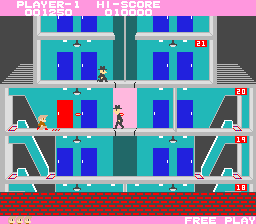
Publisher: Taito, Japan
Year: 1983
Format: Arcade
The objective: descend from the top of a skyscraper to your getaway car in the basement, picking up secret documents and avoiding and/or shooting the bad guys before they shoot you.
 Not sure what the backstory is; I'd say it's a "spy story" of some sort, with
the proviso that tradecraft in the Elevator Action universe involves going
through a building, stealing documents and shooting everyone you see. Actually, it might make more sense to think of yourself as a disgruntled postal worker than a secret agent. Another way the Elevator Action universe differs from our own is
in the world of lift control algorithms. If, in the real world, the
occupant of a lift could control its movement, there'd be a lot of pissed-off
people waiting in lift lobbies, not to mention fights for the controls.
(If everybody carried a gun, things would really start to get interesting.)
Not sure what the backstory is; I'd say it's a "spy story" of some sort, with
the proviso that tradecraft in the Elevator Action universe involves going
through a building, stealing documents and shooting everyone you see. Actually, it might make more sense to think of yourself as a disgruntled postal worker than a secret agent. Another way the Elevator Action universe differs from our own is
in the world of lift control algorithms. If, in the real world, the
occupant of a lift could control its movement, there'd be a lot of pissed-off
people waiting in lift lobbies, not to mention fights for the controls.
(If everybody carried a gun, things would really start to get interesting.)
Elevator Action came about in the days of 8-bit CPUs (it runs on 3 Z80s; the same chips that powered Sinclair ZX81s and the like) and 16-colour pixel graphics (the basic 8 plus lighter versions thereof; think Commodore 64 graphics with a less miserly hardware budget), after everybody got sick of plain black backgrounds but before game designers started trying to wow audiences with the depth of their palettes. As such, there is no shading, outlines or any other such sophistication; objects are pixelated blobs of solid colour. Which, in this days of Generation X Atari nostalgia and 1980s revivalism, is the height of modern-primitivist retro cool, a latter-day equal of Polynesian tiki kitsch and 1960s pop art.
 Anyway, back to the graphics. The action is set in a building with pastel-coloured walls and bright blue doors (which turn red if the room contains documents), which suggests that Smersh or whoever cared enough to hire a decent interior decorator. You, the player, are a little guy in a brown top, tan trousers
and, for some reason, red shoes, with a sandy blond crewcut. The bad guys
all look identical, dressed in black suits and fedoras, the usual cartoon
"spy" uniform. They follow you around and shoot at you, and you have to
dodge their bullets; which isn't hard, as they move slowly enough for you
to easily jump over them. All that makes one wonder whether or not Elevator
Action was a formative influence on the Wachowski brothers.
Anyway, back to the graphics. The action is set in a building with pastel-coloured walls and bright blue doors (which turn red if the room contains documents), which suggests that Smersh or whoever cared enough to hire a decent interior decorator. You, the player, are a little guy in a brown top, tan trousers
and, for some reason, red shoes, with a sandy blond crewcut. The bad guys
all look identical, dressed in black suits and fedoras, the usual cartoon
"spy" uniform. They follow you around and shoot at you, and you have to
dodge their bullets; which isn't hard, as they move slowly enough for you
to easily jump over them. All that makes one wonder whether or not Elevator
Action was a formative influence on the Wachowski brothers.
2003/7/8
Thailand is tackling the problem of massive online game addiction head on; the Communications Technology Minister (presumably their equivalent of Senator Alston) has announced a game curfew. Access to multiplayer game servers will be blocked between 10pm and 6am, and internet cafe hours will also be curbed. No word on how this will be implemented: whether Thailand has a national firewall which can be programmed to do this or whether the onus will be on ISPs. The minister has announced other restrictions, including mandatory breaks every 2 hours and ID cards to ensure players do not profit from games (presumably by selling their characters).
2003/5/29
First there was America's Army, the US Army's multiplayer game/recruitment tool; and now Islamic militant group Hezbollah have released their own first-person shooter. Named Special Force, it allows players to play anti-Israeli militants and kill Jewish settlers and Israeli troops. (No news on whether it involves blowing oneself up on crowded buses in Tel Aviv, leading to a victory screen showing 72 virgins in Paradise, or whether it's just a reskinned first-person shooter.) The game has been a roaring success across the Arab world; there are calls for it to be banned in Australia.
2003/5/16
An interesting article about the arms race between game developers and cheaters, written by one of the developers of Age of Empires, and describing various forms of cheating and strategies for preventing it. (via bOING bOING)
2003/4/30
And while we're on socially challenging computer games, the latest from the MIT Media Lab, where the future happens today: You're In Control (Urine Control), a computer game controlled by sensors mounted in the back of a urinal.
In an age when few people question that computers are changing social codes, You're In Control questions how technology can both challenge and enforce social mores. On one hand, You're In Control questions a basic social code of privacy by assuming that (even simulated) public urination is acceptable if the participant is playing a computer game. On the other hand, You're In Control proposes the application of technology to positively enforce social codes of sanitation.
(via bOING bOING)
Unnamed Australian computer game developers have received Australia Council funding for a game based around Australia's detention centres. The game, to be titled Escape from Woomera, will attempt to realistically simulate conditions in four of Australia's most notorious refugee detention centres, down to meal times and the behaviour of guards. Players will be challenged to escape using the means at hand - refugee action groups, sympathetic lawyers, digging tunnels or scaling fences - all based on actual events.
Requesting anonymity, she said the project was also a reaction to the Federal Government policy of restricting media access to detention centres. "They don't want people to know what it's like, and we do," she said.
Immigration minister and outspoken Amnesty International badge-wearer (aside: don't they have procedures for expelling people of poor character, or could a Kissinger or Suharto, in theory, become an Amnesty member without the organisation having any recourse to keep their name from being dragged through the mud?) Philip Ruddock is reportedly not amused. Hmmm; aren't there new "homeland security" laws against humanising people who could possibly be baby-eating terrorist monsters he could use against them?
2003/3/24
Who says theology isn't a useful science? Game designer and theologian discuss the mechanics of deities in multiplayer game world. (via bOING bOING)
2003/2/24
Atari 2600 retro fan site Stick It In The Slot has a list of the best games you never heard of, with the stories and full-colour screenshots of rarities like Peabo Bryson's Cow Tipper, Kramer vs. Kramer, Mrs. Paul's Fish Stick Hunter and not one but two games named Space Cobbler.
First there was the C-One, the Commodore 64 of the future, and now some hackers are using FPGA chips (i.e., dynamically reconfigurable hardware) to reimplement old arcade game boards, all on a chip; just supply the ROMs. The FPGA designs apparently even have extra "code" to convert the arcade-video-monitor signals to VGA, for those who don't have one of those big glass bottles sitting around. (via Slashdot)
(This is cool, not just because of the hipness of the the retro-video-game thing; the fact that you can make a small FPGA chip emulate any digital circuit, from a Pac-Man board to a Commodore 64 with an IDE interface bolted onto it, all by downloading the right information into it, is very cool. Now you have hackers creating open-source "hardware" components for FPGAs; i.e., code which, when integrated into a project, makes a complete 6502 core or USB interface or whatever, and others bolting them together to make all sorts of highly miniaturised gadgets. Unfortunately, FPGAs seem to only work for digital circuits, so something like a purely analogue open-source TB-303 core (suitable for embedding into mobile phones, childrens' toys and other gizmos) would not be possible.)
2003/1/7
Yow! Not one, but two open-source remakes of the old Commodore 64 game Paradroid. Freedroid looks like the more, umm, interesting attempt, extending the game into a multi-player RPG. Now let's see someone do a remake of Wizball. (via the retro gaming issue of "Edge", which appears to be an English video-game mag.)
2002/10/27
Computer scientists at MIT prove that Tetris is NP-hard; i.e., optimally stacking blocks is in the same class of problems as things like the Travelling Salesman problem, meaning that there is no known way to solve them efficiently. Maybe this means that we'll soon see Tetris-based cryptographic algorithms?
2002/9/18
Could this be the most twee Flash game ever? A kid of indeterminate sex flying a kite from a bicycle, over a vaguely pastoral backdrop, while a plucked acoustic guitar loop plays. How much do you want to bet the programmer was listening to a lot of Belle & Sebastian at the time?
2002/9/4
The Greek government just passed a law banning all electronic games, with heavy fines and prison sentences for possession of the forbidden devices. This law applies to everything from mobile phones with integrated games to DVDs with promotional game components, not to mention standard Windows installations, online chess games and so on; its purpose is to protect the virtuous Greek citizenry from the corrupting influence of online gambling, which the government has admitted to being unable to separate from other forms of games. (via Found)
2002/8/17
Urbanoids is like a Java-based version of Paradroid, only open-source and set in a city. It's also written by former Commodore 64 game programmer Karn Hörnell (author of various Players games, including Fungus). Nice to know such people are still around and doing things. (via NtK)
2002/7/9
A survey at Japan's Nihon University has revealed that video games decrease brain activity in the brain regions for emotion and creativity. Activity does not recover, and heavy video game users were found to have trouble concentrating, managing anger and associating with friends. (Mind you, this is from the Mainichi, which appears to be a somewhat sensationalist tabloid.)
2002/5/15
French videogame giant Infogrames (who now own the Atari name) and some other outfit plan to relaunch the Atari 2600. Only it will fit in a joystick, plug directly into a TV, and contain 10 classic Atari 2600 games. No news on whether it'll be emulated or whether they'll actually reconstruct the Atari's crippled 6502-based architecture in hardware. (via Slashdot)
2002/3/8
Two designers in Germany (where else?) have developed a video game which inflicts pain when you lose. Called the PainStation, the game is a two-player tabletop version of the ancient TV game of Pong, only players place their hands on anelectrical plate. An electric shock is delivered to a player when they miss a ball; it can do several sorts of pain, including heat, punches and electric shocks of various duration, and looks likely to be a big hit with the Big Yellow Shorts crowd:
"When you're playing in public against a friend with people cheering you on, it's very hard to throw in the towel without putting up a good fight. I've seen people leave the table with blood on their hands and their skin completely raw because they didn't want to back down in front of an audience."
2002/2/28
Game and puzzle designer Bob Abbott on why video games have become incredibly stupid; mainly due to advances in technology, the fallacy that graphic realism makes for a good game and/or the Big Yellow Shorts factor:
Not only are they incredibly stupid, they arent even game designers. They are computer programmers and graphic artists. Video game companies cant even comprehend the concept of a game inventor. To them, a game or a puzzle is of no consequence.
I think the main reason for the failure of the new video games is simply this switch from the top-down view to the 3-D view. The top-down view just gives you more information. You see where all the monsters are, you see what is travelling into your area, you see where the barriers are, and you can plan ahead. In the 3-D view, you only see what is directly ahead of you. And about all youre given to do is shoot at what you see.
Damn right. IMHO, some of the most interesting computer games were developed on ancient 8-bit computers and the like back in the distant past before the invention of the first-person shooter genre, and the confinement of the market to the carefully researched demographic of overweight teenage boys with 15-second attention spans. (via Plastic)
2001/11/5
Retro gaming action: the Java Arcade Emulator, with which you can play a selection of old arcade games using only a Java-enabled web browser (and a fast machine; it's perhaps a bit scary to think how many CPU cycles on a modern high-end PC it uses to emulate one Z80 CPU cycle in interpreted Java).
And then someone's written a Linux/X11 interpreter for SCUMM, the old LucasArts graphic adventure game system. I recall those games (Day of the Tentacle and such) looking pretty nifty
back in the days before live-animated 3D or whatever the kids are playing today.
(I'm showing my age, aren't I?)
(via Wil Wheaton and Slashdot, respectively)
2001/9/10
A Dutch computer game company has come under fire for creating a football hooligan game. In Hooligans, players are in charge of a football gang on the rampage across Europe, brawling with police and rival gangs to prove themselves as the most violent and antisocial gang.
2001/2/5
A Dogme 95 for computer game designers (via RobotWisdom):
5. The following types of games are prohibited: first-person shooters, side-scrollers, any action game with "special attacks." Also prohibited are: simulations of 20th-century or current military vehicles, simulations of sports which are routinely broadcast live on television, real-time strategy games focussing solely on warfare and weapons production, lock-and-key adventure games, numbers-heavy role-playing games, and any card game found in Hoyle's Rules of Card Games.
9. If a game is representational rather than abstract, it may contain no conceptual non sequiturs, e.g. medical kits may not be hidden inside oil tanks.
10. If a game is representational rather than abstract, the color black may not be used to depict any manmade object except ink, nor any dangerous fictitious nonhuman creatures. Black may be used to depict rooms in which the lights are not switched on.
It will be interesting to see what a DOGMA 2001 game would be like. It probably won't come from any large game house, who are more concerned with fighting games and gothic-first-person-shooters and other stuff that teenaged boys will buy. Retrospectively, Tetris would meet the criteria, and that was quite a conceptual leap (not to mention a catchy meme).
2000/12/26
A biographical piece on oddly-named game designer American McGee, creator of the entertainingly goth-as-fuck take on Alice in Wonderland. Not surprising that this guy's a friend of such pillars of the teen-angst industry as Trent Reznor and Marilyn Manson.
2000/10/18
2000/8/14
And now some eye-candy, in the form of screenshots of new games for the upcoming Nintendo GameBoy Advance. Though it's a pity that there won't be a non-Japanese version of Tottoko Hamu Taro Tomodachi Dai-Sakusen De Chu... (via Slashdot)
1999/10/27
Insanely cool, or perhaps vice versa: Now you can play classic arcade games on a Kodak digital camera. (via Slashdot)
1999/10/26
Only in America: The War In Heaven, an ultra-violent Christian-themed first-person shooting game about killing demons. (Slashdot, replete with slightly bozotic Katz commentary)
1999/8/28
A video game designed to instruct the player in Ayn Rand thought (currently in the proposal stage).