The Null Device
Posts matching tags 'environment'
2013/6/2
Nuke the whales for Jesus: In another example of how politically polarised the US culture war is, research from the US has shown that self-identified “conservatives” are less likely to buy lightbulbs labelled as energy efficient, for ideological reasons; i.e., because, even if such bulbs did save one electricity, buying them would be a treasonous endorsement of the liberals' world-view:
"Our results demonstrated that a choice that wasn't ideologically polarizing without a ("protect the environment") label became polarizing when we included that environmental labeling," Gromet said. "We saw a significant drop-off in conservative people choosing to buy a more expensive, energy-efficient option."
"So it makes that choice unattractive to some people even if they recognize that it may be a money-saving choice. When we asked afterward, those consumers identified the CFL bulbs as providing greater monetary savings over time. But they would forgo that option when that product was made to represent a value that was not something they wanted to be identified with." (See related: "Missing the Chance for Big Energy Savings.")
2012/2/2
In the 1930s, an African wild grass known as gamba grass was introduced to Australia as food for livestock, its attraction being that it grew quickly in the less than ideal Australian climate. Unfortunately, it was a little too good for its new environment, and started spreading rapidly, displacing native grasses, and growing too large for kangaroos or cattle to keep under control. Oh, and it also burned far more intensely than the native grasses. Now one ecologist has proposed a solution: introduce elephants and rhinoceri into Australia to keep it under control.
Australia, geographically isolated from much of the rest of the world's ecosystems, prides itself on its extremely stringent quarantine regime, as anybody who has ever taken anything made of wood or straw through an Australian airport will know, so the idea of introducing any new species (especially elephants) is bound to be controversial, to say the least. Professor David Bowman (the proponent of the scheme, not the astronaut in 2001) says that the elephants and rhinos wouldn't be allowed to roam freely and reproduce, but would serve as a carefully monitored "machine" for pruning the grass, with each being tracked with a GPS transmitter and otherwise meticulously accounted for. Other scientists, however, are sceptical about whether elephants are necessary or whether introducing them, even in a tightly controlled fashion, wouldn't lead to more unintended consequences.
2011/3/28
After the Fukushima nuclear disaster, there have been predictable calls for nuclear power to be phased out, now. (For example, the German government, which for all its strengths seems to be more amenable to woolly thinking than most in Europe (they also fund homeopathy, for example), has announced that it is cancelling plans to refurbish nuclear plants.) In contrast, George Monbiot (a journalist known for his solid leftist credentials and strident support of environmental causes) writes that the way the Fukushima disaster unfolded reconsider his opposition to nuclear power:
A crappy old plant with inadequate safety features was hit by a monster earthquake and a vast tsunami. The electricity supply failed, knocking out the cooling system. The reactors began to explode and melt down. The disaster exposed a familiar legacy of poor design and corner-cutting. Yet, as far as we know, no one has yet received a lethal dose of radiation.
Some greens have wildly exaggerated the dangers of radioactive pollution. For a clearer view, look at the graphic published by xkcd.com. It shows that the average total dose from the Three Mile Island disaster for someone living within 10 miles of the plant was one 625th of the maximum yearly amount permitted for US radiation workers. This, in turn, is half of the lowest one-year dose clearly linked to an increased cancer risk, which, in its turn, is one 80th of an invariably fatal exposure. I'm not proposing complacency here. I am proposing perspective.Once one gets over the innately human emotional bias of assigning greater weight to spectacular events (for example, people intuitively consider flying to be more dangerous than driving, because, despite the number of fatalities from road accidents being orders of magnitude higher than from air crashes, the latter are far more spectacular and newsworthy), Monbiot argues, nuclear (at least with modern, passively cooled reactors immune to the sorts of meltdowns that are possible with 1970s-vintage reactors like Fukushima) are the lesser evil compared to fossil fuels, in terms of the environmental impact of generating electricity. Meanwhile, renewables come with their own problems:
At high latitudes like ours, most small-scale ambient power production is a dead loss. Generating solar power in the UK involves a spectacular waste of scarce resources. It's hopelessly inefficient and poorly matched to the pattern of demand. Wind power in populated areas is largely worthless. This is partly because we have built our settlements in sheltered places; partly because turbulence caused by the buildings interferes with the airflow and chews up the mechanism. Micro-hydropower might work for a farmhouse in Wales, but it's not much use in Birmingham.
And how do we drive our textile mills, brick kilns, blast furnaces and electric railways – not to mention advanced industrial processes? Rooftop solar panels? The moment you consider the demands of the whole economy is the moment at which you fall out of love with local energy production. A national (or, better still, international) grid is the essential prerequisite for a largely renewable energy supply.And as for deep-green pipe-dreams of getting rid of electricity altogether and going back to a bucolic agrarian lifestyle, the problem with this is that the ecological footprint of going without electricity would be far more destructive than that of our current infrastructure:
The damming and weiring of British rivers for watermills was small-scale, renewable, picturesque and devastating. By blocking the rivers and silting up the spawning beds, they helped bring to an end the gigantic runs of migratory fish that were once among our great natural spectacles and which fed much of Britain – wiping out sturgeon, lampreys and shad, as well as most sea trout and salmon.
Before coal became widely available, wood was used not just for heating homes but also for industrial processes: if half the land surface of Britain had been covered with woodland, Wrigley shows, we could have made 1.25m tonnes of bar iron a year (a fraction of current consumption) and nothing else. Even with a much lower population than today's, manufactured goods in the land-based economy were the preserve of the elite. Deep green energy production – decentralised, based on the products of the land – is far more damaging to humanity than nuclear meltdown.So, short of advocating human extinction for ecological reasons, the only option is technological progress; of improving the technologies of energy generation to make it more efficient. And, in the foreseeable future, this will include either nuclear power or fossil fuels.
2010/9/24
In this economic downturn, spare a thought for the British royal family; the costs of heating all those palaces are becoming so burdensome that the Queen asked ministers for a handoud from the state poverty fund to heat them; a request which was, eventually, politely rebuffed:
Royal aides were told that the £60m worth of energy-saving grants were aimed at families on low incomes and if the money was given to Buckingham Palace instead of housing associations or hospitals it could lead to "adverse publicity" for the Queen and the Government.
Taxpayers already contribute £38m to pay for the Royal Family. Yet some of the buildings which would have benefited from the energy grant were occupied by minor royals living in grace and favour accommodation on the royal estates. Surprisingly the Government offered no resistance to the proposed application and cleared the way for the Queen to take advantage of the handout.Though to be fair, those palaces are appallingly inefficient to heat:
Last year thermal imaging technology, used to identify and measure energy waste, showed heat pouring through the closed curtained windows, the roof and cracks in the walls. A team of energy surveyors labelled the Palace "shocking and appalling", the biggest "central heating radiator" in the capital and gave it a score of 0 out of 10.You'd think that Prince Charles, that great ecologist, would take some time out from promoting homeopathy and waging war against nontraditional architecture to get some insulation installed, but alas, it doesn't seem to have happened.
Perhaps another argument for moving to a Dutch/Scandinavian-style "bicycle monarchy", in which the Royal Family earns its own keep? (A republic may be attractive to the more left-wing at heart, though it can be argued that the Royal Family is a cornerstone of British cultural "soft power", and its loss would weaken Britain's standing in the world. Having said that, one could say that the accession of Prince Charles may well end up doing that.) The Royal Family occupy that curious space between government institutions and popular entertainment; they have vestigial constitutional functions (mouthing whatever words the government of the day pens, opening Parliament), for which they are richly compensated, but the rest of their functions are providing fodder for celebrity gossip magazines and enticement for foreign tourists to visit these "quaint" isles. Perhaps if it was acknowledged that the Royal Family are part of the tourism and entertainment industries, they could be paid by these industries, in return for giving them more value for money than under the inefficient old system. Minor royals could become "tourism ambassadors", doing everything from international tours to viral video spots to get Japanese and Americans over here; a US-style surcharge on tourist visas to fund tourism promotion could help with the civil list. Meanwhile, one palace could be given over to a reality-TV company, with the royals spending a specified period of time in it, in front of the cameras, giving the paying public what they want; the revenue could be used to maintain and heat all their palaces.
2010/8/7
25 years after the Chernobyl disaster, a wildlife census in the Chernobyl exclusion zone has shown mammals in decline in the area, puncturing the myth of the zone as an involuntary park, where happy mutants can thrive unmolested by humans. Meanwhile, Germany is overrun with radioactive boar, with the German government shelling out hundreds of thousands of euros in compensation to hunters.
2010/7/22
What do you do with the Great Pacific Garbage Patch, the vast vortex of plastic and other junk that, in the lifetimes of people living today, has grown from nothing to twice the size of Texas and is still growing and leaching toxins into the food chain? One idea is to turn it into an artificial island, initially as a base for recycling efforts but eventually as a resort and/or habitable land:
Electricity would come from renewable resources like solar, wave, and wind energies. Seaweed farms would serve two main purposes: habitat and food for fish; and as “’nutrient sinks’ that would take up inorganic nutrients (ammonia, nitrate, phosphate) from the water column.” The seaweed can also be used for other things like people food, biofuel, CO2 capture and medicine.
2010/7/6
Under the new Tory/LibDem coalition government, Britain has become the first country to clamp down on airport expansion because of climate considerations; the government scrapped the third runway at Heathrow, and has committed to refusing Gatwick and Stansted new runways.
“The emissions were a significant factor” in the decision to cancel the runway-building plans, Teresa Villiers, Britain’s minister of state for transport, said in an interview. “The 220,000 or so flights that might well come with a third runway would make it difficult to meet the targets we’d set for ourselves.” She said that local environmental concerns like noise and pollution around Heathrow also weighed into the decision.The air travel industry is, expectedly, crying betrayal, while environmental activists are pleased, though uncomfortable with the decision coming from the despised Tories.
From what I understand it, the opposition to airport expansion was actually driven by the Tories, rather than having been grudgingly ceded to the Lib Dems. Could there be a Nixon-in-China thing happening here? New Labour, keen to not be mistaken for Old Labour, were anxious to avoid anything that seemed left-wing, such as opposing air travel. (It may not just have been Blairite triangulation; perhaps there was also a calculation that an ongoing age of cheap flights to credit-bought second homes in the Essex end of Spain, stag weekends in Estonia and Ecstasy-fuelled raves in the Balearics would keep the public's cool-Britannia love affair with New Labour burning, at least until the oil ran out.) The Tories, however, have less to prove as far as being pro-business goes, and can afford to pass by some of the more short-termist decisions.
A high-speed railway network is planned to replace domestic flights across Britain; it should be ready in about 20 years.
2010/4/27
A Canadian paper company has launched a campaign to get people to print more:
“There is an appropriate use for paper. You should feel comfortable to use it appropriately and you shouldn’t be feeling there is some environmental negative when you use it,” Mr. Williams said at a news conference Monday. “People do not have to feel guilty about using paper to print.”
“Young people really are not printers. When was the last time your children demanded a printer? They want the electronic device,” Mr. Williams said after making a luncheon presentation to the Canadian Club.To get the youngsters hooked, the campaign will use Facebook and YouTube.
2010/4/22
The latest idea in sustainable farming and/or green energy: putting livestock on farms on treadmills, and using it to generate electricity.
2010/4/8
Irony of the day: the colour green is toxic, or, more precisely, all known green pigments on the market are both toxic and contaminate materials beyond hope of recycling. Which brings another meaning to the word "greenwash".
2010/3/24
Plastic Bag, a poignant short film recounting the story of a discarded plastic bag (voiced by Werner Herzog) adrift around the empty world in search of the woman who first took it from the supermarket, before settling down to an eternity in the patch of plastic garbage in the middle of the Pacific Ocean.
2010/1/20
Iceland is about to make its entry into the global data centre market, taking advantage of its position in the middle of the Atlantic, cold climate (hence less need for cooling) and abundant geothermal energy; the new facility, named KEF001, is currently under construction at the former NATO Command Centre in Keflavík; one of the major investors is the Wellcome Trust, the nonprofit biotech charity who also funded the Human Genome Project.
2009/12/13
The New York Times has published its annual roundup of the past year in ideas (unfortunately, in a pretty but annoyingly unlinkable JavaScript-based format).
This list has the usual variety of design/technological ideas (artificial engine noise for electric cars, artificial guilt for battlefield robots, a kitchen sink that puts out fires by filling the air with a fine mist, the glow-in-the-dark dog), environmental interventions/observations (artificial carbon-absorbing trees, a way of more efficiently disposing of corpses, bans on suburban culs-de-sac, pessimistic variants on the Gaia hypothesis), psychology and the social sciences (lithium in the water supply reduces suicide rates, randomly promoting employees works best, being given "counterfeit" goods to wear can increase one's likelihood of cheating), geopolitics (promoting communication in itself to undermine dictatorships) and business (subscription models for funding art). Where last year's had a recurring theme of trying to fix a dysfunctional capitalism, this year's theme seems to be zombies (both in the context of Jane Austen mashups and finding scientific models of how to survive a zombie epidemic; the answer, for what it's worth, is strike back hard and annihilate them before it's too late).
2009/10/26
 Two New Zealand academics who specialise in sustainability claim that keeping pets has a catastrophic carbon footprint. In a book titled Time To Eat The Dog?, Professors Brenda and Robert Vale claim that a medium-sized dog has the carbon footprint of two SUVs driven 10,000km in a year, a cat is slightly less environmentally damaging than a Volkswagen Golf, and two hamsters are equivalent to a plasma TV (though, alas, wouldn't generate nearly enough electricity to actually power one).
"If you have a German shepherd or similar-sized dog, for example, its impact every year is exactly the same as driving a large car around," Brenda Vale said.The sustainable thing, the Vales claim, would be to only keep animals you intend to eat:
"The title of the book is a little bit of a shock tactic, I think, but though we are not advocating eating anyone's pet cat or dog there is certainly some truth in the fact that if we have edible pets like chickens for their eggs and meat, and rabbits and pigs, we will be compensating for the impact of other things on our environment."
Professor Vale took her message to Wellington City Council last year, but councillors said banning traditional pets or letting people keep food animals in their homes were not acceptable options.
2009/9/29
 In Germany, they go in for human-powered transport in a big way. In Hamburg, for example, they have an experimental bus powered by onboard stationary bicycles:
The bus takes a maximum of 20 people, and needs at least six to power the bus. One model had a row of seats at the back for pure passengers. The driver doesn't pedal, but steers and operates the brake. It can get up to about 25mph. (Here's another design, on YouTube.)I haven't seen one of those, but I have recently been in Berlin, where I saw a bicycle-powered two-carriage fake tram being pedalled through Mitte. I spoke with the two gents pedalling it, who told me that it was a consciousness-raising exercise to campaign for an extension of Berlin's tram network to the West (where it had been torn up in the 1960s, as not to get in the way of affluent capitalist Berliners' VWs and BMWs), and to help campaign for the Greens in the election.
2009/9/16
Dispatches from the grim meathook present-day: the Calabrian mafia, which has for a long time made a lucrative sideline from the disposal of waste, has apparently muscled in on the business of nuclear waste disposal. Of course, being the Mob, they're able to offer economies honest operators cannot, by the simple expedient of packing ships with nuclear waste and blowing them up off the coasts of Italy and Greece. Up to 30 such ships may have been sunk.
2009/7/7
This just in: Irish Dutch rock'n'roll businessman and globe-trotting "environmentalist" Saint Bono is a colossal hypocrite:
Perhaps appropriately, the tour’s carbon footprint can also be measured in space terms, with their colossal emissions of up to 65,000 tonnes of CO2 enough to fly Bono, the Edge, Adam Clayton and Larry Mullen Jr from earth to the planet Mars — and back.
The band’s vast emissions are dozens of times bigger than Madonna’s carbon footprint on her 2006 world tour, despite her extravagant demands and 250 staff. She produced 1,635 tonnes in air transport.
2009/6/5
A new documentary claims that, unless severe limits are placed on industrialised fishing, global fish populations will have collapsed to extinction by 2048:
It was the global capital of cod, a fishing town where the scaly creatures of the sea were so abundant they could be caught with your hands. But in the 1980s, something strange happened. The catches started to wane. The fish grew smaller. And then, in 1991, they disappeared.
It turned out the cod had been hoovered out of the sea at such a rapid rate that they couldn't reproduce themselves. But the postscript is spookier still. The Canadian government banned any attempts at fishing there, on the assumption that the few remaining fish would slowly repopulate the waters. But 15 years on, they haven't. The population was so destroyed that it could never recover.
This process of trawlering is an oceanic weapon of mass destruction, ripping up everything in its path. Charles Clover, who wrote the book on which the documentary is based, has a good analogy for it. Imagine a band of hunters stringing a mile of net between two massive all-terrain vehicles and dragging it at speed across the plains of Africa. Imagine it scooping up everything in its way: lions and cheetahs and hippos and wild dogs. The net has a massive metal roller attached to its leading edge, smashing down every tree that gets in its way. And in the end, when the hunters open up the net, they pick out the choicest creatures and dump the squashed remains in the sun as carrion for the vultures.Luckily, there is a solution; unfortunately, it is an impractical one, given the power of the fishing lobby:
The scientific experts say we need to follow two steps. First, expand the 0.6 per cent of the area of the world's oceans in which fishing is banned to 30 per cent. In these protected areas, fish can slowly recover. Second, in the remaining 70 per cent, impose strict quotas on fishermen and police it properly, as they do in Alaska, New Zealand and Iceland.
The cost of this programme? $14bn a year – precisely the sum we currently spend on subsidising fishermen. At no extra cost, we could turn them from the rapists of the oceans into their guardians.Even if they managed to beat the fishing lobby and impose these bans, they would only as good as the ability to enforce them; pirate fishing operations, such as the Chinese zombie ships operating on the high seas, would be harder to stop.
2009/4/20
The Map Scroll blog has a map of the Gini coefficients of all the US states, and another one of Europe.
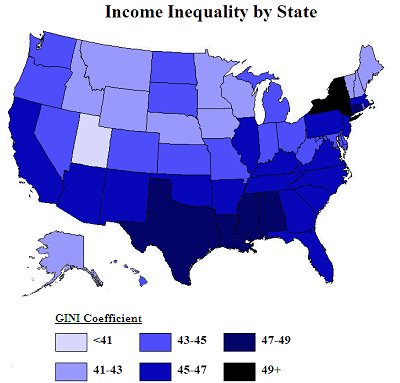
The Gini coefficient is a number from 0 to 1 representing the equality or inequality of income distribution in an economy; 0 is theoretical absolute equality, and 1 is one person having everything and everyone going without. In practice, it varies from about 0.2 to about 0.7.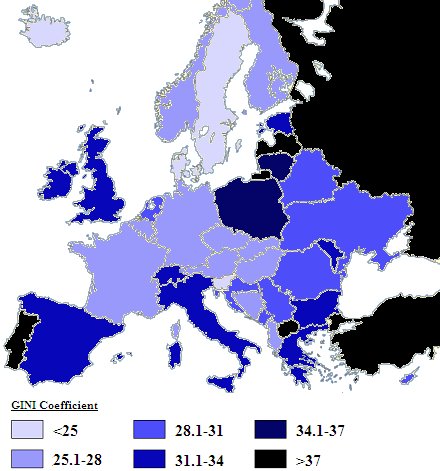
According to it, Europe ranges from the mid-.20s to the high .30s, with a few outliers in the low 40s. At the most egalitarian end, unsurprisingly, are the Jante states of Denmark and Sweden, as well as Iceland (perhaps surprisingly, if it's meant to have been an experiment in cut-throat neoliberalism). Things get more inequitous into Norway, Finland, France, Germany and Switzerland (which stays under .28, despite being home to a lot of the global super-rich), and then on to Italy, Spain, Britain and Ireland, and beyond that, Poland and Lithuania. The most unequal country in Europe is Turkey, which has a Gini coefficient of 0.436, somewhere between Guyana and Nigeria, or, if you prefer, Delaware and Hawaii.
The United States is, unsurprisingly, a lot less egalitarian in income than Europe. American states' Gini coefficients range from 0.41 (the solidly Mormon state of Utah, whose state emblem is the beehive, has a Gini coefficient equivalent to Russia's) to a whopping 0.537 in the District of Columbia (comparable to the Honduras). Other states are twinned with parts of the developing world; Alabama and Mississippi are most like Nepal, California has the income distribution of Rwanda, and New York, barely under the .5 mark, is twinned with Costa Rica. According to the article, this is an astonishing state of affairs for a developed country:
According the the CIA World Factbook (table compiled here), the lowest Gini score in the world is Sweden's, at .23, followed by Denmark and Slovenia at .24. The next 20 countries are all in either Western Europe or the former Communist bloc of Eastern Europe. The EU as a whole is at .307. Russia has the highest number in Europe (.41); Portugal is the highest in Western Europe (.38). Japan is at .381; Australia is .352; Canada is .321.
And then there is the United States, sandwiched between Cote d'Ivoire and Uruguay at .450. Not counting Hong Kong (.523), the US is a complete loner among developed countries. In fact, as you can see from the map above, there is no overlap between any single US state and any other developed country; no state is within the normal range of income distribution in the rest of the developed world. Here's a list of the states with their Gini index numbers, and the country where income distribution is most comparable in parentheses:Other interesting maps on the site include a map of religious nonbelief in the UK (which points out that Scotland and Northern Ireland are the most religious, and asks whether that correlates to the Scots-Irish roots of the US "Bible belt"), of antidepressant use in England and Wales (summary: it's grim up north, and in Cornwall too; either that or Londoners prefer a line of coke), and one suggesting that, as global warming advances, Australia is ecologically fux0red.
2008/12/30
The New York Times has published its annual Year In Ideas for 2008; unsurprisingly, perhaps, there is a lot more rethinking of economics and the foundations of capitalism there ("Guaranteed Retirement Account", "Rising Tide Tax System", and a "Stock Transfer Tax", which months ago would have been seen as unwarranted interference in the majestic free market). Other ideas tackle the energy crisis ("biomechanical energy harvester", "gallons per mile", "smart grids"), environmental issues in general ("carbon penance", "the climate-change defense", and "eat kangaroos to fight global warming"), new findings from psychology (such as "scrupulosity disorder", research into why social exclusion feels cold, or the finding that chauvinistic men earn more than egalitarian men), and random inventions (airbags for the elderly, spray-on condoms) and trends (wine from China, zoning prohibitions on fast-food restaurants).
Meanwhile, LogoLounge has posted its annual roundup of trends in logo design. It seems that organic flourishes and wrapping things around spheres are still big, with bright colours making a comeback, while more corporate clients are going for the instant sincerity of hand-sketched logos.
2008/12/24
Today's new concept: lipodiesel:
A Beverly Hills plastic surgeon who claims to have turned fat, extricated in liposuction, into biofuel for his car has skipped town after US officials raided his surgery in an investigation into his procedures.
He reportedly wrote about the practice on his website, lipodiesel.com, which has since been shut down. "The vast majority of my patients request that I use their fat for fuel - and I have more fat than I can use,” he wrote.The whole "lipodiesel" thing, though, could be a hoax, as some of the details don't match up. In addition, the surgeon in question is facing lawsuits for allegedly allowing unqualified assistants to operate on patients, and is apparently volunteering in a rural clinic in Colombia.
2008/8/25
 Apparently the world's supplies of fish are threatened by cats eating them all. Not predatory feral cats, but the pampered domestic variety, who consume increasingly large quantities of tinned fish.
"What is also interesting is that, in Australia, pet cats are eating an estimated 13.7 kilograms of fish a year which far exceeds the Australian average (human) per capita fish and seafood consumption of around 11 kilograms.
Wild forage fish, which includes sardines, herrings and anchovies, are an important link in the marine food chain, as part of the diet of larger fish like tuna and swordfish.
2008/7/23
A few interesting engineering-related developments in the news today:
- There is a proposal to provide most or all of Europe's energy needs with solar collector farms in the Sahara, slashing the continent's carbon emissions dramatically.
- England's parliament has approved the Crossrail rail scheme; from 2017—in nine short years—London will have a fast east-west underground rail link, sort of like Paris's RER, going from Paddington, under Tottenham Court Road and Farringdon, and hitting Stratford and Canary Wharf.
2008/7/18
As the north polar ice cap shrinks, some scientists are thinking that the last chance of saving polar bears may be by relocating them to Antarctica. Others are wary of this:
"Antarctic penguins and seals aren't adapted to surface predators," explained Steven Amstrup, the chief U.S. Geological Survey polar-bear researcher. "The bears would have a field day for a while, because they could walk right up to them and eat them. For a short period of time, it would be great, but in the end the whole system would probably collapse."See also here.
2008/3/14
Ever wonder what the science is that justifies Japan's "scientific whaling" programme? Well, wonder no more:
Scientists have analysed 43 research papers produced by Japan over 18 years, finding most were useless or esoteric.
The scientific research included injecting minke whale sperm into cows eggs, and attempts to produce test-tube whale babies, News Limited newspapers report.
2008/3/4
Estrogen-like substances in toxic waste turn male fish female; now, it turns out, they turn male songbirds into super-smooth lotharios, capable of singing the songs that get them all the chicks, like a wave of avian Smoove Bs:
Accordingly, the polluted male starlings sang songs of exceptional length and complexity -- a birdsign of reproductive fitness. Female starlings preferred their songs to those of unexposed males, suggesting that the polluted birds could have a reproductive advantage, eventually spreading their genes through starling populations.(Today's word of the day is "birdsign". If you're an indie-folk songwriter, make a note of that one.)
(via Boing Boing) ¶ 0
2008/1/30
The Japanese government is planning a system for certifying the authenticity and Japaneseness of Japanese restaurants around the world:

The origins of the wasabi horse-radish (preferably from the Izu peninsula), miso paste (preferably from the Nagano mountains) and pickled ginger (preferably from Tochigi) will all be scrutinised. Rice is expected to be the most frequent area of failure: a true sushi master will insist on Japanese koshihikari rice grown in Japan.
The same variety grown in California might, just, be acceptable. Faux pas may include serving Chinese soy sauce, or miso soup in a porcelain cup.Meanwhile, bluefin tuna used in sushi has been found to contain terrifying amounts of mercury, at least in the US.
2008/1/27
As the receding polar ice caps expose land and shipping lanes, setting the scene for the next great international land grab, Iceland's University of Akureyri is offering a course in Polar Law, to prepare a generation of lawyers uniquely equipped to deal with the resulting issues:
Emphasis is placed upon relevant areas of public international law, such as environmental law, the law of the sea, questions of sovereignty and boundary disputes on land and sea, natural resources law, the rights of indigenous peoples in the north, self-government and good governance, and land and resources claims in the polar regions.
(via Boing Boing) ¶ 0
2008/1/24
Lambasted for climate change and scorned by the green set, car companies are tailoring their marketing to the asshole demographic:
First to India, where an advert for the Ford Endeavour finds this 4x4 behemoth leaving slushy tracks on a melting polar landscape. Behind the two-tonne, seven-seater vehicle, which does just 7.5 km per litre in city driving conditions (compared to 22kmpl for India's new "People's Car", the Tata Nano), stand two rather forlorn-looking polar bears, an animal that has become the symbol of climate change. Could Ford India have chosen a more inappropriate setting to sell its wares? A children's playground, perhaps?
Ford in the UK goes for a much simpler approach with its Fiesta Zetec Climate (why would you ever use the word "climate" to name a car?) ads by accompanying a picture of the car with just a short sentence: "Most people would prefer a hot climate." It wouldn't appear as if Ford's survey of people's climatic preferences extended to those living in already parched regions of the planet now fearing the kinds of sharp temperature rises predicted by climatologists.
The messaging still not blunt enough for you? Try Hyundai's "Greed is Good" adverts then. Reprising the mantra of Gordon Gekko, Michael Douglas's odious city-trader character from the film Wall Street, is exactly what the environment needs right now, isn't it? Oh, how we need a return to the devil-may-care, me-want-now consumerism of the 1980s.Aside: when the line "greed is good" was penned for the film Wall Street in 1987, it was obviously an extreme, fringe view, that of a despicable character. Is this the case now, in the age of the Blatcherite "shareholder democracy" and "enterprise culture", where we are all encouraged to be marketing characters, constantly engaged in commerce, leveraging and monetising our assets much as sharks must constantly keep moving?
Meanwhile, someone at EDF's ad agency doesn't seem to have read Jared Diamond's Collapse:
The French energy giant EDF appears not to have done its homework before deciding to use the statues of Easter Island to reinforce its message that, "We develop tomorrow's energies for future generations." EDF is one of the world's largest suppliers of nuclear energy, an irony that ClimateDenial.org is quick to point out: "The Easter Island civilization collapsed from deforestation and overpopulation. The statues are a symbol of hubris and denial in the face of an impending environmental disaster. What staggering stupidity to use them to promote nuclear power".
2008/1/16
Faced with the choice of a mobile phone plan to buy, Charlie Stross did the math and determined that the more "expensive" ones are often, in terms of total cost of ownership, cheaper:
The first obvious conclusion I reached is that if you look at the total cost of ownership (TCO) of a phone, including both the phone cost and the monthly tariff cost multiplied by the term of the contract, there's surprisingly little elasticity in the bottom line until you get into the eye-wateringly high usage tariffs. The TCO for a sample phone on 18 month contract varied by only £102 between the Talk 75 and Talk 500 tariffs (75 included minutes and 100 included texts per month, versus 500 minutes and 1000 texts per month). The same pattern held on 12 month contracts, with a £60 spread. Which is, frankly, ridiculous, because you get so few minutes and texts on Talk 75 that the actual cost per minute is nine times higher, and the cost per text is eight time higher than on Talk 500.
What I had discovered looked weirdly like a classic bathtub curve — only plotting price against contract time, rather than the more familiar failure rate against time. It's a familiar curve: airline seat price allocations often follow the same distribution. At one end of the curve, you've got the chancers who want a flashy phone but no commitment to use it. Typically they'll sign up for a short, cheap contract with an expensive phone. Fashion victims, in other words. The cellcos are set up to recognize and fleece them, however. At the other side of the curve you've got the gabby heavy users, and they're going to throw money at you whatever you do, so you might as well take it. In between, you've got a highly price sensitive market, which you want to encourage to use their phones more (and graduate into being heavy users), so you dangle some promising discounts in front of them, weighted towards the heavier tariffs.Charlie also has this revelation about airline pricing:
(Airline seats for long-haul flights: if someone books a flight six months ahead of departure, it is a Big Deal to them, so they value it, so you can price it high. If they book at two day's notice to go to Aunt Irma's Funeral in New Zealand, it's a coercion purchase, so you can price it high. In-between, there's a trough where people have time to pick and choose which carrier to use ... so seat prices are at their lowest in the period 8-12 weeks before departure. It's the same bathtub-shaped curve.)Interestingly, railway companies don't do this (they sell a small amount of cheap tickets first, then progressively more expensive ones as each price level sells out, culminating with walk-up fares; at least Eurostar and Britain's railway system do this). This is undoubtedly partly due to any railway route between two stations taking the same duration being a monopoly, though that doesn't explain everything. Why, for example, are air travellers booking early willing to pay over the odds, while rail travellers are not?
Though is the bathtub curve the whole story for air fares? As flying a jumbo jet from one airport to another has a rather large fixed cost, it would make sense for the airlines to make an effort to fill as many seats as they can, whilst taking as much per ticket as the market will bear. I imagine they may have worked out a way of, at the last minute, selling off the remaining empty seats to whoever will pay for them without disincentivising other passengers from, in future, paying as much as they would otherwise be willing to, perhaps by making last-minute discounts inconvenient or cumbersome to obtain.
Anyway, while we're on the subject of mobile phones: here is a piece on how unwanted mobile phones are recycled. (Some are sold to people further down the new-shiny-toy chain; ancient, obsolete bricks often end up in countries where their network technology is still in use; some are refurbished or used for parts in countries with lower labour costs (and lower gadget-buying power), and those at the end of their useful life can end up melted down for their precious metals (of which there is a lot). If they're lucky; if not, they may end up leaching toxins into the water table somewhere in Africa.
It’s hard to track ReCellular’s or Collective Good’s phones. But Jack Qiu, a professor at the Chinese University of Hong Kong who has studied the movement of used computers and phones in China, describes one route phones take. In Kowloon, in Hong Kong, Pakistanis and other immigrants (often asylum seekers) import phones from Europe by the shipping container. These are fixed or cannibalized for parts in stalls at a local market. In the past, Nigerians and other African exporters swept in to buy tens of thousands of phones at a time, particularly so-called “14-day phones” — those that have been returned under warranty and used little. But recently, Qiu says, the markets for these phones have become saturated in African cities. So the Nigerians, needing to take their business to poorer African villages, have been leaving Hong Kong for Chinese cities like Guangzhou, where they can purchase cheaper, more heavily used phones from the larger refurbishing companies there. Many Nigerians have learned Mandarin in order to do business in Guangzhou, Qiu says, and the city now has an African-style coffee shop.
cellphones are not easily abandoned — and, when they are, someone somewhere is still likely to see some value in them. Jim Puckett, the coordinator of the Basel Action Network, a nongovernmental watchdog group that focuses on e-waste, visited Nigeria in 2005. He describes, at one Lagos electronics bazaar, repairmen sitting on dirt floors under shelves of scavenged parts, jury-rigging phones back together, over and over again, until the things are absolutely dead.And here is a discussion of what the signal strength bars on a phone actually mean. (The answer is: often not much.)
2007/12/22
BBC Newsnight's Ethical Man, Justin Rowlatt, claims that the Christmas tradition of gift-giving, in its present consumeristic incarnation, is exacting a ruinous ecological cost in carbon emissions:
The real problem is that giving presents is an inherently inefficient activity. It means guessing what someone else may want or need. Every now and then you'll buy the perfect shirt but more often than not the ornament or tie or garden thermometer will end up in the attic or more likely in a landfill site and all the carbon that went into making it is completely wasted.
A few decades ago you probably needed the socks that your mum gave you or the saucepan she was given by her Aunt. These days it is different. Consumer goods are so cheap and plentiful that even people on very low incomes have no shortage of stuff.
Indeed, if you need proof of how corrupt our present giving culture has become look no further than the "gift" shops that have colonised every high street. You know the ones; they sell things no-one wants like scented candles, little vases and foot massage kits.Perhaps it's time for a carbon-correct rewriting of Dickens' A Christmas Carol, which starts off with Scrooge as a profligate consumerist, loading his SUV up with loads of chintzy, useless plastic tat, with the intention of wrapping it up and giving it copiously to everyone he knows, as if in the throes of some seasonal lunacy. He then would be visited by the Ghosts of Christmas Past, Present and Future, who would show him the ecological and ethical consequences of his entry into the "Christmas spirit" (child slaves making toys in some hellish sweatshop in Asia, last year's presents all discarded and crushed under landfill, leaching toxins into the water table, and the ecological consequences for the world in a few decades if people keep doing this). Chastened, Scrooge mends his ways, and from now on, each of his nearest and dearest gets a £5 note and an Oxfam goat for a village in Africa.
Rowlatt points out that giving cash would be much more efficient and less likely to result in carbon emissions being generated for no good use, though cash is considered somewhat crass; in fact, anything efficient or utilitarian is considered improper (take, for example, how socks (something people all wear) have become a byword for lousy Christmas presents):
I've never understood why giving money is considered bad form. Wasn't that five pound note folded into Granny's card the very best present of all? You could use it to buy something you actually wanted. Not only that, cash is completely carbon free (until you buy something, of course).Perhaps, if we want to make the giving of efficient gifts (i.e., cash) acceptable, we need a special ceremonial form of cash which is not used in day-to-day transactions. This would be legal tender, much like normal cash, though would look different, and people would be socially discouraged from using it for mundane uses such as buying groceries. (A parallel, ceremonial form of legal tender isn't as far-fetched as it sounds; Britain already has one, though one that's used in giving alms to the poor.)
2007/10/23
Surely one of the new wonders of the modern world must be the Great Plastic Garbage Patch, a mass of rubbish (mostly plastic) twice the size of Texas floating in the Pacific, and serving as a sort of elephants' graveyard to which plastic bags from as the Americas, Japan and Australia migrate when their working lives are finished. The patch, also sometimes referred to as Gilligan's Island, has been growing tenfold every decade since the 1950s, and since it is on the high seas (and not part of any nation's responsibility), there's nothing that can be done about it, other than using fewer plastic bags.
(via Boing Boing) ¶ 0
2007/8/6
A leading environmentalist has claimed that walking to the shops does more to cause global warming than driving; according to Chris Goodall, the author of How to Live a Low-Carbon Life and a Green Party candidate in the UK, producing the food to provide a person with enough calories to walk to the shops is more energy-intensive than driving. Also, catching a diesel train is twice as polluting as driving a sports-utility vehicle over the same distance, paper bags are more environmentally damaging than plastic (because of the energy required to manufacture and transport them), organic milk causes more greenhouse emissions than intensively-produced non-organic milk, and while trees do absorb carbon, they produce methane, which is much more harmful.
So if you want to save the planet, forget about walking and drive everywhere like a mid-20th-century Los Angeleno, taking care to live a sedentary lifestyle in the interim. And don't even think about going to the gym; you'll go to green hell for such egregious wastes of carbon. Or perhaps not.
2007/3/13
Environmental campaigners are livid after it emerged that a British airline has been flying empty planes between London and Cardiff, purely to hold onto valuable slots for flying in and out of Heathrow. British Mediterranean Airways originally used the slots for flights to and from Uzbekistan, which were suspended after unrest there. Since October, it has, instead, been flying empty planes between the two airports six days a week, with each flight pumping more than five tonnes of carbon dioxide into the atmosphere.
2007/2/25
A new technology promises to turn garbage into clean energy. Called "plasma gasification", the technique can consume anything other than radioactive isotopes, producing only a glass-like substance (which is allegedly usable for making tiles or asphalt) and a hydrogen-rich gas which can be converted to various fuels. What's more, the process is self-sustaining; after initially starting the process, all one has to do is keep up the flow of material, and it will power itself, and also produce surplus electricity which can be sold.
Inside a sealed vessel made of stainless steel and filled with a stable gas--either pure nitrogen or, as in this case, ordinary air--a 650-volt current passing between two electrodes rips electrons from the air, converting the gas into plasma. Current flows continuously through this newly formed plasma, creating a field of extremely intense energy very much like lightning. The radiant energy of the plasma arc is so powerful, it disintegrates trash into its constituent elements by tearing apart molecular bonds. The system is capable of breaking down pretty much anything except nuclear waste, the isotopes of which are indestructible.Though not everybody's convinced that the system is safe:
Of course, the technology, still unproven on a large scale, has its skeptics. "That obsidian-like slag contains toxic heavy metals and breaks down when exposed to water," claims Brad Van Guilder, a scientist at the Ecology Center in Ann Arbor, Michigan, which advocates for clean air and water. "Dump it in a landfill, and it could one day contaminate local groundwater." Others wonder about the cleanliness of the syngas. "In the cool-down phases, the components in the syngas could re-form into toxins," warns Monica Wilson, the international coordinator for the Global Alliance for Incinerator Alternatives, in Berkeley, California.Perhaps if someone could adapt this technology to work on self-replicating nanobots, then we may have something...


2007/1/31
Britain's Green Party weigh in on the environmental costs of Windows Vista:
"There will be thousands of tonnes of dumped monitors, video cards and whole computers that are perfectly capable of running Vista - except for the fact they lack the paranoid lock down mechanisms Vista forces you to use. That's an offensive cost to the environment.
"Future archaeologists will be able to identify a 'Vista Upgrade Layer' when they go through our landfill sites."
2006/12/13
As water levels in Britain's reservoirs decline, a London local government is taking action to improve efficiency. Among new planning measures announced by Barnet borough council is a plan to require new homes to have only showers and not baths. The Times weighs in on why this is a threat to the British way of life and a cherished institution alongside tea and the Shipping Forecast:
Bathing is a therapy, a way of easing aches and pains, relaxing weary muscles and helping a tired brain to expand after a day of contracting. We don't expect that we will suddenly come up with a modern Archimedes principle. Or, indeed, remember exactly what it was about bodies and fluids that Archimedes puzzled out. But Eureka moments do come in the bath. A blast under a shower is better for displacing cobwebs and helping the brain to focus on immediate tasks at the start of the day. But if you need to ponder a knottier, big-picture problem, a long evening wallow in the bath is the best way of going about it.
Friends of the Earth say that the Barnet bath initiative "is probably the shape of things to come". But is it really? We are always being told that showers use less water than baths. Thames Water says that one bath uses 80 litres of water and is the equivalent of two five-minute showers. But power showers can use more water than baths. I doubt many people will trade in their power showers, and why should they? Ordinary showers are a false economy. Trying to get clean under the feeble jet can take all day.The odd thing is that, while councils are talking about measures such as eliminating baths from homes, most British houses still don't have water meters, and whenever the introduction of such meters is mooted, a vocal minority raise a fuss as if their fundamental human rights were about to be violated.
2006/12/7
While Ken Livingstone prepares to slap punitive charges on oversized SUVs and gloats over the drop in SUV sales, Westminster City Council has installed free recharging stations for electric cars and bicycles. These are devices that look like parking meters, and are located in Covent Garden (where London's first hydrogen fuel cell bus also goes). Both parking and electricity are free (albeit there's a 3 hour limit), so in addition to not having to pay the congestion charge, you get your fuel paid for by the council. Assuming that someone else with an electric vehicle hasn't gotten there before you.
I suspect that free charging stations won't last after electric cars become more popular; after all, someone has to pay the bill. I guess there's sustainability and then there's sustainability.
2006/11/15
Recent research has shown that the film and TV industry is one of Los Angeles' largest air polluters, giving off more emissions than aerospace manufacturing or hotels, or indeed any other sector with the exception of petroleum manufacturing. A lot of this is apparently due to generators on film sets and special-effects explosions. (That sounds a lot of exploding cars/helicopters/buildings.)
2006/11/13
Roof-mounted wind turbines are becoming the Hummers of environmental consciousness: they're big, unmistakeably conspicuous and demonstrate without question the owner's green credentials and general Guardian-reading smugness. It's a pity, then, that they don't actually do much for the environment:
Green campaigners warn that rooftop windmills do little to cut greenhouse gases, may annoy your neighbours, cause vibrations that could damage your home and produce only enough electricity to power a hairdryer.
Friends of the Earth said homeowners would only save tiny amounts of electricity by investing in turbines. 'For householders the idea of a turbine is very sexy because it's an exciting piece of kit. It's making a very visible statement to the effect that, "I'm doing my bit",' said Nick Rau, a campaigner at the group. 'It's glamorous to put something on your roof. But if energy efficiency is the top priority, there are many other, much more straightforward things you could do that are much more cost effective, and more beneficial for the environment, like insulating your loft thoroughly.'
2006/9/8
Today's novel use of technology: using the vibration detectors in PC hard disks around the world to detect earthquakes and predict tsunamis:
As part of their operation, hard disks measure vibrations in order to keep the read-write head of the disk on track. These measurements can be read from some hard disks. The Tsunami Harddisk Detector captures this vibration data and shares it with computers in other locations connected via a peer-to-peer network to determine whether an earth tremor is occurring.
2006/8/2
The East Japan Railway Company is experimenting with making its stations more environmentally friendly by harnessing the energy-generating potential of passengers as they pass through ticket gates:
The ticket gate electricity generation system relies on a series of piezo elements embedded in the floor under the ticket gates, which generate electricity from the pressure and vibration they receive as people step on them. When combined with high-efficiency storage systems, the ticket gate generators can serve as a clean source of supplementary power for the train stations. Busy train stations (and those with large numbers of passengers willing to bounce heavily through the gates) will be able to accumulate a relatively large amount of electricity.The system is being tested at the company's offices in Shibuya, though is expected to be rolled out in actual stations if this is successful.
Though would such a system really be able to generate a non-negligible amount of electricity? And, given that the passenger gates don't involve the passenger actually pushing anything as crude as a turnstile, how long until someone starts fitting footpaths with something similar? If it takes more energy from the walker to traverse than otherwise, they could even market it as an integrated exercise facility.
Some say that global warming has already passed the point of no return, it's too late for even the most radical CO2-reduction regime to save us (let alone the pitiful compromises politicians are squabbling over) and that we're all going to roast to death and/or starve when the food chain collapses spectacularly. Not to worry, says Nobel laureate Professor Paul Crutzen; if it gets to the point of global catastrophe, we could always release sulphur into the upper atmosphere, reducing the amount of sunlight getting through, and cooling things down:
A fleet of high-altitude balloons could be used to scatter the sulphur high overhead, or it could even be fired into the atmosphere using heavy artillery shells, said Professor Crutzen, a researcher at the Max Planck Institute for Chemistry in Germany.
His plan is modelled partly on the Mount Pinatubo volcanic eruption in 1991, when thousands of tons of sulphur were ejected into the atmosphere causing global temperatures to fall. Pinatubo generated sulphate aerosols in the atmosphere which cooled the Earth by 0.5C on average in the following year. The sulphate particles did this by acting like tiny mirrors, preventing a portion of incoming sunlight from reaching the ground.Some scientists aren't too happy with the plan, lest it encourage people to keep driving Hummers and leaving their VCRs on standby, secure in the knowledge that they can always spray some sulphur into the upper atmosphere if things get too bad.
This is only one of several proposed "geo-engineering" ideas to remedy the symptoms of climate change by technological means; others involve boosting the growth of CO2-swallowing plankton and floating white plastic islands on oceans to replace all the highly reflective sea ice that has melted. (Speaking of sending the wrong message, one can't top the last one; I wonder how many people will use it as an excuse for throwing plastic bags into drains.)
2006/8/1
Whilst visiting California, Tony Blair has have signed signed a pact to tackle climate change with the state's governor, Hummer-driving environmentalist Arnold Schwarzenegger. The pact, whilst careful to avoid anything binding or concrete, calls on both states to think positive thoughts about the environment, "find new solutions", "work together" and, in a very Californian fashion, "share experiences". The UK, spinning its hardest, has specifically denied that this pact sidesteps the Whitehouse.
2006/6/28
A London artist has produced a noise-level map of London, showing where the quiet places in this noisy city are.
(via Boing Boing) ¶ 0
2006/6/14
The latest consequence of global warming: starved of food because of longer iceless seasons, polar bears are eating each other.
2006/4/21
20 years after the Chernobyl disaster, scientists are finding the contaminated area teeming with radioactive, but otherwise perfectly healthy, wildlife, including species scarce elsewhere:
There may be plutonium in the zone, but there is no herbicide or pesticide, no industry, no traffic, and marshlands are no longer being drained.
Cattle on the same island were stunted due to thyroid damage, but the next generation were found to be surprisingly normal. Now it's typical for animals to be radioactive - too radioactive for humans to eat safely - but otherwise healthy.Scientists have analysed the DNA of Chernobyl wildlife and found them to have many mutations, though nothing altering their physiology or impairing their survival. (Which probably is at least partly due to those that were adversely affected having died and been eaten; nature's adaptability is of little comfort if one happens to be one of the unfortunate individuals that don't make the cut.) This has led some environmentalists, most notably James "Gaia theory" Lovelock, to suggest the burying of radioactive waste in endangered forests to keep developers, poachers and other human threats away.
The BBC also has a number of dramatic and well-shot photo galleries from the environs of Chernobyl: of the abandoned city of Pripyat (now with stencil art by visiting graffitiists and gas masks scattered by photographers for dramatic effect), of the vast graveyards of contaminated vehicles, and of abandoned villages in the exclusion zone.
2006/4/18
Patrick Moore, co-founder of Greenpeace and former anti-nuclear activist, has changed his mind about nuclear energy, and now argues that mass adoption of nuclear power may be our only hope of averting catastrophic global warming:
Here's why: Wind and solar power have their place, but because they are intermittent and unpredictable they simply can't replace big baseload plants such as coal, nuclear and hydroelectric. Natural gas, a fossil fuel, is too expensive already, and its price is too volatile to risk building big baseload plants. Given that hydroelectric resources are built pretty much to capacity, nuclear is, by elimination, the only viable substitute for coal. It's that simple.Moore then goes through the most common objections to nuclear power and offers refutations for each one:
Nuclear plants are not safe. Although Three Mile Island was a success story, the accident at Chernobyl, 20 years ago this month, was not. But Chernobyl was an accident waiting to happen. This early model of Soviet reactor had no containment vessel, was an inherently bad design and its operators literally blew it up. The multi-agency U.N. Chernobyl Forum reported last year that 56 deaths could be directly attributed to the accident, most of those from radiation or burns suffered while fighting the fire. Tragic as those deaths were, they pale in comparison to the more than 5,000 coal-mining deaths that occur worldwide every year. No one has died of a radiation-related accident in the history of the U.S. civilian nuclear reactor program. (And although hundreds of uranium mine workers did die from radiation exposure underground in the early years of that industry, that problem was long ago corrected.)
Nuclear waste will be dangerous for thousands of years. Within 40 years, used fuel has less than one-thousandth of the radioactivity it had when it was removed from the reactor. And it is incorrect to call it waste, because 95 percent of the potential energy is still contained in the used fuel after the first cycle. Now that the United States has removed the ban on recycling used fuel, it will be possible to use that energy and to greatly reduce the amount of waste that needs treatment and disposal. Last month, Japan joined France, Britain and Russia in the nuclear-fuel-recycling business. The United States will not be far behind.
Nuclear reactors are vulnerable to terrorist attack. The six-feet-thick reinforced concrete containment vessel protects the contents from the outside as well as the inside. And even if a jumbo jet did crash into a reactor and breach the containment, the reactor would not explode. There are many types of facilities that are far more vulnerable, including liquid natural gas plants, chemical plants and numerous political targets.
2006/2/24
Scientists have discovered that climate change is causing species to evolve more rapidly to adapt to new conditions. Meanwhile, a White House spokesperson has issued a statement saying that both global warming and evolution are unfounded theories with no concrete evidence to support them.
2005/12/31
100 things we didn't know this time last year:
8. Devout Orthodox Jews are three times as likely to jaywalk as other people, according to an Israeli survey reported in the New Scientist. The researchers say it's possibly because religious people have less fear of death.
59. Oliver Twist is very popular in China, where its title is translated as Foggy City Orphan.
74. It takes a gallon of oil to make three fake fur coats.
81. George Bernard Shaw named his shed after the UK capital so that when visitors called they could be told he was away in London.
99. The Japanese word "chokuegambo" describes the wish that there were more designer-brand shops on a given street.
100. Musical instrument shops must pay an annual royalty to cover shoppers who perform a recognisable riff before they buy, thereby making a "public performance".
2005/12/26
The Liberal Democrats have volunteered to be the butt of humourless-environmentalist jokes by issuing a Christmas statement saying that Santa Claus should deliver his presents by bus because reindeer are too polluting.
According to the Lib Dems, nine reindeer would emit methane with a global-warming impact equivalent to 40,667 tonnes of carbon dioxide as they covered the 122 million miles needed to deliver to every house in the world.
This makes his sleigh ride almost as environmentally unfriendly as an aircraft, which would produce 41,480 tonnes of CO2 on the Christmas Eve trip.Of course, the question arises of whether a bus covering those distances at the speed required to deliver all the presents would be any less polluting. Unless they mean that Mr. Claus uses existing bus services and other public transport to do his deliveries, in which case they would most probably take many years to complete, and leave many non-urban children completely without presents.
2005/11/10
A New Zealander is attempting to sail around the world on a boat powered by human fat. Peter Bethune, a former oil exploration engineer turned biofuels advocate, is asking overweight people to donate spare body fat, to be extracted by liposuction, which will be refined into biodiesel and used to power his trimaran.
2005/9/27
First there was the extraordinary biodiversity of the Korean no-man's land and the abundance of radioactive wildlife near Chernobyl, and now it emerges that penguins are flourishing in minefields in the Falkland Islands. The mines, laid by Argentine forces during the Falklands War, have rendered pristine beaches and grasslands off-limits to tourists and sheep. (These sanctions are backed up with hefty fines for any tourists afflicted by the warning-signs-are-for-sissies gene.) The penguins, fortunately, are too light to set off the mines, and have the beaches to themselves:
Argentina, which puts the number of remaining mines closer to 15,000, is offering to help clear more fields to adhere to an international treaty on land mines.
Falkland Islanders, however, are not pressing on the issue, and most believe it is better not to fiddle with the fields.
"There is a risk that only 95 percent would be removed," said Falkland Islands Gov. Howard Pearce. "You would bring a sense of complacency to the community and increase rather than reduce the chance of injury."
Besides, he noted, "The environmentalists like them."I wonder how long until someone on the militant fringes of the environmental movement decides to start sowing their own wildlife-friendly landmines in endangered areas of ecological importance.
(via bOING bOING) ¶ 0
2005/9/8
A children's story for the modern age: I'm a Cloud Factory!, By Ayn Rand A Smokestack.
I make all kinds of clouds--in all kinds of colors! Sometimes, I make white ones. Sometimes, they're gray. Sometimes, they're as brown as the grass or the trees. And sometimes, they're as green as the river.
I have other friends, too. Like the little birds. I love to watch them swoop and soar. They are so beautiful and graceful, and they bring me great joy. I'm so full of joy! I can barely hold it in! So I give them something beautiful back. Just as they approach, I pop out a great big pink cloud!
And when the birds fly straight into the cloud, they do a "rain dance" down... down... down... to the ground. Like a hundred little feathered raindrops!
2005/8/31
According to this article, the recent rise in oil prices has reduced petrol consumption in in Germany and Belgium by 10%, which is more than the embattled Kyoto protocol could have hoped for by 2012.
Also via 1.0, Steven Levitt (author of "Freakonomics") argues that fear of Peak Oil is just scaremongering, and that supply and demand will take care of necessary adjustments to cope. Which is debunked by one Dmitry Podborits, who points out that the adjustments may well include mass starvation, war, or the end of the happy consumer society and the decline into a new age of cut-throat austerity, where life is once again nasty, brutish and short for the wretched remnants of humanity scrabbling like rats over the dwindling leftovers; or, at the very least, the end of things we take for granted, from comfortable living in uncomfortable climates to widely available air travel and easy global trade. In other words, the 20th century may have been as good as it gets.
2005/6/16
Surprise of the day: large-screen TVs use more current than the smaller ones. Wal-Mart America's love affair with the jumbo plasma screen has resulted in massive increases in electricity consumption, calling on some to compare the TVs to that other emblem of the divinely-sanctioned and non-negotiable American lifestyle, the SUV. The fact that a lot of people leave the TV on 24 hours a day as a psychological security blanket probably doesn't help.
(Though is anybody really surprised that large TVs use a lot more current? Electricity consumption would, I imagine, be a function of the square of the screen size, meaning that even small increases in size result in large increases in power consumption. Which, also, is probably one of the reasons why small, wimpy-looking laptops have about twice the battery life of the larger, more-impressive-looking ones.)
2005/3/16
The good news (or possibly bad news, depending on your point of view): destroying the Earth is a lot harder than you'd think. Nuclear weapons, armageddon, gay marriage and proving that 1=0 will all fail to do anything about the planet still being there and all in one piece. Of course, if you'll settle for merely wiping out much of life on Earth, that's somewhat easier. (via Bruce Schneier)
2005/1/25
Long-haired, pot-smoking country singer Willie Nelson is now selling a line of biodiesel to America's truck drivers. Nelson, a supporter of American agricultural communities (btw, do those actually exist, or are they all owned by ConAgra, Simplot and Monsanto now?) and organiser of the Farm aid concerts, is promoting his BioWillie biodiesel as a patriotic alternative to imported oil, at once reducing dependence on Middle Eastern supplies (and the entanglements that that causes) and helping local farmers. Which sounds like the most sensible suggestion touted in the name of patriotism I've heard in a long time. More power to him.
2004/3/9
Following up on the Chernobyl photojournal, here is another similar record, this time by a woman who returned to the apartment in the dead city of Pripyat she was evacuated from, some 14 years later. The photographs of new buildings, overgrown with long grass and young trees, are eerie.
And the most recent Viridian note is about the Chernobyl "zone of alienation" involuntary park, a growing destination for extreme tourists, with its silences, fresh air and abundance of rare (and radioactive) wildlife:
About a quarter of the cesium and strontium have already decayed, and 95% of the remaining radioactive molecules are no longer in fallout that can get on or inside a visitor, but have sunk to a depth of about five inches in the soil. From there, they have insinuated themselves into the food chain, making the zone's diverse and abundant flora and fauna radioactive indeed. An antler shed recently by one Chernobyl elk was stuffed with so much strontium that it cannot be allowed out of the zone. But three Przewalski foals born in the wild, while radioactive, have grown to adolescence with no visible effects. Such radioactivity now has receded to the background. On an average day, a visitor might receive an extra radiation dose about equivalent to taking a two-hour plane trip, zone officials say.
Today, villages are slowly succumbing to encroaching forests. In the abandoned town of Pripyat, less than two miles from the nuclear reactor, empty black windows stare blindly from high-rise buildings at kindergartens littered with heartbreakingly small gas masks. It may seem like an odd place for a rewarding tourism experience. But nowhere else can a visitor stand amid a herd of wild Przewalski horses like a character in Jean Auel's Ice Age novels, or watch a pair of rare white-tailed eagles circling above the ghostly high-rises of Pripyat, a moving monument to the devastating effects of technology gone awry, and nature's near miraculous resilience and recovery.
2004/2/22
Want to see the Great Barrier Reef? You've got fewer than 50 years before it dissolves, thanks to global warming.
2004/2/9
Good news: the Earth can, and did, recover from global warming. So we can rest assured that, 150,000 years after the impending mass extinction of humanity and most other life, everything will be back to normal.
2004/2/4
The Quiet Zone is a rectangular area the size of Massachusetts and Connecticut combined (however large that is) surrouding a radio-astronomical observatory in West Virginia. In this area, by law, radio transmitters are restricted, providing with enough blessed electromagnetic peace and quiet for an ultra-sensitive receiver to detect faint signals from space. Except when an electric fence malfunctions or the area is invaded by radio-tagged squirrels or tourists with mobile phones:
The subjects of radio astronomy are astronomically large, but the signals they produce are astronomically weak by the time they reach Earth. These emissions are measured in Janskys, named for the father of radio astronomy, Karl Jansky. A Jansky is based on 0.00000000000000000000000001 watts - and that's a big signal at Green Bank. Even a musical greeting card playing at the base of the telescope could produce anomalous spikes in the data of an unlucky astronomer trying to study stellar gases. If the interference is strong enough, the telescope's ultrasensitive first amplifier - cooled by liquid helium to minimize internal noise - shuts down.
Although just about any electronic or electromechanical device can blind Green Bank's telescope, the biggest culprit in the first category is the observatory itself. After all, it's a high tech operation crammed with sophisticated electronics and PCs. Green Bank director Jewell believes that some of the steps taken to mitigate interference at the facility may someday be adopted in the wider world, such as innovative circuit board designs and extensive shielding. The cafeteria's microwave oven is kept in a shielded cage. Large chambers designed to absorb radio waves - including a 5,000-square-foot conference room - have been built to make sure that, as Sizemore tells it, "radiation generated in the building stays in the building." Outside, spark plugs are notorious radio-frequency emitters, so Green Bank maintains a fleet of diesel-powered, electronics-free '69 Checker cabs and '70s Dodge trucks.
Needless to say, keeping the Quiet Zone quiet is getting progressively harder.
2004/1/12
Free wireless networking may save the world, if certain blogging hipster sci-fi authors are right, but it wasn't enough to save Niue. The Pacific island nation (best known as the home of the .nu domain), which had installed a free, island-wide wireless network and ushered in the new golden age of humanity ahead of the rest of the world, was flattened by storms which destroyed virtually all buildings on the island and killed an unknown number of people. The population of the island, which was 1,200 before the storm, is tipped to fall below 500, with the possibility that the independent nation may become unviable, and may be returned to New Zealand rule.
2003/12/23
First there was global warming, and now we have global dimming, where the amount of sunlight reaching the earth's surface has been diminishing. Scientists aren't sure of the cause (and some dispute the existence of this phenomenon), but a leading explanation is pollution particles in the atmosphere. This could have far-reaching effects, from nobbling solar power to causing massive ecosystem collapse by affecting photosynthesis. However, the decline does not affect ultraviolet radiation, so you can still get skin cancer as you scrabble around in the dark. (via 1.0)
2003/11/25
Contrarian idea of the day: genetically engineered organisms may be our best hope for averting environmental catastrophe: (via worldchanging)
In 2001 a group of scientists announced that they had engineered a transgenic tomato plant able to thrive on salty water--water, in fact, almost half as salty as seawater, and fifty times as salty as tomatoes can ordinarily abide.
Salt-tolerant crops might bring millions of acres of wounded or crippled land back into production. "And it gets better," Alex Avery told me. The transgenic tomato plants take up and sequester in their leaves as much as six or seven percent of their weight in sodium. "Theoretically," Alex said, "you could reclaim a salt-contaminated field by growing enough of these crops to remove the salts from the soil."
most agronomists agree that some substantial yield improvements are still to be had from advances in conventional breeding, fertilizers, herbicides, and other Green Revolution standbys. But it seems pretty clear that biotechnology holds more promise--probably much more. Recall that world food output will need to at least double and possibly triple over the next several decades. Even if production could be increased that much using conventional technology, which is doubtful, the required amounts of pesticide and fertilizer and other polluting chemicals would be immense. If properly developed, disseminated, and used, genetically modified crops might well be the best hope the planet has got.
Of course, to the Khmer Vert that is the dogmatic wing of the Green movement, any tampering with Mother Gaia's blessing is anathema and an absolute evil, so they won't have a bar of this. Though hopefully more neophilic heads will prevail, when people realise that we can't return to an idealised, "natural" hunter-gatherer subsistence lifestyle. Human civilisation, in its present form, is deeply unnatural and dependent on technology, and the only way to reduce its footprint on the planet will be by technological means.
2003/10/24
Fish on Prozac! (Which sounds like a Clag/New Waver MP3 mashup, but I digress.)
According to a study by a Baylor University toxicologist, fluoxetine -- the active ingredient in the antidepressant Prozac -- is making its way to a lake in the Dallas area and into the tissue of the fresh water blue gill fish.
Science may have finally developed a happy fish that doesn't mind being eaten, and whose fluoxetine-saturated flesh makes you contented.
2003/10/7
Bruce Sterling on 10 technologies that deserve to die; which includes the usual Viridian hot buttons (coal, internal combustion and incandescent lighting), as well as nuclear weapons, prisons (apparently people can be controlled easily enough with drivers' licences and ubiquitous computing), lie detectors, DVDs (frail and illegal to back up), and cosmetic implants. (via Limey)
Unfortunately, the page forces you to "register" before you can see this; though it's reasonably lenient in what constitutes a valid email address.
2003/7/24
As a society, we discard an alarming amount of electronic equipment. It has once been claimed that the average PC has a working life of just under 3 years before it is consigned to the landfill, usually still in working condition. Meanwhile, we toss our old mobile phones as soon as the coltan to make new ones is mined from Congolese national parks. Not to mention all those electronic devices which are built to last a few years (my Sony stereo is a case in point; not to mention the fact that anything with firmware in Flash ROM is going to be scrap within a decade). So it's not surprising that the landfills are filling up with old computers, dead TVs and last year's DVD players, all of them leaching toxic chemicals into the groundwater.
Recycling of electronic devices has been a dubious exercise, with horror stories of entire Chinese villages serving as computer graveyards, young children picking futilely through mountains of dead circuit boards, and everybody getting cancer and dying before their time. But the urbane, left-leaning westerner who sent their old Pentium to be recycled (and paid the surcharge for doing so, lining the pockets of the growing guilt-assuagement industry) doesn't see any of this so their social conscience is eased. Perception is everything.
Which is why it gives me hope to see stories like this one, about a new high-tech waste recycling plant in Japan, designed to efficiently disassemble all those old unwanted devices and use as much of their constituent materials to make new things:
Glass in television sets is carefully dissected with Matsushita's own breed of cutter to keep the toxic leaded glass in the rear portion away from the safer glass in the screen. The result is two kinds of glass that ends up in new TVs. Separating the different parts of a washing machine requires a complex arrangement of magnets and wind blowers to produce cleanly divided waste.
(via Slashdot)
2003/7/16
After ten years on the high seas, a flotilla of plastic bath ducks is about to make landfall on the shores of Nova Scotia. The ducks, which originally numbered 29,000, were lost at sea when a container broke open during a storm in the Pacific; they have since floated around the Pacific, crossed the Bering Sea and entered the North Atlantic.
2003/3/26
Bravo! Anti-global-warming campaigners culture-jam Poems on the Underground, the long-running art project on the Tube in London, replacing poems with anti-Esso and anti-Bush screeds:
Sing a song of Esso
A packet full of lies
and oily greasy dollars
to help the climate fry
When the wallet opened
George Bush began to sing
"The planet may be burning
but I don't see a thing"
(via Meg)
2002/11/30
A British environmental thinktank says that high-speed trains should replace air travel on short-distance routes across Britain and Europe. Citing environmental damage caused by air travel, the Royal Commission on Environmental Pollution is calling for extra charges on air travel to represent the environmental cost, and a shift towards high-speed rail. Which all makes sense.
(Tangent: Which reminds me of something I read in the Guardian weekend magazine whilst in London; an ecological pundit in the UK (in Scotland, I believe) posited the idea that everybody should have a fixed annual number of carbon credits, which would be depleted whenever they used a car, rode a bus, used heating, &c., in proportion to the amount of fossil fuel used. To save the world from imminent doom, he argued, the allowance would need to be set so low that most people would only use cars in emergencies. Credits could be bought and sold, so poorer people could sell theirs, ride bicycles and wear thick jumpers, and the rich could buy enough to holiday in the tropics. True to form, the author of this proposal eschews travel to overseas conferences, sending addresses on cassette instead.)
(Tangent 2: Intercontinental rail will be a different issue altogether; I recall that the Russians were planning a rail tunnel from Siberia to Alaska some years ago, which would make it possible (if slow) to catch a train from London to New York.)
2002/9/6
Delegates to the recent Earth Summit, held to discuss solutions to environmental problems and poverty and ways to weasel out of actually doing anything about them have produced produced 290,000 tonnes of carbon dioxide by flying to the summit, using electricity and driving around.
A voluntary fund was set up to offset this damage, but so far, only 1/7 of this has been paid for.
(via die puny humans)
2001/12/25
Iceland is set to replace fossil fuels with hydrogen, by installing fuel cells on vehicles (starting with the Reykjavik bus fleet, and continuing on to its fishing trawlers). This will not only reduce Iceland's greenhouse gas emissions dramatically, but also (it is planned) make the state independent of foreign imports for its energy.
2001/4/26
The Victorian state government unveils plans for a "green" suburb. Situated north of Epping (on the Northern fringe of Melbourne), it will feature water recycling, energy efficiency and reduced dependence on automobiles. Mind you, they have not promised to extend the Epping railway line (which should be easy to do, as there is a dismantled railway line running north for quite a bit that they could rebuild), and so if they decide to do the typical thing and cut costs by having a 6-days-a-week bus service which stops at 7pm, everyone will just drive everywhere like they do in all the other outer dormitory suburbs. (This is also the government which recently banned the PTUA from a forum on plans to extend a freeway through the inner city, for what it's worth.)