The Null Device
Posts matching tags 'retrocomputing'
2013/4/16
A General Technique for Automating NES Games; a programmer in the US has created a system for automatically learning how to play some NES games, by monitoring control inputs, finding increasing sequences of bytes in the NES's 2Kb of RAM (which look like scores or level indicators, i.e., things to be increased) and taking it from there. It works better on some games than others (he has it playing Super Mario Brothers moderately well, and exploiting quirks no human player would stumble across, though it's hopeless at Tetris). There is a paper here.
2013/1/29
Veteran video-game developer Jeff Minter took a break from being odd about ungulates to write up a tour of family computer ads of the early 1980s; you know, the ones with families standing around an Apple II or TI994/A, sharing a moment doing the household accounts on a TV screen, or just transfixed in awe at THE TECHNOLOGY OF THE FUTURE, IN OUR LIVING ROOM TODAY:
Back at the start of the 80s cocaine use was particularly rampant, as evidenced by this buzzing Atari family. The three adult members are plainly off their tits. Mom is clenching like crazy. Older Daughter has a grin that reminds me of Aphex Twin, and Dad is on the verge of drooling while his eyebrows attempt to crawl off his face. All he can do is gesture limply with his right hand, presumably to the mirror just out of shot on top of the TV, indicating that someone should get busy and chop out some more lines with the platinum American Express card.
Here the McPervert family are shown reacting upon the occasion of their first exposure to Goatse.
What you can’t see is that the dog is in this family grouping too. He’s just stuck his nose right up Mom’s skirt, and boy is his nose cold.
2013/1/3
The latest in the ever-onward march of awesome: Scripted Amiga Emulator, which emulates a classic Amiga (of configurable specifications, though including video and audio hardware) entirely in JavaScript. Unlike the various JavaScript PC and Linux emulators, emulating the Amiga's various coprocessors probably will cause your machine to break a sweat. Running Turrican 2 on it was slow, and had the interestingly hauntological aesthetic effect of the music speeding up and slowing down, like on those battery-operated chip-tune Walkmans that everyone had in the 19A0s.
2012/11/15
Today in Extreme JavaScript:
An original IBM PC, simulated in the browser. It has a CGA adapter and two simulated floppy drives, into which one can load a number of pre-supplied images, including several versions of MS-DOS PC-DOS, as well as VisiCalc and Microsoft Adventure. Not only that, but, if left to its own devices, it will run an order of magnitude faster than an original IBM-PC.
Anyway, the simulation is fully functional on all modern browsers (that I've tested). It's booting the original IBM PC Model 5150 ROM BIOS (no modifications), and it's loading the original MDA/CGA fonts. This configuration gives you more control, allowing you to toggle any of the SW1/SW2 settings to change the memory configuration, the installed video card (MDA or CGA), and the number of diskette drives. There's also a built-in debugger with lots of DEBUG-like commands, only better. And you can create your own configuration by tweaking the underlying XML file. I'll eventually do a write-up explaining how to embed it on your own web page and what options are available. The process is very similar to embedding the C1Pjs simulation that I wrote earlier this year--the XML is just a little different.The author, a chap named @jeffpar, is now looking to add more features to his emulator, bumping up the display to EGA graphics, upgrading the CPU to a 286 and adding a serial mouse.
This is not the first PC emulator to be written in JavaScript; some two years ago, a chap named Fabrice Bellard wrote a JavaScript-based PC emulator capable of booting Linux on a JavaScript-emulated Pentium box. Bellard's emulator, though more powerful than a 1981 IBM PC, was purely text-based.
Also on doing cool things with JavaScript: Stuart Memo (who was in the 1990s Glaswegian punk/electropop band Bis) is now writing music tools in JavaScript, using the Web Audio API. He has a few demos here, and recently gave a talk at JSConf in Berlin titled JavaScript is the new Punk Rock, where he envisioned an open browser-based music-making platform.
2011/10/23
A number of retrocomputing enthusiasts are taking arcade games which were poorly ported to 8-bit computers back in the 1980s and re-doing the job properly, i.e., creating ports, to the vintage home computers in question, which (being unconstrained by the unreasonable deadlines often imposed by game publishers) do the original arcade games justice (or at least as much justice as one can physically do with a Commodore 64 or an Amstrad CPC):
"You make one mistake in your life and the internet will never let you live it down," wrote Keith Goodyer, programmer of the unfortunate R-Type port, on the CPC Wiki. "Electric Dreams / Activision gave me 21 days to do the port. I wish I had the time to do a nice mode 0 port with new graphics, but alas it was never to be." Impressed by his candor, other readers of the forum decided to make it a reality 20 years later -- and gave themselves more than 21 days to get it done.Goodyer's forum post goes into detail about the development tools, techniques and conditions in which the 8-bit games readers of a certain age will remember nostalgically. Apparently, by the late 1980s, 8-bit game developers had a pretty sophisticated system named PDS, which ran on an MS-DOS PC, assembled and linked the code and zapped it over to a tethered 8-bit computer, much in the way that iPhone development is done today. (Before then, one imagines that a lot of development was done on the actual host system.) I wonder how the tools used by today's (enthusiast) 8-bit game coders differ from those used by professionals in the 1980s.
Also, if those who feel sufficiently strongly about inadequate video-game ports from their childhoods can go back and right wrongs, I wonder whether or not other media will benefit from similar DIY interventions. Can we expect, for example, guerilla filmmakers making (illegal) film adaptations of books previously butchered by Hollywood, or (when the technology becomes available) correcting the maligned films with resynthesised graphics, altered dialogue and altered scenes? Or taking it upon themselves to record what they feel a band's disappointing follow-up album should have been, cobbled together out of samples of the originals, with new vocals resynthesised to sound like the original singer? As the technology becomes available, the possibilities are limitless.
(via Boing Boing) ¶ 0
2011/6/23
A few interesting links I've seen recently:
- BBC Four recently aired a fascinating documentary titled The Joy Of Easy Listening, charting the history of easy-listening/light music from the 1950s onward. It's viewable on YouTube here.
- Digital artist Joshua Nimoy worked on some of the visuals for Disney's Tron Legacy film, and describes how they were done, from the physics of fireworks simulations and the algorithms behind various clusters of digital-looking lines to authentic-looking UNIX command-line shots for a hacking scene. (The fact that we've gone from "UPLOAD VIRUS Y/N" screens and random equations/6502 machine code/cyber-Japanese glyphs to nmap(1) being seen as too much of a hacking-scene cliché suggests that computer literacy in the movie-viewing public has increased dramatically over the past few years.)
- IBM's Executive Briefing Center in Rome looks like something out of a scifi film:

- In epic feats of computing: the latest work by prolific technical genius Fabrice Bellard is a JavaScript-based PC emulator that's powerful enough to boot Linux. I repeat: it runs (a slightly cut-down, though fully native) Linux on a Pentium-class PC it simulates in your web browser, in JavaScript. Meanwhile, a high-school student named Jack Eisenman has designed and built his own 8-bit computer, including the CPU, from simple logic chips. The machine runs a machine code of Eisenman's own devising and can display graphics on a TV screen; Eisenman provides some games for it and full schematics, as well as a JavaScript-based emulator for those whose soldering skills aren't up to building their own.
- Quite possibly the most awesomel wedding invitation in the history of wedding invitations would have to be Karen Sandler and Mike Tarantino's, a card which unfolds into a paper record player that plays a song recorded by the happy (and creative) couple. There are more details here.
2010/7/24
The Chipophone is an instrument for live chiptune performance (i.e., playing live music on a keyboard in the style of music generated by 8-bit computers and game consoles), made from microcontrollers and housed in the chassis of a 1970s-vintage electronic organ by a Swedish chap named Linus Akesson. There is a video of Akesson demonstrating the unit and its features, and playing some classic chiptunes live, here.
2010/7/21
Apple have just donated the source code of MacPaint to the Computer History Museum. The code is in two parts: the tip of the iceberg is MacPaint itself, which was written in Pascal and consists of one source file, but the bulk of the code is the QuickDraw library, written in 68000 assembler, which gave the original Macintosh most of its (then groundbreaking) graphics capabilities. And here is a story of the development of MacPaint.
The source code still belongs to Apple, though may be used for non-commercial purposes. I wonder if anyone has managed to compile it recently.
2010/6/28
In 2001, a chap by the name of Aaron Ardiri wrote a port of Lemmings to the PalmOS PDA platform. Now, he has given himself 36 hours to port it to two modern mobile platforms, the iPhone and Palm webOS, with OSX and Windows desktop ports for good measure. Ardiri posted his progress, and interim OSX binaries, to a liveblog here; it seems to be down, but there's a long, scroll-like screenshot of the whole thing here. It's quite interesting, in its descriptions of how coding practices have changed as platforms have become less cramped, and of the process of adapting 2001-vintage PalmOS code to larger (mostly UNIX-based) systems.
Ardiri is considering adding another port to Android; I imagine this would involve some means of translating ancient, low-level C code into Java (or else a C compiler that produces Dalvik bytecode). If he's just dealing in C-based platforms, he could add Nokia's various platforms and (from what I hear) Samsung's new "Bada" OS, though whether there'd be much reason to bother is an open question.
2010/5/21
Today is the 30th anniversary of the video game Pac-Man, and so, the Google homepage has a special commemorative graphic. Only this one's even more special than most: it's a complete implementation of the Pac-Man game, in pure HTML5.
Not only is there no Flash involved, but its assets consist of only one image, with the individual elements being drawn using CSS sprites. Alas, it'll probably be gone forever come the 22nd, so play with it while you can.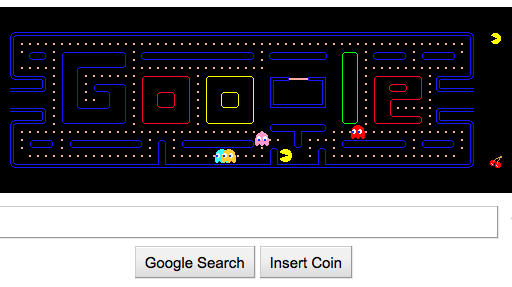
Update: Google PacMan is permanently located here.
2009/9/17
This is pretty awesome: a browser-based SNES NES emulator written entirely in JavaScript. Let me repeat that: someone wrote code in JavaScript (not in Flash or Java or anything faster) for emulating a Super Nintendo almost in its entirety*, from the 6502 CPU to the graphics and I/O hardware, and got away with it (it gets a respectable 33 frames per second in Chromium, though crawls along painfully in Firefox). The source code is all there in the page, unobfuscated, and the author has released the code (which is fairly elegantly laid out and comprehensible) under the GPL. Which means that it's probably only a matter of time until someone uses it to build a DHTML-based Commodore 64 or something.
* there's no sound, as one might expect.
2009/9/8
In the 1980s, programmers of games for the Nintendo Entertainment System would often put hidden messages, sometimes quite colourful, into the ROMs. This blog has extracted and translated a few of these, stridently complaining about clueless managers, broken tools, and, it seems, the shameless sexual peccadillos of team members. Game programmers in 1980s Japan were a wild lot, it seems.
First off, Kaoru Ogura, who ran off with some guy in the middle of the project. Yes, you, you bastard. Don’t show up at the office without showering after having sex 6 times the previous night. Next, Tatsuya Ōhashi. Yes, you, you bastard. Don’t give me your flippant shit — coming in late on the day we ship the ROM like nothing’s amiss. You can give me all the porn you want; I’m not forgetting that one. All that fucking weight you put on. No wonder you paid out 18,000 yen and still got nothing but a kiss out of it. Kenji Takano, Namco debugger. You are a part-timer; don’t dick around with the project planner. And finally, Kiyoharu Gotō, the biggest thorn to my side in this project. Yes, you, you bastard. Once I get a time machine, I’m sending you back to the Edo period. Go do your riddles over there.
Come to think of it, some people were helpful to me, too. Mr. Okada, who took all the good stuff. I know all about your abnormal tendencies. Yamagishi, who swore off soaplands until the project was over. Go ahead, knock yourself out now.
(via Boing Boing) ¶ 0
2009/7/30
The BBC is making a TV "comedy drama" about the rivalry between the ZX Spectrum and the BBC Micro. Or, more precisely, between their makers. The working title is "Syntax Era", and it will start Martin "Arthur Dent" Freeman as the BBC Micro's creator, Chris Curry.
2009/6/6
Today's Google title graphic:
Apparently today is the 25th anniversary of the invention of Tetris, perhaps one of the most concise (not to mention enjoyable) statements of existentialism embodied in interactive form. (In Tetris, there are no goals, no new worlds to explore, foes to vanquish, princesses to rescue or other paraphernalia, just the ceaseless, Sisyphean struggle against an inexorable, impersonally hostile universe, from which the only respite is your inevitable death.) Tetris also gave its name to a hallucinatory condition often triggered by playing it for a prolonged period.
Perhaps coincidentally, one of the inventors of Tetris now lives in Sydney and works at Google, and is involved in the Google Wave project.
2009/3/3
The Amiga was the future in the 1980s, and let it not be said that the Amiga community is not still at the forefront of innovation. This time, though, the innovation is one with a tinge of pathos about it, namely a gel which reverses the yellowing of the plastic used in old computers. With the unabashedly 133t name of "Retr0brite" (or perhaps "Retr0bright"), the gel is used along with an ultraviolet light source, and the formula is in the public domain.
2009/1/21
Québecois music software maker Plogue have announced a software synthesiser designed for chiptunes. the Plogue Chipsounds plugin (Windows/Mac VST; price/release date unknown) will simulate not one but seven different 8-bit sound chips (from the SID chip to ones taken from the Atari 2600, Nintendo NES, VIC-20 and arcade machines), all to great authenticity, and even features "faithful DC signal leakage emulation" for added versimilitude. It'll also come with presets made by chip musicians 8-Bit Weapon and ComputeHer.
Of course, not everybody's pleased. Some chip musicians are unhappy that this means that dilettantes unwilling or unable to put in the hard yards writing 6502 assembly language will be able to get the same authentically 8-bit sounds they can. Why, Plogue could port it to Pro Tools and it could end up on the next Madonna record; for shame!
Whether this is a good or bad thing depends on whether one regards 8-bit sound chip sounds as worthy in their own right, or merely as a shibboleth for separating the truly hip and hardcore from trendies and hangers-on. I lean towards the former camp; surely there are other ways of distinguishing interesting music from commercial pabulum than by whether the composer knows assembly language. Then again, I would say that, not having written any 6502 assembly in about two decades.
2008/6/17
The New York Times has a piece on the works of Paul Otlet, a Belgian who, between the late 19th century and World War 2, invented early forms of hypertext, search engines, the semantic web and even social software. Of course, not having digital computers to work with, his "Mundaneum" had a vaguely Terry-Gilliam's-Brazil quality about it, relying on telegraphs, vast numbers of index cards, armies of clerks and analogue terminals referred to as "electric telescopes".
The government granted them space in a government building, where Otlet expanded the operation. He hired more staff, and established a fee-based research service that allowed anyone in the world to submit a query via mail or telegraph — a kind of analog search engine. Inquiries poured in from all over the world, more than 1,500 a year, on topics as diverse as boomerangs and Bulgarian finance.
Since there was no such thing as electronic data storage in the 1920s, Otlet had to invent it. He started writing at length about the possibility of electronic media storage, culminating in a 1934 book, “Monde,” where he laid out his vision of a “mechanical, collective brain” that would house all the world’s information, made readily accessible over a global telecommunications network.Alas, when the Nazis took Belgium, they destroyed most of what he had achieved and he died a broken man, all but forgotten until a graduate student found what remained of the Mundaneum in 1968. 10 years ago, a museum dedicated to Mr. Otlet's singular vision was established:
The archive’s sheer sprawl reveals both the possibilities and the limits of Otlet’s original vision. Otlet envisioned a team of professional catalogers analyzing every piece of incoming information, a philosophy that runs counter to the bottom-up ethos of the Web.
Just as Otlet’s vision required a group of trained catalogers to classify the world’s knowledge, so the Semantic Web hinges on an elite class of programmers to formulate descriptions for a potentially vast range of information. For those who advocate such labor-intensive data schemes, the fate of the Mundaneum may offer a cautionary tale.
2008/5/7
The head of the San Diego branch of the Republican Party has been revealed to be none other than the founder of videogame cracking ring Fairlight, who were responsible for a large proportion of the pirated Commodore 64 games in circulation. Tony Krvaric, was born in Sweden of Croatian parents but emigrated to the US in 1992 to escape the stifling constraints of social democracy, co-founded Fairlight in 1987, going by the handle "Strider". Even back then, Krvaric was known for his right-wing politics, and included the motto "Kill a commie for Mommy" in bragging screens on cracked titles he released.
2008/4/8
Stephen Fry, who when he's not performing comedy is the Guardian's gadget columnist, is away, so in his stead, they've gotten Charlie Brooker to list his favourite video games of all time (or, at least, the first installment thereof):
Asteroids (1979, Atari) Of all the early monochrome classics, Asteroids was my favourite, because it's truly bleak. Rather than aliens or robots, your enemies are unthinking lumps of rock that are hurtling through space. Twirling somewhere in the middle of this cluttered void is your tiny, heartbreakingly fragile spaceship, armed only with a feeble electric peashooter. If Asteroids has a message, it's this: you are insignificant, the universe doesn't care about you, and you are definitely going to die. Brilliant.
Jet Set Willy (1984, Software Projects) Back in the day, you needed only a single programmer to create a game - and since said programmers were often geeked-out stoners, said games were often weird. Jet Set Willy's blend of flying pigs, in-jokes, Python and Freak Brothers references encapsulates the homebrew quirkiness of the cottage industry software scene of the early 80s. We shall not see their like again.
The Sentinel (1986, Firebird) You played a nomadic consciousness that had to absorb parts of the 3D landscape, then transfer itself inside a series of motionless avatars in order to travel - your goal being to ascend the highest peak before the ominous Sentinel stared you to death with his huge, cycloptic eye. In other words, it makes sense only when you play it.(I vaguely remember that on the Commodore 64. Mostly in the context of it being somewhat unsatisfying to play. I imagine that, recontextualised as an interactive art installation or similar, it could perhaps have been more fulfilling.)
Kato Chan And Ken Chan (1988, Hudson Soft) An import-only title for the PC Engine (a tiny Japanese console), Chan And Chan was a below-average platform game - but one that revolved, startlingly, around shitting, farting and pissing. The point at which I first grasped the illicit joy of off-kilter Japanese imports. (Also for the PC Engine: Toilet Kids, a shoot-em-up in which you fired turds at flying penises.)
2007/6/21
The Guardian reveals an all-but-forgotten fragment of the social history of 1980s Britain: a ZX Spectrum game named Hampstead, which codified the aspirational values of Thatcher-era Britain in the blocky, primary-coloured computer graphics of the period:
Hampstead was the ultimate 1980s adventure game, yet one of the few that broke from the traditional orcs and goblins fare. In it, you took the role of a down and out dreamer trapped in a grotty east London flat with ideals of leafy suburbs and affluence.
As aspirational games go, this text adventure was pretty high on the narcissistic scale. With the right clothes, the right education, the right muesli and the right girl (Pippa, of course), all that stood between your and your freehold was her Dad. And he was a pussycat. Hampstead taught a generation of future Brees and Tarquins how to climb the social ladder and how to look good while doing it.
2007/4/11
Someone has written a JavaScript-based 6502 assembler and emulator. The system compiles 6502 assembly language into JavaScript, includes a (low-resolution) emulated video display, and is powerful enough to play simple games like Pong (included in the examples).
In other 6502-related news, here is a commented disassembly and detailed analysis of Rob Hubbard's music playing code, as seen in numerous Commodore 64 games of the 1980s (and later ripped off by crackers and demo scenesters). If there was a museum of feats of 8-bit computing, this routine would be sitting in a prominently placed glass case in one of its wings.

2007/1/3
I recently visited Dave's Boutique, a veritable treasure trove of junk and ephemera in Smith St., Collingwood. As well as picking up a stack of CDs (at well below the standard second-hand shop price; A$10 for a recent release (before negotiation) is not bad), I found the following unusual artefact sitting in a glass cabinet, below rows of old Sega cartridges and PlayStation discs:
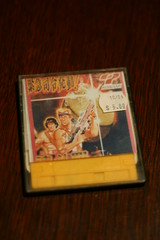
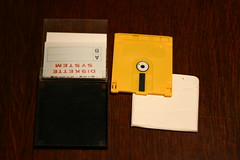
There were several such discs there, each in its own jewel case, though they varied in colour (most were black, this one is yellow). The tray card in the jewel case is, in each case, a printed photograph (a similar technique was used on Indonesian copies of cassette albums in the 1980s). The diskettes are neither 3.5" disks of the sort used on PCs, Macs and Amigas, nor the disks used on Amstrad 8-bit computers, but some other format; perhaps the same as the disks used on some old samplers and dedicated word processors?
Does anybody know what kind of system this disk was created for? I'm guessing it's either an 8-bit computer or some type of floppy-based game console that didn't make it out of Asia. Then again, given the photographic tray cards, perhaps it was designed for some illicit cartridge-copying device that piggybacked onto a better-known system. I vaguely recall seeing these disks at a flea market a decade or two earlier as well.
2006/9/6
Investigations into the kidnapping of a 10-year-old Austrian girl who was kept in a hidden cell underneath a house have been complicated by the fact that the kidnapper stored all his files using a Commodore 64, which computer forensics teams are ill-equipped to deal with:
The beige-coloured machine was popular in the 1980s but is now considered an antique, though some electronic dance acts still use it and it has a cult following among some fans of retro computers.
There are emulators available which can make a modern PC capable of running Commodore 64 programmes but Maj Gen Lang said it would be difficult to transmit the data from Priklopil's machine to a modern computer "without loss".
2006/9/1
From the 1980s to the late 1990s, the phone network was full of dial-up bulletin board systems (BBSs), where users could dial in with their 14.4k modems, download the latest shareware, post messages in forums, and play text-based multi-user games. Then the internet came along and these systems disappeared; some converted into internet nodes, reachable by Telnet, or into web-based forums, and many were merely switched off when the interest ran out. Though it appears that some BBSes were neither switched off nor connected to the internet, and exist to this day, reachable by anyone with a modem, in an eerie, Pripyat-like state of suspended animation, like zombie-filled ghost towns or something:
Each BBS is a unique a time capsule, stocked with trinkets and ephemera from the period. On message boards, you'll find posts from 1994 about the O.J. Simpson trial and which player-made Doom levels are best. In file transfer sections you'll run across large archives of long-forgotten Windows 3.1 screen savers. In door sections (online games), you'll find abandoned TradeWars 2002 games, still in progress, that haven't been touched in eight years. And of course, the Ferrengi have completely taken over.
All this makes me wonder why the Sysops who own these BBSes keep them running with such little traffic. Did they just forget to turn off their machines in 1998 as the Internet finally swept away the traditional US BBS scene? Did the old Sysops die and nobody noticed that the automated machines were still running, undetected, in a dusty back room somewhere? The possibilities are incredibly compelling; they really stir the imagination.There are ways of virtually "dialling out" to these BBSes using VoIP (at least with the boxes you can plug a regular phone (or modem) into). The voice compression techniques apparently don't cause problems. I wonder whether anyone has developed a software-only "modem" which connects to SIP or Skype and lets the user dial numbers and connect to things like BBSes.
(via Boing Boing) ¶ 0
2006/4/18
The C64Music! blog has a detailed and quite interesting academic article on Commodore 64 game music, looking at it from technical, cultural, musicological and aesthetic perspectives:
One of the attractions to Commodore's games over those of its competitors was their unique musical aesthetic. With screaming guitar-like square wave solos, full-length songs, attempts to re-create traditional "rock band" line-ups in its use of tone channels, and its increased use of percussion, Commodore music was like rock to Nintendo's heavily looped disco aesthetic.
Martin Galway was the first to use sampled sounds on the C64, in the Arkanoid (Taito, 1987) theme song, as he explains: "I figured out how samples were played by hacking into someone else's code ... It was a drum synthesizer package called Digidrums, ... I couldn't really figure out where they got the sample data, just that they were wiggling the volume register, so I tried to make up my own drum sample sounds in realtime—which is the flatulence stuff that shipped in Arkanoid."
(The hand-coded digi-flatulence technique pioneered by Galway became a standard part of SID composition, to the point where the reFX QuadraSID (a software synthesiser based on the SID chip) has a built-in "Galway Noise" setting, where those with the desire to do so can enter a list of hex values which will be fed into the SID chip's registers in the appropriate fashion. It comes with preset Galway Noise values, which are triggered by MIDI channel 10, though don't sound particularly like a useful drum kit.)
The article goes on to mention that many C64 games used melodies lifted from existing pieces of music, both classical and pop (with scant regard for credit, let alone copyright), the use of looping on various levels, the use of generative music techniques to avoid repetition, the (somewhat limited) influence of the Nintendo game-music aesthetic on C64 game music, and interactive aspects of game music, such as phrases triggered on entering/leaving rooms.
Tetris (Mirrorsoft, 1987), for instance, was very different than the versions released on the NES, showing this very different aesthetic particular to the C64. Not having any selectable music (which was an option on the NES), Wally Beben composed all original music—one very long (about 26 minutes—13Kb) track of many segments. In order to save space (likely), certain micro and mesoloops of the track repeat: for instance the bass/percussion line that begins the song repeats just one bar for about half the track, with different melodies coming over top and being layered with various accompaniments. This accumulative form—the gradual building up of a groove by adding sequential units cumulatively (Spicer, 2004)—was closer to the electronic trance music beginning to emerge in the late 1980s than any game music aesthetic of the time.
2006/1/21
This site lets you play old Commodore 64 games in your browser, without downloading any software. (Assuming your browser has Java and is on a reasonably fast machine, of course.) The experience includes everything, from SID chip sound to cracker-group intro screens, though your frame rate may vary (it feels roughly like C64 emulation on a 486-class machine in the mid-90s). A new game is added every day; today's addition is Giana Sisters, a Mario Brothers knockoff with added 1980s hairspray.
2006/1/18
First there was Jeri Ellsworth's 21st-century Commodore 64 and the highly hackable TV game it spawned; and now, a Dutch hacker is building an Amiga in a FPGA chip. Dubbed "MiniMig", Dennis van Weeren's project implements the Amiga's custom chips on the FPGA connected to a 68000 and RAM, and uses disk and ROM images stored in a standard FAT file system on a MMC card. At the time of writing, it is close to completion.
2006/1/15
Things I didn't know until today: the E-Mu SP-12 drum machine/sampler, which was designed in the 1980s by Roger Linn and whose gritty 12-bit sound became a staple of hip-hop production, was designed to use a Commodore 1541 disk drive for external storage.
This is a 5.25" self contained unit with its own power supply and a serial interface. It was the best choice in 1985, when 3.5" drives had yet to appear, and an internal 5.25" would have taken up too much room. The diskettes are used to stored samples and sequences
2005/11/28
Nifty objet d'art of the day: the Pong clock:
It's an embedded computer with an LCD display screen, which plays a perpetual game of Pong, with one round per minute. The right-hand side wins once a minute, except on the hour, when the left-hand side wins (and the right's score is reset); hence, the score displays the current time. Clocks go on sale next year, though there will be a downloadable screensaver soon.


In a sense, this seems to be the computer-age equivalent of those mechanical clocks from centuries past, in which tiny figures promenaded around illustrating the time of day.
(I wonder what it's implemented on. If the device contains, say, a Mac mini or an entire Linux system and X server, it would seem somewhat decadent.)
(via bOING bOING) ¶ 4
2005/11/8
An article looking at the console games scene in Brazil, where due to a number of factors, old systems killed off as obsolete in McWorld enjoy a new lease of life, and/or a freaky Frankensteinian afterlife:
Not only did Brazil embrace this marvel in video game history, but an increasing number of pirate consoles began appearing with additional features in an effort to beat the abundant competition. To differentiate between the two largest consumer bases, America and Japan, Nintendo had stemmed the import and export of games by employing different cartridge connections between the Famicom (Japanese version with a 60-pin connector) and the NES (American version with 72-pins). Since Brazil had never been properly established on Nintendo's world map, no marketing decision had been made to determine how sales would be controlled. Being stuck in the middle, with an increasing number of legal and illegal NES cartridges being shipped in from across the globe, clone consoles began appearing in Brazil with two connectors to accept either of the formats. On top of that, some pirate cartridge manufacturers began turning out double-ended casings, with 60-pins at one end and 72 on the other! Many of the NES and 2600 clones, still available today, even come with a multitude of games built into the system.
The Master System (Sega's challenge to the NES) and the Mega Drive landed in Brazil about the same time, where the systems were licensed to a local manufacturer. They were already due for replacement across the rest of the world, so Sega wisely allowed their licensee more freedom for internal development than was usually permitted. This has kept cloning and piracy of Sega products to almost nonexistent levels throughout South America. The entire range of Sega consoles are still in manufacture today - the only region in the world where Sega is still selling hardware - while sales of the Playstation 2 and Xbox are noticeable only by their absence.The article is from a publication known as The Escapist, which uses somewhat annoying stylesheets and JavaScript navigation and requires a rather wide browser window. Though it certainly looks pretty.
(via bOING bOING) ¶ 0
2005/9/29
A streaming radio outfit named Flat Four has a series of 3 programmes about 1980s home computer music. I just listened to the Commodore 64 one, and it's pretty interesting. It has interviews with various game-music composers (including Rob Hubbard and Benn Daglish, who now participates in the chiptune-party scene), fragments of the original music and various reworkings thereof (from club/dance remixes to heavy metal and acappella vocal covers), and some examples of new music made using Commodore 64s.
2005/9/9
I just found out that there is an entire blog devoted to Commodore 64 music; and it seems to be surprisingly busy too. Some of the things on it include C64 music nights (and there's one in Manchester this weekend; had I known about it sooner...), new music software which manages to squeeze ever more out of the C64 hardware, homebrewed MIDI interfaces, C64s grotesquely hacked into rack-mounted synths, instructions on making one's own cartridges, ways of using quirks of the C64 hardware to make sound, people selling C64 game ringtones, and links to creative projects like Casionova, an 8-bit Kraftwerk covers compilation and more.
Not to mention a Commodore-branded entry onto the media player market, which doesn't actually play C64 software or chiptunes. You'd think that whoever owns the brand would have done more than commissioning a generic media player and slapping the chickenhead logo onto it. I wonder if it's of any better quality than the "Commodore" DVD+Rs I bought last year, which burned perfectly well but failed to read afterward.
(via MusicThing) ¶ 0
2005/8/17
Never mind the PSP, I want a GPX2. It's a pocket-sized SD-based media player (capable of playing DivX/MPEG4 movies and MP3s) and some undefined games (with the provided joystick). Most interestingly, it runs Linux; assuming that they don't deliberately cripple it, that means it's going to be possible to put MAME on it, load up a SD card with old arcade ROMs and have an arcade in one's pocket. The only thing it's missing is WiFi.
2005/8/2
A Dutch chip musician has designed a GameBoy-synced tape scratching unit comprised of a Walkman and a box with a bunch of knobs, which plugs into the GameBoy. There are rather impressive sound samples on the site, as well as a link to his page on it, which has pictures but is somewhat harder to read.
2005/6/30
Scans of a 1970s-vintage childrens' book on computers, in two editions: from 1971 and 1979. Full of fascinatingly anachronistic detail of core memory, punch cards, disk packs and COBOL and PL/1, along with illustrated with Look Around You-esque scenes of high technology circa the 1970s: collages of microprocessors and paper tape, scenes of smiling women in Mary Quant-esque dresses operating desk-sized data processing units and brown-suited men loading disks into washing-machine-sized drives and the like.
It also has the sort of low-level detail that childrens' books on computers would not contain in later decades; I can't imagine a recent children's book on computers (or, indeed, anything before a second-year university subject) going into error-correcting codes, opcodes or the magnetic encoding of binary data. Mind you, back then computers were simpler; the physical details of how data is stored wasn't hidden behind a high-level interface like ATAPI or USB Mass Storage and machine language wasn't an esoteric specialty confined to compiler writers, BIOS hackers and hardcore masochists. These days, being interested in things that are too low-level is at best quaint, and at worst casts suspicion on one as being a potential h4x0r/virus writer/DRM cracker/troublemaker; all the details of computers one is meant to know about are exposed at a higher, and much more user-friendly, level, so why would anyone delve deeper if they're not either one of a tiny number of specialists or up to no good?
(via bOING bOING) ¶ 2
2005/5/13
Not that long ago, a joystick-shaped device named the C64 DTV, containing a Commodore 64-compatible computer (developed by Jeri Ellsworth, who also created the C-One super-C64) and 30 games, appeared on the market. Hackers who bought these are now opening them up and adding things to them; for one, it is possible solder on a PS2 keyboard (unlike the original C64, this one speaks the PS2 keyboard protocol) and, indeed, a standard Commodore serial bus connector for plugging in a drive (photos here); alternatively, one can embed a DTV inside a working Commodore floppy drive. With a keyboard and storage, the diminutive box (costing US$20, or about 3 times as much in the UK) becomes a fully usable Commodore 64, except for a few additional augmentations, such as a video chip capable of 256 colours. And there is more information on undocumented features of the DTV here.
2005/2/1
Entries in b3ta's Crap Computer Games challenge, in which contestants submitted demos (as animated GIFs or Flash; though at least one entrant wrote an actual ZX Spectrum program) of naff 8-bit computer games that never actually existed, both original ones and interpretations of pre-supplied concepts like Window Cleaner, Trade Union Organiser and a Spanish holiday simulator; anyway, you'll find these and more (including Football Text Adventure, the tape loader from Ocean's Last of the Summer Wine tie-in, and Mirrorsoft's Robert Maxwell Yacht Simulator) all (well, most) in pixellated 8-bit glory.
The contest was in connection with Look Around You, a BBC comedy series satirising 1970s educational television. The first episode of the new series (now changed from 9-minute "educational" programmes to a half-hour magazine-programme format; not unlike Curiosity Show for the Australians in the audience) aired last night. Unfortunately, I only managed to catch the last 5 minutes (did anyone manage to tape it?), though what I saw looked very amusing; perhaps even more so than the first series.
IMHO, Look Around You is the cream of British comedy these days. For all that is said about Little Britain, the usually cited candidate for this honour, there's no escaping the fact that it's basically a British version of The Comedy Company (right down to Vicki Pollard being a chav Kylie Mole). It inherits little from the great British absurdist tradition of the Goon Show and its heirs, instead throwing out the same predictable plots and trademarked catch-phrases in slightly different settings.
2005/1/25
A Japanese company named Gametech have released a handheld Nintendo Famicom clone. (For those not in the know, the Famicom was the Japanese game console rereleased in the west as the Nintendo Entertainment System.) It's about the size of a modern handheld game console and takes full-sized Famicom cartridges (which are shaped somewhat differently from the NES cartridges sold in the west, but an adaptor is available). It's not clear how legal it is, though given that it's on the Japanese market, they'd probably have an excuse of some sort (quite probably unlike a different handheld NES clone sold in China, and using miniature copies of Nintendo cartridges). The page says that it's of quite good quality, though given that they're trying to sell them, they would. (via gizmodo)
(This is from the Lik-Sang site, who also sell nifty and bizarre things like discontinued handheld game consoles and pencil cases shaped like vintage game controllers and such.)
2004/10/29
An intrepid hacker has created a port of Grand Theft Auto III to the Nintendo Entertainment System; that's right, the 8-bit, 6502-based console from the 1980s. The game isn't out yet, though will be released as a free download, joining the swelling ranks of elaborately handcrafted games being made for obsolete platforms because they're there. The page contains details of how he did it and the tools he used, including his elaborate homebrew developer NES system.
2004/7/29
There are now quite a few emulators running on PalmOS devices; from an expensive commercial Atari 2600 emulator to a lot of Sinclair Spectra to the Frodo C64 emulator. This actually runs quite well on my Tungsten T3 (with the slight exception of Paradroid going into pause mode every time one pushes the joystick down). I remember real Commodore 64s, and, some time after that, the hard-won satisfaction of seeing PCs (486s or low-end Pentiums, I think) finally get fast enough to emulate C64s well enough for games at full speed (possibly without sound, though); to think that now you can run a nigh-perfect C64 emulation on a pocket organiser is, well, strange.
Elsewhere, there was a project to port MAME to PalmOS, and someone collecting donations for it. The donations page seems to have disappeared, though, and the MAME site has no links to it. Hopefully someone will pull it off sometime soon. (There is Xcade, a commercial arcade emulator, though this only supports a handful of ROMs.)
2004/7/14
The Museum of Computing in Swindon, Wiltshire is exhibiting an artefact from a bizarre parallel universe of video games: a rare East German video game machine. The Polyplay was manufactured in 1985 as an ideologically sound Communist answer to Western capitalist video games. It consists of an 8-bit Russian commercial computer and a generic East German colour television (case and all) encased in a custom wooden enclosure in 1980s East German decor (which looks like 1970s Western decor). Some 1,500 units were made, many of which were recalled and destroyed at the time of the fall of the Berlin Wall. Estimates of numbers of surviving machines range from 3 to "lots" (someone on Slashdot claims that they're more common than PacMan machines in Germany).
There were no amusement arcades in East Germany so these robust Poly Play machines were found in municipal buildings, leisure centres and swimming pools, and offered seven or eight simple games. In the mid 1980's, Westerners would have been enjoying 'beat 'em up' games such as Streetfighters or Super Mario Brothers. In stark contrast, these simple games included a variation of Pacman called 'Hare and Wolf', car-racing, ski-ing (similar to ZX 81 games), and Carnival (shooting ducks). Westerners may find it harder to relate to games such as a man chasing butterflies or Deerhunt, which may have a cultural significance for East Germans. Another game, 'Catch the drips in a bucket or drown', makes one wonder if the residents of state-owned apartments ever found themselves in a similar predicament!
Here's a BBC news story about it, in which they amusingly misspell Schiessbude as Scheissbude and come to the conclusion that it had a game named "crap booth". If you can't make it to Swindon, you can play it on MAME.
The worlds of modern art and classic video games meet in Pac-Mondrian, which is just what it sounds like. They have a Java version of the game that works in browsers, and are constructing an actual Pac-Mondrian machine for installation in galleries.
2004/7/2
Tulip Computers, the Dutch company which bought the Commodore brandname, are making moves to capitalise on their brand, with portable MP3 players. The Commodore e-VIC-20 (cringe) is a 20Gb hard disk-based MP3 player/recorded, which looks not too unlike the Archos Jukebox Recorder in specs. (It's also a USB Mass Storage device, and so apparently isn't locked into what its maker considers to be good enough management software for the user, unlike some other MP3 players.) The venerable Commodore Pet line has also been reincarnated as a range of USB Flash drives and Flash-based MP3 players.
But wait, there's more! On their website, Tulip promise more to come. They have big plans for the Commodore 64 brand, with new products, both based on old C64 technologies and "new, innovative products fitting perfectly with the C64 image". (Does this mean Commodore 64-brand Windows XP notebooks or something? Maybe they'll even ship it with a dark-and-light-blue Windows XP colour theme, giving the user more of the Commodore 64 experience.) On the way is a joystick-shaped device that plugs into a TV and contains 30 C64 games built in.
Elsewhere, they promise "all sorts of merchandising available like t-shirts, caps, sweaters and lots of gadgets". I imagine rooms full of 8-year-olds somewhere in South-East Asia, busily sewing Commodore 64 trucker caps as we speak.
Also, according to the copyright notice, the official name for the Commodore logo is the "chicken head logo".
2004/4/2
2004/3/30
GUIdebook is a museum of graphical user interfaces, past and present, with comparisons of equivalent aspects (dialogs, icons, &c.) of different systems. The UIs include everything from GEOS (Commodore 64 and Apple) to Windows Longhorn, along with curiosities such as Rhapsody (i.e., NeXTSTEP with the MacOS UI bolted onto it), BeOS, the Amiga, QNX and OS/2. (Though with some notable omissions: i.e., GEM doesn't rate a mention once, and nor does any version of the MacOS X interface.)
In a similar vein, System 1.0 Headquarters, examining just how the first Macintosh OS differed from modern versions of MacOS (and here, "modern" means MacOS 7.6 and/or 8.5).
2004/3/19
During the 1980s, various musicians and bands put A gallery of 8-bit computer games on their 7" singles. The theory went that you'd play the 7" into a tape recorder, put the tape into your ZX Spectrum (and most of these were Speccy programs), load it and get some bonus content. The exact nature of this content varied from rather iffy-sounding branded video games (such as the Thompson Twins Adventure Game, or The Stranglers' "Aural Quest") to sometimes dubious games actually written by actual band members (Chris Sievey of The Freshies was a serial offender here), to Satanic messages with other messages hidden in the comments. (via bOING bOING)
2004/2/9
Video Toaster, the classic Amiga video-editing system, has been released to the open-source community. Mind you, since what made it so useful is dependent on the Amiga's video chipset, it's more a historical curio than anything else.
2003/12/6
Taito to start selling new Space Invaders machines. They aim to sell 10,000 of the units, at US$2,772. No word on whether that includes the coloured cellophane that goes across parts of the (black and white) screen. Or, indeed, whether the machines are made using original vintage hardware (2MHz 8080 CPU and all) or whether it's running in an emulator on some modern embedded RISC chip that is several orders of magnitude smaller and more powerful (and possibly cheaper to make).
2003/10/17
A video gaming magazine rounds up some 10-to-13-year-olds, gets them to review vintage games, like Pong and Donkey Kong and Tetris. (via MeFi)
Tim: Which button do I press to make the blocks explode?
EGM: Sorry, they don't explode.
Becky: This is boring. Maybe if it had characters and stuff and different levels, it would be OK. If things blew up or something or--
Sheldon: If there were bombs.
Tim (on Space Invaders): This is nothing compared to Grand Theft Auto III, because you can't steal a taxi cab, pick up somebody, then drive into the ocean with him.
2003/10/6
Commodore 64 emulation for Nokia futurephones. It appears to use the Frodo emulator for Symbian or EPOC or whatever it calls itself. I've run a version of this on a Psion I picked up a while back, and it wasn't very usable, though that's because of the monochrome screen. (via bOING bOING)
A chance meeting between a cocktail-cabinet Galaga machine and a PowerBook running MAME in a Brunswick café:
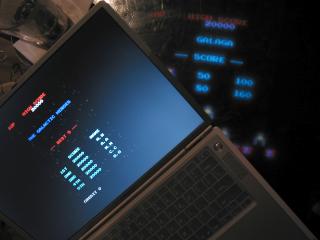
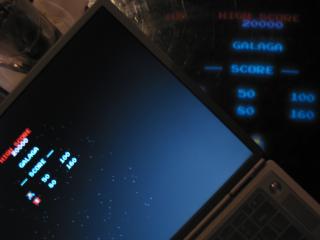
(Aside: why is it that most cocktail-cabinet arcade game machines around these days are Galaga? Is it the result of some kind of technical and/or memetic survival-of-the-fittest?)
2003/10/2
If you can read this, then we're back. A routine machine relocation didn't go quite to plan, but it's all fixed now (hopefully).
And below is the backlog of blog items that didn't get posted to The Null Device over the past few days:
- Your tax dollars at work: A US spy agency as been monitoring webcams at an Islay distillery, just in case they were making chemical weapons instead of whisky. Defense Threat Reduction Agency officials stressed that monitoring Scottish distilleries was not a high priority, but stated that it would take just a "tweak" to modify the whisky-making process to produce chemical weapons. (Hmmm; that suggests some interesting near-future scenarios for potential flashpoints between the United States of America and Britain and a rogue People's Republic of Scotland.)
- An interesting paper on the design of the Google File System, a custom file system optimised for storing huge (multi-gigabyte) files on large farms of fault-prone hardware. (via bOING bOING)
- The latest fad in baby naming in the U.S. involved naming your children after your favourite brands of consumer goods. Looks like Max Barry wasn't all that far off: (via Techdirt)
"His daddy insisted on it because Timberlands were the pride of his wardrobe. The alternative was Reebok," said the 32-year-old nurse, who is now divorced. "I wanted Kevin."
This is only the latest chapter in the boom of giving children unique names.
According to the most recent census, at least 10,000 different names are now in use, two-thirds of which were largely unknown before World War II.
- "We're Gonna Get You After School!" Gibson's Law applies to playground mob psychology, with kids setting up websites and blogs to call their classmates names. This way, technology may be said to have democratised bullying, as it's no longer the musclebound alpha-jocks and the popular rich girls who have a monopoly on making others' lives miserable. (via TechDirt)
One 12-year-old blogger, writing on the popular Angelfire Web site, recently announced she would devote her page to "anyone and everyone i hate and why." She minced no words. "erin used to be aka miss perfect. too bad now u r a train face. hahaha. god did that to u since u r such a b -- . ashley stop acting like a slut wannabe. lauren u fat b -- can't even go out at night w/ ur friends. . . . and laurinda u suck u god damn flat, weird voice, skinny as a stick b -- ."
The author of the article calls for the use of "parental control devices" to stamp out "social cruelty", much in the way that filters have been used to stop pornography. Which sounds more like it would strip those kids put upon by the alpha-jocks/princesses of their online support networks of fellow outsiders.
- More on the internet's impact on human interaction: Internet chat addiction can stunt social skills in introverted adolescents, says a researcher in "social administration". Dr. Mubarak Rahamathulla says that research suggests that chat rooms have contributed to some teenagers fearing conventional social interaction, and becoming more dependent on anonymity or pseudonymity. However, he says, webcams may be a safe, healthy way for to explore their sexuality. Perhaps the future belongs to asocial chatroom onanists, who are into anything as long as it doesn't involve actual human contact?
- The AT&T text-to-speech demo site now has two British voices; the male one sounds somewhat deranged, as if having at some time in the past eaten some BSE-contaminated beef. (via kineticfactory)
- A company is now selling licensed arcade ROMs for MAME. StarROMs currently have a few dozen titles, all from Atari, but plan to have more; games cost between US$2 and US$6 per title, and all are unencrypted ROM images suitable for MAME, with no DRM chicanery to be seen. Let's hope this idea catches on.
- Transcosmopolitan, or Spider Jerusalem's stint as features writer for a women's lifestyle magazine. (via Warren Ellis' LiveJournal comments)
2003/8/22
The MAME arcade emulator, once the sole province of geeks, is entering the mainstream; there is an article in today's Age about a local firm which builds MAME-based cocktail cabinets. The cabinets are based on a PC running MAME (on MS-DOS, apparently) and can be loaded with ROMs (which are only legal if you own the actual hardware, remember) from a floppy or CD-ROM. They retail for A$1,750.
Aside: given how much mainstream attention MAME is getting, I wonder how long until the owners of arcade ROMs start selling legitimate copies of them, in MAME-friendly format, over the internet. A while ago, they tried selling arcade games wrapped up in proprietary Windows-only emulators, though that doesn't seem to have been a resounding success. If they had a web site where for a few dollars you could download a ZIP file of MAME-ready ROMs (and possibly ancilliary artwork and such), I could see a lot of people (including myself) using that, and it making quite a bit of money for the owners of the ROMs.
But of course it will never happen; everybody knows that selling digital content without watertight digital-rights management (which is incompatible with an open-source emulator) is No Way To Run A Business.
2003/7/28
First there was Commodore 64 UNIX and IntyOS for the Intellivision, and now someone is writing a graphical multitasking OS for Pac-Man arcade machines:
Alpaca is a small multitasking operating system for Z-80 computers, specifically for Pac-Man/Pengo arcade hardware. It is an expansion upon my PTUI project, which was originally just an experiment to see how much of a real GUI can be put into the tight constraints of Pac-Man arcade machine hardware. The limitations are a total of 1kb of RAM (for storage and stack), 16k of ROM, sprite/tile based video hardware (1k color, 1k character ram), joystick, and two buttons.
Mind you, it doesn't do anything useful yet. (There apparently isn't enough space in a Pac-Man machine to fit an OS and applications, at least without optimising it further.)
And here is an extensive page on coding for the Pac-Man/Pengo hardware, including technical info, links to tools and sample ROM sets (no games, but there's an audio sequencer or two there; I'm sure there are some avant-garde applications for one of those).
It's interesting to look at the memory maps and other documents. In some ways the arcade machines were conceptually similar to 8-bit computers; in other ways, however, they're bizarre (for example, the Pac-Man machine's video RAM is all over the place).
2003/7/16
More on the Tulip/Commodore 64 thing: they're pretty much ruling out taking down non-profit sites, threatening open-source emulators or doing anything else to piss off the fan community (and quite wisely). Oh, and they're the mob who tried to sell a 486 Windows PC with a C64 emulator as the "new Commodore 64" a few years ago. (Which sounds like a daft idea, but is it any more so than marketing a new designer luxury car as a "VW Beetle" or "Cooper Mini"?)
Null Device Retro Videogame Feature #1: Elevator Action
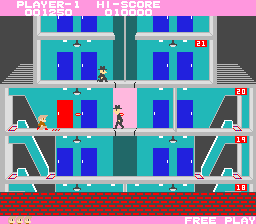
Publisher: Taito, Japan
Year: 1983
Format: Arcade
The objective: descend from the top of a skyscraper to your getaway car in the basement, picking up secret documents and avoiding and/or shooting the bad guys before they shoot you.
 Not sure what the backstory is; I'd say it's a "spy story" of some sort, with
the proviso that tradecraft in the Elevator Action universe involves going
through a building, stealing documents and shooting everyone you see. Actually, it might make more sense to think of yourself as a disgruntled postal worker than a secret agent. Another way the Elevator Action universe differs from our own is
in the world of lift control algorithms. If, in the real world, the
occupant of a lift could control its movement, there'd be a lot of pissed-off
people waiting in lift lobbies, not to mention fights for the controls.
(If everybody carried a gun, things would really start to get interesting.)
Not sure what the backstory is; I'd say it's a "spy story" of some sort, with
the proviso that tradecraft in the Elevator Action universe involves going
through a building, stealing documents and shooting everyone you see. Actually, it might make more sense to think of yourself as a disgruntled postal worker than a secret agent. Another way the Elevator Action universe differs from our own is
in the world of lift control algorithms. If, in the real world, the
occupant of a lift could control its movement, there'd be a lot of pissed-off
people waiting in lift lobbies, not to mention fights for the controls.
(If everybody carried a gun, things would really start to get interesting.)
Elevator Action came about in the days of 8-bit CPUs (it runs on 3 Z80s; the same chips that powered Sinclair ZX81s and the like) and 16-colour pixel graphics (the basic 8 plus lighter versions thereof; think Commodore 64 graphics with a less miserly hardware budget), after everybody got sick of plain black backgrounds but before game designers started trying to wow audiences with the depth of their palettes. As such, there is no shading, outlines or any other such sophistication; objects are pixelated blobs of solid colour. Which, in this days of Generation X Atari nostalgia and 1980s revivalism, is the height of modern-primitivist retro cool, a latter-day equal of Polynesian tiki kitsch and 1960s pop art.
 Anyway, back to the graphics. The action is set in a building with pastel-coloured walls and bright blue doors (which turn red if the room contains documents), which suggests that Smersh or whoever cared enough to hire a decent interior decorator. You, the player, are a little guy in a brown top, tan trousers
and, for some reason, red shoes, with a sandy blond crewcut. The bad guys
all look identical, dressed in black suits and fedoras, the usual cartoon
"spy" uniform. They follow you around and shoot at you, and you have to
dodge their bullets; which isn't hard, as they move slowly enough for you
to easily jump over them. All that makes one wonder whether or not Elevator
Action was a formative influence on the Wachowski brothers.
Anyway, back to the graphics. The action is set in a building with pastel-coloured walls and bright blue doors (which turn red if the room contains documents), which suggests that Smersh or whoever cared enough to hire a decent interior decorator. You, the player, are a little guy in a brown top, tan trousers
and, for some reason, red shoes, with a sandy blond crewcut. The bad guys
all look identical, dressed in black suits and fedoras, the usual cartoon
"spy" uniform. They follow you around and shoot at you, and you have to
dodge their bullets; which isn't hard, as they move slowly enough for you
to easily jump over them. All that makes one wonder whether or not Elevator
Action was a formative influence on the Wachowski brothers.
2003/7/14
Dutch PC manufacturer buys the Commodore 64 trademark, makes ominous noises about "not allowing unauthorised use of the brand" and releasing an emulator, the only licensed official one. Does this mean takedown notices for VICE, the C-One and the funet.fi CBM archive, or just that they'll go after the people selling Commodore 64 T-shirts at Camden Market? (via Slashdot)
2003/7/4
Someone is writing an Apple IIe emulator for PalmOS -- and it's about as fast as a real Apple. (via bOING bOING)
2003/6/26
Some hackers in France have written a multitasking GUI-based OS for the Intellivision game console; that's an old TV game box from the 1980s, based on a bizarre CPU nobody else used). Which looks about as useful as the various attempts at Commodore 64 UNIX.
2003/3/20
![Life Is Unfair. [Kill Yourself] [Get Over It]](/img/life_is_unfair_os9.gif)
Jumping on the bandwagon, only 3 or so years too late; Your humble narrator's blog now has its first pieces of CafePress merchandise, offering a positive, life-affirming philosophy in the classic old-skool Macintosh user-interface idiom. I got mine in the mail a few days ago, and was impressed with how well the printing came out. (I had been a bit skeptical about the quality of those print-to-order places, but CafePress's quality seems top-notch.) I wore it to the blogmeet tonight.
Anyway, why pay $120 for a Japanese-robot-glyph/ironic-retro-porn T-shirt on Chapel St. when you can have one of these for only US$15 (plus exorbitant shipping from the other side of the world, of course)? Or something like that.
2003/2/24
Atari 2600 retro fan site Stick It In The Slot has a list of the best games you never heard of, with the stories and full-colour screenshots of rarities like Peabo Bryson's Cow Tipper, Kramer vs. Kramer, Mrs. Paul's Fish Stick Hunter and not one but two games named Space Cobbler.
First there was the C-One, the Commodore 64 of the future, and now some hackers are using FPGA chips (i.e., dynamically reconfigurable hardware) to reimplement old arcade game boards, all on a chip; just supply the ROMs. The FPGA designs apparently even have extra "code" to convert the arcade-video-monitor signals to VGA, for those who don't have one of those big glass bottles sitting around. (via Slashdot)
(This is cool, not just because of the hipness of the the retro-video-game thing; the fact that you can make a small FPGA chip emulate any digital circuit, from a Pac-Man board to a Commodore 64 with an IDE interface bolted onto it, all by downloading the right information into it, is very cool. Now you have hackers creating open-source "hardware" components for FPGAs; i.e., code which, when integrated into a project, makes a complete 6502 core or USB interface or whatever, and others bolting them together to make all sorts of highly miniaturised gadgets. Unfortunately, FPGAs seem to only work for digital circuits, so something like a purely analogue open-source TB-303 core (suitable for embedding into mobile phones, childrens' toys and other gizmos) would not be possible.)
2003/2/3
Following a few links from the C-One Commodore 64-of-the-future project, I discovered that it is by no means the only such project, and merely the tip of the iceberg. There is an entire subculture of people (mostly in northern and central Europe, it seems) hacking Commodore 64s to do things they were never meant to, and developing all sorts of odd artefacts; such as The SuperCPU, which appears to be a 20MHz replacement CPU for the C64 with extra PC-style RAM; people are writing demos, games (and modifications to cracked commercial games) and even operating systems for it. And you can top it all off with an IDE interface which plugs into your C64's cartridge slot.
2003/1/7
Yow! Not one, but two open-source remakes of the old Commodore 64 game Paradroid. Freedroid looks like the more, umm, interesting attempt, extending the game into a multi-player RPG. Now let's see someone do a remake of Wizball. (via the retro gaming issue of "Edge", which appears to be an English video-game mag.)
2002/8/4
This looks doovy: One enterprising hacker has developed an Atari 2600-based musical instrument cartridge. The Synthcart has beats and arpeggiators, and can be operated without a TV. Wonder how long until we see Ataris take the stage next to circuit-bent Hello Kitty toys and GameBoys running NanoLoop. (via Slashdot)
2002/7/16
Geeky distraction of the day: A big list of Commodore emulator-related file formats. Interesting that they've now got digitised C64 tapes, consisting of the data as the C64 would see it; essential for that authentic watching-the-flashing-border-until-it-loads experience that ordinary emulator formats don't give you. Not to mention raw GCR disk images, for those who missed hacking the 1541 and inventing better ways of writing bit patterns to a 5 1/4-inch floppy. That's what plentiful RAM, disk space and CPU cycles give you, I suppose. I wonder how long until someone writes an 8-bit computer emulator which works on the logic-gate level, or renders the actual electrons in the machine?
2002/6/21
The bizarre world of ZX Spectrum clones, from Russia, Eastern Europe, South America and Asia. Apparently there were dozens of the beasties, some straightforward knockoffs and some (particularly in the USSR) with bizarrely improvised keyboards and some specced up to run MS-DOS and such. (via the Horn)
2002/5/15
French videogame giant Infogrames (who now own the Atari name) and some other outfit plan to relaunch the Atari 2600. Only it will fit in a joystick, plug directly into a TV, and contain 10 classic Atari 2600 games. No news on whether it'll be emulated or whether they'll actually reconstruct the Atari's crippled 6502-based architecture in hardware. (via Slashdot)
2002/3/4
A few days ago, I dreamt that I saw a new Commodore 64. It was like the old one (well, the white, triangular one, anyway), but for one addition: beneath the joystick ports, there was a USB socket. Apparently there was logic onboard which translated USB mass storage to the Commodore's crippled IEEE-488, allowing the C64 to access ZIP disks and the like as if they were 1541 disks. Then I realised that the USB translator logic would probably be more complex and computationally powerful than the C64 itself.
And, as if by coincidence, NtK tells me that some enthusiastic soul is reviving Zzap!64 Magazine, undoubtedly reliving cherished childhood fantasies. Don't expect to see issue 107 at newsstands anytime soon, though if you have a fast link and a colour printer, you can print out yourself and show it to your trainspotter mates. (It's only 30Mb in PDF format.) And if that's not enough, they have an archive of back-issues, in HTML and scans; this includes a number of features, including Andrew Braybrook's Paradroid diary.
I wasn't a Zzap! reader during the 80s; I preferred Commodore Computing International, which had a bit more in the way of technical details. Now I just read Future Music, which fills a similar niche, though is perhaps a bit less silly. What is it about English tech magazines?
2002/1/28
Abandonware news: Desqview/X released into the public domain (though without sources). I recall that it looked pretty impressive; it could run remote X11 applications and multitask DOS/Windows apps, all in a tiny amount of RAM. Not sure how useful it is these days, though. Anyway, there's a mirror here, and a Slashdot discussion here.
2002/1/18
Remember when ProDOS wasn't just a Randroid loony? Retrocomputing hack of the day: One enterprising hacker is working on a CompactFlash IDE adapter for the Apple II; one which will give up to two 32Mb ProDOS volumes per CF card. (Or IDE hard disk for that matter.) (Via Slashdot)
2001/11/5
Retro gaming action: the Java Arcade Emulator, with which you can play a selection of old arcade games using only a Java-enabled web browser (and a fast machine; it's perhaps a bit scary to think how many CPU cycles on a modern high-end PC it uses to emulate one Z80 CPU cycle in interpreted Java).
And then someone's written a Linux/X11 interpreter for SCUMM, the old LucasArts graphic adventure game system. I recall those games (Day of the Tentacle and such) looking pretty nifty
back in the days before live-animated 3D or whatever the kids are playing today.
(I'm showing my age, aren't I?)
(via Wil Wheaton and Slashdot, respectively)
2001/3/12
mame.dk is dead. It wasn't killed by arcade-machine company copyright lawyers, but screwed out of banner ad revenue by an outfit named eFront. And according to ICQ logs posted by a disgruntled employee (now mostly taken down), eFront have been doing other nasty things, such as harassing sites out of existence and even threatening a webmaster with rape. Lovely folks... (the Slashdot thread)
2001/1/20
Retrocomputing meets chindogu: Someone in the UK is designing an updated ZX Spectrum compatible, using only off-the-shelf parts. The SpeccyBOB, as he calls it, will be mostly Spectrum compatible, though will have 4Mb of RAM and an IDE hard disk interface. Watch the web site for circuit diagrams and such.
2000/10/15
The BBC has an article about the 8-bit emulator phenomenon. It's saddening to see that companies are siccing their lawyers onto those who copy old games for long-obsolete computers. Though there is some hope, with the likes of Amstrad giving carte blanche to emulate their old machines. (Didn't the Amstrad and Spectrum's ROMs contain Microsoft BASIC? Wouldn't Darth Bill's army of lawyers have something to say about this?)
2000/5/29
There's an online Java version of the old Hitchhiker's Guide to the Galaxy text adventure game on Douglas Adams' website. (via Hear Ye)
2000/4/14
Retrocomputing peripherals: forget old IBM iron; they've now built a printer for the Difference Engine, from Babbage's own drawings. (BBC News)
The printer is astonishingly advanced. It automatically prints the results of a calculation and can be programmed by the user to present information in different ways... "You can arrange how many columns the results appear in... you can even arrange the height between the lines, the space between columns and leave gaps between lines to make the results easier to read. The lines also wrap."
The apparatus not only provides a printed paper record but also produces stereotype plates for use in a conventional printing press.
To think: had Babbage or one of his contemporaries completed the Engine and the printer, the information age would have arrived in the Victorian Era. All they'd need would be a telegraph modem and there could have been an actual Victorian Internet.
1999/10/27
Insanely cool, or perhaps vice versa: Now you can play classic arcade games on a Kodak digital camera. (via Slashdot)