The Null Device
Posts matching tags 'art'
2016/8/18
This week I was at The Conference in Malmö; here are a few of the things I learned:
- People are moving away from social media (like Facebook/Twitter) in favour of 1-to-1 messaging apps (and group apps) like WhatsApp and Slack. This is partly due to messaging being more immediate, and partly due to social concerns such as privacy and the need to be able to engage differently with different people one knows (i.e., your coworkers don't need to see your family photos). In some places, there are businesses which run entirely on messaging platforms: gyms whose only point of contact is a phone number linked to WhatsApp, and property transactions in which the legal documents include screenshots of banking app transfer screens.
- Minecraft is teaching kids a lot of useful skills, from digital logic (building machines using redstone gates) and computational/design thinking, to social skills from self-organising build teams to designing and enforcing social contracts to protect from griefers. A big part of its success is because it is not a top-down product handed down from the authorities, like, say, Scratch or Swift Playgrounds, but something the kids can do whilst out of sight of grown-ups (much like the Commodore 64 back in the day).
- There is a lot happening with generative art. The most familiar form, describing a space of potential outputs parametrically and searching the parameter space by one means or another, is common enough, and appears in settings from art installations to
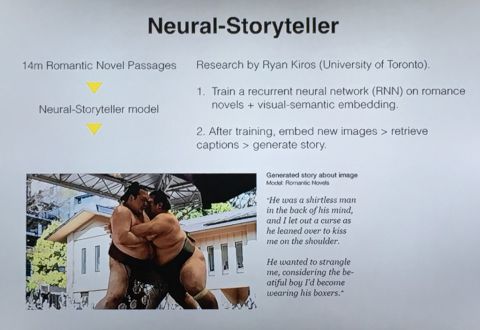
web appsTwitter bots. Now, advances in neural networks and deep learning are making an impact. Style transfer (think apps like Prisma, the photo-styling app for mobile phones, but also software for cleaning up rough sketches or colourising black-and-white images) has the potential to democratise or commodify (depending on whom you ask) artistic style. Meanwhile, deep learning with multiple media can produce synaesthetic examples, like the following output of a network trained on the text of romance novels and subsequently fed an image of a sumo match: - Smart cities, digitised to the millimetre with LIDAR, surveilled by drone, and managed by app, promise an end to the long nightmare of politics. Now a city can be run from above by impartial, objective algorithms—Plato's Philosopher King rendered in code. Everything in its right place, every space accounted for, all inhabitants managed with the efficiency of an Amazon warehouse, and all the dogs in the city are walked by drone. Until feral ravers disrupt the city's fiducial architecture (the patterned markers which guide the drones), conceal themselves from its managerial gaze with dazzle make-up and asymmetric haircuts, hijack the self-driving taxis and party in the spaces the machine does not see.
- Then again, one objective true point of view is a myth. The Jesuits found this out when, in an attempt to Christianise China, they tried to persuade the Chinese of the superiority of European-style one-point perspective over the aerial perspective used in Chinese art (which they saw as backward and inferior, for its ignorance of the point of view).
- The term “Perspective Collision” describes what happens when designed objects inadvertently reveal their designers' limited perspectives. Examples include camera film not showing dark-skinned people properly, or air conditioning in buildings being optimised for men. This is related to the Malkovich Bias, the idea that everybody uses technology the same way one does.
- Animal-free animal products are starting to appear. There now exist genetically engineered yeasts which, when fed with sugar, produce egg albumen and bovine casein, i.e., egg white and cow's milk. These are identical to the real products on a molecular level, and can be used for all the things real egg white/milk can be used for (as opposed to current animal-product substitutes, which tend to be specific to various uses). Actual animal-free meat is taking a little longer (growing more than thin layers of meat requires some form of structural scaffolding to feed the cells). This is known as cellular agriculture, and, once it matures, will work a lot like brewing: artisans/craftspeople managing a technical process.
- Stereotypical images used to represent the idea of “young people”: cartoon figures with shaggy/spiky hair and horizontally striped shirts; strobing photographs of wild-looking rock concerts.
- National Geographic, famous in popular culture for publishing photos of bare-breasted “exotic” non-Western women (something it has been doing since the 19th century), published its first photo of a bare-breasted white woman in 2016
2015/10/26
The Lego company has placed a worldwide ban on sales of bricks to the artist Ai Weiwei, on the grounds that they “cannot approve the use of Legos for political works”. Ai was planning to use the Lego bricks for an exhibit at his upcoming exhibition in Melbourne. The nature of the exhibit is not known, other than it was to concern free speech, though it could have upset officials in the Chinese government, and thus threatened Lego's profits in that billion-strong market. And so, a company from ultra-liberal Denmark, and one which has sponsored public art projects with no political censorship there, helps China export the Confucian-Communist authoritarian ideal of “harmony” to the democratic world, all guided by the profit motive.
After the news went out, Ai has received numerous offers of Lego bricks from private individuals, and has confirmed that he will proceed with voluntary donations of bricks.
So one could conclude that Lego have lost this one; an attempt to discreetly neutralise a liability having instead Streisanded them spectacularly, revealing the bastion of Scandinavian liberalism to be willing to kowtow to dictatorships in the pursuit of profits? Yes and no (though, in reality, mostly no). While Ai gets to complete his work, and a few leftists, liberals and civil libertarians (as opposed to the more common uncivil variety, to whom the freedom to pursue profit is supreme) may vow to not buy another Lego brick as long as they live, realistically that stands to hurt their bottom line about as much as the 30-year baby-milk boycott against Nestlé; i.e., not at all; and even if it did, the prospect of increased profits from the vast Chinese market (which would otherwise have gone to numerous knock-off brands) Lego can expect as a reward for its loyalty to the Chinese Communist Party will more than compensate for any loss of prestige among the small number of people in the west still inclined to vote with their wallets.
The moral of this story is that the Reaganite ideal of trade and free markets dissolving dictatorships and spreading liberalism and democracy in their wake is a non-starter when the most powerful players in the market are profoundly anti-liberal dictatorships (of which China is one; another one is Saudi Arabia, recently elected to chair the UN Human Rights Council (with, it turns out, the discreet lobbying efforts of countries like the UK behind it), and about to crucify a young man for blasphemy; Saudi Arabia's major initiative in human rights to now has been to push for the global criminalisation of the insulting of religion).
2014/12/9
This past weekend, I finally managed to make my way down to Blenheim Palace to see the Ai Weiwei exhibition; it was well worth going.
Ai Weiwei is best known these days as a thorn in the side of the Chinese government; having used his artistic practice to critique everything from China's territorial claims to corrupt officials' complicity in shoddy building practices (which claimed the lives of dozens of pupils when a school collapsed in an earthquake), and other provocations (such as the destruction of Ming vases in the name of questioning the nature of authenticity) have not won him any sympathy among China's more conservative politicians. For this reason, he remains under house arrest. Nonetheless, although he has not been allowed to travel abroad, he has managed to be intimately involved in the planning of his exhibitions outside China, working with the curators over the internet.
Ai's artistic practice as we know it took form in New York, where he lived for a decade from 1983. His earlier works were in the readymade tradition pioneered by Marcel Duchamp; found or mass-manufactured objects repurposed into statements (such as two raincoats buttoned together on a coat rack, a statement on the AIDS epidemic of the 1980s). His move back to China in 1993, and engagement with the rapidly changing society in the age of Deng Xiaoping's market reforms, provided a cornucopia of new subjects for his work.
Ai's conceptual tactics have often been subtly mischievous;
 he might take an object and transform it (such as glazing a Ming vase in automotive lacquer, destroying its value as an antiquity but transforming it into a statement about modernisation), or replicate it from an incongruous material (replicas of surveillance cameras and gas masks, carved out of expensive marble),
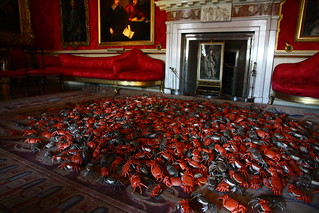
or, occasionally, relying on the sorts of subversive wordplay the Chinese government's not too fond of these days (He Xie, a collection of hundreds of porcelain crabs, alludes to the Chinese term for “river crab” being homophonous with “harmony”, the standard government euphemism for censorship and suppression of dissent).
he might take an object and transform it (such as glazing a Ming vase in automotive lacquer, destroying its value as an antiquity but transforming it into a statement about modernisation), or replicate it from an incongruous material (replicas of surveillance cameras and gas masks, carved out of expensive marble),
or, occasionally, relying on the sorts of subversive wordplay the Chinese government's not too fond of these days (He Xie, a collection of hundreds of porcelain crabs, alludes to the Chinese term for “river crab” being homophonous with “harmony”, the standard government euphemism for censorship and suppression of dissent).
In the Blenheim Palace show, the subtlety is taken to a new level. Whereas in an ordinary exhibition, one might expect the exhibits to be arrayed in a well-defined space, its boundaries defining what is and isn't in the exhibition, this exhibition does us no such favours; instead, Ai's works are placed in various locations in the palace, juxtaposed with the rich assortment of its existing contents. In the bedchamber where Winston Churchill was born, a pair of handcuffs carved out of wood lies, perhaps suggestively, on the quilt; on the ornately papered wall behind the bed, a simple wooden frame containing a human profile made from a bent coathanger takes its place next to landscapes painted in oils. Two Ming vases emblazoned with the word “Caonima”, in the style of the Coca-Cola logo, stand on an antique marble table.
 A rug in a drawing room is covered with the aforementioned ceramic river crabs, and in an adjacent room stands a cluster of traditional Chinese stools, taken from peasant houses, and stuck together into a shape not unlike a large chestnut. Under the oil paintings in a state room, two chairs carved of uncomfortable-looking marble stand opposite from two antique seats, and in the Long Library, the walls are hung with photographs from Ai's Study of Perspective series, of the artist's hand making a rude gesture at various world landmarks; at the other end, a blind marble security camera watches the scene. (During the day, adding to the incongruity, a small orchestra was playing Christmas carols in the middle of the scene.) The palace's chapel is home to a large cube, made as if of steel pipes replicated in traditionally patterned porcelain. More subtle interlopers are stowed in various places: traditionally patterned porcelain owl houses (an absurd, yet almost plausible, object) stnd in the Great Hall, and a porcelain watermelon beside a seat almost blends into the rich ostentation of the palace's contents. Outside are yet more objects, from ceramic spheres in a park to fake oil slicks, made from porcelain, under a tree in the Secret Garden. The overall effect is to make one suspicious of everything around one: is this one of the Duke of Marlborough's heirlooms or a subtle subversion deftly inserted by a mischievous artist half a world away?
Alas, this exhibition closes this coming Saturday, so those wishing to see it must hurry. However, it should be worth it.
2014/1/5
As their ranks and fortunes grow, the world's super-rich have been ploughing increasing amounts of money into buying art, often motivated primarily by its investment value; a Picasso, you see, is not so much a pretty object to hang on the wall of your grouse-hunting lodge in the Scottish Highlands, but rather a sort of high-denomination banknote. As such, airports in countries like Switzerland, Luxembourg and Singapore are sprouting networks of high-security art warehouses for storing their wealthy clients' collections; these remain airside, where import duties are not payable, and now are sprouting facilities to make it easier for the artefacts (which, for legal purposes, are still “in transit”) to be exhibited (though only to potential buyers, not members of the great unwashed):
The goods they stash in the freeports range from paintings, fine wine and precious metals to tapestries and even classic cars. (Data storage is offered, too.) Clients include museums, galleries and art investment funds as well as private collectors. Storage fees vary, but are typically around $1,000 a year for a medium-sized painting and $5,000-12,000 to fill a small room.
The early freeports were drab warehouses. But as the contents have grown glitzier, so have the premises themselves. A giant twisting metal sculpture, “Cage sans Frontières”, spans the lobby in Singapore, which looks more like the interior of a modernist museum or hotel than a storehouse. Luxembourg’s will be equally fancy, displaying concrete sculptures by Vhils, a Portuguese artist. Like Singapore and the Swiss it will offer state-of-the-art conservation, including temperature and humidity control, and an array of on-site services, including renovation and valuation.
The idea is to turn freeports into “places the end-customer wants to be seen in, the best alternative to owning your own museum,” says David Arendt, managing director of the Luxembourg freeport. The newest facilities are dotted with private showrooms, where art can be shown to potential buyers. To help expand its private-client business, Christie’s, an auction house, has leased space in Singapore’s freeport (which also houses a diamond exchange). The wealthy are increasingly using freeports as a place where they can rub shoulders and trade fine objects with each other. It is not uncommon for a painting to be swapped for, say, a sculpture and some cases of wine, with all the goods remaining in the freeport after the deal and merely being shifted between the storage rooms of the buyer’s and seller’s handling agents.
2013/10/25
We Need You Now (More Than Ever), a video by Danish artists Wooloo, in the style of We Are The World-style celebrity charity ensemble records, sardonically imploring the Catholic Church to dip into its vast wealth and bail Europe's economies out:
This video is being screened until 17 November at the Göteborg International Biennial for Contemporary Art at Röda Sten in Gothenburg, along with Chilean artist Fernando Sanchez Castillo's Pegasus Dance, an amorous ballet for two riot-control water-cannon trucks set to a languid waltz:WE NEED YOU NOW (MORE THAN EVER) from wooloo on Vimeo.
2013/10/20
From an article by Nick Cohen about the current Frieze art fair in London, an observation on the function that huge, tacky-looking artworks fulfil in validating their wealthy purchasers' status; Cohen's argument is that monumental kitsch is a peacock-tail-like mechanism for (expensively and unforgeably) demonstrating that one has status putting one beyond the criticism of one's inferiors:
The justifications from the critics whom galleries always seem able to find to dignify the shallow add to the melancholy spectacle. They talk of challenging our notions of what is art as Duchamp did with his urinal. They forget that Duchamp offered his "fountain" to a New York show in 1917 – almost a century ago, and his once radical ideas are now so established they will soon deserve a telegram from the Queen. "Everything changes except the avant garde," said Paul Valéry. Yet Frieze shows one change, although not a change for the better.
Collectors do not buy Koons because he challenges their definitions of art. The ever-popular explanation that the nouveau riche have no taste strikes me as equally false – there's no reason why the nouveau riche should have better or worse taste than anyone else.
What a buyer of a giant kitten or a gargantuan fried egg says to those who view his purchase is this: "I know you think that I am a stupid rich man who has wasted a fortune on trash. But because I am rich you won't say so and your silence is the best sign I have of my status. I can be wasteful and crass and ridiculous and you dare not confront me, whatever I do."
2013/7/27
The Quietus has a piece on the decline (if not reversal) of the equation of rock'n'roll with youth, as evidenced in the recent milestone of a 70-year-old Mick Jagger fronting the stage at Glastonbury:
Most of my predictions as a music journalist have come to grief in the near three decades I've been practising the art but one at least, which I first made 25 years ago, has successfully come to pass – that rock groups would still be touring in their 70s. Others demurred at this – we're talking about a time when a 45-year-old John Peel was considered unfeasibly senior still to be hauling his old bones to Fall gigs, like some old tennis pro ill-advisedly hitting the tournament circuit for yet another hurrah. This was a time when rock & roll still just about considered itself youth culture and the first crease had yet to be ironed into its jeans. In the 80s, the mid-20s was considered some significant cut-off point. When Q magazine was launched, it was aimed at what it considered an audaciously senior, Jeremy Clarkson-style demographic – the over-25s. Still earlier, it was still worse. In 1964, Melody Maker ran a concerned editorial about the ageing Beatles drummer entitled “Ringo – Too Old To Rock At 24?”
It's not so much that the old guard of artists have necessarily redeemed themselves, or rediscovered their old powers, it's that the critical mood has changed. The iconoclastic scepticism of the punk generation gave way, in the conservative, nostalgic, Oasis-dominated 1990s to a reverence for wealth, prestige, superstardom, a longing for the old days of mega-mania, rather than interesting, diverse, locally sourced clusters of new music. This has gradually intensified, as a sense grows that the mainstream rock narrative has run its course, the smoke is clearing, and we can look back at the legends of yore with renewed biographical clarity, their often trite sayings and doings regarded with utter fascination, their present day activities reviewed with slavering, uncritical awe.Rock'n'roll's focus on youth was itself an anomaly amongst established genres; in other genres such as jazz and blues, artists have often created work, and often groundbreaking work, well into advanced age (the article mentions Duke Ellington and Sonny Rollins); rock, however, started as a commercialised adaptation of the blues, packaged into 7" singles and marketed at teenagers, and remained tied to youth until its intrinsic momentum as a genre overwhelmed the scaffolding of commerce and/or a generation of middle-aged people refused to give up rock'n'roll and start listening to something more age-appropriate like, say, Mantovani or Harry Belafonte.
There are countless examples from the avant-garde world that old age doesn't dim the creative powers and reduce them to a twilight of tea and biscuits, Max Bygraves and the 'Semprini Serenade'. Musique concrète composers like Luc Ferrari, Henri Pousseur and of course Karlheinz Stockhausen were still operating on the ultra-radical fringes of music before they died of eventual, natural causes early in the 21st century. The same can be said of Derek Bailey, vigorous and active and expanding the guitar lexicon way beyond the confines of rock until his death, aged 75.
Quite simply, music isn't sport. You can perform to the physical level required well into your senior years. Your faculties, health permitting, are quite capable of seeing you through the flails and thrashes and moves like Jagger. This is an extremely gratifying spectacle because, of course, the rock audience itself is growing older year by year, and is most pleased to see that while death will claim us all, old age (as lived out by previous generations sometimes from about their mid-30s onwards if old photos are anything to go by) need not. And so it will go on. I predict rock groups touring and working into their 80s, maybe 90s, with the 70+ brigade, currently a relatively select group, a commonplace band filled out by the likes of Prince, Elvis Costello, Dexys. No one stops. Why would they? Why should they?The article also mentions David Bowie, Bruce Springsteen and Paul McCartney, and finishes with taking Jagger to task for taking the easy way out and resting on the laurels of mega-celebrity rather than pushing boundaries:
And so, happy birthday, Mick Jagger. You truly deserve your slice of cake. You are, after all, Fucking Mick Jagger. Never mind “Sir” Mick Jagger; you should replace the “Sir” with “Fucking” and insist, at all times on that far more appropriate mode of address. You should have a party. Only, don't invite the Kate Mosses, Chris Martins and the rest of the showbiz kids – you know they don't give a fuck about anybody else. Invite your own contemporaries, who deserve their slice of cake also. Invite Leonard Cohen. Invite Alan Vega, who just turned 75 but whose group Suicide have never enjoyed the good commercial fortune their innovations deserved. Invite Hans-Joachim Roedelius, whose birth in October 1934 is the very first event on the krautrock timeline, whose work with Kluster and later Cluster is foundational in the histories of noise and ambient respectively, and who is still cutting it, as shown in his very latest release Tiden. Invite Irmin Schmidt and Jaki Liebezeit, surviving founder members of Can, whose continued inventions (on the Cyclopean EP for example) are a discreet counterpoint to Kraftwerk's more widely feted Touring Synthpop Museum. Invite Joni Mitchell, who might have a thing or two to say about why women aren't necessarily granted the same indulgence to carry on being rock stars into their senior years as their male counterparts. Happy birthday and rock on – we know you will.Meanwhile elsewhere, how Guns'n'Roses' Chinese Democracy made possible the current wave of comeback albums, including albums like My Bloody Valentine's m b v and the new Kraftwerk, Stone Roses and Smiths albums we'll almost certainly hear over the next few years.
2013/7/4
Tom Ellard, formerly of industrial electropop combo Severed Heads and now an academic teaching the digital arts, takes the world of art and the vocation of the Artist to task in an essay titled Five Reasons Why I Am Not An ‘artist’. His targets include the various hierarchies, hypocritical masquerades and rituals enforced on those playing the role of Artist, from refraining from lowering oneself to doing anything too hands-on or technical (there are operators for that) to the politics and carefully circumscribed modes of relating to other people within the art world (a place seemingly as formalised as an 18th-century aristocratic court), to the somewhat less than inspiring reality facing an Artist who has Made It:
When I worked in advertising I was surprised to meet people who didn’t do anything. They are called ‘art directors’. People like myself that perform the actual tasks are called ‘operators’ and there is a strong class distinction which leads ‘art directors’ to cross their arms while speaking near any object that they may accidentally use*. I was employed to move text on a page for an irate person standing a few feet away from the means to do it. Apparently their pureness of thought would be sullied by contact with a mechanism.
I’ve said it too many times: the ideal of an artistic career is inertia. Innovate for a while. Find a practice, a style, a scheme that earns attention. Repeat it endlessly, never daring to step outside your persona because the system will need to bind you to an iconic representation of yourself. Do you reproduce famous paintings as slow motion videos? Or use a skateboard as your macguffin? Better stick to that. Keep on making action painting, or ‘industrial’ tape cut up until you die – which is your prime function, sealing off the quantity of your saleable work.
Artists that constrain themselves are recognised more quickly, they are funded, they are more acceptable to publications because they are easier to digest. They are the cheddar cheese of creativity, and when I am I told that ‘all the best work is happening over here’, I know the place to look is anywhere but there. Innovation is part of a continuing vitality, and confusedly being alive is more important than being neatly dead. We should never ever pre-organise ourselves into categories that fit nicely in museums, journals and repositories. That’s like pinning yourself into a display case.
What will we call ourselves? The Kraftwerk guys were onto something when they called themselves ‘music workers’. But I have another idea. In advertising the term ‘creative’ is a mixed signal, it seems to be a positive, but can be a polite substitute for ‘operator’. I’ve often heard somebody say, ‘we’ll get our creatives onto that’. It means ‘all slaves to the oars’. If so, perhaps we can claim ‘creative’ or ‘operator’ back. It can be our own swearword.
2013/6/11
More dispatches from Australia's culture war, where a raid on an art gallery, and pending charges of child pornography production against one of the artists, signal a new climate of rising censorship and a the return of a narrow-minded, provincial prudishness, now riding within the mainstream of the Liberal Party:
The opposition to Yore's work has been spearheaded by a group of local figures. Minutes from a City of Port Phillip council meeting on 28 May show that Chris Spillane, a Liberal party candidate for the council, "stated that while he hasn't seen the exhibition himself, from what he has heard about the exhibition it is offensive and pornographic in nature".
Spillane has previously claimed the council "wastes considerable sums of money" on projects that promote "socialism and multiculturalism". He has been supported in his stance against the Linden centre by councilor Andrew Bond, who called Yore's exhibition "complete smut", and by resident Adrian Jackson.As Australian historian Manning Clark (who himself has fallen posthumously out of favour in the new age of muscular conservatism, partly thanks to the Murdoch press's attempts to paint him as a Soviet agent of influence) said, Australian history has been a battle between the “enlargers” and the “straighteners” (a somewhat more nuanced paradigm than the “larrikin/wowser” nexus; after all, Australia has no shortage of rowdy, flag-draped xenophobes vigorously defending their freedom from the rules of decorum whilst attacking anything outside of their narrow view of what belongs in Australia). The straighteners were the wowsers, the provincial prudes and authoritarians, drawing the boundaries and punishing those who dare cross them, whereas the enlargers, the liberal-minded cosmopolitans, were those who aspired to push the boundaries back.
The enlargers were initially a minority but have had a home in the artistic and intellectual world of Australia's bohemian enclaves (as described by Tony Moore in Dancing with Empty Pockets) since the mid-19th century, gradually extended their influence as the nation's culture matured; this reached its peak during the great thaw, which began when the boundaries of the old conservatism, inherited from imperial administrators and shored up by the great patriarch of the Right, Menzies, broke, culminating in the sweeping in of the Whitlam government and a quarter-century of progressive change, creating the illusion of a forward-looking, broad-minded country. Now, after eleven years under the stern paternal gaze of arch-conservative John Howard and five more in an interregnum, governed by a Labor government keen to avoid breaking from the conservatism of the day and keeping the seat warm for the triumphant return of Howard's successor (Tony Abbott, a spiritual and cultural heir of Catholic ultraconservative Bob Santamaria), it becomes more apparent that that was an illusion; mere window-dressing over the small-minded authoritarianism of the penal colony and the military outpost of Empire. Leading the charge is a reinvigorated Liberal Party, having shed the ambiguity that its name suggests, sidelined progressive elements (such as deputy leader Malcolm Turnbull, who once led the push for Australia to abandon the monarchy) and firmly, unapologetically carrying the banner of a specifically Australian conservatism at all levels of government. Their Australia is a nation of God-fearing muscular soldier-sportsmen, standing proudly in the glow of imperial glories and singing in unison from the same hymn sheet, a nation in which there is no room for anything that is un-Australian, be it black-armband history, black-armband climatology, Godless Communism, uppity sheilas, uppity poofters or immoral or indecent art.
2013/6/4
In the latest conflict between contemporary art and Australia's socially conservative morés, an artist is facing charges of producing child pornography after Victoria Police raided an exhibition and seized an installation titled Everything's Fucked, which allegedly depicted sexual acts with children's faces superimposed on them.
On Saturday Yore described the police seizure as "completely absurd". "The work, I feel, has been taken completely out of context because they're very small fragments of a collage of a much larger work that constitutes literally thousands of different objects I've found in society - basically junk I've been collecting,'' he said.If convicted, Paul Yore is likely to end up with a lengthy prison sentence (and one knows how much respect “rock spiders”—convicted paedophiles—get in Australian prisons) followed by life on the sex offenders' register. Possibly a better deal than Pussy Riot got in Russia, but not by much.
If the various tiers of Australian government are so keen to draw a firm line and authoritatively declare what is not allowed in our society, wouldn't it be cheaper for them to introduce a new series of arts grants, consisting of one-way tickets to, say, New York, Berlin or Amsterdam (or perhaps even New Zealand, which lacks the undercurrent of penal-colony authoritarianism that's never far from the surface in Australia), to be disbursed to potential troublemakers who have issues with our relaxed and comfortable way of life?
2013/4/28
Visual treat of the day: Endbahnhof; a collection of photographs of all of Berlin's splendidly varied U-Bahn stations, by Melbourne photographer Kate Seabrook, who moved to Berlin some years ago. The platform are all photographed empty, without passengers or extraneous distractions, capturing the variety of architectural styles: from baroque grandeur and Jugendstil fancy to explosions of psychedelic kitsch, crisp modernism, and various steps in between. (And, of course, the nondescriptly utilitarian stations, typically on the outer reaches of lines, sporting just the stock BVG signage haven't been omitted.)
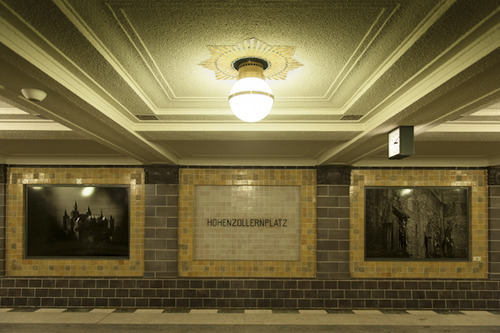
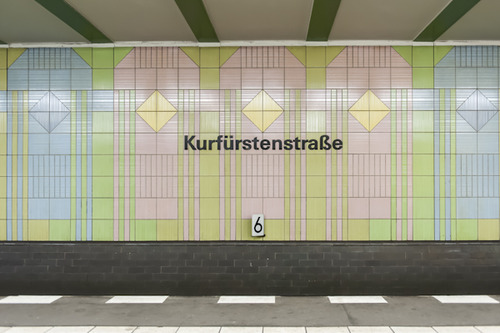
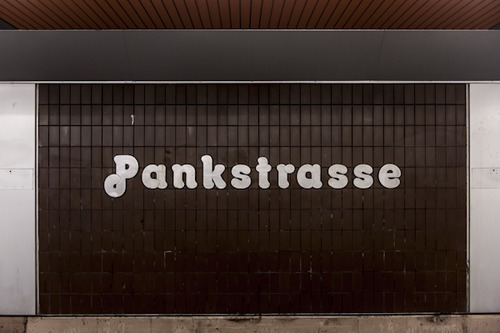

There's a piece about Endbahnhof in Atlantic Cities here, and an interview with Seabrook in Australian twee-culture bible Frankie here.
2013/3/5
Meanwhile, in Britain, there is a debate about what to do with a statue of Margaret Thatcher. The statue of the divisive former PM was proposed for her hometown, Grantham, though there is opposition from both sides. Some Tories oppose it—apparently out of respect for Thatcher's wishes—while much of the political Left and the geographical North regard Thatcher as a monster who should no more be commemorated by a statue than, say, Jack the Ripper. Indeed, an earlier statue was decapitated by a protester with a cricket bat in 2002.
I think there may be some merit in a statue of as influential a figure as Thatcher, who reshaped Britain arguably as dramatically as, say, Henry VIII or Oliver Cromwell. Though if it does go up, the statue should be surrounded by a thick wall of bulletproof glass. The totality—the statue, the glass, and the inevitable patina of spit that accumulates on it—could form a gesamtkunstwerk representing Thatcher's legacy and the range of public views of it.
2013/3/1
Berliners are protesting against the tearing down of what's left of the Berlin Wall, as a section decorated with murals and known as the East Side Gallery is demolished to make room for—wait for it—luxury apartments.
About 120 international artists were invited to plaster it with colourful murals, as the strip of wall carried none of the colourful graffiti that had covered the western side. In 2009 the murals were renovated at a cost of €2m (£1.7m).So as Berlin is gentrified, the artists and bohemians are priced out and replaced by wealthy yuppies drawn to the city's aura of cool, and the schicki-mickis as they're called start voting with their euros to have more luxurious accommodation built. And so, yuppie apartment complexes are built, and everything from art squats like Tacheles to sections of the Berlin Wall is demolished to make room for the city's new owners. And soon, Berlin will be a city of prestigious apartment towers, luxury shops and expensive champagne bars, a sort of Dubai with worse weather; the remainders of the city's rough history, artistic ferment and unkempt, boisterous underground culture will be represented by a few curated exhibits that don't interfere with the business of making and spending vast amounts of money.
There's a petition against the demolition of the East Side Gallery here.
2012/12/24
An article looking at International Art English, the language used in art-world press releases, which, whilst sharing vocabulary and grammar with English, works differently and serves a highly specific purpose: namely demonstrating the speaker's membership of an initiated elite. As such, while it is dense with technical words, as is jargon, it differs from jargon in that the terms are deliberately nebulous and vague, serving as much to confound outsiders as to communicate to insiders:
IAE has a distinctive lexicon: aporia, radically, space, proposition, biopolitical, tension, transversal, autonomy. An artist’s work inevitably interrogates, questions, encodes, transforms, subverts, imbricates, displaces—though often it doesn’t do these things so much as it serves to, functions to, or seems to (or might seem to) do these things. IAE rebukes English for its lack of nouns: Visual becomes visuality, global becomes globality, potential becomes potentiality, experience becomes … experiencability.
Space is an especially important word in IAE and can refer to a raft of entities not traditionally thought of as spatial (the space of humanity) as well as ones that are in most circumstances quite obviously spatial (the space of the gallery). ... Spatial and nonspatial space are interchangeable in IAE. The critic John Kelsey, for instance, writes that artist Rachel Harrison “causes an immediate confusion between the space of retail and the space of subjective construction.” The rules for space in this regard also apply to field, as in “the field of the real”—which is where, according to art historian Carrie Lambert-Beatty, “the parafictional has one foot.” (Prefixes like para-, proto-, post-, and hyper- expand the lexicon exponentially and Germanly, which is to say without adding any new words.) It’s not just that IAE is rife with spacey terms like intersection, parallel, parallelism, void, enfold, involution, and platform.Space isn't singled out for special treatment by International Art English; another obsession is “reality” (both in singular and plural forms). Many things are “investigated“, “subverted” or “radically questioned”. The word dialectic, meanwhile, is particularly favoured, occurring in IAE text as often as “sunlight” occurs in everyday British English, and whilst it may have originated as a technical term from 19th-century German philosophy, IAE uses it more impressionistically, as a broad note of approval or endorsement.
The imprecise and impressionistic use of language is a recurring theme in IAE, where the composition of a press release seems to be as much an exercise in (a certain highly stylised and specific form of) aesthetic composition as the conveyance of ideas; there are a number of stylistic devices used to achieve this:
IAE always recommends using more rather than fewer words. Hence a press release for a show called “Investigations” notes that one of the artists “reveals something else about the real, different information.” And when Olafur Eliasson’s Yellow Fog “is shown at dusk—the transition period between day and night—it represents and comments on the subtle changes in the day’s rhythm.” If such redundancies follow from this rule, so too do groupings of ostensibly unrelated items. Catriona Jeffries Gallery writes of Jin-me Yoon: “Like an insect, or the wounded, or even a fugitive, Yoon moves forward with her signature combination of skill and awkwardness.” The principle of antieconomy also accounts for the dependence on lists in IAE.
Reading the "Animalia" release may lead to a kind of metaphysical seasickness. It is hard to find a footing in this "space" where Kim "contemplates" and "reveals" an odd "tension," but where in the end nothing ever seems to do anything. And yet to those of us who write about art, these contortions seem to be irresistible, even natural. When we sense ourselves to be in proximity to something serious and art related, we reflexively reach for subordinate clauses. The question is why. How did we end up writing in a way that sounds like inexpertly translated French?The article looks at the origins of IAE, mainly its roots in the necessarily stilted translations of French poststructuralist writing, though also its connection to German philosophical writing (particularly of the Frankfurt School, and the numerous writings that followed those of Freud and Marx, the two titans on whose shoulders many postmodernists have stood), and comments on the varieties of IAE emanating from different countries (the French, unsurprisingly, excel in it, their releases sounding as if written “by French interns imitating American interns imitating American academics imitating French academics”, while the Scandinavians are hobbled by a fatal clarity):
Many of IAE’s particular lexical tics come from French, most obviously the suffixes -ion, -ity, -ality, and -ization, so frequently employed over homier alternatives like -ness. The mysterious proliferation of definite and indefinite articles—“the political," “the space of absence,” “the recognizable and the repulsive”—are also French imports... French is probably also responsible for the common in IAE: simultaneously, while also, and, of course, always already. Many tendencies that IAE has inherited are not just specific to French but to the highbrow written French that the poststructuralists appropriated, or in some cases parodied (the distinction was mostly lost in translation). This kind of French features sentences that go on and on and make ample use of adjectival verb forms and past and present participles. These have become art writing’s stylistic signatures.The article concludes by suggesting that IAE may be in existential peril, as a global readership no longer guaranteed to be familiar with conventional English may not necessarily experience the estrangement of meaning a native speaker would when hit over the head with dense postmodernist verbiage, and proposing that, until it disappears, we should appreciate IAE by reading it not as press releases but as verse.
2012/12/11
In addition to inventing the death machine, helping terminally ill patients end their lives and serving eight years in prison for murder for having done so, Jack Kevorkian also painted.
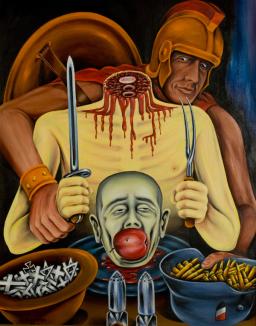 His paintings weren't like the all-too-ignorable kitsch painted by other historical figures like Hitler or Churchill, though, but something heavier odder; they had the surrealism ponderous, didactic symbolism of Eastern European poster art, and Kevorkian's obsessions—death and suffering—were everywhere:
During his prison years, Kevorkian published an anthology called glimmerIQs: A Florilegium, which compiled his serial limericks, philosophical manifestos and scientific treaties, reproductions of his paintings, and even handwriting samples and a natal chart, in case anyone wished to analyze him astrologically. In a chapter called “On Art,” Kevorkian rhymes:Kevorkian's artworks are on display at the Armenian Library and Museum of America in Watertown, Massachusetts.The subjects of art should be more
Than the aspects of life we adore;
Because dark sides abound,
Surreal paintings profound
May help change a few things we abhor.
2012/12/9
Erratum is a new exhibition in London by the artist Jeremy Hutchison, who contacted factories in China, India, Turkey and Pakistan and commissioned them to make versions of their products with one intentional error rendering them useless:
And here is a piece about it in the Guardian:

Hutchison was inspired by allegations last year about the working conditions in Apple's Foxconn factory, including a story from one worker who said he would deliberately drop a spanner on the floor so that he could have a few seconds of rest while picking it up. "I became fascinated by this idea of an intentional human error to break the tedium of mass-production," says the artist. "I wanted to see what would happen if you commissioned this kind of intentional mistake into the smooth logic of a hyperefficient globalised machine."
2012/12/5
This year's Turner Prize has been awarded to video artist Elizabeth Price for her work The Woolworths Choir of 1979, a hypnotic video mixing footage of 1960s girl group The Shangri-Las performing with news footage of a fire in a Woolworths department store. If Price's name sounds familiar, it's because she was in 1980s Sarah Records indiepop band Talulah Gosh. (And, indeed, she is by no means the only Talulah Gosh alumnus to have a notable subsequent career; the band also boasts a senior government economist and an Oxford University Press commissioning editor.
Other contestants for the prize were visual artist Paul Noble, who had been nominated for a series of detailed pencil drawings of a fantastic metropolis named Nobson Newtown, filmmaker Luke Fowler, whose entry was a documentary on controversial Scottish psychiatrist R.D. Laing, titled All Divided Selves, and the splendidly named Spartacus Chetwynd, a performance artist.
2012/10/20
Punters in a Seattle dive bar were recently treated to a surprise show when legendary kosmische band Faust showed up and played an improvised soundtrack to a video feed of the Presidential debate:
“HAVE YOU EVER PARTICIPATED IN A GENOCIDE?” a wide-eyed Jean Hervé-Péron asked a roomful of enraptured onlookers. “YES,” he answered himself, with a near-maniacal grin. “AND SO HAVE YOU.” As the improvised cacophony swelled around him, abstracted, acid-damaged images of Mitt Romney and Barack Obama arose and melted away like candied phantoms emerging from a zig-zagged field of processed video feedback.
The happening happened at the Comet Tavern, a Seattle dive bar that barely accommodates 150 patrons (a far cry from the music halls that Faust has commanded in Europe for decades). It came together at the last moment as the result of a half-joking fantasy about how to best spend the day off that Faust had to kill between scheduled Seattle and Vancouver shows.
2012/9/20
Life in the Galambosian age of intellectual-property maximalism: When Spanish octogenarian Cecilia Giménez took it upon herself to restore a crumbling fresco in a local chapel and, inadvertently made a monkey out of Jesus,the chapel was inundated with visitors who weren't leaving donations, and soon its owners, a hospital foundation, began charging an entry fee to see the newly famous work (dubbed “Ecce Mono”, or sometimes “Rhesus Christ”). Now, Giménez' family has lawyered up and are suing for royalties from her handiwork.
The Giménez family are not yet going after internet users reposting this meme for copyright infringement, but let's not give them any ideas.
2012/3/17
The Grauniad has a piece about capitalist-realist artist Damien Hirst, whose exhibition at the Tate Modern could be the peak of his imperial phase, and the idea of art-as-a-financial-instrument which he (well, he and Koons) has become the embodiment of:
This isn't just art that exists in the market, or is "about" the market. This is art that is the market – a series of gestures that are made wholly or primarily to capture and embody financial value, and only secondarily have any other function or virtue. Hirst has gone way beyond Warhol's explorations of repetition and banality. Sooner or later, his advisers will surely find a way for him to dispense with the actual objects altogether and he will package concepts in tranches, like mortgage securities, some good stuff with some trash, to be traded on the bourse in Miami-Basel.
The byproduct of his activities is the most starkly authoritarian corpus of art of recent times. All those hard, glittering surfaces, those rotting animals. The body, for Hirst, is trash, which exists to be anatomised, displayed, described in cribbed Latin names. The only way to cheat death is to slough off your rotting flesh and take on the qualities of capital. It's the 21st-century version of ars longa, vita brevis. Don't just make money, be money: weightless, ubiquitous, infinitely circulating, immortal.The article describes the mechanics of the art market and how public museums, for all their image of being above the fray of crass commerce, have become tools of art investors' Ponzi-like schemes:
This is how it works. A few major collectors make the market. Where they lead, the horde of hedgies follows. Many of the new breed of art investors ... have jettisoned even the pretence of connoisseurship. Some of these guys care about the bragging rights that come with a blue-chip work hanging in the loft. Others are all about the numbers, and employ the same tools and decision-making processes to play the art market that they use at work. A few have also discovered that many of the regulatory mechanisms that apply in other markets – preventing insider trading, price-fixing by cartels and sundry other abuses – simply don't exist in the art world. It is possible to game the system in many ways, and the careers of certain artists look not unlike a classical Ponzi scheme, where money from new investors is used to pay returns to those further upstream.
The corruption of art museums by investors is perhaps most apparent in the case of New York's New Museum. In 2009 it devoted its entire three-floor space to an exhibition of the collection of Dakis Joannou, a Greek Cypriot industrialist who sits on the museum's board. Other recent New Museum shows, devoted to Urs Fischer and Elizabeth Peyton, also relied heavily on Joannou's collection, and his wider web of patronage. The impression has been given of a museum that is no longer able to make independent determinations of value. This has become an open scandal in New York, satirised in a much-reproduced drawing by William Powhida titled How the New Museum Committed Suicide With Banality, or "how to use a non-profit museum to elevate your social status and raise market values". Likewise, Hirst's major collectors will see an effective windfall from the inclusion of their works in a Tate retrospective, and other Hirst stakeholders will benefit too. That may not be why the show is happening, but it is not without significance.
2012/3/13
Art Threat has an article about VOINA, the Russian radical performance-art collective responsible for happenings protesting against the corruption of the Russian state, its abuses of human rights, and the complicity of the mainstream art world. Their projects have included provocations such as sliding live sheep down a pro-Putin election banner at a book fair opening, staging mock hangings of gays and foreigners in Moscow to protest the Mayor's hostile stance to both, spray-painting a giant phallus on a drawbridge opposite the headquarters of the security services in St. Petersburg; though a lot of their ire is also directed at a bourgeois contemporary art world they see as more oriented to catering to the corrupt elites than questioning the state of affairs:
At the Moscow Art Fair in 2007, they staged It’s Time to Whip Russian Art, inviting members of the public to participate in a public flogging of a man dressed in white lying on a white sheet with an S&M whip dipped in red paint, a protest against elitism and conformism in Russian contemporary art.
“All our actions have political underlying messages, but we use art language only. We speak in images, symbols, which are mostly visual. We don’t use the language of political journalism. Politics is just a main theme of our works. In the current socio-political situation in Russia, an honest artist can’t be mute and make glamorous “masterpieces” for oligarchs, who decorate their “brilliant” dachas.”VOINA's actions have, perhaps unsurprisingly, brought the full brunt of the Russian security state down upon them, with all the brutality and arbitrariness that this entails.
“Being captured, the artists with handcuffs on their hands and plastic bags on their heads were thrown into a minibus and were carried from Moscow to St. Petersburg on the iron floor for ten hours. During this trip, cops kicked Oleg, the ideologist of the art group, in the kidneys and head. Two weeks later the human right defenders and the medics, who visited the arrested artists in prison, found hematomas on Oleg’s body in the kidney area and handcuff marks. Leonid had serious bruises.”British street artist turned crypto-celebrity Banksy has offered to pay the bail for Oleg and Leonid (cited as US$133,000), though his offer was rejected. There is a web site which claims to be a defence fund here.
2012/3/9
Something to read: Momus speaks to The Quietus, on topics ranging from his past career and future projects to the role of the artist and the value of art in the digital age, and the question of Scottish independence:
I think a common theme is "aggression against normality", from the left wing terrorists in The Happy Family album through the Maoist intellectuals and fake homosexuals of Tender Pervert, the baby-hating, doppelganger-haunted narrators of Ping Pong, right up to the eccentric 'Thunderclown' on the new album, my characters don't accept the world as it is. The corollary is that they respect otherness, and try to model other ways of living: parallel worlds. I think of this as basically a (post-Christian) Calvinist mindset.
While I'm happy to see the Postcard era recognised - it was genuinely a very exciting and magical time - I think the whole problem for pop music now is that it's become paralysed with respect for its past. We're crushed by the archive, and every edition of Mojo magazine (a sad catalogue of the achievements of the geriatric and the dead) makes it harder for the young to break away and create genuinely new forms of popular music. I don't have strong feelings about The Happy Family archive. We weren't as good as Josef K.
I identify as a Scot, very much. When I'm in Japan and they ask where I'm from, I always say "Scotland", not "Britain". I'd like to see Scotland independent, because we have different politics and a different culture from the English. I wouldn't like to see it become twee, navel-gazing and trivial, though. I hope an independent Scotland would really respect its artists. I'd like to see a cosmopolitanism, an orientation towards Europe and Asia rather than the States, and a kind of new Scottish Enlightenment like the one we had in the 18th Century. Adopt the euro, become a republic, dump the royals, embrace socialism fearlessly!In other news, Momus is tutoring an online course in songwriting, starting in April. At £55, it looks like a steal.
2012/2/15
Avant-garde electronic musician Matthew Herbert does an interview for Pitchfork's 5-10-15-20, a series in which they ask the artist what records they were listening to at 5-year intervals in their life so far, in the hope of distilling an artistic bildungsroman of sorts.
I was five in 1977. It seems like another world now. I grew up without a TV, so I was listening to an awful lot of radio, recording things with cassettes and putting the songs in some kind of order. It's going to sound like I'm a wanker, but I was listening to "The Model" by Kraftwerk at five-- I know that sounds like the coolest answer possible, but it was a big hit record over here. It was getting heavy rotation on the radio. In my own defense, I didn't know the song was by Kraftwerk until four years ago.His entries for subsequent years show a not unusual progression: Tom Waits' satire of consumerism at 10 (in the springtime of Thatcherism and the rise of the age of fast, loud money), De La Soul at 15 ("Our local policeman was a sweet, nice man, and the idea of shouting, "Fuck the police!" at him seemed so totally absurd."), then into the stratosphere via acid house, techno and jazz, and then, at age 35:
I still feel that there is too much music in the world. I'm not convinced that we need to make any more music. I read this statistic that said 75% of music on iTunes has never been downloaded once. It's depressing, but it also makes you think that we should stop making music until we listen to it all, and then we should start again. We're in a bit of a muddle about the function of music, and why we're making it, and what we expect from our music. I mean, surely, everything has been said about love already by now. Presumably everything has been said about war already. It feels like people think they have a right to make music or express themselves in a certain way. I think you have a right to express yourself, but I don't necessarily think that there's automatically a right that people should be expected to listen.Further reinforcing the idea that music has gone from something scarce whose value is as a consumable, to something abundant that is a byproduct of the valuable activity of its production.
2012/2/4
A French blog named Tout Bon has a gallery of the most interesting street art of 2011 (for varying definitions of "street art"):

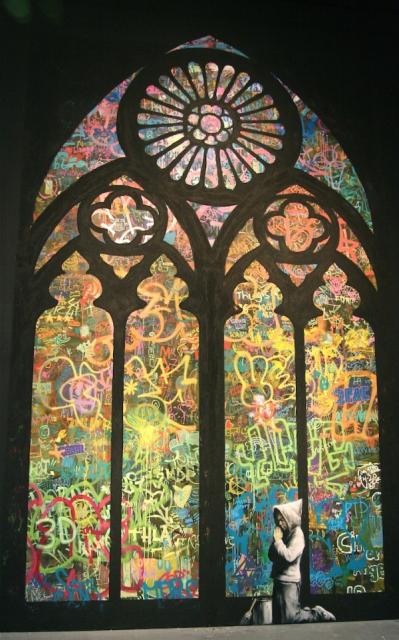
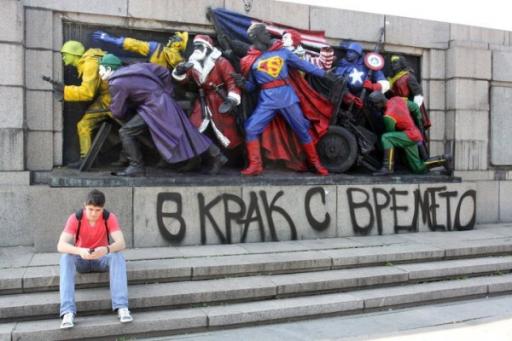
And plenty more...
2012/1/4
Legendary British cartoonist Ronald Searle has passed away, aged 91. Searle had survived imprisonment in horrific conditions by the Japanese army on the Burma Railway (a fellow prisoner remarked that one would only know that he was dead if he stopped drawing) and went on to an illustrious career, creating the St. Trinian's books and the tales of the grotesque, recalcitrant schoolboy Molesworth, and also drawing for publications including Punch, Le Monde and Le Figaro. Searle apparently kept drawing right up to the end. His friend, the cartoonist Gerald Scarfe (whom you may know from his work on Pink Floyd's The Wall) has a eulogy:
Ronald had a wonderfully dry sense of humour. Once a year, he would pay the restaurant with a picture: pigs going into the kitchen looking doubtful, or snails crawling on to people's plates. We would always find pictures waiting for us at the table: Jane would have a drawing of a cat wearing a ballerina's outfit or putting lipstick on in front of a mirror; and I would have a bearded, scruffy cat, scratching his head, pens and paper laid out, waiting for his cartoon to come.There's a gallery of images here and another, of drawings he made for his wife during her illness, here.
2011/12/31
A few random odds and ends which, for one reason or another, didn't make it into blog posts in 2011:
- Artificial intelligence pioneer John McCarthy died this year; though before he did, he wrote up a piece on the sustainability of progress. The gist of it is that he contended that progress is both sustainable and desirable, for at least the next billion years, with resource limitations being largely illusory.
- As China's economy grows, dishonest entrepreneurs are coming up with increasingly novel and bizarre ways of adulterating food:
In May, a Shanghai woman who had left uncooked pork on her kitchen table woke up in the middle of the night and noticed that the meat was emitting a blue light, like something out of a science fiction movie. Experts pointed to phosphorescent bacteria, blamed for another case of glow-in-the-dark pork last year. Farmers in eastern Jiangsu province complained to state media last month that their watermelons had exploded "like landmines" after they mistakenly applied too much growth hormone in hopes of increasing their size.
Until recently, directions were circulating on the Internet about how to make fake eggs out of a gelatinous compound comprised mostly of sodium alginate, which is then poured into a shell made out of calcium carbonate. Companies marketing the kits promised that you could make a fake egg for one-quarter the price of a real one.
- The street finds its own uses for things, and places develop local specialisations and industries: the Romanian town of Râmnicu Vâlcea has become a global centre of expertise in online scams, with industries arising to bilk the world's endless supply of marks, and to keep the successful scammers in luxury goods:
The streets are lined with gleaming storefronts—leather accessories, Italian fashions—serving a demand fueled by illegal income. Near the mall is a nightclub, now closed by police because its backers were shady. New construction grinds ahead on nearly every block. But what really stands out in Râmnicu Vâlcea are the money transfer offices. At least two dozen Western Union locations lie within a four-block area downtown, the company’s black-and-yellow signs proliferating like the Starbucks mermaid circa 2003.
It’s not so different from the forces that turn a neighborhood into, say, New York’s fashion district or the aerospace hub in southern California. “To the extent that some expertise is required, friends and family members of the original entrepreneurs are more likely to have access to those resources than would-be criminals in an isolated location,” says Michael Macy, a Cornell University sociologist who studies social networks. “There may also be local political resources that provide a degree of protection.”
- Monty Python's Terry Jones says that The Life Of Brian could not be made now, as it would be too risky in today's climate of an increasingly strident religiosity exercising its right to take offense:
The 69-year-old said: "I took the view it wasn't blasphemous. It was heretical because it criticised the structure of the church and the way it interpreted the Gospels. At the time religion seemed to be on the back burner and it felt like kicking a dead donkey. It has come back with a vengeance and we'd think twice about making it now."
- The Torygraph's Charles Moore: I'm starting to think that the Left might actually be right:
And when the banks that look after our money take it away, lose it and then, because of government guarantee, are not punished themselves, something much worse happens. It turns out – as the Left always claims – that a system purporting to advance the many has been perverted in order to enrich the few. The global banking system is an adventure playground for the participants, complete with spongy, health-and-safety approved flooring so that they bounce when they fall off. The role of the rest of us is simply to pay.
- The sketchbooks of Susan Kare, the artist who designed the icons, bitmaps and fonts for the original Macintosh, and went on to an illustrious career as a pixel artist (Microsoft hired her to do the Windows 3.x icons, and some years ago, Facebook hired her to design the virtual "gifts" you could buy for friends.) The sketchbooks show her original Macintosh icons, which were drawn by hand on graph paper (because, of course, they didn't have GUI tools for making icons back then).
- How To Steal Like An Artist: advice for those who wish to do creative work.
- The street finds its own uses for things (2): with the rise of the Arduino board (a low-cost, hackable microcontroller usable for basically anything electronic you might want to program), anyone can now make their own self-piloting drone aircraft out of a radio-controlled plane. And it isn't actually illegal in itself (at least in the US; YMMV).
- An answer to the question of why U2 are so popular.
2011/9/25
In his latest Poptimist column, Tom Ewing writes about recordings attributed to imaginary authors, typically at some time in an imagined past. More specifically, he writes about Science Of The Sea, a record allegedly made in 1979 by Jürgen Müller, a German oceanographer and amateur musician who was inspired to make a record of ambient electronic compositions by the hours he spent on field trips out at sea, one of whose 100 privately-pressed copies was apparently rediscovered in 2011:
Except, of course, he probably did no such thing. It seems likely that there never was an expedition, or a young biologist, or a private pressing. Science of the Sea is a 2011 record from fin to tail, and the rather lovely tale of Jürgen Müller is entirely invented. Did suspecting this make me like the record less? Certainly not. If anything, I enjoyed it more. As a small child I would sometimes be allowed to sit up with my parents and watch science documentaries, like Carl Sagan's Cosmos. I didn't understand the science, and the documentaries were broadcast late so I was on the edge of sleep in any case, but I remembered their soothing flow: The infinite turned into a kind of bedtime story. Meanwhile, on library bookshelves I would sometimes find 1950s and 60s paperbacks about modern-day scientist-adventurers like Jacques Cousteau or Thor Heyerdahl-- giving the impression of an age of clean-limbed scientific heroism I'd tantalizingly missed, one that looked very much like a Tintin comic.
So no surprise that some of what I get from Science of the Sea-- there by intention or not-- is a pang of love and loss for this imagined time. More intriguingly, though, if the record is fictional it feels like this might have been liberating for its mysterious creator. The album is full of beautifully cornball seascape touches-- flickering arpeggios and note-clouds which practically demand you start thinking about shoals of fish darting back and forth outside a bathysphere window. Sit down and make an electronic album about the ocean now and you might find yourself trying to dodge these clichés. Sit down and role-play a naive non-musician inching towards transcendence at the turn of the 1980s and you can fully embrace them.Science Of The Sea is not the only recent example of its kind; another recent recording shedding light on an underexplored, romantic and distinctly alien corner of the modern past was the retrospective of the Endless House Foundation. The conceit of Endless House presents an experimental electronic music collective, founded in the early 1970s by an eccentric, wealthy Czech audiophile, situated in an ultra-modernistic studio/discotheque complex in the heart of the Bialowieska primeval forest in eastern Poland and informed by the breadth of European avant-garde design and architectural movements of the 20th century, it thrived for must six weeks in the summer of 1973 before collapsing under the weight of its expensive impracticality, leaving behind only some scraps of biographical information, a few ambiguous photographs of improbable architectural spaces, and the curiously pristine recordings of the resident musicians' compositions, which, it seems, prefigured everything from Kraftwerk to Detroit techno, much in the same way that Delia Derbyshire invented IDM in 1965 but neglected to tell the world about it. The fragments have remained buried until recently, when an unnamed British curator unearthed the pieces, and managed to track down the original participants, getting interviews and even a mix, from them.
Of course, it's quite possible that none of this really happened. The story of Endless House reads almost like a Wes Anderson set-piece, only set in a nebulous European avant-garde as seen from outside. Unsurprisingly, the illusion doesn't hold up well to closer examination. For one, the idea that a group of Western European playboys could cross the Iron Curtain with impunity, bringing party guests and giant modular synthesisers with them, while the governments of the Eastern Bloc, still shocked by uprisings in Prague in 1968 and Warsaw in 1970, were in ideological lockdown, seems highly unlikely. (A non-fictional recent musical retrospective of East German electronic music reveals the extent of ideological control over music in the Eastern Bloc; in the DDR, the government only started allowing the production of electronic music in 1980, and even then anything that could be interpreted as critical of industrial society was verboten, leaving room only for ostensibly harmless cosmic psychedelia.) Over and above this, this improbable bubble is populated by a cast of exotically European bons vivants with names like Walter Schnaffs and Felix Uran, who speak in a mixture of English and German, but refer to distances in miles. Nonetheless, if you can suspend disbelief, imagine that the Cold War wasn't that big a deal and that an Austrian synthesist and socialite might sing about being sixteen miles from Saint-Tropez, in an avant-garde cyber-disco about that distance from the Polish-Soviet border, it's an entertaining story, and an even more entertaining record. (The tracks, listened to on their own, work as electronic music, and do evoke the world they purport to come from.)
Meanwhile, in a recent edition of Milan art journal Mousse, there is a retrospective of the works of Scottish-Italian artist Scotty Potenza, written by someone named Nick Currie:
The colour, shape and texture of fresh ice cream is certainly visible in Potenza’s acrylic gouaches; peach, pistachio and purply-red forest berries distinguish themselves forcefully from the sodden greens and asphalt greys of the Scottish industrial landscape. His subject-matter shares this otherness: influenced by the exciting first wave of Acid House culture in the late 1980s, Potenza evinces a non-Calvinist positivity more evocative of Chicago warehouses and Ibiza raves than Glasgow tenements. A Potenza painting incarnates not what Scotland is, but what it lacks.
As 1990s rave culture has continued to experience the bearhug embrace of mainstream acceptance in the UK — its visual values, once restricted to club flyers, now inform restaurant design, public information films and TV commercials for banks and building societies — Potenza has been granted a high-profile list of public commissions. His decoration of the walls of the Home Office lobby with a mural of happy ravers, their hands linked like the figures in Matisse’s La Danse, caused short-lived (and clearly manufactured) outrage in the tabloids, but has proved peculiarly popular with the civil servants who work in the building. A major mural at Finsbury Park underground station entitled Get On One Matey! was unfortunately damaged beyond repair in the 2011 riots. The vandals, caught on CCTV, are currently serving long prison sentences.
2011/7/15
Web design webzine Smashing Magazine has an interesting article on Berlin's street-art heritage:
After the few East Germans who crossed the Berlin Wall in the ’80s blinked and pinched themselves, what do you think was the first thing they saw? They saw big bubbly letters, spelling out words in German, English and French. They saw political slogans, either carved indelibly into the concrete or sprayed temporarily onto surfaces, commenting not only on the situation in Germany, but on the whole political world: “God Ble$$,” “Concrete Makes You Happy,” “Death to Tyrants.” As far as they could see, covering every inch of wall, was layer upon layer of zest, life and color.
After the collapse of the Berlin Wall, the graffiti artists marched straight into East Germany. Mitte, Friedrichshain, Prenzlauer Berg — all of the areas that the military had occupied became a new playground for the Western artists and became a new world for the Eastern artists who joined them. Few doubted that the East Germans’ work was weightier. It wasn’t that they were better artists, but that they could express — with authority — the one concept close to the hearts of all people now living in the city: what it meant to be free.
The article briefly profiles and analyses the work of a number of Berlin street artists, including XOOOOX (who does impeccably drawn black-and-white stencils of glamorous fashion models, sometimes relieving themselves), Mein Lieber Prost (whose sketches of jolly cartoon homunculi have become immediately recognisable)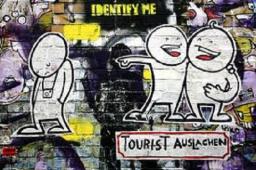
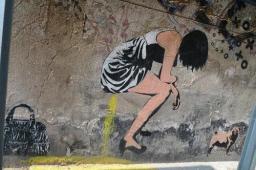
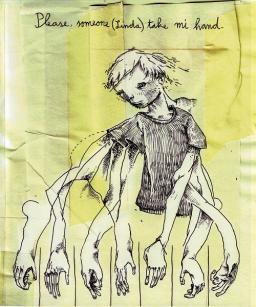 and the curious case of Linda's Ex, an artist who, in 2003, put up hand-drawn posters imploring someone named Linda to take him back, engaging others to debate whether the object of the unknown artist's affections should return to him, before revealing that Linda never existed, and the whole thing was an art project, sort of like a web soap implemented in wheatpaste.
At first, people either ignored the posters or were mildly curious. But as both the pictures and messages increased in intensity, they had no choice but to take notice. On one poster, Linda’s ex told his estranged lover that he would be waiting to speak to her at a certain bar every Saturday and Tuesday night. People were starting to believe that his suffering was real. And if his suffering was real, then they did not doubt that he needed help.
People enjoy XOOOOX’s approach because of his objective treatment of his subjects, presenting each model as neither happy nor sad, neither warm nor cold. He even draws one model urinating on the ground; while some might interpret the piece as a sign of arrogance, XOOOOX’s signature, flowing from her head like a thought bubble, persuades sensitive observers to judge her on a more humane level. She is, he suggests, just like everyone else.The article also mentions the peculiar status of street art in Berlin. Graffiti is, of course, an outlaw activity and subculture, and gets its vitality from its fraught, illegal status. Berlin (the capital of Germany, a country not known for its citizens' cavalier disdain of regulation, no less), however, gets a lot of its buzz (and, indirectly, tourist revenue) from this underground culture. Berlin's police insist that graffiti is a crime, whilst focussing their enforcement efforts on gang-related tagging. Meanwhile, having dodged the threat of prosecution, street art arguably faces the threat of legitimacy, of being turned into just another cultural consumable in a gentrified playground for the affluent:
Today, such work has made the street art a tourist attraction. Kunsthaus Tacheles, once an artists’ squat and still a focal point of the scene, holds disco nights downstairs and sells urban art books upstairs — its bar is as expensive as anywhere in the city. Artists such as XOOOOX, Mein Lieber Prost and Alias have started to exhibit and sell in galleries. They still work on the street, but they are no longer impoverished artists — if they ever were. They can afford to travel and work in countries across the world.
While these artists believe that street art needs to appeal to a wider audience, the local, more traditional artists, such as the tagging crews, disagree. They argue that street art derives its power from being on the margins of society; only from the outside can they address problems within it. That difference of opinion is opening a space in the scene that can be filled only by the mainstream. In the next few years, street art has the potential to become a social movement as inclusive as anything from the ’50s and ’60s.Does it make sense to talk of tagging crews as "artists", though?
2011/6/8
The question of tagging versus graffiti art came up at the trial of London tagger Daniel "Tox" Halpin, whose handiwork will be immediately familiar to many Tube commuters:
The 26-year-old, from Camden, north London, whose masked image and story of anarchism has featured on television documentaries and in magazines, was found guilty of a string of graffiti attacks across England after prosecutor Hugo Lodge told a jury: "He is no Banksy. He doesn't have the artistic skills, so he has to get his tag up as much as possible."
As he was remanded in custody for sentencing, his artistic merit was further questioned by the reformed guerilla graffiti artist turned establishment darling Ben "Eine" Flynn, whose work was presented to the US president, Barack Obama, by the prime minister, David Cameron, last year. "His statement is Tox, Tox, Tox, Tox, over and over again," said Flynn after the trial at Blackfriars crown court, in which he gave evidence as an expert witness. In his opinion, the Tox "tags" or signatures, and "dubs" (the larger, often bubble lettering) were "incredibly basic" and lacking "skill, flair or unique style".While Mr. Tox is not known for his artistic flair, that didn't stop him interrupting his criminal damage career top attempt to surf the post-Banksy hype boom, hoping that someone with more money than sense would interpret his tagging as a particularly "edgy", "real, innit" and "well fucking morocco, yeah?" form of street art and buy it on canvas:
Cashing in on his notoriety, he is said to have made £9,000 in two hours by selling pictures with his Tox tag. Reports in 2009 that he was selling 100 canvasses bearing his notorious mark, at £75 each, precipitated heated debate. Purists condemned him for "selling out", while legal experts mused over whether a loophole made him impervious to the Proceeds of Crime Act.
The appearance of Tox's tag in gilt-framed canvasses was "well funny", Flynn said, adding: "Art is worth what people are prepared to pay for it." People must have bought them as an investment, he added. "I can't imagine they bought them because they actually like them."Halpin's co-defendants include a students of ultra-hip art school Goldsmiths and an Edinburgh Collge of Art graduate; his own credentials are not on record. Halpin and two defendants await sentencing.
2011/4/7
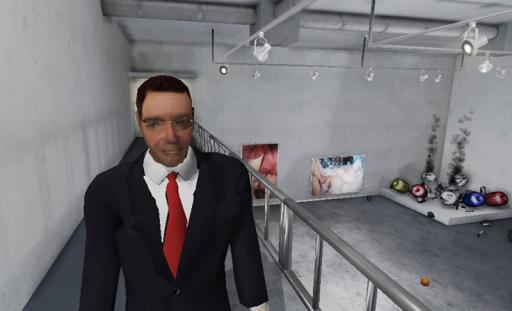
Jeff Koons Must Die!!! is a new art installation by multimedia artist Hunter Jonakin. It consists of a video arcade cabinet running a first-person shooter game involving the eponymous artist and his works:
The game is set in a large museum during a Jeff Koons retrospective. The viewer is given a rocket launcher and the choice to destroy any of the work displayed in the gallery. If nothing is destroyed the player is allowed to look around for a couple of minutes and then the game ends. However, if one or more pieces are destroyed, an animated model of Jeff Koons walks out and chastises the viewer for annihilating his art. He then sends guards to kill the player. If the player survives this round then he or she is afforded the ability to enter a room where waves of curators, lawyers, assistants, and guards spawn until the player is dead. In the end, the game is unwinnable, and acts as a comment on the fine art studio system, museum culture, art and commerce, hierarchical power structures, and the destructive tendencies of gallery goers, to name a few.
2011/1/6
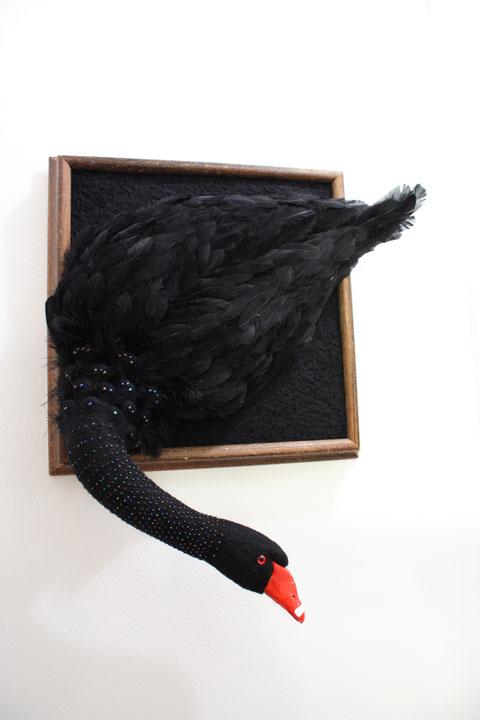
Zoë Williams (not the Grauniad columnist) is an artist whose works look like surrealistic taxidermy:


(via Boing Boing) ¶ 0
2011/1/3
An art exhibition in Berlin involves a hall divided into two parts, each of which containing six reindeer. One half of the reindeer are (possibly) fed fly agaric mushrooms, fabled by Lapp shamans to give their urine hallucinogenic properties. In the centre of the hall there is a hotel-like suite, which may be rented for €1,000 a night; the suite contains a minibar, which is stocked with bottles of urine collected from the reindeer; however, the bottles are not labelled as to which reindeer they came from. The title of this show is Soma, though an alternate title is "how to make hipsters pay €1,000 to drink piss". Pabst Blue Ribbon is the main sponsor.
Dorothée Brill, the museum's lead curator, says: "As far as we can tell, nobody's done anything they shouldn't have." Staff at the restaurant, however, report that some guests "drink the minibar dry".
2010/11/30
One possible silver lining on the cloud of Ireland's economic woes: numerous pop-up art spaces are opening up in vacant properties in Dublin. Could the Irish capital become a Berlin-style hub of spontaneous creativity?
2010/11/26
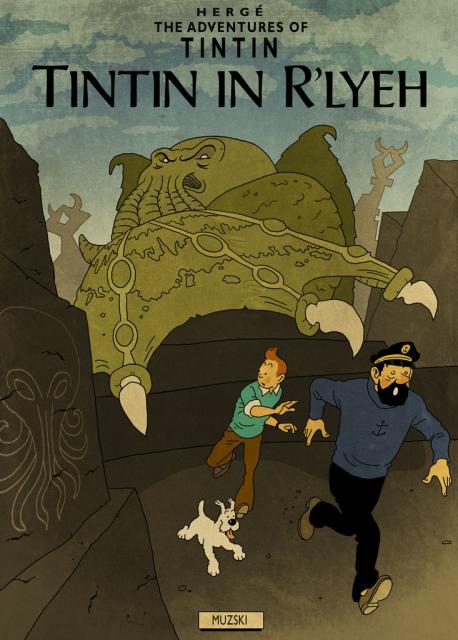
Murray "Muzski" Groat's Tintin/H.P. Lovecraft mashups are made of eldritch, blasphemous win:
(via Boing Boing) ¶ 0
2010/11/5
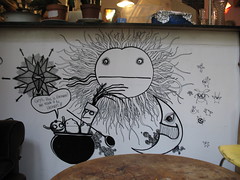 In central Edinburgh, near the university, there is an establishment named the Forest Café. It's located in a large building which used to be a church, is run by volunteers, and has been running for a little over a decade, during which time it has hosted many events, gigs and exhibitions, offered studio space and grants to artists, put out books and records and generally acted as a hub to the creative elements in the Scottish capital. Apart from that, it is a very agreeable environment, with a vaguely Berlin-like feel and good food and drink; the vegan burritos in particular are highly recommended.
Now, alas, the Forest is under threat and needs help. The Edinburgh University Settlement, the charity which owns the building it's in, has gone bankrupt, and the building is to be sold.
As many of you will be aware, the Edinburgh arts scene has suffered a massive blow due to the bankruptcy of the EUS, the charitable organisation that owned the Roxy Art House and the church which the Forest currently resides in at 3 Bristo Place. The Roxy, which was under direct management of the EUS, has been shut down. The Forest building is up for sale.Chances are, whoever buys the building will redevelop it into a more commercially profitable facility, which means no more arts space. (Perhaps it'll become another upmarket art-themed hotel, like the Foundry in Shoreditch, or perhaps just a collection of premium retail space.) Unless, of course, the Forest buys the building, enabling it to keep functioning as an arts hub and community space in the Old Town of Edinburgh indefinitely. To do so, though, they'll need £500,000, which they don't have. As such, they're putting together a business plan and collecting donations on their web site:
This means 50 000 of our friends donating £10, or 5000 of our friends donating £100, or a variety of donations large and small combined with a number of fundraisers in Edinburgh and across the UK. This is not unfeasible: Forest has many friends.We've seen you at our parties and in our hot tub with feathers in your hair, we've put out your records, we drank with you at our gallery openings, and we once gave you that grant to fund your Phillipian film programme in Manila. If you’ve ever been to a free event here, or just like the idea of what we do, please donate whatever you can afford.
Currently, we're in the process of putting together a solid business plan to demonstrate how feasible this is. We're also setting up a Just Giving site which will include a graph which grows and grows as the fund does, and plan an open meeting for anyone who wants to get involved within the next couple of weeks. However, in the meantime with the desperate events which have taken place since the Roxy's closure, we wanted to get the word out as soon as possible and start the campaign.I have just sent in a donation, and encourage anyone who has been to the Forest, or indeed who supports the existence of autonomous art spaces of this sort, to do so as well.
2010/9/12
A woman in Germany has been convicted of selling fake art forgeries. Petra Kujau sold forgeries of famous artworks, made by unknown forgers in Asia, to collectors, but attempted to pass them off as the work of famous forger Konrad Kujau (best known for the Hitler Diaries), netting €300,000 in total. She received a two-year suspended sentence.
2010/8/31
This is pretty awesome: The Wilderness Downtown, an interactive music video (to use the term slightly loosely) by anthemic indie combo The Arcade Fire, with technical assistance from Google's Creative Lab. The way it works: put in the address of the house you grew up in, and you will be presented with a music video comprised of prerecorded footage composed with animations generated from Google Earth and Street View imagery of your home. Well, I use the term "music video" loosely; it's an experience comprised of numerous browser windows opening at various times and places, presenting various combinations of imagery. Using Google Chrome is recommended. (Note that some plugins may interfere with its operation; if it doesn't start, try running it in incognito mode.)
There's a technical description here, and here is a WIRED piece on it, including an interview with the creators, director Chris Milk and Google tech lead Aaron Koblin.
2010/8/26
A Welsh artist is recruiting people to stand outside Cardiff City Hall looking miserable tomorrow from 1pm to 2pm. Barrie Davies intends the "sulkathon" to "capture the mood of the moment".
2010/8/22
A new technique involving ultraviolet light is revealing how ancient Greek statues were painted, by detecting traces of the organic compounds paints were made of. It turns out that the statues were coloured quite gaudily (indeed, some would say tackily), looking more like something you might find on a seaside pier than in a stately home.
And the fashion of subsequent millennia for alabaster-white statues of beautiful youths, female nudes, fauns and the like? Well, that's all based on the incorrect assumption that the way Classical Greek statues look now was the way they looked when they were made. (Indeed, I have heard the argument that the tendency towards minimalism in Western culture—as evidenced in High Modernism, for example—ultimately stems from the æsthetic values inculcated into the Western mindset through millennia of misinterpretation of Classical Greek artefacts.)
2010/8/20
In China's Shangdong province, life imitates art. More precisely, the operators of a public park there, faced with overcrowding, installed coin-operated park benches with retractable anti-sitting spikes, inspired by an artistic installation critiquing the user-pays ethos:
"He thought he was exaggerating. He didn't foresee that a very practical country like China might actually use them for real," said one critic.
2010/8/10
Over the past few decades, the market value of recorded music has been declining, as music has gotten easier to make and distribute, to the point where there is a flood of music vying for one's attention, and the challenge is not finding it but sorting the worthwhile stuff from the dross and filler. Of course, this sucks if you're a musician trying to be heard, as you're competing for the limited attention of your audience with millions of others.
The latest outcome of this commodification: a British band calling itself The Reclusive Barclay Brothers has paid 100 people £27 to listen to their song, a jaunty little number titled We Could Be Lonely Together.
2010/7/24
Pay & Sit is a user-pays park bench. The bench contains metal spikes embedded in the sitting surface, which are retracted when the user inserts 0.50€ into a coin box; the bench beeps when the sitting time is about to expire.
Pay & Sit is not an actual product, however, but the work of an artist named Fabian Brunsing, commenting on the logical extremes of user-pays culture and/or the privatisation of public space. There is no guarantee, however, that some local authority (or some firm contracted to manage (privatised, ad-funded) public parks by one) won't try something like that at some point.
2010/6/8
Tetsuya Ishida was a Japanese painter who, until his death in 2005, painted surrealistic scenes, which tended to involve images of himself transformed into various unhappy-looking automatons or inanimate objects. Beautiful, in a somewhat disturbing, vaguely Kafkaesque way:
There are more paintings here (note: text is in Japanese).


(via Boing Boing) ¶ 0
2010/5/8
A chance conversation with a fellow passenger on an overnight train to Copenhagen brought this to my attention: When Copenhagen's central railway station was being renovated a few years ago, the station authorities discovered that two street artists had built a complete apartment in some unused space beneath platform 12. The apartment had apparently survived for four years before being discovered and demolished; the artists, going by the names of ADAMS and ITSO, claim to have built others elsewhere in Copenhagen, and inscribed the story of the house (in neat, professional-looking typography) on the sides of trains.
There were photos of the original house on the web, but they seem to have disappeared beyond the reach of archive.org; however, some can be seen in this video from Danish TV, in which the official who discovered the room is invited to a talk show by a host who seems to know a lot more about the artists in question. The host talks about the room, and then it gets even more interesting; he shows the artists some books, made of cardboard, documenting other such spaces (a shed in the centre of Stockholm, and a room in Berlin beneath Ostbahnhof), and other contrivances (hollowed-out books in the Stockholm Library containing keys to secret spaces; a universal manhole-opening kit in a backpack; a canoe made of recycled advertising billboards, used to explore the sewers beneath Paris). One remarkable thing is the tolerance shown by the official ; he is seen praising the imagination and attention to detail of the artists in a way that, were he in an Anglo-Saxon country, would probably cost him his job. Could this be the legendary Scandinavian pragmatism?
2010/5/1
Some recent random posts related to urbanism, urban planning, architecture, transport, infrastructure and such:
- The World's Strangest Housing Communities. Includes Chinese replicas of American suburbia, sadly derelict futuristic pod cities in Taiwan (alas, now destroyed), and rumours of midget villages in rural America. Not to mention Alphaville, the chain of high-security gated cities in which Brazil's professional élites live behind electrified fences, guarded by a private army and entering and leaving only by helicopter (and which inspired a Jean-Luc Godard film of the same name),
- A Berlin-based street artist calling themself EVOL uses photographic prints to convert utility boxes and planters into miniature replicas of decaying tower blocks:


- A piece on hand-drawn maps, and the situations in which they are particularly useful, when subjective psychogeographic experience is more important than objective accuracy.
- A piece in The Economist about Portland, Oregon, a city which "looks to Amsterdam, Helsinki and Stockholm for ideas" and is touted by some as a model for a more sustainable America (though also mocked for being the cultural epicentre for hipsters and White People.
- Another possible alternative for living: Inhabited balloon cities perched atop high-altitude wind systems.
2010/4/30
The Graun asked artists to design alternative election posters.
Here's Jeremy Deller's say:
This poster (by one Liam Gillick), believe it or not, was not intended to be sarcastic:
Meanwhile, the great satirical cartoonist Gerald Scarfe's take:
2010/4/12
Michael Rakowitz, a US artist who previously created car-shaped tents for reclaiming parking spots as living space, has an exhibition at Tate Modern. Titled "The worst condition is to pass under a sword which is not one's own", the exhibition draws connections between the history of Saddam Hussein's Iraq and Western pop culture, such as professional wrestling, the G.I. Joe figurines and the history of science fiction, from Jules Verne to the Star Wars series.
 The exhibition takes up a handful of rooms in a small sub-gallery on the ground level of Tate Modern. On the walls are illustrations (traced from various sources) with explanatory text, shedding light on various episodes which are, if the artist is to be believed, tied into the tangled web of this history. We read about Gerald Bull, the Canadian scientist who, seemingly influenced by the writings of Jules Verne, strove to create a giant cannon capable of hitting the Moon (or, indeed, closer targets) for Saddam Hussein; of the impact that a screening of the Star Wars film had on Saddam's then adolescent son Uday, who, a decade later, would design the uniforms of Iraq's paramilitary Fedayeen, whose helmets were modelled almost exactly on that of Darth Vader. (Rakowitz provides four helmets for comparison: the two mentioned, along with a samurai helmet and a WW1 one.) We see prints of fantasy-art posters which were found in Saddam's palaces, and other (North American) fantasy artwork which had been plagiarised for a novel said to have been written by Saddam and published before his capture. We learn of Adnan Alkaissy, the Iraqi pro wrestler who moved to the US in the 1950s and fought under the name Billy White Wolf in the US, before returning to Iraq and becoming a national champion of the regime,
 only to flee for the US and resume his career and old identity when his popularity threatened the regime, and the impacts the wars in the Gulf had on the characters and plot lines of US pro wrestling.
The title of the exhibition comes from the Baghdad victory arch erected by Saddam Hussein in 1989, in the form of two cyclopean hands holding crossed swords. The arch is ever-present; one wall at the entrance to the exhibition is covered with photographs taken by US soldiers posing in front of it (including a Sergeant Slaughter, who shares his name with one of the aforementioned wrestling characters), and the main room (which is visible from outside through glass) has a replica of the arch, with plastic Star Wars lightsabres, and the helmets of the vanquished at the hands' base being made of melted together G.I. Joe toys. A monitor in the corner plays a YouTube clip of troops marching through Baghdad to the Star Wars Imperial March.
It is not clear how much of the exhibition is fact and how much is artistic licence, though it certainly seems plausible, and shows that the recent history of our times is more peculiar than one would expect.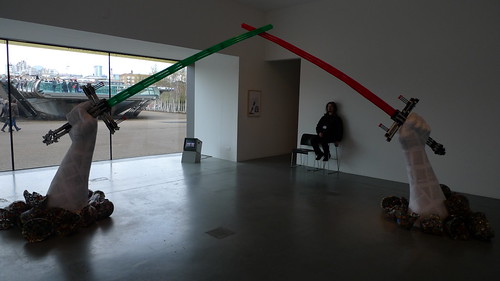
The worst condition is to pass under a sword which is not one's own is showing in the Level 2 Gallery at Tate Modern until 3 May; entry is free. There is more about the exhibition here.
2010/3/29
Pitchfork has a piece looking at government support for musicians around the world, in particular the Nordic countries (where governments plough a lot of money into supporting up-and-coming acts as a matter of principle; consequently, Sweden is the third biggest exporter of popular music and Norway, Denmark and Iceland punch well above their weight), Canada and the UK (Canada follows a vaguely Scandinavian line, more out of fear of becoming an American cultural colony than deep social-democratic principles; the UK still has some vestiges of the pre-Thatcherite arcadia—White Town's government grant-funded first single was mentioned—though apparently the golden age has been sacrificed to Blatcherite mercantilism, with art schools being more efficient assembly lines for producing employable human resources than the legendary hothouses of freeform creativity they were when Jarvis was flirting with Greek heiresses), and the US (where musicians struggle to get health care—something Obama's bill won't help much with—though, at least, they can console themselves that they're not in Iran or somewhere).
2010/3/24
Plastic Bag, a poignant short film recounting the story of a discarded plastic bag (voiced by Werner Herzog) adrift around the empty world in search of the woman who first took it from the supermarket, before settling down to an eternity in the patch of plastic garbage in the middle of the Pacific Ocean.
2010/3/23
An unusual study has examined paintings of the Biblical scene of the Last Supper made over the past 1,000 years, and noticed that serving sizes in the paintings have increased over the millennium; with each painting, thanks to gradual improvements in agriculture, the artist (and their audience) were used to larger meals than previously, which coloured the artist's creative decisions:
There is scant evidence that the body mass index of people in developed societies soared into unhealthy ranges for most of the 1,000 years studied, Young said. But there is little doubt, she added, that that changed in the 1970s, 1980s and 1990s -- coincidentally, when portion sizes began a dramatic run-up.
The Wansinks, however, suggest that portion growth may have a provenance far older than industrial farming and the economics of takeout food.Instead, they suggest, it's a natural consequence of "dramatic socio-historic increases in the production, availability, safety, abundance and affordability of food" over the millennium that started in the year 1000 A.D.
2010/3/19
Two artists in Berlin have created a digital camera which automatically edits smiles onto the subjects:
The camera „Artificial Smile“ is an apparat, whose pictures show in principle only smiling people, irrespective of their former emotional state. The camera uses a pool of pictures with smiling faces, which was created beforehand, to replace the mouthes of the pictured people with smiling ones. To generate to maximum level of exaggeration it was knowingly renounced to show the laughter/smile realistically. Unlike the cameras commercially available on the market and their autoretouch function “Artificial Smile” distorts the context of the picture, reinforced formally by the golden reflecting body of the camera.
2010/3/8
Conceptual electronic musician Matthew Herbert's most recent project is titled One Pig. In it, he followed a pig, from its birth to its death and butchery, recording the sounds of its life. (Well, mostly; the death part was somewhat hampered by him not having been able to find a slaughterhouse willing to let him record the pig being slaughtered.) The recorded sounds would be turned into an album of electronic music, hopefully to make the listener reflect on the relationship between us and the animals we farm and eat. However, this was not a good enough justification for the animal-rights fundamentalists at PETA, who issued a fatwa, condemning Herbert and his project:
No one with any true talent or creativity hurts animals to attract attention … Pigs are inquisitive, highly intelligent, sentient animals who become frightened when they are sent to slaughterhouses, where they kick and scream and try to escape the knife. They are far more worthy of respect than Matthew Herbert or anyone else who thinks cruelty is entertainment.Herbert's response to the condemnation is here; it reads as thoughtful and measured when contrasted to PETA's Talibanic zeal.
I eat meat. as I get older, I feel less proud of that fact. however, since I do eat meat, I think that I have a responsibility to understand the implications of that decision. as much as I didn't relish the prospect of witnessing the death of a pig I had seen being born and raised, I felt it an important reality to face. it seems utterly absurd to me that PETA's knee jerk reaction is to chastise me in public about the integrity of that process of enquiry without even bothering to ask me about the motivation or history of the project. in an otherwise distant and anonymous food chain, this one pig's life has been clearly and respectfully acknowledged.
I thought art and music was, in part, supposed to endorse the idea of challenge. isn't part of its core purpose to struggle in public with the compromises and frictions of its time? the implication of this statement is that PETA would rather artists and musicians stood quietly to one side whilst such a poisonous and corrupt system cheerfully multiplied, unseen, unchallenged, unheard.
2010/2/28
 Acclaimed Melbourne street artists/underground illustrators Miso and Ghostpatrol have released
a downloadable, printable map of inner Melbourne (or, as some would argue, the parts of Melbourne White People like). The map consists of two sheets, covering the CBD and Fitzroy, and showing the locations of cafés, bars, art spaces and art supply shops; it may be downloaded from here.
Acclaimed Melbourne street artists/underground illustrators Miso and Ghostpatrol have released
a downloadable, printable map of inner Melbourne (or, as some would argue, the parts of Melbourne White People like). The map consists of two sheets, covering the CBD and Fitzroy, and showing the locations of cafés, bars, art spaces and art supply shops; it may be downloaded from here.
The choice of the CBD and Fitzroy suggests that gentrification doesn't seem to have affected the north/south divide. North of the Yarra is hip and culturally rich, whereas south of the Yarra is merely trendy, a shallow, consumeristic imposter for actual cool; St. Kilda (once the crucible of punk—blah blah blah Nick Cave blah blah Seaview Ballroom— but now, as The Lucksmiths so appositely worded it, home of bright-eyed boys in business suits, tourists where once were prostitutes) and Prahran (which committed the cardinal sin of getting house music and T-shirt boutiques a decade before Fitzroy) don't rate a mention in the psychogeography of cool in Melbourne. And while Fitzroy real estate prices approach South Yarra levels, there is still enough of a cultural legacy (not to mention tram routes from more affordable areas) to maintain the area's claim to cultural vitality.
 Veteran Australian pop satirist New Waver has a new album, Bohemian Suburb Rhapsody, out.
New Waver's usual stock-in-trade in the past has been a relentlessly bleak neo-Darwinian pessimism, extrapolating the principles of neo-Darwinist evolution into a viciously competitive world, seen from the loser's perspective, and resulting in records like The Defeated and Darwin Junior High. Bohemian Suburb Rhapsody veers from this theme into an examination of the modern post-industrial age, casting a jaundiced eye over Richard Florida's concept of the "Creative Class" from the unaffordably gentrified inner north of Melbourne.
In the thesis of Bohemian Suburb Rhapsody, several phenomena of the past few decades (the shifting of industrial production to China, the move to a post-industrial economy and the rise of DIY art/music and internet-based user-generated content lowering the barriers to artistic creativity) have created a glut of "artists", with exhibitions and indie bands and bedroom music projects all over the inner suburbs. Artists have, as many have observed, congregated in undesirable suburbs hollowed out by deindustrialisation (at least in Melbourne; in Berlin, the collapse of Communism had the same effect), attracting hipsters, trendies, yuppies and ultimately the wealthy, aesthetically conservative haute-bourgeoisie, by then the artists having been forced out by rising rents. (In the words of a famous graffito in 1990s San Francisco, "artists are the shock troops of gentrification"; though it may make more sense to think of them as a sort of baker's yeast, whose job is to make the bread rise and then perish.) Meanwhile, the ease of creating (and copying) art, and indeed any sort of intellectual products, in the digital age has led to a rise in supply exceeding demand; not only is it harder to survive making art, but it is harder to get people to devote time to looking at your creations.
As with many of his previous recordings, New Waver expresses this thesis through the medium of cover versions of popular songs, assembled using General MIDI files. The opening track, Lugging For Nothing turns Dire Straits' anthem of the rock'n'roll dream on its head; in New Waver's acerbically realistic reworking, the people to be envied are the tradesmen, high-school drop-outs and cashed-up bogans, doing lucratively uncopiable physical work and spending their money on material luxuries. Like neo-Rousseauvian ignoble savages, impervious to the siren song of cultural engagement, they're happy to take the money of those afflicted by it (by renting them rehearsal rooms and such), while aspiring musicians infected by the rock'n'roll dream pack into small rooms and toil doing shitwork to pay off records and tours. The idea of cultural enagement as a parasitic replicator reemerges behind Media, I Gave You The Best Years Of My Life, which recounts the lot of the culturally engaged, struggling to afford to rent enough space to store their record collections and spending their spare hours discussing music and arthouse films on social websites; it is not difficult to square this with author Greg Wadley's well-documented interest in evolutionary psychology and conclude that the culturally engaged are the victims of parasitic memes, deprived of the chance to live a comfortable existence in a McMansion in suburbia, watching junk TV on their plasma screen and listening to whatever's on the radio by the terrible compulsion to impoverish themselves playing in bands, exhibiting art or otherwise trading time, wealth and effort for arbitrary signifiers of status, all the while helping to reproduce these memes.
Other songs touch on different, but related, themes; Party Like It's 1979 (a Prince cover, of course) looks at the resurgence of retro-styled indie music genres, from White Stripes-like garage bands to post-punk ("Fleetwood Mac's probably the most influential band today", "I got some classic rock released six months ago, some psychedelic folk, some white guys playing disco"), and the fetishisation of the vinyl format, reframing it as a cargo-cult commodity fetish, a subconscious belief that imitating one's idols will bring one their fame, wealth and sexual success. Inner City Drug Use, one of New Waver's older songs, is Queen's You're My Best Friend rewritten about the dependence on coffee, and My Memory Stick Weighs A Ton (a cover of a song by Melburnian 1980s post-punk turned suave crooner Dave Graney) about the glut of media produced by those who can be loosely categorised as "white-collar", and the declining likelihood of any of those items finding a willing audience. The closing track, The Cars That Ate Melbourne returns to the uncultured bogan "other", and this time to their habit of cruising around the inner cities in souped-up cars with blaring stereos; it does this by combining a house/commercial-dance beat, car engine noise and a porn dialogue sample; it is somewhat reminiscent of New Waver's 1990s commercial-dance track, "We're Gonna Get You After School".
The standout track, in my opinion, is "Hey Dude"; here, New Waver has taken the famous Beatles song and turned it into a missive from property developers and landlords to artists, hipsters and the creative classes, urging them to take a sad suburb and make it better by putting on exhibitions, opening cafés, organising events and looking hip, and reminding them that they carry investments on their shoulders. As commentary on gentrification, it is perfect. For what it's worth, there is a video here.
Consistent with its thesis, Bohemian Suburb Rhapsody is not being manufactured on CD or offered in shops (though there are rumours of a limited-edition memory-stick release), but is available for free downloading from New Waver's website. Which is not at all a bad deal for what will undoubtedly be one of the most apposite pieces of social commentary committed to the format of music this year.
2009/11/3
 A sound artist from New York, now based in the desert of Texas, makes neckties woven from audio tape, prerecorded with sound collages made from samples recorded in New York. If you dismember an old Walkman and pull the playback head out, you can run it over your tie, making noise.
If you want to order one (and live in the US), you can do so here.
(I can imagine this sort of thing going further. If one could make magnetic fabric, and imprint it with wave patterns, one could essentially make cloth that functions as a wavetable synthesiser, and fashion it into playable clothing.)
2009/10/12
Art installation/commercial of the day: Soundville, in which Juan Cabral (the chap behind the Sony Bravia bouncing ball ad) converts the Icelandic town of Seyðisfjörður into a giant sound system, wiring it up with speakers, playing music and sounds through them for three days, and filming the locals' reactions. For this project, Cabral had enlisted the help of several people, including Múm and the team behind Sigur Rós' live concerts. More about it here.
2009/10/2
The Adrian Tomine fan page on Facebook has a gallery of his illustrations, both old and new:
Tomine is one of my favourite illustrators/comic artists; his drawings tend to be poignant and emotive, and yet without an excess of sentiment, photorealism stripped down to the gist of the image.
2009/10/1
A news story recently appeared about a new installation by a US conceptual artist named Richard Whitehurst: an exhibit reachable only by a tunnel, with the artist waiting to rape anybody who attempted to pass:
I've constructed a 22 ft tunnel out of plywood that leads into the project room. There is no way in or out of the project room except for this tunnel. As you travel through the tunnel, it gets smaller and smaller, making it so that you have to crawl and put yourself in a submissive position in order to reach the tunnel's destination. At the end of the tunnel the subject will find me waiting in the project room and I'll try to the best of my ability to overpower and rape the person who crawls through.
I want to make it clear that I plan to make the experience as unpleasant as I possibly can to anyone who dares to crawl through the tunnel. I will try to the best of my ability to make them regret their decision.The Rape Tunnel was apparently the sequel to an earlier work, the Punch-You-In-The-Face Tunnel, over which Whitehurst is still involved in a lawsuit with a model over her broken nose, as described here:
In 2007 at the Seward Projects Space in Columbus, I had my first breakthrough with an installation that was to be the prototype for this current one. It was called THE PUNCH-YOU-IN-THE-FACE TUNNEL. It was the same set-up as THE RAPE TUNNEL except at the end of the tunnel I’d punch the subject in the face instead of raping him or her. The impetus was completely reactionary to the current state of art, and motivated by pure frustration.
As it turns out, I ended up breaking the nose of the third person to crawl through the tunnel, an aspiring model. She went to the hospital and eventually sued me. Her modeling career was put on hold. The civil case was long and drawn out and the matter still hasn’t been resolved. To this day she still has unpaid medical bills. The point of this long aside is that all this took place two years ago, and I’m still having an impact on this young lady’s life, something not many other artists could claim about their workOr would have been, had the story not been a hoax, apparently intended to "spark conversation". In that it seems to have succeeded.
2009/9/23
The latest project from Nicholas Gurewitch, the author and artist behind the Perry Bible Fellowship comic, is the soundtrack to an imaginary Wes Anderson film, titled The Cloud Photographers.
And, as you'd expect from Gurewitch, a master of picking out and imitating the salient characteristics of artists' styles (as evident here, for example), he has taken off Anderson's aesthetic and auteurial obsessions remarkably well, with a bare minimum of detail, providing a few sentences stabbing at the plot of the imaginary film in broad strokes, leaving the reader to fill in the details, and an evocative soundtrack album (i.e., a mix of songs in a MP3 and some cover artwork).
The soundtrack is spot-on, with a very Andersonesque combination of 1960s rock, folk-pop, bespoke chamber pieces and somewhat askew covers (a Beatles medley played on traditional Indian instruments, for example), and a few relatively recent pieces (Belle & Sebastian and Sigur Rós both feature), all bathed in a golden glow of wistful, slightly fey nostalgia for some imagined, indeterminate past.
2009/9/5
A teenaged graffiti artist in London has been arrested after stealing a box of pencils which were part of a Damien Hirst art installation. The purloined pencils have been valued at £500,000, making this potentially one of the highest value art thefts in modern Britain.
The graffiti artist in question goes by the name of Cartrain, and those who have been in Shoreditch over the past few years may have seen his works. It is probably fair to describe him as being like a mediocre, though relentlessly self-promoting, Banksy wannabe. He does vaguely "edgy"/"subversive" stencil art, albeit crudely executed and with little thought put into its meaning; the average Cartrain piece seems to be a bunch of hot-button subjects ("look, Ronald McDonald in a prison jumpsuit! That says something about, umm, capitalism or globalisation or something...") randomly mashed together in a desperate, attention-seeking bid to be controversial. Then again, Cartrain is, by all accounts, only 17 years old, and a product of the values of the Thatcherite-Blairite marketing society, a society in which what Erich Fromm called the Marketing Personality has become the norm. Growing up in the Marketing Society, you learn that you are not just yourself but Brand You, a commodity whose value is constantly plotted on an invisible stock exchange, and only losers miss opportunities to promote themselves and maximise their market value. (Of course, Damien Hirst and his fellow veterans of Saatchi and Cool Britannia, are prime exemplars of success in the Marketing Society.) Needless to say, this is a lesson young Cartrain seems to have taken to heart, and while he may not have honed the skills of fine draftsmanship or developed an original voice that says anything more than blurting a word salad of vaguely "edgy" concepts, he has his own art dealer selling his juvenilia while he's still a juvenile. (Should you wish to buy some, you can do so here.)
Cartrain's first run-in with Hirst was when he used a photograph of Hirst's diamond-encrusted skull sculpture, "For The Love Of God", to use in a collage, which he sold online. Hirst, canny intellectual-property entrepreneur that he is, brought the full weight of copyright law down, and had Cartrain's artworks seized. In retaliation, Cartrain allegedly purloined the pencils from Hirst's "Pharmacy" installation at Tate Britain, posting a police wanted poster and a ransom demand, in which he threatened to sharpen the pencils unless his artworks were returned. A few weeks later, he and his father were arrested by the Art and Antiques Squad. The box of pencils was, according to the police, a very rare "Faber Castell dated 1990 Mongol 482 Series", worth half a million pounds, whose theft damaged a £10-million public artwork.
2009/8/18
A few art-related items today: firstly, Boing Boing's Offworld video-game blog has a gallery of video-game-inspired artwork by Melbourne street artist/illustrator Ghostpatrol. It's mostly influenced by old Nintendo games, and is drawn in Ghostpatrol's characteristically organic twee watercolour style, avoiding the clichés of isometric/8-bit/pixel-art styles. Quite lovely stuff; I recommend listening to some Qua whilst looking through it.
Meanwhile, Josh Keyes is an artist who produces tableaux juxtaposing (or, indeed, mashing up) various forms of nature and urbanism, with varying degrees of ontological violence. The results (totem poles sprouting Halliburton-branded surveillance cameras, grizzly bears standing atop wrecked cars submerged in water, deer on sign-covered treadmills in space) are meticulously drawn, with the sort of absolutely deadpan realism of encyclopaedia illustrations:


Another artist dealing in retro-styled imagery and surreal juxtapositions is London-based Dan Hillier, whose oeuvre leans more towards surrealistic Victorian engravings:


One can find his prints for sale at the Old Truman Brewery market in Shoreditch on Sundays (where Your Humble Correspondent bought prints of the two above images).


Meanwhile, there is Banksy's ongoing exhibition at the Bristol City Museum, which is going until the end of the month. Entry is free, though prepare to wait up to four hours in the queue, and get there early. It's well worth it, though; Banksy's animatronics, for example, are superb, and his oil paintings and other non-stencil pieces are excellent (the large oil painting of Parliament occupied by chimpanzees, for example, is splendid). I had occasion to see it recently; my photos are here, though they don't quite capture the works in all their glory.
(According to The Times, Banksy charged the Bristol City Museum just £1 for putting on the exhibition, on the condition that all CCTV footage that could identify him was destroyed. Also, only four staff were informed of what was being planned (the rest were told that filming was taking place). Given the level of technical skill in his pieces, I suspect that the reason Banksy is so keen to keep his identity secret has to do not so much with fear of getting caught for illegal graffiti as fear of being outed as working for The Man; I wouldn't be surprised if his day job was in advertising, film production or similar.)
Finally, French street artist Invader (i.e., the chap who sticks tile mosaics of old-school video-game characters to high surfaces) is exhibiting in London until 17 September.
(via Boing Boing, MeFi) ¶ 1
2009/8/6
 Read: Eric, an illustrated story by Australian illustrator Shaun Tan, which is somewhere between Edward Gorey and Katamari Damacy.
Tan has done a number of other works, among them, The Arrival, the wordless story of a man travelling around the world. It ended up winning a prize, and being bashed by right-wing populist rabblerouser Andrew Bolt, ostensibly because a book without words lowers educational standards, though one does wonder whether the fact that the author is named Tan and it is about immigration has anything to do with it.
2009/7/6
 An artist has placed 30 street pianos in the City of London. The pianos are padlocked to prevent antisocial people from vandalising them and bear the legend "Play Me, I'm Yours".
Your Humble Correspondent saw one such piano this afternoon at Liverpool Street station, adjacent to the exit to the station plaza. I walked up to it, and, before I could approach it, was approached by a beggar, who presumably had found a lucrative pitch around the piano. I, of course, did what any decent person would have done and gave the poor wretch a crisp ten-pound note.* After he was off, I approached the piano, wondering whether it actually worked.
Before I could touch the keyboard, I heard another voice. Another man, with bad skin and beady eyes, had walked up to me, and was pointing to a discarded Tesco bag on the ground near the piano.
"Is this your bag?"
I assured him that it wasn't, and returned my attentions to the piano. I managed to find that the lowermost D key did actually work. My unwelcome companion, however, would not be ignored.
"It's a disgrace, that's what it is! People leaving shopping bags around."
It seems that he had a chip on his shoulder and a lot to say, and had found someone to say it to, or at least to say it at. In any case, he didn't have an audience for long; I abandoned the piano and left. The piano went unplayed; the only people who found it useful, it seems, were Trevor the Tramp and Mr. Cranky.
I suspect that ideas like street pianos, while they may well work in, say, Berlin or Copenhagen or somewhere, don't work in London; because of the culture of London and/or England, they would attract the antisocial who would render them unusable for their intended purpose; i.e., awakening the spirit of creative play in random passers-by. This comes down to the social contract of London.
To live in London for any length of time is to learn the rule that other people are at best an annoyance. There are too many of them and too little space to go around. When they're not assaulting your hearing with their tinny music-playing mobile phones, accosting you for money or subjecting you to their inanities and prejudices, they're taking up space you want to move into, or looking like they might well threaten to do one of these things. One deliberately avoids eye contact, avoids acknowledging other people as anything more than roughly human-sized obstacles, lest the barrier come down and one find oneself subjected to the outflowings of the (quite probably disagreeable) personality of the entity sitting across the Tube carriage. That is, in the event that they don't start moving away from the weirdo who's making eye contact with them. People in general are, the belief goes, not very nice. (There is a technical term used for this state of being; it starts with C.)
Of course, the flipside of believing that people are, as a rule, unpleasant is to believe that being unpleasant is the accepted behaviour, part of the social contract. The only people who are conspicuously nice are charity muggers and con artists, i.e., people who are up to something. Unpleasantry is honesty.
Why this is so is not clear. The Left might claim that it's the legacy of Thatcherism and the dog-eat-dog market society, whereas the Right may pronounce gloomily that it is part of mankind's Hobbesian nature, the eternal war of all against all which can only be quelled with suppressive force from above. Perhaps it has something to do with England being what anthropologists call a "negative politeness" society (where politeness is about leaving people alone, rather than reaching out to them, as in a "positive politeness" society), and thus the only people who deign to enter the bubbles of mutually agreed isolation people were are outsiders, those with little to lose. Well, them and chuggers, but I digress. And some (including author Stuart Maconie) claim that it is only London that is like this, that if you head far enough north, or far enough south, people become actually quite agreeable.
* Actually, I lie. I headbutted him to the ground, kicked him repeatedly in the groin and told him, firmly, to be off lest I give him a proper hiding.
2009/6/2
The Dadaist/Surrealist artist Marcel Duchamp was best known for his "ready-mades"; mundane, mass-produced objects recontextualised into art by virtue of being presented as such. Duchamp's ready-mades were shocking at the time, challenging what "art" was, and paved the way for the conceptual artists of the 20th century. Now, however, an artist named Rhonda Roland Shearer claims to have the proof that the ready-mades weren't; that, far from picking up manufactured items and effortlessly transforming them into "art", Duchamp actually went to considerable effort to produce objects which were almost—but not exactly—identical to mass-manufactured objects. Shearer supports her thesis with research into the practicality of these items, or minor differences between them and the manufactured goods they were purported to be.
Duchamp's readymade glass ampoule, which he named ''50 cc of Paris Air,'' is larger than any that would have been readily available to pharmacists. (And she has a tape of a man from Corning Glass saying so.)
The readymade snow shovel, which now exists only in photographs and replicas, ''would hurt your hand'' if you tried to use it, Ms. Shearer says, because it has a square shaft. And it doesn't have the normal reinforcements to keep it from breaking. (She has hired people to make her a snow shovel like Duchamp's and use it until it breaks.)
There is more: the bird cage is too squat for a real bird, the iron hooks in the photograph of the coat rack appear to bend in an impossible position, the French window opens the wrong way, the bottle rack has an asymmetrical arrangement of hooks and the urinal is too curvaceous to have come from the Mott Iron Works, where Duchamp said he bought it.If Shearer's thesis holds, it implies a staggering degree of foresight on the part of Duchamp. Common knowledge has him and the rest of the Dada movement as iconoclasts, concerned with upsetting the bourgeois orthodoxies of art; the punk rockers of the period, if you will. If Duchamp painstakingly crafted these objects, designing them to be almost indistinguishable from the real things, he was more akin to a virtuoso composer meticulously arranging combinations of three guitar chords and energetically pounded drums, with obsessive precision, into the right sort of chaos so that it has the right sort of enthusiastic artlessness and naïveté to sound like a bunch of angry youths with no musical training playing the instruments.
And precision is the key; if Shearer is correct, Duchamp would have had to get it exactly right. The objects would have to look sufficiently ready-made to fool the audiences (and the tutting commentariat, whose outrage was the punchline of the joke) of the day. And yet, the fact that he laboured on building shovels and urinals rather than buying some from the local ironmonger's suggests that he had in mind a secondary audience, in the distant future, who would piece together what he had done; in other words, his artefacts wouldn't be fully appreciated until long after the initial wave of Dada, an possibly long after his death. Unless, of course, he meant, and failed, to get the details exactly right, producing artefacts indistinguishable from ones he could have just bought except to himself, in which case his motives would be even more mysterious.
2009/4/27
A guy named Paul Scheer went to the exhibition of Michael Jackson's possessions, which were due to be auctioned, with a camera and took some photos. These have been posted here. It is a grotesquely unique collection, and one betraying the peculiar obsessions of one such as Jackson. There are plenty of portraits of Jackson in fantasy mediæval finery and heroic poses, or presented as various historical figures:
And then there's "Michael Jackson Unites the Children Of The World", a tableau of a messianic Jackson, like a business-casual Christ, or perhaps a modern Pied Piper, leading a procession of children through an idyllic meadow, apparently somewhere in Switzerland.
The totality of the image is disturbing enough, with its echoes of religious cultism and totalitarian poster art; the details, though, take the creepiness to new levels:
And there's more; brass statues of small children at play, objects inscribed with Jackson's doggerel, airbrush art of Jackson as Disney's Peter Pan, and who can forget the life-sized little ginger girl dolls, just far enough inside Mori's Uncanny Valley to give you nightmares.


(via Boing Boing) ¶ 3
2009/4/16
In Britain, the government is making plans to let artists and community groups take over shops hollowed out by the recession, to sow the seeds of Berlin-style regeneration (which, for all its lack of respect for the sanctity of property rights, is a lot nicer than the alternative, urban wasteland):
Planning rules will be relaxed to allow changes of use which go against local guidelines. For example, a disused clothes shop could become an art gallery or an empty Woolworths an NHS drop-in centre.
Temporary lease agreements will enable owners who want to retain a vacant property in the long term to make it available for community or creative use during the recession. Councils will be urged to take control of empty properties until the recession ends.
"Empty shops can be eyesores or crime magnets," Blears said. "Our ideas for reviving town centres will give communities the knowhow to temporarily transform vacant premises into something innovative for the community - a social enterprise, a showroom for local artists or an information centre - and stop the high street being boarded up.Of course, as always, the devil is in the details. What exactly "relaxation of planning rules" involves is uncertain. As long as the shopfronts are used for community centres or art spaces and not, say, cut-rate toxic-waste processing facilities or something, that's a good idea.
Not all artists and activists are waiting for Her Majesty's Government to hand them the keys to a disused Woolworths, though; some have taken matters into their own hands:
The slack space movement has echoes in previous slumps when many now successful architects, magazine publishers and artists moved into vacant premises. There is certainly room for creativity again. One in six shops will be vacant by the end of the year, according to the data company Experian. It predicts that 72,000 retail outlets could close during 2009, more than doubling the number of empty units to 135,000 in the UK.Of course, some artists still haven't shaken off the language of Thatcherism-Blairism, and talk not of "community spaces" but of "business development". Art, you see, is a means to an economic end, and, even immediately after the recessionary shock, in Anglocapitalist cultures, there is the assumption that artists and squatters' role is merely that of the microbes in the soil of commerce, to prepare the ground for the next wave of aspirational consumerism, and hopefully make a few quid at the end of it:
"Rather than letting lots of pound shops appear, we are encouraging people to start up businesses," said Firmin. "We know recessions are awful but can be a good time for artists as creative ideas start appearing while otherwise redundant people are sitting at home fiddling and doing creative stuff."And here is a profile of various groups of artist-squatters, including the Da! Collective, notorious for outraging the tabloids by having the temerity to move into a disused mansion, rather than a warehouse or something more appropriate; not to mention a chronology of the history of squatting in Britain (and Europe).
Via Momus, who's, understandably, over the moon about this, hailing it as a triumph for the Berlin model (which, for a while, looked like it was going to be ground under the wheels of yuppification):
Since it's a global recession, I also like to think Berlin has now become a sort of template for cities all over the world. Whereas we might once have looked like a museum of crusty subcultures past their sell-by date, this city now looks like the future of Tokyo, the future of London, and the future of New York. We're your best-case scenario, guys, your optimal recessionary outcome. Everything else is dystopia, Escape-From-New-York stuff.
If the major cities of the world all become "Berlins", though, I can't guarantee I'd stay in the actual Berlin, the black flagship, the Big Squat itself. If Tokyo, for instance, got as cheap and cheerfully creative as Berlin -- if it became the kind of city you could simply occupy without having to scuttle around pointlessly making rent -- I'd be there in a flash. Secretly, what I'm doing here in Berlin is waiting for Tokyo to Berlinify.
2009/3/27
With 1980s sophistipop group Spandau Ballet reforming, the Graun's Michael Hann puts the boot into them for being perfect avatars of Thatcherism:
Thatcherism was about more than politics. It was, obviously, also a cultural phenomenon that transformed British society. So while one can list any number of cultural trends from the 70s or 90s without linking them irrevocably to Ted Heath, Harold Wilson, John Major and Tony Blair, that's far harder to do with the cultural products of the 80s. City wide-boys; chrome-and-black-leather furniture; mobile phones the size of bricks; me-first attitudes: those are among the fruits of Thatcherism.To be precise, one can't blame mobile phones the sizes of bricks for Thatcherism; Britain would have had those either way, unless perhaps the government was so radically left-wing that it banned such a rampantly non-collective means of communication for ideological reasons or something.
I loathed Spandau Ballet first time round; I loathe them equally now. More than any other musical assembly with the possible exception of Stock Aitken and Waterman, they are Thatcherism on vinyl.
But the link between Spandau Ballet and Thatcherism is about more than the personal politics of Tony Hadley. It's about the emptiness of Spandau, the aspiration to do nothing more than look good in a nightclub, the happy embrace of style over substance. Billy Bragg has even attributed his decision to become a performer to them: "One day [I] saw Spandau Ballet on Top of the Pops wearing kilts and singing Chant No 1 and something in me snapped. I was waiting for a band to come along to play the kind of music I wanted to hear, and none was forthcoming, so it was that moment I finally realised it was gonna have to be me," he said at a press conference in August 2003.
And we still haven't talked about the music. We haven't mentioned the sexless funk of Chant No 1. Nor the oddly fascistic undertones of Musclebound. Nor the dreadful wine-bar soul of True, which was No 1 for four years between 1984 and 1988. And that's because, really, Spandau Ballet weren't about the music, just as chrome-and-black-leather furniture wasn't really about sitting down.If the values of a period are associated with its music and art, one can consider certain phenomena to embody an ideology, despite not being explicitly political. Thatcherism, in this case, seemed to be about a few things: lightweight pseudo-sophistication, acquisitive materialism, and the supremacy of the market as a metaphor for all (which includes disengagement from society outside of one's role as participant in the marketplace, exaggerated awareness of one's status relative to others, and a sharklike competitiveness). In short, the iron fist of the thuggish corporate raider couched in the velvet glove of mass-produced luxury, no sensitivity or intelligence required. As such, one has the obvious Spandau Ballet (and, indeed, one could make a case for the entire "sophistipop" genre being complicit), Stock/Aitken/Waterman (more for their business acumen than anything else; after all, the whole point of Thatcherite art is success and competitiveness), and in the visual sphere, Merchant/Ivory costume dramas (which combined visual luxuriousness with the middlebrow conservatism of the median Tory voter in the 1980s) and the musicals of Andrew Lloyd Webber, similarly vacuous spectacles. As far as the literary sphere goes, one only need mention Jeffrey Archer.
When Thatcherism turned into Blairism (and it was more a generational change than a revolution), the former opposition became the new government. Musically, we got the trailing edge of Britpop, which grew out of culturally left-wing 1980s indie and into the mass market, much in the way that post-punk started with PiL, then turned into New Pop and ended with Duran Duran and our old friends, Spandau Ballet. Meanwhile, the 1980s pop of Stock/Aitken/Waterman gave way to the hip-hop-flavoured sounds of the Spice Girls and their numerous followers. (When I first heard "Wannabe", I thought that it was an old Salt'n'Pepa song.) The cycle completed itself Cinematically, film production company Working Title seemed to be the Merchant-Ivory of Blairism. Where the Thatcherite message was that everyone could aspire to luxury, the Blairite one was that everyone could aspire to coolness.
The cycle completed itself in the late days of Blairism, with bands like Coldplay and Keane, Nth generation facsimiles of the 1980s indie scene reconstituted into music for furniture showrooms; only this time, the furniture was a breezier New Labour variant, the black-leather-and-chrome fetish of the Iron Lady's reign replaced by bland, vaguely upbeat neutral tones.
2009/3/18
Brighton-based singer-songwriter Monster Bobby (he's one of the people behind doo-wop indie firework band The Pipettes, but let's not hold that against him; his solo stuff is quite good, actually, and doesn't have the whiff of being made to a business plan) is taking a leaf out of Momus' book and accepting patronage for writing songs. £10 will get you a song about you, or the subject of your choice; or, as per the email:
finally, in homage to saint Momus, I have decided to take up a spot of 'patronage pop'. Basically, if you pay me a tenner, i'll write a song all about you, or any subject you choose. you will find a paypal button on my myspace page: http://www.myspace.com/monsterbobby.
i will also need 500 words or so of text about yourself or your chosen subject. and if you go to my tumblr page you will find a link to Momus's essay about patronage pop. I would like to point out that when Momus did this, he charged a grand, so you're getting me very cheap.. actually if this takes off i may have to up my prices somewhat so, er, get me while i'm cheap!Should you wish to take him up on his offer, the PayPal form is here.
The city of Detroit has seen more than its share of misfortune; hollowed out by the slow decline of the US car industry, it has already been synonymous with post-industrial urban decline, even before the oil crunch and the Great Recession. Now, however, the economically depressed conditions are apparently bringing in artists, drawn to Detroit by the rock-bottom real-estate prices (think $100 houses, albeit in need of work), faded grandeur of near-mythical proportions and potential for experimentation and regeneration:
Buying that first house had a snowball effect. Almost immediately, Mitch and Gina bought two adjacent lots for even less and, with the help of friends and local youngsters, dug in a garden. Then they bought the house next door for $500, reselling it to a pair of local artists for a $50 profit. When they heard about the $100 place down the street, they called their friends Jon and Sarah.
Admittedly, the $100 home needed some work, a hole patched, some windows replaced. But Mitch plans to connect their home to his mini-green grid and a neighborhood is slowly coming together.
But the city offers a much greater attraction for artists than $100 houses. Detroit right now is just this vast, enormous canvas where anything imaginable can be accomplished. From Tyree Guyton’s Heidelberg Project (think of a neighborhood covered in shoes and stuffed animals and you’re close) to Matthew Barney’s “Ancient Evenings” project (think Egyptian gods reincarnated as Ford Mustangs and you’re kind of close), local and international artists are already leveraging Detroit’s complex textures and landscapes to their own surreal ends.It'll be interesting to see what happens; will Detroit's new artist-settlers find their dreams foundering, turn tail and run, or will they succeed? Will Detroit become a new East Berlin, attracting artists and then scenesters, then showing up in boutique tourist guidebooks as the new hip destination, until eventually the process is completed and the well-off and aspirational move in, most of the artists are priced out of it and move on in search of another locus?
(via Boing Boing) ¶ 2
2009/2/9
Shepard Fairey, the street artist who created the iconic Barack Obama "Hope" poster, has been arrested in Boston for graffiti he allegedly put up many years ago, on the way to his first solo exhibition at the Institute of Contemporary Art. Break the law here, the message seems to be, and, sooner or later, the law will get you, regardless of your stature.
I wonder if he can get a Presidential pardon.
2009/1/31
On the question of whether video games can be art: The post-apocalyptic first-person shooter Fallout 3 sounds like an interesting aesthetic experience:
It's an incredibly bleak game. Critics have lauded it for its complex-but-intuitive gameplay, its intriguing story and a go-anywhere world that outdoes even the sprawling burbia of Grand Theft Auto IV. But for my money, Fallout 3's accomplishment is more subtle: It's depressing.
Its mood is so quietly and painfully demoralizing that I regularly had to turn off my PlayStation 3 to take an emotional break. After playing videogames for 25 years, I'm accustomed to wandering around environments that are gory and dangerous, or creepy and scary, or puzzling and baffling. Many such games thrill me, but very few make me sad. That's precisely what Fallout 3 achieved.
The game is also filled with scraps of surviving culture that suggest how people lived before the holocaust, dimly aware of the impending horrors. "There won't really be a nuclear war, will there?" is the title of a government flier aimed at a clearly nervous public. Most post-apocalyptic games do not seek to make you sympathize with the lost civilization. On the contrary, they usually mock the dead culture, as with the out-of-control kitsch consumerism and genetic tampering of Rapture in Bioshock. Fallout 3 possesses this mocking edge, too, but just as often, the game's designers seem to have genuine respect for the culture that died.
Probably the saddest part is the children.Which is another sign that video games are maturing as a medium. Up until now, the typical game would be analogous thematically to fairly light entertainment; pulp paperbacks, superhero comics, or perhaps Victorian parlour puzzles (in the case of the likes of Myst or ICO). That a game can move one to this extent, rather than merely providing gratification, is somewhat novel.
2008/12/17
The first previews of Keita Takahashi's new game, Noby Noby Boy, have come in, and it's an odd one:
It's a hard game to explain without sounding silly. Picture a physics playground. You control a pink worm with feet named BOY, and move, eat objects to stretch your stomach, jump to any height you choose, and stretch lengthwise by pulling yourself in opposite directions, without any specific objectives. Then after you stretch BOY for a while, you can "report" how many meters you stretched to GIRL, causing her to stretch as well. But while BOY is a reasonably-sized character with an elastic torso, GIRL is a giant who starts life in Earth's orbit in space, and as everyone playing on PlayStation Network cumulatively reports stretching scores, GIRL grows bit by bit, eventually stretching herself from Earth to The Moon, Mars, Jupiter, etc. (and in the process unlocking these settings for all players).
As the game describes itself: "Noby Noby Boy is all about stretching a character called BOY. There are no missions or enemies... You don't collect objects by rolling a ball... This game doesn't have any of that stuff. In this game, you stretch and shrink... stretch and eat objects... That's all there is to it."
This isn't a game that tells you everything about itself up front. It gives you a short quiz and then lets you loose. If you want to trip the guy riding his bicycle, or make BOY super long and thread him through buildings or the donut-shaped clouds in the sky, that's up to you. I've had fun seeing how large I could stretch (current record is just over 500 meters) and trying to tie myself into a knot. I've eaten my way through the epilepsy warning, spotted cameos from Mappy and the Prince from Katamari, written messages on the side of BOY, befriended characters so they surf on my back, and recorded video clips (the game has an option so you can send them to YouTube).And several images from the game have surfaced; it looks quite good, in a somewhat kawaii-yet-abstract sort of way:

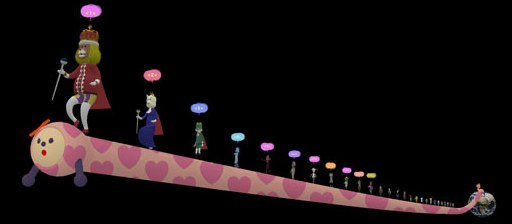
Noby Noby Boy will apparently be available as a download for the PlayStation 3 console, and will be priced at a "very reasonable" price, to ensure that players expecting Katamari Damacy VII: The Revenge or something don't feel cheated. This and Little Big Planet could be reasons to buy a PS3; it's reassuring to see that they're not just using its power to make more realistic-looking racing/war/sports/zombie-splattering games.
The ever-eccentric Takahashi, meanwhile, has apparently committed himself to designing a new children's playground in Nottingham.
2008/11/28
The Graun has a piece on El Records, the artier-than-usual indie label set up in the the mid-1980s by Cherry Red's Mike Alway, which briefly counted Momus on its roster, and then went on to make meticulously art-directed records, its A&R people casting artists as one would actors in a play:
One of Alway's first castings was Simon Fisher Turner, a man whose life story includes child stardom in Tom Brown's Schooldays, taking Robert Mitchum to see Siouxsie and the Banshees, being "the new David Cassidy" on Jonathan King's record label and playing bass for Adam and the Ants. "I was making music in gallery spaces," says Turner, now a respected soundtrack composer. "But no one was really interested in a guy bagging up handmade cassettes with small bits of art and one-off collections of sweets and postcards and cheap toys. I wrote Mike a letter and sent him a cassette. He returned one to me fairly promptly and I went up to their office. He offered me a job [recording] as the King of Luxembourg there and then - I liked that. Instant. Very Jarman."
El revelled in its thrillingly sly upper-class style. His artists weren't knuckle-dragging gangs from rough backstreets: they were presented as languorous Vogue models, archbishops' daughters, royalty. There were songs about the British Empire, soufflés, choirboys and stately homes, but there was never the merest whiff of snobbery, just the crisp, lemony cologne of a delicious privilege shared.
"I used to buy lots of anachronistic magazines and trawl them for song titles," Always says. "I got the King's Turban Disturbance from a column in the Spectator. Cookbooks were good, too. People hadn't written songs about trivial things like soufflés, everything was drowned in this awful bombast. I wanted to move pop music's vernacular on a bit. We were anticipating a Britain yet to come, a more stylish place in line with the Italian and Spanish culture I loved."El Records went on to be much more influential in Japan, informing the leading lights of the Shibuya-kei movement (and even inspiring a Kahimi Karie song titled Mike Alway's Diary; incidentally, on the same EP as the Momus-penned Giapponese a Roma), though was closed some time around 1990; though it has now been reconstituted as a reissues label, dealing with lavishly eccentric old recordings:
The new incarnation of El means near-forgotten recordings by Sabu ("The Elephant Boy") and Orson Welles, Roy Budd and Al "Jazzbo" Collins, Stravinsky and the Ink Spots. The majority of these artefacts date from a time when it seemed perfectly reasonable to lavish skill and money on an LP of questionable commercial appeal, and each one feeds neatly into Always' master vision of a better world where people dress more tastefully, read more widely, think more deeply and take an interest in the world outside their immediate environs. Four wonderfully odd CDs are released every month, each selling between 1,000 and 3,000 copies. Each is a gem.
2008/11/7
A group of squatters has taken over an opulent property in Mayfair. The Da! Collective plans to turn 18 Upper Grosvenor St., a Grade 2-listed property near Hyde Park, the US Embassy and some of London's most expensive restaurants, into an art installation:
Behind the white pillars and imposing wooden door of the grade II-listed residence, the 30-plus rooms are now scattered with sleeping bags, grubby mattresses, rucksacks spilling over with clothes and endless half-finished art installations. While their neighbours' walls are lined with priceless paintings, No 18 now exhibits a room full of tree branches and another with a pink baby bath above which dangle test tubes filled with capers. Spooky foetuses line one fireplace.
hey had been watching the building for "at least six months" before they decided to try moving in, she said. "We had put tape on the keyhole, and kept looking through the letterbox to see if anyone had been there." Then, one October night, five of the group decided to go in. Some of them wore high-visibility jackets to look like builders; Smith had a clipboard and fur coat. They propped their rented ladder up against the front of the building, and one man climbed on to the dilapidated balcony. "I went across to the window and I couldn't believe it when it was unlocked," said the squatter, who declined to give his name. "I was so happy. We didn't really expect it to be open, so it was a really exciting moment."
The group has had a mixed reception from the other residents of Upper Grosvenor Street. "Our next-door neighbours have been really nice; they've even let us use their wireless internet," said Smith. Another neighbour, a man called Alexander, has offered the services of his maid to cook them food, she added.
From 7pm to 11pm, the Da! gang will be projecting images on to each of the 19 windows at the front of the squat. "It's going to look like a doll's house," said Smith, "and there is going to be a harpist and a cellist and performance artists."Under English law, the squatters (who have reconnected the electricity and claim to be maintaining the property and paying bills) are entitled to stay until they are formally evicted by the owners. These owners, a concern known as Deltaland Resources Ltd., based in the British Virgin Islands, do not seem to have made any attempt to contact the squatters; they have 11 years and 11 months to do so before the building legally becomes the property of the Da! Collective.
2008/10/25
I'm no fan of Hollywood action flick director Roland Emmerich and his mindlessly bombastic work, though his house sounds all kinds of awesome:
Mao and Lenin fill the length of the 25ft living room wall; an old master-style painting of the Crucifixion shows Jesus sporting a Wham T-shirt; in the guest bathroom is a portrait of Saddam Hussein; and under the stairs, Pope John Paul II pores over his own obituaries. Welcome to the London home of Roland Emmerich, director of epic blockbusters, including Independence Day and The Day After Tomorrow. It's an overtly political home: glass coffee tables dot the house, containing 3D architectural models of politically significant places, including Abu Ghraib prison, Tiananmen Square, the Dallas road where JFK was assassinated, and - a nice Hollywood touch - the LA neighbourhood where Hugh Grant had his infamous encounter with a prostitute. There's even a giant White House-shaped birdcage in the top-floor hallway, with stuffed white doves.
Teall's starting point was a suitcase full of Mao statues that Emmerich picked up in Shanghai. He then approached film set designers and artists to realise his own designs, employing scenic artist Jim Gemmill to draw the murals that pepper the house, and a posse of prop and model makers to fabricate everything from the life-size papal waxwork to the coffee table dioramas. "The joy of working with film people is their can-do attitude," Teall says. "I had approached high-end furniture makers who gave me outrageous estimates and didn't grasp the humour in the pieces. An architectural model-making firm refused to build the Iraq prison camp."
Emmerich is currently in Vancouver filming, but family and friends visit regularly, sleeping in the guest suites. "It's a choice of English camp or American butch," says Teall, who designed the former with Princess Diana paraphernalia: hand-painted rose wallpaper, a gold bedspread with velvet maroon crown canopy from Harrison Gill in Chelsea ("It was so hideous, but it totally worked"); Charles and Di wedding dolls found on eBay that now languish in the fireplace, and Alison Jackson's photographs of a fake royal family in various compromising situations. The American room is kitted out with army-issue gear, including a bed throw neatly sewn from 70 pairs of vintage army underwear bought from a bemused army surplus store owner. The headboard is adapted from a second world war aeroplane wing. Resting on a bedside table is a photograph of Mahmoud Ahmadinejad, the Iranian president, wearing an open dressing gown revealing a hairy six-pack, Photoshopped from a gay website.There are photos here.
2008/10/16
Artist/culture jammer Jimmy Cauty's latest project: horrifically gory versions of classic animated cartoon cels:

(via Boing Boing) ¶ 1
2008/10/9
Banksy's latest art project, unveiled in New York, is a step away from "street art" and culture jamming and into the territory of conceptual art: he seems to have taken a leaf out of Pascal Bernier's book, and opened a fake pet shop full of grotesque animatronic food-animals, such as walking chicken nuggets.
He added that there was a serious, philosophical aspect to the work, saying: "I wanted to make art that questioned our relationship with animals and the ethics and sustainability of factory farming but it ended up as chicken nuggets singing."
Banksy defended the pet show exhibition even though it contained no graffiti by saying: "If it's art and you can see it from the street, I guess it could still be considered street art."There's more about it here.

2008/9/27
His work fetching huge sums, street artist Banksy has refused to authenticate five artworks up for auction this weekend, on the grounds that he does not approve of his art being removed from its original setting. The auctioneers are putting on a brave face, though:
A spokesman for the auctioneers said: "Banksy hasn't said they are fake. I don't know why he's not authenticated them... He's saying that street art should stay on the streets."
On its website, Pest Control said that since its creation in January, 89 street pieces and 137 screen prints attributed to Banksy had turned out to be fake.
"Pest Control does not authenticate street pieces because Banksy prefers street work to remain in situ and building owners tend to become irate when their doors go missing because of a stencil," Pest Control said.(Pest Control is the official organisation with authority to authenticate Banksy artwork, which was established in response to a spate of fake Banksys. Not to be confused with Vermin, an unauthorised organisation which vouched for the authenticity of the artworks being sold.)
2008/9/21
The shadowy phenomenon of product placement in pop music was thrust into the spotlight when culture jammers the Anti-Advertising Agency, who were running a virtual jeans-making sweatshop in Second Life as an art project, received a proposal from a product placement agency, offering to put his brand of jeans in a Pussycat Dolls song, which they published online
In the e-mail, Kluger (who has represented Mariah Carey, New Kids on the Blog, Ne-Yo, Fall Out Boy, Method Man, Lady GaGa and Ludacris) explained via e-mail that for the right price, Double Happiness Jeans could find its way into the lyrics in an upcoming Pussycat Dolls song. Crouse posted the e-mail on his blog at the Anti-Advertising Agency, an art project of sorts that's basically the philosophical mirror image of a traditional ad agency.
The Anti-Advertising Agency declined and has already drawn some attention to the practice of selling space in lyrics to advertisers through its blog. "Maybe Ludacris wants to rap about a luxury SUV, and is just looking for the right one," said Lambert. "We'll never know (everything about) how it works, because that takes the mystique out of it, and the mystique is one of the things that they can sell." But thanks to this e-mail, we at least have proof that the phenomenon is real.Meanwhile, the agency, Kluger PR (who have emailed WIRED and disowned responsibility for the actual email) has asserted that when they place products in songs, they take every care to ensure that artistic integrity is not affected:
"We are just financially taking care of the people that should be taken care of," he told us via e-mail. "If an artist like Sheryl Crow has the same target audience as XZY brand, we feel it's nothing but a strong and strategic way to pinpoint a market.
"Now, we don't want an artist to write a song specifically to promote a brand, we just feel that if it's a product that's admired by the artist and fits his/her image, we now have the capability of leveling out the playing field and making things financially beneficial for all parties involved. 'Brand-Dropping' is the term that the Kluger Agency coined to describe discreetly advertising by product mentioning in song, and we feel we can make this the way of the future without jeopardizing any artists creative outlet or typical style."I wonder how much it takes to arrange that your (virtual) brand of jeans is sufficiently admired by the Pussycat Dolls for them to (quite sincerely, of course) sing its praises. Which sounds like the artistic equivalent of the question of how much money it takes to win the amorous affections of a lady (or, indeed, gentleman) of negotiable virtue. In which case, would that make Kluger PR a pimp?
2008/9/10
Icelandic artist and product designer Hafsteinn Júlíusson has come up with a technological solution to the global obesity crisis: zero-calorie crisps made of flavoured edible paper, allowing one to happily consume lots of tasty, crunchy stuff. Or, as Júlíusson puts it, it's like eating tasty air:
It is not clear whether the chips are being marketed or whether they're just a piece of conceptual art.
Júlíusson's web site also has information on his other projects, including laptop bags which double as pillows, which are hand-sewn in Reykjavík and sold in the local Apple Store there:
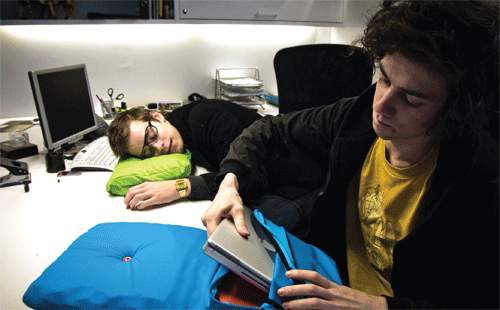
2008/9/5
A condemned prisoner in Texas has requested for his body to be made into fish food as part of an art installation. Gene Hathorn, who is on death row for murdering his father, stepmother and stepbrother, wants to donate his body to a project by Chilean-born artist Marco Evaristti:
Mr Evaristti, 45, a Chilean-born artist who lives in Denmark, said he would first deep-freeze Hathorn's body and then turn it into fish food which visitors at the exhibition could feed to a shoal of goldfish.
"One of the reasons I chose the theme of fish food is because in his court papers, they considered him a piece of 'human trash'. This is what the court papers called him, with regards to eliminating human trash. He wants to be a part of this art. It's the last thing he can do for society and he views it as positive," he said.
It will be part of a wider project by Mr Evaristti, who, in August, presented a clothing collection called "The Last Fashion", in which 15 models wore outfits designed by him. He stated that those garments were for death-row prisoners to wear on their execution day, to be offered by mail order to prisoners whose execution dates are imminent.Meanwhile, Evaristti is helping Hathorn mount an appeal. If the name "Marco Evaristti" sounds familiar, it may be because of his previous project, in which he placed living goldfish in blenders, giving gallery patrons the power to kill them at the flick of a switch.
2008/8/28
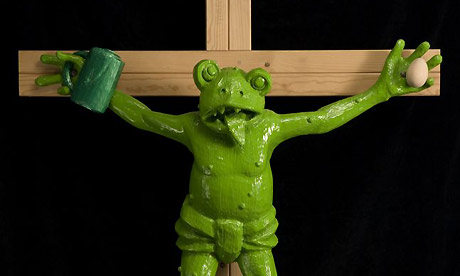 An art gallery is considering whether to withdraw a sculpture of a crucified frog after Pope Benedict condemned it as blasphemous and the president of the regional government went on a hunger strike in protest. The sculpture, Zuerst die Füsse ("Feet First") by the late German artist Martin Kippenberger, depicts an anthropomorphic frog nailed to a cross, its tongue grotesquely lolling, holding a beer stein and an egg, and was intended by the artist as a self-portrait illustrating human angst.
I'm hoping that the gallery stands fast and doesn't remove it. What too many people are forgetting is that one has to choose to be offended by something, and not being offended is not a fundamental human right. If the president of Alto Adige chose to be so offended that he went on a hunger strike and was hospitalised, that was his choice. If we allow one religion to censor art to protect its sensitivities (or, indeed, its claim to cultural hegemony), it sets a terrible precedent.
2008/8/17
The latest salvo from the culture war: Canada's conservative government has scrapped a programme to help Canadian musicians and artists abroad because it was going to "fringe art groups that were unrepresentative or offensive", with one example being the electronica outfit Holy Fuck.
2008/8/7
Belgian artist Pascal Bernier makes works which comment on the relationship between human civilisation and nature. His works include "Accidents de chasse" ("hunting accidents"), a series of glum-looking stuffed animals in bandages, as well as mockups of nightmarishly extreme industrial farms and memorials for tinned fish:


2008/7/17
In case you haven't seen it: Radiohead's video for their new song House Of Cards. Shot using no cameras but only 3D volumetric scanners and computer rendering, the video consists of disintegrating 3D dot representations of suburban streetscapes, key parties and Thom Yorke singing. What's more, there's a video on the making of it, the data set is available for download (in CSV format), and Radiohead are soliciting user-made reinterpretations of this video here.
2008/7/13
New claims have emerged about the true identity of street artist Banksy. Based on photographs taken in Jamaica, the Mail On Sunday claims that Banksy is one Robin Gunningham, a former public school pupil from Bristol. Banksy's spokespeople have refused to confirm or deny this.
2008/6/29
Yesterday, Your Humble Correspondent went to the south bank of the Thames and took part in an unreliable tour of London Tokyo, given by the performance artist/writer/musician Momus and his partner Hisae.
 I only saw part of it, joining the tour in the afternoon. Momus and Hisae were attired in what looked like Japanese or Korean uniforms (which, Momus stressed, were not trendy-minimalist Muji products) and carrying 1950s-vintage megaphones through which they talked to a small crowd which had assembled around them, describing to them which part of Tokyo they are in. Well, Momus did most of the talking, with Hisae adding a native Japanese perspective; some of the time (particularly towards the end, when things got a bit more absurd), their act seemed like a traditional comic/straight-man music-hall duo.
The actual content was fairly interesting; we were informed that the National Theatre was actually a trendy shopping centre whose top floor was an art gallery/museum, where yesterday's unsold fashions ended up, and that the mayor of Tokyo makes his way up the river by speedboat at 6pm every day. Other than that, Momus expounded on his theories on Japanese culture and its similarities/differences with British and European cultures (European individualism vs. Asian collectivism/"superlegitimacy", the British stiff upper lip and the Japanese bushidō (which is apparently making a resurgence), the falsehood of the assumption that modernism is Westernism, and the rising Gini index in Japan and declining originality of Japanese street fashion (apparently it's all Uniqlo and The Gap in Tokyo nowadays)).
2008/6/20
Kevin Kelly (one of the original WIRED contributors) and Brian Eno (no introduction needed) have a game where they try to come up with improbable trends for the near future and extrapolate them. While some of them are (at least nowadays), somewhat lacking in the "improbable" aspects (computer power plateauing has been predicted for a while, people are avoiding American citizenship for tax reasons, Sao Paolo in Brazil has already banned billboard advertising, a deadly airborne plague has been feared since SARS and bird flu and there are predictions that the end of cheap oil will enrich inner cities whilst turning formerly affluent suburbs into impoverished backwaters), others (particularly some of Eno's) are thought-provokingly out-there:
Everybody becomes so completely cynical about the election process that voter turnout drops to 2 percent (families and relatives of prospective politicians) until finally the "democratic process" is abandoned in favour of a lottery system. Everything immediately improves.
Suicide becomes not only commonplace but socially acceptable and even encouraged. People choose when to die: living too long is considered selfish and old-fashioned.
A new profession -- cosmetic psychiatry -- is born. People visit "plastic psychiatrists" to get interesting neuroses and obsessions added into their makeup.
A new kind of holiday becomes popular: you are dropped by helicopter in an unknown place, with two weeks' supply of food and water. You are assured that you will not see anyone else in this time. There is a panic button just in case.
A highly successful new magazine -- Ordinary People, edited by the nonagenarian Studs Terkel -- focuses only on people who have never done anything in particular to deserve attention.
A new type of artist arises: someone whose task is to gather together existing but overlooked pieces of amateur art, and, by directing attention onto them, to make them important. (This is part of a much larger theory of mine about the new role of curatorship, the big job of the next century.)
Manufacturers of underwear finally realize that men have different-sized balls.
(via Boing Boing) ¶ 1
2008/5/30
And Hitler is in the news again, this time in his capacity as mediocre landscape painter. British artists Jake and Dinos Chapman have bought 13 of Hitler's watercolours and modified them with rainbows, stars and love hearts. The remixed artworks, titled "If Hitler had been a Hippy How Happy Would We Be", are being exhibited at the White Cube Gallery in Hoxton, London.
Dinos Chapman said the work, entitled If Hitler had been a Hippy How Happy Would We Be, was a rumination of what might have been had Hitler not been refused entry to Vienna's art school. He added they showed a "blankness" rather than any hint of the deadly pathology that he would later demonstrate.
"He tried to get into art school with these. They are bland and show no presentiment of the genocide to come. They represent the husk of a man who would be filled up with bitterness and hatred. They are identical to thousands of drawings in junk shops. All they demonstrate is that they are a terrible work of art, not that the person behind them will become a tyrant," he said.There is a moral point to this; the Chapmans have announced that they hope that the defacement of Hitler's work will leave him spinning in his grave (how will they know, though?). Meanwhile, the White Cube Gallery has stated that it is extremely careful about whom it will sell these works to, to ensure that no actual Nazi sympathisers get their jollies from them.
2008/5/23
Australian Prime Minister Kevin Rudd's nephew, Van Thanh Rudd, is entering a stencil-style painting (of Ronald McDonald carrying an Olympic torch past a burning monk), in an exhibition in Vietnam; a painting which bears a striking resemblance to a Banksy piece:
Rudd has acknowledged the similarity, claiming that it is "a direct reference 2 Banksy". (I wonder whether he acknowledged the fact that about half of the painting is a copy of another, more famous, work when he applied for the exhibition, or only now.) Of course, there have been works which were even more copied (most notably Marchel Duchamp's "L.H.O.O.Q.", i.e., a postcard of the Mona Lisa with a mustache drawn on, or Andy Warhol's Campbell's Soup cans), though those were commentaries on the original work, the artistic process or the nature of originality. Rudd's work, however, appears to be intended as a commentary on the Olympics/American imperialism/Chinese oppression of Tibet (delete as applicable), and thus such an explanation doesn't hold water.
2008/5/22
Momus' latest New York Times Post-Materialist blog post is about fixed-gear bicycles, the latest hipster must-have after turntables and Lomo cameras, and, like them, a translation of lo-fi into the realm of physical transport, and a refusal to capitulate to bourgeois practicality:
The fixie cult demonstrates that limitations are what give a thing flavor, and that stubborn simplicity can be a sort of charisma. People love these bikes because of what they can’t do as much as for what they can. In that sense they join analog synths, vinyl record players and Lomo cameras as lovable retro lo-fi must-have. In addition to the charm and fashion kudos these bikes deliver, there are other advantages. Not only do they run cleaner than cars, you don’t even have to park them when you reach your destination. Just hang them on the wall and call them art.Even more interesting than the article is Momus' blog entry about it, which elaborates on some of the points:
Code of honour: I often find myself defending as new forms of honour things that others dismiss as fads. What do I mean by that? I think it's already encoded in Alin's self-portrait. His accident, here, isn't just a random misfortune. He "wears his wounds with pride". Like a soldier wounded in a battle fought in the name of a just cause, he feels there's something more important in life than mere safety. In fact, you could almost see cycling, and its attendant aesthetic, as "something worth dying for". The New York Times actually removed the phrase "to die for" from my text, replacing it with "must-have". But I wasn't just making a gruesome joke about cycling being dangerous. I really meant that it was important that fixie cycling -- like skateboarding -- is both difficult and dangerous. To understand why, you really have to go to non-Western places, places where Being is more important than Having, and where people -- including scary people like suicide bombers and kamikaze -- place higher values on certain ideals, certain codes of honour, certain loyalties, certain aesthetics than on life itself. Or you have to go to the chivalric codes of the middle ages. Cycling is, after all, a mechanized form of chivalric equestrianism.
Viral ecology: There's a danger that making people ecologically-conscious can end up preachy and worthy. What you need is something viral, something viscerally compelling, something cool as fuck, which is also something green. And fixie bikes are that: viral ecology with the urban credibility of skateboarding and the rebel cool of smoking combined. No more sermons! On yer bike!
Distinction strategy: We were talking earlier this month about shifts in graphic design style as a sort of distinction strategy, a game of catch-up in which one set of designers keep throwing wobblies, keep embracing ugliness and absurdity in order not just to "make it new", but to put a comfortable distance between themselves and the client-pleasing coffeetable hacks who hobble along behind, copying and pasting. The fixie trend is also a distinction strategy. It's a way for hipsters to say "I'm not just another suburban bozo with a car". But it's also a way for the West to say to China: "Okay, you all have cars now. Well, we're onto something else: bicycles." Which is ironic, since the West used to laugh at China for wobbling around, in its billions, on bicycles.
2008/5/19
A graduate arts student named Drew Burrows has created a holographic virtual sleeping partner. Titled "Inbed", the installation consists of a bed with an infrared camera and projector positioned above it, and a computer which recognises the sleeper's position and projects one of several images of a sleeping woman onto the bed, so as to interact with the sleeper. Burrows says that the piece aims to "speak on the feelings of loneliness, affection, and intimacy", a point lost on the New York Magazine article which beat this up as "weirdo student builds a virtual girlfriend because he's `too busy' to find a real one".
(via Boing Boing) ¶ 0
2008/4/19
In the 1990s, Two Russian-born, US-based conceptual artists calling themselves Komar and Melamid created what they intend to be the world's most unlikeable song. The 22-minute opus is assembled from a palette of elements determined (through a poll) to be the least desirable aspects of songs, and includes things like an operatic soprano rapping about cowboys over a tuba-backed bassline and bagpipe breaks, a children's choir singing inane holiday ditties and advertising Wal-Mart, and someone shouts political slogans over elevator music. It is, in its own way, awesome:
The most unwanted music is over 25 minutes long, veers wildly between loud and quiet sections, between fast and slow tempos, and features timbres of extremely high and low pitch, with each dichotomy presented in abrupt transition. The most unwanted orchestra was determined to be large, and features the accordion and bagpipe (which tie at 13% as the most unwanted instrument), banjo, flute, tuba, harp, organ, synthesizer (the only instrument that appears in both the most wanted and most unwanted ensembles). An operatic soprano raps and sings atonal music, advertising jingles, political slogans, and "elevator" music, and a children's choir sings jingles and holiday songs. The most unwanted subjects for lyrics are cowboys and holidays, and the most unwanted listening circumstances are involuntary exposure to commercials and elevator music. Therefore, it can be shown that if there is no covariance—someone who dislikes bagpipes is as likely to hate elevator music as someone who despises the organ, for example—fewer than 200 individuals of the world's total population would enjoy this piece.Komar and Melamid also produced what their research pointed to as America's most wanted song; it's somewhat less interesting, being a schmaltzy assemblage of Kenny G-esque sax, FM electric piano, R&B female vocals and husky male vocals, not to mention the obligatory guitar solo and not one but two truck driver's gear changes. It is, quite literally, a statistical average of early-1990s commercial radio music; if you're morbidly curious, there's a MP3 here. They also did a survey of what the American public liked to see most in paintings, and produced the resulting work of art, an autumnal landscape with wild animals, a family enjoying the outdoors—and, standing in the middle of it, George Washington.
From the artists' own website:
In an age where opinion polls and market research invade almost every aspect of our "democratic/consumer" society (with the notable exception of art), Komar and Melamid's project poses relevant questions that an art-interested public, and society in general often fail to ask: What would art look like if it were to please the greatest number of people? Or conversely: What kind of culture is produced by a society that lives and governs itself by opinion polls?
(via Boing Boing) ¶ 1
2008/4/13
Costa Rican artist Guillermo Habacus Vargas caused an uproar after announcing an art exhibition in which a dog was starved to death. The world was informed that a stray dog named Natividad was chained in an exhibition space, with a pot of food on the other side, out of reach, and kept there until it starved to death. As you can undoubtedly imagine, there was mass outrage worldwide, with galleries dealing with Vargas/Habacus receiving death threats and a petition against him collecting two million signatures. Then it emerged that the whole thing was a hoax: the dog was "starved" only for three hours at a time, and during the rest of the time was fed by the artist.
It has now emerged, however, that artist Guillermo Habacuc Vargas intended the work to be a stunt to show how a starving dog suddenly becomes the centre of attention when it is in a gallery, but not when it is on the street. The work was intended to expose people for what they really are - "hypocritical sheep". He said that in order for the work to be valid, he and the gallery had to give the impression that the dog was genuinely starving to death and that it died.
2008/2/26
Two artists have created a device for manipulating fonts as one would synthesiser sounds. The Meek FM Typographic Synthesizer consists of a box of synth-like knobs connected to a Mac running software which allows the user to tweak aspects of a font using the knobs. (The font is stored in a higher-level representation, consisting of strokes, though it's said to be able to import standard PostScript fonts.) There's a video of it in use here.
2008/2/7
Read: Notes of a Japanese soldier in the USSR; the story of former Japanese prisoner of war Kiuchi Nobuo's journey through the Soviet labour camp system, told in watercolour drawings with captions. It's surprisingly lighthearted; while Nobuo mentions the death and hardship, he chooses instead to linger on the camaraderie between prisoners of different nations and the small moments of joy, beauty and levity.

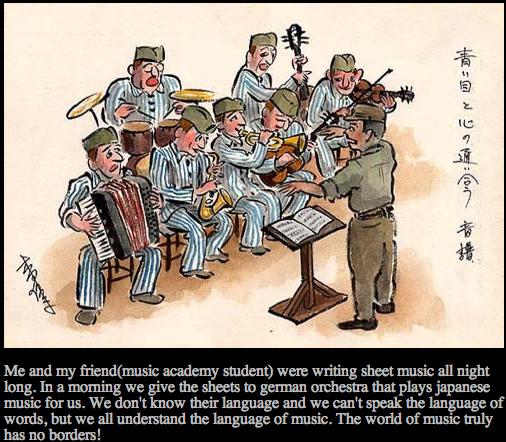
2008/2/5
The charts of Clarence Larkin; fantastic diagrams explaining arcane points of Christian theology and eschatology by analogy to hydraulics, produced between 1914 and 1919. If you ever wondered where the Church of the SubGenius' artists got some of their inspiration, look no further.
It's interesting that Larkin, a man of the 19th and early 20th centuries, used hydraulics (a commonly understood technology of his day) as a metaphor for salvation, damnation and the afterlife. I wonder whether his equivalents today use more contemporary technological metaphors. What would today's equivalents be? The scriptures as a computer bus diagram? UML charts of salvation and damnation? The Lake of Fire as /dev/null?
(via Boing Boing) ¶ 1
2008/1/28
In March, the British Library is hosting hosting a futurist banquet, based on Futurist Manifesto author Filippo Marinetti's 1932 La Cucina Futurista:
The starter makes it clear that this will be no ordinary meal. Expect to be served an olive, a quartered fennel bulb and a kumquat, while the fingers of your free hand stroke morsels of velvet, silk and sandpaper. At the same time the scent of carnations will be sprayed into the room and your ears will be assailed by “wild jazz”, Wagner and aeroplane noise.
Typical Futurist dishes included meat broth sprinkled with champagne and liquor and decorated with rose petals, or the deliberately obscene-looking porco eccittato, a whole cooked salami upended on a plate with coffee sauce mixed with eau de cologne.
Benito Fiore, chairman of the Italian Academy of Cuisine in London, is hosting the event to support the British Library exhibition Breaking The Rules: The Printed Face of the European Avant Garde 1900-1937. He said: “Marinetti was a really fantastic person but his food was awful to eat. We are trying to make it edible.”Entry to the banquet is £75; dress code is "classic or 1930s with a Futurist twist".
2008/1/24

2008/1/17
As Banksy's artwork continues to climb in value (a collector recently bought a piece on a building wall in Notting Hill for £208,100, plus the (not inconsiderable) cost of removing and relocating the wall), BBC News has a piece on how to tell an authentic Banksy from a knockoff:
wo key signifiers of a genuine Banksy work are a busy location and a political subject, he says. While other graffiti artists go for railway lines or rundown areas to reach their community, Banksy aims for the wider public.
"The drawing will be reasonably competent, not brilliant, he's not a great artist. And it will be making a small jokey point about something. It's very difficult to fake that authentically. I don't doubt people will try but he'll distance himself from it."
2008/1/15
In 2004, an artist in the Netherlands created a room filled with aerosolised gin and tonic, as an art installation and/or party. Apparently inhaling aerosolised alcohol is a good way to experience the intoxicating effects very quickly. Whether or not it is safe, I don't know (though passing out in such a room would probably be a bad idea), though I suspect that aerosolised tonic can't be good for one's clothes.
2008/1/5
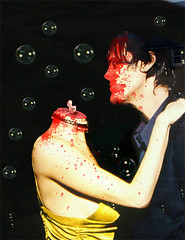 Some anonymous guerilla artist has been hacking the heads off models in advertising posters in London. Dubbed the "East London Decapitator", he or she creates meticulously photoshopped overlays, with the figures' heads replaced with gory stumps and the surroundings splattered with blood, and pastes them over the advertisements. Nobody — not squeaky-clean Disney stars, not pop singers, not even computer-animated characters — is safe.
There is a Flickr photo set here. It's pretty entertaining, as long as he/she doesn't escalate into beheading actual live models or something.
2007/11/20
Here is a tale of two indie bands and their respective negotiations of the contentious issues of commercialism and integrity that arise when an artist is tempted by the siren song of advertisement licensing revenue.
A while ago, Band Of Horses decided to licence one of their songs to Wal-Mart, that scary right-wing bète noire despised by a significant proportion of the sorts of people who buy independent music. After the ad was tested on a limited web release, they started getting bad feedback from fans who heard about it, had a change of heart and pulled the ad, returning Wal-Mart's 30 pieces of silver.
"Some fans, they don't even give a crap," he continued. "They're like, 'Whatever, bands got to get paid.' But at the same time, I was reluctant to do it in the back of my mind, and some fans reminded me there is a reason to feel that way about it. "So once I saw our fans were let down by it, I nixed the TV commercial, and said, 'You know what, this isn't for me. Keep your money.'"Meanwhile, after copping a lot of flack for licensing a song to restaurant chain Outback Steakhouse (itself a major Republican Party donor), Of Montreal's Kevin Barnes digs in and comes out swinging for the moral defense of capitalism, like some kind of indie-hipster John Galt:
The worst kind of person is the one who sucks the dick of the man during the daytime and then draws pictures of themselves slitting his throat at night. Jesus Christ, make up your mind! The thing is, there is a lack of balance. When capitalism is working on a healthy level, everyone gets their dick sucked from time to time and no one gets their throat slit. It's impossible to be a sell out in a capitalist society. You're only a winner or a loser. Either you've found a way to crack the code or you are struggling to do so. To sell out in capitalism is basically to be too accommodating, to not get what you think you deserve. In capitalism, you don't get what you think you deserve though. You get what someone else thinks you deserve. So the trick is to make them think you are worth what you feel you deserve. You deserve a lot, but you'll only get it when you figure out how to manipulate the system.
The thing is, I like capitalism. I think it's an interesting challenge. It's a system that rewards the imaginative and ambitious adults and punishes the lazy adults. Our generation is insanely lazy. We're just as smart as our parents but we are overwhelmed by contradicting ideas that confuse us into paralysis. Maybe the punk rock ethos made sense for the "no future" generation but it doesn't make sense for me. I like producing and purchasing things. I'd much rather go to IKEA than to stand in some bread line. That's because I don't have to stand in a bread line. Most people who throw around terms like "sellout" don't have to stand in one either. They don't have to stand in one because they are gainfully employed. The term "sellout" only exists in the lexicon of the over-privileged. Almost every non-homeless person in America is over-privileged, at least in a global sense.The devil, of course, is in the details. Capitalism doesn't reward those who make good art per se, but those who can find a niche in the market and fill it. Occasionally these two goals line up, but most market niches are for unchallenging populist fare. If one restricts oneself to making significant art, one will find the pickings relatively lean. (Just ask the members of OMD, who started making songs about nuclear war and, once they had mortgages to pay off, went on to manufacture commercial pop groups like Atomic Kitten.) The most successful capitalists in music aren't the most highly critically appraised artists, but rather the likes of 50 Cent and Simon Cowell.
2007/10/24
The latest exhibition at Berlin's super-hip Tacheles art space is a travelling exhibition of artefacts from failed relationships. The Broken Relationships exhibition, originally from Croatia, actively solicits contributions from attendees in the cities it visits; contributions have included a wedding dress and an axe used to destroy an ex-lover's furniture.
2007/10/21
Conceptual Terrorists Encase Sears Tower In Jell-O:
"Your outdated ideas of what terrorism is have been challenged," an unidentified, disembodied voice announces following the video's first 45 minutes of random imagery set to minimalist techno music. "It is not your simple bourgeois notion of destructive explosions and weaponized biochemical agents. True terror lies in the futility of human existence."
According to a 2007 CIA executive summary, the terrorists responsible for masterminding the attack are likely hiding somewhere in Berlin's vast labyrinth of cafés. Though officials said they didn't know if any of those involved in carrying out the plot were still in Chicago, several dozen local performance artists and interpretive dancers have been brought in for questioning.
Hayden said the CIA is working closely with the National Endowment for the Arts to cut off all grants that may serve as funding for the group. In addition, the Department of Homeland Security has begun monitoring any large purchases of gravy, tinfoil, pig's blood, and barbed wire in hopes of preventing another aesthetic tragedy.
2007/10/10
The BBC has an article on the relationship between schizophrenia and artistic inspiration, by a photographer suffering from schizophrenia:
The symptoms feed me the tools to become creative. I seem to be thinking all the time and the psychosis is not necessarily destructive. The experience of a hallucination can often be recalled in the creation of artwork or poetry, for example.
But the problem is expressing what I see or hear because strong cognitive difficulties - such as memory loss, disorganized thoughts, difficulty concentrating and completing tasks - impair my ability to enhance and capture my true creative potential.
Unfortunately psychiatry leans far more towards controlling schizophrenia, rather than showing understanding towards a patient's true needs and potential capabilities.
2007/10/2
First there were cinema verité, DOGME 95 and machinima, and now we have "Video Sniffin'". This latest technique in improvised guerilla filmmaking involves finding a (presumably unsecured) wireless CCTV camera and acting out a scene from your underground film in front of it, whilst recording its signal using a receiver:
Young people from the local YMCA and others used a cheap video receiver from a high street store to ‘sniff’ the streets for CCTV cameras. After finding 24 cameras or ‘hotspots’ they then asked shop owners if they could make a film by acting out in front of their CCTV cameras and recording the signal. The shop owners were very surprised and happy for the young people to create a film this way.
2007/9/12
Montréal artist Cesar Saez is building a giant dirigible banana which he plans to float 20 to 30 miles above Earth, where, viewed from the Earth, it will appear to be between 15 and 20% of the size of the full moon.
(via Boing Boing) ¶ 0
2007/8/21
An anonymous author has droplifted a book into bookshops in the West End of London. The book in question, "The Idiocy of Idears" by "schoolboy Gustav Claudius" purported to be the jottings of a dyslexic schoolboy; further investigation revealed it to be an upcoming work by prolific poet, painter and punk rocker Billy Childish, founder of the art movement Stuckism.
2007/7/5
The Guardian's art critic Jonathan Jones has a thought-provoking critique of Banksy:
One of Banksy's most irritating attributes is his conservatism, as an artist who seems proud of the fact that he "draws", rather than just making "concepts". He appeals to people who hate the Turner prize. It's art for people who think that artists are charlatans. This is what most people think, so Banksy is truly a popular creation: a great British commonsense antidote to all that snobby pretentious art that real people can't understand. Yet to put your painting in a public place and make this demand on attention while putting so little thought into it reveals a laziness in the roots of your being.
Perhaps the rise of Banksy is the fall of Art - that is, the waning of art as the force it has been in recent culture. A decade ago, the art of the Damien Hirst generation pushed itself into anyone's view of what was happening in Britain. Probably the rise of Banksy means that moment is coming to an end; people care more about other things. He is a background artist, as in background music: like all graffiti, his is essentially an accompaniment to other activities. Chunky sprayed-letter graffiti is a background to skateboarding. Banksy is a background to hating New Labour. The reason to admire Damien Hirst is that he makes art as if art mattered. In Banksy, the philistines are getting their revenge.
2007/6/19
Momus' latest blog post is a critique of the recent film Pan's Labyrinth. Other than being an exercise in the goring of sacred cows (an often useful exercise), it makes some good points:
The film bore all the hallmarks of COG screenwriting. COG screenwriting is the opposite of personal vision, the opposite of imagination. It's screenwriting as taught by "experts" in screenwriting class, a kind of brutal, plot-advancing writing style based around a Centre of Goodness (COG) who wins the audience's sympathy (usually by pure genetic superiority -- ie a very good-looking actor is cast -- but also by a series of sufferings overcome throughout the narrative). It takes no prisoners -- and no risks. COG screenwriting is the filmic equivalent of modern managerial techniques. It's brutally efficient -- yes, it can and will make you laugh and make you cry -- but the difference between a film made by a COG director like Guillermo del Toro and an artist like Jodorowsky or Arrabal is like the difference between a house designed by a Project Manager and one designed by an architect. I will not let del Toro pass for an artist. I'm sorry, critics. He is a cinematic Project Manager.
Complete absence of sensuality, the incidental, the non-programmatic. Appeal is made to our adrenal glands, but no sexual organs (del Toro has the nerve to talk about Pan, but read the antics of the original Greek Pan here then compare them to the sexless, boring Pan character in this movie). Shock and surprise and mawkish empathy dominate, but there's no moment in which a character senses the breeze blowing in from the woods, just for its own sake. No, everything is fire and death and danger and hatred and forward motion. No indirection allowed. Improbable chases, with a deus ex machina to save the COG and a fatal comeuppance for the COB.
This is a Mexican-US co-production. But its values are American -- it has the shiny blue lighting, the flashy special effects, and all the conventions, of a US blockbuster (and the director apparently turned down both Harry Potter and the Narnia film to make it). This, then, is "global" film-making as a kind of outsourced American filmmaking. We do not leave the technical nor the moral universe of the Americans. Nothing is imported, in the sense of a "foreign" worldview. The film has learned American ways, but American audiences will not learn anything they don't already know from it, either texturally or morally.
2007/6/14
Banksy's latest opus is a replica of Stonehenge made of portable toilets, installed on the Glastonbury festival site:
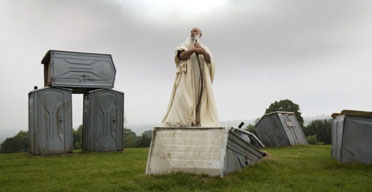
The artist, never shy of controversy, has raised some eyebrows with the location of the artwork in the "Sacred Space" field, venerated by the festival's more hippyish devotees. Banksy himself has no illusions about the sanctity of his work, however: "A lot of monuments are a bit rubbish," he said, "but this really is a pile of crap."Is it just me, or is Banksy losing his edge? Offending a few hippies (a rather soft target) is not quite the same as taking on, say, Disney Corp., the state of Israel or the oppressive existence of police forces, and I suspect that his latest work wasn't dumped in the field in the dead of night, but probably arranged with the festival organisers to add some subversive cachet and/or appropriately edgy celebrity value to their event. Mind you, whether Banksy was ever really subversive is a matter for some contention; Charlie Brooker (who, with Chris Morris, incorporated aspects of Banksy into the Nathan Barley character) reckons that this particular emperor never had any clothes.
2007/6/9
The Believer has an interview with Khaela Maricich, of The Blow (conducted by a friend of hers, writer Miranda July), in which she talks about her past art projects and what various songs from Paper Television are about.
2007/5/20
YouTube video of the day: "Amateur", by a Scandinavian fellow named Lasse Gjertsen, who, despite not knowing how to play the drums or piano, recorded video of himself hitting drums and piano keys and assembled it into a song through the sheer power of video editing:
2007/5/18
Control, Anton Corbijn's biographical drama about Ian Curtis and Joy Division, has just premièred at Cannes, and received critical acclaim.
The film is shot in black and white, and has a characteristically 1980s Corbijn look; the production stills look promisingly stark. I'm eagerly awaiting the release of this one.
2007/4/20
The Guardian looks at why today's hot new music all sounds like something you've heard before:
Pop's history, not its future, has become the driving force for so many artists that it's possible to get a modern British version of just about any music you care to mention. Want to hear brand-new 1930s swamp blues? Look to Duke Garwood. Ever wondered how the Andrews Sisters might sound transplanted to the present day? Turn to the Puppini Sisters. In search of rock'n'roll sporting unscuffed blue suede shoes? Here's Vincent Vincent and the Villains. The list goes on, taking in the Pipettes' and Lucky Soul's updates of the girl group/60s pop sound, the Draytones' recreation of 60s garage, Selfish Cunt's rowdy 70s punk, Franz Ferdinand's and the Futureheads' homage to post-punk, travelling from genre to genre and decade to decade until it reaches the so-called post-Libertines bands - most prominently, the View and the Fratellis - who take their inspiration from a group nostalgic for the 1970s and who still existed three years ago.Paul Morley, music journalist and founder of 1980s Fairlight-driven avant-garde artist of Art Of Noise, believes that music has become backward-looking:
"Instead of music moving forward," Morley says, "there was a moment - which you could pin down to around Britpop, or even earlier - when it started to fold backwards on itself. Instead of music having an idealistic need to create a future, to change things and have enough optimism to believe that could happen, it has ground to a halt."Britpop is one candidate for such a moment, especially with the media-driven hype about it being a new Mod revival/second coming of the Swinging Sixties, which some of the bands and promoters either started to believe or played along with, inaugurating a tradition of fashionable musicians dressing, knowingly or otherwise, in the drag of past eras. In Rip It Up And Start Again, however, Simon Reynolds places the end of originality after post-punk declined, via "new wave", into "new pop" and the mainstream, and places the C86 generation of indie music, with its unexperimental pop song structures and traditionalistic guitar/bass-guitar-driven instrumentation, as the start of a new conservatism in indie music.
If there is no originality any more, then originality becomes simply a matter of choosing which reference points you slavishly rip off (and/or update by putting in more swear words and references to iPods and text messages) more creatively:
Vincent Vincent thinks it's a positive advantage that someone like him has more than 60 years of musical history to draw on. "That's what this whole first decade of the 21st century has been about: this massive amalgamation of all the previous decades," he argues. "We now are in the luxury position that we can cherry-pick our favourite things from the past." A fan of Elvis, doo-wop, Bob Dylan and the 1970s rock'n'roll revisionism of Jonathan Richman and Richard Hell, he aims to "pull rock'n'roll apart and add modern things to it". Doing so, he thinks, makes Vincent Vincent and the Villains "perhaps the most forward-looking, adventurous band out there. I feel like I'm presenting something new, something different that people haven't thought about. An English rock'n'roll band of now."
For the Pipettes, choosing different reference points from your contemporaries is a sign that you're "being intelligent". "If other bands can go as short a time back as Britpop and try to recreate that, why can't we go back and discover music that we think is more interesting?" asks Becky.
Asked whether he thinks it's possible to create original music today, Lucky Soul's Andrew Laidlaw grimaces. "I think that would be utterly pretentious," he says. "And it immediately dates - unlike timeless melody." By its nature, timeless isn't modern - and it certainly isn't futuristic.Today's hot young revivalists are, of course, not the first musicians to stand on the shoulders of giants; however, they differ from their predecessors in the reverence with which they treat what came before them. Rather than ripping it up and starting again, they elevate it to sacred canon:
Think of the Libertines: they were so enamoured of punk, they hired Clash guitarist Mick Jones as their producer. "I cannot help but marvel at how peculiar that is," says Morley. "Something that was meant to be a radical music has become truly conservative, in that it conserves: it's recreating shapes and riffs and sounds that have happened before."And here's Momus' take on this.
2007/4/10
I just watched Sticky Carpet, a recent (2006) documentary on the Melbourne music scene. It was quite interesting, interviewing musicians and scene figures about various aspects of it, such as the interplay between the mainstream and the alternative (most of them were very anti-mainstream), art and commercialism (the consensus was that when money becomes a consideration, the range of allowable creative decisions narrows severely), Melbourne's profusion of band venues and community radio stations, and even the theory that Melbourne's preeminence in the Australian music scene has to do with the cold winter days encouraging musicians to go indoors and rehearse.
Sticky Carpet's main flaw was its fairly heavy
I was surprised to find that the frontman of Eddy Current Suppression Ring wasn't wearing a blue singlet or sporting a rat's tail mullet. I sort of placed them as part of a Bodgie revival.
Another interesting thing that was said in the documentary: Tony Biggs (who presents the talk-radio segment on 3RRR) made the claim that the fact that 99% of commercial music consists of love songs might contribute to depression and mental illness, as such songs instill unreasonably optimistic expectations in listeners.
2007/3/22
Art movement of the day: Neoconservative Realism:

In addition to the prints, Birk has made a number of paintings, including The Liberation of Baghdad, seen here. The paintings are more satirical and ironic, and many are based on paintings of the glories of war in Napoleon's time and from Russian socialist images of battlefield glories.
The Liberation of Baghdad, says Birk, is about "what we were told would happen -- happy, joyfully liberated Iraqis welcoming American troops as we free them from the shackles of oppression."
(via Boing Boing) ¶ 2
2007/3/16
In Oslo, Norway, some concerned citizen has taken it upon themselves to cover up indecently unclothed statues:
With the exception of one lone figure, every scrap of nipple, crotch or posterior was covered with black strips of paper, no matter the size nor position of the statue. The unknown assailant left an explanatory note behind: "There is too much nudity in newspapers and magazines, so here on the bridge the limit has been reached!"
(via Boing Boing) ¶ 0
2006/12/30
And now, here is my annual write-up of the past year in music:
Top 10 albums of 2006 (in alphabetical order, by artist):
- The Blow - Paper Television
Polished yet glitchy electropop, with just the right mix of slickness and roughness, with thoughtful lyrics. Pile Of Gold is perhaps the best pop song about the economics of sex ever recorded, The Big U talks about the universe as a romantic rival, and Babay (eat a critter, feel its wrath) is a rather clever use of meat-eating as a metaphor for unrequited love, from the point of view of the eaten creature/spurned lover. The melodies are pretty catchy too; this all works as pop music.
- CSS - Cansei de Ser Sexy
They came out of Sao Paolo, they look like American Apparel models, have songs with titles like Let's Make Love And Listen To Death From Above, Artbitch and Music Is My Hot Hot Sex, and their name means "tired of being sexy" in Portuguese. Which all sounds perhaps a bit too VICE Magazine, though their music is actually good; a bit like a more electro Shonen Knife.
- Gersey - No Satellites
The Melbourne group's third album, sees their guitarwork joined by more driving, angular grooves. It's all good.
- I'm From Barcelona - Let Me Introduce My Friends
A record so exuberantly joyous that it makes The Go! Team sound like The Smiths by comparison. A Swedish chap named Emanuel and 28 of his friends getting together to sing perfectly catchy pop songs about stamp collections, treehouses, and friendship, and once you hear them you'll be forgiven for wanting to join in and sing along. As the end of the booklet says, now you're from Barcelona too.
- James Figurine - Mistake Mistake Mistake Mistake
A new record by Jimmy Tamborello, better known as half of The Postal Service. Only with the smugly saccharine romantic-comedy feel of Give Up replaced with Kraftwerkesque cold feeling and sparse electronic buildups like winter landscapes scrolling past alongside an Autobahn. The choirs of robots are back, though they're less shiny, and their joy circuits have since burned out. One of the quiet triumphs of the year.
- Mojave 3 - Puzzles Like You
Once upon a time, Neil Halstead and Rachel Goswell were in a band named Slowdive, and crafted lush, intricate walls of gently intense emotive sound. Then they threw that all away, formed a band named Mojave 3 and started making stripped-down 2-chord country/folk busker tunes, refusing to even mention their previous incarnation. Now they got their groove back, and come back with an album of lush, layered pop songs. It's not shoegazing (though there are enough bands doing that for those who want it), but it is a return to form.
- Momus - Ocky Milk
The latest from self-styled tender pervert Momus, a mashup of influences from Canto-pop and synthpop to music-hall, ragtime, along with nods to hip genres such as glitch and freak-folk (though Momus, in his glorious eccentricity, is the sort who never quite fits into a scene or genre). There are numerous layers of subtlety and reference in this work, and analysing them could be a PhD thesis in itself. Having said that, it makes a more listenable (if still wilfully eccentric) pop record than Otto Spooky or Oskar Tennis Champion. My favourite track would probably be Zanzibar; one day, I want to go to Zanzibar and watch the sun set over the Atlantic whilst listening to this.
- The Radio Dept. - Pet Grief
The second album from the Swedish shoegazer/indie-pop band, and a very polished work, with lush yet wistful pop songs constructed from clunky 1980s drum machines, processed guitars and the odd keyboard, and a few Pet Shop Boys influences sneaking in amongst the Slowdive and Sarah Records.
- Spearmint - Paris In A Bottle
A concept album, based around an encounter between four young strangers in Paris a decade earlier and their wishes for the future, told in recollections from the imperfect present. Spearmint are in fine form, doing what they do well; catchy bossa-nova-influenced pop songs with themes of bittersweet complexity; their arrangements are more sophisticated than on earlier records. Highlights are the two tracks which bookend the CD, and the disco groove of Psycho Magnet; also listen out for the French accordion on Wednesday Night.
- Wolf & Cub - Vessels
Some kids from Adelaide with guitars, but don't let that put you off. This isn't the knuckle-dragging rockist primitivism of Jet or Eddy Current Suppression Ring but a quite effective blend of krautrock and psychedelic rock grooves, with perhaps a nod to the Stone Roses; it has driving motorik grooves, dubby basslines, fuzzy guitars, the odd psych-rock freak-out and creative use of pedals and studio effects, and it all hangs together rather nicely. I only discovered this album at the end of the year, though feel that it merits inclusion.
Other albums of note included: Beirut, Gulag Orkestar (which is rather good, though has been played to death now, thanks to everyone who reads Pitchfork; see also: The Arcade Fire), Hot Chip, The Warning (think 1980s Prince meets Aphex Twin; highlight: the title track, with its contradictory combination of gentle beauty and messages of aggression), and Small Sips, The Morning Ripples (a new project from members of Sodastream and The Paradise Motel, in a somewhat Mojave 3-ish direction), New Waver, Neuters (a compilation of covers of popular songs, reinforcing New Waver's Darwinian-pessimist ideology).
There were also new albums from Belle & Sebastian (which was OK, though I'm not sure I like the 1970s rock direction they're going in) and Camera Obscura (which sounds less like Belle & Sebastian than their previous album, and takes more cues from 1960s country and Motown). Ninetynine also released a new album, though it didn't grab me quite as much as The Process and Receiving The Sounds Of Science Fiction.
The gigs of 2006 were (in chronological order):
- Belle & Sebastian, Brighton, 3 February, and Hammersmith Apollo, 10 February
Part of the tour promoting their new album, and it was great. For a band who are trotted out as the stereotype of music for bookish introverts, they rock pretty hard. The live version of Electronic Renaissance, which has become a staple of their gigs, is pretty good too.
- Jens Lekman, Bush Hall, 16 February
He was brilliant; playing a lot of songs, some new and some old, and putting everything into it. And at the end he appeared in the corridor with an acoustic guitar and serenaded the crowd with two songs. Jens, you rock.
- dataPanik, the Luminaire, 6 April
They rocked. There was so much energy and intensity. It was the same feeling I had when I saw Ninetynine for the first time at the Punters Club all those years ago. Unfortunately, the rest of the world didn't feel the same way and dataPanik, after failing to get interest, disbanded. More's the pity; though I look forward to next year's Bis reunion gig.
- Architecture In Helsinki, ULU, 13 May
Another great AIH gig, with a tight performance and a 7-minute block-rocking extended version of Do The Whirlwind. They played a few new songs, which are in more of an electro-funk direction, and sound brilliant. I eagerly await their new album.
- Os Mutantes, Barbican, London, 22 May
The legendary Brazilian Tropicalia band, who influenced everyone from Talking Heads to Architecture In Helsinki, played their first gig in 34 years(!), at the Barbican. It was a momentous event. The audience seemed evenly divided between Brazilians and non-Brazilians. The gig didn't disappoint; they put on an impressive performance. When they did Bat Macumba, people were dancing in their seats.
- François and the Atlas Mountains, supporting Camera Obscura, 11 June
Don't get me wrong, Camera Obscura were good, but François and his friends stole the show. Playing (and swapping) a variety of instruments, from Casio keyboards to a harp, they performed some rather nice indiepop songs with a good deal of exuberant energy. They're one to watch for the UK people.
- Spearmint, Bush Hall, 21 August
One of three Spearmint gigs I saw this year, and the lads put on a good show each time.
- CSS, Dingwalls, 10 September
They were lots of fun to see. Their gig was more rock and less electro than their album sounded, and Luisa Lovefoxxx seemed to be having lots of fun on stage.
- I'm From Barcelona, Hoxton Bar, 14 September, and Jamm, 15 September
If I had a gig of the year, it would probably be this one. I went to see their first gig (on the
rightnorth side of the Thames), and liked it so much I went to the second one the following day. There were 22 people on stage, singing, clapping, playing instruments and fruit-shaped shakers, playing around and having a great time whilst making perfect pop music. It was like the best party ever, only in the form of a pop concert. - Ninetynine, Smekkleysa, Reykjavík, 21 October, and The Windmill, Brixton, 31 October
It was a reduced touring line-up, consisting of only Laura, Cameron and a girl who was filling in for Amy, though the magic was there. The mighty juggernaut that is the Macfarlane/Potts partnership was out in full force, and they played lots of old songs, including all the favourites. I swear that Polar Angle rocks harder every time they play it.
2006/12/7
Norway could soon see a renaissance of striptease, after the Norwegian High Court ruled that striptease is an art form, and thus exempt from Norway's 25% VAT.
It was not clear whether the three judges had conducted field research before reaching their verdict. Certainly they made a clear distinction between "banal and vulgar" striptease--in which there is physical contact between dancers and the audience -- and artistic dance.
The question of the artistic value of striptease has been raging since the late 19th century. The first professional stripper was a Parisian, Yvette, who in 1894 stood on a music hall stage and pretended to undress for bed. The artistic content came in the act of undressing rather than in the nudity. which was often brief and incomplete. American burlesque theatres borrowed striptease acts from the French. The most daring showed Salome's Dance of the Seven Veils--complete with a papier-mâché version of John the Baptist's head -- as if to underline that striptease had respectable roots.
2006/11/8
Police in Italy have seized a toilet which plays the Italian national anthem when flushed from the Bolzano Museum of Modern Art. A court will now decide whether the museum is guilty of causing offence to the nation; the case for the prosecution is strengthened by a decree by the authoritarian Berlusconi government earlier this year defining the national anthem as an emblem and the property of the state.
2006/10/28
TIBET is the nom de guerre of a Swedish underground artist, in the literal sense. His art involves making 11"-tall statues out of concrete, taking them into tunnels beneath Stockholm and gluing, welding or drilling them into the solid rock. Of course, very few people will actually see them down there, though given that they're going to be around for a long time, eventually someone might.
2006/9/22
An addendum to the Swedish indie-pop post made yesterday: Jim tells me that government-funding of indie music does happen in Britain—in Wales:
Many of the small bands and record labels here are part-funded by the Welsh Language Board. Who knows what'll happen to that funding once the Welsh Language Board is shut down, folded into the rest of the Assembly by Rhodri Morgan's "Bonfire of the Quangos." But here's an example - the Board have just released the new "Dan y Cownter 2" CD, which anyone can have for free, showcasing 10 bands on 10 different labels. If you want a copy, just email post@danycownter.com. You don't even have to do it in Welsh. Review here. Sorry to sound like an advert, but it's an excellent thing.There is indeed a vibrant music scene in Wales (Jim played me some examples, from the early 1980s to the present day, when I was last in Aberystwyth, along with commentary and translations), and a lot happening there creatively, with both the eisteddfod tradition and local government funding helping.
Of course, the key difference between Welsh and Swedish indie pop is that the Swedes usually sing in English. I guess it helps that the English never colonised Sweden and tried to extinguish its language.
2006/9/21
The Times has more details about the recent Banksy exhibition in LA, detailing the meticulous planning that went into it, and the businesslike canny behind it and the various recent stunts that primed the publicity pump for it:
Despite its studiously rough-and-ready aesthetic, last Thursday's party was the climax of an operation almost six months in its planning and preparation. Kari Johnson, Tai's handler, was first approached "a few months ago" to see if her entertainment elephant might be available as an exhibit.
First, a few weeks ago, his team distributed 500 defaced copies of the new Paris Hilton CD in 42 music stores around the UK -- a prank that made headlines. Then, the Friday before last, Banksy dressed a blow-up doll in the orange jumpsuit and black hood of a Guantanamo Bay prisoner. He deflated it, stuffed it into a backpack and went for a day out at Disneyland. Inside, he sat on a bench and quickly unpacked, inflated his unwanted installation with a pump, and fixed it on some fencing facing a blind corner on the Rocky Mountain Railroad rollercoaster ride. By the time Disney's in-house security team spotted Donald and Mickey's uninvited new friend, Banksy was long gone, but a cohort remained to record the reaction for the exhibition.According to the article, the planning has paid off in spades, with the exhibition taking an estimated US$4.5m, and doing what many British artists have tried and failed to—breaking America. The question remains of how much of his carefully preserved underground anti-establishment cool Banksy will keep now that most people have heard of his work by reading in celebrity gossip tabloids that Keanu and Brangelina bought pieces at an exclusive VIP premiere; and, indeed, how long he can remain both an outlaw street artist and a canny businessman selling to the establishment. (Surely it won't be long until local councils start suing Banksy Plc. or whatever his business entity is called for street-cleaning costs, if nothing else.)
The piece ends with a description of Banksy, whom the author met at a party:
Back at that party in June, what I found most telling about observing Banksy was not his appearance (dark hair, lightly bearded, nice trainers -- more I shall not say) but his behaviour. There were dodgems at this rather opulent do, and you couldn't get Banksy off them. While my girlfriend, son and I waited in the queue we watched as Banksy stayed resolutely in his ride until three five-minute changeovers had passed. Each time they did, he revved up afresh, electrically zooming with as much speed as possible into his fellow drivers. With each juddering impact, he grinned -- and then accelerated away at speed.
2006/9/17
Photos from Banksy's recent exhibition in LA, or actually from a separate VIP preview. It looks like it was a great event, with the stencil pieces, sculptures, the ornate sitting room full of "remixed" paintings refusing to stay in their frames, and, of course, the elephant. They had an elephant, painted pink, wandering around the warehouse and being metaphorical. While the elephant's handlers (a company which specialises in leasing elephants, under carefully controlled conditions, for events) stated that the elephant was not in the least way harmed, animal rights groups were not satisfied with that explanation, some seeing the very stunt as an affront to the dignity of animals:
The political statement by the artist made no impression on Dyer: 'If this man is an artist, then why couldn't he build one out of papier-mache?' Les Schobert, a former L.A. Zoo curator who is a prominent voice in the animal rights movement, said the exhibit 'degrades the elephant. Here we have an endangered species. And we're taking it and moving it into a warehouse and painting it. It's a mockery. There's no reason. This isn't a religious ceremony in India.'And the BBC has a piece about Banksy, claiming to authoritatively identify the pseudonymous artist:
His real name is Robert Banks, a 32-year-old from Bristol, that cultural melting-pot of a port where graffiti art has a long heritage.
He has no formal art education but learned his craft designing bootleg rock memorabilia. Before that, he'd started spraying graffiti when he was an unhappy 14-year-old schoolboy.And a Guardian piece here, including the claim that the Paris Hilton CD was done in collaboration with LA-based mash-up artist Danger Mouse.
(via Boing Boing) ¶ 0
2006/9/11
Not one to rest on his laurels, Banksy has been up to more pranks. His most recent has been placing a hooded detainee mannequin in Disneyland:
The hooded figure was placed inside the Big Thunder Mountain Railroad ride at the California theme park last weekend.
It is understood to have remained in place for 90 minutes before the ride was closed down and the figure removed.There is more about the stunt here. Meanwhile, Banksy is organising a "three day vandalised warehouse extravaganza" in Los Angeles this weekend. Given that it's on both his website and the BBC News, I wonder whether the LAPD or FBI will raid it.
(via Boing Boing) ¶ 0
2006/9/5
Apparently it's possible to modify a digital camera to take infrared photographs, by removing the infrared filter and replacing it with one that blocks out everything but infrared (made from material obtainable from photographic retailers). It's not recommended that you do this to any camera you'd mind destroying if the procedure fails, but if you are successful, you get something that takes photos like these:


Someone has posted photos of Banksy's Paris Hilton CD, from a copy found in a HMV in Birmingham:
There's also a copy on eBay. Bidding is currently running at £250, with just under 10 days to go.
2006/7/27
BBC Radio 4 has a three-part programme titled The Art of Pop, about the influence of the British art school tradition on pop music, and presented by famous St. Martin's graduate Jarvis Cocker. The first part (from Tuesday) may be listened to here.
2006/7/25
The creator of the Electroplankton game/generative music tool for the Nintendo DS, Toshio Iwai, has developed a new electronic musical instrument. Known as the Tenori-On, it's an electronic tablet containing a 16x16 grid of LED-illuminated pushbutton; it can be used as a loop-based sequencer, or played in more game-like modes:
Each of Tenori-On's LED buttons can either be lightly strummed, sort of like a harp, or alternatively pressed down, whereby each button lights up. Musical notes are triggered by a regular line of light that moves from left to right, much like the sweeping line in PSP game Lumines.
Perhaps most interesting are the more game-like modes, where you can set off Breakout or Pong-style music balls that 'bounce' around the grid, triggering new sets of dynamics sound. These can be layered on top of the more traditional music making modes, creating what Iwai called, "a real musical instrument for our digital age, just like the Theremin was for the 20th Century."No idea when (or even if) it'll go to market, though Yamaha seem to have the rights to it.
(via Boing Boing) ¶ 3
2006/7/20
Hezbollah militants abduct Israeli soldiers and fire missiles at Israeli cities. Israel bombs the hell out of Lebanon. Lebanese musician/artist Mazen Kerbaj records an minimalistic trumpet improvisation over the sound of exploding bombs.
(via Boing Boing) ¶ 0
2006/7/5
A new advertising agency in the Netherlands has started offering advertising on zoo animals and hookers' thighs. The agency instoresnow.nl also offers advertising iin religious establishments and huge floating billboards off popular beaches. Unfortunately for those willing to buy, the agency doesn't actually exist, but is merely a satirical project by a design student, Raoul Balai:
"I was getting sick and tired of advertising everywhere," Balai told reporters. "But I don't want to preach, and I thought satire would work better."
Prospective customers phoning his fake agency are kept on hold and bombarded with sales pitches until they give up.Not all are amused, though; an Amsterdam zoo has threatened Balai with a defamation suit after Balai's site showed fish at the zoo inscribed with the brand name of a frozen fish company.
2006/6/30
An interesting article about the history of Chinese Maoist propaganda poster art, and the contemporary artist Wang Guangyi, whose work includes the "Great Criticism" series, juxtaposing Maoist poster imagery with Western lifestyle product brands.
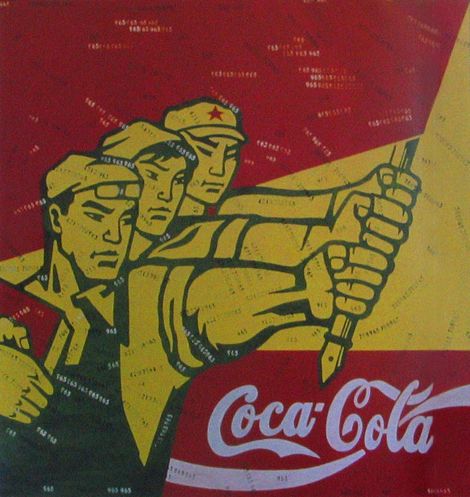
(via Boing Boing) ¶ 0
2006/6/28
A London artist has produced a noise-level map of London, showing where the quiet places in this noisy city are.
(via Boing Boing) ¶ 0
2006/6/22
Guerilla artist Banksy's latest effort: a piece on the wall of a building in Bristol, depicting a naked adulterer hanging from a window ledge by his fingers whilst the cuckolded husband searches for him.
The Bristol City Council, whose offices overlook the unsolicited artwork, is taking an uncommonly enlightened approach to it: rather than automatically obliterating it and citing Giuliani and the broken-windows theory of public order as justification, it is asking the public whether it is art or vandalism.
2006/6/10
Robin Guthrie, the guitar-pedal wizard from the Cocteau Twins and pioneer of all things swirly and æthereal, has now had a hand at filmmaking. You may not be surprised to find that his first film appears to be the visual equivalent of his music:
It has been exhaustively assembled with the same craft which Robin has used in the sonic world for years, an interweaving and layering of images, creating distinct moods which are reflected by the music being played - "improvised within the framework; dictated by the visuals", relying on layers of treated guitars, textures and sumptuously cyclic melodies"From what I hear, Lumière is basically swirling, dissolving blurs of coloured light. And it comes with Guthrie playing a live soundtrack on guitar.
(via  addedentry) ¶ 0
2006/5/19
The Smithsonian Magazine has a good article on the history of the Dada movement:
When Dadaists did choose to represent the human form, it was often mutilated or made to look manufactured or mechanical. The multitude of severely crippled veterans and the growth of a prosthetics industry, says curator Leah Dickerman, "struck contemporaries as creating a race of half-mechanical men." Berlin artist Raoul Hausmann fabricated a Dada icon out of a wig-maker's dummy and various oddments--a crocodile-skin wallet, a ruler, the mechanism of a pocket watch--and titled it Mechanical Head (The Spirit of Our Age).
Duchamp traced the roots of Dada's farcical spirit back to the fifth-century b.c. Greek satirical playwright Aristophanes, says the Pompidou Center's Le Bon. A more immediate source, however, was the absurdist French playwright Alfred Jarry, whose 1895 farce Ubu Roi (King Ubu) introduced "'Pataphysics"--"the science of imaginary solutions." It was the kind of science that Dada applauded. Erik Satie, an avant-garde composer who collaborated with Picasso on stage productions and took part in Dada soirees, claimed that his sound collages--an orchestral suite with passages for piano and siren, for example--were"dominated by scientific thought."
In Cologne, in 1920, German artist Max Ernst and a band of local dadas, excluded from a museum exhibition, organized their own--"Dada Early Spring"--in the courtyard of a pub. Out past the men's room, a girl wearing a "communion dress recited lewd poetry, thus assaulting both the sanctity of high art and of religion," art historian Sabine Kriebel notes in the current exhibition's catalog. In the courtyard, "viewers were encouraged to destroy an Ernst sculpture, to which he had attached a hatchet." The Cologne police shut down the show, charging the artists with obscenity for a display of nudity. But the charge was dropped when the obscenity turned out to be a print of a 1504 engraving by Albrecht Dürer titled Adam and Eve, which Ernst had incorporated into one of his sculptures.
Born the same year as Duchamp--1887--Schwitters had trained as a traditional painter and spent the war years as a mechanical draftsman in a local ironworks. At the war's end, however, he discovered the Dadaist movement, though he rejected the name Dada and came up with his own, Merz, a word that he cut out of an advertising poster for Hanover's Kommerz-und Privatbank (a commercial bank) and glued into a collage. As the National Gallery's Dickerman points out, the word invoked not only money but also the German word for pain, Schmerz, and the French word for excrement, merde. "A little money, a little pain, a little shit." she says, "are the essence of Schwitters' art."
(via Boing Boing) ¶ 0
2006/5/8
This past weekend, Your Humble Narrator went to see The Sultan's Elephant, a series of fantastic street-theatre pieces put on by French street theatre group Royal De Luxe and involving enormous puppets on industrial cranes, teams of Liliputian puppeteers in red livery and a 40-foot robot elephant. Photos are here.
I took photos on two occasions: once using a digital SLR and once using my small compact camera (a Canon PowerShot A620). Oddly enough, more of the ones with the compact came out well, because, being behind a large crowd meant that the only way I could get a good shot was to hold the camera up over my head, and doing that, aiming is a lot easier with a fold-out LCD screen than using a SLR.
It's occasions like this that made me wish that someone would make a hybrid digital camera, which takes standard SLR lenses (like, say, the Canon EF ones) but is not a SLR, instead having a foldout screen like the PowerShot G series. This would give most of the advantages of a SLR, whilst making it possible to aim without having one's eye to the eyepiece.
2006/4/24
An art gallery in London is having an exhibition of photographs by an outsider artist whose work has been making waves recently. Miroslav Tichý studied art in Czechoslovakia until the Communist authorities took objection to him being "different" and arrested him for subversion; he then spent some eight years in prisons and prison camps. Upon his release, a broken man with little hope for the future, he nonetheless pursued his artistic obsessions, fashioning crude cameras from junk and using them to take surreptitious photographs of women:
Upon his release in the early 70s, Tichý wandered his small town in rags, pursuing his obsession as an artist with the female form by photographing in the streets, shops and parks with cameras he made from tin cans, childrens spectacle lenses and other junk he found on the street. He would return home each day to make prints on equally primitive equipment, making only one print from the negatives he selected.
He stole intimate glimpses of his subjects through windows and the fences of swimming pools as well as in the streets, sometimes finding himself in trouble with the police. He would often draw intricately on each print in pencil embellishing the images with his lines or reworking them in other ways, Tichý would also sometimes include a card frame around the prints and decorate those too.
The work which might to the casual viewer, simply appear to be intrusive voyeurism, takes on a melancholic and poetic quality. They are exquisitely produced small objects of obsession, which have no equal. He produced work - not for others, but solely for himself without any regard for exhibiting or selling the work to others.
(via Boing Boing) ¶ 0
2006/4/19
A package just arrived in the mail, containing a Buddha Machine.

For those not familiar with the Buddha Machine, it is a small plastic device, about the size and shape of an old-fashioned transistor radio, which plays several loops of what sounds like minimal electronic ambient music, through a built-in speaker or headphones. It was designed by two artists from Beijing's electronic-music underground, Christiaan Virant and Zhang Jian.

Built in Chinese factories (though what isn't these days?), the Buddha Machine proudly embodies a made-in-China commodity-gadget aesthetic. It comes in a box decorated with lotus flowers, Buddhist swastikas and a photograph of a temple, and looking more like it would hold patent medicines than consumer electronics. The box contained two AA batteries (designed to resemble Duracells, only more cheap-looking) and device itself. The device made of thick plastic, its pieces fitting together slightly roughly (no iPod sheen here), and all the labels are exclusively in Chinese, with the exception of the creators' URL on the bottom. The Buddha Machine comes in six colours, though there is no means of choosing one; they are distributed at random, and which you get is the luck of the draw. Mine was green.


When switched on, the device plays a randomly-chosen loop through its speaker or the headphones. It has a small, ordinary-looking switch on the side; when this is flipped, it changes the loop to a different randomly-selected one. (It has 9 built in.) The loops come from performances by the two artists, and are stored in memory on the device. They sound, in a word, ambient, varying from glitchy, saturated chords and slowed-down instrument sounds to minimalistic micromelodies played on a variety of lo-fi drones and distorted string-like instruments, to what sound like fragments of larger works, chopped out of their context and fashioned into textures. The loops are chosen at random; flicking the rather ordinary-looking switch on the side of the unit switches to another loop. It is probably a cliché to describe it as "oddly soothing", though the effect is.
And here is an interview with the creators, describing how they came up with the idea, and how surprised they were to sell as many as they have; they had expected to sell a few hundred, but then various bloggers and hipsters (notably Pitchfork Magazine) picked the Buddha Machine out as a techno-fetish object to file alongside their Lomo ActionSamplers.
2006/4/13
This past evening, I went to the Tropicália exhibition at the Barbican. It was an exhibition of artworks from Brazil in the 1960s, associated with the scene that grew around the Tropicália movement (which is most commonly associated with a home-grown psychedelic rock and art happenings, though also involved art installations, happenings and the like).
It was fairly interesting; as well as artworks from the heady days of the late 1960s (between the rise of Tropicália and the dictatorship's crackdown on all dissent that effectively destroyed it), there were earlier works, which put things in context, and contemporary Brazilian art following the spirit and inspiration of the movement. Works from the 1950s embodied a geometric modernist minimalism, much like that in Europe and elsewhere; by the 60s, many of the artists had moved on and taken up exploring the relationship between the artworks and their observer; there were tactile pieces meant to be touched (one exhibit had a video of the artist holding a stone, played back on an old camcorder mounted on the wall and plugged into a pocket TV; in the next room was a pair of headphones playing a song about holding a stone), as well as the "penetrables", an entire section of the gallery filled with sand and various booths. To enter, one had to take one's shoes off, walk on the sand, peel back tarpaulins and explore, experiencing the scene as an interactive experience. The artist Lygia Clark explored the theme of tactile interaction quite a bit; among her works were a pair of plastic suits, looking like hazardous environment suits, with zippers in various places, joined by a plastic umbilicus like that of a gas mask. The notional use of the suits apparently involved a man and a woman wearing them and touching each other by unzipping the access points, and this had been demonstrated at various happenings in Brazil in the 1960s. Nothing of the sort was demonstrated at the Barbican in 2006, and the suits remained hanging in a glass box. Another item was a mobius strip of cloth, and a photograph of two hands bound with (or playing with) it; I seem to recall having seen that photograph in the cover artwork of a Ninetynine album (one of the first two, I think).
One more recent work consisted of a number of wooden boxes, each containing some kind of LCD video player. When the door of a box was opened, it played video on its screen and a loop of sound over the central speakers.
There was also an interesting talk titled Anos de Chumbo: The Years of Lead, about the effects of the military dictatorship's heavy-handed repression on the artists working at the time in Brazil, presented by a Brazilian academic (based in Britain) and an Amnesty International official who worked on the Brazil desk at the time. The effects of the dictatorship apparently still linger in Brazil, and some people (such as one of the members of Os Mutantes) claim that it had effectively destroyed a generation or two worth of artistic creativity.
2006/4/9
Banksy is back, and this time has gotten into public sculpture. His most recent work of art has been a brutally murdered red phone box, installed in Soho Square:
Unfortunately, Westminster City Council don't take kindly to sculptures being installed without planning permission, and, considering it as dumped waste, removed it.
A PR person from British Telecom, however, took a more generous view of the work, and tried to spin it as "a stunning visual comment on BT's transformation from an old-fashioned telecommunications company into a modern communications services provider".
2006/4/7
There's an abundance of unusual pixel-related projects online today:
- Papierpixel is a mechanical device which shows animated bitmaps, using no electronics other than the lightbulbs; the animated frames are encoded in perforations on a strip of paper, and the frame rate depends on how fast one pulls the strip through the machine.
- Infernoptix is a display device which uses propane jets as a display medium. It can work in a number of modes, including as a scrolling text sign, displaying freehand drawings or (low-frame-rate) animations, in "Audio Mode", putting on a fearsome light show to your favourite industrial power-noise band, or in "Percussion Mode", where it apparently makes terrifying sound that makes said industrial band sound like Isobel Campbell on valium by comparison:
Whereas the preceding modes of operation involve harnessing fire for visual appeal, the percussion mode takes advantage of the concussive nature of each burst of fire to create complex custom rhythms. What is the sound of one pixel firing? Well, it's not too scary, but add more and more simultaneous bursts and the depth and amplitude of the shockwave increase rapidly. Now by firing different quantities of pixels, and pixels at specific locations on the screen, it is possible to create beats of varied pitch and amplitude. Again the software allows easy control of tempo and pulse length, so you can optimize playback every time. Scripting and editing of a pyrocussion arrangement is easily handled with the percussion editing mode- just hit record and play along with the metronome on the keys of your keyboard. When you're done you'll see a visual representation of each beat, and be able to edit each beat's exact timing, volume, and location, as well as building up more beats on top. Then save your file and play it back any time. What's great about using combustion for percussion is that much lower frequencies can be achieved than with most any standard percussion instrument. Frequencies at and below the threshold of human hearing dominate in the larger bursts, and with the long-distance capacity of low frequencies, it means that you'll be feeling the beats of the Infernoptix before you're hearing them, and hearing them long before you're seeing them. Guaranteed to rattle windows over 1 block away . . .
- PixelRoller is a device which looks like a paint roller but, when rolled over a surface, paints a preprogrammed sequence of pixels on it. No word on how it actually works, though it sounds like it could be a boon to graffitiists and street artists.
2006/3/29
The Make Blog links to a DIY idea for the urban anarchobicyclist: the "automatic bicycle pump", a tool for filling your bicycle wheels with "conveniently available pressurised air stored in automobiles":

Unfortunately (or fortunately, depending on your point of view), it probably won't work in practice, as bicycle tyre pressures are higher than those of car tyres.
2006/3/14
Santiago Sierra, the Mexican conceptual artist who, in the past, hired labourers to masturbate, created casts of prostitutes' genitals and invited patrons to an art opening which was blocked off (thus demonstrating that they were more concerned with free champagne than aesthetic experiences), is back. His latest project involved turning a former synagogue in Germany into a gas chamber:
The Mexico-based artist has parked six cars outside the synagogue and attached their exhaust pipes to the building using plastic tubes. It is then filled with deadly gas. Visitors are invited to go inside one by one wearing a gas mask, escorted by a firefighter. Before being allowed in, they have to sign a disclaimer stating they realise the room is full of carbon monoxide.Sierra claims that the installation, titled 245 Cubic Metres with chilling blandness, is a protest against the "banalisation of the Holocaust". Germany's Jewish groups, however, don't see it that way and have denounced the exhibit as "scandalous". Visitors' reactions have been mixed. The exhibit has since been suspended until Sierra meets his critics to discuss the project.
The comments in the Guardian's blog raise some interesting points, with some claiming a second subtext, equating personal automobiles with genocide, and others comparing it to a notional installation spraying the inside of a mosque with pigs' blood.
2006/3/5
The latest cinematic art movement in Paris is the "pocket film" movement, which involves footage shot spontaneously on mobile phones and edited into short films, of which there was a festival last year:
Pocket movies are often intimate and engaging, and because mobile phones can go anywhere the camera gets a licence to roam. You can film on a bike, or shoot the rush-hour crush; one director has even filmed herself voting.
Film director Jean-Claude Taki says: "These days the process is more after the fact. By that I mean that we don't make out a storyboard and organise the filming beforehand, but we start with the filming which is something which becomes part of your life that you do whenever you want, then we edit. And all the time you can film stuff for the edit and that's how the film is constructed."The web site of last year's Pocket Films festival is here; there is a selection of films here (in streaming Flash). They vary from raw phone footage, some with overdubbed sound or music, to more elaborately edited works which use footage shot on mobile phones. Some of them tell simple stories, and some of them look not a world away from the sorts of things shot by artists with 8MM cameras in decades past, which one can find screened at film nights in inner-city bars.
2006/2/28
You may have already seen this, but if not: some gorgeous pictures of tiny people living their lives on various items of food. (set 1, set 2.)
They're apparently from a Franco-Japanese team, and appear to be titled "Mini-Miam", or so I've been able to glean from the Russian LiveJournal where the pictures have appeared.
2006/2/2
 Some hackers have has wired up an Atari 2600 emulator to Max/MSP/Jitter, ending up with a virtual Atari 2600 whose circuitry can be manipulated in lots of ways, creating weird and nifty visual effects:
The pixels rendered by the Atari 2600 emulator can now be treated as matrix data by Jitter. So, the game screen can be moved about in 3D space, stretched, and mapped to various types of surfaces (a sphere, for example).
Embedded within the Max/MSP programming environment, these manipulation parameters can be changed in relation to a signal, directly tied to music played through MSP.
It also means that a nearly unlimited number of manipulations can be done at the emulation level. Memory accesses can be visualized (including both RAM and ROM), colors manipulated, and synchronization signals tweaked.Of course, it is only usable if you have Max/MSP and Jitter (which cost a lot of money); though perhaps someone will do something like this for Pd?
2005/12/18
A New York artist has created a wearable anti-surveillance outfit with a provocatively Middle-Eastern appearance:
The design of the headdress borrows from Islamic and Hindu fashion to comment on the racial profiling of Arab and Arab-looking citizens that occurred post-9/11. The design of the headdress is thus a contradiction: while its goal is to hide the wearer, it makes the wearer a target of heightened surveillance.
The laser tikka (forehead ornament) is attached to a hooded vest and reflective shawl. The laser is activated by pressing a button on the left shoulder of the vest. When pointed directly into a camera lens, the laser creates a burst of light masking the wearers face. The wearer can also use the reflective cloth to cover the face and head. The aluminized material protects her/him by reflecting any infrared radiation and also disguises the wearer by visually reflecting the surroundings, rendering the wearers identity anonymous.Of course, in jurisdictions where shoot-to-kill policies apply, one wears this at one's own risk.
I wonder how long until the CCTV camera-zapping technology is integrated into thug hoodies or Burberry-print baseball caps?
Speaking of hoodies, someone is now making them for iPods; perfect for your 50 Cent/Lady Sovereign MP3 collection.
2005/12/5
Here is a gallery of stencil art from Buenos Aires. Much of it is fairly political, and not too dissimilar in spirit to Australian stencil art.
2005/12/3
A newly released book has dubbed Melbourne the stencil art capital of the world:
London's street art guru Tristan Manco, whose books include Stencil Graffiti and Street Logos, vouches for the vigour of Melbourne's stencil art scene — with one qualification. "To take on the title of 'best stencil graffiti scene in the world', Melbourne would have to have a showdown with Buenos Aires in Argentina — the scene there has reached critical mass right now, with a fiery political and creative passion."This title could be short-lived, though, with the Melbourne City Council and Victorian government adopting a Giuliani-esque zero-tolerance policy towards graffiti, in order to sanitise Melbourne for the Commonwealth Games, as well as the new sedition laws allowing more severe penalties for some political statements (the one of Philip Ruddock's head with "Insert Bullet Here", for example). Though, as some say, the hard-line zero-tolerance approach could backfire, by replacing Melbourne's characteristic stencil art with ugly, mindless tagging
But the State Government and Melbourne City Council's hardline approach to graffiti will backfire, according to Smallman and the stencil artists and result in a proliferation of one of the most detested forms of graffiti — tagging, which can be done in five to 10 seconds.
2005/11/28
Nifty objet d'art of the day: the Pong clock:
It's an embedded computer with an LCD display screen, which plays a perpetual game of Pong, with one round per minute. The right-hand side wins once a minute, except on the hour, when the left-hand side wins (and the right's score is reset); hence, the score displays the current time. Clocks go on sale next year, though there will be a downloadable screensaver soon.


In a sense, this seems to be the computer-age equivalent of those mechanical clocks from centuries past, in which tiny figures promenaded around illustrating the time of day.
(I wonder what it's implemented on. If the device contains, say, a Mac mini or an entire Linux system and X server, it would seem somewhat decadent.)
(via bOING bOING) ¶ 4
2005/11/9
Berlin artists put an iMac, a battery and a video projector in a suitcase, and magnetically attach it to the side of a subway train to project visuals in the tunnel outside the windows (QuickTime video), and somehow avoid getting arrested/shot for suspected terrorism.
2005/10/22
Yesterday, Your Humble Narrator went to Banksy's latest exhibition, titled "Crude Oils".  It was held in Westbourne Grove, Notting Hill, in a shop which had been transformed into a ruined art gallery for the duration of the exhibition. By this, I mean that it had been filled with props such as smashed artefacts and a skeleton in a security guard's uniform, and then populated with dozens of live rats, which were kept provided with pellets and water in shattered vases and such. Because of the rats (which, apparently, were borrowed from a film animal company and had probably appeared in any films, TV shows and commercials made in London recently and containing rats), the main part of the gallery was behind a plexiglass screen and one had to sign a disclaimer, promising not to bother the rats. Time inside the main part of the gallery was limited to five minutes per person.
The exhibition itself was quite entertaining, in characteristic Banksy fashion, consisting of various artworks "remixed" and updated for the grim meathook present, as seen through Banksy's cynical, kitchen-sink sensibility. There were romantic landscape paintings updated with police incident boards, CCTV cameras, submarines, vandalism and violence. A classical nude statue was covered in tattoos, and a bust wore a gimp mask. All the usual sort of thing, and enough to not disappoint any Banksy fan. Though the rats were the stars of the show, and their presence (which one could see, if not smell, all around) made the most striking impression.
The exhibition is open for two more days, 11am to 8pm. Meanwhile, my photos thereof are here.
2005/10/4
A new art exhibit is causing controversy in Paris; the Plancher de Jeannot (Jeannot's Floorboards) consists of the floor of a Pyreneean farmhouse, into which its schizophrenic inhabitant carved increasingly disturbed rants:
Jeannot moved his bed to the dining room, next to the stairs, and began carving the oak floor: 'Religion has invented machines for commanding the brain of people and animals and with an invention for seeing our vision through the retina uses us to do ill (...) the church after using Hitler to kill the Jews wanted to invent a trial to take power (...) we Jean Paule are innocent we have neither killed nor destroyed nor hurt others it's religion that uses electronic machines to command the brain.'The Plancher de Jeannot have gone on display at the Bibliotheque François Mitterrand in Paris, amidst much controversy; once the exhibition is finished, they will be donated to a psychiatric hospital in Paris. Some photographs are here amd here.


(via substitute) ¶ 0
2005/8/31
 This is pretty nifty: an artist has devised a device which fits into a CD jewel case and makes minimalist glitch electronica; the device is meant to fit into the standard album-based music distribution infrastructure, and to be purchased in shops; it will be released by a label named Cantaloupe.
The device looks somewhat minimal, and leaves a fair amount of space in the case; I imagine it could be expanded to less-minimal implementations. I imagine it wouldn't be too hard, in theory, to implement a sample-based music player (of the tracker/chip-tune variety) in that form factor, and provide it with enough algorithmic-composition logic to semi-randomly reconstitute/transpose/harmonise beats, basslines, chords and melodies into something resembling music.
(via bOING bOING) ¶ 0
2005/8/10
Film composer Hans Zimmer on shopping for gear:
"Never let your wife prevent you from buying equipment. A house will not buy a synthesizer, but a synthesizer can buy a house."For "synthesizer", substitute "camera", "PowerBook", or any other piece of desirable kit with creative applications.
(via MusicThing) ¶ 0
2005/8/8
There is an enormous writing desk on Hampstead Heath; it is there until the 9th of October:



More photos here.
2005/8/2
A Dutch chip musician has designed a GameBoy-synced tape scratching unit comprised of a Walkman and a box with a bunch of knobs, which plugs into the GameBoy. There are rather impressive sound samples on the site, as well as a link to his page on it, which has pictures but is somewhat harder to read.
2005/6/30
Momus has posted several extremely short stories he made up for telling at an art show:
Each time an ice skater completes a lap of the rink, he adds a decade to the faces in the crowd watching him. Guilty that he's killing many in the audience, he's relieved to discover that by skating backwards he can remove a decade from their ages. But many people still "die" by being taken back before the time of their birth.
A man follows a toothpaste trail to a small room in the red light district. In a room at the end of it he finds a woman surrounded by money. He asks why she's surrounded by money. She says "Pay me, and I'll tell you." He pays, and she says other curious fools like him have paid to learn the same thing. He goes off and starts a similar business, but makes less money at it.
A wild goose is flying in V formation with fellow geese, flying south over and away from Denmark. Surveying the land below, the goose longs to land, to peck at corn. It lags behind its comrades, and lands. The winter comes on fast, and the goose is buried by the snow.
A man buys an inflatable woman and takes her to a love hotel. He tries to make her sing karaoke with him by controlling the flow of air escaping from her. It's so exhausting blowing her up and squeezing the air out that he falls asleep without trying to have sex with her. The next day they go to the beach. The man uses the inflatable woman as a lilo, and floats with her around the coast to a temple. He tries to have the doll accepted as a new monk, but when she's having her hair shaved off she deflates.Brilliant.
2005/6/2
Paul Slocum converts dot-matrix printers into musical instruments, by reprogramming the EPROMs; the resulting instruments use the print head, paper feeder motors and internal beepers to play music, of which MP3s are provided (this one is probably the best). And then there's the Mellotron-like contraption made of a printer, a Walkman and a length of cassette tape.
2005/3/26
This computer game looks pretty nifty; photorealistic backgrounds of decaying buildings and rusty machinery and surrealistic cartoon characters. Unfortunately, it seems to be available only in Russia. (via Urban Decay)
2005/3/21
A recent interview with Björk from the Observer. In it, she talks about Medúlla (apparently a reaction against the whole soul-crushing Bush zeitgeist), and mentions that she's working on a soundtrack to husband Matthew "Cremaster" Barney's next film and compiling a CD of cover versions of Army Of Me, the proceeds going to Unicef.
2005/3/17
Some photographs from The Foundry, a bar and subterranean complex of art galleries in Shoreditch.
And this handy guide to urban survival:
(Btw, should you find yourself at The Foundry, I recommend the "Eco-Warrior" organic pale ale.)
2005/3/14
Only in Southern California would you see hipsters driving around in coffin-shaped hotrods. (from bOING bOING)
UPDATE: More details on RAT-U-LA, the coffin-shaped hot rod. Apparently it's modelled on DRAG-U-LA, the hot rod from The Munsters, and was built by Brett Barris, son of custom-car maker George Barris (the man responsible for the original DRAG-U-LA and the Batmobile).
2005/1/29
Scans of ballpoint drawings from the sketchbook of a French artist going by the name of "Mad Meg"; gorgeous, surreal, often disturbing images combined with words and social/cultural commentary. If these were published in a book, I'd be tempted to buy a copy. (via bOING bOING)
The artist's site also has other works, including this modern updating of Hieronymus Bosch.
PostSecret, an interactive mail-art project presented on a blog. It consists of postcards sent in by people anonymously telling secrets they have never revealed to anyone; most of these are confessions of dodgy things people did or bad habits they have, though they go up to people who believe they have talked friends into suicide and similarly weighty things. (via FmH)
2005/1/20
"Cyborg researcher" Steve Mann has produced a prototype user-pays chair. The chair is fitted with spikes which retract when a seating licence is purchased by swiping a credit card; a buzzer sounds when the licence is about to expire. A CCTV camera is used to prevent the smuggling in of licence-circumvention devices such as boards and cushions. (Apparently the seat was exhibited in San Francisco in 2001, but bOING bOING only mentioned it now.)
2005/1/4
While one member of the KLF, Jimmy Cauty, is now busying himself with selling terrorism-inspired art to Londoners (sort of like a more literal-minded SCHWA), the other chap, Bill Drummond, is now involved with a project called Penkiln Burn. This is a catalogue of conceptual art-related jobs proposed and/or undertaken. The jobs in question include returning a work of art to its origins, selling sledgehammers to explore their destructive potential, throwing provocative propositions into the ideosphere, protest through silence or withdrawal of art, an outsider band and a meditation on the finite number of haircuts left in your life. Oh, and if you live on a line between Belfast and Nottingham, Bill Drummond will make soup for you.
2004/12/24
This afternoon, Your Humble Narrator caught a bus down Charing Cross Road and made it down to Santa's Ghetto a subversive/punk/coolsie art gallery in the guise of a temporary gift shop/graffiti-covered squat.
Santa's Ghetto is a shopfront, covered with graffiti and filled with stolen, tag-covered street furniture and confrontational poster/stencil art. Perpetual public face of the cool set in London, Banksy, was a mainstay of this exhibition, with prints of his stencils on sale (for around £165 or so; my credit card didn't stretch quite that far), as well as T-shirts reading "SUICIDE BOMBERS JUST NEED A HUG", £10 notes bearing Princess Diana's image (for £10.99), and copies of his new book, "Cut It Out". Also, £5 will get you a roll of adhesive tape printed with "POLITE LINE / DO NOT GET CROSS". Other exhibitors included Jamie "Tank Girl/Gorillaz" Hewlett, who had his cartoonish prints of butt-kicking soldier girls and all-American zombie armies, Jamie Reid (who did the Sex Pistols' cover artwork in the 1970s, and seems to be doing much the same sort of thing; I suppose catering to nostalgic middle-agers is where the money is), and D Face (who does those graffiti-character stickers, which look not unlike the ones plastered all over empty shop windows in Melbourne). And there was a picture of two snowmen humping signed, apparently, by Raymond Briggs (of Fungus the Bogeyman fame), though his name wasn't on the flyer. Apparently Chris Cunningham and 3D (of Massive Attack) had works there too, though I didn't see them.
Santa's Ghetto was, in some ways, similar to the Outlandish Exhibition that I saw in Melbourne some six months ago. Except that it wasn't quite as confrontational and wasn't held in an industrial wasteland; it was more a public face of "subversive" art just around the corner from Oxford Street, London's main fairy-light-festooned and perpetually crowded permanent sale and/or Düreresque vision of Hell. There were also no bikies and no Chopper Read artworks, and rather than a punk/noise band, an iPod was playing some funky grooves, of the sort you could expect to hear in a fashion shop or trendy bar, from behind the counter. The business of Santa's Ghetto was not so much to shock and offend the bourgeoisie as to part them from their money (it even takes credit cards) whilst giving them a sense of being subversive and transgressive and underground. (In case you're wondering, I bought a copy of the new Banksy book.)
There are photos here. The exhibition/sale closes on the 24th (that's today), so if you want some Polite Line tape for wrapping your gifts, you'd better hurry.
2004/12/8
This is very cool; detailed drawings of the skeletal systems of various cartoon characters, including Charlie Brown, Hello Kitty, various Warner Bros. and Hanna-Barbera characters and the Powerpuff Girls, done in 19th-century anatomy textbook fashion, showing the freakishly distorted physiognomies of the characters in question. These are currently being exhibited in an art gallery in Portland, Oregon. Anyway, judging by these drawings, without their cartoonish skin, a lot of these characters would fit in well in glass cases in some Victorian eccentric's wünderkammer. (via bOING bOING/Toby)
2004/12/7
Jeremy Deller, one of the masterminds behind Acid Brass, has won the Turner Prize, with a video exploring Crawford, Texas and the Branch Davidian siege in nearby Waco. Deller is also known for staging a re-enactment of a battle of the 1984 miner's strike (using former miners to play riot police), placing ads containing Smiths lyrics in the Guardian's Valentines pages, installing a mirrorball in the "vilest alley in Liverpool", and various objects to commemorate ordinary lives and deaths; he is now planning a nationwide exhibition of spray-painted cars, gurning competitions, crop circles and other folk art.
Meanwhile, Momus weighs in, comparing Deller's socially-aware art with the terminally conservative and staid nature of rock, in particular, the rigidly formulaic variety that graces the pages of NME:
UK rock and pop awards in 2004 showed pop music, and specifically rock, to be in a terminally mannerist and museumlike place; dead, irrelevant, tongue-in-cheek, out of touch with contemporary events, as conservative and hung up on the past as opera or classical music at their most decadent, smug, pastichey and tribute-ridden. Awards like the Brits and the NME Carling this year went to sadly Spinal Tappish bands like The Darkness, The Libertines and Kings of Leon, whose moronic-ironic pomo neo-primal rockism seemed to narrow the world down to retro-reverence and in-joke tribute-nudges to rock's heyday, the 1970s (did I mention that satanist-turned-celebrity dad Ozzy Osbourne won the NME's 'Godlike genius award'?).
2004/11/14
Photographs by David Shrigley; evocative urban scenes with prepared objects or signs placed, thus reinterpreting the scene imaginatively; in places, they are reminiscent of Far Side cartoons, or perhaps something more ominous. My favourites so far: Try To Be Happy, One Day A Big Wind Will Come, Sunday Adventure Club. (via Gimbo)
2004/10/27
SuperBroncoBattle, massive, pixelicious new poster from the sultans of isometric, eBoy. And they're having an exhibition in London (187-211 St. John St., EC1) from the 29th of October to the 4th of November, featuring "wild cityscapes, celebrity vector graphics and x-rated images", as well as this poster.
2004/8/16
A somewhat arty photographic interpretation of Edward Gorey's Gashlycrumb Tinies; well, half of them anyway. (via Owen)
2004/7/14
The worlds of modern art and classic video games meet in Pac-Mondrian, which is just what it sounds like. They have a Java version of the game that works in browsers, and are constructing an actual Pac-Mondrian machine for installation in galleries.
2004/6/25
UbuWeb, archive of writings and MP3s by cultural figures from John Oswald to Robin Rimbaud (a.k.a. Scanner), and from Guy Debord to Francis E. Dec, have now given a home to the 365 Days outsider MP3 archive.
2004/6/18
The latest troublemaker of the London art world is some calling himself AK47, who claims to be an international "arto-political movement" named "Art Kaida".
He also claimed that AK47 was a rapidly growing international "arto-political movement", but was vague about the membership, saying only that it had "a lot", and adding: "It's not about members, it's about believing. Believe, and you're in.
(Which, to me, translates as either "it's just one bloke", or "it's just one bloke and a bunch of variously deranged hangers-on".)
Anyway, AK47 recently took responsibility for stealing a pink neon sign called Just Love Me, by celebrated angstmonger Tracey Emin, from outside the Hackney Empire theatre, sometime after filching a sculpture by yesterday's aesthetic terrorist bad-boy Banksy. (Does this mean that Banksy is now safe and accepted and conventional?)
Asked to explain his motives further, he said it was "an act of terrorism" and he was posing the question, "What is terrorism?"
("Ooo! Look at me, I'm a *TERRORIST*!" Wanker, more like it. For one, that sort of posturing, stealing a Tracey Emin neon sign and calling it terrorism, cheapens the whole idea of terrorism as art. What would Andre Breton, who said that the archetypal Surrealist act would consist of "going into the street, revolver in hand, and shooting at random into the crowd", say about Mr. AK47's oh-so-scary "terrorist" outrages?)
Now if Mr. AK47 wants to be really hardcore, he should come to Melbourne and steal one of Chopper Read's paintings.
2004/6/16
Formulaic music isn't just for the teeny-boppers and pissed-off teenagers. Computer scientist and songwriter Loren Jan Wilson develops a system to analyse Pitchfork music reviews, finding which words have the most positive connotations, and then using that to write two songs, scientifically designed to appeal to the coolsies who write for Pitchfork.
There are positive values for "rough" and "primitive," and negative values for the words "shiny" and "polished." This points towards a preference for lo-fi recordings, which are usually associated with lower-budget independent music. This falls in line with the Pitchfork reviewers' dislike of capitalism, which I talk about a bit in the other interesting results section below.
The "sadness" group is by far the highest-scoring mood, beating the next mood ("dark") by over 1100 points. As a response to that, I've tried to make these songs as sad as possible.
The songs, Kissing God and I'm Already Dead are provided with MP3 form, along with detailed descriptions of how the analysis guided his creative decisions. The songs, as you'd expect, combine gloomy lyrics, lo-fi guitars, choppy beats and layers of effects.
It'd be interesting if he had gotten Pitchfork to review these songs before revealing their origin, if only to see whether he'd have been critically lauded as the next Radiohead or whatever.
2004/6/5
This evening, I caught a train to North Coburg, getting off at Batman station (yes, to the Americans in the audience, we do name our railway stations after superheroes here, because we Australians are weird), and walking through darkened streets, with the occasional desultory-looking art-decoish bungalow that has seen much better days, looking for an art gallery located at 8 Lyon St. After considerable walking through this wasteland, I started wondering "what sort of art gallery would set up here?". Eventually, I found it, in a former factory/mechanic's shop/similar, across the road from the only other sign of life in the neighbourhood, a bikie clubhouse (the Foolish Few Motorcycle Club, I believe), some of whose members mingled with the hip young artists and miscellaneous troublemakers.
The art varied; it was mostly "underground" art of various sorts (think "ooh, am I OFFENDING your BOURGEOIS SENSIBILITIES? Good. *Fuck* *you*, SUBURBAN YUPPIE PIG!"). A lot of stencil art (some very intricate), done on old car doors, some of that homie graf/stencil/sticker hybrid stuff that's going up all over the city (there was one piece by "Monkey" and someone else, depicting a fantastic world, with their tags all over everything; got to love the hip-hop culture's tendency towards self-mythologisation), underground comics from members of Silent Army, someone's set of nude drawings of female artists (done as a set of postcards, yours for $10), and underworld hitman-turned-artistic cause celebre Chopper Read's own paintings, showing crude figures of big-breasted women with Ned Kelly helmets (alas, I'm not sufficiently well-versed in contemporary art to tell whether Chopper's art is a work of postmodern genre-crossing genius, a curiosity of "outsider art" notable more for who made it than its own virtues, or a publicity stunt). Chopper didn't seem to be there, though there were quite a few bikies with short-cropped hair, tattoos, big bushy beards and, in one case, Nazi patches. Which, I suppose, made the whole thing a lot more edgy and hardcore and "keeping it real". Oh, and Cameron Potts was there, in his "Osama Bin Laden World Hero" T-shirt. Meanwhile, a band (consisting of members of Jihad Against America and/or The Eggs, I'm told) made noises with distorted guitars and a theremin.
Many of the artworks had prices that wouldn't leave much change from a grand. I wonder whether many well-heeled collectors will trek out in their BMWs to the industrial wasteland to pick up a stencilled car door for their open-plan loft in St Kilda or wherever.
2004/3/31
A new application of wireless networking tailored for the bleeding-heart types of the world: WiFi-SM, which is woen by the user and delivers a painful though harmless electric shock every time a selected keyword (such as "death", "torture" or "war") appears in news sources. If you're afraid that your affluent Western lifestyle cuts you off from the true suffering of the world and diminishes your humanity, this could be for you. If it were real, that is. (Via Gizmodo)
2004/3/24
The Untitled Project is a series of photographs of urban settings accompanied by a graphical text layout. The photographs have been digitally stripped of all traces of textual information. The text pieces show the removed text in the approximate location and font as it was found in the photograph. (via jwz)
2004/3/7
Video Feedback Fractals; fractal-looking shapes (resembling IFSes, for the most part) generated using purely analogue means, i.e., a video camera, two monitors and a pane of glass. Which is rather clever. (via Gimbo)
2004/3/3
Some years after Eduardo Kac's glowing rabbit, more artists are using genetic engineering. Among recent art/biotech works are a cactus which expresses human hair (and is supposed to be some sort of statement about sexuality, of course), butterflies with mutated patterns on their wings, and winglike shapes made out of cultured pig tissue.
2003/11/18
Jimmy Cauty's follow-up to his Queen-in-a-gas-mask postage stamp: images of Big Ben exploding like the World Trade Center, labelled "5-11" after the date of Guy Fawkes' Day. The images have triggered widespread public outrage on behalf of 9/11 victims:
Gareth Glover, who helped set up the Robert Eaton Memorial Fund, told the Brighton Argus newspaper: "The images are very cheap and highly insensitive. In my opinion they should be treated with the contempt they deserve."
Cauty's defense is that the images are Tackling Uncomfortable Issues.
Mr Cauty said: "Any uncomfortable reaction to this new artwork may reflect the proximity of the subject. If Blacksmoke 5-11 depicted the government buildings in Baghdad or Kabul, would we pay attention? The war on terrorism starts here."
I wonder what the outraged citizens make of all those computer-generated animations of Big Ben blowing up that were all the rage in action films some years earlier.
(A word of advice to Mr. Cauty: if you wish to avoid public outrage, spraypaint your art pseudonymously on a wall. Nobody expects Banksy to steer away from subject matter verging on the obnoxious (i.e., his stencil of Auschwitz victims wearing lipstick). Come to think of it, could Banksy and Jimmy Cauty be one and the same? The Queen-in-a-gas-mask piece did look somewhat Banksyesque.)
2003/11/16
100 artists design alternate album covers for their favourite records; not surprisingly, Shag chose Frank Sinatra, and Ralph Steadman's choice of the Rolling Stones is not too unusual either. (via bOING bOING)
(Hmmm... there could be a blog meme in this, given how it combines two cornerstones of online self-expression: assertion of musical tastes and playing with Photoshop.)
2003/11/7
An article on the new generation of computer-generated über-babes, as seen in films, ads and Taschen coffee-table yuppie-erotica books, and soon to be taking jobs from yesteryear's meat-based supermodels.
Interestingly enough, the most impressive examples of computer-generated models are those with meticulously-computed imperfections (of the sort that get photoshopped out of photographs of live models). Though these are outnumbered by male geeks' idealised fantasy images of The Perfect Woman:
Obsessive behaviour often creates obsessive subject matter. Which is perhaps why a fair chunk of Weidemann's book could be written off as coffee-table porn. For every hyper-realistic exploration of a digital woman, such as Kaya, Digital Beauties features three with unrealistically large breasts. But filter out the provocative imagery of scantily clad women and you will discover some of the finest examples of computer graphics yet produced. Take Daniel Robichaud's hauntingly real digital resurrection of Marlene Dietrich. The Canadian animator chose the German chanteuse as the subject of his digital model and brought her back to life a decade after her death. The effect is simply breathtaking.
And then there's the story of Annlee, rescued from copyright slavery by two artists and now living it up in the creative commons:
As the critic Elizabeth Bard commented in the art magazine Contemporary, until the pair of French artists freed her from the Manga studio, Annlee was no more than an extra, "destined to live no more than a few pages in a comic book or frames of a film". Instead, Annlee has enjoyed a rather more illustrious career, showing at the Venice Biennalle, the New York Guggenheim, the Institute of Contemporary Arts in London before culminating in a solo show called No Ghost Just a Shell at the San Francisco Museum of Modern Art earlier this year.
2003/10/26
The Russian prison system talent competition; the prize: your freedom.
In a twist on the Fame Academy format, six of Russia's prisoners competing in a national song contest for convicts last night pleased the judges enough to win pardons, the Interfax news agency reported.
The organisers hope that the contest will produce some stars and ensure they have a future when they are released. A CD and video of each prisoner's songs will be released and one singer has already had a music job offer.
Some of the contestants sang blatniye pesni , a subculture genre of songs about criminal life, although the lyrics did not include the usual caustic attacks on authority typical of such songs.
(via bOING bOING)
2003/9/25
A piece (by JJJ yoof hellraiser turned overly verbose blogger Helen Razer) about copyright law, appropriation and art:
"The creative impetus is transient. If one must pause from the creative process to ask permission, or set up a contract, to continue, the integrity of the artistic vision has to be compromised."
"This (contemporary) art cannot thrive, cannot be supported, when stuck having to get permission and pay the price to simply reuse something found in one's own environment to make something new," concludes Joyce.
2003/9/23
A writer named Shelley Jackson is inviting people to become participants in a work of art titled Skin:
Each participant must agree to have one word of the story tattooed upon his or her body. The text will be published nowhere else, and the author will not permit it to be summarized, quoted, described, set to music, or adapted for film, theater, television or any other medium. The full text will be known only to participants, who may, but need not choose to establish communication with one another. In the event that insufficient participants come forward to complete the first and only edition of the story, the incomplete version will be considered definitive. If no participants come forward, this call itself is the work.
(via DPH)
2003/9/9
Two art links filched from bOING bOING: firstly, a gallery of 1950s/60s TV commercial art; a lot of it very groovy in that 50s/60s way (hipsters take note). Secondly, this gallery of contemporary Japanese op art; optical illusions which do weird things as you look at them. (Well, some of them did; others didn't have an effect on me.) (Also, the second page didn't seem to load properly in Mozilla, though Safari had no problems.)
2003/8/1
Mark Brandon "Chopper" Read is a true modern renaissance man. Underworld hitman, author (of criminalogues and childrens' stories), the subject of a popular film, and now the latest sensation in the art world, with his first art exhibition almost selling out in two days. The style of his artwork has been described as "primitive pop".
''He has a number of styles. He has a Nolanesque-(Ned) Kelly - it's been sexualised, so she's a Mrs Kelly,'' Mr Chapman said. ''They're all very bright and colourful.''
The exhibition is open until the 9th, at Dante's Upstairs in Fitzroy.
2003/7/17
The Graun's Simon Hattenstone interviews Banksy:
Banksy's attitude to brands is ambivalent - like Naomi Klein, he opposes corporate branding and has become his own brand in the process. Now, people are selling forged Banksies on the black market or stencil kits so we can produce our own Banksies. Does he mind being ripped off? "No," he says. "The thing is, I was a bootlegger for three years so I don't really have a leg to stand on."
Incidentally, some of the fake Banksies (in particular, the chimp with the sandwich board and the parachuting rat) have ended up on the walls of Fitzroy (look around Brunswick St., between Gertrude and Johnston Sts.) They lack Banksy's signature (though at least the people responsible didn't try to take the credit, regardless of clueless journalists putting photos of them next to features about "the Melbourne underground art scene" or whatever it was).
Over the past couple of years the very brands he despises have approached him to do advertising campaigns for them. Is there work he would turn down on principle? "Yeah, I've turned down four Nike jobs now. Every new campaign they email me to ask me to do something about it. I haven't done any of those jobs. The list of jobs I haven't done now is so much bigger than the list of jobs I have done. It's like a reverse CV, kinda weird. Nike have offered me mad money for doing stuff." What's mad money? "A lot of money!" he says bashfully.
Why did he turn it down? "Because I don't need the money and I don't like children working their fingers to the bone for nothing. I like that Jeremy Hardy line: 'My 11-year-old daughter asked me for a pair of trainers the other day. I said, 'Well, you're 11, make 'em yourself.' I want to avoid that shit if at all possible."
And Banksy is having an exhibition at an undisclosed London warehouse. He won't, of course, be in attendance there (or so he says, anyway), with his art being technically illegal and pseudonymity being vitally important.
2003/5/20
Art curator acquitted in goldfish blender case, because the fish in question were killed "instantly and humanely":
During the two-day trial, a zoologist and a representative of blender manufacturer Moulinex said the fish likely died within a second after the blender started. It was not known who turned the blenders on.
2003/5/13
Interactive art vs. animal rights A Danish art gallery director is facing trial for animal cruelty after hosting an exhibit featuring goldfish swimming in a blender. The artist who created the exhibit, Marco Evaristtis, said that he wanted to make people "do battle with their conscience" when confronted with the switch. Throughout the course of the exhibition, two members of the public decided to press the switch (out of curiosity, disbelief that the blender could be live, or sheer sociopathic callousness; who knows?), killing the live goldfish. The gallery director is being sued for failing to cut off the electricity supply to the blender, which he says he didn't do as not to interfere with the artist's vision.
Adam Casey (of Seascapes of the Interior fame) just pointed me to this: The Secret Books, which appears to be a photographic art/coffee-table book inspired by Jorge Luis Borges. Some very nice photographs there; reminiscent of Dave McKean's found-object collages, or perhaps Joseph Cornell's boxes.
2003/5/11
I just found out that, at the time of his death, one of the projects Edward Gorey had lined up was the illustrations to a new edition of Borges' Book of Imaginary Beings. It's a real pity he never got to do it. (via MeFi)
2003/3/19
Two London-based artists reenact a Cramps gig at a mental hospital, bringing real mental patients into the venue. The original gig was played in a Californian mental hospital in 1978, and only poor-quality video tapes exist of it.
The band's hair, outfits and guitars were copied from what little can be made out in the bootleg video, but the audience were free to dress, act and dance as they wished. The overall "realism" is in the documentation, with the artists' video being scripted to ensure the same pulls, camera jumps and lack of focus as the original. The film will later be re-shot from a TV screen and copied from videotape to videotape until the desired breakdown in quality is achieved.
Some at the ICA were worried that they may be accused of exploiting those with mental health problems; mental health charities were concerned that they might be renting patients to the art world; and the artists themselves were wary of getting out of their depth.
(via Reenhead)
2003/2/19
Why is the Mona Lisa's smile so famously enigmatic? Because it disappears when looked at directly, showing up in full only in peripheral vision.
"The elusive quality of the Mona Lisa's smile can be explained by the fact that her smile is almost entirely in low spatial frequencies, and so is seen best by your peripheral vision," Prof Livingstone said.