The Null Device
Posts matching tags 'england'
2018/7/8
So yesterday, England beat Sweden in the world cup, securing their first place in a final in decades, and setting off riotous celebrations. Some football fans, filled with the euphoria of the moment, trashed an IKEA in London, terrorising staff and customers. Others just blocked off streets and jumped on trapped cars.
It’s tempting to see this match, and its aftermath, as the latest flare-up of the Second English Civil War, this time not between the Cavaliers and Roundheads but the Gammons and Snowflakes, and on a broader scale, a Right-vs.-Left grudge match of two fundamentally different world-views of our time. On one hand, England: the bad-boy buccaneers of Brexitland. On the other hand, Sweden, the very symbolic epitome of European liberalism as most unacceptable to the Gammon majority who see themselves as custodians of England’s values, not to mention their fellow travellers in red-state, red-cap America. England may hate the Germans the most, and have hated the French for the longest, but the Swedes are the most egregiously antithetical to the harsh, robust values of the contemporary middle-England whose voice is the Daily Mail. Everything that paper rails against—gender-neutral parenting, multiculturalism, human rights, high taxes spent on the unworthy—is supposedly rampant in Sweden, and if you listen to right-wing older relatives, you will learn that the country is a bankrupt wasteland (due to the inevitable consequences of socialism) and/or an ISIS rape camp.
Sweden is lagom, everything in moderation, with a residual Jante Law stigma against putting oneself above others giving rise to an innate egalitarian tendency. In English, however, it is said that equality is the opposite of quality. We revel in excess. We’re a meritocracy of luxury flats, kept empty as investment units, towering over streets full of hungry, undeserving tramps; a land of teachers and nurses share-housing well into their 40s, and buy-to-let landlords building their well-earned empires, unmolested by redistributive taxation. We’re a nation of hard-working taxpayers who’ve had a gutful of uppity minorities asking to be treated with unearned respect. We're Terry Gilliam jealous of the privileges of imaginary black lesbians, and Morrissey spouting off about Those People. In England, a hedge-fund manager is literally worth thousands of paramedics. And where Sweden believes in universal human rights, inalienable dignity every person is, by definition, entitled to, England, however, divides humans into two camps: “deserving” and “scum”, with the latter to be treated punitively lest they get ideas above their station.
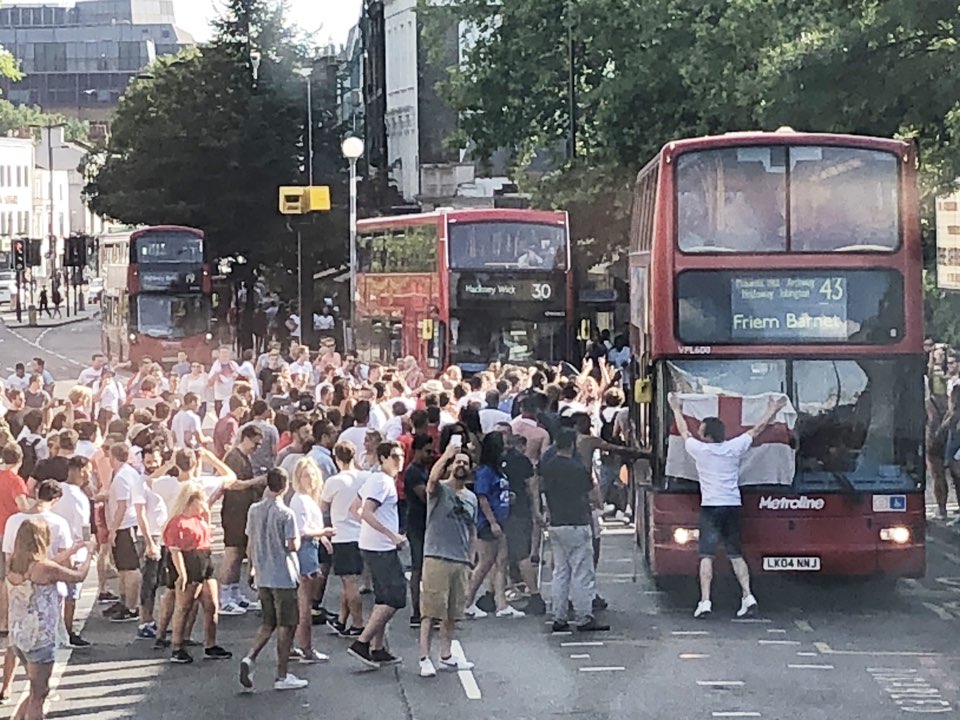 All over the streets outside pubs, mobs of men with St. George flags celebrate jubilantly, blocking traffic and chicken-dancing on the roofs of trapped cars; it's a big boffo day out, like everyone's best mate's stag do. The police come some twenty minutes later and move them on, in their own good time; they’re good lads, just a little overexcited. Hours later, and packs of blokes walk the streets, bellowing out ugly chants about German bombers. We are England, they seem to chant: the English, the English-speaking world, riding the ascending surge of the age. Donald Trump, the commander-in-chief of the English-speaking peoples, is ultimately our leader. Boris Johnson is our shit Churchill for this shit age. Human rights, social justice, Political Correctness, Cultural Marxism, the Frogs and Krauts and all their vino-drinking, garlic-eating chums, all lie vanquished under our boots. And we’re just getting started.
The word on the street here is that the Cup is coming home: home being, of course, England. This is, of course, wishful thinking, but at this stage, it is more plausible than at any recent time. Meanwhile, outside of football, Britain struggles with the consequences of a decision to leave the EU, that has been doubled down upon repeatedly even as it began to look increasingly dubious: Parliament was whipped to irreversibly tear the brakes out of the moving car and throw them out the window. Now, as funding irregularities and connections with Russian government officials emerge, some are talking about the inevitability of a second referendum. If Britain does look like winning the World Cup, perhaps we can expect to see Westminster do a rapid volte-face, approving a second referendum and rushing it through to happen within 24 hours of the victory celebration, in the hope that a groundswell of triumphalism will translate to an increased Leave majority. And in his room deep underneath the Kremlin, the chaos-magus Aleksandr Dugin watches with a smile, knowing that everything is falling into place exactly to plan.
Brexit, Trump and one world cup, all under the watchful eyes of the Kremlin.
2016/6/26
As of Friday morning, all hell has broken loose in the UK.
As nobody predicted*, the British voting public voted to leave the EU, 52% to 48%. Well, the English and Welsh voting public, mostly; Scotland and Northern Ireland voted strongly to remain. Immediately, things started going tits-up. The pound cratered, experiencing its largest drop in value since the Major government's withdrawal from the European exchange rate mechanism. Meanwhile, Google reported a surge in searches for “what is the EU” and “what happens if we leave the EU”, and the media began filling with reports of sheepish voters saying that they voted Leave because they expected Remain to win and just wanted to show their anger at the political class. Meanwhile, as soon as the result was safely in, the anti-EU politicians who backed the Leave campaign started to walk back their promises. There would be no £350 million for the NHS, no sudden end to the rights of foreigners to breathe our precious British air, no abolition of the VAT on power bills. Cornwall, which voted strongly to leave, nervously demanded reassurance that the hefty EU funding it gets would be replaced, pound for pound, from all the money not being sent to the garlic-eating crooks in Brussels; the silence with which its inquiries were answered must have done little to reassure it. A petition to have a second referendum (which, it turns out ironically, had been started before the result by a Leave supporter wanting to keep his anti-EU crusade alive in the event of a defeat) has, to date, received three and a half million signatures; this figure is still climbing.
The only people who did well out of this were the far right, who found themselves legitimised and emboldened. No longer was xenophobia something to deny, or tenuously rationalise, but a natural part of the order of Man; loathing and disgust for those unlike ourselves are nothing to be ashamed of, the message said, but perfectly natural and normal; indeed, perhaps it's those who don't feel visceral revulsion of the Other that are abnormal or sick. The far right and various bigots lost no time in taking this lesson to heart and intimidating foreign-looking people; all over Britain, Polish families found threatening letters in their letterboxes, a community centre was vandalised, and dark-skinned people found themselves being told by strangers (who, presumably, lacked the intellectual nous to know that they were probably not EU passport holders) that they're next. Even Laurie Penny, the (white, London-born) cyber-Rosa Luxembourg of this age, was told to go home by a man wearing a St. George's flag as a cape, because she looked like an art student, and thus wasn't, in his opinion, really English. I must say that, to an Australian, all this sounds uncomfortably familiar, right down to the wearing of flags as capes and/or markers of belligerent idiocy. (Incidentally, Penny's analysis of Brexit is well worth reading.)
Having realised that they had set the country on a course for economic, if not political, devastation, politicians in Westminster started to panic. A defeated David Cameron resigned tearfully, undoubtedly freighted with the complicatedly mixed feelings that he'd no longer be remembered primarily for having sexually interfered with a pig's head, but for something far, far worse. In doing so, he stated that it would not be him but his successor on whom the responsibility for pushing down the detonator and starting Britain's irrevocable exit from the EU would fall. All the obvious candidates in the Conservative Party hastily demurred; now now, they said, there's no need to be hasty. Britain had climbed out onto the ledge and announced its intention to jump, but upon seeing the distance to the hard ground below, was having second thoughts. This wasn't good enough for EU officials, who insisted that Britain had chosen to jump, and must now jump quickly, before the uncertainty upsets their markets (and also, so that the big gory splat serves as a warning to their own domestic Euro-refuseniks, now agitating for the chance to leave), and if it doesn't, they'll consult with lawyers to see if they can give it a helpful push.
Meanwhile, in staunchly pro-EU Scotland and Northern Ireland, things started to get interesting. Scotland's First Minister Nicola Sturgeon wasted no time, announcing that legislation for a second Scottish independence referendum was being drawn up, and that EU consuls would be invited to a summit in Edinburgh within two weeks to discuss ways of keeping Scotland in the EU. There was also the possibility that Scotland and Northern Ireland's legislatures may be able to veto the process of secession; this is disputed by some constitutional experts, though given the labyrinthine complexity of Britain's constitution (which is actually a collection of many documents), it may inject some doubt into the equation, or at least compel Whitehall to let Scotland have its referendum and leave. (After the last Scottish referendum, the issue was declared resolved for all time; theoretically, if Whitehall forbade a second referendum and the Scottish government went ahead with it, those involved could possibly be charged with treason. Much as the rebels of the Irish Easter Rising, a hundred years ago, were; that, of course, didn't end well for the unity of the Kingdom.)
So the pound is tanking, financial companies based in London (who comprise a big part of Britain's economy) are scoping out office space in Frankfurt and Dublin, and our elected leaders are falling on their swords, knifing each other in the back, or playing hot-potato with a live grenade, whilst those who pulled the pin out wonder whether it would be possible to, somehow, find it and put it back in; meanwhile, neo-Nazis are using this as official sanction to attack anyone they regard as not belonging. Welcome to Britain, 2016.
Oh, and in the time it took to write this article, an additional 18,000 or so people have signed the petition.
* YouGov came closest to predicting it, but got the sides the other way around, predicting a 52% win for Remain.
2015/5/4
In two days, the United Kingdom will go to the polls to elect a new parliament. It is all but certain that this will result in a hung parliament, the exact nature and composition of the next government will not be known for weeks afterward, and the government will be a fractious and unstable one.
The last general election, in 2010, also produced a hung parliament. The Conservatives won more seats than Labour, though nowhere near enough to govern in their own right; the cards were held by the Liberal Democrats, then seen as a modern centre-left party, free of both the patrician hauteur and residual Thatcherite toxicity of the Tories and the oily Blairite triangulation, Blunkettian authoritarianism and half-buried old-school socialism of the Labour Party; consequently, throughout the campaign, they were vilified pitilessly by the (then dominant) Murdoch press and right-wing tabloids. After the election, the tone changed rapidly, and both parties courted the Lib Dems as a governing partner. The Lib Dems ended up going with the Tories, promising to moderate their nastier extremes, and promptly betrayed their electoral manifesto by voting for a sharp increase in university tuition fees, in return for a Tory promise to back a referendum on electoral reform. The Tories won that one through sheer cunning; by the time the referendum came around, the sting of the Lib Dems' betrayal was still sharp in the minds of the progressive end of the electorate, and the Lib Dems' electoral reforms were voted down two to one, mostly because people really wanted to give them a good kicking. And it looks like they still do; in the upcoming election, they are staring at a massive parliamentary wipe-out; indeed, the only thing protecting their moderately right-leaning leader, Nick Clegg, from losing his own seat (in the student-populated seat of Sheffield Hallam) is Tory voters in his electorate tactically backing him, presumably as he's a known quantity with whom they can do a deal.
The elephant in the room is, of course, what Charles Stross has termed the Scottish Political Singularity; in a nutshell, politics in Scotland has become detached from the rest of the United Kingdom in a way that looks unlikely to be reversed. This process began when Margaret Thatcher, in her characteristic measured wisdom, decided to use Scotland as a testbed for her unpopular and regressive poll tax; as a result, the Conservative Party (which, at its height, had enjoyed wide support north of the border, what with the Protestant work ethic and all that) declined to a desultory rump. In the past several parliaments, the Tories had merely one MP north of the border, which, as is widely reported, is one fewer than the number of giant pandas in Scotland. Of course, Labour made hay from this, packing their Blair-era cabinets with Scottish MPs, elected by the Tory-loathing descendants of Glaswegian shipworkers and Aberdonian oil riggers, safe in the knowledge that they could triangulate rightward as far as tactics demanded without losing support for at least a generation. But then, the independence referendum happened, and while the No side won comfortably, the sight of Labour joining with the Tories in vociferously opposing independence did it for them. If the polls are to be believed, Labour (or, as they're known in Scotland, the Red Tories) are facing all but electoral annihilation north of the border, and the Scottish National Party—once a single-issue pro-independence party, now the seemingly natural party of Scotland's own devolved government, promoting itself as a broad centre-left social-democratic party, with a few sops to religious conservatism—looks set to take an overwhelming majority of Scottish seats in Westminster. The result of this is that, even though the Tories and Lib Dems are set to fall short of a majority (or even the Tories, Lib Dems and the hard-right reactionary party UKIP, if the three could somehow stomach each other for long enough), Labour will also fall short, and the SNP look set to be kingmakers.
This is, of course, a massive problem for both major parties. The SNP have ruled out forming a coalition with the Tories, for obvious reasons, though have extended an offer of mutual support to Labour, suggesting that they could help Labour be bolder (i.e., move away from the Blairite centre-right and sharply to the left). Of course, the tabloids had a field day with the prospect of the Northern barbarians dictating policy, and the Labour leader, Ed Miliband, ruled out any sort of deal with the SNP, saying that if Labour cannot govern without them, there will not be a Labour government, full stop. The presumable tactical goal of this is to scare Scottish voters into flocking back into the Labour fold, in the hope that enough Labour MPs will be returned to get a majority. This is the sort of thing that the Americans call a “Hail Mary pass”; a desperate last-ditch attempt to snatch a highly improbable victory from the jaws of almost certain defeat.
What will happen if (as polls predict) there is a hung parliament, but Labour plus the SNP would have a majority, is uncertain. Miliband could stick to his word, fall on his sword, and let Cameron assemble a fractious minority government (attempting to get the handful of surviving Lib Dems and the triumphant UKIPpers singing from the same hymn sheet), having the luxury of toying with it from the opposition benches as a cat does with a dying mouse; the downside of this would be that the Tories would still be the government, and even if the government does fall long before the end of its five-year term, there's no guarantee of which way the next election would go (and the Tories, it must be said, have the advantage in campaign fund raising). Or he could swallow his words and do a deal with the SNP, undoubtedly coming up with some lawyerly rationalisation for why he is not actually doing a deal with the SNP but instead doing something entirely different. (Whether Labour and the SNP could come to an agreement is another matter; the SNP seem less likely to fold on their red-line issues, such as the scrapping of the Trident nuclear missile system, than the Lib Dems were; and, indeed, a noble defeat hastening the breakup of the United Kingdom may be what the SNP want.) Or the result could be the formerly unthinkable: a Conservative-Labour rainbow coalition, a “government of national unity” of a kind unheard of in peacetime, with everybody else (the rebellious Scots nationalists, the cranky English nationalists, the convalescing Lib Dems, and Brighton's Green MP, Caroline Lucas) forming a somewhat chaotic opposition. Such a government would have very little in the way of representation north of the border, and would probably do little to dampen down the still smouldering embers of the secessionist mood. (If the Tories deliver on their promise of a referendum on leaving the EU, all bets are off; Scotland favours EU membership a lot more strongly than England does.)
To add to this, there is another wildcard: Her Royal Highness Princess Charlotte Elizabeth Diana of Cambridge, Saviour Of The Union, also known as the newly-born Royal Baby. Announced in the weeks before the Scottish independence referendum, the Royal Baby, whilst still a mere zygote, may have saved the Kingdom (for now, at least); and now, whilst yet functionally little more than a digestive tract, there is the prospect that she may do the same for David Cameron's Prime Ministership. The theory goes that the groundswell of uncritical patriotism, taking the form of an acceptance of the deep, ineffable rightness of deference to an archaic, ceremonial system of nobility, should rub off to some extent on the patrician Cameron (who is, after all, Queen Elizabeth II's fifth cousin once removed); and if not, surely the omnipresent Union Jack bunting and spontaneous Royal Baby tea parties in every street, where everyone—the Morrises and MacLeods, the Khans and Kowalczyks—come together to sing God Save The Queen in unison, should take the edge off dissatisfaction with the government of the day by polling day. Or perhaps not; the Guardian's Zoe Williams thinks that the Royal Baby may have the opposite effect (by virtue of being a baby, rather than being royal).
The upshot of all this is: we live in interesting times, and it'll take a long time for the dust to settle. At this stage, it is not at all clear who will be Prime Minister after the next election.
2011/7/11
The Independent has a piece on the cultural differences between England and France, specifically pertaining to the question of lunch, which, in France, is an epicurean ritual taking several hours, whilst in England, is a takeaway sandwich, often efficiently consumed at one's desk (time is money, after all):
The French have the guillotine to thank for that. French food culture really took off when the princes of the Ancien Régime – who had spent most of the 1770s and 1780s gorging themselves – took off into exile. Along with their châteaux, they left their armies of chefs behind, who, sensing the way the wind was blowing, set up restaurants to feed the rising men of the middle class.
Mrs Beeton's Book of Household Management, published in 1861 for England's housewives, did not contain a chapter on "The Foundations of Pleasure", as Brillat-Savarin's had done. Sensuous pleasure in lunching and dining was for someone else – probably for venal foreigners or, as English writer Hannah Glasse said, those men who, full of "blind folly", employed a French chef and "their tricks". "They would," she harrumphed in her book Everlasting Syllabub and the Art of Carving, "rather be imposed on by a French Booby than give encouragement to a good English cook."There was a time when Continental influences started making inroads into Britain—the two or three decades from the end of post-WW2 austerity —but Thatcherism and the cult of yuppie power-efficiency all but put paid to such profligacy and very un-British decadence, and restored the traditional English order—utilitarian, empirical, with undertones of a very Protestant puritanism—to the lunch hour, bolstered by the ascendant imperative of Anglocapitalism:
By the Eighties, simple pleasures became uneconomical. The Prime Minister gave up sleeping and lunch was for wimps. Well-upholstered City gents, who had previously led the vanguard of British lunching in the restaurants of St James's, were to be found, prawn sandwich in hand, in front of a trading screen in a glass box in Canary Wharf. "We were back to where we started: lunch as fuel to power us into the afternoon," Vogler says.Meanwhile, where Anglocapitalist modes of gastronomy—i.e., le junk food—infiltranted France, even where they succeeded, they became coopted by French cultural norms on how one relates to food:
Recent headlines proclaiming France to be the second-most profitable market for Ronald and Co (after the US) are true but that's because, as The New York Times points out, the French go to the fast-food chain less often but spend much more, ordering "more than one course" as they would in any other restaurant.
2011/6/17
Thames Town is a near-perfect replica of a model English market town, located 30 kilometres from Shanghai, replete with nonfunctional shops (peeling letters on the door of "Mike's Records" offer a selection of "blue soul" and "world music"), a pew-less stone church, red phone booths, areas with names like "Austen Garden", "Soho Area" and "Old Town Square", and more mock-Tudor timber framing than you could shake a stick at. It built over the past decade (along with eight other themed towns, including American, German, Italian and Swedish ones), and intended to accommodate 10,000 inhabitants. Unfortunately for its developers, living in a shanzhai little England didn't prove as popular as anticipated, and next to nobody actually lives there. The only industry currently thriving in Thames Town is wedding photography. (Though if they ever decide to do another remake of The Prisoner, perhaps they could film it there.) There is a photo set from Thames Town here.
2008/9/3
In December 1969, a young man from the south of England decided, under the influence of kitchen-sink films, to go to the North with his camera and capture the stark beauty of the old North on film before it disappeared forever. Some decades later, he got a Flickr account, scanned his photos and posted them here. Most of them are in black and white, and many are quite beautiful, in a somewhat bleak, sparse sort of way.
The photographs, which are generally beautifully shot, are accompanied by the photographer's descriptions of the scenes, in which he laments the passing of the old grim north, and the Southernisation of England, with the arrival of things such as pebbledash, holidays to Florida and even the Clean Air Act. Which does at times seem somewhat problematic; I suspect that the residents of Moss Side or St. Helens would quite happily sacrifice the bleak poignancy of their streetscapes for holidays in the sun and indoor lavatories (not to mention not dying prematurely from the effects of air pollution), though other pieces (such as this one about lost opportunities for childrens' play and this lengthy meditation on fleeting experience and the beauty in the mundane are simply sublime.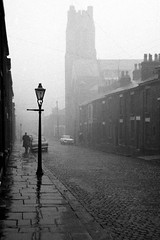


2008/8/13
It has long been said that it's grim up north, and now a new report by a right-wing think tank claims that the north of England is doomed and should be abandoned. The report by Policy Exchange, a think tank closely connected to the Conservative Party, states that northern cities which sprung up during the industrial revolution, and declined with the collapse of manufacturing, are beyond hope of regeneration:
The authors concluded that coastal cities like Liverpool and Sunderland had "lost much of their raison d'etre" with the decline of shipping and had "little prospect of offering their residents the standard of living to which they aspire".
It was time to be "realistic about the ability of cities such as Manchester, Leeds and Newcastle to regenerate struggling nearby towns such as Liverpool, Bradford and Sunderland.The solution, the report suggests, would be to encourage those residing in the north to move to the south-east of England. In particular, in the Information Age, Oxford and Cambridge would expand into vast, thriving cities, much as Liverpool and Manchester did during the industrial revolution, and the outskirts of these cities should be where large numbers of new homes for emigrating Northerners should be built:
"We should consider expanding both dramatically, just as Liverpool and Manchester expanded in the 19th Century. Dynamic economies require dynamic economic geography."The Tories, aware of their historically poor showing in the North, have been quick to dismiss the report, swearing up and down that it does not represent Conservative policy, and that, should the voters see fit to elect them, they are comitted to regenerating the North.
2008/4/9
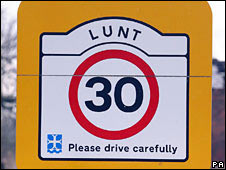 The Merseyside village of Lunt is considering changing its name to Launt, because of vandals who keep altering signs in the village, changing the 'L' to a 'C'. The village (records of which date back to 1251) has never been referred to as "Launt", and some villagers are loth to change its ancient name.
Alternately, they could twin the village with the Austrian village of Fucking (whose own villagers voted in 2004 against changing its name).
2008/4/2
It is apparently possible to travel around England entirely by local bus, if one doesn't mind doing so at a leisurely pace. And here are the timetables for getting from Penzance to Berwick-upon-Tweed entirely on local buses; the journey takes six days.
Other than obsessive bus anoraks (of which there must be some), this may be of interest to thrifty pensioners, for whom local buses across England have just become entirely free. Though, judging by the comments, not everyone's happy with that:
These baby boomers really know how to look after themselves. Their war veteran parents over the last 20 years had to pay. Never heard them getting free national bus travel. And their kids had to get out big loans to go to University while they got full grants. The FREEBIE generation.
Jon, Northumberland
Misguided, that word "free"! Yes, the pensioners will get a nice free ride but everyone else will be forced to subsidise it via higher bus prices. Good PR for the government; everyone else however will suffer further price increases. The bus companies will not let us off the hook as they still have to pay for the services. Gordon Brown cheers
Richard Kendrick, Leeds
2007/11/6
With the completion of the new high-speed rail corridor for Eurostar, Britain has finally joined the European fast rail party. Or, more precisely, the south east of England has, as the rest of the country stares forlornly at the Eurostar passing it by and/or books another Ryanair flight:
This marks a kind of betrayal. When, 21 years ago, François Mitterrand and Margaret Thatcher signed an agreement to build a rail tunnel between the UK and France, the benefits for South-east England were to be shared with the rest of Britain by virtue of a range of regional services. Plymouth would enjoy an overnight link with Brussels, while travellers from Cardiff could catch a train direct to Paris.
Over the years, this pretence was maintained at vast expense: rolling stock for Eurostar Regional was built; a catering shed was constructed at Manchester Piccadilly; and timetables at Edinburgh Waverley showed the schedules for a couple of seasons.
The result of this development will be clearer later this month, when the new high-speed Eurostar train service beds in. After an encouraging (but very brief) northbound start, it will swerve east, cross the East Coast main line and disappear into a hole in the ground. This, the "London Tunnel" , emerges 11 miles later in the Labour-voting wastes of southern Essex – an eccentric route reached following a political decision by the last Conservative government, keen to avoid upsetting the voters in key Kentish constituencies.The new link—dubbed, perhaps optimistically, "High Speed 1"—will allow trains to travel between London and the Channel Tunnel at 186mph (or 300km/h, if you're European), bringing the Continent a lot closer (the French port of Calais is now just under one hour out of London, which would (passports and ticket costs notwithstanding) place it within London's commuter belt). Once you're at Brussels-Midi, Europe's existing high-speed rail network (funded by wasteful Eurosocialist largesse in place of the British penny-pinching that's efficiently packing commuters in like sardines as it squeezes the last bit of utility out of the nation's creaking railway infrastructure) will take care of the rest. And as Europe gets closer, destinations in Britain get relatively more distant:
With trains to Brussels taking only 111 minutes, Norwich, Cardiff and Exeter share the ignominy of longer journey times. While the fastest trains to Leeds and Manchester narrowly beat those to Paris, the cities of Sheffield and Liverpool take longer to reach than the French capital.
Hull will suffer the ignominy of taking exactly the same length of time to reach from St Pancras as Disneyland Paris (and being considerably less fun when you get there).
Two locations are tantalisingly just three minutes over 10 hours away: Fort William in the West Highlands of Scotland, and Berlin. Given the investment pouring into rail at the heart of Europe, Germany's capital will beat the 10-hour barrier well before the western end of the Caledonian Canal – which relies on rail infrastructure almost as old as the inland waterway.The article concludes with a list of the "20 top new rail destinations" on the Continent, each with an equivalent UK trip; Brussels is twinned with Bristol, Lyon with Glasgow, and Cologne (in the German hinterland) with Aberystwyth. The French Riviera is now officially closer than the Welsh Riviera.
There are vague noises about linking London to Birmingham by high-speed rail (that's the European definition of "high-speed", not the feeble local substitute). As for anywhere further north; forget it. It's unlikely that anyone living today will see a 300km/h rail link between London and Scotland (one such idea was floated a while ago, before being scrapped in favour of the more "sensible" alternative of making do with what we have). Then again, maybe if the oil crash really bites and cheap flights evaporate, priorities will shift somewhat.
Another unanticipated consequence of the shift in effective distances may be an undermining of Britain's traditionally isolationist outlook. When the north of France is firmly in the London commuter belt and moneyed Londoners start considering making homes there, will they stand for spending an hour each day going through passport control? There could be new pressure to get Britain to sign the Schengen treaty and abolish border controls with the EU. Granted, the counter-pressure from the Daily Mail Little Englanders, with their visions of dirty hordes of disease-carrying paedoterrorist welfare cheats at the inadequately fortified gates, is a pretty solid obstacle, though whether it will be so in a generation's time is an open question. Perhaps the Channel Tunnel will have turned out to be the trojan horse Mitterrand intended it as?
2007/9/18
After undergoing brain surgery for life-threatening meningitis, a 10-year-old boy from York awoke with an upper-class English accent:
"We went on a family holiday to Northumberland and he was playing on the beach and he said, 'Look, I've made a sand castle' but really stretched the vowels, which made him sound really posh," Mrs McCartney-Moore said.
"We all just stared back at him - we couldn't believe what we had heard, because he had a Yorkshire accent before his illness.
"He had no idea why we were staring at him - he just thought he was speaking normally."If young William's new posh accent is the result of incidental neurological damage to the speech centres of his brain, does it follow that people who naturally speak like that are neurologically defective? The jokes pretty much write themselves.
2007/8/9
After publishing a best-selling crime novel detailing a gruesome torture and murder, Polish crime novelist Krystian Bala has been charged with a similar murder which happened a few years earlier, the victim having been a friend of his ex-wife:
The case was broadcast on Poland’s version of the BBC television programme Crimewatch but it produced no serious leads — only some strange e-mails sent from internet cafés in Indonesia and South Korea, describing the murder as “the perfect crime”.
The first break for the police came when they discovered that Mr Bala, a highly experienced diver, was on a diving trip to South Korea and Indonesia at the time that the e-mails were sent. Then they discovered that he had sold a mobile phone four days after the body of Dariusz J was discovered. It was the same model that the victim was known to have owned, but that police had never found.
Mr Bala offered to take a lie-detector test to prove his innocence and passed. When the transcripts were read out in court, the judge was struck by the very long pauses taken by Mr Bala before answering, a technique that may allow a suspect to mask the physical signs of lying.Of course, that doesn't mean that he did it, though it does start to look somewhat suspicious.
Meanwhile, some light has been shed on another murder mystery, the whereabouts of Lord Lucan; some people, including a retired Scotland Yard detective believe that the disgraced peer, who may have bludgeoned his family nanny to death, is living out of a car in New Zealand, with a cat and a pet possum, no less:
Neighbours say the man has an upper-class English accent and a military bearing like Lord Lucan, who was educated at Eton before serving in the Coldstream Guards.
He is said to have arrived in New Zealand about the time Lucan disappeared and is also understood to be receiving money from property he owns in Britain.
2007/6/2
A family in the Northern English city of Newcastle claim that they have been forced to move home twice afrer being violently persecuted for their red hair. WTF? That's insane.
2006/7/26
2006/7/21
As part of a section on the significant chunk of the population of Poland moving to Britain, today's Grauniad has a slightly facetious guide to British culture (in English and Polish).
1 Why do you ask people "how are you?" if you don't care about the answer?
Britain is a nation built upon appearances. We pretend to be richer, happier and probably nicer than we actually are, and glean some small grain of superiority in doing so. Asking "how are you?" is the quotidian incarnation of this trait. We don't actually care how you are, we are merely giving some semblance of caring, so that at all times we can retain the moral high ground. For further examples of this, perhaps study Keeping Up Appearances, the early 90s BBC sitcom starring Patricia Routledge, or the letters page of the Times. It is also worth pointing out that to be asked "how are you?" in a disgruntled British fashion is perhaps not so affronting as to be bid "have a nice day!" by some sunny-side up American.
4 Why do women here wear open-toed sandals in deepest winter?The guide goes on to cover such perplexing phenomena as the prices of rail tickets, the full English breakfast, and the peculiar habit of eating chips with vinegar (something I never understood either).
In Britain, women are highly prized for their hardiness. We have a popular saying: "Is she rugged as a goat? Then she is for me!" Hence a woman spotted out on a February evening in the most northerly quarters of the isle wearing nothing but a short, skimpy frock is valued far above any woman in a sensible coat. A less extreme interpretation is for a woman to sport open-toed sandals, regardless of the inclement weather; to us, it is as erotic as a burst of cleavage, or a glimpse of a lady's ankle.
2006/6/9
As football mania sweeps England and one scarcely sees a white van or large shaven-headed geezer without a dozen St. George's flags, England's neighbours are reacting to the conflagration of jingoism in different ways. In North Wales, the heartland of Welsh nationalism, a police chief has warned England fans to avoid flying the flag for fear of antagonising Welsh fans. Meanwhile, up in Scotland (a nation which usually supports whoever's playing against England; it's not uncommon to see Scots declaring themselves as honorary Bosnians or Ghanaians or whatever for the duration of a football match), schoolchildren who say bad things about the sassenach will be excluded from classrooms.
2006/1/20
Hertfordshire police raid reality-TV show, seizing a fur coat belonging to lead singer of 1980s glam-pop group Dead Or Alive and catty transvestite, Pete Burns, after he claimed that it was made of gorilla fur; the police have warned Burns that he may face five years in prison if it is, in fact, made of gorilla fur, which is prohibited under endangered-species legislation. Hardcore animal-rights advocates PETA praise the Hertfordshire Constabulary's actions, as this is exactly the sort of thing police should be making a priority; that and prosecuting meat-eaters for murder and pet owners for false imprisonment and such. Meanwhile, blogging magistrate Bystander is not amused:
We are told, often correctly, that some of our fellow citizens are afraid to leave their homes, that drug crime is rampant, and anarchy rules our sink estates. So the 'Wildlife Officer' (what's wrong with having a few 'lowlife officers'?) sits down with museum experts to investigate the provenance of a coat. Yes, that's right, a coat. Meanwhile, in court today, I have been forced to adjourn a number of cases because the 'overstretched' police haven't provided information to the CPS in time to allow a trial to proceed.
2005/11/17
You learn something new every day. Apparently, in England, it is illegal to sell anything that looks, smells or feels like a piece of fruit but isn't:
Novelty candles that look like strawberries or apples are a legal no-no, and shops that sell them can be heavily fined (up to £20,000) because of the danger of children eating them.I wonder if that's enforced, and whether you have the Fruit Squad raiding import shops in shabby high streets and seizing bunches of plastic grapes and such.
I guess this means you won't be seeing fruit-shaped fairy lights or banana-shaped mobile-phone cozies in England any time soon. It's a good thing that there's no law against selling things that look like sushi but aren't
(via thelawwestofealingbroadway) ¶ 0
2005/10/27
England is to ban food from pubs, after a compromise public smoking ban is thrashed out by New Labour. The ban will fall short of blanket smoking bans, such as the ones in Scotland and Ireland (and even Wales, which, whilst being governed by English law, has been given the right to ban smoking), and will ban smoking from any pubs which serve food. Which means that pubs have to choose between axing the haddock and chips and turning away their smoking clientele.
The smoking ban also highlights an asymmetry in British government: one of the main opponents of a full smoking ban was former health secretary John Reid, a MP from a Scottish constituency.
2005/9/6
A (possibly somewhat biased) social history of drinking in England reveals that talk of a pathology of "binge drinking" is more the product of Victorian squeamishness and snobbery than anything else:
In fact we are rather poor drinkers compared with our ancestors. Queen Elizabeth I was renowned for drinking ale stronger than any of her courtiers could take. During her reign, British beers were so popular abroad that exports were only permitted if sufficient quantities of wood to replace the casks used was imported. Elizabethan brewers were often urged to reduce the formidable strengths of their beers, one of which, Pharaoh, was so named because it "would not let the people go". James took a similar line, only to be told that the brewers would be more minded to follow his advice were he rather more prompt in settling his bills.
Expressions like "binge drinking" tell us less about our present drinking habits than they do about the neo-Puritan climate we live in. In truth the drinking habits of many have not changed greatly, but they are seen from the standpoint of a society that does not recognise that the values and attitudes of the late Victorian and Edwardian eras were the exception rather than the rule.
Meanwhile, England's drinking problems come not from an excess love for beer, but ultimately from its displacement by things such as gin.
Gin forced people to realise for the first time that it was possible to make intoxicating beverages that were not sustaining and wholesome, and from then it was but a short step to demonising alcohol in all its guises, to separate the middle and upper classes from their previous habits and haunts, and to allow them to convince themselves that their domestic consumption of wine and gin was somehow superior. This attitude prevails today, principally perpetuated by newspapers.
The author, former secretary general of the Society of Independent Brewers, concludes to say that getting smashed on good English ale can be a fine thing indeed:
If journalists would stop writing hysterical leaders about "24-hour drinking" and turn their hands instead to thoughtful drinks page features about the merits of our national drink, that would be useful in improving debate and reconnecting us with our forgotten history. Drunkenness is an attribute of those who do not appreciate what they are consuming, not of those who do.
2005/6/13
Your Humble Narrator recently travelled out of London and stayed briefly in the town of Brockenhurst, on the border of the somewhat misnamed New Forest.
Brockenhurst is a small country town in Hampshire (south-west of London); it either is or was cattle-farming country; at any time, there are cows and horses wandering about, and streets are fitted with strategically-placed cattle grids (as are many driveways). I was struck by how similar it looked to Australian country towns; of course, Australia got its agricultural and civic traditions mostly from Britain, but I didn't think there'd be so much similarity; the streets are slightly narrower, the houses older, and there are no eucalypts, but other than that, Brockenhurst could easily have been somewhere near Echuca or Dubbo. Except, possibly, for the pictures apparently mocking an Australian sports team above the bar at the pub:
During his stay there, Your Humble Narrator managed to bicycle through the New Forest proper. It's quite a picturesque place; contrary to the name, it's not new, but one of the largest stretches of original forest in Britain, having been preserved since the time of William the Conqueror (who used it as a hunting preserve). It's also inhabited by wild ponies, which roam pretty much at will (except for fenced areas where they are kept out, as not to eat newly-planted trees and such). Anyway, there are some photos here.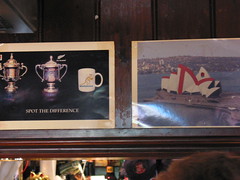
2004/9/9
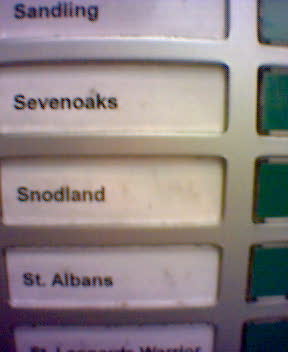
"Snodland" sounds more like a video game (of the colourful platform/puzzle variety) than a place in the south of England, though, apparently, that's what it is.
2004/6/26
I finally got around to going to see that climate-change disaster-porn film that various US "liberals" were acclaiming as a progressive Passion of the Christ. It was much as I expected it to be.
In short, the visuals were spectacular (about half a dozen SFX firms were credited), with magnificent sets and computer graphics sequences. The characterisation and plot was pure Hollywood formula, with a very linear plot and characters having only the simplest of motivations, and, half the time, thinking in schmaltzy Hallmark-card truisms. Mind you, it being from Roland Emmerich (and the sub-Spielbergian sequence from Independence Day of the towheaded little boy and his dog watching Will Smith take off to battle the aliens still sticks in my mind), I wasn't expecting anything above the lowest common denominator in this respect, so I wasn't disappointed. (Some day, I'd like to see a visually spectacular film whose characters are more than focus-grouped, computer-plotted cardboard cutouts, but I digress.) The science, of course, was exaggerated by orders of magnitude to make it more spectacular (running afoul of the laws of physics in places, such as the instant temperature drop), and some of the details were a bit geographically ignorant (such as the scene with the whisky in the Scottish research station; someone there either assumed that Scotland was part of England or that most Americans wouldn't know otherwise; I wonder how well this film will do in, say, Glasgow or somewhere). Then again, none of that was a huge surprise; as I said, it's special-effects porn, and porn films of any variety aren't known for their plotting or characterisation.