The Null Device
Posts matching tags 'fake'
2011/10/24
And more on the subject of Siri; while the technology is available only on Apple's iOS platform (and currently only on the latest and greatest iPhone), an Android software company have taken it upon themselves to make their own version, in an 8-hour hackathon. It's named Iris (see what they did there?), and it sort of works:
Me: Remind me at 9pm to go and buy milk
It Recognised: remindme at 9 pm to go in hawaii
It Replied: I have two pets.
Me: Where is siberia
Replied: Wherever you make it I guess
Q: Where can I get a recipe for cheesecake?If one views this as a competitor to Siri, it falls well short (even without the bizarre voice-recognition results, it doesn't seem to contain the sort of evolving model of the user, their relationships and preferences, and the current context that makes a system like Siri work), though one could hardly expect this from an 8-hour hacking session. (If one views it as a publicity stunt to promote Dexetra's other apps, it'll probably be far more successful.) However, as a surrealist tool for injecting chaos into the lives of those who use it, it looks to be far superior, escaping the shackles of bourgeois practicality that constrain Apple's more polished product. Iris looks to be a virtual assistant André Breton could love.
A: En la esquina, con minifalda.
("In the corner, wearing a miniskirt.")
2011/9/25
In his latest Poptimist column, Tom Ewing writes about recordings attributed to imaginary authors, typically at some time in an imagined past. More specifically, he writes about Science Of The Sea, a record allegedly made in 1979 by Jürgen Müller, a German oceanographer and amateur musician who was inspired to make a record of ambient electronic compositions by the hours he spent on field trips out at sea, one of whose 100 privately-pressed copies was apparently rediscovered in 2011:
Except, of course, he probably did no such thing. It seems likely that there never was an expedition, or a young biologist, or a private pressing. Science of the Sea is a 2011 record from fin to tail, and the rather lovely tale of Jürgen Müller is entirely invented. Did suspecting this make me like the record less? Certainly not. If anything, I enjoyed it more. As a small child I would sometimes be allowed to sit up with my parents and watch science documentaries, like Carl Sagan's Cosmos. I didn't understand the science, and the documentaries were broadcast late so I was on the edge of sleep in any case, but I remembered their soothing flow: The infinite turned into a kind of bedtime story. Meanwhile, on library bookshelves I would sometimes find 1950s and 60s paperbacks about modern-day scientist-adventurers like Jacques Cousteau or Thor Heyerdahl-- giving the impression of an age of clean-limbed scientific heroism I'd tantalizingly missed, one that looked very much like a Tintin comic.
So no surprise that some of what I get from Science of the Sea-- there by intention or not-- is a pang of love and loss for this imagined time. More intriguingly, though, if the record is fictional it feels like this might have been liberating for its mysterious creator. The album is full of beautifully cornball seascape touches-- flickering arpeggios and note-clouds which practically demand you start thinking about shoals of fish darting back and forth outside a bathysphere window. Sit down and make an electronic album about the ocean now and you might find yourself trying to dodge these clichés. Sit down and role-play a naive non-musician inching towards transcendence at the turn of the 1980s and you can fully embrace them.Science Of The Sea is not the only recent example of its kind; another recent recording shedding light on an underexplored, romantic and distinctly alien corner of the modern past was the retrospective of the Endless House Foundation. The conceit of Endless House presents an experimental electronic music collective, founded in the early 1970s by an eccentric, wealthy Czech audiophile, situated in an ultra-modernistic studio/discotheque complex in the heart of the Bialowieska primeval forest in eastern Poland and informed by the breadth of European avant-garde design and architectural movements of the 20th century, it thrived for must six weeks in the summer of 1973 before collapsing under the weight of its expensive impracticality, leaving behind only some scraps of biographical information, a few ambiguous photographs of improbable architectural spaces, and the curiously pristine recordings of the resident musicians' compositions, which, it seems, prefigured everything from Kraftwerk to Detroit techno, much in the same way that Delia Derbyshire invented IDM in 1965 but neglected to tell the world about it. The fragments have remained buried until recently, when an unnamed British curator unearthed the pieces, and managed to track down the original participants, getting interviews and even a mix, from them.
Of course, it's quite possible that none of this really happened. The story of Endless House reads almost like a Wes Anderson set-piece, only set in a nebulous European avant-garde as seen from outside. Unsurprisingly, the illusion doesn't hold up well to closer examination. For one, the idea that a group of Western European playboys could cross the Iron Curtain with impunity, bringing party guests and giant modular synthesisers with them, while the governments of the Eastern Bloc, still shocked by uprisings in Prague in 1968 and Warsaw in 1970, were in ideological lockdown, seems highly unlikely. (A non-fictional recent musical retrospective of East German electronic music reveals the extent of ideological control over music in the Eastern Bloc; in the DDR, the government only started allowing the production of electronic music in 1980, and even then anything that could be interpreted as critical of industrial society was verboten, leaving room only for ostensibly harmless cosmic psychedelia.) Over and above this, this improbable bubble is populated by a cast of exotically European bons vivants with names like Walter Schnaffs and Felix Uran, who speak in a mixture of English and German, but refer to distances in miles. Nonetheless, if you can suspend disbelief, imagine that the Cold War wasn't that big a deal and that an Austrian synthesist and socialite might sing about being sixteen miles from Saint-Tropez, in an avant-garde cyber-disco about that distance from the Polish-Soviet border, it's an entertaining story, and an even more entertaining record. (The tracks, listened to on their own, work as electronic music, and do evoke the world they purport to come from.)
Meanwhile, in a recent edition of Milan art journal Mousse, there is a retrospective of the works of Scottish-Italian artist Scotty Potenza, written by someone named Nick Currie:
The colour, shape and texture of fresh ice cream is certainly visible in Potenza’s acrylic gouaches; peach, pistachio and purply-red forest berries distinguish themselves forcefully from the sodden greens and asphalt greys of the Scottish industrial landscape. His subject-matter shares this otherness: influenced by the exciting first wave of Acid House culture in the late 1980s, Potenza evinces a non-Calvinist positivity more evocative of Chicago warehouses and Ibiza raves than Glasgow tenements. A Potenza painting incarnates not what Scotland is, but what it lacks.
As 1990s rave culture has continued to experience the bearhug embrace of mainstream acceptance in the UK — its visual values, once restricted to club flyers, now inform restaurant design, public information films and TV commercials for banks and building societies — Potenza has been granted a high-profile list of public commissions. His decoration of the walls of the Home Office lobby with a mural of happy ravers, their hands linked like the figures in Matisse’s La Danse, caused short-lived (and clearly manufactured) outrage in the tabloids, but has proved peculiarly popular with the civil servants who work in the building. A major mural at Finsbury Park underground station entitled Get On One Matey! was unfortunately damaged beyond repair in the 2011 riots. The vandals, caught on CCTV, are currently serving long prison sentences.
2011/6/17
Thames Town is a near-perfect replica of a model English market town, located 30 kilometres from Shanghai, replete with nonfunctional shops (peeling letters on the door of "Mike's Records" offer a selection of "blue soul" and "world music"), a pew-less stone church, red phone booths, areas with names like "Austen Garden", "Soho Area" and "Old Town Square", and more mock-Tudor timber framing than you could shake a stick at. It built over the past decade (along with eight other themed towns, including American, German, Italian and Swedish ones), and intended to accommodate 10,000 inhabitants. Unfortunately for its developers, living in a shanzhai little England didn't prove as popular as anticipated, and next to nobody actually lives there. The only industry currently thriving in Thames Town is wedding photography. (Though if they ever decide to do another remake of The Prisoner, perhaps they could film it there.) There is a photo set from Thames Town here.
2010/9/12
A woman in Germany has been convicted of selling fake art forgeries. Petra Kujau sold forgeries of famous artworks, made by unknown forgers in Asia, to collectors, but attempted to pass them off as the work of famous forger Konrad Kujau (best known for the Hitler Diaries), netting €300,000 in total. She received a two-year suspended sentence.
2008/6/6
 A nursing home in Düsseldolf has come up with a novel way of dealing with stray Alzheimer's patients; they set up a fake bus stop outside the home:
“It sounds funny,” said Old Lions Chairman Franz-Josef Goebel, “but it helps. Our members are 84 years-old on average. Their short-term memory hardly works at all, but the long-term memory is still active. They know the green and yellow bus sign and remember that waiting there means they will go home.” The result is that errant patients now wait for their trip home at the bus stop, before quickly forgetting why they were there in the first place.
(via Boing Boing) ¶ 1
2008/3/5
There are red faces in the Oxfordshire constabulary, after a police officer mistakenly circulated a warning to schools about a made-up drug named "strawberry meth", which led to some schools holding special assemblies. Strawberry meth was apparently meant to be a form of crystal meth flavoured with strawberries, for extra appeal to children, and sold outside schools.
One thing's for sure: today's hoax drugs are more sinister than a decade ago. Back then, all they did was make you perceive a single note as lasting 4 hours, and now they come with the fucking-up power of crystal meth. We live in less innocent, more paranoid times, it seems.
2008/2/10
And the award for chutzpah in music marketing goes to EMI for their "Independent Vol. 2" sampler CD:
This artefact was found at Rough Trade Records, in the area by the door where the free magazines and sampler CDs are left. Note the cover, with its semiotics screaming "keeping it real", with the photo of a lovingly tended independent record shop, and above all things, the blurb: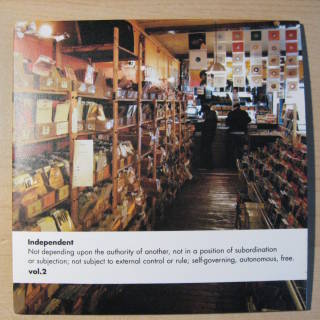
Independent Not depending upon the authority of another, not in a position of subordination or subjection; not subject to external control or rule; self-governing, autonomous, free.Note the word "independent". Not "indie" (which, in today's popular parlance, means music by white boys with guitars, stylists and skinny jeans, and has long since lost any connection to the prickly, unmarketable socialist-contrarian aesthetics of its origins in the Thatcher era), but "independent". If that wasn't enough, the word's definition is given. When we say "independent", the cover seems to say, we mean it
Turning the disc over, however, we see an entirely different story:
It turns out that the record is not actually a compilation of independent artists or recordings from independent labels, but rather a sampler from major label EMI and its various imprints. Granted, some of them are more "alternative" or leftfield than others (veteran post-punk indie label Mute, acquired some years ago, New York mutant-disco imprint DFA, and indie-pop retirement home Heavenly, not to mention Regal, best known for the underground hip-hop of Lily Allen, Voice Of Da Streets). Though somewhere along the way, they stopped trying to fool anyone and slapped on the logos of establishment cornerstones like Capitol and Parlophone.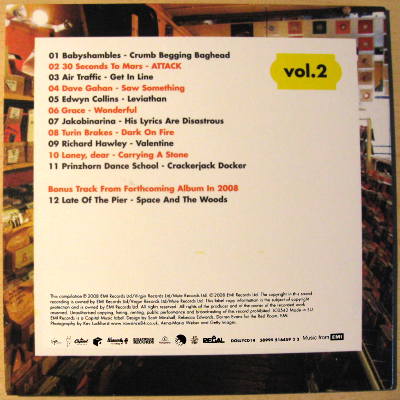
As for the content? Well, there are some interesting bits (Loney, Dear and Jakobinarina, representing Sweden and Iceland respectively), a few credible veterans (Dave Gahan, who appears to have bought a copy of Native Instruments Massive), and some truly dire Carling-indie (the Pete The Junky Show kicking off the record, doing exactly what you, I and The Sun would expect from them), with a fair amount of workmanlike garage rock. Being the sorts of acts that a major label would convince its accountants to pour money into, though, it's considerably more conservative in style and tone than what you'd expect from independent artists. Independent this ain't.
2008/2/8
Norwich-based comedian and reviewer of dubious far-eastern video game machines Dr. Ashen (he's the "sarcastic British guy") reviews the Vii, a cheap video-game console of Chinese manufacture which attempts to imitate the Nintendo Wii without having much of the technical innovation. If you ever wondered what one of those could possibly be like, here's all you need to know. (Capsule summary: don't bother importing one.)
2006/12/1
Making shameless copies of well-known foreign gadgets has been big in China; now, a Chinese company has taken it to a new scale, with an electric Smart car knockoff. The "CMEC City Smart" looks almost indistinguishable from DaimlerChrysler's petrol-powered microcar, has an electric motor, gets up to 55kph/34mph (less than half of the Smart's top speed), and, unless DaimlerChrysler can do something about it, will go on sale in Europe next year for €4,200.
2006/11/8
Property developers in China have created an artificial English town. Located on the outskirts of Shanghai, "Thames Town" contains such quintessentially English essentials as Georgian- and Victorian-style terrace houses, a pub and fish and chip shop and a statue of Winston Churchill. The owner of the original fish and chip shop, in Lyme Regis, meanwhile, is quite annoyed with her business having been copied lock, stock and barrel without permission.
Of course, unless the high street is comprised entirely of chain stores, it's not a real English town but a vaguely Disneylandish (or perhaps Portmeirionesque) idealised one. In any case, it will soon be joined by other European-style developments, with an Italian and German town being planned. And apparently the entire town of Dorchester is being reconstructed in Chengdu, under the name "British Town".
2005/10/18
For a while in the 1980s and early 1990s, you couldn't turn a radio on without hearing something containing the Funky Drummer break, a short length of drumming taken from the eponymous James Brown B-side. Then PolyGram got wise to it and started shaking down anyone using this idiom for licensing fees, and it disappeared.
Now some modular synth hackers have taken up the challenge of replicating the Funky Drummer with a Nord Modular G2. A discussion thread is here (containing downloadable patches but little other info, so people not owning Nord Modular G2s are out of luck), and a MP3 of the reconstructed Funky Drummer is here. It sounds definitely recognisable as the Funky Drummer, though also noticeably different; perhaps one should think of it as the No-Brand Funky Drummer?
Now if someone could port this to, say, Pd or SuperCollider, and/or do versions replicating the Amen break or such from first principles, that would be even cooler.
(via MusicThing) ¶ 0
2004/6/11
Mac lust knows no bounds. Now those who can't afford actual Macs can do their Windows XP PCs to look like Macs, with a set of 10 cosmetic programs, from a menu bar for the top of the screen (I wonder whether it strips the menu bars off application windows, or whether it just takes up extra space) and a dock to Aqua-style window frames and icons, giving you something that looks just like a Mac, only with the usual Windows viruses, worms and spyware. Or perhaps that looks just Maclike enough to remind you of what you're missing out on. (via bOING bOING)
2004/5/30
The credits on dodgy Chinese DVDs (the ones found at computer swap meets) are very informative. Until today, I didn't know that Kill Bill was based on a book by Bryce Courtenay.
2004/2/26
Gibson's Law update: Imaginary Girlfriends, a website connecting gamma-and-below males desperate to prove that they're not losers with pretty girls (or perhaps sweaty middle-aged men pretending to be such) willing to play along, for a fee. The "girlfriends" on the site (all three of them) have that well-scrubbed, wholesomely all-American look reminiscent of teen-slasher movie characters. (via 1.0)
2003/9/4
Postmodern ironies aplenty here: In the manufacturing countries, manufacturing of fake designer clothing has overtaken the legitimate manufacture of such items. Not only that, but the knockoffs are often of superior quality to the legitimate products; oh, and since they're made in the largest quantities, they are often the cheapest clothing on the market. Somewhere in the third world, a slum-dweller is wearing a pair of Levi's better than the one you forked over $100 for.
She had bought herself jeans in Bolivia which were as good as those she could buy anywhere else. "In fact, they are not replicas at all but originals designed for the local market but with a designer label included because otherwise they would not sell," Dr Laurie said.
She had watched a young man operating a laptop computer from a car battery in a tin shack while he downloaded logos from the internet, traced them, and began manufacturing designer labels for local factories.
All this probably also ties into the perils of commodification which have been eating everybody from SCO to the RIAA alive.
2003/7/1
AOL Time Warner's legal rottweilers are aggressively prosecuting Harry Potter-inspired books, from unauthorised fiction using the characters to thematically similar work like Tanya Grotter and the Magic Double-Bass. They have been allowed to do this by recent expansions of intellectual property treaties, which crack down on derived works. Or, another way to think about it: had the treaties been in place decades ago, J.R.R. Tolkien (or his publishers) would have been able to sue the entire fantasy fiction genre out of existence. A side-effect of the neo-Galambosian intellectual-property power-grab by the copyright industry could well be the end of new genres as such, and their replacement by licensed franchises (like the various Matrix tie-ins).
2003/6/10
The latest tool for the modern pick-up artist: fake ATM receipts with unfeasibly large balances written on them. Next time you meet an attractive gold-digger type in a dive bar, jot your number down on one of them (which you happened to have in your pocket; note: don't pull out a pristine new roll of them or you'll blow your cover), and when she (or he) sees "your" balance, they'll call you back straight away. Though if you're going to do that, why not print your own? (via MeFi)
2002/12/29
What is it about trains and public transport that attracts the unhinged? A 21-year-old New York man was arrested for impersonating a Subway motorman -- for the 16th time. Edward Brown, described as a "transit buff", wore a stolen uniform and hung around in subway employee lounges chatting with employees; he says he won't stop doing so until the Transit Authority hires him. (via rotten.com)
2002/9/17
2002/1/8
A woman with the euphonious name of Decca Aitkenhead has written a book about her search for the perfect E (the drug, that is). The Grauniad has published an excerpt, in which her quest takes her to America:
When manufacturers began tampering with Es, they would substitute the cheaper ingredient of amphetamine for MDMA. Then came a spell when pills were laced with a hint of barbiturate, followed by a short but nasty batch of Es containing ketamine, a devastating veterinary anaesthetic. A particularly sneaky substitute is something called MDA, a derivative of MDMA. Popular with drug dealers, it mimics the effects of its chemical cousin for the first 15 minutes but then, very suddenly, it's over - giving the unlucky clubber just enough of a glimpse to tempt them back to buy another. A typical dud pill nowadays contains little more than glucose and caffeine, but MDMA is still out there and the quality of Es varies widely, each new brand quickly acquiring a reputation on the club scene.
2001/2/3
According to the Victorian police, 95% of the "ecstasy" in Australia is fake, containing no MDMA and god only knows what. This is because of Customs stopping most shipments of the real stuff.
So what's in these tablets? Amphetamine is the main ingredient, says Quinn, "but in an attempt to mimic some of the effects of real ecstasy - euphoria, increased energy, pleasurable rushes, feelings of empathy, dreaminess and a hallucinogenic-like glow - producers of the fake pills typically combine various stimulants, hallucinogens and sedatives, depending on what chemicals they have access to... We're also seeing paracetamol; the stimulants pseudoephedrine and ephedrine; and heroin, codeine and cocaine all mixed up in the one tablet. And we've found tiny pieces of LSD tickets pressed inside tablets. We're finding benzodiazepines Temazepam, Diazepam, and Rohypnol, which are all sedatives. There's sometimes caffeine. We've also found Promethazine, a motion-sickness medication, which makes you feel woozy, cloudy, dissociated."
(Which sounds like a good argument for legalising and regulating the substance, like tobacco, in the name of harm minimisation. If there's a market for MDMA, give the buyers something that won't kill them and put the criminals who make fake pills out of business. Unless one accepts the neo-Darwinian argument that people who take recreational drugs with unknown long-term effects are unfit to consume resources and pass on their genes and are best culled from the gene pool.)
2000/6/23
The technology for electronically faking video footage is coming to fruition. And we all know how the street finds its own uses for new technologies...
A demo tape supplied by PVI bolsters the point in the prosaic setting of a suburban parking lot. The scene appears ordinary except for a disturbing feature: Amidst the SUVs and minivans are several parked tanks and one armored behemoth rolling incongruously along. Imagine a tape of virtual Pakistani tanks rolling over the border into India pitched to news outlets as authentic, and you get a feel for the kind of trouble that deceptive imagery could stir up.
Suddenly those large stretches of programming between commercials-the actual show, that is-become available for billions of dollars worth of primetime advertising. PVI's demo tape, for instance, includes a scene in which a Microsoft Windows box appears-virtually, of course-on the shelf of Frasier Crane's studio. This kind of product placement could become more and more important as new video recording technologies such as TiVo and RePlayTV give viewers more power to edit out commercials.
With just a few minutes of video of someone talking, their system captures and stores a set of video snapshots of the way that a person's mouth-area looks and moves when saying different sets of sounds. Drawing from the resulting library of "visemes" makes it possible to depict the person seeming to say anything the producers dream up-including utterances that the subject wouldn't be caught dead saying. In one test application, computer scientist Christoph Bregler, now of Stanford University, and colleagues digitized two minutes of public-domain footage of President John F. Kennedy speaking during the Cuban missile crisis in 1962. Using the resulting viseme library, the researchers created "animations" of Kennedy's mouth saying things he never said, among them, "I never met Forrest Gump."