The Null Device
Posts matching tags 'privatisation'
2015/2/25
Upon seeing the title “The City That Privatised Itself To Death” in this morning's Guardian, I began wondering what gruesomely absurd edge-case of neoliberalism the piece would be about; some bankrupt municipality in the US, perhaps, reduced to selling its fire brigade to Uber-like privateers (who, subsequently, would elude prosecution after having been found actually setting fires) and flogging off tolling rights to its roads; or possibly some once-vibrant city in central America, cracked open like a ripe nut by corporate raiders armed with free-trade treaties and the IMF's full backing, bled dry and reduced to a fortified enclave and a sprawl of miserable shanty towns, their inhabitants busily dying of preventable diseases? But no, it turned out to be the latest Humorous Rant About London Privatisation/Gentrification (so bleak, you have to laugh), this time by a chap named Ian Martin (who, if I recall correctly, has stepped in for Charlie Brooker when he had a column):
Perhaps eminent historians will study London in the early 21st century, see how its poorer inhabitants were driven out, observe how its built environment was slowly boiled to death by privatisation. And they will wonder why people tolerated this transfer of collective wealth from taxpayers to shareholders. And they will perhaps turn their attention to Eduardo Paolozzi’s fabled mosaics at Tottenham Court Road underground station.
Paolozzi's mosaics' significance is, firstly, that they date back to the instance before the privatisation explosion and, more importantly, whatever their artistic merit, they take up space that could be otherwise monetised for advertising, as the owners of the city would will it to be.
You can’t paste an ad on to a wallful of public art. You can’t fix one of those irritating micromovies over it, telling a vacuous five-second story about investments or vitamins or hair. The Paolozzi mosaics went up as decorative art, just as privatisation was about to explode like a dirty bomb all over the public realm. What survives at Tottenham Court Road station is a brave, forlorn little seawall set against a stormtide of corporate advertising.
I say “we”, although the greatest trick Thatcherism ever pulled was this redefinition of “us and them”. Suddenly, people in your own family were voting Tory. Mrs Thatcher’s chief information officer, Rupert Murdoch, was telling us that the firemen and the dustmen were our enemies. That the women of the NUT and Nalgo were the mad, selfish defenders of a doomed elite. The Tory government went after the local authorities, telling us that government itself was our enemy. You were just going: “Hold on a minute, if you’re the government …” and then they shouted: “Oh, God, look! The Falklands!”, hired more expensive PR guys and carried on privatising.
Further on, Martin contrasts the Blatcherite moment of privatisation with the old world, the shards and pseudo-public spaces in the middle of ridiculous-looking postmodern vanity skyscrapers, with the heady, wholesome, if at times drab and unexciting-looking, not-quite-socialism of the post-war decades:
Let me tell you, little ones, about how popular music and the bright optimism of collective space came together long ago in London’s heady, soot-laden, pre-privatised air of 1967. Song of the summer was Waterloo Sunset by the Kinks, with its odd blend of keening melancholy and positivism. Nostalgia for a doomed postwar world, exhilaration for the coming of a new post-industrial one. Terry and Julie, facing the future unafraid. Wherever you went, it floated into earshot on a tide of treble from someone’s transistor radio.
(I have, as undoubtedly many who have heard Waterloo Sunset do, a particular image of Terry and Julie standing on the bridge; an image formed long before I heard that the song referred to Terence Stamp and Julie Christie. Terry, in my vision, wears a beige cashmere jumper, and his chestnut hair cascades voluminously over his ears, as the hair of men did in 1967; he has a gold ring on the middle finger of his right hand, which rests on Julie's shoulder. Julie, his dollybird, hangs on his arm; she is tall (though half a head shorter than him) and beanpole-thin, with long, straight bottle-blond hair and teeth slightly too large, giving her a somewhat horsey appearance. Both of their respective sets of parents toiled in menial jobs, but the increased social mobility has allowed them to raise their expectations of what life has to offer. They have a little apartment near the Thames, which they've done up fashionably, a Dansette which they've bought on hire-purchase, and half a dozen records which get played when they invite friends over for parties. Life is good, and can only get better.)
And if you were Terry and Julie gazing at a Waterloo sunset in the summer of 67, you’d have seen the Hayward Gallery under construction. The beautiful, brilliant, brutalist Hayward, part of a people’s South Bank that had started with the Festival Hall in 1951 and would end triumphantly with the National Theatre in the 1970s. And we did gaze at it, thinking: “This is us.” This is us, building something amazing, for us. Several eminent architects worked on the scheme, but oversight belonged to the GLC architects department. Imagine that. A time when most architects worked in the public sector, designing a world of public space and collective aspiration, a world of affordable housing with statutory space standards.
Martin outlines the Blatcherite big-bang which ended all that; the privatisation of architecture, the normalisation of privately-owned spaces, with actual public participation governed by conditions enforced by private security, the transformation of public ownership into a sin—socialism— and its abolition into a moral imperative, takes a few shots at the Shard, and then extrapolates the zeitgeist to a post-apocalyptic conclusion:
On the current track, maybe life does become unbearable in the future, when the last remaining cubic centimetre of public space – a trembling pocket of air perhaps, in a cellar at the Emirates British Library – is finally acquired by a friend of King Charles III. At some point, there’ll be no more space left to squeeze and monetise. The city’s overlords will own everything. Qatari, Saudi, Russian, Indian, Chinese, some UK hedge funds named after Shakespearian characters – all air will be their air.
Then – who knows? Maybe when London is pixellated into billions of stock-marketable units of sequestered air, boing! The world cracks and changes. Iceland acquires the north pole, discovers tons of diamonds and becomes the richest nation on earth. Ghana puts the first woman on Mars. Scientists announce they can convert rising sea levels into environmentally sustainable “brinergy”. The global petrochemical industry suffers a fatal prolapse. Its sheiks and warlords, the fawned-upon princes who once did as they wished – buying up most of Streatham in the morning, beheading someone for sorcery in the afternoon – well, they’re dust and shadow now. Maybe the global property market follows oil down the plughole. London’s last human inhabitants head north, their hovertransits stuffed with electronic belongings and omniplasma, to affordable housing, a temperate climate and a hopeful, collective future.Also on the topic of spaces in the shadowy hinterland between public and private, the Guardian has a piece on the Thames Path, a public walking route running along the river's banks, considerable lengths of which (particularly in “regenerated” parts of London) have been surrounded with fences and gates, with the aim of intimidating the public into abrogating the right they have to use them, allowing them to finally be fully, legally taken out of the public realm.
2011/12/23
Margaret Thatcher is still alive, but sooner or later, she will go the way of all historical figures, and when she does, it's likely that she will have the first state funeral of any British Prime Minister since Churchill. As part of their repudiation of socialism in all its forms, New Labour pledged a state funeral for the Iron Lady, who arguably vanquished socialism as Churchill did Nazism, and it's unlikely that the Tory-led coalition will argue (though some Lib Dems may sputter and fume theatrically about it, especially if a punishing election is approaching).
Now a petition has been set up for Thatcher's state funeral to be privatised, in what the petitioner says is an appropriate tribute to her legacy and philosophical principles:
In keeping with the great lady's legacy, Margaret Thatcher's state funeral should be funded and managed by the private sector to offer the best value and choice for end users and other stakeholders. The undersigned believe that the legacy of the former PM deserves nothing less and that offering this unique opportunity is an ideal way to cut government expense and further prove the merits of liberalised economics Baroness Thatcher spearheaded.And here is some commentary from the Grauniad's Sunny Hundal, suggesting that the stakeholders in the funeral could sell memorabilia, such as photographs of Thatcher with her close friend and ideological compatriot Augusto Pinochet, that the proceeds from the television rights could be used to build a private memorial library, and that, when Tony Blair's time comes, the exercise should be repeated.
2011/11/13
A piece in the Observer looks at the privatisation of public space in Britain, or how many of the "public spaces" created by private developers in neo-Thatcherite Britain are not actually public space, but rather private spaces, where the developers allow the public to use them, with conditions, much like shopping malls. The public who use these spaces do so on the sufferance of the owners, who are legally in their right to prohibit anything from photography to public displays of affection to any sort of democratic unpleasantry:
City Hall – the riverside HQ of London's elected government – stands in a privately owned and managed development called More London. Should anyone wish to protest here against the actions of the mayor, they would not be allowed to do so.
With the Liverpool One development a large part of the city effectively became a shopping mall without a roof. Formerly public streets are now privately managed, and a popular indoor market was closed. Liverpool One is not gated but its architectural style and treatment create what has been called an "invisible wall" around it.
The redevelopment of Paternoster Square, next to St Paul's Cathedral, has in its middle a piazza repeatedly described as a "public space". When its owners feared that Occupy London protesters would move into it, however, a sign went up saying that it is "private land".Whilst a product of St. Margaret's vanquishment of post-WW2 quasi-socialism, the privatisation of public space found its place after the fall of the Berlin Wall, in the zeitgeist of Francis Fukuyama's "End of History". After all, if history is over and we're all happy consumers forever, things like public squares are as anachronistic as castles; there are no more issues of ideology to be thrashed out that could necessitate the unsightly spectacle of public protest, and democracy is best left to professional managers and corporate stakeholders, all watched over by the beneficent invisible hand of the free market.
However, now, two decades later, as it emerges that the seemingly endless boom of consumer capitalism was a product of a middle class with disposable income, which is now being eroded, and increasing numbers of people find themselves facing poorer standards of living than their parents and grandparents did, may be the time that privatisation of public space comes into its own. For protests to go over the tipping point, there has to be collective awareness of a reality: it's not enough for everyone to know that the emperor has no clothes; everyone also has to know that everyone else knows before one can act on this without fear, which is why public spaces (such as, say, Tahrir Square or Tienanmen Square) can breed protest, and consequently trouble for the stakeholders of the status quo. Abolishing such public spaces, and effectively interdicting anybody who looks like starting any sort of protest, may be a necessary move as the squeeze takes hold.
2010/11/17
The Dorset Police, it seems, are feeling the downside of privatisation: the force has instructed its officers to send text messages rather than talking on their radios. A spokesman for the police force (i.e., management) has said it's a simple measure to improve the efficiency of the control room, and has nothing to do with the £2 per second levied on the police force by the private operator of its radio system; the head of the Dorset Police Federation (i.e., the employees), however, begs to differ:
"Particularly if you have a major incident or a normal Friday or Saturday night, we're going to use the radios quite a lot. If they go over the estimated level then a surcharge kicks in, that's £2 a second, which I think is extortionate - especially at a time when people in the police service are losing their jobs."It may be that sending a text is more efficient; if the police radios have buttons or menus for sending standardised updates, perhaps tagged with coordinates, it could be, though if the officer has to stop and thumb in a message, that probably won't be the case*. And it's unlikely that there is so little capacity on the emergency service airwaves that the police have to ration their communications. So this looks rather like another case of, at some time in the great Blatcherite orgy of privatisation, the government of the day having eyed the police radio network and decided that, if they sold it to a private company, it'd top up the budget nicely up to the next election, when it became the next government's problem. And now, with the new age of austerity, we have police officers being told not to use their radios because every second that they do so is £2 from their budget to a private company.
*I haven't examined a police radio, but I suspect that devices developed for a largely captive institutional market will be slow to benefit from the interface-design innovations of more competitive markets; except in cases such as the US military, which has famously spent billions on human-interface research. Judging by the photographs I've seen, I'd guess that the interface of a police radio is comparable to that of a late-1990s Nokia phone in terms of design.
2010/7/24
Pay & Sit is a user-pays park bench. The bench contains metal spikes embedded in the sitting surface, which are retracted when the user inserts 0.50€ into a coin box; the bench beeps when the sitting time is about to expire.
Pay & Sit is not an actual product, however, but the work of an artist named Fabian Brunsing, commenting on the logical extremes of user-pays culture and/or the privatisation of public space. There is no guarantee, however, that some local authority (or some firm contracted to manage (privatised, ad-funded) public parks by one) won't try something like that at some point.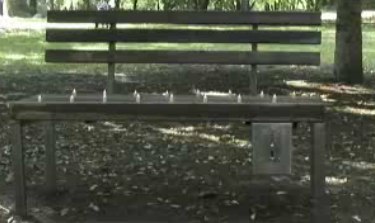
2010/6/18
Another horrible example of public transport privatisation gone wrong, this time from Auckland, where the efficiencies of the free market have produced a system that's expensive and inconvenient, and encouraged the public to drive:
City planners impose various pseudo-quantitative performance indicators on the contractors, such as sophisticated GPS systems to monitor on-time performance. But even this minimal nod to public accountability produces unintended consequences. Bus companies fear being fined for missing schedule targets, but are driven by the profit motive to ruthlessly minimize outlays on equipment and staff. The resulting pressure is intense on drivers (some of whom don’t even get paid overtime) to meet unrealistic timetables – a media exposé last year showed this often requires breaking the speed limit. Several times, we’ve watched an awaited bus race by without stopping, the driver shrugging helplessly and pointing at his watch.
Yet Aucklanders still pay for transit – three times over. Once through taxes – subsidies to private transit consume half of all property taxes collected by the regional government. Then again at the fare box. And finally a third time through inconvenience. No wonder Aucklanders take transit one-quarter as often as Torontonians.The article is written by a Canadian journalist resident in Auckland, and is in response to a debate about privatising Toronto's (fairly highly-rated, by all accounts) public transport system.
2009/11/18
Some good news on the free data front: the New Labour government, in its desperate attempts to claw back the status of lesser evil, has vowed to make all Ordnance Survey maps freely available, ending the OS's practice of licensing said data for exorbitant fees and under restrictive terms, and bringing Britain into line with the US (where US Geological Survey data is statutorily in the public domain):
The government has been inspired by the success of crime mapping where "data openness" is helping citizens assess the safety of geographical areas.
In the new year Brown intends to publish 2,000 sets of data, possibly including all legislation, as well as road-traffic counts over the past eight years, property prices listed with the stamp-duty yield, motoring offences with types of offence and the numbers, by county, for the top six offences.It is thought that among the data to be freed will be railway and bus timetables, currently being licensed under monopoly rents by privatised companies. (For example, those wanting National Rail timetables on the iPhone, and not wishing to reload the web page and zoom in on form fields every time, have to buy a £4.99 application. There was a free app, written by a user, but its access to the data was blocked by the rightsholders. The National Rail Enquiries application is currently the 10th highest grossing application in the UK App Store, undoubtedly making the publisher, Agant Inc., a mint out of the public.)
The Ordnance Survey are of course keen to protect their revenue streams, and argue that freeing their data would cost the government vast sums; an independent study at Cambridge University, however, showed that the costs of freeing the data (£12m) would be overwhelmingly outweighed by a net gain of £156m. A significant proportion of this would undoubtedly come from the slices of council tax and other funds currently being paid to the Ordnance Survey to license this data:
Local authorities also spend a lot of money getting access to Ordnance Survey. Swindon recently had to pay the OS £38,000 a year to use its addresses and geographical data, even though it had collected much of the data.Of course, the devil is in the details. For all we know, the plan to free the data could be a purely cosmetic gesture comprised of little more than hot air and New Labour spin, offering the "freed" data under such onerous terms as to make it unusable. Though if it does live up to the promise, it will be a bold step in the right direction.
2009/11/8
Nationalised railways are returning to the UK; as of next week, the East Coast Main Line, from London to Edinburgh, will be government-run. It'll give little joy to socialists, though; the New Labour government has vowed to not compromise on the Anglocapitalist principle of charging what the market will bear, and will be pushing through with above-inflation fare increases as a matter of principle:
"I don't see this as a step backwards into some sort of BR or public sector-type environment," she said. "It is a commercial company that happens to have the government as its owner."
Holt admitted that East Coast will impose the above-inflation fare hikes that National Express was planning for January, even though the new business will not have to meet the franchise payment of around £180m next year that helped derail the route's former owner. "I am not going to sit here and say that just because we are a government-owned company we are going to slash fares."The principle of attempting to run a state-subsidised universal-service system such as passenger rail as a for-profit enterprise makes little sense. If railways are a system the government has to pour taxpayer funds into to keep it operating (and has sound reasons to do so, with the availability of bulk passenger transport stimulating the economy and the welfare of its citizens in a way that a completely user-pays system could not), why privatise parts of it and have a chunk of the money that goes into the system bleed out into the pockets of shareholders? Surely whatever efficiencies private ownership brings to the table (and those Reaganite/Thatcherite articles of faith are looking increasingly shaky these days) could be achieved by less costly measures.
In any case, it seems that the government will pocket a windfall from the inflated ticket prices and lack of franchise payments. Let's hope that, short of using it to make rail travel more competitive on price, they use it to fund improvements to the rail network (such as, say, bringing forth the electrification of intercity rail lines before the existing diesel trains need to be replaced and the price of oil goes up any further), rather than just trousering it.
2009/11/3
Another first for Britain's railway system: its first £1,000 train fare. Well, £1,002 to be exact, which will get you from Newquay in Cornwall to the Kyle of Lochalsh in the Scottish highlands, nominally in first class:
The trip from Cornwall to the Highlands would last over 20 hours, but despite the cost passengers would not find themselves travelling in the lap of luxury – the first and last parts of the journey do not even have first-class carriages.
Doe told the Evening Standard: "For the price I would expect to be given a meal as soon as I got on board. What do you get with CrossCountry? For the first 183 miles to Bristol you might get a trolley service offering a cup of tea.This momentous milestone was reached thanks to the free-market efficiencies of privatisation; since 1995 (when they were set by the inefficient socialist bureaucracy of British Rail), some walk-up train fares have doubled in price.
Of course, one would have to be an eccentric train fetishist to actually buy this fare, given that flying across Britain is several orders of magnitude cheaper (in the way that flying across, say, France or Spain isn't):
"When you can fly half way across Europe for £30, the idea that you can end up paying £1,000 for a train journey in Britain is absolutely scandalous.
"Not only are passengers being encouraged off the trains and into their cars, but some considering this journey may decide they'd rather fly to Australia and back for half the price."The railway company points out in all fairness that if one buys the advance fare in time, one can get this journey for a mere £561, bringing a train trip across the UK down to the cost of one low-season return flight to Australia.
2009/10/26
Sticker seen on the Tube:
The URL leads to the website of Bring Back British Rail, a campaign to reverse the privatisation of Britain's railway network.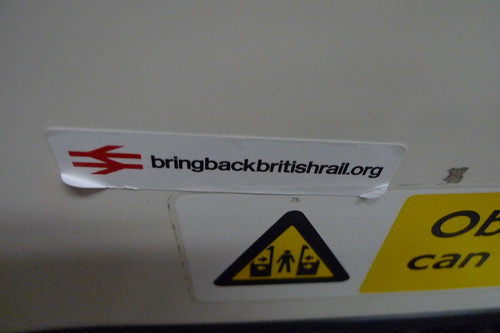
I wish them luck in their endeavour; they'll certainly need it.
2008/1/8
A Sunday Times piece on the decline of Britain's railways, whose services have been deteriorating and costs rising, the difference going to the shareholders of private operators:
The new ticket price from Bristol to London with what is, by common consent (and by most of the official indicators) Britain’s worst train company, is £137. At which price you could take a family of five to Budapest and back, although not with First Great Western. Again, this seems better value if you take into account the fact that you might well have to get off the train at Chippenham and travel by bus for a bit; two modes of transport for the price of one, you see. They think of everything for you.
I asked the eminent transport journalist Christian Wolmar what he made of Muir’s suggestion that increased fares would lead to improved services. “It’s just complete and utter crap,” he replied. “The money is going to the train operating companies, full stop.” How much is invested in improving rail services is, in any case, decided in advance by the rail regulator. Muir is being disingenuous. At the least.
Here’s a few more fares to gape at in wonderment: Plymouth to London with First Great Western – £196. That’s three times the cost of the usual return air ticket, and of course it takes almost four times as long by train. London to Manchester on Virgin Trains – £219. Fly instead and it will set you back about £80. And incidentally, those are the old prices, without the “A happy Christmas to all our benighted customers” fare increases.The author lays the blame at the feet of John Major's Conservative government, and its privatisation of British Rail (which, as maligned as it had been, was apparently much more efficient than today's system), a move driven more by neoliberal ideology and Tory antipathy to public transportation than practical concerns, though New Labour, who have presided over the decline of Britain's railways, get some of the blame:
It is either depressing or hilarious, take your pick, to mull over the fact that the privatised rail network soaks up almost three times as much taxpayers’ money in subsidies than did that much maligned, publicly owned corporation, British Rail. And the sad truth is that in those final years British Rail really was “getting there”.
You might expect of the Conservative party an instinctive affection for that most insular and individualistic form of transport, the motor car. Labour, though, has its ideological roots in public transport – and yet in the 10 years since Tony Blair took office, rail fares have been allowed to rise by 46% (not counting the latest rise), while the cost of travelling by car has risen by only 26%, according to figures from the Department for Transport. In other words, Labour has made it even more attractive to travel by car and less attractive to travel by train.
Again, the train companies will tell you that more people are travelling by rail than at any time since the 1950s. Well, up to a point. But they’re travelling short distances by rail (especially within central London, which recently got its first effectively nationalised route, the North London line). For the longer trips, people are turning to the planes, or sticking with the comfort of their cars.Or course, the idea of renationalising Britain's railways is absolutely out of the question, because that would be socialism, which is discredited, and it has been proven that free markets always achieve the best of all possible outcomes. So, whoever wins the next election, we can expect more of the same: underinvestment, price rises, and Britons paying for a service that costs considerably more and delivers less than on the continent, and choosing to fly over any distance further than London to Birmingham.
2006/6/23
Apparently the number of Americans who have close friends has plummeted in the past few decades:
Confirming the central thrust of Robert Putnam's Bowling Alone, a study (pdf) released in the American sociological review today shows that Americans have fewer close friends and confidants than they did 20 years ago. In 1985, the average American had three people in whom to confide matters that were important to them. In 2004, it dropped to two, and one in four had no close confidants at all.Apparently this is due to a number of factors: car-centric post-war urban design and the disappearance of public space where people can meet contribute, though a major factor is the ever-increasing working hours in America, a nation that's increasingly time-poor; making and maintaining friendships, after all, takes time, of which there is less and less. Perhaps someone in America will invent a way of making friends more efficiently? (I suspect that this approach, whilst inventive, may not be entirely satisfactory.) Of course, where America goes, others often follow.
And the readers' comments contain some gems, like this one:
Along with the world hating Americans, we now get told Americans can't stand each other either. Sounds like more Guardian hatred of America to me. Ever been to our churches, Mr Younge? There you'll find how we Amercians not only have the friendship and love of others, but that the Lord loves our company as well. We leave the solitary cheese-eating to others.Oddly enough, this is posted by someone in "Birmingham/gbr", so it could be some Brit taking the piss.
2005/2/3
The privatisation of the space of concepts keeps marching on; now, it turns out likenesses of the Eiffel Tower are copyrighted, and cannot be published without a licence. The city of Paris and the company which maintains the tower managed to do this by adorning it with a distinctive lighting display, which they then copyrighted; consequently, any recent night-time photograph of the Eiffel Tower is a derivative work. In their infinite generosity, they have said that they are not interested in going after amateurs putting holiday photographs of the tower on their web sites; they are, however, technically in violation. Which means that this WikiMedia image is technically in violation. And so, the space of free public discourse narrows slightly.

I wonder what's next: perhaps Ken Livingstone will copyright the names of London Underground lines and stations and demand licensing fees from fiction authors who mention them or something?
Eventually, we will get to the situation where all real-world objects and likenesses are intellectual property and use of them requires licensing fees. (After all, the dominant Reaganite/Thatcherite ideology of our time says that the way to maximise the efficient use of any resource is to monetise it and place it on the market; coupled with intellectual property, the natural conclusion is what Lawrence Lessig calls an "if-value-then-right" intellectual property regime, where for any value in an item, there is a right assigned to a rightsholder, who can license that right on the open market. Think of the colossal economic waste we had in the bad old days of the public domain and Jeffersonian copyrights.) As depicting any public figure, fictional character, location or privatised folklore will require a licence, costing fees and giving rightsholders vetoes over works they find objectionable, stories (well, those without the corporate media backing required to resolve all the rights issues) will move to generic locations; nameless, nondescript buildings, cities, countries and characters will take hold. To which, Big Copyright will respond by copyrighting categories of ideas (in the way that Marvel and DC Comics claimed a joint trademark on superheroes), or by patenting common types of plot devices and settings (which is probably not legal now, though given sufficiently pliant legislators and international treaty bodies, anything's possible). Galambosianism, here we come.
2004/12/28
China Miéville has written a story (for the Socialist Review, of all places), envisioning a privatised, trademarked Xmas:
Don't get me wrong. I haven't got shares in YuleCo, and I can't afford a one-day end-user licence, so I couldn't have a legal party. I'd briefly considered buying from one of the budget competitors like XmasTym, or a spinoff from a non-specialist like Coca-Crissmas, but the idea of doing it on the cheap was just depressing. I wouldn't have been able to use much of the traditional stuff, and if you can't have all of it, why have any? (XmasTym had the rights to Egg Nog. But Egg Nog's disgusting.) Those other firms keep trying to create their own alternatives to proprietary classics like reindeer and snowmen, but they never take off. I'll never forget Annie's underwhelmed response to the JingleMas Holiday Gecko.
No, like most people, I was going to have a little MidWinter Event, just Annie and me. So long as I was careful to steer clear of licenced products we'd be fine.
Ivy decorations you can still get away with; holly's a no-no but I'd hoarded a load of cherry tomatoes, which I was planning to perch on cactuses. I wouldn't risk tinsel but had a couple of brightly-coloured belts I was going to drape over my aspidistra. You know the sort of thing. The inspectors aren't too bad: they'll sometimes turn a blind eye to a bauble or two (which is just as well, because the fines for unlicensed Christmas celebrations are astronomical).
(via bOING bOING)