The Null Device
Posts matching tags 'anglocapitalism'
2016/6/10
Being a tenant in the free-market Anglosphere is likely to get a lot worse soon; a new British start-up has created a system offering landlords' continuous deep surveillance of their tenants' online lives to determine whether they are likely to be asset risks. The system, named Tenant Assured, involves requiring tenants, as a condition of tenancy, to link all their social media accounts to a system that data-mines their posts and messages, looking for keywords and metadata and feeding them into an algorithmic model for determining the tenant's personality type and the risk of them defaulting on rent or otherwise adversely affecting the landlord's assets. Tenant Assured appears to greedily harvest a lot of data for its model; when the landlord looks at the report on one of their tenants, status updates or messages mentioning loans, lack of money or phrases suggestive of penury like “staying in” show up under “financial stress”, and words like “prison”, “steal” or “justice” show up under “crime”, while histograms of the tenants' activity times on weekdays and weekends are shown (do they throw parties/lead a chaotic lifestyle, or are they responsible hard-working serfs who get up at six and are in bed by 11, and thus a good financial risk?)
Among the behaviors that count against your Tenant Assured “credit” percentage — i.e., how confident the company is that you’ll pay rent — are “online retail social logins and frequency of social logins used for leisure activities.” In other words, Tenant Assured draws conclusions about your credit-worthiness based on things such as whether you post about shopping or going out on the weekends.Tenant Assured is in operation in the UK, and is being launched in the US soon; it is likely to be welcomed with equally open arms in free-market anglocapitalist strongholds like Australia, where tenants are not deemed to need any rights beyond those naturally trickling down from the invisible hand of the market. The system is said to be opt-in, which means that one always has the choice of telling the landlord who insists on using it where to stick it and find another one who does not insist on it (which may involve anything from paying a human-dignity premium to the Sartrean radical freedom of starving to death under a bridge, emaciated but unbowed).
Of course, there is a chance that such an intrusive system would be found to be in violation of human-rights laws (like the ones Britain's Tory government wants to pull Britain out of); if it isn't, the chances of parliament, which is dominated by buy-to-let landlords (who comprise 40% of MPs, compared to 4% of the general population) passing any laws to restrict it are vanishingly slim at best. After all, we're a free-market society, something something light-touch dynamic self-regulation something, and heavy-handed regulation would destroy the wealth that (mumble mumble) trickles down to the very tenants it's meant to protect; also, personal responsibility. In Australia, there is no bill of rights and nothing like the European Convention of Human Rights, so there'd be fewer impediments to such a system being imposed. In the United States, the Constitution would offer little protection, as it only restricts the government from oppressive measures, making room for a vibrant market in free-enterprise oppression.
The system currently requires tenants to provide access to their social media profiles (presumably the tenancy contract would be drafted as to make withholding accounts grounds for eviction and/or forfeiture of the deposit, if not further legal sanctions); what happens to the data is opaque and could be updated. If, for example, the operators train a neural network to determine probability of drug use from selfies, or emotional stress from changes in music consumption, such capabilities could be added later. But why stop there? It's almost certain that the tenant would own a smartphone, running either iOS or Android. And legally there is no reason why a rental contract could not require them to install and run an app on their phone which tracks their location, flagging up whether they're spending time in dive bars, visiting pawn shops or have started sleeping in until noon on weekdays rather than travelling to an office by 9:30am. (The app could be styled with a nice-looking interface allowing the tenant to contact the landlord and flag fixtures in need of repair; if it looks like it's meant to help the tenant, they may not recognise that it's there to control them.) And so, the relationship between landlord and tenant starts looking like the ancient feudal relationship between a lord and one of his peasants passed through Jeremy Bentham's panopticon; the subtext is: those who don't own property or significant wealth are, at best, on parole.
If this takes off, and becomes the norm for non-wealthy tenants, the social implications could be interesting. For one, it will make all the services, like Facebook, which it touches useless for casually socialising. (In a Free Market, where all tenants are competing against each other to get and keep desirable flats—or, indeed, to win desirable tenancies from the sucker who let their game slip and got logged showing poor impulse control one time too many—maintaining a profile optimised to avoid whatever the algorithm's looking for will become paramount, and there'll be no slack for posting anything off-message.) In such a system, posting to Facebook (or Instagram, or Twitter, or whatever) will be a bureaucratic chore, an act of reporting to one's unseen overseers framed as casually socialising with one's semi-fictitious clean-living friends. (Not posting anything may also get one flagged, so shrugging it off may work against one's interests.) Perhaps an underground industry of social profile doctors will show up; they'll keep up on the latest news and gossip about the surveillance capabilities and profiling algorithms, and for a monthly fee, will provide you with enough traffic to keep your tenant-credit score up. Meanwhile, actual socialising, hedonism, self-indulgence and discussion of worries will take place on encrypted channels and pseudonymous underground social networks, or other profiles, and people will start to carry two phones: the one the landlord knows about, and one which doesn't snitch. (At some point, a tenant will be evicted without deposit for failing to declare such an account or phone, as required in the tenancy contract; if they're lucky, it may form the basis of a court case.)
2013/4/17
The International Monetary Fund has, once again, warned Britain's government to ease back on its austerity policy, or risk driving Britain into a triple-dip recession. The government has replied with a statement defending its approach.
Meanwhile, researchers have found serious flaws in an economics paper used to justify austerity policies and the prioritisation of cutting debt at all costs. The paper, Growth In A Time Of Debt, which argues that high public debt stifles economic growth, and which has been a favourite of neoliberals and small-state libertarians, was found to have flaws including selective inclusion of data, unusual weighting of years studied, and a coding flaw in an Excel spreadsheet; when corrected, the data produced does not yield the same conclusions:
This error is needed to get the results they published, and it would go a long way to explaining why it has been impossible for others to replicate these results. If this error turns out to be an actual mistake Reinhart-Rogoff made, well, all I can hope is that future historians note that one of the core empirical points providing the intellectual foundation for the global move to austerity in the early 2010s was based on someone accidentally not updating a row formula in Excel.So, if it does turn out that austerity policies are based on a spreadsheet error, does that mean that we can expect a contrite George Osborne to quickly change course? Of course not; the revelation that austerity is based on junk economics will have no more effect than what we've already known, such that Britain's current public debt is historically quite modest, because austerity never was purely about economic pragmatism, but rather about principle; the principle being “this money does not belong to you”, with the explanation being “because we say so”. Which is why, for example, the government has £10m to give Margaret Thatcher a state funeral in all but name (“we can afford it”), whilst cutting £11.6 from the arts budget, closing public libraries and slashing benefits. The principle is why the government has introduced a “bedroom tax”, cutting the benefits of those deemed to have a spare bedroom, despite the lack of suitably cramped accommodation they could move to (especially in economically depressed areas in the north). There is no economic benefit from this, but it has the moral benefit in the eyes of the Tories and the Daily Mail-reading public of punishing the unworthy poor. And punishing freeloaders is a good in itself, worth doing even if it costs us to do so.
Even if there was no recession, if government coffers were flush with cash, spending money on the public good would be immoral. In Australia, where the economy escaped the recession and is carried aloft on a mining boom, there still is no money for public infrastructure, to the point where recent secondary education reforms had to be funded by massive cuts to the university sector. There is plenty of money, but it belongs not to the little people, but the mining oligarchs, whose sense of property rights does not extend to them rejecting billions of dollars of diesel fuel subsidies paid for by the taxpayer. Needless to say, there is no money for things like modern internet infrastructure or public transport, to say nothing of things like the high-speed railway line between Melbourne and Sydney (the two endpoints of the second busiest passenger air route in the world) for which studies have recently been published. Where there is money left over, it is handed back as tax rebates to middle-class households in outer suburban electorates, where it can do the most good electorally for the government.
The libertarian myth that the economically prudent state is the minimal “nightwatchman state”–enforcing contract law, punishing freeloaders and otherwise keeping its hands off—doesn't bear out in reality, where prior investment and planning are often more prudent than leaving things to the wisdom of the free market. We have seen this in the United States' health care system, where costs are several times higher than in the supposedly inefficient socialised health care systems of socialist Europe (which is not counting externalities, from lower life expectancies and more chronic illnesses to people staying in less than ideal jobs out of fear of losing their health insurance), and in previous attempts to reduce public spending by cutting welfare (at least when the sainted Margaret Thatcher did so in the 1980s). Anyone who has had to commute in a city organised according to laissez-faire let-them-drive-cars principles, at least once it gets beyond a certain level of density, will know that it doesn't work; which is why even neoliberal London and New York spend billions on public transport facilities, which are used with almost Scandinavian egalitarianism by everybody from beggars to bankers. And, in a decade's time, it's not unlikely that the gutting of Britain's social infrastructure will end up costing more, as more people fall through the cracks; some will be picked up by a swelling prison system, as happens across the Atlantic, while others will subsist in dismal conditions, out of sight and out of mind of the people who matter.
2013/4/9
Continuing the Margaret Thatcher Memorial Season on this blog: why the Left gets neoliberalism wrong, by political scientist Corey Robin. It turns out that the thing about rugged individualism is (once one gets beyond the pulp novels of Ayn Rand and Robert Heinlein, not exactly founts of academic rigour) a red herring, and the true atom of the neoliberal world view is traditional, vaguely feudal, hierarchical structures of authority: patriarchial families, and enterprises with owners and chains of fealty:
For all their individualist bluster, libertarians—particularly those market-oriented libertarians who are rightly viewed as the leading theoreticians of neoliberalism—often make the same claim. When these libertarians look out at society, they don’t always see isolated or autonomous individuals; they’re just as likely to see private hierarchies like the family or the workplace, where a father governs his family and an owner his employees. And that, I suspect (though further research is certainly necessary), is what they think of and like about society: that it’s an archipelago of private governments.
What often gets lost in these debates is what I think is the real, or at least a main, thrust of neoliberalism, according to some of its most interesting and important theoreticians (and its actual practice): not to liberate the individual or to deregulate the marketplace, but to shift power from government (or at least those sectors of government like the legislature that make some claim to or pretense of democratic legitimacy; at a later point I plan to talk about Hayek’s brief on behalf of an unelected, unaccountable judiciary, which bears all the trappings of medieval judges applying the common law, similar to the “belated feudalism” of the 19th century American state, so brilliantly analyzed by Karen Orren here) to the private authority of fathers and owners.By this analysis, while neoliberalism may wield the rhetoric of atomised individualism, it is more like a counter-enlightenment of sorts. If civilisation was the process of climbing up from the Hobbesian state of nature, where life is nasty, brutish and short, and establishing structures (such as states, legal systems, and shared infrastructure) that damp some of the wild swings of fortune, neoliberalism would be an attempt to roll back the last few steps of this, the ones that usurped the rightful power of hierarchical structures (be they noble families, private enterprises or churches), spread bits of it to the unworthy serfs, and called that “democracy”.
On a related note, a piece from Lars Trägårdh (a Swedish historian and advisor to Sweden's centre-right—i.e., slightly left of New Labour—government) arguing that an interventionist state is not the opposite of individual freedom but an essential precondition for it:
The linchpin of the Swedish model is an alliance between the state and the individual that contrasts sharply with Anglo-Saxon suspicion of the state and preference for family- and civil society-based solutions to welfare. In Sweden, a high-trust society, the state is viewed more as friend than foe. Indeed, it is welcomed as a liberator from traditional, unequal forms of community, including the family, charities and churches.
At the heart of this social compact lies what I like to call a Swedish theory of love: authentic human relationships are possible only between autonomous and equal individuals. This is, of course, shocking news to many non-Swedes, who believe that interdependency is the very stuff of love.
Be that as it may; in Sweden this ethos informs society as a whole. Despite its traditional image as a collectivist social democracy, comparative data from the World Values Survey suggests that Sweden is the most individualistic society in the world. Individual taxation of spouses has promoted female labour participation; universal daycare makes it possible for all parents – read women – to work; student loans are offered to everyone without means-testing; a strong emphasis on children's rights have given children a more independent status; the elderly do not depend on the goodwill of children.So, by this token, Scandinavian “socialism” would seem to be the most advanced implementation of individual autonomy and human potential yet achieved in the history of civilisation whereas Anglocapitalism, with its ethos of “creative destruction”, is a vaguely Downtonian throwback to feudalism.
2012/6/1
2011/5/25
Jon Ronson looks at what makes psychopaths tick:
I met an American CEO, Al Dunlap, formerly of the Sunbeam Corporation, who redefined a great many of the psychopath traits to me as "business positives": Grandiose sense of self-worth? "You've got to believe in yourself." (As he told me this, he was standing underneath a giant oil painting of himself.) Cunning/manipulative? "That's leadership."
I wondered if sometimes the difference between a psychopath in Broadmoor and a psychopath on Wall Street was the luck of being born into a stable, rich family.The article, which is excerpted from Ronson's new book, "The Psychopath Test", also follows the story of Tony, a youth who, when tried for a violent crime, feigned insanity in an attempt to avoid prison, and instead was diagnosed as a manipulative psychopath and committed to the notorious Broadmoor prison. After 12 years amongst notorious killers and the criminally insane, he secured a hearing, which found him, whilst mildly psychopathic, fit to be released into society:
"The thing is, Jon," Tony said as I looked up from the papers, "what you've got to realise is, everyone is a bit psychopathic. You are. I am." He paused. "Well, obviously I am," he said.
"What will you do now?" I asked.
"Maybe move to Belgium," he said. "There's this woman I fancy. But she's married. I'll have to get her divorced."
2011/3/16
Three young girls in Poole, Dorsetshire received a lesson in property rights after being told off by police for picking flowers in a park, which is technically theft of council property:
But Councillor Peter Adams, who said a family member of his had reported the incident, said taking the flowers amounted to stealing and the behaviour was "unacceptable".
Whitecliff is a council-owned park and therefore removing property from it is technically classed as an offence.Cllr. Adams stated that the girls were not merely picking a few flowers, but removing them in large quantities. Perhaps they were running some sort of industrial bouquet-making operation?
2010/12/17
This year, consumers will be paying more for their Christmas turkeys, largely due to wheat prices having been pushed up by commodity traders speculating on them. Similar actions have brought hardship to the developing world, causing an additional 250 million people to go hungry in 2008, though for tremendous profit to those in the know.
Meanwhile, a recent WikiLeaks memo suggests that US and Spanish trade officials discussed artificially raising food prices to encourage adoption of genetically modified crops, breaking down those silly Europeans' opposition by hitting them in the hip pocket, and hopefully opening the door to a patent royalty windfall for US agribusiness.
2010/11/17
The Dorset Police, it seems, are feeling the downside of privatisation: the force has instructed its officers to send text messages rather than talking on their radios. A spokesman for the police force (i.e., management) has said it's a simple measure to improve the efficiency of the control room, and has nothing to do with the £2 per second levied on the police force by the private operator of its radio system; the head of the Dorset Police Federation (i.e., the employees), however, begs to differ:
"Particularly if you have a major incident or a normal Friday or Saturday night, we're going to use the radios quite a lot. If they go over the estimated level then a surcharge kicks in, that's £2 a second, which I think is extortionate - especially at a time when people in the police service are losing their jobs."It may be that sending a text is more efficient; if the police radios have buttons or menus for sending standardised updates, perhaps tagged with coordinates, it could be, though if the officer has to stop and thumb in a message, that probably won't be the case*. And it's unlikely that there is so little capacity on the emergency service airwaves that the police have to ration their communications. So this looks rather like another case of, at some time in the great Blatcherite orgy of privatisation, the government of the day having eyed the police radio network and decided that, if they sold it to a private company, it'd top up the budget nicely up to the next election, when it became the next government's problem. And now, with the new age of austerity, we have police officers being told not to use their radios because every second that they do so is £2 from their budget to a private company.
*I haven't examined a police radio, but I suspect that devices developed for a largely captive institutional market will be slow to benefit from the interface-design innovations of more competitive markets; except in cases such as the US military, which has famously spent billions on human-interface research. Judging by the photographs I've seen, I'd guess that the interface of a police radio is comparable to that of a late-1990s Nokia phone in terms of design.
2010/11/15
Out with the old, in with the new: Britain's Con-Dem government invites fast food companies like McDonalds and PepsiCo to help write health policy. Presumably New Labour's approach was too anti-business or something (damn those radical Blairite crypto-socialists). Meanwhile, despite being one of Europe's thinnest nations, Denmark is imposing a tax on junk food, out of the fear its citizens may become as obese as the British:
I met one Danish couple who are raising three young children on a modest income in what is already the most highly-taxed nation in Europe. But they do not resent the government adding further to their grocery bills; far from it.
At his heaviest Lars jokes that he had the belly of "an English hooligan".Britons, it seems, are, in stereotype, the Americans of Europe.
2009/1/26
An Europe-wide study has shown that, of all the countries in Europe, Britain has the lowest levels of "trust and belonging" amongst under-50s.
The ESS tries to measure trust and belonging by comparing answers to questions such as these:
- Generally speaking, would you say that most people can be trusted, or that you can't be too careful in dealing with people?
- Do you think that most people would try to take advantage of you if they got the chance, or would they try to be fair?
- Would you say that most of the time people try to be helpful or that they are mostly looking out for themselves?
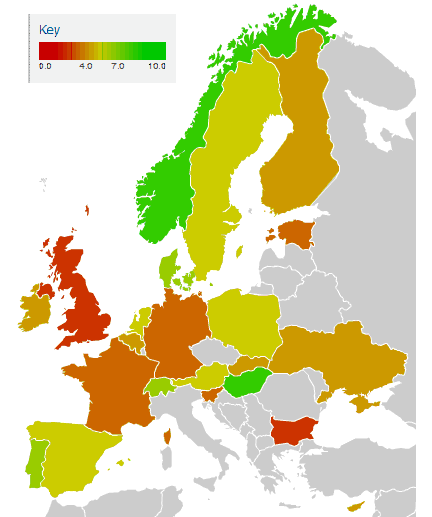
The researchers suggest that our low "trust and belonging" score may be "the result of the development of a highly individualistic culture in the UK". Basically, the suggestion is that we are in danger of becoming the most selfish nation in Europe.That's one explanation, that the low level of trust is symptomatic of Thatcherite-Blairite Hobbesian anglocapitalist values, where man is expected to be wolf to man (after all, were this not the case, that would be grossly inefficient and uncompetitive). Other factors could include greater geographical mobility (a society of immigrants, expatriates and the global superrich would be less cohesive than a tightly-knit local society). Interestingly enough, the countries with the highest level of trust and belonging in Europe appear to be Denmark and Norway (Sweden, it seems, has pulled away towards high-Gini competitive individualism, undoubtedly buoyed by the success of Ikea, H&M and a dozen supercool indie-folk and fashion-electro bands); could this be a reflection of the vaunted Scandinavian egalitarianism and/or the internalised repression of individualism of the Jante Law, or just of more homogeneous societies?
2008/12/17
Good news for British traditionalists today; the EU has abandoned its effort to make Britain go metric. Britain had been given an exemption from the requirement to standardise on metric measurements in 1995, though this was due to expire this year, with miles and pints to be banished from view. Though, with a fierce display of tutting, the Daily Mail-reading little-Englanders gave Johnny Foreigner what for, and he fled with his tail between his legs, leaving Britain to its ancient systems of measurement in perpetuity.
Those aghast at the surrender of modernity to tradition for its own sake, though, need not despair; the law still requires metric measurements to be displayed alongside the traditional ones, and the traditional measurements are defined in terms of the metric ones (a pint, for example, is legally set at 568ml; cursory inspection of a pint glass at any pub will demonstrate this).
Another British tradition, however, was not so lucky; the EU has voted to abolish Britain's right to opt out of the EU's maximum working-hour limits. The Tories, employer groups and the New Labour nomenklatura are, of course, outraged (though the Labour rank and file are, by all accounts, quite pleased), predicting a collapse of productivity and the surrender of the Calvinist work ethic that made Britain great. However, given that the maximum EU working limits prescribe a 48-hour week, averaged over some nine weeks, this doesn't hold water, unless one is running a Dickensian sweatshop.
Finally, the pound's value has recently plummeted, to the point where a pound is rapidly approaching one euro. Which has caused some commentators to suggest that maybe Britain joining the euro is not such a bad idea. Which may be the case; certainly, the traditionalist argument for retaining the pound doesn't hold much water, given that the modern decimal pound is a dollar/euro-style decimal currency which replaced the ancient pound in 1971; the difference between it and, say, the Australian dollar (another currency hewn from pounds, shillings and pence at about the same time) is that Britain decided to name its new currency after the old one. Britain joining the euro would make things easier for those travelling to/from or trading with continental Europe (or, indeed, Ireland). The question which has most bearing on the pros and cons of the euro is whether Britain's monetary policy being fixed to the Eurozone would help or harm the British economy; this is a question I'm not qualified to answer.
2004/12/28
Expatriate citizen-of-the-world Momus returns to Britain -- and hates it; on returning, he finds squalor, shabbiness, crass consumerism and an edge of latent aggression.
The marketing is slick and constant, nothing works, and it's twice the price it would be back home. And there's some sort of druggy, boozy menace hanging over the streets at night. Blame the binge drinking sprees! Have a happy smashed British Christmas!
We stop at a filling station on the Shoreditch High Street to buy some food. A homeless man is sitting at the entrance. 'Spare some change, please? Spare some change?' A black man gets out of a BMW and comes over to reform him. 'Look at yourself, mate, you've got to stop using the stuff. Go to a gym, man, do a workout, get out of this state you're in, it's a fucking shame on you, man!' He's a winner, the junkie's a loser. Go to a gym, start a business, buy a BMW, join the winners. It's dog eat dog.
The next morning the taps in the bathroom don't seem to work, and neither does the flush in the toilet. Fuck! At least I'm able to shower. I don't think I could bear to be dirty in London. It already feels like a gigantic toilet. Crossed with an advertising agency. An advertising toilet? Why not? Clever marketing idea! Out on the street, I see a bus with an advert on the side that says 'More Glitz! The Brent Cross Centre, feed your addiction'. Feed your addiction? Fuck, you mean become like that junky we saw last night at the filling station? Have drugs and celebrity become metaphors for everything in Britain? Are they marketing heroin yet? Welcome! Fuck!
The atmosphere didn't feel benign at all, nothing like soft, safe neon nights in Tokyo. `it felt brutal. Minicab sharks, cars pulling up behind pedestrians. You're in there, protected, and I'm out here, not. I'm just going to have to hope you have a good heart. People in hip hop hooded tops looking hard in kebab shops. It all feels like one of those Streets videos where a bunch of tanked-up British guys end up with blood streaming down their faces. 'Mate, mate, I don't want any trouble, mate.'
The kids in the next seat just said 'Bling bling!' The phrase is everywhere in Britain, an R&B-rap-pop fashion as widely adopted as the flash white sportsgear people wear on British streets, minus all the gold, silver and diamonds that stars like J-Lo and Britney accessorize it with. I open the Virgin Trains magazine. (Wow, marketing! Trains never used to have in flight consumer magazines! Then again, they once had basic services like running water and hot food.) There's an article about shopping in Birmingham. It begins 'Diamonds, platinum and all things bling lie ten minutes from the city centre in Birmingham's jewellery quarter...' Later in the journey, bored, I open the new tabloid Times and there it is in the financial section. 'Bling bling: fashion designer John Zhao shows off his crystal encrusted iPod'. Britain speaks fluent bling bling. Britain, from top to bottom, embraces the showy materialism. the 'I won, you lost' mindset of hip hop and R&B videos. Bling bling, I win!
I've noticed some of these things since coming here; the ubiquity of branding, often taking priority over other things (for example, anything to do with live music here has the Carling brand (which is a rather generic lager) slapped on it, and band venues have advertising billboards on the walls), the "ATM attendants" stationed beside every cash machine, trying to guilt the relatively well-off user out of one of their tenners, the chav kids looking hard and dead-eyedly cynical in their hip-hop thugwear (Burberry baseball caps worn under hooded tops, to hide faces from the ubiquitous CCTV cameras, seem to be a big part of youth fashion here), drunk arguments in the streets, with couples screaming "FUCK OFF, YOU FUCKING WANKER!" at each other, the dozens of different posters on every form of public transport, from buses to long-distance trains, warning passengers not to assault staff.
2003/4/10
In what could be a further sign of strained relations between Airstrip One and the cheese-eating surrender monkeys, Britain's Chancellor Gordon Brown announces plans to adopt US-style economic policies, moving away from the inefficiency of Eurosocialism, whilst promising to maintain a third way, tempering laissez-faire zero-friction capitalism with some degree of "social justice".
Could we be witnessing the start of the breakdown of Britain's membership in the EU? Commentators have been suggesting for a while that Britain has more culturally in common with Calvinist/capitalist America than with the wine-drinking, bureaucracy-choked welfare states of Europe, with some suggesting that Britain would belong more within the United States than in the EU.
(Hypothetical scenario: if Britain was to leave the EU and join the United States, how could the arrangement be made to work? Would England, Wales and Scotland be three states, would they be divided into smaller states, or would the U.S. federation have to be reengineered to accommodate the larger entities? What would the major issues of contention be?)