The Null Device
Posts matching tags 'momus'
2017/12/22
Recently, I have been listening a lot to The Radio Dept.'s Teach Me To Forget EP, and have realised that, to me, it feels in many ways like an echo of a record from a quarter century earlier, namely, Momus' Voyager.

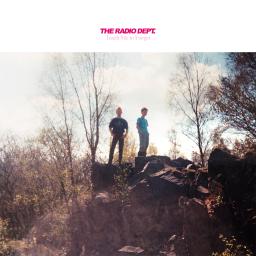
The similarities are both stylistic and aesthetic; in the tonal palette and the emotional gamut. Both have a coolly electronic feel, built on clean synthesizer sounds and programmed beats; understated and with an undercurrent of disconnection under the lights of the nocturnal city, and what Ralf Hütter once described in an interview as “cold feeling”. One could, if one were to, pinpoint where aspects of the older record reëmerge in the new one: Just So, with its dry synth-bass, quietly spoken vocals and sense of guarded futurity, is a tentative Cibachrome Blue for a more anxious age; You're Not In Love, with its funky bassline and cold, fast electronics, has an echo of Conquistador and perhaps Trans-Siberian Express. And the opening extended mix of Teach Me To Forget, itself reprising the nihilistic obliviousness in Voyager, segues neatly from the closing track of Voyager, the 2½-minute instrumental reprise Momutation 3, into its programmed club beats and minor-key tension, the 25-year gap disappearing in the crossfade.
Thematically, of course, the two records come from very different contexts. Voyager is a product of that particular euphoric moment as the eighties segued into the nineties; a confluence of the end of the Cold War and with it, some say, history, the arrival of computer technology in everyday life, and the rise of MDMA-fuelled club culture. Everything was connected, the world was waking up from history and, indeed, from the old certainties of pre-digital, pre-postmodern reality, into the Long Boom, or perhaps the Long Rave. Music could now be made with samplers, just as images could be made with Photoshop and grunged-up typefaces could be drawn on a Macintosh in Fontographer, and it's there that the idea of postmodernity, of all being artifice and simulacra, starts to leak from academic theory into everyday life. (In Japan, a country with which Momus' career was becoming increasingly intertwined, the discontinuity was even more profound, with the break between the Shōwa and Heisei eras in 1989 serving as a proxy for that entire gamut of changes, the one-way bridge between the analogue and digital, the modern and postmodern.) Voyager (the penultimate of Momus' six albums released on the then ascendant Creation label) rides the crest of that wave—the Ecstasy-infused club euphoria, the melting of genres into electronic club music, the MONDO 2000 cyberculture futurism of smart drugs and virtual reality—though not without ripples of unease. Momus picks out the analogies often cited at the time between this moment and the 1960s “Summer of Love” and posits an “electronic inwardness”; a trip into a vast, luminously pulsating inner space, and in this there is estrangement: We hear the bass talk, it's saying nothing. Love has left the arena and the lost psychonaut attempts to reach out from the gravity well of their trip. Soma Holiday, 1992.
Fast forward to 2017, and things are somewhat different. History has very noisily restarted itself, the balance between democracy and capitalism has tipped in favour of the latter and sinister actors have weaponised freedom, stirring unrest and catapulting extremists into power with swarms of social-media sockpuppets, covert ads and algorithmic manipulation (“nothing is true, we move like shadows across the stage”). In the ever-warming political climate (“there are thunderstorms, and the weather's wrong”), the thawing permafrost has released the bacilli of various anti-liberal ideologies long thought extinct, from theocracy to obscurantist arguments for absolute monarchy, to several dozen variants on fascism, including ones mainly concerned with video games and represented by cartoon frogs. In some ways the period from 1989 to 2001 looks increasingly, in retrospect, as a golden age; its buzzing, coolly luminous optimism replaced by a sensation of preapocalyptic anxiety.
The Radio Dept. were not initially a political band. Starting in the Swedish indie scene of the early 00s, their songs were hazy and ambiguous, both sonically and lyrically, consisting of fuzzy guitars, cheap drum machines and gently wistful melodies, somewhere between The Field Mice and The Jesus and Mary Chain. Somewhere around the 2010s, this started to change gradually; a sample of Thurston Moore ranting about capitalism here, a song titled Death To Fascism there (back when references to fascism sounded like Rik-from-The-Young-Ones-style hyperbole or kitsch), but still the same overall formula. Until their most recent album last year, titled, pointedly, Running Out Of Love. Gone was the haze: in its stead, sharp, cold electronics (they do love the TR-808 cowbell, it seems), sounding more Factory or Mute than Sarah or Creation, and a sniper-like aim at serious issues: the rise of the far right, the arms industry, and, perhaps above all, the comfortably apolitical, the “good people” who do nothing in the face of evil. Of course, being The Radio Dept., this was delivered not as protest-ready bolshie chants but with frosty understatement. Running Out Of Love was a timely return to form, won many accolades (among them, this blog's album of the year title), and spawned three EPs for its singles; the most recent being Teach Me To Forget, the subject of this post.
Voyager and Teach Me To Forget could be seen to bookend an era; the decade or so of the Closing-Down Sale of History and the Long Boom/Now, and slightly longer afterwards—before Trump and Brexit and the Sverigedemokraterna and numerous equivalent local phenomena—when people still thought that we may yet return to this, the natural post-historic state of loved-up transnational consumerist utopia; the coming out of the cold into the futurismic cyber-rave, and the cold crashing in with a vengeance, the party having become the Masque of the Red Death in the interim; a reëngagement with a resurgent reality.
2012/3/9
Something to read: Momus speaks to The Quietus, on topics ranging from his past career and future projects to the role of the artist and the value of art in the digital age, and the question of Scottish independence:
I think a common theme is "aggression against normality", from the left wing terrorists in The Happy Family album through the Maoist intellectuals and fake homosexuals of Tender Pervert, the baby-hating, doppelganger-haunted narrators of Ping Pong, right up to the eccentric 'Thunderclown' on the new album, my characters don't accept the world as it is. The corollary is that they respect otherness, and try to model other ways of living: parallel worlds. I think of this as basically a (post-Christian) Calvinist mindset.
While I'm happy to see the Postcard era recognised - it was genuinely a very exciting and magical time - I think the whole problem for pop music now is that it's become paralysed with respect for its past. We're crushed by the archive, and every edition of Mojo magazine (a sad catalogue of the achievements of the geriatric and the dead) makes it harder for the young to break away and create genuinely new forms of popular music. I don't have strong feelings about The Happy Family archive. We weren't as good as Josef K.
I identify as a Scot, very much. When I'm in Japan and they ask where I'm from, I always say "Scotland", not "Britain". I'd like to see Scotland independent, because we have different politics and a different culture from the English. I wouldn't like to see it become twee, navel-gazing and trivial, though. I hope an independent Scotland would really respect its artists. I'd like to see a cosmopolitanism, an orientation towards Europe and Asia rather than the States, and a kind of new Scottish Enlightenment like the one we had in the 18th Century. Adopt the euro, become a republic, dump the royals, embrace socialism fearlessly!In other news, Momus is tutoring an online course in songwriting, starting in April. At £55, it looks like a steal.
2011/9/25
In his latest Poptimist column, Tom Ewing writes about recordings attributed to imaginary authors, typically at some time in an imagined past. More specifically, he writes about Science Of The Sea, a record allegedly made in 1979 by Jürgen Müller, a German oceanographer and amateur musician who was inspired to make a record of ambient electronic compositions by the hours he spent on field trips out at sea, one of whose 100 privately-pressed copies was apparently rediscovered in 2011:
Except, of course, he probably did no such thing. It seems likely that there never was an expedition, or a young biologist, or a private pressing. Science of the Sea is a 2011 record from fin to tail, and the rather lovely tale of Jürgen Müller is entirely invented. Did suspecting this make me like the record less? Certainly not. If anything, I enjoyed it more. As a small child I would sometimes be allowed to sit up with my parents and watch science documentaries, like Carl Sagan's Cosmos. I didn't understand the science, and the documentaries were broadcast late so I was on the edge of sleep in any case, but I remembered their soothing flow: The infinite turned into a kind of bedtime story. Meanwhile, on library bookshelves I would sometimes find 1950s and 60s paperbacks about modern-day scientist-adventurers like Jacques Cousteau or Thor Heyerdahl-- giving the impression of an age of clean-limbed scientific heroism I'd tantalizingly missed, one that looked very much like a Tintin comic.
So no surprise that some of what I get from Science of the Sea-- there by intention or not-- is a pang of love and loss for this imagined time. More intriguingly, though, if the record is fictional it feels like this might have been liberating for its mysterious creator. The album is full of beautifully cornball seascape touches-- flickering arpeggios and note-clouds which practically demand you start thinking about shoals of fish darting back and forth outside a bathysphere window. Sit down and make an electronic album about the ocean now and you might find yourself trying to dodge these clichés. Sit down and role-play a naive non-musician inching towards transcendence at the turn of the 1980s and you can fully embrace them.Science Of The Sea is not the only recent example of its kind; another recent recording shedding light on an underexplored, romantic and distinctly alien corner of the modern past was the retrospective of the Endless House Foundation. The conceit of Endless House presents an experimental electronic music collective, founded in the early 1970s by an eccentric, wealthy Czech audiophile, situated in an ultra-modernistic studio/discotheque complex in the heart of the Bialowieska primeval forest in eastern Poland and informed by the breadth of European avant-garde design and architectural movements of the 20th century, it thrived for must six weeks in the summer of 1973 before collapsing under the weight of its expensive impracticality, leaving behind only some scraps of biographical information, a few ambiguous photographs of improbable architectural spaces, and the curiously pristine recordings of the resident musicians' compositions, which, it seems, prefigured everything from Kraftwerk to Detroit techno, much in the same way that Delia Derbyshire invented IDM in 1965 but neglected to tell the world about it. The fragments have remained buried until recently, when an unnamed British curator unearthed the pieces, and managed to track down the original participants, getting interviews and even a mix, from them.
Of course, it's quite possible that none of this really happened. The story of Endless House reads almost like a Wes Anderson set-piece, only set in a nebulous European avant-garde as seen from outside. Unsurprisingly, the illusion doesn't hold up well to closer examination. For one, the idea that a group of Western European playboys could cross the Iron Curtain with impunity, bringing party guests and giant modular synthesisers with them, while the governments of the Eastern Bloc, still shocked by uprisings in Prague in 1968 and Warsaw in 1970, were in ideological lockdown, seems highly unlikely. (A non-fictional recent musical retrospective of East German electronic music reveals the extent of ideological control over music in the Eastern Bloc; in the DDR, the government only started allowing the production of electronic music in 1980, and even then anything that could be interpreted as critical of industrial society was verboten, leaving room only for ostensibly harmless cosmic psychedelia.) Over and above this, this improbable bubble is populated by a cast of exotically European bons vivants with names like Walter Schnaffs and Felix Uran, who speak in a mixture of English and German, but refer to distances in miles. Nonetheless, if you can suspend disbelief, imagine that the Cold War wasn't that big a deal and that an Austrian synthesist and socialite might sing about being sixteen miles from Saint-Tropez, in an avant-garde cyber-disco about that distance from the Polish-Soviet border, it's an entertaining story, and an even more entertaining record. (The tracks, listened to on their own, work as electronic music, and do evoke the world they purport to come from.)
Meanwhile, in a recent edition of Milan art journal Mousse, there is a retrospective of the works of Scottish-Italian artist Scotty Potenza, written by someone named Nick Currie:
The colour, shape and texture of fresh ice cream is certainly visible in Potenza’s acrylic gouaches; peach, pistachio and purply-red forest berries distinguish themselves forcefully from the sodden greens and asphalt greys of the Scottish industrial landscape. His subject-matter shares this otherness: influenced by the exciting first wave of Acid House culture in the late 1980s, Potenza evinces a non-Calvinist positivity more evocative of Chicago warehouses and Ibiza raves than Glasgow tenements. A Potenza painting incarnates not what Scotland is, but what it lacks.
As 1990s rave culture has continued to experience the bearhug embrace of mainstream acceptance in the UK — its visual values, once restricted to club flyers, now inform restaurant design, public information films and TV commercials for banks and building societies — Potenza has been granted a high-profile list of public commissions. His decoration of the walls of the Home Office lobby with a mural of happy ravers, their hands linked like the figures in Matisse’s La Danse, caused short-lived (and clearly manufactured) outrage in the tabloids, but has proved peculiarly popular with the civil servants who work in the building. A major mural at Finsbury Park underground station entitled Get On One Matey! was unfortunately damaged beyond repair in the 2011 riots. The vandals, caught on CCTV, are currently serving long prison sentences.
2010/1/19
From a Momus blog post, in which he, on departing from Osaka, speculates on how he might possibly live there:
I've never seriously thought about living in Osaka before. I love Tokyo best of all. But increasingly, my outlook has Berlinified, by which I mean I regard expensive cities like New York, London and Tokyo as unsuited to subculture. They're essentially uncreative because creative people living there have to put too much of their time and effort into the meaningless hackwork which allows them to meet the city's high rents and prices. So disciplines like graphic design and television thrive, but more interesting types of art are throttled in the cradle.Momus raises an interesting observation, and one which may seem somewhat paradoxical at first. First-tier global cities, like London, New York, Paris and Tokyo are less creative than second-tier cities, largely due to the increased pressure of their dynamic economies making all but the most commercial creative endeavours unsustainable. I have noticed this myself, having lived both in Melbourne (Australia's "Second City" and home of the country's most vibrant art and music scenes; generally seen by almost everyone to be ahead of Sydney in this regard) and London (a city associated, in the public eye, with pop-cultural cool, from the Swingin' Sixties, through punk rock and Britpop, but now more concerned with marketing and repackaging than creating; it also serves as the headquarters of numerous media companies and advertising agencies). In London, it seems that people are too busy working for a living to make art in the way they do in Melbourne or Berlin, and the arts London leads in are the commercial ones Momus names Tokyo as leading in: graphic design, the media, and countless onslaughts of meticulously market-researched "indie" bands. Those who thrive in London (and presumably New York, Paris and Tokyo) tend to be not the free-wheeling bricoleurs but the repackagers and cool-hunters, one eye on the stock market of trends and another on the repository of past culture, looking for just the right thing to pick up and just the right way to market it. (Examples: various revivals (Mod, Punk, New Wave), each more cartoonish and superficial than the last.) "Moving to London" is an artistic cliché, shorthand for wanting to hit the commercial mainstream, to surf the big waves.
There are, of course, counter-examples, but they tend to be scattered. For one, the more vibrant a cultural marketplace a city is, the more money is floating around, the more rents and prices are driven up, and the more those who are not driven by a commercial killer instinct find themselves unable to keep up, without either channeling their energies into money-spinning hackwork or whoring themselves to the marketing ecosystem, subordinating their creative decisions to its meretricious logic.
Also, as Paul Graham pointed out, cities have their own emphases encoded in their cultures; a city is made up as much of cultural assumptions as buildings and roads, and there is only space for one main emphasis in a city. If it's about commerce or status, it's not going to be about creative bricolage. (This was earlier discussed in this blog, here.) The message of a city is subtle but pervasive, replicating through the attitudes and activities of its inhabitants, subtly encouraging or discouraging particular decisions (not through any system of coercion, but simply through the interest or disinterest of its inhabitants). As Graham writes, Renaissance Florence was full of artists, wherea Milan wasn't, despite both being of around the same size; Florence, it seems, had an established culture encouraging the arts and attracting artists, whereas Milan didn't.
When a city is said to be first-tier—in the same club of world cities as London and New York—the implication is that its focus is on status and success, and the city attracts those drawn to these values, starting the feedback loop. Second-tier cities (like Melbourne and Berlin and, according to Momus, Osaka) are largely shielded from this by their place in the shadows of first-tier cities and their relatively cooler economic temperature. (There's a reason why music scenes flourish disproportionately in places like Manchester and Portland, often eclipsing the Londons and New Yorks for a time.) Of course, as second-tier cities are recognised as "cool", they begin to heat up and aspire towards first-tier status. (One example is San Francisco; formerly the hub of the 1960s counterculture (which, of course, birthed the personal computing revolution), then the seat of the dot-com boom, and now promoting itself as the Manhattan of the West Coast.) Cities, however, fill niches; they can't all be New York, and the number of first-tier "world cities" is, by its nature, limited.

2009/3/18
Brighton-based singer-songwriter Monster Bobby (he's one of the people behind doo-wop indie firework band The Pipettes, but let's not hold that against him; his solo stuff is quite good, actually, and doesn't have the whiff of being made to a business plan) is taking a leaf out of Momus' book and accepting patronage for writing songs. £10 will get you a song about you, or the subject of your choice; or, as per the email:
finally, in homage to saint Momus, I have decided to take up a spot of 'patronage pop'. Basically, if you pay me a tenner, i'll write a song all about you, or any subject you choose. you will find a paypal button on my myspace page: http://www.myspace.com/monsterbobby.
i will also need 500 words or so of text about yourself or your chosen subject. and if you go to my tumblr page you will find a link to Momus's essay about patronage pop. I would like to point out that when Momus did this, he charged a grand, so you're getting me very cheap.. actually if this takes off i may have to up my prices somewhat so, er, get me while i'm cheap!Should you wish to take him up on his offer, the PayPal form is here.
2009/2/20
I have just been catching up with some blogs, and have found, in Momus' blog, an interesting taxonomy of recent pop-cultural history:

The anxious interval: The anxious interval is the recent past. It's long enough ago to feel not-contemporary, but not long enough ago to feel utterly removed. It's at an uncomfortable distance, which is why I call it "anxious". You could think of the anxious interval as the temporal equivalent of the uncanny valley, that place where robots are similar enough to us to give us an uncomfortable shudder. You could also say the anxious interval is a place, a style, a set of references we avoid, repress, sublimate, have selective amnesia about, stow away, throw out, deliberately forget.
An example: Devendra Banhart and the scene that was called Freak Folk or New Weird America. The Wire magazine cover feature on New Weird America dates from August 2003. By April 2005 the San Francisco Chronicle is telling us that Freak Folk Flies High. By June 2006 the New York Times is telling its readers that "a music scene called freak folk is bursting up from underground" but adding that "it looked like a trend of the moment a couple of years ago". By 2009, it's safe to say that a reference to Freak Folk would be more likely to puncture your credibility than bolster it. Freak Folk is in "the anxious interval".
The goldmine is the cultural era the present is currently reviving. I've put a picture of Buggles, because in general we're reviving the 80s at the moment. You know, the guy from Hot Chip wears Buggles-like glasses, and so on. The goldmine is a goldmine for people who run secondhand clothes stores and have lots of stock from the requisite era, or people who are selling synths from that era, or people who've got a bunch of cheap Chinese Ray Ban copy frames. The smartest people in the present are remembering the goldmine and sifting through its waters like a crowd of panhandlers.
The battlefront is the area right at the edge of the goldmine -- the place where the acceptable and lucrative revival era meets a time which is currently repressed, neglected, and a-slumber. What's so interesting about the battlefront is that the process of reassessment is so visible here, and the revaluation is so daringly and consciously done. An elite of taste-leaders and taste-formers unafraid of ridicule are hard at work here, foraging for bargains, bringing an unacceptable era into fresh acceptability. There's a kind of shuddering repulsion for long-neglected, long-repressed artifacts, and yet something compellingly taboo about them. Their hiddenness makes them fascinating -- it's as if their very sublimation has given these cultural objects some kind of big power over our unconscious. The best curators and fashionistas are to be found at the battlefront, battling for the fascinating-repellant things they find in that twilit zone between acceptability and unacceptability.
2008/12/9
Momus has decided to make the albums he recorded for Creation available for free in MP3 format, completely illegally and piratically:
Okay, this is quite a big decision, but I've taken it. Six Momus albums -- the ones I recorded for Alan McGee's Creation label between 1987 and 1993 -- are out of print. Creation doesn't exist any more, and in theory Sony owns the rights to these albums, but isn't doing anything with them and probably never will. In the meantime, only Russian pirates are profiting, charging punters for illegal downloads.
So, during the rest of December, I've decided to release mp3s of my six Creation albums here on Click Opera, for free. Think of it as a sort of Creation Advent Calendar, with a new old Momus album every couple of days. If you're the sort of person who likes to donate to the artist when you download, do it here. But it's not really necessary; these albums paid for themselves long ago. Think of this as a Christmas present. Yo ho ho and a bottle of rum!Over the next month, he will post them to his blog, with freshly-written liner notes. The first one, 1987's The Poison Boyfriend, is up already.
2008/8/29
MP3 blog Systems of Romance has posted a copy of an LP by 4AD band The Happy Family. The album, The Man On Your Street came out in 1982; it was somewhat less monochromatically gothic than the average 4AD band of the time, and even quite funky in places (the post-punks, it seems, did like a good groove). The band was fronted by a young student named Nicholas Currie, from whom the world would be hearing more over the next few decades.
2008/8/12
Good tidings come from Neukölln: Momus informs the world that his upcoming album is almost complete. A collaboration with Joe Howe of Germlin/Gay Against You, the album (initially referred to as "Joemus", though now probably named "Mr. Proctor") promises to be an intriguing melange of breakneck digital glitch mentalism and Momus' erudite, askew music-hall pop:
2. Widow Twanky (3.12): Basically inspired by Cliff Richard and big melodramatic 1950s ballads, this is the tale of a man who becomes a transvestite in order to incorporate the lost woman he loves. Joe blows a plastic sax solo in the middle. There's already an Idle Tigers cover version of this, though it's a bloody odd one.
12. The Man You'll Never Be (5.56): The newest song on the album -- written and recorded this morning, in fact -- is the one I like best at the moment (but the latest always is). Over a Pachelbel-like cycle of fifths, a woman (me in electronic voice drag, as I was in Widow Twanky) tells a man that she doesn't care who he is or what he does, because to her he'll always be "the man you'll never be". Because of the uniqueness of who he'll never be, she tells him, she loves No Other -- and No Other's brother, and the art school lab technician too.
13. Fade to White (4.28): Imagine an 80s Italian disco diva reciting T.S. Eliot while mouldering in an early grave. That's what this song sounds like. Stabbing, nagging synth riffs never sounded so decadent and delicate.
2008/8/4
Adbusters takes a hatchet to the "hipster" culture (think VICE Magazine/Nathan Barley/American Apparel/Kill Whitey/cocaine/MacBooks/fixed-gear bicycles/Lomography/Palestinian scarves), denouncing it as "The Rise of the Idiots Dead End Of Western Civilization", a culture whose more-ironic-than-thou detachment strips it of any potential for subversion or originality:
Lovers of apathy and irony, hipsters are connected through a global network of blogs and shops that push forth a global vision of fashion-informed aesthetics. Loosely associated with some form of creative output, they attend art parties, take lo-fi pictures with analog cameras, ride their bikes to night clubs and sweat it up at nouveau disco-coke parties. The hipster tends to religiously blog about their daily exploits, usually while leafing through generation-defining magazines like Vice, Another Magazine and Wallpaper. This cursory and stylized lifestyle has made the hipster almost universally loathed.
Punks wear their tattered threads and studded leather jackets with honor, priding themselves on their innovative and cheap methods of self-expression and rebellion. B-boys and b-girls announce themselves to anyone within earshot with baggy gear and boomboxes. But it is rare, if not impossible, to find an individual who will proclaim themself a proud hipster. It’s an odd dance of self-identity – adamantly denying your existence while wearing clearly defined symbols that proclaims it.I suspect that that's because the term "hipster" (or, indeed, the Australian cognate, "coolsie") is often one used to describe one whom one considers more pretentious/less authentic than oneself. If one is a chav, bogan, redneck or similar individual, a hipster is probably anyone who listens to music one hasn't heard of, isn't into football or cars or whatever the acceptable things to be into are, and thus is probably gay and deserving of a beating. (Of course, since the people doing the categorising here are by definition not known for their sophisticated world-views, and, in fact, probably consider having sophisticated world-views with suspicion, they use terms interchangeably; in provincial towns in England, they may call them "goths" or "moshers", in Latin America, they're "emos" (or sometimes "pokemones"), whereas in 1980s Queensland being into music got you classified as a "new waver", as Greg Wadley will attest.) However, if one goes to art events in Shoreditch, Williamsburg, Fitzroy or your local equivalent, the word "hipster", used pejoratively, only refers to the more poseurish end of the continuum; the solipsistic-nihilistic fashion victims who are too busy being disaffected and "over" everything to care about anything. One oneself is never a hipster, though one may be a "hipster" (in that someone would call one that). Though hipsters, we are told, are fond of ironic quotes:
The dance floor at a hipster party looks like it should be surrounded by quotation marks. While punk, disco and hip hop all had immersive, intimate and energetic dance styles that liberated the dancer from his/her mental states – be it the head-spinning b-boy or violent thrashings of a live punk show – the hipster has more of a joke dance. A faux shrug shuffle that mocks the very idea of dancing or, at its best, illustrates a non-committal fear of expression typified in a weird twitch/ironic twist. The dancers are too self-aware to let themselves feel any form of liberation; they shuffle along, shrugging themselves into oblivion.And it's all doom and gloom from here:
Hipsterdom is the first “counterculture” to be born under the advertising industry’s microscope, leaving it open to constant manipulation but also forcing its participants to continually shift their interests and affiliations. Less a subculture, the hipster is a consumer group – using their capital to purchase empty authenticity and rebellion. But the moment a trend, band, sound, style or feeling gains too much exposure, it is suddenly looked upon with disdain. Hipsters cannot afford to maintain any cultural loyalties or affiliations for fear they will lose relevance.
An amalgamation of its own history, the youth of the West are left with consuming cool rather that creating it. The cultural zeitgeists of the past have always been sparked by furious indignation and are reactionary movements. But the hipster’s self-involved and isolated maintenance does nothing to feed cultural evolution. Western civilization’s well has run dry. The only way to avoid hitting the colossus of societal failure that looms over the horizon is for the kids to abandon this vain existence and start over.There could be hope, with the folk trend among hipsters; when sleazy glamour and electro/fluoro fashion became thoroughly suburbanised and commodified, the hipster precincts became full of skinny young men with rustic-looking beards and girls in hand-sewn dresses. And a few of them apparently did take the folk message seriously, beyond plinking ukuleles into their MacBooks and singing tunelessly about their folkier-than-thouness; I recall a New York Times article a while ago about former Brooklyn hipsters now moving to the countryside and doing the hard yards of running farms (all organic, of course). Others, of course, put their woodsman beards and newly-acquired rootsy authenticity in ironic quotes, and the cycle began again.
Here is the Metafilter thread dissecting the article, which makes some interesting points, such as this one from "nasreddin":
Hipster self-hatred is the return of the repressed appeal to authenticity. After all, hipsterdom incorporated into itself all of its predecessors. The self-hatred, then, is the condemnation of everything it stands for by the value systems it inherited--which provide the only semblance of a normative content hipsterdom can ever manifest. This means hipsterdom is constantly at odds with itself, unable to resolve the contradiction between its countercultural heritage and its thoroughly capitalized rejection of authenticity. Authenticity, within hipsterdom, is a zombie--dead, yet unkillable, and always threatening.
This contradiction lies behind the most familiar elements of hipster culture. Pabst, high-school sports T-shirts (until recently?), Bruce Springsteen, old vinyl, trucker hats--all these are the paraphernalia of a world where authenticity could be easily and unproblematically assumed, the earnest and unpretentious vanished world of the blue-collar male. Of course, this is ironic: in searching for authenticity hipsterdom once more encounters only its superficial, external expressions. (This was Derrida's point, in a way. The hipsters are looking for authenticity, "presence," but can only seem to reach it by constructing a "supplement," which seems like a pretty good facsimile of the real thing until you realize that it never resolves the aporia, the gap between the authentic and the fake, which made it necessary to begin with.)And here is Momus' take on it. Not surprisingly, he disagrees, equating anti-hipsterism with a brutal anti-cultural atavism:
Haddow seriously seems to be suggesting that carrying rocks rather than cameras would make these kids better and more advanced, rather than worse and more neanderthal. Smashing things is apparently what we're put on the planet to do. "Each successive decade of the post-war era has seen it smash social standards, riot and fight to revolutionize every aspect of music, art, government and civil society." Oh really? Is that why we're still mostly wearing jeans and listening to rock music, just like people fifty years ago? Maybe this "smashing" has always been mostly gestural. Maybe it's a blood-red herring, and maybe glorifying it is a kind of pointless machismo.
Hip subcultures have come into existence, it seems to me, mostly for the purpose of creating art, and of getting the more creative kids in any generation laid (the geeky ones tend to be the ones who need to rely on culture rather than mere nature when it comes to luring attractive partners into bed).
Not only does Haddow fail to see that hip subculture is a big machine for creating sex and art, he fails to see that being hip can be a sort of code of honour, something sadly lacking in the cultural mainstream. The spiritual sloth Haddow accuses the hip subculture of is actually much more prevalent in the general population, which schlepps about in jeans and listens to shapeless, floppy music and sleepwalks through shapeless, floppy jobs. People in the hip subculture are more likely -- like chivalric aristocrats -- to pay attention to what they're wearing, to experiment, to innovate. As for the value of what they come up with, that brings us back to the hands-on prac crit the Adbusters article avoids, desperate to stay arm's-length.
2008/6/29
Yesterday, Your Humble Correspondent went to the south bank of the Thames and took part in an unreliable tour of London Tokyo, given by the performance artist/writer/musician Momus and his partner Hisae.
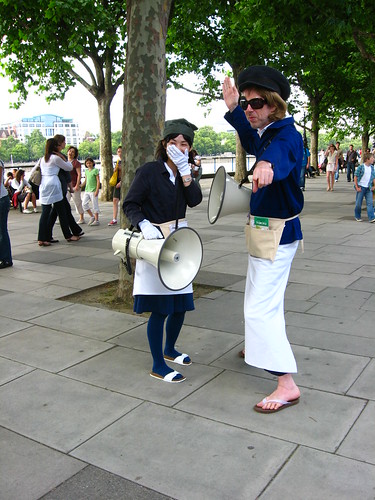 I only saw part of it, joining the tour in the afternoon. Momus and Hisae were attired in what looked like Japanese or Korean uniforms (which, Momus stressed, were not trendy-minimalist Muji products) and carrying 1950s-vintage megaphones through which they talked to a small crowd which had assembled around them, describing to them which part of Tokyo they are in. Well, Momus did most of the talking, with Hisae adding a native Japanese perspective; some of the time (particularly towards the end, when things got a bit more absurd), their act seemed like a traditional comic/straight-man music-hall duo.
The actual content was fairly interesting; we were informed that the National Theatre was actually a trendy shopping centre whose top floor was an art gallery/museum, where yesterday's unsold fashions ended up, and that the mayor of Tokyo makes his way up the river by speedboat at 6pm every day. Other than that, Momus expounded on his theories on Japanese culture and its similarities/differences with British and European cultures (European individualism vs. Asian collectivism/"superlegitimacy", the British stiff upper lip and the Japanese bushidō (which is apparently making a resurgence), the falsehood of the assumption that modernism is Westernism, and the rising Gini index in Japan and declining originality of Japanese street fashion (apparently it's all Uniqlo and The Gap in Tokyo nowadays)).
2008/5/22
Momus' latest New York Times Post-Materialist blog post is about fixed-gear bicycles, the latest hipster must-have after turntables and Lomo cameras, and, like them, a translation of lo-fi into the realm of physical transport, and a refusal to capitulate to bourgeois practicality:
The fixie cult demonstrates that limitations are what give a thing flavor, and that stubborn simplicity can be a sort of charisma. People love these bikes because of what they can’t do as much as for what they can. In that sense they join analog synths, vinyl record players and Lomo cameras as lovable retro lo-fi must-have. In addition to the charm and fashion kudos these bikes deliver, there are other advantages. Not only do they run cleaner than cars, you don’t even have to park them when you reach your destination. Just hang them on the wall and call them art.Even more interesting than the article is Momus' blog entry about it, which elaborates on some of the points:
Code of honour: I often find myself defending as new forms of honour things that others dismiss as fads. What do I mean by that? I think it's already encoded in Alin's self-portrait. His accident, here, isn't just a random misfortune. He "wears his wounds with pride". Like a soldier wounded in a battle fought in the name of a just cause, he feels there's something more important in life than mere safety. In fact, you could almost see cycling, and its attendant aesthetic, as "something worth dying for". The New York Times actually removed the phrase "to die for" from my text, replacing it with "must-have". But I wasn't just making a gruesome joke about cycling being dangerous. I really meant that it was important that fixie cycling -- like skateboarding -- is both difficult and dangerous. To understand why, you really have to go to non-Western places, places where Being is more important than Having, and where people -- including scary people like suicide bombers and kamikaze -- place higher values on certain ideals, certain codes of honour, certain loyalties, certain aesthetics than on life itself. Or you have to go to the chivalric codes of the middle ages. Cycling is, after all, a mechanized form of chivalric equestrianism.
Viral ecology: There's a danger that making people ecologically-conscious can end up preachy and worthy. What you need is something viral, something viscerally compelling, something cool as fuck, which is also something green. And fixie bikes are that: viral ecology with the urban credibility of skateboarding and the rebel cool of smoking combined. No more sermons! On yer bike!
Distinction strategy: We were talking earlier this month about shifts in graphic design style as a sort of distinction strategy, a game of catch-up in which one set of designers keep throwing wobblies, keep embracing ugliness and absurdity in order not just to "make it new", but to put a comfortable distance between themselves and the client-pleasing coffeetable hacks who hobble along behind, copying and pasting. The fixie trend is also a distinction strategy. It's a way for hipsters to say "I'm not just another suburban bozo with a car". But it's also a way for the West to say to China: "Okay, you all have cars now. Well, we're onto something else: bicycles." Which is ironic, since the West used to laugh at China for wobbling around, in its billions, on bicycles.
2008/5/16
Last night, Your Humble Correspondent made his way out to deepest darkest Richmond to see Momus' performance at the Richmond Lending Library. (This was the second ever performance in a public library I had seen; the previous one was also by Momus, only somewhere around Balham or Tooting, in the southernmost reaches of the Northern Line.)
 This performance, which I only found out about yesterday, was ostensibly about the restless spirits trapped inside books. Momus (attired all in black, including a hood) played the role of a spirit medium specialising in spirit media, as it were, or more precisely in the spirits of dead people trapped in books.
He invited attendees (of whom there were perhaps 10, presumably because those attending only had a day's notice of the event) to choose books at random and read a sentence from them, which he then would spin into a tangent, philosophical reflection or evidence of eldritch and unholy things beyond the veil between worlds. (In the first example, a cheerily banal line in colloquial English turned out to really be in "Ukrainian", and a portent of grim things indeed. Later, a book of knitting patterns revealed the battle between Jesus Christ and the tamagotchi—perhaps an echo of Momus' writings about the dualism between the Judaeochristian sex-death-guilt culture and the Shinto fertility religion, though he didn't labour that point.)
In between the entertainment, he performed a few songs, including Beowulf (which he did from under a blanket) and Robin Hood (with a dig at
This performance, which I only found out about yesterday, was ostensibly about the restless spirits trapped inside books. Momus (attired all in black, including a hood) played the role of a spirit medium specialising in spirit media, as it were, or more precisely in the spirits of dead people trapped in books.
He invited attendees (of whom there were perhaps 10, presumably because those attending only had a day's notice of the event) to choose books at random and read a sentence from them, which he then would spin into a tangent, philosophical reflection or evidence of eldritch and unholy things beyond the veil between worlds. (In the first example, a cheerily banal line in colloquial English turned out to really be in "Ukrainian", and a portent of grim things indeed. Later, a book of knitting patterns revealed the battle between Jesus Christ and the tamagotchi—perhaps an echo of Momus' writings about the dualism between the Judaeochristian sex-death-guilt culture and the Shinto fertility religion, though he didn't labour that point.)
In between the entertainment, he performed a few songs, including Beowulf (which he did from under a blanket) and Robin Hood (with a dig at Thatcher Blair Brown's devil-take-the-hindmost Britain), singing over an iPod playing through PC speakers, and playing the odd stylophone solo.
He also played one of the songs from the new album he's working on with one of the chaps from Gay Against You; it was built up from a Magazine sample (and thus, he said, possessed by Howard Devoto's restless spirit), and sounded quite good, in a glitchy breakcore sort of way; not too unlike Kid606 or Talkshow Boy.
Anyway, Momus' own account of the gig, with more details, is here.
Momus will be back in London in late June, when he will be wandering the south bank of the Thames and telling tourists that they're in Tokyo or something like that. Which should be worth going along to.
2008/4/3
Momus observes that, far from being centres of culture or creativity, districts which attract "funky" bars are merely centres of drunkenness:
I thought that being in the midst of a district dominated by theatre and retail I'd be living in a refined environment. Instead, I found I was living in a sewer. Brydges Place, of an evening, became an open toilet, used as a slash-wall of last resort by many of the thousands of people who descended on central London every evening to drink... heavily. My friend Thomi, who had a studio above John Calder's publishing house on Green's Court in Soho, had it even worse: people would stand on his step and pee right through the letterbox. Later I moved to the Chinese end of the Lower East Side just in time to see it teeter between a quietly industrious Asian district by day and a burgeoning, boisterous white people's drinking district by night.Momus lays the blame squarely at the feet of white people:
White people -- if you'll forgive the generalisation -- drink, and the further north you go the more immoderately and self-destructively they tend to drink. Or, to put that a little differently, the whiter your district gets, the more bars are going to pop up, and the more your Friday and Saturday nights will fill up with piss, shouting, boom-boom -boom, swagger and bravado.Momus' solution to avoiding being surrounded by vomiting revellers is simple: choose an area with a large Islamic population.
2008/2/27
Blogging has been sparse over the past few days, as Your Humble Correspondent has been away in Berlin.
Anyway, a round-up of things I've noticed from while I was away:
- After the European University in St. Petersburg, Russia, got involved in an EU-funded project to ensure the fairness of the election process, the Russian authorities shut down the university, claiming that it is a "fire hazard". Opposition figures accuse the Kremlin of moving Russia back towards totalitarianism (or is the goal a Singapore-style "managed democracy"?)
- While we're on the subject of democracy, Charlie Stross weighs in on why forms of democracy are becoming increasingly prevalent these days, with even otherwise illiberal regimes adopting aspects of democracy, rather than autocratic systems.
Anyway. Here we have three ways in which democracy is less bad than rival forms of government: it usually weeds out lunatics before they can get their hands on the levers of power, it provides a valuable pressure relief valve for dissent, and it handles succession crises way better than a civil war.
- Barack Obama, it seems, is doing well in the US primaries; so much so that someone in the Clinton campaign seemingly decided to resort to dog-whistle politics and took it upon themselves to circulate photos of him wearing scarily Middle-Eastern-looking attire, in the hope that enough Texans are sufficiently prejudiced to be unable to vote for someone whose name not only sounds like "Osama" but who once wore similar headgear.
- After writing a piece on the mainstreaming of neo-folk music, Momus has discovered Emmy The Great. His great revelation has little to do with her music, mind you, and much to do with her being young, (half-)Asian and fanciable.
- Apple have finally released a new MacBook Pro. It gets the Air's multi-touch trackpad, and the usual quantitative bump in specifications, alas, a higher-resolution screen isn't isn't among them, so if you want 1600 pixels across on something that doesn't look comically oversized, you'll have to buy a Windows machine.
- Meanwhile, Microsoft have been slapped with a US$1.4bn fine by the EU, as well as having made vague promises of being more open in future, and apparently they're working on a Windows Vista-based GNU rival named UNG ("just like GNU, only without all that pesky freedom").
Berlin, for what it's worth, was great; four days, though, is nowhere near enough time to see everything and enjoy the city. Though I was surprised that the attendants on the Deutsche Bahn sleeper train didn't seem to speak English. Hopefully they'll remedy this by the time they start running services through the Channel Tunnel.
For what it's worth, photos are being uploaded here.
2007/7/2
A few videos from this weekend's Momus gig at La Flèche d'Or in Paris:
Pierrot Lunaire:
Nervous Heartbeat:
2007/6/19
Momus' latest blog post is a critique of the recent film Pan's Labyrinth. Other than being an exercise in the goring of sacred cows (an often useful exercise), it makes some good points:
The film bore all the hallmarks of COG screenwriting. COG screenwriting is the opposite of personal vision, the opposite of imagination. It's screenwriting as taught by "experts" in screenwriting class, a kind of brutal, plot-advancing writing style based around a Centre of Goodness (COG) who wins the audience's sympathy (usually by pure genetic superiority -- ie a very good-looking actor is cast -- but also by a series of sufferings overcome throughout the narrative). It takes no prisoners -- and no risks. COG screenwriting is the filmic equivalent of modern managerial techniques. It's brutally efficient -- yes, it can and will make you laugh and make you cry -- but the difference between a film made by a COG director like Guillermo del Toro and an artist like Jodorowsky or Arrabal is like the difference between a house designed by a Project Manager and one designed by an architect. I will not let del Toro pass for an artist. I'm sorry, critics. He is a cinematic Project Manager.
Complete absence of sensuality, the incidental, the non-programmatic. Appeal is made to our adrenal glands, but no sexual organs (del Toro has the nerve to talk about Pan, but read the antics of the original Greek Pan here then compare them to the sexless, boring Pan character in this movie). Shock and surprise and mawkish empathy dominate, but there's no moment in which a character senses the breeze blowing in from the woods, just for its own sake. No, everything is fire and death and danger and hatred and forward motion. No indirection allowed. Improbable chases, with a deus ex machina to save the COG and a fatal comeuppance for the COB.
This is a Mexican-US co-production. But its values are American -- it has the shiny blue lighting, the flashy special effects, and all the conventions, of a US blockbuster (and the director apparently turned down both Harry Potter and the Narnia film to make it). This, then, is "global" film-making as a kind of outsourced American filmmaking. We do not leave the technical nor the moral universe of the Americans. Nothing is imported, in the sense of a "foreign" worldview. The film has learned American ways, but American audiences will not learn anything they don't already know from it, either texturally or morally.
2006/11/23
Today's dose of wrongness comes in the form of an outtake from the new Momus album, on which he raps in a bad cod-Jamaican accent about "murdering a pretty little bonsai tree", over a trip-hop beat.
2006/11/7
In his latest Wired column, Momus writes about how, in the age of digital music, record crackle has changed from undesirable noise artefact to desirable sonic texture:
There must have been some tiny glitch on one of my tracks, because the engineer -- looking as pleased as a dentist who's discovered a cavity -- rolled his swivel chair over to his newest toy: a Cedar digital declicking unit. This device, he explained, would search my recordings for clicks, crackles and other errors and strip them out faster than you could say "Leadbelly."
Fifteen years later mastering studios -- and digital restoration devices made by companies like Cedar Audio -- still flourish. But something else has happened in the interim, something either contradictory or complementary, depending on how you look at it. There are now all sorts of devices that, rather than removing "imperfections" like crackle and click, actually add them.
When analog recordings on vinyl were our main way of representing music, there was no reason to think of a black 12-inch record as a fetish object, to be celebrated for its rare, soulful, unique properties. Back then, we didn't cherish surface noise, or find failure charming. A record was supposed to be an audible "window on the world" -- the less it crackled, the better we could hear what was going on through the window.
But when CDs replaced vinyl, some of us began collecting the black stuff religiously, and treasuring its unique properties. Those turned out, mostly, to be errors and limitations.
But maybe that halo -- that warm, holy glow -- is just the consolation prize we award to any medium that's been displaced from the coveted role of representing the world. Think of painting focusing on the brushstroke when photography comes along, TV turning self-referential when we get our information about the world through computers instead, or analog crackle becoming something you add with a digital patch.I have wondered whether, at some future stage, low-bit-rate audio-compression artefacts will become fashionable in the same way that faux record crackle is these days; perhaps with bands making allusions to a mythical golden age of MySpace bedroom indie authenticity or somesuch?
2006/9/9
Momus makes a few points about car-centric urban design:
It's always seemed to me that a society's respect for humanity might be better measured by the length of its pedestrian crossing signals than by any number of abstract declarations of support for "universal human rights". Cars are the closest thing we have in our society to predators, capable of picking off the weak; they're malevolent steel sharks or pumas, cruising our cities, hogging the head of the food chain.
Car signals stay green up to ten times longer than foot traffic signals do. Pedestrians sometimes only get a cross signal when they "apply" for it by pressing a request button. It just seems that car traffic is seen as "economically rational" and "necessary", whereas foot traffic is somewhat dilettante, an afterthought, unimportant.
Often, in studies, only the motorist's convenience is taken into account. Manhattan traffic police admitted, for instance, that a barrier scheme to prevent pedestrians crossing 6th Avenue by forcing them to walk up the block to the next crossing point was deemed a success because it reduced traffic wait times. The extra time added to the pedestrian's journey wasn't even measured, though, and this despite the fact that 6 or 7 times more people were crossing town on foot at these locations than in cars.
2006/7/20
AIGA Design Forum has an article taking the Whitehouse to task for its poor typographical taste:
While his handlers would never allow the leader of the free world to go out in public wearing a rayon leisure suit and white bucks, they nonetheless use clownish shareware typefaces with hokey beveled edges and cheesy drop shadows to represent his ideas.
The most persistent is the use of Roman-like faux intaglio and engraved letterforms to give an air of authority and truth--although the effect is more Las Vegas casino. To celebrate the fourth anniversary of the "No Child Left Behind" act, someone got a little creative and added a drop shadow to a font that fakes the look of chalk or crayon lettering. This is only one evolutionary step away from introducing the Lariat font (novelty letterforms made from rope) whenever W is speaking from Crawford, Texas.The author suggests that the Whitehouse's design faux pas are the result of indifference, and/or the Whitehouse hiring computer geeks rather than designers (and, incidentally, offers his services as Undersecretary of Design. Momus, however, disagrees, arguing instead that the Whitehouse rejects what is received as good aesthetic taste because it is too closely associated with despised liberal elites, whereas chunky patriotic-action-thriller letters and extruded gold serif fonts are considered populist.
Momus then goes on to find other political signifiers in the Whitehouse's aesthetic choices:
The meaning of Trajan in the contemporary US seems fairly unambiguous to me. Trajan makes an implicit metaphor between the imperial power of ancient Rome and the imperial power of contemporary America. Whether it's made to look as if it were chiselled, or whether the letters are themselves made of metal, it suggests sharp implements, which conjure both the image of monumental permanence and the image of martial hardness -- the two basic meanings of Trajan's column itself. Pure Trajan suggests "right wing"; Trajan with drop shadow, metallic glints or lurid colors suggests "populist". Put them together and you get: "right wing populist". You don't have to spell it out in text; the message is there in the texture.
The Nazis would have hated [Mies van der Rohe's Neue Nationalgalerie's] lightness and clarity the way the Bush administration seem to hate clear, clean Franklin Gothic or Helvetica layouts. They'd already forced Mies to close down the Bauhaus, a den, in their view, of socialists, communists, Jews and progressives. They rejected Mies' Modernist style as "un-German". I'm trying to imagine a parallel world where the Nazis build a Modernist Germania of light articulated glass curtain architecture, but it's almost impossible, just as it's almost impossible to imagine the Bush administration producing a banner or a publication I'd actually admire and want to hang on my wall.Momus, though, comes to the conclusion that "good design" and "bad design" are entirely culturally relative.
There is no such thing as bad design or good design, the cultural relativist has to conclude, just their design and our design. The downside of that is that we lose the illusion that our taste has universal validity, or is inherently better than anyone else's. The upside is that we stop trying to preach and teach -- meaning, we become a little less imperialistic, perhaps. (Or do we become more imperialistic, and simply say "Our way is better because we have more power than you... and because we say so"?)I don't entirely agree with this conclusion, as it seems too much like the "blank slate" theories of human nature pushed with Lysenkoist zeal by some leftists. There is "good design" and "bad design", as far as utilitarian considerations are concerned. These considerations have to do with the nature of the human perceptual system, which (at least at its most basic levels) is most certainly not a product of culture, language or politics. I doubt, for example, whether there could be a culture that finds low-contrast combinations of colours (such as, say, green and orange) easier to read than high-contrast ones, or find lack of whitespace more legible.
2006/5/12
In his blog entry today, Momus complains about the declining quality of Japanese porn, thanks to the tendency of the girls to have their eyes surgically rounded:
Japanese women -- at least as they appear in the Japanese pop media -- are turning into bug-eyed monsters. I first noticed it in pop and porn stars; these days, the free movies page of a Japanese porn site like CPZ is a freak show of Photoshopped, fish-eyed and scalpelled eyes mooning at the visitor. These girls no longer look like real people, so they're no longer sexy.Momus goes on to discuss whether this phenomenon is a desire to emulate Caucasian ideals of beauty (he argues it is not). And in the comments, an anonymous poster cites an interesting factoid about another Japanese cultural phenomenon that seems to have been adopted from the West but wasn't:
The Japanese attachment to baseball has nothing to do with the West, either: if you look back into Japanese fuedal history, it was a popular sport for shoguns to bat around the severed heads of defeated leaders with wooden sticks and matching uniforms.
2006/5/4
Japan is preparing for an epidemic of divorces as its baby-boom generation of salarymen retire and find themselves living in close quarters with the wives they hardly knew during their working lives:
"I wanted him to keep working but I've accepted now he's going to come home," says Hatae Ishizaki, whose 59-year-old architect husband is due to punch his last card in April next year. "I'm just going to spend more time out of the house. I'd divorce him, but it's too much trouble at my age."
Japan has some of the longest hours of unpaid overtime in the world. Salarymen generally spend more time in the company of male work colleagues than with their families. In their scarce hours out of the office, husbands are poor home-makers - a recent survey found that men in Japan did just four hours housework a week, far fewer than their counterparts elsewhere. Among the cruel spousal monickers for wrung-out, retired husbands with minimal life skills are nure ochiba (wet leaves) and sodai gomi (big rubbish). "It's like having another child around the house," says Mrs Ishizaki.
One of Japan's top-selling weekly magazines, Shukan Bunshun, recently peered inside hundreds of baby-boomer households and was shocked to find that many middle-aged women were practising their farewell speeches.
"To my husband: Don't suddenly get friendly with me after all these years of leaving me alone now that you have retired from your company. It's too late now!" said one 55-year-old woman who contributed to the magazine's survey.(Let's see Momus spin this into an example of a model of human social harmony.)
2006/4/24
An art gallery in London is having an exhibition of photographs by an outsider artist whose work has been making waves recently. Miroslav Tichý studied art in Czechoslovakia until the Communist authorities took objection to him being "different" and arrested him for subversion; he then spent some eight years in prisons and prison camps. Upon his release, a broken man with little hope for the future, he nonetheless pursued his artistic obsessions, fashioning crude cameras from junk and using them to take surreptitious photographs of women:

Upon his release in the early 70s, Tichý wandered his small town in rags, pursuing his obsession as an artist with the female form by photographing in the streets, shops and parks with cameras he made from tin cans, childrens spectacle lenses and other junk he found on the street. He would return home each day to make prints on equally primitive equipment, making only one print from the negatives he selected.
He stole intimate glimpses of his subjects through windows and the fences of swimming pools as well as in the streets, sometimes finding himself in trouble with the police. He would often draw intricately on each print in pencil embellishing the images with his lines or reworking them in other ways, Tichý would also sometimes include a card frame around the prints and decorate those too.
The work which might to the casual viewer, simply appear to be intrusive voyeurism, takes on a melancholic and poetic quality. They are exquisitely produced small objects of obsession, which have no equal. He produced work - not for others, but solely for himself without any regard for exhibiting or selling the work to others.
(via Boing Boing) ¶ 0
2006/4/6
Recording artist, cultural commentator and left-wing intellectual type Momus weighs in on file-sharing and "piracy". He's all for it, and against the RIAA's crackdown; what's more, he's officially OK with people who are not sufficiently into his music to pay for a CD downloading MP3s instead:
No doubt some people will feel the same way about my new record, Ocky Milk, and that's fine too. These "unconvinced" listeners will at least listen, even if they don't buy. That may not matter to the RIAA, but it matters to me as an artist. And even if these people don't buy this record, they may buy another one, or they may come to a live show, or they may pay for a track off iTunes or E Music.
Or, you know, one of these downloaders may have sex with me, or give me a column in a magazine, or ask me to come and give a talk at an art school, or collaborate on a project, and that will lead to, you know, marriage, or a surprise twist in the career path, or something equally amazing. "Peer-to-peer" can mean much more than just sharing music. To the RIAA, a "peer" is simply a freeloading customer, a source of monetary loss. But to me a peer is a person, the source of all sorts of possible gains, quantifiable or not. To the RIAA, with a business agenda but no human agenda, that peer engaging in P2P can only mean the loss of dollars. To me it can mean the possibility of barter (the theme of artist Carolina Caycedo's work), but also friendship, communication, and a million other human possibilities.
2006/1/20
A church in Cambridge has started holding a church service for Goths:
The associate vicar at St Edward King and Martyr church in Cambridge, himself a goth, holds a 45-minute service complete with candles and a specially written liturgy for members of the goth community. There are no hymns but goth music is played instead, including artists such as Depeche Mode, Joy Division and the Sisters of Mercy, said Mr Ramshaw, 34.
After the service, most of the congregation go to a goth evening at the nearby Kambar nightclub called, appropriately enough, the Calling.Of course, if you assume that Goth is intrinsically a manifestation of Judaeo-Christianity (see also: heavy metal, Satanism, Johnny Cash, Nick Cave), this isn't quite as weird as it sounds.
2006/1/18
The New York Times has a long and interesting article on the Japanese phenomenon of hikikomori, or of young Japanese dropping out of society and shutting themselves in their rooms for months at a time, emerging only to go to convenience stores at night or not at all:
A leading psychiatrist claims that one million Japanese are hikikomori, which, if true, translates into roughly 1 percent of the population. Even other experts' more conservative estimates, ranging between 100,000 and 320,000 sufferers, are alarming, given how dire the consequences may be. As a hikikomori ages, the odds that he'll re-enter the world decline. Indeed, some experts predict that most hikikomori who are withdrawn for a year or more may never fully recover. That means that even if they emerge from their rooms, they either won't get a full-time job or won't be involved in a long-term relationship. And some will never leave home. In many cases, their parents are now approaching retirement, and once they die, the fate of the shut-ins - whose social and work skills, if they ever existed, will have atrophied - is an open question.
In other societies the response from many youths would be different. If they didn't fit into the mainstream, they might join a gang or become a Goth or be part of some other subculture. But in Japan, where uniformity is still prized and reputations and outward appearances are paramount, rebellion comes in muted forms, like hikikomori. Any urge a hikikomori might have to venture into the world to have a romantic relationship or sex, for instance, is overridden by his self-loathing and the need to shut his door so that his failures, real or perceived, will be cloaked from the world.
By Japanese standards, his room was enormous, with a wall of delicate shoji screens leading to a rock garden. But it was hard to imagine what he did there all day. There were no stacks of manga, the popular Japanese comic books, no DVD's, no computer games, all things found in the rooms of most hikikomori. The TV was broken, and the hard drive was missing from his computer. There were a few papers on his desk, including a newsletter from New Start that Kawakami brought on her last visit. Otherwise, the only evidence that this was a hikikomori's room were three holes in the wall - the size of fists. Shut-ins often describe punching their walls in a fit of anger or frustration at their parents or at their own lives. The holes were suggestive too of the practice of "cutting" among American adolescent girls. Both acts seemed to be attempts to infuse feeling into a numb life.
By the time parents seek help, often their child has been shut in for a year or more. "When they call," Dr. Saito said, "I offer them three choices: 1) Come to me for counseling; 2) Kick your child out; 3) Accept your child's state and be prepared to take care of him for the rest of your life. They choose Option 1." He also offers poignantly simple parenting tips, like not leaving dinner at a child's doorstep. "You make dinner and call him to the table, and if he doesn't come then let him fend for himself." In addition to meals, parents often provide monetary allowances for their adult child, and in rare cases, if a child has become verbally or physically abusive, parents move out, leaving their home to the shut-in.Parents of hikikomori now have support programmes to turn to, including volunteers known as "rental sisters", who try to befriend their children and coax them out of their rooms and into support centres, often over months or years.
There are multiple theories trying to explain the hikikomori phenomenon, but several frame it as a conscious rejection of the high pressure to conform and succeed placed on individuals in Japanese society; a conscious, if not particularly sustainable, decision to drop out of the traditional school-university-work career path.
On a similar note, Momus' latest piece in Wired News celebrates Japan's aging population and embrace of the "slow life".
2005/12/20
In his journal post today, Momus talks about postmodern mash-up/pastiche artists like Chicks On Speed, The KLF and Donna Summer referencing rock, with a layer of detachment:
It fits a template Ex-Berliner music journalist David Strauss has called "playback music", which includes Berlin-based artists like Chicks on Speed and Kevin Blechdom. Possibly even me. The playback artists ... perform a sort of pomo cabaret music, sampling and playing back selected music from the past, recombining it like curators. They're, inevitably, taking the piss, and never more so than when they feature their ultimate object of veneration, delectation and derision, the phallic electric guitar. That's why I call them chicks with dicks. They have ironic dicks firmly in their cheeks. Jason, aka Donna, is one of them, one of us. He calls it Cock Rock Disco, but it's the same difference, really. We don't play guitars! Yes, we do! But ironic ones!
ll pop music is parody to some degree, but some are clever enough to disguise it and can therefore tap into the inherent fascism of rock audiences. Because, make no mistake about it, rock music is fascist. Anybody addressing a stadium is basically reliving the Nuremberg rally. But because Jason is a nice, intelligent, cultivated man, and because that's pretty apparent—come on, look at those cute vikings, the tasteful references to 1960s Czech animation!—I suspect his recontextualised rock riffs will strike American adolescent Nordic Supremacist ears—hould they ever strike them at all—as gay. Because "gay" is the word the not-so-bright use instead of "ironic".I wonder where he would place bands like The Darkness and Wolfmother, who play over-the-top rock with apparent 110% sincere belief in the power of it, whilst being aware of the referentiality and formulaicity of what they are doing, and slyly acknowledging their references.
2005/11/4
A 16-year-old Japanese girl has been arrested for poisoning her mother and keeping a blog about it, recording the results. The girl, a member of an elite high-school chemistry club, was apparently emulating British teenage poisoner Graham Young, subject of the cult film The Young Poisoner's Handbook, up to using thallium as her poison of choice:
"Mother has been sick since yesterday, having a rash all over her body," the Asahi Shimbun newspaper quoted the girl as writing on August 19 on the online journal, which was kept under a male name.
Another daily newspaper, the Mainichi Shimbun, reported the blog said on September 12: "Mother is sick today, too. She had been complaining her legs have been out of it for two or three days and she has finally become almost unable to move."The girl also is reported to have kept severed animal body parts in her room. (Which seems to contradict Momus' assertion that the Japanese don't get goth because theirs is not a Judaeo-Christian culture, but I digress.)
2005/10/8
Momus opines on recent attempts to promote Satanistic occultism as a key part of "alternative culture":
Yes, Satanism just strikes me as... silly, I'm afraid. Why abandon the idiocy of God if you're not also going to abandon the idiocy of The Devil? Sure, I love mystery, and I love "the old religion", the Greek pantheon, the Celts, Shinto, all that stuff. What I hate, though, is the way Christianity vilified fertility religions and made them "evil". You can still see the result of that in the way various speakers at the Disinfo conference, included on the DVD, have a certain "evil glow" in their eyes, or believe they possess an "evil charisma". America's idiotic binary culture forces you to be good or evil, with or against, constructive or destructive. The result is that alternative culture people internalize the stigma of otherness, becoming Fashion Goths and Slayer fans.
I dislike Satanism for aesthetic reasons too. Occult sections in bookstores are usually magnets for the spottiest, stupidest, most badly-dressed people. Occultist websites are appalling cautionary tales, evidence that, whatever else he does, Satan makes you commit every graphic design sin known to man. But I particularly resist precisely this thing that Jason Louv is advocating in Generation Hex, the stringing together of Satanism and alternative culture. I resist it because it's just fucking boring to see the counterculture summed up with a skull. But also because alternative culture has some important work to do, work it needs rationality and clear-headedness to carry through, and work which it needs to believe in its own ethical goodness to bring to mainstream acceptance. Wouldn't it be terrible if everyone, for instance, who thought there were other shibboleths than endless economic growth, all turned out to go to secret meetings and make secret signs to each other and think they were "evil"?
2005/8/11
Momus gets stuck into what he calls "fashion goth", which seems to be a construct containing a whole bunch of things he dislikes, from the Goth subculture and BDSM to Suicide Girls to the New-York-hipster fashion of wearing clothes with skulls on them to show how hard and cynical you are and to Judaeo-Christian asceticism in general.
I'm not into Suicide Girls. I hate tattoos and piercings and the cult of self-injury. Sex is not evil or wicked. What Christian sect do you guys belong to?
Japanese people tend not to be fashion goths, or into kitsch. Even the black lace Gothic Lolitas in Japan are something else, really. They're human mille feuille cakes, not goths.
Can you imagine a fashion goth soaking in a sento and then playing pachinko and then eating a hearty meal at an isakaya, chatting away and laughing at the comedians on TV? "Where's the agony?" he would cry, meaning "Where's the beauty?" He'd miss the beauty in the food, and in the water.
When I was in New York this time all I could see on everyone's T shirt was skulls, skulls, fucking skulls. How can you protest the Iraq war if there are skulls all over you, fucking fashion goth?
2005/6/30
Momus has posted several extremely short stories he made up for telling at an art show:
Each time an ice skater completes a lap of the rink, he adds a decade to the faces in the crowd watching him. Guilty that he's killing many in the audience, he's relieved to discover that by skating backwards he can remove a decade from their ages. But many people still "die" by being taken back before the time of their birth.
A man follows a toothpaste trail to a small room in the red light district. In a room at the end of it he finds a woman surrounded by money. He asks why she's surrounded by money. She says "Pay me, and I'll tell you." He pays, and she says other curious fools like him have paid to learn the same thing. He goes off and starts a similar business, but makes less money at it.
A wild goose is flying in V formation with fellow geese, flying south over and away from Denmark. Surveying the land below, the goose longs to land, to peck at corn. It lags behind its comrades, and lands. The winter comes on fast, and the goose is buried by the snow.
A man buys an inflatable woman and takes her to a love hotel. He tries to make her sing karaoke with him by controlling the flow of air escaping from her. It's so exhausting blowing her up and squeezing the air out that he falls asleep without trying to have sex with her. The next day they go to the beach. The man uses the inflatable woman as a lilo, and floats with her around the coast to a temple. He tries to have the doll accepted as a new monk, but when she's having her hair shaved off she deflates.Brilliant.
2005/6/27
This afternoon, I went to The Hospital, a gallery in Endell St., Covent Garden, to see a video installation titled Anyone Else Isn't You, by Iain Forsyth and Jane Pollard (the artists behind the reenactment of that Cramps gig in the mental hospital, and a number of Smiths-themed installations in the 1990s). This video work (named after a Field Mice song, which played at the end of it) was about the way people's lives and relationships are influenced and mediated by music, and consisted of fragments of interviews with 12 people talking about such things as mixtapes they made for/received from lovers, songs they couldn't listen to any more because they were associated with relationships gone bad, records associated with specific times of their lives, and other anecdote (one woman mentioned a friend who did so much acid he thought he was living in Pet Sounds). The people were mostly in their late 20s/30s, and the music they mentioned ranged from the likes of My Bloody Valentine and Belle & Sebastian to the Velvet Underground; the video went on for about half an hour.
There is also a booklet with the exhibition, featuring writing on the subject by Momus, Steve Lamacq and one JJ Charlesworth.
2005/5/31
I haven't been paying enough attention to France's rejection of the EU constitution to comment insightfully on it, but Momus has:
It seems to me that a very similar thing has happened to Europe that has happened in the US: the people voting Yes to the EU constitution have the same educated, urban profile as the people voting Democrat in the last US election. And in both cases they've been defeated and outnumbered by less tolerant, less affluent and educated, more anxious, irrational and xenophobic people from smaller towns and country areas. People who feel like outsiders to the political process are now, with splendid passive aggression, exacting their revenge by dealing it blows. In many cases these people are also outsiders to the process of wealth creation: strip away the blue coasts and the big cities and America loses the economic powerhouses which make it the world's predominant power. It's the same in Europe: the people now determining the shape of the continent are the insecure poor, unwilling to share their meagre income with Polish plumbers and Turkish bakers, but also unwilling to admit their economic dependence on the dynamic city folk and political elites they've just dealt a slap in the face.Perhaps this is a good thing for trans-Atlantic peace. Perhaps the red-state Americans and the French Non-sayers can realise that they have a lot in common, put aside their hatreds of each others' countries and unite in a big joyous pogrom of their respective inner-city liberal-cosmopolitanist elites, shortly before devolving into a new dark age of poverty, superstition and xenophobia.
2005/4/28
Last night, Your Humble Narrator made it down to Bush Hall to see folktronica artist, cultural theorist and fabulous British eccentric Momus, HitBACK guitar-pop band The Free French and an outfit named Stars In Battledress.
First up were Stars In Battledress, a duo with one chap playing guitar and singing and the other playing piano. Their music was somewhat avant-garde, like a roiling sea of chords, notes and words, shifting and changing structure. Not really my cup of tea.
Momus was next, and took to the stage with his iBook. He basically sang over backing tracks played from iTunes, stopping from time to time to play sounds on a Flash-based microtonal instrument on the iBook. Other than that, there was no live music, though Momus put on an entertaining performance, moving around a lot and putting on quite a dramatic act as he sang his songs. (I guess that the important thing about a performance is not what proportion of notes played is live and triggered by musicians on stage, but the energy and charisma of the performer; the reason why most live-electronica acts suck is not because the artists are sitting behind a rack of synths twiddling knobs rather than playing a guitar, but because they fall into the backroom-geek trap, just sitting there rather than engaging the audience. Punters generally don't pay to see mild-mannered geeks controlling synthesizers, which is why the dance-music fad of the 90s had wide-boy "superstar DJs" to act as frontmen. But I digress; Momus certainly did not suck.)
Finally, there were The Free French; they're labelmates of Spearmint, and not too far away in the stylistic universe; indie guitar-pop with a touch of blue-eyed soul (the frontman is apparently a huge Hall & Oates fan). They played a decent set from their past three albums, and a new, as yet unrecorded song. They were enjoyable; I'll probably see them again.
There are photos here.
2005/3/13
Momus weighs in on the Michael Jackson trial, painting it as a tragic triumph of warlike Spartan puritanism over a future of limitless, polymorphous opportunity:
One of the reasons the Michael Jackson trial is so unfortunate is that the world of Either-Or will pass judgment on a creature of Yet-Also. The world of clear, unambiguous categories will pass judgment on someone who flies Peter-Pan-like over the binaries that confine and define the rest of us.
Jackson is what all humans will become if we develop further in the direction of postmodernism and self-mediation. He is what we'll become if we get both more Wildean and more Nietzschean. He's what we'll become only if we're lucky and avoid a new brutality based on overpopulation and competition for dwindling resources. By attacking Jackson and what he stands for -- the effete, the artificial, the ambiguous -- we make a certain kind of relatively benign future mapped out for ourselves into a Neverland, something forbidden, discredited, derided. When we should be deriding what passes for our normalcy -- war, waste, and the things we do en masse are the things that threaten us -- we end up deriding dandyism and deviance.
Mind you, from what I heard, the court case is not about Jackson's deviant refusal to fit into binary categories or to obey the stern laws of the joyless, unimaginative "Never-Fly", but about whether or not he buggered some children. And surely if he represents a viable future of humanity and is convicted or otherwise put out of action, some alternative, non-child-buggering manifestation of Homo Sapiens 2.0 will come along and carry on the Great Work. Surely Mankind's salvation from a soul-crushing dystopia of war, sexual puritanism and manufactured mass entertainment doesn't literally rest with one man.
Meanwhile, in the LiveJournal comments for this entry, there is an interesting tangent, quoting a New Scientist article on Michael Crichton's latest book (a thriller which paints the scientific basis of environmentalism as fraud and environmentalists as fanatical terrorists):
When I visited America during my time working for Greenpeace International in the 1990s, time and again people would say to me "we really don't approve of the way your organisation blew up that French ship", or words to that effect. It happened once at the end of a meeting with a lawyer in Philadelphia. He was defending Lloyds of London against a suit filed by Exxon after the Valdez oil spill. He wanted to thank me kindly for all the excellent free technical information I had furnished him with in support of his defence, but he really hadn't enjoyed having to talk to me because my people had murdered somebody in New Zealand.
How could it be, I used to wonder, that Americans got the French secret service's sinking of the Greenpeace ship the Rainbow Warrior the wrong way round so consistently? I encountered the phenomenon in no other country. I never knew why for sure and still don't. Whatever the explanation, it happened so many times to me and my colleagues that I had to conclude it was something cultural.
Which sounds like cognitive dissonance in action. Perhaps, to many people in the U.S., the claims that the French government blew up a Greenpeace ship jar so much with their beliefs about the nature of environmentalism (according to this New York Times article, 41% of Americans consider environmental activists to be "extremists") that they have to mentally correct the "error" in the reported facts, turning them around to make more sense.
2005/1/25
Wearing his design-commentator hat, Momus dissects VICE Magazine's Design issue, peeling back the magazine's hipster-nihilist façade:
Here's where Vice's real agenda begins to peep through the scatology, like a seam of lace under a crumpled Kleenex; behind the affectations of hoodlum and white trash style, the glorification of rural teenage delinquency and the cheap shots at NYU students, Vice is a magazine written by and for urban sophisticates, people who know quite a bit about art, photography and design and are actually highly invested in aesthetics. Vice's photo editor, seen holding a fake iBook in the iHustle feature, just happens to be Ryan McGinley, an American Photo Magazine Photographer of the Year and, at 25, the youngest artist ever to have a solo show at the Whitney. Could it be that behind the sophomoric, mischievous, dismissive, even nihilistic style, Vice is the voice of a twentysomething generation clearing the decks for a new aesthetic? Is the magazine's iconoclasm pure destruction or preparatory work for a new definition of the 'iconic'? Is the disgust directed here at design actually disgust at its co-option by consumerism, its low aspirations?
The Vice Design Issue is not an anti-design tract, but the championing of an aesthetic that's already quite well-established, already wowing museum curators -- a casual, trashy, porno-party style that celebrates tack, lo-tech and the good old bohemian values of sex, drugs and rock and roll. This salon des refuses, populated by people in their twenties, is well on its way to becoming a salon tout court.
What, VICE is run by a bunch of educated middle-class yuppies? All the nihilistic rants, casually homophobic epithets and keeping-it-real articles about prison life and street violence and ultraviolent musical subcultures and guest contributions by the likes of Jim Goad and such are just the affectation of a bunch of privileged scions of the cultural elite slumming it before they join the establishment proper? Say it ain't so!
2004/12/30
Heard in a Momus audioblog entry:
There is, apparently, a Japanese town named Aberdeen. This town originally had a different name, but was renamed to Aberdeen so that the local whisky distillery could put "Made in Aberdeen" on their bottles, with "Japan" in smaller print below.
2004/12/28
Expatriate citizen-of-the-world Momus returns to Britain -- and hates it; on returning, he finds squalor, shabbiness, crass consumerism and an edge of latent aggression.
The marketing is slick and constant, nothing works, and it's twice the price it would be back home. And there's some sort of druggy, boozy menace hanging over the streets at night. Blame the binge drinking sprees! Have a happy smashed British Christmas!
We stop at a filling station on the Shoreditch High Street to buy some food. A homeless man is sitting at the entrance. 'Spare some change, please? Spare some change?' A black man gets out of a BMW and comes over to reform him. 'Look at yourself, mate, you've got to stop using the stuff. Go to a gym, man, do a workout, get out of this state you're in, it's a fucking shame on you, man!' He's a winner, the junkie's a loser. Go to a gym, start a business, buy a BMW, join the winners. It's dog eat dog.
The next morning the taps in the bathroom don't seem to work, and neither does the flush in the toilet. Fuck! At least I'm able to shower. I don't think I could bear to be dirty in London. It already feels like a gigantic toilet. Crossed with an advertising agency. An advertising toilet? Why not? Clever marketing idea! Out on the street, I see a bus with an advert on the side that says 'More Glitz! The Brent Cross Centre, feed your addiction'. Feed your addiction? Fuck, you mean become like that junky we saw last night at the filling station? Have drugs and celebrity become metaphors for everything in Britain? Are they marketing heroin yet? Welcome! Fuck!
The atmosphere didn't feel benign at all, nothing like soft, safe neon nights in Tokyo. `it felt brutal. Minicab sharks, cars pulling up behind pedestrians. You're in there, protected, and I'm out here, not. I'm just going to have to hope you have a good heart. People in hip hop hooded tops looking hard in kebab shops. It all feels like one of those Streets videos where a bunch of tanked-up British guys end up with blood streaming down their faces. 'Mate, mate, I don't want any trouble, mate.'
The kids in the next seat just said 'Bling bling!' The phrase is everywhere in Britain, an R&B-rap-pop fashion as widely adopted as the flash white sportsgear people wear on British streets, minus all the gold, silver and diamonds that stars like J-Lo and Britney accessorize it with. I open the Virgin Trains magazine. (Wow, marketing! Trains never used to have in flight consumer magazines! Then again, they once had basic services like running water and hot food.) There's an article about shopping in Birmingham. It begins 'Diamonds, platinum and all things bling lie ten minutes from the city centre in Birmingham's jewellery quarter...' Later in the journey, bored, I open the new tabloid Times and there it is in the financial section. 'Bling bling: fashion designer John Zhao shows off his crystal encrusted iPod'. Britain speaks fluent bling bling. Britain, from top to bottom, embraces the showy materialism. the 'I won, you lost' mindset of hip hop and R&B videos. Bling bling, I win!
I've noticed some of these things since coming here; the ubiquity of branding, often taking priority over other things (for example, anything to do with live music here has the Carling brand (which is a rather generic lager) slapped on it, and band venues have advertising billboards on the walls), the "ATM attendants" stationed beside every cash machine, trying to guilt the relatively well-off user out of one of their tenners, the chav kids looking hard and dead-eyedly cynical in their hip-hop thugwear (Burberry baseball caps worn under hooded tops, to hide faces from the ubiquitous CCTV cameras, seem to be a big part of youth fashion here), drunk arguments in the streets, with couples screaming "FUCK OFF, YOU FUCKING WANKER!" at each other, the dozens of different posters on every form of public transport, from buses to long-distance trains, warning passengers not to assault staff.
2004/12/7
Jeremy Deller, one of the masterminds behind Acid Brass, has won the Turner Prize, with a video exploring Crawford, Texas and the Branch Davidian siege in nearby Waco. Deller is also known for staging a re-enactment of a battle of the 1984 miner's strike (using former miners to play riot police), placing ads containing Smiths lyrics in the Guardian's Valentines pages, installing a mirrorball in the "vilest alley in Liverpool", and various objects to commemorate ordinary lives and deaths; he is now planning a nationwide exhibition of spray-painted cars, gurning competitions, crop circles and other folk art.
Meanwhile, Momus weighs in, comparing Deller's socially-aware art with the terminally conservative and staid nature of rock, in particular, the rigidly formulaic variety that graces the pages of NME:
UK rock and pop awards in 2004 showed pop music, and specifically rock, to be in a terminally mannerist and museumlike place; dead, irrelevant, tongue-in-cheek, out of touch with contemporary events, as conservative and hung up on the past as opera or classical music at their most decadent, smug, pastichey and tribute-ridden. Awards like the Brits and the NME Carling this year went to sadly Spinal Tappish bands like The Darkness, The Libertines and Kings of Leon, whose moronic-ironic pomo neo-primal rockism seemed to narrow the world down to retro-reverence and in-joke tribute-nudges to rock's heyday, the 1970s (did I mention that satanist-turned-celebrity dad Ozzy Osbourne won the NME's 'Godlike genius award'?).
2004/11/3
Artist/musician/pundit Momus, who has a fairly nifty blog, has some words of advice for all the Americans who have been talking about moving to Canada/Europe:
For those of you thinking of leaving America today -- and there are many, I'm sure -- I'd say just do it. Walk away. Leaving Britain is the best thing I ever did. I lived for years there feeling like a political and cultural exile, trying to fight back with satire and a thousand subtle forms of stubbornness and resistance. But being an 'internal exile' is not good for the soul. My struggle with attitudes which seemed toxic to me started making me as hard, cynical and corrupt as the people and the attitudes I was fighting.
I became a world citizen. I started to think in terms of cities, and even districts of cities, rather than nations. I made my own cut and paste environment, a place where I felt comfortable and valued. I selected its elements from the internet and the parts of the cities I loved and went to live in. I count the moment I left my incorrigible homeland as the moment my adult life really began. I am now a much happier and better adjusted person.
If enough talented people leave the US, and if it keeps running up gigantic budget deficits by fighting wars, it will shrink to a manageable size. America is clearly on an identity quest. Let it become a red dwarf, shrunk down to its rural red states. Uninventive, intolerant, unproductive. That's its way of discovering 'who it really is'. Meanwhile, somewhere nicer, you can be discovering yours.
2004/11/2
Momus on the grouping of things, such as beliefs or aesthetic preferences into indivisible packages; from shrinkwrapped ideological packages such as liberalism or conservatism (i.e., assertions such as "if you believe that abortion is wrong, you'll also believe in the death penalty") to musical and aesthetic tastes (and all those web-based programs which attempt to predict which music you'd like on the basis of what other people who share your tastes do).
2000/6/23
Pop-music art nutter Momus takes a somewhat askew look at key acts of the 1990s, such as Beck, Tricky Bjork, and Nirvana:
A star had to emerge from the Seattle sequencer scene, and it turned out to be Microsoft's Nerderama. The album Clevermind hit America like a fatal processor error in 1992, its lead single, Looks Like A Teen Programming Bug, becoming the anthem for a generation raised on Space Invaders and spreadsheets.
(Thanks, K.!)