The Null Device
Posts matching tags 'retro'
2017/11/3
The British supermarket chain Sainsbury's is doubling up on the fashion for vinyl records. For a while, they (alongside their rival Tesco) have been selling a small selection of classic albums, repressed on 180 gram luxury vinyl, to shoppers who want to own a slice of pop-cultural history in its most authentic format, and to be at one with Led Zeppelin or Amy Winehouse or whoever in a way that those listening to the iTunes download can never be. And to think: all this at your local supermarket. And now, they're launching their own brand of vinyl-only compilation albums. Named Sainsbury's Own Label, the records, overseen by pop historian and Saint Etienne member Bob Stanley, will contain classic vintage tracks, and come enclosed in retro-styled monochromatic sleeves, for that extra dose of supermarket-fresh vintage authenticity. Two albums have been announced: Coming Into Los Angeles, which features Californian rock from the sixeventies such as Fleetwood Mac and The Monkees, and Hi Fidelity, which leans slightly (but never excessively) prog, with the likes of Mike Oldfield, 10CC and Roxy Music, and sounds like just the thing for putting that expensively restored vintage hi-fi system through its paces.
Which is an interesting business decision (and it's good that Bob Stanley is getting paid for his expertise), though I'm not sure it makes that much sense. From what I understand, the fashion for vinyl is less about its function as a sound carrier than its role as an ark of Authenticity, a token of connection to a legendary album, artist or era. Surveys back this up, showing that almost half of all vinyl bought is never played, and instead purchased to have something to keep whilst listening to a streaming service. In other words, a vinyl record is primarily a 12" collectible poster, representing the body of music one enjoys listening to or the artist one admires; that it contains a legacy sound carrier adds gravitas to the mystique, but is secondary. And as a sound carrier, vinyl records leave a lot to be desired; other than the bulk and the fiddly nature of putting a record on, as compared to queueing up a track on Spotify or YouTube, the sound quality of vinyl is objectively, measurably inferior to digital sound in a number of ways. Some of those shortcomings (the surface noise, the “warm” frequency distortion) can, to those who grew up with them, induce warm feelings of nostalgia, but that does not make vinyl's fidelity superior, as some of its champions are wont to claim, except, of course, at producing a characteristically vinyl-like experience. To claim that the experience of recorded music with the surface noise, distortion and constricted dynamic range and frequency response of vinyl is “better” or more “authentic” is a claim of subjective faith. (And then, there is the fact that the PVC that vinyl records are made of is pretty toxic stuff, impossible to recycle, and slowly emitting toxic particles as they age.)
It seems that what Sainsbury's are trying to do with Own Label is effectively sell the equivalent of Spotify playlists of “Classic Tracks”, only pressed to a stylish-looking vinyl record. Fair play that they slapped some modishly retro-modernist artwork on the cover, but it really does seem like the worst of both worlds: none of the collectibility of vinyl albums (except perhaps to a handful of people who fetishise commercial ephemera, and wish to get a head start on tomorrow's) and less convenient than listening to it on a computer or phone or digital system. Good luck to them, but I suspect this might not be a runaway success story.
2013/7/15
From an interview with Michael Grace Jr., of The Secret History and My Favorite in a Swedish web publication:
I think the record is the equivalent of an honest, expressive film or novel…something people can spend a bit of time inside. I know it’s good. But those are not the kind of attributes that a lot of the Pitchfork side of indie culture values. They mostly want clever abstraction of a good idea or aesthetic from the past. Which is like the same thing say… a trendy clothier does. Presented by skinny young white people whenever possible. Which is also what a trendy clothier does actually. I mean all artists explore what’s been done before, that’s WHAT ART IS, but ideally on top of a foundation of intention, something with a bit of warm blood in it. Music like DIIV seems to just aggregate other good records and blur the meaningful bits that aren’t quite as easy to ape. Youth as the best car commercial ever. VICE on the other hand just promotes what I call ”transgression tourism”. Nothing entertains rich kids quite like the fucked up things poor people, or better yet, poor people of color do. But beyond that, people aren’t really looking to take chances with what they expose. Thus you get coverage for a whole label, with the same publicist whom essentially do the same thing. Honestly, soon we will only be thinking in 7 second intervals and real art will be something exchanged in the shadows like cigarettes or Levi jeans in the 60s Soviet Union.
So our plans are to try to get people to give a listen, and our dream is to be part of a wave of groups that starts a discussion about the state of ”overground” music in the boutique subculture. Capitalism has finally alienated us from our music. Rock n’ roll was actually one of the success stories of capitalism in the 20th century. But no longer. We need to demand poetry.
2013/4/27
Apparently it's time for another Mod revival now, only this one hearkening back to the 1990s and the heady days of Britpop, with Oasis being a touchstone:
If you were looking for a reason, Oasis, forever riding on the fishtails of Paul Weller in the 90s, didn't help; the "Modfather" had ceased moving forward after the Style Council's ill-fated but entirely logical detour into house music. The Gallaghers were pictured on scooters, publicising their Earls Court gig, and mods now seem to equate Britpop (mainstream, nostalgic) with modernism (elitist, forward-facing). Mod bands who dress the part but favour Britpop over black music and its myriad mutations – and admittedly your writer has only anecdotal evidence, though it's the sort of thing mods argue over, a lot – are like a Jpeg of a photocopy of Liam's bumcheeks.Of course, strictly speaking, Paul Weller has little more claim to the holy grail of Mod authenticity than Noel Gallagher; despite being styled as “the Modfather”, he was a product of the 1979 Mod revival, the first backward-looking permutation of Mod which grew in the fertile soil following Punk's bonfire of 1970s vanities. Which, if one defines Mod as an explicitly reactionary phenomenon—a sort of mid-20th-century retrofuturism for those disaffected with the banality of the present day, and the present day always looks more banal than the tasteful photographs which survive from the past—would make Weller more authentically Mod than the paperback-reading Soho jazz intellectuals of 1960.
Then again, there is no way that something stylistically true to the tropes of the cutting edge circa the 1960s could not be reactionary. All the symbols of modernity tied to Mod—Italian tailoring and coffee, Black American music, the end of national service and rationing—are so ubiquitous that they have not been cutting-edge for a long time. Even more damning is the fate of Mod's technology of young freedom, the moped. Back then it was cheap, modern and cool; nowadays, a vintage Vespa or Lambretta would be a cantankerous inefficient relic, less an enabler of freedom and more a cross to bear for one's commitment to the Mod identity. And even worse, in the age of climate change, electric cars and cycling, wilfully riding around on something powered by a dirty 2-stroke engine would seem trollishly reactionary, like propaganda of the deed for global-warming denial and anti-green hippy-punching, a transportational equivalent of voting UKIP or complaining about foreign food. Or, indeed, about music that doesn't sound like back-to-basics rock, as those latter-day Mod icons the Gallaghers have been wont to do.
And so, just by standing still, yesterday's shining future becomes the ugly, reactionary past.
2013/2/2
In a play for the wallets of synth fetishists and authenticity-hungry hipsters, Korg have released a new edition of their MS-20 analogue synth. The MS-20 Mini is slightly smaller, has a USB MIDI interface and uses 3.5mm plugs for its patch leads rather than 6.5mm ones, but otherwise is identical to the 1978 MS-20, with the exception of a slightly cleaner voltage-controlled amplifier. It follows a number of software recreations (including an iPad app named iMS-20 and various softsynth plug-ins for use in music software).
Actual vintage synth geek Tom Ellard (of 1980s industrial electropop band Severed Heads) is less than impressed, precisely because of its authenticity:
There was a time slightly after the dinosaurs that I owned a small wall of KORG. There was two MS20′s, an MS50, a SQ10 and a billion of those short patch cables. And you know, it was pretty grand for 1980 something. For 2013, it’s… well… gee what a nice watch, does it tell the time?
But here we go again with a reissue of Old and Safe for the New Conservatives. Already been asked if I am going to buy a new midget MS20. I bought a MiniNova instead – maybe I made the wrong choice. Let’s be scientific about this:
Patch Management
MiniNova: there’s four banks of 256 patches which can be sorted into categories and saved back to a patch librarian over a USB connection.
KORG MS20: photocopy pages from the manual and draw the approximate positions of the knobs with a pencil.
Advantage: KORG for being legendary and analogue.
I keep reading the articles and hearing the talk and wondering if people use this stuff for making music. Or does it go next to the “Christmas Tree”? You know, that elaborate, expensive modular system that people build to look fantastic but sounds like a Roland preset that goes bwooooouuuw?
2012/10/5
Possible proof that we have passed Peak Retro: Japanese Collectors Face a Record Shortage of Obscure Music:
Consider the prize item in Japanese collector Takeshi "Ima-T" Imaizumi's cache: a promotional copy of the 1986 Rolling Stones record "Dirty Work," considered by guitarist Keith Richards the band's low point. The collector says he paid only $8 for it. "This is very hard to find," he says.There are historical reasons why the Japanese in particular could be counted on to seek out obscurities ignored in the West:
The Japanese fascination with America's musical flotsam is a legacy of Japan's music business, which for years promoted U.S. and European rock bands that never took off or were declining in their own countries—a strategy aimed at avoiding competition with the U.S. music industry. That prompted fan cultures to sprout up around maligned American genres like 1980s pop-metal.
2012/4/22
The Quietus has an essay by Swedish writer Johan Kugelberg about the psychology and psychogeography of record fairs, and that peculiar combination of nostalgia that causes a subculture of men of a certain age and decrepitude (the “British psychedelic fatsos”, in his words) to seize on a moment from one of various golden ages of the rockist canon (typically the psychedelic moment of the late 1960s, though these days, often also punk rock and its immediate aftermath) and strip-mine it for its elusive magic:
When it comes to original copies of popular 60’s rock records, it seems as if the importance of the condition of the vinyl is contradicted by the physical well-being of the people who are safe-guarding their sixties memories through the collecting of artefacts. The records, posters and Beatles autographs are doubtlessly relics of the time of their lives, infused with such a potent voodoo of nostalgia that the psychotic amounts of emotional projection that is fixed on them is starting to be reflected by the stars themselves. One needs only to go to the grotesque Who documentary DVD Amazing Journey to hear a bunch of propped-up geriatric rockers inflict godlike self-importance upon the viewer, comparing their stage ass-wriggling and studio knob-twiddling with the people who actually did something actually important during the same era. That the sixties survivors believe steadfastly that what they did was for the better good of the world, instead the commodified expression of the spectacle that it was, is very sad. Autographs, posters, vinyl records in mint condition, saleable things infused with nostalgia, are not necessarily a bad thing. We drink a vodka drink and sing songs that remind us of our good times, but where the problem lies is where a period of time in your life is pin-pointed as the only one directly lived, and the remainder of your days being devoted to a representation of said times.
Our emotional projection on the artifacts that remain of our youth’s cartoon rebellion is supposed to necessitate our belief system of extended adolescent self-worth. The hedge-fund lower- upper- management aging hardcore kid spending upper four figures on Misfits test-pressings is battling the same laws of gravity that middle-aged women struggle against at the plastic surgeon or the cosmetics counter. This battle, masking as against grave and ageing process, and against gravity itself, constitutes one of the most necrotic abrasions into the body-fabric of our very existence: this perpetuated falsity that only certain years in our life-span really truly matter. That life in our youth is worth so much more as a commodity, that once youth passes us by, we are obliged to forfeit what we directly lived and recede into a representation of said years for the remainder of our actual duration. Our choice of appearance, our choice of the most meaningful artifacts we surround ourselves with, our choice of the record we place in double plastic bags in alphabetical order, all representing time we address as lived in qualitative actuality.
Q: Do we collect records awake or dreaming?
A: We collect them awake, but we hope that the records will make us dream.
Q: What does a record fair mean?
A: It means that alienated consumption isn’t that great.
Q: What happens at the record fair?
A: A lot of men venture further from their goal of having plentiful sex by looking for records that quite often sing about plentiful sex.
Q: Where does its powerful allure come from?
A: The physical impossibility of death in the mind of someone living.
2011/11/27
It emerges that the "Mahna Mahna" song, that (in)famous earworm from the Muppet Show, was originally from an Italian soft-porn exploitation film titled Sweden: Heaven and Hell:
In the tradition of the shocking, factually questionable Mondo Cane, Heaven and Hell was styled as a documentary about Scandinavian sexuality, which provided a thin veneer of respectability for its leering exploration of lesbian nightclubs and meter maids who moonlight as nude models.The song, composed by Piero Umiliani, was released as a novelty single under the title “Mah Nà Mah Nà”, and made it to number 55 on the US charts, which presumably led to a bohemian hepcat and puppeteer named Jim Henson discovering it; and the rest, as they say, is history.
Mah Nà Mah Nà was by no means the only piece of worthwhile music to emerge from the seamy European cinematic underworld. Before video came along, a lot of pornographic and exploitation productions were seen as canvases for experimentation and artistic exploration in everything from cinematography to music, which has led to highly prized soundtrack recordings from films such as Vampyros Lesbos and Die Schulmädchen Report. (After the VCR commodified porn and cut into its margins, such exploration seems to have moved to the rising genre of music videos.)
2011/6/2
Simon Reynolds writes about popular culture's increasingly revivalist tendencies:
Head into the post-indie musical zones of NME/Pitchfork and most of what you encounter is "alternative" only in the sense of offering an alternative to living in the present: Fleet Foxes, with their beards and balladry modeled on their parents' Crosby, Stills & Nash LPs; Thee Oh Sees' immaculate 60s garage photocopies; the Vivian Girls' revival of what was already a revival (C86 shambling pop). In indieland too we're starting to hear 90s vibes creeping in, from Yuck's grunge-era slacker-isms to Brother's Gallagher-esque "gritpop".
Head into the post-indie musical zones of NME/Pitchfork and most of what you encounter is "alternative" only in the sense of offering an alternative to living in the present: Fleet Foxes, with their beards and balladry modeled on their parents' Crosby, Stills & Nash LPs; Thee Oh Sees' immaculate 60s garage photocopies; the Vivian Girls' revival of what was already a revival (C86 shambling pop). In indieland too we're starting to hear 90s vibes creeping in, from Yuck's grunge-era slacker-isms to Brother's Gallagher-esque "gritpop".(I'm not sure I'd lump NME and Pitchfork in together; while each does convey a formula for what "indie" is, there's an order of magnitude of difference in how cynically formulaic it is. Pitchfork, whilst being a musical equivalent of Stuff White People Like, at least aspires to a demographic which purports to be somewhat more thoughtful about its aesthetic preferences. NME, meanwhile, has long ago abandoned any ideal of "indie" being driven by any sort of independence of tastes; its oeuvre is marketing-driven Indie® reduced to a cartoonish lowest-common-denominator of facile lad-rock in skinny jeans and striped deep-V T-shirts, the messages of the original source material reduced to a series of cool stances, with ads in the back for where to buy the uniform.)
Reynolds' contention is that popular music (and other aspects of popular culture; witness retro fashion, for example, or pixel art, or the prevalence of apps that make your smartphone simulate a stylishly crappy old camera) has increasingly become focussed on the past. The mainstream has all but stripmined the obvious things (garage rock, Motown, synthpop), turning them into pattern-books of conventions (I'm not sure if anyone has described 1980s synthpop as "timeless" yet, though it's bound to happen). Meanwhile, once bounteous treasure troves of leftfield cool and edgy weirdness such as krautrock and tropicalia now look as despoiled as Nauru's phosphate quarries, leading retro cool hunters to look further afield, from exploring foreign tributaries of the collective past recently opened by the advent of YouTube (apparently the next big thing among hipsters is Soviet new-wave post-punk known as stilyagi) to the cultural equivalent of tar sands oil extraction, digging up and reviving what was considered terminally cheesy (the yacht-rock revival could be considered in this regard), to the point where one considers whether we may, indeed, run out of past. And now, as the 1980s revival is exceeding the duration of the decade it revived, the revivalists are moving into the 1990s, with indie bands doing grunge and R&B/pop artists detuning their polyphonic synths and riffing off cheesy Eurodance.
The question is: does popular music really look backwards a lot more than it used to? Is it because, as recorded music (which, a few decades ago, was relatively new) has accumulated more past, it is increasingly difficult to do anything totally novel without referencing the past, or because recorded music is becoming an elderly pursuit, with the more forward-looking diverting their attention to newer endeavours?
Anyway, Reynolds (who has a new book titled Retromania out) is chairing a talk on the subject tonight at the ICA in London.
2010/10/10
A chap in Russia has posted scans from a book of ads from the British motor company Rootes, circa 1961. The ads are all beautifully illustrated, looking somewhere between the illustrations in vintage children's books and a subtly Anglicised take on the 1950s American Dream (the cars gleam and present seductive images of freedom and leisure, though the tailfins have a subtle, very British, understatement about them).
This was once the heady height of modernity. Air travel was still expensive, and the trains still ran on coal, but Britain had a shiny new motorway system, and for the cost of a gleaming car, it was yours to explore. Oil was cheap, and as far as anyone could tell, would remain cheap forever.


Adding even more texture to it, a number of the ads are in Russian. The book was produced for an exposition in Moscow; perhaps, at the height of the brief thaw of the Khrushchev administration, the executives of Rootes imagined that Russians may soon be enjoying a version of the British take on the American Dream?
(via Boing Boing) ¶ 1
2010/3/6
Poptimist Tom Ewing has written a future history of the 2020s CD revival:
But for the fans, the music is still at the core. Unlike today's collaborative, crowdsourced, and automatically generated playlists, a CD's tracklisting is fixed, and the CD-burning scene is an opportunity for music lovers to show their deep individual loves of music, its sequencing and presentation. The 74 Sessions is one of many CD-burning clubs and groups-- some ban members from remixing or mashing up material, others ask people to theme their CD-Rs. Chantal Fielding, who runs the Prismatic Spray trading club out of Rochester, NY, loves the way CD-Rs make her focus her fandom. "You've got all this information, literally everything you look at you can find out everything about it right there, and for music that means there's no mystery anywhere. So saying no, you can't explore endlessly, you have to reduce it down-- it's powerful."The romance of CDs in Ewing's 2020s world isn't just about working within finite physical constraints, like a sort of music-curatorial Lomography; while there is that, and undoubtedly an element of nostalgia as the hipsters and scenesters of the day relive hazy early childhood memories of the CD age (you've probably seen these kids, being wheeled through Stokey or Fitzroy in three-wheeled prams, dressed up in their Ramones onesies), a lot of the physical media revival would be driven by a backlash against the network-centric age of social software, recommendations, playlists and crowdsourcing, and the ever-hungry target-marketing apparatus beneath the surface. (Or, as one of the interviewed CD fetishists says, "when you can't see what the product is and someone's still making money, the product is you.")
While earlier physical-music movements fought to preserve analog formats in the face of digitization, CD revivalists see music's physical existence as a rebuke to a world where people's digital presence has overtaken their physical one. "It's not just about the music," explains Wolfe. "Words like 'social' and 'sharing' became absolutely twisted. It used to mean things people did together, now it's about how well you fit into algorithms. We leave snail trails of data everywhere, and all 'social' means now is that two trails have crossed and somebody's making money off it. Forcing people to collaborate for a fuller experience helps restore some of the real idea of 'social.'"
Wolfe sees CD-R revivalists as part of a 'post-social' wave of digital mischief-makers and situation-builders, in the tradition not of industrial or noise culture but of Fluxus and Neoism. He's sympathetic to "troll artists" like bot-creators and recommendation-scramblers. A friend of his was involved with the 'artificial hipster' Karen Eliot, a digital taste bundle whose infiltration of music friendship networks in 2020 caused scores of trusted playlist generators to start throwing in 00s tracks like "Starstrukk" and "My Humps".Another dimension of CD revivalism would, of course, be the sonic characteristics of the medium; the brittleness of 44kHz 16-bit audio compared to what everybody's listening to in the future. Of course, the revival would take this even further; much as 2000s "electro" ramped up the electronicness of 1980s synthpop by throwing in anachronistically vocoded/robotised vocals, some participants in the CD revival will go beyond the limitations of the CD and start playing around with low-bitrate audio compression, with subsubcultures of hipsters settling upon a right form of crappiness as a cultural touchstone.
The sound on most CDs Wolfe releases is deliberately low-bitrate, with a glossy, uneasy, skinny sheen that's a stark contrast to the lossless warmth of most streamed music. Some fans call lo-bit music "ghostwave", because, as Hall Of Mirrors act Cursor Daly puts it, "you start listening to stuff that isn't there, phantom sound-- your ears are filling in the gaps. Below 128 kbps you're essentially hallucinating sound, no two people hear the same thing. Loads of CD nerds were neuroscience majors."
2010/1/25
If you want to see where the musical zeitgeist was 18 months ago, look at what Goldfrapp are doing. Pop-cultural cool-hunters par excellence, they mine the rich seams of the underground, find trends with legs and repackage them for mainstream consumption, exploding them into the public consciousness, and have successfully held this niche in the music-industry ecosystem for over a decade. Their début, Felt Mountain, took Morricone-infused trip-hop sounds and moulded them into what became the soundtrack to every upper-middle-class dinner party in the UK. After that, they turned on a dime, discovering electroclash and dragging it into the mainstream in the form of not one but two albums of mildly sexualised glam-electro, before getting wind of the wickerfolk trend and new appreciation of the output of the BBC Radiophonic Workshop, fishing it out of the underground and presenting it to the world as Seventh Tree
 (an album even whose title seems to have been a homage to underground freak-folk band Voice Of The Seven Woods).
Which makes one wonder what Goldfrapp were going to do next. I was thinking afrobeat or similar exotica. But no, it looks like their next album is going to be Empire Of The Sun-style glo-fi. The only problem with that is, of course, that Empire Of The Sun were themselves a project (a supergroup comprised of two musicians from successful major-label projects) repackaging trends from the underground (essentially Cut Copy-style indie-house with the somewhat dated New Wave/New Orderisms replaced with the recent "yacht rock" fad) for the mainstream, and to considerable mainstream attention. It remains to be seen whether or not they have scooped Goldfrapp by getting in first, or whether Goldfrapp will pull it off for a fifth time.
2010/1/23
Simon Reynolds writes in the Graun about the 1980s revival that lasted an entire decade and is still going; starting off with electroclash and new-wave/post-punk and now having gone up to "yacht rock" and the Hall & Oates revival:
Electroclash went from Next Big Thing to Last Little Fad within a year. But it didn't go away, it just slipped on to the noughties pop-cult backburner, biding its time as a staple sound in hipster clubs. By mid-decade the "clash" was long gone; people just talked about "electro". This was confusing for those of us who'd been around in the actual 1980s and for whom "electro" meant something specific: that Roland 808 bass-bumping sound purveyed by Afrika Bambaataa and Man Parrish, music for bodypopping and the electric boogaloo. In the noughties, electro came to refer to something much more vague: basically, any form of danceable electronic pop that sounded deliberately dated, that avoided the infinite sound-morphing capacities of digital technology (ie the programs and platforms that underpinned most post-rave dance) and opted instead for a restricted palette of thin synth tones and inflexible drum machine beats. "Electro" meant yesterday's futurism today.
As such Discovery anticipated a quite different uptake of 1980s pop that would occur in the second half of the noughties: the ecstatically blurry and irradiated style of indie that's been dubbed "glo-fi". Compare Bangalter's remark with glow-fi godfather Ariel Pink, who says his pop sensibility comes from watching MTV incessantly from the age of five onwards (ie only a couple of years after the channel was launched in 1981). Pink went so far as to describe MTV as "my babysitter". As a result, on the many recordings he's issued under the name Ariel Pink's Haunted Graffiti – two of which, Worn Copy and The Doldrums, are among my favorites of the decade – his reverb-hazy neo-psychedelic sound is haunted by the friendly ghosts of Hall & Oates, Men Without Hats, It's Immaterial, Blue Oyster Cult, Rick Springfield. It's an approach to songwriting and melody he assimilated as an ears-wide-open child.("Glo-fi" seems to be related to what others have referred to as "hypnagogic pop".)
Reynolds also cites a number of other aspects of the ever-unfolding 1980s revival:
Another 1980s-invoking hallmark of the new sub-underground is its cult of the cassette. Tape has a double association here. On the mass level, it was the 1980s quintessential format: far more than the CD, it was the way most kids would have owned music. But cassettes were also the preferred means of dissemination for underground 1980s scenes like industrial and noise. Tape was the ultimate in do-it-yourself, because they could be dubbed-on-demand at home, whereas vinyl required a heavier financial outlay. Today's post-noise microscenes like glo-fi maintain the tape trade tradition, releasing music in small-run editions as low as 30 copies and wrapping them in surreal photocopy-collage artwork.And sums up with a list of things not yet mined from the 1980s
As someone who lived through the 1980s – it was the first decade I was pop-conscious and alert all the way through, from start to finish – it's enjoyably disorienting to observe all these distortions and retroactive manglings of the period, from the vocoder fetish to the fact that I really don't recall terms like "Italo disco" or "minimal synth" having any currency whatsoever back in the day. But what's also interesting is how much of the era has yet to be rediscovered or recycled: the Membranes/Bogshed style shambling bands, the Redskins-style soulcialists, goth, Waterboys/Big Country-style Big Music, and a half-dozen other scenes and genres. But hey, it's 2010, the first year of the new decade, which means that – according to the 20-year rule of revivals – we really need to get started on the 1990s.It looks like there's a lot left in the 1980s to revive, though time is running out as the inevitability of 1990s retro looms. (Aside: back in the actual 1990s, I wondered what "1990s retro" will be like; I imagined a Hegelian synthesis of cheesy commercial dance (Technotronic and such) and grunge-influenced three-chord alternative-rock. It'll be interesting to see how close I was.) As such, I wonder whether they'll manage to get it all out, or whether parts of it will be left behind to be subsumed into the anxious echo, and forever lost to everyone except for wilful obscurantists. And if the latter, I wonder what the fitness function will be.
Also, while we're on Simon Reynolds' articles, here is an interesting one about the decline of "indie" into the morass of crap guitar bands and the simultaneous rise of interesting music from the awkwardly ineffable we'd-call-it-"indie"-only-that-now-means-lad-rock sector.
2009/10/5
Sweden may be associated with supercool indie, twee-folk and fashion-electro these days, but the biggest subculture there are the raggare, essentially rockabilly/greaser types who cruise around in old American cars (bought en masse cheaply when America was hit by oil crises), dress in 1950s attire and fetishise a half-remembered, half-contrived 1950s rock'n'roll Americana.
While they started off as hellraisers, fighting amongst themselves and beating up members of other subcultures, a few decades have given them respectability; there are raggare awareness groups visiting schools, the government consulted them on import taxes for classic cars, and the Swedish post office even issued a raggare commemorative stamp a few years ago. It can't be said that the Swedes undervalue their pop-cultural heritage, even when it is second-hand.
For young Swedes, these giant American cars, which contrasted with the safe, boxy Volvos their parents drove, were the ultimate symbols of rebellion. And they were dirt-cheap. "They were stupid," Georg says about the Americans. "Some of the cars were limited edition. They built maybe 70 of them and they were selling them to us for a few thousand when they were collector pieces."
When the raggare have parties, they tend to have them in their garages: comfortable enough spaces, filled with pots of grease, car jacks and stacks of fenders. The more capable raggare jitterbug and twist; others shuffle from foot to foot, stopping occasionally to pull out the kink in a poodle skirt or run a comb through a greasy quiff
2009/3/7
Idea of the day: The Trough of No Value, an idea peripherally related to Momus' anxious interval, only for material items rather than trends:
The problem is that many kinds of objects go through a period in their potential lifespans when they don't "pencil out"—they're not worth keeping or preserving because they're not worth any money.
My favorite example of the Trough of No Value comes from a former acquaintance whose back room had a high, narrow shelf running all the way around it, about a foot below the ceiling. Arrayed on the shelf were dozens of kids' lunchboxes from the 1950s and '60s. He told me that not only are such lunchboxes collectible now, but that they're actually fairly hard to find. Time was, of course, when most every schoolkid had a little metal lunchbox (poor kids "brown-bagged it"). But the kids grew up, the school lunch program got started, and who wanted to keep old lunchboxes around? They weren't useful any more. They weren't worth anything. And, since they were almost all used for their intended purpose, many were damaged or worn by use (I vaguely remember owning one that was rusty and had a dent). People naturally threw them away. The "trough of no value" for lunchboxes was long and harsh. That's why they're not so common today as you might guess—because not that many made it through the trough.
That's why "being famous" is a great way to preserve your work—because value is the #1 preservative for old objects. But want to know another? Craftsmanship. One of the great hazards of survival through time is the lack of a market and a lack of trade value, but another is simply shoddiness. (I have to chuckle whenever I read yet another description of American frontier log cabins as having been well crafted or sturdily or beautifully built. The much more likely truth is that 99% of frontier log cabins were horribly built—it's just that all of those fell down. The few that have survived intact were the ones that were well made. That doesn't mean all of them were.) It's not just that things that are poorly made deteriorate more readily, it's also that they signal their own worthlessness. Or, in the case of an archive of photos, they might actually hide their own worth. I have in mind making a book of my best 35mm black-and-white pictures, for instance, and I have it in my head which pictures would be included. But if I get hit by a bus tomorrow, nobody will ever be able to extract that book out of the great motley of my hither-and-yon mess of negatives.
2009/3/3
The Amiga was the future in the 1980s, and let it not be said that the Amiga community is not still at the forefront of innovation. This time, though, the innovation is one with a tinge of pathos about it, namely a gel which reverses the yellowing of the plastic used in old computers. With the unabashedly 133t name of "Retr0brite" (or perhaps "Retr0bright"), the gel is used along with an ultraviolet light source, and the formula is in the public domain.
2009/2/20
I have just been catching up with some blogs, and have found, in Momus' blog, an interesting taxonomy of recent pop-cultural history:

The anxious interval: The anxious interval is the recent past. It's long enough ago to feel not-contemporary, but not long enough ago to feel utterly removed. It's at an uncomfortable distance, which is why I call it "anxious". You could think of the anxious interval as the temporal equivalent of the uncanny valley, that place where robots are similar enough to us to give us an uncomfortable shudder. You could also say the anxious interval is a place, a style, a set of references we avoid, repress, sublimate, have selective amnesia about, stow away, throw out, deliberately forget.
An example: Devendra Banhart and the scene that was called Freak Folk or New Weird America. The Wire magazine cover feature on New Weird America dates from August 2003. By April 2005 the San Francisco Chronicle is telling us that Freak Folk Flies High. By June 2006 the New York Times is telling its readers that "a music scene called freak folk is bursting up from underground" but adding that "it looked like a trend of the moment a couple of years ago". By 2009, it's safe to say that a reference to Freak Folk would be more likely to puncture your credibility than bolster it. Freak Folk is in "the anxious interval".
The goldmine is the cultural era the present is currently reviving. I've put a picture of Buggles, because in general we're reviving the 80s at the moment. You know, the guy from Hot Chip wears Buggles-like glasses, and so on. The goldmine is a goldmine for people who run secondhand clothes stores and have lots of stock from the requisite era, or people who are selling synths from that era, or people who've got a bunch of cheap Chinese Ray Ban copy frames. The smartest people in the present are remembering the goldmine and sifting through its waters like a crowd of panhandlers.
The battlefront is the area right at the edge of the goldmine -- the place where the acceptable and lucrative revival era meets a time which is currently repressed, neglected, and a-slumber. What's so interesting about the battlefront is that the process of reassessment is so visible here, and the revaluation is so daringly and consciously done. An elite of taste-leaders and taste-formers unafraid of ridicule are hard at work here, foraging for bargains, bringing an unacceptable era into fresh acceptability. There's a kind of shuddering repulsion for long-neglected, long-repressed artifacts, and yet something compellingly taboo about them. Their hiddenness makes them fascinating -- it's as if their very sublimation has given these cultural objects some kind of big power over our unconscious. The best curators and fashionistas are to be found at the battlefront, battling for the fascinating-repellant things they find in that twilit zone between acceptability and unacceptability.
2008/12/15
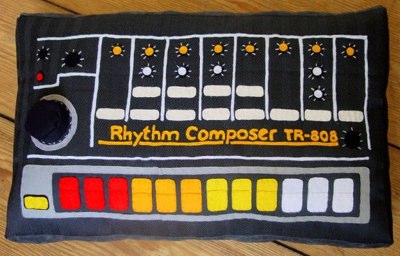 The Independent's Rhodri Marsden has an article about the Roland TR-808, the classic electronic drum machine which became a staple of everything from hip-hop to electronica, from post-punk rock to adult-oriented soft-soul, and now having lent its name to a Kanye West album (somewhat ironically, perhaps, as there is little evidence of any 808s having been used in the making of the album; those who bought it expecting to hear some sweet sidestick-and-cowbell action will probably have reason to be disappointed).
And once you know what you're listening out for, you'll hear the 808 on innumerable tracks. Unfortunately, one of its most widely heard manifestations is the cowbell effect that hammers away like a distressed woodpecker during "I Wanna Dance With Somebody" by Whitney Houston. "That noise is the bane of my life," says Simon Thornton, the producer of Fatboy Slim and countless other British dance acts over the past two decades. "It makes you wonder which person at Roland actually decided that it sounded any good."
But one man's trash is another man's treasure, and Jyoti Mishra, the self-confessed producer of "camp synth pop" and former singles chart-topping artist under the name White Town, considers the same noise to be iconic. "And so are the claves, and so are the handclaps. Of course, they don't sound like handclaps – but strangely, they have somehow become the sound of handclaps. Every drum machine produced since then has had to feature that same kind of noise."
By the mid 1980s, the 808 had helped rap artists such as Run DMC and the Beastie Boys to worldwide success – but it was also dusted off in studios to provide backing for more laidback tunes, such as Marvin Gaye's "Sexual Healing" and "One More Night" by Phil Collins. "I got mine in 1983," says Mishra, "and immediately loved it. And those things it was criticised for – the limitations of its built-in sounds – are what ended up making it so popular."The 808 pillow in the photo, incidentally, has nothing to do with the article per se, but comes from this article.
2008/12/8
Microsoft's latest attempt to shake off their stuffy, corporate image: selling MS-DOS-themed 1980s retro T-shirts. No, really.
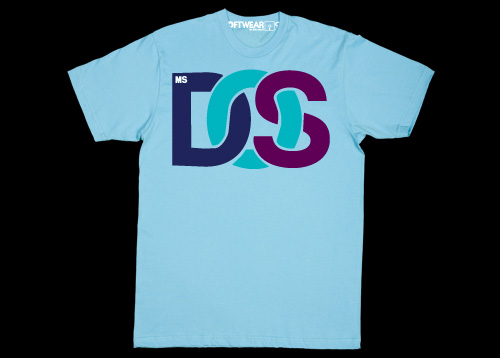
Marketed under the name "Softwear by Microsoft", they come in two lines: one consisting of "classic" designs (the old MS-DOS logo, circa Windows 3.0, the original Microsoft logo, and Bill Gates' mugshot from his 1970s driving conviction) and one co-designed with rapper Common, and involving references to the 1980s; there's one with some rap lyrics set in a monospaced font after a DOS prompt, and one featuring a pair of black-framed glasses and a pair of fluoro new-rave sunglasses.
It's not clear who will wear these. Pointy-haired boss types on casual Fridays? Visual Basic programmers who always wished they could wear cool geek T-shirts like the Linux guys but never actually understood any of the ThinkGeek ones? The guy in the office who regards himself to be with-it because he listens to Coldplay? Zune owners sick of being looked down on by those smug Mac users? Or are they expecting people to start wearing them ironically?
2008/11/2
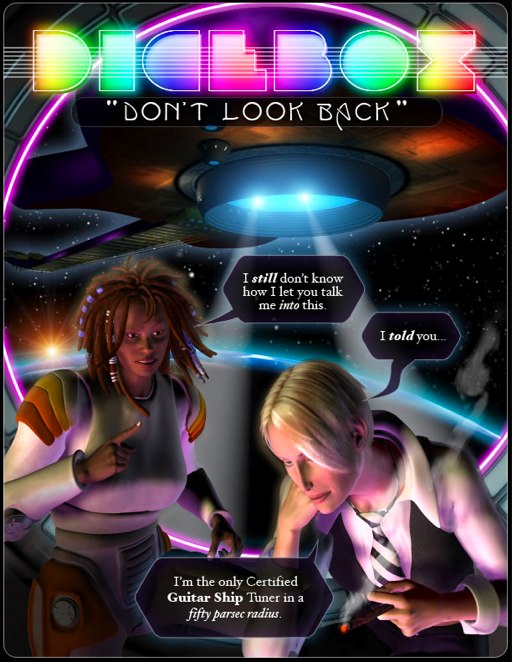
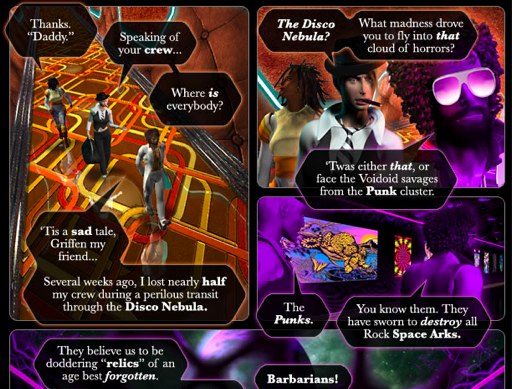
Patrick Farley (of Electric Sheep Comix) has a new work up: Don't Look Back, a gorgeously illustrated and witty slice of neon-lit 1970s prog-rock sci-fi futurism. It's a combination of distinctly retrofuturistic zeitgeists (prog rock/art, stories of spaceships, the freaks-vs.-straights dichotomy), gloriously rendered, and could be described as being like Illuminatus! meets the Hitchhiker's Guide to the Galaxy with artwork by Roger Dean. It's a work in progress (only two parts are up so far), though keep checking back.
2008/6/3
Someone has posted a remixed version of an old Ladybird book about policemen, apparently from the 1950s or so, with the original text replaced with a vaguely subversive/surrealist alternative:
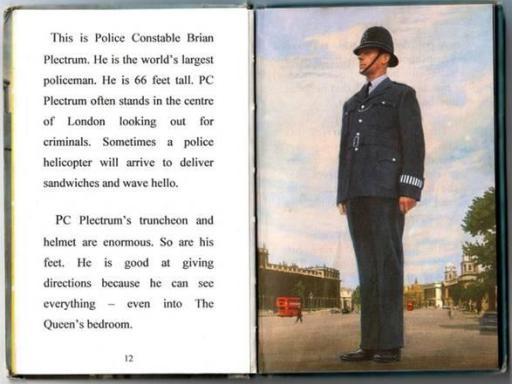
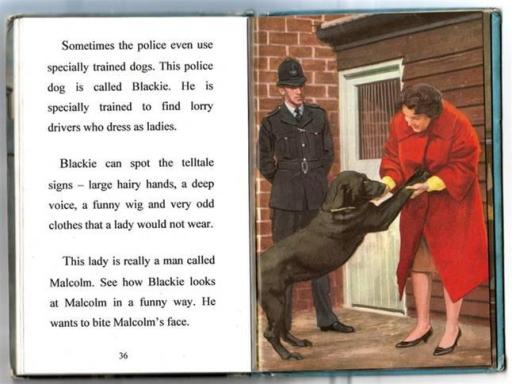
Note: if you're a police officer, passing this around at work may not be a good idea.
(via Boing Boing) ¶ 1
2008/3/3
What the Star Wars movie titles would look like had they been designed by legendary 1950s/60s title designer Saul Bass (best known for his groovy animated titles). Awesome.
(via Boing Boing) ¶ 0
2007/4/20
The Guardian looks at why today's hot new music all sounds like something you've heard before:
Pop's history, not its future, has become the driving force for so many artists that it's possible to get a modern British version of just about any music you care to mention. Want to hear brand-new 1930s swamp blues? Look to Duke Garwood. Ever wondered how the Andrews Sisters might sound transplanted to the present day? Turn to the Puppini Sisters. In search of rock'n'roll sporting unscuffed blue suede shoes? Here's Vincent Vincent and the Villains. The list goes on, taking in the Pipettes' and Lucky Soul's updates of the girl group/60s pop sound, the Draytones' recreation of 60s garage, Selfish Cunt's rowdy 70s punk, Franz Ferdinand's and the Futureheads' homage to post-punk, travelling from genre to genre and decade to decade until it reaches the so-called post-Libertines bands - most prominently, the View and the Fratellis - who take their inspiration from a group nostalgic for the 1970s and who still existed three years ago.Paul Morley, music journalist and founder of 1980s Fairlight-driven avant-garde artist of Art Of Noise, believes that music has become backward-looking:
"Instead of music moving forward," Morley says, "there was a moment - which you could pin down to around Britpop, or even earlier - when it started to fold backwards on itself. Instead of music having an idealistic need to create a future, to change things and have enough optimism to believe that could happen, it has ground to a halt."Britpop is one candidate for such a moment, especially with the media-driven hype about it being a new Mod revival/second coming of the Swinging Sixties, which some of the bands and promoters either started to believe or played along with, inaugurating a tradition of fashionable musicians dressing, knowingly or otherwise, in the drag of past eras. In Rip It Up And Start Again, however, Simon Reynolds places the end of originality after post-punk declined, via "new wave", into "new pop" and the mainstream, and places the C86 generation of indie music, with its unexperimental pop song structures and traditionalistic guitar/bass-guitar-driven instrumentation, as the start of a new conservatism in indie music.
If there is no originality any more, then originality becomes simply a matter of choosing which reference points you slavishly rip off (and/or update by putting in more swear words and references to iPods and text messages) more creatively:
Vincent Vincent thinks it's a positive advantage that someone like him has more than 60 years of musical history to draw on. "That's what this whole first decade of the 21st century has been about: this massive amalgamation of all the previous decades," he argues. "We now are in the luxury position that we can cherry-pick our favourite things from the past." A fan of Elvis, doo-wop, Bob Dylan and the 1970s rock'n'roll revisionism of Jonathan Richman and Richard Hell, he aims to "pull rock'n'roll apart and add modern things to it". Doing so, he thinks, makes Vincent Vincent and the Villains "perhaps the most forward-looking, adventurous band out there. I feel like I'm presenting something new, something different that people haven't thought about. An English rock'n'roll band of now."
For the Pipettes, choosing different reference points from your contemporaries is a sign that you're "being intelligent". "If other bands can go as short a time back as Britpop and try to recreate that, why can't we go back and discover music that we think is more interesting?" asks Becky.
Asked whether he thinks it's possible to create original music today, Lucky Soul's Andrew Laidlaw grimaces. "I think that would be utterly pretentious," he says. "And it immediately dates - unlike timeless melody." By its nature, timeless isn't modern - and it certainly isn't futuristic.Today's hot young revivalists are, of course, not the first musicians to stand on the shoulders of giants; however, they differ from their predecessors in the reverence with which they treat what came before them. Rather than ripping it up and starting again, they elevate it to sacred canon:
Think of the Libertines: they were so enamoured of punk, they hired Clash guitarist Mick Jones as their producer. "I cannot help but marvel at how peculiar that is," says Morley. "Something that was meant to be a radical music has become truly conservative, in that it conserves: it's recreating shapes and riffs and sounds that have happened before."And here's Momus' take on this.
2006/11/15
Product Music, a collection of tracks from American "industrial musicals" of the mid-20th century. Despite the name, these do not consist of Einsturzende Neubauten-style metal percussion and propane-powered death-juggernaut organs, but rather of songs, varying from cheesy showtunes to cheesy faux-country numbers to lounge grooves, with lyrics (of varying degrees of clunkiness) about whatever product, brand or company it is that is changing our lives and/or leading us into a bright future. In other words, like Leave-It-To-Beaver-era America's equivalent of Popshopping.
(via Boing Boing) ¶ 0
2006/7/20
Meet the Partridge Family Temple, a parody religion/bunch of hipsters/creepy religious cult in Portland, Oregon, who dress in flamboyant 1960s fashion, hang around in bars, and seem to be partial to a spot of the old ultraviolence.


Although the idea of basing a religion on a sappy 1970s sitcom sounds like a joke, Fairlee insists he's serious. As he explains it, The Partridge Family was, in fact, the living embodiment of religious archetypes which have echoed through humanity from the earliest days. Shirley Jones is the virgin mother earth goddess; she had children, but no father was ever mentioned in the show. David Cassidy was the satyr or male sex god, a fact supported by his legendarily large phallus. Danny Bonaduce, the constant trouble-maker, was the loki or devil character. And Bobby Sherman, a one-episode guest, was the grim reaper, driving a hearse in his own spin-off series, "Getting Together."Incidentally, Shaun Partridge appears to be part of the same vaguely Satanistic hipster-misanthrope hate-is-great milieu as Boyd Rice and Jim Goad.
(via  substitute) ¶ 1
2005/10/11
Today's Cat and Girl is a good one; it extrapolates Happy Days and That 70s Show into a prediction of 1990s retro:
Come to think of it, a sitcom about slacker/hipster ironist zine kids in the 1990s could probably work. (I imagine there's laugh-track material to be extracted from anachronisms like the characters not having LiveJournals or blogs and relying on photocopied zines to get their thoughts out, having to take film to be developed, and so on; there could also be product-placement opportunities for FedEx/Kinko's or such.) It'd probably end up looking like a more polished version of Clerks or various low-budget American indie films that followed.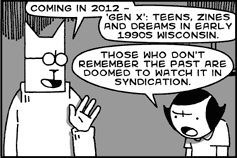

2005/6/30
Scans of a 1970s-vintage childrens' book on computers, in two editions: from 1971 and 1979. Full of fascinatingly anachronistic detail of core memory, punch cards, disk packs and COBOL and PL/1, along with illustrated with Look Around You-esque scenes of high technology circa the 1970s: collages of microprocessors and paper tape, scenes of smiling women in Mary Quant-esque dresses operating desk-sized data processing units and brown-suited men loading disks into washing-machine-sized drives and the like.
It also has the sort of low-level detail that childrens' books on computers would not contain in later decades; I can't imagine a recent children's book on computers (or, indeed, anything before a second-year university subject) going into error-correcting codes, opcodes or the magnetic encoding of binary data. Mind you, back then computers were simpler; the physical details of how data is stored wasn't hidden behind a high-level interface like ATAPI or USB Mass Storage and machine language wasn't an esoteric specialty confined to compiler writers, BIOS hackers and hardcore masochists. These days, being interested in things that are too low-level is at best quaint, and at worst casts suspicion on one as being a potential h4x0r/virus writer/DRM cracker/troublemaker; all the details of computers one is meant to know about are exposed at a higher, and much more user-friendly, level, so why would anyone delve deeper if they're not either one of a tiny number of specialists or up to no good?
(via bOING bOING) ¶ 2
2005/4/8
It seems that the big thing in car design is making modern cars that look like vintage models and selling them at a premium to fashionable urbanites. Those new BMW Cooper Minis (you know, the subcompact yuppie lifestyle cars modelled on the cheap'n'cheerful British cars of the 1960s) are everywhere (at least, if everywhere includes West London); the new Volkswagen Beetles, with the integrated flower vases as an ironic appropriation of their hippie status, are so to a lesser extent. And then there are those Chryslers that look like something a 1930s Chicago gangster might ride in.
But why stop there? There are more makes of once-common cars which could be revived as iconic-ironic status symbols. Anything of which old examples, decrepit or lovingly restored, are driven by inner-city hipsters would be fair game for remaking. For example, an all-new FJ Holden, in designer-faded turquoise and avocado green, coming soon to Prahran and Darlinghurst; iPod socket optional. Perhaps there could even be rounded vintage utes, miniaturised to suit urban parking conditions, for style-conscious urbanites. Or, for that matter, more old British cars; perhaps Peugeot could revive the Humber and Hillman marques as designer lines? And boxy, angular 1970s American cars (or, in Australia, Kingswood station wagons) in baby-shit brown would go very well with today's retro-styled fashions and rock.
2004/12/25
The bizarre story, with album covers and low-bitrate MP3s, of Yu-Mex, one of the most unlikely musical genres in the history of thrift-shop records. Yu-Mex is what happened when Tito's Yugoslavia broke off relations with the USSR, turned against Russian culture and looked for other ideologically-sound exotic influences, finding them, of all places, in Mexico. And so, sombrero-clad, mustachioed hombres from Slovenia to Serbia put out record after record on the state-run record label Jugoton, with songs with titles like "I Am A True Mexican". (via bOING bOING)
2004/11/1
2004/6/3
The Bush Game is a very well done propaganda piece for the John Kerry campaign in the form of a fashionably pixelated Flash game, referencing 1980s kid culture that's the height of ironic retro hipness with the Generation X/Y crowd. It's a politically-incorrect arcade beat-em-up game, in which hip retro characters such as Mr. T, Hulk Hogan, and He-Man, along with the likes of Mike Moore, Jessica Lynch, and, of course, Democratic Party heroes like John Kerry and Howard Dean, battle evil hordes of porcine crony-capitalists and end-of-level bosses (the entire Bush Cabinet, as well as the likes of Paris Hilton and Janet Jackson's robo-breast). Along the way it shows presentations about Bush's depredations of social security funds, redistribution of wealth to the ultra-rich, and collusion with the likes of Enron, in a fairly easy-to-grasp way -- and then claims that the Democrats will fix everything if they get elected. (via everyone, it seems)
2003/10/21
An ironilicious archive of "social hygiene" posters, on topics such as sexual self-control and the perils of "self-pollution". (via bOING bOING)
(After seeing it, I found this page, linking to one particular image, which made me wonder whether Plastic Bertrand's "Ca Plane Pour Moi" was actually about masturbation, much as "Turning Japanese" (another Saturday-night-at-the-Rob-Roy favourite) was. But I digress.)
Though are "social hygiene" posters really a quaint relic of a bygone era? There should be some good examples coming out of the Bush/Ashcroft Era's abstinence-only sex-education programmes, probably designed to look like something off MTV or a girls' fashion magazine.
2003/9/9
Two art links filched from bOING bOING: firstly, a gallery of 1950s/60s TV commercial art; a lot of it very groovy in that 50s/60s way (hipsters take note). Secondly, this gallery of contemporary Japanese op art; optical illusions which do weird things as you look at them. (Well, some of them did; others didn't have an effect on me.) (Also, the second page didn't seem to load properly in Mozilla, though Safari had no problems.)
2003/8/26
Things I have been listening to over the past few days:
- Broadcast, Haha Sound -- the followup to The Noise Made By People, follows on from it, combining '60s retro sounds, sweet vocals, clunky basslines and jangly tweeness with glitchy experimental electronica (which makes sense, with them being on Warp and all). The first song sounds like Julie Andrews or something, whereas the second one is the token attempt to ride the electroclash bandwagon (thankfully the rest of the album leaves that particular well-flogged horse carcass alone). Some of the interludes are quite nice too; in particular, the bad-acid-trip quality of Black Umbrellas.
- Pizzicato 5, Happy End of the World -- Electronica combined with shagadelic retro kitsch, stylised as only the Japanese can do it. The lyrics are mostly in Japanese, and the music varies from drum & bass and house to Bacharach-hop, vintage film scores and lounge exotica. Very cute and quite groovy.
- Cornelius, Point -- I didn't like this much; it's a bit on the bland side. Also, the birdsong samples sound like something you'd pick up in a New Age crystal shop.
- Death By Chocolate, s/t, and Zap the World -- The product of an English schoolgirl's obsession with chocky bars and the Swinging Sixties. Wears its retro stylings very much on its sleeve, and is also interspersed with short spoken-word pieces in which the narrator describes what various colours mean to her and enumerates her favourite things. Most of the music is somewhere in Mid-State Orange territory. Possibly too clever for its own good.
- Chicks on Speed, The Rereleases of the Unreleases -- A collection of tracks from Chicks on Speed combines laptop electronics, punk sensibilities and ironic detachment. Has some good moments (the ironic house track Glamour Girl, and their cover of The Normal's Warm Leatherette) and a lot of filler, including many <1-minute filler tracks. Annoyingly, though, the liner notes are printed inside the packaging, which means that the only way to read them is to tear it apart. Which was probably some sort of artistic statement.
- Manitoba, Up In Flames -- this has been growing on me. Think My Bloody Valentine meets Múm. Understated, reverb-drenched vocals, glitchy beats and layers of environmental sounds, processed guitars, tinkling music-box sounds and odd instrumentals. I'll probably get Start Breaking My Heart, their (more electronic-sounding) first album, soon.
2003/2/21
Museum of Soviet synthesizers; lots of info about various analogue synthesizers and drum machines (some conventional-looking and some weird) built in the old USSR; has photos, details and some sound samples.
2002/8/27
Apparently the new Fischerspooner album is getting a local release; I may have to check it out. Bec Hornsby just played a track from it on her programme on 3RRR; it's much as I expected, stilted synthpop-inspired beats. I get the impression of them being to the 80s what the mid-90s Britpop movement were to the 60s, or perhaps Air to the '70s; not so much a slavish imitation as a reinterpretation and an updating. (Or perhaps an appropriation or opportunistic plundering.)
(Which makes one wonder what the '90s-inspired artists in a decade's time will be like. Grunge revivalists, perhaps, or 'old-style' commercial techno-pop with 909s and 303s in the mix; only done as an ironic reference, with a 'teens sensibility?)
Btw, while I'm on the topic, I think the word "electroclash" sounds rather daft; as it (i.e., Fischerspooner, Ladytron, Felix Da Housecat) doesn't sound particularly clashy, or indeed like The Clash. I prefer Mag/Tif's term "neo-electro". Then again, most music-journalist-coined genre names initially sound silly and ill-fitting (e.g., "goth", "shoegazer", "britpop", etc.)
2002/6/4
The Mod scene is big in Japan, with many young Japanese donning Union Jack-emblazoned army parkas and tightly tailored suits and cruising around on chromed Lambretta scooters, like extras from Quadrophenia. (via rotten.com)
Hoizumi counts at least three Mod revivals: The Neo-Mod movement inspired by ``Quadrophenia'' (and which eventually led to the Skins); an early 1980s resurgence built around the British group Style Council (the Japanese Mod scene remains a huge milkcow for Paul Weller); and a unique-to-Japan revival in the mid-1990s created by teenage photoceleb Hiromix, whose snapshots of herself and her friends in undies became an international artworld sensation.
But in some ways, whilst the scene is a knockoff of 1960s British youth culture (and also of subsequent "revivals" of Mod)
. Until recently, Japan's Mods have overwhelmingly come from the ranks of hairstylists, overworked, underpaid and image-conscious, who leave the suburbs and countryside with big city dreams of grooming stars and cutting it as ``charisma stylists.'' ... But the stylists have moved on with the Hiromix boom, and the Mods of 2002 are a cadre of college art students, graphic designers and apparel professionals. Many have had their parents buy their first bikes for them, and quite a few own several bikes. They seem more sure of themselves and aren't as interested in making a class statement as an aesthetic one.
Sounds a bit like Melbourne's Mod scene, which is mostly rich private-school kids using their classicist style of youth rebellion to differentiate themselves from the plebeian rabble north of the Yarra. I.e., like the Young Liberals only noisier and more stylish.
2002/5/6
Simon Reynolds on 80s revivalism:
This last microtrend -- effectively a re-revival -- highlights one of the ironies of the 80's resurgence, for the 80's were the first era in pop in which recycling and retrospection became rife. There were vogues for ska, rockabilly, psychedelia and other musical antecedents. "With 1980's retro, we have reached the point of second-order recycling," said Andrew Ross, a cultural critic who is the director of the American studies program at New York University. "It's the equivalent, God forbid, of double quotation marks."
Modern digital technology is so sophisticated that producers make electronic music that sounds almost as if it were played by a live band, full of subtle rhythmic irregularities that create a humanlike feel and jazzy swing. But just as punk rockers embraced a raw, elemental music, rejecting the overproduced sound of 70's rock, today's electro groups use old-fashioned synthesizers and drum machines. They prefer cold tones and stiff beats because they evoke a period when electronic music seemed alien and forbiddingly novel. They are making machine-music and proud of it.
For many clubgoers, the 80's were a time when rock and dance music were in lively conversation with each other. Club music then was full of punky attitude and personality, a stark contrast to the functional music and faceless D.J.'s who dominate today's post-rave dance culture.
(There we have it; New Wave's Big Comeback.) (ta, Toby!)

2001/6/27
<RANT>
 What is it with indie-pop's fixation on the 1960s?
I recently picked up a free postcard advertising the Poptones record label;
it is green in colour and adorned with various cover art, all of which
has a strong retro motif.
Day-Glo colours and earth tones, swirly psychedelic lettering and
pop-art iconography abound. And then there are the shagadelic fonts used for
the text (ones in which the @ sign in the email address looks out of place)
and the Poptones logo itself, consisting of two swirly things in various shades of green. It's as if the past three decades never happened.
What is it with indie-pop's fixation on the 1960s?
I recently picked up a free postcard advertising the Poptones record label;
it is green in colour and adorned with various cover art, all of which
has a strong retro motif.
Day-Glo colours and earth tones, swirly psychedelic lettering and
pop-art iconography abound. And then there are the shagadelic fonts used for
the text (ones in which the @ sign in the email address looks out of place)
and the Poptones logo itself, consisting of two swirly things in various shades of green. It's as if the past three decades never happened.
And then there's much of the indie music you hear. In between Damon and Liam acting like extras from Quadrophenia, Belle and Sebastian doing the flower-child thing (compare them, the leading exponents of introspective pop balladry, to countarparts from a decade earlier, such as the Field Mice, or even the Smiths, and you will see what I mean), and all the lounge-pop and Bacharach-hop acts, the whole indie ideosphere seems rather backwards-looking.
It wasn't always like this; during the late '80s/early '90s, things were more innovative. New Order had just combined rock and acid house, and the Madchester baggycore movement was doing something similar; meanwhile, further south, the shoegazer scene was happening. Bands looking for inspiration found it in The Smiths, not retro acts from decades ago.
Of course, then came the juggernaut that was Seattle Grunge, steamrolling everything in its path; faced with the Seattle onslaught, all the other scenes wilted like so many flowers (or alternative web browsers/ independent cafés, if you prefer). Once grunge inevitably degenerated into manufactured pop (i.e., Alanis, the Presidents of the USA), the landscape was blasted and barren, and what followed (such as the britpop movement, which of course was a construct of the music press) had to go back several decades to the Golden Age Of Pop(tm) for inspiration. (The Great Spirit of Perfect Pop, you see, lives somewhere around 1967.) Pretty soon it was just wannabe-Mods and flower children, with a few brave souls venturing into '70s prog-rock.
Me? I'm just holding out for the shoegazer/madchester revival.
</RANT>
2001/6/6
I didn't realise that Guru Adrian was American; I thought it was one of those ABC/JJJ yoof-programming things. (I could have sworn I saw his grinning mug on some ABC yoof publication in the 80s or early 90s; and given the anti-American streak of the trendy-leftie set there at that time, I'd have placed him as the creation of a punk-squatter-turned-graphic-designer in Melbourne or Sydney somewhere, and not from New York...)