The Null Device
Posts matching tags 'rock'n'roll'
2015/10/20
The BBC has a new documentary series about the history of indie music, specifically in the UK; titled Music For Misfits, it follows the phenomenon, from the explosion of do-it-yourself creativity unleashed in the wake of punk, running throughout the 1980s like a subterranean river, largely out of sight of the high-gloss mainstream of Stock/Aitken/Waterman, Simply Red and Thatcherite wine-bar sophistipop, channelled through a shadow infrastructure of photocopied zines, mail-order labels selling small-run 7"s and reviews in NME and Melody Maker (which, it must be remembered, had countercultural credibility back then, and were run by people whose business cards didn't read "youth marketing professional"), surfacing in the 1990s into the new mainstream of Britpop (much in the way that its American counterpart, alternative music, had become a few years earlier with the grunge phenomenon), before finally coalescing into a low-energy state in the new millennium as the marketing phenomenon known as Indie, a hyper-stylised, conservatively retro-referential guitar rock sponsored by lager brands. Though by the third episode of this series (the 1990s one), the BBC seems to succumb to this very revisionism of the term "indie", and, as Emma Jackson of Kenickie points out, retroactively edits almost all women out of the story, presumably because otherwise it wouldn't jibe as neatly with what modern audiences understand "indie" to mean:
It wasn’t just the lack of voices but the choice of stories that were included. No mention was made of the Riot Grrrl movement. Including the story of Riot Grrrl would have easily linked up with the previous programme’s section on fanzines and C86. Riot Grrrl also complicates the idea that British indie was in a stand off with US music. Rather in this scene bodies, music and fanzines travelled across the Atlantic and influenced each other. Also, while in indie music ‘white is the norm’ as Sarah Sahim recently argued, the Riot Grrrl moment in the UK also included bands lead by people of colour such as The Voodoo Queens and Cornershop (who had a number one on the independent Wiija in 1997).
Some major players were also missing. You have to go some lengths to tell the story of Britpop and not mention Elastica, but that’s what happened in the programme. There was a very short clip of them that flashed by. Or Sleeper. They were huge. Or PJ Harvey. Or Lush. Or Echobelly. Or Shampoo.Perhaps this is all a clever meta-narrative device, highlighting the issue of the blokeification of the term "indie" that is concomitant with it having ceased to be a structural descriptor ("indie" as in independent, from the major labels, from commercially manufactured pop music, the materialistic cultural currents/right-wing politics of Reaganism/Thatcherism, or what have you), and having become a stylistic descriptor (you know, guitars/skinny jeans/Doc Martens/Fred Perry/Converse/reverent references to an agreed-upon canon of "cool" bands from the previous half-century), and soon after that, a signifier of Cool British Masculinity, in the way that, say, Michael Caine, James Bond movies and various East End gangsters of old used to be. Perhaps it's a monumental oversight, inexplicable in hindsight, an oh-shit moment as the programme goes out. Or perhaps the original outline for the programme had sections on Bratmobile and Lush and Dubstar, which ended up on the cutting room floor after some risk-averse executive ruled that putting them in would weaken the narrative, confuse the audience or induce the Daily Mail to scream about "political correctness".
The equation of indie with retro probably didn't help. The seeds were sown in the underground 1980s, along with the rejection of the glossy commercial pop of the decade (which was partly a practical matter, with the kinds of high-tech studios the Pete Watermans of this world used to craft their chart-toppers costing millions, while electric guitars and Boss pedals were cheap), though became codified in the Britpop era, when journalist after lazy journalist equated the bold new age of British Guitar Rock with that last imperial phase of UK pop culture, the Swinging Sixties. Soon this became a self-fulfilling prophecy; things which didn't fit the narrative were pushed to the side, vintage Lambretta scooters and Mod roundels started showing up everywhere, and the Gallagher brothers, gazing down red-eyed from the heights of Snow Mountain, announced themselves to be the second coming of John Lennon, returned to bring proper rock'n'roll back to the people. Somewhere along the way, this retro rockism absorbed some of the retro sexism of the post-ironic lad mags of the time, marinated in the reactionary miasma inherent in the idea of a lost "golden age" (one before all this modern nonsense, when music came on vinyl and dollybirds knew their place was hanging on a geezer's arm, and so on), and so was born the New Lad Rock, whose name, in time, was lazily shortened just to "indie"; in its moribund terminal state, the Yorkie bar of music, right down to the "Not For Girls" label on it.
(Of course, the problem with looking backwards is often also the fact that those inclined to look backwards tend to fixate on forms rather than the processes that they emerged from (as the forms are the obvious thing to grasp, especially if one is not analytically inclined) and draw reactionary conclusions. For example, the fetishisation of the two-stroke motorscooter, a symbol of teenage freedom in the 1960s (it's probably no exaggeration to say that the Vespa was the MySpace Facebook Snapchat of its age), but a dirty, cranky, inefficient antique these days. Or, indeed, the actual careers of the cultural heroes. So, while the Beatles experimented with musique concrète and Mick Jagger subverted (to an extent) the meaning of masculinity, none of this is evident in the plodding, workmanlike homages to "proper rock" of their self-announced modern-day followers.)
The equation of stylised "indie" rock with a retrograde "lad"/"geezer" masculinity seems to be firmly embedded in the culture of this day; only recently the radio station Xfm, which originated back in the day with an indie-music format, was rebranded, explicitly, as a blokey-guitar-rock station, without too much loss of cultural continuity. The next logical step would be would be to introduce a musical segment into the upcoming reboot of men-and-motors TV show Top Gear (which, of course, is already to be fronted by a Britpop-era radio DJ), where, between the high-octane stunts, a band of lads with guitars and Mod haircuts take to the screen and play something that sounds like a stodgily conservative take on the Beatles/Kinks/Clash/Pistols/Stone Roses.
(via Sarah_Records) ¶ 0
2015/2/2
Artefact found in a record shop in London:
A snapshot of 1980s major-label rock at its most excessive, moments before grunge/alternative came along, doused it with petrol and threw the fateful lit match. This has all the maximalist, late-80s-high-tech sheen of commercial rock of the time: beds of digital synthesizers, sheets of chugging, flanged guitars, drums gate-reverbed to within an inch of their life, and expansive mixes as if bragging about the sheer number of tracks on the mixing deck at the studio that the label was hiring by the day (and remember, this was in the days before ProTools, when audio tracks were actual physical hardware that took up costly space). And yet, the music laid atop this gloss argues vociferously that, despite all the expensive digital gloss, it is Rock, in its primal, testosteronal sweatiness. The guitar figures in places aren't a million miles from Guns'n'Roses or Poison, in that post-Lynyrd-Skynyrd South-of-the-psyche that bespeaks rock'n'roll Authenticity. The subject matter is vaguely in the cars'n'girls territory of Rock. And above all are the frontman's vocals, hoarse and grunty almost to the point of ridiculousless.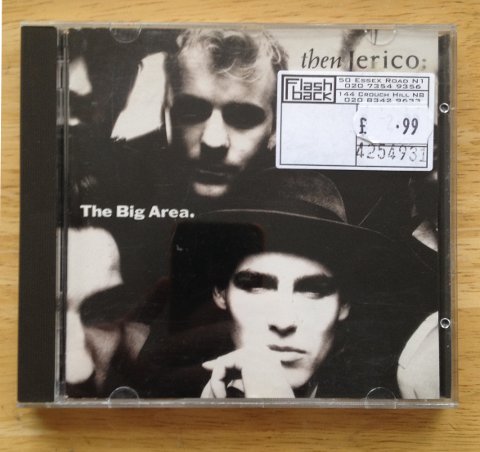
This is late-80s rock as cyborg caveman, a Hegelian synthesis of the dialectics of high-tech polish and Rockist Authenticity. Not a particularly convincing synthesis, though, in hindsight, given the lit match that was tracing a parabola through the air towards it at the very moment it came out. Rockist Authenticity won out, through Grunge and retrostyled Britpop and the waves of three-chord alternative-rock bands which all sounded equally rough-hewn; this state of affairs lasted until people realised that, while there were ProTools plugins for grunging up an expensively recorded boy band, one could make smooth, polished music on a cheap laptop, and the equation between roughness and Authenticity was forever broken.
2014/3/29
An article enumerating the eight mistakes that rock music critics make:
I’ve made some mistakes along the way. We all have: it’s a learning curve, this rock-writing thing. First we imitate Christgau and Bangs, then we imitate Spin and NME, then we forget what the hell we were trying to do in the first place, then (after several hundred reviews) we find our own voice. Well, some of us do. Some bail out; others turn to writing press kits. Some stalwarts continue hyping, lying, mushmouthing, and being generally annoying. Still, I’d like to say I’ve learned from my mistakes, and that’s the purpose of this column. Here are the Eight Biggest Mistakes That Music Critics Make, intended to supplement Lankford’s own list on how we critics can bring out our inner asshole. And yes, these mistakes: I’ve made them all. In fact (for all you pomo kids out there) I believe on at least two occasions I make the mistake while writing about it, below. Keep your eyes peeled.
This may sound absurd, but writers with Good Taste are inevitably the worst critics. Yes, yes, all critics have “good” taste, or at least they have faith in their own idiosyncratic eardrums. But Good Taste is something different altogether: it’s a combination of middlebrow sentiment, political correctness, multicultural blandness, and moral jitters. Fear of violence and speed and sex and cusswords are somewhere in there, too. Good Taste is what makes a critic love Lauryn Hill but fear Li’l Kim. Good Taste means putting Willie Nelson ahead of David Allen Coe in the country-music canon. The only way to be a truly discerning critic is to brave the elements: slap on albums by ANTiSEEN, Def Squad, Cyndi Lauper, Anal Cunt, Commodores, Star Death, Pink & Brown, Voivod, Johnny Paycheck, Ja Rule, Iron Maiden, Hanson, .38 Special, Blink 182, and see what you like. (Just for the record, I like all of ‘em except Ja Rule and Anal Cunt). Don’t stick to the safe critically received Beck’n'Wilco mulch or you’re gonna dull your ears too fast. Good Taste is for brainless elites. Go for bad taste first, then work your way up.(Though I emphatically disagree with his dismissal of Yo La Tengo's And Then Nothing Turned Itself Inside Out as an "ether-soaked gauzepad"; sure, it's no balls-to-the-wall rock workout, but it is in my opinion among their best albums. Hey, if you want shock and awe, buy a Skrillex album or something.)
2014/1/23
Fifty years ago, the governor of Indiana received an obscenity complaint about the (all but incomprehensible) lyrics of a rock'n'roll song, “Louie Louie” by The Kingsmen, which he passed to the FBI. Before they could prosecute those involved, they were faced with the problem of determining what the lyrics (which had been derived from a calypso number from 1957, originally in a cod Caribbean patois, but rendered incomprehensible by the braces worn by the Kingsmen's lead singer) actually meant, and prove that it was actually obscene; and so began an exhaustive investigation, in which the valiant G-men strove, with McCarthyite zeal, to uncover the sinister plot against America's youth by deciphering exactly what kind of filth the lyrics might be:
The subsequent report on the song – unearthed in 1984 by video producer Eric Predoehl – runs for more than 140 pages. The records of the FBI's various attempts to work out the exact kind of obscenities that Louie Louie supposedly contained make for fantastic, demented reading. You can picture agents slowly going nuts as they desperately struggle to pin something, anything, dirty on the lyrics, regardless of whether or not that something makes any sense or actually features in the lyric. "Oh my bed and I lay her there, I meet a rose in her hair," suggested one interpretation. "We'll fuck your girl and by the way," offered another, failing to answer the fairly obvious question this provoked: what, exactly, is by the way? Some of the interpretations were quite lyrical – "Hey Señorita, I'm hot as hell" – although others were not: "Get that broad out of here!"One ad-hoc translator thought it was about masturbation: "Every night and day I play with my thing." Another particularly creative agent seemed to think it centered around the subject of performing cunnilingus on a woman who was menstruating – "She's got a rag on, I'll move above" – which, with the best will in the world, seems a spectacularly improbable topic for any rock band, no matter how raunchy, to be addressing in 1963. Another, more creative still, seems to have actually invented a perversion to fit the garbled vocals: "I felt my bone … ah … in her hair."
In fact, the bureau's persistence says less about the Kingsmen than the era in which it took place. Intriguingly, the concerned letters about Louie Louie and the start of the FBI's investigation coincide with the Beatles' arrival in the US: I Want To Hold Your Hand began its seven-week run at No 1 on 7 February, their first appearance on the Ed Sullivan Show – watched by 73 million people and considered a seismic event in US pop culture – came two days later. These days, we tend to think of the moptop-era Beatles as uncomplicated, unthreatening and universally adored, but to a certain kind of reactionary mind, the Beatles were anything but uncomplicated and unthreatening. Their very appearance marked them out as unfathomably strange and alien (in one extreme version of this response, far-right British politician John Tyndall, described the Beatles in 1963 as "effeminate oddities … looking for all the world like the members of some primitive African tribe", before accusing them of ushering an era of "weirdness in the male type"). Furthermore, after several years in which rock'n'roll appeared to have been entirely denuded of its provocative power – its initial rawness streamlined and diluted with parent-friendly intimations of pre-rock pop by Bobby Darin, Paul Anka, Bobby Rydell et al – you only had to look at the reaction the Beatles were getting to know that rock'n'roll was suddenly an incredibly potent force once more.The investigation failed to produce anything more than paranoid fancy, but did have the unintended consequence of transforming an incomprehensible, otherwise forgettable rock'n'roll ditty—one which would have almost certainly been swept from history by the tide of Beatlemania months later—into an anthem of pure rock'n'roll rebellion by fiat, a sort of Necronomicon of the moral panics that spanned the gap from the McCarthy Red Scare to the Satanic panic of the Reagan years, its very lack of definition allowing interpreters to read their own demonologies of choice into it. And many, amongst them Iggy Pop, Henry Rollins and The Clash, did versions, filling in the blanks with mundane vulgarities of their own devising (and a few cribbed from the FBI report), to varying effects.
2013/7/27
The Quietus has a piece on the decline (if not reversal) of the equation of rock'n'roll with youth, as evidenced in the recent milestone of a 70-year-old Mick Jagger fronting the stage at Glastonbury:
Most of my predictions as a music journalist have come to grief in the near three decades I've been practising the art but one at least, which I first made 25 years ago, has successfully come to pass – that rock groups would still be touring in their 70s. Others demurred at this – we're talking about a time when a 45-year-old John Peel was considered unfeasibly senior still to be hauling his old bones to Fall gigs, like some old tennis pro ill-advisedly hitting the tournament circuit for yet another hurrah. This was a time when rock & roll still just about considered itself youth culture and the first crease had yet to be ironed into its jeans. In the 80s, the mid-20s was considered some significant cut-off point. When Q magazine was launched, it was aimed at what it considered an audaciously senior, Jeremy Clarkson-style demographic – the over-25s. Still earlier, it was still worse. In 1964, Melody Maker ran a concerned editorial about the ageing Beatles drummer entitled “Ringo – Too Old To Rock At 24?”
It's not so much that the old guard of artists have necessarily redeemed themselves, or rediscovered their old powers, it's that the critical mood has changed. The iconoclastic scepticism of the punk generation gave way, in the conservative, nostalgic, Oasis-dominated 1990s to a reverence for wealth, prestige, superstardom, a longing for the old days of mega-mania, rather than interesting, diverse, locally sourced clusters of new music. This has gradually intensified, as a sense grows that the mainstream rock narrative has run its course, the smoke is clearing, and we can look back at the legends of yore with renewed biographical clarity, their often trite sayings and doings regarded with utter fascination, their present day activities reviewed with slavering, uncritical awe.Rock'n'roll's focus on youth was itself an anomaly amongst established genres; in other genres such as jazz and blues, artists have often created work, and often groundbreaking work, well into advanced age (the article mentions Duke Ellington and Sonny Rollins); rock, however, started as a commercialised adaptation of the blues, packaged into 7" singles and marketed at teenagers, and remained tied to youth until its intrinsic momentum as a genre overwhelmed the scaffolding of commerce and/or a generation of middle-aged people refused to give up rock'n'roll and start listening to something more age-appropriate like, say, Mantovani or Harry Belafonte.
There are countless examples from the avant-garde world that old age doesn't dim the creative powers and reduce them to a twilight of tea and biscuits, Max Bygraves and the 'Semprini Serenade'. Musique concrète composers like Luc Ferrari, Henri Pousseur and of course Karlheinz Stockhausen were still operating on the ultra-radical fringes of music before they died of eventual, natural causes early in the 21st century. The same can be said of Derek Bailey, vigorous and active and expanding the guitar lexicon way beyond the confines of rock until his death, aged 75.
Quite simply, music isn't sport. You can perform to the physical level required well into your senior years. Your faculties, health permitting, are quite capable of seeing you through the flails and thrashes and moves like Jagger. This is an extremely gratifying spectacle because, of course, the rock audience itself is growing older year by year, and is most pleased to see that while death will claim us all, old age (as lived out by previous generations sometimes from about their mid-30s onwards if old photos are anything to go by) need not. And so it will go on. I predict rock groups touring and working into their 80s, maybe 90s, with the 70+ brigade, currently a relatively select group, a commonplace band filled out by the likes of Prince, Elvis Costello, Dexys. No one stops. Why would they? Why should they?The article also mentions David Bowie, Bruce Springsteen and Paul McCartney, and finishes with taking Jagger to task for taking the easy way out and resting on the laurels of mega-celebrity rather than pushing boundaries:
And so, happy birthday, Mick Jagger. You truly deserve your slice of cake. You are, after all, Fucking Mick Jagger. Never mind “Sir” Mick Jagger; you should replace the “Sir” with “Fucking” and insist, at all times on that far more appropriate mode of address. You should have a party. Only, don't invite the Kate Mosses, Chris Martins and the rest of the showbiz kids – you know they don't give a fuck about anybody else. Invite your own contemporaries, who deserve their slice of cake also. Invite Leonard Cohen. Invite Alan Vega, who just turned 75 but whose group Suicide have never enjoyed the good commercial fortune their innovations deserved. Invite Hans-Joachim Roedelius, whose birth in October 1934 is the very first event on the krautrock timeline, whose work with Kluster and later Cluster is foundational in the histories of noise and ambient respectively, and who is still cutting it, as shown in his very latest release Tiden. Invite Irmin Schmidt and Jaki Liebezeit, surviving founder members of Can, whose continued inventions (on the Cyclopean EP for example) are a discreet counterpoint to Kraftwerk's more widely feted Touring Synthpop Museum. Invite Joni Mitchell, who might have a thing or two to say about why women aren't necessarily granted the same indulgence to carry on being rock stars into their senior years as their male counterparts. Happy birthday and rock on – we know you will.Meanwhile elsewhere, how Guns'n'Roses' Chinese Democracy made possible the current wave of comeback albums, including albums like My Bloody Valentine's m b v and the new Kraftwerk, Stone Roses and Smiths albums we'll almost certainly hear over the next few years.
2013/4/22
Sad news: Christina Amphlett, frontwoman of post-punk rock band The Divinyls, inspiration to many, first crush to many more and arguably the archetypal Australian Rock Chick, has died in New York, aged 53. The Divinyls are best known outside of Australia for I Touch Myself, though in their career had many more hits, including Pleasure And Pain, Back To The Wall and Science Fiction, through the 1980s and until their generation was displaced by the JJJ Grunge Revolution (many of whose key players, like Adalita from Magic Dirt, were inspired by her).
It's fair to say that Amphlett lived the lifestyle. Born in industrial Geelong, she left home in her teens and spent time busking in Europe, at one point being imprisoned for three months for singing in the streets; she was born at the right time to be there when punk broke, and her artistic career embodied its values—aggressively forward, unapologetically raunchy and cuttingly honest, expressing both toughness and vulnerability; her voice certainly did.
Amphlett was diagnosed with multiple sclerosis in 2006 and breast cancer in 2010; had it only been one of the two, she'd probably had more of a chance, but apparently the MS made radiotherapy impossible.
There is more coverage, including quotes from other musicians who knew her, here
2013/4/20
A new book, How The Beatles Rocked The Kremlin, makes the claim that the Beatles contributed greatly to the collapse of the Soviet Union (or at least to the collapse of the legitimacy of the communist regime among its youth; whether glasnost, perestroika and the disintegration of the USSR would have happened as they did without the Beatles is a matter for historical inquiry):
The book's main character, the Russian writer and critic Art Troitsky, makes the claim that: "In the big bad west they've had whole huge institutions that spent millions of dollars trying to undermine the Soviet system. And I'm sure the impact of all those stupid cold war institutions has been much, much smaller than the impact of the Beatles."
A grand assertion, maybe – but widely shared. "Beatlemania washed away the foundations of Soviet society," explains Mikhail Safonov at the Institute of Russian History. And the Russian rocker Sasha Lipnitsky – snowflakes falling on his beret as he talks to Woodhead in a park bandstand – insists: "The Beatles brought us the idea of democracy. For many of us, it was the first hole in the iron curtain."The Soviet authorities didn't quite know how to respond, and alternated between trying to co-opt the new fad and attempting to stamp it out, but to no avail; once music fans contrasted the music with the authorities' denunciations of it, they became more sceptical of the official party line:
Indeed, the repression and harassment of the music ebbed and flowed as the party controls lapsed or intensified. "It went in waves: sometimes you could be approved for an official recording, and sometimes you were banned, losing your job or education. It must have driven them insane," says Woodhead. He not only excavates the minds of the rebels but also the propaganda machine at work. He recounts how a school staged a mock trial of the Beatles – broadcast on radio – with a prosecutor and denunciations in the manner of Stalin's show trials of the 1930s. A critical bulletin shown on state TV, entitled Pop Quartet the Beatles, told the story of how "these gifted guys could be real cash earners" while, "struck down with psychosis, the fans don't hear anything any more. Hysterics, screams, people fainting!" So ran the TV commentary, accompanied by shots of dancing fans intercut with images of the Ku Klux Klan and dire poverty in the American south. "Keep on dancing, lads, don't look around," the programme taunted, "You don't really want to know what's happening. Keep going, louder and faster! You don't care about anyone else."The article also mentions the USSR and its satellite states' interaction with other forms of countercultural and popular music, some deemed less threatening than others. (Disco, it seems, is OK because it's easy to contain. By then, the sclerotic Brezhnev-era USSR must have given up on trying to inspire its youth with Leninist zeal in its vision and was merely hoping that their recreations would remain safely apolitical, and, dare one say, bourgeois.)
Looking through the other end of the telescope, it is enlightening to find what the Soviet authorities approved of. They "positively encouraged" disco music – the Bee Gees' Saturday Night Fever, Abba and Boney M (though Rasputin was officially banned) – because, says Woodhead, "it was musically rigid and could be contained within the dance floor, it wasn't going to spill out on to the streets".
Why the Beatles? There is no hint of the Rolling Stones or the Who in all this. In Czechoslovakia, the underground was being inspired by dark dissonance in the Velvet Underground and Frank Zappa. "I think the Czechs had that recent memory of democracy, before the war," reflects Woodhead. "And their culture has roots in Kafka and the surreal. But Soviet taste was more melodic, they like tunes above all, even a little sentiment, verging on the beautiful – and there, I'm describing a McCartney song, not hypersexual rock'n'roll, or Street Fighting Man.
2012/11/29
A landmark in the greying of rock'n'roll and the teenage dreams of the baby boom generation: the average age of members of The Rolling Stones, who celebrate their 50th anniversary as a band this year, is now almost two years higher than the average age of US Supreme Court justices (once referred to as the “Nine Old Men”, on account of it being an office one attains late in life and retains until death or incapacity). The average age of the (surviving) Rolling Stones is 68 years and 300 days, whereas that of Supreme Court justices is 67 years and two days.
2012/4/22
The Quietus has an essay by Swedish writer Johan Kugelberg about the psychology and psychogeography of record fairs, and that peculiar combination of nostalgia that causes a subculture of men of a certain age and decrepitude (the “British psychedelic fatsos”, in his words) to seize on a moment from one of various golden ages of the rockist canon (typically the psychedelic moment of the late 1960s, though these days, often also punk rock and its immediate aftermath) and strip-mine it for its elusive magic:
When it comes to original copies of popular 60’s rock records, it seems as if the importance of the condition of the vinyl is contradicted by the physical well-being of the people who are safe-guarding their sixties memories through the collecting of artefacts. The records, posters and Beatles autographs are doubtlessly relics of the time of their lives, infused with such a potent voodoo of nostalgia that the psychotic amounts of emotional projection that is fixed on them is starting to be reflected by the stars themselves. One needs only to go to the grotesque Who documentary DVD Amazing Journey to hear a bunch of propped-up geriatric rockers inflict godlike self-importance upon the viewer, comparing their stage ass-wriggling and studio knob-twiddling with the people who actually did something actually important during the same era. That the sixties survivors believe steadfastly that what they did was for the better good of the world, instead the commodified expression of the spectacle that it was, is very sad. Autographs, posters, vinyl records in mint condition, saleable things infused with nostalgia, are not necessarily a bad thing. We drink a vodka drink and sing songs that remind us of our good times, but where the problem lies is where a period of time in your life is pin-pointed as the only one directly lived, and the remainder of your days being devoted to a representation of said times.
Our emotional projection on the artifacts that remain of our youth’s cartoon rebellion is supposed to necessitate our belief system of extended adolescent self-worth. The hedge-fund lower- upper- management aging hardcore kid spending upper four figures on Misfits test-pressings is battling the same laws of gravity that middle-aged women struggle against at the plastic surgeon or the cosmetics counter. This battle, masking as against grave and ageing process, and against gravity itself, constitutes one of the most necrotic abrasions into the body-fabric of our very existence: this perpetuated falsity that only certain years in our life-span really truly matter. That life in our youth is worth so much more as a commodity, that once youth passes us by, we are obliged to forfeit what we directly lived and recede into a representation of said years for the remainder of our actual duration. Our choice of appearance, our choice of the most meaningful artifacts we surround ourselves with, our choice of the record we place in double plastic bags in alphabetical order, all representing time we address as lived in qualitative actuality.
Q: Do we collect records awake or dreaming?
A: We collect them awake, but we hope that the records will make us dream.
Q: What does a record fair mean?
A: It means that alienated consumption isn’t that great.
Q: What happens at the record fair?
A: A lot of men venture further from their goal of having plentiful sex by looking for records that quite often sing about plentiful sex.
Q: Where does its powerful allure come from?
A: The physical impossibility of death in the mind of someone living.
2012/2/21
The musical soundtrack of the post-WW2 baby boom generation's adolescence, rock'n'roll was associated with youth. Now its generation has inevitably moved into old age but held onto its musical tastes, and today's actual youth have a different soundtrack not handed down from their forebears. Rock, with its guitar riffs and themes of adolescent testosteronal swagger, is adjusting to being the sound of mature age, of experience and regret and the awareness of one's mortality and the inexorable passage of time, with all the weirdness that that entails:
The avowedly clean-living Ringo Starr will soon be 72. Bob Dylan is 71. Further down the age range, John Lydon, aka Johnny Rotten, has just celebrated his 56th birthday – which makes him old enough (just) to be George Osborne's dad. Even the Britpop generation is now greying fast: when Blur performs at tomorrow night's Brit awards, the drums will be played by Dave Rowntree – who, at 47, is two years older than the prime minister.
All of which proves two things: that rock music and the culture it spawned are getting on a bit; and that anyone who can convincingly call themselves young will want nothing to do with either. In the face of mounting evidence, I remain a firm believer that the electric guitar is the embodiment of excitement and the four-piece band as close to the Platonic ideal of the gang as anyone has ever managed. But these illusions are now largely confined to those of us over 40, while the young understandably seek their musical thrills elsewhere.And while today's youth eschew the sound and style of rock (or occasionally partake of it as tourists, in packages of retro-styled nostalgia meticulously footnoted with references to its influences—today's cool indie-rock bands take their duties as stylistic mediums/interpreters with an almost Japanese level of fidelity, a far cry from the Dionysiac abandon of rock's young years), the genre maintains its relevance for listeners of a certain age, and is gradually beginning to shift its themes to those more relevant to a far later stage in life:
As all this happens themes of age and experience are finally entering the music. Grinderman, the project led by the Australian singer Nick Cave (54), was purposely created as an outlet for the angst of advancing years, as evidenced by the charmingly titled No Pussy Blues: "I changed the sheets on my bed / I combed the hairs across my head / I sucked in my gut / And still she said / That she just didn't want to." The impressive new single by Paul Weller (53) is called That Dangerous Age, and opens thus: "When he wakes up in the morning / It takes him time to adjust." Less cartoonishly, when I watched the eternally great Sinead O'Connor (45) perform a new single called The Wolf Is Getting Married on Graham Norton's show, I wasn't looking for the perspective of a twentysomething: she was singing about craving security, and there was something in the midst of it all that was worldly, and overwhelmingly mature. From PJ Harvey to a Dylan who wheezes and croaks his insights, this is what the best rock music is now – stuff by and for the ageing and old.Meanwhile, in another sign of generational change, printed music publications' circulations are in freefall.
2012/2/5
Data wonks at the social music-streaming site last.fm have been taking advantage of their vast repository of recorded music to correlate analyses of the music (made using cold, hard signal-processing algorithms, not anything more subjective or fuzzy) with data from sales charts, determining how the characteristics of popular music have changed in response to cultural trends. The results make for fascinating reading.
Among findings: by looking at how percussive tracks in the charts were (i.e., how strong and regular a rhythm they had, according to spectral analyses) they pretty much pinpoint the rise of disco in the mid-1970s, a change towards more strongly rhythmic tracks which has never been reversed:
The rise in percussivity was followed by a rise in rhythmic regularity in the early 1980s, when drum machines and MIDI came into existence. Unlike the increase in percussivity, though, this was a temporary hump, which waned in the 1990s, as people got sick of drum machines, grunge/alternative did to overproduced 1980s studio-pop what punk had done to prog, and/or simple 16-step drum machines were replaced by Atari STs running Steinberg Cubase, and equipped with more humanlike quantisation algorithms. Interestingly enough, the same study found that the hump in rhythmic regularity was accompanied by a rise in tracks with a tempo of 120 beats per minute, either out of laziness or from some folk wisdom about 120bpm being the optimum tempo: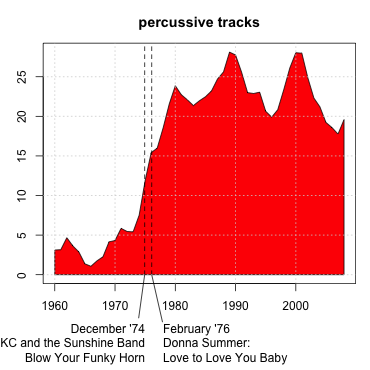
Our first thought was that songwriters in the 80s must have turned on their drum machines, loved what they heard and wrote a song to that beat - without changing the default tempo setting of 120 bpm. I would love this to be correct, but I have a hunch that it's not, especially after having found this highly interesting manual for writing a hit single written by The KLF in 1988. They say that "the different styles in modern club records are usually clustered around certain BPM’s: 120 is the classic BPM for House music and its various variants, although it is beginning to creep up", and also, "no song with a BPM over 135 will ever have a chance of getting to Number One" because "the vast majority of regular club goers will not be able to dance to it and still look cool".Time, as the KLF said, may be eternal, but time signatures aren't; dance music (which remained strongly clustered around 120bpm at the time of acid house and the Second Summer of Love) soon started creeping upward past 130bpm, while tempos of charting music in general moved down.
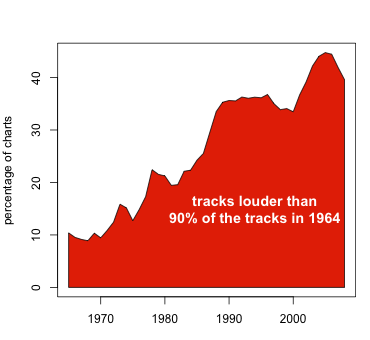
last.fm's DSP algorithms also pick out the rise of punk, with its simplistic rock'n'roll arrangements and emphasis on DIY enthusiasm over polished virtuosity, and the vanquishment of prog rock, glam and other more experimental genres; this manifested itself in a steep rise in the proportion of the charts occupied by records of low harmonic and timbre complexity (i.e., both simple melodic/chord structures and unostentatious selections of instruments) between 1976 and 1979, and map the Loudness Wars of the past few decades, as the rise of the CD and a competition for sounding louder and more kick-ass than all the music that came before conspired to annihilate dynamic range:
Finally, another cultural trend that shows up in the data is the steady decline of the Truck Driver's Gear Shift (i.e., the tendency of songs to shift their key up one or two semitones before the final chorus, for some extra heartstring-tugging oomph) from the 1950s to the present day; presumably because that shit got old. When the incidence of gear shifts is plotted by month, however, few will be surprised to find that December has 2-3 times as many as the rest of the year; after all, 'tis the season to be cheesy.
The percentage of loud tracks has increased from 10% in 1964 (by definition) to over 40% in recent years. So music has got louder. Well, isn't that in the spirit of Rock'n'Roll? Sadly, it isn't, because the increase in loudness has led to worse sound quality. Granted, it's louder, but boy is it flat!
2011/10/30
The phenomenon of the greying of rock'n'roll—an art form/entertainment industry born of idealised vintage juvenile delinquency, stylised and re-stylised over decades, and now enjoying the position of the established genre of popular musical entertainment, while the first generation of its practitioners are long-dead and the following generation, who presided over its imperial phase, are of pensionable age—has brought many paradoxical situations with it, from an aging Pete Townshend reciting his younger self's hope of dying before getting old to the question of what exactly a Rolling Stones gig signifies in the 21st century.
And now, theatrical glam-rock veterans Queen (whose imperial phase involved prodding the fourth wall between the contrived outlaw-rebel-berzerker spectacle of rock'n'roll and the formalism of public performance) have decided to embrace the inevitability of a successful rock band turning into an entertainment franchise and a micro-genre in itself by recruiting their own tribute band:
"Let's face it," Taylor told Rolling Stone magazine, "we're getting a little long in the tooth, but there are an awful lot of tribute bands, some of them good, some of them not good." Inspired by a poster he saw in Norfolk, Taylor hopes to start a "never ending" Queen tribute tour, keeping the band's music alive with performances by young lookalikes. "I'm quite convinced that there are tens of thousands of kids, of really talented people, in their bedrooms around the world playing drums, guitar, and singing," he said. "And I want to find some of those people."It's not entirely a novel act—British indie-rock combo Art Brut famously franchised their name out to cover bands—though Queen seem to be doing it less as an artistic statement and more as a professional business model, like taking a successful restaurant, codifying everything from the recipes to the décor in a ring binder, duplicating it and letting a thousand facsimiles of it bloom in shopping malls everywhere.
2011/3/19
BBC Radio 4 has an interesting radio programme about the surprisingly extensive French influence on the punk movement. Alas, it's not downloadable, and may not be accessible outside of the UK, but the gist is that the oft-cited Anglocentric creation myth of punk—the movement having sprung fully formed from the loins of Sid Vicious and/or Malcolm McLaren somewhere on the King's Road, with possibly some reference to Iggy Pop and/or the New York Dolls—is very much incomplete; or, in the words of the presenter, Andrew Hussey, without France, punk would have just been pub rock with shorter hair.
The French influences on punk rock cited by Hussey and his interviewees (who include the members of French punk bands such as Stinky Toys and Metal Urbain, as well as an adjunct professor of punk and reggae at NYU) are multiple. A big one is French philosophy, particularly Situationism and Lettrism, but going back to various strains of romantic nihilism, Dada and the poetry of Rimbaud and Baudelaire. (French punks were less afraid of being intellectual than the English rockers of the time.) There was also a lot of cross-pollination between Paris and New York's art-rock scene (Patti Smith is an obvious name to mention here), not to mention precedence in earlier French popular culture, such as les Zazous, the black-clad, swing-dancing rebels who defied the Nazi occupation, and of whom one sees superficial echoes in everything from Mod to Goth. And then there were the stylistic cues, cribbed by punk's more historically literate stylists:
Malcolm McLaren and Tony Wilson were hugely influenced by the Situationist movement in particular, and deliberately and explicitly trawled it for images and lyrics that were to become iconic punk expressions (the Sex Pistols record covers, lyrics such as 'Cheap holidays in other people's misery'...); the first festival of punk music took place at Mont de Marsan in 1976; the first Rough Trade release was from the Parisian band 'Metal Urbain'; the punk 'look' first embodied by Richard Hell was drawn straight from fin de siecle French poets, and the graffiti strewn clothing of The Clash comes straight from the 50s group les Lettrists.
2011/1/11
It is now looking increasingly likely that the age of rock music is over:
The percentage of rock songs plummeted from a sickly 13% in 2009 to a terminal 3% – far behind hip-hop/R'n'B at 47%, pop at 40% and dance 10%, according to figures from MusicWeek.("Pop", here, meaning not light guitar-based ditties, nor any niche genre (the "twee pop"/"p!o!p!" in the Orange Juice/Field Mice/Lucksmiths mould favoured by indie kids (many of them well north of 30), or the "futurepop" favoured by Goths who code) but specifically music without guitars or live drums, assembled in a studio to a commercial template.)
The news that the best performing rock song of 2010 was Don't Stop Believin', a 30-year-old track from the veteran rock act Journey made popular by US television show Glee, added a further nail to the coffin. "It is the end of the rock era. It's over, in the same way the jazz era is over," declared the veteran DJ and "professor of pop" Paul Gambaccini. "That doesn't mean there will be no more good rock musicians, but rock as a prevailing style is part of music history."The death of rock, or at least its death as the dominant musical genre, has been predicted for a while, and demographically makes sense. Rock was a product of the post-WW2 boom, and the rise, in America and the West, of large numbers of middle-class teenagers with disposable income and freedom from adult responsibility, which conveniently happened when recorded music was the most promising entertainment technology of its sort. (Television was still too expensive for teens to have their own sets, and cinema is a more rarefied pleasure; you can listen to a record over and over again in a way you couldn't watch a movie.) When the same demographic phenomenon happened in South Korea and China, the teens jumped right over recorded music and got into multiplayer video gaming; instead of youth tribes, they got gamer clans.
Anyway, the warning signs have been around for ages. Rock first started lumbering towards middle age in the 1970s, the age of prog, being revitalised by the rise of punk, which was, essentially, just 1950s-style garage rock with more focus on urgency and rage than on musicianship (in fact, being too good a player would have been a liability, as punk led in the cult of lofi-as-authenticity that stayed with us until it was dispatched by cheap computer-based production tools on one hand and commodified pseudo-alternative music on the other). Throughout the 1980s, the commercial end of rock was showing definite middle-aged bloat, no longer being the anthems of teenage hooligans but rather of working stiffs and mortgage holders. The last major strands of underground rock to emerge into the sunlight and promptly get picked over by the forces of commodification were the alternative music genres that entered the mainstream in the 1990s, leading to shitty nu-metal in America, three-chord JJJ grunge in Australia and dire lad-indie in the UK. Meanwhile, hip-hop (and R&B, i.e., electronically produced soul infused with some hip-hop street attitude) and electronic dance music were growing, and a generation was growing up whose early memories of pop music were not of guitar-based beat combos but of Michael Jackson and Madonna. And when they started making music, it was often easier to pick up a laptop than a guitar. Where once it was given that a group of kids with music to make would rock out, now doing so is a deliberate retro affectation.
Another factor in the decline of rock has been the aging of its cohort, both the audience and the makers of the music:
There are rock acts still doing well, but it is the old guard: there is now, it seems, little new in rock. Bon Jovi was the highest grossing live act of 2010, bringing in $201.1m (£130.7m) in world ticket sales. However, its frontman is 48, and according to a report by Deloitte, 40% of the frontmen of the top 20 highest-grossing live acts in the US will be 60 or over next year; almost one in five acts will be over 50.The first generation of rockers, those who made the music in the 1950s, is long gone; the second generation is moving towards retirement age, as are their original fans. (Does Pete Townshend still sing "hope I die before I get old"? Does he do so with a straight face?) As such, it's quite likely that rock's time as the dominant form of popular music is in its twilight. Of course, rock won't go away, in the way that jazz or blues (or, say, calypso or rhumba) didn't. Elements of it will occasionally reappear in whatever follows, but rock itself it will become a distinctly antiquarian pursuit.
2009/11/12
Correlation of the day: Rock music quality and US crude oil production, by year; more precisely, "rock music quality" consists of number of songs in Rolling Stone Magazine's list of greatest songs of all times:
There's more on the theory here.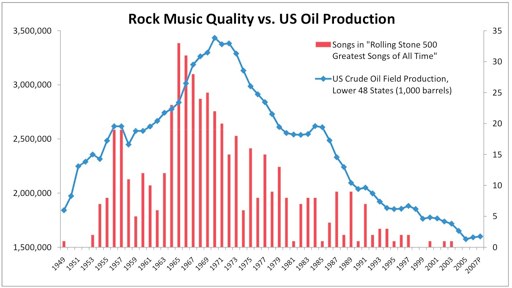
Notice that after the birth of rock & roll in the 1950’s, the production of “great songs” peaked in the 60’s, remained strong in the 70’s, but drastically fell in the subsequent decades. It would seem that, like oil, the supply of great musical ideas is finite. By the end of the 70’s, The Beatles, Led Zeppelin, Black Sabbath, the Motown greats, and other genre innovators quickly extracted the best their respective genres** had to offer, leaving little supply for future musicians.The graphs don't line up precisely, of course, though follow a similar arc.
The correlation may initially seem spooky, and invites outré speculation about the relationship between Rockism and Hubbert's Peak Oil theory and whether, as the Rockists would have us believe, we passed Peak Rock in the mid-1960s and have been in decline ever since. However, there is a more prosaic explanation; one which, in retrospect, seems obvious and somewhat boring.
The cultural phenomenon of rock'n'roll (at least in the classic sense that is venerated by the likes of Rolling Stone) was a product of the economic factors of its time, such the rise of the modern teenager, with disposable income and the freedom from harsh adult responsibility to identify along generational and subcultural lines, which were a result, in part, of an abundance of cheap oil. When one looks at it from this angle, one finds other correlations: the rise of plastics (made from oil), suburban sprawl, car culture (it's little surprise that the teenagers of the baby-boom era were about cars, from big ol' Cadillacs to hippie VWs, the way today's teens are about iPhones and social networks; witness the references to cars, and to making out in the backs of them in drive-in cinemas and such, in classic rock songs). Rock'n'roll in its classic sense was very much a product of the economic factors of cheap oil.
(via Boing Boing) ¶ 3
2009/10/5
Sweden may be associated with supercool indie, twee-folk and fashion-electro these days, but the biggest subculture there are the raggare, essentially rockabilly/greaser types who cruise around in old American cars (bought en masse cheaply when America was hit by oil crises), dress in 1950s attire and fetishise a half-remembered, half-contrived 1950s rock'n'roll Americana.
While they started off as hellraisers, fighting amongst themselves and beating up members of other subcultures, a few decades have given them respectability; there are raggare awareness groups visiting schools, the government consulted them on import taxes for classic cars, and the Swedish post office even issued a raggare commemorative stamp a few years ago. It can't be said that the Swedes undervalue their pop-cultural heritage, even when it is second-hand.
For young Swedes, these giant American cars, which contrasted with the safe, boxy Volvos their parents drove, were the ultimate symbols of rebellion. And they were dirt-cheap. "They were stupid," Georg says about the Americans. "Some of the cars were limited edition. They built maybe 70 of them and they were selling them to us for a few thousand when they were collector pieces."
When the raggare have parties, they tend to have them in their garages: comfortable enough spaces, filled with pots of grease, car jacks and stacks of fenders. The more capable raggare jitterbug and twist; others shuffle from foot to foot, stopping occasionally to pull out the kink in a poodle skirt or run a comb through a greasy quiff
2008/11/12
Music journalist Jon Savage, who has recently compiled a compilation of music from the gay underground of the 1960s and 70s, claims that today's popular music and pop culture is a lot less tolerant of difference and nontraditional sexual roles than it was in the bad old days:
A few years after Sylvester's triumph, explicitly gay music - Frankie Goes to Hollywood, Bronski Beat, the muscle-bound thud of high-energy dance music - was accepted into the British charts in a way that Joe Meek or the shadowy figures behind the Brothers Butch and Camp Records could never have anticipated. Twenty years on, Radio 1's breakfast show presenter is using the word "gay" as an insult.
"Lad culture has been a disaster for pop music," says Savage. "That definition of a heterosexual man - beer and football, Nick Hornby - is so restrictive. It's important that pop musicians play around with gender and sexual divergence. The fact that it's gone back to Oasis from the Rolling Stones, Mick Jagger being very camp, is just pathetic, it's a complete failure. People are scared of nonconformity in music, so this album is a less-than-fragrant reminder of a time when pop music was less sanitised than it is now.Perhaps he has a point and the role of the rock star as a pansexual shaman of kink seems to have largely been displaced by that of a laddish alpha-male, with rock'n'roll's rebellious energy being focussed not so much at overthrowing repressive social strictures as enforcing them and gay-bashing those who transgress. (Witness the reactionary "rebellion" of "alternative" bands like Limp Bizkit, which has more politically in common with right-wing talk radio than any sort of progressive movement.) Where it exists, it is either used as a retro cliché (think Of Montreal's glam sleaze) or in a sanitised, cartoonish form (i.e., Mormon boy band The Killers' faux-transgressivism).
Then again, one could argue that rock'n'roll was always a regressive force; Susan Sontag, for example, equated it with "aggressive normality", and in his blog, Momus (of "Tender Pervert" fame) has asserted that rock music is inherently fascist. Could the 1970s glam nexus of rock music and gender-bending be more like oil and water, less a natural symbiosis than a chance collision brought on by external pressures (in that case, opposition to the strictures of "straight" society). With mainstream conformity eroded, in favour of a marketing-driven arms race of sexualisation, the brute berzerker force of rock has no external targets to be directed against, so it lashed out against the usual targets, and the rebels become bullies?
2005/6/22
The controversial redevelopment of Camden Town station, which would have replaced the station buildings, as well as the Buck St. Market (that's the Doc-Martens-and-T-shirts one) and the Electric Ballroom (considered a sacred site by many who were teens in the 1980s) with a wedge of glass and chrome containing shops and offices, has been scrapped, after the Deputy Prime Minister, John Prescott, rejected the plans. Opposition to the plans attracted prominent supporters, including Dame Judi Dench, Bob Geldof and Nick Cave, who described the Electric Ballroom as "part of the lifeblood of Camden Town".
(via  reddragdiva) ¶ 0
2004/11/30
2004/7/6
According to the press, Rock'n'Roll sprang fully formed from the loins of Elvis Presley exactly 50 years ago.
2004/6/16
A list of things announced by journalists to be "the new rock'n'roll". Given that most of these are fairly staid things (suburbia, chicken-keeping, normality, cooking), I get the feeling that a lot of aging journalists with mid-life crises have been attempting to hand-wave their conservative, settled-down lifestyles into extensions of their long-gone youthful iconoclasm. Which, I suppose it is, though it's like saying that middle age is the new youth. (via Rocknerd)
And here's a Google search for "is the new rock'n'roll"; knitting, gambling, e-commerce, architecture and collective weblogging all come up.
2003/8/12
Mike Edwards of Jesus Jones (remember them?) on the lucrative and vaguely embarrassing world of high-paying corporate gigs:
We didn't hesitate to accept the offer and I can't think why we should have. I recall from my music-press-reading days that accepting money from The Man is wrong but I can't remember why, or how it differs from signing a recording contract or playing a heavily sponsored festival.
He then recounts a gig for a corporate convention in Florida, alongside numerous inoffensive entertainment, at which he was asked not to mention the band's name, lest it offend local religious sensibilities. (via Rocknerd)
2003/2/13
Fun facts about Australia: Did you know that in Australia importing guitars incurs a 5% duty; other instruments are duty free. Could it be one of Bob Menzies' attempts to protect Australia's youth from the harmful influence of Rock'n'Roll?
(I once heard it claimed that the importation of electric guitars was prohibited during the 1950s, presumably because of moral panics about American-style teenage rebellion infecting our youth. I haven't seen any documentation on this though. Can anybody confirm or refute this?) (ta, Graham)
2000/3/10
Righteous rant about the greying of rock'n'roll: (The Age)
ROCK is about urgency, vibrancy, the passion of youth. Trying to give it gravitas by bringing in a few violins and a bunch of 50yearold rockers way past their prime is such a betrayal of everything it once stood for that it beggars belief.
Can you imagine how awful Jimi Hendrix would sound nowadays if he hadn't choked on his own vomit back in the '60s? He'd be getting up on stage at the Colonial right now, alongside Lenny Kravitz and Whitney Houston.