The Null Device
Posts matching tags 'commercialism'
2014/7/20
A report in The Verge from a conference in Las Vegas about the business side of electronic dance music (EDM). EDM is not to be confused with the electronic dance music that older readers will remember; the 303-heavy acid-house played in underground clubs in Chicago and New York in the 1980s, the rave-techno that crusties dropped E to in illegal (and definitely undermonetised) raves during the Second Summer of Love, or even the glossier house/trance that superclubs played in the 1990s and 00s, but is a new phenomenon, as different as rock'n'roll was from jump blues. Having moved to Las Vegas, cut its name down, Diddy-fashion, to three VIP-worthy letters, and replaced the loved-up Goa-beach hippyisms with some high-octane all-American shock-and-awe, EDM has had an extreme makeover, and in doing so, not so much sold out as absorbed the whole concept of commercialism and monetisation and become one with it. The fans, apparently, couldn't be happier with it (or so the boosters of the brand synergies say, of course); on some level, being part of a super-hot marketing demographic is this generation's equivalent of the distinctly shabbier solidarity of being a Mod or a punk or whatever your grandparents did because there was nobody around to sell them energy drinks or LED jewellery.
Not surprisingly, people who love electronic music also love electronics. They have "a high propensity to purchase high-tech devices versus other genres, making them ideal for partnerships in the mobile and tech space," Simonian said. They’re more likely than other music listeners to purchase songs after hearing them in an ad. They’re also 50 percent more likely to buy energy drinks and 18 percent less likely to buy diet soda — presumably because they spend too much time dancing to worry about calories, Simonian joked. They spend more of their music money on live events, and they’re trendsetters — EDM listeners are generally regarded as "key influencers" among their peers.
Festivals also offer fertile ground for millennials, a generation entirely unfamiliar with the concept of selling out, to engage in "brand immersion." Swedish House Mafia pioneered the trend when they partnered with Absolut in 2012, releasing a single called "Greyhound" — named after the popular combination of vodka and grapefruit juice — that featured the trio behind a roboticized race dog on its cover. The move successfully cast the cocktail as an EDM staple, and the band incorporated the digital dog into its visuals for an Absolut-sponsored tour. Simonian says Nielsen’s research has revealed that electronic music fans "want brands to sponsor artists." If this concept sounds like "selling out" to you, your problem might be that you were born before 1990, or that you were raised on some form of punk rock ethos that requires strict division between creativity and capital (I’m guilty of both). Selling out is an alien concept in the EDM market — when Simonian says that fans want brands to sponsor artists, it might just mean that fans are happy to see their favorite producers making a decent wage to create amazing music.
So when I hear Skrillex in a Best Buy commercial, hear Calvin Harris teaming up with Rihanna, or a mediocre deadmau5 rip-off while I’m browsing through the underwear section of Target, I can only smile contentedly: finally, the sound I wanted to hear everywhere when I was growing up is actually everywhere. EDM has become the first "voice of a generation" that openly accepts a partner all other types of music bristled at: unabashed capitalism.Well, there was such a thing as “commercial dance” in the 1990s, but the word “commercial” in that case cast it as a lesser form of dance music; something churned out by hacks in Germany and the Benelux countries to sell to mobile-phone ringtone companies, undiscerning preteens and those too hammered on flavoured vodka to know the difference. In this case, though, the big, well-hyped megastar DJs are the hypercommercial players, and the pervasive commerciality of EDM goes unremarked; the phrase “commercial EDM” would, indeed, sound awkward and ungainly, like “water fish” or something.
2011/6/28
This article looks at the malaise in indie/hipster culture, and places the blame squarely at the feet of 1990s proto-hipster Beck:
The two most common characteristics of the “indie” persona these days, at least in North America, are an aversion to overt seriousness and the ability to find everything “awesome”. These characteristics often intermingle and feed off one another, creating the voracious indie devourer who is able to simultaneously enjoy every kind of music while at the same time not particularly caring about anything. They are the ultimate consumer, willing to embrace and discard bands at a moment’s notice while never questioning what led them to lose interest in one band and embrace another. Awkward inquiries about almost any subject can be dealt with in a detached and deliberately ironic manner — following trends is awesome, selling out is awesome, being shallow is awesome, sweatshops are awesome. When it comes to fashion, trashiness battles against both vintage store retro and American Apparel chic as the dominant form, and everyone thinks that everybody but themselves is a hipster. How this persona was birthed is a relatively straightforward tale, as suburban America fell in the love with the vulgar commercial product of its youth. An ironic approach was already somewhat popular but something, or in this case someone, happened in the ‘90s to turn what was a mere aspect of American culture into the dominant personality trait of American teenagers, twenty-somethings and, at this point, thirty-somethings. That someone was Beck.
Cinema in the 90s reflected this shift in taste, with the ultra-violence of Quentin Tarantino’s movies creating a detached, cartoonish reality that allowed the viewer to feel unconcerned as to the repercussions of the savagery on screen. The character’s brutal transgressions are played out for entertainment and amusement rather than illustrating any kind of painful struggle. Tarantino’s movies were also filled with pop culture references that allowed the viewer to feel like they were part of the director’s insular self-congratulatory world. If America in the 70s wrestled with moral dilemmas and a diminished sense of individuality and reach, then pop culture mavens in the 90s merely wanted to be in on the joke. To music fans who imagined themselves to be more alternative in their approach, Beck fulfilled this need. His music basked in the mindset of trash culture and knowing irony, of sneering at seriousness, of adopting hip-hop beats to play up the now utterly commonplace “look at me I’m a nerdy white guy rapping about ridiculous things” persona that has managed to all but reduce hip-hop to a comedy sideshow for those who need an occasional break from their Arcade Fire or Vampire Weekend albums.The ironic stance, the article argues, was a false victory, delivering the counterculture straight into the arms of the consumerist mainstream. After all, you can buy more crap if you're doing so ironically:
Consumerism thrives on people getting excited about, and buying, things that they ultimately don’t care about. In this sense the ironic persona is the ultimate gift to consumerism. Mainstream music revels in easy sentiment and soul-crushing banality and can only truly be enjoyed by not paying attention to the lyrics. Beck’s meaningless babble trained a generation of young ears to seek out amusing sound-bites over articulate content and in doing so helped break down the last vestiges of ‘alternative’ music by making it as equally meaningless as, and therefore all but identical to, mainstream drivel.I'm wondering whether the rise to dominance of the stance of ironic detachment and the tendency of musicians and bands to define themselves publically by catalogues of their influences ("we're kraut-punk meets Afrobeat meets New Jack Swing") could not both be symptoms of a more abstract shift from directness and immediacy towards mediation and referentiality, an addition of levels of abstraction to the processes of culture, a tendency to see and do things from one step removed.
2009/3/6
The BBC has an article about a French dance craze named Tecktonik, which appears to break new boundaries in the commercialisation, monetisation and wholesale stripmining of subcultural fashions. Tecktonik appears to be a local evolution of the electro/new-rave/fluoro meme complex, born among predominantly white middle-class Parisian kids and hard-partying, style-conscious young professionals. Much like the French language (and unlike Anglo-Saxon equivalents), it has an official, codified repertoire of moves. Oh, and Tecktonik's creators (who include a Merrill Lynch investment banker) had the foresight to trademark their creation, and the arguable judgment to milk the licensing for all it's worth:
Switch on the television and you'll see kids dancing Tecktonik in adverts for mobile phones. Go to the supermarket and you'll find Tecktonik playstation games and Tecktonik school bags. And the Tecktonik company opened its first boutique and hair salon in Paris in November.Of course, not everyone's happy with their subculture becoming a mass-market commodity. After all, coolness is what economists call a positional good (i.e., its value depends on its scarcity; if everyone's into something, it loses its value as a signifier of coolness; which is OK if you're talking about something with other, more practical, measures of utility, but trendy dance styles don't generally fall into this category).
"When you're young, you dance to tell your parents 'I'm a free man! I've got my sexuality, my desires and they aren't yours!' You dance to express your freedom! But, here, it's not this kind of dance. Because it's a commercial dance. It's a safe dance. No sex, no drugs, no alcohol… It's anti-rock 'n' roll! It's a Sarkozy dance!"Curiously, the article closes with this paragraph:
Down at that Tecktonik Killer night, one of the star Tecktonik dancers, Lili Azian, tells me the movement has got so commercial she just never buys anything with the Tecktonik label. And now, in any case, she prefers a new dance - the Melbourne Shuffle.The Melbourne Shuffle? I'm guessing they're not talking about the Melbourne in Florida or Derbyshire here, but rather of the Stockholm of the southern hemisphere. Which brings to mind the question of what the Melbourne shuffle is, and whom they got the idea from. (Architecture In Helsinki? Midnight Juggernauts? Corey Worthington? Some random bunch of coolsie electro kids on YouTube?)
2008/12/24
The Independent looks at how traditional the various Christmas traditions actually are:
The celebration of the birth of Christ on 25 December dates back to the fifth century, when Constantine made Christianity the official religion of the Roman Empire. The date was chosen to coincide with the winter solstice and the Roman festivals associated with the shortest day of the year, which falls between 22 December and 25 December. This was seen as the day when the Romans celebrated Dies Natalis Solis Invicti – "the birthday of the unconquered sun". It was also Jupiter's birthday and, further back, the birthday of his Greek equivalent, Zeus. In Eastern Europe, the various Orthodox churches – the Russian, Greek, Armenian, Serbian et al, follow the old Gregorian calendar, and in which Christmas Day is 7 JanuaryI've seen it claimed that Jesus Christ's actual birthday would have most probably occurred in the autumn, around August or so, if the shepherds were in the fields at the time.
There is no Santa Claus in the Gospels.(Really? What about Frosty the Snowman?)
Santa Claus, it seems, is a Dutch import via colonial New York (even the name comes from the Dutch "Sinterklaas", or St. Nicholas). They got rid of the six to eight black men he is invariably accompanied by in the Dutch tradition, though, and who are tasked with the thrashing of naughty children.
In 1863, the cartoonist Thomas Nast began a series of drawings in Harper's Weekly, based on "The Night Before Christmas", in which Santa Claus, as he had now become known, could be seen with flowing beard and fur garments. Around 1869, he turned up for the first time in a bright red suit, with a white belt, but he was not invariably dressed in red until the mighty Coca Cola corporation appropriated him for an advertising campaign that began in 1931, and ran every Christmas for 35 years. That is also when the reindeer became full size. In Britain, this American import merged with an older folk hero called Old Christmas, or Old Father Christmas, a fun-loving heavy drinker who seems to have arisen in reaction to the Puritans.
The reindeer, it seems, are a wholly American invention (despite their German-as-stollen names); not only that, but Rudolph is a non-canon reindeer:
On 23 December 1823, the Troy Sentinel, in New York State, published an anonymous 56-line poem variously known as "A Visit from St Nicholas" or "The Night Before Christmas." which fused the feast of St Nicholas with Christmas, and had the St Nicholas that Irving created arrive on Christmas Eve in a sleigh pulled by eight tiny reindeer. The author was probably a Professor of Oriental and Greek Literature named Clement Clarke Moore, who did not want to sully his fine academic reputation by putting his name to some nonsense he wrote to amuse his children. The reindeer had names, but none was called Rudolf. He of the Red Nose was created by an advertising copy writer in 1939.
2008/11/28
Tom Ellard (of Severed Heads fame) writes about the uncanny experience of finding that someone else created a MySpace page in your name:
Imagine, if you will, that you are walking down the street and see somebody that looks a lot like you. No really, the resemblance is striking and disturbing apart from the fact that your doppelganger looks like he or she threw up over themselves. And pooped their pants. What little pants they have.
Later you meet a friend who tells you that you look a lot better than when they saw you yesterday. No, you say, that’s not me, just somebody who looks like me except they pooped etc. etc. But your friend and others don’t believe you - they think you’re a sly pooper. Infuriating! You’d really like to get that fake and give it a shake!
And that’s how I feel when yet another MySpace page shows up for my poor old dead band. It looks like it pooped itself. And there are ‘friends’ there. (No link to here of course, that’d give the game away.) Of course these aren’t really my friends and they don’t really want to do anything but advertise their own emo myspace pages. But like Mike Jones once said - you had better get rid of that if you don’t want people to think you are utterly sopping clueless.The thing that struck me was the phrase "advertise their own emo pages"; those five words seem to sum up the MySpace ethos: adolescent attention-seeking behaviour reengineered as marketing, or "Brand You" as the new face of teen-angst. Why wait for someone to notice the scars on your wrists when you can spam everyone and let them know how awesome the darkness of your soul is and why, consequently, they should totally want to be friends with you? We're all our own rock stars, the MySpace ethos tells us, even if we've never played anything other than Guitar Hero and merely rock a Hot Topic wardrobe and some smeared eyeliner; which also means that we're all marketers, constantly pitching ourselves to the world in the way that a shark constantly keeps swimming forward.
2008/10/4
The Graun has an article on the alleged class divide in British commercial rock ("indie") between working-class "lad bands" on one side and privately-educated "smart, literate" bands (or "oiks" vs. "toffs", if you prefer). The details are the standard phony war of marketing narrative, though it features the following interesting paragraph:
For an art-rock band such as Foals, solidly middle class both in membership and their perceived appeal, a common marketing tactic is to use a nominally independent feeder label as a means to building up vital credibility. "Finding an indie to start things off before putting stuff out on the major label is something that happens all the time with bands like that - there are very few true independent labels now, the majority are funded by majors," the A&R says. "You've got to be careful, because you can damage the credibility of your indie label if you force them to put out some crap you've just signed. But it's about putting the band in context for the media and for fans. If you put them out on a certain indie label, it puts them into the context and aesthetic of that label, and leads people to think they must be similar to their other bands. It doesn't even matter what they sound like - it's all just codes and clues as to what you're trying to do."Which suggests that Britain's indie labels (well, the ones with offices in Soho, proper distribution deals and extensive "fruit & flowers" budgets, not small bedroom efforts struggling to put out a band they passionately believe in) are in the pockets of the majors, who are keeping them at enough of an arm's length (i.e., not actually handling distribution for them) to not make the connection obvious. I wonder who pulls who's strings; I think there's some connection between hip young art-rock label Moshi Moshi and EMI (presumably making them Heavenly 2.0), and wasn't Memphis Industries (the Go! Team's label) connected to Sony in some way?
Anyway, further down in the article:
Once an act are stereotyped, they can suffer from it, regardless of their background. Public school-educated George Pringle's experimental spoken-word electro has drawn both critical plaudits and brickbats, but her undiluted middle-class accent has been a frequent point of interest for writers. "Every critical review I've ever had has included the words 'moaning posh girl'," she explains. "I had no idea my voice would end up pissing people off as much as it has. People associate wealth with not having a cause for complaint, that you don't have something to talk about because you come from a privileged background. But you only have to look at someone like Joe Strummer to see how ridiculous that is."I don't think it's her "posh" accent that is the problem (and she doesn't sound that "posh" to my, admittedly foreign, ears, unless you're comparing her to the cast of EastEnders or something), but rather the content-free, self-indulgent nature of her stream-of-consciousness monologues, which mostly consist of her describing her mid-youth/existential crisis whilst making knowingly hip pop-cultural references, and the ploddingly dull beats that sound like someone spent half an hour slapping them together in Fruity Loops over which they're artlessly layered. Which, I suppose, is the modern equivalent of singing tunelessly about your personal growth experiences whilst strumming two chords on an acoustic guitar, but the novelty doesn't make it any better.
2008/9/27
His work fetching huge sums, street artist Banksy has refused to authenticate five artworks up for auction this weekend, on the grounds that he does not approve of his art being removed from its original setting. The auctioneers are putting on a brave face, though:
A spokesman for the auctioneers said: "Banksy hasn't said they are fake. I don't know why he's not authenticated them... He's saying that street art should stay on the streets."
On its website, Pest Control said that since its creation in January, 89 street pieces and 137 screen prints attributed to Banksy had turned out to be fake.
"Pest Control does not authenticate street pieces because Banksy prefers street work to remain in situ and building owners tend to become irate when their doors go missing because of a stencil," Pest Control said.(Pest Control is the official organisation with authority to authenticate Banksy artwork, which was established in response to a spate of fake Banksys. Not to be confused with Vermin, an unauthorised organisation which vouched for the authenticity of the artworks being sold.)
2008/9/21
The shadowy phenomenon of product placement in pop music was thrust into the spotlight when culture jammers the Anti-Advertising Agency, who were running a virtual jeans-making sweatshop in Second Life as an art project, received a proposal from a product placement agency, offering to put his brand of jeans in a Pussycat Dolls song, which they published online
In the e-mail, Kluger (who has represented Mariah Carey, New Kids on the Blog, Ne-Yo, Fall Out Boy, Method Man, Lady GaGa and Ludacris) explained via e-mail that for the right price, Double Happiness Jeans could find its way into the lyrics in an upcoming Pussycat Dolls song. Crouse posted the e-mail on his blog at the Anti-Advertising Agency, an art project of sorts that's basically the philosophical mirror image of a traditional ad agency.
The Anti-Advertising Agency declined and has already drawn some attention to the practice of selling space in lyrics to advertisers through its blog. "Maybe Ludacris wants to rap about a luxury SUV, and is just looking for the right one," said Lambert. "We'll never know (everything about) how it works, because that takes the mystique out of it, and the mystique is one of the things that they can sell." But thanks to this e-mail, we at least have proof that the phenomenon is real.Meanwhile, the agency, Kluger PR (who have emailed WIRED and disowned responsibility for the actual email) has asserted that when they place products in songs, they take every care to ensure that artistic integrity is not affected:
"We are just financially taking care of the people that should be taken care of," he told us via e-mail. "If an artist like Sheryl Crow has the same target audience as XZY brand, we feel it's nothing but a strong and strategic way to pinpoint a market.
"Now, we don't want an artist to write a song specifically to promote a brand, we just feel that if it's a product that's admired by the artist and fits his/her image, we now have the capability of leveling out the playing field and making things financially beneficial for all parties involved. 'Brand-Dropping' is the term that the Kluger Agency coined to describe discreetly advertising by product mentioning in song, and we feel we can make this the way of the future without jeopardizing any artists creative outlet or typical style."I wonder how much it takes to arrange that your (virtual) brand of jeans is sufficiently admired by the Pussycat Dolls for them to (quite sincerely, of course) sing its praises. Which sounds like the artistic equivalent of the question of how much money it takes to win the amorous affections of a lady (or, indeed, gentleman) of negotiable virtue. In which case, would that make Kluger PR a pimp?
2008/7/21
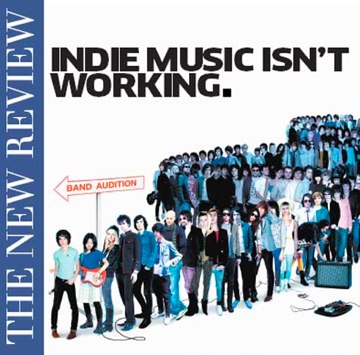 The Independent has a pretty authoritative piece on the terminal decline of the genre of "indie" in the UK, from its origins as independent, defiantly noncommercial popular music (typically released on small DIY labels) in the late 1970s and 80s, through the Britpop hype explosion, and to the present day, when "indie" means formulaic, commercially-oriented guitar rock by image-conscious young Blatcherite careerists:
John Niven was an indie fan in the 1980s, an A&R man in the Britpopping 1990s, and is now the author of Kill Your Friends, a sadistic satire of the record industry of which he was once an enthusiastic member. "I was in Gap a few weeks ago and there was some sort of generic indie music playing," he says. "I was with a friend who's a promoter and a bit younger than me. After about three or four tracks I asked him: 'Whose LP is this?' And he said, 'No, it's a compilation.' Every track sounded identical. The guitars, the production; all these bands sound like they're made in the same studio with the same producer. It's such a ball-less, soulless, generic whitewashed indie sound. You could probably take a member from each band and throw them together in a new group and no one would be able to tell the difference. They're completely interchangeable. Scouting for Girls are like the sound of Satan's scrotum emptying. They're abysmal."
"[Britpop] was great fun," wrote the journalist Andrew Collins in a 2006 piece for Word. "But it wasn't indie, and it pushed a whole slew of workmanlike guitar bands centre-stage, where they were even expected to represent their rebranded country, giving the quite false impression that Cool Britannia was an Indie Nation. The essence of New Labour, indie was capitalism dressed up as revolutionary socialism."
These days the term 'indie' is little more than a generic sonic description for any band that plays guitars and probably wears skinny ties, skinny jeans, and skinny cardigans. Collins, a former NME writer and ex-editor of Q, says now: "'Indie' has become a meaningless term. It just covers guitar bands. But it was never meant to be about a type of music, it wasa spirit and an attitude. When I glance around the bands that are supposedly 'indie' today, I don't see any attitude. I don't see any content in their records, any political interest in the band members. They're a terrible generation, unfortunately, but they're becoming famous overnight and selling a lot of records. I've heard them called 'mortgage indie'. It's a career path – a way of making a lot of money very quickly. The Kooks did so well so quickly. Scouting For Girls, from a standing start, have become a really big band. The Fratellis have become massive in a remarkably short time."
Here's another term for the indie glossary: a "firework band". It means a widely touted young act whose label has a debut LP to sell. They begin their professional lives by exploding into the top of the charts, shine brightly, then drop out of sight. The turnover of new acts is terrifying. Parklife, lest we forget, was Blur's third album.Also in the Independent, an apposite example of "mortgage indie" as a career move, in which a Cambridge indie band named Hamfatter turns to venture capitalism to bypass the recording industry. Which is something I have mixed feelings about: on one hand, from a business perspective, this is as indie in attitude as it guest. On the other hand, when art is seen through the jaundiced lens of business, with market research and venture capital, business plans and promotional campaigns, that is somewhat saddening. What happened to art made for the sake of art, without commercial calculation? Is there even a place for it in the post-Blairite marketing society? The new indie revolution may be about allowing the little guys to be as soullessly mercantile as only the old, huge record labels could afford to be.
2008/1/31
Australian independent music zine and website Mess+Noise has been acquired by Destra, an online content company:
This acquisition extends destra’s capacity to deliver credible and compelling content and create advertising opportunities on a multi-platform basis around targeted, online communities, particularly in the X & Y demographic.
Mess+Noise will be promoted across destra’s digital and physical publishing and broadcasting platforms, enabling collaboration with destra’s other music communities such as http://www.threedworld.com.au, www.centralstation.com.au and www.mp3.com.au.In other words, we can probably expect it to turn into a sort of JJJ of the web, with the unprofitable articles about small independent bands being replaced by PR pieces about commercial alternative-rock acts, and the forums being swamped by bogans.
Here is long-time contributor Emmy Hennings' eulogy for the site, and here is the discussion thread.
2008/1/27
A piece looking at the history of five generic domain names—music.com, eat.com, car.com, meat.com and milk.com—from their origins in the quirky innocence of the pre-commercialised 1990s to their present status:
meat.com: In 1996, meat.com was a classic bit of golden age Internet whimsy called L'Industrie De Meat: an oddish logo on standard-issue mid-90s textured background, with an anti-Communications Decency Act jeremiad, links to an "Internet hall of shame" (optimized for Netscape 2.0), and information about the "Transnational Church of Life on Mars." There was also a link to the site's creator's software offering: Color Manipulation Device, which helped HTML newbies choose the colors for their Web pages. Later iterations of the site foregrounded the software development angle, offering f.search, a metasearch program that would help you get the most of the pre-Google search offerings out there.
By early 2000, though, the proprietor of L'Industrie had sold the site (hopefully at full height-of-boom prices) to a company looking to sell and promote, well meat. Promising a directory of local meat suppliers and "delicious, mouth-watering entrees," it appears to have never really gotten off the ground, and by 2004 was in the hands of a domain registrar and offered for sale. Today, the site has reached the ignominious nadir for generic Websites: it's little more than a front-end for pages of text ads, with not very well thought out photo placement
milk.com: And sometimes, they just stay the same. Milk.com was snapped up in the unheard-of ancient year of 1994 by Internet denizen Dan Bornstein, and it's remained a classic homepage in the '90s sense -- sparse background, unformatted text, easy-to-find links -- ever since.
2007/8/12
Pete Waterman — yes, that Pete Waterman — laments the overly commercial state of the music industry today:
One thing I find frightening about the modern music business is how it's all about money now. These kids, ooh, they have got it sussed. There's no room to see if anything happens by chance.Not that he's defending the purity of art from commercialism, mind you; Waterman makes no pretenses of being in the business of art. His argument seems to boil down to something like "we are all whores, but some of us are honest about it".
I have no problem with saying that pop music is about making money - that's what it does. But you have to entertain. To take the song one stage further and then have it all lined up so that it's a movie, it's a deodorant, it's a car line ad - that's shocking to me.
Musicians now take great pains to lead you to believe they're precious about the music. And then you see it as a car ad. It's offensive because it's a dishonest way of becoming famous. What we did was honest - we wanted to be number one and sell a million records. These guys want to be cool, and they want to take the money, but they don't want to say they want to sell a million records. I think that's dishonest.
2007/7/11
The Guardian's (and Smoke's) Jude Rogers looks at how the meaning of the word "indie" has changed, and attempts to reclaim it:
Indie used to be such a simple term in the Eighties - a byword for an attitude, a subculture and a territory of music that was quietly, stubbornly, alternative. In the UK it meant anti-commercialism wearing a cardigan and glasses; a protest against the mainstream sporting twee hairslides. But now it has come to mean something entirely different. A few weeks ago, Big Brother contestant Emily Parr proclaimed, hilariously: 'There's a new music taking over this country and it's called indie.' Mario Testino shoots 'indie fashion' for Vogue and multi-platinum-selling guitar groups such as the Kooks, Razorlight and Snow Patrol are 'indie bands'. Indie is now a byword for something very different: for commercial savvy and success disguised as contemporary cool. It is no longer independent of anything: indie has become the mainstream.Rogers' first stop is, appropriately enough, a gig by Art Brut, who combine the shambolicism of "old indie" with the style and marketable coolness of "new indie".
Outside, a group of teenagers in velvet jackets are handing out flyers. They positively ooze indie. 'We're independent, not indie,' says Cyan, 16, with a studied world-weariness. 'We would've been, but indie means the Libertines and the View these days. We're more DIY.' He's in a band called I Am the Arm with his friend Aimee, and they both like Art Brut because the band doesn't subscribe to any notions of 'cool'. 'Indie's not difficult or energetic at all any more. It's just music for the mainstream. It's music for poseurs.'
That said, her friend Ben, 21, says, 'Indie is something to make you look better next to the chavs.' And Emma, 23, and Jo, 26, two very well-spoken, pleasant girls with thick fringes, like the term because 'being indie made you cooler at school, because you were wearing the right kind of clothes'. They agree this isn't the kind of indie that ruled back in the Eighties, but a modern, fashionable strand. And how would they define indie now? 'Cool guitar bands,' they say, before running down the stairs to hear Art Brut arrive in a flourish of feedback.
I catch a bus to the Young and Lost Club in Shoreditch, east London. I come here to investigate a related complaint about contemporary indie: that it has gone posh as well as cool; that the music of the underdog has been taken over by the rich kids, including ubiquitous gossip-column staple Peaches Geldof. Pop critic Simon Price recently complained about indie gigs being full of 'horsey young fillies canoodling with flush-faced bucks, fresh out of public school', deeming the indie gig the new 'social club for dressed-down debutantes to see and be seen'.However, there is hope; while the word "indie" essentially means "music that was considered "white" 10 years ago", and encompasses everything from Judas Priest to Coldplay (the other variety of music is "hip-hop", which includes reggae, funk and R&B—though not Rhythm and Blues, as that's "indie"), the term "indie-pop", lacking the sort of cocky stadium-filling swagger that brings the sponsors and advertisers onside, is still cherished by legions of purists and not of interest to trendy poseurs; which means that, by the new definition, they're not very "indie":
A large part of tonight's crowd come from the indie messageboard Bowlie, an international web community that grew out of the Belle and Sebastian and Jeepster label websites. Regular member Emma, 24, laughs as she tells me what a bouncer said to her recently: 'He said, "You're the most uncool crowd I've ever seen. You're like a disco for the computer club."' The messageboard's founder, David Kitchen, agrees. 'Indie initially was never about coolness. It was about the people that Pulp summed up so well - a little bit ugly, a little bit kooky, a bit fucked-up. It's for people who want to do things for themselves, and share things together, without fear of recrimination.'
HDIF founder Ian Watson is especially delighted that this culture is booming. Thanks to the internet, and a renewed enthusiasm for stuff away from the flimflam of popular music, he thinks we're now living in a golden age for DIY music. He mentions a new indie-pop festival, Indie Tracks, to be held in a station in Derbyshire this month, and how he keeps hearing about people setting up their own clubs, bands and labels.And here, rock critic Kitty Empire writes about the history of "indie" and how it won the world and lost its soul.
2007/5/8
Mess+Noise has an article about eclectically experimental Melbourne art-pop group Aleks and the Ramps:
Aleks And The Ramps' first full-length, Pisces Vs. Aquarius, does have its share of eccentric moments. "No Se Si Es Amor" is a cover of Roxette's 1990 chart hit "It Must Have Been Love", sung in Spanish and backed by primitive electronic blips and beeps and Aleks' banjo. Other song titles include "Aminals" and "Diary Of A Lizard Man". But there are also threads of a much darker lyrical obsession woven throughout. Often, they appear as dialogues, either between two people or a conflicted memory, which travel along the entanglements of violence and sexual politics in neatly rhyming couplets.
In the story told by one track, "Brain", two cripples hobble aboard a bus and share a flashback to a car accident. The lyrics are written as two individual memories which spool together into a kind of disjointed conversation. "If you were in pain, I couldn't tell," laments Aleks in deadpan character. "I was dealing with a punctured lung." The voice which replies is so playful and effortlessly gorgeous that it's difficult not to become entranced by the contrast. "Your gasping reminded me of the first time we made love," sings Janita, member of The Ramps and Aleks's real-life lover.I have Pisces Vs. Aquarius, and can vouch for it being as good as the article suggests. With a mordant wit and a deadpan voice, Aleks touches on themes such as prison escapes ("123456 (pardon us)"), the state of being a corpse ("Rigor Mortis"), and paranoid schizophrenia ("They're Recording Everything We Say"), whilst jumping between genres, combining banjos, electronic beats and crunchy metal riffs, and yet somehow manages to remain highly listenable. And the Roxette cover is genius.
According to the article, though, not all is well in the Melbourne live music scene, with commercial pressures pushing out the sort of experimental leftfield music in favour of a more commercially viable aggressive normality:
Since then, the band has recorded an album, performed a live-to-air on Melbourne radio station PBS and accrued a reasonable amount of interest. But when Aleks tried to book a venue for the launch of "They're Recording Everything We Say", the first single from Pisces Vs. Aquarius, he found it a difficult task. Many of the smaller inner-city venues he had frequented had closed -- including Good Morning Captain, where the first incarnation of the band had played its first and only gig -- and those that were left were either too small to fit five animated musicians, or wanted to play hard-ball on the door figures.
No doubt it is difficult for larger, well-maintained rooms like the East Brunswick to risk booking young or experimental bands in a headline slot, while venues in their shadow - bleeding door numbers - have become more fastidious about ensuring each night's profitability. The result can be a closed door for bands that are untested or outside the current status quo. Whether due to fatigue or necessity, the problem is reflected in the habits of venues' music directors.
Aleks: "A lot of bookers don't actually watch the bands. It's really weird that the type of people who are put in these positions are the type of people that don't bother watching music. I think they just sit in their office in this weird little bubble browsing MySpace, judging who are the best and biggest bands based on how many friends they've got."
2006/7/5
A new advertising agency in the Netherlands has started offering advertising on zoo animals and hookers' thighs. The agency instoresnow.nl also offers advertising iin religious establishments and huge floating billboards off popular beaches. Unfortunately for those willing to buy, the agency doesn't actually exist, but is merely a satirical project by a design student, Raoul Balai:
"I was getting sick and tired of advertising everywhere," Balai told reporters. "But I don't want to preach, and I thought satire would work better."
Prospective customers phoning his fake agency are kept on hold and bombarded with sales pitches until they give up.Not all are amused, though; an Amsterdam zoo has threatened Balai with a defamation suit after Balai's site showed fish at the zoo inscribed with the brand name of a frozen fish company.
2006/6/30
An interesting article about the history of Chinese Maoist propaganda poster art, and the contemporary artist Wang Guangyi, whose work includes the "Great Criticism" series, juxtaposing Maoist poster imagery with Western lifestyle product brands.
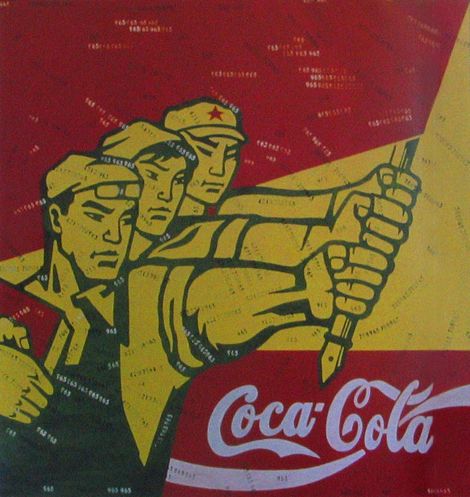
(via Boing Boing) ¶ 0
2005/12/22
More on the explosion in product placement in television shows, brought about by advertisers' concern that consumers may be skipping ads:
In a recent episode of the NBC series Medium, writers had to work the movie Memoirs of a Geisha into the dialogue three times because of a deal the network made with Sony earlier in the season. They even had the characters go on a date to an early screening of the movie and bump into friends who had just viewed Geisha to tell them how good it was.
Another product placement intruded a touching scene on ABC's soap opera, All My Children, when writers were forced to incorporate a line about a new Wal-Mart perfume into the dialogue as a character, Greenlee, sat at the bedside of her husband who was suffering from a fatal gunshot wound.
2005/11/29
The grim story of the next Superman film, which has remained in development hell for 10 years, while armies of hacks, egomaniacs and philistinic studio types battled over the details, is an eye-opening example of the horrible things that happen to a property once a Hollywood studio buys the rights to it. Read about the dozen or so different scripts, tacked-on merchandising opportunities, plot elements shamelessly lifted from the most recent blockbuster, the many forms of Lex Luthor (rogue CIA agent, mutated shoe salesman, member of the Illuminati), Tim Burton's darker, gothic Superman, and even the studio's plans to cast Justin Timberlake and Beyonce Knowles as Superman and Lois Lane. Read it, laugh uncomfortably, and then pray to whatever gods you have that the studios never get their hands on your favourite stories.
Peters then told Smith to have Brainiac fight polar bears at the Fortress of Solitude, demanding that the film be wall-to-wall action. Smith thought it was a stupid idea, so Peters said, "Then have Brainiac fight Supermans bodyguards!" Smith responded, "Why the hell would Superman need bodyguards?" Peters wouldnt let up, so Smith caved in and had Brainiac fight the polar bears. Then Peters demanded that Brainiac give Luthor a hostile space dog as a gift, arguing that the movie needed a cuddly Chewbacca character that could be turned into a toy. Then, after watching Chasing Amy, Peters liked the gay black character in the film so much that he ordered Smith to make Brainiacs robot servant L-Ron gay, asserting that the film needed a gay R2-D2 with attitude. Then Peters demanded that Superman fight a huge spider at the end of the film, which Smith refused to dohe used a "Thanagarian Snare Beast" instead. (However, Peters did manage to recycle his spider idea and use it in Wild Wild West.)
1. Krypton doesnt explode. Instead its a Naboo rip-off overrun by robot soldiers, walking war machines, and civil war (can you say, Star Wars: Episode I?). Jor-El is literally the king of Krypton and leader of the Kryptonian Senate (thus Superman is a prince), and he and Lara send Kal-El to Earth because he is "the One" whom a prophecy states will save Krypton from destruction (rip-off of The Matrix). The villains, Jor-El's evil brother and nephew Kata-Zor and Ty-Zor, take Jor-El prisoner and send probe pods out to find and kill the baby Kal-El. 14 years later, Lara and her shell-less turtle servant Taga (shades of Jar Jar Binks) are found by Ty-Zor, and Lara gets tortured to death.
5. An aerial kung-fu fight between Superman and Ty-Zor results in Superman being lured into a trap: Lois is drowning in a tank filled with kryptonite. (This begs the question of how there can be kryptonite when Krypton didnt even explode, but.) Superman is given a choice: save her and die from radiation poisoning in the act, or stand by and watch her drown. So he goes in, saves her, and dies. Jor-El magically senses Supermans death from across the galaxy, commits hara-kiri with a rock he sharpens in his prison cell, goes to Heaven, and talks Superman into coming back to life so he can fulfill the prophecy of saving Krypton from its civil war. So Supermans soul returns to his body, and he proceeds to trash Ty-Zor and his cronies. And at the end of the film, Superman flies off in a rocket to save Krypton (which is where the second film is planned to take place).
2005/11/15
"We know firsthand how the story gets short-changed every time a reality show gets taken over by an advertiser," said the Writers Guild of America. "We're the ones forced to put in long hours just to figure out how we're going to embed that can of soda into the storyline eight more times before the final episode."
Product placement - whereby items are woven into programmes to satisfy advertisers - has become rife on US television as revenue from traditional commercials has dropped. It is most common in reality shows such as The Contender, which recorded 7,500 instances last year. It can also be seen in fiction programmes. In an episode of Desperate Housewives broadcast this year, one of the lead characters finds work as a model, buys a Buick LaCrosse and wastes no time showing it off to her friends at the mall. Two Buick commercials ran during the same episode.The Writers' Guild of America wants a statement at the beginning of each show, listing the incidences of product placement in the programme, in the hope that such statements counteract the economic pressure to shovel in more products into each script, with the story taking a back seat to commercial considerations.
2005/6/7
The best summary of the Star Wars franchise I've seen:
So this ordinary, middle-class American male walks into a bar. "Gimme a beer, whatever you have on tap," he says, slapping down a fiver. The bartender, smiling, reaches below the bar, audibly unzips his fly, and a moment later produces a tall glass that looks suspiciously as if it might be full of warm urine. But our guy is a trusting soul, and he gulps it down anyway. Big mistake. He retches, curses, and then storms out, furious.
Three years later, the same guy walks into the same bar and asks the same bartender for a beer. No problemo , says the barkeep. Zzzzip . Handed what again looks like something better suited to a specimen jar, the guy barely even hesitates. Down the hatch it goes, and then halfway back up the hatch again. Tears of rage are shed; a lawsuit is threatened. Exit the dude, livid.
Three years later, the same guy walks into the same bar and asks the same bartender for a beer.
You're waiting for the punch line. It's not a joke, I'm afraid. It's a parable. The guy is you, the bar is the neighborhood multiplex, and the third steaming glass of piss you're about to be served with a smile is called Star Wars: Episode III -- Revenge of the Sith.
For God's sake, don't drink it.
2005/4/4
Republican-linked U.S. megacorps tighten their stranglehold on the British live music market, as Clear Channel is set to buy out Mean Fiddler, the company behind the Glastonbury and Reading Festivals. Rumours that Glasto will transfer its support of Greenpeace to pro-life groups, or the next festivals will be headlined by Toby Keith and Britney Spears respectively, have not been confirmed.
2005/1/18
More news from the leaden age of music diversity: major record labels are now using statistical hit-prediction software to pre-screen demos before wasting A&R ear-time on them. Hit Song Science, the software used, predicts whether a song is likely to be successful by comparing it statistically against a database containing the past 30 years' worth of Billboard hit singles:
HSS's crucial design flaw is that it can only look at the past. Those "leftfield", illogical and grassroots-inspired departures from the norm, such as disco or drum and bass, could not have been predicted - but they shift the mainstream and provide the momentum any culture needs to remain fresh. As Smith says, "Art is the one area where people can, and should be able to, make radical statements. Anything that encourages safe, consensus-driven music should be used with caution."
It's all in the clusters, you see. Hit songs, typically, fall into one of a number of groupings - there are around 50 in the US and 60 in the UK where, traditionally, tastes have been more diverse. Belonging to the same cluster does not mean songs sound the same, though, more that they are mathematically similar. And the analysis has thrown up some very unlikely musical bedfellows: Some U2 songs are in the same cluster as Beethoven, while spandex ultra rocker Van Halen sits right alongside MOR piano babe Vanessa Carlton. It is for this reason that Polyphonic are confident their software won't homogenise our already stratified and similar sounding charts. They are already working with one radio station to expand their playlist without losing audience share by selecting songs with the correct mathematical rhythms. In a world where drearily repetitive playlists have become the norm this could be the answer to an oft-uttered prayer.
It's interesting to consider where the fine line between well-formedness and homogeneity is. On one hand, one could probably state with mathematical certainty that serialist or aleatoric composition is unlikely to ever have mass appeal; as such, an algorithm which analysed music for having some kind of structure and rated it on that would be a good predictor of whether or not a piece of music has the potential (however small) to be popular. On the other hand, I suspect that HSS may overspecify things, to the extent of excluding perfectly workable new approaches which have not been tried or accepted yet. (via DIG)
A PhD study into music copyright enforcement (by a former lawyer for ARIA, the Australian RIAA equivalent, no less) has found that consumer choice of music titles has fallen dramatically, with the number of music products released falling 43% between 2001 and 2004; and it's likely to get worse as record labels merge and "rationalise" their catalogues into safely marketable titles. Alex Malik argues that this, and not file sharing, is to blame for falling music sales.
"If you go into a typical CD store these days, there's the new Australian Idol CD and of course there's the other new Australian Idol CD. You'll also find more DVDs and accessories than ever before ... But if your tastes are a little eclectic or go beyond the top 40, you may be in trouble," he said.
Of course, one could argue that the majors are now signing a lot of exciting, energetic indie bands from the underground. Except that this argument falls apart on closer examination; most of the major-label-indie fall into one of several formulaic, easily marketable categories: 70s garage primitivist rockists (think Jet/The Datsuns/Kings of Leon/&c), other radio-friendly post-ironic rehashings of old formulae (Scissor Sisters), easy-listening vaguely-indieish pap like Keane and Badly Drawn Boy, and attempts at The Next Interpol/Franz Ferdinand (or whatever the band of the moment happens to be).
Which is what happens when recording companies become agglomerated into large corporations beholden to shareholders who demand safe returns; in such a model, there is no scope for maverick A&R people to make decisions based on gut instinct or take risks. But that's OK; with modern market research methodologies, there is no need for such archaic and unreliable practices, when formulae can me made up to please enough of the market. The same has happened in Hollywood, where all scripts are plotted out with special script-writing software that ensures that characters move and develop like automata along pre-programmed tracks. The scriptwriter only has to flesh things out.
2004/3/1
According to ads in the most recent Beat/InPress, there's a new John Butler Trio (for those not in the know, that's a sort of "funky roots/blues/folk" delivered by a studmuffin with dreadlocks and appealing primarily to a younger female audience; think an unusually well-scrubbed white "feral" version of Lenny Kravitz or something) album out; and, for a limited time only, it comes with.. a trucker cap. This is proof that trucker caps have lost whatever element of irony they once had and have become just a mindless piece of fashion.
2004/1/9
Director John Boorman (of Deliverance fame) on how Hollywood studios' insistence on blockbusters is killing them, both by raising the bar to higher and higher budgets and by restricting plots and concepts to the most facile and simplistic ones that won't lose any of the audience.
Is there an inherent flaw in a socio-economic system whereby everything gets bigger and bigger until it collapses under its own weight?
Boorman describes what it would be like to attempt to make Deliverance in today's environment:
Today, I would have received pages of detailed notes from a number of studio executives. I would have been obliged to hone the script down to a simple, direct storyline that is clear and undemanding, and eradicate any eccentricity or quirkiness. When the script satisfied their requirements, the studio would send it out to a star. If the star passed, the studio's response would be to hire a new writer. Further rejections by two or three stars and the project would be dropped. If they found a star who was interested, the title, cast and storyline would then be test-marketed, asking people in the street if they would go to see such a film four men canoeing a river and one gets buggered.
script gurus such as Robert McKee have brainwashed a generation of screenwriters into constructing scenarios along rigid lines: introduction of characters, statement of conflict, development of narrative, division into three acts, carefully placed climaxes, conclusion. This contributes to the sameness of movies and feeds into audience expectations of comfortable patterns, and makes them uneasy if a film diverges from that formula. Little by little movies become more and more similar to each other, with marginal variations. One can imagine them evolving into a form where only an audience inured to them can discern any differences.
2003/12/25
A project tracking references to brands in songs in the Billboard Top 20 has found that, in 2003, there were 82 different brands mentioned in top-20 songs; most of them were brands for prestige products like luxury cars or boutique spirits, and all but one of the songs in question were hip-hop/R&B (the exception was Good Charlotte):
- Hip-hop is the perfect medium to register the relevance of contemporary brands. Hip-hop and rap have always been about the here-and-now, rather than rock or pop songs, which typically focus on eternal themes of love and loss.
Another explanation is that the vocabulary of mainstream hip-hop (or "rap" as some call it, with the word "hip-hop" being reserved for more credible music) has become restricted to assertions of status and power, which is why boutique brands are so important in the genre.
(Hip-hop has disappointed me; once upon a time, it was all rather clever and intelligent -- it started off as an African-American equivalent of punk, using improvised technology (such as turntables) in much the ways that chip musicians do now, with all the resourcefulness that such a new medium entails -- but now it has become rather stupid and atavistic, all about booty and bling-bling and how bad you are and what you'll do to whoever challenges you. Mind you, the definition of "hip-hop" appears to have been lost along the way as well; case in point: Universal's Def Jam division rereleasing a DVD of Al Pacino's Scarface rebranded as a "classic hip-hop movie". I didn't know that this movie contained any rapping, scratching, breakdancing or aerosol art (the "four elements" of hip-hop culture; note the absence of pimpin', bustin' caps or wearing bling-bling jewellery in that list).)
2003/12/2
New Spectator Sport, a rant from Warren Ellis about the decline of the music industry:
TV shows specifically designed to manufacture the absolute least offensive pop product through game-show structure and the application of telephone democracy. If you're dumb enough to be able to sit through those shows without the front of your head filling with tumours, you get to vote for the performer who is retarded enough to be a comfort to you. Loathesome as they were, even the Spice Girls delivered with some character. I remember novelist and critic Nik Cohn saying he never would have been so hard on Bob Dylan if he'd known Bruce Springsteen was around the corner. People railed about the Spice Girls being a manufactured band, but who knew there was a TV-powered pod-person hothouse around the corner?
The American music industry, from my perception here in Britain, seems to have sunk into a bizarre obsession with paedophilia. Britney Spears has gone from schoolgirl gear to a deeply strange hentai look, little-girl head stuck above great shiny plastic boobs, singing in a Minnie Mouse voice. No wonder she was being stalked by a shifty-looking middle-aged Japanese bloke. He probably had a suitcase full of tentacles to use on her.
Mainstream pop music is almost always bad., it's a given. But, God, can you remember a time when the most popular acts were this empty? It's like that awful vacuum before punk, when people were buying Dean Friedman records just to have something to buy, and poster companies were printing off six-foot long images of Nana Mouskouri and Demis Roussos just to have something to sell.
(via Rocknerd)
2003/8/21
It turns out that DJs may not be the rock stars of the new millennium after all; dance music is in steep decline in the UK. Some factors blamed: ravers who got into it during the Acid House Summer of Love/the superclub boom of the 90s getting older (and developing a tolerance to MDMA), the kids of today being into NME Back-To-Basics '70s-Style Rock, and backlash against the cult of the superstar DJ (quite understandable, IMHO). I wonder whether this will affect the content of electronic music magazines; can we expect to see the virtual-analogue synth/groovebox reviews in Future Music displaced by reviews of guitar-performance stompboxes and tutorials on recording live bands?
Meanwhile, a scathing critique of club culture, also in the Graun:
Around the same time the south London superclub The Ministry Of Sound marketed a range of clothing while admitting that anyone who wore those clothes was unlikely to pass the dress code in the club itself. It was as if the DJs and club promoters who "ran" dance music simply assumed that audiences were too befuddled by the drug ecstasy to realise they were being ripped off.(via Rocknerd)
2003/8/15
In what is an echo of both the New Order Sunkist commercial and the self-jamming Nike billboards, anti-commercial New Wave band Devo have rerecorded their song "Whip It" for a cleaning product commercial. The ad shows middle-aged women dancing robotically whilst cleaning their suburban homes, while the music plays; the chorus has been changed to "Swiffer's good":
Devo agreed to perform the altered version for Swiffer advertisements because, Mr. Mothersbaugh said, "it was so absurd. We like messing with the boundaries between art and commerce."
Blatant sell-out, a clever subversion of consumerism, both or neither? It increasingly seems like the lines are blurred, every anti-consumerist culture jam becomes a viral marketing campaign and vice versa, with a hair's breadth of ironic detachment separating the cognisant from the suckers.
2003/8/12
Mike Edwards of Jesus Jones (remember them?) on the lucrative and vaguely embarrassing world of high-paying corporate gigs:
We didn't hesitate to accept the offer and I can't think why we should have. I recall from my music-press-reading days that accepting money from The Man is wrong but I can't remember why, or how it differs from signing a recording contract or playing a heavily sponsored festival.
He then recounts a gig for a corporate convention in Florida, alongside numerous inoffensive entertainment, at which he was asked not to mention the band's name, lest it offend local religious sensibilities. (via Rocknerd)
2003/7/17
The Graun's Simon Hattenstone interviews Banksy:
Banksy's attitude to brands is ambivalent - like Naomi Klein, he opposes corporate branding and has become his own brand in the process. Now, people are selling forged Banksies on the black market or stencil kits so we can produce our own Banksies. Does he mind being ripped off? "No," he says. "The thing is, I was a bootlegger for three years so I don't really have a leg to stand on."
Incidentally, some of the fake Banksies (in particular, the chimp with the sandwich board and the parachuting rat) have ended up on the walls of Fitzroy (look around Brunswick St., between Gertrude and Johnston Sts.) They lack Banksy's signature (though at least the people responsible didn't try to take the credit, regardless of clueless journalists putting photos of them next to features about "the Melbourne underground art scene" or whatever it was).
Over the past couple of years the very brands he despises have approached him to do advertising campaigns for them. Is there work he would turn down on principle? "Yeah, I've turned down four Nike jobs now. Every new campaign they email me to ask me to do something about it. I haven't done any of those jobs. The list of jobs I haven't done now is so much bigger than the list of jobs I have done. It's like a reverse CV, kinda weird. Nike have offered me mad money for doing stuff." What's mad money? "A lot of money!" he says bashfully.
Why did he turn it down? "Because I don't need the money and I don't like children working their fingers to the bone for nothing. I like that Jeremy Hardy line: 'My 11-year-old daughter asked me for a pair of trainers the other day. I said, 'Well, you're 11, make 'em yourself.' I want to avoid that shit if at all possible."
And Banksy is having an exhibition at an undisclosed London warehouse. He won't, of course, be in attendance there (or so he says, anyway), with his art being technically illegal and pseudonymity being vitally important.
2003/4/7
Crikey looks at the decline of "yoof" broadcaster JJJ; who seem to have all the sterility of commercial radio only without the market savvy; that and the fact that they're run by a bunch of old fogies who think they know what the kids like.
Furthermore, all during the dance music boom of the 90s, it was persistently in love with bad 3-chord 'indie' -- every two bit semi-tone flat nasally singing neo-punk thrash band from Kansas got a run (with their out of focus super-8 film clips wearing out the video machine's heads at Rage HQ) while plenty of excellent locals where overlooked because they didn't fit into the 'format'. They were just interested in the Chart Music that one might find at HMV, so while they had 'dance music' it was typically of the same type you find on other chart stations that would play that sort of thing. Finally dance music runs out of steam and JJJ decides it's time to cash in on that market -- but too late -- and still its moribund music policy changes glacially it appears.
(Ah yes; "JJJ" used to almost be a genre in the 1990s, signifying naff post-grunge yoof-rock, of the sort labels like Mushroom churned out by the bucketload. That and songs with drug references and the word "fuck" in them, because that's naughty and goes well with hormonal rebellion.)
Perhaps the best demonstration of this is a couple of years ago when new rock was at its unfortunate zenith, and JJJ responded by playing stock standard Triple M new rock, interposed with the odd wigger anthem and one particularly unfortunate track from the Bomb Funk MCs called 'Freestyler' and the occasional modern classic. The mixture was clearly calculated to offend each and every listener in some way. In some sets the mix was so inappropriate it was as if Classic FM ground to a halt half way through an opera and unleashed Eminem.
(via The Fix)
2003/3/9
A Grauniad piece on punk rocker Avril Lavigne, who seems to be some sort of Alanis for the wallet-chain set or something.
The four punk rockers have been trying to school Lavigne on what she should listen to. "For her birthday, I got her [AC/DC's] Back in Black, the Clash singles and the new Me First and the Gimme Gimmes - your straightforward rock & roll, your punk and your pop punk," says bassist Charlie Moniz, the resident indie-rock connoisseur. Brann gave her a copy of Nirvana's Nevermind. And Colburn gave her the Smashing Pumpkins's Siamese Dream and some Pixies albums."I started her off with the more palatable ones, like Monkey Gone to Heaven," he says. "Then I give her Debaser, and she's like, 'I don't know about that.'"
Reid contends that "there are no guys in suits that can manufacture artists like Avril Lavigne. I wish there were. God knows the record business needs them right now."
She may not be manufactured (according to the article she was singing for a while before LA Reid (of LA and Babyface, who were the Stock/Aitken/Waterman of 80s R&B) snapped her up and made her into a star), but it's apparent that any association between her and any sort of "punk" tropes is entirely artificial; even more so than for the usual mook bands whose members weren't born when Sid killed Nancy. Mind you, if she didn't have this gimmick, she'd probably not get anywhere other than small clubs and open-mike nights, and some other malleable giglet would be storming the Top 40 in her place.
(It seems these days that everybody has forgotten Jello Biafra's maxim that "punk means thinking for yourself", and it has become just another form of rebellion-through-aspirational-consumerism. Or maybe not even so much rebellion, at least not of any form that leads to questioning, soul-searching and finding one's own identity, but merely a mindless outlet for excess testosterone, like video games or backyard wrestling.)
</RANT>
2003/2/10
Remember the rumours a while ago about Microsoft's algorithmic-music-composition research programme developing a software package to allow ordinary users to create shiny Top 40-grade pop? Well, here's a screenshot of "Microsoft Hit Wizard - R&B Edition". (via MeFi)

2003/1/24
If this WIRED Magazine article is right, the recording industry as we know it will be dead much sooner than we expect, and it's not just the Napatistas nickel-and-diming them to death with their MP3 sharing programs: new technology is democratising music production and distribution and making it easier for artists to be independent of major labels, while the labels are still stuck in a business model which assumes that they have the whip hand, the major labels are owned by a handful of gigantic corporations and dominated by conservative bean-counters concerned with short-term risk minimisation, and even if they got their choice of draconian new copyright laws with severe penalties for violation from the government (most of whom don't particularly like the degenerate hot-tubbing filthmongers in the recording industry anyway), it'd be too late.
If the majors collapse, or are reduced to a shadow of their former selves, that could be good. It could mean less homogeneity, clearing the deadwood and allowing a new diversity to flourish. Then again, that's sort of what happened with the rise of grunge in the early 90s, or so The Sell-In suggests, and it ultimately got assimilated into the system. Chances are, the cycle would repeat itself; though hopefully, the next time around, with artists having more autonomy, the system would look more like book publishing (where authors retain their copyrights and have more control) rather than the pimplike racket of the recording industry (where the legal "author" of a piece of music is the multinational corporation who lent (that's right, lent; it all comes out of the artist's share of royalties) the artist the money to get it recorded, and contracts give companies draconian levels of control over the artists' careers). The present system is riddled with scams and systemic corruption (a throwback to the days when the nascent recording industry was dominated by organised crime), and it's about time for a change.
2002/12/19
 It's that time of the year, when shops and public places replace their annoying top-40 music with annoying Christmas music (in particular, look out for the "hip" "rock'n'roll" Christmas songs between the regular carols; a guaranteed hit with the kiddies, those), and people who should really know better wear those daft foam rubber reindeer antlers in public. Yes, Christmas (or Hannukah or Kwanzaa or Winterval or whatever you call it) is upon us once again, and hence the new (or, perhaps more accurately, "new") title graphic.
And remember: make sure you buy lots of stuff this year, or the terrorists will have won.
2002/12/10
AOL Time Warner have come up with a new form of synergising their recording labels and online service: putting recording artists on their tech support line. If you call AOL's technical support number, you will hear prerecorded messages from Warner artists such as TLC and LeAnn Rimes, instructing you to "listen to the menu carefully prior to making your selection", and then urging you to buy the album "you've been enjoying during this call". (via Plastic)
2002/9/17
Meanwhile, in the land of commercial radio, the latest entry to the top-40 charts is a pop group named after a confectionery brand. The fictitious band named Starburst, whose actual performers' identities are concealed, was manufactured by a marketing firm commissioned by confectionery maker Mars. Their song, "Get Your Juices Going", whose lyrics are built around the flavours of Mars's Starburst sweets, was released by Zomba Records (who also released Britney Spears' branded hit "Taste The Victory", free with bottles of Pepsi not that long ago), and is on heavy rotation on "hip", "alternative" new commercial radio station Nova. Is it just a 4-minute ad jingle, or the future of branded pop culture? And what would Naomi Klein say?
(Also, haven't extended versions of ad jingles been released on records before? Was that "It's The Real Thing" Coca-Cola jingle that those DJs sampled recently released to the public; or the German commercial jazz on Popshopping? And I vaguely remember some commercial-techno Coca-Cola jingle being in the suburban Sanity singles racks in the mid-90s.)
2002/7/8
An article looking at why the recording industry hates web radio, and wants to wipe it out with prohibitive royalty rates. It comes down to the classic 'turd-in-a-can' business model: it's cheaper to manufacture Britneys and Limp Bizkits ("blockbuster artists" as they're known) than to provide quality and variety; if there's a varied music ecology, consumers expect to find music to cater to their varying tastes, and the recording racket can't sell everyone the same homogeneous rubbish. So, it makes perfect business sense to do their best to kill off the ecology, close off alternative channels and ensure that consumers are a captive audience conditioned to accept that there's no alternative to what Clear Channel is playing.
The smoking gun comes from testimony of an RIAA-backed economist who told the government fee panel that a dramatic shakeout in Webcasting is "inevitable and desirable because it will bring about market consolidation."
Once they cut off the alternatives, the consumer will have no choice but to buy the turd in the can and tell himself that that's what he wanted. Or so the theory goes; of course, people could just stop buying records altogether, even when their Microsoft Trusted PCs don't allow them to listen to anything they haven't paid for, resulting in the recording racket collapsing, dying in the scorched wasteland it has created. (via Techdirt)
2002/5/22
Pitchfork Media eviscerates the new Moby album. Apparently it's a load of formulaic tosh, calculated to inoffensively pander to the widest possible demographic. Not only that, but Moby's one redeeming feature -- his earnestly idealism, as expressed in his ranting liner notes -- has been similarly homogenised:
Before Play, Moby had earned a reputation for the well-crafted, often persuasive essays he included with each album. He damned cultural conservatism, cigarettes, celebrity and fundamentalism, while promoting an agenda of conservation, vegetarianism, and animal and prisoner rights. 18 has merely two essays: one about the difficulty of writing essays and the process of creating the album at hand, the other politely suggesting that everybody be nice to each other. Can someone please explain to me why, in a time when Moby's voice is louder than ever, and when cultural conservatism and fundamentalist dogma aims to destroy what few freedoms we as a nation have left, Moby would choose to back down?
Somehow I don't think I'll be giving it a listen anytime soon. (via VM)
2002/5/8
Ooh, Moby has a new album out. He's on the cover of today's issue of InPress, posing in a spacesuit, captioned with "I am a space alien". No you're not; you're a boring geezer who makes bland pinkboy techno.
(I did buy a copy of Play when it came out, though it was one of the CDs liquidated in my most recent CD recycling sweep, and is now probably in a secondhand CD shop. I listened to it about twice.)
2002/3/7
Burn down the disco, and hang the blessed DJ: An aging rocker on why dance music is rubbish:
The dance craze is the very antithesis of what punk stood for. Punk was iconoclastic. Its gigs were exuberant and unpredictable. The Pistols and The Clash lifted two fingers at some of the worst aspects of British society, with its class-ridden inequality, nauseating obsession with the Royal Family and penchant for vile-tasting beers. Dance, on the other hand, is contrived and controlled. John Major's government gave it an undeserved outlaw appeal by trying to curb large raves through public order legislation. The little grey man need not have worried his funny-looking head. Dance culture is about as big a threat to the governing classes as Val Doonican or Celine Dion.
A friend of mine, a former punk who claims to appreciate the underlying aesthetics of dance music, explained to me why I am a dance philistine. "It's very simple, Dave. You don't take E." Taking ecstasy "gives you a great buzz", my friend informed me. After popping an E tab once, he stayed up all night reading gardening books, planning his shrubbery in minute detail. Hearing that an ex-punk resorts to rave drugs, to improve his gardening, convinced me that something is seriously wrong with the world.
I must confess that I don't entirely disagree with him; I listen to more music played by live musicians than pre-sequenced electronica (though a bit of the latter), I don't have much time for the sorts of homogeneous, repetitive records that you can only appreciate when on drugs at a club, and on most of the times I saw "live electronica" acts, I found them boring (with the exception of the more theatrical acts like Down Town Brown).
OTOH, I wouldn't write off all electronica in the same vein; some of it (such as Negativland's The Letter U and the Numeral 2, which he rubbishes in the article) has more in common with his beloved punk genre's core ethos than he gives credit.
The punk rebellion started because music in the Seventies had become mind-numbingly bland. As we approach the millennium, the dance music promoted by the style gurus is even more infuriating. Any attempt at a punk rebellion now would probably be ludicrous. Yet we urgently need something with similar vitality and imagination to challenge the mediocrity stifling European club-life.
I think the problem is not that there is no challenging, vital music, but that the industry and market ignore it and select for easy-to-digest blandness instead. (link via 1.0)
2002/2/9
An interesting analysis of boy/girl bands, allegedly from an (unnamed) US study.
Percentage of unique words in lyrics. Average word length. Frequency of "love", "heart" and "baby". These were the criteria used by a US study of boy, girl and teen bands. The researchers picked albums by four of the biggest pop acts around - Backstreet Boys, Britney Spears, Christina Aguilera and 'N Sync - and pitted them against an album by Pink Floyd, their musical opposite.
"there is a scientifically proven relationship between how bad a band is and the number of times they sing the word 'baby' "
(via gimbo)
2001/11/23
Knowing which side your bread is buttered on: Ever wonder who's behind the tidal wave of disposable boy/girl band pop? former pop artists, such as OMD's Andy McCluskey (once signed to Factory and singing about nuclear war, now writing for bubblegum trio Atomic Kitten), as well as retired pop starlets such as Cathy Dennis and Alison "Betty Boo" Clarkson, both now accomplished commercial songwriters.
OMD may have begun their career on the achingly credible Factory label - home to gloomy bastions of high seriousness Joy Division - but they quickly learnt lessons about music- industry survival that ultimately led McCluskey to form Atomic Kitten: "After our 1983 album Dazzleships failed commercially, it dawned on us that we'd spent five years experimenting and selling records. All of a sudden, we realised that we'd better make sure we do something that actually sells records. That started informing our decision-making.
"Yeah, but I'd do it differently. I'd have a boyband. It's a piece of piss, a boyband. Girls have to survive on instinct, wit, talent and quality of song... You can write the most contrived drivel for a boyband and sell millions because teenage girls are in love with the members. They say love is blind," [McCluskey] chuckles. "Well, I'll tell you something, it's also deaf."
And don't forget Max Martin, who may sound like he would be a New York R&B producer, but is actually a former Swedish heavy-metal guitarist.
I suppose that's what happens when you lose your youthful passion for making a statement, and the zeitgeist passes you by. You either (a) play 15-year-old songs in small revival shows to please an ever-shrinking base of aging fans, (b) take Prozac and write bland, clichéd lyrics for your own band (like certain AOL Time Warner franchises we could name), or (c) cross over to the dark side, write bland, clichéd lyrics for pretty boys/girls to dance and lip-synch to and watch the cash come flooding in.
2000/9/11
Musical iconoclast Moby's latest album, Play, made history by being the first album with every track licensed commercially, and sold almost four million copies so far, quite impressive when you consider that it's not the product of a major label. This article sheds some light on the Moby phenomenon: (via RobotWisdom)
"The irony is that a lot of people who really love music end up working for the creative service branches of a bigger corporation." But not many of them work at major record labels, according to Moby. Instead, he says, you often have "these pencil-pushers at Seagrams, Sony and BMG, who basically see music the same way they see pencils and mufflers. Maintain your quarterly market share so that your stock price is artificially elevated so your CEO doesn't get fired."
"To be honest with you, when the record first came out, having the music used in TV shows, movies and advertisements was the only way we had of exposing it to people. Radio wasn't playing the music. MTV and MuchMusic, they weren't really getting behind it. So we had no way of reaching people except through advertisements and films."